WO1997020865A1 - Method for extending the pot life of an olefin metathesis polymerization reaction - Google Patents
Method for extending the pot life of an olefin metathesis polymerization reaction Download PDFInfo
- Publication number
- WO1997020865A1 WO1997020865A1 PCT/US1996/019216 US9619216W WO9720865A1 WO 1997020865 A1 WO1997020865 A1 WO 1997020865A1 US 9619216 W US9619216 W US 9619216W WO 9720865 A1 WO9720865 A1 WO 9720865A1
- Authority
- WO
- WIPO (PCT)
- Prior art keywords
- group
- composition according
- catalyst
- substituted
- alkyl
- Prior art date
- Legal status (The legal status is an assumption and is not a legal conclusion. Google has not performed a legal analysis and makes no representation as to the accuracy of the status listed.)
- Ceased
Links
Classifications
-
- C—CHEMISTRY; METALLURGY
- C08—ORGANIC MACROMOLECULAR COMPOUNDS; THEIR PREPARATION OR CHEMICAL WORKING-UP; COMPOSITIONS BASED THEREON
- C08G—MACROMOLECULAR COMPOUNDS OBTAINED OTHERWISE THAN BY REACTIONS ONLY INVOLVING UNSATURATED CARBON-TO-CARBON BONDS
- C08G61/00—Macromolecular compounds obtained by reactions forming a carbon-to-carbon link in the main chain of the macromolecule
- C08G61/02—Macromolecular compounds containing only carbon atoms in the main chain of the macromolecule, e.g. polyxylylenes
- C08G61/04—Macromolecular compounds containing only carbon atoms in the main chain of the macromolecule, e.g. polyxylylenes only aliphatic carbon atoms
- C08G61/06—Macromolecular compounds containing only carbon atoms in the main chain of the macromolecule, e.g. polyxylylenes only aliphatic carbon atoms prepared by ring-opening of carbocyclic compounds
- C08G61/08—Macromolecular compounds containing only carbon atoms in the main chain of the macromolecule, e.g. polyxylylenes only aliphatic carbon atoms prepared by ring-opening of carbocyclic compounds of carbocyclic compounds containing one or more carbon-to-carbon double bonds in the ring
-
- C—CHEMISTRY; METALLURGY
- C08—ORGANIC MACROMOLECULAR COMPOUNDS; THEIR PREPARATION OR CHEMICAL WORKING-UP; COMPOSITIONS BASED THEREON
- C08G—MACROMOLECULAR COMPOUNDS OBTAINED OTHERWISE THAN BY REACTIONS ONLY INVOLVING UNSATURATED CARBON-TO-CARBON BONDS
- C08G2261/00—Macromolecular compounds obtained by reactions forming a carbon-to-carbon link in the main chain of the macromolecule
- C08G2261/40—Polymerisation processes
- C08G2261/41—Organometallic coupling reactions
- C08G2261/418—Ring opening metathesis polymerisation [ROMP]
Definitions
- the present invention relates to compositions and methods for catalyzing and controlling the rate of olefin metathesis reactions. More particularly, the present invention relates to compositions and methods for catalyzing and controlling the rate of Ring Opening Metathesis Polymerization (ROMP) reactions and the molding of polymer articles using
- EMP Ring Opening Metathesis Polymerization
- thermoset polymers are a technologically important processing technique.
- a liquid monomer e.g., an olefin
- a polymerization catalyst are mixed and poured, cast or injected into a mold.
- the polymerization proceeds (the article "cures") and on completion the molded part is removed from the mold for any post cure processing that is required.
- the polymerization reaction mixture may optionally contain added modifiers, fillers, reinforcements, pigments, etc.
- reaction mixture must not cure so quickly that the liquid monomer/catalyst mixture polymerizes before the mixture can be introduced in to the mold.
- the mixture must not cure so quickly that it has polymerized before the mold is completely filled or before the catalyst has had time to completely dissolve.
- the time during which the liquid monomer/catalyst mixture can be worked after the monomer and catalyst is mixed is called the "pot life" of the polymerization reaction mixture.
- the ability to control the "pot life” becomes even more important in the molding of large parts.
- the monomer/catalyst mixture may also be applied to articles as a coating, and in this case it is also important to be able to control the "pot life” of the mixture. Generally, it would be useful to be able to control the rate of reaction of catalyzed metathesis reactions including ROMP reactions.
- Reaction Injection Molding has previously been used for the molding of polymer articles using a polymerization catalyst and olefin monomer (U.S. Patents No 4,400,340 and 4,943,621).
- a metal (W or Mo) containing compound is dissolved in a first monomer stream and an alkyl aluminum compound is dissolved in a second monomer stream.
- the monomer streams are then mixed and the metal containing compound and the alkyl aluminum compound react to form an active catalyst which then catalyzes the polymerization reaction.
- the alkyl aluminum compound stream may also include an inhibitor, usually a Lewis base, which inhibits the rate of formation of the catalyst; however, in these previous processes, once the catalyst is formed, the polymerization reaction is extremely fast and there is no method to control the rate of polymerization initiated by the active catalyst species.
- an inhibitor usually a Lewis base, which inhibits the rate of formation of the catalyst; however, in these previous processes, once the catalyst is formed, the polymerization reaction is extremely fast and there is no method to control the rate of polymerization initiated by the active catalyst species.
- Previously there has been few methods for producing a mixture of active catalyst species and monomer and controlling the rate of polymerization of the mixture other than by controlling the temperature of the monomer or the mold. Such control would be useful, for example, to produce a catalyst/monomer mixture in which the catalyst is substantially deactivated at room temperature. This mixture may then be poured, cast, or injected into a mold and the polymerization may then be initiated by heating the mixture.
- the present invention addresses these needs by providing a composition which may be used for catalyzing and controlling the rate of olefin metathesis reactions.
- the invention also provides a method for controlling an olefin metathesis reaction using the composition, a process for Ring Opening Metathesis Polymerization using the composition, and a method for molding polymer articles using ROMP catalyzed and controlled by the composition.
- the composition includes a Ruthenium or Osmium carbene complex catalyst and a gel modification additive.
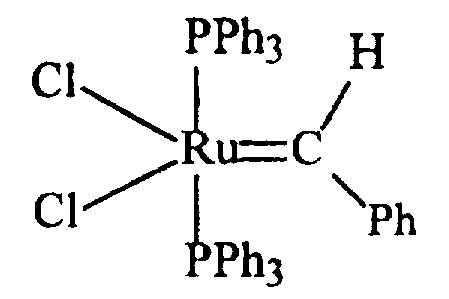
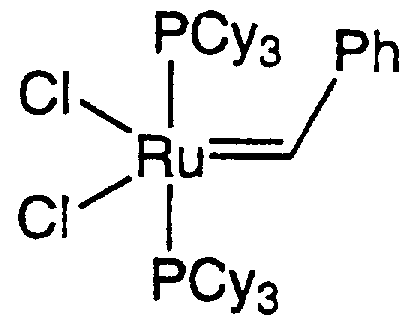
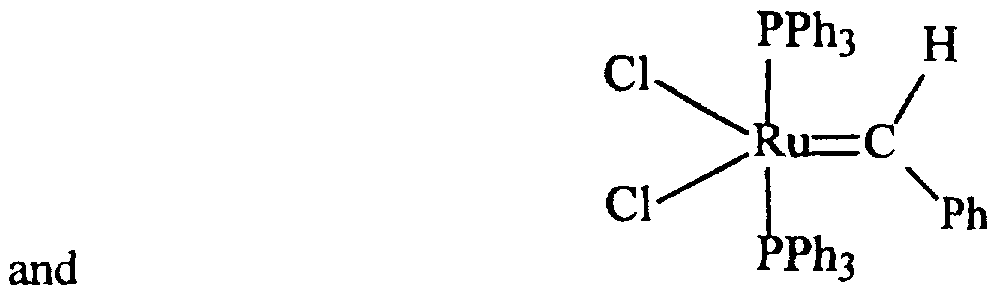
- the Ruthenium or Osmium carbene complex catalyst includes a Ruthenium or Osmium metal center that is in a +2 oxidation state, has an electron count of 16, and is pentacoordinated and the gel modification additive is an electron donor or Lewis base. More specifically, the Ruthenium or Osmium carbene complex catalyst may have the formula
- M may be Os or Ru; R and R" may be the same or different and may be hydrogen or a substituent group including C 2 -C 20 alkenyl, C 2 -C 20 alkynyl, C,-C 20 alkyl, aryl, C,-C 20 carboxylate, C,-C 20 alkoxy, C 2 -C 20 alkenyloxy, C 2 -
- X and X 1 may be the same or different and may be any anionic ligand; and L and L 1 may be the same or different and may be neutral electron donor.
- the substituent groups may be substituted with one or more groups including C,-C 5 alkyl, halide, C,-C 5 alkoxy, and phenyl.
- the phenyl group may be substituted with one or more groups including halide, C,-C 5 alkyl and C,-C 5 alkoxy.
- the substituent group may be substituted with one or more functional groups selected from the group consisting of hydroxyl, thiol, ketone, aldehyde, ester, ether, amine, imine, amide, nitro, carboxylic acid, disulfide, carbonate, isocyanate, carbodiimide, carboalkoxy, and halogen.
- the R and R 1 groups may be the same or different and may be hydrogen, substituted aryl, unsubstituted aryl, substituted vinyl, and unsubstituted vinyl; where the substituted aryl and substituted vinyl may be substituted with one or more groups selected from the group consisting of hydroxyl, thiol, ketone, aldehyde, ester, ether, amine, imine, amide, nitro, carboxylic acid, disulfide, carbonate, isocyanate, carbodiimide, carboalkoxy, halogen, C,-C 5 alkyl, C,-C 5 alkoxy, unsubstituted phenyl, and phenyl substituted with a halide, C,-C 5 alkyl or C,-C 5 alkoxy.
- the gel modification additive is a neutral electron donor or a neutral Lewis base.
- the gel modification additive may be a phosphine, sulfonated phosphine, phosphite, phosphinite, phosphonite, arsine, stibine, ether, amine, amide, sulfoxide, carboxyl, nitrosyl, pyridine, or thioether. More specifically, the gel modification additive may be a trialkylphosphine or triarylphosphine.
- Preferred gel modification additives include P(cyclohexyl) 3 , P(cyclopentyl) 3 , P(isopropyl) 3 , P(phenyl) 3 , and pyridine.
- the composition includes a catalyst of the formula
- Cy is cyclohexyl or cyclopentyl, and a gel modification additive having the formula P(Phenyl) 3 .
- the invention also includes a method for olefin metathesis which includes the step of contacting an olefin with a composition according to the present invention.
- the olefin may be unfunctionalized or functionalized to contain one or more functional groups selected from the group consisting of hydroxyl, thiol, ketone, aldehyde, ester, ether, amine, amide, nitro acid, carboxylic acid, disulfide, carbonate, carboalkoxy acid, isocyanate, carbodiimide, carboalkoxy, and halogen.
- the olefin may be a strained cyclic olefin, unstrained cyclic olefin, acyclic olefin, diene, or unsaturated polymer; each of which may be functionalized or unfunctionalized.
- the invention also includes a process for the ring opening metathesis polymerization of functionalized or unfunctionalized cyclic olefins. This process includes contacting a functionalized or unfunctionalized cyclic olefin with a composition according to the present invention.
- the cyclic olefins may be strained or unstrained and may be monocyclic, bicyclic, or multicyclic olefins.
- the cyclic olefin may contain one or more functional groups including of hydroxyl, thiol, ketone, aldehyde, ester, ether, amine, amide, nitro acid, carboxylic acid, disulfide, carbonate, carboalkoxy acid, isocyanate, carbodiimide, carboalkoxy, and halogen.
- the cyclic olefin is cyclobutene, cycloheptene, cyclooctene, cyclononene, cyclodecene, cyclooctadiene, cyclononadiene, norbornene and dicyclopentadiene; each of which may be functionalized or unfunctionalized.
- the cyclic olefin is dicyclopentadiene.
- the invention also includes a process for molding polymer articles in which a mixture comprising a functionalized or unfunctionalized cyclic olefin and a composition according to the present invention is provided in a mold.
- the mixture may either be prepared in the mold or prepared outside of the mold and then introduced into the mold. The mixture is then left to at least partially polymerize to form a polymer article and the polymer article is removed from the mold. Alternatively, the mixture may be coated onto an article and left to at least partially polymerize to form a coating.
- the mixture may be made by preparing a mixture of monomer and gel modification additive and adding the catalyst. The process may also include heating the mold and heating the mixture. The process may also include adding a crosslinking initiator to the mixture.
- the cyclic olefin may contain one or more functional groups including of hydroxyl, thiol, ketone, aldehyde, ester, ether, amine, amide, nitro acid, carboxylic acid, disulfide, carbonate, carboalkoxy acid, isocyanate, carbodiimide, carboalkoxy, and halogen.
- the cyclic olefin is cyclobutene, cycloheptene, cyclooctene, cyclononene, cyclodecene, cyclooctadiene, cyclononadiene, norbornene and dicyclopentadiene; each of which may be functionalized or unfunctionalized.
- the cyclic olefin is dicyclopentadiene.
- the invention also includes a method for controlling the rate of an olefin metathesis reaction that is catalyzed by a metathesis catalyst having an open coordination site.
- This method includes the step of contacting an active catalyst having an open coordination site with an olefin in the presence of a means for coordinating the catalyst open coordination site.
- the means may be an electron donor or Lewis base.
- olefin metathesis reactions are catalyzed and the rate of reaction is controlled by a composition that includes a Ruthenium or Osmium carbene complex catalyst as described above and a gel modification additive.
- a composition that includes a Ruthenium or Osmium carbene complex catalyst as described above and a gel modification additive.
- Gel Modification Additive because in certain reactions this component modifies the time in which the catalyst/monomer mixture gels, i.e. the time in which the mixture partially polymerizes.
- Gel Modification Additive we mean any substance that cooperates with the catalyst to change the rate of the catalyzed reaction. Most generally, we have found that the gel modification additive may be any electron donor or Lewis base.
- the Ruthenium or Osmium carbene complex catalyst and gel modification additive composition may be used to catalyze and control the rate of reaction in a variety of olefin metathesis reactions.
- olefin metathesis reactions that may be catalyzed include Ring Opening
- 08/550,679 (filed 10/31/95); 08/548,915 (filed 10/26/95); 08/548,445 (filed 10/26/95); 08/550,300 (filed 10/30/95), and 08/705,064 (filed 08/29/96).
- the Ruthenium and Osmium carbene complex catalysts of the present invention are stable in the presence of a variety of functional groups including hydroxyl, thiol, ketone, aldehyde, ester, ether, amine, amide, nitro acid, carboxylic acid, disulfide, carbonate, carboalkoxy acid, isocyanate, carbodiimide, carboalkoxy, and halogen. Since the catalysts are stable in the presence of these groups, the olefin substrate, the gel modification additive, and any substituent groups on the catalyst may include one or more of the above listed groups without deactivating the catalysts.
- Preferred catalysts used in the polymerization reactions described here are of the general structure: where M is Ru; R is hydrogen; R is substituted or unsubstituted aryl or substituted or unsubstituted vinyl; X and X 1 are Cl; and L and L 1 are triphenylphosphines or tricycloalkylphosphines such as tricyclopentylphosphine and tricyclohexylphosphine.
- the substituted aryl and substituted vinyl may each be substituted with one or more groups including C,-C 5 alkyl, halide, C,-C 3 alkoxy, and a phenyl group which may be optionally substituted with one or more halide, C,-C 5 alkyl, or C,-C 5 alkoxy groups.
- the substituted aryl and substituted vinyl may also be substituted with one or more functional groups including hydroxyl, thiol, ketone, aldehyde, ester, ether, amine, amide, nitro acid, carboxylic acid, disulfide, carbonate, carboalkoxy acid, isocyanate, carbodiimide, carboalkoxy, and halogen.
- the preferred gel modification additives are neutral electron donors such as phosphines.
- a particularly preferred embodiment of the present invention includes the ruthenium catalyst where L and L 1 are both tricyclopentylphosphine and the gel modification additive is triphenylphosphine (PPh 3 ).
- the rate of metathesis reaction may be controlled by varying the amount of gel modification additive (see Table 2) and the gel modification additive itself (see Table 3). As is conventional, the metathesis reaction rate may also be controlled by varying the reaction temperature.
- Gel modification additives that may be used in the present invention include phosphines, sulfonated phosphines, phosphites, phosphinites, phosphonites, arsines, stibines, ethers, amines, amides, sulfoxides, carboxyls, nitrosyls, pyridines, thioethers, nitriles, thiophenes, and furans.
- Specific gel modification additives include tricyclopentylphosphine, tricyclohexylphosphine, triphenylphosphite, pyridine, propylamine, tri buty lphosphine, benzonitrile, triphenylarsine, anhydrous acetonitrile, thiophene, and furan.
- Preferred gel modification additives include tricyclopentylphosphine, tricyclohexylphosphine, triisopropylphosphine, triphenylphosphine, and pyridine.
- the gel modification additive operates by modifying the coordination environment of the catalyst.
- the gel modification additives of the present invention may be used to either enhance or reduce the rate of polymerization.
- the specific action of the gel modification additive will depend on both the additive used and the catalyst.
- the magnitude of the reduction or enhancement of the reaction will also depend on the concentration of the gel modification additive. Below we describe how to select a gel modification additive to achieve a specific desired action.
- Triphenylphosphine is an example of a gel modification additive that acts to retard the rate of reaction when the catalyst has tricycloalkylphosphine L and L 1 ligands.
- the catalyst where L and L 1 are tricycloalkylphosphines is much more active in ROMP than the catalyst where L and L 1 are triphenylphosphines.
- the gel modification additive is triphenylphosphine, we therefore hypothesize that the added triphenylphosphine substitutes for the tricycloalkylphosphine in the coordination sphere of the ruthenium and decreases the activity of the catalyst.
- a gel modification additive decreases the rate of reaction if the catalyst becomes less active when its L and L 1 ligands are exchanged with the gel modification additive. Since monomer coordination is required for polymerization, the gel modification additive can also slow the polymerization reaction by competing with the monomer for coordination sites on the metal center. Hence, increasing the concentration of the gel modification additive will decrease the rate of polymerization reaction (See Table 3, samples 13-17).
- the pot life can be decreased (i.e., the reaction rate increased) by adding a gel modification additive such as tricyclohexylphosphine or tricyclopentylphosphine (see Table 3, samples 29-31).
- a gel modification additive such as tricyclohexylphosphine or tricyclopentylphosphine (see Table 3, samples 29-31).
- a gel modification additive increases the rate of reaction if the catalyst becomes more active when its L and L 1 ligands are exchanged with the gel modification additive.
- the concentration of gel modification additive is increased, the additive will compete with the monomer for coordination sites on the metal center and the additive may eventually act to decrease the rate of reaction.
- the gel modification additive is assumed to modify the coordination environment of the catalyst, we hypothesize that any substance capable of coordinating with the catalyst metal center will modify the rate of catalyzed reaction. This holds true not only for the specific Ruthenium and Osmium catalysts discussed above but also for any catalysts that initiate reaction through an open coordination site at a metal center.
- the gel modification additive may therefore be any species that is capable of coordinating with an open coordination site at a catalyst metal center. Examples of gel modification additives that may be used include electron donors, Lewis bases, and nucleophiles.
- the reaction and/or mold temperature By adjusting the amount of gel modification additive and the temperature, the pot life can be varied to the desired time.
- the amount of the additive required to achieve the desired pot life may depend on the coordinating ability of the gel modification additive used and the resulting catalyst activity of the substituted catalyst. As is shown in Table 3, some
- Lewis basic gel modification additives such as phosphites and propylamine completely inhibit the catalyst while some gel modification additives such as triphenylarsine, nitriles, ethers and thiols have little effect on polymerization rate at the low levels explored.
- pyridine was unexpectedly effective in controlling pot life.
- ROMP reactions have been used in the formation of high polymers by the ring-opening of cyclic olefins. The reaction has been used effectively for Reaction Injection Molding of thermosets. For these systems, techniques have been developed for controlling the gel time of the polymer by controlling the rate of catalyst formation after the catalyst components are mixed.
- the ROMP catalysts are the ruthenium or osmium carbene complex catalysts described above. In contrast to catalysts used in earlier RIM and Resin Transfer Molding ("RTM”) processes, these catalysts may be added to the monomer in the molding process in their "active" form. Also in contrast to the earlier RIM processes, the polymerization rate of the active catalyst can be controlled by adding a gel modification additive according to the present invention.
- DCPD dicyclopentadiene
- the pot life of the ROMP of DCPD is controlled by the addition of a gel modification additive to the reaction mixture.
- a gel modification additive By adding the gel modification additive, the room temperature pot life of the polymerization mixture may be extended from about 1 -9 minutes with no gel modification additive to greater than 2.5 hrs or more with the gel modification additive present.
- the present invention provides numerous advantages, most importantly, the ability to control the gel time or pot life while still being able to completely polymerize the monomer in a short period of time.
- the present invention further provides the ability to completely stop the polymerization reaction through decreasing the temperature of a catalyst concentrate (i.e., a concentrated mixture of the catalyst and gel modification additive dissolved in the monomer).
- a catalyst concentrate i.e., a concentrated mixture of the catalyst and gel modification additive dissolved in the monomer.
- adding the gel modification additive and lowering the temperature will allow the catalytic activity of the catalyst to be inhibited for extended periods of time (days or longer) and that the catalyst can then be "reactivated” by heating.
- the addition of the gel modification additives according to the present invention have an unexpected desirable effect on the properties of the resulting polymers.
- a Ruthenium complex catalyst of the present invention may be prepared in a one step synthesis as illustrated in the reaction sequence below.
- DCPD 500 mL DCPD was filtered under vacuum into a one liter round bottom flask through a 150 mL medium porosity sintered glass fritted funnel containing one inch of aluminum oxide.
- Lower grades of DCPD with lower freezing points can be used after similar purifying treatment.
- the flask was stirred under vacuum for about 5 minutes.
- the acetone test was a subjective test used to measure the extent of the polymerization reaction. In this test, a few drops of the catalyzed DCPD were removed with a small pipet and dropped into a test tube of acetone. Visual inspection yielded a qualitative measure of the extent of polymer formation. The visual results were described as “Nothing” (no polymerization), “Cloud”, “Flat Ball” (some polymerization), and "Ball.”
- triphenylphosphine was added to 4.052g of 95% DCPD in a test tube and the test tube shaken until the triphenylphosphine was dissolved.
- the reaction mixture was added to 60.06g of DCPD.
- the mixture was stirred slowly under vacuum (this is optional) for a further 5 minutes and then poured into a mold that had been preheated to 60.8°C. The peak exotherm occurred after about 19 minutes at a temperature of about 69.5°C. The mold was then allowed to cool to room temperature and the polymer removed from the mold and post cured at 190°C for I hour.
- the pot life for samples 2 and 3 is the time at which the polymerization mixture is becoming viscous but can still be poured.
- Gel time is defined as a) the time at which a stir bar ceases turning in a 250-ml flask during mixing of the catalyst / monomer; or b) the time at which a glass pipet lowered or pushed into a very high viscosity poured sample will no longer pick up or have "cling to" the pipet any of the polymerizing sample.
- Sample #8 In a 25 x 150mm test tube, add approximately 8.132g of Velsicol VHP DCPD that has been filtered and degassed with vacuum. (Note: filtering and degassing are optional). Add .060g of triphenylphosphine and mix until dissolved - about 3-5 minutes. Add .054g of catalyst (P(CyHexyl) 3 ) 2 Cl 2 RuCHPh and stir for about 3 minutes. Then put test tube into a dry ice / acetone bath for approximately 30 seconds to cool, and then put sample into a 35°F refrigeration and leave overnight.
- catalyst P(CyHexyl) 3
- VHP DCPD that has been filtered and degassed with vacuum. (Note: filtering and degassing is optional).
- Velsicol VHP DCPD was added.
- the gel modification additive was added.
- the catalyst P(CyHexyl) 3 ) 2 Cl 2 RuCHPh was added. After mixing for about 3 minutes (or less if gelation had occurred) the mixture was poured into a mold.
- VHP DCPD that has been filtered and degassed with vacuum. (Note: filtering and degassing are optional).
- filtering and degassing are optional.
- VHP DCPD that has been filtered and degassed with vacuum. (Note: filtering and degassing are optional).
- DCPD that has not been filtered or degassed
- test tube to the test tube and mix rapidly for about 1 minute or until the catalyst mixture is dissolved in the DCPD.
Landscapes
- Chemical & Material Sciences (AREA)
- Health & Medical Sciences (AREA)
- Chemical Kinetics & Catalysis (AREA)
- Medicinal Chemistry (AREA)
- Polymers & Plastics (AREA)
- Organic Chemistry (AREA)
- Polyoxymethylene Polymers And Polymers With Carbon-To-Carbon Bonds (AREA)
- Catalysts (AREA)
- Transition And Organic Metals Composition Catalysts For Addition Polymerization (AREA)
Abstract
Description


Claims







Priority Applications (6)
| Application Number | Priority Date | Filing Date | Title |
|---|---|---|---|
| AU12771/97A AU1277197A (en) | 1995-12-07 | 1996-12-03 | Method for extending the pot life of an olefin metathesis polymerization reaction |
| DE69630537T DE69630537T2 (en) | 1995-12-07 | 1996-12-03 | METHOD FOR EXTENDING THE POT TIME OF AN OLEFINMETATHESE POLYMERIZATION REACTION |
| JP52136497A JP4681699B2 (en) | 1995-12-07 | 1996-12-03 | Method for extending pot life of olefin metathesis polymerization reaction |
| KR19980704209A KR100391851B1 (en) | 1995-12-07 | 1996-12-03 | Method for extending the pot life of an olefin metathesis polymerization reaction |
| EP96943557A EP0865449B1 (en) | 1995-12-07 | 1996-12-03 | Method for extending the pot life of an olefin metathesis polymerization reaction |
| AT96943557T ATE253083T1 (en) | 1995-12-07 | 1996-12-03 | METHOD FOR EXTENDING THE POT LIFE OF AN OLEFIN METATHESIS POLYMERIZATION REACTION |
Applications Claiming Priority (4)
| Application Number | Priority Date | Filing Date | Title |
|---|---|---|---|
| US835695P | 1995-12-07 | 1995-12-07 | |
| US60/008,356 | 1995-12-07 | ||
| US08/759,018 | 1996-12-02 | ||
| US08/759,018 US5939504A (en) | 1995-12-07 | 1996-12-02 | Method for extending the pot life of an olefin metathesis polymerization reaction |
Publications (1)
| Publication Number | Publication Date |
|---|---|
| WO1997020865A1 true WO1997020865A1 (en) | 1997-06-12 |
Family
ID=26678109
Family Applications (1)
| Application Number | Title | Priority Date | Filing Date |
|---|---|---|---|
| PCT/US1996/019216 Ceased WO1997020865A1 (en) | 1995-12-07 | 1996-12-03 | Method for extending the pot life of an olefin metathesis polymerization reaction |
Country Status (10)
| Country | Link |
|---|---|
| US (1) | US5939504A (en) |
| EP (1) | EP0865449B1 (en) |
| JP (2) | JP4681699B2 (en) |
| KR (1) | KR100391851B1 (en) |
| CN (1) | CN1198854C (en) |
| AT (1) | ATE253083T1 (en) |
| AU (1) | AU1277197A (en) |
| DE (1) | DE69630537T2 (en) |
| ES (1) | ES2210400T3 (en) |
| WO (1) | WO1997020865A1 (en) |
Cited By (36)
| Publication number | Priority date | Publication date | Assignee | Title |
|---|---|---|---|---|
| EP0885911A1 (en) * | 1997-05-23 | 1998-12-23 | Ciba SC Holding AG | Two-component catalyst for ring-opening metathesis polymerization |
| WO1999050331A1 (en) * | 1998-03-31 | 1999-10-07 | Cryovac, Inc. | Novel regio-regular copolymer and methods of forming same |
| WO1999054374A1 (en) * | 1998-04-23 | 1999-10-28 | Hitachi Chemical Company, Ltd. | Curable molding material and method for producing molded article |
| WO1999058592A1 (en) * | 1998-05-14 | 1999-11-18 | Hitachi Chemical Company, Ltd. | Resin composition and process for producing cured article using the same |
| WO1999050330A3 (en) * | 1998-03-31 | 1999-11-18 | Ciba Sc Holding Ag | Ruthenium and osmium carbene carbonyl catalysts |
| US6040363A (en) * | 1997-09-05 | 2000-03-21 | A. O. Smith Corporation | Metathesis polymerizered olefin composites including sized reinforcement material |
| WO2000018579A1 (en) * | 1998-09-29 | 2000-04-06 | Cryovac, Inc. | Regio-regular functionalized polymeric packaging material |
| WO2000019789A1 (en) | 1998-09-28 | 2000-04-06 | Ibiden Co., Ltd. | Printed wiring board and method for producing the same |
| WO1999011958A3 (en) * | 1997-09-05 | 2002-01-10 | Smith Corp A O | Pipe made from metathesis polymerized olefins |
| US6383319B1 (en) | 1998-08-07 | 2002-05-07 | A.P.T. Aerospace, L.L.C. | Rocket fuels based on metal hydrides and poly-DCPD |
| US6409875B1 (en) | 1999-02-05 | 2002-06-25 | Materia, Inc. | Metathesis-active adhesion agents and methods for enhancing polymer adhesion to surfaces |
| US6426419B1 (en) | 1999-03-31 | 2002-07-30 | California Institute Of Technology | Ruthenium metal alkylidene complexes coordinated with triazolylidene ligands that exhibit high olefin metathesis activity |
| WO2003011455A1 (en) | 2001-08-01 | 2003-02-13 | California Institute Of Technology | Hexacoordinated ruthenium or osmium metal carbene metathesis catalysts |
| US6525125B1 (en) | 1999-02-05 | 2003-02-25 | Materia, Inc. | Polyolefin compositions having variable density and methods for their production and use |
| US6583236B1 (en) | 1999-02-05 | 2003-06-24 | Cymetech, Llc | Polyolefin compositions having enhanced ultraviolet and oxidative resistance and methods for their production and use |
| US6838489B2 (en) | 2001-03-23 | 2005-01-04 | Cymetech, Llc | High activity metal carbene metathesis catalysts generated using a thermally activated N-heterocyclic carbene precursor |
| US7205424B2 (en) * | 2003-06-19 | 2007-04-17 | University Of New Orleans Research And Technology Foundation, Inc. | Preparation of ruthenium-based olefin metathesis catalysts |
| US7285593B1 (en) | 1998-05-19 | 2007-10-23 | Advanced Polymer Technologies, Inc. | Polyolefin compositions optionally having variable toughness and/or hardness |
| US7329758B1 (en) | 1999-05-24 | 2008-02-12 | California Institute Of Technology | Imidazolidine-based metal carbene metathesis catalysts |
| EP1847558A4 (en) * | 2005-02-08 | 2008-10-08 | Kuraray Co | PROCESS FOR PRODUCING METATHESE POLYMER WITH CYCLE OPENING |
| US7622590B1 (en) | 1998-09-10 | 2009-11-24 | University Of New Orleans Foundation | Catalyst complex with carbene ligand |
| WO2011005136A1 (en) | 2009-07-09 | 2011-01-13 | Общество С Ограниченной Ответственностью "Объединённый Центр Исследований И Разработок" | Method for producing polydicyclopentadiene and materials based thereon |
| US8227371B2 (en) | 2010-09-24 | 2012-07-24 | Exxonmobil Chemical Patents Inc. | Class of olefin metathesis catalysts, methods of preparation, and processes for the use thereof |
| WO2012166259A2 (en) | 2011-05-31 | 2012-12-06 | Exxonmobil Chemical Patents Inc. | A novel class of olefin metathesis catalysts, methods of preparation, and processes for the use thereof |
| US8524930B2 (en) | 2011-05-31 | 2013-09-03 | Exxonmobil Chemical Patents Inc. | Class of olefin metathesis catalysts, methods of preparation, and processes for the use thereof |
| US9181360B2 (en) | 2011-08-12 | 2015-11-10 | Exxonmobil Chemical Patents Inc. | Polymers prepared by ring opening / cross metathesis |
| US9233994B2 (en) | 2010-03-22 | 2016-01-12 | University Court Of The University Of St. Andrews | Ruthenium complexes for use in olefin metathesis |
| WO2016063282A1 (en) | 2014-10-21 | 2016-04-28 | Stratasys Ltd. | Three-dimensional inkjet printing using ring-opening metathesis polymerization |
| WO2017134673A1 (en) | 2016-02-07 | 2017-08-10 | Stratasys Ltd. | Three-dimensional printing combining ring-opening metathesis polymerization and free radical polymerization |
| WO2017134674A1 (en) | 2016-02-05 | 2017-08-10 | Stratasys Ltd. | Three-dimensional inkjet printing using ring-opening metathesis polymerization |
| US9796889B2 (en) | 1999-02-05 | 2017-10-24 | Materia, Inc. | Metathesis-active adhesion agents and methods for enhancing polymer adhesion to surfaces |
| WO2017187434A1 (en) | 2016-04-26 | 2017-11-02 | Stratasys Ltd. | Three-dimensional inkjet printing using ring-opening metathesis polymerization |
| US10526308B2 (en) | 2016-05-04 | 2020-01-07 | Haldor Topsøe A/S | Adipate-type compounds and a process of preparing it |
| US11173653B2 (en) | 2016-02-05 | 2021-11-16 | Stratasys Ltd. | Three-dimensional inkjet printing using polyamide-forming materials |
| US20220195836A1 (en) * | 2020-12-17 | 2022-06-23 | Halliburton Energy Services, Inc. | Weight and density stable materials for flow control device float bodies |
| US12545438B2 (en) | 2021-02-19 | 2026-02-10 | Cesaroni Aerospace Incorporated | Rocket motor |
Families Citing this family (73)
| Publication number | Priority date | Publication date | Assignee | Title |
|---|---|---|---|---|
| US5831108A (en) * | 1995-08-03 | 1998-11-03 | California Institute Of Technology | High metathesis activity ruthenium and osmium metal carbene complexes |
| US6159890A (en) * | 1996-04-30 | 2000-12-12 | Bp Amoco Corporation | Ruthenium-containing catalyst system for olefin metathesis |
| US6156692A (en) * | 1996-04-30 | 2000-12-05 | Bp Amoco Corporation | Ruthenium-containing catalyst composition for olefin metathesis |
| EP0844264B1 (en) * | 1996-11-15 | 2003-01-08 | Ciba SC Holding AG | Catalytic mixture for ring-opening metathesis polymerization |
| DE69818240T2 (en) * | 1997-03-06 | 2004-07-01 | Ciba Speciality Chemicals Holding Inc. | NEW CATALYSTS |
| EP1135682B1 (en) | 1998-11-30 | 2007-07-11 | Nanosphere, Inc. | Nanoparticles with polymer shells |
| US20020015519A1 (en) * | 1998-12-11 | 2002-02-07 | Lord Corporation | Fiber substrate adhesion and coatings by contact metathesis polymerization |
| CA2361148C (en) | 1999-01-26 | 2009-06-30 | California Institute Of Technology | Novel methods for cross-metathesis of terminal olefins |
| US6486264B1 (en) * | 1999-05-31 | 2002-11-26 | Zeon Corporation | Process for producing hydrogenated ring-opening polymerization polymer of cycloolefin |
| CN1237090C (en) * | 2000-08-11 | 2006-01-18 | 日立化成工业株式会社 | Process for production of block copolymers, block copolymers produced by process and use of copolymers |
| US6610626B2 (en) * | 2000-09-05 | 2003-08-26 | Cymetech, Llp | Highly active metathesis catalysts generated in situ from inexpensive and air stable precursors |
| US20030113740A1 (en) * | 2001-04-26 | 2003-06-19 | Mirkin Chad A. | Oligonucleotide-modified ROMP polymers and co-polymers |
| US6872792B2 (en) | 2001-06-25 | 2005-03-29 | Lord Corporation | Metathesis polymerization adhesives and coatings |
| EP2251360B1 (en) * | 2001-08-29 | 2013-07-31 | California Institute of Technology | Ring-opening metathesis polymerization of bridged bicyclic and polycyclic olefins containing two or more heteroatoms |
| US20030186035A1 (en) * | 2001-08-30 | 2003-10-02 | Cruce Christopher J. | Infusion of cyclic olefin resins into porous materials |
| EP1485420A2 (en) * | 2002-03-12 | 2004-12-15 | Dow Global Technologies Inc. | Linear ethylene/vinyl alcohol and ethylene/vinyl acetate polymers and process for making same |
| AU2003232067A1 (en) * | 2002-05-06 | 2003-11-17 | Kerr Corporation | Composition curable by metathesis reaction |
| TW200420515A (en) * | 2002-07-23 | 2004-10-16 | Ppg Ind Ohio Inc | Glass fiber sizing compositions, sized glass fibers, and polyolefin composites |
| JP4922558B2 (en) * | 2002-08-01 | 2012-04-25 | カリフォルニア インスティテュート オブ テクノロジー | Synthesis of macrocyclic polymers by ring insertion polymerization of cyclic olefin monomers. |
| CA2512815A1 (en) * | 2003-01-13 | 2004-07-29 | Cargill, Incorporated | Method for making industrial chemicals |
| US7060769B2 (en) * | 2003-05-06 | 2006-06-13 | Kerr Corporation | Method of curing composition by metathesis reaction using reaction control agent |
| US7683148B2 (en) * | 2003-05-06 | 2010-03-23 | Kerr Corporation | Metathesis-curable composition with a reaction control agent |
| US7173097B2 (en) * | 2003-05-06 | 2007-02-06 | Kerr Corporation | Metathesis-curable composition with a reaction control agent |
| US7060770B2 (en) * | 2003-05-06 | 2006-06-13 | Kerr Corporation | Metathesis-curable composition with a reaction control agent |
| US7326380B2 (en) * | 2003-07-18 | 2008-02-05 | Northwestern University | Surface and site-specific polymerization by direct-write lithography |
| WO2006045070A2 (en) * | 2004-10-20 | 2006-04-27 | University Of Massachusetts | Peg-substituted pyridine ligands and related water-soluble catalysts |
| US7960555B2 (en) * | 2004-10-20 | 2011-06-14 | University Of Massachusetts | Substituted pyridine ligands and related water-soluble catalysts |
| US7001590B1 (en) | 2004-11-15 | 2006-02-21 | Kerr Corporation | Metathesis-curable composition |
| US7625551B2 (en) * | 2004-11-15 | 2009-12-01 | Kerr Corporation | Polyether-based dental impression material curable by metathesis reaction |
| US7645443B2 (en) * | 2004-11-15 | 2010-01-12 | Kerr Corporation | Polyether-based composition curable by metathesis reaction |
| JP5132060B2 (en) * | 2005-02-08 | 2013-01-30 | 株式会社クラレ | Method for producing ring-opening metathesis polymer |
| US7468417B2 (en) * | 2005-08-26 | 2008-12-23 | Korea Kumho Petrochemical Co., Ltd. | Method of preparing cyclic olefin copolymer having controlled gel contents |
| WO2007081987A2 (en) * | 2006-01-10 | 2007-07-19 | Elevance Renewable Sciences, Inc. | Method of making hydrogenated metathesis products |
| US7625991B2 (en) * | 2006-02-21 | 2009-12-01 | Kerr Corporation | Method for making alkoxy-siloxane polyether carboxylates terminated with functional olefin groups |
| EP2046719B1 (en) * | 2006-07-12 | 2013-09-04 | Elevance Renewable Sciences, Inc. | Ring opening cross-metathesis reaction of cyclic olefins with seed oils and the like |
| WO2008010961A2 (en) | 2006-07-13 | 2008-01-24 | Elevance Renewable Sciences, Inc. | Synthesis of terminal alkenes from internal alkenes and ethylene via olefin metathesis |
| DE102006040569A1 (en) * | 2006-08-30 | 2008-03-06 | Lanxess Deutschland Gmbh | Process for the metathesis degradation of nitrile rubbers |
| WO2008140468A2 (en) | 2006-10-13 | 2008-11-20 | Elevance Renewable Sciences, Inc. | METHODS OF MAKING α, ω -DICARBOXYLIC ACID ALKENE DERIVATIVES BY METATHESIS |
| WO2008048520A2 (en) | 2006-10-13 | 2008-04-24 | Elevance Renewable Sciences, Inc. | Methods of making organic compounds by metathesis and hydrocyanation |
| WO2008046106A2 (en) | 2006-10-13 | 2008-04-17 | Elevance Renewable Sciences, Inc. | Synthesis of terminal alkenes from internal alkenes via olefin metathesis |
| JP5186770B2 (en) * | 2007-01-31 | 2013-04-24 | 日本ゼオン株式会社 | Polymerizable composition and crosslinkable resin |
| US7906568B2 (en) * | 2007-09-04 | 2011-03-15 | General Electric Company | Coupling agent composition and associated method |
| US8039544B2 (en) * | 2007-09-04 | 2011-10-18 | General Electric Company | Coupling agent comprising a reaction product of an epoxy-substituted cycloolefin and an aromatic amine |
| US8039543B2 (en) * | 2007-09-04 | 2011-10-18 | General Electric Company | Composition comprising a coupling agent and a cycloolefin, the coupling agent comprising a reaction product of an epoxy-substituted cycloolefin and an aromatic amine |
| US7994238B2 (en) * | 2007-09-04 | 2011-08-09 | General Electric Company | Article and associated method |
| US7902279B2 (en) * | 2007-12-04 | 2011-03-08 | General Electric Company | Composition, article, and associated method |
| US7879963B2 (en) * | 2007-12-18 | 2011-02-01 | General Electric Company | Composition, article, and associated method |
| EP2294110B1 (en) * | 2008-06-20 | 2016-07-27 | 3M Innovative Properties Company | Molded microstructured articles and method of making same |
| CN102123837B (en) * | 2008-06-20 | 2014-07-09 | 3M创新有限公司 | Polymeric molds and articles made therefrom |
| MX345591B (en) | 2010-08-23 | 2017-02-07 | Materia Inc * | Vartm flow modifications for low viscosity resin systems. |
| EP2460587B1 (en) * | 2010-12-01 | 2017-10-18 | Rimtec Corporation | Ruthenium catalyst system for olefin metathesis |
| US8906999B2 (en) | 2011-02-17 | 2014-12-09 | Ccp Composites Us Llc | Styrene-free unsaturated polyester |
| JP5673337B2 (en) * | 2011-05-09 | 2015-02-18 | 三菱レイヨン株式会社 | Polymer and production method thereof |
| ES2805289T3 (en) | 2011-06-17 | 2021-02-11 | Materia Inc | Adhesion promoters and gelling modifiers for olefin metathesis compositions |
| RU2014151771A (en) | 2012-05-22 | 2016-07-20 | ДАУ ГЛОБАЛ ТЕКНОЛОДЖИЗ ЭлЭлСи | METHOD FOR PROCESSING DICYCLOPENTADIENE MONOMER |
| US20150152283A1 (en) | 2012-06-12 | 2015-06-04 | Materia, Inc. | Method and composition for improving adhesion of metathesis compositions to substrates |
| WO2013188201A1 (en) * | 2012-06-12 | 2013-12-19 | Elevance Renewable Sciences, Inc. | Methods of refining natural oils, and methods of producing fuel compositions |
| EP2859068A1 (en) * | 2012-06-12 | 2015-04-15 | Elevance Renewable Sciences, Inc. | Methods for suppressing dehydrogenation |
| US9527982B2 (en) | 2012-12-19 | 2016-12-27 | Materia, Inc. | Storage stable adhesion promoter compositions for cyclic olefin resin compositions |
| KR102020485B1 (en) | 2013-01-11 | 2019-09-11 | 삼성디스플레이 주식회사 | Block copolymer, method of forming the same and method of forming pattern |
| WO2014129486A1 (en) * | 2013-02-22 | 2014-08-28 | 日本ゼオン株式会社 | Polymerizable composition, cycloolefin-based polymer, cycloolefin-based resin molded body, and laminate |
| US9598531B2 (en) * | 2013-02-27 | 2017-03-21 | Materia, Inc. | Olefin metathesis catalyst compositions comprising at least two metal carbene olefin metathesis catalysts |
| EP2961778B1 (en) | 2013-02-27 | 2025-02-26 | Materia, Inc. | Metal carbene olefin metathesis two catalyst composition |
| US20160017089A1 (en) | 2013-03-15 | 2016-01-21 | Materia, Inc. | In-mold coating of romp polymers |
| MY173809A (en) | 2013-06-24 | 2020-02-24 | Materia Inc | Thermal insulation |
| MX394792B (en) | 2013-07-03 | 2025-03-24 | Materia Inc | LIQUID MOLDING COMPOSITIONS. |
| EP3092204A4 (en) | 2014-01-10 | 2017-12-20 | Materia, Inc. | Method and composition for improving adhesion of metathesis compositions to substrates |
| US10907018B2 (en) | 2014-02-27 | 2021-02-02 | Materia, Inc. | Adhesion promoter compositions for cyclic olefin resin compositions |
| EP2933274A1 (en) | 2014-04-16 | 2015-10-21 | Evonik Degussa GmbH | Method for the production of polymers by means of ring-opening polymerisation |
| CN116120715A (en) | 2015-02-12 | 2023-05-16 | 马特里亚公司 | Cycloolefin resin composition containing functional elastomer |
| PL3353187T3 (en) | 2015-09-24 | 2021-11-22 | Umicore Ag & Co. Kg | Metal carbene olefin metathesis catalysts |
| FR3088641B1 (en) | 2018-11-16 | 2021-11-19 | Demeta | OLEFINS METATHESIS PROCESS USING A CATALYST IN THE PRESENCE OF AN ACTIVATOR AND A DELAYING AGENT |
| CN111408411B (en) * | 2019-01-04 | 2024-02-13 | 中国石油化工股份有限公司 | Catalyst composition, preparation method thereof and application thereof in reaction of synthesizing 1-butene by ethylene selective dimerization |
Citations (1)
| Publication number | Priority date | Publication date | Assignee | Title |
|---|---|---|---|---|
| US5312940A (en) * | 1992-04-03 | 1994-05-17 | California Institute Of Technology | Ruthenium and osmium metal carbene complexes for olefin metathesis polymerization |
Family Cites Families (21)
| Publication number | Priority date | Publication date | Assignee | Title |
|---|---|---|---|---|
| US4400340A (en) * | 1982-01-25 | 1983-08-23 | Hercules Incorporated | Method for making a dicyclopentadiene thermoset polymer |
| US4380617A (en) * | 1982-01-20 | 1983-04-19 | The B. F. Goodrich Company | Preparation of polymers from cycloolefins |
| US4520181A (en) * | 1982-01-25 | 1985-05-28 | Hercules Incorporated | Method for making a dicyclopentadiene thermoset polymer containig elastomer |
| US4507453A (en) * | 1982-01-25 | 1985-03-26 | Hercules Incorporated | Dicyclopentadiene thermoset polymer |
| US4661575A (en) * | 1982-01-25 | 1987-04-28 | Hercules Incorporated | Dicyclopentadiene polymer product |
| US4748216A (en) * | 1982-01-25 | 1988-05-31 | Hercules Incorporated | Purified cycloolefin polymerization composition |
| DE3372102D1 (en) * | 1982-01-25 | 1987-07-23 | Hercules Inc | A dicyclopentadiene thermoset polymer and a catalyst and a method for making it |
| US4426502A (en) * | 1982-06-14 | 1984-01-17 | The B. F. Goodrich Company | Bulk polymerization of cycloolefins |
| US4418179A (en) * | 1982-09-29 | 1983-11-29 | The B. F. Goodrich Company | Impact modified polycycloolefins |
| US4701510A (en) * | 1985-12-16 | 1987-10-20 | The B.F. Goodrich Company | Polycycloolefins resistant to solvents |
| US4703098A (en) * | 1987-02-26 | 1987-10-27 | Hercules Incorporated | Metathesis polymerization of thermally oligomerized dicyclopentadiene |
| US4899005A (en) * | 1987-11-19 | 1990-02-06 | The B. F. Goodrich Company | Method for preparing cycloolefin copolymers with improved heat stability |
| US4943621A (en) * | 1988-08-04 | 1990-07-24 | The B. F. Goodrich Company | Storage stable components of reactive formulations for bulk polymerization of cycloolefin monomers |
| US4906797A (en) * | 1988-09-12 | 1990-03-06 | The B.F. Goodrich Company | Liquid dicyclopentadiene feedstock for bulk polymerization |
| US5331057A (en) * | 1992-02-22 | 1994-07-19 | Hoechst Aktiengesellschaft | Cycloolefin block copolymers and a process for their preparation |
| JP3067031B2 (en) * | 1992-04-03 | 2000-07-17 | カリフォルニア インスティチュート オブ テクノロジー | Olefin metathesis polymerization method |
| JP3234699B2 (en) * | 1993-12-22 | 2001-12-04 | 三井化学株式会社 | Tetracyclododecene polymer and method for producing the same |
| KR100396206B1 (en) * | 1994-12-23 | 2003-12-24 | 시바 스페셜티 케미칼스 홀딩 인크. | Polymerizable Compositions and Polymerization Methods |
| US5728785A (en) * | 1995-07-07 | 1998-03-17 | California Institute Of Technology | Romp polymerization in the presence of peroxide crosslinking agents to form high-density crosslinked polymers |
| US5831108A (en) * | 1995-08-03 | 1998-11-03 | California Institute Of Technology | High metathesis activity ruthenium and osmium metal carbene complexes |
| US6277935B1 (en) * | 1995-10-19 | 2001-08-21 | Ciba Specialty Chemicals Corporation | Polymerizable composition and polymerization method |
-
1996
- 1996-12-02 US US08/759,018 patent/US5939504A/en not_active Expired - Lifetime
- 1996-12-03 WO PCT/US1996/019216 patent/WO1997020865A1/en not_active Ceased
- 1996-12-03 AU AU12771/97A patent/AU1277197A/en not_active Abandoned
- 1996-12-03 DE DE69630537T patent/DE69630537T2/en not_active Expired - Lifetime
- 1996-12-03 ES ES96943557T patent/ES2210400T3/en not_active Expired - Lifetime
- 1996-12-03 AT AT96943557T patent/ATE253083T1/en not_active IP Right Cessation
- 1996-12-03 JP JP52136497A patent/JP4681699B2/en not_active Expired - Lifetime
- 1996-12-03 EP EP96943557A patent/EP0865449B1/en not_active Expired - Lifetime
- 1996-12-03 KR KR19980704209A patent/KR100391851B1/en not_active Expired - Fee Related
- 1996-12-03 CN CNB961998261A patent/CN1198854C/en not_active Expired - Lifetime
-
2006
- 2006-09-13 JP JP2006248538A patent/JP2007016247A/en active Pending
Patent Citations (2)
| Publication number | Priority date | Publication date | Assignee | Title |
|---|---|---|---|---|
| US5312940A (en) * | 1992-04-03 | 1994-05-17 | California Institute Of Technology | Ruthenium and osmium metal carbene complexes for olefin metathesis polymerization |
| US5342909A (en) * | 1992-04-03 | 1994-08-30 | California Institute Of Technology | Ruthenium and osmium metal carbene complexes for olefin metathesis polymerization |
Non-Patent Citations (1)
| Title |
|---|
| J. CHEM. SOC. DALTON TRANS., 1991, BURRELL et al., "Synthesis and Reactions of Ru(=CH2)CI(NO)(PPh3)2, a Stable Terminal Methylene Complex and the Crystal Structure of Ru(CH2PPh3)(n2-C2F4)CI(NO)(PPh3)", pages 609-614. * |
Cited By (66)
| Publication number | Priority date | Publication date | Assignee | Title |
|---|---|---|---|---|
| EP0885911A1 (en) * | 1997-05-23 | 1998-12-23 | Ciba SC Holding AG | Two-component catalyst for ring-opening metathesis polymerization |
| US6204347B1 (en) | 1997-05-23 | 2001-03-20 | Ciba Specialty Chemicals Corporation | Two-component catalyst for ROMP |
| EP1017564A4 (en) * | 1997-09-05 | 2001-01-17 | Smith Corp A O | Metathesis polymerized olefin composites including sized reinforcement material |
| US6410110B1 (en) * | 1997-09-05 | 2002-06-25 | A.O. Smith Corp. | Pipe made from metathesis polymerized olefins |
| WO1999011958A3 (en) * | 1997-09-05 | 2002-01-10 | Smith Corp A O | Pipe made from metathesis polymerized olefins |
| US6323296B1 (en) | 1997-09-05 | 2001-11-27 | Mark Warner | Metathesis polymerized olefin composites including sized reinforcement material |
| US6040363A (en) * | 1997-09-05 | 2000-03-21 | A. O. Smith Corporation | Metathesis polymerizered olefin composites including sized reinforcement material |
| AU749972B2 (en) * | 1998-03-31 | 2002-07-04 | Cryovac, Inc. | Novel regio-regular copolymer and methods of forming same |
| WO1999050331A1 (en) * | 1998-03-31 | 1999-10-07 | Cryovac, Inc. | Novel regio-regular copolymer and methods of forming same |
| US6506860B1 (en) * | 1998-03-31 | 2003-01-14 | Cryovac, Inc. | Regio-regular copolymer and methods of forming same |
| WO1999050330A3 (en) * | 1998-03-31 | 1999-11-18 | Ciba Sc Holding Ag | Ruthenium and osmium carbene carbonyl catalysts |
| JP3264442B1 (en) | 1998-03-31 | 2002-03-11 | クライオバック・インコーポレイテツド | Novel regioregular copolymer and method for producing the same |
| US6153714A (en) * | 1998-03-31 | 2000-11-28 | Cryovac, Inc. | Regio-regular copolymer and methods of forming same |
| US6465554B1 (en) | 1998-03-31 | 2002-10-15 | Ciba Specialty Chemicals Corporation | Ruthenium and osmium carbene carbonyl catalysts |
| WO1999054374A1 (en) * | 1998-04-23 | 1999-10-28 | Hitachi Chemical Company, Ltd. | Curable molding material and method for producing molded article |
| WO1999058592A1 (en) * | 1998-05-14 | 1999-11-18 | Hitachi Chemical Company, Ltd. | Resin composition and process for producing cured article using the same |
| US7285593B1 (en) | 1998-05-19 | 2007-10-23 | Advanced Polymer Technologies, Inc. | Polyolefin compositions optionally having variable toughness and/or hardness |
| US6383319B1 (en) | 1998-08-07 | 2002-05-07 | A.P.T. Aerospace, L.L.C. | Rocket fuels based on metal hydrides and poly-DCPD |
| US9339805B2 (en) | 1998-09-10 | 2016-05-17 | Materia, Inc. | Catalyst complex with carbene ligand |
| US7622590B1 (en) | 1998-09-10 | 2009-11-24 | University Of New Orleans Foundation | Catalyst complex with carbene ligand |
| US8859779B2 (en) | 1998-09-10 | 2014-10-14 | Materia, Inc. | Catalyst complex with carbene ligand |
| US7902389B2 (en) | 1998-09-10 | 2011-03-08 | Nolan Steven P | Catalyst complex with carbene ligand |
| US9233365B2 (en) | 1998-09-10 | 2016-01-12 | Materia, Inc. | Catalyst complex with carbene ligand |
| WO2000019789A1 (en) | 1998-09-28 | 2000-04-06 | Ibiden Co., Ltd. | Printed wiring board and method for producing the same |
| WO2000018579A1 (en) * | 1998-09-29 | 2000-04-06 | Cryovac, Inc. | Regio-regular functionalized polymeric packaging material |
| US6203923B1 (en) | 1998-09-29 | 2001-03-20 | Cryovac, Inc. | Regio-regular functionalized polymeric packaging material |
| JP3327910B2 (en) | 1998-09-29 | 2002-09-24 | クライオバック・インコーポレイテツド | Polymer packaging materials having regioregular functional groups |
| US6583236B1 (en) | 1999-02-05 | 2003-06-24 | Cymetech, Llc | Polyolefin compositions having enhanced ultraviolet and oxidative resistance and methods for their production and use |
| EP1165630A4 (en) * | 1999-02-05 | 2004-07-07 | Materia Inc | Polyolefin compositions having variable density and methods for their production and use |
| US6525125B1 (en) | 1999-02-05 | 2003-02-25 | Materia, Inc. | Polyolefin compositions having variable density and methods for their production and use |
| US9796889B2 (en) | 1999-02-05 | 2017-10-24 | Materia, Inc. | Metathesis-active adhesion agents and methods for enhancing polymer adhesion to surfaces |
| US6409875B1 (en) | 1999-02-05 | 2002-06-25 | Materia, Inc. | Metathesis-active adhesion agents and methods for enhancing polymer adhesion to surfaces |
| US7339006B2 (en) | 1999-02-05 | 2008-03-04 | Cymetech, L.L.C. | Metathesis-active adhesion agents and methods for enhancing polymer adhesion to surfaces |
| US8597794B2 (en) | 1999-02-05 | 2013-12-03 | Materia, Inc. | Metathesis-active adhesion agents and methods for enhancing polymer adhesion to surfaces |
| US6624265B2 (en) | 1999-03-31 | 2003-09-23 | California Institute Of Technology | Ruthenium metal alkylidene complexes coordinated with triazolylidene ligands that exhibit high olefin metathesis activity |
| US6426419B1 (en) | 1999-03-31 | 2002-07-30 | California Institute Of Technology | Ruthenium metal alkylidene complexes coordinated with triazolylidene ligands that exhibit high olefin metathesis activity |
| US7329758B1 (en) | 1999-05-24 | 2008-02-12 | California Institute Of Technology | Imidazolidine-based metal carbene metathesis catalysts |
| US8846939B2 (en) | 1999-05-24 | 2014-09-30 | California Institute Of Technology | Imidazolidine-based metal carbene metathesis catalysts |
| US6838489B2 (en) | 2001-03-23 | 2005-01-04 | Cymetech, Llc | High activity metal carbene metathesis catalysts generated using a thermally activated N-heterocyclic carbene precursor |
| WO2003011455A1 (en) | 2001-08-01 | 2003-02-13 | California Institute Of Technology | Hexacoordinated ruthenium or osmium metal carbene metathesis catalysts |
| US7205424B2 (en) * | 2003-06-19 | 2007-04-17 | University Of New Orleans Research And Technology Foundation, Inc. | Preparation of ruthenium-based olefin metathesis catalysts |
| US7700698B2 (en) | 2005-02-08 | 2010-04-20 | Kuraray Co., Ltd. | Process for producing ring-opening metathesis polymer |
| EP1847558A4 (en) * | 2005-02-08 | 2008-10-08 | Kuraray Co | PROCESS FOR PRODUCING METATHESE POLYMER WITH CYCLE OPENING |
| WO2011005136A1 (en) | 2009-07-09 | 2011-01-13 | Общество С Ограниченной Ответственностью "Объединённый Центр Исследований И Разработок" | Method for producing polydicyclopentadiene and materials based thereon |
| US9233994B2 (en) | 2010-03-22 | 2016-01-12 | University Court Of The University Of St. Andrews | Ruthenium complexes for use in olefin metathesis |
| US8227371B2 (en) | 2010-09-24 | 2012-07-24 | Exxonmobil Chemical Patents Inc. | Class of olefin metathesis catalysts, methods of preparation, and processes for the use thereof |
| WO2012166259A2 (en) | 2011-05-31 | 2012-12-06 | Exxonmobil Chemical Patents Inc. | A novel class of olefin metathesis catalysts, methods of preparation, and processes for the use thereof |
| US8524930B2 (en) | 2011-05-31 | 2013-09-03 | Exxonmobil Chemical Patents Inc. | Class of olefin metathesis catalysts, methods of preparation, and processes for the use thereof |
| US9181360B2 (en) | 2011-08-12 | 2015-11-10 | Exxonmobil Chemical Patents Inc. | Polymers prepared by ring opening / cross metathesis |
| US10259210B2 (en) | 2014-10-21 | 2019-04-16 | Statasys Ltd. | Three-dimensional inkjet printing using ring-opening metathesis polymerization |
| US11097529B2 (en) | 2014-10-21 | 2021-08-24 | Stratasys Ltd. | Three-dimensional inkjet printing using ring-opening metathesis polymerization |
| WO2016063282A1 (en) | 2014-10-21 | 2016-04-28 | Stratasys Ltd. | Three-dimensional inkjet printing using ring-opening metathesis polymerization |
| US10589511B2 (en) | 2014-10-21 | 2020-03-17 | Stratasys Ltd. | Three-dimensional inkjet printing using ring-opening metathesis polymerization |
| US11001725B2 (en) | 2016-02-05 | 2021-05-11 | Stratasys Ltd. | Three-dimensional inkjet printing using ring-opening metathesis polymerization |
| WO2017134674A1 (en) | 2016-02-05 | 2017-08-10 | Stratasys Ltd. | Three-dimensional inkjet printing using ring-opening metathesis polymerization |
| US11173653B2 (en) | 2016-02-05 | 2021-11-16 | Stratasys Ltd. | Three-dimensional inkjet printing using polyamide-forming materials |
| US11655386B2 (en) | 2016-02-05 | 2023-05-23 | Stratasys Ltd. | Three-dimensional inkjet printing using ring-opening metathesis polymerization |
| US11981825B2 (en) | 2016-02-05 | 2024-05-14 | Stratasys Ltd. | Three-dimensional inkjet printing using ring-opening metathesis polymerization |
| WO2017134673A1 (en) | 2016-02-07 | 2017-08-10 | Stratasys Ltd. | Three-dimensional printing combining ring-opening metathesis polymerization and free radical polymerization |
| US11179879B2 (en) | 2016-02-07 | 2021-11-23 | Stratasys Ltd. | Three-dimensional printing combining ring-opening metathesis polymerization and free radical polymerization |
| WO2017187434A1 (en) | 2016-04-26 | 2017-11-02 | Stratasys Ltd. | Three-dimensional inkjet printing using ring-opening metathesis polymerization |
| US11118004B2 (en) | 2016-04-26 | 2021-09-14 | Stratasys Ltd. | Three-dimensional inkjet printing using ring-opening metathesis polymerization |
| US10526308B2 (en) | 2016-05-04 | 2020-01-07 | Haldor Topsøe A/S | Adipate-type compounds and a process of preparing it |
| US10745375B2 (en) | 2016-05-04 | 2020-08-18 | Haldor Topsøe A/S | Adipate-type compounds and a process of preparing it |
| US20220195836A1 (en) * | 2020-12-17 | 2022-06-23 | Halliburton Energy Services, Inc. | Weight and density stable materials for flow control device float bodies |
| US12545438B2 (en) | 2021-02-19 | 2026-02-10 | Cesaroni Aerospace Incorporated | Rocket motor |
Also Published As
| Publication number | Publication date |
|---|---|
| ES2210400T3 (en) | 2004-07-01 |
| DE69630537T2 (en) | 2004-07-29 |
| EP0865449A1 (en) | 1998-09-23 |
| CN1198854C (en) | 2005-04-27 |
| EP0865449B1 (en) | 2003-10-29 |
| US5939504A (en) | 1999-08-17 |
| KR19990071922A (en) | 1999-09-27 |
| DE69630537D1 (en) | 2003-12-04 |
| KR100391851B1 (en) | 2004-06-16 |
| AU1277197A (en) | 1997-06-27 |
| JP2007016247A (en) | 2007-01-25 |
| JP4681699B2 (en) | 2011-05-11 |
| EP0865449A4 (en) | 2000-05-31 |
| JP2000504359A (en) | 2000-04-11 |
| CN1208421A (en) | 1999-02-17 |
| ATE253083T1 (en) | 2003-11-15 |
Similar Documents
| Publication | Publication Date | Title |
|---|---|---|
| EP0865449B1 (en) | Method for extending the pot life of an olefin metathesis polymerization reaction | |
| US6310121B1 (en) | Polymeric composites including dicyclopentadiene and related monomers | |
| JP4122059B2 (en) | Polymerization of low grade DCPD monomer using olefin metathesis catalyst | |
| EP1423195B1 (en) | Hexacoordinated ruthenium or osmium metal carbene metathesis catalysts | |
| JP4271942B2 (en) | Selective ring-opening cross-metathesis of cycloolefins | |
| Krause et al. | Monolith‐and Silica‐Supported Carboxylate‐Based Grubbs–Herrmann‐Type Metathesis Catalysts | |
| US6107420A (en) | Thermally initiated polymerization of olefins using Ruthenium or osmium vinylidene complexes | |
| JP4410422B2 (en) | Metal carbene metathesis catalysts based on imidazolidine | |
| KR100445598B1 (en) | High Metathesis Activity Ruthenium and Osmium Metal Carbene Complexes | |
| US5728917A (en) | Polymer depolymerization using ruthenium and osmium carbene complexes | |
| CN1068886C (en) | Peroxide crosslinking of ROMP polymers | |
| EP1996631B1 (en) | Metathesis interpolymers having terminal functional group(s) | |
| US6583236B1 (en) | Polyolefin compositions having enhanced ultraviolet and oxidative resistance and methods for their production and use | |
| JP4402354B2 (en) | Highly active metal carbene metathesis catalysts produced by use of thermally activated N-heterocyclic carbene precursors | |
| JP2010138413A (en) | Method for performing olefin metathesis reaction and method for performing ring opening metathesis polymerization reaction | |
| JP2000513393A (en) | Catalyst mixture and polymerizable composition | |
| CN102159603B (en) | Adducts of metathesis polymers and preparation thereof | |
| HK1017697A (en) | Method for extending the pot life of an olefin metathesis polymerization reaction | |
| US6888018B2 (en) | Organometallic compound having high metathesis activity and method for preparation thereof, methathesis reaction catalyst comprising the compound, method of polymerization using the catalyst, and polymer produced by the method of polymerization |
Legal Events
| Date | Code | Title | Description |
|---|---|---|---|
| WWE | Wipo information: entry into national phase |
Ref document number: 96199826.1 Country of ref document: CN |
|
| AK | Designated states |
Kind code of ref document: A1 Designated state(s): AL AM AT AU AZ BB BG BR BY CA CH CN CZ DE DK EE ES FI GB GE HU IL IS JP KE KG KP KR KZ LK LR LS LT LU LV MD MG MK MN MW MX NO NZ PL PT RO RU SD SE SG SI SK TJ TM TR TT UA UG UZ VN AM AZ BY KG KZ MD RU TJ TM |
|
| AL | Designated countries for regional patents |
Kind code of ref document: A1 Designated state(s): KE LS MW SD SZ UG AT BE CH DE DK ES FI FR GB GR IE IT LU MC NL PT SE BF BJ CF CG CI CM GA GN |
|
| DFPE | Request for preliminary examination filed prior to expiration of 19th month from priority date (pct application filed before 20040101) | ||
| 121 | Ep: the epo has been informed by wipo that ep was designated in this application | ||
| WWE | Wipo information: entry into national phase |
Ref document number: 1199800474 Country of ref document: VN |
|
| WWE | Wipo information: entry into national phase |
Ref document number: 1996943557 Country of ref document: EP Ref document number: 1019980704209 Country of ref document: KR |
|
| WWP | Wipo information: published in national office |
Ref document number: 1996943557 Country of ref document: EP |
|
| REG | Reference to national code |
Ref country code: DE Ref legal event code: 8642 |
|
| WWP | Wipo information: published in national office |
Ref document number: 1019980704209 Country of ref document: KR |
|
| WWG | Wipo information: grant in national office |
Ref document number: 1019980704209 Country of ref document: KR |
|
| WWG | Wipo information: grant in national office |
Ref document number: 1996943557 Country of ref document: EP |