WO1997022618A1 - INHIBITORS OF INTERLEUKIN-1β CONVERTING ENZYME - Google Patents

INHIBITORS OF INTERLEUKIN-1β CONVERTING ENZYME Download PDF

Info

Publication number
WO1997022618A1
WO1997022618A1 PCT/US1996/020370 US9620370W WO9722618A1 WO 1997022618 A1 WO1997022618 A1 WO 1997022618A1 US 9620370 W US9620370 W US 9620370W WO 9722618 A1 WO9722618 A1 WO 9722618A1
Authority
WO
WIPO (PCT)
Prior art keywords
group
disease
straight
optionally substituted
branched alkyl
Prior art date
Legal status (The legal status is an assumption and is not a legal conclusion. Google has not performed a legal analysis and makes no representation as to the accuracy of the status listed.)
Ceased
Application number
PCT/US1996/020370
Other languages
French (fr)
Inventor
Guy W. Bemis
John P. Duffy
Wolf Herman Fridman
Julian M. C. Golec
David J. Livingston
Michael D. Mullican
Mark A. Murcko
Robert E. Zelle
Current Assignee (The listed assignees may be inaccurate. Google has not performed a legal analysis and makes no representation or warranty as to the accuracy of the list.)
Vertex Pharmaceuticals Inc
Original Assignee
Vertex Pharmaceuticals Inc
Priority date (The priority date is an assumption and is not a legal conclusion. Google has not performed a legal analysis and makes no representation as to the accuracy of the date listed.)
Filing date
Publication date
Priority to IL12495496A priority Critical patent/IL124954A/en
Priority to AT96945237T priority patent/ATE310011T1/en
Priority to KR1019980704611A priority patent/KR20000064454A/en
Priority to HK99101441.5A priority patent/HK1016611B/en
Priority to BR9612191A priority patent/BR9612191A/en
Priority to AU14658/97A priority patent/AU722936B2/en
Priority to JP52300897A priority patent/JP4009320B2/en
Priority to EP96945237A priority patent/EP0876395B1/en
Application filed by Vertex Pharmaceuticals Inc filed Critical Vertex Pharmaceuticals Inc
Priority to NZ326555A priority patent/NZ326555A/en
Priority to DE69635458T priority patent/DE69635458T2/en
Priority to PL96327333A priority patent/PL188813B1/en
Publication of WO1997022618A1 publication Critical patent/WO1997022618A1/en
Priority to NO982774A priority patent/NO982774L/en
Anticipated expiration legal-status Critical
Ceased legal-status Critical Current

Links

Classifications

    • CCHEMISTRY; METALLURGY
    • C07ORGANIC CHEMISTRY
    • C07KPEPTIDES
    • C07K5/00Peptides containing up to four amino acids in a fully defined sequence; Derivatives thereof
    • C07K5/02Peptides containing up to four amino acids in a fully defined sequence; Derivatives thereof containing at least one abnormal peptide link
    • C07K5/0205Peptides containing up to four amino acids in a fully defined sequence; Derivatives thereof containing at least one abnormal peptide link containing the structure -NH-(X)3-C(=0)-, e.g. statine or derivatives thereof
    • CCHEMISTRY; METALLURGY
    • C07ORGANIC CHEMISTRY
    • C07KPEPTIDES
    • C07K5/00Peptides containing up to four amino acids in a fully defined sequence; Derivatives thereof
    • AHUMAN NECESSITIES
    • A61MEDICAL OR VETERINARY SCIENCE; HYGIENE
    • A61PSPECIFIC THERAPEUTIC ACTIVITY OF CHEMICAL COMPOUNDS OR MEDICINAL PREPARATIONS
    • A61P1/00Drugs for disorders of the alimentary tract or the digestive system
    • AHUMAN NECESSITIES
    • A61MEDICAL OR VETERINARY SCIENCE; HYGIENE
    • A61PSPECIFIC THERAPEUTIC ACTIVITY OF CHEMICAL COMPOUNDS OR MEDICINAL PREPARATIONS
    • A61P1/00Drugs for disorders of the alimentary tract or the digestive system
    • A61P1/04Drugs for disorders of the alimentary tract or the digestive system for ulcers, gastritis or reflux esophagitis, e.g. antacids, inhibitors of acid secretion, mucosal protectants
    • AHUMAN NECESSITIES
    • A61MEDICAL OR VETERINARY SCIENCE; HYGIENE
    • A61PSPECIFIC THERAPEUTIC ACTIVITY OF CHEMICAL COMPOUNDS OR MEDICINAL PREPARATIONS
    • A61P1/00Drugs for disorders of the alimentary tract or the digestive system
    • A61P1/16Drugs for disorders of the alimentary tract or the digestive system for liver or gallbladder disorders, e.g. hepatoprotective agents, cholagogues, litholytics
    • AHUMAN NECESSITIES
    • A61MEDICAL OR VETERINARY SCIENCE; HYGIENE
    • A61PSPECIFIC THERAPEUTIC ACTIVITY OF CHEMICAL COMPOUNDS OR MEDICINAL PREPARATIONS
    • A61P1/00Drugs for disorders of the alimentary tract or the digestive system
    • A61P1/18Drugs for disorders of the alimentary tract or the digestive system for pancreatic disorders, e.g. pancreatic enzymes
    • AHUMAN NECESSITIES
    • A61MEDICAL OR VETERINARY SCIENCE; HYGIENE
    • A61PSPECIFIC THERAPEUTIC ACTIVITY OF CHEMICAL COMPOUNDS OR MEDICINAL PREPARATIONS
    • A61P11/00Drugs for disorders of the respiratory system
    • AHUMAN NECESSITIES
    • A61MEDICAL OR VETERINARY SCIENCE; HYGIENE
    • A61PSPECIFIC THERAPEUTIC ACTIVITY OF CHEMICAL COMPOUNDS OR MEDICINAL PREPARATIONS
    • A61P11/00Drugs for disorders of the respiratory system
    • A61P11/06Antiasthmatics
    • AHUMAN NECESSITIES
    • A61MEDICAL OR VETERINARY SCIENCE; HYGIENE
    • A61PSPECIFIC THERAPEUTIC ACTIVITY OF CHEMICAL COMPOUNDS OR MEDICINAL PREPARATIONS
    • A61P13/00Drugs for disorders of the urinary system
    • AHUMAN NECESSITIES
    • A61MEDICAL OR VETERINARY SCIENCE; HYGIENE
    • A61PSPECIFIC THERAPEUTIC ACTIVITY OF CHEMICAL COMPOUNDS OR MEDICINAL PREPARATIONS
    • A61P13/00Drugs for disorders of the urinary system
    • A61P13/12Drugs for disorders of the urinary system of the kidneys
    • AHUMAN NECESSITIES
    • A61MEDICAL OR VETERINARY SCIENCE; HYGIENE
    • A61PSPECIFIC THERAPEUTIC ACTIVITY OF CHEMICAL COMPOUNDS OR MEDICINAL PREPARATIONS
    • A61P17/00Drugs for dermatological disorders
    • AHUMAN NECESSITIES
    • A61MEDICAL OR VETERINARY SCIENCE; HYGIENE
    • A61PSPECIFIC THERAPEUTIC ACTIVITY OF CHEMICAL COMPOUNDS OR MEDICINAL PREPARATIONS
    • A61P17/00Drugs for dermatological disorders
    • A61P17/06Antipsoriatics
    • AHUMAN NECESSITIES
    • A61MEDICAL OR VETERINARY SCIENCE; HYGIENE
    • A61PSPECIFIC THERAPEUTIC ACTIVITY OF CHEMICAL COMPOUNDS OR MEDICINAL PREPARATIONS
    • A61P17/00Drugs for dermatological disorders
    • A61P17/14Drugs for dermatological disorders for baldness or alopecia
    • AHUMAN NECESSITIES
    • A61MEDICAL OR VETERINARY SCIENCE; HYGIENE
    • A61PSPECIFIC THERAPEUTIC ACTIVITY OF CHEMICAL COMPOUNDS OR MEDICINAL PREPARATIONS
    • A61P19/00Drugs for skeletal disorders
    • AHUMAN NECESSITIES
    • A61MEDICAL OR VETERINARY SCIENCE; HYGIENE
    • A61PSPECIFIC THERAPEUTIC ACTIVITY OF CHEMICAL COMPOUNDS OR MEDICINAL PREPARATIONS
    • A61P19/00Drugs for skeletal disorders
    • A61P19/02Drugs for skeletal disorders for joint disorders, e.g. arthritis, arthrosis
    • AHUMAN NECESSITIES
    • A61MEDICAL OR VETERINARY SCIENCE; HYGIENE
    • A61PSPECIFIC THERAPEUTIC ACTIVITY OF CHEMICAL COMPOUNDS OR MEDICINAL PREPARATIONS
    • A61P19/00Drugs for skeletal disorders
    • A61P19/08Drugs for skeletal disorders for bone diseases, e.g. rachitism, Paget's disease
    • AHUMAN NECESSITIES
    • A61MEDICAL OR VETERINARY SCIENCE; HYGIENE
    • A61PSPECIFIC THERAPEUTIC ACTIVITY OF CHEMICAL COMPOUNDS OR MEDICINAL PREPARATIONS
    • A61P19/00Drugs for skeletal disorders
    • A61P19/08Drugs for skeletal disorders for bone diseases, e.g. rachitism, Paget's disease
    • A61P19/10Drugs for skeletal disorders for bone diseases, e.g. rachitism, Paget's disease for osteoporosis
    • AHUMAN NECESSITIES
    • A61MEDICAL OR VETERINARY SCIENCE; HYGIENE
    • A61PSPECIFIC THERAPEUTIC ACTIVITY OF CHEMICAL COMPOUNDS OR MEDICINAL PREPARATIONS
    • A61P21/00Drugs for disorders of the muscular or neuromuscular system
    • AHUMAN NECESSITIES
    • A61MEDICAL OR VETERINARY SCIENCE; HYGIENE
    • A61PSPECIFIC THERAPEUTIC ACTIVITY OF CHEMICAL COMPOUNDS OR MEDICINAL PREPARATIONS
    • A61P21/00Drugs for disorders of the muscular or neuromuscular system
    • A61P21/04Drugs for disorders of the muscular or neuromuscular system for myasthenia gravis
    • AHUMAN NECESSITIES
    • A61MEDICAL OR VETERINARY SCIENCE; HYGIENE
    • A61PSPECIFIC THERAPEUTIC ACTIVITY OF CHEMICAL COMPOUNDS OR MEDICINAL PREPARATIONS
    • A61P25/00Drugs for disorders of the nervous system
    • AHUMAN NECESSITIES
    • A61MEDICAL OR VETERINARY SCIENCE; HYGIENE
    • A61PSPECIFIC THERAPEUTIC ACTIVITY OF CHEMICAL COMPOUNDS OR MEDICINAL PREPARATIONS
    • A61P25/00Drugs for disorders of the nervous system
    • A61P25/14Drugs for disorders of the nervous system for treating abnormal movements, e.g. chorea, dyskinesia
    • A61P25/16Anti-Parkinson drugs
    • AHUMAN NECESSITIES
    • A61MEDICAL OR VETERINARY SCIENCE; HYGIENE
    • A61PSPECIFIC THERAPEUTIC ACTIVITY OF CHEMICAL COMPOUNDS OR MEDICINAL PREPARATIONS
    • A61P25/00Drugs for disorders of the nervous system
    • A61P25/28Drugs for disorders of the nervous system for treating neurodegenerative disorders of the central nervous system, e.g. nootropic agents, cognition enhancers, drugs for treating Alzheimer's disease or other forms of dementia
    • AHUMAN NECESSITIES
    • A61MEDICAL OR VETERINARY SCIENCE; HYGIENE
    • A61PSPECIFIC THERAPEUTIC ACTIVITY OF CHEMICAL COMPOUNDS OR MEDICINAL PREPARATIONS
    • A61P29/00Non-central analgesic, antipyretic or antiinflammatory agents, e.g. antirheumatic agents; Non-steroidal antiinflammatory drugs [NSAID]
    • AHUMAN NECESSITIES
    • A61MEDICAL OR VETERINARY SCIENCE; HYGIENE
    • A61PSPECIFIC THERAPEUTIC ACTIVITY OF CHEMICAL COMPOUNDS OR MEDICINAL PREPARATIONS
    • A61P3/00Drugs for disorders of the metabolism
    • A61P3/08Drugs for disorders of the metabolism for glucose homeostasis
    • A61P3/10Drugs for disorders of the metabolism for glucose homeostasis for hyperglycaemia, e.g. antidiabetics
    • AHUMAN NECESSITIES
    • A61MEDICAL OR VETERINARY SCIENCE; HYGIENE
    • A61PSPECIFIC THERAPEUTIC ACTIVITY OF CHEMICAL COMPOUNDS OR MEDICINAL PREPARATIONS
    • A61P31/00Antiinfectives, i.e. antibiotics, antiseptics, chemotherapeutics
    • AHUMAN NECESSITIES
    • A61MEDICAL OR VETERINARY SCIENCE; HYGIENE
    • A61PSPECIFIC THERAPEUTIC ACTIVITY OF CHEMICAL COMPOUNDS OR MEDICINAL PREPARATIONS
    • A61P31/00Antiinfectives, i.e. antibiotics, antiseptics, chemotherapeutics
    • A61P31/04Antibacterial agents
    • AHUMAN NECESSITIES
    • A61MEDICAL OR VETERINARY SCIENCE; HYGIENE
    • A61PSPECIFIC THERAPEUTIC ACTIVITY OF CHEMICAL COMPOUNDS OR MEDICINAL PREPARATIONS
    • A61P31/00Antiinfectives, i.e. antibiotics, antiseptics, chemotherapeutics
    • A61P31/12Antivirals
    • A61P31/14Antivirals for RNA viruses
    • A61P31/18Antivirals for RNA viruses for HIV
    • AHUMAN NECESSITIES
    • A61MEDICAL OR VETERINARY SCIENCE; HYGIENE
    • A61PSPECIFIC THERAPEUTIC ACTIVITY OF CHEMICAL COMPOUNDS OR MEDICINAL PREPARATIONS
    • A61P35/00Antineoplastic agents
    • AHUMAN NECESSITIES
    • A61MEDICAL OR VETERINARY SCIENCE; HYGIENE
    • A61PSPECIFIC THERAPEUTIC ACTIVITY OF CHEMICAL COMPOUNDS OR MEDICINAL PREPARATIONS
    • A61P35/00Antineoplastic agents
    • A61P35/02Antineoplastic agents specific for leukemia
    • AHUMAN NECESSITIES
    • A61MEDICAL OR VETERINARY SCIENCE; HYGIENE
    • A61PSPECIFIC THERAPEUTIC ACTIVITY OF CHEMICAL COMPOUNDS OR MEDICINAL PREPARATIONS
    • A61P37/00Drugs for immunological or allergic disorders
    • AHUMAN NECESSITIES
    • A61MEDICAL OR VETERINARY SCIENCE; HYGIENE
    • A61PSPECIFIC THERAPEUTIC ACTIVITY OF CHEMICAL COMPOUNDS OR MEDICINAL PREPARATIONS
    • A61P37/00Drugs for immunological or allergic disorders
    • A61P37/02Immunomodulators
    • AHUMAN NECESSITIES
    • A61MEDICAL OR VETERINARY SCIENCE; HYGIENE
    • A61PSPECIFIC THERAPEUTIC ACTIVITY OF CHEMICAL COMPOUNDS OR MEDICINAL PREPARATIONS
    • A61P43/00Drugs for specific purposes, not provided for in groups A61P1/00-A61P41/00
    • AHUMAN NECESSITIES
    • A61MEDICAL OR VETERINARY SCIENCE; HYGIENE
    • A61PSPECIFIC THERAPEUTIC ACTIVITY OF CHEMICAL COMPOUNDS OR MEDICINAL PREPARATIONS
    • A61P5/00Drugs for disorders of the endocrine system
    • AHUMAN NECESSITIES
    • A61MEDICAL OR VETERINARY SCIENCE; HYGIENE
    • A61PSPECIFIC THERAPEUTIC ACTIVITY OF CHEMICAL COMPOUNDS OR MEDICINAL PREPARATIONS
    • A61P5/00Drugs for disorders of the endocrine system
    • A61P5/14Drugs for disorders of the endocrine system of the thyroid hormones, e.g. T3, T4
    • AHUMAN NECESSITIES
    • A61MEDICAL OR VETERINARY SCIENCE; HYGIENE
    • A61PSPECIFIC THERAPEUTIC ACTIVITY OF CHEMICAL COMPOUNDS OR MEDICINAL PREPARATIONS
    • A61P5/00Drugs for disorders of the endocrine system
    • A61P5/48Drugs for disorders of the endocrine system of the pancreatic hormones
    • AHUMAN NECESSITIES
    • A61MEDICAL OR VETERINARY SCIENCE; HYGIENE
    • A61PSPECIFIC THERAPEUTIC ACTIVITY OF CHEMICAL COMPOUNDS OR MEDICINAL PREPARATIONS
    • A61P7/00Drugs for disorders of the blood or the extracellular fluid
    • AHUMAN NECESSITIES
    • A61MEDICAL OR VETERINARY SCIENCE; HYGIENE
    • A61PSPECIFIC THERAPEUTIC ACTIVITY OF CHEMICAL COMPOUNDS OR MEDICINAL PREPARATIONS
    • A61P7/00Drugs for disorders of the blood or the extracellular fluid
    • A61P7/06Antianaemics
    • AHUMAN NECESSITIES
    • A61MEDICAL OR VETERINARY SCIENCE; HYGIENE
    • A61PSPECIFIC THERAPEUTIC ACTIVITY OF CHEMICAL COMPOUNDS OR MEDICINAL PREPARATIONS
    • A61P9/00Drugs for disorders of the cardiovascular system
    • AHUMAN NECESSITIES
    • A61MEDICAL OR VETERINARY SCIENCE; HYGIENE
    • A61PSPECIFIC THERAPEUTIC ACTIVITY OF CHEMICAL COMPOUNDS OR MEDICINAL PREPARATIONS
    • A61P9/00Drugs for disorders of the cardiovascular system
    • A61P9/10Drugs for disorders of the cardiovascular system for treating ischaemic or atherosclerotic diseases, e.g. antianginal drugs, coronary vasodilators, drugs for myocardial infarction, retinopathy, cerebrovascula insufficiency, renal arteriosclerosis
    • CCHEMISTRY; METALLURGY
    • C07ORGANIC CHEMISTRY
    • C07KPEPTIDES
    • C07K5/00Peptides containing up to four amino acids in a fully defined sequence; Derivatives thereof
    • C07K5/02Peptides containing up to four amino acids in a fully defined sequence; Derivatives thereof containing at least one abnormal peptide link
    • C07K5/0202Peptides containing up to four amino acids in a fully defined sequence; Derivatives thereof containing at least one abnormal peptide link containing the structure -NH-X-X-C(=0)-, X being an optionally substituted carbon atom or a heteroatom, e.g. beta-amino acids
    • AHUMAN NECESSITIES
    • A61MEDICAL OR VETERINARY SCIENCE; HYGIENE
    • A61KPREPARATIONS FOR MEDICAL, DENTAL OR TOILETRY PURPOSES
    • A61K38/00Medicinal preparations containing peptides
    • YGENERAL TAGGING OF NEW TECHNOLOGICAL DEVELOPMENTS; GENERAL TAGGING OF CROSS-SECTIONAL TECHNOLOGIES SPANNING OVER SEVERAL SECTIONS OF THE IPC; TECHNICAL SUBJECTS COVERED BY FORMER USPC CROSS-REFERENCE ART COLLECTIONS [XRACs] AND DIGESTS
    • Y02TECHNOLOGIES OR APPLICATIONS FOR MITIGATION OR ADAPTATION AGAINST CLIMATE CHANGE
    • Y02ATECHNOLOGIES FOR ADAPTATION TO CLIMATE CHANGE
    • Y02A50/00TECHNOLOGIES FOR ADAPTATION TO CLIMATE CHANGE in human health protection, e.g. against extreme weather
    • Y02A50/30Against vector-borne diseases, e.g. mosquito-borne, fly-borne, tick-borne or waterborne diseases whose impact is exacerbated by climate change

Definitions

  • the present invention relates to novel classes of compounds which are inhibitors of terleukm-l ⁇ converting enzyme ("ICE") .
  • This invention also relates to pharmaceutical compositions comprising these compounds .
  • the compounds and pharmaceutical compositions of th s invention are particularly well suited for inhibiting ICE activity and consequently, may be advantageously used as agents against mterleukm-l- ("IL-1") ana apoptosis-mediated diseases, including inflammatory diseases, autoimmune diseases, proliferative disorders, infectious c seases, and degenerative diseases.
  • IL-1 mterleukm-l-
  • This invention also relates to methods for inhibiting ICE activity and methods for treating mterleukm-l- and apoptosis-mediated diseases using the compounds and compositions of this invention.
  • Interleukin 1 is a pro- inflammatory and immunoregulatory protein that stimulates fibroblast differentiation and proliferation, the production of prostaglandms, collagenase and phospholipase by synovial cells and chondrocytes, basophil and eosmophil degranulation and neutrophil activation.
  • IL-1 Interleukin 1
  • Oppenhei J.H. et al, Immunology Today, 7, pp. 45-56 (1986) . As such, it is involved the pathogenesis of chronic and acute inflammatory and autoimmune diseases.
  • IL-1 is both a mediator of inflammatory symptoms and of the destruction of the cartilage proteoglycan in afflicted joints.
  • IL-1 is also a highly potent bone resorption agent. It is reiterately referred to as "osteoclast activating factor" in destructive bone diseases such as osteoarthritis and multiple myeloma. Batailie, R. et al., Int. J. Clm. Lab. Res.. 21, p. 283 (1992) .
  • IL-1 can promote tumor cell growth and adhesion.
  • IL-1 also stimulates production of other cytokines such as IL-6, which can modulate tumor development. Tartour et al . , Cancer Res. 54, 6243 (1994) .
  • IL-1 is predominantly produced by peripheral blood monocytes as part of the inflammatory response and exists in two distinct agonist forms, IL-l ⁇ and IL-
  • IL-l ⁇ is synthesized as a biologically inactive precursor, pIL-l ⁇ .
  • pIL-l ⁇ lacks a conventional leader sequence and is not processed by a signal peptidase. March, C.J., Nature. 315, pp. 641-647 (1985) .
  • pIL-l ⁇ is cleaved by interleukin-l ⁇ converting enzyme ("ICE") between Asp- 116 and Ala-117 to produce the biologically active C-termmal fragment found human serum and synovial fluid.
  • ICE interleukin-l ⁇ converting enzyme
  • ICE is a cysteme protease localized primarily m monocytes . It converts precursor IL-l ⁇ to the mature form. Black, R.A. et al . , FEBS Lett . , 247, pp. 386-390 (1989); Kostura, M.J. et al . , Pro . Natl. Acad. Sci. USA. 86, pp. 5227-5231 (1989) . Processing by ICE is also necessary for the transport of mature
  • ICE or its homologues, also appears to be involved in the regulation of cell death or apoptosis. Yuan, J. et al., Cell. 75, pp. 641-652 (1993) ; Miura, M. et al . , Cell. 75, pp. 653-660 (1993) ; Nett-Fiordalisi, M.A. et al., J. Cell Biochem.. 17B, p. 117 (1993) . In particular, ICE or ICE homologues are thought to be associated with the regulation of apoptosis neurogenerative diseases, such as Alzheimer's ana
  • Parkinson's disease Marx, J. and M. Baringa, Science, 259, pp. 760-762 (1993) ; Gagliardim, V. et al., Science. 263, pp. 826-828 (1994) .
  • ICE has been demonstrated to mediate apoptosis (programmed cell death) m certain tissue types.
  • McGr, H. Science. 267, p. 1445 (1995) ; Whyte, M. and Evan, G., Nature, 376, p. 17 (1995) ; Martin, S.J. and Green, D.R. , Cell, 82, p. 349 (1995) ; Alnemri, E.S., et al. , J. Biol . Chem., 270, p. 4312 (1995); Yuan, J. Curr. Qpin. Cell Biol., 7, p. 211 (1995) .
  • Therapeutic applications for inhibition of apoptosis may include treatment of Alzheimer's disease, Parkinson's disease, stroke, mycardial infarction, spinal atrophy, and aging.
  • a transgenic mouse with a disruption of the ICE gene is deficient in Fas-mediated apoptosis.
  • Kuida, et al . (1995) This activity of ICE is distinct from its role as the processing enzyme for pro-IL-l ⁇ . It is conceivable that m certain tissue types, inhibition of ICE may not affect secretion of mature IL-l ⁇ , but may inhibit apoptosis.
  • ICE has been previously described as a heterodimer composed of two subunits, p20 and plO (20kDa and lOkDa molecular weight, respectively) .
  • subunits are derived from a 45kDa proenzyme (p45) by way of a p30 form, through an activation mechanism that is autocatalytic.
  • Thornberry N.A. et al., Nature, 356, pp. 768-774 (1992) .
  • the ICE proenzyme has been divided into several functional domains: a prodomam (pl4), a p22/20 subunit, a polypeptide linker and a plO subunit.
  • a prodomam pl4
  • p22/20 subunit a polypeptide linker
  • plO subunit a prodomam
  • Thornberry et al .. supra Casano et al., Genomics, 20, pp. 474-481 (1994) .
  • Full length p45 has been characterized by its cDNA and ammo acid sequences.
  • the p20 and plO cDNA and ammo acid sequences are also known.
  • Murme and rat ICE have also been sequenced and cloned. They have high am o acid and nucleic acid sequence homology to human ICE. Miller, D.K. et al., Ann. N.Y. Acad. S ⁇ .. 696, pp. 133-148 (1993) ; Molmeaux, S.M. et al . , Proc. Nat. Acad. Sci., 90, pp.
  • ICE has been determined at atomic resolution by X-ray crystallography. Wilson, K.P., et al., Nature, 370, pp. 270-275 (1995) .
  • the active enzyme exists as a tetramer of two p20 and two plO subunits .
  • human homologs of ICE with sequence similarities m the active site regions of the enzymes. Such homologs include TX (or ICE re l - II or ICH-2) (Faucheu, et al . , EMBO J.. 14, p. 1914 (1995) ; Kamens J., et al . , J. Biol.
  • Each of these ICE homologs, as well as ICE itself, is capable of inducing apoptosis when overexpressed in transfected cell lines. Inhibition of one or more of these homologs with the peptidyl ICE inhibitor Tyr-Val- Ala-Asp-chloromethylketone results in inhibition of apoptosis primary cells or cell lines. Lazebnik et al., Nature, 371, p. 346 (1994) .
  • the compounds described herein are also capable of inhibiting one or more homologs of ICE (see example) . Therefore, one can envisage using these compounds to inhibit apoptosis tissue types that contain ICE homologs, but which do not contain active ICE or produce mature IL-1 ⁇ .
  • ICE inhibitors represent a class of compounds useful for the control of inflammation or apoptosis or both.
  • Peptide and peptidyl inhibitors of ICE have been described.
  • Such peptidyl inhibitors of ICE have been observed to block the production of mature IL-l ⁇ a mouse model of inflammation (Ku, et al. or vide mfra) and to suppress growth of leukemia cells i n vi tro (Estrov, et al., Blood, 84, p. 380a (1994) ) .
  • the present invention provides novel classes of compounds, and pharmaceutically acceptable derivatives thereof, that are useful as inhibitors of ICE. These compounds can be used alone or in combination with other therapeutic or prophylactic agents, such as antibiotics, immunomodulators or other anti-inflammatory agents, for the treatment or prophylaxis of diseases mediated by IL-1 or by apoptosis. According to a preferred embodiment, the compounds of this invention are capable of binding to the active site of ICE and inhibiting the activity of that enzyme.
  • active site refers to any or all of the following sites m ICE: the substrate binding site, the site where an inhibitor binds and the site where the cleavage of substrate occurs.
  • alkenyl refers to a straight-chain or branched-cham alkenyl radical containing from 2 to 10, carbon atoms.
  • examples of such radicals include, but are not limited to, ethenyl, E- and Z-propenyl, isopropenyl, E- and Z- butenyl, E- and Z- isobutenyl, E- and Z-pentenyl, decenyl and the like.
  • alkynyl refers to a straight-chain or branched-cham alkynyl radical containing from 2 to 10, carbon atoms.
  • examples of such radicals include, but are not limited to, ethynyl (acetylenyl) , propynyl, propargyl, butynyl, hexynyl, decynyl and the like.
  • substitute refers to the replacement of a hydrogen atom in a compound with a substituent group.
  • K 1 refers to a numerical measure of the effectiveness of a compound in inhibiting the activity of a target enzyme such as ICE. Lower values of K-_ reflect higher effectiveness.
  • the K-_ value is a derived by fitting experimentally determined rate data to standard enzyme kinetic equations (see I. H. Segel, Enzyme Kinetics, Wiley-Interscience, 1975) .
  • patient as used in this application refers to any mammal, especially humans.
  • pharmaceutically effective amount refers to an amount effective in treating or ameliorating an IL-1- or apoptosis-mediated disease in a patient.
  • prophylactically effective amount refers to an amount effective in preventing or substantially lessening IL-1- or apoptosis-mediated disease in a patient.
  • pharmaceutically acceptable carrier or adjuvant refers to a non-toxic carrier or ad uvant that may be administered to a patient, together with a compound of this invention, and which does not destroy the pnarmacological activity thereof.
  • pharmaceutically acceptable derivative means any pharmaceutically acceptable salt, ester, or salt of such ester, of a compound of this invention or any other compound which, upon administration to a recipient, is capable of providing (directly or indirectly) a compound of this invention or an anti-ICE active metabolite or residue thereof.
  • Pharmaceutically acceptable salts of the compounds of this invention include, for example, those derived from pharmaceutically acceptable inorganic and organic acids and bases.
  • suitable acids include hydrochloric, hydrobromic, sulfuric, nitric, perchloric, fumaric, aleic, phosphoric, glycolic, lactic, salicylic, succinic, toluene-p-sulfonic, tartaric, acetic, citric, methanesulfonic, formic, benzoic, malonic, naphthalene-2-sulfon ⁇ c and benzenesulfonic acids.
  • Salts derived from appropriate bases include alkali metal (e.g., sodium), alkaline earth metal (e.g., magnesium), ammonium and N- (C ] __ alkyl) 4 salts.
  • This invention also envisions the "quaternization" of any basic nitrogen-containing groups of the compounds disclosed herein.
  • the basic nitrogen can be quaternized with any agents known to those of ordinary skill m the art including, for example, lower alkyl halides, such as methyl, ethyl, propyl and butyl chloride, bromides and iodides; dialkyl sulfates including dimethyl, diethyl, dibutyl and diamyl sulfates; long chain halides such as decyl, lauryl, my ⁇ styl and stearyl chlorides, bromides and iodides; and aralkyl halides including benzyl and phenethyl bromides. Water or oil-soluble or dispersible products may be obtained by such quaternization.
  • the ICE inhibitors of this invention may contain one or more "asymmetric" carbon atoms and thus may occur as racemates and racemic mixtures, single enantiomers, diastereomeric mixtures and individual diastereomers. All such lsomeric forms of these compounds are expressly included m the present invention.
  • Each stereogenic carbon may be of the R or S configuration.
  • specific compounds and scaffolds exemplified in this application may be depicted in a particular stereochemical configuration, compounds and scaffolds having either the opposite stereochemistry at any given chiral center or mixtures thereof are also envisioned.
  • the ICE inhibitors of this invention may comprise structures which may optionally be substituted at carbon, nitrogen or other atoms by various substituents. Such structures may be singly or multiply substituted.
  • the structures contain between 0 and 3 substituents.
  • each substituent may be picked independently of any other substituent as long as the combination of substituents results m the formation of a stable compound.
  • Combinations of substituents and variables envisioned by this invention are only those that result in the formation of stable compounds.
  • stable refers to compounds which possess stability sufficient to allow manufacture and administration to a mammal by methods known in the art. Typically, such compounds are stable at a temperature of 40°C or less, m the absence of moisture or other chemically reactive conditions, for at least a week.
  • ICE inhibitors of one embodiment (A) of this invention are those of formula ( ) :
  • n 1 or 2;
  • R ] _2 and R 13 are independently selected from the group consisting of -R , -C(0)-R 7 , and -C (0) -N (H) -R 7 , or R 12 and R 13 taken together form a 4-8-membered saturated cyclic group;
  • R 2 is -H or a -C 1 _ 6 straight or branched alkyl group optionally substituted with Ar, -OH, -OR 7 , -C(0)-0H, C(0)-NH 2 , or -OR 5 ;
  • R 7 is selected from the group consisting of -Ar, a -C ;] __g straight or branched alkyl group optionally substituted with -Ar, a -C 1 _ 6 straight or branched alkenyl group optionally substituted with Ar, and a ⁇ c 2- 6 straight or branched alkynyl group optionally substituted with Ar;
  • R 5 is selected from the group consisting of: -C(0)-R 7 , -C(0) -0R 9 , -C(0)-N(R 9 ) (R 10 ) ,
  • each Ar is a cyclic group independently selected from the set consisting of phenyl, 1-naphthyl, 2- naphthyl, mdenyl, azulenyl, fluorenyl and anthracenyl and a heterocyclic aromatic group selected from the group consisting of 2-furyl, 3-furyl, 2-th ⁇ enyl, 3- thienyl, 2-py ⁇ dyl, 3-py ⁇ dyl, 4-pyr ⁇ dyl, pyrrolyl, oxazolyl, thiazolyl, lmidazolyl, pyraxolyl, 2- pyrazolmyl, pyrazolidmyl, isoxazolyl, isotriazolyl, 1, 2, 3-oxad ⁇ azolyl, 1, 2, 3-tr ⁇ azolyl, 1, 3, 4-th ⁇ ad ⁇ azolyl, pyndazmyl, pyri idinyl, pyrazmyl, 1, 3, 5-t ⁇ a
  • each R 9 and R 10 is independently selected from the group consisting of -H, -Ar, and a ⁇ _- ⁇ straight or branched alkyl group optionally substituted with -Ar;
  • each Rq is a -C ] __ 5 straight or branched alkyl group optionally substituted with -Ar or -W;
  • W is -ORg, -SR 9 , -N(H)C(NR 9 )N(R 9 ) (R 10 ) , -C(0)-OR 9 , or -N(R 9 ) (R 10 ) ;
  • R 3 is -CH 2 Ar or a 5 to 15-membered non-aromatic cyclic group which contains between 1 and 3 rings, and which optionally contains between 0 and 2 endocyclic oxygen atoms, sulfur atoms, or nitrogen atoms, and wherein the cyclic group is optionally fused with Ar;
  • R 5 is -C(0)-R 7 or -C (0) C (0) -R 7 ;
  • each R 4 is a C 1 _ 5 straight or branched alky., group optionally substituted with Ar;
  • n 1;
  • R? is -CH Ar or cC
  • E is CH or N
  • each D is independently N or C, wherein C is optionally substituted with -0R 14 , -F, -Cl, -Br, -I, -N0 2 , -S(0) 2 -N(R 9 ) (R 10 ) , -C(0)-N(R 9 ) (R 10 ) , -N(H)-C ⁇ 0)- N(R 9 ) (R 10 ), -N(R 9 ) (R 10 ), -C(0)-0R 9 , -CF 3 , -0CF 3 , a C ⁇ ⁇ straight or branched alkyl group, 1, 2-methylened ⁇ oxy, -CN, or -N(H)C(NR 9 )N(R 9 ) (R 10 ) ;
  • each R 9 and R 10 is independently selected from the group consisting of -H, -Ar, and a -C 1 _ 5 straight or branched alkyl group optionally substituted with -Ar.
  • the ICE inhibitors of another embodiment of this invention are those of formula ( ⁇ ) :
  • R- j _ is selected from the group consisting of
  • X is selected from the group consisting of 0, S, S (0) , and S (0) 2 ;
  • R 6 is independently selected from the group consisting of: -H,
  • R 7 is selected from the group consisting of -Ar, _c l- 6 straight or branched alkyl group optionally substituted with -Ar, a -C 1 _ 6 straight or branched alkenyl group optionally substituted with Ar, and a -C 2 _ 6 straight or branched alkynyl group optionally substituted with Ar;
  • R 3 is selected from the following group, m which any ring may optionally be singly or multiply substituted by -NH 2 , -C(0)-OH, -F, -Cl, -Br, -I, -OH, -N0 2 , -CN, -perfluoroalkyl C 1 _ 3 alkyl, -R 5 , -0R 5 , -OR 7 , -N(H)-R 5 , -N(H)-R 7 , 1, 2-methylened ⁇ oxy, and -SR 7 :
  • Y is independently selected from the group consisting of 0 and S;
  • each Ar is a cyclic group independently selected from the set consisting of a carbocyclic aromatic group selected from the group consisting of phenyl, 1- naphthyl, 2-naphthyl, mdenyl, azulenyl, fluorenyl and anthracenyl and a heterocyclic aromatic group selected from the group consisting of 2-furyl, 3-furyl, 2- thienyl, 3-thienyl, 2-py ⁇ dyl, 3-py ⁇ dyl, 4-pyr ⁇ dyl, pyrrolyl, oxazolyl, thiazolyl, imidazolyl, pyraxolyl, 2-pyrazolinyl, pyrazolidinyl, isoxazolyl, isotriazolyl, 1, 2, 3-oxadiazolyl, 1, 2, 3-tr ⁇ azolyl, 1, 3, 4-th ⁇ ad ⁇ azolyl, pyridazinyl, pyrimidinyl, pyra
  • each R 9 and R 10 are independently selected from the group consisting of -H, -Ar, and a -C 1 _5 straight or branched alkyl group optionally substituted with Ar;
  • each R 14 is -H or a C 1 _ 6 straight or branched alkyl group
  • R 5 is selected from the group consisting of: -C(0)-R 7 ,
  • R 4 is a -C ⁇ -,5 straight or branched alkyl group optionally substituted with Ar or W;
  • W is -0R 9 , -SR 9 , -N(H)C(NR 9 )N(R 9 ) (R 10 ) , -C(0)-OR 9 , and -NR 9 , (R 10 ) ;
  • R 3 is -CH 2 Ar or a 5 to 15-membered non-aromatic cyclic group which contains between 1 and 3 rings, and which optionally contains between 0 and 2 endocyclic oxygen atoms, sulfur atoms, or nitrogen atoms, and wherein the cyclic group is optionally fused with Ar;
  • R 2 is -H, or a C ] __g straight or branched alkyl group, wherein the alkyl group is optionally substituted with Ar, -OH, -0R 7 , -C(0)-OH, C(0)-NH 2 , or -OR 5 ;
  • R ⁇ is -C(0)-H
  • R 5 is -C(0)-R 7 or -C (0) C (0) -R 7 ;
  • R 4 is a -C ] __5 straight or branched alkyl group optionally substituted by -Ar;
  • n 1;
  • n 1;
  • each D is independently N or C, wherein C is optionally substituted with -OR 14 , -F, -Cl, -Br, -I, -N0 2 , -S(0) 2 -N(R 9 ) (R 10 ), -C(0)-N(R 9 ) (R 10 ) , -N(H)-C(0)- N(R 9 ) (R 10 ), -N(R 9 ) (R 10 ), -C(0)-0R 9 , -CF 3 , -OCF 3 , a C 1 _ 6 straight or branched alkyl group, 1, 2-methylened ⁇ oxy, -CN, or -N ⁇ H)C(NR 9 )N(R 9 ) (R 10 ) ;
  • each Rg and R 10 is independently selected from the group consisting of -H, -Ar, and a -C- j __ 5 straight or branched alkyl group optionally substituted with -Ar.
  • R 5 is -C(0)-R 7 or -C (0) C (0) -R 7 ;
  • R 4 is a _ C ] __5 straight or branched alkyl group optionally substituted by -Ar;
  • n 1;
  • n 1;
  • each D is independently N or C, wherein C is optionally substituted with -0R 14 , -F, -Cl, -Br, -I,
  • ICE inhibitors of this invention may be synthesized using conventional techniques.
  • these compounds are conveniently synthesized from readily available starting materials.
  • the compounds of this invention are among the most readily synthesized ICE inhibitors known.
  • Previously described ICE inhibitors often contain four or more chiral centers and numerous peptide linkages. The relative ease with which the compounds of this invention can be synthesized represents an advantage m the large scale production of these compounds.
  • the compounds of this invention may exist m various equilibrium forms, depending on conditions including choice of solvent, pH, and others known to the practitioner skilled in the art. All such forms of these compounds are expressly included m the present invention.
  • R 1 is -(CO)-H
  • compounds of this invention may also take acyloxv ketal, acyloxy acetal, ketal or acetal form:
  • the compounds of this invention may be modified by appropriate functionalities to enhance selective biological properties. Such modifications are known the art and include those which increase biological penetration into a given biological system (e.g., blood, lymphatic system, central nervous system) , increase oral availability, increase solubility to allow administration by injection, alter metabolism and alter rate of excretion.
  • the compounds may be altered to pro-drug form such that the desired compound is created m the body of the patient as the result of the action of metabolic or other biochemical processes on the pro-drug.
  • pro-drug forms typically demonstrate little or no activity in m vi tro assays.
  • pro-drug forms include ketal, acetal, oxime, and hydrazone forms of compounds which contain ketone or aldehyde groups, especially where they occur m the R- j _ group of the compounds of this invention.
  • Other examples of pro-drug forms include the hemi- ketal, hemi-acetal, acyloxy ketal, acyloxy acetal, ketal, and acetal forms that are described in EQ1 ana EQ2.
  • the compounds of this invention are excellent ligands for ICE. Accordingly, these compounds are capable of targeting and inhibiting events m IL-1- and apoptosis-mediated diseases and, thus, the ultimate activity of that protein inflammatory diseases, autoimmune diseases, proliferative disorders, infectious diseases, and degenerative diseases.
  • the compounds of this invention innibit the conversion of precursor IL-l ⁇ to mature IL-l ⁇ by inhibiting ICE. Because ICE is essential for the production of mature IL-l ⁇ , inhibition of that enzyme effectively blocks initiation of IL-1 mediated physiological effects and symptoms, such as inflammation, by inhibiting the production of mature IL-1.
  • the compounds of this invention effectively function as IL-1 inhibitors.
  • the compounds of this invention may be employed in a conventional manner for the treatment of diseases which are mediated by IL-1 or apoptosis. Such methods of treatment, their dosage levels and requirements may be selected by those of ordinary skill m the art from available methods and techniques.
  • a compound of this invention may be combined with a pharmaceutically acceptable adjuvant for administration to a patient suffering from an IL-1- or apoptosis-mediated disease m a pharmaceutically acceptable manner and in an amount effective to lessen the severity of that disease.
  • the compounds of this invention may be used m compositions and methods for treating or protecting individuals against IL-I- or apoptosis-mediated diseases over extended periods of time.
  • the compounds may be employed m such compositions either alone or together with other compounds of this invention a manner consistent with the conventional utilization of ICE inhibitors in pharmaceutical compositions.
  • a compound of this invention may be combined with pharmaceutically acceptable adjuvants conventionally employed m vaccines and administered prophylactically effective amounts to protect individuals over an extended period time against IL-1- or apoptosis-mediated diseases.
  • the compounds of this invention may also be co-admmistered with other ICE inhibitors to increase the effect of therapy or prophylaxis against various IL-1- or apoptosis-mediated diseases.
  • the compounds of this invention may be used m combination either conventional anti- inflammatory agents or with matrix metalloprotease inhibitors, lipoxygenase inhibitors and antagonists of cyto ines other than IL-l ⁇ .
  • the compounds of this invention can also be administered in combination with lmmunomodulators (e.g., bropi ⁇ mme, anti-human alpha mterferon antibody, IL-2, GM-CSF, methion e enkephalm, mterferon alpha, diethyldithiocarbamate, tumor necrosis factor, naltrexone and rEPO) or with prostaglandms, to prevent or combat IL-1- or apoptosis-mediated disease symptoms such as inflammation.
  • lmmunomodulators e.g., bropi ⁇ mme, anti-human alpha mterferon antibody, IL-2, GM-CSF, methion e enkephalm, mterferon alpha, diethyldithiocarbamate, tumor necrosis factor, naltrexone and rEPO
  • prostaglandms e.g., IL-1- or apoptosis-mediated disease symptoms
  • compositions according to this invention may be comprised of a combination of an ICE inhibitor of this invention and another therapeutic or prophylactic agent.
  • compositions of this invention comprise any of the compounds of the present invention, and pharmaceutically acceptable salts thereof, with any pharmaceutically acceptable carrier, adjuvant or vehicle.
  • Pharmaceutically acceptable carriers, adjuvants and vehicles that may be used m the pharmaceutical compositions of this invention include, but are not limited to, ion exchangers, alumina, aluminum stearate, lecithin, serum proteins, such as human serum albumin, buffer substances such as phosphates, glycme, sorbic acid, potassium sorbate, partial glyceride mixtures of saturated vegetable fatty acids, water, salts or electrolytes, such as protamme sulfate, disodium hydrogen phosphate, potassium hydrogen phosphate, sodium chloride, zinc salts, colloidal silica, magnesium trisilicate, polyvmyl pyrrolidone, cellulose-based substances, polyethylene glycol, sodium carboxy ethylcellulose, polyacrylates, waxes, polyethylene-polyoxypropylene-block polymers, polyethylene glyco
  • compositions of this invention may be administered orally, parenterally, by inhalation spray, topically, rectally, nasally, buccally, vagmally or via an implanted reservoir. We prefer oral administration.
  • the pharmaceutical compositions of this invention may contain any conventional non-toxic pharmaceutically-acceptable carriers, adjuvants or vehicles.
  • parenteral as used herein includes subcutaneous, mtracutaneous, intravenous, intramuscular, tra-articular, mtrasynovial, mtrasternal, mtrathecal, mtralesional and mtracranial injection or infusion techniques.
  • the pharmaceutical compositions may be m the form of a sterile mjectable preparation, for example, as a sterile mjectable aqueous or oleaginous suspension.
  • This suspension may be formulated according to techniques known the art using suitable dispersing or wetting agents (such as, for example, Tween 80) and suspending agents.
  • the sterile mjectable preparation may also be a sterile mjectable solution or suspension m a non-toxic parenterally- acceptable diluent or solvent, for example, as a solution m 1, 3-butaned ⁇ ol.
  • suitable vehicles and solvents that may be employed are mannitol, water, Ringer's solution and lsotonic sodium chloride solution.
  • sterile, fixed oils are conventionally employed as a solvent or suspending medium.
  • any bland fixed oil may be employed including synthetic mono- or diglycerides .
  • Fatty acids, such as oleic acid and its glyceride derivatives are useful in the preparation of mjectables, as are natural pharmaceutically-acceptable oils, such as olive oil or castor oil, especially m their polyoxyethylated versions.
  • These oil solutions or suspensions may also contain a long-chain alcohol diluent or dispersant such as Ph. Helv or a similar alcohol.
  • compositions of this invention may be orally administered m any orally acceptable dosage form including, but not limited to, capsules, tablets, and aqueous suspensions and solutions.
  • carriers which are commonly used include lactose and corn starch.
  • Lubricating agents such as magnesium stearate, are also typically added.
  • useful diluents include lactose and dried corn starch.
  • aqueous suspensions are administered orally, the active ingredient is combined with emulsifying and suspending agents. If desired, certain sweetening and/or flavoring and/or coloring agents may be added.
  • compositions of this invention may also be administered in the form of suppositories for rectal administration.
  • These compositions can be prepared by mixing a compound of this invention with a suitable non-irritatmg excipient which is solid at room temperature but liquid at the rectal temperature and therefore will melt in the rectum to release the active components.
  • suitable non-irritatmg excipient include, but are not limited to, cocoa butter, beeswax and polyethylene glycols.
  • Topical administration of the pharmaceutical compositions of this invention is especially useful when the desired treatment involves areas or organs readily accessible by topical application.
  • the pharmaceutical composition For application topically to the skin, the pharmaceutical composition should be formulated with a suitable ointment containing the active components suspended or dissolved m a carrier.
  • Carriers for topical administration of the compounds of this invention include, but are not limited to, mineral oil, liquid petroleum, white petroleum, propylene glycol, polyoxy- ethylene polyoxypropylene compound, emulsifying wax and water.
  • the pharmaceutical composition can be formulated with a suitable lotion or cream containing the active compound suspended or dissolved in a carrier.
  • Suitable carriers include, but are not limited to, mineral oil, sorbitan monostearate, polysorbate 60, cetyl esters wax, cetearyl alcohol, 2-octyldodecanol, benzyl alcohol and water.
  • the pharmaceutical compositions of this invention may also be topically applied to the lower intestinal tract by rectal suppository formulation or a suitable enema formulation. Topically-transdermal patches are also included m this invention.
  • compositions of this invention may be administered by nasal aerosol or inhalation.
  • Such compositions are prepared according to techniques well-known in the art of pharmaceutical formulation and may be prepared as solutions m saline, employing benzyl alcohol or other suitable preservatives, absorption promoters to enhance bioavailability, fluorocarbons, and/or other solubiliz g or dispersing agents known the art.
  • Dosage levels of between about 0.01 and about 100 mg/kg body weight per day, preferably between about 1 and 50 mg/kg body weight per day of the active ingredient compound are useful in the prevention and treatment of IL-1- and apoptosis-mediated diseases, including inflammatory diseases, autoimmune diseases, destructive bone disorders, proliferative disorders, infectious diseases, degenerative diseases, osteoarthritis, pancreatitis, asthma, adult respiratory distress syndrome, glomeralonephritis, rheumatoid arthritis, systemic lupus erythematosus, scleroderma, chronic thyroiditis, Graves' disease, autoimmune gastritis, insulin-dependent diabetes mellitus (Type I), autoimmune hemolytic anemia, autoimmune neutropenia, thrombocytopema, chronic active hepatitis, myasthenia gravis, inflammatory bowel disease, Crohn' s disease, psoriasis, graft vs.
  • diseases including inflammatory diseases, autoimmune diseases,
  • osteoporosis multiple myeloma-related bone disorder
  • acute myelogenous leukemia chronic myelogenous leukemia
  • metastatic melanoma metastatic melanoma
  • Kaposi's sarcoma multiple myeloma sepsis
  • septic shock
  • compositions of this invention will be administered from about 1 to 5 times per day or alternatively, as a continuous infusion. Such administration can be used as a chronic or acute therapy.
  • the amount of active ingredient that may be combined with the carrier materials to produce a single dosage form will vary depending upon the host treated and the particular mode of administration.
  • a typical preparation will contain from about 5% to about 95% active compound (w/w) .
  • such preparations contain from about 20. to about 80 active compound.
  • a maintenance dose of a compound, composition or combination of this invention may be administered, if necessary. Subsequently, the dosage or frequency o administration, or both, may be reduced, as a function of the symptoms, to a level at which the improved condition is retained when the symptoms have been alleviated to the desired level, treatment should cease. Patients may, however, require intermittent treatment on a long-term basis upon any recurrence or disease symptoms. As the skilled artisan will appreciate, lower or higher doses than those recited above may be required.
  • IL-1 or apoptosis-mediated diseases which may be treated or prevented by the compounds of this invention include, but are not limited to, inflammatory diseases, autoimmune diseases, proliferative disorders, infectious diseases, degenerative, and necrotic diseases.
  • Inflammatory diseases which may be treated or prevented include, but are not limited to osteoarthritis, acute pancreatitis, chronic pancreatitis, asthma, and adult respiratory distress syndrome.
  • the inflammatory disease is osteoarthritis or acute pancreatitis.
  • Autoimmune diseases which may be treated or prevented include, but are not limited to, glomeralonephritis, rheumatoid arthritis, systemic lupus erythematosus, scleroderma, chronic thyroiditis, Graves' disease, autoimmune gastritis, msulm- dependent diabetes mellitus (Type I), autoimmune hemolytic anemia, autoimmune neutropema, thrombocytopenia, chronic active hepatitis, myasthenia gravis, inflammatory bowel disease, Crohn' s disease, psoriasis, and graft vs. host disease.
  • the autoimmune disease is rheumatoid arthritis, inflammatory bowel disease, Crohn' s disease, or psoriasis .
  • Bone destructive disorders which may be treated or prevented include, but are not limited to, osteoporosis and multiple myeloma-related bone disorder.
  • Proliferative diseases which may be treated or prevented include, but are not limited to, acute myelogenous leukemia, chronic myelogenous leukemia, metastatic melanoma, Kaposi's sarcoma, and multiple myeloma.
  • Infectious diseases which may be treated or prevented include, but are not limited to, sepsis, septic shock, and Shigellosis.
  • the IL-1-med ⁇ ated degenerative or necrotic diseases which may be treated or prevented by the compounds of this invention include, but are not limited to, Alzheimer's disease, Parkinson's disease, cerebral ischemia, and myocardial ischemia.
  • the degenerative disease is Alzheimer' s disease.
  • apoptosis-mediated degenerative diseases which may be treated or prevented by the compounds of this invention include, but are not limited to,
  • this invention focuses on the use of the compounds disclosed herein for preventing and treating IL-1 and apoptosis-mediated diseases, the compounds of this invention can also be used as inhibitory agents for other cysteine proteases.
  • the compounds of this invention are also useful as commercial reagents which effectively bind to ICE or other cysteine proteases.
  • the compounds of this invention, and their derivatives may be used to block proteolysis of a target peptide m biochemical or cellular assays for ICE and ICE homologs or may be derivatized to bind to a stable resin as a tethered substrate for affinity ehromatography applications.
  • Ala-Asp-pNitroanilide substrate Synthesis of analogous substrates is described by L. A. Reiter (Int. J. Peptide Protein Res. 13 . , 87-96 (1994) ; .
  • the assay mixture contains :
  • the visible ICE assay is run m a 96-well microtiter plate. Buffer, ICE and DMSO (if mnioitor is present) are added to the wells m the order _ ⁇ sted. The components are left to incubate at room temperature for 15 minutes starting at the time that all components are present m all wells. The microtiter plate reader is set to incubate at 37 °C. After the 15 minute incubation, substrate is added directly to tne wells and the reaction is monitored by following the release of the chromophore (pNA) at 405 - 603 nm at 37 °C for 20 minutes. A linear fit of the data is performed and the rate is calculated m mOD/mm. DMSO is only present during experiments involving inhibitors, buffer is used to make up the volume to 100 ⁇ l m the other experiments .
  • pNA chromophore
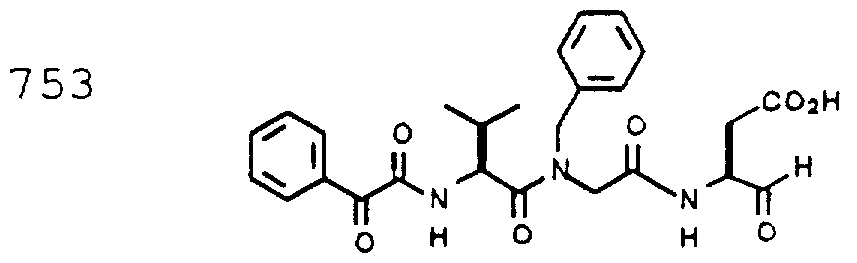
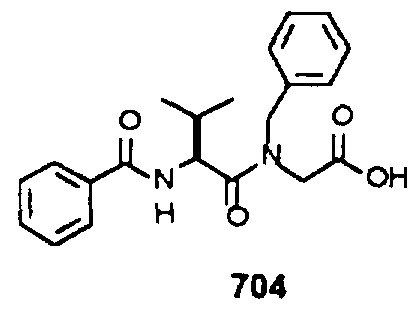
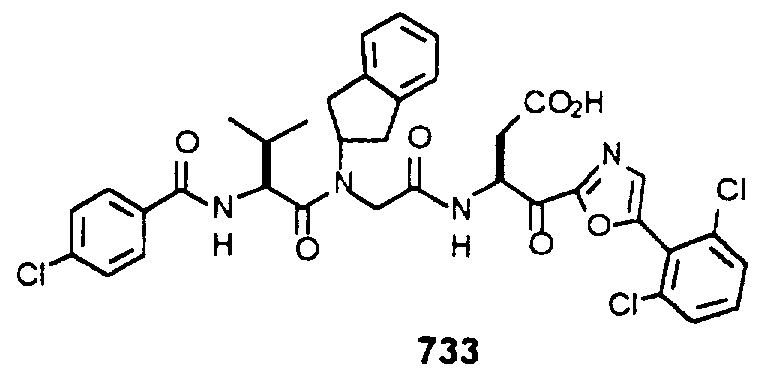
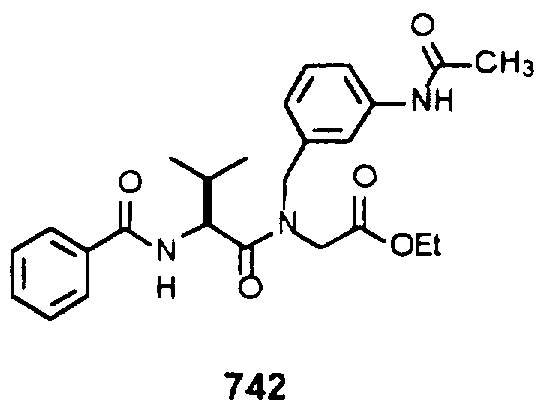
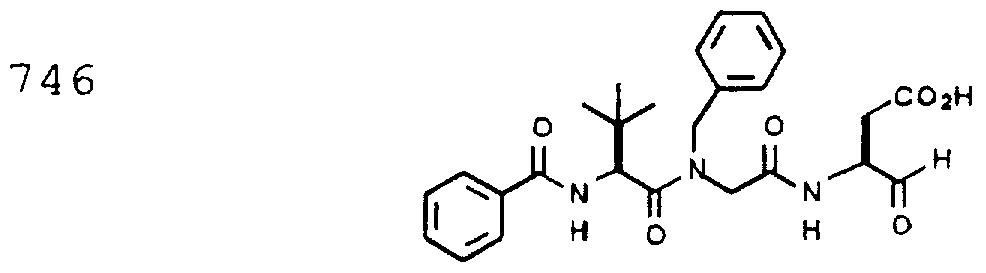
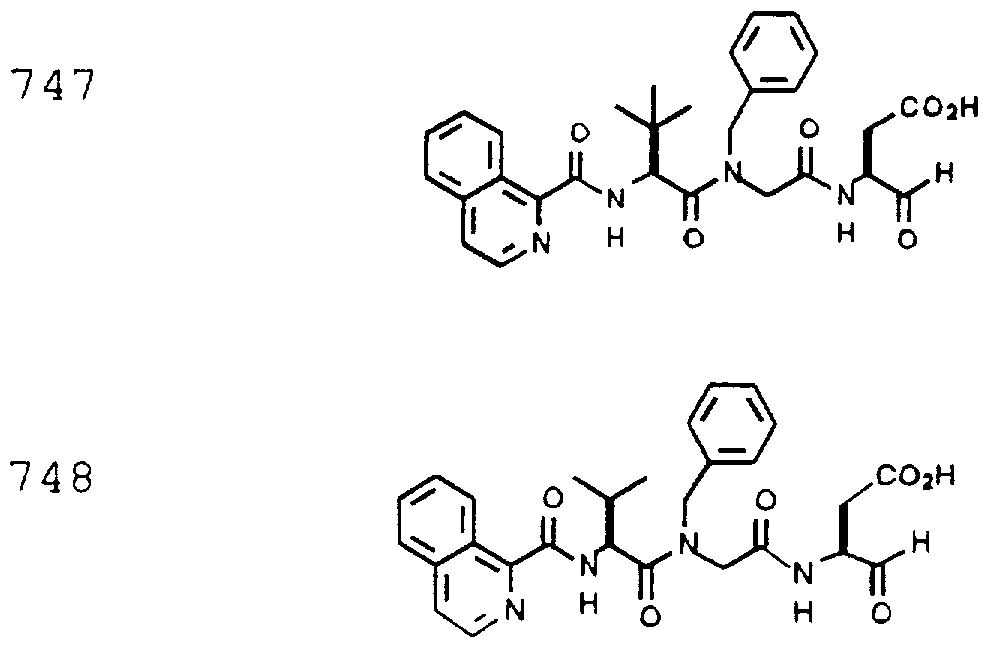
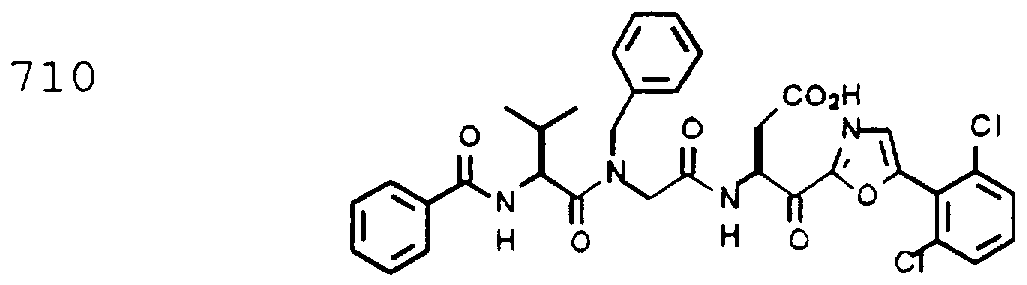
  • Example 2 The following K j _ values were determined for compounds 706, 710, 719, 720, 725-727, 729, 731, 733, 743, 745, and 747-757 using the assay described Example 1. The structures of the compounds of Example 2 are shown in the following Table and in Example 3.
  • Type 1 Type 2
  • Example 3 Compounds of Example 2 were synthesized as follows:
  • N-Benzylglycine Ethyl Ester (701) To a solution of benzaldehyde (14.0 g, 0.132 mol) in absolute EtOH (500 mL) was added glycine ethyl ester hydrochloride (37.0 g, 0.256 mol), NaOAc (32.5 g, 0.396 mol) and sodium cyanoborohydride (9.8 g, 0.158 mol) , and the resulting mixture heated to reflux. After 1 hr at reflux, the reaction was cooled and concentrated in vacuo . The residue was taken up into IN NaOH and EtOAc.
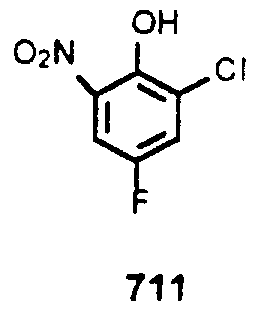
  • 2-Chloro-4-fluoro-6-n ⁇ trophenol (711) To a mixture of 2-Chloro-4-fluorophenol (25 g, 0.171 mol) in H 2 0 (100 mL) and Et 0 (300 mL) at 0 °C was added dropwise concentrated nitric acid (25 mL) . After the addition was complete the reaction was warmed to rt and stirred for 3 hr. The layers were separated and the organic phase washed with 1:1 brme:H 2 0, brme, dried over MgS0 4 , filtered and concentrated m vacuo to a slurry. The slurry was diluted with hexane and the yellow solid collected and dried to provide 23.6 g of compound 711.
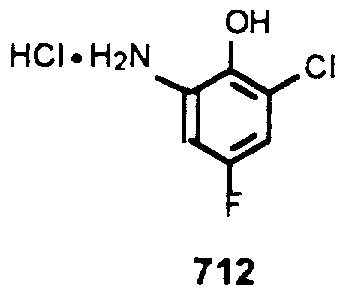
  • 6-Chloro-4-fluorobenzoxazole (713) A mixture of compound 712 (17.0 g, 86.3 mmol) and trimethylorthoformate (18.9 mL, 0.173 mol) in abso-ute MeOH (90 mL) was heated to reflux upon which a solution formed. After stirring at reflux for 24 hr, the reaction was cooled and concentrated to provide an orange solid. The solid was dissolved into Et 2 0, washed with IN NaOH, brine, dried over MgS0 4 , filtered and concentrated to provide a yellow orange solid. Recyrstallization from hot aqueous EtOH with rapid cooling and filtration provided 10.0 g of compound 713 as white needles. Note that prolong standing m aqueous EtOH causes decomposition of compound 713.
  • 4-D ⁇ fluoro-6-ammophenol Hydrochloride (715) A mixture of 2, 4-D ⁇ fluoro-6-n ⁇ trophenol (28.4 g, 0.162 mol; prepared by a similar method as 711 except replacing 2-chloro-4-fluorophenol with 2, 4-d ⁇ fluorophenol) and 10% palladium on carbon (3.5 g) m absolute MeOH (120 mL) was placed under 1 atm of H and stirred until complete reduction had occurred. The H 2 was replaced with nitrogen and the reaction was filtered through Celite. Gaseous HCl was bubbled through the filtrate and the resulting solution concentrated.
  • N-Indan-2-ylglycine t-Butyl Ester (721) To a suspension of 2-ammoindane hydrochloride (5.0g, 29.5 mmol) and powdered K 2 C0 3 (8.3 g, 60.0 mmol) m absolute EtOH (30 mL) was added tert-butyl bromoacetate (4.4 mL, 29.5 mmol) . After stirring for 10 mm at rt the reaction was heated to 45 °C and stirred for 2 hr . The reaction was cooled to rt, diluted with EtOAc, filtered and concentrated. ehromatography of the residue on silica gel (elution with 20% EtOAc:hexane) provided 4.7g of compound 721 as a white crystalline solid.
  • Bocammobenzyl) amino) acetic Acid Ethyl Ester (703): To a solution of compound 735 (1.45 g, 3.5 mmol) and DIEA (740 ⁇ l, 4.25 mmol) in CH 2 C1 2 (7.0 mL) containing a catalytic amount of N,N-dimethylammopyridme, was added di-tert-butyldicarbonate (850 mg, 3.9 mmol) . After 1 hr, the reaction was diluted with EtOAc, washed with H 2 0, sat. aq. KHS0 4 , brine, dried over MgS0 4 , filtered and concentrated in vacuo to provide 1.78 g of compound 736.
  • Step A Synthesis of 401 a/b.
  • TentaGel SS NH 2 resm (0.16 mmol/g, 10.0 g) was placed in a sintered glass funnel and washed with DMF (3 X 50 mL) , 10 ⁇ (v/v) DIEA in DMF (2 X 50 mL) and finally with DMF (4 X 50 mL) .
  • Sufficient DMF was added to the resm to obtain a slurry followed by 713a (1.42 g, 2.4 mmol, prepared from either (3S) 3-
  • HOBT HOBT-H 2 0; 0.367 g 2.4 mmol
  • HBTU 0- benzotriazole-N, N,N,N' - tetramethyluronium hexafluorophosphate
  • Method 1 Synthesis of 761a/b and 762a.
  • Resms 761a and 762a were prepared from resm 401a (0.24 g, 0.038 mmol) and Fmoc-Val e or Fmoc-t-Leucme, respectively, while resm 761b was prepared from resm 401b and Fmoc-Valme using an Advanced ChemTech 396 Multiple Peptide synthesizer.
  • the automated cycles consisted of a resm wash with DMF (3 X 1 L) , deprotection with 25% (v/v) pipe ⁇ dme m DMF (1 mL) for 3 mm followed by fresh reagent (1 mL) for 10 mm.
  • the resm was washed with DMF (3 X 1 mL) and N- methypyrrolidone (3 X 1 mL) .
  • the res was then acylated with a solution of either 0.4M Fmoc-1-Valme or Fmoc-t-Leucme and 0.4M HOBT m N-methypyrrolidone (1 mL) , a solution of 0. M HBTU in N-methypyrrolidone (0.5 mL) and a solution of 1.6M DIEA m N- methypyrrolidone (0.35 mL) and the reaction was shaken for 2 hr at rt. The acylation step was repeated. Finally, the resins were washed with DMF (3 X 1 mL) .
  • the appropriate carboxylic acid (0.4 M in 0.4 M HOBt/NMP) was coupled to the resm as described in Step B.
  • the aldehyde was cleaved from the resm and globally deprotected by treatment with 95% TFA/ 5% H 2 0 (v/v, 1.5 mL) for 30 mm at rt. After washing the resin with cleavage reagent (1 mL) , the combined filtrates were added to cold 1:1 Et 2 0:pentane (12 mL) and the resulting precipitate was isolated by centrifugation and decantation.
  • the resulting pellet was dissolved in 10% CH 3 CN/90% H 2 0/0.1% TFA (15 mL) and lyophilized to obtain the crude product as a white powder.
  • the compound was purified by semi-prep RP-HPLC with a Rainin MicrosorbTM C18 column (5 u, 21.4 X 250 mm) elutmg with a linear CH 3 CN gradient (10 ⁇ - 60%) containing 0.1% TFA (v/v) over 45 mm at 12 mL/min. Fractions containing the desired product were pooled and lyophilized.
  • Step C Method 1A. Synthesis of 751. Following a similar procedure as method 1, resin 761a was acylated with 4-(l- fluorenylmethoxycarbonylamino) benzoic acid and repeated. The Fmoc group was removed as described in Step C and the free amine was acetylated with 20% (v/v) acetic anhydride in DMF (1 mL) and 1.6M DIEA m N- methylpyrrolidone (0.35 mL) for 2 hr at rt. The acetylation step was repeated. Cleavage of the aldehyde from the resm gave 751.

Landscapes

  • Health & Medical Sciences (AREA)
  • Chemical & Material Sciences (AREA)
  • Organic Chemistry (AREA)
  • Life Sciences & Earth Sciences (AREA)
  • Medicinal Chemistry (AREA)
  • General Health & Medical Sciences (AREA)
  • Pharmacology & Pharmacy (AREA)
  • General Chemical & Material Sciences (AREA)
  • Nuclear Medicine, Radiotherapy & Molecular Imaging (AREA)
  • Animal Behavior & Ethology (AREA)
  • Chemical Kinetics & Catalysis (AREA)
  • Public Health (AREA)
  • Veterinary Medicine (AREA)
  • Bioinformatics & Cheminformatics (AREA)
  • Engineering & Computer Science (AREA)
  • Physical Education & Sports Medicine (AREA)
  • Diabetes (AREA)
  • Neurology (AREA)
  • Orthopedic Medicine & Surgery (AREA)
  • Molecular Biology (AREA)
  • Biophysics (AREA)
  • Neurosurgery (AREA)
  • Genetics & Genomics (AREA)
  • Proteomics, Peptides & Aminoacids (AREA)
  • Rheumatology (AREA)
  • Biochemistry (AREA)
  • Biomedical Technology (AREA)
  • Oncology (AREA)
  • Crystallography & Structural Chemistry (AREA)
  • Hematology (AREA)
  • Endocrinology (AREA)
  • Immunology (AREA)
  • Communicable Diseases (AREA)
  • Pulmonology (AREA)
  • Dermatology (AREA)
  • Urology & Nephrology (AREA)
  • Heart & Thoracic Surgery (AREA)
  • Cardiology (AREA)
  • Virology (AREA)
  • Hospice & Palliative Care (AREA)

Abstract

The present invention relates to novel classes of compounds which are inhibitors of interleukin-1β converting enzyme. This invention also relates to pharmaceutical compositions comprising these compounds. The compounds and pharmaceutical compositions of this invention are particularly well suited for inhibiting ICE activity and consequently, may be advantageously used as agents against interleukin-1 and apoptosis-mediated diseases, including inflammatory diseases, autoimmune diseases, proliferative, infectious, and degenerative diseases. This invention also relates to methods for inhibiting ICE activity and methods for treating interleukin-1 mediated diseases using the compounds and compositions of this invention.

Description

INHIBITORS OF INTERLEUKIN-lβ CONVERTING ENZYME
TECHNICAL FIELD OF THE INVENTION
The present invention relates to novel classes of compounds which are inhibitors of terleukm-lβ converting enzyme ("ICE") . This invention also relates to pharmaceutical compositions comprising these compounds . The compounds and pharmaceutical compositions of th s invention are particularly well suited for inhibiting ICE activity and consequently, may be advantageously used as agents against mterleukm-l- ("IL-1") ana apoptosis-mediated diseases, including inflammatory diseases, autoimmune diseases, proliferative disorders, infectious c seases, and degenerative diseases. This invention also relates to methods for inhibiting ICE activity and methods for treating mterleukm-l- and apoptosis-mediated diseases using the compounds and compositions of this invention.
BACKG-RQU P QF THE I VENTION Interleukin 1 ("IL-1") is a pro- inflammatory and immunoregulatory protein that stimulates fibroblast differentiation and proliferation, the production of prostaglandms, collagenase and phospholipase by synovial cells and chondrocytes, basophil and eosmophil degranulation and neutrophil activation. Oppenhei , J.H. et al, Immunology Today, 7, pp. 45-56 (1986) . As such, it is involved the pathogenesis of chronic and acute inflammatory and autoimmune diseases. For example, in rheumatoid arthritis, IL-1 is both a mediator of inflammatory symptoms and of the destruction of the cartilage proteoglycan in afflicted joints. IL-1 is also a highly potent bone resorption agent. It is alternativly referred to as "osteoclast activating factor" in destructive bone diseases such as osteoarthritis and multiple myeloma. Batailie, R. et al., Int. J. Clm. Lab. Res.. 21, p. 283 (1992) . In certain proliferative disorders, such as acute myelogenous leukemia and multiple myeloma, IL-1 can promote tumor cell growth and adhesion. In these disorders, IL-1 also stimulates production of other cytokines such as IL-6, which can modulate tumor development. Tartour et al . , Cancer Res. 54, 6243 (1994) .
IL-1 is predominantly produced by peripheral blood monocytes as part of the inflammatory response and exists in two distinct agonist forms, IL-lα and IL-
Iβ. Mosely, B.S. et al . , Proc. Nat. Acad. Sci ■ , 84, pp. 4572-4576 (1987) ; Lonnemann, G. et al . , Eur. J. Immunol .. 19, pp. 1531-1536 (1989) .
IL-lβ is synthesized as a biologically inactive precursor, pIL-lβ. pIL-lβ lacks a conventional leader sequence and is not processed by a signal peptidase. March, C.J., Nature. 315, pp. 641-647 (1985) . Instead, pIL-lβ is cleaved by interleukin-lβ converting enzyme ("ICE") between Asp- 116 and Ala-117 to produce the biologically active C-termmal fragment found human serum and synovial fluid. Sleath, P.R., et al . , J. B ol. Chem. , 265, pp. 14526-14528 (1992); A.D. Howard et al . , ___ Immunol.. 147, pp. 2964-2969 (1991) .
ICE is a cysteme protease localized primarily m monocytes . It converts precursor IL-lβ to the mature form. Black, R.A. et al . , FEBS Lett . , 247, pp. 386-390 (1989); Kostura, M.J. et al . , Pro . Natl. Acad. Sci. USA. 86, pp. 5227-5231 (1989) . Processing by ICE is also necessary for the transport of mature
IL-lβ through the cell membrane. ICE, or its homologues, also appears to be involved in the regulation of cell death or apoptosis. Yuan, J. et al., Cell. 75, pp. 641-652 (1993) ; Miura, M. et al . , Cell. 75, pp. 653-660 (1993) ; Nett-Fiordalisi, M.A. et al., J. Cell Biochem.. 17B, p. 117 (1993) . In particular, ICE or ICE homologues are thought to be associated with the regulation of apoptosis neurogenerative diseases, such as Alzheimer's ana
Parkinson's disease. Marx, J. and M. Baringa, Science, 259, pp. 760-762 (1993) ; Gagliardim, V. et al., Science. 263, pp. 826-828 (1994) .
ICE has been demonstrated to mediate apoptosis (programmed cell death) m certain tissue types. Steller, H., Science. 267, p. 1445 (1995) ; Whyte, M. and Evan, G., Nature, 376, p. 17 (1995) ; Martin, S.J. and Green, D.R. , Cell, 82, p. 349 (1995) ; Alnemri, E.S., et al. , J. Biol . Chem., 270, p. 4312 (1995); Yuan, J. Curr. Qpin. Cell Biol., 7, p. 211 (1995) . Therapeutic applications for inhibition of apoptosis may include treatment of Alzheimer's disease, Parkinson's disease, stroke, mycardial infarction, spinal atrophy, and aging. A transgenic mouse with a disruption of the ICE gene is deficient in Fas-mediated apoptosis. Kuida, et al . (1995) . This activity of ICE is distinct from its role as the processing enzyme for pro-IL-lβ. It is conceivable that m certain tissue types, inhibition of ICE may not affect secretion of mature IL-lβ, but may inhibit apoptosis.
ICE has been previously described as a heterodimer composed of two subunits, p20 and plO (20kDa and lOkDa molecular weight, respectively) .
These subunits are derived from a 45kDa proenzyme (p45) by way of a p30 form, through an activation mechanism that is autocatalytic. Thornberry, N.A. et al., Nature, 356, pp. 768-774 (1992) . The ICE proenzyme has been divided into several functional domains: a prodomam (pl4), a p22/20 subunit, a polypeptide linker and a plO subunit. Thornberry et al .. supra; Casano et al., Genomics, 20, pp. 474-481 (1994) .
Full length p45 has been characterized by its cDNA and ammo acid sequences. PCT patent applications WO 91/15577 and WO 94/00154. The p20 and plO cDNA and ammo acid sequences are also known. Thornberry et al .. supra . Murme and rat ICE have also been sequenced and cloned. They have high am o acid and nucleic acid sequence homology to human ICE. Miller, D.K. et al., Ann. N.Y. Acad. Sπ .. 696, pp. 133-148 (1993) ; Molmeaux, S.M. et al . , Proc. Nat. Acad. Sci., 90, pp. 1809-1813 (1993) . The three-dimensional structure of ICE has been determined at atomic resolution by X-ray crystallography. Wilson, K.P., et al., Nature, 370, pp. 270-275 (1995) . The active enzyme exists as a tetramer of two p20 and two plO subunits . Additionally, there exist human homologs of ICE with sequence similarities m the active site regions of the enzymes. Such homologs include TX (or ICErel-II or ICH-2) (Faucheu, et al . , EMBO J.. 14, p. 1914 (1995) ; Kamens J., et al . , J. Biol. Chem., 270, p. 15250; Nicholson et al., J. Biol. Chem., 270 15870 (1995)), TY (or ICErel_Ii:[) (Nicholson et al., J. Biol. Chem.. 270, p. 15870 (1995) ), ICH-1 (or Nedd-2) (Wang, L. et al., Cell, 78, p. 739 (1994) ), MCH-2, (Fernandes- Alnemri, T. et al., Cancer Res. , 55, p. 2737 (1995), CPP32 (or YAMA or apopain) (Fernandes-Alnemr , T. et al., J. Biol. Chem., 269, p. 30761 (1994) ; Nicholson, D.W. et al., Nature, 376, p. 37 (1995)), and CMH-1 (or MCH-3) (Lippke, et al . , J. Biol Chem.. (1996) ; Fernandes-Alnemri, T. et al., Cancer Res . , (1995) ) .
Each of these ICE homologs, as well as ICE itself, is capable of inducing apoptosis when overexpressed in transfected cell lines. Inhibition of one or more of these homologs with the peptidyl ICE inhibitor Tyr-Val- Ala-Asp-chloromethylketone results in inhibition of apoptosis primary cells or cell lines. Lazebnik et al., Nature, 371, p. 346 (1994) . The compounds described herein are also capable of inhibiting one or more homologs of ICE (see example) . Therefore, one can envisage using these compounds to inhibit apoptosis tissue types that contain ICE homologs, but which do not contain active ICE or produce mature IL-1 β.
ICE inhibitors represent a class of compounds useful for the control of inflammation or apoptosis or both. Peptide and peptidyl inhibitors of ICE have been described. PCT patent applications WO 91/15577; WO 93/05071; WO 93/09135; WO 93/14777 and WO 93/16710; and European patent application 0 547 699. Such peptidyl inhibitors of ICE have been observed to block the production of mature IL-lβ a mouse model of inflammation (Ku, et al. or vide mfra) and to suppress growth of leukemia cells i n vi tro (Estrov, et al., Blood, 84, p. 380a (1994) ) .
Accordingly, the need exists for compounds that can effectively inhibit the action of ICE m vi vo, for use as agents for preventing and treating chronic and acute forms of IL-1-mediated diseases, apoptosis- mediated diseases, as well as inflammatory, autoimmune, bone-destructive, proliferative, infectious, degenerative, or necrotic diseases.
SUMMARY OF THE INVENTION
The present invention provides novel classes of compounds, and pharmaceutically acceptable derivatives thereof, that are useful as inhibitors of ICE. These compounds can be used alone or in combination with other therapeutic or prophylactic agents, such as antibiotics, immunomodulators or other anti-inflammatory agents, for the treatment or prophylaxis of diseases mediated by IL-1 or by apoptosis. According to a preferred embodiment, the compounds of this invention are capable of binding to the active site of ICE and inhibiting the activity of that enzyme.
It is a principal object of this invention to provide novel classes of inhibitors of ICE represented by formulas :
S_
Figure imgf000008_0001
and
Figure imgf000009_0001
wherein the various substituents are αescribed herein,
ABBREVIATIONS AND DEFINITIONS
Abbreviations
Figure imgf000009_0002
Val valine
Ac20 acetic anhydride n-Bu normal-butyl
DMF dimethylformamide
DIEA N, N-dι ιsopropylethylamιne
EDC 1- (3-Dιmethylammopropyl) -3- ethylcarbodnmide hydrochloride
Et20 diethyl ether EtOAc ethyl acetate Fmoc 9-fluorenylmethyoxycarbonyl HBTU O-benzotrιazol- 1-yl-N, N, N' , N' - tetramethyluronium hexafluorophosphate
HOBT 1-hydroxybenzotrιazole hydrate MeOH methanol
TFA tπfluoroacetic acid
Definitions
The following terms are employed herein: The term "active site" refers to any or all of the following sites m ICE: the substrate binding site, the site where an inhibitor binds and the site where the cleavage of substrate occurs.
The term "alkenyl", alone or in combination, refers to a straight-chain or branched-cham alkenyl radical containing from 2 to 10, carbon atoms. Examples of such radicals include, but are not limited to, ethenyl, E- and Z-propenyl, isopropenyl, E- and Z- butenyl, E- and Z- isobutenyl, E- and Z-pentenyl, decenyl and the like.
The term "alkynyl", alone or m combination, refers to a straight-chain or branched-cham alkynyl radical containing from 2 to 10, carbon atoms. Examples of such radicals include, but are not limited to, ethynyl (acetylenyl) , propynyl, propargyl, butynyl, hexynyl, decynyl and the like. The term "substitute" refers to the replacement of a hydrogen atom in a compound with a substituent group.
The term "K1" refers to a numerical measure of the effectiveness of a compound in inhibiting the activity of a target enzyme such as ICE. Lower values of K-_ reflect higher effectiveness. The K-_ value is a derived by fitting experimentally determined rate data to standard enzyme kinetic equations (see I. H. Segel, Enzyme Kinetics, Wiley-Interscience, 1975) . The term "patient" as used in this application refers to any mammal, especially humans.
The term "pharmaceutically effective amount" refers to an amount effective in treating or ameliorating an IL-1- or apoptosis-mediated disease in a patient. The term "prophylactically effective amount" refers to an amount effective in preventing or substantially lessening IL-1- or apoptosis-mediated disease in a patient.
The term "pharmaceutically acceptable carrier or adjuvant" refers to a non-toxic carrier or ad uvant that may be administered to a patient, together with a compound of this invention, and which does not destroy the pnarmacological activity thereof.
The term "pharmaceutically acceptable derivative" means any pharmaceutically acceptable salt, ester, or salt of such ester, of a compound of this invention or any other compound which, upon administration to a recipient, is capable of providing (directly or indirectly) a compound of this invention or an anti-ICE active metabolite or residue thereof.
Pharmaceutically acceptable salts of the compounds of this invention include, for example, those derived from pharmaceutically acceptable inorganic and organic acids and bases. Examples of suitable acids include hydrochloric, hydrobromic, sulfuric, nitric, perchloric, fumaric, aleic, phosphoric, glycolic, lactic, salicylic, succinic, toluene-p-sulfonic, tartaric, acetic, citric, methanesulfonic, formic, benzoic, malonic, naphthalene-2-sulfonιc and benzenesulfonic acids. Other acids, such as oxalic, while not in themselves pharmaceutically acceptable, may be employed in the preparation of salts useful as intermediates m obtaining the compounds of the invention and their pharmaceutically acceptable acid addition salts. Salts derived from appropriate bases include alkali metal (e.g., sodium), alkaline earth metal (e.g., magnesium), ammonium and N- (C]__ alkyl) 4 salts.
This invention also envisions the "quaternization" of any basic nitrogen-containing groups of the compounds disclosed herein. The basic nitrogen can be quaternized with any agents known to those of ordinary skill m the art including, for example, lower alkyl halides, such as methyl, ethyl, propyl and butyl chloride, bromides and iodides; dialkyl sulfates including dimethyl, diethyl, dibutyl and diamyl sulfates; long chain halides such as decyl, lauryl, myπstyl and stearyl chlorides, bromides and iodides; and aralkyl halides including benzyl and phenethyl bromides. Water or oil-soluble or dispersible products may be obtained by such quaternization.
The ICE inhibitors of this invention may contain one or more "asymmetric" carbon atoms and thus may occur as racemates and racemic mixtures, single enantiomers, diastereomeric mixtures and individual diastereomers. All such lsomeric forms of these compounds are expressly included m the present invention. Each stereogenic carbon may be of the R or S configuration. Although specific compounds and scaffolds exemplified in this application may be depicted in a particular stereochemical configuration, compounds and scaffolds having either the opposite stereochemistry at any given chiral center or mixtures thereof are also envisioned. The ICE inhibitors of this invention may comprise structures which may optionally be substituted at carbon, nitrogen or other atoms by various substituents. Such structures may be singly or multiply substituted. Preferably, the structures contain between 0 and 3 substituents. When multiply substituted, each substituent may be picked independently of any other substituent as long as the combination of substituents results m the formation of a stable compound. Combinations of substituents and variables envisioned by this invention are only those that result in the formation of stable compounds. The term "stable", as used herein, refers to compounds which possess stability sufficient to allow manufacture and administration to a mammal by methods known in the art. Typically, such compounds are stable at a temperature of 40°C or less, m the absence of moisture or other chemically reactive conditions, for at least a week. DETAILED DESCRIPTION OF THE INVENTION
In order that the invention herein described may be more fully understood, the following detailed description is set forth.
The ICE inhibitors of one embodiment (A) of this invention are those of formula ( ) :
Figure imgf000014_0003
Figure imgf000014_0001
wherein: n = 0, 1, or 2; R is:
a
Figure imgf000014_0002
m is 1 or 2;
R]_2 and R13 are independently selected from the group consisting of -R , -C(0)-R7, and -C (0) -N (H) -R7, or R12 and R13 taken together form a 4-8-membered saturated cyclic group;
R2 is -H or a -C1_6 straight or branched alkyl group optionally substituted with Ar, -OH, -OR7, -C(0)-0H, C(0)-NH2, or -OR5; R7 is selected from the group consisting of -Ar, a -C;]__g straight or branched alkyl group optionally substituted with -Ar, a -C1_6 straight or branched alkenyl group optionally substituted with Ar, and a ~c2-6 straight or branched alkynyl group optionally substituted with Ar;
R5 is selected from the group consisting of: -C(0)-R7, -C(0) -0R9, -C(0)-N(R9) (R10) ,
-S(0)2-R7, -C(0)C(0)-R7/ -R7, and -H;
each Ar is a cyclic group independently selected from the set consisting of phenyl, 1-naphthyl, 2- naphthyl, mdenyl, azulenyl, fluorenyl and anthracenyl and a heterocyclic aromatic group selected from the group consisting of 2-furyl, 3-furyl, 2-thιenyl, 3- thienyl, 2-pyπdyl, 3-pyπdyl, 4-pyrιdyl, pyrrolyl, oxazolyl, thiazolyl, lmidazolyl, pyraxolyl, 2- pyrazolmyl, pyrazolidmyl, isoxazolyl, isotriazolyl, 1, 2, 3-oxadιazolyl, 1, 2, 3-trιazolyl, 1, 3, 4-thιadιazolyl, pyndazmyl, pyri idinyl, pyrazmyl, 1, 3, 5-tπazmyl, 1, 3, 5-trιthιanyl, mdolizmyl, mdolyl, isomdolyl, 3H- dolyl, mdolmyl, benzo [b] furanyl, benzo[b] thiophenyl, lH-mdazolyl, benzimidazolyl, benzthiazolyl, purmyl, 4H-qumolιzmyl, qumolmyl, 1,2,3, 4-tetrahydroιsoqumolmyl, isoqumolmyl, 1, 2, 3, 4-tetrahydroιsoqumolmyl, cmnol yl, phthalaz yl, qumazolmyl, qu oxaimyl, 1,8- naphthyridmyl, peridmyl, carbazolyl, acridmyl, phenazmyl, phenothiazmyl and phenoxazmyl, and the aromatic group is optionally singly or multiply substituted with -F, -Cl, -Br, -I, -OR14, -N02, -S(02)-N(R9) (R10) , -C(0)-N(R9) (R10) , -N(H)-C(0)-
N(R9) (R10), -N(R9) (R10), -C(0)-OR9, -CF3, -0CF3, a C^g straight or branched alkyl group, 1, 2-methylenedιoxy, -CN, or -N(H)C(NR9)N(R9) (R10) ;
each R14 s -H or a C1_6 straight or branched alkyl group;
each R9 and R10 is independently selected from the group consisting of -H, -Ar, and a ^_-^ straight or branched alkyl group optionally substituted with -Ar;
each Rq is a -C]__5 straight or branched alkyl group optionally substituted with -Ar or -W;
W is -ORg, -SR9, -N(H)C(NR9)N(R9) (R10) , -C(0)-OR9, or -N(R9) (R10) ;
R3 is -CH2Ar or a 5 to 15-membered non-aromatic cyclic group which contains between 1 and 3 rings, and which optionally contains between 0 and 2 endocyclic oxygen atoms, sulfur atoms, or nitrogen atoms, and wherein the cyclic group is optionally fused with Ar;
provided that when -Ar is substituted with a group containing R9 or R10 which comprises one or more addditional -Ar groups, the -Ar groups are not substituted with a group containing R9 or R^o; Preferred compounds of this embodiment are those wherein:
R5 is -C(0)-R7 or -C (0) C (0) -R7;
each R4 is a C1_5 straight or branched alky., group optionally substituted with Ar;
m is 1;
Figure imgf000017_0001
R? is -CH Ar or cC
E is CH or N;
each D is independently N or C, wherein C is optionally substituted with -0R14, -F, -Cl, -Br, -I, -N02, -S(0)2-N(R9) (R10) , -C(0)-N(R9) (R10) , -N(H)-C{0)- N(R9) (R10), -N(R9) (R10), -C(0)-0R9, -CF3, -0CF3, a C^ζ straight or branched alkyl group, 1, 2-methylenedιoxy, -CN, or -N(H)C(NR9)N(R9) (R10) ;
each R9 and R10 is independently selected from the group consisting of -H, -Ar, and a -C1_5 straight or branched alkyl group optionally substituted with -Ar. The ICE inhibitors of another embodiment of this invention are those of formula (β) :
wherei :
Figure imgf000018_0001
R-j_ is selected from the group consisting of
-CN,
-C(0)-H,
-C(0)-CH2XR6,
-C(0)-CH2F,
-C=N-0-R7, and
-C(0)-RR;
X is selected from the group consisting of 0, S, S (0) , and S (0)2;
R6 is independently selected from the group consisting of: -H,
-(CH2)p-Ar, and -C(O) -Ar;
R7 is selected from the group consisting of -Ar, _cl-6 straight or branched alkyl group optionally substituted with -Ar, a -C1_6 straight or branched alkenyl group optionally substituted with Ar, and a -C2_6 straight or branched alkynyl group optionally substituted with Ar;
R3 is selected from the following group, m which any ring may optionally be singly or multiply substituted by -NH2, -C(0)-OH, -F, -Cl, -Br, -I, -OH, -N02, -CN, -perfluoroalkyl C1_3 alkyl, -R5, -0R5, -OR7, -N(H)-R5, -N(H)-R7, 1, 2-methylenedιoxy, and -SR7 :
Figure imgf000019_0001
wherein Y is independently selected from the group consisting of 0 and S;
each Ar is a cyclic group independently selected from the set consisting of a carbocyclic aromatic group selected from the group consisting of phenyl, 1- naphthyl, 2-naphthyl, mdenyl, azulenyl, fluorenyl and anthracenyl and a heterocyclic aromatic group selected from the group consisting of 2-furyl, 3-furyl, 2- thienyl, 3-thienyl, 2-pyπdyl, 3-pyπdyl, 4-pyrιdyl, pyrrolyl, oxazolyl, thiazolyl, imidazolyl, pyraxolyl, 2-pyrazolinyl, pyrazolidinyl, isoxazolyl, isotriazolyl, 1, 2, 3-oxadiazolyl, 1, 2, 3-trιazolyl, 1, 3, 4-thιadιazolyl, pyridazinyl, pyrimidinyl, pyrazmyl, 1, 3, 5-trιazmyl, 1, 3, 5-trithianyl, mdolizinyl, mdolyl, isoindolyl, 3H- dolyl, indolinyl, benzo [b] furanyl, - I I
benzo [b] thiophenyl, lH-mdazolyl, benzimidazolyl, benzthiazolyl, purmyl, 4H-qumolιzmyl, qumolmyl, 1,2,3, 4-tetrahydroιsoqumolmyl, lsoqumolmyl, 1, 2, 3, 4-tetrahydroιsoquιnolmyl, cmnolmyl, phthalazmyl, qu azolmyl, qumoxalmyl, 1,8- naphthyrid yl, peridmyl, carbazolyl, acridmyl, phenazmyl, phenothiazmyl and phenoxazmyl, and the cyclic group is optionally being singly or multiply substituted with -0R14, -F, -Cl, -Br, -I, -N02, -S(0)2- N(R9) (R10) , -C(0)-N(R9) (R10) , - (H) -C (0) -N(R9) (R10) ,
-N(R9) (R10), -C(0)-0R9, -CF3, -OCF3, a C1_6 straight or branched alkyl group, 1, 2-methylenedιoxy, -CN, or -N(H)C(NR9)N(R9) (R10) ;
each R9 and R10 are independently selected from the group consisting of -H, -Ar, and a -C1_5 straight or branched alkyl group optionally substituted with Ar;
each R14 is -H or a C1_6 straight or branched alkyl group;
R5 is selected from the group consisting of: -C(0)-R7,
-C(0)-0R9,
-C(0)-N(R9) (R10),
-S(0)2-R7,
-C(0)C(0)-R7, -R7, and
-H;
R4 is a -C^-,5 straight or branched alkyl group optionally substituted with Ar or W; W is -0R9, -SR9, -N(H)C(NR9)N(R9) (R10) , -C(0)-OR9, and -NR9, (R10) ;
R3 is -CH2Ar or a 5 to 15-membered non-aromatic cyclic group which contains between 1 and 3 rings, and which optionally contains between 0 and 2 endocyclic oxygen atoms, sulfur atoms, or nitrogen atoms, and wherein the cyclic group is optionally fused with Ar;
R2 is -H, or a C]__g straight or branched alkyl group, wherein the alkyl group is optionally substituted with Ar, -OH, -0R7, -C(0)-OH, C(0)-NH2, or -OR5;
provided that when -Ar is substituted with a group containing R9 or R10 which comprises one or more addditional -Ar groups, the -Ar groups are not substituted with a group containing Rg or ]_0'"
Preferred compounds of this embodiment are those wherein:
Rχ is -C(0)-H;
R5 is -C(0)-R7 or -C (0) C (0) -R7;
R4 is a -C]__5 straight or branched alkyl group optionally substituted by -Ar;
m is 1;
n is 1;
Figure imgf000022_0001
E i s CH or N;
each D is independently N or C, wherein C is optionally substituted with -OR14, -F, -Cl, -Br, -I, -N02, -S(0)2-N(R9) (R10), -C(0)-N(R9) (R10) , -N(H)-C(0)- N(R9) (R10), -N(R9) (R10), -C(0)-0R9, -CF3, -OCF3, a C1_6 straight or branched alkyl group, 1, 2-methylenedιoxy, -CN, or -N{H)C(NR9)N(R9) (R10) ;
each Rg and R10 is independently selected from the group consisting of -H, -Ar, and a -C-j__5 straight or branched alkyl group optionally substituted with -Ar.
Preferred compounds of this embodiment include but are not limited to:
Figure imgf000022_0002
Figure imgf000022_0003
Figure imgf000023_0001
Figure imgf000023_0002
Figure imgf000023_0003
Figure imgf000023_0004
746
Figure imgf000023_0005
Figure imgf000024_0001
Figure imgf000024_0002
Figure imgf000024_0003
Figure imgf000024_0004
751
Figure imgf000024_0005
Figure imgf000025_0001
Figure imgf000025_0002
Figure imgf000025_0003
Figure imgf000025_0004
Figure imgf000025_0005
Figure imgf000026_0001
Other preferred compounds of this embodiment are those wherein:
Figure imgf000026_0002
R5 is -C(0)-R7 or -C (0) C (0) -R7;
R4 is a _C]__5 straight or branched alkyl group optionally substituted by -Ar;
m is 1;
n is 1;
each D is independently N or C, wherein C is optionally substituted with -0R14, -F, -Cl, -Br, -I,
-N02, -S(0)2-N(R9) (R10), -C(0)-N(R9) (R10), -N(H)-C(0)-
N(Rg; !R 10' ' -N(R< : R 10), -C(0)-0Rg, -CF3, -0CF3, a C1_6 straight or branched alkyl group, 1, 2-methylenedιoxy, -CN, or -N(H)C (NR9)N(R9) (R10) ; each Rg and R10 is independently selected from the group consisting of -H, -Ar, and a -Cι_$ straight or branched alkyl group optionally substituted with -Ar.
Preferred compounds of this embodiment include but are not limited to:
Figure imgf000027_0001
Figure imgf000027_0002
Figure imgf000027_0003
Figure imgf000028_0001
Figure imgf000028_0002
Figure imgf000028_0003
Figure imgf000028_0004
Figure imgf000028_0005
Other preferred compounds of this embodiment are those wherein R1 is -C (O) -CH2XR6. The ICE inhibitors of this invention may be synthesized using conventional techniques. Advantageously, these compounds are conveniently synthesized from readily available starting materials. The compounds of this invention are among the most readily synthesized ICE inhibitors known. Previously described ICE inhibitors often contain four or more chiral centers and numerous peptide linkages. The relative ease with which the compounds of this invention can be synthesized represents an advantage m the large scale production of these compounds.
It should be understood that the compounds of this invention may exist m various equilibrium forms, depending on conditions including choice of solvent, pH, and others known to the practitioner skilled in the art. All such forms of these compounds are expressly included m the present invention. In particular, many of the compounds of this invention, especially those which contain aldehyde or ketone groups m R^_ and carboxylic acid groups (R2=H) , may take hemi-ketai (or hemi-acetal) or hydrated forms. For example, when R1 is -(CO)-H and R2 is -H compounds of this invention may take the forms depicted below:
- 21
Hydrated Form
Figure imgf000030_0001
Depending on the cnoice of solvent and other conditions known to the practitioner skilled in the art, compounds of this invention may also take acyloxv ketal, acyloxy acetal, ketal or acetal form:
Figure imgf000031_0001
Ketal or Acetal Form
In addition, it should be understood that the equilibrium forms of the compounds of this invention may include tautomeπc forms. All such forms of these compounds are expressly included in the present invention.
It should be understood that the compounds of this invention may be modified by appropriate functionalities to enhance selective biological properties. Such modifications are known the art and include those which increase biological penetration into a given biological system (e.g., blood, lymphatic system, central nervous system) , increase oral availability, increase solubility to allow administration by injection, alter metabolism and alter rate of excretion. In addition, the compounds may be altered to pro-drug form such that the desired compound is created m the body of the patient as the result of the action of metabolic or other biochemical processes on the pro-drug. Such pro-drug forms typically demonstrate little or no activity in m vi tro assays. Some examples of pro-drug forms include ketal, acetal, oxime, and hydrazone forms of compounds which contain ketone or aldehyde groups, especially where they occur m the R-j_ group of the compounds of this invention. Other examples of pro-drug forms include the hemi- ketal, hemi-acetal, acyloxy ketal, acyloxy acetal, ketal, and acetal forms that are described in EQ1 ana EQ2.
The compounds of this invention are excellent ligands for ICE. Accordingly, these compounds are capable of targeting and inhibiting events m IL-1- and apoptosis-mediated diseases and, thus, the ultimate activity of that protein inflammatory diseases, autoimmune diseases, proliferative disorders, infectious diseases, and degenerative diseases. For example, the compounds of this invention innibit the conversion of precursor IL-lβ to mature IL-lβ by inhibiting ICE. Because ICE is essential for the production of mature IL-lβ, inhibition of that enzyme effectively blocks initiation of IL-1 mediated physiological effects and symptoms, such as inflammation, by inhibiting the production of mature IL-1. Thus, by inhibiting IL-lβ precursor activity, the compounds of this invention effectively function as IL-1 inhibitors.
The compounds of this invention may be employed in a conventional manner for the treatment of diseases which are mediated by IL-1 or apoptosis. Such methods of treatment, their dosage levels and requirements may be selected by those of ordinary skill m the art from available methods and techniques. For example, a compound of this invention may be combined with a pharmaceutically acceptable adjuvant for administration to a patient suffering from an IL-1- or apoptosis-mediated disease m a pharmaceutically acceptable manner and in an amount effective to lessen the severity of that disease. Alternatively, the compounds of this invention may be used m compositions and methods for treating or protecting individuals against IL-I- or apoptosis-mediated diseases over extended periods of time. The compounds may be employed m such compositions either alone or together with other compounds of this invention a manner consistent with the conventional utilization of ICE inhibitors in pharmaceutical compositions. For example, a compound of this invention may be combined with pharmaceutically acceptable adjuvants conventionally employed m vaccines and administered prophylactically effective amounts to protect individuals over an extended period time against IL-1- or apoptosis-mediated diseases.
The compounds of this invention may also be co-admmistered with other ICE inhibitors to increase the effect of therapy or prophylaxis against various IL-1- or apoptosis-mediated diseases.
In addition, the compounds of this invention may be used m combination either conventional anti- inflammatory agents or with matrix metalloprotease inhibitors, lipoxygenase inhibitors and antagonists of cyto ines other than IL-lβ.
The compounds of this invention can also be administered in combination with lmmunomodulators (e.g., bropiπmme, anti-human alpha mterferon antibody, IL-2, GM-CSF, methion e enkephalm, mterferon alpha, diethyldithiocarbamate, tumor necrosis factor, naltrexone and rEPO) or with prostaglandms, to prevent or combat IL-1- or apoptosis-mediated disease symptoms such as inflammation.
When the compounds of this invention are administered in combination therapies with other agents, they may be administered sequentially or concurrently to the patient. Alternatively, pharmaceutical or prophylactic compositions according to this invention may be comprised of a combination of an ICE inhibitor of this invention and another therapeutic or prophylactic agent.
Pharmaceutical compositions of this invention comprise any of the compounds of the present invention, and pharmaceutically acceptable salts thereof, with any pharmaceutically acceptable carrier, adjuvant or vehicle. Pharmaceutically acceptable carriers, adjuvants and vehicles that may be used m the pharmaceutical compositions of this invention include, but are not limited to, ion exchangers, alumina, aluminum stearate, lecithin, serum proteins, such as human serum albumin, buffer substances such as phosphates, glycme, sorbic acid, potassium sorbate, partial glyceride mixtures of saturated vegetable fatty acids, water, salts or electrolytes, such as protamme sulfate, disodium hydrogen phosphate, potassium hydrogen phosphate, sodium chloride, zinc salts, colloidal silica, magnesium trisilicate, polyvmyl pyrrolidone, cellulose-based substances, polyethylene glycol, sodium carboxy ethylcellulose, polyacrylates, waxes, polyethylene-polyoxypropylene-block polymers, polyethylene glycol and wool fat.
The pharmaceutical compositions of this invention may be administered orally, parenterally, by inhalation spray, topically, rectally, nasally, buccally, vagmally or via an implanted reservoir. We prefer oral administration. The pharmaceutical compositions of this invention may contain any conventional non-toxic pharmaceutically-acceptable carriers, adjuvants or vehicles. The term parenteral as used herein includes subcutaneous, mtracutaneous, intravenous, intramuscular, tra-articular, mtrasynovial, mtrasternal, mtrathecal, mtralesional and mtracranial injection or infusion techniques.
The pharmaceutical compositions may be m the form of a sterile mjectable preparation, for example, as a sterile mjectable aqueous or oleaginous suspension. This suspension may be formulated according to techniques known the art using suitable dispersing or wetting agents (such as, for example, Tween 80) and suspending agents. The sterile mjectable preparation may also be a sterile mjectable solution or suspension m a non-toxic parenterally- acceptable diluent or solvent, for example, as a solution m 1, 3-butanedιol. Among the acceptable vehicles and solvents that may be employed are mannitol, water, Ringer's solution and lsotonic sodium chloride solution. In addition, sterile, fixed oils are conventionally employed as a solvent or suspending medium. For this purpose, any bland fixed oil may be employed including synthetic mono- or diglycerides . Fatty acids, such as oleic acid and its glyceride derivatives are useful in the preparation of mjectables, as are natural pharmaceutically-acceptable oils, such as olive oil or castor oil, especially m their polyoxyethylated versions. These oil solutions or suspensions may also contain a long-chain alcohol diluent or dispersant such as Ph. Helv or a similar alcohol.
The pharmaceutical compositions of this invention may be orally administered m any orally acceptable dosage form including, but not limited to, capsules, tablets, and aqueous suspensions and solutions. In the case of tablets for oral use, carriers which are commonly used include lactose and corn starch. Lubricating agents, such as magnesium stearate, are also typically added. For oral administration in a capsule form, useful diluents include lactose and dried corn starch. When aqueous suspensions are administered orally, the active ingredient is combined with emulsifying and suspending agents. If desired, certain sweetening and/or flavoring and/or coloring agents may be added.
The pharmaceutical compositions of this invention may also be administered in the form of suppositories for rectal administration. These compositions can be prepared by mixing a compound of this invention with a suitable non-irritatmg excipient which is solid at room temperature but liquid at the rectal temperature and therefore will melt in the rectum to release the active components. Such materials include, but are not limited to, cocoa butter, beeswax and polyethylene glycols.
Topical administration of the pharmaceutical compositions of this invention is especially useful when the desired treatment involves areas or organs readily accessible by topical application. For application topically to the skin, the pharmaceutical composition should be formulated with a suitable ointment containing the active components suspended or dissolved m a carrier. Carriers for topical administration of the compounds of this invention include, but are not limited to, mineral oil, liquid petroleum, white petroleum, propylene glycol, polyoxy- ethylene polyoxypropylene compound, emulsifying wax and water. Alternatively, the pharmaceutical composition can be formulated with a suitable lotion or cream containing the active compound suspended or dissolved in a carrier. Suitable carriers include, but are not limited to, mineral oil, sorbitan monostearate, polysorbate 60, cetyl esters wax, cetearyl alcohol, 2-octyldodecanol, benzyl alcohol and water. The pharmaceutical compositions of this invention may also be topically applied to the lower intestinal tract by rectal suppository formulation or a suitable enema formulation. Topically-transdermal patches are also included m this invention.
The pharmaceutical compositions of this invention may be administered by nasal aerosol or inhalation. Such compositions are prepared according to techniques well-known in the art of pharmaceutical formulation and may be prepared as solutions m saline, employing benzyl alcohol or other suitable preservatives, absorption promoters to enhance bioavailability, fluorocarbons, and/or other solubiliz g or dispersing agents known the art.
Dosage levels of between about 0.01 and about 100 mg/kg body weight per day, preferably between about 1 and 50 mg/kg body weight per day of the active ingredient compound are useful in the prevention and treatment of IL-1- and apoptosis-mediated diseases, including inflammatory diseases, autoimmune diseases, destructive bone disorders, proliferative disorders, infectious diseases, degenerative diseases, osteoarthritis, pancreatitis, asthma, adult respiratory distress syndrome, glomeralonephritis, rheumatoid arthritis, systemic lupus erythematosus, scleroderma, chronic thyroiditis, Graves' disease, autoimmune gastritis, insulin-dependent diabetes mellitus (Type I), autoimmune hemolytic anemia, autoimmune neutropenia, thrombocytopema, chronic active hepatitis, myasthenia gravis, inflammatory bowel disease, Crohn' s disease, psoriasis, graft vs. host disease, osteoporosis, multiple myeloma-related bone disorder, acute myelogenous leukemia, chronic myelogenous leukemia, metastatic melanoma, Kaposi's sarcoma, multiple myeloma sepsis, septic shock,
Shigellosis, Alzheimer's disease, Parkinson's disease, cerebral ischemia, myocardial ischemia, spinal muscular atrophy, multiple sclerosis, AIDS-related encephalitis, HIV-related encephalitis, and neurological damage due to stroke. Typically, the pharmaceutical compositions of this invention will be administered from about 1 to 5 times per day or alternatively, as a continuous infusion. Such administration can be used as a chronic or acute therapy. The amount of active ingredient that may be combined with the carrier materials to produce a single dosage form will vary depending upon the host treated and the particular mode of administration. A typical preparation will contain from about 5% to about 95% active compound (w/w) . Preferably, such preparations contain from about 20. to about 80 active compound.
Upon improvement of a patient's condition, a maintenance dose of a compound, composition or combination of this invention may be administered, if necessary. Subsequently, the dosage or frequency o administration, or both, may be reduced, as a function of the symptoms, to a level at which the improved condition is retained when the symptoms have been alleviated to the desired level, treatment should cease. Patients may, however, require intermittent treatment on a long-term basis upon any recurrence or disease symptoms. As the skilled artisan will appreciate, lower or higher doses than those recited above may be required. Specific dosage and treatment regimens for any particular patient will depend upon a variety of factors, including the activity of the specific compound employed, the age, body weight, general health status, sex, diet, time of administration, rate of excretion, drug combination, the severity and course of the disease, and the patient's disposition to the disease and the judgment of the treating physician. The IL-1 or apoptosis-mediated diseases which may be treated or prevented by the compounds of this invention include, but are not limited to, inflammatory diseases, autoimmune diseases, proliferative disorders, infectious diseases, degenerative, and necrotic diseases.
Inflammatory diseases which may be treated or prevented include, but are not limited to osteoarthritis, acute pancreatitis, chronic pancreatitis, asthma, and adult respiratory distress syndrome. Preferably, the inflammatory disease is osteoarthritis or acute pancreatitis.
Autoimmune diseases which may be treated or prevented include, but are not limited to, glomeralonephritis, rheumatoid arthritis, systemic lupus erythematosus, scleroderma, chronic thyroiditis, Graves' disease, autoimmune gastritis, msulm- dependent diabetes mellitus (Type I), autoimmune hemolytic anemia, autoimmune neutropema, thrombocytopenia, chronic active hepatitis, myasthenia gravis, inflammatory bowel disease, Crohn' s disease, psoriasis, and graft vs. host disease. Preferably, the autoimmune disease is rheumatoid arthritis, inflammatory bowel disease, Crohn' s disease, or psoriasis .
Bone destructive disorders which may be treated or prevented include, but are not limited to, osteoporosis and multiple myeloma-related bone disorder.
Proliferative diseases which may be treated or prevented include, but are not limited to, acute myelogenous leukemia, chronic myelogenous leukemia, metastatic melanoma, Kaposi's sarcoma, and multiple myeloma.
Infectious diseases which may be treated or prevented include, but are not limited to, sepsis, septic shock, and Shigellosis.
The IL-1-medιated degenerative or necrotic diseases which may be treated or prevented by the compounds of this invention include, but are not limited to, Alzheimer's disease, Parkinson's disease, cerebral ischemia, and myocardial ischemia. Preferably, the degenerative disease is Alzheimer' s disease.
The apoptosis-mediated degenerative diseases which may be treated or prevented by the compounds of this invention include, but are not limited to,
Alzheimer's disease, Parkinson's disease, cerebral ischemia, myocardial ischemia, spinal muscular atrophy, multiple sclerosis, AIDS-related encephalitis, HIV- related encephalitis, aging, alopecia, and neurological damage due to stroke.
Although this invention focuses on the use of the compounds disclosed herein for preventing and treating IL-1 and apoptosis-mediated diseases, the compounds of this invention can also be used as inhibitory agents for other cysteine proteases.
The compounds of this invention are also useful as commercial reagents which effectively bind to ICE or other cysteine proteases. As commercial reagents, the compounds of this invention, and their derivatives, may be used to block proteolysis of a target peptide m biochemical or cellular assays for ICE and ICE homologs or may be derivatized to bind to a stable resin as a tethered substrate for affinity ehromatography applications. These and other uses which characterize commercial cyst e protease inhibitors will be evident to those of ordinary skill in the art .
In order that this invention be more fully understood, the following examples are set forth. These examples are for the purpose of illustration only and are not to be construed as limiting the scope of the invention in any way. Example 1 Inhibition of ICE
We obtained inhibition constants (K-_) and IC50 values for several compounds of this invention using the three methods described below:
1. Enzvme assay with UV-visible substrate
This assay is run using an Succ yl-Tyr-Val-
Ala-Asp-pNitroanilide substrate. Synthesis of analogous substrates is described by L. A. Reiter (Int. J. Peptide Protein Res. 13., 87-96 (1994) ; . The assay mixture contains :
65 μl buffer (lOmM Tπs, 1 mM DTT, 0.1°o CHAPS @pH 8.1)
10 μl ICE (50 nM final concentration to give a rate of
~lmOD/mm) 5 μl DMSO/Inhibitor mixture
20 ul 400μM Substrate (80 μM final concentration) lOOμl total reaction volume
The visible ICE assay is run m a 96-well microtiter plate. Buffer, ICE and DMSO (if mnioitor is present) are added to the wells m the order _ιsted. The components are left to incubate at room temperature for 15 minutes starting at the time that all components are present m all wells. The microtiter plate reader is set to incubate at 37 °C. After the 15 minute incubation, substrate is added directly to tne wells and the reaction is monitored by following the release of the chromophore (pNA) at 405 - 603 nm at 37 °C for 20 minutes. A linear fit of the data is performed and the rate is calculated m mOD/mm. DMSO is only present during experiments involving inhibitors, buffer is used to make up the volume to 100 μl m the other experiments .
Example 2 The following Kj_ values were determined for compounds 706, 710, 719, 720, 725-727, 729, 731, 733, 743, 745, and 747-757 using the assay described Example 1. The structures of the compounds of Example 2 are shown in the following Table and in Example 3.
Figure imgf000043_0001
Type 1 Type 2
Figure imgf000043_0002
Figure imgf000044_0001
Figure imgf000045_0002
Example 3 Compounds of Example 2 were synthesized as follows:
Figure imgf000045_0001
N-Benzylglycine Ethyl Ester (701) : To a solution of benzaldehyde (14.0 g, 0.132 mol) in absolute EtOH (500 mL) was added glycine ethyl ester hydrochloride (37.0 g, 0.256 mol), NaOAc (32.5 g, 0.396 mol) and sodium cyanoborohydride (9.8 g, 0.158 mol) , and the resulting mixture heated to reflux. After 1 hr at reflux, the reaction was cooled and concentrated in vacuo . The residue was taken up into IN NaOH and EtOAc. The layers were separated and the organic phase was washed with IN NaOH, brine, dried over MgSO^ filtered and concentrated in vacuo . The residue was taken up into EtOAc (150 L) and treated with gaseous HC1. The resulting solid was collected, washed with Et20 and dried to provide 23.4 g of compound 701 as the HC1 salt.
Figure imgf000046_0001
( (2 (S) -tert-Butoxycarbonylamino-3-methylbutyryl) benzyl- amino) acetic Acid Ethyl Ester (702) : To a solution of N-Boc-valine (2.18 g, 10 mmol) and DIEA (4.4 mL, 25.3 mmol) in CH2C12 (20 L) at -20 °C was added trimethylacetyl chloride (1.2 mL, 9.7 mmol) . After stirring for 30 min, compound 701 (2.18 g, 10 mmol) was added and the reaction allowed to warm to rt and stir for 5 hr. The reaction was concentrated in vacuo and the residue taken up into EtOAc and H 0. The layers were separated and the organic phase washed with sat. aq. NaHC03, sat. aq. KHSO4, brine, dried over MgS04, filtered and concentrated in vacuo to provide 3.45 g of compound 702.
Figure imgf000047_0001
703
( (2 (S) -Benzoy1amino-3-methylbutyryl)benzylammo) acetic Acid Ethyl Ester (703) : To a solution of compound 702 (3.45 g, 8.8 mmol) in EtOAc at 0 °C was bubbled m gaseous HCl until saturated. The reaction was warmed to rt and stirred for 3 hr. Nitrogen was bubbled through the reaction to remove excess HCl, followed by concentration m vacuo . The residue suspended in CH2C12 (50 mL) , treated with DIEA (3.4 mL, 19.5 mmol) followed by benzoyl chloride (1.2 mL, 10.3 mmol) and the reaction allowed to stir overnight. The reaction was concentrated m vacuo and the residue taken up into EtOAc and H20. The layers were separated and the organic phase washed with sat. aq. NaHC03, sat. aq. KHS04, brine, dried over MgS04, filtered and concentrated in vacuo to provide 3.45 g of compound 703.
Figure imgf000048_0001
704
( (2 (S) -Benzoylamino-3-methylbutyryl)benzylamino) acetic Acid (704) : To a solution of compound 703 (3.45 g, 8.8 mmol) in MeOH (9 mL) was added IN LiOH (9 mL) and the reaction allowed to stir over night. The reaction was concentrated in vacuo and the residue taken up into EtOAc and H20. The layers were separated and the aqueous phase was acidified with IN HCl. The product was extracted with EtOAc (2x) . The extracts were combined, washed with brine, dried over MgS04, filtered and concentrated i n vacuo to provide 3.0 g of compound 704.
Figure imgf000048_0002
705
3 (S) - (2- ( (2 (S) -Benzoylamino-3-methylbutyryl)benzyl¬ amino) acetylamino) -4-oxo-butyric Acid tert-Butyl Ester Semicarbazone (705) : To a solution of 3(S)- (1-fluorenylmethyloxycarbonylammo) -4-oxobutyrιc acid tert-butyl ester semicarbazone (678 mg, 1.5 mmol; Prepared in a similar manner to the benzyloxycarbonyl analog in Graybill et al. , Int. J. Protein Res. , 44, pp. 173-82 (1994)) in acetonitrile (5.0 mL) was added diethylamine (780 μL, 7.5 mmol) and the reaction allowed to stir at rt for 1 hr. The reaction was concentrated m vacuo and the residue co-concentrated with toluene (3x) in vacuo . To a suspension of the residue, compound 704 (555 mg, 1.5 mmol) and HOBT (224 mg, 1.66 mmol) in 1:1 CH2C12:DMF (10 mL) at 0 °C, was added EDC (318 mg, 1.66 mmol) . The reaction was warmed to rt and stirred over night. The reaction was diluted with EtOAc and H20. The layers were separated and the organic phase washed with sat. aq. NaHC03, sat. aq. KHS04, brine, dried over MgS04, filtered and concentrated m vacuo . ehromatography of the residue on silica gel (elution with 2-6% MeOH:CH2Cl2) provided 600 mg of compound 705.
Figure imgf000049_0001
706
3 (S) - (2- ( (2 (5) -Benzoylammo-3-methylbutyryl) benzylammo) acetylammo) -4-oxo-butyrιc Acid (706) : To a suspension of compound 705 (600 mg, 1.04 mmol) in CH2C12(10 mL) was added TFA (4.0 mL) and the reaction allowed to stir for 4 hr. The reaction was concentrated in vacuo and the residue co-concentrated with toluene (3x) . The residue was dissolved in MeOH (10 mL) and treated with HOAc (2.0 mL) followed by formaldehyde (2.0 mL) . After stirring for 3 hr at rt, the reaction was concentrated m vacuo . Prep-HPLC provided 89 mg of compound 706: H NMR (500 MHz, CD3OD) 58.34 - 8.21 (m) , 7.80 - 7.69 (m) , 7.51 - 7.02
(m) , 4.99 - 4.81 (m) , 4.73 - 4.59 (m) , 4.57 - 4.56 (m) , 4.35 - 4.12 (m) , 4.07 - 3.96 (m) , 3.93 - 3.84 (m) , 2.64 - 2.51 (m) , 2.49 - 2.31 (m) , 2.29 - 2.13 (m) , 1.02 - 0.80 (m) .
Figure imgf000050_0001
3 (S) - (Allyloxycarbonyl) -amino-4- ( (2, 6-dιchloro-pnenyl) - oxazol-2-yl) -4-hydroxy-butyrιc Acid tert-Butyl Ester (707) . A solution of 5- (2, 6-Dichloro-phenyl) oxazole (2.71g, 12.7 mmol; prepared by a similar method described in Tet. Lett. 2369 (1972)) THF (65 mL) was cooled to -78 °C under a nitrogen atmosphere. To this solution was added n- butyl lithium (1.5M solution in hexane, 8.5 mL, 13.3 mmol) . After 30 min. Magnesium bromide etherate (3.6 g, 13.9 mmol) was added and the solution was allowed to warm to -45 °C for 15 mm. The reaction was cooled to -78 °C and 3 (5) - (1-allyloxycarbonylamino) -4-oxobutyrιc acid tert-butyl ester (3.26g, 12.7 mmol; Graybill et al . , Int. J. Protein Res. , 44, 173-182 (1993) ) THF (65 mL) was added dropwise. The reaction was stirred for 25 min., then allowed to warm to -40 °C and stirred for 3h, and then at rt for lh. The reaction was quenched with 5% NaHC03 (12 mL) and stirred for 3h. The THF was removed in vacuo and the resulting residue was extracted with CH2Cl2. The organic layer was washed with brine and dried over MgS04, filtered, and concentrated in vacuo to yield 6.14 g. Purification gave 4.79 g of compound 707.
Figure imgf000051_0001
708
3 (S) - (2- ( (2 (S) -Benzoylamino-3-methylbutyryl) benzyl- amino) acetylammo) -4- (4- (2, 6-dichlorophenyl) -oxazol-2-y 1) -4-hydroxybutyrιc Acid tert-Butyl Ester (708) : To a suspension of compound 704 (318 mg, 0.86 mmol) and compound 707 (370 mg, 0.78 mmol) m 1:1 CH2C12:DMF (8.0 mL) was added bis (tπphenylphosphme) palladium dichloride (10 mg) , followed by the dropwise addition of tri-n-butyl tin hydride (320 μL, 1.19 mmol) . After the addition was complete, HOBT (212 mg, 1.57 mmol) was added and the reaction was cooled to 0 °C. added EDC (180 mg, 0.94 mmol) was added and the reaction allowed to warm to rt and stir overnight. The reaction was concentrated in vacuo and the residue taken up into EtOAc and sat. aq. KHS04. The layers were separated and the organic phase was washed with sat. aq. K2C03, brine, dried over MgS04, filtered and concentrated in vacuo . ehromatography on silica gel (elution with 21 MeOH:CH2Cl2) provided 150 mg of compound 708.
Figure imgf000052_0001
709
3 (S) - (2- ( (2(5) -Benzoylammo-3-methylbutyryl) benzylammo) acetylamino) -4- (4- (2, 6- dichlorophenyl) -oxazol-2-yl) -4-oxobutyrιc Acid tert-Butyl Ester (709) : To a suspension of Dessmarten (259 mg, 0.61 mmol) in CH2C12 (4.0 mL) was added dropwise a solution of compound 708 (150 mg, 0.20 mmol) in CH2C12 (2.0 mL) . After stirring at rt for lhr. the reaction was concentrated in vacuo . The residue was dissolved into EtOAc and washed with 1:1 sat. aq. Na2S203:sat. aq. NaHC03, sat. aq. NaHC03, brme, dried over MgS04, filtered and concentrated in vacuo . ehromatography on silica gel (elution with 2-5% MeOH: CH2C1 ) provided 74 mg of compound 709.
Figure imgf000052_0002
3 (S) - (2- ( (2 (S) -Benzoylammo-3-methylbutyryl) benzylamino) acetylamino) -4- (4- (2, 6-dιchlorophenyl) -oxaz ol-2-yl) -4-oxobutyric Acid (710) : To a solution of compound 709 in CH2Cl2 (4.0 mL) was added TFA (2.0 mL) and the reaction stirred at rt for 1 hr. The reaction was concentrated in vacuo and the residue co-concentrated with toluene. Prep- HPLC provided 35 mg of compound 710: 1H NMR (500 MHz, CD3OD) δ 8.90 (m)
8.52 (m) , 8.35 (m) , 7.83 (m) , 7.62 - 7.39 (m) , 7.38 -
7.16 (m) , 5.52 (m) , 5.01 ( ) , 5.01 (m) , 4.99 - 4.53
(m) , 4.42 (m) , 4.33 - 3.82 ( ) , 3.16 - 2.93 (m) , 2.91 2.48 (m) , 2.24 (m) , 1.09 - 0.85 (m) .
Figure imgf000053_0001
711
2-Chloro-4-fluoro-6-nιtrophenol (711) : To a mixture of 2-Chloro-4-fluorophenol (25 g, 0.171 mol) in H20 (100 mL) and Et 0 (300 mL) at 0 °C was added dropwise concentrated nitric acid (25 mL) . After the addition was complete the reaction was warmed to rt and stirred for 3 hr. The layers were separated and the organic phase washed with 1:1 brme:H20, brme, dried over MgS04, filtered and concentrated m vacuo to a slurry. The slurry was diluted with hexane and the yellow solid collected and dried to provide 23.6 g of compound 711.
Figure imgf000053_0002
712
2-Chloro-4-fluoro-6-ammophenol Hydrochloride (712) : A mixture of compound 711 (23.4 g, 0.122 mol) and platinum oxide (2.3 g) in absolute EtOH (120 mL) was placed under 1 atm of hydrogen and stirred until complete reduction had occurred. The hydrogen was replaced with nitrogen and the reaction was filtered through Celite. The filtrate was diluted with Et20
(300 mL) and gaseous hydrochloric acid was bubbled through the solution to provide a white precipitate.
The solid was collected and dried under vacuum to provide 17.1 g of compound 712 as a white solid.
Figure imgf000054_0001
713
6-Chloro-4-fluorobenzoxazole (713) : A mixture of compound 712 (17.0 g, 86.3 mmol) and trimethylorthoformate (18.9 mL, 0.173 mol) in abso-ute MeOH (90 mL) was heated to reflux upon which a solution formed. After stirring at reflux for 24 hr, the reaction was cooled and concentrated to provide an orange solid. The solid was dissolved into Et20, washed with IN NaOH, brine, dried over MgS04, filtered and concentrated to provide a yellow orange solid. Recyrstallization from hot aqueous EtOH with rapid cooling and filtration provided 10.0 g of compound 713 as white needles. Note that prolong standing m aqueous EtOH causes decomposition of compound 713.
Figure imgf000054_0002
714
3 (S) - (Allyloxycarbonyl) -ammo-4- ( 6-chloro-4- fluorobenzoxazol-2-yl) -4-hydroxy-butyrιc Acid tert-Butyl Ester (714) . To a solution compound 713 (2.06 g, 12.0 mmol) in THF (24 mL) at -78 °C was added dropwise butyl lithium (1.6 M in hexane, 7.0 L, 12.1 mmol) and the reaction allowed to stir for 1 hr . The reaction was treated with solution of magnesium bromide (1M m benzene:Et20 1:4, 13.2 mL) and the reaction warmed to -40 °C. After stirring for 1 hr, the reaction was cooled to -78 °C and treated with a solution of 3(5)- ( 1-allyloxycarbonylammo) -4-oxobutyrιc acid tert-butyl ester (2.57 g, 10 mmol) in THF (12 mL) . The reaction was allowed to slowly warm to rt and stir overnight. The reaction was quenched with sat. aq. NH4C1, dilutee with EtOAc and enough H 0 added to make the aqueous phase clear. The layers were separated and the organic phase washed with brme, dried over MgS04, filtered and concentrated m vacuo . ehromatography of the residue on silica gel (elution with 15-45% EtOAc:hexane) provided 2.0 g of compound 714.
Figure imgf000055_0001
715 2, 4-Dιfluoro-6-ammophenol Hydrochloride (715) : A mixture of 2, 4-Dιfluoro-6-nιtrophenol (28.4 g, 0.162 mol; prepared by a similar method as 711 except replacing 2-chloro-4-fluorophenol with 2, 4-dιfluorophenol) and 10% palladium on carbon (3.5 g) m absolute MeOH (120 mL) was placed under 1 atm of H and stirred until complete reduction had occurred. The H2 was replaced with nitrogen and the reaction was filtered through Celite. Gaseous HCl was bubbled through the filtrate and the resulting solution concentrated. The residue was taken up into H20, washed with Et20 (2x) , neutralized with solid NaHC03 and the product extracted with Et20. The extracts were combined dried over MgS04 and filtered. The filtrate was treated with gaseous HCl and resulting precipitate collected and dried under vacuum to provide 12.9 g of compound 715 as a beige solid.
Figure imgf000056_0001
716
4, 6-Dιfluorobenzoxazole (716) : A mixture of compound 715 (12.8 g, 70.7 mmol) and trimethylorthoformate (23 mL, 0.212 mol) in absolute MeOH (90 mL) was heated to reflux upon which a solution formed. After stirring at reflux for 24 hr, the reaction was cooled and concentrated. The residue was dissolved into Et20, washed with IN sodium hydroxide, brme, dried over MgS04, filtered and concentrated. Distillation under reduced pressure afforded 5.0 g of compound 716 as a clear liquid, which solidified upon standing.
Figure imgf000057_0001
717
3(5)- (Allyloxycarbonyl) -ammo-4- (4, 6-dιfluorobenzoxazol -2-yl) -4-hydroxy-butyrιc Acid tert-Butyl Ester (717) . compound 717 was prepared as described for compound 714, except compound 713 was replaced with compound 716.
Figure imgf000057_0002
718
3(5)- (Allyloxycarbonyl) -ammo-4- (4, 6-dιchorobenzoxazol- 2-yl) -4-hydroxy-butyrιc Acid tert-Butyl Ester (718) . compound 718 was prepared by a similar method as that used for compound 714, except compound 711 was replaced with 2, 4-dιchloro-6-nιtrophenol .
Figure imgf000057_0003
3(5)-(2-( (2(5) -Benzoylamιno-3-methylbutyryl) benzyl¬ ammo) acetylammo) -4- (6-chloro-4-fluorobenzoxazol-2-yl) -4-oxobutyrιc Acid (719) : Compound 719 was prepared by a method similar to the method used to prepare compound 710, except compound 707 was replaced with compound 714 in the preparation of 708: H NMR (500 MHz, CD30D) δ 8.70 - 8.54 ( ) , 8.48 - 8.35 (m) , 8.34 - 8.08 (m) , 7.98
- 7.87 (m) , 7 .75 - 7.67 (m) , 7.63 (m) , 7.58 (m) , 7.51
- 7.44 (m) , 7.43 - 7.29 (m) , 7.28 - 7.03 ( ) , 6.97 (m) , 5.51 ( ) , 4.99 - 4.66 (m) , 4.65 - 4.26 (m) , 4.25 - 3.61
(m) , 3.42 (m) , 3.13 - 2.83 (m) , 2.68 - 2.42 (m) , 2.23 - 2.00 (m) , 1.02 - 0.69 (m) .
Figure imgf000058_0001
720
3 (5) - (2- ( (2(5) -Benzoylammo-3-methylbutyryl) -3- picolylammo) acetyl-ammo) -4- (4, 6-dιchlorobenzoxazol-2- yl) -4-oxobutyrιc Acid (720) : Compound 720 was prepared by a method similar to the method used to prepare compound 710, except replacing benzaldehyde with 3-pyπdmecarboxaldehyde in the preparation of 701 and replacing compound 707 with compound 718 m the preparation of 708: XH NMR (500 MHz, CD30D) δ 8.88 -
8.44 (m) , 8.42 - 8.20 (m) , 7.91 - 7.58 (m) , 7.55 - 7.30 (m) , 5.51 ( ) , 4.72 - 4.11 (m) , 3.92 - 3.52 (m) , 3.26 -
2.92 m 2.72 -2.51 m 2.32 - 1.91 (m) , 1.46 - 1.21 m 1.11-0.68 (m)
Figure imgf000059_0001
N-Indan-2-ylglycine t-Butyl Ester (721) : To a suspension of 2-ammoindane hydrochloride (5.0g, 29.5 mmol) and powdered K2C03 (8.3 g, 60.0 mmol) m absolute EtOH (30 mL) was added tert-butyl bromoacetate (4.4 mL, 29.5 mmol) . After stirring for 10 mm at rt the reaction was heated to 45 °C and stirred for 2 hr . The reaction was cooled to rt, diluted with EtOAc, filtered and concentrated. ehromatography of the residue on silica gel (elution with 20% EtOAc:hexane) provided 4.7g of compound 721 as a white crystalline solid.
Figure imgf000059_0002
722
( (2(5) -Fluorenylmethyloxycarbonylammo-3-methylbutyryl) mdan-2-ylammo) acetic Acid t-Butyl Ester (722) : To a partial solution of N-Fmoc-valine (9.08 g, 26.8 mmol) in CH2C12 (50 mL) containing DMF (lOOμ) was slowly added oxalyl chloride (3.5 mL, 40.2 mmol) upon which an evolution of gas occurred and a yellow solution formed. After stirring for 30 min, the reaction was concentrated in vacuo . The residue was dissolved in CH2C12 (25 mL) and treated with DIEA (2.3 mL, 13.4 mmol) followed by a solution of compound 721 (3.31 g, 13.4 mmol) in CH2C1 . After stirring overnight, the - 5 {
reaction was diluted with EtOAc, washed with 5 NaHC03, br e, dried over MgS04, filtered and concentrated m vacuo . ehromatography of the residue on silica gel (elution with 10-20% EtOAc:hexane) provided 7.2 g of compound 722.
Figure imgf000060_0001
723
( (2 (5) -Benzoylammo-3-methylbutyryl) ιndan-2- ylamino) acetic Acid t-Butyl Ester (723) : To a solution of compound 722 (500 mg, 0.88 mmol) CH3CN (6.0 L) was added diethylamine (455μ, 4.4 mmol) and the reaction allowed to stir for 2 hr. The reaction was concentrated and the residue co-concentrated with toluene (2x) to provide a viscous oil. The residue was dissolved m CH2C12 (5 mL) containing DMF (2 mL) , treated with benzoic acid (161 mg, 1.32 mmol) followed by EDC (252 mg, 1.32 mmol) and the reaction allowed to stir overnight. The reaction was diluted with EtOAc and washed with H20. The aqueous layer was re-extracted with EtOAc. The extracts were combined washed with 5% KHS04, filtered and concentrated m vacuo. ehromatography of the residue on silica gel (elution with 10% EtOAc:hexane) provided 240 mg of compound 723.
Figure imgf000061_0001
724
( (2(5) -Benzoylammo-3-methylbutyryl) mdan-2- ylammo) acetic Acid (24) : To a solution of compound 723 (240 mg, 0.53 mmol) in CH2C12 (4.0 mL) was added TFA (2.0 mL) and the reaction stirred at rt for 1 hr . The reaction was concentrated m vacuo and the residue co-concentrated with toluene. The material was used directly m the next reaction without further purification.
Figure imgf000061_0002
725
3 (5) - (2- ( (2 (5) -Benzoylammo-3-methylbutyryl) mdan-2- ylamino) acetylammo) -4- (4, 6-dιchlorobenzoxazol-2-yl) -4- oxobutyric Acid (725) : Compound 725 was prepared by a method similar to the method used to prepare compound 710, except compound 704 was replaced with compound 724 and compound 707 was replaced with compound 718 in the preparation of compound 708: """H NMR (500 MHz, CD3OD) δ 8.7-8.6 (m) , 8.6-8.4 (m) , 8.1 (d) , 8.0-7.8 (m) , 7.6-7.5 (m) , 7.5-7.4 (m) , 7.2-7.0 (m) , 7.0-6.9 (m) , 5.5-5.3 (m) , 5.3-5.2 (m) , 4.6-4.5 (m) , 4.5-4.3 (m) , 4.2-4.0 (m) , 3.8-3.6 (m) , 3.3 (s) , 3.2-3.1 (m) , 3.1-3.0 (m) , 3.0-2.8 (m) , 2.7-2.6 (m) , 2.4-2.0 ( ) , 1.2-0.6 (m) .
Figure imgf000062_0001
726
3 (5) - (2- (2 (5) -Benzoylammo-3-methylbutyryl) mdan-2- ylammo) acetylammo) -4- (4, 6-dιfluorobenzoxazol-2-yl ) -4- oxobutyric Acid (726) : Compound 726 was prepared oy a method similar to the method used to prepare compound 710, except compound 704 is replaced with compound 724 and compound 707 is replaced with compound 717 in the preparation of compound 708: 1H NMR (500 MHz, CD30D) δ 8.7-8.6 (m) , 8.6-8.4 (m) , 8.1 (d) , 8.0-7.8 (m) , 7.6-7.5 (m) , 7.5-7.4 (m) , 7.2-7.0 (m) , 7.0-6.9 ( ) , 5.5-5.3 (m) , 5.3-5.2 (m) , 4.6-4.5 (m) , 4.5-4.3 ( ) , 4.2-4.0 m 3.8-3.6 m 3.3 3.2-3.1 (m) 3.1-3.0 (m
3.0-2.8 (m) , 2.7-2.6 (m) , 2.4-2.0 (m) , 1.2-O.C (m) .
Figure imgf000062_0002
3 (5) - (2- ( (2 (5) -Benzoylammo-3-methylbutyryl) ιndan-2- ylamino) acetylammo) -4- (4- (3, 5-dιchlorophenyl) oxazol-2- yl) -4-oxobutyrιc Acid (727) : Compound 727 was prepared by a method similar to the method use to prepare compound 710 , except compound 704 is replaced with compound 724 the preparation of compound 708: H NMR (500 MHz, CD3OD) δ 8.73 (d) , 8.38 - 8.21 (m) , 8.20 -
8.11 (m) , 7.81 - 7.72 (m) , 7.50 - 7.32 (m) , 7.14 - 6.93 (m) , 5.52 - 5.40 (m) , 5.22 - 5.13 (m) , 5.08 (m) , 4.96 (d), 4.56 (d), 4.48 - 4.37 (m) , 4.21 - 4.10 (m) , 3.98 (t), 3.82 (d), 3.26 - 3.11 ( ) , 3.10 - 2.88 (m) , 2.25 -
2.12 (m) , 1.04 - 0.83 (m) .
728
( (2 (5) -Benzo (1,3) dιoxole-5-carbonylammo-3- methylbutyryl) mdan-2-ylammo) acetic Acid (728) : Compound 728 was prepared by a method similar to the method used to prepare compound 724, except benzoic acid is replaced with piperonylic acid m the preparation of compound 723.
Figure imgf000063_0002
3 (5)- (2- ( (2 (5)- ( (Benzod, 3) dιoxole-5-carbonyl) ammo) -3- methylbutyryl) mdan-2-yl ammo) acetylamino) -4- (4- (3, 5- dichlorophenyl) oxazol-2-yl) -4-oxobutyrιc Acid (729) : Compound 729 was prepared by a method similar to the method used to prepare compound 710, except compound 704 is replaced with compound 728 m the preparation of 708: XH NMR (500 MHz, CD3OD) δ 8.36 (m) , 8.22 - 8.03
(m) , 7.58 - 7.37 (m) , 7.36 - 7.23 (m) , 7.22 - 7.01 (m) , 6.89 (m) , 6.00 (s), 5.51 ( ) , 5.29 - 5.04 (m) , 4.97
(d) , 4.61 - 4.49 (m) , 4.48 - 4.31 (m) , 4.27 - 4.19 (m) , 4.09 - 3.78 (m) , 3.28 - 3.19 (m) , 3.18 - 2.93 (rc) , 2.90 - 2.59 (m) , 2.51 (m) , 2.22 (m) , 1.12 - 0.83 (m) .
Figure imgf000064_0001
( (2(5)-(3,4, 5-Trιmethoxybenzoylammo) -3-methylbutyryl) mdan-2-ylammo) acetic Acid (730) : Compound 730 was prepared by a method similar to the method used to prepare compound 724, except benzoic acid is replaced with 3, , 5-trιmethoxybenzoιc acid m the preparation of 723.
Figure imgf000064_0002
3 (5) - (2- ( (2 (5) -(3,4, 5-Trιmethoxybenzoylammo) -3- methylbutyryl) mdan-2-yl am o) acetylamino) -4- (4- (3, 5- dichlorophenyl) oxazol-2-yl) -4-oxobutyrιc Acid (731) : Compound 731 was prepared by a method similar to the method used to prepare compound 710, except compound 704 is replaced with compound 730 the preparation of
708: 1H NMR (500 MHz, CD3OD) δ 8.51 - 8.32 (rr , 8.31 -
8.22 (m) , 7.60 - 7.03 (m) , 5.62 - 5.49 (m) , 5.32 - 5.02
(m) , 4.97 (m) , 4.64 - 4.53 (m) , 4.48 - 4.21 (r , 4.09 -
3.72 (m) , 3.28 - 2.89 (m) , 2.85 - 2.42 (m) , 2.25 (m) , 1.38 - 1.24 ( ) , 1.11 - 0.83 (m) .
Figure imgf000065_0001
732
( (2 (5) -(3,4, 5-Trιmethoxybenzoylamιno) -3-methyl utyryl) mdan-2-ylammo) acetic Acid (732) : Compound 732 was prepared by a method similar to the method used to prepare compound 724, except benzoic acid is replaced with 4-chlorobenzoιc acid in the preparation cf 723.
Figure imgf000065_0002
3 (5) - (2- ( (2 (5) - (4-Chlorobenzoylammo) -3-methyloutyryl) mdan-2-yl ammo) acetylammo) -4- (4- (3, 5-dιchlorophenyl) oxazol-2-yl) -4-oxobutyrιc Acid
(733) : Compound 33 was prepared by a method similar to the method used to prepare compound 710, except compound 704 is replaced with compound 732 in the preparation of 708: 1H NMR (500 MHz, CD3OD) δ 8.99, 6.4 - 6.2 (m) , 5.8 - 6.0 (m) , 5.7 - 5.4 ( ) , 4.0 - 3.9 (m) , 3.7 - 3.6 (m) , 3.6 - 3.5 (m) , 3.5 - 3.4 (m) , 3.4 - 3.2 (m) , 3.0 (m) , 2.8 (m) , 2.7 (m) , 2.5 - 2.3 ( ) , 1.8 - 1.6 (m) , 1.3 - 1.6 (m) , 1.2 (m) , 0.6 (m) .
Figure imgf000066_0001
734
( (2 (5) -Benzoylammo-3-methylbutyryl) - (3- nitrobenzyl) ammo) acetic Acid Ethyl Ester (734) : Compound 734 was prepared by a method similar to the method used to prepare compound 703 except benzaldehdye was replaced with 3-nιtrobenzaldehyde m the preparation of 701.
Figure imgf000066_0002
735
( (2(5) -Benzoylammo-3-methylbutyryl) - (3- ammobenzyl) amino) acetic Acid Ethyl Ester (735) : A mixture of compound 734 ( 1.5 g, 3.4 mmol) and 10% Pd/C (150 mg) in MeOH (35 mL) was placed under H2 (1 atm) and stirred until the reduction was complete. The H2 was replaced with nitrogen and the reaction filtered. The filtrate was concentrated to provide 1.38 g of compound 735.
Figure imgf000067_0001
736
( (2 (5) -Benzoylammo-3-methylbutyryl) - (3-
Bocammobenzyl) amino) acetic Acid Ethyl Ester (703) : To a solution of compound 735 (1.45 g, 3.5 mmol) and DIEA (740 μl, 4.25 mmol) in CH2C12 (7.0 mL) containing a catalytic amount of N,N-dimethylammopyridme, was added di-tert-butyldicarbonate (850 mg, 3.9 mmol) . After 1 hr, the reaction was diluted with EtOAc, washed with H20, sat. aq. KHS04, brine, dried over MgS04, filtered and concentrated in vacuo to provide 1.78 g of compound 736.
Figure imgf000067_0002
737
3 (5) - (2- ( (2 (5) -Benzoylammo-3-methylbutyryl) - (3- aminobenzyl) ammo) acetylam o) -4-oxo-butyrιc Acid (737) : Compound 737 was prepared by a method similar to the method used to prepare compound 706, except compound 703 was replaced with compound 736.
Figure imgf000068_0001
738
( (2(5) -Benzoylamino-3-methylbutyryl) - (3- guanidionbenzyl) amino) acetic Acid Ethyl Ester (738) : Compound 738 was prepared by a method similar to the method used to prepare compound 742.
Figure imgf000068_0002
739 3(5)- (2- ( (2 (5) -Benzoylamino-3-methylbutyryl) - (3- guanidionbenzyl) amino) acetylammo) -4-oxo-butyrιc Acid (739) : Compound 739 was prepared by a method similar to the method used to prepare compound 706, except compound 703 was replaced with compound 738.
Figure imgf000068_0003
740 ( (2 (5) -Benzoylamino-3-methylbutyryl) - (3- ureidobenzyl) amino) acetic Acid Ethyl Ester (740) : Compound 740 was prepared by method similar tc the method used to prepare compound 742.
Figure imgf000069_0001
741
3 (5) - (2- ( (2 (5) -Benzoylammo-3-methylbutyryl) - (3- ureidobenzyl) ammo) acetylamino) -4-oxo-butyrιc Acid (741) : Compound 741 was prepared by a method similar to the method used to prepare compound 706, except compound 703 was replaced with compound 740.
Figure imgf000069_0002
742
(3-Acetylammobenzyl- (2 (5) -benzoyiamιno-3- methylbutyryl) -ammo) acetic Acid Ethyl Ester (742) . To a solution of 735 (435.0 mg, 1.06 mmol) in pyridme
(3.0 ml) was added acetic anhydride (50 μL, 1.59 mmol) and the reaction allowed to stir overnight. The reaction was diluted with EtOAc and IN Hcl . The layers were separated and the organic phase washed with brme, dried over MgS04, filtered and concentrated to dryness to provide 480 mg of 742.
Figure imgf000070_0001
743
3(5)- (2- ( (3-Acetylammobenzyl) - (2 (5) -benzoylammo-3- methylbutyryl) ammo) acetyl ammo) -4-oxo-butyrιc Acid (743) : Compound 743 was prepared by a method similar to the method used to prepare compound 706, except compound 703 was replaced with compound 742. H NMR (CD3OD) δ 8.31 - 8.27 (m) , 7.82 - 7.73 (m) , 7.51 - 7.36 (m) , 7.28 - 7.13 (m) , 6.99 (d) , 6.91 (d) , 4.96 - 4.69 (m) , 4.66 - 4.46 (m) , 4.37 - 4.28 (m) , 4.11 - 3.98 (t), 3.97 - 3.89 (m) , 3.31 - 3.19 (m) , 2.67 - 2.52 ( ) , 2.48 - 2.32 (m) , 2.0 (d) , 1.01 - 0.86 (m) .
Figure imgf000070_0002
744
( (2 (5) -Benzoylamιno-3-methylbutyryl) - (3- methanesulfonylbenzyl) ammo) acetic Acid Ethyl Ester
(744) : To a solution of 735 (476.0 mg, 1.16 mmol) pyridme (3.0 mL) was added methanesulfonyl chloride
(135 μL, 1.75 mmol), and the reaction allowed to stir overnight. The reaction was diluted with EtOAc and IN Hcl . The layers were separated and the organic phase washed with br e, dried over MgS04, filtered and concentrated to provide 550 mg of 744.
Figure imgf000071_0001
745
3 (5) - (2- ( (2 (5) -Benzoylamino-methylbutyryl) - (3- methanesulfonylbenzyl) ammo) acetylamino) -4-oxo-butyrιc Acid (745) : Compound 745 was prepared by a method similar to the method used to prepare compound 706, except compound 703 was replaced with compound 744. H NMR (CD3OD) δ 8.29 (m) , 8.02 (m) , 7.82 - 7.69 (m) , 7.51 - 7.32 (m) , 7.29 - 7.01 (m) , 6.98 (d) , 4.94 - 4.38 (m) , 4.36 (d), 4.34 (d) , 4.30 - 4.13 (m) , 4.04 (d) , 3.31 - 3.19 (m) , 2.88 - 2.77 (m) , 2.64 - 2.48 (m) , 2.44 - 2.32 (m) , 2.21 (m) , 1.00 - 0.83 (m) .
Figure imgf000072_0001
Figure imgf000072_0002
StepC
Figure imgf000072_0003
Step A. Synthesis of 401 a/b. TentaGel SS NH2 resm (0.16 mmol/g, 10.0 g) was placed in a sintered glass funnel and washed with DMF (3 X 50 mL) , 10^ (v/v) DIEA in DMF (2 X 50 mL) and finally with DMF (4 X 50 mL) . Sufficient DMF was added to the resm to obtain a slurry followed by 713a (1.42 g, 2.4 mmol, prepared from either (3S) 3-
(fluorenylmethyloxycarbonyl) -4-oxobutryιc acid t-butyl ester according to A.M. Murphy et al . J. Am. Chem. Soc.. 114, 3156-3157 (1992)) or 713b (1.42 g, 2.4 mmol, prepared from (3R) 3- (fluorenylmethyloxycarbonyl) -4- oxopentanoic acid t-butyl ester according to A.M. Murphy et al . J. Am. Chem. Soc.. 114, 3156-3157 (1992) ), HOBT (HOBT-H20; 0.367 g 2.4 mmol), 0- benzotriazole-N, N,N,N' - tetramethyluronium hexafluorophosphate (HBTU; 0.91 g 2.4 mmol) , and DIEA
(0.55 mL, 3.2 mmol) . The reaction mixture was agitated overnight at rt using a wrist arm shaker. Tne resm was isolated on a sintered glass funnel by suction filtration and washed with DMF (3 X 50 mL) . Unreacted amme groups were then capped by reacting the resm with 20% (v/v) acetic anhydride/DMF (2 X 25 mL) directly m the funnel (10 mm/wash) . The resm was washed with DMF (3 X 50 mL) and CH2C12 (3 X 50 mL) prior to drying overnight m vacuo .
Step B. Method 1: Synthesis of 761a/b and 762a. Resms 761a and 762a were prepared from resm 401a (0.24 g, 0.038 mmol) and Fmoc-Val e or Fmoc-t-Leucme, respectively, while resm 761b was prepared from resm 401b and Fmoc-Valme using an Advanced ChemTech 396 Multiple Peptide synthesizer. The automated cycles consisted of a resm wash with DMF (3 X 1 L) , deprotection with 25% (v/v) pipeπdme m DMF (1 mL) for 3 mm followed by fresh reagent (1 mL) for 10 mm. The resm was washed with DMF (3 X 1 mL) and N- methypyrrolidone (3 X 1 mL) . The res was then acylated with a solution of either 0.4M Fmoc-1-Valme or Fmoc-t-Leucme and 0.4M HOBT m N-methypyrrolidone (1 mL) , a solution of 0. M HBTU in N-methypyrrolidone (0.5 mL) and a solution of 1.6M DIEA m N- methypyrrolidone (0.35 mL) and the reaction was shaken for 2 hr at rt. The acylation step was repeated. Finally, the resins were washed with DMF (3 X 1 mL) .
Step C. Method 1. Synthesis of 747, 748, 752,
753, and 755. The appropriate carboxylic acid (0.4 M in 0.4 M HOBt/NMP) was coupled to the resm as described in Step B. The aldehyde was cleaved from the resm and globally deprotected by treatment with 95% TFA/ 5% H20 (v/v, 1.5 mL) for 30 mm at rt. After washing the resin with cleavage reagent (1 mL) , the combined filtrates were added to cold 1:1 Et20:pentane (12 mL) and the resulting precipitate was isolated by centrifugation and decantation. The resulting pellet was dissolved in 10% CH3CN/90% H20/0.1% TFA (15 mL) and lyophilized to obtain the crude product as a white powder. The compound was purified by semi-prep RP-HPLC with a Rainin Microsorb™ C18 column (5 u, 21.4 X 250 mm) elutmg with a linear CH3CN gradient (10^ - 60%) containing 0.1% TFA (v/v) over 45 mm at 12 mL/min. Fractions containing the desired product were pooled and lyophilized.
Step C. Method 1A. Synthesis of 751. Following a similar procedure as method 1, resin 761a was acylated with 4-(l- fluorenylmethoxycarbonylamino) benzoic acid and repeated. The Fmoc group was removed as described in Step C and the free amine was acetylated with 20% (v/v) acetic anhydride in DMF (1 mL) and 1.6M DIEA m N- methylpyrrolidone (0.35 mL) for 2 hr at rt. The acetylation step was repeated. Cleavage of the aldehyde from the resm gave 751.
Analytical HPLC methods:
(1) Waters DeltaPak C18, 300A (5u, 3.9 X 150 mm) . Linear CH3CN gradient (10% - 60%) containing 0.1r TFA (v/v) over 14 mm at 1 mL/mm.
Compounds 746-755 were prepared from the following combinatorial methods.
Figure imgf000075_0001
746
3 (5) - (2- ( (2 (5) -Benzoylammo-3, 3- dimethyIbutyryl) benzylammo) acetylammo) -4-oxo-butyrιc Acid (746) : 0.7 mg (4%) as a white solid: Rt (1) = 11.14 mm (87%) ; (M+H) + = 482 (C26H31N306 requires 481.6) .
Figure imgf000075_0002
747
3 (5) - (2 (5) - (Benzyl- (2- ( (ιsoqumolme-1-carbonyl ) ammo! 3, 3-dιmethylbutyryl) ammo) acetylamino) -4-oxo-butyrιc Acid (747) : 2.0 mg (8%) as a white solid: Rt(l) = 12.27 mm (98%; (M+H)+ = 533 ;C29H32N4C< requires 532.6) .
Figure imgf000076_0001
748
3 (5) - (2 (5) - (Benzyl- (2- ( (ιsoqumolιne-1-carbonyi ) ammo) - 3-methylbutyryl) ammo) acetylam o) -4-oxo-butyrιc Acid (748) : 9.2 mg (38%) as a white solid: Rt ( 1 , = 11.05 mm (98%) ; (M+H) + = 519 (C28H30N4O6 requires 518.6) .
Figure imgf000076_0002
749
3 (5) - (2 (5) - (Benzyl- (2- ( (napthalene-1-carbonyl) ammo) -3- methylbutyryl) ammo) acetylamino) -4-oxo-butyrιc Acid (749) : 7.9 mg (40%) as a white solid: Rt (1 ) = 11.78 mm (98%) ; (M+H) + = 518 (C29H31N306 requires 517.6) .
Figure imgf000077_0001
750
3 (5) - (2- ( (2(5)- (4-Chlorobenzoyl) ammo- 3 - methylbutyryl) enzyl amino) acetylamino) -4-oxo-butyrιc Acid (750) : 5.9 mg (31% as a white solid: Rt ( 1 ) = 11.63 mm (98%) ; (M+H)+ = 502 (C25H28C1N306 requires 501.5) .
Figure imgf000077_0002
751
3(5)- (2- ( (2(5)- (4-Acetylaminobenzoyl) amino-3- methylbutyryl) benzylammo) acetylamino) -4-oxo-butyrιc Acid (751) : 3.8 mg (19%) as a white solid: Rt(l) = 8.50 min (98%) ; (M+H)+ = 525 (C27H32N407 requires 524.6) .
Figure imgf000078_0001
752
3 (5) - (2 (5) - (Benzyl ( 3-methyl-2- (2-oxo-2- (3, , 5- trimethoxyacetylammo) butyryl) ammo) acetylammo) -4-oxo- butyric Acid (752) : 5.0 mg (22%) as a white solid: Rt(l) = 11.09 mm (97%) ; (M+Na)+ = 60? 'C29H35N3°10 requires 585.6) .
Figure imgf000078_0002
753
3 (5) - (2 (5) - (Benzyl (3-methyl-2- (2-oxo-2-phenylacetylamm o) butyryl ) ammo) acetylammo) -4-oxo-butyrιc Acid (753) : 3.0 mg (16%) as a white solid: Rt ( 1 ) = 11.02 mm (96%) ; (M+Na)+ = 518 (C26H29N307 requires 495.5) .
Figure imgf000078_0003
754
4 (R) - (2 (5) - ( (2-Benzoylammo-3-methylbutyryl ) benzyl¬ ammo) acetylammo) -5-oxopentanoιc Acid (754) : 3.5 mg (19%) as a white solid: Rt(l) = 9.56 mm (94%) ; (M+H) = 482 (C26H31N306 requires 481.6) .
Figure imgf000079_0001
755
4 (R) - (2 (5) - (Benzyl- (2- ( ( ιsoqumolme-1-carbonyl ) ammo) - 3-methylbutyryl) ammo) acetylammo) -5-oxopentanoιc Acid (755) : 6.0 mg (24%) as a white solid: Rt ( 1 ) = 10.53 mm (93%) ; (M+H) + = 533 (C29H32N406 requires 532.6) .
Figure imgf000079_0002
756
3 (5) - (2- ( (2 (5) - (Benzoyl) ammo-3-methylbutyryl) -(1,3- dιhydroιsomdol-2-yl) ammo) acetylammo) -4-oxo-butyrιc Acid (756) : Compound 756 was prepared by a method similar to the method used to prepare compound 724 and compound 706, except 2-ammomdane was replaced with 2-ammoιsomdoline (prepared as described in Eloy, F., Moussebois, C, Bull. Soc. Ch . Belσ., 68, pp. 409-421 (1959)) .
Figure imgf000079_0003
757 - 7 i
3 (5) - (2- ( (2 (5) - (Benzyloxycarbonylamιno-3- methylbutyryl) -ιndan-2- yl) ammo) acetylammo) -4-oxobutyrιc Acid (757) : was prepared from ( (2(5)- benzyloxycarbonyl-3- methylbutyryl) mdan-2-yl) ammo) acetic acid by a method similar to the preparation of 706: H NMR (CD3OD) δ 7.4 - 7.5 (m) , 7.1 - 7.2 ( ) , 5.0 - 5.2 (m) ,
4.8 - 4.95 (dd) , 4.5 - 4.7 ( ) , 3.8 - 4.4 (m) , 3.5 (m) ,
2.9 - 3.4 (m) , 2.4 - 2.8 (m) , 2.0 - 2.2 (m) , 0.90 - 1.15 (m) .

Claims

CLAIMS We claim:
1. A compound represented by the formula:
Figure imgf000081_0001
wherein:
n = 0, 1, or 2;
R 11 is:
, or
Figure imgf000081_0002
Figure imgf000081_0003
m is 1 or 2; R12 and R13 are independently selected from the group consisting of -R7, -C(O)-R7, and -C (O)-N (H) -R7, or R12 and R13 taken together form a 4-8-membered saturated cyclic group;
R2 is -H or a -C1-6 straight or branched alkyl group optionally substituted with Ar, -OH, -OR7,
-C(O)-OH, C(O)-NH2, or -OR5;
R7 is selected from the group consisting of -Ar, a -C1-6 straight or branched alkyl group optionally substituted with -Ar, a -C1-6 straight or branched alkenyl group optionally substituted with Ar, and a -C2-6 straight or branched alkynyl group optionally substituted with Ar; R5 is selected from the group consisting of:
-C(O)-R7,
-C(O)-OR9,
-C(O)-N(R9) (R10),
-S(O)2-R7,
-C(O)C (O)-R7,
-R7, and
-H; each Ar is a cyclic group independently selected from the set consisting of phenyl, 1-naphthyl, 2-naphthyl, indenyl, azulenyl, fluorenyl and anthracenyl and a heterocyclic aromatic group selected from the group consisting of 2-furyl, 3-furyl, 2-thienyl, 3-thienyl, 2-pyridyl, 3-pyridyl, 4-pyridyl, pyrrolyl, oxazolyl, thiazolyl, lmidazolyl, pyraxolyl, 2-pyrazolinyl, pyrazolidinyl, isoxazolyl, isotri azolyl,
1,2,3-oxadiazolyl, 1,2,3-triazolyl, 1,3,4-thiadiazolyl, pyridazinyl, pyrimidinyl, pyrazinyl, 1,3,5-triazinyl, 1,3,5-trithianyl, indolizinyl, indolyl, isoindolyl, 3H-indolyl, indolinyl, benzo[b]furanyl,
benzo[b]thiophenyl, 1H-indazolyl, benzimidazolyl, benzthiazolyl, purinyl, 4H-quinolizinyl, quinolinyl, 1,2,3,4-tetrahydroisoquinolinyl, isoquinolinyl,
1,2,3,4-tetrahydroisoquinolinyl, cinnolinyl,
phthalazinyl, quinazolinyl, quinoxalinyl, 1,8-naphthyridinyl, peridinyl, carbazolyl, acridinyl, phenazinyl, phenothiazinyl and phenoxazinyl, and the aromatic group is optionally singly or multiply
substituted with -F, -Cl, -Br, -I, -OR14, -NO2,
-S(O2)-N(R9) (R10), -C(O)-N(R9) (R10), -N(H)-C(O)- N(R9) (R10), -N(R9) (R10), -C(O)-OR9, -CF3, -OCF3, a C1-6 straight or branched alkyl group, 1,2-methylenedioxy, -CN, or -N(H)C(NR9)N(R9) (R10); each R14 is -H or a C1-6 straight or branched alkyl group; each R9 and R10 is independently selected from the group consisting of -H, -Ar, and a C1-5 straight or branched alkyl group optionally substituted with -Ar; each R4 is a -C1-5 straight or branched alkyl group optionally substituted with -Ar or -W;
W is -OR9, -SR9, -N(H)C (NR9)N(R9) (R10), -C(O)-OR9, or -N(R9) (R10);
R3 is -CH2Ar or a 5 to 15-membered non-aromatic cyclic group which contains between 1 and 3 rings, and which optionally contains between 0 and 2 endocyclic oxygen atoms, sulfur atoms, or nitrogen atoms, and wherein the cyclic group is optionally fused with Ar; provided that when -Ar is substituted with a group containing R9 or R10 which comprises one or more
addditional -Ar groups, the -Ar groups are not
substituted with a group containing R9 or R10;
2. A compound according to claim 1, wherein:
R5 is -C(O)-R7 or -C (O) C (O) -R7; each R4 is a C1-5 straight or branched alkyl group optionally substituted with Ar; m is 1; n is 1;
R3 is -CH2Ar or
Figure imgf000084_0002
E is CH or N; each D is independently N or C, wherein C is optionally substituted with -OR14, -F, -Cl, -Br, -I,
-NO2, -S(O)2-N(R9) (R 10), -C(O)-N(R9) (R10) -N(H)-C(O)- N(R9) (R10), -N(R9) (R10), -C(O)-OR9, -CF3, -OCF3, a C1-6 straight or branched alkyl group, 1, 2-methylenedioxy, -CN, or -N(H)C(NR9)N(R9) (R10); each R9 and R10 is independently selected from the group consisting of -H, -Ar, and a -C1-5 straight or branched alkyl group optionally substituted with -Ar.
3. A compound represented by the formula:
Figure imgf000084_0001
wherein: m is 1 or 2; n is 0, 1, or 2; R1 is selected from the group consisting of:
-CN,
-C(O)-H,
-C(O)-CH2XR6,
-C(O)-CH2F,
-C=N-O-R7, and
-C(O)-R8;
X is selected from the group consisting of O, S, S (O), and S (O)2;
R6 is independently selected from the group consisting of:
-H,
-(CH2)p-Ar, and
-C(O)-Ar; p is 0, 1, 2, or 3; R7 is selected from the group consisting of -Ar, a
-C1-6 straight or branched alkyl group optionally substituted with -Ar, a -C1-6 straight or branched alkenyl group optionally substituted with Ar, and a -C2-6 straight or branched alkynyl group optionally substituted with Ar; R8 is selected from the following group, in which any ring may optionally be singly or multiply
substituted by -NH2, -C(O)-OH, -F, -Cl, -Br, -I, -OH, -NO2, -CN, -perfluoroalkyl C1-3 alkyl, -R5, -OR5, -OR7, -N(H)-R5, -N(H)-R7, 1,2-methylenedioxy, and -SR7: and
Figure imgf000086_0001
wherein Y is independently selected from the group consisting of O and S; each Ar is a cyclic group independently selected from the set consisting of a carbocyclic aromatic group selected from the group consisting of phenyl, 1-naphthyl, 2-naphthyl, indenyl, azulenyl, fluorenyl and anthracenyl and a heterocyclic aromatic group selected from the group consisting of 2-furyl, 3-furyl, 2-thienyl, 3-thienyl, 2-pyridyl, 3-pyridyl, 4-pyridyl, pyrrolyl, oxazolyl, thiazolyl, lmidazolyl, pyraxolyl, 2-pyrazolinyl, pyrazolidinyl, lsoxazolyl, isotriazolyl, 1, 2, 3-oxadiazolyl, 1,2,3-triazolyl, 1,3,4-thiadiazolyl, pyridazinyl, pyrimidinyl, pyrazinyl, 1, 3, 5-triazinyl, 1, 3, 5-trithianyl, indolizinyl, indolyl, isoindolyl, 3H-indolyl, indolinyl, benzo [b] furanyl,
benzo [b] thiophenyl, 1H-indazolyl, benzimidazolyl, benzthiazolyl, purinyl, 4H-quinolizinyl, quinolinyl, 1,2,3,4-tetrahydroisoquinolinyl, lsoquinolinyl,
1,2,3,
4-tetrahydroisoquinolinyl, cinnolinyl,
phthalazinyl, quinazolinyl, quinoxalinyl, 1,8-naphthyridinyl, peridinyl, carbazolyl, acridinyl, phenazinyl, phenothiazinyl and phenoxazinyl, and the cyclic group is optionally being singly or multiply substituted with -OR14, -F, -Cl, -Br, -I, -NO2, -S(O)2- N(R9) (R10), -C(O)-N(R9) (R10), -N (H) -C (O) -N (R9) (R10), -N(R9) (R10), -C(O)-OR9, -CF3, -OCF3, a C1-6 straight or branched alkyl group, 1,2-methylenedioxy, -CN, or
-N(H)C(NR9)N(R9) (R10); each R9 and R10 are independently selected from the group consisting of -H, -Ar, and a -C1-5 straight or branched alkyl group optionally substituted with Ar; each R14 is -H or a C1-6 straight or branched alkyl group;
R5 is selected from the group consisting of:
-C(O)-R7,
-C(O)-OR9,
-C.O)-N(R9) (R10),
-S(O)2-R7,
-C(O)C(O)-R7,
-R7, and
-H;
R4 is a -C1-5 straight or branched alkyl group optionally substituted with Ar or W;
W is -OR9, -SR9, -N(H)C(NR9)N(R9) (R10), -C(O)-OR9, and -NR9, (R10) ; R3 is -CH2Ar or a 5 to 15-membered non-aromatic cyclic group which contains between 1 and 3 rings, and which optionally contains between 0 and 2 endocyclic oxygen atoms, sulfur atoms, or nitrogen atoms, and wherein the cyclic group is optionally fused with Ar;
R2 is -H, or a C1-6 straight or branched alkyl group, wherein the alkyl group is optionally
substituted with Ar, -OH, -OR7, -C (O) -OH, C(O)-NH2, or -OR5; provided that when -Ar is substituted with a group containing R9 or R10 which comprises one or more
addditional -Ar groups, the -Ar groups are not
substituted with a group containing R9 or R10;
A compound according to claim 3,
wherein:
R1 is -C(O)-H;
R5 is -C(O)-R7 or -C(O)C(O) -R 7; R4 is a -C1-5 straight or branched alkyl group optionally substituted by -Ar; m is 1; n is 1;
R3 is -CH2Ar, or
Figure imgf000088_0001
E is CH or N; each D is independently N or C, wherein C is optionally substituted with -OR14, -F, -Cl, -Br, -I, -NO2, -S(O)2-N(R9) (R10), -C(O)-N(R9) (R10), -N(K)-C(O)-N(R9) (R10), -N(R9) (R10), -C(O)-OR9, -CF3, -OCF3, a CH straight or branched alkyl group, 1,2-methylenedioxy, -CN, or -N(H)C(NR9)N(R9) (R10); each R9 and R10 is independently selected from the group consisting of -H, -Ar, and a -C1-5 straight or branched alkyl group optionally substituted with -Ar.
5. The compound according to claim 4 selected from the group consisting of:
Figure imgf000089_0001
Figure imgf000089_0002
Figure imgf000089_0003
Figure imgf000090_0001
Figure imgf000090_0002
Figure imgf000090_0003
Figure imgf000090_0004
Figure imgf000090_0005
Figure imgf000091_0001
Figure imgf000091_0002
Figure imgf000091_0003
Figure imgf000091_0004
Figure imgf000091_0005
Figure imgf000092_0001
Figure imgf000092_0002
; and
Figure imgf000092_0004
Figure imgf000092_0003
6. A compound according to claim 3, wherein:
R1 is -C(O)-R8;
R5 is -C(O)-R7 or -C (O) C (O) -R7; R4 is a -C1-5 straight or brancned alkyl group optionally substituted by -Ar; m is 1; n is 1;
R3 is -CH2Ar, or
Figure imgf000093_0001
E is CH or N; each D is independently N or C, wherein C is optionally substituted with -OR14, -F, -Cl, -Br, -I, -NO2, -S(O)2-N(R9) (R10), -C(O)-N(R9) (R10), -N(H)-C(O)-N(R9) (R10), -N(R9) (R10), -C(O)-OR9, -CF3, -OCF3, a C1-6 straight or branched alkyl group, 1,2-methylenedioxy, -CN, or -N(H)C(NR9)N(R9) (R10); each R9 and R10 is independently selected from the group consisting of -H, -Ar, and a -C1-5 straight or branched alkyl group optionally substituted with -Ar.
7. The compound according to claim 6 selected from the group consisting of:
Figure imgf000094_0001
Figure imgf000094_0002
Figure imgf000094_0003
Figure imgf000094_0004
Figure imgf000094_0005
Figure imgf000095_0001
Figure imgf000095_0002
and
Figure imgf000095_0004
Figure imgf000095_0003
8. A compound according to claim 3, wherein
R1 is -C(O)-CH2XR6.
9. A pharmaceutical composition comprising an ICE inhibitor according to any one of claims 1-8 in an amount effective for treating or preventing an IL-1- mediated disease and a pharmaceutically acceptable carrier.
10. A pharmaceutical composition comprising an ICE inhibitor according to any one of claims 1-8 in an amount effective for treating or preventing an apoptosis-mediated disease and a pnarmaceutically acceptable carrier.
11. The pharmaceutical composition according to claim 9, wherein the IL-1-mediated disease is an inflammatory disease selected from the group consisting of osteoarthritis, pancreatitis, asthma, and adult respiratory distress syndrome.
12. The pharmaceutical composition according to claim 11, wherein the inflammatory disease is osteoarthritis or acute pancreatitis.
13. The pharmaceutical composition according to claim 9, wherein the IL-1-mediated disease is an autoimmune disease selected from the group consisting of glomeralonephritis, rheumatoid arthritis, systemic lupus erythematosus, scleroderma, chronic thyroiditis, Grave's disease, autoimmune gastritis, insulin-dependent diabetes mellitus (Type I), autoimmune hemolytic anemia, autoimmune neutropeina,
thrombocytopenia, chronic active hepatitis, myasthenia gravis, inflammatory bowel disease, Crohn's disease, psoriasis, and graft vs host disease.
14. The pharmaceutical composition according to claim 13, wherein the autoimmune disease is rheumatoid arthritis, inflammatory bowel disease, Crohn' s disease, or psoriasis.
15. The pharmaceutical composition according to claim 9, wherein the IL-1-mediated disease is a bone destructive disorder, wherein the disorder is
osteoporosis or a multiple myeloma-related bone
disorder.
16. The pharmaceutical composition according to claim 9, wherein the IL-1-mediated disease is a proliferative disorder selected from the grouo
consisting of acute myelogenous leukemia, cnronic myelogenous leukemia, metastatic melanoma, Kaposi's sarcoma, and multiple myeloma.
17. The pharmaceutical composition according to claim 9, wherein the IL-1-mediated disease is an infectious disease, selected from the group consisting of sepsis, septic shock, and Shigellosis.
18. The pharmaceutical composition according to claim 9, wherein the IL-1-mediated disease is a degenerative or necrotic disease, selected from the group consisting of Alzheimer's disease, Parkinson's disease, cerebral ischemia, and myocardial ischemia.
19. The pharmaceutical composition according to claim 18, wherein the degenerative disease is
Alzheimer's disease.
20. The pharmaceutical composition according to claim 10, wherein the apoptosis-mediated disease is a degenerative disease, selected from the group
consisting of Alzheimer's disease, Parkinson's disease, cerebral ischemia, myocardial ischemia, spinal muscular atrophy, multiple sclerosis, AIDS-related encephalitis, HIV-related encephalitis, aging, alopecia, and
neurological damage due to stroke.
21. A pharmaceutical composition for
inhibiting an ICE-mediated function comprising an ICE inhibitor according to any one of claims 1-8 and a pharmaceutically acceptable carrier.
22. A method for treating or preventing a disease selected from the group consisting of an IL-1 mediated disease, an apoptosis mediated disease, an inflammatory disease, an autoimmune disease, a
proliferative disorder, an infectious disease, a degenerative disease, a necrotic disease,
osteoarthritis, pancreatitis, asthma, adult respiratory distress syndrome, glomeralonephritis, rheumatoid arthritis, systemic lupus erythematosus, scleroderma, chronic thyroiditis, Grave's disease, autoimmune gastritis, insulin-dependent diabetes mellitus (Type I), autoimmune hemolytic anemia, autoimmune
neutropenia, thrombocytopenia, chronic active
hepatitis, myasthenia gravis, inflammatory bowel disease, Crohn' s disease, psoriasis, graft vs host disease, osteoporosis, multiple myeloma-related bone disorder, acute myelogenous leukemia, chronic
myelogenous leukemia, metastatic melanoma, Kaposi's sarcoma, multiple myeloma, sepsis, septic shock,
Shigellosis, Alzheimer's disease, Parkinson's disease, cerebral ischemia, myocardial ischemia, spinal muscular atrophy, multiple sclerosis, AIDS-related encephalitis, HIV-related encephalitis, aging, alopecia, and
neurological damage due to stroke in a patient
comprising the step of administering to said patient a pharmaceutical composition according to any one of claims 9 to 21.
PCT/US1996/020370 1995-12-20 1996-12-20 INHIBITORS OF INTERLEUKIN-1β CONVERTING ENZYME Ceased WO1997022618A1 (en)

Priority Applications (12)

Application Number Priority Date Filing Date Title
JP52300897A JP4009320B2 (en) 1995-12-20 1996-12-20 Inhibitor of interleukin-1β converting enzyme
KR1019980704611A KR20000064454A (en) 1995-12-20 1996-12-20 Inhibitors of Interleukin-1beta Converting Enzyme
HK99101441.5A HK1016611B (en) 1995-12-20 1996-12-20 Inhibitors of interleukin-1beta converting enzyme
BR9612191A BR9612191A (en) 1995-12-20 1996-12-20 Interleukin-1beta converting enzyme inhibitors
AU14658/97A AU722936B2 (en) 1995-12-20 1996-12-20 Inhibitors of interleukin-1beta converting enzyme
EP96945237A EP0876395B1 (en) 1995-12-20 1996-12-20 Inhibitors of interleukin-1beta converting enzyme
NZ326555A NZ326555A (en) 1995-12-20 1996-12-20 Inhibitors of interleukin-1beta converting enzyme (ICE)
IL12495496A IL124954A (en) 1995-12-20 1996-12-20 Inhibitors of interleukin-1betaconverting enzyme and pharmaceutical compositions containing the same
AT96945237T ATE310011T1 (en) 1995-12-20 1996-12-20 INHIBITORS OF THE INTERLEUKIN-1 BETA CONVERTING ENZYME
DE69635458T DE69635458T2 (en) 1995-12-20 1996-12-20 INHIBITORS OF INTERLEUKIN-1-BETA CONVERTING ENZYME
PL96327333A PL188813B1 (en) 1995-12-20 1996-12-20 Inhibitors of interleukin- 1beta converting enzyme
NO982774A NO982774L (en) 1995-12-20 1998-06-16 Inhibitors of Interleukin-1 <beta> -converting enzyme

Applications Claiming Priority (2)

Application Number Priority Date Filing Date Title
US08/575,648 US5843904A (en) 1995-12-20 1995-12-20 Inhibitors of interleukin-1βconverting enzyme
US08/575,648 1995-12-20

Publications (1)

Publication Number Publication Date
WO1997022618A1 true WO1997022618A1 (en) 1997-06-26

Family

ID=24301162

Family Applications (1)

Application Number Title Priority Date Filing Date
PCT/US1996/020370 Ceased WO1997022618A1 (en) 1995-12-20 1996-12-20 INHIBITORS OF INTERLEUKIN-1β CONVERTING ENZYME

Country Status (20)

Country Link
US (2) US5843904A (en)
EP (1) EP0876395B1 (en)
JP (3) JP4009320B2 (en)
KR (1) KR20000064454A (en)
CN (2) CN1127511C (en)
AT (1) ATE310011T1 (en)
AU (1) AU722936B2 (en)
BR (1) BR9612191A (en)
CA (1) CA2240489A1 (en)
CZ (1) CZ292633B6 (en)
DE (1) DE69635458T2 (en)
HU (1) HUP9902254A3 (en)
IL (1) IL124954A (en)
NO (1) NO982774L (en)
NZ (1) NZ326555A (en)
PL (1) PL188813B1 (en)
RU (1) RU2213096C2 (en)
TR (1) TR199801168T2 (en)
WO (1) WO1997022618A1 (en)
ZA (1) ZA9610797B (en)

Cited By (23)

* Cited by examiner, † Cited by third party
Publication number Priority date Publication date Assignee Title
WO1998011129A1 (en) * 1996-09-12 1998-03-19 Idun Pharmaceuticals, Incorporated C-TERMINAL MODIFIED (N-SUBSTITUTED)-2-INDOLYL DIPEPTIDES AS INHIBITORS OF THE ICE/ced-3 FAMILY OF CYSTEINE PROTEASES
US5869519A (en) * 1996-12-16 1999-02-09 Idun Pharmaceuticals, Inc. C-terminal modified (n-substituted)-2-indolyl dipeptides as inhibitors of the ICE/ced-3 family of cysteine proteases
US5877197A (en) * 1996-12-16 1999-03-02 Karanewsky; Donald S. C-terminal modified (N-substituted)-2-indolyl dipeptides as inhibitors of the ICE/ced-3 family of cysteine proteases
WO1999033859A3 (en) * 1997-12-24 1999-12-23 Stanford Res Inst Int Novel anti-estrogenic steroids, and associated pharmaceutical compositions and methods of use
WO2000023421A1 (en) * 1998-10-22 2000-04-27 Idun Pharmaceuticals, Inc. (SUBSTITUTED)ACYL DIPEPTIDYL INHIBITORS OF THE ICE/ced-3 FAMILY OF CYSTEINE PROTEASES
US6184244B1 (en) * 1996-12-16 2001-02-06 Idun Pharmaceuticals, Inc. C-terminal modified (N-substituted)-2-indolyl dipeptides as inhibitors of the ICE/ced-3 family of cysteine proteases
WO2001092210A1 (en) * 2000-05-30 2001-12-06 Trans Tech Pharma Compounds for modulating the rage receptor
WO2002066063A1 (en) * 2001-02-23 2002-08-29 Nippon Organon K.K. Remedies for metabolic bone diseases
JP2002539201A (en) * 1999-03-15 2002-11-19 アクシス・ファーマシューティカルズ・インコーポレイテッド Amine derivatives as protease inhibitors
US6525024B1 (en) 2000-04-17 2003-02-25 Idun Pharmaceuticals, Inc. Inhibitors of the ICE/ced-3 family of cysteine proteases
US6525025B2 (en) 2000-09-08 2003-02-25 Merck Frosst Canada & Co. Gamma-ketoacid dipeptides as inhibitors of caspase-3
US6730671B2 (en) 1999-03-02 2004-05-04 Boehringer Ingelheim Pharmaceuticals, Inc. Compounds useful as reversible inhibitors of cathespin S
US6756372B2 (en) 1999-09-13 2004-06-29 Boehringer Ingelheim Pharmaceuticals, Inc. Compounds useful as reversible inhibitors of cysteine proteases
US7087632B2 (en) 2001-03-05 2006-08-08 Transtech Pharma, Inc. Benzimidazole derivatives as therapeutic agents
US7087604B2 (en) 2002-03-08 2006-08-08 Bristol-Myers Squibb Company Cyclic derivatives as modulators of chemokine receptor activity
US7157430B2 (en) 1998-10-22 2007-01-02 Idun Pharmaceuticals, Inc. (Substituted)acyl dipeptidyl inhibitors of the ICE/CED-3 family of cysteine proteases
US7361678B2 (en) 2002-03-05 2008-04-22 Transtech Pharma, Inc. Azole derivatives and fused bicyclic azole derivatives as therapeutic agents
US7423177B2 (en) 2001-03-05 2008-09-09 Transtech Pharma, Inc. Carboxamide derivatives as therapeutic agents
US8580833B2 (en) 2009-09-30 2013-11-12 Transtech Pharma, Inc. Substituted imidazole derivatives and methods of use thereof
US9352010B2 (en) 2011-07-22 2016-05-31 The J. David Gladstone Institutes Treatment of HIV-1 infection and AIDS
EP3603634A1 (en) 2004-05-18 2020-02-05 Novartis AG Pharmaceutical composition containing glycopyrrolate and a beta2 adrenoceptor agonist
WO2022238507A1 (en) * 2021-05-11 2022-11-17 Awakn Ls Europe Holdings Limited Therapeutic aminoindane compounds and compositions
WO2026082873A1 (en) 2024-10-17 2026-04-23 Institut National de la Santé et de la Recherche Médicale Use of caspase-1 inhibitors for treating ineffective erythropoiesis in patients suffering from sickle cell disease

Families Citing this family (27)

* Cited by examiner, † Cited by third party
Publication number Priority date Publication date Assignee Title
US5843904A (en) * 1995-12-20 1998-12-01 Vertex Pharmaceuticals, Inc. Inhibitors of interleukin-1βconverting enzyme
US6093742A (en) * 1997-06-27 2000-07-25 Vertex Pharmaceuticals, Inc. Inhibitors of p38
US6184210B1 (en) 1997-10-10 2001-02-06 Cytovia, Inc. Dipeptide apoptosis inhibitors and the use thereof
KR20010041905A (en) * 1998-03-16 2001-05-25 시토비아 인크. Dipeptide caspase inhibitors and the use thereof
AU3876600A (en) 1999-03-16 2000-10-04 Cytovia, Inc. Substituted 2-aminobenzamide caspase inhibitors and the use thereof
US6355618B1 (en) 1999-04-09 2002-03-12 Cytovia, Inc. Caspase inhibitors and the use thereof
IL147970A0 (en) * 1999-08-09 2002-09-12 Tripep Ab Pharmaceutical compositions containing tripeptides
US6495522B1 (en) 1999-08-27 2002-12-17 Cytovia, Inc. Substituted alpha-hydroxy acid caspase inhibitors and the use thereof
US6566338B1 (en) 1999-10-12 2003-05-20 Cytovia, Inc. Caspase inhibitors for the treatment and prevention of chemotherapy and radiation therapy induced cell death
EP1712239A3 (en) * 2000-05-12 2007-08-22 Immunex Corporation Interleukin-1 inhibitors in the treatment of diseases
PE20011350A1 (en) 2000-05-19 2002-01-15 Vertex Pharma PROPHARMAC OF AN INHIBITOR OF INTERLEUKIN-1ß CONVERTER ENZYME (ICE)
CA2418720A1 (en) * 2000-09-13 2002-03-21 Vertex Pharmaceuticals Incorporated Caspase inhibitors and uses thereof
US6706712B2 (en) 2000-12-20 2004-03-16 Bristol-Myers Squibb Pharma Company Cyclic derivatives as modulators of chemokine receptor activity
WO2002050019A2 (en) * 2000-12-20 2002-06-27 Bristol-Myers Squibb Pharma Co. Diamines as modulators of chemokine receptor activity
US20030049255A1 (en) * 2001-08-07 2003-03-13 Sims John E. Interleukin-1 receptors in the treatment of diseases
US6593455B2 (en) * 2001-08-24 2003-07-15 Tripep Ab Tripeptide amides that block viral infectivity and methods of use thereof
WO2003024995A1 (en) * 2001-09-19 2003-03-27 Tripep Ab Molecules that block viral infectivity and methods of use thereof
US6916813B2 (en) * 2001-12-10 2005-07-12 Bristol-Myers Squibb Co. (1-phenyl-2-heteoaryl)ethyl-guanidine compounds as inhibitors of mitochondrial F1F0 ATP hydrolase
AU2003231012B2 (en) * 2002-04-22 2008-05-08 University Of Maryland, Baltimore County Antiviral inhibitions of capsid proteins
KR20050101221A (en) * 2003-02-21 2005-10-20 트리펩 아베 Glycinamide derivative for inhibiting hiv replication
US20050096319A1 (en) * 2003-02-21 2005-05-05 Balzarini Jan M.R. Identification of compounds that inhibit replication of human immunodeficiency virus
GB0329572D0 (en) * 2003-12-20 2004-01-28 Astrazeneca Ab Amide derivatives
EP2399916B1 (en) * 2004-03-12 2014-12-10 Vertex Pharmaceuticals Incorporated Process and intermediates for the preparation of aspartic acetal caspase ihnhibitors
WO2005115362A1 (en) * 2004-05-15 2005-12-08 Vertex Pharmaceuticals Incorporated Treating seizures using ice inhibitors
CN101268084A (en) 2005-07-28 2008-09-17 沃泰克斯药物股份有限公司 Caspase inhibitor prodrugs
CN104650016A (en) * 2015-01-29 2015-05-27 武汉大学 Tripeptide analog compound and preparation method thereof
CN112979636A (en) * 2021-02-06 2021-06-18 绍兴文理学院 Thiazole compound containing phenylsulfide structure and preparation method and application thereof

Citations (2)

* Cited by examiner, † Cited by third party
Publication number Priority date Publication date Assignee Title
EP0644198A1 (en) * 1993-06-03 1995-03-22 Sterling Winthrop Inc. Alpha-heteroaryloxymethyl ketones as interleukin-1beta converting enzyme inhibitors
WO1995035308A1 (en) * 1994-06-17 1995-12-28 Vertex Pharmaceuticals Incorporated INHIBITORS OF INTERLEUKIN-1β CONVERTING ENZYME

Family Cites Families (52)

* Cited by examiner, † Cited by third party
Publication number Priority date Publication date Assignee Title
US4276298A (en) * 1978-03-24 1981-06-30 Merck & Co., Inc. 2-Aryl-1,2-benzisothiazolinone-1,1-dioxides and their use as selective protease inhibitors
US4369183A (en) * 1979-09-06 1983-01-18 Merck & Co., Inc. 2-Pyridyl-1,2-benzisothiazolinone-1,1-dioxides and their use as selective protease inhibitors
US4499295A (en) * 1983-05-09 1985-02-12 G. D. Searle & Co. Protease inhibitors
US4584397A (en) * 1983-05-09 1986-04-22 G. D. Searle & Co. Protease inhibitors
US4551279A (en) * 1984-01-09 1985-11-05 G. D. Searle & Co. Protease inhibitors
US5055451A (en) * 1986-12-22 1991-10-08 Syntex Inc. Aryloxy and arylacyloxy methyl ketones as thiol protease inhibitors
US5158936A (en) * 1986-12-22 1992-10-27 Syntex (U.S.A.) Inc. Aryloxy and arylacyloxy methyl ketones as thiol protease inhibitors
NZ223148A (en) * 1987-01-16 1989-10-27 Merrell Dow Pharma Peptide derivatives having peptidase inhibition activity
WO1989004838A1 (en) * 1987-11-25 1989-06-01 Immunex Corporation Interleukin-1 receptors
US5081228A (en) * 1988-02-25 1992-01-14 Immunex Corporation Interleukin-1 receptors
US4968607A (en) * 1987-11-25 1990-11-06 Immunex Corporation Interleukin-1 receptors
US5008245A (en) * 1988-10-27 1991-04-16 University Of Kentucky Research Foundation Novel peptidyl carbamate inhibitors of the enzyme elastase
KR0183397B1 (en) * 1989-05-04 1999-05-01 존 엠. 스피나토 Saccharin derivatives useful as protease inhibitors and methods for their preparation
US5527882A (en) * 1989-07-07 1996-06-18 The Regents Of The University Of California Polypeptide having an amino acid replaced with N-benzylglycine
ZA905737B (en) * 1989-07-26 1991-05-29 Merrell Dow Pharma Novel peptidase inhibitors
NZ235155A (en) * 1989-09-11 1993-04-28 Merrell Dow Pharma Peptidase substrates in which the carboxy terminal group has been replaced by a tricarbonyl radical
WO1991015577A1 (en) * 1990-04-04 1991-10-17 Black, Roy, A. INTERLEUKIN 1'beta' PROTEASE
US5416013A (en) * 1990-04-04 1995-05-16 Sterling Winthrop Inc. Interleukin 1β protease and interleukin 1β protease inhibitors
IL99527A (en) * 1990-09-28 1997-08-14 Lilly Co Eli Tripeptide antithrombotic agents
EP0504938A3 (en) * 1991-03-22 1993-04-14 Suntory Limited Prophylactic and therapeutic agent for bone diseases comprising di- or tripeptide derivative as active ingredient
DE69226820T2 (en) * 1991-06-21 1999-05-12 Merck & Co., Inc., Rahway, N.J. Peptidyl derivatives as inhibitors of interleukin-1B converting enzymes
JP3190431B2 (en) * 1991-07-01 2001-07-23 三菱化学株式会社 Ketone derivatives
US5278061A (en) * 1991-08-16 1994-01-11 Merck & Co., Inc. Affinity chromatography matrix useful in purifying interleukin-1β converting enzyme
DE69229252T2 (en) * 1991-08-16 1999-12-16 Merck & Co., Inc. DNA encoding the interleukin-1B precursor converting enzyme
US6348570B1 (en) * 1991-08-16 2002-02-19 Merck & Co., Inc. Chromophore containing compounds and their use in determining interleukin-1β convertase activity
EP0533226A3 (en) * 1991-08-16 1993-08-18 Merck & Co. Inc. Novel chromophore containing compounds
AU657701B2 (en) * 1991-08-30 1995-03-23 Vertex Pharmaceuticals Incorporated Interleukin 1beta protease and interleukin 1beta protease inhibitors
GB9123326D0 (en) * 1991-11-04 1991-12-18 Sandoz Ltd Improvements in or relating to organic compounds
AU3479593A (en) * 1992-01-31 1993-09-01 Merck & Co., Inc. Peptidyl derivatives as inhibitors of interleukin-1beta converting enzyme
AU3666893A (en) * 1992-02-21 1993-09-13 Merck & Co., Inc. Peptidyl derivatives as inhibitors of interleukin-1beta converting enzyme
WO1993025683A1 (en) * 1992-06-12 1993-12-23 Massachusetts Institute Of Technology A gene which prevents programmed cell death
JPH08500482A (en) * 1992-06-12 1996-01-23 マサチューセッツ インスティテュート オブ テクノロジー Inhibitors of Ced-3 and related proteins
WO1993025685A1 (en) * 1992-06-12 1993-12-23 Massachusetts Institute Of Technology Cloning and characterization of the cell death genes ced-3 and ced-4
AU4634993A (en) * 1992-06-24 1994-01-24 Merck & Co., Inc. Dna encoding precursor interleukin 1beta converting enzyme
JP2602181B2 (en) * 1992-07-31 1997-04-23 ファイザー・インク. Peptidyl 4-amino-2,2-difluoro-3-oxo-1,6-hexanedioic acid derivative as anti-inflammatory agent
US5374623A (en) * 1992-08-20 1994-12-20 Prototek, Inc. Cysteine protease inhibitors effective for in vivo use
CA2109646C (en) * 1992-11-24 2000-03-07 Gaston O. Daumy Para-nitroanilide peptides
EP0618223A3 (en) * 1993-03-08 1996-06-12 Sandoz Ltd Peptides inhibit the release of interleukin 1-beta useful as anti-inflammatory agents.
US5462939A (en) * 1993-05-07 1995-10-31 Sterling Winthrop Inc. Peptidic ketones as interleukin-1β-converting enzyme inhibitors
US5411985A (en) * 1993-05-17 1995-05-02 Merck & Co., Inc. Gamma-pyrone-3-acetic acid as an inhibitor or interleukin-1 β inventory enzyme
ATE170868T1 (en) * 1993-06-04 1998-09-15 Vertex Pharma PEPTIDE PHOSPHINYLOXYMETHYL KETONES AS INHIBITORS OF INTERLEUKIN-1 BETA-CONVERTING ENZYMES
ES2114654T3 (en) * 1993-06-08 1998-06-01 Vertex Pharma PIRIDAZINES AS INHIBITORS OF THE INTERLEUKIN-1BETA CONVERSION ENZYME.
WO1995000160A1 (en) * 1993-06-24 1995-01-05 The General Hospital Corporation Programmed cell death genes and proteins
US5866545A (en) * 1993-08-13 1999-02-02 Merck & Co., Inc. Substituted ketone derivatives as inhibitors of interleukin-1β converting enzyme
US5486623A (en) * 1993-12-08 1996-01-23 Prototek, Inc. Cysteine protease inhibitors containing heterocyclic leaving groups
US5508262A (en) * 1993-12-15 1996-04-16 University Of South Florida Interleukin-1 receptor antagonist decreases severity of acute pancreatitis
CN1504462A (en) * 1994-03-31 2004-06-16 ������˹ҩƷ��˾ Pyrimidinyl derivatives as interleukin inhibitors
FI964342A7 (en) * 1994-04-29 1996-10-28 Vertex Pharma Halogenomethylamides as IL-1beta protease inhibitors
US5552400A (en) * 1994-06-08 1996-09-03 Sterling Winthrop Inc. Fused-bicyclic lactams as interleukin-1β converting enzyme inhibitors
US5565430A (en) * 1994-08-02 1996-10-15 Sterling Winthrop Inc. Azaaspartic acid analogs as interleukin-1β converting enzyme inhibitors
US5498616A (en) * 1994-11-04 1996-03-12 Cephalon, Inc. Cysteine protease and serine protease inhibitors
US5843904A (en) * 1995-12-20 1998-12-01 Vertex Pharmaceuticals, Inc. Inhibitors of interleukin-1βconverting enzyme

Patent Citations (2)

* Cited by examiner, † Cited by third party
Publication number Priority date Publication date Assignee Title
EP0644198A1 (en) * 1993-06-03 1995-03-22 Sterling Winthrop Inc. Alpha-heteroaryloxymethyl ketones as interleukin-1beta converting enzyme inhibitors
WO1995035308A1 (en) * 1994-06-17 1995-12-28 Vertex Pharmaceuticals Incorporated INHIBITORS OF INTERLEUKIN-1β CONVERTING ENZYME

Non-Patent Citations (3)

* Cited by examiner, † Cited by third party
Title
DOLLE R.E. ET AL.: "P1 Aspartate-based peptide alpha-(2,6-dichlorobenzoyl)oxy)methyl ketones as potent time-dependent inhibitors of interleukin 1-beta-converting enzyme", JOURNAL OF MEDICINAL CHEMISTRY, vol. 37, no. 5, 1994, WASHINGTON US, pages 563 - 564, XP002029379 *
DOLLE, ROLAND E. ET AL: "Aspartyl.alpha.-((1-Phenyl-3-(trifluoromethyl)- pyrazol-5-yl)oxy)methyl Ketones as Interleukin-1.beta. Converting Enzyme Inhibitors. Significance of the P1 and P3 Amido Nitrogens for Enzyme-Peptide Inhibitor Binding", JOURNAL OF MEDICINAL CHEMISTRY, vol. 37, no. 23, 11 November 1994 (1994-11-11), WASHINGTON US, pages 3863 - 6, XP000652064 *
MULLICAN, MICHAEL D. ET AL: "The synthesis and evaluation of peptidyl aspartyl aldehydes as inhibitors of ICE", BIOORG. MED. CHEM. LETT., vol. 4, no. 19, 1994, pages 2359 - 2364, XP000653042 *

Cited By (42)

* Cited by examiner, † Cited by third party
Publication number Priority date Publication date Assignee Title
WO1998011129A1 (en) * 1996-09-12 1998-03-19 Idun Pharmaceuticals, Incorporated C-TERMINAL MODIFIED (N-SUBSTITUTED)-2-INDOLYL DIPEPTIDES AS INHIBITORS OF THE ICE/ced-3 FAMILY OF CYSTEINE PROTEASES
US6184244B1 (en) * 1996-12-16 2001-02-06 Idun Pharmaceuticals, Inc. C-terminal modified (N-substituted)-2-indolyl dipeptides as inhibitors of the ICE/ced-3 family of cysteine proteases
US5869519A (en) * 1996-12-16 1999-02-09 Idun Pharmaceuticals, Inc. C-terminal modified (n-substituted)-2-indolyl dipeptides as inhibitors of the ICE/ced-3 family of cysteine proteases
US5877197A (en) * 1996-12-16 1999-03-02 Karanewsky; Donald S. C-terminal modified (N-substituted)-2-indolyl dipeptides as inhibitors of the ICE/ced-3 family of cysteine proteases
WO1999033859A3 (en) * 1997-12-24 1999-12-23 Stanford Res Inst Int Novel anti-estrogenic steroids, and associated pharmaceutical compositions and methods of use
US6242422B1 (en) 1998-10-22 2001-06-05 Idun Pharmacueticals, Inc. (Substituted)Acyl dipeptidyl inhibitors of the ice/ced-3 family of cysteine proteases
WO2000023421A1 (en) * 1998-10-22 2000-04-27 Idun Pharmaceuticals, Inc. (SUBSTITUTED)ACYL DIPEPTIDYL INHIBITORS OF THE ICE/ced-3 FAMILY OF CYSTEINE PROTEASES
US7157430B2 (en) 1998-10-22 2007-01-02 Idun Pharmaceuticals, Inc. (Substituted)acyl dipeptidyl inhibitors of the ICE/CED-3 family of cysteine proteases
US6730671B2 (en) 1999-03-02 2004-05-04 Boehringer Ingelheim Pharmaceuticals, Inc. Compounds useful as reversible inhibitors of cathespin S
JP2002539201A (en) * 1999-03-15 2002-11-19 アクシス・ファーマシューティカルズ・インコーポレイテッド Amine derivatives as protease inhibitors
US6982272B2 (en) 1999-09-13 2006-01-03 Boehringer Ingelheim Pharmaceuticals, Inc. Compounds useful as reversible inhibitors of cysteine proteases
US7279472B2 (en) 1999-09-13 2007-10-09 Boehringer Ingelheim Pharmaceuticals Inc. Compounds useful as reversible inhibitors of cysteine proteases
US7265132B2 (en) 1999-09-13 2007-09-04 Boehringer Ingelheim Pharmaceuticals Inc. Compounds useful as reversible inhibitors of cysteine proteases
US7056915B2 (en) 1999-09-13 2006-06-06 Boehringer Ingelheim Pharmaceuticals, Inc. Compounds useful as reversible inhibitors of cysteine proteases
US6756372B2 (en) 1999-09-13 2004-06-29 Boehringer Ingelheim Pharmaceuticals, Inc. Compounds useful as reversible inhibitors of cysteine proteases
US6525024B1 (en) 2000-04-17 2003-02-25 Idun Pharmaceuticals, Inc. Inhibitors of the ICE/ced-3 family of cysteine proteases
US6969703B2 (en) 2000-04-17 2005-11-29 Idun Pharmaceuticals, Inc. Inhibitors of the ICE/ced-3 family of cysteine proteases
EP1642888A1 (en) 2000-05-30 2006-04-05 TransTech Pharma Inc. compounds for modulating the rage receptor
US6613801B2 (en) 2000-05-30 2003-09-02 Transtech Pharma, Inc. Method for the synthesis of compounds of formula I and their uses thereof
US7067554B2 (en) 2000-05-30 2006-06-27 Transtech Pharma, Inc. Method for the synthesis of compounds of formula I and their uses thereof
AU780368B2 (en) * 2000-05-30 2005-03-17 Transtech Pharma Compounds for modulating the rage receptor
WO2001092210A1 (en) * 2000-05-30 2001-12-06 Trans Tech Pharma Compounds for modulating the rage receptor
US6525025B2 (en) 2000-09-08 2003-02-25 Merck Frosst Canada & Co. Gamma-ketoacid dipeptides as inhibitors of caspase-3
US6858623B2 (en) 2000-09-08 2005-02-22 Boehringer Ingelheim Pharmaceuticals, Inc. Compounds useful as reversible inhibitors of cysteine proteases
WO2002066063A1 (en) * 2001-02-23 2002-08-29 Nippon Organon K.K. Remedies for metabolic bone diseases
US7423177B2 (en) 2001-03-05 2008-09-09 Transtech Pharma, Inc. Carboxamide derivatives as therapeutic agents
US7776919B2 (en) 2001-03-05 2010-08-17 TransTech Pharm, Inc. Carboxamide derivatives as therapeutic agents
US7329684B2 (en) 2001-03-05 2008-02-12 Transtech Pharma, Inc. Benzimidazole derivatives as therapeutic agents
US7087632B2 (en) 2001-03-05 2006-08-08 Transtech Pharma, Inc. Benzimidazole derivatives as therapeutic agents
US7361678B2 (en) 2002-03-05 2008-04-22 Transtech Pharma, Inc. Azole derivatives and fused bicyclic azole derivatives as therapeutic agents
US7714013B2 (en) 2002-03-05 2010-05-11 Transtech Pharma, Inc. Azole derivatives and fused bicyclic azole derivatives as therapeutic agents
US7737285B2 (en) 2002-03-05 2010-06-15 Transtech Pharma, Inc. Azole derivatives and fused bicyclic azole derivatives as therapeutic agents
US7776884B2 (en) 2002-03-08 2010-08-17 Bristol-Myers Squibb Company Cyclic derivatives as modulators of chemokine receptors activity
US7087604B2 (en) 2002-03-08 2006-08-08 Bristol-Myers Squibb Company Cyclic derivatives as modulators of chemokine receptor activity
EP3603634A1 (en) 2004-05-18 2020-02-05 Novartis AG Pharmaceutical composition containing glycopyrrolate and a beta2 adrenoceptor agonist
US8580833B2 (en) 2009-09-30 2013-11-12 Transtech Pharma, Inc. Substituted imidazole derivatives and methods of use thereof
US9598375B2 (en) 2009-09-30 2017-03-21 Vtv Therapeutics Llc Substituted imidazole derivatives and methods of use thereof
US10363241B2 (en) 2009-09-30 2019-07-30 Vtv Therapeutics Llc Substituted imidazole derivatives and methods of use thereof
US9352010B2 (en) 2011-07-22 2016-05-31 The J. David Gladstone Institutes Treatment of HIV-1 infection and AIDS
US9956260B1 (en) 2011-07-22 2018-05-01 The J. David Gladstone Institutes Treatment of HIV-1 infection and AIDS
WO2022238507A1 (en) * 2021-05-11 2022-11-17 Awakn Ls Europe Holdings Limited Therapeutic aminoindane compounds and compositions
WO2026082873A1 (en) 2024-10-17 2026-04-23 Institut National de la Santé et de la Recherche Médicale Use of caspase-1 inhibitors for treating ineffective erythropoiesis in patients suffering from sickle cell disease

Also Published As

Publication number Publication date
US6162790A (en) 2000-12-19
AU722936C (en) 1997-07-14
CZ292633B6 (en) 2003-11-12
IL124954A0 (en) 1999-01-26
HK1016611A1 (en) 1999-11-05
JP2004143182A (en) 2004-05-20
CA2240489A1 (en) 1997-06-26
HUP9902254A2 (en) 1999-09-28
EP0876395A1 (en) 1998-11-11
RU2213096C2 (en) 2003-09-27
PL327333A1 (en) 1998-12-07
HUP9902254A3 (en) 2001-04-28
DE69635458T2 (en) 2006-06-14
IL124954A (en) 2005-11-20
NO982774L (en) 1998-08-19
NO982774D0 (en) 1998-06-16
ZA9610797B (en) 1997-06-26
ATE310011T1 (en) 2005-12-15
EP0876395B1 (en) 2005-11-16
JP4009320B2 (en) 2007-11-14
CZ190598A3 (en) 1998-11-11
JP2008101008A (en) 2008-05-01
US5843904A (en) 1998-12-01
CN1127511C (en) 2003-11-12
PL188813B1 (en) 2005-04-29
KR20000064454A (en) 2000-11-06
TR199801168T2 (en) 1998-09-21
NZ326555A (en) 2000-03-27
DE69635458D1 (en) 2005-12-22
BR9612191A (en) 1999-07-13
CN1500781A (en) 2004-06-02
MX9805015A (en) 1998-09-30
AU1465897A (en) 1997-07-14
AU722936B2 (en) 2000-08-17
CN1207743A (en) 1999-02-10

Similar Documents

Publication Publication Date Title
AU722936C (en) Inhibitors of interleukin-1beta converting enzyme
EP0942925B1 (en) Inhibitors of interleukin-1 beta converting enzyme
JP5285130B2 (en) Intermediate of prodrug of ICE inhibitor
US5874424A (en) Inhibitors of interleukin-1β converting enzyme
KR100561504B1 (en) Inhibitors of Interleukin-1 Beta Converting Enzyme
EP0944645B1 (en) INHIBITORS OF INTERLEUKIN-1beta CONVERTING ENZYME
JP2000503635A (en) Inhibitor of interleukin-1β converting enzyme
US6008217A (en) Inhibitors of interleukin-1β converting enzyme
MXPA98005015A (en) Inhibitors of the enzyme that becomes the interleucine
HK1016611B (en) Inhibitors of interleukin-1beta converting enzyme
RU2249598C2 (en) Interleikyn-1beta converting enzyme inhibitors
KR100856767B1 (en) Inhibitors of interleukin-1beta converting enzyme
EP1466921A1 (en) Inhibitors of interleukin-1 beta converting enzyme
AU7612201A (en) Inhibitors of interleukin-1beta converting enzyme

Legal Events

Date Code Title Description
WWE Wipo information: entry into national phase

Ref document number: 96199733.8

Country of ref document: CN

AK Designated states

Kind code of ref document: A1

Designated state(s): AL AM AT AU AZ BA BB BG BR BY CA CH CN CU CZ DE DK EE ES FI GB GE HU IL IS JP KE KG KP KR KZ LC LK LR LS LT LU LV MD MG MK MN MW MX NO NZ PL PT RO RU SD SE SG SI SK TJ TM TR TT UA UG UZ VN AM AZ BY KG KZ MD RU TJ TM

AL Designated countries for regional patents

Kind code of ref document: A1

Designated state(s): KE LS MW SD SZ UG AT BE CH DE DK ES FI FR GB GR IE IT LU MC NL PT SE BF BJ CF CG CI

DFPE Request for preliminary examination filed prior to expiration of 19th month from priority date (pct application filed before 20040101)
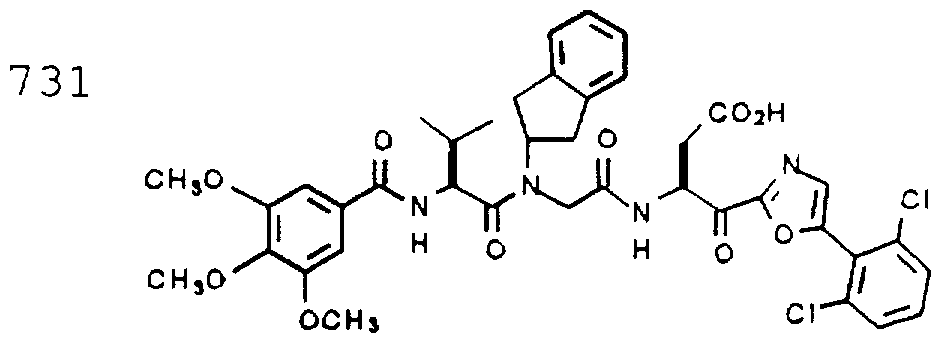
121 Ep: the epo has been informed by wipo that ep was designated in this application
WWE Wipo information: entry into national phase

Ref document number: 1199800508

Country of ref document: VN

WWE Wipo information: entry into national phase

Ref document number: 326555

Country of ref document: NZ

ENP Entry into the national phase

Ref document number: 2240489

Country of ref document: CA

Ref document number: 2240489

Country of ref document: CA

Kind code of ref document: A

WWE Wipo information: entry into national phase

Ref document number: PV1998-1905

Country of ref document: CZ

WWE Wipo information: entry into national phase

Ref document number: 1019980704611

Country of ref document: KR

WWE Wipo information: entry into national phase

Ref document number: PA/a/1998/005015

Country of ref document: MX

Ref document number: 1998/01168

Country of ref document: TR

WWE Wipo information: entry into national phase

Ref document number: 1996945237

Country of ref document: EP

REG Reference to national code

Ref country code: DE

Ref legal event code: 8642

WWP Wipo information: published in national office

Ref document number: 1996945237

Country of ref document: EP

Ref document number: PV1998-1905

Country of ref document: CZ

WWP Wipo information: published in national office

Ref document number: 1019980704611

Country of ref document: KR

WWG Wipo information: grant in national office

Ref document number: PV1998-1905

Country of ref document: CZ

WWR Wipo information: refused in national office

Ref document number: 1019980704611

Country of ref document: KR

WWG Wipo information: grant in national office

Ref document number: 1996945237

Country of ref document: EP