WO1997024478A1 - Polyester filamentary yarn, polyester tire cord and production thereof - Google Patents
Polyester filamentary yarn, polyester tire cord and production thereof Download PDFInfo
- Publication number
- WO1997024478A1 WO1997024478A1 PCT/KR1996/000248 KR9600248W WO9724478A1 WO 1997024478 A1 WO1997024478 A1 WO 1997024478A1 KR 9600248 W KR9600248 W KR 9600248W WO 9724478 A1 WO9724478 A1 WO 9724478A1
- Authority
- WO
- WIPO (PCT)
- Prior art keywords
- yarn
- polyester
- temperature
- cord
- yam
- Prior art date
- Legal status (The legal status is an assumption and is not a legal conclusion. Google has not performed a legal analysis and makes no representation as to the accuracy of the status listed.)
- Ceased
Links
Classifications
-
- B—PERFORMING OPERATIONS; TRANSPORTING
- B60—VEHICLES IN GENERAL
- B60C—VEHICLE TYRES; TYRE INFLATION; TYRE CHANGING; CONNECTING VALVES TO INFLATABLE ELASTIC BODIES IN GENERAL; DEVICES OR ARRANGEMENTS RELATED TO TYRES
- B60C9/00—Reinforcements or ply arrangement of pneumatic tyres
- B60C9/0042—Reinforcements made of synthetic materials
-
- D—TEXTILES; PAPER
- D01—NATURAL OR MAN-MADE THREADS OR FIBRES; SPINNING
- D01F—CHEMICAL FEATURES IN THE MANUFACTURE OF ARTIFICIAL FILAMENTS, THREADS, FIBRES, BRISTLES OR RIBBONS; APPARATUS SPECIALLY ADAPTED FOR THE MANUFACTURE OF CARBON FILAMENTS
- D01F6/00—Monocomponent artificial filaments or the like of synthetic polymers; Manufacture thereof
- D01F6/58—Monocomponent artificial filaments or the like of synthetic polymers; Manufacture thereof from homopolycondensation products
- D01F6/62—Monocomponent artificial filaments or the like of synthetic polymers; Manufacture thereof from homopolycondensation products from polyesters
-
- Y—GENERAL TAGGING OF NEW TECHNOLOGICAL DEVELOPMENTS; GENERAL TAGGING OF CROSS-SECTIONAL TECHNOLOGIES SPANNING OVER SEVERAL SECTIONS OF THE IPC; TECHNICAL SUBJECTS COVERED BY FORMER USPC CROSS-REFERENCE ART COLLECTIONS [XRACs] AND DIGESTS
- Y10—TECHNICAL SUBJECTS COVERED BY FORMER USPC
- Y10T—TECHNICAL SUBJECTS COVERED BY FORMER US CLASSIFICATION
- Y10T428/00—Stock material or miscellaneous articles
- Y10T428/29—Coated or structually defined flake, particle, cell, strand, strand portion, rod, filament, macroscopic fiber or mass thereof
- Y10T428/2913—Rod, strand, filament or fiber
-
- Y—GENERAL TAGGING OF NEW TECHNOLOGICAL DEVELOPMENTS; GENERAL TAGGING OF CROSS-SECTIONAL TECHNOLOGIES SPANNING OVER SEVERAL SECTIONS OF THE IPC; TECHNICAL SUBJECTS COVERED BY FORMER USPC CROSS-REFERENCE ART COLLECTIONS [XRACs] AND DIGESTS
- Y10—TECHNICAL SUBJECTS COVERED BY FORMER USPC
- Y10T—TECHNICAL SUBJECTS COVERED BY FORMER US CLASSIFICATION
- Y10T428/00—Stock material or miscellaneous articles
- Y10T428/29—Coated or structually defined flake, particle, cell, strand, strand portion, rod, filament, macroscopic fiber or mass thereof
- Y10T428/2913—Rod, strand, filament or fiber
- Y10T428/2933—Coated or with bond, impregnation or core
- Y10T428/2964—Artificial fiber or filament
- Y10T428/2967—Synthetic resin or polymer
- Y10T428/2969—Polyamide, polyimide or polyester
Definitions
- the present invention relates to an industrial polyester filamentary yam and a tire cord formed from this filamentary yarn. More particulary, it relates to a polyester filamentary yarn, a tire cord having an improved fatigue resistance due to increased thermal dimensional stability and strength, and low shrinkage as well as a process for production of this yarn.
- nylon, rayon, polyester etc. fibers are typical examples of the fibers which have been used as reinforcements in rubber tires.
- Nylon tire cord has higher strength and toughness than the other materials due to the inherent properties of nylon fiber and has been generally used in bias tires for trucks, buses etc..
- Rayon tire cord provides a low degree of shrinkage and has good thermal and dimensional stability due to the inherent properties of rayon fiber and has been generally used in high speed radial travelling tires for passenger cars.
- nylon tire cord has poor dimensional stability due to its low modulus characteristics and high shrinkage and further exhibits flat spots due to its low glass transition temperature( T g ).
- Rayon tire cord also has low modulus characteristics and exhibits a sharp decrease in strength after the fibers have been formed into a tire cord.
- polyester tire cord has been widely used.
- polyester fibers that have been used in tires have benzene lings in their molecular structure, and a rigid molecular chain. Accordingly, tire cord formed from polyester yarn has good elastic modulus and good fatigue resistance, and provides few flat spots, excellent creep resistance and excellent endurance. For these reasons, polyester tire cord has been widely used in radial tires for passenger cars.
- polyester tire cords do have a problem; they undergo substantial variation in their properties with temperature due, it is thought, to hysteresis effect.
- conventional industrial high strength polyester fibers generally exhibit substantial shrinkage when heated.
- Prior art methods for improving fatigue resistance of polyester fibers have focused on a chemical method for increasing stability by reducing the content of carboxyl groups in the polyester and a method wherein highly -oriented undrawn yarn produced using a polyester with a relatively low intrinsic viscosity (IV), or produced by employing a high-speed spinning process, is drawn.
- IV intrinsic viscosity
- Prior art processes for producing tire cord from yarn include, for example, Japanese patent laid-open no. Sho 61-12952 which discloses a tire cord having a tenacity of at least 7.0g/d, an absorption peak temperature in the amorphous portions of 148 ⁇ 154 T, a dry shrinkage of 3.3 — 5 % which is produced by spinning a polyester having an intrinsic viscosity of 1.0, a diethylene glycol content of 1.0 mol%, a carboxyl group content of 10 eq/ 10 g at a spinning speed of 2,000 — 2,500 m/min to obtain undrawn yarn, drawing the undrawn yarn at about 160 * 0, thermally treating at 210 - 240 V. and dipping the obtained yarn in a conventional rubber solution.
- USP 4,101,525 and 4,195,052 disclose a polyester tire cord produced by a process comprising drawing highly oriented undrawn yarn prepared from a high-speed spinning process to obtain highly oriented drawn yam, specifically multi-drawn yarn comprising 85mol% polyethylene terephthalate having a denier per filament of 1 to 20 and a work loss at 150 of 0.004 - 0.02 lb.in, and clipping the multi -drawn yarn in a rubber solution.
- the tie molecular chains which greatly affect dimensional stability (especially shrinkage), are oriented. This leads to residual internal stress and finally causes a lowering of the fatigue resistance of the tire cord.
- internal stress causes a temperature rise which induces a continuous increase of thermal stress. This finally results in poor tire cord fitigue resistance because after the tire cord conversion process or dipping process comprising dipping the cord in a rubber solution and thermally treating, an internal stress remains in the tire cord.
- yarns which are highly oriented drawn yarns before undergoing the tire cord conversion process have a definite two-phase structure with both crystalline and amorphous portions. When it is dipped in a rubber solution and thermally treated, breaking of molecular chains occurs and leads to a lowering of strength.
- Japanese Patent laid-open no. Sho. 54-77794 discloses a process which comprises treating polyester drawn yam with an epoxy resin compound prior to dipping in a rubber solution but this process did not solve the above-described problems.
- the present invention has been developed to solve the above described problems of the prior art. According to the present invention, the two problems of lowering of fatigue resistance due to residual internal stress by high-speed spinning and lowering of strength due to deterioration of the crystalline portions on dipping in a rubber solution can be solved based upon the points described below.
- Polyester yarn having a high crystallinity undergoes a high degree of the thermal hysteresis and, accordingly, has a high thermal stress. Thus, it tends to undergo a lowering of strength, elastic modulus or strength retension efficiency due to formation of folded crystals and in particular, from unconstrained molecular chains in the amorphous portions present during recrystallization which subsquent heat treatments, such as dipping process etc., cause.
- a high crystalline polyester yam itself may exhibit microstructally good thermal stability, dimensional stability and fatigue resistance , but these properties are still insufficient because the ya has not any functional groups for bonding with rubber. Accordingly, the ya is twisted to improve its fatigue resistance and is subjected to dipping processGatex treatment) to improve bonding property with the rubber. All conditions of thermal energy, shrinkage and relaxation heat treatment etc. in dipping process of the yarn determine the mechanical properties and final dimensional stability of tire cords. From such variation, the present inventors have found that a microstructural variation during a series of cord conversion processes is a important technical point in improvement of cord qualities such as dimensional stability and fatigue resistance.
- the present inventors have directed their research toward improving the prior art methods for producing polyester yarn for tire cord which has excellent overall physical properties like strength, and at the same time, which has a high strength conversion efficiency and excellent dimensional stability leading to excellent fatigue resistance when used even after having been subjected to a high temperature dipping treatment as well as after having been incorporated into a rubber matrix.
- the present invention has been achieved.
- most of the conventional methods form filamentary yarn with an ideal structure which maintain high degree of crystallization and minimize the degree of orientation of amorphous portions, through processes taking with the thermal treatment of high tempreature, and dip the filamentary yarn into a rubber solution to accomplish properties required as final tire cords.
- the present invention comprise producing a polyester tire cord having stable two-phase structure of crystalline and amorphous portions by defining a density, which represents a crystallization level , within a limited range from the preparation of yam, maximizing birefringence index of amorphous portions to form fibrous microstructure and then recrystallization using thermal energy generated during dipping in rubber solution to rearrange the fibrous microstructure.
- Amorphous portions with high degree of orientation existing in filamentary yam is easily crystallized when they are subjected to thermal treatment during dipping.
- the size of such crystal in the present yam is small than that of conventional yam with 10% or more.
- the present filamentary yarn in a cord has a network crystal structure which crystalline portions and amorphous portions are homogeneously distributed, and therefore, have a excellent dimensional stability.
- the content of constrained tie molecular chains connecting between crystals is increased by minimizing formation of folded crystals during recrystallization so that high elastic modulus can be remained.
- an undrawn yam is produced which has highly oriented molecular chains in amorphous phase shch that crystalline diffraction is not observed clearly by x-ray, thereafter the undrawn yam is drawn at a low draw ratio and a low temperature (below the crystallization temperature) so as to minimize the strain of molecular chains in amorphous portions induced by drawing, and then subjected to thermal treatment and relaxing at a low temperature so that no further crystallization occurs.
- the filamentary yam is then dipped into a rubber solution and thermally treated at certain temperature and tension conditions enabling recrystallization to occur, thereby obtaining a final polyester tire cord.
- the first object of the present invention is to provide a polyester filamentary yarn which exhibits excellent fatigue resistance and dimensional stability both before and after it has been incorporated in a rubber matrix even under the conditions where it is subjected to repeated fatigue behavior at high temperature (at least 210 * 0, and a process for production thereof.
- the second object of the present invention is to provide a tire cord comprising a polyester filamentary yarn exhibiting excellent dimensional stability and fatigue resistance useful as a reinforcement in rubber.
- the third object of the present invention is to provide a tire exhibiting significantly improved fatigue resistance and dimensional stability even under the conditions of repeated fatigue behavior at high temperature.
- the present invention provides a polyester filamentary yam comprising at least 90 mol% polyethylene terephthalate and having a fineness of 3 to 5 denier per filament wherein said yarn satisfies the following characteristics: i ) a density of 1.38 ⁇ 1.39 g/c ⁇ f, ii ) a birefringence index in amorphous portions of 0.06—0.09, and iii ) tan ⁇ peak temperature of 140 "C and below.
- tension of 0.1 g/d satisfies the following variations of microstructural physical properties: i ) the increment of an percent crystallinity( ⁇ X C ) of 10 ⁇ 20 wt%, ii ) the decrement of an amorphous orientation coefficient of at least 0.05, iii ) the increment of a long period value( -4LP) of at least 10 A, and iv ) the decrement of tan ⁇ peak temperature( Atan of at least 5'C.
- the long period value may be calculated from the Bragg equation by obtaining the small angle X-ray scattering pattern under the conditions of 50 kV voltage, 200 mA current employing X-ray scattering instrument (the inventors used an instrument manufactured by Rigaku Co., Ltd. of Japan), using Cu-K ⁇ -radiation with 1.54 A wavelength as a light source.
- a polyester filamentary yam comprising at least 90 mol% polyethylene terephthalate is treated at a dipping condition which a relaxation and tension is subjected to filaments at high temperature, namely, a tension of 0.2 ⁇ 0.6g/d, a heating zone temperation in relaxing and dipping of 230 ⁇ -250 ,, C, microstructural variations occurs in filaments during converting the filamentary yam into the treated cord.
- microstructural variations are same with the microstructural variations before and after the filamentary yam has been treated for 3 minute at temperature of 240 * 0 , tension of 0.1 g/d.
- the present polyester filamentary yarn exhibits a considerable decrease of thermal shrinkage between the yarn and its treated cord according to variations of microstructural physical properties on dipping process.
- the filamentary yarn after dipping process has an ideal microscopic structure.
- the present invention provides a process for producing a polyester filamentary yam from polyester resin comprising at least 90 mol% polyethylene terephthalate and having an intrinsic viscosity of at least 0.85 by melt-spinning and directly drawing, wherein i ) said polyester resin is spun at a spinning speed of 2,500 ⁇ 4,000 m/min and then solidified by quenching at a quench air temperature of 25 * C — T g of the polymer to an extent of a solidification point formed within 2/3 of the whole length of a quenching zone and below to produce a undrawn yarn having a density of 1.355 — 1.360 g/cm' ; ii ) said undrawn yam is drawn at a drawing temperature of T e to crystallization temperature of the polymer to produce a drawn yarn having a breaking elongation of 15 % and below; and iii ) the obtained drawn yarn is thermally set at a temperature of 210 * C and below.
- a polyester undrawn yam having a density of 1.355— 1.360 g/ ⁇ rf can be drawn at a drawing temperature between glsss transition temperature (i.e. second transition temperature) and crystallization temperature of the polymer and preferably 80-120 "C, and then thermally treated at a temperature of 210 " C and below to produce a drawn yam having a breaking elongation of 15 % and below.
- glsss transition temperature i.e. second transition temperature
- crystallization temperature of the polymer preferably 80-120 "C
- the present invention provides a tire cord formed from a polyester filamentary yam comprising at least 90 mol% polyethylene terephthalate and having a fineness of 3 to 5 denier per filament, wherein said cord satisfies the following characteristics according to variations of microstructural physical properties on dipping: i ) a value of dimensional stability(DS) : DS > 0.80, ii ) tenacity of cord [T(g/d)] : T > 0.1DS + 4.8 , and iii ) a dry shrinkage of 3.5% and below.
- the polyester filamentary yarn of the present invention contains at least 90 mol% polyethylene terephthalate, preferably at least 95 mol% . Additionally, the polyester filamentary yam of the present invention may contains 10 mol% and below, preferably 5 mol% and below, copolymerized ester units other than polyethylene terephthalate.
- the ester-forming ingredients useful as ester units other than polyethylene terephthalate include, for example, glycols such as diethylene glycol, trimethylene glycol, tetrarnethylene glycol, hexamethylene glycol and dicarboxylic acids such as isophthalic acid, hexahydroterephthalic acid, adipic acid, sebasic acid, azellaic acid, etc.
- polyester filamentary yam of the present invention usually has a fineness of 3-5 denier per filament, but this value can be widely varied as is apparent to the skilled in this art.
- a density which represents a crystallization level, is limited within a given range from the preparation of yarn and a birefringence index of amorphous portions is maximized.
- the peak intensity of the ya in x-ray diffraction is minimized.
- the fibrous microstructure of the yarn is rearranged through a recrystallization using thermal energy generated during dipping process in rubber solution to produce a polyester tire cord having stable two-phase structure of crystalline and amorphous portions.
- the microstructue of the yarn as specifically defined in the present invention may be determined by scanning x-ray diffraction strength within a small angle in the direction of the meridian and quantitatively computing the strength of diffraction lines. Also, the density( p ) may be determined by measurement according to density gradient column method using n-heptane and carbon tetrachloride at 25 * C.
- the present yarn is characterized by a density of 1.38— 1.39 g/ CT.
- the density of the yarn is below the above range, the filament is so soft that breakage frequently occurs during the yarn manufacturing process.
- the yam as it is subjected to high heat during the yam manufacturing process etc., has a high residual thermal stress which causes a lowering of the strength of cord and limits variations of its microstructure during dipping process although the mechanical properties of the yam may be good and the thermal shrinkage of the yarn is lowering.
- the present yarn is characterized by a birefringence of amorphous portions( ⁇ n a ) of 0.06-0.09, preferably 0.07-0.09.
- the pressent yarn exhibits a suitable orientation characteristic of amorphous portions within the above range of ⁇ n a .
- the degree of orientation in amorphous portions is insufficient so that on dipping the amount of the amorphous portions incorporated into the crystalline portions is low and the increased thermal energy required for increasing the amount of incorporation may be effected thereby to produce a final dipped cord with poor properties such as low strength and poor dimensional stability.
- the average birefringence(.- n) is calculated from the following equation by measuring the retardation obtained from the interference fringe by the sample using a Berek compensator mounted in a polarizing light microscope.
- ⁇ n ⁇ d
- d thickness of sample (mm)
- R retardation (nm)
- the crystallinity ( X c ) may be calculated from the following equation using the density( p , unit: g/c ⁇ ) of the fiber.
- the crystalline orientation coefficient f c ) may be calculated from the following equation by averaging the orientation coefficients obtained from the width at half-height of the wide angle x-ray diffraction pattem of (010) and (100) crystal planes of the material. f - f ( 010 ) + f ( 100 ) Ic 2
- a reinforcing fiber for rubbers such as tires is required to have improved toughness and high dimensional stability because it tends to suffer a severe lowering of strength and elastic modulus.
- the crystalline portions of materials should be uniformly distributed in the yarn.
- the shrinkage phenomenon which is an important indicator of dimensional stability, is a phenomenon observed when molecular chains are subjected to heat-' the length of the molecular chains is shortened as the molecular orientation of amorphous portions becomes loose and disordered.
- the part which contributes to a decrease in the dimensional deformation is the crystals adjacent to the amorphous portions. If such crystals form a close network structure, the variation of an elastic modulus under high temperature, which is represented by the value of tan ⁇ peak temperature, acts to prevent the dimensional deformation such as shrinkage by heat. In other words, This yields the same effect as that of forming a crosslink network in a rubber using sulfur.
- the present yam has lower tan S peak temperature than that of conventional yam.
- the tan ⁇ peak temperature of the prsent ya is 140 * C and below, preferably 135 "C and below.
- the accumulation of stress due to heat etc. is minimized, and the following microstructual variations between the filamentary ya and the treated cord occur simultaneously by the help of thermal energy, tension, etc., on dipping: i ) the increment of an percent crystallinity( ⁇ X C ) of 10—20 wt%, ii ) the decrement of an amorphous orientation coefficient ⁇ F a ) of at least 0.05, iii ) the increment of a long period value( ⁇ UP) of at least 10 A, and iv ) the decrement of tan ⁇ peak temperature( tan ⁇ $ggi « ,) ⁇ ) of at least 5
- the present invention provides a polyester filamentary yam exhibiting the remarkable decrease of thermal shrinkage by minimizing the accumulation of stress by heat etc. in the yarn and causing simultaneously the above described microstructural variation of physical properties between the yarn and the dipped cord using thermal energy on dipping and mechanical forces such as tension .
- the present yarn having such characteristics make the production of a cord having a good mechanical properties and dimensional stability possible.
- Amorphous portions with high degree of orientation existing in a filamentary yam is further crystallized when they are subjected to thermal treatment during dipping.
- the size of such crystal in the present ya is smaller than that of conventional yarn with 10% or more.
- the present filamentary yarn in a cord has a network crystal structure which crystalline portions and amorphous portions are uniformly distributed, and therefore, have a excellent dimensional stability.
- the content of constrained tie molecular chains connecting between crystals is increased by minimizing formation of folded crystals during recrystedlization so that high elastic modulus can be remained.
- the present yam itself exhibits a high shrinkage in an oven at 150 * 0 during 30 minutes under zero tension, but a cord prepared by dipping the yarn into a rubber matrix exhibits the following excellent physical properties owing to the above described microstructural variations: i ) a value of dimensional stability (DS) ' DS > 0.80, ii ) tenacity of cord [T(g/d)] : T > 0.1DS + 4.8 , and iii ) dry shrinkage of cord(%) ⁇ 3.5%.
- a tire cord having a network structure as described above generates a lot of heat when it has been incorporated in a tire and subjected to deformation power such as elongation and compression, because a high activation energy is required for the molecular chains existing in the amorphous portions to move, and, as a result, the interior temperature of tire will be increased and accordingly the tire cord will have poor fatigue resistance and a short lifetime, But in practice the opposite phenomenon is observed.
- the present inventors have verified by experiments that the above described network contributes to excellent fatigue resistance. This is because the fatigue mechanism of tire cord is attributed to the chemical deterioration much more than to physical deterioration.
- a tire cord in tire has a structure wherein a network developed well, movement of the amorphous molecules by exterior elongation, compression and flexing deformation is difficult so that a high amount of heat is generated to increase the temperature and thus to increase the physical fatigue, but it is very small.
- the present yarn has a high degree of orientation in the amorphous portions which makes the penetration of water and amines difficult, thereby decreasing the chemical deterioration to obtain excellent fatigue resistance.
- the polyester used as the starting material may be a polyester with a high polymerization degree shch that its intrinsic viscosity is at least 0.85.
- the degree of polymerization is very important with respect to ultimate dimensional stability and fatigue resistance.
- a polymer with a low molecular weight may be used advantageously for dimensional stability, but a polymer with a high molecular weight is preferred for fatigue resistance.
- optimization of the whole of the properties and a lowering of fatigue resistance can be achived by selecting a polymer with an intrinsic viscosity of at least 0.85, preferably at least 1.0.
- a high-stress spinning process is performed to obtain an undrawn yarn with a density of at least 1.355 g/ ⁇ rf. It is important to produce the undrawn yam exhibiting unique packing degree of molecular chains in the prior step before producing the yarn forming the above described microstructure according to the present invention.
- the density of the undrawn yarn is proportional to the magnitude of tension which the extruded yam is subjected to upon reaching the glass transition temperature by cooling with quench air.
- the magnitude of tension depends upon the spinning speed, the discharge quantity per opening and the temperature of the quench air.
- the density of the undrawn yarn is effected on the point that the extruded yam from the spinneret reaches a temperature below the glass transition temperature by cooling with quench air.
- the density is preferably controlled to be at least 1.355 with a high tension in the solidification point by heightening the spinning speed to increase the speed of tensile deformation of the extruded yam or by fixing the spinning speed and decreasing the discharge quantity per opening.
- the bundle of filaments is slowly cooled so that the solidification point moves as fat as possible from the spinneret.
- the bundle of filaments is cooled after melt spinning from the spinneret it is preferable to form the solidification point within 2/3 of the whole length of the quenching zone and below.
- the density of undrawn yam is variable according to positions forming the solidification point. Accordingly, positions forming the solidification point can presuppose from the density of undrawn yam.
- the lowering of strength owing to the temperature difference between the inner and outer layer of the filament can be decreased by increasing the quench temperature to a range of from 25 * 0 to the glass transition temperature T g of the polymer, preferably 40—60 * 0 in order to decrease the temperature difference between the inner and outer layer of the filament at the solidification point in a high-speed spinning process.
- the temperature is less than 25 * 0, the filament may be too quickly quenched and thus the tension at the solidification point may be decreased so that it may be difficult to obtain a highly oriented undrawn yam.
- Varying the discharge quantity per opening may have a great influence upon the mechanical properties of the yam. It is advantageous to maintain the finess of the yarn after drawing within 3 to 5 denier by controlling the spinning conditions and preventing a ununiform quench.
- the present process is characterized by drawing at a low draw ratio and at a temperature below the crystallization temperature of the undrawn yarn.
- Multi-step drawing of two or more step is preferably used in the present process.
- the crystallization temperature of a highly oriented undrawn yam produced by a high-speed spinning process is usually lower by more than 10 * 0 than that of an undrawn yarn by a low -speed spinning process.
- the drawing temperature is controlled to be in the range of from the glass transition temperature to 120t!, preferably 80-120 * 0 , more preferably 80-90 * 0. If the drawing temperature is high, fine crystals are already formed before the orientation of the molecular chains and accordingly the drawability is degraded. At low temperature, the molecular chains lose their mobility, whereby the efficiency of drawing is low.
- the total draw ratio is controlled to be in the range of about
- multi-step drawing comprising two or more step is preferably used in the present process. If the drawing is performed in one step by drawing to achieve about 70 persent of total draw ratio in the first drawing zone, the period of time taken is not enough for the tangled molecular chains to attain a fibrillar structure so that part of the molecular chains remain in the tangled state. This causes a defect of structure and, accordingly, shrinkage by heat may be increased.
- the shrinkage of the dipped cord can be greatly decreased by use of a highly oriented undrawn ya produced by the high-speed spinning process such that it is transformed into a liquid-like form rather than undergoes shrinkage when it is subjected to heat after drawing it under specific conditions. It is reported that as a result of experiments wherein the initially oriented amorphous polymer was maintained at a temperature between the glass transition temperature and melting temperature and then its behaviour under the stress was observed, it is proved that shrinkage is originated from the disorientation of molecular chains in the oriented amorphous portions and transformation to liquid-like form by elongation occurs as the degree of orientation increase when a stress higher than the shrinkage power is applied.
- the elongation and shrinkage behaviour upon application of heat can be considered to be a phenomenon oriented from the difference of elongation power due to crystallization of the originated amorphous molecular chains. Accordingly, in the present invention, the mechanism of elongation and shrinkage behaviour is put to use so the the shrinkage can be minimized.
- the present inventors have found that in order to maxmize the elongation behaviour like a liquid, crystallization by heat should not occur during drawing. Accordingly, the drawing should be carried out at a low draw ratio and at a temperature below the crystallization temperature of the undrawn yam. That is to say, when crystallization by heat already has occurred in the drawing process, because the oriented amorphous portions have been transformed into a crystalline portions, the elongation transformation occurring as the oriented amorphous portions are changed to oriented crystals no longer occurs.
- the shrinkage behaviour only occurs by disorientation of the amorphous molecular chains existing in the amorphous portions, which leads to a high dry shrinkage value.
- the present process is characterized in that the thermal treatment of the resulting drawn yam is carried out at a temperature of 150-210 TC, preferably 190-200 ⁇ .
- the crystalline and amorphous portions may be previously defined in the yarn.
- the orientation of the crystalline portions are extremly increased and the orientation of the amorphous portions are decreased.
- the temperature is one of the important factors to determine the structure of the yam because in this thermal treatment a ya with nearly completed orientation is treated.
- the temperature is required to be in the range of 150-210 * 0, preferably 190-200 * 0 to produce the present polyester yam for tire cord.
- the undrawn yam before drawing will gain the characteristic properties of the final yarn as it undergoes a drawing process wherein the crystallization and orientation of molecular chains occur by the heat employed in drawing.
- the orientation in drawing occurs concurrently in the crystalline and amorphous portions, and drawing tension of the amorphous portions are higher than the crystalline portions.
- this problem is solved by controlling the temperature at which the amorphous molecular chains after drawing initiate mobilization, that is, the loss tangent value(tan ⁇ ) is at a maximum. For example, this problem is solved by controlling the tan ⁇ peak temperature with 140 * 0 and below and lowering at least 5 ' C during dipping process.
- the present yarn is subjected in sequence to dipping in a rubber solution, drying, thermal treatment and normalizing thereby to produce a tire cord.
- a tension in the range of 0.2— 0.6g/d and a temperature in the range of 220—250 * 0 is suitably employed. If the tension exceeds 0.6 g/d or the temperature exceeds 250 * 0, a stress much higher than the elongation power originated from the crystallization of the oriented amorphous molecular chains may be applied against the yam and then it may remains as a residual stress finally in the dipped cord, leading to an increase in dry shrinkage.
- the shrinkage When the tension is less than 0.2 g/d, the shrinkage may be decreased but the strength is lowered due to the undisirable growth of the amorphous molecular chains owing to disorientation and folding of the chains. And if the temperature is less than 220O, the adhesion of the rubber solution may be insufficient the shrinkage may increase and, further, it may be impossible to obtain a tire cord with a high crystallinity.
- the present filaments are twisted in more than two strand on the basis of 1,000 denier and formed into a fabric, then this fabric is dipped into a conventional rubber solution and dried. Subsquently, the fabric is thermally treated at the above described temperature and tension, and normalized to obtain a cord fabric, from which the dipped cord of the present invention is obtained.
- the thus obtained dipped cord exhibit a dry shrinkage(S) of at most 3.5%.
- the presnt tire cord exhibits a value of dimensional stability (DS) of at least 0.80, wherein DS value means dry shrinkage(S) divided by tenacity(g/d) at
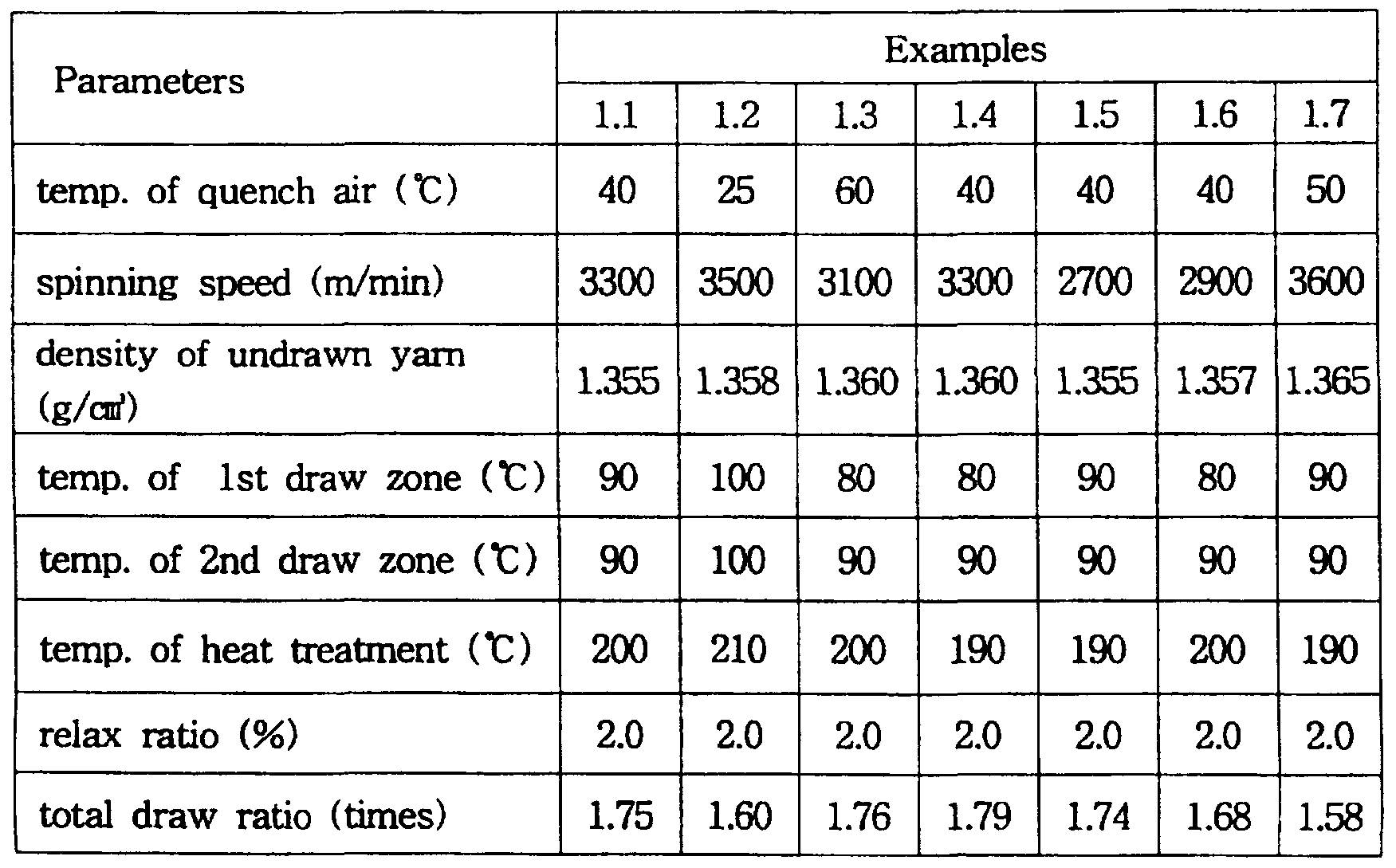
- a polyethylene terephthalate polymer having an intrinsic viscosity of 1.0 and a carboxyl end group content of about 15 eq./ 10 6 g was used as a starting material.
- the polymer was melt- spun at 305 O.
- a spinneret containing 250 holes (hole diameter 0.60 m ⁇ i) was used in the extrusion.
- a shroud was placed directly under the spinneret and below the shroud quenching and solidification was carried out with quench air at a temperature less than 80 C.
- ® dry shrinkage of yam-' the value(-d ⁇ in percent) calculated from the following equation wherein 0 is the length of a sample measured under a load of 20g after it has been placed at 25 O, 65%RH during more that 24 hours, and , is the length after it has been placed in the oven at 150 * 0 during 30 minutes under zero load.
- ® dry shrinkage of cord the value (S, in percent) calculated from the following equation wherein Q is the length of the cord fabric measured under a dead weight loading of 20g after it has been placed at 25 * 0, 65%RH during more that 24 hours, and is the length after it has been placed in the oven at 150 * 0 during 30 minutes under a dead weight loading of 20g.
- D 885 method The value obtained from the following formula by measuring the strength of a cord sample taken from a tire, before and after 48 hours rotation at an inner tube presure of 3.5 kg/cm 1 , rotation speed 850 rpm and tube angle 80° .
- ® tan ⁇ peak temperature the value measured under the condition of 100 Hz, temperature rise rate of 3 * 0 /min.
- the drawn filmentary yarn produced in the above Examples was subjected to twisting consisting of first twists of 49 times/10 cm in Z direction and second twists of 49 times/ 10cm in S direction and two times of doubling and then formed into a fabric.
- the resulting fabric was dipped in resorcinol formalin latex solution and then dried at 160 ⁇ C during 60 seconds.
- the dipped fabric was thermally treated, relaxed at 1.5 percent, and normalized at 245 * C for 60 seconds, to finally obtain a polyester tire cord of 2500 denier.
- the properties of the so obtained tire cord are also described in Table 4 which follows.
- the present tire cord has a dry shrinkage less than 3.5% at dimensional stability (DS) of at least 0.80 and thus exhibits excellent dimensional stability.
Landscapes
- Engineering & Computer Science (AREA)
- Mechanical Engineering (AREA)
- Chemical & Material Sciences (AREA)
- Chemical Kinetics & Catalysis (AREA)
- General Chemical & Material Sciences (AREA)
- Textile Engineering (AREA)
- Tires In General (AREA)
- Artificial Filaments (AREA)
- Yarns And Mechanical Finishing Of Yarns Or Ropes (AREA)
- Ropes Or Cables (AREA)
Abstract
Description


Claims
Priority Applications (8)
| Application Number | Priority Date | Filing Date | Title |
|---|---|---|---|
| DE69621006T DE69621006T2 (en) | 1995-12-30 | 1996-12-26 | POLYESTER FILAMENT THREAD, POLYESTER TIRE CORD AND THEIR PRODUCTION |
| US08/894,706 US5891567A (en) | 1995-12-30 | 1996-12-26 | Polyester filamentary yarn, polyester tire cord and production thereof |
| EP96943355A EP0812370B1 (en) | 1995-12-30 | 1996-12-26 | Polyester filamentary yarn, polyester tire cord and production thereof |
| CA002214110A CA2214110C (en) | 1995-12-30 | 1996-12-26 | Polyester filamentary yarn, polyester tire cord and production thereof |
| PL96322121A PL184254B1 (en) | 1995-12-30 | 1996-12-26 | Yarn made of continuous polyester monofilaments, polyester tyre reinforcement cord and method of making them |
| AU12115/97A AU713003B2 (en) | 1995-12-30 | 1996-12-26 | Polyester filamentary yarn, polyester tire cord and production thereof |
| NZ324845A NZ324845A (en) | 1995-12-30 | 1996-12-26 | Filamentary yarn comprising at least 90 mol% polyethylene terephthalate and having a density of 3 to 5 denier per filament |
| JP09524229A JP3139627B2 (en) | 1995-12-30 | 1996-12-26 | Polyester filament yarn, polyester tire cord and method for producing the same |
Applications Claiming Priority (4)
| Application Number | Priority Date | Filing Date | Title |
|---|---|---|---|
| KR1019950069066A KR0141414B1 (en) | 1995-12-30 | 1995-12-30 | Polyester filament yarn and its manufacturing method |
| KR1019960064955A KR100213311B1 (en) | 1996-12-13 | 1996-12-13 | Polyester filament yarn, polyester tire cords and their manufacturing method |
| KR1995/69066 | 1996-12-13 | ||
| KR1996/64955 | 1996-12-13 |
Publications (1)
| Publication Number | Publication Date |
|---|---|
| WO1997024478A1 true WO1997024478A1 (en) | 1997-07-10 |
Family
ID=26631573
Family Applications (1)
| Application Number | Title | Priority Date | Filing Date |
|---|---|---|---|
| PCT/KR1996/000248 Ceased WO1997024478A1 (en) | 1995-12-30 | 1996-12-26 | Polyester filamentary yarn, polyester tire cord and production thereof |
Country Status (13)
| Country | Link |
|---|---|
| US (1) | US5891567A (en) |
| EP (1) | EP0812370B1 (en) |
| JP (2) | JP3139627B2 (en) |
| CN (1) | CN1071812C (en) |
| AR (1) | AR005327A1 (en) |
| AU (1) | AU713003B2 (en) |
| CA (1) | CA2214110C (en) |
| DE (1) | DE69621006T2 (en) |
| MA (1) | MA26141A1 (en) |
| MY (2) | MY124795A (en) |
| NZ (1) | NZ324845A (en) |
| PL (1) | PL184254B1 (en) |
| WO (1) | WO1997024478A1 (en) |
Cited By (4)
| Publication number | Priority date | Publication date | Assignee | Title |
|---|---|---|---|---|
| EP1176233A1 (en) * | 2000-07-28 | 2002-01-30 | Toyo Boseki Kabushiki Kaisha | Polyester fibers for rubber reinforcement and dipped cords using same |
| CN101981240B (en) * | 2008-03-31 | 2012-06-20 | 可隆工业株式会社 | Drawn polyethylene terephthalate (PET) fiber, PET tire cord, and tire comprising thereof |
| CN102634858A (en) * | 2012-04-24 | 2012-08-15 | 可隆(南京)特种纺织品有限公司 | Manufacture method of polyethylene terephthalate drawn wire, tyre cord fabric and manufacture method thereof |
| CN104089974A (en) * | 2014-07-29 | 2014-10-08 | 盐城纺织职业技术学院 | Synthetic fiber heat shrinkage rate detection method and synthetic fiber heat shrinkage rate detection device |
Families Citing this family (20)
| Publication number | Priority date | Publication date | Assignee | Title |
|---|---|---|---|---|
| ID846B (en) * | 1991-12-13 | 1996-08-01 | Kolon Inc | FIBER YARN, POLYESTER TIRE THREAD AND HOW TO PRODUCE IT |
| US6329053B2 (en) * | 1999-07-28 | 2001-12-11 | Kolon Industries, Inc. | Polyester multifilamentary yarn for tire cords, dipped cord and production thereof |
| KR100571214B1 (en) * | 1999-07-31 | 2006-04-13 | 주식회사 코오롱 | Polyester Multifilament Yarn for Tire Cord, Deep Cord and Manufacturing Method thereof |
| US6358605B1 (en) | 2000-02-10 | 2002-03-19 | Brady Worldwide, Inc. | Label for use on rubber products |
| US6667254B1 (en) * | 2000-11-20 | 2003-12-23 | 3M Innovative Properties Company | Fibrous nonwoven webs |
| KR100448008B1 (en) * | 2002-07-20 | 2004-09-08 | 주식회사 효성 | A high-strength and low-shrinkage polyester yarn and process for its preparation |
| JP2005103039A (en) * | 2003-09-30 | 2005-04-21 | Pentax Corp | Pupil distance measuring method and measuring instrument |
| US7056461B2 (en) * | 2004-03-06 | 2006-06-06 | Hyosung Corporation | Process of making polyester multifilament yarn |
| CN1297696C (en) * | 2004-12-31 | 2007-01-31 | 张学军 | Polyester filament capable of integrated dyeing with natural fiber under normal temperature and pressure, and and composite yarn and fabric |
| CN101878332B (en) * | 2007-09-28 | 2012-09-05 | 自然工作有限责任公司 | Polylactide stereocomplex conjugate fibers |
| PT2207919E (en) * | 2007-11-09 | 2012-06-20 | Kolon Inc | The industrial high tenacity polyester fiber with superior creep properties and the manufacture thereof |
| JP5479698B2 (en) * | 2008-09-08 | 2014-04-23 | 株式会社ブリヂストン | Crystal structure analysis method for tire fiber cords |
| JP5358424B2 (en) * | 2009-12-18 | 2013-12-04 | 株式会社ブリヂストン | Pneumatic tire |
| JP5542084B2 (en) * | 2011-03-31 | 2014-07-09 | 帝人株式会社 | Polyester fiber for rubber reinforcement |
| KR101917900B1 (en) * | 2011-03-31 | 2018-11-12 | 데이진 프론티아 가부시키가이샤 | Polyester fiber for rubber reinforcement and process for producing same |
| JP5542085B2 (en) * | 2011-03-31 | 2014-07-09 | 帝人株式会社 | Method for producing pretreated polyester fiber |
| JP5852280B1 (en) * | 2015-03-23 | 2016-02-03 | コスメディ製薬株式会社 | Microneedle and its manufacture |
| CN112709074B (en) * | 2020-12-29 | 2021-11-02 | 盐城市恒固新材料科技有限公司 | Preparation method of modified polyester fiber yarn |
| CN118895587A (en) * | 2021-04-30 | 2024-11-05 | 上海凯赛生物技术股份有限公司 | A method for preparing polyamide 56 stretch yarn |
| TR2021010187A1 (en) * | 2021-06-22 | 2023-01-23 | Kordsa Teknik Tekstil As | A NEW POLYESTER BELTING PLY |
Citations (3)
| Publication number | Priority date | Publication date | Assignee | Title |
|---|---|---|---|---|
| EP0042664A1 (en) * | 1980-06-24 | 1981-12-30 | Imperial Chemical Industries Plc | Polyester yarns produced by high speed melt-spinning processes |
| US4491657A (en) * | 1981-03-13 | 1985-01-01 | Toray Industries, Inc. | Polyester multifilament yarn and process for producing thereof |
| EP0546859A2 (en) * | 1991-12-13 | 1993-06-16 | Kolon Industries Inc. | Polyester filamentary yarn, polyester tire cord and production thereof |
Family Cites Families (5)
| Publication number | Priority date | Publication date | Assignee | Title |
|---|---|---|---|---|
| JPS5281394A (en) * | 1975-12-29 | 1977-07-07 | Showa Highpolymer Co Ltd | Curable resin compositions |
| US4101525A (en) * | 1976-10-26 | 1978-07-18 | Celanese Corporation | Polyester yarn of high strength possessing an unusually stable internal structure |
| US4195052A (en) * | 1976-10-26 | 1980-03-25 | Celanese Corporation | Production of improved polyester filaments of high strength possessing an unusually stable internal structure |
| US5288553A (en) * | 1991-01-29 | 1994-02-22 | E. I. Du Pont De Nemours And Company | Polyester fine filaments |
| DE69127118T2 (en) * | 1990-04-06 | 1997-12-11 | Asahi Chemical Ind | Polyester fiber and process for its manufacture |
-
1996
- 1996-12-26 US US08/894,706 patent/US5891567A/en not_active Expired - Lifetime
- 1996-12-26 WO PCT/KR1996/000248 patent/WO1997024478A1/en not_active Ceased
- 1996-12-26 CN CN96192255A patent/CN1071812C/en not_active Expired - Fee Related
- 1996-12-26 CA CA002214110A patent/CA2214110C/en not_active Expired - Fee Related
- 1996-12-26 PL PL96322121A patent/PL184254B1/en not_active IP Right Cessation
- 1996-12-26 NZ NZ324845A patent/NZ324845A/en unknown
- 1996-12-26 EP EP96943355A patent/EP0812370B1/en not_active Revoked
- 1996-12-26 AU AU12115/97A patent/AU713003B2/en not_active Ceased
- 1996-12-26 JP JP09524229A patent/JP3139627B2/en not_active Expired - Fee Related
- 1996-12-26 DE DE69621006T patent/DE69621006T2/en not_active Revoked
- 1996-12-27 MY MYPI20013233 patent/MY124795A/en unknown
- 1996-12-27 MY MYPI96005522A patent/MY127650A/en unknown
- 1996-12-30 MA MA24444A patent/MA26141A1/en unknown
- 1996-12-30 AR ARP960105961A patent/AR005327A1/en active IP Right Grant
-
2000
- 2000-07-19 JP JP2000219746A patent/JP3768389B2/en not_active Expired - Fee Related
Patent Citations (3)
| Publication number | Priority date | Publication date | Assignee | Title |
|---|---|---|---|---|
| EP0042664A1 (en) * | 1980-06-24 | 1981-12-30 | Imperial Chemical Industries Plc | Polyester yarns produced by high speed melt-spinning processes |
| US4491657A (en) * | 1981-03-13 | 1985-01-01 | Toray Industries, Inc. | Polyester multifilament yarn and process for producing thereof |
| EP0546859A2 (en) * | 1991-12-13 | 1993-06-16 | Kolon Industries Inc. | Polyester filamentary yarn, polyester tire cord and production thereof |
Cited By (7)
| Publication number | Priority date | Publication date | Assignee | Title |
|---|---|---|---|---|
| EP1176233A1 (en) * | 2000-07-28 | 2002-01-30 | Toyo Boseki Kabushiki Kaisha | Polyester fibers for rubber reinforcement and dipped cords using same |
| US6852411B2 (en) | 2000-07-28 | 2005-02-08 | Toyo Boseki Kabushiki Kaisha | Polyester fibers for rubber reinforcement and dipped cords using same |
| CN101981240B (en) * | 2008-03-31 | 2012-06-20 | 可隆工业株式会社 | Drawn polyethylene terephthalate (PET) fiber, PET tire cord, and tire comprising thereof |
| US9045589B2 (en) | 2008-03-31 | 2015-06-02 | Kolon Industries, Inc. | Drawn polyethylene terephthalate fiber, pet tire cord, and tire comprising thereof |
| US9441073B2 (en) | 2008-03-31 | 2016-09-13 | Kolon Industries, Inc. | Drawn polyethylene terephthalate fiber, pet tire cord, and tire comprising thereof |
| CN102634858A (en) * | 2012-04-24 | 2012-08-15 | 可隆(南京)特种纺织品有限公司 | Manufacture method of polyethylene terephthalate drawn wire, tyre cord fabric and manufacture method thereof |
| CN104089974A (en) * | 2014-07-29 | 2014-10-08 | 盐城纺织职业技术学院 | Synthetic fiber heat shrinkage rate detection method and synthetic fiber heat shrinkage rate detection device |
Also Published As
| Publication number | Publication date |
|---|---|
| JP2001115354A (en) | 2001-04-24 |
| EP0812370B1 (en) | 2002-05-02 |
| CA2214110A1 (en) | 1997-07-10 |
| JP3768389B2 (en) | 2006-04-19 |
| NZ324845A (en) | 1999-02-25 |
| MA26141A1 (en) | 2004-07-01 |
| AR005327A1 (en) | 1999-04-28 |
| CN1176670A (en) | 1998-03-18 |
| JPH10505640A (en) | 1998-06-02 |
| CA2214110C (en) | 2002-05-28 |
| CN1071812C (en) | 2001-09-26 |
| MY127650A (en) | 2006-12-29 |
| PL322121A1 (en) | 1998-01-05 |
| PL184254B1 (en) | 2002-09-30 |
| AU713003B2 (en) | 1999-11-18 |
| US5891567A (en) | 1999-04-06 |
| EP0812370A1 (en) | 1997-12-17 |
| AU1211597A (en) | 1997-07-28 |
| JP3139627B2 (en) | 2001-03-05 |
| DE69621006T2 (en) | 2002-12-05 |
| DE69621006D1 (en) | 2002-06-06 |
| MY124795A (en) | 2006-07-31 |
Similar Documents
| Publication | Publication Date | Title |
|---|---|---|
| EP0812370B1 (en) | Polyester filamentary yarn, polyester tire cord and production thereof | |
| EP0546859B1 (en) | Polyester filamentary yarn, polyester tire cord and production thereof | |
| CA1314673C (en) | High-tenacity conjugated fiber and process for preparation thereof | |
| US6519925B2 (en) | Polyester multi-filamentary yarn for tire cords, dipped cord and production thereof | |
| CN1290772A (en) | Polyester multifilament yarn for tire cord, dipped cord and production method thereof | |
| CA2455209C (en) | High tenacity polyethylene-2,6-naphthalate fibers having excellent processability | |
| JPH0246689B2 (en) | ||
| JPH06136614A (en) | Polyester fiber having improved dimensional stability and its production | |
| KR100213311B1 (en) | Polyester filament yarn, polyester tire cords and their manufacturing method | |
| KR19980066987A (en) | Polyester filament yarn having excellent thermal dimensional stability and strength utilization rate and a method of manufacturing the same | |
| WO2012134229A2 (en) | Method for manufacturing polyethylene terephthalate drawn fiber, polyethylene terephthalate drawn fiber, and tire cord | |
| KR100209110B1 (en) | Polyester tire cord and its apparatus | |
| JPH04222215A (en) | Polyester fiber and production thereof | |
| KR0141414B1 (en) | Polyester filament yarn and its manufacturing method | |
| KR19980046020A (en) | Polyester filament yarn, polyester tire cords and their manufacturing method | |
| JPS63315608A (en) | Polyester fiber | |
| KR930010801B1 (en) | Polyester fiber for rubber reinforcement | |
| KR930010799B1 (en) | Polyester fiber for tyre cord | |
| JPH0274612A (en) | Conjugate fiber having high tenacity | |
| KR930010800B1 (en) | Method for preparation of polyester cord for tyre cord |
Legal Events
| Date | Code | Title | Description |
|---|---|---|---|
| WWE | Wipo information: entry into national phase |
Ref document number: 96192255.9 Country of ref document: CN |
|
| AK | Designated states |
Kind code of ref document: A1 Designated state(s): AU CA CN JP NZ PL US |
|
| AL | Designated countries for regional patents |
Kind code of ref document: A1 Designated state(s): AT BE CH DE DK ES FI FR GB GR IE IT LU MC NL PT SE |
|
| WWE | Wipo information: entry into national phase |
Ref document number: 324845 Country of ref document: NZ |
|
| ENP | Entry into the national phase |
Ref document number: 2214110 Country of ref document: CA Ref document number: 2214110 Country of ref document: CA Kind code of ref document: A |
|
| WWE | Wipo information: entry into national phase |
Ref document number: 08894706 Country of ref document: US |
|
| WWE | Wipo information: entry into national phase |
Ref document number: 1996943355 Country of ref document: EP |
|
| 121 | Ep: the epo has been informed by wipo that ep was designated in this application | ||
| WWP | Wipo information: published in national office |
Ref document number: 1996943355 Country of ref document: EP |
|
| WWG | Wipo information: grant in national office |
Ref document number: 1996943355 Country of ref document: EP |
|
| WWW | Wipo information: withdrawn in national office |
Ref document number: 1996943355 Country of ref document: EP |