WO1997041468A1 - Organic photochromic contact lens compositions - Google Patents
Organic photochromic contact lens compositions Download PDFInfo
- Publication number
- WO1997041468A1 WO1997041468A1 PCT/US1997/006776 US9706776W WO9741468A1 WO 1997041468 A1 WO1997041468 A1 WO 1997041468A1 US 9706776 W US9706776 W US 9706776W WO 9741468 A1 WO9741468 A1 WO 9741468A1
- Authority
- WO
- WIPO (PCT)
- Prior art keywords
- photochromic
- contact lens
- group
- general formula
- photochromic contact
- Prior art date
- Legal status (The legal status is an assumption and is not a legal conclusion. Google has not performed a legal analysis and makes no representation as to the accuracy of the status listed.)
- Ceased
Links
Classifications
-
- G—PHYSICS
- G02—OPTICS
- G02B—OPTICAL ELEMENTS, SYSTEMS OR APPARATUS
- G02B5/00—Optical elements other than lenses
- G02B5/20—Filters
- G02B5/22—Absorbing filters
- G02B5/23—Photochromic filters
Definitions
- the invention relates to photochromic organic contact lenses.
- a photochromic material which can be used in the production of a contact lens whose transmittance varies as a function of light.
- photochromic properties i.e., colorability, rapid darkening and lightening kinetics, acceptable durability, etc.
- such lenses are generally made by the use of appropriate mixtures of photochromic compounds.
- the polymer matrix used for such lenses are thermally crosslinked, they tend to have a low glass transition point, generally lower than that of CR39 ® , a reference ophthalmic resin consisting of diethylene glycol bis(aUyl carbonate) available from PPG Industries, in order to exhibit rapid photochromic kinetics.
- these polymers generally have a relatively low refractive index (below 1.54).
- the invention is directed at organic photochromic contact lenses, in particular, a plastic contact lens.
- the lens is composed of (1) a polymer matrix of high optical quality, and (2) at least one dye capable of imparting photochromic properties on the lens.
- a photochromic contact lens comprising organic photochromic materials consisting of a transparent polymer having a refractive index equal to at least 1.54, and at least one photochromic dye selected from the group consisting of spirooxazines, spiropyrans, chromenes and a mixture of these, wherein the polymer is a copolymer of at least two monomers selected from the group consisting of: (i) homopolymers of ethoxylated bisphenol A dimethylacrylate with formula I:
- R is H or CH 3 , and m and n independently represent 1 or 2; (ii) ethoxylated bisphenol A dimethylacrylate containing at most 30 weight percent of an aromatic monomer with vinyl, acrylic or methoacrylic functionality;
- the invention relates to a photochromic contact lens in which the polymer is a comonomer selected from the group consisting of divinylbenzene, diallyl phthalate, benzyl methacrylate, benzyl acrylate, naphthyl methacrylate and naphthyl acrylate, and their derivatives substituted on the aromatic nuclei by chlorine or bromine atoms.
- the polymer is a comonomer selected from the group consisting of divinylbenzene, diallyl phthalate, benzyl methacrylate, benzyl acrylate, naphthyl methacrylate and naphthyl acrylate, and their derivatives substituted on the aromatic nuclei by chlorine or bromine atoms.
- the organic photochromic contact lens of the invention can be either hard or soft, and can be prepared from inventive organic photochromic materials having properties appropriate for contact lens applications such as, surface wettability, oxygen permeability, and suitable hydrophilic properties. It is also desirable that the photochromic dyes have the proper solubility, dispersability and stability for contact lens applications in order to obtain consistent or uniform photochromicity.
- the lens is made of a plastic host (polymer matrix), a photochromic compound or a mixture of photochromic compounds, and optionally, a stabilizer.
- the polymer matrix of the inventive contact lens can be thermally crosslinked, free of optical distortion, and is able to receive, and be cross-linked in the presence of an appropriate mixture of photochromic dyes.
- the resulting lens exhibits a high initial transmission before exposure as well as a high capacity to rapidly darken after exposure. Also, the lens rapidly lighten when the light source is eliminated.
- the material has a low thermal dependence, a high resistance to fatigue, and a high index of refraction. In a preferred embodiment, the index of refraction is at least 1.54, more preferably, at least 1.55.
- Examples of useful organic photochromic materials for the contact lens for the invention include the compositions disclosed in co-assigned, U.S. provisional patent application serial no. 60/000,829, titled “Temperature Stable and Sunlight Protected Photochromic Articles,” by Florent et al. (Florent I); U.S. provisional application serial no.
- the organic materials are composed of a plastic host, photochromic compounds, and a stabilizer.
- useful hosts polymer matrix
- photochromic compounds for the invention are discussed below.
- Florent I discloses transparent organic photochromic materials having high refractive index, formed from a polymer matrix, which matrix can consist of a homopolymer of ethoxylated bisphenol A dimethacrylate having the formula I.
- R H or CH 3
- m and n independently represent 1 or 2, and where optionally, the dimethacrylate is modified up to 30 wt% with an aromatic comonomer with vinyl, acrylic or methacrylic functionality, and where the material contains at least one dye that imparts photochromic properties to the matrix, the dye being selected from spirooxazines, spiropyrans and chromenes.
- These materials can be prepared by polymerizing a methoxylated bisphenol A dimethacrylate having formula I, optionally in the presence of one or more aromatic monomers with vinyl, acrylic or methacrylic functionality, in the presence of a diazo radical initiator, such as azobisisobutyronitrile, and in the absence of a peroxide radical initiator.
- a diazo radical initiator such as azobisisobutyronitrile
- Patent Nos. 5, 130,353; 5,185,390, and 5,180,254 for example
- a substrate which is impregnated with one or more photochromic dye is applied to one side (usually the convex side in the case of a lens) of the polymer matrix, and the mixture is heated at 100-150° C for I to 3 hours, and finally the substrate is separated from the matrix.
- the matrix of Florent I exhibits essentially constant photochromic characteristics.
- the organic photochromic materials disclosed in Chan et al. is particularly useful in applications where it is desired to obtain contact lenses having adjustable photochromic properties.
- Chan et al. disclose organic photochromic materials consisting of a polymer matrix with optical quality, having a refractive index of at least 1.54 and containing at least one dye that imparts photochromic properties to the matrix, the dye being selected from spirooxazines, spiropyrans and chromenes.
- the polymer that constitutes the matrix is a copolymer consisting of (i) 30-95 wt% ethoxylated bisphenol A dimethacrylate having the following formula I:
- Henry et al. disclose a transparent photochromic organic material having a refractive index greater than 1.55 and free of optical distortions, obtained by radical polymerization of a polymerizable composition containing: a) 80 to 95 wt% of at least one monomer represented by general formula (I):
- R H or CH 3 , and m and n are independently 1 or 2;
- R, H or CH 3 c) an effective quantity of at least one coloring agent giving the material photochromic properties, chosen from the group of the spiroxazines, spiropyrans and chromenes; d) an effective quantity of a chain transfer agent; and e) an effective quantity of a radical polymerization initiator; characterized by the fact that the chain transfer agent is a straight-chain alkanethiol, and the radical polymerization initiator is a diazoic compound, as well as a process for preparation of these photochromic materials and photochromic articles consisting of these materials.
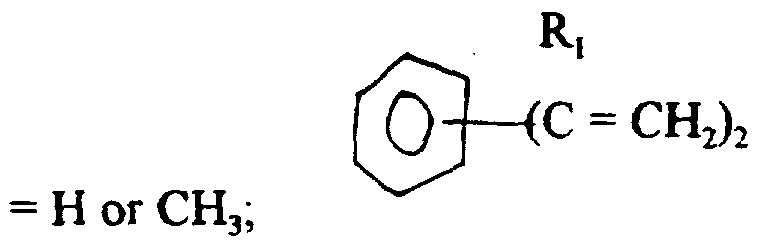
- the polymerizable composition of Chan et al. further incorporates, up to 10 wt% of an aromatic di vinyl monomer represented by the general formula (III):
- R H or CH 3 .
- Florent II discloses a new transparent organic material having a refractive index greater than 1.55 and which are free of optical distortions, characterized by the fact that they consist of a copolymer of: a) 55 to 90 and preferably 55 to 70 wt% of units derived from at least one monomer represented by general formula (I):
- R H or CH 3 , and m and n are independently 1 or 2;
- R, H or CH 3
- R H or CH 3 ; d) 1 to 20 and preferably 5 to 15 wt% of units derived from at least one (meth)acrylic monomer corresponding to the general formula
- (meth)acrylic means acrylic or methacrylic.
- Optional constituent e) may be inco ⁇ orated in the polymerizable composition to obtain directly, after polymerization, a matrix with photochromic properties. It is also possible to produce a photochromic matrix by preparing a nonphotochromic matrix by polymerization, and then later giving it photochromic properties, for example, by diffusion of a photochromic coloring agent, as is well known in the art.
- Monomers (a) of formula I are well known and are available commercially.
- Styrene and methylstyrene are examples of monomers
- Monomers (c) of formula III are represented by divinylbenzene and di(methylvinyl)benzene, for example.
- the (meth)acrylic monomers (d) are also well-known products which are commercially available. Examples include, the butyl, pentyl, hexyl, heptyl, octyl, and 2-ethylhexyl (meth)acrylates, and ethyltriglycol (meth)acrylate.
- the monomer (b) monomer (c) weight ratio in a dimethacrylic matrix as described, it is possible to adjust the kinetic parameters of the photochromic process to a desired value, without altering the optical quality of the materials obtained, while maintaining a high refractive index.
- the inco ⁇ oration of the fourth monomer (d) in the proportions defined allows one to obtain more easily thick lenses which are free of optical defects (distortions, stresses, cords, etc.) without altering properties such as the glass transition temperature T g , the impact strength, or the refractive index.
- the optional photochromic coloring agent (e) can be chosen from the general classes of the spiroxazines, spiropyrans and chromenes which have photochromic properties. Quite a few photochromic coloring agents of this type are described in the literature and are available commercially.
- the refractive index of the photochromic material can be adjusted to a desired value by the use of an appropriate modifying co-monomer such as vinyl, acrylic or methacrylic compounds containing in their formulae, one or more benzene nuclei, for example, divinylbenzene, diallyl phthalate, benzyl methacrylate, benzyl acrylate, naphthyl methacrylate and naphthyl acrylate, and their derivatives substituted on the aromatic nuclei by chlorine or brimine atoms.
- an appropriate modifying co-monomer such as vinyl, acrylic or methacrylic compounds containing in their formulae, one or more benzene nuclei, for example, divinylbenzene, diallyl phthalate, benzyl methacrylate, benzyl acrylate, naphthyl methacrylate and naphthyl acrylate, and their derivatives substituted on the aromatic nuclei by chlorine or brimine atoms.
- Either one or a combination of photochromic components or coloring agents can be used to obtain a desired tint.
- the total amount of coloring agents added to the matrix is in the range of 0.03 to 0.3 wt. %, more preferably, in the range of 0.05 to 0.1 wt. %.
- useful photochromic coloring agents for the invention include:
- photochromic dyes include:
- Useful radical initiators are described in Polymer Handbook, by Bandrup and Immergut, p.II-2, John Wiley (1989), for example, azobisisobutyronitrile (AIBN) and 2-2'- azobis(2-methylbutyronitrile) (AMBN).
- AIBN azobisisobutyronitrile
- AMBN 2-2'- azobis(2-methylbutyronitrile)
- Examples of useful chain transfer agents include, dodecanethiol (DDT).
Landscapes
- Physics & Mathematics (AREA)
- General Physics & Mathematics (AREA)
- Optics & Photonics (AREA)
- Macromonomer-Based Addition Polymer (AREA)
- Addition Polymer Or Copolymer, Post-Treatments, Or Chemical Modifications (AREA)
- Eyeglasses (AREA)
Abstract
Description








Claims


Priority Applications (2)
| Application Number | Priority Date | Filing Date | Title |
|---|---|---|---|
| EP97918785A EP0896685A4 (en) | 1996-04-30 | 1997-04-21 | Organic photochromic contact lens compositions |
| US09/171,397 US6174464B1 (en) | 1997-04-21 | 1997-04-21 | Organic photochromic contact lens compositions |
Applications Claiming Priority (2)
| Application Number | Priority Date | Filing Date | Title |
|---|---|---|---|
| US1651796P | 1996-04-30 | 1996-04-30 | |
| US60/016,517 | 1996-04-30 |
Publications (1)
| Publication Number | Publication Date |
|---|---|
| WO1997041468A1 true WO1997041468A1 (en) | 1997-11-06 |
Family
ID=21777538
Family Applications (1)
| Application Number | Title | Priority Date | Filing Date |
|---|---|---|---|
| PCT/US1997/006776 Ceased WO1997041468A1 (en) | 1996-04-30 | 1997-04-21 | Organic photochromic contact lens compositions |
Country Status (2)
| Country | Link |
|---|---|
| EP (1) | EP0896685A4 (en) |
| WO (1) | WO1997041468A1 (en) |
Cited By (4)
| Publication number | Priority date | Publication date | Assignee | Title |
|---|---|---|---|---|
| WO2001009645A1 (en) * | 1999-08-02 | 2001-02-08 | Essilor International Compagnie Generale D'optique | Process for the manufacture of a crosslinked, transparent, hydrophilic and photochromic polymeric material, and optical and ophthalmic article obtained |
| FR2797266A1 (en) * | 1999-08-02 | 2001-02-09 | Essilor Int | Production of polymeric material used in contact lens involves impregnating cross-linked, transparent, hydrophilic polymeric material with photochromic impregnating solution |
| US6224945B1 (en) | 1999-08-02 | 2001-05-01 | Essilor International Compagnie Generale D'optique | Process for the manufacture of a crosslinked, transparent, hydrophilic and photochromic polymeric material, and optical and ophthalmic articles obtained |
| WO2020219162A1 (en) * | 2019-04-26 | 2020-10-29 | Canon Kabushiki Kaisha | Photocurable composition |
Citations (2)
| Publication number | Priority date | Publication date | Assignee | Title |
|---|---|---|---|---|
| US5395566A (en) * | 1992-03-03 | 1995-03-07 | Tokuyama Corporation | Photochromic composition |
| WO1995010790A1 (en) * | 1993-10-15 | 1995-04-20 | Ppg Industries, Inc. | High refractive index photochromic ophthalmic article |
Family Cites Families (5)
| Publication number | Priority date | Publication date | Assignee | Title |
|---|---|---|---|---|
| JPS5817527B2 (en) * | 1978-07-17 | 1983-04-07 | 株式会社保谷レンズ | Copolymers for high refractive index lenses and lenses made from them |
| JPS58113203A (en) * | 1981-12-28 | 1983-07-06 | Nippon Kanko Shikiso Kenkyusho:Kk | Manufacture of photo-reversible color changeable resin formed body |
| FR2699541B1 (en) * | 1992-12-22 | 1995-04-28 | Essilor Int | Polymeric compositions with a low yellow index, polymerizable compositions and lenses using them. |
| FR2727971A1 (en) * | 1994-12-12 | 1996-06-14 | Corning Inc | NEW PHOTOCHROMIC ORGANIC MATERIALS WITH HIGH REFRACTION INDEX, THEIR PREPARATION AND ARTICLES SHAPED FROM THESE MATERIALS |
| FR2728576A1 (en) * | 1994-12-22 | 1996-06-28 | Corning Inc | PHOTOCHROMIC ORGANIC MATERIALS HAVING A HIGH REFRACTIVE INDEX AND ADJUSTABLE PROPERTIES, THEIR PREPARATION AND ARTICLES FORMED THEREFROM |
-
1997
- 1997-04-21 EP EP97918785A patent/EP0896685A4/en not_active Withdrawn
- 1997-04-21 WO PCT/US1997/006776 patent/WO1997041468A1/en not_active Ceased
Patent Citations (2)
| Publication number | Priority date | Publication date | Assignee | Title |
|---|---|---|---|---|
| US5395566A (en) * | 1992-03-03 | 1995-03-07 | Tokuyama Corporation | Photochromic composition |
| WO1995010790A1 (en) * | 1993-10-15 | 1995-04-20 | Ppg Industries, Inc. | High refractive index photochromic ophthalmic article |
Non-Patent Citations (1)
| Title |
|---|
| See also references of EP0896685A4 * |
Cited By (6)
| Publication number | Priority date | Publication date | Assignee | Title |
|---|---|---|---|---|
| WO2001009645A1 (en) * | 1999-08-02 | 2001-02-08 | Essilor International Compagnie Generale D'optique | Process for the manufacture of a crosslinked, transparent, hydrophilic and photochromic polymeric material, and optical and ophthalmic article obtained |
| FR2797266A1 (en) * | 1999-08-02 | 2001-02-09 | Essilor Int | Production of polymeric material used in contact lens involves impregnating cross-linked, transparent, hydrophilic polymeric material with photochromic impregnating solution |
| US6224945B1 (en) | 1999-08-02 | 2001-05-01 | Essilor International Compagnie Generale D'optique | Process for the manufacture of a crosslinked, transparent, hydrophilic and photochromic polymeric material, and optical and ophthalmic articles obtained |
| WO2020219162A1 (en) * | 2019-04-26 | 2020-10-29 | Canon Kabushiki Kaisha | Photocurable composition |
| KR20210142147A (en) * | 2019-04-26 | 2021-11-24 | 캐논 가부시끼가이샤 | photocurable composition |
| KR102823723B1 (en) * | 2019-04-26 | 2025-06-24 | 캐논 가부시끼가이샤 | Photocurable composition |
Also Published As
| Publication number | Publication date |
|---|---|
| EP0896685A4 (en) | 2000-07-19 |
| EP0896685A1 (en) | 1999-02-17 |
Similar Documents
| Publication | Publication Date | Title |
|---|---|---|
| EP0797785B1 (en) | Temperature stable and sunlight protected photochromic articles | |
| EP0866987B1 (en) | New organic photochromic materials | |
| US6174464B1 (en) | Organic photochromic contact lens compositions | |
| US6034193A (en) | Photochromic organic materials | |
| EP0838039B1 (en) | Novel photochromic organic materials | |
| KR19990043979A (en) | Polymeric materials for photochromic products | |
| US5973039A (en) | Temperature stable and sunlight protected photochromic articles | |
| US6476103B1 (en) | Photochromic organic material, its manufacture and the photochromic articles containing it | |
| US6329482B1 (en) | Polymerizable compositions based on difunctional monomers, resins and ophthalmic articles containing same | |
| WO1997041468A1 (en) | Organic photochromic contact lens compositions | |
| AU730815B2 (en) | Polymerizable compositions based on difunctional monomers, resins and ophthalmic articles containing same | |
| US6399682B2 (en) | Temperature stable and sunlight protected photochromic articles | |
| EP0973811B1 (en) | Self-light-stabilized photochromic polymer, its preparation and articles containing same | |
| EP2305768B1 (en) | Photochromic compositions, resins and articles obtained therefrom | |
| RU97112161A (en) | ORGANIC PHOTOCHROME MATERIALS WITH A HIGH REFRACTION INDICATOR, THEIR PRODUCTION AND PRODUCED FROM THESE PRODUCT MATERIALS |
Legal Events
| Date | Code | Title | Description |
|---|---|---|---|
| AK | Designated states |
Kind code of ref document: A1 Designated state(s): JP US |
|
| AL | Designated countries for regional patents |
Kind code of ref document: A1 Designated state(s): AT BE CH DE DK ES FI FR GB GR IE IT LU MC NL PT SE |
|
| 121 | Ep: the epo has been informed by wipo that ep was designated in this application | ||
| DFPE | Request for preliminary examination filed prior to expiration of 19th month from priority date (pct application filed before 20040101) | ||
| WWE | Wipo information: entry into national phase |
Ref document number: 09171397 Country of ref document: US |
|
| WWE | Wipo information: entry into national phase |
Ref document number: 1997918785 Country of ref document: EP |
|
| WWP | Wipo information: published in national office |
Ref document number: 1997918785 Country of ref document: EP |
|
| NENP | Non-entry into the national phase |
Ref country code: JP Ref document number: 97539004 Format of ref document f/p: F |
|
| WWW | Wipo information: withdrawn in national office |
Ref document number: 1997918785 Country of ref document: EP |