WO1997047687A1 - Dispersion aqueuse a base de silicones et de latex de (co)polymere(s) organique(s) pour la preparation d'elastomere silicone a translucidite reglable - Google Patents
Dispersion aqueuse a base de silicones et de latex de (co)polymere(s) organique(s) pour la preparation d'elastomere silicone a translucidite reglable Download PDFInfo
- Publication number
- WO1997047687A1 WO1997047687A1 PCT/FR1996/000891 FR9600891W WO9747687A1 WO 1997047687 A1 WO1997047687 A1 WO 1997047687A1 FR 9600891 W FR9600891 W FR 9600891W WO 9747687 A1 WO9747687 A1 WO 9747687A1
- Authority
- WO
- WIPO (PCT)
- Prior art keywords
- weight
- aqueous dispersion
- polymer
- acrylic
- monomers
- Prior art date
- Legal status (The legal status is an assumption and is not a legal conclusion. Google has not performed a legal analysis and makes no representation as to the accuracy of the status listed.)
- Ceased
Links
Classifications
-
- C—CHEMISTRY; METALLURGY
- C08—ORGANIC MACROMOLECULAR COMPOUNDS; THEIR PREPARATION OR CHEMICAL WORKING-UP; COMPOSITIONS BASED THEREON
- C08L—COMPOSITIONS OF MACROMOLECULAR COMPOUNDS
- C08L83/00—Compositions of macromolecular compounds obtained by reactions forming in the main chain of the macromolecule a linkage containing silicon with or without sulfur, nitrogen, oxygen or carbon only; Compositions of derivatives of such polymers
- C08L83/04—Polysiloxanes
-
- C—CHEMISTRY; METALLURGY
- C08—ORGANIC MACROMOLECULAR COMPOUNDS; THEIR PREPARATION OR CHEMICAL WORKING-UP; COMPOSITIONS BASED THEREON
- C08G—MACROMOLECULAR COMPOUNDS OBTAINED OTHERWISE THAN BY REACTIONS ONLY INVOLVING UNSATURATED CARBON-TO-CARBON BONDS
- C08G77/00—Macromolecular compounds obtained by reactions forming a linkage containing silicon with or without sulfur, nitrogen, oxygen or carbon in the main chain of the macromolecule
- C08G77/04—Polysiloxanes
- C08G77/045—Polysiloxanes containing less than 25 silicon atoms
-
- C—CHEMISTRY; METALLURGY
- C08—ORGANIC MACROMOLECULAR COMPOUNDS; THEIR PREPARATION OR CHEMICAL WORKING-UP; COMPOSITIONS BASED THEREON
- C08G—MACROMOLECULAR COMPOUNDS OBTAINED OTHERWISE THAN BY REACTIONS ONLY INVOLVING UNSATURATED CARBON-TO-CARBON BONDS
- C08G77/00—Macromolecular compounds obtained by reactions forming a linkage containing silicon with or without sulfur, nitrogen, oxygen or carbon in the main chain of the macromolecule
- C08G77/04—Polysiloxanes
- C08G77/14—Polysiloxanes containing silicon bound to oxygen-containing groups
- C08G77/16—Polysiloxanes containing silicon bound to oxygen-containing groups to hydroxy groups
-
- C—CHEMISTRY; METALLURGY
- C08—ORGANIC MACROMOLECULAR COMPOUNDS; THEIR PREPARATION OR CHEMICAL WORKING-UP; COMPOSITIONS BASED THEREON
- C08G—MACROMOLECULAR COMPOUNDS OBTAINED OTHERWISE THAN BY REACTIONS ONLY INVOLVING UNSATURATED CARBON-TO-CARBON BONDS
- C08G77/00—Macromolecular compounds obtained by reactions forming a linkage containing silicon with or without sulfur, nitrogen, oxygen or carbon in the main chain of the macromolecule
- C08G77/04—Polysiloxanes
- C08G77/14—Polysiloxanes containing silicon bound to oxygen-containing groups
- C08G77/18—Polysiloxanes containing silicon bound to oxygen-containing groups to alkoxy or aryloxy groups
-
- C—CHEMISTRY; METALLURGY
- C08—ORGANIC MACROMOLECULAR COMPOUNDS; THEIR PREPARATION OR CHEMICAL WORKING-UP; COMPOSITIONS BASED THEREON
- C08G—MACROMOLECULAR COMPOUNDS OBTAINED OTHERWISE THAN BY REACTIONS ONLY INVOLVING UNSATURATED CARBON-TO-CARBON BONDS
- C08G77/00—Macromolecular compounds obtained by reactions forming a linkage containing silicon with or without sulfur, nitrogen, oxygen or carbon in the main chain of the macromolecule
- C08G77/04—Polysiloxanes
- C08G77/20—Polysiloxanes containing silicon bound to unsaturated aliphatic groups
-
- C—CHEMISTRY; METALLURGY
- C08—ORGANIC MACROMOLECULAR COMPOUNDS; THEIR PREPARATION OR CHEMICAL WORKING-UP; COMPOSITIONS BASED THEREON
- C08G—MACROMOLECULAR COMPOUNDS OBTAINED OTHERWISE THAN BY REACTIONS ONLY INVOLVING UNSATURATED CARBON-TO-CARBON BONDS
- C08G77/00—Macromolecular compounds obtained by reactions forming a linkage containing silicon with or without sulfur, nitrogen, oxygen or carbon in the main chain of the macromolecule
- C08G77/04—Polysiloxanes
- C08G77/22—Polysiloxanes containing silicon bound to organic groups containing atoms other than carbon, hydrogen and oxygen
- C08G77/24—Polysiloxanes containing silicon bound to organic groups containing atoms other than carbon, hydrogen and oxygen halogen-containing groups
-
- C—CHEMISTRY; METALLURGY
- C08—ORGANIC MACROMOLECULAR COMPOUNDS; THEIR PREPARATION OR CHEMICAL WORKING-UP; COMPOSITIONS BASED THEREON
- C08G—MACROMOLECULAR COMPOUNDS OBTAINED OTHERWISE THAN BY REACTIONS ONLY INVOLVING UNSATURATED CARBON-TO-CARBON BONDS
- C08G77/00—Macromolecular compounds obtained by reactions forming a linkage containing silicon with or without sulfur, nitrogen, oxygen or carbon in the main chain of the macromolecule
- C08G77/04—Polysiloxanes
- C08G77/22—Polysiloxanes containing silicon bound to organic groups containing atoms other than carbon, hydrogen and oxygen
- C08G77/26—Polysiloxanes containing silicon bound to organic groups containing atoms other than carbon, hydrogen and oxygen nitrogen-containing groups
-
- C—CHEMISTRY; METALLURGY
- C08—ORGANIC MACROMOLECULAR COMPOUNDS; THEIR PREPARATION OR CHEMICAL WORKING-UP; COMPOSITIONS BASED THEREON
- C08G—MACROMOLECULAR COMPOUNDS OBTAINED OTHERWISE THAN BY REACTIONS ONLY INVOLVING UNSATURATED CARBON-TO-CARBON BONDS
- C08G77/00—Macromolecular compounds obtained by reactions forming a linkage containing silicon with or without sulfur, nitrogen, oxygen or carbon in the main chain of the macromolecule
- C08G77/80—Siloxanes having aromatic substituents, e.g. phenyl side groups
Definitions
- the present invention relates to an aqueous dispersion based on silicone compounds and a latex of organic (co) polymer (s), which can crosslink into an elastomer with adjustable translucency by elimination of water using drying under ambient conditions. It also relates to its process for obtaining and its use in the building industry for the production of silicone elastomer products with adjustable translucency such as in particular sealants and caulking, protective coatings, epidemics of facades.
- the basic aqueous dispersion is a mixture (i) of a silicone microemulsion with a particle size of less than 0.15 ⁇ m (150 nm), prepared by emulsion polymerization of a cyclopolydiorganosiloxane, with (2i) 5 to 30 parts by weight (per 100 parts of the silicone polymer) of colloidal silica and (3i) 1 to 5 parts by weight (per 100 parts of the silicone polymer) of a catalyst of the dialkyltin dicarboxylate type; in EP-A-0 542 498, the basic aqueous dispersion is a mixture (i) of an aqueous emulsion of a crosslinked silicone polymer, which is the product of crosslinking of a silicone oil with silanol endings
- the system in fact tends to give rise to a gel because of the premature development of condensation reactions which can take place between the silicone polymer and the colloidal silica, which is reactive by its surface hydroxyl groups;
- an aqueous dispersion - stable on storage, since it is prepared from ingredients not comprising a reactive filler such as colloidal silica, and - capable of crosslinking by elimination of water in elastomer having the advantages on the one hand of having an adjustable translucency independently of its other properties, in particular its mechanical properties and on the other hand of offering, despite the absence of a mineral filler of reinforcements, high mechanical properties, advantageously making this elastomer suitable for the production of building products, can be obtained by replacing the mineral fillers usually used in this general type of aqueous dispersions crosslinking into a silicone elastomer by elimination of water, with a polymeric filler having in the form of an aqueous dispersion of organic (co) polymer (s).
- adjustable translucency in the sense of the present invention means that the level of translucency can be easily adjusted to cover the whole range from total opacity to high translucency close to transparency.
- the mechanical properties in question in this specification are the properties essential for the elastomeric product to be able to perform its function as a gasket, whatever the climatic conditions; there will be mentioned in particular: the drying module at 100% elongation, the elongation at break, the breaking strength, the elasticity and the adhesion.
- the present invention relates to an aqueous dispersion based on silicones and on organic (co) polymer (s) crosslinking, by elimination of water using drying under ambient conditions, in a adjustable translucency elastomer having high mechanical properties, characterized in that it is devoid of any mineral reinforcing filler and that it comprises the following constituents:
- surfactant (A3) chosen from anionic, and nonionic surfactants and their mixtures,. having a particle size of between 0.1 ⁇ m (100 nm) and 100 ⁇ m (100,000 nm),. having a dry extract content of at least 60% by weight;
- a dry extract of between 10 and 70% by weight (C): optionally, per 100 parts by weight of oil or polymer (Al), from 0.01 to 5 parts by weight of a catalytic metal curing compound; said aqueous dispersion having a solids content of at least 60% by weight; the adjustment of the translucency of the elastomer product to be formed is done, at the level of the preparation of the aqueous dispersion, by adjusting to the desired value (s): either the size of the latex polymer particles (B ); either the refractive index of the constituent polymer of the latex (B) by varying the chemical composition of the organic (co) polymer; or the two aforementioned parameters, size and refractive index, at the same time.
- the final aqueous dispersion is prepared by simple intimate mixing of all its constituents leading to a homogeneous dispersion, stable on storage sheltered from air.
- a particle in this case the latex polymer particles (B)] in a continuous medium [in this case the silicone matrix obtained after crosslinking, by elimination of water , of phase (A)], which controls the opacity of the elastomer (inversely proportional to its translucency), decreases with: - the particle size of the particle, and - the difference in refractive indices between the particle and the continuous medium.
- the ⁇ , ⁇ - (dihydroxy) polydiorganosiloxanes must have a viscosity of at least 100 mPa.s at 25 ° C, preferably at least 50,000 mPa.s.
- the preferred viscosities for the present invention are between 50,000 and 1,500,000 mPa.s at 25 ° C.
- the viscosity in question here is the dynamic viscosity at 25 ° C; it is measured using a BROOKFIELD viscometer according to the indications of the AFNOR NTF 76102 standard of May 1982.
- the organic radicals of ⁇ , ⁇ - (dihydroxy) polydiorganosiloxanes are monovalent hydrocarbon radicals containing up to 6 carbon atoms, optionally substituted by cyano or fluoro groups.
- the substituents generally used because of their availability in industrial products are the methyl, ethyl, propyl, phenyl, vinyl and 3,3,3-trifluoropropyl radicals. In general at least 80% by number of these radicals are methyl radicals.
- an organosilicon crosslinking agent is used.
- the following is a list of recommended crosslinking agents with, for each of them, the precise quantities recommended in the emulsion (A) which take into account the nature of the crosslinking agent used, these quantities being expressed in parts by weight per 100 parts of oil or polymer (Al):. 1 to 15 parts of an organosiliconate; . 1 to 100 parts of a microemulsion of silsesquioxane resin according to the combined teaching of US-A-3,355,406 and US-A-3,433,780; . 5 to 100 parts of a reactive low molecular weight silicone resin having alkoxy and acyloxy groups; . 5 to 100 parts of a high molecular weight silicone resin insoluble in toluene;
- a hydroxylated silicone resin having per molecule, at least 2 different units chosen from those of formulas: R3S1O0 5 (M), R2SiO (D), RSiOi 5 (T) and Si ⁇ 2 (Q), R being mainly a C] alkyl radical - Cg, vinyl and trifluoro-3,3,3 propyl and a content by weight of hydroxyl group of between 0.1 and 10%.
- R being mainly a C] alkyl radical - Cg, vinyl and trifluoro-3,3,3 propyl and a content by weight of hydroxyl group of between 0.1 and 10%.
- R is a monovalent organic radical, in particular methyl or vinyl
- a is 1 or
- X is a condensable and / or hydrolyzable group preferably chosen from alkoxy, acyloxy, ketiminoxy, alkylamino, amido and alkenyloxy groups and their various possible mixtures.
- X is an alkoxy, it is desirable to add, as stabilizer, 2-amino-2-methylpropanol, in accordance with the teaching of EP-A-0 259 734.
- the crosslinking agent (A2) which is preferably used consists of the 5 to 100 parts of the hydroxylated silicone resin which has just been mentioned.
- surfactant (A3) In the context of the present invention, the surfactants used include anionic surfactants which can be chosen from, for example, alkylbenzene sulfonates, alkyl sulfates, alkyl ether sulfates, alkylaryl ether sulfates, dioctylsulfosuccinates, of alkali metals and their mixtures.
- anionic surfactants are the alkali metal polybenzene sulfonates.
- the surfactants used can also be non-ionic; examples that may be mentioned are alkoxylated fatty acids, polyalkoxylated alkylphenols, polyalkoxylated fatty alcohols, polyalkoxylated or polyglycerolated fatty amides, polyglycerolated alcohols and alphadiols, ethylene oxide-propylene oxide block polymers, polydiorganosiloxanes comprising siloxy units carrying ethylene oxide sequences or propylene oxide sequences, as well as alkylglucosides, alkylpolyglucosides, sucroethers, sucroesters, sucroglycerides, sorbitan esters, ethoxylated compounds of these sugar derivatives and mixtures of these surfactants.
- Preferred nonionic surfactants are polyalkoxylated alkylphenols and polyalkoxylated fatty alcohols.
- a mixture of preferred nonionic surfactant (s) can be used with one (or more) preferred anionic surfactant (s).
- the surfactants taken alone or as a mixture, are chosen according to the nature of the oil or silicone polymer (Al) to be emulsified; an HLB of the order of 11 to 15 is generally chosen to emulsify an oil or polymer (Al) consisting of an ⁇ , ⁇ - (dihydroxy) polydiorganosiloxane.
- an emulsion polymerization process can be used which allows the emulsion (A) to be obtained directly. Furthermore, this process makes it possible to easily obtain emulsions (A) comprising an ⁇ , ⁇ - (dihydroxy) -poly-diorganosiloxane of very high viscosity.
- the oil-in-water emulsion of the silicone phase is carried out by the technique of the anionic polymerization of an oil (Al) of low viscosity ranging from 100 mPa.s to 1000 mPa.s, optionally polymerization conducted in the presence of the crosslinking agent (A2), which according to another procedure can also be added, later, after the polymerization.
- Al oil
- A2 crosslinking agent
- Such an anionic polymerization process is described in American patents US-A-2 891 920 and especially US-A-3 294 725 (cited as reference).
- the polymer obtained is anionically stabilized by a surfactant which, according to the teaching of US Pat. No. 3,294,725, is preferably the salt of an alkali metal of an aromatic sulphonic hydrocarbon acid, the free acid also acting role of polymerization catalyst.
- the preferred catalyst and surfactant are dodecylbenzenesulfonic acid and its alkali metal salts, in particular its sodium salt.
- Other anionic or nonionic surfactants can optionally be added. However, this addition is not necessary because, according to the teaching of US Pat. No. 3,294,725, the amount of anionic surfactant resulting from the neutralization of the sulfonic acid is sufficient to stabilize the polymer emulsion. This amount is generally less than 3%, preferably 1.5% of the weight of the emulsion (A).
- ⁇ , ⁇ - (dihydroxy) polydiorganosiloxane already polymerized, then to put it in aqueous emulsion, in the presence of the crosslinking agent (A2), by stabilizing the emulsions with an agent.
- anionic and / or nonionic surfactant according to a process well known to those skilled in the art and described in detail in the literature (see for example the patents FR-A-2,064,563, FR-A-2,094,322, FR- A-2 114 230 and EP-A-0 169 098).
- the polymers ⁇ , ⁇ - (dihydroxy) - polydiorganosiloxane (Al) are mixed by simple stirring with the crosslinking agent (A2) and with the anionic and / or nonionic surfactant (A3).
- the latter can be in aqueous solution, then add water if necessary and transform the whole into a fine and homogeneous emulsion by passing through a conventional colloid mill.
- the grinding thus obtained can be diluted with an additional quantity of suitable water.
- An emulsion (A) is thus obtained stabilized by an anionic or nonionic surfactant stable on storage.
- the emulsion (A) prepared by emulsion polymerization or by emulsion of the silicone polymer (Al) is in the form of an oil-in-water emulsion having a dry extract content equal to or greater than 60% by weight and preferably between 80 and 98% by weight.
- the latex (B) is formed from an aqueous suspension of polymer particles resulting from an emulsion (co) polymerization process of polymerizable organic monomer (s).
- the main polymerizable monomers consist of at least one main monomer chosen from styrene (a), butadiene (b), acrylic esters (c) and vinyl nitriles (d).
- acrylic esters denotes the esters of acrylic acid and of methacrylic acid with C 1 -C 2 alkanols, preferably C 1 -C 6, such as methyl acrylate, ethyl acrylate, propyl acrylate, n-butyl acrylate, isobutyl acrylate, 2-ethylhexyl acrylate, methyl methacrylate, ethyl methacrylate, n-butyl methacrylate, methacrylate d 'isobutyle.
- Vinyl nitriles include those having 3 to 12 carbon atoms, in particular acrylonitrile and methacrylonitrile.
- Styrene can be replaced in whole or in part by alpha-methylstyrene or vinyltoluene.
- ethylenic monomers containing a sulfonic acid group and its alkali or ammonium salts for example vinylsulfonic acid, vinylbenzene sulfonic acid, alpha-acrylamido methylpropane-sulfonic acid, 2-sulfoethylenemethacrylate;
- esters of (meth) acrylic acids with alkanediols preferably containing 2 - 8 carbon atoms such as glycol mono (meth) acrylate, hydroxypropyl mon (meth) acrylate, mono (meth) 1-4 butanediol acrylate as well as the monomers comprising two polymerizable double bonds such as ethylene glycol dimethacrylate.
- ethylenic unsaturated monomers having a crosslinkable nature such as (glycidyl meth) acrylate (1) or vinyl and acrylic silanes (m) such as vinyltrimethoxysilane and vinyltriethoxysilane.
- a functionalized polyorganosuoxane (n) carrying at least one ethylenically unsaturated function for example a vinyl function or
- (meth) acrylic capable of reacting radically with at least one of the ethylenically unsaturated monomers (a) to (d) more optionally at least one of the monomers (e) to (m), and possibly at least one other reactive function (for example an epoxyfunctional or hydroxyfunctional group) (cf. in particular EP-A-0.635.526).
- dispersion (B) which can be used in the context of the present invention, mention will be made in particular of those containing homopolymers derived from monomers (a), (c) and (e).
- latex (B) copolymers mention will be made in particular of the latexes containing the derived copolymers: - at least one monomer (a), at least one monomer (d) and at least one monomer
- a latex (B) having:
- - a particle size between 0.01 ⁇ m (10 nm) and 0.08 ⁇ m (80 nm), and preferably between 0.02 ⁇ m (20 nm) and 0.06 ⁇ m (60 nm), and - a dry extract of between 10 and 50% by weight.
- a latex (B) having the small particle size and the dry extract indicated above, which contains the following acrylic (co) polymers :
- an amount of acrylic monomers of between 70% and 99% by weight of the total of the monomers is used, and preferably between 80% and 99% by weight of the total monomers.
- the constituent polymers of the latexes (B) can have a glass transition temperature Tg of between - 70 ° C and + 230 ° C.
- the aqueous dispersions (B) which are used are the latexes defined above in the context of the so-called "more preferential" method, whose constituent acrylic polymers have a glass transition temperature Tg of between + 50 ° C and + 130 ° C.
- Tg glass transition temperature
- the constituent polymers of the latexes (B) have a refractive index n generally between 1.34 and 1.60.
- the index in question is calculated by the simplified relation of GLADSTONE-DALE:
- xi and n i represent the volume fraction and the refractive index of each constituent of the polymer (cf. the book Polymer Handbook, 1989, pages VI / 452 to VI / 461).
- the aqueous dispersions (B) which are used are the latexes defined above in the context of the so-called “even more preferential" method for which the index n polymers is between 1.34 and 1.50.
- a latex (B) is used:
- the aqueous dispersions (B) which are used are the latexes defined above within the framework of the so-called “different” method, the constituent acrylic polymers of which have a temperature glass transition Tg between + 50 ° C and + 130 ° C.
- the aqueous dispersions (B) which are used are the latexes defined above within the framework of the so-called “different and preferential” method for which the index n of the polymers is between 1, 34 and 1.50.
- this process consists in putting the polymer in solution in a solvent immiscible with water and having a boiling point lower than that of water, then in emulsifying in water the solution of polymer, then removing the solvent by evaporation;
- - By precipitation in a non-solvent this process consists in putting the polymer in solution in a solvent miscible with water, then in precipitating the polymer in water;
- this process consists, starting from a homogeneous solution, in obtaining a phase demixion with the formation of a colloidal phase (rich in polymer) by playing on physical factors such as pH or temperature.
- the process which is preferably used for the preparation of the latexes (B) coming within the scope of the present invention is the process by radical emulsion polymerization.
- latexes (B) of small particle size comprised between 0.01 ⁇ m (10 nm) and 0.08 ⁇ m (80 nm) which are used in the context of the preferred methods of implementing the invention, they are prepared by a more preferred radical polymerization process, described in EP-A-0 644 205 (cited as reference), which provides for the incremental introduction of monomer (s) into an aqueous reaction medium with the introduction, optionally also incremental, of d 'initiator (s) of free radicals.
- the metal curing catalytic compounds (C) are essentially the salts of carboxylic acids and the metal halides chosen from lead, zinc, zirconium. titanium, iron, tin, barium, calcium and manganese.
- Component (C) is preferably a tin catalytic compound, generally an organotin salt, preferably introduced in the form of an aqueous emulsion.
- organotin salts which can be used are described, in particular in the work by NOLL, Chemistry and Technology of Silicones Academy Press (1968), page 337.
- Such an emulsion can be stabilized if necessary, for example, with polyvinyl alcohol.
- the preferred tin salts are the tin bischelates (EP-A-0 147 323 and EP-A-0 235 049), the diorgano-tin dicarboxylates and in particular the dibutyi- or dioctyltin diversatates (British patent GB- A-1 289 900), dibutyl- or dioctyltin diacetate, dibutyi- or dioctyltin dilaurate. 0.01 to 3, preferably 0.05 to 2 parts of metal curing compound (C) are used per 100 parts of (Al).
- the aqueous dispersions according to the invention may also comprise one or more additive (s) such as in particular:
- the adhesion agent (D) is chosen from organosilicon compounds bearing at the same time (1) organic groups substituted by radicals chosen from the group of amino, ureido, isocyanato, epoxy, alkenyl, isocyanurates, hydantoyl radicals , mercaptoester and (2) hydrolyzable groups bound to silicon atoms.
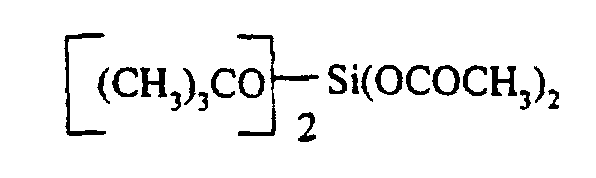
- organosilicon compounds (D) corresponding to the formulas below (accompanied by the patent numbers describing them):
- the organosilicon surfactant (E) is chosen from polyorganosiloxanes functionalized either by ethylene oxide or propylene oxide sequences (an agent of this type is commercially available under the brand TEGOPREN, type 30. 58 or 70, from the company GOLDSCHMIDT), either by salified amino groups (an agent of this type is also commercially available under the brand TEGOPREN, type 69. from the company GOLDSCHMIDT), or by metal sulfonate groups (cf. in this regard the work: Surface Phenomena and Additives in Water - Based Coatings and Printing Technology, edited by MK SHARMA, Plenum Press. New York, 1991, pages 73 to 82, which describes this type of agents).
- aqueous dispersions To prepare the aqueous dispersions according to the invention, it is recommended to add, with stirring at room temperature, to the emulsion (A), first of all the dispersion (B), then the metal curing catalyst (C) optionally under the form of an aqueous dispersion or emulsion and optionally the additive (s) (D), (E) and / or (F). Recall that it is possible to carry out all or part of the emulsion polymerization or the emulsion of the emulsion (A) in the presence of the dispersion (B).
- the pH of the aqueous dispersion can be acidic, neutral or basic. It is however recommended to adjust the pH of the dispersion to a value greater than 7, preferably between 8 and 13 by means of a strong organic base or preferably a strong mineral base (triethanolamine, and preferably soda and potash) .
- the final dispersion obtained is homogenized and then degassed and is then packaged in a sealed package against air oxygen and water vapor.
- the constituents (A), (B), (C) and optionally (D), (E) and / or (F) are mixed in amounts such that the final emulsion has a dry extract content at least equal to 60 %, preferably between 80 and 95% by weight.
- the dispersion according to the invention after its preparation undergoes a maturation step, at room temperature, from a few hours to a few days.
- This maturation step simply consists in allowing the dispersion to stand sheltered from the oxygen of the air before its use.
- the dispersions according to the invention can be used in the building industry for the production of translucent silicone elastomer products, in particular sealants and caulks and water-repellent coatings on building surfaces or facade epidermis in contact with the weather, at a dose for example of 20 to 100 g of dispersion per m 2 of surface to be treated.
- An emulsion (A) is prepared by introducing into a 5 liter MEILI arm mixer:
- a hydroxylated silicone resin introduced as such, having 0.5% by weight of hydroxyl group, consisting of 62% by weight of CH3SiO ⁇ 5 units and 24% by weight of (CH3) 2SiO units and 14% by weight of units (CH3) 3SiOn, 5; this resin is soluble in toluene and has a molecular mass of approximately 1000 and a CHySi molar ratio of 1.5;
- GENAPOL X080 sold by the company HOECHST, which is a nonionic surfactant, namely a polyalkoxylated fatty alcohol (with 13 carbon atoms) (with about 8 ethylene oxide units); and
- Emulsion A thus obtained has an average particle size of 0.5 ⁇ m (500 nm) and a dry extract of 96.9% by weight.
- the emulsion (A) is incorporated, with stirring for 10 minutes for each additive: • an aqueous dispersion of precipitation CaC ⁇ 3 at 43.6% by weight of dry extract, consisting of: 280 g of CaC ⁇ 3 of precipitation, with an average particle size of 0.07 ⁇ m (70 nm), ie a volume equivalent to that of the particles of the polymeric filler in the following examples, 13 g of dispersant in the form of an aqueous solution containing 40% by weight of sodium polyacrylate and 323 g of water; • 10 g of aqueous emulsion at 38% by weight of di-n-octyltin dilaurate, stabilized by 5% by weight of polyvinyl alcohol relative to the tin salt; and
- the final dispersion has a pH of 12 and a solids content of 81.3% by weight. After 4 days of storage, samples are prepared which will be used to measure the various desired properties mentioned below: Mechanical properties in rupture and elasticity:
- the dispersion is spread with a doctor blade on a Teflon plate to make films 2.5 mm thick which are left to dry for 7 days in an air-conditioned room (temperature 23 ° C ⁇ 2 ° C; relative humidity: 55 % ⁇ 5%).
- the following properties are measured on H2 test pieces cut from the dried film:
- a flat-bottomed glass dish 4 mm deep is filled with the dispersion, then the whole is dried for 10 days in an air-conditioned room (temperature: 23 ° C ⁇ 2 ° C; relative humidity: 55% ⁇ 5%) .
- the translucency of the sample is determined by its contrast ratio (RC, in
- RC Y black background / Y white background x 100 (%), i.e. RC / 100 is the ratio of Y (green light) of the three-color coordinates of light reflected at 90 ° C by the elastomer sample, placed on black and white backgrounds respectively.
- Adhesion The adhesion (A, in Newton) of the elastomer is estimated by a peel test in T, at
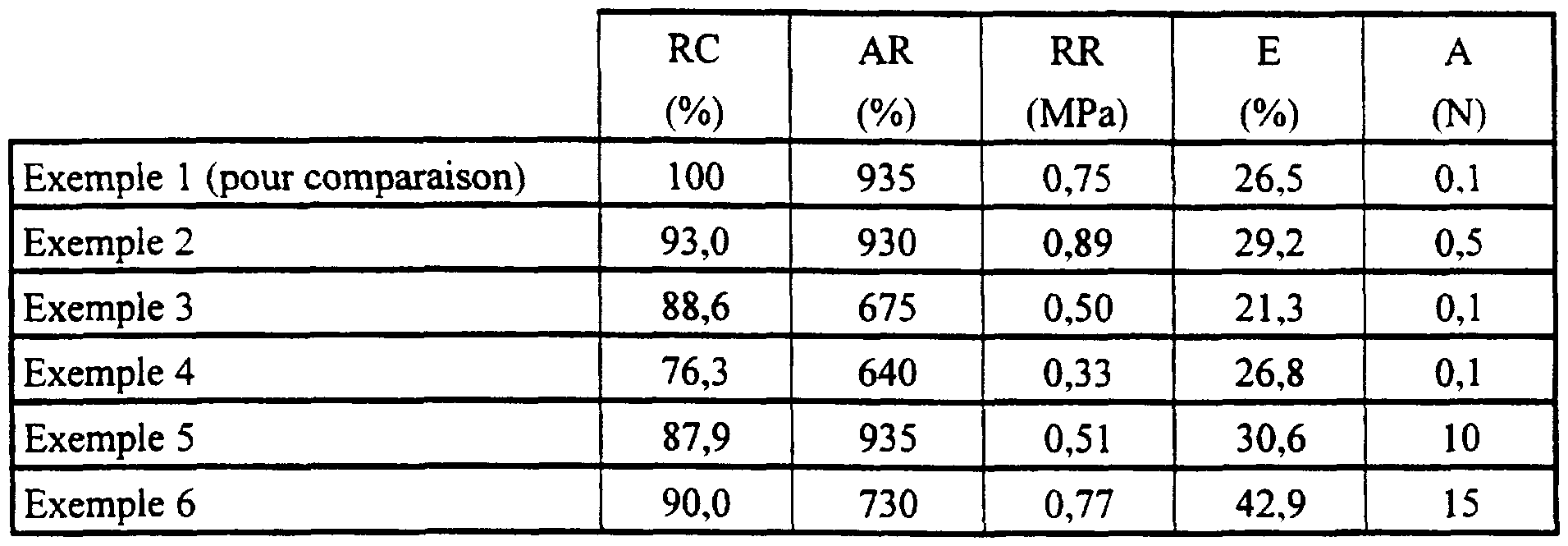
- the mastic film is reinforced with a wide mesh polyamide fabric of nylon 66 type in the following manner: a first film, 1.5 mm thick, is deposited on which the polyamide strip is unwound; a second layer of aqueous silicone dispersion is deposited on the assembly using a 2.5 mm doctor blade, which leads to a sandwich structure of mastic-polyamide-mastic. All the properties measured are collated in Table II below.
- Example 2 The operation is carried out as indicated above in Example 1, except that now the aqueous dispersion of CaCO3 is replaced by 330 g of a latex (B) of fine particle size.
- Tg is measured by differential calorimetric analysis (Differential Scanning Calorimetry on DSC), according to the indications of standard AFNOR T 51-5077.
- 3 g of sodium lauryl sulfate, 240 are successively introduced into a 1 liter stainless steel reactor, with stirring and a double jacket with water circulation allowing the temperature inside the reactor to be regulated. 3 g of water and 0.5 g of an aqueous solution at 30% by weight of ammonium persulfate. The temperature of the contents of the reactor is then brought to 90 ° C. and is then introduced continuously, over a 2 hour period, 100 g of the mixture of ethylenically unsaturated monomers. The dispersion is then cooled and filtered.
- a blue gray latex is obtained having a dry extract content of 30% by weight and an average particle size of 0.04 ⁇ m (40 nm).
- the final dispersions, examples 2 to 7, obtained have a pH of 12 and a dry extract content of 81.3%.
- the elastomers reinforced with nanolatex Compared with an elastomer reinforced with carbonate, the elastomers reinforced with nanolatex have comparable mechanical properties if not better, and are clearly more translucent.
Landscapes
- Chemical & Material Sciences (AREA)
- Health & Medical Sciences (AREA)
- Chemical Kinetics & Catalysis (AREA)
- Medicinal Chemistry (AREA)
- Polymers & Plastics (AREA)
- Organic Chemistry (AREA)
- Compositions Of Macromolecular Compounds (AREA)
- Paints Or Removers (AREA)
- Processes Of Treating Macromolecular Substances (AREA)
- Silicon Polymers (AREA)
- Laminated Bodies (AREA)
- Materials For Medical Uses (AREA)
Abstract
Description




Claims
Priority Applications (15)
| Application Number | Priority Date | Filing Date | Title |
|---|---|---|---|
| FR9506268A FR2734273B1 (fr) | 1995-05-19 | 1995-05-19 | Dispersion aqueuse a base de silicones et de latex de (co)polymere(s) organique(s) pour la preparation d'elastomere silicone a translucidite reglable |
| EP96922104A EP0904321B1 (fr) | 1995-05-19 | 1996-06-12 | Dispersion aqueuse a base de silicones et de latex de (co)polymere(s) organique(s) pour la preparation d'elastomere silicone a translucidite reglable |
| PCT/FR1996/000891 WO1997047687A1 (fr) | 1995-05-19 | 1996-06-12 | Dispersion aqueuse a base de silicones et de latex de (co)polymere(s) organique(s) pour la preparation d'elastomere silicone a translucidite reglable |
| AT96922104T ATE188983T1 (de) | 1995-05-19 | 1996-06-12 | Wässrige dispersionen auf basis von silikonen und organische kopolymerlatex zur herstellung von silikonlastomeren mit einstellbarer lichtdurchlässigkeit |
| ES96922104T ES2140871T3 (es) | 1995-05-19 | 1996-06-12 | Dispersion acuosa a base de siliconas y de latex de (co)polimero(s) organico(s) para la preparacion de elastomero de silicona con translucidez regulable. |
| CZ984024A CZ402498A3 (cs) | 1995-05-19 | 1996-06-12 | Vodné disperze na bázi silikonu a organického (ko)polymerního latexu pro přípravu silikonového elastomeru s říditelnou průsvitností |
| PL96330598A PL330598A1 (en) | 1995-05-19 | 1996-06-12 | Aqueous dispersions based on silicones and organic (co)polymeric latex for obtaining a silicone elastomer of selectable light transmittance |
| IL12743196A IL127431A0 (en) | 1995-05-19 | 1996-06-12 | Silicon and organic (co) polymer latex based aqueous dispersion for preparing silicon elastomer with adjustable translucency |
| JP10501267A JPH11513060A (ja) | 1995-05-19 | 1996-06-12 | 調節可能な半透明性を有するシリコーンエラストマーを製造するための、シリコーン及び有機(コ)ポリマーラテックスをベースにした水性分散液 |
| AU63095/96A AU730772B2 (en) | 1995-05-19 | 1996-06-12 | Aqueous dispersion based on silicones and on organic (co) polymer latex, for the preparation of a silicone elastomer with adjustable translucency |
| CA002258148A CA2258148A1 (fr) | 1995-05-19 | 1996-06-12 | Dispersion aqueuse a base de silicones et de latex de (co)polymere(s) organique(s) pour la preparation d'elastomere silicone a translucidite reglable |
| DE69606333T DE69606333T2 (de) | 1995-05-19 | 1996-06-12 | Wässrige dispersionen auf basis von silikonen und organische kopolymerlatex zur herstellung von silikonlastomeren mit einstellbarer lichtdurchlässigkeit |
| HU9904098A HUP9904098A3 (en) | 1995-05-19 | 1996-06-12 | Silicon and organic (co)polymer latex based aqueous dispersion for preparing silicon elastomer with adjustable translucency |
| DK96922104T DK0904321T3 (da) | 1995-05-19 | 1996-06-12 | Vandig dispersion på basis af siliconer og organisk (co)polymer-latex til fremstilling af silicone-elastomer med regulerbar |
| RU99100387/04A RU2162866C2 (ru) | 1995-05-19 | 1996-06-12 | Водная дисперсия для силиконового эластомера с регулируемой светопроницаемостью и способ ее получения |
Applications Claiming Priority (3)
| Application Number | Priority Date | Filing Date | Title |
|---|---|---|---|
| FR9506268A FR2734273B1 (fr) | 1995-05-19 | 1995-05-19 | Dispersion aqueuse a base de silicones et de latex de (co)polymere(s) organique(s) pour la preparation d'elastomere silicone a translucidite reglable |
| PCT/FR1996/000891 WO1997047687A1 (fr) | 1995-05-19 | 1996-06-12 | Dispersion aqueuse a base de silicones et de latex de (co)polymere(s) organique(s) pour la preparation d'elastomere silicone a translucidite reglable |
| CA002258148A CA2258148A1 (fr) | 1995-05-19 | 1996-06-12 | Dispersion aqueuse a base de silicones et de latex de (co)polymere(s) organique(s) pour la preparation d'elastomere silicone a translucidite reglable |
Publications (1)
| Publication Number | Publication Date |
|---|---|
| WO1997047687A1 true WO1997047687A1 (fr) | 1997-12-18 |
Family
ID=27170908
Family Applications (1)
| Application Number | Title | Priority Date | Filing Date |
|---|---|---|---|
| PCT/FR1996/000891 Ceased WO1997047687A1 (fr) | 1995-05-19 | 1996-06-12 | Dispersion aqueuse a base de silicones et de latex de (co)polymere(s) organique(s) pour la preparation d'elastomere silicone a translucidite reglable |
Country Status (15)
| Country | Link |
|---|---|
| EP (1) | EP0904321B1 (fr) |
| JP (1) | JPH11513060A (fr) |
| AT (1) | ATE188983T1 (fr) |
| AU (1) | AU730772B2 (fr) |
| CA (1) | CA2258148A1 (fr) |
| CZ (1) | CZ402498A3 (fr) |
| DE (1) | DE69606333T2 (fr) |
| DK (1) | DK0904321T3 (fr) |
| ES (1) | ES2140871T3 (fr) |
| FR (1) | FR2734273B1 (fr) |
| HU (1) | HUP9904098A3 (fr) |
| IL (1) | IL127431A0 (fr) |
| PL (1) | PL330598A1 (fr) |
| RU (1) | RU2162866C2 (fr) |
| WO (1) | WO1997047687A1 (fr) |
Cited By (3)
| Publication number | Priority date | Publication date | Assignee | Title |
|---|---|---|---|---|
| WO1999065973A1 (fr) * | 1998-06-18 | 1999-12-23 | Rhodia Chimie | Dispersion silicone aqueuse, reticulable en elastomere transparent |
| US6214841B1 (en) | 1997-05-15 | 2001-04-10 | Eli Lilly And Company | Antithrombotic compound |
| WO2009077389A1 (fr) * | 2007-12-14 | 2009-06-25 | Henkel Ag & Co. Kgaa | Compositions durcissables contenant des dispersions aqueuses d'organopolysiloxanes |
Families Citing this family (6)
| Publication number | Priority date | Publication date | Assignee | Title |
|---|---|---|---|---|
| JP5224425B2 (ja) * | 2000-09-22 | 2013-07-03 | 日本エンバイロケミカルズ株式会社 | 塗料組成物 |
| JP5421513B2 (ja) * | 2006-02-24 | 2014-02-19 | 出光興産株式会社 | 硬化膜、樹脂積層体及びコーティング組成物 |
| CN110627949A (zh) * | 2013-03-14 | 2019-12-31 | 阿克佐诺贝尔国际涂料股份有限公司 | 混合胶乳乳液和由混合胶乳乳液形成的涂料组合物 |
| JP6387885B2 (ja) | 2015-04-06 | 2018-09-12 | 信越化学工業株式会社 | 剥離紙又は剥離フィルム用オルガノポリシロキサンエマルション組成物及びその製造方法、並びに剥離紙及び剥離フィルム |
| RU2629192C1 (ru) * | 2016-06-24 | 2017-08-25 | Федеральное государственное автономное образовательное учреждение высшего образования "Национальный исследовательский Томский государственный университет" (ТГУ, НИ ТГУ) | Способ получения водно-дисперсионного кремнийорганического лака |
| CN111032786A (zh) * | 2017-07-24 | 2020-04-17 | 陶氏东丽株式会社 | 水包油型乳液组合物、其制造方法及其用途 |
Citations (2)
| Publication number | Priority date | Publication date | Assignee | Title |
|---|---|---|---|---|
| EP0049026A1 (fr) * | 1980-09-30 | 1982-04-07 | Dow Corning Corporation | Emulsion de polysiloxanes élastomères renforcés à l'aide d'émulsions de copolymères siliconiques |
| EP0410899A1 (fr) * | 1989-06-29 | 1991-01-30 | Rhone-Poulenc Chimie | Dispersion aqueuse à base d'huiles silicones et de (co)polymère organique rÀ©ticulant en un élastomère par élimination de l'eau |
Family Cites Families (1)
| Publication number | Priority date | Publication date | Assignee | Title |
|---|---|---|---|---|
| US4618645A (en) * | 1985-05-24 | 1986-10-21 | Dow Corning Corporation | Method of producing aqueous latex of crosslinked polydiorganosiloxane |
-
1995
- 1995-05-19 FR FR9506268A patent/FR2734273B1/fr not_active Expired - Lifetime
-
1996
- 1996-06-12 ES ES96922104T patent/ES2140871T3/es not_active Expired - Lifetime
- 1996-06-12 EP EP96922104A patent/EP0904321B1/fr not_active Expired - Lifetime
- 1996-06-12 WO PCT/FR1996/000891 patent/WO1997047687A1/fr not_active Ceased
- 1996-06-12 DK DK96922104T patent/DK0904321T3/da active
- 1996-06-12 JP JP10501267A patent/JPH11513060A/ja active Pending
- 1996-06-12 CA CA002258148A patent/CA2258148A1/fr not_active Abandoned
- 1996-06-12 AU AU63095/96A patent/AU730772B2/en not_active Ceased
- 1996-06-12 PL PL96330598A patent/PL330598A1/xx unknown
- 1996-06-12 RU RU99100387/04A patent/RU2162866C2/ru active
- 1996-06-12 IL IL12743196A patent/IL127431A0/xx unknown
- 1996-06-12 DE DE69606333T patent/DE69606333T2/de not_active Expired - Fee Related
- 1996-06-12 HU HU9904098A patent/HUP9904098A3/hu unknown
- 1996-06-12 CZ CZ984024A patent/CZ402498A3/cs unknown
- 1996-06-12 AT AT96922104T patent/ATE188983T1/de not_active IP Right Cessation
Patent Citations (2)
| Publication number | Priority date | Publication date | Assignee | Title |
|---|---|---|---|---|
| EP0049026A1 (fr) * | 1980-09-30 | 1982-04-07 | Dow Corning Corporation | Emulsion de polysiloxanes élastomères renforcés à l'aide d'émulsions de copolymères siliconiques |
| EP0410899A1 (fr) * | 1989-06-29 | 1991-01-30 | Rhone-Poulenc Chimie | Dispersion aqueuse à base d'huiles silicones et de (co)polymère organique rÀ©ticulant en un élastomère par élimination de l'eau |
Cited By (8)
| Publication number | Priority date | Publication date | Assignee | Title |
|---|---|---|---|---|
| US6214841B1 (en) | 1997-05-15 | 2001-04-10 | Eli Lilly And Company | Antithrombotic compound |
| WO1999065973A1 (fr) * | 1998-06-18 | 1999-12-23 | Rhodia Chimie | Dispersion silicone aqueuse, reticulable en elastomere transparent |
| FR2780067A1 (fr) * | 1998-06-18 | 1999-12-24 | Rhodia Chimie Sa | Dispersion sillicone aqueuse reticulable en elastomere transparent et materiau d'etancheification et/ou de jointoiement et/ou de revetement comprenant cet elastomere |
| US6528580B1 (en) | 1998-06-18 | 2003-03-04 | Rhodia Chimie | Aqueous silicone dispersion, crosslinkable into transparent elastomer |
| AU759798B2 (en) * | 1998-06-18 | 2003-05-01 | Henkel Kgaa | Aqueous silicone dispersion, crosslinkable into transparent elastomer |
| RU2223989C2 (ru) * | 1998-06-18 | 2004-02-20 | Родиа Шими | Водная силиконовая дисперсия, сшиваемая с образованием прозрачного эластомера |
| WO2009077389A1 (fr) * | 2007-12-14 | 2009-06-25 | Henkel Ag & Co. Kgaa | Compositions durcissables contenant des dispersions aqueuses d'organopolysiloxanes |
| US8293848B2 (en) | 2007-12-14 | 2012-10-23 | Henkel Ag & Co. Kgaa | Curable compositions containing aqueous dispersions of organopolysiloxanes |
Also Published As
| Publication number | Publication date |
|---|---|
| PL330598A1 (en) | 1999-05-24 |
| DK0904321T3 (da) | 2000-05-08 |
| FR2734273A1 (fr) | 1996-11-22 |
| ES2140871T3 (es) | 2000-03-01 |
| EP0904321A1 (fr) | 1999-03-31 |
| FR2734273B1 (fr) | 1997-07-04 |
| JPH11513060A (ja) | 1999-11-09 |
| ATE188983T1 (de) | 2000-02-15 |
| CZ402498A3 (cs) | 1999-12-15 |
| HUP9904098A2 (hu) | 2000-03-28 |
| CA2258148A1 (fr) | 1997-12-18 |
| DE69606333D1 (de) | 2000-02-24 |
| AU6309596A (en) | 1998-01-07 |
| RU2162866C2 (ru) | 2001-02-10 |
| IL127431A0 (en) | 1999-10-28 |
| HUP9904098A3 (en) | 2000-04-28 |
| DE69606333T2 (de) | 2000-07-27 |
| EP0904321B1 (fr) | 2000-01-19 |
| AU730772B2 (en) | 2001-03-15 |
Similar Documents
| Publication | Publication Date | Title |
|---|---|---|
| EP0410899B1 (fr) | Dispersion aqueuse à base d'huiles silicones et de (co)polymère organique réticulant en un élastomère par élimination de l'eau | |
| EP0387157B1 (fr) | Dispersion aqueuse de silicone à base d'aminosilane et/ou d'amidosilane réticulant et un élastomère par élimination de l'eau | |
| EP1299458B1 (fr) | Dispersion aqueuse a base d'huiles silicones visqueuses reticulables par condensation en un elastomere adherent utilisables notamment comme mastics ou peintures, procede de preparation | |
| CA1334603C (fr) | Emulsion aqueuse de silicone pouvant reticuler en un elastomere par elimination de l'eau | |
| US6071987A (en) | Silicone emulsion composition and process for producing silicone powder therefrom | |
| EP0904321B1 (fr) | Dispersion aqueuse a base de silicones et de latex de (co)polymere(s) organique(s) pour la preparation d'elastomere silicone a translucidite reglable | |
| CA2266389C (fr) | Dispersion silicone aqueuse | |
| EP1044237B1 (fr) | Emulsion silicone aqueuse, utile comme base de preparation de revetement hydrofuge et antiadherent pour papier, procede de preparation d'une emulsion de ce type et de revetements antiadherents | |
| CN1039430A (zh) | 具有硅氧烷官能度的稳定的含水乳液共聚物 | |
| EP0665862B1 (fr) | Dispersions aqueuses a base d'huiles silicones pouvant reticuler par elimination de l'eau et leur utilisation a la realisation de joints elastomeres silicones | |
| FR2637606A1 (fr) | Dispersion aqueuse de silicone a base d'alcenyloxysilane reticulant en un elastomere par elimination de l'eau | |
| WO2019166507A1 (fr) | Matériaux silicones | |
| CA1315451C (fr) | Emulsion de silicone pouvant reticuler en un elastomere par elimination de l'eau | |
| FR2638166A1 (fr) | Dispersion aqueuse a base de resine silicone pouvant reticuler en un elastomere par elimination de l'eau | |
| MXPA98010374A (en) | Aqueous dispersion based on silicones and latexde (co) organic polymer (s) for the preparation of silicone elastomer with translucidez regula | |
| CN1222174A (zh) | 用于制备具有可调半透明性的硅氧烷弹性体的基于硅氧烷和有机(共)聚合物胶乳的水分散体 | |
| EP0441717A1 (fr) | Procédé de prise d'empreinte au moyen d'une composition élastomère silicone | |
| FR2780066A1 (fr) | Dispersion d'huile silicone avec tensioactif fluore | |
| KR20000016607A (ko) | 조정가능한 반투명성을 지닌 규소 탄성중합체의 제조용 규소 및유기 (공)중합체 라텍스 기재 수성 분산액 |
Legal Events
| Date | Code | Title | Description |
|---|---|---|---|
| WWE | Wipo information: entry into national phase |
Ref document number: 96180327.4 Country of ref document: CN |
|
| AK | Designated states |
Kind code of ref document: A1 Designated state(s): AU CA CN CZ HU IL JP KR MX PL RO RU US |
|
| AL | Designated countries for regional patents |
Kind code of ref document: A1 Designated state(s): AT BE CH DE DK ES FI FR GB GR IE IT LU MC NL PT SE |
|
| DFPE | Request for preliminary examination filed prior to expiration of 19th month from priority date (pct application filed before 20040101) | ||
| 121 | Ep: the epo has been informed by wipo that ep was designated in this application | ||
| WWE | Wipo information: entry into national phase |
Ref document number: 1996922104 Country of ref document: EP |
|
| WWE | Wipo information: entry into national phase |
Ref document number: PV1998-4024 Country of ref document: CZ |
|
| WWE | Wipo information: entry into national phase |
Ref document number: PA/a/1998/010374 Country of ref document: MX |
|
| ENP | Entry into the national phase |
Ref document number: 2258148 Country of ref document: CA Ref document number: 2258148 Country of ref document: CA Kind code of ref document: A |
|
| WWE | Wipo information: entry into national phase |
Ref document number: 1019980710203 Country of ref document: KR |
|
| ENP | Entry into the national phase |
Ref document number: 1998 501267 Country of ref document: JP Kind code of ref document: A |
|
| WWP | Wipo information: published in national office |
Ref document number: 1996922104 Country of ref document: EP |
|
| WWP | Wipo information: published in national office |
Ref document number: PV1998-4024 Country of ref document: CZ |
|
| WWG | Wipo information: grant in national office |
Ref document number: 1996922104 Country of ref document: EP |
|
| WWP | Wipo information: published in national office |
Ref document number: 1019980710203 Country of ref document: KR |
|
| WWG | Wipo information: grant in national office |
Ref document number: 1019980710203 Country of ref document: KR |
|
| WWR | Wipo information: refused in national office |
Ref document number: PV1998-4024 Country of ref document: CZ |