WO1997049773A1 - Ink jet inks - Google Patents

Ink jet inks Download PDF

Info

Publication number
WO1997049773A1
WO1997049773A1 PCT/GB1997/001646 GB9701646W WO9749773A1 WO 1997049773 A1 WO1997049773 A1 WO 1997049773A1 GB 9701646 W GB9701646 W GB 9701646W WO 9749773 A1 WO9749773 A1 WO 9749773A1
Authority
WO
WIPO (PCT)
Prior art keywords
ink
adhesion promoter
binder
anyone
groups
Prior art date
Legal status (The legal status is an assumption and is not a legal conclusion. Google has not performed a legal analysis and makes no representation as to the accuracy of the status listed.)
Ceased
Application number
PCT/GB1997/001646
Other languages
French (fr)
Inventor
Asutosh Nigam
Jitender M. Khurana
Current Assignee (The listed assignees may be inaccurate. Google has not performed a legal analysis and makes no representation or warranty as to the accuracy of the list.)
Domino Printing Sciences PLC
Original Assignee
Domino Printing Sciences PLC
Priority date (The priority date is an assumption and is not a legal conclusion. Google has not performed a legal analysis and makes no representation as to the accuracy of the date listed.)
Filing date
Publication date
Application filed by Domino Printing Sciences PLC filed Critical Domino Printing Sciences PLC
Priority to DE69701873T priority Critical patent/DE69701873T2/en
Priority to JP50250998A priority patent/JP2001504520A/en
Priority to EP97927263A priority patent/EP0906376B1/en
Priority to AU31814/97A priority patent/AU3181497A/en
Publication of WO1997049773A1 publication Critical patent/WO1997049773A1/en
Anticipated expiration legal-status Critical
Ceased legal-status Critical Current

Links

Classifications

    • CCHEMISTRY; METALLURGY
    • C09DYES; PAINTS; POLISHES; NATURAL RESINS; ADHESIVES; COMPOSITIONS NOT OTHERWISE PROVIDED FOR; APPLICATIONS OF MATERIALS NOT OTHERWISE PROVIDED FOR
    • C09DCOATING COMPOSITIONS, e.g. PAINTS, VARNISHES OR LACQUERS; FILLING PASTES; CHEMICAL PAINT OR INK REMOVERS; INKS; CORRECTING FLUIDS; WOODSTAINS; PASTES OR SOLIDS FOR COLOURING OR PRINTING; USE OF MATERIALS THEREFOR
    • C09D11/00Inks
    • C09D11/30Inkjet printing inks
    • C09D11/36Inkjet printing inks based on non-aqueous solvents

Definitions

  • the present invention relates to inks for ink jet printers and especially those which operate continuously. It will be described with reference to such printers but it will be appreciated that the inks described herein may also find uses in a far wider range of less demanding applications, such as drop on demand.
  • An ink jet printer projects from a printer head a stream of ink droplets to impact on the substrate to be marked as the substrate is conveyed, typically at high speed, past the head.
  • the droplets are controlled, typically electrically, so that they are deposited in a controlled array and the substrate is thereby printed with a desired indicia.
  • indicia are code numbers and letters, dates such as "sell by" dates and other alphanumeric data. Precision is clearly essential as well as high speed.
  • the ink must also be stable physically and chemically during periods between runs.
  • Ink which is not deposited on the substrate is collected automatically and recycled to a return tank. To enable the ink to be applied in this way it has to have a viscosity held to close limits. In addition in order for the ink to dry or set on the substrate it is necessary for components of the ink to evaporate off from the image on the substrate. Accordingly to maintain sufficient fluidity a make up fluid has to be added to the return tank to replace lost fluids.
  • an ink jet ink contains a colouring agent, a liquid vehicle, and a polymer.
  • the adhesion of the polymer to the substrate and thus the adhesion of the image may be increased by adhesion promoters.
  • the present invention is concerned with marking containers such as bottles which carry a film of condensation on their surface at the time they are being printed upon and the use of particular adhesion promoters to achieve this.
  • FR-A-2308672 discloses ink compositions made of low molecular weight, linear, soluble Novalac resins, an alcohol and water soluble colourant, an organo silicone compound and a low boiling alcohol with or without water as a diluent.
  • Example 1 discloses gamma- aminopropyl-triethoxy-silane as the organo silicone.
  • Example 2 discloses N-aminoethylaminopropyltrimethoxy- silane as the organo silicone. The specification does not refer to the printing of the ink on wet glass bottles. When these organosilicones were made up into inks in accordance with Example 1A of the present case and tested for adhesion by capillary spotting onto wet bottles satisfactory rub resistance was not achieved.
  • JP-A-02300192 is concerned with an improved method of production of 3- [N- (2-aminoethyl) ] aminopropylalkoxy- silane, and specifically discloses the methyldimethoxy and trimethoxy versions of the compound (Examples 1 and 2) . It does not disclose the formulation of any ink. It mentions the use of these compounds as an adhesion accelerator for epoxy- and acrylic-based inks, but does not specify any substrates to which adhesion is accelerated and it gives no suggestion that the compound would be effective in improving adhesion of an ink to a wet glass bottle.
  • the Example 2 compound is the same as that of Example 2 of FR-A-2308672.
  • an ink jet ink comprises a binder, a colourant, a liquid vehicle and an adhesion promoter, characterised in that the adhesion promoter is an alkoxysilane polyalkylene-imine containing repeat units of the formula (I) :
  • R 5 represents a bond to another nitrogen atom and R 4 represents a bond to another carbon atom or a hydrogen atom; a is from 1 to 8; b is from 1 to 8; c is from 1 to 6; at least one of R 1 , R 2 and R 3 is a C j -Cgalkoxy group and any of R 1 , R 2 and R 3 which are not alkoxy groups are C 1 - C 6 alkyl groups and p is 1 or more, and x is 1 to 50
  • a preferred form of the promoter is one in which c is 3 and specific examples of such compounds which have been found to be effective are, dimethoxymethylsilyl- propyl-polyethylene-imine (DMMSP-PEI hereafter) , tri- methoxy-silylpropyl-polyethylene-imine ⁇ TMSP-PEI hereafter) , and trimethoxysilylpropyl-diethylenetriamine (TMSP-DETA hereafter) .
  • DDMSP-PEI dimethoxymethylsilyl- propyl-polyethylene-imine
  • TTMSP-PEI trimethoxysilylpropyl-diethylenetriamine
  • DMMSP-PEI has one Si for every seven nitrogen atoms, an Si functionality of 4 i.e. 4 Si atoms per molecule and a molecular weight of 2000.
  • the nitrogen carrying the Si group also has a chlorine counter ion.
  • the alkoxysilane polyalkylene-imines used as adhesion promoters in the present invention are water soluble and preferably have molecular weights not in excess of 10,000.
  • p is preferably not in excess of 50 e.g. in the range 1 to 50 e.g. 1 to 10 or more preferably 1 to 4.
  • x may be in the range 1 to 50 or more preferably 2 to 10 or most preferably 1 to 7 or 3 to 7.
  • DMMSP-PEI has two hydrolysable groups on each Si atom whereas TMSP-DETA has three.
  • the increased number of hydrolysable groups may contribute to adhesion.
  • DMMSP-PEI has a large polymeric chain and this may anchor it more firmly to the binder and also contribute in a different way to adhesion.
  • a conductivity controller e.g. a species ionizable in the ink, e.g. in the liquid vehicle, such as an inorganic salt or an organic salt.
  • a conductivity controller e.g. a species ionizable in the ink, e.g. in the liquid vehicle, such as an inorganic salt or an organic salt.
  • ASS acrylonitrile butadiene styrene polymers
  • polyolefins such as polyethylene; polystyrene; polyvinyl chloride (PVC) , plasticized or unplasticized; polyesters; and cellulose.
  • Metal surfaces such as aluminium and stainless steel are also important substrates.
  • Ink jet inks utilizing acrylate binders containing acid groups e.g. carboxyl groups and utilizing organic solvent liquid vehicles and containing the adhesion promoters of the present invention have been found to give deposits on dry glass which have improved adhesion compared to the same ink absent the adhesion promoter.
  • the inks in accordance with the present invention give much improved adhesion to glass surfaces carrying a film of condensation such as is met with when bottles are filled with liquids cooled to below the ambient temperature which are then marked with the ink after being exposed to a humid atmosphere.
  • the degree of condensation will vary widely with the ambient temperature and humidity from winter to summer and from country to country.
  • the bottle may be transported under refrigeration and kept in a refrigerator before use. Also the bottle may be cooled before use in an ice water mixture.
  • the inks in accordance with the present invention in their most preferred embodiments all give improved adhesion under these conditions as compared to the formulations absent the adhesion promoter.
  • alkoxy silane groups couple with hydroxy groups on the glass surface and the nitrogen atoms in the polyethylene imine interact in an acid base type manner with carboxyl groups in an acrylate resin binder.
  • a further requirement of the inks is that whilst they should adhere to the moisture filmed surface of the bottle they can be removed from the bottle when it is to be reused. Typically this removal will be by washing with a caustic solution e.g. at 65°C or with a detergent solution or a mixture thereof.
  • a caustic solution e.g. at 65°C or with a detergent solution or a mixture thereof.
  • the preferred embodiments of this invention also comply with this requirement.
  • the colouring agent may be soluble in organic solvents e.g. methyl ethyl ketone, or C 1 . s alcohols e.g. methanol or ethanol (for example as industrial methylated spirits) or they may be soluble in alcohols mixed with water, or soluble in both alcohol and water.
  • organic solvents e.g. methyl ethyl ketone, or C 1 . s alcohols e.g. methanol or ethanol (for example as industrial methylated spirits) or they may be soluble in alcohols mixed with water, or soluble in both alcohol and water.
  • the colouring agent is preferably a dyestuff soluble in the liquid vehicle; however very finely divided pigments could be contemplated.
  • Examples of colouring agents which have been advocated for use in ink jet inks are dyestuffs soluble in alcohol alone such as Basic Blue 81, Solvent Orange 7 and Solvent Blue 58. Examples which are soluble in alcohol and water are Basic Violet 10, Acid Red 52, Acid Black 1, Acid Blue 59, Acid Red 73 and Acid Blue 9. Triarylmethane dyes have also been advocated. Examples of these are Crystal Violet Fn (available from BASF) and Victoria Blue B base (available from Hilton Davis) . Other dyes include Orasol RL1 (Ciba-Geigy) , Valifast 3808 and 3810 (Orient Chemicals) , Duasyn Blak ARG (Hoechst) and Projet MEK (Zeneca) .
  • the colouring agents are employed in amounts appropriate to give the desired colour intensity in the deposit.
  • the colouring agent is preferably a dyestuff soluble in both MEK and alcohols.
  • the liquid vehicle has to be such as to impart the desired fluidity (or low viscosity) to the ink but must evaporate at a high enough rate to leave the deposited image resistant to smudging soon after it is deposited. It must also be a good enough solvent to get the colouring agent and polymer intimately admixed.
  • Methyl ethyl ketone has been used very effectively in commercially available ink jet formulations, as has ethyl acetate. However, these are thought to have adverse effects on the environment. It is thus desired to replace them with other liquid vehicles. Alcohols and mixtures of alcohols and water have been advocated.
  • MEK systems give good adhesion to many substrates and evaporates rapidly giving a short smudge time - typically the deposit becomes dry and smudge free within 2 seconds.
  • the polymer has the function of carrying the colouring agent and adhering it to the substrate.
  • Suitable binders for the present invention include any film formers soluble in the chosen liquid vehicle and capable of interacting in some way with the chosen adhesion promoter.
  • the mechanism of interaction may include chemical bonding, hydrogen bonding, acid/base interactions, interpenetrating polymeric networks and wetting and surface energy effects.
  • a number of binders have been advocated including acrylates, vinyls, polyesters, amides, phenolics, urethanes, polycarbonates, epoxy and polyketones.
  • the preferred binders are acrylates and vinyls.
  • Preferred commercial binders are the Carboset range (water and solvent borne) available from BF Goodrich.
  • Additives can be used to impart favourable performance characteristics to the present invention. These include humectants, which prevent the ink jet tip from drying. Suitable humectants include N-methyl pyrrolidone, and triacetin. The humectant if used should be present in an amount from 0.1 to 4.0% e.g.
  • composition may also contain a conductivity controller such as ionizable salts.
  • Conductivity controllers which have been proposed to increase conductivity include ionizable inorganic salts such as potassium thiocyanate, and lithium nitrate.
  • ionizable inorganic salts such as potassium thiocyanate, and lithium nitrate.
  • An example of an organic ionizable salt is tetrabutyl ammonium bromide. These can all be used in systems where the liquid vehicle is MEK or an alcohol or alcohol water mixture.
  • the amount of polymer based on the ink by weight is preferably in the range 2% to 20% e.g. 5% to 15% especially 7% to 12%.
  • the amount of colouring agent based on the ink by weight is preferably in the range 0.1 % to 15% e.g. 0.5% to 10% especially 4% to 7%.
  • the amount of liquid vehicle is typically the balance of the composition and is typically, based on the ink by weight, in the range 65% to 95%, preferably
  • the amount of adhesion promoter is preferably 0.001% to 1% or 2%, more preferably 0.01% to 0.8%, or more particularly, 0.05 to 0.7%, the upper limit of 0.7% is effective to achieve the increased adhesion and avoids any tendency for the ink to precipitate.
  • the weight ratio of the binder to the coupler is preferably in the range 10:1 to 150:1, more preferably 10:1 to 50:1 especially 10:1 to 30:1.
  • composition may also contain a conductivity controller e.g. an ionizable compound effective to make the ink of sufficient conductivity for ink jet printing.
  • a conductivity controller e.g. an ionizable compound effective to make the ink of sufficient conductivity for ink jet printing.
  • the conductivity controller when needed, is present in an amount based on the ink by weight in the range 0.1% to 5% e.g. 0.5% to 3%, especially 0.75% to 2%.
  • the ink compositions of the present invention exhibit the following characteristics for use in ink jet applications: a viscosity from about 1.6 to 7.0 centipoise at 25°C; a surface tension of 23 to 31 dynes; and a conductivity of at least 700 e.g. 700 to 2000 or 3000 or higher microSeimens/cm ( ⁇ s/cm) .
  • Ink jet ink compositions were made up with the ingredients shown in Table 1 below.
  • the binder is charged into the mixing vessel followed by the liquid vehicle.
  • the mixture is stirred vigorously until the binder is completely dissolved.
  • the adhesion promoter is then added and the solution left stirring for at least 2 hours.
  • Other additives are then added followed by the colourant.
  • the ink is left stirring for a further 24 hours and then filtered through a 1 micron filter.
  • Example IB is a comparison example without adhesion promoter.
  • Carboset GA 1594 is a water based colloidal dispersion of an acrylic resin containing carboxyl groups neutralised with dimethylaminoethanol . It has an acid number based on solids of 65 mg KOH/g resin.
  • DMMSP-PEI is dimethoxymethyl ⁇ ilylpropyl- polyethylene imine (see formula III above) .
  • Duasyn A-RG VP 280 is a black dye supplied as a powder by Hoeschst and is approximately 100% active.
  • Wet bottles were prepared by filling the clean Coco-Cola (TM) dry bottles with cold water leaving the neck empty.
  • the water containing bottles were then cooled to 4°C in a refrigerator for 8 hrs . They were then held in a 25°C, approximately 65% relative humidity atmosphere for 30 seconds until a film of water droplets misted the surface of the bottles.
  • the neck was then immediately printed with the indicia by ink jet printing. Depending on the ambient atmosphere more condensation may occur on the bottle after the image has been deposited.
  • Drying time is the time taken, from the ink being deposited, to it having dried sufficiently to not smudge when a finger is drawn across it; the finger is drawn across about every half second.
  • Refrigeration test The deposit is allowed to dry for 1 hour in the 25°C 50% RH ambient atmosphere and then placed in a refrigerator at 4°C for 2 weeks. The deposit is then rubbed harshly with the thumb to see how many strokes are needed to remove the deposit.
  • adhesion promoter interacts with the binder by an acid/base mechanism in this example.
  • Ink jet compositions 2A to 2D were made up as in Example 1 with the ingredients shown in Table 3 below.
  • Examples 2B and 2D are comparison examples without adhesion promoter. TABLE 3
  • TMSP-PEI is trimethoxysilylpropyl-polyethylene imine (see above re formula III) .
  • the dye provides a charged species and a counterion and affords the necessary conductivity to the ink obviating the need for a separate conductivity agent.
  • TMSP-DETA is trimethoxysilylpropyl-diethylene triamine (see formula II above) .
  • the tests described for Example 1 were repeated using these inks and the same ink jet printing on wet bottles and test procedures for all of these examples. The results are given in Table 4 below.
  • adhesion promoter interacts with the binder by an acid/base mechanism in this example.
  • Example 3B is a comparison example without adhesion promoter.
  • Liquid vehicle Methylethylketone 80.46 81.61 isopropylalcohol from from binder 3.39 3.44 isopropylalcohol from 0.705 adhesion promoter Humectant N-methyl pyrrolidone 1.17 1.19
  • Carboset 514A is an acrylic resin containing free carboxyl groups. It has an acid number in the range 60
  • VALIFAST 3808 is supplied by Orient Chemicals. Note (5) also applies. VALIFAST 3808 is supplied as 100% actives powder.
  • Example 1 For wet bottles were repeated using these two inks and the same printing and test procedures .
  • adhesion promoter interacts with the binder by an acid/base mechanism in this example.
  • 4B is a comparison example without the adhesion promoter.
  • Poly(BD/AN/AA) is a 2:1:0.1 terpolymer of butadiene, acrylonitrile and acrylic acid available from Polysciences Inc. of Valley Road, Warrington, PA 18976, U.S.A.
  • Examples 4A and 4B were deposited onto wet bottles by capillary spotting.
  • Capilliary spotting entails forming fine glass capilliary tubes, drawing up a sample of the ink into the tube by capilliary action, and contacting the end of the tube with the bottle surface to leave a dot of ink on the bottle.
  • adhesion promoter interacts with the binder by an acid/base mechanism in this example.
  • Binder (%w/v) 5 or 10 g (solids)
  • Liquid vehicle MEK up to 100 ml
  • Adhesion promoter 0.5 or 1 g (solids) Humectant
  • MMA/AN (3:1) is a 3:1 molar ratio copolymer of methylmethacrylate and acrylonitrile. It does not have 30 an acid function. It was made as described in Example 11.
  • MMA/CEA (3:1) is a 3:1 molar ratio copolymer of methylmethacrylate and cyanoethylacrylate. It does not have an acid function. It was made as described in
  • Example 12 The liquid vehicle used in this example is a 1:1 wt/wt blend of MEK and isopropylalcohol instead of MEK alone.
  • MMA/CEA (1:1) is the same as the note (13) polymer except that the molar ratio is 1:1.
  • MMA/VS (3:1) is a copolymer of methylmethacrylate and vinyl stearate made as described in Example 13. It does not have an acid function.
  • MMA/AN/VS (3:1:1) is a terpolymer of methylmethacrylate (3 moles) , acrylonitrile (1 mole) and vinylstearate (1 mole) . It does not have an acid function. It is made as described in Example 14.
  • a mixture of 22.5 g of methylmethacrylate and 7.5 g of acrylonitrile in 75 ml of methylethylketone and 0.3 g (1%) of AIBN were heated together at about 80°C under an argon atmosphere for two hours. A second portion of 0.3 g (1%) of AIBN was then added. The mixture was heated overnight under an argon atmosphere. The solution was thereafter diluted with methylethyl-ketone to make a total of 300 ml of solution to give a 10% solution of the polymer.
  • Example 12 (MMA/CEA, 3:1) A mixture of 22.5 g of methylmethacrylate and 7.5 g of cyanoethylacrylate in 70 ml of methylethylketone and
  • Example 13 (MMA/VS . 3 : 1 )
  • a mixture of 22.5 g of methylmethacrylate and 7.5 g of vinyl stearate in 70 ml of methylethylketone together with 0.3 g (1%) of azoisobutyronitrile (AIBN) was heated at about 70°C overnight (12 hours) under an argon atmosphere.
  • the resultant solution was then diluted to 300 ml to give a 10% solution of the polymer or to 600 ml to give a 5% solution. This solution was then used to make up the inks.
  • adhesion promoter interacts with the binder by interpenetrating network interactions in these Examples 5 - 10.
  • Example 15A methylethylketone with zero adhesion promoter
  • Example 15B various amounts of three different adhesion promoters
  • Example 15H various amounts of BA-AA as polymer and 0.5% of TMSP-DETA
  • Example 16 TMSP-DETA
  • the proportions and properties are given in Table 11 below.
  • the inks were capilliary spotted onto dry bottles as described above for Example 4. The deposits were then allowed to dry in ambient air for 24 hours. The bottles were then immersed in an ice/water bath for 8 hours and then rubbed as described for the water immersion test for Example 1.
  • the binder BA-AA is a 1:1 copolymer of butylacrylate and acrylic acid available as a 20% solution in ethanol from Polysciences Inc. of the U.S.A.
  • the weight ratio of the binder to adhesion promoter for Ex 15B and 15E is in the range 10:1 (Ex 15B) to 25:1 (Ex 16D) or more broadly 10:1 to 30:1 or 10:1 to 50:1.
  • Examples 17A to 17G Inks were made up using the same binder as in Example
  • the proportions are given in Table 12 below, the inks being made up as described for Example 1.
  • the compositions had 11-11.5% of B providing about 8% wt of resin, 82 to 80% wt of MEK, 0 to 0.6% wt of AP, 1.1 to 1.2% wt of NMP and 5.8 to 5.6% wt of colourant.
  • Example 17A to 17E were then ink jet printed onto wet bottles (two per ink) prepared as described for Example 1, with six deposits on each bottle.
  • the rub resistance of the deposits was then tested immediately after this post humidification, after 1 hour in ambient air (25°C, 50% RH) and after 24 hours in ambient air (25°C, 50% RH) .
  • the bottle was then placed in a refrigerator at 4°C. It was removed after 24 hours and three of the deposits subjected to the same rubbing test as for Table 14. It was then returned to the refrigerator and left for 7 days and then the other three deposits were tested.
  • the binder and the adhesion promoter form a complex and that at a certain level of concentration of adhesion promoter above 0.5% but below 1.0% the mixture no longer exists as a single phase. Possibly the complex is no longer soluble in the liquid vehicle (MEK) .
  • Example 18A 18B 18C 18D Ingredient Binder (B) Carboset 514A log lOg none none 70% (IPA) resin (7) resin 7. Og 7. Og none none Liquid vehicle MEK up to up to up to up to up to up to
  • Ratio B/AP (wt/wt) none 11.2:1 none none 6 ml of water (distilled) was then added to each of these clear solutions and the mixture stirred.
  • Examples 18A and B remained clear, a solid precipitated out from 18C and 18D. This suggests that the binder stabilises the adhesion promoter in the liquid vehicle.

Landscapes

  • Chemical & Material Sciences (AREA)
  • Life Sciences & Earth Sciences (AREA)
  • Engineering & Computer Science (AREA)
  • Materials Engineering (AREA)
  • Wood Science & Technology (AREA)
  • Organic Chemistry (AREA)
  • Inks, Pencil-Leads, Or Crayons (AREA)
  • Ink Jet Recording Methods And Recording Media Thereof (AREA)
  • Ink Jet (AREA)
  • Compositions Of Macromolecular Compounds (AREA)

Abstract

There is provided an ink jet ink comprising a binder, a colourant, a liquid vehicle and an adhesion promoter, the adhesion promoter being an alkoxysilane polyalkylene-imine containing repeat units of formula (I) wherein R5 represents a bond to another nitrogen atom and R4 represents a bond to another carbon atom or a hydrogen atom; a is from 1 to 8; b is 1 to 8; c is from 1 to 6; at least one of R?1, R2 and R3¿ is a C¿1?-C6alkoxy group and any of R?1, R2 and R3¿ which are not alkoxy groups are C¿1?-C6alkyl groups and p is 1 or more, and x is 1 to 50.

Description

INK JET INKS
The present invention relates to inks for ink jet printers and especially those which operate continuously. It will be described with reference to such printers but it will be appreciated that the inks described herein may also find uses in a far wider range of less demanding applications, such as drop on demand.
An ink jet printer projects from a printer head a stream of ink droplets to impact on the substrate to be marked as the substrate is conveyed, typically at high speed, past the head. The droplets are controlled, typically electrically, so that they are deposited in a controlled array and the substrate is thereby printed with a desired indicia. Typically such indicia are code numbers and letters, dates such as "sell by" dates and other alphanumeric data. Precision is clearly essential as well as high speed.
In addition whilst the jet will be continuously operating during a printing run, the ink must also be stable physically and chemically during periods between runs.
Ink which is not deposited on the substrate is collected automatically and recycled to a return tank. To enable the ink to be applied in this way it has to have a viscosity held to close limits. In addition in order for the ink to dry or set on the substrate it is necessary for components of the ink to evaporate off from the image on the substrate. Accordingly to maintain sufficient fluidity a make up fluid has to be added to the return tank to replace lost fluids.
Typically an ink jet ink contains a colouring agent, a liquid vehicle, and a polymer. The adhesion of the polymer to the substrate and thus the adhesion of the image may be increased by adhesion promoters.
The present invention is concerned with marking containers such as bottles which carry a film of condensation on their surface at the time they are being printed upon and the use of particular adhesion promoters to achieve this.
A search of the prior art carried out by the EPO has revealed FR-A-2308672, JP-A-02300192 and Research Disclosure vol 388 no. 053, 10 August 1996.
FR-A-2308672 discloses ink compositions made of low molecular weight, linear, soluble Novalac resins, an alcohol and water soluble colourant, an organo silicone compound and a low boiling alcohol with or without water as a diluent. Example 1 discloses gamma- aminopropyl-triethoxy-silane as the organo silicone. Example 2 discloses N-aminoethylaminopropyltrimethoxy- silane as the organo silicone. The specification does not refer to the printing of the ink on wet glass bottles. When these organosilicones were made up into inks in accordance with Example 1A of the present case and tested for adhesion by capillary spotting onto wet bottles satisfactory rub resistance was not achieved.
JP-A-02300192 is concerned with an improved method of production of 3- [N- (2-aminoethyl) ] aminopropylalkoxy- silane, and specifically discloses the methyldimethoxy and trimethoxy versions of the compound (Examples 1 and 2) . It does not disclose the formulation of any ink. It mentions the use of these compounds as an adhesion accelerator for epoxy- and acrylic-based inks, but does not specify any substrates to which adhesion is accelerated and it gives no suggestion that the compound would be effective in improving adhesion of an ink to a wet glass bottle. The Example 2 compound is the same as that of Example 2 of FR-A-2308672.
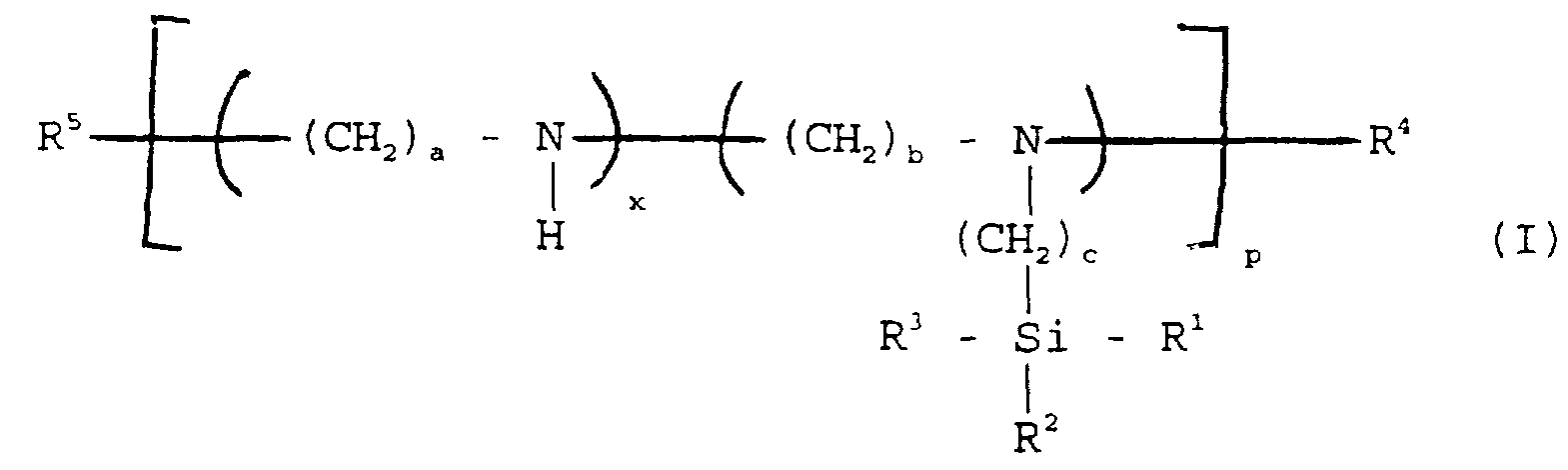
Thus according to the present invention an ink jet ink comprises a binder, a colourant, a liquid vehicle and an adhesion promoter, characterised in that the adhesion promoter is an alkoxysilane polyalkylene-imine containing repeat units of the formula (I) :
Figure imgf000005_0001
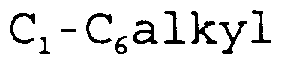
wherein R5 represents a bond to another nitrogen atom and R4 represents a bond to another carbon atom or a hydrogen atom; a is from 1 to 8; b is from 1 to 8; c is from 1 to 6; at least one of R1, R2 and R3 is a Cj-Cgalkoxy group and any of R1, R2 and R3 which are not alkoxy groups are C1 - C6alkyl groups and p is 1 or more, and x is 1 to 50
A preferred form of the promoter is one in which c is 3 and specific examples of such compounds which have been found to be effective are, dimethoxymethylsilyl- propyl-polyethylene-imine (DMMSP-PEI hereafter) , tri- methoxy-silylpropyl-polyethylene-imine {TMSP-PEI hereafter) , and trimethoxysilylpropyl-diethylenetriamine (TMSP-DETA hereafter) .
In TMSP-DETA a = 2 and b = 2 and x = 1, c = 3 and p = 1 and R5 = NH, and R4 = H and it has the formula (II) :
Figure imgf000005_0002
It has one Si atom and three nitrogen atoms. It has a molecular weight of 245.
In DMMSP- PEI x = 7 and p = 4 and a = 2 and b = 2 and c = 3 and it has the formula ( I I I ) :
CI"
H- (CH2) 2 - N- (CH, - IT- -H
H ( CH, :ιn:
CH30 Si CH,
OCH,
DMMSP-PEI has one Si for every seven nitrogen atoms, an Si functionality of 4 i.e. 4 Si atoms per molecule and a molecular weight of 2000. The nitrogen carrying the Si group also has a chlorine counter ion.
In TMSP-PEI the formula is the same as for DMMSP- PEI except that R1 = R2 = R3 = methoxy. The alkoxysilane polyalkylene-imines used as adhesion promoters in the present invention are water soluble and preferably have molecular weights not in excess of 10,000. p is preferably not in excess of 50 e.g. in the range 1 to 50 e.g. 1 to 10 or more preferably 1 to 4. x may be in the range 1 to 50 or more preferably 2 to 10 or most preferably 1 to 7 or 3 to 7.
Comparing DMMSP-PEI with TMSP-DETA it will be noted that DMMSP-PEI has two hydrolysable groups on each Si atom whereas TMSP-DETA has three. The increased number of hydrolysable groups may contribute to adhesion. DMMSP-PEI has a large polymeric chain and this may anchor it more firmly to the binder and also contribute in a different way to adhesion. These two factors can be born in mind when choosing an adhesion promoter in accordance with the present invention. In addition, where droplet formation and control is achieved electrically, it is necessary for the ink to be electrically conductive. Conductivity may be imparted by the colouring agent when this includes a charged species. If it, or some other ingredient in the ink, does not impart sufficient or any conductivity this may be provided by a conductivity controller, e.g. a species ionizable in the ink, e.g. in the liquid vehicle, such as an inorganic salt or an organic salt. The art is constantly striving to achieve deposits of sufficient durability on an increasing range of substrates. Some have concerned themselves with printing on glass or glazed ceramics. Others have concerned themselves with polymer substrates such as acrylonitrile butadiene styrene polymers (ABS) ; polyolefins, such as polyethylene; polystyrene; polyvinyl chloride (PVC) , plasticized or unplasticized; polyesters; and cellulose. Metal surfaces such as aluminium and stainless steel are also important substrates.
Ink jet inks utilizing acrylate binders containing acid groups e.g. carboxyl groups and utilizing organic solvent liquid vehicles and containing the adhesion promoters of the present invention have been found to give deposits on dry glass which have improved adhesion compared to the same ink absent the adhesion promoter.
In addition the inks in accordance with the present invention give much improved adhesion to glass surfaces carrying a film of condensation such as is met with when bottles are filled with liquids cooled to below the ambient temperature which are then marked with the ink after being exposed to a humid atmosphere.
It will be appreciated that the degree of condensation will vary widely with the ambient temperature and humidity from winter to summer and from country to country. In addition even when the deposit sticks initially to the moisture filmed surface the bottle may be transported under refrigeration and kept in a refrigerator before use. Also the bottle may be cooled before use in an ice water mixture.
The inks in accordance with the present invention in their most preferred embodiments all give improved adhesion under these conditions as compared to the formulations absent the adhesion promoter.
Whilst the present invention is not dependant on the correctness or otherwise of any theory it is thought that the alkoxy silane groups couple with hydroxy groups on the glass surface and the nitrogen atoms in the polyethylene imine interact in an acid base type manner with carboxyl groups in an acrylate resin binder.
A further requirement of the inks is that whilst they should adhere to the moisture filmed surface of the bottle they can be removed from the bottle when it is to be reused. Typically this removal will be by washing with a caustic solution e.g. at 65°C or with a detergent solution or a mixture thereof. The preferred embodiments of this invention also comply with this requirement.
With regard to the colouring agent this has usually been related to the liquid vehicle. The colouring agents may be soluble in organic solvents e.g. methyl ethyl ketone, or C1.s alcohols e.g. methanol or ethanol (for example as industrial methylated spirits) or they may be soluble in alcohols mixed with water, or soluble in both alcohol and water.
Thus, the colouring agent is preferably a dyestuff soluble in the liquid vehicle; however very finely divided pigments could be contemplated.
Examples of colouring agents which have been advocated for use in ink jet inks are dyestuffs soluble in alcohol alone such as Basic Blue 81, Solvent Orange 7 and Solvent Blue 58. Examples which are soluble in alcohol and water are Basic Violet 10, Acid Red 52, Acid Black 1, Acid Blue 59, Acid Red 73 and Acid Blue 9. Triarylmethane dyes have also been advocated. Examples of these are Crystal Violet Fn (available from BASF) and Victoria Blue B base (available from Hilton Davis) . Other dyes include Orasol RL1 (Ciba-Geigy) , Valifast 3808 and 3810 (Orient Chemicals) , Duasyn Blak ARG (Hoechst) and Projet MEK (Zeneca) .
The colouring agents are employed in amounts appropriate to give the desired colour intensity in the deposit.
The colouring agent is preferably a dyestuff soluble in both MEK and alcohols.
The liquid vehicle has to be such as to impart the desired fluidity (or low viscosity) to the ink but must evaporate at a high enough rate to leave the deposited image resistant to smudging soon after it is deposited. It must also be a good enough solvent to get the colouring agent and polymer intimately admixed.
Methyl ethyl ketone (MEK) has been used very effectively in commercially available ink jet formulations, as has ethyl acetate. However, these are thought to have adverse effects on the environment. It is thus desired to replace them with other liquid vehicles. Alcohols and mixtures of alcohols and water have been advocated.
However MEK systems give good adhesion to many substrates and evaporates rapidly giving a short smudge time - typically the deposit becomes dry and smudge free within 2 seconds. The polymer has the function of carrying the colouring agent and adhering it to the substrate.
Suitable binders for the present invention include any film formers soluble in the chosen liquid vehicle and capable of interacting in some way with the chosen adhesion promoter. The mechanism of interaction may include chemical bonding, hydrogen bonding, acid/base interactions, interpenetrating polymeric networks and wetting and surface energy effects. A number of binders have been advocated including acrylates, vinyls, polyesters, amides, phenolics, urethanes, polycarbonates, epoxy and polyketones. The preferred binders are acrylates and vinyls. Preferred commercial binders are the Carboset range (water and solvent borne) available from BF Goodrich.
Additives can be used to impart favourable performance characteristics to the present invention. These include humectants, which prevent the ink jet tip from drying. Suitable humectants include N-methyl pyrrolidone, and triacetin. The humectant if used should be present in an amount from 0.1 to 4.0% e.g.
0.1% to 2.0% by weight of the ink formulation, and preferably 0.5% to 1.5% by weight of the composition.
The composition may also contain a conductivity controller such as ionizable salts.
Surface active materials may be incorporated to reduce surface tension and to act as defoamers. Conductivity controllers which have been proposed to increase conductivity include ionizable inorganic salts such as potassium thiocyanate, and lithium nitrate. An example of an organic ionizable salt is tetrabutyl ammonium bromide. These can all be used in systems where the liquid vehicle is MEK or an alcohol or alcohol water mixture.
The amount of polymer based on the ink by weight is preferably in the range 2% to 20% e.g. 5% to 15% especially 7% to 12%. The amount of colouring agent based on the ink by weight is preferably in the range 0.1 % to 15% e.g. 0.5% to 10% especially 4% to 7%.
The amount of liquid vehicle is typically the balance of the composition and is typically, based on the ink by weight, in the range 65% to 95%, preferably
75 to 85%. The amount of adhesion promoter is preferably 0.001% to 1% or 2%, more preferably 0.01% to 0.8%, or more particularly, 0.05 to 0.7%, the upper limit of 0.7% is effective to achieve the increased adhesion and avoids any tendency for the ink to precipitate. The weight ratio of the binder to the coupler is preferably in the range 10:1 to 150:1, more preferably 10:1 to 50:1 especially 10:1 to 30:1.
As mentioned above the composition may also contain a conductivity controller e.g. an ionizable compound effective to make the ink of sufficient conductivity for ink jet printing.
Typically the conductivity controller, when needed, is present in an amount based on the ink by weight in the range 0.1% to 5% e.g. 0.5% to 3%, especially 0.75% to 2%.
In general, the ink compositions of the present invention exhibit the following characteristics for use in ink jet applications: a viscosity from about 1.6 to 7.0 centipoise at 25°C; a surface tension of 23 to 31 dynes; and a conductivity of at least 700 e.g. 700 to 2000 or 3000 or higher microSeimens/cm (μs/cm) .
The invention may be put into practice in various ways and a number of specific embodiments will be described to illustrate the invention with reference to the accompanying examples.
Example 1A and IB
Ink jet ink compositions were made up with the ingredients shown in Table 1 below. The binder is charged into the mixing vessel followed by the liquid vehicle. The mixture is stirred vigorously until the binder is completely dissolved. The adhesion promoter is then added and the solution left stirring for at least 2 hours. Other additives are then added followed by the colourant. The ink is left stirring for a further 24 hours and then filtered through a 1 micron filter. Example IB is a comparison example without adhesion promoter.
TABLE 1
Example 1A IB
Ingredient
Binder
40% aq. Carboset GA 1594(1) (14.07) (14.07) resin 5.63 5.63
Liquid vehicle
Methylethylketone 78.01 79.14 water from binder 8.44 8.44 isopropylalcohol from 0.565 - adhesion promoter
Humectant
N-methyl pyrrolidone 1.16 1.16
Adhesion Promoter
50% DMMSP-PEI (2) 0.565 -
Colourant
Duasyn A-RG VP 280 (3) 5.63 5.63 dye
100 100
Notes on Table 1
(1) Carboset GA 1594 is a water based colloidal dispersion of an acrylic resin containing carboxyl groups neutralised with dimethylaminoethanol . It has an acid number based on solids of 65 mg KOH/g resin.
(2) DMMSP-PEI is dimethoxymethylεilylpropyl- polyethylene imine (see formula III above) .
(3) Duasyn A-RG VP 280 is a black dye supplied as a powder by Hoeschst and is approximately 100% active.
These two inks were applied by continuous ink jet printers to glass bottles . Before printing the bottles are cleaned by washing in 3% caustic soda solution at 60°C for 20 minutes, followed by rinsing with distilled water and drying.
Dry bottles were printed at ambient temperature 25°C and 50% relative humidity whilst empty.
Wet bottles were prepared by filling the clean Coco-Cola (TM) dry bottles with cold water leaving the neck empty. The water containing bottles were then cooled to 4°C in a refrigerator for 8 hrs . They were then held in a 25°C, approximately 65% relative humidity atmosphere for 30 seconds until a film of water droplets misted the surface of the bottles. The neck was then immediately printed with the indicia by ink jet printing. Depending on the ambient atmosphere more condensation may occur on the bottle after the image has been deposited.
Three deposits were made on each bottle and the results quoted in Table 2 below are the average of these three deposits.
Four tests were carried out.
Drying time is the time taken, from the ink being deposited, to it having dried sufficiently to not smudge when a finger is drawn across it; the finger is drawn across about every half second.
Water immersion test . The deposit is allowed to dry for 1 hour in the 25°C 50% RH ambient atmosphere and the bottle then placed in a 50/50 w/w ice/water mixture and left for 8 hours. The deposit is then rubbed harshly with the thumb to see how many strokes are needed to remove the deposit .
Refrigeration test. The deposit is allowed to dry for 1 hour in the 25°C 50% RH ambient atmosphere and then placed in a refrigerator at 4°C for 2 weeks. The deposit is then rubbed harshly with the thumb to see how many strokes are needed to remove the deposit.
Caustic wash test. The deposit is allowed to dry for 24 hours in the 25°C 50% RH ambient atmosphere and then placed in a static bath of 3% sodium hydroxide at 65°C for 10 minutes. In some cases the deposit floats off, in others it only needs to be rubbed gently with the finger. The number of strokes needed to remove it are quoted. TABLE 2
Test Dying Ice/ Caustic Refrig¬ Bottle time water wash eration type
(sees) tests tests tests
(Rubs) (Rubs) (Rubs) (3A) (3A) (3A)
Example
1A 1-2 9-10 1-2 10 + (3A) dry
IB 1-2 3-4 1-2 10+ dry
1A - 10 + 1-2 10 + wet
IB - 1-2 1-2 5-6 wet
Notes on Table 2
(3A) In the rubbing tests if the deposit survives 10 rubs it is reported as 10 + and the deposit is considered to be permanent .
It is believed that the adhesion promoter interacts with the binder by an acid/base mechanism in this example.
Example 2A to 2D
Ink jet compositions 2A to 2D were made up as in Example 1 with the ingredients shown in Table 3 below. Examples 2B and 2D are comparison examples without adhesion promoter. TABLE 3
Example 2A 2B 2C 2D
Ingredient Binder
40% aq. Carboset (16.8) (16.8) (16.93) (16.93)
GA 1594 (1) resin 6.72 6.72 6.772 6.772
Liquid vehicle Methylethylketone 75.2 76.2 75 .67 76.078 water from binder 10.08 10.08 10. .15 10.15 isopropylalcohol 0.5 - 0 .03 _ from adhesion promoter Humectant N-methyl pyrrolidone 1.2 1.2 1.17 1.2 Adhesion Promoter 50% (IPA) TMSP-PEI 0.5
(4) 50% (IPA) TMSP-DETA - - 0.56 - (6)
Colourant Duasyn A-RG (5) 5.8 5.8 Valifast 3808 - - 5.64 5.8
100 100 100 100
Notes on Table 3
(4) TMSP-PEI is trimethoxysilylpropyl-polyethylene imine (see above re formula III) . (5) The dye provides a charged species and a counterion and affords the necessary conductivity to the ink obviating the need for a separate conductivity agent.
(6) TMSP-DETA is trimethoxysilylpropyl-diethylene triamine (see formula II above) . The tests described for Example 1 were repeated using these inks and the same ink jet printing on wet bottles and test procedures for all of these examples. The results are given in Table 4 below.
Table 4
Test Print Ice/ Caustic Refrig¬ Bottle
Quality water wash eration type tests tests tests (Rubs) (Rubs) (Rubs)
Example
2A good 10 + 1-2 10 + wet
2B poor 3-4 floats 3-5 wet off
2C good 10 + 1-2 10 + wet
2D poor 2-3 1-2 3-5 wet
It is believed that the adhesion promoter interacts with the binder by an acid/base mechanism in this example.
Example 3A and 3B
Ink jet ink compositions were made up as in Example 1 with the ingredients shown in Table 5 below. Example 3B is a comparison example without adhesion promoter.
TABLE 5
Example 3A 3B
Ingredient Binder
70% (IPA) Carboset 514A (7) (11.31) (11.47) resin 7.92 8.03
Liquid vehicle Methylethylketone 80.46 81.61 isopropylalcohol from from binder 3.39 3.44 isopropylalcohol from 0.705 adhesion promoter Humectant N-methyl pyrrolidone 1.17 1.19
Adhesion Promoter
50% (IPA) DMMSP-PEI (2) 0.705
Colourant Orasol RL1 (8) 5.65 5.73
100 100
Notes on Table 5
(7) Carboset 514A is an acrylic resin containing free carboxyl groups. It has an acid number in the range 60
70 mg KOH/g resin and a molecular weight of approximately 30,000.
(8) VALIFAST 3808 is supplied by Orient Chemicals. Note (5) also applies. VALIFAST 3808 is supplied as 100% actives powder.
The tests described for Example 1 for wet bottles were repeated using these two inks and the same printing and test procedures .
The results are given in Table 6. Table 6
Test Print Ice/ Caustic Refrig¬ Quality water wash eration tests tests tests (Rubs) (Rubs) (Rubs)
Example
3A good 10 + 1-2 10 +
3B poor 1 0 4
It is believed that the adhesion promoter interacts with the binder by an acid/base mechanism in this example.
Examples 4A and 4B
Ink jet compositions were made up as in Example 1 with the ingredients shown in Table 7 below. Examples
4B is a comparison example without the adhesion promoter.
Table 7 Example 4A 4B
Ingredient Binder Poly(BD/AN/AA) (9) 5 5
Liquid vehicle MEK 88.5 89
Humectant N-methyl pyrrolidone 1 1 Adhesion Promoter
TMSP-DETA (6) 0.5
Colourant Duasyn ARG (3) 5 5
100 100
Notes on Table 7
(9) Poly(BD/AN/AA) is a 2:1:0.1 terpolymer of butadiene, acrylonitrile and acrylic acid available from Polysciences Inc. of Valley Road, Warrington, PA 18976, U.S.A.
Examples 4A and 4B were deposited onto wet bottles by capillary spotting. Capilliary spotting entails forming fine glass capilliary tubes, drawing up a sample of the ink into the tube by capilliary action, and contacting the end of the tube with the bottle surface to leave a dot of ink on the bottle.
The water immersion test (ice/water) and the caustic wash tests were then carried out as described above for Example 1 and the results are given in Table 8.
Table 8
Test Ice/water Caustic wash tests (rubs) tests (rubs) Example
4A 10+ Removed by hard rubbing 4B 1 Removed by 1 soft rub
It is believed that the adhesion promoter interacts with the binder by an acid/base mechanism in this example.
Examples 5 to 10
Ink formulations were made up as described for Example 1 using the proportions set out below in Table 9. Table 9
Binder (%w/v) 5 or 10 g (solids)
Liquid vehicle MEK up to 100 ml
Adhesion promoter 0.5 or 1 g (solids) Humectant
NMP 1 ml
Dye Duasyn A-RG VP280 5 g
These inks were spotted onto dry bottles using capillary spotting as described above in relation to Example 4. The deposits were then allowed to dry in ambient air for 24 hours . The bottles were then immersed in an ice/water bath for 8 hours and then rubbed as described for the water immersion test for Example 1.
The results are given in Table 10 below. Examples 5A, 6A, 7A, 8A, 9A and 10A are comparison examples.
Table 10
Polymer Coupler Rub
5 Example Polvmer Amount Coupler Amount Resistance
5A Carboset 5% none none none GA 1594
5B 5% DMMSP-PEI 0.5% 10+
6A MMA/AN 5% none none none
10 (3: 1) (10)
6B 5% DMMSP-PEI 0.5 8
6C 5% TMSP-PEI 0.5 8
7A MMA/CEA 5% none none 0-3 (3:1) (11)
15 7B (12) 5% TMSP-PEI 0.5 8
8A MMA/CEA 5% none none none (1:1) (13)
8B 5% TMSP-DETA 0.5% 9
9A MMA/VS 10% none none 0-3 20 (3:1) (14)
9B 10% TMSP-DETA 0.5 10+
9C 10% 1.0 8-10
10A MMA/AN/VS 10% none none 0-3
(3: 1 :1) (15)
25 10B 5% TMSP-DETA 0.5 8-10
Notes on Table 10
(10) MMA/AN (3:1) is a 3:1 molar ratio copolymer of methylmethacrylate and acrylonitrile. It does not have 30 an acid function. It was made as described in Example 11. (11) MMA/CEA (3:1) is a 3:1 molar ratio copolymer of methylmethacrylate and cyanoethylacrylate. It does not have an acid function. It was made as described in
Example 12. (12) The liquid vehicle used in this example is a 1:1 wt/wt blend of MEK and isopropylalcohol instead of MEK alone.
(13) MMA/CEA (1:1) is the same as the note (13) polymer except that the molar ratio is 1:1. (14) MMA/VS (3:1) is a copolymer of methylmethacrylate and vinyl stearate made as described in Example 13. It does not have an acid function.
(15) MMA/AN/VS (3:1:1) is a terpolymer of methylmethacrylate (3 moles) , acrylonitrile (1 mole) and vinylstearate (1 mole) . It does not have an acid function. It is made as described in Example 14.
Example 11 (MMA/AN. 3:1)
A mixture of 22.5 g of methylmethacrylate and 7.5 g of acrylonitrile in 75 ml of methylethylketone and 0.3 g (1%) of AIBN were heated together at about 80°C under an argon atmosphere for two hours. A second portion of 0.3 g (1%) of AIBN was then added. The mixture was heated overnight under an argon atmosphere. The solution was thereafter diluted with methylethyl-ketone to make a total of 300 ml of solution to give a 10% solution of the polymer.
Example 12 (MMA/CEA, 3:1) A mixture of 22.5 g of methylmethacrylate and 7.5 g of cyanoethylacrylate in 70 ml of methylethylketone and
0.3 g (1%) of AIBN were heated together at about 70°C overnight (12 hours) under an argon atmosphere. The solution was then diluted and used as described in Examples 13 and 14 below. Example 13 (MMA/VS . 3 : 1 )
A mixture of 22.5 g of methylmethacrylate and 7.5 g of vinyl stearate in 70 ml of methylethylketone together with 0.3 g (1%) of azoisobutyronitrile (AIBN) was heated at about 70°C overnight (12 hours) under an argon atmosphere. The resultant solution was then diluted to 300 ml to give a 10% solution of the polymer or to 600 ml to give a 5% solution. This solution was then used to make up the inks.
Example 14 (MMA/ACN/VS, 3:1:1)
A mixture of 18 g methylmethacrylate, 6 g of acrylonitrile and 6 g of vinyl stearate in 70 ml of methylethylketone together with 0.3 g (1%) of AIBN was heated at about 70°C overnight (12 hours) under an argon atmosphere. The resultant solution was then diluted to 300 ml to give a 10% solution of the polymer or to 600 ml to give a 5% solution. This solution was then used to make up the inks.
It is believed that the adhesion promoter interacts with the binder by interpenetrating network interactions in these Examples 5 - 10.
Examples 15A to 15H, 15J and 15K and 16
The procedure of Examples 5 to 10 using the general proportions of Table 9 was carried out to make a series of inks containing 5% by weight Carboset 1594 in methylethylketone with zero adhesion promoter (Example 15A) and various amounts of three different adhesion promoters (Examples 15B to 15H) and with 2% of BA-AA as polymer and 0.5% of TMSP-DETA (Example 16) . The proportions and properties are given in Table 11 below. The inks were capilliary spotted onto dry bottles as described above for Example 4. The deposits were then allowed to dry in ambient air for 24 hours. The bottles were then immersed in an ice/water bath for 8 hours and then rubbed as described for the water immersion test for Example 1.
Table 11 Example Adhesion Amount wt/wt Rub
Promoter of binder/ resistance (AP) AP promoter
15A none none none 15B TMSP-DETA 0.5% 10:1 10 + 15C TMSP-DETA 0.4% 12.5: 1 10 + 15D 0.3% 16.1: :1 10 + 15E 0.2% 25:1 8 15F 1.0% 5:1 not tested (16)
15G DMMSP-PEI 1% 5:1 not tested (16)
15H II 0.5% 10:1 10 +
15J TMSP-PEI 1% 5:1 not tested (16)
15K II 0.5% 10:1 10 +
16 (17) TMSP-DETA 0.5% 5:1 10 +
Notes on Table 11
(16) The composition separated into two layers when this amount of adhesion promoter was added to the Carboset MEK solution before addition of the dye.
(17) The binder BA-AA is a 1:1 copolymer of butylacrylate and acrylic acid available as a 20% solution in ethanol from Polysciences Inc. of the U.S.A. The weight ratio of the binder to adhesion promoter for Ex 15B and 15E is in the range 10:1 (Ex 15B) to 25:1 (Ex 16D) or more broadly 10:1 to 30:1 or 10:1 to 50:1.
On a 5:1 wt/wt ratio of polymer to adhesion promoter at 1% adhesion promoter (Examples 15F, 15G and 15J) the ink tends to precipitate, below 0.01% adhesion promoter the amount of adhesion tends to diminish.
Examples 17A to 17G Inks were made up using the same binder as in Example
3, the same liquid vehicle (LV) the same adhesion promoter
(AP) , the same humectant (H) and the same colourant (C) .
The proportions are given in Table 12 below, the inks being made up as described for Example 1. The compositions had 11-11.5% of B providing about 8% wt of resin, 82 to 80% wt of MEK, 0 to 0.6% wt of AP, 1.1 to 1.2% wt of NMP and 5.8 to 5.6% wt of colourant.
Examples 17F and 17G which were intended to contain
1.0 and 2.0% wt of AP could not be made up because the mixture separated out when the AP was added.
Table 12
Example 17A 17B 17C 17D 17E
Ingredient
(B) 11.47 11.45 11.44 11.40 11.34 resin 8.029 8.015 8.008 7.98 7.94
(LV)
MEK 81.61 81.52 81.42 81.14 80.68
IPA from (B) 3.44 3.435 3.432 3.42 3.4
IPA from (AP) 0 0.055 0.115 0.285 0.565
(H) 1.19 1.19 1.19 1.19 1.18
(AP) 0 0.055 0.115 0.285 0.565
(C) 5.73 5.73 5.72 5.70 5.67
Ratio (B)/(AP) 0 100:1 50:1 20:1 10:1 as supplied
Ratio (B)/(AP) 0 140:1 70:1 28:1 14 :1 solids wt/wt
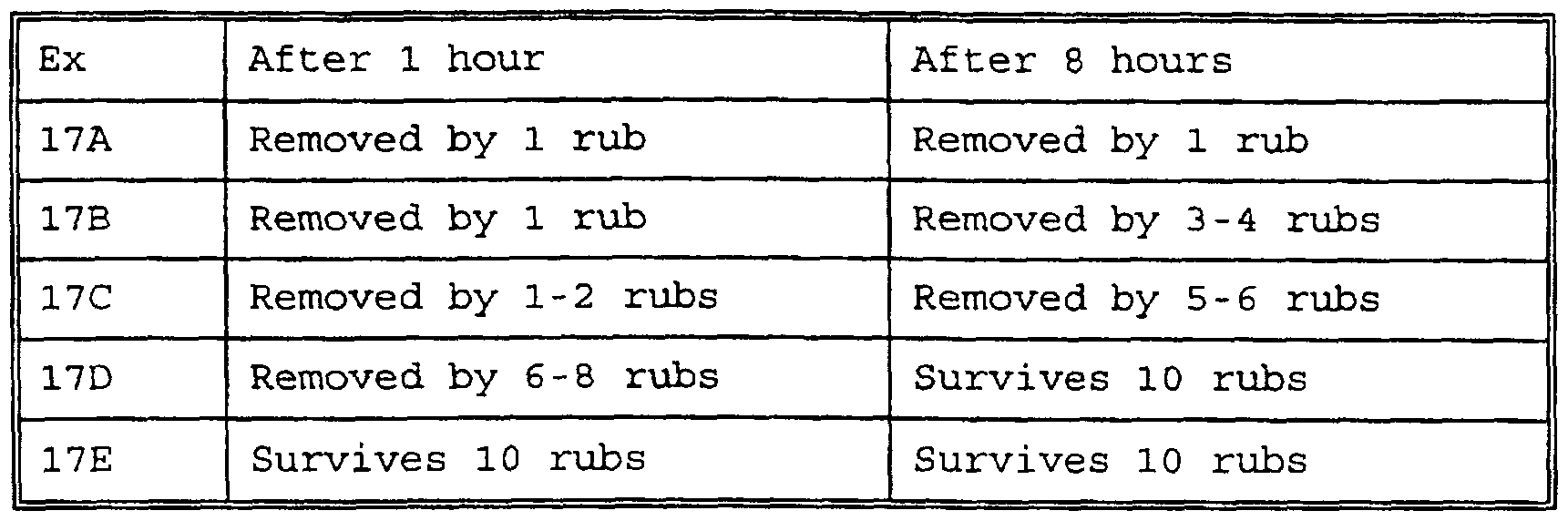
The inks of Examples 17A to 17E were then ink jet printed onto wet bottles (two per ink) prepared as described for Example 1, with six deposits on each bottle.
After printing the bottles were placed in an atmosphere of 25°C 65% relative humidity for 10 minutes to produce a thick misted film of water.
The rub resistance of the deposits was then tested immediately after this post humidification, after 1 hour in ambient air (25°C, 50% RH) and after 24 hours in ambient air (25°C, 50% RH) .
The results are given in Table 13. Table 13
Figure imgf000027_0001
One bottle for each ink was also subjected to a water immersion test. After the post humidification the deposit was allowed to dry for 1 hour at 25°C and 50% RH. The bottle was then placed in a 50/50 ice/water mixture and left. It was removed after 1 hour and then three of the deposits were rubbed harshly with the finger to see how many strokes are needed to remove them. The bottle was then returned to the ice water. It was removed after 8 hours and then the other three deposits tested in the same way for rub resistance.
The results are given in Table 14. Table 14
Figure imgf000028_0001
Another bottle for each ink was also subjected to a refrigeration test.
After post humidification the deposit was allowed to dry for 1 hour at 25°C and 50% RH.
The bottle was then placed in a refrigerator at 4°C. It was removed after 24 hours and three of the deposits subjected to the same rubbing test as for Table 14. It was then returned to the refrigerator and left for 7 days and then the other three deposits were tested.
The results are given in Table 15.
Table 15
Figure imgf000028_0002
It is believed that the binder and the adhesion promoter form a complex and that at a certain level of concentration of adhesion promoter above 0.5% but below 1.0% the mixture no longer exists as a single phase. Possibly the complex is no longer soluble in the liquid vehicle (MEK) .
The best rub resistance is observed at 0.5% to 0.625% wt/wt adhesion promoter based on the total composition.
Examples 18A, B, C and D Three formulations given in Table 16 were made up, first adding the liquid vehicle to the binder then adding the adhesion promoter to the mixture and stirring for 15 minutes which gave a clear solution in each case.
Table 16
Example 18A 18B 18C 18D Ingredient Binder (B) Carboset 514A log lOg none none 70% (IPA) resin (7) resin 7. Og 7. Og none none Liquid vehicle MEK up to up to up to up to
100 ml 100 ml 100 ml 100ml
IPA from AP none 0.625g 0.625g none
IPA from binder 3. Og 3.Og none extra IPA 3.0g Humectant none none none none Adhesion Promoter (AP) none 1.25g 1.25g 1.25g
50% (IPA)
DMMSP-PEI (2) none 0.625g 0.625g none
Colourant none none none none
Ratio B/AP (wt/wt) none 11.2:1 none none 6 ml of water (distilled) was then added to each of these clear solutions and the mixture stirred. Examples 18A and B remained clear, a solid precipitated out from 18C and 18D. This suggests that the binder stabilises the adhesion promoter in the liquid vehicle.

Claims

1. An ink jet ink comprising a binder, a colourant, a liquid vehicle and an adhesion promoter, characterised in that the adhesion promoter is an alkoxysilane polyalkylene- imine containing repeat units of the formula (I) :
{ (CH2)b
Figure imgf000031_0001
R2
wherein R5 represents a bond to another nitrogen atom and R4 represents a bond to another carbon atom or a hydrogen atom; a is from 1 to 8; b is 1 to 8; c is from 1 to 6; at least one of R1, R2 and R3 is a group and any of R1, R2 and R3 which are not alkoxy groups are
Figure imgf000031_0003
groups and p is 1 or more, and x is 1 to 50.
2. An ink jet ink comprising a binder, a colourant, a liquid vehicle and an adhesion promoter, characterised in that the adhesion promoter is an alkoxysilane polyalkylene- imine containing repeat units of the formula (I) :
H
Figure imgf000031_0004
wherein R5 represents a bond to another nitrogen atom and R4 represents a bond to another carbon atom or a hydrogen atom; a is from 1 to 8 ; b is 1 to 8 ; c is from 1 to 6 ; at least one of R1 , R2 and R3 is a
Figure imgf000032_0001
group and any of R1 , R2 and R3 which are not alkoxy groups are Cx- C6alkyl groups and p is 1 or more , and x is 1 to 10 .
3. An ink jet ink comprising a binder, a colourant, a liquid vehicle and an adhesion promoter, characterised in that the adhesion promoter is an alkoxysilane polyalkylene- imine containing repeat units of the formula (I) :
f M
Figure imgf000032_0002
wherein R5 represents a bond to another nitrogen atom and R4 represents a bond to another carbon atom or a hydrogen atom; a is from 1 to 8; b is 1 to 8; c is from 1 to 6; at least one of R1, R2 and R3 is a Cj-C6alkoxy group and any of R1, R2 and R3 which are not alkoxy groups are
Figure imgf000032_0003
groups and p is 1 or more, and x is 2 to 10.
4. An ink as claimed in anyone of the preceding claims in which x is 3 to 7.
5. An ink as claimed in anyone of the preceding claims, in which a and b are 2; c is 3; R1 and R2 are alkoxy and R3 is alkyl or R1, R2 and R3 are alkoxy.
6. An ink as claimed in anyone of the preceding claims in which R1 and R2 are methoxy and R3 is methyl or R1, R2 and R3 are methoxy.
7. An ink as claimed in anyone of the preceding claims in which p is 1 to 50.
8. An ink as claimed in anyone of the preceding claims in which p is 1 to 10.
9. An ink as claimed in anyone of the preceding claims in which p is 1 to 4.
10. An ink as claimed in anyone of the preceding claims in which the binder is an acrylate containing acid groups.
11. An ink as claimed in anyone of the preceding claims in which the binder is one which does not contain free acid groups.
12. An ink as claimed in anyone of the preceding claims in which the weight ratio of the binder to the adhesion promoter is in the range 10:1 to 150:1.
13. An ink as claimed in anyone of the preceding claims in which the weight ratio of the binder to the adhesion promoter is 10:1 to 50:1.
PCT/GB1997/001646 1996-06-21 1997-06-18 Ink jet inks Ceased WO1997049773A1 (en)

Priority Applications (4)

Application Number Priority Date Filing Date Title
DE69701873T DE69701873T2 (en) 1996-06-21 1997-06-18 INK-JET INKS
JP50250998A JP2001504520A (en) 1996-06-21 1997-06-18 Inkjet ink
EP97927263A EP0906376B1 (en) 1996-06-21 1997-06-18 Ink jet inks
AU31814/97A AU3181497A (en) 1996-06-21 1997-06-18 Ink jet inks

Applications Claiming Priority (2)

Application Number Priority Date Filing Date Title
US667,465 1996-06-21
US08/667,465 US5693127A (en) 1996-06-21 1996-06-21 Inks

Publications (1)

Publication Number Publication Date
WO1997049773A1 true WO1997049773A1 (en) 1997-12-31

Family

ID=24678339

Family Applications (1)

Application Number Title Priority Date Filing Date
PCT/GB1997/001646 Ceased WO1997049773A1 (en) 1996-06-21 1997-06-18 Ink jet inks

Country Status (7)

Country Link
US (1) US5693127A (en)
EP (1) EP0906376B1 (en)
JP (1) JP2001504520A (en)
CN (1) CN1083471C (en)
AU (1) AU3181497A (en)
DE (1) DE69701873T2 (en)
WO (1) WO1997049773A1 (en)

Families Citing this family (30)

* Cited by examiner, † Cited by third party
Publication number Priority date Publication date Assignee Title
CN101187710A (en) * 1996-01-11 2008-05-28 株式会社东芝 Method for forming color filter film pattern on non-fibrous substrate and formed color filter film
EP0856566B1 (en) * 1997-01-30 2001-10-24 Shin-Etsu Chemical Co., Ltd. Aqueous ink compositions, their preparation, and use thereof in writing instruments and printers
CA2321816A1 (en) * 1998-02-27 1999-09-02 Marconi Data Systems Inc. Fast drying jet ink composition
US6547616B1 (en) * 1998-04-15 2003-04-15 Fujitsu Display Technologies Corporation Display, its manufacture, ink coating apparatus, all suitable for narrowing display frame
JP3470624B2 (en) * 1998-12-16 2003-11-25 信越化学工業株式会社 Water resistant ink composition
US6908955B2 (en) * 1999-07-09 2005-06-21 Construction Research & Technology Gmbh Oligomeric dispersant
JP4092520B2 (en) * 1999-08-13 2008-05-28 信越化学工業株式会社 Pigment ink composition
US6765039B1 (en) * 2000-04-18 2004-07-20 Philip Morris Incorporated Water fast, water-based pigmented ink-jet ink
US6861115B2 (en) 2001-05-18 2005-03-01 Cabot Corporation Ink jet recording medium comprising amine-treated silica
WO2003016045A1 (en) 2001-08-17 2003-02-27 Avery Dennison Corporation Topcoat compositions, substrates containing a topcoat derived therefrom, and methods of preparing the same
US7279511B2 (en) * 2002-12-09 2007-10-09 Videojet Technologies Inc. Opaque ink jet ink composition
US7148268B2 (en) * 2003-10-24 2006-12-12 Videojet Technologies Inc. Opaque ink jet ink composition
US7530683B2 (en) * 2004-07-29 2009-05-12 E.I. Du Pont De Nemours And Company Fixing fluid and inkjet ink sets comprising same
FR2883294B1 (en) * 2005-03-18 2009-03-06 Imaje Sa Sa INK COMPOSITION FOR CONTINUOUS JET PRINTING DEVICE
JP4839092B2 (en) * 2006-01-30 2011-12-14 矢崎総業株式会社 Inkjet ink for wire marking
US7740694B2 (en) * 2006-06-30 2010-06-22 Videojet Technologies Inc Ink jet ink composition and method for printing
US7785410B2 (en) * 2006-06-30 2010-08-31 Videojet Technologies Inc. Ink jet ink composition and method for printing on substrates under conditions of high static electrical charge
US7947124B2 (en) * 2006-06-30 2011-05-24 Videojet Technologies Inc. High electrical resistivity ink jet ink composition
US7520926B2 (en) * 2006-09-15 2009-04-21 Videojet Technologies Inc. Solvent-based ink composition
US20080206504A1 (en) * 2007-02-28 2008-08-28 Richard Allen Hayes Decorative Safety Glass
US20080233371A1 (en) * 2007-03-19 2008-09-25 Richard Allen Hayes Decorative safety glass
US8142559B2 (en) 2008-03-31 2012-03-27 Casey Robertson Thermal ink jet ink composition
US8632630B2 (en) 2008-03-31 2014-01-21 Videojet Technologies Inc. Thermal ink jet ink composition
US8142558B2 (en) * 2008-03-31 2012-03-27 Videojet Technologies Inc. Thermal ink jet ink composition
AT506074B1 (en) 2008-06-12 2009-06-15 Durst Phototech Digital Tech ADHESION ADDITIVE ADDITION TO AN INK FOR PRINTING GLASS
FR2943068B1 (en) 2009-03-13 2011-04-15 Markem Imaje INK COMPOSITION FOR CONTINUOUS JET PRINTING IN PARTICULAR ON WET GLASS
US8020359B2 (en) * 2009-05-11 2011-09-20 The Coca-Cola Company Method of using temporary decoration to mass customize refillable glass vessels
FR2972457B1 (en) 2011-03-09 2014-09-12 Markem Imaje INK COMPOSITION FOR CONTINUOUS JET PRINTING.
US9388264B2 (en) * 2013-04-26 2016-07-12 Canon Kabushiki Kaisha Method for producing resin composition and resin composition
CN111247217A (en) * 2017-10-26 2020-06-05 桑福德有限合伙人公司 Opaque ink preparations and related writing instruments

Citations (2)

* Cited by examiner, † Cited by third party
Publication number Priority date Publication date Assignee Title
FR2308672A1 (en) * 1975-04-24 1976-11-19 Dick Co Ab INK COMPOSITIONS FOR INJECTION INK PRINTING ON ENAMELLED CERAMIC SURFACES
JPH02300192A (en) * 1989-05-15 1990-12-12 Toshiba Silicone Co Ltd Production of 3-(n-(2-aminoethyl))aminopropylalkoxysilane

Family Cites Families (7)

* Cited by examiner, † Cited by third party
Publication number Priority date Publication date Assignee Title
US4045377A (en) * 1975-10-20 1977-08-30 Hercules Incorporated Cationic polymer prepared from dicyandiamide, a polyamide, a dialkylamine, and an epoxide
US4155768A (en) * 1977-12-05 1979-05-22 International Business Machines Corporation Waterfast ink for use in ink jet printing
US4197135A (en) * 1979-03-09 1980-04-08 International Business Machines Corporation Waterfast ink for use in ink jet printing
US4789400A (en) * 1987-07-10 1988-12-06 Xerox Corporation Waterfast ink jet compositions and process
US5300143A (en) * 1991-07-30 1994-04-05 Xerox Corporation Ink compositions for ink jet printing
US5223028A (en) * 1991-08-19 1993-06-29 Lexmark International, Inc. Waterfast aqueous inks
US5254159A (en) * 1992-12-17 1993-10-19 Xerox Corporation Ink compositions

Patent Citations (2)

* Cited by examiner, † Cited by third party
Publication number Priority date Publication date Assignee Title
FR2308672A1 (en) * 1975-04-24 1976-11-19 Dick Co Ab INK COMPOSITIONS FOR INJECTION INK PRINTING ON ENAMELLED CERAMIC SURFACES
JPH02300192A (en) * 1989-05-15 1990-12-12 Toshiba Silicone Co Ltd Production of 3-(n-(2-aminoethyl))aminopropylalkoxysilane

Non-Patent Citations (3)

* Cited by examiner, † Cited by third party
Title
DATABASE WPI Section Ch Week 9105, Derwent World Patents Index; Class A60, AN 91-032000, XP002020871 *
DATABASE WPI Section Ch Week 9640, Derwent World Patents Index; Class A26, AN 96-400111, XP002020872, ANONYMOUS: "Improvement in stability of CAP-based inks - with polyethyleneimine adhesion promoter" *
RESEARCH DISCLOSURE, vol. 388, no. 053, 10 August 1996 (1996-08-10), EMSWORTH, GB *

Also Published As

Publication number Publication date
CN1222925A (en) 1999-07-14
DE69701873T2 (en) 2001-01-25
CN1083471C (en) 2002-04-24
US5693127A (en) 1997-12-02
EP0906376A1 (en) 1999-04-07
JP2001504520A (en) 2001-04-03
EP0906376B1 (en) 2000-05-03
DE69701873D1 (en) 2000-06-08
AU3181497A (en) 1998-01-14

Similar Documents

Publication Publication Date Title
US5693127A (en) Inks
DE69918064T2 (en) QUICK-DRYING INK INK INK COMPOSITION
US6054505A (en) Ink compositions with improved shelf stability
EP0379978B1 (en) Recording liquid and ink jet recording method employing the same
CA1207999A (en) Ink composition for ink jet printing
CN1058742C (en) Mimeograph for marking hole free carrier
US4661158A (en) Recording liquid
US4761180A (en) Dyes containing tetramethylammonium cation for ink-jet printing inks
JP4275203B2 (en) Ink composition
EP1321498A1 (en) Reduced-corrosion inkjet inks and methods for making same
JPH04226175A (en) Ink for ink jet printer
EP0851012A2 (en) Ink jet inks containing linear polymer additives
BRPI0608005B1 (en) ink and system for printing images on a substrate
US4994110A (en) Dyes containing lithium for ink-jet printing inks
CN102898892A (en) Ink, ink cartridge and ink jet recording method
US5998502A (en) Ink jet inks
KR20200126977A (en) Continuous inkjet ink composition
US5868823A (en) Water-based magenta ink composition and ink-jet recording process employing the same
JPS61113672A (en) Recording liquid and inkjet recording method using the same
US5416145A (en) Aqueous anionic dye based ink jet inks
EP0874029B1 (en) Ink-jet recording ink and an ink-jet recording method
US5830264A (en) Water-based recording ink composition, and ink-jet recording process
JPS598775A (en) Yellow ink for ink jet printer
JPH08218027A (en) Oily ink composition
EP0259088A2 (en) Ink-jet printing inks

Legal Events

Date Code Title Description
WWE Wipo information: entry into national phase

Ref document number: 97195695.2

Country of ref document: CN

AK Designated states

Kind code of ref document: A1

Designated state(s): AL AM AT AU AZ BA BB BG BR BY CA CH CN CU CZ DE DK EE ES FI GB GE GH HU IL IS JP KE KG KP KR KZ LC LK LR LS LT LU LV MD MG MK MN MW MX NO NZ PL PT RO RU SD SE SG SI SK SL TJ TM TR TT UA UG US UZ VN YU ZW AM AZ BY KG KZ MD RU TJ TM

AL Designated countries for regional patents

Kind code of ref document: A1

Designated state(s): GH KE LS MW SD SZ UG ZW AT BE CH DE DK ES FI FR GB GR IE IT LU MC NL

DFPE Request for preliminary examination filed prior to expiration of 19th month from priority date (pct application filed before 20040101)
121 Ep: the epo has been informed by wipo that ep was designated in this application
WWE Wipo information: entry into national phase

Ref document number: 1997927263

Country of ref document: EP

ENP Entry into the national phase

Ref document number: 1998 502509

Country of ref document: JP

Kind code of ref document: A

WWP Wipo information: published in national office

Ref document number: 1997927263

Country of ref document: EP

REG Reference to national code

Ref country code: DE

Ref legal event code: 8642

NENP Non-entry into the national phase

Ref country code: CA

WWG Wipo information: grant in national office

Ref document number: 1997927263

Country of ref document: EP