WO1998015580A1 - Monoklonale antikörper gegen einen komplex aus humanem act und einer serinprotease - Google Patents
Monoklonale antikörper gegen einen komplex aus humanem act und einer serinprotease Download PDFInfo
- Publication number
- WO1998015580A1 WO1998015580A1 PCT/EP1997/005556 EP9705556W WO9815580A1 WO 1998015580 A1 WO1998015580 A1 WO 1998015580A1 EP 9705556 W EP9705556 W EP 9705556W WO 9815580 A1 WO9815580 A1 WO 9815580A1
- Authority
- WO
- WIPO (PCT)
- Prior art keywords
- act
- psa
- monoclonal
- antiköφer
- human
- Prior art date
- Legal status (The legal status is an assumption and is not a legal conclusion. Google has not performed a legal analysis and makes no representation as to the accuracy of the status listed.)
- Ceased
Links
Classifications
-
- C—CHEMISTRY; METALLURGY
- C07—ORGANIC CHEMISTRY
- C07K—PEPTIDES
- C07K14/00—Peptides having more than 20 amino acids; Gastrins; Somatostatins; Melanotropins; Derivatives thereof
- C07K14/435—Peptides having more than 20 amino acids; Gastrins; Somatostatins; Melanotropins; Derivatives thereof from animals; from humans
- C07K14/705—Receptors; Cell surface antigens; Cell surface determinants
-
- A—HUMAN NECESSITIES
- A61—MEDICAL OR VETERINARY SCIENCE; HYGIENE
- A61P—SPECIFIC THERAPEUTIC ACTIVITY OF CHEMICAL COMPOUNDS OR MEDICINAL PREPARATIONS
- A61P35/00—Antineoplastic agents
-
- C—CHEMISTRY; METALLURGY
- C07—ORGANIC CHEMISTRY
- C07K—PEPTIDES
- C07K16/00—Immunoglobulins [IG], e.g. monoclonal or polyclonal antibodies
- C07K16/38—Immunoglobulins [IG], e.g. monoclonal or polyclonal antibodies against protease inhibitors of peptide structure
-
- C—CHEMISTRY; METALLURGY
- C07—ORGANIC CHEMISTRY
- C07K—PEPTIDES
- C07K16/00—Immunoglobulins [IG], e.g. monoclonal or polyclonal antibodies
- C07K16/40—Immunoglobulins [IG], e.g. monoclonal or polyclonal antibodies against enzymes
-
- G—PHYSICS
- G01—MEASURING; TESTING
- G01N—INVESTIGATING OR ANALYSING MATERIALS BY DETERMINING THEIR CHEMICAL OR PHYSICAL PROPERTIES
- G01N33/00—Investigating or analysing materials by specific methods not covered by groups G01N1/00 - G01N31/00
- G01N33/48—Biological material, e.g. blood, urine; Haemocytometers
- G01N33/50—Chemical analysis of biological material, e.g. blood, urine; Testing involving biospecific ligand binding methods; Immunological testing
- G01N33/53—Immunoassay; Biospecific binding assay; Materials therefor
- G01N33/575—Immunoassay; Biospecific binding assay; Materials therefor for cancer
- G01N33/57555—Immunoassay; Biospecific binding assay; Materials therefor for cancer of the prostate
Definitions
- the present invention relates to monoclonal antibodies (MAK) which specifically bind a complex of ⁇ 1-antichymotrypsin (ACT) and a serine protease, in particular prostate-specific antigen (PSA) and which have essentially no cross-reactivity to non-complexed ACT and non-complexed serine proteases.
- MAK monoclonal antibodies
- ACT ⁇ 1-antichymotrypsin
- PSA prostate-specific antigen
- the prostate-specific antigen is a glycoprotein with a molecular weight of 33 kDa. It is formed in the prostate epithelial cells and is part of the seminal fluid. PSA has the enzymatic activity of a neutral serine protease.
- the main function of the PSA is to cleave the Se inogeline I and II as well as the fibronectin, gel-like proteins that block the sperm motility as essential components of the ejaculate. Through the hydrolysis of these proteins, PSA liquefies the semen coagulum, thus enabling sperm mobility.
- serpins serine protease inhibitors
- the majority of the immunologically detectable PSA is bound to ⁇ l-antichymotrypsin (60-95%) in the serum. Further complexes are formed with ⁇ 2-macroglobulin, ⁇ l-antitrypsin, inter- ⁇ -trypsin inhibitor and protein C inhibitor.
- ⁇ l-Antichymotrypsin is a glycoprotein with a molecular weight of approx. 69 kDa and a carbohydrate content.
- ACT plays an important role in controlling inflammation. ACT also forms complexes with chymotrypsin, cathepsin G and glandular kallikrein hK2. ACT occurs in human serum in a concentration 10,000 times higher than PSA (on a molar basis).
- the PSA-ACT complex is the main form of the immunologically detectable total PSA in the serum.
- Prostate cancer in many cases leads to an increase in the serum PS A level.
- PSA is not a cancer-specific marker, especially in the low concentration range.
- the screening tests available to date for the possible presence of prostate carcinoma in a patient were always tests for the detection of total PSA.
- PSA is usually found in very low concentrations in the serum of male persons, a so-called "cut-off" must be defined in such a test. PSA values above this cut-off are taken as an indication of the presence of prostate carcinoma.
- the PSA concentration increases with increasing age of the patient, values of 4 to 6 ng / ml have been used in the test for the detection of the total PSA cut-off. As a result, some patients who had early prostate carcinoma were not included in these screening tests.
- WO 92/01936 describes a method for the detection of PSA-ACT in which a combination of the antibody 2E9, which binds uncomplexed PSA and also PSA in a complex with ACT, and an antibody against ACT is used.
- the object was achieved by a monoclonal antibody against a complex of human ACT and a serine protease which has essentially no cross-reactivity with free, non-complexed human ACT and free, non-complexed serine proteases.
- the object was achieved by a MAK against a complex of ACT and a serine protease which has essentially no cross-reactivity with free human ACT and free serine proteases and which has a significantly higher affinity and specificity for PSA-ACT than for other serine protease ACT Has complexes, in particular to chymotrypsin-ACT and cathepsin-G-ACT.
- the monoclonal antibody can be used in all tests known to those skilled in the art for the detection of a protein.
- the test can be carried out in one step, that is to say without an additional washing step to remove the excess ACT.
- screening tests in which a large number of samples are to be tested in as quick a sequence as possible, this is a decisive advance over the previously possible tests, which all contained a washing step to remove the excess ACT.
- the monolonal antibodies according to the invention against a complex of human ACT and a serine protease have essentially no cross-reactivity with free human ACT and free serine proteases.
- Substantially no cross-reactivity is understood to mean a cross-reactivity which, in the test for the detection of the ACT-serine protease complex, does not influence free ACT or free serine protease.
- How high the tolerated cross-reactivity to individual components can be depends on the concentration in which this component can occur in human serum. Since ACT occurs in a very large excess, the cross-reactivity in this case may only be negligible, that is to say far below 1%.
- the monoclonal antibodies according to the invention in particular have a higher affinity and specificity for PSA-ACT than for the other serine protease ACT complexes.
- the affinity for PSA-ACT is preferably at least 10 times higher, particularly preferably 50 times or higher.
- the monoclonal antibodies according to the invention preferably have an affinity for PSA-ACT of at least 10 7 l / mol, particularly preferably of at least 10 9 l / mol.
- an affinity of 10 10 l / mol which is unusually high for monoclonal antibodies, could even be determined.
- Such high affinity monoclonal antibodies against PSA-ACT are outstandingly suitable for one-step residues, in which a relatively short incubation of the sample with the monoclonal antibody usually takes place. The binding of this high affinity monoclonal antibody to PSA-ACT takes place very quickly.
- the monoclonal antibodies according to the invention can belong to all possible Ig classes.
- the monoclonal antibodies belong to the IgGl class.
- the coupling of further components such as binding partners for binding the antibody to a solid phase in heterogeneous immunoassays, or for example labels such as enzymes etc., can preferably be carried out on IgGl antibodies.
- the cleavage to antibody fragments is also unproblematic with the IgGl class.
- the term monoclonal antibody means both the complete antibody and all fragments thereof common in immunoassays and other uses, such as F (ab ') 2 and Fab fragments. Also included are those antibodies which were produced by changing the monoclonal antibodies as long as the antigen binding property was not decisively influenced.
- genetic engineering measures can be used to replace parts of the monoclonal antibodies normally produced in mice by corresponding human antibody sequences in order to minimize non-specific binding in the immunoassay.
- Methods for producing such chimeric monoclonal antibodies are known to the person skilled in the art, for example from Antibody Engineering, J. Mc Cafferty, HR Hoogenboom and DJ. Chiswell, The Practical Approach Series, Series Editor: BD Harnes, Oxford University Press, known in 1996.
- the monoclonal antibodies according to the invention can be deposited, for example, from the cell lines MAK ⁇ PSA-ACT> M 4.6.374, MAK ⁇ PSA-ACT> M 4.3.2 and MAK ⁇ PSA-ACT> M 6.13.64, deposited on September 19, 1996. at the DSM (German Collection of Microorganisms and Cell Cultures GmbH, Mascheroder Weg lb, D-38124 Braunschweig).
- MAK ⁇ PSA-ACT> M 4.6.374 DSM ACC 2281;
- MAK ⁇ PSA-ACT> M 6.13.64 DSM ACC 2282;
- MAK ⁇ PSA-ACT> M 4.3.2 DSM ACC 2283).
- the invention further relates to antibodies, preferably monoclonal antibodies, which bind in an equivalent manner to serine protease-ACT complexes, such as the monoclonal antibodies 4.6.374, 4.3.2 and 6.13.64. Binding in an equivalent manner is understood to mean that these antibodies recognize the same epitope as the deposited monoclonal antibodies. This can be determined, for example, by multi-binding tests on the BIAcore ® .
- the monoclonal antibodies according to the invention can be prepared in a manner known per se by immunization with PSA-ACT of human origin in suitable experimental animals and subsequent fusion of the spleen cells of the immunized animals with myeloma cells.
- the yield of serine protease ACT-specific monoclonal antibodies was however very low. By using exclusively female experimental animals, the yield of PSA-serine protease-specific antibodies could be increased. Even here, about 70% of the monoclonal antibodies still had high cross-reactivity with ACT and about 30% had high cross-reactivity with PSA. Well below 1% of the total of the antibodies obtained had the required specificity for the serine protease inhibitor complex or the PS A-ACT complex.
- PBL peripheral blood lymphocytes
- lymph node cells from immunized animals (preferably the mouse and the rat) can also be used.
- lymphocytes (PBL, spleen cells, lymph node cells) from human donors (such as prostate tumor patients, lactating women, patients with PSA-secreting cells / tissues) who have developed antibodies or autoantibodies against PSA-ACT can also be used.
- Such anti-PS A-ACT-producing lymphocytes can be immortalized either by fusion with a human myeloma line or by EB V (Epstein Barr virus) transformation to antibody-producing hybridoma cells (Monoclonal Antibody and Immunosensor Technology, AM Campbell, Elsevier Verlag 1991; Monoklonale Antikö ⁇ er, JH Peters, H. Baumgarten, Springer Verlag 1990; Monoclonal Antibody Production Techniques and Applications, ed. Lawrence B. Schook, Marcel Dekker Verlag 1987).
- Another object of the invention is the use of the monoclonal antibodies according to the invention for the detection of serine protease-ACT complexes, in particular of PSA-ACT in samples, preferably human samples such as plasma, serum, blood, seminal fluid, prostate fluid, seminal vesicle Liquid, saliva, cerebrospinal fluid, women's milk, cysts, tissue homogenates, tissue sections, biopsy material.
- samples preferably human samples such as plasma, serum, blood, seminal fluid, prostate fluid, seminal vesicle Liquid, saliva, cerebrospinal fluid, women's milk, cysts, tissue homogenates, tissue sections, biopsy material.
- the invention therefore furthermore relates to a method for determining a complex of human ACT and serine proteases by incubating the sample with at least one monoclonal antibody according to the invention.
- All common methods known to the person skilled in the art for the detection of a protein such as, for example, competitive tests according to the IEMA principle or direct tests such as sandwich tests, are suitable.
- homogeneous tests which are suitable for the detection of a protein can also be used. Examples include nephelometric or turbidimetric tests such as latex agglutination tests or TINIA (turbidimetric inhibition immunoassays).
- test reagents are in the liquid phase
- all common dry test formats that are suitable for the detection of a protein can also be used.
- the test components are applied to a carrier.
- Such dry tests are described, for example, in EP-A 0 186 799.
- Another object of the invention is a test for the detection of PSA-ACT by incubating the sample with a monoclonal antibody according to the invention which has a higher affinity for PSA-ACT than for the other serine protease ACT complexes.
- This MAK preferably has an affinity for PSA-ACT that is at least 10 times, particularly preferably at least 50 times higher.
- the invention therefore relates to a method for determining PSA-ACT by incubating the sample with at least a monoclonal antibody according to the invention and an antibody which is directed against PSA.
- PSA-specific antibodies are known and have been used since 1985 in diagnostic tests for the detection of PSA or ⁇ -seminoprotein. By combining these two antibodies, PSA-ACT is specifically detected. Which of the two antibodies is present in the sandwich test customary in this case in marked form or bound to the solid phase is the same.
- PSA belongs to the kallikreine family, a protease group that has high homologies with one another. They are bound by inhibitors, the so-called serine protease inhibitors, to which ACT belongs.
- PSA-Se ⁇ in complexes have an epitope, a so-called neo-epitope, which is not present on the free inhibitors that have not bound a protease.
- PSA-ACT complexes or the kallikrein-Se ⁇ in complexes in general are eliminated from the blood circulation via receptors which recognize this neo-epitope.
- the neo-epitope is described, for example, in Perlmutter et al., J. Biol. Chem. 265, No. 28, 16713-16716, 1990; Perlmutter et al., Proc. Natl. Acac. Be. USA, 87, 3753-3757, 1990 and Joslin et al, J. Biol. Chem. 268, No. 3, 1886-1893, 1993.
- Another object of the invention is therefore a method for determining PSA-ACT by incubating the sample with a receptor of PSA-ACT, which binds the neo-epitope described in more detail above, and an antibody, preferably a monoclonal antibody, which is directed against PSA . It is the same whether the receptor or the antibody is present in labeled form or bound to the solid phase.
- Se ⁇ in protease receptors cells are first cultivated which express the desired receptor.
- the receptor is detected, for example, with a Zeil ELISA as described by Hashemi et al., J. Lab. Clin. Med. 109 (1987), 434-440.
- Hep G2 cells in flat-bottomed culture vessels (Costar) in one Sown density of 2 x 10 4 cells / ml. D'MEM with 10% fetal calf serum (FCS) is used as the culture medium.
- FCS fetal calf serum
- ACT-PSA (Scripps Laboratories) is added to a final concentration of 10 ⁇ g / ml in D'MEM / 1% RSA and left for 10 minutes at 4 ° C. for complexation with the receptor. After washing twice with D'MEM / 1% RSA, the cells are incubated with an anti PSA monoclonal antibody which is labeled with peroxidase (1 U / ml) for 30 minutes at 4 ° C. The cells are then washed twice with D'MEM / 1% RSA. For detection, the cells are incubated with substrate (TMB).
- TMB substrate
- Hep G2 cells which show a high expression of the receptor, are grown in T 150 culture bottles and the cell layers formed are harvested by carefully scraping off the cells. Cells from multiple culture vessels are combined to arrive at a total of 10 9 cells. The cells are then lysed by incubation with 1% Triton X100 in PBS. After centrifugation at 10,000 xg for 10 minutes, the cell supernatant is separated and the precipitate with the core and cell membrane fractions is resuspended in 1 M sodium chloride in PBS. After centrifugation at 10,000 xg for 10 minutes, the cell supernatant is collected and stored at -20 ° C. This receptor preparation can be used for the characterization of the receptor in ELISA procedures.
- Hydrophobic chromatography is carried out to further purify the crude receptor extract.
- the activity of the individual fractions is detected by an ELISA, as described above, and the fractions with receptor activity are combined.
- the NH 2 terminus of the receptor molecule is then applied using known methods. sequenced and the cDNA fished from a gene bank. For this purpose, the cleaned recipe repair is first separated by SDS-PAGE. The protein bands are cut out and eluted.
- the receptor activity of the individual bands is detected by competition using a cell ELISA.
- the NH2 terminus of the active band is then sequenced using known methods.
- the nucleic acid sequence is derived from the amino acid sequence and corresponding oligoprimers are synthesized.
- a second degenerate primer from the untranslated region in front of the poly A region is also used for PCR amplification, using Hep G2 DNA as a template.
- the amplified sequence approximately 45 nucleotides
- positive clones are identified and purified.
- the DNA is characterized by restriction analysis and Southern blots.
- An EcoRI-Xbal fragment is subcloned in Bluescript SK. Sequence analysis of the clone and deduction of the amino acid sequence prove the receptor specificity.
- this oligonucleotide a DNA is identified in a cDNA bank, for example of fetal liver in ⁇ DR2 (Clontech Cat. No. HL 115 lx), which correlates with the receptor sequence.
- the identified clones are purified and analyzed with primers from the vicinity of the B AMHI-Xbal region in ⁇ DR2 using PCR.
- the phage suspension is used as a template.
- the plasmid pDR2 is isolated and subjected to a restriction analysis with B AMHI and Xbal.
- the double-stranded DNA insert is sequenced with an auto-sequencer (ABI 373) according to standard instructions for color-labeled dioxynucleoside triphosphate terminators and “walking primers” (Sanger et al., PNAS (1977) 74, 5463-5467).
- the receptor DNA is then isolated and an expression system is constructed.
- the cDNA which contains the open reading frame for the receptor, is cloned into the plasmid pSV15.JD.LL between the restriction sites Cla I and Sal I.
- the vector pSV15.JD.LL.SERC is obtained.
- the plasmid contains a short leader sequence upstream of the receptor gene. This leader sequence allows a high translation rate and fast purification. To Induction of the tryptophan promoter initiates high intracellular production.
- the expression plasmid is used, for example, to transform E. coli 44C6 using the CaCl 2 heat shock method according to Mandel et al., J. Mol. Biol. 53 (1970), 159-162.
- the cells transformed in this way are grown at 37 ° C. in LB medium with 50 ⁇ g / ml carbenicillin to an optical density of 2-3 at 600 nm.
- the suspension is diluted 20-fold with M9 medium with 0.49% casamino acids and 50 ⁇ g / ml carbenicillin.
- Cultivation is continued for one hour at 30 ° C. with aeration and indolyl-3-acrylic acid is added to a final concentration of 50 ⁇ g / ml. After further culturing for 15 hours, the cells are harvested.
- the plasmid is linearized with Not I and CHO cells are transferred by electroporation (Andreason, J. Tissue Culture Meth. ⁇ 5_ (1993), 56). The cells are transferred to DHFR selection medium. After 2 weeks, individual clones are transferred to 96 microtiter plates. Expression is measured using a competitive ELISA.
- the receptor Following the expression of the receptor, it is isolated, purified, characterized and the use as a binding partner in an immunoassay evaluated.
- the culture supernatant of the transfected CHO cells is collected and applied to a Cibachromblue-Sepharose column / 100 volume parts cell supernatant / 1 volume part column material).
- the column is washed with 5 parts by volume of application buffer without urea and then with 10 mM phosphate buffer pH 7.4 with 2 M urea (5 parts by volume).
- the recombinant receptor is eluted with 10 mM phosphate buffer pH 7.4, 2 M urea and 1 M NaCl.
- the fractions containing receptor are applied to a Wheatgerm lectin column. After washing with 5 Volumes of application buffer, the receptor is eluted with 10 mM phosphate buffer pH 7.4, 2 M urea and 0.5 M N-acetyl-D-glucosamine.
- the combined receptor-containing fractions are adjusted to 0.04% C 2 E 8 and 0.1% TFA.
- the proteins are separated with two consecutive linear acetonitrile gradients (0-30% and 30-60% in 0.04% C ⁇ 2 Eg and 0.1% TFA).
- the fractions are analyzed using SDS-PAGE.
- the receptor-containing fractions are combined and diluted with 2 volumes of 10 mM sodium phosphate buffer, pH 7.4 and 150 M aCl and dialyzed against 6 volumes of the dilution buffer in an ultrafiltration chamber (connection size 30,000) and concentrated.
- the concentrate is adjusted to 0.01% and Tween ® 80 purified in the same buffer to remove aggregates and fragments by means of gel chromatography.
- the fractions containing the receptor are sterile filtered (0.22 ⁇ filter) and stored at 4 ° C.
- the receptor expressed in E. coli is isolated as follows.
- the E. coli cells are homogenized in 10 volumes of buffer (10 mM Tris-HCl, 5 mM EDTA, pH 8) and centrifuged at 5000 x g for 30 minutes.
- the cells are taken up in 10 volumes of buffer (10 mM Tris-HCl, 5 mM EDTA, pH 8), for example passed through a microfluidizer and centrifuged.
- the cell pellet is frozen at -70 ° C or used directly.
- the cell pellet is resuspended in 20 mM Tris-HCl, 8 M guanidine hydrochloride and 25 mM DTT, pH 8 and stirred at 4 ° C. for 12 hours to solubilize the receptor molecules. After solubilization, the solution is centrifuged at 30,000 xg for 30 minutes. The clear cell supernatant is obtained and this solution is purified on a G200 Sephadex column (gel chromatography column) in 20 mM Na phosphate buffer with 10 mM DTT, pH 6. The fractions containing the receptor are pooled (detection of the protein via SDS-PAGE). These fractions are, as described above, on a C4 reversed Phase column separated.
- the fractions containing the receptor are combined again and the receptor is renatured.
- the solution is diluted with 9 volumes of renaturation buffer (5 mM EDTA, 2% CHAPS detergent, 25% glycerol, 5 mM oxidized glutathione and 1 mM reduced glutathione, pH 8.3) and dialyzed at 4 ° C. for 4 days.
- renaturation buffer 5 mM EDTA, 2% CHAPS detergent, 25% glycerol, 5 mM oxidized glutathione and 1 mM reduced glutathione, pH 8.3
- the solution is adjusted to 0.2% TFA, filtered through a 0.45 ⁇ filter and adjusted to 10% acetonitrile. This is followed by a C4 reversed phase column as described above.
- the receptor-containing fractions are dialyzed against an isotonic buffer (10 mM Na phosphate buffer, 150 mM NaCl and 0.01% Tween ® 80, pH 74) and stored at 4
- the recombinant receptor thus produced can be used as a binding partner, either wall-bound or labeled, for the determination of PSA-Se ⁇ in complexes in immunoassays, as described above.
- the tests according to the invention for the detection of PSA-ACT are outstandingly suitable for screening a large amount of sample in order to obtain an indication of the presence of a prostate carcinoma. It has been shown that by using the test according to the invention, the cut-off can be reduced compared to the cut-off previously used in tests for the detection of total PSA. Even in areas below the usual cut-off values, the test according to the invention can still be used to find a comparatively certain differentiation between normal patients and high-risk patients. At the same time, however, patients who have early prostate carcinoma who have not been recorded in the tests customary to date are also increasingly being recorded.
- the cut-off values in the test according to the invention are significantly lower than the corresponding cut-off values for total PSA.
- the cut-off value for PSA-ACT is ⁇ 70% of the cut-off value for PSA, preferably ⁇ 60% (in ng / ml). With the same specificity (95% against BPH), the cut-off value for total PSA is, for example, 10.05 ng / m, the cut-off value for PSA-ACT is 5.70 ng / ml.
- Interleukin 6 (100 U / ml) is added to the medium as the growth factor. After about 10 days, the primary cultures are tested for specific antibody synthesis (see Examples 2). Primary cultures which show a positive reaction with PSA-ACT and show no cross-reaction with non-complexed PSA and non-complexed ACT and with all other serum components are cloned in 96-cell culture plates using fluorescence-activated cell sorters. Interleukin-6 (100 U / ml) is added to the medium as a growth additive.
- the hybridoma cells obtained are sown at a density of 1 ⁇ 10 5 cells per ml in RPMI 1640 medium with 10% FCS and for 7 days in a fermenter (from Thermodux, Wertheim / Main, model MCS-104XL, order no 144-050) increased. Concentrations of on average 100 ⁇ g monoclonal antibodies per ml are reached in the culture supernatant. This antibody is purified from the culture supernatant by methods customary in protein chemistry (for example according to Methods in Enzymology 121 (1986), 587-695).
- Example 2
- Streptavidin-coated MTP are coated with “capture antibodies” that bind PSA and PSA-ACT.
- the incubation then takes place with the analyte PSA-ACT (in a)) or PSA (in b)).
- the incubation takes place with the Anti-PSA-ACT antibodies to be tested
- the bound antibodies are detected using an anti-mouse IgG POD in the usual way by reacting a substrate.
- MTP coated with recombinant streptavidin (MicroCoat, Penzberg, Order No. 12-K 96 N, batch MC 289) with 10 ⁇ g / ml biotinylated Fab fragment of the monoclonal antibody 1 or monoclonal antibody 2 (both monoclonal antibodies recognize non-complexed PSA and PSA in the complex) coated in PBS plus 0.5% Crotein C (100 ⁇ l per well, 10 min incubation at room temperature with shaking) and then 3 times with 0.9% NaCl / 0.05% Tween 20 washed.
- 100 ⁇ l of the antibody solution to be examined (in the culture supernatant) is placed in a coated well and incubated for 1 hour at room temperature with shaking. After washing three times with 0.9% sodium chloride / 0.05% Tween 20, 100 ⁇ l of a POD-labeled Fab fragment of a polyclonal antibody from the sheep against mouse Fc ⁇ is used to detect bound antibodies from the sample (Boehringer Mannheim GmbH, ID number 1431323, corresponding to 25 mU / ml), incubated for 1 hour at room temperature with shaking and then washed 3 times with 0.9% sodium chloride / 0.05% Tween® 20.
- test described under a is used to incubate with non-complexed PSA instead of with PSA-ACT.
- MTP coated with recombinant streptavidin from MicroCoat, Penzberg, order no. 12-K 96 N, batch MC 289 with 10 ⁇ g / ml biotinylated Fab fragment of the monoclonal antibody 1 or the monoclonal antibody 2 ( Both monoclonal antibodies recognize non-complexed PSA and PSA in the complex) coated in PBS plus 0.5% Crotein C (100 ⁇ l per well, 10 min incubation at room temperature with shaking) and then 3 times with 0.9% NaCl / 0.05 % Tween®20 washed.
- 100 ⁇ l of the antibody solution to be examined (in the culture supernatant) is placed in a coated well and incubated for 1 hour at room temperature with shaking. After washing 3 times with 0.9% sodium chloride / 0.05% Tween® 20, 100 ⁇ l of a POD- labeled Fab fragment of a polyclonal antibody from the sheep against mouse Fc ⁇ (Boehringer Mannheim GmbH, ID number 1431323, corresponding to 25 mU / ml) was added, incubated for 1 hour at room temperature with shaking and then 3 times with 0.9% Sodium chloride / 0.05% Tween 20 washed.
- the antibody to be examined is preincubated with ACT in excess in the test described under a). If the measurement signal remains unchanged high, there is no cross reaction, if the measurement signal is lowered, there is a cross reaction.
- MTP coated with recombinant streptavidin from MicroCoat, Penzberg, order no. 12-K 96 N, batch MC 289 with 10 ⁇ g / ml biotinylated Fab fragment of the monoclonal antibody 1 or the monoclonal antibody 2 (both monoclonal Antibodies recognize non-complexed PSA and PSA in the complex) coated in PBS plus 0.5% Crotein C (100 ⁇ l per well, 10 min incubation at room temperature with shaking) and then 3 times with 0.9% NaCl / 0.05% Tween ® 20 washed.
- the antibody to be tested for cross-reaction is tested with a concentration series of 0, 10 ⁇ g, 50 ⁇ g, 100 ⁇ g / ml ACT (from Athens, Athens, order no. 16-16-012400, batch AX 9501) preincubated.
- the preincubation is carried out in uncoated 96 mm MTP wells for 1 h at room temperature with shaking.
- the antibody to be examined is preincubated with human, female sera in the test described under a). If the measurement signal remains unchanged high, there is no cross reaction, if the measurement signal is lowered, there is a cross reaction.
- MTP coated with recombinant streptavidin from MicroCoat, Penzberg, order no. 12-K 96 N, batch MC 289 with 10 ⁇ g / ml biotinylated Fab fragment of the monoclonal antibody 1 or the monoclonal antibody 2 (both monoclonal Antibodies recognize non-complexed PSA and PSA in the complex) coated in PBS plus 0.5% Crotein C (100 ⁇ l per well, 10 min incubation at room temperature with shaking) and then 3 times with 0.9% NaCl / 0.05% Tween ® 20 washed.
- the antibody to be tested for cross reaction is pre-incubated with a series of concentrations (1: 1 to 1:10) of human, female sera (a mixture of four PSA-negative donors).
- the preincubation is carried out in uncoated 96 mm MTP wells for 1 h at room temperature with shaking.
- the affinity constants and the rate constants of the association and dissociation of the antibodies produced were determined using BIAcore ® from the company
- Pharmacia Biosensor (BIA stands for Biospecific Interaction Analysis). The measuring principle is based on the "Surface Plasmon Resonance". The measurement is carried out on a biosensor, the so-called sensor chip.
- a polyclonal rabbit antibody against the Fc ⁇ part of mouse IgG is coupled via its amino groups to the surface of a sensor chip (CM5, Pharmacia Biosensor) coated with carboxmethylated dextran.
- CM5 Sensor Cibshammer
- a solution of the antibody to be determined is passed over this sensor chip, the antibody being bound to the immobilized capture antibody by non-covalent interaction forces.
- the antigen to be examined is passed over the sensor chip, which is then bound to the antibody immobilized via the capture antibody by likewise non-covalent interaction forces.
- the binding of the individual components increases the mass density on the surface of the sensor chip, which the device converts into a proportional measurement signal.
- the rate constants of the association and dissociation and the affinity constant can be calculated from the change in time of the signal, the sensorgram.
- the antibody-antigen complexes can be detached again without affecting the capture antibodies bound to the surface with simple means, so that further binding experiments can be carried out on the same sensor chip under identical conditions.
- CM5 Pharmacia Biosensor
- a solution of the Antikö ⁇ ers (BIA certified Rabbit anti Mouse Fc ⁇ , Pharmacia Biosensor) with a concentration of 60 ⁇ g / ml in 10 mM sodium acetate buffer pH 5.0 with a flow rate of 5 ⁇ l / min passed over the sensor chip previously activated with NHS / EDC.
- the antibodies are then added, so that the mass bound to the surface increases by at least 600 resonance units.
- the binding of the antigens to the antibodies is monitored at a flow rate of 10 ⁇ l / min and the rate constants of the association and the dissociation for the binding to the antibodies are calculated from the sensor programs using software from the manufacturer (BIAevaluation 2.1, Pharmacia Biosensor).
- PSA-ACT was measured by replacing the detection antibody of the Enzymun-Test® PSA with the antibody 4.6.374 (according to its POD label) specific for PSA-ACT and otherwise following the instructions on the package insert.
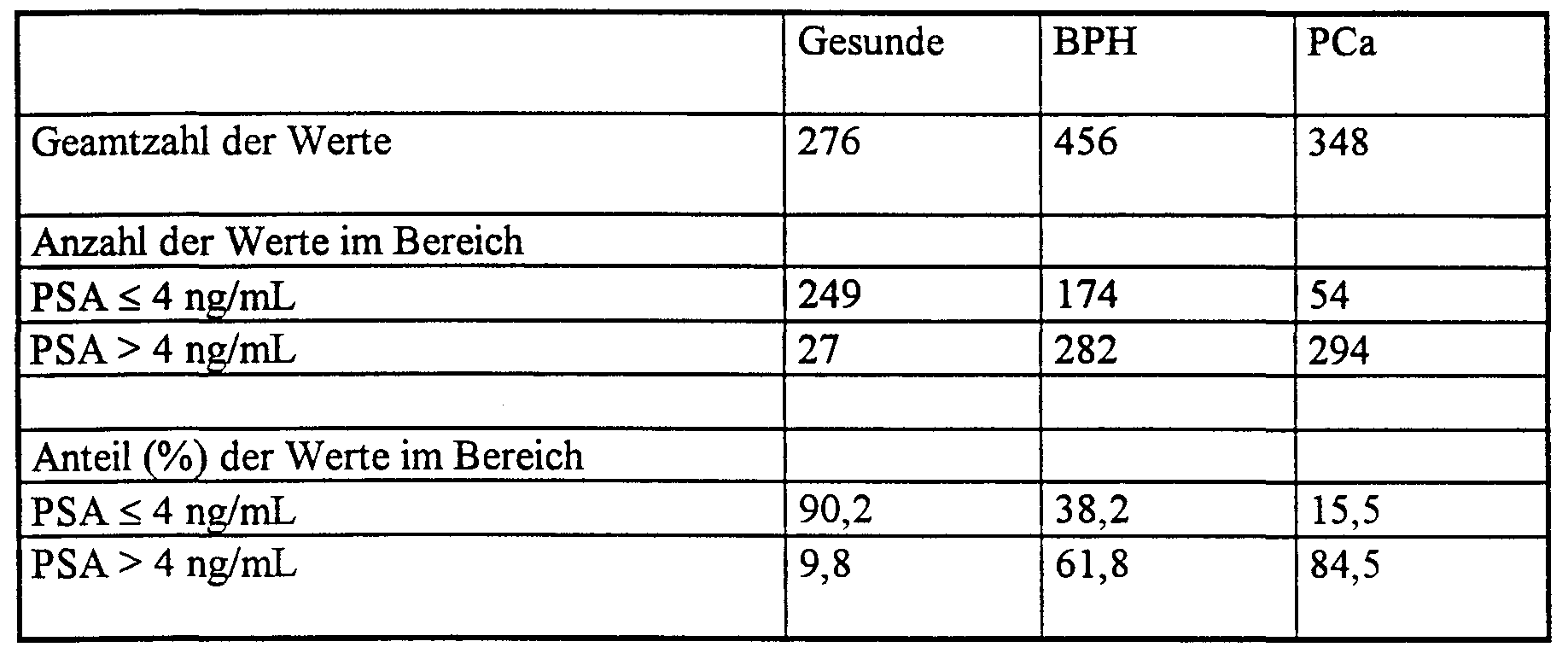
- the distribution of the P SA values in the three collectives is shown in Table 3. 90% of healthy people, 38% of BPH patients and 16% of carcinoma patients were below the usual cut-off value of 4 ng PSA / mL. Subjects with a PSA above the cut-off are given further examinations; while those whose PSA levels are below the decision value are considered prostate healthy.
- PSA-ACT limit of 3 ng / ml is used instead of PSA 4 ng / ml, 90% of healthy people are below this value, but in this case 3 additional prostate carcinoma patients are correctly recognized (see Table 4).
- reagent 1 40 mmol / 1 sodium phosphate buffer, pH 7.4 / 0.2% (w / v) bovine serum albumin / 1.2 ⁇ g / ml bio tinylated monoclonal anti-PSA antibody MIO, Fab fragment, incubated in streptavidin-coated Enzymun ® universal tubes and then washed.
- reagent 2 40 mmol 1 sodium phosphate buffer, pH 7.4 / 0.2% (w / v) bovine serum albumin / 0.1% bovine IgG / monoclonal anti-PSA-ACT antibody, clone 4.6.374, (Fab) 2 '-POD conjugate, 95 mU / ml
- the color development was carried out with 700 ⁇ l substrate solution (1 mg / ml ABTS ® / 0.5 mg / ml sodium perborate / citrate-phosphate buffer) for 30 min and was measured at 422 nm in the photometer.
- the PSA-ACT contents were measured in 40 sera from healthy women and in 18 sera from patients with various inflammations.
- the PSA-ACT level was on average 0.01 ng / ml ( ⁇ 0.03 ng / ml standard deviation), while in the inflammatory group on average 0.03 ( ⁇ 0.04) ng PSA-ACT / ml was found.
- t PSA and f PSA were determined using the respective Enzymun ® tests and PSA-ACT according to Example 5.
- the PSA content was below 20 ng / ml in both groups.
- an ROC evaluation was carried out (Zweig, MH, Clin. Chem. 39 (1993) 561-577: "Receiver-Operating Characteristic (ROC) Plots: A Fundamental Tool in Clinical Medicine ”) and the corresponding values for sensitivity and specificity can be read from the respective curves.
- the area under the ROC curve was calculated, which is a measure of the discriminatory ability of a parameter to differentiate between the corresponding tumor and benign disease population. The larger this area, the more likely it is that an unknown sample will be correctly assigned.
- the sensitivity of the detection of prostate carcinoma to benign prostatic hyposplasia with the same specificity of 95% when measuring the PSA-ACT was 40% compared to 29% for t PSA.
- the area under the curve also increased from 0.709 to 0.748 if you look at PSA-ACT instead of t PSA.
- the third can be calculated after measuring the first two parameters and this result can be compared with the measured values of the third parameter. After determining t PSA and f PSA with the respective Enzymun ® tests, their difference was calculated and the correlation with the PSA-ACT measured according to Example 5 was determined.
Landscapes
- Health & Medical Sciences (AREA)
- Chemical & Material Sciences (AREA)
- Life Sciences & Earth Sciences (AREA)
- Organic Chemistry (AREA)
- Immunology (AREA)
- Molecular Biology (AREA)
- General Health & Medical Sciences (AREA)
- Medicinal Chemistry (AREA)
- Biochemistry (AREA)
- Biophysics (AREA)
- Engineering & Computer Science (AREA)
- Genetics & Genomics (AREA)
- Proteomics, Peptides & Aminoacids (AREA)
- Hematology (AREA)
- Urology & Nephrology (AREA)
- Cell Biology (AREA)
- Biomedical Technology (AREA)
- Microbiology (AREA)
- Pathology (AREA)
- General Physics & Mathematics (AREA)
- Analytical Chemistry (AREA)
- Physics & Mathematics (AREA)
- Food Science & Technology (AREA)
- Toxicology (AREA)
- Zoology (AREA)
- Biotechnology (AREA)
- Gastroenterology & Hepatology (AREA)
- Chemical Kinetics & Catalysis (AREA)
- General Chemical & Material Sciences (AREA)
- Veterinary Medicine (AREA)
- Public Health (AREA)
- Animal Behavior & Ethology (AREA)
- Pharmacology & Pharmacy (AREA)
- Nuclear Medicine, Radiotherapy & Molecular Imaging (AREA)
- Preparation Of Compounds By Using Micro-Organisms (AREA)
- Peptides Or Proteins (AREA)
- Medicines Containing Antibodies Or Antigens For Use As Internal Diagnostic Agents (AREA)
- Measuring Or Testing Involving Enzymes Or Micro-Organisms (AREA)
- Micro-Organisms Or Cultivation Processes Thereof (AREA)
Abstract
Description


Claims
Priority Applications (9)
| Application Number | Priority Date | Filing Date | Title |
|---|---|---|---|
| US09/284,128 US6630350B1 (en) | 1996-10-06 | 1997-10-09 | Monoclonal antibodies against a human act and serine protease complex |
| IL12923697A IL129236A (en) | 1996-10-09 | 1997-10-09 | Monoclonal antibodies against a human act and serine protease complex |
| DE59709109T DE59709109D1 (de) | 1996-10-09 | 1997-10-09 | Monoklonale antikörper gegen einen komplex aus humanem act und einer serinprotease |
| JP51719098A JP3589303B2 (ja) | 1996-10-09 | 1997-10-09 | ヒトactおよびセリンプロテアーゼからなる複合体に対するモノクローナル抗体 |
| EP97911202A EP0929579B1 (de) | 1996-10-09 | 1997-10-09 | Monoklonale antikörper gegen einen komplex aus humanem act und einer serinprotease |
| CA002267660A CA2267660A1 (en) | 1996-10-09 | 1997-10-09 | Monoclonal antibodies against a complex composed of human act and a serine protease |
| AT97911202T ATE230761T1 (de) | 1996-10-09 | 1997-10-09 | Monoklonale antikörper gegen einen komplex aus humanem act und einer serinprotease |
| AU48659/97A AU725332B2 (en) | 1996-10-09 | 1997-10-09 | Monoclonal antibodies against a human ACT and serine protease complex |
| US10/188,607 US20030073141A1 (en) | 1996-10-09 | 2002-07-02 | Monoclonal antibodies against a complex of human ACT and a serine protease |
Applications Claiming Priority (2)
| Application Number | Priority Date | Filing Date | Title |
|---|---|---|---|
| DE19641560.8 | 1996-10-09 | ||
| DE19641560A DE19641560A1 (de) | 1996-10-09 | 1996-10-09 | Monoklonale Antikörper gegen einen Komplex aus humanem ACT und einer Serinprotease |
Publications (1)
| Publication Number | Publication Date |
|---|---|
| WO1998015580A1 true WO1998015580A1 (de) | 1998-04-16 |
Family
ID=7808241
Family Applications (1)
| Application Number | Title | Priority Date | Filing Date |
|---|---|---|---|
| PCT/EP1997/005556 Ceased WO1998015580A1 (de) | 1996-10-06 | 1997-10-09 | Monoklonale antikörper gegen einen komplex aus humanem act und einer serinprotease |
Country Status (10)
| Country | Link |
|---|---|
| US (2) | US6630350B1 (de) |
| EP (1) | EP0929579B1 (de) |
| JP (1) | JP3589303B2 (de) |
| AT (1) | ATE230761T1 (de) |
| AU (1) | AU725332B2 (de) |
| CA (1) | CA2267660A1 (de) |
| DE (2) | DE19641560A1 (de) |
| ES (1) | ES2191173T3 (de) |
| IL (1) | IL129236A (de) |
| WO (1) | WO1998015580A1 (de) |
Cited By (1)
| Publication number | Priority date | Publication date | Assignee | Title |
|---|---|---|---|---|
| JP2009106284A (ja) * | 1998-06-01 | 2009-05-21 | Agensys Inc | ヒト癌で発現される新規蛇行性膜貫通抗原およびその使用 |
Families Citing this family (7)
| Publication number | Priority date | Publication date | Assignee | Title |
|---|---|---|---|---|
| CA2311512A1 (en) * | 1999-07-24 | 2001-01-24 | Bayer Corporation | Reflex method for the detection of prostate cancer |
| DE10211818B4 (de) * | 2002-03-16 | 2006-07-06 | peS Gesellschaft für medizinische Diagnose-Systeme mbH | Verfahren zur quantitativen Bestimmung mehrerer Analyten |
| US20080125582A1 (en) * | 2006-10-13 | 2008-05-29 | Bio-Rad Laboratories, Inc. | Methods and compositions for stabilizing prostate specific antigen |
| WO2015005960A1 (en) | 2013-07-12 | 2015-01-15 | Emd Millipore Corporation | Removal of fragments from a sample containing a target protein using activated carbon |
| CN104459109B (zh) * | 2014-11-25 | 2016-03-23 | 成都威尔诺生物科技有限公司 | 一种用于酶联免疫反应的单组份tmb显色液 |
| CN106198989B (zh) * | 2016-06-29 | 2018-02-16 | 丹娜(天津)生物科技有限公司 | 检测前列腺特异抗原与α1‑抗糜蛋白酶复合物的试剂盒 |
| JP7355140B2 (ja) * | 2022-02-28 | 2023-10-03 | 住友ベークライト株式会社 | セリンプロテアーゼの検出用または測定用試薬 |
Citations (4)
| Publication number | Priority date | Publication date | Assignee | Title |
|---|---|---|---|---|
| WO1992001936A1 (en) * | 1990-07-23 | 1992-02-06 | Hans Lilja | Assay of free and complexed prostate-specific antigen (psa) |
| EP0635575A1 (de) * | 1993-07-22 | 1995-01-25 | Wallac Oy | Monoklonale Antikörper gegen Epitope in freiem uber nicht in Alpha-1-antichymotrypsin komplexiertem Prostata spezifisches Antigen |
| DE4322342A1 (de) * | 1993-07-05 | 1995-02-09 | Gif Ges Fuer Immunologische Fo | Verfahren für die Differentialdiagnostik des Prostata-Karzinoms |
| WO1995018381A1 (en) * | 1993-12-29 | 1995-07-06 | Abbott Laboratories | Immunoassays for prostate specific antigen |
Family Cites Families (3)
| Publication number | Priority date | Publication date | Assignee | Title |
|---|---|---|---|---|
| US5485799A (en) | 1991-04-17 | 1996-01-23 | Julien; Pierre | Device with at least one variable-geometry aerodynamic member including a boundary layer control system |
| IL121659A (en) * | 1996-10-25 | 2000-07-16 | Bayer Ag | Method for determining CPSA in a blood sample |
| US5856182A (en) | 1996-11-18 | 1999-01-05 | Beckman Coulter, Inc. | Monoclonal antibodies specific for the PSA-ACT complex |
-
1996
- 1996-10-09 DE DE19641560A patent/DE19641560A1/de not_active Withdrawn
-
1997
- 1997-10-09 EP EP97911202A patent/EP0929579B1/de not_active Expired - Lifetime
- 1997-10-09 CA CA002267660A patent/CA2267660A1/en not_active Abandoned
- 1997-10-09 AT AT97911202T patent/ATE230761T1/de not_active IP Right Cessation
- 1997-10-09 IL IL12923697A patent/IL129236A/en not_active IP Right Cessation
- 1997-10-09 DE DE59709109T patent/DE59709109D1/de not_active Expired - Fee Related
- 1997-10-09 ES ES97911202T patent/ES2191173T3/es not_active Expired - Lifetime
- 1997-10-09 JP JP51719098A patent/JP3589303B2/ja not_active Expired - Fee Related
- 1997-10-09 US US09/284,128 patent/US6630350B1/en not_active Expired - Fee Related
- 1997-10-09 AU AU48659/97A patent/AU725332B2/en not_active Ceased
- 1997-10-09 WO PCT/EP1997/005556 patent/WO1998015580A1/de not_active Ceased
-
2002
- 2002-07-02 US US10/188,607 patent/US20030073141A1/en not_active Abandoned
Patent Citations (4)
| Publication number | Priority date | Publication date | Assignee | Title |
|---|---|---|---|---|
| WO1992001936A1 (en) * | 1990-07-23 | 1992-02-06 | Hans Lilja | Assay of free and complexed prostate-specific antigen (psa) |
| DE4322342A1 (de) * | 1993-07-05 | 1995-02-09 | Gif Ges Fuer Immunologische Fo | Verfahren für die Differentialdiagnostik des Prostata-Karzinoms |
| EP0635575A1 (de) * | 1993-07-22 | 1995-01-25 | Wallac Oy | Monoklonale Antikörper gegen Epitope in freiem uber nicht in Alpha-1-antichymotrypsin komplexiertem Prostata spezifisches Antigen |
| WO1995018381A1 (en) * | 1993-12-29 | 1995-07-06 | Abbott Laboratories | Immunoassays for prostate specific antigen |
Non-Patent Citations (3)
| Title |
|---|
| JOSLIN ET AL.: "CROSS-COMPETITION FOR BINDING OF ALPHA1-ANTITRYPSIN (ALPHA1 AT)-ELASTASE COMPLEXES TO THE SERPIN-ENZYME COMPLEX RECEPTOR BY OTHER SERPIN-ENZYME COMPLEXES AND BY PROTEOLYTICALLY MODIFIED ALPHA1 AT", JOURNAL OF BIOLOGICAL CHEMISTRY, vol. 268, no. 3, 1993, pages 1886 - 1893, XP002054745 * |
| PERLMUTTER ET AL.: "IDENTIFICATION OF A SERPIN-ENZYM COMPLEX RECEPTOR ON HUMAN HEPATOMA CELLS AND HUMAN MONOCYTES", PROC.NATL.ACAD.SCI., vol. 87, 1990, pages 3753 - 3757, XP002054746 * |
| WU ET AL.: "CORRELATION OF SERUM CONCENTRATIONS OF PSA-ACT COMPLEX WITH TOTAL PSA IN RANDOM AND SERIAL SPECIMENS FROM PATIENTS WITH BPH AND PROSTATE CANCER", JOURNAL OF CLINICAL LABORATORY ANALYSIS, vol. 9, 1995, pages 15 - 24, XP002054744 * |
Cited By (1)
| Publication number | Priority date | Publication date | Assignee | Title |
|---|---|---|---|---|
| JP2009106284A (ja) * | 1998-06-01 | 2009-05-21 | Agensys Inc | ヒト癌で発現される新規蛇行性膜貫通抗原およびその使用 |
Also Published As
| Publication number | Publication date |
|---|---|
| JP2001502669A (ja) | 2001-02-27 |
| IL129236A (en) | 2002-08-14 |
| JP3589303B2 (ja) | 2004-11-17 |
| DE19641560A1 (de) | 1998-04-16 |
| US20030073141A1 (en) | 2003-04-17 |
| AU4865997A (en) | 1998-05-05 |
| AU725332B2 (en) | 2000-10-12 |
| US6630350B1 (en) | 2003-10-07 |
| ES2191173T3 (es) | 2003-09-01 |
| DE59709109D1 (de) | 2003-02-13 |
| IL129236A0 (en) | 2000-02-17 |
| CA2267660A1 (en) | 1998-04-16 |
| EP0929579B1 (de) | 2003-01-08 |
| EP0929579A1 (de) | 1999-07-21 |
| ATE230761T1 (de) | 2003-01-15 |
Similar Documents
| Publication | Publication Date | Title |
|---|---|---|
| DE69521608T2 (de) | Verwendung von humanem neutrophil-lipocalin(hnl) als diagnostischer marker und anti-hnl-antikörperzubereitung | |
| US8940549B2 (en) | Immunoassay reagent for KL-6 assay | |
| US8399207B2 (en) | Monoclonal antibodies against osteopontin | |
| KR100756117B1 (ko) | 모노클로날 항체, 하이브리도마, 면역분석 방법 및 진단킷트 | |
| WO2007145362A1 (ja) | マイコプラズマ・ニューモニエのグリセロ型糖脂質抗原 | |
| US7439025B2 (en) | Antibodies binding a gamma carboxyglutamic acid displaying epitope | |
| EP0929579B1 (de) | Monoklonale antikörper gegen einen komplex aus humanem act und einer serinprotease | |
| EP0244473A1 (de) | Verfahren zum nachweis von krebszellen | |
| EP0854152B1 (de) | Antikörper und immunoassay zum Nachweis von MIA | |
| DE68929511T2 (de) | Nachweis, Quantifizierung und Klassifizierung von RAS-Proteinen in Körperflüssigkeiten und Geweben | |
| US5858685A (en) | Prostate specific antigen from benign prostatic hyperplasia and its use in diagnosis | |
| JP3149960B2 (ja) | ヒト組織因子を定量する方法 | |
| JP6793514B2 (ja) | 新規甲状腺癌関連抗原に結合する抗体および甲状腺癌診断剤 | |
| CN106771216B (zh) | 提高免疫试剂检测特异性的方法及其应用 | |
| Tobi et al. | Adenoma-derived antibody, Adnab-9 recognizes a membranebound glycoprotein in colonic tissue and effluent material from patients with colorectal neoplasia | |
| WO2001090194A2 (de) | Antikörper gegen spezielle formen des propsa und deren verwendung in immunoassays | |
| JP4451784B2 (ja) | 前立腺癌腫瘍マーカー | |
| JP2878317B2 (ja) | ラミニン測定試薬 | |
| JP3164922B2 (ja) | ヒトc−kit癌原遺伝子産物の測定法 | |
| US7157286B2 (en) | Method for immunologically measuring RCAS1 and kit for measuring the same | |
| DE10032040A1 (de) | Antikörper gegen spezielle Formen des proPSA und deren Verwendung in Immunoassays | |
| JPH07103977A (ja) | Slpi又はslpi・エラスターゼ複合体の免疫学的サンドイッチアッセイ方法 | |
| JPH07258297A (ja) | 抗ヒトprotein1モノクローナル抗体、およびハイブリドーマ | |
| JPH07206899A (ja) | がん発生蛋白28kDを認識する単クローン抗体及び該単クローン抗体を含有する診断試薬 | |
| JPWO2000009739A1 (ja) | イヌトリプシンに対するモノクローナル抗体 |
Legal Events
| Date | Code | Title | Description |
|---|---|---|---|
| AK | Designated states |
Kind code of ref document: A1 Designated state(s): AL AM AT AU AZ BA BB BG BR BY CA CH CN CU CZ DE DK EE ES FI GB GE GH HU IL IS JP KE KG KP KR KZ LC LK LR LS LT LU LV MD MG MK MN MW MX NO NZ PL PT RO RU SD SE SG SI SK SL TJ TM TR TT UA UG US UZ VN YU ZW AM AZ BY KG KZ MD RU TJ TM |
|
| AL | Designated countries for regional patents |
Kind code of ref document: A1 Designated state(s): GH KE LS MW SD SZ UG ZW AT BE CH DE DK ES FI FR GB GR IE IT LU MC NL |
|
| DFPE | Request for preliminary examination filed prior to expiration of 19th month from priority date (pct application filed before 20040101) | ||
| 121 | Ep: the epo has been informed by wipo that ep was designated in this application | ||
| WWE | Wipo information: entry into national phase |
Ref document number: 1997911202 Country of ref document: EP |
|
| ENP | Entry into the national phase |
Ref document number: 2267660 Country of ref document: CA Ref country code: CA Ref document number: 2267660 Kind code of ref document: A Format of ref document f/p: F |
|
| ENP | Entry into the national phase |
Ref country code: JP Ref document number: 1998 517190 Kind code of ref document: A Format of ref document f/p: F |
|
| WWP | Wipo information: published in national office |
Ref document number: 1997911202 Country of ref document: EP |
|
| WWE | Wipo information: entry into national phase |
Ref document number: 09284128 Country of ref document: US |
|
| REG | Reference to national code |
Ref country code: DE Ref legal event code: 8642 |
|
| WWG | Wipo information: grant in national office |
Ref document number: 1997911202 Country of ref document: EP |