WO1998023702A1 - Refrigerant composition - Google Patents
Refrigerant composition Download PDFInfo
- Publication number
- WO1998023702A1 WO1998023702A1 PCT/GB1997/003286 GB9703286W WO9823702A1 WO 1998023702 A1 WO1998023702 A1 WO 1998023702A1 GB 9703286 W GB9703286 W GB 9703286W WO 9823702 A1 WO9823702 A1 WO 9823702A1
- Authority
- WO
- WIPO (PCT)
- Prior art keywords
- composition
- component
- weight
- composition according
- amount
- Prior art date
- Legal status (The legal status is an assumption and is not a legal conclusion. Google has not performed a legal analysis and makes no representation as to the accuracy of the status listed.)
- Ceased
Links
Classifications
-
- C—CHEMISTRY; METALLURGY
- C09—DYES; PAINTS; POLISHES; NATURAL RESINS; ADHESIVES; COMPOSITIONS NOT OTHERWISE PROVIDED FOR; APPLICATIONS OF MATERIALS NOT OTHERWISE PROVIDED FOR
- C09K—MATERIALS FOR MISCELLANEOUS APPLICATIONS, NOT PROVIDED FOR ELSEWHERE
- C09K5/00—Heat-transfer, heat-exchange or heat-storage materials, e.g. refrigerants; Materials for the production of heat or cold by chemical reactions other than by combustion
- C09K5/02—Materials undergoing a change of physical state when used
- C09K5/04—Materials undergoing a change of physical state when used the change of state being from liquid to vapour or vice versa
- C09K5/041—Materials undergoing a change of physical state when used the change of state being from liquid to vapour or vice versa for compression-type refrigeration systems
- C09K5/044—Materials undergoing a change of physical state when used the change of state being from liquid to vapour or vice versa for compression-type refrigeration systems comprising halogenated compounds
- C09K5/045—Materials undergoing a change of physical state when used the change of state being from liquid to vapour or vice versa for compression-type refrigeration systems comprising halogenated compounds containing only fluorine as halogen
-
- C—CHEMISTRY; METALLURGY
- C09—DYES; PAINTS; POLISHES; NATURAL RESINS; ADHESIVES; COMPOSITIONS NOT OTHERWISE PROVIDED FOR; APPLICATIONS OF MATERIALS NOT OTHERWISE PROVIDED FOR
- C09K—MATERIALS FOR MISCELLANEOUS APPLICATIONS, NOT PROVIDED FOR ELSEWHERE
- C09K2205/00—Aspects relating to compounds used in compression type refrigeration systems
- C09K2205/10—Components
- C09K2205/11—Ethers
- C09K2205/112—Halogenated ethers
-
- C—CHEMISTRY; METALLURGY
- C09—DYES; PAINTS; POLISHES; NATURAL RESINS; ADHESIVES; COMPOSITIONS NOT OTHERWISE PROVIDED FOR; APPLICATIONS OF MATERIALS NOT OTHERWISE PROVIDED FOR
- C09K—MATERIALS FOR MISCELLANEOUS APPLICATIONS, NOT PROVIDED FOR ELSEWHERE
- C09K2205/00—Aspects relating to compounds used in compression type refrigeration systems
- C09K2205/10—Components
- C09K2205/12—Hydrocarbons
Definitions
- the present invention relates to a refrigerant composition suitable for use in compression refrigeration.
- Chlorofluorocarbons such as dichlorodifluoromethane (CFC-12)
- CFCs Chlorofluorocarbons
- Refrigeration systems that use CFCs as refrigerants generally use mineral oils to lubricate the compressor. These lubricating mineral oils are also known as napthalenic oils.
- a lubricating mineral oil is typically a lube oil fraction having a viscosity index of from -300 to 140, which has been dewaxed, deasphalted and hydrogenated.
- the mineral oil may contain up to 15% by weight of an additive such as an antioxidant or a corrosion inhibitor.
- it has a kinematic viscosity at 40°C of from 10 mm 2 /s to 220 mm 2 /s (lOcSt to 220 cSt) .
- CFC-12 has an ozone depletion potential of 0.9, where the ozone depletion potential of trichloromethane is defined to be 1.
- Alternative refrigerants are therefore required.
- Perfluorocarbons are not suitable as alternative refrigerants as they have a high global warming potential (GWP) and excessive atmospheric lifetimes.
- the GWP is the time-integrated commitment to climate forcing from the instantaneous release of 1kg of refrigerant expressed relative to that from 1kg of carbon dioxide, which is taken as having a GWP of l.
- R134a 1, 1, 1, 2-tetrafluoroethane
- R134a is becoming widely used as an alternative to chlorofluorocarbon refrigerants. It has substantially no ozone depletion potential. It has a GWP, measured on the basis of a 100 year integrated time horizon, of about 1300.
- R134a has the disadvantage that it is substantially immiscible with the mineral oil lubricants used in existing refrigeration equipment. In other words, R134a cannot be used by itself in such equipment .
- a novel refrigerant composition has now been devised, according to the present invention, which has substantially no ozone depletion potential, which is sufficiently compatible with the conventional mineral oil lubricants to be used with them and which has an operating performance equal to or superior to fluorinated hydrocarbons such as R134a and chlorofluorocarbons such as CFC-12.
- the present invention provides a non-azeotropic refrigerant composition having a vapour pressure at -20°C of from 70 to 190 kPa (0.7 to 1.9 bar), at +20°C of from 510 to 630 kPa (5.1 to 6.3 bar) and at +60°C of from 1620 to 1740 kPa (16.2 to 17.4 bar), which composition comprises : (a) 1, 1,2,2 -tetrafluoroethane (R134) , 1,1,1,2- tetrafluoroethane (R134a) , difluoromethoxytrifluoromethane (E125) or a mixture of two or more thereof, in an amount of from 60 to 99% by weight, based on the weight of the composition; (b) from 1 to 10% by weight, based on the weight of the composition, of an unsubstituted hydrocarbon of the formula C n H m in which n is at least 4 and m is at least 2n-2; and,
- a composition is "non-azeotropic" if, at any given pressure and temperature, the composition of the liquid and the composition of the vapour above the liquid are substantially not equal.
- any loss of vapour from a non-azeotropic composition will result in a composition change of the remaining liquid.
- loss of vapour from an azeotrope does not result in a change of liquid composition.
- Preferred non-azeotropic compositions are those in which, after about 50% of the composition is removed such as by evaporation or boiling off, the difference in the original composition and the composition remaining is more than about 2%, more preferably more than about 10%.
- component (a) is present in an amount of from 70 to 95%, preferably from 80 to 90%, more preferably from 82 to 86%, by weight based on the composition.
- Component (b) is an unsubstituted hydrocarbon of the formula C n H m , in which n is at least 4 and m is at least 2n-2. Typically, n is from 4 to 6, preferably 4 or 5.
- the unsubstituted hydrocarbon has no triple bonds.
- the unsubstituted hydrocarbon is saturated except for one double bond. More preferably, the unsubstituted hydrocarbon is fully saturated.
- the unsubstituted hydrocarbon is methylenecyclopropane, 1-butene, cis and trans-2-butene, butane, 2 -methyl propane, cyclopentene, cyclopentane, 2- methyl-1-butene, 2-methyl-2-butene, 3 -methyl -1-butene, 1- pentene, cis and trans-2 -pentene, 2-methylbutane, pentane or a mixture of two or more thereof.
- it is cyclobutane, more preferably n-butane (R600) or 2 -methyl- propane (R600a) .
- the unsubstituted hydrocarbon is present in an amount of from 1 to 8%, preferably from 2 to 6%, more preferably from 2 to 5%, by weight based on the composition.
- the unsubstituted hydrocarbon serves to improve the compatibility of the refrigerant composition of the invention with mineral oil lubricants. Unfortunately it increases the vapour pressure of the composition of the invention. It may also increase the flammability of the composition of the invention.
- component (c) is required in order to reverse the increase in vapour-pressure caused by component (b) .
- Component (c) is a vapour-pressure depressant, i.e. a compound capable of lowering the vapour pressure of the refrigerant composition.
- the vapour-pressure depressant is 1,1- difluoroethane , 1,1,1,2,2,3, 3 -heptafluoropropane , 1 , 1 , 1, 2 , 3 , 3 , 3 -heptafluoropropane, octafluorocyclobutane,
- R152a 1,1- difluoroethane
- R227ca 1, 1 , 1, 2 , 3 , 3 , 3 -heptafluoropropane
- R227ea 1,1,1,2, 2 -pentafluoropropane
- R245cb octafluorocyclobutane
- Component (c) is typically present in an amount of from 4 to 29%, preferably from 8 to 18%, more preferably from 12 to 16%, by weight based on the composition.
- the amount of vapour-pressure depressant depends on the nature and amount of components (a) and (b) . If a large amount of component (b) is present (i.e. more than about 5% by weight, based on the composition), then a correspondingly greater amount of component (c) (or of R134) will be required to achieve an appropriate vapour pressure.
- the amount of component (c) should be such that the composition has a vapour pressure at -20°C of from 70 to 190 kPa, preferably from 90 to 190 kPa, more preferably from 120 to 180 kPa, at 20°C of from 510 to 630 kPa, preferably from 530 to 630 kPa, more preferably from 580 to 620 kPa, and at 60°C of from 1620 to 1740 kPa, preferably from 1630 to 1720 kPa, more preferably from 1650 to 1700 kPa.
- This amount can, of course, be readily determined by routine experiment. It is particularly preferred that the vapour pressure depressant is present in an amount so that the composition has a vapour pressure substantially equal to that of R134a.
- the vapour-pressure depressant When the vapour-pressure depressant is present in an amount of more than 20% by weight, based on the weight of the composition, it is preferred that the vapour-pressure depressant comprises two or more compounds, each of which being present in an amount of 20% by weight or less, based on the weight of the composition.
- the refrigerant composition of the invention may further comprise component (d) , a flammability supressant .
- the composition comprises a flammability supressent when the unsubstituted hydrocarbon (b) is present in an amount greater than about 2% by weight based on the composition. It is particularly preferred that the composition comprises a flammability supressent when the unsubstituted hydrocarbon (b) is present in an amount of about 3% by weight or more based on the composition.
- compositions which do not contain a flammability supressent typically contain less than 3%, for example from 1 to 2%, by weight of the hydrocarbon (b) based on the composition.
- the flammability supressant is 1,1,1,2,2,3, 3 -heptafluoropropane , 1,1,1,2,3,3,3- heptafluoropropane , octafluorocyclobutane , octafluoropropane, trifluoromethoxytrifluoromethane, difluoromethoxytrifluoromethane, trifluoromethoxypentafluoroethane, difluoromethoxypentafluoroethane, trifluoromethoxy-1, 2,2,2- tetrafluoroethane, or a mixture of two or more thereof.
- the vapour-pressure depressant may also function as a flammability supressant.
- Vapour-pressure depressants which also function as flammability supressants include 1, 1, 1,2, 2, 3, 3 -heptafluoropropane (R227ca) , 1,1,1,2,3,3,3- heptafluoropropane (R227ea) , octafluorocyclobutane (RC-318) trifluoromethoxypentafluoroethane (E218), difluoromethoxypentafluoroethane (E227ea) and trifluoromethoxy- 1, 2 , 2 , 2-tetrafluoroethane (E227ca) .
- components (c) and (d) are typically together present in an amount of up to 39%, preferably from 4 to 29%, more preferably from 8 to 18%, most preferably from 12 to 16%, by weight based on the composition.
- component (c) is present in an amount of up to 19% by weight, based on the composition and component (d) is present in an amount of up to 20% by weight, based on the composition.
- the flammability supressant and the vapour- pressure depressant are together present in an amount of 20% by weight or more, based on the weight of the composition, it is preferred that no single compound comprised in the flammability supressant or vapour-pressure depressant is present in an amount of 20% by weight or more, based on the weight of the composition.
- any flammability supressant or vapour- pressure depressant used must not render the refrigerant composition unsuitable for use in compression refrigeration.
- the choice of vapour-pressure depressant or flammability supressant should not be such as to significantly decrease solubility in the mineral oil lubricants.
- addition of the vapour-pressure depressant or flammability supressant causes no more than a 10%, preferably no more than a 5%, decrease in the solubility of the composition in the mineral oil lubricants .
- any flammability supressant or vapour- pressure depressant used should have a GWP, measured on the basis of a 100 year integrated time horizon, of less than 5,000, preferably less than 4,000, most preferably less than 3,500.
- any flammability supressant or vapour- pressure depressant used should not impart undue toxicity to the refrigerant composition.
- the Occupational Exposure Limit (OEL) of the refrigerant composition of the invention is typically from 800 to 1000, preferably from 850 to 950, ppm.
- the flammability supressant and vapour pressure depressant should have substantially no ozone depletion potential . Furthermore, the flammability supressant and/or vapour-pressure depressant should not unduly decrease the operating performance of the refrigerant composition of the invention.
- the cooling capacity of a compression refrigeration apparatus, using, as refrigerant, the composition of the invention is not more than 10% less, preferably not more than 5% less, more preferably not less than, the cooling capacity of an identical compression refrigeration apparatus, operating under identical conditions, using, as refrigerant, CFC-12 or R134a.
- the refrigerant composition of the invention contains substantially no lubricant such as polyalkylene glycol .
- the energy consumption of a compression refrigeration apparatus using, as refrigerant, the composition of the invention is not more than 10% less, preferably not more than 5% less, more preferably not less than, the energy consumption of an identical compression refrigeration apparatus, operating under identical conditions, using, as refrigerant, CFC-12 or R134a.
- compositions are particularly preferred:
- component (a) is R134 and/or R134a
- component (b) is R600 and/or R600a
- component (c) is R152a, R227ca, R227ea or a mixture of two or more thereof ;
- component (a) is R134 and/or R134a
- component (b) is R600 and/or R600a
- component (c) is R152a
- component (a) is R134 and/or R134a
- component (b) is R600 and/or R600a
- component (c) is R227ca and/or R227ea.
- the ratio of the total number of fluorine atoms in the composition to the total number of hydrogen atoms in the composition is desirably at least 1.25:1, preferably at least 1.5:1, more preferably at least 2:1.
- the refrigerant composition has a lower flammable limit (LFL) of more than 7% v/v in air, preferably, a LFL of more than 14% v/v in air.
- LFL lower flammable limit
- the refrigerant composition is non-flammable.
- the refrigerant composition of the present invention has a vapour pressure substantially equal to that of R134a.
- R134a has a vapour pressure at -20°C of about 134kPa (5 psi.g), at 20°C of about 572kPa (68 psi.g) and at 60°C of about 1680kPa (229 psi.g) .
- the composition of the invention has a vapour pressure not exceeding ⁇ 60 kPa (0.6 bar), preferably not exceeding ⁇ 40 kPa (0.4 bar) of that of R134a between -30°C and +60°C.
- the refrigerant composition of the invention has substantially no ozone depletion potential.
- the refrigerant composition of the present invention is preferably used in a domestic refrigeration apparatus. Typically, it is used in a compression refrigeration apparatus which contains not more than 1kg of refrigerant.
- the present invention also provides a process of producing refrigeration, comprising condensing a composition of the invention and thereafter evaporating the composition in the vicinity of a body to be cooled.
- the refrigerant composition of the present invention can be prepared by transferring the individual components by autogenous pressure into an initially evacuated pressure vessel, in order of ascending vapour pressure at room temperature .
- the amount of each component can be checked by weighing the vessel and contents before and after transferring it.
- the refrigerant composition of the present invention is advantageous as it does not deplete the ozone layer, it has a low global warming potential (GWP) relative to CFC-12 or R134a, it is compatible with mineral oil lubricants and it has an operating performance equal to or superior to conventional refrigerants such as R134a and CFC-12.
- GWP global warming potential
- the refrigerant composition of the present invention is compatible with the mineral oil lubricants as used with CFC refrigerants.
- the liquid phases Prior to the present invention it was thought that, for a refrigerant and lubricant to be compatible, the liquid phases must be miscible. However, it has now surprisingly been found that satisfactory results are achieved if gaseous refrigerant is at least partly soluble in the liquid lubricant.
- the refrigerant composition of the present invention is not fully miscible with mineral oil lubricants when in its liquid phase, in the gaseous phase it is partially soluble in the mineral oil.
- the refrigerant composition of the invention is thus compatible with mineral oil lubricants.
- the refrigerant composition also has a high operating performance. Refrigeration systems containing the composition of the present invention are up to 10% more efficient than refrigeration systems containing conventional refrigerants.
- the refrigerant composition of the present invention is a blend of fluorohydrocarbons and hydrocarbons rather than a single compound.
- the refrigerant composition Prior to the present invention it was thought to be undesirable to use non-azeotropic mixtures as refrigerants as these mixtures show a temperature glide.
- a temperature glide of a mixture is the absolute value of the difference between the starting and ending temperatures of the gas/liquid phase change by the mixture. It can be measured by determining the difference between the bubble point of the mixture (the temperature at which the mixture of liquids starts to boil) and the dew point of a corresponding mixture of gases (the temperature at which the mixture of gases starts to condense) .
- the vapour pressure of the refrigerant composition of Example 1 was measured at varying temperature using a 300cm 3 internal volume stainless steel cylinder, fitted with a calibrated Bourdon gauge suspended in a temperature controlled bath containing a glycol solution. The temperatures were determined using a calibrated platinum resistance thermometer.
- Example 2 The vapour pressure of the refrigerant composition of Example 2 was measured at varying temperature in the same way as in Example 7. The results are shown in Table 3.
- Example 6 The vapour pressure of the refrigerant composition of Example 6 was measured at varying temperature in the same way as in Example 7. The results are shown in Table 4.
- the global warming potentials (GWPs) of the compositions of Examples 2 to 6 were calculated on a mass ratio basis, i.e. by taking the sum of the products of the global warming potentials of each component of the composition in question with the mass ratio of that component in the composition
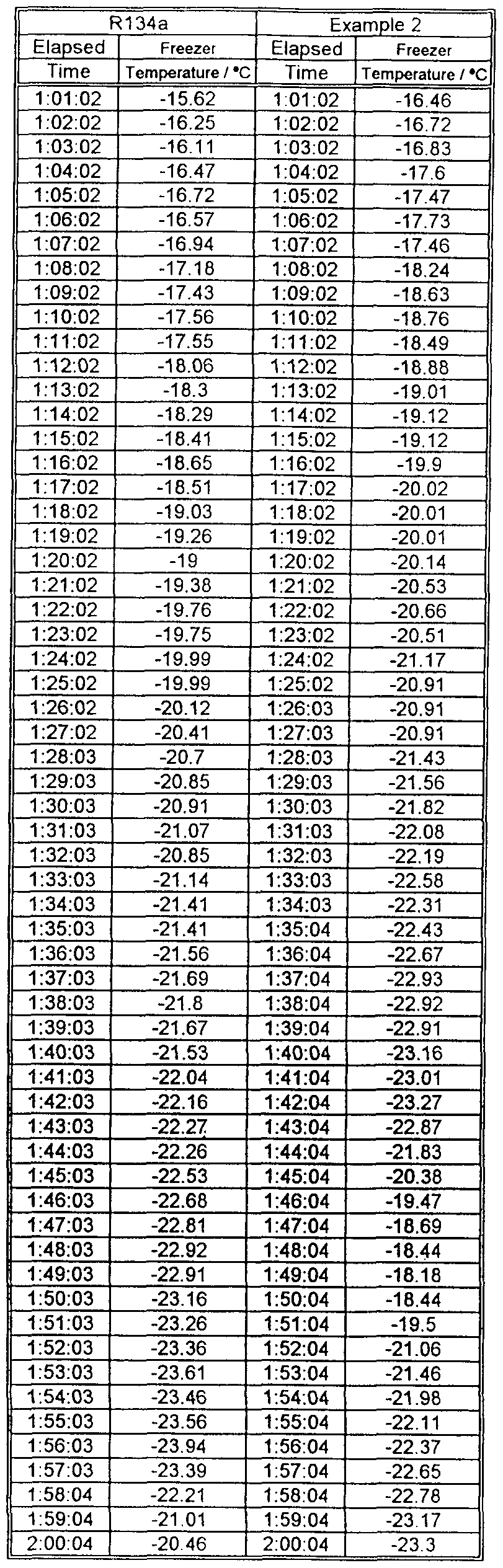
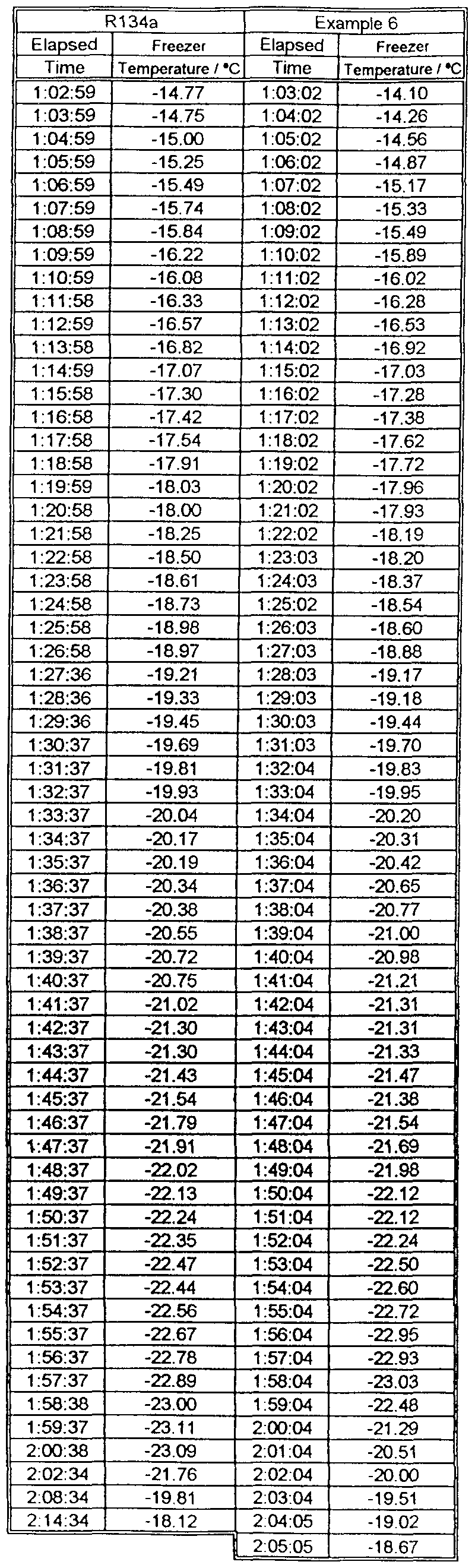
- the rate of cooling in a Bauknecht GKC 3333/0 WS Class N freezer having a gross volume of 332 litres and a refrigerant charge of 18Og was measured using the composition of Example 1 as a refrigerant.
- the rate of cooling in the same domestic freezer using R134a as a refrigerant was also measured.
- Thermocouples were connected to the inlet and outlet of the evaporator coil inside the freezer compartment as well as the compressor discharge line. A further thermocouple was placed inside the freezer compartment near the thermostat sensor. Pressure gauges were fitted to the suction and discharge lines and the power supply to the freezer was passed through a kilowatt hour meter.
- thermocouples were logged by a data logger typically at 1 minute intervals.
- the freezer, factory charged with R134a was placed in a temperature controlled environment, typically 22°C + , 1°C, and allowed to temperature equilibrate for at least 24 hours .
- the freezer and data logger were turned on and the time taken to reduce the internal freezer temperature to a level at which the thermostat cut-in was determined.
- the rate of cooling was measured in the same way as in Example 11 except that the composition of Example 2 was used in place of the composition of Example 1.
- the rate of cooling was measured in the same way as in Example 11, except that the composition of Example 6 was used in place of the composition of Example 1.
- Example 11 The maximum and minimum cabinet temperature, average evaporator and condenser pressure, average compressor discharge temperature and average power consumption of the freezer used in Example 11, using the composition of Example 2 as a refrigerant, were measured while the freezer was running .
- Thermocouples were connected to the inlet and outlet of the evaporator coil inside the freezer compartment as well as the compressor discharge line. A further thermocouple was placed inside the freezer compartment near the thermostat sensor. Pressure gauges were fitted to the suction and discharge lines and the power supply to the freezer was passed through a kilowatt hour meter.
- thermocouples were logged by a data logger typically at 1 minute intervals.
- the freezer and data logger were turned on and the performance characteristics specified above were recorded over a period of at least 30 hours.
Landscapes
- Chemical & Material Sciences (AREA)
- Engineering & Computer Science (AREA)
- Materials Engineering (AREA)
- Chemical Kinetics & Catalysis (AREA)
- Combustion & Propulsion (AREA)
- Thermal Sciences (AREA)
- Physics & Mathematics (AREA)
- Organic Chemistry (AREA)
- Lubricants (AREA)
- Confectionery (AREA)
- Organic Low-Molecular-Weight Compounds And Preparation Thereof (AREA)
- Acyclic And Carbocyclic Compounds In Medicinal Compositions (AREA)
- Noodles (AREA)
- Detergent Compositions (AREA)
- Sorption Type Refrigeration Machines (AREA)
Abstract
Description





Claims
Priority Applications (9)
| Application Number | Priority Date | Filing Date | Title |
|---|---|---|---|
| NZ335993A NZ335993A (en) | 1996-11-28 | 1997-11-28 | Non-azeotropic refrigerant composition |
| DE69737210T DE69737210T2 (en) | 1996-11-28 | 1997-11-28 | COOLANT COMPOSITION |
| JP52444298A JP4143127B2 (en) | 1996-11-28 | 1997-11-28 | Refrigerant composition |
| EP97945977A EP0954555B1 (en) | 1996-11-28 | 1997-11-28 | Refrigerant composition |
| BR9713158-0A BR9713158A (en) | 1996-11-28 | 1997-11-28 | Non-azeotropic refrigerant composition, use of it, process to produce refrigeration, and, compression refrigeration apparatus. |
| PL33375297A PL187855B1 (en) | 1996-11-28 | 1997-11-28 | Cooling composition |
| CA002272961A CA2272961C (en) | 1996-11-28 | 1997-11-28 | Refrigerant composition |
| AU51294/98A AU737564B2 (en) | 1996-11-28 | 1997-11-28 | Refrigerant composition |
| US09/308,910 US6521141B1 (en) | 1996-11-28 | 1997-11-28 | Refrigerant composition |
Applications Claiming Priority (2)
| Application Number | Priority Date | Filing Date | Title |
|---|---|---|---|
| GBGB9624818.2A GB9624818D0 (en) | 1996-11-28 | 1996-11-28 | Refrigerant composition |
| GB9624818.2 | 1996-11-28 |
Publications (1)
| Publication Number | Publication Date |
|---|---|
| WO1998023702A1 true WO1998023702A1 (en) | 1998-06-04 |
Family
ID=10803658
Family Applications (1)
| Application Number | Title | Priority Date | Filing Date |
|---|---|---|---|
| PCT/GB1997/003286 Ceased WO1998023702A1 (en) | 1996-11-28 | 1997-11-28 | Refrigerant composition |
Country Status (14)
| Country | Link |
|---|---|
| US (1) | US6521141B1 (en) |
| EP (1) | EP0954555B1 (en) |
| JP (1) | JP4143127B2 (en) |
| AT (1) | ATE350427T1 (en) |
| AU (1) | AU737564B2 (en) |
| BR (1) | BR9713158A (en) |
| CA (1) | CA2272961C (en) |
| CZ (1) | CZ296054B6 (en) |
| DE (1) | DE69737210T2 (en) |
| ES (1) | ES2279547T3 (en) |
| GB (2) | GB9624818D0 (en) |
| NZ (1) | NZ335993A (en) |
| PL (1) | PL187855B1 (en) |
| WO (1) | WO1998023702A1 (en) |
Cited By (2)
| Publication number | Priority date | Publication date | Assignee | Title |
|---|---|---|---|---|
| US7410595B2 (en) * | 2002-10-11 | 2008-08-12 | E.I. Du Pont De Nemours And Company | Refrigerant compositions |
| CN101307223B (en) * | 2008-06-26 | 2010-06-02 | 中国科学院理化技术研究所 | A ternary near-azeotropic refrigerant containing 1,1,2,2-tetrafluoroethane |
Families Citing this family (8)
| Publication number | Priority date | Publication date | Assignee | Title |
|---|---|---|---|---|
| AU2003273365A1 (en) * | 2002-10-01 | 2004-04-23 | James B. Tieken | Refrigerant blend |
| CA2507639C (en) * | 2002-11-29 | 2013-08-06 | Rhodia Organique Fine Limited | Chiller refrigerants |
| DE102007002121B4 (en) * | 2007-01-10 | 2008-12-11 | Dräger, Karl-Heinz | Use of a liquefied gas mixture as non-combustible propellant gas for ultrafine distribution of a stimulant or warfare agent |
| WO2009129126A1 (en) * | 2008-04-15 | 2009-10-22 | E. I. Du Pont De Nemours And Company | Pentafluoroethane, tetrafluoroethane and n-butane compositions |
| GB2510322A (en) * | 2012-11-13 | 2014-08-06 | Rpl Holdings Ltd | Refrigerant compositions |
| DE102014202849A1 (en) * | 2014-02-17 | 2015-08-20 | Siemens Aktiengesellschaft | Method and device for loading a thermal stratified storage tank |
| US20150353801A1 (en) | 2014-06-06 | 2015-12-10 | Bluon Energy, LLC | Heat Transfer Fluids, Systems, Efficiencies and Methods |
| CN110591650B (en) * | 2019-09-12 | 2020-09-25 | 珠海格力电器股份有限公司 | Heat transfer composition suitable for centrifugal refrigerating unit |
Citations (6)
| Publication number | Priority date | Publication date | Assignee | Title |
|---|---|---|---|---|
| EP0565265A1 (en) * | 1992-04-04 | 1993-10-13 | Star Refrigeration Ltd. | Refrigerant composition |
| WO1994018282A1 (en) * | 1993-02-05 | 1994-08-18 | E.I. Du Pont De Nemours And Company | Compositions of a hydrofluorocarbon and a hydrocarbon |
| WO1995008602A1 (en) * | 1993-09-22 | 1995-03-30 | Star Refrigeration Limited | Replacement refrigerant composition |
| GB2291884A (en) * | 1994-07-27 | 1996-02-07 | Ici Plc | Refrigerant compositions comprising organofluorine compounds and hydrocarbons |
| WO1996037571A1 (en) * | 1995-05-24 | 1996-11-28 | Intercool Energy Corporation | Mixed gas refrigerant |
| EP0779352A1 (en) * | 1995-12-14 | 1997-06-18 | AUSIMONT S.p.A. | Near-azeotropic ternary compositions constituted by hydrogenated fluorocarbons as hydrocarbons, suitable as refrigerating fluids |
Family Cites Families (6)
| Publication number | Priority date | Publication date | Assignee | Title |
|---|---|---|---|---|
| JP2576161B2 (en) * | 1987-11-26 | 1997-01-29 | 旭硝子株式会社 | Working medium mixture |
| US4944890A (en) | 1989-05-23 | 1990-07-31 | E. I. Du Pont De Nemours And Company | Compositions and process of using in refrigeration |
| US5370811A (en) | 1989-11-30 | 1994-12-06 | Matsushita Electric Industrial Co., Ltd. | Working fluid containing tetrafluoroethane |
| JPH0418485A (en) * | 1990-05-11 | 1992-01-22 | Sanyo Electric Co Ltd | Refrigerant composition |
| US5370812A (en) | 1993-06-28 | 1994-12-06 | Union Carbide Chemicals & Plastics Technology Corporation | Lubricant compositions for refrigerators comprising polyalkylene glycol and a hydrocarbon solvent |
| US5417871A (en) | 1994-03-11 | 1995-05-23 | E. I. Du Pont De Nemours And Company | Hydrofluorocarbon compositions |
-
1996
- 1996-11-28 GB GBGB9624818.2A patent/GB9624818D0/en active Pending
-
1997
- 1997-11-28 PL PL33375297A patent/PL187855B1/en not_active IP Right Cessation
- 1997-11-28 WO PCT/GB1997/003286 patent/WO1998023702A1/en not_active Ceased
- 1997-11-28 ES ES97945977T patent/ES2279547T3/en not_active Expired - Lifetime
- 1997-11-28 NZ NZ335993A patent/NZ335993A/en unknown
- 1997-11-28 JP JP52444298A patent/JP4143127B2/en not_active Expired - Fee Related
- 1997-11-28 GB GB9725267A patent/GB2319778B/en not_active Expired - Fee Related
- 1997-11-28 DE DE69737210T patent/DE69737210T2/en not_active Expired - Fee Related
- 1997-11-28 AT AT97945977T patent/ATE350427T1/en not_active IP Right Cessation
- 1997-11-28 AU AU51294/98A patent/AU737564B2/en not_active Ceased
- 1997-11-28 CA CA002272961A patent/CA2272961C/en not_active Expired - Fee Related
- 1997-11-28 CZ CZ19991901A patent/CZ296054B6/en not_active IP Right Cessation
- 1997-11-28 EP EP97945977A patent/EP0954555B1/en not_active Expired - Lifetime
- 1997-11-28 US US09/308,910 patent/US6521141B1/en not_active Expired - Fee Related
- 1997-11-28 BR BR9713158-0A patent/BR9713158A/en not_active IP Right Cessation
Patent Citations (6)
| Publication number | Priority date | Publication date | Assignee | Title |
|---|---|---|---|---|
| EP0565265A1 (en) * | 1992-04-04 | 1993-10-13 | Star Refrigeration Ltd. | Refrigerant composition |
| WO1994018282A1 (en) * | 1993-02-05 | 1994-08-18 | E.I. Du Pont De Nemours And Company | Compositions of a hydrofluorocarbon and a hydrocarbon |
| WO1995008602A1 (en) * | 1993-09-22 | 1995-03-30 | Star Refrigeration Limited | Replacement refrigerant composition |
| GB2291884A (en) * | 1994-07-27 | 1996-02-07 | Ici Plc | Refrigerant compositions comprising organofluorine compounds and hydrocarbons |
| WO1996037571A1 (en) * | 1995-05-24 | 1996-11-28 | Intercool Energy Corporation | Mixed gas refrigerant |
| EP0779352A1 (en) * | 1995-12-14 | 1997-06-18 | AUSIMONT S.p.A. | Near-azeotropic ternary compositions constituted by hydrogenated fluorocarbons as hydrocarbons, suitable as refrigerating fluids |
Non-Patent Citations (1)
| Title |
|---|
| PEARSON, S. F.: "Automatic calorimeter for mixed refrigerants", PROC. - INT. CONGR. REFRIG., 19TH (1995), VOLUME 4A, 481-487 PUBLISHER: INSTITUT INTERNATIONAL DU FROID, PARIS, FR. CODEN: 64VHAQ, 1995, XP002056974 * |
Cited By (2)
| Publication number | Priority date | Publication date | Assignee | Title |
|---|---|---|---|---|
| US7410595B2 (en) * | 2002-10-11 | 2008-08-12 | E.I. Du Pont De Nemours And Company | Refrigerant compositions |
| CN101307223B (en) * | 2008-06-26 | 2010-06-02 | 中国科学院理化技术研究所 | A ternary near-azeotropic refrigerant containing 1,1,2,2-tetrafluoroethane |
Also Published As
| Publication number | Publication date |
|---|---|
| DE69737210D1 (en) | 2007-02-15 |
| CZ190199A3 (en) | 2000-03-15 |
| AU5129498A (en) | 1998-06-22 |
| CZ296054B6 (en) | 2005-12-14 |
| PL187855B1 (en) | 2004-10-29 |
| NZ335993A (en) | 2001-03-30 |
| DE69737210T2 (en) | 2007-11-08 |
| EP0954555A1 (en) | 1999-11-10 |
| GB2319778A (en) | 1998-06-03 |
| US6521141B1 (en) | 2003-02-18 |
| ES2279547T3 (en) | 2007-08-16 |
| GB2319778B (en) | 2000-12-13 |
| GB9624818D0 (en) | 1997-01-15 |
| EP0954555B1 (en) | 2007-01-03 |
| AU737564B2 (en) | 2001-08-23 |
| BR9713158A (en) | 2000-02-08 |
| ATE350427T1 (en) | 2007-01-15 |
| CA2272961A1 (en) | 1998-06-04 |
| CA2272961C (en) | 2006-09-19 |
| GB9725267D0 (en) | 1998-01-28 |
| JP2001504884A (en) | 2001-04-10 |
| JP4143127B2 (en) | 2008-09-03 |
Similar Documents
| Publication | Publication Date | Title |
|---|---|---|
| US6428720B1 (en) | Refrigerant compositions | |
| EP1238039B8 (en) | Refrigerant compositions | |
| US6863840B2 (en) | Nonflammable, nonozone depleting, refrigerant mixtures suitable for use in mineral oil | |
| US6521141B1 (en) | Refrigerant composition | |
| US20070262285A1 (en) | Refrigerant compositions | |
| GB2447629A (en) | Refrigerant composition comprising three hydrofluorocarbon components | |
| JPH0585966A (en) | Coolant | |
| MXPA99004988A (en) | Refrigerant composition | |
| EP0858490B1 (en) | Refrigerant compositions | |
| EP0922077A1 (en) | Refrigerant compositions | |
| CA2277718E (en) | Refrigerant compositions |
Legal Events
| Date | Code | Title | Description |
|---|---|---|---|
| AK | Designated states |
Kind code of ref document: A1 Designated state(s): AL AM AT AU AZ BA BB BG BR BY CA CH CN CU CZ DE DK EE ES FI GB GE GH HU ID IL IS JP KE KG KP KR KZ LC LK LR LS LT LU LV MD MG MK MN MW MX NO NZ PL PT RO RU SD SE SG SI SK SL TJ TM TR TT UA UG US UZ VN YU ZW AM AZ BY KG KZ MD RU TJ TM |
|
| AL | Designated countries for regional patents |
Kind code of ref document: A1 Designated state(s): GH KE LS MW SD SZ UG ZW AT BE CH DE DK ES FI FR GB GR IE IT LU MC |
|
| DFPE | Request for preliminary examination filed prior to expiration of 19th month from priority date (pct application filed before 20040101) | ||
| 121 | Ep: the epo has been informed by wipo that ep was designated in this application | ||
| WWE | Wipo information: entry into national phase |
Ref document number: 51294/98 Country of ref document: AU |
|
| ENP | Entry into the national phase |
Ref document number: 2272961 Country of ref document: CA |
|
| WWE | Wipo information: entry into national phase |
Ref document number: 335993 Country of ref document: NZ |
|
| ENP | Entry into the national phase |
Ref document number: 1998 524442 Country of ref document: JP Kind code of ref document: A |
|
| WWE | Wipo information: entry into national phase |
Ref document number: PA/a/1999/004988 Country of ref document: MX Ref document number: PV1999-1901 Country of ref document: CZ |
|
| WWE | Wipo information: entry into national phase |
Ref document number: 1997945977 Country of ref document: EP |
|
| REG | Reference to national code |
Ref country code: DE Ref legal event code: 8642 |
|
| WWE | Wipo information: entry into national phase |
Ref document number: 09308910 Country of ref document: US |
|
| WWP | Wipo information: published in national office |
Ref document number: 1997945977 Country of ref document: EP |
|
| WWP | Wipo information: published in national office |
Ref document number: PV1999-1901 Country of ref document: CZ |
|
| WWG | Wipo information: grant in national office |
Ref document number: 51294/98 Country of ref document: AU |
|
| WWG | Wipo information: grant in national office |
Ref document number: PV1999-1901 Country of ref document: CZ |
|
| WWG | Wipo information: grant in national office |
Ref document number: 1997945977 Country of ref document: EP |