WO1998023731A2 - Chimeric target molecules having a regulatable activity - Google Patents
Chimeric target molecules having a regulatable activity Download PDFInfo
- Publication number
- WO1998023731A2 WO1998023731A2 PCT/IB1997/001643 IB9701643W WO9823731A2 WO 1998023731 A2 WO1998023731 A2 WO 1998023731A2 IB 9701643 W IB9701643 W IB 9701643W WO 9823731 A2 WO9823731 A2 WO 9823731A2
- Authority
- WO
- WIPO (PCT)
- Prior art keywords
- enzyme
- chimeric
- chimeric enzyme
- analyte
- binding
- Prior art date
- Legal status (The legal status is an assumption and is not a legal conclusion. Google has not performed a legal analysis and makes no representation as to the accuracy of the status listed.)
- Ceased
Links
Classifications
-
- G—PHYSICS
- G01—MEASURING; TESTING
- G01N—INVESTIGATING OR ANALYSING MATERIALS BY DETERMINING THEIR CHEMICAL OR PHYSICAL PROPERTIES
- G01N33/00—Investigating or analysing materials by specific methods not covered by groups G01N1/00 - G01N31/00
- G01N33/48—Biological material, e.g. blood, urine; Haemocytometers
- G01N33/50—Chemical analysis of biological material, e.g. blood, urine; Testing involving biospecific ligand binding methods; Immunological testing
- G01N33/53—Immunoassay; Biospecific binding assay; Materials therefor
- G01N33/536—Immunoassay; Biospecific binding assay; Materials therefor with immune complex formed in liquid phase
- G01N33/542—Immunoassay; Biospecific binding assay; Materials therefor with immune complex formed in liquid phase with steric inhibition or signal modification, e.g. fluorescent quenching
-
- C—CHEMISTRY; METALLURGY
- C12—BIOCHEMISTRY; BEER; SPIRITS; WINE; VINEGAR; MICROBIOLOGY; ENZYMOLOGY; MUTATION OR GENETIC ENGINEERING
- C12N—MICROORGANISMS OR ENZYMES; COMPOSITIONS THEREOF; PROPAGATING, PRESERVING, OR MAINTAINING MICROORGANISMS; MUTATION OR GENETIC ENGINEERING; CULTURE MEDIA
- C12N15/00—Mutation or genetic engineering; DNA or RNA concerning genetic engineering, vectors, e.g. plasmids, or their isolation, preparation or purification; Use of hosts therefor
- C12N15/09—Recombinant DNA-technology
- C12N15/11—DNA or RNA fragments; Modified forms thereof; Non-coding nucleic acids having a biological activity
- C12N15/62—DNA sequences coding for fusion proteins
-
- C—CHEMISTRY; METALLURGY
- C12—BIOCHEMISTRY; BEER; SPIRITS; WINE; VINEGAR; MICROBIOLOGY; ENZYMOLOGY; MUTATION OR GENETIC ENGINEERING
- C12N—MICROORGANISMS OR ENZYMES; COMPOSITIONS THEREOF; PROPAGATING, PRESERVING, OR MAINTAINING MICROORGANISMS; MUTATION OR GENETIC ENGINEERING; CULTURE MEDIA
- C12N9/00—Enzymes; Proenzymes; Compositions thereof; Processes for preparing, activating, inhibiting, separating or purifying enzymes
-
- C—CHEMISTRY; METALLURGY
- C12—BIOCHEMISTRY; BEER; SPIRITS; WINE; VINEGAR; MICROBIOLOGY; ENZYMOLOGY; MUTATION OR GENETIC ENGINEERING
- C12N—MICROORGANISMS OR ENZYMES; COMPOSITIONS THEREOF; PROPAGATING, PRESERVING, OR MAINTAINING MICROORGANISMS; MUTATION OR GENETIC ENGINEERING; CULTURE MEDIA
- C12N9/00—Enzymes; Proenzymes; Compositions thereof; Processes for preparing, activating, inhibiting, separating or purifying enzymes
- C12N9/14—Hydrolases (3)
- C12N9/78—Hydrolases (3) acting on carbon to nitrogen bonds other than peptide bonds (3.5)
- C12N9/86—Hydrolases (3) acting on carbon to nitrogen bonds other than peptide bonds (3.5) acting on amide bonds in cyclic amides, e.g. penicillinase (3.5.2)
-
- C—CHEMISTRY; METALLURGY
- C12—BIOCHEMISTRY; BEER; SPIRITS; WINE; VINEGAR; MICROBIOLOGY; ENZYMOLOGY; MUTATION OR GENETIC ENGINEERING
- C12Y—ENZYMES
- C12Y305/00—Hydrolases acting on carbon-nitrogen bonds, other than peptide bonds (3.5)
- C12Y305/02—Hydrolases acting on carbon-nitrogen bonds, other than peptide bonds (3.5) in cyclic amides (3.5.2)
- C12Y305/02006—Beta-lactamase (3.5.2.6)
-
- C—CHEMISTRY; METALLURGY
- C07—ORGANIC CHEMISTRY
- C07K—PEPTIDES
- C07K2319/00—Fusion polypeptide
- C07K2319/70—Fusion polypeptide containing domain for protein-protein interaction
- C07K2319/735—Fusion polypeptide containing domain for protein-protein interaction containing a domain for self-assembly, e.g. a viral coat protein (includes phage display)
Definitions
- assays for measuring the presence and amount of desired substances is highly desirable for a variety of purposes, including for medical, veterinary, research, and environmental uses. It is further desirable to design and isolate molecules having an activity which is regulatable by a desired substance. These regulatable molecules are useful to detect the amount and presence of a desired analyte, utilizing the ability of the analyte to directly or indirectly (e.g., by competition) regulate the molecule's activity.
- the present invention relates to a chimeric target molecule having an activity which can be regulated or modulated by a binding molecule.
- the invention also relates to methods of using the chimeric target molecule to detect the presence and/or amount of a desired analyte in a sample.
- the analyte is a binding molecule, or a ligand of a binding molecule, which binding molecule, upon binding to the target molecule, alters the activity of the target molecule in a detectable way.
- a binding molecule binds to the chimeric molecule, inactivating it.
- An analyte in a test sample competes and/or displaces the binding molecule from the chimera, reactivating it.
- a desired target molecule can be modified to have at least one binding site moiety (BSM) to which a binding molecule (BM) can attach.
- BSM binding site moiety
- BM binding molecule
- an activity associated with the TM is altered in a detectable way, e.g., increasing or reducing the activity of the TM.
- the BSM can act as a regulatory switch, turning on or off (all or in part) an activity of a desired TM in response to the binding of a BM.
- the BSM can also be selected so that binding of the binding molecule regulates the activation of the target molecule.
- a mimotope is the preferred BSM.
- a BSM can be engineered into a target molecule by the insertion of sequences, by the replacement of sequences present in the molecule with new sequences, by mutagenesis of sequences already present in the molecule, etc. Engineering can be accomplished according to methods available to the skilled worker.
- binding molecule means a molecule that specifically binds or attaches to a binding site moiety.
- binding site moiety By the term “specific,” it is meant that the binding molecule recognizes the defined sequence of amino acids within or including the amino acid sequence of the binding site moiety. Specificity can be a function of the linear amino acid sequence of the binding site moiety, alone, or in combination with amino acids originally present in the target molecule or at an insertion or replacement at another site.
- Various binding molecules can be employed, including antibodies, polypeptides, aptamers, nucleic acids, drugs, and chemical ligands.
- Antibodies can be monoclonal, poly- clonal, single-chain, genetically-engineered antibodies, etc., as known in the art. See, e.g., Reiter et al . , Nature Biotechnology, 14:1239-1245, 1996; Bird et al . , Science, 242:423-426, 1988.
- a binding molecule can bind to a specific portion of a macromolecule called an epitope or a determinant .
- the epitope can be a linear determinant or a conformational determinant. See, e.g., Abbas et al . , Cellular and Molecular Immunology, Second Edition, .B. Saunders Co., 1991, especially, pages 47-49.
- a "mimotope” is a determinant which is recognized by the same binding molecule as a particular "epitope” but which has a different composition from the "epitope.”
- a binding molecule can be an antibody which recognizes (i.e., binds to) an epitope comprising a linear sequence of amino acids.
- a “mimotope” of this epitope comprises a different linear sequence of amino acids but which is still recognized by the same antibody.
- the “mimotope” differs by at least one amino acid from the “epitope.”
- a mimotope can mime a hapten and other molecules, including non-proteinaceous molecules or moieties, e.g., carbohydrate, biotin, etc.
- the mimotope can also be a conformational determinant formed by amino acid residues or other constituents from separated portions of the chimeric molecule.
- the mimotope can comprise constituents (e.g., amino acids) already present in the starting TM and which remained (i.e., were not replaced) in the chimeric TM.
- a mimotope can be selected as discussed below, e.g., in the examples, by engineering random amino acids into a target and screening or selecting for recognition by a desired binding molecule .
- An advantage of employing a mimotope is that no knowledge of the structure of the epitope is required.
- a library of mimotopes is created and engineered, e.g., inserted, into a target molecule, preferably into a loop.
- the resultant chimeric molecule is then screened or selected for retention of activity.
- the mimotope can be extracted from a random sequence, e.g., containing five amino acids, preferably six amino acids (a random hexapeptide), or seven, eight, nine, ten, amino acids in length.
- the binding molecule can be an antibody to a carbohydrate or other non-proteinaceous hapten or non-hapten, or an amino acid sequence. In especially the latter case, no sequence information is required to implement the invention.
- the target molecule can be selected for a desired detectable activity.
- the TM can be: ⁇ - lactamase: P. Soumillion et al . , J. Mol . Biol . , 237:415- 422, 1994; Plasmin: L. Jespers et al . , conference communication; Prostate specific antigen: R. Eerola et al., Biochem . Biophys . Res . Comm . , 200:1346-1352, 1994; Subtilisin: P. Soumillion et al . , Appl . Biochem. Biotechnol . , 47:175-190, 1994; Trypsin: D.R.
- TM can also be a protein possessing a fluorescent activity (e.g., green fluorescent protein, GFP : Chalfie et al . , 1994, Science, 263:802; Cheng et al . , 1996, Nature Biotechnology, 14:606; Levy et al . , 1996, Nature Biotechnology, 14:610) which is modulated by binding of a BM to a BSM contained within the fluorescent protein.
- the TM can also be a regulatory molecule which activates/inactivates a second molecule having a detectable activity.
- a GTPase activating protein GAP
- GAP GTPase activating protein
- the ability of a GAP to activate a G- protein can be modulated by engineering a BSM into the GAP.
- the stimulating activity of the GAP can be modulated. Its upstream effect on G-proteins can be monitored, e.g., by measuring a GTPase activity of the G- protein. See, e.g., Trahey and McCormick, Science, 238:542-545, 1987.
- the TM can also be a subunit of another protein which itself possesses enzymatic or another detectable activity. Additionally, the TM can be a nucleic acid enzyme, e.g., a ribozyme, a hammerhead enzyme, RNAse P, or a hairpin enzyme. If a nucleic acid is used as the target molecule, the engineered binding site moiety would usually comprise nucleotides, either modified or naturally-occurring.
- the TM can also be a transcription activator or repressor involved in vitro transcription and translation systems; detection of activity can be accomplished at the level of the activity of the expressed enzyme or fluorescent molecule. Binding of the BM to the chimeric molecule, preferably at the BSM, can affect activity in various ways.
- the binding molecule can inactivate the chimeric TM.
- activate it is meant that the activity of the chimeric TM is reduced or weakened.
- the binding molecule can inactivate the chimeric TM completely so that it possesses no, or only negligible, activity, or it can inactivate only part of its activity, e.g., Kcat is reduced or Km is increased.
- a chimeric TM can exist in at least two conformations, an active and inactive conformation. At equilibrium, a population of chimeric TMs will contain a mixture of molecules, some in the active and some in the inactive conformation of a TM.
- a BM can be selected that binds to an inactive conformation of a TM.
- a selected starting enzyme can be serine protease that can exist in two different conformations: an active and an inactive one. The inactive conformation is similar to that of the corresponding zymogen.
- the equilibrium can be shifted from the active into the inactive conformation by disrupting a salt bridge maintaining the enzyme in its active conformation; this can be done by a pH increase leading to deprotonation of the amino terminal of the peptide chain involved in the salt bridge or by chemical modification of this amino terminal.
- the energetics of the salt bridge are such that the active conformation is not strongly stabilized (2.9 Kcal/mol, see: A.R. Fersht, J " . Mol . Biol . , 64:497-509, 1972) so that the equilibrium can be relatively easily shifted to the inactive form.
- Binding of a BM, e.g., a monoclonal antibody, to the amino acid terminal can shift the equilibrium by several orders of magnitude.
- the activation of a chimeric molecule can also be regulated by a BM.
- the simplest example of activation is the proteolytic cleavage of a peptide bond in a zymogen to transform it into an enzyme.
- a classical example is the activation of a serine protease, or more specifically the activation of chymotrypsinogen into chymotrypsin by proteolytic cleavage of the peptide bond Argl5-Ilel6 by trypsin.
- An antibody, or other BM, binding to an epitope or a mimotope engineered in the region of the cleaved peptide bond can inhibit the activation.
- Glycogen phosphorylase is an example: when it is phosphorylated on Serl4, it is essentially in its active form, dephosphorylation deactivates the enzyme. Binding of an antibody, or other BM, to a engineered epitope or mimotope in the vicinity of the phosphorylation site would interfere with the activation/deactivation mechanism by phosphorylase kinase and phosphoprotein phosphatase, respectively.
- any post-translation modification of an enzyme, that contributes to modulate its activity can be interfered with by binding a foreign molecule to a BSM (e.g., an antibody) .
- a BSM e.g., an antibody
- the binding site moiety can be engineered into any desired position in the target molecule, including as a fusion with the N- and C-termini.
- One or more, e.g., 2, 3, 4, or 5 , BSMs can be engineered into the target moiety at adjacent or different regions.
- Multiple engineering, e.g., insertions or replacements, to the target molecule can be made for a variety of reasons, e.g., to contribute to the mimotope (e.g., the mimotope can be comprised of amino acids contributed by engineering at two different sites in the target molecule) , to provide more than one site to which a binding molecule can bind, to provide one site at which a BM activates the enzyme and another site at which a second BM inactivates an enzyme, etc.
- An advantage of inserting or replacing amino acid sequences with a mimotope at two sites (or more) is that a discontinuous mimotope can be constructed, providing for high affinity sites to which a binding molecule can attach.
- the resultant chimeric TM retains at least some of its activity after engineering of the BSM.
- attachment of a BM to the BSM results in regulating the aforementioned activity of the chimeric target molecule.
- retention of an activity and regulation of the retained activity of the resultant chimeric molecule by a binding molecule are preferred aspects of the invention.
- a preferred site of engineering e.g., insertion, is a position where the activity of the TM is not eliminated but which, when replaced or modified by the addition of amino acid residues, can act as a regulatory switch for TM activity.
- the site where a BSM is engineered, e.g., inserted into and/or replaced, in the TM can be selected by various ways as the skilled worker would know. For example, if the three-dimensional (3D) structure of the TM is known, a site can be selected by specifically identifying a desired location on the molecule to engineer. For some purposes, it may be desirable to select an exposed site on the surface of the target molecule, where the site is available for attachment by the binding molecule. 3D- structure can be determined according to empirical means, e.g., by crystallography, and/or, it can be deduced from known structures and amino acid sequence data. See, e.g., Holm and Sander, Science, 273:595-602, 1995.
- the site of engineering can be selected on the basis of other information, e.g., when the structure of the protein is not known, sites susceptible to limited proteolysis or sites strongly predicted to be loops by secondary structure prediction or by analysis of hydrophobic patterns are suitable for engineering, e.g., insertion or replacement.
- a BSM can be engineered at random positions within the TM.
- the engineered site is preferably not at the active site, more preferably it is at a location remote from it, e.g., about 1, 5, 15, 20, or 25 A from it.
- the activity of the chimeric molecule must be regulatable by binding to the inserted or replaced sequence, irrespective of whether the modification is close or remote from the active site.
- Target and chimeric molecules can be prepared by methods which are available in the art. For example, genetic engineering can be employed to prepare target and chimeric molecules which comprise amino acid or nucleotide residues.
- a cloned gene is employed as the starting material for the starting target molecule and resultant chimeric target molecule.
- the cloned gene for the starting enzyme -lactamase serves as the beginning material to produce the chimeric enzyme.
- the BSM can be engineered into the starting TM using the various methods available to the skilled worker, e.g., Kunkel, Proc . Na tl . Acad. Sci .
- the polypeptide coded for the resultant gene is chimeric. It is chimeric since a different amino acid sequence, i.e., a binding site moiety, has been engineered into the starting target molecule.
- a resultant chimeric enzyme will comprise an amino acid binding site moiety which has replaced the naturally- occurring amino acid sequences.
- the sequence of the gene encoding a wild type enzyme is modified by the site directed mutagenesis according to the Kunkel or Eckstein protocols to introduce two restriction sites upstream and downstream from the region of the gene targeted for engineering; preferentially, a mutation is introduced in the coding sequence at the same time so that the encoded enzyme is inactive; the plasmid, phagemid or phage containing the modified gene will be called the "vector. " This vector is digested at the new restriction sites with the corresponding restriction enzymes and the small fragment encoding the sequence between the sites is discarded.
- synthetic degenerate oligonucleotide libraries are prepared according to the method of Munir et al . , J.
- the wild type sequence is replaced by a longer nucleotide sequence that will encode the insertion of a random polypeptide in the corresponding position in the protein sequence.
- the synthetic oligonucleotides are ligated with the purified large fragment of the digested vector and the ligation mixture is used to transform E. coli cells. Typically, libraries containing about 10 6 and 10 8 transformants are produced. Clones producing active enzymes are selected from these (see below) .
- a gene coding for a target molecule e.g., an enzyme
- an expression vector suited for expression of a polypeptide in a desired host.
- a target molecule e.g., an enzyme
- a gene coding for a target molecule can be cloned into an expression vector suited for expression of a polypeptide in a desired host.
- Various hosts are contemplated, including, mammalian cells (e.g., human, monkey, or rodent, such as HeLa, COS, Ltk-, or CHO) , insect cells (e.g., Sf9 or Drosophila) , bacteria (e.g., E.
- Filamentous phage systems have been used to express and select peptides in bacteria that attach to binding molecules, including antibodies (Scott and Smith, 249:386-390, 1990; Grihalde et al., Gene, 166:185-195, 1995), streptavidin (Kay et al., Gene, 128:59-65, 1993; Devlin et al . , Science, 249:404-406, 1990), ribonuclease DNA (Rebor and Pabo, Science, 263:671-673, 1994). See, also, Jespers et al . , Biotechnology, 13:378-382, 1995. See, also, Parmley and Smith, Gene, 76:305-318, 1985; de la Cruz et al . , J.
- Preferred polypeptides for filamentous phage expression systems are those which are properly folded on the phage, or at least, displayed on the phage in a fully active form.
- a nucleic acid coding for the molecule is cloned into the phage in a manner suitable for expression.
- the expressed molecule is then assayed for an activity in accordance with conventional methods.
- Engineering of a BSM into the starting molecule can then be accomplished in accordance with the above-mentioned procedures. See, e.g., Grihalde et al .
- Expression control sequences are selected for host compatibility and a desired purpose, e.g., high copy number, high amounts, induction, amplification, controlled expression, etc.
- Other sequences which can be employed, include enhancers such as from SV40, CMV, inducible promoters, or other elements which allow selective or specific cell expression.
- the invention also relates to nucleic acids which code for a chimeric target molecule.
- a nucleic acid can further comprise various sequences, e.g., an expression control sequence (s) operably linked to a nucleotide sequence coding for the chimeric target molecule.
- expression control sequence means a nucleic acid sequence which regulates expression of a nucleic acid to which it is operably linked. Expression can be regulated at the level of the mRNA or polypeptide.
- the expression control sequence includes mRNA-related elements and protein-related elements. Such elements include promoters, enhancers (viral or cellular) , ribosome binding sequences, transcriptional terminators, etc.
- An expression control sequence is operably linked to a nucleotide coding sequence when t e expression control sequence is positioned in such a manner to effect or achieve expression of the coding sequence.
- a nucleic acid coding for a chimeric molecule also includes nucleic acids which hybridize to it, e.g., under stringent conditions, such as conditions that allow the selection of at least 95% to 99% nucleotide identity.
- a nucleic acid coding for it includes, e.g., nucleotide degeneracy. Nucleic acids include DNA and RNA. Chemical and/or synthetic methods can also be used to create the chimeric molecule, e.g., the methods of building compounds by combinatorial chemistry, as the skilled worker would know.
- an aspect of the present invention involves chimeric target molecules which have an activity that can be regulated or modulated by a binding molecule.
- the activity of the chimeric target molecule is modulated upon binding of a binding molecule, " it is meant that attachment of the binding molecule to the chimeric TM, preferably at the BSM, affects the activity of the chimeric TM in a detectable way.
- the chimeric TM is an enzyme such as 3-lactamase
- the binding molecule will affect its activity in hydrolyzing the 3-lactam bond.
- the effect of the binding molecule can be to reduce or even eliminate the activity, e.g., reduce or eliminate its ability to cleave the 3-lactam bond.
- the binding molecule can also affect activity in other ways, e.g, increase it, change its specificity, activate it, etc.
- random peptide sequences are engineered at a selected site on a target molecule, e.g., an enzyme. After modification of the starting target molecule to produce a library containing the resultant chimeric target molecule with a BSM engineered by insertion or replacement, it is desirable to select those chimeric molecules which have retained an activity of the starting target molecule.
- the chimeric target molecule has an activity of the starting target molecule
- the activity of the chimeric TM can be different quantitatively or qualitatively from the starting TM.
- the starting enzyme is /3-lactamase.
- /3-lactamase is an enzyme which hydrolyzes a /3-lactam bond.
- Various compounds can be used as substrates, including penicillins, cephalosporins, ampicillin, etc.
- a chimeric 3-lactamase having a binding site moiety, either replacing or inserted in addition to naturally-occurring amino acids, will possess the ability to hydrolyse a ⁇ - lactam bond.
- This activity in the chimeric / ⁇ -lactamase can be, e.g., greater or less than the starting enzyme
- the first step is to select resultant chimeric molecules which retain the desired activity. If an enzyme activity is the desired activity, then a selection assay can be designed for it .
- the selection of the desired molecule can be accomplished by various methods as the skilled worker would know. For example, selection can be accomplished by color (e.g., where cleavage by the enzyme produces an end-product having a detectable color) , by conferring resistance to clones expressing an active enzyme (e.g., drug resistance), etc.
- screening is performed by plating a library on solid medium, adding a chromogenic or fluorogenic substrate, and observing product development in individual colonies.
- In vivo selection can be applied when the molecule is necessary for growth in the presence of antibiotic (antibiotic resistance; this technique is used with the beta-lactamase in the examples) , or when the activity is used for complementation of an missing essential gene in auxotrophic bacteria (e.g., auxotrophy for an amino acid) .
- antibiotic antibiotic resistance
- auxotrophy for an amino acid
- vi tro selection can also be used when the enzyme is displayed on phage; e.g., WO 93/11242.
- any classical spectrophotometric, fluorometric, potentiometric (pHstat) technique can be used.
- the ORIGENTM technology IGEN Gaithersburg, MD
- a next step of selection is to identify clones which bind to the binding molecule.
- the chimeric target molecule is expressed on a phage. Selection can be accomplished by antibody panning technique, column chromatography, etc.
- substrate elution is utilized to identify an activity of a chimeric target molecule which is inhibited by antibody binding.
- a chimeric enzyme for example, a chimeric enzyme
- the chimeric target molecule is expressed on the surface on the host cell (e.g., a bacteria, a insect cell, a mammalian cell) and selection can be accomplished without cell lysis.
- the chimeric target can also be expressed within the host cell and selection accomplished after, e.g., permeabilizing or lysing the cells, or otherwise making the expressed product accessible to the binding molecule .
- a chimeric target molecule can be used to detect the presence or amount of an analyte in test sample.
- a chimeric TM is a chimeric enzyme.
- the chimeric enzyme is contacted with a (1) test sample containing an analyte, and (2) a substrate upon which the chimeric TM enzyme catalytically acts, to form a reaction mixture.
- the amount of analyte present in the reaction mixture is determined by monitoring or detecting the amount of catalysis on the substrate achieved by the chimeric enzyme, wherein the analyte modulates the catalysis by the chimeric enzyme.
- the analyte is an antibody, such as an antibody specific for prostate specific antigen (PSA) , carcinoma embryonic antigen (CEA), c-erbB2, products of oncogenes, viral (HIV or hepatitis) , bacterial (staphylococcal) , and the chimeric TM is a chimeric enzyme. Binding or attachment of the antibody or BM to the chimeric enzyme can modulate catalysis on the substrate by the chimeric enzyme. Modulation of activity is discussed above. In a preferred example, the enzyme activity of the chimeric enzyme is reduced (inactivated) by the antibody.
- PSA prostate specific antigen
- CEA carcinoma embryonic antigen
- c-erbB2 products of oncogenes
- viral HIV or hepatitis
- bacterial staphylococcal
- the chimeric TM is a chimeric enzyme. Binding or attachment of the antibody or BM to the chimeric enzyme can modulate catalysis on the substrate by the chi
- the presence of the analyte antibody in the test sample can be determined by monitoring or detecting the reduction of activity manifested by the chimeric enzyme, either as individual molecules or as a population.
- the analyte is a polypeptide such as any of the aforementioned proteins or fragments thereof.
- the activity of a reaction mixture comprising a chimeric enzyme and a binding molecule (BM) which modulates the activity of the chimeric enzyme
- BM binding molecule
- an analyte a ligand of the binding molecule
- the analyte can act as a direct competitor of the interaction of the chimeric enzyme with BM: addition of the analyte competes or displaces the binding molecule from TM, reversing its modulatory effect on the detectable activity.
- the binding molecule inactivates the chimeric TM; addition of the analyte will result in the restoration of activity in the reaction mixture .
- the enzyme assay can be performed in accordance with known procedures. For example, the activity can be monitored temporally, kinetically, or by end-point.
- the chimeric enzyme can be in solution or on a solid support, e.g., directly coupled or via biotin-streptavidin coupling, to materials such cellulose, Sephadex, plastics, polypropylene, polystyrene, polyvinyl, cellulose nitrate, polyethylene, nylon, polymethylmetacrylic , etc.
- the coupling can be accomplished as one having skill in the art would know. See, e.g., Methods in Enzymology, Volume 73, for various techniques on substrates, coupling, and assays in general.
- contacting the chimeric molecule with a test sample containing analyte or binding molecule
- the analyte or binding molecule is brought into contact with the chimeric molecule by a desired means.
- the contact can be accomplished by: adding a test sample to a solution containing the chimeric TM, dipping a solid support containing the chimeric enzyme into a solution containing the analyte or BM, dropping a solution containing an analyte on to a solid support containing the chimeric TM, etc.
- a substrate e.g., where a chimeric TM is an enzyme
- the substrate can be contacted with the chimeric enzyme at the same time as the analyte, or before or after, i.e., simultaneously or sequentially.
- the chimeric TM can be any molecule having a desired activity, e.g., enzymatic, fluorescent, activating, complementary, etc.
- Assays for detecting an analyte can be tailored as one of ordinary skill in the art would know for monitoring or detecting the change in activity of the selected chimeric TM.
- an analyte is a competitor of a binding molecule.
- the presence or amount of competition with the binding molecule is used to ascertain its presence.
- An example of such a process is described in Example 2.
- a chimeric molecule in the example, it is /3-lactamase
- a antibody specific for a desired molecule is prepared (in the example, it is prostate- specific antigen or "PSA") . Binding of the antibody to the mimotope reduces the activity of the chimeric molecule.
- the analyte (in the example, it is PSA) competes with the antibody for binding to the mimotope.
- the assays of the present invention are useful for medical, veterinary, environmental, and various diagnostic uses, e.g., for detecting diseases, pathogenic disorders, environmental contamination, tissue culture contamination, etc.
- the presence of cancer in a patient can be determined by detecting the presence of a characteristic antigen or antibody. It is known that individuals with cancer can have elevated levels of various antigens, such as prostate-specific antigen (PSA) or carcinoma embryonic antigen (CEA) .
- PSA prostate-specific antigen
- CEA carcinoma embryonic antigen
- nucleic acids for other aspects of the nucleic acids, polypeptides, antibodies, etc., reference is made to standard textbooks of molecular biology, protein science, and immunology. See, e.g., Davis et al . (1986), Basic Methods in Molecular Biology, Elsevier Sciences Publishing, Inc., New York; Hames et al . (1985), Nucleic Acid Hybridization, IL Press, Molecular Cloning, Sambrook et al . ; Current Protocols in Molecular Biology, Edited by F.M. Ausubel et al . , John Wiley & Sons, Inc ; Current Protocols in Human Genetics , Edited by Nicholas C. Dracopoli et al .
- Figs, la, lb and lc show the insertion sites used to generate libl and lib3 libraries: libl 1. V103, 2. E104 and 3. Y105; lib3 : 4. T271 and 5. M272; catalytic site 6. S70.
- Figs. 2 and Fig. 3 are curves showing the inhibitory effect of antibody psal9 on a mutant /3-lactamase psal9A;302.
- Fig. 3 is a curve showing an expanded area of Fig. 2, representing the enzyme activity as a function of psal9, between 0 and 50 nM.
- Fig. 4 is a curve showing the effect of psal9 antibody on the activity of chimeric pl9Rb404.
- Figs. 5A and 5B are curves showing the effect of psa66 antibody on the activity of chimeric p66Rb330 using two different substrates, Centa and PADAC, respectively.
- Fig. 6 is a curve showing an assay of psa antigen performed on PenG in the presence of phage-enzyme P19L3- 01 and psa 19mAb.
- EXAMPLE 1 Construction of the libraries.
- the filamentous fd phage carrying the /3-lactamase gene in fusion with the coat protein pill (fdBla + ) was described in Soumillion, P., Jespers, L., Bouchet, M., Marchand-Brynaert , J. , Winter, G. and Fastrez, J. Selection of /3-lactamase on Filamentous Bacteriophage by Catalytic Activity. J. Mol. Biol. 237, 415-422 (1994) .
- the restriction map of the phage is given in figure la; the DNA sequence of the R-
- Tem ⁇ -lactamase gene inserted between the ApaLI and Notl restriction sites engineered within the phage gene 3 is given in figure lb together with the encoded amino acid sequence.
- Three libraries, libl, lib2 and lib3, were constructed by introducing into the fdBla + plasmid unique restriction sites on either sides of the regions to randomize (by site directed mutagenesis) and by cloning, between these sites, small partially degenerated DNA fragments.
- the inserts were produced by synthesizing oligonucleotides of the desired sequences and by converting them to double strand DNA by the elongation of a small primer hybridizing to the 3 ' non-degenerated part of the oligonucleotides.
- the bacteria were discarded by centrifugation and the phages purified from the supernatants by PEG/NaCl precipitations.
- the phage libraries were reamplified in liquid medium at 23°C just before selecting them on mAbs (1 /3-lactamase is displayed per phage at 23 °C compared to 0.2 /3-lactamase per phage at 37°C, data not shown) .
- Libraries that were selected for activity were produced in the same conditions except that they were plated on plates containing ampicillin (at 10 ⁇ g/ml or at 30 ⁇ g/ml) . Individual clones were always amplified at 23 °C in liquid LB medium.
- Enzyme assays The /3-lactamase activity on phage was assayed in solution at 20°C in 50mM Na phosphate buffer at pH 7.5. Except when otherwise noted, benzyl- penicillin (PenG) was used as substrate. The decrease in absorbance was measured at 232 nm as a function of time to afford the values of kcat expressed in s "1 per mole of phage-enzymes .
- EXAMPLE 2 Construction of a library in a loop on the rim of the active site of the ⁇ -lactamase protein (libl) .
- Random peptide sequences have been inserted in the region 103-105 of the sequence of the R-Tem /3-lactamase (J.G. Sutcliffe, Proc . Natl . Acad. Sci . , 75:3737-3741, 1995) .
- the inactivated vector (fdBlall) was produced by site directed mutagenesis of fdBla + using the phosphorothioate method (Nakamaye, K.C. and Eckstein, F. (1986) Nucl. Acid Res. 14, 9679-9688) .
- This vector features two new restriction sites, Bbsl and SgrAI, and a stop codon inactivating the enzyme (scheme la) .
- Two double stranded oligonucleotide cassettes were prepared as shown in scheme lb and lc by annelation of a small primer on the 3' non-degenerated part of the synthetic oligonucleotide containing the random sequences, elongation of the primer catalyzed by T4 polymerase and purification on 15% polyacrylamide .
- Scheme lb sequence of the oligonucleotide containing the random cassette and the primer:
- the vector was restricted with Bbnsl and SgrAI and agarose purified.
- the cassette was restricted with Bbsl and NgoMI .
- a tenfold excess of the cassette was then ligated with the vector.
- the contaminating fdBlall vector was removed by Bbsl digestion.
- the product was resuspended in 100 ⁇ l of buffer in preparation for electroporation. Twice, 4 ⁇ l of this ligation mixture was used to transform competent TGI cells to produce the libraries liblA and liblB.
- LiblA-B should contain 6.4 x 10 7 times 0.05%-0.08% clones growing on 10 ⁇ g/ml ampicillin containing plates, i.e., between 32,000 and 51,000 clones.
- Our purpose is to produce the complete phage and DNA libraries. The latter will be used to create the recombination library lib4. To produce enough material for isolation of the DNA library, two rounds of plating on large dishes were necessary.
- the product of fourteen 4 ⁇ l electroporations was plated after dilution in 52ml of Soc medium onto two 23 x 23 cm dishes (solid medium containing 10 ⁇ g/ml of tetracycline and 10 ⁇ g/ml of ampicillin.) After 18 hours growth at 37°C, the bacteria were collected in 120 ml of liquid LB medium. A 60 fold dilution of the cell's solution diluted to an optical density at 600 nm of 0.5 was plated on ten large dishes to produce 79,000 clones (libC2) . The experiment was repeated and 150,000 clones were obtained (libC4).
- phage and DNA libraries were prepared, respectively, as described in example 1 and by conventional methods (Sambrook et al . (1989) Molecular cloning: A laboratory Manual. 2nd Edit., Cold Spring Harbor Laboratory) . A few individual clones were produced in quantity to measure their activity and determine their sequence. See Table 2. The same protocols were used to produce library
- a cassette was constructed by conversion of the auto-hybridizing oligonucleotide shown in scheme Id into its double stranded form (scheme le) .
- Scheme Id sequence of the auto-hybridizing oligonucleotide containing the random cassette
- this cassette was ligated into the restricted and agarose purified vector fdBlall.
- the contaminating cloning vector was removed by Bbsl digestion and the ligation mixture was used for the transformation of TGI cells by electroporation. 3 ⁇ l afforded 9.2 x 10 6 transformants among which 0.11% produced an enzyme active enough to grow on a medium containing 10 ⁇ g/ml Amp.
- the complete library (liblD2) was produced as described for liblC2 and liblC4. The activity and sequence of a few clones were determined. See Table 3.
- Table 2 Sequences and activities of IiblC 4 clones.
- the loop preceding the all helix (residues 271-272) of /3-lactamase was chosen as an insertion site because of its position relatively close to the catalytic pocket and its poor sequence conservation among the known ⁇ - lactamases.
- This region is also well located with regard to the insertion site of the libl library (residues 103- 106) for the construction of a non linear epitope. Indeed, these two regions lie on opposite edges of the active site. See Fig. lc.
- the amino acids T 271 and M 272 of the /3-lactamase were exchanged for a degenerated sequence of 5 residues were exchanged to give the lib3d library.
- This library was constructed following the strategy used to construct the libl libraries.
- the inactivated vector (fdBlaI2) was produced by site directed mutagenesis of fdBla + using the phosphorothioate method (Nakamaye, K.C. and Eckstein, F. (1986) Nucl. Acid Res. 14, 9679-9688).
- This vector features two new Bbsl restriction sites and a stop codon inactivating the enzyme (scheme 2a) .
- Two double stranded oligonucleotide cassettes were prepared as shown in scheme 2b and 2c by annelation of a small primer on the 3' non-degenerated part of the synthetic oligonucleotite containing the random sequences, elongation of the primer catalyzed by T4 polymerase and purification on 15% polyacrylamide .
- the vector and the cassette were restricted with Bbsl. A tenfold excess of the cassette was then ligated with the vector. The contaminating fdBlaI2 vector was removed by Bbnsl digestion. The product was resuspended in 100 ⁇ l. 4 ⁇ l of this ligation mixture were used to transform competent TGI cells and produce the libraries lib3d. Samples of these libraries were plated on solid LB medium containing 10 ⁇ g/ml tetracycline to determine the number of clones obtained per 4 ⁇ l electroporation i.e.: 4.5 x 10 5 clones.
- the activities of the library was evaluated by plating samples of transformed bacteria on plates with different ampicillin concentrations and counting the clones obtained after incubation at 37°C or 20°C. From 2 to 3 percent of the clones proved to be active, i.e. about 8 x 10 4 different clones.
- the methionine at position 272 is strongly conserved in active clones. See Table 4. About one third of the clones selected on 10 ⁇ g ampicillin contained sequences shorter than 5 residues. This results from the presence during the cloning of the degenerated insert into the /3-lactamase vector of a small percentage of shortened double strand oligonucleotide; shorter insert clones are afterward strongly selected since they are more active.
- lib3d library was sufficiently large and active to be recombined with libl, its variability suggested the construction of a second library in the same region but replacing only residue T 271 .
- the size of the insert was increased to 6 amino acids, instead of 5, in order to take into account the more remote position of the new insertion site.
- the lib3f library was constructed like lib3d by cloning a cassette into the fdBlaI2 vector, the cassette is shown in scheme 2d.
- the library produced, lib3f was very active since about 7% of the clones were able to grow on 10 ⁇ g ampicillin/ml at 37°C. Sequencing of several clones selected in those conditions indicated that active clones have a wide sequence variability and do not contain shortened insertion sequences. See Table 5. This results from the fact that the degenerated oligonucleotides were purified on acrylamide gel.
- the active fractions of the lib3f library were prepared by electroporating 3 times 100 ⁇ l of TGI cells with 6 ⁇ l of litigation mixture and diluting first to 12 ml of Soc medium, then to 48 ml of LB medium.
- the bacteria were plated on 10 large dishes (23 x 23 cm) and grown for 18 hours at 37 °C.
- the libraries were then recovered from plates with 3 times 20 ml of LB medium at 4°C.
- the size of the libraries, about 4 x 10 6 different active clones, and the activity of the lib3G library should allow direct affinity selections with psa antibodies (see below) .
- Lib3d was handled similarly to produce the active library lib3E.
- Table 4 Sequences and activities of several clones from the lib3d library picked from among the 3% most active ones.
- the libraries (liblC2, 1C4 and 1D2 in the 103-105 region, and lib3E and 3G in the 271-272 region) were selected on ampicillin and contain essentially clones whose kcats are higher than 40 s '1 (i.e., ⁇ 4% of wild type activity) .
- the size of the libl and lib3 libraries are about 1 x 10 4 and 4 x 10 6 clones, respectively.
- the lib3G library was very large and has a wide diversity of sequences so that only the mcs" active clones were selected. This is expected to increase the chances of obtaining an active recombinant library.
- the lib3G library was selected on 30 ⁇ g ampicillin/ml at 37C, which oer itted selection of 10% of its clones. In this way, the activity of the library was increased by a factor of 1.5.
- the liblC2, 1C4 and 1D2 libraries were pooled and were recombined with the lib3H library.
- the pooled libl libraries above and the lib3H library were digested with EcoRI and Pvul .
- the library of large fragments derived from libl and the library of small fragments derived from lib3H were purified on gel, ligated, and used for transformations.
- the library (reel) was very active as about 20% of its clones were able to grow on 10 ⁇ g ampicillin/ml at 37°C. This means that 20% of its clones have activities higher than 40 s "1 .
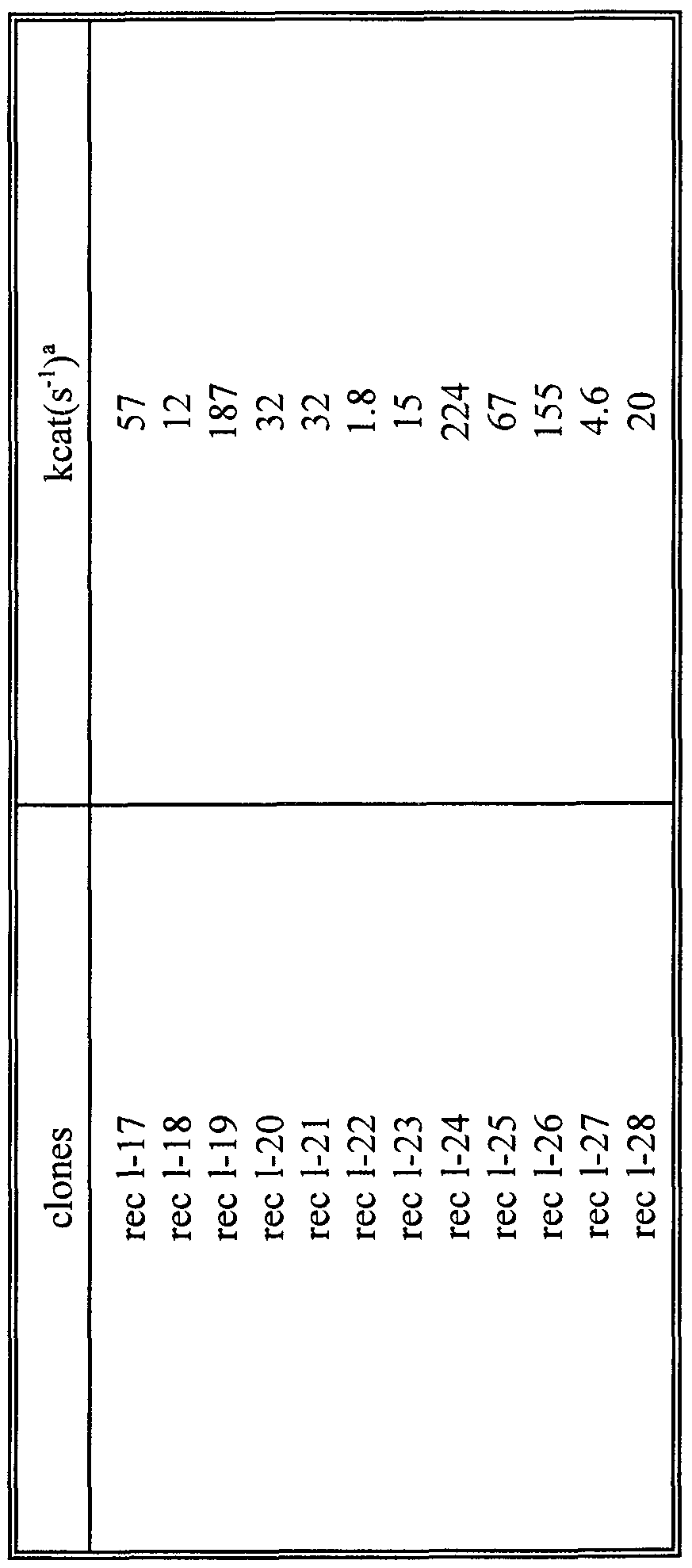
- Table 7 Activities of rec 1 clones not selected on ampicillin.
- lib3j prepared by pooling the lib3E, lib3G(a) and lib3G(b) libraries
- rec4B libraries by panning on streptavidin-coated magnetic beads (Dynabeads M280 from Dynal AS, Oslo, Norway) saturated with biotinylated psalO and psa66 antibodies as selecting agents (from CanAg Diagnostics AB, Gothenburg, Sweden).
- streptavidin-coated magnetic beads Dynabeads M280 from Dynal AS, Oslo, Norway
- biotinylated psalO and psa66 antibodies as selecting agents (from CanAg Diagnostics AB, Gothenburg, Sweden).
- the phages displaying mutant ⁇ -lactamases with high affinity for the antibodies were extracted from these libraries.
- [E] t and [mAb] are the total enzyme and antibody concentrations respectively
- [E.mAb] is the enzyme-mAb complex concentration
- kd is the dissociation constant of the enzyme-mAb complex
- kcat E and kcat E.mAb are the catalytic constants of the free enzyme and the complex.
- This percentage can be as high as 70% or more when the concentration of psa66 is increased to 1.7 x 10 "6 M.
- the inhibition is less important when PenG is used as a substrate. It is believed that the difference of behavior results probably mainly from the difference in size of the substrates, the larger substrates being less rapidly hydrolysed in the presence of the bound antibody.
- the wild type residues E 104 -Y 105 are replaced by T 104 G 105 and the wild type residue T 27 , is replaced by DGSRQ.
- R 275 is mutated to Q 275 .
- FIG. 2 A plot of the inhibitory effect of the monoclonal antibody psal9 on the catalytic activity of the mutant 3-lactamase on phage identified as psal9Aj302 and extracted from the lib3j library is shown in Figs. 2 and 3.
- Fig. 3 is an expanded version of Fig. 2. It represents the activities as a function of [psal9] between 0 and 50 nM. The activity is reduced to 60% at a psa 19 antibody concentration of 4 x 10 "9 M and to 17% at saturation. This allows detection of the analyte PSA itself at a nM concentration by observation of an increase in activity.
- the wild type residue T 271 was replaced by SWPVKS .
- R 275 was also mutated to Q 275 . These sequences are not present in PSA.
- the monoclonal antibody recognizes a mimotope.
- the substrate (benzyl-penicillin) was added at a final concentration of 5 x 10 "4 M.
- the activity was measured by determination of the rate of decrease of the decrease of the absorbance at 232 nm.
- a kcat of 134 s "1 was found in absence of psal9.
- Psal9 binding inhibits the activity to 8% of that found in absence of antibody.
- a single successful affinity selection of the rec4b library has permitted clones that are strongly regulated by their binding partner, i.e., by the psa66 antibody.
- Table 10 Characteristics of the lib3 and lib4 clones selected on psa mAbs. selecting clone frq sequence ssuubbssttrraattee K Kccaatt ( (ss-- • l1 )) rreellaattiivvee kd(M) agent activities (-/+ psa mAb)
- EXAMPLE 5 Three rounds of selection were carried out on the Rec4b library by panning using the psa66 antibody (CanAg diagnostics AB, Gothengburg, Sweden) . Clone p66Rb330 was selected and analyzed for regulation of activity by psa66 binding. Two substrates were used. The effect observed depended on the substrate. See Figs. 5A and 5B . With Centa as substrate, a 1.72 fold activation was observed. With PADAC, a 2.6 fold inhibition was observed. Both activation/inhibition curves can be fitted with the same - 48 -
Landscapes
- Health & Medical Sciences (AREA)
- Life Sciences & Earth Sciences (AREA)
- Chemical & Material Sciences (AREA)
- Engineering & Computer Science (AREA)
- Genetics & Genomics (AREA)
- Organic Chemistry (AREA)
- Bioinformatics & Cheminformatics (AREA)
- Biomedical Technology (AREA)
- Wood Science & Technology (AREA)
- Zoology (AREA)
- Molecular Biology (AREA)
- Biotechnology (AREA)
- General Engineering & Computer Science (AREA)
- Biochemistry (AREA)
- General Health & Medical Sciences (AREA)
- Microbiology (AREA)
- Immunology (AREA)
- Medicinal Chemistry (AREA)
- Physics & Mathematics (AREA)
- Urology & Nephrology (AREA)
- Hematology (AREA)
- General Physics & Mathematics (AREA)
- Analytical Chemistry (AREA)
- Food Science & Technology (AREA)
- Cell Biology (AREA)
- Biophysics (AREA)
- Plant Pathology (AREA)
- Pathology (AREA)
- Measuring Or Testing Involving Enzymes Or Micro-Organisms (AREA)
- Enzymes And Modification Thereof (AREA)
- Peptides Or Proteins (AREA)
- Acyclic And Carbocyclic Compounds In Medicinal Compositions (AREA)
- Bakery Products And Manufacturing Methods Therefor (AREA)
- Medicines That Contain Protein Lipid Enzymes And Other Medicines (AREA)
- Breeding Of Plants And Reproduction By Means Of Culturing (AREA)
- Investigating, Analyzing Materials By Fluorescence Or Luminescence (AREA)
- Micro-Organisms Or Cultivation Processes Thereof (AREA)
Abstract
Description



Claims
Priority Applications (7)
| Application Number | Priority Date | Filing Date | Title |
|---|---|---|---|
| DE69739664T DE69739664D1 (en) | 1996-11-27 | 1997-11-26 | CHIMERATING TARGET MOLECULES WITH REGULATORY ACTIVITY |
| AT97952131T ATE449166T1 (en) | 1996-11-27 | 1997-11-26 | CHIMERIC TARGET MOLECULES WITH ADJUSTABLE ACTIVITY |
| EP97952131A EP0958351B1 (en) | 1996-11-27 | 1997-11-26 | Chimeric target molecules having a regulatable activity |
| JP52642798A JP4416185B2 (en) | 1996-11-27 | 1997-11-26 | Chimeric target molecules with regulatable activity |
| DK97952131.7T DK0958351T3 (en) | 1996-11-27 | 1997-11-26 | Chimeric target molecules with controllable activity |
| PT97952131T PT958351E (en) | 1996-11-27 | 1997-11-26 | Chimeric target molecules having a regulatable activity |
| AU55719/98A AU5571998A (en) | 1996-11-27 | 1997-11-26 | Chimeric target molecules having a regulatable activity |
Applications Claiming Priority (2)
| Application Number | Priority Date | Filing Date | Title |
|---|---|---|---|
| US08/757,425 | 1996-11-27 | ||
| US08/757,425 US6500660B1 (en) | 1996-11-27 | 1996-11-27 | Chimeric target molecules having a regulatable activity |
Publications (2)
| Publication Number | Publication Date |
|---|---|
| WO1998023731A2 true WO1998023731A2 (en) | 1998-06-04 |
| WO1998023731A3 WO1998023731A3 (en) | 1998-11-12 |
Family
ID=25047774
Family Applications (1)
| Application Number | Title | Priority Date | Filing Date |
|---|---|---|---|
| PCT/IB1997/001643 Ceased WO1998023731A2 (en) | 1996-11-27 | 1997-11-26 | Chimeric target molecules having a regulatable activity |
Country Status (10)
| Country | Link |
|---|---|
| US (1) | US6500660B1 (en) |
| EP (1) | EP0958351B1 (en) |
| JP (1) | JP4416185B2 (en) |
| AT (1) | ATE449166T1 (en) |
| AU (1) | AU5571998A (en) |
| DE (1) | DE69739664D1 (en) |
| DK (1) | DK0958351T3 (en) |
| ES (1) | ES2336634T3 (en) |
| PT (1) | PT958351E (en) |
| WO (1) | WO1998023731A2 (en) |
Cited By (2)
| Publication number | Priority date | Publication date | Assignee | Title |
|---|---|---|---|---|
| EP1349869A4 (en) * | 2000-11-08 | 2007-12-12 | Commw Scient Ind Res Org | Method of identifying antibacterial compounds |
| US7705120B2 (en) | 2001-06-21 | 2010-04-27 | Millennium Pharmaceuticals, Inc. | Compositions, kits, and methods for identification, assessment, prevention, and therapy of breast cancer |
Families Citing this family (4)
| Publication number | Priority date | Publication date | Assignee | Title |
|---|---|---|---|---|
| KR100428998B1 (en) * | 2001-09-10 | 2004-04-28 | 한국과학기술원 | A Method for Manufacturing Mutant Library of Proteins with Variable Sequences and Sizes |
| GB0209878D0 (en) * | 2002-04-30 | 2002-06-05 | Glaxosmithkline Biolog Sa | Vaccine |
| WO2009154461A1 (en) * | 2008-06-19 | 2009-12-23 | Prothix Bv | Use of anti-factors xi antibodies for prevention of thrombus formation |
| DE102022000897A1 (en) | 2022-03-15 | 2023-09-21 | Ruhr-Universität Bochum, Körperschaft des öffentlichen Rechts | Implantable biosensor |
Citations (1)
| Publication number | Priority date | Publication date | Assignee | Title |
|---|---|---|---|---|
| WO1992007090A1 (en) | 1990-10-22 | 1992-04-30 | Genentech, Inc. | Methods for modifying and detecting the effects on the interaction of modified polypeptides and target substrates |
Family Cites Families (4)
| Publication number | Priority date | Publication date | Assignee | Title |
|---|---|---|---|---|
| WO1988002757A1 (en) * | 1986-10-17 | 1988-04-21 | Saramane Pty. Ltd.; | Hybrid proteins or polypeptides |
| EP0397834B1 (en) * | 1988-10-28 | 2000-02-02 | Genentech, Inc. | Method for identifying active domains and amino acid residues in polypeptides and hormone variants |
| AU4238893A (en) * | 1992-05-07 | 1993-11-29 | Regents Of The University Of California, The | Novel diphtheria toxin-based molecules |
| US5674681A (en) * | 1994-12-06 | 1997-10-07 | Rothenberg; Barry E. | Methods to identify hemochromatosis |
-
1996
- 1996-11-27 US US08/757,425 patent/US6500660B1/en not_active Expired - Lifetime
-
1997
- 1997-11-26 ES ES97952131T patent/ES2336634T3/en not_active Expired - Lifetime
- 1997-11-26 AU AU55719/98A patent/AU5571998A/en not_active Abandoned
- 1997-11-26 WO PCT/IB1997/001643 patent/WO1998023731A2/en not_active Ceased
- 1997-11-26 JP JP52642798A patent/JP4416185B2/en not_active Expired - Lifetime
- 1997-11-26 AT AT97952131T patent/ATE449166T1/en active
- 1997-11-26 DK DK97952131.7T patent/DK0958351T3/en active
- 1997-11-26 PT PT97952131T patent/PT958351E/en unknown
- 1997-11-26 EP EP97952131A patent/EP0958351B1/en not_active Expired - Lifetime
- 1997-11-26 DE DE69739664T patent/DE69739664D1/en not_active Expired - Lifetime
Patent Citations (1)
| Publication number | Priority date | Publication date | Assignee | Title |
|---|---|---|---|---|
| WO1992007090A1 (en) | 1990-10-22 | 1992-04-30 | Genentech, Inc. | Methods for modifying and detecting the effects on the interaction of modified polypeptides and target substrates |
Non-Patent Citations (3)
| Title |
|---|
| J. BIOL. CHEM, vol. 271, August 1996 (1996-08-01), pages 21251 - 21256 |
| P.N.A.S. USA, vol. 92, June 1995 (1995-06-01), pages 5783 - 5787 |
| PROT. ENG., vol. 7, April 1994 (1994-04-01), pages 509 - 514 |
Cited By (2)
| Publication number | Priority date | Publication date | Assignee | Title |
|---|---|---|---|---|
| EP1349869A4 (en) * | 2000-11-08 | 2007-12-12 | Commw Scient Ind Res Org | Method of identifying antibacterial compounds |
| US7705120B2 (en) | 2001-06-21 | 2010-04-27 | Millennium Pharmaceuticals, Inc. | Compositions, kits, and methods for identification, assessment, prevention, and therapy of breast cancer |
Also Published As
| Publication number | Publication date |
|---|---|
| DK0958351T3 (en) | 2010-03-15 |
| JP2001515346A (en) | 2001-09-18 |
| US6500660B1 (en) | 2002-12-31 |
| ES2336634T3 (en) | 2010-04-14 |
| EP0958351A2 (en) | 1999-11-24 |
| PT958351E (en) | 2010-02-17 |
| AU5571998A (en) | 1998-06-22 |
| WO1998023731A3 (en) | 1998-11-12 |
| JP4416185B2 (en) | 2010-02-17 |
| DE69739664D1 (en) | 2009-12-31 |
| EP0958351B1 (en) | 2009-11-18 |
| ATE449166T1 (en) | 2009-12-15 |
Similar Documents
| Publication | Publication Date | Title |
|---|---|---|
| PT1658858E (en) | Use of botulinum toxin for the treatment of recalcitrant voiding dysfunction | |
| US8679753B2 (en) | Methods for making and using molecular switches involving circular permutation | |
| Fastrez | In vivo versus in vitro screening or selection for catalytic activity in enzymes and abzymes | |
| Legendre et al. | Engineering a regulatable enzyme for homogeneous immunoassays | |
| WO1992002536A1 (en) | Systematic polypeptide evolution by reverse translation | |
| JP2003135084A (en) | Walk-through mutagenesis | |
| US20150065382A1 (en) | Method for Producing and Identifying Soluble Protein Domains | |
| Moore et al. | The development of β-lactamase as a highly versatile genetic reporter for eukaryotic cells | |
| CA2374476A1 (en) | Interaction-activated proteins | |
| Ponsard et al. | Selection of metalloenzymes by catalytic activity using phage display and catalytic elution | |
| US6607881B1 (en) | Combined ligand and receptor display | |
| EP0958351B1 (en) | Chimeric target molecules having a regulatable activity | |
| Vanwetswinkel et al. | Selection of β-lactamases and penicillin binding mutants from a library of phage displayed TEM-1 β-lactamase randomly mutated in the active site Ω-loop | |
| AU2002341204A1 (en) | Method for producing and identifying soluble protein domains | |
| WO2003060073A2 (en) | An in vivo protein screen based on enzyme-assisted chemically induced dimerization ('cid') | |
| US7138265B1 (en) | Chimeric target molecules having a regulatable activity | |
| Siemers et al. | Modifying the specificity and activity of the Enterobacter cloacae P99 β-lactamase by mutagenesis within an M13 phage vector | |
| US20040038317A1 (en) | Breakpoint fusion fragment complementation system | |
| Strobel et al. | In vitro selection for enzymatic activity: A model study using adenylate cyclase | |
| US20030143563A1 (en) | Method for identifying a nucleic acid | |
| O'Donohue et al. | Tyr26 and Phe73 are essential for full biological activity of the Fd Gene 5 protein | |
| US20080119432A1 (en) | Inhibition Of Metallo-Beta-Lactamase By Rna | |
| KR0173131B1 (en) | Walk-through mutagenesis | |
| WO2009102080A1 (en) | Vector for screening antibody | |
| Heinis et al. | Calmodulin-tagged phage and two-filter sandwich assays for the identification of enzymatic activities |
Legal Events
| Date | Code | Title | Description |
|---|---|---|---|
| AK | Designated states |
Kind code of ref document: A2 Designated state(s): AL AM AT AU AZ BA BB BG BR BY CA CH CN CU CZ DE DK EE ES FI GB GE GH HU IL IS JP KE KG KP KR KZ LC LK LR LS LT LU LV MD MG MK MN MW MX NO NZ PL PT RO RU SD SE SG SI SK SL TJ TM TR TT UA UG UZ VN YU ZW AM AZ BY KG KZ MD RU TJ TM |
|
| AL | Designated countries for regional patents |
Kind code of ref document: A2 Designated state(s): GH KE LS MW SD SZ UG ZW AT BE CH DE DK ES FI FR GB GR IE IT LU MC NL PT |
|
| DFPE | Request for preliminary examination filed prior to expiration of 19th month from priority date (pct application filed before 20040101) | ||
| 121 | Ep: the epo has been informed by wipo that ep was designated in this application | ||
| AK | Designated states |
Kind code of ref document: A3 Designated state(s): AL AM AT AU AZ BA BB BG BR BY CA CH CN CU CZ DE DK EE ES FI GB GE GH HU IL IS JP KE KG KP KR KZ LC LK LR LS LT LU LV MD MG MK MN MW MX NO NZ PL PT RO RU SD SE SG SI SK SL TJ TM TR TT UA UG UZ VN YU ZW AM AZ BY KG KZ MD RU TJ TM |
|
| AL | Designated countries for regional patents |
Kind code of ref document: A3 Designated state(s): GH KE LS MW SD SZ UG ZW AT BE CH DE DK ES FI FR GB GR IE IT LU MC NL PT |
|
| ENP | Entry into the national phase |
Ref country code: JP Ref document number: 1998 526427 Kind code of ref document: A Format of ref document f/p: F |
|
| WWE | Wipo information: entry into national phase |
Ref document number: 1997952131 Country of ref document: EP |
|
| REG | Reference to national code |
Ref country code: DE Ref legal event code: 8642 |
|
| WWP | Wipo information: published in national office |
Ref document number: 1997952131 Country of ref document: EP |
|
| NENP | Non-entry into the national phase |
Ref country code: CA |