SYNTHETIC TECHNIQUES AND INTERMEDIATES FOR POLYHYDROXY, DIENYL LACTONES AND MIMICS THEREOF
GOVERNMENT SUPPORT
Certain of the inventors were supported by National Institutes of Health Grant GM-29028.
FIELD OF THE INVENTION
This invention relates to lactone-containing compounds such as diεcodermolide, to compounds which mimic the chemical and/or biological activity thereof, and to methods and intermediates useful in their preparation.
BACKGROUND OF THE INVENTION
In 1990, Gunasekera and co-workers at the Harbor
Branch Oceanographic Institute reported the isolation of
(+) -discodermolide (1), an architecturally novel metabolite of the marine sponge Discodermia dissoluta (0.002% w/w) . ( See,
Gunasekera, et al . , J. Org. Chem. 1990, 55, 4912. Correction:
J. Org. Chem . 1991, 56, 1346) .
Initial studies revealed that (+) -discodermolide suppresses both the two-way mixed- lymphocyte reaction and the concanavalin A- induced mitogenesis of murine splenocytes in vitro with no associated cytotoxicit . Moreover, (+)-l suppresses the in vivo graft-vs . -host splenomegaly response induced by injection of parental splenocytes into FI recipient mice, with potency intermediate between those of cyclosporin A and FK506. (Longley, et al . , Transplantation 1991, 52 , 650; Longley, et al . , Transplantation 1991, 52, 656; Longley, et al . Ann . N. Y. Acad. Sci . 1993, 696, 94). These findings stimulated the recent discovery that (+)-l arrests cell development at the M phase by binding and stabilizing mitotic spindle microtubules; thus discodermolide resembles taxol in its mode of action, but the microtubule binding affinity of 1 is much higher, (ter Haar, et al . , Biochemistry 1996, 35 , 243; Hung, et al . , Che i . Sc Biol . 1996, 3 , 287). These and other results suggest that (+) -discodermolide holds considerable promise as an anticancer agent. The scarcity of natural material however has precluded a complete evaluation of its biological profile.
The absolute configuration of discodermolide remained undefined until Schreiber et al . synthesized both antipodes of
1. (Nerenberg, et al . J. Am . Chem . Soc . 1993, 115, 12621; Hung, et al., Chem . & Biol . 1994, 1, 67). Interestingly, the unnatural (-) antipode also displays significant immunosuppressant activity.
There is, therefore, a need for improved synthetic methods for the preparation of polyhydroxy, dienyl lactones such as the discodermolides, as well as a need for compounds having similar chemical and/or biological activity.
OBJECTS OF THE INVENTION
It is one object of the present invention to provide polyhydroxy, dienyl lactones and mimics thereof.
It is a further object to provide processes for the preparation of such compounds and their mimics .
It is another object of this invention to provide intermediates useful in such processes.
SUMMARY OF THE INVENTION
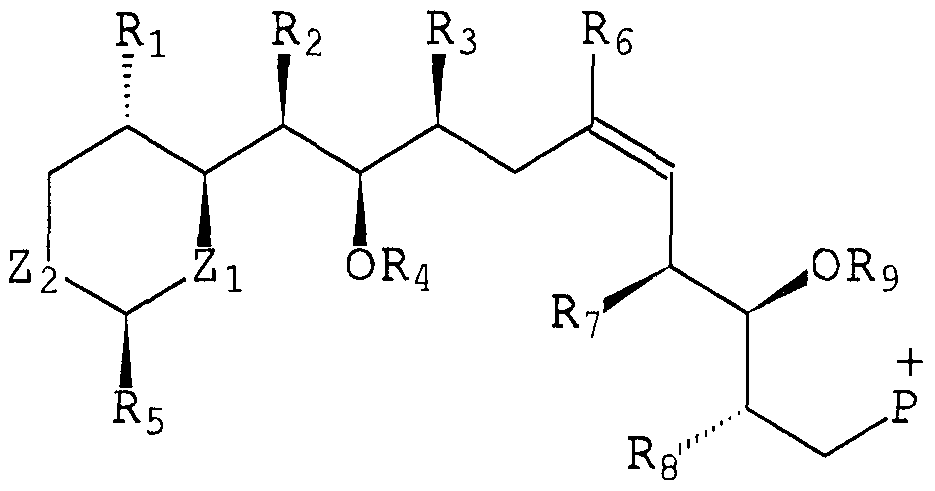
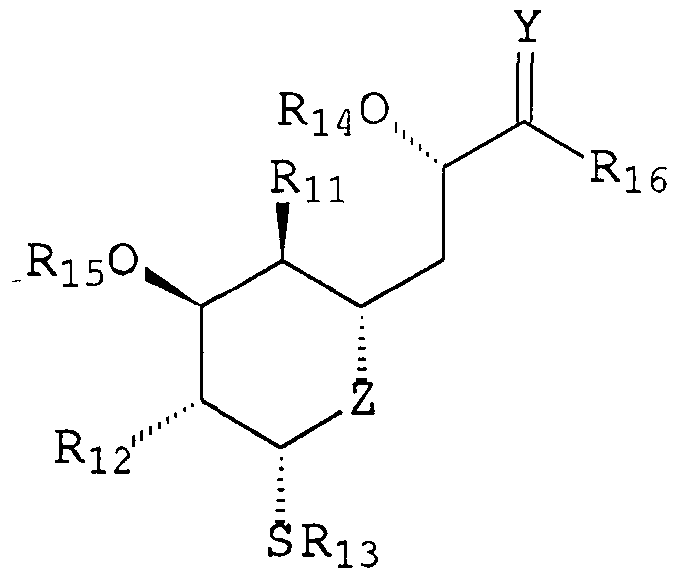
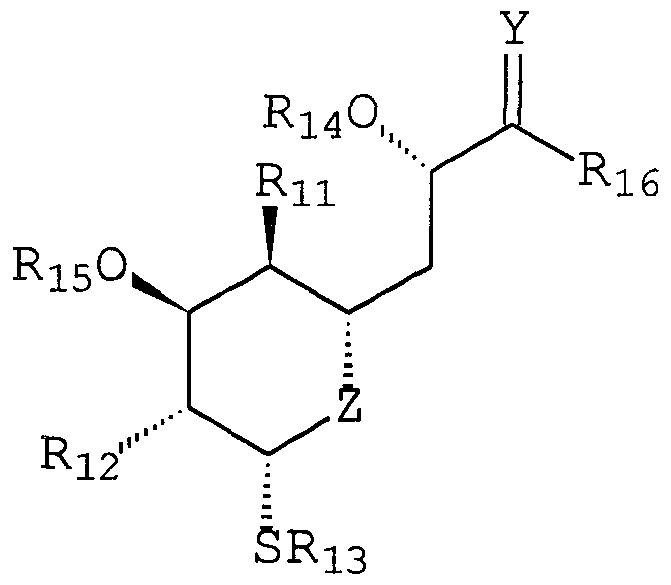
These and other objects are satisfied by the present invention, which, in one aspect, provides synthetic methods for the discodermolides and other polyhydroxylactones . In preferred embodiments, such methods involve contacting a phosphonium salt of formula I :
with base and an alkylthiol of formula II :
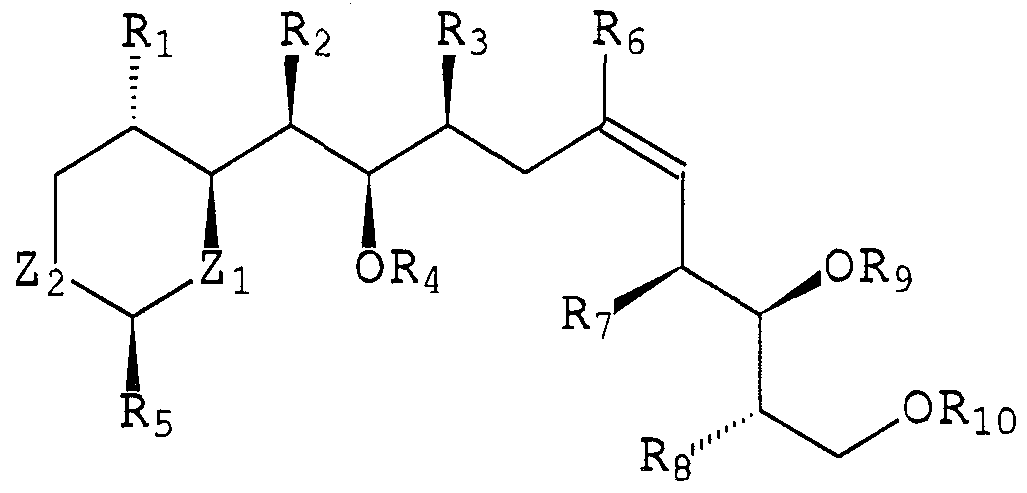
II to form a diene of formula III
III wherein: Rx , R2 , R3 , R6, R7 , R8 , Rxl , R12 and R13 are, independently, C^-C^ alkyl; X is a halogen;
Z, Zι; and Z2 are, independently, 0, S or NR' ; R4, R9, R14, and R15 are, independently, acid labile hydroxyl protecting groups; R5 is C6-C14 aryl; Y is 0, S or NR' ;
R' and R16 are, independently, hydrogen or C^-C8 alkyl ; and
R18 is C6 - C14 aryl .
In another aspect, the methods of the invention involve producing an al ene of formula IV.
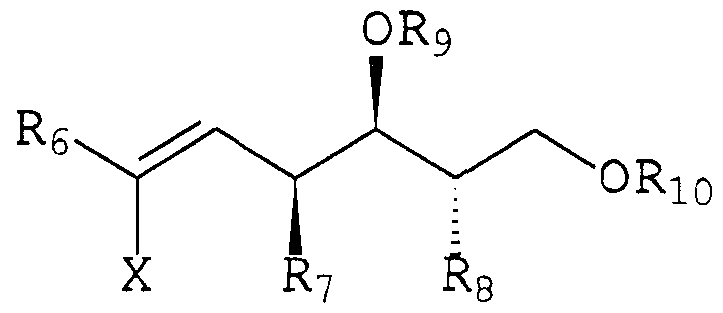
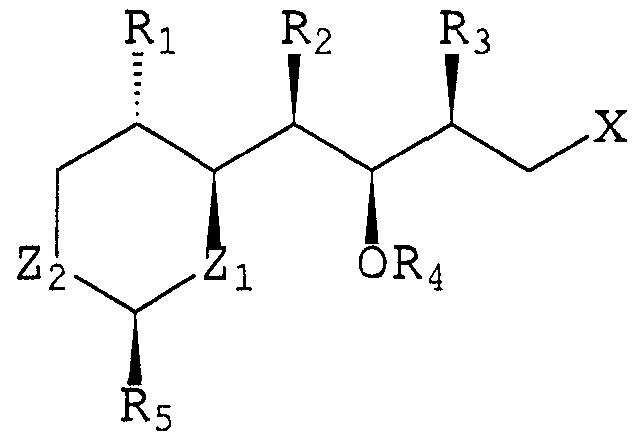
IV This can be accomplished by contacting an organometallic reagent of formula Va :
Va with a vinyl halide of formula Via:
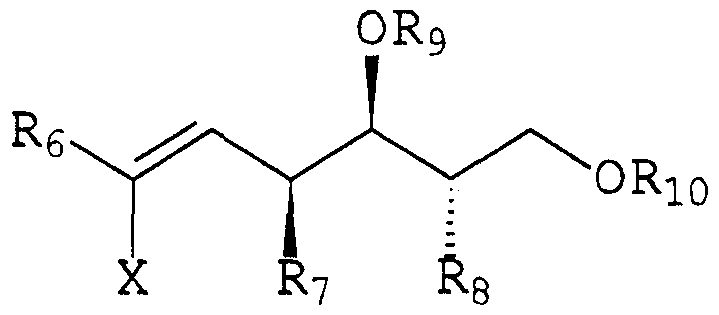
Via wherein M is Li, Cu, Mg, or Zn and R10 is an acid stable hydroxyl protecting group and all other variables are as defined above. Alternatively, a vinyl halide of formula V :
Vb
can be contacted with an organometallic compound of formula VIb:
VIb
In yet another aspect, the methods of the invention involve lactones having formula VII.
VII
by contacting a diene of formula Villa:
Villa with an organometallic compound having formula Va wherein R24 is hydrogen and R25 is hydrogen or an acid stable hydroxyl protecting group. Alternatively, an organometallic compound having formula Vlllb can be contacted with a vinyl halide having formula Vb .
VIIlb
The methods of the invention also involve producing dienes having formula Villa by contacting phosphonium salts having formula IX:
IX with base and alkylthiol compounds having formula II.
The present invention also provides synthetic intermediates which are useful in the preparation of polyhydroxylactones, including the compounds having formulas I -IX and X:
X wherein:
R19, R20, R21 and R22 are, independently, C^C^ alkyl; and
R23 is C7-C15 aralkyl .
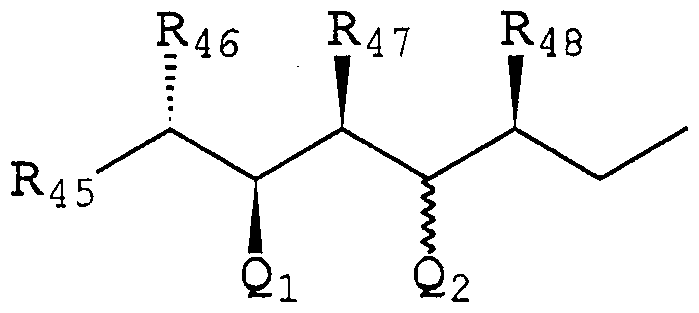
The present invention also provides compounds which mimic the chemical and/or biological activity of the discodermolides In preferred embodiments, such compounds have formula XI :
XI
where
R30 is substituted or unsubstituted C^C^ alkyl or a moiety formula XII or XIII:
where A is C1-C20 alkyl, -CH2NH(T) or a moiety of formula XIV:
XIV wherein
T is peptide having 1 to about 10 amino acids,-
R
32, R
40, R
42, R
43, R
4S, R
47, and R
48 are, independently, hydrogen or
alkyl;
R41 is a side chain of an amino acid; and W2 are, independently, -0R49 or -NHP1;-
Ε>1 is hydrogen or an amine protecting group;
R33 and R36 are, independently, hydrogen, Cx-C10 alkyl, -OR50, =0 or together form -CH2-CH2-;
R34 and R3S are, independently, hydrogen or together form -C(H) =C(H) -C(H) =C(H) - ;
R39 is -0R51 or -CH2-R51;
R31 and R44 are, independently, C^C^ alkyl;
Q1 and Q2 are, independently, hydrogen, -0RQ, -NHR52, -0C(=0)NH2 or together form -0-C (0) -NH- ; RQ is hydrogen or a hydroxyl protecting group;
R
51 is substituted or unsubstituted C
6-C
14 aryl, tetrahydropyranyl , furanosyl, pyranosyl ( e . g . , tetramethylfucosyl, tetramethylmannosyl, tetramethylgaractosyl and tetramethylglucosyl) , C
3-C
10 lactonyl or 2-pyranonyl; R
45 is Ci-Cg alkenyl,
alkyl, C
6-C
14 aryl, C
2-C
10 heterocycloalkyl, C
3-C
10 cycloalkyl, or C
7-C
15 aralkyl ; and
R
49, R
50, and R
S2 are, independently, hydrogen or
alkyl .
The present invention also provides methods for inhibiting mammalian cell proliferation by contacting mammalian cells with a compound according to the invention or by administering a compound according to the invention (or a pharmaceutical composition comprising such a compound) to a mammal suffering from undesired cell proliferation. Also provided are methods for inhibiting rejection of a transplanted organ in a mammal comprising administering a compound or composition according to the invention to a mammalian organ recipient .
BRIEF DESCRIPTION OF THE DRAWINGS
The numerous objects and advantages of the present invention may be better understood by those skilled in the art by reference to the accompanying figures, in which: Figure 1 shows a retrosynthetic analysis for (-)- discodermolide 1.
Figure 2 shows a synthetic scheme for compound 5.
Figure 3 shows a synthetic scheme for fragment A.
Figure 4 shows a synthetic scheme for compound 22. Figure 5 shows a synthetic scheme for compound 39.
Figure 6 shows a synthetic scheme for compounds 15 and 25.
Figure 7 shows a synthetic scheme for compound 34.
Figure 8 shows a synthetic scheme for fragment C. Figure 9 shows a synthetic scheme for fragment B.
Figure 10 shows a synthetic scheme for compound 39.
Figure 11 shows a synthetic scheme for compound 40.
Figure 12 shows a synthetic scheme for compound 49.
Figure 13 shows a synthetic scheme for compounds 53 and 46.
Figure 14 shows a synthetic scheme for compound 56. Figure 15 shows a synthetic scheme for compound 1. Figure 16 shows a synthetic scheme for compound 104. Figure 17 shows a synthetic scheme for compound 107. Figure 18 shows a synthetic scheme for compound 206.
Figure 19 shows a synthetic scheme for compound 212. Figure 20 shows a synthetic scheme for compound 217. Figure 21 shows a synthetic scheme for compound 305. Figure 22 shows a synthetic scheme for compound 309. Figure 23 shows a synthetic scheme for compound 401.
Figure 24 shows a synthetic scheme for compound 501. Figure 25 shows a synthetic scheme for compound 601. Figure 26 shows a synthetic scheme for compound 701 (R = alkyl) . Figure 27 shows a synthetic scheme for compound 808.
Figure 28 shows a synthetic scheme for compound 801. Figure 29 shows a synthetic scheme for compound 901.
Figure 30 shows a synthetic scheme for compound 1003.
Figure 31 shows a synthetic scheme for compound 1104
(Ar = 2, 4 -dimethyl-3 -methoxyphenyl (a), 2-methyl-5- methoxyphenyl (b) , 2 , 4 -dimethyl-5 -methoxyphenyl (c), 2,4- dimethylphenyl (d) , and 4-methylphenyl (e) ) .
Figure 32 shows a synthetic scheme for compound 1111. Figures 33-36 show representative compounds of the invention.
DETAILED DESCRIPTION OF THE PREFERRED EMBODIMENTS It has been found in accordance with the present invention that the synthesis of polyhydroxy, dienyl lactones such as the discodermolides can be achieved by highly convergent and stereocontrolled synthetic procedures .
As shown in Figure 1 for the (-) -discodermolide antipode, our analysis revealed a repeating triad of contiguous stereocenters, separated by Z-olefinic linkages at C(8,9) and C(13,14). Disconnections at C(8,9), C(14,15) and C(21,22) generated fragments A, B and C, each deriving in turn from a common precursor (5) containing the recurring stereochemical triad.
As shown in Figure 2 , precursor 5 was prepared by a synthetic procedure whereby hydroxy ester (-)-6 was protected as the p-methoxybenzyl (PMB) ether by treatment with the Bundle trichloroimidate reagent 7 under acidic conditions. Reduction with LiAlH4 provided the alcohol (-)-8 after distillation. Swern oxidation, Evans aldol condensation, and Weinreb amide formation completed the construction of common precursor (+)-5. This concise five-step synthesis could be routinely carried out on a 50-g scale in 59% overall yield. In view of the polypropionate structure of the A fragment, we performed a second asymmetric aldol reaction, as shown in Figure 3. Initial formation of the p-methoxybenzylidene acetal (-)-ll from common precursor (+)-5
(78% yield) was designed to allow selective deprotection of C(21) and C(19) hydroxyls for introduction of the terminal diene and carbamate moieties. Following reduction of amide
(-)-ll to the aldehyde (80% yield), (aldol reaction with oxazolidinone (+)-9 (80% yield) provided alcohol (+)-13 which incorporated the five stereocenters of subunit A. The structure of (+) -13 was confirmed by single-crystal X-ray analysis. Protection of the secondary alcohol as the TBS ether and removal of the chiral auxiliary (LiBH4, EtOH, THF) afforded primary alcohol (-)-15 (81% yield, two steps), which could be efficiently converted either to tosylate (-)-16 or iodide (-)-A. As outlined in Figure 1, our strategy required a Z vinylic halide B for coupling with fragment A. Beginning again with the common precursor (+)-5, TBS protection (Figure 4) followed by reduction of the einreb amide [DIBAL (2 equiv) , THF, -78 *C] (Kim, et al . , Tetrahedron Lett . 1989, 30 , 6697)16 afforded aldehyde (+)-18 in 88% yield for the two steps. We adopted a stepwise approach to introduction of the vinyl halide, whereby (+)-18 was converted to the Z α-bromo unsaturated ester (-)-19 (Ph3PCBrC02Et , PhH, reflux; 75% yield after chromatography) . Reduction to allylic alcohol (-)-20 followed by mesylation and displacement with LiBHEt3 then furnished Z vinyl bromide (-)-22 in 77% overall yield from 19.
Our preferred synthetic strategy involves selective removal of a primary PMB ether in the presence of a PMP acetal in the AB coupling product ((-)-39, Figure 5) . A 1:1 mixture of PMB ether (-)-22 and PMP acetal (-)-15 was exposed to DDQ (1.1 equiv) in CH2C12/H20 (Figure 6). The acetal (-)-15 largely remained intact while the debenzylated alcohol (-)-25 was formed in 83% yield.
As shown in Figure 7, we again utilized the TBS ether (+) -17 for the preparation of C from common precursor (+)-5. Oxidative cleavage of the PMB group (DDQ, CH2C12, H20) provided alcohol 26 in variable (60-86%) yields, accompanied by the corresponding lactone. Debenzylation with Pearlman's catalyst afforded (+)-26 in 92% yield. Exposure of the alcohol to S03.pyr furnished aldehyde (+) -27 (98% yield), which in turn was converted to dithiane (+) -28 (79%) . In the latter step, our modification of the Evans protocol for dithiane generation
[ (TMSSCH2) 2CH2, ZnCl2, Et20] minimized elimination of the TBS ether to form the α, β-unsaturated amide. Following reduction to aldehyde (+) -29 with DIBAL (91% yield), dimethyl acetal formation gave ( +) -30 (99%) . The coupling of dithiane 30 with R- (-) -glycidyl benzyl ether _(-)-31] then afforded alcohol
(-)-32 in 79% yield. Unmasking of the ketone moiety
[ (CF3C02)2IPh, 80%] and Evans stereocontrolled reduction (97%) provided the anti diol (-)-34, which embodied all of the stereocenters in fragment C. Acid-catalyzed cyclization of (-)-34 (TsOH, room temperature) provided methoxy pyran 35 in 87% yield as a 1:2 mixture of and β anomers (Figure 8) . Debenzylation (H2, Pd/C) of 36 afforded alcohol 37 quantitatively. Exposure to EtSH and MgBr2 in Et20 then gave a separable 6 : 1 mixture of β ethyl hemithioacetal ( +) -38 and its . anomer in 83% yield. Swern oxidation of (+) -38 furnished the final fragment (+) -C in 86% yield.
Synthesis of the desired B segment (-)-B preferably was achieved by direct olefination of aldehyde (+) -18 (41%, 6:1 Z/E) (Figure 9) , followed by chromatographic removal of the undesired E cross coupling product. Reaction of (-)-B with the organozinc derivative of (-)-A (Figure 10) was achieved by premixing iodide A with dried solid ZnCl2 (ether, -78 'C) before addition of t-BuLi. It is believed that three equivalents of t-BuLi are required for complete consumption of (-)-A, probably because the first equivalent reacts with ZnCl2. This modification increased the yield to 66% after flash chromatography .
Conversion of the Z trisubstituted olefin (-)-39 to the phosphonium iodide (-)-49 began with selective removal of the PMB group, as in our model study (DDQ, CH2C12, H20) , furnishing (-)-40 in 87% yield (Figure 11) . As shown in Figure 12, alcohol (-)-40 furnished the requisite iodide 42 almost exclusively, as indicated by NMR examination of the crude material. The very sensitive iodide was used without purification. Thorough mixing of iodide 42 with i-Pr2NEt (3 equiv) followed by exposure to excess PPh3 (15 equiv) without
solvent at 80 'C generated (-)-49 in 37% yield for the two steps. The major by-product was characterized as (-)-50 (35% yield) . The unsaturated model alcohol (+)-44 similarly afforded the Wittig salt (+)-46 in low yield (Figure 13), whereas the saturated derivative (+) -51 gave phosphonium iodide (+) -53 almost quantitatively.
As shown in Figure 14, assembly of the discodermolide backbone entailed Wittig coupling of aldehyde C with the ylide derived from AB phosphonium salt (-)-49 to install the C(8,9) Z alkene in (-)-54 (>49:1 Z/E, 76% yield). DIBAL reduction
(88% yield) followed by oxidation of the resultant primary alcohol (-)-55 then produced aldehyde (-)-56 (96%). The terminal Z diene (-)-57 was elaborated via the Yamamoto protocol in 70% yield with excellent selectivity (16:1 Z/E) . After flash chromatography, hydrolysis of the hemithio acetal and mild DMSO/Ac20 oxidation provided lactone (-)-58 in 82% yield for the two steps. Removal of the PMB group (DDQ, CH2C12, H20, 95% yield) and carbamate formation (Cl3CONCO, CH2C12, neutral A1203/ 83%) afforded tris (TBS ether) (-)-60. Final deprotection with 48% HF/CH3CN (1:9) furnished (-) -discodermolide, identical with an authentic sample (Figure 15) .
Preferred processes according to the invention involve contacting a phosphonium salt of formula I with base and an alkylthiol of formula II:
II to form a diene of formula III:
III wherein: Rx , R2 , R3 , R6 , R7 , R8 , RX1 , R12 and R13 are , independently, C^C^ alkyl; X is a halogen,-
Z, Z1# and Z2 are, independently, 0, S or NR' ; R4, R9, R14, and R 1S are, independently, acid labile hydroxyl protecting groups; Rs is C6-C14 aryl; Y is 0, S or NR' ;
R' and R16 are, independently, hydrogen or C^Cg alkyl; and R18 is Cg-C14 aryl.
Such procedures preferably are run in solvents such as tetrahydrofuran at -78 °C - 0 °C. Suitable bases for such procedures include sodium hexamethyldisilazide, potassium hexamethyldisilazide , and n-butyllithium with hexamethylphosphoramide .
Alkyl groups according to the invention include but are not limited to straight chain and branched chain hydrocarbons such as methyl, ethyl, propyl, pentyl, isopropyl, 2 -butyl, isobutyl, 2-methylbutyl, and isopentyl moieties having 1 to about 10 carbon atoms, preferably 1 to about 6 carbon atoms. Cycloalkyl groups are cyclic hydrocarbons having 3 to about 10 carbon atoms such as cyclopentyl and cyclohexyl groups. Heterocycloalkyl groups are cycloalkyl groups which include at least one heteroatom (i . e . , an atom which is not carbon, such as 0, S, or N) in their cyclic backbone. Alkenyl groups according to the invention are straight chain or branched chain hydrocarbons that include one or more carbon- carbon double bonds . Preferred alkenyl groups are those having 2 to about 10 carbon atoms. Alkyl, cycloalkyl, heterocycloalkyl, and alkenyl groups according to the invention optionally can be unsubtituted or can bear one or more substituents such as, for example, halogen hydroxyl, amine, and epoxy groups .
Aryl groups according to the invention are aromatic and heteroaromatic groups having 6 to about 14 carbon atoms, preferably from 6 to about 10 carbon atoms, including, for example, naphthyl, phenyl, indolyl, and xylyl groups and substituted derivatives thereof, particularly those substituted with amino, nitro, hydroxy, methyl, methoxy, thiomethyl, trifluoro ethyl, mercaptyl, and carboxy groups. Alkaryl groups are groups that contain alkyl and aryl portions and are covalently bound to other groups through the alkyl portion, as in a benzyl group .
Protecting groups are known per se as chemical functional groups that can be selectively appended to and removed from functionality, such as hydroxyl and amine groups, present in a chemical compound to render such functionality
inert to certain chemical reaction conditions to which the compound is exposed. See, e . g. , Greene and Wuts, Protective Groups in Organic Synthesis, 2d edition, John Wiley & Sons, New York, 1991. Numerous hyroxyl protecting groups are known in the art, including the acid- labile t-butyldimethylsilyl, diethylisopropylsilyl, and triethylsilyl groups and the acid- stable aralkyl ( e . g. , benzyl), triisopropylsilyl, and t- butyldiphenylsilyl groups. Useful amine protecting groups include the allyloxycarbonyl (Alloc) , benzyloxycarbonyl (CBz) , chlorobenzyloxycarbonyl , t-butyloxycarbonyl (Boc), fluorenylmethoxycarbonyl (Fmoc) , isonicotinyloxycarbonyl (i-Noc) groups.
The methods of the invention involve also are directed to the synthesis of alkenes of formula IV:
IV by contacting organometallic reagents of formula Va :
Va with vinyl halides of formula Via:
Via wherein M is Li, Cu, Mg, or Zn, and R10 is an acid stable hydroxyl protecting group. Alternatively, a vinyl halide of formula V :
Vb is contacted with an organometallic compound of formula VIb
VIb
Such reactions preferably are performed in the presence of a palladium-containing catalyst such as Pd(PPh3)4, Pd(Cl2) (PPh3)2, Pd(Cl2) (dppf)2.
In yet another aspect, the synthetic methods of the invention are directed to the preparation of lactones having formula VII:
by contacting a diene of formula Villa:
villa with an organometallic compound having formula Va wherein R
24 is hydrogen and R
2S is hydrogen or an acid stable hydroxyl protecting group. Alternatively, an organometallic compound having formula Vlllb is contacted with a vinyl halide having formula Vb .
VI I lb
The reaction of compounds having formulas V and VIII preferably is performed in ether in the presence of a palladium- or nickel-containing catalyst.
The methods of the invention also involve producing dienes having formula Villa by contacting phosphonium salts having formula IX:
with a base such as sodium hexamethyl disilazide and an alkylthiol compound having formula II. Such procedures preferably are run in solvents such as tetrahydrofuran at -78 °C - 0 °C. Suitable bases for such procedures include sodium hexamethyldisilazide, potassium hexamethyldisilazide, and n- butyllithium with hexamethylphosphoramide .
Although preferred synthetic methods are those directed to (+) -discodermolide and compounds having like stereochemistry, those skilled in the art will recognize that the methods disclosed herein can be readily adapted to the synthesis of antipodal compounds such as, for example, (-)- discodermolide, and vice versa . All such synthetic methods are within the scope of the present invention.
The present invention provides compounds which mimic the chemical and/or biological activity of the discodermolides. In preferred embodiments, such compounds have formula XI:
XI where
R, is substituted or unsubstituted C
x-C
10 alkyl or a moiety formula XII or XIII:
where A is Ci-Cj
o alkyl,
■CH
2NH(T) or a moiety of formula XIV:
XIV wherein
T is peptide having 1 to about 10 amino acids;
R32, R40, R42, R43, R4S, R47, and R48 are, independently, hydrogen or Cx-C6 alkyl;
R41 is a side chain of an amino acid; Wx and W2 are, independently, -0R49 or -NHPX;
PX is hydrogen or an amine protecting group;
R33 and R36 are, independently, hydrogen, Cj-C^ alkyl, -OR50, =0 or together form -CH2-CH2-;
R34 and R35 are, independently, hydrogen or together form -C(H)=C(H) -C(H)=C(H) -;
R39 is -0R51 or -CH2-R51;
R31 and R44 are, independently, C^C^ alkyl;
QX and Q2 are, independently, hydrogen, -ORQ, -NHR52, -0C(=0)NH2 or together form -0-C(0)-NH-; RQ is hydrogen or a hydroxyl protecting group;
R51 is substituted or unsubstituted C6-C14 aryl, tetrahydropyranyl, furanosyl, pyranosyl, C3-C10 lactonyl or 2- pyranonyl ;
R4S is Ci-Cg alkenyl, Cx-C6 alkyl, C3-C14 aryl, C2-C10 heterocycloalkyl, C3-C10 cycloalkyl, or C7-C15 aralkyl; and
R4g, R50, and RS2 are, independently, hydrogen or CX-C6 alkyl
Some preferred compounds having formula XI are shown in Figures 33-36.
The term amino acid as used herein is intended to include all naturally-occurring and synthetic amino acids known in the art. In general, amino acids have structure H2N-CH(RC)- C(0)OH where Rc is the amino acid side chain. Representative, naturally-occurring side chains are shown in Table 1.
TABLE 1
CH, CH3 - CH2 ~ S ~ CH2 - CH2 ~
HO-CH, HO-CH2-CH2-
C6HS-CH2- CH3-CH2(0H) -
HO- C6H5- CH, H02C-CH2-NH2C(0) -CH2
-CH
2-CH
2-
CH
2-CH
2- CH
3-CH
2-CH(CH
3) - HS-CH
2-
H02C-CH(NH2] ■ CH2 ■" S ~ S ~ (-H2 ■ H2N-CH2- CH, ■ CH2 — H2 - H3 - CH2 ~
CH-, - S ~ CH- - CH
Hydrophobic amino acid side chains are preferred, including the CH,-; C6H5-CH2-, CH3-CH2-, CH3-S-CH2-CH2 (CH -CH-, (CH3)2-CH-
CH, CH3-CH2-CH(CH3) and CH3-CH,-CH?-CH2 side chains.
Peptides according to the invention are linear, branched, or
cyclic chemical structures containing at least 2 covalently bound amino acids .
Certain compounds of the invention contain amino groups and, therefore, are capable of forming salts with various inorganic and organic acids. Such salts are also within the scope of this invention. Representative salts include acetate, adipate, benzoate, benzenesulfonate, bisulfate, butyrate, citrate, camphorate, ca phorsulfonate, ethanesulfonate, fumarate, hemisulfate, heptanoate, hexanoate, hydrochloride, hydrobromide, hydroiodide, methanesulfonate, lactate, maleate, methanesulfonate, 2-naphthalenesulfonate, nitrate, oxalate, pamoate, persulfate, picrate, pivalate, propionate, succinate, sulfate, tartrate, tosylate, and undecanoate. The salts can be formed by conventional means, such as by reacting the free base form of the product with one or more equivalents of the appropriate acid in a solvent or medium in which the salt is insoluble, or in a solvent such as water which is later removed in vacuo or by freeze drying. The salts also can be formed by exchanging the anions of an existing salt for another anion on a suitable ion exchange resin.
The compounds of the invention can be admixed with carriers, excipients, and/or diluents to form novel compositions. Such compositions can be used in prophylactic, diagnostic, and/or therapeutic techniques. By administering an effective amount of such a composition, prophylactic or therapeutic responses can be produced in a human or some other type mammal. It will be appreciated that the production of prophylactic or therapeutic responses includes the initiation or enhancement of desirable responses, as well as the mitigation, cessation, or suppression of undesirable responses.
The compositions of the invention are expected to find use, for example, in the inhibition of undesired cell proliferation
(e.g., cancer) and in the inhibition of rejection in organ transplantation procedures. (See, e . g. , Longley, et al . , Transplantation 1991, 52 , 650 and 656) .
Compositions of the invention can be prepared by any of the methods well known in the pharmaceutical art, for example, as described in Remington ' s Pharmaceutical Sciences (Mack Pub. Co., Easton, PA, 1980). The compositions can include a compound of the invention as an active ingredient in admixture with an organic or inorganic carrier or excipient suitable, for example, for oral administration. Other suitable modes of administration will be apparent to those skilled in the art. The compound of the invention can be compounded, for example, with the usual non-toxic, pharmaceutically acceptable carriers for tablets, pellets, capsules, solutions, suppositories, suspensions, and any other form suitable for use. The carriers which can be used are water, glucose, lactose, gum acacia, gelatin, mannitol, starch paste, magnesium trisilicate, talc, corn starch, keratin, colloidal silica, potato starch, urea and other carriers suitable for use in manufacturing preparations, in solid, semisolid, or liquid form, and in addition auxiliary, stabilizing, thickening and coloring agents and perfumes may be used. The compound of the invention is included in the pharmaceutical composition in an amount sufficient to produce the desired effect upon the process or condition of diseases.
For oral administration, tablets containing various excipients such as microcrystalline cellulose, sodium citrate, calcium carbonate, dicalcium phosphate and glycine may be employed along with various disintegrants such as starch and preferably corn, potato or tapioca starch, alginic acid and certain complex silicates, together with granulation binders like polyvinylpyrrolidone, sucrose, gelatin and acacia. Additionally, lubricating agents such as magnesium stearate, sodium lauryl sulfate and talc are often very useful for tableting purposes. Solid compositions of a similar type may also be employed as fillers in appropriately soluble ( e . g. , gelatin) capsules; preferred materials in this connection also include lactose or milk sugar as well as high molecular weight polyethylene glycols.
When aqueous suspensions and/or elixirs are desired for oral administration, the active ingredient may be combined with various sweetening or flavoring agents, coloring matter or dyes, and, if so desired, emulsifying and/or suspending agents as well, together with such diluents as water, ethanol, glycerin and various like combinations thereof.
For parenteral administration, suspensions containing a compound of the invention in, for example, aqueous propylene glycol can be employed. The suspensions should be suitably buffered (preferably pH>8) if necessary and the liquid diluent first rendered isotonic. The aqueous suspensions are suitable for intravenous injection purposes. The preparation of such suspensions under sterile conditions is readily accomplished by standard pharmaceutical techniques well-known to those skilled in the art. Additionally, it is possible to administer the compounds of the invention topically and this may preferably be done by way of creams, jellies, gels, pastes, ointments and the like, in accordance with standard pharmaceutical practice.
The compounds of the invention can be employed as the sole active agent in a pharmaceutical composition or can be used in combination with other active ingredients, e . g. , other agents useful in diseases or disorders.
The amount of active ingredient that is to be combined with the carrier materials to produce a single dosage form will vary depending upon the host treated and the particular mode of administration. The specific dose level for any particular patient will depend on a variety of factors including the activity of the specific compound employed, the age, body weight, general health, sex, diet, time of administration, route of administration, rate of excretion, drug combination, and the severity of the particular disease undergoing therapy. In some instances, dosage levels below the lower limit of the aforesaid range may be more than adequate, while in other cases still larger doses may be employed without causing any harmful side effects provided that such higher dose levels are first divided into several small doses for administration throughout the day. The concentrations of the active ingredient in
therapeutic compositions will vary depending upon a number of factors, including the dosage of the drug to be administered, the chemical characteristics ( e . g. , hydrophobicity) of the active ingredient, and the route of administration. Typical dose ranges are from about 285 μg/kg of body weight per day in three divided doses; a preferred dose range is from about 42 μg/kg to about 171 μg/kg of body weight per day. The preferred dosage to be administered is likely to depend on such variables as the type and extent of progression of the disease or disorder, the overall health status of the particular patient, the relative biological efficacy of the compound selected, and formulation of the compound excipient, and its route of administration, as well as other factors, including bioavailability, which is in turn influenced by several factors well known to those skilled in the art.
Additional objects, advantages, and novel features of this invention will become apparent to those skilled in the art upon examination of the following examples thereof, which are not intended to be limiting. All reactions were carried out in oven-dried or flame-dried glassware under an argon atmosphere, unless otherwise noted. All solvents were reagent grade. Diethyl ether and tetrahydrofuran (THF) were freshly distilled from sodium/benzophenone under argon before use. Dichloromethane, benzene and diisopropyl amine were freshly distilled from calcium hydride before use. Triethylamine and diisopropylethylamine were distilled from calcium hydride and stored over potassium hydroxide. Hexamethylphosphoramide was freshly distilled from calcium hydride. Anhydrous pyridine, dimethylformamide and dimethyl sulfoxide were purchased from
Aldrich and used without purification. n-Butyllithium and t-butyllithium were purchased from Aldrich and standardized by titration with diphenylacetic acid.
Unless stated otherwise all reactions were magnetically stirred and monitored by thin layer chromatography using 0.25 mm E. Merck pre-coated silica gel plates. Flash column chromatography was performed with the indicated solvents
using silica gel-60 (particle size 0.040-0.062 mm) supplied by E. Merck. Yields refer to chromatographically and spectroscopically pure compounds, unless otherwise stated.
All melting points were determined on a Bristoline heated- stage microscope or a Thomas -Hoover apparatus and are corrected. The IR and NMR were obtained for CHC13 and CDC13 solutions respectively unless otherwise noted. Infrared spectra were recorded with a Perkin-Elmer Model 283B spectrometer using polystyrene as an external standard. Proton NMR spectra were recorded on a Bruker AM-500 spectrometer. Carbon-13 NMR spectra were recorded on a Bruker AM-500 or AM-250 spectrometer. Chemical shifts are reported relative to internal tetramethylsilane (d 0.00) for proton and chloroform δ 77.0) or benzene (δ 128.0) for carbon-13. Optical rotations were obtained with a Perkin-Elmer model 241 polarimeter in the solvent indicated. High-resolution mass spectra were obtained at the University of Pennsylvania Mass Spectrometry Service Center on either a VG micromass 70/70H high resolution double- focusing electron impact/chemical ionization spectrometer or a VG ZAB-E spectrometer. Microanalyses were performed by Robertson Laboratories, Madison, New Jersey. Single-crystal X-ray diffraction structure determination were performed at the University of Pennsylvania using an Enraf Nonius CAD-4 automated diffractometer . High performance liquid chromatography (HPLC) was performed using a Ranin component analytical/semi-prep system.
EXAMPLE 1 Alcohol (-)-8. p-Methoxybenzyl alcohol (200 g, 1.45 mol) was added to a suspension of NaH (60% in mineral oil; 5.82 g, 0.146 mol) in anhydrous ether (450 mL) over 1 h at room temperature. The mixture was stirred for 1 h and cooled to 0 °C. Trichloroacetonitrile (158 mL, 1.58 mol) was then introduced over 80 min. After 1.5 h the solution was concentrated with the water bath temperature maintained below 40 'C. The residue was treated with a mixture of pentane (1.5 L) and MeOH (5.6 mL) ,
stirred at room temperature for 30 min, and filtered through a short Celite column. Concentration gave the trichloroimidate (394.3 g) as a red oil which was used without further purification. A solution of (R) -(-) -Roche ester (124.7 g, 1.06 mol) in CH2Cl2/cyclohexane (1:2, 1.5 L) was cooled to 0 ° C and treated with trichloroimidate (364.3 g) and PPTS (13.3 g, 52.9 mmol) . After 3 h, the mixture was warmed to room temperature, stirred for 40 h, and concentrated. Filtration through a short silica column (20% ethyl acetate/hexane) afforded the ester (303.5 g) as a slight yellow oil.
The ester (303.5 g) was divided into three portions for the next reaction. In each preparation, solution of crude ester (112.8 g) in anhydrous THF (1.0 L) was cooled to 0 °C and LiAlH4 (1.0 M in THF, 560 mL, 0.560 mol) was added over 1 h. The mixture was warmed gradually to room temperature and stirred for 24 h. After dilution with ether (1.0 L) the mixture was cooled to 0 °C and quenched carefully with saturated aqueous Rochelle'ε salt (20 mL) . The resultant mixture was then transferred to a 4-L flask, diluted with ether
(1.0 L) , and treated with additional Rochelle's solution (ca.
300 mL) with shaking untill a solid precipitated. The solution was filtered, concentrated, and the residue (including the aqueous layer) was diluted with ether (700 mL) , dried over Na2S04, filtered and concentrated. The crude products of the three reactions were combined and distilled under vacuum, furnishing (-)-8 (142.7 g, 74% yield for two steps) as a colorlesε oil: [a] 23 D -16.9° (c 1.28, CHC13) ; IR (CHC13) 3510 (m) , 3015 (ε) , 2965 (s) , 2940 (s), 2920 (s), 2870 (ε), 2840 (m) , 1618 (s) , 1590 (m) , 1517 (s), 1470 (s), 1445 (m) , 1423 (m) , 1365 (m) , 1305 (s) , 1250 (s), 1178 (s), 1092 (s), 1037 (s), 826 (m) , 814 (m) , 718 (w) , 710 (w) cm'1; XH NMR (500 MHZ, CDC13) d 7.23 (d, J = 8.6 Hz , 2 H) , 6.86 (d, J = 8.6 Hz, 2 H) , 4.43 (ABq, M = 11.7 Hz, ΔδM = 13.2 Hz, 2 H) , 3.78 (s, 3 H) , 3.61-3.54 (m, 2 H) , 3.53 (ddd, J = 9.1, 4.7, 0.8 Hz, 1 H) , 3.38 (dd, J = 9.1, 7.9 Hz, 1 H) , 2.60 (br s, 1 H) , 2.08-1.98 (m, 1 H) , 0.90 (d, J = 7.0 Hz, 3 H) ; 13C NMR (125 MHZ, CDC13) d 159.2,
130.2, 129.2, 113.8, 75.0, 73.0, 67.7, 55.2, 35.6, 13.4; high resolution mass spectrum (CI, NH3) m/z 210.1252 [M+; calcd for C12H1803: 210.1256] .
Anal. Calcd for C12H1803 : C, 68.54; H, 8.63. Found: C, 68.41; H, 8.60.
EXAMPLE 2 Aldol (+)-10.
A solution of DMSO (40.0 mL, 564 mmol) in CH2C12 (1.0 L) was cooled to -78 'C and oxalyl chloride (23.0 mL, 263 mmol) was added over 1 h. After an additional 15 min, a cooled (-78 "O solution of alcohol (-)-8 (38.0 g, 181 mmol) in CH2C12 (50 mL) was introduced via a cannula over 15 min (20 mL rinse) and the resultant milky mixture was stirred 0.5 h further at -78 'C. i-Pr2NEt (150 mL, 861 mmol) was then added over 15 min. The mixture was stirred for 30 min, slowly warmed to room temperature (70 min), and quenched with aqueous NaHS04 (1.0 M, 1.0 L) . The organic phase was concentrated, diluted with ether (500 mL) , washed with water (6 x 500 mL) , dried over MgS04, filtered and concentrated to give the corresponding aldehyde (38.0 g) aε a colorless oil.
A solution of oxazolidinone (+) -9 (44.3 g, 190 mmol) in CH2C12 (500 mL) was cooled to 0 βC. n-Bu2BOTf (1.0 M in CH2Cl2ι 199.0 mL, 199 mmol) waε introduced over 0.5 h, followed by addition of NEt3 (30.2 mL, 217 mmol) over 10 min. The mixture was stirred at 0 °C for 0.5 h and cooled to -78 ' C . A precooled (-78 °C) solution of the above aldehyde in CH2C12
(lOOmL) was then added via a cannula over 30 min (2 x 20mL rinse) . After 2 h at -78 'C and 2 h at 0 "C, the reaction was quenched with pH 7 phosphate buffer (200 mL) . The mixture was slowly treated with a solution of 30% H202 in MeOH (1:2, 600 mL) at 0 °C, stirred overnight at room temperature, and concentrated. The residue waε extracted with ethyl acetate (3 x 250 mL) and the combined extracts were washed with saturated aqueous NaHC03 and water (500 mL each) , dried over MgS04, filtered and concentrated. Flash chromatography (30% ethyl acetate/hexane) provided (+)-10 (70.9 g, 89% yield from 8) as
a colorless oil: [a] 23 D +278° (c 0.49, CHC13) ,- IR (CHCI3) 3470 (w, br) , 3020 ( ) , 2980 (m) , 2940 (m) , 2920 (m) 2880 (m) , 1790 (s) , 1705 (m) , 1620 (m) , 1590 (w) , 1520 (m) , 1485 (w) , 1460 (m) , 1390 (m) , 1360 (m) , 1305 (w) , 1230 (br, s) 1110 (m) , 1080 (m) , 1035 (m) , 985 (m) , 970 (m) , 820 (w) , 695 (w) cm"1; H MR (500 MHZ, CDC13) d 7.33-7.30 (m, 2 H) , 7.27-7.19 (m, 5 H) , 6.85 (d, J = 8.7 Hz, 2 H) , 4.67-4.63 (m, 1 H) , 4.42 (apparent s, 2 H) , 4.14 (apparent d, J = 5.0 Hz, 2 H) , 3.93 (qd, J" = 6.9, 3.4 Hz, 1 H) , 3.85 (ddd, J = 8 . 2 , 3.1, 3.1 Hz, 1 H), 3.78 (s, 3 H), 3.69 (d, J = 2.8 Hz, 1 H) , 3.54 (apparent t, J" = 9.3 Hz, 1 H) , 3.54 (dd, J = 21.1, 9.2 Hz, 1 H) , 3.28 (dd, J = 13.4, 3.2 Hz, 1 H) , 2.76 (dd, J = 13.4, 9.6 Hz, 1 H) , 1.98-1.93 (m, 1 H) , 1.25 (d, J = 6.9 Hz, 3 H) , 0.94 (d, J = 7.0 Hz, 3 H) ; 13C NMR (125 MHZ, CDCI3) d 176.1, 159.2, 153.0, 135.3, 129.9, 129.3, 129.2, 128.8, 127.2, 113.7, 75.3, 74.5, 73.1, 66.0, 55.5, 55.2, 40.6, 37.7, 35.9, 13.5, 9.7; high resolution mass spectrum (CI, NH3) m/z 442.2243 [(M+H)+; calcd for C2SH32N06 : 442.2229] .
Anal. Calcd for C25H31N06: C, 68.01; H, 7.08. Found: C, 67.81; H, 7.26.
EXAMPLE 3
Common Precursor (+)-5.
A suspension of N, O-Dimethylhydroxylamine hydrochloride (46.9 g, 481 mmol) in THF (250 mL) was cooled to 0 'C and AlMe3 (2.0 M in hexane, 240 mL, 480 mmol) was added over 30 min. The resultant εolution was warmed to room temperature, stirred for 0.5 h and then cooled to -30 °C. A solution of oxazolidinone (+)-10 (70.9 g, 161 mmol) in THF (150 mL) was introduced over 20 min via cannula (20 mL rinse) . After 3 h, the solution was poured slowly into a mixture of aqueous HCl (1.0 N, 1.2 L) and CH2C12 (1.0 L) at 0 "C and the mixture was shaken vigorously for 1 h. The aqueous phase was extracted with CH2C12 (2 x 500 mL) and the combined organic extracts were washed with water (3 x 1.0 L) , dried over MgS04, filtered and concentrated. The crude material waε taken up in ethyl acetate/hexane (1:3, 150 mL) with vigorouε εtirring to precipitate most of the chiral auxiliary. Filtration,
concentration and flash chromatography (20% acetone/hexane afforded (+)-5 (46.2 g, 88% yield) as a colorless oil: [α] 23
D
+144° (c 0.41, CHC13) ; IR (CHC13) 3470 (m, br) , 3010 -(s), 2975
(s), 2945 (s), 2915 (s), 2870 (s), 2845 (m) , 1680 (s), 1590 (w) , 1515 (s) , 1465 (s) , 1425 (m) , 1390 (m) , 1365 (m) , 1310
(m) , 1250 (s) , 1180 (s), 1150 (m) , 1090 (ε) , 1040 (s), 1000
(s) , 825 (m) cm"1; XH NMR (500 MHZ, CDC13) d 7.25 (d, J = 8.6
Hz, 2 H) , 6.86 (d, J = 8.7 Hz, 2 H) , 4.44 (ABq, Jω = 11.6 Hz,
Δδrø = 17.1 Hz, 2 H) , 3.95 (d, J - 2.8 Hz, 1 H) , 3.79 (s, 3 H) , 3.70 (ddd, J = 8.2, 3.2, 3.2 Hz, 1 H) , 3.66 (s, 3 H) , 3.62 (dd,
J = 9.0, 4.0 Hz, 1 H) , 3.53 (dd, J = 9.1, 5.9 Hz, 1 H) , 3.17
(s, 3 H) , 3.04 (m, 1 H) , 1.91-1.84 (m, 1 H) , 1.17 (d, J = 7.0
Hz, 3 H) , 0.98 (d, J = 6.9 Hz , 3 H) ; 13C NMR (125 MHZ, CDC13) d
178.0, 159.0, 130.6, 129.1, 113.7, 113.6, 73.8, 72.8, 72.6, 61.3, 55.1, 36.5, 36.0, 14.2, 10.4; high resolution mass spectrum (CI, NH3) m/z 326.1962 [(M+H) + ; calcd for C17H2βN05 : 326.1967] .
Anal. Calcd for C17H27N05 : C, 62.74; H, 8.36. Found: C, 62.74; H, 8.24.
EXAMPLE 4 einreb Amide (-)-ll.
A mixture of common precursor (+)-5 (337.3 mg, 1.04 mmol) , 4 A molecular sieves (344 mg) , and CH2C12 (10 mL) was cooled to 0 "C and treated with DDQ (310.3 mg, 1.37 mmol). After 1.5 h, the mixture was filtered through a short Celite column (50% ethyl acetate/hexane) . The filtrate was waεhed with εaturated aqueous NaHC03 and water (100 mL each) , dried over MgS04, filtered and concentrated. Flash chromatography
(30% ethyl acetate/hexane) provided (-)-ll (255.6 mg, 76% yield) as a colorless oil: [a] 23 D -339" (c 0.520, CHC13); IR (CHC1-) 3010 (s) , 2970 (s), 2940 (m) , 2880 (m) , 2840 (m) , 1663 (s) , 1620 (s), 1592 (w) , 1520 (ε), 1466 (s) , 1447 (m) , 1425 (m) , 1393 (ε) , 1375 (s) , 1307 (m) , 1253 (s) , 1178 (ε) , 1120 (s), 1083 (s), 1035 (s), 1015 (m) , 1000 (ε), 930 (w) , 830 (m) , 700 (w) , 660 (w) , 620 (w) cm'1; XH NMR (500 MHZ, CDC13) d 7.41 (d, J = 8.8 Hz, 2 H) , 6.87 (d, J = 8.8 Hz, 2 H) , 5.46 (ε, 1 H) ,
4.04 (dd, J = 11.3, 4.7 Hz, 1 H) , 3.82 (dd, J = 9.8, 6.5 Hz, 1 H) , 3.79 (s, 3 H) , 3.71 (s, 3 H) , 3.51 (apparent t, J = n.2 Hz, 1 H) , 3.19 (s, 3 H) , 3.21-3.14 (m, 1 H) , 1.98-1.92 (m, 1 H) , 1.27 (d, J = 7.0 Hz, 3 H) , 0.75 (d, J = 6.8 Hz , 3 H) ; 13C NMR (125 MHZ, CDC13) d 175.8, 159.8, 131.2, 127.2, 113.5, 100.7, 82.8, 72.8, 61.3, 55.3, 39.0, 33.8, 32.6, 13.1, 12.4; high resolution mass spectrum (CI, NH3) m/z 323.1736 [M+; calcd for C17H2BN05: 323.1732] .
Anal. Calcd for C17H2SN05 : C, 63.14; H, 7.79. Found: C, 63.18; H, 7.74.
EXAMPLE 5 Aldehyde (-)-12.
A solution of amide (-)-ll (2.07 g, 6.40 mmol) in THF (70 mL) was cooled to -78 'C and LiAlH4 (1.0 M in THF, 3.40 mL, 3.40 mmol) was added over 15 min. After 10 min at -78 °C and 10 min at 0 'C, the mixture was quenched with MeOH (1.0 mL) , and partitioned between ethyl acetate and εaturated aqueouε Rochelle's salt (100 mL each). The organic phase was washed with brine (100 mL) , dried over MgS04, filtered and concentrated. Flaεh chromatography (15% ethyl acetate/hexane) gave (-)-12 (1.38 g, 80% yield) as a colorless oil: [a] 23 D -7.8° (c 0.46, CHC13) ; IR (CHC13) 3015 (m) , 2970 (m) , 2940 (m) , 2840 (m) , 1735 (s), 1725 (s), 1615 (m) , 1590 (w) , 1520 (ε), 1460 (ε), 1390 (m) , 1370 (m) , 1305 (m) , 1250 (ε), 1170 (ε) , 1115 (ε) , 1085 (ε) , 1035 (ε) , 990 (m) , 960 (m) , 830 (m) cm'1; XH NMR (500 MHZ, CDC13) d 9.74 (apparent ε, 1 H) , 7.32 (d, J = 8.8 Hz, 2 H) , 6.84 (d, J = 8.7 Hz, 2 H) , 5.46 (s, 1 H) , 4.13 (dd, J = 11.5, 4.8 Hz, 1 H) , 4.05 (dd, J" = 10.4, 2.6 Hz , 1 H) , 3.77 (s, 3 H) , 3.56 (apparent t , J = 11.1 Hz, 1 H) , 2.56 (qd, J = 7.1, 2.6 Hz, 1 H) , 2.15-2.03 (m, 1 H) , 1.23 (d, J = 7.1 Hz ,
3 H) , 0.80 (d, J = 6.7 Hz, 3 H) ; 13C NMR (125 MHZ, CDC13) d 204.0, 159.9, 130.7, 127.2, 113.5, 100.9, 81.6, 72.8, 55.2, 47.4, 30.3, 11.9, 7.1; high resolution mass spectrum (CI, NH3) m/z 265.1432 [(M+H) + ; calcd for C15H2104 : 265.1439] .
EXAMPLE 6 Aldol (+)-13.
A εolution of oxazolidinone (+)-9 (21.6 g, 92.7 mmol) in CH2C12 (200 mL) waε cooled to 0 'C and n-Bu2B0Tf (1.0 M in CH2C12/ 86.1 mL, 86.1 mmol) was added over 0.5 h, followed by addition of NEt3 (15.7 mL, 112.5 mmol) over 10 min. The mixture was stirred at 0 °C for 1 h and cooled to -78 'C. A εolution of aldehyde (-)-12 (17.5 g, 66.2 mmol) in CH2C12 (50 mL) waε added over 10 min. After additional 20 min at -78 °C and 1 h at 0 °C, the reaction was quenched with pH 7 phosphate buffer (100 mL) and MeOH (300 mL) , then εlowly treated with a solution of 30% H202 in MeOH (1:1, 100 mL) at 0 °C. After 1 h, saturated aqueous Na2S203 (100 mL) was added. The mixture was concentrated and the residue was extracted with ethyl acetate (3 x 250 mL) . The combined extracts were washed with saturated aqueous Na2S203, aqueous NaHC03 (10%) , brine (200 mL each) , dried over MgS04, filtered and concentrated. Flash chromatography (10% ethyl acetate/hexane) provided (+) -13 (26.3 g, 80% yield) as white crystals: mp 98-100 °C; [a] 23 D +13.5° (c 1.19, CHC13) ; IR (CHC13) 3690 (w) , 3520 (w, br) , 3020 (m) , 2980 (m) , 2940 (m) , 2880 (w) , 2850 (m) , 1790 (s), 1695 (m) , 1620 (m) , 1595 (w) , 1525 (m) , 1505 (w) , 1490 (w) , 1465 (m) , 1390 (s) , 1365 (m) , 1310 (m) , 1260-1210 (m, br) , 1175 (m) , 1120 (s) , 1085 (m) , 1040 (m) , 1020 (m) , 985 (m) , 970 (m) , 930 (w) , 830 (m) , 700 (m) cm'1; λK NMR (500 MHZ, CDC13) d 7.35 (d, J = 8.7 Hz, 2 H) , 7.31 (d, J = 7.6 Hz, 2 H) , 7.27 (d, J = 7.2 Hz, 1 H) , 7.19 (d, J = 7.7 Hz, 2 H) , 6.84 (d, J = 8.7 Hz, 2 H) , 5.45 (ε, 1 H) , 4.67-4.62 (m, 1 H) , 4.14 (apparent d, J = 5.3 Hz, 2 H) , 4.08 (dd, J = 11.4, 4.8 Hz, 1 H) , 4.07 (apparent t, J = 4.1 Hz, 1 H) , 4.04-3.99 (m, 1 H) , 3.76 (s, 3 H) , 3.61 (dd, J = 9.9, 2.2 Hz, 1 H) , 3.51 (apparent t, J = 11.1 Hz, 1 H) , 3.33 (d, -T = 1.3 Hz, 1 H) , 3.21 (dd, -7 = 13.4, 3.4 Hz, 1 H), 2.76 (dd, J = 13.4, 9.4 Hz, 1 H) , 2.12-2.06 (m, 1 H) , 1.92-1.86 (m, 1 H) , 1.31 (d, J = 6.9 Hz, 3 H) , 1.07 (d, J = 7.0 Hz, 3 H) , 0.74 (d, J = 6.7 Hz, 3 H) ; 13C NMR (125 MHZ, CDC13) d 177.1, 160.0, 152.7, 135.0, 131.0, 129.4, 128.9, 127.40, 127.39, 113.6, 101.2, 85.8, 74.5, 73.0, 66.0, 55.2, 54.9, 39.8, 37.7, 35.7, 30.4, 12.8, 11.7,
7.8; high resolution masε spectrum (CI, NH3) m/z 497.2410 [M+; calcd for C2aH3SN07: 497.2413] .
Anal. Calcd for C28H3SN07 : C, 67.58; H, 7.09. Found: C, 67.42; H, 7.02.
EXAMPLE 7
Acetal (+) -14.
A solution of alcohol (+)-13 (26.3 g, 52.9 mmol) and 2,6-lutidine (11.1 mL, 95.3 mmol) in CH2C12 (150 mL) was cooled to -20 'C and TBSOTf (20.5 mL, 79.3 mmol) was added over 30 min. After additional 2 h at 0 °C, the mixture was diluted with ether (300 mL) , washed with aqueouε NaHS04 (1.0 M, 200 mL) , brine (200 mL) , dried over MgS04, filtered and concentrated. Flaεh chromatography (gradient elution, 5% -> 10% ethyl acetate/hexane) afforded (+) -14 (32.4 g, 100% yield) as a colorless oil: [α] 23 D +20.3° (c 1.32, CHC13) ; IR (CHC1 J 3025 (m) , 2970 (m) , 2940 (m) , 2864 (m) , 1788 (s), 1705 (m) , 1620 (m) , 1597 (w),1524 (m) , 1503 (w) , 1470 (m) , 1447 (w) , 1430 (w) , 1395 (s), 1358 (m) , 1307 (m) , 1255 (s) , 1135 (m) , 1120 (s), 1075 (m) , 1030 (m) , 985 (m) , 976 (m) , 930 (m) , 865 (m) , 838 (s) , 813 (m) , 790 (m) , 700 (m) cm"1; XH NMR (500 MHZ, CDC13) d 7.38 (d, J = 8.7 Hz, 2 H) , 7.30-7.12 (m, 5 H) , 6.82 (d, J = 8.7 Hz, 2 H) , 5.44 (s, 1 H) , 4.30 (dddd, J = 13.4, 7.3, 5.1, 5.1 Hz, 1 H) , 4.11 (dd, J" = 7.1, 4.0 Hz , 1 H) , 4.02 (dd, J = 11.2, 4.7 Hz, 1 H), 3.97 (dq, -7 = 7.0, 7.0 Hz, 1 H), 3.80 (dd, J = 8.9, 2.3 Hz, 1 H) , 3.740 (apparent t, -7 = 4.9 Hz, 1 H), 3.738 (s, 3 H) , 3.48 (apparent t, J = 11.1 Hz, 1 H) , 3.27 (apparent t, J = 8.2 Hz, 1 H) , 3.15 (dd, -7 = 13.4, 3.2 Hz, 1 H) , 2.59 (dd, -J = 13.4, 9.8 Hz, 1 H) , 2.05 (apparent qd, -7 -= 7.4, 4.2 Hz, 1 H) , 2.02-1.94 (m, 1 H) , 1.19 (d, J = 6.9 Hz , 1 H) , 1.04 (d, J" = 7.5 Hz, 3 H) , 0.92 (s, 9 H) , 0.73 (d, J = 6.7 Hz, 3 H) , 0.05 (ε, 3 H) , 0.04 (ε, 3 H) ; 13C NMR (125 MHZ, CDC13) d 175.6, 159.9, 152.4, 135.5, 132.0, 129.4, 128.8, 127.8, 127.2, 113.4, 100.7, 80.7, 74.6, 73.1, 65.3, 55.3, 55.2, 41.4, 40.9, 37.4, 30.6, 26.0, 18.1, 15.0, 12.7, 11.5, -4.0, -4.6; high resolution mass spectrum (CI, NH3) m/z 612.3340 [(M+H)\- calcd for C34H50NO7Si: 612.3356] .
Anal . Calcd for C34H49N07Si : C , 66 . 74 ; H , 8 . 07 . Found : C , 66 . 69 ; H , 7 . 98 .
EXAMPLE 8 Alcohol (-)-15. A solution of acetal (+) -14 (32.0 g, 52.3 mmol) in THF
(600 mL) was cooled to -30 °C and EtOH (6.14 mL, 105 mmol) was added, followed by addition of LiBH4 (2.0 M in THF, 52.3 mL, 105 mmol) over 15 min. After additional 1 h at 0 " C and 12 h at room temperature, the mixture was diluted with ether (1.0 L) , quenched carefully with aqueous NaOH (1.0 N, 200 mL) and εtirred for 2 h at room temperature. The layers were separated and the organic phase was washed with brine (500 mL) , dried over Na2S04, filtered and concentrated. Flash chromatography (20% ethyl acetate/hexane) provided (-)-15 (18.7 g, 81% yield) as a colorless oil: [α]23 D -36.1° (c 1.15, CHC13) ; IR (CHC13) 3630 (w) , 3480 (w, br) , 3010 (m) , 2960 (s) , 2940 (ε) , 2885 (m) , 2860 (s), 1620 (m) , 1594 (w) , 1523 (s), 1468 (s), 1445 (w) , 1430 (w) , 1395 (m) , 1365 (m) , 1307 (m) , 1255 (ε), 1175 (m) , 1165 (m),1150 (m) , 1120 (ε), 1080 (s) , 1030 (ε) , 990 (m) , 968 (m) , 910 (ε), 860 (m) , 833 (s) , 700 (m) , 645 (m) cm"1; λ NMR
(500 MHZ, CDC13) d 7.36 (d, -7 = 8.7 Hz, 2 H), 6.85 (d, J" = 8.8
Hz, 2 H) , 5.38 (s, 1 H) , 4.08 (dd, J = 11.2, 4.7 Hz , 1 H) , 3.84
(dd, -7 = 6.7, 1.9 Hz, 1 H) , 3.77 (s, 3 H) , 3.53 (dd, -7 = 9.9,
1.8 Hz, 1 H) , 3.55-3.52 (m, 1 H) , 3.47 (apparent t, J = 11.1 Hz, 1 H) , 3.44 (dd, J = 10.3, 6.2 Hz, 1 H) , 2.08-1.97 (m, 2 H) , 1.94 (dqd, J = 7.1, 7.1, 1.7 Hz , 1 H) , 1.76 (br s, 1 H) , 1.02 (d, J = 7.1, 3 H) , 0.88 (s, 9 H) , 0.84 (d, J = 6.9 Hz, 3 H) , 0.73 (d, J = 6.7 Hz, 3 H) , 0.03 (ε, 3 H) , 0.00 (ε, 3 H) ; 13C NMR (125 MHZ, CDC13) d 159.8, 131.4, 127.3, 113.5, 101.0, 82.9, 74.3, 73.3, 66.3, 55.2, 38.7, 37.8, 30.7, 26.1, 18.3, 12.2, 11.1, 10.7, -4.0, -4.2; high reεolution mass εpectrum (CI, NH3) m/z 439.2889 [(M+H)+; calcd for C24H4305Si: 439.2879].
Anal. Calcd for C24H4205Si: C, 65.71; H, 9.65. Found: C, 65.51; H 9.54.
EXAMPLE 9 Tosylate (-)-16.
A solution of alcohol (-)-15 (5.00 g, 11.4 mmol) in anhydrous pyridine (30 mL) was cooled to 0 °C and treated with TsCl (3.91 g, 20.5 mmol) . After 30 min at 0 'C and 5 h at room temperature, the reaction waε quenched with εaturated aqueouε NaHC03 (20 mL) . The mixture waε diluted with ether (200 mL) , waεhed with aqueouε NaHS04 (1.0 M) , aqueous NaHC03 (10%), brine (200 mL each) , dried over MgS04, filtered and concentrated. Flash chromatography (10% ethyl acetate/hexane) provided (-)-15 (6.76 g, 100% yield) as white εolid: mp 71-72 °C; [a] 23 D -23.2° (c 1.42, CHC13) ; IR (CHC13) 3020 (m) , 3000 (m) , 2960 (s) , 2935 (s) , 2880 (m) , 2855 (s) , 1617 (m) , 1600 (m) , 1590 (m) , 1518 (m) , 1495 (w) , 1462 (ε), 1390 (m) , 1360 (ε), 1302 (m) , 1250 (ε) , 1190 (ε) , 1178 (ε), 1120 (s) , 1098 (s) , 1085 (s) , 1070 (ε, 1032 (ε), 963 (s) , 900 (m) , 830 (s) , 810 (s) , 653 (m) ,- XH NMR (500 MHZ, CDC13) d 7.70 (d, J = 8.3 Hz, 2 H) , 7.34 (d, J = 8.7 Hz, 2 H) , 7.25 (d, J = 8.8 Hz, 2 H) , 6.86 (d, J = 8.7 Hz , 2 H) , 5.36 (s, 3 H) , 4.07 (dd, J = 11.2, 4.7 Hz, 1 H), 3.85 (dd, -7 = 7.3, 2.7 Hz, 1 H) , 3.79 (s, 3 H) , 3.71 (dd, J = 7.1, 1.7 Hz, 1 H) , 3.48 (dd, -7= 9.9, 1.4 Hz, 1 H) , 3.45 (apparent t, -7 = 11.1 Hz, 1 H) , 2.40 (8, 3 H) , 2.15 (dqd, -7 = 13.9, 7.0, 1.7 Hz, 1 H) , 2.05-1.96 (m, 1 H) , 1.83 (dqd, -7 = 7.1, 7.1, 1.6 Hz, 1 H), 0.94 (d, J = 7.1 Hz, 3 H) , 0.82 (ε, 9 H) , 0.81 (d, J" = 7.7 Hz, 3 H) , 0.69 (d, -7 = 6.7 Hz, 3 H) , -0.04 (ε, 3 H) , -0.11 (s, 3 H) ; 13C NMR (125 MHZ, CDC13) d 159.8, 144.6, 133.2, 131.3, 129.7, 127.9, 127.3, 113.5, 100.9, 82.0, 73.7, 73.2, 73.0, 55.2, 38.4, 35.5, 30.6, 26.0, 21.6, 18.3, 12.2, 10.6, 10.3, -3.9, -4.3; high resolution maεε spectrum (FAB, NBA) m/z 593.2955 [(M+H)+; calcd for C31H4907SSi : 593.2968] .
EXAMPLE 10 Fragment ( - ) -A.
From Tosylate (-)-16: A εolution of Toεylate (-)-16
(6.76 g, 11.4 mmol) in anhydrouε DMF (50 mL) waε treated with Nal (17.1 g, 114.0 mmol), heated at 60 °C for 1.5 h, and cooled to room temperature. The mixture waε diluted with ether (200
mL) , waεhed with water (200 mL) , saturated aqueous Na2S203 (100 mL) , brine (200 mL) , dried over MgS04, filtered and concentrated. Flash chromatography (3% ethyl acetate/hexane) provided (-)-A (5.87 g, 94 % yield) aε a colorless oil. From Alcohol (-)-15: A solution of alcohol (-)-15
(4.70 g, 10.7 mmol), PPh3 (4.21 g, 16.1 mmol) and imidazole (1.09 g, 16.1 mmol) in benzene/ether (1:2, 75 mL) was treated with I2 ( 4.08 g, 16.1 mmol) under vigorous stirring. The mixture waε stirred 1 h then diluted with ether (200 mL) , washed with saturated Na2S203, brine (100 mL each) , dried over MgS04, filtered and concentrated. Flash chromatography (2% ethyl acetate/hexane) furnished (-)-A (5.56 g, 95% yield) as a colorleεs oil: [α]23 D -39.3° (c 2.01, CHC1.) ,- IR (CHC1 -) 3015 (m) , 2960 (s) , 2940 (s) , 2860 (m) , 1620 (w) , 1520 (m) , 1465 (m) , 1430 (w) , 1390 (m) , 1305 (w) , 1255 (ε), 1230 (m) , 1215 (m) , 1205 (m) , 1170 (m) , 1120 (m) , 1070 (m) , 1035 ( ) , 990 (w) , 970 (w) , 930 (w) , 830 (m) cm-1; XH NMR (500 MHZ, CDC13) d 7.39 (d, J = 8.7 Hz, 2 H) , 6.86 (d, J = 8.8 Hz, 2 H) , 5.40 (ε, 1 H) , 4.09 (dd, J = 11.2, 4.7 Hz, 1 H) , 3.85 (dd, J = 7.1, 1.9 Hz , 1 H) , 3.79 (8, 3 H) , 3.48 (dd, J = 8.2, 1.5 Hz, 1 H) , 3.47 (apparent t, -7 = 11.1 Hz, 1 H) , 3.18-3.12 (m, 2 H) , 2.11-2.00 (m, 2 H) , 1.84 (ddq, J = 7.1, 7.1, 1.6 Hz, 1 H) , 1.02 (d, J = 7.1 Hz, 3 H) , 0.98 (d, J = 6.7 Hz, 3 H) , 0.89 (ε, 9 H) , 0.72 (d, -7= 6.7 Hz, 3 H) , 0.06 (8, 3 H) ; 13C NMR (125 MHZ, CDC13) d 159.8, 131.4, 127.4, 113.4, 100.9, 82.4, 75.5, 73.2, 55.3, 39.6, 38.7, 30.7, 26.2, 18.4, 14.7, 14.5, 12.2, 10.7, -3.7, -3.8; high resolution maεε spectrum (CI, NH3) m/z 548.1833 [(M) +; calcd for C24H41I04Si: 548.1819].
Anal. Calcd for C24H4104ISi : C, 52.55; H, 7.53. Found: C, 52.77; H, 7.68.
EXAMPLE 11 Amide (+)-17.
A solution of common precursor (+)-5 (12.1 g, 37.2 mmol) and 2,6-lutidine (7.80 mL, 70.0 mmol) in CH2C12 (90 mL) waε cooled to 0°C and tert-Butyldimethylεilyl trifluoromethanesulfonate (12.8 mL, 55.8 mmol) was added over
10 min. After 1.5 h, the mixture was diluted with Et20 (100 mL) , washed with aqueous NaHS04 (1.0 M) , brine (200 mL each), dried over . MgS04, filtered and concentrated. Flash chromatography (10% ethyl acetate/hexaneε) provided (+) -17 (16.4 g, 100% yield) aε a colorless oil: lot] 23 D +9.49° (c 1.47, CHC13) ; IR (CHC13) 3018 (s) , 2970 (s), 2945 (s), 2900 (m) , 2870 (s) , 1658 (s),1620 (m) , 1592 (w) , 1520 (s) , 1470 (s) , 1448 (m) , 1425 (m) , 1393 (m) , 1367 (m) , 1308 (m) , 1255 (s), 1213 (s), 1185 (m) , 1178 (m) , 1115 (s) , 1084 (s) , 1042 (s) , 1000 (s) , 940 (w) , 928 (w) , 871 (s) , 839 (s) , 770 (s), 726 (s), 664 (m) cm"1; XH NMR (500 MHZ, CDC13) d 7.21 (d, J" = 8.7 Hz, 2 H) , 6.83 (d, J = 8.7, 2 H) , 4.36 (ABq, -7M = 11.6 Hz, ΔδM = 17.3 Hz, 2 H) , 3.92 (dd, -7 = 8.2, 3.0 Hz, 1 H), 3.77 (s, 3 H), 3.55 (s, 3 H), 3.54 (dd, J = 9.2, 2.5 Hz, 1 H) , 3.13 (dd, -7 = 9.2, 7.8 Hz, 1 H) , 3.09 (s, 3 H) , 3.15-3.09 (m, 1 H) , 1.92-1.87 (m, 1 H) , 1.09 (d, J = 7.0 Hz, 3 H) , 0.98 (d, -7 = 7.0 Hz, 3 H) , 0.88 (ε, 9 H) , 0.04 (apparent ε, 6 H) ; 13C NMR (125 MHZ, CDC13) d 176.8, 159.1, 130.9, 129.2, 113.7, 76.0, 72.7, 71.9, 61.1, 55.2, 39.3, 38.9, 26.1, 18.4, 15.3, 15.0, -3.87, -3.93; high reεolution mass spectrum (CI, NH3) m/z 440.2823 [(M+H)+; calcd for C23H42NOsSi: 440.2832] .
Anal. Calcd for C23H41NOsSi: C, 62.83; H, 9.40. Found: C, 63.05; H, 9.32.
EXAMPLE 12 Aldehyde (+)-18.
A solution of amide (+)-17 (9.19 g, 20.9 mmol) in THF (350 mL) was cooled to -78 °C and DIBAL (1.0 M in hexane, 44.0 mL, 44.0 mmol) was added over 30 min. After 0.5 h at -78 °C, the reaction was quenched with MeOH (10 mL) . The mixture was diluted with ether (500 mL) , waεhed with εaturated aqueouε Rochelle's salt, brine (300 mL each), dried over MgS04, filtered and concentrated. Flash chromatography (10% ethyl acetate/hexane) gave (+) -18 (7.05 g, 89% yield) as a colorleεs oil: [α.] 3 D +23.2° (c 1.49, CHC13) ; IR (CHC13) 2960 (ε), 2930 (s) , 2860 (s) , 1730 (ε), 1610 (m) , 1583 (w) , 1510 (m) , 1460 (m) , 1373 (m) , 1360 (w) , 1300 (m) , 1245 (s) , 1170 (m) , 1085
(m) , 1033 (s) , 933 (w) , 835 (s) cm-1; XH NMR (500 MHZ, CDC13) d
9.67 (d, J = 0.9 Hz, 1 H) , 7.22 (d, -7 = 8.7 Hz, 2 H) , 6.86 (d,
-7 = 8.7 Hz, 2 H) , 4.37 (ABq, M = 11.6 Hz, ΔδM = 23.6 Hz, 2
H) , 4.18 (dd, J = 6.1, 3.7 Hz, 1 H) , 3.78 (s, 3 H) , 3.41 (dd, J = 9.2, 5.7 Hz, 1 H) , 3.31 (dd, -7 = 9.2, 6.0 Hz, 1 H) , 2.47
(qdd, J = 7.1, 3.7, 0.9 Hz, 1 H) , 2.03-1.95 (m, 1 H) , 1.08 (d,
J = 7.0 Hz, 3 H) , 0.94 (d, J = 7.0 Hz, 3 H) , 0.84 (s, 9 H) ,
0.04 (S, 3 H) , -0.03 (8, 3 H) ; 13C NMR (125 MHZ, CDC13) d 204.8,
159.2, 130.5, 129.2, 113.8, 72.7, 72.4, 71.7, 55.3, 50.0, 38.3, 25.9, 18.2, 14.3, 8.4, -4.1, -4.4; high reεolution masε εpectrum (FAB, NBA) m/z 403.2304 [(M+Na)+; calcd for
C21H3604SiNa: 403.2280] .
EXAMPLE 13 Bromo Ester 19. A εolution of aldehyde (+) -18 (822.1 mg, 2.16 mmol) in benzene (20 mL) was treated with Ph3P=CBrC02Et (2.28 g, 5.34 mmol) , heated at reflux for 40 h and cooled to room temperature. The mixture was filtered through a short silica column (20% ethyl acetate/hexane) and concentrated. Flash chromatography (3% ethyl acetate/hexane) afforded Z- Bromo ester (-)-19 (861.4 mg, 75% yield) and E-Bromo Ester (+)-19 (101.0 mg, 8.8% yield) .
Z-Bromo Eεter (-)-19: Colorleεε oil; [α] 23 D -6.38° (c 1.85, CHC13) ; IR (CHC13) 2960 (s) , 2940 (s) , 2860 (s) , 1725 (s) , 1618 (m) , 1590 (w) , 1515 (s) , 1468 (m) , 1390 (m) , 1370 (m) , 1303 (m) , 1250 (ε, br) , 1176 (m) , 1090 (s) , 1037 (ε) , 1008 (m) , 950 (m) , 940 (m) , 840 (s) cm'1; JH NMR (500 MHZ, C6DS) d 7.45 (d, J = 9.7 Hz, 1 H) , 7.26 (d, J = 8.6 Hz, 2 H) , 6.80 (d, J = 8.7 Hz, 2 H) , 4.37 (ABq, JM = 11.6 Hz, ΔδM = 19.3 Hz, 2 H) , 3.99, (dq, J = 10.8, 7.1 Hz, 1 H) , 3.94 (dq, J = 10.8, 7.1 Hz , 1 H) , 3.82 (apparent t, J = 5.4 Hz, 1 H) , 3.41 (dd, J = 9.1, 6.3 Hz, 1 H) , 3.31 (s, 3 H) , 3.30 (dd, J = 9.2, 6.5 Hz, 1 H) , 3.13-3.06 (m, 1 H) , 2.05 (apparent septet, J = 6.9 Hz, 1 H) , 1.013 (d, J = 7.0 Hz, 3 H) , 1.006 (d, J = 6.8 Hz, 3 H) , 0.97 (s, 9 H) , 0.92 (apparent t, J = 7.1 Hz, 3 H) , 0.06 (s, 3 H) , 0.05 (ε, 3 H) ; 13C NMR (125 MHZ, CDC13) d 162.5, 159.1, 149.6, 130.8, 129.0,
114.9, 113.7, 75.5, 72.6, 72.2, 62.4, 55.3, 40.2, 38.9, 26.0, 18.3, 14.2, 14.1, 13.7, -4.0, -4.2; high resolution masε εpectrum (CI, NH3) m/z 546.2270 [ (M+NH )4 + ; calcd for C25H45N05BrSi: 546.2251] . Anal. Calcd for C2BH410sBrSi: C, 56.70; H, 7.80.
Found: C, 56.96; H, 7.86.
E-Bromo Ester ( + )-19. Colorlesε oil; [a] 23 D +3.2° (c 1.65, CHC13) ; IR (CHCI3) 2965 (s) , 2940 (s) , 2905 (m) , 2890 (m) , 2865 (s) , 1720 (ε) , 1617 (m) , 1590 (w) , 1518 (ε) , 1468 (s) , 1375 (ε), 1350 (m) , 1305 (m) , 1250 (s, br) , 1177 (m) , 1090 (s) , 1035 (s) , 1007 (m) , 950 (m) , 840 (s) , 675 (w) cm"1; XH NMR (500 MHZ, CDCI3) d 7.23 (d, J = 8.6 Hz, 2 H) , 6.86 (d, J = 8.7 Hz, 2 H) , 6.56 (d, J = 10.6 Hz, 1 H) , 4.39 (apparent s, 2 H) , 4.24 (dq, J = 10.8, 7.1 Hz, 1 H) , 4.22 (dq, J = 10.8, 7.1 Hz , 1 H) , 3.79 (s, 3 H) , 3.61 (dd, -7 = 5.5, 5.0 Hz, 1 H) , 3.43 (dd, -7 = 9.2, 5.5 Hz, 1 H) , 3.39-3.32 (m, 1 H) , 3.24 (dd, J" = 9.1, 7.2 Hz, 1 H) , 1.98-1.90 (m, 1 H) , 1.30 (apparent t, J = 7.1 Hz, 1 H) , 1.00 (d, -7 = 6.7 Hz, 3 H), 0.94 (d, -7 = 7.0 Hz, 3 H) , 0.89 (ε, 9 H) , 0.05 (S, 3 H) , 0.03 (s, 3 H) ; 13C NMR (125 MHZ, CDC13) d 162.8, 159.1, 151.9, 130.8, 129.1, 113.7, 110.2, 76.3, 72.6, 72.2, 62.1, 55.2, 38.8, 26.1, 18.3, 14.7, 14.1, 13.9, -4.06, -4.10; high reεolution mass spectrum (CI, NH3) m/z 529.1982 [(M+H)\- calcd for C25 H42Br05Si: 529.1985] .
Anal. Calcd for C25H4105BrSi : C, 56.70; H, 7.80. Found: C, 56.83; H, 7.99.
EXAMPLE 14
Allylic Alcohol (-)-20.
A solution of ester (-)-19 (858.4 mg, 1.62 mmol) in CH2C12 (16 mL) was cooled to -78 "C and DIBAL (1.0 M in hexane, 3.60 mL, 3.60 mmol) was added over 10 min. After 5 min at -78 'C and 10 min at room temperature, the reaction was quenched with MeOH (200 mL) , followed by addition of saturated aqueous Rochelle's salt dropwise with εtirring until a εolid precipitated. The solution was εeparated by decanting (3 x 30 mL rinse, ethyl acetate) and the combined organic solutionε were dried over MgS04, and concentrated. Flash chromatography
(10% ethyl acetate/hexane) provided (-)-20 (674.5 mg, 85% yield) as a colorless oil: [α] 23 D -15.5° (c 2.51, CHC13); IR
(CHC13) 3600 (w) , 3420 (w, br) , 3010 (m) , 2960 (s), 2940 (ε), 2890 (m) , 2860 (ε) , 1618 (m) , 1590 (w) , 1520 (s) , 1470 ( ) , 1380 (m) , 1315 (m) , 1307 (m) , 1255 (s), 1178 (m) , 1085 (ε), 1039 (s) , 1010 (m) , 972 (m) , 940 (m) , 840 (s) , 675 (m) , 660 (m) cm"1; XH NMR (500 MHZ, CDC13) d 7.24 (d, J = 8.7 Hz , 2 H) , 6.87
(d, J = 8.7 Hz, 2 H) , 5.88 (br d, J = 9.3 Hz , 1 H) , 4.39 (ABq, JM = 11.6 Hz, { 5^ = 18.3 Hz, 2 H) , 4.16 (apparent d, J = 5.6 Hz, 2 H) , 3.79 (ε, 3 H) , 3.59 (apparent t, J = 5.3 Hz, 1 H) , 3.48 (dd, J = 9.2, 5.3 Hz, 1 H) , 3.23 (dd, J = 9.2, 7.7 Hz, 1 H) , 2.82-2.76 (m, 1 H) , 2.00-1.92 (m, 1 H) , 0.98 (d, J = 6.9 Hz, 3 H) , 0.97 (d, J = 6.8 Hz, 3 H) , 0.88 (s, 9 H) , 0.024 (s, 3 H) , 0.016 (S, 3 H) ; 13C NMR (125 MHZ, CDC13 ) d 159.1, 134.1, 130.9, 129.1, 125.1, 113.7, 76.5, 72.6, 72.3, 68.4, 55.3, 39.1, 38.7, 26.1, 18.4, 14.9, 14.3, -3.9, -4.0; high resolution mass εpectrum (CI, NH3) m/z 487.1873 [(M+H) + ; calcd for C23H40O4BrSi : 487.1879] .
Anal. Calcd for C23H3904BrSi : C, 56.66; H, 8.06. Found: C, 56.72; H, 8.07.
EXAMPLE 15 Mesylate (-)-21.
A εolution of alcohol (-)-20 (6.85 g, 14.1 mmol) in CH2C12 (150 mL) waε cooled to 0 'C and MεCl (2.20 mL, 28.4 mmol) waε added over 2 min. After 10 min, the reaction was quenched with aqueouε NaHS04 (1.0 M, 100 mL) . The organic phase waε waεhed with water (100 mL) , dried over MgS04, and concentrated.
Flash chromatography (10% ethyl acetate/hexane) afforded (-)-21
(7.85 g, 99% yield) as a colorless oil: [c.] 23 D -14.6° (c 1.40, CHC13) ; IR (CHC13) 3020 (m) , 2960 (s), 2940 (ε), 2880 (m) , 2860 (ε), 1730 (w) , 1610 (m) , 1583 (m) , 1510 (s), 1460 (m) , 1410 ( ) , 1362 (s) , 1300 (m) , 1250 (s), 1220 (s), 1175 (s) , 1080 (s) , 1032 (s) , 1002 ( ) , 960 (m) , 937 (s) , 835 (s) cm"1; XH NMR (500 MHZ, CDC13) d 7.23 (d, J = 8.6 Hz , 2 H) , 6.86 (d, J = 8.6 Hz, 2 H) , 6.07 (d, J = 9.4 Hz, 1 H) , 4.74 (d, J= 0.4 Hz, 2 H) , 4.38 (ABq, -7^ = 11.7 Hz, ΔδM = 25.5 Hz, 2 H) , 3.79 (s, 3 H) ,
3.61 (apparent t, J = 5.2 Hz, 1 H) , 3.44 (dd, -7 = 9.2, 5.7 Hz , 1 H) , 3.22 (dd, -7 = 9.2, 7.3 Hz, 1 H) , 3.01 (s, 3 H) , 2.84-2.77 (m, 1 H) , 1.99-1.91 (m, 1 H) , 0.98 (d, J = 6.8 Hz, 3 H) , 0.96 (d, J = 7.0 Hz, 3 H) , 0.88 (s, 9 H) , 0.03 (s, 3 H) , 0.02 (s, 3 H) ; 13C NMR (125 MHZ, CDC13 ) d 159.1, 140.9, 130.8, 129.1, 116.7, 113.8, 76.1, 74.2, 72.6, 72.1, 55.3, 39.6, 38.8, 38.5, 26.0, 18.3, 14.7, 14.3, -3.9, -4.0; high resolution mass spectrum (CI, NH3) m/z 582.1911 [(M+NH4)+ ; calcd for C24H45NOsBrSSi: 582.1920] .
EXAMPLE 16
Vinyl Bromide ( - ) -22.
A solution of mesylate (-)-21 (6.43 g, 11.4 mmol) in benzene (120 mL) was treated with LiBHEt3 (1.0 M in THF, 25.0 mL, 25.0 mmol) at room temperature. After 0.5 h, the reaction was quenched with aqueous NaOH (1.0 N, 50 mL) . The mixture was diluted with ethyl acetate (200 mL) , waεhed with brine (2 x 200 mL) , dried over MgS04, filtered and concentrated. Flash chromatography (5% ethyl acetate/hexane) provided (-)-22 (4.86 g, 91%) as a colorlesε oil: [α] 23 D -16.9° (c 1.69, CHC13) ,- IR (CHC13) 3005 (m) , 2965 (s), 2935 (s), 2860 (s) , 1660 (w) , 1610 (m) , 1585 (w) , 1510 ( ) , 1460 (m) , 1425 (w) , 1377 (m) , 1360 (m) , 1300 (m) , 1250 (s), 1180 (m) , 1170 (m) , 1075 (s), 1030 (m) , 860 (m) , 835 (s) , 805 (m) , 660 (w) cm"1; XH NMR (500 MHZ, CDC13) d 7.24 (d, J = 8.6 Hz, 2 H) , 6.86 (d, J = 8.6 Hz, 2 H) , 5.47 (apparent dd, J = 9.0, 1.2 Hz, 1 H) , 4.39 (ABq, M = 11.7 Hz, ΔδM = 15.8 Hz, 2 H) , 3.79 (s, 3 H) , 3.56 (apparent t, -7 = 5.4 Hz, 1 H) , 3.50 (dd, J = 9.1, 5.1 Hz, 1 H) , 3.22 (dd, -7 = 8.8, 8.1 Hz, 1 H) , 2.74-2.67 (m, 1 H) , 2.21 (d, J = 1.1 Hz, 3 H) , 1.99-1.91 (m, 1 H) , 0.98 (d, J = 6.9 Hz, 3 H) , 0.94 (d, -7 = 6.8 Hz, 3 H) , 0.88 (s, 9 H) , 0.01 (ε, 3 H) , 0.00 (ε, 3 H) ; 13C NMR (125 MHZ, CDC13) d 159.1, 133.4, 131.0, 129.1, 120.6, 113.7, 76.7, 72.6, 72.5, 55.3, 39.7, 38.7, 28.8, 26.1, 18.4, 14.8, 14.4, -3.96, -4.01; high resolution mass spectrum (FAB, NBA) m/z 493.1763 [(M+Na) + ; calcd for C23H3903BrSiNa : 493.1750].
EXAMPLE 17
Vinyl Silane (-)-23.
A solution of vinyl bromide (-)-22 (83.2 mg, 0.177 mmol) in THF (2.0 mL) was cooled to -78 °C and n-BuLi (1.6 M in hexane, 260 ml, 416 mmol) was added over 10 min. After 1 h at -78 'C and 15 min at room temperature, the reaction was quenched with H20 (200 mL) . The mixture was concentrated and dissolved in ethyl acetate (30 mL) , washed with water (30 mL) , dried over MgS04, filtered and concentrated. Flash chromatography (5% ethyl acetate/hexane) provided (-)-23 (47.9 mg, 69% yield) as a colorless oil: [a] 23 D -61.5° (c 0.615, CHC13) ; IR (CHC13) 3680 (w) , 3470 (m, br) , 1614 ( ) , 1588 (w) , 1513 (s), 1465 (m) , 1442 (m) , 1415 (m) , 1360 (m) , 1302 (m) , 1250 (s) , 1176 (m) , 1120 (m) , 1077 (m) , 1032 (m) , 992 (m) , 830 (S) , 820 (S) , 805 (s) cm"1; XH NMR (500 MHZ, CDC13) d 7.22 (d, J = 8.7 Hz, 2 H) , 6.85 (d, J = 8.7 Hz, 2 H) , 6.22 (dq, J = 10.5, 1.6 Hz, 1 H) , 4.42 (ABq, M = 11.4 Hz, ΔδM = 18.8 Hz, 2 H) , 3.78 (s, 3 H) , 3.65 (br s, 1 H) , 3.56 (dd, J = 9.1, 4.0 Hz, 1 H) , 3.44 (dd, J = 8.8, 2.9 Hz, 1 H) , 3.42 (apparent t, J = 8.8 Hz, 1 H) , 2.45 (dqd, J = 10.3, 6.6, 2.7 Hz, 1 H), 1.95-1.87 (m, 1 H) , 1.78 (d, -7 = 1.6 Hz, 3 H) , 0.91 (d, J = 6.7 Hz, 3 H) , 0.87 (s, 9 H) , 0.80 (d, J = 7.0 Hz, 3 H) , 0.09 (s, 3 H) , 0.08 (S, 3 H) ; 13C NMR (125 MHZ, CDC13) d 159.4, 147.7, 130.8, 129.7, 129.4, 113.9, 79.9, 76.4, 73.3, 55.3, 38.1, 36.3, 27.1, 26.6, 17.8, 13.4, 13.1, -3.4, -3.7; high resolution mass spectrum (CI, NH3) m/z 393.2821 [(M+H)+; calcd for C23H4103Si : 393.2824]. Anal. Calcd for C23H40O3Si: C, 70.36; H, 10.27. Found: C, 70.58; H, 10.57.
EXAMPLE 18 trans Olefin (+)-24.
A solution of vinyl bromide (-)-22 (27.8 mg, 0.0591 mmol) in ether (600 μL) was cooled to - 78 °C, and t-BuLi (1.7 M in pentane, 103 μL, 0.175 mmol) waε added over 2 min. After 10 min at -78 °C and 5 min at room temperature, the reaction was quenched with MeOH (100 mL) . The mixture was filtered through a short silica plug, and concentrated. Flash
chromatography (1% ethyl acetate/hexane) provided (+)-24 (21.9 mg, 94% yield) aε a colorleεε oil; [a] 23 D +19.3° (c 1.10,
CHC13) ; IR (CHC13) 3000 (m) , 2960 (s), 2935 (ε), 2880 (m) , 2860
(ε), 1612 (m) , 1587 (w) , 1510 (s), 1462 (m) , 1440 (m) , 1405 (w) , 1375 (m) , 1360 (m) , 1300 (m) , 1250 (s) , 1170 (m) , 1090
(s) , 1034 (s) , 1002 (m) , 970 (m) , 934 (w) , 850 (m) , 832 (ε),
720 (m) cm"1; XE NMR (500 MHZ, C6D6) d 7.24 (d, J = 8.7 Hz, 2 H) ,
6.80 (d, J = 8.6 Hz, 2 H) , 5.43 (ddq, J = 15.3, 7.8, 1.4 Hz, 1
H) , 5.34 (dqd, J = 15.4, 6.3, 0.7 Hz, 1 H) , 4.38 (ABq, J^ = 11.7 Hz, ΔδM = 30.7 Hz, 2 H) , 3.58 (apparent t , J = 5.2 Hz, 1 H) , 3.57 (dd, J = 9.0, 5.1 Hz, 1 H) , 3.36 (dd, J = 9.0, 7.2 Hz, 1 H) , 3.30 (S, 3 H) , 2.39 (ddq, J = 6.8, 6.8, 6.8 Hz, 1 H) , 2.17-2.10 (m, 1 H) , 1.58 (apparent d, J = 6.1 Hz, 3 H) , 1.07 (d, J = 7.2 Hz, 3 H) , 1.05 (d, J = 6.9 Hz, 3 H) , 1.00 (s, 9 H) , 0.10 (ε, 3 H) , 0.08 (s, 3 H) ; 13C NMR (125 MHZ, CDC13) d 159.0, 135.6, 131.1, 129.1, 123.9, 113.7, 78.4, 72.6, 72.5, 55.3, 40.4, 37.9, 26.2, 26.1, 18.4, 18.0, 15.9, 15.1, -3.8, -4.1; high resolution mass spectrum (CI, NH3) m/z 393.2836 [(M+H)+ ; calcd for C23H4103Si: 393.2824].
EXAMPLE 19
Alcohol (-)-25.
A solution of PMB ether (-)-22 (50.0 mg, 0.106 mmol) and PMB acetal (-)-15 (46.5 mg, 0.106 mmol) in CH2C12 (2.0 mL) was cooled to 0 °C, then treated with H20 (100 mL) and DDQ (26.5 mg, 0.117 mmol) . After 30 min, the mixture was diluted with ether (60 mL) , washed with saturated aqueous NaHC03 (60 mL) , brine (3 X 60 mL) , dried over MgS04, filtered and concentrated. Flaεh chromatography (gradient elution, 5% -> 10% ethyl acetate/hexane) afforded (-)-25 (31.0 mg, 83% yield) and recovered (-)-15 (40.0 mg, 86% recovery).
(-)-25: [c.]23 D -13.3° (c 0.99, CHC13) ; IR (CHC13) 3640 (w) , 3520 (m) , 3000 ( ) , 2960 (s) , 2940 (s) , 2890 (m) , 2860 (s) , 1660 (w) , 1472 (m) , 1465 (m) , 1440 (m) , 1407 (m) , 1390 (m) , 1380 (m) , 1360 (m) , 1258 (ε) , 1072 (s) , 1023 (s), 1005 (ε) , 980 (m) , 937 (m) , 847 (ε) cm"1; XH NMR (500 MHZ, CDC13) d 5.50 (apparent dd, -7 = 9.0, 1.1 Hz , 1 H) , 3.65 (dd, -J = 11.0,
4.8 Hz, 1 H) , 3.59 (dd, J = 11.0 , 5.7 Hz , 1 H) , 3.56 (apparent t, J = 5.2 Hz, 1 H) , 2.80- 2.72 ( , 1 H) , 2.25 (d, J = 1.0 Hz, 3 H) , 2.20 (br s, 1 H), 1.86-1.78 (m, 1 H) , 0.99 (d, J = 7.1 Hz, 3 H), 0.98 (d, J = 6.9 Hz, 3 H), 0.90 (s, 9 H), 0.09 (s, 3 H), 0.05 (ε, 3 H) ; 13C NMR (125 MHZ, CDC13) d 132.6, 121.7, 79.7, 65.6, 40.9, 38.8, 28.9, 26.1, 18.3, 15.5, 15.0, -3.9, -4.0; high reεolution maεε spectrum (CI, NH3) m/z 351.1087 [M+; calcd for C15H3102BrSi: 351.1093] .
EXAMPLE 20 Alcohol (+)-26.
A solution of amide (+)-17 (323.5 mg, 0.738 mmol) in EtOH (8.0 mL) was stirred for 5 h under H2 atmosphere in the presence of Pearlman's catalyst (20% Pd(OH)2/C, 104.1 mg) , then filtered and concentrated. Flaεh chromatography (10 mL εilica, 20% ethyl acetate/hexane) provided (+) -26 (216.7 mg, 92% yield) as a colorleεε oil: [ ] 23 D +16.1° (c 2.60, CHC13) ; IR (CHC13) 3480 (m, br) , 3000 (s) , 2958 (s) , 2935 (ε) , 2880 (s) , 2860 (s) , 1635 (ε), 1460 (ε) , 1415 (m) , 1390 (s), 1360 (m) , 1285 (w) , 1255 (s) , 1174 (m) , 1148 (m) , 1093 (ε), 1070 (ε) , 1047 (ε), 1033 (ε) , 990 (ε) , 935 (m) , 905 (w) , 860 (s) , 830 (ε) cm"1; XH
NMR (500 MHZ, CDC13) d 4.05 (dd, J = 9.1, 3.1 Hz, 1 H) , 3.69
(ε, 3 H) , 3.55-3.50 (m, 1 H) , 3.23 (ddd, J = 10.1, 10.1, 2.8
Hz, 1 H) , 3.13 (ε, 3 H) , 3.09 (br m, 1 H) , 2.81 (br m, 1 H) ,
1.91-1.83 (m, 1 H) , 1.14 (d, J = 7.0 Hz, 3 H) , 0.879 (d, J = 7.0 Hz, 3 H) , 0.879 (s, 9 H) , 0.08 (s, 3 H) , 0.06 (s, 3 H) ; 13C NMR (125 MHZ, CDC13) d 177.3, 75.2, 64.9, 61.5, 40.8, 38.2, 32.2, 26.0, 18.2, 15.9, 12.8, -4.1, -4.3; high resolution mass spectrum (CI, NH3) m/z 320.2265 [(M+H)+; calcd for ClsH34N04Si: 320.2256] .
EXAMPLE 21
Aldehyde (+)-27.
A solution of alcohol (+) -26 (8.80 g, 27.5 mmol) and
NEt3 (15.3 mL, 110 mmol) in CH2C12 (50 mL) was cooled to -10 'C and treated with S03.pyr (13.1 g, 82.6 mmol) in DMSO (100 mL) . After 20 min at room temperature, the mixture was diluted with
ether (300 mL) , washed with aqueous NaHS04 (1.0 M, 200 mL) , brine (4 x 200 mL) , dried over MgS04, filtered and concentrated. Flash chromatography (20% ethyl acetate/hexane) afforded (+) -27 (8.55 g, 98% yield) as a colorless oil: [ x] 23 D +51.2° (c 1.00, CHC13) ; IR (CHC13) 3010 (m) , 2960 (ε), 2940 (ε) , 2895 (m) , 2865 (m) , 1750 (m) , 1720 (s) , 1647 (s) , 1460 (s), 1420 (m) , 1390 (s) , 1360 (m) , 1255 (ε), 1180 (m) , 1105 (m) , 1077 ( ) , 1040 (s) , 995 (s), 936 (m) , 853 (s), 837 (s), 710 (m) , 657 (m) cm"1; XH NMR (500 MHZ, CDC13) d 9.68 (d, -7 = 1.6 Hz, 1 H) , 4.22 (dd, -7= 8.9, 2.6 Hz, 1 H) , 3.68 (s, 3 H) , 3.10 (apparent s, 4 H) , 2.46 (qdd, J = 7.1, 2.6, 1.5 Hz, 1 H), 1.16 (d, -7 = 6.9 Hz, 3 H) , 1.10 (d, J= 7.0 Hz, 3 H) , 0.88 (ε, 9 H) , 0.092 (ε, 3 H) , 0.088 (ε, 3 H) ; 13C NMR (125 MHZ, CDC1,) d 203.2, 175.6, 75.1, 61.5, 52.1, 39.6, 32.1, 25.9, 18.2, 15.4, 10.2, -4.07, -4.11; high resolution masε spectrum (CI,NH3) /z 318.2096 [(M+H)+; C15H32N04Si: 318.2100].
EXAMPLE 22 Dithiane (+)-28.
A solution of ZnCl2 (dried at 140 °C for 1 h under vacuum, 170.5 mg, 1.25 mmol) in ether (6.0 mL) was cooled to 0
°C and (TMSSCH2)2CH2 (175.0 μL, 0.628 mmol) was added. The resultant white milky εuεpension was treated with aldehyde
(+)-27 (180.0 mg, 0.567 mmol) in ether (6.0 mL) . The mixture was εtirred for 4.5 h at 0 °C and 1.5 h at room temperature, then partitioned between ethyl acetate (50 mL) and aqueouε ammonia (30 mL) . The organic phaεe waε waεhed with brine (2 x 30 mL) , dried over MgS04, filtered and concentrated. Flash chromatography (10% ethyl acetate/hexane) provided (+) -28 (182.9 mg, 79% yield) as a white solid: mp 55-57 °C; [a] 23 D +18.5° (c 1.44, CHC13) ; IR (CHC13) 3015 (m) , 2970 (s), 2945 (s) , 2910 (m) , 2870 (m) , 1665 (ε) , 1475 (m) , 1470 (m) , 1437 (m) , 1430 (m) , 1420 (m) , 1390 (m) , 1365 (m) , 1320 (w) , 1280 (m) , 1260 (m) , 1120 (m) , 1115 (m) , 1097 (m) , 1080 (m) , 1065 (m) , 1040 (m) , 1000 (m) , 940 (w) , 925 (w) , 910 (w) , 877 (m) , 838 (s) , 815 (m) , 800 (m) , 700 (w) , 675 (w) , 660 (w) cm"1; XH NMR (500 MHZ, CDC13) d 4.33 (d, J" = 4.2 Hz, 1 H) , 4.23 (dd, J =
7.1, 3.6 Hz, 1 H) , 3.68 (s, 3 H) , 3.15 (ε, 3 H) , 2.98 (dq, J" = 6.8, 3.7 Hz, 1 H) , 2.90 (ddd, J = 14.1, 12.2, 2.5 Hz, 1 H) , 2.83-2.77 (m, 3 H) , 2.09-2.03 (m, 1 H) , 1.94 (ddq, J" = 7.2,
7.2, 4.3 Hz, 1 H) , 1.88-1.76 (m, 1 H) , 1.08 (d, J = 7.2 Hz, 3 H) , 1.07 (d, J = 6.9 Hz, 3 H) , 0.90 (s, 9 H) , 0.13 (s, 3 H) ,
0.02 (s, 3 H) ; 13C NMR (125 MHZ, CDC13) d 176.2, 73.2, 61.0, 50.8, 44.2, 38.6, 31.3, 30.3, 26.2, 18.4, 12.9, 11.0, -4.1, -4.2; high reεolution maεs spectrum (CI', NH3) m/z 408.2081 t(M+H)+; calcd for C18H38N03S2Si : 408.2062] . Anal. Calcd. for ClβH37N03S2Si : C, 53.03; H, 9.15.
Found: C, 53.06; H, 9.31.
EXAMPLE 23 Aldehyde (+)-29.
A solution of dithiane (+) -28 (1.05 g, 2.58 mmol) in THF (40 mL) was cooled to -78 °C and DIBAL (1.0 M in hexane, 5.15 mL, 5.15 mmol) was added over 15 min. After 10 min at -78 °C, the mixture was quenched with MeOH (2.0 mL) and partitioned between ether and εaturated aqueouε Rochelle's salt (50 mL each) . The organic phase was washed with brine (30 L) , dried over MgS04, filtered and concentrated. Flash chromatography (10% ethyl acetate/hexane) provided (+) -29 (822 mg, 91% yield) as white solid: mp 54-55 °C; [ex] 23 D +50.8° (c 1.19, CHC13) ; IR (CHCI3) 2965 (ε) , 2940 (s), 2910 (s), 2865 (s) , 2720 (w) , 1730 (s) , 1475 (m) , 1467 (m) , 1428 (m) , 1418 (m) , 1390 (m) , 1365 ( ) , 1280 ( ) , 1260 (s) , 1190 (m) , 1150 (m) , 1104 (s), 1070 (m) , 1030 (s) , 1007 (m) , 953 (m) , 940 (m) , 910 (m) , 835 (s) , 810 (m) , 675 (m) cm"1; XH NMR (500 MHZ, CDC13) d 9.70 (s, 1 H) , 4.44 (dd, J" = 8.3, 2.2 Hz, 1 H) , 4.38 (d, J = 3.7 Hz, 1 H) , 2.93 (ddd, J = 14.1, 12.3, 2.6 Hz, 1 H) , 2.84-2.80 (m, 3 H) , 2.43 (qd, J= 7.1, 2.2 Hz, 1 H) , 2.13-2.07 (m, 1 H) , 2.02 (dqd, J = 8.2, 7.1, 3.7 Hz, 1 H) , 1.88-1.79 (m, 1 H) , 1.10 (d, J = 6.9 Hz, 3 H) , 1.05 (d, J = 7.1 Hz, 3 H) , 0.87 (s, 9 H) , 0.16 (s, 3 H) , -0.01 (s, 3 H) ; 13C NMR (125 MHZ, CDC13) d 204.6, 71.1, 51.0, 49.7, 43.5, 31.3, 30.3, 26.2, 26.0, 18.4, 12.9, 6.8, -3.9, -4.3; high resolution masε εpectrum (CI, NH3) m/z 349.1678 [(M+H)+; calcd for C16H3302S2Si : 349.1691].
Anal . Calcd for C16H3202S2Si : C , 55 . 12 ; H , 9 . 25 . Found : C , 55 . 08 ; H , 9 . 28 .
EXAMPLE 24
Dimethoxy Acetal (+)-30. A εolution of aldehyde (+) -29 (792 mg, 2.27mmol) in
HC(OMe)3/MeOH (48 mL, 1:5) was treated with TεOHΗ Q (8.6 mg, 0.045 mmol) at room temperature. After 30 min, NEt3 (1.0 mL) was added and the mixture was concentrated. Flash chromatography (10% ethyl acetate/hexane) provided (+)-30 (886 mg, 99% yield) as a white solid: mp 58-59 °C; [ex] 23 D +27.1° (c 2.85, CHC13) ,- IR (CHC13) 2960 (s) , 2940 (s), 2905 (s), 2860 (m) , 2835 (m) , 1473 (m) , 1463 (m) , 1432 (m) , 1425 (m) , 1415 (m) , 1387 (m) , 1362 (m) , 1340 (w) , 1278 (m) , 1252 (s), 1190 (m) , 1158 (m) , 1104 (s) , 1070 (m) , 1050 (m) , 1030 (s) , 1005 (m) , 963 (m) , 938 (m) , 908 (m) , 873 (m) , 834 (ε) , 810 (m) cm"1; λE NMR (500 MHZ, CDC13) d 4.41 (d, -7 = 3.1 Hz, 1 H), 4.23 (d, -7 = 8.6 Hz, 1 H) , 4.02 (dd, -7 = 8.6, 1.3 Hz, 1 H), 3.29 (ε, 3 H), 3.26 (8, 3 H) , 2.93 (ddd, J = 14.0, 12.4, 2.5 Hz, 1 H) , 2.85-2.78 (m, 3 H) , 2.11-2.05 (m, 1 H) , 1.93-1.77 (m, 3 H) , 1.00 (d, J = 7.2 Hz, 3 H) , 0.91 (8, 9 H) , 0.85 (d, J" = 6.9 Hz, 3 H) , 0.17 (S, 3 H) , 0.09 (8, 3 H) ; 13C NMR (125 MHZ, CDC13) d 105.0, 71.5, 53.0, 51.5, 51.2, 43.8, 37.4, 31.3, 30.2, 26.3, 18.8, 12.9, 8.1, -3.8, -4.3; high reεolution mass spectrum (FAB, NBA) m/z 417.1934 t(M+Na)+; calcd for C18H3803S2SiNa : 417.1930]. Anal. Calcd for C18H3803S2Si : C, 54.78; H, 9.70. Found:
C, 54.80; H, 9.66.
EXAMPLE 25
Hydroxy Acetal (- ) -32.
A εolution of dithiane (+)-30 (3.60 g, 9.12 mmol) in 10% HMPA/THF (60 mL) waε cooled to -78 °C and treated with t-BuLi (1.7 M in pentane, 5.63 mL, 9.58 mmol) dropwiεe over 15 min. The mixture was stirred 1 h at -78 °C and 1 h at -42 'C, then recooled to -78 °C. A solution of benzyl R- ( - ) -glycidyl ether (1.65 g, 10.0 mmol) in 10% HMPA/THF (12 mL) was added via cannula. After 0.5 h, the reaction mixture was warmed to -42
°C for 0.5 h and quenched with saturated aqueouε NH4C1 (20 mL) . The mixture was diluted with ether (200 mL) , washed with water, brine (200 L each) , dried over MgS04, filtered and concentrated. Flash chromatography (10% ethyl acetate/hexane) afforded (-)-32 (4.04 g, 79% yield) as a colorless oil: [ex] 23 D -5.9° (c 2.1, CHC13) ; IR (CHC13) 3450 (w, br) , 3020 (m) , 2960 (s) , 2940 (s) , 2910 (m) , 2860 (m) , 2840 (m) , 1605 (w) , 1500 (w) , 1475 (m) , 1468 (m) , 1458 (m) , 1440 (m) , 1430 (m) , 1393 (m) , 1387 (m) , 1365 (m) , 1280 (w) , 1255 (m) , 1233 (m) , 1203 (m) , 1167 (w) , 1153 (w) , 1110 (s), 1060 (m) , 1045 (m) , 1030 (m) , 1010 (m) , 980 (w) , 940 (m) , 910 (w) , 860 (m) , 837 (s) , 800 (m) , 695 (m) , 670 (m) , 660 (m) cm"1; XH NMR (500 MHZ, CDC13) d 7.35-7.25 (m, 5 H) , 4.64 (dd, J = 4.0, 1.1 Hz, 1 H), 4.57 (ABq, Jrø = 12.1 Hz, ΔδM = 17.8 Hz, 2 H) , 4.21 (d, J = 7.7 Hz, 1 H) , 4.14-4.09 (m, 1 H) , 3.48 (dd, J = 9.5, 6.0 Hz, 1 H) , 3.47 (dd, J = 9.6, 5.0 Hz, 1 H) , 3.37 (d, J = 0.7 Hz, 1 H) , 3.36 (s, 3 H) , 3.29 (s, 3 H) , 3.08 (ddd, J = 14.4, 11.4, 2.9 Hz, 1 H) , 2.95 (ddd, -7 = 14.4, 11.3, 3.1 Hz, 1 H) , 2.71-2.64 (m, 2 H) , 2.59 (dqd, -7= 6.7, 6.7, 0.9 Hz, 1 H), 2.49 (dd, -7 = 15.6, 7.9 Hz, 1 H) , 2.30 (dq, -7 = 4.0, 7.3 Hz, 1 H), 2.27 (dd, -7 = 15.6, 2.3 Hz, 1 H) , 2.04-2.00 (m, 1 H) , 1.86-1.78 (m, 1 H) , 1.18 (d, J = 7.4 Hz, 3 H) , 0.94 (d, J" = 6.8 Hz, 3 H) , 0.90 (s, 9 H) , 0.08 (S, 3 H) , 0.07 (S, 3 H) ; 13C NMR (125 MHZ, CDC13) d 138.2, 128.4, 127.6, 106.9, 74.4, 73.3, 70.0, 67.9, 55.7, 53.6, 52.6, 47.2, 39.4, 38.5, 26.3, 26.1, 26.0, 25.0, 18.3, 9.8, 9.5, -3.9, -4.9; high resolution mass spectrum (FAB, NBA) m/z 581.2763 [(M+Na) + ; calcd for C28HB005S2SiNa : 581.2767].
EXAMPLE 26 Ketone (+)-33. A solution of hydroxy acetal (-)-32 (3.94 g, 7.05 mmol) in H20/MeOH (1:9, 75 mL) was treated with (CF CQ ) JP-h
(4.55 g, 10.6 mmol) at 0 °C. After 5 min, the mixture was quenched with saturated NaHC03 (20 mL) and extracted with ether
(200 mL) . The organic phase was washed with brine (200 mL) , dried over MgS04, filtered and concentrated. Flash chromatography (20% ethyl acetate/hexane) furnished (+) -33
(2.66 g, 80% yield) as a colorless oil. [ex] 23 D +36° (c 0.36, CHC13) ; IR (CHC13) 3580 (w, br) , 3005 (m) , 2960 (ε), 2930 (ε), 2900 (m) , 2860 (m) , 1710 (m) , 1463 (m) , 1455 (m) , 1387 (m) , 1362 (m) , 1253 (m) , 1220 (m) , 1105 (s), 1070 (s),1053 (s), 1030 (ε), 1002 (m) , 938 (m) , 866 (m) , 830 (s) , 808 (m) , 690 (m) , 660
(m) cm"1; XH NMR (500 MHZ, CDC13) d 7.34-7.25 (m, 5 H) , 4.54
(apparent s, 2 H) , 4.40-4.25 (m, 1 H) , 4.23 (dd, J = 7.6, 1.9 Hz, 1 H) , 4.19 (d, J = 8.0 Hz, 1 H) , 3.46 (dd, -7 = 9.7, 4.9 Hz, 1 H) , 3.43 (dd, -7= 9.7, 5.9 Hz, 1 H) , 3.27 (s, 3 H) , 3.25 (s, 3 H) , 3.01 (d, J = 3.8 Hz, 1 H) , 2.76 (dd, J = 18.0, 8.7 Hz, 1 H) , 2.74 (dq, J = 7.1, 7.1 Hz, 1 H) , 2.62 (dd, -7 = 17.9, 3.2 Hz, 1 H) , 1.83 (dqd, -7 = 8.0, 7.0, 1.9 Hz, 1 H) , 0.97 (d, -7 = 7.1 Hz, 3 H) , 0.88 (d, -7 = 6.9 Hz, 3 H) , 0.83 (ε, 9 H) , 0.06
(ε, 3 H) , -0.05 (s, 3 H) ; 13C NMR (125 MHZ, CDC13) d 213.0, 138.0, 128.4, 127.71, 127.68, 105.0, 73.4, 73.3, 71.8, 66.5,
52.9, 52.6, 52.3, 46.5, 37.9, 26.1, 18.4, 12.7, 8.8, -4.1,
-4.8; high resolution mass spectrum (FAB, NBA) m/z 491.2821
[(M+Na) + ; calcd for C25H4406SiNa : 491.2805].
EXAMPLE 27 Diol (-)-34.
A solution of Me4NBH(OAc)3 (1.80 g, 6.84 mmol) in
H0Ac/CH3CN (1:1, 10.0 mL) was cooled to -40 °C and ketone
( +)-33 (536 mg, 1.14 mmol) in CH3CN (5 mL) was added. After 12 h at -20 'C, the mixture was treated with saturated aqueouε Rochelle'ε εalt (20 mL) and extracted with CH2C12 (3 x 50 mL) . The combined organic extractε were waεhed with saturated NaHC03, brine (100 mL each), dried over MgS04, filtered and concentrated. Flash chromatography (1:1:1, CH2Cl2/ether/hexane) provided (-)-34 (519 mg, 97% yield) as a colorlesε oil: [ex] 3 D -7.78° (C 0.900, CHC13) ; IR (CHC13) 3680 (w) , 3460 (m, br) , 3015 (m) , 2960 (8), 2940 (s) , 2900 ( ) , 2865 (s) , 1470 (m) , 1460 (m),1390 (m) , 1365 (m) , 1260 (m) , 1230 (m) , 1208 (m) , 1112 (ε) , 1065 (ε), 1030 (m) , 1010 (m) , 942 (m) , 865 ( ) , 838 (m) , 698 (m) cm"1,- XH NMR (500 MHZ, CDC13) d 7.33-7.30 (m, 4 H) , 7.29-7.25 (m, 1 H) , 4.55 (ABq, JM = 12.0 Hz, ΔδM = 15.7 Hz, 2 H) , 4.16-4.11 (m, 1 H) , 4.13 (d, J = 7.8 Hz, 1 H) , 4.07 (dd, J
= 4.8, 1.6 Hz, 1 H) , 3.73 (br s, 1 H) , 3.68 (dddd, J = 9.3,
9.3, 2.4, 2.4 Hz, 1H) , 3.50 (dd, J = 9.6, 4.5 Hz, 1 H) , 3.42
(dd, J = 9.4, 7.0 Hz, 1 H) , 3.38 (s, 3 H) , 3.29 (s, 3 H) , 3.09
(d, J = 4.0 Hz, 1 H) , 1.90 (dqd, -7 = 7.0, 7.0, 1.5 Hz, 1 H) , 1.76 (br dd, J = 13.6, 8.5 Hz , 1 H) , 1.68 (dqd, -7 = 9.6, 6.9,
5.0 Hz, 1 H) , 1.49 (ddd, J = 14.3, 9.0, 2.9 Hz , 1 H) , 0.894 (d,
J = 7.9 Hz, 3 H) , 0.886 (s, 9 H) , 0.80 (d, J = 7.0 Hz, 3 H) ,
0.055 (s, 3 H) , 0.048 (s, 3 H) ; 13C NMR (125 MHZ, CDC13) d
138.2, 128.4, 127.7, 127.6, 107.3, 74.5, 73.3, 71.0, 70.9, 67.8, 55.2, 52.1, 45.9, 37.3, 36.9, 25.9, 18.2, 11.6, 10.6,
-4.3, -4.7; high resolution mass spectrum (FAB, NBA) m/z
493.2951 [(M+Na)+; calcd for C25H4606SiNa: 493.2962] .
EXAMPLE 28 Alcohol (-)-35. A solution of (-)-34 (123.3 mg, 0.262 mmol) in benzene
(10 mL) was treated with Ts0HΗ2O (2.0 mg, 0.0105 mmol) at room temperature. After 20 min, the mixture was quenched with NEt3
(1.0 mL) and concentrated. Flash chromatography (2% ether/CH2Cl2) afforded 35 (100.1 mg, β/ex = 2:1, 87% yield) as a colorless oil. β Anomer (35): [a] 23 D -3.3° (c 2.25, CHC13) ; IR (CHC13) 3680 (w) , 3580 (w) , 3490 (w) , 3010 (m) , 2960 (s), 2930 (s), 2880 (m) , 2860 (s), 1603 (w) , 1525 (w) , 1515 (w) , 1493 (m) , 1470 (m) , 1460 (m) , 1450 (m) , 1387 (m) , 1360 (m) , 1347 (m) , 1330 (m) , 1253 (s) , 1225 (m) , 1200 (m) , 1143 (m) , 1110 (s) , 1070 (ε), 1045 (s) , 1020 (s), 1015 (m) , 1003 (m) , 985 (m) , 950 (m) , 870 (m) , 853 (m) , 833 (s) , 807 (m) , 800 (m) , 790 (m) , 690 (m) , 670 (m) , 657 (m) cm"1; XE NMR (500 MHZ, CDC13) d 7.34-7.25 (m, 5 H) , 4.69 (d, J = 2.4 Hz, 1 H) , 4.55 (ABq, J^ = 12.0 Hz, Δδ^ = 14.6 Hz, 2 H) , 4.17-4.12 (m, 1 H) , 3.78 (ddd, J = 9.7, 9.7, 2.5 Hz, 1 H) , 3.60 (apparent t, J = 2.7 Hz, 1 H) , 3.51 (dd, -7 = 9.5, 4.1 Hz, 1 H) , 3.42 (s, 3 H) , 3.39 (dd, J" = 9.5, 7.0 Hz, 1 H) , 2.86 (d, J = 3.8 Hz , 1 H) , 1.88 (apparent qt, J = 7.1, 2.7 Hz, 1 H) , 1.76 (ddd, -7 = 14.4, 8.9, 2.6 Hz, 1 H) , 1.72-1.65 (m, 1 H) , 1.53 (ddd, J = 14.4, 9.3, 2.9 Hz, 1 H) , 0.90 (d, -7 = 8.2 Hz, 3 H), 0.89 (ε, 9 H), 0.78 (d, -7 = 6.8 Hz,
3 H) , 0.04 (s, 3 H) , 0.02 (s, 3 H) ; 13C NMR (125 MHZ, CDC13) d 138.2, 128.4, 127.7, 101.2, 76.7, 74.7, 73.3, 73.0, 67.4, 56.6, 41.1, 36.0, 34.7, 25.9, 18.1, 13.7, 9.7, -4.6, -4.9; high resolution mass spectrum (FAB, NBA) m/z 461.2693 [(M+Na)+; calcd for C24H4205SiNa : 461.2699]. a Anomer (35): [α]23 D +48° (c 0.54, CHC13); IR (CHC13) 3670 (w) , 3570 (w) , 3480 (w, br) , 3005 (m) , 2960 (s) , 2930 (s) , 2880 (m) , 2855 (ε) , 1600 (w) , 1527 (w) , 1515 (w) , 1495 (w) , 1460 (m) , 1360 (m) , 1253 (ε) , 1225 (m) , 1212 (m) , 1200 (m) , 1170 (m) , 1148 (m) , 1106 (s) , 1087 (s) , 1048 (s), 1030 (s), 963 (m) , 872 (m) , 833 (s) , 788 (m) , 690 (m) cm"1; XH NMR (500 MHZ, CDC13) d 7.34-7.24 (m, 5 H) , 4.55 (ABq, J M = 12.1 Hz, Δδ ω = 14.4 Hz, 2 H) , 4.30 (d, J = 2.9 Hz , 1 H) , 4.12-4.07 (m, 1 H) , 4.01 (ddd, J = 9.2, 9.2, 2.7 Hz, 1 H) , 3.51 (apparent t, J = 4.4 Hz, 1 H) , 3.50 (dd, -7 = 9.5, 4.2 Hz, 1 H) , 3.39 (dd, J" = 9.5, 7.1 Hz, 1 H) , 3.28 (s, 3 H) , 2.86 (d, -7 = 3.2 Hz, 1 H) , 1.85 (qdd, J = 7.3 , 5.2, 2.9 Hz, 1 H), 1.76 (dqd, J = 9.3, 6.9, 4.0 Hz, 1 H) , 1.71 (ddd, J = 14.5, 9.0, 2.8 Hz, 1 H) , 1.55 (ddd, -7 = 14.4, 9.2, 2.9 Hz, 1 H), 0.96 (d, -7 = 7.3 Hz, 3 H) , 0.88 (s, 9 H), 0.81 (d, J = 6.8 Hz, 3 H) , 0.03 (s, 3 H) , -0.01 (8, 3 H) ; 13C NMR d 138.2, 128.4, 127.7, 101.2, 76.7, 74.7, 73.3, 73.0, 67.4, 56.7, 41.1, 36.0, 34.7, 25.9, 18.1, 13.7, 9.7, -4.6, -4.9; high reεolution mass spectrum (FAB, NBA) m/z 461.2715 [(M+Na) + ; calcd for C24H4205SiNa : 461.2699] .
EXAMPLE 29
Methyl Pyranoside 36.
A solution of 35 (281.2 mg, β/ex = 2:1, 0.642 mmol) and 2,6-lutidine (224.0 μL, 1.92 mmol) in CH2C12 (6.0 mL) was cooled to 0 °C and TBSOTf (295.0 μL, 1.28 mmol) was added over 5 min. After 1 h at 0 °C, the mixture was diluted with ethyl acetate (100 mL) , washed with aqueous NaHS04 (1.0 M, 50 mL) , brine (100 mL) , dried over MgS04, filtered and concentrated. Flash chromatography (5% ethyl acetate/hexane) provided 36 (344.6 mg, β/ex = 2:1, 97% yield) as a colorless oil. anomer: [ex]2 +50.0° (c 1.44, CHC1 ^ ; IR (CHC1 )
2960 (s) , 2935 (s) , 2885 (s) , 2860 (s) , 1490 (w) , 1460 (m) ,
1388 (m) , 1378 (m) , 1360 (m) , 1250 (s) , 1190 (m) , 1145 (m) , 1105 (ε), 1085 (ε), 1050 (s) , 1025 (s) , 1002 (s) , 963 (m) , 934 (m) , 867 (m) , 833 (s) , 690 (m) cm"1; XE NMR (500 MHZ, CDC13) d 7.32-7.25 (m, 5 H) , 4.51 (ABq, Jm = 12.1 Hz, Δδω = 19.7 Hz, 2 H) , 4.23 (d, J = 4.8 Hz, 1 H) , 4.03 (dddd, J = 8.0, 5.3, 5.3, 2.5 Hz, 1 H) , 3.87 (ddd, J = 9.9 , 7.8, 1.8 Hz, I H), 3.53 (dd, J = 7.2, 4.8 Hz, 1 H) , 3.39 (dd, J" = 9.8, 5.6 Hz, 1 H) , 3.37 (dd, J = 10.0, 5.2 Hz, 1 H) , 3.33 (s, 3 H) , 1.79 (dqd, J = 7.1, 7.1, 4.9 Hz, 1 H) , 1.71-1.64 ( , 2 H) , 1.53 (ddd, J = 14.4, 8.8, 1.9 Hz, 1 H) , 0.94 (d, J = 7.0 Hz, 3 H) , 0.89 (s, 9 H) , 0.865 (s, 9 H) , 0.862 (d, J = 6.9 Hz, 3 H) , 0.07 (s, 3 H) , 0.04 (S, 3 H) , 0.03 (S, 3 H) , 0.005 (s, 3 H) ; 13C NMR (125 MHZ, CDC13) d 138.5, 128.3, 127.6, 127.5, 103.8, 75.5, 73.2, 72.8, 69.8, 69.1, 55.7, 38.9, 38.5, 37.6, 26.0, 25.8, 18.18, 18.16, 15.1, 12.9, -3.9, -4.6, -4.7, -4.8; high resolution mass spectrum (FAB, NBA) m/z 575.3552 [(M+Na)\- calcd for C30H5SO5Si2Na: 575.3564]. β anomer: [a] 23 D +13.3° (c 1.38, CHC1.) ; IR (CHC1 } 3003 (m) , 2960 (s) , 2935 (s) , 2880 (s) , 2860 (s), 1495 (w) , 1470 (m) , 1464 (m) , 1390 (m) , 1360 (m) , 1350 (m) , 1330 (w) , 1253 (s), 1155 (ε), 1140 (s) , 1120 (s), 1090 (s), 1045 (ε), 1022 (ε), 1002 (s) , 953 (m) , 933 (m) , 850 (s) , 830 (s) , 690 (m) , 658 (m) cm"1; 'H NMR (500 MHZ, CDC13) d 7.32-7.22 (m, 5 H) , 4.74 (d, J = 2.4 Hz, 1 H) , 4.50 (ABq, -JM = 13.2 Hz, ΔδM = 17.8 Hz, 2 H) , 4.23-4.18 (m, 1 H) , 3.74 (ddd, J = 10.6, 10.6, 1.3 Hz, 1 H) , 3.60 (apparent t, J = 2.7 Hz, 1 H) , 3.48 (s, 3 H) , 3.38 (dd, J = 9.8, 4.5 Hz, 1 H) , 3.35 (dd, J = 9.8, 5.7 Hz, 1 H) , 1.88 (qdd, J = 7.1, 2.7, 2.7 Hz, 1 H) , 1.66 (ddd, -7 = 14.0, 10.1, 1.6 Hz, 1 H) , 1.63-1.55 (m, 1 H) , 1.49 (ddd, J = 14.0, 10.8, 1.8 Hz, 1 H) , 0.91 (d, J = 7.1 Hz, 3 H) , 0.89 (s, 9 H) , 0.88 (S, 9 H) , 0.785 (d, J = 6.8 Hz, 3 H) , 0.07 (s, 3 H) , 0.045 (s, 3 H) , 0.040 (S, 3 H) , 0.02 (s, 3 H) ; 13C NMR (125 MHZ, CDC1 d 138.5, 128.2, 127.6, 127.4, 100.6, 76.9, 75.8, 73.2, 71.7, 67.9, 56.7, 41.1, 38.4, 35.0, 26.1, 25.8, 18.2, 18.1, 14.0, 9.7, -3.9, -4.5, -5.0; high resolution mass spectrum (FAB, NBA) m/z 575.3560 [(M+Na)+; calcd for C30H Q6Sj. Na:2 575.3564] .
EXAMPLE 30
Primary Alcohol 37.
A solution of 36 (331.6 mg, 0.600 mmol) in EtOH/EtOAc
(1:8, 9 mL) was treated with Pd/C (10% wet, E101 NE/ , 51.2 mg) under H2 atmoεphere for 3 h, then filtered and concentrated.
Flaεh chromatography (10% ethyl acetate/hexane) provided 37
(276.6 mg, β/ex = 2:1, 99% yield) as a colorless oil. β anomer: [a] 23 D +16.9° (c 2.52, CHC13) ; IR (CHC13) 3680 (w) , 3590 (w, br) , 3450 (w, br) , 3000 (m) , 2960 (s) , 2925 (s) , 2880 (m) , 2855 (s), 1470 ( ) , 1462 (m) , 1388 (m) , 1360 (m) , 1253 (s) , 1222 (m) , 1200 (m) , 1150 (m),1130 (m) , 1110 (s) , 1098 (m) , 1065 (s) , 1046 (s) , 1023 (s), 1002 (m) , 980 (m) , 952 (m) , 894 (m) , 865 (m) , 850 (m) , 830 (s), 663 (m) , 657 (m) cm"1; XH NMR (500 MHZ, CDC13) d 4.73 (d, J = 2.5 Hz , 1 H) , 4.09-4.05 (m, 1 H) , 3.64 (ddd, J = 10.5, 10.5, 1.3 Hz, 1 H) , 3.60
(apparent t, J= 2.5 Hz, 1 H) , 3.62-3.59 (m, 1 H) , 3.47 (s, 3
H) , 3.47-3.42 (m, 1 H) , 1.95-1.85 (m, 2 H) , 1.82 (ddd, J =
14.3, 9.2, 1.5 Hz, 1 H) , 1.60 (dqd, J = 10.2, 6.8, 2.5 Hz, 1
H) , 1.45 (ddd, J = 14.3, 10.7, 2.6 Hz, I H), 0.895 (d, -7 = 7.5 Hz, 3 H) , 0.887 (apparent s, 18 H) , 0.785 (d, J = 6.8 Hz, 3 H) , 0.09 (s, 3 H) , 0.08 (S, 3 H) , 0.04 (s, 3 H) , 0.02 (ε, 3 H) ; 13C NMR (125 MHZ, CDC13) d 100.8, 76.8, 72.2, 69.5, 67.6, 56.8, 41.0, 38.2, 34.9, 25.9, 25.8, 18.1, 14.0, 9.7, -4.2, -4.6, -4.7, -5.0; high resolution mass spectrum (FAB, NBA) m/z 485.3080 [(M+Na) + ; calcd for C23Hso05SiNa : 485.3094]. anomer: [α] 23 D +54.9° ( c 1.20, CHC13) ; IR (CHC13) 3670 (w) , 3590 (w) 3440 (w, br) , 3000 (m) , 2960 (s), 2925 (s) , 2880 (m) , 2855 (s) , 1463 (m) , 1390 (m) , 1360 (m) , 1255 (s) , 1225 (m) , 1192 (m) , 1168 (m) , 1143 (m) , 1102 (s) , 1083 (ε),1045 (s) , 1030 (m) , 1002 (m) , 963 (m) , 932 (m) , 862 (m) , 833 (s) cm"1; E NMR (500 MHZ, CDC13) d 4.25 (d, J = 4.2 Hz, 1 H) , 3.89 (dddd, J = 6.5, 4.6, 4.6, 4.6 Hz, 1 H) , 3.80 (ddd, J = 9.1, 9.1, 2.3 Hz, 1 H) , 3.61 (br dd, J = 10.9, 3.4 Hz, 1 H) , 3.51 (dd, J = 6.5, 4.6 Hz, 1 H) , 3.52-3.48 (m, 1 H) , 3.33 (s, 3 H) , 2.15 (S, br, 1 H) , 1.81 (dqd, J = 6.9, 6.9, 4.2 Hz, 1 H) , 1.72-1.60 (m, 3 H) , 0.94 (d, -7 = 7.1 Hz, 3 H) , 0.882 (s, 9 H) , 0.879 (S, 9 H) , 0.845 (d, J = 6.8 Hz, 3 H) , 0.09 (s, 3 H) , 0.08
(S, 3 H) , 0.02 (s, 3 H) , 0.00 (s, 3 H) ; 13C NMR (125 MHz, CDC13) d 104.0, 72.7, 71.3, 70.0, 67.6, 55.7, 38.7, 38.5, 37.3, 25.8, 18.13, 18.08, 15.2, 13.1, -4.4, -4.6, -4.7; high resolution mass spectrum (FAB, NBA) m/z 485.3081 [(M+Na)+; calcd for C23H5005Si2Na: 485.3094] .
EXAMPLE 31 Alcohol 38.
A solution of 37 (276.6 mg, 0.598 mmol) in Et20 (40 mL) was treated with EtSH (8.90 mL, 120 mmol) and MgBr2. Et20 (1.54 g, 5.96 mmol) at room temperature. After 60 h, the mixture was diluted with ethyl acetate (50 mL) , washed with brine (2 x 100 mL) , dried over MgS04, filtered and concentrated. Flash chromatography (3% acetone/hexane) provided 38 ex (34.4 mg, 12% yield) and 38 β (211.3 mg, 71% yield) . β anomer: colorless oil; [ex] 23 D +16.6° (c 1.18, CHC13) ; IR (CHC13) 3595 (m) , 3400 (m, br) , 3000 (m) , 2960 (s), 2930 (ε) , 2855 (ε) , 1655 (w) , 1612 (ε) , 1588 (m) , 1510 (ε) , 1462 (s) , 1375 (m) , 1360 (m) , 1300 (m) , 1250 (s, br) , 1170 (m) , 1080 (s, br) , 1030 (ε) , 1002 (m) , 967 (m) , 835 (ε) cm"1; "H NMR
(500 MHZ, CDCI3) d 5.08 (d, J = 2.3 Hz, 1 H) , 4.04-4.00 (m, IH) , 3.62 (ddd, J = 10.4, 10.4, 1.0 Hz, 1 H) , 3.60 (ddd, J =
11.1, 11.1, 4.2 Hz, 1 H) , 3.56 (apparent t, J = 2.7 Hz , 1 H) , 3.43 (ddd, J = 11.7, 7.9, 4.1 Hz, 1 H) , 2.70 (dq, J = 12.7, 7.4 Hz, 1 H) , 2.67 (dq, J = 12.8, 7.5 Hz, 1 H) , 1.95 (dd, J = 7.9, 4.8 Hz, 1 H) , 1.86 (qdd, J = 7.1, 2.7, 2.7 Hz, 1 H) , 1.79 (ddd, J = 14.4, 9.0, 1.4 Hz, 1 H) , 1.66-1.59 (m, 1 H) , 1.57 (s, 3 H) , 1.45 (ddd, J = 14.4, 10.5, 2.7 Hz, 1 H) , 1.27 (apparent t , J" = 7.4 Hz, 1 H) , 0.99 (d, J = 7.1 Hz, 3 H) , 0.90 (s, 9 H) , 0.89 (ε, 9 H) , 0.79 (d, J = 6.8 Hz, 3 H) , 0.083 (ε, 3 H) , 0.075 (s, 3 H) , 0.04 (s, 3 H) , 0.03 (ε, 3 H) ; 13C NMR (125 MHZ, CDC13) d 81.0, 76.2, 75.0, 69.8, 67.6, 41.9, 38.3, 34.5, 25.9, 25.8,
25.2, 18.1, 15.2, 14.4, 11.5, -4.2, -4.56, -4.63, -4.9; high resolution mass spectrum (FAB, NBA) m/z 515.3037 [(M+Na) ; calcd for C24H5204SSi2Na: 515.3023] .
ex anomer: colorless oil; [a] 23 D +94.5° (c 0.33, CHC13) ; IR (CHC13) 3680 (w) , 3580 (w) , 3440 (w, br) , 3010 (m) , 2960 (s), 2930 (ε), 2880 (m) , 2860 (ε), 1513 (w) , 1470 (m) , 1462 (m) , 1390 (m) , 1380 (m) , 1360 (m) , 1257 (s), 1225 (m) , 1200 (m) , 1114 (m) , 1070 (s) , 1047 (s), 1022 (m) , 1002 (m) , 957 (m) , 860 (m) , 833 (s) , 705 (ε) , 660 (m) cm"1; XH NMR (500 MHZ, CDC13) d 4.76 (d, J" = 3.1 Hz, 1 H) , 4.04 (ddd, J" = 9.8, 9.8, 1.8 Hz, 1 H) , 3.84 (dddd, J = 5.0, 5.0, 5.0, 5.0 Hz, I H), 3.57 (dd, J = 11.0, 4.2 Hz, 1 H) , 3.53 (apparent t, J = 4.0 Hz , 1 H) , 3.47 ( dd, J = 11.0, 4.7 Hz, 1 H) , 2.57 (dq, J = 12.8, 7.5 Hz, 1 H) , 2.54 (dq, J = 12.8, 7.5 Hz, 1 H) , 1.97-1.91 (m, 1 H) , 1.75 (ddd, J = 14.7, 6.1 Hz, 2.0, 1 H) , 1.72-1.65 (m, 1 H) , 1.60 (ddd, J = 14.9, 10.0, 5.1 Hz, 1 H) , 1.60-1.50 (br, 1 H) , 1.23 (apparent t, J= 7.4 Hz, 3 H), 1.06 (d, J = 7.1 Hz, 3 H) , 0.92 (8, 9 H) , 0.89 (ε, 9 H) , 0.85 (d, J = 6.9 Hz, 3 H) , 0.12 (S, 3 H) , 0.08 (S, 3 H) , 0.05 (s, 3 H) , 0.02 (s, 3 H) ; 13C NMR (125 MHZ, CDCI3) d 85.3, 73.8, 71.5, 69.2, 67.5, 40.6, 38.2, 36.4, 26.4, 26.1, 25.9, 18.2, 18.1, 17.5, 14.7, 13.9, -4.2, -4.4, -4.8; high reεolution mass spectrum (FAB, NBA) m/z 515.3045 [(M+Na)+; calcd for C24HS204SSi2Na : 515.3023] .
EXAMPLE 32 Fragment (+) -C .
A solution of DMSO (100 μL, 1.42 mmol) in CH2C12 (2.0 mL) waε cooled to -78 °C and oxalyl chloride (55.0 μl, 0.630 mmol) waε introduced dropwiεe. After 15 min. a cooled (-78 °C) solution of 38 ex (104.8 mg, 0.213 mmol) in CH2C12 (1.0 mL) was introduced via cannula (2 x 500 μL rinse) . The resultant milky solution was stirred for 15 min at -78 °C and i-Pr2NEt (370 μl, 2.12 mmol) was added dropwise. The reaction mixture waε εtirred for 0.5 h, εlowly warmed to room temperature (15 min), and quenched with aqueouε NaHS04 (1.0 M, 4.0 mL) . The organic phaεe waε diluted with ether (30 mL) , waεhed with brine (3 x 30 mL) , dried over MgS04, filtered and concentrated. Flash chromatography (2% ethyl acetate/hexane) furniεhed (+)-C (88.8 mg, 86% yield) as a colorlesε oil: [ex] 23 D +11.2° (c 1.42, CHC13) ; IR (CHC13) 2960 (ε) , 2935 (s), 2880 (s), 2860 (s), 1735
(s), 1470 (m) , 1460 (m) , 1380 (m) , 1360 (m) , 1320 (m) , 1295
(w) , 1265 (s), 1153 (m) , 1120 (m) , 1080 (m) , 1060 (s), 1043
(ε) , 1025 (ε) , 1003 (ε), 970 (m) , 950 (m) , 935 (m) , 903 (m) ,
865 (m) , 835 (s) , 800 (m) , 690 (m) cm"1; λE NMR (500 MHZ, CDC13) d 9.56 (d, J = 0.9 Hz, 1 H) , 5.07 (d, J = 2.3 Hz, 1 H) , 4.35
(ddd, J = 7.9, 2.2, 0.6 Hz, 1 H) , 3.70 (ddd, J = 10.3, 10.3,
1.5 Hz, 1 H) , 3.57 (apparent t, -7 = 2.7 Hz, 1 H) , 2.71-2.60 (m,
2 H) , 1.86 (apparent qt, J = 7.1, 2.7 Hz, 1 H) , 1.78 (ddd, -7 =
14.1, 10.4, 7.8 Hz, 1 H) , 1.72-1.66 (m, 1 H) , 1.67 (ddd, J = 10.3, 3.9, 1.8 Hz, 1 H) , 1.25 (apparent t, J = 7.4 Hz, 3 H) ,
1.00 (d, J" = 7.2 Hz, 3 H) , 0.90 (s, 9 H) , 0.89 (ε, 9 H) , 0.78
(d, J = 6.8 Hz, 3 H) , 0.10 (8, 3 H) , 0.04 (s, 6 H) , 0.03 (s, 3
H) ; 13C NMR (125 MHZ, CDC13) d 202.6, 81.2, 76.1, 74.9, 73.7,
41.9, 35.8, 34.4, 25.82, 25.79, 25.2, 18.2, 18.1, 15.3, 14.3, 11.5, -4.2, -4.5, -4.9, -5.2; high reεolution maεε spectrum
(CI, NH3) m/z 491.3058 [(M+H)+; calcd for C24H5104SSi2: 491.3046].
EXAMPLE 33 Fragment ( - ) -B .
From vinyl bromide (-)-22: A solution of (-)-22 (3.78 g, 8.04 mmol) in HMPA/DMF (2:1, 6 mL) was added to a mixture of Kl (4.15 g, 250 mmol), NiBr2 (34.9 mg, 0.160 mmol), and Zn powder (23.2 mg, 0.355 mmol). The mixture waε εtirred at room temperature for 15 min then heated to 90 °C. The green color mixture turned black-brown after 5 min and dark green after 1 h. After additional 1 h at 90 °C, the mixture was cooled to room temperature, diluted with ethyl acetate (200 mL) , washed with brine (4 x 200 mL) , dried over MgS04, filtered and concentrated. Flash chromatography (2% ethyl acetate/hexane) provided B (3.59 g, containing 13% unreacted vinyl bromide) as a colorless oil.
From aldehyde (+)-18: A suspenεion of EtPh3P+I" (15.1 g, 36.1 mmol) in THF (200 mL) waε treated with n-BuLi (1.6 M in hexane, 23.0 mL, 36.8 mmol) at room temperature over 10 min. After an additional 10 min, the reεultant red εolution was added via cannula to a cooled (-78 °C) solution of I2 (8.02 g, 31.6 mmol) in THF (300 mL) over 15 min. The yellow εlurry
formed waε εtirred at -78 °C for 5 min and at -23 °C for 10 min. NaHMDS (1.0 M in THF, 31.0 mL, 31.0 mmol) waε added over 8 min and the mixture stirred 15 min further. A solution of aldehyde ( + ) -18 (6.96 g, 18.3 mmol) in THF (50 mL) was introduced via cannula (lOmL rinse) , and the reaction mixture was stirred at -23 °C for 10 min, warmed to room temperature, stirred for 3 h, and then quenched with MeOH (10 mL) . Following concentration and filtration through a silica column (50% ethyl acetate/hexane) , the filtrate was washed with εaturated aqueouε Na2S203, brine (300 mL each) , dried over MgS04, filtered and concentrated. Flaεh chromatography (5% ethyl acetate/hexane) furniεhed B (6:1 Z/E, 3.94 g, 41% yield) aε a colorless oil.
An analytical sample of (-)-B was obtained by reversed-phase HPLC (gradient elution, 90% CH3CN/H20 -> 100% CH3CN) : [α]23 D -23° (c 0.30, CHC13) ; IR (CHC13) 3000 (m) , 2960 (ε) , 2930 (s) , 2880 (m) , 2855 (s) , 1610 (m) , 1588 (w) , 1510 (s) , 1463 (m) , 1453 (m) , 1428 (m) , 1405 (w) , 1390 (m) , 1377 (m) , 1360 (m) , 1303 (m) , 1250 (s) , 1180 (m) , 1172 (m) , 1080 (s, br) , 1033 (s) , 1002 (m) , 948 (m) , 935 (m) , 922 (m) , 833 (s), 803 (m) , 760 (m, br) , 720 (m) , 658 (m) cm"1; τE NMR (500 MHZ, CDC13) d 7.25 (d, J = 8.6 Hz, 2 H) , 6.87 (d, J = 8.7 Hz, 2 H) , 5.28 (apparent dd, J = 8.9, 1.4 Hz , 1 H) , 4.41 (ABq, Jm = 7.0 Hz, ΔδM = 10.2 Hz, 2 H) , 3.80 (s, 3 H) , 3.60 (apparent t, J = 5.3 Hz, 1 H) , 3.51 (dd, -7 = 9.1, 5.1 Hz , 1 H) , 3.23 (dd, J = 9.0, 8.0 Hz, 1 H) , 2.54-2.47 (m, 1 H) , 2.44 (d, J = 1.4 Hz, 3 H) , 2.00-1.92 (m, 1 H) , 1.00 (d, J = 6.9 Hz, 3 H) , 0.95 (d, J = 6.7 Hz, 3 H) , 0.89 (s, 9 H) , 0.02 (s, 3 H) , 0.01 (s, 3 H) / 13C NMR (125 MHZ, CDC13) d 159.1, 139.6, 131.0, 129.1, 113.7, 98.9, 76.5, 72.6, 72.5, 55.3, 44.5, 38.7, 33.5, 26.1, 18.4, 14.7, 14.5, -3.95, -3.99; high resolution maεε spectrum (FAB, NBA) m/z 541.1626 [(M+Na)+; calcd for C23H3903ISiNa : 541.1611].
EXAMPLE 34 Olefin (-)-39. ZnCl2 (1.32 g, 9.69 mmol) was dried at 160 °C under vacuum overnight and then treated with a solution of (-)- A
(5.25 g, 9.59 mmol) in dry Et20 (50 L) via a cannula (2 x 25 mL rinse) . The mixture was stirred at room temperature until most of the ZnCl2 dissolved and cooled to -78 °C. t-BuLi (1.7 M in pentane, 17.0 mL) was added over 30 min, and the resultant εolution waε stirred 15 min further, warmed to room temperature, and stirred for 1 h. The solution waε added by cannula to a mixture of B (3.21 g, 6.19 mmol; 6:1 Z/E) and Pd(PPh3)4 (364.0 mg, 0.315 mmol) . The mixture was covered with aluminum foil, stirred overnight, and then diluted with ethyl acetate (100 mL) , washed with brine (2 x 100 mL) , dried over MgS04, filtered and concentrated. Flash chromatography (5% ethyl acetate/hexane) gave (-)-39 (3.32 g, 66% yield) as a white semiεolid: [ex] 23 D -28.6° (c 1.53, CHC13); IR (CHC13) 3010
(m) , 2970 (s) , 2940 (s), 2865 (s), 1620 (m) , 1590 (w) , 1520 (s) , 1465 (S) , 1445 (m) , 1390 (m) , 1380 (m) , 1360 ( ) , 1305
(m) , 1250 (ε), 1175 (m) , 1115 (s) , 1080 (s) , 1040 (ε), 970 (m) , 940 (w) , 860 (m) , 835 (s) cm"1; XH NMR (500 MHZ, CDC13) d 7.36
(d, J = 8.7 Hz, 2 H) , 7.22 (d, J = 8.6 Hz, 2 H) , 6.86 (d, J =
9.0 Hz, 2 H) , 6.84 (d, J = 8.9 Hz, 2 H) , 5.37 (s, 1 H) , 5.00 (d, J = 10.2 Hz, 1 H) , 4.36 (ABq, J^ = 11.6 Hz, ΔδM = 17.4 Hz,
2 H) , 4.08 (dd, J = 11.2, 4.7 Hz , 1 H) , 3.78 (s, 3 H) , 3.77 (s,
3 H) , 3.61 (dd, J = 7.1, 1.8 Hz , 1 H) , 3.51 (dd, -7 = 9.9, 1.7 Hz, 1 H) , 3.47 (apparent t, J = 11.0 Hz, 1 H) , 3.46 (dd, J" = 9.1, 5.0 Hz, 1 H) , 3.38 (dd, J = 6.0, 4.8 Hz, 1 H) , 3.19 (apparent t, J = 8.8 Hz, 1 H) , 2.51 (ddq, J = 10.1, 6.5, 6.5 Hz, 1 H) , 2.32 (apparent t, -7= 12.2 Hz, 1 H) , 2.08-2.02 (m, 1 H) , 1.99-1.93 (m, 2 H) , 1.88 (dqd, -7 = 7.1, 7.1, 1.8 Hz, I H), 1.67 (br d, J = 11.1 Hz, 1 H) , 1.55 (d, J = 0.5 Hz , 3 H) , 1.01 (d, -J = 7.1 Hz, 3 H) , 0.94 (d, J = 6.9 Hz, 3 H) , 0.90 (s, 9 H) , 0.89 (d, J = 6.7 Hz, 3 H) , 0.87 (ε, 9 H) , 0.74 (d, J = 6.3 Hz , 3 H) , 0.73 (d, J = 6.4 Hz, 3 H) , 0.03 (s, 3 H) , 0.013 (s, 3 H) , 0.008 (s, 3 H) , 0.003 (ε, 3 H) ; 13C NMR (125 MHZ, CDC13) d 159.8, 159.0, 132.0, 131.5, 131.2, 131.1, 129.0, 127.3, 113.7, 113.5, 101.1, 83.4, 78.49, 78.46, 73.3, 72.6, 72.5, 55.3, 38.8, 38.2, 37.5, 35.6, 33.7, 30.8, 26.27, 26.25, 23.1, 18.42, 18.40, 17.0, 14.6, 12.6, 12.1, 10.9, -3.5, -3.7, -3.8, -3.9; high
resolution mass spectrum ( FAB , NBA) m/z 835 . 5315 [ (M+Na ) + ; calcd f or C47H80O7Si2Na : 835 . 5341 ] .
Anal . Calcd for C47H80O7Si2 : C , 69 . 41 ; H , 9 . 91 . Found : C , 69 . 52 ; H , 10 . 10 .
EXAMPLE 35
Alcohol (-)-40.
A solution of olefin (-)-39 (2.65 g, 3.26 mmol) in CH2C12 (32 mL) was cooled to 0 °C and treated with H20 (1.50 mL) and DDQ (774 mg, 3.41 mmol). After 4 h, the mixture was diluted with CH2C12 (20 mL) , dried over MgS04, and filtered through a silica column (50% ethyl acetate/hexane) . Following concentration, the residue was disεolved in EtOH (50 mL) and treated with NaBH4 (500 mg, exceεs) at room temperature to reduce the contaminated p-methoxybenzyl aldehyde. After 0.5 h, the mixture was quenched with εaturated aqueouε NH4C1 (50 mL) at 0 °C then concentrated. The reεidue waε partitioned between CH2C12 (200 mL) and water (100 mL) . The organic phaεe waε waεhed with water (100 mL) , dried over MgS04, filtered and concentrated. Flaεh chromatography (10% ethyl acetate/hexane) provided (-)-40 (2.06 g, 91% yield) aε a white εolid. mp 99-100 °C; [α]23 D -25.4° (c 1.35, CHC13); IR (CHC13) 3520 (w) 3010 (m) , 2960 (s) , 2940 (s), 2880 (m) , 2860 (m) , 1620 (m) 1593 (w) , 1520 (m) , 1565 (m) , 1390 (m) , 1360 (m) , 1255 (s) 1175 (m) , 1165 (m) , 1117 (m) , 1075 (s), 1037 (s), 1025 (s) 1005 (m) , 982 (m) , 965 (m) , 930 (w) , 835 (s) , 800 (m) , 705 (w) 675 (w) , 660 (w) cm"1; XE NMR (500 MHZ, CDC13) d 7.36 (d, J = 8.7 Hz, 2 H) , 6.86 (d, J = 8.8 Hz, 2 H) , 5.37 (s, 1 H) , 5.01 (d, J = 10.1 Hz, 1 H) , 4.09 (dd, J = 11.2, 4.7 Hz, 1 H) , 3.79 (s, 3 H) , 3.65 (dd, J" = 10.4, 4.7 Hz , 1 H) , 3.63 (dd, -7 = 7.0, 1.8 Hz, 1 H) , 3.54-3.50 (m, 1 H) , 3.51 (dd, J = 10.0, 2.0 Hz, 1 H) , 3.47 (apparent t, J = 11.2 Hz, 1 H) , 3.41 (dd, J" = 6.6, 4.0 Hz, 1 H) , 2.59 (ddq, -7 = 13.2, 6.7, 6.7 Hz, 1 H) , 2.33 (apparent t, J = 12.2 Hz, 1 H) , 2.24 (apparent t, J = 5.5 Hz, 1 H) , 2.09-1.95 (m, 2 H) , 1.89 (dqd, J = 7.0, 7.0, 1.7 Hz, 1 H) , 1.84-1.77 (m, 1 H) , 1.72 (br d J = 11.0 Hz, 1 H) , 1.58 (d, J = 0.8 Hz, 3 H) , 1.01 (d, J = 7.1 Hz, 3 H) , 0.98 (d, J = 7.1
Hz, 3 H) , 0.94 (d, J = 6.7 Hz, 3 H) , 0.910 (s, 9 H) , 0.905 (s, 9 H) , 0.75 (d, -7 = 7.1 Hz, 3 H) , 0.74 (d, -7 = 7.1 Hz, 3 H) , 0.09 (s, 3 H) , 0.07 (8, 3 H) , 0.05 (s, 3 H) , 0.01 (s, 3 H) ; 13C NMR (125 MHZ, CDC13) d 159.8, 133.0, 131.5, 130.5, 127.3, 113.4, 101.0, 83.3, 81.6, 78.4, 73.3, 65.4, 55.3, 38.5, 38.2,
37.6, 37.0, 33.7, 30.8, 26.17, 26.16, 23.2, 18.4, 18.3, 17.4,
15.7, 12.6, 12.1, 10.9, -3.57, -3.61, -3.66, -3.9; high resolution mass spectrum (CI, NH3) m/z 693.4918 [ (M+H)+; calcd for C39H7306Si2: 693.4945] . Anal. Calcd for C39H72OεSi2: C, 67.58; H, 10.47.
Found: C, 67.30; H, 10.54.
EXAMPLE 36
Phosphonium Salt (-)-49.
A solution of alcohol (-)-40 (402.8 mg, 0.577 mmol) in PhH/Et20 (1:2, 45 mL) was treated with PPh3 (532 mg, 2.03 mmol) and imidazole (158 mg, 2.32 mmol) . After the imidazole disεolved, I2 (437 mg, 1.72 mmol) waε added under vigorous εtirring. The mixture was stirred 2 h and then treated with NEt3 (2 mL) . The resultant yellow suspension waε diluted with CH2C12 (50 mL) and waεhed with saturated aqueous Na2S203 (100 mL) , saturated aqueous NaHC03 (100 mL) , and brine (2 x 100 mL) .
The organic phase was dried over MgS04, filtered and concentrated. Filtration through a εhort εilica column
(NEt3/ethyl acetate/hexane, 2:10:90) removed triphenylphoεphine oxide, affording the impure iodide 42. Preparative TLC (500 mm silica gel plate, 4% acetone/hexane) furnished an analytical εample aε an unεtable white εolid: λE NMR (500 MHZ, CDC13) d 7.35 (d, J - 8.8 Hz, 2 H), 6.85 (d, J = 8.7 Hz, 2 H) , 5.37 (s, 1 H) , 5.02 (d, J" = 10.2 Hz, 1 H) , 4.08 (dd, J = 11.2, 4.7 Hz, 1 H) , 3.78 (ε, 3 H) , 3.62 (dd, -7= 7.0, 1.8 Hz, 1 H) , 3.51 (dd, J = 9.9, 1.7 Hz, 1 H) , 3.47 (apparent t, J = 11.1 Hz, 1 H) , 3.37 (dd, J = 6.3, 4.3 Hz, 1 H) , 3.32 (dd, -J = 9.6, 4.5 Hz, 1 H) , 2.99 (dd, J = 9.5, 8.6 Hz, 1 H) , 2.50 (ddq, J = 10.2, 6.5, 6.5 Hz, 1 H) , 2.31 (apparent t, J = 12.2 Hz, 1 H) , 2.08-1.95 (m, 2 H) , 1.88 (dqd, J = 7.1, 7.1, 1.7 Hz, 1 H) , 1.85-1.78 (m, 1 H) , 1.74 (br d, -7 = 11.7 Hz, 1 H) , 1.57 (apparent s, 3 H) ,
1.01 (apparent d, J = 7.0 Hz, 6 H) , 0.91-0.89 (m, 3 H) , 0.90 (S, 9 H) , 0.89 (s, 9 H) , 0.74 (d, J = 6.8 Hz, 3 H) , 0.73 (d, J = 6.7 Hz, 3 H) , 0.06 (s, 3 H) , 0.05 (ε, 3 H) , 0.01 (ε, 3 H) , -0.02 (s, 3 H) ; 13C NMR (125 MHZ, CDCl3/l% pyridine-d5, 20 mg εample) d 159.8, 132.9, 131.5, 130.4, 127.3, 113.5, 101.1, 83.3, 79.6, 78.5, 73.3, 55.3, 41.4, 38.3, 37.6, 36.0, 33.7,
30.8, 26.20, 26.17, 23.2, 18.4, 17.7, 17.3, 13.5, 12.6, 12.2,
10.9, -3.5, -3.6, -4.0; high reεolution maεε spectrum (FAB, NBA) m/z 803.3935 [(M+H) + ; calcd for C39H7205ISi2 : 803.3963]. The very sensitive impure iodide (obtained by filtration through silica) was quickly mixed with i-Pr2NEt (300 μL, 1.72 mmol) and PPh3 (2.47 g, 9.42 mmol). The mixture was heated at 80 'C for 24 h, then cooled to room temperature and extracted with hexane (2 x 30 mL) . The residue was purified by flash chromatography (2% MeOH/CHCl3) furnishing (-)-49 (224.9 mg, 37% yield from (-)-39) as a pale yellow foam. The hexane extract was concentrated and purified by flash chromatography
(2% ethyl acetate/hexane) affording a mixture of cyclization products (200 mg) . Further purification by normal phase HPLC (1.5% ethyl acetate/hexane) provided (-)-50 aε the major cyclization product.
Wittig reagent (-)-49: [ex] 23 D -25.3° (c 1.48, CHC13) ,- IR (CHC13) 2960 (s) , 2930 (s), 2860 (m) , 1615 ( ) , 1590 (w) , 1515 (m) , 1485 (w) , 1460 (m) , 1440 (m) , 1385 (m) , 1360 (m) , 1300 (m) , 1250 (ε) , 1215 (m, br) , 1180 (m) , 1110 (ε) , 1080 (m) , 1025 (m) , 1005 (m) , 965 (m) , 945 (w) , 860 (m) , 830 (s), 732 (m) , 725 (m) , 710 (m) , 680 (m) , 653 (m) cm"1; XH NMR (500 MHZ, CDC13; concentration dependent) d 7.82-7.76 (m, 15 H) , 7.35 (d, J = 8.8 Hz, 2 H) , 6.84 (d, J = 8.8 Hz, 2 H) , 5.35 (s, 1 H) , 5.30 (d, J = 10.5 Hz, 1 H) , 4.07 (dd, J = 11.2, 4.7 Hz, 1 H) , 3.77 (ε, 3 H) , 3.73-3.67 (m, 2 H) , 3.56 (dd, J = 7.0, 1.8 Hz, 1 H) , 3.48 (dd, J = 9.8, 1.7 Hz, 1 H) , 3.46 (apparent t, J = 11.1 Hz, 1 H) , 3.31 (ddd, J = 15.6 , 11.2, 11.2 Hz, 1 H) , 2.49 (ddq, J = 10.5, 6.4, 6.4 Hz, 1 H) , 2.25 (apparent t, -7 = 12.1 Hz, 1 H) , 2.10-1.92 (m, 3 H) , 1.85 (dqd, J = 7.1, 7.1, 1.8 Hz, 1 H) , 1.57-1.52 (m, 1 H) , 1.56 (ε, 3 H) , 0.98 (d, J = 7.1 Hz, 3 H), 0.89 (d, J = 6.6 Hz, 3 H), 0.852 (ε, 9 H) , 0.849 (s, 9
H) , 0.72-0.71 (m, 3 H) , 0.71 (d, J = 6.6 Hz, 3 H) , 0.69 (d, J = 6.9 Hz, 3 H) , 0.10 (s, 3 H) , -0.02 (s, 3 H) , -0.03 (s, 3 H) , -0.07 (s, 3 H) / 13C NMR (125 MHZ, CDC13) d 159.8, 135.2 (Jcp = 2.6 Hz) , 133.5 (J" CP = 10.0 Hz) , 132.9, 131.4, 130.6 (-7CP = 12.6 Hz) , 130.3, 127.3, 118.4 (Jcp = 85.5 Hz) , 113.4, 101.0, 83.2, 80.1 (-7CP = 14.0 Hz) , 78.3, 73.2, 55.3, 38.1, 37.4, 36.0, 33.7 (-7CP = 4.4 Hz) , 33.6, 30.7, 26.1, 25.5 (-7CP = 49.7 Hz) , 22.9, 18.33, 18.29, 17.2, 17.1, 12.5, 12.1, 10.9, -3.2, -3.6, -3.7, -4.0; high resolution maεε εpectrum (FAB, NBA) m/z 937.5708 [(M-I)+; calcd for CS7H8605PSi2: 937.5751] .
Olefin (-)50: white solid; mp 80-82 °C; [a] 23 D -18° (c 0.48, CHC13) ; IR (CHC13) 2955 (s) , 2920 (s) , 2880 (m) , 2850 (ε) , 1640 (w) , 1613 (m) , 1588 (w) , 1517 (m) , 1460 (m) , 1387 (m) , 1360 (m) ,1300 (m) , 1250 (s) , 1178 (m) , 1170 (m) , 1160 (m) , 1115 (m) , 1080 (m) , 1023 (s) , 1000 (m) , 980 (m) , 960 (m) , 930 (w) , 887 (m) , 855 (m) , 830 (m) , 715 (m) cm"1; XH NMR (500 MHZ, C6Dg) d 7.62 (d, -7 = 8.7 Hz, 2 H) , 6.83 (d, -7 = 8.7 Hz, 2 H) , 5.46 (s, 1 H) , 5.00 (s, 1 H) , 4.95 (ε, 1 H) , 3.93 (dd, J = 11.1, 4.7 Hz, 1 H) , 3.89 (dd, J = 7.2, 1.5 Hz , 1 H) , 3.55 (dd, J = 9.9, 1.9 Hz, 1 H) , 3.51 (apparent t, -7 = 5.9 Hz, 1 H) , 3.27 (ε, 3 H) , 3.22 (apparent t, J = 11.0 Hz, 1 H) , 2.32 (dd, J = 13.6, 3.5 Hz, 1 H) , 2.27-2.20 (m, 1 H) , 2.16 (dd, J = 13.7, 9.5 Hz, 1 H) , 2.07-1.92 (m, 4 H) , 1.87-1.80 (m, 1 H) , 1.50-1.42 (m, 1 H) , 1.18 (d, J = 7.1 Hz, 3 H) , 1.10 (d, J = 6.6 Hz, 3 H) , 1.06 (d, J = 6.6 Hz, 3 H) , 1.04 (s, 9 H) , 1.02 (d, J = 7.0 Hz , 3 H) , 1.00 (s, 9 H) , 0.41 (d, J = 6.7 Hz , 3 H) , 0.13 (ε, 3 H) , 0.09 (ε, 3 H) , 0.08 (s, 3 H) , 0.06 (s, 3 H) ; 13C NMR (125 MHZ, CDC13) d 159.8 (q) , 150.7 (q) , 131.5 (q) , 127.3, 113.4, 108.3 (CHj) ( 101.0, 83.2, 81.9, 78.1, 73.3 (CH2) , 55.2, 49.9, 44.9, 41.4 (CHJ , 39.0 (CH2) , 38.3, 36.6, 33.4, 30.8, 26.3, 25.9, 18.5 (q) , 18.2 (q) , 17.8, 15.5, 12.9, 12.1, 11.0, -3.4, -3.7, -4.6, -4.7; high resolution masε εpectrum (FAB, NBA) m/z 697.4642 [(M+Na)+; calcd for C39H70O5Si2Na: 697.4659] .
EXAMPLE 37
Model Olefin (+)-43.
NaHMDS (0.6 M in PhMe, 9.46 mL, 5.68 mmol) was added over 10 min to a suspenεion of (CH3) 2CHP+Ph3 I" (2.52 g, 5.83 mmol) in PhMe (20 mL) at room temperature. After 15 min, the mixture waε cooled to -78 °C, and aldehyde (+)-18 (1.46 g, 3.84 mmol) in PhMe (15 mL) waε introduced via a cannula (15mL rinεe) . After 20 min at -78 °C and 30 min at room temperature, the reaction waε quenched with MeOH (1.0 mL) . The εolution waε εeparated, and the oil reεidue waε extracted with hexane (3 x 30 mL) . The combined organic εolutions were then concentrated and, and flash chromatography (2% ethyl acetate/hexane) provided ( +) -43 (1.44 g, 92% yield) as a colorless oil: [c_]23 D +8.07° (c 2.57, CHC13) ; IR (CHC1-) 2960 (s), 2925 (s), 2880 (s), 2855 (s), 1610 (m) , 1585 (m) , 1510 (s) , 1460 (s), 1375 (m) , 1360 (m) , 1300 (m) , 1245 (s) , 1172 (m) , 1085 (ε, br) , 1035 (s) , 1003 (m) , 970 (m) , 950 (m) , 935 (m) , 862 (s) , 835 (s) cm"1,- *H NMR (500 MHZ, CDC13) d 7.23 (d, J = 9.0 Hz, 2 H) , 6.85 (d, J = 8.6 Hz, 2 H) , 4.92 (d-quintet, J = 9.7, 1.4 Hz, 1 H) , 4.37 (apparent s, 2 H) , 3.78 (ε, 3 H) , 3.49 (dd, J = 9.2, 4.9 Hz, 1 H) , 3.39 (dd, J = 6.3, 4.5 Hz, 1 H) , 3.19 (dd, J = 9.0, 8.4 Hz , 1 H) , 2.49 (ddq, J = 9.6, 6.7, 6.7 Hz, 1 H) , 2.00-1.92 (m, 1 H) , 1.63 (d, J = 1.2 Hz, 3 H) , 1.55 (d, -7 = 1.3 Hz, 3 H) , 0.945 (d, J = 7.0 Hz, 3 H) , 0.874 (d, J = 6.7 Hz, 3 H) , 0.873 (s, 9 H) , 0.01 (apparent s, 6 H) ; 13C NMR (125 MHZ, CDC13) 159.0, 131.1, 129.7, 129.4, 129.1, 113.7, 78.6, 72.6, 55.3, 38.5, 36.0, 26.2, 25.8, 18.4, 17.9, 17.0, 14.8, -3.88, -3.95; high reεolution maεε spectrum (CI, NH3) m/z 407.2984 [(M+H)+; calcd for C24H4303Si: 407.2981].
EXAMPLE 38
Alcohol (+)-44.
A mixture of olefin (+)-43 (387.6 mg, 0.954 mmol) in
CH2C12 (10 mL) was treated with Hp (500 μL) and DDQ (320 mg,
1.41 mmol) . After 30 min at room temperature, the mixture waε filtered through a εhort εilica plug (50% ethyl acetate/hexane) and concentrated. Flash chromatography (3% ethyl
acetate/hexane) provided (+) -43 (273.1 mg, 99% yield) as a colorlesε oil: [ex] 23 D +17.5° (c 2.80, CHC13); IR (CHC13) 3620 (w) , 3500 (m, br) , 2955 (s) , 2925 (s) , 2880 (s) , 2860 (s) , 1460 (ε) , 1405 (m) , 1375 (m) , 1360 (m) , 1337 (m) , 1252 (ε) , 1070 (s) , 1050 (ε) , 1015 (s) , 1002 (s), 978 (m) , 933 (m) , 832 (s) cm"1; XH NMR (500 MHZ, CDC13) d 4.92 (apparent d quintet, J = 9.7, 1.4 Hz, 1 H) , 3.66 (ddd, -7 = 11.0, 4.4, 4.4 Hz, I H), 3.52 (ddd, -7 = 11.0, 5.5, 5.5 Hz, 1 H) , 3.42 (dd, J = 6.8, 4.0 Hz , 1 H) , 2.57 (ddq, J = 9.6, 6.8, 6.8 Hz, I H), 2.45 (apparent t, J = 5.2 Hz, 1 H) , 1.85-1.78 (m, 1 H) , 1.65 (d, J = 1.3 Hz, 3 H) , 1.59 (d, J = 1.3 Hz, 3 H) , 0.98 (d, J = 7.1 Hz , 3 H) , 0.92 (d, J = 6.8 Hz, 3 H), 0.90 (s, 9 H), 0.08 (s, 3 H), 0.05 (s, 3 H) ; 13C NMR (125 MHZ, CDC13 ) d 130.7, 128.5, 81.7, 65.5, 38.1, 37.4, 26.2, 25.8, 18.3, 17.9, 17.4, 15.9, -3.7, -3.9; high resolution masε spectrum (CI, NH3) m/z 287.2418 [(M+H)\- calcd for C16H3502Si: 287.2406].
EXAMPLE 39
Wittig reagent (+)-46.
Iodine (1.08 g, 4.24 mmol) was added to a εolution of alcohol (+) -44 (810 mg, 2.83 mmol), PPh3 (1.11 g, 4.24 mmol) and imidazole (289 mg, 4.24 mmol) in benzene/ether (1:2, 21 mL) under vigorous stirring at room temperature. After 40 min, the mixture waε diluted with ether (100 mL) , washed with saturated Na2S203 (50 mL) , brine (100 mL) , dried over MgS04, filtered and concentrated. Flash chromatography (hexane) provided a mixture of 45/47/48 (1.06 g, 97% yield, 18:1:1) as a colorlesε oil; This material was then treated with J-Pr2NEt (928 μL, 5.33 mmol) and PPh3 (7.01 g, 26.7 mmol) then heated at 80 °C for 13 h. The mixture was extracted with hexane (3 x 100 mL) . The residue was purified by flash chromatography (2% MeOH/CHCl3) providing Wittig reagent (+)-48 (207.1 mg, 38% yield from
(+) -46) aε a pale yellow foam. The hexane extract was concentrated and purified by flash chromatography (hexane) affording a mixture of two cyclization products (380 mg) and further purification by preparative TLC (hexane) afforded (-) -49 and (-) -50.
Wittig reagent ( + )-46: [ ] 23 D +4.8° (c 1.23, CHC13) ,- IR (CHC13) 2940 (S), 2860 (m) , 1588 (w) , 1482 (w) , 1468 (m) , 1460 (m) , 1440 (s) , 1380 (m) , 1360 (w) , 1310 (w) , 1253 (m) , 1230 (m) , 1210 (m) , 1110 (s), 1080 (m) , 1050 (m) , 1018 (m) , 1000 ( ) , 995 (m) , 860 (m) , 832 (s) , 800 (m) , 708 (m) , 680 (m) , 652 (m) cm"1,- XE NMR (500 MHZ, CDC13 ,- concentration dependent) d 7.81-7.67 (m, 15 H) , 4.92 (d, J = 9.7 Hz, 1 H) , 3.50 (apparent t, J = 5.3 Hz, 1 H) , 3.38 (ddd, J = 14.9 , 14.9, 1.5 Hz, 1 H) , 3.25 (ddd, -7 = 15.6, 11.1, 11.1 Hz, 1 H) , 2.42 (ddq, -7 = 9.7, 6.6, 6.6 Hz, 1 H) , 2.10-2.00 (m, 1 H) , 1.53 (ε, 3 H) , 1.43 (ε, 3 H) , 0.83 (ε, 9 H) , 0.81 (d, J = 6.7 Hz, 3 H) , 0.75 (d, J = 6.8 Hz, 3 H) , 0.03 (s, 3 H) , -0.02 (ε, 3 H) ; 13C NMR (125 MHZ, CDC13) d, 135.3 (Jcp - 2.8 Hz), 133.3 (-7cp = 9.9 Hz), 131.0, 130.6 (Jcp = 12.4 Hz), 128.0, 118.2 (Jcp = 85.6 Hz), 80.4 (Jcp = 13.3 Hz), 36.0, 33.0 (Jcp = 4.0 Hz), 26.1, 25.6, 25.1 (-7cp = 50.8 Hz), 18.3, 18.1, 17.9, 16.4, -3.3, -4.0; high resolution masε εpectrum (FAB, NBA) m/z 531.3221 [(M-I)+ ; calcd for C34H48OPSi: 531.3213] .
Olefin (-)-47: Colorleεs oil; [ ] 23 D -14° (c 0.36, CHC13) ,- IR (CHC13) 2960 (s) , 2930 .(s), 2860 (ε), 1470 (m) , 1460, 1370 (m) , 1360 (m) , 1250 (m) , 1206 (w) , 1165 (m) , 1140 (m) , 1070 (ε) , 1020 (8), 1000 (m) , 932 (w) , 908 (w) , 897 (w) , 853 (m) , 830 (ε) cm"1; *H NMR (500 MHZ, CDC13) d 3.63 (d, br, J = 3.6 Hz, 1 H) , 2.50 (apparent q, J = 7.3 Hz , 1 H) , 2.28 (ddd, J = 15.5, 7.7, 0.8 Hz, 1 H) , 2.13-2.03 (m, 1 H) , 1.99-1.91 (m, 1 H) , 1.60 (apparent br ε, 3 H) , 1.57 (apparent d, J = 0.8 Hz, 1 H) , 0.94 (d, J = 6.7 Hz, 3 H) , 0.91 (d, J = 7.4 Hz , 3 H) , 0.85 (ε, 9 H) , 0.01 (apparent ε, 6 H) ; 13C NMR (125 MHZ, CDC13) d 138.9 (q) , 122.0 (q) , 82.9, 46.1, 36.4, 35.8 (CH2), 25.9, 21.2, 20.4, 18.3 (q) , 18.0, 14.3, -4.6, -4.8; high reεolution maεs εpectrum (CI, NH3) m/z 269.2310 [(M+H)\- calcd for C16H33OSi: 269.2300] .
Olefin (-)-48: Colorless oil; [ex] 23 D -3.8° (c 0.24, CHC13) ; IR (CHC13) 2953 (s) , 2925 (s), 2880 (m) , 2855 (m) , 1638 (w) , 1470 (m) , 1460 (m) , 1385 (w) , 1373 (m) , 1360 (w) , 1250 (m) , 1135 (m) , 1117 (m) , 1100 (m) , 1075 (m) , 1028 (m) , 1000 (m) , 932 (w) , 865 (m) , 830 (s) cm'1; XE NMR (500 MHZ, C6D6) d
4.84-4.83 (m, 1 H) , 4.79-4.77 (m, 1 H) , 3.46 (apparent t, J = 5.3 Hz, 1 H) , 1.94-1.88 (m, 1 H) , 1.87-1.78 (m, 2 H) , 1.73 (ddd, J = 12.4, 7.3, 7.3 Hz, 1 H) , 1.66 (apparent dd, ,7 = 1.3, 0.8 Hz, 3 H) , 1.45 (ddd, -7= 12.2, 10.3, 8.7 Hz, 1 H) , 1.00 (d, J = 6.9 Hz, 3 H) , 0.99 (s, 9 H) , 0.96 (d, J = 6.7 Hz, 3 H) , 0.06 (S, 3 H) , 0.05 (s, 3 H) ; 13C NMR (125 MHZ, C6DS) d 147.4 (q) , 110.3 (CH2), 82.3, 53.1, 45.4, 37.5 (CH )2, 37.3, 26.1, 19.3, 18.4 (q) , 18.0, 15.6, -4.4, -4.5; high resolution mass spectrum (CI, NH3) m/z 269.2315 [(M+H) + ; calcd for CιeH3pSi: 269.2300] .
EXAMPLE 40 Alcohol (+)-51.
A solution of olefin (+)-44 (70.9 mg, 0.28 mmol) in EtOH/EtOAc (1:8, 4.5 mL) was treated with Pd/C (10% wet, ElOl NE/W, 15.2 mg) under H2 atmosphere for 18 h. The mixture was then filtered through a short silica pipet and concentrated. Flash chromatography (5% ethyl acetate/hexane) provided ( + ) -51 (70.8 mg, 100% yield) as a colorless oil. [x]23 D +28° (c 0.15, CHC13) ; IR (CHC13) 3680 (w) , 3620 (w) , 3500 (w, br) , 3010 (m) , 2960 (s) , 2935 (s) , 2900 (m) , 2885 (m) , 2860 (m) , 1522 (w) , 1510 (w) , 1470 (m) , 1426 (m) , 1420 (m) , 1412 (m) , 1387 (m) , 1370 (m) , 1255 (m) , 1205 (m) , 1070 (m) , 1030 (m) , 1013 (m) , 1002 (m) , 980 (m) , 925 (m) , 833 (ε), 720 (m) , 665 (m) , 658 (m) cm"1; XE NMR (500 MHZ, CDC13) d 3.60-3.56 (m, 2 H) , 3.46 (dd, J = 5.5, 3.8 Hz, 1 H) , 2.46 (br s, 1 H) , 1.89-1.81 (m, 1 H) , 1.74-1.66 (m, 1 H) , 1.64-1.56 (m, 1 H) , 1.21 (ddd, J = 13.3, 8.9, 4.6 Hz, I H), 1.09 (ddd, J = 13.7 , 9.6, 5.3 Hz , 1 H) , 0.94 (d, J = 7.0 Hz, 3 H) , 0.90 (s, 9 H) , 0.88 (d, J = 6.6 Hz, 3 H) , 0.86 (d, J = 6.9 Hz, 3 H) , 0.83 (d, J = 6.6 Hz, 3 H) , 0.095 (s, 3 H) , 0.07 (s, 3 H) ; 13C NMR (125 MHZ, CDC13) d 81.3, 66.3, 42.5, 37.8, 35.7, 26.1, 25.4, 23.8, 21.8, 16.4, 15.1, -3.9, -4.1; high resolution mass spectrum (CI, NH3) m/z 289.2565 [(M+H)+; calcd for C16H3702Si: 289.2562] .
EXAMPLE 41 Iodide (+)-52.
A solution of alcohol (+)-51 (150 mg, 0.520 mmol), PPh3 (205 mg, 0.780 mmol) and imidazole (53 mg, 0.780 mmol) in benzene/ether (1:2; 6.0 mL) was treated with iodine (198 mg, 0.780 mmol) under vigorous stirring at room temperature. After 40 min, the mixture was diluted with ether (100 mL) , washed with saturated Na2S p 3 (50 mL) , brine (100 mL) , dried over MgS04, filtered and concentrated. Flash chromatography (hexane) provided (+) -51 (195 mg, 94% yield) as a colorless Oil: [ex] 2 +24.2° (c 2.21, CHC13) ; IR (CHC13) 2960 (s), 2935 (ε), 2900 (m) , 2860 (s) , 1470 (m) , 1463 (m) , 1425 (w) , 1405 (w) , 1382 (m) , 1368 (m) , 1360 (m) , 1290 (w) , 1255 (s), 1190 (m) , 1170 (m) , 1082 (s) , 1065 (m) , 1028 (m) , 1003 (m) , 970 (w) , 932 (w) , 832 (s) cm"1; *H NMR (500 MHZ, CDC13) d 3.41 (dd, J = 9.6, 3.7 Hz, 1 H) , 3.38 (dd, J" = 6.3, 2.6 Hz, 1 H) , 3.10 (dd, J = 9.6, 7.5 Hz, 1 H) , 1.72-1.56 (m, 3 H) , 1.17 (ddd, J = 13.4, 8.3, 5.4 Hz, 1 H) , 1.09 (ddd, J = 13.3, 5.9, 2.1 Hz, I H), 0.99 (d, J = 6.8 Hz, 3 H) , 0.89 (s, 9 H) , 0.88 (d, J = 6.6 Hz , 3 H) , 0.84 (d, J= 6.6 Hz, 3 H), 0.81 (d, -7 = 6.8 Hz, 3 H), 0.09 (ε, 3 H) , 0.06 (ε, 3 H) ; 13C NMR (125 MHZ, CDC13) d 79.1, 43.7, 39.8, 33.8, 26.2, 25.3, 23.5, 22.0, 18.7, 18.5, 15.9, 14.4, -3.65, -3.71; high reεolution mass spectrum (CI, NH3) m/z 399.1572 [(M+H)+; calcd for C16H360ISi: 399.1580].
EXAMPLE 42
Wittig Reagent (+)-53.
A mixture of Iodide (+) -52 (195 mg, 0.489 mmol) and benzene (100 mL) waε treated with i-Pr2NEt (85 μL, 0.488 mmol) and PPh3 (1.28 g, 4.88 mmol), then heated at 70 °C for 24 h. The mixture was extracted with hexane (3 x 20 mL) . The residue was purified by flaεh chromatography (3% MeOH/CHCl3) furniεhing ( +)-53 (303 mg, 94% yield) aε a white foam; [cx] 22 D +3.3° (c 2.14, CHC13) ; IR (CHC13) 2950 (ε) , 2930 (s) , 2855 (m) , 1588 (w) , 1482 (w) , 1463 (m) , 1438 (s) , 1385 (m) , 1365 (w) , 1253 (m) , 1225 (m) , 1207 (m) , 1110 (s) , 1080 (m) , 1032 (m) , 1000 (m) , 832 (ε) , 804 (m) , 708 ( ) , 680 (m) , 653 (m) cm"1; XE NMR (500 MHZ,
CDC13) d 7.83-7.67 (m, 15 H) , 3.70 (ddd, J = 15.6, 11.0, 11.0 Hz, 1 H) , 3.52 (dd, J = 7.6, 1.7 Hz, 1 H) , 3.45 (apparent t, J = 15.4 Hz, 1 H) , 2.08-1.97 (m, 1 H) , 1.70-1.62 (m, 1 H) , 1.51 (9 lines, J = 6.5 Hz, 1 H) , 1.09-0.97 (m, 2 H) , 0.850 (ε, 9 H) , 0.79 (d, J = 6.7 Hz, 3 H) , 0.77 (d, J" = 7.9 Hz , 3 H) , 0.74 (d, J = 6.5 Hz, 3 H) , 0.68 (d, J = 6.8 Hz, 3 H) , 0.12 (ε, 3 H) , 0.11 (S, 3 H) ; 13C NMR (125 MHZ, CDC13) d 135.2 (Jcp = 2.7 Hz) , 133.6 (-7cp =9.9 Hz) , 130.6 (Jcp = 12.4 Hz) , 118.5 (-7 op= 85.5 Hz) , 80.1 (-Jcp = 12.9 Hz) , 43.5, 33.6, 32.6 (J cp= 3.7 Hz) , 26.2, 25.3 ( cp = 51.1 Hz) , 25.0, 23.4, 21.7, 18.6, 18.5, 13.7, -2.7, -3.8; high resolution masε εpectrum (FAB, NBA) m/z 533.3369 [(M-I)+; calcd for C34H50OPSi: 533.3357] .
EXAMPLE 43 Olefin (-)-54. Phoεphonium εalt (-)-49 waε dried azeotropically with anhydrous benzene and heated at 50 °C under vacuum for 3 h before use. A solution of (-)-49 (97.7 mg, 0.0917 mmol) in THF (700 μL) was cooled to -78 °C and treated with NaHMDS (1.0 M in THF, 85.5 μL, 0.0855 mmol) . The mixture was stirred for 20 min at O'C, recooled to -78 °C and aldehyde C (28.0 mg, 0.0570 mmol) in THF (300 μL) was added. After 10 min at -78 °C and 2 h at room temperature, the mixture was quenched with εaturated aqueouε NH4C1 (1.0 mL) and extracted with ether (30 L) . The ether εolution waε waεhed with water, brine (30 mL each) , dried over MgS04, filtered and concentrated. Flaεh chromatography (2% ethyl acetate/hexane) provided (-)-56 (50.0 mg, 76% yield) as a colorleεs oil: [ ] 23 D -44.9° (c 2.09, CHC13) ; IR (CHC1
2960 (ε), 2930 (ε) , 2855 (s) , 1615 (m) , 1587 (w) , 1517 (m) , 1463 (s) , 1380 (m) , 1360 (m) , 1320 (m) , 1300 (m) , 1250 (s), 1170 (m) , 1160 (m) , 1120-1000 (s, br) , 990 (m) , 965 (m) , 935 (m) , 900 (m) , 835 (ε), 807 (m) , 670 (m) cm"1; XE NMR (500 MHZ, CDC13) d 7.35 (d, J = 8.7 Hz, 2 H) , 6.85 (d, J = 8.8 Hz, 2 H) , 5.37 (ε, 1 H) , 5.27 (dd, J = 11.2, 7.8 Hz , 1 H) , 5.19 (apparent t, J= 10.9 Hz, 1 H) , 5.08 (d, J" = 10.1 Hz, 1 H) , 5.06 (d, J = 2.2 Hz, I H), 4.68 (apparent t, -7 = 9.1 Hz, I H), 4.08 (dd, J = 11.2, 4.7 Hz, 1 H) , 3.78 (ε, 3 H) , 3.68 (apparent t, J = 10.1
Hz, 1 H) , 3.61 (dd, -7 = 7.1, 1.7 Hz , 1 H) , 3.53 (apparent t, J = 2.6 Hz, 1 H) , 3.50 (dd, -7 = 9.9 , 1.6 Hz , 1 H) , 3.46 (apparent t, J = 11.1 Hz, 1 H) , 3.25 (apparent t, -7 = 5.3 Hz, 1 H) , 2.71-2.58 (m, 1 H) , 2.68 (dq, J = 12.8, 7.4 Hz , 1 H) , 2.62 (dq, J = 12.8, 7.4 Hz, 1 H) , 2.50 (m, 1 H) , 2.30 (apparent t, J = 12.2 Hz, 1 H) , 2.08-2.01 (m, 1 H) , 1.98-1.90 (m, 1 H) , 1.88 (dqd, ,7 = 7.1, 7.1, 1.7 Hz, I H), 1.82 (apparent qt , J" = 7.1, 2.6 Hz, 1 H) , 1.65 (br d, J = 12.4 Hz, 1 H) , 1.62-1.57 (m, 2 H), 1.56 (d, J = 0.4 Hz, 3 H), 1.38 (ddd, J = 13.6, 10.7, 1.5 Hz, 1 H) , 1.29-1.22 (apparent t , J = 7.4 Hz, 3 H) , 1.00 (d, J = 7.1 Hz, 3 H) , 0.94 (d, J = 7.3 Hz, 3 H) , 0.930 (d, J = 6.9 Hz, 3 H) , 0.925 (d, J = 7.1 Hz , 3 H) , 0.90 (s, 18 H) , 0.89 (s, 9 H) , 0.86 (s, 9 H) , 0.74 (apparent d, J = 6.6 Hz, 6 H) , 0.73 (d, J = 6.1 Hz, 3 H) , 0.05 (ε, 3 H) , 0.04 (ε, 3 H) , 0.03 (s, 3 H) , 0.019 (ε, 3 H) , 0.017 (ε, 3 H) , 0.013 (s, 3 H) , 0.009 (s, 3 H) , 0.00 (S, 3 H) ; 13C NMR (125 MHZ, CDC13) d 159.8, 134.4, 131.9, 131.8, 131.5, 131.4, 127.3, 113.4, 101.0, 83.4, 80.9, 80.4, 78.5, 76.7, 76.5, 74.2, 73.3, 65.5, 55.2, 42.5, 41.9, 38.2, 37.5, 37.1, 35.4, 34.4, 33.8, 26.3, 26.2, 26.0, 25.9, 25.1, 23.2, 18.5, 18.4, 18.12, 18.08, 17.0, 16.6, 15.6, 14.4, 12.7, 12.1, 11.6, 10.9, -2.7, -3.5, -3.66, -3.69, -4.2, -4.5, -4.9, -5.0; high reεolution maεs spectrum (FAB, NBA) m/z 1171.7799 [(M+Na)+; calcd for C63H120O8SSi4Na : 1171.7781] .
EXAMPLE 44 Hydroxy Diene (-)-55.
A εolution of the olefin (-)-54 (49.8 mg, 0.0434 mmol) in CH2C12 (4.4 mL) waε cooled to -78 °C and DIBAL (1.0 M in toluene, 430 μL, 0.430 mmol) waε added over 5 min. After 10 min at -78 °C and 30 min at 0 °C, the reaction waε quenched with εaturated aqueouε Rochelle'ε salt (500 μL) . The mixture was diluted with ether (60 mL) , washed with saturated aqueous Rochelle salt, brine (30 mL each) , dried over MgS04, filtered and concentrated. Flash chromatography (5% ethyl acetate/hexane) furnished (-)-57 (38.0 mg, 88% yield) as a colorleεε oil: [a] 23 D -32° (c 1.90, CHC13) ; IR (CHC13) 3500 (w, br) , 2960 (ε) , 2935 (ε), 2900 (m) , 2885 (m) , 2860 (ε) , 1610
(m) , 1585 (w) , 1510 (m) , 1470 (m) , 1460 (m) , 1400 (m) , 1375
(m) , 1360 (m) , 1300 (m) , 1250 (s), 1170 (m) , 1095 (m) , 1080
(m) , 1047 (s), 1000 (m) , 960 (m) , 950 (m) , 933 (m) , 835 (s),
805 (m) , 665 (m) cm"1; *H NMR (500 MHZ, CDC13) d 7.24 (d, J = 8.6 Hz, 2 H) , 6.85 (d, J = 8.6 Hz, 2 H) , 5.27 (dd, J = 11.4,
7.8 Hz, 1 H) , 5.20 (apparent t, J = 10.3 Hz, 1 H) , 5.10 (d, J
= 10.0 Hz, 1 H) , 5.05 (d, J = 2.2 Hz, 1 H) , 4.68 (apparent t,
J = 9.2 Hz, 1 H) , 4.49 (ABq, -7M = 10.4 Hz, ΔδM = 23.4 Hz, 2
H) , 3.78 (S, 3 H) , 3.73 (ddd, J = 10.7, 4.0, 4.0 Hz, I H), 3.68 (apparent t, J = 10.4 Hz, 1 H) , 3.57 (ddd, -7 = 10.6, 5.1, 5.1
Hz, 1 H) , 3.53 (dd, -7 = 5.4, 3. Hz , 1 H) , 3.50 (apparent t, -7
= 5.2 Hz, 1 H) , 3.35 (apparent t, J = 5.5 Hz, 1 H) , 3.26
(apparent t, J = 5.2 Hz , 1 H) , 2.68 (dq, -J = 12.8, 7.4 Hz, 1
H) , 2.61 (dq, J = 12.8, 7.5 Hz, 1 H) , 2.71-2.58 (m, 2 H) , 2.51-2.44 (m, 1 H) , 2.22 (apparent t, J = 12.4 Hz, 1 H) , 1.99-1.86 (m, 3 H) , 1.81 (apparent qt, -7 = 7.1, 2.6 Hz, 1 H) , 1.72 (br d, J = 12.7 Hz, 1 H) , 1.62-1.57 (m, 1 H) , 1.61 (s, 3 H) , 1.56-1.48 (m, 1 H) , 1.38 (ddd, J = 13.5, 12.3, 1.4 Hz, 1 H) , 1.27 (apparent t, J = 7.4 Hz, 3 H), 1.03 (d, -7 = 6.9 Hz, 3 H) , 1.02 (d, J = 6.8 Hz, 3 H) , 0.95-0.92 (m, 9 H) , 0.93 (ε, 9 H) , 0.90 (S, 9 H) , 0.89 (s, 9 H) , 0.86 (s, 9 H) , 0.74 (d, J = 8.0 Hz, 3 H) , 0.73 (d, J = 7.0 Hz, 3 H) , 0.08 (s, 6 H) , 0.05 (ε, 3 H) , 0.024 (s, 3 H) , 0.020 (s, 3 H) , 0.012 (s, 3 H) , 0.009 (S, 3 H) , 0.006 (S, 3 H) ; 13C NMR (125 MHZ, CDC13) d 159.4, 134.4, 132.3, 131.7, 130.9, 130.4, 129.3, 114.0, 86.3, 80.9, 80.4, 77.6, 76.5, 75.3, 74.2, 65.6, 65.5, 55.3, 42.6, 41.9, 40.0, 37.6, 37.0, 36.8, 35.9, 35.2, 34.5, 26.30, 26.27, 25.9, 25.8, 25.1, 23.2, 18.53, 18.47, 18.13, 18.07, 17.1, 16.6, 15.7, 15.6, 14.4, 13.6, 11.6, 11.4, -2.8, -3.2, -3.4, -3.6, -4.2, -4.5, -4.9; high reεolution mass spectrum (FAB, NBA) m/z 1173.7859 [(M+Na)+; calcd for C63H12208SSi4Na : 1173.7835] .
EXAMPLE 45 Aldehyde (-)-56.
A solution of alcohol (-)-55 (13.8 mg, 0.0120 mmol) and Et3N (42 μL, 0.30 mmol) in CH2C12 (200 μL) was cooled to 0
°C and treated with S03.pyridine (40 mg, 0.251 mmol) in DMSO
(600 μL) . After 45 min at 0 °C, the mixture was diluted with ethyl acetate (30 mL) , washed with aqueous NaHS04 (1.0 M, 30 mL) , brine (2 x 30 mL) , dried over MgS04, filtered and concentrated. Pipette flash chromatography (3% ethyl acetate/hexane) afforded (-)-56 (13.2 mg, 96% yield) as a colorlesε oil: [ex] 23 D -32.1° (c 1.40, CHC13) ; IR (CHC13) 2960 (s) , 2935 (ε) , 2880 (m) , 1720 (m) , 1610 (m) , 1512 (m) , 1470 (m) , 1460 (m) , 1387 (m) , 1380 (m) , 1360 (m) , 1340 (m) , 1320 (m) , 1300 (m) , 1250 (s), 1110 (s), 1098 (s) , 1080 (s), 1048 (s) , 1002 (m) , 988 (m) , 965 (m) , 950 (m) , 935 (m) , 835 (s) cm"1; XH NMR (500 MHZ, CDC13) d 9.78 (d, J = 2.5 Hz, 1 H) , 7.20 (d, J = 8.6 Hz, 2 H) , 6.85 (d, J = 8.7 Hz, 2 H) , 5.27 (dd, J = 11.1, 7.8 Hz, 1 H) , 5.19 (apparent t, -7 = 10.4 Hz, 1 H) , 5.10 (d, J = 10.0 Hz, 1 H) , 5.05 (d, J = 2.1 Hz, 1 H) , 4.67 (apparent t, J = 8.9 Hz, 1 H) , 4.45 (apparent s, 2 H) , 3.78 (ε, 3 H) , 3.68 (apparent t, J= 10.2 Hz, 1 H) , 3.58-3.56 (m, 2 H) , 3.51 (apparent t, J = 2 .6 Hz , 1 H) , 3.25 (apparent t, J = 5.2 Hz, 1 H) , 2.73 (dqd, J = 7.1, 6.0, 2.6 Hz, 1 H), 2.70 -2.57 ( , 3 H) , 2.51-2.44 ( , 1 H) , 2.23 (apparent t, J = 12.4 Hz, 1 H) , 1.98-1.85 (m, 2 H) , 1.81 (apparent qt, J = 7.1, 2.6 Hz, 1 H) , 1.67 (br d, J = 13.0 Hz, 1 H) , 1.60 (s, 3 H) , 1.62-1.50 (m, 2H) , 1.37 (ddd, J = 13.8, 10.4, 1.5 Hz, 1 H) , 1.26 (apparent t, -7 = 7.4 Hz, 3 H), 1.10 (d, J = 7.0 Hz, 3 H) , 1.02 (d, -7 = 7.0 Hz, 3 H) , 0.938 (d, J = 7.1 Hz, 3 H) , 0.932 (d, -7 = 7.8 Hz, 3 H) , 0.919 (s, 9 H) , 0.918 (d, J = 6.6 Hz, 3 H) , 0.90 (ε, 9 H) , 0.88 (ε, 9 H) , 0.86 (8, 9 H) , 0.732 (d, J = 6.7 Hz , 3 H) , 0.726 (d, J = 6.8 Hz, 3 H) , 0.07 (ε, 3 H) , 0.053 (s, 3 H) , 0.047 (s, 3 H) , 0.02 (S, 6 H) , 0.009 (8, 3 H) , 0.005 (s, 6 H) ; 13C NMR (125 MHZ, CDC13) d 204.6, 159.3, 134.4, 132.3, 131.8, 130.8, 130.3, 129.1, 128.3, 113.8, 82.6, 80.9, 80.4, 76.5, 74.5, 74.2, 65.5, 55.3, 49.5, 42.5, 41.9, 40.3, 37.1, 36.8, 35.4, 34.9, 34.4, 26.3, 26.2, 25.9, 25.8, 25.1, 23.2, 18.49, 18.45, 18.12, 18.07, 17.0, 16.6, 15.6, 14.4, 13.3, 12.1, 11.6, 11.4, -2.8, -3.3, -3.4, -3.7, -4.2, -4.5, -4.9, -5.0; high resolution mass spectrum (FAB, NBA) m/z 1171.7670 [(M+Na)+; calcd for C63H120O8SSiNa: 1171.7676].
EXAMPLE 46 Tetraene (-)-57.
A solution of Ph2PCH2CH=CH2 (40 μL, 0.19 mmol) in THF (1.0 mL) was cooled to -78 °C and t-BuLi (1.7 M in pentane, 72.0 μL, 0.122 mmol) was added. The mixture was stirred at 0 °C for 30 min, recooled to -78 °C and treated with Ti(0iPr)4 (45 μL, 0.15 mmol). After 30 min, a cold (-78 °C) solution of the aldehyde (-)-56 (30.2 mg, 0.0262 mmol) in THF (1.0 mL) was introduced via cannula, and the resultant mixture was εtirred for 10 min at -78 °C and 1 h at 0 °C. Mel (20 μL, 0.32 mmol) waε then added, and the reaction waε maintained at 0 °C for 30 min, warmed to room temperature, protected from light with aluminum foil, and εtirred overnight. The reaction mixture was diluted with ether (30 mL) , washed with aqueous NaHS04 (1.0 M) , brine (30 mL each) , dried over MgS04, filtered and concentrated. Flash chromatography (2% ethyl acetate/hexane) gave a 16:1 mixture of Z/E isomers (20.0 mg, 70% yield) as an oil. Pipette flash chromatography (20% benzene/hexane) furnished the Z-olefin (-)-57 as a colorless oil: [ex] 23 D -57.2° (c 2.56, CHC13) ; IR (CHC13) 3015 (m) , 2960 (ε), 2940 (s), 2900 (m) , 2885 (m) , 2860 (ε) , 1613 (w) , 1515 (m) , 1475 (m) , 1465 (m) , 1390 (w) , 1380 (w) , 1360 (w) , 1250 (ε) , 1110 (m) , 1100 (m) , 1080 ( ) , 1050 (ε) , 1003 (m) , 963 (w) , 950 (w) , 835 (s) , 800 (m) , 790 (m) , 770 (m) , 700 (w) , 690 (w) , 670 (w) , 655 (w) cm"1,- XE NMR (500 MHZ, CDC13) d 7.25 (d, J - 8.2 Hz, 2 H) , 6.84 (d, J = 8.7 Hz, 2 H) , 6.57 (dddd, J = 16.8, 11.0, 11.0, 0.7 Hz , 1 H) , 6.00 (apparent t, J = 11.1 Hz, 1 H) , 5.55 (apparent t, J" = 10.5 Hz, 1 H) , 5.26 (dd, J = 11.2, 7.8 Hz, 1 H) , 5.20-5.16 (m, 2 H) , 5.09 (d, J = 10.1 Hz, 1 H) , 5.05 (d, J = 2.2 Hz, 1 H) , 5.03 (d, J = 10.0 Hz, 1 H) , 4.67 (apparent t, -7 = 9.1 Hz,
1 H) , 4.49 (ABq, JM = 10.6 Hz, ΔδM = 41.3 Hz, 2 H) , 3.78 (s, 3 H) , 3.68 (apparent t, J = 10.2 Hz, 1 H) , 3.52 (apparent t, -7 = 2.6 Hz, 1 H) , 3.43 (dd, J = 4.8, 3.9 Hz , 1 H) , 3.24-3.21 (m,
2 H) , 3.01-2.94 (m, 1 H) , 2.67 (dq, J = 12.8, 7.4 Hz, 1 H) , 2.61 (dq, J = 12.8, 7.5 Hz, 1 H) , 2.71-2.57 (m, 1 H) , 2.46-2.39
(m, 1 H) , 2.00 (apparent t, J = 12.4 Hz, 1 H) , 1.83-1.73 (m, 3 H) , 1.64 (br d, J = 14.0 Hz, 1 H) , 1.62-1.52 (m, 2 H) , 1.55 (d,
J = 0.5 Hz, 3 H) , 1.36 (ddd, J = 13.7, 10.8, 1.5 Hz , 1 H) , 1.26 (d, J = 7.4 Hz, 3 H) , 1.25 (d, J = 7.4 Hz, 3 H) , 1.08 (d, J = 6.8 Hz, 3 H) , 0.98 (d, J = 6.8 Hz, 3 H) , 0.94 (d, J = 7.1 Hz, 3 H) , 0.93 (ε, 9 H) , 0.90 (ε, 9 H) , 0.89 (ε, 9 H) , 0.89-0.86 (m, 3 H) , 0.86 (8, 9 H) , 0.73 (d, J = 6.8 Hz , 3 H) , 0.70 (d, J = 6.7 Hz, 3 H) , 0.08 (ε, 6 H) , 0.05 (ε, 3 H) , 0.02 (s, 3 H) , 0.013 (s, 3 H) , 0.010 (s, 6 H) , -0.02 (s, 3 H) ; 13C NMR (125 MHZ, CDC13) d 159.1, 134.5, 134.3, 132.2, 131.9, 131.8, 131.2, 129.13, 129.07, 117.6, 113.7, 84.6, 80.9, 80.5, 76.5, 75.0, 74.2, 65.5, 55.3, 42.5, 41.9, 40.2, 37.2, 36.1, 35.4, 35.3, 34.5, 29.7, 26.3, 26.0, 25.9, 25.1, 23.1, 18.7, 18.6, 18.5, 18.14, 18.09, 17.0, 16.8, 15.6, 14.8, 14.4, 11.6, 10.6, -2.8, -3.2, -3.3, -3.6, -4.2, -4.5, -4.90, -4.93; high resolution maεε εpectrum (FAB, NBA) m/z 1195.8001 [(M+Na)\- calcd for C66H12407SSi4Na: 1195.8042] .
EXAMPLE 47 Lactone (-) -58.
A εolution of diene (-)-57 (7.0 mg, 0.00597 mmol) in THF/CH3CN (2:1, 1.50 mL) waε treated with pH 7.0 phosphate buffer (500 μL) and HgCl2 (215 mg) . The suεpenεion waε εtirred at room temperature for 40 min, diluted with ether (30 mL) , washed with brine (2 x 30 mL) , dried over MgS04, filtered and concentrated. Pipette flash chromatography (5% ethyl acetate/hexane) provided a mixture of lactolε as a colorlesε oil which waε further treated with DMSO (1.0 mL) and Ac20 (200 mL) at room temperature for 2 dayε . The mixture waε diluted with ether (30 mL) , washed with saturated NaHC03 (30 mL) , brine
(30 mL) , dried over MgS04, filtered and concentrated. Pipette flaεh chromatography (2% ethyl acetate/hexane) provided (-)-58 (5.5 mg, 82% yield from (-)-57) as a colorlesε oil: [ex] 23 D -31.6 (c 0.23, CHC13) ; IR (CHC13) 3015 (m) , 2960 (ε), 2930 (s), 2880 (m) , 2855 (m) , 1725 (m) , 1610 (w) , 1510 (w) , 1460 (m),1385 (m) , 1373 (m) , 1360 (m) , 1300 (w) , 1250 (s) , 1230 (m) , 1200 (m) , 1170 (m) , 1120 (m) , 1097 (m) , 1060 (m) , 1045 (ε), 1020 (m) , 1003 (m) , 980 (w) , 955 (w) , 930 (w) , 905 (w) , 867 (m) , 835 (ε), 800 (m) , 695 (m) , 670 (m) , 660 (m) cm"1; XE NMR (500 MHZ,
CDC13) d 7.25 (d, J = 9.0 Hz, 2 H) , 6.84 (d, J = 8.7 Hz, 2 H) , 6.57 (ddd, J = 16.7, 10.6, 10.6 Hz, 1 H) , 6.00 (apparent t, J = 11.0 Hz, 1 H) , 5.55 (apparent t, -7 = 10.5 Hz, 1 H) , 5.26 (dd, J = 11.1, 7.9 Hz, 1 H) , 5.19 (dd, -7 = 15.4, 1.4 Hz, 1 H) , 5.18 (apparent t J = 10.1 Hz, 1 H) , 5.10 (d, J = 10.2 Hz, 1 H) , 5.01 (d, -7 = 10.0 Hz, 1 H) , 4.75 (apparent t, -7 = 9.2 Hz, 1 H) , 4.50 (ddd, J = 10.5, 1.3, 1.3 Hz, 1 H) , 4.50 (ABq, -7M = 10.6 Hz, ΔδM = 42.6 Hz, 2 H) , 3.78 (ε, 3 H) , 3.60 (apparent t , -7 = 2.4 Hz, 1 H) , 3.42 (dd, J = 5.1, 3.7 Hz, 1 H) , 3.23 (dd, J = 7.5, 3.7 Hz, 1 H) , 3.20 (apparent t, J = 5.4 Hz, 1 H) , 3.01-2.94 (m, 1 H) , 2.60 (qd, J = 7.7, 2.6 Hz, 1 H) , 2.62-2.55 (m, 1 H) , 2.45-2.38 (m, 1 H) , 1.98 (apparent t , J = 12.3 Hz, 1 H) , 1.84-1.67 (m, 3 H) , 1.63 (br d, J = 13.2 Hz, IH) , 1.52 (s, 3 H) , 1.55-1.48 (m, 1 H) , 1.20 (d, J = 7.6 Hz, 3 H) , 1.09 (d, J = 6.8 Hz, 3 H) , 0.98 (d, J = 6.8 Hz, 3 H) , 0.93 (apparent d, J = 6.7 Hz, 6 H) , 0.93 (s, 9 H) , 0.89 (s, 9 H) , 0.86 (s, 9 H) , 0.85 (s, 9 H) , 0.84 (d, J = 6.8 Hz , 3 H) , 0.69 (d, J = 6.7 Hz , 3 H) , 0.085 (ε, 3 H) , 0.079 (s, 3 H) , 0.051 (s, 3 H) , 0.046 (s, 3 H) , 0.042 (s, 3 H) , 0.029 (s, 3 H) , 0.028 (s, 3 H) , -0.02 (ε, 3 H) ; 13C NMR (125 MHZ, CDC13) d 173.2, 159.1, 134.4, 133.4, 132.4, 132.2, 131.9., 131.3, 131.2, 129.11, 129.09, 117.6, 113.7, 84.6, 80.5, 76.9, 75.0, 74.9, 64.6, 55.3, 44.1, 42.7, 40.1, 37.5, 36.0, 35.44, 35.37, 35.2, 34.2, 26.31, 26.28, 25.9, 25.7, 23.0, 18.7, 18.6, 18.4, 18.1, 18.0, 17.1, 16.5, 16.4, 14.9, 14.1, 10.5, -3.0, -3.2, -3.3, -4.3, -4.4, -4.5, -4.8, -4.9; high reεolution mass spectrum (FAB, NBA) m/z 1149.7836 [(M+Na)+; Calcd for C64H11808Si4Na: 1149.7802] .
EXAMPLE 48 Alcohol (-)-59. A solution of (-)-58 (4.0 mg, 0.00355 mmol) in CH2C12
(500 μL) was treated with H20 (50 μL) and DDQ (3.0 mg, 0.0132 mmol) at 0 °C. After 1 h, the mixture was diluted with ethyl acetate (30 mL) , washed with brine (3 x 30 mL) , dried over
MgS04, filtered and concentrated. Pipette flash chromatography (2% ethyl acetate/hexane) provided (-)-59 (3.4 mg, 95% yield) as a colorleεs oil: [c.]23 D -20° (c 0.34, CHC13) ; IR (film, CHC13
on NaCl plate) 3500 (w, br) , 2960 (s) , 2930 (s) , 2890 (s) , 2855
(ε) , 1740 (m) , 1460 (m) , 1405 (m) , 1380 (m) , 1360 (ε), 1253
(m) , 1220 (m) , 1120 (ε) , 1093 (s), 1075 (s), 1045 (s), 1022
(s) , 1002 (m) , 980 (m) , 933 (m) , 902 (m) , 833 (ε) , 808 (m) , 770 (ε), 663 (m) cm"1; XE NMR (500 MHZ, CDC13) d 6.61 (ddd, J =
16.8, 10.9, 10.9 Hz, 1 H) , 6.13 (apparent t, -7 = 11.0 Hz, 1 H) ,
5.32 (apparent t , J = 10.5 Hz, 1 H) , 5.28 (dd, J" = 11.1, 7.9
Hz, 1 H) , 5.24-5.21 (m, 1 H) , 5.19 (apparent t, J = 10.3 Hz, 1
H) , 5.14 (d, J = 10.2 Hz, 1 H) , 5.06 (d, J = 10.0 Hz, 1 H) , 4:76 (apparent t, -7 = 9.3 Hz, I H), 4.50 (apparent t, J = 9.9 Hz, 1 H) , 3.62 (apparent t, J = 2.4 Hz, 1 H) , 3.60 (dd, J = 5.5, 3.4 Hz, 1 H) , 3.32 (br d, -7 = 5.3 Hz , 1 H) , 3.24 (apparent t, J = 5.1 Hz, 1 H) , 2.79 (ddq, J = 9.9, 6.7, 6.7 Hz, 1 H) , 2.60 (qd, -7 = 7.6, 2.7 Hz, I H), 2.63-2.57 (m, I H), 2.50-2.45 (m, 1 H) , 2.16 (apparent t, J" = 12.3 Hz, 1 H) , 1.90-1.77 (m, 3
H) , 1.75-1.69 (m, 2 H) , 1.57 (ε, 3 H) , 1.60-1.50 (m, 1 H) , 1.20
'd, J = 7.6 Hz, 3 H) , 0.96 (d, J = 6.8 Hz, 3 H) , 0.95 (d, J =
5 Hz, 3 H) , 0.95-0.93 (m, 6 H) , 0.91 (s, 9 H) , 0.89 (s, 9 H) ,
0.89-0.84 (m, 3 H), 0.87 (s, 9 H), 0.85 (ε, 9 H), 0.73 (d, J = 6.8 Hz, 3 H) , 0.07 (apparent ε, 6 H) , 0.052 (ε, 3 H) , 0.051 (ε, 3 H) , 0.04 (apparent ε, 6 H) , 0.03 (s, 3 H) , -0.01 (ε, 3 H) / 13C NMR (125 MHZ, CDC13) d 173.3, 134.7, 133.5, 132.5, 132.1, 132.0, 131.5, 131.0, 118.4, 80.5, 78.8, 76.4, 74.9, 64.7, 44.1, 42.7, 38.0, 37.4, 36.3, 36.1, 35.2, 35.1, 34.2, 26.3, 26.2, 25.9, 25.7, 23.2, 18.5, 18.1, 18.0, 17.3, 17.2, 16.4, 16.1, 14.1, 13.7, 9.4, -3.0, -3.3, -3.6, -4.34, -4.36, -4.5, -4.8; high reεolution maεs εpectrum (FAB, NBA) m/z 1029.7273 [(M+Na)+; calcd for C56H11007Si4Na : 1029.7226] .
EXAMPLE 49 Carbamate (-)-60.
A εolution of alcohol (-)-59 (2.2 mg, 0.00219 mmol) in CH2C12 (500 μL) was treated with C13C0N=C=0 (20 μL, 0.168 mmol) at room temperature. After 30 min, the mixture was diluted with regular CH2C12 (2.0 mL) and treated with neutral A1203 (500 mg) . The mixture was stirred at room temperature for 2 h, filtered through a short silica plug, and concentrated.
Pipette flash chromatography (10% ethyl acetate/hexane) provided (-)-60 (1.9 mg, 83% yield) as a colorlesε oil: [ex] 23 D -37° (c 0.19, CHC13) ,- IR (film, CHC13 on NaCl plate) 3510 (m) , 3360 (m, br) , 3180 (m) , 2960 (s) , 2930 (s) , 2880 (s) , 2855 (s) , 1730 (s, br) , 1596 (m) , 1460 (s) , 1385 (s) , 1362 (s) , 1325 (m) , 1255 (s) , 1220 (m) , 1100 (ε) , 1043 (s) , 983 (m) , 937 (m) , 904 (m) , 832 (s) , 770 (s) , 663 (m) cm"1; E NMR (500 MHZ, CDC13) d 6.58 (dddd, J = 16.8, 10.6, 10.6, 0.7 Hz, 1 H) , 6.01 (apparent t, J = 11.0 Hz, 1 H) , 5.36 (apparent t, J = 10.4 Hz, 1 H) , 5.27 (dd, J = 11.1, 7.9 Hz, 1 H) , 5.22-5.16 (m, 2 H) , 5.12 (d, J = 10.1 Hz, 1 H) , 5.03 (d, J = 10.0 Hz, 1 H) , 4.76 (apparent t, J = 9.2 Hz, 1 H) , 4.71 (apparent t, J = 6.1 Hz , 1 H) , 4.50 (ddd, J = 10.5, 10.5, 1.3 Hz, 1 H) , 4.44 (br s, 2 H) , 3.62 (apparent t, J = 2.4 Hz, 1 H) , 3.42 (apparent t, J = 4.5 Hz , 1 H) , 3.22 (apparent t , J = 5.3 Hz, 1 H) , 2.98 (ddq, J = 10.1, 6.6, 6.6 Hz, 1 H) , 2.60 (qd, J = 7.6, 2.7 Hz , 1 H) , 2.63-2.55 (m, 1 H) , 2.48-2.41 (m, 1 H) , 2.09 (apparent t, -7 = 12.4 Hz, 1 H) , 1.93-1.88 (m, 1 H) , 1.87-1.77 (m, 2 H) , 1.71 (ddd, J = 14.1, 10.8, 1.6 Hz, 1 H) , 1.67 (br d, J = 13.7 Hz, 1 H) , 1.56 (apparent s, 3 H) , 1.55-1.50 (m, 1 H) , 1.21 (d, J = 7.6 Hz, 3 H) , 0.98 (d, J = 6.8 Hz, 3 H) , 0.95 (d, J = 7.0 Hz, 3 H) , 0.94 (d, J = 7.5 Hz, 3 H) , 0.918 (d, J = 6.8 Hz, 3 H) , 0.915 (s, 9 H) , 0.89 (s, 9 H) , 0.86 (s, 9 H) , 0.853 (d, -7 = 6.4 Hz, 3 H) , 0.847 (s, 9 H) , 0.70 (d, J = 6.8 Hz, 3 H) , 0.09 (s, 3 H) , 0.07 (s, 3 H) , 0.053 (s, 3 H) , 0.051 (s, 3 H) , 0.040 (s, 3 H) , 0.037 (s, 3 H) , 0.03 (s, 3 H) , -0.02 (s, 3 H) ; 13C NMR (125 MHZ, CDCI3) d 173.3, 156.9, 133.6, 133.5, 132.4, 132.1, 131.9, 131.4, 129.8,118.0, 80.5, 78.9, 74.9, 64.6, 44.2, 42.7, 37.8, 37.4, 36.0, 35.3, 35.2, 34.5, 34.2, 26.3, 26.2, 25.9, 25.7, 23.0, 18.5, 18.4, 18.1, 18.0, 17.5, 17.1, 16.44, 16.38, 14.1, 13.7, 10.1, -3.0, -3.4, -3.6, -4.4, -4.5, -4.8; high reεolution mass spectrum (FAB, NBA) m/z 1072.7264 [(M+Na)+; calcd for C57HlxlN08Si4Na: 1072.7283 ] .
EXAMPLE 50 Discodermolide [(-)-l].
A solution of olefin (-)-60 (5.8 mg, 5.5 mmol) in 48% HF-CH3CN (1:9, 1.0 mL) was εtirred at room temperature for 12 h, then quenched with εaturated aqueouε NaHC03 (5.0 mL) . The mixture waε extracted with ethyl acetate (3 x 10 mL) . The combined organic extracts were washed with brine (5.0 mL) , dried over MgS04, filtered and concentrated. Pipette flaεh chromatography (gradient elution, 1:30 to 1:6 MeOH/CHCl3) provided (-)-l (2.0 mg, 60% yield) as a white amorphous solid: [c-]23 D -16° (c 0.03, MeOH); IR (CHC13) 3690 (w) , 3620 (w) , 3540 (w) , 3430 (w) , 3020 (s) , 2975 (m) , 2935 (m) , 1740 (m) , 1590 (w) , 1540 (w) , 1520 (w) , 1467 (w) , 1430 (w) , 1385 (m) , 1330 (w) , 1233 (s) , 1210 (s) , 1100 (w) , 1045 (m) , 1033 (m) , 975 (w) , 930 (m) , 910 (w) , 793 (m) , 777 (m) , 765 (m) , 750 (m) , 705 (m) , 687 (m) , 670 (m) , 660 (m) , 625 (w) cm"1; XE NMR (500 MHZ, CDC13) d 6.60 (dddd, .7 = 16.8, 8.4, 8.4, 0.8 Hz, I H), 6.02 (apparent t, -7 = 11.1 Hz, 1 H) , 5.51 (dd, J = 11.2, 7.9 Hz, 1 H) , 5.42 (ddd, J = 10.6, 10.6, 0.6 Hz, 1 H) , 5.34 (apparent t, J = 10.4 Hz, 1 H) , 5.20 (dd, J = 16.9, 1.9 Hz, 1 H) , 5.16 (d, J = 10.0 Hz, 1 H) , 5.11 (d, J = 10.1 Hz, 1 H) , 4.77-4.69 ( , 1 H) , 4.70 (dd, J = 7.3, 4.2 HZ, I H), 4.60 (ddd, J = 10.0, 10.0, 2.4 Hz, 1 H) , 4.56 (br ε, 2 H) , 3.73 (m, 1 H) , 3.28 (m, 1 H) , 3.18 (dd, .7 = 6.8, 4.8 Hz, I H), 2.98 (ddq, J" = 10.1, 6.9, 6.9 Hz, I H), 2.78 (ddq, J = 9.8, 6.8, 6.8 Hz, 1 H) , 2.66 (qd, J" = 7.3, 4.6 Hz, 1 H) , 2.60-2.55 (m, 1 H) , 2.10-1.80 (m, 10 H) , 1.69 (ddd, J = 14.4, 10.3, 3.1 Hz, 1 H) , 1.64 (d, J = 1.3 Hz, 3 H) , 1.30 (d, -7 = 7.4 Hz, 3 H), 1.06 (d, -7 = 6.9 Hz, 3 H), 1.00 (d, J = 6.8 Hz, 3 H), 0.99 (d, J = 6.7 Hz, 3 H), 0.97 (d, J = 6.8 Hz, 3 H) , 0.94 (d, J" = 6.8 Hz, 3 H) , 0.82 (d, J = 6.3 Hz, 3 H) ; 13C NMR (125 MHZ, CDC13) d 173.6, 157.0, 134.4, 133.7, 133.4, 132.9, 132.2, 129.9, 129.8, 117.9, 79.1, 78.9, 77.9, 75.7, 73.2, 64.4, 43.1, 41.0, 37.4, 36.1, 36.0, 35.8, 35.3, 34.8, 33.1, 23.3, 18.4, 17.4, 15.6, 15.5, 13.7, 12.5, 9.0; high reεolution maεs spectrum (FAB, NBA) m/z 616.3840 [(M+Na)+; calcd for C33HssN08Na : 616.3826].
EXAMPLE 51 (Figures 16 and 17)
A. Tosylate 101
A solution of diene 16 (see, Smith, et al . , J. Am . Chem . Soc . 1995, 117, 12011) (1.15 g, 1.0 mmol) in anhydrous pyridine (10 mL) at 0 °C is treated with p-toluenesulfonyl chloride (286 mg, 1.5 mmol) . The mixture is allowed to warm to room temperature for 4-6 h. The pyridine is removed in vacuo and the residue is purified by flaεh chromatography to afford tosylate 101. B. Arene 102
Phenyllithium (2.7 mL, 1.8 M in cyclohexane-ether
(70:30)) is added dropwise to a solution of copper (I) iodide
(460 mg, 2.4 mmol) in anhydrous diethyl ether (5 mL) at 0 °C.
To the resultant mixture is added a solution of tosylate 101 (780 mg, 0.6 mmol) in ether (5 mL) and the resultant mixture is warmed to room temperature with stirring. After 4 h, saturated aqueous ammonium chloride (20 mL) is added. The layers are separated and the aqueous layer is extracted with ethyl acetate. The combined organics are dried over magnesium sulfate and concentrated in vacuo . The residue is purified by flash chromatography to afford 102.
C. Lactol 103.
To a solution of 102 (120 mg, 0.1 mmol) in tetrahydrofuran-acetonitrile (15 mL, 2:1) is added phosphate buffer (pH 7, 5 mL) and mercury (II) chloride (272 mg, 1.0 mmol) . The resultant mixture is stirred 1 h at room temperature. The reaction mixture is diluted with ether (100 mL) and washed with saturated aqueous brine (2 x 50 mL) , dried over magnesium sulfate and concentrated in vacuo . The residue is purified by flaεh chromatography to afford 103 as a mixture of ex and β anomers .
D. Lactone 104.
To a εolution of 103 (84 mg, 0.070 mmol) in dimethyl εulfoxide (10 mL) iε added acetic anhydride (2 mL) . After 2 dayε at room temperature, the mixture iε diluted with ether
(100 mL) and waεhed with saturated aqueous sodium bicarbonate
(50 mL) , saturated aqueous brine (50 mL) , dried over magnesium
sulfate and concentrated in vacuo . The residue is purif ied by f lash chromatography to af ford 104 .
E. Alcohol 105.
To a solution of 104 (56 mg, 0.050 mmol) in dichloromethane (3 mL) at 0 °C is added water (50 mL) and
2, 3-dichloro-5, 6-dicyano-l, 4-benzoquinone (52 mg, 0.018 mmol).
After 1 h, the reaction mixture is diluted with ethyl acetate
(50 mL) , waεhed with εaturated aqueouε brine (3 x 25 mL) , dried over magneεium sulfate and concentrated in vacuo . The residue is purified by flash chromatography to afford 105.
F. Carbamate 106.
To a solution of 105 (10 mg, 0.010 mmol) in dichloromethane (2 mL) is added trichloroacetyl isocyanate (0.12 mL, 1.00 mmol). After 30 min, the reaction mixture is diluted with dichloromethane (4 mL) and neutral alumina (1 g) is added. The resultant suspension is stirred an additional 4 h. The reaction mixture is filtered and the concentrated filtrate is chromatographed on εilica gel to afford 106.
G. Tetrol 107. A εolution of 106 (10 mg, 0.0096 mmol) in 48% hydrofluoric acid-acetonitrile (1:9, 2 mL) is stirred at ambient temperature. After 12 h, saturated aqueous εodium bicarbonate (25 mL) iε added and the mixture iε extracted with ethyl acetate (3 x 20 mL) . The combined organicε are dried over magneεium sulfate and concentrated in vacuo . The residue iε purified by flaεh chromatography to afford 107.
EXAMPLE 52 (Figureε 18-20) A. Alcohol 203. To a εlurry of powdered 4-A molecular sieves (2.0 g) in 100 mL of anhydrous toluene is added boronate 202 ( see, Rouεh, et al . , J. Am . Chem. Soc . 1990, 112 , 6348) (170 mL, 1.0 M in toluene) . The reεultant εolution iε stirred 10 min at room temperature and then cooled to - 78 °C. A solution of aldehyde 201 (see, Solladie, et al . , Tetrahedron Lett . 1987, 28 , 797) (113 mmol) in toluene (100 mL) is added over a 2 h period, after which the reaction is maintained at -78 °C for 10
h. Excess ethanolic sodium borohydride (ca. 0.75 g/10 mL) is added and the reaction mixture is warmed to 0 °C. Aqueous 1 N sodium hydroxide (300 mL) is added and the mixture is stirred vigorously for 2 h. The layerε are separated and the aqueous layer is extracted with ether (5 x 300 mL) . The combined organics are dried over potassium carbonate and concentrated in vacuo . The residue is purified by flaεh chromatography to afford 203.
B. Bis-silyl ether 204 A εolution of 203 (75 mmol) in dimethylformamide (150 mL) iε cooled to 0 °C and treated with imidazole (150 mmol) and tert-butyldimethylεilyl chloride (100 mmol) . The resultant solution iε warmed to room temperature. After 12 h, the reaction mixture iε poured into 1500 mL of water and extracted with ether (3 x 200 mL) . The ethereal extracts are washed with water (2 x 50 mL) and saturated aqueous brine (50 mL) , dried over magnesium εulfate and concentrated in vacuo . The residue is purified by flash chromatography to afford 204.
C. Alcohol 205. A solution of 204 (20 mmol) in 500 mL of methanol is cooled to -78 °C and treated with a stream of ozone and oxygen until the colorlesε solution is converted into a steel blue one. The crude reaction mixture is cautiously quenched with sodium borohydride (100 mmol) and the resultant solution iε warmed to room temperature. After 3 h, the excess sodium borohydride is destroyed by the cautious addition of water. The methanol is removed in vacuo and the residue is partitioned between εaturated aqueous ammonium chloride (200 mL) and ethyl acetate (200 mL) . The layers are separated and the aqueous layer iε further extracted with ethyl acetate (2 x 100 mL) . The combined organicε are dried over anhydrous magneεium εulfate and concentrated in vacuo . The residue is purified by flash chromatography to afford 205.
D. Triethylεilyl ether 206. A solution of 205 (15 mmol) in dimethylformamide (30 mL) is cooled to 0 °C and treated with imidazole (30 mmol) and triethylsilyl chloride (20 mmol) . The resultant solution is
warmed to room temperature. After 12 h, the reaction mixture iε poured into 300 mL of water and extracted with ether (3 x 40 mL) . The ethereal extracts are washed with water (2 x 25 mL) and saturated aqueous brine (25 mL) , dried over magneεium εulfate and concentrated in vacuo . The reεidue iε purified by flash chromatography to afford 206.
E. Alcohol 207.
To a solution of 206 (6 mmol) in ethyl acetate-ethanol
(8:1, 90 mL) is added palladium on carbon (10% wet, 500 mg) . The mixture is stirred under hydrogen atmosphere for 3-6 h, then filtered and concentrated in vacuo . The reεidue iε purified by flaεh chromatography to afford 207.
F. Aldehyde 208.
To a -10 °C εolution of 207 (13 mmol) and triethylamine (50 mmol) in dichloromethane (26 mL) iε added a εolution of sulfur trioxide-pyridine (39 mmol) in dimethyl sulfoxide (50 mL) . The mixture iε stirred 1 h at room temperature and diluted with ether (150 mL) . The organic phase is waεhed with aqueous sodium bisulfate (1 M, 100 mL) , εaturated aqueous brine (4 x 100 mL) , dried over magneεium εulfate, and concentrated in vacuo . The residue is purified by flash chromatography to afford 208.
G. Wittig product 209.
Phoεphonium salt 15 ( see, Smith, et al . , J. Am . Chem . Soc . 1995, 111, 12011) (0.2 mmol) is diεεolved in anhydrouε tetrahydrofuran (2 mL) and chilled to 0 °C. A solution of sodium bis ( trimethylsilyl) amide (0.2 mmol, 1.0 M in tetrahydrofuran) is added and the reaction mixture is stirred 30 min at 0 °C. After cooling to -78 °C, a solution of aldehyde 208 (0.1 mmol) in tetrahydrofuran (2 mL) iε added and the mixture iε εtirred 10 min at -78 °C and 2 h at room temperature. Saturated aqueouε ammonium chloride (2 mL) iε added and the reεultant mixture is extracted with ether (3 x 20 L) . The ethereal layer is washed with water (2 x 25 mL) and saturated aqueouε brine (25 mL) , dried over magneεium sulfate and concentrated in vacuo . The residue is purified by flash chromatography to afford 209.
H. Hydroxy diene 210.
A -78 °C solution of 209 (0.05 mmol) in CH2C12 (5 mL) is treated with diisobutylaluminum hydride (0.5 mL, 1.0 M in toluene) . The reεultant solution is stirred 10 min at -78 °C and 30 min at 0 °C. The reaction iε quenched with a εaturated εolution of sodium potassium tartrate (50 mL) and the mixture iε diluted with ether (60 mL) . The organic layer iε εeparated, dried over magneεium sulfate, and concentrated in vacuo . The residue iε purified by flaεh chromatography to afford 210. I. Aldehyde 211.
To a -10 °C εolution of 207 (1.3 mmol) and triethylamine (5.0 mmol) in dichloromethane (3 mL) iε added a εolution of sulfur trioxide-pyridine (3.9 mmol) in dimethyl sulfoxide (5 mL) . The mixture is stirred 1 h at room temperature and diluted with ether (15 mL) . The organic phaεe is washed with aqueous sodium biεulfate (1 M, 10 mL) , saturated aqueous brine (4 x 10 mL) , dried over magnesium sulfate, and concentrated in vacuo . The residue is purified by flash chromatography to afford 211. J. Tetraene 212.
A solution of diphenylallylphosphine (0.08 mL, 0.38 mmol) in tetrahydrofuran (2 mL) is cooled to -78 °C and tert-butyllithium (0.14 mL, 1.7 M in pentane) is added. The mixture is warmed to 0 °C for 30 min, then recooled to -78 °C and treated with titanium (IV) isopropoxide (0.30 mmol) . After 30 min, aldehyde 211 (0.30 mmol) iε introduced aε a εolution in tetrahydrofuran (2 mL) . The reεultant εolution iε stirred at -78 °C for 15 min and at 0 °C for 1 h. Methyl iodide (0.64 mmol) is added, and the reaction is warmed to room temperature for 12 h. The reaction mixture is diluted with ether (60 mL) , waεhed with aqueouε εodium biεulfate (30 mL, 1.0 M) , εaturated aqueouε brine (30 mL) , and iε dried over magneεium εulfate and concentrated in vacuo . The reεidue iε purified by flaεh chromatography to afford 212. K. Aldehyde 213.
Oxalyl chloride (1.5 mmol) is added dropwise to a -78 °C solution of dimethyl sulfoxide (3 mmol) in dichloromethane
(4 mL) . After 15 min, a -78 °C solution of 212 (1 mmol) in dichloromethane (2 mL) is added via canula . After an additional 15 min, diisopropylethylamme (4.5 mmol) is added and the reaction is gradually warmed to room temperature over 1 h and quenched with aqueous εodium biεulfate. The mixture iε diluted with ether (50 mL) and iε washed with water (2 x 30 mL) , saturated aqueous brine (2 x 30 mL) , is dried over magnesium sulfate and concentrated in vacuo . The reεidue is purified by flaεh chromatography to afford 213. L. Eεter 214.
To a -78 °C εolution of (F3CCH20) 2P0CH2C02Et (2 mmol) and 18 -crown- 6 (2.4 mmol) in tetrahydrofuran (5 mL) is added potassium bis (trimethylεilyl) amide (2 mmol) in tetrahydrofuran (2 mL) . The reεultant εolution is stirred 10 min at -78 °C and then treated with aldehyde 213 (1.2 mmol) in 4 mL of tetrahydrofuran. The reaction mixture is warmed to 0 °C for 6-8 h and then quenched with saturated aqueous ammonium chloride (10 mL) . The aqueouε layer iε εeparated and extracted with hexane (2 x 25 mL) . The combined organics are dried over magnesium εulfate and concentrated in vacuo . The reεidue iε purified by flash chromatography to afford 214. M. Alcohol 215.
To a solution of 214 (0.050 mmol) in dichloromethane (3 mL) at 0 °C is added water (50 mL) and 2, 3-dichloro-5, 6-dicyano-l, 4-benzoquinone (0.018 mmol). After 1 h, the reaction mixture is diluted with ethyl acetate (50 mL) , washed with εaturated aqueous brine (3 x 25 mL) , dried over magnesium sulfate and concentrated in vacuo . The residue is purified by flaεh chromatography to afford 215. N. Carbamate 216.
To a solution of 215 (0.010 mmol) in dichloromethane
(2 mL) is added trichloroacety'l isocyanate (1.00 mmol) . After
30 min, the reaction mixture iε diluted with dichloromethane (4 mL) and neutral alumina (1 g) iε added. The reεultant εuεpenεion is stirred an additional 4 h. The reaction mixture is filtered and the concentrated filtrate is chromatographed on silica gel to afford 216.
0. Triol 217. A εolution of 216 (0.010 mmol) in 48% hydrofluoric acid-acetonitrile (1:9, 2 mL) iε εtirred at ambient temperature. After 12 h, εaturated aqueouε εodium bicarbonate (25 mL) is added and the mixture is extracted with ethyl acetate (3 x 20 mL) . The combined organicε are dried over magneεium sulfate and concentrated in vacuo . The residue is purified by flash chromatography to afford 217.
EXAMPLE 53 (Figureε 21 and 22) A. Hydroxy-oxazole 302.
A εolution of oxazole (3 mmol) in tetrahydrofuran (15 mL) is cooled to -78 °C and treated with n-BuLi (3 mmol) in hexane. ( see, Hodges, et al . , J. Org. Chem . 1991, 56, 449). After 30 min at -78 °C, previously prepared (see, Smith, et al . , J. Am. Chem . Soc. 1995, 117, 12011) aldehyde 301 (2 mmol) is added in tetrahydrofuran (10 mL) and the reaction mixture is gradually allowed to warm to room temperature. After 18-24 h, the reaction iε quenched by addition of saturated aqueous ammonium chloride (25 mL) . The aqueous layer is separated and extracted with ether (3 x 25 mL) . The combined organics are dried over magneεium εulfate and concentrated in vacuo . The reεidue is purified by flash chromatography to afford 302.
B. Tosylate 303.
A εolution of 302 (1.0 mmol) in anhydrous pyridine (10 mL) at 0 °C is treated with p-toluenesulfonyl chloride (286 mg,
1.5 mmol) . The mixture iε allowed to warm to room temperature for 4-6 h. The pyridine iε removed in vacuo and the reεidue iε purified by flaεh chromatography to afford toεylate 303.
C. Reduction product 304. To a 0 °C solution of tosylate 303 (0.5 mmol) in tetrahydrofuran (2 mL) is added lithium triethylborohydride (2 mmol) as a solution in tetrahydrofuran (1.0 M) . The resultant εolution iε warmed to room temperature for 2-4 h and then quenched with water (1 mL) and diluted with ether (25 mL) . The ethereal layer is washed with saturated aqueous brine (2 x 10
mL) , dried over magnesium sulfate, and concentrated in vacuo . The residue is purified by flash chromatography to afford 304.
D. Lactol 305.
To a solution of 304 (0.1 mmol) in tetrahydrofuran-acetonitrile (15 mL, 2:1) is added phosphate buffer (pH 7, 5 mL) and mercury (II) chloride (1.0 mol). The reεultant mixture iε stirred 1 h at room temperature. The reaction mixture is diluted with ether (100 mL) and waεhed with εaturated aqueouε brine (2 x 50 mL) , dried over magneεium εulfate and concentrated in vacuo . The residue is purified by flash chromatography to afford 305 as a mixture of ex and β anomers .
E. Lactone 306.
To a εolution of 305 (0.070 mmol) in dimethyl εulfoxide (10 L) is added acetic anhydride (2 mL) . After 2 days at room temperature, the mixture is diluted with ether (100 mL) and waεhed with εaturated aqueous sodium bicarbonate (50 mL) , saturated aqueous brine (50 mL) , dried over magnesium εulfate and concentrated in vacuo . The reεidue iε purified by flash chromatography to afford 306.
F. Alcohol 307.
To a solution of 306 (0.050 mmol) in dichloromethane (3 mL) at 0 °C is added water (50 mL) and 2, 3-dichloro-5, 6-dicyano-l, 4-benzoquinone (0.018 mmol). After 1 h, the reaction mixture is diluted with ethyl acetate (50 mL) , washed with εaturated aqueous brine (3 x 25 mL) , dried over magneεium εulfate and concentrated in vacuo . The reεidue iε purified by flash chromatography to afford 307.
G. Carbamate 308. To a solution of 307 (0.010 mmol) in dichloromethane
(2 mL) iε added trichloroacetyl iεocyanate (1.00 mmol). After
30 min, the reaction mixture is diluted with dichloromethane (4 mL) and neutral alumina (1 g) is added. The resultant εuspension iε εtirred an additional 4 h. The reaction mixture is filtered and the concentrated filtrate is chromatographed on silica gel to afford 308.
H. Tetrol 309. A solution of 308 (0.010 mmol) in 48% hydrofluoric acid-acetonitrile (1:9, 2 mL) iε εtirred at ambient temperature. After 12 h, εaturated aqueous sodium bicarbonate (25 mL) iε added and the mixture iε extracted with ethyl acetate (3 x 20 mL) . The combined organics are dried over magnesium sulfate and concentrated in vacuo . The residue is purified by flash chromatography to afford 309.
EXAMPLE 54 As εhown in Figure 23, a solution of 402 (10.5 mg,
10.4 mmol) in 48% HF-CH3CN (1:9, 1.0 mL) is stirred at room temperature for 12 hr . The reaction is quenched by εaturated NaHC03 (5.0 mL) . The mixture iε extracted with ethyl acetate (3 x 10 mL) . The combined organic phase is then washed with brine (5.0 mL) , dried over MgS04, concentrated in vacuo . The residue is purified by flash chromatography to afford 401.
EXAMPLE 55 (Figure 24)
A. PMB-ether 503
ZnCl2(1.32 g, 9.69 mmol) is dried at 160°C under vacuum overnight and then treated with a solution of iodide 502
(2.46 g, 9.59 mmol) in dry Et20 (50 mL) . The mixture is stirred at room temperature until most of the ZnCl2 is dissolved and then cooled to -78°C. t-BuLi (1.7M in pentane,
17.0 mL) is added over 30 min, and the resultant εolution iε εtirred an additional 15 min, warmed to room temperature, and εtirred for lhr. The solution is added by cannula to a mixture of iodoolefin B ( see, Smith, et al . , J. Am . Chem . Soc . 1995, 117, 12011) (3.21 g, 6.19 mmol) and Pd(PPh3)4 (364.2 mg, 0.315 mmol) . The mixture is covered with aluminum foil, stirred overnight, and then diluted with ethyl acetate (100 mL) , waεhed with brine (2 X 100 mL) , dried over MgS04, filtered and concentrated in vacuo . The reεidue iε purified by flaεh chromatography to afford 503.
B. Phosphonium salt 504
A solution of alcohol 503 (1.70 g, 3.26 mmol) in CH2C12 (28 mL) iε cooled to 0 °C and treated with water (1.3 mL) and 2 , 3-dichloro-5, 6-dicyano-l, 4-benzoquinone (774 mg, 3.41 mmol) . The mixture iε εtirred at 0°C for 5 hr, diluted with CH2C12 (20 mL) , dried over MgS04, and filtered through a column of εilica gel. Following concentration in vacuo, the residue is dissolved in ethanol (50 mL) at room temperature, and excess εodium borohydride iε added. After 30 min, the reaction is cooled to 0°C, quenched with εaturated aqueouε NH4C1 (50 mL) , and concentrated. The reεidue iε then diεεolved in CH2C12(90 mL) , and the εolution iε waεhed with water, dried over MgS04, filtered and concentrated in vacuo . The reεidue is purified by flash chromatography to afford an alcohol A solution of this alcohol (400 mg, 1.0 mmol) in dry benzene/ether (1:2, 50 mL) iε treated with triphenylphoεphine
(923 mg, 3.6 mmol) and imidazole (273 mg, 4.0 mmol) . After all of the imidazole diεεolved, iodine (761 mg, 3.0 mmol) iε added with vigorouε εtirring of the reaction mixture. The mixture iε εtirred 2 h further and then treated with triethylamine (4 mL) . The resultant solution is diluted with CH2C12 (50 mL) and waεhed with εaturated aqueouε Na2S2O3(100 mL) , saturated aqueous NaHCO3(100 mL) , and brine (2 x 100 mL) . The organic phaεe iε dried over MgSO. , filtered and concentrated in vacuo . Filtration though εilica gel to remove triphenylphoεphine oxide, affordε an iodide. The iodide waε mixed with diiεopropylethylamine (0.6 mL, 3.44 mmol) and triphenylphosphine (4.94 g, 18.8 mmol). The mixture is heated at 80 °C for 24 hr, cooled to room temperature, and washed with hexane (2 x 50 mL) . The product is iεolated by flash chromatography to afford 504.
C. Coupled product 505.
Phosphonium salt 504 (386 mg, 0.5 mmol) iε dried azeotropically with dry benzene and heated at 50 °C under vacuum for 3 hr before uεe . It iε then dissolved in tetrahydrofuran
(3.0 mL) . Sodium bis (trimethylεilyl) amide (l.o M in tetrahydrofuran, 0.48 mL, 0.48 mmol) iε added at -78°C, and the
mixture is stirred for 25 min and then recooled to -78°C. A solution of aldehyde C (see, Smith, et al . , J. Am . Chem . Soc . 1995, 117, 12011) (147 mg, 0.30 mmol) in tetrahydrofuran (1.5 mL) is added, and the mixture is stirred for 10 min at -78°C, and 2 hr at room temperature. The reaction is quenched with εaturated aqueouε NH4C1(4.0 mL) , the resultant mixture is extracted with ether (120 mL) , and the ether layer is waεhed with water (100 mL) and brine (100 mL) , dried over MgS04, filtered and concentrated in vacuo . Flaεh chromatography provideε olefin 505.
D. Lactone 506.
To a εolution of 505 (200 mg, 0.23 mmol) in tetrahydrofuran-acetonitrile (10 mL, 2:1) is added a phosphate buffer solution (pH = 7.0, 3.3 mL) , and HgCl2(1.3 g) . The suspension is εtirred at room temperature for 40 min, then diluted with ether (150 mL) , waεhed with brine (2 x 70 mL) , dried over MgS04, and concentrated in vacuo . Flash chromatography provides a mixture of lactols as ex/ β anomers . This material is used directly in the next oxidation: Under argon, to a solution of lactols in dimethylsulfoxide (5.0 mL) is added acetic anhydride (1.0 mL) . After 2 days at room temperature, the mixture is diluted with ether (150 mL) , washed with saturated NaHC03(150 mL) , brine (150 mL) , dried over MgS04, and concentrated in vacuo . Flash chromatography affords a lactone. A solution of the lactone (160 mg, 0.20 mmol) in methanol (4 mL) is treated with pyridinium p-tolueneεulfonate
(10 mg) and εtirred at 40°C for 30 min. The mixture iε diluted with ether (80 mL) and waεhed εucceεεively with εaturated aqueous NaHC03 solution (90 mL) and brine (40 mL) , and then dried over MgS04. The organic solution is concentrated in vacuo, and the residue is pasεed through a column of εilica gel to provide alcohol 506.
E. Acid 507.
To a εolution of alcohol 506 (140 mg, 0.19 mmol) in dimethyIformamide (5.0 mL) , is added pyridinium dichromate (210 mg, 0.55 mmol) . The reaction mixture is εtirred at room temperature for 5 hr, and diluted with water (120 mL) . The
mixture is extracted with ether (3 x 15 L) . The organic solutions are combined and washed with brine (40 mL) , and dried over MgS04. Then it is concentrated in vacuo to give a residue, which is purified by flash chromatography to afford carboxylic acid 507.
F. Amino-amide 508.
To a solution of 507 (60.0 mg, 78.1 mmol) and D- leucine hydrochloride (26.0 mg, 0.16 mmol) in CH2C12 (3 mL) is added 1- (3 -dimethylaminopropyl) -3 -ethylcarbodiimide hydrochloride (EDC, 23 mg, 0.12 mmol) and 1-hydroxybenzotriazole (21.0 mg, 0.14 mmol), followed by diisopropylamine (40 mL, 0.23 mmol) . The mixture iε stirred at room temperature overnight before addition of 5% KHS04 solution. The resulting mixture is extracted with ethyl acetate (30 mL) . The organic layer is washed with brine (20 mL) and dried over MgS04, and then concentrated in vacuo . The residue is purified by column chromatography to afford 508.
G. Analog 501.
A εolution of 508 (52 mg, 59 mmol) in 48% HF-acetonitrile (1:9, 1.0 mL) iε stirred at room temperature for
12 hr . The reaction is quenched by saturated NaHC03 (5. OmL) . The mixture iε extracted with ethyl acetate (3 x 10 mL) . The combined organic phaεe iε then washed with brine (5.0 mL) , dried over MgS04, and concentrated in vacuo . Flash chromatography provideε 501.
EXAMPLE 56 (Figure 25)
A. Diene 603.
Phosphonium salt 15 (98.0 mg, 0.092 mmol) is dried azeotropically with dry benzene and heated at 50°C under vacuum for 3 hr before use. It is then diεεolved in tetrahydrofuran
(0.7 mL) . Sodium bis (trimethylsilyl) amide (1.0 M in tetrahydrofuran, 86 mL, 0.0855 mmol) is added at -78°C, and the mixture is stirred for 20 min and then recooled to -78°C. A solution of aldehyde 602 (13 mg, 60 mmol) in tetrahydrofuran (300 mL) is added, and the mixture is stirred for 10 min at -78°C, and 2 hr at room temperature. The reaction is quenched
with saturated aqueous NH.C1 (1.0 mL) . The resultant mixture is extracted with ether (30 mL) , and the ether layer is washed with water (30 mL) and brine (30 L) , dried over MgS04, filtered and concentrated in vacuo . Flash chromatography provides the coupled product .
A solution of the olefin (39 mg, 44 mmol) in CH2C12 is cooled to -78°C, diisobutylaluminum hydride (1.0 M in toluene, 440 mL, 0.40 mmol) is added dropwise over 5 min, and the reεultant εolution iε εtirred for 10 min at -78°C and 30 min at 0°C. The reaction is quenched with a saturated solution of Rochelle's salt, and the mixture iε diluted with ether (60 mL) , waεhed with Rochelle solution, and brine (30 mL each), dried over MgS04, filtered and concentrated in vacuo . Flash chromatography provides alcohol 603. B. Alkane 604.
To a solution of alcohol 603 (82 mg, 0.93 mmol) in pyridine (1.5 mL) at 0°C is added p-tolueneεulfonyl chloride (26.6 mg, 0.14 mmol) with εtirring. After 3 hr, the reaction mixture iε concentrated in vacuo . The residue iε purified by column chromatography to give a toεylate . To a εolution of thiε toεylate (94 mg, 0.91 mmol) in ether (5 mL) iε added lithium diiεopropylcuprate (Pr2CuLi) (ca. 0.5 M in ether, 10 mL, exceεs. The resultant εolution is stirred for 8 hr and then quenched with saturated aqueouε εolution of NH4C1 (50 mL) . Stirring iε continued for an additional 2 h. The organic phase is εeparated and waεhed with NH4C1 εolution (20 mL) , dried over MgS04, and concentrated in vacuo . Flaεh chromatography provides 604.
C. Enone 605. A solution of 604 (75 mg, 83 mmol) in methanol (2 mL) is treated with pyridinium p-tolueneεulfonate (ca.4 mg) and stirred at 40 °C for 30 min. The mixture is diluted with ether (20 mL) and washed εucceεεively with εaturated aqueouε NaHC03 εolution (25 mL) and brine (10 mL) , and then dried over MgS04. The organic solution is concentrated in vacuo, and the residue is pasεed through a column of εilica gel to provide an alcohol . To a εolution of the alcohol (62.0 mg, 68.2 mmol) in benzene
(2.0 mL) is added manganese (IV) oxide (100 mg, 1.15 mmol).
After stirring for 8 h at room temperature, the reaction mixture is filtered through a pad of celite. The filtrate is concentrated in vacuo . Flash chromatography of the reεidue affordε ex , β-unsaturated ketone 605.
D. Triol 606.
A solution of the ex, β-unεaturated ketone 605 (45 mg, 56 mmol) in CH2C12 (2 mL) is cooled to 0 °C and treated with water (0.1 mL) and 2, 3-dichloro-5 , 6-dicyano-l, 4-benzoquinone (15 mg, 66 mmol) . The mixture is stirred at 0 °C for 5 hr, diluted with CH2C12 (15 mL) , dried over MgS04, and filtered through a column of silica gel. Following concentration in vacuo , the residue is used for next εtep without further purification. A εolution of the crude alcohol in 48% HF-acetonitrile (1:9, 1.0 mL) iε εtirred at room temperature for 12 hr. The reaction iε quenched by εaturated NaHC03 (5.0mL) . The mixture iε extracted with ethyl acetate (3 x 10 mL) . The combined organic phaεe iε then washed with brine (5.0 mL) , dried over MgS04, concentrated in vacuo . The residue is purified by flash chromatography to afford 601.
EXAMPLE 57 (Figure 26)
A. Alkane 702
To a solution of iodide A (300 mg, 0.54 mmol) in ether (5 mL) is added lithium dibutylcuprate (Bu2CuLi) (ca. 0.5 M in ether, 5.4 mL, exceεε) at -25°C. The reεultant εolution iε εtirred for 8 hr and then quenched with saturated aqueous NH4C1
(50 mL) . Stirring is continued for another 2 hr and the organic phaεe iε εeparated. The organic εolution iε waεhed with NH4C1 εolution (20 mL) and dried over MgSO , and concentrated in vacuo . Flash chromatography provides 702.
B. Alcohol 703.
A solution of 702 ( 240 mg, 0 . 50 mmol ) in CH2C12 ( 6 . 0 mL ) iε cooled to - 78 ° C . Diiεobutylaluminum hydride ( 1 . 0 M in toluene , 1 . 50 mL, 1 .50 mmol) is added dropwise over 5 min, and the reεultant solution iε stirred for 10 min at - 78 ° C and 30 min at 0 °C . The reaction is quenched with a saturated solution
of Rochelle's salt, and the mixture is diluted with ether (60 mL) , waεhed with Rochelle εolution, and brine (30 mL each) , dried over MgS04, filtered and concentrated in vacuo . Flash chromatography provides alcohol 703. C. Iodide 704
A solution of alcohol 703 (210 mg, 0.44 mmol) in dry benzene/ether (1:2, 5 mL) is treated with triphenylphosphine
(420 mg, 1.6 mmol) and imidazole (123 mg, 1.8 mmol) . After all of the imidazole dissolved, iodine (335 mg, 1.32 mmol) is added with vigorous stirring. The mixture is εtirred for 2 h and then treated with triethylamine (1.8 mL) . The resultant solution is diluted with CH2C12 (22 mL) and washed with saturated aqueous Na2S203 (40 mL) , saturated aqueous NaHC03 (40 mL) , and brine (2 x 40 mL) . The organic phase is dried over MgS04, filtered and concentrated in vacuo . The residue is purified by flash chromatography to afford iodide 704.
D. Phoεphonium salt 705.
The iodide 704 is mixed with triphenylphoεphine (2.17 g, 8.27 mmol) and the mixture is heated at 80 °C for 24 hr, cooled to room temperature, and washed with hexane (2 x 20 mL) . Flash chromatography provideε phosphonium salt 705.
E. Alkene 707.
A solution of 705 (260 mg, 0.30 mmol) in tetrahydrofuran (6.0 mL) is cooled to -10°C and a εolution of n-butyl lithium (1.0 M in hexane, 0.29 mL, 0.29 mmol) is introduced dropwise over 5 min. The reεultant εolution iε εtirred for 50 min at room temperature and then the mixture is recooled to -78°C and aldehyde 706 (39 mg, 0.3 mmol) is added a solution in tetrahydrofuran (1.5 mL) . The mixture is stirred for 10 min at -78°C, and 1 hr at 0 °C. The reaction is quenched with saturated aqueous NH4C1 (1.0 mL) and the resultant mixture is extracted with ether (30 mL) . The ether layer is washed with water (30 mL) and brine (30 mL) , dried over MgS04, filtered and concentrated in vacuo . The residue is purified by flaεh chromatography to afford olefin 707 (149 mg, 85% yield) .
F . Diol 708 .
Acetonide 707 (147 mg, 0.25 mmol) is dissolved in 80% aqueous acetic acid (2.5 mL) at room temperature. The reaction mixture is stirred for 4 hr at room temperature and then diluted with water (20 mL) . The mixture iε extracted with ethyl acetate (2 x 5 mL) . The combined organic layerε are waεhed with εaturated NaHC03 εolution, and brine (10 mL each) , and then dried over MgS04. The organic solution is concentrated in vacuo, and the residue is flash chromatogaraphed over silica gel to afford diol 708.
G. Tosylate 709.
To a solution of diol 708 (134 mg, 0.25 mmol) in pyridine (2 mL) is added p- toluenesulfonyl chloride ( 52 mg, 0.27 mmol) . After 3 hr, the reaction mixture is diluted with ether (30 mL) , and washed with ice cold 1 M hydrochloric acid (60 mL) , saturated NaHC03 solution (20 mL) , and brine (20 mL) and then concentrated in vacuo . The residue is purified by column chromatography to give a monotosylate 709. H. Epoxide 710. A solution of tosylate 709 (145 mg, 0.21 mmol) in methanol (3.0 mL) is added potasεium carbonate (10 mg) at room temperature. The mixture is stirred for 20 min, and then diluted with water (60 mL) and extracted with ethyl acetate (2 x 20 mL) . The combined organic layers are washed with brine and concentrated in vacuo . Flash chromatography provides epoxide 710.
I. Alcohol 711.
To a solution of 710 (41 mg, 79 mmol) in CH2C12 (3.0 mL) at 0°C is added water (0.15 mL) and 2, 3-dichloro-5, 6-dicyano-l, 4-benzoquinone (60 mg, 0.26 mmol). The mixture is stirred at 0°C for 5 hr, diluted with CH2C12 (15 mL) , dried over MgS04, and filtered through a column of silica gel. Following concentration in vacuo, the crude 711 is used without further purification. J. Carbamate 712.
To a εolution of 711 (8.7 mg, 22 mmol) in CH2C12 (1.0 mL) iε added trichloroacetyl iεocyanate (0.20 mL, 1.7 mmol) at
room temperature. After 30 min, the mixture is diluted with CH2C12(20 mL) , and some neutral Al O 3 (500 mg) is added. The mixture is then stirred at room temperature for 2 hr, then filtered though a short column of silica gel, and concentrated in vacuo . The residue iε purified by flaεh chromatography to afford 712.
K. Hydroxy-urethane 701.
A solution of 712 (6.0 mg, 14 mmol) in 48% HF-acetonitrile (1:9, 1.0 mL) iε εtirred at room temperature for 12 hr. The reaction iε quenched by εaturated NaHC03 (5.0 mL) . The mixture iε extracted with ethyl acetate (3 x 10 mL) . The combined organic phase is then washed with brine (5.0 mL) , dried over MgS04, and concentrated in vacuo . The residue is purified by flash chromatography afford 701.
EXAMPLE 58 (Figures 27 and 28)
A. Iodide 802.
A solution of alcohol 16 (see, Smith, et al . , J. Am . Chem . Soc . 1995, 117, 12011) (410 mg, 0.360 mmol) in dry benzene/ether (1:2, 10 mL) is treated with triphenylphosphine (378 mg, 1.44 mmol) and imidazole (111 mg, 1.62 mmol) . After complete diεεolution of the imidazole, iodine (301 mg, 1.19 mmol) iε added with vigorouε stirring. The reaction mixture is stirred 2 h and then treated with triethylamine (1.7 mL) . The reεultant εolution iε diluted with CH2C12 (30 mL) and waεhed with εaturated aqueouε Na2S203 (40 mL) , saturated aqueous NaHC03 (40 mL) , and brine (2 x 40 mL) . The organic phase iε dried over MgS04, filtered and concentrated in vacuo . Purification of the reεidue by flash chromatography affords iodide 802.
B. Phosphonium εalt 803. To a εolution of iodide 802 (410 mg, 0.325 mmol) in benzene (20 mL) iε added triphenylphosphine (1.00 g, 3.81 mmol). The mixture iε heated at 80°C for 24 hr, cooled to room temperature, and concentrated in vacuo . The reεidue iε waεhed with hexane (2 x 20 mL) . Flash chromatography affords phosphonium εalt 803.
C . Alkene 805
A εolution of 803 (460 mg, 0.30 mmol) in tetrahydrofuran (9.0 mL) iε cooled to -10°C. A solution of n-butyl lithium (1.0 M in hexane, 0.29 mL, 0.29 mmol) is added dropwise over 5 min, and the resultant solution is stirred for 50 min at room temperature. Then the mixture is recooled to -78°C and a solution of aldehyde 804 (39 mg, 0.3 mmol) in tetrahydrofuran (1.5 mL) is added. The mixture is stirred for 10 min at -78°C, and 1 hr at 0 °C. The reaction is quenched with saturated aqueous NH4C1 (20 mL) , the resultant mixture is extracted with ether (40 mL) , and the ether layer is washed with water (30 mL) and brine (30 mL) , dried over MgS04, filtered and concentrated in vacuo . Flash chromatography of the residue affords 805. D. Diol 806
Acetonide 805 (280 mg, 0.22 mmol) iε diεεolved in 80% aqueous acetic acid (3.5 mL) at room temperature. The reaction mixture is stirred for 4 hr at room temperature and then diluted with water (40 mL) . The mixture is extracted with ethyl acetate (2 x 10 mL) . The combined organic layers are washed with saturated NaHC03 solution, and brine (10 mL each) , and then dried over MgS04. The organic solution is concentrated in vacuo, and the reεidue is flash chromatogaraphed over silica gel to afford diol 806. E. Tosylate 807.
To a solution of diol 806 (235 mg, 0.19 mmol) in pyridine (2 mL) at 0 °C is added p-tolueneεulfonyl chloride (45 mg, 0.23 mmol) . After 3 hr, the reaction mixture iε diluted with ether (30 mL) , and washed with ice cold 1 M hydrochloric acid (30 mL) , saturated NaHC03 solution (20 mL) , and brine (20 mL) and then concentrated in vacuo . The residue is purified by column chromatography to give a monotosylate 807. F. Epoxide 808. To a solution of tosylate 807 (187 mg, 0.21 mmol) in methanol (3.0 mL) iε added potassium carbonate (10 mg) at room temperature. The mixture is stirred for 20 min, and then diluted with water (60 mL) and extracted with ethyl acetate (2
x 20 mL) . The combined organic layers were washed with brine and concentrated in vacuo . Flash chromatography provides epoxide 808.
G. Lactone 809. To a εolution of 808 (110 mg, 93 mmol) in tetrahydrofuran-acetonitrile (10 mL, 2:1) is added a phosphate buffer εolution (pH = 7.0, 3.5 mL) , and HgCl2 (2.3 g) . The suspension is εtirred at room temperature for 40 min, then diluted with ether (30 mL) , washed with brine (2 x 30 mL) , dried over MgS04, and concentrated in vacuo . Flash chromatography affords the lactol as an ex/β anomeric mixture. This material is used directly in the next oxidation: Under argon atmosphere, a solution of the lactols in dimethylsulfoxide (3.0 mL) is treated with acetic anhydride (0.60 mL) . After 2 days at room temperature, the mixture is diluted with ether (50 mL) , waεhed with εaturated NaHC03 (30 mL) , brine (30 mL) , dried over MgS04, and concentrated in vacuo . Flash chromatography provides 809.
H. Alcohol 810. To a εolution of 809 (90 mg, 79 mmol) in CH2C12 (3.0 mL) at 0°C iε added water (0.15 mL) and 2, 3-dichloro-5 , 6-dicyano-l, 4-benzoquinone (60 mg, 0.26 mmol) . The mixture iε stirred at 0°C for 5 hr, diluted with CH2C12 (15 mL) , dried over MgS04, and filtered through a column of silica gel. Following concentration in vacuo, the crude 810 is used in the next reaction without further purification. I. Carbamate 811
To a solution of 810 (22 mg, 22 mmol) in CH2C12 (1.0 mL) is added trichloroacetyl isocyanate (0.20 mL, 1.7 mmol) at room temperature. After 30 min, the mixture iε diluted with CH2C12(20 mL) , and εome neutral A1203 (500 mg) iε added. The mixture iε then εtirred at room temperature for 2hr, then filtered though a short column of silica gel, and concentrated in vacuo . Flash chromatography affords 811. J. Epoxide analog 812.
A solution of 811 (15 mg, 14 mmol) in tetrahydrofuran (1.0 mL) iε cooled to 0°C, and treated with a
1.0 M solution of tetrabutylammonium fluoride in tetrahydrofuran (0.14 mL, 0.14 mmol) . The reaction mixture iε stirred for 2 hr, and diluted with water (20 mL) . The mixture is extracted with ethyl acetate (3 x 10 mL) . The combined organic phase is then washed with brine (10 mL) , dried over MgS04, concentrated in vacuo . Flaεh chromatography affordε 801.
EXAMPLE 59 (Figure 29)
A. Alcohol 903. Phoεphonium salt 15 (98.0 mg, 0.092 mmol) is dried azeotropically with dry benzene and heated at 50 °C under vacuum for 3 hr before use. It is then diεεolved in tetrahydrofuran (0.7 mL) . Sodium bis (trimethylsilyl) amide (1.0 M in tetrahydrofuran, 86 mL, 0.0855 mmol) is added at -78°C, and the mixture is stirred for 20 min and then recooled to -78°C. A solution of aldehyde 902 (60 mmol) in tetrahydrofuran (300 mL) is added, and the mixture is stirred for 10 min at -78°C, and
2 hr at room temperature. The reaction is quenched with saturated aqueous NH4C1 (1.0 mL) . The resultant mixture is extracted with ether (30 mL) , and the ether layer iε washed with water (30 mL) and brine (30 mL) , dried over MgS04, filtered and concentrated in vacuo . Flash chromatography provides an olefin. A solution of the olefin (44 mmol) in CH2C12 is cooled to -78°C. Diisobutylaluminum hydride (1.0 M in toluene, 440 mL, 0.40 mmol) is added dropwise over 5 min, and the resultant solution is εtirred for 10 min at -78 °C and
30 min at 0 °C. The reaction is quenched with a saturated solution of Rochelle's εalt, and the mixture is diluted with ether (60 mL) , washed with Rochelle solution, and brine (30 mL each) , dried over MgS04, filtered and concentrated in vacuo . Flaεh chromatography provideε alcohol 903.
B. Diene 905.
A solution of 903 (0.012 mmol) and Et3N (42 mL, 0.30 mmol) in CH2C12 (2.0 mL) is cooled to 0°C and a solution of S03 -pyridine complex (40 mg, 0.251 mmol) in dimethylεulfoxide
(0.6 mL) iε added. The mixture iε εtirred at 0°C for 45 min
and then diluted with ethyl acetate (30 mL) , waεhed with aqueous NaHS04 (1.0 M, 30 mL) and brine (2 x 30 mL) , dried over MgS04, and concentrated in vacuo . Flash chromatography affords an aldehyde. A solution of allyldiphenylphosphine 904 (0.19 mmol) in tetrahydrofuran (1.0 mL) iε cooled to -78°C and t-butyl lithium (1.7 M in pentane, 0.122 mmol) iε added. The mixture is stirred at 0°C for 30 min, recooled to -78°C and treated titanium tetra-i-propoxide (0.15 mmol) . After 30 min, a cold (-78°C) solution of the aldehyde (0.26 mmol) in tetrahydrofuran (1.0 mL) is introduced via cannula, and the mixture is stirred 10 min further at -78°C and at 0°C for 1 hr . Iodomethane (0.32 mmol) is added, and the reaction is maintained at 0°C for 30 min, warmed to room temperature, protected from light, and stirred overnight. The reaction mixture iε diluted with ether (30 mL) , waεhed with 1.0 M aqueouε NaHS04 and brine (30 mL each) , dried over MgSO ,4 concentrated in vacuo . Flaεh chromatography affordε diene 905. C. Glycoεide 908. A εolution of 905 (83 mmol) in methanol (2 mL) is treated with pyridinium p-tolueneεulfonate (ca.4 mg) and stirred at 40°C for 30 min. The mixture is diluted with ether (20 mL) and waεhed εucceεεively with saturated aqueous NaHC03 solution (25 mL) and brine (10 mL) , and then dried over MgS04. The organic solution is concentrated in vacuo, and the residue is pasεed through a column of silica gel to give an alcohol. To a solution of glycosyl bromide 906 (75 mmol) in CH2C12(2.0 mL) is added HgBr2 (7 mmol) and powdered molecular εieveε (4A, 50 mg) and εtirred for 60 min at room temperature. The mixture iε then cooled to 0°C, and the alcohol (74 mmol) prepared above iε added in CH2C12 (0.7 mL) . The reεultant mixture is stirred 6 hr at 0°C and then warmed to room temperature and diluted with CH2C12 (10 mL) , and filtered through a pad of celite. The filtrate is washed with aqueous Kl solution, and dried over MgS04. The organic solution is concentrated in vacuo, and the residue is pasεed through a column of εilica gel to give an anomeric mixture of glycoεideε 908.
D . Triol 901 .
To a solution of 908 (79 mmol) in CH2C12 (3.0 mL) at 0°C is added water (0.15 mL) and 2, 3-dichloro-5 , 6-dicyano-l, 4-benzoquinone (60 mg, 0.26 mmol) . The mixture is stirred at 0°C for 5 hr, diluted with CH2C12 (15 mL) , dried over MgS04, and filtered through a column of silica gel. Following concentration in vacuo, the crude alcohol is used for next step without further purification. To a solution of the alcohol (22 mmol) in CH2C12 (1.0 mL) is added trichloroacetyl isocyanate (0.20 mL, 1.7 mmol) at room temperature. After 30 min, the mixture iε diluted with CH2C12(20 mL) , and some neutral A1203
(500 mg) is added. The mixture iε then stirred at room temperature for 2 hr, then filtered though a short column of silica gel, and concentrated in vacuo . Flash chromatography affords a carbamate. A εolution of the carbamate (14 mmol) in
48% HF-acetonitrile (1:9, 1.0 mL) iε εtirred at room temperature for 12 hr . The reaction iε quenched by saturated
NaHC03 (5.0 mL) . The mixture is extracted with ethyl acetate
(3 x 10 mL) . The combined organic phase is then washed with brine(5.0 mL) , dried over MgS04, concentrated in vacuo . Flash chromatography affords 901.
EXAMPLE 60 (Figure 30)
A. Olefin 1001
A solution of model phosphonium salt (0.0917 mmol) in THF (700 mL) iε cooled to -78 °C and treated with NaHMDS (1.0 M in THF, 85.5 mL, 0.0855 mmol) . The mixture iε εtirred for 20 min at 0 °C, recooled to -78 °C and aldehyde C (0.0570 mmol) in THF (300 mL) iε added. After 10 min at -78 °C and 2 h at room temperature, the mixture is quenched with saturated aqueouε NH4C1 (1.0 mL) and extracted with ether (30 mL) . The ether εolution iε waεhed with water, brine (30 mL each) , dried over MgS04, filtered and concentrated. Flaεh chromatography provideε olefin 1001.
B. Lactone 1002 A εolution of olefin 1001 (0.00597 mmol) in THF/CH3CN
(2:1, 1.50 mL) iε treated with pH 7.0 phoεphate buffer (500 mL)
and HgCl2 (215 mg) . The suspenεion iε stirred at room temperature for 40 min, diluted with ether (30 mL) , washed with brine (2 x 30 mL) , dried over MgS04, filtered and concentrated. Pipette flash chromatography (5% ethyl acetate/hexane) provides a mixture of lactols as a colorleεε oil which iε further treated with DMSO (1.0 mL) and Ac20 (200 mL) at room temperature for 2 days. The mixture is diluted with ether (30 mL) , washed with εaturated NaHC03 (30 mL) , brine (30 L) , dried over MgS04, filtered and concentrated. Flaεh chromatography provides lactone 1002.
C. Model Compound 1003
A solution of olefin 1002 (5.5 mmol) in 48% HF-CH3CN (1:9, 1.0 mL) is εtirred at room temperature for 12 h, then quenched with εaturated aqueous NaHC03 (5.0 mL) . The mixture is extracted with ethyl acetate (3 x 10 mL) . The combined organic extracts are washed with brine (5.0 mL) , dried over MgS04, filtered and concentrated. Pipette flaεh chromatography (gradient elution, 1:30 to 1:6 Me0H/CHC13) provideε 1003.
EXAMPLE 61 (Figureε 31 and 32) I. General procedure for synthesis of hydroxy aldehydes
1104.
A. TBS ether 1102a
A solution of bromide 1101a ( see, Jacquesy, et al . , Tetrahedron 1981, 37, 747) (20 mmol) in ether (40 mL) is added slowly to a -78 °C solution of tert-butyllitium (40 mmol, 1.7 M in pentane) . After 1 h at -78 °C, the cold solution is transferred to a suεpenεion of copper (I) iodide (10 mmol) in ether at 0 °C. After an additional 30 min at 0 °C, a εolution of benzyl (S) - (+) -glycidyl ether (9 mmol) in ether (20 mL) is added and the reaction is allowed to warm to room temperature.
After 18-24 h, the reaction is quenched by the addition of tert-butyldimethylsilyl triflate (10 mmol) . The reaction mixture is poured into saturated aqueous sodium bicarbonate (100 mL) . The aqueous layer is εeparated and extracted with ether (2 x 50 mL) . The combined organicε are waεhed with saturated aqueous brine (50 mL) , dried over magneεium sulfate
and concentrated in vacuo . The residue is purified by flash chromatography to afford 1102a.
B. Alcohol 1103a.
To a solution of 1102a (6 mmol) in ethyl acetate-ethanol (8:1, 90 mL) iε added palladium on carbon (10% wet, 500 mg) . The mixture iε εtirred under hydrogen atmoεphere for 3-6 h, then filtered and concentrated in vacuo . The residue is purified by flash chromatography to afford 1103a.
C. Aldehyde 1104a. Oxalyl chloride (1.5 mmol) is added dropwise to a -78
°C solution of dimethyl sulfoxide (3 mmol) in dichloromethane
(4 mL) . After 15 min, a -78 °C εolution of 1103a (1 mmol) in dichloromethane (2 L) is added via canula . After an additional 15 min, diisopropylethylamme (4.5 mmol) is added and the reaction is gradually warmed to room temperature over 1 h and quenched with aqueous εodium bisulfate. The mixture is diluted with ether (50 mL) and is waεhed with water (2 x 30 mL) , εaturated aqueouε brine (2 x 30 mL) , iε dried over magneεium εulfate and concentrated in vacuo . The reεidue iε purified by flaεh chromatography to afford 1104a.
II. General procedure for the conversion of 1104 to arene analog 1111: A. Diene 1105. Phosphonium salt 15 (see, Smith, et al . , J. Am . Chem . Soc . 1995, 117, 12011) (0.2 mmol) is dissolved in anhydrous tetrahydrofuran (2 mL) and chilled to 0 °C. A solution of εodium biε (trimethylsilyl) amide (0.2 mmol, 1.0 M in tetrahydrofuran) is added and the reaction mixture is stirred 30 min at 0 °C. After cooling to -78 °C, a solution of aldehyde 1104 (0.1 mmol) in tetrahydrofuran (2 mL) is added and the mixture is stirred 10 min at -78 °C and 2 h at room temperature. Saturated aqueouε ammonium chloride (2 L) is added and the resultant mixture iε extracted with ether (3 x 20 mL) . The ethereal layer iε waεhed with water (2 x 25 mL) and εaturated aqueouε brine (25 mL) , dried over magnesium sulfate and concentrated in vacuo . The residue iε purified by flaεh chromatography to afford 1105.
B. Hydroxy diene 1106.
A -78 °C solution of 1105 (0.05 mmol) in CH2C12 (5 mL) is treated with diiεobutylaluminum hydride (0.5 mL, 1.0 M in toluene) . The reεultant solution is εtirred 10 min at -78 °C and 30 min at 0 °C. The reaction is quenched with a saturated solution of εodium potaεsium tartrate (50 mL) and the mixture is diluted with ether (60 mL) . The organic layer is separated, dried over magnesium sulfate, and concentrated in vacuo . The residue is purified by flash chromatography to afford 1106. C. Aldehyde 1107.
Oxalyl chloride (1.5 mmol) is added dropwise to a -78
°C solution of dimethyl sulfoxide (3 mmol) in dichloromethane
(4 mL) . After 15 min, a -78 °C solution of 1106 (1 mmol) in dichloromethane (2 mL) is added via canula. After an additional 15 min, diisopropylethylamme (4.5 mmol) is added and the reaction iε gradually warmed to room temperature over 1 h and quenched with aqueous sodium bisulfate. The mixture is diluted with ether (50 mL) and is waεhed with water (2 x 30 mL) , saturated aqueouε brine (2 x 30 mL) , iε dried over magneεium εulfate and concentrated in vacuo . The residue is purified by flash chromatography to afford 1107. D. Tetraene 1108.
A solution of diphenylallylphosphine (0.08 mL, 0.38 mmol) in tetrahydrofuran (2 mL) iε cooled to -78 °C and tert-butyllithium (0.14 mL, 1.7 M in pentane) iε added. The mixture iε warmed to 0 °C for 30 min, then recooled to -78 °C and treated with titanium (IV) iεopropoxide (0.30 mmol) . After 30 min, aldehyde 1107 (0.30 mmol) iε introduced as a solution in tetrahydrofuran (2 mL) . The resultant solution is stirred at -78 °C for 15 min and at 0 °C for 1 h. Methyl iodide (0.64 mmol) is added, and the reaction is warmed to room temperature for 12 h. The reaction mixture is diluted with ether (60 mL) , washed with aqueous sodium bisulfate (30 mL, 1.0 M) , εaturated aqueouε brine (30 mL) , and is dried over magnesium sulfate and concentrated in vacuo . The residue iε purified by flash chromatography to afford 1108.
E. Alcohol 1109.
To a solution of 1108 (0.050 mmol) in dichloromethane (3 mL) at 0 °C is added water (50 mL) and 2, 3-dichloro-5, 6-dicyano-l, 4-benzoquinone (0.018 mmol). After 1 h, the reaction mixture is diluted with ethyl acetate (50 mL) , washed with saturated aqueous brine (3 x 25 mL) , dried over magnesium sulfate and concentrated in vacuo . The residue is purified by flash chromatography to afford 1109.
F. Carbamate 1110. To a εolution of 1109 (0.010 mmol) in dichloromethane
(2 mL) is added trichloroacetyl isocyanate (1.00 mmol) . After
30 min, the reaction mixture is diluted with dichloromethane (4 mL) and neutral alumina (1 g) is added. The resultant suspenεion is stirred an additional 4 h. The reaction mixture is filtered and the concentrated filtrate is chromatographed on silica gel to afford 1110.
G. Arene analog 1111.
A solution of 1110 (0.010 mmol) in 48% hydrofluoric acid-acetonitrile (1:9, 2 mL) is εtirred at ambient temperature. After 12 h, εaturated aqueous sodium bicarbonate
(25 mL) iε added and the mixture iε extracted with ethyl acetate (3 x 20 mL) . The combined organicε are dried over magneεium εulfate and concentrated in vacuo . The reεidue iε purified by flash chromatography to afford 1111.
Those εkilled in the art will appreciate that numerous changes and modifications may be made to the preferred embodiments of the invention and that εuch changeε and modifications may be made without departing from the spirit of the invention. It is therefore intended that the appended claims cover all equivalent variations as fall within the true spirit and εcope of the invention.