WO1998027103A1 - Fused ring substituted indenyl metal complexes and polymerization process - Google Patents
Fused ring substituted indenyl metal complexes and polymerization process Download PDFInfo
- Publication number
- WO1998027103A1 WO1998027103A1 PCT/US1997/021585 US9721585W WO9827103A1 WO 1998027103 A1 WO1998027103 A1 WO 1998027103A1 US 9721585 W US9721585 W US 9721585W WO 9827103 A1 WO9827103 A1 WO 9827103A1
- Authority
- WO
- WIPO (PCT)
- Prior art keywords
- hydrocarbyl
- dιmethyl
- group
- phenyl
- substituted
- Prior art date
- Legal status (The legal status is an assumption and is not a legal conclusion. Google has not performed a legal analysis and makes no representation as to the accuracy of the status listed.)
- Ceased
Links
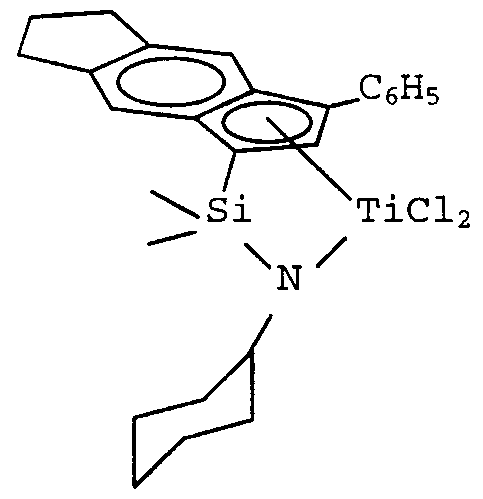
- 0 CC(*)S*c1c(C(C)C(C)C*N(C)C2CCCCC2)cc(CCC2)c2c1 Chemical compound CC(*)S*c1c(C(C)C(C)C*N(C)C2CCCCC2)cc(CCC2)c2c1 0.000 description 1
Classifications
-
- C—CHEMISTRY; METALLURGY
- C07—ORGANIC CHEMISTRY
- C07F—ACYCLIC, CARBOCYCLIC OR HETEROCYCLIC COMPOUNDS CONTAINING ELEMENTS OTHER THAN CARBON, HYDROGEN, HALOGEN, OXYGEN, NITROGEN, SULFUR, SELENIUM OR TELLURIUM
- C07F17/00—Metallocenes
-
- C—CHEMISTRY; METALLURGY
- C08—ORGANIC MACROMOLECULAR COMPOUNDS; THEIR PREPARATION OR CHEMICAL WORKING-UP; COMPOSITIONS BASED THEREON
- C08F—MACROMOLECULAR COMPOUNDS OBTAINED BY REACTIONS ONLY INVOLVING CARBON-TO-CARBON UNSATURATED BONDS
- C08F10/00—Homopolymers and copolymers of unsaturated aliphatic hydrocarbons having only one carbon-to-carbon double bond
-
- C—CHEMISTRY; METALLURGY
- C08—ORGANIC MACROMOLECULAR COMPOUNDS; THEIR PREPARATION OR CHEMICAL WORKING-UP; COMPOSITIONS BASED THEREON
- C08F—MACROMOLECULAR COMPOUNDS OBTAINED BY REACTIONS ONLY INVOLVING CARBON-TO-CARBON UNSATURATED BONDS
- C08F210/00—Copolymers of unsaturated aliphatic hydrocarbons having only one carbon-to-carbon double bond
- C08F210/02—Ethene
-
- C—CHEMISTRY; METALLURGY
- C08—ORGANIC MACROMOLECULAR COMPOUNDS; THEIR PREPARATION OR CHEMICAL WORKING-UP; COMPOSITIONS BASED THEREON
- C08F—MACROMOLECULAR COMPOUNDS OBTAINED BY REACTIONS ONLY INVOLVING CARBON-TO-CARBON UNSATURATED BONDS
- C08F210/00—Copolymers of unsaturated aliphatic hydrocarbons having only one carbon-to-carbon double bond
- C08F210/16—Copolymers of ethene with alpha-alkenes, e.g. EP rubbers
-
- C—CHEMISTRY; METALLURGY
- C08—ORGANIC MACROMOLECULAR COMPOUNDS; THEIR PREPARATION OR CHEMICAL WORKING-UP; COMPOSITIONS BASED THEREON
- C08F—MACROMOLECULAR COMPOUNDS OBTAINED BY REACTIONS ONLY INVOLVING CARBON-TO-CARBON UNSATURATED BONDS
- C08F210/00—Copolymers of unsaturated aliphatic hydrocarbons having only one carbon-to-carbon double bond
- C08F210/16—Copolymers of ethene with alpha-alkenes, e.g. EP rubbers
- C08F210/18—Copolymers of ethene with alpha-alkenes, e.g. EP rubbers with non-conjugated dienes, e.g. EPT rubbers
-
- C—CHEMISTRY; METALLURGY
- C08—ORGANIC MACROMOLECULAR COMPOUNDS; THEIR PREPARATION OR CHEMICAL WORKING-UP; COMPOSITIONS BASED THEREON
- C08F—MACROMOLECULAR COMPOUNDS OBTAINED BY REACTIONS ONLY INVOLVING CARBON-TO-CARBON UNSATURATED BONDS
- C08F2420/00—Metallocene catalysts
- C08F2420/02—Cp or analog bridged to a non-Cp X anionic donor
-
- C—CHEMISTRY; METALLURGY
- C08—ORGANIC MACROMOLECULAR COMPOUNDS; THEIR PREPARATION OR CHEMICAL WORKING-UP; COMPOSITIONS BASED THEREON
- C08F—MACROMOLECULAR COMPOUNDS OBTAINED BY REACTIONS ONLY INVOLVING CARBON-TO-CARBON UNSATURATED BONDS
- C08F4/00—Polymerisation catalysts
- C08F4/42—Metals; Metal hydrides; Metallo-organic compounds; Use thereof as catalyst precursors
- C08F4/44—Metals; Metal hydrides; Metallo-organic compounds; Use thereof as catalyst precursors selected from light metals, zinc, cadmium, mercury, copper, silver, gold, boron, gallium, indium, thallium, rare earths or actinides
- C08F4/60—Metals; Metal hydrides; Metallo-organic compounds; Use thereof as catalyst precursors selected from light metals, zinc, cadmium, mercury, copper, silver, gold, boron, gallium, indium, thallium, rare earths or actinides together with refractory metals, iron group metals, platinum group metals, manganese, rhenium technetium or compounds thereof
- C08F4/62—Refractory metals or compounds thereof
- C08F4/64—Titanium, zirconium, hafnium or compounds thereof
- C08F4/659—Component covered by group C08F4/64 containing a transition metal-carbon bond
- C08F4/65908—Component covered by group C08F4/64 containing a transition metal-carbon bond in combination with an ionising compound other than alumoxane, e.g. (C6F5)4B-X+
-
- C—CHEMISTRY; METALLURGY
- C08—ORGANIC MACROMOLECULAR COMPOUNDS; THEIR PREPARATION OR CHEMICAL WORKING-UP; COMPOSITIONS BASED THEREON
- C08F—MACROMOLECULAR COMPOUNDS OBTAINED BY REACTIONS ONLY INVOLVING CARBON-TO-CARBON UNSATURATED BONDS
- C08F4/00—Polymerisation catalysts
- C08F4/42—Metals; Metal hydrides; Metallo-organic compounds; Use thereof as catalyst precursors
- C08F4/44—Metals; Metal hydrides; Metallo-organic compounds; Use thereof as catalyst precursors selected from light metals, zinc, cadmium, mercury, copper, silver, gold, boron, gallium, indium, thallium, rare earths or actinides
- C08F4/60—Metals; Metal hydrides; Metallo-organic compounds; Use thereof as catalyst precursors selected from light metals, zinc, cadmium, mercury, copper, silver, gold, boron, gallium, indium, thallium, rare earths or actinides together with refractory metals, iron group metals, platinum group metals, manganese, rhenium technetium or compounds thereof
- C08F4/62—Refractory metals or compounds thereof
- C08F4/64—Titanium, zirconium, hafnium or compounds thereof
- C08F4/659—Component covered by group C08F4/64 containing a transition metal-carbon bond
- C08F4/65912—Component covered by group C08F4/64 containing a transition metal-carbon bond in combination with an organoaluminium compound
-
- Y—GENERAL TAGGING OF NEW TECHNOLOGICAL DEVELOPMENTS; GENERAL TAGGING OF CROSS-SECTIONAL TECHNOLOGIES SPANNING OVER SEVERAL SECTIONS OF THE IPC; TECHNICAL SUBJECTS COVERED BY FORMER USPC CROSS-REFERENCE ART COLLECTIONS [XRACs] AND DIGESTS
- Y10—TECHNICAL SUBJECTS COVERED BY FORMER USPC
- Y10S—TECHNICAL SUBJECTS COVERED BY FORMER USPC CROSS-REFERENCE ART COLLECTIONS [XRACs] AND DIGESTS
- Y10S526/00—Synthetic resins or natural rubbers -- part of the class 520 series
- Y10S526/943—Polymerization with metallocene catalysts
Definitions
- This invention relates to a class of Group 4 metal complexes and to polymerization catalysts derived therefrom that are particularly suitable for use in a polymerization process for preparing homopolymers and copolymers of olefins or diolefins, including copolymers comprising two or more olefins or diolefins such as copolymers comprising a monovinyl aromatic monomer and ethylene or copolymers comprising ethylene, propylene and a conjugated diene.
- Constrained geometry metal complexes and methods for their preparation are disclosed in U.S. Application Serial No. 545,403, filed July 3, 1990 (EP-A-416,815). This publication also teaches the preparation of certain novel copolymers of ethylene and a hindered vinyl monomer, including monovinyl aromatic monomers, having a pseudo-random incorporation of the hindered vinyl monomer therein. Additional teachings of constrained geometry catalysts may be found in U.S. Application Serial No. 547,718, filed July 3, 1990 (EP- A-468,651 ); U S Application Serial No. 702,475, filed May 20, 1991 (EP-A-514,828); U.S.
- M is titanium, zirconium or hafnium in the +2, +3 or +4 formal oxidation state
- R' and R" are independently each occurrence hydride, hydrocarbyl, silyl, germyl, halide, hydrocarbyloxy, hydrocarbylsiloxy, hydrocarbylsilyiamino, d ⁇ (hydrocarbyl)am ⁇ no, hydrocarbyleneamtno, d ⁇ (hydrocarbyl)phosph ⁇ no, hydrocarbylene-phosphino, hydrocarbylsulfido, halo-substituted hydrocarbyl, hydrocarbyloxy-substituted hydrocarbyl, silyl- substituted hydrocarbyl, hydrocarbylsiloxy-substituted hydrocarbyl, hydrocarbylsilylamino- substituted hydrocarbyl, d ⁇ (hydrocarbyl)am ⁇ no-subst ⁇ tuted hydrocarbyl, hydrocarbyleneamino- substituted hydrocarbyl, di(hydrocarbyl)phosphino-substitute
- R'" is a divalent hydrocarbylene- or substituted hydrocarbylene group forming a fused system with the remainder of the metal complex, said R'" containing from 1 to 30 nonhydrogen atoms;
- Z is a divalent moiety, or a moiety comprising one ⁇ -bond and a neutral two electron pair able to form a coordinate-covalent bond to M, said Z comprising boron, or a member of Group 14 of the Periodic Table of the Elements, and also comprising nitrogen, phosphorus, sulfur or oxygen;
- X is a monovalent anionic ligand group having up to 60 atoms exclusive of the class of ligands that are cyclic, delocalized, ⁇ -bound ligand groups;
- X' independently each occurrence is a neutral ligating compound having up to 20 atoms
- X" is a divalent anionic ligand group having up to 60 atoms
- p is zero, 1 , 2, or 3;
- q is zero, 1 or 2
- r is zero or 1.
- the above complexes may exist as isolated crystals optionally in pure form or as a mixture with other complexes, in the form of a solvated adduct, optionally in a solvent, especially an organic liquid, as well as in the form of a dimer or chelated derivative thereof, wherein the chelating agent is an organic material such as ethylenediaminetetraacetic acid (EDTA).
- EDTA ethylenediaminetetraacetic acid
- a catalyst for olefin polymerization comprising:
- olefins having greater than 3 carbon atoms copolymers of ethylene, propylene and a diene
- EPDM copolymers copolymers of ethylene and styrene
- ES polymers copolymers of ethylene, styrene, and a diene
- EPS polymers copolymers of ethylene, propylene and styrene
- the catalysts of this invention may also be supported on a support material and used in olefin polymerization processes in a slurry or in the gas phase.
- the catalyst may be prepolyme ⁇ zed with one or more olefin monomers in situ in a polymerization reactor or in a separate process with intermediate recovery of the prepolymenzed catalyst prior to the primary polymerization process.
- the neutral diene complexes are prepared by contacting the corresponding complex in the +4 or +3 oxidation state with a neutral diene in the presence of a reducing agent, preferably a group 1 or 2 metal alkyl derivative having from 1 to 6 carbons in each alkyl group in an inert diluent. It has been found that the use of from 1.0 to 2.0 equivalents of the diene in the foregoing reaction gives improved yields and purity of the desired diene complex compared to the use of larger quantities of the diene. In addition, heating the reaction mixture prior to addition of the conjugated diene reactant, preferably to a temperature from 50 to 95 °C, gives a further improvement in yield and purity.
- a reducing agent preferably a group 1 or 2 metal alkyl derivative having from 1 to 6 carbons in each alkyl group in an inert diluent.
- olefins also included are mixtures of such olefins as well as mixtures of such olefins with C4. 4o diolefin compounds. Examples of the latter compounds include ethylidenenorbomene, 1 ,4- hexadiene, and norbomadiene.
- Long chain vinyl terminated monomers may be formed during the polymerization process, for example by the phenomenon of ⁇ -hydride elimination of a proton from a growing polymer chain. This process results in incorporation of extremely long chains into the resulting polymer, i. e. long chain branching.
- the catalysts and processes herein are especially suited for use in preparation of ethylene/propylene, ethylene/1 -butene, ethylene/1 -hexene.
- EPDM polymers ethylene/styrene, and ethylene/1 -octene copolymers as well as te ⁇ olymers of ethylene, propylene and a nonconjugated diene
- EPDM polymers terpolymers of ethylene, propylene and styrene
- EPS polymers terpolymers of ethylene, styrene and a nonconjugated diene
- ESDM polymers terpolymers of ethylene, styrene and a nonconjugated diene
- Monovinyl aromatic monomers for use herein include 03.20 a ⁇ ⁇ ' substituted ethylene compounds having the formula:
- R- ] independently each occurrence is hydrogen or C1.4 alkyl, and R 2 independently each occurrence is R ⁇ or halo.
- preferred X' groups are carbon monoxide; phosphines, especially trimethyfphosphine, triethylphosphine, triphenylphosphine and bis(1 ,2- dimethylphosphino)ethane; P(OR) 3 , wherein R is C-1.20 hydrocarbyl; ethers, especially tetrahydrofuran; amines, especially pyridine, bipyridine, tetramethylethylenediamine (TMEDA), and triethylamine; olefins; and neutral conjugated dienes having from 4 to 40 carbon atoms.
- Complexes including such neutral diene X' groups are those wherein the metal is in the +2 formal oxidation state.
- R' are those corresponding to the formula:
- R' is as previously defined, most preferably hydrogen or methyl.
- X preferably is selected from the group consisting of halo, hydrocarbyl, silyl, and N,N-dialkylam ⁇ no substituted hydrocarbyl.
- the number of X groups depends on the oxidation state of M, whether Z is divalent or not and whether any neutral diene groups or divalent X" groups are present.
- the skilled artisan will appreciate that the quantity of the various substituents and the identity of Z are chosen to provide charge balance, thereby resulting in a neutral metal complex. For example, when Z is divalent, and r is zero, p is two less than the formal oxidation state of M.
- Z contains one neutral two electron coordinate-covalent bonding site
- M is in a formal oxidation state of +3
- p may equal zero and r equal 1
- p may equal 2 and r equal zero.
- Z may be a divalent ligand group
- p and r may both equal zero and one neutral ligand group may be present.
- Preferred coordination complexes used according to the present invention are complexes corresponding to the formula:
- R' is hydrocarbyl, di(hydrocarbylamino), or a hydrocarbyleneamino group, said R' having up to 20 carbon atoms, R" is C-
- M is titanium
- Y is -0-, -S-, -NR*-, -PR * -; -NR 2 *, or -PR 2 * ;
- R * each occurrence is independently hydrogen, or a member selected from hydrocarbyl, hydrocarbyloxy, silyl, halogenated alkyl, halogenated aryl, and combinations thereof, said R * having up to 20 non-hydrogen atoms, and optionally, two R* groups from Z (when R * is not hydrogen), or an R * group from Z and an R* group from Y form a ring system;
- X, X' and X" are as previously defined; p is 0, 1 or 2; q is zero or 1 ; and r is zero or 1 ; with the provis
- X is a dianionic ligand selected from the group consisting of hydrocarbadiyl, oxy hydrocarbyl, and hydrocarbylenedioxy groups, said X group having up to 30 nonhydrogen atoms,
- X is a stabilizing anionic ligand group selected from the group consisting of allyl, 2-(N,N- dimethylamino)phenyl, 2-(N,N-dimethylaminomethyl)phenyl, and 2-(N,N-dimethylamino)benzyl, and
- X' is a neutral, conjugated or nonconjugated diene, optionally substituted with one or more hydrocarbyl groups, said X' having up to 40 carbon atoms and forming a ⁇ -complex with M.
- Most preferred metal complexes are those according to the previous formula (II) or (III), wherein M, X, X', X", R' R", Z*, Y, p, q and r are as previously defined, with the proviso that:
- X is a 1 ,4- butadienyl group that forms a metallocyclopentene ring with M, when p is 1 , q and r are zero, M is in the +3 formal oxidation state, and X is 2-(N,N- d ⁇ methylammo)benzyl;
- Especially preferred coordination complexes corresponding to the previous formulas (II) and (III) are uniquely substituted depending on the particular end use thereof.
- highly useful metal complexes for use in catalyst compositions for the copolymerization of ethylene, one or more monovinyl aromatic monomers, and optionally an ⁇ -olefin or diolefin comprise the foregoing complexes (II) or (III) wherein R' is Ce-20 an '- especially phenyl, biphenyl or naphthyl, and R" is hydrogen or methyl, especially hydrogen. More preferably such complexes are 3-phenyl-subst ⁇ tuted s-indecenyl complexes corresponding to the formula:
- Highly useful metal complexes for use in catalyst compositions for the homopolyme ⁇ zation of ethylene or the copolymerization of ethylene and one or more ⁇ -olefins, especially 1 -butene, 1 -hexene or 1 -octene comprise the foregoing complexes (II) or (III) wherein R' is C-
- Y is preferably a cyclohexylamido group
- X is methyl
- p is two
- both q and r are zero.
- complexes are 2,3-d ⁇ methyl-subst ⁇ tuted s- indecenyl complexes corresponding to the formulas:
- highly useful metal complexes for use in catalyst compositions for the copolymerization of ethylene, an ⁇ -olefin and a diene, especially ethylene, propylene and a nonconjugated diene, such as ethylidenenorbornene or 1 ,4-hexadiene comprise the foregoing complexes (II) or (III) wherein R' is hydrogen, and R" is C- j .4 alkyl, especially methyl.
- 2-methyl-substituted s-indecenyl complexes corresponding to the formula:
- Illustrative metal complexes that may be employed in the practice of the present invention include:
- the complexes can be prepared by use of well known synthetic techniques.
- a reducing agent can be employed to produce the lower oxidation state complexes.
- Such a process is disclosed in WO95-00526.
- the syntheses are conducted in a suitable noninterfe ⁇ ng solvent at a temperature from -100 to 300°C, preferably from -78 to 100°C, most preferably from 0 to 50°C.
- reducing agent herein is meant a metal or compound which, under reducing conditions causes the metal M, to be reduced from a higher to a lower oxidation state
- suitable metal reducing agents are alkali metals, alkaline earth metals, aluminum and zinc, alloys of alkali metals or alkaline earth metals such as sodium/mercury amalgam and sodium/potassium alloy.
- suitable reducing agent compounds are group 1 or 2 metal hydrocarbyl compounds having from 1 to 20 carbons in each hydrocarbyl group, such as, sodium naphthalenide, potassium graphite, lithium alkyls, lithium or potassium alkadienyls; and Gngnard reagents.
- Most preferred reducing agents are the alkali metals or alkaline earth metals, especially lithium and magnesium metal.
- Suitable reaction media for the formation of the complexes include aliphatic and aromatic hydrocarbons, ethers, and cyclic ethers, particularly branched-chain hydrocarbons such as isobutane, butane, pentane, hexane, heptane, octane, and mixtures thereof; cyclic and alicyclic hydrocarbons such as cyclohexane, cycloheptane, methylcyclohexane, methylcycloheptane, and mixtures thereof; aromatic and hydrocarbyl-substituted aromatic compounds such as benzene, toluene, and xylene, C-j_4 dialkyl ethers, Ci 4 dialkyl ether derivatives of (poly)alkylene glycols, and tetrahydrofuran.
- aliphatic and aromatic hydrocarbons such as isobutane, butane, pentane, hexane, heptane,
- the diene complexes wherein the metal is in the +2 formal oxidation state can be conveniently prepared by reaction of the corresponding metal complex wherein the metal is in the +3 or +4 formal oxidation state, especially the diha de complex, with the neutral diene in the presence of a reducing agent
- a process for preparing a neutral diene complex corresponding to the formula:
- R' and R" are independently each occurrence hydride, hydrocarbyl, silyl, germyl, halide, hydrocarbyloxy, hydrocarbylsiloxy, hydrocarbylsilyiamino, d ⁇ (hydrocarbyl)am ⁇ no, hydrocarbyleneamino, d ⁇ (hydrocarbyl)phosph ⁇ no, hydrocarbylene-phosphino, hydrocarbylsulfido.
- halo-substituted hydrocarbyl hydrocarbyloxy-substituted hydrocarbyl, silyl- substituted hydrocarbyl, hydrocarbylsiioxy-substituted hydrocarbyl, hydrocarbylsilylamino- substituted hydrocarbyl, d ⁇ (hydrocarbyl)am ⁇ no-subst ⁇ tuted hydrocarbyl, hydrocarbyleneamino- substituted hydrocarbyl, d ⁇ (hydrocarbyl)phosph ⁇ no-subst ⁇ tuted hydrocarbyl, hydrocarbylene- phosphino-substituted hydrocarbyl, or hydrocarbylsulfido-substituted hydrocarbyl, said R' or R" group having up to 40 nonhydrogen atoms, and optionally two or more of the foregoing groups may together form a divalent derivative;
- R'" is a divalent hydrocarbylene- or substituted hydrocarbylene group forming a fused system with the remainder of the metal complex, said R'" containing from 1 to 30 nonhydrogen atoms;
- Z is a divalent moiety, or a moiety comprising one ⁇ -bond and a neutral two electron pair able to form a coordinate-covalent bond to M, said Z comprising boron, or a member of Group 14 of the Pe ⁇ odic Table of the Elements, and also comprising nitrogen, phosphorus, sulfur or oxygen; and
- X' independently is a neutral conjugated diene compound having up to 20 carbon atoms
- M is titanium in the +3 or +4 formal oxidation state
- R' R", R'" and Z are as previously defined;
- X is a monovending anionic ligand group having up to 60 atoms exclusive of the class of ligands that are cyclic, deiocalized, ⁇ -bound ligand groups,
- X" is a divalent anionic ligand group having up to 60 atoms
- the reagents are contacted at an elevated temperature from 50 to 95 °C rather than first contacting the reagent sat a lower temperature and then raising the reaction temperature. More particularly, it is desirable to conduct the process under conditions wherein a reaction mixture comprising the metal complex and reducing agent is heated to a temperature from 50 to 95 °C prior to adding the conjugated diene.
- the complexes are rendered catalytically active by combination with an activating cocatalyst or by use of an activating technique.
- Suitable activating cocatalysts for use herein include polymeric or oligomenc alumoxanes, especially methylalumoxane, tnisobutyl aluminum modified methylalumoxane, or isobutylalumoxane; neutral Lewis acids, such as C-1.30 hydrocarbyl substituted Group 13 compounds, especially tn(hydrocarbyl)alum ⁇ num- or tr ⁇ (hydrocarbyl)boron compounds and halogenated (including perhalogenated) derivatives thereof, having from 1 to 10 carbons in each hydrocarbyl or halogenated hydrocarbyl group, more especially perfluonnated tr ⁇ (aryl)boron compounds, and most especially tr ⁇ s(pentafluoro- phenyl)borane; nonpolymeric, compatible, noncoordinating, ion
- Combinations of neutral Lewis acids especially the combination of a t ⁇ alkylaluminum compound having from 1 to 4 carbons in each alkyl group and a halogenated tr ⁇ (hydrocarbyl)boron compound having from 1 to 20 carbons in each hydrocarbyl group, especially tr ⁇ s(pentafluorophenyl)borane, further combinations of such neutral Lewis acid mixtures with a polymeric or oligomenc alumoxane, and combinations of a single neutral Lewis acid, especially t ⁇ s(pentafluorophenyl)borane with a polymeric or oligomenc alumoxane are especially desirable activating cocatalysts.
- Preferred molar ratios of Group 4 metal complex t ⁇ s(pentafluoro-phenylborane:alumoxane are from 1 -1 :1 to 1 :10:30, more preferably from 1 1 1 5 to 1 5.10.
- Suitable ion forming compounds useful as cocatalysts in one embodiment of the present invention comprise a cation which is a Bronsted acid capable of donating a proton, and a compatible, noncoordinating anion, A .
- noncoordinating means an anion or substance which either does not coordinate to the Group 4 metal containing precursor complex and the catalytic derivative derived therefrom, or which is only weakly coordinated to such complexes thereby remaining sufficiently labile to be displaced by a neutral Lewis base.
- a noncoordinating anion specifically refers to an anion which when functioning as a charge balancing anion in a cationic metal complex does not transfer an anionic substituent or fragment thereof to said cation thereby forming neutral complexes.
- “Compatible anions” are anions which are not degraded to neutrality when the initially formed complex decomposes and are noninterfe ⁇ ng with desired subsequent polymerization or other uses of the complex.
- Preferred anions are those containing a single coordination complex comprising a charge-bearing metal or metalloid core which anion is capable of balancing the charge of the active catalyst species (the metal cation) which may be formed when the two components are combined.
- said anion should be sufficiently labile to be displaced by olefinic, diolefinic and acetylenically unsaturated compounds or other neutral Lewis bases such as ethers or nitnles
- Suitable metals include, but are not limited to, aluminum, gold and platinum.
- Suitable metalloids include, but are not limited to, boron, phosphorus, and silicon.
- Compounds containing anions which comprise coordination complexes containing a single metal or metalloid atom are, of course, well known and many, particularly such compounds containing a single boron atom in the anion portion, are available commercially.
- cocatalysts may be represented by the following general formula: (L * -H) d + (A)" '
- L * is a neutral Lewis base
- a ' is a noncoordinating, compatible anion having a charge of d-
- d is an integer from 1 to 3.
- a d" corresponds to the formula: [M'Q 4 ] ' ; wherein:
- M' is boron or aluminum in the +3 formal oxidation state
- Q independently each occurrence is selected from hydride, dialkylamido, halide, hydrocarbyl, hydrocarbyloxide, halo-substituted hydrocarbyl, halo-substituted hydrocarbyloxy, and halo- substituted silylhydrocarbyl radicals (including perhalogenated hydrocarbyl- perhalogenated hydrocarbyloxy- and perhalogenated silylhydrocarbyl radicals), said Q having up to 20 carbons with the proviso that in not more than one occurrence is Q halide.
- suitable hydrocarbyloxide Q groups are disclosed in U. S. Patent 5,296,433.
- d is one, that is, the counter ion has a single negative charge and is A " .
- Activating cocatalysts comprising boron which are particularly useful in the preparation of catalysts of this invention may be represented by the following general formula:
- B is boron in a formal oxidation state of 3
- Q is a hydrocarbyl-, hydrocarbyloxy-, fluorinated hydrocarbyl-, fluorinated hydrocarbyloxy-, or fluorinated silylhydrocarbyl- group of up to 20 nonhydrogen atoms, with the proviso that in not more than one occasion is Q hydrocarbyl.
- Preferred Lewis base salts are ammonium salts, more preferably trialkylammonium salts containing one or more C-12-40 alkyl groups.
- Q is each occurrence a fluorinated aryl group, especially, a pentafluorophenyl group.
- boron compounds which may be used as an activating cocatalyst in the preparation of the improved catalysts of this invention are
- t ⁇ -substituted ammonium salts such as: t ⁇ methylammonium tetrak ⁇ s(pentafluorophenyl) borate, t ⁇ ethylammonium tetrakis(pentafluorophenyl) borate, t ⁇ propylammonium tetrakis(pentafluorophenyl) borate, tri(n-butyl)ammon ⁇ um tetrakis(pentafluorophenyl) borate, tr ⁇ (sec-butyl)ammon ⁇ um tetrak ⁇ s(pentafluorophenyl) borate,
- dialkyl ammonium salts such as:
- t ⁇ -substituted phosphonium salts such as:
- triphenylphosphonium tetrakis(pentafluorophenyl) borate methyldioctadecylphosphonium tetrakis(pentafluorophenyl) borate, and tri(2,6-dimethylphenyl)phosphonium tetrakis(pentafluorophenyl) borate;
- di-substituted oxonium salts such as:
- di-substituted sulfonium salts such as: d ⁇ (o-tolyl)sulfon ⁇ um tetrakis(pentafluorophenyl) borate, and methylcotadecylsulfonium tetrakis(pentafluorophenyl) borate.
- Preferred (L * -H) + cations are methyldioctadecylammonium and dimethyloctadecylammonium
- Another suitable ion forming, activating cocatalyst comprises a salt of a cationic oxidizing agent and a noncoordinating, compatible anion represented by the formula:
- Ox 8* is a cationic oxidizing agent having a charge of e+
- e is an integer from 1 to 3;
- a and d are as previously defined
- cationic oxidizing agents include ferrocenium, hydrocarbyl-substituted ferrocenium, Ag + or Pb +2
- Preferred embodiments of A d are those anions previously defined with respect to the Bronsted acid containing activating cocatalysts, especially tetrak ⁇ s(pentafluorophenyl)borate.
- Another suitable ion forming, activating cocatalyst comprises a compound which is a salt of a carbenium ion and a noncoordinating, compatible anion represented by the formula:
- ⁇ + is a C ⁇ 20 carbenium ion
- A is as previously defined.
- a preferred carbenium ion is the tntyl cation, that is t ⁇ phenylmethylium.
- a further suitable ion forming, activating cocatalyst comprises a compound which is a salt of a silylium ion and a noncoordinating, compatible anion represented by the formula:
- R is C1. 10 hydrocarbyl, and X', q and A are as previously defined.
- silylium salt activating cocatalysts are t ⁇ methylsilylium tetrakispentafluorophenylborate, triethylsilylium tetrakispentafluorophenylborate and ether substituted adducts thereof.
- Silylium salts have been previously genencally disclosed in J. Chem Soc Chem. Comm , 1993, 383-384, as well as Lambert, J. B., et al., Organometallics, 1994, 13, 2430-2443
- the use of the above silylium salts as activating cocatalysts for addition polymerization catalysts is disclosed in WO96/08519 on March 21 , 1996.
- the technique of bulk electrolysis involves the electrochemical oxidation of the metal complex under electrolysis conditions in the presence of a supporting electrolyte comprising a noncoordinating, inert anion.
- solvents, supporting electrolytes and electrolytic potentials for the electrolysis are used such that electrolysis byproducts that would render the metal complex catalytically inactive are not substantially formed during the reaction.
- solvents are materials that are: liquids under the conditions of the electrolysis (generally temperatures from 0 to 100°C), capable of dissolving the supporting electrolyte, and inert "Inert solvents" are those that are not reduced or oxidized under the reaction conditions employed for the electrolysis It is generally possible in view of the desired electrolysis reaction to choose a solvent and a supporting electrolyte that are unaffected by the electrical potential used for the desired electrolysis Preferred solvents include difluorobenzene (all isomers), dimethoxyethane (DME), and mixtures thereof.
- the electrolysis may be conducted in a standard electrolytic cell containing an anode and cathode (also referred to as the working electrode and counter electrode respectively).
- Suitable materials of construction for the cell are glass, plastic, ceramic and glass coated metal.
- the electrodes are prepared from inert conductive materials, by which are meant conductive mate ⁇ als that are unaffected by the reaction mixture or reaction conditions. Platinum or palladium are preferred inert conductive materials.
- an ion permeable membrane such as a fine glass frit separates the cell into separate compartments, the working electrode compartment and counter electrode compartment.
- the working electrode is immersed in a reaction medium comprising the metal complex to be activated, solvent, supporting electrolyte, and any other materials desired for moderating the electrolysis or stabilizing the resulting complex.
- the counter electrode is immersed in a mixture of the solvent and supporting electrolyte.
- the desired voltage may be determined by theoretical calculations or experimentally by sweeping the cell using a reference electrode such as a silver electrode immersed in the cell electrolyte.
- the background cell current the current draw in the absence of the desired electrolysis, is also determined.
- the electrolysis is completed when the current drops from the desired level to the background level. In this manner, complete conversion of the initial metal complex can be easily detected.
- Suitable supporting electrolytes are salts comprising a cation and a compatible, noncoordinating anion,
- A- Preferred supporting electrolytes are salts corresponding to the formula G T A , wherein:
- G + is a cation which is nonreactive towards the starting and resulting complex
- A is as previously defined.
- Examples of cations, G + include tetrahydrocarbyl substituted ammonium or phosphonium cations having up to 40 nonhydrogen atoms.
- Preferred cations are the tetra(n- butylammonium)- and tetraethylammonium- cations.
- the cation of the supporting electrolyte passes to the counter electrode and A- migrates to the working electrode to become the anion of the resulting oxidized product.
- Either the solvent or the cation of the supporting electrolyte is reduced at the counter electrode in equal molar quantity with the amount of oxidized metal complex formed at the working electrode.
- Preferred supporting electrolytes are tetrahydrocarbylammonium salts of tetrak ⁇ s(perfluoroaryl) borates having from 1 to 10 carbons in each hydrocarbyl or perfluoroaryl group, especially tetra(n- butylammon ⁇ um)tetrak ⁇ s(pentafluorophenyl) borate.
- a further recently discovered electrochemical technique for generation of activating cocatalysts is the electrolysis of a disilane compound in the presence of a source of a noncoordinating compatible anion. This technique is more fully disclosed and claimed in the previously mentioned United States Patent application serial number 304,314, published in eqauivalent form as WO96/08519.
- electrochemical activating technique and activating cocatalysts may also be used in combination.
- An especially preferred combination is a mixture of a t ⁇ (hydrocarbyl)alum ⁇ num or tr ⁇ (hydrocarbyl)borane compound having from 1 to 4 carbons in each hydrocarbyl group with an oligomenc or polymeric alumoxane compound.
- the molar ratio of catalyst/cocatalyst employed preferably ranges from 1 :10,000 to 100:1 , more preferably from 1 :5000 to 10:1 , most preferably from 1 :1000 to 1 * 1.
- Alumoxane when used by itself as an activating cocatalyst, is employed in large quantity, generally at least 100 times the quantity of metal complex on a molar basis.
- T ⁇ s(pentafluorophenyl)borane, where used as an activating cocatalyst is employed in a molar ratio to the metal complex of form 0.5:1 to 10:1 , more preferably from 1 :1 to 6:1 most preferably from 1 :1 to 5:1.
- the remaining activating cocatalysts are generally employed in approximately equimolar quantity with the metal complex.
- the catalysts may be used to polymerize ethylenically and/or acetylenically unsaturated monomers having from 2 to 100,000 carbon atoms either alone or in combination.
- Preferred monomers include the C2-20 ⁇ -olefins especially ethylene, propylene, isobutylene, 1 -butene, 1 -pentene, 1 -hexene, 3-methyl- 1 -pentene, 4-methyl-1 -pentene, 1 -octene, 1-decene, long chain macromolecular ⁇ -olefins, and mixtures thereof.
- Other preferred monomers include styrene, C- j .4 alkyl substituted styrene, tetrafluoroethylene.
- Long chain macromolecular ⁇ -olefins are vinyl terminated polymeric remnants formed in situ dunng continuous solution polymerization reactions. Under suitable processing conditions such long chain macromolecular units are readily polymerized into the polymer product along with ethylene and other short chain olefin monomers to give small quantities of long chain branching in the resulting polymer.
- Preferred monomers include a combination of ethylene and one or more comonomers selected from monovinyl aromatic monomers, 4-v ⁇ nylcyclohexene, vinylcyclohexane, norbornadiene, ethylidene-norbornene, C3.10 aliphatic ⁇ -olefins (especially propylene, isobutylene, 1 -butene, 1 -hexene, 3-methyl-1-pentene, 4-methyl-1 -pentene, and 1 -octene), and C4.40 dienes.
- monovinyl aromatic monomers 4-v ⁇ nylcyclohexene, vinylcyclohexane, norbornadiene, ethylidene-norbornene, C3.10 aliphatic ⁇ -olefins (especially propylene, isobutylene, 1 -butene, 1 -hexene, 3-methyl-1-pentene, 4-methyl-1 -pentene
- Most preferred monomers are mixtures of ethylene and styrene; mixtures of ethylene, propylene and styrene; mixtures of ethylene, styrene and a nonconjugated diene, especially ethylidenenorbornene or 1 ,4-hexad ⁇ ene, and mixtures of ethylene, propylene and a nonconjugated diene, especially ethylidenenorbornene or 1 ,4-hexadiene.
- the polymerization may be accomplished at conditions well known in the prior art for Ziegler-Natta or Kaminsky-Sinn type polymerization reactions, that is, temperatures from 0-250°C, preferably 30 to 200°C and pressures from atmospheric to 10,000 atmospheres. Suspension, solution, slurry, gas phase, solid state powder polymerization or other process condition may be employed if desired.
- a support, especially silica, alumina, or a polymer (especially poly(tetrafluoroethyiene) or a polyolefin) may be employed, and desirably is employed when the catalysts are used in a gas phase polymerization process.
- the support is preferably employed in an amount to provide a weight ratio of catalyst (based on metal):support from 1 :100,000 to 1 :10, more preferably from 1 :50,000 to 1 :20, and most preferably from 1 :10,000 to 1 :30.
- the molar ratio of catalyst:polymer ⁇ zable compounds employed is from 10 '12 :1 to 10 "1 :1 , more preferably from 10 '9 :1 to 10 "5 :1.
- Suitable solvents use for solution polymerization are inert liquids.
- examples include straight and branched-chain hydrocarbons such as isobutane, butane, pentane, hexane, heptane, octane, and mixtures thereof; cyclic and alicyclic hydrocarbons such as cyclohexane, cycloheptane, methylcyclohexane, methylcycloheptane, and mixtures thereof; perfluonnated hydrocarbons such as perfluonnated C4.10 alkanes, and alkyl-substituted aromatic compounds such as benzene, toluene, xylene, and ethylbenzene.
- Suitable solvents also include liquid olefins which may act as monomers or comonomers.
- the catalysts may be utilized in combination with at least one additional homogeneous or heterogeneous polymerization catalyst in the same reactor or in separate reactors connected in series or in parallel to prepare polymer blends having desirable properties.
- An example of such a process is disclosed in WO 94/00500. .
- ⁇ -olefin homopolymers and copolymers having densities from 0.85 g/cm 3 to 0 96 g/cm 3 , and melt flow rates from 0.001 to 1000.0 dg/min are readily attained in a highly efficient process.
- the catalysts of the present invention are particularly advantageous for the production of ethylene homopolymers and ethylene/ ⁇ -olefm copolymers having high levels of long chain branching
- the use of the present catalyst compositions advantageously allows for the economical production of ethylene/ ⁇ -olefin copolymers having processabi ty similar to high pressure, free radical produced low density polyethylene.
- the present catalyst compositions may be advantageously employed to prepare olefin polymers having improved processing properties by polymerizing ethylene alone or ethylene/ ⁇ - olefin mixtures with low levels of a "H" branch inducing diene, such as norbornadiene, 1 ,7- octadiene, or 1 ,9-decad ⁇ ene.
- a "H" branch inducing diene such as norbornadiene, 1 ,7- octadiene, or 1 ,9-decad ⁇ ene.
- the unique combination of elevated reactor temperatures, high molecular weight (or low melt indices) at high reactor temperatures and high comonomer reactivity advantageously allows for the economical production of polymers having excellent physical properties and processabiiity.
- such polymers comprise ethylene, a C3.20 ⁇ -olefin and a "H"-branch ⁇ ng comonomer.
- such polymers are produced in a solution process, most preferably
- the catalyst composition may be prepared as a homogeneous catalyst by addition of the requisite components to a solvent in which polymerization will be carried out by solution polymerization procedures.
- the catalyst composition may also be prepared and employed as a heterogeneous catalyst by adsorbing the requisite components on an inert inorganic or organic particulated solid.
- a heterogeneous catalyst is prepared by co- precipitating the metal complex, an inert, inorganic compound and an activator, especially an ammonium salt of a hydroxyaryl(tr ⁇ spentafluorophenyi)borate, such as an ammonium salt of (4- hydroxy-3,5-d ⁇ tert ⁇ arybutylphenyl)(tr ⁇ spentafluorophenylborate.
- a preferred inert, inorganic compound for use in this embodiment is a tn (Ci 4 alkyl) aluminum compound.
- the catalyst composition When prepared in heterogeneous or supported form, the catalyst composition is employed in a slurry or gas phase polymerization.
- slurry polymerization takes place in liquid diluents in which the polymer product is substantially insoluble
- the diluent for slurry polymerization is one or more hydrocarbons with less than 5 carbon atoms.
- saturated hydrocarbons such as ethane, propane or butane may be used in whole or part as the diluent.
- the ⁇ -olefin monomer or a mixture of different ⁇ -olefin monomers may be used in whole or part as the diluent.
- at least a major part of the diluent comprises the ⁇ -olefin monomer or monomers to be polymerized
- the catalyst components and catalysts must be prepared and recovered in an oxygen and moisture free atmosphere.
- the reactions are performed in the presence of an dry, inert gas such as, for example, nitrogen
- the polymerization may be carried out as a batchwise or a continuous polymerization process
- a continuous process is preferred, in which event catalyst, ethylene, comonomer, and optionally solvent are continuously supplied to the reaction zone and polymer product continuously removed therefrom.
- one means for carrying out such a polymerization process is as follows: In a stirred-tank reactor, the monomers to be polymerized are introduced continuously together with solvent and an optional chain transfer agent.
- the reactor contains a liquid phase composed substantially of monomers together with any solvent or additional diluent and dissolved polymer. If desired, a small amount of a "H"- branch inducing diene such as norbornadiene, 1 ,7-octad ⁇ ene or 1 ,9-decad ⁇ ene may also be added.
- Catalyst and cocatalyst are continuously introduced in the reactor liquid phase.
- the reactor temperature and pressure may be controlled by adjusting the solvent/monomer ratio, the catalyst addition rate, as well as by cooling or heating coils, jackets or both.
- the polymerization rate is controlled by the rate of catalyst addition.
- the ethylene content of the polymer product is determined by the ratio of ethylene to comonomer in the reactor, which is controlled by manipulating the respective feed rates of these components to the reactor.
- the polymer product molecular weight is controlled, optionally, by controlling other polymerization variables such as the temperature, monomer concentration, or by the previously mention chain transfer agent, such as a stream of hydrogen introduced to the reactor, as is well known in the art.
- the reactor effluent is contacted with a catalyst kill agent such as water.
- the polymer solution is optionally heated, and the polymer product is recovered by flashing off gaseous monomers as well as residual solvent or diluent at reduced pressure, and, if necessary, conducting further devolatihzation in equipment such as a devolati zing extruder.
- the mean residence time of the catalyst and polymer in the reactor generally is from 5 minutes to 8 hours, and preferably from 10 minutes to 6 hours.
- the process of the present invention can be employed to advantage in the gas phase copolymerization of olefins
- Gas phase processes for the polymerization of olefins, especially the homopolyme ⁇ zation and copolymerization of ethylene and propylene, and the copolymerization of ethylene with higher ⁇ -olefins such as, for example, 1 -butene, 1 -hexene, 4- methyl-1 -pentene are well known in the art.
- cooling of the reactor may be provided by the use of recycle gas, which is fed as a volatile liquid to the bed to provide an evaporative cooling effect.
- the volatile liquid employed in this case can be, for example, a volatile inert liquid, for example, a saturated hydrocarbon having 3 to 8, preferably 4 to 6, carbon atoms.
- a volatile inert liquid for example, a saturated hydrocarbon having 3 to 8, preferably 4 to 6, carbon atoms.
- the monomer or comonomer itself is a volatile liquid (or can be condensed to provide such a liquid) this can be fed to the bed to provide an evaporative cooling effect.
- olefin monomers which can be employed in this manner are olefins containing three to eight, preferably three to six carbon atoms.
- the volatile liquid evaporates in the hot fluidized bed to form gas which mixes with the fluidizing gas. If the volatile liquid is a monomer or comonomer, it will undergo some polymerization in the bed.
- the evaporated liquid then emerges from the reactor as part of the hot recycle gas, and enters the compression/heat exchange part of the recycle loop.
- the recycle gas is cooled in the heat exchanger and, if the temperature to which the gas is cooled is below the dew point, liquid will condense from the gas.
- This liquid is desirably recycled continuously to the fluidized bed. It is possible to recycle the condensed liquid to the bed as liquid droplets carried in the recycle gas stream. This type of process is described, for example in EP 89691 ; U.S. 4,543,399; WO 94/25495 and U.S. 5,352,749.
- a particularly preferred method of recycling the liquid to the bed is to separate the liquid from the recycle gas stream and to reinject this liquid directly into the bed, preferably using a method which generates fine droplets of the liquid within the bed. This type of process is described in BP Chemicals' WO 94/28032.
- the polymerization reaction occurring in the gas fluidized bed is catalyzed by the continuous or semi-continuous addition of catalyst.
- catalyst can be supported on an inorganic or organic support material as described above.
- the polymer is produced directly in the fluidized bed by catalyzed copolymerization of the monomer and one or more comonomers on the fluidized particles of catalyst, supported catalyst or prepolymer within the bed.
- Start-up of the polymerization reaction is achieved using a bed of preformed polymer particles, which are preferably similar to the target polyolefin, and conditioning the bed according to techniques that are well known in the art.
- Such processes are used commercially on a large scale for the manufacture of high density polyethylene (HDPE), medium density polyethylene (MDPE), linear low density polyethylene (LLDPE) and polypropylene.
- the gas phase process employed can be, for example, of the type which employs a mechanically stirred bed or a gas fluidized bed as the polymerization reaction zone.
- Preferred is the process wherein the polymerization reaction is carried out in a vertical cylindrical polymerization reactor containing a fluidized bed of polymer particles supported above a perforated plate, the fluidization grid, by a flow of fluidization gas.
- the gas employed to fluidize the bed comprises the monomer or monomers to be polymerized, and also serves as a heat exchange medium to remove the heat of reaction from the bed
- the hot gases emerge from the top of the reactor, normally via a tranquilization zone, also known as a velocity reduction zone, having a larger cross-sectional area than the fluidized bed and wherein fine particles entrained in the gas stream have an opportunity to gravitate back into the bed. It can also be advantageous to use a cyclone to remove ultra-fine particles from the hot gas stream.
- the gas is then normally recycled to the bed by means of a blower or compressor and one or more heat exchangers to strip the gas of the heat of polymerization.
- the produced polymer is discharged continuously or discontmuously from the fluidized bed as desired.
- the gas phase processes suitable for the practice of this invention are preferably continuous processes which provide for the continuous supply of reactants to the reaction zone of the reactor and the removal of products from the reaction zone of the reactor, thereby providing a steady-state environment on the macro scale in the reaction zone of the reactor.
- the fluidized bed of the gas phase process is operated at temperatures greater than 50°C, preferably from 60°C to 110°C, more preferably from 70°C to 110°C.
- the molar ratio of comonomer to monomer used in the polymerization depends upon the desired density for the composition being produced and is 0.5 or less. Desirably, when producing materials with a density range of from 0.91 to 0.93 the comonomer to monomer ratio is less than 0.2, preferably less than 0.05, even more preferably less than 0.02, and may even be less than 0.01. Typically, the ratio of hydrogen to monomer is less than 0.5, preferably less than 0.2, more preferably less than 0.05, even more preferably less than 0 02 and may even be less than 0.01.
- the above-described ranges of process variables are appropriate for the gas phase process of this invention and may be suitable for other processes adaptable to the practice of this invention.
- s-lndacen-1 ,2,3,5-tetrahydro-6-methyl (25.000 g, 0.14684 moles) was stirred in hexane (400 mL) as nBuLi (0.17621 moles, 70.48 mL of 2.5 M solution in hexane) was added slowly This mixture was then allowed to stir 16 hours during which time a solid precipitated. After the reaction period the mixture was filtered resulting in the isolation of the desired product as a pale yellow solid which was used without further purification or analysis (24.3690 g, 94.2 percent).
- N-(1 ,1-d ⁇ methylethyl)-1 ,1-d ⁇ methyl-1-(1 ,5,6,7-tetrahydro-2-methyl-s- ⁇ ndacen-1- yl)s ⁇ lanam ⁇ ne 8.00 g, 0.2671 moles was stirred in hexane (110 mL) as nBuLi (0.05876 moles, 23.5 mL of 2.5 M solution in hexane) was added dropwise. This mixture was then allowed to stir 16 hours. After the reaction period the desired product was isolated as a light yellow solid via filtration which was used without further purification or analysis (6.22 g, 75 percent).
- Chlorodimethyl(1 ,5,6,7-tetrahydro-2,3-dimethyl-s-indacen-1-yl) silane (3.537 g, 0.01217 moles) was stirred in hexane (50 mL) as NEt 3 (1.94 g, 0.01916 moles) and t- butylamine (1.12 g, 0.01533 moles) were added. This mixture was allowed to stir 16 hours. After the reaction period the mixture was filtered and the volatiles removed resulting in the isolation of the desired product as a light yellow oil (3.537 g, 88.6 percent).
- N-(1 ,1-dimethylethyl)-1 ,1 -dimethyl-1-(1 ,5,6,7-tetrahydro-2,3-dimethyl-s-indacen-1- yl)silanamine (3.461 g, 0.01107 moles) was stirred in hexane (100 mL) as nBuLi (0.02325 moles, 14.5 mL of 1.6 M solution in hexane) was added slowly. This mixture was then allowed to stir 16 hours. After the reaction period the volatiles were removed and the desired product was isolated as an orange glassy solid which was used without further purification or analysis (3.853 g, product still contained hexane).
- Chlorod ⁇ methyl(1 ,5,6,7-tetrahydro-2,3-d ⁇ methyl-s- ⁇ ndacen-1 -yl)s ⁇ lane (5.00 g, 0.01806 moles) was stirred in hexane (80 mL) as NEt 3 (3.29 g, 0.03251 moles) and t-cyclohexylamme (1.81 g, 0.01824 moles) were added. This mixture was allowed to stir 16 hours. After the reaction pe ⁇ od the mixture was filtered and the volatiles removed resulting in the isolation of the desired product as a yellow oil (5.55 g, 90.9 percent).
- N-(cyclohexyl)-1 ,1 -d ⁇ methyl-1 -(1 ,5,6,7-tetrahydro-2,3-d ⁇ methyl-s- ⁇ ndacen-1 - yl)s ⁇ lanam ⁇ ne was stirred in hexane (75 mL) as n-BuLi (0.03454 moles, 13.8 mL of 2.5 M solution in hexane) was added slowly. This mixture was then allowed to stir for 72 hours. After the reaction period the hexane was decanted away and the volatiles were removed resulting in the isolation of the desired product as an orange glassy solid which was used without further purification or analysis (5.56 g, 99.9 percent).
- s-lndacen-1 ,2,3,5-tetrahydro-6-methyl-7-phenyl (18.90 g, 0.07672 moles) was stirred in hexane (200 mL) as nBuLi (0.10 moles, 50.00 mL of 2.0 M solution in cyclohexane) was slowly added. This mixture was then allowed to stir 16 hours. After the reaction period the solid was collected via suction filtration as an off-white powder which was used without further purification or analysis (17.8305 g, 92.1 percent).
- Chlorod ⁇ methyl(1 ,5,6,7-tetrahydro-2-methyl-3-phenyl-s- ⁇ ndacen-1 -yl)s ⁇ lane (5.3483 g, 0.01578 moles) was stirred in hexane (100 mL) as NEt 3 (2.2579 g, 0.02231 moles) and t- butylamine (1.9898 g, 0.02721 moles) were added. This mixture was allowed to stir for 24 hours. After the reaction period the mixture was filtered and the volatiles removed resulting in the isolation of the desired product as a yellow oil (5.4118 g, 91.3 percent).
- N-(1 , 1 -d ⁇ methylethyl)-1 , 1 -d ⁇ methyl-1 -(1 ,5,6,7-tetrahydro-2-methyl-3-phenyl-s- ⁇ ndacen- 1-yl)s ⁇ lanam ⁇ ne (5.4118 g, 0.01441 moles) was stirred in hexane (100 mL) as nBu ⁇ (0.032 moles, 16.00 mL of 2.0 M solution in cyclohexane) was added slowly. This mixture was then allowed to stir 16 hours. After the reaction period the desired product was isolated as a pale yellow solid via filtration which was used without further purification or analysis (5.2255 g, 93.6 percent).
- N-(cyclohexyl)-1 ,1 -dimethyl-1-(1 ,5,6,7-tetrahydro-2-methyl-3-phenyl-s-indacen-1- yl)silanamine (5.8969 g, 0.01468 moles) was stirred in hexane (100 mL) as nBuLi (0.032 moles, 16.00 mL of 2.0 M solution in cyclohexane) was added slowly. This mixture was then allowed to stir 16 hours during which time a sticky precipitate formed. The volatiles were then removed and the resulting pale yellow solid slurried in cold hexane. After the reaction period the solid was collected via suction filtration as a yellow powder which was used without further purification or anaiysis (5.3101 g, 87.5 percent).
- Indan (94.00 g, 0.7954 moles) and 3-chloroprop ⁇ onyl chloride (100.99 g, 0.7954 moles) were stirred in CH 2 CI 2 (300 mL) at 0 °C as AICI 3 (130.00 g, 0.9750 moles) was added slowly under a nitrogen flow. The mixture was then allowed to stir at 20-25 °C for 2 hours. The volatiles were then removed. The mixture was then cooled to 0 °C and concentrated
- H 2 S0 4 500 mL slowly added resulting in formation of a precipitate .
- the mixture was then left under nitrogen for 16 hours at 20-25 °C.
- the mixture was then heated to 90 °C while stirring. After 2 hours crushed ice was added and the mixture agitated.
- the mixture was then transferred to a beaker and washed with H 2 0 and diethylether. The fractions were filtered and combined.
- the mixture was extracted with H 2 0 (2 x 200 mL). The organic layer was then separated and the volatiles removed.
- the desired product was then isolated via recrystallization from hexane at 0 °C as pale yellow crystals (22.36 g, 16.3 percent).
- Chlorod ⁇ methyl(1 ,5,6,7-tetrahydro-3-phenyl-s- ⁇ ndacen-1-yl)s ⁇ lane (10.8277 g, 0.03322 moles) was stirred in hexane (150 mL) as NEt 3 (3.5123 g, 0.03471 moles) and t-butylamine (2.6074 g, 0.03565 moles) were added. This mixture was allowed to stir for 24 hours. After the reaction period the mixture was filtered and the volatiles removed resulting in the isolation of the desired product as a thick red-yellow oil (10.6551 g, 88.7 percent).
- N-(1 ,1 -d ⁇ methylethyl)-1 ,1 -d ⁇ methyl-1 -(1 ,5,6,7-tetrahydro-3-phenyl-s- ⁇ ndacen-1 - yl)s ⁇ laneam ⁇ ne (10.6551 g, 0.02947 moles) was stirred in hexane (100 mL) as nBuLi (0.070 moles, 35.00 mL of 2.0 M solution in cyclohexane) was added slowly This mixture was then allowed to stir 16 hours during which time no salts crashed out of the dark red solution. After the reaction period the volatiles were removed and the residue quickly washed with hexane (2 x 50 mL) The dark red residue was then pumped dry and used without further purification or analysis (9 6517 g, 87 7 percent).
- Chlorod ⁇ methyl(1 ,5,6,7-tetrahydro-3-phenyl-s- ⁇ ndacen-1 -yl) silane (3.8523 g, 0.01182 moles) was stirred in hexane (100 mL) as NEt 3 (1.5136 g, 0.01496 moles) and cyclohexylamine (1.2107 g, 0.01221 moles) were added. This mixture was allowed to stir for 24 hours. After the reaction period the mixture was filtered and the volatiles removed resulting in the isolation of the desired product as a yellow oil (4.3313 g, 94.5 percent).
- N-(1 ,1 -dimethylethyl)-1 ,1 -dimethyl-1-(5,6,7,8-tetrahydro-5,5,8,8-tetramethyl-3-phenyl- 1 H-Benz(f)inde-1-yl)-silanamine (1.0037 g, 0.002325 moles) was stirred in hexane (50 mL) as n-BuLi (0.00475 moles, 1.90 mL of 2.5 M solution in hexane) was added. This mixture was then allowed to stir 16 hours.
- the decanted portion was transferred to an extraction funnel and washed with 1 M HCI (1 x 200 mL), saturated NaHC0 3 (2 x 200 mL), and H 2 0 (1 x 200 mL). The organic fraction was then dried over MgS0 4 . The mixture was then filtered and the volatiles removed from the filtrate resulting in the isolation of the desired product as a clear colorless oil (53.10 g, 82.5 percent yield).
- N-(1 ,1 -Dimethylethyl)-5,6,7,8-tetrahydro-1 ,1-dimethyl-1-(2,5,5,8,8-pentamethyl-1 H- benz(f)inden-1 -yl)siianamine (5.049 g, 13.66 mmol) was stirred in hexane (75 mL) as n-BuLi (29.08 mmol, 14.54 mL of 2.0 M solution in cyclohexane) was added dropwise. After 2 hours this mixture was clear and yellow but had become extremely viscous. Diethylether (10 mL) was added to this mixture resulting in a decrease of the viscosity of the solution and the precipitation of a yellow solid.
- reaction conditions of example 22 are substantially repeated excepting that 15 equivalents of 1 ,3-pentad ⁇ ene (1.08 mL, 10.81 mmol) instead of the 10 equivalents of hexadiene and two equivalents of a 2.5 M hexane solution of n-BuLi (0.58 mL, 1.44 mmol) instead of the 2.25 equivalents of the 2 0 M Et 2 0 solution of n-BuMgCI is used.
- the reflux time is increased to three hours.
- 0.257g of a brown oily solid (86 percent yield) of the desired product is obtained.
- the product is isolated as a mixture of the prone and supine isomers resulting from the orientation of 1 ,3-pentad ⁇ ene.
- the flask is fitted with a condenser, stirred for 45 minutes at 20 °C and heated to reflux for 2.5 hours. Upon cooling, the mixture was filtered using a 0.45 ⁇ M pore size polytetrafluoroethylene filter. The volatiles are removed under reduced pressure to afford 0.606 g of product as a black oily solid, in 99 percent yield.
- Example 25 The conditions of Example 25 were substantially repeated using 0.9g, (1.88 mmol) of (t-butylam ⁇ do)d ⁇ methyl( ⁇ 5 -3-phenyl-s- ⁇ ndacen-1-yl)s ⁇ lanet ⁇ tan ⁇ um dichlo ⁇ de, one and one half molar equivalents of 1 ,3-pentad ⁇ ene (0.3 mL), and 2.1 molar equivalents of n-butyllithium (2.5 mL of a 1 60M solution in hexanes). The flask is again fitted with a condenser and heated to reflux for 4 hours.
- Example 25 Upon cooling, the mixture was filtered using diatomaceous earth filter aid and a glass frit filter and the residue washed twice with 10 mL mixed hexanes. The volatiles were removed from the combined filtrates under reduced pressure to afford 0.777 g of the product as a dark, olive green solid containing 48 mole percent of the desired metal complex (85 weight percent yield). The product purity was higher than the product obtained in Example 25.
- a two-liter Parr reactor is charged with approximately 360 g of Isopar-ETM mixed alkanes solvent (available from Exxon Chemicals Inc.) and 460 g of styrene comonomer.
- Hydrogen is added as a molecular weight control agent by differential pressure expansion from a 75 mL addition tank at 25 psid (2070 kPa).
- the reactor is heated to 90 °C and saturated with ethylene at 200 psig (1.4 MPa).
- the appropriate amount of catalyst and cocatalyst as 0.005M solutions in toluene (approximately 2 ⁇ mole) are premixed in the drybox to give a 1 :1 molar ratio of catalyst and cocatalyst.
- Example 10 102 8.5 2
- Example 14 283 19.9
- Example 16 90 18.6 kilograms po lymer per gram mole percent styrene * MAO cocatalyst
- a stirred 3.8 liter reactor was charged with 1440 g of Isopar-ETM mixed alkanes solvent (available from Exxon Chemicals Inc.) and 126 g of 1 -octene comonomer. Hydrogen was added as a molecular weight control agent by differential pressure expansion from a 75 mL addition tank at 25 psid (2070 kPa). The reactor was heated to the polymerization temperature of 130 S C and saturated with ethylene at 450 psig (3.1 MPa).
- Example 2 1 ,800 0.44 5
- Example 6 3,500 0.43 6
- Example 8 700 0.3 kilograms polymer per gram Ti melt index l 2 dg/min
- a 2.0 liter Parr reactor is charged with approximately 740 g of Isopar-E mixed alkanes solvent (available from Exxon Chemicals Inc.) and 118 g of 1 -octene comonomer. Hydrogen was added as a molecular weight control agent by differential pressure expansion from a 75 mL addition tank at 25 psid (2070 kPa). The reactor was heated to the polymerization temperature of 140°C and saturated with ethylene at 500 psig. Then 0.5 ⁇ mol each of catalyst and B(C 6 F 5 ) 3 cocatalyst as 0 005 M solutions in toluene were premixed in a drybox, transferred to a catalyst addition tank, and injected into the reactor.
- Isopar-E mixed alkanes solvent available from Exxon Chemicals Inc.
- Hydrogen was added as a molecular weight control agent by differential pressure expansion from a 75 mL addition tank at 25 psid (2070 kPa).
- TCTP (t-butylam ⁇ do)d ⁇ methyl(tetramethylcyclo-pentad ⁇ enyl)t ⁇ tan ⁇ um (II) 1 ,3- pentadiene Kg polymer/g Ti g/mL
- Ethylene, propylene, and ethy dene norbornene (EPDM) terpolymer compositions are prepared using in a 23 L stirred, oil jacketed, autoclave reactor designed for continuous addition of reactants and continuous removal of polymer solution, devolati zation and polymer recovery, operating at 475 psig (3.3 MPa) pressure and 90 C C temperature.
- the metal complex used was prepared according to Example 1.
- the metal complex used was a comparative complex, (t- butylam ⁇ do)d ⁇ methyl(tetramethylcyclopentad ⁇ enyl)s ⁇ lanet ⁇ tan ⁇ um 1 ,3-pentad ⁇ ene.
- Ethylene flows for all polyme ⁇ zations was 1 1 kg/h
- Propylene flows for all polymerizations was 1.6 kg/h.
- Hydrogen, added as a molecular weight control agent was added at a flow rate of 26 scc/mm.
- the cocatalyst for all polymerizations was a combination of t ⁇ spentafluorophenyl-borane (FAB) and modified methylalumoxane (MMAO available from Akzo Nobel).
- ethylene, propylene, and hydrogen were combined into a single stream before being introduced into a diluent mixture comprising a mixed alkane solvent (Isopar-ETM, available from Exxon Chemicals Inc.) and ethy dene norbornene (ENB) to form a combined feed mixture that was continuously injected into the reactor.
- a diluent mixture comprising a mixed alkane solvent (Isopar-ETM, available from Exxon Chemicals Inc.) and ethy dene norbornene (ENB) to form a combined feed mixture that was continuously injected into the reactor.
- the metal complex and the cocatalyst mixture were similarly combined in the same diluent and also continuously injected into the reactor.
- the reactor exit stream was continuously removed from the reactor, injected with catalyst kill (water) and hindered bisphenol antioxidant, and introduced into a separator, where molten polymer was continuously separated from the unreacted monomers, hydrogen, and diluent.
- the molten polymer was fed to an extruder, formed into strands, cooled, pelletized and collected for analysis. Details of processing conditions and polymer properties are contained in Table 4.
- the resulting polymers not only have significantly increased Mooney viscosity compared to the control, thereby indicating increased molecular weight, especially for run 13 using a titanium catalyst wherein the metal is in the +2 formal oxidation state, but the catalyst and cocatalyst efficiencies for the catalysts of the invention in preparing such polymers under essentially equivalent process rates and condtions were significantly improved.
Landscapes
- Chemical & Material Sciences (AREA)
- Organic Chemistry (AREA)
- Health & Medical Sciences (AREA)
- Chemical Kinetics & Catalysis (AREA)
- Medicinal Chemistry (AREA)
- Polymers & Plastics (AREA)
- Transition And Organic Metals Composition Catalysts For Addition Polymerization (AREA)
- Addition Polymer Or Copolymer, Post-Treatments, Or Chemical Modifications (AREA)
Abstract
Description




Claims


Priority Applications (9)
| Application Number | Priority Date | Filing Date | Title |
|---|---|---|---|
| AU53626/98A AU726100B2 (en) | 1996-12-19 | 1997-11-21 | Fused ring substituted indenyl metal complexes and polymerization process |
| JP52771998A JP3427302B2 (en) | 1996-12-19 | 1997-11-21 | Fused ring substituted indenyl metal complex and polymerization method |
| BRPI9714571-8A BR9714571B1 (en) | 1996-12-19 | 1997-11-21 | metal complex, catalyst for olefin polymerization, process for olefin polymerization and process for preparing a neutral diene complex. |
| CA002268440A CA2268440C (en) | 1996-12-19 | 1997-11-21 | Fused ring substituted indenyl metal complexes and polymerization process |
| DE69707306T DE69707306T2 (en) | 1996-12-19 | 1997-11-21 | METAL COMPLEXES CONTAINING CONDENSED INDENYL DERIVATIVES, AND POLYMERIZATION PROCESS |
| KR10-1999-7005558A KR100500093B1 (en) | 1996-12-19 | 1997-11-21 | Fused Ring Substituted Indenyl Metal Complexes And Polymerization Process |
| AT97950689T ATE206713T1 (en) | 1996-12-19 | 1997-11-21 | METAL COMPLEXES CONTAINING CONDENSED INDENYL DERIVATIVES AND POLYMERIZATION PROCESSES |
| EP97950689A EP0946575B1 (en) | 1996-12-19 | 1997-11-21 | Fused ring substituted indenyl metal complexes and polymerization process |
| NO19992993A NO324380B1 (en) | 1996-12-19 | 1999-06-18 | Condensed ring-substituted-idenyl-metal complexes and the polymerization process thereof |
Applications Claiming Priority (4)
| Application Number | Priority Date | Filing Date | Title |
|---|---|---|---|
| US3481796P | 1996-12-19 | 1996-12-19 | |
| US60/034,817 | 1996-12-19 | ||
| US08/949,505 | 1997-10-14 | ||
| US08/949,505 US5965756A (en) | 1996-12-19 | 1997-10-14 | Fused ring substituted indenyl metal complexes and polymerization process |
Publications (1)
| Publication Number | Publication Date |
|---|---|
| WO1998027103A1 true WO1998027103A1 (en) | 1998-06-25 |
Family
ID=26711411
Family Applications (1)
| Application Number | Title | Priority Date | Filing Date |
|---|---|---|---|
| PCT/US1997/021585 Ceased WO1998027103A1 (en) | 1996-12-19 | 1997-11-21 | Fused ring substituted indenyl metal complexes and polymerization process |
Country Status (18)
| Country | Link |
|---|---|
| US (2) | US5965756A (en) |
| EP (1) | EP0946575B1 (en) |
| JP (1) | JP3427302B2 (en) |
| KR (1) | KR100500093B1 (en) |
| CN (1) | CN1093543C (en) |
| AR (1) | AR010799A1 (en) |
| AT (1) | ATE206713T1 (en) |
| AU (1) | AU726100B2 (en) |
| BR (1) | BR9714571B1 (en) |
| CA (1) | CA2268440C (en) |
| DE (1) | DE69707306T2 (en) |
| ES (1) | ES2162339T3 (en) |
| ID (1) | ID22003A (en) |
| MY (1) | MY117028A (en) |
| NO (1) | NO324380B1 (en) |
| TR (1) | TR199901403T2 (en) |
| TW (1) | TW513448B (en) |
| WO (1) | WO1998027103A1 (en) |
Cited By (22)
| Publication number | Priority date | Publication date | Assignee | Title |
|---|---|---|---|---|
| WO2000026268A1 (en) * | 1998-11-02 | 2000-05-11 | Du Pont Dow Elastomers L.L.C. | SHEAR THINNING ETHYLENE/α-OLEFIN INTERPOLYMERS AND THEIR PREPARATION |
| WO2000035929A1 (en) * | 1998-12-14 | 2000-06-22 | Fina Research S.A. | Bimetallic metallocene catalyst for isotactic polypropylene polymerisation |
| WO2001014434A1 (en) * | 1999-08-19 | 2001-03-01 | Dupont Dow Elastomers L.L.C. | Process for preparing in a single reactor polymer blends having a broad molecular weight distribution |
| WO2002038270A1 (en) * | 2000-11-13 | 2002-05-16 | Basell Polyolefine Gmbh | Catalyst system for the polymerization of olefins |
| EP1070072A4 (en) * | 1999-02-05 | 2002-09-25 | Boulder Scient Co | SYNTHESIS OF SILYL AND N-SILYL COMPOUNDS |
| EP1120424A3 (en) * | 2000-01-28 | 2002-10-16 | Bayer Ag | Organometallic compounds with annelated indenyl ligands |
| US6680361B1 (en) * | 1998-11-02 | 2004-01-20 | Dupont Dow Elastomers Llc | Shear thinning ethylene/α-olefin interpolymers and their preparation |
| EP1383810A2 (en) * | 2001-03-27 | 2004-01-28 | Union Carbide Chemicals & Plastics Technology Corporation | Gas phase process for polymers with group 4 metal complex catalyst addition |
| US7049453B2 (en) | 2002-03-23 | 2006-05-23 | Celanese Ventures Gmbh | “Constrained geometry” metallocenes, method for the production thereof and use of the same for the polymerisation of olefins |
| US8124707B2 (en) | 2003-07-09 | 2012-02-28 | Dsm Ip Assets B.V. | Process for the production of a polymer comprising monomeric units of ethylene, an A-olefin and a vinyl norbornene |
| US9796795B2 (en) | 2015-01-14 | 2017-10-24 | Exxonmobil Chemical Patents Inc. | Tetrahydroindacenyl catalyst composition, catalyst system, and processes for use thereof |
| US9803037B1 (en) | 2016-05-03 | 2017-10-31 | Exxonmobil Chemical Patents Inc. | Tetrahydro-as-indacenyl catalyst composition, catalyst system, and processes for use thereof |
| WO2017192226A1 (en) | 2016-05-03 | 2017-11-09 | Exxonmobil Chemical Patents Inc. | Tetrahydroindacenyl catalyst composition, catalyst system, and processes for use thereof |
| US10703838B2 (en) | 2017-10-31 | 2020-07-07 | Exxonmobil Chemical Patents Inc. | Mixed catalyst systems with four metallocenes on a single support |
| US10717790B2 (en) | 2015-04-20 | 2020-07-21 | Exxonmobil Chemical Patents Inc. | Catalyst composition comprising fluorided support and processes for use thereof |
| US10807998B2 (en) | 2017-01-13 | 2020-10-20 | Exxonmobil Chemical Patents Inc. | Bridged bis(indenyl) transitional metal complexes, production, and use thereof |
| US10894841B2 (en) | 2018-03-19 | 2021-01-19 | Exxonmobil Chemical Patents Inc. | Processes for producing high propylene content PEDM having low glass transition temperatures using tetrahydroindacenyl catalyst systems |
| WO2021011892A1 (en) | 2019-07-17 | 2021-01-21 | Exxonmobil Chemical Patents Inc. | High propylene content ep having low glass transition temperatures |
| US10927207B2 (en) | 2018-04-06 | 2021-02-23 | Exxonmobil Chemical Patents Inc. | Thermoplastic vulcanizate compositions |
| WO2021173361A1 (en) | 2020-02-24 | 2021-09-02 | Exxonmobil Chemical Patents Inc. | Ansa-bis(inden-2-yl) catalysts for producing vinylidene-terminated polyalphaolefins |
| EP3768740A4 (en) * | 2018-03-19 | 2021-12-29 | ExxonMobil Chemical Patents Inc. | Processes for producing high propylene content pedm using tetrahydroindacenyl catalyst systems |
| US11472828B2 (en) | 2019-10-11 | 2022-10-18 | Exxonmobil Chemical Patents Inc. | Indacene based metallocene catalysts useful in the production of propylene polymers |
Families Citing this family (90)
| Publication number | Priority date | Publication date | Assignee | Title |
|---|---|---|---|---|
| US6420507B1 (en) * | 1997-05-01 | 2002-07-16 | The Dow Chemical Company | Olefin polymers prepared with substituted indenyl containing metal complexes |
| US6635715B1 (en) | 1997-08-12 | 2003-10-21 | Sudhin Datta | Thermoplastic polymer blends of isotactic polypropylene and alpha-olefin/propylene copolymers |
| US7232871B2 (en) | 1997-08-12 | 2007-06-19 | Exxonmobil Chemical Patents Inc. | Propylene ethylene polymers and production process |
| US6921794B2 (en) | 1997-08-12 | 2005-07-26 | Exxonmobil Chemical Patents Inc. | Blends made from propylene ethylene polymers |
| AU4962399A (en) | 1998-07-01 | 2000-01-24 | Exxon Chemical Patents Inc. | Elastic blends comprising crystalline polymer and crystallizable polymers of propylene |
| CA2646567A1 (en) * | 1999-12-10 | 2001-06-14 | Dow Global Technologies Inc. | Substituted group 4 metal complexes, catalysts and olefin polymerization process |
| US6825295B2 (en) * | 1999-12-10 | 2004-11-30 | Dow Global Technologies Inc. | Alkaryl-substituted group 4 metal complexes, catalysts and olefin polymerization process |
| US6723675B1 (en) * | 2000-05-25 | 2004-04-20 | Univation Technologies, Llc | Catalyst for the production of olefin polymers |
| MY137183A (en) * | 2001-03-16 | 2009-01-30 | Dow Global Technologies Inc | Method of making interpolymers and products made therefrom |
| EP1390417B1 (en) | 2001-04-12 | 2010-10-20 | ExxonMobil Chemical Patents Inc. | Process for polymerizing propylene and ethylene in solution |
| US6946531B2 (en) * | 2001-05-14 | 2005-09-20 | Dow Global Technologies Inc. | Low molecular weight ethylene interpolymers and polymerization process |
| EP1389215B1 (en) * | 2001-05-14 | 2005-06-15 | Dow Global Technologies Inc. | 3-aryl-substituted cyclopentadienyl metal complexes and polymerization process |
| WO2002100908A1 (en) * | 2001-06-12 | 2002-12-19 | Basell Polyolefine Gmbh | Process for the polymerization of 1-butene |
| US6960635B2 (en) * | 2001-11-06 | 2005-11-01 | Dow Global Technologies Inc. | Isotactic propylene copolymers, their preparation and use |
| US6943215B2 (en) | 2001-11-06 | 2005-09-13 | Dow Global Technologies Inc. | Impact resistant polymer blends of crystalline polypropylene and partially crystalline, low molecular weight impact modifiers |
| US6906160B2 (en) | 2001-11-06 | 2005-06-14 | Dow Global Technologies Inc. | Isotactic propylene copolymer fibers, their preparation and use |
| US6927256B2 (en) | 2001-11-06 | 2005-08-09 | Dow Global Technologies Inc. | Crystallization of polypropylene using a semi-crystalline, branched or coupled nucleating agent |
| WO2003040201A1 (en) * | 2001-11-06 | 2003-05-15 | Dow Global Technologies Inc. | Isotactic propylene copolymers, their preparation and use |
| WO2003078480A2 (en) * | 2002-03-14 | 2003-09-25 | Dow Global Technologies Inc. | Polycyclic, fused heteroring compounds, metal complexes and polymerization process |
| ATE403684T1 (en) * | 2002-03-14 | 2008-08-15 | Dow Global Technologies Inc | METAL COMPLEXES WITH SUBSTITUTED INDENYL LIGANDS AND POLYMERIZATION PROCESSES |
| ATE369396T1 (en) * | 2002-06-04 | 2007-08-15 | Union Carbide Chem Plastic | POLYMER COMPOSITIONS AND METHODS FOR PRODUCING PIPES THEREFROM |
| EP1529051B1 (en) * | 2002-08-02 | 2008-07-02 | Dow Global Technologies Inc. | Group 4 metal complexes containing 4-aryl-substituted, tricyclic indenyl derivatives |
| US20080153997A1 (en) * | 2006-12-20 | 2008-06-26 | Exxonmobil Research And Engineering | Polymer production at supercritical conditions |
| US8008412B2 (en) * | 2002-09-20 | 2011-08-30 | Exxonmobil Chemical Patents Inc. | Polymer production at supersolution conditions |
| EP1554320B2 (en) | 2002-10-02 | 2011-07-13 | Dow Global Technologies LLC | Liquid and gel-like low molecular weight ethylene polymers |
| WO2004035680A1 (en) * | 2002-10-17 | 2004-04-29 | Dow Global Technologies Inc. | Highly filled polymer compositions |
| US7144934B2 (en) * | 2002-10-24 | 2006-12-05 | Dow Global Technologies Inc. | Charge dissipation modifiers for olefinic interpolymer compositions |
| US7579407B2 (en) * | 2002-11-05 | 2009-08-25 | Dow Global Technologies Inc. | Thermoplastic elastomer compositions |
| US7459500B2 (en) | 2002-11-05 | 2008-12-02 | Dow Global Technologies Inc. | Thermoplastic elastomer compositions |
| US7534848B2 (en) * | 2002-12-04 | 2009-05-19 | Basell Polyolefine Gmbh | 1-butene copolymers and process for preparing them |
| US7589160B2 (en) * | 2002-12-04 | 2009-09-15 | Basell Polyolefine Gmbh | Process for preparing 1-butene polymers |
| ATE472562T1 (en) | 2002-12-13 | 2010-07-15 | Dow Global Technologies Inc | OLEFIN POLYMERIZATION CATALYST COMPOSITION CONTAINING GROUP 13 AMIDE DERIVATIVES |
| WO2004094487A1 (en) | 2003-03-21 | 2004-11-04 | Dow Global Technologies, Inc. | Morphology controlled olefin polymerization process |
| ES2293344T3 (en) | 2003-08-19 | 2008-03-16 | Dow Global Technologies Inc. | SUITABLE INTERPOLYMERS FOR USE IN THERMOPLASTIC TAILS AND PROCESSES TO PREPARE THEM. |
| ES2321632T3 (en) * | 2004-03-16 | 2009-06-09 | UNION CARBIDE CHEMICALS & PLASTICS TECHNOLOGY LLC | ETHYLENE OLIGOMERIZATION WITH GROUP 6 METAL AMIDA CATAKLIZERS SUPPORTED ON ALUMINUM PHOSPHATE. |
| EP2221329B1 (en) | 2004-03-17 | 2014-11-26 | Dow Global Technologies LLC | Catalyst composition comprising shuttling agent for ethylene multi-block copolymer formation |
| BRPI0508173B1 (en) | 2004-03-17 | 2016-03-15 | Dow Global Technologies Inc | multiblock copolymers, polymer, copolymer, a functional derivative, homogeneous polymer blend, process for preparing a propylene-containing multiblock copolymer and process for preparing a 4-methyl-1-pentene multiblock copolymer |
| CN1934150A (en) | 2004-03-17 | 2007-03-21 | 陶氏环球技术公司 | Catalyst composition comprising shuttling agent for ethylene copolymer formation |
| TWI418589B (en) * | 2004-03-19 | 2013-12-11 | Dow Global Technologies Llc | Film layer prepared from polymer formulation |
| JP5188178B2 (en) | 2004-06-16 | 2013-04-24 | ダウ グローバル テクノロジーズ エルエルシー | Techniques for selecting polymerization modifiers. |
| BRPI0513057A (en) * | 2004-07-08 | 2008-04-22 | Exxonmobil Chem Patents Inc | polymer production under supercritical conditions |
| EP1805229A1 (en) | 2004-10-28 | 2007-07-11 | Dow Gloval Technologies Inc. | Method of controlling a polymerization reactor |
| US9410009B2 (en) | 2005-03-17 | 2016-08-09 | Dow Global Technologies Llc | Catalyst composition comprising shuttling agent for tactic/ atactic multi-block copolymer formation |
| BRPI0609849B1 (en) | 2005-03-17 | 2017-05-09 | Dow Global Technologies Inc | multiblock copolymer, continuous solution process for preparing a multiblock copolymer, functionalized derivative, homogeneous polymer blend and polymer |
| EP3424966B1 (en) | 2005-03-17 | 2020-05-27 | Dow Global Technologies Llc | Catalyst composition comprising shuttling agent for tactic/ atactic multi-block copolymer formation |
| AR058448A1 (en) * | 2005-09-15 | 2008-02-06 | Dow Global Technologies Inc | POLYMER ARCHITECTURE CONTROL AND MOLECULAR WEIGHT DISTRIBUCOIN GOES THE MULTI-CENTERED TRANSFER AGENT |
| JP5411502B2 (en) * | 2005-09-15 | 2014-02-12 | ダウ グローバル テクノロジーズ エルエルシー | Catalytic olefin block copolymer with polymerizable shuttling agent |
| US8242237B2 (en) | 2006-12-20 | 2012-08-14 | Exxonmobil Chemical Patents Inc. | Phase separator and monomer recycle for supercritical polymerization process |
| ITMI20070878A1 (en) | 2007-05-02 | 2008-11-03 | Dow Global Technologies Inc | PROCESS FOR POLYMERIZZAINE OF TACTICAL POLYMERS USING CHIRAL CATALYSTS |
| ITMI20070877A1 (en) | 2007-05-02 | 2008-11-03 | Dow Global Technologies Inc | PROCESS FOR THE PRODUCTION OF MULTI-BLOCKED COPOLYMERS WITH THE USE OF POLAR SOLVENTS |
| JP2010529253A (en) * | 2007-06-04 | 2010-08-26 | エクソンモービル・ケミカル・パテンツ・インク | Very homogeneous solution polymerization of propylene |
| WO2009080216A1 (en) * | 2007-12-19 | 2009-07-02 | Basell Polyolefine Gmbh | Mono-hydroindacenyl complexes |
| US8318875B2 (en) * | 2008-01-18 | 2012-11-27 | Exxonmobil Chemical Patents Inc. | Super-solution homogeneous propylene polymerization and polypropylenes made therefrom |
| BR112012001942B1 (en) | 2009-07-29 | 2019-10-22 | Dow Global Technologies Llc | multifunctional chain exchange agent, process for preparing a multifunctional chain exchange agent, process for preparing a multifunctional composition, multifunctional composition, process for preparing a multifunctional chain exchange agent containing poly radical polyolefin, telequel polyolefin, process for preparing a terminal functionality polyolefin with battery separator |
| US20110054122A1 (en) * | 2009-08-31 | 2011-03-03 | Jerzy Klosin | Catalyst and process for polymerizing an olefin and polyolefin prepared thereby |
| CN102822180B (en) | 2010-02-19 | 2016-06-15 | 陶氏环球技术有限责任公司 | Metal Ligand Complexes and Catalysts |
| SG183310A1 (en) | 2010-02-19 | 2012-09-27 | Dow Global Technologies Llc | Process for polymerizing an olefin monomer and catalyst therefor |
| WO2012103080A1 (en) | 2011-01-26 | 2012-08-02 | Dow Global Technologies Llc | Process for making a polyolefin-polysiloxane block copolymer |
| US9296836B2 (en) | 2011-05-12 | 2016-03-29 | Dow Global Technologies Llc | Non-cyclopentadienyl-based chromium catalysts for olefin polymerization |
| KR101212637B1 (en) * | 2011-06-09 | 2012-12-14 | 에스케이종합화학 주식회사 | NEW CYCLOPENTA[b]FLUORENYL TRANSITION METAL COMPLEXES, CATALYSTS COMPOSITION CONTAINING THE SAME, AND METHODS FOR PREPARING ETHYLENE HOMOPOLYMERS OR COPOLYMERS OF ETHYLENE AND α-OLEFINS USING THE SAME |
| KR101858787B1 (en) | 2011-10-24 | 2018-05-16 | 미쯔비시 케미컬 주식회사 | Thermoplastic elastomer composition and method for producing same |
| US9382361B2 (en) | 2014-03-21 | 2016-07-05 | Exxonmobil Chemical Patents Inc. | Process to produce ethylene propylene copolymers |
| WO2016171807A1 (en) | 2015-04-20 | 2016-10-27 | Exxonmobil Chemical Patents Inc. | Catalyst composition comprising fluorided support and processes for use thereof |
| EP3356374B1 (en) | 2015-09-30 | 2025-09-24 | Dow Global Technologies LLC | Multi- or dual-headed compositions useful for chain shuttling and process to prepare the same |
| CN109790247B (en) | 2016-09-29 | 2022-03-25 | 陶氏环球技术有限责任公司 | Magnesium halide supported titanium (pre) catalysts |
| US11008412B2 (en) | 2016-09-29 | 2021-05-18 | Dow Global Technologies Llc | Method of polymerizing an olefin |
| KR102449456B1 (en) | 2016-09-29 | 2022-10-11 | 다우 글로벌 테크놀로지스 엘엘씨 | Modified Ziegler-Natta (pre)catalysts and systems |
| TW201840572A (en) | 2016-09-30 | 2018-11-16 | 美商陶氏全球科技有限責任公司 | Multi- or dual-headed compositions useful for chain shuttling and process to prepare the same |
| TWI756272B (en) | 2016-09-30 | 2022-03-01 | 美商陶氏全球科技有限責任公司 | Capped multi- or dual-headed compositions useful for chain shuttling and process to prepare the same |
| EP4435013A3 (en) | 2016-09-30 | 2024-12-25 | Dow Global Technologies LLC | Process for preparing multi- or dual-headed compositions useful for chain shuttling |
| CN109843938B (en) | 2016-10-27 | 2022-09-30 | 尤尼威蒂恩技术有限责任公司 | Process for preparing molecular catalysts |
| KR101846412B1 (en) * | 2016-12-06 | 2018-05-18 | 한화케미칼 주식회사 | Transition metal compound used to prepare catalyst for polymerizing olefin, catalyst for polymerizing olefin comprising the same and polyolefin polymerized by using the same |
| CN110582518B (en) | 2017-03-15 | 2022-08-09 | 陶氏环球技术有限责任公司 | Catalyst system for forming multi-block copolymers |
| KR102710284B1 (en) | 2017-03-15 | 2024-09-27 | 다우 글로벌 테크놀로지스 엘엘씨 | Catalytic system for the formation of multi-block copolymers |
| EP3596146B1 (en) | 2017-03-15 | 2023-07-19 | Dow Global Technologies LLC | Catalyst system for multi-block copolymer formation |
| US20200247936A1 (en) | 2017-03-15 | 2020-08-06 | Dow Global Technologies Llc | Catalyst system for multi-block copolymer formation |
| CN110612315B (en) | 2017-03-15 | 2022-08-26 | 陶氏环球技术有限责任公司 | Catalyst system for forming multi-block copolymers |
| JP7381449B2 (en) | 2017-08-24 | 2023-11-15 | ダウ グローバル テクノロジーズ エルエルシー | Ethylene/C5-C10 alpha-olefin/polyethylene interpolymer |
| JP2021518463A (en) | 2018-03-19 | 2021-08-02 | ダウ グローバル テクノロジーズ エルエルシー | Silicon-terminated organometallic compounds and the process for preparing them |
| WO2020069370A1 (en) | 2018-09-28 | 2020-04-02 | Dow Global Technologies Llc | Tetra-functional long-chain branched ethylene-based polymers |
| WO2020069364A1 (en) | 2018-09-28 | 2020-04-02 | Dow Global Technologies Llc | Tetra-functional long-chain branched ethylene-based polymers |
| JP7587494B2 (en) | 2018-09-28 | 2024-11-20 | ダウ グローバル テクノロジーズ エルエルシー | Polymerization process of tetrafunctional long-chain branched polyolefin resin |
| SG11202102950WA (en) | 2018-09-28 | 2021-04-29 | Dow Global Technologies Llc | Tetra-functional long-chain branched ethylene-based polymers |
| SG11202109432QA (en) | 2019-03-29 | 2021-10-28 | Dow Global Technologies Llc | Process of polymerizing tri-functional long-chain branched olefin |
| US20220213246A1 (en) | 2019-03-29 | 2022-07-07 | Dow Global Technologies Llc | Process of polymerizing tri-functional long-chain branched olefin |
| US12065523B2 (en) | 2019-03-29 | 2024-08-20 | Dow Global Technologies Llc | Tri-functional long-chain branched polyolefin |
| KR102826584B1 (en) * | 2019-09-30 | 2025-06-26 | 주식회사 엘지화학 | Novel metallocene compound, catalyst composition comprising the same, and method for preparing olefin polymer using the same |
| EP4182365A1 (en) | 2020-07-17 | 2023-05-24 | Dow Global Technologies LLC | Hydrocarbyl-modified methylaluminoxane cocatalysts for constrained geometry procatalysts |
| CN116234834A (en) | 2020-07-17 | 2023-06-06 | 陶氏环球技术有限责任公司 | Hydrocarbyl-modified methylalumoxane cocatalysts of bisphenylphenoxy metal-ligand complexes |
| JP2024537473A (en) | 2021-10-26 | 2024-10-10 | 中国石油化工股▲ふん▼有限公司 | Method for promoting phase separation in polymer solutions and method for preparing olefin polymers |
Citations (5)
| Publication number | Priority date | Publication date | Assignee | Title |
|---|---|---|---|---|
| EP0416815A2 (en) * | 1989-08-31 | 1991-03-13 | The Dow Chemical Company | Constrained geometry addition polymerization catalysts, processes for their preparation, precursors therefor, methods of use, and novel polymers formed therewith |
| EP0520732A1 (en) * | 1991-06-24 | 1992-12-30 | The Dow Chemical Company | Homogeneous olefin polymerization catalyst by ligand abstraction with lewis acids |
| EP0549900A1 (en) * | 1991-11-30 | 1993-07-07 | Hoechst Aktiengesellschaft | Metallocenes containing benzocondensed indenyl derivatives as ligands, process for their preparation and their use as catalysts |
| WO1995000526A1 (en) * | 1993-06-24 | 1995-01-05 | The Dow Chemical Company | Titanium(ii) or zirconium(ii) complexes and addition polymerization catalysts therefrom |
| WO1997015583A1 (en) * | 1995-10-27 | 1997-05-01 | The Dow Chemical Company | Substituted indenyl containing metal complexes and olefin polymerization process |
Family Cites Families (12)
| Publication number | Priority date | Publication date | Assignee | Title |
|---|---|---|---|---|
| US5621126A (en) * | 1987-01-30 | 1997-04-15 | Exxon Chemical Patents Inc. | Monocyclopentadienyl metal compounds for ethylene-α-olefin-copolymer production catalysts |
| US5055438A (en) * | 1989-09-13 | 1991-10-08 | Exxon Chemical Patents, Inc. | Olefin polymerization catalysts |
| US5264405A (en) * | 1989-09-13 | 1993-11-23 | Exxon Chemical Patents Inc. | Monocyclopentadienyl titanium metal compounds for ethylene-α-olefin-copolymer production catalysts |
| US5096867A (en) * | 1990-06-04 | 1992-03-17 | Exxon Chemical Patents Inc. | Monocyclopentadienyl transition metal olefin polymerization catalysts |
| US5057475A (en) * | 1989-09-13 | 1991-10-15 | Exxon Chemical Patents Inc. | Mono-Cp heteroatom containing group IVB transition metal complexes with MAO: supported catalyst for olefin polymerization |
| US5064802A (en) * | 1989-09-14 | 1991-11-12 | The Dow Chemical Company | Metal complex compounds |
| US5374696A (en) * | 1992-03-26 | 1994-12-20 | The Dow Chemical Company | Addition polymerization process using stabilized reduced metal catalysts |
| US5470993A (en) * | 1993-06-24 | 1995-11-28 | The Dow Chemical Company | Titanium(II) or zirconium(II) complexes and addition polymerization catalysts therefrom |
| WO1995014024A1 (en) * | 1993-11-18 | 1995-05-26 | Idemitsu Kosan Co., Ltd. | Transition metal compound, olefin polymerization catalyst, and process for producing olefin polymer by using said catalyst |
| DE4416876A1 (en) * | 1994-05-13 | 1995-11-16 | Basf Ag | Process for the production of bridged half-sandwich complexes |
| US5486632A (en) * | 1994-06-28 | 1996-01-23 | The Dow Chemical Company | Group 4 metal diene complexes and addition polymerization catalysts therefrom |
| US5688880A (en) * | 1995-12-11 | 1997-11-18 | The Dow Chemical Company | Readily supportable metal complexes |
-
1997
- 1997-10-14 US US08/949,505 patent/US5965756A/en not_active Expired - Lifetime
- 1997-11-21 EP EP97950689A patent/EP0946575B1/en not_active Expired - Lifetime
- 1997-11-21 CN CN97199909A patent/CN1093543C/en not_active Expired - Lifetime
- 1997-11-21 DE DE69707306T patent/DE69707306T2/en not_active Expired - Lifetime
- 1997-11-21 AU AU53626/98A patent/AU726100B2/en not_active Ceased
- 1997-11-21 BR BRPI9714571-8A patent/BR9714571B1/en not_active IP Right Cessation
- 1997-11-21 ID IDW990543A patent/ID22003A/en unknown
- 1997-11-21 WO PCT/US1997/021585 patent/WO1998027103A1/en not_active Ceased
- 1997-11-21 AT AT97950689T patent/ATE206713T1/en not_active IP Right Cessation
- 1997-11-21 JP JP52771998A patent/JP3427302B2/en not_active Expired - Lifetime
- 1997-11-21 TR TR1999/01403T patent/TR199901403T2/en unknown
- 1997-11-21 ES ES97950689T patent/ES2162339T3/en not_active Expired - Lifetime
- 1997-11-21 KR KR10-1999-7005558A patent/KR100500093B1/en not_active Expired - Lifetime
- 1997-11-21 CA CA002268440A patent/CA2268440C/en not_active Expired - Fee Related
- 1997-12-17 MY MYPI97006079A patent/MY117028A/en unknown
- 1997-12-18 TW TW086119201A patent/TW513448B/en active
- 1997-12-18 AR ARP970105965A patent/AR010799A1/en active IP Right Grant
-
1999
- 1999-06-03 US US09/325,049 patent/US6034022A/en not_active Expired - Lifetime
- 1999-06-18 NO NO19992993A patent/NO324380B1/en not_active IP Right Cessation
Patent Citations (5)
| Publication number | Priority date | Publication date | Assignee | Title |
|---|---|---|---|---|
| EP0416815A2 (en) * | 1989-08-31 | 1991-03-13 | The Dow Chemical Company | Constrained geometry addition polymerization catalysts, processes for their preparation, precursors therefor, methods of use, and novel polymers formed therewith |
| EP0520732A1 (en) * | 1991-06-24 | 1992-12-30 | The Dow Chemical Company | Homogeneous olefin polymerization catalyst by ligand abstraction with lewis acids |
| EP0549900A1 (en) * | 1991-11-30 | 1993-07-07 | Hoechst Aktiengesellschaft | Metallocenes containing benzocondensed indenyl derivatives as ligands, process for their preparation and their use as catalysts |
| WO1995000526A1 (en) * | 1993-06-24 | 1995-01-05 | The Dow Chemical Company | Titanium(ii) or zirconium(ii) complexes and addition polymerization catalysts therefrom |
| WO1997015583A1 (en) * | 1995-10-27 | 1997-05-01 | The Dow Chemical Company | Substituted indenyl containing metal complexes and olefin polymerization process |
Cited By (41)
| Publication number | Priority date | Publication date | Assignee | Title |
|---|---|---|---|---|
| WO2000026268A1 (en) * | 1998-11-02 | 2000-05-11 | Du Pont Dow Elastomers L.L.C. | SHEAR THINNING ETHYLENE/α-OLEFIN INTERPOLYMERS AND THEIR PREPARATION |
| KR100623106B1 (en) * | 1998-11-02 | 2006-09-13 | 다우 글로벌 테크놀로지스 인크. | Shear Thinning Ethylene / α-Olefin Interpolymer and Manufacturing Method Thereof |
| US7750104B2 (en) | 1998-11-02 | 2010-07-06 | Dow Global Technologie Inc. | Shear thinning ethylene/α-olefin interpolymers and their preparation |
| EP2277928A1 (en) | 1998-11-02 | 2011-01-26 | Dow Global Technologies Inc. | Shear thinning ethylene/alpha-olefin interpolymers and their preparation |
| JP2002528610A (en) * | 1998-11-02 | 2002-09-03 | デュポン ダウ エラストマーズ エルエルシー | Shear-thinning ethylene / α-olefin interpolymer and process for producing them |
| JP2014145082A (en) * | 1998-11-02 | 2014-08-14 | Dow Global Technologies Llc | SHEAR THINNING ETHYLENE/α-OLEFIN INTERPOLYMERS AND THEIR PREPARATION METHOD |
| JP2012136706A (en) * | 1998-11-02 | 2012-07-19 | Dow Global Technologies Llc | SHEAR THINNING ETHYLENE/α-OLEFIN INTERPOLYMER AND ITS PREPARATION |
| US6680361B1 (en) * | 1998-11-02 | 2004-01-20 | Dupont Dow Elastomers Llc | Shear thinning ethylene/α-olefin interpolymers and their preparation |
| WO2000035929A1 (en) * | 1998-12-14 | 2000-06-22 | Fina Research S.A. | Bimetallic metallocene catalyst for isotactic polypropylene polymerisation |
| EP1070072A4 (en) * | 1999-02-05 | 2002-09-25 | Boulder Scient Co | SYNTHESIS OF SILYL AND N-SILYL COMPOUNDS |
| US6369176B1 (en) | 1999-08-19 | 2002-04-09 | Dupont Dow Elastomers Llc | Process for preparing in a single reactor polymer blends having a broad molecular weight distribution |
| US6610800B2 (en) | 1999-08-19 | 2003-08-26 | Dupont Dow Elastomers Llc | Process for preparing in a single reactor polymer blends having a broad molecular weight distribution |
| JP2003507541A (en) * | 1999-08-19 | 2003-02-25 | デユポン・ダウ・エラストマーズ・エル・エル・シー | Method for producing polymer blends with broad molecular weight distribution in a single reactor |
| JP2014208840A (en) * | 1999-08-19 | 2014-11-06 | ダウ グローバル テクノロジーズ エルエルシー | Process for preparing, in single reactor, polymer blends having broad molecular weight distribution |
| WO2001014434A1 (en) * | 1999-08-19 | 2001-03-01 | Dupont Dow Elastomers L.L.C. | Process for preparing in a single reactor polymer blends having a broad molecular weight distribution |
| US6613713B2 (en) | 2000-01-28 | 2003-09-02 | Bayer Aktiengesellschaft | Organometallic compounds with fused indenyl ligands |
| EP1120424A3 (en) * | 2000-01-28 | 2002-10-16 | Bayer Ag | Organometallic compounds with annelated indenyl ligands |
| WO2002038270A1 (en) * | 2000-11-13 | 2002-05-16 | Basell Polyolefine Gmbh | Catalyst system for the polymerization of olefins |
| EP1383810A2 (en) * | 2001-03-27 | 2004-01-28 | Union Carbide Chemicals & Plastics Technology Corporation | Gas phase process for polymers with group 4 metal complex catalyst addition |
| US7049453B2 (en) | 2002-03-23 | 2006-05-23 | Celanese Ventures Gmbh | “Constrained geometry” metallocenes, method for the production thereof and use of the same for the polymerisation of olefins |
| US8124707B2 (en) | 2003-07-09 | 2012-02-28 | Dsm Ip Assets B.V. | Process for the production of a polymer comprising monomeric units of ethylene, an A-olefin and a vinyl norbornene |
| US9796795B2 (en) | 2015-01-14 | 2017-10-24 | Exxonmobil Chemical Patents Inc. | Tetrahydroindacenyl catalyst composition, catalyst system, and processes for use thereof |
| US10717790B2 (en) | 2015-04-20 | 2020-07-21 | Exxonmobil Chemical Patents Inc. | Catalyst composition comprising fluorided support and processes for use thereof |
| US9803037B1 (en) | 2016-05-03 | 2017-10-31 | Exxonmobil Chemical Patents Inc. | Tetrahydro-as-indacenyl catalyst composition, catalyst system, and processes for use thereof |
| WO2017192226A1 (en) | 2016-05-03 | 2017-11-09 | Exxonmobil Chemical Patents Inc. | Tetrahydroindacenyl catalyst composition, catalyst system, and processes for use thereof |
| WO2017192225A1 (en) | 2016-05-03 | 2017-11-09 | Exxonmobil Chemical Patents, Inc. | Tetrahydro-as-indacenyl catalyst composition, catalyst system, and processes for use thereof |
| US11345766B2 (en) | 2016-05-03 | 2022-05-31 | Exxonmobil Chemical Patents Inc. | Tetrahydro-as-indacenyl catalyst composition, catalyst system, and processes for use thereof |
| US10807998B2 (en) | 2017-01-13 | 2020-10-20 | Exxonmobil Chemical Patents Inc. | Bridged bis(indenyl) transitional metal complexes, production, and use thereof |
| US10703838B2 (en) | 2017-10-31 | 2020-07-07 | Exxonmobil Chemical Patents Inc. | Mixed catalyst systems with four metallocenes on a single support |
| US10894841B2 (en) | 2018-03-19 | 2021-01-19 | Exxonmobil Chemical Patents Inc. | Processes for producing high propylene content PEDM having low glass transition temperatures using tetrahydroindacenyl catalyst systems |
| US10899853B2 (en) | 2018-03-19 | 2021-01-26 | Exxonmobil Chemical Patents Inc. | Processes for producing high propylene content PEDM using tetrahydroindacenyl catalyst systems |
| EP3768740A4 (en) * | 2018-03-19 | 2021-12-29 | ExxonMobil Chemical Patents Inc. | Processes for producing high propylene content pedm using tetrahydroindacenyl catalyst systems |
| EP3768741A4 (en) * | 2018-03-19 | 2021-12-29 | ExxonMobil Chemical Patents Inc. | Processes for producing high propylene content pedm having low glass transition temperatures using tetrahydroindacenyl catalyst systems |
| US11466102B2 (en) | 2018-03-19 | 2022-10-11 | Exxonmobil Chemical Patents Inc. | Processes for producing high propylene content PEDM having low glass transition temperatures using tetrahydroindacenyl catalyst systems |
| US11597782B2 (en) | 2018-03-19 | 2023-03-07 | Exxonmobil Chemical Patents Inc. | Processes for producing high propylene content PEDM using tetrahydroindacenyl catalyst systems |
| US10927207B2 (en) | 2018-04-06 | 2021-02-23 | Exxonmobil Chemical Patents Inc. | Thermoplastic vulcanizate compositions |
| WO2021011892A1 (en) | 2019-07-17 | 2021-01-21 | Exxonmobil Chemical Patents Inc. | High propylene content ep having low glass transition temperatures |
| US12305028B2 (en) | 2019-07-17 | 2025-05-20 | ExxonMobil Engineering & Technology Company | High propylene content EP having low glass transition temperatures |
| US11472828B2 (en) | 2019-10-11 | 2022-10-18 | Exxonmobil Chemical Patents Inc. | Indacene based metallocene catalysts useful in the production of propylene polymers |
| WO2021173361A1 (en) | 2020-02-24 | 2021-09-02 | Exxonmobil Chemical Patents Inc. | Ansa-bis(inden-2-yl) catalysts for producing vinylidene-terminated polyalphaolefins |
| US11613593B2 (en) | 2020-02-24 | 2023-03-28 | Exxonmobil Chemical Patents Inc. | Ansa-bis(inden-2-yl) catalysts for producing vinylidene-terminated polyalphaolefins |
Also Published As
| Publication number | Publication date |
|---|---|
| CA2268440A1 (en) | 1998-06-25 |
| NO992993D0 (en) | 1999-06-18 |
| BR9714571B1 (en) | 2009-01-13 |
| ES2162339T3 (en) | 2001-12-16 |
| DE69707306T2 (en) | 2002-06-27 |
| US6034022A (en) | 2000-03-07 |
| TR199901403T2 (en) | 1999-08-23 |
| NO324380B1 (en) | 2007-10-01 |
| MY117028A (en) | 2004-04-30 |
| AU5362698A (en) | 1998-07-15 |
| US5965756A (en) | 1999-10-12 |
| CA2268440C (en) | 2007-04-17 |
| JP3427302B2 (en) | 2003-07-14 |
| ID22003A (en) | 1999-08-19 |
| DE69707306D1 (en) | 2001-11-15 |
| JP2000507959A (en) | 2000-06-27 |
| EP0946575B1 (en) | 2001-10-10 |
| ATE206713T1 (en) | 2001-10-15 |
| CN1093543C (en) | 2002-10-30 |
| AR010799A1 (en) | 2000-07-12 |
| BR9714571A (en) | 2000-03-28 |
| EP0946575A1 (en) | 1999-10-06 |
| TW513448B (en) | 2002-12-11 |
| KR100500093B1 (en) | 2005-07-11 |
| AU726100B2 (en) | 2000-11-02 |
| NO992993L (en) | 1999-06-18 |
| CN1237976A (en) | 1999-12-08 |
| KR20000069586A (en) | 2000-11-25 |
Similar Documents
| Publication | Publication Date | Title |
|---|---|---|
| EP0946575B1 (en) | Fused ring substituted indenyl metal complexes and polymerization process | |
| US5866704A (en) | 3-aryl substituted indenyl containing metal complexes and polymerization process | |
| US6150297A (en) | Cyclopentaphenanthrenyl metal complexes and polymerization process | |
| US6015868A (en) | Substituted indenyl containing metal complexes and olefin polymerization process | |
| EP1299405B1 (en) | Polycyclic, fused ring compounds, metal complexes and polymerization process | |
| US6376406B1 (en) | Catalyst compositions comprising bridged metal complexes and an activating cocatalyst | |
| EP1487886B1 (en) | Substituted indenyl metal complexes and polymerization process | |
| EP0874860B1 (en) | Substituted indenyl containing metal complexes and olefin polymerization process | |
| WO2000020462A2 (en) | Bridged metal complexes for gas phase polymerizations | |
| US6927264B2 (en) | Metal complexes and polymerization process using same | |
| US6630545B2 (en) | Polymerization process |
Legal Events
| Date | Code | Title | Description |
|---|---|---|---|
| WWE | Wipo information: entry into national phase |
Ref document number: 97199909.0 Country of ref document: CN |
|
| AK | Designated states |
Kind code of ref document: A1 Designated state(s): AL AM AT AU AZ BA BB BG BR BY CA CH CN CU CZ DE DK EE ES FI GB GE GH HU ID IL IS JP KE KG KP KR KZ LC LK LR LS LT LU LV MD MG MK MN MW MX NO NZ PL PT RO RU SD SE SG SI SK SL TJ TM TR TT UA UG UZ VN YU ZW AM AZ BY KG KZ MD RU TJ TM |
|
| AL | Designated countries for regional patents |
Kind code of ref document: A1 Designated state(s): GH KE LS MW SD SZ UG ZW AT BE CH DE DK ES FI FR GB GR IE IT LU MC NL |
|
| DFPE | Request for preliminary examination filed prior to expiration of 19th month from priority date (pct application filed before 20040101) | ||
| 121 | Ep: the epo has been informed by wipo that ep was designated in this application | ||
| WWE | Wipo information: entry into national phase |
Ref document number: 1997950689 Country of ref document: EP |
|
| WWE | Wipo information: entry into national phase |
Ref document number: 53626/98 Country of ref document: AU |
|
| ENP | Entry into the national phase |
Ref document number: 2268440 Country of ref document: CA Ref document number: 2268440 Country of ref document: CA Kind code of ref document: A |
|
| ENP | Entry into the national phase |
Ref document number: 1998 527719 Country of ref document: JP Kind code of ref document: A |
|
| WWE | Wipo information: entry into national phase |
Ref document number: PA/a/1999/005748 Country of ref document: MX Ref document number: 1019997005558 Country of ref document: KR Ref document number: 1999/01403 Country of ref document: TR |
|
| WWP | Wipo information: published in national office |
Ref document number: 1997950689 Country of ref document: EP |
|
| REG | Reference to national code |
Ref country code: DE Ref legal event code: 8642 |
|
| WWP | Wipo information: published in national office |
Ref document number: 1019997005558 Country of ref document: KR |
|
| WWG | Wipo information: grant in national office |
Ref document number: 53626/98 Country of ref document: AU |
|
| WWG | Wipo information: grant in national office |
Ref document number: 1997950689 Country of ref document: EP |
|
| WWG | Wipo information: grant in national office |
Ref document number: 1019997005558 Country of ref document: KR |