WO1998027106A1 - Aminosterol ester compounds - Google Patents

Aminosterol ester compounds Download PDF

Info

Publication number
WO1998027106A1
WO1998027106A1 PCT/US1997/023447 US9723447W WO9827106A1 WO 1998027106 A1 WO1998027106 A1 WO 1998027106A1 US 9723447 W US9723447 W US 9723447W WO 9827106 A1 WO9827106 A1 WO 9827106A1
Authority
WO
WIPO (PCT)
Prior art keywords
compound
compounds
pharmaceutically acceptable
acceptable salt
aminosterol
Prior art date
Legal status (The legal status is an assumption and is not a legal conclusion. Google has not performed a legal analysis and makes no representation as to the accuracy of the status listed.)
Ceased
Application number
PCT/US1997/023447
Other languages
French (fr)
Inventor
Michael Zasloff
William Kinney
Steven Jones
Current Assignee (The listed assignees may be inaccurate. Google has not performed a legal analysis and makes no representation or warranty as to the accuracy of the list.)
Magainin Pharmaceuticals Inc
Original Assignee
Magainin Pharmaceuticals Inc
Priority date (The priority date is an assumption and is not a legal conclusion. Google has not performed a legal analysis and makes no representation as to the accuracy of the date listed.)
Filing date
Publication date
Application filed by Magainin Pharmaceuticals Inc filed Critical Magainin Pharmaceuticals Inc
Priority to JP52798798A priority Critical patent/JP2001506267A/en
Priority to EP97953313A priority patent/EP0946586A1/en
Priority to CA002274779A priority patent/CA2274779A1/en
Priority to AU57087/98A priority patent/AU5708798A/en
Publication of WO1998027106A1 publication Critical patent/WO1998027106A1/en
Anticipated expiration legal-status Critical
Ceased legal-status Critical Current

Links

Classifications

    • C—CHEMISTRY; METALLURGY
    • C07—ORGANIC CHEMISTRY
    • C07J—STEROIDS
    • C07J41/00—Normal steroids containing one or more nitrogen atoms not belonging to a hetero ring
    • C07J41/0005—Normal steroids containing one or more nitrogen atoms not belonging to a hetero ring the nitrogen atom being directly linked to the cyclopenta(a)hydro phenanthrene skeleton
    • A—HUMAN NECESSITIES
    • A61—MEDICAL OR VETERINARY SCIENCE; HYGIENE
    • A61P—SPECIFIC THERAPEUTIC ACTIVITY OF CHEMICAL COMPOUNDS OR MEDICINAL PREPARATIONS
    • A61P35/00—Antineoplastic agents
    • C—CHEMISTRY; METALLURGY
    • C07—ORGANIC CHEMISTRY
    • C07J—STEROIDS
    • C07J43/00—Normal steroids having a nitrogen-containing hetero ring spiro-condensed or not condensed with the cyclopenta(a)hydrophenanthrene skeleton
    • C07J43/003—Normal steroids having a nitrogen-containing hetero ring spiro-condensed or not condensed with the cyclopenta(a)hydrophenanthrene skeleton not condensed
    • Y—GENERAL TAGGING OF NEW TECHNOLOGICAL DEVELOPMENTS; GENERAL TAGGING OF CROSS-SECTIONAL TECHNOLOGIES SPANNING OVER SEVERAL SECTIONS OF THE IPC; TECHNICAL SUBJECTS COVERED BY FORMER USPC CROSS-REFERENCE ART COLLECTIONS [XRACs] AND DIGESTS
    • Y02—TECHNOLOGIES OR APPLICATIONS FOR MITIGATION OR ADAPTATION AGAINST CLIMATE CHANGE
    • Y02A—TECHNOLOGIES FOR ADAPTATION TO CLIMATE CHANGE
    • Y02A50/00—TECHNOLOGIES FOR ADAPTATION TO CLIMATE CHANGE in human health protection, e.g. against extreme weather
    • Y02A50/30—Against vector-borne diseases, e.g. mosquito-borne, fly-borne, tick-borne or waterborne diseases whose impact is exacerbated by climate change

Definitions

  • the present invention relates to aminosterol ester compounds and pharmaceutical compositions containing such compounds.
  • This application is a continuation-in-part of U.S. Patent Appln. No. 08/290,826, filed August 18, 1994; U.S. Patent Appln. No. 08/416,883, filed April 20, 1995; and U.S. Patent Appln. No. 08/483,059, filed June 7, 1995.
  • This application also relates to U.S. Patent Appln. No. 08/769,689, filed December 18, 1996.
  • Each of these U.S. patent applications is entirely incorporated herein by reference.
  • NHEs sodium proton exchangers
  • squalamine sodium proton exchangers
  • Compounds that are anti- angiogenic typically are useful for treating cancers and other proliferative disorders.
  • Compound 1436 has been found to have properties that indicate it will be useful in treating viral infections, such as HIV, SIV, and herpes.
  • aminosterols have been discovered or synthesized in addition to squalamine and compound 1436. More specifically, aminosterol esters have been produced and constitute the compounds according to this invention. Like squalamine and compound 1436, these aminosterol esters have interesting antibiotic properties and anti-proliferation properties for certain types of cells. The synthesis and properties of these aminosterol esters will be discussed in more detail below.
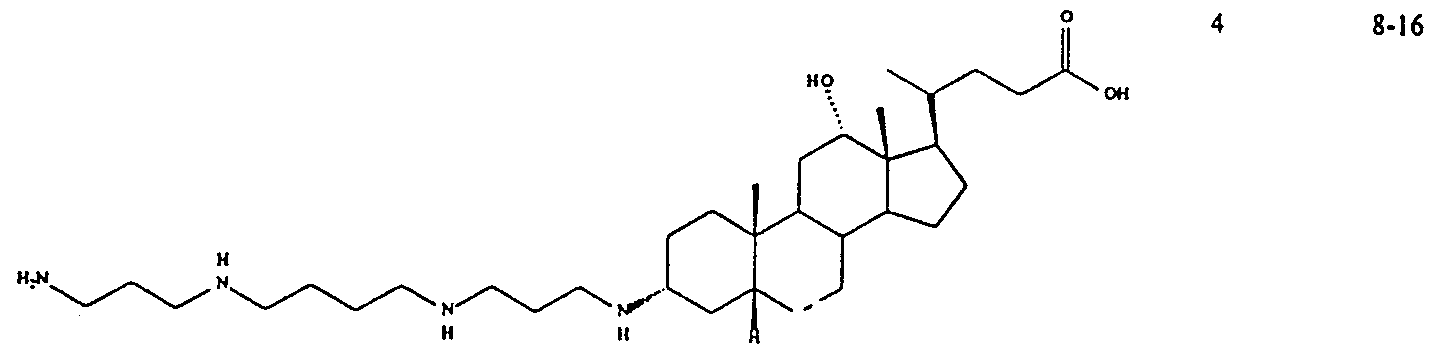
  • the present invention relates to aminosterol esters according to the following general formula:
  • R is a member selected from the group consisting of:
  • Rg is H or ;
  • the R 5 substituent group can be a C, to C I2 alkyl group, as noted above.
  • the R 5 group is a C, to C 6 alkyl group.
  • R 5 is a methyl group, i.e., a C, alkyl group.
  • R 2 , R 3 , and R 4 substituent groups can be oriented either or ⁇ to the steroid ring base.
  • the polyamine side chain (“-NH-R,") also can be oriented either ⁇ or ⁇ to the steroid ring base.
  • Specific ester compounds according to this invention include the following compounds and their pharmaceutically acceptable salts:
  • the invention further relates to various methods for using the compounds according to the invention or their pharmaceutically acceptable salts.
  • the invention relates to a method of treating microbial infections in a human or non-human animal by administering to the animal an antibiotic effective amount of a compound according to the invention or a pharmaceutically acceptable salt thereof.
  • malaria can be treated using the compounds according to the invention, and particularly using compounds 459, 466, and 566.
  • the compounds according to the invention can be used to treat viral infections in a human or non-human animal by administering to the animal an antiviral effective amount of a compound according to the invention or a pharmaceutically acceptable salt thereof.
  • the compounds according to the invention and particularly compounds 459, 469, and 569, can be used to treat HIV infection.
  • the compounds according to the invention also can be used to inhibit angiogenesis in a human or non-human animal by administering to the animal an antiangiogenic effective amount of a compound according to the invention (or a pharmaceutically acceptable salt thereof). In this manner, the compounds of the invention can be used to treat tumors, such as a melanoma.
  • the compounds according to the invention can be administered individually, in combination, or in combination with one or more conventional cytotoxic chemical compounds.
  • the cytotoxic chemical compound(s) used can be conventional cancer treating agents. Suitable agents include a nitrosourea, cyclophosphamide, adriamycin, 5-fIuorouracil, paclitaxel and its derivatives, and cisplatin and related platinum compounds. These conventional cancer treating agents are well known to those skilled in this art. Note, M.C. Wiemann and Paul Calabresi, "Pharmacology of Antineoplastic Agents, " Medical Oncology. Chapter 10, edited by Paul Calabresi, et.
  • BCNU BCNU
  • Another suitable cytotoxic agent is cisplatin, and yet another is cyclophosphamide.
  • Other conventional cytotoxic chemical compounds such as those disclosed in Medical Oncology, supra. , can be used without departing from the invention.
  • the compounds or salts according to the invention can be used in combination with conventional radiation treatments to treat cancers and tumors.
  • the compounds according to the invention also can be used to treat sickle cell anemia in a human by administering the compound or salt to the human in an effective amount.
  • squalamine also called “compound 1256" in this application
  • squalamine is the subject of U.S. Patent No. 5,192,756 to Zasloff et al., the disclosure of which is entirely incorporated herein by reference.
  • This compound is a broad-spectrum antibiotic, killing bacteria, fungi and protozoa.
  • the total chemical synthesis of squalamine was reported in 1994, for example, in PCT Patent Publication No. WO 94/19366 (published September 1, 1994), which document is entirely incorporated herein by reference. Additionally, the synthesis of squalamine is described in a U.S.
  • the HC1 salt of compound 303 was prepared by dissolving the free base in chloroform, treating with IN HC1 in ether (10 ml), and evaporating in vacuo. The solid was recrystallized from methanol in ether (15 ml final volume), and the filtered solid was concentrated overnight under high vacuum to yield compound 303-3HC1 as a beige solid (261 mg, 26% yield).
  • reaction mixture was filtered through Celite® (SiO 2 available from Aldrich) and washed with methanol (20 ml), dichloromethane (20 ml), 10%) sodium hydroxide (15 ml), and brine (25 ml). The layers were separated, and the aqueous layer was extracted with more dichloromethane (3 x 10 ml), and the combined organic layers were washed with brine, dried (Na 2 SO 4 ), and evaporated.
  • Celite® SiO 2 available from Aldrich
  • 353 354 The above compounds were prepared by reductive coupling of 5 ⁇ -cholestan-3-one 300 (from Steraloids Inc.) to spermine (4 equivalents) with sodium cyanoborohydride in a manner analogous to the preparation of compound 303. Purification was achieved on silica gel (gradient elution with 9:3:1 to 3:3:1 chloroform:methanol:isopropylamine). Compound 353 (more polar) and compound 354 (less polar) were converted to their hydrochloride salts in the same manner as for compound 303.
  • Compound 353 is a simple adduct of spermine and cholestanol, representing a very inexpensive compound. It can be synthesized like compound 354 in the following straightforward manner:
  • the above compounds were prepared from methyl 3-oxo-5 ⁇ -cholanoate 310 (from Steraloids) and spermine (1.35 equivalents, available from Aldrich) as in the synthesis of compound 353. Purification on silica gel (gradient elution with 6:3:1 to 3:5:2 chloroform:methanol:isopropylamine) produced the less polar ⁇ -amino compound 458 and the more polar ⁇ -amino compound 459. These compounds were converted to their hydrochloride salts as done for compound 303.
  • the steroid methyl 7 ⁇ -hydroxy-3-oxo-5 ⁇ -cholanoate was prepared according to the method of Iida et al., Chem. Pharm. Bull. 41(4), 1993, 763-765, which article is entirely incorporated herein by reference.
  • This steroid was coupled to the polyamine compound 301 with sodium cyanoborohydride, the BOC groups (t-butyloxycarbonyl groups) were removed with trifluoroacetic acid to yield the esters 380 and 394.
  • Hydrolysis of the esters was performed as in the preparation of compound 319 except that lithium hydroxide was used as the base, yielding compounds 381 and 382.
  • Methyl 7 ⁇ -hydroxy-3-oxo-5 ⁇ -cholanoate which is described in the preparation of compound 380 above, was coupled to spermine (2 equivalents, from Aldrich) with sodium cyanoborohydride, and the ester was hydrolyzed as in the preparation of compound 319, except that lithium hydroxide was used as the base.
  • Purification of compounds 395 and 396 was achieved on silica gel (15:5:1 to 5:5:1 chloroform:methanol:isopropylamine).
  • Purification of compound 397 was achieved on silica gel (2:6:1 benzene:methanol:isopropylamine), followed by treatment with 2 M ammonia in methanol (3 x 20 ml) to drive off isopropylamine.
  • the hydrochloride salts of compounds 395 and 396 were prepared in the same manner as for compound 303.
  • the chromium crust in the bottom of the flask was broken up with a spatula, and the contents of the flask were filtered through a Celite® (SiO 2 available from Aldrich) column. The elutant from the column was then reduced in volume under vacuum and filtered through a Florisil® column (elution with ethyl acetate). Florisil® is a magnesium silicate material that is available from Aldrich. The elutant was again reduced in volume to approximately 200 ml, and diethyl ether (100 ml) was added, followed by washing with sodium bicarbonate solution (2 x 250 ml) and then brine (250 ml).
  • the organic layer was dried over anhydrous sodium sulfate, filtered, and dried under vacuum.
  • the total yield of methyl 3,6-dioxo-5 ⁇ -cholan-24-oate 1017 without recrystallization was 9.6 g (24 mmol, 96%) (see Organic Preparations and Procedures Int. 19(2-3), 1987, 197-208).
  • the product can be recrystallized from a number of solvents (absolute methanol, ethyl acetate in hexanes, or diethyl ether in hexanes) if any chromium remains.
  • the 3,6-dioxo-5 sterol was prepared by acid- catalyzed isomerization of the 5 ⁇ sterol. To methanol (250 ml) was added the 3,6-dioxo-5 ⁇ sterol 1017 (9.6 g, 24 mmol) and tetrahydrofuran (25 ml) to dissolve the sterol completely. Concentrated hydrochloric acid (12.5 ml) was added, and the reaction was allowed to proceed overnight. The solvent was then removed under vacuum to yield 9.6 g (100%) yield) of methyl 3,6-dioxo-5 ⁇ -cholan-24-oate 1018 (see Organic Preparations and Procedures Int. 19(2-3), 1987, 197-208; authors used base-catalyzed isomerization using sodium methoxide rather than HCl).
  • ethylenediamine compounds were prepared as follows. A magnetically stirred solution of 50:50 methanohtetrahydrofuran (100 ml) and ethylenediamine (2 ml) was treated with acetic acid to lower the pH to approximately 6. The 3-oxo sterol 1021 (1.5 g, 3.7 mmol) was added, and the mixture was stirred for 15 minutes. Sodium cyanoborohydride (1 g, 16 mmol) was dissolved in 10 ml methanol and added to the reaction vessel, and the pH was again adjusted to 6 by the addition of acetic acid.
  • the crude product was purified by flash chromatography (5 cm x 25 cm, elution with 4:5:1 chloroform:methanol:isopropylamine), producing the less polar ⁇ -amino isomer 465 and the more polar ⁇ -amino isomer 466.
  • the total yield of amino sterol was 1.3 g (58% yield).
  • the polyamine 1023 was prepared from piperazine by double addition of acrylonitrile to yield compound 1022, which was reduced by Raney nickel catalyzed hydrogenation.
  • the residue was redissolved in a minimal amount of deionized water and applied to an octadecyl-functionalized silica gel column (Aldrich, 2 x 10 cm, gradient elution of acetonitrile in 2%> trifluoroacetic acid in water).
  • the fractions containing aminosterol were pooled, and the solvent was removed under vacuum.
  • the aminosterol was redissolved in 0. IN HCl, and the solvent was removed under vacuum (2x) to insure the removal of trifluoroacetate.
  • Benzene was added to the resulting hydrochloride salts, followed by evaporation overnight to remove as much water as possible.
  • Ethylenediamine ⁇ -amino isomer 433 was not treated with HCl, but isolated as the trifluoroacetate salt.
  • Silver carbonate on Celite® was prepared by dissolving 4 equivalents of silver nitrate in deionized water and adding sufficient Celite® (SiO 2 available from Aldrich) to result in 50% silver carbonate on Celite® (SiO 2 available from Aldrich). To the magnetically stirred solution was added 2.2 equivalents of sodium carbonate dissolved in deionized water, with continued vigorous stirring. The resulting silver carbonate precipitated on Celite® (SiO 2 available from Aldrich) was filtered through a glass-fritted funnel, washed with tetrahydrofuran, and allowed to dry in a vacuum desiccator.
  • the methyl ester of the bile acid to be oxidized was dissolved in toluene, treated with 2 equivalents of silver carbonate on Celite® (SiO 2 available from Aldrich), and heated to reflux using a Dean Stark apparatus for azeotropic removal of water.
  • the oxidation was complete in less than 6 hours for both sterols.
  • the only product in both cases was the desired 3-oxo sterol.
  • the solution was filtered, and the solvent was removed under vacuum.
  • the product in both cases recrystallized readily from ethyl acetate in hexanes to give the 3-oxo sterol in excellent yield (>89% in both cases).
  • This spermine compound was prepared by the same procedure as the ethylenediamine compounds 409 and 410, except for the following modification.
  • One gram of the 3-oxo sterol methyl ester of chenodeoxycholic acid and 1 g of spermine (approx. 2 equiv.) were used, and the chromatography required a more polar solvent system (5:4:1 CHCl 3 :methanol:isopropylamine was used).
  • the total yield of aminosterol was 48%.
  • the ratio of ⁇ -amino isomer to ⁇ -amino isomer 411 was not determined due to incomplete separation.
  • aminosterol esters Various properties of specific aminosterol esters are described below. Some properties are described in comparison with other aminosterols, such as squalamine, compound 1436, and compound 1437.
  • Endothelial cells have the capacity in vitro to form tubular aggregates resembling capillaries in various early stages of formation. This conversion occurs under relatively specific conditions, in which essential growth factors along with an effective substratum are provided. It has been shown that both the interaction of growth factors with the endothelial cell and its attachment to a substratum activate the NHE. The activation of this exchanger is believed to be required for subsequent morphologic transformation of the endothelial cell into a multicellular tubular structure.
  • VEGF Vascular Endothelial Growth Factor
  • basic fibroblast growth factor basic fibroblast growth factor
  • squalamine inhibits cord formation at about 0.1 ⁇ g/ml, compared with fumagillin, which exhibits comparable activity at 10 ⁇ g/ml. At these concentrations, squalamine does not appear to profoundly affect cell viability or proliferation. This property in vitro roughly correlates with anti-angiogenic activity in more complex in vivo models (see Goto et al., Lab Investigation 69, 1993, 508-518, which article is entirely incorporated herein by reference). Notably, ester compounds 410 and 411 also inhibit angiogenesis at higher doses.
  • Squalamine was found to disrupt vitelline capillaries in 3- to 5-day chick embryos.
  • the 3-day chick embryo consists of an embryonic disc from which numerous vessels emerge and return, forming a "figure 8"-shaped structure—the embryo in the center with vascular loops extending outward over both poles.
  • Application of squalamine onto the embryonic structure (0.1 ml in 15% Ficol in PBS) resulted in progressive "beading up" of the vitelline vessels, with the finest capillaries being the first to exhibit these changes. Following a lag period of around 15 minutes, the constriction of continuity between capillary and secondary vessels, generally on the "venous" side, was observed.
  • tadpole assay was conducted to test the properties of various aminosterols. This tadpole assay is described in U.S. Patent Application No. 08/483,059.
  • tadpoles preferably Xenopus laevis Stages 59-60 tadpoles, were employed to study the effect of a compound by monitoring capillary occlusion in the tadpole's tail. Animals at these stages were used because they represent the period of transition through metamorphosis at which time the animal possess both embryonic and adult stage tissues.
  • Compounds, when tested in this assay can affect the shape, viability, and integrity of the embryonic tissues while not affecting the adult tissues, providing a powerful, highly specific screen. For example, substances that destroy all of the animal's epithelium, both adult and embryonic, could be regarded as toxic. Substances that destroy only the embryonic tissues exhibit a very unique specificity.
  • tadpoles are introduced into Petri dishes containing a solution of the test compound in distilled water, preferably about 100 ml.
  • the preferred concentration of the test compound is from about 1 ⁇ g/ml to about 10 ⁇ g/ml.
  • the volume of liquid is sufficient for the animal to swim freely and drink from the solution. Thus, the effect observed results from oral absorption and subsequent systemic distribution of the agent. If the volume of liquid is not sufficient to permit oral intake, the effects that are observed would result from absorption through the surface epithelium.
  • this simple assay can identify if an compound has characteristics of oral availability.
  • a solution of a compound in water can be injected directly into the abdomen of the animal using standard techniques. Concentrations of the compound from about 0.05 mg/ml to about 0.5 mg/ml in about 0.05 ml of water are preferred.
  • compound 1437 targets a "mesothelium-like" epithelial layer, a skin layer that is comprised of only one cellular layer. Such a layer resembles epithelial surfaces such as the human peritoneum, synovium, pericardium, and ependyma. Accordingly, compound 1437 should exhibit antiproliferative effects on these tissues and malignancies which derive from them. In addition, these tissues can support viral infections, and therefore in these instances the compound should provide therapeutic antiviral benefit.
  • the aminosterol NHE inhibitors represent a class of antibiotics based on mechanism of action. Because these agents also interact with specific NHE isoforms in human tissues, prudent selection of an antibiotic of this class can eliminate undesirable side effects, due to host NHE inhibition, or potentiate the therapeutic intent. Thus, use of an agent like compound 1436 would suppress lymphoid proliferation during active treatment of an infection.
  • An effective antifungal agent can be designed further to increase specificity for its pathogenic target over sensitive vertebrate isoforms.
  • the antibacterial/antifungal spectrum differs from compound to compound.
  • Table III shows various properties of aminosterol ester compound 569. Notably, this aminosterol compound has higher inhibition of HIV than compound 1436.
  • the mode of administration of aminosterol compounds of the invention may be selected to suit the particular therapeutic use. Modes of administration generally include, but are not limited to, transdermal, intramuscular, intraperitoneal, intravenous, subcutaneous, intranasal, inhalation, intralesional, endothelial and oral routes.
  • the compounds of the invention may be administered by any convenient route, for example, by infusion or bolus injection, or by absorption through epithelial or mucocutaneous linings (e.g., oral mucosa, rectal, and intestinal mucosa, etc.), and the active aminosterol ingredient may be administered together with other biologically active agents. Administration may be local or systemic.
  • the present invention also provides pharmaceutical compositions that include one or more aminosterol compounds as an active ingredient.
  • Such pharmaceutical compositions include a therapeutically effective amount of the aminosterol compounds (or a pharmaceutically acceptable salt thereof) and a pharmaceutically acceptable carrier or excipient.
  • a pharmaceutically acceptable carrier include, but are not limited to, saline, buffered saline, dextrose, water, glycerol, ethanol, and combinations thereof.
  • the particular form and formulation of the pharmaceutical composition should be selected to suit the mode of administration.
  • the pharmaceutical composition if desired, also may contain minor amounts of wetting or emulsifying agents, or pH buffering agents.
  • the pharmaceutical composition may be in any suitable form, such as a liquid solution, suspension, emulsion, tablet, pill, capsule, sustained release formulation, or powder.
  • the pharmaceutical composition also may be formulated as a suppository, with traditional binders and carriers, such as triglycerides.
  • Oral formulations may include standard carriers, such as pharmaceutical grades of mannitol, lactose, starch, magnesium stearate, sodium saccharine, cellulose, magnesium carbonate, etc.
  • Various delivery systems are known and may be used to administer a therapeutic compound of the invention, e.g., encapsulation in liposomes, microparticles, microcapsules and the like.
  • the pharmaceutical composition is formulated in accordance with routine procedures as a pharmaceutical composition adapted for intravenous administration to humans.
  • compositions for intravenous administration are solutions in sterile isotonic aqueous buffer.
  • the pharmaceutical composition also may include a solubilizing agent and a local anesthetic to ameliorate pain at the cite of the injection.
  • the ingredients are supplied either separately or mixed together in unit dosage form, for example, as a dry lyophilized powder or water-free concentrate in a hermetically sealed container such as an ampule or sachette indicating the quantity of active agent.
  • the pharmaceutical composition is to be administered by infusion, it may be dispensed with an infusion bottle containing sterile pharmaceutical grade water or saline.
  • an ampoule of sterile water for injection or saline may be provided so that the ingredients may be mixed prior to administration.
  • the amount of the therapeutic compound of the invention that will be effective in the treatment of a particular disorder or condition will depend on the nature of the disorder or condition, and this amount can be determined by standard clinical techniques known to those skilled in the art through routine experimentation.
  • the precise dose to be employed in the pharmaceutical composition also will depend on the route of administration and the seriousness of the disease or disorder, and should be decided according to the judgement of the practitioner and each patient's circumstances. Effective therapeutical doses may be determined from extrapolations of dose-response curves derived from in vitro or animal- model test systems.
  • Suitable dosages for intravenous administration are generally about 20 micrograms to 40 milligrams of active compound per kilogram body weight.
  • Suitable dosage ranges for intranasal administration are generally about 0.01 mg/kg body weight to 1 mg/kg body weight.
  • Suitable concentrations for topical administration are generally at least about 0.01%) by weight.
  • Suitable dosages for oral administration are generally about 500 micrograms to 800 milligrams per kilogram body weight, and preferably about 1 -200 mg/kg body weight.
  • Suppositories generally contain, as the active ingredient, 0.5 to 10% by weight of the aminosterol compounds.
  • Oral formulations preferably contain 10%> to 95%> active ingredient.
  • Exemplary dosages of the aminosterol compounds for most pharmacological or therapeutical uses fall within the range of about 0.01 mg/kg body weight to about 100 mg/kg body weight. Preferred dosages are from 0.1 to 25 mg/kg body weight.
  • the invention also may include a pharmaceutical pack or kit including one or more containers filled with pharmaceutical compositions in accordance with the invention. Associated with such containers may be a notice in the form prescribed by a government agency regulating the manufacture, use or sale of pharmaceuticals or biological products, which notice reflects approval by the agency of manufacture, use or sale for human administration.
  • an effective amount in this application, applicants refer to a suitable amount of the active ingredient of the invention, with an appropriate carrier or excipient, including a sufficient amount of the active ingredient to provide the desired effects or results.
  • the effective amount can be readily ascertained by those skilled in the art through routine experimentation.
  • Tadpole CBBJ HM diss. Formation MTT assay (10 ⁇ g/mL) ( ⁇ g mL) 2 ⁇ _SLS__aaxX MH

Landscapes

  • Organic Chemistry (AREA)
  • Chemical & Material Sciences (AREA)
  • Health & Medical Sciences (AREA)
  • General Health & Medical Sciences (AREA)
  • Life Sciences & Earth Sciences (AREA)
  • Nuclear Medicine, Radiotherapy & Molecular Imaging (AREA)
  • Medicinal Chemistry (AREA)
  • Pharmacology & Pharmacy (AREA)
  • General Chemical & Material Sciences (AREA)
  • Animal Behavior & Ethology (AREA)
  • Chemical Kinetics & Catalysis (AREA)
  • Public Health (AREA)
  • Veterinary Medicine (AREA)
  • Steroid Compounds (AREA)
  • Pharmaceuticals Containing Other Organic And Inorganic Compounds (AREA)
  • Organic Low-Molecular-Weight Compounds And Preparation Thereof (AREA)

Abstract

An aminosterol compound according to formula (I) wherein R1 is a member selected from the group of: (a), wherein R6 is H or (b); (c); and (d); R2 is H or OH; R3 is H or OH; R4 is H or OH; and R5 is a C1 to C12 alkyl group, or pharmaceutically acceptable salts thereof. Preferably, R5 is a C1 to C6 alkyl group, and a methyl group is particularly preferred.

Description

AMINOSTEROL ESTER COMPOUNDS
FIELD OF THE INVENTION
The present invention relates to aminosterol ester compounds and pharmaceutical compositions containing such compounds. This application is a continuation-in-part of U.S. Patent Appln. No. 08/290,826, filed August 18, 1994; U.S. Patent Appln. No. 08/416,883, filed April 20, 1995; and U.S. Patent Appln. No. 08/483,059, filed June 7, 1995. This application also relates to U.S. Patent Appln. No. 08/769,689, filed December 18, 1996. Each of these U.S. patent applications is entirely incorporated herein by reference.
BACKGROUND OF THE INVENTION
Various aminosterols have been discovered, and their use in various pharmacological applications has been disclosed. For example, as described in the above-noted patent applications, certain aminosterols have been found to selectively inhibit certain sodium proton exchangers ("NHE's") in cells. NHEs control various cellular properties and functions. For example, NHEs control cellular pH. It is critical that cells maintain an appropriate narrow pH range to assure that cell growth and certain body functions proceed in a suitable manner. If cells do not maintain an appropriate pH, severe health consequences, and even death can occur. Other aminosterols, such as squalamine described in the above- noted patent applications, have anti-angiogenic properties. Compounds that are anti- angiogenic typically are useful for treating cancers and other proliferative disorders. Compound 1436 has been found to have properties that indicate it will be useful in treating viral infections, such as HIV, SIV, and herpes.
Other aminosterols have been discovered or synthesized in addition to squalamine and compound 1436. More specifically, aminosterol esters have been produced and constitute the compounds according to this invention. Like squalamine and compound 1436, these aminosterol esters have interesting antibiotic properties and anti-proliferation properties for certain types of cells. The synthesis and properties of these aminosterol esters will be discussed in more detail below. BRIEF DESCRIPTION OF THE INVENTION
The present invention relates to aminosterol esters according to the following general formula:
Figure imgf000004_0001
wherein:
R, is a member selected from the group consisting of:
wherein Rg is H or
Figure imgf000004_0003
;
Figure imgf000004_0002
Figure imgf000004_0004
Figure imgf000004_0005
R2 is H or OH; R3 is H or OH; R4 is H or OH; and R5 is a C, to C12 alkyl group, or pharmaceutically acceptable salts thereof. The R5 substituent group can be a C, to CI2 alkyl group, as noted above. Preferably, the R5 group is a C, to C6 alkyl group. As one particularly preferred subclass of the above- noted aminosterol esters, R5 is a methyl group, i.e., a C, alkyl group.
The R2, R3, and R4 substituent groups can be oriented either or β to the steroid ring base. Likewise, the polyamine side chain ("-NH-R,") also can be oriented either α or β to the steroid ring base.
Specific ester compounds according to this invention include the following compounds and their pharmaceutically acceptable salts:
Figure imgf000005_0001
Figure imgf000005_0002
Figure imgf000006_0001
Figure imgf000006_0002
Figure imgf000006_0003
Figure imgf000007_0001
Figure imgf000007_0002
Figure imgf000007_0003
Figure imgf000008_0001
Figure imgf000008_0002
Figure imgf000008_0003
Figure imgf000009_0001
Figure imgf000009_0002
Figure imgf000009_0003
Figure imgf000010_0001
Figure imgf000010_0002
Figure imgf000010_0003
Figure imgf000011_0001
Figure imgf000011_0002
Figure imgf000011_0003
Figure imgf000012_0001
Figure imgf000012_0002
The invention further relates to various methods for using the compounds according to the invention or their pharmaceutically acceptable salts. In one aspect, the invention relates to a method of treating microbial infections in a human or non-human animal by administering to the animal an antibiotic effective amount of a compound according to the invention or a pharmaceutically acceptable salt thereof. As an example, malaria can be treated using the compounds according to the invention, and particularly using compounds 459, 466, and 566.
In another embodiment, the compounds according to the invention can be used to treat viral infections in a human or non-human animal by administering to the animal an antiviral effective amount of a compound according to the invention or a pharmaceutically acceptable salt thereof. As an example, the compounds according to the invention, and particularly compounds 459, 469, and 569, can be used to treat HIV infection. The compounds according to the invention also can be used to inhibit angiogenesis in a human or non-human animal by administering to the animal an antiangiogenic effective amount of a compound according to the invention (or a pharmaceutically acceptable salt thereof). In this manner, the compounds of the invention can be used to treat tumors, such as a melanoma. Additionally, the compounds according to the invention (or their pharmaceutically acceptable salts) can be administered individually, in combination, or in combination with one or more conventional cytotoxic chemical compounds. In this method, the cytotoxic chemical compound(s) used can be conventional cancer treating agents. Suitable agents include a nitrosourea, cyclophosphamide, adriamycin, 5-fIuorouracil, paclitaxel and its derivatives, and cisplatin and related platinum compounds. These conventional cancer treating agents are well known to those skilled in this art. Note, M.C. Wiemann and Paul Calabresi, "Pharmacology of Antineoplastic Agents, " Medical Oncology. Chapter 10, edited by Paul Calabresi, et. al., McMillan Publishing (1985). Medical Oncology is entirely incorporated herein by reference. One suitable nitrosourea is BCNU, which also is known as carmustine. Another suitable cytotoxic agent is cisplatin, and yet another is cyclophosphamide. Other conventional cytotoxic chemical compounds, such as those disclosed in Medical Oncology, supra. , can be used without departing from the invention.
Additionally, the compounds or salts according to the invention can be used in combination with conventional radiation treatments to treat cancers and tumors.
Finally, the compounds according to the invention (or their pharmaceutically acceptable salts) also can be used to treat sickle cell anemia in a human by administering the compound or salt to the human in an effective amount.
Other aspects, objects, and advantages of the invention will be apparent from the detailed disclosure below, which illustrates preferred features and embodiments of the invention. The specific examples described below should be construed as illustrating the invention and not as limiting the same. DETAILED DESCRIPTION OF THE INVENTION
SYNTHESIS OF VARIOUS AMINOSTEROL COMPOUNDS
The steroid known as squalamine (also called "compound 1256" in this application) is the subject of U.S. Patent No. 5,192,756 to Zasloff et al., the disclosure of which is entirely incorporated herein by reference. This compound is a broad-spectrum antibiotic, killing bacteria, fungi and protozoa. The total chemical synthesis of squalamine was reported in 1994, for example, in PCT Patent Publication No. WO 94/19366 (published September 1, 1994), which document is entirely incorporated herein by reference. Additionally, the synthesis of squalamine is described in a U.S. Patent Application entitled "Stereoselective Synthesis of 24-Hydroxylated Compounds Useful for the Preparation of Aminosterols, Vitamin D Analogs, and Other Compounds," filed on December 5, 1997, in the names of William A. Kinney, Steven Jones, Xuehai Zhang, Meena N. Rao, Michel Bulliard, Harold Meckler, and Nancy Lee. This application also is entirely incorporated herein by reference.
Example 1— Synthesis of Aminosterols
In addition to compound 1436 and squalamine, which were originally isolated from shark liver, synthetic aminosterol compounds have been developed. Various polyaminosterol compounds are described in U.S. Patent Appl. No. 08/416,883, which is the U.S. national phase of International Application No. PCT/US94/10265, filed September 13, 1994. This PCT application is entirely incorporated herein by reference. The synthesis of various compounds is described in this related application, including the following:
Figure imgf000014_0001
Figure imgf000015_0001
Figure imgf000015_0002
Figure imgf000015_0003
Additional aminosterol compounds have now been developed, including those exemplified below. The following describes the synthesis procedure for producing various aminosterol compounds, including aminosterols 303, 304, 318, and 319 identified above, as well as various aminosterol esters according to the invention.
Example A
Figure imgf000016_0001
Figure imgf000016_0002
301
TFA
Figure imgf000016_0003
303 304
Preparation of compound 302: Reductive amination of 5α-cholestan-3-one produces a majority of the 3β-amino isomer (see M.H. Boutique, R. Jacquesy, Bull. Soc. Chim. (France), 1973, 750-753, which article is entirely incorporated herein by reference). A solution of 5 - cholestan-3-one 300 (898 mg, 2.32 mmol, available from Steraloids Inc. of New Hampshire) in dry tetrahydrofuran (10 ml) under nitrogen was treated with 3 A molecular sieves (5 g) and the triamine 301 (see K. Nakanishi et al., Tetrahedron 46 (9), 1990, 3267-3286, which article is entirely incorporated herein by reference) dissolved in dry methanol (25 ml). After 20 minutes at room temperature, sodium cyanoborohydride (696 mg, 11.0 mmol) was added, and the reaction mixture was stirred for four days, filtered through Celite® (a form of SiO2 sold by Aldrich), and washed thoroughly with methanol and dichloromethane. After evaporation, the residue was partitioned between water (75 ml) and dichloromethane (75 ml), treated with IN sodium hydroxide solution (15 ml) and brine (25 ml), and the layers were separated. The aqueous layer was extracted again with dichloromethane (75 ml), and the combined organics were dried (Na^O , filtered, and evaporated. The resulting colorless oil was dissolved in dichloromethane and applied to a flash column (4-cm diameter, gradient elution with 2.5- 3.5% 2N methanolic ammonia (available from Aldrich) in dichloromethane). A mixture of 3 ,β-amino isomers 302 was obtained (1.18 g, 71% yield) as a white foam. Η NMR (200 MHz, CDC13) δ: 4.57 (br s, NH), 3.3-3.0 (m, 6H), 2.7-2.4 (m, 3H), 2.0-1.0 (m, 37H), 1.45 (s, 9H), 1.44 (s, 9H), 0.91-0.84 (m, 9H), 0.78 (s, 3H), 0.64 (s, 3H); MS(+FAB): 716 (M+H, 100).
Preparation of compounds 303 and 304: A solution of compound 302 in chloroform (50 ml) was cooled to 0°C and treated with trifluoroacetic acid (40 ml) under nitrogen. After stirring for fifty minutes at room temperature, the reaction mixture was concentrated, dissolved in chloroform, and evaporated again (three times). The resulting solid was dissolved in methanol, treated with isopropylamine, and preadsorbed onto silica gel. Flash chromatography (4 cm, gradient elution with 2:8:30 to 2:8:15 isopropylamine:methanol:dichloromethane) provided the faster eluting material 304 (3α- amino isomer) in an impure state, followed by compound 303 (3β-amino isomer) as a solid (340 mg, 40% yield). Η NMR (200 MHz, CDC13) δ: 2.8-2.6 (m, 8H), 2.47 (br m, 3α-H), 2.0-0.9 (m, 37H), 0.9-0.8 (m, 9H), 0.78 (s, 3H), 0.64 (s, 3H).
The HC1 salt of compound 303 was prepared by dissolving the free base in chloroform, treating with IN HC1 in ether (10 ml), and evaporating in vacuo. The solid was recrystallized from methanol in ether (15 ml final volume), and the filtered solid was concentrated overnight under high vacuum to yield compound 303-3HC1 as a beige solid (261 mg, 26% yield). Η NMR (200 MHz, CD3OD) δ: 3.3-3.0 (m, 9H), 2.2-1.0 (m, 37H), 1.0-0.9 (m, 12H), 0.71 (s, 3H); MS(+FAB): 516.5 (M+H, 100); Anal, calcd. for C34H65N3- 3HCl-H2O: C-63.48, H=10.97, N=6.53; Found: C=63.72, H=10.71, N=6.25.
Crude compound 304 was again purified by flash chromatography (2 cm, 1 :4:20 isopropylamine:methanol:chloroform) to yield the free base (44 mg, 5% yield) (Η NMR (200 MHz, CD3OD) δ: 3.40 (m, 3β-H), 3.3-2.9 (m, 8H), 2.2-1.0 (m, 37H), 1.0-0.8 (m, 12H), 0.70 (s, 3H)), which was dissolved in methanokdichloromethane (2 ml), treated with IN HCl in ether (3 ml), concentrated in vacuo, and recrystallized from methanol in ether (1 ml final volume) to produce a gelantinous substance. After cooling in an ice bath, the solid was filtered, washed with ether, and concentrated under high vacuum to deliver compound 304-
3HC1 (18 mg, 2% yield). Η NMR (200 MHz, CD3OD) δ: 3.45 (m, 3β-H), 3.3-3.0 (m, 8H),
2.3-1.0 (m, 37H), 1.0-0.9 (m, 12H), 0.70 (s, 3H); MS(+FAB): 516.6 (M+H, 100).
Figure imgf000018_0001
315
Figure imgf000018_0002
317
KOH
KOH
Figure imgf000019_0001
Preparation of compound 315: To a solution of 5α-cholanic acid-3-one methyl ester 310 (719 mg, 1.85 mmol, available from Steraloids Inc., of New Hampshire) in anhydrous tetrahydrofuran (10 ml) was added 3A sieves (4 g), a solution of triamine 301 (650 mg, 1.88 mmol) in dry methanol (25 ml), and sodium cyanoborohydride (600 mg, 9.55 mmol). After stirring for eighteen hours at room temperature, the reaction mixture was filtered through Celite® (SiO2 available from Aldrich) and washed with methanol (20 ml), dichloromethane (20 ml), 10%) sodium hydroxide (15 ml), and brine (25 ml). The layers were separated, and the aqueous layer was extracted with more dichloromethane (3 x 10 ml), and the combined organic layers were washed with brine, dried (Na2SO4), and evaporated. The crude material was purified by flash chromatography (2 cm, gradient elution with 2-4%> 2N methanolic ammonia (Aldrich) in dichloromethane), producing compound 315 (1.09 g, 82% yield) as a mixture of C-3 isomers. Η NMR (200 MHz, CDC13) δ: 4.57 (br s, NH), 3.65 (s, 3H), 3.4- 3.0 (m, 6H), 2.8-2.5 (m, 3H), 2.4-1.0 (m, 34H), 1.45 (s, 9H), 1.44 (s, 9H), 0.91 (d, J = 6 Hz, 3H), 0.78 (s, 3H), 0.64 (s, 3H); MS(+FAB): 719 (M+H, 100).
Preparation of compounds 316 and 317: A solution of compound 315 (910 mg, 1.27 mmol) in chloroform (39 ml) was treated with trifluoroacetic acid (33 ml) at 0°C. After one hour at room temperature, the reaction mixture was evaporated, dissolved in chloroform, and evaporated again (three times). The crude material was dissolved in methanol, treated with isopropylamine, and preadsorbed onto silica gel. Flash chromatography (2 cm, gradient elution with 1 :4:15 to 1 :4:6 isopropylamine:methanol:chloroform) yielded the 3α-amino isomer 316 as a crude product and the 3β-amino isomer 317 as a pure product (319 mg, 48% yield). Η NMR (200 MHz, CDC13) δ: 3.66 (s, 3H), 2.8-2.6 (m, 8H), 2.47 (br m, 3 -H), 2.4- 1.0 (m, 34H), 0.90 (d, J = 6 Hz, 3H), 0.78 (s, 3H), 0.64 (s, 3H); MS(+FAB): 518 (M+H, 100).
Preparation of compound 318: Crude compound 316, obtained as described above, was dissolved in methanol (20 ml) and treated with 0.5N potassium hydroxide solution (15 ml) in methanol and water (5 ml). After refluxing for thirty minutes and leaving at room temperature overnight, the reaction mixture was purified in the manner described below for the isolation of compound 319, producing the 3α-amino isomer 318 (50 mg, 8% yield, two steps). Η NMR (200 MHz, CD3OD) δ: 3.13 (m, 3β-H), 3.0-2.6 (m, 8H), 2.3-1.0 (m, 34H), 0.96 (d, J = 6 Hz, 3H), 0.84 (s, 3H), 0.70 (s, 3H); IR (KBr, cm"1): 2930, 2850, 1560, 1444, 1396, 1120, 752; MS(+FAB): 504 (M+H, 100).
Preparation of compound 319: A solution of compound 317 (240 mg, 0.46 mmol) in methanol (15 ml) was treated with 0.5N potassium hydroxide in methanol (10 ml) and water (3.3 ml) under nitrogen at reflux for 3.5 hours. After cooling to room temperature, the reaction mixture was acidified with IN HCl to a pH of 4-5, extracted with chloroform (3 x 20 ml), and dried over MgSO4. The solvent was evaporated, and the product was purified by flash chromatography (1 cm diameter, elution with 1 :3:10 ammonium hydroxide:methanol:chloroform), producing the 3β-amino isomer 319 as a beige solid (130 mg, 56% yield). Η NMR (200 MHz, CD3OD) δ: 2.9-2.6 (m, 9H), 2.2-1.0 (m, 34H), 0.95 (d, J = 6 Hz, 3H), 0.84 (s, 3H), 0.70 (s, 3H); IR (KBr, cm"1): 3268, 2928, 2850, 1560, 1444, 1396, 1118, 750; MS(+FAB): 504 (M+H, 100).
Example C
Preparation of compound 353 and compound 354:
Figure imgf000020_0001
353 354 The above compounds were prepared by reductive coupling of 5α-cholestan-3-one 300 (from Steraloids Inc.) to spermine (4 equivalents) with sodium cyanoborohydride in a manner analogous to the preparation of compound 303. Purification was achieved on silica gel (gradient elution with 9:3:1 to 3:3:1 chloroform:methanol:isopropylamine). Compound 353 (more polar) and compound 354 (less polar) were converted to their hydrochloride salts in the same manner as for compound 303. α-Amino compound 354: Η NMR (200 MHz, CD3OD) δ: 3.47 (m, IH), 3.3-2.9 (m, 12H), 2.3-1.0 (m, 39H), 1.0-0.8 (m, 12H), 0.70 (s, 3H); IR (KBr, cm'1): 3396, 2934, 1594, 1457, 1383; MS(+FAB): 573.6 (M+l); Anal, calcd. for C37H72N4- 4HCl-H2O: C=60.31, H=l 0.67, N=7.60; Found: 0=60.01, H=10.83, N=7.67. β-Amino compound 353: 'H NMR (200 MHz, CD3OD) δ: 3.3-3.0 (m, 13H), 2.2-1.0 (m, 39H), 1.0-0.8 (m, 12H), 0.70 (s, 3H); IR (KBr, cm'1): 2945, 1596, 1466, 1383; MS exact mass (+FAB) calcd.: 573.5835; Found: 573.5801; Anal, calcd. for C37H72N4-4HCl-H2O: C=58.87, H=10.68, N=7.42; Found: C=58.49, H=10.94, N=7.94.
Compound 353 is a simple adduct of spermine and cholestanol, representing a very inexpensive compound. It can be synthesized like compound 354 in the following straightforward manner:
Spermine
Figure imgf000021_0001
(13%) Example D
Preparation of compound 458 and compound 459:
Figure imgf000022_0001
458 459
The above compounds were prepared from methyl 3-oxo-5α-cholanoate 310 (from Steraloids) and spermine (1.35 equivalents, available from Aldrich) as in the synthesis of compound 353. Purification on silica gel (gradient elution with 6:3:1 to 3:5:2 chloroform:methanol:isopropylamine) produced the less polar α-amino compound 458 and the more polar β-amino compound 459. These compounds were converted to their hydrochloride salts as done for compound 303. Compound 458: Η NMR (400 MHz, CD3OD) δ: 3.64 (s, 3H), 3.45 (m, IH), 3.25-3.05 (m, 12H), 2.4-1.0 (m, 36H), 0.93 (d, J = 6 Hz, 3H), 0.87 (s, 3H), 0.70 (s, 3H); IR (KBr, cm"1): 2943, 1741, 1458, 1169; MS(+FAB): 575.6 (M+1); Anal, calcd. for C35H66N4O2-4HCl-1.2H2O: C=56.63, H=9.83, N-7.55; Found: C=56.58, H-9.46, N=7.29. Compound 459: 'H NMR (400 MHz, CD3OD) δ: 3.63 (s, 3H), 3.2-3.0 (m, 13H), 2.4-1.0 (m, 36H), 0.92 (d, J = 6 Hz, 3H), 0.86 (s, 3H), 0.69 (s, 3H); IR (KBr, cm-1): 2942, 1739, 1595, 1459, 1382, 1170; MS(+FAB): 575.6 (M+1); Anal, calcd. for C35H66N4O2-4HCl-1.4H2O: C=56.35, H=9.84, N=7.51; Found: C=56.35, H=9.26, N=7.67.
Example E
Preparation of compounds 380, 381, 382, and 394:
Figure imgf000023_0001
380
381
Figure imgf000023_0002
382
394
The steroid methyl 7α-hydroxy-3-oxo-5α-cholanoate was prepared according to the method of Iida et al., Chem. Pharm. Bull. 41(4), 1993, 763-765, which article is entirely incorporated herein by reference. This steroid was coupled to the polyamine compound 301 with sodium cyanoborohydride, the BOC groups (t-butyloxycarbonyl groups) were removed with trifluoroacetic acid to yield the esters 380 and 394. Hydrolysis of the esters was performed as in the preparation of compound 319 except that lithium hydroxide was used as the base, yielding compounds 381 and 382. Purification was achieved on silica gel (15:4:1 to 10:4:1 chloroform:methanol:isopropylamine). Compounds 381 and 382 were treated with 2 M ammonia in methanol and evaporated (3 x 20 ml) to drive off isopropylamine. The hydrochloride salt was prepared as for compound 303.
Compound 380, C32H59N3O3: 'H NMR (200 MHz, CDC13) δ: 3.83 (br s, IH), 3.66 (s, 3H), 2.8-2.4 (m, 9H), 2.3-1.0 (m, 32H), 0.92 (d, J = 6 Hz, 3H), 0.78 (s, 3H), 0.65 (s, 3H); IR (KBr, cm"1): 3278, 2928, 1736, 1447, 1163; MS(+FAB): 534 (M+1).
Compound 381, C31H57N3O3-l .7 H2O: Η NMR (200 MHz, CD3OD) δ: 3.80 (br s, IH), 3.0-2.5 (m, 9H), 2.2-1.1 (m, 32H), 0.94 (d, J = 6 Hz, 3H), 0.84 (s, 3H), 0.69 (s, 3H); IR (KBr, cm"1): 3380, 2929, 1560, 1395; MS(+FAB) calcd.: 520.4478 (M+1); Found: 520.4506; Anal, calcd.: C=67.64, H=l 1.06, N=7.63; Found: C=67.64, H=10.24, N=7.83.
Compound 382, C31H57N3O3-2H2O: Η NMR (200 MHz, CD3OD) δ: 3.80 (br s, IH), 3.15 (br s, IH), 3.1-2.6 (m, 8H), 2.2-1.1 (m, 32H), 0.96 (d, J = 6 Hz, 3H), 0.85 (s, 3H), 0.69 (s, 3H); IR (KBr, cm"1): 3416, 2930, 1560, 1395; MS(+FAB) calcd.: 520.4478 (M+1); Found: 520.4489; Anal, calcd: C=66.99, H=l 1.06, N=7.56; Found: C=66.93, H=10.16, N=7.28.
Compound 394, C32H59N3O3-3HC1-0.5H2O: Η NMR (200 MHz, CD3OD) δ: 3.83 (br s, IH), 3.64 (s, 3H), 3.48 (br s, IH), 3.3-2.9 (m, 8H), 2.4-1.1 (m, 32 H), 0.94 (d, J = 6 Hz, 3H), 0.87 (s, 3H), 0.70 (s, 3H); MS(+FAB): 535 (M+1); Anal, calcd.: C=58.93, H=9.74, N=6.44; Found: 0=58.71, H=10.13, N=6.39.
Example F
Preparation of compounds 395, 396, and 397:
Figure imgf000024_0001
Figure imgf000024_0002
Figure imgf000025_0001
Methyl 7α-hydroxy-3-oxo-5α-cholanoate, which is described in the preparation of compound 380 above, was coupled to spermine (2 equivalents, from Aldrich) with sodium cyanoborohydride, and the ester was hydrolyzed as in the preparation of compound 319, except that lithium hydroxide was used as the base. Purification of compounds 395 and 396 was achieved on silica gel (15:5:1 to 5:5:1 chloroform:methanol:isopropylamine). Purification of compound 397 was achieved on silica gel (2:6:1 benzene:methanol:isopropylamine), followed by treatment with 2 M ammonia in methanol (3 x 20 ml) to drive off isopropylamine. The hydrochloride salts of compounds 395 and 396 were prepared in the same manner as for compound 303.
Compound 395, C35H66N4O3-4HCl-2H2O: Η NMR (200 MHz, CD3OD) δ: 3.80 (br s, IH), 3.64 (s, 3H), 3.3-3.0 (m, 13H), 2.4-1.0 (m, 34H), 0.94 (d, J = 6 Hz, 3H), 0.87 (s, 3H), 0.70 (s, 3H); Anal, calcd.: C=54.40, H=9.65, N=7.25; Found: C=54.16, H=9.31, N=7.12.
Compound 396, C35H66N4O3-4HC1-0.5H2O: MS(+FAB): 592 (M+1); Anal, calcd.: C=56.37, H=9.60, N=7.51; Found: C=56.43, H=9.83, N=7.27.
Compound 397, C34H64N4O3: Η NMR (200 MHz, CD3OD) δ: 3.78 (br s, IH), 2.9- 2.5 (m, 13H), 2.2-1.1 (m, 34H), 0.95 (d, J = 6 Hz, 3H), 0.87 (s, 3H), 0.70 (s, 3H); MS(+FAB): 577.3 (M+1). Example G
Preparation of compound 470:
Figure imgf000026_0001
Preparation of precursors:
Figure imgf000026_0002
Figure imgf000026_0003
1013 1014 1015
Preparation of compounds 1011 and 1012: A solution of methyl 3-oxo-5α-cholanoate (compound 310 from Steraloid Inc., 2.00 g, 5.15 mmol), p-toluenesulfonic acid (250 mg), and ethylene glycol (25 ml) in benzene (160 ml) was heated to reflux with the removal of water for 6 hours. After cooling to room temperature, saturated sodium bicarbonate (30 ml) was added, and the aqueous phase was extracted with benzene and ethyl acetate. The organic layers were washed with water and brine, dried over sodium sulfate, and evaporated to yield compound 1011, which was used for the next step without purification.
A solution of 1 M lithium aluminum hydride (25 ml, 25 mmol) in ether under nitrogen was treated with a solution of compound 1011 in anhydrous ether (80 ml) and heated to reflux for 5 hours. After stirring overnight, the reaction mixture was quenched at 0°C with water and 2 N sodium hydroxide solution. The aqueous layer was extracted with ether, followed by washing with brine, drying over magnesium sulfate, and evaporating to produce compound 1012 (1.80 g, 86% yield). Η NMR (400 MHz, CDC13) δ: 3.94 (s, 4H), 3.62 (m, 2H), 2.0-1.0 (m, 28H), 0.92 (d, J = 6 Hz, 3H), 0.81 (s, 3H), 0.66 (s, 3H).
Preparation of compounds 1013 and 1014: A solution of compound 1012 (3.63 g, 8.97 mmol) in anhydrous pyridine (16 ml) was treated with p-toluenesulfonyl chloride (2.3 g, 12.1 mmol) at room temperature, and left overnight. Ice water was added, and the reaction mixture was left for 30 minutes with stirring. Then 6 N hydrochloric acid was added (70 ml), and the aqueous layer was extracted with dichloromethane and ether. The organic layers were washed with 2 N hydrogen chloride, saturated sodium bicarbonate and brine, dried, and evacuated to yield crude compound 1013. Compound 1013 was dissolved in dimethylsulfoxide (40 ml) and treated with sodium cyanide (1.4 g, 28 mmol) at 90°C for 2.5 hours under nitrogen. After cooling, the reaction mixture was treated with ice water and extracted into ether and dichloromethane. The organic layers were washed with brine, dried over sodium sulfate, and purified by chromatography (4-cm diameter, gradient elution with 0-25% ethyl acetate in hexane) to yield pure compound 1014. 'H NMR (400 MHz, CDC13) δ: 3.94 (s, 4H), 2.32 (m, 2H), 2.0-1.0 (m, 28H), 0.93 (d, J = 6 Hz, 3H), 0.81 (s, 3H), 0.66 (s, 3H); IR (KBr, cm"1): 2930, 2247, 1445, 1381, 1357, 1133, 1091, 928, 899; MS(+FAB): 414.4 (M+1).
Preparation of compound 1015: A solution of compound 1014 (480 mg, 1.16 mmol) in acetic acid (35 ml) and concentrated hydrochloric acid (25 ml) was refluxed for 25 hours. After evaporating the solvent, the residue was partitioned between water and ethyl acetate. After drying and evaporating, the crude carboxylic acid was dissolved in methanol (25 ml), treated with concentrated hydrochloric acid (1 ml), and brought to reflux for 20 minutes. After evaporation of solvent, the product was dissolved in ethyl acetate and water and extracted again with ethyl acetate. The organic layers were washed with brine, dried over sodium sulfate, and purified by flash chromatography (2-cm diameter, gradient elution with 0-25%) ethyl acetate in hexane) to produce pure compound 1015 (298 mg, 64%> yield), m.p. 147-148°C. Η NMR (400 MHz, CDC13) δ: 3.67 (s, 3H), 2.4-1.0 (m, 30H), 1.01 (s, 3H), 0.93 (d, J = 6 Hz, 3H), 0.68 (s, 3H); 13C NMR (400 MHz, CDC13) δ: 212.3, 174.5, 56.5, 56.1, 54.0, 51.6, 46.9, 44.9, 42.8, 40.1, 38.8, 38.4, 35.8, 35.7, 35.6, 34.7, 31.9, 29.2, 28.4, 24.4, 21.7, 21.6, 18.8, 12.2, 11.7; MS(+FAB): 403.3 (M+1); Anal, calcd. for C26H42O3: C=77.56, H=l 0.51; Found: C-77.49, H-10.52.
Preparation of compound 470: Steroid 1015 was coupled to polyamine 301 with sodium cyanoborohydride, the BOC groups were removed with trifluoroacetic acid, and the ester was hydrolyzed as in the preparation of compound 319, except that lithium hydroxide was used as the base. Purification was achieved on silica gel (gradient elution with 14:4:1 to 4:4:1 chloroform:methanol:isopropylamine). After evaporation from methanol:chloroform (3x), the compound was treated with 2 M ammonia in methanol and evaporated (3 x 20 ml) to drive off isopropylamine. 'H NMR (400 MHz, CD3OD) δ: 2.8-2.6 (m, 9H), 2.2-1.0 (m, 36H), 0.92 (d, J = 6 Hz, 3H), 0.80 (s, 3H), 0.66 (s, 3H); MS(+FAB): 518.4 (M+1); Anal, calcd.: C=71.73, H=l 1.47, N=7.84; Found: C=72.03, H=11.06, N=7.53.
Example H
Preparation of compounds 431, 432, 433, 465, 466, 467, and 469.
Figure imgf000028_0001
Figure imgf000029_0001
Figure imgf000029_0002
Figure imgf000029_0003
Figure imgf000030_0001
Figure imgf000030_0002
Figure imgf000030_0003
Preparation of precursors:
Figure imgf000031_0001
1016 1017 1018
Figure imgf000031_0002
1019 1020 1021
Preparation of compound 1016: The methyl ester of hyodeoxycholic acid was prepared by acid-catalyzed esterification of hyodeoxycholic acid in methanol. To a magnetically stirred 500-ml round-bottom flask containing absolute methanol (200 ml) was added hyodeoxycholic acid (10 g, 25.5 mmol, from Aldrich) and concentrated sulfuric acid (5 ml) dropwise. The reaction was stirred overnight and then treated with dichloromethane (250 ml), followed by washing with sodium bicarbonate solution (2 x 100 ml) and brine (100 ml). The organic layer was then dried over anhydrous sodium sulfate, filtered, and dried under vacuum to yield compound 1016 (10.1 g, 97% yield) (see Organic Preparations and Procedures Int. 19(2-3), 1987, 197-208, which excerpt is entirely incorporated herein by reference).
Preparation of compound 1017: The 3,6-dioxo sterol was prepared by oxidation of methyl hyodeoxycholic acid with pyridinium chlorochromate. Compound 1016 (10.1 g, 25 mmol) was dissolved in dichloromethane (200 ml). To a magnetically stirred flask in an ice water bath was added pyridinium chlorochromate (33 g, 150 mmol, from Aldrich). The reaction was allowed to warm to room temperature and to proceed for 8 hours, until the product was the only visible TLC spot. A major portion of the dichloromethane was removed under vacuum, and ethyl acetate (250 ml) was then added to the flask. The chromium crust in the bottom of the flask was broken up with a spatula, and the contents of the flask were filtered through a Celite® (SiO2 available from Aldrich) column. The elutant from the column was then reduced in volume under vacuum and filtered through a Florisil® column (elution with ethyl acetate). Florisil® is a magnesium silicate material that is available from Aldrich. The elutant was again reduced in volume to approximately 200 ml, and diethyl ether (100 ml) was added, followed by washing with sodium bicarbonate solution (2 x 250 ml) and then brine (250 ml). The organic layer was dried over anhydrous sodium sulfate, filtered, and dried under vacuum. The total yield of methyl 3,6-dioxo-5β-cholan-24-oate 1017 without recrystallization was 9.6 g (24 mmol, 96%) (see Organic Preparations and Procedures Int. 19(2-3), 1987, 197-208). The product can be recrystallized from a number of solvents (absolute methanol, ethyl acetate in hexanes, or diethyl ether in hexanes) if any chromium remains.
Preparation of compound 1018: The 3,6-dioxo-5 sterol was prepared by acid- catalyzed isomerization of the 5β sterol. To methanol (250 ml) was added the 3,6-dioxo-5β sterol 1017 (9.6 g, 24 mmol) and tetrahydrofuran (25 ml) to dissolve the sterol completely. Concentrated hydrochloric acid (12.5 ml) was added, and the reaction was allowed to proceed overnight. The solvent was then removed under vacuum to yield 9.6 g (100%) yield) of methyl 3,6-dioxo-5α-cholan-24-oate 1018 (see Organic Preparations and Procedures Int. 19(2-3), 1987, 197-208; authors used base-catalyzed isomerization using sodium methoxide rather than HCl).
Preparation of compound 1019: The mono-protection of methyl 3,6-dioxo-5α-cholan-24-oate 1018 may be accomplished using a variety of techniques. One technique involved refluxing compound 1018 (9.6 g, 23.8 mmol) in toluene (250 ml) with ethylene glycol (1.77 g, 28.5 mmol) in the presence of catalytic p-toluenesulfonic acid. A Dean Stark trap was used for removing the toluene/water azeotrope. The reaction was judged to be complete by TLC after approximately 20 minutes. The reaction was worked up by pouring the toluene over sodium bicarbonate solution (500 ml) and ice slurry. The organic layer was washed with additional sodium bicarbonate (200 ml) and brine (200 ml), dried over anhydrous sodium sulfate, filtered, and dried under vacuum. The crude product was chromatographed on silica gel (4 cm x 25 cm, elution with 33% ethyl acetate in hexanes). Methyl 3-dioxolane-6-oxo-5α-cholan-24-oate 1019 (8.9 g, 81%) was the second band off the column; the only other product present was the less polar di-dioxolane. Subsequent techniques yielded better results by substituting benzene for toluene and following the reaction by TLC, which apparently allows for greater selectivity. The reaction can be stopped before significant di-protection occurs in the lower boiling solvent. Compound 1019: m.p. 124-126°C; ]H NMR (200 MHz, CDC13) δ: 4.04-3.93 (m, 4H), 3.68 (s, 3H), 0.95 (d, J = 6 Hz, 3H), 0.78 (s, 3H), 0.69 (s, 3H); IR (KBr, cm"1): 2945, 1742, 1709, 1439, 1381, 1313, 1162, 1090; MS(FD): 446 (M+), 388.
Preparation of compound 1020: The 6β-hydroxy sterol was prepared in good yield from the mono-protected diketone by reduction with sodium borohydride. The 3-dioxolane-6-oxo sterol 1019 (5 g, 11 mmol) was dissolved in tetrahydrofuran (10 ml) and added to absolute methanol (200 ml) and sodium borohydride (2.5 g, 66 mmol). The sodium borohydride was dissolved and stirred for approximately 20-30 minutes before the addition of the sterol. After stirring overnight, the reaction mixture was treated with chloroform (500 ml), and washed with distilled water (2 x 200 ml) and then brine (100 ml). The organic layer was then dried over sodium sulfate, filtered, concentrated under vacuum, and purified by flash chromatography on silica gel (4 cm x 25 cm, elution with 2:1 :1 hexanes:ethyl acetate :methylene chloride) to yield methyl 3-dioxolane-6β-hydroxy-5α-cholan-24-oate 1020 (4.35 g, 87%o yield). Alternatively, the crude product can be recrystallized from benzene in hexanes, ethyl acetate in hexanes, or chloroform in hexanes (2x) to yield a product of high purity without need for column chromatography. Compound 1020: m.p. 164°C; !H NMR (200 MHz, CDC13) δ: 4.04-3.93 (m, 4H), 3.77 (br s, IH), 3.66 (s, 3H), 1.03 (s, 3H), 0.92 (d, J = 6 Hz, 3H), 0.69 (s, 3H); IR (KBr, cm"1): 3533, 2937, 1726, 1438, 1379, 1255, 1191, 1096; X-ray diffraction revealed the expected structure.
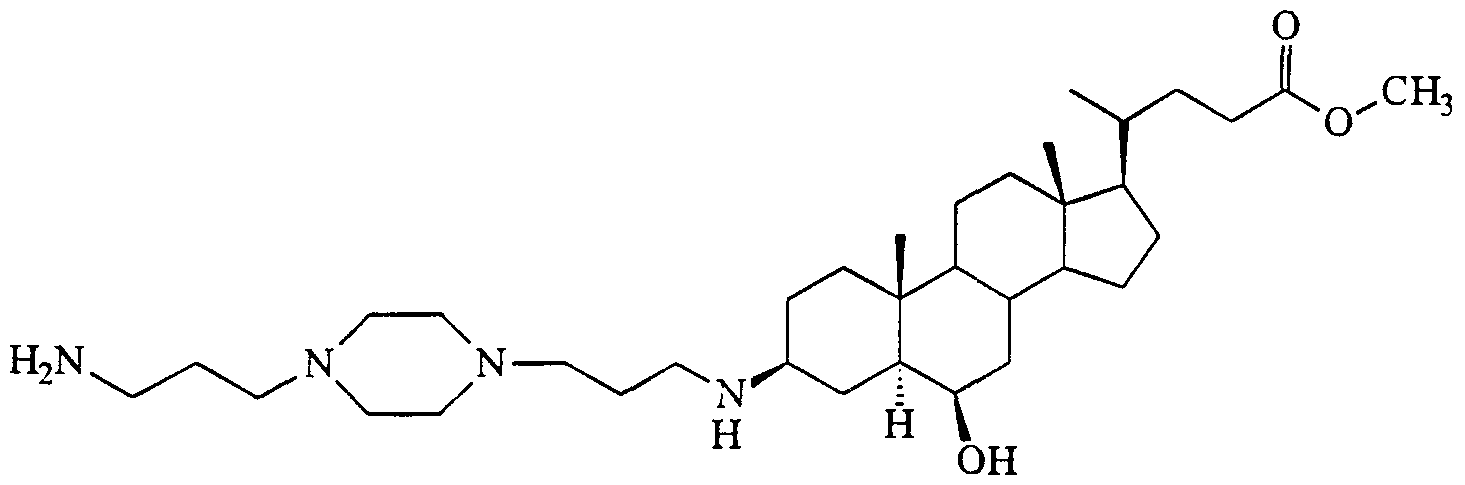
Preparation of compound 1021: The 3-dioxolane was deprotected using acidic acetone solution. The 3-dioxolane-6β-hydroxy-sterol 1020 (4.0 g, 8.9 mmol) was dissolved in acetone (200 ml) and treated with concentrated hydrochloric acid solution (10 ml). After approximately 1 hour, the reaction mixture was poured into a sodium bicarbonate solution. The solution was extracted with dichloromethane (3 x 200 ml), washed with distilled water (100 ml) and then brine (100 ml), dried over anhydrous sodium sulfate, filtered, and evaporated under vacuum to yield methyl 3-oxo-6β-hydroxy-5α-cholan-24-oate 1021 (3.45 g, 100% yield): 'H NMR (200 MHz, CDC13) δ: 3.8 (br m, IH), 3.69 (s, 3H), 1.24 (s, 3H), 0.95 (d, J = 6 Hz, 3H), 0.74 (s, 3H); IR (KBr, cm"'): 3447, 2954, 1742, 1707, 1431. Preparation of compounds 431 and 432: The ethylenediamine compounds were prepared as follows. A magnetically stirred solution of 50:50 methanohtetrahydrofuran (100 ml) and ethylenediamine (2 ml) was treated with acetic acid to lower the pH to approximately 6. The 3-oxo sterol 1021 (1.5 g, 3.7 mmol) was added, and the mixture was stirred for 15 minutes. Sodium cyanoborohydride (1 g, 16 mmol) was dissolved in 10 ml methanol and added to the reaction vessel, and the pH was again adjusted to 6 by the addition of acetic acid. The reaction was stirred for 1 hour, and the contents of the flask were poured into a pH 10.5 carbonate-buffer ice slurry (250 ml). The solution was extracted with chloroform (5 x 150 ml). The organic layers were combined, dried over anhydrous sodium sulfate, filtered, dried under vacuum, and purified by flash chromatography on silica gel (4 cm x 25 cm, elution with 8:2:1 chloroform:methanol:isopropylamine) to produce the less polar α-isomer 431 (260 mg, 15%) yield) and the more polar β-isomer 432 (840 mg, 49 % yield). Compound 431: Η NMR (400 MHz, CD3OD) δ: 3.74 (m, IH), 3.65 (s, 3H), 3.53 (m, IH), 1.06 (s, 3H), 0.94 (d, J = 6 Hz, 3H), 0.74 (s, 3H); IR (KBr, cm 1): 3426, 2943, 1740, 1590, 1438, 1379, 1258, 1168, 1027; MS(+FAB): 449.5 (M+1); Anal, calcd. for C27H48N2O3-2HC1-0.7H2O: C=60.70, H=9.70, N=5.24; Found: C=60.97, H=9.68, N=5.34. Compound 432: 'H NMR (400 MHz, CD3OD) δ: 3.75 (m, IH), 3.64 (s, 3H), 1.02 (s, 3H), 0.94 (d, J - 6 Hz, 3H), 0.73 (s, 3H); IR (KBr, cm 1): 3560, 3366, 3257, 2936, 1726, 1648, 1605, 1438, 1376, 1166, 1047; MS(+FAB): 449.5 (M+1); Anal, calcd. for C27H48N2O3-0.4H2O: C=71.13, H=10.79, N=6.14; Found: C=71.15, H=10.71, N=6.28.
Preparation of compounds 465 and 466: To a magnetically stirred flask containing anhydrous methanol (100 ml) was added compound 1021 (1.5 g, 3.7 mmol), spermine (2 g, 9.9 mmol), powdered 3A sieves (2 g), and acetic acid until the pH was 6. The flask was sealed, the contents stirred overnight, and then sodium cyanoborohydride (1 g, 16 mmol) in methanol (10 ml) was added. The pH was again adjusted with acetic acid, and the reaction mixture was stirred for 8 hours. The workup was similar to the workup for the ethylenediamine compounds 431 and 432 described above. The crude product was purified by flash chromatography (5 cm x 25 cm, elution with 4:5:1 chloroform:methanol:isopropylamine), producing the less polar α-amino isomer 465 and the more polar β-amino isomer 466. The total yield of amino sterol was 1.3 g (58% yield). Compound 465: Η NMR (400 MHz, CD3OD) δ: 3.75 (m, IH), 3.65 (s, 3H), 3.54 (m, IH), 1.06 (s, 3H), 0.95 (d, J = 6 Hz, 3H), 0.74 (s, 3H); IR (KBr, cm 1): 3406, 2944, 1740, 1596, 1466, 1168, 1049, 1027; MS(+FAB): 591.4 (M+1); Anal, calcd. for C35H66N4O3-4HCl- 1.2H2O: C=55.43, H=9.62, N=7.39; Found: 0=55.70, H=9.15, N=7.12. Compound 466: 'H NMR (400 MHz, CD3OD) δ: 3.79 (m, IH), 3.65 (s, 3H), 1.06 (s, 3H), 0.95 (d, J = 6 Hz, 3H), 0.74 (s, 3H); IR (KBr, cm 1): 3406, 2944, 1740, 1595, 1459, 1381, 1167, 1051, 1026; MS(+FAB): 591.4 (M+1); Anal, calcd. for C35H66N4O3-4HCl-1.2H2O: C=55.43, H=9.62, N=7.39; Found: C=55.48, H=9.03, N=7.33.
Preparation of compound 469: This compound was prepared in a manner analogous to that used for compound 466, but using polyamine 1023 produced by the following reaction:
Figure imgf000035_0001
1022
Figure imgf000035_0002
1023
The polyamine 1023 was prepared from piperazine by double addition of acrylonitrile to yield compound 1022, which was reduced by Raney nickel catalyzed hydrogenation. β-amino isomer 469: Η NMR (400 MHz, CD3OD) δ: 3.78 (m, IH), 3.64 (s, 3H), 3.5-3.3 (m, 8H), 3.2-3.0 (m, 9H), 2.4-1.0 (m, 30H), 1.03 (s, 3H), 0.92 (d, J = 6.5 Hz, 3H), 0.71 (s, 3H); IR (KBr, cm"1): 3406, 2943, 1736, 1594, 1443, 1165; MS(+FAB): 589.4 (M+1); Anal, calcd. for C35H64N4O3-4HCl-3H2O: C=53.29, H=9.46, N=7.10; Found: C=53.06, H=8.90, N=8.43. Preparation of compounds 433 and 467: An amount of aminosterol methyl ester (1 mmol) as the free base (compounds 432 and 466, respectively) was weighed into a 25-ml round-bottom flask. The aminosterol was dissolved in a minimal amount of tetrahydrofuran (2 ml), treated with 1 N potassium hydroxide solution (10 ml), and magnetically stirred for 1 hour. The solution was then neutralized with IN HCl, and the solvent was removed under vacuum. The residue was redissolved in a minimal amount of deionized water and applied to an octadecyl-functionalized silica gel column (Aldrich, 2 x 10 cm, gradient elution of acetonitrile in 2%> trifluoroacetic acid in water). The fractions containing aminosterol were pooled, and the solvent was removed under vacuum. The aminosterol was redissolved in 0. IN HCl, and the solvent was removed under vacuum (2x) to insure the removal of trifluoroacetate. Benzene was added to the resulting hydrochloride salts, followed by evaporation overnight to remove as much water as possible.
Ethylenediamine β-amino isomer 433 was not treated with HCl, but isolated as the trifluoroacetate salt. Compound 433: 'H NMR (400 MHz, CD3OD) δ: 3.78 (m, IH), 1.06 (s, 3H), 0.95 (d, J = 6.5 Hz, 3H), 0.74 (s, 3H); IR (KBr, cm"1): 3533, 3488, 2941, 1716, 1679, 1615, 1489, 1431, 1191; MS(+FAB): 435.5 (M+1), 531.5 (likely a trace of the trifluoroacetamide); Anal, calcd. for C26H46N203-2TFA-0.7H2O: C=53.36, H=7.37, N= .15; Found: C=54.36, H=7.45, N=4.40.
Spermine β-amino isomer 467: Η NMR (400 MHz, CD3OD) δ: 3.80 (m, IH), 1.05 (s, 3H), 0.95 (d, J = 6.5 Hz, 3H), 0.73 (s, 3H); IR (KBr, cm"1): 3406, 2944, 1718, 1637, 1458; MS(+FAB): 577.4 (M+1); Anal, calcd. for C34H64N4O3-4HCl-4H2O: C=51.38, H=9.64, N=7.05; Found: C=51.40, H=8.77, N=7.01.
Example I
Preparation of bile acid methyl esters 409, 410, 411, 355, 356, 416, 448, 414, 415, 412, 413, 417, and 449:
Figure imgf000037_0001
Figure imgf000037_0002
Figure imgf000037_0003
Figure imgf000038_0001
Figure imgf000038_0002
Figure imgf000038_0003
Figure imgf000039_0001
Figure imgf000039_0002
Figure imgf000039_0003
Figure imgf000040_0001
Figure imgf000040_0002
Figure imgf000040_0003
39
Figure imgf000041_0001
Preparation of precursors: The methyl esters of chenodeoxycholic acid and deoxycholic acid (available from Aldrich), which are structurally depicted below, were prepared by the same procedure as used to esterify hyodeoxycholic acid to compound 1016.
Figure imgf000041_0002
Chenodeoxycholic Acid Deoxycholic Acid
Silver carbonate oxidations of bile acid esters to prepare 3-keto steroids: Both chenodeoxycholic and deoxycholic acid derivatives were prepared by reductive aminations of the 3-oxo sterols with the appropriate amines. The 3-oxo sterols were prepared by similar procedures as described below.
Silver carbonate on Celite® (SiO2 available from Aldrich) was prepared by dissolving 4 equivalents of silver nitrate in deionized water and adding sufficient Celite® (SiO2 available from Aldrich) to result in 50% silver carbonate on Celite® (SiO2 available from Aldrich). To the magnetically stirred solution was added 2.2 equivalents of sodium carbonate dissolved in deionized water, with continued vigorous stirring. The resulting silver carbonate precipitated on Celite® (SiO2 available from Aldrich) was filtered through a glass-fritted funnel, washed with tetrahydrofuran, and allowed to dry in a vacuum desiccator. The methyl ester of the bile acid to be oxidized was dissolved in toluene, treated with 2 equivalents of silver carbonate on Celite® (SiO2 available from Aldrich), and heated to reflux using a Dean Stark apparatus for azeotropic removal of water. The oxidation was complete in less than 6 hours for both sterols. The only product in both cases was the desired 3-oxo sterol. The solution was filtered, and the solvent was removed under vacuum. The product in both cases recrystallized readily from ethyl acetate in hexanes to give the 3-oxo sterol in excellent yield (>89% in both cases).
Preparation of compounds 409 and 410: The 3-oxo sterol methyl ester of chenodeoxycholic acid (1.5 g, 3.7 mmol) was dissolved in methanol, to which a ten-fold excess of ethylenediamine (2.5 ml) was added. The pH was lowered with acetic acid to approximately 6, NaBH3CN (1 g, 15.9 mmol) dissolved in methanol was added, and the pH was again adjusted with acetic acid. The solution was stirred for 1 hour, and then worked up and purified in the same manner as compound 431. The total yield of aminosterol was 58%>, with an approximate ratio of α-amino isomer to the less polar β-amino isomer of 7:3. β-Amino isomer 409: 'H NMR (400 MHz, CD3OD) δ: 3.81 (m, IH), 3.68 (s, 3H), 3.42 (m, IH), 1.04 (s, 3H), 0.95 (d, J = 6.5 Hz, 3H), 0.72 (s, 3H); IR (KBr, cm 1): 3428, 2940, 2055, 1740, 1591, 1440, 1377, 1169, 1077, 984; MS(+FAB): 449.3 (M+1); Anal, calcd. for C27H48N2O3-2HCl-1.2H2O: C=59.70, H=9.72, N=5.16; Found: C=59.59, H=9.49, N=5.15. α-Amino isomer 410: Η NMR (400 MHz, CD3OD) δ: 3.82 (m, IH), 3.65 (s, 3H), 3.05 (br m, IH), 1.00 (s, 3H), 0.94 (d, J = 6.5 Hz, 3H), 0.72 (s, 3H); IR (KBr, cm 1): 3522, 2944, 2017, 1718, 1619, 1448, 1377, 1314, 1282, 1260, 1163, 1018; MS(+FAB): 449.3 (M+1); Anal, calcd. for C27H48N2O3-2HCl-3.7H2O: C=55.13, H=9.84, N=4.76; Found: C=55.03, H=9.32, N=4.78.
Preparation of compound 411: This spermine compound was prepared by the same procedure as the ethylenediamine compounds 409 and 410, except for the following modification. One gram of the 3-oxo sterol methyl ester of chenodeoxycholic acid and 1 g of spermine (approx. 2 equiv.) were used, and the chromatography required a more polar solvent system (5:4:1 CHCl3:methanol:isopropylamine was used). The total yield of aminosterol was 48%. The ratio of α-amino isomer to β-amino isomer 411 was not determined due to incomplete separation. Compound 411: 'H NMR (400 MHz, CD3OD) δ: 3.83 (m, IH), 3.65 (s, 3H), 3.42 (m, IH), 1.04 (s, 3H), 0.95 (d, J = 6.5 Hz, 3H), 0.70 (s, 3H); IR (KBr, cm"1): 3404, 2946, 2059, 1739, 1595, 1458, 1378, 1168, 1073, 1012, 985, 759; MS(+FAB): 591.4 (M+1); Anal, calcd. for C36H66N4O3-4HCl-4H2O: C=51.97, H=9.72, N=6.93; Found: C=51.65, H=8.53, N=6.77.
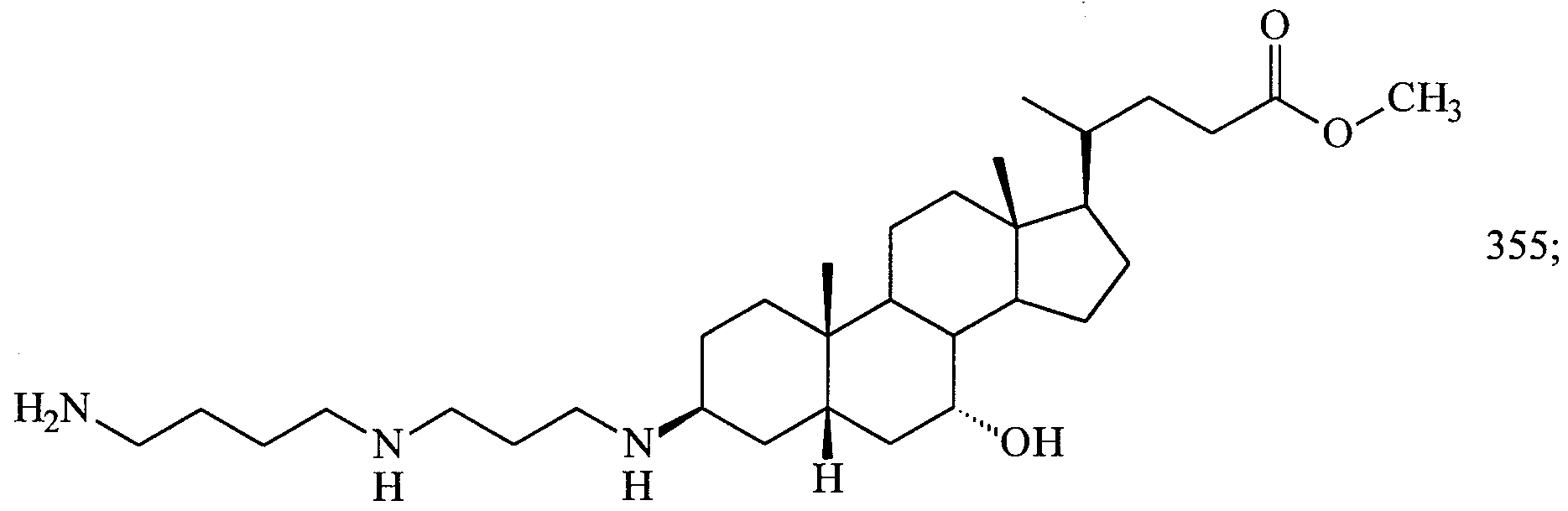
Preparation of compounds 355 and 356: The 3-oxo sterol methyl ester of chenodeoxycholic acid was coupled to polyamine 301 with sodium cyanoborohydride, the BOC groups were removed with trifluoroacetic acid, and the ester was hydrolyzed as in the preparation of compound 319. Purification was achieved on silica gel (15:4:1 to 10:4:1 chloroform:methanol:isopropylamine). Less polar β-amino isomer 355, C32H59N3O3: Η NMR (400 MHz, CDC13) δ: 3.87 (m, IH), 3.68 (s, 3H), 3.15 (m, IH), 3.0-2.7 (m, 8H), 2.4-1.0 (m, 32H), 0.99 (s, 3H), 0.91 (d, J = 6 Hz, 3H), 0.66 (s, 3H); MS(DCI): 534 (M+1). More polar α-amino isomer 356, C32H59N3O3-3HCl: 'H NMR (400 MHz, CD3OD) δ: 3.82 (m, IH), 3.25-2.95 (m, 9H), 2.5-1.0 (m, 32H), 0.97 (s, 3H), 0.94 (d, J = 6 Hz, 3H), 0.69 (s, 3H); MS(DCI): 534 (M+1).
Preparation of compound 416: The procedures used for the preparation of deoxycholic acid derivatives were the same as those used in the preparation of the chenodeoxycholic acid derivatives. For the ethylenediamine compound 416, the total yield of aminosterol was 62%, with the ratio of α-amino isomer 416 to β-amino isomer being 4: 1. Compound 416: Η NMR (400 MHz, CD3OD) δ: 3.97 (m, IH), 3.68 (s, 3H), 3.22 (br m, IH), 1.02 (d, J = 6.5 Hz, 3H), 1.01 (s, 3H), 0.73 (s, 3H); IR (KBr, cm 1): 3418, 2940, 1739, 1616, 1456, 1379, 1253, 1169, 1036; MS(+FAB): 449.4 (M+1); C27H48N2O3-2HC1-0.5H2O: C=61.12, H=9.69, N=5.28; Found: C=61.20, H=9.50, N=5.07.
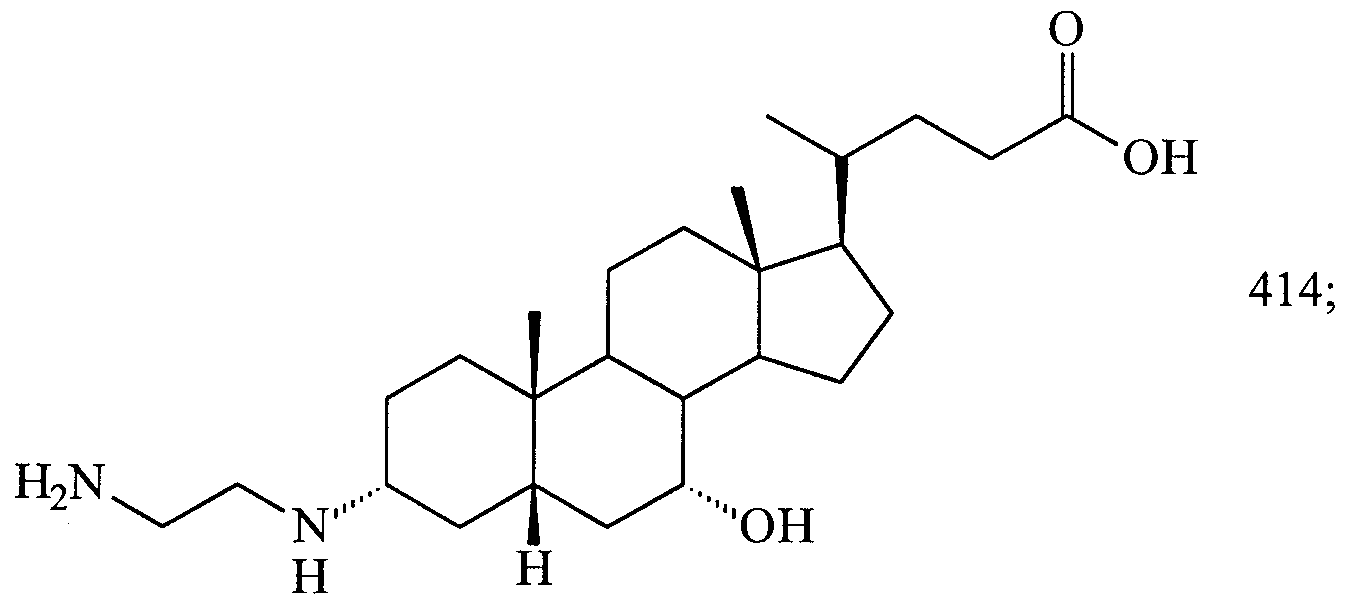
Preparation of compound 448: For the spermine derivatives of deoxycholic acid, the total yield of aminosterol was 46% (difficulty in the workup was likely responsible for the lower yield). The ratio of α-amino isomer 448 to β-amino isomer was not determined due to incomplete separation. Compound 448: Η NMR (400 MHz, CD3OD) δ: 3.98 (m, IH), 3.67 (s, 3H), 1.01 (d, J = 6 Hz, 3H), 1.01 (s, 3H), 0.73 (s, 3H); IR (KBr, cm"1): 2944, 1738, 1594, 1451, 1378, 1169, 1038, 758; MS(+FAB): 591.5 (M+1); Anal, calcd. for C35H66N4O3-4HCl- 2.3H2O: C=54.02, H=9.66, N=7.20; Found: 0=54.00, H=8.64, N=7.22. Preparation of compounds 414 and 415: The free acids were prepared from the methyl esters as in the preparation of 6β-hydroxy 433. α- Amino isomer 414: Η NMR (400 MHz, CD3OD) δ: 3.83 (m, IH), 3.06 (br m, IH), 1.04 (s, 3H), 0.96 (d, J = 6 Hz, 3H), 0.73 (s, 3H); IR (KBr, cm"1): 2940, 2053, 1709, 1452, 1378, 1167, 1076, 1007, 975; MS(+FAB): 435.5 (M+1); Anal, calcd. for C26H46N2O3-2HCl-l .5H2O: C=58.41, H=9.62, N=5.24; Found: C=58.24, H=9.40, N=5.47. β-Amino isomer 415: Η NMR (400 MHz, CD3OD) δ: 3.83 (m, IH), 3.47 (m, IH), 1.06 (s, 3H), 0.95 (d, J = 6 Hz, 3H), 0.73 (s, 3H); IR (KBr, cm'1): 3488, 2935, 2054, 1709, 1593, 1499, 1450, 1246, 1168, 1077, 1022, 984; MS(+FAB): 435.5 (M+1); Anal, calcd. for C26H46N2O3-2HCl-1.5H2O: C=58.41, H=9.62, N-5.24; Found: C=58.59, H=9.35, N=5.43.
Preparation of compounds 412, 413, 417, and 449: These compounds were produced using procedures analogous to those above in this Example. α-Amino 412: 'H NMR (400 MHz, CD3OD) δ: 3.83 (m, IH), 3.00 (br m, IH), 1.04 (s, 3H), 0.96 (d, J = 6 Hz, 3H), 0.74 (s, 3H); IR (KBr, cm"1): 3413, 2942, 2061, 1710, 1594, 1460, 1377, 1167, 1074; MS(+FAB): 577.7 (M+1); Anal, calcd. for C34H64N4O3-4HCl- 2.5H2O: C=53.19, H=9.58, N=7.30; Found: C=53.27, H=9.47, N=7.32. β-Amino 413: Η NMR (400 MHz, CD3OD) δ: 3.8 (m, IH), 3.4 (m, IH), 1.05 (s, 3H), 0.96 (d, J = 6 Hz, 3H), 0.73 (s, 3H); MS(+FAB): 577.7 (M+1).
Deoxycholic acid ethylenediamine 417 (α-amino isomer): 'H NMR (400 MHz, CD3OD) δ: 4.03 (m, IH), 3.22 (br m, IH), 1.03 (d, J = 6 Hz, 3H), 1.00 (s, 3H), 0.74 (s, 3H); IR (KBr, cm"1): 2940, 1706, 1456, 1379, 1254, 1034; MS(+FAB): 435.4 (M+1); Anal, calcd. for C26H46N2O3-2HCl-2H2O: C=57.45, H=9.64, N=5.15; Found: C=57.32, H=9.22, N=5.13.
Deoxycholic acid spermine 449 (α-amino isomer): 'H NMR (400 MHz, CD3OD) δ: 4.02 (m, IH), 1.04 (d, J = 6 Hz, 3H), 1.00 (s, 3H), 0.75 (s, 3H); IR (KBr, cm 1): 2941, 1716, 1448, 1038; MS(+FAB): 577.4 (M+1); Anal, calcd. for C34H64N4O3-4HCl-1.5H2O: C=54.57, H=9.54, N=7.47; Found: C=54.31, H=8.71, N=7.80. Example J
Preparation of compounds 566 and 569:
Figure imgf000045_0001
301 566
Preparation of compound 566. Compound 566 was prepared in an analogous manner to that used for compound 466, but using polyamine 301 instead of spermine. The product of the reductive coupling was deprotected with trifluoroacetic acid to remove the BOC groups and yield compound 566. Compound 566: Η NMR (400 MHz, CD3OD): δ 3.74 (m, IH), 3.61 (s, 3H), 3.3-2.9 (m, 9H), 2.4 - 1.0 ( , 32H), 1.01 (s, 3H), 0.90 (d, J = 6 Hz, 3H), 0.70 (s, 3H); MS (+FAB): 534.4 (M+1); Anal, calcd. for C32H59N3O3-3TFA: C=52.1 1, H=7.13, N= .80; Found: C=52.02, H=6.97, N=4.67.
Figure imgf000045_0002
569
Preparation of compound 569. Compound 569 was prepared in an analogous manner to compound 466, but methyl 3-oxo-5β-cholanoate (from Steraloids Inc.) was used as the starting steroid component. Compound 569: MS (+FAB): 575.5 (M+1); Η NMR (400 MHz, CD3OD): δ 3.61 (s, 3H), 3.1-3.0 (m, 12H), 2.3-1.0 (m, 36H), 1.00 (s, 3H), 0.90 (d, J = 6 Hz, 3H), 0.66 (s, 3H); Anal, calcd. for C35H66N4O2-4TFA: C=50.09, H=6.84, N=5.43, F=22.11; Found: C=50.04, H=6.41, N=5.21, F=20.66. Based on the above description, one skilled in the art would be capable of producing additional aminosterol ester compounds that fall within the general formula identified above through routine experimentation.
PROPERTIES OF THE AMINOSTEROL ESTERS
Various properties of specific aminosterol esters are described below. Some properties are described in comparison with other aminosterols, such as squalamine, compound 1436, and compound 1437.
Inhibition of Endothelial Cell Cord Formation In Vitro:
Endothelial cells have the capacity in vitro to form tubular aggregates resembling capillaries in various early stages of formation. This conversion occurs under relatively specific conditions, in which essential growth factors along with an effective substratum are provided. It has been shown that both the interaction of growth factors with the endothelial cell and its attachment to a substratum activate the NHE. The activation of this exchanger is believed to be required for subsequent morphologic transformation of the endothelial cell into a multicellular tubular structure.
To assess the effect of compounds on the cord-like structures formed by human microvascular cells when plated in the presence of VEGF (Vascular Endothelial Growth Factor) and basic fibroblast growth factor on a collagen matrix, a standard cord formation assay was used. The results are shown in the table below.
EFFECT OF VARIOUS AMINOSTEROLS ON ENDOTHELIAL CORD FORMATION μg/ml
0.01 Q 0 10.0
Fumagillin - +/- + Squalamine - + + + Compound 319 - + + + Compound 353 + + + Compound 410 + +* 0.01 (Li 0 10.0
Compound 411 - - +
Compound 412 - - +
Compound 413 - - +
Compound 415 - - +/T
Compound 432
Compound 449 - +/-
Compound 467
Notes: + = Inhibition of angiogenesis;
- = No inhibition of angiogenesis;
T = Toxic;
* = cell rounding @ 10 μg/ml.
As shown in the above Table, squalamine inhibits cord formation at about 0.1 μg/ml, compared with fumagillin, which exhibits comparable activity at 10 μg/ml. At these concentrations, squalamine does not appear to profoundly affect cell viability or proliferation. This property in vitro roughly correlates with anti-angiogenic activity in more complex in vivo models (see Goto et al., Lab Investigation 69, 1993, 508-518, which article is entirely incorporated herein by reference). Notably, ester compounds 410 and 411 also inhibit angiogenesis at higher doses.
The Vitelline Capillaries of 3-5 Day Chick Embryo Model:
In the course of evaluating squalamine in the "classical" chick chorioallantoic membrane model, it was noted that this steroid exerted a dramatic and rapid effect on capillary vessel integrity in the three- to five-day old chick embryo. Using the chick embryo vitelline capillaries assay, various aminosterol compounds were tested for their ability to induce capillary regression. Each compound was applied in 0.1 ml of 15% Ficol 400 and PBS onto the embryo, and vascular regression was assessed after 60 minutes.
Squalamine was found to disrupt vitelline capillaries in 3- to 5-day chick embryos. The 3-day chick embryo consists of an embryonic disc from which numerous vessels emerge and return, forming a "figure 8"-shaped structure—the embryo in the center with vascular loops extending outward over both poles. Application of squalamine onto the embryonic structure (0.1 ml in 15% Ficol in PBS) resulted in progressive "beading up" of the vitelline vessels, with the finest capillaries being the first to exhibit these changes. Following a lag period of around 15 minutes, the constriction of continuity between capillary and secondary vessels, generally on the "venous" side, was observed. Continued pulsatile blood flow progressed, resulting in a "swelling" of the blind tube, followed by a pinching off of the remaining connection and formation of an enclosed vascular sac resembling a "blood island." This process progressed until only the largest vessels remained intact. The embryonic heart continued to beat vigorously. No hemorrhage was seen, reflecting the integrity of the capillary structure. In addition, no obvious disruption of circulating red cells was observed microscopically, demonstrating the absence of hemo lysis.
Utilizing this assay, which appears to demonstrate what is commonly called capillary "regression," a minimum concentration of squalamine and other aminosterol compounds required to observe an effect in 60 minutes can be determined. Results are summarized in the table below.
EFFECTS OF VARIOUS AMINOSTEROLS IN CHICK EMBRYO VITELLINE CAPILLARY REGRESSION ASSAY
Amount of Compound Applied (μg)
Compound 10 J_ 0J. 0.01 0.001
Compound 1436 + + + + +/-
Compound 319 + + + + +/- squalamine + + + + 0
Compound 415 + + + 0
Compound 410 + +/- +/- 0
Compound 412 + 0 0 0
Compound 411 +/- 0 0 0
Compound 382 + + 0 0 0
Compound 396 + 0 0 0 Amount of Compound Applied (μg)
Compound 10 1_ 0.1 0.01 0.001
Compound 353 +/■
Compound 413 0
Compound 414 0
Compound 381 0
Compound 303 0
Compound 318 0
Compound 409 0
Vehicle 0 0
Notes: + = Vascular reactivity;
0 = No vascular reactivity; +/- = Equivocal reactivity; Vehicle = 15% (w/w) Ficol in phosphate-buffered saline.
As apparent from the above Table, 0.1-0.01 μg of squalamine in 0.1 ml medium can induce changes. Compounds having various ranges of activities were found, with squalamine, compound 319, and compound 415 being especially active. Additionally, ester compound 410 demonstrated substantial activity in this assay. This experiment demonstrates that the steroids tested can dramatically restructure capillaries over a time interval amounting to several minutes. The results reflect that this effect is accomplished through inhibition of NHE.
Tadpole Assay
A tadpole assay was conducted to test the properties of various aminosterols. This tadpole assay is described in U.S. Patent Application No. 08/483,059. For this assay, tadpoles, preferably Xenopus laevis Stages 59-60 tadpoles, were employed to study the effect of a compound by monitoring capillary occlusion in the tadpole's tail. Animals at these stages were used because they represent the period of transition through metamorphosis at which time the animal possess both embryonic and adult stage tissues. Compounds, when tested in this assay, can affect the shape, viability, and integrity of the embryonic tissues while not affecting the adult tissues, providing a powerful, highly specific screen. For example, substances that destroy all of the animal's epithelium, both adult and embryonic, could be regarded as toxic. Substances that destroy only the embryonic tissues exhibit a very unique specificity.
In this assay, tadpoles are introduced into Petri dishes containing a solution of the test compound in distilled water, preferably about 100 ml. The preferred concentration of the test compound is from about 1 μg/ml to about 10 μg/ml. The volume of liquid is sufficient for the animal to swim freely and drink from the solution. Thus, the effect observed results from oral absorption and subsequent systemic distribution of the agent. If the volume of liquid is not sufficient to permit oral intake, the effects that are observed would result from absorption through the surface epithelium. Thus, this simple assay can identify if an compound has characteristics of oral availability.
In another embodiment of this assay, a solution of a compound in water can be injected directly into the abdomen of the animal using standard techniques. Concentrations of the compound from about 0.05 mg/ml to about 0.5 mg/ml in about 0.05 ml of water are preferred.
After an amount of time, typically about 60 minutes, the occlusion of blood flow through capillaries in the tadpole's tail are observed under an inverted microscope at a magnification of roughly 100X.
When the tadpoles were introduced into distilled water containing squalamine at 10 μg/ml, it was observed that blood flow through the capillaries of the tail shut down. The process occurred from the caudal to cranial direction. Blood flow within the most distal vessels stopped initially, followed by the larger vessels. During this period, it was observed that the cardiovascular system was otherwise robust, as evidenced by a continued heartbeat, pulsatile expansion of the great vessels, and, most curiously, unaltered blood flow through the fine capillaries of the hands and feet. Thus, selective cessation of blood flow was seen in localized regions. If the animals are maintained in squalamine for several days, enhanced regression of the most distal aspects of the tail, as well as the peripheral aspects of the tail fin are observed, corresponding to regions of the animal perfused by the occluded vasculature.
This effect apparently results from selective change in the resting diameter of the capillaries of the tail. Inhibition of the endothelial cell NHE evidently leads to a change in shape of the cell making up the capillary, resulting in diminished flow. The continued functioning of capillary beds in the "adult" portions of the tadpole (the limbs) indicates that squalamine is selective for certain capillaries. From the results of the tadpole tail capillary occlusion assay, compound 319, squalamine and compound 1436 were found to induce a common vascular occlusive effect.
Various other aminosterols were tested in the tadpole assay. Compound 1437, described, for example in U.S. Patent Appl. No. 08/483,059, contains an unusual ergosterol-like side chain. In the tadpole assay, this molecule can be distinguished readily from other steroids extracted from shark on the basis of its dramatic effect on the embryonic epithelium covering the tadpole tail.
Using the tadpole assay described above, within 60 minutes of exposure to steroid 1437 at 10 μg/ml, the larval skin was observed to shed off in a sheet. The rapid appearance of the process suggests that an NHE expressed by this epithelial tissue is the target. Since NHE activity and cell membrane proteins involved in adhesion cross-communicate (Schwartz et al., Proc. Nat'l. Acad. Sci. 888, 7849-7853, which article is entirely incorporated herein by reference), it is proposed that inhibition of NHE on the epithelium results in disruption of cellular contacts between the epithelium and its substratum, leading to a shedding effect.
Because of the results in the assay described above, the anticancer effects of compound 1437 against several cancer lines was assessed. Compound 1437 was found to exhibit anticancer activity against the human ovarian carcinoma, SKOV3. Thus, compound 1437 should find use in the treatment of carcinomas exhibiting a sensitive phenotype.
As the study above demonstrates, compound 1437 targets a "mesothelium-like" epithelial layer, a skin layer that is comprised of only one cellular layer. Such a layer resembles epithelial surfaces such as the human peritoneum, synovium, pericardium, and ependyma. Accordingly, compound 1437 should exhibit antiproliferative effects on these tissues and malignancies which derive from them. In addition, these tissues can support viral infections, and therefore in these instances the compound should provide therapeutic antiviral benefit.
By use of the Xenopus tadpole assay, it was possible to identify compounds that exhibit little chemical resemblance to compound 1437, but produce the same pharmacological effect with respect to epithelial shedding. Using such a method, it was found that aminosterol esters 409, 410, 416, 431, and 432 are functionally similar to compound 1437.
Antimicrobial and Other Activity
The aminosterol NHE inhibitors represent a class of antibiotics based on mechanism of action. Because these agents also interact with specific NHE isoforms in human tissues, prudent selection of an antibiotic of this class can eliminate undesirable side effects, due to host NHE inhibition, or potentiate the therapeutic intent. Thus, use of an agent like compound 1436 would suppress lymphoid proliferation during active treatment of an infection. An effective antifungal agent can be designed further to increase specificity for its pathogenic target over sensitive vertebrate isoforms.
As seen in Table I at the end of this specification, the antibacterial/antifungal spectrum differs from compound to compound. Thus, it is possible to achieve an antimicrobial steroid with or without squalamine-like pharmacological activity.
As set forth in Table II, which follows Table I, the activities of natural and synthetic aminosterols in the different assays vary. In light of the foregoing, it is now possible to screen for steroids with or without squalamine-like pharmacological activity.
Table III, following Table II, shows various properties of aminosterol ester compound 569. Notably, this aminosterol compound has higher inhibition of HIV than compound 1436.
Additional properties of certain aminosterol compounds described above are shown in Table IV. Notably, compound 469 has a higher potency in the mitogen proliferation assay than compound 1436. See Table IV. Aminosterol esters 459, 569, and 466 also have substantial potency in this assay, as shown in Table IV.
In Table V, several aminosterol esters show efficacy in killing melanoma cells in the MTT assay. Notably, many of them are more potent than compound 1436 in this assay.
Furthermore, like compound 1361, compounds 459, 466, and 566 have been found to induce swelling of red blood cells. This activity is believed to make compounds 459, 466, and 566 useful for treatment of malaria or sickle cell anemia. THERAPEUTIC ADMINISTRATION AND COMPOSITIONS
The mode of administration of aminosterol compounds of the invention may be selected to suit the particular therapeutic use. Modes of administration generally include, but are not limited to, transdermal, intramuscular, intraperitoneal, intravenous, subcutaneous, intranasal, inhalation, intralesional, endothelial and oral routes. The compounds of the invention may be administered by any convenient route, for example, by infusion or bolus injection, or by absorption through epithelial or mucocutaneous linings (e.g., oral mucosa, rectal, and intestinal mucosa, etc.), and the active aminosterol ingredient may be administered together with other biologically active agents. Administration may be local or systemic.
The present invention also provides pharmaceutical compositions that include one or more aminosterol compounds as an active ingredient. Such pharmaceutical compositions include a therapeutically effective amount of the aminosterol compounds (or a pharmaceutically acceptable salt thereof) and a pharmaceutically acceptable carrier or excipient. Examples of such a carrier include, but are not limited to, saline, buffered saline, dextrose, water, glycerol, ethanol, and combinations thereof. The particular form and formulation of the pharmaceutical composition should be selected to suit the mode of administration.
The pharmaceutical composition, if desired, also may contain minor amounts of wetting or emulsifying agents, or pH buffering agents. The pharmaceutical composition may be in any suitable form, such as a liquid solution, suspension, emulsion, tablet, pill, capsule, sustained release formulation, or powder. The pharmaceutical composition also may be formulated as a suppository, with traditional binders and carriers, such as triglycerides. Oral formulations may include standard carriers, such as pharmaceutical grades of mannitol, lactose, starch, magnesium stearate, sodium saccharine, cellulose, magnesium carbonate, etc.
Various delivery systems are known and may be used to administer a therapeutic compound of the invention, e.g., encapsulation in liposomes, microparticles, microcapsules and the like.
In one embodiment, the pharmaceutical composition is formulated in accordance with routine procedures as a pharmaceutical composition adapted for intravenous administration to humans. Typically, compositions for intravenous administration are solutions in sterile isotonic aqueous buffer. Where necessary, the pharmaceutical composition also may include a solubilizing agent and a local anesthetic to ameliorate pain at the cite of the injection. Generally, the ingredients are supplied either separately or mixed together in unit dosage form, for example, as a dry lyophilized powder or water-free concentrate in a hermetically sealed container such as an ampule or sachette indicating the quantity of active agent. Where the pharmaceutical composition is to be administered by infusion, it may be dispensed with an infusion bottle containing sterile pharmaceutical grade water or saline. Where the pharmaceutical composition is administered by injection, an ampoule of sterile water for injection or saline may be provided so that the ingredients may be mixed prior to administration.
The amount of the therapeutic compound of the invention that will be effective in the treatment of a particular disorder or condition will depend on the nature of the disorder or condition, and this amount can be determined by standard clinical techniques known to those skilled in the art through routine experimentation. The precise dose to be employed in the pharmaceutical composition also will depend on the route of administration and the seriousness of the disease or disorder, and should be decided according to the judgement of the practitioner and each patient's circumstances. Effective therapeutical doses may be determined from extrapolations of dose-response curves derived from in vitro or animal- model test systems.
The following dosage ranges are exemplary. Suitable dosages for intravenous administration are generally about 20 micrograms to 40 milligrams of active compound per kilogram body weight. Suitable dosage ranges for intranasal administration are generally about 0.01 mg/kg body weight to 1 mg/kg body weight. Suitable concentrations for topical administration are generally at least about 0.01%) by weight. Suitable dosages for oral administration are generally about 500 micrograms to 800 milligrams per kilogram body weight, and preferably about 1 -200 mg/kg body weight. Suppositories generally contain, as the active ingredient, 0.5 to 10% by weight of the aminosterol compounds. Oral formulations preferably contain 10%> to 95%> active ingredient.
Exemplary dosages of the aminosterol compounds for most pharmacological or therapeutical uses fall within the range of about 0.01 mg/kg body weight to about 100 mg/kg body weight. Preferred dosages are from 0.1 to 25 mg/kg body weight. The invention also may include a pharmaceutical pack or kit including one or more containers filled with pharmaceutical compositions in accordance with the invention. Associated with such containers may be a notice in the form prescribed by a government agency regulating the manufacture, use or sale of pharmaceuticals or biological products, which notice reflects approval by the agency of manufacture, use or sale for human administration.
By the term "effective amount" in this application, applicants refer to a suitable amount of the active ingredient of the invention, with an appropriate carrier or excipient, including a sufficient amount of the active ingredient to provide the desired effects or results. The effective amount can be readily ascertained by those skilled in the art through routine experimentation.
In describing the invention, applicants have stated certain theories in an effort to disclose how and why the invention works in the manner in which it works. These theories are set forth for informational purposes only. Applicants do not wish to be bound by any specific theory of operation.
While the invention has been described in terms of various specific preferred embodiments and specific examples, those skilled in the art will recognize that various changes and modifications can be made without departing from the spirit and scope of the invention, as defined in the appended claims.
TABLE I
ANTIBIOTIC ACTIVITY OF NATURAL AND SYNTHETIC AMINOSTEROLS
MIC Values (μ /m )
Structure S. aurcus E. Coli P. acrug C. albicans
Figure imgf000056_0001
Compound 303
Figure imgf000056_0002
MSI- 1256
TABLE I (continued)
Antibiotic Activity
MIC Values (μg/mL)
Structure S. aureus E. Coli P. aerug C albicans
Figure imgf000057_0001
Compound 304
Figure imgf000057_0002
Compound 31
Figure imgf000057_0003
Compound 318 TABLE I (continued)
Antibiotic Activity
MIC Values (μg/mL)
Structure S. aureus E Coli P aerug C. albicans
Figure imgf000058_0001
Compound 353
Figure imgf000058_0002
4-8 32 64 32
Figure imgf000058_0003
TABLE I (continued)
Antibiotic Activity
MIC Values (μ /mL)
Structure S. aureus E. Coli p. aerug C. albicans
Figure imgf000059_0001
64 64 32
Figure imgf000059_0003
TABLE I (continued) Antibiotic Activity
MIC Values (μg/mL)
Structure S. aureus E. Coli P. aerug C albicans
Figure imgf000060_0001
Figure imgf000060_0002
Figure imgf000060_0003
Figure imgf000060_0004
Compound 355 TABLE I (continued)
Antibiotic Activity
MIC Values (μg/mL)
Structure S.aureus E. Coli P. aenig C. albicans
Figure imgf000061_0001
Compound 356
Figure imgf000061_0002
Co pound 409
Figure imgf000061_0003
Compound 4!0 TABLE I (continued)
Antibiotic Activity
MIC Values (μg/mL)
Structure S. aureus E. Coli p. aerug C. albicans
Figure imgf000062_0001
Figure imgf000062_0002
256 64 32
Figure imgf000062_0003
TABLE I (continued)
Antibiotic Activity
MIC Values (μg/mL)
Structure S. aureus E. Coli P. aerag C. albicans
Figure imgf000063_0001
Figure imgf000063_0002
16-32 32
Figure imgf000063_0003
TABLE I (continued)
Antibiotic Activity
MIC Values (μg/mL)
Structure S. aureus E. Coli P. aenig C. albicans
Figure imgf000064_0001
Figure imgf000064_0002
64 24
Figure imgf000064_0003
TABLE I (continued)
Antibiotic Activity
MIC Values (μg/mL)
Structure S. aureus E. Coli P. aerug C. albicans
Figure imgf000065_0001
Figure imgf000065_0002
Figure imgf000065_0003
Compound 1437 TABLE I (continued) Antibiotic Activity
MIC Values (μg/mL)
Structure S. aureus E. Coli P. aerug C. albicans
Figure imgf000066_0001
Figure imgf000066_0002
Figure imgf000066_0003
1-2 32 64
Figure imgf000066_0004
TABLE I (continued)
Antibiotic Activity
MIC Values (μg/mL)
Structure S. aureus E. Coli P. aerug C. albicans
Figure imgf000067_0001
Compound 465
Figure imgf000067_0002
Conpound 46ό
16 16
Figure imgf000067_0003
- 66 - TABLE II
ACTIVITY OF NATURAL AND SYNTHETIC AMINOSTEROLS IN CHICK EMBRYO AND TADPOLE ASSAYS
V=vascular; M=melanocytes, E=epithelial, TB=tissue breakdown GI=gastrointestinal, Mus=muscle, Tox=lethality at 2 hrs
Minimum Effective Concentration (μg/mL)
Chick
Structure embrvo iJM
Tadpole
Formatinn MH assay (10 μg/mL) MTT
(μg/mL) assay lusl (μg/mL) (^mL>
303 >10
Figure imgf000068_0003
Figure imgf000068_0001
318 >10
Figure imgf000068_0004
Figure imgf000068_0002
- 67
TABLE II (continued)
Minimum Effective Concentration (μg/mL)
Chick
Structure embrvo Cord H
Tadpole diss, Formation M ***H■*-*• MTT
(10 μg/mL) assay. (μg/mL) a assssaayy
(μg/mL) (^mL>
319 0.001
13.8
Figure imgf000069_0004
Figure imgf000069_0001
10 3.0 1.9
Figure imgf000069_0005
Figure imgf000069_0002
Figure imgf000069_0006
Figure imgf000069_0003
TABLE II (continued)
Minimum Effective Concentration (μg/mL)
Chick
Structure embrvo Tadpole C2--1 λX-T-r diss, assay (10 μg/mL) Foππaiioπ ^l MTT
(μ8/mL) αSS., (««■
55
Figure imgf000070_0004
Figure imgf000070_0001
56
Figure imgf000070_0005
Figure imgf000070_0002
96 10
Figure imgf000070_0006
Figure imgf000070_0003
O 98/27106
- 69
TABLE II (continued)
Minimum Effective Concentration (μg/mL)
Chick
Structure embryo Tadpole Co*
Formation ^-^- (10 μg/mL) asiax. (μg mL) aasax
( £} (μg/mL) (μg/mL)
397
Figure imgf000071_0003
Figure imgf000071_0001
409 > 1
Figure imgf000071_0004
Figure imgf000071_0002
Figure imgf000072_0004
Figure imgf000072_0001
>10
Figure imgf000072_0005
Figure imgf000072_0002
Figure imgf000072_0006
Figure imgf000072_0003
TABLE II (continued)
Minimum Effective Concentration (μg/mL)
ChisJς
Structure emhrvo HM
Tadpole Cqrd djss. (10 μg/mL) FPΠU-IIOΠ MTT assay. assay MTT
(μg/mL) (μg/mL)
394 >10
Figure imgf000073_0004
Figure imgf000073_0001
395 >ιo
Figure imgf000073_0005
Figure imgf000073_0002
Figure imgf000073_0006
Figure imgf000073_0003
TABLE II (continued)
Minimum Effective Concentration (μg/mL)
Chicli
Structure rmhrvo HM djss. Tadpole Cord
Formating MTT assay. (10 μg/mL) MTT
(μg/mL) sssay iiifύ (μg/mL) (μg/mL)
465
Figure imgf000074_0004
Figure imgf000074_0001
466
Figure imgf000074_0002
467
Figure imgf000074_0006
Figure imgf000074_0003
TABLE II (continued)
Minimum Effective Concentration (μg/mL)
Chick
Structure gmbrvo
Tadpole Csai HM diss. Formation — MT~*T MTT (10 μg/mL) assay iMύ (μg/mL) oϋS , <" ".>
431 >1
Figure imgf000075_0004
Figure imgf000075_0001
432 >1
Figure imgf000075_0005
Figure imgf000075_0002
433
Figure imgf000075_0006
Figure imgf000075_0003
TABLE II (continued)
Minimum Fffective Concentration (μg/mL)
C ±
Structure emhrvo
Tadpole CBBJ HM diss. Formation MTT assay (10 μg/mL) (μg mL) 2 ≥_SLS__aaxX MH
(μg/mL) (^mL>
448
Figure imgf000076_0004
Figure imgf000076_0001
>1
449
Figure imgf000076_0005
Figure imgf000076_0002
Figure imgf000076_0006
Figure imgf000076_0003
TABLE II (continued)
Minimum Effective Concentration (μg/mL)
Chicjς
Structure cmhrvo Tadpole diss. * τ (10 μg/mL) Forma*tmn J 5LUτ- MTT assay lasύ (μg mL) (μ8/m >
Figure imgf000077_0004
Figure imgf000077_0001
Figure imgf000077_0005
Figure imgf000077_0002
413 >1
>10
Figure imgf000077_0006
Figure imgf000077_0003
TABLE II (continued)
Minimum Effective Concentration (μg/mL)
Thick
Structure embryo
Tadpole Cad HM diss. Formating (10 μg/mL) MTT assay.
(U£) (μg/mL) (^mL>
414 >1
Figure imgf000078_0004
Figure imgf000078_0001
Figure imgf000078_0005
Figure imgf000078_0002
Figure imgf000078_0006
TABLE II (continued)
Minimum Effective Concentration (μg/mL)
Chic HM
Structure emhrvo Tadpole Cod TT diss. Formation M
MTT assay (10 μg/mL)
(μg/mL) ass≤y (μg/mL) (^mL>
417 >1
Figure imgf000079_0004
Figure imgf000079_0001
Figure imgf000079_0005
Figure imgf000079_0002
Figure imgf000079_0006
Figure imgf000079_0003
TABLE II (continued)
Minimum Effective Concentration (μg/mL)
Chick
Structure embryo HM
Tadpole Card dins. Formation MTT (10 μg/mL) MTT assay (μg/mL) assay (μg/mL) (^mL>
>1
Figure imgf000080_0002
Figure imgf000080_0001
Rel. potency
TABLE III V. lnhib. of MSI-1436 to MSI-1436
Binding (10 mg/kg Iv)
@ 100 μg/mL V. PBMC Mitogen MTT assay
Structure ('H-MSI-1436 at 20 μg/mL) % Inhlb of HIV toxicity (140 nM) Proliferation (14 μM) Assay μg/mL
Figure imgf000081_0001
569
Figure imgf000081_0002
1436 --4
*0
Figure imgf000081_0003
413
% Inhib. of MSI-1436 Rel. potency
TABLE IV Binding to MSI-1438 (10 mg/kg Iv)
@ 100 μg/mL % PBMC Mitogen MTT assay
Structure ('H-MSI-1436 at 20 μg/mL) % Inhib of HIV toxicity (140 πM) Proliferation (14 μM) Assay |ig/mL
Figure imgf000082_0001
Figure imgf000082_0002
Figure imgf000082_0003
1436
Rel. potency
% lnhib. of MSI-1436
TABLE IV (continued) to MSI-1436
Binding
(10 mg/kg iv)
@ 100 μg/mL % PBMC Mitogen MTT assay
Structure ('H-MSI-1438 at 20 μg/mL) V. Inhlb of HIV toxicity (140 nM) Proliferation ιc„ (14 μM) Assay μg/mL
Figure imgf000083_0001
449
Figure imgf000083_0002
413
Figure imgf000083_0003
459
Rel. potency
% Inhib. of MSI-1436
TABLE IV (continued) to MSI-1436
Binding
(10 mg/kg iv)
@ 100 μg/niL •A PBMC Inhlb of HIV Mitogen MTT assay
Structure ('H-MSI-143β at 20 μg/mL) % toxicity (140 nM) Proliferation ιcM (14 μM) Assay μg/mL
Figure imgf000084_0001
467
Figure imgf000084_0002
569 oo NJ
Figure imgf000084_0003
466
TABLE V Rel. potency
% Inhlb. of MSI-1436 to MSI-14J8
Binding (10 mαΛo. iv)
K PBMC
@> 100 μg/taL % Inhlb ot HIV Mitogen MTT assay toxicity fH-MSI-1438 zt 20 μgfmL) (140 fiM) Structure Proliferation IC, (14 μ ) . A»»»y ug mL
Figure imgf000085_0001
432
Figure imgf000085_0002
469
Figure imgf000085_0003
TABLE V (continued)
Rel. potency
% Inhib. Of MSI-1438 to MSI-1438
Binding (10 mgkg Iv)
% PBMC
@ 100 μg/mL % Inhib of HIV Mitogen MTT assay
('H-MSI-143S «t 20 μβ/mL) (140 nM) Structure toxicity Proltfsritlon (14 μM) Assay μdΛriL
Figure imgf000086_0001
431
Figure imgf000086_0002
Figure imgf000086_0003
TABLE V (continued)
Rel. potency
% Inhib. of MSI-1436 to MSI-143β Binding (10 mg/kg Iv) PBMC @ 100 μgΛnL % Inhlb ol HIV Mitogen MTT assay toxlcKy
('H-MSl-1 3β it 20 μg/mL) (140 nM) Structure Prollterat m (14 μM) Assay μg/mL
Figure imgf000087_0001
Figure imgf000087_0002
Figure imgf000087_0003
TABLE V (continued)
Rel. potency
% Inhlb. of M3I-1438 to MSI-14J6
Binding (10 mg/kg Iv)
%PBMC
© 100 μg t % Inhlb of HIV MKogen MTT assay
(Η-MSI-1430ιt20μαftnL) (140 nM) Structure toxtdty Proliferation (14 μM) Assay μg/rnL
Figure imgf000088_0001
Figure imgf000088_0002
Figure imgf000088_0003
458
TABLE V (continued)
Rcl. potency
% Inhlb. of MSI-1438 to MSI-1436
Binding (10 mgkg tv) g>10θμg/mL %PBMC
% Inhlb of HIV Mitogen MTT assay f H-MS 43B (t 20 μg/mL) (140 nM) Structure toxicity ProlHararUon IC. (14 μM) Assay μg/mL
Figure imgf000089_0001
Figure imgf000089_0002
Figure imgf000089_0003
448
TABLE V (continued)
Rcl. potency
% Inhlb. Of M3M43C to MSI-14M
Blndlπg (10 mg/kg Iv)
% PBMC
© 100 μg/mL % Inhlb of HtV Mitogen MTT assay toxicity
(Η-MSI-1430 at 20 μg/mL) (140 nM) Structure Proliferation IC„ (14 μM) Assay μg/mL
Figure imgf000090_0001

Claims

WE CLAIM:
1. An aminosterol compound according to the following formula:
Figure imgf000091_0001
wherein:
R, is a member selected from the group consisting of:
is H or
Figure imgf000091_0003
Figure imgf000091_0002
Figure imgf000091_0004
H,N
— r
R2 is H or OH; R3 is H or OH; R4 is H or OH: and R5 is a C, to C,2 alkyl group, or a pharmaceutically acceptable salt thereof.
2. An aminosterol compound or salt according to claim 1. wherein R5 is a C, to C6 alkyl group.
3. An aminosterol compound or salt according to claim 1. wherein R5 is a methyl group.
4. A method of treating a microbial infection in a human or non-human animal, comprising: administering to the animal an antibiotic effective amount of a compound of claim 1 or a pharmaceutically acceptable salt thereof.
5. A method according to claim 4, wherein the microbial infection is malaria.
6. A method according to claim 5. wherein the compound is
Figure imgf000092_0001
or a pharmaceutically acceptable salt thereof.
7. A method according to claim 5, wherein the compound is
Figure imgf000092_0002
or a pharmaceutically acceptable salt thereof.
8. A method according to claim 5, wherein the compound is
Figure imgf000093_0001
or a pharmaceutically acceptable salt thereof.
9. A method of treating a viral infection in a human or non-human animal, comprising: administering to the animal an antiviral effective amount of a compound according to claim 1 or a pharmaceutically acceptable salt thereof.
10. A method according to claim 9. wherein the viral infection is HIV.
11. A method according to claim 10. wherein the compound is
Figure imgf000093_0002
or a pharmaceutically acceptable salt thereof.
12. A method according to claim 10. wherein the compound is
Figure imgf000094_0001
or a pharmaceutically acceptable salt thereof.
13. A method according to claim 10, wherein the compound is
Figure imgf000094_0002
or a pharmaceutically acceptable salt thereof.
14. A method for producing an antiangiogenic effect in a human or non-human animal, comprising: administering to the animal an antiangiogenic effective amount of a compound according to claim 1 or a pharmaceutically acceptable salt thereof.
15. A method for treating a tumor in a human or non-human animal, comprising: administering to the animal an effective amount of a compound according to claim 1 or a pharmaceutically acceptable salt thereof.
16. A method according to claim 15. wherein the tumor is a melanoma.
17. A method for treating a tumor in a human or non-human animal, comprising: administering to the animal an effective amount of a compound according to claim 1 or a pharmaceutically acceptable salt thereof, in combination with a cytotoxic chemical compound.
18. A method for treating sickle cell anemia in a human, comprising: administering to the human an effective amount of a compound according to claim 1 or a pharmaceutically acceptable salt thereof.
PCT/US1997/023447 1996-12-18 1997-12-18 Aminosterol ester compounds Ceased WO1998027106A1 (en)

Priority Applications (4)

Application Number Priority Date Filing Date Title
JP52798798A JP2001506267A (en) 1996-12-18 1997-12-18 Aminosterol ester compound
EP97953313A EP0946586A1 (en) 1996-12-18 1997-12-18 Aminosterol ester compounds
CA002274779A CA2274779A1 (en) 1996-12-18 1997-12-18 Aminosterol ester compounds
AU57087/98A AU5708798A (en) 1996-12-18 1997-12-18 Aminosterol ester compounds

Applications Claiming Priority (2)

Application Number Priority Date Filing Date Title
US08/769,689 US5856535A (en) 1994-08-18 1996-12-18 Aminosterol ester compounds
US08/769,689 1996-12-18

Publications (1)

Publication Number Publication Date
WO1998027106A1 true WO1998027106A1 (en) 1998-06-25

Family

ID=25086244

Family Applications (1)

Application Number Title Priority Date Filing Date
PCT/US1997/023447 Ceased WO1998027106A1 (en) 1996-12-18 1997-12-18 Aminosterol ester compounds

Country Status (6)

Country Link
US (1) US5856535A (en)
EP (1) EP0946586A1 (en)
JP (1) JP2001506267A (en)
AU (1) AU5708798A (en)
CA (1) CA2274779A1 (en)
WO (1) WO1998027106A1 (en)

Cited By (25)

* Cited by examiner, † Cited by third party
Publication number Priority date Publication date Assignee Title
US6635629B2 (en) 2000-04-28 2003-10-21 Inflazyme Pharmaceuticals Ltd. 3-nitrogen-6,7-dioxygen steroids and uses related thereto
WO2014100679A1 (en) * 2012-12-20 2014-06-26 Mount Desert Island Biological Laboratory Stimulation and enhancement of regeneration of tissues
KR20150103099A (en) * 2013-01-07 2015-09-09 브라이엄 영 유니버시티 Methods for reducing cellular proliferation and treating certain disease
US9931350B2 (en) 2014-03-14 2018-04-03 Brigham Young University Anti-infective and osteogenic compositions and methods of use
US9943614B2 (en) 2008-06-17 2018-04-17 Brigham Young University Cationic steroid antimicrobial diagnostic, detection, screening and imaging methods
US10039285B2 (en) 2012-05-02 2018-08-07 Brigham Young University Ceragenin particulate materials and methods for making same
US10155788B2 (en) 2014-10-07 2018-12-18 Brigham Young University Cationic steroidal antimicrobial prodrug compositions and uses thereof
US10220045B2 (en) 2014-03-13 2019-03-05 Brigham Young University Compositions and methods for forming stabilized compositions with reduced CSA agglomeration
US10226550B2 (en) 2016-03-11 2019-03-12 Brigham Young University Cationic steroidal antimicrobial compositions for the treatment of dermal tissue
US10227376B2 (en) 2014-08-22 2019-03-12 Brigham Young University Radiolabeled cationic steroid antimicrobials and diagnostic methods
US10238665B2 (en) 2014-06-26 2019-03-26 Brigham Young University Methods for treating fungal infections
US10370403B2 (en) 2015-04-22 2019-08-06 Brigham Young University Methods for the synthesis of ceragenins
US10441595B2 (en) 2014-06-26 2019-10-15 Brigham Young University Methods for treating fungal infections
US10556923B2 (en) 2012-04-20 2020-02-11 Ohr Pharmaceutical Inc. Aminosteroids for the treatment of a PTP1B associated disease
US10568893B2 (en) 2013-03-15 2020-02-25 Brigham Young University Methods for treating inflammation, autoimmune disorders and pain
US10626139B2 (en) 2014-02-27 2020-04-21 Brigham Young University Cationic steroidal antimicrobial compounds
US10676501B2 (en) 2011-07-20 2020-06-09 Brigham Young University Hydrogel materials incorporating eluting ceragenin compound
US10959433B2 (en) 2017-03-21 2021-03-30 Brigham Young University Use of cationic steroidal antimicrobials for sporicidal activity
US11286276B2 (en) 2014-01-23 2022-03-29 Brigham Young University Cationic steroidal antimicrobials
JP2022543244A (en) * 2019-08-02 2022-10-11 エンターイン、 インコーポレイテッド Human squalamine derivatives, related compositions containing same, and methods of using same
JP2022543242A (en) * 2019-08-02 2022-10-11 エンターイン、 インコーポレイテッド Human aminosterol ENT-03 compounds, related compositions containing same, and methods of using same
US11524015B2 (en) 2013-03-15 2022-12-13 Brigham Young University Methods for treating inflammation, autoimmune disorders and pain
US11690855B2 (en) 2013-10-17 2023-07-04 Brigham Young University Methods for treating lung infections and inflammation
US11739116B2 (en) 2013-03-15 2023-08-29 Brigham Young University Methods for treating inflammation, autoimmune disorders and pain
US12186328B2 (en) 2019-05-23 2025-01-07 Brigham Young University Use of CSA compounds to stimulate stem cells and hair growth

Families Citing this family (24)

* Cited by examiner, † Cited by third party
Publication number Priority date Publication date Assignee Title
US6596712B2 (en) 1996-04-26 2003-07-22 Genaera Corporation Treatment of carcinomas using squalamine in combination with other anti-cancer agents or modalities
EP1066033B1 (en) * 1998-03-26 2005-12-28 Phytopharm Plc Smilagenin and anzurogenin-d for the treatment of alzheimer's disease
GB9923076D0 (en) * 1999-09-29 1999-12-01 Phytopharm Plc Sapogenin derivatives and their use
GB9923078D0 (en) * 1999-09-29 1999-12-01 Phytopharm Plc Sapogenin derivatives and their use
GB9923077D0 (en) * 1999-09-29 1999-12-01 Phytopharm Plc Sapogenin derivatives and their use
CA2393135C (en) 1999-12-09 2009-06-23 Genaera Corporation Asthma associated factors as targets for treating atopic allergies including asthma and related disorders
GB0000228D0 (en) * 2000-01-06 2000-03-01 Phytopharm Plc Fluoro substituted sapogenins and their use
GB0107822D0 (en) * 2001-03-28 2001-05-23 Phytopharm Plc Sapogenin derivatives their synthesis and use methods based upon their use
US20050130948A1 (en) * 2002-03-27 2005-06-16 Daryl Rees Therapeutic methods and uses of sapogenins and their derivatives
CN102727501A (en) * 2002-03-27 2012-10-17 菲特法姆股份有限公司 Uses of saponins and derivatives thereof
US7691905B2 (en) * 2002-12-24 2010-04-06 New York University Inhibition of melanogenesis and melanoma metastasis with p-aminobenzoic acid (PABA)
WO2008038965A1 (en) * 2006-09-26 2008-04-03 Kyungpook National University Industry-Academic Cooperation Foundation 7alpha-aminosteroid derivatives or pharmaceutically acceptable salts thereof, preparation method thereof and composition for anticancer or antibiotics containing the same as an active ingredient
WO2009032321A2 (en) * 2007-09-06 2009-03-12 Genaera Corporation A method for treating diabetes
WO2011056650A2 (en) * 2009-10-27 2011-05-12 Michael Zasloff Methods and compositions for treating and preventing viral infections
US8623416B2 (en) * 2009-11-25 2014-01-07 Michael Zasloff Formulations comprising aminosterols
KR101427467B1 (en) 2012-07-24 2014-08-08 경북대학교 산학협력단 Aminosteroid derivatives or pharmaceutically acceptable salts thereof and composition for antibiotics containing the same
US10040817B2 (en) 2013-10-03 2018-08-07 Enterin Laboratories, Inc. Methods and compositions for stimulation of the intestinal enteroendocrine system for treating diseases or conditions related to the same
BR112018015092A2 (en) * 2016-02-22 2018-12-18 Hoffmann La Roche process for manufacturing a compound
FR3055801B1 (en) * 2016-09-15 2020-10-30 Virbac SQUALAMINE ESTERS FOR THE TREATMENT OF INFECTIONS
FR3055802B1 (en) 2016-09-15 2018-08-24 Virbac SQUALAMINE AMIDE DERIVATIVES FOR THE TREATMENT OF INFECTIONS
US11083735B2 (en) 2017-09-08 2021-08-10 Enterin, Inc. Methods for treating sleep disorders, sleep disturbances, and related symptoms using aminosterol compositions
JP2021519349A (en) * 2018-03-27 2021-08-10 エンターイン、 インコーポレイテッドEnterin, Inc. Methods and compositions for the treatment of hallucinations and related pathologies
WO2020049509A1 (en) * 2018-09-07 2020-03-12 Massey University Antibacterial combinations
CN115974957B (en) * 2021-10-15 2026-04-17 石家庄迪斯凯威医药科技有限公司 Steroid derivatives and their pharmaceutical compositions and uses

Citations (5)

* Cited by examiner, † Cited by third party
Publication number Priority date Publication date Assignee Title
WO1994020520A1 (en) * 1993-03-10 1994-09-15 Magainin Pharmaceuticals Inc. Steroid derivatives, pharmaceutical compositions containing them, and their use as antibiotics or disinfectants
WO1995024415A1 (en) * 1994-03-10 1995-09-14 Magainin Pharmaceuticals Inc. Steroid derivatives, pharmaceutical compositions containing them, and their pharmaceutical uses
WO1996008270A2 (en) * 1994-09-13 1996-03-21 Magainin Pharmaceuticals Inc. Method for inhibiting sexually transmitted diseases using magaining antimicrobials or squalamine compounds
WO1996040151A1 (en) * 1995-06-07 1996-12-19 Magainin Pharmaceuticals Inc. Use of squalamine for the manufacture of a medicament for inhibiting nhe
WO1996040728A2 (en) * 1995-06-07 1996-12-19 Magainin Pharmaceuticals Inc. Aminosterol compounds useful as inhibitors of the sodium/proton exchanger (nhe), pharmaceutical methods and compositions employing such inhibitors, and processes for evaluating the nhe-inhibitory efficacy of compounds

Family Cites Families (32)

* Cited by examiner, † Cited by third party
Publication number Priority date Publication date Assignee Title
US3016390A (en) * 1960-06-30 1962-01-09 Searle & Co N-(substituted alkyl) amino-5alpha-androstan-17beta-ols
US3246019A (en) * 1964-06-10 1966-04-12 Abbott Lab 3-(substituted) amino-17beta-carboxy-androstanes
US3370070A (en) * 1965-06-16 1968-02-20 Searle & Co [n-alkyl-17-(dialkylaminoalkyl)amino] androst-4-en-3-ones
GB1565351A (en) * 1975-06-02 1980-04-16 Theramex Steroid aminoethers
US4220598A (en) * 1977-11-14 1980-09-02 Abbott Laboratories Method and reagents for measuring the level of conjugated bile acids
US4550163A (en) * 1979-02-05 1985-10-29 Abbott Laboratories Ligand analog-irreversible enzyme inhibitor conjugates
US4372888A (en) * 1980-08-26 1983-02-08 The United States Of America As Represented By The Secretary Of The Department Of Health & Human Services Nondenaturing zwitterionic detergents
JPS5842878B2 (en) * 1981-12-02 1983-09-22 名糖産業株式会社 12-oxocholanic acid tosylhydrazone compound, its production method and use
EP0101554B1 (en) * 1982-07-29 1986-10-15 Lehner A.G. New derivatives of biliary acids, process for the production thereof and pharmaceutical compositions containing the same
US5001116A (en) * 1982-12-20 1991-03-19 The Children's Medical Center Corporation Inhibition of angiogenesis
US4994443A (en) * 1982-12-20 1991-02-19 The Children's Medical Center Corporation Inhibition of angiogenesis
IT1221734B (en) * 1983-02-24 1990-07-12 Schiena Michele Giuseppe Di URSODEXOXYLIC ACID SULFUR SULFATE
US4545938A (en) * 1983-11-02 1985-10-08 Beth Israel Medical Center Chemical synthesis
US4917826A (en) * 1985-10-18 1990-04-17 The Upjohn Company Cyclic hydrocarbons with an aminoalkyl sidechain
US4771042A (en) * 1985-11-25 1988-09-13 The Upjohn Company Inhibition of angiogenesis involving the coadministration of steroids with heparin or heparin fragments
JPS62175497A (en) * 1986-01-28 1987-08-01 Wakunaga Pharmaceut Co Ltd Bile acid derivative and production thereof
US5075464A (en) * 1987-04-22 1991-12-24 Merrell Dow Pharmaceuticals Inc. 17β-(cyclopropylamino)androstene derivatives
SE8702254D0 (en) * 1987-05-29 1987-05-29 Kabivitrum Ab NOVEL HEPARIN DERIVATIVES
US5135919A (en) * 1988-01-19 1992-08-04 Children's Medical Center Corporation Method and a pharmaceutical composition for the inhibition of angiogenesis
IT1229569B (en) * 1989-04-17 1991-09-04 Giuliani Spa BILIARY ACID DERIVATIVES, THEIR PREPARATION AND PHARMACEUTICAL COMPOSITIONS CONTAINING THEM.
IT1229570B (en) * 1989-04-17 1991-09-04 Giuliani Spa FLUORATED DERIVATIVES OF BILIARY ACIDS, THEIR PREPARATION AND PHARMACEUTICAL COMPOSITIONS CONTAINING THEM.
JPH07116215B2 (en) * 1989-04-19 1995-12-13 エスエス製薬株式会社 Novel steroid compound
PT93847A (en) * 1989-04-24 1990-11-20 Harvard College PROCESS FOR THE PREPARATION OF OLIGOSACARIDES OF LOW MOLECULAR WEIGHT DERIVED FROM HEPARIN OR DESPOLYMENED HEPARAN SULFATE AND PHARMACEUTICAL COMPOSITIONS THAT CONTAIN THEM
US4966897A (en) * 1989-08-15 1990-10-30 Merrell Dow Pharmaceuticals Inc. 4-substituted 17β-(cyclopropyloxy)androst-5-en-3β-ol and related compounds useful as C17-20 lyase inhibitors
US5004737A (en) * 1989-09-22 1991-04-02 Pacific Chemical Co., Ltd. Quaternary ammonium-substituted sterol derivatives
EP0466315A3 (en) * 1990-05-30 1992-07-01 Larrian Gillespie Compositions containing xylan sulphates for affecting growth factor function and for inhibiting fibroblast proliferation
AU657690B2 (en) * 1990-06-11 1995-03-23 Alcon Laboratories, Inc. Steroids which inhibit angiogenesis
NZ240846A (en) * 1990-12-06 1994-04-27 Hoechst Ag Dimeric bile acid derivatives; preparatory processes and pharmaceutical compositions
US5192756A (en) * 1992-03-18 1993-03-09 The Children's Hospital Of Pennsylvania Aminosterol antibiotic
WO1993025197A1 (en) * 1992-06-12 1993-12-23 Affymax Technologies N.V. Compositions and methods for enhanced drug delivery
WO1994019366A1 (en) * 1993-02-26 1994-09-01 Magainin Pharmaceuticals Inc. Chemical synthesis of squalamine
US5646316A (en) * 1994-04-08 1997-07-08 Osteoarthritis Sciences, Inc. Bile acid inhibitors of metalloproteinase enzymes

Patent Citations (5)

* Cited by examiner, † Cited by third party
Publication number Priority date Publication date Assignee Title
WO1994020520A1 (en) * 1993-03-10 1994-09-15 Magainin Pharmaceuticals Inc. Steroid derivatives, pharmaceutical compositions containing them, and their use as antibiotics or disinfectants
WO1995024415A1 (en) * 1994-03-10 1995-09-14 Magainin Pharmaceuticals Inc. Steroid derivatives, pharmaceutical compositions containing them, and their pharmaceutical uses
WO1996008270A2 (en) * 1994-09-13 1996-03-21 Magainin Pharmaceuticals Inc. Method for inhibiting sexually transmitted diseases using magaining antimicrobials or squalamine compounds
WO1996040151A1 (en) * 1995-06-07 1996-12-19 Magainin Pharmaceuticals Inc. Use of squalamine for the manufacture of a medicament for inhibiting nhe
WO1996040728A2 (en) * 1995-06-07 1996-12-19 Magainin Pharmaceuticals Inc. Aminosterol compounds useful as inhibitors of the sodium/proton exchanger (nhe), pharmaceutical methods and compositions employing such inhibitors, and processes for evaluating the nhe-inhibitory efficacy of compounds

Non-Patent Citations (1)

* Cited by examiner, † Cited by third party
Title
JONES S R ET AL: "The synthesis and characterization of analogs of the antimicrobial compound squalamine: 6.beta.-hydroxy-3-aminosterols synthesized from hyodeoxycholic acid", STEROIDS., vol. 61, no. 10, October 1996 (1996-10-01), SAN FRANCISCO US, pages 565 - 571, XP002062882 *

Cited By (34)

* Cited by examiner, † Cited by third party
Publication number Priority date Publication date Assignee Title
US7112580B2 (en) 2000-04-28 2006-09-26 Inflazyme Pharmaceuticals Ltd. 3-nitrogen-6, 7-dioxygen steroids and uses related thereto
US6635629B2 (en) 2000-04-28 2003-10-21 Inflazyme Pharmaceuticals Ltd. 3-nitrogen-6,7-dioxygen steroids and uses related thereto
US9943614B2 (en) 2008-06-17 2018-04-17 Brigham Young University Cationic steroid antimicrobial diagnostic, detection, screening and imaging methods
US10676501B2 (en) 2011-07-20 2020-06-09 Brigham Young University Hydrogel materials incorporating eluting ceragenin compound
US10556923B2 (en) 2012-04-20 2020-02-11 Ohr Pharmaceutical Inc. Aminosteroids for the treatment of a PTP1B associated disease
US11434257B2 (en) 2012-04-20 2022-09-06 Depymed Inc. Aminosteroids for the treatment of a PTP1B associated disease
US10039285B2 (en) 2012-05-02 2018-08-07 Brigham Young University Ceragenin particulate materials and methods for making same
WO2014100679A1 (en) * 2012-12-20 2014-06-26 Mount Desert Island Biological Laboratory Stimulation and enhancement of regeneration of tissues
US9504700B2 (en) 2012-12-20 2016-11-29 Mount Desert Island Biological Laboratory Methods and compositions for stimulation and enhancement of regeneration of tissues
KR102203375B1 (en) * 2013-01-07 2021-01-15 브라이엄 영 유니버시티 Methods for reducing cellular proliferation and treating certain disease
US10195215B2 (en) 2013-01-07 2019-02-05 Brigham Young University Methods for reducing cellular proliferation and treating certain diseases
US9943529B2 (en) 2013-01-07 2018-04-17 Brigham Young University Methods for reducing cellular proliferation and treating certain diseases
EP2941253A4 (en) * 2013-01-07 2016-11-16 Univ Brigham Young METHODS OF INHIBITING CELL PROLIFERATION AND TREATING CERTAIN DISEASES
KR20150103099A (en) * 2013-01-07 2015-09-09 브라이엄 영 유니버시티 Methods for reducing cellular proliferation and treating certain disease
US11524015B2 (en) 2013-03-15 2022-12-13 Brigham Young University Methods for treating inflammation, autoimmune disorders and pain
US11739116B2 (en) 2013-03-15 2023-08-29 Brigham Young University Methods for treating inflammation, autoimmune disorders and pain
US10568893B2 (en) 2013-03-15 2020-02-25 Brigham Young University Methods for treating inflammation, autoimmune disorders and pain
US11690855B2 (en) 2013-10-17 2023-07-04 Brigham Young University Methods for treating lung infections and inflammation
US11286276B2 (en) 2014-01-23 2022-03-29 Brigham Young University Cationic steroidal antimicrobials
US10626139B2 (en) 2014-02-27 2020-04-21 Brigham Young University Cationic steroidal antimicrobial compounds
US10220045B2 (en) 2014-03-13 2019-03-05 Brigham Young University Compositions and methods for forming stabilized compositions with reduced CSA agglomeration
US9931350B2 (en) 2014-03-14 2018-04-03 Brigham Young University Anti-infective and osteogenic compositions and methods of use
US10441595B2 (en) 2014-06-26 2019-10-15 Brigham Young University Methods for treating fungal infections
US10238665B2 (en) 2014-06-26 2019-03-26 Brigham Young University Methods for treating fungal infections
US10227376B2 (en) 2014-08-22 2019-03-12 Brigham Young University Radiolabeled cationic steroid antimicrobials and diagnostic methods
US10155788B2 (en) 2014-10-07 2018-12-18 Brigham Young University Cationic steroidal antimicrobial prodrug compositions and uses thereof
US10370403B2 (en) 2015-04-22 2019-08-06 Brigham Young University Methods for the synthesis of ceragenins
US11253634B2 (en) 2016-03-11 2022-02-22 Brigham Young University Cationic steroidal antibiotic compositions for the treatment of dermal tissue
US10226550B2 (en) 2016-03-11 2019-03-12 Brigham Young University Cationic steroidal antimicrobial compositions for the treatment of dermal tissue
US10959433B2 (en) 2017-03-21 2021-03-30 Brigham Young University Use of cationic steroidal antimicrobials for sporicidal activity
US12186328B2 (en) 2019-05-23 2025-01-07 Brigham Young University Use of CSA compounds to stimulate stem cells and hair growth
JP2022543244A (en) * 2019-08-02 2022-10-11 エンターイン、 インコーポレイテッド Human squalamine derivatives, related compositions containing same, and methods of using same
JP2022543242A (en) * 2019-08-02 2022-10-11 エンターイン、 インコーポレイテッド Human aminosterol ENT-03 compounds, related compositions containing same, and methods of using same
US12503485B2 (en) 2019-08-02 2025-12-23 Enterin, Inc. Human aminosterol ENT-03 compounds, related compositions comprising the same, and methods of using the same

Also Published As

Publication number Publication date
EP0946586A1 (en) 1999-10-06
AU5708798A (en) 1998-07-15
JP2001506267A (en) 2001-05-15
CA2274779A1 (en) 1998-06-25
US5856535A (en) 1999-01-05

Similar Documents

Publication Publication Date Title
EP0946586A1 (en) Aminosterol ester compounds
JP3814292B2 (en) Estra-1,3,5 (10) -triene derivatives, processes for their production and pharmaceutical compositions containing these compounds
JP4368945B2 (en) Novel 19-noroop legnene derivatives
EP0749437B1 (en) Pharmaceutical uses of steroid derivatives
US6958327B1 (en) 18 Norsteroids as selectively active estrogens
EP1169336A1 (en) Ent-steroids as selectively active estrogens
RU2159774C2 (en) Sulfamate derivatives, method of preparation thereof, and pharmaceutical compositions
JPH01135795A (en) Bile acid derivative, its production and pharmaceutical composition containing the same
ES2255983T3 (en) 16-HYDROXIESTRATRIENOS AS EFFECTIVE STROGENS SELECTIVELY.
CN1305488A (en) Testosterone derivative
IE882991L (en) New esters of androstane-17-carboxylic acid, process for their preparation, and medications containing them
EP1599493B1 (en) 2-substituted estra-1,3,5(10)-triene-3-yl sulfamate with an anti-tumour action
US5502046A (en) 11β-substituted 14,17-ethanoestratrienes, process for their production and their use as pharmaceutical agents
ES2286042T3 (en) 18-NOR-STEROIDS AS EFFECTIVE STROGENS SELECTIVELY.
JPH09505802A (en) 1,3,5 ▲ (10) ▼ -orally active derivative of estratriene
WO2001030803A1 (en) B-homoestra-1,3,5(10)-trienes as modulators of tubulin polymerization
US20090029957A1 (en) 8-beta-substituted estratrienes as selectively active estrogens
EP1737880B1 (en) 17alpha-fluoro-17beta-hydroximinomethyl steroids, a method for production thereof and pharmaceutical compositions comprising said compounds
US3492320A (en) 13-polycarbonalkyl-17-hydroxygona-17-nitrite esters
US20050282791A1 (en) 18-nor steroids as selectively active estrogens
HK1077832B (en) 17α-ALKYL-17β-OXY-ESTRATRIENES AND INTERMEDIATES FOR THE FRODUCTION THEREOF, AND USE OF SAID 17α-ALKYL-17β-OXY-ESTRATRIENES FOR PRODUCING MEDICAMENTS AND PHARMACEUTICAL PREPARATIONS
HK1077832A1 (en) 17α-ALKYL-17β-OXY-ESTRATRIENES AND INTERMEDIATES FOR THE FRODUCTION THEREOF, AND USE OF SAID 17α-ALKYL-17β-OXY-ESTRATRIENES FOR PRODUCING MEDICAMENTS AND PHARMACEUTICAL PREPARATIONS
HK1079215B (en) 17α-ALKYL-17β-OXY-ESTRATRIENES, USES THEREOF AND PHARMACEUTICAL PREPARATIONS

Legal Events

Date Code Title Description
AK Designated states

Kind code of ref document: A1

Designated state(s): AL AM AT AU AZ BA BB BG BR BY CA CH CN CU CZ DE DK EE ES FI GB GE GH GM GW HU ID IL IS JP KE KG KP KR KZ LC LK LR LS LT LU LV MD MG MK MN MW MX NO NZ PL PT RO RU SD SE SG SI SK SL TJ TM TR TT UA UG US UZ VN YU ZW AM AZ BY KG KZ MD RU TJ TM

AL Designated countries for regional patents

Kind code of ref document: A1

Designated state(s): GH GM KE LS MW SD SZ UG ZW AT BE CH DE DK ES FI FR GB GR IE

DFPE Request for preliminary examination filed prior to expiration of 19th month from priority date (pct application filed before 20040101)
121 Ep: the epo has been informed by wipo that ep was designated in this application
ENP Entry into the national phase

Ref document number: 2274779

Country of ref document: CA

Ref country code: CA

Ref document number: 2274779

Kind code of ref document: A

Format of ref document f/p: F

ENP Entry into the national phase

Ref country code: JP

Ref document number: 1998 527987

Kind code of ref document: A

Format of ref document f/p: F

WWE Wipo information: entry into national phase

Ref document number: 1997953313

Country of ref document: EP

WWE Wipo information: entry into national phase

Ref document number: 57087/98

Country of ref document: AU

WWP Wipo information: published in national office

Ref document number: 1997953313

Country of ref document: EP

REG Reference to national code

Ref country code: DE

Ref legal event code: 8642

WWW Wipo information: withdrawn in national office

Ref document number: 1997953313

Country of ref document: EP