WO1998040398A1 - Synthesis of 2-alkoxyestradiols - Google Patents
Synthesis of 2-alkoxyestradiols Download PDFInfo
- Publication number
- WO1998040398A1 WO1998040398A1 PCT/US1998/005026 US9805026W WO9840398A1 WO 1998040398 A1 WO1998040398 A1 WO 1998040398A1 US 9805026 W US9805026 W US 9805026W WO 9840398 A1 WO9840398 A1 WO 9840398A1
- Authority
- WO
- WIPO (PCT)
- Prior art keywords
- structural formula
- following structural
- group
- represented
- lower alkyl
- Prior art date
- Legal status (The legal status is an assumption and is not a legal conclusion. Google has not performed a legal analysis and makes no representation as to the accuracy of the status listed.)
- Ceased
Links
- 0 C[C@](CC1)(C(CC2)C(CCc3c4)C1c3cc(*)c4O)[C@]2O Chemical compound C[C@](CC1)(C(CC2)C(CCc3c4)C1c3cc(*)c4O)[C@]2O 0.000 description 2
- CQOQDQWUFQDJMK-WRWXEFHESA-N C[C@](CC1)(C(CC2)C(CCc3c4)C1c3cc(OC)c4O)[C@H]2O Chemical compound C[C@](CC1)(C(CC2)C(CCc3c4)C1c3cc(OC)c4O)[C@H]2O CQOQDQWUFQDJMK-WRWXEFHESA-N 0.000 description 1
Classifications
-
- C—CHEMISTRY; METALLURGY
- C07—ORGANIC CHEMISTRY
- C07J—STEROIDS
- C07J1/00—Normal steroids containing carbon, hydrogen, halogen or oxygen, not substituted in position 17 beta by a carbon atom, e.g. estrane, androstane
- C07J1/0051—Estrane derivatives
- C07J1/0066—Estrane derivatives substituted in position 17 beta not substituted in position 17 alfa
- C07J1/007—Estrane derivatives substituted in position 17 beta not substituted in position 17 alfa the substituent being an OH group free esterified or etherified
-
- C—CHEMISTRY; METALLURGY
- C07—ORGANIC CHEMISTRY
- C07J—STEROIDS
- C07J1/00—Normal steroids containing carbon, hydrogen, halogen or oxygen, not substituted in position 17 beta by a carbon atom, e.g. estrane, androstane
- C07J1/0051—Estrane derivatives
- C07J1/0066—Estrane derivatives substituted in position 17 beta not substituted in position 17 alfa
- C07J1/007—Estrane derivatives substituted in position 17 beta not substituted in position 17 alfa the substituent being an OH group free esterified or etherified
- C07J1/0077—Ethers
-
- Y—GENERAL TAGGING OF NEW TECHNOLOGICAL DEVELOPMENTS; GENERAL TAGGING OF CROSS-SECTIONAL TECHNOLOGIES SPANNING OVER SEVERAL SECTIONS OF THE IPC; TECHNICAL SUBJECTS COVERED BY FORMER USPC CROSS-REFERENCE ART COLLECTIONS [XRACs] AND DIGESTS
- Y02—TECHNOLOGIES OR APPLICATIONS FOR MITIGATION OR ADAPTATION AGAINST CLIMATE CHANGE
- Y02P—CLIMATE CHANGE MITIGATION TECHNOLOGIES IN THE PRODUCTION OR PROCESSING OF GOODS
- Y02P20/00—Technologies relating to chemical industry
- Y02P20/50—Improvements relating to the production of bulk chemicals
- Y02P20/55—Design of synthesis routes, e.g. reducing the use of auxiliary or protecting groups
Definitions
- 2-alkoxy-estra-3, 17 ⁇ -diols have anticancer activity.
- 2-methoxy estradiol (1) acts as a potent inhibitor of neovascularization of solid tumors and inhibits their growth at doses which produce no apparent signs of toxicity (Fotsis et al . , Nature 368 : 231 (1994)).
- Other 2-alkoxy estradiols that are believed to have anti- cancer activity are disclosed in co-pending U.S. provisional patent application "Novel 2-Alkoxy Estradiols and Derivatives Thereof", filed on March 13, 1997 (Attorney Docket No.
- 2-Methoxy estradiol (1) is thought to inhibit tumor growth act by: 1) inhibiting DNA synthesis and mitosis (Breuer et al . , Na turroz 12:280 (1960) and Gelbke et al . , J. Steroid Biochem, 7:457 (1976)); 2) inhibiting tubulin polymerization or causing the formation of tubulin polymer with altered morphology and stability properties (D'Amato et al . , Proc . Na tl . Acad . Sci . U. S . A .
- the present invention is directed to an improved method for synthesizing 2 -alkoxy estradiols and to specific 2-alkoxy estradiols.
- the invention is also directed to improved methods for preparing intermediates useful in the preparation of 2 -alkoxy estradiols.
- the method comprises reacting bromine (Br 2 ) or iodine (I 2 ) and an aliphatic organic acid with a compound represented by the following structural formula:
- R x and R 2 are each independently a hydroxyl protecting group.
- R x and R 2 are each a benzyl or substituted benzyl group, more preferably a benzyl group.
- R 3 is -Br or -I .
- the organic acid is preferably a Cl to C5 aliphatic organic acid, preferably a C1-C5 aliphatic carboxylic acid, more preferably acetic acid.
- R x and R 2 are as described above.
- R 4 is selected from the group consisting of -H, a lower alkyl group and a substituted lower alkyl group.
- R 4 is preferably -H.
- the method comprises reacting an organolithium reagent and a synthetic equivalent of R 4 CO + with a compound represent by the following structural formula:
- R 1 -R 4 are as described above.
- the organolithium reagent is preferably ⁇ -butyllithium.
- the synthetic equivalent of R 4 CO + is preferably dimethylformamide .
- R 10 and R 20 are independently a benzyl group or a substituted benzyl group.
- R 10 and R 20 are each a benzyl group.
- R 30 is -Br or -I.
- the present invention has many advantages.
- the bromination and the halogen-metal exchange reactions disclosed herein can be used to prepare 2 -formyl - ⁇ -estradiol dibenzyl ether (2) in higher overall yields than known methods.
- the bromination introduces bromine predominantly at the two position of ⁇ - estradiol dibenzyl ether (5) to give a novel brominated estradiol dibenzyl ether intermediate (4), which can be substantially purified by crystallization.
- the disclosed method of preparing 2 -formyl - ⁇ -estradiol dibenzyl ether (2) provides higher yields than methods previously used to prepare this compound with decreased formation of the 4-bromo by-product.
- 2 -formyl- ⁇ - estradiol dibenzyl ether (2) is an intermediate in the synthesis of 2-alkoxy- ⁇ -estradiols .
- 2 -alkoxy estradiols can be synthesized more economically and in higher overall yield than was previously possible.
- the Figure is a schematic representation of the synthesis of 2 -alkoxy estradiols.
- R 5 is a lower alkyl group or a substituted lower alkyl group .
- suitable lower alkyl groups include
- Suitable substitutents on a lower alkyl group or phenyl group include one or more halogens (e.g., fluoro, chloro, bromo and iodo) , nitro, nitrile, -NH 2 , -NH(lower alkyl), -NH (substituted lower alkyl), -N(lower alkyl) 2 , - N (substituted lower alkyl) 2 , carbonyl groups, -CONH 2 , -
- Halogenated alkyl groups can contain more than one kind of halogen.
- Suitable lower alkyl or substituted lower alkyl groups include methyl, ethyl, n-propyl , iso- propyl, trifluoromethyl , trifluoroethyl , N0 2 -CH 2 -CH 2 - , (CH 3 ) 2 N-CH 2 -CH 2 -, -CH 2 CH 2 -CO-R' , wherein R ⁇ is -H, lower alkyl, substituted lower alkyl, -OH, -O lower alkyl), - 0(substituted lower alkyl), -NH 2 , -NHdower alkyl), -NH (substituted lower alkyl), - (substituted lower alkyl) 2 and -N (lower alkyl) 2 .
- estradiols can be prepared from estradiol (3) .
- the Figure shows shematically the preparation of 2-ethoxy estradiol (10) and 2-(2',2',2'- trifluoroethoxy) estradiol (9) by this synthesis. Each of the reactions in this synthesis is described in greater detail below.
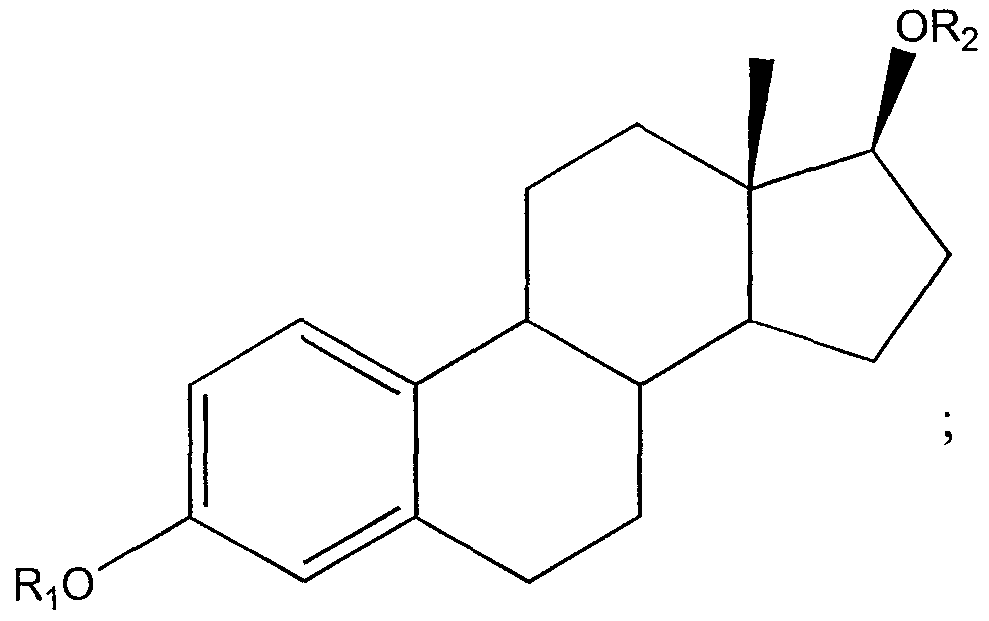
- a first intermediate is prepared from estradiol (3) by protecting the two hydroxyl groups to form a compound represented by Structural Formula (I) :
- R 1 and R 2 are each independently a hydroxyl protecting group.
- R and R 2 are each a benzyl or substituted benzyl group, more preferably a benzyl group.
- hydroxyl refers to alcohols and phenolic groups.
- a "suitable protecting group" is substantially inert with respect to the reagents used in the subsequent reactions in the disclosed synthesis of 2- alkoxy estradiols and does not cause, for example, undesired side reactions.
- Hydroxyl protecting groups are well known in the art and are described in, for example, Chapters 2 and 3 of Greene and Wuts, "Protective Groups in Organic Synthesis", John Wiley & Sons (1991), the entire teachings of which are incorporated into this application by reference. The skilled artisan can select, using no more than routine experimentation, suitable groups for use in the disclosed synthesis as well as conditions for applying and removing the hydroxyl protecting groups.
- Preferred hydroxyl protecting groups include benzyl groups and substituted benzyl groups.
- suitable substituents for benzyl protecting groups include, but are not limited to, one or more of the following groups: lower alkyl, fluoro, chloro, (lower alkyl) -0-, nitro, phenyl, di (lower alkyl) aminocarbonyl and silyl .
- Protecting a free hydroxyl group with a benzyl group or substituted benzyl group is referred to herein as "benzylating" the hydroxyl group .
- Estradiols can be benzylated by reacting at least one equivalent of a benzyl chloride, bromide or iodide and at least one equivalent of a base per free hydroxyl group (see, for example, Venuti et al . , J. Med. Chem. 31:2132 (1988) ) .
- Suitable bases include hydride bases such as sodium hydride, potassium hydride and lithium hydride.
- a molar excess of benzyl halide and sodium hydride are used with respect to each free hydroxyl group, for example up to a 1-3 fold excess of base and up to a 1-5 fold excess of benzyl halide.
- a catalytic amount of an iodide salt is preferably added to the reaction mixture, e.g., sodium iodide, potassium iodide or a tetraalkylammonium iodide.
- Suitable solvents include apolar diprotic solvents such as dimethylformamide, dimethyl sulfoxide and hexamethylphosphoramide .
- Suitable temperatures for carrying out the reaction range from about 0°C to about 50°C, and preferably at room temperature.
- the starting material and base are preferably mixed at 0°C.
- the first intermediate is reacted with bromine (Br 2 ) or iodine (I 2 ) and an aliphatic organic acid in a suitable solvent to form a second intermediate represented by Structural Formula (II) :
- R ⁇ and R 2 are as described above.
- R 3 is -Br or -I.
- Suitable aliphatic organic acids include C1-C5 aliphatic carboxylic acids, sulfonic acids, sulfinic acids and phosphoric acids.
- Aliphatic carboxylic acids are preferred; acetic acid is particularly preferred.
- the first intermediate is brominated (or iodinated) with at least one molar equivalent of bromine (or I 2 ) .
- an excess of bromine for example up to about a three fold excess, can be used.
- about a 10% to about a 20% excess of bromine is used.
- concentrations of bromine in the reaction mixture range, for example, from between about .01 M to about 5.0 M, and preferably between about 0.10 M and about 0.40 M.
- Suitable solvents for the bromination reaction include, for example, etheral solvents in which the organic acid and estradiol are soluble, for example, tetrahydrofuran (THF) , dioxane or glyme . THF is preferred.
- Suitable amounts of aliphatic organic acid include a volume/volume ratio of about 1:5 to about 5:1 with respect to the solvent, preferably about 3:2 with respect to tetrahydrofuran.
- the reaction can be run, for example, at temperatures between about -10°C and about 45°C.
- reagents are mixed under ice bath cooling, after which the reaction is allowed to warm to room temperature .
- Example 2 Specific conditions for brominating a first intermediate, specifically estra-3 , 17 ⁇ -diol dibenzyl ether (5), are provided in Example 2.
- the bromination reaction using the conditions described above and in Example 2 forms predominently the 2-regioisomer over the 4-regioisomer .
- the brominated product can be substantially purified by crystallization from, for example, ethyl acetate .
- the second intermediate is reacted with an organolithium reagent and a synthetic equivalent of R 4 C0 + to form a third intermediate represented by Structural Formula (III) :
- R 1 and R 2 are as described above.
- R 4 is selected from the group consisting of -H, lower alkyl and substituted lower alkyl .
- Organolithium reagents are well known in the art and are described in Wakefield, "Organolithium Methods"
- Organolithium reagents are capable of reacting with aryl bromides and iodides such as bromobenzene to effect a halogen/lithium exchange to produce a lithiated intermediate, which can then be reacted with a suitable electrophile . This type of reaction is described in greater detail on pages 107-08 of Wakefield.
- suitable organolithium reagents include n- butyllithiu , sec-butyllithium, t-butyllithium, methyllithium and lithium metal.
- Synthetic equivalent has the meaning commonly associated with the term in the art of synthetic organic chemistry (see, for example, Warren, “Designing Organic Syntheses: A Programmed Introduction to the Synthon Approach", John Wiley & Sons, 1978, page 8, and March,
- Synthetic equivalent is understood to mean a reagent which functions as the equivalent of a structural unit in an organic molecule so that after one or more reactions with a precursor, the reagent adds that structural unit to the precursor.
- dimethylformamide is a synthetic equivalent of + CH0 and, under suitable conditions, reacts with nucleophiles, including lithiated intermediates, to add a -CHO moiety to the precursor.
- nucleophiles including lithiated intermediates
- Suitable synthetic equivalents of R 4 CO + include, for example, R 4 CO-N(lower alkyl) 2 (e.g., dimethylformamide) , R 4 CO-X, wherein X is a halide (e.g., acetyl chloride), -O- CO- (lower alkyl) (e.g., acetic anhydride) and -0- (lower alkyl) (e.g., ethyl acetate).
- R 4 is -H and the synthetic equivalent of R 4 C0 + is dimethylformamide .
- the second intermediate is typically reacted with, for example, between about 1.0 to about 5.0 equivalents, preferably between about 2.0 and about 3.0 equivalents, of an organolithium reagent, preferably n-butyllithium.
- suitable solvents include anhydrous etheral solvents (e.g., diethyl ether, dimethoxyethane, dioxane, tetrahydrofuran or diglyme) or anhydrous hydrocarbon solvents (e.g., benzene, pentane or hexane) .
- THF is preferred.
- Suitable reaction temperatures range from, for example, between about -100°C to to about -60°C, preferably between about -75° to about -85°C.
- Suitable concentrations of the second intermediate in the reaction mixture range between about 0.005 M to about 1.0 M, preferably between about 0.050 M to about 0.10 M. The temperature is maintained until halogen metal exchange is complete, from about ten minutes to about five hours, and typically about one to two hours, at which time an excess (e.g., from about 1.1 to about 10 fold, typically about 2.5 fold) of the synthetic equivalent of -R 4 CO + with respect to organolithium reagent is added to the reaction mixture.
- the synthetic equivalent can be added neat or as a solution in an anhydrous etheral or hydrocarbon solvent.
- the reaction is warmed, for example, at about 0.5 to about 3.0 hours after addition of the synthetic equivalent to between about -30°C to about room temperature, preferably about -10°C to about 10°C, and allowed to stir until the reaction is complete.
- Specific conditions for converting a second intermediate, specifically 2 -bromo-estra-3 , 17 ⁇ -diol dibenzyl ether (4) , to the third intermediate are provided in Example 3.
- the third intermediate is reacted with an oxidizing agent capable of oxidizing an aryl alkyl ketone R-CO-Ar to the corresponding aryl alkonate R-CO-O-Ar to form a fourth intermediate represented by Structural Formula (IV) :
- Suitable oxidizing agents for carrying out a Baeyer- Williger Oxidation include peracids such as - chloroperbenzoic acid (hereinafter "mCPBA”), perbenzoic acid and peracetic acid.
- the reaction is carried out in the presence of an acid catalyst, for example, sulfonic acids such a methyl sulfonic acid, benzene sulfonic acid and p-toluene sulfonic acid.
- an acid catalyst for example, sulfonic acids such a methyl sulfonic acid, benzene sulfonic acid and p-toluene sulfonic acid.
- Suitable solvents include halogenated solvents such as methylene chloride, chloroform and dichloroethane .
- Suitable amounts of oxidizing agent include between about 1.1 to about 2.0 equivalents with respect to the third intermediate.
- Suitable amounts of acid catalyst include between about 0.1% to about 10% by weight with respect to the oxidizing agent, preferably about 3-7%. Additional oxidizing agent and acid catalyst can be added if the reaction does not go to completion.
- Suitable concentrations of the third intermediate in the reaction mixture include between about 0.005 M to about 5.0 M, preferably between about 0.05 M to about 0.5 M.
- the reaction is typically performed at room temperature, but can also be carried out, for example, at temperatures ranging from about 0°C to the about 45°C.
- Example 4 Specific conditions for carrying out a Baeyer-Williger Oxidation on a third intermediate, specifically 2 -formyl-estra-3 , ⁇ l7- diol dibenzyl ether (2), are provided in Example 4.
- the ester group of the fourth intermediate is cleaved to form a fifth intermediate represented by Structural Formula (V) :
- the cleavage of esters includes hydrolysis or alcoholysis of esters, which are well known in the field of chemistry. Conditions for the hydrolysis or alcoholysis of esters are described, for example, in Marvel, Org . Syn , , Coll . , 3:495 (1995) and Marvel, Org . Syn . , Coll . 2:416 (1943) , the teachings of which are incorporated herein by reference. Specific conditions for hydrolyzing the ester of a fourth chemical intermediate are provided Example 4.
- “Cleaving an ester” also refers to reacting an ester R-CO-O-R' with a reducing agent suitable for reducing the ester to alcohols R-CH 2 -0H and R'OH.
- Suitable reducing reagents are well known in the art and include, for example, lithium aluminum hydride, lithium borohydride and diborane.
- the fifth intermediate is alkylated to form a sixth intermediate represented by Structural Formula (VI) :
- R- L , R 2 and R 5 are as defined above.
- alkylation refers to converting a phenolic group aryl-OH to the alkyl aryl ether aryl-0-R 3 , wherein R 3 is as defined above.
- the alkylation of phenols is well known in the field of organic synthesis and can be carried out, for example, by the "Williamson Reaction". Conditions for carrying out the Williamson Reaction as well as other reactions suitable for alkylating phenolic groups are described in, for example, March, "Advanced Organic
- the alkylation can be carried out, for example, by reacting the fifth intermediate with an alkylating agent R 5 X, wherein X is a leaving group such as -Br, -I, mesylate, tosylate, brosylate or other suitable sulfonate ester, triflate or -O-SO-0CH 3 .
- R 5 X alkylating agent
- Examples include an alkyl bromide, an alkyl iodide (e.g., methyl iodide, ethyl iodide or 2 , 2 , 2-trifluoro-iodo-ethane) or a dialkyl sulfate (e.g., dimethyl sulfate) in the presence of a suitable base (e.g., potassium hydroxide, potassium carbonate or mercury (I) oxide) .
- a suitable base e.g., potassium hydroxide, potassium carbonate or mercury (I) oxide
- Suitable amounts of alkylating agent and base range, for example, from about 1.0 equivalent to about 10.0 equivalents and from about 1.0 to about 3.0 equivalents, respectively. Additional base and alkylating agent can be added if the reaction does not go to completion.
- the fifth intermediate is reacted at concentrations, for example, ranging from about 0.01 M to about 5.0 M, preferably from about 0.1 M to about 0.5 M.
- Suitable solvents include halogenated solvents such as methylene chloride and aprotic polar solvents such as dimethylformamide .
- the reaction temperature ranges, for example, from about room temperature to about 150°C; when aprotic polar solvents are used, the reaction temperature preferably ranges from about 110°C to about 130°C.
- Specific conditions for alkylating a compound represented by Structural Formula (VI) specifically estradiol (6) and estradiol (8) in the Figure, are provided in Examples 5 and 6B respectively.
- Suitable conditions for removing phenolic protecting groups are known in the art and are described in, for example, Greene and Wuts, "Protective Groups in Organic Synthesis", John Wiley & Sons (1991) .
- the hydroxyl protecting groups are benzylic or sbstituted benzylic groups
- the deprotection reaction is referred to herein as a "debenzylation” .
- Protected hydroxyl groups can be debenzylated by hydrogenolysis over a palladium catalyst, for example Pd(OH) 2 -C in an etheral solvent (e.g. THF, diethyl ether) or an alcoholic solvent (methanol or ethanol) .
- Suitable pressures include from about 10 to about 120 psi, preferably from about 40-60 psi.
- the hydrogenation can be carried-out, for example, at temperatures from about 15 °C to about 45°C, but preferably at room temperature, and at concentrations of the sixth intermediate ranging, for example, from about 0.01 M to about 5.0 M.
- the reaction is continued until complete, and can be monitored by thin layer chromatography.
- Specific conditions for debenzylating a hydroxyl represented by Structural Formula (VI) specifically estradiols (7) and (8) in the Figure, are provided in Example 6.
- Other conditions for debenzylating a hydroxyl group are disclosed in Chapters 2 and 3 of Wuts and Greene and are within the scope of the present invention.
- the sixth intermediate represented by Structural Formula (VI) can be prepared directly from a compound represented by Structural Formula (III) .
- bromide is nucleophilically displaced by an alkali metal alkoxide R 5 0- Y + , wherein Y + is an alkali metal cation, in the presence of a catalytic amount of copper (I) iodide.
- the reaction is typically carried out in an aprotic dipolar solvent such dimethylformamide .
- the reaction nucleophilic displacement of halides from aryl halides with nucleophilies in the presence of copper (I) iodide is well known in the art as the "Ullman Reaction" .
- the combined organic layer was washed with water (200 mL) , saturated aqueous sodium bicarbonate (200 mL) , 10% aqueous sodium thiosulfate (150 mL) , water (100 mL) , brine (100 mL) , and dried over anhydrous sodium sulfate.
- the organic layer on evaporation under vacuum, followed by trituration with hexane-ethyl acetate mixture, gave the product (3.9 g, 75%) . Only about 10% of the 4-bromo regioisomer is formed.
- Triene (2) A 1.6 M solution of n-BuLi (17.5 mL) in hexanes was added dropwise by syringe under argon atmosphere at -78°C to a solution of estradiol (4) (5.88 g, 11.2 mmol) in anhydrous THF (150 mL) , and the resulting reaction mixture was stirred at -78°C for 2 h. Anhydrous DMF (5.5 mL) was added and the stirring was continued for 1 h at -78°C. The mixture was warmed to 0°C and stirred for 1 h, and poured onto an ice-cold solution of 3N HCl (100 mL) .
- estradiol (7) (4.5 g, 95%) as a colorless oil:
- the reaction was cooled and poured onto ice-cold water (200 mL) , and followed by addition of 3 N HCl (25 mL) .
- the insoluble material was filtered off through a celite pad and the aqueous layer was extracted with dichlomethane (300 mL x 3) .
- the combined organic layer was washed with water (200 mL) , brine (200 mL) , and dried over sodium sulfate.
- Electrophoretically homogeneous tubulin was purified from bovine brain as described previously (Hamel et al . , Biochemistry 23:4173-4184 (1984)). Determination of IC 50 values for the polymerization of purified tubulin was performed as described in D'Amato et al . Proc. Natl. Acad. Sci. U.S.A. 91:3964-3968 (1994). Tubulin was preincubated at 26°C with varying compound concentrations, reaction mixtures were chilled on ice, GTP (required for the polymerization reaction) was added, and polymerization was followed at 26°C by turbidimetry at 350 nm in Gilford recording spectrophotometers equipped with electronic temperature controllers.
- HOP-62 non-small-cell lung cancer cells HCT-116 colon cancer cells
- CNS central nervous system
- UACC-62 melanoma cells UACC-62 melanoma cells
- OVCAR ovarian cancer cells SN12-C renal cancer cells
- DU-145 prostate cancer cells DU-145 prostate cancer cells
- MDA-MB-435 breast cancer cells 2-Ethoxy estradiol (10) was more active against all the cell lines listed in Table 1 than 2-methoxy estradiol (1) .
- cytotoxicity GI S0 values are the concentrations corresponding to 50% growth inhibition, b Mean graph midpoint for all human cancer cell lines (approximately 55) tested.
Landscapes
- Chemical & Material Sciences (AREA)
- Organic Chemistry (AREA)
- Health & Medical Sciences (AREA)
- General Health & Medical Sciences (AREA)
- Steroid Compounds (AREA)
- Organic Low-Molecular-Weight Compounds And Preparation Thereof (AREA)
Abstract
Description


Claims




Priority Applications (8)
| Application Number | Priority Date | Filing Date | Title |
|---|---|---|---|
| AT98910398T ATE213740T1 (en) | 1997-03-13 | 1998-03-13 | METHOD FOR PRODUCING 2-ALKOXYESTRADIOLS |
| CA002283436A CA2283436A1 (en) | 1997-03-13 | 1998-03-13 | Synthesis of 2-alkoxyestradiols |
| IL13175498A IL131754A0 (en) | 1997-03-13 | 1998-03-13 | Synthesis of 2-alkoxyestradiols |
| AU64649/98A AU6464998A (en) | 1997-03-13 | 1998-03-13 | Synthesis of 2-alkoxyestradiols |
| EP98910398A EP0984979B1 (en) | 1997-03-13 | 1998-03-13 | Synthesis of 2-alkoxyestradiols |
| BR9808330-9A BR9808330A (en) | 1997-03-13 | 1998-03-13 | Synthesis of 2-alkoxystradiols and estradiol compound |
| JP53987598A JP2001514666A (en) | 1997-03-13 | 1998-03-13 | Synthesis of 2-alkoxyestradiol |
| DE69803982T DE69803982D1 (en) | 1997-03-13 | 1998-03-13 | METHOD FOR PRODUCING 2-ALKOXYESTRADIOLS |
Applications Claiming Priority (2)
| Application Number | Priority Date | Filing Date | Title |
|---|---|---|---|
| US08/816,558 | 1997-03-13 | ||
| US08/816,558 US6051726A (en) | 1997-03-13 | 1997-03-13 | Synthesis of 2-alkoxyestradiols |
Publications (1)
| Publication Number | Publication Date |
|---|---|
| WO1998040398A1 true WO1998040398A1 (en) | 1998-09-17 |
Family
ID=25220965
Family Applications (1)
| Application Number | Title | Priority Date | Filing Date |
|---|---|---|---|
| PCT/US1998/005026 Ceased WO1998040398A1 (en) | 1997-03-13 | 1998-03-13 | Synthesis of 2-alkoxyestradiols |
Country Status (10)
| Country | Link |
|---|---|
| US (2) | US6051726A (en) |
| EP (1) | EP0984979B1 (en) |
| JP (1) | JP2001514666A (en) |
| AT (1) | ATE213740T1 (en) |
| AU (1) | AU6464998A (en) |
| BR (1) | BR9808330A (en) |
| CA (1) | CA2283436A1 (en) |
| DE (1) | DE69803982D1 (en) |
| IL (1) | IL131754A0 (en) |
| WO (1) | WO1998040398A1 (en) |
Cited By (15)
| Publication number | Priority date | Publication date | Assignee | Title |
|---|---|---|---|---|
| WO2001014405A3 (en) * | 1999-08-23 | 2002-01-24 | Entremed Inc | Methods of obtaining 2-methoxyestradiol of high purity |
| WO2002062347A1 (en) * | 2001-02-05 | 2002-08-15 | Oncology Sciences Corporation | Method and composition of novel compounds for the therapy and targeting of the primary modalities of cancer cell proliferation and homeostasis |
| US6593321B2 (en) | 2001-06-11 | 2003-07-15 | Southwest Foundation For Biomedical Research | 2-alkoxyestradiol analogs with antiproliferative and antimitotic activity |
| US6605622B2 (en) | 1998-08-11 | 2003-08-12 | Entremed, Inc. | Use of anti-estrogenic compounds as anti-fungal agents |
| US6723858B2 (en) | 1993-08-06 | 2004-04-20 | The Children's Medical Center Corporation | Estrogenic compounds as anti-mitotic agents |
| US6995278B2 (en) | 2000-08-18 | 2006-02-07 | Entre Med, Inc. | Antiangiogenic agents |
| US7087592B1 (en) | 1999-08-23 | 2006-08-08 | Entre Med, Inc. | Compositions comprising purified 2-methoxyestradiol and methods of producing same |
| US7109187B2 (en) | 1993-08-06 | 2006-09-19 | The Children's Medical Center Corporation | Estrogenic compounds as anti-mitotic agents |
| US7135581B2 (en) | 2000-08-18 | 2006-11-14 | Entremed, Inc. | Antiangiogenic agents |
| US7371741B2 (en) | 2003-05-28 | 2008-05-13 | Entremed, Inc. | Estradiol derivatives and pharmaceutical compositions using same |
| WO2008099414A1 (en) | 2007-02-13 | 2008-08-21 | Council Of Scientific & Industrial Research | NOVEL CATIONIC 17 α- SUBSTITUTED-ESTRADIOL DERIVATIVES USEFUL AS ANTI-CANCER AGENT |
| US7498322B2 (en) | 2004-03-12 | 2009-03-03 | Entremed, Inc. | Antiangiogenic agents |
| WO2010043506A1 (en) * | 2008-10-16 | 2010-04-22 | Naxospharma S.R.L. | Method and intermediates for preparing 2-alkoxy and 2-aryloxy estrogen compounds |
| AU2007234536B2 (en) * | 1999-08-23 | 2011-03-03 | Entremed, Inc. | Compositions comprising purified 2-methoxyestradiol and methods of producing same |
| US8026229B2 (en) | 2001-08-13 | 2011-09-27 | Sterix Limited | Antitumor-active 2-alkoxyestradiol sulfamates |
Families Citing this family (17)
| Publication number | Priority date | Publication date | Assignee | Title |
|---|---|---|---|---|
| US20040214807A1 (en) * | 1993-08-06 | 2004-10-28 | D'amato Robert J. | Estrogenic compounds as anti-mitotic agents |
| US6346510B1 (en) * | 1995-10-23 | 2002-02-12 | The Children's Medical Center Corporation | Therapeutic antiangiogenic endostatin compositions |
| AUPQ342599A0 (en) * | 1999-10-14 | 1999-11-04 | University Of Melbourne, The | Conjugates and uses thereof |
| US20020035098A1 (en) * | 2000-03-17 | 2002-03-21 | Oncology Sciences Corporation | Agents and methods for the prevention of initial onset and recurrence of existing cancers |
| US20050192258A1 (en) * | 2000-08-18 | 2005-09-01 | Agoston Gregory E. | Antiangiogenic agents |
| WO2003063791A2 (en) * | 2002-01-30 | 2003-08-07 | Entremed, Inc. | Non-steroidal analogs of 2-methoxyestradiol |
| US20070004689A1 (en) * | 2004-03-12 | 2007-01-04 | Agoston Gregory E | Antiangiogenic agents |
| TW200611909A (en) * | 2004-08-04 | 2006-04-16 | Akzo Nobel Nv | Process for the preparation 2-substituted-derivatives of estrone and estradiol |
| TW200613316A (en) * | 2004-08-26 | 2006-05-01 | Akzo Nobel Nv | Process for the preparation of estrone and/or estradiol-derivates |
| US20060116360A1 (en) * | 2004-11-29 | 2006-06-01 | Fogler William E | Method of administering anti-angiogenic agents and a method of treating disease using same |
| WO2007059111A2 (en) * | 2005-11-14 | 2007-05-24 | Entremed, Inc. | Anti-angiogenic activity of 2-methoxyestradiol in combination with anti-cancer agents |
| US20070176403A1 (en) * | 2006-02-01 | 2007-08-02 | Dennis Calderone | Air adjustable seat |
| CA2646065C (en) * | 2006-03-20 | 2014-01-14 | Entremed, Inc. | Disease modifying anti-arthritic activity of 2-methoxyestradiol |
| WO2008094665A1 (en) * | 2007-01-31 | 2008-08-07 | Entremed, Inc. | Method of treating amyloidosis mediated diseases |
| WO2008137599A2 (en) * | 2007-05-01 | 2008-11-13 | Evestra, Inc. | 2-alkoxyestradiol analogs and pharmaceutical preparations |
| CN101723813A (en) | 2008-10-15 | 2010-06-09 | 上海华理生物医药有限公司 | Ethoxy diphenyl ethane derivative and preparation method and application thereof |
| US20120225849A1 (en) * | 2011-03-01 | 2012-09-06 | The University Of Kansas | 2-Methoxyestradiol (2-ME2) Prodrug with Enhanced Bioavailability for Prophylaxis or Treatment of Cancerous or Non-Cancerous Condition |
Family Cites Families (1)
| Publication number | Priority date | Publication date | Assignee | Title |
|---|---|---|---|---|
| CA2078804C (en) * | 1991-10-01 | 2003-02-25 | Takehiko Suzuki | Manufacture and use of novel glycosides of catechol estrogens |
-
1997
- 1997-03-13 US US08/816,558 patent/US6051726A/en not_active Expired - Fee Related
-
1998
- 1998-03-13 JP JP53987598A patent/JP2001514666A/en active Pending
- 1998-03-13 EP EP98910398A patent/EP0984979B1/en not_active Expired - Lifetime
- 1998-03-13 CA CA002283436A patent/CA2283436A1/en not_active Abandoned
- 1998-03-13 AU AU64649/98A patent/AU6464998A/en not_active Abandoned
- 1998-03-13 IL IL13175498A patent/IL131754A0/en unknown
- 1998-03-13 DE DE69803982T patent/DE69803982D1/en not_active Expired - Lifetime
- 1998-03-13 WO PCT/US1998/005026 patent/WO1998040398A1/en not_active Ceased
- 1998-03-13 BR BR9808330-9A patent/BR9808330A/en not_active Application Discontinuation
- 1998-03-13 AT AT98910398T patent/ATE213740T1/en not_active IP Right Cessation
- 1998-03-23 US US09/046,362 patent/US6054598A/en not_active Expired - Fee Related
Non-Patent Citations (8)
| Title |
|---|
| C. AKIRA HORIUCHI ET AL: "Novel Regioselective Iodination of Estradiol 17.beta.-Acetate", BULLETIN OF THE CHEMICAL SOCIETY OF JAPAN., vol. 59, no. 8, 1986, TOKYO JP, pages 2459 - 2462, XP002067992 * |
| CHEN S H ET AL: "A new synthetic route to 2- and 4-methoxyestradiols by nucleophilic substitution", STEROIDS: STRUCTURE, FUNCTION, AND REGULATION., vol. 47, no. 1, January 1986 (1986-01-01), MA US, pages 63 - 66, XP002067994 * |
| CUSHMAN M ET AL: "Synthesis of Analogs of 2-Methoxyestradiol with Enhanced Inhibitory Effects on Tubulin Polymerization and Cancer Cell Growth", JOURNAL OF MEDICINAL CHEMISTRY., vol. 40, no. 15, 18 July 1997 (1997-07-18), WASHINGTON US, pages 2323 - 2334, XP002067998 * |
| CUSHMAN M ET AL: "SYNTHESIS, ANTITUBULIN AND ANTOMITOTIC ACTIVITY, AND CYTOTOXICITY OF 2-METHOXYESTRADIOL, AN ENDOGENOUS MAMMALIAN METALBOLIC OF ESTRADIOL THAT INHIBITS TUBULIN POLYMERIZATION BY BINDING TO THE COLCHICINE BINDING SITE", JOURNAL OF MEDICINAL CHEMISTRY, vol. 38, no. 12, 9 June 1995 (1995-06-09), pages 2041 - 2049, XP002059349 * |
| HE H M ET AL: "A Novel 1,3 O.fwdarw. C Silyl Shift and Deacylation Reaction Mediated by Tetra-n-butylammonium Fluoride in an Aromatic System", JOURNAL OF ORGANIC CHEMISTRY., vol. 60, no. 18, 8 September 1995 (1995-09-08), EASTON US, pages 5905 - 5909, XP002067996 * |
| NAMBARA T; HONMA S; AKIYAMA S: "Analytical chemical studies on steroids. XXXIII. Steroid conjugates. III. New syntheses of 2-methoxyestrogens", CHEMICAL AND PHARMACEUTICAL BULLETIN., vol. 18, no. 3, 1970, TOKYO JP, pages 474 - 480, XP002067995 * |
| NUMAZAWA M; OGURA Y; KIMURA K; NAGAOKA M: "Synthesis of 2-methoxy- and 4-methoxyestrogens with halogen-methoxy exchange reactions", J. CHEM. RES. MINIPRINT, no. 11, 1985, pages 3701 - 3715, XP002067997 * |
| XU-HUA ZENG ET AL: "A New Synthetic Route to Pyrogallolestrogen Dimethyl Ethers by Nucleophilic Substitution of 2,4-Dibromoestrogens", STEROIDS., vol. 40, no. 2, August 1982 (1982-08-01), SAN FRANCISCO US, pages 121 - 124, XP002067993 * |
Cited By (18)
| Publication number | Priority date | Publication date | Assignee | Title |
|---|---|---|---|---|
| US7109187B2 (en) | 1993-08-06 | 2006-09-19 | The Children's Medical Center Corporation | Estrogenic compounds as anti-mitotic agents |
| US6723858B2 (en) | 1993-08-06 | 2004-04-20 | The Children's Medical Center Corporation | Estrogenic compounds as anti-mitotic agents |
| US6605622B2 (en) | 1998-08-11 | 2003-08-12 | Entremed, Inc. | Use of anti-estrogenic compounds as anti-fungal agents |
| AU2007234536B2 (en) * | 1999-08-23 | 2011-03-03 | Entremed, Inc. | Compositions comprising purified 2-methoxyestradiol and methods of producing same |
| WO2001014405A3 (en) * | 1999-08-23 | 2002-01-24 | Entremed Inc | Methods of obtaining 2-methoxyestradiol of high purity |
| US7087592B1 (en) | 1999-08-23 | 2006-08-08 | Entre Med, Inc. | Compositions comprising purified 2-methoxyestradiol and methods of producing same |
| US7235540B2 (en) | 1999-08-23 | 2007-06-26 | Entremed, Inc. | Methods of using 2-methoxyestradiol of high purity |
| US7135581B2 (en) | 2000-08-18 | 2006-11-14 | Entremed, Inc. | Antiangiogenic agents |
| US6995278B2 (en) | 2000-08-18 | 2006-02-07 | Entre Med, Inc. | Antiangiogenic agents |
| WO2002062347A1 (en) * | 2001-02-05 | 2002-08-15 | Oncology Sciences Corporation | Method and composition of novel compounds for the therapy and targeting of the primary modalities of cancer cell proliferation and homeostasis |
| US6852710B2 (en) | 2001-06-11 | 2005-02-08 | Southwest Foundation For Biomedical Research | 2-alkoxyestradiol analogs with antiproliferative and antimitotic activity |
| US6593321B2 (en) | 2001-06-11 | 2003-07-15 | Southwest Foundation For Biomedical Research | 2-alkoxyestradiol analogs with antiproliferative and antimitotic activity |
| US8026229B2 (en) | 2001-08-13 | 2011-09-27 | Sterix Limited | Antitumor-active 2-alkoxyestradiol sulfamates |
| US7371741B2 (en) | 2003-05-28 | 2008-05-13 | Entremed, Inc. | Estradiol derivatives and pharmaceutical compositions using same |
| US7498322B2 (en) | 2004-03-12 | 2009-03-03 | Entremed, Inc. | Antiangiogenic agents |
| WO2008099414A1 (en) | 2007-02-13 | 2008-08-21 | Council Of Scientific & Industrial Research | NOVEL CATIONIC 17 α- SUBSTITUTED-ESTRADIOL DERIVATIVES USEFUL AS ANTI-CANCER AGENT |
| WO2010043506A1 (en) * | 2008-10-16 | 2010-04-22 | Naxospharma S.R.L. | Method and intermediates for preparing 2-alkoxy and 2-aryloxy estrogen compounds |
| US7901904B2 (en) | 2008-10-16 | 2011-03-08 | Naxospharma S.R.L. | Method and intermediates for preparing 2-alkoxy and 2-aryloxy estrogen compounds |
Also Published As
| Publication number | Publication date |
|---|---|
| BR9808330A (en) | 2000-05-16 |
| EP0984979A1 (en) | 2000-03-15 |
| JP2001514666A (en) | 2001-09-11 |
| EP0984979B1 (en) | 2002-02-27 |
| ATE213740T1 (en) | 2002-03-15 |
| US6054598A (en) | 2000-04-25 |
| AU6464998A (en) | 1998-09-29 |
| US6051726A (en) | 2000-04-18 |
| DE69803982D1 (en) | 2002-04-04 |
| IL131754A0 (en) | 2001-03-19 |
| CA2283436A1 (en) | 1998-09-17 |
Similar Documents
| Publication | Publication Date | Title |
|---|---|---|
| EP0984979B1 (en) | Synthesis of 2-alkoxyestradiols | |
| SU973025A3 (en) | Process for producing 17alpha-alkylsterosis | |
| Cushman et al. | Synthesis, antitubulin and antimitotic activity, and cytotoxicity of analogs of 2-methoxyestradiol, an endogenous mammalian metabolite of estradiol that inhibits tubulin polymerization by binding to the colchicine binding site | |
| US3887545A (en) | Synthesis of 1{60 -hydroxylated cholesterol derivatives | |
| AU746559B2 (en) | Stereoselective synthesis of 24-hydroxylated compounds useful for the preparation of aminosterols, vitamin D analogs, and other compounds | |
| CA2406847C (en) | Regioselective and stereoselective oxidation of fused ring systems useful for the preparation of aminosterols | |
| McCague et al. | Inhibition of enzymes of estrogen and androgen biosynthesis by esters of 4-pyridylacetic acid | |
| CN106749466A (en) | A kind of preparation method of high-purity Austria shellfish cholic acid | |
| ES2293986T3 (en) | NON-STEROID TETRACICLIC COMPOUNDS FOR TREATMENTS RELATED TO STROGEN. | |
| US6768014B2 (en) | PROCESS FOR PREPARING 17α-ACETOXY-11β-[4-N,N(DIMETHYLAMINO)PHENYL]-21-METHOXY-19-NORPREGNA-4,9-DIENE-3,20-DIONE, INTERMEDIATES USEFUL IN THE PROCESS , AND PROCESSES FOR PREPARING SUCH INTERMEDIATES | |
| JPH0440360B2 (en) | ||
| US6784170B2 (en) | Synthesis of anti-estrogenic and other therapeutic steroids from 21-hydroxy-19-norpregna-4-en-3-one | |
| Rao et al. | A new, practical synthesis of 2-methoxyestradiols | |
| US4861875A (en) | 3α,5-cyclo-22,23-dihydroxy-5α-steroid compounds | |
| US4145346A (en) | Preparation of 3β-hydroxy-27-norcholest-5-ene-25-one and intermediates thereof | |
| MXPA99008325A (en) | Synthesis of 2-alkoxyestradiols | |
| US4046760A (en) | Process for preparing 1-α-hydroxy cholesterol derivatives | |
| US5583228A (en) | 17-halogeno-4-azaandrostene derivatives and process for the preparation thereof | |
| Rao et al. | New synthesis of Δ6-estrogens | |
| US6310225B1 (en) | Processes for the preparation of steroid derivatives, intermediates therefor and processes for the preparation of the intermediates | |
| AU2002300302B2 (en) | Stereoselective synthesis of 24-hydroxylated compounds useful for the preparation of aminosterols, vitamin D analogs, and other compounds | |
| KR100525139B1 (en) | Method for Producing 4,4-Dimethyl-5α-Cholesta-8,14,24-Triene-3β-Ol and Intermediate Products Obtained by Said Method | |
| NO744612L (en) | ||
| SK283613B6 (en) | Method for producing 4,4-dimethyl-3beta-hydroxypregna-8,14-diene- 21-carboxylic acid esters and intermediate products obtained by the same method | |
| JPS617289A (en) | 3'-n-trifluoroacetyl-4-demethoxyadriamycin |
Legal Events
| Date | Code | Title | Description |
|---|---|---|---|
| WWE | Wipo information: entry into national phase |
Ref document number: 131754 Country of ref document: IL |
|
| AK | Designated states |
Kind code of ref document: A1 Designated state(s): AL AM AT AU AZ BA BB BG BR BY CA CH CN CU CZ DE DK EE ES FI GB GE GH GM GW HU ID IL IS JP KE KG KP KR KZ LC LK LR LS LT LU LV MD MG MK MN MW MX NO NZ PL PT RO RU SD SE SG SI SK SL TJ TM TR TT UA UG US UZ VN YU ZW |
|
| AL | Designated countries for regional patents |
Kind code of ref document: A1 Designated state(s): GH GM KE LS MW SD SZ UG ZW AM AZ BY KG KZ MD RU TJ TM AT BE CH DE DK ES FI FR GB GR IE IT LU MC NL PT SE BF BJ CF CG CI CM GA GN ML MR NE SN TD TG |
|
| DFPE | Request for preliminary examination filed prior to expiration of 19th month from priority date (pct application filed before 20040101) | ||
| 121 | Ep: the epo has been informed by wipo that ep was designated in this application | ||
| ENP | Entry into the national phase |
Ref document number: 2283436 Country of ref document: CA Ref country code: CA Ref document number: 2283436 Kind code of ref document: A Format of ref document f/p: F |
|
| WWE | Wipo information: entry into national phase |
Ref document number: 1998910398 Country of ref document: EP |
|
| ENP | Entry into the national phase |
Ref country code: JP Ref document number: 1998 539875 Kind code of ref document: A Format of ref document f/p: F |
|
| WWE | Wipo information: entry into national phase |
Ref document number: PA/a/1999/008325 Country of ref document: MX |
|
| REG | Reference to national code |
Ref country code: DE Ref legal event code: 8642 |
|
| WWP | Wipo information: published in national office |
Ref document number: 1998910398 Country of ref document: EP |
|
| WWG | Wipo information: grant in national office |
Ref document number: 1998910398 Country of ref document: EP |