WO1998046348A1 - Heat resistant lipid vesicles - Google Patents
Heat resistant lipid vesicles Download PDFInfo
- Publication number
- WO1998046348A1 WO1998046348A1 PCT/US1998/007451 US9807451W WO9846348A1 WO 1998046348 A1 WO1998046348 A1 WO 1998046348A1 US 9807451 W US9807451 W US 9807451W WO 9846348 A1 WO9846348 A1 WO 9846348A1
- Authority
- WO
- WIPO (PCT)
- Prior art keywords
- lipid
- oil
- lipid vesicle
- group
- polyoxyethylene
- Prior art date
- Legal status (The legal status is an assumption and is not a legal conclusion. Google has not performed a legal analysis and makes no representation as to the accuracy of the status listed.)
- Ceased
Links
Classifications
-
- B—PERFORMING OPERATIONS; TRANSPORTING
- B01—PHYSICAL OR CHEMICAL PROCESSES OR APPARATUS IN GENERAL
- B01J—CHEMICAL OR PHYSICAL PROCESSES, e.g. CATALYSIS OR COLLOID CHEMISTRY; THEIR RELEVANT APPARATUS
- B01J13/00—Colloid chemistry, e.g. the production of colloidal materials or their solutions, not otherwise provided for; Making microcapsules or microballoons
- B01J13/02—Making microcapsules or microballoons
-
- A—HUMAN NECESSITIES
- A61—MEDICAL OR VETERINARY SCIENCE; HYGIENE
- A61K—PREPARATIONS FOR MEDICAL, DENTAL OR TOILETRY PURPOSES
- A61K8/00—Cosmetics or similar toiletry preparations
- A61K8/02—Cosmetics or similar toiletry preparations characterised by special physical form
- A61K8/14—Liposomes; Vesicles
-
- A—HUMAN NECESSITIES
- A61—MEDICAL OR VETERINARY SCIENCE; HYGIENE
- A61K—PREPARATIONS FOR MEDICAL, DENTAL OR TOILETRY PURPOSES
- A61K8/00—Cosmetics or similar toiletry preparations
- A61K8/18—Cosmetics or similar toiletry preparations characterised by the composition
- A61K8/30—Cosmetics or similar toiletry preparations characterised by the composition containing organic compounds
- A61K8/33—Cosmetics or similar toiletry preparations characterised by the composition containing organic compounds containing oxygen
- A61K8/39—Derivatives containing from 2 to 10 oxyalkylene groups
-
- A—HUMAN NECESSITIES
- A61—MEDICAL OR VETERINARY SCIENCE; HYGIENE
- A61K—PREPARATIONS FOR MEDICAL, DENTAL OR TOILETRY PURPOSES
- A61K9/00—Medicinal preparations characterised by special physical form
- A61K9/10—Dispersions; Emulsions
- A61K9/127—Synthetic bilayered vehicles, e.g. liposomes or liposomes with cholesterol as the only non-phosphatidyl surfactant
- A61K9/1271—Non-conventional liposomes, e.g. PEGylated liposomes or liposomes coated or grafted with polymers
- A61K9/1272—Non-conventional liposomes, e.g. PEGylated liposomes or liposomes coated or grafted with polymers comprising non-phosphatidyl surfactants as bilayer-forming substances, e.g. cationic lipids or non-phosphatidyl liposomes coated or grafted with polymers
-
- A—HUMAN NECESSITIES
- A61—MEDICAL OR VETERINARY SCIENCE; HYGIENE
- A61Q—SPECIFIC USE OF COSMETICS OR SIMILAR TOILETRY PREPARATIONS
- A61Q1/00—Make-up preparations; Body powders; Preparations for removing make-up
- A61Q1/02—Preparations containing skin colorants, e.g. pigments
- A61Q1/04—Preparations containing skin colorants, e.g. pigments for lips
- A61Q1/06—Lipsticks
-
- Y—GENERAL TAGGING OF NEW TECHNOLOGICAL DEVELOPMENTS; GENERAL TAGGING OF CROSS-SECTIONAL TECHNOLOGIES SPANNING OVER SEVERAL SECTIONS OF THE IPC; TECHNICAL SUBJECTS COVERED BY FORMER USPC CROSS-REFERENCE ART COLLECTIONS [XRACs] AND DIGESTS
- Y10—TECHNICAL SUBJECTS COVERED BY FORMER USPC
- Y10T—TECHNICAL SUBJECTS COVERED BY FORMER US CLASSIFICATION
- Y10T428/00—Stock material or miscellaneous articles
- Y10T428/29—Coated or structually defined flake, particle, cell, strand, strand portion, rod, filament, macroscopic fiber or mass thereof
- Y10T428/2982—Particulate matter [e.g., sphere, flake, etc.]
- Y10T428/2984—Microcapsule with fluid core [includes liposome]
-
- Y—GENERAL TAGGING OF NEW TECHNOLOGICAL DEVELOPMENTS; GENERAL TAGGING OF CROSS-SECTIONAL TECHNOLOGIES SPANNING OVER SEVERAL SECTIONS OF THE IPC; TECHNICAL SUBJECTS COVERED BY FORMER USPC CROSS-REFERENCE ART COLLECTIONS [XRACs] AND DIGESTS
- Y10—TECHNICAL SUBJECTS COVERED BY FORMER USPC
- Y10T—TECHNICAL SUBJECTS COVERED BY FORMER US CLASSIFICATION
- Y10T428/00—Stock material or miscellaneous articles
- Y10T428/29—Coated or structually defined flake, particle, cell, strand, strand portion, rod, filament, macroscopic fiber or mass thereof
- Y10T428/2982—Particulate matter [e.g., sphere, flake, etc.]
- Y10T428/2984—Microcapsule with fluid core [includes liposome]
- Y10T428/2985—Solid-walled microcapsule from synthetic polymer
-
- Y—GENERAL TAGGING OF NEW TECHNOLOGICAL DEVELOPMENTS; GENERAL TAGGING OF CROSS-SECTIONAL TECHNOLOGIES SPANNING OVER SEVERAL SECTIONS OF THE IPC; TECHNICAL SUBJECTS COVERED BY FORMER USPC CROSS-REFERENCE ART COLLECTIONS [XRACs] AND DIGESTS
- Y10—TECHNICAL SUBJECTS COVERED BY FORMER USPC
- Y10T—TECHNICAL SUBJECTS COVERED BY FORMER US CLASSIFICATION
- Y10T428/00—Stock material or miscellaneous articles
- Y10T428/29—Coated or structually defined flake, particle, cell, strand, strand portion, rod, filament, macroscopic fiber or mass thereof
- Y10T428/2982—Particulate matter [e.g., sphere, flake, etc.]
- Y10T428/2989—Microcapsule with solid core [includes liposome]
Definitions
- the present invention relates to lipid vesicles which remain stable at high temperatures. This heat resistance is due in part to the presence of at least one high melting point compound in their lipid bilayers.
- blended lipid vesicles made up of at least two surfactants surrounding an aqueous or oil-filled central cavity provide several advantages when used in forming cosmetic preparations.
- One advantage provided by blended lipid vesicles is the ability to incorporate water and water-soluble compounds into the lipid vesicles which can then be mixed with oily bases to improve their consistency.
- these lipid vesicles can break down as the structural components making up their lipid bilayers melt.
- lipid vesicles which are stable at high temperatures (e.g., above 80°C) and which do not break down when used in cosmetic or dermatologic compounds which are heated to high temperatures (e.g., 80°C or higher) during manufacture.
- One cosmetic, in particular, which undergoes high temperature processing during manufacture is lipstick.
- Conventional lipstick manufacture requires heating color pigments and a fatty base, which typically includes waxes, oils and other fats, and uniformly blending the mixture.
- the base and pigments are generally heated to at least about 85°C in a steam jacketed kettle. Once molten, they are blended and then molded, allowing for the release of any trapped air. After cooling, the appearance of the lipstick is often refined by passing it through a gas flame to rapidly reheat its surface, leaving a glossy finish.
- lipid vesicles of the prior art Due to the high temperature processing used during the manufacture of lipstick and other similar cosmetics, blended lipid vesicles of the prior art have not been practical for use in these compounds. Accordingly, it is another object of the present invention to provide lipid vesicles which can be used in a lipstick preparation.
- the present invention features heat resistant lipid vesicles which can be used in the manufacture of products which are processed at high temperatures, for example, of greater than 80°C.
- the lipid vesicles are rendered heat stable by incorporating into their lipid bilayers at least one ethoxylated alcohol having a long, substantially linear C20-C50 carbon chain.
- the long fatty carbon chain relative to the polar ethoxylated head 'group of this molecule gives it a high melting point compared to conventional surfactants used to prepare lipid vesicles which typically have carbon chains in the range of Ci4-C 2 2-
- the lipid vesicles of the present invention are therefore particularly useful in the manufacture of oil and/or wax based cosmetics or dermatologies which must be heated to temperatures of about 80°C or higher to melt the fatty cosmetic base and to achieve sufficient blending with other components such as dyes, oils and fragrances.
- the present invention provides lipid vesicles which have as the major structural components of their lipid bilayers a blend of non- ionic surfactants including a primary surfactant and at least one ethoxylated alcohol having a substantially linear C20-C50 carbon chain.
- the lipid bilayers further include a sterol which acts as a membrane modulator to increase the shape and form of the lipid vesicles as well as their stability.
- the primary lipid which constitutes the greatest structural lipid by weight of the bilayers (e.g., 10-20%), can be any suitable non-ionic surfactant known in the art to be useful in forming lipid vesicles.
- suitable surfactants are disclosed in US 5,260,065, entitled “Blended Lipid Vesicles;” US 5,234,767, entitled “Lipid Hybrid Vesicles;” US 5,439,967 entitled “Propylene Glycol Stearate Vesicles;” US 5,405,615, entitled “Sucrose Distearate Vesicles;” US 5,160,669, entitled “Method of Making Oil Filled Paucilamellar Lipid Vesicles, the contents all of which are incorporated by reference herein.
- the primary lipid of the vesicle bilayers is selected from the group consisting of polyoxyethylene glyceryl fatty acid esters (e.g., having 1- 10 polyoxyethylene groups), such as polyoxyethylene glyceryl monostearate and polyoxyethylene glyceryl monooleate, glycol monoesters, C ⁇ -C j g glyceryl mono-and diesters, and mixtures thereof.
- Preferred primary lipids are selected from the group consisting of C j g and g fatty alcohols, glyceryl mono- and distearate, glyceryl dilaurate, glycol stearate, and mixtures thereof. All of the aforementioned compounds are commercially available.
- Sterols useful in forming the lipid bilayers also include any sterol known in the art to be useful as modulators of lipid membranes. Suitable sterols include but are not limited to cholesterol, cholesterol derivatives, hydrocortisone, phytosterol, or mixtures thereof. In one embodiment, the sterol is phytosterol supplied from avocado oil unsaponifiables. The use of this sterol, in particular, to form lipid vesicles is described in U.S. Serial No. 08/345,223, entitled Lipid Vesicles Containing avocado Oil Unsaponifiables, the contents of which are incorporated by reference herein.
- the primary lipid and sterol are mixed with at least one ethoxylated alcohol derived from a primary alcohol having a C20-C 5 0 average carbon chain, preferably derived from a primary alcohol.
- the ethoxylated alcohol comprises about 20- 80% by weight ethylene oxide (e.g., 2.6-4.0 ethylene oxides per mole) and has a hydroxyl number ranging from about 20-85.
- the long, substantially linear carbon chain of the ethoxylated alcohol gives it a high melting point and makes the lipid vesicles resistant to breakdown at high temperatures.
- Preferred ethoxylated alcohols have a melting point of at least about 80°C, more preferably at least about 90°C, and more preferably at least about 100°C or higher.
- Such compounds can be purchased from Petrolite Corporation (Tulsa, OK) under the brand name UNITHOXTM ethoxylated alcohols.
- Preferred UNITHOXTM ethoxylated alcohols for use in the present invention include UNITHOXTM 420 having a melting point of 91 °C, UNITHOXTM 520 having a melting point of 99°C and most preferably UNITHOXTM 720 having a melting point of 106°C.
- high melting point compounds may also be used in place of, or in addition to, the ethoxylated alcohol.
- high melting point lipids such as ceramides (e.g., phytoceramides) and other sphingolipids (e.g., N-oleoyl-phytosphingosine), can be used in the lipid bilayers of the vesicles to provide high temperature stability and additional moisture when the vesicles are used in dermatological or cosmetic formulations.
- lipid vesicles of the present invention When used in preparations which are processed at high temperatures, such as cosmetic and/or dermatologic preparations, lipid vesicles of the present invention should be made with ethoxylated alcohols which have a melting point which is greater than the highest temperature reached during processing of the preparation. Therefore, the lipid vesicles can be tailored for use in particular products according to the conditions of manufacture of the product. In general, the ethoxylated alcohol or other high melting point compound (e.g., phytoceramides), or combination thereof, is present as approximately 10-25% of the total lipid (by weight) of the vesicles.
- the ethoxylated alcohol or other high melting point compound e.g., phytoceramides
- the lipid bilayers of the vesicles can further contain one or more secondary surfactants in addition to the primary surfactant(s), the sterol and the ethoxylated alcohol.
- Suitable secondary surfactants include but are not limited to polyoxyethylene acyl alcohols, Ci ⁇ -Qg fatty alcohols, quaternary dimethyldiacyl amines, polyoxyethylene sorbitan alcohols, polyglycerols, sorbitan fatty acids esters, fatty acids and their salts, and mixtures thereof.
- stearyl alcohol and a polyoxyethylene 10-20 stearyl alcohol are used together as secondary surfactants.
- the lipid vesicles of the present invention can further contain an oil to improve the shape and consistency of the vesicles, as well as to lower the solidification temperature of the products in which the vesicles are used.
- oils known in the art can be used for this purpose including, but not limited to, castor oil, soybean oil, squalene oil, squalane oil, sesame oil, olive oil, canola oil, corn oil, rapeseed oil, safflower oil, sunflower oil, fish oils, avocado oil, water insoluble vitamins, and mixtures thereof.
- the oil can also contain a dye to color the vesicles for use in cosmetics.
- the oil partitions to the central core of the vesicles while the remaining lipid surfactants are incorporated into the lipid bilayers which surround the core.
- the lipid vesicles are paucilamellar vesicles having 2-10 bilayers surrounding an amorphous central cavity.
- the above-described lipid components are blended at a sufficiently high temperature to form an even, homogenous lipid phase. In general, this temperature ranges from about 75-95°C, preferably about 80-90°C.
- a separate aqueous phase is formed which can contain water-soluble components, such as emulsifiers and preservatives, to further improve the form, consistency and stability of the vesicle preparation.
- Polyoxyethylene 20 sorbitan ester (Tween 80) is added to the aqueous phase in an amount which ranges from 1.5-3.0% by weight.
- the lipid phase is then shear mixed with the aqueous phase under conditions sufficient to allow formation of the vesicles.
- This can be achieved using many different techniques known in the art.
- the lipid phase and the aqueous phase are shear mixed as described in US 5,163,809, entitled “ Method and Apparatus for Producing Lipid Vesicles", the disclosure of which is incorporated herein by reference.
- the term "shear mixing,” as used herein, means a shear equivalent to a relative flow of 5-50 m/s through a 1mm orifice.
- the lipid vesicles of the present invention can be used in a wide variety of products, such as cosmetics and dermatologies, to improve the consistency, uniformity and moisture levels of the product.
- the lipid vesicles are used in a lipstick preparation which is formed by blending the vesicles with a fatty lipstick base at a high temperature of 80°C or greater.
- a lipstick preparation which is formed by blending the vesicles with a fatty lipstick base at a high temperature of 80°C or greater.
- Conventional materials and techniques known in the art for forming lipsticks may be employed using the lipid vesicles of the present invention.
- the vesicles are heated to at least about 80-85°C with a lipstick base made up of color pigments, waxes, oils and other fats conventionally used in lipstick bases.
- the lipstick base also can contain emulsifiers to help suspend and disperse the lipid vesicles.
- polyethylene glycol hydrogenated castor oil (which can be purchased under the brand name CREMAPHORTM) is added in the base (i.e., exterior to the lipid vesicles) in an amount which is approximately 10% by weight of the base.
- a steam jacketed kettle or other suitable apparatus can be used to heat the vesicles and lipstick base.
- the mixture is then uniformly blended (allowing for the release of any trapped air), poured into a mold and allowed to cool. Further processing, such as flash flaming, can be employed to improve the gloss and shape of the final lipstick product.
- lipid vesicles were made using the procedure described below using ethoxylated alcohols selected from UNITHOX TM 420, 520 or 720. These ethoxylated alcohols contain 2.6-4.0 ethylene oxides per mole and have average molecular weights of 560, 700 and 875, respectively.
- Vesicles (corresponding to Samples A-C) were also made with varying percentages of Tween 80 (1.5%, 2.0%. 2.5% and 3.0%) and with 10% mineral oil instead of 20% castor oil to determine the effect on the lipid vesicles. Lipid vesicles were formed in all samples, however, the samples listed above as A-C represent the best results in terms of lipid size, shape and homogeneity.
- Lipid vesicles were formed using the hot loading technique described in United States Patent No. 4,911,928, the disclosure of which is incorporated herein by reference.
- the lipid phase listed in Table 1 was hydrated with 35.0 ml of deionized water at 70°C. Hydration was achieved by shear mixing the lipid and aqueous phases using two heated 60 cc syringes.
- a flow device such as the NovaMixTM vesicle former is used.
- the basic details of the NovaMixTM system are described in United States Patent No. 4,895,452, the disclosure of which is incorporated herein by reference.
- Sample C containing UNITHOX TM 720 produced the nicest looking, most homogenous population of vesicles of the three samples (i.e., A-C). However, all three samples produced visible lipid vesicles.
- Lipid vesicles were formed by heating the lipid phase (15.05 g or 17.3 ml) to 95°C and then hydrating the lipid phase with 35.05 ml of deionized water at 65°C. Hydration was achieved by shear mixing the lipid and aqueous phases using two 60 cc syringes.
- heat resistant lipid vesicles were formed at high temperature using a lower total percentage of surfactants and a higher total percentage of ethoxylated alcohol compared to the vesicles prepared in Examples 1 and 2.
- Polyoxyethylene 9 glyceryl monostearate POE 9 GMS
- POE 9 GMS Polyoxyethylene 9 glyceryl monostearate
- glyceryl distearate e.g., glyceryl distearate, stearyl alcohol, polyoxyethylene 10 stearyl alcohol and polyoxyethylene 20 sorbitan ester
- phytosterol was used in place of cholesterol.
- Lipid vesicles were formed by heating the lipid phase to 100°C and then hydrating the lipid phase with 35.05 ml of deionized water at 95°C. Hydration was achieved by shear mixing the lipid and aqueous phases using two 60 cc syringes.
- Samples A and B exhibited a thick, creamy consistency. Sample C was similar to Sample A but not as viscous. Sample D was fluid compared to samples A-C. One day later, the samples exhibited the same consistency.
- Samples A-C all contained a substantially uniform population of small, nicely shaped (e.g., spherical) vesicles, with Sample A being the best of the three samples.
- Sample D had fewer vesicles which were larger than those of Samples A-C.
- Microscopic examination showed smaller sized vesicles in Sample C compared to Samples A and B.
- Example 2 the lipid vesicles from Example 1 were used in lipstick preparations.
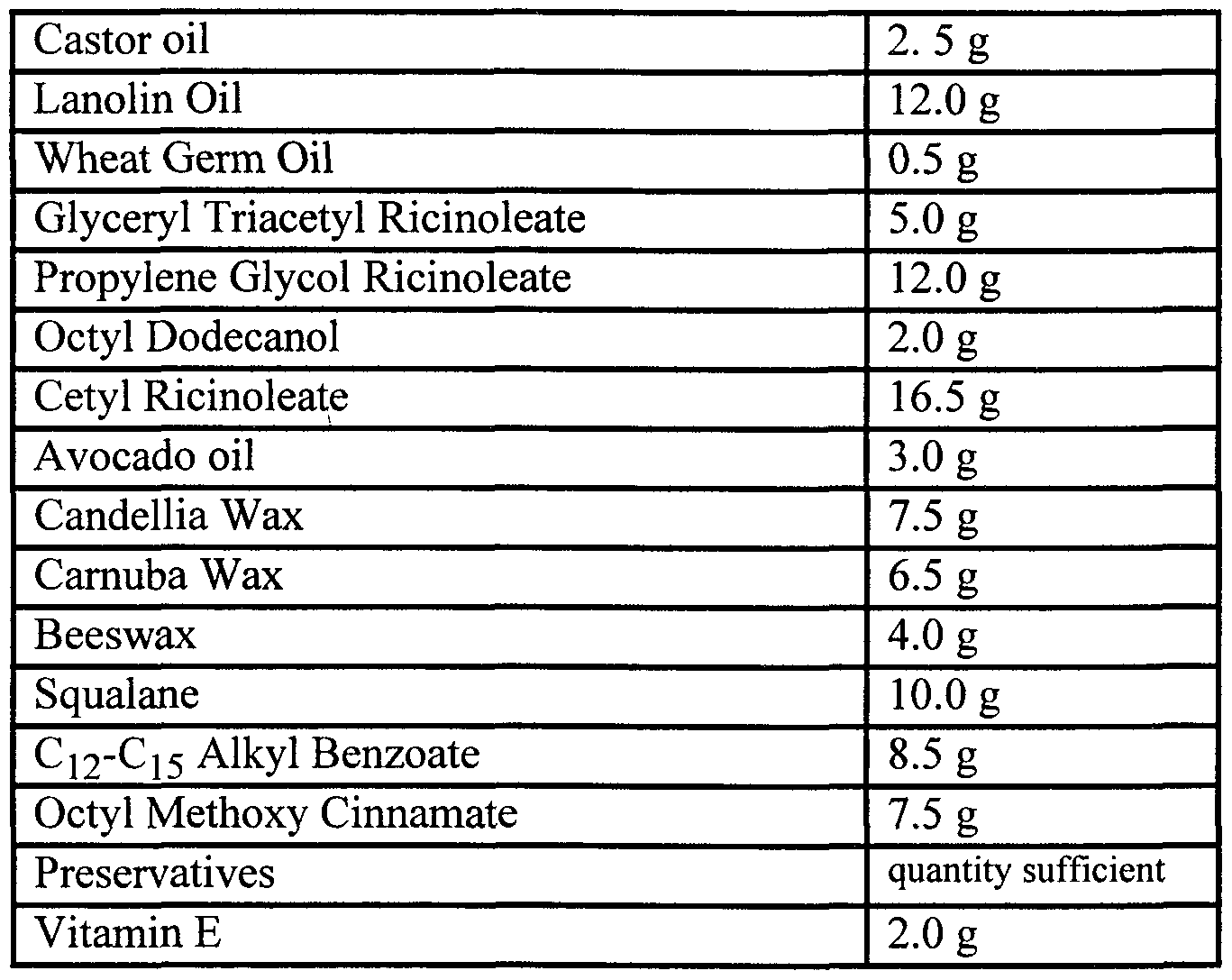
- Each sample A-C was mixed using a vortex mixer in a test tube with melted lipstick base made up of the components shown below in Table 4 at a ratio of 1.0 g (vesicles) to 4.0 g (base).
- the samples were then placed in a water bath at 80°C. Aliquots were taken after 0, 1 , 2, 3, and 4 hours and placed on a slide, diluted with castor oil and observed under a microscope.
- lipid vesicles of the present invention made with at least one high melting point ethoxylated alcohol such as UNITHOX TM 420, 520 or 720 remain stable when processed with other cosmetic components at high temperatures of at least 80°C for an extended period of time.
- high melting point ethoxylated alcohol such as UNITHOX TM 420, 520 or 720
- the lipstick preparation described in Example 4 was modified by adding various Polyethylene glycol (PEG) hydrogenated castor oil preparations (sold under the brand name CREMAPHORTM) to help disperse and maintain suspension of the lipid vesicles in the lipstick base.
- PEG Polyethylene glycol
- the PEG hydrogenated castor oil was added at both 10% total base mix (e.g., 2.5 g, as shown in Table 3) and at 5% total base mix (e.g., 1.25 g).
- the lipid vesicles and lipstick preparation was prepared as described in Example 3 using 1.0 g of vesicles and 9.0 g of base mix with PEG hydrogenated castor oil.
Landscapes
- Health & Medical Sciences (AREA)
- Life Sciences & Earth Sciences (AREA)
- Chemical & Material Sciences (AREA)
- General Health & Medical Sciences (AREA)
- Animal Behavior & Ethology (AREA)
- Veterinary Medicine (AREA)
- Public Health (AREA)
- Epidemiology (AREA)
- Dispersion Chemistry (AREA)
- Organic Chemistry (AREA)
- Birds (AREA)
- Medicinal Chemistry (AREA)
- Pharmacology & Pharmacy (AREA)
- Chemical Kinetics & Catalysis (AREA)
- Molecular Biology (AREA)
- Biophysics (AREA)
- Emergency Medicine (AREA)
- Cosmetics (AREA)
- Manufacturing Of Micro-Capsules (AREA)
Abstract
Description



Claims


Priority Applications (4)
| Application Number | Priority Date | Filing Date | Title |
|---|---|---|---|
| DE69831144T DE69831144D1 (en) | 1997-04-11 | 1998-04-10 | HEAT-RESISTANT LIPID VESICLES |
| EP98915548A EP0973605B1 (en) | 1997-04-11 | 1998-04-10 | Heat resistant lipid vesicles |
| CA002286096A CA2286096C (en) | 1997-04-11 | 1998-04-10 | Heat resistant lipid vesicles |
| JP54419198A JP2001523230A (en) | 1997-04-11 | 1998-04-10 | Thermostable lipid vesicles |
Applications Claiming Priority (2)
| Application Number | Priority Date | Filing Date | Title |
|---|---|---|---|
| US08/838,633 US5756014A (en) | 1997-04-11 | 1997-04-11 | Heat resistant lipid vesicles |
| US08/838,633 | 1997-04-11 |
Publications (1)
| Publication Number | Publication Date |
|---|---|
| WO1998046348A1 true WO1998046348A1 (en) | 1998-10-22 |
Family
ID=25277651
Family Applications (1)
| Application Number | Title | Priority Date | Filing Date |
|---|---|---|---|
| PCT/US1998/007451 Ceased WO1998046348A1 (en) | 1997-04-11 | 1998-04-10 | Heat resistant lipid vesicles |
Country Status (6)
| Country | Link |
|---|---|
| US (1) | US5756014A (en) |
| EP (1) | EP0973605B1 (en) |
| JP (1) | JP2001523230A (en) |
| CA (1) | CA2286096C (en) |
| DE (1) | DE69831144D1 (en) |
| WO (1) | WO1998046348A1 (en) |
Cited By (2)
| Publication number | Priority date | Publication date | Assignee | Title |
|---|---|---|---|---|
| US7252830B2 (en) | 2003-10-06 | 2007-08-07 | The Gillette Company | Moisturizing compositions |
| WO2012051406A1 (en) * | 2010-10-13 | 2012-04-19 | Sun Chemical Corporation | Water dispersible solid dispersion of pigment |
Families Citing this family (14)
| Publication number | Priority date | Publication date | Assignee | Title |
|---|---|---|---|---|
| US6039960A (en) * | 1997-05-28 | 2000-03-21 | E-L Management Corp. | Water containing wax-based product |
| US6080211A (en) * | 1999-02-19 | 2000-06-27 | Igen, Inc. | Lipid vesicle-based fuel additives and liquid energy sources containing same |
| JP4001310B2 (en) * | 1999-09-30 | 2007-10-31 | 株式会社資生堂 | Lipid complex and composition for external use containing the same |
| US20040022838A1 (en) * | 2001-06-20 | 2004-02-05 | Holick Michael F. | Regulation of cell proliferation and differentiation using topically applied peptides |
| DE10116497B4 (en) * | 2001-04-03 | 2004-08-12 | Faber-Castell Ag | Liquid for lip care or lip coloring |
| WO2006014035A1 (en) * | 2004-08-06 | 2006-02-09 | Biospectrum, Inc. | Multiple layered liposome and preparation method thereof |
| WO2006071659A1 (en) * | 2004-12-29 | 2006-07-06 | Trustees Of Boston University | Delivery of h2 antagonists |
| US8449979B2 (en) * | 2005-01-28 | 2013-05-28 | Japan Science And Technology Agency | Molecular aggregate capable of undergoing phase transition by dehydrating condensation and method of phase transition thereof |
| US10251839B2 (en) * | 2008-01-22 | 2019-04-09 | Igi Laboratories, Inc. | Lipid vesicles derived from olive oil fatty acids |
| GB0920879D0 (en) * | 2009-11-27 | 2010-01-13 | Revolymer Ltd | Cosmetic composition |
| US8968755B2 (en) | 2010-10-23 | 2015-03-03 | Joel Schlessinger | Topical base and active agent-containing compositions, and methods for improving and treating skin |
| US8685381B2 (en) * | 2010-10-23 | 2014-04-01 | Joel Schlessinger | Topical base and active agent-containing compositions, and methods for improving and treating skin |
| US10111956B2 (en) | 2013-06-03 | 2018-10-30 | Tolmar, Inc. | Corticosteroid compositions |
| GR1008481B (en) * | 2013-12-05 | 2015-05-12 | Συμβουλοι Αναπτυξης Πωλησεων Επε, | Method for the confinement of plant oils (olive oil) with use of specific edible liposomes without phospholipids- application of said method in food, charcuterie, dairy products and fish preparations |
Citations (1)
| Publication number | Priority date | Publication date | Assignee | Title |
|---|---|---|---|---|
| US5405615A (en) * | 1991-09-17 | 1995-04-11 | Micro Vesicular Systems, Inc. | Sucrose distearate lipid vesicles |
Family Cites Families (3)
| Publication number | Priority date | Publication date | Assignee | Title |
|---|---|---|---|---|
| AU603659B2 (en) * | 1987-03-13 | 1990-11-22 | Micro Vesicular Systems, Inc. | Lipid vesicles formed of surfactants and steroids |
| US5260065A (en) * | 1991-09-17 | 1993-11-09 | Micro Vesicular Systems, Inc. | Blended lipid vesicles |
| AU715468B2 (en) * | 1995-06-22 | 2000-02-03 | Minnesota Mining And Manufacturing Company | Stable hydroalcoholic compositions |
-
1997
- 1997-04-11 US US08/838,633 patent/US5756014A/en not_active Expired - Lifetime
-
1998
- 1998-04-10 WO PCT/US1998/007451 patent/WO1998046348A1/en not_active Ceased
- 1998-04-10 CA CA002286096A patent/CA2286096C/en not_active Expired - Lifetime
- 1998-04-10 JP JP54419198A patent/JP2001523230A/en active Pending
- 1998-04-10 EP EP98915548A patent/EP0973605B1/en not_active Expired - Lifetime
- 1998-04-10 DE DE69831144T patent/DE69831144D1/en not_active Expired - Lifetime
Patent Citations (1)
| Publication number | Priority date | Publication date | Assignee | Title |
|---|---|---|---|---|
| US5405615A (en) * | 1991-09-17 | 1995-04-11 | Micro Vesicular Systems, Inc. | Sucrose distearate lipid vesicles |
Cited By (2)
| Publication number | Priority date | Publication date | Assignee | Title |
|---|---|---|---|---|
| US7252830B2 (en) | 2003-10-06 | 2007-08-07 | The Gillette Company | Moisturizing compositions |
| WO2012051406A1 (en) * | 2010-10-13 | 2012-04-19 | Sun Chemical Corporation | Water dispersible solid dispersion of pigment |
Also Published As
| Publication number | Publication date |
|---|---|
| EP0973605A1 (en) | 2000-01-26 |
| DE69831144D1 (en) | 2005-09-15 |
| EP0973605B1 (en) | 2005-08-10 |
| CA2286096C (en) | 2006-03-14 |
| EP0973605A4 (en) | 2000-04-19 |
| JP2001523230A (en) | 2001-11-20 |
| US5756014A (en) | 1998-05-26 |
| CA2286096A1 (en) | 1998-10-22 |
Similar Documents
| Publication | Publication Date | Title |
|---|---|---|
| US5756014A (en) | Heat resistant lipid vesicles | |
| JP3411570B2 (en) | Blended lipid vesicles | |
| EP0727982B1 (en) | Propylene glycol stearate vesicles | |
| EP0534286B1 (en) | External skin care preparation | |
| KR101337811B1 (en) | Process for producing o/w microemulsion preparation for external application | |
| US6479041B2 (en) | Method for producing aqueous emulsions or suspensions | |
| JPH10500675A (en) | Pharmaceutical compositions derived from microemulsion-based gels, methods for their preparation and novel microemulsion-based gels | |
| US5994414A (en) | Water-thin emulsion formed by high pressure homogenization process | |
| KR20010013086A (en) | Water containing wax-based product | |
| CA2175471C (en) | Sucrose distearate lipid vesicles | |
| EP1280497A2 (en) | Rinse-off cosmetic conditioning compositions | |
| EP1069882A1 (en) | Di-behenyl fumarate and its use in dermatological products | |
| JPS6157838B2 (en) | ||
| CN102655840A (en) | Personal care emulsions comprising waxy materials and organopolysiloxanes | |
| JP2002526399A (en) | Glucoside pouch lamellar vesicle | |
| US6844009B1 (en) | Media in the form of complex dispersions, method for preparing same and uses | |
| JPS63221835A (en) | Method for producing stable oil-in-water emulsion | |
| JPH09510432A (en) | Lipid vesicles containing unsaponifiable avocado oil | |
| JPH08268829A (en) | Emulsion type composition | |
| JP2026001832A (en) | Fragrant three-phase emulsion composition | |
| CN119770382A (en) | Emulsifying wax for solid cosmetic compositions | |
| CN120884538A (en) | A one-step method for preparing water-in-oil-in-water multi-component liquid crystal emulsions |
Legal Events
| Date | Code | Title | Description |
|---|---|---|---|
| AK | Designated states |
Kind code of ref document: A1 Designated state(s): CA JP |
|
| AL | Designated countries for regional patents |
Kind code of ref document: A1 Designated state(s): AT BE CH CY DE DK ES FI FR GB GR IE IT LU MC NL PT SE |
|
| DFPE | Request for preliminary examination filed prior to expiration of 19th month from priority date (pct application filed before 20040101) | ||
| 121 | Ep: the epo has been informed by wipo that ep was designated in this application | ||
| ENP | Entry into the national phase |
Ref document number: 2286096 Country of ref document: CA Ref country code: CA Ref document number: 2286096 Kind code of ref document: A Format of ref document f/p: F |
|
| ENP | Entry into the national phase |
Ref country code: JP Ref document number: 1998 544191 Kind code of ref document: A Format of ref document f/p: F |
|
| WWE | Wipo information: entry into national phase |
Ref document number: 1998915548 Country of ref document: EP |
|
| WWP | Wipo information: published in national office |
Ref document number: 1998915548 Country of ref document: EP |
|
| WWG | Wipo information: grant in national office |
Ref document number: 1998915548 Country of ref document: EP |