WO1998057915A1 - Verfahren zur herstellung von butenylethern - Google Patents
Verfahren zur herstellung von butenylethern Download PDFInfo
- Publication number
- WO1998057915A1 WO1998057915A1 PCT/EP1998/003368 EP9803368W WO9857915A1 WO 1998057915 A1 WO1998057915 A1 WO 1998057915A1 EP 9803368 W EP9803368 W EP 9803368W WO 9857915 A1 WO9857915 A1 WO 9857915A1
- Authority
- WO
- WIPO (PCT)
- Prior art keywords
- formula
- radicals
- group
- alkyl
- atoms
- Prior art date
- Legal status (The legal status is an assumption and is not a legal conclusion. Google has not performed a legal analysis and makes no representation as to the accuracy of the status listed.)
- Ceased
Links
Classifications
-
- C—CHEMISTRY; METALLURGY
- C07—ORGANIC CHEMISTRY
- C07C—ACYCLIC OR CARBOCYCLIC COMPOUNDS
- C07C41/00—Preparation of ethers; Preparation of compounds having groups, groups or groups
- C07C41/01—Preparation of ethers
- C07C41/05—Preparation of ethers by addition of compounds to unsaturated compounds
- C07C41/06—Preparation of ethers by addition of compounds to unsaturated compounds by addition of organic compounds only
-
- C—CHEMISTRY; METALLURGY
- C07—ORGANIC CHEMISTRY
- C07C—ACYCLIC OR CARBOCYCLIC COMPOUNDS
- C07C41/00—Preparation of ethers; Preparation of compounds having groups, groups or groups
- C07C41/01—Preparation of ethers
- C07C41/32—Preparation of ethers by isomerisation
Definitions
- the invention relates to a process for the preparation of butenyl ethers by adding alcohols to butadiene in the presence of transition metal complex catalysts with ligands whose complex-forming centers are bonded to a ferrocene-cyclopentadienyl radical with atoms of the V group of the periodic table of the elements.
- WO 95/19334 describes the production of butenyl ethers as intermediates for the production of n-butyraldehyde or n-butanol in the presence of complex catalysts.
- the process described there opens up a new way of producing n-butyraldehyde and n-butanol compared to the synthesis which is generally carried out on an industrial scale by means of hydroformylation of propylene.
- the new process is a particularly valuable alternative where cheap butadiene is available as a starting material.
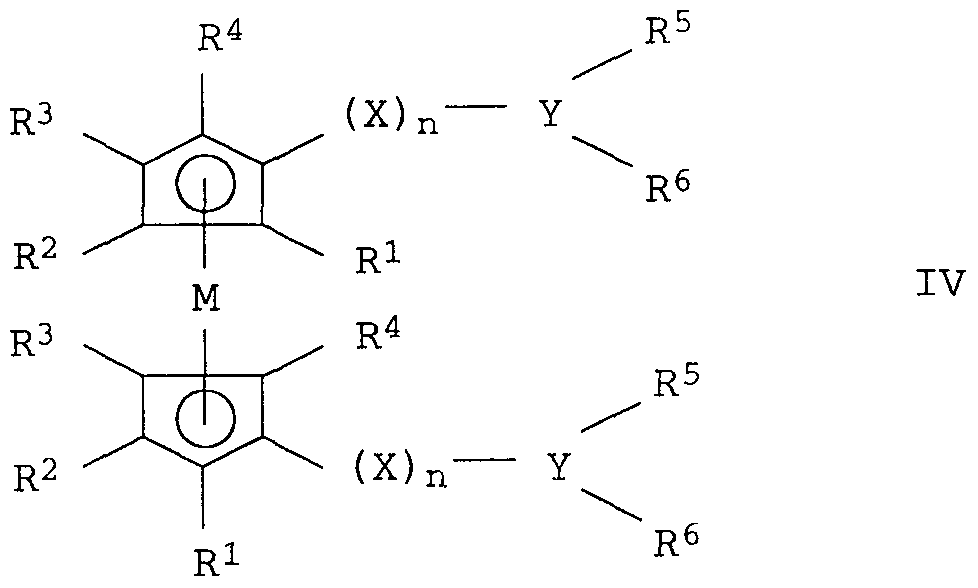
- R is an alkyl or alkenyl group having 1 to 20 C atoms, an aryl group having 6 to 10 C atoms or an aralkyl group having 7 to 11 C atoms and wherein the radicals R can be substituted by hydroxyl or alkoxy groups, in which a complex of a transition metal of group VIII of the periodic table of the elements with ligands of the formula IV is used as the catalyst
- R 1 to R 4 independently of one another, also independently of one another in the two cyclopentadienyl radicals are hydrogen or alkyl or cycloalkyl, aryl or aralkyl radicals having up to 40, preferably hydrogen or alkyl radicals having 1 to 4, carbon atoms or part of one May be isocyclic or heterocyclic ring system, furthermore the two cyclopentadienyl radicals can be bridged via the respective radicals R 1 to R 4 , Y nitrogen, arsenic, antimony or phosphorus and the radicals R 5 and R 6 independently of one another, also independently of one another in the two molecules of the sandwich complex hydrogen or alkyl, cyclo- are alkyl, aryl or
- Nickel and especially palladium are particularly suitable as transition metals of group VIII of the periodic table of the elements.
- the complexes can either be generated in situ in the reaction mixture or added to the reaction mixture in preformed form.
- the procedure is generally such that the compounds of the transition metals, e.g. whose halides, preferably their chlorides, bromides or iodides, the nitrates, cyanides or sulfates or preferably complex compounds of these metals, such as acetylacetonates, carboxylates, carbonyl complexes or olefin complexes such as ethene or butadiene complexes, are fed together with the ligand to the reaction mixture, whereupon the complexes form in the reaction mixture.
- the compounds of the transition metals e.g. whose halides, preferably their chlorides, bromides or iodides, the nitrates, cyanides or sulfates or preferably complex compounds of these metals, such as acetylacetonates, carboxylates, carbonyl complexes or o
- Palladium is generally used in the form of palladium di-chloride, palladium (dibenzonitrile) dichloride, palladium (diacetonitrile) dichloride and preferably as palladium diacetate and palladium di (acetylacetonate).
- the catalyst formation is otherwise carried out in a manner known per se, the ratio of ligand to palladium being selected in the range from 0.5 to 50, preferably 1 to 20 and particularly preferably between 2 and 10.
- the amount of palladium or the palladium-containing compound is generally 0.001 to 5% m / m, preferably 0.01 to 1% m / m, particularly preferably 0.05 to 0.5% m / m 1, 3 butadiene.
- the ligands of the formula IV to be used according to the invention contain iron as the central atom of the sandwich complex.
- the substituents R 1 and R 4 are preferably hydrogen, the value of n is preferably 0 and Y is preferably phosphorus.
- the radicals R 5 and R 6 are in particular low molecular weight alkyl radicals, cyclohexyl radicals and phenyl radicals.
- the following ligands come into consideration in particular: 1, 1 'bis (diphenylphosphino) ferrocene, 1,1' bis (diisopropylphosphino) ferrocene, 1,1 'bis (diethylphosphine) ferrocene, 1 , 1 '-Bis (dipropylphosphino) ferrocene, 1- (di-iso-propylphosphino) -1' - (dipropylphosphino) ferrocene, 1- (di-iso-propylphosphino) -1 '- (dicyclohexylphosphino) ferrocene and 1, 1' .
- any alcohols are suitable as alcohols ROH, depending on which butenyl ether is to be produced.
- ROH butenyl ether
- n-butyraldehyde or n-butanol low molecular weight alcohols and in particular n-butanol are expediently used.
- a molar ratio of 1,3-butadiene / palladium is generally from 100: 1 to 100000: 1, preferably from 200: 1 to 2000: 1 and particularly preferably from 400: 1 to 1000: 1 is set, this molar ratio is in the case of the continuous execution process based on the statio nary ⁇ 1, 3-butadiene concentration in the liquid internationalesmi ⁇ research.
- the molar ratio of alcohol ROH / 1, 3-butadiene can be selected within wide limits in this process design and is generally not critical.
- the alcohol to be added to 1,3-butadiene can also act as a solvent for the complex catalyst in addition to acting as a reagent.
- an alcohol / 1,3-butadiene molar ratio of 1: 1 to 10: 1, preferably 1: 1 to 5: 1 and particularly preferably 1: 1 to 3: 1 is used, these details being in the If the process is carried out continuously, refer to the stationary 1,3-butadiene concentration in the liquid reaction mixture.
- the addition of the alcohol ROH to 1,3-butadiene is usually carried out in the liquid phase.
- the catalyst is initially dissolved in the liquid reaction medium and 1,4-butadiene in liquid or gaseous form is introduced into the reaction mixture together with the alcohol.
- the alcohol to be added to 1,3-butadiene or a solvent which is inert under the reaction conditions, preferably a high-boiling solvent, can serve as the reaction medium.
- Suitable solvents are, for example, condensation products which can arise in the course of the reaction, such as alkoxyoctadienes, alkoxydodecatrienes, furthermore ethers, such as dibutyl ether, dioctyl ether, diethylene glycol di-butyl ether, low molecular weight polyethylene glycol ether and Sulfones, such as sulfolane, and also hydrostokes, such as hexane,
- the reaction is generally carried out in a stirred autoclave.
- the adducts of the formulas I and III formed in this way are then expediently separated off from the reaction mixture by distillation, the homogeneous catalyst containing the palladium or nickel remaining in the bottom of the distillation, dissolved in the high-boiling solvent.
- the catalyst which remains in the distillation bottoms in this way can be reused for further reactions.
- the 1,3-butadiene is preferably fed in liquid form under pressure into the reaction mixture containing the alcohol ROH and the homogeneously dissolved transition metal element complex catalyst and optionally a high-boiling solvent.
- the reaction is advantageously carried out in a tubular reactor or preferably in a reactor cascade. Not implemented
- 1,3-Butadiene is advantageously circulated.
- the alcohol ROH is advantageously metered in continuously according to its consumption during the reaction of the reaction mixture.
- the 1,3-butadiene can be passed in gaseous form through the liquid reaction medium containing the catalyst, unreacted 1,3-butadiene being used for the relatively volatile adducts formed in the reaction with the alcohol of formulas I and III from the reaction mixture.
- the alcohol ROH can, depending on its consumption during the reaction, be metered continuously into the reaction mixture.
- the addition of the alcohol ROH to 1,3-butadiene in the presence of the complexes to be used according to the invention is generally carried out at a temperature of from 20 to 180 ° C., preferably from 50 to 150 ° C. and particularly preferably from 50 to 120 ° C. and at Pressure from 1 to 50 bar, preferably 2 to 10 bar and particularly preferably carried out under autogenous pressure.
- 1,3-butadiene-containing hydrocarbon streams can also preferably be used as the raw material.
- Such hydrocarbon streams occur, for example, as so-called C cuts in steam crackers.
- These hydrocarbon streams are expediently used before they are used by any acetylenic or allenic carbon atoms contained therein.
- Hydrogen oils exempted by partial hydrogenation (Weissermel, Arpe: Industrial Organic Chemistry; 3rd edition, VCH Verlagsgesellschaft, Weinheim 1988).
- the 1,3-butadiene-containing hydrocarbon streams can then be used as starting material in a manner analogous to that of pure 1,3-butadiene.
- the saturated or monoolefinic hydrocarbons contained in these hydrocarbon streams, which did not react during the reaction, are expediently removed from the reaction discharge, for example by means of a gas / liquid separator.
- the adducts of the formulas I and III obtained in the reaction of these hydrocarbon streams can be processed further in the same way as the adducts I and III produced with pure 1,3-butadiene.
- the adduct required in the production of n-butyraldehyde and / or n-butanol is 1-alkoxybutene-2 of the formula I, which can be separated from its isomer 3-alkoxy-butene-1 of the formula III contained in the reaction product . Since the adducts I and III are formed in comparable amounts when the alcohol ROH is added to 1,3-butadiene, the process according to the invention would not be economical on an industrial scale if the 3-alkoxybutene-1 III were not economical Way to convert into the desired 1-alkoxy-buten-2 I.
- the adduct III is first separated from the isomeric adduct I contained in the reaction discharge. This can advantageously be done in such a way that the reaction is discharged after prior removal of unreacted 1,3-butadiene, e.g. in a gas-liquid separator into a distillation apparatus and separated there by fractional distillation.
- the by-products, 1,3-butadiene dimers and trimers optionally present in the reaction discharge and their adducts with the alcohol ROH and optionally multiply alkoxylated by-products can also be separated off from the adduct I.
- the more volatile adduct III is separated off from the adduct I by distillation in a simple manner, for example in conventional distillation columns.
- the adduct III separated off from the desired adduct like the unreacted 1,3-butadiene, can then be returned to the reaction.
- the recirculation of adduct III causes the isomerization of adduct III to adduct I and ultimately leads to the suppression of the new formation of the undesired adduct III, so that when using this circular procedure in the overall balance of this cycle practically only the desired adduct I, but not its undesired isomer III is formed.
- the isomerization of the adduct III can also be accomplished in a separate isomerization stage instead of by recycling it, by adding the adduct III separated from the adduct I e.g. conducts through a reactor coated with a complex catalyst, the discharge of this reactor, which consists of the isomerization mixture formed therein from adduct III and adduct I, for example by distillation into adduct I and adduct III, optionally further processes the newly formed adduct I and the adduct III returns to the isomerization reactor.
- the isomerization of adduct III to adduct I in the isomerization reactor can take place in the presence or absence of a solvent. This reaction is preferably carried out without a solvent. If the isomerization is carried out in the presence of a solvent, high-boiling solvents such as ethers, for example di- or triethylene glycol dimethyl ether, di- or triethylene glycol dibutyl ether, sulfoxides, e.g. Dimethyl sulfoxide or sulfones such as sulfolane, high-boiling aromatic or aliphatic hydrocarbons or halogenated aliphatic or aromatic solvents, e.g. Dichlorobenzene.
- ethers for example di- or triethylene glycol dimethyl ether, di- or triethylene glycol dibutyl ether
- sulfoxides e.g. Dimethyl sulfoxide or sulfones such as sulfolane
- a 150 ml glass pressure vessel was treated with 0.068 g (0.223 mmol) palladium acetylacetonate, 0.372 g (0.889 mmol) 1, 1 'bis (diisopropylphosphino) ferrocene (produced according to JJ Bishop et. Al., J. Organomet. Chem. 27 (1971), 241-249), 29.53 g (0.398 mol) butanol and 17.80 g of a C ⁇ o-C ⁇ 3 hydrocarbon mixture filled under a protective gas atmosphere. Then 7.92 g (0.146 mol) of 1,3-butadiene were injected and the mixture was heated to 80.degree. The pressure was 1.5 bar.
Landscapes
- Chemical & Material Sciences (AREA)
- Organic Chemistry (AREA)
- Organic Low-Molecular-Weight Compounds And Preparation Thereof (AREA)
Abstract
Description

Claims
Priority Applications (4)
| Application Number | Priority Date | Filing Date | Title |
|---|---|---|---|
| AU82134/98A AU8213498A (en) | 1997-06-18 | 1998-06-05 | Method for producing butenyl ethers |
| EP98932124A EP0994837A1 (de) | 1997-06-18 | 1998-06-05 | Verfahren zur herstellung von butenylethern |
| US09/445,410 US6271423B1 (en) | 1997-06-18 | 1998-06-05 | Preparation of butenyl ethers |
| CA002286854A CA2286854A1 (en) | 1997-06-18 | 1998-06-05 | Method for producing butenyl ethers |
Applications Claiming Priority (2)
| Application Number | Priority Date | Filing Date | Title |
|---|---|---|---|
| DE19725872.7 | 1997-06-18 | ||
| DE19725872A DE19725872A1 (de) | 1997-06-18 | 1997-06-18 | Verfahren zur Herstellung von Butenylethern |
Publications (1)
| Publication Number | Publication Date |
|---|---|
| WO1998057915A1 true WO1998057915A1 (de) | 1998-12-23 |
Family
ID=7832909
Family Applications (1)
| Application Number | Title | Priority Date | Filing Date |
|---|---|---|---|
| PCT/EP1998/003368 Ceased WO1998057915A1 (de) | 1997-06-18 | 1998-06-05 | Verfahren zur herstellung von butenylethern |
Country Status (6)
| Country | Link |
|---|---|
| US (1) | US6271423B1 (de) |
| EP (1) | EP0994837A1 (de) |
| AU (1) | AU8213498A (de) |
| CA (1) | CA2286854A1 (de) |
| DE (1) | DE19725872A1 (de) |
| WO (1) | WO1998057915A1 (de) |
Citations (1)
| Publication number | Priority date | Publication date | Assignee | Title |
|---|---|---|---|---|
| WO1995019334A1 (de) * | 1994-01-14 | 1995-07-20 | Basf Aktiengesellschaft | VERFAHREN ZUR HERSTELLUNG VON n-BUTYRALDEHYD UND/ODER n-BUTANOL |
Family Cites Families (1)
| Publication number | Priority date | Publication date | Assignee | Title |
|---|---|---|---|---|
| US5847166A (en) * | 1996-10-10 | 1998-12-08 | Massachusetts Institute Of Technology | Synthesis of aryl ethers |
-
1997
- 1997-06-18 DE DE19725872A patent/DE19725872A1/de not_active Withdrawn
-
1998
- 1998-06-05 EP EP98932124A patent/EP0994837A1/de not_active Withdrawn
- 1998-06-05 US US09/445,410 patent/US6271423B1/en not_active Expired - Fee Related
- 1998-06-05 CA CA002286854A patent/CA2286854A1/en not_active Abandoned
- 1998-06-05 AU AU82134/98A patent/AU8213498A/en not_active Abandoned
- 1998-06-05 WO PCT/EP1998/003368 patent/WO1998057915A1/de not_active Ceased
Patent Citations (1)
| Publication number | Priority date | Publication date | Assignee | Title |
|---|---|---|---|---|
| WO1995019334A1 (de) * | 1994-01-14 | 1995-07-20 | Basf Aktiengesellschaft | VERFAHREN ZUR HERSTELLUNG VON n-BUTYRALDEHYD UND/ODER n-BUTANOL |
Also Published As
| Publication number | Publication date |
|---|---|
| AU8213498A (en) | 1999-01-04 |
| EP0994837A1 (de) | 2000-04-26 |
| US6271423B1 (en) | 2001-08-07 |
| CA2286854A1 (en) | 1998-12-23 |
| DE19725872A1 (de) | 1998-12-24 |
Similar Documents
| Publication | Publication Date | Title |
|---|---|---|
| EP1529768B1 (de) | Verfahren zur Herstellung von TCD-Alkohol DM | |
| EP4103571B1 (de) | Niederdruckhydroformylierung von diisobuten | |
| EP0048804B1 (de) | Verfahren zur Herstellung von Cycloocten-4-ol-1 aus Cyclooctadien-1,5 | |
| DE3017682A1 (de) | Verfahren zur herstellung von alkoholen | |
| DE10352261B4 (de) | Verfahren zur Herstellung von TCD-Dialdehyd | |
| DE10357718A1 (de) | Verfahren zur Herstellung von Tricyclodecandialdehyd | |
| DE3884254T2 (de) | Verfahren zur kontinuierlichen Herstellung von Octa-2,7-dien-1-ol. | |
| EP0263259B1 (de) | Verfahren und Katalysatorsystem zur Trimerisierung von Acetylen und Acetylenverbindungen | |
| DE2417985A1 (de) | Diolefindimerisierungskatalysatoren und verfahren zur katalytischen dimerisierung von diolefinen | |
| EP1604966A1 (de) | Verfahren zur Herstellung von Tricyclo-[5.2.1.0 2,6]-decan dimethylol | |
| DE19815323C2 (de) | Verfahren zur Herstellung von Isochroman-3-onen | |
| EP0994837A1 (de) | Verfahren zur herstellung von butenylethern | |
| DE69402106T2 (de) | Verfahren zur Herstellung von 2-Formyl-1,4-Butandiol | |
| EP0931046B1 (de) | VERFAHREN ZUR HERSTELLUNG VON n-BUTYLALKYLETHERN | |
| DE69507414T2 (de) | Verfahren zur Herstellung von Octadienen | |
| WO1998057916A1 (de) | Verfahren zur herstellung von butenylethern | |
| EP0047834B1 (de) | Verfahren zur Herstellung von Alkylestern gesättigter aliphatischer Carbonsäuren | |
| DE10149349A1 (de) | Verfahren zur Herstellung von 6-Methylheptan-2-on und dessen Verwendung | |
| DE68909547T2 (de) | Verfahren zur Herstellung von Alpha-(4-isobutyl-phenyl)propionsäure. | |
| DE3034098A1 (de) | Verfahren zur herstellung von alkadienen | |
| DE1955933B2 (de) | Verfahren zur herstellung von 1- alkoxyoctadienen-(2,7) | |
| DE69224504T2 (de) | Verfahren zur Telomerisation von konjugierten Alkadienen | |
| EP0497796B1 (de) | Verfahren zur herstellung von fluorbenzolen | |
| DE3942790A1 (de) | Verfahren zur herstellung von 2-(4-chlorphenyl)-3-methylbuttersaeure | |
| DE1468614C3 (de) | Verfahren zur Herstellung von Aldehyden und/oder Alkoholen durch die Oxosynthese |
Legal Events
| Date | Code | Title | Description |
|---|---|---|---|
| AK | Designated states |
Kind code of ref document: A1 Designated state(s): AL AU BG BR BY CA CN CZ GE HU ID IL JP KR KZ LT LV MX NO NZ PL RO RU SG SI SK TR UA US |
|
| AL | Designated countries for regional patents |
Kind code of ref document: A1 Designated state(s): AM AZ BY KG KZ MD RU TJ TM AT BE CH CY DE DK ES FI FR GB GR IE IT LU MC NL PT SE |
|
| DFPE | Request for preliminary examination filed prior to expiration of 19th month from priority date (pct application filed before 20040101) | ||
| 121 | Ep: the epo has been informed by wipo that ep was designated in this application | ||
| WWE | Wipo information: entry into national phase |
Ref document number: 1998932124 Country of ref document: EP |
|
| ENP | Entry into the national phase |
Ref document number: 2286854 Country of ref document: CA Ref country code: CA Ref document number: 2286854 Kind code of ref document: A Format of ref document f/p: F |
|
| WWE | Wipo information: entry into national phase |
Ref document number: 09445410 Country of ref document: US |
|
| NENP | Non-entry into the national phase |
Ref country code: JP Ref document number: 1999503669 Format of ref document f/p: F |
|
| WWP | Wipo information: published in national office |
Ref document number: 1998932124 Country of ref document: EP |
|
| WWW | Wipo information: withdrawn in national office |
Ref document number: 1998932124 Country of ref document: EP |