WO1999007894A1 - Direct quantitation of low copy number rna - Google Patents
Direct quantitation of low copy number rna Download PDFInfo
- Publication number
- WO1999007894A1 WO1999007894A1 PCT/US1998/016347 US9816347W WO9907894A1 WO 1999007894 A1 WO1999007894 A1 WO 1999007894A1 US 9816347 W US9816347 W US 9816347W WO 9907894 A1 WO9907894 A1 WO 9907894A1
- Authority
- WO
- WIPO (PCT)
- Prior art keywords
- dna
- rna
- hybrid
- sequence
- probe
- Prior art date
- Legal status (The legal status is an assumption and is not a legal conclusion. Google has not performed a legal analysis and makes no representation as to the accuracy of the status listed.)
- Ceased
Links
Classifications
-
- C—CHEMISTRY; METALLURGY
- C12—BIOCHEMISTRY; BEER; SPIRITS; WINE; VINEGAR; MICROBIOLOGY; ENZYMOLOGY; MUTATION OR GENETIC ENGINEERING
- C12Q—MEASURING OR TESTING PROCESSES INVOLVING ENZYMES, NUCLEIC ACIDS OR MICROORGANISMS; COMPOSITIONS OR TEST PAPERS THEREFOR; PROCESSES OF PREPARING SUCH COMPOSITIONS; CONDITION-RESPONSIVE CONTROL IN MICROBIOLOGICAL OR ENZYMOLOGICAL PROCESSES
- C12Q1/00—Measuring or testing processes involving enzymes, nucleic acids or microorganisms; Compositions therefor; Processes of preparing such compositions
- C12Q1/68—Measuring or testing processes involving enzymes, nucleic acids or microorganisms; Compositions therefor; Processes of preparing such compositions involving nucleic acids
- C12Q1/6813—Hybridisation assays
- C12Q1/6816—Hybridisation assays characterised by the detection means
- C12Q1/6825—Nucleic acid detection involving sensors
Definitions
- This invention relates to the field of direct nucleic acid detection, particularly RNA in low copy number, without a requirement for amplification of either the number of RNA molecules, or by amplification of a detection signal.
- the method further utilizes capillary electrophoresis to detect a target RNA-DNA probe hybrid band.
- the invention also combines laser- induced fluorescence and capillary electrophoresis.
- RNA particularly RNA derived from infectious agents or from cellular sources
- the viral load detected in serum correlates to high concentrations of virus in the lymph nodes and has predictive value in assessing progression of AIDS to advanced stages, as reported in Ho, et al . , Nature, 373: 123 (1995) and Mellors, et al . , Ann. Intern . Med. , 122: 573 (1996).
- Viral titers in serum are also correlated with disease progression for other viruses such as HCV, nonA nonB hepatitis other than HCV, and atypical lentiviruses .
- RNA-DNA duplexes direct measurement of the low RNA copy number in the native sample, even where adequate detection sensitivities can be achieved, is thwarted by the inherent instability of RNA-DNA duplexes.
- Increasing the length of the hybridized target can increase both sensitivity and stability of the hybrid, but the additional nucleotide sequence combinations increase the chance of nonspecific hybridizing to fragments of host nucleic acids or partial hybridization to nonselected regions of the viral genome, thereby contributing to a falsely inflated positive value.
- Most of the improvements to date in low RNA copy number quantitation represent attempts to better control the multiple molecular events involved in signal or nucleic acid amplification strategies.
- the three main amplification systems currently available include branched chain signal amplification (bDNA) , reverse transcriptase polymerase chain reaction (RT-PCR) , and nucleic acid sequence based amplification (NASBA) .
- bDNA branched chain signal amplification
- RT-PCR reverse transcriptase polymerase chain reaction
- NASBA nucleic acid sequence based amplification
- an initial probe hybridizing with a complementary probe contains a plurality of noncomplementary sites capable of hybridizing to further DNA strands, which in turn may hybridize sites noncomplementary to the probe sequence, so that as repeated layers of hybridization occur, a branched DNA structure of extreme complexity is created.
- the last to be annealed strand in the branched structure carries a reporter.
- the original RNA target molecule gives rise to an amplification of the signal generating capability of the system.
- RNA target In both RT-PCR and bDNA, the original RNA target can theoretically be dispensed with, without impairing the sensitivity of the test, once the conversion to a DNA system has occurred.
- both RT-PCR and bDNA share many of the same deficiencies. Both systems rely upon the integrity of a large number of successive hybridization events. If an early hybridization event fails, for any of a number of reasons such as structural (steric) hindrance, uncorrected mismatch, binding of a defective enzyme molecule, etc., the final number of copies, and therefore the intensity of the signal will be ablated. These random occurrences help to account for the great sensitivity of the assays coupled with a widely variable coefficient of variability.
- the commercial form of the test normalizes variability by co- amplification of an internal standard. To control for variability the internal standard must be amplified under identical conditions as the target yet be able to be differentiated from the target, an almost impossible task. Also, introducing an internal standard changes the PCR reaction kinetics itself. RT-PCR, while showing some efficacy, is in practice very labor intensive, and not practical under normal clinical laboratory conditions.
- RNA In NASBA, the lability of RNA is overcome by increasing copy number to a vast number.
- the technique involves creating a cDNA from the target RNA and then generating a large number of transcripts from bDNA template, which in turn can be converted to a cDNA, and so on.
- the number of transcripts produced is always much greater than the number converted to cDNA, so that a large excess of RNA occurs.
- the process is initiated upon annealing of two primers, one of which contains a phage promoter, which in the ensuing cDNA provides a point of initiation for transcription.
- Unlike PCR where the numbers of actual cycles of amplification are nominally controlled by the number of temperature cycles, there is much less control in NASBA.
- the technique suffers from a lack of uniformity as between different target sequences, and in the same target sequence from one run to another.
- the commercial form of the assay employs three internal calibrators, which are co-amplified with the target sequence.
- the analytical coefficient of variability (CV) it is desirable for the analytical coefficient of variability (CV) to be less than 15 percent .
- RNA is extracted from a cell -free biological specimen such as serum or from a cellular RNA source, hybridized to a fluorescent DNA probe
- RNA-DNA hybrid first dye molecule covalently attached to probe
- first dye molecule complementary sequence to form an RNA-DNA hybrid
- second dye second dye in electrophoresis buffer
- quantitatively detecting the amount of RNA-DNA hybrid by measuring the total fluorescent intensity of light emitted from the hybrid band upon excitation by laser-induced fluorescence, and decay of the excited molecules to light of a longer wave length.
- the sample containing the RNA-DNA hybrid is loaded onto the gel column and an electric current is applied to the gel matrix.
- the dye which permeates the gel matrix is capable of intercalating the hybrid, and binds to the interstices of the duplex, so that these intercalated molecules migrate with the hybrid band.
- the unbound dye molecules are not seen as background because its quantum yield varies in the presence of nucleic acid.
- the band is quantitated by directing a scanning laser- induction beam along the gel .
- the hybrids with pendant dye both covalently attached and bound by electrostatic interaction
- migrating as a band absorb the light of excitation wavelength, and emit at a lower energy wavelength. Peak areas of light emission intensity are identified.
- the total fluorescence is the sum of the fluorescence values under the peak.
- the present invention provides a method for stabilizing during capillary electrophoresis nucleic acid hybrids consisting of an RNA strand and a fluorophore terminally labelled DNA strand of short length (15 to about 40 base pairs in length) which involves only electrophoresing the nucleic acid hybrid in the presence of an intercalating dye.
- Any dye, preferably which fluoresces at the same wavelength as the dye covalently attached to the DNA probe, capable of intercalating double stranded nucleic acids will be efficacious in increasing stability.
- RNA target sequence can now readily be selected having less than 5 percent homology to any other portion of the target, and non-homology to host nucleic acids, as verified by a GenBank search or by comparison to other published sequence databases.
- the principles of the invention are also applicable to DNA detection by visualizing DNA/DNA hybrids.
- the technique has particular efficacy for detecting and quantitating target wild type and mutant DNA sequences containing mutations associated with oncogene and tumor suppressor markers such as K-ras, DPC4, DCKNZ, and p53. The steps in the technique are essentially the same.
- the present invention also provides a kit containing the key ingredients for carrying out a direct quantitative test for HIV-1 and other targets suspected of being present in a biological specimen utilizing capillary electrophoresis and laser-induced fluorescence.
- the kit contains a quantity of a DNA probe of 15 to 30 nucleotides labelled with a fluorophore at its 3 ',5' terminus, or at both termini, whose sequence is complementary to an RNA sequence having less than 5% homology to any other sequence of commensurate length contained within the target gene, or other host genome.
- the kit also provides a quantity of a fluorescent dye capable of intercalating an RNA- DNA hybrid molecule of 15-30 base pairs.
- the vessels containing the reagent probe and dye are made of materials to which the reagents do not adhere, such as surface-treated borosilicate glass, polypropylene and the like, and are shaped to accommodate an automatic pipetter tip.
- the methods and reagents of the present invention fulfill the following advantages and objectives: --fast and highly reliable direct assay for quantitative determination of RNA
- Figures 1A-1C are electropherograms of cellular RNA (1.856 ⁇ g/ ⁇ L) obtained from Spodoptera frugiperda culture.
- Figure 1A represents an injection at time 0.
- a second injection of same sample after 30 minutes at room temperature is shown in Figure IB.
- Figure 1C shows a third injection of same sample after 60 minutes at room temperature .
- Figure 2 is an electropherogram analysis of fluorescently labeled HIV specific probe alone diluted in DEPC treated water to a concentration of 72 fg/7.1 nL, which elutes at 11 min.
- Figures 3A-3C show an electropherogram analysis of hybridization products. RNA samples obtained from a HIV seropositive patient and a seronegative volunteer were hybridized with a HIV specific probe and analyzed as described in experimental. Figure 3A represents a HIV RNA/Probe complex elutes at 12 min, indicating the presence of HIV RNA in the patient's serum. Figure 3B represents a seronegative volunteer. Figure 3C is a negative control containing all reaction components except RNA.
- Figures 4A and 4B show electropherogram analysis of DNA/DNA hybridization products .
- Figure 4A is the control showing migration of the probe at 8-9 minutes.
- Figure 4B shows the DNA/DNA hybrid peak migrating at about 11.5 minutes.
- RNA-DNA hybrid of short length is inherently unstable, and its lability is not due to a contaminating nuclease, or other process for which a carrier population can exert protection or rescue. Since the lability appears to be activated by the electric current, separation of tRNA from duplex may cause a loss of whatever protection might otherwise be afforded.
- Isolating RNA from biological specimens may be carried out by any conventional method which takes precautions in minimizing RNA degradation. Accordingly, procedures involving heat or strong acid/base reagents are to be avoided.
- blood is centrifuged to remove cells, and then extracted.
- extraction kits commercially available for this purpose, as, for example, the Ultraspec II RNA isolation system from Biotex.
- the probe sequence is selected for uniqueness within the genome of the organism to be detected and monitored, and which is unlikely to show any homology for the host genome. This is important because it is impossible to guarantee that all cells contained in the specimen will be removed by centrifugation.
- the degree of homology between the probe sequence and the remainder of the target genome should be as low as possible, but less than 5 percent. Thus, it is important to select a sequence long enough to confer selectivity and short enough to avoid partial homologies with non-target RNAs .
- the DNA probe will have a nucleotide sequence of about 15 to 50 bases, preferably between 20 and 30 bases.
- This sequence is identified in GenBank as entry U62632.
- a probe terminally labelled with a fluorophore at the 5 ' end and having the sequence given above which is complementary to the HIV-1 sense strand was prepared synthetically utilizing 5 ' -fluorescein phosphoramidite .
- Another sequence of interest in HIV quantitation is: 5 ' -GGCAAARRCATYTCTTCTAATACTGT-3 ' (Seq . I.D. No . 2 ) .
- the following sequences are useful in the present invention for quantitation of Quinone Acceptor Oxidoreductase and Human Topoisomerase I, respectively.
- the preferred terminal fluorophore is fluorescein, although others such as rhodamine, or the BODIPY series (Molecular Probes, Inc.) may be utilized also.
- the preferred intercalating dye is thiazole orange, although other dyes such as YOYO (also available from Molecular Probes, Inc., and whose structure is given at p.155 of its 1996 Catalogue for Product No. Y-3601) may be used.
- YOYO also available from Molecular Probes, Inc., and whose structure is given at p.155 of its 1996 Catalogue for Product No. Y-3601
- the intercalating dye may be taken up by the DNA-RNA hybrid prior to loading on the gel. Utilizing the combined dyes prevents degradation of the RNA-DNA hybrid, and also increases sensitivity to levels comparable to other methods. The most sensitive assay system will be the best system for monitoring HIV, and with a lower detection limit of 50 ag this system is more sensitive than other available methods .
- the lower limit of the linear range is 11 picograms to 72 femtograms, which provides a lower detection limit of 7200 HIV equivalents per ml compared to 10,000 equivalents for bDNA.
- the greater sensitivity of RT-PCR 350 equivalents/ml has a precision of only 11-93 percent, whereas in the present method of direct detection, the CV is always less than 15 percent for peak area (total fluorescence) .
- the precision (CV) of peak position in the gel (lapsed time) is less than 1 percent. In hybridization assays of actual patient specimens producing RNA-DNA hybrids, reliable and quantitative detection of less than 2000 equivalents of HIV could be achieved.
- CE capillary electrophoresis
- RNA was obtained from a HIV seropositive patient by centrifugation of whole blood at 3,000 xg for 15 min at 4°C on a Centra GP8R (International Equipment Corporation, Needham Heights, MA, USA) refrigerated centrifuge. The plasma was separated and stored at -80°C. RNA was extracted from plasma samples using the Ultraspec II RNA isolation system (Biotex, Houston, TX, USA) as recommended by the manufacturer. RNA was extracted from both plasma and peripheral blood lymphocytes of a HIV seronegative normal volunteer. RNA was also obtained from Spodoptera frugiperda 21, grown in TC-100 serum (HyClone, Logan, UT, USA) at 27°C.
- RNA present in a concentration of 0.095 ⁇ g/ ⁇ L was diluted serially with DEPC treated water and hybridized with the DNA probe (1.0125 ⁇ g) in a buffer volume of 30 ⁇ L containing 10 mM Tris-HCl (pH 7.2), 1 mM EDTA (pH 8.0) , 50 mM NaCl , and 1 mM cetyltrimethylammonium bromide (CTAB) (ACROS, Pittsburgh, PA, USA) .
- CTAB cetyltrimethylammonium bromide
- RNAase One (4.5 U) (Promega Corporation, Madison, WI , USA) in a digestion buffer of 50 ⁇ L consisting of 50 mM Tris-HCl (pH 7.2), 5 mM EDTA (pH 8.0) . Samples were flash frozen at -80°C to stop enzymatic digestion.
- CE-LIF Analysis Separations were performed on a P/ACE 2050 CE system (Beckman Instruments, Fullerton, CA, USA) with the temperature held constant at 20°C. Detection of hybridization samples was achieved using laser- induced fluorescence in the reversed-polarity mode (anode at the detector side) at excitation of 488 nm and emission of 520 nm. Samples were introduced hydrodynamically by 10 s injections at 0.34 Pa across a 65 cm X 100 ⁇ m coated eCAP dsDNA capillary filled with replaced linear polyacrylamide (Beckman Instruments, Fullerton, CA, USA) .
- the capillary was conditioned with eCAP dsDNA 1000 gel buffer which contained 60 ⁇ L of LiFluor dsDNA 1000 EnhanceCE (thiazole orange) intercalator per 20 mL (Beckman Instruments, Fullerton, CA, USA) . Separation were performed under constant voltage at 7.0 kV for 15-30 min. The capillary was rinsed with gel buffer for 3 min prior to each injection. The capillary was calibrated with the fluorescently labeled probe and a mixture of RNA molecular markers (Ambion, Austin, TX, USA) . The 5 markers ranged in size from 100-500 bp .
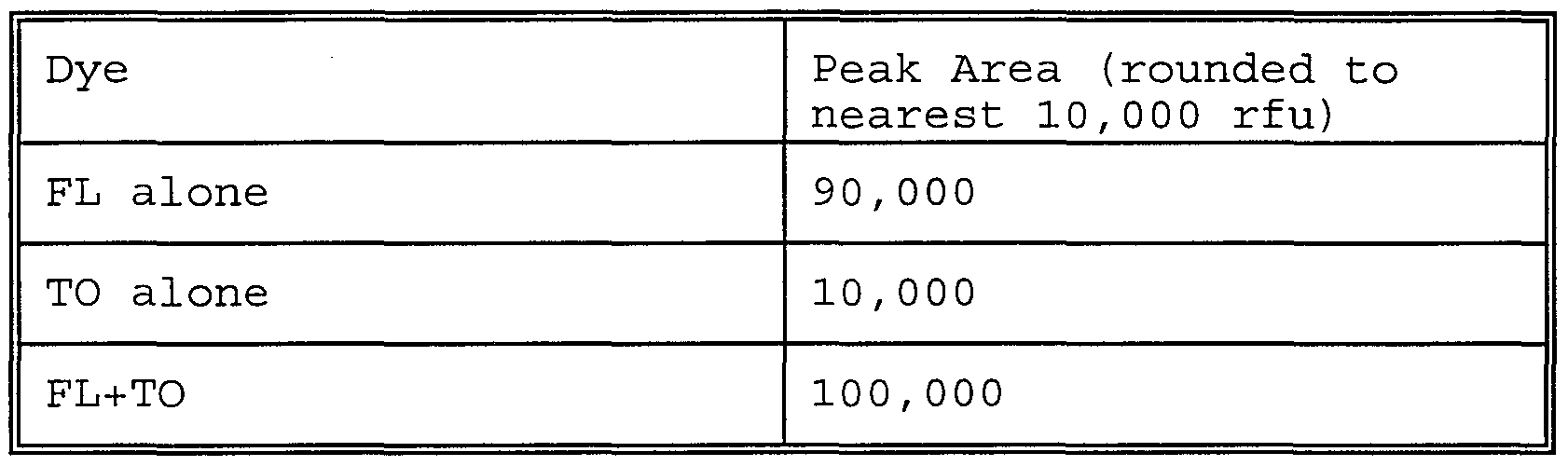
- Table 3 shows that the total fluorescence when both a terminal dye and an intercalating dye are used is additive when emission takes place at the same wavelength.
- the low panel shows the dramatic contribution to duplex stability of the dye combination.
- RNA Serum obtained from HIV seropositive patient #31 was serially diluted with sterile double distilled H 2 0. The original sample contained 5 x 10 5 HIV copies per ml and five dilutions were made, the most dilute containing 10 copies of HIV RNA per ml. E. Coli tRNA (100 meg) was added to the diluted samples, and the hybridizations to labelled probe were carried out .
- RNA/RNA complexes The failure to detect viral RNA at higher dilutions indicates that the hybrids are unstable, even in the presence of carrier tRNA. Contrast this to extracting RNA then serially diluting. Detection limits are 1.9 fg for DNA/RNA complexes.
- Direct detection of DNA Direct detection method for the analysis of DNA can also be demonstrated. Genomic DNA is extracted by standard techniques and digested with Mbo I to generate smaller and more easily workable fragments of DNA. The target DNA is then hybridized with a gene specific probe. This hybridization product generates a DNA/DNA probe. A typical probe in use is much small (26mer) than the target fragment of DNA generated by Mbo I restriction nuclease (420bp) , so while it may be detected, the assay at this point is not highly quantitative and the migration time is somewhat variable .
- Figure 4B illustrates detection of a hybrid DNA/DNA peak migration at 11.5 minutes.
- Figure 4A is a control showing only a predominant peak at 8-9 minutes for the unhybridized probe.
Landscapes
- Chemical & Material Sciences (AREA)
- Life Sciences & Earth Sciences (AREA)
- Organic Chemistry (AREA)
- Health & Medical Sciences (AREA)
- Analytical Chemistry (AREA)
- Proteomics, Peptides & Aminoacids (AREA)
- Zoology (AREA)
- Engineering & Computer Science (AREA)
- Wood Science & Technology (AREA)
- Immunology (AREA)
- Bioinformatics & Cheminformatics (AREA)
- Molecular Biology (AREA)
- Biophysics (AREA)
- Biotechnology (AREA)
- Physics & Mathematics (AREA)
- Biochemistry (AREA)
- Microbiology (AREA)
- General Engineering & Computer Science (AREA)
- General Health & Medical Sciences (AREA)
- Genetics & Genomics (AREA)
- Measuring Or Testing Involving Enzymes Or Micro-Organisms (AREA)
- Saccharide Compounds (AREA)
- Investigating Or Analysing Biological Materials (AREA)
- Breeding Of Plants And Reproduction By Means Of Culturing (AREA)
- Pharmaceuticals Containing Other Organic And Inorganic Compounds (AREA)
Abstract
Description


Claims
Priority Applications (6)
| Application Number | Priority Date | Filing Date | Title |
|---|---|---|---|
| DE69837146T DE69837146T2 (en) | 1997-08-05 | 1998-08-05 | DIRECT QUANTIFICATION OF LITTLE OCCURRING RNA |
| CA002298884A CA2298884C (en) | 1997-08-05 | 1998-08-05 | Direct quantitation of low copy number rna |
| JP2000506376A JP2001512699A (en) | 1997-08-05 | 1998-08-05 | Direct quantification of low copy number RNA |
| AU86937/98A AU8693798A (en) | 1997-08-05 | 1998-08-05 | Direct quantitation of low copy number rna |
| EP98938408A EP0990048B9 (en) | 1997-08-05 | 1998-08-05 | Direct quantitation of low copy number rna |
| US09/499,003 US6261781B1 (en) | 1997-08-05 | 2000-02-04 | Direct detection and mutation analysis of low copy number nucleic acids |
Applications Claiming Priority (2)
| Application Number | Priority Date | Filing Date | Title |
|---|---|---|---|
| US08/906,443 | 1997-08-05 | ||
| US08/906,443 US6013442A (en) | 1997-08-05 | 1997-08-05 | Direct quantitation of low copy number RNA |
Related Parent Applications (1)
| Application Number | Title | Priority Date | Filing Date |
|---|---|---|---|
| US08/906,443 Continuation US6013442A (en) | 1997-08-05 | 1997-08-05 | Direct quantitation of low copy number RNA |
Related Child Applications (1)
| Application Number | Title | Priority Date | Filing Date |
|---|---|---|---|
| US48182200A Continuation-In-Part | 1997-08-05 | 2000-01-11 |
Publications (1)
| Publication Number | Publication Date |
|---|---|
| WO1999007894A1 true WO1999007894A1 (en) | 1999-02-18 |
Family
ID=25422458
Family Applications (1)
| Application Number | Title | Priority Date | Filing Date |
|---|---|---|---|
| PCT/US1998/016347 Ceased WO1999007894A1 (en) | 1997-08-05 | 1998-08-05 | Direct quantitation of low copy number rna |
Country Status (8)
| Country | Link |
|---|---|
| US (1) | US6013442A (en) |
| EP (1) | EP0990048B9 (en) |
| JP (1) | JP2001512699A (en) |
| AT (1) | ATE354673T1 (en) |
| AU (1) | AU8693798A (en) |
| CA (1) | CA2298884C (en) |
| DE (1) | DE69837146T2 (en) |
| WO (1) | WO1999007894A1 (en) |
Cited By (9)
| Publication number | Priority date | Publication date | Assignee | Title |
|---|---|---|---|---|
| WO2000032820A1 (en) * | 1998-11-23 | 2000-06-08 | Exact Laboratories, Inc. | Method for detecting target sequences in small proportions in heterogeneous samples |
| WO2001057258A3 (en) * | 2000-02-04 | 2002-04-18 | Wisconsin Alumni Res Found | Direct detection and mutation analysis of low copy number nucleic acids |
| KR100386606B1 (en) * | 2001-02-03 | 2003-06-02 | 엘지전자 주식회사 | method and apparatus for detecting DNA |
| US6586177B1 (en) | 1999-09-08 | 2003-07-01 | Exact Sciences Corporation | Methods for disease detection |
| KR100459394B1 (en) * | 2001-10-30 | 2004-12-03 | 엘지전자 주식회사 | Electrochemiluminescence detection method for a nucleic acid using an intercalator |
| US6849403B1 (en) | 1999-09-08 | 2005-02-01 | Exact Sciences Corporation | Apparatus and method for drug screening |
| US6919174B1 (en) | 1999-12-07 | 2005-07-19 | Exact Sciences Corporation | Methods for disease detection |
| US6964846B1 (en) | 1999-04-09 | 2005-11-15 | Exact Sciences Corporation | Methods for detecting nucleic acids indicative of cancer |
| US7368233B2 (en) | 1999-12-07 | 2008-05-06 | Exact Sciences Corporation | Methods of screening for lung neoplasm based on stool samples containing a nucleic acid marker indicative of a neoplasm |
Families Citing this family (20)
| Publication number | Priority date | Publication date | Assignee | Title |
|---|---|---|---|---|
| US6420115B1 (en) | 1999-12-21 | 2002-07-16 | Ingeneus Corporation | Cation mediated triplex hybridization assay |
| US6858390B2 (en) | 1998-12-31 | 2005-02-22 | Ingeneus Corporation | Aptamers containing sequences of nucleic acid or nucleic acid analogues bound homologously, or in novel complexes |
| US6656692B2 (en) | 1999-12-21 | 2003-12-02 | Ingeneus Corporation | Parallel or antiparallel, homologous or complementary binding of nucleic acids or analogues thereof to form duplex, triplex or quadruplex complexes |
| US6403313B1 (en) * | 1999-12-21 | 2002-06-11 | Ingeneus Corporation | Fluorescent intensity assay for duplex and triplex nucleic acid hybridization solution utilizing fluorescent intercalators |
| US6911536B1 (en) | 1999-12-21 | 2005-06-28 | Ingeneus Corporation | Triplex and quadruplex catalytic hybridization |
| US20030181412A1 (en) * | 1999-12-21 | 2003-09-25 | Ingeneus Corporation | Method for modifying transcription and/or translation in an organism for therapeutic, prophylactic and/or analytic uses |
| US6927027B2 (en) | 1999-12-21 | 2005-08-09 | Ingeneus Corporation | Nucleic acid multiplex formation |
| US7309569B2 (en) | 1999-12-21 | 2007-12-18 | Ingeneus, Inc. | Parallel or antiparallel, homologous or complementary binding of nucleic acids or analogues thereof to form duplex, triplex or quadruplex complexes |
| US7052844B2 (en) | 1999-12-21 | 2006-05-30 | Ingeneus, Inc. | Purification of DS-DNA using heteropolymeric capture probes and a triplex, quadruplex or homologous duplex binding mechanism |
| US6982147B2 (en) * | 2000-01-24 | 2006-01-03 | Ingeneus Corporation | Apparatus for assaying biopolymer binding by means of multiple measurements under varied conditions |
| US20030170659A1 (en) * | 2000-01-24 | 2003-09-11 | Ingeneus Corporation | Electrical treatment of binding media to encourage, discourage and/or study biopolymer binding |
| US6613524B1 (en) | 2000-01-24 | 2003-09-02 | Ingeneus Corporation | Amperometric affinity assay and electrically stimulated complexes of nucleic acids |
| US7220541B2 (en) | 2000-01-24 | 2007-05-22 | Ingeneus, Inc. | Homogeneous assay of biopolymer binding by means of multiple measurements under varied conditions |
| US6265170B1 (en) | 2000-01-24 | 2001-07-24 | Ingeneus Corporation | Homogenous assay of duplex of triplex hybridization by means of multiple measurements under varied conditions |
| US6323337B1 (en) | 2000-05-12 | 2001-11-27 | Molecular Probes, Inc. | Quenching oligonucleotides |
| EP1330547A4 (en) * | 2000-10-04 | 2005-01-19 | Univ Leland Stanford Junior | RENATURATION, REAGOATION, ASSOCIATION AND HYBRIDIZATION OF NUCLEIC ACID MOLECULES |
| AU2003300569A1 (en) * | 2003-11-17 | 2005-06-08 | Agilent Technologies, Inc. | Nucleic acid detection |
| US7582430B2 (en) * | 2004-01-20 | 2009-09-01 | United States Of America As Represented By The Secretary Of The Army | Immunoliposome-nucleic acid amplification (ILNAA) assay |
| WO2005098031A1 (en) * | 2004-04-06 | 2005-10-20 | MAX-PLANCK-Gesellschaft zur Förderung der Wissenschaften e.V. | Liquid-based hybridization assay |
| US20100193357A1 (en) * | 2009-01-30 | 2010-08-05 | Chang Po-Ling | Quantitative analysis method for micrornas |
Citations (3)
| Publication number | Priority date | Publication date | Assignee | Title |
|---|---|---|---|---|
| JPH03147797A (en) * | 1989-10-31 | 1991-06-24 | Shimadzu Corp | Detection of nucleic acid |
| WO1993013223A1 (en) * | 1991-12-23 | 1993-07-08 | Chiron Corporation | Hiv probes for use in solution phase sandwich hybridization assays |
| EP0714986A1 (en) * | 1994-12-01 | 1996-06-05 | Tosoh Corporation | Method of detecting specific nucleic acid sequences |
Family Cites Families (1)
| Publication number | Priority date | Publication date | Assignee | Title |
|---|---|---|---|---|
| GB8902689D0 (en) * | 1989-02-07 | 1989-03-30 | Ici Plc | Assay method |
-
1997
- 1997-08-05 US US08/906,443 patent/US6013442A/en not_active Expired - Lifetime
-
1998
- 1998-08-05 AT AT98938408T patent/ATE354673T1/en not_active IP Right Cessation
- 1998-08-05 WO PCT/US1998/016347 patent/WO1999007894A1/en not_active Ceased
- 1998-08-05 CA CA002298884A patent/CA2298884C/en not_active Expired - Fee Related
- 1998-08-05 EP EP98938408A patent/EP0990048B9/en not_active Expired - Lifetime
- 1998-08-05 DE DE69837146T patent/DE69837146T2/en not_active Expired - Lifetime
- 1998-08-05 AU AU86937/98A patent/AU8693798A/en not_active Abandoned
- 1998-08-05 JP JP2000506376A patent/JP2001512699A/en active Pending
Patent Citations (3)
| Publication number | Priority date | Publication date | Assignee | Title |
|---|---|---|---|---|
| JPH03147797A (en) * | 1989-10-31 | 1991-06-24 | Shimadzu Corp | Detection of nucleic acid |
| WO1993013223A1 (en) * | 1991-12-23 | 1993-07-08 | Chiron Corporation | Hiv probes for use in solution phase sandwich hybridization assays |
| EP0714986A1 (en) * | 1994-12-01 | 1996-06-05 | Tosoh Corporation | Method of detecting specific nucleic acid sequences |
Non-Patent Citations (5)
| Title |
|---|
| BIANCHI N. ET AL.,: "Capillary electrophoresis: detection of hybridization between synthetic oligonucleotides and HIV-1 genomic DNA amplified by polymerase-chain reaction", J. VIROL. METHODS, vol. 47, - 1994, pages 321 - 329, XP002084004 * |
| DATABASE WPI Section Ch Week 9131, Derwent World Patents Index; Class B04, AN 91-227685, XP002084014 * |
| FANG C. ET AL.,: "Sequence-dependent separation of DNA fragments by capillary electrophoresis in the presence of SYBR Green I", BIOTECHNIQUES, vol. 23, - July 1997 (1997-07-01), pages 58 - 60, XP002084005 * |
| KOLESAR J.M. ET AL.,: "Direct quantification of HIV-1 RNA by capillary electrophoresis with laser-induced fluorescence", J. CHROMAT., vol. 697, - 12 September 1997 (1997-09-12), pages 189 - 194, XP002083988 * |
| SCHWARTZ H E ET AL: "CAPILLARY ELECTROPHORESIS WITH LASER-INDUCED FLUORESCENCE DETECTION OF PCR FRAGMENTS USING THIAZOLE ORANGE", ANALYTICAL CHEMISTRY, vol. 64, no. 15, 1 August 1992 (1992-08-01), pages 1737 - 1740, XP000297441 * |
Cited By (9)
| Publication number | Priority date | Publication date | Assignee | Title |
|---|---|---|---|---|
| WO2000032820A1 (en) * | 1998-11-23 | 2000-06-08 | Exact Laboratories, Inc. | Method for detecting target sequences in small proportions in heterogeneous samples |
| US6964846B1 (en) | 1999-04-09 | 2005-11-15 | Exact Sciences Corporation | Methods for detecting nucleic acids indicative of cancer |
| US6586177B1 (en) | 1999-09-08 | 2003-07-01 | Exact Sciences Corporation | Methods for disease detection |
| US6849403B1 (en) | 1999-09-08 | 2005-02-01 | Exact Sciences Corporation | Apparatus and method for drug screening |
| US6919174B1 (en) | 1999-12-07 | 2005-07-19 | Exact Sciences Corporation | Methods for disease detection |
| US7368233B2 (en) | 1999-12-07 | 2008-05-06 | Exact Sciences Corporation | Methods of screening for lung neoplasm based on stool samples containing a nucleic acid marker indicative of a neoplasm |
| WO2001057258A3 (en) * | 2000-02-04 | 2002-04-18 | Wisconsin Alumni Res Found | Direct detection and mutation analysis of low copy number nucleic acids |
| KR100386606B1 (en) * | 2001-02-03 | 2003-06-02 | 엘지전자 주식회사 | method and apparatus for detecting DNA |
| KR100459394B1 (en) * | 2001-10-30 | 2004-12-03 | 엘지전자 주식회사 | Electrochemiluminescence detection method for a nucleic acid using an intercalator |
Also Published As
| Publication number | Publication date |
|---|---|
| DE69837146T2 (en) | 2007-10-31 |
| AU8693798A (en) | 1999-03-01 |
| EP0990048B9 (en) | 2007-05-23 |
| US6013442A (en) | 2000-01-11 |
| CA2298884C (en) | 2007-10-23 |
| EP0990048B1 (en) | 2007-02-21 |
| CA2298884A1 (en) | 1999-02-18 |
| JP2001512699A (en) | 2001-08-28 |
| DE69837146D1 (en) | 2007-04-05 |
| ATE354673T1 (en) | 2007-03-15 |
| EP0990048A1 (en) | 2000-04-05 |
Similar Documents
| Publication | Publication Date | Title |
|---|---|---|
| US6013442A (en) | Direct quantitation of low copy number RNA | |
| JP3439221B2 (en) | Nucleic acid analysis method using fluorescence resonance energy transfer | |
| US5800984A (en) | Nucleic acid sequence detection by triple helix formation at primer site in amplification reactions | |
| US6833257B2 (en) | Fluorimetric detection system of a nucleic acid | |
| EP0656955B1 (en) | Elimination of false negatives in nucleic acid detection | |
| US20130288231A1 (en) | Universal multi-variant detection system | |
| JP3594598B2 (en) | Improved nucleic acid quantification method | |
| EP1055002A1 (en) | Method for detection of target nucleic acids using pcr | |
| JP3844996B2 (en) | Melting curve analysis method for repetitive PCR products | |
| EP0408918A1 (en) | Method for detecting nucleic acid | |
| CN102257163A (en) | Method for detecting a target nucleic acid in a sample | |
| Lan et al. | Polymerization and isomerization cyclic amplification for nucleic acid detection with attomolar sensitivity | |
| US6261781B1 (en) | Direct detection and mutation analysis of low copy number nucleic acids | |
| WO1997012058A1 (en) | Method for quantifying nucleic acid using multiple competitor nucleic acids | |
| US6183999B1 (en) | Procedure for the detection of high virus concentrations in blood plasma and/or blood serum by means of the polymerase chain reaction | |
| Arakawa et al. | Analysis of single-strand conformation polymorphisms by capillary electrophoresis with laser induced fluorescence detection | |
| Soheili et al. | Real time PCR: principles and application | |
| JP3322894B2 (en) | Nucleic acid sample fluorescence detection method | |
| AU748023B2 (en) | Procedure for the detection of high virus concentrations in blood plasma and/or blood serum by means of the polymerase chain reaction | |
| JP4227139B2 (en) | Biological sample analysis method, reaction solution, and analyzer | |
| CN114134254A (en) | Molecular logic gate intelligent detection system for detecting coronavirus and application thereof | |
| CN1460722A (en) | Nucleic acid amplification detection method | |
| Hanley et al. | Heteroduplex Mobility Analysis | |
| JPH06261795A (en) | Polynucleotide detection method | |
| JP2002369700A (en) | Nucleic acid analysis method |
Legal Events
| Date | Code | Title | Description |
|---|---|---|---|
| AK | Designated states |
Kind code of ref document: A1 Designated state(s): AL AM AT AU AZ BA BB BG BR BY CA CH CN CU CZ DE DK EE ES FI GB GE GH GM HR HU ID IL IS JP KE KG KP KR KZ LC LK LR LS LT LU LV MD MG MK MN MW MX NO NZ PL PT RO RU SD SE SG SI SK SL TJ TM TR TT UA UG US UZ VN YU ZW |
|
| AL | Designated countries for regional patents |
Kind code of ref document: A1 Designated state(s): GH GM KE LS MW SD SZ UG ZW AM AZ BY KG KZ MD RU TJ TM AT BE CH CY DE DK ES FI FR GB GR IE IT LU MC NL PT SE BF BJ CF CG CI CM GA GN GW ML MR NE SN TD TG |
|
| 121 | Ep: the epo has been informed by wipo that ep was designated in this application | ||
| DFPE | Request for preliminary examination filed prior to expiration of 19th month from priority date (pct application filed before 20040101) | ||
| ENP | Entry into the national phase |
Ref document number: 2298884 Country of ref document: CA Ref country code: CA Ref document number: 2298884 Kind code of ref document: A Format of ref document f/p: F |
|
| WWE | Wipo information: entry into national phase |
Ref document number: 1998938408 Country of ref document: EP |
|
| NENP | Non-entry into the national phase |
Ref country code: KR |
|
| WWP | Wipo information: published in national office |
Ref document number: 1998938408 Country of ref document: EP |
|
| REG | Reference to national code |
Ref country code: DE Ref legal event code: 8642 |
|
| WWG | Wipo information: grant in national office |
Ref document number: 1998938408 Country of ref document: EP |