WO1999012969A1 - Treatment of obesity - Google Patents

Treatment of obesity Download PDF

Info

Publication number
WO1999012969A1
WO1999012969A1 PCT/AU1998/000724 AU9800724W WO9912969A1 WO 1999012969 A1 WO1999012969 A1 WO 1999012969A1 AU 9800724 W AU9800724 W AU 9800724W WO 9912969 A1 WO9912969 A1 WO 9912969A1
Authority
WO
WIPO (PCT)
Prior art keywords
cys
arg
ser
val
gly
Prior art date
Legal status (The legal status is an assumption and is not a legal conclusion. Google has not performed a legal analysis and makes no representation as to the accuracy of the status listed.)
Ceased
Application number
PCT/AU1998/000724
Other languages
French (fr)
Inventor
Frank Man-Woon Ng
Woei-Jia Jiang
Current Assignee (The listed assignees may be inaccurate. Google has not performed a legal analysis and makes no representation or warranty as to the accuracy of the list.)
Metabolic Pharmaceuticals Pty Ltd
Original Assignee
Metabolic Pharmaceuticals Pty Ltd
Priority date (The priority date is an assumption and is not a legal conclusion. Google has not performed a legal analysis and makes no representation as to the accuracy of the date listed.)
Filing date
Publication date
Priority claimed from AUPO9001A external-priority patent/AUPO900197A0/en
Priority claimed from AUPP0398A external-priority patent/AUPP039897A0/en
Priority to US09/508,054 priority Critical patent/US6737407B1/en
Priority to BR9811755-6A priority patent/BR9811755A/en
Priority to CA002303395A priority patent/CA2303395C/en
Priority to AU89653/98A priority patent/AU755512B2/en
Application filed by Metabolic Pharmaceuticals Pty Ltd filed Critical Metabolic Pharmaceuticals Pty Ltd
Priority to EP98941152A priority patent/EP1012189B1/en
Priority to JP2000510774A priority patent/JP4334761B2/en
Priority to DE69838647T priority patent/DE69838647T2/en
Priority to NZ502993A priority patent/NZ502993A/en
Publication of WO1999012969A1 publication Critical patent/WO1999012969A1/en
Anticipated expiration legal-status Critical
Ceased legal-status Critical Current

Links

Classifications

    • C—CHEMISTRY; METALLURGY
    • C07—ORGANIC CHEMISTRY
    • C07K—PEPTIDES
    • C07K14/00—Peptides having more than 20 amino acids; Gastrins; Somatostatins; Melanotropins; Derivatives thereof
    • C07K14/435—Peptides having more than 20 amino acids; Gastrins; Somatostatins; Melanotropins; Derivatives thereof from animals; from humans
    • C07K14/575—Hormones
    • C07K14/61—Growth hormone [GH], i.e. somatotropin
    • A—HUMAN NECESSITIES
    • A61—MEDICAL OR VETERINARY SCIENCE; HYGIENE
    • A61P—SPECIFIC THERAPEUTIC ACTIVITY OF CHEMICAL COMPOUNDS OR MEDICINAL PREPARATIONS
    • A61P3/00—Drugs for disorders of the metabolism
    • A61P3/04—Anorexiants; Antiobesity agents
    • A—HUMAN NECESSITIES
    • A61—MEDICAL OR VETERINARY SCIENCE; HYGIENE
    • A61P—SPECIFIC THERAPEUTIC ACTIVITY OF CHEMICAL COMPOUNDS OR MEDICINAL PREPARATIONS
    • A61P43/00—Drugs for specific purposes, not provided for in groups A61P1/00-A61P41/00
    • A—HUMAN NECESSITIES
    • A61—MEDICAL OR VETERINARY SCIENCE; HYGIENE
    • A61P—SPECIFIC THERAPEUTIC ACTIVITY OF CHEMICAL COMPOUNDS OR MEDICINAL PREPARATIONS
    • A61P5/00—Drugs for disorders of the endocrine system
    • A61P5/06—Drugs for disorders of the endocrine system of the anterior pituitary hormones, e.g. TSH, ACTH, FSH, LH, PRL, GH
    • A—HUMAN NECESSITIES
    • A61—MEDICAL OR VETERINARY SCIENCE; HYGIENE
    • A61K—PREPARATIONS FOR MEDICAL, DENTAL OR TOILETRY PURPOSES
    • A61K38/00—Medicinal preparations containing peptides

Definitions

  • This invention relates to the treatment of obesity in animals.
  • the invention relates to the treatment of obesity in humans, although it is to be understood that the present invention also extends to the treatment of obesity in non- human mammals, for example, for the improvement of meat qualities in farm animals used in food production.
  • hGH human growth hormone
  • hGH globular protein with a molecular weight of 22,000 daltons (22-KD) and consists of 191 amino acid residues in a single-chain, folded by 2 disulphide bonds with a small loop at the carboxyl terminus between residues 182 and 189.
  • Recent crystallographic studies also show that the hGH molecule contains four anti-parallel ⁇ -helices which are arranged in a left-twisted, tightly-packed helical bundle 1 .
  • the concept that there are discrete functional domains within the hGH molecule responsible for specific metabolic actions of the hormone is generally accepted.
  • the amino-terminus has been identified as the functional domain responsible for the insulin-like actions of the hGH molecule 23 .
  • the results of the latter effect may include both a stimulation of lipolysis and an inhibition of lipogenesis.
  • the anti-lipogenic effect of hGH has been substantiated with the demonstrations of the decrease of the expression of glucose transporter GLUT 4 in adipocytes 18 , the inhibition of the activity of acetyl-CoA carboxylase in adipose tissues 19,20 and the reduction of glucose incorporation into lipid in both isolated cells and tissues 21,22 .
  • the present invention provides a peptide which comprises an analogue of the carboxyl-terminal sequence of a growth hormone.
  • the peptide may comprise an analogue of the carboxyl-terminal sequence of human growth hormone or the growth hormone of a non-human mammalian species.
  • the carboxyl- terminal sequence of growth hormone includes a bioactive lipid metabolic domain.
  • the peptide comprises an analogue of the carboxyl-terminal sequence of human growth hormone containing amino acid residues 177-191 or a corresponding sequence of a non-human mammalian growth hormone.
  • the analogue may be obtained by insertion, deletion or substitution of amino acids in, or chemical modification of, the native carboxyl-terminal sequence of human growth hormone or the growth hormone of a non-human mammalian species.
  • the present invention provides a method for treating obesity comprising administering an effective amount of a peptide which comprises an analogue of the carboxyl-terminal sequence of a growth hormone, as described above.
  • the treatment may be administered to any animal, including humans.
  • the present invention also provides a pharmaceutical composition for use in the treatment of obesity comprising an effective amount of a peptide which comprises an analogue of the carboxyl-terminal sequence of a growth hormone as described above, together with one or more pharmaceutically acceptable carriers and/or diluents.
  • the present invention provides use of a peptide which comprises an analogue of the carboxyl-terminal sequence of a growth hormone as describe dabove, in the manufacture of a pharmaceutical composition for the treatment of obesity in an animal.
  • a method for the treatment of obesity in an animal which comprises administering to the animal an effective amount of a peptide which comprises an analogue of the carboxyl- terminal sequence of a growth hormone.
  • the animal is a human although the invention also extends to the treatment of non-human mammals.
  • the peptide comprises an analogue of the carboxyl-terminal sequence of human growth hormone containing amino acid residues 177-191 (hereinafter referred to as hGH 177-191).
  • the peptide may comprise an analogue of the carboxyl-terminal sequence of the growth hormone of other non-human mammalian species, such as bovine, porcine, ovine, equine, feline or canine growth hormone, corresponding to the hGH 177-191 peptide.
  • the term "obesity" is used to include both excess body weight and excess adipose tissue mass in the animal, and correspondingly the references to treatment of obesity include both reduction of body weight gain and reduction of adipose tissue mass of the obese animal.
  • the expected outcome of any treatment of obesity is the reduction of body weight, body adipose tissue mass in particular.
  • the reduction of body adipose tissue mass is directly regulated by two biochemical processes - lipogenesis (fat-production) and lipolysis (fat-reduction) - and it is generally understood that these biochemical processes are controlled by key metabolic enzymes, specifically the fat-reducing key enzyme (hormone-sensitive lipase) and the fat-producing key enzyme (acetyl CoA carboxylase).
  • hGH 177-191 is effective in stimulating the fat-reducing key enzyme, hormone-sensitive lipase, and in inhibiting the fat-producing key enzyme, acetyl CoA carboxylase. This is further supported by data showing that in the presence of hGH 177-191, fat utilization is accelerated while fat production is reduced, as measured by metabolic end-products in vitro as well as in vivo. In addition, the mechanism of these molecular actions has been established as resulting from the activation of the production of the cellular second-messenger, diacylglycerol.
  • the present invention extends to the use of peptides which are analogues of longer amino acid sequences than the particular sequence 177-191 of growth hormone, for example analogues of the sequence 172- 191 of human growth hormone or the corresponding sequence of growth hormone of other non-human mammalian species.
  • the concept of correspondence in amino acid sequences between species is well known in the biological sciences and is determined by aligning comparable sequences (including if necessary theoretical deletions) to match isofunctional or isostereo amino acids thereby maximising homology.
  • the published corresponding sequences of the C-terminus region of the growth hormone of selected mammals are tabulated below 26 , using standard single letter notation:
  • FRKDMDKVETFLRIVQCR human FRKDMDKVETFLRIVQCR.
  • SVEGSCGF human variant FRKDMDKVETFLRIVQCR SVEGSCGF human CS FRKDMDKVETFLRMVQCR.
  • the present invention extends to the use of peptides which are analogues of the native carboxyl-terminal sequences of human growth hormone or growth hormone of other animal species, and which are derived from natural or synthetic (including recombinant) sources, provided always that the resulting peptide retains the biological activity of the native carboxyl-terminal sequence described herein, namely the ability to reduce body weight gain and adipose tissue mass in an obese animal.
  • these analogues may exhibit a cyclic configuration, which may be induced by a disulfide bond.
  • the analogues of the present invention may be derived by elongation, insertion, deletion or substitution of amino acids in, or chemical modification of, or introduction of a cyclic amide bond between the side chains of amino acids of, the native carboxyl-terminal sequence.
  • Amino acid insertional analogues include amino and/or carboxylic terminal fusions as well as intra-sequence insertions of single or multiple (for example, up to 10, preferably up to 5) amino acids.
  • Insertional amino acid sequence analogues are those in which one or more amino acid residues are introduced into a predetermined site in the protein although random insertion is also possible with suitable screening of the resulting product.
  • Deletional analogues are characterised by the removal of one or more (for example, up to 5, preferably up to 3) amino acids from the sequence.
  • Substitutional amino acid analogues are those in which at least one amino acid residue in the sequence, preferably one or two, has been replaced by another of the twenty primary protein amino acids, or by a non- protein amino acid.
  • Chemical modifications of the native carboxyl-terminal sequence include the acetylation of the amino-terminus and/or amidation of the carboxyl- terminus and/or side chain cyclisation of the native carboxyl-terminal sequence.
  • Analogues of the native carboxyl-terminal sequences of human growth hormone or growth hormone of other animal species which in particular retain the same conformation, structure and charge characteristics as the native carboxyl- terminal sequences can be expected to exhibit the same or similar biological activity as the native sequences, in particular in the ability to reduce body weight gain and adipose tissue mass in an obese animal.
  • Peptides comprising amino acid residues 177-191 of native human growth hormone include the following sequence (Ref No. 9401): Leu-Arg-lle-Val-Gln-Cys-Arg-Ser-Val-Glu-Gly-Ser-Cys-Gly-Phe
  • Such a native peptide may be in cyclic disulfide form, and may comprise an organic or inorganic acid addition salt.
  • Analogues of the hGH 177-191 peptide may be obtained by deletion or insertion of one or more amino acid residues at any position along the native sequence, with the retention of anti-obesity properties as described above.
  • the analogue is in a cyclic configuration.
  • analogues of the hGH 177-191 peptide may be obtained by substitution of one or more amino acid residues at any position along the native sequence.
  • analogue of the current invention include peptide analogues of hGH 177-191 wherein
  • amino acids at positions 182 and 189 of hGH are joined by a bond to promote a cyclic conformation
  • amino acids at positions 183 and 186 of hGH are joined by a salt bridge or a covalent bond.
  • the bond between amino acids at 182 and 189 of hGH may be a disulfide bond, in which case the amino acids at positions 182 and 189 of hGH may preferably be L- or D- Cys or Pen.
  • amino acids at positions 183 and 186 of hGH are joined by a salt bridge
  • these amino acids may preferably be (X and Y) or (Y and X), respectively, where:
  • X is a positively charged amino acid such as L- or D- Arg, Lys or Orn and Y is a negatively charged amino acid such as L- or D- Asp or Glu.
  • amino acids at positions 183 and 186 of hGH are joined by a covalent bond
  • that bond may be an amide bond in which case these amino acids may preferably be (X and Y) or (Y and X), respectively, where:
  • X is selected from the group consisting of L- or D- Lys and Orn and Y is selected from the group consisting of L- or D- Asp and Glu.
  • the amino acid at position 178 of hGH is preferably a positively charged amino acid such as L- or D- Arg, Lys or Orn.
  • Analogues may also be obtained by elongation of the native hGH 177-191 peptide sequence at one or both ends of the amino acid residues, for example with one or more hydrophilic amino acids to increase solubility in aqueous solution.
  • Such analogues include the following sequence, preferably in cyclic disulphide form: Xim-Leu-Arg-lle-Val-Gln-Cys-Arg-Ser-Val-Glu-Gly-Ser-Cys-Gly-Phe-Xfri (SEQ ID NO: 2) wherein X 1 and X 2 are each is selected from the group consisting of L- or D-Arg, His and Lys, and m and n are each 0, 1 , 2 or 3 with the provision that at least m or n is 1. [Throughout this specification, elements which are underlined denote differences from the native hGH 177-191 sequence, and unless otherwise stated, amino acids at positions corresponding to 182 and 189 are joined by a disulfide
  • One elongation analogue not elongated with a hydrophilic amino acid but nonetheless exhibiting especially enhanced anti-obesity properties is the following (Ref No. 9604): l r-Leu-Arg-lle-Val-Gln-Cys-Arg-Ser-Val-Glu-Gly-Ser-Cys-Gly-Phe.
  • Analogues may also be obtained by chemical modification of the native hGH 177-191 peptide sequence.
  • Such analogues include the sequence:
  • Y 1 is selected from the group consisting of the desamino form (H), acetyl (CH 3 CO-) and other acyl groups; or the sequence:
  • hGH 177-191 analogues obtained by substitution of amino acids, by elongation, by chemical modification, or by introduction of a cyclic amide bond between side chains of amino acids, of the native hGH 177-191 peptide sequence, and which exhibit anti-obesity properties, include the following:
  • Gly Glycine He Isoleucine; Glu Glutamic Acid; Phe Phenylalanine; Cys Cysteine; Arg Arginine; Gin Glutamine; Leu Leucine; Ser Serine; Val Valine; Lys Lysine; Ala Alanine; Asp Aspartic acid; His Histidine; Orn Ornithine; Tyr Tyrosine; Pen Penicillamine ( ⁇ , ⁇ '-Dimethyl-Cysteine).
  • All amino acids, except for glycine, are of the L-absolute configuration, unless indicated as D-absolute configuration. All the above peptides above have a cyclic disulfide bond between Cys(182) and Cys(189) or Pen(182) and Pen(189) as appropriate.
  • analogues described above may comprise an organic or inorganic acid addition salt.
  • an effective amount means an amount of the peptide sufficient to attain the desired effect in the treatment of obesity in the animal, but not so large an amount as to cause serious side effects or adverse reactions.
  • the present invention provides the use of a peptide which comprises an analogue of the carboxyl-terminal sequence of a growth hormone as described above, in the treatment of obesity in an animal or in the manufacture of a pharmaceutical composition for the treatment of obesity in an animal.
  • the present invention provides a pharmaceutical composition for use in the treatment of obesity in an animal, comprising an effective amount of a peptide which comprises an analogue of the carboxyl-terminal sequence of a growth hormone as described above, together with one or more pharmaceutically acceptable carriers and/or diluents.
  • the peptide which is the active ingredient of the pharmaceutical composition of this aspect of the invention exhibits advantageous therapeutic activity in the treatment of obesity in an animal when administered in an amount appropriate to the particular case. For example, from about 0.5 ⁇ g to about 20 mg per kilogram of body weight per day may be administered. Dosage regimens may be adjusted to provide the optimum prophylactic or therapeutic response. For example, one or more divided doses may be administered daily, weekly, monthly or in other suitable time intervals or the dose may be proportionally reduced as indicated by the exigencies of the clinical situation.
  • the active ingredient may be administered in any convenient manner such as by the oral, parenteral (including intraperitoneal, intravenous, subcutaneous, intramuscular and intramedullary injection), intranasal, intradermal or suppository routes or by implanting (eg using slow release devices).
  • oral administration is preferred, however parenteral administration is also quite convenient.
  • the active ingredient may be required to be coated in a material that protects said ingredient from the action of enzymes, acids and other natural conditions which may inactivate the said ingredient.
  • low lipophilicity of the ingredient may allow it to be destroyed in the gastrointestinal tract by enzymes capable of cleaving peptide bonds and in the stomach by acid hydrolysis.
  • the active ingredient may be coated by, or administered with, a material to prevent its inactivation.
  • the active ingredient may also be administered in dispersions prepared in glycerol, liquid polyethylene glycols, and/or mixtures thereof and in oils. Under ordinary conditions of storage and use, these preparations will usually contain a preservative to prevent the growth of microorganisms.
  • the pharmaceutical forms suitable for injectable use include sterile aqueous solutions (where water soluble) or dispersions and sterile powders for the extemporaneous preparation of sterile injectable solutions or dispersion.
  • the form must be sterile and must be fluid to the extent that easy syringability exists. It must be stable under the conditions of manufacture and storage and must be preserved against the contaminating action of microorganisms such as bacteria and fungi.
  • the carrier can be a solvent or dispersion medium containing, for example, water, ethanol, polyol (for example, glycerol, propylene glycol, and liquid polyethylene glycol, and the like), suitable mixtures thereof, and vegetable oils.
  • the proper fluidity can be maintained, for example, by the use of a coating such as lecithin, by the maintenance of the required particle size in the case of dispersion and by the use of surfactants.
  • the prevention of the action of microorganisms can be brought about by various antibacterial and antifungal agents, for example, parabens, chlorobutanol, phenol, sorbic acid, thiomorosal, and the like. In many cases, it will be preferable to include isotonic agents, for example, sugars or sodium chloride. Prolonged absorption of the injectable compositions can be brought about by, for example, the use in the compositions of agents delaying absorption.
  • Sterile injectable solutions are prepared by incorporating the active ingredient in the required amount in the appropriate solvent with various of the other ingredients enumerated above, as required, followed by filtered sterilisation.
  • dispersions are prepared by incorporating the sterilised active ingredient into a sterile vehicle which contains the basic dispersion medium and the required other ingredients from those enumerated above.
  • the preferred methods of preparation are vacuum drying and the freeze-drying technique which yield a powder of the active ingredient plus any additional desired ingredient from previously sterile- filtered solution thereof.
  • the composition may be orally administered, for example, with an inert diluent or with an assimilable edible carrier, or it may be enclosed in hard or soft shell gelatin capsule, or it may be compressed into tablets, or it may be incorporated directly with the food of the diet.
  • the active ingredient may be incorporated with excipients and used in the form of ingestible tablets, buccal tablets, troches, capsules, elixirs, suspensions, syrups, wafers, and the like.
  • Such compositions and preparations should contain at least 0.01% by weight and more preferably at least 0.1-1% by weight of active ingredient.
  • compositions and preparations may, of course, be varied and may conveniently be between about 5 to about 80% of the weight of the unit.
  • the amount of active ingredient in the pharmaceutical compositions is such that a suitable dosage will be obtained.
  • Preferred compositions or preparations according to the present invention may, for example, be prepared so that an oral dosage unit form contains between about 0.5 ⁇ g and 200 mg and more preferably 10 ⁇ g and 20 mg of active ingredient.
  • the tablets, troches, pills, capsules and the like may also contain the following: a binder such as gum tragacanth, acacia, corn starch or gelatin; excipients such as dicalcium phosphate; a disintegrating agent such as corn starch, potato starch, alginic acid and the like; a lubricant such as magnesium stearate; and a sweetening agent such a sucrose, lactose or saccharin may be added or a flavouring agent such as peppermint, oil of wintergreen, or cherry flavouring.
  • a binder such as gum tragacanth, acacia, corn starch or gelatin
  • excipients such as dicalcium phosphate
  • a disintegrating agent such as corn starch, potato starch, alginic acid and the like
  • a lubricant such as magnesium stearate
  • a sweetening agent such as sucrose, lactose or saccharin may be added or a flavouring agent such as pepper
  • tablets, pills, or capsules may be coated with shellac, sugar or both.
  • a syrup or elixir may contain the active compound, sucrose as a sweetening agent, methyl and propylparabens as preservatives, a dye and flavouring such as cherry or orange flavour.
  • any material used in preparing any dosage unit form should be pharmaceutically pure and substantially non-toxic in the amounts employed.
  • the active ingredient may be incorporated into sustained-release preparations and formulations.
  • pharmaceutically acceptable carriers and diluents include any and all solvents, dispersion media, aqueous solutions, coatings, antibacterial and antifungal agents, isotonic and absorption delaying agents, and the like.
  • the use of such media and agents for pharmaceutically active substances is well known in the art, and it is described, by way of example, in Remington's Pharmaceutical Sciences, 18th Edition, Mack Publishing Company, Pennsylvania, USA. Except insofar as any conventional media or agent is incompatible with the active ingredient, use thereof in the pharmaceutical compositions of the present invention is contemplated. Supplementary active ingredients can also be incorporated into the compositions.
  • Dosage unit form refers to physically discrete units suited as unitary dosages for the human subjects to be treated; each unit containing a predetermined quantity of active ingredient calculated to produce the desired therapeutic effect in association with the required pharmaceutical carrier and/or diluent.
  • the specifications for the novel dosage unit forms of the invention are dictated by and directly dependent on (a) the unique characteristics of the active ingredient and the particular therapeutic effect to be achieved, and (b) the limitations inherent in the art of compounding such an active ingredient for the treatment of obesity.
  • Figures 1A & 1B show the effect of hGH 177-191 peptide on cumulative body weight gains in male (1 A) and female (1 B) C57BL/6J (ob/ob) mice during the
  • Figures 2A & 2B show the average daily food consumption (g/mouse/day) of C57BL/6J (ob/ob) mice during an 18-day treatment period with hGH 177-191.
  • the treatment for the four groups of animals was as described in figures 1 A & 1 B. Each point represents the mean + SEM of 6 animals. No significance between the groups was observed at all times.
  • Figures 3A & 3B demonstrate the effect of hGH 177-191 peptide on body weight gain of 14-15 week old male Zucker fatty (fa/fa) rats during the 20 or 27-days treatment period.
  • Animals were given a daily intraperitoneal injection of either saline or the peptide (500 ⁇ g/kg body weight) (3A) or implanted intradermally with a slow-release tablet (500 ⁇ g/day/kg body weight) in the lower quadrant of the abdomen of the animals.
  • the control group was implanted with a placebo tablet in the same manner. Each point represents the mean + SEM of 6 animals.
  • Figures 4A & 4B demonstrate the average daily food consumption (g/rat/day) of Zucker fatty rats during the treatment period with hGH 177-191 peptide.
  • the treatment for the four groups of animals was as described in Figures
  • Figures 5A & 5B depict the ex vivo effect on lipogenesis in adipose tissues of the C57BU6J (ob/ob) male mice (5A) and female mice (5B) after 18-day treatment with hGH 177-191.
  • Data indicate the rate of [C 14 ]-lipid synthesis and are expressed as [C 1 ]-glucose incorporated into lipid (pmol/mg tissue/min) Values are mean ⁇ SEM of 12 determinations from 6 animals of each group. The differences between the hGH 177-191 treated and saline control groups were statistically significant.
  • Figure 6A & 6B depict the ex vivo effect on lipolysis in adipose tissue of the C57BL/6J (ob/ob) male mice (6A) and female mice (6B) after 18-days treatment with hGH 177-191.
  • Data indicate the rate of glycerol release from adipose tissues (pmol/mg tissue/min). Values are mean ⁇ SEM of 12 determinations from 6 animals of each group. The differences between the hGH 177-191 treated and saline control groups were statistically significant.
  • Figure 7 illustrates the in vitro effect of hGH 177-191 on fatty acid oxidation in isolated adipose tissues of C57BL/6J (ob/ob) mice with the determination of the rate of [C ]O 2 production from [C 14 ]-palmitic acid.
  • the rate of [C 14 ]-palmitic acid oxidation was expressed as ⁇ mol/g tissue/hr.
  • Figure 8 illustrates the in vitro effect of hGH 177-191 on the release of diacylglycerol from isolated adipocytes of normal rats over an incubation period of 40 min. Diacylglycerol was quantitated using radioenzymic assay and the results were expressed as % increase over the basal levels.
  • Figure 9 shows the in vitro effect of hGH 177-191 on hormone-sensitive lipase activity in isolated adipocytes of male Zucker fatty (fa/fa) rats was determined by the amount of hydrolyzed [C 14 ]-oleic acid from [C 14 ]-triolein.
  • the enzyme was expressed as U/mg protein, where the release of 1 nmole of oleic acid per hour was considered as 1 Unit of enzyme activity.
  • Figures 10A & 10B shows the in vitro effect of hGH 177-191 on acetyl-CoA carboxylase in the isolated adipocytes (10A) and hepatocytes (10B) of normal rats was determined by [C 14 ]-bicarbonate fixation reaction and expressed as mU/g cell dry weight, where 1 Unit of acetyl-CoA carboxylase was defined as the carboxylation of 1 ⁇ mole acetyl-CoA per minute.
  • Figure 11 A demonstrates the effect of analogue Ref. No. 9403 (SEQ ID NO: 9403
  • mice on body weight gain of 26-week-old C57BL/6J (ob/ob) mice during the 18 days treatment period. Animals were given a daily intraperitoneal injection of either saline (as control) or peptide analogue (500 ⁇ g/kg body weight). Each point represents the mean ⁇ SEM of 6 animals.
  • Figure 11B shows the average daily food consumption (g/mouse/day) of 26-week-old C57BL/6J (ob/ob) mice during the treatment period with analogue Ref No. 9403 (SEQ ID NO: 6).
  • the treatment for the two groups of animals was as described in Figure 11 A. Each point represents the mean ⁇ SEM of 6 animals. No significance between the test group and the control was observed at all times.
  • Figure 12 shows the effect on body weight gain of chronic treatment of 16-week old C57BL/6J(ob/ob) mice with analogues Ref Nos. 9604 (SEQ ID NO: 19) and 9605 (SEQ ID NO: 20).
  • Figure 13 shows the effect of long-term oral administration of analogue Ref No. 9604 to ob/ob mice.
  • Obese C57BU6J (ob/ob) mice and fatty Zucker (fa/fa) rats were used to demonstrate the biological effects of the synthetic hGH 177-191 and analogues.
  • the animals of the same age and same sex were randomly divided into two groups, housed 6 per cage and maintained on a normal 12-hr light/dark cycle at a constant room temperature of 25°C in the animal house of the Department of Biochemistry and Molecular Biology, Monash University, Clayton, Australia. Animals were fed ad libitum on pre-determined quantity of animal pellets (Clark King, Melbourne, Australia) and allowed free access to water at all times.
  • the animals were given a daily intraperitoneal (i.p) injection of 0.1 ml of either the synthetic peptide (200-500 ⁇ g/kg body weight) or equivalent volume of physiological saline (0.9% sodium chloride) for appropriate number of days.
  • the i.p. injection was administered with a 30G x 1 /_" (0.31 x 13 mm) needle on a 1-ml disposable tuberculin syringes, and the site of injection was the lower left quadrant of the abdomen of the animals.
  • slow-release peptide-pellets in a diameter of 3 mm were implanted intradermally in the abdominal region of Zucker rats under anaesthesia. The body weight and food intake were monitored for the periods of time as indicated.
  • the peptides of the present invention were prepared by using standard 9- fluorenylmethyloxycarbonyl(Fmoc) solid-phase techniques.
  • the solid-phase synthesis could be commenced from the C-terminal end of the peptide using an ⁇ -amino protected amino acid.
  • a suitable starting materials could be prepared, for instance, by attaching the required ⁇ -amino acid to a Wang resin (4- alkoxybenzyl alcohol resin), or Rink amide resin (2,4-dimethoxy-4'- [carboxymethyoxyj-benzhydrylamine linked to amino methyl resin) or PAM resin (4- hydroxymethylphenyl- acetic acid resin). Resins were commercially available from Auspep Pty. Ltd., Parkville, Victoria, Australia.
  • a protected amino acid was coupled to a resin with the aid of a coupling agent.
  • the ⁇ -amino protecting group was removed by piperidine in organic solvents at room temperature.
  • the remaining protected amino acids were coupled stepwise in the desired order.
  • a 4-fold excess of each protected amino acid was generally used in the reaction with an appropriate carboxyl group activator such as diisopropylcarbodiimide (DIC) and 1-hydroxybenzotriazole (HOBt), in methylene chloride (DCM)-N,N-dimethylformamide (DMF) mixtures.
  • DIC diisopropylcarbodiimide
  • HOBt 1-hydroxybenzotriazole
  • the peptide was then cleaved from the resin support by treatment with a reagent such as trifluoroacetic acid (TFA) or trifluormethanesulfonic acid (TFMSA) which cleaved the peptide from the resin, as well as all side-chain protecting groups, except for Cys(Acm).
  • a reagent such as trifluoroacetic acid (TFA) or trifluormethanesulfonic acid (TFMSA) which cleaved the peptide from the resin, as well as all side-chain protecting groups, except for Cys(Acm).
  • TFA treatment resulted in the formation of the free peptide acids.
  • Rink amide resin was used
  • TFA treatment resulted in the formation of the free peptide amides.
  • TFMSA treatment resulted in the formation of the free peptide acids.
  • the target peptides might exist in cyclic disulfide form which requires post-synthesis modification.
  • Step 5 DMF (8 ml) was added to the reaction vessel. The resulting solution was stirred for 2 minutes. The solution was drained from the resin in the reaction vessel. This washing procedure was repeated twice. DMF (2 ml) was added to the reaction vessel to keep the resin swollen.
  • Step 7 DMF (8 ml) was added to the reaction vessel. The resulting solution was vigorously stirred for 2 minutes. The solution was then drained from the reaction vessel. The washing procedure was repeated twice.
  • the reaction vessel containing the peptide-resin was then placed in a desiccator and dried overnight under vacuum.
  • the yield of peptide-resin was 0.635 g.
  • the dried peptide- resin was removed from the reaction vessel and placed in a 50 ml round-bottom flask containing a magnetic stirring bar.
  • the cleavage of the peptide from the resin with TFA was carried out with the following procedure: A scavenger solution, containing 0.75 g phenol, 0.5 ml H 2 O, 0.5 ml thioanisole, and 0.25 ml ethanedithio, was added to the round-bottom flask. The resulting mixture was stirred for 5 minutes. 10 ml TFA was added drop by drop into the flask while kept stirring vigorously. The resulting mixture was stirred for 2.5 hours at room temperature.
  • the mixture was filtered through a medium-porosity filter, fritted glass funnel.
  • the TFA-peptide solution was sucked into another 500 ml round-bottom flask containing 200 mL cold diethyl ether by applying vacuum. Peptide was allowed to be precipitated in the ether solution at 4°C overnight, then collected by filtering the mixture through a fine-porosity, fritted glass funnel. The peptide pellet on the filter was washed with cold ether (10 ml x 3) to remove the scavenger. The peptide pellet was then dissolved with 25% aqueous acetic acid and then lyophilized to yield the crude peptide (about 400 mg dry weight, purity -80%).
  • the crude peptide was purified by reversed-phase high performance liquid chromatography (RP-HPLC). Purification was carried out on a preparative 21.2 x 250 mm Supelcosil PLC-18 (octadecyl, C 18 ) column(120 Angstrom pore size, 12 ⁇ m particle size, 190 m 2 /g surface area; Supelco, Bellefonte, PA, U.S.A.) at 5.0 ml/min flow rate at room temperature. A linear gradient program was utilized , where solvent A was water with 0.1% TFA, and solvent B was acetonitrile-water (50/50: v/v, containing 0.1 % TFA). The gradient was developed from 20 to 100% over 80 min.
  • RP-HPLC reversed-phase high performance liquid chromatography
  • EXAMPLE A The procedure set forth in EXAMPLE A was employed. After completion of the synthesis of the desired deblocked peptide-resin, 5 ml solution of 20% acetic anhydride in DMF was added. After 5 minutes, 71 ⁇ l (0.4 mmols) of diisopropylethylamine (DIEA) was added to neutralize the protons that were generated. Acetylation of the peptide was performed at room temperature for 30 minutes. The peptide-resin was washed twice with DMF and twice with DCM and the N-acetyl peptide resin was ready for TFA cleavage as shown in EXAMPLE A.
  • DIEA diisopropylethylamine
  • Fmoc-glycine (Fmoc-Gly, 0.238 g, 0.8 mmol), HOBt (108 mg; 0.8 mmol) and DIC (128 ⁇ l; 0.8 mmol) were added to a 10 ml-test tube containing 2 ml DMF. The mixture was stirred for 10 minutes to activate the amino acid. The solution was then added to the resin in the reaction vessel. The resulting mixture was stirred for 1.5 hours or until a negative ninhydrin test was obtained. The solution was then drained from the reaction vessel. Step 4. DMF (8 ml) was added to the reaction vessel. The resulting solution was vigorously stirred for 2 minutes, followed by the removal of the supernatant. The washing procedure was repeated twice. Step 5.
  • Step 7 Steps 3 and 4 were repeated to couple Fmoc-Lys(Boc) to Ser in the position 184. After completion of coupling, the reaction vessel containing the peptide-resin was then placed in a desiccator and dried overnight under vacuum, the peptide-resin was then transferred to a 10ml-reaction vessel. DCM (4 ml) was added to the reaction vessel. The resin was washed with vigorous stirring for 2 minutes. The DCM solution was then drained from the reaction vessel. This washing was repeated once.
  • Step 8 was used to remove the Boc group and the t-Bu group from the side chain of lysine and glutamic acid, respectively.
  • Step 9 1 ml of 1.5% DIEA/DMF was added to the reaction vessel.
  • Benzotriazo-1-yl-oxy-tris-(dimethylamino)phosphoniumhexafluorophosphate(BOP) 400 mg; 0.90 mmol
  • HOBt 122 mg, 0.90 mmol
  • DIEA 400 ⁇ l, 2.25 mmol
  • Step 10 Step 10
  • Steps 5 through 6 were then repeated to remove the Fmoc group from the ⁇ -amino group of the lysine residue in the peptide-resin.
  • Steps 3 through 6 were then repeated with the following order of amino acids: Fmoc-Cys(Acm) Fmoc-GIn Fmoc-Val Fmoc-lle
  • Step 4 was then repeated to remove the Fmoc group from Leu and get the deblocked peptide resin.
  • the reaction vessel containing the peptide resin was then placed in a desiccator and dried overnight under vacuum. 604 mg peptide-resin was yielded.
  • the dried peptide resin was removed from the reaction vessel and placed in a 25 ml round- bottom flask containing a magnetic stirring bar.
  • Trifluoromethanesulfonic acid (TFMSA)/TFA cleavage protocol was used to cleave peptide from the PAM resin:
  • a scavenger solution containing 500 ⁇ l thioanisole, and 250 ⁇ l ethanedithio, was added to the flask. The resulting mixture was stirred for 10 minutes at room temperature. 5 ml of TFA was added drop by drop into the flask while kept stirring vigorously. The resulting mixture was stirred at room temperature for 15 minutes. Place the flask in an ice-bath and then 500 ml of TFMSA was slowed added while kept stirring vigorously. The resulting mixture was stirred in the ice-bath for 10 minutes and at room temperature another 15 minutes.
  • Example A The procedure set forth in Example A was employed, modified by the addition of a further repetition of the steps 4 to 7 using Fmoc-Tyr(t-Bu).
  • Cumulative weight gain and food consumption were determined at 3-day intervals by the measurements of body weight and uneaten food remaining in the cages.
  • the animals were placed in a covered chamber to minimise movement during the weighing procedure.
  • the food consumption data were obtained by subtracting the amount of uneaten food remaining in the cages from the original provision.
  • the reagents are based on either a modified glycerol phosphate oxidase (GPO)- Trinder's type colour reaction 24 or a cholesterol oxidase-4-aminoantipyrine method 25 . All assays were performed with the CentrifiChem System 400 (Union Carbide) containing an automated pipetter, a centrifugal analyser and a recording spectrophotometer. Seronorm Lipid (Nycomed Pharma Co., Oslo, Norway) was used as the calibrator.
  • GPO modified glycerol phosphate oxidase
  • adipose tissue weight The procedure for the isolation and measurement of intact epididymal fat pads was established in previous studies of epididymal growth of GH-deficient (lit/lit) mice. In the present study, white adipose tissues, either whole epididymal or parametrical fat pads, were excised with the identical techniques as previously described 22 from the mice immediately after sacrifice. The tissues were washed in cold physiological saline, blotted and weighed. For ex vivo lipogenic assays, the portions of adipose tissues without blood vessels were used.
  • HSL Hormone-sensitive lipase
  • HSL Hormone-sensitive lipase activity of isolated adipocytes was used as a model to evaluate the lipolytic effect of hGH 177-191 peptide and analogues.
  • [C 14 ]-triolein was used as a substrate by HSL.
  • the amount of hydrolyzed [C 1 ]-oleic acid was determined and used as an index of HSL activity.
  • the adipocytes were prepared from the epididymal fat pads of male Zucker fatty (fa/fa) rats by collagenase digestion. Fat pads (5 g) were finely-cut into small cells
  • the digestion medium contained microbial collagenase (Type II) at a concentration of 1 mg/ml in Krebs-Ringer phosphate buffer (pH 7.4) at half Ca 2+ strength, at 2% (w/v) of bovine serum albumin (BSA Fraction V).
  • BSA Fraction V bovine serum albumin
  • the adipocytes released from tissue were then filtered through nylon chiffon into a siliconised glass tube and washed twice with 6 ml of collagen free albumin buffer.
  • the isolated adipocytes were resuspended with 10 ml collagen-free buffer and the concentration of adipocytes was estimated by counting an aliquot of a pre-determined volume of cells on a microscope slide. It normally gave approximate 10 9 cells/ml of adipocytes in Krebs-Ringer phosphate buffer (pH 7.4).
  • the HSL activity was measured at 37 °C for 1 hour in a final volume of 200 ⁇ l, containing 10 ⁇ moles phosphate buffer (pH 7.0), 15 ⁇ moles of emulsified [C 14 ]- triolein, and 10 8 cells.
  • the substrate, [C 14 ]-triolein was pre-emulsified with un- labelled triolein to provide the final emulsion contains 15 ⁇ moles of triolein and 375,000 cpm in 0.1 ml..
  • Different concentrations of hGH 177-191 peptide or analogues were added to evaluate their effects on the HSL activities.
  • the reaction was stopped by adding 1 ml of the fatty acid extraction mixture of choloform- methanol-benzene 2:2:4:1 containing 50 ⁇ g oleic acid, followed by adding 67 ⁇ l of 0.5N NaOH.
  • samples were vortexed for 20 seconds and then centrifuged at 1 ,000 x g for 5 minutes.
  • a 200 ⁇ l portion of the alkaline aqueous upper phase containing fatty acids was transferred to scitillation vials.
  • the [C 14 ]-radioactivity was measured by a liquid scintillation counter.
  • the remaining cell suspension was assayed for protein content..
  • the HSL activity was expressed as U/mg protein, where the release of 1 nmole of oleic acid per hour was defined as 1 U of enzyme activity.
  • Acetyl-CoA carboxylase catalyzes the critical step in fatty acid synthesis.
  • the acetyl-CoA carboxylase activities of both isolated adipocytes and hepatocytes in the presence of hGH 177-191 peptide or analogues were measured for the evaluation of the anti-lipogenic effect of the peptides.
  • the acetyl-CoA carboxylase activity was determined by the [C 14 ]-bicarbonate fixation reaction - the rate of incorporation of acetyl-CoA dependent H[C 14 ]O 3 into [C 14 ]-malonyl-CoA.
  • Adipocytes were prepared with the method described in the HSL assay.
  • Hepatocytes were prepared from the livers of male Wistar rats by collagenase digestion.
  • the liver was finely-cut with scissors and transferred to a 250 ml Erlenmeyer flask containing 30 ml of digestion medium.
  • the digestion medium contained microbial collagenase (Type IV) at a concentration of 30 mg/ml in calcium-free Krebs-Ringer phosphate buffer (pH 7.4) and glucose (5 mM).
  • microbial collagenase Type IV
  • the digestion medium contained microbial collagenase (Type IV) at a concentration of 30 mg/ml in calcium-free Krebs-Ringer phosphate buffer (pH 7.4) and glucose (5 mM).
  • After digestion for 15 minutes at 37°C under an atmosphere of 95% O 2 /5% CO 2 the hepatocytes liberated from the tissue were then filtered through nylon chiffon into a siliconised glass tube and washed twice with fresh collagen-free digestion medium.
  • the isolated cells were resuspended in 45 ml of medium containing extra EDTA (0.45 mmoles), gelatine (0.7 ml), 2- ⁇ [tris(hydroxymethyl)methyl]amino ⁇ ethane sulphonic acid (TES) (0.9 mmoles), and gassed with 95% OJ % CO 2 prior to use.
  • extra EDTA 0.45 mmoles
  • gelatine 0.45 ml
  • TES 2- ⁇ [tris(hydroxymethyl)methyl]amino ⁇ ethane sulphonic acid
  • the isolated cells were first preincubated at 37°C for 30 minutes in a mixture containing 50 mM Tris-HCI buffer (pH 7.5), 10 mM potassium citrate, 10 mM MgCI 2 , 1 mM dithiothreitol (DTT), and BSA (0.8 mg/ml).
  • the reaction was then initiated by the adding an aliquot of the preincubated cells to an assay mixture (final volume, 500 ⁇ l) containing 50 mM Tris-HCI buffer (pH 7.5), 10 mM potassium citrate, 10 mM MgCI 2 , 1 mM dithiothreitol (DTT), BSA (0.8 mg/ml), 3.75 mM ATP, 0.125 mM acetyl- CoA, and 12.5 mM NaH[C 14 ]O 3 (0.44 ⁇ Ci/ ⁇ mol). After incubation at 37° C for 10 minutes, the reaction was terminated with 0.1 ml of 6M HCI.
  • reaction mixture was then allowed to stand in a vacuum desiccator for 30 minutes to remove the unreacted NaH[C 14 ]O 3 and followed by centrifugation at 1500 g for 10 minutes to eliminate the insoluble material. A 0.5 ml aliquot of the supernatant was taken and transferred to scintillation vials. The [C 14 ] radioactivity was measured with a liquid scintillation counter. The remaining cell suspention was assayed for protein content. Specific activity of the enzyme was expressed as mU/g cell dry weight, where 1 U of acetyl-CoA carboxylase was defined as that amount which catalyzed the carboxylation of 1 ⁇ mole acetyl-CoA per minute. Assay for lipolytic activity
  • hGH 177-191 and analogues on the isolated adipose tissues was demonstrated by the release of glycerol and free fatty acid (FFA) into the medium during incubation at 37°C.
  • FFA free fatty acid
  • Adipose tissues were removed from animals and sliced into segments of approximately 200 mg each. Then the tissues were pre-incubated in 25 ml vials containing 2 ml of Krebs-Ringer bicarbonate (KRB) buffer, 4% defatted BSA and 5.5 mM glucose under an atmosphere of carbogen (95%O2/ 5%CO2) at 37°C for 1 hour. Tissues were then transferred to another vials with fresh medium and the incubation was initiated by adding hGH 177-191 peptide or analogues into the vials. The mixtures were then incubated at 37°C for 90 minutes.
  • KRB Krebs-Ringer bicarbonate
  • glycerol or free fatty acid FFA
  • enzyme assay glycerol kinase
  • colorimetric copper-dye
  • Adipose tissues removed from laboratory animals were sliced into segments of approximately 200 mg each.
  • the tissues in 25 ml vials containing 2 ml of Krebs- Ringer phosphate (KRP) buffer, and 2% defatted bovine serum albumin (BSA) were pre-incubated at 37°C for 30 minutes under an atmosphere of carbogen (95%O 2 / 5%CO 2 ) Then the tissues were transferred to Konte flasks with fresh incubation medium with 0.15 mM sodium [C 14 ]-palmitate (final [C 14 ]-specific activity, 0.20 ⁇ Ci/ ⁇ mol) and hGH 177-191 peptide or analogues (1 - 1000 nM).
  • KRP Krebs- Ringer phosphate
  • BSA defatted bovine serum albumin
  • a filter paper roll was placed in a well inside of flask and then the flask was seal with rubber septum stopper. The incubation at 37°C was lasted for 1 hour under an atmosphere of carbogen and was then terminated by injecting 250 ⁇ l of 4.5 M H 2 SO 4 with a needle through the rubber septum into the medium of a flask and 250 ⁇ l of hyamine hydroxide was injected to the filter paper roll in the centre well. Flasks were incubated for a further 1 hour to complete the absorption of [C 14 ]O 2 by hyamine hydroxide. The filter paper rolls were then removed and transferred to scintillation vials. The [C 14 ] radioactivity was measured with a liquid scintillation counter. The rate of [C 14 ]-palmitic acid oxidation to [C 14 ]O 2 was calculated and expressed as ⁇ mol/g tissue/hr.
  • Adipose tissues were sliced into segments of approximately 200 mg each and then placed in Krebs-Ringer bicarbonate (KRB) buffer (pH 7.4) containing 2% defatted BSA, and glucose (0.1 mg/ml) and gassed with 95% O2 - 5% CO2 at 37 °C. After 1 hr preincubation, the tissues were transferred to another 2 ml of fresh media containing [C 14 ]-glucose (final specific activity 0.05 ⁇ Ci/ ⁇ mol), and 0.3 ⁇ M of hGH 177-191 in the presence or absence of insulin (0.1 mU/ml) for a further 90 min incubation (conditions as above).
  • KRB Krebs-Ringer bicarbonate
  • Diacylglycerol released from isolated adipose tissue or adipocytes was quantitated using a radioenzymic assay, employing E coli DAG kinase and defined mixed micelle conditions to solubilize DAG and allow its quantitative conversion to [ 33 p] phosphatidic acid in the presence of [ 33 p]- ⁇ -ATP. Following a number of extraction steps to remove unreacted [ 33 p]- ⁇ -ATP, separation of [ 33 p] phosphatidic acid was achieved with the use of 1 ml Am-PrepTM minicolumns.
  • mice significantly reduced their adipose tissue weights up to 20% in the males and 12% in the females as compared with the controls of the same sex (Table 1).
  • Lipogenesis is subject to the supply of precursor metabolites such as glucose and acetate.
  • the effect of hGH 177-191 or analogues was therefore determined by measuring the incorporation of [ 1 C]-glucose into lipid in isolated adipose tissues.
  • the peptide hGH 177-191 and analogues (Table 5) reduced lipogenic activity in vitro more than 25% as compared with the control in isolated tissues from fatty Zucker rats.
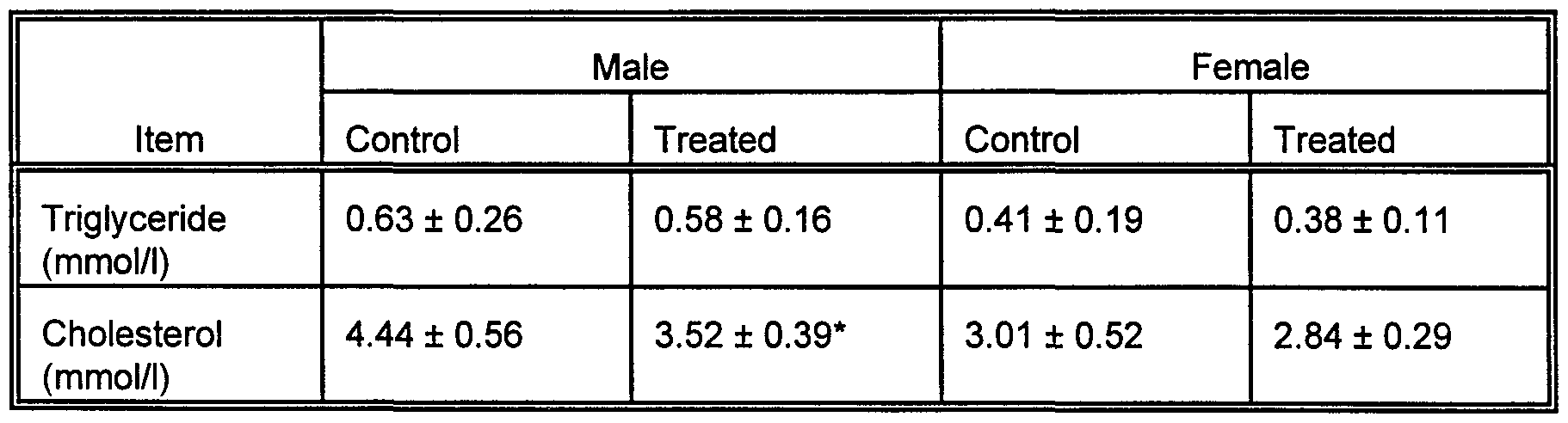
  • Table 2 depicts the effect of the hGH 177-191 treatment on the profiles of circulating levels of triglyceride and cholesterol.
  • the total cholesterol in plasma was significantly reduced from 4.44 + 0.56 to 3.52 + 0.39 mmol/l in the male animals but the plasma levels of cholesterol in the treated female animals were only slightly lower than those of the control ones.
  • hGH 177-191 did not influence the plasma levels of triglyceride in both sexes.
  • the oxidation of fatty acids ( Figure 7) and the release of glycerol (Table 4) in adipose tissues isolated from obese animals were enhanced.
  • Tables 6 and 7 show the in vitro antilipogenic and lipolytic activity of hGH 177-191 and two representative analogues (Ref Nos. 9604 and 9605) on human adipose tissue.
  • Table 8 shows similar positive lipolytic results on porcine adipose tissue. These results support the expectation that hGH 177-191 and peptide variants thereof shown to be effective in one mammal species will have efficacy in all mammals. Since corresponding sequences of non-human mammals are effectively peptide variants of the human sequence, it is also therefore expected that those corresponding sequences will be effective in other mammals including humans.
  • Figure 12 shows cumulative weight gain results for analogue Ref No. 9604 and 9605, showing exceptional efficacy of Ref No. 9604 in particular. This in vivo result is consistent with the enhanced in vitro activity of Ref No. 9604 and 9605 compared with hGH 177-191 (Ref No. 9401) shown in Tables 6, 7 and 8.
  • Figure 13 shows the result of long-term oral administration of analogue Ref No. 9604 at 500 ⁇ g/kg daily by oral gavage to ob/ob mice.
  • analogue Ref No. 9403 500 ⁇ g/kg body weight

Landscapes

  • Health & Medical Sciences (AREA)
  • Chemical & Material Sciences (AREA)
  • Life Sciences & Earth Sciences (AREA)
  • Organic Chemistry (AREA)
  • Medicinal Chemistry (AREA)
  • General Health & Medical Sciences (AREA)
  • Endocrinology (AREA)
  • Veterinary Medicine (AREA)
  • Engineering & Computer Science (AREA)
  • Nuclear Medicine, Radiotherapy & Molecular Imaging (AREA)
  • Chemical Kinetics & Catalysis (AREA)
  • Pharmacology & Pharmacy (AREA)
  • General Chemical & Material Sciences (AREA)
  • Animal Behavior & Ethology (AREA)
  • Bioinformatics & Cheminformatics (AREA)
  • Public Health (AREA)
  • Biochemistry (AREA)
  • Toxicology (AREA)
  • Zoology (AREA)
  • Gastroenterology & Hepatology (AREA)
  • Diabetes (AREA)
  • Biophysics (AREA)
  • Genetics & Genomics (AREA)
  • Molecular Biology (AREA)
  • Proteomics, Peptides & Aminoacids (AREA)
  • Child & Adolescent Psychology (AREA)
  • Hematology (AREA)
  • Obesity (AREA)
  • Medicines That Contain Protein Lipid Enzymes And Other Medicines (AREA)
  • Peptides Or Proteins (AREA)
  • Pharmaceuticals Containing Other Organic And Inorganic Compounds (AREA)
  • Materials For Photolithography (AREA)
  • Reverberation, Karaoke And Other Acoustics (AREA)
  • Mechanical Treatment Of Semiconductor (AREA)
  • Percussion Or Vibration Massage (AREA)

Abstract

A method for the treatment of obesity in an animal such as a human, comprises administering to the animal an effective amount of a peptide which comprises an analogue of the carboxyl-terminal sequence of a growth hormone, particularly an analogue of the carboxyl-terminal sequence of human growth hormone containing amino acid residues 177-191. A pharmaceutical composition for use in the treatment of obesity is also disclosed.

Description

TREATMENT OF OBESITY
FIELD OF THE INVENTION
This invention relates to the treatment of obesity in animals. In particular, the invention relates to the treatment of obesity in humans, although it is to be understood that the present invention also extends to the treatment of obesity in non- human mammals, for example, for the improvement of meat qualities in farm animals used in food production.
BACKGROUND OF THE INVENTION.
The critical role of human growth hormone (hGH) in postnatal growth in humans is well recognised. Less obvious is the impact of this hormone on the regulation of lipid and carbohydrate metabolism, due to lack of detailed molecular studies.
It is well documented that the predominant form of hGH is a globular protein with a molecular weight of 22,000 daltons (22-KD) and consists of 191 amino acid residues in a single-chain, folded by 2 disulphide bonds with a small loop at the carboxyl terminus between residues 182 and 189. Recent crystallographic studies also show that the hGH molecule contains four anti-parallel α-helices which are arranged in a left-twisted, tightly-packed helical bundle1. The concept that there are discrete functional domains within the hGH molecule responsible for specific metabolic actions of the hormone is generally accepted. The amino-terminus has been identified as the functional domain responsible for the insulin-like actions of the hGH molecule23. Recombinant DNA technology opens the way to the large-scale commercial production of human growth hormone, and the recombinant hGH appears to have equivalent biological efficacies and pharmacokinetic properties 4,s. Current supply of this multiple-functional hormone no longer restricts the types and numbers of experimental therapies in humans and animals. The use of hGH for treatment of short stature in children and adults is well-established6. Therapeutic effects of hGH in female infertility have also been reported 7,s. Treatment of human obesity with hGH encounters a variety of problems. Evidence suggests that this multiple- functional hormone often simultaneously exerts in vivo, by various bioactive domains within the molecules, some adverse effects9,10.
Regulation of lipid metabolism by GH was first described in 1959 by Raben & Hollenberg11. The regulatory role of the hormone in lipid metabolism was subsequently supported by the body composition studies of GH-deficient and GH- treated humans12,13 and pigs14,15. The findings of Gertner suggest that hGH is linked to adipose tissue distribution through a series of interactions known as the "GH-fat cycle"16. However, the molecular events transpiring to these biochemical and physiological changes remained largely unknown. The metabolic effects of GH on adipose and other tissues in vivo are variable and complex, apparently consisting of at least two components, an early insulin-like effect followed by a later more profound anti-insulin effect17. The results of the latter effect may include both a stimulation of lipolysis and an inhibition of lipogenesis. The anti-lipogenic effect of hGH has been substantiated with the demonstrations of the decrease of the expression of glucose transporter GLUT 4 in adipocytes18, the inhibition of the activity of acetyl-CoA carboxylase in adipose tissues19,20 and the reduction of glucose incorporation into lipid in both isolated cells and tissues21,22.
In view of the multiple-functional effects of intact hGH and the problems encountered in clinical applications of the intact hormone, work leading to the present invention has been directed to investigating whether hGH derivatives could be synthesised that retain the desired bioactivities and lack the unwanted side effects.
The structure-function studies of hGH with synthetic hormonal fragments have revealed that the carboxyl terminus of the hGH molecule appears to be the functional domain of the hormone for the regulation of lipid metabolism20,23 and it has been shown that a synthetic peptide having a sequence based in the carboxyl terminal region reduces body weight gain and adipose tissue mass in a laboratory obese animal model.
The entire contents of US Patent Application Serial No. 08/340389, dated 15 November 1994, including the specification, claims and figures, are incorporated herein by reference in their entirety.
SUMMARY OF THE INVENTION
The present invention provides a peptide which comprises an analogue of the carboxyl-terminal sequence of a growth hormone. The peptide may comprise an analogue of the carboxyl-terminal sequence of human growth hormone or the growth hormone of a non-human mammalian species. As described above, the carboxyl- terminal sequence of growth hormone includes a bioactive lipid metabolic domain. In one embodiment of the invention, the peptide comprises an analogue of the carboxyl-terminal sequence of human growth hormone containing amino acid residues 177-191 or a corresponding sequence of a non-human mammalian growth hormone. The analogue may be obtained by insertion, deletion or substitution of amino acids in, or chemical modification of, the native carboxyl-terminal sequence of human growth hormone or the growth hormone of a non-human mammalian species. In another aspect, the present invention provides a method for treating obesity comprising administering an effective amount of a peptide which comprises an analogue of the carboxyl-terminal sequence of a growth hormone, as described above. The treatment may be administered to any animal, including humans.
The present invention also provides a pharmaceutical composition for use in the treatment of obesity comprising an effective amount of a peptide which comprises an analogue of the carboxyl-terminal sequence of a growth hormone as described above, together with one or more pharmaceutically acceptable carriers and/or diluents.
In yet another aspect, the present invention provides use of a peptide which comprises an analogue of the carboxyl-terminal sequence of a growth hormone as describe dabove, in the manufacture of a pharmaceutical composition for the treatment of obesity in an animal.
DESCRIPTION OF THE PREFERRED EMBODIMENTS
According to one aspect of the present invention, there is provided a method for the treatment of obesity in an animal, which comprises administering to the animal an effective amount of a peptide which comprises an analogue of the carboxyl- terminal sequence of a growth hormone.
Preferably, the animal is a human although the invention also extends to the treatment of non-human mammals. Preferably also, the peptide comprises an analogue of the carboxyl-terminal sequence of human growth hormone containing amino acid residues 177-191 (hereinafter referred to as hGH 177-191). Alternatively, the peptide may comprise an analogue of the carboxyl-terminal sequence of the growth hormone of other non-human mammalian species, such as bovine, porcine, ovine, equine, feline or canine growth hormone, corresponding to the hGH 177-191 peptide.
As used throughout this specification, the term "obesity" is used to include both excess body weight and excess adipose tissue mass in the animal, and correspondingly the references to treatment of obesity include both reduction of body weight gain and reduction of adipose tissue mass of the obese animal.
The expected outcome of any treatment of obesity is the reduction of body weight, body adipose tissue mass in particular. The reduction of body adipose tissue mass is directly regulated by two biochemical processes - lipogenesis (fat-production) and lipolysis (fat-reduction) - and it is generally understood that these biochemical processes are controlled by key metabolic enzymes, specifically the fat-reducing key enzyme (hormone-sensitive lipase) and the fat-producing key enzyme (acetyl CoA carboxylase).
It has been shown by the present inventors that hGH 177-191 is effective in stimulating the fat-reducing key enzyme, hormone-sensitive lipase, and in inhibiting the fat-producing key enzyme, acetyl CoA carboxylase. This is further supported by data showing that in the presence of hGH 177-191, fat utilization is accelerated while fat production is reduced, as measured by metabolic end-products in vitro as well as in vivo. In addition, the mechanism of these molecular actions has been established as resulting from the activation of the production of the cellular second-messenger, diacylglycerol.
It will, of course, be appreciated that the present invention extends to the use of peptides which are analogues of longer amino acid sequences than the particular sequence 177-191 of growth hormone, for example analogues of the sequence 172- 191 of human growth hormone or the corresponding sequence of growth hormone of other non-human mammalian species. The concept of correspondence in amino acid sequences between species is well known in the biological sciences and is determined by aligning comparable sequences (including if necessary theoretical deletions) to match isofunctional or isostereo amino acids thereby maximising homology. The published corresponding sequences of the C-terminus region of the growth hormone of selected mammals are tabulated below26, using standard single letter notation:
GH Species Sequence
Position 170 180 190
human FRKDMDKVETFLRIVQCR. SVEGSCGF human variant FRKDMDKVETFLRIVQCR . SVEGSCGF human CS FRKDMDKVETFLRMVQCR. SVEGSCGF monkey, rhesus FRKDMDKIETFLRIVQCR. SVEGSCGF rat FKKDLHKAETYLRVMKCRRFAESSCAF mouse FKKDLHKAETYLRVMKCRRFVESSCAF hamster FKKDLHKAETYLRVMKCRRFVESSCAF whale, fin FKKDLHKAETYLRVMKCRRFVESSCAF whale, sei FKKDLHKAETYLRVMKCRRFVESSCAF fox, dog, cat FKKDLHKAETYLRVMKCRRFVESSCAF mink FKKDLHKAETYLRVMKCRRFVESSCAF cattle FRKDLHKTETYLRVMKCRRFGEASCAF sheep FRKDLHKTETYLRVMKCRRFGEASCAF goat FRKDLHKTETYLRVMKCRRFGEASCAF pig FKKDLHKAETYLRVMKCRRFVESSCAF alpaca FKKDLHKAETYLRVMKCRRFVESSCAF horse FKKDLHKAETYLRVMKCRRFVESSCAF elephant FKKDLHKAETYLRVMKCRRFVESSCAF ancestral mammal FKKDLHKAETYLRVMKCRRFVESSCAF
The present invention extends to the use of peptides which are analogues of the native carboxyl-terminal sequences of human growth hormone or growth hormone of other animal species, and which are derived from natural or synthetic (including recombinant) sources, provided always that the resulting peptide retains the biological activity of the native carboxyl-terminal sequence described herein, namely the ability to reduce body weight gain and adipose tissue mass in an obese animal. In particular, these analogues may exhibit a cyclic configuration, which may be induced by a disulfide bond.
The analogues of the present invention may be derived by elongation, insertion, deletion or substitution of amino acids in, or chemical modification of, or introduction of a cyclic amide bond between the side chains of amino acids of, the native carboxyl-terminal sequence. Amino acid insertional analogues include amino and/or carboxylic terminal fusions as well as intra-sequence insertions of single or multiple (for example, up to 10, preferably up to 5) amino acids. Insertional amino acid sequence analogues are those in which one or more amino acid residues are introduced into a predetermined site in the protein although random insertion is also possible with suitable screening of the resulting product. Deletional analogues are characterised by the removal of one or more (for example, up to 5, preferably up to 3) amino acids from the sequence. Substitutional amino acid analogues are those in which at least one amino acid residue in the sequence, preferably one or two, has been replaced by another of the twenty primary protein amino acids, or by a non- protein amino acid. Chemical modifications of the native carboxyl-terminal sequence include the acetylation of the amino-terminus and/or amidation of the carboxyl- terminus and/or side chain cyclisation of the native carboxyl-terminal sequence.
Analogues of the native carboxyl-terminal sequences of human growth hormone or growth hormone of other animal species which in particular retain the same conformation, structure and charge characteristics as the native carboxyl- terminal sequences can be expected to exhibit the same or similar biological activity as the native sequences, in particular in the ability to reduce body weight gain and adipose tissue mass in an obese animal.
Whilst the following detailed description refers specifically to analogues of hGH 177-191, it is to be understood that this invention extends to similar analogues of corresponding peptides of non-human mammalian growth hormone as described above.
Peptides comprising amino acid residues 177-191 of native human growth hormone (hGH 177-191) include the following sequence (Ref No. 9401): Leu-Arg-lle-Val-Gln-Cys-Arg-Ser-Val-Glu-Gly-Ser-Cys-Gly-Phe
(SEQ ID NO: 1)
Such a native peptide may be in cyclic disulfide form, and may comprise an organic or inorganic acid addition salt.
Analogues of the hGH 177-191 peptide may be obtained by deletion or insertion of one or more amino acid residues at any position along the native sequence, with the retention of anti-obesity properties as described above. Preferably, the analogue is in a cyclic configuration.
Alternatively, analogues of the hGH 177-191 peptide may be obtained by substitution of one or more amino acid residues at any position along the native sequence.
Screening for in vitro and in vivo activity using alanine substitution scanning and other methods reported herein has revealed positions and relationships between amino acids in hGH 177-191 which are important in the bioactivity as described above. Preferred analogues of the current invention include peptide analogues of hGH 177-191 wherein
(i) amino acids at positions 182 and 189 of hGH are joined by a bond to promote a cyclic conformation; and/or
(ii) amino acids at positions 183 and 186 of hGH are joined by a salt bridge or a covalent bond. The bond between amino acids at 182 and 189 of hGH may be a disulfide bond, in which case the amino acids at positions 182 and 189 of hGH may preferably be L- or D- Cys or Pen.
When the amino acids at positions 183 and 186 of hGH are joined by a salt bridge, these amino acids may preferably be (X and Y) or (Y and X), respectively, where:
X is a positively charged amino acid such as L- or D- Arg, Lys or Orn and Y is a negatively charged amino acid such as L- or D- Asp or Glu.
When the amino acids at positions 183 and 186 of hGH are joined by a covalent bond, that bond may be an amide bond in which case these amino acids may preferably be (X and Y) or (Y and X), respectively, where:
X is selected from the group consisting of L- or D- Lys and Orn and Y is selected from the group consisting of L- or D- Asp and Glu.
The amino acid at position 178 of hGH is preferably a positively charged amino acid such as L- or D- Arg, Lys or Orn.
Analogues may also be obtained by elongation of the native hGH 177-191 peptide sequence at one or both ends of the amino acid residues, for example with one or more hydrophilic amino acids to increase solubility in aqueous solution. Such analogues include the following sequence, preferably in cyclic disulphide form: Xim-Leu-Arg-lle-Val-Gln-Cys-Arg-Ser-Val-Glu-Gly-Ser-Cys-Gly-Phe-Xfri (SEQ ID NO: 2) wherein X1 and X2 are each is selected from the group consisting of L- or D-Arg, His and Lys, and m and n are each 0, 1 , 2 or 3 with the provision that at least m or n is 1. [Throughout this specification, elements which are underlined denote differences from the native hGH 177-191 sequence, and unless otherwise stated, amino acids at positions corresponding to 182 and 189 are joined by a disulfide bond.]
One elongation analogue not elongated with a hydrophilic amino acid but nonetheless exhibiting especially enhanced anti-obesity properties is the following (Ref No. 9604): l r-Leu-Arg-lle-Val-Gln-Cys-Arg-Ser-Val-Glu-Gly-Ser-Cys-Gly-Phe.
(SEQ ID NO: 19)
Analogues may also be obtained by chemical modification of the native hGH 177-191 peptide sequence. Such analogues include the sequence:
Y1-Leu-Arg-lle-Val-Gln-Cys-Arg-Ser-Val-Glu-Gly-Ser-Cys-Gly-Phe
(SEQ ID NO: 3) wherein Y1 is selected from the group consisting of the desamino form (H), acetyl (CH3CO-) and other acyl groups; or the sequence:
Leu-Arg-lle-Val-Gln-Cys-Arg-Ser-Val-Glu-Gly-Ser-Cys-Gly-Phe-Y2
(SEQ ID NO: 4) where Y2 is selected from the group consisting of -CONH2 and alkyl amide groups.
Specific hGH 177-191 analogues obtained by substitution of amino acids, by elongation, by chemical modification, or by introduction of a cyclic amide bond between side chains of amino acids, of the native hGH 177-191 peptide sequence, and which exhibit anti-obesity properties, include the following:
Ref No. STRUCTURE SEQ ID NO:
9502 Leu Arg He Val Gin Pen Arg Ser Val Glu Gly Ser Pen Gly Phe 15 9405 CH,CO- Leu Arg He Val Gin Cys Arg Ser Val Glu Gly Ser Cys Gly Phe 8
9410 H - Leu Arg He Val Gin Cys Arg Ser Val Glu Gly Ser Cys Gly Phe 12
9404 Leu Arg He Val Gin Cys Arg Ser Val Glu Gly Ser Cys Gly Phe - CONH? 7
9407 Leu Arg He Val Gin Cys Lys Ser Val Glu Gly Ser Cys Gly Phe 10
9408 Leu Arg He Val Gin Cys Lys Ser Val Glu Gly Ser Cys Gly Phe 11
| |(amide bond)
9604 Tyr Leu Arg He Val Gin Cys Arg Ser Val Glu Gly Ser Cys Gly Phe 19
9605 Lys Leu Arg He Val Gin Cys Arg Ser Val Glu Gly Ser Cys Gly Phe 20
9618 Lys Lys Leu Arg He Val Gin Cys Arg Ser Val Glu Gly Ser Cys Gly Phe 33
9607 AJa Arg He Val Gin Cys Arg Ser Val Glu Gly Ser Cys Gly Phe 22
9606 Leu Lys He Val Gin Cys Arg Ser Val Glu Gly Ser Cys Gly Phe 21
9608 Leu Arg AJa Val Gin Cys Arg Ser Val Glu Gly Ser Cys Gly Phe 23
9403 Leu Arg Lyg Val Gin Cys Arg Ser Val Glu Gly Ser Cys Gly Phe 6
9609 Leu Arg He Ala Gin Cys Arg Ser Val Glu Gly Ser Cys Gly Phe 24
9610 Leu Arg He Val AJa Cys Arg Ser Val Glu Gly Ser Cys Gly Phe 25
9612 Leu Arg lie Val Gin Cys Arg AJa Val Glu Gly Ser Cys Gly Phe 27
9613 Leu Arg He Val Gin Cys Arg Ser Ala Glu Gly Ser Cys Gly Phe 28
9615 Leu Arg He Val Gin Cys Arg Ser Val Glu AJa Ser Cys Gly Phe 30
9616 Leu Arg He Val Gin Cys Arg Ser Val Glu Gly AJa Cys Gly Phe 31
9602 Leu Arg He Val Gin Cys Arg Ser Val Glu Gly Ser Cys AJa Phe 17
9501 Leu Arg He Val Gin Cys Arg Ser Val Glu r A!a Ser Cys a__a Phe 14
9601 Leu Arg He Val Gin Cys Arg Ser Val Glu Gly Ser Cys Gly AJa 16 wherein the amino acid residue abbreviations used are in accordance with the standard peptide nomenclature:
Gly Glycine; He Isoleucine; Glu Glutamic Acid; Phe Phenylalanine; Cys Cysteine; Arg Arginine; Gin Glutamine; Leu Leucine; Ser Serine; Val Valine; Lys Lysine; Ala Alanine; Asp Aspartic acid; His Histidine; Orn Ornithine; Tyr Tyrosine; Pen Penicillamine (β,β'-Dimethyl-Cysteine).
All amino acids, except for glycine, are of the L-absolute configuration, unless indicated as D-absolute configuration. All the above peptides above have a cyclic disulfide bond between Cys(182) and Cys(189) or Pen(182) and Pen(189) as appropriate.
Where appropriate, the analogues described above may comprise an organic or inorganic acid addition salt.
The term "effective amount" as used herein means an amount of the peptide sufficient to attain the desired effect in the treatment of obesity in the animal, but not so large an amount as to cause serious side effects or adverse reactions.
In another aspect, the present invention provides the use of a peptide which comprises an analogue of the carboxyl-terminal sequence of a growth hormone as described above, in the treatment of obesity in an animal or in the manufacture of a pharmaceutical composition for the treatment of obesity in an animal. ln yet another aspect, the present invention provides a pharmaceutical composition for use in the treatment of obesity in an animal, comprising an effective amount of a peptide which comprises an analogue of the carboxyl-terminal sequence of a growth hormone as described above, together with one or more pharmaceutically acceptable carriers and/or diluents.
The peptide which is the active ingredient of the pharmaceutical composition of this aspect of the invention exhibits advantageous therapeutic activity in the treatment of obesity in an animal when administered in an amount appropriate to the particular case. For example, from about 0.5 μg to about 20 mg per kilogram of body weight per day may be administered. Dosage regimens may be adjusted to provide the optimum prophylactic or therapeutic response. For example, one or more divided doses may be administered daily, weekly, monthly or in other suitable time intervals or the dose may be proportionally reduced as indicated by the exigencies of the clinical situation.
The active ingredient may be administered in any convenient manner such as by the oral, parenteral (including intraperitoneal, intravenous, subcutaneous, intramuscular and intramedullary injection), intranasal, intradermal or suppository routes or by implanting (eg using slow release devices). For ease of administration, oral administration is preferred, however parenteral administration is also quite convenient. Depending on the route of administration, the active ingredient may be required to be coated in a material that protects said ingredient from the action of enzymes, acids and other natural conditions which may inactivate the said ingredient. For example, low lipophilicity of the ingredient may allow it to be destroyed in the gastrointestinal tract by enzymes capable of cleaving peptide bonds and in the stomach by acid hydrolysis. In order to administer the composition by other than parenteral administration, the active ingredient may be coated by, or administered with, a material to prevent its inactivation. The active ingredient may also be administered in dispersions prepared in glycerol, liquid polyethylene glycols, and/or mixtures thereof and in oils. Under ordinary conditions of storage and use, these preparations will usually contain a preservative to prevent the growth of microorganisms.
The pharmaceutical forms suitable for injectable use include sterile aqueous solutions (where water soluble) or dispersions and sterile powders for the extemporaneous preparation of sterile injectable solutions or dispersion. In all cases, the form must be sterile and must be fluid to the extent that easy syringability exists. It must be stable under the conditions of manufacture and storage and must be preserved against the contaminating action of microorganisms such as bacteria and fungi. The carrier can be a solvent or dispersion medium containing, for example, water, ethanol, polyol (for example, glycerol, propylene glycol, and liquid polyethylene glycol, and the like), suitable mixtures thereof, and vegetable oils. The proper fluidity can be maintained, for example, by the use of a coating such as lecithin, by the maintenance of the required particle size in the case of dispersion and by the use of surfactants. The prevention of the action of microorganisms can be brought about by various antibacterial and antifungal agents, for example, parabens, chlorobutanol, phenol, sorbic acid, thiomorosal, and the like. In many cases, it will be preferable to include isotonic agents, for example, sugars or sodium chloride. Prolonged absorption of the injectable compositions can be brought about by, for example, the use in the compositions of agents delaying absorption.
Sterile injectable solutions are prepared by incorporating the active ingredient in the required amount in the appropriate solvent with various of the other ingredients enumerated above, as required, followed by filtered sterilisation. Generally, dispersions are prepared by incorporating the sterilised active ingredient into a sterile vehicle which contains the basic dispersion medium and the required other ingredients from those enumerated above. In the case of sterile powders for the preparation of sterile injectable solutions, the preferred methods of preparation are vacuum drying and the freeze-drying technique which yield a powder of the active ingredient plus any additional desired ingredient from previously sterile- filtered solution thereof.
When the active ingredient is suitably protected as described above, the composition may be orally administered, for example, with an inert diluent or with an assimilable edible carrier, or it may be enclosed in hard or soft shell gelatin capsule, or it may be compressed into tablets, or it may be incorporated directly with the food of the diet. For oral administration, the active ingredient may be incorporated with excipients and used in the form of ingestible tablets, buccal tablets, troches, capsules, elixirs, suspensions, syrups, wafers, and the like. Such compositions and preparations should contain at least 0.01% by weight and more preferably at least 0.1-1% by weight of active ingredient. The percentage of the compositions and preparations may, of course, be varied and may conveniently be between about 5 to about 80% of the weight of the unit. The amount of active ingredient in the pharmaceutical compositions is such that a suitable dosage will be obtained. Preferred compositions or preparations according to the present invention may, for example, be prepared so that an oral dosage unit form contains between about 0.5 μg and 200 mg and more preferably 10μg and 20 mg of active ingredient.
The tablets, troches, pills, capsules and the like may also contain the following: a binder such as gum tragacanth, acacia, corn starch or gelatin; excipients such as dicalcium phosphate; a disintegrating agent such as corn starch, potato starch, alginic acid and the like; a lubricant such as magnesium stearate; and a sweetening agent such a sucrose, lactose or saccharin may be added or a flavouring agent such as peppermint, oil of wintergreen, or cherry flavouring. When the dosage unit form is a capsule, it may contain, in addition to materials of the above type, a liquid carrier. Various other materials may be present as coatings or to otherwise modify the physical form of the dosage unit. For instance, tablets, pills, or capsules may be coated with shellac, sugar or both. A syrup or elixir may contain the active compound, sucrose as a sweetening agent, methyl and propylparabens as preservatives, a dye and flavouring such as cherry or orange flavour. Of course, any material used in preparing any dosage unit form should be pharmaceutically pure and substantially non-toxic in the amounts employed. In addition, the active ingredient may be incorporated into sustained-release preparations and formulations.
As used herein, pharmaceutically acceptable carriers and diluents include any and all solvents, dispersion media, aqueous solutions, coatings, antibacterial and antifungal agents, isotonic and absorption delaying agents, and the like. The use of such media and agents for pharmaceutically active substances is well known in the art, and it is described, by way of example, in Remington's Pharmaceutical Sciences, 18th Edition, Mack Publishing Company, Pennsylvania, USA. Except insofar as any conventional media or agent is incompatible with the active ingredient, use thereof in the pharmaceutical compositions of the present invention is contemplated. Supplementary active ingredients can also be incorporated into the compositions.
It is especially advantageous to formulate compositions in dosage unit form for ease of administration and uniformity of dosage. Dosage unit form as used herein refers to physically discrete units suited as unitary dosages for the human subjects to be treated; each unit containing a predetermined quantity of active ingredient calculated to produce the desired therapeutic effect in association with the required pharmaceutical carrier and/or diluent. The specifications for the novel dosage unit forms of the invention are dictated by and directly dependent on (a) the unique characteristics of the active ingredient and the particular therapeutic effect to be achieved, and (b) the limitations inherent in the art of compounding such an active ingredient for the treatment of obesity. Throughout this specification and claims which follow, unless the context requires otherwise, the word "comprise", or variations such as "comprises" or "comprising", will be understood to imply the inclusion of a stated integer or group of integers but not the exclusion of any other integer or group of integers.
Further details of the present invention will be apparent from the following Example and the accompanying drawings which are included by way of illustration, not by way of limitation, of this invention.
BRIEF DESCRIPTION OF THE DRAWINGS.
In the drawings:
Figures 1A & 1B show the effect of hGH 177-191 peptide on cumulative body weight gains in male (1 A) and female (1 B) C57BL/6J (ob/ob) mice during the
18-day treatment period. Animals were given a daily intraperitoneal injection of 0.1 ml of either saline or hGH 177-191 (200μg/kg body weight). Each points represents the mean + SEM of 6 animals.
Figures 2A & 2B show the average daily food consumption (g/mouse/day) of C57BL/6J (ob/ob) mice during an 18-day treatment period with hGH 177-191. The treatment for the four groups of animals was as described in figures 1 A & 1 B. Each point represents the mean + SEM of 6 animals. No significance between the groups was observed at all times.
Figures 3A & 3B demonstrate the effect of hGH 177-191 peptide on body weight gain of 14-15 week old male Zucker fatty (fa/fa) rats during the 20 or 27-days treatment period. Animals were given a daily intraperitoneal injection of either saline or the peptide (500μg/kg body weight) (3A) or implanted intradermally with a slow-release tablet (500μg/day/kg body weight) in the lower quadrant of the abdomen of the animals. The control group was implanted with a placebo tablet in the same manner. Each point represents the mean + SEM of 6 animals.
Figures 4A & 4B demonstrate the average daily food consumption (g/rat/day) of Zucker fatty rats during the treatment period with hGH 177-191 peptide. The treatment for the four groups of animals was as described in Figures
3A & 3B. Each point represents the mean ± SEM of 6 animals. No significance between the test groups and the appropriate controls was observed at all times
Figures 5A & 5B depict the ex vivo effect on lipogenesis in adipose tissues of the C57BU6J (ob/ob) male mice (5A) and female mice (5B) after 18-day treatment with hGH 177-191. Data indicate the rate of [C14]-lipid synthesis and are expressed as [C1 ]-glucose incorporated into lipid (pmol/mg tissue/min) Values are mean ± SEM of 12 determinations from 6 animals of each group. The differences between the hGH 177-191 treated and saline control groups were statistically significant.
Figure 6A & 6B depict the ex vivo effect on lipolysis in adipose tissue of the C57BL/6J (ob/ob) male mice (6A) and female mice (6B) after 18-days treatment with hGH 177-191. Data indicate the rate of glycerol release from adipose tissues (pmol/mg tissue/min). Values are mean ± SEM of 12 determinations from 6 animals of each group. The differences between the hGH 177-191 treated and saline control groups were statistically significant.
Figure 7 illustrates the in vitro effect of hGH 177-191 on fatty acid oxidation in isolated adipose tissues of C57BL/6J (ob/ob) mice with the determination of the rate of [C ]O2 production from [C14]-palmitic acid. The rate of [C14]-palmitic acid oxidation was expressed as μmol/g tissue/hr. Figure 8 illustrates the in vitro effect of hGH 177-191 on the release of diacylglycerol from isolated adipocytes of normal rats over an incubation period of 40 min. Diacylglycerol was quantitated using radioenzymic assay and the results were expressed as % increase over the basal levels.
Figure 9 shows the in vitro effect of hGH 177-191 on hormone-sensitive lipase activity in isolated adipocytes of male Zucker fatty (fa/fa) rats was determined by the amount of hydrolyzed [C14]-oleic acid from [C14]-triolein. The enzyme was expressed as U/mg protein, where the release of 1 nmole of oleic acid per hour was considered as 1 Unit of enzyme activity.
Figures 10A & 10B shows the in vitro effect of hGH 177-191 on acetyl-CoA carboxylase in the isolated adipocytes (10A) and hepatocytes (10B) of normal rats was determined by [C14]-bicarbonate fixation reaction and expressed as mU/g cell dry weight, where 1 Unit of acetyl-CoA carboxylase was defined as the carboxylation of 1 μmole acetyl-CoA per minute.
Figure 11 A demonstrates the effect of analogue Ref. No. 9403 (SEQ
ID NO: 6) on body weight gain of 26-week-old C57BL/6J (ob/ob) mice during the 18 days treatment period. Animals were given a daily intraperitoneal injection of either saline (as control) or peptide analogue (500 μg/kg body weight). Each point represents the mean ± SEM of 6 animals.
Figure 11B shows the average daily food consumption (g/mouse/day) of 26-week-old C57BL/6J (ob/ob) mice during the treatment period with analogue Ref No. 9403 (SEQ ID NO: 6). The treatment for the two groups of animals was as described in Figure 11 A. Each point represents the mean ± SEM of 6 animals. No significance between the test group and the control was observed at all times. Figure 12 shows the effect on body weight gain of chronic treatment of 16-week old C57BL/6J(ob/ob) mice with analogues Ref Nos. 9604 (SEQ ID NO: 19) and 9605 (SEQ ID NO: 20).
Figure 13 shows the effect of long-term oral administration of analogue Ref No. 9604 to ob/ob mice.
EXAMPLE
MATERIALS AND METHODS
Animals and treatments.
Obese C57BU6J (ob/ob) mice and fatty Zucker (fa/fa) rats were used to demonstrate the biological effects of the synthetic hGH 177-191 and analogues. The animals of the same age and same sex were randomly divided into two groups, housed 6 per cage and maintained on a normal 12-hr light/dark cycle at a constant room temperature of 25°C in the animal house of the Department of Biochemistry and Molecular Biology, Monash University, Clayton, Australia. Animals were fed ad libitum on pre-determined quantity of animal pellets (Clark King, Melbourne, Australia) and allowed free access to water at all times. The animals were given a daily intraperitoneal (i.p) injection of 0.1 ml of either the synthetic peptide (200-500μg/kg body weight) or equivalent volume of physiological saline (0.9% sodium chloride) for appropriate number of days. The i.p. injection was administered with a 30G x 1/_" (0.31 x 13 mm) needle on a 1-ml disposable tuberculin syringes, and the site of injection was the lower left quadrant of the abdomen of the animals. To study the effects of controlled-delivery of hGH 177-191 and analogues, slow-release peptide-pellets in a diameter of 3 mm were implanted intradermally in the abdominal region of Zucker rats under anaesthesia. The body weight and food intake were monitored for the periods of time as indicated. Peptide Synthesis
The peptides of the present invention were prepared by using standard 9- fluorenylmethyloxycarbonyl(Fmoc) solid-phase techniques. The solid-phase synthesis, for example, could be commenced from the C-terminal end of the peptide using an α-amino protected amino acid. A suitable starting materials could be prepared, for instance, by attaching the required α-amino acid to a Wang resin (4- alkoxybenzyl alcohol resin), or Rink amide resin (2,4-dimethoxy-4'- [carboxymethyoxyj-benzhydrylamine linked to amino methyl resin) or PAM resin (4- hydroxymethylphenyl- acetic acid resin). Resins were commercially available from Auspep Pty. Ltd., Parkville, Victoria, Australia.
In the solid-phase preparation of the compounds of this invention, a protected amino acid was coupled to a resin with the aid of a coupling agent. After the initial coupling, the α-amino protecting group was removed by piperidine in organic solvents at room temperature. Following the removal of the α-amino protecting group, the remaining protected amino acids were coupled stepwise in the desired order. A 4-fold excess of each protected amino acid was generally used in the reaction with an appropriate carboxyl group activator such as diisopropylcarbodiimide (DIC) and 1-hydroxybenzotriazole (HOBt), in methylene chloride (DCM)-N,N-dimethylformamide (DMF) mixtures.
After the desired amino acid sequence was completed, the peptide was then cleaved from the resin support by treatment with a reagent such as trifluoroacetic acid (TFA) or trifluormethanesulfonic acid (TFMSA) which cleaved the peptide from the resin, as well as all side-chain protecting groups, except for Cys(Acm). When a Wang resin was used, TFA treatment resulted in the formation of the free peptide acids. When the Rink amide resin was used, TFA treatment resulted in the formation of the free peptide amides. When a PAM resin was used, TFMSA treatment resulted in the formation of the free peptide acids. The target peptides might exist in cyclic disulfide form which requires post-synthesis modification. The following examples are provided for the purpose of further illustration only and not intended to be limitations on the disclosed invention.
A. Synthesis of pentadecapeptide comprising amino acid residues 177-191 of native human growth hormone, designated as hGH (177-191) (Ref No.
9401): Leu1-Arg-lle-Val-Gln-Cys-Arg-Ser-Val-Glu-Gly-Ser-Cys-Gly-Phe15 (cyclic disulfide)
The following procedure was employed in preparing the pentadecapeptide: Step 1. Wang resin (0.625 g, 0.5 mmol) was placed in a 10 ml-reaction vessel.
DCM (4 ml) was added to the reaction vessel. The Wang resin was washed with vigorous stirring for 2 minutes. The DCM solution was then drained from the reaction vessel. This washing was repeated twice. Step 2. Fmoc-L-phenylalanine (Fmoc-Phe, 0.388 g, 1.0 mmol) in 2.4 ml NMP-DCM (1:5, v/v) and DIC (0.135 g, 1.0 mmol) in 1.0 ml NMP were mixed in a reaction vessel for 10 minutes. To the mixture, 4-dimethylaminopyridine (DMAP, 0.074g, 0.06 mmol) in 0.6 ml DMF was added. The reaction in the solution was allowed to continue for 68 minutes at room temperature. The solution was then drained, the resin was washed thoroughly with NMP (4 ml x 3) and DCM (4 ml x 3). The Fmoc-Phe-Wang Resin complex was dried in vacuo overnight to yield 0.781 g of material. The coupling level of amino acid to resin was determined to be 0.80 mmol/g resin by using spectrophotometric measurement of the Fmoc-piperidine adduct. Step 3. Fmoc-Phe-Wang Resin (0.263 g, 0.20 mmol) was placed in the 10 ml-reaction vessel. DMF (8 ml) was added to wash and swell the resin by stirring for 2 minutes. The solution was then drained from the reaction vessel. Step 4. A 25% piperidine/DMF solution (4 ml) was added to the reaction vessel. The resulting mixture was stirred for 2 minutes. The solution was drained from the reaction vessel. This deprotection procedure was repeated once but with prolonged stirring time (18 min). The solution was drained from the reaction vessel.
Step 5. DMF (8 ml) was added to the reaction vessel. The resulting solution was stirred for 2 minutes. The solution was drained from the resin in the reaction vessel. This washing procedure was repeated twice. DMF (2 ml) was added to the reaction vessel to keep the resin swollen.
Step 6. Fmoc-glycine (Fmoc-Gly, 0.238 g, 0.8 mmol), HOBt (108 mg;
0.8 mmol) and DIC (128 μl; 0.8 mmol) were added to a 10 ml-test tube containing
2 ml DMF. The mixture was stirred for 10 minutes to start the activation of amino acid. The solution was then added to the resin which originally was placed in the reaction vessel. The resulting mixture was stirred for 1.5 hours or until a negative ninhydrin test was obtained. The solution was then drained from the reaction vessel.
Step 7. DMF (8 ml) was added to the reaction vessel. The resulting solution was vigorously stirred for 2 minutes. The solution was then drained from the reaction vessel. The washing procedure was repeated twice.
Steps 4 through 7 were then repeated employing the following order of amino acid: Fmoc-Cys(Acm)
Fmoc-Ser(t-Bu)
Fmoc-Gly
Fmoc-Glu(O-tBu)
Fmoc-Val Fmoc-Ser(t-Bu)
Fmoc-Arg(Pmc)
Fmoc-Cys(Acm)
Fmoc-GIn
Fmoc-Val Fmoc-lle Fmoc-Arg(Pmc) Fmoc-Leu
After completion of the synthesis of the desired peptide-resin, the reaction vessel containing the peptide-resin was then placed in a desiccator and dried overnight under vacuum. The yield of peptide-resin was 0.635 g. The dried peptide- resin was removed from the reaction vessel and placed in a 50 ml round-bottom flask containing a magnetic stirring bar. The cleavage of the peptide from the resin with TFA was carried out with the following procedure: A scavenger solution, containing 0.75 g phenol, 0.5 ml H2O, 0.5 ml thioanisole, and 0.25 ml ethanedithio, was added to the round-bottom flask. The resulting mixture was stirred for 5 minutes. 10 ml TFA was added drop by drop into the flask while kept stirring vigorously. The resulting mixture was stirred for 2.5 hours at room temperature.
The mixture was filtered through a medium-porosity filter, fritted glass funnel.
The TFA-peptide solution was sucked into another 500 ml round-bottom flask containing 200 mL cold diethyl ether by applying vacuum. Peptide was allowed to be precipitated in the ether solution at 4°C overnight, then collected by filtering the mixture through a fine-porosity, fritted glass funnel. The peptide pellet on the filter was washed with cold ether (10 ml x 3) to remove the scavenger. The peptide pellet was then dissolved with 25% aqueous acetic acid and then lyophilized to yield the crude peptide (about 400 mg dry weight, purity -80%).
The crude peptide was purified by reversed-phase high performance liquid chromatography (RP-HPLC). Purification was carried out on a preparative 21.2 x 250 mm Supelcosil PLC-18 (octadecyl, C18) column(120 Angstrom pore size, 12 μm particle size, 190 m2/g surface area; Supelco, Bellefonte, PA, U.S.A.) at 5.0 ml/min flow rate at room temperature. A linear gradient program was utilized , where solvent A was water with 0.1% TFA, and solvent B was acetonitrile-water (50/50: v/v, containing 0.1 % TFA). The gradient was developed from 20 to 100% over 80 min. Separation profiles were recorded and analysed using a Perkin-Elmer LC-100 integrator. The desired peptide component was eluted and collected with the Pharmacia Model FRAC-100 automatic fraction collector (Uppsala, Sweden). The fractions of identical component were combined and lyophilized. The purified peptide (275 mg dry weight, purity >98%), Cys(Acm)6,13-pentadecapeptide, was kept frozen at -20 °C.
For cyclisation of the disulfide bridge of the peptides, iodine oxidation in 80% aqueous acetic acid was used to remove the cysteine-protecting groups, Acm, and furnished the intramolecular disulfide bridge simultaneously. Cys(Acm)6,13- pentadecapeptide (275 mg , 0.155 mmole) was dissolved in 50 ml 80% aqueous acetic acid. This solution was slowly added to a 250 ml round-bottom flask containing iodine (378 mg, 1.4 mmole) in 100 ml 80% aqueous acetic acid by stirring vigorously. Reaction was allowed to continue for 2 hours at room temperature and terminated by adding the ascorbic acid (Vitamin C) to the resulting solution. Liquid volume was then reduced by rotary evaporation and peptide recovered by lyophilization. The cyclised peptide was then purified by RP-HPLC as described in the purification of linear peptide. After lyophilization, 165 mg cyclic pentadecapeptide with 96% purity was yielded. The total yield of synthesis was about 46%.
B. Synthesis of pentadecapeptide (Ref No. 9404):
Leu1-Arg-lle-Val-Gln-Cys-Arg-Ser-Val-Glu-Gly-Ser-Cys-Gly-Phe15-CONH2 (cyclic disulfide)
The procedure set forth in EXAMPLE A was employed. The modification consisted of omitting Wang resin and replacing it with the Rink amide resin.
C. Synthesis of the pentadecapeptide (Ref No. 9410): H-Leu1-Arg-lle-Val-Gln-Cys-Arg-Ser-Val-Glu-Gly-Ser-Cys-Gly-Phe15 (cyclic disulfide)
The procedure set forth in EXAMPLE A was employed. The modification consisted of the replacement of Fmoc-Leu and with 4-methyl-pentacarboxylic acid, resulting in the synthesis of the desamino pentadecapeptide.
D. Synthesis of the pentadecapeptide (Ref No. 9405):
CH3CO-Leu -Arg-lle-Val-Gln-Cys-Arg-Ser-Val-Glu-Gly-Ser-Cys-Gly-Phe15 (cyclic disulfide)
The procedure set forth in EXAMPLE A was employed. After completion of the synthesis of the desired deblocked peptide-resin, 5 ml solution of 20% acetic anhydride in DMF was added. After 5 minutes, 71 μl (0.4 mmols) of diisopropylethylamine (DIEA) was added to neutralize the protons that were generated. Acetylation of the peptide was performed at room temperature for 30 minutes. The peptide-resin was washed twice with DMF and twice with DCM and the N-acetyl peptide resin was ready for TFA cleavage as shown in EXAMPLE A.
E. Synthesis of the dicyclo-pentadecapeptide (Ref No. 9408):
I I
Leu1-Arg-lle-Val-Gln-Cys-Lys-Ser-Val-Glu-Gly-Ser-Cys-Gly-Phe15 (cyclic disulfide)
The following procedure was employed in preparing the pentadecapeptide: Step ! Boc-L-phenylalanine-PAM resin (0.400 g, 0.2 mmol; Auspep,
Melbourne, Australia; Cat#5290F, Batch#494123) was placed in a 10ml reaction vessel. The resin was washed with DCM (4 ml) by vigorous stirring for 2 minutes. The DCM solution was then drained from the reaction vessel. This washing was repeated once. Step 2. 50% TFA/DCM solution (4 ml) was added to the reaction vessel. The resulting mixture was stirred for 2 minutes. The solution was then drained from the reaction vessel. This deprotection procedure was repeated once with a stirring time of 18 minutes. The solution was drained from the reaction vessel. DCM (4 ml) was added to the reaction vessel and the content was allowed to stand for 2 minutes. The solution was again drained from the resin. This washing procedure was repeated twice. 10% DIEA/DMF (4ml) was added to the reaction vessel. The resulting mixture was allowed to stand for 1 minute and the solution removed as before. This deprotection procedure was repeated once. DMF (4ml) was added to the resin complex in the reaction vessel. The resulting solution was allowed to stand for 2 minutes, followed by the removal of the solution from the vessel. This washing procedure was repeated four times. Finally, DMF (2 ml) was added to the reaction vessel to keep the resin swollen. Step 3. Fmoc-glycine (Fmoc-Gly, 0.238 g, 0.8 mmol), HOBt (108 mg; 0.8 mmol) and DIC (128 μl; 0.8 mmol) were added to a 10 ml-test tube containing 2 ml DMF. The mixture was stirred for 10 minutes to activate the amino acid. The solution was then added to the resin in the reaction vessel. The resulting mixture was stirred for 1.5 hours or until a negative ninhydrin test was obtained. The solution was then drained from the reaction vessel. Step 4. DMF (8 ml) was added to the reaction vessel. The resulting solution was vigorously stirred for 2 minutes, followed by the removal of the supernatant. The washing procedure was repeated twice. Step 5. 25% piperidine/DMF solution (4 ml) was added to the reaction vessel. The resulting mixture was stirred for 2 minutes. The solution was drained from the reaction vessel. This deprotection procedure was repeated once with stirring for 18 minutes. The solution was drained from the reaction vessel. Step 6. DMF (8 ml) was added to the reaction vessel. The resulting solution was stirred for 2 minutes. The solution was drained from the reaction vessel resin. This washing procedure was repeated twice. 2 ml DMF was added to the reaction vessel to keep the resin swollen. Steps 3 through 6 were then repeated with the following order of amino acids: Fmoc-Cys(Acm) Fmoc-Ser(Bzl) Fmoc-Gly
Fmoc-Glu(O-tBu)
Fmoc-Val
Fmoc-Ser(Bzl)
Step 7. Steps 3 and 4 were repeated to couple Fmoc-Lys(Boc) to Ser in the position 184. After completion of coupling, the reaction vessel containing the peptide-resin was then placed in a desiccator and dried overnight under vacuum, the peptide-resin was then transferred to a 10ml-reaction vessel. DCM (4 ml) was added to the reaction vessel. The resin was washed with vigorous stirring for 2 minutes. The DCM solution was then drained from the reaction vessel. This washing was repeated once.
Step 8. Step 2 was used to remove the Boc group and the t-Bu group from the side chain of lysine and glutamic acid, respectively. Step 9 1 ml of 1.5% DIEA/DMF was added to the reaction vessel. Benzotriazo-1-yl-oxy-tris-(dimethylamino)phosphoniumhexafluorophosphate(BOP) ( 400 mg; 0.90 mmol), HOBt (122 mg, 0.90 mmol), and DIEA (400 μl, 2.25 mmol) were dissolved in 3.4 ml of 1.5% DIEA/DMF and then added to the reaction vessel. The resulting mixture was stirred for 3 hours or until a negative ninhydrin test was obtained before the removal of the supernatant from the reaction vessel. DMF (8 ml) was then added to the reaction vessel. The resulting solution was vigorously stirred for 2 minutes. The solution was then drained from the reaction vessel. The washing procedure was repeated twice.
Step 10. Steps 5 through 6 were then repeated to remove the Fmoc group from the α-amino group of the lysine residue in the peptide-resin. Steps 3 through 6 were then repeated with the following order of amino acids: Fmoc-Cys(Acm) Fmoc-GIn Fmoc-Val Fmoc-lle
Fmoc-Arg(Pmc) Fmoc-Leu
After completion of the synthesis of the desired peptide resin, Step 4 was then repeated to remove the Fmoc group from Leu and get the deblocked peptide resin. The reaction vessel containing the peptide resin was then placed in a desiccator and dried overnight under vacuum. 604 mg peptide-resin was yielded. The dried peptide resin was removed from the reaction vessel and placed in a 25 ml round- bottom flask containing a magnetic stirring bar. Trifluoromethanesulfonic acid (TFMSA)/TFA cleavage protocol was used to cleave peptide from the PAM resin: A scavenger solution, containing 500 μl thioanisole, and 250 μl ethanedithio, was added to the flask. The resulting mixture was stirred for 10 minutes at room temperature. 5 ml of TFA was added drop by drop into the flask while kept stirring vigorously. The resulting mixture was stirred at room temperature for 15 minutes. Place the flask in an ice-bath and then 500 ml of TFMSA was slowed added while kept stirring vigorously. The resulting mixture was stirred in the ice-bath for 10 minutes and at room temperature another 15 minutes. Cold diethyl ether (50 ml) was added to the flask to stop the reaction and precipitate the cleaved peptide. The peptide was collected by filtering the mixture through a fine-porosity, fritted glass funnel and washed with cold ether (10 mL x 3) to remove the scavenger. The peptide pellet was dissolved with 30 ml of 50 % acetonitrile/H2O followed by the addition of 5 ml of cold 10% NH4HCO3 to neutralize the solution. The crude peptide (519 mg, purity ~69%) was obtained after lyophilization. The preparation of peptide with cyclic disulfide form and the purification of pure final product are shown in EXAMPLE A.
F. Synthesis of the hexadecapeptide (Ref No. 9604)
Tyr-Leu-Arg-lle-Val-Gln-Cys-Arg-Ser-Val-Glu-Gly-Ser-Cys-Gly-Phe(cyclicdisulfide)
The procedure set forth in Example A was employed, modified by the addition of a further repetition of the steps 4 to 7 using Fmoc-Tyr(t-Bu).
Cumulative weight gain and food consumption.
Cumulative weight gain and food consumption were determined at 3-day intervals by the measurements of body weight and uneaten food remaining in the cages. The animals were placed in a covered chamber to minimise movement during the weighing procedure. The food consumption data were obtained by subtracting the amount of uneaten food remaining in the cages from the original provision.
Assays for plasma triglyceride and total cholesterol. The animals were anaesthetised with sodium pentobarbitone (80 mg/kg body weight) 12 hr after the last dose of hGH 177-191. Blood samples were collected from the tail vein of anaesthetised animals 45 mins after the administration of anaesthetic. After being centrifuged at 2000 x g for 5 minutes, plasma was removed from the samples and used for metabolite assays. Triglyceride and total cholesterol in plasma were measured by enzyme-spectrophotometric methods. The reagents are based on either a modified glycerol phosphate oxidase (GPO)- Trinder's type colour reaction24 or a cholesterol oxidase-4-aminoantipyrine method25. All assays were performed with the CentrifiChem System 400 (Union Carbide) containing an automated pipetter, a centrifugal analyser and a recording spectrophotometer. Seronorm Lipid (Nycomed Pharma Co., Oslo, Norway) was used as the calibrator.
Determination of adipose tissue weight. The procedure for the isolation and measurement of intact epididymal fat pads was established in previous studies of epididymal growth of GH-deficient (lit/lit) mice. In the present study, white adipose tissues, either whole epididymal or parametrical fat pads, were excised with the identical techniques as previously described22 from the mice immediately after sacrifice. The tissues were washed in cold physiological saline, blotted and weighed. For ex vivo lipogenic assays, the portions of adipose tissues without blood vessels were used.
Hormone-sensitive lipase (HSL) Assay
Hormone-sensitive lipase (HSL) activity of isolated adipocytes was used as a model to evaluate the lipolytic effect of hGH 177-191 peptide and analogues. In this assay [C14]-triolein was used as a substrate by HSL. The amount of hydrolyzed [C1 ]-oleic acid was determined and used as an index of HSL activity.
The adipocytes were prepared from the epididymal fat pads of male Zucker fatty (fa/fa) rats by collagenase digestion. Fat pads (5 g) were finely-cut into small
(2 -3 mm) pieces and placed in a siliconised glass vial containing 10 ml digestion medium. The digestion medium contained microbial collagenase (Type II) at a concentration of 1 mg/ml in Krebs-Ringer phosphate buffer (pH 7.4) at half Ca2+ strength, at 2% (w/v) of bovine serum albumin (BSA Fraction V). After digestion at 37°C for 1 hr under an atmosphere of 95% 02/5% C02, adipocytes were liberated from any remaining pieces of adipose tissue by gently sucking the suspension up and down with a 5.0 ml pipette with the tip opening of 3 - 4 mm. The adipocytes released from tissue were then filtered through nylon chiffon into a siliconised glass tube and washed twice with 6 ml of collagen free albumin buffer. The isolated adipocytes were resuspended with 10 ml collagen-free buffer and the concentration of adipocytes was estimated by counting an aliquot of a pre-determined volume of cells on a microscope slide. It normally gave approximate 109 cells/ml of adipocytes in Krebs-Ringer phosphate buffer (pH 7.4).
The HSL activity was measured at 37 °C for 1 hour in a final volume of 200 μl, containing 10 μmoles phosphate buffer (pH 7.0), 15 μmoles of emulsified [C14]- triolein, and 108 cells. The substrate, [C14]-triolein, was pre-emulsified with un- labelled triolein to provide the final emulsion contains 15 μmoles of triolein and 375,000 cpm in 0.1 ml.. Different concentrations of hGH 177-191 peptide or analogues were added to evaluate their effects on the HSL activities. The reaction was stopped by adding 1 ml of the fatty acid extraction mixture of choloform- methanol-benzene 2:2:4:1 containing 50 μg oleic acid, followed by adding 67 μl of 0.5N NaOH. To extract and isolate free fatty acid, samples were vortexed for 20 seconds and then centrifuged at 1 ,000 x g for 5 minutes. A 200 μl portion of the alkaline aqueous upper phase containing fatty acids was transferred to scitillation vials. The [C14]-radioactivity was measured by a liquid scintillation counter. The remaining cell suspension was assayed for protein content.. The HSL activity was expressed as U/mg protein, where the release of 1 nmole of oleic acid per hour was defined as 1 U of enzyme activity.
Acetyl-CoA Carboxylase Assay
Acetyl-CoA carboxylase catalyzes the critical step in fatty acid synthesis. The acetyl-CoA carboxylase activities of both isolated adipocytes and hepatocytes in the presence of hGH 177-191 peptide or analogues were measured for the evaluation of the anti-lipogenic effect of the peptides. The acetyl-CoA carboxylase activity was determined by the [C14]-bicarbonate fixation reaction - the rate of incorporation of acetyl-CoA dependent H[C14]O3 into [C14]-malonyl-CoA. Adipocytes were prepared with the method described in the HSL assay. Hepatocytes were prepared from the livers of male Wistar rats by collagenase digestion. The liver was finely-cut with scissors and transferred to a 250 ml Erlenmeyer flask containing 30 ml of digestion medium. The digestion medium contained microbial collagenase (Type IV) at a concentration of 30 mg/ml in calcium-free Krebs-Ringer phosphate buffer (pH 7.4) and glucose (5 mM). After digestion for 15 minutes at 37°C under an atmosphere of 95% O2/5% CO2 the hepatocytes liberated from the tissue were then filtered through nylon chiffon into a siliconised glass tube and washed twice with fresh collagen-free digestion medium. The isolated cells were resuspended in 45 ml of medium containing extra EDTA (0.45 mmoles), gelatine (0.7 ml), 2-{[tris(hydroxymethyl)methyl]amino} ethane sulphonic acid (TES) (0.9 mmoles), and gassed with 95% OJ % CO2 prior to use.
The isolated cells were first preincubated at 37°C for 30 minutes in a mixture containing 50 mM Tris-HCI buffer (pH 7.5), 10 mM potassium citrate, 10 mM MgCI2, 1 mM dithiothreitol (DTT), and BSA (0.8 mg/ml). The reaction was then initiated by the adding an aliquot of the preincubated cells to an assay mixture (final volume, 500 μl) containing 50 mM Tris-HCI buffer (pH 7.5), 10 mM potassium citrate, 10 mM MgCI2, 1 mM dithiothreitol (DTT), BSA (0.8 mg/ml), 3.75 mM ATP, 0.125 mM acetyl- CoA, and 12.5 mM NaH[C14]O3 (0.44 μCi/μmol). After incubation at 37° C for 10 minutes, the reaction was terminated with 0.1 ml of 6M HCI. The reaction mixture was then allowed to stand in a vacuum desiccator for 30 minutes to remove the unreacted NaH[C14]O3 and followed by centrifugation at 1500 g for 10 minutes to eliminate the insoluble material. A 0.5 ml aliquot of the supernatant was taken and transferred to scintillation vials. The [C14] radioactivity was measured with a liquid scintillation counter. The remaining cell suspention was assayed for protein content. Specific activity of the enzyme was expressed as mU/g cell dry weight, where 1 U of acetyl-CoA carboxylase was defined as that amount which catalyzed the carboxylation of 1 μmole acetyl-CoA per minute. Assay for lipolytic activity
The lipolytic action of hGH 177-191 and analogues on the isolated adipose tissues was demonstrated by the release of glycerol and free fatty acid (FFA) into the medium during incubation at 37°C.
Adipose tissues were removed from animals and sliced into segments of approximately 200 mg each. Then the tissues were pre-incubated in 25 ml vials containing 2 ml of Krebs-Ringer bicarbonate (KRB) buffer, 4% defatted BSA and 5.5 mM glucose under an atmosphere of carbogen (95%O2/ 5%CO2) at 37°C for 1 hour. Tissues were then transferred to another vials with fresh medium and the incubation was initiated by adding hGH 177-191 peptide or analogues into the vials. The mixtures were then incubated at 37°C for 90 minutes. After incubation, the tissues wee removed and aliquots (200 μl) of samples withdrawn from the medium were assayed for the contents of glycerol or free fatty acid (FFA) either by the enzyme assay (glycerol kinase) or colorimetric (copper-dye) spectrometry. The NADH or color produced was then monitored by the absorption at 340 nm and 610 nm, respectively.
Assay for Oxidation of Free Fatty Acid The effect of hGH 177-191 or analogues on the free fatty acid (FFA) oxidation in the adipose tissues is evaluated by the measure of converted [C1 ]O2 from C14- palmitic acid. The [C14]O2 a final product of FFA oxidation, was trapped by hyamine hydroxide and measured by liquid scintillation counter. The rate of FFA oxidation was then determined by [C 4] radioactivity.
Adipose tissues removed from laboratory animals were sliced into segments of approximately 200 mg each. The tissues in 25 ml vials containing 2 ml of Krebs- Ringer phosphate (KRP) buffer, and 2% defatted bovine serum albumin (BSA) were pre-incubated at 37°C for 30 minutes under an atmosphere of carbogen (95%O2/ 5%CO2) Then the tissues were transferred to Konte flasks with fresh incubation medium with 0.15 mM sodium [C14]-palmitate (final [C14]-specific activity, 0.20 μCi/ μmol) and hGH 177-191 peptide or analogues (1 - 1000 nM). A filter paper roll was placed in a well inside of flask and then the flask was seal with rubber septum stopper. The incubation at 37°C was lasted for 1 hour under an atmosphere of carbogen and was then terminated by injecting 250 μl of 4.5 M H2SO4with a needle through the rubber septum into the medium of a flask and 250 μl of hyamine hydroxide was injected to the filter paper roll in the centre well. Flasks were incubated for a further 1 hour to complete the absorption of [C14]O2 by hyamine hydroxide. The filter paper rolls were then removed and transferred to scintillation vials. The [C14] radioactivity was measured with a liquid scintillation counter. The rate of [C14]-palmitic acid oxidation to [C14]O2 was calculated and expressed as μmol/g tissue/hr.
Assay for Lipogenic activity The rate of the incorporation of exogenous [C14]-glucose into total lipid in adipose tissue was measured as the index of anti-lipogenic activity of hGH 177- 191.
Adipose tissues were sliced into segments of approximately 200 mg each and then placed in Krebs-Ringer bicarbonate (KRB) buffer (pH 7.4) containing 2% defatted BSA, and glucose (0.1 mg/ml) and gassed with 95% O2 - 5% CO2 at 37 °C. After 1 hr preincubation, the tissues were transferred to another 2 ml of fresh media containing [C14]-glucose (final specific activity 0.05 μCi/μmol), and 0.3 μM of hGH 177-191 in the presence or absence of insulin (0.1 mU/ml) for a further 90 min incubation (conditions as above). Then the tissues were removed, washed thoroughly with KRB buffer and lipid was extracted with 5 ml of chloroform/methanol (2:1 , v/v) The extraction solution was washed with 2 ml of MeOH-H2O solution containing 0.1 % MgCI2. . A 2.5 ml aliquot of the washed extraction solution was taken and transferred to scintillation vials. The [C14] radioactivity was measured with a liquid scintillation counter. The rates of total lipid synthesis were expressed as μmol [C14]-glucose incorporated into lipid/g tissue/hr. Assays for diacylglycerol (DAG) release
Diacylglycerol released from isolated adipose tissue or adipocytes was quantitated using a radioenzymic assay, employing E coli DAG kinase and defined mixed micelle conditions to solubilize DAG and allow its quantitative conversion to [33p] phosphatidic acid in the presence of [33p]-γ-ATP. Following a number of extraction steps to remove unreacted [33p]-γ-ATP, separation of [33p] phosphatidic acid was achieved with the use of 1 ml Am-Prep™ minicolumns.
Statistical analysis. The Student's t-test was used to analyse the results. All data are expressed as the mean ± SEM. P values of <0.05 are accepted as statistically significant.
RESULTS
The chronic treatment of the obese mice and rats with the synthetic hGH 177-
191 and analogues was evaluated by the measurements of a number of parameters including cumulative body weight gain and daily food consumption. During the treatment period, a clear reduction of cumulative body weight gain was observed in the hGH 177-191 treated male as well as female animals when compared with the appropriate control (Figures 1A, 1B). When the data were analysed and expressed as daily body weigh gain, the treated male animals reduced their body weight gain from 0.22 ± 0.03 to 0.16 ± 0.04 g/day and the female animals from 0.30 + 0.02 to 0.22 + 0.04 g/day. The average daily body weight gains of the both male and female treated animals showed approximately 27% lower than those of the appropriate control groups. However, no significant difference in the average daily food consumption among the 4 groups was observed (Figures 2A, 2B). Similar positive results have also been observed with daily oral administration at 500 g/kg/day. These anti-obesity actions of various analogues, as represented by Ref. No. 9403 (Figure 11 A) were observed in obese mice. The synthetic analogues control body weight gain without affecting the appetite of the treated animals (Figure 11B). The similar reduction of body weight gain was found also in Zucker fatty (fa/fa) rats during hGH 177-191 treatment via either daily intraperitoneal injection or intradermal implantation of a slow-release pellet (Figures 3A, 3B). The food consumption of the treated Zucker rats was unchanged throughout the treatment period (Figures 4A, 4B). These data clearly demonstrated that the chronic treatment with hGH 177-191 peptide reduced the body weight gain without affecting food consumption.
As indicated by the measurements of epididymal and parametrical fat pads, the treated mice significantly reduced their adipose tissue weights up to 20% in the males and 12% in the females as compared with the controls of the same sex (Table 1). Lipogenesis is subject to the supply of precursor metabolites such as glucose and acetate. The effect of hGH 177-191 or analogues was therefore determined by measuring the incorporation of [1 C]-glucose into lipid in isolated adipose tissues. The peptide hGH 177-191 and analogues (Table 5) reduced lipogenic activity in vitro more than 25% as compared with the control in isolated tissues from fatty Zucker rats. Decrease in lipogenesis of the adipose tissue isolated from hGH 177-191 treated mice was evident (Figures 5A, 5B). The tissue lipogenic activity reduced from 2.80 + 0.33 to 2.33 + 0.21 pmol/mg tissue/min in male mice and from 3.36 + 0.13 to 2.99 + 0.21 pmol/mg tissue/min in female mice. The lipolytic activity in adipose tissues of the hGH 177-191 treated obese animals was found to increase significantly in both sexes (Figures 6A, 6B). These results are consistent with the reduction in adipose tissue mass and cumulative body weight gain previously observed.
Table 2 depicts the effect of the hGH 177-191 treatment on the profiles of circulating levels of triglyceride and cholesterol. The total cholesterol in plasma was significantly reduced from 4.44 + 0.56 to 3.52 + 0.39 mmol/l in the male animals but the plasma levels of cholesterol in the treated female animals were only slightly lower than those of the control ones. On the other hand hGH 177-191 did not influence the plasma levels of triglyceride in both sexes. In the presence of hGH 177-191 and various analogues, the oxidation of fatty acids (Figure 7) and the release of glycerol (Table 4) in adipose tissues isolated from obese animals were enhanced. This is consistent with the increase in lipolytic activity of the hGH 177- 191 treated adipose tissues. All these in vivo and in vitro actions on lipid metabolism by the synthetic hGH 177-191 and analogues appear to be the result of the stimulation of the release of the cellular messenger diacylglycerol (Figure 8) which in turn modulates the key lipolytic enzyme hormone-sensitive lipase (Figure 9) and lipogenic enzymes acetyl-CoA carboxylase (Figures 10A, 10B) in target organs.
Tables 6 and 7 show the in vitro antilipogenic and lipolytic activity of hGH 177-191 and two representative analogues (Ref Nos. 9604 and 9605) on human adipose tissue.
Table 8 shows similar positive lipolytic results on porcine adipose tissue. These results support the expectation that hGH 177-191 and peptide variants thereof shown to be effective in one mammal species will have efficacy in all mammals. Since corresponding sequences of non-human mammals are effectively peptide variants of the human sequence, it is also therefore expected that those corresponding sequences will be effective in other mammals including humans.
Figure 12 shows cumulative weight gain results for analogue Ref No. 9604 and 9605, showing exceptional efficacy of Ref No. 9604 in particular. This in vivo result is consistent with the enhanced in vitro activity of Ref No. 9604 and 9605 compared with hGH 177-191 (Ref No. 9401) shown in Tables 6, 7 and 8. Figure 13 shows the result of long-term oral administration of analogue Ref No. 9604 at 500 μg/kg daily by oral gavage to ob/ob mice.
The in vivo and in vitro assay results reveal that non-cyclic peptide analogues are generally inactive. (Ref Nos. 9402,9411 ,9611 and 9617 are non-cyclic). Inactivity also results from alanine substitution at position 178, 183 and 186, with activity being retained for all other alanine substitutions tested (except at 182 and 189 which lead to non-cyclicity) including one with two d-Alanine substitutions (Ref No. 9501). Ref No. 9606, with Arg replaced by Lys at position 178, also retains activity, as does and Ref No. 9407 with Arg (183) replaced by Lys, and Ref No. 9408 which additionally has an amide bond between Lys (183) and Glu (186).
The inactivity of peptides having analine substitutions at positions 183 and 186 is consistent with the importance of a stabilising salt bridge interaction between opposite charges on Arg (183) and Glu (186) in hGH 177-191. Maintenance of activity with Ref No. 9408 (with an amide bond between Lys (183) and Glu (186)) and with Ref No. 9407 (where Arg (183) is replaced by the similar positively charged Lys(183)) is consistent with the need for a stabilising bond, either covalent or salt-bridge, between position 183 and 186.
TABLE 1 Effect of synthetic hGH 177-191 peptide on body weight and adipose tissue mass of obese mice after 18-day chronic treatment. Animals were given a daily i.p. injection of either hGH 177-191 (200 μg/kg body weight) or equivalent volume of saline as control. All data represent the mean ± SEM of 6 animals (*p<0.1 ; **p<0.05).
Figure imgf000042_0001
(a) The difference between the initial and final body weights were considered as body weight gain.
(b) The intact epididymal or parametrical fat pads were the representative adipose tissues.
TABLE 2 Effect of synthetic hGH 177-191 on plasma levels of triglyceride and total cholesterol in obese mice after 18-day chronic treatment. Blood samples were collected from the cut tips of the tails of the anaesthetised animals. Data represent the mean ± SEM of 6 animals (*p<0.05).
Figure imgf000042_0002
TABLE 3 Female C57BL/6J (ob/ob) mice aged 26 weeks were randomly divided into two groups (Sample number = 6 in each group). The mice were given a daily intraperitoneal (i.p.) injection of analogue Ref No. 9403 (500 μg/kg body weight) or saline for 18 days. After 18 days, all animals were given saline for another 18 days.
Figure imgf000043_0001
TABLE 4 In vitro effect of peptide analogues on the glycerol release during the lipolysis. Adipose tissues were isolated from male Zucker fatty (fa/fa) rats (12-14 week-old) and incubated with different concentrations of peptide or saline. Each test group contains 6 samples.
Figure imgf000043_0002
TABLE 5. In vitro effect of peptide analogues on the inhibition of lipogenesis. Isolated adipose tissues from male Zucker fatty (fa/fa) rats (12-14 week-old) were incubated with peptide (0.3 μM) in KRB buffer containing exogenous insulin (0.1 mU/ml). The rate of [C14]-glucose incorporation into [C14]-lipid (nmol/g tissue/hr) was measured as the lipogenic activity of adipose tissues. Each test rou contains 6 determinations.
Figure imgf000044_0001
TABLE 6. Antilipogenic activity in Human Abdominal adipose Tissue.
Figure imgf000045_0001
TABLE 7. Lipolytic activity in Human Subcutaneous adipose Tissue
Figure imgf000045_0002
TABLE 8 Lipolytic activity in Porcine adipose Tissue.
Figure imgf000045_0003
REFERENCES:
1. Ultsch, M.H., Somers, W., Kossiakof, A.A. and DeVos, A.M. (1994), J. Mol. Biol. 236: 286-299.
2. Ng, F.M., Bornstein, J., Welker, C, Zimmet, P.Z. and Taft, P. (1974). Diabetes 23: 943-949.
3. Frigeri, L.G., Teguh, C, Lind.N., Wolff, G.L and Lewis, U.J. (1988). Endocrinology 122: 2940-2945.
4. Moore, W.V., Moore, K.C., McLachlan, C.G., Fuller, N.J., Burnett, G.B. and Frane, J.W. (1988). Endocrinology 122: 2920-2926.
5. Zeisel, H.J., Petrykowski, W.V. and Wais, U. (1992). Horm. Res. 37 (Suppl.2): 5-13.
6. Wabitsch, M. and Heinze, E. (1993). Horm. Res. 49: 5-9.
7. Christman, G.M. and Halme, J.K. (1992) Fertil. Steril. 57: 12-14.
8. Jacobs, H.S. (1992) Horm. Res. 38 (Suppl.1): 14-21.
9. Crist, D.M., Peake, G.T., Loftfield, R.B., Kraner, J.C. and Egan, P.A. (1991) Mech. Ageing Dev. 58: 191-205.
10. Strobl, J.S. and Thomas, M.J. (1994) Pharm. Rev. 46: 1-34.
11. Raben, M.S. and Hollenberg, CH. (1959) J. Clin. Invest. 38: 484-488. 12. Bengtsson, B.A., Eden, S., Lonn, L, Kvist, H., Stokland, A., Lindstedt, G., Bosaeus, I., Tolli, J., Sjostorm, L. and Isaksson, O.G.P. (1993) J. Clin. Endocrinol. Metab. 76: 309-317.
13. Skaggs, S.R. and Crist, D.M. (1991) Horm. Res. 35: 19-24.
14. Etherton, T.D., Wiggins, J.P., Evock, CM., Chung, C.S., Rebhun, J.F., Walton, P.E. and Steele, N.C. (1987). J. Anim. Sci. 64: 433-443.
15. Jiang, W.J., Shih, I.L, Tsai, H., Huang, Y.T. and Koh, T.J. (1993). 13th American Peptide Symposium, Edmonton, Canada, P-334 (Abstract).
16. Gertner, J.M. (1993) Horm. Res. 40: 10-15.
17. Davidson, M.B. (1987) Endocrine Rev. 8: 115-131.
18. Tai, P.K., Liao, J.F., Chen, E.H., Dietz, J., Schwards, J. and Carter-Su, C. (1990) J. Biol. Chem. 265: 21828-21834.
19. Dobo, M. (1975) PhD. Thesis, Department of Biochemistry, Monash University, Australia.
20. McNeillie, E.M. and Zammit, V.A. (1982) Biochem. J. 204: 273-288.
21. Gertner, J.M. (1992) Horm. Res. 38 (Suppl.2): 41-43.
22. Ng, F.M., Adamafio, N.A. and Graystone, J.E. (1990) J. Mol. Endocrinol. 4: 43-49.
23. Ng, F.M. and Heng, D. (1988) Asia Pacific Commun. Biochem. 2: 47-51. 24. Fossati, P., Prencipe, L. (1982) Clin. Chem. 28: 2077-80.
25. Allain, C.C, Poon, L.S., Chan, C.S.G., Richmond, W. and Fu, P.C. (1974) Clin. Chem. 20: 470-475.
26. Harvey, S. et al , "Growth Hormone", CRC Press (1995); Ascacio- Martinez et al. (1994), Gene, 143:277-280; Castro-Peretta et al. (1995), Gene, 160:311-312.

Claims

CLAIMS:
1. A peptide which comprises an analogue of the carboxyl-terminal sequence of a growth hormone.
2. A peptide according to claim 1 , which comprises an analogue of the carboxyl-terminal sequence of human growth hormone.
3. A peptide according to claim 1 , which comprises an analogue of the carboxyl-terminal sequence of a non-human mammalian growth hormone.
4. A peptide according to claim 1 , which comprises an analogue of the carboxyl-terminal sequence of human growth hormone containing amino acid residues 177-191 , Leu-Arg-lle-Val-Gln-Cys-Arg-Ser-Val-Glu-Gly-Ser-Cys-Gly-Phe, or a corresponding sequence of a non-human mammalian growth hormone, a cyclic disulfide thereof or an organic or inorganic acid addition salt thereof.
5. A peptide according to claim 1 , which is obtained by elongation, insertion, deletion or substitution of amino acids in, or chemical modification of, or introduction of a cyclic amide bond between the side chains of amino acids of the native carboxyl-terminal sequence of human growth hormone containing amino acid residues 177-191 , a cyclic disulfide thereof or an organic or inorganic acid addition salt thereof.
6. A peptide according to claim 5, wherein (i) amino acids at positions 182 and 189 of hGH are joined by a bond to promote a cyclic conformation; and/or
(ii) amino acids at positions 183 and 186 of hGH are joined by a salt bridge or a covalent bond.
7. A peptide according to claim 6, wherein the bond between amino acids at positions 182 and 189 of hGH is a disulfide bond.
8. A peptide according to claim 6, wherein the amino acids at positions182 and 189 of hGH are selected from the group consisting of L-Cys, D-Cys, L-Pen and D-Pen.
9. A peptide according to claim 6, wherein the amino acids at positions 183 and 186 of hGH are joined by a salt bridge, and are (X and Y) or (Y and X), respectively, where:
X is a positively charged amino acid, and Y is a negatively charged amino acid.
10. A peptide according to claim 9, wherein X is selected from the group consisting of L- or D-Arg, Lys and Orn, and Y is selected from the group consisting of L- or D-Asp and Glu.
11. A peptide according to claim 6, wherein the amino acids at positions 183 and 186 of hGH are joined by an amide covalent bond.
12. A peptide according to claim 11 , wherein the amino acids at positions 183 and 186 of hGH are (X and Y) or (Y and X), respectively, where:
X is selected from the group consisting of L- or D- Lys and Orn, and Y is selected from the group consisting of L- or D- Asp and Glu
13. A peptide according to claim 5, of the sequence:
X1m-Leu-Arg-lle-Val-Gln-Cys-Arg-Ser-Val-Glu-Gly-Ser-Cys-Gly-Phe-X n wherein X1 and X2 are each selected from the group consisting of L- or D- Arg, His, Lys and Tyr, and m and n are each 0, 1 , 2 or 3 with the proviso that at least m or n is 1 , a cyclic disulfide thereof or an organic or inorganic and addition salt thereof.
14. A peptide according to claim 5, of the sequence: Y1-Leu-Arg-lle-Val-Gln-Cys-Arg-Ser-Val-Glu-Gly-Ser-Cys-Gly-Phe wherein Y1 is selected from the group consisting of the desamino form (H), acetyl (CH3CO-) and other acyl groups; a cyclic disulfide thereof or an organic or inorganic acid addition salt thereof.
15. A peptide according to claim 5, of the sequence: Leu-Arg-lle-Val-Gln-Cys-Arg-Ser-Val-Glu-Gly-Ser-Cys-Gly-Phe-Y2 wherein Y2 is selected from the group of CONH2 and alkyl amide groups, a cyclic disulfide thereof or an organic or inorganic acid addition salt thereof.
16. A peptide according to claim 5, which is selected from:
Ref No. STRUCTURE
9502 Leu Arg lie Val Gin Pen Arg Ser Val Glu Gly Ser Pen Gly Phe
9405 CH,CO- Leu Arg lie Val Gin Cys Arg Ser Val Glu Gly Ser Cys Gly Phe 9410 H - Leu Arg He Val Gin Cys Arg Ser Val Glu Gly Ser Cys Gly Phe
9404 Leu Arg He Val Gin Cys Arg Ser Val Glu Gly Ser Cys Gly Phe - CONH-,
9407 Leu Arg He Val Gin Cys Lys Ser Val Glu Gly Ser Cys Gly Phe
9408 Leu Arg He Val Gin Cys J=ys Ser Val Glu Gly Ser Cys Gly Phe
| |(amide bond)
9604 Tyr Leu Arg lie Val Gin Cys Arg Ser Val Glu Gly Ser Cys Gly Phe
9605 l= s Leu Arg He Val Gin Cys Arg Ser Val Glu Gly Ser Cys Gly Phe
9618 Lys Lys Leu Arg He Val Gin Cys Arg Ser Val Glu Gly Ser Cys Gly Phe
9607 Ala Arg He Val Gin Cys Arg Ser Val Glu Gly Ser Cys Gly Phe
9606 Leu l^ He Val Gin Cys Arg Ser Val Glu Gly Ser Cys Gly Phe
9608 Leu Arg AJa Val Gin Cys Arg Ser Val Glu Gly Ser Cys Gly Phe
9403 Leu Arg Lj^s Val Gin Cys Arg Ser Val Glu Gly Ser Cys Gly Phe
9609 Leu Arg lie AJa Gin Cys Arg Ser Val Glu Gly Ser Cys Gly Phe
9610 Leu Arg He Val AJa Cys Arg Ser Val Glu Gly Ser Cys Gly Phe
9612 Leu Arg He Val Gin Cys Arg AJa Val Glu Gly Ser Cys Gly Phe
9613 Leu Arg He Val Gin Cys Arg Ser AJa Glu Gly Ser Cys Gly Phe
9615 Leu Arg lie Val Gin Cys Arg Ser Val Glu AJa Ser Cys Gly Phe
9616 Leu Arg He Val Gin Cys Arg Ser Val Glu Gly AJa Cys Gly Phe
9602 Leu Arg He Val Gin Cys Arg Ser Val Glu Gly Ser Cys AJa Phe
9501 Leu Arg He Val Gin Cys Arg Ser Val Glu D-Ala Ser Cys D-Ala Phe
9601 Leu Arg lie Val Gin Cys Arg Ser Val Glu Gly Ser Cys Gly AJa
wherein the amino acid residue abbreviations used are in accordance with the standard peptide nomenclature: Gly Glycine; He Isoleucine; Glu Glutamic Acid; Phe Phenylalanine; Cys Cysteine; Arg Arginine; Gin Glutamine; Leu Leucine; Ser Serine; Val Valine; Lys Lysine; Ala Alanine; Asp Aspartic acid; His Histidine; Orn Ornithine; Tyr Tyrosine; Pen = Penicillamine (β,β'-Dimethyl-Cysteine). wherein all amino acids, except for glycine, are of the L-absolute configuration, unless indicated as D-absolute configuration, and the peptide has a cyclic disulfide bond between Cys(182) and Cys(189) or Pen(182) and Pen(189) as appropriate, or an organic or inorganic acid addition salt thereof.
17. A method for the treatment of obesity in an animal, which comprises administering to the animal an effective amount of a peptide which comprises an analogue of the carboxyl-terminal sequence of a growth hormone.
18. A method according to claim 17, wherein the animal is a human.
19. A method according to claim 17 or claim 18, wherein the peptide comprises an analogue of the carboxyl-terminal sequence of human growth hormone.
20. A method according to claim 17 or claim 18, wherein the peptide comprises an analogue of the carboxyl-terminal sequence of a non- human mammalian growth hormone.
21. A method according to claim 17 or claim 18, wherein the peptide comprises an analogue of the carboxyl-terminal sequence of human growth hormone containing amino acid residues 177-191 , Leu-Arg-lle-Val-Gln-Cys-Arg-Ser-Val-Glu-Gly-Ser-Cys-Gly-Phe, or a corresponding sequence of a non-human mammalian growth hormone, a cyclic disulfide thereof or an organic or inorganic acid addition salt thereof.
22. A method according to claim 17 or claim 18, wherein the analogue is obtained by elongation, insertion, deletion or substitution of amino acids in, or introduction of a cyclic amide bond between the side chains of amino acids of, or chemical modification of, the native carboxyl-terminal sequence of human growth hormone containing amino acid residues 177-191 , a cyclic disulfide thereof or an organic or inorganic acid addition salt thereof.
23. A method according to claim 22, wherein the analogue comprises a peptide wherein:
(i) amino acids at positions 182 and 189 of hGH are joined by a bond to promote a cyclic conformation; and/or
(ii) amino acids at positions 183 and 186 of hGH are joined by a salt bridge or a covalent bond.
24. A method according to claim 23, wherein the bond between amino acids at positions 182 and 189 of hGH is a disulfide bond.
25. A method according to claim 23, wherein the amino acids at positions182 and 189 of hGH are selected from the group consisting of L-Cys, D-Cys, L-Pen and D-Pen.
26. A method according to claim 23, wherein the amino acids at positions 183 and 186 of hGH are joined by a salt bridge, and are (X and Y) or (Y and X), respectively, where:
X is a positively charged amino acid, and Y is a negatively charged amino acid.
27. A method according to claim 26, wherein X is selected from the group consisting of L- or D-Arg, Lys and Orn, and Y is selected from the group consisting of L- or D-Asp and Glu.
28. A method according to claim 23, wherein the amino acids at positions 183 and 186 of hGH are joined by an amide covalent bond.
29. A method according to claim 28, wherein the amino acids at positions 183 and 186 of hGH are (X and Y) or (Y and X), respectively, where:
X is selected from the group consisting of L- or D- Lys and Orn and
Y is selected from the group consisting of L- or D- Asp and Glu
30. A method according to claim 22, wherein the analogue comprises a peptide of the sequence:
X1m-Leu-Arg-lle-Val-Gln-Cys-Arg-Ser-Val-Glu-Gly-Ser-Cys-Gly-Phe-X- n wherein X1 and X2 are each selected from the group consisting of L- or D- Arg, His, Lys and Tyr and m and n are each 0, 1 , 2 or 3 with the proviso that at least m or n is 1 , a cyclic disulfide thereof or an organic and inorganic acid addition salt thereof.
SUBSΗTUTE SHEET (Rule 26) (RO/AU)
31. A method according to claim 22, wherein the analogue comprises a peptide of the sequence:
Y1-Leu-Arg-lle-Val-Gln-Cys-Arg-Ser-Val-Glu-Gly-Ser-Cys-Gly-Phe wherein Y1 is selected from the group consisting of the desamino form (H), acetyl (CH3CO-) and other acyl groups, a cyclic disulfide thereof or an organic or inorganic acid addition salt thereof.
32. A method according to claim 22, wherein the analogue comprises a peptide of the sequence:
Leu-Arg-lle-Val-Gln-Cys-Arg-Ser-Val-Glu-Gly-Ser-Cys-Gly-Phe-Y2 wherein Y2 is selected from the group of CONH2 and alkyl amide groups, a cyclic disulfide thereof or an organic or inorganic acid addition salt thereof.
33. A method according to claim 20, wherein the analogue comprises a peptide selected from:
Ref No. STRUCTURE
9502 Leu Arg He Val Gin ____n Arg Ser Val Glu Gly Ser Pen Gly Phe
9405 CH,CO- Leu Arg He Val Gin Cys Arg Ser Val Glu Gly Ser Cys Gly Phe
9410 H - Leu Arg lie Val Gin Cys Arg Ser Val Glu Gly Ser Cys Gly Phe
9404 Leu Arg He Val Gin Cys Arg Ser Val Glu Gly Ser Cys Gly Phe - CONH
9407 Leu Arg He Val Gin Cys J= s Ser Val Glu Gly Ser Cys Gly Phe
9408 Leu Arg lie Val Gin Cys l^ Ser Val Glu Gly Ser Cys Gly Phe
| Kamide bond)
9604 Tyr Leu Arg He Val Gin Cys Arg Ser Val Glu Gly Ser Cys Gly Phe 9605 j ys Leu Arg He Val Gin Cys Arg Ser Val Glu Gly Ser Cys Gly Phe
9618 L^ Lys Leu Arg He Val Gin Cys Arg Ser Val Glu Gly Ser Cys Gly Phe
9607 AJa Arg He Val Gin Cys Arg Ser Val Glu Gly Ser Cys Gly Phe
9606 Leu __ys lie Val Gin Cys Arg Ser Val Glu Gly Ser Cys Gly Phe
9608 Leu Arg Ala Val Gin Cys Arg Ser Val Glu Gly Ser Cys Gly Phe
9403 Leu Arg J. s Val Gin Cys Arg Ser Val Glu Gly Ser Cys Gly Phe
9609 Leu Arg He AJa Gin Cys Arg Ser Val Glu Gly Ser Cys Gly Phe
9610 Leu Arg He Val AJa Cys Arg Ser Val Glu Gly Ser Cys Gly Phe
9612 Leu Arg He Val Gin Cys Arg AJa Val Glu Gly Ser Cys Gly Phe
9613 Leu Arg lie Val Gin Cys Arg Ser AJa Glu Gly Ser Cys Gly Phe
9615 Leu Arg He Val Gin Cys Arg Ser Val Glu AJa Ser Cys Gly Phe
9616 Leu Arg He Val Gin Cys Arg Ser Val Glu Gly AJa Cys Gly Phe
9602 Leu Arg He Val Gin Cys Arg Ser Val Glu Gly Ser Cys AJa Phe
9501 Leu Arg lie Val Gin Cys Arg Ser Val Glu D-Ala Ser Cys D-Ala Phe
9601 Leu Arg lie Val Gin Cys Arg Ser Val Glu Gly Ser Cys Gly AJa
wherein the amino acid residue abbreviations used are in accordance with the standard peptide nomenclature:
Gly = Glycine; lie Ξ: Isoleucine;
Glu = Glutamic Acid; Phe = Phenylalanine;
Cys = Cysteine; Arg = Arginine;
Gin = Glutamine; Leu = Leucine;
Ser = Serine; Val = Valine;
Lys = Lysine; Ala = Alanine;
Asp = Aspartic acid; His = Histidine; Orn = Omithine; Tyr = Tyrosine;
Pen = Penicillamine (β,β'-Dimethyl-Cysteine).
wherein all amino acids, except for glycine, are of the L-absolute configuration, unless indicated as D-absolute configuration, and the peptide has a cyclic disulfide bond between Cys(182) and Cys(189) or Pen(182) and Pen(189) as appropriate, or an organic or inorganic acid addition salt thereof.
34. A method according to any of claims 17 to 33, wherein the peptide is administered orally.
35. Use of a peptide according to any of claims 1 to 16 in the manufacture of a pharmaceutical composition for the treatment of obesity in an animal.
36. A pharmaceutical composition for use in the treatment of obesity in an animal, which comprises an effective amount of a peptide according to any one of claims 1 to 16, together with one or more pharmaceutically acceptable carriers and/or diluents.
SUBSΗTUTE SHEET (Rule 26) (RO/AU)
PCT/AU1998/000724 1997-09-08 1998-09-04 Treatment of obesity Ceased WO1999012969A1 (en)

Priority Applications (8)

Application Number Priority Date Filing Date Title
NZ502993A NZ502993A (en) 1997-09-08 1998-09-04 Treatment of obesity using hGH 177-191analogues
DE69838647T DE69838647T2 (en) 1997-09-08 1998-09-04 TREATMENT OF GRAVITY
BR9811755-6A BR9811755A (en) 1997-09-08 1998-09-04 Peptide, process for the treatment of obesity in an animal, use of a peptide, and pharmaceutical composition
CA002303395A CA2303395C (en) 1997-09-08 1998-09-04 Treatment of obesity
AU89653/98A AU755512B2 (en) 1997-09-08 1998-09-04 Treatment of obesity
US09/508,054 US6737407B1 (en) 1997-09-08 1998-09-04 Treatment of obesity
EP98941152A EP1012189B1 (en) 1997-09-08 1998-09-04 Treatment of obesity
JP2000510774A JP4334761B2 (en) 1997-09-08 1998-09-04 Obesity treatment

Applications Claiming Priority (4)

Application Number Priority Date Filing Date Title
AUPO9001 1997-09-08
AUPO9001A AUPO900197A0 (en) 1997-09-08 1997-09-08 Treatment of obesity
AUPP0398A AUPP039897A0 (en) 1997-11-13 1997-11-13 Treatment of obesity
AUPP0398 1997-11-13

Related Child Applications (2)

Application Number Title Priority Date Filing Date
US09/508,054 A-371-Of-International US6737407B1 (en) 1997-09-08 1998-09-04 Treatment of obesity
US10/842,485 Continuation US20040192608A1 (en) 1997-09-08 2004-05-11 Treatment of obesity

Publications (1)

Publication Number Publication Date
WO1999012969A1 true WO1999012969A1 (en) 1999-03-18

Family

ID=25645599

Family Applications (1)

Application Number Title Priority Date Filing Date
PCT/AU1998/000724 Ceased WO1999012969A1 (en) 1997-09-08 1998-09-04 Treatment of obesity

Country Status (12)

Country Link
US (2) US6737407B1 (en)
EP (1) EP1012189B1 (en)
JP (1) JP4334761B2 (en)
CN (1) CN1195776C (en)
AT (1) ATE377026T1 (en)
BR (1) BR9811755A (en)
CA (1) CA2303395C (en)
DE (1) DE69838647T2 (en)
ES (1) ES2296342T3 (en)
NZ (1) NZ502993A (en)
RU (1) RU2223970C2 (en)
WO (1) WO1999012969A1 (en)

Cited By (12)

* Cited by examiner, † Cited by third party
Publication number Priority date Publication date Assignee Title
WO2005105132A1 (en) * 2004-05-04 2005-11-10 Metabolic Pharmaceuticals Limited Methods for preventing or treating bone disorders
WO2005007859A3 (en) * 2003-07-11 2005-12-01 Sirna Therapeutics Inc Rna interference mediated inhibition of acetyl-coa carboxylase gene expression using short interfering nucleic acid (sina)
US7098029B1 (en) 1999-11-05 2006-08-29 Metabolic Pharmaceuticals Limited Product and method for control of obesity
WO2007068039A1 (en) * 2005-12-12 2007-06-21 Metabolic Pharmaceuticals Limited Treatment of weight gain in estrogen deficient mammals
WO2008098280A1 (en) * 2007-02-16 2008-08-21 Polychip Pharmaceuticals Pty Ltd Methods for the synthesis of dicarba bridges in growth hormone peptides
WO2010033215A3 (en) * 2008-09-19 2010-05-14 Nektar Therapeutics Polymer conjugates of aod-like peptides
EP2457893A1 (en) 2004-06-18 2012-05-30 Tranzyme Pharma, Inc. Intermediates for macrocyclic modulators of the ghrelin receptor
WO2013082667A1 (en) 2011-12-09 2013-06-13 Metabolic Pharmaceuticals Pty Ltd Use of growth hormone fragments
EP2644618A1 (en) 2007-02-09 2013-10-02 Tranzyme Pharma, Inc. tether intermediates for the synthesis of macrocyclic ghrelin receptor modulators
GB2507341A (en) * 2012-10-29 2014-04-30 Peter Kenny Fat loss composition comprising a prostaglandin F2 alpha analogue and a fragment of amino acids 176-191 of human growth hormone
US9682153B2 (en) 2008-09-19 2017-06-20 Nektar Therapeutics Polymer conjugates of therapeutic peptides
WO2019136528A1 (en) * 2018-01-15 2019-07-18 Lateral IP Pty Ltd Peptides and uses thereof

Families Citing this family (7)

* Cited by examiner, † Cited by third party
Publication number Priority date Publication date Assignee Title
GB0121709D0 (en) * 2001-09-07 2001-10-31 Imp College Innovations Ltd Food inhibition agent
WO2004022593A2 (en) * 2002-09-09 2004-03-18 Nautilus Biotech Rational evolution of cytokines for higher stability, the cytokines and encoding nucleic acid molecules
GB0315182D0 (en) * 2003-06-28 2003-08-06 Asterion Ltd Cytokine variant polypeptides
US7998930B2 (en) 2004-11-04 2011-08-16 Hanall Biopharma Co., Ltd. Modified growth hormones
ES2258923B1 (en) * 2005-02-23 2007-11-01 Universitat De Les Illes Balears USE OF LEPTINE FOR THE PREVENTION OF EXCESS OF BODY WEIGHT AND COMPOSITION CONTAINING LEPTINE.
US20110092448A1 (en) * 2005-08-02 2011-04-21 Metabolic Pharmaceuticals Limited Peptide Conjugate for Oral Delivery of Hydrophilic Peptide Analgesics
CN102827290A (en) * 2012-09-07 2012-12-19 浙江大学 Fusion protein of human serum albumin and lipolysis structural domain of human growth hormone

Citations (1)

* Cited by examiner, † Cited by third party
Publication number Priority date Publication date Assignee Title
AU7772794A (en) * 1994-11-10 1996-05-16 Metabolic Pharmaceuticals Limited Treatment of obesity

Family Cites Families (4)

* Cited by examiner, † Cited by third party
Publication number Priority date Publication date Assignee Title
BG49718A3 (en) 1983-07-15 1992-01-15 Bio- Technology General Corp METHOD FOR OBTAINING A POLYPEPTIDE WITH SUPEROXIDE DISMUTASE ACTIVITY
US4863901A (en) 1986-01-09 1989-09-05 Brigham & Women's Hospital Use of growth hormone for nitrogen retention under hypocaloric conditions
US5534617A (en) * 1988-10-28 1996-07-09 Genentech, Inc. Human growth hormone variants having greater affinity for human growth hormone receptor at site 1
US5126324A (en) 1990-06-07 1992-06-30 Genentech, Inc. Method of enhancing growth in patients using combination therapy

Patent Citations (1)

* Cited by examiner, † Cited by third party
Publication number Priority date Publication date Assignee Title
AU7772794A (en) * 1994-11-10 1996-05-16 Metabolic Pharmaceuticals Limited Treatment of obesity

Non-Patent Citations (10)

* Cited by examiner, † Cited by third party
Title
BORNSTEIN J: "Biological Acti ons of Synthetic Part Sequences of Human Growth Hormone", TRENDS IN BIOCHEMICAL SCIENCES., ELSEVIER, HAYWARDS., GB, vol. 3, 1 April 1978 (1978-04-01), GB, pages 83 - 86, XP002903344, ISSN: 0968-0004, DOI: 10.1016/S0968-0004(78)80004-8 *
BORNSTEIN J: "In Vivo and In Vitro Actions of Synthetic Part Sequences of Human Pituitary Growth Hormone", PROCEEDINGS OF THE IIIRD INTERNATIONAL SYMPOSIUM, XX, XX, 17 September 1975 (1975-09-17) - 20 September 1975 (1975-09-20), XX, pages 41 - 49, XP002903358 *
GERTNER J M: "GROWTH HORMONE ACTIONS ON FAT DISTRIBUTION AND METABOLISM", HORMONE RESEARCH., S. KARGER AG, BASEL, vol. 38, no. SUPPL. 02, 1 January 1992 (1992-01-01), BASEL, pages 41 - 43, XP008039768, ISSN: 0301-0163, DOI: 10.1159/000182592 *
MA G Y W, ET AL.: "The Mechan ism of the Hyperglycaemic Action of Synthetic Peptides Related to the C-Terminal Sequence of Human Growth Hormone", BIOCHIMICA ET BIOPHYSICA ACTA (BBA) - BIOMEMBRANES, ELSEVIER, AMSTERDAM, NL, vol. 716, 1 January 1982 (1982-01-01), AMSTERDAM, NL, pages 400 - 409, XP002903342, ISSN: 0005-2736 *
NATERA S H A, JIANG W J, NG F M: "Reduction of Cumulative Body Weight Gain and Adipose Tissue Mass in Obese M ice: RESPONSE TO CHRONIC TREATMENT WITH SYNTHETIC HGH 177-191 PEPTIDE.", BIOCHEMISTRY AND MOLECULAR BIOLOGY INTERNATIONAL., ACADEMIC PRESS, LONDON., GB, vol. 33, no. 5, 1 August 1994 (1994-08-01), GB, pages 1011 - 1021, XP002903353, ISSN: 1039-9712 *
NEWMAN J D, ARMSTRONG J MCD, BORNSTEIN J: "Effects of Part Sequences of Human Growth Hormone on In Vivo Hepatic Glycogen Metabolism in the Rat.", BIOCHIMICA ET BIOPHYSICA ACTA (BBA) - BIOMEMBRANES, ELSEVIER, AMSTERDAM, NL, vol. 544, 1 January 1978 (1978-01-01), AMSTERDAM, NL, pages 234 - 244, XP002903343, ISSN: 0005-2736 *
WADE J D, ET AL.: "Effect of C-Termina l Chain Shortening on the Insulin-Antagonistic Activity of Human Growth Hormone 177-191", ACTA ENDOCRINOLOGICA., SCANDINAVIAN UNIVERSITY PRESS, OSLO., SE, vol. 101, 1 January 1982 (1982-01-01), SE, pages 10 - 14, XP002903356, ISSN: 0001-5598 *
WADE J D, NG FRANK M, BORNSTEIN J: "Diabetogenic Action of Human Growth Hormone/SYNTHESIS AND ACTIVITY OF C-TERMINAL FRAFMENTS.", INTERNATIONAL JOURNAL OF PEPTIDE AND PROTEIN RESEARCH., MUNKSGAARD, COPENHAGEN., DK, vol. 13, no. 2, 1 January 1979 (1979-01-01), DK, pages 195 - 200,I, XP002903354, ISSN: 0367-8377 *
WEERASINGHE C, BORNSTEIN J: "Effect of Synthetic C-Terminal Fragments of hGH on Glucose Oxidation by Iso lated Islets", AMERICAN JOURNAL OF PHYSIOLOGY, AMERICAN PHYSIOLOGICAL SOCIETY, US, vol. 236, 1 January 1979 (1979-01-01), US, pages E4 - E9, XP002903357, ISSN: 0002-9513 *
WU Z, NG FRANK M: "Antilipogenic Action of Synthetic C-Terminal Sequence 177-191 o f Human Growth Hormone", BIOCHEMISTRY AND MOLECULAR BIOLOGY INTERNATIONAL., ACADEMIC PRESS, LONDON., GB, vol. 30, no. 1, 1 May 1993 (1993-05-01), GB, pages 187 - 196, XP002903355, ISSN: 1039-9712 *

Cited By (21)

* Cited by examiner, † Cited by third party
Publication number Priority date Publication date Assignee Title
US7098029B1 (en) 1999-11-05 2006-08-29 Metabolic Pharmaceuticals Limited Product and method for control of obesity
WO2005007859A3 (en) * 2003-07-11 2005-12-01 Sirna Therapeutics Inc Rna interference mediated inhibition of acetyl-coa carboxylase gene expression using short interfering nucleic acid (sina)
JP2007536282A (en) * 2004-05-04 2007-12-13 メタボリック・ファーマシューティカルズ・リミテッド Methods for preventing or treating bone disorders
WO2005105132A1 (en) * 2004-05-04 2005-11-10 Metabolic Pharmaceuticals Limited Methods for preventing or treating bone disorders
JP4931802B2 (en) * 2004-05-04 2012-05-16 メタボリック・ファーマシューティカルズ・リミテッド Methods for preventing or treating bone disorders
EP2457893A1 (en) 2004-06-18 2012-05-30 Tranzyme Pharma, Inc. Intermediates for macrocyclic modulators of the ghrelin receptor
EP2457925A1 (en) 2004-06-18 2012-05-30 Tranzyme Pharma, Inc. Process for preparing a macrocyclic modulator of the ghrelin receptor and intermediates
WO2007068039A1 (en) * 2005-12-12 2007-06-21 Metabolic Pharmaceuticals Limited Treatment of weight gain in estrogen deficient mammals
EP2644618A1 (en) 2007-02-09 2013-10-02 Tranzyme Pharma, Inc. tether intermediates for the synthesis of macrocyclic ghrelin receptor modulators
WO2008098280A1 (en) * 2007-02-16 2008-08-21 Polychip Pharmaceuticals Pty Ltd Methods for the synthesis of dicarba bridges in growth hormone peptides
US20110237524A1 (en) * 2008-09-19 2011-09-29 Nektar Therapeutics Polymer conjugates of aod-like peptides
WO2010033215A3 (en) * 2008-09-19 2010-05-14 Nektar Therapeutics Polymer conjugates of aod-like peptides
US9682153B2 (en) 2008-09-19 2017-06-20 Nektar Therapeutics Polymer conjugates of therapeutic peptides
WO2013082667A1 (en) 2011-12-09 2013-06-13 Metabolic Pharmaceuticals Pty Ltd Use of growth hormone fragments
JP2015500813A (en) * 2011-12-09 2015-01-08 メタボリック、ファーマシューティカルズ、プロプライエタリー、リミテッドMetabolic Pharmaceuticals Pty Ltd Use of growth hormone fragments
AU2012327167B2 (en) * 2011-12-09 2015-04-23 Metabolic Pharmaceuticals Pty Ltd Use of growth hormone fragments
EP2788014A4 (en) * 2011-12-09 2015-10-28 Metabolic Pharmaceuticals Pty Ltd USE OF GROWTH HORMONE FRAGMENTS
US10111933B2 (en) 2011-12-09 2018-10-30 Metabolic Pharmaceuticals Pty Ltd Use of growth hormone fragments
US10758593B2 (en) 2011-12-09 2020-09-01 Metabolic Pharmaceuticals Pty Ltd Use of growth hormone fragments
GB2507341A (en) * 2012-10-29 2014-04-30 Peter Kenny Fat loss composition comprising a prostaglandin F2 alpha analogue and a fragment of amino acids 176-191 of human growth hormone
WO2019136528A1 (en) * 2018-01-15 2019-07-18 Lateral IP Pty Ltd Peptides and uses thereof

Also Published As

Publication number Publication date
DE69838647T2 (en) 2008-08-28
ES2296342T3 (en) 2008-04-16
EP1012189A4 (en) 2004-10-20
EP1012189A1 (en) 2000-06-28
JP4334761B2 (en) 2009-09-30
RU2223970C2 (en) 2004-02-20
DE69838647D1 (en) 2007-12-13
US6737407B1 (en) 2004-05-18
NZ502993A (en) 2002-12-20
BR9811755A (en) 2000-08-29
CN1195776C (en) 2005-04-06
JP2002501004A (en) 2002-01-15
ATE377026T1 (en) 2007-11-15
US20040192608A1 (en) 2004-09-30
CN1275132A (en) 2000-11-29
CA2303395C (en) 2008-12-02
EP1012189B1 (en) 2007-10-31
CA2303395A1 (en) 1999-03-18

Similar Documents

Publication Publication Date Title
US6737407B1 (en) Treatment of obesity
Miyamoto et al. Identification of the second gonadotropin-releasing hormone in chicken hypothalamus: evidence that gonadotropin secretion is probably controlled by two distinct gonadotropin-releasing hormones in avian species.
US5869452A (en) Treatment of obesity
Spiess et al. Sequence analysis of a growth hormone releasing factor from a human pancreatic islet tumor
Li Human growth hormone: 1974–1981
EP0828758B1 (en) Chimeric fatty body-pro-grf analogs with increased biological potency
Yasuda et al. Primary structure of chum salmon prolactins: Occurrence of highly conserved regions
EP0525838A2 (en) Growth hormone releasing factor analogs
US5175146A (en) Synthetic calcitonin peptides
AU2011208620B2 (en) Stable growth hormone compounds
NO179587B (en) Analogous Process for Preparing a Therapeutically Active Insulin Analog and Intermediate
JPS60260595A (en) Grf analogue
KR900006713B1 (en) Grf peptide annog
AU654195B2 (en) GRF analogs XI
US6057422A (en) Antagonistic analogs of GH-RH inhibiting IGF-I and -II
EP2794647B1 (en) Novel gh-rh analogs with potent agonistic effects
Kostyo The search for the active core of pituitary growth hormone
Su et al. In vitro stability of growth hormone releasing factor (GRF) analogs in porcine plasma
CA2747825A1 (en) Stable growth hormone compounds
AU755512B2 (en) Treatment of obesity
US6335319B1 (en) Treatment of obesity
AU2007200203A1 (en) Treatment of obesity
KR970001510B1 (en) Grf analogs
US4820804A (en) Analogs of [1,7-di-alanine, des-19-leucine]calcitonin
EP0297159A1 (en) [N-Acyl, 1,7-Di-Aline] calcitonins, method for their preparation, pharmaceutical compositions and use

Legal Events

Date Code Title Description
WWE Wipo information: entry into national phase

Ref document number: 98810089.4

Country of ref document: CN

AK Designated states

Kind code of ref document: A1

Designated state(s): AL AM AT AU AZ BA BB BG BR BY CA CH CN CU CZ DE DK EE ES FI GB GE GH GM HR HU ID IL IS JP KE KG KP KR KZ LC LK LR LS LT LU LV MD MG MK MN MW MX NO NZ PL PT RO RU SD SE SG SI SK SL TJ TM TR TT UA UG US UZ VN YU ZW

AL Designated countries for regional patents

Kind code of ref document: A1

Designated state(s): GH GM KE LS MW SD SZ UG ZW AM AZ BY KG KZ MD RU TJ TM AT BE CH CY DE DK ES FI FR GB GR IE IT LU MC NL PT SE BF BJ CF CG CI CM GA GN GW ML MR NE SN TD TG

DFPE Request for preliminary examination filed prior to expiration of 19th month from priority date (pct application filed before 20040101)
121 Ep: the epo has been informed by wipo that ep was designated in this application
WWE Wipo information: entry into national phase

Ref document number: 502993

Country of ref document: NZ

WWE Wipo information: entry into national phase

Ref document number: 89653/98

Country of ref document: AU

ENP Entry into the national phase

Ref document number: 2303395

Country of ref document: CA

Ref document number: 2303395

Country of ref document: CA

Kind code of ref document: A

NENP Non-entry into the national phase

Ref country code: KR

WWE Wipo information: entry into national phase

Ref document number: 1998941152

Country of ref document: EP

WWE Wipo information: entry into national phase

Ref document number: 09508054

Country of ref document: US

WWP Wipo information: published in national office

Ref document number: 1998941152

Country of ref document: EP

REG Reference to national code

Ref country code: DE

Ref legal event code: 8642

WWG Wipo information: grant in national office

Ref document number: 89653/98

Country of ref document: AU

WWG Wipo information: grant in national office

Ref document number: 1998941152

Country of ref document: EP