WO1999015160A2 - Use of 6,7-substituted 2-aminotetralines suitable for preparing pharmaceutical composition for the therapeutic treatment of inflammatory and/or autoimmune pathologies - Google Patents

Use of 6,7-substituted 2-aminotetralines suitable for preparing pharmaceutical composition for the therapeutic treatment of inflammatory and/or autoimmune pathologies Download PDF

Info

Publication number
WO1999015160A2
WO1999015160A2 PCT/IT1998/000250 IT9800250W WO9915160A2 WO 1999015160 A2 WO1999015160 A2 WO 1999015160A2 IT 9800250 W IT9800250 W IT 9800250W WO 9915160 A2 WO9915160 A2 WO 9915160A2
Authority
WO
WIPO (PCT)
Prior art keywords
acid
lps
substituted
inflammatory
therapeutic treatment
Prior art date
Legal status (The legal status is an assumption and is not a legal conclusion. Google has not performed a legal analysis and makes no representation as to the accuracy of the status listed.)
Ceased
Application number
PCT/IT1998/000250
Other languages
French (fr)
Other versions
WO1999015160A3 (en
Inventor
Piero Foresta
Vito Ruggiero
Current Assignee (The listed assignees may be inaccurate. Google has not performed a legal analysis and makes no representation or warranty as to the accuracy of the list.)
Sigma Tau Industrie Farmaceutiche Riunite SpA
Original Assignee
Sigma Tau Industrie Farmaceutiche Riunite SpA
Priority date (The priority date is an assumption and is not a legal conclusion. Google has not performed a legal analysis and makes no representation as to the accuracy of the date listed.)
Filing date
Publication date
Application filed by Sigma Tau Industrie Farmaceutiche Riunite SpA filed Critical Sigma Tau Industrie Farmaceutiche Riunite SpA
Priority to DE69802828T priority Critical patent/DE69802828T2/en
Priority to SI9830040T priority patent/SI1017377T1/en
Priority to AU93661/98A priority patent/AU735369B2/en
Priority to NZ503391A priority patent/NZ503391A/en
Priority to DK98946704T priority patent/DK1017377T3/en
Priority to CA002303918A priority patent/CA2303918A1/en
Priority to BR9812489-7A priority patent/BR9812489A/en
Priority to JP2000512530A priority patent/JP2001517618A/en
Priority to EP98946704A priority patent/EP1017377B1/en
Priority to MXPA00002774A priority patent/MXPA00002774A/en
Priority to AT98946704T priority patent/ATE209910T1/en
Priority to KR1020007003076A priority patent/KR20010030670A/en
Publication of WO1999015160A2 publication Critical patent/WO1999015160A2/en
Publication of WO1999015160A3 publication Critical patent/WO1999015160A3/en
Anticipated expiration legal-status Critical
Ceased legal-status Critical Current

Links

Classifications

    • AHUMAN NECESSITIES
    • A61MEDICAL OR VETERINARY SCIENCE; HYGIENE
    • A61KPREPARATIONS FOR MEDICAL, DENTAL OR TOILETRY PURPOSES
    • A61K31/00Medicinal preparations containing organic active ingredients
    • A61K31/13Amines
    • A61K31/135Amines having aromatic rings, e.g. ketamine, nortriptyline
    • AHUMAN NECESSITIES
    • A61MEDICAL OR VETERINARY SCIENCE; HYGIENE
    • A61PSPECIFIC THERAPEUTIC ACTIVITY OF CHEMICAL COMPOUNDS OR MEDICINAL PREPARATIONS
    • A61P1/00Drugs for disorders of the alimentary tract or the digestive system
    • AHUMAN NECESSITIES
    • A61MEDICAL OR VETERINARY SCIENCE; HYGIENE
    • A61PSPECIFIC THERAPEUTIC ACTIVITY OF CHEMICAL COMPOUNDS OR MEDICINAL PREPARATIONS
    • A61P13/00Drugs for disorders of the urinary system
    • A61P13/12Drugs for disorders of the urinary system of the kidneys
    • AHUMAN NECESSITIES
    • A61MEDICAL OR VETERINARY SCIENCE; HYGIENE
    • A61PSPECIFIC THERAPEUTIC ACTIVITY OF CHEMICAL COMPOUNDS OR MEDICINAL PREPARATIONS
    • A61P19/00Drugs for skeletal disorders
    • A61P19/02Drugs for skeletal disorders for joint disorders, e.g. arthritis, arthrosis
    • AHUMAN NECESSITIES
    • A61MEDICAL OR VETERINARY SCIENCE; HYGIENE
    • A61PSPECIFIC THERAPEUTIC ACTIVITY OF CHEMICAL COMPOUNDS OR MEDICINAL PREPARATIONS
    • A61P29/00Non-central analgesic, antipyretic or antiinflammatory agents, e.g. antirheumatic agents; Non-steroidal antiinflammatory drugs [NSAID]
    • AHUMAN NECESSITIES
    • A61MEDICAL OR VETERINARY SCIENCE; HYGIENE
    • A61PSPECIFIC THERAPEUTIC ACTIVITY OF CHEMICAL COMPOUNDS OR MEDICINAL PREPARATIONS
    • A61P43/00Drugs for specific purposes, not provided for in groups A61P1/00-A61P41/00
    • YGENERAL TAGGING OF NEW TECHNOLOGICAL DEVELOPMENTS; GENERAL TAGGING OF CROSS-SECTIONAL TECHNOLOGIES SPANNING OVER SEVERAL SECTIONS OF THE IPC; TECHNICAL SUBJECTS COVERED BY FORMER USPC CROSS-REFERENCE ART COLLECTIONS [XRACs] AND DIGESTS
    • Y02TECHNOLOGIES OR APPLICATIONS FOR MITIGATION OR ADAPTATION AGAINST CLIMATE CHANGE
    • Y02ATECHNOLOGIES FOR ADAPTATION TO CLIMATE CHANGE
    • Y02A50/00TECHNOLOGIES FOR ADAPTATION TO CLIMATE CHANGE in human health protection, e.g. against extreme weather
    • Y02A50/30Against vector-borne diseases, e.g. mosquito-borne, fly-borne, tick-borne or waterborne diseases whose impact is exacerbated by climate change

Definitions

  • the present invention relates to the use of 6,7-substituted-2-
  • EP-A-0730861 which is
  • the present invention are also known compounds but for completely
  • cytokines can also be effectively treated according the invention.
  • LPS lipopolysaccharide
  • lipid A lipid portion
  • LPS administered to animals, LPS is capable of reproducing all the
  • monocyte origin such as, for instance, TNF, IL- 1 and IL-6.
  • R is methoxy or hydroxy
  • X ⁇ is the monovalent anion of a pharmacologically acceptable acid.
  • R methoxy: (R,S)-2-amino-6,7-dimethoxytetraline hydrochloride
  • substituted-2-aminotetralines with formula (I) are any of its salts
  • Non-limiting examples of such salts are chloride, bromide,
  • the compound ST 626 is the compound known to
  • cytokines TNF, IL- lbeta, IL-6, IFN- ⁇ levels, and in serum nitric
  • NOx nitrogen oxide
  • mice Male BALB/C mice (C. River) aged approx. 6 weeks were
  • the compounds tested were administered intravenously (i.v.)
  • the compounds tested were administered intravenously (i.v.)
  • the compounds tested were administered intravenously (i.v.)
  • a Increase in survival (%) of treated animals compared to LPS control
  • b Statistical significance calculated using one-tailed Fisher's exact test.
  • a Increase in survival (%) of treated animals compared to LPS control.
  • b Statistical significance calculated using one-tailed Fisher's exact test.
  • a Increase in survival (%) of treated animals compared to LPS control
  • b Statistical significance calculated using one-tailed Fisher's exact test.
  • a Increase in survival (%) of treated animals compared to LPS control
  • b Statistical significance calculated using one-tailed Fisher's exact test.
  • the compounds ST 1213 and ST 1236 reduce the lethality in
  • a Increase in survival (%) of treated animals compared to LPS control
  • b Statistical significance calculated using one-tailed Fisher's exact test.
  • polysaccharide of gram-negative bacteria is released into the bloodstream, thus coming into contact with the immune system
  • the endotoxin utilised was LPS from Salmonella typhosa,
  • test tubes were incubated in the same conditions
  • TNF biological activity was determined in RPMI medium added
  • TNF TNF standard, culture supernatants, serum,
  • FCS FCS
  • the PMS mother solution is 100 mM (stable for about 20 days
  • staining mixture must be filtered prior to use.
  • microtitre plates were incubated for 2-2.5 hours at 37°C
  • total incubation time about 20 hours.
  • microtitre plate reader using a 450 nm readout wavelength and a
  • the TNF titre was calculated as described here below.
  • mice Male BALB/c mice (C. River), aged approx. 6 weeks were
  • LPS from E. coli serotype
  • Ether- anaesthetised mice were bled by retro-orbital sinus
  • TNF biological activity was determined in RPMI medium
  • the compound ST 1213 significantly reduces TNF levels induced by
  • TNF levels in S. typhosa LPS septic shock model in mice were assessed for TNF levels in S. typhosa LPS septic shock model in mice.
  • the compound ST 1236 significantly reduces the release of
  • TNF (p ⁇ 0.0001) induced by LPS in mice sensitised with D-
  • mice Male BALB/c mice (C. River), aged approximately 6 weeks,
  • mice were utilised (10 animals per experimental group). The animals.
  • the compound tested was ST 1213.
  • the substances utilised were: LPS from E. coli 026:B6, batch
  • Ether- anaesthetised mice were bled by retro-orbital sinus
  • the compound ST 1213 significantly reduces ( ⁇ 0.0001) the
  • the compound ST 1213 significantly reduces serum IL- l ⁇ and
  • mice Male BALB/c mice (C. River), aged approx. 6-7 weeks, were
  • the compound tested was ST 1213.
  • the endotoxin utilised was LPS from E. coli 026:B6, batch
  • mice were bled by retro-orbital sinus
  • the blood put into heparinised test tubes, was centrifuged for
  • the sample assay for NOx was carried out using the recently marketed assay kit manufactured by Cabru (Nitrate/ Nitrite assay
  • the compound ST 1213 significantly reduces NOx levels (42%
  • a Decrease (%) in NOx levels of treated animals compared to the control group
  • b Statistical significance evaluated using the two-tailed Student's t-test.

Landscapes

  • Health & Medical Sciences (AREA)
  • Pharmacology & Pharmacy (AREA)
  • Veterinary Medicine (AREA)
  • Chemical & Material Sciences (AREA)
  • Public Health (AREA)
  • General Health & Medical Sciences (AREA)
  • Medicinal Chemistry (AREA)
  • Animal Behavior & Ethology (AREA)
  • Life Sciences & Earth Sciences (AREA)
  • Nuclear Medicine, Radiotherapy & Molecular Imaging (AREA)
  • Organic Chemistry (AREA)
  • General Chemical & Material Sciences (AREA)
  • Chemical Kinetics & Catalysis (AREA)
  • Engineering & Computer Science (AREA)
  • Bioinformatics & Cheminformatics (AREA)
  • Epidemiology (AREA)
  • Rheumatology (AREA)
  • Immunology (AREA)
  • Urology & Nephrology (AREA)
  • Orthopedic Medicine & Surgery (AREA)
  • Physical Education & Sports Medicine (AREA)
  • Pain & Pain Management (AREA)
  • Pharmaceuticals Containing Other Organic And Inorganic Compounds (AREA)
  • Acyclic And Carbocyclic Compounds In Medicinal Compositions (AREA)
  • Organic Low-Molecular-Weight Compounds And Preparation Thereof (AREA)
  • Medicines That Contain Protein Lipid Enzymes And Other Medicines (AREA)
  • Peptides Or Proteins (AREA)
  • Medicines Containing Plant Substances (AREA)
  • Medicines Containing Material From Animals Or Micro-Organisms (AREA)

Abstract

The use of 6,7-substituted 2-aminotetralines is disclosed for preparing pharmaceutical compositions for the therapeutic treatment of inflammatory and/or autoimmune pathologies induced by inflammatory cytokines.

Description

Use of 6,7-substituted 2-aminotetralines suitable for preparing a
pharmaceutical composition for the therapeutic treatment of
inflammatory and/ or autoimmune pathologies.
The present invention relates to the use of 6,7-substituted-2-
aminotetralines and their pharmacologically acceptable salts suitable
for the prophylactic and therapeutic treatment of septic shock and
for the treatment of inflammatory and/ or autoimmune pathologies
which will be better defined here below, in which the
aetiopathogenetic role of inflammatory cytokines is well established.
6,7-Substituted-2-aminotetralines, which are active in the
treatment of septic shock, are well known. EP-A-0730861, which is
incorporated herein for reference purposes, describes a class of such
6,7-substituted-2-aminotetralines and particularly the compound
(R,S)-2-amino-6-fluoro-7-methoxytetraline (ST 626).
The 6,7-substituted-2-aminotetralines for the use according to
the present invention are also known compounds but for completely
different therapeutic applications. In fact, in J Chem Soc (1997),
288-93 they are described as possessing bronchodilatory activity; in
Tetrahedron let, 22/38, 3707- 10, 1981 they are described as
compounds endowed with dopaminergic activity.
It is clear that there is no relationship between the known bronchodilatory and dopaminergic activity of such aminotetralines
and their therapeutic activity in septic shock and in inflammatory
and/ or autoimmune pathologies in which the aetiopathogenetic role
of the inflammatory cytokines is well established.
The inflammatory and/ or autoimmune pathologies to be
treated with the compounds of the invention described herein are, for
example, rheumatoid arthritis, pancreatitis, inflammatory bowel
disease, systemic lupus erythematosus, glomerulo-nephritis and
encephalomyelitis.
Hereinafter, reference will be made only to septic shock, it
being understood that the other pathologies due to inflammatory
cytokines can also be effectively treated according the invention.
Septic shock is an extremely severe clinical syndrome which
may set in as a result of infections mainly caused either by gram-
negative or gram-positive bacteria, by protozoa or by viruses, and
characterised by leukocytosis, fever, tachycardia, hypotension and
renal, respiratory, cardiac and hepatic insufficiency. It should be
stressed, however, that the severity of septic shock is independent of
the type of micro-organism responsible for the syndrome (Parrillo
J.E., Pathogenetic mechanisms of septic shock, N Engl J Med,
328: 1471-1477, 1993) but is related to the individual inflammatory response to the antigen responsible for the toxic insult. Despite the
significant improvement in antibiotic therapy and in intervention
protocols in intensive care units over the past few years, shock
remains one of the major causes of morbidity and mortality in
hospitalised patients. It is estimated that in the USA it is responsible
for approximately 100,000 deaths/year (Glauser M.P., Zanetti G.,
Baumgartner J.D. and Cohen J., Septic shock: pathogenesis, Lancet,
338:732-736, 1991).
The most decisive and characteristic feature of septic shock is
the body's reaction to products deriving from lysis or from microbial
metabolism.
The first of these substances to be identified and the one most
used in experimental research is lipopolysaccharide (LPS), a
constituent of the gram-negative bacterial wall chemically consisting
in a polysaccharide portion which varies according to the bacterial
species and a lipid portion (lipid A) which is constant, and present in
the blood of septicaemic subjects in the form of micelles. If
administered to animals, LPS is capable of reproducing all the
cardio circulatory and neurological symptoms encountered in shock
(Olson C, Salzer W.L., McCall C.E., Biochemical, physiological and
clinical aspects of endotoxaemia, Molec Aspects Med, 10: 511-629, 1988). It is therefore identifiable as the prime mover in the chain of
events, which leads to the triggering of the clinical symptoms via
activation of the intrinsic and extrinsic pathways of the coagulative
cascade and the . secretion of cytokines of mainly macrophage-
monocyte origin, such as, for instance, TNF, IL- 1 and IL-6.
The increasing importance this syndrome has come to take on
over the past few years, its severity and the inadequate therapeutic
measures currently available make the rapid discovery of therapeutic
agents capable of effectively combating the progression of the disease
a highly desirable goal.
It has now been found that a class of known 6, 7 -substituted
2-aminotetralines exhibits potent activity in the prevention and
therapeutic treatment of the above- mentioned pathologies.
6,7-Substituted-2-aminotetralines according to the invention
can occur both as free bases with general formula (I):
Figure imgf000006_0001
(I) and as pharmacologically acceptable salts with general formula (II):
Figure imgf000007_0001
(II)
wherein:
R is methoxy or hydroxy and
X~ is the monovalent anion of a pharmacologically acceptable acid.
Among the 6,7-substituted-2-aminotetralines with general formula (I)
or (II) the following compounds are particularly preferred wherein:
R = methoxy: (R,S)-2-amino-6,7-dimethoxytetraline hydrochloride
(hereinafter: ST 1213)
R = OH: (R,S)-2-a_mino-6,7-dihydroxytetraline hydrochloride
(hereinafter: ST 1236).
What is meant by pharmacologically acceptable salts of 6,7-
substituted-2-aminotetralines with formula (I) are any of its salts
with an acid that does not give rise to unwanted toxic or side effects. Such acids are well known to pharmacologists and to experts in
pharmacy and pharmaceutical technology.
Non-limiting examples of such salts are chloride, bromide,
orotate, acid aspartate, acid citrate, acid phosphate, fumarate and
acid fumarate, lactate, maleate and acid maleate, acid oxalate, acid
sulphate, glucose phosphate, tartrate and acid tartrate. FDA-
approved salts are listed in Int J Pharm 33 (1986), 201-217, which is
incorporated herein for reference purposes.
The methodological approach most widely employed for the
purposes of assessing the possible protective effect of a substance in
septic shock, in preclinical investigation, is the use of experimental
models of intoxication with a toxic substance (exo- or endotoxin)
injected directly into the laboratory animal or released in massive
amounts by the infecting cells with which the animal is inoculated.
Here below are given the results obtained with the according
to the invention, (R,S)-2-amino-6,7-dimethoxytetraline hydrochloride
(ST 1213) and (R,S)-2-amino-6,7-dihydroxytetraline hydrochloride
(ST 1236), in comparison with the reference compound (R,S)-2-
amino-6-fluoro-7-methoxytetraline hydrochloride (ST 626). As
mentioned above, the compound ST 626 is the compound known to
be most closely related structurally to the compounds for use as per the invention and also known to be endowed with the same
pharmacological activity.
These results demonstrate the preventive and therapeutic
activity of the compounds according to the invention (ST 1213 and
ST 1236) in comparison with the known compound ST 626 and also
provide indications as to one of the possible mechanisms of action
responsible for the favourable pharmacological profile of the
compounds: a drastic reduction in blood levels of inflammatory
cytokines (TNF, IL- lbeta, IL-6, IFN-γ levels, and in serum nitric
oxide (NOx) levels.
EVALUATION OF THE EFFECTS OF ST 1213 AND ST 1236
IN ANIMAL MODELS OF SEPTIC SHOCK.
Male BALB/C mice (C. River) aged approx. 6 weeks were
utilised (10 animals per experimental group). The animals, housed in
cages at a constant temperature 22± 2°C and 50+15% relative
humidity with 12 hours of light (7am-7pm) and 12 hours of darkness
(7 pm-7 am), had unrestricted access to food and drinking water.
The compounds tested were ST1213, ST 1236 and ST 626
(reference compound). The pH of the compound solutions was
corrected, as necessary, with NaOH 0.1 N (maintaining the solution
cold and under stirring) to obtain values no lower than pH 5.5. The substances utilised were: LPS (Escherichia coli serotype
026:B6), batch 73570 JB (Difco), LPS (Salmonella typhosa), batch
81H4018 (Sigma), SEB (Staphylococcus aureus), batch 144H4024
(Sigma), and D-galactosamine batch 031EE002485 (Merck).
Lethality induced by E. coli and S. typhosa LPS
Animals were treated with LPS from E. coli or S. typhosa. Prior
to use the endotoxin was first dissolved in sterile saline and then
injected mtraperitoneally (i.p.) in a volume of 200 μL at doses of
10.0-12.5 mg/kg (E. coli) and 23.0-27.0 mg/kg (S. typhosa),
corresponding to approximately the LDβo.
The compounds tested were administered intravenously (i.v.)
in a volume of 200 μL of sterile saline, corresponding to
approximately 1/ 10 of the respective LDsos, 30 min before and again
5 min after treatment with LPS, or 5 and 30 min after the endotoxic
challenge.
Lethality induced by E. coli LPS in mice sensitised with
D-galactosamine
Animals were sensitised with D-galactosamine (1000 mg/kg
i.p.) and, at the same time, treated with E. coli LPS (0.30 mg/kg i.p.)
in a total volume of 200 μL. The dose of LPS utilised corresponded
approximately to the endotoxin LDβo in the animals sensitised with D-galactosamine.
The compounds tested were administered intravenously (i.v.)
in a volume of 200 μL of sterile saline at the dose corresponding
approximately to 1/ 10 of the respective LD50S, 30 min before and 5
min after, or 5 and 30 min after the LPS challenge.
Lethality induced by SEB (Staphylococcus aureus) in mice
sensitised with D-galactosamine
Animals were sensitised with D-galactosamine (1000- 1500
mg/kg i.p.) and, at the same time, treated with the enterotoxin SEB
(3 mg/kg i.p.) in a total volume of 200 μL. The dose of SEB utilised
corresponds to approximately the LDso and was determined in a
preliminary experiment.
The compounds tested were administered intravenously (i.v.)
in a volume of 200 μL of sterile saline at the dose corresponding
approximately to 1/ 10 of the respective LDsos, 30 min before and 5
min. after, or 5 min. and 30 min. after the SEB challenge.
The animals were observed for 10 days in all experiments,
taking daily note of any deaths.
The statistical significance of the protective effect of the study
compounds was evaluated using the one-tailed Fisher's exact test. RESULTS
Lethality induced by E. coli LPS
The results obtained with this experimental model of shock
with E. coli LPS are reported in Table 1 (A and B). The compound
ST1213 significantly reduces the lethality induced by LPS (p<0.001),
when it is administered 30 min before and 5 min after the LPS
challenge (Tab. 1A). Such protection is also obtained in the post-
challenge treatment protocol, though the degree of statistical
significance is lower (p<0.05) (Tab. IB).
Table 1 Protective effect of ST 1213 i.v. administration on lethality induced in mice by injection of E. coli LPS. Pre- and post- challenge treatment (-30 and +5 min) (A) or post-challenge only (+5 and +30 min) (B).
Figure imgf000012_0001
a = Increase in survival (%) of treated animals compared to LPS control, b = Statistical significance calculated using one-tailed Fisher's exact test.
Figure imgf000013_0001
a = Increase in survival (%) of treated animals compared to LPS control. b = Statistical significance calculated using one-tailed Fisher's exact test.
Lethality induced by S. typhosa LPS
In this experimental model of endotoxic shock with S. typhosa
LPS, the compounds ST 1213 and ST 1236 significantly reduce
lethality when administered pre- and post-challenge, p<0.001 and p<
0.05, respectively (Tab. 2).
ST 1213, when administered in a second post-challenge
treatment protocol, retains its protective efficacy, though to a lesser
extent (Tab. 3).
Table 2 Protective effect of ST 1213 and ST 1236 i.v.
administration on lethality induced in mice by injection of
S. typhosa LPS. Pre- and post-challenge treatment (-30
and +5 min).
Figure imgf000014_0001
a = Increase in survival (%) of treated animals compared to LPS control, b = Statistical significance calculated using one-tailed Fisher's exact test.
Table 3 Protective effect of ST 1213 i.v. administration on lethality
induced in mice by injection of S. typhosa LPS. Post-
challenge treatment (+5 and +30 min).
Figure imgf000015_0001
a = Increase in survival (%) of treated animals compared to LPS control, b = Statistical significance calculated using one-tailed Fisher's exact test.
Lethality induced by E. coli LPS in mice sensitised with
D-galactosamine
Animals were sensitised with D-galactosamine and at the
same time treated with E. coli LPS. The compound ST 1236
significantly reduces the lethality (ρ< 0.001) (Tab. 4).
Table 4 Protective effect of ST 1236 i.v. administration on lethality
induced by injection of E. coli LPS in mice sensitised with
D-galactosamine. Pre- and post- challenge treatment (-30
and +5 min).
Figure imgf000016_0001
a = Increase in survival (%) of treated animals compared to LPS + D-
GalN control, b = Statistical significance calculated using one-tailed Fisher's exact test.
Lethality induced by enterotoxin SEB (Staphylococcus aureus) in
mice sensitised with D-galactosamine
The results obtained with this experimental model of shock
with enterotoxin SEB in mice sensitised with D-galactosamine are
reported in Tables 5 and 6.
The compounds ST 1213 and ST 1236 reduce the lethality in
comparison with the control (increases in survival = 46% and 90%,
respectively) when administered 30 min before and 5 min after the challenge (Tab. 5). Following the post-challenge treatment the
protective effect remains, but fails to prove statistically significant
(Tab. 6).
Table 5 Protective effect of ST 1213 and ST 1236 i.v. administration
on lethality induced by injection of LPS from enterotoxin
SEB in mice sensitised with D-galactosamine. Pre- and
post-challenge treatment (-30 and +5 min).
Figure imgf000017_0001
a = Increase in survival (%) of treated animals compared to LPS control, b = Statistical significance calculated using one-tailed Fisher's exact test. Table 6 Protective effect of ST 1213 and ST 1236 i.v. administration
on lethality induced by injection of LPS from enterotoxin
SEB in mice sensitised with D-galactosamine. Post-
challenge treatment (-30 and +5 min).
Figure imgf000018_0001
a = Increase in survival (%) of treated animals compared to LPS control, b = Statistical significance calculated using one-tailed Fisher's exact test.
EVALUATION OF THE EFFECT OF ST 1213 AND ST 1236 ON
SERUM TNF (TUMOR NECROSIS FACTOR) LEVELS INDUCED BY
LPS IN RAT WHOLE BLOOD CULTURE
Cultures of whole blood cells stimulated by LPS have been
utilised in recent years as an experimental model, which, though
presenting a number of limitations, mimics the physiopathological
condition of endotoxaemia, a situation in which the lipo-
polysaccharide of gram-negative bacteria is released into the bloodstream, thus coming into contact with the immune system
cells. This experimental model, in fact, has recently been adopted for
the evaluation of potential inhibitors of the release of TNF and IL- 1
(GC Rice et al., Shock, 4:254-266, 1994. AJH Gearing et al., Nature,
370:555-557, 1994. K Tschaikowsky, Biochim Biophys Acta,
1222: 1 13- 121 , 1994. A Haziot et al., J Immunol, 152:5868-5876,
1994).
Male Wistar rats (C. River) weighing 175-200 g were utilised in
these experiments.
The animals, housed in cages at a constant temperature of
22± 2°C and 50+ 15% relative humidity with 12 hours of light (7 am-7
pm), had unrestricted access to food and drinking water.
The compounds tested were ST 1213 and ST 1236.
The endotoxin utilised was LPS from Salmonella typhosa,
batch 81 H4018 (Sigma) .
Heparinised blood samples (0.450 mL/test tube) were taken
from Wistar rats sacrificed by decapitation. Volumes of 0.025 mL
(20x solution) of the compounds tested (final concentration 0.050
mM) dissolved in sterile saline were added to the test tubes
containing the blood samples. 0.025 mL (20x solution) of LPS from
Salmonella typhosa were added (final LPS concentration = 1 μg/mL) to the test tubes incubated for 1 h at 37°C in a 5% C02 humidified
atmosphere. The test tubes were incubated in the same conditions
for 4 h and then centrifuged for 5 min at 10,000 rpm and the
supernatants were stored frozen at -80°C pending TNF assay.
TNF biological activity was determined in RPMI medium added
with 1% FCS. For the TNF assay serial dilutions of the samples (50
μL) containing TNF (TNF standard, culture supernatants, serum,
biological fluids, etc.) were made directly in the 96-well Primaria
microtitre plates. Actinomycin D-mannitol (50 μL) at a final
concentration of 4 μg/mL, prepared in RPMI medium added with 1%
FCS, was added to the wells. This inhibitor enhances cell sensitivity
to TNF.
100 μL of a standardised suspension of 4x10⁵ cells/mL of
L929 (murine fibrosarcoma sensitive to the toxic action of TNF) was
added to each well. Appropriate controls, i.e. the Actinomycin D
control (cells + Actinomycin but without TNF) and the cell control
(cells in the presence of culture medium alone), were also prepared.
After further incubation for 18 h at 37°C with 5% C02, the
cells were stained with a freshly prepared solution of 1 mg/mL XTT
(sodium 3'-[l-[(phenylamino)-carbonyl]-3,4-tetrazolium]-bis(4-
methoxy-6-nitro)benzene-sulphonic acid hydrate) and 125 μM PMS (phenazine methosulphate) according to the method described here
below.
The PMS mother solution is 100 mM (stable for about 20 days
at +4°C in the dark) and is prepared by dissolving PMS in PBS,
followed by brief sonication to dissolve the PMS completely. The 100
mM PMS solution is then diluted 1 :800 in XTT, thus obtaining a final
PMS concentration of 125 μM in XTT 1 mg/ml. The XTT-PMS
staining mixture must be filtered prior to use.
On completing the 18 h incubation, cells were stained by
adding 50 μL of the XTT-PMS staining solution to each well, thus
obtaining a final volume of 250 μL with final XTT and PMS
concentrations of 0.2 mg/mL and 25 μM, respectively. A "blank",
consisting of wells containing 200 μL of culture medium + 50 μL of
XTT-PMS staining solution, was also prepared.
The microtitre plates were incubated for 2-2.5 hours at 37°C
with 5% C02 (total incubation time = about 20 hours).
The absorbance values of each sample were measured with a
microtitre plate reader using a 450 nm readout wavelength and a
620 nm reference wavelength (the colorimetric microtiter plate reader
was programmed to automatically deduct the "blank" absorbance
value from the sample value). The TNF titre was calculated as described here below. By
definition, 1 unit of biological activity is given by the semimaximal
value (=50%) of the Actinomycin-D absorbance.
Sample dilutions give rise to an absorbance value curve whose
linear portion is described by the equation y=ax+b. After inserting
the a and b values (obtained by computerised linear regression
analysis) and after substituting for y the semimaximal absorbance
value (corresponding to 1 biological unit) of the Actinomycin-D
control, the equation is resolved for x, which represents the
reciprocal of the sample dilutions. The value obtained gives the TNF
titre expressed in U/mL.
Data were analysed using the two-tailed Student's t-test.
RESULTS
The results obtained with this experimental model and
reported in Table 7 show that the compounds tested reduce, though
to different extents, TNF production by the blood culture stimulated
with LPS. In fact, the compounds ST 1236 and ST 1213 induce 59%
and 31% reductions, respectively, in TNF levels. Table 7 Effect of compounds ST 1213 and ST 1236 on TNF
production induced in rat blood cultures (n°=5) stimulated
with S. typhosa LPS (1 μg/mL). The compounds were
tested at a concentration of 50 μM. The experimental
conditions were those described in Materials and Methods.
Figure imgf000023_0001
* Statistical significance evaluated using two-tailed Student's t test.
EVALUATION OF THE EFFECT OF ST 1213 AND ST 1236 ON
SERUM TNF LEVELS INDUCED BY LPS IN MICE
Male BALB/c mice (C. River), aged approx. 6 weeks were
utilised (10 animals per experimental group).
The animals, housed in cages at a constant temperature of
22+2°C and 50+15% relative humidity with 12 hours of light (7 ara-7
pm) and 12 hours of darkness (7 pm-7 am), had unrestricted access
to food and drinking water.
The compounds tested were ST1213, ST 1236 and ST 626
(reference compound). The pH of the compound solutions was corrected, as necessary, with NaOH 0.1 N (maintaining the solution
cold and under stirring) to obtain values no lower than pH 5.5.
The substances utilised were: LPS (from E. coli serotype
026:B6, batch 73570 JB (Difco), LPS (Salmonella typhosa), batch
81H4018 (Sigma), D-galactosamine, batch 031EE002485 (Merck).
Lethality induced by E. coli and S. typhosa LPS
The experimental conditions were exactly the same as those
previously described.
Lethality induced by E. coli LPS in mice sensitised with D-
galactosamine
The experimental conditions were exactly the same as those
previously described.
In both the experimental models the blood samples were taken
90 min after the challenge (TNF serum peak level).
Ether- anaesthetised mice were bled by retro-orbital sinus
puncture. Blood samples were incubated at room temperature for 2
h and the serum thus obtained was centrifuged for 20 min at 3000
rpm and stored frozen at -80°C pending TNF assay.
TNF biological activity was determined in RPMI medium
containing 1% FCS.
50 μL/well serial dilutions of the sample containing TNF were added directly to the Primaria microtitre plate. The experimental
conditions utilised were the same as those previously described.
Data were analysed using the one-tailed Student's t-test.
RESULTS
Lethality induced by E. coli and S. typhosa LPS
The results obtained in these experimental models show that
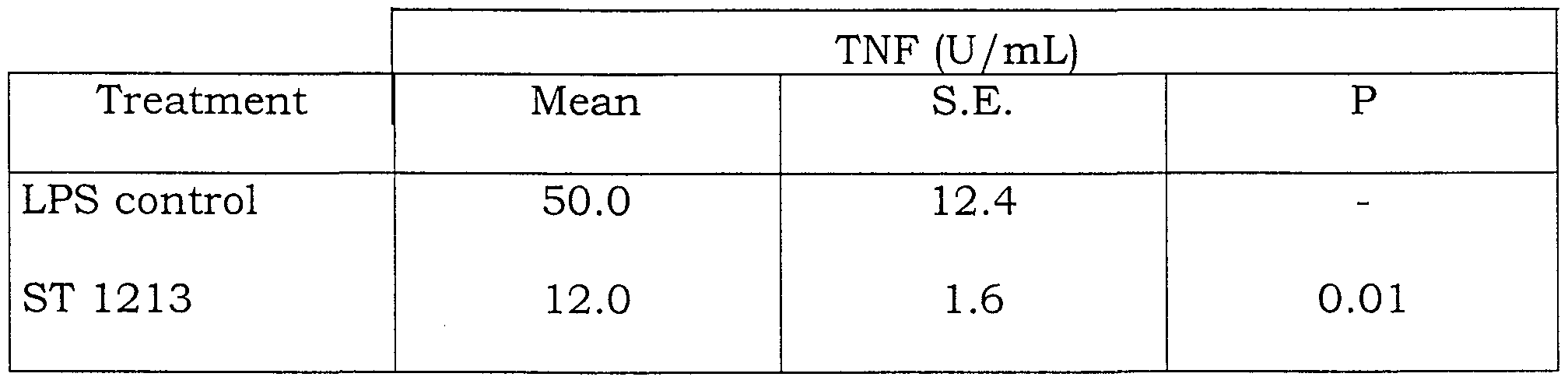
the compound ST 1213 significantly reduces TNF levels induced by
E. coli LPS (p<0.01) (Tab. 8) and produces an even more substantial
reduction in serum TNF levels in the experiment with Salmonella
typhosa LPS (p<0.0001) (Tab. 9).
Table 8 Effect of ST 1213 administration (6 mg/kg i.v.) on serum
TNF levels in E. coli LPS septic shock model in mice. Pre-
and post-challenge treatment (-30 and +5 min).
Figure imgf000025_0001
Table 9 Effect of ST 1213 administration (6 mg/kg i.v.) on serum
TNF levels in S. typhosa LPS septic shock model in mice.
Pre- and post- challenge treatment (-30 and +5 min).
Figure imgf000026_0001
Lethality induced by E. coli LPS in mice sensitised with D-
galactosamine
The results obtained with this experimental model of TNF
production induced by E. coli LPS in animals sensitised with D-
galactosamine are reported in Table 10.
The compound ST 1236 significantly reduces the release of
TNF (p<0.0001) induced by LPS in mice sensitised with D-
galactosamine. Table 10 Effect of ST 1236 administration (19 mg/kg i.v.) on serum
TNF levels induced by E. coli LPS in mice sensitised
with D-galactosamine. Pre- and post-challenge treatment
(-30 and +5 min).
Figure imgf000027_0001
EVALUATION OF THE EFFECT OF ST 1213 ON SERUM
INTERLEUKIN-1 BETA (IL-lβ), INTERLEUKIN-6 (IL-6) AND
INTERFERON-GAMMA (IFN-γ, LEVELS INDUCED BY E. coli or
SEB ENTEROTOXIN IN MICE
Male BALB/c mice (C. River), aged approximately 6 weeks,
were utilised (10 animals per experimental group). The animals.
housed in cages at a constant temperature of 22+2°C and 50+ 15
relative humidity, with 12 hours of light (7 am-7 pm) and 12 hours of
darkness (7 pm-7 am) had unrestricted access to food and drinking
water.
The compound tested was ST 1213. The substances utilised were: LPS from E. coli 026:B6, batch
73570 JB (Difco), SEB (Staphylococcus aureus), batch 144H4024
(Sigma), and D-galactosamine, batch 031EE002485 (Merck).
Lethality induced by E. coli LPS
The experimental conditions were exactly the same as those
previously described.
Lethality induced by SEB from S. aureus in mice sensitised with
D-galactosamine
The experimental conditions were exactly the same as those
previously described.
In both models, blood samples were taken 2 h post-challenge
for IL-6, 4 h post-challenge for IL- lβ, and 6 h post-challenge for IFN-
γ-
Ether- anaesthetised mice were bled by retro-orbital sinus
puncture. Blood samples were incubated at room temperature for 2
h and the serum thus obtained was centrifuged for 20 min at 3000
rpm and stored frozen at -80°C until assayed.
Biological assays were carried out according to the procedures
indicated in the assay kits utilised. In particular, the following were
used: - Mouse IL-lβ Immunoassay (MLBOO, R&D Systems)
- Mouse IL-6 EIA Kit (8-6706, PerSeptive Diagnostics)
- Mouse IFN-γ EIA Kit (8-6716, PerSeptive Diagnostics).
Data were analysed using the one-tailed Student's t-test.
RESULTS
Lethality induced by E. coli LPS
The results obtained with this experimental model are
reported in Table 11.
The compound ST 1213 significantly reduces (ρ<0.0001) the
production of IFN-gamma, but does not reduce the levels of the other
two cytokines analysed .
Table 11 Effect of ST 1213 administration (6 mg/kg i.v.) on serum levels of IL- lβ. IL-6 and IFN-γ in mice stimulated with E. coli LPS. Pre- and post-challenge treatment (-30 and +5 min).
Figure imgf000029_0001
Lethality induced by S. aureus SEB in mice sensitised with
D-galactosamine
The results obtained with this experimental model are
reported in Table 12.
The compound ST 1213 significantly reduces serum IL- l β and
IL-6 levels but not serum IFN-γ levels.
Table 12 Effect of ST 1213 administration (6 mg/kg i.v.) on serum
levels of IL- l β, IL-6 and IFN-γ in mice stimulated with S.
aureus SEB. Pre- and post-challenge treatment (-30 and
+5 min).
Figure imgf000030_0001
EVALUATION OF THE EFFECT OF ST 1213 ON SERUM NITRIC
OXIDE (NOx) INDUCED BY E. coli LPS IN MICE
Male BALB/c mice (C. River), aged approx. 6-7 weeks, were
utilised (6-9 animals per experimental group) . The animals, housed in cages at a constant temperature of
22±2°C and 50±15% relative humidity with 12 hours of light (7 am-7
pm) and 12 hours of darkness (7 pm-7 am), had unrestricted access
to food and drinking water.
The compound tested was ST 1213.
The endotoxin utilised was LPS from E. coli 026:B6, batch
73570, Difco, previously dissolved in sterile saline, which was
injected mtraperitoneally at the dose of 5 mg/kg.
Compounds ST 1213 and ST 626 (reference compound) were
administered i.v. at the dose of 6 mg/kg, corresponding to
approximately 1 / 10 of the LD50, +5 min and +30 min after the LPS
challenge.
Ether-anaesthetised mice were bled by retro-orbital sinus
puncture, taking blood samples 20 h after the LPS challenge, when
NOx reached its serum peak levels in mice.
The blood, put into heparinised test tubes, was centrifuged for
10 min at 2200 rpm and stored frozen at -80 C pending NOx assay.
Before testing the samples were diluted 1 :3 with distilled
water and then centrifuged for 90 min at 4700 g on Ultrafree-MC,
10,000 NMWL Millipore filters (Cat. No. UFC3LGC00).
The sample assay for NOx was carried out using the recently marketed assay kit manufactured by Cabru (Nitrate/ Nitrite assay
kit, Cat. No. 780001).
Data were analysed using the two-tailed Student's t-test.
RESULTS
The results obtained with this experimental model are
reported in Table 13.
The compound ST 1213 significantly reduces NOx levels (42%
reduction) induced by E. coli LPS in BALB/c mice, when
administered post-challenge.
In the same experimental model, the reference compound ST
626 does not significantly reduce serum levels of NOx (21%
reduction) .
Table 13 Effect of ST 1213 administration (6 mg/kg i.v.). Treatment 5 and 30 min after the i.p. LPS challenge (5 mg/kg).
Figure imgf000032_0001
a = Decrease (%) in NOx levels of treated animals compared to the control group, b = Statistical significance evaluated using the two-tailed Student's t-test.

Claims

1. Use of 6,7-substituted 2-aminotetralines with general formula (I)
Figure imgf000033_0001
(I)
or their pharmacologically acceptable salts with general formula
(II)
Figure imgf000033_0002
(II)
wherein:
R is methoxy or hydroxy and
X is the monovalent anion of a pharmacologically acceptable acid suitable for preparing a pharmaceutical composition for the
therapeutic treatment of inflammatory and/ or autoimmune
pathologies induced by inflammatory cytokines.
2. Use according to claim 1 , in which the pharmaceutical
composition is suitable for the prophylactic and the therapeutic
treatment of septic shock.
3. Use according to claim 1 , in which the pharmaceutical
composition is suitable for the therapeutic treatment of
rheumatoid arthritis, pancreatitis, inflammatory bowel disease,
systematic lupus erythematosus, glomerulonephritis and
encephalomy elitis .
4. Use according to claims 1-3, in which the monovalent anion of
the pharmacologically acceptable acid is selected from among
chloride, bromide, orotate, acid aspartate, acid citrate, acid
phosphate, fumarate and acid fumarate, lactate, maleate and
acid maleate, acid oxalate, acid sulphate, glucose phosphate,
tartrate and acid tartrate.
5. Use according to claims 1-3, in which the 6,7-substituted 2-
aminotetraline is (R,S)-2-amino-6,7-dimethoxytetraline hydro-
chloride.
6. Use according to claims 1-3, in which the 6,7-substituted 2-
aminotetraline is (R,S)-2-amino-6,7-dihydroxytetraline hydro¬
chloride.
PCT/IT1998/000250 1997-09-22 1998-09-18 Use of 6,7-substituted 2-aminotetralines suitable for preparing pharmaceutical composition for the therapeutic treatment of inflammatory and/or autoimmune pathologies Ceased WO1999015160A2 (en)

Priority Applications (12)

Application Number Priority Date Filing Date Title
DE69802828T DE69802828T2 (en) 1997-09-22 1998-09-18 USE OF 6,7-SUBSTITUTED 2-AMINOTETRALINE FOR TREATING CYTOKIN-MEDIATED FLAMMABILITY
SI9830040T SI1017377T1 (en) 1997-09-22 1998-09-18 Use of 6, 7-substituted 2-aminotetralines for the treatment of cytokine mediated inflammatory conditions
AU93661/98A AU735369B2 (en) 1997-09-22 1998-09-18 Use of 6,7-substituted 2-aminotetralines suitable for preparing a pharmaceutical composition for the therapeutic treatment of inflammatory and/or autoimmune pathologies
NZ503391A NZ503391A (en) 1997-09-22 1998-09-18 Use of 6,7-substituted 2-aminotetralines useful as for treating inflammatory and/or autoimmune disorders or diseases
DK98946704T DK1017377T3 (en) 1997-09-22 1998-09-18 Use of 6,7-substituted 2-aminotetralins for the treatment of cytokine-induced inflammatory conditions
CA002303918A CA2303918A1 (en) 1997-09-22 1998-09-18 Use of 6,7-substituted 2-aminotetralines suitable for preparing pharmaceutical composition for the therapeutic treatment of inflammatory and/or autoimmune pathologies
BR9812489-7A BR9812489A (en) 1997-09-22 1998-09-18 Use of 6,7-substituted-2-aminotetralins suitable for the preparation of a pharmaceutical composition for the therapeutic treatment of inflammatory and / or autoimmune pathologies
JP2000512530A JP2001517618A (en) 1997-09-22 1998-09-18 Use of 6,7-substituted 2-aminotetralin suitable for preparing a pharmaceutical composition for therapeutic treatment of inflammatory and / or autoimmune diseases
EP98946704A EP1017377B1 (en) 1997-09-22 1998-09-18 Use of 6, 7-substituted 2-aminotetralines for the treatment of cytokine mediated inflammatory conditions
MXPA00002774A MXPA00002774A (en) 1997-09-22 1998-09-18 Use of 6,7-substituted 2-aminotetralines suitable for preparing pharmaceutical composition for the therapeutic treatment of inflammatory and/or autoimmune pathologies.
AT98946704T ATE209910T1 (en) 1997-09-22 1998-09-18 USE OF 6,7-SUBSTITUTED 2-AMINOTETRALINE FOR THE TREATMENT OF CYTOKINE-MEDIATED INFLAMMATORY CONDITIONS
KR1020007003076A KR20010030670A (en) 1997-09-22 1998-09-18 Use of 6,7-substituted 2-aminotetralines suitable for preparing pharmaceutical composition for the therapeutic treatment of inflammatory and/or autoimmune pathologies

Applications Claiming Priority (2)

Application Number Priority Date Filing Date Title
ITRM97A000569 1997-09-22
IT97RM000569A IT1294932B1 (en) 1997-09-22 1997-09-22 USE OF SUBSTITUTED 2-AMINOTETHRALINE-6,7 FOR THE PREPARATION OF PHARMACEUTICAL COMPOSITIONS SUITABLE FOR THE TREATMENT OF PATHOLOGIES

Publications (2)

Publication Number Publication Date
WO1999015160A2 true WO1999015160A2 (en) 1999-04-01
WO1999015160A3 WO1999015160A3 (en) 1999-05-20

Family

ID=11405258

Family Applications (1)

Application Number Title Priority Date Filing Date
PCT/IT1998/000250 Ceased WO1999015160A2 (en) 1997-09-22 1998-09-18 Use of 6,7-substituted 2-aminotetralines suitable for preparing pharmaceutical composition for the therapeutic treatment of inflammatory and/or autoimmune pathologies

Country Status (17)

Country Link
US (1) US6242497B1 (en)
EP (1) EP1017377B1 (en)
JP (1) JP2001517618A (en)
KR (1) KR20010030670A (en)
CN (1) CN1276721A (en)
AT (1) ATE209910T1 (en)
AU (1) AU735369B2 (en)
BR (1) BR9812489A (en)
CA (1) CA2303918A1 (en)
DE (1) DE69802828T2 (en)
DK (1) DK1017377T3 (en)
ES (1) ES2167942T3 (en)
IT (1) IT1294932B1 (en)
MX (1) MXPA00002774A (en)
NZ (1) NZ503391A (en)
PT (1) PT1017377E (en)
WO (1) WO1999015160A2 (en)

Cited By (1)

* Cited by examiner, † Cited by third party
Publication number Priority date Publication date Assignee Title
WO2011047350A3 (en) * 2009-10-16 2011-10-27 David Helton Emesis treatment

Families Citing this family (1)

* Cited by examiner, † Cited by third party
Publication number Priority date Publication date Assignee Title
IT1294931B1 (en) * 1997-09-22 1999-04-23 Sigma Tau Ind Farmaceuti DERIVATIVES OF 2-AMINOTETHRALIN PROCEDURE FOR THEIR PREPARATION AND PHARMACEUTICAL COMPOSITIONS CONTAINING THEM, ACTIVE IN THE

Family Cites Families (2)

* Cited by examiner, † Cited by third party
Publication number Priority date Publication date Assignee Title
IT1241988B (en) * 1990-06-15 1994-02-02 Sigma Tau Ind Farmaceuti 2- AMMINOTETRALINE-6, 7-ACTIVE SUBSTITUTES AS IMMUNOMODULANTS AND PHARMACEUTICAL COMPOSITIONS CONTAINING THEM
IT1278045B1 (en) * 1995-03-09 1997-11-17 Sigma Tau Ind Farmaceuti USE OF 2-AMINOTETRALINE-6,7-SUBSTITUTED FOR THE PREPARATION OF PHARMACEUTICAL COMPOSITIONS SUITABLE FOR THE TREATMENT OF SHOCK, AND OF

Cited By (2)

* Cited by examiner, † Cited by third party
Publication number Priority date Publication date Assignee Title
WO2011047350A3 (en) * 2009-10-16 2011-10-27 David Helton Emesis treatment
US9918949B2 (en) 2009-10-16 2018-03-20 Repurposed Therapeutics, Inc. Emesis treatment

Also Published As

Publication number Publication date
DK1017377T3 (en) 2002-03-04
DE69802828T2 (en) 2002-07-18
AU9366198A (en) 1999-04-12
DE69802828D1 (en) 2002-01-17
ITRM970569A1 (en) 1999-03-22
IT1294932B1 (en) 1999-04-23
NZ503391A (en) 2001-06-29
JP2001517618A (en) 2001-10-09
EP1017377A2 (en) 2000-07-12
CN1276721A (en) 2000-12-13
AU735369B2 (en) 2001-07-05
US6242497B1 (en) 2001-06-05
BR9812489A (en) 2000-09-26
KR20010030670A (en) 2001-04-16
ATE209910T1 (en) 2001-12-15
WO1999015160A3 (en) 1999-05-20
ES2167942T3 (en) 2002-05-16
EP1017377B1 (en) 2001-12-05
PT1017377E (en) 2002-04-29
MXPA00002774A (en) 2002-10-31
CA2303918A1 (en) 1999-04-01

Similar Documents

Publication Publication Date Title
CN117398384A (en) Use of piperidinyl-indole derivatives
Matsuura et al. Biological activities of lipopolysaccharide of Burkholderia (Pseudomonas) pseudomallei
JP6035340B2 (en) Compositions and methods for treating autoimmune diseases
Steenken Jr et al. Cycloserine: antituberculous activity in vitro and in the experimental animal
US6849663B2 (en) 2-Aminotetralines, a process for their preparation, and pharmaceutical compositions, for the prevention and therapeutic treatment of inflammatory and/or autoimmune pathologies
AU735369B2 (en) Use of 6,7-substituted 2-aminotetralines suitable for preparing a pharmaceutical composition for the therapeutic treatment of inflammatory and/or autoimmune pathologies
Heikkila et al. Pharmacological studies with several analogs of mazindol: correlation between effects on dopamine uptake and various in vivo responses
Tegzes et al. Toxic mushrooms
US6225501B1 (en) Optically active 2-aminotetraline, process for its preparation and pharmaceutical compositions containing same, active in preventing and treating septic shock
CN117482084A (en) A new antifungal use of artemisinin or its analogues
CN108992437B (en) Use of lauroyl arginine ethyl ester as veterinary antibacterial agent
Costantini The fungal etiology of gout and hyperuricemia: the antifungal mode of action of colchicine
EP0730861B1 (en) Use of 6,7-substituted-2-aminotetralines for preparing pharmaceutical compositions useful for the treatment of septic shock, and antipyretic and antiinflammatory pharmaceutical compositions
WO1998033762A9 (en) Optically active 2-aminotetraline, process for its preparation and pharmaceutical compositions containing same, active in preventing and treating septic shock
CN119633011B (en) Application of acetyl-CoA in preparing medicine for treating pneumonia
JP2021517887A (en) Uses of Calimycin or its active ingredient
CN100562315C (en) Active compound of Baojiwan pill for resisting diarrhea and relieving gastrointestinal diseases
TW202302110A (en) Pharmaceutical composition comprising jak3/jak1/tbk1 selective inhibitor and medical use thereof
WO2022162265A1 (en) Antimicrobials against pathogens of the genus streptococcus
JPH08183734A (en) Use of phthalidylidene esters of carnitine and alkanoylcarnitines for the treatment of endotoxic shock.
Matsumoto et al. Methenamine Salts as Topical Antibacterial Agent: I. Experimental Studies for Burn and Crush Wound
Matsukura et al. Clinical and experimental studies on acute intestinal obstructions with special reference to the cause of death
Goswick Effects Of Therapeutic Agents On The Lee (M67) Strain Of Naegleria Fowleri
CN1546028A (en) Compound furosemide injection for treating piglet edema disease

Legal Events

Date Code Title Description
WWE Wipo information: entry into national phase

Ref document number: 98810460.1

Country of ref document: CN

AK Designated states

Kind code of ref document: A2

Designated state(s): AL AM AT AU AZ BA BB BG BR BY CA CH CN CU CZ DE DK EE ES FI GB GE GH GM HU ID IL IS JP KE KG KP KR KZ LC LK LR LS LT LU LV MD MG MK MN MW MX NO NZ PL PT RO RU SD SE SG SI SK SL TJ TM TR TT UA UG US UZ VN YU ZW

AL Designated countries for regional patents

Kind code of ref document: A2

Designated state(s): GH GM KE LS MW SD SZ UG ZW AM AZ BY KG KZ MD RU TJ TM AT BE CH CY DE DK ES FI FR GB GR IE IT LU MC NL PT SE BF BJ CF CG CI CM GA GN GW ML MR NE SN TD TG

AK Designated states

Kind code of ref document: A3

Designated state(s): AL AM AT AU AZ BA BB BG BR BY CA CH CN CU CZ DE DK EE ES FI GB GE GH GM HU ID IL IS JP KE KG KP KR KZ LC LK LR LS LT LU LV MD MG MK MN MW MX NO NZ PL PT RO RU SD SE SG SI SK SL TJ TM TR TT UA UG US UZ VN YU ZW

AL Designated countries for regional patents

Kind code of ref document: A3

Designated state(s): GH GM KE LS MW SD SZ UG ZW AM AZ BY KG KZ MD RU TJ TM AT BE CH CY DE DK ES FI FR GB GR IE IT LU MC NL PT SE BF BJ CF CG CI CM GA GN GW ML MR NE SN TD TG

121 Ep: the epo has been informed by wipo that ep was designated in this application
DFPE Request for preliminary examination filed prior to expiration of 19th month from priority date (pct application filed before 20040101)
WWE Wipo information: entry into national phase

Ref document number: 503391

Country of ref document: NZ

WWE Wipo information: entry into national phase

Ref document number: 93661/98

Country of ref document: AU

ENP Entry into the national phase

Ref document number: 2303918

Country of ref document: CA

Ref document number: 2303918

Country of ref document: CA

Kind code of ref document: A

WWE Wipo information: entry into national phase

Ref document number: PA/a/2000/002774

Country of ref document: MX

WWE Wipo information: entry into national phase

Ref document number: 1020007003076

Country of ref document: KR

WWE Wipo information: entry into national phase

Ref document number: 1998946704

Country of ref document: EP

WWP Wipo information: published in national office

Ref document number: 1998946704

Country of ref document: EP

REG Reference to national code

Ref country code: DE

Ref legal event code: 8642

WWP Wipo information: published in national office

Ref document number: 1020007003076

Country of ref document: KR

WWG Wipo information: grant in national office

Ref document number: 93661/98

Country of ref document: AU

WWG Wipo information: grant in national office

Ref document number: 1998946704

Country of ref document: EP

WWR Wipo information: refused in national office

Ref document number: 1020007003076

Country of ref document: KR