WO1999028320A1 - 2-aryl-8-oxodihydropurine derivatives, process for producing the same, medicinal compositions containing the same, and intermediates thereof - Google Patents
2-aryl-8-oxodihydropurine derivatives, process for producing the same, medicinal compositions containing the same, and intermediates thereof Download PDFInfo
- Publication number
- WO1999028320A1 WO1999028320A1 PCT/JP1998/005320 JP9805320W WO9928320A1 WO 1999028320 A1 WO1999028320 A1 WO 1999028320A1 JP 9805320 W JP9805320 W JP 9805320W WO 9928320 A1 WO9928320 A1 WO 9928320A1
- Authority
- WO
- WIPO (PCT)
- Prior art keywords
- group
- alkyl group
- hydrogen atom
- formula
- phenyl
- Prior art date
- Legal status (The legal status is an assumption and is not a legal conclusion. Google has not performed a legal analysis and makes no representation as to the accuracy of the status listed.)
- Ceased
Links
Classifications
-
- C—CHEMISTRY; METALLURGY
- C07—ORGANIC CHEMISTRY
- C07D—HETEROCYCLIC COMPOUNDS
- C07D473/00—Heterocyclic compounds containing purine ring systems
-
- A—HUMAN NECESSITIES
- A61—MEDICAL OR VETERINARY SCIENCE; HYGIENE
- A61P—SPECIFIC THERAPEUTIC ACTIVITY OF CHEMICAL COMPOUNDS OR MEDICINAL PREPARATIONS
- A61P25/00—Drugs for disorders of the nervous system
-
- A—HUMAN NECESSITIES
- A61—MEDICAL OR VETERINARY SCIENCE; HYGIENE
- A61P—SPECIFIC THERAPEUTIC ACTIVITY OF CHEMICAL COMPOUNDS OR MEDICINAL PREPARATIONS
- A61P25/00—Drugs for disorders of the nervous system
- A61P25/08—Antiepileptics; Anticonvulsants
-
- A—HUMAN NECESSITIES
- A61—MEDICAL OR VETERINARY SCIENCE; HYGIENE
- A61P—SPECIFIC THERAPEUTIC ACTIVITY OF CHEMICAL COMPOUNDS OR MEDICINAL PREPARATIONS
- A61P25/00—Drugs for disorders of the nervous system
- A61P25/22—Anxiolytics
-
- A—HUMAN NECESSITIES
- A61—MEDICAL OR VETERINARY SCIENCE; HYGIENE
- A61P—SPECIFIC THERAPEUTIC ACTIVITY OF CHEMICAL COMPOUNDS OR MEDICINAL PREPARATIONS
- A61P25/00—Drugs for disorders of the nervous system
- A61P25/24—Antidepressants
-
- A—HUMAN NECESSITIES
- A61—MEDICAL OR VETERINARY SCIENCE; HYGIENE
- A61P—SPECIFIC THERAPEUTIC ACTIVITY OF CHEMICAL COMPOUNDS OR MEDICINAL PREPARATIONS
- A61P25/00—Drugs for disorders of the nervous system
- A61P25/26—Psychostimulants, e.g. nicotine, cocaine
-
- A—HUMAN NECESSITIES
- A61—MEDICAL OR VETERINARY SCIENCE; HYGIENE
- A61P—SPECIFIC THERAPEUTIC ACTIVITY OF CHEMICAL COMPOUNDS OR MEDICINAL PREPARATIONS
- A61P37/00—Drugs for immunological or allergic disorders
-
- A—HUMAN NECESSITIES
- A61—MEDICAL OR VETERINARY SCIENCE; HYGIENE
- A61P—SPECIFIC THERAPEUTIC ACTIVITY OF CHEMICAL COMPOUNDS OR MEDICINAL PREPARATIONS
- A61P37/00—Drugs for immunological or allergic disorders
- A61P37/02—Immunomodulators
-
- A—HUMAN NECESSITIES
- A61—MEDICAL OR VETERINARY SCIENCE; HYGIENE
- A61P—SPECIFIC THERAPEUTIC ACTIVITY OF CHEMICAL COMPOUNDS OR MEDICINAL PREPARATIONS
- A61P43/00—Drugs for specific purposes, not provided for in groups A61P1/00-A61P41/00
-
- A—HUMAN NECESSITIES
- A61—MEDICAL OR VETERINARY SCIENCE; HYGIENE
- A61P—SPECIFIC THERAPEUTIC ACTIVITY OF CHEMICAL COMPOUNDS OR MEDICINAL PREPARATIONS
- A61P9/00—Drugs for disorders of the cardiovascular system
Definitions
- the present invention relates to a novel 2-ary-l-u-oxodihydropurine derivative which selectively acts on a peripheral benzodiazepine receptor, and more particularly, has a amide amide moiety at the 7- or 9-position of the purine ring.
- the present invention relates to a 2-aryl-8-oxodihydropurine derivative, a method for producing the same, a pharmaceutical composition containing the same and an intermediate of the compound.
- the central type ⁇ receptor is ⁇ -aminobutyric acid (hereinafter sometimes referred to as “GABA”) in the central nervous system.
- GABA ⁇ -aminobutyric acid
- peripheral BZ receptors are widely distributed in central and peripheral tissues and organs (brain, kidney, liver, heart, etc.).
- peripheral BZ receptors are present at high density in endocrine organs such as the adrenal gland and testicles, and in cells that are deeply involved in biological inflammatory immune mechanisms such as mast cells, lymphocytes, macrophages, and platelets.
- Interest in physiological roles is growing.
- the peripheral BZ receptor in the brain is abundant in the mitochondrial membrane of glial cells and is involved in the uptake of cholesterol into the mitochondrial membrane. It is thought to affect the biosynthetic pathways to e.g.
- the following compounds are known as compounds having a non-BZ skeleton and exhibiting selective affinity for peripheral BZ receptors.
- Japanese Patent Application Laid-Open No. Sho 62-5946 discloses that an amide represented by the following formula binds to a peripheral BZ receptor, thereby producing anxiety. It is described as useful as a drug, an antispasmodic agent, an antianginal agent, and a therapeutic agent for immunodeficiency symptoms.
- WO 9 6 - The 3 2 3 8 3 JP, have anxiolytic effects Ya anti Riumachi work with acetic ⁇ Mi de derivative represented by the following formula is applied selectively to the BZ omega 3 receptor, anxiety It is described that it can be used for treating related diseases and immune diseases.
- R 2 represents a lower alkyl group, a cycloalkyl group, an unsubstituted or substituted phenyl group, an unsubstituted or substituted phenyl (lower) alkyl group,
- R 3 represents a hydrogen atom, a lower alkyl group or a hydroxy (lower) alkyl group
- R 4 represents a hydrogen atom, a lower alkyl group, or the like
- R 5 is a hydrogen atom, a lower alkyl group, a lower alkenyl group, a hydroxy (lower) alkyl group, an unsubstituted or substituted benzyloxy (lower) alkyl group, an acyloxy (lower) alkyl group, a lower alkoxy (lower) alkyl group Amino, mono- or di-lower alkylamino, acylamino, amino (lower) alkyl, nitro, carbamoyl, mono- or di-lower alkyl rubamoyl, carboxyl, protected carboxyl, carboxy (lower) An alkyl group or a protected alkyl (lower) alkyl group;
- R 6 is a hydrogen atom, lower alkyl group, trifluoromethyl group or an unsubstituted or substituted phenyl group; or R 5 and R 6 are taken together to form — (CH 2 ) ⁇ , ⁇ means 3, 4, 5 or 6)
- R 7 is a hydrogen atom, a halogen atom, a lower alkyl group, a lower alkoxy group, a trifluoromethyl group, a hydroxy group, an amino group, a mono- or di-lower alkylamino group, Means a cyano group or a nitro group,
- R 8 represents a hydrogen atom, a halogen atom, a lower alkyl group or a lower alkoxy group
- the present inventors have, beta Zeta omega 3 selectively Chikaratsu strongly result of intensive studies to obtain a compound which acts on receptors, 2-Ariru one 8-Okisojihi de port represented by the below formula (I)
- the present inventors have found that a purine derivative meets this purpose, and have completed the present invention.
- the present invention beta Zeta omega 3 receptor selectively and strongly acting novel 2 ⁇ Li one Roux 8 Okisojihi Doropurin derivatives, more particularly been or 7-position of Okisojihi Doropurin 9-position acetic ⁇ Mi de
- An object of the present invention is to provide a 2-aryl-8-oxodihydropurine derivative having a moiety bonded thereto.
- an object of the present invention is to provide a useful compound having an anxiolytic effect. Another object of the present invention is to provide a method for producing the compound. Furthermore, an object of the present invention is to provide a pharmaceutical composition containing the compound. Another object of the present invention is to provide an intermediate for producing the compound.
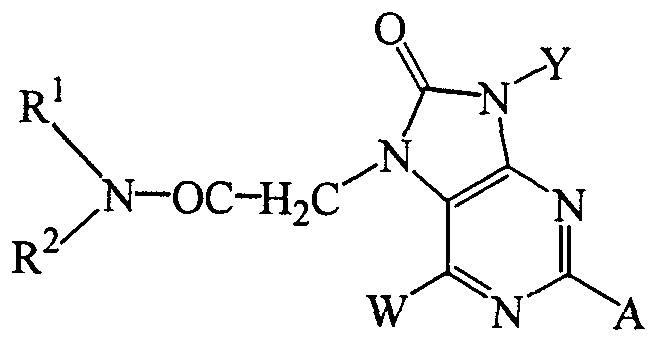
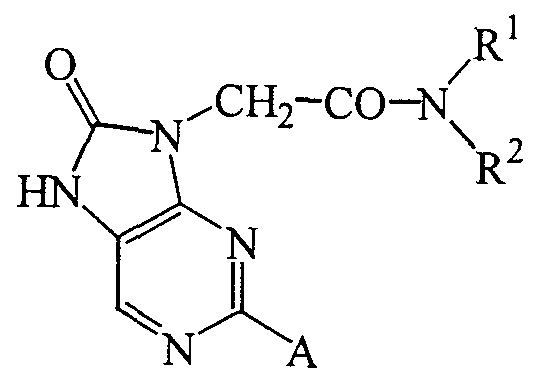
- a 2-aryl 8-oxodihydroproprine derivative represented by the following formula (I) and a pharmaceutically acceptable acid addition salt thereof a method for producing the same, and a compound containing the compound Pharmaceutical compositions,
- W represents a hydrogen atom, a lower alkyl group, a halogen atom, a lower alkoxy group, an amino group, a mono- or di- (lower) alkylamino group, or an unsubstituted or substituted phenyl group,
- X is a hydrogen atom, a lower alkyl group, a cycloalkyl (lower) alkyl group, an unsubstituted or substituted phenyl (lower) alkyl group, a lower alkenyl group, a carbamoyl group, A (lower) alkyl group or a group represented by the following formula [Q],
- R 1 represents a lower alkyl group, a lower alkenyl group, a cycloalkyl group, a cycloalkyl (lower) alkyl group or a hydroxy (lower) alkyl group
- R 2 represents a lower alkyl group, a cycloalkyl group, unsubstituted Or a substituted functional group, an unsubstituted or substituted phenyl (lower) alkyl group or an unsubstituted or substituted heteroaryl group, or R 1 and R 2 together with an adjacent nitrogen atom Or may form a piperidine ring, a pyrrolidine ring, a morpholine ring or a piperazine ring, each of which may be substituted by two lower alkyl groups, and R 3 is a hydrogen atom, a lower alkyl group or a hydroxy group.
- Y represents a hydrogen atom, a lower alkyl group, a cycloalkyl group, a cycloalkyl (lower) alkyl group, a lower alkenyl group, an unsubstituted or substituted phenyl (lower) alkyl group, or a group represented by the following formula [Q]
- Y represents a hydrogen atom, a lower alkyl group, a cycloalkyl group, a cycloalkyl (lower) alkyl group, a lower alkenyl group, an unsubstituted or substituted phenyl (lower) alkyl group, or a group represented by the following formula [Q]
- A represents an unsubstituted or substituted phenyl group or an unsubstituted or substituted heteroaryl group.
- one of X and Y is a group represented by the above formula [Q], and the other is each the same group as the above X and Y other than the formula [Q]]
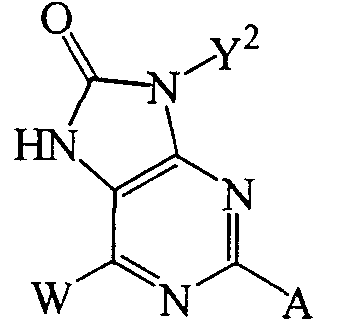
- Y 2 represents a hydrogen atom, a lower alkyl group, a cycloalkyl group, a cycloalkyl (lower) alkyl group, a lower alkenyl group or an unsubstituted or substituted fuunyl (lower) alkyl group, and A and W are as defined above. Means the same thing]
- the pharmaceutically acceptable acid addition salt of the compound represented by the formula (I) A pharmaceutically acceptable acid addition salt of a compound of formula (I) when it has a basicity sufficient to form a salt, for example, hydrochloride, hydrobromide, hydroiodide, Inorganic acid salts such as sulfates and phosphates and organic acid salts such as maleate, fumarate, oxalate, citrate, tartrate, lactate, benzoate, methanesulfonate, etc. It is.
- the compound of the formula (I) and its intermediate, the compound of the formula (II) and their acid addition salts may be present in the form of hydrates and Z or solvates. Hydrates and solvates are also included in the compounds of the present invention.
- the compounds of formula (I) optionally have one or more asymmetric carbon atoms and may give rise to geometric isomerism.
- the compounds of formula (I) may optionally exist in more than one stereoisomeric form. These stereoisomers, their mixtures and racemates are included in the compounds of the present invention.
- the 2-aryl-18-oxodihydropurine derivatives of the present invention are given a purine ring position number as shown in the following formula, and are named according to this position number in the present specification.
- the lower alkyl group and the lower alkyl moiety mean those having 1 to 6 carbon atoms, unless otherwise specified, and may be linear or branched. Specific examples of the “lower alkyl group” include methyl, ethyl, propyl, isopropyl, butyl, isobutyl, pentyl, and hexyl. The lower alkyl group preferably has 1 to 4 carbon atoms. “Lower alkoxy group” means an alkoxy group having 1 to 6 carbon atoms, and examples include methoxy, ethoxy, propoxy, isopropoxy and butoxy.
- “Lower alkenyl group” means one double bond other than between 1 and 2 C3 to C6 means, for example, aryl and 2-butyr.
- the "cycloalkyl group” means one having 3 to 8 carbon atoms, and specific examples include cyclopropynole, cyclopentinole, cyclopentinole, cyclohexinole, cycloheptinole, and cyclooctyl.
- the “cycloalkyl (lower) alkyl group” means an alkyl group having 1 to 4 carbon atoms which is substituted by the above “cycloalkyl group”, and examples thereof include cyclopropylmethyl, cyclopentylmethyl and cyclohexylmethyl.
- “Hydroxy (lower) alkyl group” refers to a lower alkyl group substituted with a hydroxy group, and includes, for example, hydroxymethyl, 2-hydroxyxethyl, and 3-hydroxypropyl.
- “Halogen atom” means fluorine, chlorine, bromine, and iodine.
- “Mono or di (lower) alkylamino group” means an amino group in which one or two alkyl groups having 1 to 4 carbon atoms are substituted, such as methylamino, ethylamino, propylamino, dimethylamino, dimethylamino, Dipropylamino and ethylmethylamino.
- “Unsubstituted or substituted phenyl group” means one or two substituted with halogen atom, lower alkyl, lower alkoxy, trifluoromethyl, hydroxy, amino, mono- or di (lower) alkylamino, cyano and nitro. Phenyl; 2-, 3- or 4-chlorophenyl; 2-, 3- or 4-bromophenyl; 2-, 3- or 4-fluorophenylinole; 2,4-dicyclobutene; 2,4-dib, lomofen; 2,4-difluorophenyl; 2-, 3- or 4-methylphenyl; 2-, 3- or
- Unsubstituted or substituted phenyl (lower) alkyl means a halogen atom, lower alkyl, lower alkoxy, trifluoromethyl, hydroxy, amino, mono- or di (lower) alkylamino, cyano and nitro.
- R 4 represents a hydrogen atom, a halogen atom, a lower alkyl group, a lower alkoxy group, a trifluoromethyl group, a hydroxy group, an amino group, a mono- or di- (lower) alkylamino group, a cyano group or a nitro group
- R 5 represents a hydrogen atom, a halogen atom, a lower alkyl group, a lower alkoxy group or a hydroxy group
- R 4 represents a hydrogen atom, a halogen atom, a lower alkyl group, a lower alkoxy group, a trifluoromethyl group, a hydroxy group, an amino group, a mono- or di- (lower) alkylamino group, a cyano group or a nitro group
- R 5 represents a hydrogen atom, a halogen atom, a lower alkyl group, a lower alkoxy group or a hydroxy group, and m represents 0, 1 or 2
- R 11 and R 21 together with the adjacent nitrogen atom may be substituted with one or two lower alkyl groups, respectively.
- R 31 represents a hydrogen atom, a lower alkyl group or a hydroxy (lower) alkyl group],
- Y is a hydrogen atom or a lower alkyl group
- X is a hydrogen atom, a lower alkyl group or a radical group
- Y is the following formula
- A is a group represented by the above formula [ ⁇ '], a pyridyl group, a cyenyl group or a furyl group, and w is the same compound as described above and a pharmaceutically acceptable acid addition salt thereof.
- X is a group represented by the above formula [Qx] (wherein, R 11 is a methyl group, an ethyl group, a propyl group, an isopropyl group or a butyl group, and R 21 is an ethyl group, a propyl group, an isopropyl group Butyl, phenyl, halogen, methoxy, trifluoromethyl or hydroxy-substituted phenyl, benzyl, or halogen, methoxy, trifluoromethyl or hydroxy-substituted benzyl, and R 31 is as described above.
- Y is a hydrogen atom, a methyl group or an ethyl group, or
- X is a hydrogen atom, a methyl group, an ethyl group, a propyl group, an isopropyl group or a butyl group
- Y is a group represented by the above formula [Qy] (where R 11 is a methyl group, an ethyl group , Propyl, isopropyl or butyl, wherein R 21 is phenyl, propyl, isopropyl, butyl, phenyl, phenyl, halogen, methoxy, trifluoromethyl or hydroxy-substituted phenyl, benzyl or benzyl.
- Particularly preferred compounds include 2-aryl 8-oxodihydropurine derivatives represented by the following formula (I3) or (1b) and pharmaceutically acceptable acid addition salts thereof. .
- R 12 and R 22 are the same or different and represent an ethyl group, a propyl group or a butyl group, or R 12 represents a methyl group, an ethyl group or a propyl group, and R 22 represents a phenyl group, a halogenophenyl Group, methoxyphenyl group, benzyl group, halogenobenzyl group or methoxybenzyl group, R 32 represents a hydrogen atom, methyl group or ethyl group, Y 1 represents a hydrogen atom, methyl group or ethyl group R 41 represents a hydrogen atom, a halogen atom, a methyl group, a methoxy group, a nitro group or a trifluoromethyl group),
- X 1 represents a hydrogen atom, a methyl group, an ethyl group or a propyl group
- R 12 and R 22 are the same or different and have the meaning of an ethyl group, a propyl group or a butyl group, or R 12 methyl group, a Echiru or propyl
- R 22 denotes Hue group, Harogu Roh phenylene Honoré group, main Tokishifue group, a benzyl group, a Harogenoben Jill group or main Tokishibenjiru group
- R 32 is a hydrogen atom , A methyl group or an ethyl group
- R 41 represents a hydrogen atom, a halogen atom, a methyl group, a methoxy group, a nitro group or a trifluoromethyl group
- compounds wherein R 32 is each a hydrogen atom are more preferred.
- particularly preferred compounds include, for example, the following compounds and pharmaceutically acceptable acid addition salts thereof.
- N-Penzinole 7,8-Dihydro Draw N-Methyl-7-Methynole 1 8-Oxo 1 2— (4-Chlorophenyl) -19H—Purine 19-acetoamide.
- Ph-4-C1 represents a 4-chlorophenyl group
- Ph-4-F represents a 4-fluorophenyl group
- 2-Thi represents a 2-phenyl group.
- the compound of the present invention can be produced, for example, by the following method.
- the compound wherein Y is a hydrogen atom, a lower alkyl group, a cycloalkyl group, a cycloalkyl (lower) alkyl group, a lower alkenyl group or an unsubstituted or substituted phenyl (lower) alkyl group is represented by the following formula: (II)
- the leaving atom or leaving group represented by z in the formula (III) means an atom or group capable of leaving in the form of HZ together with the hydrogen atom in the NH portion of the compound of the formula (II) under the reaction conditions.
- halogen atoms such as chlorine, bromine and iodine
- lower alkylsulfonyloxy groups such as methanesulfonyloxy
- trihalogenomethanesulfonyloxy groups such as trifluoromethanesulfonyloxy
- benzenesulfonyloxy and arylsulfonyloxy groups such as p-toluenesulfonyloxy.
- the reaction between the compound represented by the formula (II) and the compound represented by the formula (III) can be carried out in the presence of a base, without a solvent or in a suitable solvent under normal pressure or pressure.
- a base examples include toluene, xylene, dimethoxetane, 1,2-dichloroethane, acetone, methylethylketone, dioxane, diglyme, ethyl acetate, dimethylformamide, and dimethylsulfoxide.
- Bases include sodium hydride, triethylamine, potassium carbonate, and sodium carbonate. No.
- the reaction temperature is usually about 110 ° C to about 150 ° C, preferably about 10 ° C to about 70 ° C.
- R 1 and Z or R 3 in the above formula (III) are a hydroxy (lower) alkyl group
- the hydroxy (lower) alkyl group is protected by a protecting group which can be eliminated by hydrogenolysis.
- the protecting group is, for example, benzyloxy, 4-chlorobenzyloxy, 3-bromobenzyloxy, 4-fluorobenzyloxy, 4-methylbenzyloxy, 4-methoxybenzyloxy.
- the protecting group can be easily converted to hydroxy groups by conventional hydrogenolysis.
- the same protection is carried out, followed by deprotection to obtain a desired compound. It is desirable.
- the compound of the formula (II) can be produced by a method known per se, for example, the method described in JP-A No. 62-64 or a method analogous thereto.
- the starting compound (II) can be produced, for example, by the method shown in Route A or Route B below.
- R represents a lower alkyl group
- Z 1 represents a halogen atom or an arylsulfonyloxy group such as a p-toluenesulfonyloxy group, a methanesulfonyloxy group or a trifluoromethanesulfonyloxy group
- A, W and Y 2 mean the same as above.
- Step 1 Halogenated or sulfonirido
- the halogenation is carried out, for example, by reacting a compound of the formula (A) or (F) with a halogenating agent (for example, oxychloride phosphorus, phosphorus tribromide).
- a halogenating agent for example, oxychloride phosphorus, phosphorus tribromide.
- the sulfonylation is carried out, for example, by reacting a compound of the formula (A) or (F) with a sulfonylating agent (eg, methanesulfonyl chloride, p-toluenesulfuryl chloride, trifluorosulfone methanesulfonyl chloride). This is done by:
- reaction of the compound of the formula (B) or (G) with the compound of the formula (C) is carried out at normal pressure or under pressure, in the absence of a solvent or in a suitable solvent.
- the solvent include aromatic hydrocarbons such as toluene and xylene; Examples include ketones such as rutile ketone and methyl isobutyl ketone, ethers such as dioxane and diglime, alcohols such as ethanol, isopropanol and butanol, acetonitrile, dimethylformamide and dimethyl sulfoxide.
- This reaction is preferably carried out in the presence of a base.
- the base include alkali carbonates such as sodium carbonate and potassium carbonate, alkali hydrogen carbonates such as sodium hydrogen carbonate and potassium hydrogen carbonate, and the like.
- a tertiary amine such as triethylamine can be used, but it can also serve as an excess of the compound of the formula (C).
- the reaction temperature varies depending on the type of the starting compound, the reaction conditions and the like, but is usually about 0 ° C to about 200 ° C, preferably about 20 ° C to about 100 ° C.
- This hydrolysis can be carried out according to a conventional method, for example, by contacting with water in an appropriate solvent under acidic or basic conditions.
- the solvent for example, alcohols such as methanol, ethanol, and isopropanol, dioxane, water, or a mixture thereof is used.
- acids include mineral acids such as hydrochloric acid and sulfuric acid, and organic acids such as formic acid, acetic acid, propionic acid and oxalic acid.
- Specific examples of the base include alkali hydroxides such as sodium hydroxide and potassium hydroxide, and alkali carbonates such as sodium carbonate and potassium carbonate.
- the reaction temperature is usually about 20 ° C to 100 ° C.
- This reduction can be carried out according to a conventional method, for example, by reacting with hydrogen in a suitable solvent in the presence of a catalyst such as palladium carbon, Raney nickel, and platinum oxide.
- a catalyst such as palladium carbon, Raney nickel, and platinum oxide.
- the present reduction reaction is a combination of a metal (eg, tin, zinc, iron) or a metal salt (eg, stannous salt) and an acid (eg, hydrochloric acid, acetic acid), or iron or stannous chloride alone.
- the solvent for example, alcohols such as ethanol and methanol, water, acetic acid, dioxane, and tetrahydrofuran are used.
- the reaction temperature is usually about 0 ° C. to about 80 ° C., and the reaction is carried out under normal pressure or under pressure.
- This reaction can be carried out by the same method as described in the production method (b) or (c) below.
- Can be produced by reacting an azide compound with the compound represented by Examples of the azide compound used in this reaction include diphenylphosphoric acid azide and sodium azide.
- This reaction can be carried out in the presence of a base, without a solvent, or in a suitable solvent under normal pressure or pressure.
- a base without a solvent, or in a suitable solvent under normal pressure or pressure.
- the solvent to be used include toluene, xylene, dimethoxetane, 1,2-dichloroethane, acetone, methylethylketone, dioxane, diglyme, ethylethyl acetate, dimethylformamide, and dimethylsulfoxide.
- Bases include triethylamine, potassium carbonate, and sodium carbonate.
- the reaction temperature is usually about 10 ° C. to about 150 ° C., preferably about 30 ° C. to about 120 ° C.
- Starting compound (IV) is a compound of formula (C) in Route A is Y 3 - even Noto formula is NH 2 in steps 2 and 3 of the compound shown in Yore ,, the root A of (B) On the way Can be manufactured more. Further, the starting compound (IV) was prepared by using the compound of the formula (B) of Route A and amino acids, and a substituted amino group was introduced into the 4-position of the pyrimidine ring by the method of Step 2 of Route A. Thereafter, it can also be produced by amidation by the method described in Production method (e) described below, and further, if necessary, by alkylation, and is specifically shown in Reference Example 63 described later.
- Starting compound (V) is a compound of the route B (C) is Y 3 - method steps 2 and 3 showing the what is NH 2 with a compound of formula (G) in Yore ,, the route B Can be manufactured.
- X 2 is the same group as X described above except for a hydrogen atom and the group represented by the above formula [Q], and ⁇ ⁇ means the same as described above.
- the starting compound (VII) can be produced by a commercially available method known per se.
- R 13 and R 23 represent a hydrogen atom or the same as defined above for R 1 and R 2 respectively.
- R 24 represents a lower alkyl group, a cycloalkyl group or an unsubstituted or substituted phenyl (lower) alkyl group
- R 14 represents a lower alkyl group, a lower alkenyl group
- It means a cycloalkyl group, a cycloalkyl (lower) alkyl group or a hydroxy (lower) alkyl group
- Z has the same meaning as described above.
- R 13 is a hydrogen atom
- the compound of the above formula (X) is reacted
- R 23 is a hydrogen atom
- the compound of the above formula (XI) is reacted.
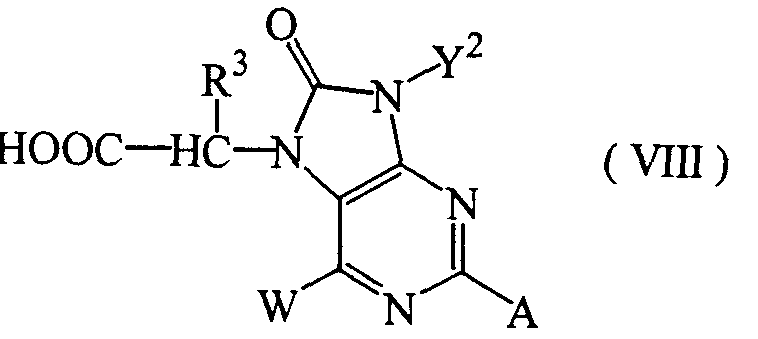
- Reactive derivatives of the compound of formula (VIII) include, for example, lower alkyl esters
- methyl esters especially methyl esters
- active esters especially methyl esters
- acid anhydrides especially acid chlorides
- acid halides especially acid chlorides
- active ester include p-nitrophenyl ester, 2,4,5-trichloromouth phenyl ester, and N-hydroxysuccinic acid imido ester.
- acid anhydride a symmetric acid anhydride or a mixed acid anhydride is used.
- the mixed acid anhydride examples include a mixed acid anhydride with an alkyl chlorocarbonate such as ethyl chlorocarbonate and isobutyl chlorocarbonate; Mixed acid anhydrides with aralkyl chlorocarbonate, such as benzyl chlorocarbonate, mixed acid anhydrides with aryl chlorocarbonate, such as phenyl chlorocarbonate, isovaleric acid, pivalic acid And mixed acid anhydrides with various alkanoic acids.
- an alkyl chlorocarbonate such as ethyl chlorocarbonate and isobutyl chlorocarbonate
- Mixed acid anhydrides with aralkyl chlorocarbonate such as benzyl chlorocarbonate
- mixed acid anhydrides with aryl chlorocarbonate such as phenyl chlorocarbonate
- isovaleric acid pivalic acid
- pivalic acid and mixed acid anhydrides with various alkanoic acids.
- a condensing agent such as l-yloxy-tris (dimethylamino) phosphonium hexafluorophosphate.
- the reaction of the compound of the formula (VIII) or a reactive derivative thereof with the compound of the formula (IX) is carried out in a solvent or without a solvent.
- the solvent to be used should be appropriately selected according to the type of the raw material compounds, and examples thereof include aromatic hydrocarbons such as benzene, toluene, and xylene, and ethers such as dimethyl ether, tetrahydrofuran, and dioxane.
- Halogenated hydrocarbons such as dimethylene chloride, chloroform, alcohols such as ethanol and isopropanol, ethyl acetate, acetone and acetone Tonitrinole, dimethylformamide, dimethylsulfoxide, ethylene glycol, water and the like can be mentioned, and these solvents can be used alone or in combination of two or more.
- This reaction is carried out in the presence of a base, if necessary.
- the base include alkali hydroxides such as sodium hydroxide and potassium hydroxide, sodium carbonate and potassium carbonate such as potassium carbonate.
- Alkali metal bicarbonate such as sodium bicarbonate, sodium bicarbonate, or an organic base such as triethylamine, tributylamine, diisopropylethylamine, N-methylmorpholine; Can also serve as an excess amount of the compound.
- the reaction temperature varies depending on the type of the starting material to be used and the like, but is usually about 130 ° C to about 200 ° C, preferably about 110 ° C.
- the reaction between the product obtained by the reaction of the compound of the formula (VIII) with the compound of the formula (IX) and the compound of the formula (X) or the formula (XI) is carried out by the method described in the above-mentioned production method (a). It can be carried out.
- the compound of the formula (VIII) is represented by the following formula (II)
- the compound of the present invention can also be produced by the following method.
- the compound of the formula (I) wherein W is a lower alkoxy group is a compound of the formula (I) wherein W is
- the compound can be produced by reacting a metal, which is a halogen atom, with a lower alkyl metal. Specific examples are shown in Example 46.
- the compound of the formula (I) wherein W is a mono or di (lower) alkylamino group is prepared by reacting a compound of the formula (I) wherein W is a halogen atom with a mono or di (lower) alkylamine. This is specifically shown in Example 47.
- a compound in which a phenyl group is substituted by a hydroxy group in the formula (I) may be obtained by treating a compound in which a phenyl group is replaced by a methoxy group in the formula (I) with hydrogen tribromide or hydrogen bromide. This is specifically shown in Example 174.
- the product obtained by each of the above production methods can be isolated and purified by a conventional method such as chromatography, recrystallization, and reprecipitation.
- the compound of the formula (I) having a basicity sufficient to form an acid addition salt can be converted into an acid addition salt by treating with a variety of acids according to a conventional method.
- Various stereoisomers of the compound of the formula (I) can be separated and purified according to a conventional method such as chromatography.
- test results of representative compounds of the present invention are shown below, and the pharmacological properties of the compounds of the present invention will be described.
- Test Example 1 Central ( ⁇ ⁇ 2 ) and peripheral ( ⁇ 3 ) benzodiazepine receptor binding test
- omega 2 and omega 3 receptor membrane preparation is small brain Wistar male rats 7-8 weeks old (omega), respectively were prepared by the following procedure from the spinal cord (omega 2) or kidney ( ⁇ 3).
- the cerebellum or spinal cord was homogenized by adding 20 volumes of an ice-cooled buffer (5 OmM trisquanate buffer, pH 7.1), and then centrifuged at 40,000 Og for 15 minutes. The sediment was washed four times in the same manner, and stored frozen at-60 ° C for 24 hours.
- Betazetaomega and omega 2 30 minutes at 37 ° C for a receptor binding assay in Betazetaomega 3 receptor binding assay was carried out 0 1 50 min.
- the ⁇ ⁇ and ⁇ 2 receptor binding test was performed in the presence of bicuculline (bicuculline: final concentration 100 ⁇ ).
- the receptor binding test was performed according to the following procedure. To each tube, add a test compound of known concentration, tritium-labeled ligand, receptor membrane standard, and buffer I or II for binding test to make a total volume of 1 ml, and start the reaction by adding the receptor membrane standard. . After the incubation, the reaction was stopped by suction-filtering the labeled ligand bound to the receptor onto a Whatman GF / B glass fiber filter using a cell harvester (Brandel Rene ⁇ , USA). Immediately, ice-cold buffer [omega i and omega 2 in 50 mM Tris monohydrochloride buffer (p H 7. 7); the omega 3 buffer II] was washed 3 times with 5 ml.
- the radioactivity was measured by using a scintillation counter after transferring the filter to a vial, adding 10 ml of liquid scintillation cocktail (ACS-II, manufactured by Amersham, USA), and incubating for a certain period of time. Specific binding is measured in the presence of unlabeled ligand The amount of non-specific binding was determined by subtracting the amount of non-specific binding from the total amount of binding.
- the test of compound is a specific binding of the labeled ligand that inhibits 50% of the concentration (IC 5. Value) was determined by Turks Tsu preparative method. Table 3 shows the results. Note that with the compounds of the examples shown in Table 5, the value for Benzojiazepin omega ⁇ and omega 2 receptors were all 1 ⁇ ⁇ ⁇ on more than.
- Example 1 Means the compound of Example 1 (hereinafter, means the compound corresponding to the example number, respectively).
- the compounds of the present invention shown in Table 3 strongly bind to 8Shiguma 3 receptor.
- the IC 5 0 value of BZ omega and beta Zeta omega 2 receptors for these compounds is 1 0 0 ⁇ ⁇ more, potent and selective compounds are beta Zeta omega 3 receptor of the present invention It is clear that it is bound to.
- Test Example 2 Ming ⁇ Box test (Anxiolytic effect)
- This light-dark box test uses the habit of rodents such as mice and rats to prefer dark places, and uses the increase in relative residence time in bright places, which are uncomfortable environments, to measure the anxiolytic effects of drugs. It is an effective and simple behavioral pharmacological test method to evaluate. In this method, many of the cholecystokinin type 1 antagonists and benzodiazepines show a positive effect.
- a clear acrylic plate light box (20xl7xl5cm) illuminated by an incandescent light bulb at an illuminance of 1700 lux and a black acrylic plate black box (15xl7xl5cm) are connected, and the mouse freely moves between the borders
- the measurement was performed using a device (35xl7xl5cm) equipped with a barrier (4.4x5. Ocm) that could be used.
- mice 10 Std-ddY male mice weighing 25 to 3 Og were used per group. At 30 minutes after oral administration of the test compound, the mouse was placed in the center of the light box, and the time spent in the light box during the 5-minute test period was measured. Box stay rate,%) was calculated.
- the anxiolytic potency of the test compound was expressed as the minimum effective dose (MED) that statistically significantly increased the stay rate in the light box (Dunnett's method, 5% risk factor). Table 4 shows the results. Table 4
- Example 1 Means the compound of Example 1 (hereinafter, means the compound corresponding to the example number, respectively).
- the compounds of the present invention shown in Table 4 show anxiolytic effects at a dose of 1 mg / kg or less, and particularly the compounds of Examples 1, 2, 5, 106, 107, 136, 137, 146 and 147. Showed anxiolytic effects at doses as low as 0.001-0.003 mg / kg.
- Test Example 3 Effect test on isoniazid-induced clonic seizures (anticonvulsant effect) Since isodiazide inhibits glutamate decarboxylase, a GABA biosynthetic enzyme, administration of isodiazide reduces the amount of GAB A in the brain. Decline-induced clonic seizures are induced. Based on the method of Auta, J. et al. [See J. Pharmacol. Exp. Ther., 265, 649-656 (1993)], the test compound was tested for its antagonism against isoniazid-induced clonic seizures.
- indirect or direct GAB ⁇ receptor function Target Many drugs with fC-promoting action, for example, BZ receptor agonists such as diazebam, neurosteroids such as alopredananolone and arotetrahydrodeoxycorticosterone (THDOC), or neurosteroids. lifting one BZ omega 3 receptor agonists promoting effect has been known to exhibit positive effect.
- BZ receptor agonists such as diazebam
- neurosteroids such as alopredananolone and arotetrahydrodeoxycorticosterone (THDOC)
- THDOC alopredananolone
- THDOC arotetrahydrodeoxycorticosterone
- mice were Std-ddY male mice weighing 22 to 24 g per group. Thirty minutes after oral administration of the test compound, isodiazide (20 Omg / kg) was subcutaneously administered. Immediately thereafter, mice were placed in plastic cages and observed for 90 minutes for the onset latency of clonic seizures. The onset latency of the vehicle control group was about 40 minutes.
- Antagonism Test compound potency was expressed expression latency rates compared to the vehicle control group as a net 25% increase extended to dose (ED 2 5 value). ED 2 5 value was calculated by probit method. Table 5 shows the results.
- Example 106 (hereinafter, each means the compound corresponding to the Example No.).
- Test Example 4 Acute toxicity
- Example 1 Experiments were conducted on the compound of Example 1 using 10 Std-ddY male mice (weight: 25 to 30 g) in each group. Oral administration of 0.5% and 200 mg of test compound suspended in lagant solution was administered orally, and death was observed for 7 days after administration.As a result, no compound died in the compound of Example 1. .
- the compounds exhibit strong anxiolytic effects, for example, the following compounds and their pharmaceutically acceptable acid addition salt thereof .
- the compound of the present invention may be administered orally, parenterally, or rectally.
- the dose varies depending on the type of compound, the administration method, the symptoms and age of the patient, etc., but is usually from 0.1 to 5 Omg / kgZ day, preferably from 0.03 to 5 mgZkg day.
- the compound of the present invention is usually administered in the form of a preparation prepared by mixing with a preparation carrier.
- a preparation carrier for the preparation a substance which is commonly used in the field of the preparation and which does not react with the compound of the present invention is used.
- a substance which is commonly used in the field of the preparation and which does not react with the compound of the present invention is used.
- Dosage forms include tablets, capsules, granules, powders, syrups, suspensions, suppositories, injections and the like. These preparations are prepared according to a conventional method. In addition, the liquid preparation may be in the form of being dissolved or suspended in water or other appropriate medium at the time of use. Tablets and granules may be coated by a known method.
- the compound of the present invention is prepared by dissolving the compound of the present invention in water. Or a solubilizing agent, or a pH adjusting agent, a buffer or a preservative may be added.
- compositions can contain the compound of the present invention in an amount of 0.11% or more, preferably 0.1 to 70%. These formulations may also contain other therapeutically effective components.
- BOP reagent 1-yloxy-tris (dimethylamino) phosphonium hexafluorophosphate 1
- BOP reagent 1-yloxy-tris (dimethylamino) phosphonium hexafluorophosphate 1
- the foam-form layer was separated, dried over anhydrous magnesium sulfate, and concentrated under reduced pressure. The residue was subjected to silica gel column chromatography, eluted with chloroform and purified, and recrystallized from diisopropyl ether to obtain 0.34 g of the desired product.
- Example 48 2-chloropropionate was used in place of ethyl chloroacetate, and in Example 48 (3), N-ethylaniline was used in place of methylbenzylamine. In the same manner, the reaction product was treated and recrystallized from ethanol to obtain the desired product.
- Example R 1 R 2 YA Melting point (° c) Recrystallization solvent
- Bzl-3-F means a 3-fluorobenzyl group.
- Example 79 To a mixture of 0.8 g of about 60% sodium hydride (oil-based) and 50 ml of dimethylformamide, the 7,8-dihydro-8-oxo-2-phenyl obtained in Example 79 was added. 6 g of N, N-dipropyl-19H-purine-19-acetoamide was added little by little at 0 to 5 ° C, and the mixture was stirred at 0 ° C for 1 hour. Then, 2.9 g of methyl iodide was added dropwise at the same temperature. After the addition was completed, the mixture was stirred at room temperature for 2 hours. Water and chloroform were added to the reaction mixture, and the form layer was separated, dried over anhydrous sodium sulfate, and concentrated under reduced pressure. The residue was subjected to silica gel column chromatography, eluted with chloroform and purified, and recrystallized from ethanol to obtain 6 g of the desired product.
- Example 48 Using the corresponding starting compounds, react and treat as in Example 48. Then, the desired product was obtained by recrystallization.
- the compounds and pharmaceutically biological acceptable acid addition salts of the present invention represented by the formula (I) are selective and significant parent on peripheral-type BZ omega 3 receptors As well as being compatible with anxiety-related diseases (neurosis, psychosomatic disorders, anxiety disorders, and others), central illnesses such as depression and epilepsy, It is useful as a therapeutic and prophylactic agent for cardiovascular diseases such as heart disease and hypertension.
- the compound of the present invention represented by the formula ( ⁇ ) is useful as an intermediate of a compound in which X in the formula (I) is a group represented by the formula [Q].
Landscapes
- Health & Medical Sciences (AREA)
- Chemical & Material Sciences (AREA)
- Organic Chemistry (AREA)
- Animal Behavior & Ethology (AREA)
- Public Health (AREA)
- Chemical Kinetics & Catalysis (AREA)
- General Chemical & Material Sciences (AREA)
- Medicinal Chemistry (AREA)
- Nuclear Medicine, Radiotherapy & Molecular Imaging (AREA)
- Bioinformatics & Cheminformatics (AREA)
- Pharmacology & Pharmacy (AREA)
- Life Sciences & Earth Sciences (AREA)
- Engineering & Computer Science (AREA)
- General Health & Medical Sciences (AREA)
- Veterinary Medicine (AREA)
- Biomedical Technology (AREA)
- Neurology (AREA)
- Neurosurgery (AREA)
- Immunology (AREA)
- Psychiatry (AREA)
- Pain & Pain Management (AREA)
- Cardiology (AREA)
- Heart & Thoracic Surgery (AREA)
- Pharmaceuticals Containing Other Organic And Inorganic Compounds (AREA)
- Nitrogen Condensed Heterocyclic Rings (AREA)
- Organic Low-Molecular-Weight Compounds And Preparation Thereof (AREA)
- Acyclic And Carbocyclic Compounds In Medicinal Compositions (AREA)
Description








Claims



Priority Applications (18)
| Application Number | Priority Date | Filing Date | Title |
|---|---|---|---|
| PL340925A PL191489B1 (pl) | 1997-12-03 | 1998-11-26 | Pochodna 2-arylo-8-oksodihydropuryny, sposób jej wytwarzania i jej zastosowanie, zawierająca ją kompozycja farmaceutyczna, zawierający ją środek do leczenia oraz zawierający ją środek przeciwlękowy |
| SK797-2000A SK285703B6 (sk) | 1997-12-03 | 1998-11-26 | 2-Aryl-8-oxodihydropurínový derivát, spôsob jeho prípravy, farmaceutický prostriedok s jeho obsahoma medziprodukt na jeho prípravu |
| EP98955937A EP1036794B1 (en) | 1997-12-03 | 1998-11-26 | 2-aryl-8-oxodihydropurine derivatives, process for producing the same, medicinal compositions containing the same, and intermediates thereof |
| HK00108107.3A HK1028769B (en) | 1997-12-03 | 1998-11-26 | 2-aryl-8-oxodihydropurine derivatives, process for producing the same, medicinal compositions containing the same, and intermediates thereof |
| HU0004422A HUP0004422A3 (en) | 1997-12-03 | 1998-11-26 | 2-aryl-8-oxohydropurine derivatives, process for producing them, medicaments containing the same |
| BR9815140-1A BR9815140A (pt) | 1997-12-03 | 1998-11-26 | "derivados de 2-aril-8-oxodidropurina, processo para a sua produção, composições medicinais contendo os mesmos, e seus intermediários" |
| IL13592098A IL135920A0 (en) | 1997-12-03 | 1998-11-26 | 2-aryl -8-oxodihydropurine derivative, process for the preparation thereof, pharmaceutical composition containing the same and intermediate therefor |
| DK98955937T DK1036794T3 (da) | 1997-12-03 | 1998-11-26 | 2-Aryl-8-oxodihydropurinderivater, fremgangsmåde til fremstilling af samme, medicinske præparater indeholdende samme og mellemprodukter deraf |
| JP2000523212A JP3815966B2 (ja) | 1997-12-03 | 1998-11-26 | 2−アリール−8−オキソジヒドロプリン誘導体、その製造方法および該化合物の中間体 |
| DE69817611T DE69817611T2 (de) | 1997-12-03 | 1998-11-26 | 2-aryl-8-oxodihydropurin-derivate, ihre herstellung, ihre verwendung als medikamentenkomponente und deren intermediate |
| AT98955937T ATE248169T1 (de) | 1997-12-03 | 1998-11-26 | 2-aryl-8-oxodihydropurin-derivate, ihre herstellung, ihre verwendung als medikamentenkomponente und deren intermediate |
| AU12604/99A AU744014B2 (en) | 1997-12-03 | 1998-11-26 | 2-aryl-8-oxodihydropurine derivatives, process for producing the same, medicinal compositions containing the same, and intermediates thereof |
| US09/555,490 US6372740B1 (en) | 1997-12-03 | 1998-11-26 | 2-aryl-8-oxodihydropurine derivative, process for the producing the same, medicinal compositions containing the same, and intermediates thereof |
| NZ504457A NZ504457A (en) | 1997-12-03 | 1998-11-26 | 2-aryl-8-oxodihydropurine derivatives for treating anxiety-related diseases |
| KR10-2000-7005968A KR100494347B1 (ko) | 1997-12-03 | 1998-11-26 | 2-아릴-8-옥소디히드로푸린 유도체, 그의 제조방법, 이를함유하는 의약조성물, 및 이 화합물의 중간체 |
| CA002312885A CA2312885C (en) | 1997-12-03 | 1998-11-26 | 2-aryl-8-oxodihydropurine derivatives, process for producing the same, medicinal compositions containing the same, and intermediates thereof |
| SI9830507T SI1036794T1 (en) | 1997-12-03 | 1998-11-26 | 2-aryl-8-oxodihydropurine derivatives, process for producing the same, medicinal compositions containing the same, and intermediates thereof |
| NO20002835A NO20002835L (no) | 1997-12-03 | 2000-06-02 | 2-aryl-oksodihydropurinderivater, fremgangsmÕte for fremstilling av disse medisinske preparater inneholdende disse, og mellomprodukter derfor |
Applications Claiming Priority (2)
| Application Number | Priority Date | Filing Date | Title |
|---|---|---|---|
| JP9/350000 | 1997-12-03 | ||
| JP35000097 | 1997-12-03 |
Publications (1)
| Publication Number | Publication Date |
|---|---|
| WO1999028320A1 true WO1999028320A1 (en) | 1999-06-10 |
Family
ID=18407561
Family Applications (1)
| Application Number | Title | Priority Date | Filing Date |
|---|---|---|---|
| PCT/JP1998/005320 Ceased WO1999028320A1 (en) | 1997-12-03 | 1998-11-26 | 2-aryl-8-oxodihydropurine derivatives, process for producing the same, medicinal compositions containing the same, and intermediates thereof |
Country Status (26)
| Country | Link |
|---|---|
| US (1) | US6372740B1 (ja) |
| EP (1) | EP1036794B1 (ja) |
| JP (1) | JP3815966B2 (ja) |
| KR (1) | KR100494347B1 (ja) |
| CN (1) | CN1146566C (ja) |
| AR (1) | AR017796A1 (ja) |
| AT (1) | ATE248169T1 (ja) |
| AU (1) | AU744014B2 (ja) |
| BR (1) | BR9815140A (ja) |
| CA (1) | CA2312885C (ja) |
| DE (1) | DE69817611T2 (ja) |
| DK (1) | DK1036794T3 (ja) |
| ES (1) | ES2205574T3 (ja) |
| HU (1) | HUP0004422A3 (ja) |
| ID (1) | ID24929A (ja) |
| IL (1) | IL135920A0 (ja) |
| NO (1) | NO20002835L (ja) |
| NZ (1) | NZ504457A (ja) |
| PL (1) | PL191489B1 (ja) |
| PT (1) | PT1036794E (ja) |
| RU (1) | RU2223272C2 (ja) |
| SK (1) | SK285703B6 (ja) |
| TR (1) | TR200001600T2 (ja) |
| TW (1) | TW502034B (ja) |
| WO (1) | WO1999028320A1 (ja) |
| ZA (1) | ZA9810490B (ja) |
Cited By (31)
| Publication number | Priority date | Publication date | Assignee | Title |
|---|---|---|---|---|
| WO2001023361A1 (en) * | 1999-09-27 | 2001-04-05 | Ono Pharmaceutical Co., Ltd. | Pyrimidine derivatives, process for preparing the derivatives and drugs containing the same as the active ingredient |
| WO2002010167A1 (en) * | 2000-07-31 | 2002-02-07 | Dainippon Pharmaceutical Co., Ltd. | Dementia remedies containing 2-aryl-8-oxodihydropurine derivatives as the active ingredient |
| WO2006108591A1 (en) | 2005-04-11 | 2006-10-19 | Novartis Ag | 1h-quinaz0line-2,4-diones and their use as ampa-receptor ligands |
| EP2009003A1 (en) | 2007-06-27 | 2008-12-31 | Ajinomoto Co., Inc. | Production method of diaminopyrimidine compounds |
| WO2011030798A1 (ja) * | 2009-09-09 | 2011-03-17 | 大日本住友製薬株式会社 | 8-オキソジヒドロプリン誘導体 |
| US7981893B2 (en) | 2006-10-19 | 2011-07-19 | Signal Pharmaceuticals, Llc | Heteroaryl compounds, compositions thereof, and methods of treatment therewith |
| US8110578B2 (en) | 2008-10-27 | 2012-02-07 | Signal Pharmaceuticals, Llc | Pyrazino[2,3-b]pyrazine mTOR kinase inhibitors for oncology indications and diseases associated with the mTOR/PI3K/Akt pathway |
| WO2012105635A1 (ja) * | 2011-02-03 | 2012-08-09 | 大日本住友製薬株式会社 | 2-オキシ置換8-オキソジヒドロプリン誘導体 |
| WO2012168697A1 (en) | 2011-06-06 | 2012-12-13 | Imperial Innovations Limited | Methods to predict binding affinity of tspo imaging agents to tspo |
| US8569494B2 (en) | 2009-10-26 | 2013-10-29 | Signal Pharmaceuticals, Llc | Methods of synthesis and purification of heteroaryl compounds |
| US9155736B2 (en) | 2012-10-18 | 2015-10-13 | Signal Pharmaceuticals, Llc | Inhibition of phosphorylation of PRAS40, GSK3-beta or P70S6K1 as a marker for TOR kinase inhibitory activity |
| US9346812B2 (en) | 2013-01-16 | 2016-05-24 | Signal Pharmaceuticals, Llc | Substituted pyrrolopyrimidine compounds, compositions thereof, and methods of treatment therewith |
| US9359364B2 (en) | 2013-04-17 | 2016-06-07 | Signal Pharmaceuticals, Llc | Pharmaceutical formulations, processes, solid forms and methods of use relating to 1-ethyl-7-(2-methyl-6-(1H-1,2,4-triazol-3-yl)pyridin-3-yl)-3,4-dihydropyrazino[2,3-b] pyrazin-2(1H)-one |
| US9358232B2 (en) | 2013-04-17 | 2016-06-07 | Signal Pharmaceuticals, Llc | Methods for treating cancer using TOR kinase inhibitor combination therapy |
| US9375443B2 (en) | 2012-02-24 | 2016-06-28 | Signal Pharmaceuticals, Llc | Method for treating advanced non-small cell lung cancer (NSCLC) by administering a combination of a TOR kinase inhibitor and azacitidine or erlotinib |
| US9403829B2 (en) | 2011-12-02 | 2016-08-02 | Signal Pharmaceuticals, Llc | Pharmaceutical compositions of 7-(6-(2-hydroxypropan-2-yl)pyridin-3-yl)-1-((trans)-4-methoxycyclohexyl)-3,4-dihydropyrazino [2,3-b]pyrazin-2(1H)-one, a solid form thereof and methods of their use |
| US9416134B2 (en) | 2014-04-16 | 2016-08-16 | Signal Pharmaceuticals, Llc | Solid forms of 1-ethyl-7-(2-methyl-6-(1H-1,2,4-triazol-3-yl)pyridin-3-yl)-3,4-dihydropyrazino[2,3-b]pyrazin-2(1H)-one, as TOR kinase inhibitors |
| US9434735B2 (en) | 2014-07-14 | 2016-09-06 | Signal Pharmaceuticals, Llc | Amorphous form of 4-((4-(cyclopentyloxy)-5-(2-methylbenzo[d]oxazol-6-yl)-7h-pyrrolo[2,3-d]pyrimidin-2-yl)amino)-3-methoxy-n-methylbenzamide, compositions thereof and methods of their use |
| US9474757B2 (en) | 2013-04-17 | 2016-10-25 | Signal Pharmaceuticals, Llc | Methods for treating cancer using TOR kinase inhibitor combination therapy |
| US9493466B2 (en) | 2011-10-19 | 2016-11-15 | Signal Pharmaceuticals, Llc | Treatment of cancer with TOR kinase inhibitors |
| US9505764B2 (en) | 2013-04-17 | 2016-11-29 | Signal Pharmaceuticals, Llc | Treatment of cancer with dihydropyrazino-pyrazines |
| US9512129B2 (en) | 2014-04-16 | 2016-12-06 | Signal Pharmaceuticals, Llc | Solid forms comprising 1-ethyl-7-(2-methyl-6-(1H-1,2,4-triazol-3-yl)pyridin-3-yl)-3,4-dihydropyrazino[2,3-b]pyrazin-2(1H)-one and a coformer |
| US9604939B2 (en) | 2013-05-29 | 2017-03-28 | Signal Pharmaceuticals, Llc | Pharmaceutical compositions of 7-(6-(2-hydroxypropan-2-YL)pyridin-3-YL)-1-((trans)-4-methoxycyclohexyl)-3,4-dihydropyrazino [2,3-B]pyrazin-2(1H)-one, a solid form thereof and methods of their use |
| US9623028B2 (en) | 2014-07-14 | 2017-04-18 | Signal Pharmaceuticals, Llc | Methods of treating a cancer using substituted pyrrolopyrimidine compounds, compositions thereof |
| US9630966B2 (en) | 2013-04-17 | 2017-04-25 | Signal Pharmaceuticals, Llc | Treatment of cancer with dihydropyrazino-pyrazines |
| US9718824B2 (en) | 2014-04-16 | 2017-08-01 | Signal Pharmaceuticals, Llc | Solid forms comprising 7-(6-(2-hydroxypropan-2-yl)pyridin-3-yl)-1-((trans)-4-methoxycyclohexyl)-3,4-dihydropyrazino[2,3-b]pyrazin-2(1H)-one, and a coformer, compositions and methods of use thereof |
| US9737535B2 (en) | 2014-04-16 | 2017-08-22 | Signal Pharmaceuticals, Llc | Methods for treating cancer using TOR kinase inhibitor combination therapy comprising administering substituted pyrazino[2,3-b]pyrazines |
| US9782427B2 (en) | 2013-04-17 | 2017-10-10 | Signal Pharmaceuticals, Llc | Methods for treating cancer using TOR kinase inhibitor combination therapy |
| US9937169B2 (en) | 2013-04-17 | 2018-04-10 | Signal Pharmaceuticals, Llc | Methods for treating cancer using dihydropyrazino-pyrazine compound combination therapy |
| US11096940B2 (en) | 2017-06-22 | 2021-08-24 | Celgene Corporation | Treatment of hepatocellular carcinoma characterized by hepatitis B virus infection |
| US11220502B2 (en) | 2018-02-12 | 2022-01-11 | Hoffmann-La Roche, Inc. | Sulfone compounds and derivatives for the treatment and prophylaxis of virus infection |
Families Citing this family (19)
| Publication number | Priority date | Publication date | Assignee | Title |
|---|---|---|---|---|
| JP2003146987A (ja) * | 1999-05-31 | 2003-05-21 | Dainippon Pharmaceut Co Ltd | 2−アリールプリン−9−アセトアミド誘導体 |
| GB9913932D0 (en) * | 1999-06-15 | 1999-08-18 | Pfizer Ltd | Purine derivatives |
| EP1663994B1 (en) * | 2003-08-05 | 2012-03-07 | Vertex Pharmaceuticals Incorporated | Tetrahydroquinazoline compounds as inhibitors of voltage-gated ion channels |
| EP1719761A4 (en) * | 2004-02-23 | 2007-10-10 | Dainippon Sumitomo Pharma Co | NEW HETEROCYCLIC CONNECTION |
| EP1734820A4 (en) * | 2004-04-16 | 2008-01-23 | Neurogen Corp | Imidazopyrrazine, imidazopyridine, and imidazo-pyrimidine as CRF1 receptor ligands |
| FR2870239B1 (fr) * | 2004-05-11 | 2006-06-16 | Sanofi Synthelabo | Derives de carbamate de 2h- ou 3h-benzo[e]indazol-1-yle, leur preparation et leur application en therapeutique. |
| BRPI0610514A2 (pt) * | 2005-04-05 | 2016-11-16 | Pharmacopeia Inc | composto, composição farmacêutica, e, método de tratamento de um distúrbio |
| US7884109B2 (en) * | 2005-04-05 | 2011-02-08 | Wyeth Llc | Purine and imidazopyridine derivatives for immunosuppression |
| WO2007030438A2 (en) * | 2005-09-06 | 2007-03-15 | Pharmacopeia, Inc. | Aminopurine derivatives for treating neurodegenerative diseases |
| US7989459B2 (en) * | 2006-02-17 | 2011-08-02 | Pharmacopeia, Llc | Purinones and 1H-imidazopyridinones as PKC-theta inhibitors |
| US20090281075A1 (en) * | 2006-02-17 | 2009-11-12 | Pharmacopeia, Inc. | Isomeric purinones and 1h-imidazopyridinones as pkc-theta inhibitors |
| EP1991547A2 (en) * | 2006-03-09 | 2008-11-19 | Pharmacopeia, Inc. | 8-heteroarylpurine mnk2 inhibitors for treating metabolic disorders |
| TW200831104A (en) * | 2006-10-04 | 2008-08-01 | Pharmacopeia Inc | 6-substituted 2-(benzimidazolyl)purine and purinone derivatives for immunosuppression |
| US7902187B2 (en) * | 2006-10-04 | 2011-03-08 | Wyeth Llc | 6-substituted 2-(benzimidazolyl)purine and purinone derivatives for immunosuppression |
| TW200837064A (en) * | 2006-10-04 | 2008-09-16 | Pharmacopeia Inc | 8-substituted 2-(benzimidazolyl)purine derivatives for immunosuppression |
| US20080119496A1 (en) * | 2006-11-16 | 2008-05-22 | Pharmacopeia Drug Discovery, Inc. | 7-Substituted Purine Derivatives for Immunosuppression |
| US8473571B2 (en) | 2009-01-08 | 2013-06-25 | Microsoft Corporation | Synchronizing presentation states between multiple applications |
| CN102675315B (zh) * | 2012-02-28 | 2015-04-01 | 中国人民解放军第四军医大学 | 含取代苯烷基的嘌呤类化合物和制备方法及应用 |
| CN114702495A (zh) | 2015-11-20 | 2022-07-05 | 福马治疗有限公司 | 作为泛素-特异性蛋白酶1抑制剂的嘌呤酮 |
Citations (2)
| Publication number | Priority date | Publication date | Assignee | Title |
|---|---|---|---|---|
| JPH0232078A (ja) * | 1988-06-09 | 1990-02-01 | Sanofi Sa | 4―アミノ―3―カルボキシ―ナフチリジン誘導体、その製法および医薬組成物 |
| WO1998001448A1 (en) * | 1996-07-03 | 1998-01-15 | Japan Energy Corporation | Novel purine derivatives |
Family Cites Families (8)
| Publication number | Priority date | Publication date | Assignee | Title |
|---|---|---|---|---|
| FR2525595A1 (fr) | 1982-04-27 | 1983-10-28 | Pharmuka Lab | Nouveaux derives d'arene et d'heteroarenecarboxamides et leur utilisation comme medicaments |
| NL8202626A (nl) * | 1982-06-29 | 1984-01-16 | Stichting Rega V Z W | Derivaten van 9-(2-hydroxyethoxymethyl)guanine. |
| FR2582514B1 (fr) | 1985-05-30 | 1988-02-19 | Rhone Poulenc Sante | Medicaments a base d'amides, nouveaux amides et leur preparation |
| DK273689A (da) | 1988-06-06 | 1989-12-07 | Sanofi Sa | 4-amino-3-carboxyquinoliner og -naphthyridiner, fremgangsmaade til deres fremstilling og anvendelse deraf i laegemidler |
| US6083953A (en) | 1994-07-28 | 2000-07-04 | Syntex (U.S.A.) Inc. | 2- (2-amino-1,6-dihydro-6-oxo-purin-9-yl) methoxy-1,3- propanediol derivative |
| IL117659A (en) | 1995-04-13 | 2000-12-06 | Dainippon Pharmaceutical Co | Substituted 2-phenyl pyrimidino amino acetamide derivative process for preparing the same and a pharmaceutical composition containing same |
| NZ335823A (en) * | 1997-04-22 | 2001-06-29 | Neurocrine Biosciences Inc | Thiophenopyridines, preparation as CRF receptor antagonists |
| JP3814125B2 (ja) * | 1999-06-02 | 2006-08-23 | 大日本住友製薬株式会社 | 2−アリール−8−オキソジヒドロプリン誘導体からなる医薬 |
-
1998
- 1998-11-17 ZA ZA9810490A patent/ZA9810490B/xx unknown
- 1998-11-25 TW TW087119571A patent/TW502034B/zh not_active IP Right Cessation
- 1998-11-26 BR BR9815140-1A patent/BR9815140A/pt not_active Application Discontinuation
- 1998-11-26 WO PCT/JP1998/005320 patent/WO1999028320A1/ja not_active Ceased
- 1998-11-26 ES ES98955937T patent/ES2205574T3/es not_active Expired - Lifetime
- 1998-11-26 PL PL340925A patent/PL191489B1/pl unknown
- 1998-11-26 SK SK797-2000A patent/SK285703B6/sk unknown
- 1998-11-26 AT AT98955937T patent/ATE248169T1/de not_active IP Right Cessation
- 1998-11-26 CN CNB988134519A patent/CN1146566C/zh not_active Expired - Fee Related
- 1998-11-26 AU AU12604/99A patent/AU744014B2/en not_active Ceased
- 1998-11-26 RU RU2000117278/04A patent/RU2223272C2/ru not_active IP Right Cessation
- 1998-11-26 PT PT98955937T patent/PT1036794E/pt unknown
- 1998-11-26 TR TR2000/01600T patent/TR200001600T2/xx unknown
- 1998-11-26 US US09/555,490 patent/US6372740B1/en not_active Expired - Fee Related
- 1998-11-26 CA CA002312885A patent/CA2312885C/en not_active Expired - Fee Related
- 1998-11-26 EP EP98955937A patent/EP1036794B1/en not_active Expired - Lifetime
- 1998-11-26 DE DE69817611T patent/DE69817611T2/de not_active Expired - Fee Related
- 1998-11-26 KR KR10-2000-7005968A patent/KR100494347B1/ko not_active Expired - Fee Related
- 1998-11-26 ID IDW20000990A patent/ID24929A/id unknown
- 1998-11-26 NZ NZ504457A patent/NZ504457A/en unknown
- 1998-11-26 DK DK98955937T patent/DK1036794T3/da active
- 1998-11-26 JP JP2000523212A patent/JP3815966B2/ja not_active Expired - Fee Related
- 1998-11-26 HU HU0004422A patent/HUP0004422A3/hu unknown
- 1998-11-26 IL IL13592098A patent/IL135920A0/xx not_active IP Right Cessation
- 1998-12-03 AR ARP980106147A patent/AR017796A1/es active IP Right Grant
-
2000
- 2000-06-02 NO NO20002835A patent/NO20002835L/no unknown
Patent Citations (2)
| Publication number | Priority date | Publication date | Assignee | Title |
|---|---|---|---|---|
| JPH0232078A (ja) * | 1988-06-09 | 1990-02-01 | Sanofi Sa | 4―アミノ―3―カルボキシ―ナフチリジン誘導体、その製法および医薬組成物 |
| WO1998001448A1 (en) * | 1996-07-03 | 1998-01-15 | Japan Energy Corporation | Novel purine derivatives |
Non-Patent Citations (2)
| Title |
|---|
| KELLEY J L, ET AL.: "BENZODIAZEPINE RECEPTOR BINDING ACTIVITY OF 9-(1-PHENYLETHYL) PURINES", JOURNAL OF MEDICINAL CHEMISTRY, AMERICAN CHEMICAL SOCIETY, US, vol. 33, no. 07, 1 January 1990 (1990-01-01), US, pages 1910 - 1914, XP002918389, ISSN: 0022-2623, DOI: 10.1021/jm00169a013 * |
| YONEDA F, ET AL.: "SYNTHESIS OF PURINES BY CYCLIZATION OF THE MICHAEL-TYPE ADDUCTS FROM 6-AMINOPYRIMIDINES AND 4-PHENYL-1,2,4-TRIAZOLINE-3,5-DIONE", JOURNAL OF THE CHEMICAL SOCIETY, PERKIN TRANSACTIONS 1, ROYAL SOCIETY OF CHEMISTRY, GB, 1 January 1977 (1977-01-01), GB, pages 2285 - 2288, XP002918388, ISSN: 0300-922X, DOI: 10.1039/p19770002285 * |
Cited By (67)
| Publication number | Priority date | Publication date | Assignee | Title |
|---|---|---|---|---|
| WO2001023361A1 (en) * | 1999-09-27 | 2001-04-05 | Ono Pharmaceutical Co., Ltd. | Pyrimidine derivatives, process for preparing the derivatives and drugs containing the same as the active ingredient |
| WO2002010167A1 (en) * | 2000-07-31 | 2002-02-07 | Dainippon Pharmaceutical Co., Ltd. | Dementia remedies containing 2-aryl-8-oxodihydropurine derivatives as the active ingredient |
| US6962921B2 (en) | 2000-07-31 | 2005-11-08 | Dainippon Pharmaceutical Co., Ltd. | Dementia remedies containing 2-aryl-8-oxodihydropurine derivatives as the active ingredient |
| KR100829297B1 (ko) * | 2000-07-31 | 2008-05-13 | 다이닛본 스미토모 세이야꾸 가부시끼가이샤 | 2-아릴-8-옥소디히드로푸린 유도체를 유효성분으로 하는치매증 치료제 |
| EP2476671A1 (en) | 2005-04-11 | 2012-07-18 | Novartis AG | 1H-Quinazoline-2,4-diones |
| WO2006108591A1 (en) | 2005-04-11 | 2006-10-19 | Novartis Ag | 1h-quinaz0line-2,4-diones and their use as ampa-receptor ligands |
| EP2463278A1 (en) | 2005-04-11 | 2012-06-13 | Novartis AG | 1h-quinaz0line-2,4-diones and their use as ampa-receptor ligands |
| EP2468732A1 (en) | 2005-04-11 | 2012-06-27 | Novartis AG | 1H-Quinazoline-2,4-diones |
| US7981893B2 (en) | 2006-10-19 | 2011-07-19 | Signal Pharmaceuticals, Llc | Heteroaryl compounds, compositions thereof, and methods of treatment therewith |
| US8372976B2 (en) | 2006-10-19 | 2013-02-12 | Signal Pharmaceuticals, Llc | Methods of treatment comprising the administration of heteroaryl compounds |
| EP2009003A1 (en) | 2007-06-27 | 2008-12-31 | Ajinomoto Co., Inc. | Production method of diaminopyrimidine compounds |
| US11292796B2 (en) | 2008-10-27 | 2022-04-05 | Signal Pharmaceuticals, Llc | Substituted pyrazino[2,3-b]pyrazines as mTOR kinase inhibitors |
| US9771371B2 (en) | 2008-10-27 | 2017-09-26 | Signal Pharmaceuticals, Llc | Substituted pyrazino[2,3-b]pyrazines as mTOR kinase inhibitors |
| US10167290B2 (en) | 2008-10-27 | 2019-01-01 | Signal Pharmaceuticals, Llc | Substituted pyrazino[2,3-b]pyrazines as mTOR kinase inhibitors |
| US8110578B2 (en) | 2008-10-27 | 2012-02-07 | Signal Pharmaceuticals, Llc | Pyrazino[2,3-b]pyrazine mTOR kinase inhibitors for oncology indications and diseases associated with the mTOR/PI3K/Akt pathway |
| US10683298B2 (en) | 2008-10-27 | 2020-06-16 | Signal Pharmaceuticals, Llc | Substituted pyrazino[2,3-b]pyrazines as mTOR kinase inhibitors |
| US8492381B2 (en) | 2008-10-27 | 2013-07-23 | Signal Pharmaceuticals, Llc | Pyrazino[2,3-b]pyrazine mTOR kinase inhibitor for oncology indications and diseases associated with the mTOR/PI3K/Akt pathway |
| US8507492B2 (en) | 2008-10-27 | 2013-08-13 | Signal Pharmaceuticals, Llc | Pyrazino[2,3-b]pyrazine mTOR kinase inhibitor for oncology indications and diseases associated with the mTOR/PI3K/AKT pathway |
| US9193692B2 (en) | 2008-10-27 | 2015-11-24 | Signal Pharmaceuticals, Llc | Halogen substituted pyrazines as intermediates of mTOR kinase inhibitors |
| US8907087B2 (en) | 2008-10-27 | 2014-12-09 | Signal Pharmaceuticals, Llc | Substituted pyrazino[2,3-b]pyrazines as mTOR kinase inhibitors |
| EP2476682A4 (en) * | 2009-09-09 | 2013-02-27 | Dainippon Sumitomo Pharma Co | 8-oxodihydropurine DERIVATIVE |
| US8735406B2 (en) | 2009-09-09 | 2014-05-27 | Dainippon Sumitomo Pharma Co., Ltd. | 8-oxodihydropurine derivative |
| JP5738766B2 (ja) * | 2009-09-09 | 2015-06-24 | 大日本住友製薬株式会社 | 8−オキソジヒドロプリン誘導体 |
| WO2011030798A1 (ja) * | 2009-09-09 | 2011-03-17 | 大日本住友製薬株式会社 | 8-オキソジヒドロプリン誘導体 |
| AU2010293429B2 (en) * | 2009-09-09 | 2015-12-17 | Sumitomo Dainippon Pharma Co., Ltd. | 8-oxodihydropurine derivative |
| US9079900B2 (en) | 2009-10-26 | 2015-07-14 | Signal Pharmaceuticals, Llc | Methods of synthesis and purification of heteroaryl compounds |
| US8569494B2 (en) | 2009-10-26 | 2013-10-29 | Signal Pharmaceuticals, Llc | Methods of synthesis and purification of heteroaryl compounds |
| US8686135B2 (en) | 2009-10-26 | 2014-04-01 | Signal Pharmaceuticals, Llc | Methods of synthesis and purification of heteroaryl compounds |
| WO2012105635A1 (ja) * | 2011-02-03 | 2012-08-09 | 大日本住友製薬株式会社 | 2-オキシ置換8-オキソジヒドロプリン誘導体 |
| WO2012168697A1 (en) | 2011-06-06 | 2012-12-13 | Imperial Innovations Limited | Methods to predict binding affinity of tspo imaging agents to tspo |
| US11166950B2 (en) | 2011-10-19 | 2021-11-09 | Signal Pharmaceuticals, Llc | Treatment of cancer with TOR kinase inhibitors |
| US9937170B2 (en) | 2011-10-19 | 2018-04-10 | Signal Pharmaceuticals, Llc | Treatment of cancer with TOR kinase inhibitors |
| US9493466B2 (en) | 2011-10-19 | 2016-11-15 | Signal Pharmaceuticals, Llc | Treatment of cancer with TOR kinase inhibitors |
| US9403829B2 (en) | 2011-12-02 | 2016-08-02 | Signal Pharmaceuticals, Llc | Pharmaceutical compositions of 7-(6-(2-hydroxypropan-2-yl)pyridin-3-yl)-1-((trans)-4-methoxycyclohexyl)-3,4-dihydropyrazino [2,3-b]pyrazin-2(1H)-one, a solid form thereof and methods of their use |
| US9375443B2 (en) | 2012-02-24 | 2016-06-28 | Signal Pharmaceuticals, Llc | Method for treating advanced non-small cell lung cancer (NSCLC) by administering a combination of a TOR kinase inhibitor and azacitidine or erlotinib |
| US9557338B2 (en) | 2012-10-18 | 2017-01-31 | Signal Pharmaceuticals, Llc | Inhibition of phosphorylation of PRAS40, GSK3-beta or P70S6K1 as a marker for tor kinase inhibitory activity |
| US9155736B2 (en) | 2012-10-18 | 2015-10-13 | Signal Pharmaceuticals, Llc | Inhibition of phosphorylation of PRAS40, GSK3-beta or P70S6K1 as a marker for TOR kinase inhibitory activity |
| US9428509B2 (en) | 2013-01-16 | 2016-08-30 | Signal Pharmaceuticals, Llc | Substituted pyrrolopyrimidine compounds, compositions thereof, and methods of treatment therewith |
| US9346812B2 (en) | 2013-01-16 | 2016-05-24 | Signal Pharmaceuticals, Llc | Substituted pyrrolopyrimidine compounds, compositions thereof, and methods of treatment therewith |
| US9795607B2 (en) | 2013-01-16 | 2017-10-24 | Signal Pharmaceuticals, Llc | Substituted pyrrolopyrimidine compounds, compositions thereof, and methods of treatment therewith |
| US9359364B2 (en) | 2013-04-17 | 2016-06-07 | Signal Pharmaceuticals, Llc | Pharmaceutical formulations, processes, solid forms and methods of use relating to 1-ethyl-7-(2-methyl-6-(1H-1,2,4-triazol-3-yl)pyridin-3-yl)-3,4-dihydropyrazino[2,3-b] pyrazin-2(1H)-one |
| US9980963B2 (en) | 2013-04-17 | 2018-05-29 | Signal Pharmaceuticals, Llc | Treatment of cancer with dihydropyrazino-pyrazines |
| US9630966B2 (en) | 2013-04-17 | 2017-04-25 | Signal Pharmaceuticals, Llc | Treatment of cancer with dihydropyrazino-pyrazines |
| US9358232B2 (en) | 2013-04-17 | 2016-06-07 | Signal Pharmaceuticals, Llc | Methods for treating cancer using TOR kinase inhibitor combination therapy |
| US10391092B2 (en) | 2013-04-17 | 2019-08-27 | Signal Pharmaceuticals, Llc | Methods for treating cancer using dihydropyrazino-pyrazine compound combination therapy |
| US9474757B2 (en) | 2013-04-17 | 2016-10-25 | Signal Pharmaceuticals, Llc | Methods for treating cancer using TOR kinase inhibitor combination therapy |
| US9782427B2 (en) | 2013-04-17 | 2017-10-10 | Signal Pharmaceuticals, Llc | Methods for treating cancer using TOR kinase inhibitor combination therapy |
| US9505764B2 (en) | 2013-04-17 | 2016-11-29 | Signal Pharmaceuticals, Llc | Treatment of cancer with dihydropyrazino-pyrazines |
| US10183019B2 (en) | 2013-04-17 | 2019-01-22 | Signal Pharmaceuticals, Llc | Treatment of cancer with dihydropyrazino-pyrazines |
| US9827243B2 (en) | 2013-04-17 | 2017-11-28 | Signal Pharmaceuticals, Llc | Pharmaceutical formulations, processes, solid forms and methods of use relating to 1-ethyl-7-(2-methyl-6-(1H-1,2,4-triazol-3-yl)pyridin-3-yl)-3,4-dihydropyrazino[2,3-b]pyrazin-2(1H)-one |
| US10052322B2 (en) | 2013-04-17 | 2018-08-21 | Signal Pharmaceuticals, Llc | Pharmaceutical formulations, processes, solid forms and methods of use relating to 1-ethyl-7-(2-methyl-6-(1H-1,2,4-triazol-3-yl)pyridin-3-yl)-3,4-dihydropyrazino[2,3-b]pyrazin-2(1H)-one |
| US9937169B2 (en) | 2013-04-17 | 2018-04-10 | Signal Pharmaceuticals, Llc | Methods for treating cancer using dihydropyrazino-pyrazine compound combination therapy |
| US9974786B2 (en) | 2013-05-29 | 2018-05-22 | Signal Pharmaceuticals, Llc | Pharmaceutical compositions of 7-(6-(2-hydroxypropan-2-yl)pyridin-3-yl)-1-((trans)-4-methoxycyclohexyl)-3,4-dihydropyrazino[2,3- B]pyrazin-2(1H)-one, a solid form there of and methods of their use |
| US10052323B2 (en) | 2013-05-29 | 2018-08-21 | Signal Pharmaceuticals, Llc | Pharmaceutical compositions of 7-(6-(2-hydroxypropan-2-yl)pyridin-3-yl)-1-(trans)-4-methoxycyclohexyl)-3,4-dihydropyrazino [2,3-b]pyrazin-2(1H)-one, a solid form thereof and methods of their use |
| US9604939B2 (en) | 2013-05-29 | 2017-03-28 | Signal Pharmaceuticals, Llc | Pharmaceutical compositions of 7-(6-(2-hydroxypropan-2-YL)pyridin-3-YL)-1-((trans)-4-methoxycyclohexyl)-3,4-dihydropyrazino [2,3-B]pyrazin-2(1H)-one, a solid form thereof and methods of their use |
| US9795603B2 (en) | 2013-05-29 | 2017-10-24 | Signal Pharmaceuticals, Llc | Pharmaceutical compositions of 7-(6-(2-hydroxypropan-2-yl)pyridin-3-yl)-1-((trans)-4-methoxycyclohexyl)-3,4-dihydropyrazino [2,3-B]pyrazin-2(1H)-one, a solid form thereof and methods of their use |
| US9416134B2 (en) | 2014-04-16 | 2016-08-16 | Signal Pharmaceuticals, Llc | Solid forms of 1-ethyl-7-(2-methyl-6-(1H-1,2,4-triazol-3-yl)pyridin-3-yl)-3,4-dihydropyrazino[2,3-b]pyrazin-2(1H)-one, as TOR kinase inhibitors |
| US10004735B2 (en) | 2014-04-16 | 2018-06-26 | Signal Pharmaceuticals, Llc | Methods for treating cancer using TOR kinase inhibitor combination therapy comprising administering substituted pyrazino[2,3-b]pyrazines |
| US9975898B2 (en) | 2014-04-16 | 2018-05-22 | Signal Pharmaceuticals, Llc | Solid forms of 1-ethyl-7-(2-methyl-6-(1H-1,2,4-triazol-3-yl)pyridin-3-YL)-3,4-dihydropyrazino [2,3-b]pyrazin-2(1H)-one as tor kinase inhibitors |
| US9981971B2 (en) | 2014-04-16 | 2018-05-29 | Signal Pharmaceuticals, Llc | Solid forms of 1-ethyl-7-(2-methyl-6-(1H-1,2,4-triazol-3-yl)pyridin-3-yl)-3,4-dihydropyrazino[2,3-b]pyrazin-2(1H)-one as TOR kinase inhibitors |
| US9737535B2 (en) | 2014-04-16 | 2017-08-22 | Signal Pharmaceuticals, Llc | Methods for treating cancer using TOR kinase inhibitor combination therapy comprising administering substituted pyrazino[2,3-b]pyrazines |
| US9718824B2 (en) | 2014-04-16 | 2017-08-01 | Signal Pharmaceuticals, Llc | Solid forms comprising 7-(6-(2-hydroxypropan-2-yl)pyridin-3-yl)-1-((trans)-4-methoxycyclohexyl)-3,4-dihydropyrazino[2,3-b]pyrazin-2(1H)-one, and a coformer, compositions and methods of use thereof |
| US9512129B2 (en) | 2014-04-16 | 2016-12-06 | Signal Pharmaceuticals, Llc | Solid forms comprising 1-ethyl-7-(2-methyl-6-(1H-1,2,4-triazol-3-yl)pyridin-3-yl)-3,4-dihydropyrazino[2,3-b]pyrazin-2(1H)-one and a coformer |
| US9434735B2 (en) | 2014-07-14 | 2016-09-06 | Signal Pharmaceuticals, Llc | Amorphous form of 4-((4-(cyclopentyloxy)-5-(2-methylbenzo[d]oxazol-6-yl)-7h-pyrrolo[2,3-d]pyrimidin-2-yl)amino)-3-methoxy-n-methylbenzamide, compositions thereof and methods of their use |
| US9623028B2 (en) | 2014-07-14 | 2017-04-18 | Signal Pharmaceuticals, Llc | Methods of treating a cancer using substituted pyrrolopyrimidine compounds, compositions thereof |
| US11096940B2 (en) | 2017-06-22 | 2021-08-24 | Celgene Corporation | Treatment of hepatocellular carcinoma characterized by hepatitis B virus infection |
| US11220502B2 (en) | 2018-02-12 | 2022-01-11 | Hoffmann-La Roche, Inc. | Sulfone compounds and derivatives for the treatment and prophylaxis of virus infection |
Also Published As
Similar Documents
| Publication | Publication Date | Title |
|---|---|---|
| AU744014B2 (en) | 2-aryl-8-oxodihydropurine derivatives, process for producing the same, medicinal compositions containing the same, and intermediates thereof | |
| JP3814125B2 (ja) | 2−アリール−8−オキソジヒドロプリン誘導体からなる医薬 | |
| CA2752981C (en) | Indole derivatives as crth2 receptor antagonists | |
| AU2002248151B2 (en) | Compounds specific to adenosine A1, A2A, and A3 receptor and uses thereof | |
| JPWO1999028320A1 (ja) | 2−アリール−8−オキソジヒドロプリン誘導体、その製造方法、それを含有する医薬組成物および該化合物の中間体 | |
| JP5097696B2 (ja) | Vr1拮抗剤としての2,3−置換縮合ピリミジン−4(3h)−オン | |
| WO2000073306A1 (en) | 2-arylpurine-9-acetamide derivatives, process for the preparation thereof, medicinal compositions containing the same and intermediates of the derivatives | |
| JPH0749429B2 (ja) | アザインデン、その製法、これを含有する高血圧及びうつ血性心臓疾患の治療剤及び中間体 | |
| CA2443835A1 (en) | Fused heterocyclic inhibitors of phosphodiesterase (pde) 7 | |
| JP2005502662A (ja) | ホスホジエステラーゼ阻害剤としての1−アルキルまたは1−シクロアルキルトリアゾロ[4,3−a]キナゾリン−5−オン類 | |
| AU2002247059B2 (en) | Method of treating inflammatory and immune diseases using inhibitors of IkappaB kinase (IKK) | |
| JP2002543199A (ja) | ホスホジエステラーゼIVを阻害する1−アミノトリアゾロ[4,3−a]キナゾリン−5−オン、および/または−5−チオン | |
| CN102574869A (zh) | 2-氧代-1-吡咯烷基咪唑并噻二唑衍生物 | |
| JP5969003B2 (ja) | 2−オキソ−1−イミダゾリジニルイミダゾチアジアゾール誘導体 | |
| WO1998009960A1 (en) | 2,4-disubstituted pyrimidine derivatives, process for producing the same, and medicinal compositions containing the same | |
| JP2519734B2 (ja) | 新規置換ピリド〔2,3−b〕〔1,4〕ベンゾジアゼピン−6−オン,その製法及びその化合物を含む医薬 | |
| JP2008516975A (ja) | 化合物 | |
| CZ20022222A3 (cs) | Nové substituované pyrazolo [4,3-e] diazepiny, farmaceutické kompozice obsahující tyto diazepiny, jejich použití jako léčiva a způsoby jejich přípravy | |
| TW201930311A (zh) | 蕈毒鹼型乙醯膽鹼受體m4之正向別構調節劑 | |
| JP2002501517A (ja) | 1,6−ナフチリジン抗痙攣薬 | |
| JP2003183283A (ja) | 縮合インドール化合物、その製造法および用途 | |
| WO2003043637A1 (en) | 3,7-dihydro-purine-2,6-dione derivatives as crf receptor ligands | |
| AU2006326247A1 (en) | Tricyclic lactam derivatives, their manufacture and use as pharmaceutical agents | |
| JPWO2000073306A1 (ja) | 2−アリールプリン−9−アセトアミド誘導体、その製造方法、それを含有する医薬組成物および該化合物の中間体 | |
| MXPA00005415A (en) | 2-aryl-8-oxodihydropurine derivatives, process for producing the same, medicinal compositions containing the same, and intermediates thereof |
Legal Events
| Date | Code | Title | Description |
|---|---|---|---|
| WWE | Wipo information: entry into national phase |
Ref document number: 135920 Country of ref document: IL Ref document number: 98813451.9 Country of ref document: CN |
|
| AK | Designated states |
Kind code of ref document: A1 Designated state(s): AL AM AT AU AZ BA BB BG BR BY CA CH CN CU CZ DE DK EE ES FI GB GD GE GH GM HR HU ID IL IS JP KE KG KR KZ LC LK LR LS LT LU LV MD MG MK MN MW MX NO NZ PL PT RO RU SD SE SG SI SK SL TJ TM TR TT UA UG US UZ VN YU ZW |
|
| AL | Designated countries for regional patents |
Kind code of ref document: A1 Designated state(s): GH GM KE LS MW SD SZ UG ZW AM AZ BY KG KZ MD RU TJ TM AT BE CH CY DE DK ES FI FR GB GR IE IT LU MC NL PT SE BF BJ CF CG CI CM GA GN GW ML MR NE SN TD TG |
|
| DFPE | Request for preliminary examination filed prior to expiration of 19th month from priority date (pct application filed before 20040101) | ||
| 121 | Ep: the epo has been informed by wipo that ep was designated in this application | ||
| WWE | Wipo information: entry into national phase |
Ref document number: 504457 Country of ref document: NZ |
|
| WWE | Wipo information: entry into national phase |
Ref document number: 12604/99 Country of ref document: AU |
|
| WWE | Wipo information: entry into national phase |
Ref document number: 7972000 Country of ref document: SK |
|
| WWE | Wipo information: entry into national phase |
Ref document number: PV2000-1981 Country of ref document: CZ |
|
| ENP | Entry into the national phase |
Ref document number: 2312885 Country of ref document: CA Ref document number: 2312885 Country of ref document: CA Kind code of ref document: A |
|
| WWE | Wipo information: entry into national phase |
Ref document number: PA/a/2000/005415 Country of ref document: MX Ref document number: 1020007005968 Country of ref document: KR Ref document number: 09555490 Country of ref document: US Ref document number: 2000/01600 Country of ref document: TR |
|
| WWE | Wipo information: entry into national phase |
Ref document number: 1200000508 Country of ref document: VN |
|
| WWE | Wipo information: entry into national phase |
Ref document number: 1998955937 Country of ref document: EP |
|
| WWP | Wipo information: published in national office |
Ref document number: 1998955937 Country of ref document: EP |
|
| REG | Reference to national code |
Ref country code: DE Ref legal event code: 8642 |
|
| WWP | Wipo information: published in national office |
Ref document number: PV2000-1981 Country of ref document: CZ |
|
| WWP | Wipo information: published in national office |
Ref document number: 1020007005968 Country of ref document: KR |
|
| WWG | Wipo information: grant in national office |
Ref document number: 12604/99 Country of ref document: AU |
|
| WWG | Wipo information: grant in national office |
Ref document number: 1998955937 Country of ref document: EP |
|
| WWG | Wipo information: grant in national office |
Ref document number: 1020007005968 Country of ref document: KR |