WO1999038521A1 - Verwendung von wirkstoffkombinationen aus antimikrobiell wirkenden substanzen und terpenhaltigen pflanzenextrakten in der tiermedizin - Google Patents
Verwendung von wirkstoffkombinationen aus antimikrobiell wirkenden substanzen und terpenhaltigen pflanzenextrakten in der tiermedizin Download PDFInfo
- Publication number
- WO1999038521A1 WO1999038521A1 PCT/EP1998/000542 EP9800542W WO9938521A1 WO 1999038521 A1 WO1999038521 A1 WO 1999038521A1 EP 9800542 W EP9800542 W EP 9800542W WO 9938521 A1 WO9938521 A1 WO 9938521A1
- Authority
- WO
- WIPO (PCT)
- Prior art keywords
- active ingredient
- combination according
- ingredient combination
- group
- medicament
- Prior art date
- Legal status (The legal status is an assumption and is not a legal conclusion. Google has not performed a legal analysis and makes no representation as to the accuracy of the status listed.)
- Ceased
Links
Classifications
-
- A—HUMAN NECESSITIES
- A61—MEDICAL OR VETERINARY SCIENCE; HYGIENE
- A61K—PREPARATIONS FOR MEDICAL, DENTAL OR TOILETRY PURPOSES
- A61K45/00—Medicinal preparations containing active ingredients not provided for in groups A61K31/00 - A61K41/00
- A61K45/06—Mixtures of active ingredients without chemical characterisation, e.g. antiphlogistics and cardiaca
-
- A—HUMAN NECESSITIES
- A61—MEDICAL OR VETERINARY SCIENCE; HYGIENE
- A61K—PREPARATIONS FOR MEDICAL, DENTAL OR TOILETRY PURPOSES
- A61K36/00—Medicinal preparations of undetermined constitution containing material from algae, lichens, fungi or plants, or derivatives thereof, e.g. traditional herbal medicines
- A61K36/18—Magnoliophyta (angiosperms)
- A61K36/185—Magnoliopsida (dicotyledons)
-
- A—HUMAN NECESSITIES
- A61—MEDICAL OR VETERINARY SCIENCE; HYGIENE
- A61K—PREPARATIONS FOR MEDICAL, DENTAL OR TOILETRY PURPOSES
- A61K36/00—Medicinal preparations of undetermined constitution containing material from algae, lichens, fungi or plants, or derivatives thereof, e.g. traditional herbal medicines
- A61K36/18—Magnoliophyta (angiosperms)
- A61K36/185—Magnoliopsida (dicotyledons)
- A61K36/61—Myrtaceae (Myrtle family), e.g. teatree or eucalyptus
-
- A—HUMAN NECESSITIES
- A61—MEDICAL OR VETERINARY SCIENCE; HYGIENE
- A61P—SPECIFIC THERAPEUTIC ACTIVITY OF CHEMICAL COMPOUNDS OR MEDICINAL PREPARATIONS
- A61P31/00—Antiinfectives, i.e. antibiotics, antiseptics, chemotherapeutics
- A61P31/02—Local antiseptics
-
- A—HUMAN NECESSITIES
- A61—MEDICAL OR VETERINARY SCIENCE; HYGIENE
- A61P—SPECIFIC THERAPEUTIC ACTIVITY OF CHEMICAL COMPOUNDS OR MEDICINAL PREPARATIONS
- A61P31/00—Antiinfectives, i.e. antibiotics, antiseptics, chemotherapeutics
- A61P31/04—Antibacterial agents
Definitions
- the present invention relates to novel uses of active ingredient combinations of antimicrobial substances and terpene plant extracts in veterinary medicine for the treatment of microbially induced diseases - in particular mastitis and metritis in farm animals and small animals.
- the object of the present invention is to reduce the amount of the bactericidal or bacteriostatic agent required for the treatment to a minimum in the treatment of bacterially induced diseases, since undesirable side effects are or may be associated with such medicaments.
- Hypersensitivity reactions may be mentioned as examples with regard to the use of antibiotics in the human medical field.
- the high dose of antibiotics in animals that - or their products - are intended for consumption leads, for example, to long waiting times so that the medicinal products are not inadvertently taken up by humans and thus, for example, the development of resistance in the pathogens is promoted .
- antimicrobial substances preferably of antibiotics - and particularly preferably of ampicillin, cephalothin, penicillin G and spiramycin, the typical representatives of the aminopenicillins (ampicillin), the cephalosporins (cephalothin), the benzylpenicillins (penicillin G) and the macrolide antibiotics (spiramycin) are [M. Alexander, C.-J. Estler, F. Legier, antibiotics and chemotherapy drugs,ticianliche Verlagsgesellschaft mbH, Stuttgart 1995; Adam-Thoma, Antibiotika,ticianliche Verlagsgesellschaft mbH Stuttgart, 1994], with terpene plant extracts, preferably with extracts from plants of the
- the extracts from the leaves or plant parts of the plant genera Leptospermum and Melaleuca, the natural range of which is limited to the subtropical coastal regions of New South Wales, are preferably obtained by steam distillation or extraction.
- Leaves of the Australian tea tree (Melaleuca alternifolia) are particularly preferably used as starting products.
- Tea tree oil is practically insoluble in water - but can be mixed well with most organic solvents - and consists of a multicomponent mixture with approx. 100 known components. It is particularly rich in (+) - terpinen-1-ol and contains the following monoterpenes [R. Salier and J. Reichling, Manual maschiner Science 135 (1995) 40 and cit. Lit]:
- ⁇ -terpinene (approx. 10%), ⁇ -terpinene (approx. 20%) terpinolene (approx. 4%), ⁇ -terpineol (3%), ⁇ -pinene, ⁇ -pinene, myrcene, ⁇ -phellandrene and 1 , 8-Cineol and the Sesquiterpenes Aromadendren, Viridifloren and ⁇ -Cadinen.
- Tetracycline, erythromycin, fusidic acid, nebacetin, gentamycin, clindamycin, framycetin, neomycin, chloramphenicol, oxytetracycline or sulfonamides are preferably used in particular for external use.
- Ampicillin, cephalothin, penicillin-G and spiramycin are particularly preferred.
- tea tree oil - used alone - shows no inhibitory effect on the growth of staph. aureus in nutrient solution, (see Experiment No. 1: Effect of tea tree oil on the growth of Staphylococcus aureus in nutrient solution!).
- the strengthening of the inhibitory effect is particularly eye-catching when combining tea tree oil with spiramycin. - 4 -
- the active substances mentioned can find their way into the active substance combination according to the invention either alone or in combination with other active substances and additionally with other auxiliaries.
- the terpene-containing extracts can be used as a single extract or as an extract mixture in the active ingredient combination according to the invention.
- the active compound combinations according to the invention can be administered in the form of creams, ointments, lotions, W / O or O / W emulsions or aerosol foams. However, they can also be administered orally in the form of tablets, capsules, for example hard or soft gelatin capsules or dragées. The preparation of such dosage forms is well known per se from the prior art.
- the combination of active substances according to the invention can be used advantageously, in particular in the treatment of mastitis in dairy cows and sows, the preparations advantageously being - in addition to creams, ointments, lotions or emulsions - aerosol foams or the form of the bolus for administration come into question.
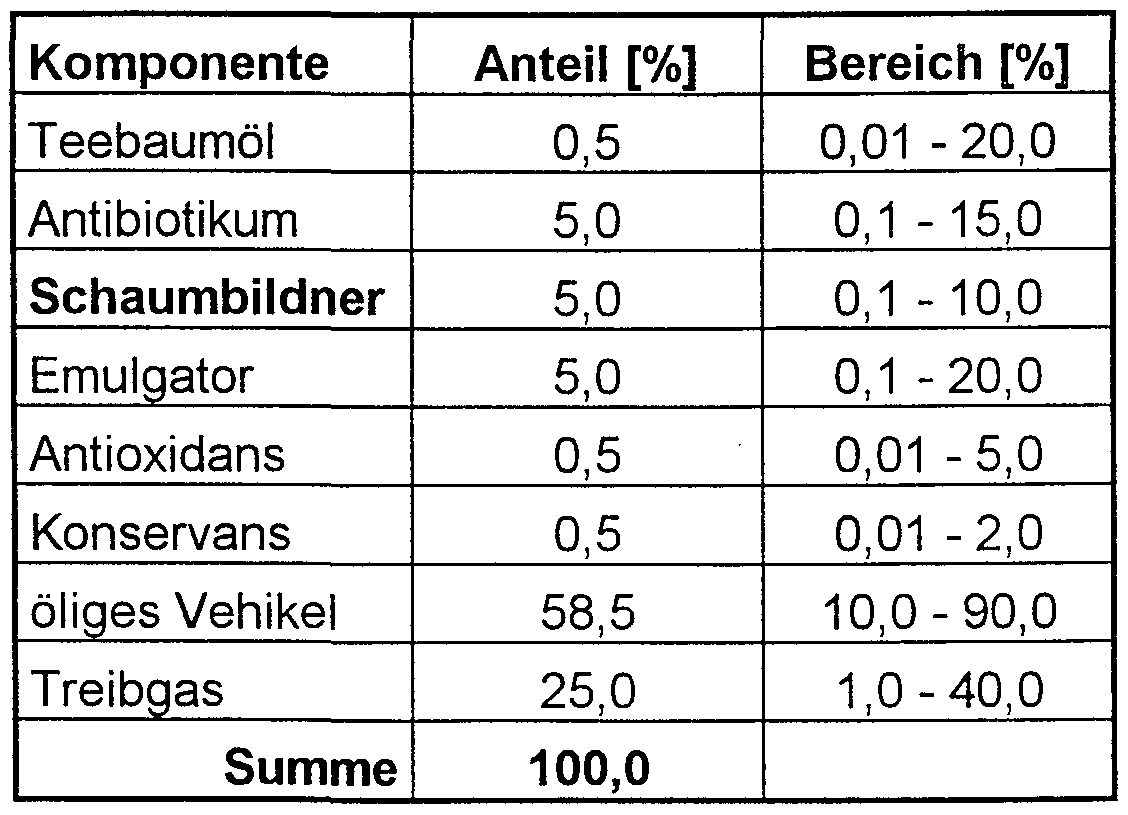
- compositions for the production of aerosol foams are named.
- these compositions essentially consist of a so-called vehicle, antioxidants for stabilizing the components against the influence of oxygen, foaming agents, emulsifiers, preservatives and a propellant.
- Such aerosol foams can be administered either directly as a fixed combination of tea tree oil with antibiotics or by a successive use of any antibiotic preparation (in the form of ointments, foams, etc.) and a foam gas preparation that contains tea tree oil alone. With the latter form of application, a better distribution in the target organ can be achieved together with an increase in effectiveness ("booster" effect).
- the vehicle can be formed from water and / or oily components.
- oily components e.g. preferably vegetable oils - e.g. Cottonseed, peanut, corn, rapeseed, sesame and soybean oil - or triglycerides of medium chain length - for example fractionated coconut oil - or isopropyl myristate, palmitate or mineral oils or ethyl oleate.
- vegetable oils - e.g. Cottonseed, peanut, corn, rapeseed, sesame and soybean oil - or triglycerides of medium chain length - for example fractionated coconut oil - or isopropyl myristate, palmitate or mineral oils or ethyl oleate.
- Suitable antioxidants are all antioxidants known from the prior art, such as preferably a-tocopherol, butylated hydroxytoluene (BHT) or butylated hydroxyanisole (BHA).
- foaming agents all foaming agents that are permitted under pharmaceutical law and are known from the prior art can be preferred.
- Polyoxyethylene sorbitan esters of various fatty acids (polysorbates) - are used.
- polyoxyethylene derivatives of castor oil or polyoxyethylene alkyl ether are preferably used as emulsifiers.
- preservatives of which preferably preservatives from the group of the PHB esters - for example a mixture of PHB methyl and PHB propyl esters -, quaternary ammonium compounds - such as benzalkonium chloride -, phenol, chlorobutanol, chlorocresol, ethyl alcohol, Thiomersal, phenylmercury salts - such as nitrates, borates etc. - or benzoic and sorbic acids and their salts. - 6 -
- Suitable propellants are all propellants permitted for use in the medical field and known from the prior art - such as CO2, N2O, N2, propane / butane mixtures, isobutane, chloropentafluoroethane (CCIF2-CF3), octafluorocyclobutane (C4F8).
- Some exemplary dosage forms are added to the experimental part.
- the MIC value means the minimum concentration at which an inhibitory effect can be demonstrated.
- the concentration of the standard solution of the tea tree oil used was 4% vol / vol. • 7 -
- the highest concentration used in the tests was 1/10 of the original standard solution, i.e.: 0.4% by volume.
- the MIC is defined as the lowest active ingredient concentration that inhibits a bacterial increase in turbidity - in nutrient solution - or an increase in fluorescence - in milk. It means:
- a / MICa where A means the MIC of the antibacterial substance in the presence of the highest concentration of tea tree oil and MICa means the MIC of the antibacterial substance alone.
- a FlC value ⁇ 0.5 means an increase in effectiveness through the respective tea tree oil (Tböl), while FIC values> 1 imply an antagonism.
- Miglyol [Fiedler, HP, Lexicon of auxiliaries for pharmacy, cosmetics and related areas, 4th edition, Editio Cantor Verlag, Aulendorf 1996, Vol. II], as an emulsified standard solution with 10% v / v shows no inhibitory effect on the growth of S. aureus in milk (at a maximum concentration of 1%).
- SaA SaB SaC SaD SaE SaF Tböl 4 4>4>4> 4 2 Effect of tea tree oil on the growth of Staphylococcus aureus in normal milk. Each strain was tested in four replicas.
- Penicillin G 0.033 + 0.004 0.031 +0.005 0.035 + 0.004 0.022 + 0.002 (0.025 - 0.05) (0.013-0.05) (0.025 - 0.05) (0.013-0.025)
- Ratio of potentiation or ratio of antagonistic effect with "-" signs The same applies to the following tables 5-7.
- FIC 0.5 means additive effect, ⁇ 0.5 potentiation and> 2
- aureus A - C are capsule negative and staph. aureus D - F
- Ratio of potentiation or ratio of antagonistic effect with - signs The same applies to the following tables 5-7. - 10th
- FIC 0.5 means addition, ⁇ 0.5 potentiation and> 2 antagonism.
- aureus A - C are capsule negative and staph. aureus D - F
- aureus A - C are capsule negative and staph. aureus D - F
Landscapes
- Health & Medical Sciences (AREA)
- Natural Medicines & Medicinal Plants (AREA)
- Life Sciences & Earth Sciences (AREA)
- Chemical & Material Sciences (AREA)
- Medicinal Chemistry (AREA)
- Pharmacology & Pharmacy (AREA)
- Animal Behavior & Ethology (AREA)
- General Health & Medical Sciences (AREA)
- Public Health (AREA)
- Veterinary Medicine (AREA)
- Epidemiology (AREA)
- Medical Informatics (AREA)
- Alternative & Traditional Medicine (AREA)
- Mycology (AREA)
- Microbiology (AREA)
- Botany (AREA)
- Biotechnology (AREA)
- Engineering & Computer Science (AREA)
- Oncology (AREA)
- Chemical Kinetics & Catalysis (AREA)
- Organic Chemistry (AREA)
- Communicable Diseases (AREA)
- Nuclear Medicine, Radiotherapy & Molecular Imaging (AREA)
- General Chemical & Material Sciences (AREA)
- Medicines Containing Plant Substances (AREA)
- Pharmaceuticals Containing Other Organic And Inorganic Compounds (AREA)
- Agricultural Chemicals And Associated Chemicals (AREA)
- Medicinal Preparation (AREA)
- Acyclic And Carbocyclic Compounds In Medicinal Compositions (AREA)
- Medicines Containing Material From Animals Or Micro-Organisms (AREA)
Abstract
Description




Claims
Priority Applications (11)
| Application Number | Priority Date | Filing Date | Title |
|---|---|---|---|
| PL98342648A PL342648A1 (en) | 1998-02-02 | 1998-02-02 | Veterinary application of a combination of active agent consisting of bactericides and terpene containing plant extracts |
| AT98904169T ATE239488T1 (de) | 1998-02-02 | 1998-02-02 | Verwendung von wirkstoffkombinationen aus antibiotika und terpenhaltigen pflanzenextrakten in der tiermedizin |
| ES98904169T ES2193514T3 (es) | 1998-02-02 | 1998-02-02 | Utilizacion de combinaciones de sustancias activas a base de antibioticos y de estractos vegetales que contienen terpenos en la medicina veterinaria. |
| PCT/EP1998/000542 WO1999038521A1 (de) | 1998-02-02 | 1998-02-02 | Verwendung von wirkstoffkombinationen aus antimikrobiell wirkenden substanzen und terpenhaltigen pflanzenextrakten in der tiermedizin |
| CA002318833A CA2318833A1 (en) | 1998-02-02 | 1998-02-02 | The use of combinations of active agents consisting of antimicrobially active substances and plant extracts containing terpene in veterinary medicine |
| PT98904169T PT1054681E (pt) | 1998-02-02 | 1998-02-02 | Utilizacao de combinacoes de agentes activos consistindo de antibioticos e extractos vegetais contendo terfeno na medicina veterinaria |
| EP98904169A EP1054681B1 (de) | 1998-02-02 | 1998-02-02 | Verwendung von wirkstoffkombinationen aus antibiotika und terpenhaltigen pflanzenextrakten in der tiermedizin |
| DK98904169T DK1054681T3 (da) | 1998-02-02 | 1998-02-02 | Veterninærmedicinsk anvendelse af kombinationer af aktive midler bland antibiotika og terpenholdige planteekstrakter |
| DE59808313T DE59808313D1 (de) | 1998-02-02 | 1998-02-02 | Verwendung von wirkstoffkombinationen aus antibiotika und terpenhaltigen pflanzenextrakten in der tiermedizin |
| AU62150/98A AU749923C (en) | 1998-02-02 | 1998-02-02 | The use of combinations of active agents consisting of antimicrobially active substances and plant extracts containing terpene in veterinary medicine |
| US10/219,180 US20030113385A1 (en) | 1998-02-02 | 2002-08-15 | Use of combinations of active agents consisting of antimicrobially active substances and plant extracts containing terpene in veterinary medicine |
Applications Claiming Priority (1)
| Application Number | Priority Date | Filing Date | Title |
|---|---|---|---|
| PCT/EP1998/000542 WO1999038521A1 (de) | 1998-02-02 | 1998-02-02 | Verwendung von wirkstoffkombinationen aus antimikrobiell wirkenden substanzen und terpenhaltigen pflanzenextrakten in der tiermedizin |
Related Child Applications (1)
| Application Number | Title | Priority Date | Filing Date |
|---|---|---|---|
| US09/405,129 Continuation US6428336B1 (en) | 1997-03-25 | 1999-09-24 | Female connector |
Publications (1)
| Publication Number | Publication Date |
|---|---|
| WO1999038521A1 true WO1999038521A1 (de) | 1999-08-05 |
Family
ID=8166853
Family Applications (1)
| Application Number | Title | Priority Date | Filing Date |
|---|---|---|---|
| PCT/EP1998/000542 Ceased WO1999038521A1 (de) | 1998-02-02 | 1998-02-02 | Verwendung von wirkstoffkombinationen aus antimikrobiell wirkenden substanzen und terpenhaltigen pflanzenextrakten in der tiermedizin |
Country Status (11)
| Country | Link |
|---|---|
| US (1) | US20030113385A1 (de) |
| EP (1) | EP1054681B1 (de) |
| AT (1) | ATE239488T1 (de) |
| AU (1) | AU749923C (de) |
| CA (1) | CA2318833A1 (de) |
| DE (1) | DE59808313D1 (de) |
| DK (1) | DK1054681T3 (de) |
| ES (1) | ES2193514T3 (de) |
| PL (1) | PL342648A1 (de) |
| PT (1) | PT1054681E (de) |
| WO (1) | WO1999038521A1 (de) |
Cited By (2)
| Publication number | Priority date | Publication date | Assignee | Title |
|---|---|---|---|---|
| DE10011344A1 (de) * | 2000-03-10 | 2001-09-20 | Krueger Gmbh & Co Kg | Pharmazeutische oder kosmetische Präparate in Form eines Druckgas-Schaumsprays |
| CN103690952A (zh) * | 2013-11-27 | 2014-04-02 | 广西大学 | 治疗畜禽大肠杆菌感染疾病的复方药物 |
Families Citing this family (6)
| Publication number | Priority date | Publication date | Assignee | Title |
|---|---|---|---|---|
| WO2003002132A1 (en) * | 2001-06-27 | 2003-01-09 | Australian Rural Group Limited | Tea tree oil formulations |
| EA014372B1 (ru) * | 2003-01-24 | 2010-10-29 | Стифел Рисерч Оустрэйлиа Пти Лтд. | Пена на основе фосфата клиндамицина |
| US7186416B2 (en) * | 2003-05-28 | 2007-03-06 | Stiefel Laboratories, Inc. | Foamable pharmaceutical compositions and methods for treating a disorder |
| GB2473460B (en) * | 2009-09-10 | 2016-02-10 | Univ Surrey | Antimicrobial Composition |
| BG1452U1 (bg) * | 2011-01-13 | 2011-06-30 | "Мастърхерб" Еоод | Състав от природни продукти за лечение на мастити |
| CZ2012167A3 (cs) | 2012-03-09 | 2013-04-03 | Univerzita Tomáse Bati ve Zlíne | Antimikrobiální komponenta a její pouzití |
Citations (6)
| Publication number | Priority date | Publication date | Assignee | Title |
|---|---|---|---|---|
| WO1984001776A1 (en) * | 1982-10-26 | 1984-05-10 | Beecham Group Plc | Beta-lactam compounds, preparation and use |
| WO1984004249A2 (fr) * | 1983-05-03 | 1984-11-08 | Ssm Int Chem Co Ltd | Composition a activite pharmaceutique amelioree et utilisation decelle-ci pour des usages veterinaires |
| WO1991010364A1 (en) * | 1990-01-19 | 1991-07-25 | Spindel & Spinnfluegelfab Veb | Utter or teat care substance with mastitis preventing effect |
| FR2706770A1 (en) * | 1993-06-21 | 1994-12-30 | Pelletier Jacques | Formula for the treatment of tuberculosis. |
| WO1997030718A1 (en) * | 1996-02-20 | 1997-08-28 | Thomas Keith Stacey | Antimicrobial composition |
| FR2748204A1 (fr) * | 1996-05-06 | 1997-11-07 | Interexport Services | Compositions cosmetiques ou pharmaceutiques ou alimentaires contenant une huile essentielle rectifiee de melaleuca type terpinene-4-ol (arbre a the) |
Family Cites Families (3)
| Publication number | Priority date | Publication date | Assignee | Title |
|---|---|---|---|---|
| US3135658A (en) * | 1961-10-10 | 1964-06-02 | Merck & Co Inc | Non-aqueous oleaginous aerosol foam therapy of bovine mastitis |
| DE3704907A1 (de) * | 1987-02-17 | 1988-08-25 | Bayer Ag | Topisch anwendbare zubereitungen von gyrase-inhibitoren in kombination mit kortikosteroiden |
| US5260341A (en) * | 1992-07-14 | 1993-11-09 | Agro-K Corporation Inc. | Product and process for treating bovine mastitis and bovine metritis |
-
1998
- 1998-02-02 AT AT98904169T patent/ATE239488T1/de not_active IP Right Cessation
- 1998-02-02 AU AU62150/98A patent/AU749923C/en not_active Ceased
- 1998-02-02 DK DK98904169T patent/DK1054681T3/da active
- 1998-02-02 DE DE59808313T patent/DE59808313D1/de not_active Expired - Fee Related
- 1998-02-02 EP EP98904169A patent/EP1054681B1/de not_active Expired - Lifetime
- 1998-02-02 WO PCT/EP1998/000542 patent/WO1999038521A1/de not_active Ceased
- 1998-02-02 PL PL98342648A patent/PL342648A1/xx unknown
- 1998-02-02 ES ES98904169T patent/ES2193514T3/es not_active Expired - Lifetime
- 1998-02-02 PT PT98904169T patent/PT1054681E/pt unknown
- 1998-02-02 CA CA002318833A patent/CA2318833A1/en not_active Abandoned
-
2002
- 2002-08-15 US US10/219,180 patent/US20030113385A1/en not_active Abandoned
Patent Citations (6)
| Publication number | Priority date | Publication date | Assignee | Title |
|---|---|---|---|---|
| WO1984001776A1 (en) * | 1982-10-26 | 1984-05-10 | Beecham Group Plc | Beta-lactam compounds, preparation and use |
| WO1984004249A2 (fr) * | 1983-05-03 | 1984-11-08 | Ssm Int Chem Co Ltd | Composition a activite pharmaceutique amelioree et utilisation decelle-ci pour des usages veterinaires |
| WO1991010364A1 (en) * | 1990-01-19 | 1991-07-25 | Spindel & Spinnfluegelfab Veb | Utter or teat care substance with mastitis preventing effect |
| FR2706770A1 (en) * | 1993-06-21 | 1994-12-30 | Pelletier Jacques | Formula for the treatment of tuberculosis. |
| WO1997030718A1 (en) * | 1996-02-20 | 1997-08-28 | Thomas Keith Stacey | Antimicrobial composition |
| FR2748204A1 (fr) * | 1996-05-06 | 1997-11-07 | Interexport Services | Compositions cosmetiques ou pharmaceutiques ou alimentaires contenant une huile essentielle rectifiee de melaleuca type terpinene-4-ol (arbre a the) |
Non-Patent Citations (2)
| Title |
|---|
| CHEMICAL ABSTRACTS, vol. 126, no. 22, 2 June 1997, Columbus, Ohio, US; abstract no. 290666f, RHEE ET AL.: "Antimicrobial activities of a steam distillate of Leptospermum scoparium" page 391; column r; XP002079097 * |
| YAKHAK HOECHI, vol. 41, no. 1, 1997, SOUTH KOREA, pages 132 - 138 * |
Cited By (2)
| Publication number | Priority date | Publication date | Assignee | Title |
|---|---|---|---|---|
| DE10011344A1 (de) * | 2000-03-10 | 2001-09-20 | Krueger Gmbh & Co Kg | Pharmazeutische oder kosmetische Präparate in Form eines Druckgas-Schaumsprays |
| CN103690952A (zh) * | 2013-11-27 | 2014-04-02 | 广西大学 | 治疗畜禽大肠杆菌感染疾病的复方药物 |
Also Published As
| Publication number | Publication date |
|---|---|
| AU6215098A (en) | 1999-08-16 |
| EP1054681A1 (de) | 2000-11-29 |
| CA2318833A1 (en) | 1999-08-05 |
| ATE239488T1 (de) | 2003-05-15 |
| AU749923B2 (en) | 2002-07-04 |
| PL342648A1 (en) | 2001-06-18 |
| US20030113385A1 (en) | 2003-06-19 |
| PT1054681E (pt) | 2003-09-30 |
| DE59808313D1 (de) | 2003-06-12 |
| ES2193514T3 (es) | 2003-11-01 |
| DK1054681T3 (da) | 2003-08-18 |
| EP1054681B1 (de) | 2003-05-07 |
| AU749923C (en) | 2003-01-30 |
Similar Documents
| Publication | Publication Date | Title |
|---|---|---|
| DE69617945T2 (de) | Pharmazeutische zubereitungen, auf der basis von pflanzlichen etherischen ölen für die verwendung im menschlichen oder veterinären medizinischem bereich | |
| EP1007060B1 (de) | Stabiler extrakt aus hypericum perforatum l., verfahren zu seiner herstellung und pharmazeutische zubereitungen | |
| AU2007321711A1 (en) | Topical formulation and uses thereof | |
| EP1054681B1 (de) | Verwendung von wirkstoffkombinationen aus antibiotika und terpenhaltigen pflanzenextrakten in der tiermedizin | |
| KR20110116231A (ko) | 고 용량 도라멕틴 제형 | |
| DE19631037C2 (de) | Neue Wirkstoffkombinationen aus bacterizid wirkenden Substanzen mit terpenhaltigen Pflanzenextrakten | |
| DE60125955T2 (de) | Bioaktive fraktion von eurycoma longifolia | |
| DE69914957T2 (de) | Nicht-festes topisch anzuwendendes arzneimittel enthaltend glyzerol und alchemilla vulgaris extrakt | |
| DE69904454T2 (de) | Topische formulierungen des öl-in-wasser typs als träger zur vermittlung eines reduzierten reizeffekts | |
| DE3640409A1 (de) | Aeusserlich anwendbare komposition | |
| US20230066008A1 (en) | Antiparasitic composition | |
| DE19716660A1 (de) | Zubereitungen, insbesondere pharmazeutische, und Arzneiformen auf pflanzlicher Basis zur Bekämpfung von Heliobacter pylori-Infektionen | |
| CN115671040B (zh) | 一种控制动物寄生虫感染的外用制剂 | |
| EP1299420A2 (de) | Zusammensetzung für pharmaka und kosmetika | |
| DE19821971C2 (de) | Arzneimittel zur Behandlung von Psoriasis oder Neurodermitis | |
| EP0845983A2 (de) | Pharmazeutisches präparat mit trypanoziden eigenschaften | |
| EP3299026A1 (de) | Extrakte aus samen von aframomum-arten und deren verwendung | |
| DE3508875A1 (de) | Verfahren und praeparat zur stimulierung des immunsystems | |
| US12350335B2 (en) | Homeopathic topical composition | |
| DE60311013T2 (de) | Synergistische leberschützende zusammensetzung und verfahren dazu | |
| DE60213522T2 (de) | Kombination von Arnica, Ruscus und Menthol | |
| AU2006203630B2 (en) | Intramammary formulations | |
| Kalaiarasi et al. | A DRUG REVIEW ON VARMAM EXTERNAL MEDICINE MURIVU ENNAI | |
| EP4545067A1 (de) | Hochdosierte dermal applizierbare permethrin-zubereitung mit erhöhtem drugload im zielkompartiment zur verbesserten behandlung von ektoparasiten befall | |
| US20080050456A1 (en) | Intramammary formulations |
Legal Events
| Date | Code | Title | Description |
|---|---|---|---|
| AK | Designated states |
Kind code of ref document: A1 Designated state(s): AL AM AU AZ BA BB BG BR BY CA CN CU CZ EE GE GH HU IL IS JP KE KG KP KR KZ LC LK LR LS LT LV MD MG MK MN MW MX NO NZ PL RO RU SD SG SI SK SL TJ TM TR TT UA UG US UZ VN YU ZW |
|
| AL | Designated countries for regional patents |
Kind code of ref document: A1 Designated state(s): GH GM KE LS MW SD SZ UG ZW AM AZ BY KG KZ MD RU TJ TM AT BE CH DE DK ES FI FR GB GR IE IT LU MC NL PT SE BF BJ CF CG CI CM GA GN ML MR NE SN TD TG |
|
| WWE | Wipo information: entry into national phase |
Ref document number: 09405129 Country of ref document: US |
|
| 121 | Ep: the epo has been informed by wipo that ep was designated in this application | ||
| DFPE | Request for preliminary examination filed prior to expiration of 19th month from priority date (pct application filed before 20040101) | ||
| ENP | Entry into the national phase |
Ref document number: 2318833 Country of ref document: CA Ref country code: CA Ref document number: 2318833 Kind code of ref document: A Format of ref document f/p: F |
|
| WWE | Wipo information: entry into national phase |
Ref document number: 1998904169 Country of ref document: EP |
|
| NENP | Non-entry into the national phase |
Ref country code: KR |
|
| WWE | Wipo information: entry into national phase |
Ref document number: 62150/98 Country of ref document: AU |
|
| WWE | Wipo information: entry into national phase |
Ref document number: 09601422 Country of ref document: US |
|
| WWP | Wipo information: published in national office |
Ref document number: 1998904169 Country of ref document: EP |
|
| WWG | Wipo information: grant in national office |
Ref document number: 62150/98 Country of ref document: AU |
|
| WWG | Wipo information: grant in national office |
Ref document number: 1998904169 Country of ref document: EP |