WO1999038800A1 - Procede d'epuration d'un gaz en composes acides - Google Patents
Procede d'epuration d'un gaz en composes acides Download PDFInfo
- Publication number
- WO1999038800A1 WO1999038800A1 PCT/EP1999/000330 EP9900330W WO9938800A1 WO 1999038800 A1 WO1999038800 A1 WO 1999038800A1 EP 9900330 W EP9900330 W EP 9900330W WO 9938800 A1 WO9938800 A1 WO 9938800A1
- Authority
- WO
- WIPO (PCT)
- Prior art keywords
- sodium carbonate
- anhydrous sodium
- powder
- atmosphere
- gas
- Prior art date
- Legal status (The legal status is an assumption and is not a legal conclusion. Google has not performed a legal analysis and makes no representation as to the accuracy of the status listed.)
- Ceased
Links
Classifications
-
- C—CHEMISTRY; METALLURGY
- C01—INORGANIC CHEMISTRY
- C01D—COMPOUNDS OF ALKALI METALS, i.e. LITHIUM, SODIUM, POTASSIUM, RUBIDIUM, CAESIUM, OR FRANCIUM
- C01D7/00—Carbonates of sodium, potassium or alkali metals in general
- C01D7/42—Preventing the absorption of moisture or caking
-
- B—PERFORMING OPERATIONS; TRANSPORTING
- B01—PHYSICAL OR CHEMICAL PROCESSES OR APPARATUS IN GENERAL
- B01D—SEPARATION
- B01D53/00—Separation of gases or vapours; Recovering vapours of volatile solvents from gases; Chemical or biological purification of waste gases, e.g. engine exhaust gases, smoke, fumes, flue gases, aerosols
- B01D53/34—Chemical or biological purification of waste gases
- B01D53/38—Removing components of undefined structure
- B01D53/40—Acidic components
-
- C—CHEMISTRY; METALLURGY
- C01—INORGANIC CHEMISTRY
- C01D—COMPOUNDS OF ALKALI METALS, i.e. LITHIUM, SODIUM, POTASSIUM, RUBIDIUM, CAESIUM, OR FRANCIUM
- C01D7/00—Carbonates of sodium, potassium or alkali metals in general
Definitions
- the present invention is the result of work carried out in the laboratory of the Department of Industrial and Analytical Chemistry of the Faculty of Applied Sciences of the Free University of Brussels.
- the invention relates to the purification of gases into acidic compounds, by means of a basic reagent, such as fumes from the combustion of fossil fuels or from the incineration of household or hospital waste.
- a basic reagent such as fumes from the combustion of fossil fuels or from the incineration of household or hospital waste.
- Sodium bicarbonate in powder form, is known as a reagent for purifying gases from acidic compounds. It finds in particular an application for purifying fumes in sulfur oxides, in nitrogen oxides (in particular in nitric oxide) and in hydrogen halide of general formula HX (in particular in hydrogen fluoride and in hydrogen chloride). Such smoke is commonly generated by the incineration of household waste or hospital waste, as well as by the combustion of fossil fuels, especially in thermal power plants for the production of electricity. In these applications, the gas to be purified is brought into contact with sodium bicarbonate in the form of a finely ground powder at a temperature generally between 120 and 250 ° C.
- the invention relates to a process for the purification of a gas into acidic compounds, according to which the gas is subjected to a dry or semi-wet treatment with a basic reagent comprising a powder of sodium carbonate of specific surface greater than 2 m 2 / g, the process being characterized in that an anhydrous sodium carbonate powder is used which, during its handling, is maintained in an atmosphere having a relative humidity of less than 20% and / or is added with a desiccant.
- the basic reagent comprises an anhydrous sodium carbonate powder with a large specific surface, greater than
- the specific surface of the anhydrous sodium carbonate powder is obtained by the BET measurement method with nitrogen adsorption.
- An anhydrous sodium carbonate powder is advantageously used having a specific surface at least equal to 5 ⁇ m / g, for example between 5 and 12 m 2 / g, the specific surfaces greater than 7 m 2 / g being preferred.
- anhydrous sodium carbonate powders having a particle size defined by an average particle diameter of 95 to 115 ⁇ m and a particle size spread such that 95% by weight of the powder has a particle diameter between 60 and 150 ⁇ m .
- the mean diameter D m is defined by the relation
- D m ⁇ nj. Dj ⁇ nj in which nj denotes the frequency (by weight) of particles of diameter Dj, the diameters Dj being measured by the particle size analysis method by laser beam diffraction.
- the basic reagent may optionally include hydrated sodium carbonate (for example sodium carbonate monohydrate) and / or sodium bicarbonate. Where appropriate, its weight content of hydrated sodium carbonate and / or sodium bicarbonate is less than 5% (preferably 1%) of the weight of anhydrous sodium carbonate.
- Particles of anhydrous sodium carbonate powder may optionally have a coating of a material different from sodium carbonate. It is preferred that the anhydrous sodium carbonate does not carry such a coating, so as not to harm its reactivity with respect to acid gases.
- the anhydrous sodium carbonate powder can be obtained by any suitable means capable of giving it a specific surface greater than 2 m 2 / g (preferably at least equal to 5 n g).
- a recommended way is to subject a sodium bicarbonate powder to heating in an atmosphere having a relative humidity of less than 20% (preferably equal to a maximum of 2%), to decompose more than 95% (preferably at least 99% ) by weight of sodium bicarbonate to anhydrous sodium carbonate.
- the treatment of the gas with the basic reagent can be either a dry treatment or a semi-wet treatment.
- dry treatment is understood to mean a treatment in which the basic reagent is introduced in the form of a solid powder into the gas, in the absence of a liquid, in particular of water.
- the basic reagent in general, in the dry treatment, is used in the form of a powder which is injected into a stream of gas, circulating inside a reaction chamber or a pipeline.
- semi-wet treatment is understood to mean a treatment in which the basic reagent is introduced into the gas in the presence of an amount of liquid (usually water) such that the latter is completely vaporized in contact with the gas.
- the basic reagent is generally used in the form of a powder dispersed in a liquid, generally water. According to the invention, the treatment by dry route is preferred.
- Information concerning the treatment of smoke with the basic reagent is available in European patent EP-603 218 and international application WO 95/19835, both in the name of SOLNAY (cios Anonyme).
- the anhydrous sodium carbonate powder contains a desiccant or is maintained in an atmosphere having a relative humidity of less than 20%, during its handling.
- the function of the desiccant and said atmosphere is to prevent aging of the anhydrous sodium carbonate powder, this aging being characterized by a reduction in the reactivity of the sodium carbonate to decompose acid gases, in particular halides of hydrogen (especially hydrogen chloride and hydrogen fluoride), sulfur oxides (especially sulfur dioxide) and nitrogen oxides (especially nitric oxide).
- the anhydrous sodium carbonate powder may both contain a drying agent and be kept in an atmosphere with a relative humidity of less than 20%, during its handling.
- handling is meant both the handling of the anhydrous sodium carbonate powder (transport, packaging, storage) and its storage. Handling is normally considered from the moment when the anhydrous sodium carbonate powder is manufactured, until the moment when it is brought into contact with the gas to be purified.
- the atmosphere used for handling the sodium carbonate must be inert with respect to the sodium carbonate, have a temperature compatible with the preservation of the properties of the anhydrous sodium carbonate powder and have a relative humidity of less than 20%. Notwithstanding these three conditions, the choice of handling atmosphere is not critical. It can for example be air, nitrogen, argon or carbon dioxide. Air and carbon dioxide are fine. All other things being equal, it is preferable to use a handling atmosphere the temperature of which is less than 250 ° C. (preferably less than 100 ° C., the temperatures of 10 to 25 ° C. being specially recommended) and the humidity of which relative does not exceed 10% (preferably 7%). With regard to the relative humidity of the atmosphere, the values of 0 to 7% are especially recommended, those of 0 to 5% (for example from 0.1 to 2%) being especially advantageous. Dry air is preferred.
- the handling atmosphere preferably has a relative humidity of 0 to 5% and a temperature of 10 to 25 ° C.
- the handling atmosphere can be calm.
- the anhydrous sodium carbonate powder is subjected to continuous scanning with the handling atmosphere.
- the scanning can for example consist of a circulation of the atmosphere in contact with the upper surface of a bed of the anhydrous sodium carbonate powder.
- the scanning can consist of an upward circulation of the atmosphere through a bed of anhydrous sodium carbonate powder.
- the anhydrous sodium carbonate bed can be a fixed bed or a fluidized bed.
- the desiccant used, if necessary, in the process according to the invention is not critical. Silica gels and alkali metal hydroxides are especially recommended. Sodium hydroxide works well.
- the optimum amount of desiccant depends on various parameters, in particular the desiccant selected, the specific surface and the particle size of the anhydrous sodium carbonate powder and the handling conditions thereof, in particular the temperature. storage, the relative humidity of the storage atmosphere and the duration of storage before use. In practice, good results are obtained in the case where the reactive composition contains from 1 to 20 parts by weight (preferably from 2 to 15 parts by weight) of desiccant agent per 100 parts by weight of anhydrous sodium carbonate.
- the desiccant is generally used in the form of a powder.
- it can be mechanically mixed with anhydrous sodium carbonate powder.
- a powder of the desiccant is mixed with a sodium bicarbonate powder and then the sodium bicarbonate powder, added with the desiccant is subjected to heating, under the conditions set out above, to form the anhydrous sodium carbonate powder.
- a sodium bicarbonate powder is subjected to heating in an atmosphere having a relative humidity of less than 20% (preferably equal to the maximum at 2%), to break down more than 95% (preferably at least 99%) of the weight of sodium bicarbonate into anhydrous sodium carbonate.
- the heating temperature must be sufficient to decompose substantially all of the sodium bicarbonate in an acceptable time. It is advantageously greater than 50 ° C.
- the heating temperature must be below 270 ° C and it is preferable that it does not exceed 250 ° C. Temperatures of 60 to 150 ° C are well suited, temperatures of 100 to 120 ° C being preferred.
- the heating must be carried out in an atmosphere whose relative humidity is controlled so that it is permanently less than 20%.
- the relative humidity of the atmosphere in which the heating is carried out does not exceed 5%, preferably 2%, the values from 0 to 2% (for example from 0, 1 to 2% ) being especially advantageous.
- the heating of the sodium bicarbonate powder can be carried out by any suitable means.
- a specially heated means advantageous is to fluidize a bed of sodium bicarbonate powder by means of an updraft of hot gas.
- the hot gas can be air or an inert gas such as nitrogen, argon or carbon dioxide.
- An anhydrous gas is preferably used.
- the origin of the sodium bicarbonate powder is not critical.
- the sodium bicarbonate powder contains ammonium salts and is obtained by carbonation of an ammoniacal brine in an ammonia welder.
- the sodium bicarbonate powder generally contains more than 60% (generally from 65 to 80%) by weight of sodium bicarbonate.
- it usually contains anhydrous sodium carbonate, sodium chloride, ammonium carbonate and ammonium chloride (Te-Pang Hou, Manufacture of soda, Hafner Publishing Company, 1969, page 172) .
- the sodium bicarbonate powder is advantageously in the form of particles with a diameter greater than 60 ⁇ m (usually between 60 and 150 ⁇ m) as defined by the method of particle size analysis by laser beam diffraction.
- the heating of the sodium bicarbonate powder can advantageously be carried out by fluidization of the sodium bicarbonate powder by means of an updraft of hot carbon dioxide. The gas leaving the fluidized bed can then be recycled for the carbonation of the ammonia brine in an ammonia welder.
- the process according to the invention applies especially well to the purification of gases in hydrogen halides of general formula HX (where X denotes a halide ion, for example the chloride ion or the fluoride ion), in oxides of sulfur and nitrogen oxides. It finds a particularly advantageous application for the purification of fumes contaminated with hydrogen chloride in incineration plants for household waste or hospital waste. It also finds an advantageous application for the purification of fumes contaminated by sulfur dioxide and nitrogen oxides, originating from the combustion of fossil fuels in thermal power stations for the production of electricity. Special features and details of the invention will appear during the following description of a particular embodiment of the invention. In an ammonia welder, ammonia gas was introduced into a substantially saturated aqueous solution of sodium chloride, so as to / 38800
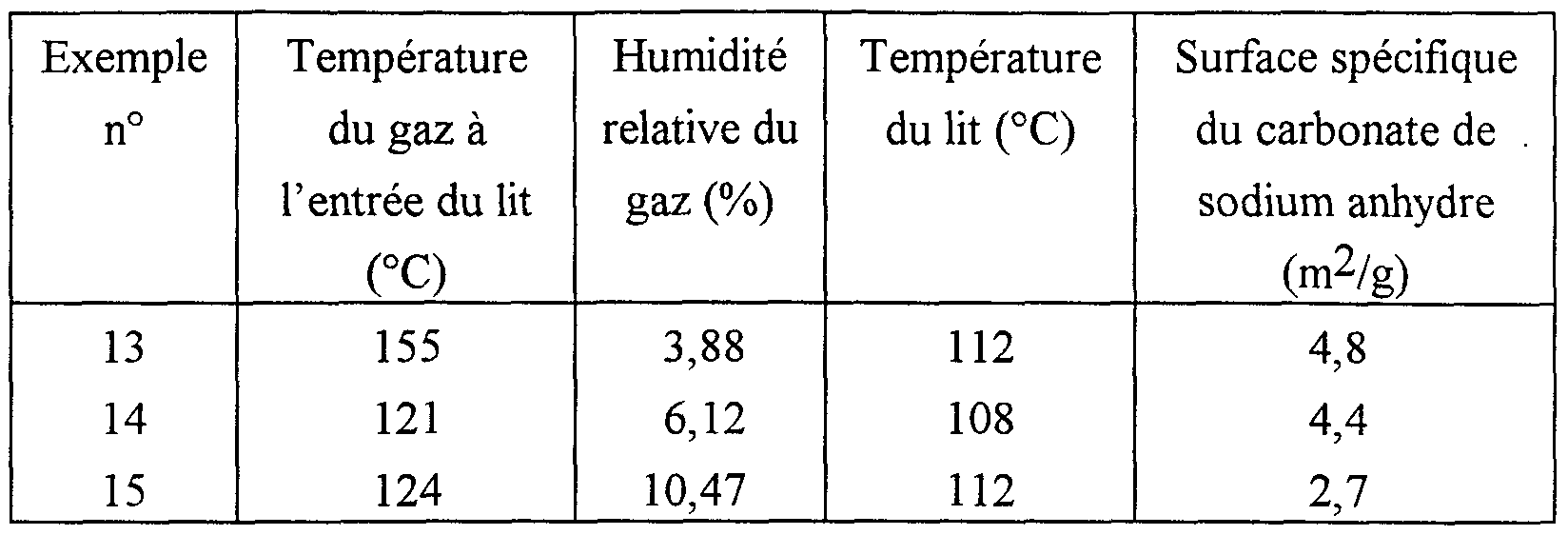
- the gas used to fluidize the sodium bicarbonate bed was dry air (substantially zero moisture content) at various temperatures.
- Table 1 below reproduces the conditions and the results of the tests.
- Example Gas temperature Bed temperature Specific surface of the number at the entrance to the bed (° C) (° C) anhydrous sodium carbonate (m-Vg)
- the gas used for the fluidization of the sodium bicarbonate bed was humid air having a relative humidity of 2.7%.
- the characteristics of the test were as follows: Temperature of the fluidizing air, at the inlet of the bed: 157 ° C; Bed temperature during fluidization: 100 ° C; Specific surface of anhydrous sodium carbonate, collected from the bed: 7.5 nm / g.
- Example Gas temperature Bed temperature Specific surface of the number at the entrance to the bed (° C) (° C) anhydrous sodium carbonate (vP-lg)
- Examples 1 to 15 show that, all other things being equal, the specific surface area of anhydrous sodium carbonate is adversely affected by the presence of moisture during the conversion of sodium bicarbonate to sodium carbonate.
- the four examples, the description of which follows, relate to storage tests of anhydrous sodium carbonate.
- a sodium bicarbonate powder was treated in a fluidized bed type reactor, as described above, to decompose all of the sodium bicarbonate and form anhydrous sodium carbonate.
- the gas used to fluidize the sodium bicarbonate bed was, in accordance with the invention, dry carbon dioxide (substantially zero relative humidity).
- an anhydrous sodium carbonate powder was collected and divided into four fractions which were immediately enclosed in four chambers each containing air at a controlled humidity level. After a storage period of one week, the four chambers were opened and the specific surface of the samples of anhydrous sodium carbonate was immediately measured. The results are reported in Table 5.
- Example 19 shows in particular that by using, in accordance with the invention, an anhydrous atmosphere (zero relative humidity), degradation of the specific surface of anhydrous sodium carbonate is avoided.
- Examples 20 to 23
- the four examples, the description of which follows, relate to storage tests of anhydrous sodium carbonate to which a desiccant additive has been added.
- anhydrous sodium carbonate with a large specific surface was prepared, as described in the description of Examples 16 to 19, and a sodium hydroxide powder was added thereto, in an amount of 2.4 parts by weight.
- the anhydrous sodium carbonate powder, together with sodium hydroxide, was then divided into four samples, which were immediately enclosed in four chambers containing ambient air.
- the specific surface area of the anhydrous sodium carbonate samples was measured after four different storage periods. Each time the sample was taken, the atmosphere in the enclosure was brought into contact with the ambient air. The results of the tests are listed in Table 6. 11
- Examples 20 to 28 show that the presence, in accordance with the invention, of a desiccant in the anhydrous sodium carbonate powder, preserves the specific surface of the anhydrous sodium carbonate powder.
- Examples 29 to 33 show that in the absence of a desiccant in the anhydrous sodium carbonate powder, the specific surface of the anhydrous sodium carbonate powder decreases rapidly.
Landscapes
- Chemical & Material Sciences (AREA)
- Engineering & Computer Science (AREA)
- Organic Chemistry (AREA)
- Materials Engineering (AREA)
- Inorganic Chemistry (AREA)
- Analytical Chemistry (AREA)
- Biomedical Technology (AREA)
- Environmental & Geological Engineering (AREA)
- Health & Medical Sciences (AREA)
- General Chemical & Material Sciences (AREA)
- Oil, Petroleum & Natural Gas (AREA)
- Chemical Kinetics & Catalysis (AREA)
- Treating Waste Gases (AREA)
- Solid-Sorbent Or Filter-Aiding Compositions (AREA)
- Organic Low-Molecular-Weight Compounds And Preparation Thereof (AREA)
- Drying Of Gases (AREA)
- Pharmaceuticals Containing Other Organic And Inorganic Compounds (AREA)
- Gas Separation By Absorption (AREA)
Abstract
Description




Claims
Priority Applications (5)
| Application Number | Priority Date | Filing Date | Title |
|---|---|---|---|
| DE69908554T DE69908554T2 (de) | 1998-01-29 | 1999-01-21 | Verfahren zur reinigung eines sauren gases |
| JP2000530045A JP2002501823A (ja) | 1998-01-29 | 1999-01-21 | 酸性化合物の気体を清浄化する方法 |
| AU26198/99A AU2619899A (en) | 1998-01-29 | 1999-01-21 | Method for purifying a gas consisting of acid compounds |
| EP99906167A EP1051353B1 (fr) | 1998-01-29 | 1999-01-21 | Procede d'epuration d'un gaz en composes acides |
| AT99906167T ATE242175T1 (de) | 1998-01-29 | 1999-01-21 | Verfahren zur reinigung eines sauren gases |
Applications Claiming Priority (2)
| Application Number | Priority Date | Filing Date | Title |
|---|---|---|---|
| BE9800060 | 1998-01-29 | ||
| BE9800060A BE1011721A5 (fr) | 1998-01-29 | 1998-01-29 | Procede pour la manutention d'une poudre de carbonate de sodium anhydre, composition reactive comprenant une poudre de carbonate de sodium anhydre et procede d'epuration d'un gaz en composes acide. |
Publications (1)
| Publication Number | Publication Date |
|---|---|
| WO1999038800A1 true WO1999038800A1 (fr) | 1999-08-05 |
Family
ID=3891068
Family Applications (1)
| Application Number | Title | Priority Date | Filing Date |
|---|---|---|---|
| PCT/EP1999/000330 Ceased WO1999038800A1 (fr) | 1998-01-29 | 1999-01-21 | Procede d'epuration d'un gaz en composes acides |
Country Status (9)
| Country | Link |
|---|---|
| EP (1) | EP1051353B1 (fr) |
| JP (1) | JP2002501823A (fr) |
| AT (1) | ATE242175T1 (fr) |
| AU (1) | AU2619899A (fr) |
| BE (1) | BE1011721A5 (fr) |
| DE (1) | DE69908554T2 (fr) |
| ES (1) | ES2201670T3 (fr) |
| PT (1) | PT1051353E (fr) |
| WO (1) | WO1999038800A1 (fr) |
Cited By (3)
| Publication number | Priority date | Publication date | Assignee | Title |
|---|---|---|---|---|
| BE1012396A3 (fr) * | 1999-01-22 | 2000-10-03 | Solvay | Composition reactive comprenant une poudre de carbonate de sodium anhydre et procede d'epuration d'un gaz en composes acides. |
| EP1357085A3 (fr) * | 2002-03-29 | 2004-01-28 | Asahi Glass Company, Limited | Procédé de préparation de particules cristallines de bicarbonate de sodium ayant un faible pouvoir collant, ainsi que ces particules |
| US20140348738A1 (en) * | 2011-12-21 | 2014-11-27 | Solvay Sa | Process for preparing sodium bicarbonate particles |
Families Citing this family (4)
| Publication number | Priority date | Publication date | Assignee | Title |
|---|---|---|---|---|
| JP4918741B2 (ja) * | 2000-05-17 | 2012-04-18 | 旭硝子株式会社 | ガスの処理方法 |
| DE102008029937A1 (de) | 2008-06-26 | 2009-12-31 | Drysotec Gmbh | Verfahren zur Rauchgasreinigung |
| FR2937888B1 (fr) * | 2008-10-31 | 2011-08-19 | Solvay | Dispositif et procede pour distribuer un fluide. |
| WO2015188849A1 (fr) * | 2014-06-10 | 2015-12-17 | Solvay Sa | Procédé pour la production de particules de composition réactives à base de carbonate de sodium et particules de composition réactives correspondantes |
Citations (4)
| Publication number | Priority date | Publication date | Assignee | Title |
|---|---|---|---|---|
| DE431256C (de) * | 1924-08-10 | 1926-07-01 | Josef Urchs | Verfahren zur Erhaltung des pulverfoermigen Zustandes von calcinierter Soda beim Lagern |
| US4105744A (en) * | 1974-06-12 | 1978-08-08 | Ceskoslovenska Akademie Ved | Method of neutralizing industrial waste gases |
| JPS56152727A (en) * | 1980-04-07 | 1981-11-26 | Alumax Inc | Sodium carbonate dry scrubber |
| JPH06296858A (ja) * | 1993-04-19 | 1994-10-25 | Kuraray Chem Corp | 酸性ガス吸収剤 |
-
1998
- 1998-01-29 BE BE9800060A patent/BE1011721A5/fr not_active IP Right Cessation
-
1999
- 1999-01-21 DE DE69908554T patent/DE69908554T2/de not_active Expired - Fee Related
- 1999-01-21 EP EP99906167A patent/EP1051353B1/fr not_active Expired - Lifetime
- 1999-01-21 AU AU26198/99A patent/AU2619899A/en not_active Abandoned
- 1999-01-21 ES ES99906167T patent/ES2201670T3/es not_active Expired - Lifetime
- 1999-01-21 AT AT99906167T patent/ATE242175T1/de not_active IP Right Cessation
- 1999-01-21 JP JP2000530045A patent/JP2002501823A/ja not_active Ceased
- 1999-01-21 WO PCT/EP1999/000330 patent/WO1999038800A1/fr not_active Ceased
- 1999-01-21 PT PT99906167T patent/PT1051353E/pt unknown
Patent Citations (4)
| Publication number | Priority date | Publication date | Assignee | Title |
|---|---|---|---|---|
| DE431256C (de) * | 1924-08-10 | 1926-07-01 | Josef Urchs | Verfahren zur Erhaltung des pulverfoermigen Zustandes von calcinierter Soda beim Lagern |
| US4105744A (en) * | 1974-06-12 | 1978-08-08 | Ceskoslovenska Akademie Ved | Method of neutralizing industrial waste gases |
| JPS56152727A (en) * | 1980-04-07 | 1981-11-26 | Alumax Inc | Sodium carbonate dry scrubber |
| JPH06296858A (ja) * | 1993-04-19 | 1994-10-25 | Kuraray Chem Corp | 酸性ガス吸収剤 |
Non-Patent Citations (3)
| Title |
|---|
| B ELVERS ET AL (ED): "Ullmann's Encyclopedia of Industrial Chemistry, 5th Edn, Volume A24", SILICON COMPOUNDS, INORGANIC TO STAINS, MICROSCOPIC, NR. VOL. A24, ELVERS B;HAWKINS S; RUSSEY W; SCHULZ G, XP002079274 * |
| DATABASE WPI Section Ch Week 8211, Derwent World Patents Index; Class J01, AN 82-20397E, XP002079275 * |
| PATENT ABSTRACTS OF JAPAN vol. 095, no. 001 28 February 1995 (1995-02-28) * |
Cited By (5)
| Publication number | Priority date | Publication date | Assignee | Title |
|---|---|---|---|---|
| BE1012396A3 (fr) * | 1999-01-22 | 2000-10-03 | Solvay | Composition reactive comprenant une poudre de carbonate de sodium anhydre et procede d'epuration d'un gaz en composes acides. |
| EP1357085A3 (fr) * | 2002-03-29 | 2004-01-28 | Asahi Glass Company, Limited | Procédé de préparation de particules cristallines de bicarbonate de sodium ayant un faible pouvoir collant, ainsi que ces particules |
| US7361318B2 (en) | 2002-03-29 | 2008-04-22 | Asahi Glass Company, Limited | Sodium hydrogencarbonate crystal particles |
| US20140348738A1 (en) * | 2011-12-21 | 2014-11-27 | Solvay Sa | Process for preparing sodium bicarbonate particles |
| US9695059B2 (en) * | 2011-12-21 | 2017-07-04 | Solvay Sa | Process for preparing sodium bicarbonate particles |
Also Published As
| Publication number | Publication date |
|---|---|
| AU2619899A (en) | 1999-08-16 |
| EP1051353B1 (fr) | 2003-06-04 |
| DE69908554D1 (de) | 2003-07-10 |
| DE69908554T2 (de) | 2004-05-06 |
| ATE242175T1 (de) | 2003-06-15 |
| JP2002501823A (ja) | 2002-01-22 |
| BE1011721A5 (fr) | 1999-12-07 |
| ES2201670T3 (es) | 2004-03-16 |
| EP1051353A1 (fr) | 2000-11-15 |
| PT1051353E (pt) | 2003-10-31 |
Similar Documents
| Publication | Publication Date | Title |
|---|---|---|
| Bedja et al. | Photoelectrochemistry of quantized WO3 colloids: electron storage, electrochromic, and photoelectrochromic effects | |
| US5817284A (en) | Method for decomposing halide-containing gas | |
| FR2718658A1 (fr) | Sorbants résistants contenant de l'oxyde de zinc pour la désulfuration des gaz de houille. | |
| EP1051353B1 (fr) | Procede d'epuration d'un gaz en composes acides | |
| FR2520722A1 (fr) | Boehmites et pseudo- | |
| WO2009144143A1 (fr) | Procede de traitement d'un gaz pour diminuer sa teneur en dioxyde de carbone | |
| EP0419356A1 (fr) | Procédé d'élimination d'hydrures gazeux sur support solide constitué d'oxydes métalliques | |
| CN1091634C (zh) | 从真空室或者从气体中除去水的方法 | |
| EP0432007A1 (fr) | Nitrure de bore hexagonal monodisperse de haute pureté vis à vis des métaux et de l'oxygène et son procédé de prÀ©paration | |
| EP0756578B1 (fr) | Nouveau procede de preparation d'un oxyde, notamment d'un oxyde de metal de transition | |
| BE1012396A3 (fr) | Composition reactive comprenant une poudre de carbonate de sodium anhydre et procede d'epuration d'un gaz en composes acides. | |
| EP0692306B1 (fr) | Catalyseurs pour le traitement de gaz contenant des composés soufrés, utilisation et procédé de traitement d'un gaz contenant des composés soufrés | |
| US5256390A (en) | Biocidal zeolite particles | |
| EP2454006B1 (fr) | Composition solide minerale, son procede de preparation et son utilisation en abattement de metaux lourds des gaz de fumees | |
| CA2036682C (fr) | Agglomeres d'alumine activee et leur procede d'obtention | |
| EP1659097A1 (fr) | Composition comprenant au moins du bicarbonate de sodium, son procédé d'obtention et ses utilisations | |
| EP1076633B1 (fr) | Matrice reactive pouvant eliminer l'humidite d'un gaz contenant du fluor et procede | |
| EP0280585A1 (fr) | Procédé et installation d'élimination des hydrures de silicium contenus dans un effluent gazeux | |
| EP0779834A1 (fr) | Composition reactive et procede pour l'epuration d'un gaz contenant de l'oxyde nitrique | |
| CA2090888A1 (fr) | Procede de recyclage de bouteilles d'acetylene renfermant de l'amiante | |
| EP0606271B1 (fr) | Procede pour epurer un gaz contenant de l'oxyde nitrique | |
| EP0541155A1 (fr) | Procédé pour épurer un gaz contenant de l'oxyde nitrique | |
| TW202116675A (zh) | 精製矽微粒子的製造方法 | |
| FR2751560A1 (fr) | Procede pour epurer une fumee contenant du chlorure d'hydrogene, un oxyde d'azote ou du dioxyde de soufre | |
| SK102094A3 (en) | Method of elimination of dampness from gas and thimble for its realization |
Legal Events
| Date | Code | Title | Description |
|---|---|---|---|
| AK | Designated states |
Kind code of ref document: A1 Designated state(s): AL AM AT AU AZ BA BB BG BR BY CA CH CN CU CZ DE DK EE ES FI GB GD GE GH GM HR HU ID IL IN IS JP KE KG KP KR KZ LC LK LR LS LT LU LV MD MG MK MN MW MX NO NZ PL PT RO RU SD SE SG SI SK SL TJ TM TR TT UA UG US UZ VN YU ZW |
|
| AL | Designated countries for regional patents |
Kind code of ref document: A1 Designated state(s): GH GM KE LS MW SD SZ UG ZW AM AZ BY KG KZ MD RU TJ TM AT BE CH CY DE DK ES FI FR GB GR IE IT LU MC NL PT SE BF BJ CF CG CI CM GA GN GW ML MR NE SN TD TG |
|
| 121 | Ep: the epo has been informed by wipo that ep was designated in this application | ||
| DFPE | Request for preliminary examination filed prior to expiration of 19th month from priority date (pct application filed before 20040101) | ||
| WWE | Wipo information: entry into national phase |
Ref document number: 1999906167 Country of ref document: EP |
|
| NENP | Non-entry into the national phase |
Ref country code: KR |
|
| WWE | Wipo information: entry into national phase |
Ref document number: 09600906 Country of ref document: US |
|
| WWP | Wipo information: published in national office |
Ref document number: 1999906167 Country of ref document: EP |
|
| REG | Reference to national code |
Ref country code: DE Ref legal event code: 8642 |
|
| NENP | Non-entry into the national phase |
Ref country code: CA |
|
| WWG | Wipo information: grant in national office |
Ref document number: 1999906167 Country of ref document: EP |