WO1999042451A1 - Benzimidazole derivative - Google Patents
Benzimidazole derivative Download PDFInfo
- Publication number
- WO1999042451A1 WO1999042451A1 PCT/JP1999/000794 JP9900794W WO9942451A1 WO 1999042451 A1 WO1999042451 A1 WO 1999042451A1 JP 9900794 W JP9900794 W JP 9900794W WO 9942451 A1 WO9942451 A1 WO 9942451A1
- Authority
- WO
- WIPO (PCT)
- Prior art keywords
- hydrocarbon group
- carbon atoms
- group
- substituted
- aliphatic hydrocarbon
- Prior art date
- Legal status (The legal status is an assumption and is not a legal conclusion. Google has not performed a legal analysis and makes no representation as to the accuracy of the status listed.)
- Ceased
Links
Classifications
-
- C—CHEMISTRY; METALLURGY
- C07—ORGANIC CHEMISTRY
- C07D—HETEROCYCLIC COMPOUNDS
- C07D235/00—Heterocyclic compounds containing 1,3-diazole or hydrogenated 1,3-diazole rings, condensed with other rings
- C07D235/02—Heterocyclic compounds containing 1,3-diazole or hydrogenated 1,3-diazole rings, condensed with other rings condensed with carbocyclic rings or ring systems
- C07D235/04—Benzimidazoles; Hydrogenated benzimidazoles
- C07D235/24—Benzimidazoles; Hydrogenated benzimidazoles with hetero atoms or with carbon atoms having three bonds to hetero atoms with at the most one bond to halogen, e.g. ester or nitrile radicals, directly attached in position 2
- C07D235/26—Oxygen atoms
-
- C—CHEMISTRY; METALLURGY
- C07—ORGANIC CHEMISTRY
- C07D—HETEROCYCLIC COMPOUNDS
- C07D235/00—Heterocyclic compounds containing 1,3-diazole or hydrogenated 1,3-diazole rings, condensed with other rings
- C07D235/02—Heterocyclic compounds containing 1,3-diazole or hydrogenated 1,3-diazole rings, condensed with other rings condensed with carbocyclic rings or ring systems
- C07D235/04—Benzimidazoles; Hydrogenated benzimidazoles
- C07D235/24—Benzimidazoles; Hydrogenated benzimidazoles with hetero atoms or with carbon atoms having three bonds to hetero atoms with at the most one bond to halogen, e.g. ester or nitrile radicals, directly attached in position 2
- C07D235/30—Nitrogen atoms not forming part of a nitro radical
Definitions
- the present invention relates to a novel benzimidazole derivative or a salt thereof, a pharmaceutical composition containing the benzoimidazole derivative or a salt thereof as an active ingredient, in particular, a therapeutic or preventive agent for renal disease or a therapeutic or preventive agent for heart disease, It relates to treatment methods and uses.
- the benzoimidazole derivative according to the present invention is useful for renal disease or heart disease despite substantially no antagonism to angiotensin II receptor type 1 related to blood pressure lowering effect, or very weak antagonism. It has a sufficient therapeutic and prophylactic action (especially an ameliorating effect).
- symptomatic treatment for treating lesions associated with the disease is still mainly performed.
- antihypertensives, diuretics, anti-inflammatory drugs, diet, and exercise Hypertension is often associated with renal disease, and hypertension is considered to be one of the causes of renal disease, so antihypertensive drugs are often used.
- angiotensin II has the effect of increasing blood pressure and also causes the exacerbation of renal disease by promoting the proliferation of stromal cells of the kidney. This is thought to result in improvement of renal disease.
- symptomatic treatments that treat disease-related lesions are still dominant in heart diseases such as heart failure, cardiac hypertrophy, abnormal heart rate, and valvular heart disease.
- heart with antihypertensive include hypertrophy, diet, and exercise.
- Heart disease often accompanies hypertension, and hypertension is considered to be one of the factors that worsen heart disease, so antihypertensive drugs are often used and drugs that suppress the production and action of angiotensin 11
- angiotensin II has the effect of increasing blood pressure and also causes heart disease to worsen by promoting the proliferation of stromal cells of the heart. Is thought to bring about an improvement in heart disease.
- angiotensin converting enzyme ACE
- AC EI angiotensin converting enzyme inhibitor
- angiotensin M A receptor antagonist of angiotensin M (AG II RA) was developed as an antihypertensive agent.
- AG II RA angiotensin M
- type 1 and type 2 two types of angiotensin receptor are known, type 1 and type 2.
- type 2 the effects of type 2 involvement have not yet been elucidated, but since type 1 has been shown to be involved in blood pressure, antagonists of type 1 receptors have become the goal of antihypertensive drug development. I have.
- a compound that is a hypotensive agent that has a strong antagonistic effect on the angiotensin 11 receptor and that has been examined for its effect on renal disease is an imidazole derivative, 2-butyl-4-chloro-5- (hydroxymethyl) -1-imidazole.
- 1-[[2,-(1H—tetrazol-5-yl) biphenyl2 4-yl] methyl] imidazole (D u P 7 53 or MK 954) are known.
- Administration of this imidazole derivative to kidney disease rats had an effect on proteinuria and glomerulosclerosis, but was accompanied by a clear decrease in blood pressure (J. Clinical Invest., 90: 7). 6 6-7 7 1, 1 9 9 2).
- Japanese Patent Application Laid-Open No. 4-364171 discloses a compound useful for hypertension, heart disease, stroke, nephritis and the like. I have.
- Japanese Patent Application Laid-Open No. 4-346978 and US Pat. No. 4,880,804 also disclose angiotensin II receptor antagonists having a benzoimidazole skeleton. .
- all of these compounds exhibit potent angiotensin II receptor antagonism and are characterized by hypotensive effects. That is, since the above-mentioned benzimidazole compounds have a hypotensive effect based on strong type 1 receptor antagonism, they may cause acute renal failure when applied to renal diseases.o
- heart failure is the end result of heart disease, showing progressive symptoms
- the 5-year survival rate is 50% and the prognosis is extremely poor.
- This treatment is distinguished between the acute and chronic phases.
- the treatment in the acute phase focuses on measures against sudden cardiac pump dysfunction, and treatment with inotropic drugs is mainly performed.
- angiotensin converting enzyme inhibitors lowers blood pressure as described above, and may cause side effects such as dry cough and acute renal failure.
- the present inventors have conducted intensive studies to find a compound which has no effect on blood pressure and shows a sufficient improvement effect on renal disease or heart disease, and found that antagonism of angiotensin II against type II receptor Although the force is less than 1100 to 1/100 of an antagonist having a standard effect as an antihypertensive agent, and there is no substantial antagonistic effect, it is effective against renal disease and heart disease. As a result, a novel benzoimidazole derivative showing a sufficient improvement effect was found. The present invention is based on these findings. Disclosure of the invention
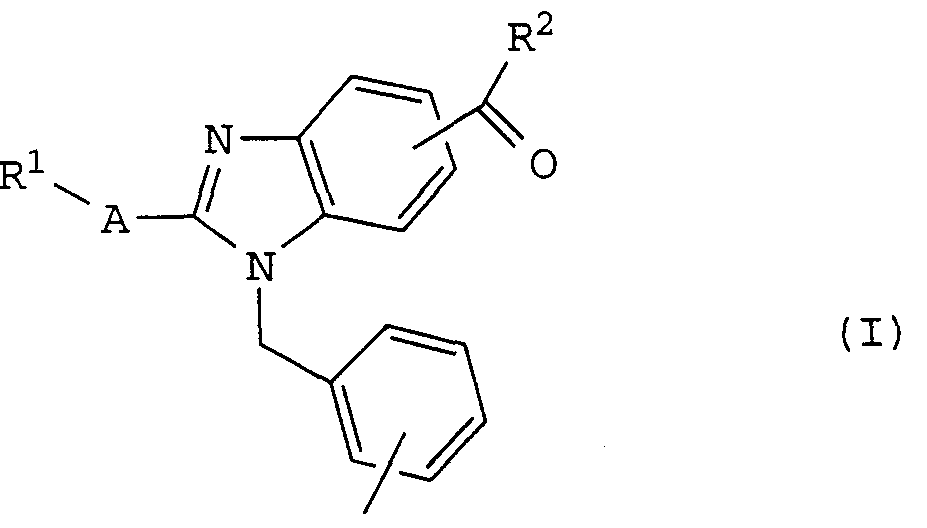
- the present invention provides a compound represented by the general formula (I):
- A is 10— or 1 N H—;
- R 1 is an aliphatic hydrocarbon group having 8 to 8 carbon atoms, or an aliphatic hydrocarbon group having 1 to 8 carbon atoms, which is substituted by 1 or more halogen atoms;
- R 2 is -OH, -OR 10 , NHR 11 , NR 12 R 13 , or NH 2 , or optionally, a nitrogen atom, an oxygen atom, or a nitrogen atom 3 to 7-membered saturated aliphatic amino group or a ring containing at least one nitrogen atom substituted by an aliphatic hydrocarbon group having 1 to 8 carbon atoms.
- a 3- to 7-membered saturated aliphatic aliphatic hydrocarbon group including:
- R 3 is 1 C 00H, 1 C00 R 4 , or 1 OH;
- R 5 is a 3- to 7-membered saturated aliphatic cyclic amino group which may be interposed by a nitrogen atom, an oxygen atom, or a hydrogen atom, or an aliphatic hydrocarbon having 1 to 8 carbon atoms
- a 3- to 7-membered saturated aliphatic cyclic hydrocarbon group containing at least one nitrogen atom substituted with an aliphatic hydrocarbon group of ⁇ 8, or 3-7 A membered unsaturated heterocyclic group;
- R 6 is a 3- to 7-membered saturated aliphatic cyclic hydrocarbon group containing at least one nitrogen atom in the ring which may be optionally substituted by an aliphatic hydrocarbon group having 8 to 8 carbon atoms Or contains at least one nitrogen atom which may be optionally substituted by an aliphatic hydrocarbon group having ⁇ to 8 carbon atoms which is substituted by one or more halogen atoms.
- R 7 and R 8 are one (CH 2 ) r R 9 ;
- R 9 is a hydrogen atom, an aliphatic hydrocarbon group having ⁇ to 8 carbon atoms, an aliphatic hydrocarbon group having 1 to 8 carbon atoms substituted by one or more halogen atoms, or one NR 22 R 23 ;
- R '. , R 1,, R l 2 , R, 3, R '4, R' 5, R, 6, R '7, R, 8, R' 9, R 22, ⁇ Beauty R 23 are each independently U is an aliphatic hydrocarbon group having 1 to 8 carbon atoms, or an aliphatic hydrocarbon group having 1 to 8 carbon atoms, which is substituted by one or more halogen atoms;
- R 2 & — and R 21 are a hydrogen atom, an aliphatic hydrocarbon group having 8 to 8 carbon atoms, or an aliphatic hydrocarbon group having 1 to 8 carbon atoms, which is substituted with one or more halogen atoms;
- n, p, and r are 0 or an integer of 1 to 6]
- the present invention provides a pharmaceutical composition
- a pharmaceutical composition comprising a compound represented by the above general formula (I), or a pharmaceutically acceptable salt thereof, and a pharmaceutically acceptable carrier or diluent. Also concerns.
- the present invention also relates to a compound represented by the above general formula (I) or a pharmaceutically acceptable salt thereof for use in human or veterinary medicine.
- the present invention also relates to a compound represented by the above general formula (I) or a pharmaceutically acceptable salt thereof for use in medical treatment or prevention or veterinary treatment or prevention.
- the present invention also relates to the use of the compound represented by the above general formula) or a pharmaceutically acceptable salt thereof for producing a pharmaceutical composition. Further, the present invention provides a method for treating a renal disease or a heart disease comprising administering a compound represented by the general formula (I) or a pharmaceutically acceptable salt thereof in an amount effective for treating or preventing a renal disease or a heart disease. The present invention also relates to a method for treating or preventing a renal disease or a heart disease, which comprises administering to a subject in need of the treatment or prevention of a heart disease.
- the aliphatic hydrocarbon group includes a saturated or unsaturated linear, branched, or cyclic hydrocarbon group.
- saturated or unsaturated linear or branched hydrocarbon group include an alkyl group, an alkenyl group, and an alkynyl group, and an alkyl group is preferable.
- saturated or unsaturated cyclic hydrocarbon group include a cycloalkyl group, a cycloalkenyl group, and a cycloalkynyl group, and a cycloalkyl group is preferable.
- alkyl group having 8 to 8 carbon atoms examples include a methyl group, an ethyl group, an n-propyl group, an i-propyl group, an n-butyl group, an i-butyl group, an s-butyl group, a t-butyl group, n-pentyl, i-pentyl, neopentyl, t-pentyl, 1-methylbutyl, 2-methylbutyl, 1,2-dimethylpropyl, 1-ethylpropyl, n- hexyl, i-to-1
- Examples thereof include a xyl group, a 2-ethylbutyl group, an n-heptyl group, a 5-methylhexyl group, an n-aminohexyl group, and a 4-ethylhexyl group.
- alkenyl group having 2 to 8 carbon atoms examples include a vinyl group, an aryl group, a 1-butenyl group, an isopropenyl group, a 1-butenyl group, a 2-butenyl group, a 3-butenyl group, and a 1-butenyl group.
- alkynyl group having 2 to 8 carbon atoms examples include ethynyl group, 1-propynyl group, 2-propynyl group, 1-butynyl group, 2-butynyl group, 3-butynyl group, and 1-methyl group 1-propynyl group, 1-pentynyl group, 2-pentynyl group, 3-pentynyl group, 4-pentynyl group, 1-methyl-12-butynyl group, 1-methyl-13-butynyl group, 2 —Methyl-3-butynyl group, 3-methyl-1-butynyl group, 1,1-dimethyl-12-propynyl group, 1-hexynyl group, 2-hexynyl group, 3-hexynyl group, 4-hexynyl group , 5-hexynyl, 1 heptynyl, 2 heptynyl, 3 heptynyl, 4 hepty
- Examples of the cycloalkyl group having 3 to 8 carbon atoms include a cyclopropyl group, a cyclobutyl group, a cyclopentyl group, a cyclohexyl group, a cycloheptyl group, and a cyclooctyl group.
- Examples of the cycloalkenyl group having 3 to 8 carbon atoms include a cyclopropenyl group, a cyclobutenyl group, a cyclopentenyl group, a cyclohexenyl group, a cycloheptenyl group, and a cyclooctenyl group.
- Examples of the cycloalkynyl group having 3 to 8 carbon atoms include a cyclooctynyl group.
- the aliphatic hydrocarbon group having 1 to 8 carbon atoms substituted by one or more halogen atoms is a halogen atom at a substitutable position of the aliphatic hydrocarbon group having 1 to 8 carbon atoms.
- ⁇ To 17 are substituted groups, and the halogen atom is, for example, a chlorine atom, a bromine atom, a fluorine atom, or an iodine atom.
- Examples of the aliphatic hydrocarbon group having 1 to 8 carbon atoms substituted with one or more halogen atoms include halo having 1 to 8 carbon atoms.
- Alkyl groups, for example, trifluoromethyl, pentafluoroethyl, or 4,4,4-trifluorobutyl are preferred.
- alkyleneamino group in which one hetero atom may be interposed in some cases include, for example, 1-azetidinyl group, 1-pyrrolidinyl group, piberidino group, morpholino group, thiomorpholino group, and 1-piperazinyl group.
- a 3- to 7-membered saturated aliphatic cyclic hydrocarbon group having at least one nitrogen atom substituted with an aliphatic hydrocarbon group having 1 to 8 carbon atoms in the ring contains at least one nitrogen atom in the ring, Moreover, it is a 3-7 membered saturated aliphatic cyclic hydrocarbon group substituted with an aliphatic hydrocarbon group having 1-8 carbon atoms (ie, a 3-7 membered saturated N heterocyclic group).
- the number of carbon atoms substituted with one or more halogen atoms 8 8 (7) A 3- to 7-membered saturated aliphatic cyclic ring containing at least one nitrogen atom substituted with an aliphatic hydrocarbon group
- the hydrocarbon group contains at least one nitrogen atom in the ring, and is a 3- to 7-membered saturated hydrocarbon group substituted with an aliphatic hydrocarbon group having 8 to 8 carbon atoms and substituted with one or more halogen atoms. It is an aliphatic cyclic hydrocarbon group (that is, a 3 to 7-membered saturated N-hetero group).
- Examples of the 3- to 7-membered cyclic alkyl group having at least one nitrogen atom in the ring substituted with an aliphatic hydrocarbon group of 8 include 1-methylaziridinyl group, 1-methylazetidinyl group, 1-methylpyrrolidinyl group, 1-ethylpyrrolidinyl group, 1-propylpyrrolidinyl group, 3-methylimidazolidine-14-yl group, 1-methylvillazolidine-14-yl group, 1-methylbiperidyl group, 1-ee Tylbiperidyl group, 1-propylpiperidyl group, 1-trifluoromethylpyrrolidinyl group, 1-trifluroylpyrrolidinyl group, 1-trifluroylpyrrolidiny
- Examples of the 3- to 7-membered unsaturated heterocyclic group include an imidazolyl group, an oxazolyl group, a thiazolyl group, a pyrazolyl group, an isoxazolyl group, an isothiazolyl group, a triazolyl group, a trixazodazolyl group, a thiadiazolyl group, and a tetrazolyl group And a tristriazolyl group, a thiotriazolyl group, a thienyl group, a furyl group, a vinylyl group, a pyrrolyl group, a birazolinyl group, an imidazolinyl group, a pyridyl group, a birazinyl group, a pyrimidinyl group, or a pyridazinyl group.
- At least one nitrogen atom which may be optionally substituted by an aliphatic hydrocarbon group having 1 to 8 carbon atoms and which is substituted by one or more halogen atoms is represented by 3 ⁇ 4 to 7 to 7 members.
- the saturated aliphatic cyclic hydrocarbon group contains at least one nitrogen atom in the ring, and is optionally substituted with an aliphatic hydrocarbon group having 1 to 8 carbon atoms and substituted with one or more halogen atoms.
- a 3-7 membered saturated aliphatic cyclic hydrocarbon group ie, a 3-7 membered saturated N heterocyclic group).
- Examples of the 3- to 7-membered saturated aliphatic cyclic hydrocarbon group containing at least one nitrogen atom substituted with an aliphatic hydrocarbon group having 1 to 8 carbon atoms in a ring include, for example, 1-methylaziridinylene group , 1-methylazetidinylene group, 1-methylbi-lidinylene group, 1-ethylpyrrolidinylene group, 1-propylpyrrolidinylene group, pyrrolidinylene group, 3-methylimidazolidine-14-ylene group, 1-methylvilla 1-Ziridine 4-pyrylene group, piperidylene group, 1-methylbiveridylene group, 1-ethylpiperidylene group, 1-propylpiberidylene group
- R 1 is an aliphatic hydrocarbon group having ⁇ to 5 carbon atoms, or an aliphatic hydrocarbon group having ⁇ to 5 carbon atoms substituted with 1 or more halogen atoms;
- R 2 is 0 H, -0 R 1 ° — NHR 11 , 1 NR 12 R 13 , or 1 NH 2 , or optionally, a nitrogen atom, an oxygen atom, or an iodine atom is interposed.
- R 3 is one COOH, one CO R 4 , or one OH;
- R 5 is a 3- to 6-membered saturated aliphatic cyclic amino group which may be optionally interposed with a nitrogen atom, an oxygen atom or an i-atom atom, or an aliphatic hydrocarbon group having 1 to 4 carbon atoms.
- a 3- to 6-membered saturated aliphatic cyclic hydrocarbon group containing at least one substituted nitrogen atom in the ring, or a substituted or unsubstituted C1-C4 aliphatic hydrocarbon group having 1 or more halogen atoms A 3- to 6-membered saturated aliphatic cyclic hydrocarbon group containing at least one nitrogen atom in the ring substituted with an aliphatic hydrocarbon group, or a 3- to 6-membered unsaturated heterocyclic group.
- R 6 is a 3- to 6-membered saturated aliphatic cyclic hydrocarbon group containing at least one nitrogen atom in the ring which may be optionally substituted by an aliphatic hydrocarbon group having 1 to 4 carbon atoms. Or a 3- to 6-membered ring containing at least one nitrogen atom which may be optionally substituted by an aliphatic hydrocarbon group having 1 to 4 carbon atoms and which is substituted by one or more halogen atoms.
- R 7 and R 8 are one (CH) r R 9 ;
- R 9 is a hydrogen atom, an aliphatic hydrocarbon group having 1 to 5 carbon atoms, an aliphatic hydrocarbon group having 1 to 5 carbon atoms substituted with one or more halogen atoms, or one NR 22 R 23 ;
- R 1 1, R 1 2 , R 1 3, R, 4, R 1 5, R 1 6, R 1 7, R 1 8, R 1 9, R 22, ⁇ Beauty R 23 are each independently An aliphatic hydrocarbon group having 1 to 6 carbon atoms, or an aliphatic hydrocarbon group having 1 to 6 carbon atoms, which is substituted with one or more halogen atoms;
- R 2 ° and R 2 ′ are a hydrogen atom, an aliphatic hydrocarbon group having 6 to 6 carbon atoms, or an aliphatic hydrocarbon group having 1 to 6 carbon atoms substituted by one or more halogen atoms. ;
- A is 10- or 1 NH-
- R 1 is an aliphatic hydrocarbon group having 2 to 4 carbon atoms
- R 2 may be optionally intervened by oxygen, nitrogen, or thio atoms
- R 3 is one C00H, one COO R 4 , or one OH;
- R 4 is an alkyl group having 1 to 5 carbon atoms, one (CH 2 ) m NR 14 R 15 ,
- R may be intervened by a nitrogen, oxygen, or oxygen atom, as the case may be
- R 7 is one (CH 2 ) r CH 3 ;
- R , 0 , R 1 ⁇ R 12 , R 13 , R ′ 4 , and R 15 are each independently an alkyl group having 1 or 2 carbon atoms;
- n is 0 or an integer of 1 or 2;
- n is an integer from 1 to 5;
- a compound or a salt thereof in which 1 C ( 0) R 2 is located at the 5-position or 6-position of the benzoimidazole ring, and R 3 is located at the 4-position of fenziruma.
- A is -0-;
- R 1 is an alkyl group having 2 to 4 carbon atoms
- R 2 is a pyrrolidinyl group or a pyridino group
- R 3 is —C 0 R 4 ;
- R 4 is one (CH 2 ) n R 5 ;
- R 5 is a morpholino group
- n is an integer of 1 to 3;
- R 2 is in the 6th position of Benzoimidazola
- the benzimidazole derivative represented by the general formula (I) according to the present invention ( ⁇ salts include salts with inorganic or organic acids, or salts with inorganic or organic bases, and are pharmaceutically acceptable Preferred acid addition salts are, for example, hydrochloride, sulfate, methanesulfonate, or p-toluenesulfonate, and further, oxalic acid, malonic acid, succinic acid, maleic acid, or fumaric acid And a salt with a monocarboxylic acid such as acetic acid, propionic acid or diacid, etc. Further, the benzimidazole represented by the above general formula (I) according to the present invention.
- Inorganic bases suitable for forming the salt of the derivative include, for example, hydroxides, carbonates, such as ammonia, sodium, lithium, calcium, magnesium, and aluminum.
- Salts with organic bases include, for example, mono-, di- and trialkylamine salts such as methylamine, dimethylamine and triethylamine, mono-, di- and trihydroxyalkyl Examples include amine salts, guanidine salts, N-methylglucosamine salts, and amino acid salts.
- Me represents a methyl group
- Et represents an ethyl group
- nPr represents an n-propyl group
- ⁇ 8 represents a monobutyl group
- iPr represents an i-propyl group.
- the cyc P r is a cyclopropyl group, a cyc NC 4 H 8 0 morpholino group, cyc NC 5 H ,.
- cyc NC 4 H 8 is 1 pyrrolidinyl group
- cyc NC 3 H 6 is 1 azetidinyl group
- 2 1 cyc N (Me)
- C 4 H 7 is N-methyl 1-2-pyrrolidinyl
- C 5 H 9 is N-methyl-2-piperidinyl group
- cyc C 6 H, is cyclohexyl group
- cyc NC 6 H 12 is 1-1 hydroazepinyl group Are respectively shown.
- the compound represented by the formula (1) is dissolved in an appropriate solvent (for example, chloroform, tetrahydrofuran, benzene, pyridine, or N, N-dimethylformamide), and one COOH is dissolved in one COOH.
- an appropriate solvent for example, chloroform, tetrahydrofuran, benzene, pyridine, or N, N-dimethylformamide
- R 2 a compound that can be converted to R 2 (where R 2 has the same meaning as described above) and a suitable condensing agent, and reacting at 0 to 50 ° C.
- R 2 is a compound that can be converted to R 2
- R 2 is a suitable condensing agent
- reacting at 0 to 50 ° C. the compound represented by the general formula (2)
- the compounds represented can be obtained.
- a compound capable of converting an COOH to one CO R 2 for example, in the case R 2 is a morpholino group, it can be exemplified morpho
- R 3 has the same meaning as described above, and one (C 6 H 4 ) — is an o-phenylene group, an m-phenylene group, or a p-phenylene group, and Y is A compound represented by the general formula (3) can be obtained by reacting at 20 to 110 ° C with a compound represented by the following formula:
- the compound represented by the general formula (3) is dissolved in a suitable solvent (eg, tetrahydrofuran, alcohol, or ethyl acetate, etc.) and a suitable catalyst [eg, palladium on carbon (10%), etc.] And reacting at 20 ° C. or lower than the boiling point of the solvent in the presence of a suitable reducing agent (for example, hydrazine hydrate) to obtain the compound represented by the general formula (4). .
- a suitable solvent eg, tetrahydrofuran, alcohol, or ethyl acetate, etc.
- a suitable catalyst eg, palladium on carbon (10%), etc.
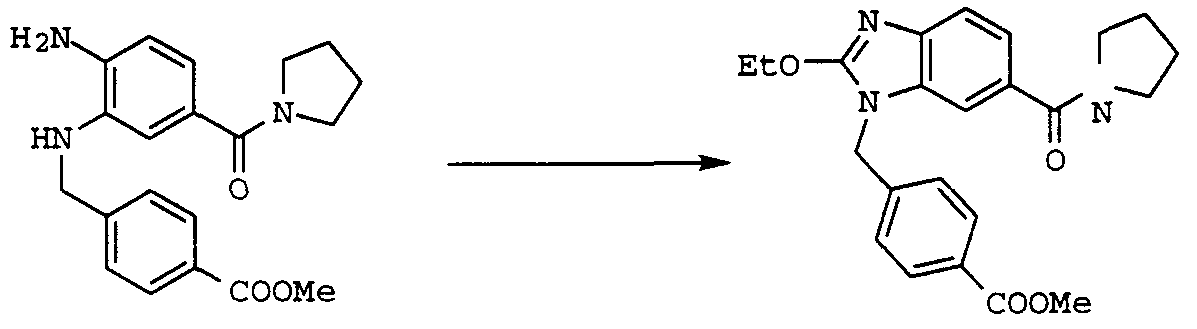
- the compound represented by the general formula (4) can be dissolved in an appropriate solvent (for example, acetic acid or the like) to form a benzoimidazole group while having a desired substituent (R′—A—).
- the compound represented by the general formula (5) (wherein R 1 and A have the same meanings as described above) can be obtained by reacting the compound with the compound at 20 to 140 ° C.
- R′-A- for example, when a compound represented by the general formula (5) in which R 1 is an ethyl group and A is an oxygen atom, Ethoxymethane can be mentioned.
- R 1 or A is other, those skilled in the art can appropriately select R 1 or A according to the purpose.
- Protecting groups that may optionally be present in the resulting compound can be removed, if desired, for example, by treatment with an acid and or a base to give the free compound. Further, a compound in which R 3 is —C 00 R 4 can be obtained by performing a usual esterification reaction after obtaining a compound in which R 3 is a carboxyl group.
- R 2 is located at the 6-position of the benzoimidazole ring
- R 3 is located at the 4-position of phenyl
- R 3 is —COO R 4 [Synthetic pathway described later]
- the compound represented by the formula (17) in [2]] can be obtained by, for example, a synthetic route [2] including the following steps (e) to (j) in addition to the synthetic route [1]. It can also be synthesized.
- a compound represented by the general formula (11) (where X is a halogen atom) is dissolved in a suitable solvent (eg, acetic anhydride) to form a compound serving as a nitro source (eg, fuming nitric acid, etc.) ) And reacting at 120 to 50 ° C. to obtain a compound represented by the general formula (12).
- a suitable solvent eg, acetic anhydride
- a compound capable of converting one COOH to one COR 2 by dissolving the compound represented by the general formula ⁇ 2) in an appropriate solvent for example, N, N-dimethylformamide, etc.
- an appropriate solvent for example, N, N-dimethylformamide, etc.
- R 2 is The compound represented by the general formula (13) can be obtained by adding the same condensing agent and reacting at 0 to 50 ° C.
- the compound represented by the general formula (14) is dissolved in a suitable solvent (eg, toluene and the like), and is dissolved in a suitable base (eg, diisopropylethylamine) in the presence of the general formula:
- a suitable solvent eg, toluene and the like
- a suitable base eg, diisopropylethylamine
- the compound represented by the general formula (16) is dissolved in a suitable solvent (for example, acetic acid, etc.) to form a benzoimidazole group having the desired substituent (R′—A—).
- a suitable solvent for example, acetic acid, etc.
- the compound represented by the general formula (17) (wherein, R 1 and A have the same meanings as described above) can be obtained by reacting the resulting compound with the compound at 20 to 140 ° C. Protecting groups that may optionally be present in the resulting compound can be removed as necessary, for example, by treatment with acid and Z or a base to give the free compound. Further, a compound in which R 3 is —COO R 4 can be obtained by performing a normal esterification reaction after obtaining a compound in which R 3 is a carboxyl group.
- the compound [compound represented by the formula (26) ′ in the synthetic pathway [3]] may be, for example, the following steps (k) to (0) in addition to the synthetic pathway [1]. It can also be synthesized by a synthetic route consisting of [3].
- a suitable solvent e.g., N, N-dimethyl formamidine de etc.
- a compound represented by the general formula (23) (where R ′ and A have the same meaning as described above) can be obtained.
- the compound represented by the general formula (25) is dissolved in a suitable solvent (for example, acetic acid, etc.) and reacted at 20 to 140 ° C. to obtain the compound represented by the general formula (25). Can be obtained.
- a suitable solvent for example, acetic acid, etc.
- the compound represented by the general formula (25) is dissolved in a suitable solvent (eg, N, N-dimethylformamide), and is dissolved in a suitable base (eg, potassium carbonate) in the presence of a general formula:
- a suitable solvent eg, N, N-dimethylformamide
- a suitable base eg, potassium carbonate
- Protecting groups that may optionally be present in the resulting compound can be removed as necessary, for example, by treatment with an acid and or a base to give the free compound. Further, after obtaining a compound in which R 3 is a carboxyl group, a normal esterification reaction is carried out, whereby a compound in which R 3 is —CO R 4 can be obtained.
- the benzimidazole derivative represented by the above general formula (I) or a pharmaceutically acceptable salt thereof according to the present invention has sufficient effects on renal disease and heart disease without having an effect on blood pressure. It shows a preventive effect (especially an improvement effect). Therefore, the present invention provides a pharmaceutical composition comprising the benzimidazole derivative represented by the general formula (I) or a pharmaceutically acceptable salt thereof as an active ingredient,
- the present invention also relates to a prophylactic agent (particularly a renal disease ameliorating agent) or a heart disease treating or preventing agent (particularly a heart disease ameliorating agent).
- a benzimidazole derivative represented by the above formula (or a derivative thereof that can be easily converted to a pharmaceutically acceptable salt thereof, that is, a open-drug is also used as an active ingredient of the present invention.
- Methods commonly used for the selection and manufacture of suitable prodrugs are described, for example, in Design of Prodrugs, ed. H. Bundgaard, Elsevier, 1985.
- the benzimidazole derivative represented by the above general formula (I) or a pharmaceutically acceptable salt thereof according to the present invention is useful as an agent for treating or preventing renal disease.
- it is useful for phlegmitis, nephropathy, renal failure, nephrotic syndrome, asymptomatic proteinuria, hematuria, diabetic nephropathy, drug-induced renal disease, urinary tract infection, or prostatitis.
- the benzimidazole derivative represented by the general formula (I) or a pharmaceutically acceptable salt thereof according to the present invention is also useful as a therapeutic or preventive agent for heart disease.
- left ventricular systolic insufficiency eg, myocardial infarction, dilated cardiomyopathy, or hypertensive heart disease
- regurgitant valve disease eg, aortic regurgitation or mitral regurgitation
- left and right shunting disease eg, Patency of the ductus arteriosus, ventricular septal defect, or rupture of VaIsaIva sinus.
- Cardiac disease mainly due to stenotic valve disease (eg, aortic stenosis or mitral stenosis), obstructive hypertrophic cardiomyopathy, or diastolic insufficiency, which has been a challenge for ACE inhibitors
- hypertrophic cardiomyopathy constrictive pericarditis, or cardiac tambonade
- cardiac hypertrophy that causes these diseases can be selectively treated or prevented.
- the benzimidazole derivative represented by the above general formula (I) or a pharmaceutically acceptable salt thereof according to the present invention can be orally or parenterally administered to mammals including humans (for example, transdermally or intravenously). , Intraperitoneal, etc.).
- the benzimidazole derivative represented by the general formula (I) or a pharmaceutically acceptable salt thereof according to the present invention was orally administered to mice at a dose of 500 mg / kg and observed for one week. No deaths were found.
- the benzimidazole derivative represented by the above general formula (I) or a pharmaceutically acceptable salt thereof according to the present invention is obtained by adding one or more pharmaceutically or veterinarily acceptable additives to a preparation.
- a preparation for example, powders, tablets, granules, capsules, suppositories, injections, or oral liquids can be prepared.
- additives include magnesium stearate, talc, lactose, dextrin, starches, methylcellulose, fatty acid glycerides, water, propylene glycol, macrogol, alcohol, crystalline cellulose, hydroxypropylcellulose, and low-substituted additives.
- Granules, tablets, or capsules can also be coated with a coating base such as hydroxypropylmethylcellulose or hydroxypropylmethylcellulose phthalate.
- the benzimidazole derivative represented by the general formula (I) or a pharmaceutically acceptable salt thereof according to the present invention may be contained in a unit dose of 0.1 to 50 mg, preferably 1 to 10 mg. 0 mg can be contained. Use of the benzimidazole derivative represented by the general formula (I) or a pharmaceutically acceptable salt thereof according to the present invention.
- the dose is between 0.1 and 15 Omg per kg of body weight per day, preferably between 1 and 100 mg. It is administered once or twice or three times daily. However, the administration site can be appropriately selected depending on the patient's condition.
- 3-amino-4-212-benzobenzoic acid [compound represented by formula (1a)] synthesized by a method known in the literature (HECHENG HUAS UE, pp. 91, 1995) 10. 8 g was dissolved in 108 ml of N, N-dimethylformamide (DMF), and morpholine 10.3 ml and 1-hydroxybenzotriazole were added.
- DMF N, N-dimethylformamide
- 2-ethoxy-1-1 [[4,-[3,1,1- (dimethylamino) -12 ", 2,2'-dimethylpropoxycarbonyl] phenyl] methyl] -1H-benzoimidazole-6-carboxylic acid Morpholide [compound N 0.49] was synthesized, that is, 2-ethoxy-1-[(4'-carboxyphenyl) methyl] 1-1H-benzoimidazole-1-6 obtained in Example 5.
- the obtained crude product was treated with methanol 24 ml And 24 ml of a 1N aqueous sodium hydroxide solution was added thereto, and the mixture was reacted at room temperature for 1 hour.
- the reaction mixture was acidified by adding 1N hydrochloric acid, and then separated and extracted with a black hole form.
- the organic layer was dried over anhydrous sodium sulfate and concentrated under reduced pressure.
- Yield 56.9%
- 2-ethoxy-1-1 [[4,1- (2 "-(ethylamino) ethoxycarbonyl) phenyl] methyl] -11-H-benzimidazole-16-carboxypiperidineamide
- Compound N o. 5 6 was synthesized. That is, 2.511 g of 2-ethoxy 1-[(4′-carboxyphenyl) methyl] —1H-benzoimidazole-6-carboxylate piperidine amide obtained in Example 25 was added. Dissolve in 5 ml of DMF, then add WS CI ⁇ HC I -1.772 g, DMA P 0.3736 g, and 2-ethylaminoethanol 2.1676 g in order.
- Acid-n-propylamide [compound represented by formula (4f)] 6.91 g was added to tetraethoxymethane (5.81 mI) and acetic acid (1.03 ml) sequentially, and the mixture was added at 90 ° C. Stirred for 40 minutes. Distilled water was added to the reaction solution, and the mixture was separated and extracted with a black hole form.
- test compound was prepared in Example 6.
- 2-Ethoxy 11-[[4,-(2 "-N, N-dimethylamino-ethoxycarbonyl) phenyl] methyl] 1-1H-Venzoimidazo-1-lu 6-carboxylic acid morpholide (Compound No. 13) was used.
- a 5-week-old ICR mouse female is divided into 5 mice in each group, and after acclimation and rearing for 1 week, compound N 0.13 is dissolved or dispersed in a 0.5% aqueous methylcellulose solution, and a single oral administration is performed. (The dose was 50 OmgZkg), and the number of deaths after 6 days was examined. Further, Compound No. 55, Compound No. 55 prepared in Examples 26, 28, 31 and 23.
- the binding atsee was performed. That is, the affinity of angiotensin II for the type 1 or type 2 receptor was described in the literature (Bi 0 chem. Pharmacol., 33: 405 7 to 40 62, 199 84). It was determined according to the method described above.
- the measurement of total binding in the presence of each drug was performed as follows. Drugs of a predetermined concentration (after dissolving in DMSQ, diluted 2-fold with the buffer attached to the drug discovery system and used for Atsusei; 0.025 ml), tracer (0.025 ml), and receptor (0. 2 ml) was added, a total of 2 and 5 m I, ink Interview base one Bok [angiopathy old tensin II receptor type 1 (aT,) in 3 hours at room temperature, motor drive 2 (aT 2) in 3 7 After that, the reaction solution was subjected to suction filtration (using G FZC filter paper for AT, and G FZB filter paper for AT 2 ).
- IC 5 concentrations investigational drug product is to inhibit the rate (50% to inhibit binding of the radioligand (Bok Racer) and receptor. Value, Or the percentage of inhibition of binding at 1) was determined. Table 5 shows the results.
- the blood pressure lowering effect was examined. That is, 2-ethoxy-1-[[4,-(2 "-N, N-dimethylamino-ethoxycarbonyl) phenyl] methyl] 1-1H-benzimidazole-6-force prepared in Example 6 Rubonic acid morpholide (compound N 0.13), 2-ethoxy 1 prepared in Example 28 — [[4 '-(2,, 1 morpholinoethoxycarbonyl) phenyl] methyl] —1H—
- the blood pressure-lowering effect was examined by oral gavage administration of nzomidazolu 6-potassium piperidine amide (Compound No. 57) or a comparative substance to renal disease rats.
- a kidney disease rat was prepared. As groups of 8 animals, 15 groups were prepared so that there was no difference in serum creatinine level and urea nitrogen level, which are indicators of renal function. Rats have free access to food and water, and each group receives 20 mg / kg of compound No. 13, No. 57 or a comparison substance (DuP753) at a daily dose of 20 mg / kg. In the control group, water alone was administered by oral gavage every day. Two weeks later, the rat is under anesthesia. 0.2 ml of blood was collected from the carotid artery, and serum creatinine (S cr) was measured with a creatinine analyzer (Beckman) using serum 25 I obtained by centrifugation.
- S cr serum creatinine
- BUN Urea nitrogen
- Creatinine clearance was calculated by the following equation.
- the effect is comparable to that of the comparative substance.
- Compound N 0.13 and compound No. 57 have substantially no known angiotensin 11 receptor antagonism and blood pressure lowering effect, and have an effect of improving renal disease. It was shown that there is.
- the test compound used was 2-ethoxy 1-[[4,1- (2 "-N, N-dimethyl) prepared in Example 6. Cylamino-ethoxycarbonyl) phenyl] methyl] 1-1H-benzoimidazo-ru-6-potassic acid morpholide (compound No. 13) and 2-ethoxy 1-[[4,1 (2, '-Morpholinoethoxycarbonyl) phenyl] methyl] 1H-benzimidazole-6-potassium piperidine amide (compound N 0.57) was used.
- a kidney disease rat was prepared. As groups of 8 animals, 15 groups were prepared so that there was no difference in serum creatinine level and urea nitrogen level, which are indicators of hip function. Rats are allowed free access to food and water, and each group is given 20 mg / kg'B of Compound No. 13, Compound No. 57, or a comparative substance (DuP753). And the control group received water only by oral gavage every day. Rats died from uremia as renal disease progressed, so the survival time of rats was examined as a comprehensive indicator of the improvement effect on renal disease. Table 8 shows the results. Here, the test period was eight weeks. Therefore, if all rats survive, the average survival time is 8 weeks, which is the upper limit. Compound N 0. Average survival says (week.)
- DuP7536.9 Compound No. 13 or Compound No. 57 clearly prolonged the survival of kidney disease rats. Its effects are comparable to or better than those of the comparison substance.Compounds No. 13 and No. 57 have substantially no known angiotensin II receptor antagonism and blood pressure lowering effects. It has been shown to prolong the life of rats that die from kidney disease.
- Table 9 shows the body weight, blood pressure, heart weight, and relative weight ratio of the heart to the body weight (mean soil standard deviation).
- Compound No. 13 or Compound No. 57 suppressed myocardial damage without inducing blood pressure lowering.
- tablets were prepared. That is, 2-ethoxy-1-[[4,-(2 "- ⁇ , ⁇ -dimethylamino-ethoxycarbonyl) phenyl] methyl] 1 1 1-benzoimidazo-l-6-carboxylic acid prepared in Example « 6 Morpholide (Compound No. 13) (1 Omg), lactose (36 mg), corn starch (15 Omg), microcrystalline cellulose (29 mg), and magnesium stearate (5 mg) were mixed. This was compressed into tablets (230 mgZ tablets).
- the benzoimidazole derivative of the general formula (I) according to the present invention or a pharmacological description thereof Tolerable salts have a sufficient effect on kidney and heart disease, despite having very little effect on blood pressure. Therefore, by using such drugs, renal disease or heart disease can be sufficiently treated, while blood pressure can be adjusted to a desired level by using an appropriate antihypertensive agent as needed. Appropriate treatment becomes possible.
- the present invention has been described according to the specific embodiments. However, modifications and improvements obvious to those skilled in the art are included in the scope of the present invention.
Landscapes
- Chemical & Material Sciences (AREA)
- Organic Chemistry (AREA)
- Pharmaceuticals Containing Other Organic And Inorganic Compounds (AREA)
Description









Claims


Priority Applications (4)
| Application Number | Priority Date | Filing Date | Title |
|---|---|---|---|
| US09/622,788 US6242445B1 (en) | 1998-02-23 | 1999-02-23 | Benzimidazole derivative |
| EP99905278A EP1069113A1 (en) | 1998-02-23 | 1999-02-23 | Benzimidazole derivative |
| CA002321110A CA2321110A1 (en) | 1998-02-23 | 1999-02-23 | Benzimidazole derivative |
| AU44819/99A AU745838B2 (en) | 1998-02-23 | 1999-02-23 | Benzimidazole derivative |
Applications Claiming Priority (2)
| Application Number | Priority Date | Filing Date | Title |
|---|---|---|---|
| JP5749798 | 1998-02-23 | ||
| JP10/57497 | 1998-02-23 |
Publications (1)
| Publication Number | Publication Date |
|---|---|
| WO1999042451A1 true WO1999042451A1 (en) | 1999-08-26 |
Family
ID=13057376
Family Applications (1)
| Application Number | Title | Priority Date | Filing Date |
|---|---|---|---|
| PCT/JP1999/000794 Ceased WO1999042451A1 (en) | 1998-02-23 | 1999-02-23 | Benzimidazole derivative |
Country Status (5)
| Country | Link |
|---|---|
| US (1) | US6242445B1 (ja) |
| EP (1) | EP1069113A1 (ja) |
| AU (1) | AU745838B2 (ja) |
| CA (1) | CA2321110A1 (ja) |
| WO (1) | WO1999042451A1 (ja) |
Families Citing this family (2)
| Publication number | Priority date | Publication date | Assignee | Title |
|---|---|---|---|---|
| EP1660472A1 (en) | 2003-08-27 | 2006-05-31 | Janssen Pharmaceutica N.V. | Aryl piperidine amides |
| WO2011091446A1 (en) * | 2010-01-22 | 2011-07-28 | Glaxosmithkline Llc | Chemical compounds |
Citations (1)
| Publication number | Priority date | Publication date | Assignee | Title |
|---|---|---|---|---|
| JPH04364171A (ja) * | 1990-04-27 | 1992-12-16 | Takeda Chem Ind Ltd | ベンズイミダゾール誘導体 |
-
1999
- 1999-02-23 EP EP99905278A patent/EP1069113A1/en not_active Withdrawn
- 1999-02-23 WO PCT/JP1999/000794 patent/WO1999042451A1/ja not_active Ceased
- 1999-02-23 AU AU44819/99A patent/AU745838B2/en not_active Ceased
- 1999-02-23 CA CA002321110A patent/CA2321110A1/en not_active Abandoned
- 1999-02-23 US US09/622,788 patent/US6242445B1/en not_active Expired - Fee Related
Patent Citations (1)
| Publication number | Priority date | Publication date | Assignee | Title |
|---|---|---|---|---|
| JPH04364171A (ja) * | 1990-04-27 | 1992-12-16 | Takeda Chem Ind Ltd | ベンズイミダゾール誘導体 |
Also Published As
| Publication number | Publication date |
|---|---|
| AU4481999A (en) | 1999-09-06 |
| CA2321110A1 (en) | 1999-08-26 |
| US6242445B1 (en) | 2001-06-05 |
| AU745838B2 (en) | 2002-04-11 |
| EP1069113A1 (en) | 2001-01-17 |
Similar Documents
| Publication | Publication Date | Title |
|---|---|---|
| JP5638513B2 (ja) | インドリジン誘導体及びその医薬用途 | |
| JP5621148B2 (ja) | 5−ht2b受容体拮抗活性を有する新規ピラゾール−3−カルボキサミド誘導体 | |
| Mano et al. | Novel imidazole compounds as a new series of potent, orally active inhibitors of 5-lipoxygenase | |
| JPWO2008126899A1 (ja) | 5員環へテロ環誘導体及びその医薬用途 | |
| EA021025B1 (ru) | Соединения, эффективные в качестве ингибиторов ксантиноксидазы, способ их получения и содержащая их фармацевтическая композиция | |
| WO1998018765A1 (fr) | Composes de 1-phenylpyrazole et leur application pharmaceutique | |
| CN115160299B (zh) | 一类黄嘌呤氧化酶抑制剂 | |
| JPH11292766A (ja) | 哺乳動物の心不全処置法、組成物およびキット | |
| CN107235906B (zh) | 一组吡唑酰胺类衍生物及其应用 | |
| JP3295277B2 (ja) | 抗腎疾患剤及びベンズイミダゾール誘導体 | |
| WO2001027088A1 (en) | Lpl potentiators | |
| WO1999042451A1 (en) | Benzimidazole derivative | |
| JPH0853424A (ja) | ベンズイミダゾールスルホン酸アミド誘導体 | |
| CN106478619A (zh) | 一类黄嘌呤氧化酶抑制剂及其应用 | |
| JPWO1999042451A1 (ja) | ベンゾイミダゾール誘導体 | |
| JPH10203981A (ja) | 心疾患改善剤 | |
| JP2887179B2 (ja) | 芳香族化合物 | |
| JP4676883B2 (ja) | 2,4−ビス(トリフルオロエトキシ)ピリジン化合物及びこれを含有する医薬 | |
| JP2010155802A (ja) | 5−ht2b受容体拮抗活性を有する新規5−エチニルピラゾール−3−カルボキサミド誘導体 | |
| JP2996609B2 (ja) | ピリミジン誘導体 | |
| JP2008106017A (ja) | Oatp選択的阻害性を有する化合物、及び該化合物を含むoatpの選択的阻害剤 | |
| JP2009051731A (ja) | 新規アスコクロリン誘導体化合物及びそれを含有する医薬組成物 | |
| EA007202B1 (ru) | Новые производные пиперидинилалкиламинопиридазинона, способ их получения и содержащие их фармацевтические композиции | |
| TW202214645A (zh) | 含氮雜環化合物的鹽及其鹽的固體形式、藥物組合物和用途 | |
| CN108358856A (zh) | 一种防治消化性溃疡的药物以及其制备方法和用途 |
Legal Events
| Date | Code | Title | Description |
|---|---|---|---|
| AK | Designated states |
Kind code of ref document: A1 Designated state(s): AU CA JP US |
|
| AL | Designated countries for regional patents |
Kind code of ref document: A1 Designated state(s): AT BE CH CY DE DK ES FI FR GB GR IE IT LU MC NL PT SE |
|
| 121 | Ep: the epo has been informed by wipo that ep was designated in this application | ||
| DFPE | Request for preliminary examination filed prior to expiration of 19th month from priority date (pct application filed before 20040101) | ||
| ENP | Entry into the national phase |
Ref document number: 2321110 Country of ref document: CA Ref country code: CA Ref document number: 2321110 Kind code of ref document: A Format of ref document f/p: F |
|
| WWE | Wipo information: entry into national phase |
Ref document number: 09622788 Country of ref document: US |
|
| WWE | Wipo information: entry into national phase |
Ref document number: 44819/99 Country of ref document: AU |
|
| WWE | Wipo information: entry into national phase |
Ref document number: 1999905278 Country of ref document: EP |
|
| WWP | Wipo information: published in national office |
Ref document number: 1999905278 Country of ref document: EP |
|
| WWG | Wipo information: grant in national office |
Ref document number: 44819/99 Country of ref document: AU |
|
| WWW | Wipo information: withdrawn in national office |
Ref document number: 1999905278 Country of ref document: EP |