WO1999043797A2 - Constitutive maize promoters - Google Patents
Constitutive maize promoters Download PDFInfo
- Publication number
- WO1999043797A2 WO1999043797A2 PCT/US1999/004203 US9904203W WO9943797A2 WO 1999043797 A2 WO1999043797 A2 WO 1999043797A2 US 9904203 W US9904203 W US 9904203W WO 9943797 A2 WO9943797 A2 WO 9943797A2
- Authority
- WO
- WIPO (PCT)
- Prior art keywords
- nucleotide sequence
- sequence
- seq
- plant
- promoter
- Prior art date
- Legal status (The legal status is an assumption and is not a legal conclusion. Google has not performed a legal analysis and makes no representation as to the accuracy of the status listed.)
- Ceased
Links
Classifications
-
- C—CHEMISTRY; METALLURGY
- C12—BIOCHEMISTRY; BEER; SPIRITS; WINE; VINEGAR; MICROBIOLOGY; ENZYMOLOGY; MUTATION OR GENETIC ENGINEERING
- C12N—MICROORGANISMS OR ENZYMES; COMPOSITIONS THEREOF; PROPAGATING, PRESERVING, OR MAINTAINING MICROORGANISMS; MUTATION OR GENETIC ENGINEERING; CULTURE MEDIA
- C12N9/00—Enzymes; Proenzymes; Compositions thereof; Processes for preparing, activating, inhibiting, separating or purifying enzymes
- C12N9/0004—Oxidoreductases (1.)
- C12N9/0008—Oxidoreductases (1.) acting on the aldehyde or oxo group of donors (1.2)
-
- C—CHEMISTRY; METALLURGY
- C07—ORGANIC CHEMISTRY
- C07K—PEPTIDES
- C07K14/00—Peptides having more than 20 amino acids; Gastrins; Somatostatins; Melanotropins; Derivatives thereof
- C07K14/415—Peptides having more than 20 amino acids; Gastrins; Somatostatins; Melanotropins; Derivatives thereof from plants
-
- C—CHEMISTRY; METALLURGY
- C07—ORGANIC CHEMISTRY
- C07K—PEPTIDES
- C07K14/00—Peptides having more than 20 amino acids; Gastrins; Somatostatins; Melanotropins; Derivatives thereof
- C07K14/825—Metallothioneins
-
- C—CHEMISTRY; METALLURGY
- C12—BIOCHEMISTRY; BEER; SPIRITS; WINE; VINEGAR; MICROBIOLOGY; ENZYMOLOGY; MUTATION OR GENETIC ENGINEERING
- C12N—MICROORGANISMS OR ENZYMES; COMPOSITIONS THEREOF; PROPAGATING, PRESERVING, OR MAINTAINING MICROORGANISMS; MUTATION OR GENETIC ENGINEERING; CULTURE MEDIA
- C12N15/00—Mutation or genetic engineering; DNA or RNA concerning genetic engineering, vectors, e.g. plasmids, or their isolation, preparation or purification; Use of hosts therefor
- C12N15/09—Recombinant DNA-technology
- C12N15/63—Introduction of foreign genetic material using vectors; Vectors; Use of hosts therefor; Regulation of expression
- C12N15/79—Vectors or expression systems specially adapted for eukaryotic hosts
- C12N15/82—Vectors or expression systems specially adapted for eukaryotic hosts for plant cells, e.g. plant artificial chromosomes (PACs)
- C12N15/8216—Methods for controlling, regulating or enhancing expression of transgenes in plant cells
-
- C—CHEMISTRY; METALLURGY
- C12—BIOCHEMISTRY; BEER; SPIRITS; WINE; VINEGAR; MICROBIOLOGY; ENZYMOLOGY; MUTATION OR GENETIC ENGINEERING
- C12N—MICROORGANISMS OR ENZYMES; COMPOSITIONS THEREOF; PROPAGATING, PRESERVING, OR MAINTAINING MICROORGANISMS; MUTATION OR GENETIC ENGINEERING; CULTURE MEDIA
- C12N15/00—Mutation or genetic engineering; DNA or RNA concerning genetic engineering, vectors, e.g. plasmids, or their isolation, preparation or purification; Use of hosts therefor
- C12N15/09—Recombinant DNA-technology
- C12N15/63—Introduction of foreign genetic material using vectors; Vectors; Use of hosts therefor; Regulation of expression
- C12N15/79—Vectors or expression systems specially adapted for eukaryotic hosts
- C12N15/82—Vectors or expression systems specially adapted for eukaryotic hosts for plant cells, e.g. plant artificial chromosomes (PACs)
- C12N15/8216—Methods for controlling, regulating or enhancing expression of transgenes in plant cells
- C12N15/8237—Externally regulated expression systems
Definitions
- the present invention relates to the field of plant molecular biology, more particularly to regulation of gene expression in plants.
- heterologous DNA sequences in a plant host is dependent upon the presence of an operably linked promoter that is functional within the plant host. Choice of the promoter sequence will determine when and where within the organism the heterologous DNA sequence is expressed. Thus, where continuous expression is desired throughout the cells of a plant, constitutive promoters are utilized. In contrast. where gene expression in response to a stimulus is desired, inducible promoters are the regulatory element of choice. In either case, additional regulatory sequences upstream and/or downstream from the core promoter sequence may be included in expression constructs of transformation vectors to bring about varying levels of constitutive or inducible expression of heterologous nucleotide sequences in a transgenic plant.
- constitutive expression of a DNA sequence throughout the cells of an organism For example, increased resistance of a plant to infection by soil- and air-borne pathogens might be accomplished by genetic manipulation of the plant ' s genome to comprise a constitutive promoter operably linked to a heterologous pathogen-resistance gene such that pathogen-resistance proteins are continuously expressed throughout the plant ' s tissues.
- RNA transcript that interferes with translation of the mRNA of the native DNA sequence.
- compositions and methods for regulating expression of heterologous nucleotide sequences in a plant are provided.
- Compositions are novel nucleotide sequences for constitutive plant promoters, more particularly promoters isolated from maize genes encoding histone H2B, metallothionein, alpha-tubulin 3, elongation factor efla, ribosomal protein rps8, chlorophyll a/b binding protein, and glyceraldehyde-3-phosphate dehydrogenase.
- a method for constitutively expressing a heterologous nucleotide sequence in a plant using the promoter sequences disclosed herein is provided. The method comprises transforming a plant cell with a transformation vector that comprises a heterologous nucleotide sequence operably linked to one of the plant promoters of the present invention and regenerating a stably transformed plant from the transformed plant cell.
- Figure 1 shows the plasmid vector PHP3953 comprising the GUS gene operably linked to the ubiquitin promoter.
- Promoter fragments of the present invention were recloned into this plasmid in place of the ubiquitin promoter, and the resulting plasmid DNA was available for use in transformation studies to test for promoter activity.
- compositions of the present invention are nucleic acid molecules comprising novel nucleotide sequences for plant promoters, more particularly constitutive promoters for the maize genes encoding histone H2B; metallothionein- 1 ; alpha- tubulin 3-18; elongation factor efla-1 1. efla-15. and efla-16; ribosomal protein rps8; chlorophyll a/b binding protein cab- 10 and cab-20; and glyceraldehyde-3-phosphate dehydrogenase gpc4.
- the nucleotide sequences for these promoters are set forth in SEQ ID NOs: 1-10, respectively.
- the present invention provides for isolated nucleic acid molecules comprising nucleotide sequences encoding the DNA sequences deposited in a bacterial host as ATCC Accession Nos. , and variants and fragments thereof.
- the promoters for these maize genes were isolated from the 5' untranslated region flanking their respective transcription initiation sites. Methods for isolation of promoter regions are well known in the art. The specific method used to obtain the promoters of the present invention is described in Example 1 below. Plasmids containing the promoter nucleotide sequences of the invention were deposited with American Type Culture Collection (ATCC), Manassas, Virginia, and assigned Accession Nos. .
- the invention encompasses isolated or substantially purified nucleic acid compositions.
- An "isolated” or “purified” nucleic acid molecule, or biologically active portion thereof, is substantially free of other cellular material, or culture medium when produced by recombinant techniques, or substantially free of chemical precursors or other chemicals when chemically synthesized.
- an "isolated" nucleic acid is free of sequences (preferably protein encoding sequences) that naturally flank the nucleic acid (i.e., sequences located at the 5' and 3' ends of the nucleic acid) in the genomic DNA of the organism from which the nucleic acid is derived.
- the isolated nucleic acid molecule can contain less than about 5 kb, 4 kb, 3 kb, 2 kb, 1 kb, 0.5 kb. or 0.1 kb of nucleotide sequences that naturally flank the nucleic acid molecule in genomic DNA of the cell from which the nucleic acid is derived.
- promoter a regulatory region of DNA usually comprising a TATA box capable of directing RNA polymerase II to initiate RNA synthesis at the appropriate transcription initiation site for a particular coding sequence.
- a promoter may additionally comprise other recognition sequences generally positioned upstream or 5' to the TATA box. referred to as upstream promoter elements, which influence the transcription initiation rate. It is recognized that having identified the nucleotide sequences for the promoter regions disclosed herein, it is within the state of the art to isolate and identify further regulatory elements in the 5' untranslated region upstream from the particular promoter regions identified herein.
- promoter regions disclosed herein may further comprise upstream regulatory elements that confer tissue-specific expression of any heterologous nucleotide sequence operably linked to one of the disclosed promoter sequences. See particularly Australian Patent No. AU- A-77751/94 and U.S. Patent Nos. 5,466,785 and 5,635,618.
- heterologous nucleotide sequence when assembled within a DNA construct such that the promoter is operably linked to a heterologous nucleotide sequence of interest, enable constitutive expression of the heterologous nucleotide sequence in the cells of a plant stably transformed with this DNA construct.
- heterologous nucleotide sequence is intended a sequence that is not naturally occurring with the promoter sequence. While this nucleotide sequence is heterologous to the promoter sequence, it may be homologous or native or heterologous or foreign to the plant host.
- Constitutive is intended expression in the cells throughout a plant at most times and in most tissues.
- the isolated promoter sequences of the present invention can be classified as providing for a range of constitutive expression. Thus, some are weak constitutive promoters, and others are strong constitutive promoters. Generally, by “weak promoter” is intended a promoter that drives expression of a coding sequence at a low level. By “low level” is intended at levels of about 1/10,000 transcripts to about 1/100,000 transcripts to about 1/500,000 transcripts. Conversely, a strong promoter drives expression of a coding sequence at a high level, or at about 1/10 transcripts to about 1/100 transcripts to about 1/1,000 transcripts.
- the nucleotide sequences for the constitutive promoters of the present invention may be the naturally occurring sequences or any sequence having substantial homology.
- substantially homology is intended a sequence exhibiting substantial functional and structural equivalence with the native or naturally occurring sequence. Any functional or structural differences between substantially homologous sequences do not effect the ability of the sequence to function as a promoter as disclosed in the present invention. Thus, any sequence having substantial sequence homology with the sequence of a particular constitutive promoter of the present invention will direct constitutive expression of an operably linked heterologous nucleotide sequence.
- Two promoter nucleotide sequences are considered substantially homologous when they have at least about 50%, 60%, to 70%, generally about 80%, preferably about 85%, 90%, up to 98% sequence homology.
- Substantially homologous sequences of the present invention include variants of the disclosed sequences, such as those that result from site-directed mutagenesis. as well as synthetically derived sequences. Methods for mutagenesis and nucleotide sequence alterations are well known in the art. See, for example, Kunkel (1985) Proc. Natl. Acad. Sci. USA 52:488-492; Kunkel et al. (1987) Methods Enzymol. 154:361- 382; U.S. Patent No. 4.873,192; Walker et al., eds. (1983) Techniques in Molecular Biology (MacMillan Publishing Company, New York) and the references cited therein.
- the promoter nucleotide sequences of the invention include both the naturally occurring sequences as well as mutant and synthetically derived forms.
- nucleotide sequence variants of the invention will have at least about 50%. 60%, to 70%, generally about 80%, preferably about 85%, 90%. up to 98% sequence identity to its respective native nucleotide sequence.
- Fragments of the promoter nucleotide sequences disclosed herein are also encompassed by the present invention. By “fragment” is intended a portion of the promoter nucleotide sequence. Fragments of a promoter nucleotide sequence may retain their biological activity.
- nucleotide sequence of interest such as a nucleotide sequence encoding a heterologous protein. It is within skill in the art to determine whether such fragments decrease expression levels or alter the nature of expression, i.e., constitutive expression.
- fragments of a promoter nucleotide sequence that are useful as hybridization probes generally do not retain this biological activity. Nucleic acid molecules that are fragments of a promoter nucleotide sequence comprise at least 15, 20. 25, 30, 35, 40, 45, 50, 75, 100. 325, 350, 375, 400, 425, 450. 500, 550, 600, 650, 700.
- fragments of a promoter sequence that retain their biological activity comprise at least 30, 35, 40 contiguous nucleotides. preferably at least 50 contiguous nucleotides.
- the nucleotides of such fragments will usually comprise the TATA recognition sequence of the particular promoter sequence.
- Such fragments may be obtained by use of restriction enzymes to cleave the naturally occurring promoter nucleotide sequence disclosed herein; by synthesizing a nucleotide sequence from the naturally occurring sequence of the promoter DNA sequence; or may be obtained through the use of PCR technology. See particularly, Mullis et al. (1987) Methods Enzymol. 155:335-350, and Erlich, ed. (1989) PCR Technology (Stockton Press, New York). Variants of these promoter fragments, such as those resulting from site- directed mutagenesis, are encompassed by the compositions of the present invention.
- the disclosed promoter nucleotide sequences can be used to isolate homologous promoter sequences in other plant species. Methods are readily available in the art for the hybridization of nucleic acid sequences. Promoter sequences from other plants may be isolated according to well-known techniques based on their sequence homology to the promoter sequences set forth herein. In these techniques all or part of the known nucleotide sequence is used as a probe which selectively hybridizes to other promoter nucleotide sequences present in a population of cloned genomic DNA fragments or cDNA fragments (i.e., genomic or cDNA libraries) from a chosen organism.
- the entire promoter nucleotide sequence or portions thereof may be used as probes capable of specifically hybridizing to corresponding promoter sequences.
- probes include sequences that are unique and are preferably at least about 10 nucleotides in length, and most preferably at least about 20 nucleotides in length.
- Such probes may be used to amplify the promoter sequences of interest from a chosen organism by the well-known process of polymerase chain reaction (PCR). This technique may be used to isolate additional promoter sequences from a desired organism or as a diagnostic assay to determine the presence of promoter sequences in an organism.
- Such techniques include hybridization screening of plated DNA libraries (either plaques or colonies; see, e.g., Sambrook et al. (1989) Molecular Cloning: A Laboratory Manual (2d ed., Cold Spring Harbor Laboratory Press. Plainview, New York) and amplification by PCR using oligonucleotide primers (see. e.g., Innis et al., eds. (1990) PCR Protocols, a Guide to Methods and Applications. Academic Press, New York).
- hybridization of such sequences may be carried out under conditions of reduced stringency, medium stringency, or even stringent conditions (e.g., conditions represented by a wash stringency of 35-40% Formamide with 5x Denhardt's solution, 0.5% SDS and lx SSPE at 37°C; conditions represented by a wash stringency of 40-45% Formamide with 5x Denhardt's solution, 0.5% SDS, and lx SSPE at 42°C; and conditions represented by a wash stringency of 50% Formamide with 5x Denhardt's solution, 0.5% SDS and lx SSPE at 42°C, respectively) to DNA for the promoter sequences disclosed herein in a standard hybridization assay. See Sambrook et al.
- homologous sequences that are promoter sequences and hybridize to the promoter sequences disclosed herein will be at least 40% to 50% homologous, 60% to 70% homologous, and even 80%, 85%, 90%, 95% homologous or more with the disclosed sequence. That is, the sequence similarity of sequences may range, sharing at least about 40%, 50%, about 60%, 70%, and even about 80%, 85%, 90%, 95%, 98% sequence similarity.
- sequence relationships between two or more nucleic acids are used to describe the sequence relationships between two or more nucleic acids: (a) “reference sequence”, (b) “comparison window”, (c) “sequence identity”, (d) “percentage of sequence identity”, and (e) “substantial identity”.
- reference sequence is a defined sequence used as a basis for sequence comparison.
- a reference sequence may be a subset or the entirety of a specified sequence; for example, as a segment of a full-length cDNA or gene sequence, or the complete cDNA or gene sequence.
- comparison window makes reference to a contiguous and specified segment of a polynucleotide sequence, wherein the polynucleotide sequence in the comparison window may comprise additions or deletions (i.e., gaps) compared to the reference sequence (which does not comprise additions or deletions) for optimal alignment of the two sequences.
- the comparison window is at least 20 contiguous nucleotides in length, and optionally can be 30, 40, 50, 100, or longer.
- a gap penalty is typically introduced and is subtracted from the number of matches.
- Optimal alignment of sequences for comparison may be conducted by the local homology algorithm of Smith et al. (1981) Adv. Appl. Math. 2:482; by the homology alignment algorithm of Needleman et al. (1970) J. Mol. Biol. 48:443; by the search for similarity method of Pearson et al. (1988) Proc. Natl. Acad. Set.
- preferred computer alignment methods also include the BLASTP, BLASTN, and BLASTX algorithms (see Altschul et al. (1990) ,/. Mol. Biol. 215:403-410). Alignment is also often performed by inspection and manual alignment.
- sequence identity or “identity” in the context of two nucleic acid sequences makes reference to the residues in the two sequences that are the same when aligned for maximum correspondence over a specified comparison window.
- percentage of sequence identity means the value determined by comparing two optimally aligned sequences over a comparison window, wherein the portion of the polynucleotide sequence in the comparison window may comprise additions or deletions (i.e., gaps) as compared to the reference sequence (which does not comprise additions or deletions) for optimal alignment of the two sequences. The percentage is calculated by determining the number of positions at which the identical nucleic acid base occurs in both sequences to yield the number of matched positions, dividing the number of matched positions by the total number of positions in the window of comparison, and multiplying the result by 100 to yield the percentage of sequence identity.
- polynucleotide sequences means that a polynucleotide comprises a sequence that has at least 70% sequence identity, preferably at least 80%. more preferably at least 90% and most preferably at least 95%, compared to a reference sequence using one of the alignment programs described using standard parameters.
- stringent conditions are selected to be about 5°C to about 20°C lower than the thermal melting point (T m ) for the specific sequence at a defined ionic strength and pH.
- T m is the temperature (under defined ionic strength and pH) at which 50% of the target sequence hybridizes to a perfectly matched probe.
- stringent wash conditions are those in which the salt concentration is about 0.02 molar at pH 7 and the temperature is at least about 50, 55, or 60°C.
- nucleotide sequences for the constitutive promoters disclosed in the present invention are useful in the genetic manipulation of any plant when assembled within a DNA construct such that the promoter sequence is operably linked with a heterologous nucleotide sequence whose constitutive expression is to be controlled to achieve a desired phenotypic response.
- operably linked is intended the transcription or translation of the heterologous nucleotide sequence is under the influence of the promoter sequence.
- nucleotide sequences for the promoters of the invention are provided in expression cassettes along with heterologous nucleotide sequences for expression in the plant of interest.
- the promoter sequences of the invention may also be used with their native coding sequences to increase or decrease expression of the native coding sequence, thereby resulting in a change in phenotype in the transformed plant.
- Such expression cassettes will comprise a transcriptional initiation region comprising one of the promoter nucleotide sequences of the present invention, or variants or fragments thereof, operably linked to the heterologous nucleotide sequence whose expression is to be controlled by the constitutive promoters disclosed herein.
- Such an expression cassette is provided with a plurality of restriction sites for insertion of the nucleotide sequence to be under the transcriptional regulation of the regulatory regions.
- the expression cassette may additionally contain selectable marker genes.
- Enhancers are nucleotide sequences that act to increase the expression of a promoter region. Enhancers are known in the art and include the SV40 enhancer region, the 35S enhancer element, and the like.
- the transcriptional cassette will include in the 5'-to-3' direction of transcription, a transcriptional and translational initiation region, a heterologous nucleotide sequence of interest, and a transcriptional and translational termination region functional in plants.
- the termination region may be native with the transcriptional initiation region comprising one of the promoter nucleotide sequences of the present invention, may be native with the DNA sequence of interest, or may be derived from another source.
- Convenient termination regions are available from the Ti-plasmid of A. tumefaciens, such as the octopine synthase and nopaline synthase termination regions. See also, Guerineau et al. (1991) Mol. Gen. Genet.
- the expression cassette comprising the promoter sequence of the present invention operably linked to a heterologous nucleotide sequence may also contain at least one additional nucleotide sequence for a gene to be cotransformed into the organism.
- the additional sequence(s) can be provided on another expression cassette.
- heterologous nucleotide sequence whose expression is to be under the control of the promoter sequence of the present invention and any additional nucleotide sequence(s) may be optimized for increased expression in the transformed plant. That is, these nucleotide sequences can be synthesized using plant- preferred codons for improved expression. Methods are available in the art for synthesizing plant-preferred nucleotide sequences. See. for example. U.S. Patent Nos. 5,380,831 and 5.436,391, and Murray et al. (1989) Nuc. Acids Res. 17:477-498, herein incorporated by reference. Additional sequence modifications are known to enhance gene expression in a cellular host.
- heterologous nucleotide sequence may be adjusted to levels average for a given cellular host, as calculated by reference to known genes expressed in the host cell. When possible, the sequence is modified to avoid predicted hairpin secondary mRNA structures.
- the expression cassettes may additionally contain 5' leader sequences in the expression cassette construct.
- leader sequences can act to enhance translation.
- Translation leaders are known in the art and include: picornavirus leaders, for example, EMCV leader (Encephalomyocarditis 5' noncoding region) (Elroy-Stein et al. (1989) Proc. Nat. Acad. Sci. USA 86:6126-6130); potyvirus leaders, for example, TEV leader (Tobacco Etch Virus) (Allison et al.
- MDMV leader Mainze Dwarf Mosaic Virus
- Virology 154:9-20 human immunoglobulin heavy-chain binding protein (BiP) (Macejak and Sarnow (1991) Nature 353:90-94); untranslated leader from the coat protein mRNA of alfalfa mosaic virus (AMV RNA 4) (Jobling and Gehrke (1987) Nature 325:622-625); tobacco mosaic virus leader (TMV) (Gallie et al. (1989) Molecular Biology of RNA, pages 237-256); and maize chlorotic mottle virus leader (MCMV) (Lommel et al. (1991) Virology 81 :382-385). See also
- the expression cassette may further comprise a coding sequence for a transit peptide.
- transit peptides are well known in the art and include, but are not limited to, the transit peptide for the acyl carrier protein, the small subunit of RUBISCO, plant EPSP synthase, and the like.
- the various DNA fragments may be manipulated, so as to provide for the DNA sequences in the proper orientation and, as appropriate, in the proper reading frame.
- adapters or linkers may be employed to join the DNA fragments or other manipulations may be involved to provide for convenient restriction sites, removal of superfluous DNA, removal of restriction sites, or the like.
- primer repair, restriction, annealing, resubstitutions, for example, transitions and transversions may be involved.
- the expression cassette comprising the particular promoter sequence of the present invention operably linked to a heterologous nucleotide sequence of interest can be used to transform any plant.
- Transformation protocols may vary depending on the type of plant or plant cell, i.e., monocot or dicot. targeted for transformation. Suitable methods of transforming plant cells include microinjection (Crossway et al. (1986) Biotechniques 4:320-334), electroporation (Riggs et al. (1986) Proc. Natl. Acad. Sci. USA 83:5602-5606), Agrobacterium-mediated transformation (Hinchee et ⁇ l. (1988) Biotechnology 6:915-921), direct gene transfer (Paszkowski et ⁇ l. (1984) EMBO J.
- Two or more generations may be grown to ensure that constitutive expression of the desired phenotypic characteristic is stably maintained and inherited and then seeds harvested to ensure constitutive expression of the desired phenotypic characteristic has been achieved.
- the promoter nucleotide sequences and methods disclosed herein are useful in regulating constitutive expression of any heterologous nucleotide sequence in a host plant in order to vary the phenotype of a plant.
- Various changes in phenotype are of interest including modifying the fatty acid composition in a plant, altering the amino acid content of a plant, altering a plant's pathogen defense mechanism, and the like. These results can be achieved by providing expression of heterologous products or increased expression of endogenous products in plants.
- the results can be achieved by providing for a reduction of expression of one or more endogenous products, particularly enzymes or cofactors in the plant.
- endogenous products particularly enzymes or cofactors in the plant.
- transgenes include genes encoding important traits for agronomics, insect resistance, disease resistance, herbicide resistance, sterility, grain characteristics, and commercial products. Genes of interest include, generally, those involved in oil. starch, carbohydrate, or nutrient metabolism as well as those affecting kernel size, sucrose loading, and the like.
- Agronomically important traits such as oil, starch, and protein content can be genetically altered in addition to using traditional breeding methods. Modifications include increasing content of oleic acid, saturated and unsaturated oils, increasing levels of lysine and sulfur, providing essential amino acids, and also modification of starch. Hordothionin protein modifications are described in U.S. Patent Application Serial Nos. 08/838,763, filed April 10, 1997; 08/824,379, filed March 26, 1997; 08/824.382, filed March 26, 1997; and U.S. Patent No. 5.703,409; herein incorporated by reference. Another example is lysine and/or sulfur rich seed protein encoded by the soybean 2S albumin described in U.S. Serial No.
- Other proteins include methionine-rich plant proteins such as from sunflower seed (Lilley et al. (1989) Proceedings of the World Congress on Vegetable Protein Utilization in Human Foods and Animal Feedstujfs, ed. Applewhite (American Oil Chemists Society, Champaign, Illinois), pp. 497-502; herein incorporated by reference)); corn (Pedersen et al. (1986) J. Biol. Chem. 261 :6279; Kirihara et al. (1988) Gene 71 :359; both of which are herein incorporated by reference); and rice (Musumura et al. (1989) Plant Mol. Biol. 12:123, herein incorporated by reference).
- Other agronomically important genes encode latex, Floury 2, growth factors, seed storage factors, and transcription factors.
- Insect resistance genes may encode resistance to pests that have great yield drag such as rootworm, cutworm, European Corn Borer, and the like.
- Such genes include, for example Bacillus thuringiensis toxic protein genes (U.S. Patent Nos. 5,366,892; 5,747,450; 5,737,514; 5,723,756; 5,593,881 ; Geiser et al. (1986) Gene 48:109); lectins (Van Damme et al. (1994) Plant Mol. Biol. 24:825); and the like.
- Genes encoding disease resistance traits include detoxification genes, such as against fumonosin (U.S. Patent Application Serial No. 08/484,815, filed June 7,
- Herbicide resistance traits may include genes coding for resistance to herbicides that act to inhibit the action of acetolactate synthase (ALS), in particular the sulfonylurea-type herbicides (e.g., the acetolactate synthase (ALS) gene containing mutations leading to such resistance, in particular the S4 and/or Hra mutations), genes coding for resistance to herbicides that act to inhibit action of glutamine synthase, such as phosphinothricin or basta (e.g., the bar gene), or other such genes known in the art.
- the bar gene encodes resistance to the herbicide basta
- the nptll gene encodes resistance to the antibiotics kanamycin and geneticin
- the ALS gene encodes resistance to the herbicide chlorsulfuron.
- Sterility genes can also be encoded in an expression cassette and provide an alternative to physical detasseling. Examples of genes used in such ways include male tissue-preferred genes and genes with male sterility phenotypes such as QM, described in U.S. Patent No. 5,583,210. Other genes include kinases and those encoding compounds toxic to either male or female gametophytic development. The quality of grain is reflected in traits such as levels and types of oils, saturated and unsaturated, quality and quantity of essential amino acids, and levels of cellulose. In corn, modified hordothionin proteins, described in U.S. Patent Application Serial Nos. 08/838,763, filed April 10, 1997; 08/824,379, filed March 26, 1997; 08/824,382, filed March 26, 1997; and U.S. Patent No. 5,703,409 issued December 30, 1997, provide descriptions of modifications of proteins for desired purposes.
- Exogenous products include plant enzymes and products as well as those from other sources including procaryotes and other eukaryotes. Such products include enzymes, cofactors, hormones, and the like.
- the level of proteins, particularly modified proteins having improved amino acid distribution to improve the nutrient value of the plant, can be increased. This is achieved by the expression of such proteins having enhanced amino acid content.
- heterologous nucleotide sequence operably linked to one of the constitutive promoters disclosed herein may be a structural gene encoding a protein of interest.
- heterologous genes include, but are not limited to, genes encoding proteins conferring resistance to abiotic stress, such as drought, temperature, salinity, and toxins such as pesticides and herbicides, or to biotic stress, such as attacks by fungi, viruses, bacteria, insects, and nematodes, and development of diseases associated with these organisms.
- constitutive promoters disclosed herein and identified as weak constitutive promoters are useful in transforming plants to constitutively express an avirulence gene as disclosed in the copending applications both entitled “Methods for Enhancing Disease Resistance in Plants," U.S. Application Serial No. 60/075.151, filed February 26, 1998, and U.S. Application Serial No. 60/092,464, filed July 1 1, 1998. both of which are herein incorporated by reference.
- weak promoters may cause activation of the plant defense system short of hypersensitive cell death. Thus, there is an activation of the plant defense system at levels sufficient to protect from pathogen invasion.
- the heterologous nucleotide sequence operably linked to one of the constitutive promoters disclosed herein may be an antisense sequence for a targeted gene.
- antisense DNA nucleotide sequence is intended a sequence that is in inverse orientation to the 5' to 3' normal orientation of that nucleotide sequence.
- expression of the antisense DNA sequence prevents normal expression of the DNA nucleotide sequence for the targeted gene.
- the antisense nucleotide sequence encodes an RNA transcript that is complementary to and capable of hybridizing to the endogenous messenger RNA (mRNA) produced by transcription of the DNA nucleotide sequence for the targeted gene.
- mRNA messenger RNA
- promoter sequences disclosed herein may be operably linked to antisense DNA sequences to reduce or inhibit expression of a native protein in the plant.
- Histones are classified on the basis of their role in chromatin structure.
- the histone H2B is one of four histones contributing to the nucleosome core. Of the core histones H2A, H2B, H3, and H4, H2B is the least conserved from one species to another. In maize, it exists in the form of multiple variants encoded by a large multigenic family.
- the maize H2B histones are constitutively expressed at a high level in meristematic tissues throughout the plant.
- the novel promoter sequence for a maize gene encoding one of these H2B histones is set forth in SEQ ID NO: 1.
- Metallothioneins make up a class of proteins that are constitutively expressed in low copy number in cells throughout a plant. Expression of these proteins in mammalian cells is inducible in response to stress and to elevated concentrations of trace elements and hormones.
- the novel promoter sequence for a maize gene encoding one of these metallothioneins, met-1, is set forth in SEQ ID NO: 2.
- Alpha-tubulins play a key role in the cytoskeleton of a plant, contributing to microtubule formation.
- these proteins are encoded by a family of genes. Generally, these genes are constitutively expressed in all meristematic tissues, though some are preferentially expressed in certain tissues (see Montoliu et al. (1989) Plant Mol. Biol. 14:1-15; Montoliu et al. (1990) Gene 94:201-207).
- the novel promoter sequence for a maize gene encoding alpha-tubulin 3-18 is set forth in SEQ ID NO: 3.
- Elongation factor efla is one of four subunits of the translation elongation factor 1 protein. This subunit plays a role in binding aminoacyl tRNA to the ribosome's acceptor site during protein synthesis. However, it has been found to play a number of other diverse roles in the cell, and hence is a multifunctional protein (see Durso and Cyr (1994) Protoplasma 180:99-105 for a review).
- efla is encoded by a family of genes comprising at least 6 members (see Berberich et al. (1995) Plant Mol. Biol. 29:611-615). Novel promoter sequences for three maize genes encoding efla proteins, efla-11, efla-15, and efla-16, are set forth in SEQ ID NOs: 4, 5. and 6, respectively.
- Ribosomal proteins contribute to the structure of ribosomes.
- a novel promoter sequence for a gene encoding a maize ribosomal protein rps8 is set forth in SEQ ID NO: 7. Chlorophyll a/b binding protein is associated with photosystem II in the thylakoid membranes. Expression of this protein in leaf tissues is elevated in the light.
- Novel promoter sequences for two maize genes encoding maize chlorophyll a/b binding proteins, cab-10 and cab-20, are set forth in SEQ ID NOs: 8 and 9, respectively.
- the cab-10 promoter sequence shares homology (97% in an overlap from nt 1-271 of SEQ ID NO: 8) with a maize cab-m7 gene sequence (emb Accession No. X53398/ZMCABM7).
- the C-terminal end of the cab-10 promoter sequence disclosed herein is unique from nt 272-467.
- the cab-20 promoter sequence shares homology (98% in an overlap from nt 1-85 of SEQ ID NO:9) with this same cab-m7 gene sequence.
- the C-terminal end of the cab-20 promoter sequence disclosed herein is unique from nt 86-467.
- Fragments comprising contiguous nucleotides of the cab-10 and cab-20 promoters disclosed herein are preferably obtained from the unique C- terminal end of these promoter sequences, but fragments may overlap the N-terminal regions of homology, and thus include contiguous nucleotides within this region of overlap.
- Glyceraldehyde-3 -phosphate dehydrogenase is a glycolytic enzyme.
- a novel promoter sequence for a maize gene encoding glyceraldehyde-3-phosphate dehydrogenase gpc4 is set forth in SEQ ID NO: 10.
- Genomic DNA from maize line A63 was extracted by grinding 10-day old seedling leaves in liquid nitrogen, and the DNA prepared as described by Chen and Dellaporta (1994) in The Maize Handbook, ed. Freeling and Walbot (Springer-Verlag, Berlin). RNase A was added to 10 ⁇ g/ml and then incubated at 37°C for 1 hr. The DNA was then extracted once with phenol-chloroform, then chloroform, then ethanol precipitated and resuspended in TE (10 mM Tris pH 8.0, 1 mM EDT A).
- the DNA was then used exactly as described in the Genome Walker User Manual (Clontech PT3042-1 version PR68687). Briefly, the DNA was digested separately with restriction enzymes Dral, EcoRV, PvuII, Seal .and Stul, all blunt end cutters. The Genome Walker adapters were then ligated onto the ends of the restricted DNA. The resulting DNA is referred to as DL1-DL5, respectively.
- two nonoverlapping gene-specific primers (usually 27 bp in length) were designed from the sequences of abundant ESTs in the Pioneer/HGS database. The primers were designed to amplify the region upstream of the coding sequence, i.e.. the 5' untranslated region and promoter region of the chosen gene.
- the sequences of the primers are given below for each promoter described.
- the first round of PCR was performed on each DNA sample (DL1-5) with Clontech primer API (sequence 5'-gtaatacgactcactatagggc-3'; SEQ ID NO: 11) and the gene-specific primer (gsp)l with the following sequences:
- PCR was performed in a model PTC- 100 thermal cycler with HotBonnet from MJ Research (Watertown, Massachusetts) using reagents supplied with the Genome Walker kit. The following cycle parameters were used: 7 cycles of 94°C for 2 sec, then 72°C for 3 min. followed by 32 cycles of 94°C for 2 sec. and 67°C for 3 min. Finally, the samples were held at 67°C for 4 min. then at 4°C until further analysis.
- the DNA from the first round of PCR was then diluted and used as a template in a second round of PCR using the Clontech AP2 primer (sequence 5'-actatagggcacgcgtggt-3'; SEQ ID NO: 19) and gene-specific primer (gsp)2 with the following sequences:
- the cycle parameters for the second round were: 5 cycles of 94°C for 2 sec. then 72°C for 3 min. followed by 20 cycles of 94°C for 2 sec, and 67°C for 3 min. Finally, the samples were held at 67°C for 4 min, and then held at 4°C. Approximately 10 ⁇ l of each reaction were run on a 0.8% agarose gel. and bands (usually 500bp or larger) were excised, purified with the Sephaglas BandPrep kit (Pharmacia, Piscataway, New Jersey), and cloned into the TA vector pCR2.1 (Invitrogen, San Diego, California).
- Clones were sequenced for verification, and then the mini-prep DNA was diluted 1 :30 in water and 1 ⁇ l was amplified with gene- specific primer (gsp)3 (sequences below) and the Clontech AP2 primer with the following cycle parameters: five cycles of 94°C for 2 sec, 46°C for 30 sec, 72°C for min, followed by 20 cycles of 94°C for 2 sec, 67°C for 3 min, then 67°C for 4 min, and held at 4°C.
- gene-specific primer gsp
- gsp3 sequence 5'-gaccatggtgtcgtgtggatccgatgcggctgct-3' (SEQ ID NO: 27) metallothionein gsp3 sequence: 5'-gaccatggtgtcgtgtggatcccttgtggtgc-3' (SEQ ID NO: 28) alpha-tubulin gsp3 sequence: 5'-gaccatggtgtcgtgtggatccggtgttgttgaacg-3' (SEQ ID NO: 29) efla-11 and efla-15 gsp3 sequence: 5'-gaccatggtgtcgtgtggatccgtgagattgaac-3' (SEQ ID NO: 30) efla-16 gsp3 sequence: 5'-gaccatggtgtcgtcgtgtggatccgtgaagc
- rps8 gsp3 sequence 5'-gaccatggtgtcgtgtggatccgcctgctccttgtc-3' (SEQ ID NO: 32)
- cab gsp3 sequence 5'-gaccatggtgtcgtgtggatcctgcactgctac-3' (SEQ ID NO: 33)
- gpc4 gsp3 sequence 5'-gaccatggtgtcgtgtggatccacaaacacacaagc-3' (SEQ ID NO: 34)
- Example 2 Transient Gene Expression Data Using Promoter Sequences
- the promoters were recloned into plasmid PHP3953 ( Figure 1) digested with Bglll and Sphl or with Bglll and PvuII to remove the ubiquitin promoter.
- the new promoter fragments were inserted in place of the ubiquitin promoter such that the ubiquitin 5' untranslated region and intron were now between the test promoter and the GUS reporter gene.
- Immature GS3 maize embryos were isolated from ears 9-11 days after pollination using a scalpel. Prior to embryo isolation, pollinated ears were surface- sterilized with a microdetergent and 25% commercial bleach mixture, then washed with 3 exchanges of sterile H 2 O. Isolated immature embryos (1.4-1.7 mm) were placed on bombardment medium and aligned in a target grid in preparation for bombardment.
- Immature embryos were then transformed by the tungsten particle biolistic method (Tomes et al. (1995) in Plant Cell, Tissue, and Organ Culture: Funadamental Methods, ed. Gamborg and Phillips (Springer-Verlag, Berlin); Koziel et al. (1993) Bio/Technology 77:194-200) using a high pressure particle delivery system (Biolistic Particle Delivery System Model PDS-100 by DuPont).
- Plasmid DNA comprising a promoter sequence of the invention operably linked to the GUS gene was bombarded into the maize immature embryos. Following culture for 40 hours, bombarded embryos were stained with X-Gluc staining solution (McCabe et al.
- Promoter activity of the promoter sequences for the alpha-tubulin and histone H2B genes was significantly stronger than that of the ubiquitin promoter, indicating these as strong constitutive promoters.
- Promoter activity of the promoter sequence for the metallothionein gene was considerably lower than that of the ubiquitin promoter, indicating this is a weak constitutive promoter.
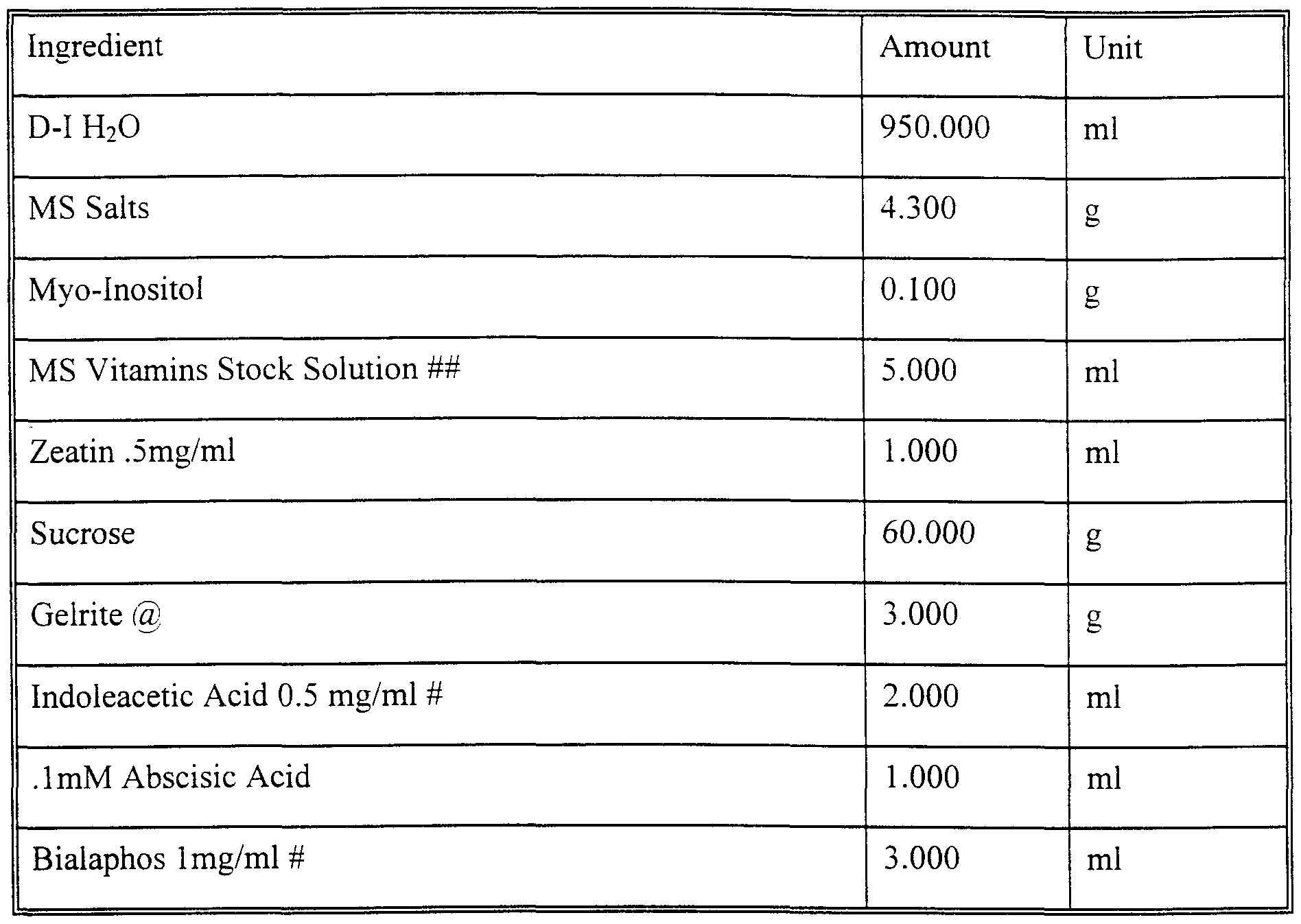
- Example 3 Transformation and Regeneration of Transgenic Plants Immature GS3 maize embryos were bombarded with a plasmid containing the promoter sequence operably linked to the GUS gene plus a plasmid containing the selectable marker gene PAT (Wohlleben et al. (1988) Gene 70:25-37) that confers resistance to the herbicide Bialaphos. Transformation was performed as described in Example 1. See Appendix for examples of bombardment (560Y), selection (560R), hormone-containing regeneration (288J), and hormone-free (272V) media.
- the embryos were transferred from bombardment medium to selection medium containing 3 mg/liter Bialaphos and subcultured on selection medium every 2 weeks. After approximately 10 weeks of selection, selection-resistant callus clones were transferred to hormone-containing medium to initiate plant regeneration. Following somatic embryo maturation (2-4 weeks), well- developed somatic embryos were transferred to medium for germination and transferred to the lighted culture room. Approximately 7-10 days later, developing plantlets were transferred to hormone-free medium in tubes for 7-10 days until plantlets were well established.
- Plants were then transferred to inserts in flats (equivalent to 2.5 " pot) containing potting soil and grown for 1 week in a growth chamber, subsequently grown an additional 1 -2 weeks in the greenhouse, then transferred to classic 600 pots (1.6 gallon) and grown to maturity.
- Promoter activity in transformed plant tissues was assessed by measuring expression of GUS. Plant tissue samples were placed into the wells of 12-well cell culture clusters and stained with X-Gluc staining solution for 12 h at 37°C in the dark. Samples were then scored for GUS staining. GUS staining score ranged from 0
- H2B is a strong promoter in maize embryos, callus, and different tissues.
- the ubiquitin promoter was used as a control. Five transformation events have been evaluated. Overall, two events scored strong GUS expression and three scored weak expression. GUS expression was found in all plant tissues, including leaf, root. husk, silk, and tassel. With those transformation events exhibiting strong expression, GUS was expressed in all different tissues, with tissues mostly having staining scores of 4-5. With those transformation events exhibiting weak expression, GUS was expressed in leaf, root, and tassel, with these tissues mostly having staining scores of 1-3. There was very little GUS expression in husk and silk tissues in those transformation events that exhibited weak expression.
- Thiamine.HCL & Pyridoxine.HCL are in Dark Desiccator. Store for one month, unless contamination or precipitation occurs, then make fresh stock.
- Thiamine.HCL & Pyridoxine.HCL are in Dark Desiccator. Store for one month. unless contamination or precipitation occurs, then make fresh stock.
Landscapes
- Health & Medical Sciences (AREA)
- Life Sciences & Earth Sciences (AREA)
- Genetics & Genomics (AREA)
- Chemical & Material Sciences (AREA)
- Organic Chemistry (AREA)
- Engineering & Computer Science (AREA)
- Bioinformatics & Cheminformatics (AREA)
- Wood Science & Technology (AREA)
- Zoology (AREA)
- Biomedical Technology (AREA)
- Molecular Biology (AREA)
- Biochemistry (AREA)
- General Engineering & Computer Science (AREA)
- Biotechnology (AREA)
- General Health & Medical Sciences (AREA)
- Biophysics (AREA)
- Microbiology (AREA)
- Medicinal Chemistry (AREA)
- Plant Pathology (AREA)
- Physics & Mathematics (AREA)
- Cell Biology (AREA)
- Gastroenterology & Hepatology (AREA)
- Proteomics, Peptides & Aminoacids (AREA)
- Botany (AREA)
- Breeding Of Plants And Reproduction By Means Of Culturing (AREA)
- Micro-Organisms Or Cultivation Processes Thereof (AREA)
- Engine Equipment That Uses Special Cycles (AREA)
- Enzymes And Modification Thereof (AREA)
Abstract
Description




Claims
Priority Applications (5)
| Application Number | Priority Date | Filing Date | Title |
|---|---|---|---|
| EP99909638A EP1056864B1 (en) | 1998-02-26 | 1999-02-25 | Constitutive maize promoters |
| AT99909638T ATE278782T1 (en) | 1998-02-26 | 1999-02-25 | CONSTITUTIVE CORN PROMOTORS |
| CA002315546A CA2315546C (en) | 1998-02-26 | 1999-02-25 | Constitutive maize promoters |
| DE69920879T DE69920879T2 (en) | 1998-02-26 | 1999-02-25 | CONSTITUTIVE MAIZE PROMOTERS |
| AU28803/99A AU762993C (en) | 1998-02-26 | 1999-02-25 | Constitutive maize promoters |
Applications Claiming Priority (2)
| Application Number | Priority Date | Filing Date | Title |
|---|---|---|---|
| US7607598P | 1998-02-26 | 1998-02-26 | |
| US60/076,075 | 1998-02-26 |
Publications (2)
| Publication Number | Publication Date |
|---|---|
| WO1999043797A2 true WO1999043797A2 (en) | 1999-09-02 |
| WO1999043797A3 WO1999043797A3 (en) | 2000-02-24 |
Family
ID=22129784
Family Applications (1)
| Application Number | Title | Priority Date | Filing Date |
|---|---|---|---|
| PCT/US1999/004203 Ceased WO1999043797A2 (en) | 1998-02-26 | 1999-02-25 | Constitutive maize promoters |
Country Status (11)
| Country | Link |
|---|---|
| US (1) | US6177611B1 (en) |
| EP (1) | EP1056864B1 (en) |
| AR (1) | AR014072A1 (en) |
| AT (3) | ATE336580T1 (en) |
| AU (1) | AU762993C (en) |
| CA (1) | CA2315546C (en) |
| DE (3) | DE69933713T2 (en) |
| ES (3) | ES2270227T3 (en) |
| PT (1) | PT1056864E (en) |
| WO (1) | WO1999043797A2 (en) |
| ZA (1) | ZA991528B (en) |
Cited By (11)
| Publication number | Priority date | Publication date | Assignee | Title |
|---|---|---|---|---|
| WO2001019976A3 (en) * | 1999-09-16 | 2001-11-22 | Monsanto Technology Llc | Plant regulatory sequences for control of gene expression |
| WO2001083790A3 (en) * | 2000-05-01 | 2002-05-02 | Monsanto Technology Llc | Plant regulatory sequences for selective control of gene expression |
| WO2002000905A3 (en) * | 2000-06-28 | 2002-09-26 | Monsanto Technology Llc | Plant regulatory sequences for selective control of gene expression |
| WO2004106530A1 (en) * | 2003-05-30 | 2004-12-09 | East Malling Research Limited | Novel promoters |
| WO2006084868A3 (en) * | 2005-02-09 | 2007-01-25 | Basf Plant Science Gmbh | Expression cassettes for regulation of expression in monocotyledonous plants |
| EP1873252A3 (en) * | 2003-02-27 | 2008-03-12 | CropDesign N.V. | Arabidopsis promoters |
| EP2039769A2 (en) | 2000-09-13 | 2009-03-25 | Pioneer Hi-Bred International, Inc. | Antimicrobial peptides and methods of use |
| CN103289961A (en) * | 2004-09-24 | 2013-09-11 | 巴斯福植物科学有限公司 | Nucleic acid sequences encoding proteins associated with abiotic stress response and plant cells and plants with increased tolerance to environmental stress |
| WO2014093485A1 (en) | 2012-12-13 | 2014-06-19 | Pioneer Hi-Bred International, Inc. | Methods and compositions for producing and selecting transgenic plants |
| CN103173447B (en) * | 2003-06-24 | 2016-12-21 | 建新公司 | New beta-actin and RPS21 promoter and application thereof |
| WO2017040343A1 (en) | 2015-08-28 | 2017-03-09 | Pioneer Hi-Bred International, Inc. | Ochrobactrum-mediated transformation of plants |
Families Citing this family (339)
| Publication number | Priority date | Publication date | Assignee | Title |
|---|---|---|---|---|
| WO2012030759A1 (en) | 2010-09-01 | 2012-03-08 | Pioneer Hi-Bred International, Inc. | Vacuole targeting peptides and methods of use |
| WO2005012515A2 (en) | 2003-04-29 | 2005-02-10 | Pioneer Hi-Bred International, Inc. | Novel glyphosate-n-acetyltransferase (gat) genes |
| AU2002322388A1 (en) | 2001-06-22 | 2003-01-08 | E.I. Du Pont De Nemours And Company | Defensin polynucleotides and methods of use |
| US20040121360A1 (en) * | 2002-03-31 | 2004-06-24 | Hagai Karchi | Methods, platforms and kits useful for identifying, isolating and utilizing nucleotide sequences which regulate gene exoression in an organism |
| DE10224889A1 (en) * | 2002-06-04 | 2003-12-18 | Metanomics Gmbh & Co Kgaa | Process for the stable expression of nucleic acids in transgenic plants |
| AU2004219858B2 (en) * | 2003-03-12 | 2009-01-08 | Evogene Ltd. | Nucleotide sequences regulating gene expression and constructs and methods utilizing same |
| EP1921152A1 (en) | 2003-05-05 | 2008-05-14 | Monsanto Technology, LLC | Transgenic plants with glycine-betaine specific promoter |
| CN103333885A (en) | 2003-06-23 | 2013-10-02 | 先锋高级育种国际公司 | Engineering single-gene-controlled staygreen potential into plants |
| PT2343364T (en) * | 2003-08-25 | 2017-01-02 | Monsanto Technology Llc | Tubulin regulatory elements for use in plants |
| US20130117881A1 (en) | 2003-10-14 | 2013-05-09 | Ceres, Inc. | Promoter, promoter control elements, and combinations, and uses thereof |
| US11634723B2 (en) | 2003-09-11 | 2023-04-25 | Ceres, Inc. | Promoter, promoter control elements, and combinations, and uses thereof |
| US11739340B2 (en) | 2003-09-23 | 2023-08-29 | Ceres, Inc. | Promoter, promoter control elements, and combinations, and uses thereof |
| WO2005033319A2 (en) | 2003-10-02 | 2005-04-14 | Monsanto Technology Llc | Stacking crop improvement traits in transgenic plants |
| WO2005035769A2 (en) | 2003-10-09 | 2005-04-21 | E. I. Du Pont De Nemours And Company | Gene silencing by using micro-rna molecules |
| CA2871472C (en) | 2003-12-16 | 2017-08-08 | Pioneer Hi-Bred International, Inc. | Dominant gene suppression transgenes and methods of using same |
| US20070169227A1 (en) | 2003-12-16 | 2007-07-19 | Pioneer Hi-Bred International Inc. | Dominant Gene Suppression Transgenes and Methods of Using Same |
| AR047598A1 (en) | 2004-02-10 | 2006-01-25 | Monsanto Technology Llc | TRANSGENIZED CORN SEED WITH GREATER AMINO ACID CONTENT |
| EP1716230A2 (en) | 2004-02-20 | 2006-11-02 | Pioneer Hi-Bred International, Inc. | Lipases and methods of use |
| KR20120035233A (en) | 2004-02-25 | 2012-04-13 | 파이어니어 하이 부렛드 인터내쇼날 인코포레이팃드 | Novel bacillus thuringiensis crystal polypeptides, polynucleotides, and compositions thereof |
| US20060041961A1 (en) | 2004-03-25 | 2006-02-23 | Abad Mark S | Genes and uses for pant improvement |
| CN101124323A (en) | 2004-06-30 | 2008-02-13 | 先锋高级育种国际公司 | Method for protecting plants against pathogenic fungi |
| BR122015026849C8 (en) | 2004-07-02 | 2017-06-20 | Du Pont | expression cassette, transformed microorganism, method for inducing plant pathogen resistance in a plant, anti-pathogenic composition and method for protecting a plant against a plant pathogen |
| US20060075522A1 (en) | 2004-07-31 | 2006-04-06 | Jaclyn Cleveland | Genes and uses for plant improvement |
| WO2006076423A2 (en) | 2005-01-12 | 2006-07-20 | Monsanto Technology, Llc | Genes and uses for plant improvement |
| ATE530656T1 (en) | 2005-02-23 | 2011-11-15 | Univ North Carolina State | MODIFICATION OF ALKALOID CONTENT IN TOBACCO THROUGH MODIFICATION OF SPECIFIC CYTOCHROME P450 GENES. |
| US12570965B2 (en) | 2005-03-02 | 2026-03-10 | Instituto Nacional De Technologia Agropecuaria | Herbicide-resistant rice plants, polynucleotides encoding herbicide-resistant acetohydroxyacid synthase large subunit proteins, and methods of use |
| EP1882392A4 (en) | 2005-05-10 | 2009-07-01 | Monsanto Technology Llc | Genes and uses for plant improvement |
| EP2532750B1 (en) | 2005-07-01 | 2016-04-27 | Basf Se | Herbicide-resistant sunflower plants, polynucleotides encoding herbicide-resistant acetohydroxyacid synthase large subunit proteins, and methods of use |
| EP2272968A3 (en) | 2005-09-08 | 2011-08-31 | Chromatin, Inc. | Plants modified with mini-chromosomes |
| US20070079396A1 (en) | 2005-10-03 | 2007-04-05 | Malvar Thomas M | Transgenic plant seed with increased lysine |
| AR056778A1 (en) | 2005-11-10 | 2007-10-24 | Pioneer Hi Bred Int | DOF SEQUENCES (THAT JOIN DNA WITH A FINGER) AND METHODS TO USE THEM |
| EP2251349A1 (en) | 2006-04-19 | 2010-11-17 | Pioneer Hi-Bred International, Inc. | Isolated polynucleotide molecules corresponding to mutant and wild-type alleles of the maize D9 gene and methods of use |
| EP2316958B1 (en) | 2006-05-12 | 2015-08-19 | Monsanto Technology LLC | Methods and compositions for obtaining marker-free transgenic plants |
| EP3196311B1 (en) | 2006-05-16 | 2019-12-04 | Monsanto Technology LLC | Use of non-agrobacterium bacterial species for plant transformation |
| DE602007012343D1 (en) | 2006-05-16 | 2011-03-17 | Du Pont | ANTIMYCOTIC POLYPEPTIDE |
| PL2018435T3 (en) | 2006-05-17 | 2012-11-30 | Pioneer Hi Bred Int | Artificial plant minichromosomes |
| US7855326B2 (en) | 2006-06-06 | 2010-12-21 | Monsanto Technology Llc | Methods for weed control using plants having dicamba-degrading enzymatic activity |
| US20080115240A1 (en) | 2006-10-05 | 2008-05-15 | Milo Aukerman | Maize microrna sequences |
| BRPI0717640A2 (en) | 2006-10-16 | 2013-11-12 | Monsato Technology Llc | PROCESS AND COMPOSITIONS FOR INCREASING PLANT HEALTH |
| US7939721B2 (en) | 2006-10-25 | 2011-05-10 | Monsanto Technology Llc | Cropping systems for managing weeds |
| US7838729B2 (en) | 2007-02-26 | 2010-11-23 | Monsanto Technology Llc | Chloroplast transit peptides for efficient targeting of DMO and uses thereof |
| EP2811026B1 (en) | 2007-03-09 | 2016-11-09 | Monsanto Technology LLC | Methods for plant transformation using spectinomycin selection |
| WO2009031031A2 (en) | 2007-04-04 | 2009-03-12 | Basf Se | Herbicide-resistant brassica plants and methods of use |
| CN104017817B (en) | 2007-04-04 | 2017-12-01 | 巴斯福植物科学有限公司 | Ahas mutant |
| WO2008145629A2 (en) | 2007-05-25 | 2008-12-04 | Cropdesign N.V. | Yield enhancement in plants by modulation of maize alfins |
| CA2691440A1 (en) | 2007-06-29 | 2009-01-08 | Pioneer Hi-Bred International, Inc. | Methods for altering the genome of a monocot plant cell |
| US20120124697A1 (en) | 2007-08-29 | 2012-05-17 | E.I.Du Pont De Nemours And Company | Plants with altered root architecture, related constructs and methods involving genes encoding nucleoside diphosphatase kinase (ndk) polypeptides and homologs thereof |
| WO2009061776A1 (en) | 2007-11-07 | 2009-05-14 | E. I. Du Pont De Nemours And Company | Plants having altered agronomic characteristics under nitrogen limiting conditions and related constructs and methods involving genes encoding lnt2 polypeptides and homologs thereof |
| CN101939431B (en) | 2007-11-12 | 2015-01-28 | 北卡罗来纳州立大学 | Alteration of Tobacco Alkaloid Content by Modification of Specific Cytochrome P450 Genes |
| EP2617831A3 (en) | 2007-11-20 | 2013-08-07 | E. I. du Pont de Nemours and Company | Plants with altered root architecture, related constructs and methods involving genes encoding leucine rich repeat kinase (llrk) polypeptides and homologs thereof |
| BRPI0819743A2 (en) | 2007-11-20 | 2014-10-07 | Pioneer Hi Bred Int | ISOLATED NUCLEIC ACID, EXPRESSION CASSETTE, HOST CELL, TRANSGENIC PLANT, TRANSGENIC SEED, METHOD FOR MODULATING ETHYLEN RESPONSE ON A PLANT, PROTEIN ISOLATED |
| US8937217B2 (en) | 2007-12-18 | 2015-01-20 | E. I. Du Pont De Nemours And Company | Down-regulation of gene expression using artificial microRNAs |
| US8115055B2 (en) | 2007-12-18 | 2012-02-14 | E.I. Du Pont De Nemours And Company | Down-regulation of gene expression using artificial microRNAs |
| US8367895B2 (en) | 2008-01-17 | 2013-02-05 | Pioneer Hi-Bred International, Inc. | Compositions and methods for the suppression of target polynucleotides from the family aphididae |
| US8847013B2 (en) | 2008-01-17 | 2014-09-30 | Pioneer Hi Bred International Inc | Compositions and methods for the suppression of target polynucleotides from lepidoptera |
| US12331304B2 (en) | 2008-02-01 | 2025-06-17 | Ceres, Inc. | Promoter, promoter control elements, and combinations, and uses thereof |
| BRPI0907501B1 (en) * | 2008-02-01 | 2021-02-23 | Ceres, Inc | vector construct, method for directing transcription, method of expression of an exogenous coding region, method of altering the expression of a gene and method of producing a transgenic plant |
| WO2009155950A1 (en) * | 2008-06-27 | 2009-12-30 | King Faisal Specialist Hospital And Research Centre | Cloning-free method of generating transcriptionally and post-transcriptionally controllable expression active linear reporter constructs |
| HUE028066T2 (en) | 2008-07-31 | 2016-11-28 | Anglo Netherlands Grain Bv | Herbicide resistant sunflower plants |
| NZ592464A (en) | 2008-09-26 | 2013-05-31 | Basf Agrochemical Products Bv | Herbicide resistant acetohydroxyacid synthase large subunit (AHAS) mutants and methods of use thereof |
| CA2743707A1 (en) | 2008-12-04 | 2010-06-10 | Pioneer Hi-Bred International, Inc. | Methods and compositions for enhanced yield by targeted expression of knotted1 |
| CN102282261A (en) | 2008-12-17 | 2011-12-14 | 纳幕尔杜邦公司 | Plants having altered agronomic characteristics under nitrogen limiting conditions and related constructs and methods involving genes encoding lnt9 polypeptides |
| US20110258735A1 (en) | 2008-12-22 | 2011-10-20 | Marie Coffin | Genes and uses for plant enhancement |
| US20120004114A1 (en) | 2008-12-22 | 2012-01-05 | E. I. Du Pont De Nemours And Company And Pioneer Hi-Bred International | Nucleotide sequences encoding gsh1 polypeptides and methods of use |
| US20110239315A1 (en) | 2009-01-12 | 2011-09-29 | Ulla Bonas | Modular dna-binding domains and methods of use |
| EP2206723A1 (en) | 2009-01-12 | 2010-07-14 | Bonas, Ulla | Modular DNA-binding domains |
| EP3156489B1 (en) | 2009-01-22 | 2019-03-06 | Syngenta Participations Ag | Mutant hydroxyphenylpyruvate dioxygenase polypeptides and methods of use |
| BRPI1006284A2 (en) | 2009-03-09 | 2015-08-25 | E I Du Pont Ne Nemours And Company | "plant comprising in its genome a recombinant DNA construct comprising a polynucleotide operably linked to at least one regulatory element, method of increasing plant drought tolerance, isolated polynucleotide, polynucleotide, vector, recombinant DNA construct, cell and plant or seed " |
| WO2010111568A2 (en) | 2009-03-27 | 2010-09-30 | E. I. Du Pont De Nemours And Company | Plants having altered agronomic characteristics under nitrogen limiting conditions and related constructs and methods involving genes encoding snf2 domain-containing polypeptides |
| MX2011010845A (en) | 2009-04-14 | 2011-11-02 | Pioneer Hi Bred Int | Modulation of acc synthase improves plant yield under low nitrogen conditions. |
| CA2760700A1 (en) | 2009-05-04 | 2010-11-11 | Pioneer Hi-Bred International, Inc. | Yield enhancement in plants by modulation of ap2 transcription factor |
| US20120047603A1 (en) | 2009-06-09 | 2012-02-23 | Allen Stephen M | Drought tolerant plants and related constructs and methods involving genes encoding fatty acid desaturase family polypeptides |
| AU2010273756A1 (en) | 2009-06-30 | 2011-11-24 | E. I. Du Pont De Nemours And Company | Plant seeds with altered storage compound levels, related constructs and methods involving genes encoding cytosolic pyrophosphatase |
| AU2010326672A1 (en) | 2009-07-10 | 2011-08-04 | Syngenta Participations Ag | Novel hydroxyphenylpyruvate dioxygenase polypeptides and methods of use |
| WO2011021171A1 (en) | 2009-08-21 | 2011-02-24 | Beeologics, Llc | Preventing and curing beneficial insect diseases via plant transcribed molecules |
| WO2011025860A1 (en) | 2009-08-28 | 2011-03-03 | E. I. Du Pont De Nemours And Company | Compositions and methods to control insect pests |
| BR112012008731A2 (en) | 2009-10-15 | 2015-09-01 | Du Pont | '' plant, drought tolerance increase method in a plant and drought tolerance evaluation method in a plant '' |
| AR078828A1 (en) | 2009-10-30 | 2011-12-07 | Du Pont | DROUGHT-DROUGHT PLANTS AND RELATED CONSTRUCTS AND METHODS THAT INVOLVE GENES THAT CODIFY DTP21 POLYPEPTIDES |
| AR078829A1 (en) | 2009-10-30 | 2011-12-07 | Du Pont | PLANTS AND SEEDS WITH ALTERED LEVELS OF STORAGE COMPOUND, RELATED CONSTRUCTIONS AND METHODS RELATED TO GENES THAT CODIFY SIMILAR PROTEINS TO THE BACTERIAL ALDOLASES OF CLASS II OF THE ACID 2,4- DIHYDROXI-HEPT-2-ENO-1,7-DIO-1,7 |
| US8993840B2 (en) | 2009-11-23 | 2015-03-31 | E I du Pont de Nemours and Compay | Sucrose transporter genes for increasing plant seed lipids |
| CA2793596A1 (en) | 2009-12-30 | 2011-07-07 | Pioneer Hi-Bred International, Inc. | Methods and compositions for targeted polynucleotide modification |
| CA2793600C (en) | 2009-12-30 | 2020-01-14 | Pioneer Hi-Bred International, Inc. | Methods and compositions for the introduction and regulated expression of genes in plants |
| EP2519639A1 (en) | 2009-12-31 | 2012-11-07 | Pioneer Hi-Bred International Inc. | Direct and continuous root alone or root/shoot production from transgenic events derived from green regenerative tissues and its applications |
| WO2011082304A1 (en) | 2009-12-31 | 2011-07-07 | Pioneer Hi-Bred International, Inc. | Engineering plant resistance to diseases caused by pathogens |
| CA2787674C (en) | 2010-01-22 | 2022-09-06 | Dow Agrosciences Llc | Excision of transgenes in genetically modified organisms |
| BR112012018616A2 (en) | 2010-01-26 | 2017-01-10 | Pioneer Hi Bred Int | polynucleotide marker, isolated polynucleotide, isolated abc transporter polypeptide, plant, cell, seed, method for selecting a soybean plant or germplasm, method of introgression of a herbicide resistance allele in a soybean plant, method for conferring tolerance or improved tolerance to one or more herbicides, method for selectively controlling weeds in a field containing a crop |
| EP2531603A2 (en) | 2010-02-02 | 2012-12-12 | E.I. Du Pont De Nemours And Company | Plants with altered root architecture, related constructs and methods involving genes encoding lectin protein kinase (lpk) polypeptides and homologs thereof |
| EP2542682A2 (en) | 2010-03-03 | 2013-01-09 | E.I. Du Pont De Nemours And Company | Plant seeds with altered storage compound levels, related constructs and methods involving genes encoding oxidoreductase motif polypeptides |
| WO2011136909A1 (en) | 2010-04-30 | 2011-11-03 | E.I. Dupont De Nemours And Company | Alteration of plant architecture characteristics in plants |
| US20130053243A1 (en) | 2010-05-04 | 2013-02-28 | Basf Se | Plants having increased tolerance to herbicides |
| AR080745A1 (en) | 2010-05-06 | 2012-05-02 | Du Pont | GEN AND PROTEIN ACC (1-AMINOCICLOPROPANO-1-CARBOXILIC ACID) SYNTHESE 3 OF CORN AND ITS USES |
| PH12012502433A1 (en) | 2010-06-09 | 2013-02-11 | Du Pont | Regulatory sequences for modulating transgene expression in plants |
| EP4449858A3 (en) | 2010-06-25 | 2025-04-16 | Corteva Agriscience LLC | Compositions and methods for enhancing resistance to northern leaf blight in maize |
| BR112012033668A2 (en) | 2010-07-01 | 2017-06-13 | Du Pont | transgenic plant and seed, method for producing a transgenic plant, product and / or by-product obtained from the transgenic seed, isolated polynucleotide and plant or seed comprising a recombinant DNA construct |
| UA112969C2 (en) | 2010-08-03 | 2016-11-25 | Сібас Юс Ллс | PLANT RESISTANT TO ONE OR MORE PPH-INHIBITING HERBICIDES CONTAINING PROTOPORPHYRINOGEN IX OXIDASE (PPX) MUTANT GENE |
| US20120122223A1 (en) | 2010-08-03 | 2012-05-17 | Cibus Us Llc | Mutated protoporphyrinogen ix oxidase (ppx) genes |
| CA2805941A1 (en) | 2010-08-13 | 2012-02-16 | Pioneer Hi-Bred International, Inc. | Methods and compositions for targeting sequences of interest to the chloroplast |
| CA2807785A1 (en) | 2010-08-23 | 2012-03-01 | Pioneer Hi-Bred International, Inc. | Novel defensin variants and methods of use |
| CN105296530A (en) | 2010-10-28 | 2016-02-03 | 纳幕尔杜邦公司 | Drought tolerant plants and related constructs and methods involving genes encoding DTP6 polypeptides |
| JP6334169B2 (en) | 2010-12-16 | 2018-05-30 | ビーエーエスエフ アグロ ベー.ブイ. | Plants with increased herbicide tolerance |
| BR122021012776B1 (en) | 2010-12-17 | 2022-08-16 | Monsanto Technology Llc | METHOD TO IMPROVE THE COMPETENCE OF A PLANT CELL FOR BACTERIAL-MEDIATED TRANSFORMATION |
| PH12013501283A1 (en) | 2010-12-20 | 2013-07-15 | Du Pont | Drought tolerant plants and related constructs and methods involving genes encoding mate-efflux polypeptides |
| MX2013007532A (en) | 2010-12-28 | 2013-09-16 | Pioneer Hi Bred Int | Novel bacillus thuringiensis gene with lepidopteran activity. |
| BRPI1107329A2 (en) | 2010-12-30 | 2019-11-19 | Dow Agrosciences Llc | nucleic acid molecules that target the vacuolar atpase h-subunit that confer resistance to Coleoptera pests, plant transformation vector, transformed cell, as well as methods for controlling a Coleoptera pest population, controlling an infestation by said pest, improving the yield of a crop and to produce a transgenic cell |
| AU2011351969A1 (en) | 2010-12-30 | 2013-07-25 | Dow Agrosciences Llc | Nucleic acid molecules that target the RHO1 small GTP-binding protein and confer resistance to coleopteran pests |
| WO2012092573A2 (en) | 2010-12-30 | 2012-07-05 | Dow Agrosciences Llc | Nucleic acid molecules that target the vacuolar atpase c subunit and confer resistance to coleopteran pests |
| KR20130130806A (en) | 2010-12-30 | 2013-12-02 | 다우 아그로사이언시즈 엘엘씨 | Nucleic acid molecules that confer resistance to coleopteran pests |
| WO2012109515A1 (en) | 2011-02-11 | 2012-08-16 | Pioneer Hi-Bred International, Inc. | Synthetic insecticidal proteins active against corn rootworm |
| US8878007B2 (en) | 2011-03-10 | 2014-11-04 | Pioneer Hi Bred International Inc | Bacillus thuringiensis gene with lepidopteran activity |
| AR085533A1 (en) | 2011-03-23 | 2013-10-09 | Pioneer Hi Bred Int | PRODUCTION METHODS OF A COMPLEX TRANSGENIC RISK LOCUS |
| WO2012131495A2 (en) | 2011-03-30 | 2012-10-04 | Universidad Nacional Autónoma de México | Mutant bacillus thuringiensis cry genes and methods of use |
| CA2833254A1 (en) | 2011-04-15 | 2012-10-18 | Pioneer Hi-Bred International, Inc. | Self-reproducing hybrid plants |
| US9062317B2 (en) | 2011-05-09 | 2015-06-23 | E I Du Pont De Nemours And Company | Methods and compositions for silencing gene families using artificial microRNAs |
| US9150625B2 (en) | 2011-05-23 | 2015-10-06 | E I Du Pont De Nemours And Company | Chloroplast transit peptides and methods of their use |
| CA2844470A1 (en) | 2011-06-21 | 2013-05-10 | Pioneer Hi-Bred International, Inc. | Methods and compositions for producing male sterile plants |
| AR087167A1 (en) | 2011-07-12 | 2014-02-26 | Two Blades Foundation | GENES OF RESISTANCE TO LATE TIZON |
| BR112014002605A2 (en) | 2011-08-02 | 2017-09-26 | Du Pont | method for the selection of high yield transgenic plants |
| BR112014002622A2 (en) | 2011-08-03 | 2019-09-24 | Du Pont | method for introducing into the genome of a plant cell a target site for site, plant cell, plant part, plant or seed specific integration, method for integrating a polynucleotide of interest into a target site in the genome of a plant cell |
| AU2012301912A1 (en) | 2011-08-31 | 2014-03-06 | E. I. Dupont De Nemours & Company | Methods for tissue culture and transformation of sugarcane |
| US20140298544A1 (en) | 2011-10-28 | 2014-10-02 | Pioneer Hi Bred International Inc | Engineered PEP carboxylase variants for improved plant productivity |
| EP2771467A1 (en) | 2011-10-28 | 2014-09-03 | E. I. Du Pont de Nemours and Company | Methods and compositions for silencing genes using artificial micrornas |
| WO2013103366A1 (en) | 2012-01-06 | 2013-07-11 | Pioneer Hi-Bred International, Inc. | A method to screen plants for genetic elements inducing parthenogenesis in plants |
| WO2013109754A1 (en) | 2012-01-17 | 2013-07-25 | Pioneer Hi-Bred International, Inc. | Plant transcription factors, promoters and uses thereof |
| BR112014018009A2 (en) | 2012-01-23 | 2018-06-26 | Du Pont | isolated nucleic acid sequence, recombinant construct, plant cell, method for reducing expression of at least one plant fatty acid biosynthetic gene, method for reducing expression of two or more plant fatty acid biosynthetic genes and transgenic plant or seed |
| BR112014018294B1 (en) | 2012-01-26 | 2022-01-11 | Norfolk Plant Sciences, Ltd | METHOD FOR PRODUCING A PLANT, EXPRESSION CASSETTE, AND BACTERIAL CELL |
| AR089793A1 (en) | 2012-01-27 | 2014-09-17 | Du Pont | METHODS AND COMPOSITIONS TO GENERATE COMPOSITE TRANSGENIC RISK LOCUS |
| US9506077B2 (en) | 2012-02-01 | 2016-11-29 | Dow Agrosciences Llc | Synthetic chloroplast transit peptides |
| CA3151103C (en) | 2012-02-02 | 2024-02-13 | Corteva Agriscience Llc | Plant transactivation interaction motifs and uses thereof |
| WO2013138358A1 (en) | 2012-03-13 | 2013-09-19 | Pioneer Hi-Bred International, Inc. | Genetic reduction of male fertility in plants |
| WO2013138309A1 (en) | 2012-03-13 | 2013-09-19 | Pioneer Hi-Bred International, Inc. | Genetic reduction of male fertility in plants |
| AU2013205557B2 (en) | 2012-04-17 | 2016-04-21 | Corteva Agriscience Llc | Synthetic brassica-derived chloroplast transit peptides |
| US20150184173A1 (en) | 2012-05-04 | 2015-07-02 | E I Du Pont De Nemours And Company | Compositions and methods comprising sequences having meganuclease activity |
| US20130337442A1 (en) | 2012-06-15 | 2013-12-19 | Pioneer Hi-Bred International, Inc. | Genetic loci associated with soybean cyst nematode resistance and methods of use |
| WO2013188291A2 (en) | 2012-06-15 | 2013-12-19 | E. I. Du Pont De Nemours And Company | Methods and compositions involving als variants with native substrate preference |
| AR091489A1 (en) | 2012-06-19 | 2015-02-11 | Basf Se | PLANTS THAT HAVE A GREATER TOLERANCE TO HERBICIDES INHIBITORS OF PROTOPORFIRINOGENO OXIDASA (PPO) |
| CA2877496A1 (en) | 2012-06-20 | 2013-12-27 | E.I. Du Pont De Nemours And Company | Terminating flower (tmf) gene and methods of use |
| WO2014036048A1 (en) | 2012-08-30 | 2014-03-06 | E. I. Du Pont De Nemours And Company | Long intergenic non-coding rnas in maize |
| BR112015004995B1 (en) | 2012-09-07 | 2023-05-02 | Sangamo Biosciences, Inc. | METHOD FOR MODIFYING THE GENOME OF A CELL, USE OF A CELL, SEED OR PLANT OBTAINED BY THE SAID METHOD AND SITE-SPECIFIC ZINC FINGER NUCLEASE |
| UA118090C2 (en) | 2012-09-07 | 2018-11-26 | ДАУ АГРОСАЙЄНСІЗ ЕлЕлСі | METHOD OF THE METHER OF THE METHOD OF THE INTEGRED EMBLED SUBSTITUTION OF NUCLEIC NUCLE OF NUCLEIC ACID AND NON-NUCLIC ACID AND NON-SPECIAL SPECIES |
| US9816102B2 (en) | 2012-09-13 | 2017-11-14 | Indiana University Research And Technology Corporation | Compositions and systems for conferring disease resistance in plants and methods of use thereof |
| WO2014062544A2 (en) | 2012-10-15 | 2014-04-24 | Pioneer Hi-Bred International, Inc. | Methods and compositions to enhance activity of cry endotoxins |
| US20140123339A1 (en) | 2012-10-31 | 2014-05-01 | Pioneer Hi Bred International Inc | Transformed Plants Having Increased Beta-Carotene Levels, Increased Half-Life and Bioavailability and Methods of Producing Such |
| JP6457945B2 (en) | 2012-11-23 | 2019-01-23 | ヘキシマ リミテッドHexima Limited | Anti-pathogen method |
| EP2935593A2 (en) | 2012-12-21 | 2015-10-28 | Pioneer Hi-Bred International, Inc. | Compositions and methods for auxin-analog conjugation |
| EP2951308A2 (en) | 2013-01-31 | 2015-12-09 | E. I. du Pont de Nemours and Company | Slm1, a suppressor of lesion mimic phenotypes |
| US20160002658A1 (en) | 2013-03-11 | 2016-01-07 | Pioneer Hi-Bred International, Inc. | Compositions and methods to enhance mechanical stalk strength in plants |
| BR112015022742A2 (en) | 2013-03-11 | 2018-11-27 | Pionner Hi Bred Int Inc | methods and compositions employing a sulfonylurea-dependent stabilization domain |
| WO2014164775A1 (en) | 2013-03-11 | 2014-10-09 | Pioneer Hi-Bred International, Inc. | Methods and compositions to improve the spread of chemical signals in plants |
| US9803214B2 (en) | 2013-03-12 | 2017-10-31 | Pioneer Hi-Bred International, Inc. | Breeding pair of wheat plants comprising an MS45 promoter inverted repeat that confers male sterility and a construct that restores fertility |
| CN105189788B (en) | 2013-03-12 | 2018-07-13 | 纳幕尔杜邦公司 | Method of variant recognition site for identifying rare cutting engineering double-strand break derivant and combinations thereof and purposes |
| US9416368B2 (en) | 2013-03-13 | 2016-08-16 | E I Du Pont De Nemours And Company | Identification of P. pachyrhizi protein effectors and their use in producing Asian soybean rust (ASR) resistant plants |
| BR112015023268A2 (en) | 2013-03-13 | 2018-05-02 | Du Pont | method for reducing expression, DNA construct, plant cell procurement method, transgenic plant procurement method or a plant part |
| CN105358696A (en) | 2013-03-14 | 2016-02-24 | 希博斯美国有限公司 | Mutated allene oxygenase 2 (AOS2) gene |
| CA3200166A1 (en) | 2013-03-14 | 2014-09-25 | Pioneer Hi-Bred International, Inc. | Compositions and methods to control insect pests |
| CA2904537A1 (en) | 2013-03-14 | 2014-09-25 | Pioneer Hi-Bred International, Inc. | Compositions having dicamba decarboxylase activity and methods of use |
| WO2014160122A1 (en) | 2013-03-14 | 2014-10-02 | Pioneer Hi-Bred International, Inc. | Maize stress related transcription factor 18 and uses thereof |
| EP2970995A1 (en) | 2013-03-14 | 2016-01-20 | Pioneer Hi-Bred International, Inc. | Compositions having dicamba decarboxylase activity and methods of use |
| WO2014151213A2 (en) | 2013-03-15 | 2014-09-25 | E. I. Du Pont De Nemours And Company | Drought tolerant plants and related constructs and methods involving genes encoding dtp32 polypeptides |
| IL290273B2 (en) | 2013-03-15 | 2024-03-01 | Cibus Us Llc | Methods and compositions for increasing the efficiency of targeted gene modification through the use of gene repair with oligonucleotides - mediators |
| US20140283216A1 (en) | 2013-03-15 | 2014-09-18 | Pioneer Hi Bred International Inc | Compositions and methods of use of acc oxidase polynucleotides and polypeptides |
| US12331303B2 (en) | 2013-03-15 | 2025-06-17 | Cibus Us Llc | Methods and compositions for increasing efficiency of targeted gene modification using oligonucleotide-mediated gene repair |
| US9957515B2 (en) | 2013-03-15 | 2018-05-01 | Cibus Us Llc | Methods and compositions for targeted gene modification |
| CA2917103C (en) | 2013-07-09 | 2021-01-12 | Board Of Trustees Of Michigan State University | Transgenic plants produced with a k-domain, and methods and expression cassettes related thereto |
| US11459579B2 (en) | 2013-07-09 | 2022-10-04 | Board Of Trustees Of Michigan State University | Transgenic plants produced with a K-domain, and methods and expression cassettes related thereto |
| US10287329B2 (en) | 2013-08-08 | 2019-05-14 | Pioneer Hi-Bred International, Inc. | Insecticidal polypeptides having broad spectrum activity and uses thereof |
| US10006045B2 (en) | 2013-08-16 | 2018-06-26 | Pioneer Hi-Bred International, Inc. | Insecticidal proteins and methods for their use |
| CN106133138A (en) | 2013-08-22 | 2016-11-16 | 先锋国际良种公司 | Use genomic modification and the using method thereof guiding polynucleotide/CAS endonuclease systems |
| BR122020001770B1 (en) | 2013-09-13 | 2022-11-29 | Pioneer Hi-Bred International, Inc | DNA CONSTRUCTION, METHOD FOR OBTAINING A TRANSGENIC PLANT, FUSION PROTEIN, METHOD FOR CONTROLLING AN INSECT PEST POPULATION, METHOD FOR INHIBITING THE GROWTH OR KILLING AN INSECT PEST |
| BR102014025574A2 (en) * | 2013-10-15 | 2015-09-29 | Dow Agrosciences Llc | zea mays regulatory elements and uses thereof |
| CN105874062B (en) | 2013-10-18 | 2021-07-20 | 先锋国际良种公司 | Glyphosate-N-acetyltransferase (GLYAT) sequences and methods of use |
| CA2928830A1 (en) | 2013-10-29 | 2015-05-07 | Shai J. Lawit | Self-reproducing hybrid plants |
| BR102014031844A2 (en) | 2013-12-20 | 2015-10-06 | Dow Agrosciences Llc | RAS and related nucleic acid molecules that confer resistance to Coleoptera and Hemiptera pests |
| MX2016008263A (en) | 2013-12-20 | 2017-05-09 | Dow Agrosciences Llc | Rnapii-140 nucleic acid molecules that confer resistance to coleopteran pests. |
| CA2935703A1 (en) | 2013-12-30 | 2015-07-09 | E. I. Du Pont De Nemours And Company | Drought tolerant plants and related constructs and methods involving genes encoding dtp4 polypeptides |
| TW201531480A (en) * | 2014-01-23 | 2015-08-16 | Dow Agrosciences Llc | Zea mays regulatory elements and uses thereof |
| US20170166920A1 (en) | 2014-01-30 | 2017-06-15 | Two Blades Foundation | Plants with enhanced resistance to phytophthora |
| RU2747978C2 (en) | 2014-02-07 | 2021-05-18 | Пайонир Хай-Бред Интернэшнл, Инк. | Insecticidal proteins and their application methods |
| CN114763376A (en) | 2014-02-07 | 2022-07-19 | 先锋国际良种公司 | Insecticidal proteins and methods of use thereof |
| CA3208184A1 (en) | 2014-03-14 | 2015-09-17 | Cibus Us Llc | Methods and compositions for increasing efficiency of targeted gene modification using oligonucleotide-mediated gene repair |
| US9719101B2 (en) * | 2014-03-19 | 2017-08-01 | E I Du Pont De Nemours And Company | Soybean GAPD promoter and its use in constitutive expression of transgenic genes in plants |
| WO2015150465A2 (en) | 2014-04-03 | 2015-10-08 | Basf Se | Plants having increased tolerance to herbicides |
| WO2015171603A1 (en) | 2014-05-06 | 2015-11-12 | Two Blades Foundation | Methods for producing plants with enhanced resistance to oomycete pathogens |
| AU2015255995B2 (en) | 2014-05-07 | 2018-05-10 | Dow Agrosciences Llc | Dre4 nucleic acid molecules that confer resistance to coleopteran pests |
| WO2016000237A1 (en) | 2014-07-03 | 2016-01-07 | Pioneer Overseas Corporation | Plants having enhanced tolerance to insect pests and related constructs and methods involving insect tolerance genes |
| EP3166391A1 (en) | 2014-07-11 | 2017-05-17 | E. I. du Pont de Nemours and Company | Compositions and methods for producing plants resistant to glyphosate herbicide |
| BR112017003757A2 (en) | 2014-09-12 | 2017-12-26 | Du Pont | ? corn plants, parts of corn plants or corn seeds? |
| WO2016044092A1 (en) | 2014-09-17 | 2016-03-24 | Pioneer Hi Bred International Inc | Compositions and methods to control insect pests |
| EP3197270B1 (en) | 2014-09-26 | 2025-12-03 | Pioneer Hi-Bred International, Inc. | Wheat ms1 polynucleotides, polypeptides, and methods of use |
| WO2016061197A1 (en) | 2014-10-16 | 2016-04-21 | Pioneer Hi-Bred International, Inc. | Insecticidal polypeptides having improved activity spectrum and uses thereof |
| WO2016061206A1 (en) | 2014-10-16 | 2016-04-21 | Pioneer Hi-Bred International, Inc. | Insecticidal proteins and methods for their use |
| UA124757C2 (en) | 2014-10-16 | 2021-11-17 | Піонір Хай-Бред Інтернешнл, Інк. | INSECTICIDAL POLYPEPTIDE AGAINST SCALE OR SOLIDWIDE PESTER AND ITS APPLICATION |
| DK3597740T3 (en) | 2014-11-06 | 2022-06-20 | Dupont Us Holding Llc | PEPTIME MEDIATED INTRODUCTION OF RNA-CONTROLLED ENDONUCLEASE INTO CELLS |
| US20170369902A1 (en) | 2014-12-16 | 2017-12-28 | Pioneer Hi-Bred International, Inc. | Restoration of male fertility in wheat |
| US20180066026A1 (en) | 2014-12-17 | 2018-03-08 | Ei Du Pont De Nemours And Company | Modulation of yep6 gene expression to increase yield and other related traits in plants |
| BR112017012900A2 (en) | 2014-12-19 | 2018-02-06 | Agbiome Inc | isolated polynucleotide or a recombinant DNA, plant cell, plant, explant, seed, method for producing a plant cell, method for controlling weeds, host cell |
| US11041158B2 (en) | 2014-12-22 | 2021-06-22 | AgBiome, Inc. | Optimization methods for making a synthetic gene |
| EP4663761A3 (en) | 2015-01-15 | 2026-03-04 | Pioneer Hi-Bred International, Inc. | Insecticidal proteins and methods for their use |
| EA201791613A1 (en) | 2015-01-21 | 2017-12-29 | Басф Се | PLANTS WITH ENHANCED STABILITY TO HERBICIDES |
| CN107406858A (en) | 2015-02-25 | 2017-11-28 | 先锋国际良种公司 | Compositions and methods for directing regulated expression of RNA/CAS endonuclease complexes |
| MX376048B (en) | 2015-03-11 | 2025-03-07 | Corteva Agriscience Llc | PIP-72 INSECTICIDE COMBINATIONS AND METHODS OF USE. |
| US11492632B2 (en) | 2015-03-19 | 2022-11-08 | Pioneer Hi-Bred International, Inc. | Methods and compositions for accelerated trait introgression |
| MA44954A (en) | 2015-04-17 | 2019-03-20 | Agbiome Inc | PESTICIDE GENES AND THEIR METHODS OF USE |
| CA2981088A1 (en) | 2015-04-22 | 2016-10-27 | AgBiome, Inc. | Pesticidal genes and methods of use |
| CA2984901A1 (en) | 2015-05-06 | 2016-11-10 | Pioneer Hi-Bred International, Inc. | Methods and compositions for the production of unreduced, non-recombined gametes and clonal offspring |
| CA2985458A1 (en) | 2015-05-09 | 2016-11-17 | Two Blades Foundation | Late blight resistance gene from solanum americanum and methods of use |
| US10842097B2 (en) | 2015-05-11 | 2020-11-24 | Two Blades Foundation | Polynucleotides and methods for transferring resistance to Asian soybean rust |
| MX2017014560A (en) | 2015-05-15 | 2018-03-01 | Pioneer Hi Bred Int | QUICK CHARACTERIZATION OF ENDONUCLEASA CAS SYSTEMS, PAM SEQUENCES AND ARN DE GUIA ELEMENTS. |
| CA2985198A1 (en) | 2015-05-19 | 2016-11-24 | Pioneer Hi-Bred International, Inc. | Insecticidal proteins and methods for their use |
| BR102016012010A2 (en) | 2015-05-29 | 2020-03-24 | Dow Agrosciences Llc | NUCLEIC ACID, RIBONUCLEIC ACID (RNA) AND DOUBLE-FILAMENT RIBONUCLEIC ACID (DSRNA) MOLECULE, CELL, PLANT AND SEED USES, PRIMARY PRODUCT, AS WELL AS METHODS TO CONTROL A POPULATION OF HOLIDAYS, OR HOSPITALS, OR HOSPITALS, OR HOSPITALS, OR HOSPITALS THE INCOME OF A CULTURE, AND TO PRODUCE A TRANSGENIC VEGETABLE CELL AND A TRANSGENIC PLANT |
| CA2987598A1 (en) | 2015-06-03 | 2016-12-08 | AgBiome, Inc. | Pesticidal genes and methods of use |
| US10647995B2 (en) | 2015-06-16 | 2020-05-12 | Pioneer Hi-Bred International, Inc. | Compositions and methods to control insect pests |
| MX389329B (en) | 2015-06-17 | 2025-03-11 | Basf Agro Bv | PLANTS THAT HAVE A GREATER TOLERANCE TO HERBICIDES. |
| BR112017027821A2 (en) | 2015-06-22 | 2019-05-14 | AgBiome, Inc. | pesticide genes and methods of use |
| CN116003550A (en) | 2015-08-06 | 2023-04-25 | 先锋国际良种公司 | Insecticidal proteins of plant origin and methods of use thereof |
| MX2018002090A (en) | 2015-08-24 | 2018-09-12 | Halo Bio Rnai Therapeutics Inc | Polynucleotide nanoparticles for the modulation of gene expression and uses thereof. |
| WO2017059341A1 (en) | 2015-10-02 | 2017-04-06 | Monsanto Technology Llc | Recombinant maize b chromosome sequence and uses thereof |
| CN116555254A (en) | 2015-10-09 | 2023-08-08 | 孟山都技术公司 | Novel RNA-directed nucleases and uses thereof |
| WO2017062790A1 (en) | 2015-10-09 | 2017-04-13 | Two Blades Foundation | Cold shock protein receptors and methods of use |
| JP7011590B2 (en) | 2015-10-12 | 2022-02-10 | イー・アイ・デュポン・ドウ・ヌムール・アンド・カンパニー | Protected DNA template and method of use for increased intracellular gene recombination and homologous recombination |
| BR112018008134A2 (en) | 2015-10-20 | 2018-11-06 | Pioneer Hi Bred Int | method for restoring the function of a non-functional gene product in the genome of a cell, method for editing a nucleotide sequence in the genome of a cell, plant or progeny plant, method for editing a nucleotide sequence in the genome of a cell without the use of A Modified Polynucleotide Mold and Method for Delivering a Guide RNA / Endonuclease Cas Complex to a Cell |
| US12203089B2 (en) | 2015-10-22 | 2025-01-21 | Basf Se | Plants having increased tolerance to herbicides |
| US20180312864A1 (en) | 2015-10-22 | 2018-11-01 | Basf Se | Plants having increased tolerance to herbicides |
| WO2017079286A1 (en) | 2015-11-03 | 2017-05-11 | Two Blades Foundation | Wheat stripe rust resistance genes and methods of use |
| US20180258438A1 (en) | 2015-11-06 | 2018-09-13 | Pioneer Hi-Bred International, Inc. | Generation of complex trait loci in soybean and methods of use |
| EP3390431A1 (en) | 2015-12-18 | 2018-10-24 | Pioneer Hi-Bred International, Inc. | Insecticidal proteins and methods for their use |
| WO2017112538A2 (en) | 2015-12-22 | 2017-06-29 | AgBiome, Inc. | Pesticidal genes and methods of use |
| EP4159848A1 (en) | 2015-12-29 | 2023-04-05 | Monsanto Technology LLC | Novel crispr-associated transposases and uses thereof |
| CN109072248A (en) | 2016-02-09 | 2018-12-21 | 希博斯美国有限公司 | Methods and compositions for increasing the efficiency of targeted gene modification using oligonucleotide-mediated gene repair |
| US9896696B2 (en) | 2016-02-15 | 2018-02-20 | Benson Hill Biosystems, Inc. | Compositions and methods for modifying genomes |
| US20190100762A1 (en) | 2016-03-11 | 2019-04-04 | Pioneer Hi-Bred International, Inc. | Novel cas9 systems and methods of use |
| WO2017155715A1 (en) | 2016-03-11 | 2017-09-14 | Pioneer Hi-Bred International, Inc. | Novel cas9 systems and methods of use |
| AU2017234920B2 (en) | 2016-03-18 | 2023-08-17 | E. I. Du Pont De Nemours And Company | Methods and compositions for producing clonal, non-reduced, non-recombined gametes |
| WO2017180715A2 (en) | 2016-04-14 | 2017-10-19 | Pioneer Hi-Bred International, Inc. | Insecticidal polypeptides having improved activity spectrum and uses thereof |
| CA3021391A1 (en) | 2016-04-19 | 2017-10-26 | Pioneer Hi-Bred International, Inc. | Insecticidal combinations of polypeptides having improved activity spectrum and uses thereof |
| CN109068660B (en) | 2016-05-04 | 2023-05-02 | 先锋国际良种公司 | Insecticidal proteins and methods of use thereof |
| US11959086B2 (en) | 2016-05-20 | 2024-04-16 | BASF Agro B.V. | Dual transit peptides for targeting polypeptides |
| EP3464601B1 (en) | 2016-05-27 | 2024-07-03 | The Board of Trustees of the University of Illinois | Transgenic plants with increased photosynthesis efficiency and growth |
| EP3472323A1 (en) | 2016-06-16 | 2019-04-24 | Pioneer Hi-Bred International, Inc. | Compositions and methods to control insect pests |
| WO2018005491A1 (en) | 2016-06-28 | 2018-01-04 | Monsanto Technology Llc | Methods and compositions for use in genome modification in plants |
| CN109788735A (en) | 2016-07-01 | 2019-05-21 | 先锋国际良种公司 | Insecticidal protein and its application method from plant |
| US20210292778A1 (en) | 2016-07-12 | 2021-09-23 | Pioneer Hi-Bred International, Inc. | Compositions and methods to control insect pests |
| AU2017294685B2 (en) | 2016-07-15 | 2023-10-26 | Basf Se | Plants having increased tolerance to herbicides |
| BR112019001483A2 (en) | 2016-07-27 | 2019-09-10 | Basf Agro Bv | method for controlling unwanted vegetation at a plantation site |
| US10787679B2 (en) | 2016-09-06 | 2020-09-29 | AgBiome, Inc. | Pesticidal genes and methods of use |
| WO2018052919A1 (en) | 2016-09-14 | 2018-03-22 | Monsanto Technology Llc | Methods and compositions for genome editing via haploid induction |
| CN109863167B (en) | 2016-11-01 | 2022-12-23 | 先锋国际良种公司 | Insecticidal proteins and methods of use thereof |
| CA3044404A1 (en) | 2016-12-14 | 2018-06-21 | Pioneer Hi-Bred International, Inc. | Insecticidal proteins and methods for their use |
| CA3047121A1 (en) | 2016-12-16 | 2018-06-21 | Two Blades Foundation | Late blight resistance genes and methods of use |
| US11879132B2 (en) | 2016-12-20 | 2024-01-23 | BASF Agro B.V. | Plants having increased tolerance to herbicides |
| MX2019007491A (en) | 2016-12-22 | 2019-09-06 | Pioneer Hi Bred Int | Insecticidal proteins and methods for their use. |
| EP3342780A1 (en) | 2016-12-30 | 2018-07-04 | Dow AgroSciences LLC | Pre-mrna processing factor 8 (prp8) nucleic acid molecules to control insect pests |
| WO2018140214A1 (en) | 2017-01-24 | 2018-08-02 | Pioneer Hi-Bred International, Inc. | Nematicidal protein from pseudomonas |
| WO2018140859A2 (en) | 2017-01-30 | 2018-08-02 | AgBiome, Inc. | Pesticidal genes and methods of use |
| MX2019009371A (en) | 2017-02-08 | 2019-09-23 | Pionner Hi Bred Int Inc | Insecticidal combinations of plant derived insecticidal proteins and methods for their use. |
| US11046973B2 (en) | 2017-04-11 | 2021-06-29 | AgBiome, Inc. | Pesticidal genes and methods of use |
| CN110832074A (en) | 2017-05-03 | 2020-02-21 | 科沃施种子欧洲股份两合公司 | Application of CRISPR-Cas endonuclease in plant genome engineering |
| RU2019140646A (en) | 2017-05-11 | 2021-06-11 | Пайонир Хай-Бред Интернэшнл, Инк. | INSECTICIDE PROTEINS AND METHODS OF THEIR APPLICATION |
| WO2018209209A1 (en) | 2017-05-12 | 2018-11-15 | Two Blades Foundation | Methods for screening proteins for pattern recognition receptor function in plant protoplasts |
| BR112019024827A2 (en) | 2017-05-26 | 2020-06-16 | Pioneer Hi-Bred International, Inc. | DNA CONSTRUCTION, TRANSGENIC PLANT OR PROGENY OF THE SAME, COMPOSITION AND METHOD TO CONTROL A POPULATION OF INSECT PEST |
| US11261458B2 (en) | 2017-07-28 | 2022-03-01 | Two Blades Foundation | Potyvirus resistance genes and methods of use |
| JP2020529206A (en) | 2017-07-31 | 2020-10-08 | アール・ジエイ・レイノルズ・タバコ・カンパニー | Methods and compositions for virus-based gene editing in plants |
| EP4230642A2 (en) | 2017-08-03 | 2023-08-23 | Agbiome, Inc. | Pesticidal genes and methods of use |
| IL310452A (en) | 2017-08-09 | 2024-03-01 | Ricetec Inc | Compositions and methods for modifying genomes |
| AU2018320864B2 (en) | 2017-08-22 | 2024-02-22 | Napigen, Inc. | Organelle genome modification using polynucleotide guided endonuclease |
| WO2019049111A1 (en) | 2017-09-11 | 2019-03-14 | R. J. Reynolds Tobacco Company | Methods and compositions for increasing expression of genes of interest in a plant by co-expression with p21 |
| US20200165626A1 (en) | 2017-10-13 | 2020-05-28 | Pioneer Hi-Bred International, Inc. | Virus-induced gene silencing technology for insect control in maize |
| WO2019084148A1 (en) | 2017-10-25 | 2019-05-02 | Monsanto Technology Llc | Targeted endonuclease activity of the rna-guided endonuclease casx in eukaryotes |
| WO2019108619A1 (en) | 2017-11-28 | 2019-06-06 | Two Blades Foundation | Methods and compositions for enhancing the disease resistance of plants |
| CR20200233A (en) | 2017-11-29 | 2020-10-02 | Basf Se | Plants having increased tolerance to herbicides |
| CN111630061B (en) | 2017-12-19 | 2025-02-18 | 先锋国际良种公司 | Insecticide polypeptide and its use |
| US10907173B2 (en) | 2017-12-22 | 2021-02-02 | AgBiome, Inc. | Pesticidal genes and methods of use |
| UA128937C2 (en) | 2018-01-09 | 2024-12-04 | Сайбас Юес Ллс | Shatterproof genes and mutations |
| EP3737226A1 (en) | 2018-01-12 | 2020-11-18 | Two Blades Foundation | Stem rust resistance genes and methods of use |
| EP3740578A4 (en) | 2018-01-17 | 2021-12-29 | Basf Se | Plants having increased tolerance to herbicides |
| BR112020016306A2 (en) | 2018-02-12 | 2020-12-15 | Curators Of The University Of Missouri | SMALL SUPRARREGULATED GENE (SAUR) FOR THE IMPROVEMENT OF THE PLANT'S RADICULAR SYSTEM ARCHITECTURE, FLOOD TOLERANCE, DROUGHT RESISTANCE, AND PERFORMANCE |
| CA3087861A1 (en) | 2018-03-02 | 2019-09-06 | Pioneer Hi-Bred International, Inc. | Plant health assay |
| CN112020302B9 (en) | 2018-03-14 | 2023-05-09 | 先锋国际良种公司 | Insecticidal proteins from plants and methods of use thereof |
| CA3092075A1 (en) | 2018-03-14 | 2019-09-19 | Pioneer Hi-Bred International, Inc. | Insecticidal proteins from plants and methods for their use |
| EA202092382A1 (en) | 2018-04-04 | 2021-02-02 | САЙБАС ЮЭс ЛЛС | FAD2 GENES AND MUTATIONS |
| WO2019204584A1 (en) | 2018-04-20 | 2019-10-24 | AgBiome, Inc. | Pesticidal proteins and methods of use |
| AU2019282149B2 (en) | 2018-06-05 | 2025-08-21 | Life Edit Therapeutics, Inc. | RNA-guided nucleases and active fragments and variants thereof and methods of use |
| CN112689677B (en) | 2018-08-29 | 2024-09-03 | 先锋国际良种公司 | Insecticide protein and method of using the same |
| CN113631704A (en) | 2018-12-27 | 2021-11-09 | 生命编辑制药股份有限公司 | Polypeptides useful for gene editing and methods of use |
| EP4219700A1 (en) | 2019-03-07 | 2023-08-02 | The Regents of the University of California | Crispr-cas effector polypeptides and methods of use thereof |
| EP4768574A2 (en) | 2019-05-29 | 2026-07-01 | Monsanto Technology LLC | METHODS AND COMPOSITIONS FOR THE PRODUCTION OF DOMINANT ALLELS USING GENOMEDITATION |
| US20220251595A1 (en) | 2019-06-27 | 2022-08-11 | Two Blades Foundation | Engineered atrlp23 pattern recognition receptors and methods of use |
| US20210071193A1 (en) | 2019-07-12 | 2021-03-11 | The Regents Of The University Of California | Plants with enhanced resistance to bacterial pathogens |
| CN118813654A (en) | 2019-08-12 | 2024-10-22 | 生命编辑制药股份有限公司 | RNA-guided nucleases and active fragments and variants thereof and methods of use |
| CN114729381A (en) | 2019-09-05 | 2022-07-08 | 本森希尔股份有限公司 | Compositions and methods for modifying genomes |
| EP4085133A1 (en) | 2019-12-30 | 2022-11-09 | Lifeedit Therapeutics, Inc. | Rna-guided nucleases and active fragments and variants thereof and methods of use |
| US20230263121A1 (en) | 2020-03-31 | 2023-08-24 | Elo Life Systems | Modulation of endogenous mogroside pathway genes in watermelon and other cucurbits |
| JP2023516226A (en) | 2020-04-24 | 2023-04-18 | ライフエディット セラピューティクス,インコーポレイティド | RNA-guided nucleases, active fragments and variants thereof, and methods of use |
| CA3173882A1 (en) | 2020-05-11 | 2021-11-18 | Alexandra Briner CRAWLEY | Rna-guided nucleic acid binding proteins and active fragments and variants thereof and methods of use |
| BR112022025167A2 (en) | 2020-06-12 | 2022-12-27 | Pioneer Hi Bred Int | CHANGES IN SEED COMPOSITION IN PLANTS |
| CN115867564A (en) | 2020-07-14 | 2023-03-28 | 先锋国际良种公司 | Insecticidal proteins and methods of use thereof |
| JP7890972B2 (en) | 2020-07-15 | 2026-07-15 | ライフ エディット セラピューティクス,インコーポレイティド | Uracil-stabilized protein, its active fragment and variant, and method of use |
| CN116234816A (en) | 2020-08-10 | 2023-06-06 | 纳幕尔杜邦公司 | Compositions and methods for enhancing resistance to northern leaf blight in maize |
| WO2022056139A1 (en) | 2020-09-10 | 2022-03-17 | Monsanto Technology Llc | Increasing gene editing and site-directed integration events utilizing meiotic and germline promoters |
| EP4211235A2 (en) | 2020-09-11 | 2023-07-19 | Lifeedit Therapeutics, Inc. | Dna modifying enzymes and active fragments and variants thereof and methods of use |
| MX2023004761A (en) | 2020-10-23 | 2023-07-17 | Elo Life Systems Inc | Methods for producing vanilla plants with improved flavor and agronomic production. |
| AU2021378791A1 (en) | 2020-11-11 | 2023-06-15 | Monsanto Technology Llc | Methods to improve site-directed integration frequency |
| US11780890B2 (en) | 2020-11-24 | 2023-10-10 | AgBiome, Inc. | Pesticidal genes and methods of use |
| CN112852810B (en) * | 2021-01-28 | 2022-10-21 | 中国医学科学院血液病医院(中国医学科学院血液学研究所) | Eukaryotic gene expression promoter, expression vector and application thereof |
| US20240147927A1 (en) | 2021-02-26 | 2024-05-09 | Signalchem Plantech Corporation | Methods of high production of polyphenols from red lettuces and uses thereof |
| CA3173950A1 (en) | 2021-03-22 | 2022-09-22 | Tyson D. BOWEN | Dna modifyng enzymes and active fragments and variants thereof and methods of use |
| WO2022226316A1 (en) | 2021-04-22 | 2022-10-27 | Precision Biosciences, Inc. | Compositions and methods for generating male sterile plants |
| BR112023023044A2 (en) | 2021-05-06 | 2024-01-23 | Agbiome Inc | PESTICIDE GENES AND METHODS OF USE |
| EP4336997A1 (en) | 2021-05-11 | 2024-03-20 | Two Blades Foundation | Methods for preparing a library of plant disease resistance genes for functional testing for disease resistance |
| CA3173953A1 (en) | 2021-06-11 | 2023-12-10 | Tyson D. BOWEN | Rna polymerase iii promoters and methods of use |
| CN117897378A (en) | 2021-09-03 | 2024-04-16 | 巴斯夫农业种子解决方案美国有限责任公司 | Plants with increased tolerance to herbicides |
| AU2022356378A1 (en) | 2021-09-30 | 2024-05-02 | Two Blades Foundation | Plant disease resistance genes against stem rust and methods of use |
| WO2023073333A1 (en) | 2021-11-01 | 2023-05-04 | The University Of Manchester | Error prone dna polymerase for organelle mutation |
| GB202116307D0 (en) | 2021-11-12 | 2021-12-29 | Syngenta Crop Protection Ag | Herbicide resistance |
| EP4444890A1 (en) | 2021-12-07 | 2024-10-16 | Agbiome, Inc. | Pesticidal genes and methods of use |
| EP4453199A1 (en) | 2021-12-21 | 2024-10-30 | Benson Hill, Inc. | Compositions and methods for modifying genomes |
| WO2023141464A1 (en) | 2022-01-18 | 2023-07-27 | AgBiome, Inc. | Method for designing synthetic nucleotide sequences |
| JP2025504898A (en) | 2022-01-24 | 2025-02-19 | ライフエディット セラピューティクス,インコーポレイティド | RNA-guided nucleases and active fragments and variants thereof, and methods of use |
| WO2023154887A1 (en) | 2022-02-11 | 2023-08-17 | Northeast Agricultural University | Methods and compositions for increasing protein and/or oil content and modifying oil profile in a plant |
| EP4562168A1 (en) | 2022-07-28 | 2025-06-04 | Institut Pasteur | Hsc70-4 in host-induced and spray-induced gene silencing |
| AU2023323547A1 (en) | 2022-08-12 | 2025-03-20 | Life Edit Therapeutics, Inc. | Rna-guided nucleases and active fragments and variants thereof and methods of use |
| WO2024044596A1 (en) | 2022-08-23 | 2024-02-29 | AgBiome, Inc. | Pesticidal genes and methods of use |
| WO2024042489A1 (en) | 2022-08-25 | 2024-02-29 | LifeEDIT Therapeutics, Inc. | Chemical modification of guide rnas with locked nucleic acid for rna guided nuclease-mediated gene editing |
| IL320573A (en) | 2022-11-04 | 2025-07-01 | Life Edit Therapeutics Inc | Evolved adenine deaminases and rna-guided nuclease fusion proteins with internal insertion sites and methods of use |
| AU2023398330A1 (en) | 2022-12-12 | 2025-06-19 | Basf Agricultural Solutions Us Llc | Plants having increased tolerance to herbicides |
| AR131334A1 (en) | 2022-12-13 | 2025-03-12 | Ag Biome Inc | PESTICIDE GENES AND METHODS OF USE |
| WO2024160989A1 (en) | 2023-02-03 | 2024-08-08 | Syngenta Crop Protection Ag | Herbicide resistant plants |
| WO2024218220A1 (en) | 2023-04-19 | 2024-10-24 | Syngenta Crop Protection Ag | Herbicide resistant plants |
| EP4743481A1 (en) | 2023-07-14 | 2026-05-20 | Two Blades Foundation | METHOD FOR IMPROVING THE THERMOSTABILITY OF PLANT IMMUNE RECEPTORS |
| EP4743480A1 (en) | 2023-07-15 | 2026-05-20 | Two Blades Foundation | Broadband polar virus resistance gene |
| EP4750890A2 (en) | 2023-07-27 | 2026-06-03 | Life Edit Therapeutics, Inc. | Rna-guided nucleases and active fragments and variants thereof and methods of use |
| WO2025052302A1 (en) | 2023-09-05 | 2025-03-13 | Mazen Animal Health, Inc. | Methods and compositions for the production of mannanase in plants |
| GB202314578D0 (en) | 2023-09-22 | 2023-11-08 | Univ Manchester | Methods of producing homoplasmic modified plants or parts thereof |
| WO2025074304A1 (en) | 2023-10-03 | 2025-04-10 | Mazen Animal Health, Inc. | Compositions and methods for in planta production of a porcine circovirus vaccine |
| CN122422501A (en) | 2023-10-18 | 2026-07-17 | 生命编辑治疗股份有限公司 | RNA-guided nucleases and active fragments and variants thereof and methods of use |
| AR134940A1 (en) | 2024-01-17 | 2026-05-13 | Basf Se | PLANTS THAT HAVE A GREATER TOLERANCE TO HERBICIDES |
| WO2025153595A1 (en) | 2024-01-17 | 2025-07-24 | Basf Se | Plants having increased tolerance to herbicides |
| WO2025174908A1 (en) | 2024-02-12 | 2025-08-21 | Life Edit Therapeutics, Inc. | Novel rna-guided nucleases and proteins for polymerase editing |
| TW202617985A (en) | 2024-06-25 | 2026-05-01 | 美商生命編輯治療學公司 | Novel reverse transcriptases and uses thereof |
| WO2026003150A1 (en) | 2024-06-28 | 2026-01-02 | Basf Se | Plants with mutated tubulin polypeptide having increased tolerance to herbicides |
Family Cites Families (10)
| Publication number | Priority date | Publication date | Assignee | Title |
|---|---|---|---|---|
| ATE112314T1 (en) * | 1988-05-17 | 1994-10-15 | Lubrizol Genetics Inc | PLANT UBIQUITIN PROMOTOR SYSTEM. |
| GB8818706D0 (en) | 1988-08-05 | 1988-09-07 | Ici Plc | Dna constructs & plants incorporating them |
| AU4210389A (en) * | 1988-08-18 | 1990-03-23 | Calgene, Inc. | Plant elongation factor, promoters, coding sequences and uses |
| US5639952A (en) * | 1989-01-05 | 1997-06-17 | Mycogen Plant Science, Inc. | Dark and light regulated chlorophyll A/B binding protein promoter-regulatory system |
| ES2187497T3 (en) | 1990-04-12 | 2003-06-16 | Syngenta Participations Ag | PROMOTERS PREFERREDLY IN FABRICS. |
| US5321936A (en) | 1992-10-05 | 1994-06-21 | Joseph Sendldorfer | Method and apparatus for folding cartons to consistently square the cartons |
| FR2712302B1 (en) * | 1993-11-10 | 1996-01-05 | Rhone Poulenc Agrochimie | Promoter elements of alpha tubulin chimeric genes. |
| US5998167A (en) * | 1994-06-17 | 1999-12-07 | Scottish Crop Research Institute | Expression control polynucleotides derived from spliceosomal protein gene promoters |
| US5750866A (en) | 1994-09-08 | 1998-05-12 | American Cyanamid Company | AHAS promoter useful for expression of introduced genes in plants |
| NZ312976A (en) * | 1995-07-26 | 1999-06-29 | Pioneer Hi Bred Int | An expression control sequence for general and effective expression of genes in plants |
-
1999
- 1999-02-25 ES ES04014323T patent/ES2270227T3/en not_active Expired - Lifetime
- 1999-02-25 AT AT04014323T patent/ATE336580T1/en not_active IP Right Cessation
- 1999-02-25 AR ARP990100800A patent/AR014072A1/en unknown
- 1999-02-25 ZA ZA9901528A patent/ZA991528B/en unknown
- 1999-02-25 PT PT99909638T patent/PT1056864E/en unknown
- 1999-02-25 EP EP99909638A patent/EP1056864B1/en not_active Expired - Lifetime
- 1999-02-25 CA CA002315546A patent/CA2315546C/en not_active Expired - Fee Related
- 1999-02-25 WO PCT/US1999/004203 patent/WO1999043797A2/en not_active Ceased
- 1999-02-25 DE DE69933713T patent/DE69933713T2/en not_active Expired - Lifetime
- 1999-02-25 AU AU28803/99A patent/AU762993C/en not_active Ceased
- 1999-02-25 AT AT99909638T patent/ATE278782T1/en not_active IP Right Cessation
- 1999-02-25 DE DE69920879T patent/DE69920879T2/en not_active Expired - Lifetime
- 1999-02-25 DE DE69932868T patent/DE69932868T2/en not_active Expired - Lifetime
- 1999-02-25 ES ES04014324T patent/ES2273127T3/en not_active Expired - Lifetime
- 1999-02-25 US US09/257,584 patent/US6177611B1/en not_active Expired - Lifetime
- 1999-02-25 AT AT04014324T patent/ATE342985T1/en not_active IP Right Cessation
- 1999-02-25 ES ES99909638T patent/ES2229687T3/en not_active Expired - Lifetime
Cited By (18)
| Publication number | Priority date | Publication date | Assignee | Title |
|---|---|---|---|---|
| JP2003509048A (en) * | 1999-09-16 | 2003-03-11 | モンサント テクノロジー エルエルシー | Plant regulatory sequence for regulating gene expression |
| US6645765B1 (en) | 1999-09-16 | 2003-11-11 | Monsanto Technology Llc | Plant regulatory sequences for control of gene expression |
| WO2001019976A3 (en) * | 1999-09-16 | 2001-11-22 | Monsanto Technology Llc | Plant regulatory sequences for control of gene expression |
| US7256324B2 (en) | 2000-05-01 | 2007-08-14 | Monsanto Technology Llc | Plant regulatory sequences for selective control of gene expression |
| WO2001083790A3 (en) * | 2000-05-01 | 2002-05-02 | Monsanto Technology Llc | Plant regulatory sequences for selective control of gene expression |
| WO2002000905A3 (en) * | 2000-06-28 | 2002-09-26 | Monsanto Technology Llc | Plant regulatory sequences for selective control of gene expression |
| EP2039769A2 (en) | 2000-09-13 | 2009-03-25 | Pioneer Hi-Bred International, Inc. | Antimicrobial peptides and methods of use |
| EP1873252A3 (en) * | 2003-02-27 | 2008-03-12 | CropDesign N.V. | Arabidopsis promoters |
| WO2004106530A1 (en) * | 2003-05-30 | 2004-12-09 | East Malling Research Limited | Novel promoters |
| CN103173447B (en) * | 2003-06-24 | 2016-12-21 | 建新公司 | New beta-actin and RPS21 promoter and application thereof |
| US9920318B2 (en) | 2003-06-24 | 2018-03-20 | Genzyme Corporation | β-actin and RPS21 promoters and uses thereof |
| US10273479B2 (en) | 2003-06-24 | 2019-04-30 | Genzyme Corporation | β-actin promoters and uses thereof |
| CN103289961A (en) * | 2004-09-24 | 2013-09-11 | 巴斯福植物科学有限公司 | Nucleic acid sequences encoding proteins associated with abiotic stress response and plant cells and plants with increased tolerance to environmental stress |
| WO2006084868A3 (en) * | 2005-02-09 | 2007-01-25 | Basf Plant Science Gmbh | Expression cassettes for regulation of expression in monocotyledonous plants |
| US8884098B2 (en) | 2005-02-09 | 2014-11-11 | Basf Plant Science Gmbh | Expression cassettes for regulation of expression in monocotyledonous plants |
| WO2014093485A1 (en) | 2012-12-13 | 2014-06-19 | Pioneer Hi-Bred International, Inc. | Methods and compositions for producing and selecting transgenic plants |
| WO2014143304A1 (en) | 2012-12-13 | 2014-09-18 | Pioneer Hi-Bred International, Inc. | Methods and compositions for producing and selecting transgenic plants |
| WO2017040343A1 (en) | 2015-08-28 | 2017-03-09 | Pioneer Hi-Bred International, Inc. | Ochrobactrum-mediated transformation of plants |
Also Published As
| Publication number | Publication date |
|---|---|
| AU762993C (en) | 2004-06-10 |
| ES2273127T3 (en) | 2007-05-01 |
| WO1999043797A3 (en) | 2000-02-24 |
| DE69932868D1 (en) | 2006-09-28 |
| CA2315546A1 (en) | 1999-09-02 |
| ATE336580T1 (en) | 2006-09-15 |
| DE69933713T2 (en) | 2007-08-23 |
| ES2270227T3 (en) | 2007-04-01 |
| ATE278782T1 (en) | 2004-10-15 |
| DE69932868T2 (en) | 2007-03-15 |
| AU2880399A (en) | 1999-09-15 |
| ES2229687T3 (en) | 2005-04-16 |
| ZA991528B (en) | 1999-08-31 |
| US6177611B1 (en) | 2001-01-23 |
| CA2315546C (en) | 2008-04-29 |
| DE69933713D1 (en) | 2006-11-30 |
| PT1056864E (en) | 2004-12-31 |
| DE69920879T2 (en) | 2005-10-13 |
| ATE342985T1 (en) | 2006-11-15 |
| DE69920879D1 (en) | 2004-11-11 |
| EP1056864A2 (en) | 2000-12-06 |
| EP1056864B1 (en) | 2004-10-06 |
| AU762993B2 (en) | 2003-07-10 |
| AR014072A1 (en) | 2001-01-31 |
Similar Documents
| Publication | Publication Date | Title |
|---|---|---|
| AU762993C (en) | Constitutive maize promoters | |
| AU772908B2 (en) | Maize promoters | |
| US6403862B1 (en) | Seed-preferred promoter from maize | |
| US6407315B1 (en) | Seed-preferred promoter from barley | |
| CN104093842A (en) | Improving plant drought tolerance, nitrogen use efficiency and yield | |
| US6271437B1 (en) | Soybean gene promoters | |
| US7276596B2 (en) | Promoter from maize invertase inhibitor gene | |
| AU2004215592B2 (en) | Arabidopsis promoters | |
| EP1464707B1 (en) | Maize alpha-tubulin 3-18 promoter | |
| US20060037103A1 (en) | Cytokinin oxidase promoter from maize | |
| US20020059657A1 (en) | Homeobox binding sites and their uses | |
| CA2389759A1 (en) | Seed-preferred promoter from barley |
Legal Events
| Date | Code | Title | Description |
|---|---|---|---|
| AK | Designated states |
Kind code of ref document: A2 Designated state(s): AL AM AT AT AU AZ BA BB BG BR BY CA CH CN CU CZ CZ DE DE DK DK EE EE ES FI FI GB GD GE GH GM HR HU ID IL IN IS JP KE KG KP KR KZ LC LK LR LS LT LU LV MD MG MK MN MW MX NO NZ PL PT RO RU SD SE SG SI SK SK SL TJ TM TR TT UA UG US UZ VN YU ZW |
|
| AL | Designated countries for regional patents |
Kind code of ref document: A2 Designated state(s): GH GM KE LS MW SD SL SZ UG ZW AM AZ BY KG KZ MD RU TJ TM AT BE CH CY DE DK ES FI FR GB GR IE IT LU MC NL PT SE BF BJ CF CG CI CM GA GN GW ML MR NE SN TD TG |
|
| 121 | Ep: the epo has been informed by wipo that ep was designated in this application | ||
| DFPE | Request for preliminary examination filed prior to expiration of 19th month from priority date (pct application filed before 20040101) | ||
| AK | Designated states |
Kind code of ref document: A3 Designated state(s): AL AM AT AT AU AZ BA BB BG BR BY CA CH CN CU CZ CZ DE DE DK DK EE EE ES FI FI GB GD GE GH GM HR HU ID IL IN IS JP KE KG KP KR KZ LC LK LR LS LT LU LV MD MG MK MN MW MX NO NZ PL PT RO RU SD SE SG SI SK SK SL TJ TM TR TT UA UG US UZ VN YU ZW |
|
| AL | Designated countries for regional patents |
Kind code of ref document: A3 Designated state(s): GH GM KE LS MW SD SL SZ UG ZW AM AZ BY KG KZ MD RU TJ TM AT BE CH CY DE DK ES FI FR GB GR IE IT LU MC NL PT SE BF BJ CF CG CI CM GA GN GW ML MR NE SN TD TG |
|
| ENP | Entry into the national phase |
Ref document number: 2315546 Country of ref document: CA Ref country code: CA Ref document number: 2315546 Kind code of ref document: A Format of ref document f/p: F |
|
| NENP | Non-entry into the national phase |
Ref country code: KR |
|
| WWE | Wipo information: entry into national phase |
Ref document number: 506615 Country of ref document: NZ |
|
| WWE | Wipo information: entry into national phase |
Ref document number: 1999909638 Country of ref document: EP |
|
| WWE | Wipo information: entry into national phase |
Ref document number: 28803/99 Country of ref document: AU |
|
| WWP | Wipo information: published in national office |
Ref document number: 1999909638 Country of ref document: EP |
|
| REG | Reference to national code |
Ref country code: DE Ref legal event code: 8642 |
|
| WWG | Wipo information: grant in national office |
Ref document number: 28803/99 Country of ref document: AU |
|
| WWG | Wipo information: grant in national office |
Ref document number: 1999909638 Country of ref document: EP |