WO1999047144A1 - Method and means for treating glomerulonephritis - Google Patents
Method and means for treating glomerulonephritis Download PDFInfo
- Publication number
- WO1999047144A1 WO1999047144A1 PCT/SE1999/000406 SE9900406W WO9947144A1 WO 1999047144 A1 WO1999047144 A1 WO 1999047144A1 SE 9900406 W SE9900406 W SE 9900406W WO 9947144 A1 WO9947144 A1 WO 9947144A1
- Authority
- WO
- WIPO (PCT)
- Prior art keywords
- glucocorticoid
- medicament
- administered
- budesonide
- capsules
- Prior art date
- Legal status (The legal status is an assumption and is not a legal conclusion. Google has not performed a legal analysis and makes no representation as to the accuracy of the status listed.)
- Ceased
Links
Classifications
-
- A—HUMAN NECESSITIES
- A61—MEDICAL OR VETERINARY SCIENCE; HYGIENE
- A61K—PREPARATIONS FOR MEDICAL, DENTAL OR TOILETRY PURPOSES
- A61K31/00—Medicinal preparations containing organic active ingredients
- A61K31/56—Compounds containing cyclopenta[a]hydrophenanthrene ring systems; Derivatives thereof, e.g. steroids
- A61K31/57—Compounds containing cyclopenta[a]hydrophenanthrene ring systems; Derivatives thereof, e.g. steroids substituted in position 17 beta by a chain of two carbon atoms, e.g. pregnane or progesterone
- A61K31/573—Compounds containing cyclopenta[a]hydrophenanthrene ring systems; Derivatives thereof, e.g. steroids substituted in position 17 beta by a chain of two carbon atoms, e.g. pregnane or progesterone substituted in position 21, e.g. cortisone, dexamethasone, prednisone or aldosterone
-
- A—HUMAN NECESSITIES
- A61—MEDICAL OR VETERINARY SCIENCE; HYGIENE
- A61K—PREPARATIONS FOR MEDICAL, DENTAL OR TOILETRY PURPOSES
- A61K31/00—Medicinal preparations containing organic active ingredients
- A61K31/56—Compounds containing cyclopenta[a]hydrophenanthrene ring systems; Derivatives thereof, e.g. steroids
- A61K31/58—Compounds containing cyclopenta[a]hydrophenanthrene ring systems; Derivatives thereof, e.g. steroids containing heterocyclic rings, e.g. danazol, stanozolol, pancuronium or digitogenin
-
- A—HUMAN NECESSITIES
- A61—MEDICAL OR VETERINARY SCIENCE; HYGIENE
- A61P—SPECIFIC THERAPEUTIC ACTIVITY OF CHEMICAL COMPOUNDS OR MEDICINAL PREPARATIONS
- A61P13/00—Drugs for disorders of the urinary system
- A61P13/12—Drugs for disorders of the urinary system of the kidneys
-
- A—HUMAN NECESSITIES
- A61—MEDICAL OR VETERINARY SCIENCE; HYGIENE
- A61P—SPECIFIC THERAPEUTIC ACTIVITY OF CHEMICAL COMPOUNDS OR MEDICINAL PREPARATIONS
- A61P37/00—Drugs for immunological or allergic disorders
Definitions
- the present invention relates to a method and means for treating glo- merulonephritis.
- the functional units of the kidney may suffer from inflammation.
- An inflammatory attack in the glomeruli is termed glomerulonephritis and can be classified into subgroups such as membraneous glomerulonephritis, focal segmental glomerulosclerosis, mes- angial diffuse proliferative glomerulonephritis, endocapillary or extra- capillary proliferative glomerulonephritis. Using histopathological techniques these subgroups vary with respect to microscopical or immuno- histochemical picture.
- IgA immunoglobulin A
- IgA nephropathy 1-3
- glomerulonephritis Various treatments for glomerulonephritis are known. For example substances which act on the immune system, e.g. Cyclophosphamide, Azathioprine and Cyclosporine have been used. Glucocorticoids have 2 also been used (mainly prednisone or prednisone acetate) which may be administered orally or by venous infusion (5, 6). Unfortunately, these treatments cause severe side effects and are not particularly effective.
- IgA nephropathy is basically missing (10). For this reason, a substantial number of patients with IgA nephropathy, 20-30%, will eventually de- velop renal insufficiency and uraemia (1-4).
- the available treatment for uraemia today is dialysis or kidney transplantation. Renal transplant patients who have been transplanted because of uraemia due to glomerulonephritis frequently suffer from recurrence of glomerulonephritis in the transplant and subsequently a gradual loss of transplant func- tion (11 , 12). This is most common with patients who previously suffered from IgA nephropathy. Today there is no effective treatment against recurrence of glomerulonephritis in a transplant.
- the giucocorticoids that have been used in IgA nephropathy and in other types of glomerulonephritis are characterised by a substantial gastrointestinal absorption after oral administration, aiming to exert a direct effect on circulating leukocytes and cells that have infiltrated the kidney or the renal transplant, thus having a systemic effect. Such a systemic effect is also achieved if giucocorticoids are administered as an intravenous infusion. Systemic administration of giucocorticoids may have influenced the outcome of IgA nephropathy in some cases.
- glucocorticoid having a first pass metabolism in the liver of at least 90% which minimises the systemic effect, is effective in controlling glomerulonephritis and especially IgA nephropathy in a native kidney or a kidney transplant.
- the substance preferably exerts its effect in the intestinal wall of a certain part of the gut (the lower third of the small intestine and the upper fourth of 3 the large intestine) .
- a man skilled in the art would not have expected that treatment of an apparently healthy intestine should have an effect on an inflamed kidney.
- the invention relates to the use of a glucocorticoid having a first pass metabolism in the liver of at least 90%, which gives a minimal systemic effect, for the manufacturing of a medicament for oral or rectal administration for the treatment of glomerulonephritis. More specifically the invention relates to the use of the glucocorticoid defined above for the manufacturing of a medicament for the treatment of glomeluronephritis, especially IgA nephropathy, in a native kidney or kidney transplant.
- the medicament is provided in a form by which the active substance is released in a pharmacologically effective amount, in the apparently healthy intestine when it passes the lower third of the small intestine and the upper fourth of the large intestine.
- the invention also relates to a method for the treatment of glomeluronephritis, by oral and rectal administration of a pharmacologically effective amount of a glucocorticoid preparation having a first pass metabolism in the liver of at least 90%, minimising the systemic effect.
- the preparation is released in the intestine when passing the lower third of the small intestine and the upper fourth of the large intestine.
- the invention relates more specifically to the treatment of IgA nephropathy by administering 0. lmg to 40 mg of the active substance daily to a subject in need thereof.
- a pharmaceutical composition comprising the glucocorticoid, in association with a pharmaceutically acceptable diluent, adjuvant or carrier, which composition is for use in the treatment of glomerulonephritis.
- a pharmaceutically acceptable diluent, adjuvant or carrier for use in the treatment of glomerulonephritis.
- the com- 4 position is preferably administered in a form selected from tablets, pills, capsules, syrups, suspensions, powders and granules.
- the solid forms of the preparation comprise a carrier and an enteric coating, and are most preferably in the form of a capsule comprising microcapsules.
- the active substance is preferably administered in a form selected from foams, suppositories, and enemas.
- the medicament and method according to the invention is preferably used to treat a patient who suffers from acute or chronic glomerulonephritis.
- Glomerulonephritis may be divided into subtypes such as membranous glomerulonephritis, focal segmental proliferative glomerulonephritis, diffuse mesangioproliferative glomerulonephritis, en- docapillary or extracapillary proliferative glomerulonephritis, depending on where the inflammation is located.
- the medicament and method according to this invention is preferably used to treat the IgA nephropathy type of glomerulonephritis.
- the invention is particularly suitable for treating patients who suffered from glomerulonephritis (particularly IgA nephropathy), had a transplant, and suffered from a recurrence of glo- merulonephritis (particularly IgA nephropathy) in the transplanted kidney.
- the glucocorticoid used in the present invention is preferably one which has a first pass metabolism in the liver of at least 90% minimising the systemic effects.
- the first pass metabolism in the liver of a glucocorticoid substance can be determined using the method disclosed previously (13). More preferably it is budesonide, rofleponide or derivatives thereof, beclomethasone dipropionate, beclomethasone monopropion- ate, ciclesonide, tipredane, flunisolide, traimcinolone acetonide or flutiscasone propionate.
- Budesonide which is a 16, 17-butylidenedioxy- l l ⁇ , 21-dihydroxypregna- l ,4-diene-3,20-dione, is particularly preferred. 5
- the glucocorticoid when administered orally, is generally administered in the form of tablets, pills, capsules, powders or granules, especially in the form of capsules comprising microcapsules. Also liquid preparations such as syrups and suspensions are conceivable. When administered rectally, it is in the form of foams, suppositories or enemas.
- the glucocorticoid may be administered as such or as a pharmaceutical composition in combination with a pharmaceutically acceptable diluent, adjuvant or carrier.
- a pharmaceutically acceptable diluent, adjuvant or carrier particularly preferred are compositions not con- taining material capable of causing an adverse, e.g. an allergic reaction.
- the glucocorticoid substance may be admixed with an adjuvant or a carrier, e.g. lactose, saccharose, sorbitol, mannitol; starches such as potato starch, corn starch or amylopectin; cellulose derivatives; a binder such as gelatin or polyvinlypyrrolidone; and a lubricant such as magnesium stearate, calcium stearate, polyethylene glycol, waxes and/or paraffin, and then compressed into tablets.
- a carrier e.g. lactose, saccharose, sorbitol, mannitol
- starches such as potato starch, corn starch or amylopectin
- cellulose derivatives e.g. lactose, saccharose, sorbitol, mannitol
- starches such as potato starch, corn starch or amylopectin
- cellulose derivatives e.g. lactose, sac
- the tablet may be coated with a suitable polymer dissolved in a readily volatile organic solvent.
- the tablet preferably has an enteric coating to allow release of the glucocorticoid substance in the lower intestine.
- Suitable capsules may be prepared by using the methods described in EP-A-502092, WO 97/27843 or WO 95/08323.
- the glucocorticoid substance may be admixed with e.g. a vegetable oil or polyethylene glycol.
- Hard gelatin capsules may contain granules of the substance using ei- ther the above mentioned excipients for tablets, e.g. lactose, saccharose, sorbitol, mannitol, starches, cellulose derivatives or gelatin.
- liquid or semisolid formulations of the glucocorticoid substance may be filled into hard gelatin capsules. 6
- Liquid preparations of oral application may be in the form of syrups or suspensions, for example solutions containing the glucocorticoid substance, the balance being sugar and a mixture of ethanol, water, glyc- erol and propylene glycol.
- Such liquid preparations may contain colouring agents, flavouring agents, saccharine and carboxy- methylcellulose as a thickening agent or other excipients known to those skilled in the art.
- Rectal enema formulations can be in the form of simple suspensions of the glucocorticoid substance in a pharmaceutically acceptable carrier or may be in the form of a rectal foam formulation, for example as described in EP-A-468555.
- the glucocorticoid substance is preferably administered at a dosage re- gime from 0.1 to 40 mg, more preferably from 0.5 to 20 mg, most preferably from 1 to 10 mg, either as a single dose or in divided doses from 2 to 4 times per day.
- the pharmaceutical composition for oral administration used in the present invention should preferably be prepared in such a way that the glucocorticoid substance is released during the passage of the lower third of the small intestine and the upper fourth of the large intestine. This is in order to achieve a high local concentration of glucocorticoid in these parts of the intestine so that the glucocorticoid exerts its effect, preferably through the intestinal wall of these parts of the intestine.
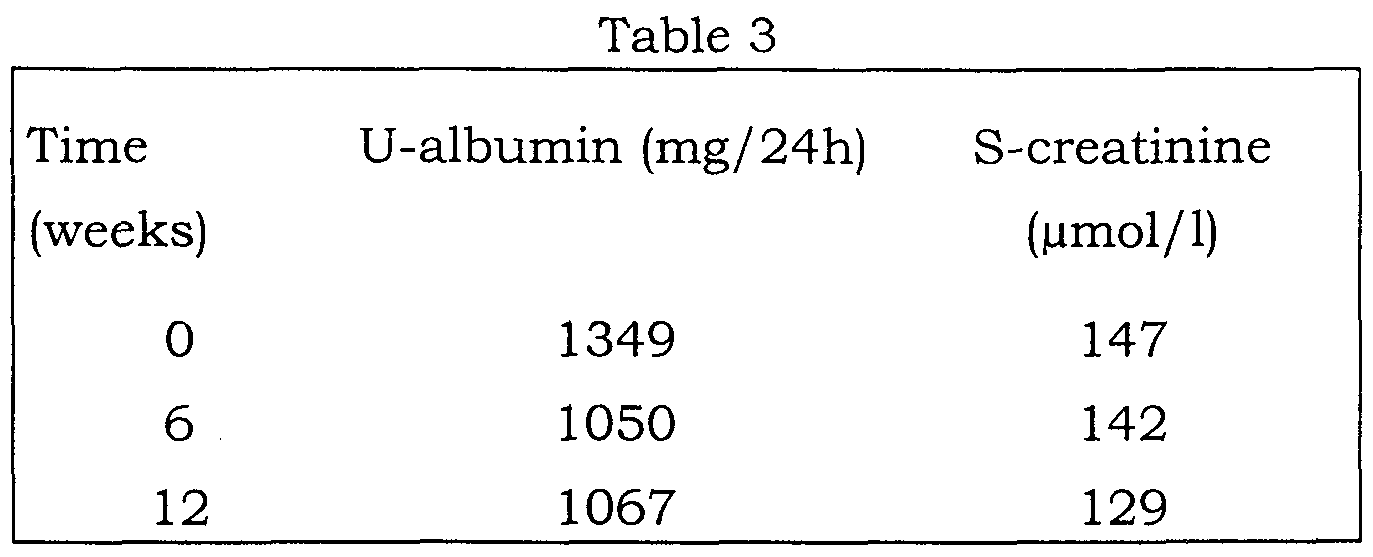
- the invention is illustrated by the following examples where budesonide was administered orally using the EntocortTM preparation (tablet form) to patients suffering from IgA nephropathy in native kidneys or kidney transplants.
- Example 4 A patient, 37-years old, (male) with IgA nephropathy, where histological examination of the renal biopsy demonstrated that 2/ 15 glomeruli were sclerotic and the other glomeruli had mesangial proliferative changes. A slight focal interstitial fibrosis and tubular atrophy could also be dem- onstrated. Treatment with budesonide (9 mg/day) was initiated and after 12 weeks of treatment the proteinuria was reduced and renal function was basically unchanged as shown in Table 4.
- Example 6 A 26-year old patient (male) with IgA nephropathy was studied before and during the treatment with budesonide (9 mg/day). After 12 weeks of treatment the proteinuria was reduced as shown in Table 6. 10 Table 6
- Example 8 A 36-year old patient (male) with IgA nephropathy, where histological examination of material from renal biopsy showed that 14/28 glomeruli were entirely sclerotic and in the rest of glomeruli there was a widening of the mesangium and a slight mesangial proliferation and an increase of mesangial matrix. Focal fibrosis was also found in the interstitium. Treatment with budesonide (9 mg/day) was initiated and after 6 weeks of treatment the proteinuria was reduced and renal function was improved as shown in Table 8. 11 Table 8
Landscapes
- Health & Medical Sciences (AREA)
- Veterinary Medicine (AREA)
- Public Health (AREA)
- General Health & Medical Sciences (AREA)
- Pharmacology & Pharmacy (AREA)
- Animal Behavior & Ethology (AREA)
- Chemical & Material Sciences (AREA)
- Medicinal Chemistry (AREA)
- Life Sciences & Earth Sciences (AREA)
- Epidemiology (AREA)
- Bioinformatics & Cheminformatics (AREA)
- Nuclear Medicine, Radiotherapy & Molecular Imaging (AREA)
- General Chemical & Material Sciences (AREA)
- Chemical Kinetics & Catalysis (AREA)
- Organic Chemistry (AREA)
- Engineering & Computer Science (AREA)
- Immunology (AREA)
- Urology & Nephrology (AREA)
- Pharmaceuticals Containing Other Organic And Inorganic Compounds (AREA)
- Steroid Compounds (AREA)
Abstract
Description




Claims
Priority Applications (8)
| Application Number | Priority Date | Filing Date | Title |
|---|---|---|---|
| DE69902999T DE69902999T2 (en) | 1998-03-17 | 1999-03-16 | GLUCOCORTICOIDS FOR TREATING GLOMERULONEPHITIS |
| JP2000536384A JP4326696B2 (en) | 1998-03-17 | 1999-03-16 | Methods and means for the treatment of glomerulonephritis |
| CA002317796A CA2317796A1 (en) | 1998-03-17 | 1999-03-16 | Method and means for treating glomerulonephritis |
| AU29686/99A AU749199B2 (en) | 1998-03-17 | 1999-03-16 | Method and means for treating glomerulonephritis |
| BR9908838-0A BR9908838A (en) | 1998-03-17 | 1999-03-16 | Use of a glucocorticoid, process to treat acute or chronic glomerulonephritis, and pharmaceutical composition to treat glomerulonephritis |
| KR1020007009283A KR20010041204A (en) | 1998-03-17 | 1999-03-16 | Method and means for treating glomerulonephritis |
| AT99910932T ATE224195T1 (en) | 1998-03-17 | 1999-03-16 | GLUCOCORTICOIDS FOR THE TREATMENT OF GLOMERULONEPHITIS |
| EP99910932A EP1056461B1 (en) | 1998-03-17 | 1999-03-16 | Glucocorticoids for treating glomerulonephritis |
Applications Claiming Priority (2)
| Application Number | Priority Date | Filing Date | Title |
|---|---|---|---|
| SE9800905A SE514128C2 (en) | 1998-03-17 | 1998-03-17 | Use of a glucocorticoid for the manufacture of a medicament for the treatment of glomerulonephritis |
| SE9800905-3 | 1998-03-17 |
Publications (1)
| Publication Number | Publication Date |
|---|---|
| WO1999047144A1 true WO1999047144A1 (en) | 1999-09-23 |
Family
ID=20410600
Family Applications (1)
| Application Number | Title | Priority Date | Filing Date |
|---|---|---|---|
| PCT/SE1999/000406 Ceased WO1999047144A1 (en) | 1998-03-17 | 1999-03-16 | Method and means for treating glomerulonephritis |
Country Status (12)
| Country | Link |
|---|---|
| EP (1) | EP1056461B1 (en) |
| JP (1) | JP4326696B2 (en) |
| KR (1) | KR20010041204A (en) |
| CN (1) | CN1152688C (en) |
| AT (1) | ATE224195T1 (en) |
| AU (1) | AU749199B2 (en) |
| BR (1) | BR9908838A (en) |
| CA (1) | CA2317796A1 (en) |
| DE (1) | DE69902999T2 (en) |
| ES (1) | ES2181407T3 (en) |
| SE (1) | SE514128C2 (en) |
| WO (1) | WO1999047144A1 (en) |
Cited By (6)
| Publication number | Priority date | Publication date | Assignee | Title |
|---|---|---|---|---|
| WO2001028563A1 (en) * | 1999-10-20 | 2001-04-26 | Byk Gulden Lomberg Chemische Fabrik Gmbh | Ciclesonide-containing aqueous pharmaceutical composition |
| WO2001028562A1 (en) * | 1999-10-20 | 2001-04-26 | Byk Gulden Lomberg Chemische Fabrik Gmbh | Ciclesonide contained pharmaceutical composition for application to mucosa |
| WO2005025577A1 (en) * | 2003-09-15 | 2005-03-24 | Altana Pharma Ag | Use of ciclesonide for the treatment of inflammatory bowel diseases |
| WO2023139285A1 (en) * | 2022-01-24 | 2023-07-27 | Calliditas Therapeutics Ab | Pharmaceutical composition comprising budesonide for treating iga nephropathy |
| US12290598B2 (en) | 2009-10-01 | 2025-05-06 | Ellodi Pharmaceuticals, L.P. | Orally administered corticosteroid compositions |
| US12310976B2 (en) | 2013-09-06 | 2025-05-27 | Ellodi Pharmaceuticals, L.P. | Corticosteroid containing orally disintegrating tablet compositions for eosinophilic esophagitis |
Families Citing this family (2)
| Publication number | Priority date | Publication date | Assignee | Title |
|---|---|---|---|---|
| GB0808537D0 (en) * | 2008-05-12 | 2008-06-18 | Archimedes Dev Ltd | Compositions |
| EP3870229A1 (en) * | 2018-10-22 | 2021-09-01 | IOI Oleo GmbH | Additive for a powder material intended for compaction into shaped bodies |
Citations (1)
| Publication number | Priority date | Publication date | Assignee | Title |
|---|---|---|---|---|
| US5643602A (en) * | 1989-11-22 | 1997-07-01 | Astra Aktiebolag | Oral composition for the treatment of inflammatory bowel disease |
-
1998
- 1998-03-17 SE SE9800905A patent/SE514128C2/en not_active IP Right Cessation
-
1999
- 1999-03-16 WO PCT/SE1999/000406 patent/WO1999047144A1/en not_active Ceased
- 1999-03-16 AU AU29686/99A patent/AU749199B2/en not_active Expired
- 1999-03-16 CN CNB998041351A patent/CN1152688C/en not_active Expired - Lifetime
- 1999-03-16 AT AT99910932T patent/ATE224195T1/en not_active IP Right Cessation
- 1999-03-16 ES ES99910932T patent/ES2181407T3/en not_active Expired - Lifetime
- 1999-03-16 JP JP2000536384A patent/JP4326696B2/en not_active Expired - Lifetime
- 1999-03-16 BR BR9908838-0A patent/BR9908838A/en not_active IP Right Cessation
- 1999-03-16 EP EP99910932A patent/EP1056461B1/en not_active Expired - Lifetime
- 1999-03-16 KR KR1020007009283A patent/KR20010041204A/en not_active Withdrawn
- 1999-03-16 CA CA002317796A patent/CA2317796A1/en not_active Abandoned
- 1999-03-16 DE DE69902999T patent/DE69902999T2/en not_active Expired - Lifetime
Patent Citations (1)
| Publication number | Priority date | Publication date | Assignee | Title |
|---|---|---|---|---|
| US5643602A (en) * | 1989-11-22 | 1997-07-01 | Astra Aktiebolag | Oral composition for the treatment of inflammatory bowel disease |
Non-Patent Citations (2)
| Title |
|---|
| EUR. CYTOKINE NETW., Volume 5, No. 3, 1994, ECKHARDT J.U. VON ASMUTH et al., "IL-6, IL-8 and TNF Production by Cytokine and Lipopolysaccharide-Stimulated Human Renal Cortical Epithelial Cells In Vitro", pages 301-310. * |
| STN INTERNATIONAL, File CAPLUS, CAPLUS Accession No. 1993:531139, Dokument No. 119:131139, MINAMI TAKEO et al., "Preliminary Results of Short-Term Combination Immunosuppressions of Mizoribine, Azathioprine and Prednisolone with Pretreatment to Canine Kidney Transplantation"; & J. VET. MED. SCI., (1993), 55(3), 409-14. * |
Cited By (19)
| Publication number | Priority date | Publication date | Assignee | Title |
|---|---|---|---|---|
| HRP20020346B1 (en) * | 1999-10-20 | 2011-06-30 | Nycomed Gmbh | PHARMACEUTICAL COMPOSITION CONTAINING CYCLESONIDE FOR SLAUGHTER APPLICATION |
| US6767901B1 (en) | 1999-10-20 | 2004-07-27 | Altana Pharma Ag | Ciclesonide contained pharmaceutical composition for application to mucosa |
| US8383611B1 (en) | 1999-10-20 | 2013-02-26 | Nycomed Gmbh | Ciclesonide containing aqueous pharmaceutical composition |
| CZ297780B6 (en) * | 1999-10-20 | 2007-03-28 | Altana Pharma Ag | Aqueous pharmaceutical composition |
| CZ297779B6 (en) * | 1999-10-20 | 2007-03-28 | Altana Pharma Ag | Aqueous pharmaceutical composition |
| KR100722209B1 (en) * | 1999-10-20 | 2007-05-29 | 알타나 파마 아게 | Cyclasonide-containing pharmaceutical composition for mucosal application |
| WO2001028562A1 (en) * | 1999-10-20 | 2001-04-26 | Byk Gulden Lomberg Chemische Fabrik Gmbh | Ciclesonide contained pharmaceutical composition for application to mucosa |
| WO2001028563A1 (en) * | 1999-10-20 | 2001-04-26 | Byk Gulden Lomberg Chemische Fabrik Gmbh | Ciclesonide-containing aqueous pharmaceutical composition |
| AU2004271743B2 (en) * | 2003-09-15 | 2010-06-10 | Covis Pharma B.V. | Use of ciclesonide for the treatment of inflammatory bowel diseases |
| WO2005025577A1 (en) * | 2003-09-15 | 2005-03-24 | Altana Pharma Ag | Use of ciclesonide for the treatment of inflammatory bowel diseases |
| US12290598B2 (en) | 2009-10-01 | 2025-05-06 | Ellodi Pharmaceuticals, L.P. | Orally administered corticosteroid compositions |
| US12447157B2 (en) | 2013-09-06 | 2025-10-21 | Ellodi Pharmaceuticals, L.P. | Corticosteroid containing orally disintegrating tablet compositions for eosinophilic esophagitis |
| US12310976B2 (en) | 2013-09-06 | 2025-05-27 | Ellodi Pharmaceuticals, L.P. | Corticosteroid containing orally disintegrating tablet compositions for eosinophilic esophagitis |
| WO2023139285A1 (en) * | 2022-01-24 | 2023-07-27 | Calliditas Therapeutics Ab | Pharmaceutical composition comprising budesonide for treating iga nephropathy |
| US12171882B2 (en) | 2022-01-24 | 2024-12-24 | Calliditas Therapeutics Ab | Pharmaceutical compositions |
| US12171883B2 (en) | 2022-01-24 | 2024-12-24 | Calliditas Therapeutics Ab | Pharmaceutical compositions |
| US11896719B2 (en) * | 2022-01-24 | 2024-02-13 | Calliditas Therapeutics Ab | Pharmaceutical compositions |
| US12311057B2 (en) | 2022-01-24 | 2025-05-27 | Calliditas Therapeutics Ab | Pharmaceutical compositions |
| US20230293444A1 (en) * | 2022-01-24 | 2023-09-21 | Calliditas Therapeutics Ab | New pharmaceutical compositions |
Also Published As
| Publication number | Publication date |
|---|---|
| ATE224195T1 (en) | 2002-10-15 |
| AU749199B2 (en) | 2002-06-20 |
| ES2181407T3 (en) | 2003-02-16 |
| CA2317796A1 (en) | 1999-09-23 |
| JP2002506824A (en) | 2002-03-05 |
| CN1293572A (en) | 2001-05-02 |
| JP4326696B2 (en) | 2009-09-09 |
| SE9800905L (en) | 1999-09-18 |
| DE69902999D1 (en) | 2002-10-24 |
| KR20010041204A (en) | 2001-05-15 |
| EP1056461A1 (en) | 2000-12-06 |
| AU2968699A (en) | 1999-10-11 |
| BR9908838A (en) | 2000-12-12 |
| SE514128C2 (en) | 2001-01-08 |
| DE69902999T2 (en) | 2003-06-05 |
| CN1152688C (en) | 2004-06-09 |
| SE9800905D0 (en) | 1998-03-17 |
| EP1056461B1 (en) | 2002-09-18 |
Similar Documents
| Publication | Publication Date | Title |
|---|---|---|
| Al-Dury et al. | Ileal bile acid transporter inhibition for the treatment of chronic constipation, cholestatic pruritus, and NASH | |
| Bergmann et al. | Clinical pharmacokinetics and pharmacodynamics of prednisolone and prednisone in solid organ transplantation | |
| Fedorak et al. | Targeted delivery, safety, and efficacy of oral enteric-coated formulations of budesonide | |
| US20070149465A1 (en) | Compositions and methods for prevention and treatment of cachexia | |
| WO2007095497A2 (en) | Compositions and methods for prevention and treatment of cachexia | |
| Chibbar et al. | Mesalamine in the initial therapy of ulcerative colitis | |
| CN102670864A (en) | Medicine composition with antioxidant function for treating cardiovascular and cerebrovascular diseases and sugar diabetes | |
| US20230301951A1 (en) | Compositions and methods for the treatment of primary biliary cholangitis | |
| EP1056461B1 (en) | Glucocorticoids for treating glomerulonephritis | |
| US6239120B1 (en) | Method and means for treating glomerulonephritis | |
| US6096731A (en) | Method for preventing tissue damage associated with graft-versus-host or host-versus-graft disease following transplantation | |
| Kidd et al. | Clinical studies of phenylbutazone (butazolidin) and butapyrin (irgapyrin) in rheumatoid arthritis, rheumatoid spondylitis, and gout | |
| MXPA00008173A (en) | Method and means for treating glomerulonephritis | |
| US20100184732A1 (en) | Method of long-term treatment of graft-versus-host disease using topical active corticosteroids | |
| Lo | Immunosuppression and metabolic syndrome in renal transplant recipients | |
| Teplick et al. | Acute renal failure following oral cholecystography | |
| Tsuchida et al. | Evaluation of theophylline or pranlukast, a cysteinyl leukotriene receptor 1 antagonist, as add-on therapy in uncontrolled asthmatic patients with a medium dose of inhaled corticosteroids. | |
| CN113950329A (en) | Combination of polyhydroxylated bile acids and farnesoid X receptor agonists | |
| JP7427199B2 (en) | Metabolism improver | |
| JP7863835B2 (en) | visceral fat accumulation reduction agent | |
| EP4116710A1 (en) | Use of a group of markers for diagnosing and adjusting treatment of primary biliary cholangitis, pharmaceutical composition and solid dosage form for treating primary biliary cholangitis | |
| OKADA et al. | Early morphological changes of tubules in rats with chronic renal failure | |
| Sohi et al. | Management of refractory ulcerative colitis | |
| EP4719402A1 (en) | Sparsentan for use in a method of treating iga-mediated diseases | |
| Jain et al. | Effect of T‐tube clamping on the pharmacokinetics of mycophenolic acid in liver transplant patients on oral therapy of mycophenolate mofetil |
Legal Events
| Date | Code | Title | Description |
|---|---|---|---|
| WWE | Wipo information: entry into national phase |
Ref document number: 99804135.1 Country of ref document: CN |
|
| AK | Designated states |
Kind code of ref document: A1 Designated state(s): AE AL AM AT AU AZ BA BB BG BR BY CA CH CN CU CZ DE DK EE ES FI GB GD GE GH GM HR HU ID IL IN IS JP KE KG KP KR KZ LC LK LR LS LT LU LV MD MG MK MN MW MX NO NZ PL PT RO RU SD SE SG SI SK SL TJ TM TR TT UA UG UZ VN YU ZA ZW |
|
| AL | Designated countries for regional patents |
Kind code of ref document: A1 Designated state(s): GH GM KE LS MW SD SL SZ UG ZW AM AZ BY KG KZ MD RU TJ TM AT BE CH CY DE DK ES FI FR GB GR IE IT LU MC NL PT SE BF BJ CF CG CI CM GA GN GW ML MR NE SN TD TG |
|
| 121 | Ep: the epo has been informed by wipo that ep was designated in this application | ||
| DFPE | Request for preliminary examination filed prior to expiration of 19th month from priority date (pct application filed before 20040101) | ||
| ENP | Entry into the national phase |
Ref document number: 2317796 Country of ref document: CA Ref document number: 2317796 Country of ref document: CA Kind code of ref document: A |
|
| WWE | Wipo information: entry into national phase |
Ref document number: 1999910932 Country of ref document: EP |
|
| WWE | Wipo information: entry into national phase |
Ref document number: 29686/99 Country of ref document: AU |
|
| WWE | Wipo information: entry into national phase |
Ref document number: PA/a/2000/008173 Country of ref document: MX |
|
| WWE | Wipo information: entry into national phase |
Ref document number: 1020007009283 Country of ref document: KR |
|
| WWP | Wipo information: published in national office |
Ref document number: 1999910932 Country of ref document: EP |
|
| REG | Reference to national code |
Ref country code: DE Ref legal event code: 8642 |
|
| WWP | Wipo information: published in national office |
Ref document number: 1020007009283 Country of ref document: KR |
|
| WWG | Wipo information: grant in national office |
Ref document number: 1999910932 Country of ref document: EP |
|
| WWG | Wipo information: grant in national office |
Ref document number: 29686/99 Country of ref document: AU |
|
| WWW | Wipo information: withdrawn in national office |
Ref document number: 1020007009283 Country of ref document: KR |