WO1999047525A1 - Herbicidally active 3-hydroxy-4-aryl-5-oxopyrazoline derivatives - Google Patents

Herbicidally active 3-hydroxy-4-aryl-5-oxopyrazoline derivatives Download PDF

Info

Publication number
WO1999047525A1
WO1999047525A1 PCT/EP1999/001593 EP9901593W WO9947525A1 WO 1999047525 A1 WO1999047525 A1 WO 1999047525A1 EP 9901593 W EP9901593 W EP 9901593W WO 9947525 A1 WO9947525 A1 WO 9947525A1
Authority
WO
WIPO (PCT)
Prior art keywords
alkyl
hydrogen
halogen
formula
substituted
Prior art date
Legal status (The legal status is an assumption and is not a legal conclusion. Google has not performed a legal analysis and makes no representation as to the accuracy of the status listed.)
Ceased
Application number
PCT/EP1999/001593
Other languages
French (fr)
Inventor
Michel Mühlebach
Jutta Glock
Thomas Maetzke
André Stoller
Current Assignee (The listed assignees may be inaccurate. Google has not performed a legal analysis and makes no representation or warranty as to the accuracy of the list.)
Novartis Pharma GmbH Austria
Novartis AG
Original Assignee
Novartis Erfindungen Verwaltungs GmbH
Novartis AG
Priority date (The priority date is an assumption and is not a legal conclusion. Google has not performed a legal analysis and makes no representation as to the accuracy of the date listed.)
Filing date
Publication date
Priority to UA2000095230A priority Critical patent/UA66837C2/en
Priority to DK99915574T priority patent/DK1062217T3/en
Priority to AT99915574T priority patent/ATE242249T1/en
Priority to BRPI9908757-0A priority patent/BR9908757B1/en
Priority to CA002318976A priority patent/CA2318976C/en
Priority to AU34109/99A priority patent/AU741365B2/en
Priority to JP2000536720A priority patent/JP3652986B2/en
Priority to HU0101359A priority patent/HU228637B1/en
Priority to EP99915574A priority patent/EP1062217B1/en
Priority to RU2000125819A priority patent/RU2221787C9/en
Priority to US09/646,142 priority patent/US6410480B1/en
Priority to ROA200000860A priority patent/RO120911B1/en
Application filed by Novartis Erfindungen Verwaltungs GmbH, Novartis AG filed Critical Novartis Erfindungen Verwaltungs GmbH
Priority to PL342902A priority patent/PL197466B1/en
Priority to DE69908568T priority patent/DE69908568T2/en
Publication of WO1999047525A1 publication Critical patent/WO1999047525A1/en
Anticipated expiration legal-status Critical
Priority to NL350038C priority patent/NL350038I2/en
Priority to FR11C0010C priority patent/FR11C0010I2/fr
Priority to HUS1300054C priority patent/HUS1300054I1/en
Ceased legal-status Critical Current

Links

Classifications

    • CCHEMISTRY; METALLURGY
    • C07ORGANIC CHEMISTRY
    • C07DHETEROCYCLIC COMPOUNDS
    • C07D498/00Heterocyclic compounds containing in the condensed system at least one hetero ring having nitrogen and oxygen atoms as the only ring hetero atoms
    • C07D498/02Heterocyclic compounds containing in the condensed system at least one hetero ring having nitrogen and oxygen atoms as the only ring hetero atoms in which the condensed system contains two hetero rings
    • C07D498/04Ortho-condensed systems
    • AHUMAN NECESSITIES
    • A01AGRICULTURE; FORESTRY; ANIMAL HUSBANDRY; HUNTING; TRAPPING; FISHING
    • A01NPRESERVATION OF BODIES OF HUMANS OR ANIMALS OR PLANTS OR PARTS THEREOF; BIOCIDES, e.g. AS DISINFECTANTS, AS PESTICIDES OR AS HERBICIDES; PEST REPELLANTS OR ATTRACTANTS; PLANT GROWTH REGULATORS
    • A01N43/00Biocides, pest repellants or attractants, or plant growth regulators containing heterocyclic compounds
    • A01N43/90Biocides, pest repellants or attractants, or plant growth regulators containing heterocyclic compounds having two or more relevant hetero rings, condensed among themselves or with a common carbocyclic ring system
    • AHUMAN NECESSITIES
    • A61MEDICAL OR VETERINARY SCIENCE; HYGIENE
    • A61PSPECIFIC THERAPEUTIC ACTIVITY OF CHEMICAL COMPOUNDS OR MEDICINAL PREPARATIONS
    • A61P13/00Drugs for disorders of the urinary system

Definitions

  • the present invention relates to novel herbicidally active 3-hydroxy-4-aryl-5-oxopyrazoline derivatives, to processes for their preparation, to compositions which comprise these compounds and may additionally comprise safeners, and to the use of these compounds as herbicides for controlling weeds and grasses, in particular in crops of useful plants.
  • R ⁇ , R 2 and R 3 independently of one another are halogen, nitro, cyano, CrC 4 alkyl, C 2 - C 4 alkenyl, C 2 -C alkynyl, CrC 4 haloalkyl, C 2 -C 6 haloalkenyl, C 3 -C 6 cycloalkyl, halogen- substituted C 3 -C 6 cycloalkyl, CrC ⁇ alkoxyalkyl, d-C ⁇ alkylthioalkyl, hydroxyl, mercapto, C C 6 alkoxy, C 3 -C 6 alkenyloxy, C 3 -C 6 alkynyloxy, C ⁇ -C 4 alkylcarbonyl, C ⁇ -C 4 alkoxycarbonyl, d- C 4 alkylthio, C ⁇ -C alkylsuifinyl, CrC 4 alkylsulfonyl, amino, Crdalkylamino or di(d-C - al
  • G is hydrogen, -C(X 1 )-R 30 , -C(X 2 )-X3-R 3 ⁇ , -C(X 4 )-N(R 32 )-R 3 3, -SO 2 -R 34 , an alkali metal, alkaline earth metal, sulfonium or ammonium cation or -P(X 5 )(R 35 )-R 36 ,' Xi, X 2 .
  • X 3 , X 4 and X 5 independently of one another are oxygen or sulfur; and R30, R31, R32.
  • R33, R 34 , R35 and R 36 independently of one another are hydrogen, CrC 5 alkyl, CrC 5 haloalkyl, C 2 -C 5 alkenyl, C C 5 alkoxyalkyl, C 3 -C 6 cycloalkyl or phenyl, and R 34 is additionally C 2 -C 20 alkenyl, C 2 -C 2 oalkenyl substituted by halogen, alkylcarbonyl, alkoxycarbonyl, alkylcarbonyloxy, alkoxy, thioalkyl, alkylthiocarbonyl, alkylcarbonylthio, alkylsulfonyl, alkylsulfoxyl, alkylaminosulfonyl, dialkylaminosulfonyl, alkylsulfonyloxy, alkylsulfonylamino, alkylamino, dialkylamino, alkylcarbonylamino, dialkylamino, alky
  • halogen is to be understood as meaning fluorine, chlorine, bromine and iodine, preferably fluorine, chlorine and bromine.
  • the alkyl groups in the definitions of the substituents are, for example, methyl, ethyl, n-propyl, isopropyl, n-butyl, sec-butyl, isobutyl or tert-butyl, and the isomeric pentyls and hexyls.
  • Suitable cycloalkyl substituents contain 3 to 6 carbon atoms and are, for example, cyclopropyl, cyclobutyl, cyciopentyl or cyclohexyl.
  • Alkenyl is to be understood as meaning, for example, vinyl, allyl, methallyl, 1 -methylvinyl or but-2-en-1-yl.
  • Alkynyl is, for example, ethinyl, propargyl, but-2-in- 1 -yl, 2-methylbutin-2-yl or but-3-in-2-yl.
  • Haloalkyl groups preferably have a chain length of 1 to 4 carbon atoms.
  • Haloalkyl is, for example, fluoromethyl, difluoromethyl, trifluoromethyl, chloromethyl, dichloromethyl, trichloromethyl, 2,2,2-trifluoroethyl, 2-fluoroethyl, 2-chloroethyl, pentafluoroethyl, 1 ,1-difluoro-2,2,2-trichloroethyl, 2,2,3,3-tetrafluoroethyl and 2,2,2- trichloroethyl; preferably trichloromethyl, difluorochloromethyl, difluoromethyl, trifluoromethyl and dichlorofluoromethyl.
  • Suitable haloalkenyls are alkenyl groups which are mono- or polysubstituted by halogen, halogen being fluorine, chlorine, bromine and iodine and in particular fluorine and chlorine, for example 2,2-difluoro-1 -methylvinyl, 3-fluoropropenyl, 3- chloropropenyl, 3-bromopropenyl, 2,3,3-trifluoropropenyl, 2,3,3-trichloropropenyl and 4,4,4- trifluorobut-2-en-1-yl.
  • halogen being fluorine, chlorine, bromine and iodine and in particular fluorine and chlorine, for example 2,2-difluoro-1 -methylvinyl, 3-fluoropropenyl, 3- chloropropenyl, 3-bromopropenyl, 2,3,3-trifluoropropenyl, 2,3,3-trichloropropenyl and 4,4,4- trifluorobut-2-
  • Alkoxy groups preferably have a chain length of 1 to 6 carbon atoms.
  • Alkoxy is, for example, methoxy, ethoxy, propoxy, isopropoxy, n-butoxy, isobutoxy, sec-butoxy and tert-butoxy, and the isomeric pentyloxy and hexyloxy radicals; preferably methoxy and ethoxy.
  • Alkylcarbonyl is preferably acetyl or propionyl.
  • Alkoxycarbonyl is, for example, methoxycarbonyl, ethoxycarbonyl, propoxycarbonyl, isopropoxycarbonyl, n-butoxycarbonyl, isobutoxycarbonyl, sec-butoxycarbonyl or tert-butoxycarbonyl; preferably methoxycarbonyl or ethoxycarbonyl.
  • Alkylthio groups preferably have a chain length of 1 to 4 carbon atoms.
  • Alkylthio is, for example, methylthio, ethylthio, propylthio, isopropylthio, n-butylthio, isobutylthio, sec-butylthio or tert-butylthio, preferably methylthio and ethylthio.
  • Alkylsulfinyl is, for example, methylsulfinyl, ethylsulfinyl, propylsulfinyl, isopropylsulfinyl, n-butylsulfinyl, isobutylsulfinyl, sec-butylsulfinyl, tert-butylsulfinyl; preferably methylsulfinyl and ethylsulfinyl.
  • Alkylsulfonyl is, for example, methylsulfonyl, ethylsulfonyl, propylsulfonyl, isopropylsulfonyl, n-butylsulfonyl, isobutylsulfonyl, sec-butylsulfonyl or tert-butylsulfonyl; preferably methylsulfonyl or ethylsulfonyl.
  • Alkylamino is, for example, methylamino, ethylamino, n-propylamino, isopropylamino or the isomeric butylamines.
  • Dialkylamino is, for example, dimethylamino, methylethylamino, diethylamino, n-propylmethylamino, dibutylamino and diisopropylamino.
  • Alkoxyalkyl groups preferably have 1 to 6 carbon atoms.
  • Alkoxyalkyl is, for example, methoxymethyl, methoxyethyl, ethoxymethyl, ethoxyethyl, n-propoxymethyl, n-propoxyethyl, isopropoxymethyl or isopropoxyethyl.
  • Alkylthioalkyl is, for example, methylthiomethyl, methylthioethyl, ethylthiomethyl, ethylthioethyl, n-propylthiomethyl, n-propylthioethyl, isopropylthiomethyl, isopropylthioethyl, butylthiomethyl, butylthioethyl or butylthiobutyl.
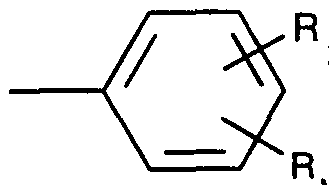
  • Phenyl may be substituted.
  • the substituents may be in the ortho, meta and/or para position.
  • the substituents are preferably located in the positions ortho and para to the site where the ring is attached.
  • halogen, alkyl, cycloalkyl, alkoxy, alkylthio, alkylcarbonyl, alkylsulfonyl and (di)alkylamino radicals which may be present in the radicals R 34 , in particular -SO 2 R3 (G) , are derived from the corresponding radicals mentioned above.
  • Preferred heterocyclyl radicals are those containing 1 or 2 heteroatoms, for example N, S or O. They are usually saturated.
  • Heteroaryl radicals are customarily aromatic heterocycles which preferably contain 1 to 3 heteroatoms, such as N, S and O.
  • heterocycles and heteroaromatics examples include: pyrrolidine, piperidine, pyran, dioxane, azetidine, oxetan, pyridine, pyrimidine, triazine, thiazole, thiadiazole, imidazole, oxazole, isoxazole and pyrazine, furan, morpholine, piperazine, pyrazole, benzoxazole, benzothiazole, quinoxaiine and quinoline.
  • heterocycles and heteroaromatics may also be substituted, for example by halogen, alkyl, alkoxy, haloalkyl, haloalkoxy, nitro, cyano, thioalkyl, alkylamino or phenyl.
  • the C 2 - C 20 alkenyl and alkynyl groups R ⁇ may be mono- or polyunsaturated. They preferably contain 2 to 12, in particular 2 to 6, carbon atoms.
  • suitable groups -SO 2 R 34 are given in the example below:
  • Alkyl ⁇ Alkyl Alkyl o
  • Alkali metal cations, alkaline earth metal cations or ammonium cations for the substituent G are, for example, the cations of sodium, potassium, magnesium, calcium and ammonium.
  • Preferred sulfonium cations are, in particular, trialkylsulfonium cations, where the alkyl radicals each preferably contain 1 to 4 carbon atoms. - 7 -
  • the free valency on the left hand of the groups Z Z 2 and Z 3 is linked to the 1 -position and the free valency on the right hand is linked to the 2-position of the pyrazoline ring.
  • R 4 and R 5 together are in particular a group
  • R26, R27, R28 and R 29 independently of one another are hydrogen, halogen, d-C 4 alkyl or C C 4 haloalkyl, where an alkylene ring which, together with the carbon atoms of the groups Z ⁇ , Z 2 and Z 3 , contains 3 to 6 carbon atoms may be fused or spiro-linked to the groups Z , Z 2 and Z 3 .
  • R 4 and R 5 together form a group Z 2 .
  • Ri, R 2 and R 3 independently of one another are halogen, C C 4 alkyl, C 2 -C 4 alkenyl, C 2 -C 4 alkynyl or CrC 6 - alkoxy.
  • R 2 is halogen, methyl, ethyl or ethinyl
  • R T and R 3 independently of one another are methyl, ethyl, isopropyl, vinyl, allyl, ethinyl, methoxy, ethoxy, bromine or chlorine.
  • G is the group -C(X ⁇ )-R 30 or C(X 2 )-(X 3 )-R 3 ⁇ in which X ⁇ X 2 and X 3 are, in particular, oxygen, and R 30 and R 31 independently of one another are preferably CrC 5 alkyl.
  • R 30 , R 31 , R 32 , R 33 , Rs- t , R 35 and R 36 independently of one another are hydrogen, d-Csalkyl or C ⁇ -C 5 haloalkyl.
  • Another preferred group of compounds of the formula I is that where at least one ring atom of the groups Z Z 2 or Z 3 is bridged by an alkyiene ring which, together with the carbon atoms of the groups Z , Z 2 or Z 3 , contains 2 to 6 carbon atoms and may be interrupted by oxygen.
  • the invention also includes the salts which the compounds of the formula I can form with acids.
  • Suitable acids for forming the acid addition salts are both organic and inorganic acids. Examples of such acids are hydrochloric acid, hydrobromic acid, nitric acid, phosphoric acids, sulfuric acid, acetic acid, propionic acid, butyric acid, valeric acid, oxalic acid, malonic acid, fumaric acid, organic sulfonic acids, lactic acid, tartaric acid, citric acid and salicylic acid.
  • the salts of the compounds of the formula I with acidic hydrogen also include alkali metal salts, for example sodium salts and potassium salts; alkaline earth metal salts, for example calcium salts and magnesium salts; ammonium salts, i.e. unsubstituted ammonium salts and mono- or polysubstituted ammonium salts, and salts with other organic nitrogen bases.
  • suitable salt formers are alkali metal and alkaline earth metal hydroxides, in particular the hydroxides of lithium, sodium, potassium, magnesium or calcium, where those of sodium or potassium are particularly important.
  • amines which are suitable for forming ammonium salts are both ammonia and primary, secondary and tertiary CrC 18 alkylamines, C C hydroxyalkylamines and C 2 - C 4 alkoxyalkylamines, for example methylamine, ethylamine, n-propylamine, isopropylamine, the four isomeric butylamines, n-amylamine, isoamylamine, hexylamine, heptylamine, - 9 -
  • octylamine nonylamine, decylamine, pentadecylamine, hexadecylamine, heptadecylamine, octadecylamine, methylethylamine, methylisopropylamine, methylhexylamine, methylnonylamine, methyipentadecylamine, methyloctadecylamine, ethylbutylamine, ethylheptylamine, ethyloctylamine, hexylheptylamine, hexyloctylamine, dimethylamine, diethylamine, di-n-propylamine, diisopropylamine, di-n-butylamine, di-n-amylamine, diisoamylamine, dihexylamine, diheptylamine, dioctylamine, ethanolamine, n-propanol
  • the unsymmetrically substituted compounds of the formula I are generally obtained as racemates.
  • the stereoisomers can then be separated by known methods, such as fractional crystallization after salt formation with optically pure bases, acids or metal complexes, or else by chromatographic processes such as high pressure liquid chromatography (HPLC) on acetylcellulose, owing to their physicochemical properties.
  • HPLC high pressure liquid chromatography
  • the active compounds of the formula I are to be understood as meaning both the enriched and optically pure forms of the stereoisomers in question, and the racemates or diastereomers.
  • the compounds of the formula I may be present as geometrical and/or optical isomers and isomer mixtures, and also as tautomers and mixtures of tautomers. These compounds of the formula I likewise form part of the subject-matter of the present invention.
  • the compounds of the formula I in which the group G is hydrogen may, for example, be present in the following tautomer equilibriums: - 10 -
  • the compound of the formula I may be present as an isomer of the formula Id
  • Processes for preparing compounds which, with respect to the meaning of the substituents R and R 5 , are different from the compounds of the formula I according to the present invention are, for example, described in WO 96/21652.
  • the compounds of the formula I according to the present invention can be prepared by methods similar to the processes described in WO 96/21652.
  • R ⁇ R 2 , R 3 , R 4 and R 5 are as defined under formula I and which are employed as starting materials for such processes can be prepared, for example, by reacting a compound of the formula III
  • R is C ⁇ -C 6 alkyl, CrC 6 haloalkyl, preferably methyl, ethyl or trichloroethyl, and R ⁇ R 2 and R 3 are as defined under formula I in an inert organic solvent, if appropriate in the presence of a base, with a compound of the formula IV or IVa
  • R 4 and R 5 are as defined under formula I.
  • Other preparation processes for compounds of the formula II are described, for example, in WO 92/16510 .
  • the compounds of the formula III are either known, or they can be prepared similarly to known processes. Processes for preparing compounds of the formula III and their reaction with hydrazines are described, for example, in WO 97/02243 .
  • Compounds of the formula III in which R is C ⁇ -C 6 alkyl, C ⁇ -C 6 haloalkyl, preferably methyl, ethyl or trichloroethyl, and R ⁇ , R 2 and R 3 are as defined under formula I can be prepared by methods known to the person skilled in the art.
  • R is CrC 6 alkyl, d- C 6 haloalkyl, preferably methyl, ethyl or trichloroethyl, and R ⁇ R 2 and R 3 independently of one - 12 -
  • C C 4 alkyl, C -C 4 alkenyl, C 2 -C alkynyl can be prepared by the process of cross- coupling according to Stille (J.K. Stifle, Angew. Chem. 1986, 98, 504-519), Sonogashira (K. Sonogashira et al., Tetrahedron Lett. 1975, 4467-4470), Suzuki (N. Miyaura, A. Suzuki, Chem. Rev. 1995, 95, 2457-2483) or Heck (R.F. Heck, Org. React. 1982. 27, 345-390), with or without subsequent hydrogenation.
  • This procedure is illustrated by the following reaction scheme:
  • the compounds of the formulae IV and IVa are either known, or they can be prepared by known processes. Processes for preparing compounds of the formula IV are described, for example, in WO 95/00521. These compounds can be prepared, for example, by heating a compound of the formula V
  • R 42 is hydrogen, d-C 4 alkyl, C,-C 6 alkoxy, d-C 6 haloalkoxy, benzyloxy, preferably hydrogen, methyl, methoxy, ethoxy, trichloroethoxy, tert-butoxy or benzyloxy and R and R 5 are as defined under formula I in the presence of a base or an acid in an inert solvent.
  • R 42 is hydrogen, d-C 4 alkyl, d-C 6 alkoxy, Ci-Cehaloalkoxy, benzyloxy, preferably hydrogen, methyl, methoxy, ethoxy, trichloroethoxy, tert-butoxy or benzyloxy in the presence of a base and an inert solvent with a compound of the formula VII
  • the free valencies of the groups Z ⁇ ,Z 2 and Z 3 are in each case attached to the group Y.
  • Compounds of the formula VI and VII are known, or they can be prepared by methods known to the person skilled in the art.
  • the end products of the formula I can be isolated in a customary manner by concentration and/or evaporation of the solvent and be purified by recrystallization or trituration of the solid residue in solvents in which they are not readily soluble, such as ethers, alkanes, aromatic hydrocarbons or chlorinated hydrocarbons, or by chromatography. Salts of compounds of the formula I can be prepared in a manner known per se. Such preparation methods are described, for example, in WO 96/21652.
  • the compounds of the formula I or compositions comprising them can be used according to the invention by all the application methods customary in agriculture, for example pre- emergence application, postemergence application and seed dressing, and various methods and techniques, for example controlled release of active compounds.
  • the active compound is absorbed in solution onto mineral granule carriers or polymerized granules (urea/formaldehyde) and dried. If appropriate, a coating which allows the active compound to be released in metered form over a certain period of time can additionally be applied (coated granules).
  • urea/formaldehyde urea/formaldehyde
  • the compounds of the formula I can be employed as herbicides in unchanged form, i.e. as they are obtained in the synthesis, but they are preferably processed in a customary manner with the auxiliaries conventionally used in the art of formulation, for example to give emulsifiable concentrates, directly sprayable or dilutable solutions, dilute emulsions, wettable powders, soluble powders, dusts, granules or microcapsules.
  • Such formulations are described, for example, in WO 97/34485 on pages 9 to 13.
  • the methods of application, such as spraying, atomizing, dusting, wetting, scattering or watering, in the same way as the nature of the compositions, are chosen according to the required aims and the given circumstances.
  • the formulations i.e. the compositions, formulations or preparations comprising the active compound of the formula I or at least one active compound of the formula I and as a rule one or more solid or liquid formulation auxiliaries, are prepared in a known manner, for example by intimate mixing and/or grinding of the active compounds with the formulation auxiliaries, for example solvents or solid carriers.
  • Surface-active compounds surfactants
  • solvents and solid carriers are given, for example, in WO 97/34485 on page 6.
  • suitable surface-active compounds are nonionic, cationic and/or anionic surfactants and surfactant mixtures having good emulsifying, dispersing and wetting properties.
  • anionic, nonionic and cationic surfactants examples include WO 97/34485 on pages 7 and 8.
  • compositions according to the invention containing a herbicidally effective amount of a compound of the formula I can be enhanced by addition of spray tank adjuvants. - 16 -
  • These adjuvants may be, for example: nonionic surfactants, mixtures of nonionic surfactants, mixtures of anionic surfactants with nonionic surfactants, cationic surfactants, organosilicon surfactants, mineral oil derivatives with and without surfactants, vegetable oil derivatives with and without addition of surfactants, alkylated derivatives of oils of vegetable or mineral origin with and without surfactants, fish oils and other oils of animal nature and their alkyl derivatives with and without surfactants, natural higher fatty acids, preferably having 8 to 28 carbon atoms, and their alkyl ester derivatives, organic acids which contain an aromatic ring system and one or more carboxylic esters, and their alkyl derivatives, furthermore suspensions of polymers of vinyl acetate or copolymers of vinyl acetate/acrylic esters. Mixtures of individual adjuvants with one another and in combination with organic solvents may further increase the effect.
  • Suitable nonionic surfactants are, for example, polyglycol ether derivatives of aliphatic or cycloaliphatic alcohols, saturated or unsaturated fatty acids and alkylphenols, preferably those which may contain 3 to 30 glycol ether groups and 8 to 20 carbon atoms in the (aliphatic) hydrocarbon radical and 6 to 18 carbon atoms in the alkyl radical of the alkylphenols.
  • nonionic surfactants are the water-soluble polyethylene oxide adducts on polypropylene glycol, ethylenediaminopolypropylene glycol and alkylpolypropylene glycol preferably having 1 to 10 carbon atoms in the alkyl chain which preferably contain 20 to 250 ethylene glycol ether groups and 10 to 100 propylene glycol ether groups.
  • the abovementioned compounds generally contain 1 to 5 ethylene glycol units per propylene glycol unit.
  • nonionic surfactants which may be mentioned are nonylphenolpolyethoxyethanols, castor oil polyglycol ethers, polypropylene/polyethylene oxide adducts, tributylphenoxypolyethoxyethanol, polyethylene glycol and octylphenoxypolyethoxyethanol.
  • fatty esters of polyoxyethylene sorbitan for example polyoxyethylene sorbitan trioleate.
  • Preferred anionic surfactants are, in particular, alkyl sulfates, alkyl sulfonates, alkylaryl sulfonates, alkylated phosphoric acids and their ethoxylated derivatives.
  • the alkyl radicals usually contain 8 to 24 carbon atoms. - 17 -
  • Preferred nonionic surfactants are known under the following trade names:
  • Polyoxyethylene cocoalkylamine for example AMIET ® 105 (Kao Co.)
  • polyoxyethylene oleylamine for example AMIET ® 415 (Kao Co.)
  • nonylphenolpolyethoxyethanols for example polyoxyethylene stearylamine (for example AMIET ® 320 (Kao Co.))
  • N- polyethoxyethylamines for example GENAMIN ® (Hoechst AG)
  • N,N,N',N'- tetra(polyethoxypolypropoxyethyl)ethylene diamines for example TERRONIL ® and TETRONIC ® (BASF Wyandotte Corp.)
  • BRIJ ® Alkylamine
  • ETHYLAN ® CD and ETHYLAN ® D Diamond Shamrock
  • GENAPOL ® C for example AMIET ® O, GENAPOL ® S and GENAPOL ® X080 (Hoechst AG)
  • the cationic surfactants are primarily quaternary ammonium salts which contain, as N- substituents, at least one alkyl radical having 8 to 22 C atoms and, as further substituents, lower nonhalogenated or halogenated alkyl, benzyl or lower hydroxyalkyl radicals.
  • the salts are preferably present as halides, methyl sulfates or ethyl sulfates, for example stearyltrimethylammonium chloride or benzyldi(2-chloroethyl)ethylammonium bromide.
  • the oils used are either of mineral or natural origin.
  • the natural oils may additionally be of animal or vegetable origin.
  • preference is given, in particular, to derivatives of beef tallow, but fish oils (for example sardine oil) and derivatives thereof are also used.
  • Vegetable oils are mainly seed oils of various origin. Examples of particularly preferred vegetable oils which may be mentioned are coconut, rapeseed or sunflower oils and derivatives thereof.
  • the herbicidal formulations as a rule comprise 0.1 to 99% by weight, in particular 0.1 to 95% by weight, of herbicide, 1 to 99.9% by weight, in particular 5 to 99.8% by weight, of a solid or liquid formulation auxiliary and 0 to 25% by weight, in particular 0.1 to 25% by weight, of a surfactant. While concentrated compositions are rather preferred as commercial goods, the end user as a rule uses dilute compositions.
  • compositions can also comprise further additives, such as stabilizers, for example epoxidized or non-epoxidized vegetable oils (epoxidized coconut oil, rapeseed oil or soya oil), defoamers, for example silicone oil, preservatives, viscosity regulators, binders, tackifiers and fertilizers or other active • compounds.
  • stabilizers for example epoxidized or non-epoxidized vegetable oils (epoxidized coconut oil, rapeseed oil or soya oil)
  • defoamers for example silicone oil, preservatives, viscosity regulators, binders, tackifiers and fertilizers or other active • compounds.
  • the herbicidally active compounds of the formula I are as a rule applied to the plants or their habitat, at application rates of 0.001 to 4 kg/ha, in particular 0.005 to 2 kg/ha.
  • the dosage required for the desired effect can be determined by tests. It depends on the nature of the effect, the development stage of the crop plant and the weed and on the application (location, time, process) and can, as a function of these parameters, vary within wide ranges.
  • the compounds of the formula I have herbicidal and growth-inhibiting properties, owing to which they can be used in crops of useful plants, in particular in cereals, cotton, soya, sugar beet, sugar cane, plantings, rapeseed, maize and rice, very particularly in maize and cereals, and for the non-selective control of weeds.
  • Crops include those which have been rendered tolerant towards herbicides or herbicide classes by conventional breeding methods or genetical engineering methods.
  • the weeds to be controlled can be both monocotyledonous and dicotyledonous weeds, for example Stellaria, Agrostis, Digitaria, Avena, Brachiaria, Phalaris, Setaria, Sinapis, Lolium, Solanum, Echinochloa, Scirpus, Monochoria, Sagittaria, Panicum, Bromus, Alopecurus, Sorghum halepense, Sorghum bicolor, Rottboellia, Cyperus, Abutilon, Sida, Xanthium, Amaranthus, Chenopodium, Ipomoea, Chrysanthemum, Galium, Viola, Matricharia, Papaver and Veronica.
  • the herbicidal composition according to the - 19 -
  • invention is particularly suitable for controlling Alopecurus, Avena, Agrostis, Setaria, Phalaris, Lolium, Panicum, Echinochloa, Brachiaria and Digitaria.
  • the present invention also relates to a selective herbicidal composition for controlling grasses and weeds in crops of useful plants, in particular in crops of maize and cereals, said composition comprising a herbicide of the formula I and a safener (antidote) and which protects the useful plants, but not the weeds, against the phytotoxic effect of the herbicide, and to the use of this composition for controlling weeds in crops of useful plants.
  • a selective-herbicidal composition which, in addition to customary inert formulation auxiliaries such as carriers, solvents and wetting agents, comprises, as active compound, a mixture of a) a herbicidally effective amount of a compound of the formula I
  • R 37 is hydrogen, d-C 8 alkyl or d-C 6 alkoxy- or C 3 -C 6 alkenyloxy-substituted d- C 8 alkyl; and X 6 is hydrogen or chlorine; or a compound of the formula XI
  • E is nitrogen or methine
  • R 38 is -CCI 3 , phenyl or halogen-substituted phenyl; R 39 and R 40 independently of one another are hydrogen or halogen; and R 4 ⁇ is d-dalkyl; or a compound of the formula XII
  • R 44 and R 45 independently of one another are hydrogen or halogen and R 46 , R 47 and R 48 independently of one another are C C 4 alkyl, or a compound of the formula XIII
  • R 51 and R 52 independently of one another are hydrogen, d-C 8 alkyl, C 3 -C 8 cycloalkyl,
  • R 51 and R 52 together form a C 4 -C 6 alkylene bridge which may be interrupted by oxygen, sulfur, SO, SO , NH or -N(C C 4 alkyl)-,
  • R 53 is hydrogen or C C 4 alkyl
  • R 49 is hydrogen, halogen, cyano, trifluoromethyl, nitro, d-C 4 alkyl, C ⁇ -C alkoxy, d-
  • R g is hydrogen, halogen, cyano, nitro, d-C alkyl, d-C 4 haloalkyl, C C 4 alkylthio, d-
  • R 50 and R h independently of one another are hydrogen, halogen, d-C 4 alkyl, trifluoromethyl, d-C 6 alkoxy, d-C 6 alkylthio or -COOR,;
  • R c is hydrogen, halogen, nitro, C C 4 alkyl or methoxy
  • R d is hydrogen, halogen, nitro, d-
  • R ⁇ is hydrogen, halogen, C C alkyl, -COOR,, trifluoromethyl or methoxy, or R d and R e together form a C 3 -C 4 alkylene bridge; - 22 -
  • Rp is hydrogen, halogen, d-C 4 alkyl, -COOR,, trifluoromethyl or methoxy;
  • Rq is hydrogen, halogen, nitro, d-C 4 alkyl, d-C 4 alkoxy, C ⁇ -C 4 alkylthio, d-dalkylsulfinyl, C ⁇ -C 4 alkylsulfonyl,
  • Rr is hydrogen, halogen, d-dalkyl, -COOR,, trifluoromethyl or methoxy;
  • Rs is hydrogen, halogen, nitro, d-C 4 alkyl, d-C 4 alkoxy, d-C alkylthio, CrC 4 alkylsulfinyl, C C alkylsulfonyl,
  • Rt is hydrogen, halogen, d-C alkyl, -COOR,, trifluoromethyl or methoxy;
  • Ru is hydrogen, halogen, nitro, d-C 4 alkyl, d-C 4 alkoxy, d-C alkylthio, C ⁇ -C 4 alkylsulfinyl, d-C 4 alkylsulfonyl,
  • R f and Rv are hydrogen, halogen or C C alkyl
  • R x and R y independently of one another are hydrogen, halogen, C ⁇ -C alkyl, d-C 4 alkoxy, d-
  • Rstrich R k and R m independently of one another are hydrogen or C ⁇ -C 4 alkyl; or
  • R k and R m together form a C 4 -C 6 alkylene bridge which may be interrupted by oxygen, NH or
  • R n is d-dalkyl, phenyl, or halogen-, C C alkyl-, methoxy-, nitro- or trifluoromethyl- substituted phenyl;
  • R M is hydrogen, d-C 10 alkyl, d-C 4 alkoxy-d-C 4 alkyl, C ⁇ -C 4 alkylthio-d-C alkyl, di-d-
  • R 56 and R 57 independently of one another are C C 6 alkyl or C 2 -C 6 alkenyl; or R 56 and
  • R 57 together are ° , ; R 58 and R 59 independently of one another are hydrogen
  • R 60 and R 6 ⁇ independently of one another are d-C 4 alkyl, or R 6 oand R 6 ⁇ together are -(CH 2 )5-
  • R 62 is hydrogen, d-C 4 alkyl or l ⁇ JL
  • R76 or R 56 and R 57 together are or N
  • Re 3 , Re 4 , Res, Ree, Re7, Res, Reg, R70, R71, R72, R73, R7 4 , R75, R?e, R77 and R 78 independently of one another are hydrogen or d-C 4 alkyl; or a compound of the formula XV - 24 -
  • R 80 is hydrogen or chlorine and R 79 is cyano or trifluoromethyl, or a compound of the formula XVI
  • R 82 is hydrogen, d-C 4 alkyl, C ⁇ -C 4 alkyl which is substituted by d-C 4 alkyl-X - or d- C 4 haloalkyl-X 2 -, C C 4 haloalkyl, nitro, cyano, -COOR 85 , -NR 86 R 87 , -SO 2 NR 88 R 89 or -CONR90R91;
  • R3 is hydrogen, halogen, C C 4 alkyl, trifluoromethyl, d-C 4 alkoxy or d-C haloalkoxy;
  • Rai is hydrogen, halogen or d-C 4 alkyl;
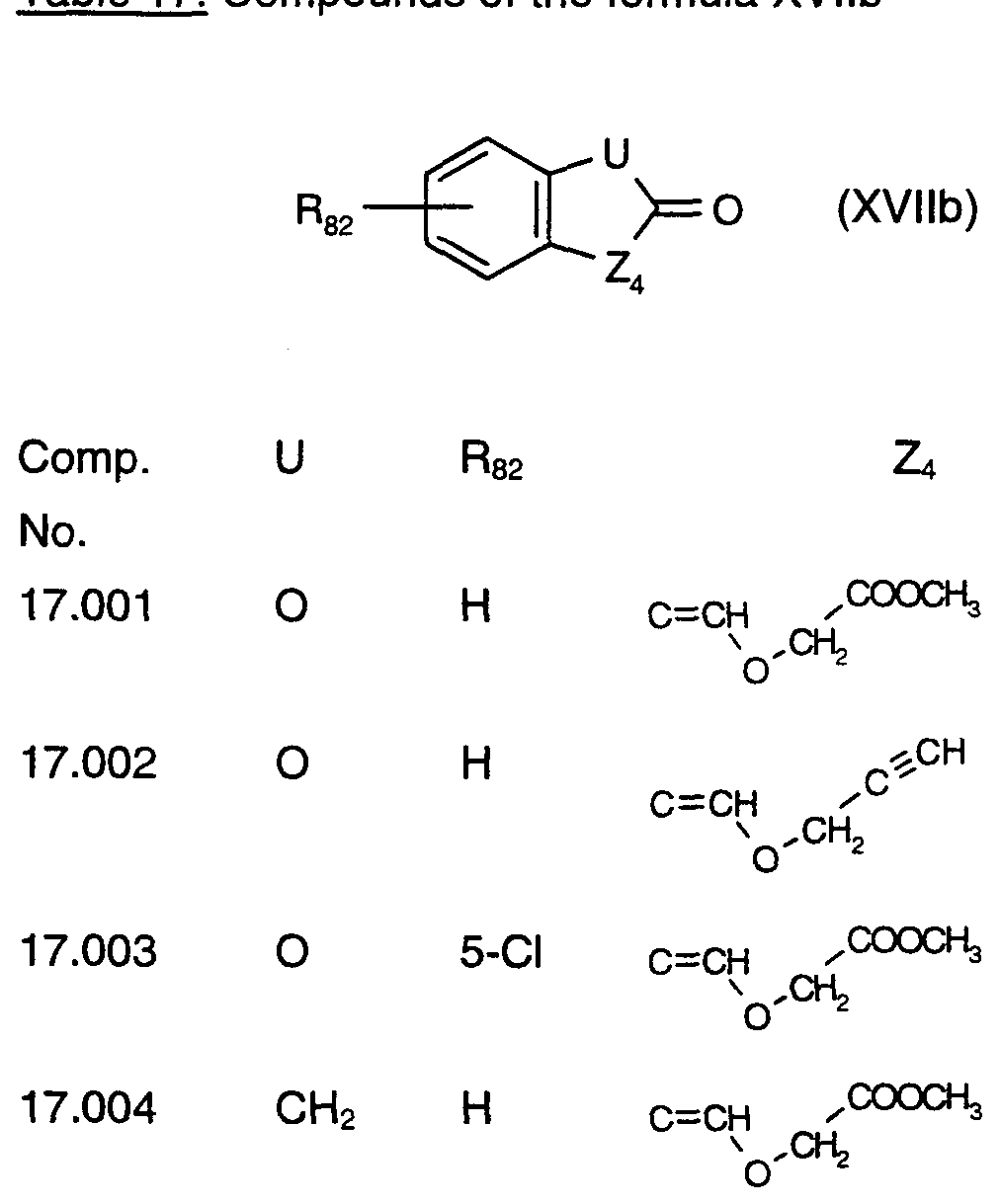
  • U, V, W T and Z ⁇ independently of one another are oxygen, sulfur, C(R 92 )R 93 , carbonyl, NR 94 ,
  • R 102 is C 2 -C alkenyl or
  • At least one of the ring members U, V, Wi or Z 4 is carbonyl, and a ring member which is
  • Ax adjacent to this or these ring members is the group 1 or
  • two adjacent ring members U and V, V and Wi and W T and Z 4 may not simultaneously be oxygen;
  • R 95 and R 96 independently of one another are hydrogen or C ⁇ -C 8 alkyl; or
  • R 95 and R m together form a C 2 -C 6 alkylene group
  • a T is R 9 9-Y 1 - or -NR 97 R 98 ;
  • X 2 is oxygen or -S(O) s ;
  • Y 1 is oxygen or sulfur
  • R 99 is hydrogen, C ⁇ -C 8 alkyl, Ci-Cshaloalkyl, d-C 4 alkoxy-C ⁇ -C 8 alkyl, C 3 -C 6 alkenyloxy-C
  • R 85 is hydrogen or d-C 4 alkyl
  • R 86 is hydrogen, C C 4 alkyl or d-C 4 alkylcarbonyl
  • R 87 is hydrogen or d-dalkyl
  • R 86 and R 87 together form a C - or C 5 alkylene group
  • R ⁇ , Reg, R90 and R 1 independently of one another are hydrogen or d-C 4 alkyl; or Res together with R 89 or R 90 together with R 91 independently of one another are C - or C 5 - alkylene, where a carbon atom may be replaced by oxygen or sulfur, or one or two carbon atoms may be replaced by -NR 100 -;
  • R92, R100 and R 93 independently of one another are hydrogen or C ⁇ -C 8 alkyl; or
  • R 9 and R 93 together are C 2 -C 6 alkylene
  • R94 ⁇ is hydrogen or CrC 8 alkyl
  • Rg 7 is hydrogen, d-C ⁇ alkyl, phenyl, phenyl-C ⁇ -C 8 alkyl, where the phenyl rings may be substituted by fluorine, chlorine, bromine, nitro, cyano, -OCH 3 , d-C 4 alkyl or CH 3 SO -, d-
  • R 98 is hydrogen, d-C 8 alkyl, C 3 -C 6 alkenyl or C 3 -C 6 alkynyl; or - 26
  • R 9 and R 98 together are C 4 - or C 5 -alkylene, where a carbon atom may be replaced by oxygen or sulfur, or one or two carbon atoms may be replaced by -NR 10 r;
  • R 1 0 1 is hydrogen or C ⁇ -C 4 alkyl; r is 0 or 1 ; and s is 0, 1 or 2, or a compound of the formula XVIII
  • R ⁇ 03 is hydrogen, d-C 6 alkyl, C 3 -C 6 cycloalkyl, C 3 -C 6 alkenyl or C 3 -C 6 alkynyl; and R 104 ,
  • R 10 5 and R 10 6 independently of one another are hydrogen, d-C 6 alkyl, C 3 -C 6 cycloalkyl or C
  • R 107 is halogen, C.-C 4 alkyl, C C 4 haloalkyl, d-C 4 alkoxy, C1- C 4 haloalkoxy, nitro, d-C 4 alkylthio, d-C 4 alkylsulfonyl, d-dalkoxycarbonyl or unsubstituted or substituted phenyl or phenoxy, R ⁇ 0 s is hydrogen or d-dalkyl, R 109 is hydrogen, d-C 4 alkyl, C 3 -C 6 cycloalkyl, C 2 -C 6 alkenyl, C 2 -C 6 alkynyl, d-C 4 haloalkyl, C -C 6 haloalkenyl, C 2 - C 6 - C 6
  • Rm and Rn 2 independently of one another are cyano, hydrogen, d-C 4 alkyl, C 3 - C 6 cycloalkyl, C 2 -C 6 alkenyl, unsubstituted or substituted phenyl or heteroaryl;
  • R and R 120 independently of one another are hydrogen, halogen or d- dhaloalkyl
  • R 12 ⁇ is hydrogen, C C alkyl, C 3 -C 4 alkenyl, C 3 -C 4 alkynyl, C 1 -C 4 haloalkyl, C 3 - C 6 cycloalkyl, a metal cation or an ammonium cation
  • Z 8 is N, CH, C-F or C-CI
  • W 4 is a group of the formula - 28 -
  • R 126 is hydrogen, cyano, halogen, d-C 4 alkyl, C 3 -C 6 cycloalkyl, d-C 4 alkoxy, C
  • R 12 7 is hydrogen, cyano, nitro, halogen, d-C 4 alkyl, C C haloalkyl, d-C 4 alkoxy, d-
  • R 12 g and R 130 independently of one another are hydrogen, C ⁇ -C 4 alkyl, d- C 4 haloalkyl, d-C 4 alkoxy, mono-C ⁇ -C 8 - or di-C ⁇ -C 8 alkylamino, C 3 -C 6 cycloalkyl, d-C thioalkyl, phenyl or heteroaryl
  • R 131 has the meaning of R 129 and is additionally OH, NH 2 , halogen, di- C ⁇ -C 4 aminoalkyl, C ⁇ -C 4 alkylthio, d-dalkylsulfonyl or d-C alkoxycarbonyl
  • R 132 has the meaning of R 129 and is additionally cyano, nitro, carboxyl, d-C alkoxycarbonyl, di-d- C aminoalkyl, d-C 4 alkylthio, d-dalkylsulfonyl, SO 2 -OH, iso-
  • R ⁇ is hydrogen, C 4 alkyl, d-C 4 haloalkyl, C 2 -C 4 alkenyl, C 2 -C alkynyl or C C 4 alkoxy- d-C 4 alkyl
  • R ⁇ 35 is hydrogen, halogen, d-dalkyi, C C 4 haloalkyl or d-C 4 alkoxy
  • R ⁇ 36 is hydrogen, halogen, d-dalkyl, d-C 4 haloalkyl or d-C 4 alkoxy, with the proviso that R 135 and R ⁇ 36 are not simultaneously hydrogen.
  • the selective-herbicidal composition according to the invention preferably comprises, as herbicide-antagonistically effective amount, either a compound of the formula X
  • R 37 is hydrogen, d-C 8 alkyl or d-C 6 alkoxy- or C 3 -C 6 alkenyioxy-substituted C ,- C 8 alkyl; and X 6 is hydrogen or chlorine; or a compound of the formula XI
  • E is nitrogen or methine;
  • R 38 is -CCI 3 , phenyl or halogen-substituted phenyl; 30 -
  • R 39 and R 0 independently of one another are hydrogen or halogen; and R 4 ⁇ is d-dalkyl; or a compound of the formula XII
  • R 44 and R 45 independently of one another are hydrogen or halogen and R 46 , R 47 and R 48 independently of one another are C C 4 alkyl.
  • compositions according to the invention comprise a safener selected from the group consisting of the formula Xa
  • the invention also relates to a method for the selective control of weeds in crops of useful plants which comprises treating the useful plants, their seeds or seedlings or the area on which they are cultivated jointly or separately with a herbicidally effective amount of the herbicide of the formula I and a herbicide-antagonistically effective amount of the safener of the formula X, XI, XII, XIII, XIV, XV, XVI, XVII or XVIII.
  • Crop plants which can be protected against the damaging effect of the abovementioned herbicides by the safeners of the formula X, XI, XII, XIII, XIV, XV, XVI, XVII or XVIII are, in particular, cereals, cotton, soya, sugarbeet, sugarcane, plantings, rapeseed, maize and rice, very particularly maize and cereals. Crops are to be understood as including those which have been rendered tolerant towards herbicides or classes of herbicides by conventional breeding methods or genetical engineering methods.
  • the weeds to be controlled can be both monocotyledonous and dicotyledonous weeds, for example the monocotyledonous weeds Avena, Agrostis, Phalaris, Lolium, Bromus, Alopecurus, Setaria, Digitaria Brachiaria, Echinochloa, Panicum, Sorghum haL/bic, Rottboellia, Cyperus, Brachiaria, Scirpus, Monochoria, Sagittaria, and Stellaria and the dicotyledonous weeds Sinapis, Chenopodium, Galium, Viola, Veronica, Matricaria, Papaver, Solanum, Abutilon, Sida, Xanthium, Amaranthus, Ipomoea and Chrysanthemum. - 42 -
  • Areas under cultivation are the areas on which the crop plants are already growing, or on which the seeds of these crop plants have been sown, and also the soils which are intended to be cultivated with these crop plants.
  • a safener of the formula X, XI, XII, XIII, XIV, XV, XVI, XVII or XVIII can be employed for pretreating the seeds of the crop plant (dressing of the seeds or the seedlings), or it can be worked into the soil before or after seeding. However, it can also be applied on its own or together with the herbicide after the plants have emerged. Thus, the treatment of the plants or the seeds with the safener can, in principle, be carried out independently of when the herbicide is applied. However, the plant can also be treated by simultaneous application of herbicide and safener (for example as tank mix). The application rate of safener to herbicide to be applied depends essentially on the type of application.
  • the ratio of herbicide to safener is as a rule from 100:1 to 1 :10, preferably from 20:1 to 1 :1.
  • 0.001 to 1.0 kg of safener/ha preferably 0.001 to 0.25 kg of safener/ha are applied in the field treatment.
  • the application rates of herbicide are as a rule between 0.001 and 2 kg/ha, but preferably between 0.005 to 0.5 kg/ha.
  • compositions according to the invention are suitable for all application methods which are customary in agriculture, for example preemergence application, postemergence application and seed dressing.
  • safener/kg of seed For seed dressing, generally 0.001 to 10 g of safener/kg of seed, preferably 0.05 to 2 g of safener/kg of seed, are applied. If the safener is applied in liquid form while swelling the seeds shortly before seeding, it is advantageous to employ safener solutions which comprise the active compound in a concentration of from 1 to 10000, preferably from 100 to 1000, ppm.
  • the safeners of the formula X, XI, XII, XIII, XIV, XV, XVI, XVII or XVIII or combinations of these safeners with the herbicides of the formula I are advantageously processed together with auxiliaries conventionally used in the art of formulation, for example to give emulsion concentrates, spreadable pastes, directly sprayable or dilutable solutions, dilute emulsions, wettable powders, soluble powders, dusts, granules or microcapsules. - 43 -
  • formulations are described, for example, in WO 97/34485 on pages 9 to 13.
  • the formulations are prepared in a known manner, for example by intimate mixing and/or grinding of the active compounds with liquid or solid formulation auxiliaries, for example solvents or solid carriers.
  • Surface-active compounds (surfactants) can furthermore additionally be used during preparation of the formulations.
  • Solvents and solid carriers which are suitable for this purpose are mentioned, for example, in WO 97/34485 on page 6.
  • Suitable surface-active compounds are, depending on the nature of the active compound of the formula I to be formulated, nonionic, cationic and/or anionic surfactants and surfactant mixtures having good emulsifying, dispersing and wetting properties.
  • suitable anionic, nonionic and cationic surfactants are listed, for example, in WO 97/34485 on pages 7 and 8.
  • the herbicidal formulations as a rule comprise 0.1 to 99% by weight, in particular 0.1 to 95% by weight, of the active compound mixture of the compound of the formula I with the compounds of the formulae X, XI, XII, XIII, XIV, XV, XVI, XVII or XVIII, 1 to 99.9% by weight of a solid or liquid formulation auxiliary and 0 to 25% by weight, in particular 0.1 to 25% by weight, of a surfactant. While concentrated compositions are usually preferred as commercial goods, the end user as a rule uses dilute compositions.
  • compositions can also comprise further additives, such as stabilizers, for example epoxidized or non-epoxidized vegetable oils (epoxidized coconut oil, rapeseed oil or soya oil), defoamers, for example silicone oil, preservatives, viscosity regulators, binders, tackifiers and fertilizers or other active substances.
  • stabilizers for example epoxidized or non-epoxidized vegetable oils (epoxidized coconut oil, rapeseed oil or soya oil)
  • defoamers for example silicone oil, preservatives, viscosity regulators, binders, tackifiers and fertilizers or other active substances.
  • Seed dressing a) Dressing the seeds with an active compound of the formula X, XI, XII, XIII, XIV, XV, XVI,
  • Seed dressing or the treatment of the germinated seedling are the naturally preferred application methods, since the treatment with active compound is completely directed at the target culture.
  • 1 to 1000 g of antidote, preferably 5 to 250 g of antidote, are employed per 100 kg of seed, but, depending on the method, which also permits the addition of other active compounds or micronutrients, it is possible to deviate above or below the stated limit concentrations (repeat dressing).
  • a liquid preparation of a mixture of antidote and herbicide (mutual ratio between 10:1 and 1:100) is employed, the application rate of herbicide being from 0.005 to 5.0 kg per hectare.
  • Such tank mixes are applied before or after seeding.
  • the active compound of the formula X, XI, XII, XIII, XIV, XV, XVI, XVII or XVIII is applied into the open seeded seed farrow as an emulsion concentrate, a wettable powder or as granules. After the seed farrow has been covered, the herbicide is applied in a customary manner by the pre-emergence method.
  • the active compound of the formula X, XI, XII, XIII, XIV, XV, XVI, XVII or XVIII is absorbed in solution onto mineral granule carriers or polymerized granules (urea/formaldehyde) and dried. If appropriate, a coating which allows the active compound to be released in metered form over a certain period of time can be applied (coated granules).
  • compositions according to the invention comprising a herbicidally effective amount of a compound of the formula I and a herbicide- - 45 -
  • antagonistically effective amount of a compound of the formula X, XI, XII, XIII, XIV, XV, XVI, XVII or XVIII can be increased by addition of spray tank adjuvants.
  • These adjuvants may be, for example, nonionic surfactants, mixtures of nonionic surfactants, mixtures of anionic surfactants with nonionic surfactants, cationic surfactants, organosilicon surfactants, mineral oil derivatives with or without surfactants, vegetable oil derivatives with or without addition of surfactants, alkylated derivatives of oils of vegetable or mineral origin with or without surfactants, fish oils and other oils of animal nature and their alkyl derivatives with or without surfactants, natural higher fatty acids, preferably having 8 to 28 carbon atoms, and their alkyl ester derivatives, organic acids which contain an aromatic ring system and one or more carboxylic esters, and their alkyl derivatives, furthermore suspensions of polymers of vinyl acetate or copolymers of vinyl acetate/acrylic esters. Mixtures of individual adjuvants with one another and in combination with organic solvents may further increase the effect.
  • Suitable nonionic surfactants are, for example, polyglycol ether derivatives of aliphatic or cycloaliphatic alcohols, saturated or unsaturated fatty acids and alkylphenols, preferably those which may contain 3 to 30 glycol ether groups and 8 to 20 carbon atoms in the (aliphatic) hydrocarbon radical and 6 to 18 carbon atoms in the alkyl radical of the alkylphenols.
  • nonionic surfactants are the water-soluble polyethylene oxide adducts on polypropylene glycol, ethylenediaminopolypropylene glycol and alkylpolypropylene glycol preferably having 1 to 10 carbon atoms in the alkyl chain which preferably contain 20 to 250 ethylene glycol ether groups and 10 to 100 propylene glycol ether groups.
  • the abovementioned compounds generally contain 1 to 5 ethylene glycol units per propylene glycol unit.
  • nonionic surfactants which may be mentioned are nonylphenolpolyethoxyethanols, castor oil polyglycol ethers, polypropylene/polyethylene oxide adducts, tributylphenoxypolyethoxyethanol, polyethylene glycol and octylphenoxypolyethoxyethanol.
  • fatty esters of polyoxyethylene sorbitan for example polyoxyethylene sorbitan trioleate. - 46 -
  • Preferred anionic surfactants are, in particular, alkyl sulfates, alkyl sulfonates, alkylaryl sulfonates, alkylated phosphoric acids and their ethoxylated derivatives.
  • the alkyl radicals usually contain 8 to 24 carbon atoms.
  • Preferred nonionic surfactants are known under the following trade names:
  • Polyoxyethylene cocoalkylamine for example AMIET ® 105 (Kao Co.)
  • polyoxyethylene oleylamine for example AMIET ® 415 (Kao Co.)
  • nonylphenolpolyethoxyethanols for example polyoxyethylene stearylamine (for example AMIET ® 320 (Kao Co.))
  • N- polyethoxyethylamines for example GENAMIN ® (Hoechst AG)
  • N,N,N',N'- tetra(polyethoxypolypropoxyethyl)ethylene diamines for example TERRONIlYand TETRONIC ® (BASF Wyandotte Corp.)
  • BRIJ ® Alkyl Chemicals
  • ETHYLAN ® CD and ETHYLAN ® D Diamond Shamrock
  • GENAPOL ® C for example AMIET ® O, GENAPOL ® S and GENAPOL ® X080 (Hoechst AG)
  • the cationic surfactants are primarily quaternary ammonium salts which contain, as N- substituents, at least one alkyl radical having 8 to 22 C atoms and, as further substituents, lower nonhalogenated or halogenated alkyl, benzyl or lower hydroxyalkyl radicals.
  • the salts are preferably present as halides, methyl sulfates or ethyl sulfates, for example stearyltrimethylammonium chloride or benzyldi(2-chloroethyl)ethylammonium bromide.
  • the oils used are either of mineral or natural origin.
  • the natural oils may additionally be of animal or vegetable origin.
  • preference is given, in particular, to derivatives of beef tallow, but fish oils (for example sardine oil) and derivatives thereof are also used.
  • Vegetable oils are mainly seed oils of various origin. Examples of particularly - 47 -
  • preferred vegetable oils which may be mentioned are coconut, rapeseed or sunflower oils and derivatives thereof.
  • surfactants oils, in particlar vegetable oils, derivatives thereof such as alkylated fatty acids and mixtures thereof, for example with preferably anionic surfactants such as alkylated phosphoric acids, alkyl sulfates and alkylaryl sulfonates and higher fatty acids which are customary in formulation and adjuvant technique and which can also be employed in the compositions according to the invention and spray tank solutions thereof are described, inter alia, in "Mc Cutcheon's Detergents and Emulsifiers Annual", MC Publishing Corp., Ridgewood New Jersey, 1998, Stache, H., "Tensid-Taschenbuch” [Surfactant handbook], Carl Hanser Verlag, Kunststoff/Vienna, 1990, M. and J.
  • Emulsifiable concentrates active compound mixture: 1 to 90%, preferably 5 to 20% surface-active agent: 1 to 30%, preferably 10 to 20% liquid carrier: 5 to 94%, preferably 70 to 85%
  • Dusts active compound mixture: 0.1 to 10%, preferably 0.1 to 5% solid carrier: 99.9 to 90%, preferably 99.9 to 99%
  • Suspension concentrates active compound mixture: 5 to 75%, preferably 10 to 50% water: 94 to 24%, preferably 88 to 30% surface-active agent: 1 to 40%, preferably 2 to 30%
  • Wettable powders active compound mixture: 0.5 to 90%, preferably 1 to 80% surface-active agent: 0.5 to 20%, preferably 1 to 15% - 48 -
  • solid carrier material 5 to 95%, preferably 15 to 90%
  • Granules active compound mixture: 0.1 to 30%, preferably 0.1 to 15% solid carrier: 99.5 to 70%, preferably 97 to 85%
  • Emulsion concentrates a) b) c) d)
  • Active compound mixture 5% 10% 25% 50%
  • Emulsions of any desired concentration can be prepared from such concentrates by dilution with water.
  • Active compound mixture 5% 10% 50% 90%
  • the solutions are suitable for use in the form of tiny droplets.
  • Active compound mixture 5% 25% 50% 80%
  • the active compound is thoroughly mixed with the additives and ground well in a suitable mill. This gives spray powders which can be diluted with water to give suspensions of any desired concentration.
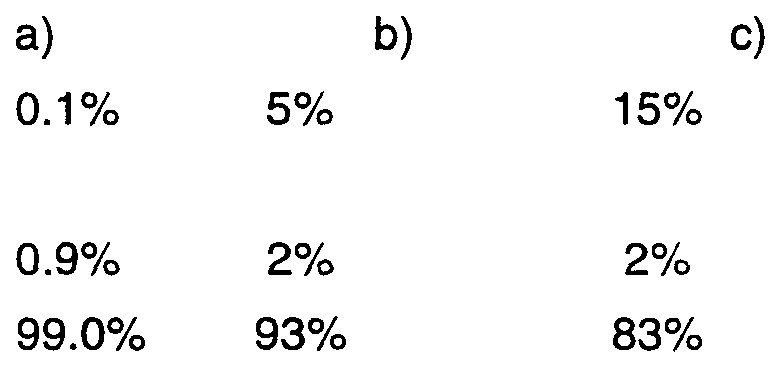
  • Active compound mixture 0.1% 5% 15%
  • the active compound is dissolved in methylene chloride, the solution is sprayed onto the carrier and the solvent is subsequently evaporated off under reduced pressure.
  • Active compound mixture 0.1% 5% 15%
  • Inorg. carrier material 98.0% 92% 80%
  • the finely ground active compound is applied evenly to the carrier material moistened with polyethylene glycol. In this manner, dust-free coated granules are obtained.
  • the active compound is mixed with the additives, ground and moistened with water. This mixture is extruded and subsequently dried in a stream of air. - 50 -
  • Ready-to-use dusts are obtained by mixing the active compound with the carriers and grinding the mixture in a suitable mill.
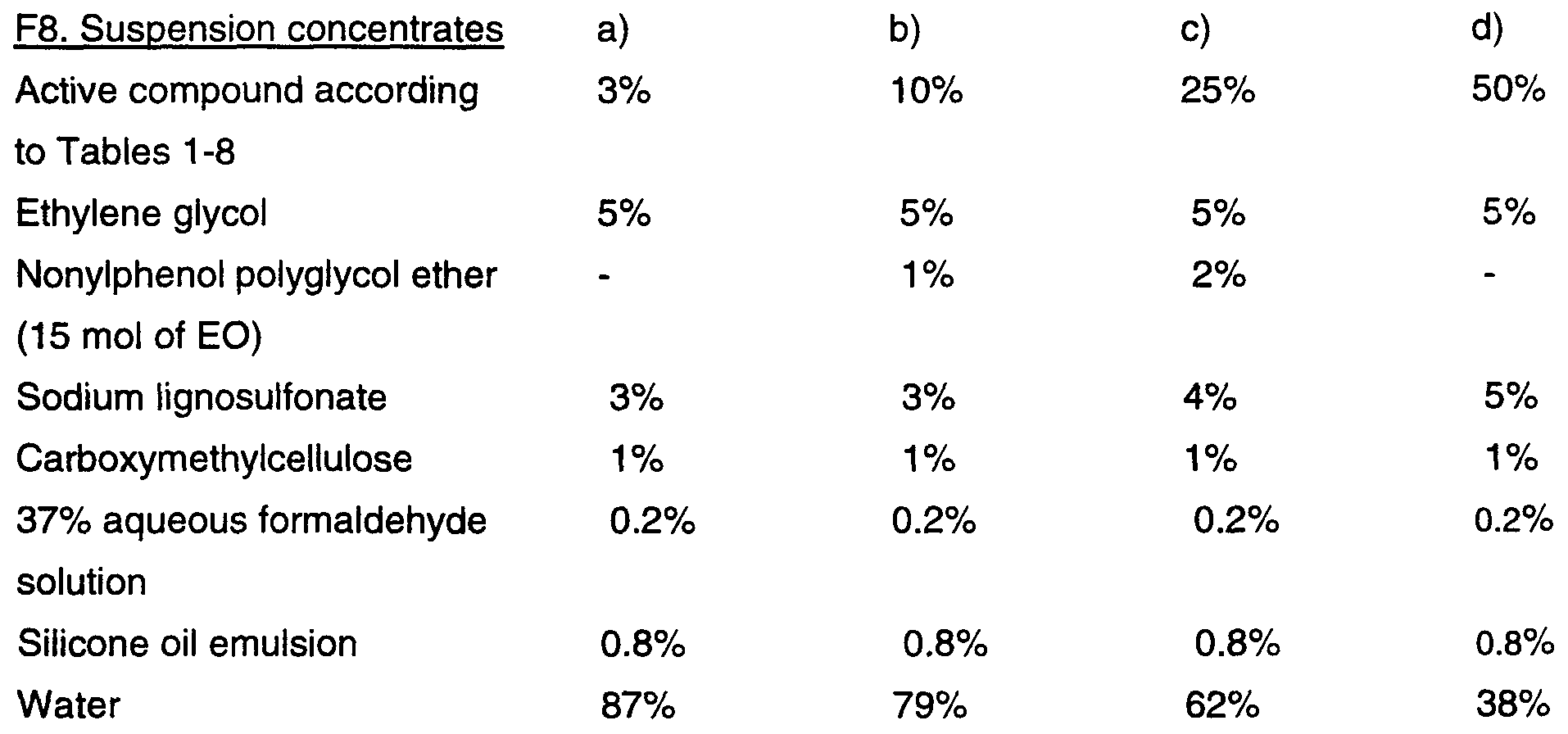
  • Active compound mixture 3% 10% 25% 50%
  • the finely ground active compound is intimately mixed with the additives. This gives a suspension concentrate, from which suspensions of any desired concentration can be prepared by dilution with water.
  • test plants Under greenhouse conditions, the test plants are grown in plastic pots until they have reached the 4-leaf-stage. In this stage, both the herbicide on its own and the mixtures of the herbicide with the test substances to be tested as safeners are applied to the test plants. - 51 -
  • the application is carried out as an aqueous suspension of the test substances, prepared from a 25% wettable powder (Example F3, b)), using 500 I of water/ha. 3 weeks after the application, the phytotoxic effect of the herbicide on the crop plants, for example maize and cereals, is evaluated using a percentage scale. 100% means that the test plant has died, 0% means no phytotoxic effect.
  • test plants Under greenhouse conditions, the test plants are grown in plastic pots until they have reached the 4-leaf-stage. In this stage, both the herbicide on its own and the mixtures of the herbicide with the test substances to be tested as safeners are applied to the test plants.
  • the application is carried out as an aqueous suspension of the test substances, prepared from an emulsion concentrate (EC 100; Example F1 ) of the herbicides and an emulsion concentrate (EC 100; Example F1) of the safeners (exceptions: the safeners no. 10.05 and 20.17, which are employed as a 25% wettable powder (Example F3, b)).
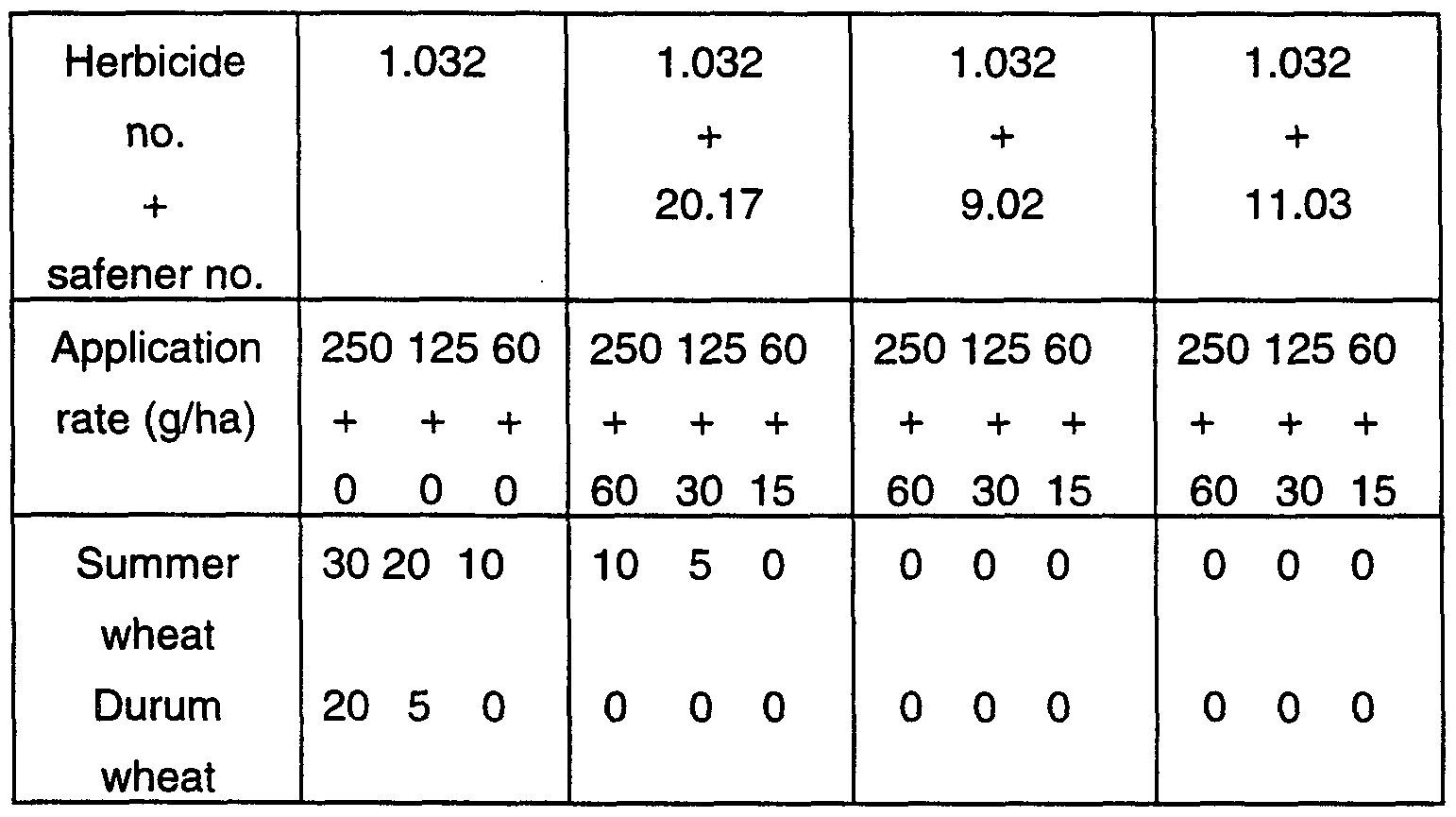
  • 9 days after the application the phytotoxic effect of the herbicide on summer wheat and durum wheat is evaluated using a percentage scale (100%: test plant has died; 0%: no phytotoxic effect).
  • test plants Under greenhouse conditions, the test plants are grown in plastic pots until they have reached the 4-leaf-stage. In this stage, both the herbicide on its own and the mixtures of the herbicide with the test substances to be tested as safeners are applied to the test plants.
  • the application is carried out as an aqueous suspension of the test substances, prepared from an emulsion concentrate (EC 100; Example F1) of the herbicides and an emulsion concentrate (EC 100; Example F1) of the safeners (exceptions: the safeners no. 10.05 and 20.17, which are employed as a 25% wettable powder (Example F3, b)).
  • 11 days after the application the phytotoxic effect of the herbicide on summer wheat and durum wheat is evaluated using a percentage scale (100%: test plant has died; 0%: no phytotoxic effect). 53
  • test plants Under greenhouse conditions, the test plants are grown in plastic pots until they have reached the 4-leaf-stage. In this stage, both the herbicide on its own and the mixtures of the herbicide with the test substances to be tested as safeners are applied to the test plants.
  • the application is carried out as an aqueous suspension of the test substances, prepared from an emulsion concentrate (EC 100; Example F1) of the herbicides and an emulsion concentrate (EC 100; Example F1) of the safeners (exceptions: the safeners no. 10.05 and 20.17, which are employed as a 25% wettable powder (Example F3, b)).
  • 9 days after the application the phytotoxic effect of the herbicide on summer wheat and durum wheat is evaluated using a percentage scale (100%: test plant has died; 0%: no phytotoxic effect). 54
  • Durum 60 60 55 20 10 5 10 5 0 20 10 5 wheat
  • Example H1 Preparation of: - 55 -
  • a solution of 68.78 g (0.30 mol) of (2) in 140 ml of dimethylformamide is added dropwise for a period of 30 minutes to a suspension of 23.9 g (0.60 mol) of 60% sodium hydride in 500 ml of dimethylformamide which had been cooled to 5°C. Cooling is removed and the reaction mixture is stirred until it has reached a temperature of 20°C. The mixture is subsequently briefly heated to a temperature of from 30 to 40°C to bring the evolution of hydrogen to completion. After cooling to a temperature of from 0 to 5°C, a solution of 80 g (0.305 mol) of (1) in 160 ml of dimethylformamide is added dropwise over a period of 30 minutes, during - 56 -
  • reaction mixture is subsequently heated to a temperature of 60°C and stirred for 3 hours. 42.5 g (0.15 mol) of (5) are then added, and the mixture is heated to a bath temperature of 150°C to distil off excess triethylamine and the ethanol which is formed. After 3 hours, the reaction mixture is cooled to a temperature of 40°C and added to 500 ml of an ice/water mixture. Using 100 ml of aqueous 1N sodium hydroxide solution, the reaction mixture is made alkaline and the aqueous phase (which contains the product) is washed twice with ethyl acetate.
  • the organic phase is reextracted twice using aqueous 1 N sodium hydroxide solution, the aqueous phases are combined, the remaining xylene is distilled off and the combined aquoeus phases are adjusted to pH 2-3 using 4N HCI with cooling.
  • the product which precipitates is transferred onto a suction filter, the filter cake is washed with water and briefly with hexane and is subsequently dried under reduced pressure at a temperature of 60°C over P 2 O 5 . This gives 34.6 g of (6) as a slightly beige solid of melting point 242-244°C (decomp.).
  • H C CH, O H,
  • a catalytic amount of 4-dimethylaminopyridine is added to a solution of 3 g (10.4 mmol) of (6) and 1.6 g (15.8 mmol) of triethylamine in 100 ml of tetrahydrofuran which had been cooled to a temperature of 0°C. 1.57 g (13.0 mmol) of pivaloyl chloride are subsequently added dropwise. The mixture is stirred at a temperature of 0°C for 30 minutes, cooling is removed, and the mixture is stirred for a further 60 minutes. The reaction mixture is subsequently poured into saturated aqueous sodium chloride solution, and the organic phase is separated off. The organic phase is dried over magnesium sulfate, filtered off and concentrated. Chromatographic purification and recrystallization from diethyl ether gives 2.94 g of (7) of melting point 135-136°C. 58
  • a catalytic amount of 4-dimethylaminopyridine is added to a solution of 1 g (3.2 mmol) of (10) and 0.65 g (6.4 mmol) of triethylamine in 30 ml of tetrahydrofuran which had been cooled to a temperature of 0°C. 0.49 g (4.1 mmol) of pivaloyi chloride is subsequently added dropwise.
  • the mixture is stirred at a temperature of 0°C for 10 minutes, cooling is removed, and stirring is then continued for a further 90 minutes.
  • the reaction mixture is poured into saturated aqueous sodium chloride solution and diluted with tert-butyl methyl ether, and the organic phase is separated off. The organic phase is dried over magnesium sulfate, filtered off and concentrated. Chromatographic purification gives 1.07 g of (11) in the form of a white solid of melting point 122-123°C. - 60 -
  • the starting material (12) is known from the literature: see, for example, K. Naemura et al., Tetrahedron Asymmetry 1993, 4, 911-918.

Landscapes

  • Life Sciences & Earth Sciences (AREA)
  • Chemical & Material Sciences (AREA)
  • Organic Chemistry (AREA)
  • Health & Medical Sciences (AREA)
  • Engineering & Computer Science (AREA)
  • General Health & Medical Sciences (AREA)
  • Zoology (AREA)
  • Plant Pathology (AREA)
  • Dentistry (AREA)
  • Wood Science & Technology (AREA)
  • Pest Control & Pesticides (AREA)
  • Environmental Sciences (AREA)
  • Agronomy & Crop Science (AREA)
  • Nuclear Medicine, Radiotherapy & Molecular Imaging (AREA)
  • Bioinformatics & Cheminformatics (AREA)
  • Veterinary Medicine (AREA)
  • Animal Behavior & Ethology (AREA)
  • Pharmacology & Pharmacy (AREA)
  • Medicinal Chemistry (AREA)
  • General Chemical & Material Sciences (AREA)
  • Chemical Kinetics & Catalysis (AREA)
  • Urology & Nephrology (AREA)
  • Public Health (AREA)
  • Agricultural Chemicals And Associated Chemicals (AREA)
  • Plural Heterocyclic Compounds (AREA)
  • Nitrogen Condensed Heterocyclic Rings (AREA)
  • Nitrogen And Oxygen Or Sulfur-Condensed Heterocyclic Ring Systems (AREA)
  • Quinoline Compounds (AREA)
  • Other In-Based Heterocyclic Compounds (AREA)
  • Heterocyclic Carbon Compounds Containing A Hetero Ring Having Nitrogen And Oxygen As The Only Ring Hetero Atoms (AREA)
  • Pyrane Compounds (AREA)
  • Indole Compounds (AREA)

Abstract

Compounds of formula (I), in which the subsituents are as defined in claim 1, are suitable for use as herbicides, in particular in combination with herbicide-antagonistically effective compounds.

Description

-1 -
HERBICIDALLY ACTIVE 3-HYDR0XY-4-ARYL-5-0X0PYRAZ0LINE DERIVATIVES
The present invention relates to novel herbicidally active 3-hydroxy-4-aryl-5-oxopyrazoline derivatives, to processes for their preparation, to compositions which comprise these compounds and may additionally comprise safeners, and to the use of these compounds as herbicides for controlling weeds and grasses, in particular in crops of useful plants.
3-Hydroxy-4-aryl-5-oxopyrazoline derivates having herbicidal action are described, for example, in EP-A-0 508 126, WO 96/25395 and WO 96/21652 . We have now found novel 3-hydroxy-4-aryl-5-oxopyrazoiine derivatives having herbicidal properties.
The present invention thus provides compounds of the formula I
(I).
Figure imgf000003_0001
in which
Rι, R2 and R3 independently of one another are halogen, nitro, cyano, CrC4alkyl, C2- C4alkenyl, C2-C alkynyl, CrC4haloalkyl, C2-C6haloalkenyl, C3-C6cycloalkyl, halogen- substituted C3-C6cycloalkyl, CrCβalkoxyalkyl, d-Cβalkylthioalkyl, hydroxyl, mercapto, C C6alkoxy, C3-C6alkenyloxy, C3-C6alkynyloxy, Cι-C4alkylcarbonyl, Cι-C4alkoxycarbonyl, d- C4alkylthio, Cι-C alkylsuifinyl, CrC4alkylsulfonyl, amino, Crdalkylamino or di(d-C - alkyl)amino; R4 and R5 together are a group
-C-R6(R7)-O-C-R8(R9)-C-R1o(Rιι)-C-R12(R13)- (Z,),
-C-R14(R15)-C-R16(R17)-O-C-R18(Ri9)-C-R2o(R2i)- (Z2), or
-C-R22(R23)-C-R24(R25)"O-R26(R27)-O-C-R28(R29)- (Z3)," in which Re, R , Re. R9, Rιo> Rn> R121 Rι3ι Rι4> R15, Riβ. R17. Riβ. Ri9> R201 R211 R22. R231 R24. R25, R26. R27, R28. and R29 independently of one another are hydrogen, halogen, C C4alkyl or - 2 -
C C4haloalkyl where an alkylene ring, which together with the carbon atoms of the groups Z Z2 or Z3 contains 2 to 6 carbon atoms and may be interrupted by oxygen, may either be fused or spiro-linked to the carbon atoms of the groups Z Z2 or Z3, or where this alkylene ring bridges at least one ring atom of the groups Z Z2 or Z3;
G is hydrogen, -C(X1)-R30, -C(X2)-X3-R3ι, -C(X4)-N(R32)-R33, -SO2-R34, an alkali metal, alkaline earth metal, sulfonium or ammonium cation or -P(X5)(R35)-R36,' Xi, X2. X3, X4 and X5 independently of one another are oxygen or sulfur; and R30, R31, R32. R33, R34, R35 and R36 independently of one another are hydrogen, CrC5alkyl, CrC5haloalkyl, C2-C5alkenyl, C C5alkoxyalkyl, C3-C6cycloalkyl or phenyl, and R34 is additionally C2-C20alkenyl, C2-C2oalkenyl substituted by halogen, alkylcarbonyl, alkoxycarbonyl, alkylcarbonyloxy, alkoxy, thioalkyl, alkylthiocarbonyl, alkylcarbonylthio, alkylsulfonyl, alkylsulfoxyl, alkylaminosulfonyl, dialkylaminosulfonyl, alkylsulfonyloxy, alkylsulfonylamino, alkylamino, dialkylamino, alkylcarbonylamino, dialkylcarbonylamino, alkyl-alkylcarbonylamino, cyano, (C3-C7)cycloalkyl, (C3-C7)heterocyclyl, trialkylsiiyl, trialkylsilyloxy, phenyl, substituted phenyl, heteroaryl or substituted heteroaryl, C2-C20alkynyl, C2-C20alkynyl substituted by halogen, alkylcarbonyl, alkoxycarbonyl, alkylcarbonyloxy, alkoxy, thioalkyl, alkylthiocarbonyl, alkylcarbonylthio, alkylsulfonyl, alkylsulfoxyl, alkylaminosulfonyl, dialkylaminosulfonyl, alkylsulfonyloxy, alkylsulfonylamino, alkylamino, dialkylamino, alkylcarbonylamino, dialkylcarbonylamino, alkyl-alkylcarbonylamino, cyano, (C3-C7)cycloalkyl, (C3-C7)heterocyclyl, trialkylsiiyl, trialkylsilyloxy, phenyl, substituted phenyl, heteroaryl or substituted heteroaryl, (C C7)cycloalkyl, (C C7)cycloalkyl substituted by halogen, haloalkyl, (CrC6)alkyl, alkoxy, alkylcarbonyloxy, thioalkyl, alkylcarbonylthio, alkylamino, alkylcarbonylamino, trialkylsiiyl or trialkylsilyloxy, heteroaryl, heteroaryl substituted by halogen, haloalkyl, nitro, cyano, (C C6)alkyl, alkoxy, alkylcarbonyloxy, thioalkyl, alkylcarbonylthio, alkylamino, alkylcarbonylamino, trialkylsiiyl or trialkylsilyloxy, heteroaryloxy, substituted heteroaryloxy, heteroarylthio, substituted heteroarylthio, heteroarylamino, substituted heteroarylamino, diheteroarylamino, substituted diheteroarylamino, phenylamino, substituted phenylamino, diphenylamino, substituted diphenylamino, cycloalkylamino, substituted cycloalkylamino, dicycloalkylamino, substituted dicycloalkylamino, cycloalkoxy or substituted cycloalkoxy, and salts and diastereomers of the compounds of the formula I.
In the above definitions, halogen is to be understood as meaning fluorine, chlorine, bromine and iodine, preferably fluorine, chlorine and bromine. The alkyl groups in the definitions of the substituents are, for example, methyl, ethyl, n-propyl, isopropyl, n-butyl, sec-butyl, isobutyl or tert-butyl, and the isomeric pentyls and hexyls. Suitable cycloalkyl substituents contain 3 to 6 carbon atoms and are, for example, cyclopropyl, cyclobutyl, cyciopentyl or cyclohexyl. These may be mono- or polysubstituted by halogen, preferably by fluorine, chlorine or bromine. Alkenyl is to be understood as meaning, for example, vinyl, allyl, methallyl, 1 -methylvinyl or but-2-en-1-yl. Alkynyl is, for example, ethinyl, propargyl, but-2-in- 1 -yl, 2-methylbutin-2-yl or but-3-in-2-yl. Haloalkyl groups preferably have a chain length of 1 to 4 carbon atoms. Haloalkyl is, for example, fluoromethyl, difluoromethyl, trifluoromethyl, chloromethyl, dichloromethyl, trichloromethyl, 2,2,2-trifluoroethyl, 2-fluoroethyl, 2-chloroethyl, pentafluoroethyl, 1 ,1-difluoro-2,2,2-trichloroethyl, 2,2,3,3-tetrafluoroethyl and 2,2,2- trichloroethyl; preferably trichloromethyl, difluorochloromethyl, difluoromethyl, trifluoromethyl and dichlorofluoromethyl. Suitable haloalkenyls are alkenyl groups which are mono- or polysubstituted by halogen, halogen being fluorine, chlorine, bromine and iodine and in particular fluorine and chlorine, for example 2,2-difluoro-1 -methylvinyl, 3-fluoropropenyl, 3- chloropropenyl, 3-bromopropenyl, 2,3,3-trifluoropropenyl, 2,3,3-trichloropropenyl and 4,4,4- trifluorobut-2-en-1-yl. Among the C2-C6alkenyl groups which are mono-, di- or trisubstituted by halogen, preference is given to those having a chain length of 3 to 5 carbon atoms. Alkoxy groups preferably have a chain length of 1 to 6 carbon atoms. Alkoxy is, for example, methoxy, ethoxy, propoxy, isopropoxy, n-butoxy, isobutoxy, sec-butoxy and tert-butoxy, and the isomeric pentyloxy and hexyloxy radicals; preferably methoxy and ethoxy. Alkylcarbonyl is preferably acetyl or propionyl. Alkoxycarbonyl is, for example, methoxycarbonyl, ethoxycarbonyl, propoxycarbonyl, isopropoxycarbonyl, n-butoxycarbonyl, isobutoxycarbonyl, sec-butoxycarbonyl or tert-butoxycarbonyl; preferably methoxycarbonyl or ethoxycarbonyl. Alkylthio groups preferably have a chain length of 1 to 4 carbon atoms. Alkylthio is, for example, methylthio, ethylthio, propylthio, isopropylthio, n-butylthio, isobutylthio, sec-butylthio or tert-butylthio, preferably methylthio and ethylthio. Alkylsulfinyl is, for example, methylsulfinyl, ethylsulfinyl, propylsulfinyl, isopropylsulfinyl, n-butylsulfinyl, isobutylsulfinyl, sec-butylsulfinyl, tert-butylsulfinyl; preferably methylsulfinyl and ethylsulfinyl. Alkylsulfonyl is, for example, methylsulfonyl, ethylsulfonyl, propylsulfonyl, isopropylsulfonyl, n-butylsulfonyl, isobutylsulfonyl, sec-butylsulfonyl or tert-butylsulfonyl; preferably methylsulfonyl or ethylsulfonyl. Alkylamino is, for example, methylamino, ethylamino, n-propylamino, isopropylamino or the isomeric butylamines. Dialkylamino is, for example, dimethylamino, methylethylamino, diethylamino, n-propylmethylamino, dibutylamino and diisopropylamino. Alkoxyalkyl groups preferably have 1 to 6 carbon atoms. Alkoxyalkyl is, for example, methoxymethyl, methoxyethyl, ethoxymethyl, ethoxyethyl, n-propoxymethyl, n-propoxyethyl, isopropoxymethyl or isopropoxyethyl. Alkylthioalkyl is, for example, methylthiomethyl, methylthioethyl, ethylthiomethyl, ethylthioethyl, n-propylthiomethyl, n-propylthioethyl, isopropylthiomethyl, isopropylthioethyl, butylthiomethyl, butylthioethyl or butylthiobutyl. - 4 -
Phenyl may be substituted. In this case, the substituents may be in the ortho, meta and/or para position. The substituents are preferably located in the positions ortho and para to the site where the ring is attached.
The halogen, alkyl, cycloalkyl, alkoxy, alkylthio, alkylcarbonyl, alkylsulfonyl and (di)alkylamino radicals which may be present in the radicals R34, in particular -SO2R3 (G) , are derived from the corresponding radicals mentioned above. Preferred heterocyclyl radicals are those containing 1 or 2 heteroatoms, for example N, S or O. They are usually saturated. Heteroaryl radicals are customarily aromatic heterocycles which preferably contain 1 to 3 heteroatoms, such as N, S and O. Examples of suitable heterocycles and heteroaromatics are: pyrrolidine, piperidine, pyran, dioxane, azetidine, oxetan, pyridine, pyrimidine, triazine, thiazole, thiadiazole, imidazole, oxazole, isoxazole and pyrazine, furan, morpholine, piperazine, pyrazole, benzoxazole, benzothiazole, quinoxaiine and quinoline. These heterocycles and heteroaromatics may also be substituted, for example by halogen, alkyl, alkoxy, haloalkyl, haloalkoxy, nitro, cyano, thioalkyl, alkylamino or phenyl. The C2- C20alkenyl and alkynyl groups R^ may be mono- or polyunsaturated. They preferably contain 2 to 12, in particular 2 to 6, carbon atoms. For illustration, suitable groups -SO2R34 are given in the example below:
V .> .(CH2)n
Figure imgf000007_0001
V ,(C rH2)n V (C rH n V ,(C rH,)n Hal
O^ Alkyl o^o/A.ky, Alkyl
Y "Alkyl
V° ,(C fH,)n V V° ,(C fH-)n V V/> ,(C fH-)n (CH2)n ,(CH2)n
0^s^»<yi Alkyl 5γ OS.
"Alkyl Ύ Alkyl "Alkyl o
,S_. ,(C rH-)n v° ,(C rH2)n v ,S^° ,(C rH2)n -S^ ,(C fH2)n ° ,(C fH,)n
02S. .Alkyl o2s. -Alkyl Ύ Y HN. so, -so, "SO,
Alkyl I 2
Alkyl Alkyl Alkyl
<W v .S^.° ,(C rH,)n ,S^ ,(CH.)n .S^ ,(C
~° ,(C fH,)n fH2)n / %~„\ oAC fH2)n '».\^ .Alkyl .N. .Alkyl
HN. ,N. HN^^^AIkyl AlkylN ^ N AlkyA A
"Alkyl Alkyr Alkyl T O T 0 T 0 O
6 -
V (CH2)n ^
Figure imgf000008_0001
VS,° (C fH2)n V ,S.,° YC fH2)n \ -S4^ JCH- n
Y CN SiAlkyl3
Δ "SiAlkyl3
Figure imgf000008_0002
^S ° (C rH2)n
Y^N
\ v° V v
Figure imgf000008_0003
N' A x " \y~y-
V N
H H
Figure imgf000008_0006
V O
Figure imgf000008_0005
Figure imgf000008_0004
Y >
Figure imgf000008_0007
Alkali metal cations, alkaline earth metal cations or ammonium cations for the substituent G are, for example, the cations of sodium, potassium, magnesium, calcium and ammonium. Preferred sulfonium cations are, in particular, trialkylsulfonium cations, where the alkyl radicals each preferably contain 1 to 4 carbon atoms. - 7 -
The free valency on the left hand of the groups Z Z2 and Z3 is linked to the 1 -position and the free valency on the right hand is linked to the 2-position of the pyrazoline ring.
Compounds of the formula I, in which an alkylene ring which, together with the carbon atoms of the groups Z , Z2 and Z3 contains 2 to 6 carbon atoms may be fused or spiro-linked to the groups Z Z2 and Z3, have, for example, the following structure:
(spiro-linked) or
Figure imgf000009_0001
(fused).
Figure imgf000009_0002
O
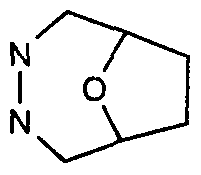
Compounds of the formula I, in which in the groups Z Z2 or Z3 an alkylene ring bridges at least one ring atom of the groups Z^, Z2 or Z3, have, for example, the following structure:
O
R , ~ jT~\^N i ° (bridged).
R4 and R5 together are in particular a group
-C-R6(R7)-O-C-R8(R9)-C-R1o(Rιι)-C-R12(Ri3)- (Z,),
-C-R14(R15)-C-R16(R17)-O-C-R18(R19)-C-R2o(R2i)- (Z2), or
-C-R22(R23)-C-R24(R25)-C-R26(R27)-O-C-R28(R29)- (Z3); in which Re, R7, Rs> R9. R10. Rn. R12. Ri3ι R-ι4, Rιs> R161 R17, Riβ. R19. R201 R2i> R22, R231 24. R25. R26, R27, R28 and R29 independently of one another are hydrogen, halogen, d-C4alkyl or C C4haloalkyl, where an alkylene ring which, together with the carbon atoms of the groups Zι, Z2 and Z3, contains 3 to 6 carbon atoms may be fused or spiro-linked to the groups Z , Z2 and Z3. - 8 -
Among the compounds of the formula I, preference is given to those in which G is hydrogen. In a particularly preferred group of compounds of the formula I, R4 and R5 together form a group Z2. Also of particular interest are compounds of the formula I in which Ri, R2 and R3 independently of one another are halogen, C C4alkyl, C2-C4alkenyl, C2-C4alkynyl or CrC6- alkoxy. Particular preference is given to compounds of the formula I in which R2 is halogen, methyl, ethyl or ethinyl, and to compounds of the formula I in which RT and R3 independently of one another are methyl, ethyl, isopropyl, vinyl, allyl, ethinyl, methoxy, ethoxy, bromine or chlorine. Very particular preference is given to compounds of the formula I in which G is the group -C(Xι)-R30 or C(X2)-(X3)-R3ι in which X^ X2 and X3 are, in particular, oxygen, and R30 and R31 independently of one another are preferably CrC5alkyl. Preference is furthermore given to compounds of the formula I in which R30, R31, R32, R33, Rs-t, R35 and R36 independently of one another are hydrogen, d-Csalkyl or Cι-C5haloalkyl.
Another preferred group of compounds of the formula I is is that where at least one ring atom of the groups Z Z2 or Z3 is bridged by an alkyiene ring which, together with the carbon atoms of the groups Z , Z2 or Z3, contains 2 to 6 carbon atoms and may be interrupted by oxygen.
The invention also includes the salts which the compounds of the formula I can form with acids. Suitable acids for forming the acid addition salts are both organic and inorganic acids. Examples of such acids are hydrochloric acid, hydrobromic acid, nitric acid, phosphoric acids, sulfuric acid, acetic acid, propionic acid, butyric acid, valeric acid, oxalic acid, malonic acid, fumaric acid, organic sulfonic acids, lactic acid, tartaric acid, citric acid and salicylic acid. The salts of the compounds of the formula I with acidic hydrogen also include alkali metal salts, for example sodium salts and potassium salts; alkaline earth metal salts, for example calcium salts and magnesium salts; ammonium salts, i.e. unsubstituted ammonium salts and mono- or polysubstituted ammonium salts, and salts with other organic nitrogen bases. Correspondingly, suitable salt formers are alkali metal and alkaline earth metal hydroxides, in particular the hydroxides of lithium, sodium, potassium, magnesium or calcium, where those of sodium or potassium are particularly important.
Examples of amines which are suitable for forming ammonium salts are both ammonia and primary, secondary and tertiary CrC18alkylamines, C C hydroxyalkylamines and C2- C4alkoxyalkylamines, for example methylamine, ethylamine, n-propylamine, isopropylamine, the four isomeric butylamines, n-amylamine, isoamylamine, hexylamine, heptylamine, - 9 -
octylamine, nonylamine, decylamine, pentadecylamine, hexadecylamine, heptadecylamine, octadecylamine, methylethylamine, methylisopropylamine, methylhexylamine, methylnonylamine, methyipentadecylamine, methyloctadecylamine, ethylbutylamine, ethylheptylamine, ethyloctylamine, hexylheptylamine, hexyloctylamine, dimethylamine, diethylamine, di-n-propylamine, diisopropylamine, di-n-butylamine, di-n-amylamine, diisoamylamine, dihexylamine, diheptylamine, dioctylamine, ethanolamine, n-propanolamine, isopropanolamine, N,N-diethanolamine, N-ethylpropanolamine, N-butylethanolamine, allylamine, n-butenyl-2-amine, n-pentenyl-2-amine, 2,3-dimethylbutenyl-2-amine, dibutenyl- 2-amine, n-hexenyl-2-amine, propylenediamine, trimethylamine, triethylamine, tri-n- propylamine, triisopropylamine, tri-n-butylamine, triisobutylamine, tri-sec-butylamine, tri-n- amylamine, methoxyethylamine and ethoxyethylamine; heterocyclic amines, for example pyridine, quinoline, isoquinoline, morpholine, N-methylmorpholine, thiomorpholine, piperidine, pyrrolidine, indoline, quinuclidine and azepine; primary arylamines, for example anilines, methoxyanilines, ethoxyanilines, o, m, p-toluidines, phenyienediamines, benzidines, naphthylamines and o, m, p-chloroanilines; but in particular triethylamine, isopropylamine and diisopropylamine.
In the processes described in this application, unless chiral starting materials are employed, the unsymmetrically substituted compounds of the formula I are generally obtained as racemates. The stereoisomers can then be separated by known methods, such as fractional crystallization after salt formation with optically pure bases, acids or metal complexes, or else by chromatographic processes such as high pressure liquid chromatography (HPLC) on acetylcellulose, owing to their physicochemical properties. In the present invention, the active compounds of the formula I are to be understood as meaning both the enriched and optically pure forms of the stereoisomers in question, and the racemates or diastereomers. Unless specific reference is made to the individual optical isomers, the given formula is to be understood as meaning those racemic mixtures which are formed in the preparation process mentioned. If an aliphatic C=C double bond is present, geometrical isomerism may additionally occur.
Also depending on the type of the substituents, the compounds of the formula I may be present as geometrical and/or optical isomers and isomer mixtures, and also as tautomers and mixtures of tautomers. These compounds of the formula I likewise form part of the subject-matter of the present invention. The compounds of the formula I in which the group G is hydrogen may, for example, be present in the following tautomer equilibriums: - 10 -
Figure imgf000012_0001
(lb) (Ic)
If G is different from hydrogen and Z is the group or Z3, or if G is different from hydrogen and Z2 is unsymmetrically substituted, fused or spiro-linked, the compound of the formula I may be present as an isomer of the formula Id
G R
(Id)
Figure imgf000012_0002
Processes for preparing compounds which, with respect to the meaning of the substituents R and R5, are different from the compounds of the formula I according to the present invention are, for example, described in WO 96/21652. The compounds of the formula I according to the present invention can be prepared by methods similar to the processes described in WO 96/21652. The compounds of the formula II - 11 -
(il)
Figure imgf000013_0001
in which R^ R2, R3, R4 and R5 are as defined under formula I and which are employed as starting materials for such processes can be prepared, for example, by reacting a compound of the formula III
(Hl)>
Figure imgf000013_0002
in which R is Cι-C6alkyl, CrC6haloalkyl, preferably methyl, ethyl or trichloroethyl, and R^ R2 and R3 are as defined under formula I in an inert organic solvent, if appropriate in the presence of a base, with a compound of the formula IV or IVa
H — H — N'
I • 2HBr (IV), (IVa),
H — N H — N
\. \.
R
in which R4 and R5 are as defined under formula I. Other preparation processes for compounds of the formula II are described, for example, in WO 92/16510 .
The compounds of the formula III are either known, or they can be prepared similarly to known processes. Processes for preparing compounds of the formula III and their reaction with hydrazines are described, for example, in WO 97/02243 . Compounds of the formula III in which R is Cι-C6alkyl, Cι-C6haloalkyl, preferably methyl, ethyl or trichloroethyl, and Rι, R2 and R3 are as defined under formula I can be prepared by methods known to the person skilled in the art. For example, compounds of the formula III in which R is CrC6alkyl, d- C6haloalkyl, preferably methyl, ethyl or trichloroethyl, and R^ R2 and R3 independently of one - 12 -
another are C C4alkyl, C -C4alkenyl, C2-C alkynyl can be prepared by the process of cross- coupling according to Stille (J.K. Stifle, Angew. Chem. 1986, 98, 504-519), Sonogashira (K. Sonogashira et al., Tetrahedron Lett. 1975, 4467-4470), Suzuki (N. Miyaura, A. Suzuki, Chem. Rev. 1995, 95, 2457-2483) or Heck (R.F. Heck, Org. React. 1982. 27, 345-390), with or without subsequent hydrogenation. This procedure is illustrated by the following reaction scheme:
. CH,
Bu3Sn L
H2
Pd(PPh3)4 3 Pd / C
H'cy$~ OCH, toluene THF
OCH, OCH,
Br
Figure imgf000014_0001
Figure imgf000014_0002
The compounds of the formulae IV and IVa are either known, or they can be prepared by known processes. Processes for preparing compounds of the formula IV are described, for example, in WO 95/00521. These compounds can be prepared, for example, by heating a compound of the formula V
R ■42 X N'
(V),
N .
'Ύ in which R42 is hydrogen, d-C4alkyl, C,-C6alkoxy, d-C6haloalkoxy, benzyloxy, preferably hydrogen, methyl, methoxy, ethoxy, trichloroethoxy, tert-butoxy or benzyloxy and R and R5 are as defined under formula I in the presence of a base or an acid in an inert solvent. Compounds of the formula V in which R4 is hydrogen, C C4alkyl, d-C6alkoxy, d- C6haloalkoxy, benzyloxy, preferably hydrogen, methyl, methoxy, ethoxy, trichloroethoxy, tert- butoxy or benzyloxy and R4 and R5are as defined under formula I can be prepared, for example, by reacting a compound of the formula VI O
- '42A--
(VI),
Y \
H o - 13 -
in which R42 is hydrogen, d-C4alkyl, d-C6alkoxy, Ci-Cehaloalkoxy, benzyloxy, preferably hydrogen, methyl, methoxy, ethoxy, trichloroethoxy, tert-butoxy or benzyloxy in the presence of a base and an inert solvent with a compound of the formula VII
Y— Pz1, Z2, orZ3 " — Y (VII),
in which Y is halogen, alkyl/aryl sulfonates -OSO2R43, preferably bromine, chlorine, iodine, mesylate (R 3 = CH3), triflate (R43 = CF3) or tosylate (R43 = p-tolyl) and Z Z2andZ3are as defined under formula I. In the formula VII, the free valencies of the groups Zι,Z2 and Z3 are in each case attached to the group Y. Compounds of the formula VI and VII are known, or they can be prepared by methods known to the person skilled in the art.
Compounds of the formula IV in which R4 and R5 together are a group Z2 -C-R14(R15)-C-R16(Ri7)-O-C-R18(R19)-C-R2o(R2ι)- (Z2), in which R14, R15, Rι6, R17, Riβ, R19, R2o and R2ι are hydrogen can be prepared, for example, according to the following reaction scheme:
CH,
H H,3 cC X NH
HO CH3S020
V I H,C. ,NH
CH3S02CI Λ0 ^ CH, Y O
NEt 3> Et20
HO CH3S020
NaH, DMF
CH3 O HgC^I II
H3C O^^N' \_ HBr / AcOH HN
2 HBr
H H^ A°v 3 Y^
CH O
Compounds of the formula I in which R4 and R5 are a group Z or Z3 can be prepared using the methods of the synthesis examples given above. Thus, the compounds of the formula III can, for example, be reacted with a hydrazine alkanol of the formula IV(b) - 14 -
H-N
HΛ ON
H H (IVb)
(here, R6-Rι3 and R22-R29 are hydrogen) to give the compounds of the formula IVc R Q
' Vl t (IVc), followed by a cyclization, for example with formaldehyde, to give the end products of the formula le
r\
Figure imgf000016_0001
R O
(Iβ).
The compound of the formula le in which Rt and R3 are ethyl and R2 is methyl has a melting point of 186-191 °C (decomp.). Similarly, it is also possible to prepare compounds of the formula I in which the substituents R6-Rι3 and R22-R29 are different from hydrogen and, independently of one another, have one of the meanings mentioned for them above.
The end products of the formula I can be isolated in a customary manner by concentration and/or evaporation of the solvent and be purified by recrystallization or trituration of the solid residue in solvents in which they are not readily soluble, such as ethers, alkanes, aromatic hydrocarbons or chlorinated hydrocarbons, or by chromatography. Salts of compounds of the formula I can be prepared in a manner known per se. Such preparation methods are described, for example, in WO 96/21652.
The compounds of the formula I or compositions comprising them can be used according to the invention by all the application methods customary in agriculture, for example pre- emergence application, postemergence application and seed dressing, and various methods and techniques, for example controlled release of active compounds. To this end, the active compound is absorbed in solution onto mineral granule carriers or polymerized granules (urea/formaldehyde) and dried. If appropriate, a coating which allows the active compound to be released in metered form over a certain period of time can additionally be applied (coated granules). - 15 -
The compounds of the formula I can be employed as herbicides in unchanged form, i.e. as they are obtained in the synthesis, but they are preferably processed in a customary manner with the auxiliaries conventionally used in the art of formulation, for example to give emulsifiable concentrates, directly sprayable or dilutable solutions, dilute emulsions, wettable powders, soluble powders, dusts, granules or microcapsules. Such formulations are described, for example, in WO 97/34485 on pages 9 to 13. The methods of application, such as spraying, atomizing, dusting, wetting, scattering or watering, in the same way as the nature of the compositions, are chosen according to the required aims and the given circumstances.
The formulations, i.e. the compositions, formulations or preparations comprising the active compound of the formula I or at least one active compound of the formula I and as a rule one or more solid or liquid formulation auxiliaries, are prepared in a known manner, for example by intimate mixing and/or grinding of the active compounds with the formulation auxiliaries, for example solvents or solid carriers. Surface-active compounds (surfactants) can furthermore additionally be used during the preparation of the formulations. Examples of solvents and solid carriers are given, for example, in WO 97/34485 on page 6. Depending on the nature of the active compound of the formula I to be formulated, suitable surface-active compounds are nonionic, cationic and/or anionic surfactants and surfactant mixtures having good emulsifying, dispersing and wetting properties.
Examples of suitable anionic, nonionic and cationic surfactants are listed, for example, in WO 97/34485 on pages 7 and 8.
The surfactants conventionally used in the art of formulation and which can also be used to prepare the herbicidal compositions according to the invention are described, inter alia, in "Mc Cutcheon's Detergents and Emulsifiers Annual", MC Publishing Corp., Ridgewood New Jersey, 1981 , Stache, H., "Tensid-Taschenbuch" [Surfactant handbook], Carl Hanser Verlag, Munich/Vienna, 1981 and M. and J. Ash, "Encyclopedia of Surfactants", Vol I— 111, Chemical Publishing Co., New York, 1980-81.
The efficacy of herbicidal and plant-growth-inhibiting compositions according to the invention containing a herbicidally effective amount of a compound of the formula I can be enhanced by addition of spray tank adjuvants. - 16 -
These adjuvants may be, for example: nonionic surfactants, mixtures of nonionic surfactants, mixtures of anionic surfactants with nonionic surfactants, cationic surfactants, organosilicon surfactants, mineral oil derivatives with and without surfactants, vegetable oil derivatives with and without addition of surfactants, alkylated derivatives of oils of vegetable or mineral origin with and without surfactants, fish oils and other oils of animal nature and their alkyl derivatives with and without surfactants, natural higher fatty acids, preferably having 8 to 28 carbon atoms, and their alkyl ester derivatives, organic acids which contain an aromatic ring system and one or more carboxylic esters, and their alkyl derivatives, furthermore suspensions of polymers of vinyl acetate or copolymers of vinyl acetate/acrylic esters. Mixtures of individual adjuvants with one another and in combination with organic solvents may further increase the effect.
Suitable nonionic surfactants are, for example, polyglycol ether derivatives of aliphatic or cycloaliphatic alcohols, saturated or unsaturated fatty acids and alkylphenols, preferably those which may contain 3 to 30 glycol ether groups and 8 to 20 carbon atoms in the (aliphatic) hydrocarbon radical and 6 to 18 carbon atoms in the alkyl radical of the alkylphenols.
Other suitable nonionic surfactants are the water-soluble polyethylene oxide adducts on polypropylene glycol, ethylenediaminopolypropylene glycol and alkylpolypropylene glycol preferably having 1 to 10 carbon atoms in the alkyl chain which preferably contain 20 to 250 ethylene glycol ether groups and 10 to 100 propylene glycol ether groups. The abovementioned compounds generally contain 1 to 5 ethylene glycol units per propylene glycol unit.
Other examples of nonionic surfactants which may be mentioned are nonylphenolpolyethoxyethanols, castor oil polyglycol ethers, polypropylene/polyethylene oxide adducts, tributylphenoxypolyethoxyethanol, polyethylene glycol and octylphenoxypolyethoxyethanol.
Also suitable are fatty esters of polyoxyethylene sorbitan, for example polyoxyethylene sorbitan trioleate.
Preferred anionic surfactants are, in particular, alkyl sulfates, alkyl sulfonates, alkylaryl sulfonates, alkylated phosphoric acids and their ethoxylated derivatives. The alkyl radicals usually contain 8 to 24 carbon atoms. - 17 -
Preferred nonionic surfactants are known under the following trade names:
Polyoxyethylene cocoalkylamine (for example AMIET® 105 (Kao Co.)), polyoxyethylene oleylamine (for example AMIET® 415 (Kao Co.)), nonylphenolpolyethoxyethanols, polyoxyethylene stearylamine (for example AMIET® 320 (Kao Co.)), N- polyethoxyethylamines (for example GENAMIN® (Hoechst AG)), N,N,N',N'- tetra(polyethoxypolypropoxyethyl)ethylene diamines (for example TERRONIL®and TETRONIC® (BASF Wyandotte Corp.)), BRIJ® (Atlas Chemicals), ETHYLAN® CD and ETHYLAN® D (Diamond Shamrock), GENAPOL® C, GENAPOL® O, GENAPOL® S and GENAPOL® X080 (Hoechst AG), EMULGEN® 104P, EMULGEN® 109P and EMULGEN® 408 (Kao Co.); DISTY® 125 (Geronazzo), SOPROPHOR® CY 18 (Rhone Poulenc S.A.); NONISOL® (Ciba-Geigy), MRYJ® (ICI); TWEEN® (ICI); EMULSOGEN® (Hoechst AG); AMIDOX® (Stephan Chemical Co.), ETHOMID® (Armak Co.); PLURONIC® (BASF Wyandotte Corp.), SOPROPHOR® 461 P (Rhone Poulenc S.A.), SOPROPHOR® 496/P (Rhone Poulenc S.A.), ANTAROX FM-63 (Rhone Poulenc S.A.), SLYGARD 309 (Dow Corning), SILWET 408, SILWET L-7607N (Osi-Specialities).
The cationic surfactants are primarily quaternary ammonium salts which contain, as N- substituents, at least one alkyl radical having 8 to 22 C atoms and, as further substituents, lower nonhalogenated or halogenated alkyl, benzyl or lower hydroxyalkyl radicals. The salts are preferably present as halides, methyl sulfates or ethyl sulfates, for example stearyltrimethylammonium chloride or benzyldi(2-chloroethyl)ethylammonium bromide.
The oils used are either of mineral or natural origin. The natural oils may additionally be of animal or vegetable origin. In the case of animal oils, preference is given, in particular, to derivatives of beef tallow, but fish oils (for example sardine oil) and derivatives thereof are also used. Vegetable oils are mainly seed oils of various origin. Examples of particularly preferred vegetable oils which may be mentioned are coconut, rapeseed or sunflower oils and derivatives thereof.
Surfactants, oils, in particlar vegetable oils, derivatives thereof such as alkylated fatty acids and mixtures thereof, for example with preferably anionic surfactants such as alkylated phosphoric acids, alkyl sulfates and alkylaryl sulfonates and higher fatty acids which are customary in formulation and adjuvant technique and which can also be employed in the compositions according to the invention and spray tank solutions thereof are described, inter - 18 -
alia, in "Mc Cutcheon's Detergents and Emulsifiers Annual", MC Publishing Corp., Ridgewood New Jersey, 1998, Stache, H., "Tensid-Taschenbuch" [Surfactant handbook], Carl Hanser Verlag, Munich/Vienna, 1990, M. and J. Ash, "Encyclopedia of Surfactants", Vol. I-IV, Chemical Publishing Co., New York, 1981-89, G. Kapusta, "A Compendium of Herbicide Adjuvants", Southern Illinois Univ., 1998, L. Thomson Harvey, "A Guide to Agricultural Spray Adjuvants Used in the United States", Thomson Pubns., 1992.
The herbicidal formulations as a rule comprise 0.1 to 99% by weight, in particular 0.1 to 95% by weight, of herbicide, 1 to 99.9% by weight, in particular 5 to 99.8% by weight, of a solid or liquid formulation auxiliary and 0 to 25% by weight, in particular 0.1 to 25% by weight, of a surfactant. While concentrated compositions are rather preferred as commercial goods, the end user as a rule uses dilute compositions. The compositions can also comprise further additives, such as stabilizers, for example epoxidized or non-epoxidized vegetable oils (epoxidized coconut oil, rapeseed oil or soya oil), defoamers, for example silicone oil, preservatives, viscosity regulators, binders, tackifiers and fertilizers or other active compounds.
The herbicidally active compounds of the formula I are as a rule applied to the plants or their habitat, at application rates of 0.001 to 4 kg/ha, in particular 0.005 to 2 kg/ha. The dosage required for the desired effect can be determined by tests. It depends on the nature of the effect, the development stage of the crop plant and the weed and on the application (location, time, process) and can, as a function of these parameters, vary within wide ranges.
The compounds of the formula I have herbicidal and growth-inhibiting properties, owing to which they can be used in crops of useful plants, in particular in cereals, cotton, soya, sugar beet, sugar cane, plantings, rapeseed, maize and rice, very particularly in maize and cereals, and for the non-selective control of weeds. Crops include those which have been rendered tolerant towards herbicides or herbicide classes by conventional breeding methods or genetical engineering methods. The weeds to be controlled can be both monocotyledonous and dicotyledonous weeds, for example Stellaria, Agrostis, Digitaria, Avena, Brachiaria, Phalaris, Setaria, Sinapis, Lolium, Solanum, Echinochloa, Scirpus, Monochoria, Sagittaria, Panicum, Bromus, Alopecurus, Sorghum halepense, Sorghum bicolor, Rottboellia, Cyperus, Abutilon, Sida, Xanthium, Amaranthus, Chenopodium, Ipomoea, Chrysanthemum, Galium, Viola, Matricharia, Papaver and Veronica. The herbicidal composition according to the - 19 -
invention is particularly suitable for controlling Alopecurus, Avena, Agrostis, Setaria, Phalaris, Lolium, Panicum, Echinochloa, Brachiaria and Digitaria.
Surprisingly, it has been found that specific safeners known from US-A-5 041 157, US-A-5-541 148, US-A-5 006 656, EP-A-0 094 349, EP-A-0 551 650, EP-A-0 268 554, EP-A-0 375 061 , EP-A-0 174 562, EP-A-492 366, WO 91/7874, WO 94/987, DE-A-19 612 943, WO 96/29870, WO 98/13361 , WO 98/39297, WO 98/27049, EP 716 073, EP 613 618, US-A-5 597 776 and EP-A-430 004 are suitable for mixing with the herbicidal composition according to the invention. Consequently, the present invention also relates to a selective herbicidal composition for controlling grasses and weeds in crops of useful plants, in particular in crops of maize and cereals, said composition comprising a herbicide of the formula I and a safener (antidote) and which protects the useful plants, but not the weeds, against the phytotoxic effect of the herbicide, and to the use of this composition for controlling weeds in crops of useful plants.
According to the invention, a selective-herbicidal composition is therefore proposed which, in addition to customary inert formulation auxiliaries such as carriers, solvents and wetting agents, comprises, as active compound, a mixture of a) a herbicidally effective amount of a compound of the formula I
(I).
Figure imgf000021_0001
in which R1 f R2, R3, R4, R5 and G are as defined above, and b) a herbicide-antagonistically effective amount of either a compound of the formula X
(X),
Figure imgf000021_0002
- 20 -
in which R37 is hydrogen, d-C8alkyl or d-C6alkoxy- or C3-C6alkenyloxy-substituted d- C8alkyl; and X6 is hydrogen or chlorine; or a compound of the formula XI
COOR 41
// N
N
3B
(XI),
"f R 39
R 40 in which
E is nitrogen or methine;
R38 is -CCI3, phenyl or halogen-substituted phenyl; R39 and R40 independently of one another are hydrogen or halogen; and R4ι is d-dalkyl; or a compound of the formula XII
C0 '2oR' l4,8
R4702C ^ V
N N
R N
'4-6 (XII),
^ tR 45
44 in which R44 and R45 independently of one another are hydrogen or halogen and R46, R47 and R48 independently of one another are C C4alkyl, or a compound of the formula XIII
R '49
^
Rsi
N-CO - N
/
Figure imgf000022_0001
S02-NH-CO-A2
^52
(XIII), in which A is a group - 21 -
Rp
Rq-^ or
Y y
Figure imgf000023_0001
Figure imgf000023_0002
Figure imgf000023_0003
o
Rr
Rs- c
R51 and R52 independently of one another are hydrogen, d-C8alkyl, C3-C8cycloalkyl,
3-C6alkenyl, C3-C6alkynyl, ( // - X C > ,or C C4alkoxy- or
Figure imgf000023_0004
\= Ry
substituted d-C4alkyl; or R51 and R52 together form a C4-C6alkylene bridge which may be interrupted by oxygen, sulfur, SO, SO , NH or -N(C C4alkyl)-,
R53 is hydrogen or C C4alkyl;
R49 is hydrogen, halogen, cyano, trifluoromethyl, nitro, d-C4alkyl, Cι-C alkoxy, d-
C4alkylthio, d-C4alkylsulfinyl, C C4alkylsulfonyl, -COOR,, -CONRkRm, -CORn, -SO NRkRm or -OSO2-d-C4alkyl;
Rg is hydrogen, halogen, cyano, nitro, d-C alkyl, d-C4haloalkyl, C C4alkylthio, d-
C4alkylsulfinyl, C C4alkylsulfonyl, -COOR,, -CONRkRm, -CORn, -SO2NRkRm, -OSO2-C
C4alkyl, d-C6alkoxy, or d-C6alkoxy which is substituted by d-C alkoxy or halogen, C3-
C6alkenyloxy, or C3-C6alkenyloxy which is substituted by halogen, or C3-C6alkynyloxy, or R 9 and R50 together form a C3-C4alkylene bridge which may be substituted by halogen or d-C4alkyl, or they form a C3-C4alkenylene bridge which may be substituted by halogen or d-C alkyl, or they form a C alkadienylene bridge which may be substituted by halogen or d-C4alkyl;
R50 and Rh independently of one another are hydrogen, halogen, d-C4alkyl, trifluoromethyl, d-C6alkoxy, d-C6alkylthio or -COOR,;
Rc is hydrogen, halogen, nitro, C C4alkyl or methoxy; Rd is hydrogen, halogen, nitro, d-
C4alkyl, C C4alkoxy, C C4alkylthio, C C4alkylsulfinyl, d-C4alkylsulfonyl, -COOR, or
CONRkRm;
Rβ is hydrogen, halogen, C C alkyl, -COOR,, trifluoromethyl or methoxy, or Rd and Re together form a C3-C4alkylene bridge; - 22 -
Rp is hydrogen, halogen, d-C4alkyl, -COOR,, trifluoromethyl or methoxy; Rq is hydrogen, halogen, nitro, d-C4alkyl, d-C4alkoxy, Cι-C4alkylthio, d-dalkylsulfinyl, Cι-C4alkylsulfonyl,
-COOR, or CONRkRm, or Rp and Rq together form a C3-C4alkylene bridge;
Rr is hydrogen, halogen, d-dalkyl, -COOR,, trifluoromethyl or methoxy; Rs is hydrogen, halogen, nitro, d-C4alkyl, d-C4alkoxy, d-C alkylthio, CrC4alkylsulfinyl, C C alkylsulfonyl,
-COOR, or CONRkRm, or Rr and Rs together form a C3-C4alkylene bridge;
Rt is hydrogen, halogen, d-C alkyl, -COOR,, trifluoromethyl or methoxy; Ru is hydrogen, halogen, nitro, d-C4alkyl, d-C4alkoxy, d-C alkylthio, Cι-C4alkylsulfinyl, d-C4alkylsulfonyl,
-COOR, or CONRkRm, or Rv and Ru together form a C3-C alkylene bridge;
Rf and Rv are hydrogen, halogen or C C alkyl;
Rx and Ry independently of one another are hydrogen, halogen, Cι-C alkyl, d-C4alkoxy, d-
C alkylthio, -COOR^, trifluoromethyl, nitro or cyano;
R„ Rk and Rm independently of one another are hydrogen or Cι-C4alkyl; or
Rk and Rm together form a C4-C6alkylene bridge which may be interrupted by oxygen, NH or
-N(C C4alkyl)-;
Rn is d-dalkyl, phenyl, or halogen-, C C alkyl-, methoxy-, nitro- or trifluoromethyl- substituted phenyl;
RM is hydrogen, d-C10alkyl, d-C4alkoxy-d-C4alkyl, Cι-C4alkylthio-d-C alkyl, di-d-
C4alkylamino-Cι-C alkyl, halo-d-C8alkyl, C2-C8alkenyl, halo-C2-C8alkenyl, C3-C8alkynyl, C3-
C7cycloalkyl, halo-C3-C7cycloalkyl, d-C8alkylcarbonyl, allylcarbonyl, C3-C7cycloalkylcarbonyl, benzoyi which is unsubstituted or substituted up to three times on the phenyl ring by identical or different substituents selected from the group consisting of halogen, Cι-C4alkyl, halo-C dalkyl, halo-Cι-C4alkoxy or d-C4alkoxy; or furoyl, thienyl; or d-C4alkyl which is substituted by phenyl, halophenyl, d-C4alkylphenyl, d-C4alkoxyphenyl, halo-Cι-C4alkylphenyl, halo-d-
C4alkoxyphenyl, d-C6alkoxycarbonyl, CrC4alkoxy-Cι-C8alkoxycarbonyl, C3-
C8alkenyloxycarbonyl, C3-C8alkynyloxycarbonyl, d-C8alkylthiocarbonyl, C3-
C8alkenylthiocarbonyl, C3-C8alkynylthiocarbonyl, carbamoyl, mono-C C4alkylaminocarbonyl, di-Cι-C4alkylaminocarbonyl; or phenylaminocarbonyl which is unsubstituted or substituted up to three times on the phenyl by identical or different substituents selected from the group consisting of halogen, d-C4alkyl, halo-d-C alkyl, halo-C ,-dalkoxy and d-C4alkoxy, or is monosubstituted by cyano or nitro, or dioxolan-2-yl which is unsubstituted or substituted by one or two Cι-C alkyl radicals, or dioxan-2-yl which is unsubstituted or substituted by one or two d-C4alkyl radicals, or d-C4alkyl which is substituted by cyano, nitro, carboxyl or
Cι-C8alkylthio-d-C8alkoxycarbonyl; or a compound of the formula XIV 23
O
Rge
\
N - CHClj (XIV),
V in which R56 and R57 independently of one another are C C6alkyl or C2-C6alkenyl; or R56 and
Figure imgf000025_0001
R57 together are ° , ; R58 and R59 independently of one another are hydrogen
Figure imgf000025_0002
^2
or d-C6alkyl; or R56 and R57 together are Vs
Figure imgf000025_0003
R60 and R6ι independently of one another are d-C4alkyl, or R6oand R6ι together are -(CH2)5-
R62 is hydrogen, d-C4alkyl or l^ JL
R76 or R56 and R57 together are or
Figure imgf000025_0005
N
Figure imgf000025_0006
O
Figure imgf000025_0007
R78
Figure imgf000025_0004
Re3, Re4, Res, Ree, Re7, Res, Reg, R70, R71, R72, R73, R74, R75, R?e, R77 and R78 independently of one another are hydrogen or d-C4alkyl; or a compound of the formula XV - 24 -
R , 79 o- (XV),
Figure imgf000026_0004
RB< C^Γ " o, ^
in which R80 is hydrogen or chlorine and R79 is cyano or trifluoromethyl, or a compound of the formula XVI
'81 (XVI)
Figure imgf000026_0001
Figure imgf000026_0002
in which R8ι is hydrogen or methyl, or of the formula XVII
R 82 ?> ^
R \
83 (xvii),
84 in which
R82is hydrogen, d-C4alkyl, Cι-C4alkyl which is substituted by d-C4alkyl-X - or d- C4haloalkyl-X2-, C C4haloalkyl, nitro, cyano, -COOR85, -NR86R87, -SO2NR88R89 or -CONR90R91;
Rs3 is hydrogen, halogen, C C4alkyl, trifluoromethyl, d-C4alkoxy or d-C haloalkoxy; Rai is hydrogen, halogen or d-C4alkyl;
U, V, WT and ZΛ independently of one another are oxygen, sulfur, C(R92)R93, carbonyl, NR94,
in which R102 is C2-C alkenyl or
Figure imgf000026_0003
C2-C alkynyl; with the proviso that - 25 -
a) at least one of the ring members U, V, Wi or Z4 is carbonyl, and a ring member which is
O
Ax adjacent to this or these ring members is the group 1 or
Figure imgf000027_0001
H C = C p
\ . H 102
Q 4 , this group being present only once; and
R 95 96
b) two adjacent ring members U and V, V and Wi and WT and Z4 may not simultaneously be oxygen;
R95 and R96 independently of one another are hydrogen or Cι-C8alkyl; or
R95 and Rm together form a C2-C6alkylene group;
AT is R99-Y1- or -NR97R98;
X2 is oxygen or -S(O)s ;
Y1 is oxygen or sulfur;
R99 is hydrogen, Cι-C8alkyl, Ci-Cshaloalkyl, d-C4alkoxy-Cι-C8alkyl, C3-C6alkenyloxy-C
C8alkyl or phenyl-d-C8alkyl, where the phenyl ring may be substituted by halogen, C dalkyl, trifluoromethyl, methoxy or methyl-S(O)5-, C3-C6alkenyl, C3-C6haloalkenyl, phenyl-
C3-C6alkenyl, C3-C6alkynyl, phenyl-C3-C6alkynyl, oxetanyl, furyl or tetrahydroturyl;
R85 is hydrogen or d-C4alkyl;
R86 is hydrogen, C C4alkyl or d-C4alkylcarbonyl;
R87 is hydrogen or d-dalkyl; or
R86 and R87 together form a C - or C5alkylene group;
Rββ, Reg, R90 and R 1 independently of one another are hydrogen or d-C4alkyl; or Res together with R89 or R90 together with R91 independently of one another are C - or C5- alkylene, where a carbon atom may be replaced by oxygen or sulfur, or one or two carbon atoms may be replaced by -NR100-;
R92, R100 and R93 independently of one another are hydrogen or Cι-C8alkyl; or
R9 and R93 together are C2-C6alkylene;
R94} is hydrogen or CrC8alkyl;
Rg7 is hydrogen, d-Cβalkyl, phenyl, phenyl-Cι-C8alkyl, where the phenyl rings may be substituted by fluorine, chlorine, bromine, nitro, cyano, -OCH3, d-C4alkyl or CH3SO -, d-
C alkoxy-d-C8alkyl, C3-C6alkenyl or C3-C6alkynyl;
R98 is hydrogen, d-C8alkyl, C3-C6alkenyl or C3-C6alkynyl; or - 26
R9 and R98 together are C4- or C5-alkylene, where a carbon atom may be replaced by oxygen or sulfur, or one or two carbon atoms may be replaced by -NR10r;
R101 is hydrogen or Cι-C4alkyl; r is 0 or 1 ; and s is 0, 1 or 2, or a compound of the formula XVIII
NH BJ 105 (xvni),
Figure imgf000028_0001
COOR 103
Figure imgf000028_0002
in which Rι03 is hydrogen, d-C6alkyl, C3-C6cycloalkyl, C3-C6alkenyl or C3-C6alkynyl; and R104,
R105 and R106 independently of one another are hydrogen, d-C6alkyl, C3-C6cycloalkyl or C
C6alkoxy, with the proviso that one of the substituents R104, R105 and R106 is different from hydrogen; a compound of the formula XIX
Figure imgf000028_0003
109 (XIX),
in which Z5 is N or CH, n, in the case where Z5 is N, is 0, 1 , 2 or 3 and, in the case where Z5 is CH, is 0, 1 , 2, 3 or 4, R107 is halogen, C.-C4alkyl, C C4haloalkyl, d-C4alkoxy, C1- C4haloalkoxy, nitro, d-C4alkylthio, d-C4alkylsulfonyl, d-dalkoxycarbonyl or unsubstituted or substituted phenyl or phenoxy, Rι0s is hydrogen or d-dalkyl, R109is hydrogen, d-C4alkyl, C3-C6cycloalkyl, C2-C6alkenyl, C2-C6alkynyl, d-C4haloalkyl, C -C6haloalkenyl, C2- C6haloalkynyl, C C4alkylthio-Cι-C4alkyl, d-C alkylsulfonyl-Cι-C4alkyl, C C4alkoxy-d- C4alkyl, d-C alkenyloxy-d-C alkyl or CrC4alkynyloxy-C C4alkyl; a compound of the formula XX - 27 -
Figure imgf000029_0001
(XX),
in which Ze is O or N-R110 and Rno is a group of the formula
111
-CH„ ^0
112
O in which Rm and Rn2 independently of one another are cyano, hydrogen, d-C4alkyl, C3- C6cycloalkyl, C2-C6alkenyl, unsubstituted or substituted phenyl or heteroaryl;
W. W,
a compound of the formula XXI H114 (XXI),
Figure imgf000029_0002
"113 in which Z7 is O, S, S=O, SO2 or CH2, Rn3 and R independently of one another are hydrogen, halogen or d-C4alkyl, W2 and W3 independently of one another are CH2COORn5, COORι15 or together are a group of the formula -(CH2)C(O)-O-C(O)-(CH2)-, and R115 is hydrogen, d-dalkyl, C2-C4alkenyl, C2-C6alkynyl, C3-C6cycloalkyl, Cι-C4haloalkyl, a metal cation or an ammonium cation; a compound of the formula XXII
(XXII),
Figure imgf000029_0003
in which R and R120 independently of one another are hydrogen, halogen or d- dhaloalkyl, R12ι is hydrogen, C C alkyl, C3-C4alkenyl, C3-C4alkynyl, C1-C4haloalkyl, C3- C6cycloalkyl, a metal cation or an ammonium cation, Z8 is N, CH, C-F or C-CI and W4 is a group of the formula - 28 -
123
OR 121
Figure imgf000030_0001
Figure imgf000030_0002
«124 0 in which R122 and R123 independently of one another are hydrogen or d-C alkyl and R1 4 and R125 independently of one another are hydrogen or d-C4alkyl; a compound of the formula XXIII
(XXIII),
Figure imgf000030_0003
in which R126 is hydrogen, cyano, halogen, d-C4alkyl, C3-C6cycloalkyl, d-C4alkoxy, C
C4alkoxycarbonyl, C C4alkylthiocarbonyl, -NH-R128, -C(O)NH-R128, unsubstituted or substituted aryl or heteroaryl,
R127 is hydrogen, cyano, nitro, halogen, d-C4alkyl, C C haloalkyl, d-C4alkoxy, d-
C4thioalkyl, d-C haloalkyl, -NH-R128, -C(O)NH-Rι28, unsubstituted or substituted aryl, heteroaryl, and R1 8 is d-C alkyl, d-C4haloalkyl, C3-C4alkenyl, C3-C alkynyl, C3-C4cycloalkyl, unsubstituted or substituted aryl or heteroaryl, formyl, d-C4-alkylcarbonyl, d-d- alkylsulfonyl; a compound of the formula XXIV
Figure imgf000030_0004
(XXIV),
*133 29
in which R12g and R130 independently of one another are hydrogen, Cι-C4alkyl, d- C4haloalkyl, d-C4alkoxy, mono-Cι-C8- or di-Cι-C8alkylamino, C3-C6cycloalkyl, d-C thioalkyl, phenyl or heteroaryl, R131 has the meaning of R129 and is additionally OH, NH2, halogen, di- Cι-C4aminoalkyl, Cι-C4alkylthio, d-dalkylsulfonyl or d-C alkoxycarbonyl, R132 has the meaning of R129 and is additionally cyano, nitro, carboxyl, d-C alkoxycarbonyl, di-d- C aminoalkyl, d-C4alkylthio, d-dalkylsulfonyl, SO2-OH, iso-d-C4aminoalkylsulfonyl or d-C4alkoxysulfonyl, R133 has the meaning of Rι29 and is additionally OH, NH2, halogen, di-C C aminoalkyl, pyrrolidin-1-yl, piperidin-1-yl, - 29
morpholin-1-yl, d-C4alkylthio, C C4alkylsulfonyl, d-C4alkoxycarbonyl, phenoxy, naphtoxy, phenylamino, benzoyloxy or phenylsulfonyloxy; or a compound of the formula XXV
^ R 134
(XXV),
135
Figure imgf000031_0001
in which R^is hydrogen, C4alkyl, d-C4haloalkyl, C2-C4alkenyl, C2-C alkynyl or C C4alkoxy- d-C4alkyl, Rι35 is hydrogen, halogen, d-dalkyi, C C4haloalkyl or d-C4alkoxy and Rι36is hydrogen, halogen, d-dalkyl, d-C4haloalkyl or d-C4alkoxy, with the proviso that R135 and Rι36 are not simultaneously hydrogen.
The selective-herbicidal composition according to the invention preferably comprises, as herbicide-antagonistically effective amount, either a compound of the formula X
(X),
Figure imgf000031_0002
O- C O - R 37 o in which R37 is hydrogen, d-C8alkyl or d-C6alkoxy- or C3-C6alkenyioxy-substituted C ,- C8alkyl; and X6 is hydrogen or chlorine; or a compound of the formula XI
COOR 41
Figure imgf000031_0003
, N
R N n 38
(XI),
1" R 39
R 40 in which
E is nitrogen or methine; R38 is -CCI3, phenyl or halogen-substituted phenyl; 30 -
R39 and R 0 independently of one another are hydrogen or halogen; and R4ι is d-dalkyl; or a compound of the formula XII
.co '2,a' '4,8
R4702C
N N
A N
'46 (XII),
Figure imgf000032_0001
in which R44 and R45 independently of one another are hydrogen or halogen and R46, R47 and R48 independently of one another are C C4alkyl.
The abovementioned preferences for the compounds of the formula I also apply to mixtures of the compounds of the formula I with safeners of the formulae X to XVIII. Preferred compositions according to the invention comprise a safener selected from the group consisting of the formula Xa
(Xa),
Figure imgf000032_0002
αChVC(0)-0-CH(CI-yQttrn the formula Xb
(Xb),
Figure imgf000032_0003
0-Cht-C(0)-0-CH(CI-y-CI-fe-0-CI-^CH=CI-fe and the formula Xla - 31
(Xla).
Figure imgf000033_0001
Other preferred compounds of the formulae X, XI and XII are also listed in Tables 9, 10 and 11.
Table 9: Compounds of the formula X:
(X),
Figure imgf000033_0002
O — CH2-π- 0 — R 37 0
Comp. No. X6 R37
9.01 Cl -CH(CH3)-C5Hι n
9.02 Cl -CH(CH3)-CH2OCH2CH=CH2
9.03 Cl H
Figure imgf000033_0003
9.04 Cl C4Hg-n
Preferred compounds of the formula XI are listed in Table 10 below. - 32
Table 10: Compounds of the formula XI:
COOR 41
,N
N
R 38
(XI),
"[ R 39
R 40
Comp. No. M 138 13 399 R rl.4o
10.01 CH3 phenyl 2-CI H CH
10.02 CH3 phenyl 2-CI 4-CI CH
10.03 CH3 phenyl 2-F H CH
10.04 CH3 2-chlorophenyl 2-F H CH
10.05 C2Hs CCI3 2-CI 4-CI N
10.06 CH3 phenyl 2-CI 4-CF3 N
Figure imgf000034_0001
10.07 CH3 phenyl 2-CI 4-CF3 N
Preferred compounds of the formula XII are listed in Table 11 below.
- 33 -
Table 11 : Compounds of the formula XII:
CO. 2R' '48
R4702C W
N N
N N
R46 (XII)
^ tR 45
44
Comp. No. MS 7 8 R44 "*45
11.01 CH3 CH3 CH3 2-CI 4-CI
11.02 CH3 C2H5 CH3 2-CI 4-CI
Figure imgf000035_0004
11.03 CH3 O2H5
Figure imgf000035_0005
C H5 2-CI 4-CI
Preferred compounds of the formula XIII are listed in Table 12 below as compounds of the formula Xllla:
Table 12: Compounds of the formula Xllla
O ^
/CH3
-NHSO N- -N. (Xllla)
Figure imgf000035_0001
H
51
Comp. No. R 51
OCH,
12.001
Figure imgf000035_0002
H
12.002 H
Figure imgf000035_0003
- 34 -
12.003 CH,
Figure imgf000036_0001
12.004
Figure imgf000036_0002
CH3
Preferred compounds of the formula XIV are listed in Table 13 below:
Table 13: Compounds of the formula XIV:
O
N - CHCl, (XIV)
Comp. No. 56 R 57 R56+R57
13.001 CH2=CHCH2 CH2=CHCH2
H3C CH
13.002 CH,
13.003 C >H, CH,
13.004
Figure imgf000036_0003
-35
13.005
Figure imgf000037_0001
C °Hy3 CH3
,0
^
13.006
CH,
CH,
13.007
Figure imgf000037_0002
CH, CH,
Figure imgf000037_0003
X
13.008
Preferred compounds of the formula XV are listed in Table 14 below:
Table 14: Compounds of the formula XV:
-O (XV)
Figure imgf000037_0004
Figure imgf000037_0005
c
H. o - 36 -
Comp. No. 180 179
14.01 H CN
14.02 Cl CF3
Preferred compounds of the formula XVI are listed in Table 15 below:
Table 15: Compounds of the formula XVI:
* ( M /> (XVI)
Cl
Comp. No. R8ι
15.01 H
15.02 CH3
Preferred compounds of the formula XVII are listed in Table 16 below as compounds of the formula XVIIa:
Table 16: Compounds of the formula XVIIa
(V)
R82 " } r (XVIIa)
Figure imgf000038_0001
O
37 -
Comp. Rδ2 V
No.
16.001 H CH
H C c=c-
Figure imgf000039_0001
O A H, "
16.002 H C=CH /∞OCHj O 0^
16.003 H CH O
C=CH ~s „ yCH '2,
16.004 H C=CH /XXXLMpttyP*_)£3 _
16.005 H C=CH /COOCH3 CH2 o
16.006 H CH, CH2
0 "COOCH3
16.007 H C=CH ^. CCOCHg O *
16.008 H >CH
C=CH \ ,C yH,
16.009 H CH NCH3
C=CH , yCH,
16.010 H C=CH /∞OCH, NCH3
VCH*
16.011 H CH, C=CH A3 NCH3 ,CH
0 'COOCHg
16.012 H C=CH A3 >^ ,CH
° 'COOCHg
16.013 H CH, C=CH A3 \ ,CH
0 'COOCH3 - 38 -
Pref erred compounds of the formula XVII are listed in Table 17 below as compounds of the formula XVIIb:
Table 17: Compounds of the formula XVIIb
R82 YTi }= 0 (XVIIb)
Comp. U Rβ2 z.
No.
17.001 O H C=CH ^ ,c -f0000"3
0
17.002 O H CH
C=CH y CHz
17.003 O 5-CI C=CH '∞∞"*
17.004 CH2 H C=CH s∞∞Hs
Figure imgf000040_0001
0 *
17.005 CH2 H
C=CH ^-COO-CH^ // w
17.006 CH2 H C=CH ✓∞∞Λ
17.007 NH 5-CI &
\ ,CH 0 'COOCHg
17.008 NH 5-CI C=CH . ∞0^
Y^ o
17.009 NH H c=CH /∞∞^
17.010 NH H .__, CH
C_C^ ,CH
0 ^COOCHg - 39 -
Comp. U R82 Z4
No.
17.01 1 NCH3 H C=CH CH -CH
0 ^COOCHg
17.012 NCH3 H C=CH ^∞00^
Preferred compounds of the formula XVII are listed in Table 18 below as compounds of the formula XVIIc:
Table 18: Compounds of the formula XVIIc
R82 v I iV)r (XVIIc)
^ y 1
Comp. U V r WT z. Rβ2
No.
18.001 O C=O 1 CH CH2 H c= =CH -CH2
Figure imgf000041_0001
O'
18.002 O C=O 1 c=CH ^∞00^ CH2 H
N -CH, O
18.003 CH2 C=O 1 C=CH ^3 CH2 H
'' ,CH
0 "COOCHg
18.004 CH2 C=O 1 c=CH /∞00^ CH2 H
V . C"R",
18.005 CH2 CH2 1 C=CH ^∞∞Hs C=O H
-CH,
18.006 CH2 CH2 1 -__, ^ C=O H
C_C? -CH
0 'COOCB,
18.007 NCH3 C=O 1 C=CH ✓∞∞^ CH2 H
O * - 40 -
Preferred compounds of the formula XVII are listed in Table 19 below as compounds of the formula XVIId:
Table 19: Compounds of the formula XVIId
(XVIId)
Figure imgf000042_0001
Comp. R82 Wi
No.
19.001 6-CI C=CH 4∞0 H3
19.002 6-CI CH,
C=CH A
\ _CH
° ^COOCHj
19.003 H yCH C=CH y VCH*
19.004 H CH,
C=CH y
\ „CH ° "COOCH3
19.005 H C=CH /∞00^ -CH,
Figure imgf000042_0002
O
Preferred compounds of the formula XVIII are listed in Table 20 below:
Table 20: Compounds of the formula XVIII
R ...
N . NHSO- (' N - ~ R 105
I 1 N A y
(XVIII), S \COOR 103 N ι\ ...
106
Comp. No. R103 RlCM R105 Rio
20.01 CH3 H cyclop ropy I H
Figure imgf000042_0003
20.02 CH3 C2Hδ cyclopropyl H - 41 -
20.03 CH3 cyclopropyl C2Hδ H
20.04 CH3 CH3 H H
20.05 CH3 CH3 cyclopropyl H
20.06 CH3 OCH3 OCH3 H
20.07 CH3 CH3 OCH3 H
20.08 CH3 OCH3 CH3 H
20.09 CH3 CH3 CH3 H
20.10 C2Hs CH3 CH3 H
20.11 C2H5 OCH3 OCH3 H
20.12 H OCH3 OCH3 H
20.13 H CH3 CH3 H
20.14 C2Hs H H CH3
20.15 H H H CH3
20.16 CH3 H H CH3
Figure imgf000043_0001
20.17 CH3 CH3 H CH3
The invention also relates to a method for the selective control of weeds in crops of useful plants which comprises treating the useful plants, their seeds or seedlings or the area on which they are cultivated jointly or separately with a herbicidally effective amount of the herbicide of the formula I and a herbicide-antagonistically effective amount of the safener of the formula X, XI, XII, XIII, XIV, XV, XVI, XVII or XVIII.
Crop plants which can be protected against the damaging effect of the abovementioned herbicides by the safeners of the formula X, XI, XII, XIII, XIV, XV, XVI, XVII or XVIII are, in particular, cereals, cotton, soya, sugarbeet, sugarcane, plantings, rapeseed, maize and rice, very particularly maize and cereals. Crops are to be understood as including those which have been rendered tolerant towards herbicides or classes of herbicides by conventional breeding methods or genetical engineering methods.
The weeds to be controlled can be both monocotyledonous and dicotyledonous weeds, for example the monocotyledonous weeds Avena, Agrostis, Phalaris, Lolium, Bromus, Alopecurus, Setaria, Digitaria Brachiaria, Echinochloa, Panicum, Sorghum haL/bic, Rottboellia, Cyperus, Brachiaria, Scirpus, Monochoria, Sagittaria, and Stellaria and the dicotyledonous weeds Sinapis, Chenopodium, Galium, Viola, Veronica, Matricaria, Papaver, Solanum, Abutilon, Sida, Xanthium, Amaranthus, Ipomoea and Chrysanthemum. - 42 -
Areas under cultivation are the areas on which the crop plants are already growing, or on which the seeds of these crop plants have been sown, and also the soils which are intended to be cultivated with these crop plants.
Depending on the intended use, a safener of the formula X, XI, XII, XIII, XIV, XV, XVI, XVII or XVIII can be employed for pretreating the seeds of the crop plant (dressing of the seeds or the seedlings), or it can be worked into the soil before or after seeding. However, it can also be applied on its own or together with the herbicide after the plants have emerged. Thus, the treatment of the plants or the seeds with the safener can, in principle, be carried out independently of when the herbicide is applied. However, the plant can also be treated by simultaneous application of herbicide and safener (for example as tank mix). The application rate of safener to herbicide to be applied depends essentially on the type of application. In a field treatment which is carried out either by using a tank mix of a combination of safener and herbicide or by separate application of safener and herbicide, the ratio of herbicide to safener is as a rule from 100:1 to 1 :10, preferably from 20:1 to 1 :1. As a rule, 0.001 to 1.0 kg of safener/ha, preferably 0.001 to 0.25 kg of safener/ha are applied in the field treatment.
The application rates of herbicide are as a rule between 0.001 and 2 kg/ha, but preferably between 0.005 to 0.5 kg/ha.
The compositions according to the invention are suitable for all application methods which are customary in agriculture, for example preemergence application, postemergence application and seed dressing.
For seed dressing, generally 0.001 to 10 g of safener/kg of seed, preferably 0.05 to 2 g of safener/kg of seed, are applied. If the safener is applied in liquid form while swelling the seeds shortly before seeding, it is advantageous to employ safener solutions which comprise the active compound in a concentration of from 1 to 10000, preferably from 100 to 1000, ppm.
For application, the safeners of the formula X, XI, XII, XIII, XIV, XV, XVI, XVII or XVIII or combinations of these safeners with the herbicides of the formula I are advantageously processed together with auxiliaries conventionally used in the art of formulation, for example to give emulsion concentrates, spreadable pastes, directly sprayable or dilutable solutions, dilute emulsions, wettable powders, soluble powders, dusts, granules or microcapsules. - 43 -
Such formulations are described, for example, in WO 97/34485 on pages 9 to 13. The formulations are prepared in a known manner, for example by intimate mixing and/or grinding of the active compounds with liquid or solid formulation auxiliaries, for example solvents or solid carriers. Surface-active compounds (surfactants) can furthermore additionally be used during preparation of the formulations. Solvents and solid carriers which are suitable for this purpose are mentioned, for example, in WO 97/34485 on page 6.
Suitable surface-active compounds are, depending on the nature of the active compound of the formula I to be formulated, nonionic, cationic and/or anionic surfactants and surfactant mixtures having good emulsifying, dispersing and wetting properties. Examples of suitable anionic, nonionic and cationic surfactants are listed, for example, in WO 97/34485 on pages 7 and 8. The surfactants conventionally used in the art of formulation and which can also be used in the preparation of the herbicidal compositions according to the invention are described, inter alia, in "Mc Cutcheon's Detergents and Emulsifiers Annual", MC Publishing Corp., Ridgewood New Jersey, 1981 , Stache, H., "Tensid-Taschenbuch" [Surfactant handbook], Carl Hanser Verlag, Munich/Vienna, 1981 and M. and J. Ash, "Encyclopedia of Surfactants", Vol Mil, Chemical Publishing Co., New York, 1980-81.
The herbicidal formulations as a rule comprise 0.1 to 99% by weight, in particular 0.1 to 95% by weight, of the active compound mixture of the compound of the formula I with the compounds of the formulae X, XI, XII, XIII, XIV, XV, XVI, XVII or XVIII, 1 to 99.9% by weight of a solid or liquid formulation auxiliary and 0 to 25% by weight, in particular 0.1 to 25% by weight, of a surfactant. While concentrated compositions are usually preferred as commercial goods, the end user as a rule uses dilute compositions.
The compositions can also comprise further additives, such as stabilizers, for example epoxidized or non-epoxidized vegetable oils (epoxidized coconut oil, rapeseed oil or soya oil), defoamers, for example silicone oil, preservatives, viscosity regulators, binders, tackifiers and fertilizers or other active substances. For using safeners of the formula X, XI, XII, XIII, XIV, XV, XVI, XVII or XVIII or compositions comprising them to protect crop plants against damaging effects of herbicides of the formula I, various methods and techniques are suitable, for example the following:
i) Seed dressing a) Dressing the seeds with an active compound of the formula X, XI, XII, XIII, XIV, XV, XVI,
XVII or XVIII formulated as a wettable powder by shaking in a vessel until even distribution - 44 -
on the surface of the seeds is achieved (dry dressing). Here, approximately 1 to 500 g of active compound of the formula X, XI, XII, XIII, XIV, XV, XVI, XVII or XVIII (4 g to 2 kg of wettable powder) are employed per 100 kg of seed. b) Dressing the seeds using an emulsion concentrate of the active compound of the formula X, XI, XII, XIII, XIV, XV, XVI, XVII or XVIII according to method a) (wet dressing). c) Dressing by dipping the seeds for 1 to 72 hours into a liquor containing 1-1000 ppm of active compound of the formula X, XI, XII, XIII, XIV, XV, XVI, XVII or XVIII, with or without subsequent drying of the seeds (dip dressing).
Seed dressing or the treatment of the germinated seedling are the naturally preferred application methods, since the treatment with active compound is completely directed at the target culture. As a rule, 1 to 1000 g of antidote, preferably 5 to 250 g of antidote, are employed per 100 kg of seed, but, depending on the method, which also permits the addition of other active compounds or micronutrients, it is possible to deviate above or below the stated limit concentrations (repeat dressing).
ii) Application as tank mix
A liquid preparation of a mixture of antidote and herbicide (mutual ratio between 10:1 and 1:100) is employed, the application rate of herbicide being from 0.005 to 5.0 kg per hectare. Such tank mixes are applied before or after seeding.
iii) Application in the seed farrow
The active compound of the formula X, XI, XII, XIII, XIV, XV, XVI, XVII or XVIII is applied into the open seeded seed farrow as an emulsion concentrate, a wettable powder or as granules. After the seed farrow has been covered, the herbicide is applied in a customary manner by the pre-emergence method.
iv) Controlled release of active compound
The active compound of the formula X, XI, XII, XIII, XIV, XV, XVI, XVII or XVIII is absorbed in solution onto mineral granule carriers or polymerized granules (urea/formaldehyde) and dried. If appropriate, a coating which allows the active compound to be released in metered form over a certain period of time can be applied (coated granules).
The efficacy of herbicidal and plant-growth-inhibiting compositions according to the invention comprising a herbicidally effective amount of a compound of the formula I and a herbicide- - 45 -
antagonistically effective amount of a compound of the formula X, XI, XII, XIII, XIV, XV, XVI, XVII or XVIII can be increased by addition of spray tank adjuvants.
These adjuvants may be, for example, nonionic surfactants, mixtures of nonionic surfactants, mixtures of anionic surfactants with nonionic surfactants, cationic surfactants, organosilicon surfactants, mineral oil derivatives with or without surfactants, vegetable oil derivatives with or without addition of surfactants, alkylated derivatives of oils of vegetable or mineral origin with or without surfactants, fish oils and other oils of animal nature and their alkyl derivatives with or without surfactants, natural higher fatty acids, preferably having 8 to 28 carbon atoms, and their alkyl ester derivatives, organic acids which contain an aromatic ring system and one or more carboxylic esters, and their alkyl derivatives, furthermore suspensions of polymers of vinyl acetate or copolymers of vinyl acetate/acrylic esters. Mixtures of individual adjuvants with one another and in combination with organic solvents may further increase the effect.
Suitable nonionic surfactants are, for example, polyglycol ether derivatives of aliphatic or cycloaliphatic alcohols, saturated or unsaturated fatty acids and alkylphenols, preferably those which may contain 3 to 30 glycol ether groups and 8 to 20 carbon atoms in the (aliphatic) hydrocarbon radical and 6 to 18 carbon atoms in the alkyl radical of the alkylphenols.
Other suitable nonionic surfactants are the water-soluble polyethylene oxide adducts on polypropylene glycol, ethylenediaminopolypropylene glycol and alkylpolypropylene glycol preferably having 1 to 10 carbon atoms in the alkyl chain which preferably contain 20 to 250 ethylene glycol ether groups and 10 to 100 propylene glycol ether groups. The abovementioned compounds generally contain 1 to 5 ethylene glycol units per propylene glycol unit.
Other examples of nonionic surfactants which may be mentioned are nonylphenolpolyethoxyethanols, castor oil polyglycol ethers, polypropylene/polyethylene oxide adducts, tributylphenoxypolyethoxyethanol, polyethylene glycol and octylphenoxypolyethoxyethanol.
Also suitable are fatty esters of polyoxyethylene sorbitan, for example polyoxyethylene sorbitan trioleate. - 46 -
Preferred anionic surfactants are, in particular, alkyl sulfates, alkyl sulfonates, alkylaryl sulfonates, alkylated phosphoric acids and their ethoxylated derivatives. The alkyl radicals usually contain 8 to 24 carbon atoms.
Preferred nonionic surfactants are known under the following trade names:
Polyoxyethylene cocoalkylamine (for example AMIET® 105 (Kao Co.)), polyoxyethylene oleylamine (for example AMIET® 415 (Kao Co.)), nonylphenolpolyethoxyethanols, polyoxyethylene stearylamine (for example AMIET® 320 (Kao Co.)), N- polyethoxyethylamines (for example GENAMIN® (Hoechst AG)), N,N,N',N'- tetra(polyethoxypolypropoxyethyl)ethylene diamines (for example TERRONIlYand TETRONIC® (BASF Wyandotte Corp.)), BRIJ® (Atlas Chemicals), ETHYLAN® CD and ETHYLAN® D (Diamond Shamrock), GENAPOL® C, GENAPOL® O, GENAPOL® S and GENAPOL® X080 (Hoechst AG), EMULGEN® 104P, EMULGEN® 109P and EMULGEN® 408 (Kao Co.); DISTY® 125 (Geronazzo), SOPROPHOR® CY 18 (Rhone Poulenc S.A.); NONISOL® (Ciba-Geigy), MRYJ® (ICI); TWEEN® (ICI); EMULSOGEN® (Hoechst AG); AMIDOX® (Stephan Chemical Co.), ETHOMID® (Armak Co.); PLURONIC® (BASF Wyandotte Corp.), SOPROPHOR® 461 P (Rhone Poulenc S.A.), SOPROPHOR® 496/P (Rhone Poulenc S.A.), ANTAROX FM-63 (Rhone Poulenc S.A.), SLYGARD 309 (Dow Corning), SILWET 408, SILWET L-7607N (Osi-Specialities).
The cationic surfactants are primarily quaternary ammonium salts which contain, as N- substituents, at least one alkyl radical having 8 to 22 C atoms and, as further substituents, lower nonhalogenated or halogenated alkyl, benzyl or lower hydroxyalkyl radicals. The salts are preferably present as halides, methyl sulfates or ethyl sulfates, for example stearyltrimethylammonium chloride or benzyldi(2-chloroethyl)ethylammonium bromide.
The oils used are either of mineral or natural origin. The natural oils may additionally be of animal or vegetable origin. In the case of animal oils, preference is given, in particular, to derivatives of beef tallow, but fish oils (for example sardine oil) and derivatives thereof are also used. Vegetable oils are mainly seed oils of various origin. Examples of particularly - 47 -
preferred vegetable oils which may be mentioned are coconut, rapeseed or sunflower oils and derivatives thereof.
Surfactants, oils, in particlar vegetable oils, derivatives thereof such as alkylated fatty acids and mixtures thereof, for example with preferably anionic surfactants such as alkylated phosphoric acids, alkyl sulfates and alkylaryl sulfonates and higher fatty acids which are customary in formulation and adjuvant technique and which can also be employed in the compositions according to the invention and spray tank solutions thereof are described, inter alia, in "Mc Cutcheon's Detergents and Emulsifiers Annual", MC Publishing Corp., Ridgewood New Jersey, 1998, Stache, H., "Tensid-Taschenbuch" [Surfactant handbook], Carl Hanser Verlag, Munich/Vienna, 1990, M. and J. Ash, "Encyclopedia of Surfactants", Vol. I-IV, Chemical Publishing Co., New York, 1981-89, G. Kapusta, "A Compendium of Herbicide Adjuvants", Southern Illinois Univ., 1998, L. Thomson Harvey, "A Guide to Agricultural Spray Adjuvants Used in the United States", Thomson Pubns., 1992.
In particular, preferred formulations have the following compositions: (% = per cent by weight)
Emulsifiable concentrates: active compound mixture: 1 to 90%, preferably 5 to 20% surface-active agent: 1 to 30%, preferably 10 to 20% liquid carrier: 5 to 94%, preferably 70 to 85%
Dusts: active compound mixture: 0.1 to 10%, preferably 0.1 to 5% solid carrier: 99.9 to 90%, preferably 99.9 to 99%
Suspension concentrates: active compound mixture: 5 to 75%, preferably 10 to 50% water: 94 to 24%, preferably 88 to 30% surface-active agent: 1 to 40%, preferably 2 to 30%
Wettable powders: active compound mixture: 0.5 to 90%, preferably 1 to 80% surface-active agent: 0.5 to 20%, preferably 1 to 15% - 48 -
solid carrier material: 5 to 95%, preferably 15 to 90%
Granules: active compound mixture: 0.1 to 30%, preferably 0.1 to 15% solid carrier: 99.5 to 70%, preferably 97 to 85%
The following examples illustrate the invention in more detail, without limiting it.
Formulation examples for mixtures of herbicides of the formula I and safeners of the formula
X. XI. XII. XIII. XIV. XV. XVI, XVII or XVIII (% = per cent by weight)
F1. Emulsion concentrates a) b) c) d)
Active compound mixture 5% 10% 25% 50%
Ca dodecylbenzenesulfonate 6% 8% 6% 8%
Castor oil polyglycol ether
Figure imgf000050_0001
4% - 4% 4%
(36 mol of EO)
Octylphenol polyglycol ether - 4% - 2%
(7-8 mol of EO)
Cyclohexanone - - 10% 20%
Arom. hydrocarbon 85% 78% 55% 16% mixture C9-C12
Emulsions of any desired concentration can be prepared from such concentrates by dilution with water.
F2. Solutions a) b) c) d)
Active compound mixture 5% 10% 50% 90%
1 -Methoxy-3-(3-methoxy- propoxy)propane - 20% 20%
Polyethylene glycol MW 400 20% 10%
N-Methyl-2-pyrrolidone - - 30% 10%
Arom. hydrocarbon 75% 60% mixture C9-d2
The solutions are suitable for use in the form of tiny droplets.
F3. Wettable powders a) b) c) d)
Active compound mixture 5% 25% 50% 80%
Sodium lignosulfonate 4% - 3%
Sodium laurylsulfate 2 % 3 % - 4 % - 49 -
Sodium diisobutyinaphthalene- 6% 5% 6% sulfonate
Octylphenol polyglycol ether - 1 % 2%
(7-8 mol of EO)
Finely divided silica 1% 3% 5% 10%
Kaolin 88% 62% 35%
The active compound is thoroughly mixed with the additives and ground well in a suitable mill. This gives spray powders which can be diluted with water to give suspensions of any desired concentration.
F4. Coated granules a) b) c)
Active compound mixture 0.1% 5% 15%
Finely divided silica 0.9% 2% 2%
Inorg. carrier material
Figure imgf000051_0001
99.0% 93% 83%
( E 0.1 - 1 mm), for example CaCO3 or SiO2
The active compound is dissolved in methylene chloride, the solution is sprayed onto the carrier and the solvent is subsequently evaporated off under reduced pressure.
F5. Coated granules a) b) c)
Active compound mixture 0.1% 5% 15%
Polyethylene glycol MW 200 1.0% 2% 3%
Finely divided silica 0.9% 1% 2%
Inorg. carrier material
Figure imgf000051_0002
98.0% 92% 80%
( E 0.1 - 1 mm), for example CaCO3 or SiO2
In a mixer, the finely ground active compound is applied evenly to the carrier material moistened with polyethylene glycol. In this manner, dust-free coated granules are obtained.
F6. Extruder granules a) b) c) d)
Active compound mixture 0.1% 3% 5% 15%
Sodium lignosulfonate 1.5% 2% 3% 4%
Carboxymethylcellulose 1.4% 2% 2% 2%
Figure imgf000051_0003
Kaolin 97.0% 93% 90% 79%
The active compound is mixed with the additives, ground and moistened with water. This mixture is extruded and subsequently dried in a stream of air. - 50 -
F7. Dusts a) b) c)
Active compound mixture 0.1% 1% 5%
Talc mixture 39.9% 49% 35%
Kaolin
Figure imgf000052_0001
60.0% 50% 60%
Ready-to-use dusts are obtained by mixing the active compound with the carriers and grinding the mixture in a suitable mill.
F8. Suspension concentrates a) b) c) d)
Active compound mixture 3% 10% 25% 50%
Ethylene glycol 5% 5% 5% 5%
Nonylphenol polyglycol ether - 1 % 2% -
(15 mol of EO)
Sodium lignosulfonate 3% 3% 4% 5%
Carboxymethylcellulose 1% 1% 1% 1 %
37% aqueous formaldehyde 0.2% 0.2% 0.2% 0.2% solution
Silicone oil emulsion 0.8% 0.8% 0.8% 0.8%
Figure imgf000052_0002
Water 87% 79% 62% 38%
The finely ground active compound is intimately mixed with the additives. This gives a suspension concentrate, from which suspensions of any desired concentration can be prepared by dilution with water.
It is often more useful to formulate the active compound of the formula I and the mixing partner of the formula X, XI, XII, XIII, XIV, XV, XVI, XVII or XVIII individually and then to mix them shortly before application in the applicator in the desired mixing ratio as "tank mix" in water.
The capability of the safeners of the formula X, XI, XII, XIII, XIV, XV, XVI, XVII or XVIII to protect crop plants against the phytotoxic action of herbicides of the formula I is illustrated in the examples below.
Biological Example 1 : Safening action
Under greenhouse conditions, the test plants are grown in plastic pots until they have reached the 4-leaf-stage. In this stage, both the herbicide on its own and the mixtures of the herbicide with the test substances to be tested as safeners are applied to the test plants. - 51 -
The application is carried out as an aqueous suspension of the test substances, prepared from a 25% wettable powder (Example F3, b)), using 500 I of water/ha. 3 weeks after the application, the phytotoxic effect of the herbicide on the crop plants, for example maize and cereals, is evaluated using a percentage scale. 100% means that the test plant has died, 0% means no phytotoxic effect.
The results obtained in this test show that the damage to the crop plants caused by the herbicide of the formula I can be considerably reduced using the compounds of the formula X, XI, XII, XIII, XIV, XV, XVI, XVII or XVIII.
The same results are obtained when the mixtures are formulated in accordance with Examples F1 , F2 and F4 to F8.
Biological Example 2: Safening of the compound no. 1.032
Under greenhouse conditions, the test plants are grown in plastic pots until they have reached the 4-leaf-stage. In this stage, both the herbicide on its own and the mixtures of the herbicide with the test substances to be tested as safeners are applied to the test plants. The application is carried out as an aqueous suspension of the test substances, prepared from an emulsion concentrate (EC 100; Example F1 ) of the herbicides and an emulsion concentrate (EC 100; Example F1) of the safeners (exceptions: the safeners no. 10.05 and 20.17, which are employed as a 25% wettable powder (Example F3, b)). 9 days after the application, the phytotoxic effect of the herbicide on summer wheat and durum wheat is evaluated using a percentage scale (100%: test plant has died; 0%: no phytotoxic effect).
- 52
Table S2: Safening of the compound no. 1.032
Herbicide 1.032 1.032 1.032 1.032 no. + + +
+ 10.01 9.01 10.05 safener no.
Application 250 125 60 250 125 60 250 125 60 250 125 60 rate (g/ha) + + + + + + + + + + + +
0 0 0 60 30 15 60 30 15 60 30 15
Summer 30 20 10 0 0 0 5 0 0 0 0 0 wheat
Durum 20 5 0 10 5 0 0 0 0 0 0 0
Figure imgf000054_0001
wheat
Herbicide 1.032 1.032 1.032 1.032 no. + + +
+ 20.17 9.02 11.03 safener no.
Application 250 125 60 250 125 60 250 125 60 250 125 60 rate (g/ha) + + + + + + + + + + + +
0 0 0 60 30 15 60 30 15 60 30 15
Summer 30 20 10 10 5 0 0 0 0 0 0 0 wheat
Durum 20 5 0 0 0 0 0 0 0 0 0 0
Figure imgf000054_0002
wheat
Biological Example 3: Safening of the compound no. 1.025
Under greenhouse conditions, the test plants are grown in plastic pots until they have reached the 4-leaf-stage. In this stage, both the herbicide on its own and the mixtures of the herbicide with the test substances to be tested as safeners are applied to the test plants. The application is carried out as an aqueous suspension of the test substances, prepared from an emulsion concentrate (EC 100; Example F1) of the herbicides and an emulsion concentrate (EC 100; Example F1) of the safeners (exceptions: the safeners no. 10.05 and 20.17, which are employed as a 25% wettable powder (Example F3, b)). 11 days after the application, the phytotoxic effect of the herbicide on summer wheat and durum wheat is evaluated using a percentage scale (100%: test plant has died; 0%: no phytotoxic effect). 53
Table S3: Safening of the compound no. 1.025
Herbicide 1.025 1.025 1.025 1.025 no. + + +
+ 10.01 9.01 10.05 safener no.
Application 500 250 125 500 250 125 500250 125 500 250 125 rate (g/ha) + + + + + + + + + + + +
0 0 0 125 60 30 125 60 30 125 60 30
Summer 55 40 10 10 0 0 0 0 0 5 0 0 wheat
Durum 40 5 0 10 0 0 0 0 0 0 0 0
Figure imgf000055_0001
wheat
Herbicide 1.025 1.025 1.025 1.025 no. + + +
+ 20.17 9.02 11.03 safener no.
Application 500 250 125 500 250 125 500 250 125 500 250 125 rate (g/ha) + + + + + + + + + + + +
0 0 0 125 60 30 125 60 30 125 60 30
Summer 55 40 10 10 5 5 20 5 0 10 5 0 wheat
Durum 40 5 0 0 0 0 5 0 0 0 0 0
Figure imgf000055_0002
wheat
Biological Example 4: Safening of the compound no. 1.007
Under greenhouse conditions, the test plants are grown in plastic pots until they have reached the 4-leaf-stage. In this stage, both the herbicide on its own and the mixtures of the herbicide with the test substances to be tested as safeners are applied to the test plants. The application is carried out as an aqueous suspension of the test substances, prepared from an emulsion concentrate (EC 100; Example F1) of the herbicides and an emulsion concentrate (EC 100; Example F1) of the safeners (exceptions: the safeners no. 10.05 and 20.17, which are employed as a 25% wettable powder (Example F3, b)). 9 days after the application, the phytotoxic effect of the herbicide on summer wheat and durum wheat is evaluated using a percentage scale (100%: test plant has died; 0%: no phytotoxic effect). 54
Table S4: Safening of the compound no. 1.007
Herbicide 1.007 1.007 1.007 1.007 no. + + +
+ 10.01 9.01 10.05 safener no.
Application 250 125 60 250 125 60 250 125 60 250 125 60 rate (g/ha) + + + + + + + + + + + +
0 0 0 60 30 15 60 30 15 60 30 15
Summer 60 60 60 30 20 10 20 10 0 30 20 10 wheat
Durum 60 60 55 20 10 5 10 5 0 20 10 5
Figure imgf000056_0001
wheat
Herbicide 1.007 1.007 1.007 1.007 no. + + +
+ 20.17 9.02 11.03 safener no.
Application 250 125 60 250 125 60 250 125 60 250 125 60 rate (g/ha) + + + + + + + + + + + +
0 0 0 60 30 15 60 30 15 60 30 15
Summer 60 60 60 60 60 40 20 10 10 20 10 10 wheat
Durum 60 60 55 60 50 40 10 5 5 10 5 5
Figure imgf000056_0002
wheat
The following examples illustrate the invention in more detail without limiting it.
Preparation Examples: Example H1 : Preparation of: - 55 -
CH3S020
P (1):
CH3S020
Over a period of one hour, a solution of 177.6 g of methanesulfonyl chloride and 400 ml of diethyl ether is added dropwise to a solution of 80.6 g (0.76 mol) of diethylene glycol and 159.9 g (1.58 mol) of triethylamine in 1500 ml of diethyl ether which had been cooled to -10°C, and during the addition, the temperature is kept below 5°C. The mixture is stirred at a temperature of 0°C for 30 minutes, and cooling is then removed. After 2 hours, at a temperature of 20°C, 12 ml of triethylamine and 12 ml of methanesulfonyl chloride are added, and stirring is continued for another 4 hours. The resulting white suspension is subsequently transferred onto a suction filter, and the residue is washed twice with 300 ml of diethyl ether. The filter cake is taken up in 2000 ml of ethyl acetate, and the suspension is stirred at room temperature for 30 minutes and then filtered again. The resulting filtrate is concentrated and the residue is used for the next reaction without any further purification. 216.5 g of the desired crude product (1) are obtained in the form of white crystals.
Example H2:
CH,
H3C CH, O
CH3S02Oχ H3C O^^NH H,C
3 I
H3C^O. -NH H,C y. Ox N
I H3C" T H,C. ,0 N
CH3 O HaC'Y' *
CH, O
CH3S020
NaH, DMF
(1) (2) (3)
A solution of 68.78 g (0.30 mol) of (2) in 140 ml of dimethylformamide is added dropwise for a period of 30 minutes to a suspension of 23.9 g (0.60 mol) of 60% sodium hydride in 500 ml of dimethylformamide which had been cooled to 5°C. Cooling is removed and the reaction mixture is stirred until it has reached a temperature of 20°C. The mixture is subsequently briefly heated to a temperature of from 30 to 40°C to bring the evolution of hydrogen to completion. After cooling to a temperature of from 0 to 5°C, a solution of 80 g (0.305 mol) of (1) in 160 ml of dimethylformamide is added dropwise over a period of 30 minutes, during - 56 -
which the temperature is kept at from 0 to 5°C. Cooling is removed and the reaction mixture is stirred at room temperature for 3 hours and at approximately 40°C for 45 minutes and then added to a mixture of saturated ammonium chloride solution, ice and tert-butyl methyl ether. The phases are separated and the organic phase is subsequently washed with water (2x). The organic phase is dried with sodium sulfate and evaporated, and the residue is dried further at a temperature of 40°C and under reduced pressure, giving 92.2 g of (3) in the form of a slightly yellow oil. The crude product is employed for the next reaction without any further purification.
Example H3:
CH,
H3c L I
H3C O'^N' \ HBr / AcOH HN' w r o ι!ι P * ' O • 2 HBr
H Y CH3 Y O — / Bmy
(3) (4)
160.5 ml of a 33% solution of hydrogen bromide in glacial acetic acid are added dropwise over a period of 30 minutes to a solution of 92.2 g (0.305 mol) of (3) in 1200 ml of diethyl ether which had been cooled to 0°C. Cooling is removed and the mixture is subsequently stirred at 20°C for 22 hours and then under reflux for 27 hours, the resulting white suspension is transferred onto a suction filter and washed with diethyl ether, and the filter residue is subsequently dried over P2O5 under reduced pressure at a temperature of from 50 to 60°C. The product (4) is obtained in a yield of 52.9 g in the form of a white solid.
Example H4:
N Λ NEt3, xylene
2 HBr
OC2H5
Figure imgf000058_0001
Figure imgf000058_0002
W (5) (6)
71.8 g (0.71 mol) of triethylamine are added to a suspension of 40 g (0.15 mol) of (4) in 1000 ml of xylene, and the mixture is degassed (4 x vacuum/argon). The yellow suspension - 57 -
is subsequently heated to a temperature of 60°C and stirred for 3 hours. 42.5 g (0.15 mol) of (5) are then added, and the mixture is heated to a bath temperature of 150°C to distil off excess triethylamine and the ethanol which is formed. After 3 hours, the reaction mixture is cooled to a temperature of 40°C and added to 500 ml of an ice/water mixture. Using 100 ml of aqueous 1N sodium hydroxide solution, the reaction mixture is made alkaline and the aqueous phase (which contains the product) is washed twice with ethyl acetate. The organic phase is reextracted twice using aqueous 1 N sodium hydroxide solution, the aqueous phases are combined, the remaining xylene is distilled off and the combined aquoeus phases are adjusted to pH 2-3 using 4N HCI with cooling. The product which precipitates is transferred onto a suction filter, the filter cake is washed with water and briefly with hexane and is subsequently dried under reduced pressure at a temperature of 60°C over P2O5. This gives 34.6 g of (6) as a slightly beige solid of melting point 242-244°C (decomp.).
Example H5:
CH3 9\ CH3 O
N NEt3, D AP V"N1,
CH, O CH
H C: CH, O H,
(6)
(7)
A catalytic amount of 4-dimethylaminopyridine is added to a solution of 3 g (10.4 mmol) of (6) and 1.6 g (15.8 mmol) of triethylamine in 100 ml of tetrahydrofuran which had been cooled to a temperature of 0°C. 1.57 g (13.0 mmol) of pivaloyl chloride are subsequently added dropwise. The mixture is stirred at a temperature of 0°C for 30 minutes, cooling is removed, and the mixture is stirred for a further 60 minutes. The reaction mixture is subsequently poured into saturated aqueous sodium chloride solution, and the organic phase is separated off. The organic phase is dried over magnesium sulfate, filtered off and concentrated. Chromatographic purification and recrystallization from diethyl ether gives 2.94 g of (7) of melting point 135-136°C. 58
Example H6: Preparation of
OMe
(8):
OMe
Figure imgf000060_0001
First 36.7 g (0.116 mol) of tributylvinylstannane and then 2 g of tetrakis(triphenylphosphine)palladium are added to a solution of 20 g of dimethyl 2-(2,6- dibromo-4-methyl-phenyl)malonate (52.6 mmol) in 400 ml of toluene (3 x degassed, vacuum/argon). The reaction mixture is then stirred at a temperature of from 90 to 95°C for 9 hours. Filtration through Hyflo and concentration on a rotary evaporator gives, after chromatographic purification, 15.3 g of (8) in the form of a yellow oil which is used for the next reaction without any further purification.
Example H7:
OMe
Figure imgf000060_0002
Figure imgf000060_0003
At a temperature of from 20 to 25°C, 15.2 g of the compound (8) obtained according to Example H6 are hydrogenated with hydrogen over a palladium catalyst (using carbon as carrier, 7 g of 5% Pd/C) in 160 ml of tetrahydrofuran. After the hydrogenation has ended, the product is filtered through Hyflo, and the resulting filtrate is concentrated on a rotary evaporator. This gives 13.7 g of (9) in the form of yellow crystals of melting point 47 - 49°C. - 59 -
Example H8:
HN \ l o • 2 HBr NEt,. xylene
HN /
Figure imgf000061_0001
(*)
(9)
Figure imgf000061_0002
By the method of Preparation Example H4, but starting from 4.8 g (17.2 mmol) of the malonate (9), 4.56 g of the compound (10) are obtained as a solid of melting point 188-190°C.
Example H9:
_Piv-CI
NEt3, DMAP
THF
Figure imgf000061_0004
H3C
(10)
Figure imgf000061_0003
A catalytic amount of 4-dimethylaminopyridine is added to a solution of 1 g (3.2 mmol) of (10) and 0.65 g (6.4 mmol) of triethylamine in 30 ml of tetrahydrofuran which had been cooled to a temperature of 0°C. 0.49 g (4.1 mmol) of pivaloyi chloride is subsequently added dropwise. The mixture is stirred at a temperature of 0°C for 10 minutes, cooling is removed, and stirring is then continued for a further 90 minutes. The reaction mixture is poured into saturated aqueous sodium chloride solution and diluted with tert-butyl methyl ether, and the organic phase is separated off. The organic phase is dried over magnesium sulfate, filtered off and concentrated. Chromatographic purification gives 1.07 g of (11) in the form of a white solid of melting point 122-123°C. - 60 -
Example H10:
HO-^ CH3S020— _ 02CI
0 Y CH3S o Y
Figure imgf000062_0002
HO-" Y NEt3 ^ CH3S020-"" Y^
(12) (13)
67.8 g (0.59 mol) of methanesulfonyl chloride are added dropwise to a solution of 37.1 g (0.28 mol) of c/s-2,5-bis(hydroxymethyl)tetrahydrofuran (12) and 65.3 g (0.65 mol) of triethylamine in 400 ml of methylene chloride which had been cooled to 0-3°C, during which the temperature is kept below 7°C. The mixture is subsequently stirred at a temperature of 20°C overnight. The resulting white suspension is transferred onto a suction filter, the residue is washed with methylene chloride and the filtrate is concentrated. The residue is taken up in ethyl acetate, washed with water (2x) and with saturated aqueous sodium chloride solution (1x), dried (Na2SO4) and concentrated. This gives 72.7 g of the dimesylate compound (13) as a crude oil which is employed for the next reaction without any further purification.
The starting material (12) is known from the literature: see, for example, K. Naemura et al., Tetrahedron Asymmetry 1993, 4, 911-918.
CH3S020-
CH3S020-
Figure imgf000062_0001
Example HU : (13) (14)
By the method of Preparation Example H2, but starting from 21.0 g (0.53 mol) of 60% NaH, 58.4 g (0.25 mol) of (2) and 72.5 g (0.25 mol) of dimesylate (13) in a total of 840 ml of dimethylformamide, (14) is obtained as a crude brown oil. Chromatographic purification gives 53.7 g of the pure compound (14) as a white solid of melting point 81 - 83°C. 61
CH, 0
H3C HBr / AcOH
• 2 HBr
"3C 0 r^
Figure imgf000063_0001
Et20
Figure imgf000063_0002
3 O
(15)
Example H12: (14)
By the method of Preparation Example H3, but starting from 53.5 g (0.16 mol) of (14) in 800 ml of diethyl ether and 90 ml of a 33% solution of hydrogen bromide in cone, acetic acid, 36.5 g of the bicyclic hydrazine (15) are obtained as a solid of melting point 262 - 264°C.
Example H13:
O-CH,
• 2 HBr + H3C
Figure imgf000063_0003
O-CH,
Figure imgf000063_0005
(15)
Figure imgf000063_0004
(16)
By the method of Preparation Example H4, but starting from 0.105 mol of the malonate (9) and 30.4 g (0.105 mol) of the hydrazine (15), 29.7 g of the compound (16) are obtained as a solid of melting point 287°C.
Example H14:
Piv-CI
(i-Pr)2NEt, D AP THF
Figure imgf000063_0006
Figure imgf000063_0007
By the method of Preparation Example H9, but starting from 1.1 g (3.2 mmol) of (16), 0.83 g of the pivaloyi ester (17) is obtained as a solid of melting point 141-143°C. - 62 -
Table 1 : Compounds of the formula le:
" w o
Comp. Ri R2 Phys. data No. 1.001 CH3 CH3 CH3 H m.p. 245°C 1.002 CH3 CH3 CH3 C(O)C(CH3)3 m.p. 135- 136°C
1.003 CH3 CH3 CH3 C(O)OCH2CH3 1.004 CH2CH3 CH3 CH3 H m.p. 182- 185°C
1.005 CH2CH3 CHa CH3 C(O)C(CH3)3 m.p. 1 lul l 3°C
1.006 CH2CH3 CH3 CH3 C(O)OCH2CH3
1.007 CH2CH3 CH3 CH2CH3 H m.p. 189- 191°C
1.008 CH2CH3 CH3 CH2CH3 C(O)C(CH3)3 m.p. 122- 124°C
1.009 CH2CH3 CH3 CH2CHs C(O)OCH2CH3 m.p. 114- 116°C
1.010 CH=CH2 CH3 CH3 H m.p. 165- 170°C
1.011 CH=CH2 CH3 CH3 C(O)C(CH3)3 m.p. 111- 113°C
1.012 CH=CH2 CH3 CH2CH3 H
1.013 CH=CH2 CH3 CH=CH2 H
1.014 CH=CH2 CH3 CH=CH2 C(O)C(CH3)3
1.015 C=CH CH3 CH3 H m.p. 179-
Figure imgf000064_0001
- 63 -
Comp. Ri Phys. data No.
184°C
1.016 C≡CH CH3 CH3 C(O)C(CH3)3 m.p. 109- 111°C
1.017 C≡CH CH3 CH3 C(O)OCH2CH3
1.018 C≡CH CH3 CH2CH3 H m.p. 189- 193°C
1.019 C≡CH CH3 CH2CH3 C(O)C(CH3)3
1.020 C≡CH CH3 CH2CH3 C(O)OCH2CH3
1.021 C≡CH CH3 C≡CH H m.p. 300°C
1.022 C≡CH CH3 C≡CH C(O)C(CH3)3 m.p. 183- 185°C
1.023 C≡CH CH3 C≡CH C(O)OCH2CH3
Figure imgf000065_0001
1.024 C≡CH CH3 CH=CH2 H
1.025 C≡CCH, CH3 CH3 H m.p. 179- 181°C
1.026 C≡CCH3 CH3 CH3 C(O)C(CH3)3 m.p. 128- 129°C
1.027 C≡CCH3 CH3 CH3 C(O)OCH2CH3
1.028 C≡CCH3 CH3 CH2CH3 H
1.029 C≡CCH3 CH3 CH2CH3 C(O)C(CH3)3
1.030 C≡CCHg CH3 C≡CCH3 H
1.031 C≡CCH3 CH3 C≡CCH3 C(O)C(CH3)3
Figure imgf000065_0002
1.032 CH2CH2CH3 CH3 CH3 H m.p. 1 Sβ-
1 033 CH2CH2CH3 CH3 CH3 C(O)C(CH3)3 m.p. 65- 67°C
1.034 CH2CH2CH3 CH3 CH3 C(O)OCH2CH3 1.035 CH2CH2CH3 CH3 CH2CH3 H 1.036 CH2CH2CH3 CH3 CH2CH2CH3 H 1.037 CH2CH2CH3 CH3 CH2CH2CH3 C(O)C(CH3)3 1.038 CH2CH2CH3 CH3
Figure imgf000065_0003
CH2CH2CH3 C(O)OCH2CH3 - 64
Comp. Ri R2 R3 G Phys. datε
No.
1.039 CH2CH2CH3 CH3 C≡CH H
1.040 CH(CH3)2 CH3 CH3 H m.p. 214- 216°C
1.041 CH(CH3)2 CH3 CH3 C(O)C(CH3)3 m.p. 148- 151 °C
1.042 CH(CH3)2 CH3 CH2CH3 H
1.043 CH(CH3)2 CH3 C≡CH H
1.044 Y- CH3 CH3 H
1.045 Y- CH3 CH2CH3 H
1.046 Y- CH3 C≡CH H
1.047 CH2CH=CH2 CH3 CH3 H
1.048 CH2CH=CH2 CH3 CH2CH3 H
1.049 CH2CH=CH2 CH3 C≡CH H
CH2CH2CH2CH3
1.050 CH3 CH3 H
CH2CH2CH2CH3
1.051 CH3 CH CH3 H
1.052 N(CH2CH3)2 CH3 CH3 H
1.053 N(CH2CH3)2 CH3 CH2CH3 H
1.054 CH2OH CH3 CH3 H
1.055 CH2OCH3 CH3 CH3 H
1.056 CH2OC(CH3)3 CH3 CH3 H
1.057 CH3 CH2CH3 CH3 H
1.058 CH2CH3 CH2CH3 CH3 H
1.059 CH2CH3 CH2CH3 CH2CH3 H m.p. 185- 187°C
1.060 CH2CH3 CH2CH3 CH2CH3 C(O)C(CH3)3 m.p. 126- 128°C
1.061 CH2CH3 CH2CH3 CH2CH3 C(O)OCH2CH3 m.p. 105- 107°C
1.062 CH=CH2 CH2CH3 CH=CH2 H
1.063 C≡CH CH2CH3 C≡CH H
Figure imgf000066_0001
- 65 -
Comp. Ri Phys. data
No.
1.064 CH3 CH=CH2 CH3 H
1.065 CH2CH3 CH=CH2 CH2CH3 H
1.066 CH2CH3 CH=CH2 CH3 H
1.067 CH2CH3 CH=CH2 CH3 C(O)C(CH3)3 m.p. 108- 110°C
1.068 C≡CH CH=CH2 C≡CH H
1.069 CH3 C≡CH CH3 H
Figure imgf000067_0001
1.070 CH2CH3 C≡CH CH3 H m.p. 240- 243°C
1.071 CH2CH3 C≡CH CH3 C(O)C(CH3)3 m.p. 138- 140°C
1.072 CH2CH3 C≡CH CH3 C(O)OCH2CH3
1.073 CH2CH3 C≡CH CH2CH3 H
1.074 CH2CH3 C≡CH C≡CH H
1.075 C≡CH C≡CH C≡CH H
1.076 CH3 CH2CH=CH2 CH3 H
1.077 CH3 CH2CH=CH2 CH2CH3 H
1.078 CH3 CH3 Br H m.p. 234- 237°C
1.079 CH3 CH3 Br C(O)C(CH3)3 m.p. 76- 78°C
1.080 CH3 CH3 Br C(O)OCH2CH3
1.081 CH2CH3 CH3 Br H
1.082 C≡CH CH3 Br H
1.083 CH3 Br CH3 H m.p. 298- 299°C
1.084 CH2CH3 Br CH3 H m.p. 261 263°C
1.085 CH2CH3 Br CH3 C(O)C(CH3)3 m.p. 127 130°C
1.086 CH2CH3 Br CH3 C(O)OCH2CH3
1.087 CH2CH3 Br CH2CH3
Figure imgf000067_0002
Figure imgf000067_0003
H r- z O o o O O o o o o o o o o o o
-* o o o o CO CD CD O CO CO CO CO CO O 00 00 " ro oi 4- co ro o CD oo ^oj roo o
Ol o 4 co oro -o•• o
Figure imgf000068_0001
O 00 ^1 ro Ol 4-. CO ro —. o CO 00 3
TJ o o o o o o o o o o o o o 00 o o
O o o o o o o o X X X X X X ox ox ox ox xo ox ox ox ox 00 03 00 XI
X X X X X X X X o o o o o o o o o
Figure imgf000068_0002
X X o
X X X X X X X X
Figure imgf000068_0003
o o o o o O 0 0 0 00 0 03 0 0 0 0 π -π o o o o o σσ σσ o o o
X X X X X X X X - ", — "' X - — x - - - x x "1 - x x X
O oo o o o o o o 00 33
X o-ιo o- o1o o o o o o o o o o o o o o oo σo oo oo o - III ro ro ro co o J [jij rx rxo cxo cxo - - -' - - -« ro
X o X I ro ro
T o o o o X O O
X X ro X X X X o
Figure imgf000068_0004
X
X X X X O o x x x x x x x x x x x x x x x x x x x x o o o
O o o o
O o o o O o o
X o r Xo X o o
X
Figure imgf000068_0005
X
a
CO IV) o 4-. 3 zr n
- ig T .3 ^ TJ H o •J co o CL o o CO
O -x- O ro *>. l O α. o ro 00
Figure imgf000068_0006
00 CO
0)
VO
ro ro ro ro ro ro ro ro ro ro ro Z O O o o ' o o 'o o o o o o b o o o o o o o o o o o o σ ro rv) ro ro ro ro ro co oo - I ro en 4 co ro 3
TJ ro en 4-. co IV) -«• o O 00 3
TJ ro
O o O O O O O O O o o o X X X X X X X vo x O O O O O O O O O O O XI 3
D ro rox rx rxo rxo x x rx x x x Oo o o o o o o o o roo roo oo co co co cc X X X O C) in X X t~ n x x x x x x x x Q. CO o X x ox ox ox ox o 3 x xo xo xo ox xo φ o o o o o o o o o o X o 33
X 3 c Xo c Xo c Xo c Xo c Xo c Xo ro X o X X o X o
CD X
Figure imgf000069_0004
o oo oo oo o o o o o o o r Xo -" "" " rox rox rox cxo cxo cxo cxo o o o o
X X X o o o o o o o o o o
X X X r Xo ro X ro X c Xo c Xo c Xo r Xo ro ro o o o o o o x o o x o o x x o o o X X X X X X o o o o o o
Figure imgf000069_0005
o o o o o o o
X o o
X X o
X . oI
Figure imgf000069_0001
CO ω 03 CO CO CO o X X O o o ^ o
Figure imgf000069_0002
X X ω r oo ro o ro o ro o r oo
X o o o o o o
X X X X o o ro ro ro ro X X ro o o o o o o o o o o 'o x x x ox x x x o o o o o x x x xo x X X X X X X X o o o o o o
X X X ro X X X o o o o ro
Figure imgf000069_0003
X X
CO
Q. 0) ro 3 o ~0 n H
Ol TJ
0) al >< fc
O ro Q. vo
Figure imgf000069_0006
ω ω vo
0)
CO O ro ro ro ro IV) ro ro ro ro ro ro ro ro ro ro ro ro ro rv> IV) IVJ b o 0) b o o o o o o o o o o o o o o o o o o o o o o z o o
3 σ co CO CO ro IV) ro ro ro ro ro ro ro ro
TJ CD ro o
Figure imgf000070_0002
CO 00 ^1 ro Ol 4 CO ro o CD 00
Figure imgf000070_0003
roro Ol 4*. CO ro 3
TJ CO o o
3 o o o o vo
O o X *:
X o X X c o o o o o o o o o o o o o o o o o o o o o o X o X X o o X o X o o o o oIII
3
Figure imgf000070_0004
o X X X X o III o « X X
X o X X X X X X o o co X X X o o X O O
X CD o ox ox ox o o X o o III o III x ox xo ox ox ox ox ox ox ox xo ox xo ox r Xo ro X
X X o o
3 X X
0) o X .5" o o
X X o I o III o oo oo oσ o o o o III o o o o o o o o o X oII o o r Xo rXo rXo o X r Xo r Xo X X X o X ro X
X X X o o o o r
X o o
X X X o o o
X X X o X
Figure imgf000070_0005
X X ro oo o x x o o x o o x o o x x x o o x o o x o o o o o o o o o o o o o o o o o o o o o o o o o o o o o o o
X o o o
X X X o X X X o o
X X o X X o
X
Figure imgf000070_0001
o o o o o o
Figure imgf000070_0006
X X X
Figure imgf000070_0007
X X X
CQ
O
X o ox ox ox ox ox ox ox ox ox ox xo ox ox ox ox o X o X o o o X X X X
T3 T3 rr
< O O
Q. CL 0) 0) n
CD SB
T3 vo vo
CO ω o o CO CO CO CO ω CO CO CO CO O CO O CO CO CO CO CO CO CO CO CO CO CO CO CO CO CO b b b b o o o o o o o o o o o o o o ω co ro
Figure imgf000071_0001
ro ro ro I ro ro ro ro ro -A o o o O O o o o o oo o O O O o o o o ro o CD 00 ro oi
Figure imgf000071_0002
ro o CO 00 --I ro Ol 4s. co ro -i
Figure imgf000071_0003
CD 00 --. ro l 4*. CO iv) 3
TJ vo
VO
O O cX o o o o o oo o o o o o o o o o o o o o o o o o o o o o o o X ox o o ox o o x ox o o III X -4 o r_o rox rxo rox tox fox rxo ωx n roX o o x x x x x π >
X X o II o X o X o o III III X X o Λ X X X X X o ro_ _ o roo r_ o xo ox ox xo o o o tΛ
X x x x x x x
O O O O O O O O O O O O O O O O O O O O O O O O O O O O O O O X o o X X ω X X X c Xo ω X x x x x x x x x r Xo ro X r Xo X X X X X X X X
X X o o o
Figure imgf000071_0004
X X X
O O O O O OO OO OO O O O O O O O O O O O O O O OO OO OO O O O O O O X
X X o ro ro roX ro X r Xo r Xo X X X r Xo ro X ro X ro X r Xo r Xo c Xo c Xo c Xo
X o X o X o o o o X o II
X o o o o o o o o o
X X X
Figure imgf000071_0005
X X X X X X ω X cXo co ro co x o o x o o x o o x x x o o x o o x o o x o o x o o x x o o o o o o o o o o o o o o o o o o o o o o o o o o o o o o o o o o o o o o o o o o o
X X X o o
X X o X X o o
X X o o
X X o o
X X o o
X X o o
X o r Xo X o o o o ω o o o o o
Figure imgf000071_0006
X X X
Figure imgf000071_0007
X X X X X X o o o o o o o o o o o o o o o o o o o o o o o o o o o o o o o x x x x x x x x x x x x x x x x x x x x x x x x x x x x x x x
co Qω. o
0)
13
VO
VO in vo
4 4- 4-. 4*. 4* 4 4 4*. 4 z o O co co co co co co co co co CO CO
O o O O O O o o o O p o 0) O O o o o o > o o o Ό c>
O O O O o O *. 4*. *. 4 CO CO O CO CO b o z o o
3 CO b CO
Figure imgf000072_0002
O CO 00 l ro Ol 4-. CO ro T3 CD * ω I o CD 00 Nl (3) en 4 CO 3
TJ
4
O o VO
O o o o o o o o o o X 3 O O O
III X X X o o o o o vo
X X X X X X o o X o ro ro ro ro ιo ro o X III III X X o X X o c C) C) r Xo r Xo X X X Λ
X o o o o o o
X X X X X X
Figure imgf000072_0006
D X X o o o (Λ
CL
Figure imgf000072_0007
X X X o X o CO X o X
O o o o o o o o o o X O O O
X X ro X X X X X X o o o X
X ro X ro HI) c Xo c X o o o X X X o X o X X o X o o X o X o
X X X X o
X
o o o o o o o o o o X o o o o o o
X X X X X X o X ro ro ro ro X X ro X X X III o X o o o o X o X X o X X o o o o o o O ro X X X o ro r
Figure imgf000072_0003
X X X X X X X o o o o
Figure imgf000072_0008
ω X X X X o X X o
-i O
X o o x o o x o o o x x x x o o x o o x x x o o o o o o o o o o o
O o o o o o o o o o o o o o
X o o
X o
X X o
X X X o o
Figure imgf000072_0001
r Xo ω ro X X o o o C) C)
Figure imgf000072_0005
X X
Figure imgf000072_0004
X X X
Figure imgf000072_0009
o o o o o o o X o o o o o oo X x x x x x x ox ox ox ro o o o o o o
TJ zr o ox ox ox ox ox ox ox ox o CO x X Q. 0) o
H
0) W
13 vo vo a. Tj in £2. ^ vo
- 71 -
Comp. Ri R2 R3 G R2o R21 Phys,
No. data
4.011 C≡CH CH3 CH3 C(O)C(CH3)3 CH3 CH3
4.012 C≡CH CH3 CH3 C(O)OCH2CH3 CH3 CH3
C≡CH CH3 C≡CH H
Figure imgf000073_0001
4.013 CH3 CH3
CH3 C≡CH CH3 H
4.014 CH3 CH3 CH3 CH3 CH3 H 4.015 CH2CH2
CH2CH3 CH3 CH2CH3 H
4.016 CH2CH2
H2CH3 CH C ri3 CH GH3 H
4.017 CH2CH2
4.018 CH2CH3 CH3 CH2CH3 H CH2CH2CH2
4.019 CH3 CH3 CH3 H CH2CH2CH2CH2
4.020 CH2CH3 CH3 CH2CH3 H CH2CH2CH2CH2
4.021 CH2CH3 CH2CH3 CH2CH3 H CH2CH2CH2CH2
4.022 C≡CH CH3 CH3 H CH2CH2CH2CH2
4.023 C≡CH CH3 C≡CH H CH2CH2CH2CH2
4.024 CH3 C≡CH CH3 H CH2CH2CH2CH2 72
Comp. Ri 120 ^21 Phys. No. data
CH3 CH, CH3 H
4.025 CH2CH2CH2CH2CH2
CH2Cri3 CH3 CH2CH3 H
4.026 CH2CH2CH2CH2CH2
CH2CH3 CH2CH3 CH2CH3 H
4.027 CH2CH2CH2CH2CH2
C≡CH CH3 CH3 H
4.028 CH2CH CH2CH2CH2
4.029 C≡CH CH3 C≡CH H CH2CH2CH2CH2CH2
4 030 ^3 C≡CH CH3 H CH2CH2CH2CH2CH2
4.031 CH2CH3 CH3 CH2CH3 H CH2CH2OCH2CH2
Table 5: Compounds of the formula Ik:
,R 1 ?. R18 R 19
'N
^ // ^l* P dk)
Comp. R1 R2 R3 G Riβ Rl9 Phys
No. data
5.001 CH3 CH3 CH3 H CH3 CH3
5.002 CH3 CH3 CH3
Figure imgf000074_0001
C(0)C(CH3)3 CH3 CH3 Ol Oi Oi Oi Ol Oi Ol Oi Ol Ol l Oi Ol Ol Ol Ol Ol Oi Ol Ol Ol Oi Oi Oi Ol Ol Oi Ol Ol Ol l o o o o o o o o o o o o o o o o o O o
CO CO CO CO ro ro ro ro ro ro ro ro ro ro —_. o o o O —~ o o o o o o o o o o o o o o o o o
Figure imgf000075_0001
CO ro o CO 00 ^1 ro OI 4-. CO ro o CO 00 NI ro Ol 4-. ω ro o CO oo ^4 ro l >. CO 3
T3
o o o o o o o o o ≥
T X III III HI IN X X X X X X X o o III o III o III o III o III o III o X o X o I o X o X o X X -α ro X X X X
< > ( ) ro ro C ro ro co to O r^ M '^ ro r ω in
C) T T C) o
X Il i r oo ro co ro
- X X X X - X o o o o o o C uΛ
X X X oX o oX o X X X X X X
o o o o o o o o o o o o o o o o o o o o o o o o o o o o o X
X III X X X X X III ω X X X X X X X X X
( ) ro ( ) x x x ox ox x rxo rxo rox x x x x
X o X o o o
X o o o
Figure imgf000075_0002
X X X X X X
o o o o o o o o o o o o o o o o o o o ro X c Xo f IH o j c Xo ro X r Xo ω X o c I o o r I ω X o I -II o III o III o roXo ioX cXo rX o o rXo rXo o o o cXo cXo X X X X r Xo X X X X
O O O I o o o o o o o X
O ω
X X X O O O O O O
X X X X X X X X X X X X X
^1
CO x x x x x x x x x x x x x x x x x o x o o x o o x o o x o Q o o o o o o o o o o o o o o o o o o o o o o o o ro X ro X r Xo ro X r Xo o o o o o
X X X X X
o o o o o o o o o o r Xo r Xo r Xo r Xo r Xo r Xo o o x ox ox ox xo ox ox ox ox ox ox x x ox r Xo o o o o X X o o o o o o o ro X r Xo ro X ro X o
X
X ro ro X ro X r Xo r Xo r Xo o o o o o o r Xo o o o ro X o _ o o o o o o X ro x r xo r xo r xo o X X X
X
O r X <o_ι r Xo ro X ro r Xo ro X o oo o o o o r Xo o o o o o o o o o X X X O O O O O O O O O O O O O O j] 1 r Xo r Xo r Xo r Xo o X X o r Xo ro X ro X ro X ro X o o o o X M X X X X X X X X X X X X X X s n3 r Xo o o r Xo o o o o o o X X x x x x
Figure imgf000075_0003
X X X X X X 13 vo vo a. Tj (Λ
VO
C *O" *<co
ro ro ro ro ro ro ro ro ro ro ro ro ro ro ro ro ro ro ro H o o o o b b Z O b b b b b b b b b b b b b p o 0 o o o o o
Figure imgf000076_0002
o
Figure imgf000076_0003
Oi 4-. CO r 3 σ>_ D 00 r o o o o o
O CD 00 ^1 ro Ol 4-. CO ro T3 CD ro
O o o o 3 ' — .
X oX X o o o o o III o III o o o o o o o o o X X X X σ ro ro ro I" X X X X o -4 o o o o III O O O O c IΛ
X X X X X X I o tJ
3
X X o o X o X o X o X CL CO
O o o o o o o o o o o o o o o o o o o o X
X X X III o X X X X X X X X X X X X X X X ro ro ro ω B
X o o o
X X X
o o o o o o
III III o III o o o o o o o o o o o o
X X X X X X o o o o X ro ro X X X X X X X r ro ro ro ro ro X X o o o X X X o o o o o o
X X X X X X X X X
4*
X X X X o o X o o X o o X o o X o o X o o o o o o o o o o o o o o o o o o o o o o o
X o o o o o o o o ro X X r Xo ro X X ro X X r X X o o o o o o
Figure imgf000076_0001
X X X X X
o o o o o o o o o o o o o o o o X o X X X X X X X X X X X X X X X X
X ro o o o ro X
X r Xo ro o o o o r Xo
X ro X o o o o o o o o o o o o o o o o o X o X X X X X X X X X X X X X X X X X O ω H
Figure imgf000076_0004
X vo vo
Q. TJ
» -r tΛ
CO O
-J - | »j -Λ ~4 ^1 -vl -J -vl -j -j o o o o o o o o o o o _l o _l o Q o o o o o o o o o 0) ro ro ro ro r\3 -1. _1 _ -I o — L o _ ol _ ol o o o o o o o o σ
Figure imgf000077_0001
CO ro o co oo ^ι ro oi 4k co ro ->• o co
Figure imgf000077_0002
00 ro Ol k ω ro 3
TJ CD
;-J
O o o
VO
O O O O O O O o J VO
III III X III III III III o III o III o o o o o o o
X X o
O O ϊι o o o o o o r Xo ro r X o o rox ox o rx o o rox o rxo Tox o rox roxo x x xo o ^1 c
X X o x x x x X X o o o o o ro co co co Λ
X X X X X xo ox ox o o
Figure imgf000077_0006
x x xo x x z. (Λ a. O o o o o o o o o o o o o o o -y
X X X X X X X X X ro X X o o o X ro ro X c X o o x ox ox x ox ox ox ox x x xo CD
-→ o o o 33 O x x X 3 c o o o 00 00 00
III III x o o o o o o o o o o o o o X O O II o X ro X ro X X X X ro x o ro x r Xo rxo ox x x x o o x x X X o o o o o o o o ro x x o roo co co co co co ω
X
Figure imgf000077_0003
X X X
Figure imgf000077_0005
x x X x x Λ CD
5"
A ^\
33 33
O-. o X X o o o o o o o o x o o x o o x o o x o D Y \^Y ^° Oi o o ϋ o o ϋ o o o oo o oo o o
Figure imgf000077_0010
33 z- -z 33 o o o o o o o o o o o
X o o o o o C) o o o o oo 3g o o o o
X X o X . r xo X J ro X X I r Xo o o o o o O
Figure imgf000077_0004
X X
Figure imgf000077_0007
X X
Figure imgf000077_0008
X ox X
Figure imgf000077_0009
O O O o X oX o o o o o x x X X X X o X o xo ox ox ox ox x ox xo ox ox o X o X oX x
o x ox o o x ox ox ox ox ox ox ox o x ox ox ox ox ox ox ox ox ox ox ox ox X n H
CO co o o zr CΛ
VO
CD co
-si -j ^4 -4 -si -J -si -4 ^J -si -s| -si -J -sj -si -si -si -s| -s| -sj O o o o O O O o O O O O o o o o o o b b b b o o
4k 45- 4* 4*. 4k 4k 4k O CO CO CO CO CO CO CO CO O ro ro ro ro ro
Figure imgf000078_0001
ro O! k O ro O CD 00 -s| ro Ol 4k CO ro o co oo ro Ol 3
TJ
O X ≥ I o o o o o o o II r Xo X o X o o o o o o o o o o o o
X O O O O O O O O O "! --)
(Λ ro ro X o ro X r Xo ro X X c X o o
X o o o o ro X ω x x x x x x x x x (Λ
X X X o o
X X X o X
o o o o o o o o o o o o o o o xo o
T. X X X X X X X X X III III o o o o X x x x ox ox ox x x X
Figure imgf000078_0002
X X
o CD 00 00 o o o o o o o o o o o o X
X X X X X X X III III o oo oo o o o o ro ro X r Xo ω o X _ ^ o ro ro ro O
Figure imgf000078_0003
X X o o X X O O O i
X o o
X ω X X X X
-si ro
X o o X o o X o o X X X o o X o o X o o X o o o o o o o o o o o o o o o o o o o o o o o o o o o o o o o o o o
X o o o o o o o
X r Xo ro X X ro X ro X X r X X X o r Xo r Xo o o ω o o o o o
X X X X X X X
o o o o o o o o o o o o X
X X X X X X X X X X X X ΪS ω
o o o o o o o o o o
X X X X X X X X X ro ro ro ro ro ro ro r Xo ro ro o o o o o o o o o o o o " 13
Figure imgf000078_0004
X X X X X X X X X X X X o vo vo
CL
W co
77
Comp. Ri R2 R3 G R21 Rl5 Phys
No. data
7.047 C≡CH CH3 CH3 C(0)C(CH3)3
CH2
7.048 C≡CH CH3 CH3 C(O)OCH2CH3 CH2
Figure imgf000079_0001
7 (ΛΔQ C≡CH CH3 CH2CH3 H r.u.
C≡CH CH3 CH2CH3 C(0)C(CH3)3
7.050 CH2
7.051 C≡CH CH3 CH2CH3 C(O)OCH2CH3 CH2
7.052 C≡CH CH, C≡CH H CH2
7.053 C≡CH CH3 C≡CH C(0)C(CH3)3 CH2
7.054 C≡CH CH3 C≡CH C(O)OCH2CH3 CH2
7.055 OCH, CH3 CH2CH3 H CH2
7.056 OCH, CH3 CH2CH3 C(0)C(CH3)3 CH2
7.057 OCH, CH3 CH2CH3 C(O)OCH2CH3 CH2
7.058 OCH3 CH3 Br H CH2
7.059 OCH3 CH3 Br C(0)C(CH3)3 CH2
7.060 OCH, CH3 Br C(O)OCH2CH3 CH2
7.061 OCH, CH3 C≡CH H CH2
7.062 OCH, CH3 C≡CH C(0)C(CH3)3 CH2
7.063 OCH3 CH3 C≡CH C(O)OCH2CH3 CH2 78 -
Comp. Ri R2 21 R15 Phys. No. data
CH3 CH, CH, H
7.064 CH2 CH2
CH3 CH3 CH3 C(0)C(CH3)3
7.065 CH2 CH2
7.066 CH3 CH3 CH3 C(O)OCH2CH3 CH2 CH2
CH2CH,
7.067 CH3 CH2CH3 H CH2 CH2
7 068 CH2CH3 CH3 CH2CH3 C(0)C(CH3)3 CH2 CH2
7 069 CH2CH3 CH3 CH2CH3 C(O)OCH2CH3 CH2 CH2
CH2CH3 CH3
7.070 Br H CH2 CH2
7.071 CH2CH3 CH3 Br C(0)C(CH3)3 CH2 CH2
7.072 CH2CH3 CH3 Br C(O)OCH2CH3 CH2 CH2
7.073 C≡CH CH, CH3 H CH2 CH2
7.074 C≡CH CH3 CH3 C(0)C(CH3)3 CH2 CH2
7.075 C≡CH CH3 CH3 C(O)OCH2CH3 CH2 CH2
7.076 C=CH CH3 CH2CH3 H CH2 CH2
7.077 C≡CH CH3 CH2CH3 C(0)C(CH3)3 CH2 CH2
7.078 C≡CH CH3 CH2CH3 C(O)OCH2CH3 CH2 CH2
7.079 C≡CH CH3 C≡CH H CH2 CH2 -79-
Comp. Ri R2 R3 G R21 R15 Phys.
No. data
7.080 C≡CH CH3 C≡CH C(0)C(CH3)3 QH_ ^
7081 C≡CH CH3 C≡CH C(O)OCH2CH3 u
7.082 0CH3 CH3 CH2CH3 H CH2CH2
7083 OCH3 CH3 CH2CH3 C(0)C(CH3)3 «■■ μ
7084 OCH3 CH3 CH2CH3 C(O)OCH2CH3 ii
7.085 0CH3 CHs Br H CH2CH2
7.086 0CH3 °H3 Br C(0)C(CH3)3 ^ ^
7.087 0CH3 C 3 Br C(O)OCH2CH3 CH2 CH2
7.088 OCH3 Chl3 C≡CH H CH2CH2
7.089 OCH3 Chl3 C≡CH C(0)C(CH3)3 CH CH
7090 OCH3 CH3 C≡CH C(O)OCH2CH3 -M Q
Table 8: Compounds of the formula lo:
/R 1 O R
R AY" 2_ ^~
R, > °xM R° 17
Figure imgf000081_0001
G
Comp. RT G RlE *17 Phys.
No. data 00 00 00 oo 00 00 00 00 00 oo 00 00 00 oo 00 00 00 00 00 00 00 00 00 00 00 00 00 00 00 00 00 00 Z O o o o o o o o o o o o o o o o o o o o o o o o o o o o
CO O O ro ro ro ro ro ro ro ro ro ro o o o o o o o o o
Figure imgf000082_0001
ιo o CO 00 -4 ro n k CO ro o CO 00 -si ro oi 4k co ro ->■ co oo ^ι ro n 4k co ro 3
TJ
O O O O O O O oI o o III o o o o o o o o o o o o o o X X o X o X o X o X o II X O II o III o III o o III o o III o o III o III r X o o r X X o o o x x o
X o o o r X x X 4≥ r Xo r Xo X x x ox xo x X X o X X X X oo ro
X X o o o O O O O O O
X X o o X X X
Figure imgf000082_0002
X X X X X X X X
o o o o o o O O
X o X o o o X o X X X X X X o X o X X o o X X o o X o o c Xo ω X r Xo r X o o X X o X X o ox xo xo xo xo ox xo ox o o
Figure imgf000082_0003
X X o X
O DO 00 00 o
III - -« o o o - III o III o III o o o o o o o o o 00 oo oo o o o o o o o o o r Xo r Xo r Xo - x x x x x x x x x o o o o T X X o X
II ro r Xo X X r Xo r Xo ro X "
X o o o X X X o o o
X X o o o o o
X X X o X X X
Figure imgf000082_0005
Figure imgf000082_0007
Figure imgf000082_0008
Figure imgf000082_0006
r Xo x xo x x oo o o O X o o o o X X o o o o o o o x o o x o o x o o x O o o o o o p o o o o ϋ O o o o o o o o o o o o o o o o o o o o o o o o o o o
Figure imgf000082_0004
X X X o o X o o o o X o o o o o o o o o o O Q
X ro X ro X T X X r X ro r X X o X x ro x m.
O " o o O ω O "
X X o o X o o
X oo
X
Figure imgf000082_0009
X X
Figure imgf000082_0010
X X X
O O O o o o o o o o X X X X X X X X X X o X o o o o X o o
X X X X X X o o X X X o o X o X o X ox ox ox ox ox ox ox ox ox
o o o o o o o o o o o o o o o o o o o o o o o o o o o o o o o o x x x x x x x x x x x x x x x x x x x x x x x x x x x x x x x X 1 n3
Q. T3 0) zr vo
Figure imgf000082_0011
CD *< It)
00 oo oo oo oo oo 00 oo oo 00 oo 00 00 oo 00 00 00 oo oo 00 00 00 oo oo 00 o o o o o o o o o
Oi O oi o
Ol o o o o o o o
Ol Ol Oi Ol I k o o o o o o o
4k 4k 4>. 4k 4k 4 o 4k. O CO CO CO CO o
CO CO
Figure imgf000083_0001
-4 ro Oi 4k co ro o CO 00 -4 ro Oi 4k CO ιo O CD 00 -sj ro Oi 4k ω 3
TJ
VO V
O O O O O O O O O O O O O o o o o O O O O O O X —O o o o o Ill III o o ro ro roX X X X X ro ro c Xo ro X c Xo r Xo ro X c X o o o o o (Λ x x x ox x o L. tX X X x xo x X O O O O o o o X X κ»
X X X X X X x o x ox
xo ox xo ox ox xo ox ox ox ox ox ox ox o o o o o o o o o o o o X
Figure imgf000083_0002
X X X X
C XO XO C XO C XO ζ I"") .£ I"") O CXO
X X
o o o o o o o o o 00 00 00
" o o o o o o o o o o o o o X
III III III "\ -
X X X X X X X X X X X X X X X X X III III o o o ro ro ro ro ro ro ω ro ro o o o o o o o o
X X X o o X X
X X X X X X X X oo o o X o o X o o X o o X o o X o o X X X X X X o o o o o o o o o o o o o o o o o o o o o o o o o "δ o o o o o o o
X o o
X o o
X o o
X o o o o o o
X X ro X ro r Xo X X ro r Xo r X X o r Xo o o o o o o o
X X X X X X X
o o | o o o o
X X X X
Figure imgf000083_0003
O O O O X X X X X o ox ox ox ox ox ox ox ox o o o o o
X X X X X o o o o o ro ro ro ro ro ro ro ro ro x x x x x ox xo ox o o
X o o o o o X o X o X o X
Figure imgf000083_0004
X X X X X r O^ r O^ Tl O X O O X X o X 13
X o
13 VO VO ro i 4k ? oo 3 ro CL TJ
CO CO 3 (Λ O VO
CO -± TJ
Figure imgf000083_0005
^1 3 CO 00 TJ Ol E =» W o o o o
00 00 00 oo 00 oo 00 00 00 00 00 00 00 00 00 00 oo 00 00 00 00 00 oo 00 00 00 oo oo 00 00 oo o o o o o o o o o o o o o o o o o o o o o o o o o oo oo oo oo oo oo 00 0 o0 oo -si o -si o -sj -s| o -si o -s| -si -si o o o ro ro ro ro ro ro ro ro ro ro Oi Ol
Figure imgf000084_0001
oo -si ro en 4 O IO o CO oo ^1 ro Ol -> CO ro o CO 00 -si ro Oi
Figure imgf000084_0002
4k CO ro o CO 00 3 τι
VO VO o o o o o oI o o o o o o o o o o o ox xo o O o o III x x xo o Oo o oO oO o o oO O o o oO O O X o -4
X X X X o III I
Figure imgf000084_0003
x oI x o III II x o I III III I x ox oII x x x ox ^x x x
O O O O O O x x x x x x x ox ox m t~ in X X X X X X
Ox Ox Ox Ox Ox Ox Ox Ox Ox Ox xO Ox ox ox ox ox xo ox ox ox ox ox ox xo ox ox ox ox ox xo xo
00 o o o o o O O O O O O OO OO OO O O O O O O O O O OO OO OD O O O X
III II I III III o rx I o III r x o ro ro ro ro ro r xo rxo cxo X X II Xo o o o o o o X X X X X X o o o o ro r Xo r x x x x o o o o o
X X X x
Figure imgf000084_0005
X X X o o o
Figure imgf000084_0004
x oo ro x o o x o o x o o x o o x o o x o o x o o x o o x o o x o o x o o o o o o o o o o o o o o o o o o o o o o o o o o o o o o o o o o o o o o o o o o o o o o o o o o o o o o o o o o o o C)
X X X ro X X ro X ro X X X r Xo ro X X X ro X r X X o ro ιo X X r Xo o o o o o o o o o o
X X X X X X X X X X
Figure imgf000084_0006
o o o o o o o o o o o o O O O O O O O O O O
X X X X X X X ro ro r X X X X o r X ro ro ro ro ro ro ro ro o ro X ro X r Xo ro X r Xo ro X ro X ro X ro X r Xo o o o O O O O O O o o o o o o o o o o o oo O O O O O O O O O O r X X r Xo Λ X) r Xo r X r Xo ro X ro X
X X X X X X X ro ro X X X X ro r X ro ro ro ro ro ro ro ro o X X X X X X X X X X oo o o o o oo o o o o o o o o o o o o o o X x x x x x ox ox ox X 13
Figure imgf000084_0007
X X X X X X X X X X X X x ox ox ox ox ox ox x ox ox o
*0 vo
VO
Q. TJ (Λ
21 ^ VO
00 00 00 00 00 00 00 00 00 00 00 00 00 00 oo oo oo oo oo oo oo oo oo oo 00 00 00 00 00 00 oo b o b b o o O O o o o z p o o o o o o o o O O o o CO CD O CD CO O 00 co oo -si ro oi co ro CD oo ro n CO ro -- o
Figure imgf000085_0001
Oi 4 CO ro o O -p 3 o
O O O O O O O O o o O X O O O O O O O O III o III o o o III o III o o o o O O xo " x xo ox x ox ox xo xo o oO O O O X X X X X X X X O O O O O O O x x x x x x x x x O O O O O O X X Xo oX oX
Figure imgf000085_0002
(Λ X X X X X X
O O o o o o o o o o o o o o o x Ox Ox Ox Ox Ox xO o o xo o o o o o o o x x x x x x x x x x x x x x x x x x x x x
o o oo oo oo o o o o o o o o o o o o oo oo oo o o o o o o p o p oo oo o III o r xo rxo rxo r Xo r Xo r Xo X X X r Xo r Xo r Xo c Xo c Xo c X III III o o o
X X o o o o o o ^ x x x x o o o o o o o
Figure imgf000085_0003
X X X x x x x x oo co
O X O X ) O X O O ZT O O X O X C) X ) O O X ) 0 X ) O o o O o o o o o o o o o o o o o o o o o o o o o o o o o o o o o o o o o o o o o o O o o o o o o o o o
X o o o o o o
X o o o o o
X o o ω X ro X X r X X o r Xo ro X X r X X o ro X r X X o ro X X ro X J. r Xo o o o o o o o o o o
X X X X X X
Figure imgf000085_0004
ω X X X X
X
O o o o o o o o o o o o o o o o o o o o o o o o o o o o o o o X X X X X X X X Λ XD rX X X X ro X r Xo ro X ro X ro X ro X roo roo roo roo roo roo ro ro ro ro o o oo oo oo oo oo oo oo o o o o o Xo oo ro X o roo roo o o o o O X o o o o o X X x x x x x x x x x x x x
Figure imgf000085_0005
X X X X x ox o o o o o x ox ox ox ox ox ox ox ^o o o o o "G
X π
X X X X X vo vo
©
Q. TJ (Λ
U> 3"
Figure imgf000085_0006
CD ><
- 84 -
Comp. Ri R2 R3 G R19 R17 Phys.
No. data
Figure imgf000086_0002
a t n OCH3 CH3 C≡CH C(O)OCH2CH3 CH2OCH2
Formulation examples for herbicidallv active compounds of the formula I (% = per cent by weight)
F1. Emulsion concentrates a) b) c) d)
Active compound according 5% 10% 25% 50% to Tables 1 -8
Ca dodecylbenzenesulfonate 6% 8% 6% 8%
Castor oil polyglycol ether
Figure imgf000086_0001
4% . 4% 4%
(36 mol of EO)
Octylphenol polyglycol ether - 4% - 2%
(7- 8 mol of EO)
Cyclohexanone - - 10% 20%
Arom. hydrocarbon 85% 78% 55% 16% mixture C9-C12
Emulsions of any desired concentration can be prepared from such concentrates by dilution with water.
F2. Solutions a) b) c) d)
Active compound according 5% 10% 50% 90% to Tables 1 -8
1 -Methoxy-3-(3-methoxy- propoxy)propane - 20% 20%
Polyethylene glycol MW 400 20% 10%
N-Methyl-2-pyrrolidone - - 30% 10%
Arom. hydrocarbon 75% 60% mixture C9-C12
The solutions are suitable for use in the form of tiny droplets.
F3. Wettable powders a) b) c) d)
Active compound according 5% 25% 50% 80% to Tables 1 -8
Sodium lignosulfonate 4% - 3%
Sodium laurylsulfate 2% 3% - 4% - 85 -
Sodium diisobutylnaphthalene- - 6% 5% 6% sulfonate
Octylphenol polyglycol ethe - 1% 2%
(7-8 mol of EO)
Finely divided silica 1% 3% 5% 10%
Figure imgf000087_0001
Kaolin 88% 62% 35%
The active compound is thoroughly mixed with the additives and ground well in a suitable mill. This gives spray powders which can be diluted with water to give suspensions of any desired concentration.
F4. Coated granules a) b) c)
Active compound according 0.1% 5% 15% to Tables 1-8
Finely divided silica 0.9% 2% 2%
Inorg. carrier material
Figure imgf000087_0002
99.0% 93% 83%
( E 0.1 - 1 mm), for example CaCO3 or SiO2
The active compound is dissolved in methylene chloride, the solution is sprayed onto the carrier and the solvent is subsequently evaporated off under reduced pressure.
F5. Coated granules a) b) c)
Active compound according 0.1% 5% 15% to Tables 1 -8
Polyethylene glycol MW 200 1.0% 2% 3%
Finely divided silica 0.9% 1 % 2%
Inorg. carrier material
Figure imgf000087_0003
98.0% 92% 80%
( E 0.1 - 1 mm), for example CaCO3 or SiO2
In a mixer, the finely ground active compound is applied evenly to the carrier material moistened with polyethylene glycol. In this manner, dust-free coated granules are obtained.
F6. Extruder granules a) b) c) d)
Active compound according 0.1% 3% 5% 15% to Tables 1-8
Sodium lignosulfonate 1.5% 2% 3% 4%
Figure imgf000087_0004
Carboxymethylcellulose 1.4% 2% 2% 2% - 86
Kaolin 97.0% 93% 90% 79%
The active compound is mixed with the additives, ground and moistened with water. This mixture is extruded and subsequently dried in a stream of air.
F7. Dusts a) b) c)
Active compound according 0.1% 1% 5% to Tables 1-8
Talc mixture 39.9% 49% 35° 7/o
Figure imgf000088_0001
Kaolin 60.0% 50% 60°/
Ready-to-use dusts are obtained by mixing the active compound with the carriers and grinding the mixture in a suitable mill.
F8. Suspension concentrates a) b) c) d)
Active compound according 3% 10% 25% 50% to Tables 1 -8
Ethylene glycol 5% 5% 5% 5%
Nonylphenol polyglycol ether - 1 % 2% -
(15 mol of EO)
Sodium lignosulfonate 3% 3% 4% 5%
Carboxymethylcellulose 1% 1% 1% 1%
37% aqueous formaldehyde 0.2% 0.2% 0.2% 0.2% solution
Silicone oil emulsion 0.8% 0.8% 0.8% 0.8%
Figure imgf000088_0002
Water 87% 79% 62% 38%
The finely ground active compound is intimately mixed with the additives. This gives a suspension concentrate, from which suspensions of any desired concentration can be prepared by dilution with water.
Biological Examples
Experimental comparison with the prior art:
The following compounds were examined for their herbicidal activity: 87
Compound No. 1.01
(1.01 )
Figure imgf000089_0001
CH- O
according to the present invention, and compound A
(compound A)
Figure imgf000089_0002
o
from the prior art (EP-A-0 508 126, compound no. 46 of Table 1).
Example B1 : Herbicidal action before emergence of the plants (pre-emergence action) Monocotyledonous and dicotyledonous weeds are sown in standard soil in plastic pots. Immediately after sowing, the test substances are applied (500 I of water/ha) as an aqueous suspension (prepared using a 25% wettable powder (Example F3, b)) or as an emulsion (prepared using a 25% emulsion concentrate (Example F1 , c)). The application rate is 500 g of active substance/ha. The test plants are subsequently grown under optimum conditions in a greenhouse. 3 weeks after the application, evaluation is carried out using a nine-level scale of ratings (1 = complete damage, 9 = no effect). Ratings of 1 to 4 (in particular 1 to 3) mean a good to very good herbicidal action.
Test plants: Alopecurus (Alo), Avena (Ave), Lolium (Lol), Setaria (Set), Panicum (Pan), Sorghum (Sor), Digitaria (Dig), Echinocloa (Ech) and Brachiaria (Bra).
Table B1 : Pre-emergence action:
Pre-emergence action at 500 g of ai/ha
Comp. No. Aio Ave Lol Set Pan Sor Dig Ech Bra
Compound A 5 7 4 3 7 6 7 5 3
Figure imgf000089_0003
1.001 3 4 1 1 1 1 2 1 2 - 88 -
Example B2: Herbicidal action after emergence of the plants (post-emergence action): Monocotyledonous and dicotyledonous weeds are grown in standard soil in plastic pots under greenhouse conditions. The test substances are applied at the 3- to 6-leaf stage of the test plants. The test substances are applied (500 I of water/ha) as an aqueous suspension (prepared using a 25% wettable powder (Example F3, b)) or as an emulsion (prepared using a 25% emulsion concentrate (Example F1 , c)) at an application rate of 500 g of active substance/ha. 3 weeks after the application, evaluation is carried out using a nine-level scale of ratings (1 = complete damage, 9 = no effect). Ratings of 1 to 4 (in particular 1 to 3) mean a good to very good herbicidal action.
Test plants: Alopecurus (Alo), Avena (Ave), Lolium (Lol), Setaria (Set), Panicum (Pan), Sorghum (Sor), Digitaria (Dig), Echinocloa (Ech) and Brachiaria (Bra).
Table B2: Post-emergence action:
Post-emergence action at 500 g of ai/ha
Comp. No. Alo Ave Lol Set Pan Sor Dig Ech Bra
Compound A 5 2 5 4 2 3 5 1 2
Figure imgf000090_0001
1.001 2 1 1 1 1 1 1 1 1
Comparing the herbicidal action of the compound A of the prior art with the compound no. 1.01 of the present invention, it can be seen that the compound no. 1.01 surprisingly exhibits considerably better herbicidal action against all of the weeds tested, although this compound differs from the compound A only in that an alkylene group in the ring has been replaced by oxygen.
Example B3: Herbicidal action of compounds of the present invention before emergence of the plants (pre-emergence action):
Monocotyledonous and dicotyledonous weeds are grown in standard soil in plastic pots. Directly after sowing, the test substances are applied (500 I of water/ha) as an aqueous suspension (prepared using a 25% wettable powder (Example F3, b)) or as an emulsion (prepared using a 25% emulsion concentrate (Example F1 , c)). The application rate is 500 g of active substance/ha. The test plants are subsequently grown under optimum conditions in a greenhouse 3 weeks after the application, evaluation is carried out using a nine-level scale 89
of ratings (1 = complete damage, 9 = no effect). Ratings of 1 to 4 (in particular 1 to 3) mean a good to very good herbicidal action.
Test plants: Avena (Ave), Lolium (Lol), Setaria (Set).
Table B3: Pre-emergence action:
Test plant:
Comp. No. Ave Lol Set
1.001 4 1 1
1.008 1 1 1
1.004 1 1 2
Figure imgf000091_0001
The same results are obtained when the compounds of the formula I are formulated according to Examples F2 and F4 to F8.
Example B4: Herbicidal action of compounds of the present invention after emergence of the plants (post-emergence action):
Monocotyledonous and dicotyledonous weeds are grown in standard soil in plastic pots under greenhouse conditions. The test substances are applied at the 3- to 6-leaf stage of the test plants. The test substances are applied (500 I of water/ha) as an aqueous suspension (prepared using a 25% wettable powder (Example F3, b)) or as an emulsion (prepared using a 25% emulsion concentrate (Example F1 , c)) at an application rate of 250 g of active substance/ha. 3 weeks after the application, evaluation is carried out using a nine-level scale of ratings (1 = complete damage, 9 = no effect). Ratings of 1 to 4 (in particular 1 to 3) mean a good to very good herbicidal action.
Test plants: Avena (Ave), Lolium (Lol), Setaria (Set).
Table B4: Post-emergence action:
Test plant:
Comp. No. Ave Lol Set
1.001 1 1 2
Figure imgf000091_0002
- 90 -
1.088 4 4 3
1.078 1 1 4
1.007 1 1 1
1.005 1 2 2
1.085 1 2 2
1.016 3 2 2
Figure imgf000092_0001
The same results are obtained when the compounds of the formula I are formulated according to Examples F2 and F4 to F8.

Claims

- 91 -WHAT IS CLAIMED IS:
1. A compound of the formula
(I),
Figure imgf000093_0001
in which
R1 f R2 and R3 independently of one another are halogen, nitro, cyano, CrC4alkyl, C2- C4alkenyl, C2-C alkynyl, CrC4haloalkyl, C2-C6haioalkenyl, C3-C6cycloalkyl, halogen- substituted C3-C6cycloalkyl, Cι-C6alkoxyalkyl, C C6alkylthioalkyl, hydroxyl, mercapto, d- C6alkoxy, C3-C6alkenyloxy, C3-C6alkynyioxy, CrC4alkylcarbonyl, CrC^lkoxycarbonyl, d- C4alkylthio, C C4alkylsulfinyl, C C4alkylsulfonyl, amino, d-C4alkylamino or di(C C4- alkyl)amino; R4 and R5 together are a group
-C-R6(R7)-O-C-R8(R9)-C-R1o(Rιι)-C-R12(Rι3)- (Z,),
-C-R14(R15)-C-R16(R17)-O-C-R18(R19)-C-R2o(R2i)- (Z2), or
-C-R22(R23)-C-R24(R25)"O-R26(R27)-O-C-R28(R29)_ (Z3),- in which Re, R7, Rβ> R91 RIO> RH . R12, Ri3» Rι4, R15, R16, R17. Riβ. R19. R20, R21. R22, R23, R24.
R25> R26, R27, R28. and R29 independently of one another are hydrogen, halogen, C C4alkyl or
CrC4haloalkyl where an alkylene ring, which together with the carbon atoms of the groups
ZL Z2 or Z3 contains 2 to 6 carbon atoms and may be interrupted by oxygen, may either be fused or spiro-linked to the carbon atoms of the groups Z Z2 or Z3, or where this alkylene ring bridges at least one ring atom of the groups Z , Z2 or Z3;
G is hydrogen, -C(X1)-R30, -C(X2)-X3-R3ι, -C(X4)-N(R32)-R33, -SO2-R:*, an alkali metal, alkaline earth metal, sulfonium or ammonium cation or -P(X5)(R3s)-R36;
Xi, X2, X3, 4 and X5 independently of one another are oxygen or sulfur; and
R30, R31, R32, R33, R^. R35 and R36 independently of one another are hydrogen, C C5alkyl,
CrC5haloalkyl, C2-C5alkenyl, Cι-C5alkoxyalkyl, C3-C6cycloalkyl or phenyl, and M is additionally C2-C2oalkenyl, C2-C oalkenyl substituted by halogen, alkylcarbonyl, alkoxycarbonyl, alkylcarbonyloxy, alkoxy, thioalkyl, alkylthiocarbonyl, alkylcarbonylthio, alkylsulfonyl, alkylsulfoxyl, alkylaminosulfonyl, dialkylaminosulfonyl, alkylsulfonyloxy, alkylsulfonylamino, alkylamino, dialkylamino, alkylcarbonylamino, dialkylcarbonylamino, - 92 -
alkyl-alkylcarbonylamino, cyano, (C3-C7)cycloalkyl, (C3-C7)heterocyclyl, trialkylsiiyl, trialkylsilyloxy, phenyl, substituted phenyl, heteroaryl or substituted heteroaryl, C2-C2oalkynyl, C2-C2oalkynyl substituted by halogen, alkylcarbonyl, alkoxycarbonyl, alkylcarbonyloxy, alkoxy, thioalkyl, alkylthiocarbonyl, alkylcarbonylthio, alkylsulfonyl, alkylsulfoxyl, alkylaminosulfonyl, dialkylaminosulfonyl, alkylsulfonyloxy, alkylsulfonylamino, alkylamino, dialkylamino, alkylcarbonylamino, dialkylcarbonylamino, alkyl-alkylcarbonylamino, cyano, (C3-C7)cycloalkyl, (C3-C7)heterocyclyl, trialkylsiiyl, trialkylsilyloxy, phenyl, substituted phenyl, heteroaryl or substituted heteroaryl, (CrC7)cycloalkyl, (CrC7)cycloalkyl substituted by halogen, haloalkyl, (Cι-C6)alkyl, alkoxy, alkylcarbonyloxy, thioalkyl, alkylcarbonylthio, alkylamino, alkylcarbonylamino, trialkylsiiyl or trialkylsilyloxy, heteroaryl, heteroaryl substituted by halogen, haloalkyl, nitro, cyano, (d-CβJalkyl, alkoxy, alkylcarbonyloxy, thioalkyl, alkylcarbonylthio, alkylamino, alkylcarbonylamino, trialkylsiiyl or trialkylsilyloxy, heteroaryloxy, substituted heteroaryloxy, heteroarylthio, substituted heteroarylthio, heteroarylamino, substituted heteroarylamino, diheteroarylamino, substituted diheteroarylamino, phenylamino, substituted phenylamino, diphenylamino, substituted diphenylamino, cycloalkylamino, substituted cycloalkylamino, dicycloalkylamino, substituted dicycloalkylamino, cycloalkoxy or substituted cycloalkoxy, and salts and diastereomers of the compounds of the formula I.
2. A compound according to claim 1 , wherein R4 and R5 together are a group
-C-R6(R7)-O-C-R8(R9)-C-R10(Rιι)-C-R12(R13)- (Z,),
-C-R14(R15)-C-R16(R17)-O-C-R18(R19)-C-R2o(R2ι)- (Z2), or
-C-R22(R23)-C-R24(R25)-C-R26(R2 )-O-C-R28(R29)- (Z3); in which Re, R7, R8, R9, R101 Rn> R12, R13. Rι4, R15, Rιβ> R17, Riβ. R19, R20. R21. R22. R23, R24. R25, R26, R27> R28 and R29 independently of one another are hydrogen, halogen, C,-C alkyl or CrC4haloalkyl, where an alkylene ring which, together with the carbon atoms of the groups Z,, Z2 and Z3, contains 3 to 6 carbon atoms may be fused or spiro-linked to the groups Zι, Z2 and Z3.
3. A compound according to claim 1 , wherein G is hydrogen.
4. A compound according to claim 1 , wherein R4 and R5 together are a group Z2. - 93 -
5. A compound according to claim 1 , wherein at least one ring atom of the groups Z15 Z2 or Z3 is bridged by an alkylene ring which, together with the carbon atoms of the groups Zι, Z or Z3, contains 2 to 6 carbon atoms and may be interrupted by oxygen.
6. A compound according to claim 1 , wherein R f R2 and R3 independently of one another are halogen, C C alkyl, C -C alkenyl, C2-C alkynyl or CrC6alkoxy.
7. A compound according to claim 1 , wherein R2 is halogen, methyl, ethyl or ethinyl.
8. A compound according to claim 1 , wherein G is the group -C(X1)-R30 or C(X2)-(X3)-R3ι in which X1 t X2 and X3 are oxygen and R30 and R31 independently of one another are C C5alkyl.
9. A compound according to claim 1 , wherein R^ and R3 independently of one another are methyl, ethyl, isopropyl, vinyl, allyl, ethinyl, methoxy, ethoxy, bromine or chlorine.
10. A compound according to claim 1 , wherein R30, R3ι, R32, R33, R^, R35 and R36 independently of one another are hydrogen, Cι-C5alkyl or Cι-C5haloalkyl.
11. A herbicidal and plant-growth-inhibiting composition, which contains a herbicidally effective amount of a compound of the formula I on an inert carrier.
12. A method for controlling undesirable plant growth, wherein a herbicidally effective amount of an active compound of the formula I or a composition which contains this active compound is applied to the plants or their habitat.
13. A method for inhibiting plant growth, wherein a herbididally effective amount of an active compound of the formula I or a composition which contains this active compound is applied to the plants or their habitat.
14. A selective-herbicidal composition which comprises as active compound, in addition to customary inert formulation auxiliaries, a mixture of a) a herbicidally effective amount of a compound of the formula I according to claim 1 and b) a herbicide-antagonistically effective amount of either a compound of the formula X - 94 -
(X).
Figure imgf000096_0001
O — C O — R 37
in which R37 is hydrogen, Cι-C8alkyl or CrC6alkoxy- or C3-C6alkenyloxy-substituted C C8alkyl; and X6 is hydrogen or chlorine; or a compound of the formula XI
COOR 41
.N
Figure imgf000096_0002
N
38
(XI).
Y r 39
^ ^
R 40 in which
E is nitrogen or methine; R38 is -CCI3, phenyl or halogen-substituted phenyl; R39 and R40 independently of one another are hydrogen or halogen; and R4ι is C C alkyl; or a compound of the formula XII
C-OΛ
R4702C W
N N
N
'46 (XII),
Figure imgf000096_0003
in which R44 and R45 independently of one another are hydrogen or halogen and R46. R47 and R48 independently of one another are C1-C4alkyl, or a compound of the formula XIII
R '49 ^
*51
N CO- N
/
Figure imgf000096_0004
'SO2-NH-CO-A2
Rs: (XIII), - 95
in which A2 is a group
PP
Re- Rq or y
Figure imgf000097_0001
N
Figure imgf000097_0002
o
Rr
Rs-
^y
R51 and R52 independently of one another are hydrogen, CrC8alkyl, C3-C8cycloalkyl,
C3-C6alkenyl, C3-C6alkynyl, ,or Cι-C4alkoxy- or
Figure imgf000097_0003
Figure imgf000097_0004
y y substituted d-C4alkyl; or R51 and R52 together form a d-Cβalkylene bridge which may be interrupted by oxygen, sulfur, SO, SO2, NH or -N(d-C4alkyl)-,
R53 is hydrogen or d-C4alkyl;
R49 is hydrogen, halogen, cyano, trifluoromethyl, nitro, C C4alkyl, d-C alkoxy, d-
C4alkylthio, Cι-C4alkylsulfinyl, Cι-C4alkylsulfonyl, -COOR,, -CONRkRm> -CORn, -SO2NRkRm or -OSO2-Cι-C4alkyl;
Rg is hydrogen, halogen, cyano, nitro, C C alkyl, d-C4haloalkyl, Cι-C alkylthio, d-
C4alkylsulfinyl, C C4alkylsulfonyl, -COOR,, -CONRkRm, -CORn, -SO2NRkRm, -OSO2-C
C4alkyl, C C6alkoxy, or d-C6alkoxy which is substituted by Cι-C4alkoxy or halogen, C3-
C6alkenyloxy, or C3-C6alkenyloxy which is substituted by halogen, or C3-C6alkynyloxy, or R49 and R50 together form a C3-C4alkylene bridge which may be substituted by halogen or d-C alkyl, or they form a C3-C4alkenylene bridge which may be substituted by halogen or d-C4alkyl, or they form a C4alkadienylene bridge which may be substituted by halogen or
C C4alkyl;
R50 and Rh independently of one another are hydrogen, halogen, d-C4alkyl, trifluoromethyl,
Cι-C6alkoxy, d-C6alkylthio or -COOR,; - 96 -
Rc is hydrogen, halogen, nitro, d-C4alkyl or methoxy; Rd is hydrogen, halogen, nitro, d- dalkyl, CrC4alkoxy, d-C4alkylthio, d-dalkylsulfinyl, d-C4alkylsulfonyl, -COOR, or
CONRkRm;
Re is hydrogen, halogen, d-C4alkyl, -COOR,, trifluoromethyl or methoxy, or Rd and Re together form a C3-C4alkylene bridge;
Rp is hydrogen, halogen, d-C alkyl, -COOR,, trifluoromethyl or methoxy; Rq is hydrogen, halogen, nitro, C C4alkyl, d-C4alkoxy, d-C alkylthio, C C alkylsulfinyl, C C4alkylsulfonyl,
-COOR, or CONRkRm, or Rp and Rq together form a C3-C4alkylene bridge;
Rr is hydrogen, halogen, d-C4alkyl, -COOR,, trifluoromethyl or methoxy; Rs is hydrogen, halogen, nitro, d-C4alkyl, C C4alkoxy, d-C4alkylthio, d-C4alkylsulfinyl, d-dalkyisulfonyl,
-COOR, or CONRkRm, or Rr and Rs together form a C3-C4alkylene bridge;
Rt is hydrogen, halogen, d-C4alkyl, -COOR,, trifluoromethyl or methoxy; Ru is hydrogen, halogen, nitro, d-C4alkyl, Cι-C4alkoxy, d-C4alkylthio, d-C4alkylsulfinyl, C C alkylsulfonyl,
-COOR, or CONRkRm, or Rv and Ru together form a C3-C alkylene bridge;
Rf and Rv are hydrogen, halogen or C C4alkyl;
Rx and Ry independently of one another are hydrogen, halogen, d-C4alkyl, d-C alkoxy, C
C4alkylthio, -COOR&4, trifluoromethyl, nitro or cyano;
R,, Rk and Rm independently of one another are hydrogen or d-C alkyl; or
Rk and Rm together form a C -C6alkylene bridge which may be interrupted by oxygen, NH or
-N(d-C4alkyl)-;
Rn is d-dalkyl, phenyl, or halogen-, d-C alkyl-, methoxy-, nitro- or trifluoromethyl- substituted phenyl;
RM is hydrogen, d-C10alkyl, Cι-C4alkoxy-d-C4alkyl, d-C4alkylthio-C dalkyl, di-d-
C alkylamino-C C4alkyl, halo-C C8alkyl, C2-C8alkenyl, halo-C2-C8alkenyl, C3-C8alkynyl, C3- dcycloalkyl, halo-C3-C cycloalkyl, d-C8alkylcarbonyl, allylcarbonyl, C3-C cycloalkylcarbonyl, benzoyi which is unsubstituted or substituted up to three times on the phenyl ring by identical or different substituents selected from the group consisting of halogen, d-C4alkyl, halo-Cι- dalkyl, halo-C C4alkoxy or d-C4alkoxy; or furoyl, thienyl; or Cι-C alkyl which is substituted by phenyl, halophenyl, d-C alkylphenyl, d-C4alkoxyphenyl, halo-d-C4alkylphenyl, halo-d-
C alkoxyphenyl, d-C6alkoxycarbonyl, d-dalkoxy-d-Cβalkoxycarbonyl, C3-
C8alkenyloxycarbonyl, C3-C8alkynyloxycarbonyl, Cι-C8alkylthiocarbonyl, C3-
C8alkenylthiocarbonyl, C3-C8alkynylthiocarbonyl, carbamoyl, mono-d-C alkylaminocarbonyl, di-Cι-C4alkylaminocarbonyl; or phenylaminocarbonyl which is unsubstituted or substituted up to three times on the phenyl by identical or different substituents selected from the group - 97 -
consisting of halogen, Cι-C4alkyl, halo-CrC alkyl, halo-CrC alkoxy and d-C alkoxy, or is monosubstituted by cyano or nitro, or dioxolan-2-yl which is unsubstituted or substituted by one or two d-C alkyl radicals, or dioxan-2-yl which is unsubstituted or substituted by one or two d-C4alkyl radicals, or d-C4alkyl which is substituted by cyano, nitro, carboxyl or Cι-C8alkylthio-d-C8alkoxycarbonyl; or a compound of the formula XIV
o
Rse \
N - CHCL, (XIV),
^57 in which R56 and R57 independently of one another are d-C6alkyl or C2-C6alkenyl; or R56 and R R '«59
Figure imgf000099_0001
R5 together are °. , ; R58 and R59 independently of one another are hydrogen
Figure imgf000099_0002
R62 >
or d-C6alkyl; or R56 and R57 together are o
Figure imgf000099_0003
R6o and R6ι independently of one another are d-C4alkyl, or R6oand R6ι together are -(CH2)5-;
R62 is hydrogen, d-C4alkyl or l^ JL 98
R63 / 64
^3 ^6
Figure imgf000100_0002
Figure imgf000100_0003
or R56 and R57 together are fr^ N ^ \ e or 0 N
Figure imgf000100_0004
Figure imgf000100_0001
*T7 R78 R71
Res, Rβ4, Res, Ree. Re?, Res, Reg, R70, R71, R72, R73, R?4, R75, R?e, R77 and R78 independently of one another are hydrogen or Cι-C4alkyl; or a compound of the formula XV
O
(XV),
Figure imgf000100_0005
O in which R80 is hydrogen or chlorine and R79 is cyano or trifluoromethyl, or a compound of the formula XVI
(XVI)
Figure imgf000100_0006
in which R81 is hydrogen or methyl, or of the formula XVII
fYγU4ψ (XVII),
in which
R82is hydrogen, C C4alkyl, C C4alkyl which is substituted by d-C4alkyl-X2- or d-
C haloalkyl-X2-, d-C4haloalkyl, nitro, cyano, -COOR85, -NR86R8?, -SO2NR88R89 or
-CONRrøRgi; - 99 -
R83 is hydrogen, halogen, C C4alkyl, trifluoromethyl, C C alkoxy or C C haloalkoxy;
Rw is hydrogen, halogen or d-C alkyl;
U, V, Wi and Z» independently of one another are oxygen, sulfur, C(R92)R93, carbonyl, NR94,
O H c ~ c R
A \ 102
1 or Q in which Rι02 is C2-C4alkenyl or
Figure imgf000101_0001
R 95 " 96
C2-C4alkynyl; with the proviso that a) at least one of the ring members U, V, Wi or Z» is carbonyl, and a ring member which is
C=N adjacent to this or these ring members is the group or
Figure imgf000101_0002
H C = C R
\ . H 102
Q 4 , this group being present only once; and
R 95 R " b) two adjacent ring members U and V, V and Wi and Wi and Z4 may not simultaneously be oxygen;
R95 and R96 independently of one another are hydrogen or Cι-C8alkyl; or
R95 and Rge together form a C2-C6alkylene group;
Ai is R99-Y1- or -NR97R98;
X2 is oxygen or -S(O)s ;
Y1 is oxygen or sulfur;
R99 is hydrogen, C C8alkyl, CrC8haloalkyl, d-C alkoxy-Cι-C8alkyl, C3-C6alkenyloxy-d-
C8alkyl or phenyl-Cι-C8alkyl, where the phenyl ring may be substituted by halogen, C1- dalkyl, trifluoromethyl, methoxy or methyl-S(O)5-, C3-C6alkenyl, C3-C6haloalkenyl, phenyl-
C3-C6alkenyl, C3-C6alkynyl, phenyl-C3-C6alkynyl, oxetanyl, furyl or tetrahydrofuryl;
R85 is hydrogen or C C alkyl;
R86 is hydrogen, d-C4alkyl or d-C4alkylcarbonyl;
R87 is hydrogen or d-C4alkyl; or
R86 and R87 together form a C - or C5alkyiene group; - 100 -
Rββ, Rβ9. R90 and R91 independently of one another are hydrogen or d-C4alkyl; or R88 together with R89 or R90 together with R91 independently of one another are C4- or C5- alkylene, where a carbon atom may be replaced by oxygen or sulfur, or one or two carbon atoms may be replaced by -NR100-;
R92, R100 and R93 independently of one another are hydrogen or Cι-C8alkyl; or
R92 and R93 together are C -C6alkylene;
R94 is hydrogen or Cι-C8alkyl;
R97 is hydrogen, Cι-C8alkyl, phenyl, phenyl-d-C8alkyl, where the phenyl rings may be substituted by fluorine, chlorine, bromine, nitro, cyano, -OCH3, d-C4alkyl or CH3SO2-, d-
C alkoxy-C C8alkyl, C3-C6alkenyl or C3-C6alkynyl;
R98 is hydrogen, Cι-C8alkyl, C3-C6alkenyl or C3-C6alkynyl; or
R97 and R98 together are C4- or C5-alkylene, where a carbon atom may be replaced by oxygen or sulfur, or one or two carbon atoms may be replaced by -NR101-;
R101 is hydrogen or Cι-C4alkyl; r is 0 or 1 ; and s is 0, 1 or 2, or a compound of the formula XVIII
NH ;s! c 105 (xviii),
*COOR 103
Figure imgf000102_0001
in which Rι03 is hydrogen, d-C6alkyl, C3-C6cycloalkyl, C3-C6alkenyl or C3-C6alkynyl; and Rw,
R105 and R106 independently of one another are hydrogen, d-C6alkyl, C3-C6cycloalkyl or d-
C6alkoxy, with the proviso that one of the substituents R104, R105 and Ri06 is different from hydrogen; a compound of the formula XIX
Figure imgf000102_0002
109 (XIX), - 101 -
in which Z5 is N or CH, n, in the case where Z5 is N, is 0, 1 , 2 or 3 and, in the case where Z5 is CH, is 0, 1 , 2, 3 or 4, R107 is halogen, d-C4alkyl, d-C4haloalkyl, d-C4alkoxy, C C haloalkoxy, nitro, d-C alkylthio, Crdalkylsulfonyl, d-C alkoxycarbonyl or unsubstituted or substituted phenyl or phenoxy, R108 is hydrogen or d-C4alkyl, Riogis hydrogen, d-C4alkyl, C3-C6cycloalkyl, C2-C6alkenyl, C2-C6alkynyl, C C4haloalkyl, C2-C6haloalkenyl, C2- Cehaloalkynyl, C C4alkylthio-Cι-C alkyl, Cι-C alkylsulfonyl-Cι-C4alkyl, C C4alkoxy-C C alkyl, d-C4alkenyloxy-Cι-C4alkyl or Cι-C alkynyloxy-C C4alkyl; a compound of the formula XX
Figure imgf000103_0001
(XX),
in which Z6 is O or N-Rn0 and Rn0 is a group of the formula
111
-CH, ^O
*112
O in which Rm and Rn2 independently of one another are cyano, hydrogen, d-dalkyl, C3- C6cycloalkyl, C2-C6alkenyl, unsubstituted or substituted phenyl or heteroaryl;
W, W„
a compound of the formula XXI (XXI),
Figure imgf000103_0002
in which Z7 is O, S, S=O, SO2 or CH2, Rn3 and Rn4 independently of one another are hydrogen, halogen or d-C4alkyl, W2 and W3 independently of one another are CH COORι15, COOR115 or together are a group of the formula -(CH2)C(O)-O-C(O)-(CH2)-, and R115 is hydrogen, d-C alkyl, C -C4alkenyl, C -C6alkynyl, C3-C6cycloalkyl, d-C4haloalkyl, a metal cation or an ammonium cation; a compound of the formula XXII 102 -
(XXII),
Figure imgf000104_0001
in which Rn9 and R12o independently of one another are hydrogen, halogen or d- dhaloalkyl, R1 ι is hydrogen, d-C4alkyl, C3-C4alkenyl, C3-C4alkynyl, C C4haloalkyl, C3- C6cycloalkyl, a metal cation or an ammonium cation, Z8is N, CH, C-F or C-CI and W4 is a group of the formula
"122, "123
OR 121
Figure imgf000104_0002
Figure imgf000104_0003
in which R 22 and R 23 independently of one another are hydrogen or d-C4alkyl and R124 and Rι25 independently of one another are hydrogen or C C4alkyl; a compound of the formula XXIII
127
(XXIII),
Figure imgf000104_0004
126
in which R126 is hydrogen, cyano, halogen, Cι-C alkyl, C3-C6cycloalkyl, d-C4alkoxy, Ci- dalkoxycarbonyl, Cι-C alkylthiocarbonyl, -NH-R128, -C(O)NH-Rι28, unsubstituted or substituted aryl or heteroaryl,
Ri27 is hydrogen, cyano, nitro, halogen, C C4alkyl, Cι-C4haloalkyl, d-C4alkoxy, d- C4thioalkyl, d-C4haloalkyl, -NH-Rι28, -C(O)NH-R128, unsubstituted or substituted aryl, heteroaryl, and Rι28 is d-C4alkyl, d-C4haloalkyl, C3-C4alkenyl, C3-C alkynyl, C3-C4cycloalkyl, unsubstituted or substituted aryl or heteroaryl, formyl, d-C4-alkylcarbonyl, d-dalkylsulfonyl; a compound of the formula XXIV 103
R 131 '130
(XXIV),
Figure imgf000105_0001
in which R12g and Rι30 independently of one another are hydrogen, C C alkyl, d- C haloalkyl, d-C4alkoxy, mono-C C8- or di-Cι-C8alkylamino, C3-C8cycloalkyl, Cι-C4thioalkyl, phenyl or heteroaryl, Rι3ι has the meaning of R129 and is additionally OH, NH2, halogen, di- Cι-C4aminoalkyl, Cι-C4alkylthio, CrC4alkylsulfonyl or d-C alkoxycarbonyl, Rι32 has the meaning of Rι2g and is additionally cyano, nitro, carboxyl, d-C4alkoxycarbonyl, di-C C4aminoalkyl, C C4alkylthio, d-C4alkylsulfonyl, SO2-OH, iso-Cι-C4aminoalkyisulfonyl or C C4alkoxysulfonyl, R133 has the meaning of Ri29 and is additionally OH, NH2, halogen, di-Cι-C4aminoalkyl, pyrrolidin-1-yl, piperidin-1-yl, morpholin-1-yl, CrC alkylthio, d-dalkylsulfonyl, d-C4alkoxycarbonyl, phenoxy, naphtoxy, phenylamino, benzoyloxy or phenylsulfonyloxy; or a compound of the formula XXV
(XXV),
135
Figure imgf000105_0002
in which R^is hydrogen, dalkyl, d-C4haloalkyl, C2-C alkenyl, C2-C4alkynyl or Cι-C4alkoxy- d-C alkyI, Rι35 is hydrogen, halogen, C C alkyl, d-C4haloalkyl or Cι-C4alkoxy and Rι36is hydrogen, halogen, Cι-C4alkyl, Cι-C4haloalkyl or d-C4alkoxy, with the proviso that R135 and R136 are not simultaneously hydrogen.
15. A composition according to claim 14, wherein it comprises, as herbicide-antagonistically effective amount, either a compound of the formula X 104 -
(X).
Figure imgf000106_0001
in which R37 is hydrogen, d-C8alkyl or d-C6alkoxy- or C3-C6alkenyloxy-substituted d- C8alkyl; and X6 is hydrogen or chlorine; or a compound of the formula XI
COOR 41
N
R
Figure imgf000106_0002
N
38
(XI),
1" R 39
40 in which
E is nitrogen or methine; R^ is -CCI3, phenyl or halogen-substituted phenyl; R39 and R 0 independently of one another are hydrogen or halogen; and R4ι is Cι-C4alkyl; or a compound of the formula XII
(XII),
Figure imgf000106_0003
in which R j and R45 independently of one another are hydrogen or halogen and R46, R47 and R 8 independently of one another are -^alkyl.
16. A method for the selective control of weeds and grasses in crops of useful plants, wherein the useful plants, their seeds or seedlings or the area on which they are cultivated are treated with a herbicidally effective amount of a herbicide of the formula I and a herbicide-antagonistically effective amount of a safener of the formula X, XI, XII, XIII, XIV, XV, XVI, XVII, XVIII, XIX, XX, XXI, XXII, XXIII, XXIV or XXV. - 105 -
17. A composition according to claim 11 , which contains spray tank adjuvants.
18. A composition according to claim 14, which contains spray tank adjuvants.
PCT/EP1999/001593 1998-03-13 1999-03-11 Herbicidally active 3-hydroxy-4-aryl-5-oxopyrazoline derivatives Ceased WO1999047525A1 (en)

Priority Applications (17)

Application Number Priority Date Filing Date Title
US09/646,142 US6410480B1 (en) 1998-03-13 1999-03-11 Herbicidally active 3-hydroxy-4-aryl-5-oxopyrazoline derivatives
AT99915574T ATE242249T1 (en) 1998-03-13 1999-03-11 HERBICIDE ACTIVE 3-HYDROXY-4-ARYL-5-OXOPYRAZOLINE DERIVATIVES
BRPI9908757-0A BR9908757B1 (en) 1998-03-13 1999-03-11 herbicidally active 3-hydroxy-4-aryl-5-oxopyrazoline derivatives
CA002318976A CA2318976C (en) 1998-03-13 1999-03-11 Herbicidally active 3-hydroxy-4-aryl-5-oxopyrazoline derivatives
AU34109/99A AU741365B2 (en) 1998-03-13 1999-03-11 Herbicidally active 3-hydroxy-4-aryl-5-oxopyrazoline derivatives
JP2000536720A JP3652986B2 (en) 1998-03-13 1999-03-11 Herbicidally active 3-hydroxy-4-aryl-5-oxopyrazoline derivatives
HU0101359A HU228637B1 (en) 1998-03-13 1999-03-11 Herbicidally active 3-hydroxy-4-aryl-5-oxopyrazoline derivatives and use thereof
EP99915574A EP1062217B1 (en) 1998-03-13 1999-03-11 Herbicidally active 3-hydroxy-4-aryl-5-oxopyrazoline derivatives
RU2000125819A RU2221787C9 (en) 1998-03-13 1999-03-11 3-hydroxy-4-aryl-5-oxopyrazoline derivatives having herbicidal action, a composition and a method of controlling weed
UA2000095230A UA66837C2 (en) 1998-03-13 1999-03-11 3-hydroxy-4-aryl-5-oxopyrazoline derivatives revealing herbicidal activity
DK99915574T DK1062217T3 (en) 1998-03-13 1999-03-11 Herbicide active 3-hydroxy-4-aryl-5-oxopyrazoline derivatives
ROA200000860A RO120911B1 (en) 1998-03-13 1999-03-11 3-hydroxy-4-aryl-5-oxopiralozine derivatives, active as herbicides
PL342902A PL197466B1 (en) 1998-03-13 1999-03-11 Herbicidally active 3-hydroxy-4-aryl-5-oxopyrazoline derivatives
DE69908568T DE69908568T2 (en) 1998-03-13 1999-03-11 HERBICIDE ACTIVE 3-HYDROXY-4-ARYL-5-OXOPYRAZOLINE DERIVATIVES
NL350038C NL350038I2 (en) 1998-03-13 2008-09-26 Herbicidally active 3-hydroxy-4-aryl-5-oxopyrazoline derivatives
FR11C0010C FR11C0010I2 (en) 1998-03-13 2011-04-07
HUS1300054C HUS1300054I1 (en) 1998-03-13 2013-09-27 Herbicidally active 3-hydroxy-4-aryl-5-oxopyrazoline derivatives and use thereof

Applications Claiming Priority (4)

Application Number Priority Date Filing Date Title
CH61698 1998-03-13
CH616/98 1998-03-13
CH243198 1998-12-08
CH2431/98 1998-12-08

Publications (1)

Publication Number Publication Date
WO1999047525A1 true WO1999047525A1 (en) 1999-09-23

Family

ID=25685126

Family Applications (1)

Application Number Title Priority Date Filing Date
PCT/EP1999/001593 Ceased WO1999047525A1 (en) 1998-03-13 1999-03-11 Herbicidally active 3-hydroxy-4-aryl-5-oxopyrazoline derivatives

Country Status (22)

Country Link
US (1) US6410480B1 (en)
EP (1) EP1062217B1 (en)
JP (1) JP3652986B2 (en)
CN (1) CN1185234C (en)
AR (1) AR015243A1 (en)
AT (1) ATE242249T1 (en)
AU (1) AU741365B2 (en)
BR (1) BR9908757B1 (en)
CA (1) CA2318976C (en)
CZ (1) CZ301369B6 (en)
DE (1) DE69908568T2 (en)
DK (1) DK1062217T3 (en)
ES (1) ES2201698T3 (en)
FR (1) FR11C0010I2 (en)
HU (2) HU228637B1 (en)
NL (1) NL350038I2 (en)
PL (1) PL197466B1 (en)
RO (1) RO120911B1 (en)
RU (2) RU2246492C2 (en)
TR (1) TR200002366T2 (en)
UA (1) UA66837C2 (en)
WO (1) WO1999047525A1 (en)

Cited By (54)

* Cited by examiner, † Cited by third party
Publication number Priority date Publication date Assignee Title
WO2001017351A1 (en) * 1999-09-07 2001-03-15 Syngenta Participations Ag Herbicidal composition
WO2001017352A1 (en) * 1999-09-07 2001-03-15 Syngenta Participations Ag Herbicide agent
WO2001017353A1 (en) * 1999-09-07 2001-03-15 Syngenta Participations Ag Herbicidal composition
WO2000078881A3 (en) * 1999-06-16 2001-05-17 Novartis Ag Process for the preparation of herbicidal derivatives
WO2003067984A1 (en) * 2002-02-13 2003-08-21 Syngenta Participations Ag Herbicidal composition
JP2004501071A (en) * 2000-04-03 2004-01-15 バイエル・クロツプサイエンス・アクチエンゲゼルシヤフト C2 phenyl-substituted cyclic keto-enols used as pesticides and herbicides
WO2004111042A1 (en) 2003-06-12 2004-12-23 Bayer Cropscience Aktiengesellschaft N-heterocyclyl phenyl-substituted cyclic ketoenols
US6960662B2 (en) 2000-08-04 2005-11-01 Warner-Lambert Company Process for preparing 2-(4-pyridyl)amino-6-dialkyloxyphenyl-pyrido[2,3-d]pyrimidin-7-ones
WO2006024411A3 (en) * 2004-08-27 2006-05-18 Bayer Cropscience Gmbh Herbicide combinations comprising special ketoenoles
WO2006084663A1 (en) 2005-02-09 2006-08-17 Syngenta Participations Ag Process for the preparation of intermediates
WO2007096058A1 (en) 2006-02-21 2007-08-30 Bayer Cropscience Ag Cycloalkylphenyl substituted cyclic ketoenols
US7268247B2 (en) 2002-12-05 2007-09-11 Syngenta Crop Protection, Inc. Process for the preparation of phenylmalonic acid dinitriles
WO2008092615A2 (en) 2007-01-29 2008-08-07 Syngenta Participations Ag Herbicidal composition
US7420062B2 (en) 2003-07-14 2008-09-02 Bayer Cropscience, Ag Hetaryl-substituted pyrazolidindione derivatives with pesticidal characteristics
WO2009044777A1 (en) 2007-10-02 2009-04-09 Research Foundation Itsuu Laboratory Oxazolidinone derivative having 7-membered hetero ring
EP2052605A1 (en) 2007-10-24 2009-04-29 Bayer CropScience AG Herbicide combination
US7605111B2 (en) 1999-09-07 2009-10-20 Syngenta Crop Protection, Inc. Herbicides
DE102008037632A1 (en) 2008-08-14 2010-02-18 Bayer Cropscience Ag Herbicide combination with dimethoxytriazinyl-substituted difluoromethanesulfonylanilides
WO2010102758A2 (en) 2009-03-11 2010-09-16 Bayer Cropscience Ag Halogenalkylmethylenoxy-phenyl-substituted ketoenols
WO2010102761A1 (en) 2009-03-12 2010-09-16 Bayer Cropscience Aktiengesellschaft Method for producing aromatic chlorine and bromine compounds
WO2011098433A1 (en) 2010-02-15 2011-08-18 Bayer Schering Pharma Aktiengesellschaft Cyclic keto-enols for therapy
WO2011107741A1 (en) 2010-03-05 2011-09-09 Syngenta Participations Ag Herbicidal composition comprising a mixture of a first herbicide and pinoxaden
US8119566B2 (en) 2003-08-14 2012-02-21 Bayer Cropscience Ag 4-biphenyl-substituted pyrazolidin-3,5-dione derivatives
US8247351B2 (en) 2005-12-13 2012-08-21 Bayer Cropscience Ag Insecticidal compositions having improved effect
WO2012152527A2 (en) 2011-05-06 2012-11-15 Syngenta Participations Ag Herbicidal composition comprising pinoxaden and fluroxypyr, and methods of use thereof
WO2012175666A1 (en) 2011-06-22 2012-12-27 Syngenta Participations Ag N-oxy pyrazolo-triazepine-dione derivatives
TWI382021B (en) * 2004-10-27 2013-01-11 先正達合夥公司 Method for preparing organic compounds
CN102907443A (en) * 2012-10-31 2013-02-06 青岛瀚生生物科技股份有限公司 Agricultural field weedicide
WO2013021044A1 (en) 2011-08-11 2013-02-14 Bayer Intellectual Property Gmbh 1,2,4-triazolyl-substituted keto-enols
WO2013020985A1 (en) 2011-08-10 2013-02-14 Bayer Intellectual Property Gmbh Active compound combinations comprising specific tetramic acid derivatives
WO2013034513A2 (en) 2011-09-08 2013-03-14 Syngenta Limited Herbicidal composition comprising polymeric microparticles containing a herbicide
WO2013110612A1 (en) 2012-01-26 2013-08-01 Bayer Intellectual Property Gmbh Phenyl-substituted ketoenols for controlling fish parasites
US8680339B2 (en) 2009-02-04 2014-03-25 Syngenta Limited Herbicides
US8680012B2 (en) 2006-12-14 2014-03-25 Syngenta Crop Protection Llc 4-phenyl-pyrane-3,5-diones,4-phenyl-thiopyrane-3,6-diones and cyclohexanetriones as novel herbicides
US8754242B2 (en) 2007-08-08 2014-06-17 Syngenta Crop Protection Llc Herbicides
US8828908B2 (en) 2007-05-29 2014-09-09 Syngenta Limited Herbicidally active bicyclic 1,3-dione compounds
US8865623B2 (en) 2009-01-15 2014-10-21 Syngenta Limited Herbicidally active cyclic diones and derivatives thereof, processes for their preparation, compositions, and method of controlling weeds
US8895761B2 (en) 2007-12-13 2014-11-25 Syngenta Limited 4-phenylpyrane-3,5-diones, 4-phenylthiopyrane-3,5-diones and 2-phenylcyclohexane-1,3,5-triones as herbicides
US8895474B2 (en) 2009-01-22 2014-11-25 Syngenta Limited Herbicidally active cyclopentanediones and derivatives thereof, and their use in controlling weeds
US8940913B2 (en) 2007-08-09 2015-01-27 Syngenta Crop Protection, Llc Herbicides
US8956999B2 (en) 2007-06-28 2015-02-17 Syngenta Limited Herbicides
US9096560B2 (en) 2008-07-03 2015-08-04 Syngenta Limited 5-heterocyclylalkyl-3-hydroxy-2-phenylcyclopent-2-enones as herbicides
US9102642B2 (en) 2009-02-04 2015-08-11 Syngenta Limited Herbicidally active cyclic diones and derivatives thereof, processes for their preparation, compositions, and methods of controlling weeds
US9414593B2 (en) 2006-10-27 2016-08-16 Syngenta Crop Protection, Llc Herbicidal compositions
WO2018120093A1 (en) 2016-12-30 2018-07-05 泸州东方农化有限公司 Process for preparing oxadiazacyclo compound and use thereof
US20190263752A1 (en) * 2016-07-22 2019-08-29 Syngenta Participations Ag Process for the preparation of phenylmalonic acid dinitriles
WO2020199079A1 (en) 2019-04-01 2020-10-08 泸州东方农化有限公司 Conjugated triene compound, preparation method therefor and use thereof
WO2020199078A1 (en) 2019-04-01 2020-10-08 泸州东方农化有限公司 Halogenated conjugated diene compound and preparation and use thereof
WO2021009716A1 (en) 2019-07-18 2021-01-21 Adam Agan Ltd. Stable formulation comprising herbicides
CN112522340A (en) * 2019-09-19 2021-03-19 四川利尔生物科技有限公司 Method for preparing 1-oxo-4, 5-diazepane by enzyme catalytic hydrolysis
US10952437B2 (en) 2005-12-27 2021-03-23 Syngenta Crop Protection Llc Herbicidal composition
WO2021205448A1 (en) 2020-04-06 2021-10-14 Adama Agan Ltd. Co-crystals of antioxidants and active ingredients and use of antioxidants as stabilizer
WO2023066695A1 (en) * 2021-10-22 2023-04-27 Syngenta Crop Protection Ag Herbicide transport system
WO2023104626A1 (en) 2021-12-06 2023-06-15 Syngenta Crop Protection Ag Herbicidal compositions

Families Citing this family (49)

* Cited by examiner, † Cited by third party
Publication number Priority date Publication date Assignee Title
US6535599B1 (en) * 1999-11-08 2003-03-18 Sprint Communications Company, L.P. System and method for processing ported calls
US20040162286A1 (en) * 2001-07-18 2004-08-19 Tormo I Blasco Jordi Substituted 6-(2-tolyl)-triazolopyrimidines as fungicides
KR101068775B1 (en) * 2002-11-21 2011-09-30 신젠타 파티서페이션즈 아게 Herbicide composition
DE10311300A1 (en) * 2003-03-14 2004-09-23 Bayer Cropscience Ag New 2-alkoxy-4-halo-6-alkylphenyl-substituted (hetero)cyclic ketoenols, useful as total or selective herbicides and pesticides, e.g. insecticides, acaricides and nematocides for plant protection
DE10340739A1 (en) * 2003-09-04 2005-04-07 Satia Gmbh Process for the enzymatic preparation of mono- and diacylglyceride-containing emulsifiers
US7214825B2 (en) * 2003-10-17 2007-05-08 Honeywell International Inc. O-(3-chloropropenyl) hydroxylamine free base
DE102004014620A1 (en) * 2004-03-25 2005-10-06 Bayer Cropscience Ag 2,4,6-phenyl-substituted cyclic ketoenols
DE102004035133A1 (en) 2004-07-20 2006-02-16 Bayer Cropscience Ag Selective insecticides based on substituted cyclic ketoenols and safeners
DE102004044827A1 (en) 2004-09-16 2006-03-23 Bayer Cropscience Ag Iodine-phenyl-substituted cyclic ketoenols
US7674521B2 (en) 2005-07-27 2010-03-09 International Business Machines Corporation Materials containing voids with void size controlled on the nanometer scale
DE102005059471A1 (en) * 2005-12-13 2007-07-12 Bayer Cropscience Ag Herbicidal compositions with improved action
GB0921343D0 (en) 2009-12-04 2010-01-20 Syngenta Participations Ag Chemical compounds
GB0921346D0 (en) 2009-12-04 2010-01-20 Syngenta Participations Ag Chemical compounds
GB0921344D0 (en) 2009-12-04 2010-01-20 Syngenta Participations Ag Chemical compounds
CN102093389B (en) * 2009-12-09 2014-11-19 华东理工大学 Duplex and oxygen bridge heterlcyclic ring anabasine compound and preparation method thereof
BR112012014564A2 (en) 2009-12-18 2015-09-15 Sygenta Ltd "method of combat and pest control"
US20130324404A1 (en) 2010-05-31 2013-12-05 Syngenta Participations Ag 1, 8 -diazaspiro [4.5] decane- 2, 4 -dione derivatives useful as pesticides
CN103003239A (en) 2010-05-31 2013-03-27 先正达参股股份有限公司 Spiroheterocyclic pyrrolidine derivatives based pesticides
WO2011151194A1 (en) 2010-05-31 2011-12-08 Syngenta Participations Ag 1, 8 -diazaspiro [4.5] decane- 2, 4 -dione derivatives useful as pesticides
BR112012030416B1 (en) 2010-05-31 2019-05-14 Syngenta Participations Ag Pesticide compositions and method to combat and control pests
AR081768A1 (en) 2010-05-31 2012-10-17 Syngenta Participations Ag PESTICIDE COMPOSITIONS
BR112012030408A2 (en) 2010-05-31 2015-09-29 Syngenta Participations Ag crop breeding method
CN102326562A (en) * 2011-05-27 2012-01-25 陕西韦尔奇作物保护有限公司 Weeding composition containing carfentrazone-ethyl and pinoxaden
US20140187426A1 (en) 2011-09-16 2014-07-03 Syngenta Participations Ag Crop enhancement
PT2785708E (en) 2011-11-29 2016-06-03 Syngenta Participations Ag Insecticidal triazinone derivatives
WO2013127780A1 (en) 2012-03-01 2013-09-06 Syngenta Participations Ag Chemical compounds
WO2013127768A1 (en) 2012-03-01 2013-09-06 Syngenta Participations Ag Pyridine carboxamide pesticides
EP2647626A1 (en) 2012-04-03 2013-10-09 Syngenta Participations AG. 1-Aza-spiro[4.5]dec-3-ene and 1,8-diaza-spiro[4.5]dec-3-ene derivatives as pesticides
WO2013167651A1 (en) 2012-05-11 2013-11-14 Syngenta Participations Ag Crop enhancement
GB201210398D0 (en) 2012-06-11 2012-07-25 Syngenta Participations Ag Crop enhancement
GB201210395D0 (en) 2012-06-11 2012-07-25 Syngenta Participations Ag Crop enhancement compositions
WO2014023531A1 (en) 2012-08-07 2014-02-13 Syngenta Participations Ag Trifluoromethylpyridine carboxamides as pesticides
EP2738171A1 (en) 2012-11-30 2014-06-04 Syngenta Participations AG. Pesticidally active tricyclic pyridyl derivatives
WO2014142308A1 (en) * 2013-03-15 2014-09-18 公益財団法人相模中央化学研究所 Bicyclic pyrazolinone derivative and herbicide comprising same as effective component thereof
AU2014230503A1 (en) 2013-03-15 2015-10-22 Kaken Pharmaceutical Co., Ltd. Polycyclic pyrazolinone derivative and herbicide comprising same as effective component thereof
WO2015000715A1 (en) 2013-07-02 2015-01-08 Syngenta Participations Ag Pesticidally active bi- or tricyclic heterocycles with sulfur containing substituents
EP2873668A1 (en) 2013-11-13 2015-05-20 Syngenta Participations AG. Pesticidally active bicyclic heterocycles with sulphur containing substituents
WO2015091945A1 (en) 2013-12-20 2015-06-25 Syngenta Participations Ag Pesticidally active substituted 5,5-bicyclic heterocycles with sulphur containing substituents
WO2016016131A1 (en) 2014-07-31 2016-02-04 Syngenta Participations Ag Pesticidally active cyclic enaminones
JP2017214289A (en) * 2014-09-12 2017-12-07 公益財団法人相模中央化学研究所 Pyrazolinone derivative, method for producing the same and herbicide containing the same as an active ingredient
CN106259396A (en) * 2015-05-11 2017-01-04 深圳诺普信农化股份有限公司 Herbicidal combinations
AU2017249659A1 (en) * 2016-04-14 2018-11-01 Bayer Cropscience Aktiengesellschaft Anellated 3-phenyl tetramic acid derivatives having a herbicidal effect
CN105851038B8 (en) * 2016-05-20 2019-11-26 陕西上格之路生物科学有限公司 A kind of ternary weeding composition of fluorine-containing chloropyridine ester
CN106070249A (en) * 2016-06-01 2016-11-09 浙江天丰生物科学有限公司 A kind of rice terrace Herbicidal combinations
CN108264493B (en) * 2016-12-30 2022-09-30 泸州东方农化有限公司 Process for preparing oxydiazacyclic compound and application thereof
CN106928253A (en) * 2017-03-09 2017-07-07 武汉工程大学 A kind of preparation method of pinoxaden
CN110066286B (en) * 2018-01-24 2020-06-16 湖南化工研究院有限公司 Phenylpyrazoline compound with biological activity and preparation method and application thereof
CN111226962A (en) * 2020-02-21 2020-06-05 安徽丰乐农化有限责任公司 Post-seedling compound herbicide for barley field
CN114106016B (en) * 2020-08-29 2025-08-12 海利尔药业集团股份有限公司 Phenylpyrazoline derivative or salt thereof, composition and application thereof

Citations (4)

* Cited by examiner, † Cited by third party
Publication number Priority date Publication date Assignee Title
EP0508126A1 (en) * 1991-03-21 1992-10-14 Bayer Ag 3-Hydroxy-4-aryl-5-oxo-pyrazolin derivatives
WO1995001971A1 (en) * 1993-07-05 1995-01-19 Bayer Aktiengesellschaft Substituted aryl-keto-enolic heterocycles
WO1996011574A1 (en) * 1994-10-17 1996-04-25 Novartis Ag Herbicidal compositions
WO1996021652A1 (en) * 1995-01-13 1996-07-18 Novartis Ag 4-aryl- and 4-heteroaryl -5-oxopyrazoline derivatives having pesticidal properties

Family Cites Families (4)

* Cited by examiner, † Cited by third party
Publication number Priority date Publication date Assignee Title
US5358924A (en) 1991-03-21 1994-10-25 Bayer Aktiengesellschaft 3-hydroxy-4-aryl-5-oxo-pyrozoline derivatives, compositions and use
TW240163B (en) * 1992-07-22 1995-02-11 Syngenta Participations Ag Oxadiazine derivatives
ES2107233T3 (en) * 1993-06-23 1997-11-16 Ciba Geigy Ag TIADIAZABICICLODECANOS HERBICIDAS.
US6358887B1 (en) * 1995-02-13 2002-03-19 Bayer Aktiengesellschaft 2-Phenyl-substituted heterocyclic 1,3-ketonols as herbicides and pesticides

Patent Citations (4)

* Cited by examiner, † Cited by third party
Publication number Priority date Publication date Assignee Title
EP0508126A1 (en) * 1991-03-21 1992-10-14 Bayer Ag 3-Hydroxy-4-aryl-5-oxo-pyrazolin derivatives
WO1995001971A1 (en) * 1993-07-05 1995-01-19 Bayer Aktiengesellschaft Substituted aryl-keto-enolic heterocycles
WO1996011574A1 (en) * 1994-10-17 1996-04-25 Novartis Ag Herbicidal compositions
WO1996021652A1 (en) * 1995-01-13 1996-07-18 Novartis Ag 4-aryl- and 4-heteroaryl -5-oxopyrazoline derivatives having pesticidal properties

Cited By (89)

* Cited by examiner, † Cited by third party
Publication number Priority date Publication date Assignee Title
WO2000078881A3 (en) * 1999-06-16 2001-05-17 Novartis Ag Process for the preparation of herbicidal derivatives
US6552187B1 (en) 1999-06-16 2003-04-22 Syngenta Crop Protection, Inc. Process for the preparation of herbicidal derivatives
RU2251268C2 (en) * 1999-09-07 2005-05-10 Зингента Партисипейшнс Аг Herbicide composition, method for selective controlling of weeds and grassy plants
US6962894B1 (en) 1999-09-07 2005-11-08 Syngenta Crop Protection, Inc. Herbicidal composition
WO2001017352A1 (en) * 1999-09-07 2001-03-15 Syngenta Participations Ag Herbicide agent
WO2001017351A1 (en) * 1999-09-07 2001-03-15 Syngenta Participations Ag Herbicidal composition
WO2001017353A1 (en) * 1999-09-07 2001-03-15 Syngenta Participations Ag Herbicidal composition
US7915199B1 (en) 1999-09-07 2011-03-29 Syngenta Crop Protection, Inc. Herbicidal composition
US7605111B2 (en) 1999-09-07 2009-10-20 Syngenta Crop Protection, Inc. Herbicides
RU2251268C9 (en) * 1999-09-07 2012-12-20 Зингента Партисипейшнс Аг Herbicide composition, method for selective controlling of weeds and grassy plants
JP2004501071A (en) * 2000-04-03 2004-01-15 バイエル・クロツプサイエンス・アクチエンゲゼルシヤフト C2 phenyl-substituted cyclic keto-enols used as pesticides and herbicides
JP2011236222A (en) * 2000-04-03 2011-11-24 Bayer Cropscience Ag C2 phenyl-substituted cyclic keto-enol
US6960662B2 (en) 2000-08-04 2005-11-01 Warner-Lambert Company Process for preparing 2-(4-pyridyl)amino-6-dialkyloxyphenyl-pyrido[2,3-d]pyrimidin-7-ones
WO2003067984A1 (en) * 2002-02-13 2003-08-21 Syngenta Participations Ag Herbicidal composition
US7268247B2 (en) 2002-12-05 2007-09-11 Syngenta Crop Protection, Inc. Process for the preparation of phenylmalonic acid dinitriles
WO2004111042A1 (en) 2003-06-12 2004-12-23 Bayer Cropscience Aktiengesellschaft N-heterocyclyl phenyl-substituted cyclic ketoenols
US7420062B2 (en) 2003-07-14 2008-09-02 Bayer Cropscience, Ag Hetaryl-substituted pyrazolidindione derivatives with pesticidal characteristics
US8119566B2 (en) 2003-08-14 2012-02-21 Bayer Cropscience Ag 4-biphenyl-substituted pyrazolidin-3,5-dione derivatives
US8586783B2 (en) 2003-08-14 2013-11-19 Bayer Cropscience Ag 4-biphenyl-substituted pyrazolidin-3,5-dione derivatives
US8987500B2 (en) 2003-08-14 2015-03-24 Bayer Cropscience Ag 4-biphenyl-substituted pyrazolidin-3,5-dione derivatives
EA011553B1 (en) * 2004-08-27 2009-04-28 Байер Кропсайенс Гмбх Herbicide combinations comprising special ketoenoles
WO2006024411A3 (en) * 2004-08-27 2006-05-18 Bayer Cropscience Gmbh Herbicide combinations comprising special ketoenoles
TWI382021B (en) * 2004-10-27 2013-01-11 先正達合夥公司 Method for preparing organic compounds
US8030529B2 (en) 2005-02-09 2011-10-04 Syngenta Crop Protection, Inc. Process for the preparation of intermediates
WO2006084663A1 (en) 2005-02-09 2006-08-17 Syngenta Participations Ag Process for the preparation of intermediates
US8247351B2 (en) 2005-12-13 2012-08-21 Bayer Cropscience Ag Insecticidal compositions having improved effect
US20210195901A1 (en) * 2005-12-27 2021-07-01 Syngenta Crop Protection Llc Herbicidal composition
US10952437B2 (en) 2005-12-27 2021-03-23 Syngenta Crop Protection Llc Herbicidal composition
EP2186805A1 (en) 2006-02-21 2010-05-19 Bayer CropScience AG Cycloalkyl-phenyl-substituted cyclic ketoenoles
WO2007096058A1 (en) 2006-02-21 2007-08-30 Bayer Cropscience Ag Cycloalkylphenyl substituted cyclic ketoenols
EP2186791A1 (en) 2006-02-21 2010-05-19 Bayer CropScience AG Cycloalkyl-phenyl-substituted cyclic ketoenoles
EP2184275A1 (en) 2006-02-21 2010-05-12 Bayer CropScience AG Cycloalkyl-phenyl-substituted cyclic ketoenoles
US9414593B2 (en) 2006-10-27 2016-08-16 Syngenta Crop Protection, Llc Herbicidal compositions
US9006429B2 (en) 2006-12-14 2015-04-14 Syngenta Crop Protection, Llc Herbicidal pyrandione, thiopyrandione, and cyclohexanetrione derivatives
US8680012B2 (en) 2006-12-14 2014-03-25 Syngenta Crop Protection Llc 4-phenyl-pyrane-3,5-diones,4-phenyl-thiopyrane-3,6-diones and cyclohexanetriones as novel herbicides
WO2008092615A2 (en) 2007-01-29 2008-08-07 Syngenta Participations Ag Herbicidal composition
WO2008092615A3 (en) * 2007-01-29 2010-01-21 Syngenta Participations Ag Herbicidal composition comprising pinoxaden
EA019580B1 (en) * 2007-01-29 2014-04-30 Зингента Партисипейшнс Аг Method of controlling weeds in crops of useful plants
US8828908B2 (en) 2007-05-29 2014-09-09 Syngenta Limited Herbicidally active bicyclic 1,3-dione compounds
US8956999B2 (en) 2007-06-28 2015-02-17 Syngenta Limited Herbicides
US8754242B2 (en) 2007-08-08 2014-06-17 Syngenta Crop Protection Llc Herbicides
US8940913B2 (en) 2007-08-09 2015-01-27 Syngenta Crop Protection, Llc Herbicides
EP2233484A2 (en) 2007-10-02 2010-09-29 Research Foundation Itsuu Laboratory Oxazolidinone derivatives having a 7-membered heterocyclic ring
US8530646B2 (en) 2007-10-02 2013-09-10 Research Foundation Itsuu Laboratory Oxazolidinone derivative having 7-membered hetero ring
WO2009044777A1 (en) 2007-10-02 2009-04-09 Research Foundation Itsuu Laboratory Oxazolidinone derivative having 7-membered hetero ring
EP2669283A1 (en) 2007-10-02 2013-12-04 Shionogi&Co., Ltd. Oxazolidinone derivative having 7-membered hetero ring
EP2052605A1 (en) 2007-10-24 2009-04-29 Bayer CropScience AG Herbicide combination
US8895761B2 (en) 2007-12-13 2014-11-25 Syngenta Limited 4-phenylpyrane-3,5-diones, 4-phenylthiopyrane-3,5-diones and 2-phenylcyclohexane-1,3,5-triones as herbicides
US9096560B2 (en) 2008-07-03 2015-08-04 Syngenta Limited 5-heterocyclylalkyl-3-hydroxy-2-phenylcyclopent-2-enones as herbicides
DE102008037632A1 (en) 2008-08-14 2010-02-18 Bayer Cropscience Ag Herbicide combination with dimethoxytriazinyl-substituted difluoromethanesulfonylanilides
US8865623B2 (en) 2009-01-15 2014-10-21 Syngenta Limited Herbicidally active cyclic diones and derivatives thereof, processes for their preparation, compositions, and method of controlling weeds
US8895474B2 (en) 2009-01-22 2014-11-25 Syngenta Limited Herbicidally active cyclopentanediones and derivatives thereof, and their use in controlling weeds
US8680339B2 (en) 2009-02-04 2014-03-25 Syngenta Limited Herbicides
US9102642B2 (en) 2009-02-04 2015-08-11 Syngenta Limited Herbicidally active cyclic diones and derivatives thereof, processes for their preparation, compositions, and methods of controlling weeds
US8518985B2 (en) 2009-03-11 2013-08-27 Bayer Cropscience Ag Haloalkylmethyleneoxyphenyl-substituted ketoenols
WO2010102758A2 (en) 2009-03-11 2010-09-16 Bayer Cropscience Ag Halogenalkylmethylenoxy-phenyl-substituted ketoenols
EP3153503A1 (en) 2009-03-11 2017-04-12 Bayer Intellectual Property GmbH Intermediates for halogenoalkylmethylenoxy-phenyl-substituted ketoenols
US9045390B2 (en) 2009-03-11 2015-06-02 Bayer Cropscience Ag Haloalkylmethyleneoxyphenyl-substituted ketoenols
WO2010102761A1 (en) 2009-03-12 2010-09-16 Bayer Cropscience Aktiengesellschaft Method for producing aromatic chlorine and bromine compounds
US8334417B2 (en) 2009-03-12 2012-12-18 Bayer Cropscience Ag Process for preparing chloro- and bromoaromatics
WO2011098433A1 (en) 2010-02-15 2011-08-18 Bayer Schering Pharma Aktiengesellschaft Cyclic keto-enols for therapy
WO2011107741A1 (en) 2010-03-05 2011-09-09 Syngenta Participations Ag Herbicidal composition comprising a mixture of a first herbicide and pinoxaden
WO2012152527A2 (en) 2011-05-06 2012-11-15 Syngenta Participations Ag Herbicidal composition comprising pinoxaden and fluroxypyr, and methods of use thereof
WO2012175666A1 (en) 2011-06-22 2012-12-27 Syngenta Participations Ag N-oxy pyrazolo-triazepine-dione derivatives
US9265252B2 (en) 2011-08-10 2016-02-23 Bayer Intellectual Property Gmbh Active compound combinations comprising specific tetramic acid derivatives
WO2013020985A1 (en) 2011-08-10 2013-02-14 Bayer Intellectual Property Gmbh Active compound combinations comprising specific tetramic acid derivatives
WO2013021044A1 (en) 2011-08-11 2013-02-14 Bayer Intellectual Property Gmbh 1,2,4-triazolyl-substituted keto-enols
US9198432B2 (en) 2011-08-11 2015-12-01 Bayer Intellectual Property Gmbh 1,2,4-triazolyl-substituted ketoenols
WO2013034513A2 (en) 2011-09-08 2013-03-14 Syngenta Limited Herbicidal composition comprising polymeric microparticles containing a herbicide
WO2013110612A1 (en) 2012-01-26 2013-08-01 Bayer Intellectual Property Gmbh Phenyl-substituted ketoenols for controlling fish parasites
CN102907443A (en) * 2012-10-31 2013-02-06 青岛瀚生生物科技股份有限公司 Agricultural field weedicide
US11136289B2 (en) 2016-07-22 2021-10-05 Syngenta Participations Ag Process and intermediate
US20190263752A1 (en) * 2016-07-22 2019-08-29 Syngenta Participations Ag Process for the preparation of phenylmalonic acid dinitriles
US10759742B2 (en) * 2016-07-22 2020-09-01 Syngenta Participations Ag Process for the preparation of phenylmalonic acid dinitriles
US20210284602A1 (en) * 2016-07-22 2021-09-16 Syngenta Participations Ag 2-(4-chloro-2,6-dimethyl-phenyl)propanedinitrile
EP3564219A4 (en) * 2016-12-30 2019-12-04 Oriental (Luzhou) Agrochemicals. Co., Ltd. PROCESS FOR THE PREPARATION OF OXADIAZACYCLO COMPOUND AND USE THEREOF
WO2018120093A1 (en) 2016-12-30 2018-07-05 泸州东方农化有限公司 Process for preparing oxadiazacyclo compound and use thereof
US11345648B2 (en) 2019-04-01 2022-05-31 Oriental(Luzhou) Agrochemicals Co., Ltd. Halogenated conjugated diene compound, and preparation and application thereof
WO2020199078A1 (en) 2019-04-01 2020-10-08 泸州东方农化有限公司 Halogenated conjugated diene compound and preparation and use thereof
WO2020199079A1 (en) 2019-04-01 2020-10-08 泸州东方农化有限公司 Conjugated triene compound, preparation method therefor and use thereof
US11993555B2 (en) 2019-04-01 2024-05-28 Oriental(Luzhou) Agrochemicals Co., Ltd. Conjugated triene compound, and preparation and application thereof
WO2021009716A1 (en) 2019-07-18 2021-01-21 Adam Agan Ltd. Stable formulation comprising herbicides
EP4159039A1 (en) 2019-07-18 2023-04-05 Adama Agan Ltd. Stable formulation comprising pinoxaden
CN112522340A (en) * 2019-09-19 2021-03-19 四川利尔生物科技有限公司 Method for preparing 1-oxo-4, 5-diazepane by enzyme catalytic hydrolysis
CN112522340B (en) * 2019-09-19 2023-05-09 四川利尔生物科技有限公司 Method for preparing 1-oxygen-4, 5-diazacycloheptane by enzyme catalysis hydrolysis
WO2021205448A1 (en) 2020-04-06 2021-10-14 Adama Agan Ltd. Co-crystals of antioxidants and active ingredients and use of antioxidants as stabilizer
CN115720487A (en) * 2020-04-06 2023-02-28 安道麦阿甘有限公司 Co-crystals of an antioxidant and an active ingredient and use of an antioxidant as a stabilizer
WO2023066695A1 (en) * 2021-10-22 2023-04-27 Syngenta Crop Protection Ag Herbicide transport system
WO2023104626A1 (en) 2021-12-06 2023-06-15 Syngenta Crop Protection Ag Herbicidal compositions

Also Published As

Publication number Publication date
RU2221787C9 (en) 2020-11-26
DK1062217T3 (en) 2003-10-27
EP1062217A1 (en) 2000-12-27
ES2201698T3 (en) 2004-03-16
CN1292791A (en) 2001-04-25
CN1185234C (en) 2005-01-19
FR11C0010I2 (en) 2012-10-26
ATE242249T1 (en) 2003-06-15
DE69908568D1 (en) 2003-07-10
AU741365B2 (en) 2001-11-29
JP2002506870A (en) 2002-03-05
PL197466B1 (en) 2008-04-30
UA66837C2 (en) 2004-06-15
TR200002366T2 (en) 2000-12-21
HU228637B1 (en) 2013-04-29
JP3652986B2 (en) 2005-05-25
HUS1300054I1 (en) 2017-08-28
HUP0101359A3 (en) 2002-03-28
NL350038I1 (en) 2008-12-01
DE69908568T2 (en) 2004-05-06
RO120911B1 (en) 2006-09-29
BR9908757B1 (en) 2012-03-20
CZ20003271A3 (en) 2000-12-13
EP1062217B1 (en) 2003-06-04
AU3410999A (en) 1999-10-11
FR11C0010I1 (en) 2011-05-13
HUP0101359A2 (en) 2001-08-28
CZ301369B6 (en) 2010-02-03
CA2318976C (en) 2009-10-27
NL350038I2 (en) 2009-01-05
AR015243A1 (en) 2001-04-18
BR9908757A (en) 2000-12-05
CA2318976A1 (en) 1999-09-23
RU2246492C2 (en) 2005-02-20
US6410480B1 (en) 2002-06-25
RU2221787C2 (en) 2004-01-20
PL342902A1 (en) 2001-07-16

Similar Documents

Publication Publication Date Title
EP1062217B1 (en) Herbicidally active 3-hydroxy-4-aryl-5-oxopyrazoline derivatives
ES2233451T3 (en) NEW HERBICIDES.
AU762436B2 (en) Herbicide agent
RU2251268C9 (en) Herbicide composition, method for selective controlling of weeds and grassy plants
DE60026318T2 (en) ISOXAZOLINE DERIVATIVES AND HERBICIDES CONTAINING THESE AS AN ACTIVE INGREDIENT
WO2000047585A1 (en) 3-hydroxy-4-aryl-5-pyrazoline derivatives as herbicides
AU718048B2 (en) Pyrazole derivatives as herbicides
JP2002524554A (en) Pyridine ketones useful as herbicides
EP0786937A2 (en) Herbicidal compositions
EP1429610B1 (en) Herbicidal composition
DE4029753A1 (en) SULFONAMIDE
EP0434624B1 (en) Triazolylsulfonamides
EP0468924A2 (en) New herbicides
WO2001066522A1 (en) Acylated phenyl or pyridine herbicides
AU9344198A (en) Benzothiophene derivates as herbicides
MXPA00008807A (en) Herbicidally active 3-hydroxy-4-aryl-5-oxopyrazoline derivatives
SK150594A3 (en) Selective herbicidal agent and method of selective fight against weeds
EP0630377A1 (en) Triazolopyrimidinesulfonamides as herbicides
DE3302413A1 (en) TRIAZINONE, METHOD FOR PRODUCING THESE COMPOUNDS AND THEIR CONTAINING MEANS WITH SELECTIVE HERBICIDAL ACTION

Legal Events

Date Code Title Description
WWE Wipo information: entry into national phase

Ref document number: 99803747.8

Country of ref document: CN

AK Designated states

Kind code of ref document: A1

Designated state(s): AE AL AM AT AU AZ BA BB BG BR BY CA CH CN CU CZ DE DK EE ES FI GB GD GE GH GM HR HU ID IL IN IS JP KE KG KP KR KZ LC LK LR LS LT LU LV MD MG MK MN MW MX NO NZ PL PT RO RU SD SE SG SI SK SL TJ TM TR TT UA UG US UZ VN YU ZW

AL Designated countries for regional patents

Kind code of ref document: A1

Designated state(s): GH GM KE LS MW SD SL SZ UG ZW AM AZ BY KG KZ MD RU TJ TM AT BE CH CY DE DK ES FI FR GB GR IE IT LU MC NL PT SE BF BJ CF CG CI CM GA GN GW ML MR NE SN TD TG

DFPE Request for preliminary examination filed prior to expiration of 19th month from priority date (pct application filed before 20040101)
121 Ep: the epo has been informed by wipo that ep was designated in this application
ENP Entry into the national phase

Ref document number: 2318976

Country of ref document: CA

Ref document number: 2318976

Country of ref document: CA

Kind code of ref document: A

WWE Wipo information: entry into national phase

Ref document number: 34109/99

Country of ref document: AU

WWE Wipo information: entry into national phase

Ref document number: 1999915574

Country of ref document: EP

Ref document number: 2000/02366

Country of ref document: TR

ENP Entry into the national phase

Ref document number: 2000 200000860

Country of ref document: RO

Kind code of ref document: A

WWE Wipo information: entry into national phase

Ref document number: PV2000-3271

Country of ref document: CZ

WWE Wipo information: entry into national phase

Ref document number: PA/a/2000/008807

Country of ref document: MX

WWE Wipo information: entry into national phase

Ref document number: IN/PCT/2000/371/CHE

Country of ref document: IN

NENP Non-entry into the national phase

Ref country code: KR

WWE Wipo information: entry into national phase

Ref document number: 09646142

Country of ref document: US

WWP Wipo information: published in national office

Ref document number: PV2000-3271

Country of ref document: CZ

WWP Wipo information: published in national office

Ref document number: 1999915574

Country of ref document: EP

REG Reference to national code

Ref country code: DE

Ref legal event code: 8642

WWG Wipo information: grant in national office

Ref document number: 34109/99

Country of ref document: AU

WWG Wipo information: grant in national office

Ref document number: 1999915574

Country of ref document: EP