WO1999052915A1 - Chiral phosphorated ligands useful in catalysts - Google Patents
Chiral phosphorated ligands useful in catalysts Download PDFInfo
- Publication number
- WO1999052915A1 WO1999052915A1 PCT/EP1999/002432 EP9902432W WO9952915A1 WO 1999052915 A1 WO1999052915 A1 WO 1999052915A1 EP 9902432 W EP9902432 W EP 9902432W WO 9952915 A1 WO9952915 A1 WO 9952915A1
- Authority
- WO
- WIPO (PCT)
- Prior art keywords
- group
- formula
- alkyl
- ligand
- phosphorated
- Prior art date
- Legal status (The legal status is an assumption and is not a legal conclusion. Google has not performed a legal analysis and makes no representation as to the accuracy of the status listed.)
- Ceased
Links
- 0 **(*)**(BC*1)*1*(*BC1)=*1P* Chemical compound **(*)**(BC*1)*1*(*BC1)=*1P* 0.000 description 1
- MOJMTGHDSRBHRI-UHFFFAOYSA-N CC(CCC1C)P1c1c(C)[s]c(C)c1-c1c(C)c2ccccc2[n]1P(c1ccccc1)c1ccccc1 Chemical compound CC(CCC1C)P1c1c(C)[s]c(C)c1-c1c(C)c2ccccc2[n]1P(c1ccccc1)c1ccccc1 MOJMTGHDSRBHRI-UHFFFAOYSA-N 0.000 description 1
- YOQNHRKPPOTOFE-UHFFFAOYSA-N Cc([s]c(N)c1-c([n](c2c3C=CCC2)P(C2CCCCC2)C2CCCCC2)c3[U])c1P(C1CCCCC1)C1CCCCC1 Chemical compound Cc([s]c(N)c1-c([n](c2c3C=CCC2)P(C2CCCCC2)C2CCCCC2)c3[U])c1P(C1CCCCC1)C1CCCCC1 YOQNHRKPPOTOFE-UHFFFAOYSA-N 0.000 description 1
Classifications
-
- B—PERFORMING OPERATIONS; TRANSPORTING
- B01—PHYSICAL OR CHEMICAL PROCESSES OR APPARATUS IN GENERAL
- B01J—CHEMICAL OR PHYSICAL PROCESSES, e.g. CATALYSIS OR COLLOID CHEMISTRY; THEIR RELEVANT APPARATUS
- B01J31/00—Catalysts comprising hydrides, coordination complexes or organic compounds
- B01J31/16—Catalysts comprising hydrides, coordination complexes or organic compounds containing coordination complexes
- B01J31/24—Phosphines, i.e. phosphorus bonded to only carbon atoms, or to both carbon and hydrogen atoms, including e.g. sp2-hybridised phosphorus compounds such as phosphabenzene, phosphole or anionic phospholide ligands
- B01J31/2404—Cyclic ligands, including e.g. non-condensed polycyclic ligands, the phosphine-P atom being a ring member or a substituent on the ring
- B01J31/2409—Cyclic ligands, including e.g. non-condensed polycyclic ligands, the phosphine-P atom being a ring member or a substituent on the ring with more than one complexing phosphine-P atom
-
- B—PERFORMING OPERATIONS; TRANSPORTING
- B01—PHYSICAL OR CHEMICAL PROCESSES OR APPARATUS IN GENERAL
- B01J—CHEMICAL OR PHYSICAL PROCESSES, e.g. CATALYSIS OR COLLOID CHEMISTRY; THEIR RELEVANT APPARATUS
- B01J31/00—Catalysts comprising hydrides, coordination complexes or organic compounds
- B01J31/16—Catalysts comprising hydrides, coordination complexes or organic compounds containing coordination complexes
- B01J31/24—Phosphines, i.e. phosphorus bonded to only carbon atoms, or to both carbon and hydrogen atoms, including e.g. sp2-hybridised phosphorus compounds such as phosphabenzene, phosphole or anionic phospholide ligands
- B01J31/2404—Cyclic ligands, including e.g. non-condensed polycyclic ligands, the phosphine-P atom being a ring member or a substituent on the ring
- B01J31/2409—Cyclic ligands, including e.g. non-condensed polycyclic ligands, the phosphine-P atom being a ring member or a substituent on the ring with more than one complexing phosphine-P atom
- B01J31/2414—Cyclic ligands, including e.g. non-condensed polycyclic ligands, the phosphine-P atom being a ring member or a substituent on the ring with more than one complexing phosphine-P atom comprising aliphatic or saturated rings
-
- B—PERFORMING OPERATIONS; TRANSPORTING
- B01—PHYSICAL OR CHEMICAL PROCESSES OR APPARATUS IN GENERAL
- B01J—CHEMICAL OR PHYSICAL PROCESSES, e.g. CATALYSIS OR COLLOID CHEMISTRY; THEIR RELEVANT APPARATUS
- B01J31/00—Catalysts comprising hydrides, coordination complexes or organic compounds
- B01J31/16—Catalysts comprising hydrides, coordination complexes or organic compounds containing coordination complexes
- B01J31/24—Phosphines, i.e. phosphorus bonded to only carbon atoms, or to both carbon and hydrogen atoms, including e.g. sp2-hybridised phosphorus compounds such as phosphabenzene, phosphole or anionic phospholide ligands
- B01J31/2404—Cyclic ligands, including e.g. non-condensed polycyclic ligands, the phosphine-P atom being a ring member or a substituent on the ring
- B01J31/2419—Cyclic ligands, including e.g. non-condensed polycyclic ligands, the phosphine-P atom being a ring member or a substituent on the ring comprising P as ring member
- B01J31/2428—Cyclic ligands, including e.g. non-condensed polycyclic ligands, the phosphine-P atom being a ring member or a substituent on the ring comprising P as ring member with more than one complexing phosphine-P atom
- B01J31/2433—Cyclic ligands, including e.g. non-condensed polycyclic ligands, the phosphine-P atom being a ring member or a substituent on the ring comprising P as ring member with more than one complexing phosphine-P atom comprising aliphatic or saturated rings
-
- B—PERFORMING OPERATIONS; TRANSPORTING
- B01—PHYSICAL OR CHEMICAL PROCESSES OR APPARATUS IN GENERAL
- B01J—CHEMICAL OR PHYSICAL PROCESSES, e.g. CATALYSIS OR COLLOID CHEMISTRY; THEIR RELEVANT APPARATUS
- B01J31/00—Catalysts comprising hydrides, coordination complexes or organic compounds
- B01J31/16—Catalysts comprising hydrides, coordination complexes or organic compounds containing coordination complexes
- B01J31/24—Phosphines, i.e. phosphorus bonded to only carbon atoms, or to both carbon and hydrogen atoms, including e.g. sp2-hybridised phosphorus compounds such as phosphabenzene, phosphole or anionic phospholide ligands
- B01J31/2404—Cyclic ligands, including e.g. non-condensed polycyclic ligands, the phosphine-P atom being a ring member or a substituent on the ring
- B01J31/2442—Cyclic ligands, including e.g. non-condensed polycyclic ligands, the phosphine-P atom being a ring member or a substituent on the ring comprising condensed ring systems
- B01J31/2447—Cyclic ligands, including e.g. non-condensed polycyclic ligands, the phosphine-P atom being a ring member or a substituent on the ring comprising condensed ring systems and phosphine-P atoms as substituents on a ring of the condensed system or on a further attached ring
- B01J31/2452—Cyclic ligands, including e.g. non-condensed polycyclic ligands, the phosphine-P atom being a ring member or a substituent on the ring comprising condensed ring systems and phosphine-P atoms as substituents on a ring of the condensed system or on a further attached ring with more than one complexing phosphine-P atom
-
- B—PERFORMING OPERATIONS; TRANSPORTING
- B01—PHYSICAL OR CHEMICAL PROCESSES OR APPARATUS IN GENERAL
- B01J—CHEMICAL OR PHYSICAL PROCESSES, e.g. CATALYSIS OR COLLOID CHEMISTRY; THEIR RELEVANT APPARATUS
- B01J31/00—Catalysts comprising hydrides, coordination complexes or organic compounds
- B01J31/16—Catalysts comprising hydrides, coordination complexes or organic compounds containing coordination complexes
- B01J31/24—Phosphines, i.e. phosphorus bonded to only carbon atoms, or to both carbon and hydrogen atoms, including e.g. sp2-hybridised phosphorus compounds such as phosphabenzene, phosphole or anionic phospholide ligands
- B01J31/2404—Cyclic ligands, including e.g. non-condensed polycyclic ligands, the phosphine-P atom being a ring member or a substituent on the ring
- B01J31/2442—Cyclic ligands, including e.g. non-condensed polycyclic ligands, the phosphine-P atom being a ring member or a substituent on the ring comprising condensed ring systems
- B01J31/2447—Cyclic ligands, including e.g. non-condensed polycyclic ligands, the phosphine-P atom being a ring member or a substituent on the ring comprising condensed ring systems and phosphine-P atoms as substituents on a ring of the condensed system or on a further attached ring
- B01J31/2452—Cyclic ligands, including e.g. non-condensed polycyclic ligands, the phosphine-P atom being a ring member or a substituent on the ring comprising condensed ring systems and phosphine-P atoms as substituents on a ring of the condensed system or on a further attached ring with more than one complexing phosphine-P atom
- B01J31/2457—Cyclic ligands, including e.g. non-condensed polycyclic ligands, the phosphine-P atom being a ring member or a substituent on the ring comprising condensed ring systems and phosphine-P atoms as substituents on a ring of the condensed system or on a further attached ring with more than one complexing phosphine-P atom comprising aliphatic or saturated rings, e.g. Xantphos
-
- B—PERFORMING OPERATIONS; TRANSPORTING
- B01—PHYSICAL OR CHEMICAL PROCESSES OR APPARATUS IN GENERAL
- B01J—CHEMICAL OR PHYSICAL PROCESSES, e.g. CATALYSIS OR COLLOID CHEMISTRY; THEIR RELEVANT APPARATUS
- B01J31/00—Catalysts comprising hydrides, coordination complexes or organic compounds
- B01J31/16—Catalysts comprising hydrides, coordination complexes or organic compounds containing coordination complexes
- B01J31/24—Phosphines, i.e. phosphorus bonded to only carbon atoms, or to both carbon and hydrogen atoms, including e.g. sp2-hybridised phosphorus compounds such as phosphabenzene, phosphole or anionic phospholide ligands
- B01J31/2404—Cyclic ligands, including e.g. non-condensed polycyclic ligands, the phosphine-P atom being a ring member or a substituent on the ring
- B01J31/2442—Cyclic ligands, including e.g. non-condensed polycyclic ligands, the phosphine-P atom being a ring member or a substituent on the ring comprising condensed ring systems
- B01J31/2461—Cyclic ligands, including e.g. non-condensed polycyclic ligands, the phosphine-P atom being a ring member or a substituent on the ring comprising condensed ring systems and phosphine-P atoms as ring members in the condensed ring system or in a further ring
- B01J31/2471—Cyclic ligands, including e.g. non-condensed polycyclic ligands, the phosphine-P atom being a ring member or a substituent on the ring comprising condensed ring systems and phosphine-P atoms as ring members in the condensed ring system or in a further ring with more than one complexing phosphine-P atom
- B01J31/2476—Cyclic ligands, including e.g. non-condensed polycyclic ligands, the phosphine-P atom being a ring member or a substituent on the ring comprising condensed ring systems and phosphine-P atoms as ring members in the condensed ring system or in a further ring with more than one complexing phosphine-P atom comprising aliphatic or saturated rings
-
- B—PERFORMING OPERATIONS; TRANSPORTING
- B01—PHYSICAL OR CHEMICAL PROCESSES OR APPARATUS IN GENERAL
- B01J—CHEMICAL OR PHYSICAL PROCESSES, e.g. CATALYSIS OR COLLOID CHEMISTRY; THEIR RELEVANT APPARATUS
- B01J31/00—Catalysts comprising hydrides, coordination complexes or organic compounds
- B01J31/16—Catalysts comprising hydrides, coordination complexes or organic compounds containing coordination complexes
- B01J31/24—Phosphines, i.e. phosphorus bonded to only carbon atoms, or to both carbon and hydrogen atoms, including e.g. sp2-hybridised phosphorus compounds such as phosphabenzene, phosphole or anionic phospholide ligands
- B01J31/2495—Ligands comprising a phosphine-P atom and one or more further complexing phosphorus atoms covered by groups B01J31/1845 - B01J31/1885, e.g. phosphine/phosphinate or phospholyl/phosphonate ligands
-
- C—CHEMISTRY; METALLURGY
- C07—ORGANIC CHEMISTRY
- C07B—GENERAL METHODS OF ORGANIC CHEMISTRY; APPARATUS THEREFOR
- C07B53/00—Asymmetric syntheses
-
- C—CHEMISTRY; METALLURGY
- C07—ORGANIC CHEMISTRY
- C07C—ACYCLIC OR CARBOCYCLIC COMPOUNDS
- C07C45/00—Preparation of compounds having >C = O groups bound only to carbon or hydrogen atoms; Preparation of chelates of such compounds
- C07C45/49—Preparation of compounds having >C = O groups bound only to carbon or hydrogen atoms; Preparation of chelates of such compounds by reaction with carbon monoxide
- C07C45/50—Preparation of compounds having >C = O groups bound only to carbon or hydrogen atoms; Preparation of chelates of such compounds by reaction with carbon monoxide by oxo-reactions
- C07C45/505—Asymmetric hydroformylation
-
- C—CHEMISTRY; METALLURGY
- C07—ORGANIC CHEMISTRY
- C07F—ACYCLIC, CARBOCYCLIC OR HETEROCYCLIC COMPOUNDS CONTAINING ELEMENTS OTHER THAN CARBON, HYDROGEN, HALOGEN, OXYGEN, NITROGEN, SULFUR, SELENIUM OR TELLURIUM
- C07F15/00—Compounds containing elements of Groups 8, 9, 10 or 18 of the Periodic Table
- C07F15/0006—Compounds containing elements of Groups 8, 9, 10 or 18 of the Periodic Table compounds of the platinum group
- C07F15/0033—Iridium compounds
- C07F15/004—Iridium compounds without a metal-carbon linkage
-
- C—CHEMISTRY; METALLURGY
- C07—ORGANIC CHEMISTRY
- C07F—ACYCLIC, CARBOCYCLIC OR HETEROCYCLIC COMPOUNDS CONTAINING ELEMENTS OTHER THAN CARBON, HYDROGEN, HALOGEN, OXYGEN, NITROGEN, SULFUR, SELENIUM OR TELLURIUM
- C07F15/00—Compounds containing elements of Groups 8, 9, 10 or 18 of the Periodic Table
- C07F15/0006—Compounds containing elements of Groups 8, 9, 10 or 18 of the Periodic Table compounds of the platinum group
- C07F15/0046—Ruthenium compounds
- C07F15/0053—Ruthenium compounds without a metal-carbon linkage
-
- C—CHEMISTRY; METALLURGY
- C07—ORGANIC CHEMISTRY
- C07F—ACYCLIC, CARBOCYCLIC OR HETEROCYCLIC COMPOUNDS CONTAINING ELEMENTS OTHER THAN CARBON, HYDROGEN, HALOGEN, OXYGEN, NITROGEN, SULFUR, SELENIUM OR TELLURIUM
- C07F15/00—Compounds containing elements of Groups 8, 9, 10 or 18 of the Periodic Table
- C07F15/0006—Compounds containing elements of Groups 8, 9, 10 or 18 of the Periodic Table compounds of the platinum group
- C07F15/0073—Rhodium compounds
- C07F15/008—Rhodium compounds without a metal-carbon linkage
-
- C—CHEMISTRY; METALLURGY
- C07—ORGANIC CHEMISTRY
- C07F—ACYCLIC, CARBOCYCLIC OR HETEROCYCLIC COMPOUNDS CONTAINING ELEMENTS OTHER THAN CARBON, HYDROGEN, HALOGEN, OXYGEN, NITROGEN, SULFUR, SELENIUM OR TELLURIUM
- C07F9/00—Compounds containing elements of Groups 5 or 15 of the Periodic Table
- C07F9/02—Phosphorus compounds
- C07F9/547—Heterocyclic compounds, e.g. containing phosphorus as a ring hetero atom
- C07F9/553—Heterocyclic compounds, e.g. containing phosphorus as a ring hetero atom having one nitrogen atom as the only ring hetero atom
- C07F9/572—Five-membered rings
- C07F9/5728—Five-membered rings condensed with carbocyclic rings or carbocyclic ring systems
-
- C—CHEMISTRY; METALLURGY
- C07—ORGANIC CHEMISTRY
- C07F—ACYCLIC, CARBOCYCLIC OR HETEROCYCLIC COMPOUNDS CONTAINING ELEMENTS OTHER THAN CARBON, HYDROGEN, HALOGEN, OXYGEN, NITROGEN, SULFUR, SELENIUM OR TELLURIUM
- C07F9/00—Compounds containing elements of Groups 5 or 15 of the Periodic Table
- C07F9/02—Phosphorus compounds
- C07F9/547—Heterocyclic compounds, e.g. containing phosphorus as a ring hetero atom
- C07F9/6553—Heterocyclic compounds, e.g. containing phosphorus as a ring hetero atom having sulfur atoms, with or without selenium or tellurium atoms, as the only ring hetero atoms
- C07F9/655345—Heterocyclic compounds, e.g. containing phosphorus as a ring hetero atom having sulfur atoms, with or without selenium or tellurium atoms, as the only ring hetero atoms the sulfur atom being part of a five-membered ring
-
- C—CHEMISTRY; METALLURGY
- C07—ORGANIC CHEMISTRY
- C07F—ACYCLIC, CARBOCYCLIC OR HETEROCYCLIC COMPOUNDS CONTAINING ELEMENTS OTHER THAN CARBON, HYDROGEN, HALOGEN, OXYGEN, NITROGEN, SULFUR, SELENIUM OR TELLURIUM
- C07F9/00—Compounds containing elements of Groups 5 or 15 of the Periodic Table
- C07F9/02—Phosphorus compounds
- C07F9/547—Heterocyclic compounds, e.g. containing phosphorus as a ring hetero atom
- C07F9/6558—Heterocyclic compounds, e.g. containing phosphorus as a ring hetero atom containing at least two different or differently substituted hetero rings neither condensed among themselves nor condensed with a common carbocyclic ring or ring system
- C07F9/65586—Heterocyclic compounds, e.g. containing phosphorus as a ring hetero atom containing at least two different or differently substituted hetero rings neither condensed among themselves nor condensed with a common carbocyclic ring or ring system at least one of the hetero rings does not contain nitrogen as ring hetero atom
-
- C—CHEMISTRY; METALLURGY
- C07—ORGANIC CHEMISTRY
- C07F—ACYCLIC, CARBOCYCLIC OR HETEROCYCLIC COMPOUNDS CONTAINING ELEMENTS OTHER THAN CARBON, HYDROGEN, HALOGEN, OXYGEN, NITROGEN, SULFUR, SELENIUM OR TELLURIUM
- C07F9/00—Compounds containing elements of Groups 5 or 15 of the Periodic Table
- C07F9/02—Phosphorus compounds
- C07F9/547—Heterocyclic compounds, e.g. containing phosphorus as a ring hetero atom
- C07F9/6564—Heterocyclic compounds, e.g. containing phosphorus as a ring hetero atom having phosphorus atoms, with or without nitrogen, oxygen, sulfur, selenium or tellurium atoms, as ring hetero atoms
- C07F9/6568—Heterocyclic compounds, e.g. containing phosphorus as a ring hetero atom having phosphorus atoms, with or without nitrogen, oxygen, sulfur, selenium or tellurium atoms, as ring hetero atoms having phosphorus atoms as the only ring hetero atoms
-
- C—CHEMISTRY; METALLURGY
- C07—ORGANIC CHEMISTRY
- C07F—ACYCLIC, CARBOCYCLIC OR HETEROCYCLIC COMPOUNDS CONTAINING ELEMENTS OTHER THAN CARBON, HYDROGEN, HALOGEN, OXYGEN, NITROGEN, SULFUR, SELENIUM OR TELLURIUM
- C07F9/00—Compounds containing elements of Groups 5 or 15 of the Periodic Table
- C07F9/02—Phosphorus compounds
- C07F9/547—Heterocyclic compounds, e.g. containing phosphorus as a ring hetero atom
- C07F9/6564—Heterocyclic compounds, e.g. containing phosphorus as a ring hetero atom having phosphorus atoms, with or without nitrogen, oxygen, sulfur, selenium or tellurium atoms, as ring hetero atoms
- C07F9/6568—Heterocyclic compounds, e.g. containing phosphorus as a ring hetero atom having phosphorus atoms, with or without nitrogen, oxygen, sulfur, selenium or tellurium atoms, as ring hetero atoms having phosphorus atoms as the only ring hetero atoms
- C07F9/65683—Heterocyclic compounds, e.g. containing phosphorus as a ring hetero atom having phosphorus atoms, with or without nitrogen, oxygen, sulfur, selenium or tellurium atoms, as ring hetero atoms having phosphorus atoms as the only ring hetero atoms the ring phosphorus atom being part of a phosphine
-
- B—PERFORMING OPERATIONS; TRANSPORTING
- B01—PHYSICAL OR CHEMICAL PROCESSES OR APPARATUS IN GENERAL
- B01J—CHEMICAL OR PHYSICAL PROCESSES, e.g. CATALYSIS OR COLLOID CHEMISTRY; THEIR RELEVANT APPARATUS
- B01J2231/00—Catalytic reactions performed with catalysts classified in B01J31/00
- B01J2231/30—Addition reactions at carbon centres, i.e. to either C-C or C-X multiple bonds
- B01J2231/32—Addition reactions to C=C or C-C triple bonds
-
- B—PERFORMING OPERATIONS; TRANSPORTING
- B01—PHYSICAL OR CHEMICAL PROCESSES OR APPARATUS IN GENERAL
- B01J—CHEMICAL OR PHYSICAL PROCESSES, e.g. CATALYSIS OR COLLOID CHEMISTRY; THEIR RELEVANT APPARATUS
- B01J2231/00—Catalytic reactions performed with catalysts classified in B01J31/00
- B01J2231/40—Substitution reactions at carbon centres, e.g. C-C or C-X, i.e. carbon-hetero atom, cross-coupling, C-H activation or ring-opening reactions
- B01J2231/42—Catalytic cross-coupling, i.e. connection of previously not connected C-atoms or C- and X-atoms without rearrangement
-
- B—PERFORMING OPERATIONS; TRANSPORTING
- B01—PHYSICAL OR CHEMICAL PROCESSES OR APPARATUS IN GENERAL
- B01J—CHEMICAL OR PHYSICAL PROCESSES, e.g. CATALYSIS OR COLLOID CHEMISTRY; THEIR RELEVANT APPARATUS
- B01J2531/00—Additional information regarding catalytic systems classified in B01J31/00
- B01J2531/02—Compositional aspects of complexes used, e.g. polynuclearity
- B01J2531/0261—Complexes comprising ligands with non-tetrahedral chirality
- B01J2531/0266—Axially chiral or atropisomeric ligands, e.g. bulky biaryls such as donor-substituted binaphthalenes, e.g. "BINAP" or "BINOL"
-
- B—PERFORMING OPERATIONS; TRANSPORTING
- B01—PHYSICAL OR CHEMICAL PROCESSES OR APPARATUS IN GENERAL
- B01J—CHEMICAL OR PHYSICAL PROCESSES, e.g. CATALYSIS OR COLLOID CHEMISTRY; THEIR RELEVANT APPARATUS
- B01J2531/00—Additional information regarding catalytic systems classified in B01J31/00
- B01J2531/80—Complexes comprising metals of Group VIII as the central metal
- B01J2531/82—Metals of the platinum group
- B01J2531/821—Ruthenium
-
- B—PERFORMING OPERATIONS; TRANSPORTING
- B01—PHYSICAL OR CHEMICAL PROCESSES OR APPARATUS IN GENERAL
- B01J—CHEMICAL OR PHYSICAL PROCESSES, e.g. CATALYSIS OR COLLOID CHEMISTRY; THEIR RELEVANT APPARATUS
- B01J2531/00—Additional information regarding catalytic systems classified in B01J31/00
- B01J2531/80—Complexes comprising metals of Group VIII as the central metal
- B01J2531/82—Metals of the platinum group
- B01J2531/822—Rhodium
-
- B—PERFORMING OPERATIONS; TRANSPORTING
- B01—PHYSICAL OR CHEMICAL PROCESSES OR APPARATUS IN GENERAL
- B01J—CHEMICAL OR PHYSICAL PROCESSES, e.g. CATALYSIS OR COLLOID CHEMISTRY; THEIR RELEVANT APPARATUS
- B01J2531/00—Additional information regarding catalytic systems classified in B01J31/00
- B01J2531/80—Complexes comprising metals of Group VIII as the central metal
- B01J2531/82—Metals of the platinum group
- B01J2531/824—Palladium
-
- B—PERFORMING OPERATIONS; TRANSPORTING
- B01—PHYSICAL OR CHEMICAL PROCESSES OR APPARATUS IN GENERAL
- B01J—CHEMICAL OR PHYSICAL PROCESSES, e.g. CATALYSIS OR COLLOID CHEMISTRY; THEIR RELEVANT APPARATUS
- B01J2531/00—Additional information regarding catalytic systems classified in B01J31/00
- B01J2531/80—Complexes comprising metals of Group VIII as the central metal
- B01J2531/82—Metals of the platinum group
- B01J2531/827—Iridium
-
- B—PERFORMING OPERATIONS; TRANSPORTING
- B01—PHYSICAL OR CHEMICAL PROCESSES OR APPARATUS IN GENERAL
- B01J—CHEMICAL OR PHYSICAL PROCESSES, e.g. CATALYSIS OR COLLOID CHEMISTRY; THEIR RELEVANT APPARATUS
- B01J2531/00—Additional information regarding catalytic systems classified in B01J31/00
- B01J2531/80—Complexes comprising metals of Group VIII as the central metal
- B01J2531/82—Metals of the platinum group
- B01J2531/828—Platinum
-
- B—PERFORMING OPERATIONS; TRANSPORTING
- B01—PHYSICAL OR CHEMICAL PROCESSES OR APPARATUS IN GENERAL
- B01J—CHEMICAL OR PHYSICAL PROCESSES, e.g. CATALYSIS OR COLLOID CHEMISTRY; THEIR RELEVANT APPARATUS
- B01J2531/00—Additional information regarding catalytic systems classified in B01J31/00
- B01J2531/80—Complexes comprising metals of Group VIII as the central metal
- B01J2531/84—Metals of the iron group
- B01J2531/847—Nickel
-
- C—CHEMISTRY; METALLURGY
- C07—ORGANIC CHEMISTRY
- C07B—GENERAL METHODS OF ORGANIC CHEMISTRY; APPARATUS THEREFOR
- C07B2200/00—Indexing scheme relating to specific properties of organic compounds
- C07B2200/07—Optical isomers
Definitions
- the present invention refers to new atropo-isomeric chiral phosphorated ligands having C, symmetry, the procedure for their preparation, the organometallic complexes containing said phosphorated ligands in optically active form, and the use of these complexes as catalysts in stereoselective organic syntheses.
- Prior art Stereoselective reactions catalysed by enantiomerically pure complexes of transition metals, such as enantio- and/or diastereo-selective reactions of reduction, isomerization, hydroformylation, hydroboration, hydrosilylation, hydrocyanation, allylation, vinylation, and other reactions of formation of the C-C bond, are the subject of considerable interest from the scientific and application standpoints.
- the catalysts containing C 2 -symmetry atropo-isomeric biheterocyclic ligands described by WO 96/01831 are endowed with a good capacity for inducing stereoselection in the reactions referred to above, they prove less efficient in certain stereoselective reactions, such as hydroformylation, hydrocyanation or hydrosilylation. Consequently, even though the number of organometallic catalysts is high and constantly increasing, the need is felt for identifying new chiral catalysts that are selective, easy to prepare, economical, stable, provided with high productivity, and may be possibly recycled without racemizing and without losing stereoselectivity.
- the applicant has unexpectedly found a critical selection of molecular parameters which enables the properties of phosphorated ligands to be foreseen, and hence selective and efficient organometallic catalysts to be synthesized, determining a priori the structures of interest, and thus avoiding a purely experimental approach based upon the synthesis and a posteriori verification of the properties of the ligands.
- a fundamental feature of the present invention hence consists in atropo-isomeric chiral phosphorated ligands of formula (I), having C, symmetry, in the optically active form or in the racemic form, i.e., as individual atropo-isomers or mixtures of these :
- R 1 and R 2 bound to the phosphorous atoms, equal to or different from one another, are selected from a linear, branched or cyclic C 3 -C 10 alkyl group, a carbocyclic aromatic group (for example, phenyl or naphthyl), and a heterocyclic aromatic group having 5-6 members in the cycle, containing one or more hetero- atoms (for example, 1-2) chosen among oxygen, sulphur and nitrogen, where said carbocyclic or heterocyclic aromatic group is possibly substituted with one or more groups selected from a linear or branched 0,-0, 0 alkyl group, a linear or branched C C 10 alkoxyl group, an halogen, -COOR 4 , -SO 3 R 4 and -NR ⁇ where R 4 is chosen among H, alkyl (for example, C C 10 ), aryl (for example, phenyl), alkaline or alkaline-earth metal, -NH 4 + and alkyl ammonium c
- R together with the phosphorous atom, or R 2 together with the phosphorus atom, form a heterocycle having 3-6 atoms in the cycle, possibly substituted with linear or branched C r C 10 alkyl groups ;
- X is an -O- group or an -N(R 7 )- group, where R 7 is chosen among H, alkyl (for example, C C 6 alkyl) and phenyl ; n may have one of the following values : is 0 or 1 , when Ar is a heterocyclic aromatic residue, and n is 1 , when Ar is phenyl ; 4
- Q,, Q 2 , Z, and Z 2 are selected from the group consisting of H, linear, branched or cyclic 0,-0, 0 alkyl, linear or branched
- C,-C 10 alkoxyl a carbocyclic aromatic residue (for example, phenyl) and halogen, or Q, taken together with Z,, or Q 2 taken together with Z 2 , form a carbocyclic aromatic ring (for example, phenyl or naphthyl), possibly substituted with one or more T groups (for example, one or two T groups), where T is chosen among halogen, C,-C, 0 alkyl, C,-C, 0 alkokyl, -COOR 4 , -SO 3 R 4 and -NR 5 R 6> where R 4 is selected from H, alkyl (for example, C,-C, 0 alkyl), aryl (for example, phenyl), alkaline or alkaline-earth metal, -NH 4 + or alkyl ammonium cation having from 4 to
- R 5 and R 6 are selected from H and alkyl (for example, C,-C, 0 alkyl).
- the groups -P 1 (R 1 ) 2 and -(X) n -P 2 (R 2 ) 2 are bound to the corresponding carbocyclic or heterocyclic aromatic residue by means of a carbon atom of said aromatic residue or by means of a nitrogen atom comprised as hetero-atom in a pentatomic heterocyclic residue.
- a further subject of the present invention is the procedure of preparation of the above-mentioned ligands of formula (I), comprising: a) construction of the molecular model of a series of structures of ligands of formula (I) as defined above, indicated as (I),, (l) 2 , (l) 3 , — , (l) ZI where z is the number of structures created, carried out by using the computation program SYBYL, Version 6.2; b) conformational analysis, comprising the determination, for each structure from (I), to (l) z , of the minimum-energy conformer, followed by optimisation using the program MOPAC, Version 6.0, Method MNDO; c) calculation, for each minimum-energy conformer structure, of the above defined difference
- M(diphosphine) imposing that M should be Rh and that the bending constant of the bond P,-M-P 2 should be 0 Kcal/mol, and calculated by using the program SYBYL, Version 6.2, and adopting the parameters of the force field of the program TRIPOS, modified by entering the parameters developed for the Rh-diphosphine complexes by M. Kranenburg et al. [Organometallics, 14, 3081 , 1995]; f) selection of the structures from (I), to (l) n having: 6
- ⁇ Q(P) Q(P, ) - Q(P 2 ) > 0.05 (preferably > 0.15) ; ii) a cone angle ⁇ n ranging from 80° and 130° (preferably between 83° and
- organometallic complexes between the optically active form (enanatiomerically pure or at least enriched) of a ligand of formula (I) and a transition metal the procedure for their preparation, and their use in the preparation of an optically active chiral catalyst.
- Further subjects of the present invention are the use of the present catalyst in stereoselective (diastereoselective or enantioselective) reactions, and therefore the processes of synthesis for the preparation of organic compounds in the form of stereo-isomers, which comprise at least one strereocontrolled reaction carried out in the presence of one of the present optically active chiral catalysts.
- optically active chiral catalysts of the present invention have unexpectedly been found to be superior to those described by WO 96/01831 in some stereoselective reactions. Brief description of the figures
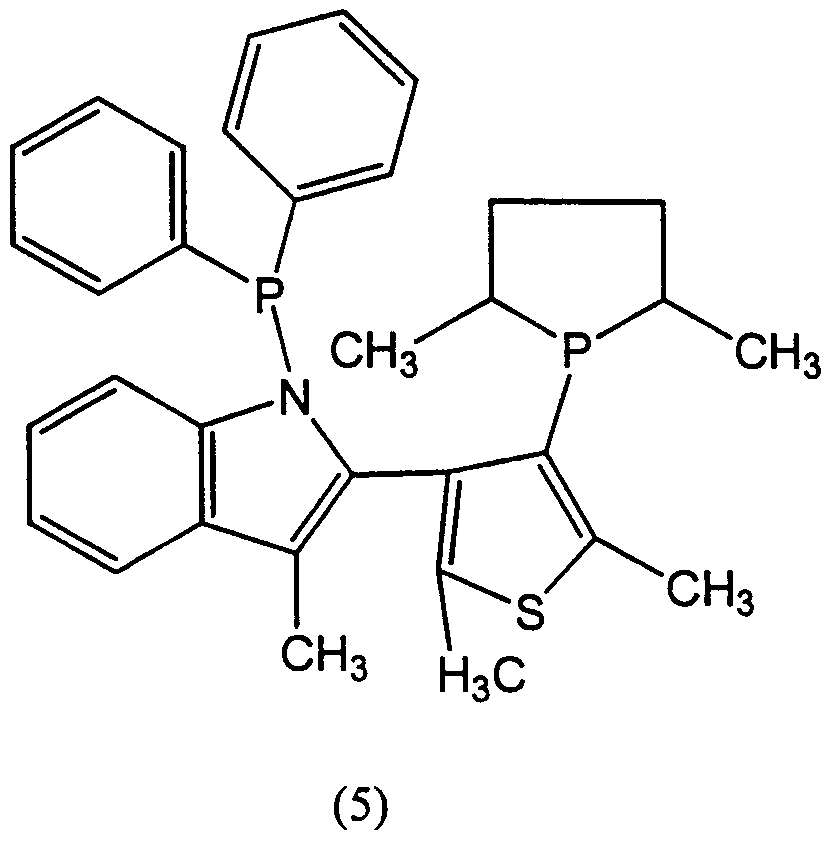
- Figures 1-3 show the structures of some examples of phosphorated ligands according to the present invention, indicated as compounds (1 ) - (15). Detailed description
- the atoms engaged in the bond between the two aromatic cycles are carbon atoms or nitrogen atoms.
- the present ligands of formula (I) having C, symmetry in which Ar is a heterocycle and those in which Ar is phenyl are represented by the following formulas (l)a and (l)b, respectively :
- Het, and Het 2 are pentatomic heterocyclic aromatic rings, equal to or different from one another, defined as Het is defined above ; n is 0 or 1 ; and X, A, B, C, D, E, Q,, Q 2 , Z, and Z 2 are as defined above.
- Het, Het, and Het 2 heterocyclic residues are thiophene, pyrrole, furan, imidazole, isoxazole, isothiazole, pyrazole and triazole.
- the Het, Het, or Het 2 pentatomic heterocyclic ring is condensed with phenyl or naphthyl.
- Het, Het, or Het 2 may be, for example, benzothiophene, naphthothiophene, indole, benzofuran or benzoimidazole.
- Q,, Q 2 , Z, and Z 2 are, for example, methyl.
- heterocyclic aromatic residues present in the ligands of the present invention are 2,5-dimethyl-thien-3-yl, 4,6-dimethyl-benzofur-3-yl, 3-methyl-indol-2- yl, 1-N-methyl-indol-2-yl and benzothien-3-yl.
- the carbocyclic aromatic residue is, for example, phenyl.
- n is, for example, 0.
- X is, for example, -O-.
- the groups R, and R 2 are, for example, phenyl or cyclohexyl, hence -P ⁇ R ⁇ and - P 2 (R 2 ) 2 are, for instance, diphenyl phosphine or dicyclohexyl phosphine.
- the two R, residues bound together with the atom P, (or the two R 2 residues bound together with the atoms P 2 ) represent a cyclic residue J, or J 2
- Examples of sub-structures contained in the phosphorated ligands of the present invention are: (4-diphenylphosphine)- or (4-dicyclohexylphosphine)-2,5-dimethyl- thien-3-yl; (1-N-diphenylphosphine)- or (1-N-dicyclohexylphosphine)-3- methylindol-2-yl; (3-diphenylphosphine)- or (3-dicyclohexylphosphine)-1-N- methylindol-2-yl; 2-(diphenylphosphine)- or 2-(dicyclohexylphosphine)-benzothien- 3-yl; 2-(diphenylphosphine-oxy)- or 2-(dicyclohexylphosphine-oxy)-phenyl-1-yl; 4- (diphenylphosphine-oxy)- or 4-(dichenylphosphine-
- Het, and Het 2 are defined as Het ;
- A, B, C, D, E, Q,, Z,, P,, R,, Q 2 , Z 2 , P 2 , R 2 and T are as defined as for the formula (I) ;
- m is 0, 1 or 2.
- transition metals contained in the organometallic complexes of the present invention are Rh, Ru, Ir, Pt, Pd and Ni.
- the structures of the ligands of formula (I) were created according to step a) of the present procedure by using the SYBYL modelling software, Version 6.2. Then, according to procedures known to the person skilled in the art, a structural investigation was carried out to determine the minimum- energy conformation associated to each individual structure. The reliability of the forecast of the minimum-energy conformer was then increased by subjecting the conformations thus identified to a further structural investigation, defined as 11
- This ⁇ E corresponds to the maximum possible extension, given by the difference between the energy of the maximum-energy conformers E trans and the energy of the minimum-energy conformer E min , for each ligand examined, and was calculated by imposing that the said maximum energy should be the one associated to the conformer in which the two aromatic rings (the two heterocycles, or the heterocycle and the carbocyclic system) are coplanar.
- the cone angle ⁇ n is as defined in the article by Casey et al., Isr. J. Chem., 30, 299-304, 1990, and is determined uniquely by the steric compression of the ligand structure, and not by the valence angle of the transition metal chosen for the complexation. However, it was calculated by using a program other than the software program AMBER which was employed according to the said article.
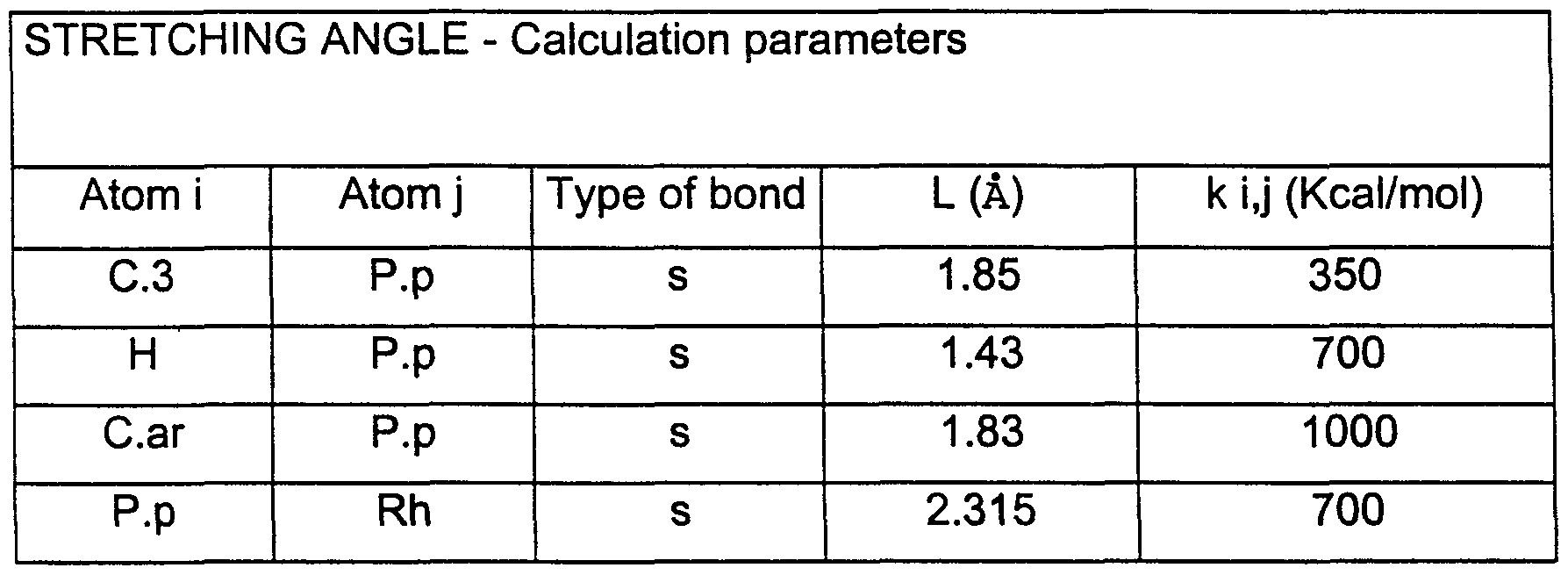
- Atom i Atom j Type of bond L (A) k i,j (Kcal/mol)
- the introduction of the groups containing the phosphorous atom may precede or follow the reaction of formation of the inter-annular bond.
- [M] is an organometallic group, such as for example Li, MgX, ZnX and an organoboron residue, where X is a halogen ;
- Z is an alkaline metal, such as Li, Na and K ;
- R, and R 2 are alkyl or aryl residues.
- Ar is a carbocyclic aromatic or hetero-aromatic residue comprised in the structure of formula (I) ;
- Ind is an indole residue ;
- X is a halogen ;
- Z is an alkaline metal, such as Li, Na and K, or Z is a MgX group ;
- R, is an alkyl or aryl group ;
- R 2 is H or an alkyl or aryl group.
- the present phosphorated ligands comprise basic or acidic groups, for example, amine, carboxyl or sulphone groups
- the diastereo-isomeric adducts are, for example, the corresponding salts with enantiomerically pure chiral acids or bases.
- the diastereo-isomeric adducts may be, for example, the diastereo- isomeric salts among enantiomerically pure chiral acids, and the phosphinoxides corresponding to the phosphorated ligands, obtained by phosphorous oxidation according to conventional methods : in this case, optical resolution is followed by reduction of the optically active phosphinoxides to phosphine, by means of a treatment with suitable reducing agents, such as sylans, in non-racemising reaction conditions, for example, according to the procedure described in WO 96/01831.
- suitable reducing agents such as sylans
- the complexes between ligands of formula (I) in the optically active form and transition metals are useful as catalysts in enantio- and/or diastereoselective reactions of reduction, hydroformylation, hydroboration, hydrosilylation, hydrocyanation, allylation, vynylation and other reactions of formation of the C-C bond.
- the aqueous phase is separated, and the organic phase is washed, in order, with an aqueous solution of sodium chloride (10 g in 68.5 ml), an alkaline solution of sodium hyposulphite (6.8 g in 70 ml of 1% sodium hydroxide), and again with an aqueous solution of sodium 18
- racemic disphosphine is obtained by reduction with trichlorosilane, and is resolved via HPLC on stationary chiral phase.
- the mixture is then filtered on celite and concentrated under vacuum ; the residue is treated with 30 ml of diethyl ether, and the solution, in inert atmosphere, is fed drop by drop into 5 ml of a t-BuLi solution 1.6 M in penthane at the temperature of -30°C ; then 1.4 ml of chlorodiphenyl phosphine is added, and the reaction mixture is allowed to reconstitute at room temperature.
- the organic phase is concentrated under vacuum, and the crude reaction product is purified by means of silica chromatography to yield the 4- bromo-2,5-dimethyl-3-propionyl-thiophene phenylhydrazone, which is dissolved in 350 ml of isopropanol/HCI (7.5 M) and kept stirred at room temperature until the reaction is completed.
- the solvent is removed under reduced pressure, and the residue is treated with methylene chloride.
- the organic phase is subjected to washings with a saturated solution of sodium bicarbonate, then with water, and finally concentrated under reduced pressure to yield 4.7 g of 2-[3'(4'-bromo-2',5'- dimethyl)-thienyl]-3-methyl-indole.
- (+)(15) is added under stirring to a 4.2 mmol solution of hexahydrated NiCI 2 in 30 ml of ethanol. After 1 h the mixture is concentrated to a small volume, and the residue is squashed with ethanol and subsequently dried under vacuum.
- the complex is used as such in enantoselective reactions of formation of C-C bonds. It is assumed that the complex obtained has the following structure:
- (+)(15) and 2.6 mmol of PdCI 2 (benzonitrile) 2 is kept under stirring for 1 h at room temperature.
- the mixture is concentrated to a small volume and the residue is squashed with ethanol and subsequently dried under vacuum.
- the complex obtained is used as such in enantioselective reactions of formation of C-C bonds. It is assumed that the complex obtained has the following structure: [PdCI 2 (compound (+)(15)]. Using the same procedure, similar complexes of palladium were prepared with the other optically active phosphines of Table 7.
Landscapes
- Chemical & Material Sciences (AREA)
- Organic Chemistry (AREA)
- Chemical Kinetics & Catalysis (AREA)
- Inorganic Chemistry (AREA)
- Engineering & Computer Science (AREA)
- Materials Engineering (AREA)
- Health & Medical Sciences (AREA)
- Life Sciences & Earth Sciences (AREA)
- Biochemistry (AREA)
- General Health & Medical Sciences (AREA)
- Molecular Biology (AREA)
- Organic Low-Molecular-Weight Compounds And Preparation Thereof (AREA)
- Catalysts (AREA)
- Low-Molecular Organic Synthesis Reactions Using Catalysts (AREA)
Abstract
Description




Claims




Priority Applications (5)
| Application Number | Priority Date | Filing Date | Title |
|---|---|---|---|
| AT99920633T ATE251634T1 (en) | 1998-04-10 | 1999-04-09 | CHIRAL PHOSPHORIZED LIGANDS USEFUL IN CATALYSTS |
| DE69911936T DE69911936T2 (en) | 1998-04-10 | 1999-04-09 | CHIRAL PHOSPHORATED LIGANDS USEABLE IN CATALYSTS |
| EP99920633A EP1070075B1 (en) | 1998-04-10 | 1999-04-09 | Chiral phosphorated ligands useful in catalysts |
| JP2000543471A JP2002511473A (en) | 1998-04-10 | 1999-04-09 | Chiral phosphorylated ligands useful for catalysts |
| AU38147/99A AU3814799A (en) | 1998-04-10 | 1999-04-09 | Chiral phosphorated ligands useful in catalysts |
Applications Claiming Priority (2)
| Application Number | Priority Date | Filing Date | Title |
|---|---|---|---|
| IT98MI000773A IT1299068B1 (en) | 1998-04-10 | 1998-04-10 | CHIRAL PHOSPHORATED LEGANDS AND THEIR ORGANOMETALLIC COMPLEXES, USEFUL AS CATALYSTS IN STEREOSELECTIVE SYNTHESES |
| ITMI98A000773 | 1998-04-10 |
Publications (1)
| Publication Number | Publication Date |
|---|---|
| WO1999052915A1 true WO1999052915A1 (en) | 1999-10-21 |
Family
ID=11379741
Family Applications (1)
| Application Number | Title | Priority Date | Filing Date |
|---|---|---|---|
| PCT/EP1999/002432 Ceased WO1999052915A1 (en) | 1998-04-10 | 1999-04-09 | Chiral phosphorated ligands useful in catalysts |
Country Status (8)
| Country | Link |
|---|---|
| EP (1) | EP1070075B1 (en) |
| JP (1) | JP2002511473A (en) |
| AT (1) | ATE251634T1 (en) |
| AU (1) | AU3814799A (en) |
| DE (1) | DE69911936T2 (en) |
| ES (1) | ES2209431T3 (en) |
| IT (1) | IT1299068B1 (en) |
| WO (1) | WO1999052915A1 (en) |
Cited By (19)
| Publication number | Priority date | Publication date | Assignee | Title |
|---|---|---|---|---|
| WO2000029370A1 (en) * | 1998-11-16 | 2000-05-25 | Sigma-Tau Industrie Farmaceutiche Riunite S.P.A. | Industrial process for the production of l-carnitine |
| WO2002055528A1 (en) * | 2001-01-10 | 2002-07-18 | Oxeno Olefinchemie Gmbh | Novel n-phenyl-pyrrol bisphosphane compounds and the metal complexes of the same |
| WO2003031456A3 (en) * | 2001-10-05 | 2003-07-24 | Solvias Ag | Ligands for asymmetric reactions |
| WO2003018192A3 (en) * | 2001-08-24 | 2003-11-13 | Basf Ag | Method for the production of 2-propylheptanol and hydroformylating catalysts and the further use thereof for carbonylation, hydrocyanation and hydrogenation |
| RU2223965C1 (en) * | 2002-07-15 | 2004-02-20 | Нифантьев Илья Эдуардович | Heteroaryl-aryldiphosphines and method for their preparing |
| US6716984B2 (en) | 2000-04-13 | 2004-04-06 | E. I. Du Pont De Nemours And Company | Polymer-supported synthesis of heteroatom bidentate ligands for catalysis |
| RU2239639C1 (en) * | 2003-02-06 | 2004-11-10 | Нифантьев Илья Эдуардович | Achiral bidentate p,n-ligands and method for their preparing |
| EP1595888A1 (en) * | 2004-05-11 | 2005-11-16 | Degussa AG | Cycloolefin phosphine ligands and their use in catalysis |
| US7145042B2 (en) | 2002-09-13 | 2006-12-05 | Basf Aktiengesellschaft | Method for producing dialdehydes and or ethylenically unsaturated monoaldehydes by hydroformylating ethylenically unsaturated compounds |
| US7173138B2 (en) | 2001-03-29 | 2007-02-06 | Basf Aktiengesellschaft | Ligands for pnicogen chelate complexes with a metal of subgroup VIII and use of the complexes as catalysts for hydroformylation, carbonylation, hydrocyanation or hydrogenation |
| WO2006054182A3 (en) * | 2004-09-17 | 2007-03-01 | Idenix Pharmaceuticals Inc | Phosphoindoles as hiv inhibitors |
| US7960428B2 (en) | 2006-09-29 | 2011-06-14 | Idenix Pharmaceuticals, Inc. | Enantiomerically pure phosphoindoles as HIV inhibitors |
| US8933239B1 (en) | 2013-07-16 | 2015-01-13 | Dow Global Technologies Llc | Bis(aryl)acetal compounds |
| US8962779B2 (en) | 2013-07-16 | 2015-02-24 | Dow Global Technologies Llc | Method of forming polyaryl polymers |
| US9063420B2 (en) | 2013-07-16 | 2015-06-23 | Rohm And Haas Electronic Materials Llc | Photoresist composition, coated substrate, and method of forming electronic device |
| WO2015110515A1 (en) * | 2014-01-24 | 2015-07-30 | Givaudan Sa | Improvements in or relating to organic compounds |
| US9410016B2 (en) | 2013-07-16 | 2016-08-09 | Dow Global Technologies Llc | Aromatic polyacetals and articles comprising them |
| CN107459533A (en) * | 2016-06-02 | 2017-12-12 | 香港理工大学深圳研究院 | A kind of Phosphine ligands of benzimidazole-indoles skeleton and its preparation method and application |
| CN112679546A (en) * | 2020-12-24 | 2021-04-20 | 安徽泽升科技有限公司 | Cyclic triazophos ligand compound and preparation method thereof |
Families Citing this family (3)
| Publication number | Priority date | Publication date | Assignee | Title |
|---|---|---|---|---|
| US7629470B2 (en) | 2004-07-08 | 2009-12-08 | Merck & Co., Inc. | Formation of tetra-substituted enamides and stereoselective reduction thereof |
| FR2932476B1 (en) * | 2008-06-17 | 2010-07-30 | Rhodia Operations | PROCESS FOR THE PRODUCTION OF NITRILIC COMPOUNDS FROM ETHYLENE-UNSATURATED COMPOUNDS |
| JP5493352B2 (en) * | 2008-12-25 | 2014-05-14 | 東ソー株式会社 | Imidazole compound and catalyst composition for cross-coupling reaction using the same |
Citations (2)
| Publication number | Priority date | Publication date | Assignee | Title |
|---|---|---|---|---|
| WO1996001831A1 (en) * | 1994-07-12 | 1996-01-25 | Italfarmaco Sud S.P.A. | Heteroaromatic diphosphines as chiral ligands |
| WO1997047633A1 (en) * | 1996-06-14 | 1997-12-18 | The Penn State Research Foundation | Asymmetric synthesis catalyzed by transition metal complexes with cyclic chiral phosphine ligands |
-
1998
- 1998-04-10 IT IT98MI000773A patent/IT1299068B1/en active IP Right Grant
-
1999
- 1999-04-09 ES ES99920633T patent/ES2209431T3/en not_active Expired - Lifetime
- 1999-04-09 JP JP2000543471A patent/JP2002511473A/en active Pending
- 1999-04-09 AU AU38147/99A patent/AU3814799A/en not_active Abandoned
- 1999-04-09 EP EP99920633A patent/EP1070075B1/en not_active Expired - Lifetime
- 1999-04-09 AT AT99920633T patent/ATE251634T1/en not_active IP Right Cessation
- 1999-04-09 DE DE69911936T patent/DE69911936T2/en not_active Expired - Fee Related
- 1999-04-09 WO PCT/EP1999/002432 patent/WO1999052915A1/en not_active Ceased
Patent Citations (2)
| Publication number | Priority date | Publication date | Assignee | Title |
|---|---|---|---|---|
| WO1996001831A1 (en) * | 1994-07-12 | 1996-01-25 | Italfarmaco Sud S.P.A. | Heteroaromatic diphosphines as chiral ligands |
| WO1997047633A1 (en) * | 1996-06-14 | 1997-12-18 | The Penn State Research Foundation | Asymmetric synthesis catalyzed by transition metal complexes with cyclic chiral phosphine ligands |
Non-Patent Citations (1)
| Title |
|---|
| KRANENBURG M ET AL: "NEW DIPHOSPHINE LIGANDS BASED ON HETEROCYCLIC AROMATICS INDUCING VERY HIGH REGIOSELECTIVITY IN RHODIUM-CATALYZED HYDROFORMYLATION: EFFECT OF THE BITE ANGLE", ORGANOMETALLICS, vol. 14, no. 6, 1 June 1995 (1995-06-01), pages 3081 - 3089, XP000565317, ISSN: 0276-7333 * |
Cited By (32)
| Publication number | Priority date | Publication date | Assignee | Title |
|---|---|---|---|---|
| US6566552B2 (en) | 1998-11-16 | 2003-05-20 | Sigma-Tau Industrie Farmaceutiche Riunite S.P.A. | Industrial process for the production of L-carnitine |
| WO2000029370A1 (en) * | 1998-11-16 | 2000-05-25 | Sigma-Tau Industrie Farmaceutiche Riunite S.P.A. | Industrial process for the production of l-carnitine |
| US6716984B2 (en) | 2000-04-13 | 2004-04-06 | E. I. Du Pont De Nemours And Company | Polymer-supported synthesis of heteroatom bidentate ligands for catalysis |
| WO2002055528A1 (en) * | 2001-01-10 | 2002-07-18 | Oxeno Olefinchemie Gmbh | Novel n-phenyl-pyrrol bisphosphane compounds and the metal complexes of the same |
| US7109346B2 (en) | 2001-01-10 | 2006-09-19 | Oxeno Olefinchemie Gmbh & Co. Kg | N-phenyl-pyrrol bisphosphane compounds and the metal complexes of the same |
| US7173138B2 (en) | 2001-03-29 | 2007-02-06 | Basf Aktiengesellschaft | Ligands for pnicogen chelate complexes with a metal of subgroup VIII and use of the complexes as catalysts for hydroformylation, carbonylation, hydrocyanation or hydrogenation |
| WO2003018192A3 (en) * | 2001-08-24 | 2003-11-13 | Basf Ag | Method for the production of 2-propylheptanol and hydroformylating catalysts and the further use thereof for carbonylation, hydrocyanation and hydrogenation |
| CN100519571C (en) * | 2001-10-05 | 2009-07-29 | 索尔维亚斯股份公司 | Ligands for asymmetric reactions |
| WO2003031456A3 (en) * | 2001-10-05 | 2003-07-24 | Solvias Ag | Ligands for asymmetric reactions |
| US7407910B2 (en) | 2001-10-05 | 2008-08-05 | Solvias Ag | Ligands for asymmetric reactions |
| US7094907B2 (en) | 2001-10-05 | 2006-08-22 | Solvias Ag | Ligands for asymmetric reactions |
| RU2223965C1 (en) * | 2002-07-15 | 2004-02-20 | Нифантьев Илья Эдуардович | Heteroaryl-aryldiphosphines and method for their preparing |
| US7145042B2 (en) | 2002-09-13 | 2006-12-05 | Basf Aktiengesellschaft | Method for producing dialdehydes and or ethylenically unsaturated monoaldehydes by hydroformylating ethylenically unsaturated compounds |
| RU2239639C1 (en) * | 2003-02-06 | 2004-11-10 | Нифантьев Илья Эдуардович | Achiral bidentate p,n-ligands and method for their preparing |
| WO2005108407A1 (en) * | 2004-05-11 | 2005-11-17 | Degussa Ag | Cycloolefin phosphine ligands and their use in catalysis |
| US7763739B2 (en) | 2004-05-11 | 2010-07-27 | Evonik Degussa, GmbH | Cycloolefin phosphine ligands and their use in catalysis |
| EP1595888A1 (en) * | 2004-05-11 | 2005-11-16 | Degussa AG | Cycloolefin phosphine ligands and their use in catalysis |
| US7534809B2 (en) | 2004-09-17 | 2009-05-19 | Idenix Pharmaceuticals, Inc. | Phospho-indoles as HIV inhibitors |
| WO2006054182A3 (en) * | 2004-09-17 | 2007-03-01 | Idenix Pharmaceuticals Inc | Phosphoindoles as hiv inhibitors |
| US8044091B2 (en) | 2004-09-17 | 2011-10-25 | Idenix Pharmaceuticals, Inc. | Phospho-indoles as HIV inhibitors |
| US7960428B2 (en) | 2006-09-29 | 2011-06-14 | Idenix Pharmaceuticals, Inc. | Enantiomerically pure phosphoindoles as HIV inhibitors |
| US8486991B2 (en) | 2006-09-29 | 2013-07-16 | Idenix Pharmaceuticals, Inc. | Enantiomerically pure phosphoindoles as HIV inhibitors |
| US9063420B2 (en) | 2013-07-16 | 2015-06-23 | Rohm And Haas Electronic Materials Llc | Photoresist composition, coated substrate, and method of forming electronic device |
| US8962779B2 (en) | 2013-07-16 | 2015-02-24 | Dow Global Technologies Llc | Method of forming polyaryl polymers |
| US8933239B1 (en) | 2013-07-16 | 2015-01-13 | Dow Global Technologies Llc | Bis(aryl)acetal compounds |
| US9410016B2 (en) | 2013-07-16 | 2016-08-09 | Dow Global Technologies Llc | Aromatic polyacetals and articles comprising them |
| WO2015110515A1 (en) * | 2014-01-24 | 2015-07-30 | Givaudan Sa | Improvements in or relating to organic compounds |
| US10196414B2 (en) | 2014-01-24 | 2019-02-05 | Givaudan S.A. | Organic compounds |
| US10544179B2 (en) | 2014-01-24 | 2020-01-28 | Givaudan S.A. | Organic compounds |
| CN107459533A (en) * | 2016-06-02 | 2017-12-12 | 香港理工大学深圳研究院 | A kind of Phosphine ligands of benzimidazole-indoles skeleton and its preparation method and application |
| CN107459533B (en) * | 2016-06-02 | 2020-06-05 | 香港理工大学深圳研究院 | A kind of phosphine ligand of benzimidazole-indole skeleton and preparation method and application thereof |
| CN112679546A (en) * | 2020-12-24 | 2021-04-20 | 安徽泽升科技有限公司 | Cyclic triazophos ligand compound and preparation method thereof |
Also Published As
| Publication number | Publication date |
|---|---|
| DE69911936D1 (en) | 2003-11-13 |
| ITMI980773A1 (en) | 1999-10-10 |
| ATE251634T1 (en) | 2003-10-15 |
| EP1070075B1 (en) | 2003-10-08 |
| IT1299068B1 (en) | 2000-02-07 |
| ES2209431T3 (en) | 2004-06-16 |
| DE69911936T2 (en) | 2004-09-09 |
| JP2002511473A (en) | 2002-04-16 |
| EP1070075A1 (en) | 2001-01-24 |
| AU3814799A (en) | 1999-11-01 |
Similar Documents
| Publication | Publication Date | Title |
|---|---|---|
| EP1070075B1 (en) | Chiral phosphorated ligands useful in catalysts | |
| Togni et al. | A novel easily accessible chiral ferrocenyldiphosphine for highly enantioselective hydrogenation, allylic alkylation, and hydroboration reactions | |
| Nettekoven et al. | Phosphorus-chiral analogues of 1, 1 ‘-bis (diphenylphosphino) ferrocene: asymmetric synthesis and application in highly enantioselective Rhodium-catalyzed hydrogenation reactions | |
| Guillen et al. | Synthesis and first applications of a new family of chiral monophosphine ligand: 2, 5-diphenylphosphospholanes | |
| RU2335342C2 (en) | C1-symmetrical biophosphine ligands and their application in asymmetrical pregabaline synthesis | |
| JP2004505091A (en) | Phosphane ligands having an adamantyl group, their preparation and their use in catalytic reactions | |
| KR100384411B1 (en) | Chiral ligand in heteroaromatic diphosphine | |
| Rowlands | Planar chiral phosphines derived from [2.2] paracyclophane | |
| Wang et al. | NiII-catalyzed enantioselective anti-markovnikov hydrophosphination of unactivated alkynes | |
| Goulioukina et al. | Catalytic Hydrogenation of α‐Iminophosphonates as a Method for the Synthesis of Racemic and Optically Active α‐Aminophosphonates | |
| He et al. | Optical Resolution, Configurational Stability, and Coordination Chemistry of the P-Chiral Heterocyclic Diphosphine 1, 1 ‘-Diphenyl-3, 3 ‘, 4, 4 ‘-tetramethyl-2, 2 ‘-diphosphole-3, 3 ‘-diene | |
| JP2004509947A (en) | Lactam-substituted propanoic acid derivatives with high enantiomeric purity and methods for their preparation and use | |
| Jaillet et al. | Design of P-chirogenic aminophosphine–phosphinite ligands at both phosphorus centers: origin of enantioselectivities in Pd-catalyzed allylic reactions | |
| CA2559242A1 (en) | Cycloolefin phosphine ligands and their use in catalysis | |
| CN101861326A (en) | Bidentate Chiral Ligands for Catalytic Asymmetric Addition Reactions | |
| JP6006723B2 (en) | Biaryldiphosphine ligands, their intermediates, and their use in asymmetric catalysis | |
| Chapp et al. | Platinum-catalyzed asymmetric alkylation of bis (isitylphosphino) ethane: stereoselectivity reversal in successive formation of two P− C bonds | |
| JP4201916B2 (en) | Optically active 1,2-bis (dialkylphosphino) benzene derivative, process for producing the same, and rhodium metal complex having the compound as a ligand | |
| US6613922B2 (en) | Phosphorus p-cyclophane ligands and their use in transition metal catalyzed asymmetric reactions | |
| US6333291B1 (en) | Optically active diphosphine compound, production intermediate thereof, transition metal complex containing the compound as ligand and asymmetric hydrogenation catalyst containing the complex | |
| Rodríguez et al. | Carbosilane dendrimers peripherally functionalized with P-stereogenic diphosphine ligands and related rhodium complexes | |
| US20040072680A1 (en) | Chiral phosphorus cyclic compounds for transition metal-catalyzed asymmetric reactions | |
| JP2005504849A (en) | Ligand for asymmetric reaction | |
| JP2009235067A (en) | Axially asymmetric phosphorus compound and method for producing the same | |
| Tuba et al. | Synthesis, structure, and reactivity of fluorous phosphorus/carbon/phosphorus pincer ligands and metal complexes |
Legal Events
| Date | Code | Title | Description |
|---|---|---|---|
| AK | Designated states |
Kind code of ref document: A1 Designated state(s): AE AL AM AT AU AZ BA BB BG BR BY CA CH CN CU CZ DE DK EE ES FI GB GD GE GH GM HR HU ID IL IN IS JP KE KG KP KR KZ LC LK LR LS LT LU LV MD MG MK MN MW MX NO NZ PL PT RO RU SD SE SG SI SK SL TJ TM TR TT UA UG US UZ VN YU ZA ZW |
|
| AL | Designated countries for regional patents |
Kind code of ref document: A1 Designated state(s): GH GM KE LS MW SD SL SZ UG ZW AM AZ BY KG KZ MD RU TJ TM AT BE CH CY DE DK ES FI FR GB GR IE IT LU MC NL PT SE BF BJ CF CG CI CM GA GN GW ML MR NE SN TD TG |
|
| 121 | Ep: the epo has been informed by wipo that ep was designated in this application | ||
| DFPE | Request for preliminary examination filed prior to expiration of 19th month from priority date (pct application filed before 20040101) | ||
| WWE | Wipo information: entry into national phase |
Ref document number: 09647970 Country of ref document: US |
|
| NENP | Non-entry into the national phase |
Ref country code: KR |
|
| WWE | Wipo information: entry into national phase |
Ref document number: 1999920633 Country of ref document: EP |
|
| WWP | Wipo information: published in national office |
Ref document number: 1999920633 Country of ref document: EP |
|
| REG | Reference to national code |
Ref country code: DE Ref legal event code: 8642 |
|
| NENP | Non-entry into the national phase |
Ref country code: CA |
|
| WWG | Wipo information: grant in national office |
Ref document number: 1999920633 Country of ref document: EP |