WO1999054459A2 - Nucleic acid molecules with novel chemical compositions capable of modulating gene expression - Google Patents
Nucleic acid molecules with novel chemical compositions capable of modulating gene expression Download PDFInfo
- Publication number
- WO1999054459A2 WO1999054459A2 PCT/US1999/008547 US9908547W WO9954459A2 WO 1999054459 A2 WO1999054459 A2 WO 1999054459A2 US 9908547 W US9908547 W US 9908547W WO 9954459 A2 WO9954459 A2 WO 9954459A2
- Authority
- WO
- WIPO (PCT)
- Prior art keywords
- nucleic acid
- acid molecule
- nucleotide
- independently
- enzymatic
- Prior art date
- Legal status (The legal status is an assumption and is not a legal conclusion. Google has not performed a legal analysis and makes no representation as to the accuracy of the status listed.)
- Ceased
Links
Classifications
-
- C—CHEMISTRY; METALLURGY
- C12—BIOCHEMISTRY; BEER; SPIRITS; WINE; VINEGAR; MICROBIOLOGY; ENZYMOLOGY; MUTATION OR GENETIC ENGINEERING
- C12N—MICROORGANISMS OR ENZYMES; COMPOSITIONS THEREOF; PROPAGATING, PRESERVING, OR MAINTAINING MICROORGANISMS; MUTATION OR GENETIC ENGINEERING; CULTURE MEDIA
- C12N15/00—Mutation or genetic engineering; DNA or RNA concerning genetic engineering, vectors, e.g. plasmids, or their isolation, preparation or purification; Use of hosts therefor
- C12N15/09—Recombinant DNA-technology
- C12N15/11—DNA or RNA fragments; Modified forms thereof; Non-coding nucleic acids having a biological activity
- C12N15/113—Non-coding nucleic acids modulating the expression of genes, e.g. antisense oligonucleotides; Antisense DNA or RNA; Triplex- forming oligonucleotides; Catalytic nucleic acids, e.g. ribozymes; Nucleic acids used in co-suppression or gene silencing
-
- A—HUMAN NECESSITIES
- A61—MEDICAL OR VETERINARY SCIENCE; HYGIENE
- A61P—SPECIFIC THERAPEUTIC ACTIVITY OF CHEMICAL COMPOUNDS OR MEDICINAL PREPARATIONS
- A61P35/00—Antineoplastic agents
-
- A—HUMAN NECESSITIES
- A61—MEDICAL OR VETERINARY SCIENCE; HYGIENE
- A61P—SPECIFIC THERAPEUTIC ACTIVITY OF CHEMICAL COMPOUNDS OR MEDICINAL PREPARATIONS
- A61P5/00—Drugs for disorders of the endocrine system
- A61P5/24—Drugs for disorders of the endocrine system of the sex hormones
- A61P5/30—Oestrogens
-
- C—CHEMISTRY; METALLURGY
- C12—BIOCHEMISTRY; BEER; SPIRITS; WINE; VINEGAR; MICROBIOLOGY; ENZYMOLOGY; MUTATION OR GENETIC ENGINEERING
- C12N—MICROORGANISMS OR ENZYMES; COMPOSITIONS THEREOF; PROPAGATING, PRESERVING, OR MAINTAINING MICROORGANISMS; MUTATION OR GENETIC ENGINEERING; CULTURE MEDIA
- C12N15/00—Mutation or genetic engineering; DNA or RNA concerning genetic engineering, vectors, e.g. plasmids, or their isolation, preparation or purification; Use of hosts therefor
- C12N15/09—Recombinant DNA-technology
- C12N15/11—DNA or RNA fragments; Modified forms thereof; Non-coding nucleic acids having a biological activity
- C12N15/113—Non-coding nucleic acids modulating the expression of genes, e.g. antisense oligonucleotides; Antisense DNA or RNA; Triplex- forming oligonucleotides; Catalytic nucleic acids, e.g. ribozymes; Nucleic acids used in co-suppression or gene silencing
- C12N15/1135—Non-coding nucleic acids modulating the expression of genes, e.g. antisense oligonucleotides; Antisense DNA or RNA; Triplex- forming oligonucleotides; Catalytic nucleic acids, e.g. ribozymes; Nucleic acids used in co-suppression or gene silencing against oncogenes or tumor suppressor genes
-
- C—CHEMISTRY; METALLURGY
- C12—BIOCHEMISTRY; BEER; SPIRITS; WINE; VINEGAR; MICROBIOLOGY; ENZYMOLOGY; MUTATION OR GENETIC ENGINEERING
- C12N—MICROORGANISMS OR ENZYMES; COMPOSITIONS THEREOF; PROPAGATING, PRESERVING, OR MAINTAINING MICROORGANISMS; MUTATION OR GENETIC ENGINEERING; CULTURE MEDIA
- C12N15/00—Mutation or genetic engineering; DNA or RNA concerning genetic engineering, vectors, e.g. plasmids, or their isolation, preparation or purification; Use of hosts therefor
- C12N15/09—Recombinant DNA-technology
- C12N15/11—DNA or RNA fragments; Modified forms thereof; Non-coding nucleic acids having a biological activity
- C12N15/113—Non-coding nucleic acids modulating the expression of genes, e.g. antisense oligonucleotides; Antisense DNA or RNA; Triplex- forming oligonucleotides; Catalytic nucleic acids, e.g. ribozymes; Nucleic acids used in co-suppression or gene silencing
- C12N15/1138—Non-coding nucleic acids modulating the expression of genes, e.g. antisense oligonucleotides; Antisense DNA or RNA; Triplex- forming oligonucleotides; Catalytic nucleic acids, e.g. ribozymes; Nucleic acids used in co-suppression or gene silencing against receptors or cell surface proteins
-
- A—HUMAN NECESSITIES
- A61—MEDICAL OR VETERINARY SCIENCE; HYGIENE
- A61K—PREPARATIONS FOR MEDICAL, DENTAL OR TOILETRY PURPOSES
- A61K38/00—Medicinal preparations containing peptides
-
- C—CHEMISTRY; METALLURGY
- C12—BIOCHEMISTRY; BEER; SPIRITS; WINE; VINEGAR; MICROBIOLOGY; ENZYMOLOGY; MUTATION OR GENETIC ENGINEERING
- C12N—MICROORGANISMS OR ENZYMES; COMPOSITIONS THEREOF; PROPAGATING, PRESERVING, OR MAINTAINING MICROORGANISMS; MUTATION OR GENETIC ENGINEERING; CULTURE MEDIA
- C12N2310/00—Structure or type of the nucleic acid
- C12N2310/10—Type of nucleic acid
- C12N2310/15—Nucleic acids forming more than 2 strands, e.g. TFOs
-
- C—CHEMISTRY; METALLURGY
- C12—BIOCHEMISTRY; BEER; SPIRITS; WINE; VINEGAR; MICROBIOLOGY; ENZYMOLOGY; MUTATION OR GENETIC ENGINEERING
- C12N—MICROORGANISMS OR ENZYMES; COMPOSITIONS THEREOF; PROPAGATING, PRESERVING, OR MAINTAINING MICROORGANISMS; MUTATION OR GENETIC ENGINEERING; CULTURE MEDIA
- C12N2310/00—Structure or type of the nucleic acid
- C12N2310/30—Chemical structure
- C12N2310/31—Chemical structure of the backbone
-
- C—CHEMISTRY; METALLURGY
- C12—BIOCHEMISTRY; BEER; SPIRITS; WINE; VINEGAR; MICROBIOLOGY; ENZYMOLOGY; MUTATION OR GENETIC ENGINEERING
- C12N—MICROORGANISMS OR ENZYMES; COMPOSITIONS THEREOF; PROPAGATING, PRESERVING, OR MAINTAINING MICROORGANISMS; MUTATION OR GENETIC ENGINEERING; CULTURE MEDIA
- C12N2310/00—Structure or type of the nucleic acid
- C12N2310/30—Chemical structure
- C12N2310/31—Chemical structure of the backbone
- C12N2310/315—Phosphorothioates
-
- C—CHEMISTRY; METALLURGY
- C12—BIOCHEMISTRY; BEER; SPIRITS; WINE; VINEGAR; MICROBIOLOGY; ENZYMOLOGY; MUTATION OR GENETIC ENGINEERING
- C12N—MICROORGANISMS OR ENZYMES; COMPOSITIONS THEREOF; PROPAGATING, PRESERVING, OR MAINTAINING MICROORGANISMS; MUTATION OR GENETIC ENGINEERING; CULTURE MEDIA
- C12N2310/00—Structure or type of the nucleic acid
- C12N2310/30—Chemical structure
- C12N2310/31—Chemical structure of the backbone
- C12N2310/317—Chemical structure of the backbone with an inverted bond, e.g. a cap structure
-
- C—CHEMISTRY; METALLURGY
- C12—BIOCHEMISTRY; BEER; SPIRITS; WINE; VINEGAR; MICROBIOLOGY; ENZYMOLOGY; MUTATION OR GENETIC ENGINEERING
- C12N—MICROORGANISMS OR ENZYMES; COMPOSITIONS THEREOF; PROPAGATING, PRESERVING, OR MAINTAINING MICROORGANISMS; MUTATION OR GENETIC ENGINEERING; CULTURE MEDIA
- C12N2310/00—Structure or type of the nucleic acid
- C12N2310/30—Chemical structure
- C12N2310/32—Chemical structure of the sugar
- C12N2310/321—2'-O-R Modification
-
- C—CHEMISTRY; METALLURGY
- C12—BIOCHEMISTRY; BEER; SPIRITS; WINE; VINEGAR; MICROBIOLOGY; ENZYMOLOGY; MUTATION OR GENETIC ENGINEERING
- C12N—MICROORGANISMS OR ENZYMES; COMPOSITIONS THEREOF; PROPAGATING, PRESERVING, OR MAINTAINING MICROORGANISMS; MUTATION OR GENETIC ENGINEERING; CULTURE MEDIA
- C12N2310/00—Structure or type of the nucleic acid
- C12N2310/30—Chemical structure
- C12N2310/33—Chemical structure of the base
- C12N2310/332—Abasic residue
-
- C—CHEMISTRY; METALLURGY
- C12—BIOCHEMISTRY; BEER; SPIRITS; WINE; VINEGAR; MICROBIOLOGY; ENZYMOLOGY; MUTATION OR GENETIC ENGINEERING
- C12N—MICROORGANISMS OR ENZYMES; COMPOSITIONS THEREOF; PROPAGATING, PRESERVING, OR MAINTAINING MICROORGANISMS; MUTATION OR GENETIC ENGINEERING; CULTURE MEDIA
- C12N2310/00—Structure or type of the nucleic acid
- C12N2310/30—Chemical structure
- C12N2310/33—Chemical structure of the base
- C12N2310/334—Modified C
- C12N2310/3341—5-Methylcytosine
-
- C—CHEMISTRY; METALLURGY
- C12—BIOCHEMISTRY; BEER; SPIRITS; WINE; VINEGAR; MICROBIOLOGY; ENZYMOLOGY; MUTATION OR GENETIC ENGINEERING
- C12N—MICROORGANISMS OR ENZYMES; COMPOSITIONS THEREOF; PROPAGATING, PRESERVING, OR MAINTAINING MICROORGANISMS; MUTATION OR GENETIC ENGINEERING; CULTURE MEDIA
- C12N2310/00—Structure or type of the nucleic acid
- C12N2310/30—Chemical structure
- C12N2310/34—Spatial arrangement of the modifications
- C12N2310/341—Gapmers, i.e. of the type ===---===
-
- C—CHEMISTRY; METALLURGY
- C12—BIOCHEMISTRY; BEER; SPIRITS; WINE; VINEGAR; MICROBIOLOGY; ENZYMOLOGY; MUTATION OR GENETIC ENGINEERING
- C12N—MICROORGANISMS OR ENZYMES; COMPOSITIONS THEREOF; PROPAGATING, PRESERVING, OR MAINTAINING MICROORGANISMS; MUTATION OR GENETIC ENGINEERING; CULTURE MEDIA
- C12N2310/00—Structure or type of the nucleic acid
- C12N2310/30—Chemical structure
- C12N2310/34—Spatial arrangement of the modifications
- C12N2310/345—Spatial arrangement of the modifications having at least two different backbone modifications
-
- C—CHEMISTRY; METALLURGY
- C12—BIOCHEMISTRY; BEER; SPIRITS; WINE; VINEGAR; MICROBIOLOGY; ENZYMOLOGY; MUTATION OR GENETIC ENGINEERING
- C12N—MICROORGANISMS OR ENZYMES; COMPOSITIONS THEREOF; PROPAGATING, PRESERVING, OR MAINTAINING MICROORGANISMS; MUTATION OR GENETIC ENGINEERING; CULTURE MEDIA
- C12N2310/00—Structure or type of the nucleic acid
- C12N2310/30—Chemical structure
- C12N2310/34—Spatial arrangement of the modifications
- C12N2310/346—Spatial arrangement of the modifications having a combination of backbone and sugar modifications
Definitions
- This invention relates to novel chemically modified nucleic acid molecules that are capable of modulating gene expression through a variety of mechanisms. Specifically, the invention concerns novel combinations of chemical modifications in an oligonucleotide which enhance nuclease resistance, binding affinity, and/ or potency.
- nucleic acid molecules have been designed which are capable of binding to specific mRNA sequences by Watson-Crick base pairing interaction and blocking translation (Crooke, 1996, Medicinal Res. Rev. 16, 319-344).
- Another approach involves complexation of DNA with triplex forming oligonucleotides to prevent transcription of bound DNA sequences thereby inhibiting gene expression (Kim et ah, 1998, Biochemistry.
- oligonucleotides for modulation of gene expression generally requires stabilization of oligonucleotides from degradation by nucleases that are present in biological systems. Cellular efficacy may be effected if the nucleic acid molecule is degraded before it reaches its desired target.
- Chemical modifications of nucleic acid molecules have been found to be advantageous in making them inaccessible to degradation by cellular nucleases. Uhlmann and Peyman, 1990, Chem. Reviews 90, 543, review the use of nucleoside modifications to stabilize antisense oligonucleotides. Besides improved stability, chemical modifications have also been shown to increase binding affinity, improve cellular penetration, and enhanced target specificity (Monia et al., 1993, J Biol Chem. 268, 14514-14522; Wu-Pong, 1994, BioPharm, 22-33).
- Phosphorothioate oligonucleotides are nucleic acid molecules whose phosphodiester linkage has been modified by substituting a sulfur atom in place of an oxygen atom.
- phosphorothioate oligonucleotides are substrates for ribonuclease H (RNase H) (Monia, supra; Crooke et al, 1995, Biochem. J. 3112, 599-608).
- RNase H is an endonuclease which catalyzes the degradation of RNA in an RNA-DNA heteroduplex (Hostomsky et al., 1993 in Nucleases, Linn et al., eds., Cold Spring Harbor Laboratory Press, NY, 341-376).
- RNA/DNA heteroduplexes called Okazaki fragments, are formed naturally during DNA replication. Therefore, the normal function of RNase H is to degrade the RNA portion of the heteroduplex to complete DNA replication.
- the phosphorothioate oligonucleotide activated the enzyme more efficiently (2-5 fold) compared to a standard phosphodiester containing oligonucleotide (Crooke, 1995, supra).
- RNA to RNA interaction Binding of DNA to RNA is not as thermodynamically favorable as an RNA to RNA interaction (Altmann et al, 1996, Chimia 50, 168-176). Inoe & Ohtsuka, 1987, Nucleic Acids Research 115, 6131, first proposed an oligonucleotide with a central region consisting of oligodeoxynucleotides flanked by 2'-O-methyl modified nucleotide regions. The region of oligodeoxynucleotides in such a chimeric molecule is recognized by RNase H when bound to target RNA; and facilitates cleavage of target RNA by RNase H.
- nuclease resistant modifications of the chimeric oligonucleotides such as methylphosphonates (Tidd & Gibson, 1988, Anticancer Drug Design 3, 117), phosphorothioates (Agrawal & Pederson, 1990, Proc Nat. Acad. Set USA 87, 1407), and phosphoramidates (Potts & Runyun, 1991, Proc Nat. Acad. Sci. USA 88, 1516).
- flanking sequences have been modified with 2'-O-methyl and 2 '-E-modifications (Cook, 1993, Antisense Research and Applications, CRC Press, 150-181).
- Agrawal et al., US Patent No. 5,652,355 describe a phosphorothioate-containing nucleic acid molecule with at least two 2'-O-methyl modifications on the 5' and 3' ends.
- Agrawal, US Patent No. 5,652,356 describes an oligonucleotide which consists of a region of 2'-O-substituted oligonucleotide located between two oligodeoxyribonucleotide regions. The DNA regions of this nucleic acid molecule consists of phosphorothioate modifications at every position.
- nucleic acid molecules of the instant invention are distinct from other nucleic acid molecules known in the art.
- nucleic acid molecules of the present invention have novel combinations of chemical modifications and are capable of binding to RNA or DNA to facilitate modulation of gene expression. These novel combinations of chemical modifications may be used to form antisense oligonucleotides, triplex forming oligonucleotides, 2-5A antisense chimera, and enzymatic nucleic acid molecules.
- the invention features a nucleic acid molecule having the following formulae: Formula I:
- the invention features an enzymatic nucleic acid molecule having the formula: Formula IV:
- each (X) m , (X) 0 , (X) r , (X) q , and/or (Y) n independently comprise phosphorothioate linkages, more specifically each (X) m , (X) o , (X) r , (X) q , and/or (Y) n independently comprise at least one phosphodiester linkage and one phosphorothioate linkage; each C and C independently represents a cap structure which may independently be present or absent; and (Z) p may optionally include a phosphorothioate linkage.
- the nucleotides in the each of the formula I-VII are unmodified or modified at the sugar, base, and/or phosphate as known in the art.
- each of X represents independently a nucleotide which may be same or different; where m and o are integers independently greater than or equal to 5; (X) m and (X) o are oligonucleotides which are of sufficient length to stably interact independently with a target nucleic acid molecule; each (X) r comprises independently at least one phosphodiester linkage and one phosphorothioate linkage; Y represents independently a deoxyribonucleotide which may be same or different; (Y) n is an oligonucleotide which is of sufficient length to stably interact independently with a target nucleic acid molecule; n is an integer greater than or equal to 4; each (X) m , and (X) 0 comprise independently at least one phosphodiester linkage and one phosphorothioate linkage; (Y) n comprises a phosphorothioate linkage or a phosphorodithioate linkage or a 5'-
- nucleotide as used herein is as recognized in the art to include natural bases (standard), and modified bases well known in the art. Such bases are generally located at the 1' position of a sugar moiety. Nucleotide generally comprise a base, sugar and a phosphate group. The nucleotides can be unmodified or modified at the sugar, phosphate and/or base moiety, (also referred to interchangeably as nucleotide analogs, modified nucleotides, non-natural nucleotides, non-standard nucleotides and other; see for example, Usman and McSwiggen, supra; Eckstein et al, International PCT Publication No.
- base modifications that can be introduced into nucleic acids include, inosine, purine, pyridin-4-one, pyridin-2-one, phenyl, pseudouracil, 2, 4, 6-trimethoxy benzene, 3-methyl uracil, dihydrouridine, naphthyl, aminophenyl, 5-alkylcytidines (e.g., 5-methylcytidine), 5-alkyluridines (e.g., ribothymidine), 5-halouridine (e.g., 5-bromouridine) or 6-azapyrimidines or 6-alkylpyrimidines (e.g.
- modified bases in this aspect is meant nucleotide bases other than adenine, guanine, cytosine and uracil at 1' position or their equivalents; such bases may be used at any position, for example, within the catalytic core of an enzymatic nucleic acid molecule and/or in the substrate-binding regions of the nucleic acid molecule.
- unmodified nucleotide is meant a nucleotide with one of the bases adenine, cytosine, guanine, thymine, uracil joined to the 1' carbon of ⁇ -D-ribo-furanose.
- modified nucleotide is meant a nucleotide which contains a modification in the chemical structure of an unmodified nucleotide base, sugar and/or phosphate.
- oligonucleotide of greater than or equal to 4 nucleotides.
- stably interact is meant, interaction of the oligonucleotides with target nucleic acid (e.g., by forming hydrogen bonds with complementary nucleotides in the target under physiological conditions). The interaction is stable either alone or in conjunction with (Y) n and (Z) p where applicable.
- chimeric nucleic acid molecule or “chimeric oligonucleotide” is meant that, the molecule may be comprised of both modified or unmodified DNA or RNA.
- cap structure is meant chemical modifications which have been incorporated at the terminus of the oligonucleotide. These terminal modifications protect the nucleic acid molecule from exonuclease degradation, and may help in delivery and/or localization within a cell.
- (X) m , (X) 0 , (X) q , (Y) n and/or (Z) p independently include modifications selected from a group comprising 2'-O-alkyl (e.g. 2'-O-allyl; Sproat et al, supra); 2'-O-alkylthioalkyl (e.g. 2'-O-methylthiomethyl; Karpeisky et al, 1998,
- the invention features a nucleic acid molecule of any of formula I-NII, where each X and/or Z, independently include a nucleotide modification having formula IX:
- each B is independently a modified or an unmodified nucleic acid base;
- Rl is independently a fluoroalkyl or an alkylthiofluoroalkyl;
- E is independently a phosphorus- containing group; and
- D is independently an O, blocking group or a phosphorus- containing group.
- the invention features a nucleic acid molecule of any of formula I-NII, where each X and/or Z, independently include a nucleotide modification having formula X:
- each B is independently a modified or an unmodified nucleic acid base
- Rl is independently an aklyl, an alkylthioalkyl, a fluoroalkyl or an alkylthiofluoroalkyl; E is independently a phosphorus-containing group; and D is independently an O, blocking group or a phosphorus-containing group.
- alkyl refers to a saturated aliphatic hydrocarbon, including straight- chain, branched-chain, and cyclic alkyl groups.
- the alkyl group has 1 to 12 carbons. More preferably it is a lower alkyl of from 1 to 7 carbons, more preferably 1 to 4 carbons.
- alkenyl groups which are unsaturated hydrocarbon groups containing at least one carbon-carbon double bond, including straight-chain, branched-chain, and cyclic groups.
- the alkenyl group has 1 to 12 carbons. More preferably it is a lower alkenyl of from 1 to 7 carbons, more preferably 1 to 4 carbons.
- alkyl also includes alkynyl groups which have an unsaturated hydrocarbon group containing at least one carbon-carbon triple bond, including straight-chain, branched-chain, and cyclic groups.
- the alkynyl group has 1 to 12 carbons. More preferably it is a lower alkynyl of from 1 to 7 carbons, more preferably 1 to 4 carbons.
- alkyl groups may also include aryl, alkylaryl, carbocyclic aryl, heterocyclic aryl, amide and ester groups.
- An "aryl” group refers to an aromatic group which has at least one ring having a conjugated p electron system and includes carbocyclic aryl, heterocyclic aryl and biaryl groups, all of which may be optionally substituted.
- the preferred substituent(s) of aryl groups are halogen, trihalomethyl, hydroxyl, SH, OH, cyano, alkoxy, alkyl, alkenyl, alkynyl, and amino groups.
- alkylaryl refers to an alkyl group (as described above) covalently joined to an aryl group (as described above.
- Carbocyclic aryl groups are groups wherein the ring atoms on the aromatic ring are all carbon atoms. The carbon atoms are optionally substituted.
- Heterocyclic aryl groups are groups having from 1 to 3 heteroatoms as ring atoms in the aromatic ring and the remainder of the ring atoms are carbon atoms.
- Suitable heteroatoms include oxygen, sulfur, and nitrogen, and include furanyl, thienyl, pyridyl, pyrrolyl, N-lower alkyl pyrrolo, pyrimidyl, pyrazinyl, imidazolyl and the like, all optionally substituted.
- An "amide” refers to an -C(O)-NH-R, where R is either alkyl, aryl, alkylaryl or hydrogen.
- An “ester” refers to an -C(O)-OR', where R is either alkyl, aryl, alkylaryl or hydrogen.
- a “blocking group” is a group which is able to be removed after polynucleotide synthesis and/or which is compatible with solid phase polynucleotide synthesis.
- a “phosphorus containing group” can include phosphorus in forms such as dithioates, phosphoramidites and/or as part of an oligonucleotide.
- C is selected from a group comprising inverted abasic residue,. 4',5'-methylene nucleotide; l-(beta-D-erythrofuranosyl) nucleotide, 4'-thio nucleotide, carbocyclic nucleotide; 1,5-anhydrohexitol nucleotide; L- nucleotides; alpha-nucleotides; modified base nucleotide; phosphorodithioate linkage; t/zre ⁇ -pentofuranosyl nucleotide; acyclic 3',4'-seco nucleotide; acyclic 3,4-dihydroxybutyl nucleotide; acyclic 3,5-dihydroxypentyl nucleotide, 3'-3'-inverted nucleotide moiety; 3'-3'- inverted abasic moiety; 3'-2'-inverted nucleotide moiety; 3
- C is selected from a group comprising, 4',5'- methylene nucleotide; l-(beta-D-erythrofuranosyl) nucleotide; 4'-thio nucleotide, carbocyclic nucleotide; 5'-amino-alkyl phosphate; l,3-diamino-2-propyl phosphate, 3- aminopropyl phosphate; 6-aminohexyl phosphate; 1 ,2-aminododecyl phosphate; hydroxypropyl phosphate; 1,5-anhydrohexitol nucleotide; L-nucleotide; alpha-nucleotide; modified base nucleotide; phosphorodithioate; t/Veo-pentofuranosyl nucleotide; acyclic 3',4'-seco nucleotide; 3,4-dihydroxybutyl nucle
- (Z) p includes a non-nucleotide linker.
- the invention features an enzymatic nucleic acid molecule having one or more non-nucleotide moieties, and having enzymatic activity to cleave an RNA or DNA molecule.
- non-nucleotide is meant any group or compound which can be incorporated into a nucleic acid chain in the place of one or more nucleotide units, including either sugar and/or phosphate substitutions, and allows the remaining bases to exhibit their enzymatic activity.
- the group or compound is abasic in that it does not contain a commonly recognized nucleotide base, such as adenosine, guanine, cytosine, uracil or thymine.
- abasic or abasic nucleotide encompass sugar moieties lacking a base or having other chemical groups in place of base at the 1' position.
- enzyme nucleic acid is meant a nucleic acid molecule capable of catalyzing (altering the velocity and/or rate of) a variety of reactions including the ability to repeatedly cleave other separate nucleic acid molecules (endonuclease activity) in a nucleotide base sequence-specific manner.
- Such a molecule with endonuclease activity may have complementarity in a substrate binding region (e.g. (X) m , (X) 0 , (X)q and (Y) n in formulae IV-VII) to a specified gene target, and also has an enzymatic activity that specifically cleaves RNA or DNA in that target. That is, the nucleic acid molecule with endonuclease activity is able to intramolecularly or intermolecularly cleave RNA or DNA and thereby inactivate a target RNA or DNA molecule.
- This complementarity functions to allow sufficient hybridization of the enzymatic RNA molecule to the target RNA or DNA to allow the cleavage to occur.
- the nucleic acids may be modified at the base, sugar, and/or phosphate groups.
- the term enzymatic nucleic acid is used interchangeably with phrases such as ribozymes, catalytic RNA, enzymatic RNA, catalytic DNA, nucleozyme, DNAzyme, RNA enzyme, endoribonuclease, endonuclease, minizyme, leadzyme, oligozyme, chimeric ribozyme, chimeric enzymatic nucleic acid, or DNA enzyme. All of these terminologies describe nucleic acid molecules with enzymatic activity.
- complementarity is meant a nucleic acid that can form hydrogen bond(s) with other RNA sequence by either traditional Watson-Crick or other non-traditional types (for example, Hoogsteen type) of base-paired interactions.
- oligonucleotide as used herein, is meant a molecule comprising two or more nucleotides.
- enzymatic portion is meant that part of the enzymatic nucleic acid molecule essential for cleavage of a nucleic acid substrate
- substrate binding region or “substrate binding domain” is meant that portion/region of a nucleic acid molecule (e.g. ribozyme) which is complementary to (i.e., able to base-pair with) a portion of its substrate.
- complementarity is 100%, but can be less if desired. For example, as few as 10 bases out of 14 may be base- paired. Such arms are shown generally in Figures 1 and 3.
- these arms contain sequences within a ribozyme which are intended to bring ribozyme and target RNA together through complementary base-pairing interactions.
- the ribozyme of the invention may have binding arms that are contiguous or non-contiguous and may be of varying lengths.
- the length of the binding arm(s) are preferably greater than or equal to four nucleotides; specifically 12-100 nucleotides; more specifically 14-24 nucleotides long.
- the design is such that the length of the binding arms are symmetrical (i.e., each of the binding arms is of the same length; e.g., five and five nucleotides, six and six nucleotides or seven and seven nucleotides long) or asymmetrical (i.e., the binding arms are of different length; e.g., six and three nucleotides; three and six nucleotides long; four and five nucleotides long; four and six nucleotides long; four and seven nucleotides long; and the like).
- DNAzyme or “catalytic DNA” or “DNA enzyme” is meant, an enzymatic nucleic acid molecule lacking a 2' -OH group.
- nucleic acid molecule as used herein is meant a molecule comprising nucleotides.
- the nucleic acid can be composed of modified or unmodified nucleotides or non-nucleotides or various mixtures and combinations thereof.
- the nucleic acid molecule of the present invention is conjugated with another moiety including but not limited to abasic nucleotides, polyether, polyamine, polyamides, peptides, carbohydrates, lipid, or polyhydrocarbon compounds. Those skilled in the art will recognize that these molecules may be linked to one or more of any nucleotides comprising the nucleic acid molecule at several positions on the sugar, base or phosphate group.
- the nucleic acid molecule of the present invention can form structures including but not limited to antisense, triplexes, 2-5A chimera antisense, or enzymatic nucleic acid (ribozymes).
- antisense is meant a non-enzymatic nucleic acid molecule that binds to target RNA, for example, by means of RNA-RNA or RNA-DNA or RNA-PNA (protein nucleic acid; Egholm et al, 1993 Nature 365, 566) interactions and alters the activity of the target RNA (for a review see Stein and Cheng, 1993 Science 261, 1004).
- RNA-RNA or RNA-DNA or RNA-PNA protein nucleic acid; Egholm et al, 1993 Nature 365, 566) interactions and alters the activity of the target RNA (for a review see Stein and Cheng, 1993 Science 261, 1004).
- 2-5A antisense chimera an antisense oligonucleotide containing a 5' phosphorylated 2'-5'-linked adenylate residues. These chimeras bind to target RNA in a sequence-specific manner and activate a cellular 2-5A-dependent ribonuclease which in turn cleaves the target RNA (Torrence et al, 1993 Proc. Natl Acad. Sci. USA 90, 1300).
- triplex DNA it is meant an oligonucleotide that can bind to a double-stranded DNA in a sequence-specific manner to form a triple-strand helix. Triple-helix formation has been shown to inhibit transcription of the targeted gene (Duval- Valentin et al, 1992 Proc. Natl Acad. Sci. USA 89, 504).
- the invention features an antisense oligonucleotide which is capable of interacting with the target RNA and sterically blocking translation, where the oligonucleotide has a 5' and a 3' Cap structure and the oligonucleotide may include modifications at the base, sugar or the phosphate groups.
- Figure 1 is a diagrammatic representation of a nucleic acid molecule with 7-9 phosphorothioate oligodeoxyribonucleotide sequence flanked by 9 non- deoxyribonucleotide containing oligonucleotides, binding to a target molecule.
- Figure 2 displays schematic representations of certain chemical structures which may be incorporated into the nucleic acid molecule of the invention.
- Figure 3 shows the secondary structure model for seven different classes of enzymatic nucleic acid molecules. Arrow indicates the site of cleavage. indicate the target sequence. Lines interspersed with dots are meant to indicate tertiary interactions. - is meant to indicate base-paired interaction.
- Group I Intron P1-P9.0 represent various stem-loop structures (Cech et al, 1994, Nature Struc. Bio., 1, 273).
- Group II Intron 5'SS means 5' splice site; 3' SS means 3 '-splice site; IBS means intron binding site; EBS means exon binding site (Pyle et al, 1994, Biochemistry, 33, 2716).
- VS RNA I-VI are meant to indicate six stem-loop structures; shaded regions are meant to indicate tertiary interaction (Collins, International PCT Publication No. WO 96/19577).
- HDV Ribozyme : I-IV are meant to indicate four stem-loop structures (Been et al, US Patent No. 5,625,047).
- Hammerhead Ribozyme I-III are meant to indicate three stem-loop structures; stems I-III can be of any length and may be symmetrical or asymmetrical (Usman et al, 1996, Curr. Op. Struct. Bio., 1, 527).
- Helix 2 and helix 5 may be covalently linked by one or more bases (i.e., r is 1 base). Helix 1, 4 or 5 may also be extended by 2 or more base pairs (e.g., 4 - 20 base pairs) to stabilize the ribozyme structure, and preferably is a protein binding site.
- each N and N' independently is any normal or modified base and each dash represents a potential base- pairing interaction. These nucleotides may be modified at the sugar, base or phosphate. Complete base-pairing is not required in the helices, but is preferred.
- Helix 1 and 4 can be of any size (i.e., o and p is each independently from 0 to any number, e.g., 20) as long as some base-pairing is maintained.
- Essential bases are shown as specific bases in the structure, but those in the art will recognize that one or more may be modified chemically (abasic, base, sugar and/or phosphate modifications) or replaced with another base without significant effect.
- Helix 4 can be formed from two separate molecules, i.e., without a connecting loop.
- the connecting loop when present may be a ribonucleotide with or without modifications to its base, sugar or phosphate, "q" is 2 bases.
- the connecting loop can also be replaced with a non-nucleotide linker molecule.
- H refers to bases A, U, or C.
- Y refers to pyrimidine bases.
- " refers to a covalent bond. (Burke et al, 1996,
- Figure 4 is a graph comparing cell proliferation rates of MCF-7 cells treatment with active and inactive ribozyme with mismatch arms targeted to estrogen receptor delivered with GSV transfection reagent.
- the sequence for the active ribozyme is given as Seq. ID. No.2725 and the inactive is 2726.
- Figure 5 is a graph comparing RNA levels of c-raf RNA in PC-3 cells following treatment with antisense (Seq. ID. No 2717) and scrambled antisense (mismatch) controls.
- Figure 6a and 6b displays several possible ribozymes comprising oligodeoxyribonucleotides. The symbols used in the diagram include: N' represents a nucleotide complementary to a nucleotide on the target molecule; N7 represents position 7 in the ribozyme molecule (Hertel, K. J., et al, 1992, Nucleic Acids Res..
- N' represents a deoxyribonucleotide complementary to a nucleotide on the target molecule
- s represents a phosphorothioate modification
- C represents a chemical modification at the 5' end of the ribozyme
- C represents a chemical modification at the 3' end.
- Figure 7 shows examples of nucleotide modifications for incorporation into oligonucleotides.
- Figure 8 is a graph demonstrating the level of c-raf mRNA in PC-3 cells following treatment with c-raf sequence targeting antisense nucleic acid molecules.
- the antisense molecules target regions within the intron/exon junction (Seq. I.D. Nos.2731-2735), intron (Seq. I.D. 2736) and exon (Seq. I.D. 2737).
- the results demonstrate the molecules' ability to inhibit c-raf mRNA compared to the untreated or mismatch control at two concentrations.
- Figure 9 is a graph which demonstrates the ability of an antisense molecule represented by Seq. I.D. No. 2738 (phosphorothioate modifications at every deoxynucleotide position) to inhibit c-raf message in PC-3 cells over a period of five days compared to the untreated and mismatch controls at three different concentrations.
- Figure 10 is a graph which demonstrates the ability of an antisense molecule represented by Seq. I.D. No. 2737 (three phosphorothoate modified nucleotides at both the 5' and 3' ends of the oligonucleotide) to inhibit c-raf message in PC-3 cells over a period of five days compared to the untreated control at three different concentrations.
- Figure 11 is a graph which demonstrates the ability of an antisense molecule represented by Seq. I.D. No. 2744 (9 phosphorothioate modified DNA flanked by 7 2'-O- methylthiomethyl RNA nucleotides at the 5' and 3' end) to inhibit c-raf message in PC-3 cells over a period of five days compared to the untreated and mismatch control at three different concentrations.
- an antisense molecule represented by Seq. I.D. No. 2744 (9 phosphorothioate modified DNA flanked by 7 2'-O- methylthiomethyl RNA nucleotides at the 5' and 3' end) to inhibit c-raf message in PC-3 cells over a period of five days compared to the untreated and mismatch control at three different concentrations.
- Figure 12 is a graph showing the level of cellular proliferation inhibition exhibited by antisense oligonucleotides represented by Seq. I.D. Nos. 2738 and 2741. Also shown within the graph is the cellular proliferation after treatment of cells with a mismatch control (Seq. I.D. 2739).
- Figure 13 is a graph showing the ability of oligonucleotides with different chemical modifications to inhibit c-raf mRNA. Each antisense molecule is compared to an untreated and mismatch control.
- Figure 14 is a graph demonstrating a dose dependent inhibition of C-raf in PC-3 cells following treatment with antisense oligonucleotides (Seq. I.D. Nos. 2741 and 2738).
- Figure 15 is a graph showing inhibition of bcl-2 mRNA by antisense oligonucleotides compared to untreated and mismatch controls.
- Figure 16 is a graph showing the ability of several k-ras targeting antisense molecules to inhibit k-ras message
- Figure 17 is a graph showing the ability of oligonucleotides with different chemical modifications to inhibit estrogen receptor mRNA. Each antisense molecule is compared to an untreated and mismatch control.
- Figure 18 shows a scheme for the synthesis of 3'-deoxy-3'-thio guanosine nucleoside (scheme 1).
- Figure 19 shows a scheme for the synthesis of S-(pyridyl-2-disulfanyl) derivative (scheme 2).
- Figure 20 shows a scheme for the synthesis of 3'-deoxy-3'-thio guanosine phosphoramidite.
- Figure 21 shows a scheme for the preparation of 5'-thio-nucleoside phosphoramidite and succinates.
- Figure 22 shows a scheme for the synthesis of 3'-thio-2'-O-methyl uridine.
- nucleic acid Molecules Synthesis of Nucleic acid Molecules Synthesis of nucleic acids greater than 100 nucleotides in length is difficult using automated methods, and the therapeutic cost of such molecules is prohibitive.
- small nucleic acid motifs e.g., antisense oligonucleotides, hammerhead or the hairpin ribozymes
- the simple structure of these molecules increases the ability of the nucleic acid to invade targeted regions of RNA structure.
- the molecules of the instant invention were chemically synthesized.
- Oligodeoxyribonucleotides were synthesized using standard protocols as described in
- RNA including certain enzymatic nucleic acid molecules follows the procedure as described in Usman et al, 1987 J. Am. Chem. Soc, 109, 7845; Scaringe et al, 1990 Nucleic Acids Res., 18, 5433; and Wincott et al, 1995 Nucleic Acids Res. 23, 2677-2684 and makes use of common nucleic acid protecting and coupling groups, such as dimethoxytrityl at the 5'-end, and phosphoramidites at the 3'- end.
- small scale synthesis were conducted on a 394 Applied Biosystems, Inc.
- Deprotection of the R ⁇ A was performed as follows.
- the base-deprotected oligoribonucleotide was resuspended in anhydrous TEA'HF/NMP solution (250 ⁇ L of a solution of 1.5mL N-methylpyrrolidinone, 750 ⁇ L TEA and 1.0 mL TEA » 3HF to provide a 1.4M HF concentration) and heated to 65°C for 1.5 h.
- the resulting, fully deprotected, oligomer was quenched with 50 mM TEAB (9 mL) prior to anion exchange desalting.
- the TEAB solution was loaded onto a Qiagen 500® anion exchange cartridge (Qiagen Inc.) that was prewashed with 50 mM TEAB (10 mL). After washing the loaded cartridge with 50 mM TEAB (10 mL), the R ⁇ A was eluted with 2 M TEAB (10 mL) and dried down to a white powder.
- Inactive hammerhead ribozymes were synthesized by substituting a U for G5 and a
- nucleic acid molecules of the present invention can be synthesized separately and joined together by ligation (Moore et al., 1992, Science 256, 9923; Draper et al, International PCT publication No. WO 93/23569; Shabarova et al, 1991, Nucleic Acids Research 19, 4247)
- nucleic acid molecules Methods for the delivery of nucleic acid molecules is described in Akhtar et al, 1992, Trends Cell Bio., 2, 139; and Delivery Strategies for Antisense Oligonucleotide Therapeutics, ed. Akhtar, 1995 which are both incorporated herein by reference.
- Sullivan et al, PCT WO 94/02595 further describes the general methods for delivery of enzymatic RNA molecules . These protocols may be utilized for the delivery of virtually any nucleic acid molecule.
- Nucleic acid molecules may be administered to cells by a variety of methods known to those familiar to the art, including, but not restricted to, encapsulation in liposomes, by iontophoresis, or by incorporation into other vehicles, such as hydrogels, cyclodextrins, biodegradable nanocapsules, and bioadhesive microspheres.
- nucleic acid molecules may be directly delivered ex vivo to cells or tissues with or without the aforementioned vehicles.
- the nucleic acid/vehicle combination is locally delivered by direct injection or by use of a catheter, infusion pump or stent.
- routes of delivery include, but are not limited to, intravascular, intramuscular, subcutaneous or joint injection, aerosol inhalation, oral (tablet or pill form), topical, systemic, ocular, intraperitoneal and/or intrathecal delivery. More detailed descriptions of nucleic acid delivery and administration are provided in Sullivan et al. , supra and Draper et al, PCT WO93/23569 which have been incorporated by reference herein.
- the molecules of the instant invention can be used as pharmaceutical agents.
- Pharmaceutical agents prevent, inhibit the occurrence, or treat (alleviate a symptom to some extent, preferably all of the symptoms) of a disease state in a patient.
- the negatively charged polynucleotides of the invention can be administered (e.g.,
- compositions of the present invention may also be formulated and used as tablets, capsules or elixirs for oral administration; suppositories for rectal administration; sterile solutions; suspensions for injectable administration; and the like.
- the present invention also includes pharmaceutically acceptable formulations of the compounds described.
- formulations include salts of the above compounds, e.g., acid addition salts, for example, salts of hydrochloric, hydrobromic, acetic acid, and benzene sulfonic acid.
- a pharmacological composition or formulation refers to a composition or formulation in a form suitable for administration, e.g., systemic administration, into a cell or patient, preferably a human. Suitable forms, in part, depend upon the use or the route of entry, for example oral, transdermal, or by injection. Such forms should not prevent the composition or formulation to reach a target cell (i.e., a cell to which the negatively charged polymer is desired to be delivered to). For example, pharmacological compositions injected into the blood stream should be soluble. Other factors are known in the art, and include considerations such as toxicity and forms which prevent the composition or formulation from exerting its effect.
- systemic administration in vivo systemic absorption or accumulation of drugs in the blood stream followed by distribution throughout the entire body.
- Administration routes which lead to systemic absorption include, without limitations: intravenous, subcutaneous, intraperitoneal, inhalation, oral, intrapulmonary and intramuscular.
- Each of these administration routes expose the desired negatively charged polymers, e.g., nucleic acids, to an accessible diseased tissue.
- the rate of entry of a drug into the circulation has been shown to be a function of molecular weight or size.
- the use of a liposome or other drug carrier comprising the compounds of the instant invention can potentially localize the drug, for example, in certain tissue types, such as the tissues of the reticular endothelial system (RES).
- RES reticular endothelial system
- a liposome formulation which can facilitate the association of drug with the surface of cells, such as, lymphocytes and macrophages is also useful. This approach may provide enhanced delivery of the drug to target cells by taking advantage of the specificity of macrophage and lymphocyte immune recognition of abnormal cells, such as the cancer cells.
- the invention also features the use of the a composition comprising surface- modified liposomes containing poly (ethylene glycol) lipids (PEG-modified, or long- circulating liposomes or stealth liposomes).
- PEG-modified, or long- circulating liposomes or stealth liposomes These formulations offer an method for increasing the accumulation of drugs in target tissues.
- This class of drug carriers resists opsonization and elimination by the mononuclear phagocytic system (MPS or RES), thereby enabling longer blood circulation times and enhanced tissue exposure for the encapsulated drug (Lasic et al. Chem. Rev. 1995, 95, 2601-2627; Ishiwata et al., Chem. Pharm. Bull. 1995, 43, 1005-1011).
- liposomes have been shown to accumulate selectively in tumors, presumably by extravasation and capture in the neovascularized target tissues (Lasic et al, Science 1995, 267, 1275-1276; Oku et ⁇ /., 1995, Biochim. Biophys. Acta, 1238, 86-90).
- the long-circulating liposomes enhance the pharmacokinetics and pharmacodynamics of DNA and RNA, particularly compared to conventional cationic liposomes which are known to accumulate in tissues of the MPS (Liu et al, J. Biol. Chem. 1995, 42, 24864-24870; Choi et al, International PCT Publication No.
- WO 96/10391 Ansell et al, International PCT Publication No. WO 96/10390; Holland et al, International PCT Publication No. WO 96/10392; all of these are incorporated by reference herein).
- Long-circulating liposomes are also likely to protect drugs from nuclease degradation to a greater extent compared to cationic liposomes, based on their ability to avoid accumulation in metabolically aggressive MPS tissues such as the liver and spleen. All of these references are incorporated by reference herein.
- compositions prepared for storage or administration which include a pharmaceutically effective amount of the desired compounds in a pharmaceutically acceptable carrier or diluent.
- Acceptable carriers or diluents for therapeutic use are well known in the pharmaceutical art, and are described, for example, in Remington's Pharmaceutical Sciences, Mack Publishing Co. (A.R. Gennaro edit. 1985) hereby incorporated by reference herein.
- preservatives, stabilizers, dyes and flavoring agents may be provided. Id. at 1449. These include sodium benzoate, sorbic acid and esters of ⁇ hydroxybenzoic acid.
- antioxidants and suspending agents may be used.
- a pharmaceutically effective dose is that dose required to prevent, inhibit the occurrence, or treat (alleviate a symptom to some extent, preferably all of the symptoms) of a disease state.
- the pharmaceutically effective dose depends on the type of disease, the composition used, the route of administration, the type of mammal being treated, the physical characteristics of the specific mammal under consideration, concurrent medication, and other factors which those skilled in the medical arts will recognize. Generally, an amount between 0.1 mg/kg and 100 mg/kg body weight/day of active ingredients is administered dependent upon potency of the negatively charged polymer.
- Antisense molecules may be RNA or DNA oligonucleotides and primarily function by specifically binding to matching sequences resulting in inhibition of peptide synthesis (Wu-Pong, Nov 1994, BioPharm, 20-33).
- the oligonucleotide binds to target RNA by Watson Crick base-pairing and blocks gene expression by preventing ribosomal translation of the bound sequences.
- Antisense molecules may also alter protein synthesis by interfering with RNA processing or transport from the nucleus into the cytoplasm (Mukhopadhyay & Roth, 1996, Crit. Rev. in Oncogenesis 1, 151-190).
- RNA binding of single stranded DNA to RNA may result in nuclease degradation of the heteroduplex (Wu-Pong, supra; Crooke, supra).
- the only backbone modified DNA chemistry which will act as substrates for RNase H are phosphorothioates and phosphorodithioates.
- the oligodeoxyribonucleotides phosphorothioate modification activated RNase H more efficiently (2-5 fold) compared to the natural phosphodiester containing oligodeoxynucleotide (Crooke, 1995, supra).
- oligonucleotides with 5'-thiophosphate modification can activate RNase H cleavage of RNA.
- Triplex Forming Oligonucleotides TFOV. Single stranded DNA may be designed to bind to genomic DNA in a sequence specific manner. TFOs are comprised of pyrimidine-rich oligonucleotides which bind DNA helices through Hoogsteen Base- pairing (Wu-Pong, supra)The resulting triple helix composed of the DNA sense, DNA antisense, and TFO disrupts RNA synthesis by RNA polymerase. The TFO mechanism may result in gene expression or cell death since binding may be irreversible (Mukhopadhyay & Roth, supra).
- 2-5A Antisense Chimera The 2-5A system is an interferon mediated mechanism for RNA degradation found in higher vertebrates (Mitra et al, 1996, Proc Nat Acad Sci USA 93, 6780-6785). Two types of enzymes, 2-5 A synthetase and RNase L, are required for RNA cleavage. The 2-5A synthetases require double stranded RNA to form 2'-5' oligoadenylates (2-5A). 2-5A then acts as an allosteric effector for utilizing RNase L which has the ability to cleave single stranded RNA. The ability to form 2-5A structures with double stranded RNA makes this system particularly useful for inhibition of viral replication.
- (2'-5')oligoadenylate structures may be covalently linked to antisense molecules to form chimeric oligonucleotides capable of RNA cleavage (Torrence, supra). These molecules putatively bind and active a 2-5A dependent RNase, the oligonucleotide/enzyme complex then binds to a target RNA molecule which can then be cleaved by the RNase enzyme.
- Enzymatic Nucleic acid Seven basic varieties of naturally-occurring enzymatic
- RNAs are known presently.
- in vitro selection (evolution) strategies (Orgel, 1979, Proc. R. Soc. London, B 205, 435) have been used to evolve new nucleic acid catalysts capable of catalyzing cleavage and ligation of phosphodiester linkages (Joyce, 1989, Gene, 82, 83-87; Beaudry et al, 1992, Science 257, 635-641; Joyce, 1992, Scientific American 261, 90-97; Breaker et al, 1994, TIBTECH 12, 268; Bartel et al, 1993, Science 261 :1411-1418; Szostak, 1993, TIBS 17, 89-93; Kumar et al, 1995, FASEB J., 9, 1183; Breaker, 1996, Curr.
- enzymatic nucleic acids act by first binding to a target RNA. Such binding occurs through the target binding portion of an enzymatic nucleic acid which is held in close proximity to an enzymatic portion of the molecule that acts to cleave the target RNA. Thus, the enzymatic nucleic acid first recognizes and then binds a target RNA through complementary base-pairing, and once bound to the correct site, acts enzymatically to cut the target RNA. Strategic cleavage of such a target RNA will destroy its ability to direct synthesis of an encoded protein. After an enzymatic nucleic acid has bound and cleaved its RNA target, it is released from that RNA to search for another target and can repeatedly bind and cleave new targets.
- ribozyme The enzymatic nature of a ribozyme is advantageous over other technologies, since the concentration of ribozyme necessary to affect a therapeutic treatment is lower. This advantage reflects the ability of the ribozyme to act enzymatically.
- a single ribozyme molecule is able to cleave many molecules of target RNA.
- the ribozyme is a highly specific inhibitor, with the specificity of inhibition depending not only on the base-pairing mechanism of binding to the target RNA, but also on the mechanism of target RNA cleavage. Single mismatches, or base-substitutions, near the site of cleavage can be chosen to completely eliminate catalytic activity of a ribozyme.
- Nucleic acid molecules having an endonuclease enzymatic activity are able to repeatedly cleave other separate RNA molecules in a nucleotide base sequence-specific manner. Such enzymatic nucleic acid molecules can be targeted to virtually any RNA transcript, and efficient cleavage achieved in vitro (Zaug et al, 324, Nature 429 1986 ; Uhlenbeck, 1987 Nature 328, 596; Kim et al., 84 Proc. Natl. Acad. Sci. USA 8788, 1987; Dreyfus, 1988, Einstein Quart. J. Bio.
- Ribozymes can be designed to cleave specific RNA targets within the background of cellular RNA. Such a cleavage event renders the RNA non-functional and abrogates protein expression from that RNA. In this manner, synthesis of a protein associated with a disease state can be selectively inhibited.
- Catalytic activity of the ribozymes described in the instant invention can be optimized as described by Draper et al., supra. The details will not be repeated here, but include altering the length of the ribozyme binding arms, or chemically synthesizing ribozymes with modifications (base, sugar and/or phosphate) that prevent their degradation by serum ribonucleases and/or enhance their enzymatic activity (see e.g., Eckstein et al, International Publication No. WO 92/07065; Perrault et al, 1990 Nature 344, 565; Pieken et al., 1991 Science 253, 314; Usman and Cedergren, 1992 Trends in Biochem. Sci.
- Ribozymes are modified to enhance stability and/or enhance catalytic activity by modification with nuclease resistant groups, for example, 2'-amino, 2'- C-allyl, 2'-flouro, 2'-O-methyl, 2'-H, nucleotide base modifications (for a review see Usman and Cedergren, 1992 TIBS 17, 34; Usman et al, 1994 Nucleic Acids Symp. Ser. 31 , 163; Burgin et al, 1996 Biochemistry 35, 14090).
- nuclease resistant groups for example, 2'-amino, 2'- C-allyl, 2'-flouro, 2'-O-methyl, 2'-H, nucleotide base modifications
- Nucleic acid catalysts having chemical modifications which maintain or enhance enzymatic activity are provided. Such nucleic acid is also generally more resistant to nucleases than unmodified nucleic acid. Thus, in a cell and/or in vivo the activity may not be significantly lowered. As exemplified herein such ribozymes are useful in a cell and/or in vivo even if activity over all is reduced 10 fold (Burgin et al, 1996, Biochemistry, 35, 14090). Such ribozymes herein are said to "maintain” the enzymatic activity on all RNA ribozyme.
- Therapeutic ribozymes delivered exogenously must optimally be stable within cells until translation of the target RNA has been inhibited long enough to reduce the levels of the undesirable protein. This period of time varies between hours to days depending upon the disease state.
- ribozymes must be resistant to nucleases in order to function as effective intracellular therapeutic agents. Improvements in the chemical synthesis of RNA (Wincott et al, 1995 Nucleic Acids Res. 23, 2677; incorporated by reference herein) have expanded the ability to modify ribozymes by introducing nucleotide modifications to enhance their nuclease stability as described above.
- enhanced enzymatic activity is meant to include activity measured in cells and/or in vivo where the activity is a reflection of both catalytic activity and ribozyme stability. In this invention, the product of these properties is increased or not significantly (less that 10 fold) decreased in vivo compared to an all RNA ribozyme.
- nucleic acid catalysts having chemical modifications which maintain or enhance enzymatic activity is provided.
- Such nucleic acid is also generally more resistant to nucleases than unmodified nucleic acid.
- the activity may not be significantly lowered.
- ribozymes are useful in a cell and/or in vivo even if activity over all is reduced 10 fold (Burgin et al, 1996, Biochemistry, 35, 14090).
- Such ribozymes herein are said to "maintain” the enzymatic activity on all RNA ribozyme.
- Estrogen receptor plays a pivotal role in these cancers and thus controlling the expression of this gene is of paramount interest to researchers and clinicians.
- the estrogen receptor is a member of the steroid hormone receptor gene family that displays it's biological function as a ligand binding-dependent transcription factor.
- Tamoxifen is a nonsteroidal antiestrogen which treats all stages of breast cancer and may be used as a preventative compound in those predisposed to breast cancer (Jordan and Murphy, 1990, Endocr. Rev. 11; 578-610).
- MCF-7 human breast cancer cell line expresses high levels of estrogen receptor and is responsive to the effects of added estrogen (Borras et al., 1996, J. Steroid Biochem. Molec. Biol 57, 203-213; Pink and Jordan, 1996, Cancer Res. 56, 2321- 2330). They are an excellent model system to study the effects of regulation of estrogen receptor in breast cancer. Ribozymes and antisense oligonucleotides represent a direct means of affecting the levels of estrogen receptor message.
- estrogen dependent cell lines decreased amounts of estrogen receptor transcript should lower overall amounts of estrogen receptor protein and prevent proliferation of those cells.
- the effects of estrogen receptor on sexual differentiation of brain has been examined using antisense oligonucleotides (McCarthy et al, 1993 Endocrinology 133, 433-439). This application documents the effects of ribozymes and antisense oligonucleotides to estrogen receptor RNA levels and proliferation in MCF-7 cells.
- Estrogen receptor may be inhibited using nucleic acid molecules, including the nucleic acid molecules of the present invention.
- nucleic acid molecules of the present invention include nucleic acid molecules of the present invention.
- Other references describe the use of antisense molecules to down regulate estrogen receptor RNA (Defazio et al, 1997, Cell Growth Differ. 8, 903-911; Santagati et al, 1997, Mol Endocrinol. 11, 938-949; Williard et al., 1994, Gene 149, 21 -24; Jiang & Jordan, supra).
- the nucleic acid molecules may be chemically synthesized and delivered using methods described above, or may be expressed within cells from eukaryotic promoters (e.g., Izant and Weintraub, 1985 Science 229, 345; McGarry and Lindquist, 1986 Proc. Natl. Acad. Sci. USA 83, 399; Scanlon et al, 1991, Proc. Natl. Acad. Sci. USA, 88, 10591- 5; Kashani-Sabet et al, 1992 Antisense Res.
- eukaryotic promoters e.g., Izant and Weintraub, 1985 Science 229, 345; McGarry and Lindquist, 1986 Proc. Natl. Acad. Sci. USA 83, 399; Scanlon et al, 1991, Proc. Natl. Acad. Sci. USA, 88, 10591- 5; Kashani-Sabet et al, 1992 Antisense Res
- nucleic acid can be expressed in eukaryotic cells from the appropriate DNA/RNA vector.
- the activity of such nucleic acids can be augmented by their release from the primary transcript by a ribozyme (Draper et al, PCT WO 93/23569, and Sullivan et al, PCT WO 94/02595; Ohkawa et al, 1992 Nucleic Acids Symp. Ser., 27, 15-6; Taira et al, 1991, Nucleic Acids Res., 19, 5125-30; Ventura et al, 1993 Nucleic Acids Res., 21, 3249-55; Chowrira et al, 1994 J. Biol. Chem. 269, 25856; all of the references are hereby incorporated in their totality by reference herein).
- ribozymes which can cleave target molecules, are expressed from transcription units (see for example Couture et al, 1996, TIG., 12, 510) inserted into DNA or RNA vectors.
- the recombinant vectors are preferably DNA plasmids or viral vectors. Ribozyme expressing viral vectors could be constructed based on, but not limited to, adeno-associated virus, retrovirus, adenovirus, or alphavirus.
- the recombinant vectors capable of expressing the ribozymes are delivered as described above, and persist in target cells.
- viral vectors may be used that provide for transient expression of ribozymes. Such vectors might be repeatedly administered as necessary.
- the ribozymes cleave the target mRNA.
- the active ribozyme contains an enzymatic center or core equivalent to those in the examples, and binding arms able to bind target nucleic acid molecules such that cleavage at the target site occurs. Other sequences may be present which do not interfere with such cleavage. Delivery of ribozyme expressing vectors could be systemic, such as by intravenous or intramuscular administration, by administration to target cells ex-planted from the patient followed by reintroduction into the patient, or by any other means that would allow for introduction into the desired target cell (for a review see Couture et al, 1996, TIG., 12, 510).
- an expression vector comprising nucleic acid sequence encoding at least one of the nucleic acid molecules of the instant invention is disclosed.
- the nucleic acid sequence encoding the nucleic acid catalyst of the instant invention is operable linked in a manner which allows expression of that nucleic acid molecule.
- the expression vector comprises: a transcription initiation region (e.g., eukaryotic pol I, II or III initiation region); b) a transcription termination region (e.g., eukaryotic pol I, II or III termination region); c) a gene encoding at least one of the nucleic acid catalyst of the instant invention; and wherein said gene is operably linked to said initiation region and said termination region, in a manner which allows expression and/or delivery of said nucleic acid molecule.
- the vector may optionally include an open reading frame (ORF) for a protein operably linked on the 5' side or the 3 '-side of the gene encoding the nucleic acid catalyst of the invention; and/or an intron (intervening sequences).
- ORF open reading frame
- RNA polymerase I RNA polymerase I
- polymerase II RNA polymerase II
- poly III RNA polymerase III
- Transcripts from pol II or pol III promoters will be expressed at high levels in all cells; the levels of a given pol II promoter in a given cell type will depend on the nature of the gene regulatory sequences (enhancers, silencers, etc.) present nearby.
- Prokaryotic RNA polymerase promoters are also used, providing that the prokaryotic RNA polymerase enzyme is expressed in the appropriate cells (Elroy-Stein and Moss, 1990 Proc. Natl. Acad. Sci.
- transcription units such as the ones derived from genes encoding U6 small nuclear (snRNA), transfer RNA (tRNA) and adenovirus NA R ⁇ A are useful in generating high concentrations of desired R ⁇ A molecules such as ribozymes in cells (Thompson et al, supra; Couture and Stinchcomb, 1996, supra; ⁇ oonberg et al, 1994, Nucleic Acid Res., 22, 2830; ⁇ oonberg et al, US Patent No. 5,624,803; Good et al, 1997, Gene Ther. 4, 45; Beigelman et al, International PCT Publication No. WO 96/18736; all of these publications are incorporated by reference herein.
- ribozyme transcription units can be incorporated into a variety of vectors for introduction into mammalian cells, including but not restricted to, plasmid DNA vectors, viral DNA vectors (such as adenovirus or adeno-associated virus vectors), or viral RNA vectors (such as retroviral or alphavirus vectors) (for a review see Couture and Stinchcomb, 1996, supra).
- viral DNA vectors such as adenovirus or adeno-associated virus vectors
- viral RNA vectors such as retroviral or alphavirus vectors
- the expression vector comprises in one embodiment; a) a transcription initiation region; b) a transcription termination region; c) a gene encoding at least one said nucleic acid molecule; and wherein said gene is operably linked to said initiation region and said termination region, in a manner which allows expression and/or delivery of said nucleic acid molecule.
- the expression vector comprises: a) a transcription initiation region; b) a transcription termination region; c) an open reading frame; d) a gene encoding at least one said nucleic acid molecule, wherein said gene is operably linked to the 3'-end of said open reading frame; and wherein said gene is operably linked to said initiation region, said open reading frame and said termination region, in a manner which allows expression and/or delivery of said nucleic acid molecule.
- the expression vector comprises: a) a transcription initiation region; b) a transcription termination region; c) an intron; d) a gene encoding at least one said nucleic acid molecule; and wherein said gene is operably linked to said initiation region, said intron and said termination region, in a manner which allows expression and/or delivery of said nucleic acid molecule.
- the expression vector comprises: a) a transcription initiation region; b) a transcription termination region; c) an intron; d) an open reading frame; e) a gene encoding at least one said nucleic acid molecule, wherein said gene is operably linked to the 3'-end of said open reading frame; and wherein said gene is operably linked to said initiation region, said intron, said open reading frame and said termination region, in a manner which allows expression and/or delivery of said nucleic acid molecule.
- the nucleic acid molecules of the present invention can inhibit gene expression in a highly specific manner by binding to and causing the cleavage of the mR ⁇ A corresponding to the gene of interest, and thereby prevent production of the gene product (Christoffersen, Nature Biotech, 1997, 2, 483-484).
- Appropriate delivery vehicles can be combined with these nucleic acid molecules (including polymers, cationic lipids, liposomes and the like) and delivered to appropriate cell culture or in vivo animal disease models as described above.
- the process may be both fast and highly selective, and allow for the process to be used at any point in the development of the organism.
- the novel chemical composition of these nucleic acid molecules may allowed for added stability and therefore increased efficacy.
- RNA sequences of target RNAs were screened for accessible sites using a computer folding algorithm. Regions of the mRNA that did not form secondary folding structures were identified. For ribozyme sites, regions of mRNA that did not form secondary structure and contained potential hammerhead and/or haripin cleavage sites were identified.
- Ribozyme target sites were chosen by analyzing genomic sequences of Genbank Sequence HSERR1 (Green et al, 1986, Nature 320, 134-139) and prioritizing the sites on the basis of folding. Ribozymes were designed that could bind each target (see Figure 3) and were individually analyzed by computer folding (Christoffersen et al, 1994 J. Mol. Struc. Theochem, 311, 273; Jaeger et al, 1989, Proc. Natl. Acad. Sci. USA, 86, 7706) to assess whether the ribozyme sequences fold into the appropriate secondary structure.
- ribozymes with unfavorable intramolecular interactions between the binding arms and the catalytic core were eliminated from consideration.
- varying binding arm lengths can be chosen to optimize activity.
- at least 5 bases on each arm are able to bind to, or otherwise interact with, the target RNA.
- Hammerhead (Seq. ID. Nos.1-1245) and hairpin ribozymes (2491-2603) are listed in tables IV and V respectively.
- Example 3 Inhibition of c-raf RNA Targets using Nucleic Acid Molecules Prostate cancer cells (PC-3) were grown in a growth media consisting of Kaighn's
- F-12K media 10% FBS, 1% glutamine, 20 mM HEPES, and 1% pen strep to sub- confluent densities.
- a 4X concentration (10 ⁇ g/mL) of GSV was prepared from a 2 mg/mL stock solution as well as a lO ⁇ M solution of antisense and its scrambled (mismatch) control.
- Complexes of antisense and GSV were formed in a 96 well plate by channel pipetting in antisense and GSV to form complex solutions which are twice the final concentrations. 50 ⁇ L of the complex solution and 50 ⁇ L of growth medium (without antibiotics) were added to PC-3 cells and incubated for 24 hours.
- the final concentrations of antisense used were 400, 200, and 100 nM, while the GSV concentration was held constant at 2.5 ⁇ g/mL.
- PC-3 cells were then harvested with 150 ⁇ L of RLT lysis buffer (Qiagen). RNA was purified using Qiagen' s instructions and RNA was quantified using Taqman reagents and the 7700 Prism (Perkin Elmer) using the manufacturer's protocol. The c-raf RNA concentration was normalized to the c-raf RNA concentrations of the scrambled controls.
- the antisense sequence (Seq. I.D. No. 2717) and the data is shown in table III A and figure 5.
- the antisense molecules were capable of reducing c-raf RNA levels up to 80% compared to the mismatch control in PC-3 cells at several concentrations of antisense molecules.
- Ribozymes and complementary substrates were synthesized as described above. These ribozymes can be tested for cleavage activity in vitro, for example using the following procedure. The ribozyme sequences are shown in figure 7.
- Full-length or partially full-length, internally-labeled target RNA for ribozyme cleavage assay was prepared by in vitro transcription in the presence of [ a -32p] CTP, passed over a G 50 Sephadex column by spin chromatography and used as substrate RNA without further purification.
- substrates may by 5'-32p-end labeled using T4 polynucleotide kinase enzyme.
- Assays were performed by pre-warming a 2X concentration of purified ribozyme in ribozyme cleavage buffer (50 mM Tris-HCl, pH 7.5 at 37°C, 10 mM MgCl 2 ) and the cleavage reaction was initiated by adding the 2X ribozyme mix to an equal volume of substrate RNA (maximum of 1-5 nM) that was also pre-warmed in cleavage buffer. The assays were carried out for 1 hour at 37 C using a final concentration of either 1 ⁇ M ribozyme, i.e., ribozyme excess.
- the reaction was quenched by the addition of an equal volume of 95% formamide, 20 mM EDTA, 0.05% bromophenol blue and 0.05% xylene cyanol after which the sample was heated to 95 C for 2 minutes, quick chilled and loaded onto a denaturing polyacrylamide gel.
- Substrate RNA and the specific RNA cleavage products generated by ribozyme cleavage were visualized on an autoradiograph of the gel. The percentage of cleavage was determined by Phosphor Imager® quantitation of bands representing the intact substrate and the cleavage products.
- the ribozymes were able to cleave between 1-80.8% of their complementary substrates after 2 hours (table VI).
- Example 5 Inhibition of Cell Proliferation Using Estrogen Receptor Targeted Ribozyme MCF-7 cells were were grown in a T-75 flask to 80% confluency in growth media, which was prepared by mixing 500 mL Alpha-MEM, 10 mL 1M Hepes, 5mL sodium Pyruvate, 5 mL NEAA, 5 mL L-glutamine, 250 ⁇ L 2.0 mg/ml insulin, 500 ⁇ l Gentamycin, and 10% FBS following by sterile filtration. Ribozyme and cationic lipid was mixed as described in example 4 with final concentrations of 20, 40, and 80 nM ribozyme and 1 ⁇ g/mL GSV.
- the MCF-7 cells were treated with serum free alpha-MEM 24 hours prior to exposure to ribozyme/transfection reagent complexes.
- the complexes were added to the cells and allowed to continously transfect for 1,2 , 3, 4, and 5 days.
- the media was removed off the cells and proliferation was measured using a CyQuant kit (Molecular Probes). Fluorescence was measured at after 10 minutes of incubation at 485 nm (excitation) and 538 (emission). Inhibition of cellular proliferation by active ribozyme was compared to inactive scrambled ribozyme controls.
- the sequence for the active ribozyme is given as sequence ID. No. 2725 and the inactive scrambled control is given as Seq. ID. No. 2726.
- the chimeric enzymatic nucleic acid was able to inhibit MCF-7 cellular proliferation at all of the tested concentrations (figure 4).
- RNA levels were then quantified using Taqman reagents and the 7700 Prism (Perkin Elmer) using the manufacturer's protocol. This cellular delivery assay was used for several RPI targets in varying cell lines and the data is shown in table IIIA.
- the levels of target RNA were either normalized to mismatch control RNA or to an internal housekeeping gene such as actin.
- Antisense nucleic acid molecules which are given as Seq. ID. Nos. 2718-2723, were able to knock down estrogen receptor RNA by varying degrees. The levels of RNA inhibition ranged from 48-64% depending on the antisense sequence.
- Ribozymes and GSV transfection reagents were mixed together using a protocol similar to the one found in example 6.
- Target RNA was purified using a Qiagen kit. RNA levels were then quantified using Taqman reagents and the 7700 Prism (Perkin Elmer) using the manufacturer's protocol.
- the ribozyme specific to estrogen receptor is given as sequence ID. No. 2724 and was able to inhibit the gene by 50%.
- Example 8 Inhibition of c-Raf mRNA and Cellular Proliferation Using Antisense Nucleic Acid Molecules
- RNA endpoint assay The effect of targeting intron, exon, and intron-exon junction sites with antisense molecules was tested on c-raf RNA using in vitro cell culture assays. Seven chimeric antisense oligonucleotides with various chemical modifications were tested and the results were compared to an untreated control and an oligonucleotide modified at every nucleotide position with a phosphorothioate modification.
- Prostate cancer cells PC-3 were grown in growth media consisting of Kaighn's F-12K media, 10% FBS, 1% glutamine, 20 mM HEPES, and 1% pen/strep in 96 well plates (15,000 cells per well).
- GSV transfection reagent (Glen Research) was complexed to either 200 or 400 nM concentration of antisense molecules. The complex was left on the cells for 24 hours and the cells were then harvested with 150 ⁇ L of RLT lysis buffer (Qiagen). RNA levels were quantified using Taqman reagents and the 7700 Prism (Perkin Elmer) using the manufacturer's protocol. C-raf RNA levels were normalized to actin controls and the data is shown in Figure 8. All compounds demonstrated an ability to inhibit c-raf message. Of the compounds tested, sequence I.D. 2732, 2736 and 2737 seemed particularly effective.
- RNA endpoint assay Prostate cancer cells (PC-3) were grown in growth media consisting of Kaighn's F-12K media, 10% FBS, 1% glutamine, 20 mM HEPES, and 1% pen/strep in 96 well plates (15,000 cells per well). The cells were plated to 2500 cells per well in a 96 well plate and incubated at 37°C.
- Antisense nucleic acid molecules (Seq. I.D. Nos. 2738, 2737, 2744; Table IV) and GSV transfection reagent were complexed as in described under example 4 to a final concentration of antisense molecules of 100, 200 or 400 nM with 1.0 ⁇ g/mL of GSV transfection reagent. For seq.
- Proliferation Assay Chimeric oligonucleotides and delivery reagents were mixed as described in example 6 where the final concentration of antisense oligonucleotide is 200 nM (Seq. I.D. No.2738 and 2741) and GSV is 1 ⁇ g/mL. A mismatch antisense control was also tested (Seq. I.D. No. 2739) in this experiment.
- the MCF-7 cells were treated with serum free alpha-MEM 24 hours prior to exposure to antisense/transfection reagent complexes. The complexes were added to the cells and allowed to continuously transfect for 1, 3, or 5 days.
- the media was removed off the cells and proliferation was measured using a CyQuant kit (Molecular Probes). Fluorescence was measured after 10 minutes of incubation at 485 nm (excitation) and 538 (emission). Inhibition of cellular proliferation by active oligonucleotide was compared to scrambled mismatch controls.
- the antisense molecules targeting c-raf mRNA were able to inhibit cellular proliferation by up to 55%.
- Varying Chemical Modifications Referring to Figure 13 and Table IV, alterations of the chemical composition of antisense molecules were made while keeping the oligonucleotide sequence constant. All of the sequences were the same except for the mismatch controls and Seq. I.D. Nos. 2738 and 2739 (table IV) which were two nucleotides shorter than the others.
- Antisense molecules and GSV transfection reagent were mixed using the protocol described under example 6. The complexes were added to the cells and allowed to continuously transfect for 24 hours. The cells were then harvested with 150 ⁇ L of RLT lysis buffer (Qiagen). RNA levels were then quantified using Taqman reagents and the 7700 Prism (Perkin Elmer) using the manufacturer's protocol.
- Dose dependent Inhibition 0, 50, 100 150, and 200 nM of antisense molecules (seq. I.D. No. 2738 or 2737) were mixed with mismatch control antisense molecules to give a final antisense/mismatch antisense concentration of 200nM for each sample.
- the antisense nucleic acid and GSV were complexed as in example 6 with a final GSV transfection reagent concentration at 2.5 ⁇ g/mL. The complexes were added to the cells and allowed to continuously transfect for 24 hours. At the end of each time period, the cells were harvested with 150 ⁇ L of RLT lysis buffer (Qiagen).
- RNA levels were then quantified using Taqman reagents and the 7700 Prism (Perkin Elmer) using the manufacturer's protocol. All c-raf levels were normalized using actin RNA as a control. The results ( Figure 14) show that c-raf is inhibited in a dose dependent manner and that the IC50 is approximately 35 nM for each of the antisense molecules.
- MCF-7 cells were plated in RPMI 1640 (10% FBS, 1% 1-glutamine, 20 mM HEPES) at 100,000 cells per well for 24 hours. On the following day, the cells were treated with 150 nM of antisense nucleic acid molecules (Seq. I.D. Nos. 2749-2753; Table VIII) complexed with 5.4 ⁇ M of LipofectAMINE (LFA) for 4 hours. The antisense/LFA complex was then aspirated off and fresh RPMI 1640 media was added to the cells. 24 hours later the cells were harvested using RLT lysis buffer (Qiagen).
- RPMI 1640 50% FBS, 1% 1-glutamine, 20 mM HEPES
- RNA levels were then quantified using Taqman reagents and the 7700 Prism (Perkin Elmer) using the manufacturer's protocol.
- Bcl-2 RNA levels were normalized to GAPDH controls and is shown in Figure 15. The antisense oligonucleotides specifically inhibited Bcl-2 expression in MCF-7 cells.
- 96-well plates with DLD-1 cells at 10,000 cells per well were plated in complete RPMI 1640 media ((10% FBS, 1% 1-glutamine, 20 mM HEPES, 1% pen/strep).
- Antisense molecules (Seq. I.D. Nos. 2754-2757; Table VIII) were complexed with GSV transfection reagent (Glen Research) using the method described in example 6.
- the final concentrations delivered to the cells were 200 nM antisense oligonucleotide and 1.25 ⁇ g/mL of GSV.
- the complex was added to the cells for 26 hours and at the end of the time period, the cells were harvested with 150 ⁇ L of RLT lysis buffer (Qiagen).
- RNA levels were then quantified using Taqman reagents and the 7700 Prism (Perkin Elmer) using the manufacturer's protocol. All k-ras levels were normalized using actin RNA as a control.
- the data ( Figure 16) demonstrates that the antisense molecules can inhibit approximately 50-90% k-ras expression compared to the untreated or mismatch controls.
- Example 11 Inhibition of Estrogen Receptor mRNA Using Antisense Molecules of varying Chemical Composition
- RNA levels were then quantified using Taqman reagents and the 7700 Prism (Perkin Elmer) using the manufacturer's protocol. All estrogen receptor mRNA levels were normalized using actin RNA as a control.
- the antisense molecules which included phosphorothioate modifications, inverted abasic caps, 2'-O-methyl or 2'-O-methylthiomethyl modifications appeared to decrease estrogen receptor RNA ( Figure 17).
- Applicant has developed an efficient method for the synthesis of 3'-deoxy-3'-thio guanosine (13) and its 3'-thiophosphoramidite 23 from guanosine.
- Reaction of suitably protected guanosine with a-acetoxyisobutyryl bromide (a-AIBBr) afforded stereoselectively 3'-deoxy-3'-bromo-2'-O-acetyl-b-D-xylofuranosyl derivative 3 which was converted into the 7:3 mixture of S-acyl ribofuranosyl derivatives 5 (or 6) and 3 ',4 '-unsaturated derivative 4.
- Applicant describes a novel and improved process for the synthesis of 3'-deoxy-3'- thio guanosine (13) and its phosphoramidite 23 from guanosine as a starting material. It was recently reported (He et al, Tetrahedron Lett. 1995, 39, 6991) that the reaction of N 2 -(dimethylaminomethylene)-guanosine 1 with a-AIBBr (the Mattocks-Moffatt reagent; Russell et al, J. Am. Chem. Soc. 1973,95, 4025) proceeded stereoselectively yielding exclusively 3'-bromo-3'-deoxy-b-D-xylofuranosyl derivative.
- TBDPS t-butyldiphenylsilyl
- the unsaturated derivative 4 was unstable under the acidic reaction conditions and could not be isolated in a pure state by silica gel column chromatography.
- TEA*3HF triethylamine trihydrofluoride
- Applicant used basic treatment followed by S-protection with S-pyridyl group, as used for the preparation of the S-pyridyl-2-disulfanyl derivative 11 from S- acylated 9 and 10. In this manner 11 was obtained from the disulfide 16 in 67% yield.
- Applicant shows a scheme for synthesis of 5'-deoxy-5'- thionucleoside phosphoramidites and succinates.
- Lehmann et al (NAR 1989, 17, 2379; incorporated by reference herein) describes the preparation of the more base-stable sarcosyl modified solid support.
- Dimethoxytrityl chloride was added to the reaction at rt and the resulting clear, reddish solution stirred at rt for 18 hours. Pyridine was removed in vacuo after quenching with ethanol, and the resulting crude foam partitioned between dichloromethane and sat. aq. sodium bicarbonate and the organics dried over sodium sulfate. Flash chromatography using an ethyl acetate/hexanes gradient furnished pure (4). 5 '-O-dimethoxytrityl-3 '-deoxy-3 '-thio-2 '-O-methyl uridine (5): Compound (4) was dissolved in 40% aq. methylamine in the presence of DTT.
- Nucleic acid molecules of this invention may be used as diagnostic tools to examine genetic drift and mutations within diseased cells or to detect the presence of specific RNAs in a cell.
- the close relationship between for example ribozyme activity and the structure of the target RNA allows the detection of mutations in any region of the molecule which alters the base-pairing and three-dimensional structure of the target RNA.
- ribozymes described in this invention one may map nucleotide changes which are important to RNA structure and function in vitro, as well as in cells and tissues. Cleavage of target RNAs with ribozymes may be used to inhibit gene expression and define the role (essentially) of specified gene products in the progression of disease. In this manner, other genetic targets may be defined as important mediators of the disease.
- nucleic acid molecules of this invention include detection of the presence of RNAs related to various conditions. Such RNA is detected by determining the presence of a cleavage product after treatment with for example, an enzymatic nucleic acid molecule using standard methodology.
- ribozymes which can cleave only wild-type or mutant forms of the target RNA are used for the assay.
- the first ribozyme is used to identify wild-type RNA present in the sample and the second ribozyme will be used to identify mutant RNA in the sample.
- synthetic substrates of both wild-type and mutant RNA will be cleaved by both ribozymes to demonstrate the relative ribozyme efficiencies in the reactions and the absence of cleavage of the "non-targeted" RNA species.
- the cleavage products from the synthetic substrates will also serve to generate size markers for the analysis of wild-type and mutant RNAs in the sample population.
- each analysis will require two ribozymes, two substrates and one unknown sample which will be combined into six reactions.
- the presence of cleavage products will be determined using an RNAse protection assay so that full-length and cleavage fragments of each RNA can be analyzed in one lane of a polyacrylamide gel. It is not absolutely required to quantify the results to gain insight into the expression of mutant RNAs and putative risk of the desired phenotypic changes in target cells.
- the expression of mRNA whose protein product is implicated in the development of a phenotype is adequate to establish risk. If probes of comparable specific activity are used for both transcripts, then a qualitative comparison of RNA levels will be adequate and will decrease the cost of the initial diagnosis. Higher mutant form to wild-type ratios will be correlated with higher risk whether RNA levels are compared qualitatively or quantitatively.
- sequence-specific enzymatic nucleic acid molecules of the instant invention might have many of the same applications for the study of RNA that DNA restriction endonucleases have for the study of DNA (Nathans et al, 1975 Ann. Rev. Biochem. 44:273).
- the pattern of restriction fragments could be used to establish sequence relationships between two related RNAs, and large RNAs could be specifically cleaved to fragments of a size more useful for study.
- the ability to engineer sequence specificity of the ribozyme is ideal for cleavage of RNAs of unknown sequence.
- Other embodiments are within the following claims.
- Reaction mechanism attack by the 3'-OH of guanosine to generate cleavage products with 3'-OH and 5 '-guanosine.
- the small (4-6 nt) binding site may make this ribozyme too non-specific for targeted RNA cleavage, however, the Tetrahymena group I intron has been used to repair a "defective" ⁇ -galactosidase message by the ligation of new ⁇ -galactosidase sequences onto the defective message [ ].
- RNAse P RNA Ml RNAse P RNA
- Size -290 to 400 nucleotides.
- RNA portion of a ubiquitous ribonucleoprotein enzyme • RNA portion of a ubiquitous ribonucleoprotein enzyme.
- RNAse P is found throughout the prokaryotes and eukaryotes.
- the RNA subunit has been sequenced from bacteria, yeast, rodents, and primates.
- Reaction mechanism attack by 2'-OH 5' to the scissile bond to generate cleavage products with 2',3'-cyclic phosphate and 5'-OH ends.
- a group II intron RNA is a catalytic component of a DNA endonuclease involved in intron mobility. Cell (Cambridge, Mass.) (1995), 83(4), 529-38.
- Reaction mechanism attack by 2'-OH 5' to the scissile bond to generate cleavage products with 2',3'-cyclic phosphate and 5'-OH ends.
- Hepatitis Delta Virus (HDN Ribozyme • Size: -60 nucleotides.
- Folded ribozyme contains a pseudoknot structure f 40 ].
- Circular form of HDV is active and shows increased nuclease stability f 41 ]
Landscapes
- Health & Medical Sciences (AREA)
- Life Sciences & Earth Sciences (AREA)
- Engineering & Computer Science (AREA)
- Genetics & Genomics (AREA)
- Biomedical Technology (AREA)
- Organic Chemistry (AREA)
- Chemical & Material Sciences (AREA)
- Bioinformatics & Cheminformatics (AREA)
- Zoology (AREA)
- Biotechnology (AREA)
- General Engineering & Computer Science (AREA)
- Molecular Biology (AREA)
- Wood Science & Technology (AREA)
- General Health & Medical Sciences (AREA)
- Biochemistry (AREA)
- Microbiology (AREA)
- Plant Pathology (AREA)
- Biophysics (AREA)
- Physics & Mathematics (AREA)
- General Chemical & Material Sciences (AREA)
- Pharmacology & Pharmacy (AREA)
- Veterinary Medicine (AREA)
- Chemical Kinetics & Catalysis (AREA)
- Oncology (AREA)
- Medicinal Chemistry (AREA)
- Nuclear Medicine, Radiotherapy & Molecular Imaging (AREA)
- Public Health (AREA)
- Animal Behavior & Ethology (AREA)
- Diabetes (AREA)
- Endocrinology (AREA)
- Pharmaceuticals Containing Other Organic And Inorganic Compounds (AREA)
- Medicines That Contain Protein Lipid Enzymes And Other Medicines (AREA)
- Enzymes And Modification Thereof (AREA)
- Micro-Organisms Or Cultivation Processes Thereof (AREA)
Abstract
Description


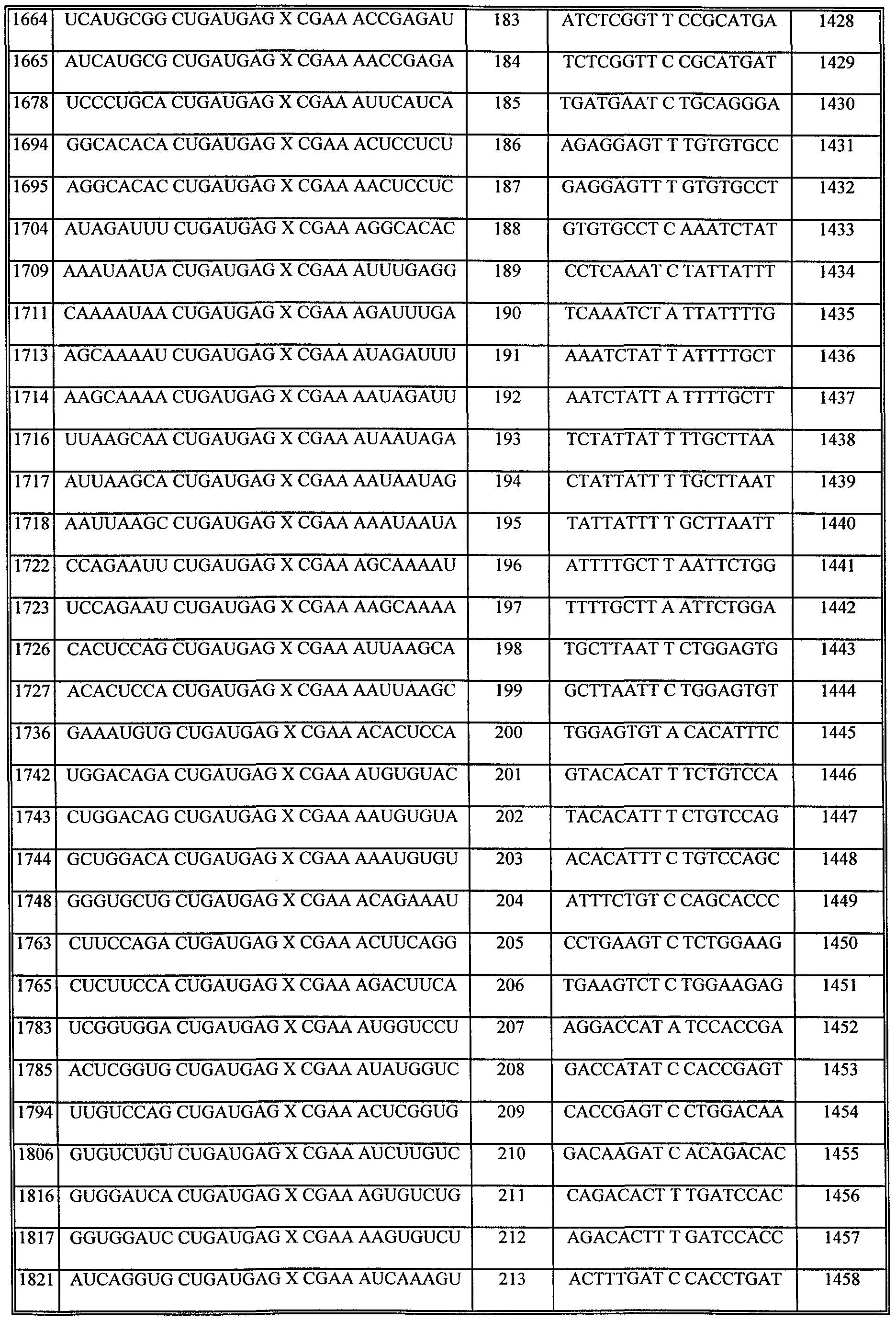


Claims


Priority Applications (4)
| Application Number | Priority Date | Filing Date | Title |
|---|---|---|---|
| EP99919896A EP1071753A2 (en) | 1998-04-20 | 1999-04-19 | Nucleic acid molecules with novel chemical compositions capable of modulating gene expression |
| CA002326823A CA2326823A1 (en) | 1998-04-20 | 1999-04-19 | Nucleic acid molecules with novel chemical compositions capable of modulating gene expression |
| JP2000544791A JP2003525017A (en) | 1998-04-20 | 1999-04-19 | Nucleic acid molecules with novel chemical composition that can regulate gene expression |
| AU37512/99A AU3751299A (en) | 1998-04-20 | 1999-04-19 | Nucleic acid molecules with novel chemical compositions capable of modulating gene expression |
Applications Claiming Priority (4)
| Application Number | Priority Date | Filing Date | Title |
|---|---|---|---|
| US8240498P | 1998-04-20 | 1998-04-20 | |
| US60/082,404 | 1998-04-20 | ||
| US10363698A | 1998-06-23 | 1998-06-23 | |
| US09/103,636 | 1998-06-23 |
Publications (2)
| Publication Number | Publication Date |
|---|---|
| WO1999054459A2 true WO1999054459A2 (en) | 1999-10-28 |
| WO1999054459A8 WO1999054459A8 (en) | 2000-02-03 |
Family
ID=26767418
Family Applications (1)
| Application Number | Title | Priority Date | Filing Date |
|---|---|---|---|
| PCT/US1999/008547 Ceased WO1999054459A2 (en) | 1998-04-20 | 1999-04-19 | Nucleic acid molecules with novel chemical compositions capable of modulating gene expression |
Country Status (6)
| Country | Link |
|---|---|
| US (2) | US6673611B2 (en) |
| EP (1) | EP1071753A2 (en) |
| JP (2) | JP2003525017A (en) |
| AU (1) | AU3751299A (en) |
| CA (1) | CA2326823A1 (en) |
| WO (1) | WO1999054459A2 (en) |
Cited By (132)
| Publication number | Priority date | Publication date | Assignee | Title |
|---|---|---|---|---|
| WO2000017346A3 (en) * | 1998-09-21 | 2000-08-03 | Ribozyme Pharm Inc | Hairpin hybridizer molecules for modulation of gene expression |
| WO2000074485A1 (en) * | 1999-06-04 | 2000-12-14 | The Board Of Regents The University Of Texas | Estrogen receptor site-specific ribozymes and uses thereof for estrogen dependent tumors |
| WO2001059102A3 (en) * | 2000-02-08 | 2002-04-25 | Ronald Breaker | Nucleozymes with endonuclease activity |
| WO2001057206A3 (en) * | 2000-02-03 | 2002-08-29 | Ribozyme Pharm Inc | Method and reagent for the inhibition of checkpoint kinase-1 (chk 1) enzyme |
| WO2001088124A3 (en) * | 2000-05-16 | 2003-01-23 | Ribozyme Pharm Inc | Method and reagent for the inhibition of erg |
| EP1325955A1 (en) * | 2002-01-04 | 2003-07-09 | atugen AG | Compounds and methods for the identification and/or validation of a target |
| US6617162B2 (en) | 2001-12-18 | 2003-09-09 | Isis Pharmaceuticals, Inc. | Antisense modulation of estrogen receptor alpha expression |
| US6673611B2 (en) | 1998-04-20 | 2004-01-06 | Sirna Therapeutics, Inc. | Nucleic acid molecules with novel chemical compositions capable of modulating gene expression |
| US6831171B2 (en) | 2000-02-08 | 2004-12-14 | Yale University | Nucleic acid catalysts with endonuclease activity |
| WO2005014782A2 (en) | 2003-06-13 | 2005-02-17 | Alnylam Europe Ag., | Double-stranded ribonucleic acid with increased effectiveness in an organism |
| US6995259B1 (en) | 1998-10-23 | 2006-02-07 | Sirna Therapeutics, Inc. | Method for the chemical synthesis of oligonucleotides |
| WO2006021893A2 (en) | 2004-08-26 | 2006-03-02 | The University Of Western Ontario | Pharmaceutical compositions comprising inhibitors of iron transport, and method of identifying iron transport inhibitors, fn staphylococcus aureus |
| US7022828B2 (en) | 2001-04-05 | 2006-04-04 | Sirna Theraputics, Inc. | siRNA treatment of diseases or conditions related to levels of IKK-gamma |
| US7071311B2 (en) | 2002-02-13 | 2006-07-04 | Sirna Therapeutics, Inc. | Antibodies having specificity for 2′-C-allyl nucleic acids |
| US7109165B2 (en) | 2001-05-18 | 2006-09-19 | Sirna Therapeutics, Inc. | Conjugates and compositions for cellular delivery |
| US7176304B2 (en) | 2002-02-20 | 2007-02-13 | Mcswiggen James | RNA interference mediated inhibition of vascular endothelial growth factor and vascular endothelial growth factor receptor gene expression using short interfering nucleic acid (siNA) |
| US7179593B1 (en) | 1999-06-04 | 2007-02-20 | Board Of Regents, The University Of Texas System | Estrogen receptor site-specific ribozymes and uses thereof for estrogen dependent tumors |
| US7205399B1 (en) | 2001-07-06 | 2007-04-17 | Sirna Therapeutics, Inc. | Methods and reagents for oligonucleotide synthesis |
| US7235534B2 (en) * | 2001-12-21 | 2007-06-26 | Institut De Cardiologie De Montreal | Antisense strategy to modulate estrogen receptor response (ER α and/or ER β ) |
| WO2008060776A2 (en) | 2006-10-03 | 2008-05-22 | University Of Medicine And Dentistry Of New Jersey | Atap peptides, nucleic acids encoding the same and associated methods of use |
| US7423142B2 (en) * | 2001-01-09 | 2008-09-09 | Alnylam Pharmaceuticals, Inc. | Compositions and methods for inhibiting expression of anti-apoptotic genes |
| WO2008137758A2 (en) | 2007-05-04 | 2008-11-13 | Mdrna, Inc. | Amino acid lipids and uses thereof |
| US7491805B2 (en) | 2001-05-18 | 2009-02-17 | Sirna Therapeutics, Inc. | Conjugates and compositions for cellular delivery |
| EP2042510A2 (en) | 2002-02-20 | 2009-04-01 | Sirna Therapeutics Inc. | RNA interference mediated inhibition of gene expression using chemically modified short interfering nucleid acid (siNA) |
| EP2055310A1 (en) | 2002-08-14 | 2009-05-06 | Silence Therapeutics Aktiengesellschaft | Further use of protein kinase N beta |
| WO2009058881A1 (en) * | 2007-10-29 | 2009-05-07 | The University Of California | Osteoarthritis gene therapy |
| EP2072619A1 (en) | 2002-10-18 | 2009-06-24 | Silence Therapeutics Aktiengesellschaft | Factor involved in metastasis and uses thereof |
| WO2009123764A2 (en) | 2008-04-04 | 2009-10-08 | Calando Pharmaceuticals, Inc. | Compositions and use of epas1 inhibitors |
| WO2009155100A1 (en) | 2008-05-30 | 2009-12-23 | Yale University | Targeted oligonucleotide compositions for modifying gene expression |
| US7655790B2 (en) | 2002-07-12 | 2010-02-02 | Sirna Therapeutics, Inc. | Deprotection and purification of oligonucleotides and their derivatives |
| US7745610B2 (en) | 2002-11-14 | 2010-06-29 | Dharmacon, Inc. | siRNA targeting cyclin dependent kinase 11 (CDK11) |
| US7767802B2 (en) | 2001-01-09 | 2010-08-03 | Alnylam Pharmaceuticals, Inc. | Compositions and methods for inhibiting expression of anti-apoptotic genes |
| WO2010091878A2 (en) | 2009-02-13 | 2010-08-19 | Silence Therapeutics Ag | Means for inhibiting the expression of opa1 |
| WO2010094491A1 (en) | 2009-02-18 | 2010-08-26 | Silence Therapeutics Ag | Means for inhibiting the expression of ang2 |
| WO2010107955A2 (en) | 2009-03-19 | 2010-09-23 | Merck Sharp & Dohme Corp. | RNA INTERFERENCE MEDIATED INHIBITION OF BTB AND CNC HOMOLOGY 1, BASIC LEUCINE ZIPPER TRANSCRIPTION FACTOR 1 (BACH 1) GENE EXPRESSION USING SHORT INTERFERING NUCLEIC ACID (siNA) SEQUENCE LISTING |
| WO2010107952A2 (en) | 2009-03-19 | 2010-09-23 | Merck Sharp & Dohme Corp. | RNA INTERFERENCE MEDIATED INHIBITION OF CONNECTIVE TISSUE GROWTH FACTOR (CTGF) GENE EXPRESSION USING SHORT INTERFERING NUCLEIC ACID (siNA) |
| WO2010107957A2 (en) | 2009-03-19 | 2010-09-23 | Merck Sharp & Dohme Corp. | RNA INTERFERENCE MEDIATED INHIBITION OF GATA BINDING PROTEIN 3 (GATA3) GENE EXPRESSION USING SHORT INTERFERING NUCLEIC ACID (siNA) |
| WO2010107958A1 (en) | 2009-03-19 | 2010-09-23 | Merck Sharp & Dohme Corp. | RNA INTERFERENCE MEDIATED INHIBITION OF SIGNAL TRANSDUCER AND ACTIVATOR OF TRANSCRIPTION 6 (STAT6) GENE EXPRESSION USING SHORT INTERFERING NUCLEIC ACID (siNA) |
| WO2010111490A2 (en) | 2009-03-27 | 2010-09-30 | Merck Sharp & Dohme Corp. | RNA INTERFERENCE MEDIATED INHIBITION OF THE THYMIC STROMAL LYMPHOPOIETIN (TSLP) GENE EXPRESSION USING SHORT INTERFERING NUCLEIC ACID (siNA) |
| WO2010111471A2 (en) | 2009-03-27 | 2010-09-30 | Merck Sharp & Dohme Corp. | RNA INTERFERENCE MEDIATED INHIBITION OF SIGNAL TRANSDUCER AND ACTIVATOR OF TRANSCRIPTION 1 (STAT1) GENE EXPRESSION USING SHORT INTERFERING NUCLEIC ACID (siNA) |
| WO2010111497A2 (en) | 2009-03-27 | 2010-09-30 | Merck Sharp & Dohme Corp. | RNA INTERFERENCE MEDIATED INHIBITION OF THE INTERCELLULAR ADHESION MOLECULE 1 (ICAM-1)GENE EXPRESSION USING SHORT INTERFERING NUCLEIC ACID (siNA) |
| WO2010111464A1 (en) | 2009-03-27 | 2010-09-30 | Merck Sharp & Dohme Corp. | RNA INTERFERENCE MEDIATED INHIBITION OF APOPTOSIS SIGNAL-REGULATING KINASE 1 (ASK1) GENE EXPRESSION USING SHORT INTERFERING NUCLEIC ACID (siNA) |
| WO2010111468A2 (en) | 2009-03-27 | 2010-09-30 | Merck Sharp & Dohme Corp. | RNA INTERFERENCE MEDIATED INHIBITION OF THE NERVE GROWTH FACTOR BETA CHAIN (NGFß) GENE EXPRESSION USING SHORT INTERFERING NUCLEIC ACID (SINA) |
| WO2010115993A1 (en) | 2009-04-10 | 2010-10-14 | Association Institut De Myologie | Tricyclo-dna antisense oligonucleotides, compositions, and methods for the treatment of disease |
| US7833992B2 (en) | 2001-05-18 | 2010-11-16 | Merck Sharpe & Dohme | Conjugates and compositions for cellular delivery |
| JP2010268815A (en) * | 2000-04-26 | 2010-12-02 | Masafumi Matsuo | Medicament for treatment of duchenne muscular dystrophy |
| WO2011031600A1 (en) | 2009-09-10 | 2011-03-17 | Schering Corporation | Use of il-33 antagonists to treat fibrotic disease |
| US7923547B2 (en) | 2002-09-05 | 2011-04-12 | Sirna Therapeutics, Inc. | RNA interference mediated inhibition of gene expression using chemically modified short interfering nucleic acid (siNA) |
| WO2011084357A1 (en) | 2009-12-17 | 2011-07-14 | Schering Corporation | Modulation of pilr to treat immune disorders |
| EP2360249A1 (en) | 2005-03-31 | 2011-08-24 | Calando Pharmaceuticals, Inc. | Inhibitors of ribonucleotide reductase subunit 2 and uses thereof |
| EP2365077A1 (en) | 2004-03-12 | 2011-09-14 | Alnylam Pharmaceuticals, Inc. | iRNA agents targeting VEGF |
| WO2011119881A1 (en) | 2010-03-24 | 2011-09-29 | Northeastern University | Multi-compartmental macrophage delivery |
| WO2011120023A1 (en) | 2010-03-26 | 2011-09-29 | Marina Biotech, Inc. | Nucleic acid compounds for inhibiting survivin gene expression uses thereof |
| WO2011133584A2 (en) | 2010-04-19 | 2011-10-27 | Marina Biotech, Inc. | Nucleic acid compounds for inhibiting hras gene expression and uses thereof |
| WO2011139843A2 (en) | 2010-04-28 | 2011-11-10 | Marina Biotech, Inc. | Multi-sirna compositions for reducing gene expression |
| WO2011139710A1 (en) | 2010-04-26 | 2011-11-10 | Marina Biotech, Inc. | Nucleic acid compounds with conformationally restricted monomers and uses thereof |
| EP2399924A2 (en) | 2004-05-27 | 2011-12-28 | Alnylam Pharmaceuticals, Inc. | Nuclease resistant double-stranded ribonucleic acid |
| EP2415486A2 (en) | 2001-05-18 | 2012-02-08 | Sirna Therapeutics, Inc. | Conjugates and compositions for cellular delivery |
| WO2012017208A1 (en) | 2010-08-04 | 2012-02-09 | Cizzle Biotechnology Limited | Methods and compounds for the diagnosis and treatment of |
| WO2012018754A2 (en) | 2010-08-02 | 2012-02-09 | Merck Sharp & Dohme Corp. | RNA INTERFERENCE MEDIATED INHIBITION OF CATENIN (CADHERIN-ASSOCIATED PROTEIN), BETA 1 (CTNNB1) GENE EXPRESSION USING SHORT INTERFERING NUCLEIC ACID (siNA) |
| WO2012027467A1 (en) | 2010-08-26 | 2012-03-01 | Merck Sharp & Dohme Corp. | RNA INTERFERENCE MEDIATED INHIBITION OF PROLYL HYDROXYLASE DOMAIN 2 (PHD2) GENE EXPRESSION USING SHORT INTERFERING NUCLEIC ACID (siNA) |
| WO2012027206A1 (en) | 2010-08-24 | 2012-03-01 | Merck Sharp & Dohme Corp. | SINGLE-STRANDED RNAi AGENTS CONTAINING AN INTERNAL, NON-NUCLEIC ACID SPACER |
| WO2012058210A1 (en) | 2010-10-29 | 2012-05-03 | Merck Sharp & Dohme Corp. | RNA INTERFERENCE MEDIATED INHIBITION OF GENE EXPRESSION USING SHORT INTERFERING NUCLEIC ACIDS (siNA) |
| US8202979B2 (en) | 2002-02-20 | 2012-06-19 | Sirna Therapeutics, Inc. | RNA interference mediated inhibition of gene expression using chemically modified short interfering nucleic acid |
| EP2471815A1 (en) | 2006-07-11 | 2012-07-04 | University Of Medicine And Dentistry Of New Jersey | Proteins, nucleic acids encoding the same and associated methods of use |
| WO2012097093A2 (en) | 2011-01-11 | 2012-07-19 | Fate Therapeutics, Inc. | Novel wnt compositions and therapeutic uses of such compositions |
| US8273866B2 (en) | 2002-02-20 | 2012-09-25 | Merck Sharp & Dohme Corp. | RNA interference mediated inhibition of gene expression using chemically modified short interfering nucleic acid (SINA) |
| US8283328B2 (en) | 2002-08-19 | 2012-10-09 | Coley Pharmaceutical Group, Inc. | Immunostimulatory nucleic acids |
| US8299236B2 (en) | 2004-05-04 | 2012-10-30 | Marina Biotech, Inc. | Compositions and methods for enhancing delivery of nucleic acids into cells and for modifying expression of target genes in cells |
| US8329667B2 (en) | 2004-04-23 | 2012-12-11 | The Trustees Of Columbia University In The City Of New York | Inhibition of hairless protein mRNA |
| US8329463B2 (en) | 2000-12-01 | 2012-12-11 | MAX-PLANCK-Gesellschaft zur Förderung der Wissenschaften e.V. | RNA interference mediating small RNA molecules |
| EP2546337A1 (en) | 2006-07-21 | 2013-01-16 | Silence Therapeutics AG | Means for inhibiting the expression of protein kinase 3 |
| US8394628B2 (en) | 2000-03-30 | 2013-03-12 | University Of Massachusetts | RNA sequence-specific mediators of RNA interference |
| WO2013036868A1 (en) | 2011-09-07 | 2013-03-14 | Marina Biotech Inc. | Synthesis and uses of nucleic acid compounds with conformationally restricted monomers |
| US8476245B2 (en) | 2004-02-11 | 2013-07-02 | University Of Tennessee Research Foundation | Inhibition of tumor growth and invasion by anti matrix metalloproteinase DNAzymes |
| WO2013124324A1 (en) | 2012-02-21 | 2013-08-29 | Institut National De La Sante Et De La Recherche Medicale (Inserm) | Tam receptors as virus entry cofactors |
| WO2013123996A1 (en) | 2012-02-24 | 2013-08-29 | Astrazeneca Uk Limited | Novel sirna inhibitors of human icam-1 |
| WO2013124327A1 (en) | 2012-02-21 | 2013-08-29 | Institut National De La Sante Et De La Recherche Medicale (Inserm) | Tim receptors as virus entry cofactors |
| WO2013165816A2 (en) | 2012-05-02 | 2013-11-07 | Merck Sharp & Dohme Corp. | SHORT INTERFERING NUCLEIC ACID (siNA) COMPOSITIONS |
| WO2014016152A1 (en) | 2012-07-27 | 2014-01-30 | Institut National De La Sante Et De La Recherche Medicale | Cd147 as receptor for pilus-mediated adhesion of meningococci to vascular endothelia |
| US8785409B2 (en) | 2007-01-30 | 2014-07-22 | Geron Corporation | Compounds having anti-adhesive effects on cancer cells |
| JP2014198056A (en) * | 2002-03-12 | 2014-10-23 | エンゾ ライフ サイエンシズ、インコーポレイテッド | Real-time nucleic acid detection processes and compositions |
| EP2853595A1 (en) | 2013-09-30 | 2015-04-01 | Soluventis GmbH | NOTCH 1 specific siRNA molecules |
| EP2902013A1 (en) | 2008-10-16 | 2015-08-05 | Marina Biotech, Inc. | Processes and Compositions for Liposomal and Efficient Delivery of Gene Silencing Therapeutics |
| US9181551B2 (en) | 2002-02-20 | 2015-11-10 | Sirna Therapeutics, Inc. | RNA interference mediated inhibition of gene expression using chemically modified short interfering nucleic acid (siNA) |
| US9228186B2 (en) | 2002-11-14 | 2016-01-05 | Thermo Fisher Scientific Inc. | Methods and compositions for selecting siRNA of improved functionality |
| WO2016027263A2 (en) | 2014-08-21 | 2016-02-25 | Omrix Biopharmaceuticals Ltd. | Stabilized thrombin |
| US9271932B2 (en) | 2006-04-28 | 2016-03-01 | Children's Hospital Medical Center | Fusogenic properties of saposin C and related proteins and peptides for application to transmembrane drug delivery systems |
| WO2016083624A1 (en) | 2014-11-28 | 2016-06-02 | Silence Therapeutics Gmbh | Means for inhibiting the expression of edn1 |
| EP3040081A2 (en) | 2002-08-14 | 2016-07-06 | Silence Therapeutics GmbH | Use of protein kinase n beta |
| WO2016176745A1 (en) | 2015-05-06 | 2016-11-10 | Benitec Biopharma Limited | Reagents for treatment of hepatitis b virus (hbv) infection and use thereof |
| US9657294B2 (en) | 2002-02-20 | 2017-05-23 | Sirna Therapeutics, Inc. | RNA interference mediated inhibition of gene expression using chemically modified short interfering nucleic acid (siNA) |
| US9714446B2 (en) | 2010-02-11 | 2017-07-25 | Nanostring Technologies, Inc. | Compositions and methods for the detection of small RNAs |
| EP3222294A1 (en) | 2003-04-30 | 2017-09-27 | Sirna Therapeutics, Inc. | Conjugates and compositions for cellular delivery |
| EP3228326A1 (en) | 2016-04-05 | 2017-10-11 | Silence Therapeutics GmbH | Nucleic acid linked to a trivalent glycoconjugate |
| US9839649B2 (en) | 2002-11-14 | 2017-12-12 | Thermo Fisher Scientific Inc. | Methods and compositions for selecting siRNA of improved functionality |
| EP1857547B1 (en) | 2002-08-05 | 2018-01-17 | Silence Therapeutics GmbH | Further novel forms of interfering RNA molecules |
| US9879266B2 (en) | 2002-11-14 | 2018-01-30 | Thermo Fisher Scientific Inc. | Methods and compositions for selecting siRNA of improved functionality |
| US9885036B2 (en) | 2008-07-01 | 2018-02-06 | Daiichi Sankyo Company, Limited | Double-stranded polynucleotide |
| US9902955B2 (en) | 1999-01-30 | 2018-02-27 | Alnylam Pharmaceuticals, Inc. | Method and medicament for inhibiting the expression of a given gene |
| WO2018057575A1 (en) | 2016-09-21 | 2018-03-29 | Alnylam Pharmaceuticals, Inc | Myostatin irna compositions and methods of use thereof |
| US9994853B2 (en) | 2001-05-18 | 2018-06-12 | Sirna Therapeutics, Inc. | Chemically modified multifunctional short interfering nucleic acid molecules that mediate RNA interference |
| US10011836B2 (en) | 2002-11-14 | 2018-07-03 | Thermo Fisher Scientific Inc. | Methods and compositions for selecting siRNA of improved functionality |
| EP3385272A1 (en) | 2017-04-05 | 2018-10-10 | Silence Therapeutics GmbH | Further novel oligonucleotide-ligand conjugates |
| WO2018185253A1 (en) | 2017-04-05 | 2018-10-11 | Silence Therapeutics Gmbh | Ligand modified double-stranded nucleic acids |
| WO2018185252A1 (en) | 2017-04-05 | 2018-10-11 | Silence Therapeutics Gmbh | Nucleic acid conjugates |
| US10144957B2 (en) | 2002-03-12 | 2018-12-04 | Enzo Life Sciences, Inc. | Optimized real time nucleic acid detection processes |
| WO2019170731A1 (en) | 2018-03-07 | 2019-09-12 | Sanofi | Nucleotide precursors, nucleotide analogs and oligomeric compounds containing the same |
| EP3549610A1 (en) | 2018-04-05 | 2019-10-09 | Silence Therapeutics GmbH | Nucleic acid conjugates |
| WO2019217459A1 (en) | 2018-05-07 | 2019-11-14 | Alnylam Pharmaceuticals, Inc. | Extrahepatic delivery |
| US10508277B2 (en) | 2004-05-24 | 2019-12-17 | Sirna Therapeutics, Inc. | Chemically modified multifunctional short interfering nucleic acid molecules that mediate RNA interference |
| WO2020069055A1 (en) | 2018-09-28 | 2020-04-02 | Alnylam Pharmaceuticals, Inc. | Transthyretin (ttr) irna compositions and methods of use thereof for treating or preventing ttr-associated ocular diseases |
| EP2351852B2 (en) † | 2000-12-01 | 2020-07-01 | Max-Planck-Gesellschaft zur Förderung der Wissenschaften e.V. | RNA interference mediating small RNA molecules |
| WO2021044004A1 (en) | 2019-09-05 | 2021-03-11 | Sanofi | Oligonucleotides containing nucleotide analogs |
| WO2021092145A1 (en) | 2019-11-06 | 2021-05-14 | Alnylam Pharmaceuticals, Inc. | Transthyretin (ttr) irna composition and methods of use thereof for treating or preventing ttr-associated ocular diseases |
| WO2021092371A2 (en) | 2019-11-06 | 2021-05-14 | Alnylam Pharmaceuticals, Inc. | Extrahepatic delivery |
| WO2021178607A1 (en) | 2020-03-05 | 2021-09-10 | Alnylam Pharmaceuticals, Inc. | Complement component c3 irna compositions and methods of use thereof for treating or preventing complement component c3-associated diseases |
| WO2022084331A2 (en) | 2020-10-20 | 2022-04-28 | Sanofi | Novel ligands for asialoglycoprotein receptor |
| WO2022147223A2 (en) | 2020-12-31 | 2022-07-07 | Alnylam Pharmaceuticals, Inc. | 2'-modified nucleoside based oligonucleotide prodrugs |
| WO2022147214A2 (en) | 2020-12-31 | 2022-07-07 | Alnylam Pharmaceuticals, Inc. | Cyclic-disulfide modified phosphate based oligonucleotide prodrugs |
| EP4079856A1 (en) | 2010-08-17 | 2022-10-26 | Sirna Therapeutics, Inc. | Rna interference mediated inhibition of hepatitis b virus (hbv) gene expression using short interfering nucleic acid (sina) |
| WO2023003922A1 (en) | 2021-07-21 | 2023-01-26 | Alnylam Pharmaceuticals, Inc. | Metabolic disorder-associated target gene irna compositions and methods of use thereof |
| WO2023064530A1 (en) | 2021-10-15 | 2023-04-20 | Alnylam Pharmaceuticals, Inc. | Extra-hepatic delivery irna compositions and methods of use thereof |
| WO2023069987A1 (en) | 2021-10-20 | 2023-04-27 | University Of Rochester | Rejuvenation treatment of age-related white matter loss cross reference to related application |
| WO2024006999A2 (en) | 2022-06-30 | 2024-01-04 | Alnylam Pharmaceuticals, Inc. | Cyclic-disulfide modified phosphate based oligonucleotide prodrugs |
| WO2024073732A1 (en) | 2022-09-30 | 2024-04-04 | Alnylam Pharmaceuticals, Inc. | Modified double-stranded rna agents |
| WO2024216155A1 (en) | 2023-04-12 | 2024-10-17 | Alnylam Pharmaceuticals, Inc. | Extrahepatic delivery of double-stranded rna agents |
| WO2025021833A1 (en) | 2023-07-24 | 2025-01-30 | Astrazeneca Ab | Multivalent cargo-carrying complexes and uses thereof |
| WO2025021831A1 (en) | 2023-07-24 | 2025-01-30 | Astrazeneca Ab | Multivalent cargo-carrying complexes and uses thereof |
| WO2025021829A1 (en) | 2023-07-24 | 2025-01-30 | Astrazeneca Ab | Multivalent cargo-carrying complexes and uses thereof |
| WO2025064660A2 (en) | 2023-09-21 | 2025-03-27 | Alnylam Pharmaceuticals, Inc. | Activin a receptor type 1c (acvr1c) irna compositions and methods of use thereof |
| WO2025090427A1 (en) | 2023-10-23 | 2025-05-01 | University Of Rochester | Glial-targeted relief of hyperexcitability in neurodegenerative diseases |
Families Citing this family (144)
| Publication number | Priority date | Publication date | Assignee | Title |
|---|---|---|---|---|
| US7812149B2 (en) * | 1996-06-06 | 2010-10-12 | Isis Pharmaceuticals, Inc. | 2′-Fluoro substituted oligomeric compounds and compositions for use in gene modulations |
| US20050119470A1 (en) * | 1996-06-06 | 2005-06-02 | Muthiah Manoharan | Conjugated oligomeric compounds and their use in gene modulation |
| US5898031A (en) * | 1996-06-06 | 1999-04-27 | Isis Pharmaceuticals, Inc. | Oligoribonucleotides for cleaving RNA |
| US20050053976A1 (en) * | 1996-06-06 | 2005-03-10 | Baker Brenda F. | Chimeric oligomeric compounds and their use in gene modulation |
| US20080119427A1 (en) * | 1996-06-06 | 2008-05-22 | Isis Pharmaceuticals, Inc. | Double Strand Compositions Comprising Differentially Modified Strands for Use in Gene Modulation |
| US20040171031A1 (en) * | 1996-06-06 | 2004-09-02 | Baker Brenda F. | Sugar surrogate-containing oligomeric compounds and compositions for use in gene modulation |
| US9096636B2 (en) | 1996-06-06 | 2015-08-04 | Isis Pharmaceuticals, Inc. | Chimeric oligomeric compounds and their use in gene modulation |
| US20040147022A1 (en) * | 1996-06-06 | 2004-07-29 | Baker Brenda F. | 2'-methoxy substituted oligomeric compounds and compositions for use in gene modulations |
| US20040203024A1 (en) * | 1996-06-06 | 2004-10-14 | Baker Brenda F. | Modified oligonucleotides for use in RNA interference |
| US7517864B2 (en) | 2001-05-18 | 2009-04-14 | Sirna Therapeutics, Inc. | RNA interference mediated inhibition of vascular endothelial growth factor and vascular endothelial growth factor receptor gene expression using short interfering nucleic acid (siNA) |
| IL159722A0 (en) * | 2001-07-10 | 2004-06-20 | Oligos Etc Inc | Pharmaceutical compositions containing oligonucleotides |
| DE60216798T2 (en) * | 2001-10-29 | 2007-10-18 | Mcgill University, Montreal | AZYCLIC LINKER-CONTAINING OLIGONUCLEOTIDES AND ITS USES |
| US20060009409A1 (en) | 2002-02-01 | 2006-01-12 | Woolf Tod M | Double-stranded oligonucleotides |
| EP3415625A1 (en) | 2002-02-01 | 2018-12-19 | Life Technologies Corporation | Double-stranded oligonucleotides |
| WO2003064621A2 (en) * | 2002-02-01 | 2003-08-07 | Ambion, Inc. | HIGH POTENCY siRNAS FOR REDUCING THE EXPRESSION OF TARGET GENES |
| US20090137510A1 (en) * | 2002-02-20 | 2009-05-28 | Sirna Therapeutics, Inc. | RNA INTERFERENCE MEDIATED INHIBITION OF NF-KAPPA B/ REL-A GENE EXPRESSION USING SHORT INTERFERING NUCLEIC ACID (siNA) |
| US8258288B2 (en) * | 2002-02-20 | 2012-09-04 | Sirna Therapeutics, Inc. | RNA interference mediated inhibition of respiratory syncytial virus (RSV) expression using short interfering nucleic acid (siNA) |
| US20040248094A1 (en) * | 2002-06-12 | 2004-12-09 | Ford Lance P. | Methods and compositions relating to labeled RNA molecules that reduce gene expression |
| AU2003276666A1 (en) * | 2002-06-12 | 2003-12-31 | Ambion, Inc. | Methods and compositions relating to polypeptides with rnase iii domains that mediate rna interference |
| US20100075423A1 (en) * | 2002-06-12 | 2010-03-25 | Life Technologies Corporation | Methods and compositions relating to polypeptides with rnase iii domains that mediate rna interference |
| US20040029275A1 (en) * | 2002-08-10 | 2004-02-12 | David Brown | Methods and compositions for reducing target gene expression using cocktails of siRNAs or constructs expressing siRNAs |
| WO2004043979A2 (en) * | 2002-11-05 | 2004-05-27 | Isis Pharmaceuticals, Inc. | Sugar surrogate-containing oligomeric compounds and compositions for use in gene modulation |
| US20050048641A1 (en) * | 2002-11-26 | 2005-03-03 | Medtronic, Inc. | System and method for delivering polynucleotides to the central nervous system |
| US20040198640A1 (en) * | 2003-04-02 | 2004-10-07 | Dharmacon, Inc. | Stabilized polynucleotides for use in RNA interference |
| US20050020526A1 (en) * | 2003-06-03 | 2005-01-27 | Cytogenix, Inc. | Oligodeoxynucleotide intervention for prevention and treatment of sepsis |
| US20060241072A1 (en) * | 2003-06-20 | 2006-10-26 | Isis Pharmaceuticals, Inc. | Oligomeric compounds for use in gene modulation |
| EP1793674B1 (en) * | 2003-11-26 | 2018-05-30 | University of Massachusetts | Sequence-specific inhibtion of small rna function |
| US20090280567A1 (en) * | 2004-02-06 | 2009-11-12 | Dharmacon, Inc. | Stabilized sirnas as transfection controls and silencing reagents |
| EP2123759B1 (en) * | 2004-02-06 | 2014-01-15 | Thermo Fisher Scientific Biosciences Inc. | Stabilized RNAS as transfection controls and silencing reagents |
| US8569474B2 (en) * | 2004-03-09 | 2013-10-29 | Isis Pharmaceuticals, Inc. | Double stranded constructs comprising one or more short strands hybridized to a longer strand |
| US7109173B1 (en) | 2004-03-16 | 2006-09-19 | Wilbert Gamble | Transport of nucleotides, oligonucleotides and polynucleotides into the cytoplasm and nucleus of cells by peptides |
| KR101147147B1 (en) * | 2004-04-01 | 2012-05-25 | 머크 샤프 앤드 돔 코포레이션 | Modified polynucleotides for reducing off-target effects in rna interference |
| JP2007531794A (en) * | 2004-04-05 | 2007-11-08 | アルニラム ファーマスーティカルズ インコーポレイテッド | Methods and reagents used for oligonucleotide synthesis and purification |
| WO2006078278A2 (en) | 2004-04-27 | 2006-07-27 | Alnylam Pharmaceuticals, Inc. | Single-stranded and double-stranded oligonucleotides comprising a 2-arylpropyl moiety |
| CA2562151C (en) * | 2004-04-30 | 2016-09-06 | Alnylam Pharmaceuticals, Inc. | Oligonucleotides comprising a c5-modified pyrimidine |
| EP2290073A3 (en) | 2004-05-28 | 2011-08-31 | Asuragen, Inc. | Methods and compositions involving microRNA |
| US8394947B2 (en) * | 2004-06-03 | 2013-03-12 | Isis Pharmaceuticals, Inc. | Positionally modified siRNA constructs |
| JP2008504840A (en) * | 2004-06-30 | 2008-02-21 | アルニラム ファーマスーティカルズ インコーポレイテッド | Oligonucleotides containing non-phosphate backbone bonds |
| WO2006093526A2 (en) | 2004-07-21 | 2006-09-08 | Alnylam Pharmaceuticals, Inc. | Oligonucleotides comprising a modified or non-natural nucleobase |
| CA2574603C (en) | 2004-08-04 | 2014-11-04 | Alnylam Pharmaceuticals, Inc. | Oligonucleotides comprising a ligand tethered to a modified or non-natural nucleobase |
| JP2008512097A (en) * | 2004-09-07 | 2008-04-24 | アーケミックス コーポレイション | Aptamer medicinal chemistry |
| US7884086B2 (en) * | 2004-09-08 | 2011-02-08 | Isis Pharmaceuticals, Inc. | Conjugates for use in hepatocyte free uptake assays |
| US20070036740A1 (en) * | 2004-10-06 | 2007-02-15 | Reed Kenneth C | Modulation of hair growth |
| US20060115455A1 (en) * | 2004-10-22 | 2006-06-01 | Reed Kenneth C | Therapeutic RNAi agents for treating psoriasis |
| CA2857878A1 (en) | 2004-11-12 | 2006-12-28 | Asuragen, Inc. | Methods and compositions involving mirna and mirna inhibitor molecules |
| US7935811B2 (en) * | 2004-11-22 | 2011-05-03 | Dharmacon, Inc. | Apparatus and system having dry gene silencing compositions |
| US20060166234A1 (en) * | 2004-11-22 | 2006-07-27 | Barbara Robertson | Apparatus and system having dry control gene silencing compositions |
| US7923207B2 (en) | 2004-11-22 | 2011-04-12 | Dharmacon, Inc. | Apparatus and system having dry gene silencing pools |
| US20060142228A1 (en) * | 2004-12-23 | 2006-06-29 | Ambion, Inc. | Methods and compositions concerning siRNA's as mediators of RNA interference |
| EP1838853A2 (en) * | 2005-01-06 | 2007-10-03 | Benitec, Inc. | Rnai agents for maintenance of stem cells |
| WO2006113679A2 (en) * | 2005-04-15 | 2006-10-26 | Board Of Regents, The University Of Texas System | Delivery of sirna by neutral lipid compositions |
| US8999943B2 (en) * | 2005-03-14 | 2015-04-07 | Board Of Regents, The University Of Texas System | Antigene oligomers inhibit transcription |
| US20060223777A1 (en) * | 2005-03-29 | 2006-10-05 | Dharmacon, Inc. | Highly functional short hairpin RNA |
| WO2007014469A1 (en) * | 2005-08-01 | 2007-02-08 | Chu Sainte-Justine, Le Centre Hospitalier Universitaire Mere-Enfant | Hepatitis c antivirals |
| EP1945813A4 (en) * | 2005-10-11 | 2010-04-21 | Stratagene California | Binary signal detection assays |
| EP2641970B1 (en) | 2005-11-17 | 2014-12-24 | Board of Regents, The University of Texas System | Modulation of gene expression by oligomers targeted to chromosomal DNA |
| CA2663878A1 (en) * | 2006-09-19 | 2008-03-27 | Asuragen, Inc. | Mir-200 regulated genes and pathways as targets for therapeutic intervention |
| US8809514B2 (en) * | 2006-09-22 | 2014-08-19 | Ge Healthcare Dharmacon, Inc. | Tripartite oligonucleotide complexes and methods for gene silencing by RNA interference |
| WO2008060613A1 (en) | 2006-11-15 | 2008-05-22 | The J. David Gladstone Institutes | Methods and compositions for reducing amyloid beta levels |
| CN101663047B (en) | 2007-02-23 | 2014-07-09 | 纽约哥伦比亚大学理事会 | Method for treating immune diseases by activating or blocking HLA-E/Qa-1 restricted CD8+ T cell regulatory pathway |
| US8067390B2 (en) * | 2007-03-02 | 2011-11-29 | The Board Of Regents Of The University Of Texas System | Therapeutic targeting of interleukins using siRNA in neutral liposomes |
| US20090060889A1 (en) * | 2007-03-12 | 2009-03-05 | Von Hofe Eric | Ii-RNAi involved Ii suppression in cancer immunotherapy |
| US8699939B2 (en) * | 2008-12-19 | 2014-04-15 | Xerox Corporation | System and method for recommending educational resources |
| US8457544B2 (en) * | 2008-12-19 | 2013-06-04 | Xerox Corporation | System and method for recommending educational resources |
| US8725059B2 (en) * | 2007-05-16 | 2014-05-13 | Xerox Corporation | System and method for recommending educational resources |
| US20100159437A1 (en) * | 2008-12-19 | 2010-06-24 | Xerox Corporation | System and method for recommending educational resources |
| EP2198050A1 (en) | 2007-09-14 | 2010-06-23 | Asuragen, INC. | Micrornas differentially expressed in cervical cancer and uses thereof |
| WO2009046397A2 (en) * | 2007-10-04 | 2009-04-09 | Board Of Regents, The University Of Texas System | Modulating gene expression with agrna and gapmers targeting antisense transcripts |
| WO2009070805A2 (en) | 2007-12-01 | 2009-06-04 | Asuragen, Inc. | Mir-124 regulated genes and pathways as targets for therapeutic intervention |
| US7845686B2 (en) * | 2007-12-17 | 2010-12-07 | S & B Technical Products, Inc. | Restrained pipe joining system for plastic pipe |
| US8188060B2 (en) | 2008-02-11 | 2012-05-29 | Dharmacon, Inc. | Duplex oligonucleotides with enhanced functionality in gene regulation |
| EP2247729B1 (en) * | 2008-02-11 | 2019-05-01 | Phio Pharmaceuticals Corp. | Modified rnai polynucleotides and uses thereof |
| US8258111B2 (en) | 2008-05-08 | 2012-09-04 | The Johns Hopkins University | Compositions and methods related to miRNA modulation of neovascularization or angiogenesis |
| US8222221B2 (en) | 2008-06-04 | 2012-07-17 | The Board Of Regents Of The University Of Texas System | Modulation of gene expression through endogenous small RNA targeting of gene promoters |
| WO2010008582A2 (en) | 2008-07-18 | 2010-01-21 | Rxi Pharmaceuticals Corporation | Phagocytic cell drug delivery system |
| EP2340309A2 (en) | 2008-09-22 | 2011-07-06 | Rxi Pharmaceuticals Corporation | Neutral nanotransporters |
| US20100075290A1 (en) * | 2008-09-25 | 2010-03-25 | Xerox Corporation | Automatic Educational Assessment Service |
| US20100075292A1 (en) * | 2008-09-25 | 2010-03-25 | Deyoung Dennis C | Automatic education assessment service |
| US20100075291A1 (en) * | 2008-09-25 | 2010-03-25 | Deyoung Dennis C | Automatic educational assessment service |
| WO2010039801A2 (en) | 2008-10-02 | 2010-04-08 | The J. David Gladstone Institutes | Methods of treating hepatitis c virus infection |
| US9074211B2 (en) | 2008-11-19 | 2015-07-07 | Rxi Pharmaceuticals Corporation | Inhibition of MAP4K4 through RNAI |
| CA2745111A1 (en) | 2008-12-03 | 2010-06-10 | Research Development Foundation | Modulation of olfml-3 mediated angiogenesis |
| US20100157345A1 (en) * | 2008-12-22 | 2010-06-24 | Xerox Corporation | System for authoring educational assessments |
| US9493774B2 (en) | 2009-01-05 | 2016-11-15 | Rxi Pharmaceuticals Corporation | Inhibition of PCSK9 through RNAi |
| WO2010090762A1 (en) | 2009-02-04 | 2010-08-12 | Rxi Pharmaceuticals Corporation | Rna duplexes with single stranded phosphorothioate nucleotide regions for additional functionality |
| US20110045080A1 (en) * | 2009-03-24 | 2011-02-24 | William Marsh Rice University | Single-Walled Carbon Nanotube/Bioactive Substance Complexes and Methods Related Thereto |
| US8815586B2 (en) * | 2009-04-24 | 2014-08-26 | The Board Of Regents Of The University Of Texas System | Modulation of gene expression using oligomers that target gene regions downstream of 3′ untranslated regions |
| US20120128673A1 (en) | 2009-05-20 | 2012-05-24 | Schering Corporation | Modulation of pilr receptors to treat microbial infections |
| US8768241B2 (en) * | 2009-12-17 | 2014-07-01 | Xerox Corporation | System and method for representing digital assessments |
| US20110195389A1 (en) * | 2010-02-08 | 2011-08-11 | Xerox Corporation | System and method for tracking progression through an educational curriculum |
| EP2550000A4 (en) | 2010-03-24 | 2014-03-26 | Advirna Inc | Reduced size self-delivering rnai compounds |
| BR112012024049A2 (en) | 2010-03-24 | 2017-03-01 | Rxi Pharmaceuticals Corp | rna interference on dermal and fibrotic indications |
| CN106074591B (en) | 2010-03-24 | 2020-01-14 | 菲奥医药公司 | RNA interference in ocular symptoms |
| US8521077B2 (en) | 2010-07-21 | 2013-08-27 | Xerox Corporation | System and method for detecting unauthorized collaboration on educational assessments |
| US8831504B2 (en) | 2010-12-02 | 2014-09-09 | Xerox Corporation | System and method for generating individualized educational practice worksheets |
| WO2013040251A2 (en) | 2011-09-13 | 2013-03-21 | Asurgen, Inc. | Methods and compositions involving mir-135b for distinguishing pancreatic cancer from benign pancreatic disease |
| JP6129844B2 (en) | 2011-09-14 | 2017-05-17 | ラナ セラピューティクス インコーポレイテッド | Multimeric oligonucleotide compounds |
| EP2885313A4 (en) * | 2012-08-20 | 2016-03-09 | Univ California | POLYNUCLEOTIDES HAVING BIOREVERSIBLE GROUPS |
| CA2884608C (en) | 2012-09-14 | 2025-05-20 | Translate Bio Ma, Inc. | Multimeric oligonucleotide compounds |
| US9478146B2 (en) | 2013-03-04 | 2016-10-25 | Xerox Corporation | Method and system for capturing reading assessment data |
| AU2014302038B2 (en) | 2013-06-25 | 2019-11-14 | Epiaxis Therapeutics Pty Ltd | Methods and compositions for modulating cancer stem cells |
| JP6998657B2 (en) | 2013-09-18 | 2022-02-04 | エピアクシス セラピューティクス プロプライエタリー リミテッド | Stem cell regulation II |
| CN106061488B (en) | 2013-12-02 | 2021-04-09 | 菲奥医药公司 | Immunotherapy for Cancer |
| US11279934B2 (en) | 2014-04-28 | 2022-03-22 | Phio Pharmaceuticals Corp. | Methods for treating cancer using nucleic acids targeting MDM2 or MYCN |
| AU2015309686B2 (en) | 2014-08-25 | 2020-05-14 | Epiaxis Therapeutics Pty Ltd | Compositions for modulating cancer stem cells and uses therefor |
| KR102506169B1 (en) | 2014-09-05 | 2023-03-08 | 피오 파마슈티칼스 코프. | Methods for treating aging and skin disorders using nucleic acids targeting tyr or mmp1 |
| WO2016061131A1 (en) | 2014-10-14 | 2016-04-21 | The J. David Gladstone Institutes | Compositions and methods for reactivating latent immunodeficiency virus |
| EP3229842B1 (en) | 2014-12-08 | 2022-07-06 | The Board of Regents of The University of Texas System | Lipocationic polymers and uses thereof |
| CA3026154A1 (en) | 2015-06-03 | 2016-12-08 | The University Of Queensland | Mobilizing agents and uses therefor |
| US11001845B2 (en) | 2015-07-06 | 2021-05-11 | Phio Pharmaceuticals Corp. | Nucleic acid molecules targeting superoxide dismutase 1 (SOD1) |
| US10808247B2 (en) | 2015-07-06 | 2020-10-20 | Phio Pharmaceuticals Corp. | Methods for treating neurological disorders using a synergistic small molecule and nucleic acids therapeutic approach |
| WO2017023861A1 (en) | 2015-08-03 | 2017-02-09 | The Regents Of The University Of California | Compositions and methods for modulating abhd2 activity |
| CN108271360B (en) | 2015-09-14 | 2023-01-24 | 得克萨斯州大学系统董事会 | Lipophilic cationic dendrimers and uses thereof |
| CN109563509B (en) | 2015-10-19 | 2022-08-09 | 菲奥医药公司 | Reduced size self-delivering nucleic acid compounds targeting long non-coding RNAs |
| KR102775461B1 (en) | 2016-04-01 | 2025-02-28 | 어비디티 바이오사이언시스 인크. | Nucleic acid-polypeptide compositions and uses thereof |
| MA45340A (en) * | 2016-04-01 | 2019-02-06 | Avidity Biosciences Llc | ANDROGEN RECEPTOR NUCLEIC ACIDS AND THEIR USES |
| MA45469A (en) | 2016-04-01 | 2019-02-06 | Avidity Biosciences Llc | BETA-CATENIN NUCLEIC ACIDS AND THEIR USES |
| WO2017173325A1 (en) * | 2016-04-01 | 2017-10-05 | Avidity Biosciences Llc | Phosphatidylinositol-3-kinase nucleic acids and uses thereof |
| US10858656B2 (en) | 2016-04-01 | 2020-12-08 | Avidity Biosciences, Inc. | KRAS nucleic acids and uses thereof |
| US20170283476A1 (en) * | 2016-04-01 | 2017-10-05 | Avidity Biosciences Llc | Myc nucleic acids and uses thereof |
| MA45349A (en) | 2016-04-01 | 2019-02-06 | Avidity Biosciences Llc | EGFR NUCLEIC ACIDS AND THEIR USES |
| AU2017267634C1 (en) | 2016-05-16 | 2022-05-26 | The Board Of Regents Of The University Of Texas System | Cationic sulfonamide amino lipids and amphiphilic zwitterionic amino lipids |
| CN110381980A (en) | 2017-01-06 | 2019-10-25 | 艾维迪提生物科学有限责任公司 | The method that nucleic acid-peptide composition and inducing exon are skipped |
| JP7167059B2 (en) | 2017-04-19 | 2022-11-08 | フィオ ファーマシューティカルズ コーポレーション | Local delivery of nucleic acid compounds |
| GB201711809D0 (en) | 2017-07-21 | 2017-09-06 | Governors Of The Univ Of Alberta | Antisense oligonucleotide |
| CA3082055A1 (en) | 2017-11-08 | 2019-05-16 | Epiaxis Therapeutics Pty Ltd | Immunogenic compositions and uses therefor |
| CN118638788A (en) | 2017-12-06 | 2024-09-13 | 艾维迪提生物科学公司 | Compositions and methods for treating muscular dystrophy and myotonic dystrophy |
| AU2019242912B2 (en) | 2018-03-28 | 2025-07-17 | Board Of Regents, The University Of Texas System | Identification of epigenetic alterations in DNA isolated from exosomes |
| WO2019186274A2 (en) | 2018-03-30 | 2019-10-03 | University Of Geneva | Micro rna expression constructs and uses thereof |
| WO2020086701A1 (en) | 2018-10-24 | 2020-04-30 | Codiak Biosciences, Inc. | Methods to improve potency of electroporation |
| IL319265A (en) | 2018-12-21 | 2025-04-01 | Avidity Biosciences Inc | Anti-transferrin receptor antibodies and uses thereof |
| JP2022519184A (en) | 2019-01-22 | 2022-03-22 | コロ バイオ, インコーポレイテッド | RNA editing oligonucleotides and their use |
| CA3126947A1 (en) | 2019-01-22 | 2020-07-30 | Korro Bio, Inc. | Rna-editing oligonucleotides and uses thereof |
| CA3127243A1 (en) | 2019-01-22 | 2020-07-30 | Korro Bio, Inc. | Rna-editing oligonucleotides and uses thereof |
| KR20210125530A (en) | 2019-02-08 | 2021-10-18 | 보드 오브 리전츠, 더 유니버시티 오브 텍사스 시스템 | Telomerase-containing exosomes for the treatment of diseases associated with aging and age-related organ dysfunction |
| CA3137715A1 (en) | 2019-04-25 | 2020-10-29 | Avidity Biosciences, Inc. | Nucleic acid compositions and methods of multi-exon skipping |
| WO2021188390A1 (en) | 2020-03-19 | 2021-09-23 | Avidity Biosciences, Inc. | Compositions and methods of treating facioscapulohumeral muscular dystrophy |
| CN115996707A (en) | 2020-04-20 | 2023-04-21 | 德克萨斯大学系统董事会 | Bioactive dry powder composition and methods of making and using the same |
| WO2022155500A1 (en) | 2021-01-14 | 2022-07-21 | Senti Biosciences, Inc. | Secretable payload regulation |
| MX2024003266A (en) | 2021-09-16 | 2024-04-03 | Avidity Biosciences Inc | Compositions and methods of treating facioscapulohumeral muscular dystrophy. |
| US12071621B2 (en) | 2022-04-05 | 2024-08-27 | Avidity Biosciences, Inc. | Anti-transferrin receptor antibody-PMO conjugates for inducing DMD exon 44 skipping |
| GB202206507D0 (en) | 2022-05-04 | 2022-06-15 | Antion Biosciences Sa | Expression construct |
| GB202306619D0 (en) | 2023-05-04 | 2023-06-21 | Antion Biosciences Sa | Cell |
| GB202415862D0 (en) | 2024-10-28 | 2024-12-11 | Antion Biosciences Sa | Intronic mirna |
Family Cites Families (78)
| Publication number | Priority date | Publication date | Assignee | Title |
|---|---|---|---|---|
| US2359180A (en) * | 1942-08-11 | 1944-09-26 | Gen Motors Corp | Dynamic balancer |
| WO1983001451A1 (en) | 1981-10-23 | 1983-04-28 | Molecular Biosystems Inc | Oligonucleotide therapeutic agent and methods of making same |
| US5272065A (en) | 1983-10-20 | 1993-12-21 | Research Foundation Of State University Of New York | Regulation of gene expression by employing translational inhibition of MRNA utilizing interfering complementary MRNA |
| DE3788914T2 (en) | 1986-09-08 | 1994-08-25 | Ajinomoto Kk | Compounds for cleaving RNA at a specific position, oligomers used in the preparation of these compounds and starting materials for the synthesis of these oligomers. |
| US4987071A (en) | 1986-12-03 | 1991-01-22 | University Patents, Inc. | RNA ribozyme polymerases, dephosphorylases, restriction endoribonucleases and methods |
| US5264423A (en) | 1987-03-25 | 1993-11-23 | The United States Of America As Represented By The Department Of Health And Human Services | Inhibitors for replication of retroviruses and for the expression of oncogene products |
| US5276019A (en) | 1987-03-25 | 1994-01-04 | The United States Of America As Represented By The Department Of Health And Human Services | Inhibitors for replication of retroviruses and for the expression of oncogene products |
| CA1339303C (en) | 1987-09-21 | 1997-08-19 | Lyle John Arnold Jr. | Non-nucleotide linking reagents for nucleotide probes |
| EP0348458B1 (en) | 1987-11-30 | 1997-04-09 | University Of Iowa Research Foundation | Dna molecules stabilized by modifications of the 3'-terminal phosphodiester linkage and their use as nucleic acid probes and as therapeutic agents to block the expression of specifically targeted genes |
| CA1340323C (en) | 1988-09-20 | 1999-01-19 | Arnold E. Hampel | Rna catalyst for cleaving specific rna sequences |
| US5144019A (en) | 1989-06-21 | 1992-09-01 | City Of Hope | Ribozyme cleavage of HIV-I RNA |
| AU637800B2 (en) | 1989-08-31 | 1993-06-10 | City Of Hope | Chimeric dna-rna catalytic sequences |
| US5623065A (en) | 1990-08-13 | 1997-04-22 | Isis Pharmaceuticals, Inc. | Gapped 2' modified oligonucleotides |
| US6365730B1 (en) * | 1990-06-19 | 2002-04-02 | Gene Shears Pty. Limited | DNA-Armed ribozymes and minizymes |
| WO1992007065A1 (en) | 1990-10-12 | 1992-04-30 | MAX-PLANCK-Gesellschaft zur Förderung der Wissenschaften e.V. | Modified ribozymes |
| WO1994008003A1 (en) * | 1991-06-14 | 1994-04-14 | Isis Pharmaceuticals, Inc. | ANTISENSE OLIGONUCLEOTIDE INHIBITION OF THE ras GENE |
| DE4216134A1 (en) | 1991-06-20 | 1992-12-24 | Europ Lab Molekularbiolog | SYNTHETIC CATALYTIC OLIGONUCLEOTIDE STRUCTURES |
| US6001653C1 (en) | 1997-12-04 | 2001-10-16 | Isis Pharmaceuticals Inc | Human type 2 rnase h |
| JPH07502898A (en) | 1992-01-13 | 1995-03-30 | デューク・ユニバーシティー | enzyme rna molecule |
| US5652094A (en) | 1992-01-31 | 1997-07-29 | University Of Montreal | Nucleozymes |
| WO1993023569A1 (en) | 1992-05-11 | 1993-11-25 | Ribozyme Pharmaceuticals, Inc. | Method and reagent for inhibiting viral replication |
| US5496698A (en) * | 1992-08-26 | 1996-03-05 | Ribozyme Pharmaceuticals, Inc. | Method of isolating ribozyme targets |
| US20030206887A1 (en) * | 1992-05-14 | 2003-11-06 | David Morrissey | RNA interference mediated inhibition of hepatitis B virus (HBV) using short interfering nucleic acid (siNA) |
| US5525468A (en) | 1992-05-14 | 1996-06-11 | Ribozyme Pharmaceuticals, Inc. | Assay for Ribozyme target site |
| EP1251170A3 (en) | 1992-07-17 | 2002-10-30 | Ribozyme Pharmaceuticals, Inc. | Method and reagent for treatment of NF-kappaB dependent animal diseases |
| US5652355A (en) | 1992-07-23 | 1997-07-29 | Worcester Foundation For Experimental Biology | Hybrid oligonucleotide phosphorothioates |
| ES2103408T3 (en) * | 1992-09-24 | 1997-09-16 | Hoechst Ag | ANALOGS OF OLIGORRIBONUCLEOTIDES AND RIBOZYMES WITH TERMINAL JOINTS IN 3'-3 'OR 5'-5' RESPECTIVELY. |
| US5731294A (en) * | 1993-07-27 | 1998-03-24 | Hybridon, Inc. | Inhibition of neovasularization using VEGF-specific oligonucleotides |
| US5624803A (en) | 1993-10-14 | 1997-04-29 | The Regents Of The University Of California | In vivo oligonucleotide generator, and methods of testing the binding affinity of triplex forming oligonucleotides derived therefrom |
| US5861288A (en) | 1993-10-18 | 1999-01-19 | Ribozyme Pharmaceuticals, Inc. | Catalytic DNA |
| ES2127948T3 (en) | 1993-10-27 | 1999-05-01 | Ribozyme Pharm Inc | OLIGONUCLEOTIDES MODIFIED IN THE POSITION 2'-AMIDO AND 2'-PEPTIDE. |
| US5587362A (en) | 1994-01-28 | 1996-12-24 | Univ. Of Ga Research Foundation | L-nucleosides |
| US5631359A (en) | 1994-10-11 | 1997-05-20 | Ribozyme Pharmaceuticals, Inc. | Hairpin ribozymes |
| US5627053A (en) | 1994-03-29 | 1997-05-06 | Ribozyme Pharmaceuticals, Inc. | 2'deoxy-2'-alkylnucleotide containing nucleic acid |
| US5633133A (en) | 1994-07-14 | 1997-05-27 | Long; David M. | Ligation with hammerhead ribozymes |
| JP3531686B2 (en) | 1994-08-24 | 2004-05-31 | 田岡化学工業株式会社 | Discharge container with nozzle |
| US5753613A (en) | 1994-09-30 | 1998-05-19 | Inex Pharmaceuticals Corporation | Compositions for the introduction of polyanionic materials into cells |
| US5885613A (en) | 1994-09-30 | 1999-03-23 | The University Of British Columbia | Bilayer stabilizing components and their use in forming programmable fusogenic liposomes |
| US5820873A (en) | 1994-09-30 | 1998-10-13 | The University Of British Columbia | Polyethylene glycol modified ceramide lipids and liposome uses thereof |
| US5727065A (en) * | 1994-11-14 | 1998-03-10 | Hughes Electronics | Deferred billing, broadcast, electronic document distribution system and method |
| US5807718A (en) | 1994-12-02 | 1998-09-15 | The Scripps Research Institute | Enzymatic DNA molecules |
| AU4412096A (en) | 1994-12-13 | 1996-07-03 | Ribozyme Pharmaceuticals, Inc. | Method and reagent for treatment of arthritic conditions, induction of graft tolerance and reversal of immune responses |
| US5716824A (en) | 1995-04-20 | 1998-02-10 | Ribozyme Pharmaceuticals, Inc. | 2'-O-alkylthioalkyl and 2-C-alkylthioalkyl-containing enzymatic nucleic acids (ribozymes) |
| WO1996019577A1 (en) | 1994-12-22 | 1996-06-27 | Richard Collins | Vs ribozymes |
| EP0837933A4 (en) * | 1995-06-07 | 2003-05-21 | Commw Scient Ind Res Org | Optimized minizymes and miniribozymes and uses thereof |
| US5652356A (en) | 1995-08-17 | 1997-07-29 | Hybridon, Inc. | Inverted chimeric and hybrid oligonucleotides |
| US6346398B1 (en) * | 1995-10-26 | 2002-02-12 | Ribozyme Pharmaceuticals, Inc. | Method and reagent for the treatment of diseases or conditions related to levels of vascular endothelial growth factor receptor |
| US5998203A (en) * | 1996-04-16 | 1999-12-07 | Ribozyme Pharmaceuticals, Inc. | Enzymatic nucleic acids containing 5'-and/or 3'-cap structures |
| DE69637256T2 (en) | 1996-01-16 | 2008-06-19 | Sirna Therapeutics, Inc., Boulder | Synthesis of methoxynucleosides and enzymatic nucleic acid molecules |
| US6214805B1 (en) * | 1996-02-15 | 2001-04-10 | The United States Of America As Represented By The Department Of Health And Human Services | RNase L activators and antisense oligonucleotides effective to treat RSV infections |
| US20040161844A1 (en) * | 1996-06-06 | 2004-08-19 | Baker Brenda F. | Sugar and backbone-surrogate-containing oligomeric compounds and compositions for use in gene modulation |
| US5898031A (en) * | 1996-06-06 | 1999-04-27 | Isis Pharmaceuticals, Inc. | Oligoribonucleotides for cleaving RNA |
| US5989912A (en) | 1996-11-21 | 1999-11-23 | Oligos Etc. Inc. | Three component chimeric antisense oligonucleotides |
| US5849902A (en) | 1996-09-26 | 1998-12-15 | Oligos Etc. Inc. | Three component chimeric antisense oligonucleotides |
| US20030064945A1 (en) * | 1997-01-31 | 2003-04-03 | Saghir Akhtar | Enzymatic nucleic acid treatment of diseases or conditions related to levels of epidermal growth factor receptors |
| US6001311A (en) | 1997-02-05 | 1999-12-14 | Protogene Laboratories, Inc. | Apparatus for diverse chemical synthesis using two-dimensional array |
| JP2002510207A (en) | 1997-06-19 | 2002-04-02 | リボザイム・ファーマシューティカルズ・インコーポレーテッド | Hammerhead ribozymes with extended cleavage rules |
| JP3066346B2 (en) * | 1997-07-11 | 2000-07-17 | 株式会社平和クリエーション | Novelty card |
| US6395713B1 (en) | 1997-07-23 | 2002-05-28 | Ribozyme Pharmaceuticals, Inc. | Compositions for the delivery of negatively charged molecules |
| JP2001510808A (en) | 1997-07-24 | 2001-08-07 | イネックス ファーマシューティカルズ コーポレイション | Liposome composition for delivery of nucleic acid catalyst |
| JP2001518292A (en) * | 1997-09-22 | 2001-10-16 | マックス−プランク−ゲゼルシャフト・ツア・フェルデルング・デア・ヴィッセンシャフテン・エー・ファオ | Nucleic acid catalyst having endonuclease activity |
| US6506559B1 (en) * | 1997-12-23 | 2003-01-14 | Carnegie Institute Of Washington | Genetic inhibition by double-stranded RNA |
| AUPP249298A0 (en) * | 1998-03-20 | 1998-04-23 | Ag-Gene Australia Limited | Synthetic genes and genetic constructs comprising same I |
| WO1999054459A2 (en) | 1998-04-20 | 1999-10-28 | Ribozyme Pharmaceuticals, Inc. | Nucleic acid molecules with novel chemical compositions capable of modulating gene expression |
| JP2002512794A (en) | 1998-04-29 | 2002-05-08 | リボザイム・ファーマシューティカルズ・インコーポレーテッド | Nucleotide triphosphates and their incorporation into ribozymes |
| US5998206A (en) * | 1999-02-23 | 1999-12-07 | Isis Pharmaceuticals Inc. | Antisense inhibiton of human G-alpha-12 expression |
| US5998148A (en) * | 1999-04-08 | 1999-12-07 | Isis Pharmaceuticals Inc. | Antisense modulation of microtubule-associated protein 4 expression |
| US6831171B2 (en) * | 2000-02-08 | 2004-12-14 | Yale University | Nucleic acid catalysts with endonuclease activity |
| US20070026394A1 (en) * | 2000-02-11 | 2007-02-01 | Lawrence Blatt | Modulation of gene expression associated with inflammation proliferation and neurite outgrowth using nucleic acid based technologies |
| ATE450621T2 (en) * | 2000-03-30 | 2009-12-15 | Whitehead Biomedical Inst | MEDIATORS OF RNA INTERFERENCE THAT ARE RNA SEQUENCE SPECIFIC |
| US6824972B2 (en) * | 2000-05-22 | 2004-11-30 | Baylor College Of Medicine | Diagnosis and treatment of medical conditions associated with defective NFkappa B(NF-κB) activation |
| US20030190635A1 (en) * | 2002-02-20 | 2003-10-09 | Mcswiggen James A. | RNA interference mediated treatment of Alzheimer's disease using short interfering RNA |
| KR100872437B1 (en) * | 2000-12-01 | 2008-12-05 | 막스-플랑크-게젤샤프트 츄어 푀르더룽 데어 비쎈샤프텐 에.파우. | Small RNA molecules that mediate JR interference |
| US20040019001A1 (en) * | 2002-02-20 | 2004-01-29 | Mcswiggen James A. | RNA interference mediated inhibition of protein typrosine phosphatase-1B (PTP-1B) gene expression using short interfering RNA |
| AU2002326906C1 (en) * | 2001-09-13 | 2009-01-29 | California Institute Of Technology | Method for expression of small antiviral RNA molecules within a cell |
| EP1556402B1 (en) * | 2002-09-25 | 2011-06-22 | University of Massachusetts | In vivo gene silencing by chemically modified and stable sirna |
| EP1793674B1 (en) * | 2003-11-26 | 2018-05-30 | University of Massachusetts | Sequence-specific inhibtion of small rna function |
| US20050182005A1 (en) * | 2004-02-13 | 2005-08-18 | Tuschl Thomas H. | Anti-microRNA oligonucleotide molecules |
-
1999
- 1999-04-19 WO PCT/US1999/008547 patent/WO1999054459A2/en not_active Ceased
- 1999-04-19 JP JP2000544791A patent/JP2003525017A/en active Pending
- 1999-04-19 AU AU37512/99A patent/AU3751299A/en not_active Abandoned
- 1999-04-19 CA CA002326823A patent/CA2326823A1/en not_active Abandoned
- 1999-04-19 EP EP99919896A patent/EP1071753A2/en not_active Withdrawn
-
2001
- 2001-05-25 US US09/866,316 patent/US6673611B2/en not_active Expired - Lifetime
-
2003
- 2003-11-17 US US10/715,285 patent/US20050176018A1/en not_active Abandoned
-
2005
- 2005-08-30 JP JP2005249901A patent/JP2006000120A/en active Pending
Non-Patent Citations (1)
| Title |
|---|
| No Search * |
Cited By (234)
| Publication number | Priority date | Publication date | Assignee | Title |
|---|---|---|---|---|
| US6673611B2 (en) | 1998-04-20 | 2004-01-06 | Sirna Therapeutics, Inc. | Nucleic acid molecules with novel chemical compositions capable of modulating gene expression |
| WO2000017346A3 (en) * | 1998-09-21 | 2000-08-03 | Ribozyme Pharm Inc | Hairpin hybridizer molecules for modulation of gene expression |
| US6995259B1 (en) | 1998-10-23 | 2006-02-07 | Sirna Therapeutics, Inc. | Method for the chemical synthesis of oligonucleotides |
| US7777023B2 (en) | 1998-10-23 | 2010-08-17 | Sirna Therapeutics, Inc. | Method for the chemical synthesis of oligonucleotides |
| US9902955B2 (en) | 1999-01-30 | 2018-02-27 | Alnylam Pharmaceuticals, Inc. | Method and medicament for inhibiting the expression of a given gene |
| US7179593B1 (en) | 1999-06-04 | 2007-02-20 | Board Of Regents, The University Of Texas System | Estrogen receptor site-specific ribozymes and uses thereof for estrogen dependent tumors |
| WO2000074485A1 (en) * | 1999-06-04 | 2000-12-14 | The Board Of Regents The University Of Texas | Estrogen receptor site-specific ribozymes and uses thereof for estrogen dependent tumors |
| WO2001057206A3 (en) * | 2000-02-03 | 2002-08-29 | Ribozyme Pharm Inc | Method and reagent for the inhibition of checkpoint kinase-1 (chk 1) enzyme |
| WO2001059102A3 (en) * | 2000-02-08 | 2002-04-25 | Ronald Breaker | Nucleozymes with endonuclease activity |
| US6831171B2 (en) | 2000-02-08 | 2004-12-14 | Yale University | Nucleic acid catalysts with endonuclease activity |
| US9012621B2 (en) | 2000-03-30 | 2015-04-21 | MAX-PLANCK-Gesellschaft zur Förderung der Wissenschaften e.V. | RNA sequence-specific mediators of RNA interference |
| US9012138B2 (en) | 2000-03-30 | 2015-04-21 | MAX-PLANCK-Gesellschaft zur Förderung der Wissenschaften e.V. | RNA sequence-specific mediators of RNA interference |
| US8552171B2 (en) | 2000-03-30 | 2013-10-08 | University Of Massachusetts | RNA sequence-specific mediators of RNA interference |
| US10472625B2 (en) | 2000-03-30 | 2019-11-12 | MAX-PLANCK-Gesellschaft zur Förderung der Wissenschaften e.V. | RNA sequence-specific mediators of RNA interference |
| US8420391B2 (en) | 2000-03-30 | 2013-04-16 | University Of Massachusetts | RNA sequence-specific mediators of RNA interference |
| US8632997B2 (en) | 2000-03-30 | 2014-01-21 | University Of Massachusetts | RNA sequence-specific mediators of RNA interference |
| US8790922B2 (en) | 2000-03-30 | 2014-07-29 | MAX-PLANCK-Gesellschaft zur Förderung der Wissenschaften e.V. | RNA sequence-specific mediators of RNA interference |
| US8742092B2 (en) | 2000-03-30 | 2014-06-03 | University Of Massachusetts | RNA sequence-specific mediators of RNA interference |
| US8394628B2 (en) | 2000-03-30 | 2013-03-12 | University Of Massachusetts | RNA sequence-specific mediators of RNA interference |
| US9193753B2 (en) | 2000-03-30 | 2015-11-24 | University Of Massachusetts | RNA sequence-specific mediators of RNA interference |
| JP2010268815A (en) * | 2000-04-26 | 2010-12-02 | Masafumi Matsuo | Medicament for treatment of duchenne muscular dystrophy |
| WO2001088124A3 (en) * | 2000-05-16 | 2003-01-23 | Ribozyme Pharm Inc | Method and reagent for the inhibition of erg |
| US8933044B2 (en) | 2000-12-01 | 2015-01-13 | MAX-PLANCK-Gesellschaft zur Förderung der Wissenschaften e.V. | RNA interference mediating small RNA molecules |
| US10633656B2 (en) | 2000-12-01 | 2020-04-28 | Max-Planck-Gesellschaft Zur Forderung Der Wissenschaften E.V. | RNA interference mediating small RNA molecules |
| US8372968B2 (en) | 2000-12-01 | 2013-02-12 | MAX-PLANCK-Gesellschaft zur Förderung der Wissenschaften e.V. | RNA interference mediating small RNA molecules |
| US8796016B2 (en) | 2000-12-01 | 2014-08-05 | MAX-PLANCK-Gesellschaft zur Förderung der Wissenschaften e.V. | RNA interference mediating small RNA molecules |
| US8778902B2 (en) | 2000-12-01 | 2014-07-15 | MAX-PLANCK-Gesellschaft zur Förderung der Wissenschaften e.V. | RNA interference mediating small RNA molecules |
| US8765930B2 (en) | 2000-12-01 | 2014-07-01 | MAX-PLANCK-Gesellschaft zur Förderung der Wissenschaften e.V. | RNA interference mediating small RNA molecules |
| EP2351852B2 (en) † | 2000-12-01 | 2020-07-01 | Max-Planck-Gesellschaft zur Förderung der Wissenschaften e.V. | RNA interference mediating small RNA molecules |
| US8993745B2 (en) | 2000-12-01 | 2015-03-31 | MAX-PLANCK-Gesellschaft zur Förderung der Wissenschaften e.V. | RNA interference mediating small RNA molecules |
| US8853384B2 (en) | 2000-12-01 | 2014-10-07 | MAX-PLANCK-Gesellschaft zur Förderung der Wissenschaften e.V. | RNA interference mediating small RNA molecules |
| US8445237B2 (en) | 2000-12-01 | 2013-05-21 | MAX-PLANCK-Gesellschaft zur Förderung der Wissenschaften e.V. | RNA interference mediating small RNA molecules |
| US8895718B2 (en) | 2000-12-01 | 2014-11-25 | MAX-PLANCK-Gesellschaft zur Förderung der Wissenschaften e.V. | RNA interference mediating small RNA molecules |
| US8362231B2 (en) | 2000-12-01 | 2013-01-29 | Max-Planck-Gesellschaft zur Föderung der Wissenschaften E.V. | RNA interference mediating small RNA molecules |
| US8329463B2 (en) | 2000-12-01 | 2012-12-11 | MAX-PLANCK-Gesellschaft zur Förderung der Wissenschaften e.V. | RNA interference mediating small RNA molecules |
| US8895721B2 (en) | 2000-12-01 | 2014-11-25 | MAX-PLANCK-Gesellschaft zur Förderung der Wissenschaften e.V. | RNA interference mediating small RNA molecules |
| US7868160B2 (en) | 2001-01-09 | 2011-01-11 | Alnylam Pharmaceuticals, Inc. | Compositions and methods for inhibiting expression of anti-apoptotic genes |
| US7767802B2 (en) | 2001-01-09 | 2010-08-03 | Alnylam Pharmaceuticals, Inc. | Compositions and methods for inhibiting expression of anti-apoptotic genes |
| US7423142B2 (en) * | 2001-01-09 | 2008-09-09 | Alnylam Pharmaceuticals, Inc. | Compositions and methods for inhibiting expression of anti-apoptotic genes |
| US7022828B2 (en) | 2001-04-05 | 2006-04-04 | Sirna Theraputics, Inc. | siRNA treatment of diseases or conditions related to levels of IKK-gamma |
| EP2415486A2 (en) | 2001-05-18 | 2012-02-08 | Sirna Therapeutics, Inc. | Conjugates and compositions for cellular delivery |
| US7964578B2 (en) | 2001-05-18 | 2011-06-21 | Sirna Therapeutics, Inc. | Conjugates and compositions for cellular delivery |
| EP3231445A1 (en) | 2001-05-18 | 2017-10-18 | Sirna Therapeutics, Inc. | Conjugates and compositions for cellular delivery |
| US7491805B2 (en) | 2001-05-18 | 2009-02-17 | Sirna Therapeutics, Inc. | Conjugates and compositions for cellular delivery |
| US7833992B2 (en) | 2001-05-18 | 2010-11-16 | Merck Sharpe & Dohme | Conjugates and compositions for cellular delivery |
| US7109165B2 (en) | 2001-05-18 | 2006-09-19 | Sirna Therapeutics, Inc. | Conjugates and compositions for cellular delivery |
| US7858625B2 (en) | 2001-05-18 | 2010-12-28 | Sirna Therapeutics, Inc. | Conjugates and compositions for cellular delivery |
| US9994853B2 (en) | 2001-05-18 | 2018-06-12 | Sirna Therapeutics, Inc. | Chemically modified multifunctional short interfering nucleic acid molecules that mediate RNA interference |
| US7205399B1 (en) | 2001-07-06 | 2007-04-17 | Sirna Therapeutics, Inc. | Methods and reagents for oligonucleotide synthesis |
| US6617162B2 (en) | 2001-12-18 | 2003-09-09 | Isis Pharmaceuticals, Inc. | Antisense modulation of estrogen receptor alpha expression |
| US7235534B2 (en) * | 2001-12-21 | 2007-06-26 | Institut De Cardiologie De Montreal | Antisense strategy to modulate estrogen receptor response (ER α and/or ER β ) |
| EP1325955A1 (en) * | 2002-01-04 | 2003-07-09 | atugen AG | Compounds and methods for the identification and/or validation of a target |
| US7071311B2 (en) | 2002-02-13 | 2006-07-04 | Sirna Therapeutics, Inc. | Antibodies having specificity for 2′-C-allyl nucleic acids |
| EP2042510A2 (en) | 2002-02-20 | 2009-04-01 | Sirna Therapeutics Inc. | RNA interference mediated inhibition of gene expression using chemically modified short interfering nucleid acid (siNA) |
| US9957517B2 (en) | 2002-02-20 | 2018-05-01 | Sirna Therapeutics, Inc. | RNA interference mediated inhibition of gene expression using chemically modified short interfering nucleic acid (siNA) |
| EP3926046A2 (en) | 2002-02-20 | 2021-12-22 | Sirna Therapeutics, Inc. | Rna interference mediated inhibition of gene expression using short interfering nucleic acid (sina) |
| US7176304B2 (en) | 2002-02-20 | 2007-02-13 | Mcswiggen James | RNA interference mediated inhibition of vascular endothelial growth factor and vascular endothelial growth factor receptor gene expression using short interfering nucleic acid (siNA) |
| EP2287305A1 (en) | 2002-02-20 | 2011-02-23 | Sirna Therapeutics, Inc. | RNA interference mediated inhibition of gene expression using short interfering nucleic acid (siNA) |
| EP2287306A1 (en) | 2002-02-20 | 2011-02-23 | Sirna Therapeutics, Inc. | RNA interference mediated inhibition of gene expression using short interfering nucleic acid (siNA) |
| EP2902406A1 (en) | 2002-02-20 | 2015-08-05 | Sirna Therapeutics, Inc. | RNA interference mediated inhibition of gene expression using short interfering nucleic acid (siNA) |
| US10000754B2 (en) | 2002-02-20 | 2018-06-19 | Sirna Therapeutics, Inc. | RNA interference mediated inhibition of gene expression using chemically modified short interfering nucleic acid (siNA) |
| EP2278004A1 (en) | 2002-02-20 | 2011-01-26 | Sirna Therapeutics, Inc. | RNA interference mediated inhibition of gene expression using short interfering nucleic acid (siNA) |
| US8273866B2 (en) | 2002-02-20 | 2012-09-25 | Merck Sharp & Dohme Corp. | RNA interference mediated inhibition of gene expression using chemically modified short interfering nucleic acid (SINA) |
| EP3354656A1 (en) | 2002-02-20 | 2018-08-01 | Sirna Therapeutics, Inc. | Rna interference mediated inhibition of gene expression using short interfering nucleic acid (sina) |
| US9771588B2 (en) | 2002-02-20 | 2017-09-26 | Sirna Therapeutics, Inc. | RNA interference mediated inhibition of gene expression using chemically modified short interfering nucleic acid (siNA) |
| US10889815B2 (en) | 2002-02-20 | 2021-01-12 | Sirna Therapeutics, Inc. | RNA interference mediated inhibition of gene expression using chemically modified short interfering nucleic acid (siNA) |
| EP3459963A1 (en) | 2002-02-20 | 2019-03-27 | Sirna Therapeutics, Inc. | Rna interference mediated inhibition of gene expression using short interfering nucleic acid (sina) |
| US9181551B2 (en) | 2002-02-20 | 2015-11-10 | Sirna Therapeutics, Inc. | RNA interference mediated inhibition of gene expression using chemically modified short interfering nucleic acid (siNA) |
| US8202979B2 (en) | 2002-02-20 | 2012-06-19 | Sirna Therapeutics, Inc. | RNA interference mediated inhibition of gene expression using chemically modified short interfering nucleic acid |
| US9657294B2 (en) | 2002-02-20 | 2017-05-23 | Sirna Therapeutics, Inc. | RNA interference mediated inhibition of gene expression using chemically modified short interfering nucleic acid (siNA) |
| US9732344B2 (en) | 2002-02-20 | 2017-08-15 | Sirna Therapeutics, Inc. | RNA interference mediated inhibition of gene expression using chemically modified short interfering nucleic acid (siNA) |
| US9738899B2 (en) | 2002-02-20 | 2017-08-22 | Sirna Therapeutics, Inc. | RNA interference mediated inhibition of gene expression using chemically modified short interfering nucleic acid (siNA) |
| US10351852B2 (en) | 2002-02-20 | 2019-07-16 | Sirna Therapeutics, Inc. | RNA interference mediated inhibition of gene expression using chemically modified short interfering nucleic acid (siNA) |
| US10662428B2 (en) | 2002-02-20 | 2020-05-26 | Sirna Therapeutics, Inc. | RNA interference mediated inhibition of gene expression using chemically modified short interfering nucleic acid (siNA) |
| US10144957B2 (en) | 2002-03-12 | 2018-12-04 | Enzo Life Sciences, Inc. | Optimized real time nucleic acid detection processes |
| JP2014198056A (en) * | 2002-03-12 | 2014-10-23 | エンゾ ライフ サイエンシズ、インコーポレイテッド | Real-time nucleic acid detection processes and compositions |
| US10144956B2 (en) | 2002-03-12 | 2018-12-04 | Enzo Biochem, Inc. | Processes for quantitative or qualitative detection of single-stranded or double-stranded nucleic acids |
| US7655790B2 (en) | 2002-07-12 | 2010-02-02 | Sirna Therapeutics, Inc. | Deprotection and purification of oligonucleotides and their derivatives |
| US7893249B2 (en) | 2002-07-12 | 2011-02-22 | Sirna Therapeutics, Inc. | Deprotection and purification of oligonucleotides and their derivatives |
| US10266829B2 (en) | 2002-08-05 | 2019-04-23 | Silence Therapeutics Gmbh | Interfering RNA molecules |
| US10774332B2 (en) | 2002-08-05 | 2020-09-15 | Silence Therapeutics Gmbh | Interfering RNA molecules |
| US10329568B2 (en) | 2002-08-05 | 2019-06-25 | Silence Therapeutics Gmbh | Interfering RNA molecules |
| EP1857547B1 (en) | 2002-08-05 | 2018-01-17 | Silence Therapeutics GmbH | Further novel forms of interfering RNA molecules |
| US10323246B2 (en) | 2002-08-05 | 2019-06-18 | Silence Therapeutics Gmbh | Interfering RNA molecules |
| US11578328B2 (en) | 2002-08-05 | 2023-02-14 | Silence Therapeutics Gmbh | Interfering RNA molecules |
| EP3040081A2 (en) | 2002-08-14 | 2016-07-06 | Silence Therapeutics GmbH | Use of protein kinase n beta |
| EP2055310A1 (en) | 2002-08-14 | 2009-05-06 | Silence Therapeutics Aktiengesellschaft | Further use of protein kinase N beta |
| AU2009251186B2 (en) * | 2002-08-19 | 2013-05-30 | Coley Pharmaceutical Gmbh | Immunostimulatory nucleic acids |
| US8283328B2 (en) | 2002-08-19 | 2012-10-09 | Coley Pharmaceutical Group, Inc. | Immunostimulatory nucleic acids |
| US8304396B2 (en) | 2002-08-19 | 2012-11-06 | Coley Pharmaceutical Group, Inc. | Immunostimulatory nucleic acids |
| US7956176B2 (en) | 2002-09-05 | 2011-06-07 | Sirna Therapeutics, Inc. | RNA interference mediated inhibition of gene expression using chemically modified short interfering nucleic acid (siNA) |
| US7923547B2 (en) | 2002-09-05 | 2011-04-12 | Sirna Therapeutics, Inc. | RNA interference mediated inhibition of gene expression using chemically modified short interfering nucleic acid (siNA) |
| EP2072619A1 (en) | 2002-10-18 | 2009-06-24 | Silence Therapeutics Aktiengesellschaft | Factor involved in metastasis and uses thereof |
| US7833989B2 (en) | 2002-11-14 | 2010-11-16 | Dharmacon, Inc. | siRNA targeting connective tissue growth factor (CTGF) |
| US8022199B2 (en) | 2002-11-14 | 2011-09-20 | Dharmacon, Inc. | SiRNA targeting myeloid differentiation primary response gene (88) (MYD88) |
| US8222395B2 (en) | 2002-11-14 | 2012-07-17 | Dharmacon, Inc. | siRNA targeting kinase insert domain receptor (KDR) |
| US9228186B2 (en) | 2002-11-14 | 2016-01-05 | Thermo Fisher Scientific Inc. | Methods and compositions for selecting siRNA of improved functionality |
| US11198870B2 (en) | 2002-11-14 | 2021-12-14 | Thermo Fisher Scientific Inc. | Methods and compositions for selecting siRNA of improved functionality |
| US9777270B2 (en) | 2002-11-14 | 2017-10-03 | Thermo Fisher Scientific Inc. | Methods and compositions for selecting siRNA of improved functionality |
| US9839649B2 (en) | 2002-11-14 | 2017-12-12 | Thermo Fisher Scientific Inc. | Methods and compositions for selecting siRNA of improved functionality |
| US9879266B2 (en) | 2002-11-14 | 2018-01-30 | Thermo Fisher Scientific Inc. | Methods and compositions for selecting siRNA of improved functionality |
| US8268985B2 (en) | 2002-11-14 | 2012-09-18 | Dharmacon, Inc. | siRNA targeting amyloid beta (A4) precursor protein (APP) |
| US8039610B2 (en) | 2002-11-14 | 2011-10-18 | Dharmacon, Inc. | siRNA targeting superoxide dismutase 1 (SOD1) |
| US8022198B2 (en) | 2002-11-14 | 2011-09-20 | Dharmacon, Inc. | siRNA targeting histamine receptor H1 |
| US10011836B2 (en) | 2002-11-14 | 2018-07-03 | Thermo Fisher Scientific Inc. | Methods and compositions for selecting siRNA of improved functionality |
| US8304528B2 (en) | 2002-11-14 | 2012-11-06 | Dharmacon, Inc. | SiRNA targeting fructose-1, 6-bisphosphatase 1 (FBP1) |
| US10233449B2 (en) | 2002-11-14 | 2019-03-19 | Thermo Fisher Scientific Inc. | Methods and compositions for selecting siRNA of improved functionality |
| US10696968B2 (en) | 2002-11-14 | 2020-06-30 | Thermo Fisher Scientific Inc. | Methods and compositions for selecting siRNA of improved functionality |
| US7745610B2 (en) | 2002-11-14 | 2010-06-29 | Dharmacon, Inc. | siRNA targeting cyclin dependent kinase 11 (CDK11) |
| US10765695B2 (en) | 2002-11-14 | 2020-09-08 | Thermo Fisher Scientific Inc. | Methods and compositions for selecting siRNA of improved functionality |
| EP3222294A1 (en) | 2003-04-30 | 2017-09-27 | Sirna Therapeutics, Inc. | Conjugates and compositions for cellular delivery |
| EP2336317A1 (en) | 2003-06-13 | 2011-06-22 | Alnylam Europe AG | Double-stranded ribonucleic acid with increased effectiveness in an organism |
| WO2005014782A2 (en) | 2003-06-13 | 2005-02-17 | Alnylam Europe Ag., | Double-stranded ribonucleic acid with increased effectiveness in an organism |
| EP3604537A1 (en) | 2003-06-13 | 2020-02-05 | Alnylam Europe AG | Double-stranded ribonucleic acid with increased effectiveness in an organism |
| US8476245B2 (en) | 2004-02-11 | 2013-07-02 | University Of Tennessee Research Foundation | Inhibition of tumor growth and invasion by anti matrix metalloproteinase DNAzymes |
| EP2899278A1 (en) | 2004-03-12 | 2015-07-29 | Alnylam Pharmaceuticals Inc. | iRNA agents targeting VEGF |
| EP2365077A1 (en) | 2004-03-12 | 2011-09-14 | Alnylam Pharmaceuticals, Inc. | iRNA agents targeting VEGF |
| EP2636739A1 (en) | 2004-03-12 | 2013-09-11 | Alnylam Pharmaceuticals Inc. | iRNA agents targeting VEGF |
| US8329667B2 (en) | 2004-04-23 | 2012-12-11 | The Trustees Of Columbia University In The City Of New York | Inhibition of hairless protein mRNA |
| US8946402B2 (en) | 2004-04-23 | 2015-02-03 | The Trustees Of Columbia University In The City Of New York | Inhibition of hairless protein mRNA |
| US8299236B2 (en) | 2004-05-04 | 2012-10-30 | Marina Biotech, Inc. | Compositions and methods for enhancing delivery of nucleic acids into cells and for modifying expression of target genes in cells |
| US10508277B2 (en) | 2004-05-24 | 2019-12-17 | Sirna Therapeutics, Inc. | Chemically modified multifunctional short interfering nucleic acid molecules that mediate RNA interference |
| EP2399924A2 (en) | 2004-05-27 | 2011-12-28 | Alnylam Pharmaceuticals, Inc. | Nuclease resistant double-stranded ribonucleic acid |
| WO2006021893A2 (en) | 2004-08-26 | 2006-03-02 | The University Of Western Ontario | Pharmaceutical compositions comprising inhibitors of iron transport, and method of identifying iron transport inhibitors, fn staphylococcus aureus |
| EP2360249A1 (en) | 2005-03-31 | 2011-08-24 | Calando Pharmaceuticals, Inc. | Inhibitors of ribonucleotide reductase subunit 2 and uses thereof |
| EP3357490A1 (en) | 2006-04-28 | 2018-08-08 | Children's Hospital Medical Center | Fusogenic properties of saposin c and related proteins and polypeptides for application to transmembrane drug delivery systems |
| US9271932B2 (en) | 2006-04-28 | 2016-03-01 | Children's Hospital Medical Center | Fusogenic properties of saposin C and related proteins and peptides for application to transmembrane drug delivery systems |
| EP2471809A1 (en) | 2006-07-11 | 2012-07-04 | University Of Medicine And Dentistry Of New Jersey | Proteins, nucleic acids encoding the same and associated methods of use |
| EP2471815A1 (en) | 2006-07-11 | 2012-07-04 | University Of Medicine And Dentistry Of New Jersey | Proteins, nucleic acids encoding the same and associated methods of use |
| EP2546337A1 (en) | 2006-07-21 | 2013-01-16 | Silence Therapeutics AG | Means for inhibiting the expression of protein kinase 3 |
| WO2008060776A2 (en) | 2006-10-03 | 2008-05-22 | University Of Medicine And Dentistry Of New Jersey | Atap peptides, nucleic acids encoding the same and associated methods of use |
| US9732114B2 (en) | 2007-01-30 | 2017-08-15 | Geron Corporation | Compounds having anti-adhesive effects on cancer cells |
| US8785409B2 (en) | 2007-01-30 | 2014-07-22 | Geron Corporation | Compounds having anti-adhesive effects on cancer cells |
| WO2008137758A2 (en) | 2007-05-04 | 2008-11-13 | Mdrna, Inc. | Amino acid lipids and uses thereof |
| EP2494993A2 (en) | 2007-05-04 | 2012-09-05 | Marina Biotech, Inc. | Amino acid lipids and uses thereof |
| EP3434259A1 (en) | 2007-05-04 | 2019-01-30 | Marina Biotech, Inc. | Amino acid lipids and uses thereof |
| WO2009058881A1 (en) * | 2007-10-29 | 2009-05-07 | The University Of California | Osteoarthritis gene therapy |
| WO2009123764A2 (en) | 2008-04-04 | 2009-10-08 | Calando Pharmaceuticals, Inc. | Compositions and use of epas1 inhibitors |
| WO2009155100A1 (en) | 2008-05-30 | 2009-12-23 | Yale University | Targeted oligonucleotide compositions for modifying gene expression |
| US9885036B2 (en) | 2008-07-01 | 2018-02-06 | Daiichi Sankyo Company, Limited | Double-stranded polynucleotide |
| EP2902013A1 (en) | 2008-10-16 | 2015-08-05 | Marina Biotech, Inc. | Processes and Compositions for Liposomal and Efficient Delivery of Gene Silencing Therapeutics |
| WO2010091878A2 (en) | 2009-02-13 | 2010-08-19 | Silence Therapeutics Ag | Means for inhibiting the expression of opa1 |
| WO2010094491A1 (en) | 2009-02-18 | 2010-08-26 | Silence Therapeutics Ag | Means for inhibiting the expression of ang2 |
| WO2010107952A2 (en) | 2009-03-19 | 2010-09-23 | Merck Sharp & Dohme Corp. | RNA INTERFERENCE MEDIATED INHIBITION OF CONNECTIVE TISSUE GROWTH FACTOR (CTGF) GENE EXPRESSION USING SHORT INTERFERING NUCLEIC ACID (siNA) |
| WO2010107958A1 (en) | 2009-03-19 | 2010-09-23 | Merck Sharp & Dohme Corp. | RNA INTERFERENCE MEDIATED INHIBITION OF SIGNAL TRANSDUCER AND ACTIVATOR OF TRANSCRIPTION 6 (STAT6) GENE EXPRESSION USING SHORT INTERFERING NUCLEIC ACID (siNA) |
| WO2010107955A2 (en) | 2009-03-19 | 2010-09-23 | Merck Sharp & Dohme Corp. | RNA INTERFERENCE MEDIATED INHIBITION OF BTB AND CNC HOMOLOGY 1, BASIC LEUCINE ZIPPER TRANSCRIPTION FACTOR 1 (BACH 1) GENE EXPRESSION USING SHORT INTERFERING NUCLEIC ACID (siNA) SEQUENCE LISTING |
| WO2010107957A2 (en) | 2009-03-19 | 2010-09-23 | Merck Sharp & Dohme Corp. | RNA INTERFERENCE MEDIATED INHIBITION OF GATA BINDING PROTEIN 3 (GATA3) GENE EXPRESSION USING SHORT INTERFERING NUCLEIC ACID (siNA) |
| WO2010111464A1 (en) | 2009-03-27 | 2010-09-30 | Merck Sharp & Dohme Corp. | RNA INTERFERENCE MEDIATED INHIBITION OF APOPTOSIS SIGNAL-REGULATING KINASE 1 (ASK1) GENE EXPRESSION USING SHORT INTERFERING NUCLEIC ACID (siNA) |
| WO2010111471A2 (en) | 2009-03-27 | 2010-09-30 | Merck Sharp & Dohme Corp. | RNA INTERFERENCE MEDIATED INHIBITION OF SIGNAL TRANSDUCER AND ACTIVATOR OF TRANSCRIPTION 1 (STAT1) GENE EXPRESSION USING SHORT INTERFERING NUCLEIC ACID (siNA) |
| WO2010111497A2 (en) | 2009-03-27 | 2010-09-30 | Merck Sharp & Dohme Corp. | RNA INTERFERENCE MEDIATED INHIBITION OF THE INTERCELLULAR ADHESION MOLECULE 1 (ICAM-1)GENE EXPRESSION USING SHORT INTERFERING NUCLEIC ACID (siNA) |
| WO2010111468A2 (en) | 2009-03-27 | 2010-09-30 | Merck Sharp & Dohme Corp. | RNA INTERFERENCE MEDIATED INHIBITION OF THE NERVE GROWTH FACTOR BETA CHAIN (NGFß) GENE EXPRESSION USING SHORT INTERFERING NUCLEIC ACID (SINA) |
| WO2010111490A2 (en) | 2009-03-27 | 2010-09-30 | Merck Sharp & Dohme Corp. | RNA INTERFERENCE MEDIATED INHIBITION OF THE THYMIC STROMAL LYMPHOPOIETIN (TSLP) GENE EXPRESSION USING SHORT INTERFERING NUCLEIC ACID (siNA) |
| WO2010115993A1 (en) | 2009-04-10 | 2010-10-14 | Association Institut De Myologie | Tricyclo-dna antisense oligonucleotides, compositions, and methods for the treatment of disease |
| WO2011031600A1 (en) | 2009-09-10 | 2011-03-17 | Schering Corporation | Use of il-33 antagonists to treat fibrotic disease |
| WO2011084357A1 (en) | 2009-12-17 | 2011-07-14 | Schering Corporation | Modulation of pilr to treat immune disorders |
| US9714446B2 (en) | 2010-02-11 | 2017-07-25 | Nanostring Technologies, Inc. | Compositions and methods for the detection of small RNAs |
| WO2011119881A1 (en) | 2010-03-24 | 2011-09-29 | Northeastern University | Multi-compartmental macrophage delivery |
| WO2011120023A1 (en) | 2010-03-26 | 2011-09-29 | Marina Biotech, Inc. | Nucleic acid compounds for inhibiting survivin gene expression uses thereof |
| WO2011133584A2 (en) | 2010-04-19 | 2011-10-27 | Marina Biotech, Inc. | Nucleic acid compounds for inhibiting hras gene expression and uses thereof |
| WO2011139710A1 (en) | 2010-04-26 | 2011-11-10 | Marina Biotech, Inc. | Nucleic acid compounds with conformationally restricted monomers and uses thereof |
| WO2011139843A2 (en) | 2010-04-28 | 2011-11-10 | Marina Biotech, Inc. | Multi-sirna compositions for reducing gene expression |
| WO2011139842A2 (en) | 2010-04-28 | 2011-11-10 | Marina Biotech, Inc. | Nucleic acid compounds for inhibiting fgfr3 gene expression and uses thereof |
| EP3330377A1 (en) | 2010-08-02 | 2018-06-06 | Sirna Therapeutics, Inc. | Rna interference mediated inhibition of catenin (cadherin-associated protein), beta 1 (ctnnb1) gene expression using short interfering nucleic acid (sina) |
| WO2012018754A2 (en) | 2010-08-02 | 2012-02-09 | Merck Sharp & Dohme Corp. | RNA INTERFERENCE MEDIATED INHIBITION OF CATENIN (CADHERIN-ASSOCIATED PROTEIN), BETA 1 (CTNNB1) GENE EXPRESSION USING SHORT INTERFERING NUCLEIC ACID (siNA) |
| WO2012017208A1 (en) | 2010-08-04 | 2012-02-09 | Cizzle Biotechnology Limited | Methods and compounds for the diagnosis and treatment of |
| EP4079856A1 (en) | 2010-08-17 | 2022-10-26 | Sirna Therapeutics, Inc. | Rna interference mediated inhibition of hepatitis b virus (hbv) gene expression using short interfering nucleic acid (sina) |
| WO2012027206A1 (en) | 2010-08-24 | 2012-03-01 | Merck Sharp & Dohme Corp. | SINGLE-STRANDED RNAi AGENTS CONTAINING AN INTERNAL, NON-NUCLEIC ACID SPACER |
| EP3372684A1 (en) | 2010-08-24 | 2018-09-12 | Sirna Therapeutics, Inc. | Single-stranded rnai agents containing an internal, non-nucleic acid spacer |
| US9243246B2 (en) | 2010-08-24 | 2016-01-26 | Sirna Therapeutics, Inc. | Single-stranded RNAi agents containing an internal, non-nucleic acid spacer |
| US10584335B2 (en) | 2010-08-24 | 2020-03-10 | Sirna Therapeutics, Inc. | Single-stranded RNAi agents containing an internal, non-nucleic acid spacer |
| US9845466B2 (en) | 2010-08-24 | 2017-12-19 | Sirna Therapeutics, Inc. | Single-stranded RNAi agents containing an internal, non-nucleic acid spacer |
| WO2012027467A1 (en) | 2010-08-26 | 2012-03-01 | Merck Sharp & Dohme Corp. | RNA INTERFERENCE MEDIATED INHIBITION OF PROLYL HYDROXYLASE DOMAIN 2 (PHD2) GENE EXPRESSION USING SHORT INTERFERING NUCLEIC ACID (siNA) |
| US9260471B2 (en) | 2010-10-29 | 2016-02-16 | Sirna Therapeutics, Inc. | RNA interference mediated inhibition of gene expression using short interfering nucleic acids (siNA) |
| US9970005B2 (en) | 2010-10-29 | 2018-05-15 | Sirna Therapeutics, Inc. | RNA interference mediated inhibition of gene expression using short interfering nucleic acids (siNA) |
| US11193126B2 (en) | 2010-10-29 | 2021-12-07 | Sirna Therapeutics, Inc. | RNA interference mediated inhibition of gene expression using short interfering nucleic acids (siNA) |
| US12516321B2 (en) | 2010-10-29 | 2026-01-06 | Sirna Therapeutics, Inc. | RNA interference mediated inhibition of gene expression using short interfering nucleic acids (siNA) |
| EP3766975A1 (en) | 2010-10-29 | 2021-01-20 | Sirna Therapeutics, Inc. | Rna interference mediated inhibition of gene expression using short interfering nucleic acid (sina) |
| EP3327125A1 (en) | 2010-10-29 | 2018-05-30 | Sirna Therapeutics, Inc. | Rna interference mediated inhibition of gene expression using short interfering nucleic acids (sina) |
| US11932854B2 (en) | 2010-10-29 | 2024-03-19 | Sirna Therapeutics, Inc. | RNA interference mediated inhibition of gene expression using short interfering nucleic acids (siNA) |
| WO2012058210A1 (en) | 2010-10-29 | 2012-05-03 | Merck Sharp & Dohme Corp. | RNA INTERFERENCE MEDIATED INHIBITION OF GENE EXPRESSION USING SHORT INTERFERING NUCLEIC ACIDS (siNA) |
| WO2012097093A2 (en) | 2011-01-11 | 2012-07-19 | Fate Therapeutics, Inc. | Novel wnt compositions and therapeutic uses of such compositions |
| US9751909B2 (en) | 2011-09-07 | 2017-09-05 | Marina Biotech, Inc. | Synthesis and uses of nucleic acid compounds with conformationally restricted monomers |
| WO2013036868A1 (en) | 2011-09-07 | 2013-03-14 | Marina Biotech Inc. | Synthesis and uses of nucleic acid compounds with conformationally restricted monomers |
| WO2013124324A1 (en) | 2012-02-21 | 2013-08-29 | Institut National De La Sante Et De La Recherche Medicale (Inserm) | Tam receptors as virus entry cofactors |
| WO2013124327A1 (en) | 2012-02-21 | 2013-08-29 | Institut National De La Sante Et De La Recherche Medicale (Inserm) | Tim receptors as virus entry cofactors |
| WO2013123996A1 (en) | 2012-02-24 | 2013-08-29 | Astrazeneca Uk Limited | Novel sirna inhibitors of human icam-1 |
| US11530407B2 (en) | 2012-05-02 | 2022-12-20 | Sirna Therapeutics, Inc. | Short interfering nucleic acid (siNA) compositions |
| EP3919620A1 (en) | 2012-05-02 | 2021-12-08 | Sirna Therapeutics, Inc. | Short interfering nucleic acid (sina) compositions |
| WO2013165816A2 (en) | 2012-05-02 | 2013-11-07 | Merck Sharp & Dohme Corp. | SHORT INTERFERING NUCLEIC ACID (siNA) COMPOSITIONS |
| US12486503B2 (en) | 2012-05-02 | 2025-12-02 | Sirna Therapeutics, Inc. | Short interfering nucleic acid (siNA) compositions |
| US10689648B2 (en) | 2012-05-02 | 2020-06-23 | Sirna Therapeutics, Inc. | Short interfering nucleic acid (siNA) compositions |
| WO2014016152A1 (en) | 2012-07-27 | 2014-01-30 | Institut National De La Sante Et De La Recherche Medicale | Cd147 as receptor for pilus-mediated adhesion of meningococci to vascular endothelia |
| EP2853595A1 (en) | 2013-09-30 | 2015-04-01 | Soluventis GmbH | NOTCH 1 specific siRNA molecules |
| WO2015043768A1 (en) | 2013-09-30 | 2015-04-02 | Soluventis Gmbh | Notch 1 specific sirna molecule |
| EP3754017A2 (en) | 2014-08-21 | 2020-12-23 | Omrix Biopharmaceuticals Ltd. | Stabilized thrombin |
| WO2016027263A2 (en) | 2014-08-21 | 2016-02-25 | Omrix Biopharmaceuticals Ltd. | Stabilized thrombin |
| US11229688B2 (en) | 2014-08-21 | 2022-01-25 | Omrix Biopharmaceuticals Ltd. | Stabilized thrombin |
| US10159719B2 (en) | 2014-08-21 | 2018-12-25 | Omrix Biopharmaceuticals Ltd. | Kit with stabilized thrombin |
| WO2016083624A1 (en) | 2014-11-28 | 2016-06-02 | Silence Therapeutics Gmbh | Means for inhibiting the expression of edn1 |
| WO2016176745A1 (en) | 2015-05-06 | 2016-11-10 | Benitec Biopharma Limited | Reagents for treatment of hepatitis b virus (hbv) infection and use thereof |
| EP3228326A1 (en) | 2016-04-05 | 2017-10-11 | Silence Therapeutics GmbH | Nucleic acid linked to a trivalent glycoconjugate |
| US11912993B2 (en) | 2016-04-05 | 2024-02-27 | Silence Therapeutics Gmbh | Nucleic acid linked to a trivalent glycoconjugate |
| EP3744350A1 (en) | 2016-04-05 | 2020-12-02 | Silence Therapeutics GmbH | Nucleic acid linked to a trivalent glycoconjugate |
| US10933081B2 (en) | 2016-09-21 | 2021-03-02 | Alnylam Pharmaceuticals, Inc. | Myostatin iRNA compositions and methods of use thereof |
| WO2018057575A1 (en) | 2016-09-21 | 2018-03-29 | Alnylam Pharmaceuticals, Inc | Myostatin irna compositions and methods of use thereof |
| EP3385272A1 (en) | 2017-04-05 | 2018-10-10 | Silence Therapeutics GmbH | Further novel oligonucleotide-ligand conjugates |
| WO2018185252A1 (en) | 2017-04-05 | 2018-10-11 | Silence Therapeutics Gmbh | Nucleic acid conjugates |
| WO2018185253A1 (en) | 2017-04-05 | 2018-10-11 | Silence Therapeutics Gmbh | Ligand modified double-stranded nucleic acids |
| US11299738B2 (en) | 2017-04-05 | 2022-04-12 | Silence Therapeutics Gmbh | Further novel oligonucleotide-ligand conjugates |
| WO2018185210A1 (en) | 2017-04-05 | 2018-10-11 | Silence Therapeutics Gmbh | Further novel oligonucleotide-ligand conjugates |
| WO2019170731A1 (en) | 2018-03-07 | 2019-09-12 | Sanofi | Nucleotide precursors, nucleotide analogs and oligomeric compounds containing the same |
| US11897911B2 (en) | 2018-03-07 | 2024-02-13 | Sanofi | Nucleotide precursors, nucleotide analogs and oligomeric compounds containing the same |
| EP3549610A1 (en) | 2018-04-05 | 2019-10-09 | Silence Therapeutics GmbH | Nucleic acid conjugates |
| WO2019217459A1 (en) | 2018-05-07 | 2019-11-14 | Alnylam Pharmaceuticals, Inc. | Extrahepatic delivery |
| WO2020069055A1 (en) | 2018-09-28 | 2020-04-02 | Alnylam Pharmaceuticals, Inc. | Transthyretin (ttr) irna compositions and methods of use thereof for treating or preventing ttr-associated ocular diseases |
| WO2021044004A1 (en) | 2019-09-05 | 2021-03-11 | Sanofi | Oligonucleotides containing nucleotide analogs |
| WO2021092371A2 (en) | 2019-11-06 | 2021-05-14 | Alnylam Pharmaceuticals, Inc. | Extrahepatic delivery |
| WO2021092145A1 (en) | 2019-11-06 | 2021-05-14 | Alnylam Pharmaceuticals, Inc. | Transthyretin (ttr) irna composition and methods of use thereof for treating or preventing ttr-associated ocular diseases |
| WO2021178607A1 (en) | 2020-03-05 | 2021-09-10 | Alnylam Pharmaceuticals, Inc. | Complement component c3 irna compositions and methods of use thereof for treating or preventing complement component c3-associated diseases |
| WO2022084331A2 (en) | 2020-10-20 | 2022-04-28 | Sanofi | Novel ligands for asialoglycoprotein receptor |
| WO2022147214A2 (en) | 2020-12-31 | 2022-07-07 | Alnylam Pharmaceuticals, Inc. | Cyclic-disulfide modified phosphate based oligonucleotide prodrugs |
| WO2022147223A2 (en) | 2020-12-31 | 2022-07-07 | Alnylam Pharmaceuticals, Inc. | 2'-modified nucleoside based oligonucleotide prodrugs |
| WO2023003922A1 (en) | 2021-07-21 | 2023-01-26 | Alnylam Pharmaceuticals, Inc. | Metabolic disorder-associated target gene irna compositions and methods of use thereof |
| WO2023064530A1 (en) | 2021-10-15 | 2023-04-20 | Alnylam Pharmaceuticals, Inc. | Extra-hepatic delivery irna compositions and methods of use thereof |
| WO2023069987A1 (en) | 2021-10-20 | 2023-04-27 | University Of Rochester | Rejuvenation treatment of age-related white matter loss cross reference to related application |
| WO2023069979A1 (en) | 2021-10-20 | 2023-04-27 | University Of Rochester | Isolated glial progenitor cells for use in the competition treatment of age-related white matter loss |
| WO2024006999A2 (en) | 2022-06-30 | 2024-01-04 | Alnylam Pharmaceuticals, Inc. | Cyclic-disulfide modified phosphate based oligonucleotide prodrugs |
| WO2024073732A1 (en) | 2022-09-30 | 2024-04-04 | Alnylam Pharmaceuticals, Inc. | Modified double-stranded rna agents |
| WO2024216155A1 (en) | 2023-04-12 | 2024-10-17 | Alnylam Pharmaceuticals, Inc. | Extrahepatic delivery of double-stranded rna agents |
| WO2025021833A1 (en) | 2023-07-24 | 2025-01-30 | Astrazeneca Ab | Multivalent cargo-carrying complexes and uses thereof |
| WO2025021831A1 (en) | 2023-07-24 | 2025-01-30 | Astrazeneca Ab | Multivalent cargo-carrying complexes and uses thereof |
| WO2025021829A1 (en) | 2023-07-24 | 2025-01-30 | Astrazeneca Ab | Multivalent cargo-carrying complexes and uses thereof |
| WO2025064660A2 (en) | 2023-09-21 | 2025-03-27 | Alnylam Pharmaceuticals, Inc. | Activin a receptor type 1c (acvr1c) irna compositions and methods of use thereof |
| WO2025090427A1 (en) | 2023-10-23 | 2025-05-01 | University Of Rochester | Glial-targeted relief of hyperexcitability in neurodegenerative diseases |
Also Published As
| Publication number | Publication date |
|---|---|
| CA2326823A1 (en) | 1999-10-28 |
| US20050176018A1 (en) | 2005-08-11 |
| JP2003525017A (en) | 2003-08-26 |
| US6673611B2 (en) | 2004-01-06 |
| EP1071753A2 (en) | 2001-01-31 |
| US20020142980A1 (en) | 2002-10-03 |
| JP2006000120A (en) | 2006-01-05 |
| WO1999054459A8 (en) | 2000-02-03 |
| AU3751299A (en) | 1999-11-08 |
Similar Documents
| Publication | Publication Date | Title |
|---|---|---|
| EP1071753A2 (en) | Nucleic acid molecules with novel chemical compositions capable of modulating gene expression | |
| US6159951A (en) | 2'-O-amino-containing nucleoside analogs and polynucleotides | |
| US5545729A (en) | Stabilized ribozyme analogs | |
| US6248878B1 (en) | Nucleoside analogs | |
| US5998203A (en) | Enzymatic nucleic acids containing 5'-and/or 3'-cap structures | |
| US6602858B2 (en) | Nucleic acid catalysts comprising L-nucleotide analogs | |
| AU750947C (en) | Nucleic acid catalysts with endonuclease activity | |
| US6989442B2 (en) | Deprotection and purification of oligonucleotides and their derivatives | |
| EP0948511B1 (en) | Chemical synthesis of nucleosides analogs and their incorporation into polynucleotides | |
| US6797815B2 (en) | Xylofuranosly-containing nucleoside phosphoramidites and polynucleotides | |
| AU6025598A (en) | Enzymatic nucleic acid treatment of diseases or conditions related to levels of epidermal growth factor receptors | |
| WO1998043993A2 (en) | Nucleic acid catalysts | |
| WO1998032846A9 (en) | Enzymatic nucleic acid treatment of diseases or conditions related to levels of c-fos | |
| WO1998032846A2 (en) | Enzymatic nucleic acid treatment of diseases or conditions related to levels of c-fos | |
| WO2001057206A2 (en) | Method and reagent for the inhibition of checkpoint kinase-1 (chk 1) enzyme | |
| WO2001088124A2 (en) | Method and reagent for the inhibition of erg | |
| EP1115859A2 (en) | Hairpin hybridizer molecules for modulation of gene expression | |
| EP1165758A2 (en) | Regulation of the expression of transcriptional repressor genes using nucleic acid molecules | |
| EP1626086A2 (en) | Double-stranded nucleic acid molecules with novel chemical compositions capable of modulating gene expression | |
| US6656731B1 (en) | Nucleic acid catalysts with endonuclease activity | |
| EP1257639A2 (en) | Nucleozymes with endonuclease activity | |
| AU2003264633A1 (en) | Nucleic Acid Molecules with Novel Chemical Compositions Capable of Modulating Gene Expression | |
| AU2005203690A1 (en) | Nucleic acid molecules with novel chemical compositions capable of modulating gene expression | |
| WO2002011674A2 (en) | Method and reagent for the inhibition of calcium activated chloride channel-1 (clca-1) | |
| WO2001062911A2 (en) | Antisense and catalytically acting nucleic acid molecules targeted to grb2- related with insert domain (grid) proteins and their uses |
Legal Events
| Date | Code | Title | Description |
|---|---|---|---|
| AK | Designated states |
Kind code of ref document: A2 Designated state(s): AE AL AM AT AU AZ BA BB BG BR BY CA CH CN CU CZ DE DK EE ES FI GB GD GE GH GM HR HU ID IL IN IS JP KE KG KP KR KZ LC LK LR LS LT LU LV MD MG MK MN MW MX NO NZ PL PT RO RU SD SE SG SI SK SL TJ TM TR TT UA UG UZ VN YU ZA ZW |
|
| AL | Designated countries for regional patents |
Kind code of ref document: A2 Designated state(s): GH GM KE LS MW SD SL SZ UG ZW AM AZ BY KG KZ MD RU TJ TM AT BE CH CY DE DK ES FI FR GB GR IE IT LU MC NL PT SE BF BJ CF CG CI CM GA GN GW ML MR NE SN TD TG |
|
| 121 | Ep: the epo has been informed by wipo that ep was designated in this application | ||
| DFPE | Request for preliminary examination filed prior to expiration of 19th month from priority date (pct application filed before 20040101) | ||
| AK | Designated states |
Kind code of ref document: C1 Designated state(s): AE AL AM AT AU AZ BA BB BG BR BY CA CH CN CU CZ DE DK EE ES FI GB GD GE GH GM HR HU ID IL IN IS JP KE KG KP KR KZ LC LK LR LS LT LU LV MD MG MK MN MW MX NO NZ PL PT RO RU SD SE SG SI SK SL TJ TM TR TT UA UG UZ VN YU ZA ZW |
|
| AL | Designated countries for regional patents |
Kind code of ref document: C1 Designated state(s): GH GM KE LS MW SD SL SZ UG ZW AM AZ BY KG KZ MD RU TJ TM AT BE CH CY DE DK ES FI FR GB GR IE IT LU MC NL PT SE BF BJ CF CG CI CM GA GN GW ML MR NE SN TD TG |
|
| D17 | Declaration under article 17(2)a | ||
| WWE | Wipo information: entry into national phase |
Ref document number: 1999919896 Country of ref document: EP |
|
| ENP | Entry into the national phase |
Ref document number: 2326823 Country of ref document: CA Ref country code: CA Ref document number: 2326823 Kind code of ref document: A Format of ref document f/p: F Ref country code: JP Ref document number: 2000 544791 Kind code of ref document: A Format of ref document f/p: F |
|
| NENP | Non-entry into the national phase |
Ref country code: KR |
|
| WWE | Wipo information: entry into national phase |
Ref document number: 37512/99 Country of ref document: AU |
|
| WWP | Wipo information: published in national office |
Ref document number: 1999919896 Country of ref document: EP |
|
| REG | Reference to national code |
Ref country code: DE Ref legal event code: 8642 |
|
| WWW | Wipo information: withdrawn in national office |
Ref document number: 1999919896 Country of ref document: EP |