WO1999064420A1 - β-CARBOLINE COMPOUNDS - Google Patents

β-CARBOLINE COMPOUNDS Download PDF

Info

Publication number
WO1999064420A1
WO1999064420A1 PCT/US1999/012874 US9912874W WO9964420A1 WO 1999064420 A1 WO1999064420 A1 WO 1999064420A1 US 9912874 W US9912874 W US 9912874W WO 9964420 A1 WO9964420 A1 WO 9964420A1
Authority
WO
WIPO (PCT)
Prior art keywords
phenyl
alkyl
subject
imidazolyl
hydrogen
Prior art date
Legal status (The legal status is an assumption and is not a legal conclusion. Google has not performed a legal analysis and makes no representation as to the accuracy of the status listed.)
Ceased
Application number
PCT/US1999/012874
Other languages
French (fr)
Inventor
Christophe Alain Thurieau
Lydie Francine Poitout
Marie-Odile Galcera
Christophe Philippe Moinet
Thomas D. Gordon
Barry A. Morgan
Dennis C. H. Bigg
Jacques Pommier
Current Assignee (The listed assignees may be inaccurate. Google has not performed a legal analysis and makes no representation or warranty as to the accuracy of the list.)
Ipsen Pharma SAS
Original Assignee
Societe de Conseils de Recherches et dApplications Scientifiques SCRAS SAS
Priority date (The priority date is an assumption and is not a legal conclusion. Google has not performed a legal analysis and makes no representation as to the accuracy of the date listed.)
Filing date
Publication date
Priority to HU0302962A priority Critical patent/HUP0302962A2/en
Priority to IL14019799A priority patent/IL140197A0/en
Priority to US09/719,455 priority patent/US6586445B1/en
Priority to DE69904595T priority patent/DE69904595T2/en
Priority to NZ508765A priority patent/NZ508765A/en
Priority to KR1020007014116A priority patent/KR20010071461A/en
Priority to AU45536/99A priority patent/AU761020B2/en
Priority to DK99928479T priority patent/DK1086101T3/en
Priority to HK01102432.1A priority patent/HK1032049B/en
Application filed by Societe de Conseils de Recherches et dApplications Scientifiques SCRAS SAS filed Critical Societe de Conseils de Recherches et dApplications Scientifiques SCRAS SAS
Priority to JP2000553429A priority patent/JP2002517500A/en
Priority to EP99928479A priority patent/EP1086101B1/en
Priority to CA002335339A priority patent/CA2335339A1/en
Priority to AT99928479T priority patent/ATE229954T1/en
Publication of WO1999064420A1 publication Critical patent/WO1999064420A1/en
Priority to NO20006268A priority patent/NO319532B1/en
Anticipated expiration legal-status Critical
Ceased legal-status Critical Current

Links

Classifications

    • CCHEMISTRY; METALLURGY
    • C07ORGANIC CHEMISTRY
    • C07DHETEROCYCLIC COMPOUNDS
    • C07D471/00Heterocyclic compounds containing nitrogen atoms as the only ring hetero atoms in the condensed system, at least one ring being a six-membered ring with one nitrogen atom, not provided for by groups C07D451/00 - C07D463/00
    • C07D471/02Heterocyclic compounds containing nitrogen atoms as the only ring hetero atoms in the condensed system, at least one ring being a six-membered ring with one nitrogen atom, not provided for by groups C07D451/00 - C07D463/00 in which the condensed system contains two hetero rings
    • C07D471/04Ortho-condensed systems
    • AHUMAN NECESSITIES
    • A61MEDICAL OR VETERINARY SCIENCE; HYGIENE
    • A61PSPECIFIC THERAPEUTIC ACTIVITY OF CHEMICAL COMPOUNDS OR MEDICINAL PREPARATIONS
    • A61P1/00Drugs for disorders of the alimentary tract or the digestive system
    • AHUMAN NECESSITIES
    • A61MEDICAL OR VETERINARY SCIENCE; HYGIENE
    • A61PSPECIFIC THERAPEUTIC ACTIVITY OF CHEMICAL COMPOUNDS OR MEDICINAL PREPARATIONS
    • A61P1/00Drugs for disorders of the alimentary tract or the digestive system
    • A61P1/04Drugs for disorders of the alimentary tract or the digestive system for ulcers, gastritis or reflux esophagitis, e.g. antacids, inhibitors of acid secretion, mucosal protectants
    • AHUMAN NECESSITIES
    • A61MEDICAL OR VETERINARY SCIENCE; HYGIENE
    • A61PSPECIFIC THERAPEUTIC ACTIVITY OF CHEMICAL COMPOUNDS OR MEDICINAL PREPARATIONS
    • A61P13/00Drugs for disorders of the urinary system
    • A61P13/12Drugs for disorders of the urinary system of the kidneys
    • AHUMAN NECESSITIES
    • A61MEDICAL OR VETERINARY SCIENCE; HYGIENE
    • A61PSPECIFIC THERAPEUTIC ACTIVITY OF CHEMICAL COMPOUNDS OR MEDICINAL PREPARATIONS
    • A61P17/00Drugs for dermatological disorders
    • AHUMAN NECESSITIES
    • A61MEDICAL OR VETERINARY SCIENCE; HYGIENE
    • A61PSPECIFIC THERAPEUTIC ACTIVITY OF CHEMICAL COMPOUNDS OR MEDICINAL PREPARATIONS
    • A61P25/00Drugs for disorders of the nervous system
    • AHUMAN NECESSITIES
    • A61MEDICAL OR VETERINARY SCIENCE; HYGIENE
    • A61PSPECIFIC THERAPEUTIC ACTIVITY OF CHEMICAL COMPOUNDS OR MEDICINAL PREPARATIONS
    • A61P25/00Drugs for disorders of the nervous system
    • A61P25/04Centrally acting analgesics, e.g. opioids
    • AHUMAN NECESSITIES
    • A61MEDICAL OR VETERINARY SCIENCE; HYGIENE
    • A61PSPECIFIC THERAPEUTIC ACTIVITY OF CHEMICAL COMPOUNDS OR MEDICINAL PREPARATIONS
    • A61P25/00Drugs for disorders of the nervous system
    • A61P25/08Antiepileptics; Anticonvulsants
    • AHUMAN NECESSITIES
    • A61MEDICAL OR VETERINARY SCIENCE; HYGIENE
    • A61PSPECIFIC THERAPEUTIC ACTIVITY OF CHEMICAL COMPOUNDS OR MEDICINAL PREPARATIONS
    • A61P25/00Drugs for disorders of the nervous system
    • A61P25/14Drugs for disorders of the nervous system for treating abnormal movements, e.g. chorea, dyskinesia
    • AHUMAN NECESSITIES
    • A61MEDICAL OR VETERINARY SCIENCE; HYGIENE
    • A61PSPECIFIC THERAPEUTIC ACTIVITY OF CHEMICAL COMPOUNDS OR MEDICINAL PREPARATIONS
    • A61P25/00Drugs for disorders of the nervous system
    • A61P25/14Drugs for disorders of the nervous system for treating abnormal movements, e.g. chorea, dyskinesia
    • A61P25/16Anti-Parkinson drugs
    • AHUMAN NECESSITIES
    • A61MEDICAL OR VETERINARY SCIENCE; HYGIENE
    • A61PSPECIFIC THERAPEUTIC ACTIVITY OF CHEMICAL COMPOUNDS OR MEDICINAL PREPARATIONS
    • A61P25/00Drugs for disorders of the nervous system
    • A61P25/28Drugs for disorders of the nervous system for treating neurodegenerative disorders of the central nervous system, e.g. nootropic agents, cognition enhancers, drugs for treating Alzheimer's disease or other forms of dementia
    • AHUMAN NECESSITIES
    • A61MEDICAL OR VETERINARY SCIENCE; HYGIENE
    • A61PSPECIFIC THERAPEUTIC ACTIVITY OF CHEMICAL COMPOUNDS OR MEDICINAL PREPARATIONS
    • A61P27/00Drugs for disorders of the senses
    • A61P27/02Ophthalmic agents
    • AHUMAN NECESSITIES
    • A61MEDICAL OR VETERINARY SCIENCE; HYGIENE
    • A61PSPECIFIC THERAPEUTIC ACTIVITY OF CHEMICAL COMPOUNDS OR MEDICINAL PREPARATIONS
    • A61P29/00Non-central analgesic, antipyretic or antiinflammatory agents, e.g. antirheumatic agents; Non-steroidal antiinflammatory drugs [NSAID]
    • AHUMAN NECESSITIES
    • A61MEDICAL OR VETERINARY SCIENCE; HYGIENE
    • A61PSPECIFIC THERAPEUTIC ACTIVITY OF CHEMICAL COMPOUNDS OR MEDICINAL PREPARATIONS
    • A61P3/00Drugs for disorders of the metabolism
    • AHUMAN NECESSITIES
    • A61MEDICAL OR VETERINARY SCIENCE; HYGIENE
    • A61PSPECIFIC THERAPEUTIC ACTIVITY OF CHEMICAL COMPOUNDS OR MEDICINAL PREPARATIONS
    • A61P3/00Drugs for disorders of the metabolism
    • A61P3/06Antihyperlipidemics
    • AHUMAN NECESSITIES
    • A61MEDICAL OR VETERINARY SCIENCE; HYGIENE
    • A61PSPECIFIC THERAPEUTIC ACTIVITY OF CHEMICAL COMPOUNDS OR MEDICINAL PREPARATIONS
    • A61P3/00Drugs for disorders of the metabolism
    • A61P3/08Drugs for disorders of the metabolism for glucose homeostasis
    • A61P3/10Drugs for disorders of the metabolism for glucose homeostasis for hyperglycaemia, e.g. antidiabetics
    • AHUMAN NECESSITIES
    • A61MEDICAL OR VETERINARY SCIENCE; HYGIENE
    • A61PSPECIFIC THERAPEUTIC ACTIVITY OF CHEMICAL COMPOUNDS OR MEDICINAL PREPARATIONS
    • A61P31/00Antiinfectives, i.e. antibiotics, antiseptics, chemotherapeutics
    • A61P31/04Antibacterial agents
    • AHUMAN NECESSITIES
    • A61MEDICAL OR VETERINARY SCIENCE; HYGIENE
    • A61PSPECIFIC THERAPEUTIC ACTIVITY OF CHEMICAL COMPOUNDS OR MEDICINAL PREPARATIONS
    • A61P35/00Antineoplastic agents
    • AHUMAN NECESSITIES
    • A61MEDICAL OR VETERINARY SCIENCE; HYGIENE
    • A61PSPECIFIC THERAPEUTIC ACTIVITY OF CHEMICAL COMPOUNDS OR MEDICINAL PREPARATIONS
    • A61P37/00Drugs for immunological or allergic disorders
    • A61P37/02Immunomodulators
    • A61P37/06Immunosuppressants, e.g. drugs for graft rejection
    • AHUMAN NECESSITIES
    • A61MEDICAL OR VETERINARY SCIENCE; HYGIENE
    • A61PSPECIFIC THERAPEUTIC ACTIVITY OF CHEMICAL COMPOUNDS OR MEDICINAL PREPARATIONS
    • A61P43/00Drugs for specific purposes, not provided for in groups A61P1/00-A61P41/00
    • AHUMAN NECESSITIES
    • A61MEDICAL OR VETERINARY SCIENCE; HYGIENE
    • A61PSPECIFIC THERAPEUTIC ACTIVITY OF CHEMICAL COMPOUNDS OR MEDICINAL PREPARATIONS
    • A61P9/00Drugs for disorders of the cardiovascular system
    • AHUMAN NECESSITIES
    • A61MEDICAL OR VETERINARY SCIENCE; HYGIENE
    • A61PSPECIFIC THERAPEUTIC ACTIVITY OF CHEMICAL COMPOUNDS OR MEDICINAL PREPARATIONS
    • A61P9/00Drugs for disorders of the cardiovascular system
    • A61P9/06Antiarrhythmics
    • CCHEMISTRY; METALLURGY
    • C07ORGANIC CHEMISTRY
    • C07DHETEROCYCLIC COMPOUNDS
    • C07D403/00Heterocyclic compounds containing two or more hetero rings, having nitrogen atoms as the only ring hetero atoms, not provided for by group C07D401/00
    • C07D403/14Heterocyclic compounds containing two or more hetero rings, having nitrogen atoms as the only ring hetero atoms, not provided for by group C07D401/00 containing three or more hetero rings
    • CCHEMISTRY; METALLURGY
    • C07ORGANIC CHEMISTRY
    • C07DHETEROCYCLIC COMPOUNDS
    • C07D413/00Heterocyclic compounds containing two or more hetero rings, at least one ring having nitrogen and oxygen atoms as the only ring hetero atoms
    • C07D413/14Heterocyclic compounds containing two or more hetero rings, at least one ring having nitrogen and oxygen atoms as the only ring hetero atoms containing three or more hetero rings
    • CCHEMISTRY; METALLURGY
    • C07ORGANIC CHEMISTRY
    • C07DHETEROCYCLIC COMPOUNDS
    • C07D417/00Heterocyclic compounds containing two or more hetero rings, at least one ring having nitrogen and sulfur atoms as the only ring hetero atoms, not provided for by group C07D415/00
    • C07D417/14Heterocyclic compounds containing two or more hetero rings, at least one ring having nitrogen and sulfur atoms as the only ring hetero atoms, not provided for by group C07D415/00 containing three or more hetero rings
    • CCHEMISTRY; METALLURGY
    • C07ORGANIC CHEMISTRY
    • C07DHETEROCYCLIC COMPOUNDS
    • C07D471/00Heterocyclic compounds containing nitrogen atoms as the only ring hetero atoms in the condensed system, at least one ring being a six-membered ring with one nitrogen atom, not provided for by groups C07D451/00 - C07D463/00
    • C07D471/02Heterocyclic compounds containing nitrogen atoms as the only ring hetero atoms in the condensed system, at least one ring being a six-membered ring with one nitrogen atom, not provided for by groups C07D451/00 - C07D463/00 in which the condensed system contains two hetero rings
    • C07D471/10Spiro-condensed systems
    • CCHEMISTRY; METALLURGY
    • C07ORGANIC CHEMISTRY
    • C07DHETEROCYCLIC COMPOUNDS
    • C07D471/00Heterocyclic compounds containing nitrogen atoms as the only ring hetero atoms in the condensed system, at least one ring being a six-membered ring with one nitrogen atom, not provided for by groups C07D451/00 - C07D463/00
    • C07D471/12Heterocyclic compounds containing nitrogen atoms as the only ring hetero atoms in the condensed system, at least one ring being a six-membered ring with one nitrogen atom, not provided for by groups C07D451/00 - C07D463/00 in which the condensed system contains three hetero rings
    • C07D471/20Spiro-condensed systems
    • CCHEMISTRY; METALLURGY
    • C07ORGANIC CHEMISTRY
    • C07DHETEROCYCLIC COMPOUNDS
    • C07D495/00Heterocyclic compounds containing in the condensed system at least one hetero ring having sulfur atoms as the only ring hetero atoms
    • C07D495/02Heterocyclic compounds containing in the condensed system at least one hetero ring having sulfur atoms as the only ring hetero atoms in which the condensed system contains two hetero rings
    • C07D495/04Ortho-condensed systems

Definitions

  • the present invention is directed to compounds of formulas (I) and (II) and compositions containing said compounds which bind selectively to somatostatin receptor subtypes and the use of said compounds for treating medical disorders which are mediated by somatostatin receptor subtypes.
  • Somatostatin somatotropin release inhibiting factor, SRIF
  • SRIF somatotropin release inhibiting factor
  • Activation of types 2 and 5 have been associated with growth hormone suppression and more particularly GH secreting adenomas (Acromegaly) and TSH secreting adenomas. Activation of type 2 but not type 5 has been associated with treating prolactin secreting adenomas.
  • somatostatin subtypes are restenosis, inhibition of insulin and/or glucagon and more particularly diabetes mellitus, hyperlipidemia, insulin insensitivity, Syndrome X, angiopathy, proliferative retinopathy, dawn phenomenon and Nephropathy; inhibition of gastric acid secretion and more particularly peptic ulcers, enterocutaneous and pancreaticocutaneous fistula, irritable bowel syndrome, Dumping syndrome, watery diarrhea syndrome, AIDS related diarrhea, chemotherapy-induced diarrhea, acute or chronic pancreatitis and gastrointestinal hormone secreting tumors, treatment of cancer such as hepatoma, inhibition of angiogenesis, treatment of inflammatory disorders such as arthritis, chronic allograft rejection, angioplasty, preventing graft vessel and gastrointestinal bleeding Somatostatin agonists can also be used for decreasing body weight in a patient
  • compounds of Formula I and II are sodium channel blocker and, thus, exhibit useful pharmacological properties, especially utility for the alleviation of neuropathic pain
  • Neuropathic pain can be described as pain associated with damage or permanent alteration of the peripheral or central nervous system
  • Clinical manifestations of neuropathic pain include a sensation of burning or electric shock, feelings of bodily distortion, allodynia and hyperpathia
  • sodium channel-blocking agents have been reported to be effective in the treatment of various disease states They are in particular useful as local anesthetics, and in the treatment of arrhythmia It has also been reported for many years that sodium channel-blocking agents may be useful in the treatment of pain, including neuropathic pain, see, for example, Tanehan et al , Pain Forum , 4(2), 75-80, (1995) There is evidence that sodium channel-blocking agents selectively suppress ectopic neural firing in injured nerves, and it is via this mechanism that they are believed to be useful for relieving pain
  • studies carried out on well known sodium channel- blocking agents for example carbamazepine, phenytoin, docaine, mexiletine, and the like, indicate that these agents are not very effective for the treatment of neuropathic pain conditions at moderate dose levels, and that even at these moderate dose levels they are associated with a range of undesirable side effects, such as vertigo, nausea, sommolence, tremor, slurred speech, etc
  • peripheral neuropathies such as trigemmal neuralgia, postherapeutic neuralgia, radiculopathy, and neuropathy secondary to metastatic infiltration, adiposis dolorosa and burn pain, and central pain conditions following stroke, thalamic lesions and multiple sclerosis, by administering a therapeutically effective amount of a compound of Formula I or II to the mammal
  • the compounds of the invention are indicated for the treatment of any pathology, disorder or clinical condition involving glutamate release in their etiology, including psychiatric disorders (such as schizophrenia, depression, anxiety, panic attacks, attention deficit and cognitive disorders, social withdrawal), hormonal conditions (excess GH, e g in the treatment of diabetes melhtus, angiopathy and acromegaly, or LH secretion, e g , prostrate hypertrophy, menopausal syndrome, corticosterone secretion in stress), metabolic inducted brain damage (hypoglycaemia, non-ketotic hyperglycmaemia (glycine encephalopathy), sulphite oxidase deficiency, hepatic encephalopathy associated with liver failure), emesis, spasticity, epilepsy, tinnitus, pain (e g cancer pain, arthritis) and drug (ethanol, opiates, including synthetics with opiate-like effects, e g peripheral
  • a compound of the present invention is indicated in the treatment of any pathology involving neuronal damage, for example neurodegenerative disorders such as Alzheimer's, Huntington's or Parkinson's diseases, virus (including HIV)- induced neurodegeneration, Amyotrophic lateral sclerosis (ALS), supra-nuclear palsy, o voponto-cerebellar atrophy (OPCA), and the actions of environmental, exogenous neurotoxins Summary of the Invention
  • the present invention is directed to a compound of formula (I),
  • R 1 is H -(CH 2 ) m -C(0)-(CH 2 ) m -Z 1 , -(CH 2 ) m -Z 1 , -(CH 2 ) m -0-Z 1 or (C 0 -C 6 )alkyl-C(O)-NH- (CH 2 ) m -Z 3 ,
  • Z 1 is an optionally substituted moiety selected from the group consisting of (C 1 -C 12 )alkyl, benzo[b]th ⁇ ophene, phenyl, naphthyl, benzo[b]furanyl, thiophene, isoxazolyl, indolyl,
  • R 2 is (C r C 12 )alkyl, (C 0 -C 6 )alkyl-C(O)-O-Z 5 , (C 0 -C 6 )alkyl-C(O)-NH-(CH 2 ) m -Z 3 or optionally substituted phenyl,
  • Z 5 is H, (C r C 12 )alkyl or (CH 2 ) m -aryl,
  • Z 3 is ammo, (C 1 -C 12 )alkylam ⁇ no, N,N-d ⁇ -(C r C 12 )alkylam ⁇ no, -NH-C(O)-0-(CH 2 ) m - phenyl, -NH-C(O)-O-(CH 2 ) m -(C r C 6 )alkyl or an optionally substituted moiety selected from the group consisting of imidazolyl, py ⁇ dinyl and morpholinyl, piperidinyl, piperazinyl, pyrazolidinyl, furanyl and thiophene,
  • X 3 is H or an optionally substituted moiety selected from the group consisting of
  • R 5 is (C r C 12 )alkyl, -(CH 2 ) m -Y 1 -(CH 2 ) m -phenyl-(X 1 ) n , (C 3 -C 12 )cycloalkyl, -(CH 2 ) m -S-(C r C 12 )alkyl, (C 1 -C 12 )alkyl-S-S-(C 1 -C 12 )alkyl, -(CH 2 ) m -(C 1 -C 12 )al enyl or an
  • Y 1 is O, S, NH or a bond
  • R 6 is H or SO 2 -phenyl
  • R 7 is H, alkyl optionally substituted with alkoxy or dialkylamino; wherein an optionally substituted moiety or optionally substituted phenyl is optionally substituted by one or more substituents, each independently selected from the group consisting of Cl, F, Br, I, CF 3 , NO 2 , OH, SO 2 NH 2 , CN, N 3 , -OCF 3 , (C r C 12 )alkoxy, -(CH 2 ) m -phenyl-(X 1 ) n , -NH-CO-(C 1 -C 6 )alkyl, -S-phenyl-(X 1 ) n , -O-(CH 2 ) m -phenyl-(X 1 ) n , -(CH 2 ) m -C(O)-O-(C 1 -C 6 )alkyl, -(CH 2 ) m -C(O)-(C 1 -
  • X 1 for each occurrence is independently selected from the group consisting of hydrogen, Cl, F, Br, I, N0 2 , OH, -CF 3 , -OCF 3 , (C r C 12 )alkyl, (C r C 12 )alkoxy, -S-(C r
  • C 6 )alkyl -(CH 2 ) m -amino, -(CH 2 ) m -NH-(C 1 -C 6 )alkyl, -(CH 2 ) m -N-di-((C 1 -C 6 )alkyl), -(CH 2 ) m -phenyl and -(CH 2 ) m -NH-(C 3 -C 6 )cycloalkyl; m for each occurrence is independently 0 or an integer from 1 to 6; and n for each occurrence is independently an integer from 1 to 5.
  • a preferred compound of formula (I) is where X is NH; R 1 is H; R 2 is is
  • Z 3 is imidazolyl, pyridinyl, morpholino, or N,N-di-ethylamino;
  • R 5 is propyl, n-butyl, n-pentyl, -(CH 2 )-O-(CH 2 )-phenyl, 2-nitro-3-OMe-phenyl, p-t-Bu- phenyl, m-OMe-phenyl, o-OMe-phenyl, p-nitro-phenyl, -(CH 2 ) 2 -S-Me, cyclohexyl, m-Br- phenyl, p-S-Me-phenyl, p-N,N-dimethylamino-phenyl, m-methyl-phenyl or
  • R 6 is H
  • R 7 is H
  • Another preferred compound of formula (I) is where X is NH, R 1 is H, R 2 is phenyl,
  • R 5 is propyl, n-butyl, n-pentyl, n-heptyl, isobutyl, neopentyl, cyclopropyl, cyclohexyl, -(CH 2 ) 2 -S-Me, phenyl, -(CH 2 )-0-(CH 2 )-phenyl, 2-n ⁇ tro-3-OMe-phenyl, p-t-Bu-phenyl, o- OMe-phenyl, m-OMe-phenyl, p-OMe-phenyl, 3,4,5-t ⁇ -OMe-phenyi, p-butoxy-phenyl, 3- ethoxy-4-methoxy-phenyl, o-nitro-phenyl, p-nitro-phenyl, p-OCF 3 -phenyl, o-CF 3 -phenyl, 3-F-4-OMe-phenyl, o-F-phenyl,
  • Another preferred compound of formula (I) is where X is NH, R 1 is H, R 2 is p- OMe-phenyl or p-nitro-phenyl,
  • R 5 is n-butyl, n-pentyl, n-hexyl, isobutyl, cyclohexyl, -(CH 2 ) 2 -S-Me. phenyl, m-OMe- phenyl, 2-n ⁇ tro-3-OMe-phenyl, p-nitro-phenyl, p-t-Bu-phenyl, p-thiomethyl-phenyl, m-Br- phenyl, 2-OMe-4-d ⁇ methylam ⁇ no-phenyl, p-(3-(N N-d ⁇ methylam ⁇ no)propoxy)phenyl, p-
  • the present invention is directed to a compound of formula (ID, the racemic-diastereome ⁇ c mixtures and optical isomers of said compound of formula (II), the pharmaceutically-acceptable salts or prodrugs thereof or a pharmaceutically acceptable salt of said prodrug, wherein represents an optional bond,
  • J 1 is N-R 6 or S
  • J 2 is N-R 1 O or S
  • X is N or N-R 4 , where X is N when both optional bonds are present and X is N-R 4 when the optional bonds are not present,
  • R 1 is H -(CH 2 ) m -C(0)-(CH 2 ) m -Z 1 , -(CH 2 ) m -Z 1 , -(CH 2 ) m -0-Z 1 or (C 0 -C 6 )alkyl-C(O)-NH-
  • Z 1 is an optionally substituted moiety selected from the group consisting of (C r C 12 )alkyl, benzo[b]th ⁇ ophene, phenyl, naphthyl, benzo[b]furanyl thiophene, isoxazolyl, indolyl,
  • R 2 is (C 1 -C 12 )alkyl, (C 0 -C 6 )alkyl-C(O)-O-Z 5 , (C 0 -C 6 )alkyl-C(O)-NH-(CH 2 ) m -Z 3 or optionally substituted phenyl,
  • Z 5 is H, (C 1 -C 12 )alkyl or (CH 2 ) m -aryl,
  • Z 3 is ammo, (C 1 -C 12 )alkylam ⁇ no, N,N-d ⁇ -(C,-C 12 )alkylam ⁇ no -NH-C(O)-0-(CH 2 ) m - phenyl, -NH-C(O)-0-(CH 2 ) m -(C 1 -C 6 )alkyl or an optionally substituted moiety selected from the group consisting of phenyl, imidazolyl, pyridinyl and morpholinyl, piperidinyl, piperazmyl, pyrazolidinyl furanyl and thiophene,
  • R 3 is H, (C r C 6 )alkyl or optionally substituted phenyl
  • X 2 is H or -(CH 2 ) m -Y 1 -X 3 ;
  • X 3 is H or an optionally substituted moiety selected from the group consisting of
  • R 5 and R 8 are each independently selected from the group consisting of H, (C r C 12 )alkyl, -(CH 2 ) m -Y 1 -(CH 2 ) m -phenyl-(X 1 ) n , (C 3 -C 12 )cycloalkyl, (C 3 -C 12 )cycloalkenyl, -(CH 2 ) m -S-(C r C 12 )alkyl, (C 1 -C 12 )alkyl-S-S-(C 1 -C 12 )alkyl-S-S-(C 1 -C 12 )alkyl
  • R 5 and R 8 are not both H at the same time; or R 5 and R 8 are taken together with the carbon atom to which they are attached to form
  • Y 1 is O, S, NH or a bond
  • A is a bond, -CO-, -C(0)0-, -C(O)NH-, -C(S)NH-, or -S0 2 -;
  • B is a bond or -(CH 2 ) q -, where q is an integer from 1 to 6 ;
  • J 3 is H, (C 1 -C 6 )alkyl, optionally substituted phenyl, optionally substituted heteroaryl or N(R 9 R 10 ), where R 9 and R 10 are each independently selected from the group consisting of (C 1 -C 6 )alkyl, and optionally substituted phenyl, or R 9 and R 10 are taken together with the nitrogen to which they are attached to form a ring having 5 to 8 members including the nitrogen atom that R 9 and R 10 are attached to, where one of the ring members may optionally be an oxygen atom or NR 11 , where R 11 is (C 1 -C 6 )alkyl, -C(O)-(C C 6 )alkyl, -C(O)-N(V 1 V 2 ), -C(S)- N(V 1 V 2 ), or optionally-substituted-pheny
  • R 6 is H or SO 2 -phenyl
  • R 7 is H, Cl, F, Br, I, CF 3 , NO 2 , OH, SO 2 NH 2 , CN, N 3 , -OCF 3 , (C 1 -C 12 )alkoxy, -(CH 2 ) m -phenyl-(X 1 ) n , -NH-CO-(C r C 6 )alkyl, -S-(C r C 12 )alkyl, -S-phenyl-(X 1 ) n , -O-(CH 2 ) m - phenyl-(X 1 ) n , -(CH 2 ) m -C(O.)-O-(C 1 -C 6 )alkyl, -(CH 2 ) m -C(O)-(C 1 -C 6 )alkyl, -(CH 2 ) m -C(O)-(C -C 6 )alkyl, -(CH
  • X 1 for each occurrence is independently selected from the group consisting of hydrogen, Cl. F, Br, I, NO 2 , OH, -CF 3 , -OCF 3 , (C r C 12 )alkyl, (C r C 12 )aikoxy, -S-(C r C 6 )alkyl, -(CH 2 ) m -am ⁇ no, -(CH 2 ) m -NH-(C r C 6 )alkyl, -(CH 2 ) m -N-d ⁇ -((C r C 6 )alkyl), -(CH 2 ) m -phenyl and -(CH 2 ) m -NH-(C 3 -C 6 )cycloalkyl, m for each occurrence is independently 0 or an integer from 1 to 6, and n for each occurrence is independently an integer from 1 to 5
  • a preferred group of compounds of the compounds of formula (II) are those having the formula (lla)
  • R 3 is H or methyl
  • R 4 is H or methyl
  • R 5 is H, methyl, ethyl, butyl, pentyl or hexyl
  • R 8 is ethyl, butyl, pentyl, hexyl, or cyclohexyl , or R 5 and R 8 are taken together with the carbon to which they are attached to form
  • A is a bond or -C(0)0- B is a bond -(CH 2 )- or -(CH 2 2)/ 2
  • J 3 is H, or phenyl
  • R 7 is H, Me, F, Cl, OH, -O-methyl or -0-CH 2 -phenyl
  • a more preferred group of compounds of the formula (lla) are those compounds wherein
  • R 3 , R 4 and R 7 are each hydrogen, R 5 and R 8 are together V and the imidazolyl is in the R-configuration ,
  • R 3 , R 4 and R 7 are each hydrogen, R 5 and R 8 are together and the imidazolyl is in the R-configuration
  • R 3 , R 4 and R 7 are each hydrogen, R 5 and R a are together and the imidazolyl is in the R-configuration ,
  • R 3 , R 4 and R 7 are each hydrogen R 5 and R 8 are together and the imidazolyl is in the R-configuration, or its hydrochlo ⁇ de salt
  • R 3 is methyl
  • R 4 and R 7 are each hydrogen
  • R 5 and R 8 are each n-butyl and the imidazolyl is in the R-configuration
  • R 3 , R 4 and R 7 are each hydrogen, R 5 and R 8 are together and the imidazolyl is in the R-configuration, or its hydrochlo ⁇ de salt,
  • R 3 and R 4 are each hydrogen, R 7 is 6-0-CH 2 -phenyl, R 5 and R 8 are each n-butyl and the imidazolyl is a racemic mixture of the S- and R-configurations, R 3 , R 4 and R 7 are each hydrogen, R 5 and R 8 are together the imidazolyl is in the R-configuration, or its hydrochlo ⁇ de salt,
  • R 3 , R 4 and R 7 are each hydrogen, R 5 and R 8 are together
  • N-(CH 2 ) 2 -Phenyl and the imidazolyl is in the R-configuration
  • R 3 and R 7 are each hydrogen
  • R 4 is methyl
  • R 5 and R 8 are each n-butyl and the imidazolyl is in the R-configuration
  • R 3 , R 4 and are each hydrogen, R 7 is 7-fluoro, R 5 and R 8 are each n-pentyl and the imidazolyl is the racemic mixture of the S- and R-configurations,
  • R 3 , R 4 and R 7 are each hydrogen, R 5 and R 8 are each n-hexyl and the imidazolyl is in the R-configuration
  • R 3 , R 4 and R 7 are each hydrogen
  • R 5 is hydrogen and R 8 is hexyl in the S- configuration and the imidazolyl is in the R-configuration or its fumarate salt
  • R 3 , R 4 and R 7 are each hydrogen, R 5 and R 8 are each n-butyl and the imidazolyl is in the R-configuration, or its fumarate salt,
  • R 3 , R 4 and R 7 are each hydrogen, R 5 and R 8 are together and the imidazolyl is in the R-configuration,
  • R 3 , R 4 and R 7 are each hydrogen
  • R 5 and R 8 are each n-butyl and the imidazolyl is in the S-configuration
  • R 3 , R 4 and R 7 are each hydrogen, R 5 and R 8 are each ethyl and the imidazolyl is in the R-configuration,
  • R 3 , R 4 and R 7 are each hydrogen, R 5 and R 8 are each n-pentyl and the imidazolyl is in the R-configuration,
  • R 3 , R 4 and R 7 are each hydrogen, R 5 is methyl and R 8 is cyclohexyl and the imidazolyl is in the R-configuration.
  • R 3 and R 4 are each hydrogen, R 7 is 6-methyl
  • R 5 and R 8 are each n-butyl and the imidazolyl is a racemic mixture of the S- and R-configurations,
  • R 3 and R 4 are each hydrogen, R 7 is 7-fluoro, R 5 and R 8 are each n-butyl and the imidazolyl is a racemic mixture of the S- and R-configurations, R 3 and R 4 are each hydrogen, R 7 is 6-methoxy R 5 and R 8 are each n-butyl and the imidazolyl is a racemic mixture of the S- and R-configurations,
  • R 3 and R 4 are each hydrogen, R 7 is 6-hydroxy, R 5 and R 8 are each n-butyl and the imidazolyl is a racemic mixture of the S- and R-configurations, R 3 and R 4 are each hydrogen, R 7 is 6-fluoro, R 5 and R 8 are each n-butyl and the imidazolyl is a racemic mixture of the S- and R-configurations, or its hydrochlo ⁇ de salt,
  • R 3 and R 4 are each hydrogen, R 7 is 8-methyl, R 5 and R 8 are each n-butyl and the imidazolyl is a racemic mixture of the S- and R-configurations,
  • R 3 and R 4 are each hydrogen, R 7 is 6-methyl, R 5 and R 8 are each n-pentyl and the imidazolyl is a racemic mixture of the S- and R-configurations, or
  • R 3 and R 4 are each hydrogen, R 7 is 6-chloro, R 5 and R 8 are each n-butyl and the imidazolyl is a racemic mixture of the S- and R-configurations
  • An even more preferred group of compounds of the formula (lla) are those compounds selected from the group consisting of R 3 , R 4 and R 7 are each hydrogen, R 5 is hydrogen and R 8 is hexyl in the S- configuration and the imidazolyl is in the R-configuration, or its fumarate salt,
  • R 3 , R 4 and R 7 are each hydrogen, R 5 and R 8 are each n-butyl and the imidazolyl is in the R-configuration, or its fumarate salt,
  • R 3 , R 4 and R 7 are each hydrogen, R 5 and R 8 are together and the imidazolyl is in the R-configuration,
  • R 3 , R 4 and R 7 are each hydrogen
  • R 5 and R 8 are each n-butyl and the imidazolyl is in the S-configuration
  • R 3 , R 4 and R 7 are each hydrogen, R 5 and R 8 are each ethyl and the imidazolyl is in the R-configuration, R 3 , R 4 and R 7 are each hydrogen, R 5 and R 8 are each n-pentyl and the imidazolyl is in the R-configuration,
  • R 3 , R 4 and R 7 are each hydrogen, R 5 is methyl and R 8 is cyclohexyl and the imidazolyl is in the R-configuration,
  • R 3 and R 4 are each hydrogen, R 7 is 6-methyl R 5 and R 8 are each n-butyl and the imidazolyl is a racemic mixture of the S- and R-configurations, R 3 and R 4 are each hydrogen R 7 is 7-fluoro, R 5 and R 8 are each n-butyl and the imidazolyl is a racemic mixture of the S- and R-configurations,
  • R 3 and R 4 are each hydrogen, R 7 is 6-methoxy, R 5 and R 8 are each n-butyl and the imidazolyl is a racemic mixture of the S- and R-configurations, R 3 and R 4 are each hydrogen, R 7 is 6-hydroxy, R 5 and R 8 are each n-butyl and the imidazolyl is a racemic mixture of the S- and R-configurations,
  • R 3 and R 4 are each hydrogen, R 7 is 6-fluoro, R 5 and R 8 are each n-butyl and the imidazolyl is a racemic mixture of the S- and R-configurations, or its hydrochlo ⁇ de salt,
  • R 3 and R 4 are each hydrogen, R 7 is 8-methyl, R 5 and R 8 are each n-butyl and the imidazolyl is a racemic mixture of the S- and R-configurations,
  • R 3 and R 4 are each hydrogen, R 7 is 6-methyl, R 5 and R 8 are each n-pentyl and the imidazolyl is a racemic mixture of the S- and R-configurations, and
  • this invention is directed to a pharmaceutical composition
  • a pharmaceutical composition comprising one or more of a compound of formula (I) or formula (II) or a pharmaceutically acceptable salt thereof as defined heremabove, and a pharmaceutically acceptable carrier
  • the present invention is directed to a method of eliciting an agonist effect from one or more of a somatostatin subtype receptor in a subject in need thereof, which comprises administering a compound of formula (I) or (II) or a pharmaceutically acceptable salt thereof, as described heremabove, to said subject
  • the present invention is directed to a method of eliciting an antagonist effect from one or more of a somatostatin subtype receptor in a subject in need thereof, which comprises administering a compound of formula (I) or (II) or a pharmaceutically acceptable salt thereof, as described heremabove, to said subject
  • the present invention is directed to a method of binding one or more somatostatin subtype receptor in a subject in need thereof, which comprises administering a compound of formula (I) or (II) or a pharmaceutically acceptable salt thereof , as described heremabove, to said subject
  • this invention is directed to a method of treating acromegaly, restenosis, Crohn's disease, systemic sclerosis, external and internal pancreatic pseudocysts and ascites, VIPoma, nesidoblastosis, hype ⁇ nsulinism, gast ⁇ noma, Zolimger-Ellison Syndrome, diarrhea, AIDS related diarrhea, chemotherapy related diarrhea, scleroderma Irritable Bowel Syndrome, pancreatitis, small bowel obstruction, gastroesophageal reflux duodenogast ⁇ c reflux, Cushing s Syndrome, gonadotropinoma, hyperparathyroidism, Graves' Disease, diabetic neuropathy, Paget's disease, polycystic ovary disease, cancer, cancer cachexia, hypotension, postprandial hypotension, panic attacks, GH secreting adenomas and TSH secreting adenomas, in a subject in need thereof, which comprises administering a compound of formula (I)
  • this invention provides a method of inhibiting the proliferation of helicobacter pylori in a subject in need thereof, which comprises administering a compound of formula (I) or (II) or a pharmaceutically acceptable salt thereof, as described heremabove, to said subject
  • this invention provides a method of blocking sodium channel in a subject in need thereof, which comprises administering a compound of formula (I) or a pharmaceutically acceptable salt thereof, to said subject
  • this invention provides a method of blocking sodium channel in a subject in need thereof, which comprises administering a compound of formula (II) or a pharmaceutically acceptable salt thereof, to said subject
  • this invention provides a method of alleviating neuropathic pain in a subject in need thereof, which comprises administering a compound of formula (I) or a pharmaceutically acceptable salt thereof, to said subject
  • this invention provides a method of alleviating neuropathic pain in a subject in need thereof, which comprises administering a compound of formula (II) or a pharmaceutically acceptable salt thereof, to said subject
  • this invention provides a pharmaceutical composition for use as a local anesthetic, comprising a compound of formula (I) or a pharmaceutically acceptable salt thereof, and optionally a pharmaceutically acceptable diluent
  • this invention provides a pharmaceutical composition for use as a local anesthetic, comprising a compound of formula (II) or a pharmaceutically acceptable salt thereof, and optionally a pharmaceutically acceptable diluent
  • this invention provides a method of treating any pathology, disorder or clinical condition involving glutamate release in their etiology in a subject in need thereof, comprising administering a compound of formula (I) or a pharmaceutically acceptable salt thereof, to said subject
  • a preferred method of the immediately foregoing method is wherein the pathology, disorder or clinical condition is selected from the group consisting of psychiatric disorders, hormonal conditions, metabolic inducted brain damage, sulphite oxidase deficiency, hepatic encephalopathy associated with liver failure, emesis, spasticity, epilepsy, tinnitus, pain and drug abuse and withdrawal
  • this invention provides a method of treating any pathology, disorder or clinical condition involving glutamate release in their etiology in a subject in need thereof, comprising administering a compound of formula (II) or a pharmaceutically acceptable salt thereof, to said subject
  • a preferred method of the immediately foregoing method is wherein the pathology, disorder or clinical condition is selected from the group consisting of psychiatric disorders, hormonal conditions, metabolic inducted brain damage, sulphite oxidase deficiency, hepatic encephalopathy associated with liver failure, emesis, spasticity, epilepsy, tinnitus, pain and drug abuse and withdrawal
  • this invention provides a method of treating any pathology involving neuronal damage in a subject in need thereof, comprising administering a compound of formula (I) or a pharmaceutically acceptable salt thereof, to said subject
  • a preferred method of the immediately foregoing method is wherein the pathology is selected from the group consisting of Alzheimer's disease, Huntington's disease,
  • this invention provides a method of treating any pathology involving neuronal damage in a subject in need thereof, comprising administering a compound of formula (II) or a pharmaceutically acceptable salt thereof to said subject
  • a preferred method of the immediately foregoing method is wherein the pathology is selected from the group consisting of Alzheimer's disease, Huntington's disease, Parkinson's diseases, virus (including HIV)- ⁇ nduced neurodegeneration, amyotrophic lateral sclerosis (ALS), supra-nuclear palsy, oiivoponto-cerebellar atrophy (OPCA), and the actions of environmental, exogenous neurotoxins
  • this invention provides a method of treating arrhythmia in a subject in need thereof, comprising administering a compound of formula (I) or a pharmaceutically acceptable salt thereof, to said subject
  • this invention provides a method of treating arrhythmia in a subject in need thereof, comprising administering a compound of formula (II) or a pharmaceutically acceptable salt thereof, to said subject
  • this invention provides a method of treating epilepsy in a subject in need thereof, comprising administering a compound according to claim 1 or a pharmaceutically acceptable salt thereof to said subject
  • this invention provides a method of treating epilepsy in a subject in need thereof, comprising administering a compound according to claim 12 or a pharmaceutically acceptable salt thereof, to said subject
  • the compounds of Formula (I) and (II) can be made by processes which include processes known in the chemical arts for the production of compounds Certain processes for the manufacture of Formula (I) and (II) compounds are provided as further features of the invention and are illustrated by the following reaction schemes and examples
  • alkyl groups are intended to include those alkyl groups of the designated length in either a straight or branched configuration Exemplary of such alkyl groups are methyl, ethyl, propyl, isopropyl, butyl, sec-butyl tertiary butyl, pentyl, isopentyl, hexyl, isohexyl and the like
  • alkoxy groups specified above are intended to include those alkoxy groups of the designated length in either a straight or branched configuration Exemplary of such alkoxy groups are methoxy, ethoxy, propoxy, isopropoxy, butoxy, isobutoxy, tertiary butoxy, pentoxy, isopentoxy, hexoxy, isohexoxy and the like
  • halogen or halo is intended to include the halogen atoms fluorine, chlorine, bromine and iodine
  • cycloalkyl is intended to include a mono-cycloalkyl (e g , cyclopentyl, cyclohexyl, etc ), a bi-cycloalkyl (e g , b ⁇ cyclo[2 2 1]hepta-2,5-d ⁇ ene, etc ) or a t ⁇ - cycloalkyl group (e g , adamantyl, etc ) of the indicated carbon number known to those of skill in the art, optionally having double or triple bonds therein
  • aryl is intended to include aromatic rings known in the art which can be mono-cyclic, bi-cyclic or t ⁇ -cyclic, such as phenyl, naphthyl indenyl, azulenyl and anthracene
  • heterocycle includes mono-cyclic, bi-cyclic and t ⁇ -cyclic systems having one or more heteroatoms, such as oxygen, nitrogen and/or sulfur
  • the ring systems may be aromatic, for example pyridine, indole, qumolme, pyrimidine thiophene (also known as thienyl), furan, benzothiophene, tetrazole dihydromdole, dazole, N- formylmdole, benzimidazole, thiazole, and thiadiazole
  • the ring systems may be non- aromatic, for example pyrrolidme, pipe ⁇ dine morpholine and the like
  • R 9 and R 10 are taken together with the nitrogen to which they are attached to form a ring having 5 to 8 members including the nitrogen atom that R 9 and R 10 are attached to, where one of the ring members may optionally be an oxygen atom or NR 11 , where R 11 is (C 1 -C 6 )alkyl,
  • bonding points for example means that the phenyl can be bonded ortho, meta or para to the X group
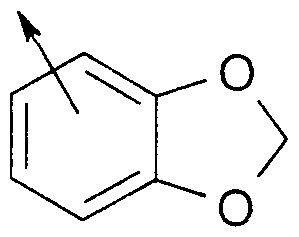
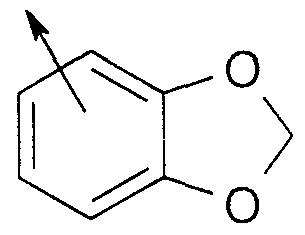
  • the arrow indicates that the bi-cyclic or t ⁇ -cyclic ring can be attached at any of
  • the available bonding points in any of the rings for example means that the indole is bonded either through the phenyl portion of the ring or the nitrogen containing ring portion
  • Treatment means any treatment of a condition in a mammal, particularly a human, and includes (i) preventing the disease from occurring in a subject which may be predisposed to the disease, but has not yet been diagnosed as having it, (II) inhibiting the condition, / e , arresting its development, or
  • subject means the recipient of a compound of the present invention, preferrably a mammal and most preferrably a human
  • Disease state which is treatable by administration of a sodium channel blocker is intended to cover all disease states which are generally acknowledged in the art to be usefully treated with sodium channel blockers in general, and those disease states which have been found to be usefully treated by the specific sodium channel blocker of our invention, the compounds of formula (I) or (II)
  • Such disease states include, but are not limited to peripheral neuropathies, such as t ⁇ ge ⁇ nal neuralgia, postherapeutic neuralgia, diabetic neuropathy, glossopharymgeal neuralgia, lumbar and cervical radiculopathy, reflex sympathetic dystrophy and causalgia, and neuropathy secondary to metastatic infiltration, adiposis dolorosa and burn pain, and central pain conditions following stroke thal ic lesions and multiple sclerosis
  • “Therapeutically effective amount” refers to that amount of a compound of formula (I) or (II) or a pharmaceutically acceptable salt thereof which is sufficient to effect treatment, as defined above, when administered to a mammal in need of such treatment
  • the therapeutically effective amount will vary depending on the subject and disease state being treated, the severity of the affliction and the manner of administration, and may be determined routinely by one of ordinary skill in the art
  • the term "therapeutically effective amount” is implicitly incorporated in the amount of compound administered in a method of the present invention or when said compound is a component in a pharmaceutical composition of the present invention
  • the compounds of the instant invention have at least one asymmetric center as noted by the asterisk in the structural formula (I) and (II), above Additional asymmetric centers may be present on the molecule depending upon the nature of the various substituents on the molecule Each such asymmetric center will produce two optical isomers and it is intended that all such optical isomers, as separated, pure or partially purified optical isomers, racemic
  • the instant compounds can be generally isolated in the form of their pharmaceutically acceptable acid addition saits, such as the salts derived from using inorganic and organic acids
  • acids are hydrochloric, nitric, sulfu ⁇ c, phosphoric, acetic, propionic, maleic, succmic, D-tarta ⁇ c, L-tarta ⁇ c, malonic, methane sulfonic and the like
  • certain compounds containing an acidic function such as a carboxy can be isolated in the form of their inorganic salt in which the counter-ion can be selected from sodium, potassium, lithium calcium, magnesium and the like, as well as from organic bases
  • the pharmaceutically acceptable salts are formed by taking about 1 equivalent of a compound of formula (I) or (II) and contacting it with about 1 equivalent of the appropriate corresponding acid of the salt which is desired Work-up and isolation of the resulting salt is well-known to those of ordinary skill in the art
  • agonists and antagonists of somatostatin are useful for treating a variety of medical conditions and diseases, such as inhibition of H pylori proliferation, acromegaiy, restenosis, Crohn's disease, systemic sclerosis, external and internal pancreatic pseudocysts and ascites, VIPoma, nesidoblastosis, hype ⁇ nsulinism, gast ⁇ noma Zollinger-Ellison Syndrome, diarrhea, AIDS related diarrhea, chemotherapy related diarrhea, scleroderma, Irritable Bowel Syndrome, pancreatitis, small bowel obstruction, gastroesophageal reflux, duodenogast ⁇ c reflux and in treating endoc ⁇ n
  • the present invention includes within its scope pharmaceutical compositions comprising, as an active ingredient, at least one of the compounds of Formula (I) or (II) in association with a pharmaceutically acceptable carrier
  • the compounds of this invention can be administered by oral, parenteral (e g , intramuscular, intrape ⁇ toneal intravenous or subcutaneous injection, or implant), nasal, vaginal, rectal, sublmgual or topical routes of administration and can be formulated with pharmaceutically acceptable carriers to provide dosage forms appropriate for each route of administration
  • Solid dosage forms for oral administration include capsules, tablets, pills, powders and granules
  • the active compound is admixed with at least one inert pharmaceutically acceptable carrier such as sucrose, lactose, or starch
  • Such dosage forms can also comprise, as is normal practice, additional substances other than such inert diluents, e g , lubricating agents such as magnesium stearate
  • the dosage forms may also comprise buffering agents Tablets and
  • Liquid dosage forms for oral administration include pharmaceutically acceptable emulsions, solutions, suspensions, syrups, the elixirs containing inert diluents commonly used in the art, such as water Besides such inert diluents, compositions can also include adjuvants, such as wetting agents, emulsifying and suspending agents, and sweetening, flavoring and perfuming agents
  • Preparations according to this invention for parenteral administration include sterile aqueous or non-aqueous solutions, suspensions, or emulsions
  • non-aqueous solvents or vehicles are propylene glycol polyethylene glycol vegetable oils, such as olive oil and corn oil, gelatin and injectable organic esters such as ethyl oleate
  • Such dosage forms may also contain adjuvants such as preserving, wetting, emulsifying, and dispersing agents They may be sterilized by, for example, filtration through a bacteria-retaining filter, by incorporating sterilizing agents into the compositions, by irradiating the compositions, or by heating the compositions They can also be manufactured in the form of sterile solid compositions which can be dissolved in sterile water, or some other sterile injectable medium immediately before use
  • compositions for rectal or vaginal administration are preferably suppositories which may contain, in addition to the active substance, excipients such as coca butter or a suppository wax
  • compositions for nasal or sublmgual administration are also prepared with standard excipients well known in the art
  • a compound of this invention of formula (I) or (II) can be administered in a sustained release composition such as those described in the following patents
  • U S Patent No 5,672,659 teaches sustained release compositions comprising a bioactive agent and a polyester
  • U S Patent No 5 595 760 teaches sustained release compositions comprising a bioactive agent in a gelable form
  • U S Application No 08/929 363 filed September 9, 1997 teaches polymeric sustained release compositions comprising a bioactive agent and chitosan
  • U S Application No 08/740,778 filed November 1 , 1996 teaches sustained release compositions comprising a bioactive agent and cyclodext ⁇ n
  • U S Application No 09/015 394 filed January 29, 1998 teaches absorbable sustained release compositions of a bioactive agent
  • an effective dosage of a compound of the present invention of the formula (I) or (II) in the compositions of this invention may be varied, however, it is necessary that the
  • a preferred dosage range is 0 01 to 10 0 mg/kg of body weight daily, which can be administered as a single dose or divided into multiple doses
  • Compounds of the instant invention can be and were assessed for its ability to bind to a somatostatin subtype receptor according to the following assays Human somatostatin subtype receptor binding studies
  • the affinity of a compound for human somatostatin subtype receptors 1 to 5 is determined by measuring the inhibition of [ 125 l- Tyr 11 ]SRIF-14 binding to CHO-K1 transfected cells
  • the human sst, receptor gene was cloned as a genomic fragment
  • a 1 5 Kb Psfl-Xm ⁇ l segment containg 100 bp of the 5'-untranslated region, 1 17 Kb of the entire coding region, and 230 bp of the 3'-untranslated region was modified by the Bg1 ll linker addition
  • the resulting DNA fragment was subcloned into the BamH ⁇ site of a pCMV-81 to produce the mammalian expression plasmid (provided by Dr Graeme Bell, Univ Chicago)
  • a clonal cell line stably expressing the sst 1 receptor was obtained by transfection into CHO-K1 cells (ATCC) using the calcium phosphate co-precipitation method (1)
  • the plasmid pRSV-neo was included as a selectable marker
  • Clonal cell lines were selected in RPMI 1640 media containing 0 5 mg/ml of G418 (Gibco
  • the human sst 2 somatostatin receptor gene isolated as a 1 7Kb Sa/nHI-H/ndlll genomic DNA fragment and subcloned into the plasmid vector pGEM3Z (Promega), was kindly provided by Dr G Bell (Univ of Chicago)
  • the mammalian cell expression vector is constructed by inserting the 1 7Kb BamHI-H/ndll fragment into compatible restriction endonuclease sites in the plasmid pCMV5
  • a clonal eel! line is obtained by transfection into CHO-K1 ceils using the calcium phosphate co-precipitation method
  • the plasmid pRSV-neo is included as a selectable marker
  • the human sst 3 was isolated at genomic fragment, and the complete coding sequence was contained within a 2 4 Kb SamHl/H/ndlll fragment
  • the mammalian expression plasmid, pCMV-h3 was constructed by inserting the a 2 0 Kb ⁇ /col-H/ndlll fragment into the EcoRI site of the pCMV vector after modification of the ends and addition of EcoRI linkers
  • a clonal cell line stably expressing the sst 3 receptor was obtained by transfection into CHO-K1 ceils (ATCC) using the calcium phosphate co- precipitation method
  • the plasmid pRSV-neo (ATCC) was included as a selectable marker
  • Clonal cell lines were selected in RPMI 1640 media containing 0 5 mg/ml of G418 (Gibco), ring cloned and expanded into culture
  • the human sst 4 receptor expression plasmid, pCMV-HX was provided by Dr Graeme Bell (Univ Chicago)
  • the vector contains the 1 4 Kb Nhe ⁇ -Nhe ⁇ genomic fragment encoding the human sst 4 456 bp of the 5 -untranslated region and 200 bp of the 3'-untranslated region clone into the Xoal/EcoR1 sites of PCMV-HX
  • a clonal cell line stably expressing the sst 4 receptor was obtained by transfection into CHO-K1 cells (ATCC) using the calcium phosphate co-precipitation method
  • the plasmid pRSV-neo (ATCC) was included as a selectable marker
  • Clonal cell lines were selected in RPMI 1640 media containing 0 5 mg/ml of G418 (Gibco) ring cloned, and expanded into culture
  • the human sst 5 gene was obtained by PCR using a ⁇ genomic clone as a template, and kindly provided by Dr Graeme Bell (Univ Chicago)
  • the resulting 1 2 Kb PCR fragment contained 21 base pairs of the 5'-untranslated region, the full coding region, and 55 bp of the 3'-untranslated region
  • the clone was inserted into EcoRI site of the plasmid pBSSK(+)
  • the insert was recovered as a 1 2 Kb H/ndlll-Xbal fragment for subclonmg into pCVM5 mammalian expression vector
  • a clonal cell line stably expressing the SST 5 receptor was obtained by transfection into CHO-K1 cells (ATCC) using the calcium phosphate co-precipitation method
  • the plasmid pRSV-neo was included as a selectable marker Clonal cell lines were selected in RPMI 1640 media containing 0 5 mg/ml of G4
  • CHO-K1 cells stably expressing one of the human sst receptor are grown in RPMI 1640 containing 10% fetal calf serum and 0 4 mg/ml geneticm Cells are collected with 0 5 mM EDTA and cent ⁇ fuged at 500 g for about 5 mm at about 4°C
  • the pellet is resuspended in 50 mM Tris pH 7 4 and cent ⁇ fuged twice at 500 g for about 5 mm at about 4°C
  • the cells are lysed by sonication and cent ⁇ fuged at 39000 g for about 10 mm at about 4°C
  • the pellet is resuspended in the same buffer and cent ⁇ fuged at 50000 g for about 10 mm at about 4°C and membranes in resulting pellet are stored at - 80°C
  • Competitive inhibition experiments of [ 125 l-Tyr 11 ]SRIF-14 binding are run in duplicate in polypropylene 96 well plates Cell membranes (10 ⁇ g protein/well
  • GF/C glass fiber filter plate Unifilter, Packard presoaked with 0 1 % polyethylenimine (P E I ), using Filtermate 196 (Packard) cell harvester Filters are washed with 50 mM HEPES at about 0-4°C for about 4 sec and assayed for radioactivity using Packard Top Count Specific binding is obtained by subtracting nonspecific binding (determined in the presence of 0 1 ⁇ M SRIF-14) from total binding Binding data are analyzed by computer- assisted nonlinear regression analysis (MDL) and inhibition constant (Ki) values are determined The determination of whether a compound of the instant invention is an agonist or an antagonist is determined by the following assay Functional assay Inhibition of cAMP intracellular production
  • CHO-K1 Cells expressing human somatostatin (SRIF-14) subtype receptors are seeded in 24-well tissue culture multidishes in RPMI 1640 media with 10% FCS and 0 4 mg/ml geneticm The medium is changed the day before the experiment
  • Cyclic AMP production is stimulated by the addition of 1 mM forskolm (FSK) for about 15-30 minutes at about 37°C
  • the antagonist effect of a compound is measured by the simultaneous addition of FSK (1 ⁇ M) , SRIF-14 (1 to 10 nM) and a test compound (10 10 M to 10 5 ) The reaction medium is removed and 200 ml 0 1 N HCl is added cAMP is measured using radioimmunoassay method (Kit FlashPlate SMP001A New England Nuclear)
  • the compounds of the present invention can be tested for activity in blocking Na channels
  • the compounds of the invention display binding to the verat ⁇ dine-sensitive sodium channel
  • For the binding procedure see for example J B Brown Journal of Neuroscience 6,. 2064-2070 (1986), the contents of which are incorporated herein by reference They block verat ⁇ dine-induced glutamate release in rat hippocampal slice preparations
  • the experiment is performed according to a modification of M J Leach et al , in Epiiepsia 27, 490-497 (1986) and Stroke 24 1063-1067 (1993), using exogenous glutamate
  • the compounds of the instant invention are synthesized according to the following procedures and examples ⁇ -CARBOLINES Tetrahydro- ⁇ -carbolines
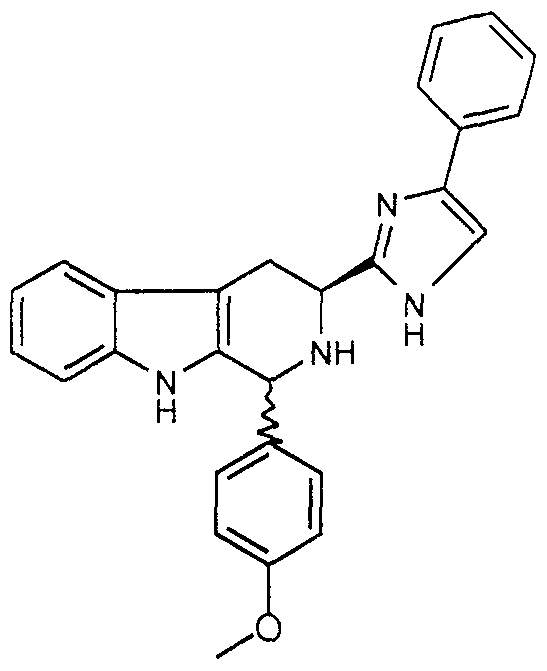
  • Example 1 Diastereomic mixture at C 1 of 1 2,3,4-tetrahydro-1-(4-methoxyphenyl)-3(S)-(4-phenyl- 1 H- ⁇ m ⁇ dazol-2-yl)-9H-py ⁇ do[3, 4-b] ⁇ ndole
  • a compound of formula (b) can react with isocyanates, isothiocyanates, ⁇ /-succ ⁇ n ⁇ m ⁇ dyl carbamates, acyl chlorides or activated carboxylic acids in aprotic solvent at 20-70°C for 2-18 hours
  • the resulting derivative can be isolated by evaporation of the mixture followed by flash chromatography on silica gel or by addition to the mixture of a nucleophile supported on polymer such as ammomethyl or thiomethyl polystyrene resm followed by filtration
  • Example 1334-1336 The following compounds were prepared analogously to the procedure described for Example 1333 using the appropriate starting materials, which can be obtained from commercial sources or synthesized according to methods known to those skilled in the art or as enabled by the teachings herein
  • Example 1501 (3R)-3-(4-Phenyl-1 H-imidazol-2-yl)-2,3,4,9-tetrahydro-spiro[1 H- ⁇ -carboline-1 ,1 - cycloheptyl]
  • Mass spectra were acquired on a single quadrupole electrospray mass spectrometer (Micromass, Platform model), 0.8 Da resolution. A monthly calibration, between 80 and 1000 Da, is performed with sodium and rubidium iodide solution isopropanol/water (1/1 Vol.).
  • HPLC retention times were acquired on an HPLC system: HP1 100 (Hewlett- Packard) equipped with a photodiode array UV detector.
  • HPLC conditions are as follows and the conditions used for each of the following tables of compounds are indicated in the column heading.
  • Condition A was employed for the HPLC analysis of the compounds in the Tables of Compounds of Formulas 2, 3 and 4.
  • Condition B was employed for the HPLC analysis of the compounds in the Tables of Compounds of Formulas 2, 3 and 4.
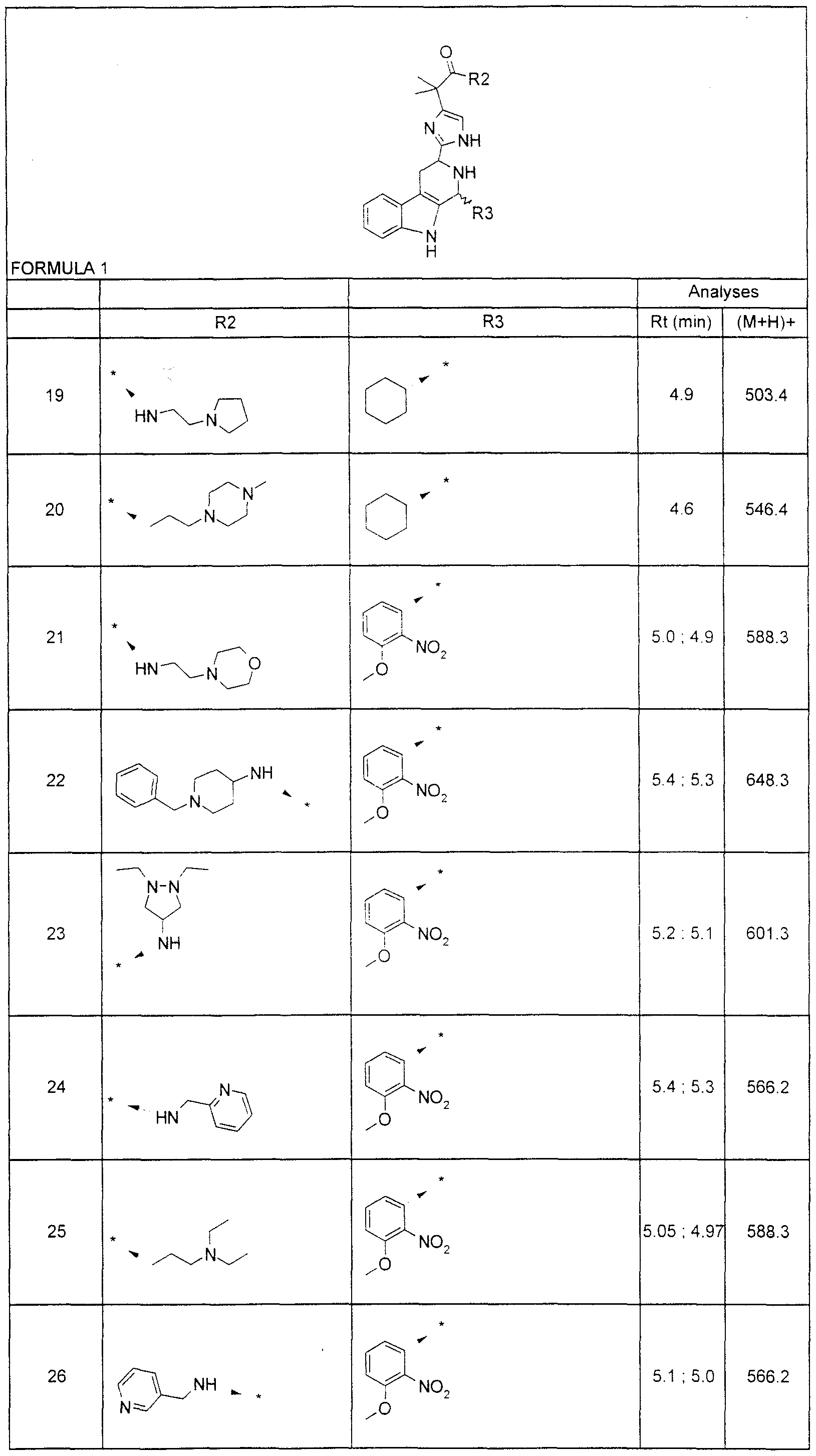
  • Condition B was employed for the HPLC analysis of the compounds in the Table of Compounds of Formula 1.
  • Condition C was employed for the HPLC analysis of the compounds in the Table of Compounds of Formula 5.

Landscapes

  • Health & Medical Sciences (AREA)
  • Chemical & Material Sciences (AREA)
  • Organic Chemistry (AREA)
  • Engineering & Computer Science (AREA)
  • Life Sciences & Earth Sciences (AREA)
  • Bioinformatics & Cheminformatics (AREA)
  • Public Health (AREA)
  • Veterinary Medicine (AREA)
  • General Health & Medical Sciences (AREA)
  • Chemical Kinetics & Catalysis (AREA)
  • General Chemical & Material Sciences (AREA)
  • Medicinal Chemistry (AREA)
  • Nuclear Medicine, Radiotherapy & Molecular Imaging (AREA)
  • Animal Behavior & Ethology (AREA)
  • Pharmacology & Pharmacy (AREA)
  • Biomedical Technology (AREA)
  • Neurosurgery (AREA)
  • Neurology (AREA)
  • Diabetes (AREA)
  • Pain & Pain Management (AREA)
  • Immunology (AREA)
  • Obesity (AREA)
  • Hematology (AREA)
  • Psychology (AREA)
  • Heart & Thoracic Surgery (AREA)
  • Cardiology (AREA)
  • Emergency Medicine (AREA)
  • Communicable Diseases (AREA)
  • Psychiatry (AREA)
  • Endocrinology (AREA)
  • Transplantation (AREA)
  • Rheumatology (AREA)
  • Ophthalmology & Optometry (AREA)
  • Hospice & Palliative Care (AREA)
  • Oncology (AREA)
  • Urology & Nephrology (AREA)
  • Dermatology (AREA)
  • Pharmaceuticals Containing Other Organic And Inorganic Compounds (AREA)
  • Nitrogen Condensed Heterocyclic Rings (AREA)
  • Plural Heterocyclic Compounds (AREA)

Abstract

The present invention is directed to compounds of formula (I) wherein the variables are defined in the specification, which bind to somatostatin receptors and block Na channels.

Description

β-CARBOLINE COMPOUNDS Background of the Invention
The present invention is directed to compounds of formulas (I) and (II) and compositions containing said compounds which bind selectively to somatostatin receptor subtypes and the use of said compounds for treating medical disorders which are mediated by somatostatin receptor subtypes. Somatostatin (somatotropin release inhibiting factor, SRIF), a tetradecapeptide hormone, originally isolated from bovine hypothalami (Brazeau, P. et al., Science 179, 77-79, 1973) has been shown to have a wide range of regulatory effects on the release of a variety of hormones such as growth hormone, prolactin, glucagon, insulin, gastrin (Bloom, S.R. and Poldack, J.M., Brit. Med. J. 295, 288-289, 1987). In addition, antiproliferative properties (Reichlin, S., N. Engl. J . Med. 309, 1495-1501 , 1983) have been obtained with somatostatin analogs in metastatic prostatic cancer (Parmar, H. et al, Clin. Exp. Metastasis, 10, 3-1 1 , 1992) and in several other neuroendocrine neoplasms in man (Anthony, L. et al, Acta Oncol., 32, 217-223, 1993). Metabolism of somatostatin by aminopeptidases and carboxypeptidases leads to a short duration of action. The actions of somatostatin are mediated via membrane bound receptors. The heterogeneity of its biological functions has led to studies to identify structure-activity relationships of peptides analogs at the somatostatin receptors which resulted in the discovery of five receptor subtypes (Yamada, et al, Proc . Natl. Acad. Sci. U.S.A, 89, 251-255, 1992 ; Raynor, K. et al, Mol. Pharmacol., 44, 385-392, 1993). The functional roles of these receptors are under extensive investigation. Binding to the different types of somatostatin subtypes have been associated with the treatment of the following conditions and/or diseases. Activation of types 2 and 5 have been associated with growth hormone suppression and more particularly GH secreting adenomas (Acromegaly) and TSH secreting adenomas. Activation of type 2 but not type 5 has been associated with treating prolactin secreting adenomas. Other indications associated with activation of the somatostatin subtypes are restenosis, inhibition of insulin and/or glucagon and more particularly diabetes mellitus, hyperlipidemia, insulin insensitivity, Syndrome X, angiopathy, proliferative retinopathy, dawn phenomenon and Nephropathy; inhibition of gastric acid secretion and more particularly peptic ulcers, enterocutaneous and pancreaticocutaneous fistula, irritable bowel syndrome, Dumping syndrome, watery diarrhea syndrome, AIDS related diarrhea, chemotherapy-induced diarrhea, acute or chronic pancreatitis and gastrointestinal hormone secreting tumors, treatment of cancer such as hepatoma, inhibition of angiogenesis, treatment of inflammatory disorders such as arthritis, chronic allograft rejection, angioplasty, preventing graft vessel and gastrointestinal bleeding Somatostatin agonists can also be used for decreasing body weight in a patient
In drug research, it is a key issue to minimize side effects by developing highly potent and selective drug molecules Recent work on the development of nonpeptide structures (Hirschmann, R et al, J Am Chem Soc 115, 12550-12568, 1993 , Papageorgiou, C and Borer, X , Bioorg Med Chem Lett 6, 267-272, 1996) have described compounds with low somatostatin receptor affinity
Further, compounds of Formula I and II are sodium channel blocker and, thus, exhibit useful pharmacological properties, especially utility for the alleviation of neuropathic pain Neuropathic pain can be described as pain associated with damage or permanent alteration of the peripheral or central nervous system Clinical manifestations of neuropathic pain include a sensation of burning or electric shock, feelings of bodily distortion, allodynia and hyperpathia
Sodium channel-blocking agents have been reported to be effective in the treatment of various disease states They are in particular useful as local anesthetics, and in the treatment of arrhythmia It has also been reported for many years that sodium channel-blocking agents may be useful in the treatment of pain, including neuropathic pain, see, for example, Tanehan et al , Pain Forum , 4(2), 75-80, (1995) There is evidence that sodium channel-blocking agents selectively suppress ectopic neural firing in injured nerves, and it is via this mechanism that they are believed to be useful for relieving pain However, studies carried out on well known sodium channel- blocking agents, for example carbamazepine, phenytoin, docaine, mexiletine, and the like, indicate that these agents are not very effective for the treatment of neuropathic pain conditions at moderate dose levels, and that even at these moderate dose levels they are associated with a range of undesirable side effects, such as vertigo, nausea, sommolence, tremor, slurred speech, etc Pre-clinical evidence demonstrates that sodium channel-blocking agents selectively suppress abnormal ectopic neural firing in injured peripheral and central neurons, and it is via this mechanism that they are believed to be useful for relieving pain Consistent with this hypothesis, it has been shown that sodium channel accumulate in the peripheral nerve at sites of axonal injury (Devor et al , J Neurosci, 1993, 132, 1976-1992) Alterations in either the level of expression or distribution of sodium channels with an injured nerve, therefore, have a major influence on the pathophysiology of pain associated with this type of trauma This concept is supported by the relative success of employing sodium channel modulating agents (e g , anticonvulsants, local anesthesics) for the treatment of neuroplastic pain However, pain relief has often been obtained concomitantly with numerous adverse events and/or limitations in efficacy which have restricted tolerabi ty of these drugs It can be seen that a need still exists for an orally active agent that is effective for the treatment of neuropathic pain, but having fewer side effects Another aspect of this invention relates to the use of a compound of Formula I or
II for treating neuropathic pain conditions in a mammal that is responsive to sodium channel-blocking agents including peripheral neuropathies, such as trigemmal neuralgia, postherapeutic neuralgia, radiculopathy, and neuropathy secondary to metastatic infiltration, adiposis dolorosa and burn pain, and central pain conditions following stroke, thalamic lesions and multiple sclerosis, by administering a therapeutically effective amount of a compound of Formula I or II to the mammal
As a result, the compounds of the invention are indicated for the treatment of any pathology, disorder or clinical condition involving glutamate release in their etiology, including psychiatric disorders (such as schizophrenia, depression, anxiety, panic attacks, attention deficit and cognitive disorders, social withdrawal), hormonal conditions (excess GH, e g in the treatment of diabetes melhtus, angiopathy and acromegaly, or LH secretion, e g , prostrate hypertrophy, menopausal syndrome, corticosterone secretion in stress), metabolic inducted brain damage (hypoglycaemia, non-ketotic hyperglycmaemia (glycine encephalopathy), sulphite oxidase deficiency, hepatic encephalopathy associated with liver failure), emesis, spasticity, epilepsy, tinnitus, pain (e g cancer pain, arthritis) and drug (ethanol, opiates, including synthetics with opiate-like effects, e g pethidine, methadone etc , cocaine, amphetamine, barbiturates and other sedatives, benzodiazephines, abuse and withdrawal
Moreover, a compound of the present invention is indicated in the treatment of any pathology involving neuronal damage, for example neurodegenerative disorders such as Alzheimer's, Huntington's or Parkinson's diseases, virus (including HIV)- induced neurodegeneration, Amyotrophic lateral sclerosis (ALS), supra-nuclear palsy, o voponto-cerebellar atrophy (OPCA), and the actions of environmental, exogenous neurotoxins Summary of the Invention
In one aspect the present invention is directed to a compound of formula (I),
Figure imgf000006_0001
(I) the racemic-diastereomeπc mixtures and optical isomers of said compound of formula (I), the pharmaceutically-acceptable salts or prodrugs thereof or a pharmaceutically acceptable salt of said prodrug, wherein represents an optional bond, X is N or N-R4, where X is N when both optional bonds are present and X is N-R4 when the optional bonds are not present,
R1 is H -(CH2)m-C(0)-(CH2)m-Z1, -(CH2)m-Z1, -(CH2)m-0-Z1 or (C0-C6)alkyl-C(O)-NH- (CH2)m-Z3,
Z1 is an optionally substituted moiety selected from the group consisting of (C1-C12)alkyl, benzo[b]thιophene, phenyl, naphthyl, benzo[b]furanyl, thiophene, isoxazolyl, indolyl,
Figure imgf000006_0002
R2 is (CrC12)alkyl, (C0-C6)alkyl-C(O)-O-Z5, (C0-C6)alkyl-C(O)-NH-(CH2)m-Z3 or optionally substituted phenyl,
Z5 is H, (CrC12)alkyl or (CH2)m-aryl,
Z3 is ammo, (C1-C12)alkylamιno, N,N-dι-(CrC12)alkylamιno, -NH-C(O)-0-(CH2)m- phenyl, -NH-C(O)-O-(CH2)m-(CrC6)alkyl or an optionally substituted moiety selected from the group consisting of imidazolyl, pyπdinyl and morpholinyl, piperidinyl, piperazinyl, pyrazolidinyl, furanyl and thiophene,
R4 is H -C(=Y)-N(X1X2), C(=O)X2 or X2,
Figure imgf000006_0003
X2 is -(CH2)m-Y1-X3;
X3 is H or an optionally substituted moiety selected from the group consisting of
(CrC12)alkyl, (C3-C8)cycloalkyl, (C1-C12)alkoxy, aryloxy, (C1-C12)alkylamino, N,N- di-(C1-C12)alkylamino, -CH-di-(C1-C12)alkoxy or phenyl; R5 is (CrC12)alkyl, -(CH2)m-Y1-(CH2)m-phenyl-(X1)n, (C3-C12)cycloalkyl, -(CH2)m-S-(Cr C12)alkyl, (C1-C12)alkyl-S-S-(C1-C12)alkyl, -(CH2)m-(C1-C12)al enyl or an optionally substituted moiety selected from the group consisting of phenyl, furanyl, thiophene, pyrrolyl, pyridinyl and
Figure imgf000007_0001
Y1 is O, S, NH or a bond;
R6 is H or SO2-phenyl;
R7 is H, alkyl optionally substituted with alkoxy or dialkylamino; wherein an optionally substituted moiety or optionally substituted phenyl is optionally substituted by one or more substituents, each independently selected from the group consisting of Cl, F, Br, I, CF3, NO2, OH, SO2NH2, CN, N3, -OCF3, (CrC12)alkoxy, -(CH2)m-phenyl-(X1)n, -NH-CO-(C1-C6)alkyl, -S-phenyl-(X1)n, -O-(CH2)m-phenyl-(X1)n, -(CH2)m-C(O)-O-(C1-C6)alkyl, -(CH2)m-C(O)-(C1-C6)alkyl, -O-(CH2)m-NH2, -O-(CH2)m-NH-(CrC6)alkyl, -0-(CH2)m-N-di-((C1-C6)alkyl) and -(C0-C12)alkyl-(X1)n;
X1 for each occurrence is independently selected from the group consisting of hydrogen, Cl, F, Br, I, N02, OH, -CF3, -OCF3, (CrC12)alkyl, (CrC12)alkoxy, -S-(Cr
C6)alkyl, -(CH2)m-amino, -(CH2)m-NH-(C1-C6)alkyl, -(CH2)m-N-di-((C1-C6)alkyl), -(CH2)m-phenyl and -(CH2)m-NH-(C3-C6)cycloalkyl; m for each occurrence is independently 0 or an integer from 1 to 6; and n for each occurrence is independently an integer from 1 to 5. A preferred compound of formula (I) is where X is NH; R1 is H; R2 is
-CH(CH3)2-CO-NH-(CH2)m-Z3 where m in the definition of R2 is 1 , 2 or 3;
Z3 is imidazolyl, pyridinyl, morpholino, or N,N-di-ethylamino; R5 is propyl, n-butyl, n-pentyl, -(CH2)-O-(CH2)-phenyl, 2-nitro-3-OMe-phenyl, p-t-Bu- phenyl, m-OMe-phenyl, o-OMe-phenyl, p-nitro-phenyl, -(CH2)2-S-Me, cyclohexyl, m-Br- phenyl, p-S-Me-phenyl, p-N,N-dimethylamino-phenyl, m-methyl-phenyl or
Figure imgf000008_0001
R6 is H, and R7 is H
Another preferred compound of formula (I) is where X is NH, R1 is H, R2 is phenyl,
R5 is propyl, n-butyl, n-pentyl, n-heptyl, isobutyl, neopentyl, cyclopropyl, cyclohexyl, -(CH2)2-S-Me, phenyl, -(CH2)-0-(CH2)-phenyl, 2-nιtro-3-OMe-phenyl, p-t-Bu-phenyl, o- OMe-phenyl, m-OMe-phenyl, p-OMe-phenyl, 3,4,5-tπ-OMe-phenyi, p-butoxy-phenyl, 3- ethoxy-4-methoxy-phenyl, o-nitro-phenyl, p-nitro-phenyl, p-OCF3-phenyl, o-CF3-phenyl, 3-F-4-OMe-phenyl, o-F-phenyl, o-Br-phenyl, m-Br-phenyl, p-Br-phenyl, 2,4-dι-CI-phenyl, 3,4-dι-CI-phenyl, p-(3-(N,N-dιmethyiamιno)propoxy)phenyl, -(CH2)2-S-Me, cyclohexyl, p-(Me-CO-NH-)-phenyl, p-t-Bu-phenyl, p-OH-phenyl, p-(-S-Me)-phenyl, p(-S-t-Bu)- phenyl, p-N,N-dιmethylamιno-phenyl, m-methyl-phenyl, 3-OH-4-Ome-phenyl, p-phenyl- phenyl,
Figure imgf000008_0002
Another preferred compound of formula (I) is where X is NH, R1 is H, R2 is p- OMe-phenyl or p-nitro-phenyl,
R5 is n-butyl, n-pentyl, n-hexyl, isobutyl, cyclohexyl, -(CH2)2-S-Me. phenyl, m-OMe- phenyl, 2-nιtro-3-OMe-phenyl, p-nitro-phenyl, p-t-Bu-phenyl, p-thiomethyl-phenyl, m-Br- phenyl, 2-OMe-4-dιmethylamιno-phenyl, p-(3-(N N-dιmethylamιno)propoxy)phenyl, p-
dimethylamino-phenyl, 3-nιtro-4-CI-phenyl, -(CH2)-0-(CH2)-phenyl or
Figure imgf000008_0003
Figure imgf000008_0004
In another aspect, the present invention is directed to a compound of formula (ID,
Figure imgf000009_0001
the racemic-diastereomeπc mixtures and optical isomers of said compound of formula (II), the pharmaceutically-acceptable salts or prodrugs thereof or a pharmaceutically acceptable salt of said prodrug, wherein represents an optional bond,
J1 is N-R6 or S,
J2 is N-R1 O or S,
X is N or N-R4, where X is N when both optional bonds are present and X is N-R4 when the optional bonds are not present,
R1 is H -(CH2)m-C(0)-(CH2)m-Z1, -(CH2)m-Z1, -(CH2)m-0-Z1 or (C0-C6)alkyl-C(O)-NH-
(CH2)m-Z3,
Z1 is an optionally substituted moiety selected from the group consisting of (CrC12)alkyl, benzo[b]thιophene, phenyl, naphthyl, benzo[b]furanyl thiophene, isoxazolyl, indolyl,
Figure imgf000009_0002
R2 is (C1-C12)alkyl, (C0-C6)alkyl-C(O)-O-Z5, (C0-C6)alkyl-C(O)-NH-(CH2)m-Z3 or optionally substituted phenyl,
Z5 is H, (C1-C12)alkyl or (CH2)m-aryl,
Z3 is ammo, (C1-C12)alkylamιno, N,N-dι-(C,-C12)alkylamιno -NH-C(O)-0-(CH2)m- phenyl, -NH-C(O)-0-(CH2)m-(C1-C6)alkyl or an optionally substituted moiety selected from the group consisting of phenyl, imidazolyl, pyridinyl and morpholinyl, piperidinyl, piperazmyl, pyrazolidinyl furanyl and thiophene,
R3 is H, (CrC6)alkyl or optionally substituted phenyl;
Figure imgf000009_0003
X2 is H or -(CH2)m-Y1-X3;
X3 is H or an optionally substituted moiety selected from the group consisting of
(C1-C12)alkyl, (C3-C8)cycloalkyl, (C1-C12)alkoxy, aryloxy, (C1-C12)alkylamino, N,N- di-(C1-C12)alkylamino, -CH-di-(C C12)alkoxy or phenyl; R5 and R8 are each independently selected from the group consisting of H, (CrC12)alkyl, -(CH2)m-Y1-(CH2)m-phenyl-(X1)n, (C3-C12)cycloalkyl, (C3-C12)cycloalkenyl, -(CH2)m-S-(CrC12)alkyl, (C1-C12)alkyl-S-S-(C1-C12)alkyl, -(CH2)m-(C1-C12)alkenyl and an optionally substituted moiety selected from the group consisting of phenyl, furanyl, thiophene, pyrrolyl, pyridinyl and
Figure imgf000010_0001
, provided that R5 and R8 are not both H at the same time; or R5 and R8 are taken together with the carbon atom to which they are attached to form
Figure imgf000010_0002
Y1 is O, S, NH or a bond; A is a bond, -CO-, -C(0)0-, -C(O)NH-, -C(S)NH-, or -S02-;
B is a bond or -(CH2)q-, where q is an integer from 1 to 6 ; J3 is H, (C1-C6)alkyl, optionally substituted phenyl, optionally substituted heteroaryl or N(R9R10), where R9 and R10 are each independently selected from the group consisting of (C1-C6)alkyl, and optionally substituted phenyl, or R9 and R10 are taken together with the nitrogen to which they are attached to form a ring having 5 to 8 members including the nitrogen atom that R9 and R10 are attached to, where one of the ring members may optionally be an oxygen atom or NR11 , where R11 is (C1-C6)alkyl, -C(O)-(C C6)alkyl, -C(O)-N(V1V2), -C(S)- N(V1V2), or optionally-substituted-phenyl-(C0-C6)alkyl-, where V1 and V2 are each independently H, (C1-C6)alkyl or optionally-substituted-phenyl-(C0-C6)alkyl;
R6 is H or SO2-phenyl;
R7 is H, Cl, F, Br, I, CF3, NO2, OH, SO2NH2, CN, N3, -OCF3, (C1-C12)alkoxy, -(CH2)m-phenyl-(X1)n, -NH-CO-(CrC6)alkyl, -S-(CrC12)alkyl, -S-phenyl-(X1)n, -O-(CH2)m- phenyl-(X1)n, -(CH2)m-C(O.)-O-(C1-C6)alkyl, -(CH2)m-C(O)-(CrC6)alkyl, -O-(CH2)m-NH2, -O-(CH2)m-NH-(C1-C6)alkyl, -O-(CH2)m-N-di-((C1-C6)alkyl) and -(C0-C12)alkyl-(X1)n; wherein an optionally substituted moiety or optionally substituted phenyl is optionally substituted by one or more substituents, each independently selected from the group consisting of Cl, F, Br, I, CF3, N02, OH, S02NH2. CN, N3, -OCF3, (CrC12)alkoxy, -(CH2)m-phenyl-(X1)n, -NH-CO-(C1-C6)alkyl, -S-(C1-C12)alkyl, -S-phenyl-(X1)n, -O-(CH2)m- phenyl-(X1)n, -(CH2)m-C(0)-0-(C1-C6)alkyl,
Figure imgf000011_0001
-O-(CH2)m-NH2, -O-(CH2)m-NH-(C1-C6)alkyl, -0-(CH2)m-N-dι-((CrC6)alkyl) and -(C0-C12)alkyl-(X1)n,
X1 for each occurrence is independently selected from the group consisting of hydrogen, Cl. F, Br, I, NO2, OH, -CF3, -OCF3, (CrC12)alkyl, (CrC12)aikoxy, -S-(Cr C6)alkyl, -(CH2)m-amιno, -(CH2)m-NH-(CrC6)alkyl, -(CH2)m-N-dι-((CrC6)alkyl), -(CH2)m-phenyl and -(CH2)m-NH-(C3-C6)cycloalkyl, m for each occurrence is independently 0 or an integer from 1 to 6, and n for each occurrence is independently an integer from 1 to 5
A preferred group of compounds of the compounds of formula (II) are those having the formula (lla)
Figure imgf000011_0002
wherein R3 is H or methyl ,
R4 is H or methyl ,
R5 is H, methyl, ethyl, butyl, pentyl or hexyl,
R8 is ethyl, butyl, pentyl, hexyl, or cyclohexyl , or R5 and R8 are taken together with the carbon to which they are attached to form
Figure imgf000011_0003
spirocyclohexyl, spirocycloheptyl, spiroadamantyl or / \
N-A-B-
\ where A is a bond or -C(0)0- B is a bond -(CH2)- or -(CH2 2)/2
J3 is H, or phenyl , and
R7 is H, Me, F, Cl, OH, -O-methyl or -0-CH2-phenyl
A more preferred group of compounds of the formula (lla) are those compounds wherein
R3, R4 and R7 are each hydrogen, R5 and R8 are together V and the imidazolyl is in the R-configuration ,
R3, R4 and R7 are each hydrogen, R5 and R8 are together
Figure imgf000012_0001
and the imidazolyl is in the R-configuration
\ /
R3, R4 and R7 are each hydrogen, R5 and Ra are together and the imidazolyl is in the R-configuration ,
/~Λ
R3, R4 and R7 are each hydrogen R5 and R8 are together and the imidazolyl is in the R-configuration, or its hydrochloπde salt
R3 is methyl R4 and R7 are each hydrogen R5 and R8 are each n-butyl and the imidazolyl is in the R-configuration,
Figure imgf000012_0002
R3, R4 and R7 are each hydrogen, R5 and R8 are together and the imidazolyl is in the R-configuration, or its hydrochloπde salt,
R3 and R4 are each hydrogen, R7 is 6-0-CH2-phenyl, R5 and R8 are each n-butyl and the imidazolyl is a racemic mixture of the S- and R-configurations, R3, R4 and R7 are each hydrogen, R5 and R8 are together
Figure imgf000013_0001
the imidazolyl is in the R-configuration, or its hydrochloπde salt,
R3, R4 and R7 are each hydrogen, R5 and R8 are together
/ \
N-(CH2)2-Phenyl and the imidazolyl is in the R-configuration, R3 and R7 are each hydrogen, R4 is methyl, R5 and R8 are each n-butyl and the imidazolyl is in the R-configuration,
R3, R4 and are each hydrogen, R7 is 7-fluoro, R5 and R8 are each n-pentyl and the imidazolyl is the racemic mixture of the S- and R-configurations,
R3, R4 and R7 are each hydrogen, R5 and R8 are each n-hexyl and the imidazolyl is in the R-configuration
R3, R4 and R7 are each hydrogen R5 is hydrogen and R8 is hexyl in the S- configuration and the imidazolyl is in the R-configuration or its fumarate salt,
R3, R4 and R7 are each hydrogen, R5 and R8 are each n-butyl and the imidazolyl is in the R-configuration, or its fumarate salt,
Figure imgf000013_0002
R3, R4 and R7 are each hydrogen, R5 and R8 are together and the imidazolyl is in the R-configuration,
R3, R4 and R7 are each hydrogen R5 and R8 are each n-butyl and the imidazolyl is in the S-configuration,
R3, R4 and R7 are each hydrogen, R5 and R8 are each ethyl and the imidazolyl is in the R-configuration,
R3, R4 and R7 are each hydrogen, R5 and R8 are each n-pentyl and the imidazolyl is in the R-configuration,
R3, R4 and R7 are each hydrogen, R5 is methyl and R8 is cyclohexyl and the imidazolyl is in the R-configuration. R3 and R4 are each hydrogen, R7 is 6-methyl R5 and R8 are each n-butyl and the imidazolyl is a racemic mixture of the S- and R-configurations,
R3 and R4 are each hydrogen, R7 is 7-fluoro, R5 and R8 are each n-butyl and the imidazolyl is a racemic mixture of the S- and R-configurations, R3 and R4 are each hydrogen, R7 is 6-methoxy R5 and R8 are each n-butyl and the imidazolyl is a racemic mixture of the S- and R-configurations,
R3 and R4 are each hydrogen, R7 is 6-hydroxy, R5 and R8 are each n-butyl and the imidazolyl is a racemic mixture of the S- and R-configurations, R3 and R4 are each hydrogen, R7 is 6-fluoro, R5 and R8 are each n-butyl and the imidazolyl is a racemic mixture of the S- and R-configurations, or its hydrochloπde salt,
R3 and R4 are each hydrogen, R7 is 8-methyl, R5 and R8 are each n-butyl and the imidazolyl is a racemic mixture of the S- and R-configurations,
R3 and R4 are each hydrogen, R7 is 6-methyl, R5 and R8 are each n-pentyl and the imidazolyl is a racemic mixture of the S- and R-configurations, or
R3 and R4 are each hydrogen, R7 is 6-chloro, R5 and R8 are each n-butyl and the imidazolyl is a racemic mixture of the S- and R-configurations
An even more preferred group of compounds of the formula (lla) are those compounds selected from the group consisting of R3, R4 and R7 are each hydrogen, R5 is hydrogen and R8 is hexyl in the S- configuration and the imidazolyl is in the R-configuration, or its fumarate salt,
R3, R4 and R7 are each hydrogen, R5 and R8 are each n-butyl and the imidazolyl is in the R-configuration, or its fumarate salt,
Figure imgf000014_0001
R3, R4 and R7 are each hydrogen, R5 and R8 are together and the imidazolyl is in the R-configuration,
R3, R4 and R7 are each hydrogen R5 and R8 are each n-butyl and the imidazolyl is in the S-configuration,
R3, R4 and R7 are each hydrogen, R5 and R8 are each ethyl and the imidazolyl is in the R-configuration, R3, R4 and R7 are each hydrogen, R5 and R8 are each n-pentyl and the imidazolyl is in the R-configuration,
R3, R4 and R7 are each hydrogen, R5 is methyl and R8 is cyclohexyl and the imidazolyl is in the R-configuration,
R3 and R4 are each hydrogen, R7 is 6-methyl R5 and R8 are each n-butyl and the imidazolyl is a racemic mixture of the S- and R-configurations, R3 and R4 are each hydrogen R7 is 7-fluoro, R5 and R8 are each n-butyl and the imidazolyl is a racemic mixture of the S- and R-configurations,
R3 and R4 are each hydrogen, R7 is 6-methoxy, R5 and R8 are each n-butyl and the imidazolyl is a racemic mixture of the S- and R-configurations, R3 and R4 are each hydrogen, R7 is 6-hydroxy, R5 and R8 are each n-butyl and the imidazolyl is a racemic mixture of the S- and R-configurations,
R3 and R4 are each hydrogen, R7 is 6-fluoro, R5 and R8 are each n-butyl and the imidazolyl is a racemic mixture of the S- and R-configurations, or its hydrochloπde salt,
R3 and R4 are each hydrogen, R7 is 8-methyl, R5 and R8 are each n-butyl and the imidazolyl is a racemic mixture of the S- and R-configurations,
R3 and R4 are each hydrogen, R7 is 6-methyl, R5 and R8 are each n-pentyl and the imidazolyl is a racemic mixture of the S- and R-configurations, and
R3 and R4 are each hydrogen, R7 is 6-chloro, R5 and R8 are each n-butyl and the imidazolyl is a racemic mixture of the S- and R-configurations In another aspect, this invention is directed to a pharmaceutical composition comprising one or more of a compound of formula (I) or formula (II) or a pharmaceutically acceptable salt thereof as defined heremabove, and a pharmaceutically acceptable carrier
In yet another aspect, the present invention is directed to a method of eliciting an agonist effect from one or more of a somatostatin subtype receptor in a subject in need thereof, which comprises administering a compound of formula (I) or (II) or a pharmaceutically acceptable salt thereof, as described heremabove, to said subject
In still another aspect, the present invention is directed to a method of eliciting an antagonist effect from one or more of a somatostatin subtype receptor in a subject in need thereof, which comprises administering a compound of formula (I) or (II) or a pharmaceutically acceptable salt thereof, as described heremabove, to said subject
In a further aspect, the present invention is directed to a method of binding one or more somatostatin subtype receptor in a subject in need thereof, which comprises administering a compound of formula (I) or (II) or a pharmaceutically acceptable salt thereof , as described heremabove, to said subject
In an even further aspect, this invention is directed to a method of treating acromegaly, restenosis, Crohn's disease, systemic sclerosis, external and internal pancreatic pseudocysts and ascites, VIPoma, nesidoblastosis, hypeπnsulinism, gastπnoma, Zolimger-Ellison Syndrome, diarrhea, AIDS related diarrhea, chemotherapy related diarrhea, scleroderma Irritable Bowel Syndrome, pancreatitis, small bowel obstruction, gastroesophageal reflux duodenogastπc reflux, Cushing s Syndrome, gonadotropinoma, hyperparathyroidism, Graves' Disease, diabetic neuropathy, Paget's disease, polycystic ovary disease, cancer, cancer cachexia, hypotension, postprandial hypotension, panic attacks, GH secreting adenomas and TSH secreting adenomas, in a subject in need thereof, which comprises administering a compound of formula (I) or (II) or a pharmaceutically acceptable salt thereof, as described heremabove to said subject Another aspect of this invention provides a method of treating diabetes mel tus, hyper pidemia, insulin insensitivity, Syndrome X, angiopathy, pro ferative retmopathy, dawn phenomenon and Nephropathy, inhibition of gastric acid secretion and more particularly peptic ulcers, enterocutaneous and pancreaticocutaneous fistula, Dumping syndrome, watery diarrhea syndrome, acute or chronic pancreatitis and gastrointestinal hormone secreting tumors inhibition of angiogenesis, treatment of inflammatory disorders such as arthritis chronic allograft rejection, angioplasty, preventing graft vessel and gastrointestinal bleeding in a subject in need thereof, which comprises administering a compound of formula (I) or (II) or a pharmaceutically acceptable salt thereof, as described heremabove to said subject
In still another aspect, this invention provides a method of inhibiting the proliferation of helicobacter pylori in a subject in need thereof, which comprises administering a compound of formula (I) or (II) or a pharmaceutically acceptable salt thereof, as described heremabove, to said subject
In still another aspect, this invention provides a method of blocking sodium channel in a subject in need thereof, which comprises administering a compound of formula (I) or a pharmaceutically acceptable salt thereof, to said subject In still another aspect, this invention provides a method of blocking sodium channel in a subject in need thereof, which comprises administering a compound of formula (II) or a pharmaceutically acceptable salt thereof, to said subject
In still another aspect, this invention provides a method of alleviating neuropathic pain in a subject in need thereof, which comprises administering a compound of formula (I) or a pharmaceutically acceptable salt thereof, to said subject
In still another aspect, this invention provides a method of alleviating neuropathic pain in a subject in need thereof, which comprises administering a compound of formula (II) or a pharmaceutically acceptable salt thereof, to said subject In still another aspect, this invention provides a pharmaceutical composition for use as a local anesthetic, comprising a compound of formula (I) or a pharmaceutically acceptable salt thereof, and optionally a pharmaceutically acceptable diluent
In still another aspect, this invention provides a pharmaceutical composition for use as a local anesthetic, comprising a compound of formula (II) or a pharmaceutically acceptable salt thereof, and optionally a pharmaceutically acceptable diluent
In still another aspect, this invention provides a method of treating any pathology, disorder or clinical condition involving glutamate release in their etiology in a subject in need thereof, comprising administering a compound of formula (I) or a pharmaceutically acceptable salt thereof, to said subject A preferred method of the immediately foregoing method is wherein the pathology, disorder or clinical condition is selected from the group consisting of psychiatric disorders, hormonal conditions, metabolic inducted brain damage, sulphite oxidase deficiency, hepatic encephalopathy associated with liver failure, emesis, spasticity, epilepsy, tinnitus, pain and drug abuse and withdrawal
In still another aspect, this invention provides a method of treating any pathology, disorder or clinical condition involving glutamate release in their etiology in a subject in need thereof, comprising administering a compound of formula (II) or a pharmaceutically acceptable salt thereof, to said subject A preferred method of the immediately foregoing method is wherein the pathology, disorder or clinical condition is selected from the group consisting of psychiatric disorders, hormonal conditions, metabolic inducted brain damage, sulphite oxidase deficiency, hepatic encephalopathy associated with liver failure, emesis, spasticity, epilepsy, tinnitus, pain and drug abuse and withdrawal In still another aspect, this invention provides a method of treating any pathology involving neuronal damage in a subject in need thereof, comprising administering a compound of formula (I) or a pharmaceutically acceptable salt thereof, to said subject A preferred method of the immediately foregoing method is wherein the pathology is selected from the group consisting of Alzheimer's disease, Huntington's disease, Parkinson's diseases, virus (including HIV)-ιnduced neurodegeneration, amyotrophic lateral sclerosis (ALS), supra-nuclear palsy, oiivoponto-cerebellar atrophy (OPCA), and the actions of environmental, exogenous neurotoxins
In still another aspect, this invention provides a method of treating any pathology involving neuronal damage in a subject in need thereof, comprising administering a compound of formula (II) or a pharmaceutically acceptable salt thereof to said subject A preferred method of the immediately foregoing method is wherein the pathology is selected from the group consisting of Alzheimer's disease, Huntington's disease, Parkinson's diseases, virus (including HIV)-ιnduced neurodegeneration, amyotrophic lateral sclerosis (ALS), supra-nuclear palsy, oiivoponto-cerebellar atrophy (OPCA), and the actions of environmental, exogenous neurotoxins
In still another aspect, this invention provides a method of treating arrhythmia in a subject in need thereof, comprising administering a compound of formula (I) or a pharmaceutically acceptable salt thereof, to said subject In still another aspect, this invention provides a method of treating arrhythmia in a subject in need thereof, comprising administering a compound of formula (II) or a pharmaceutically acceptable salt thereof, to said subject
In still another aspect, this invention provides a method of treating epilepsy in a subject in need thereof, comprising administering a compound according to claim 1 or a pharmaceutically acceptable salt thereof to said subject
In still another aspect, this invention provides a method of treating epilepsy in a subject in need thereof, comprising administering a compound according to claim 12 or a pharmaceutically acceptable salt thereof, to said subject
Detailed Description of the Invention One of ordinary skill will recognize that certain substituents listed in this invention may have reduced chemical stability when combined with one another or with heteroatoms in the compounds Such compounds with reduced chemical stability are not preferred
In general, the compounds of Formula (I) and (II) can be made by processes which include processes known in the chemical arts for the production of compounds Certain processes for the manufacture of Formula (I) and (II) compounds are provided as further features of the invention and are illustrated by the following reaction schemes and examples
All of the references and patents cited throughout this disclosure are incorporated herein by reference
In the above structural formulae and throughout the instant application, the following terms have the indicated meanings unless expressly stated otherwise
The alkyl groups are intended to include those alkyl groups of the designated length in either a straight or branched configuration Exemplary of such alkyl groups are methyl, ethyl, propyl, isopropyl, butyl, sec-butyl tertiary butyl, pentyl, isopentyl, hexyl, isohexyl and the like
When the definition C0-alkyl occurs in the definition, it means a single covalent bond The alkoxy groups specified above are intended to include those alkoxy groups of the designated length in either a straight or branched configuration Exemplary of such alkoxy groups are methoxy, ethoxy, propoxy, isopropoxy, butoxy, isobutoxy, tertiary butoxy, pentoxy, isopentoxy, hexoxy, isohexoxy and the like
The term halogen or halo is intended to include the halogen atoms fluorine, chlorine, bromine and iodine
The term cycloalkyl is intended to include a mono-cycloalkyl (e g , cyclopentyl, cyclohexyl, etc ), a bi-cycloalkyl (e g , bιcyclo[2 2 1]hepta-2,5-dιene, etc ) or a tπ- cycloalkyl group (e g , adamantyl, etc ) of the indicated carbon number known to those of skill in the art, optionally having double or triple bonds therein The term aryl is intended to include aromatic rings known in the art which can be mono-cyclic, bi-cyclic or tπ-cyclic, such as phenyl, naphthyl indenyl, azulenyl and anthracene
The term heterocycle includes mono-cyclic, bi-cyclic and tπ-cyclic systems having one or more heteroatoms, such as oxygen, nitrogen and/or sulfur The ring systems may be aromatic, for example pyridine, indole, qumolme, pyrimidine thiophene (also known as thienyl), furan, benzothiophene, tetrazole dihydromdole, dazole, N- formylmdole, benzimidazole, thiazole, and thiadiazole The ring systems may be non- aromatic, for example pyrrolidme, pipeπdine morpholine and the like
What is meant by the following description, which appears in the claims "R9 and R10 are taken together with the nitrogen to which they are attached to form a ring having 5 to 8 members including the nitrogen atom that R9 and R10 are attached to, where one of the ring members may optionally be an oxygen atom or NR11 , where R11 is (C1-C6)alkyl,
-C(0)-(C1-C6)alkyl, -C(O)-NH2, -C(O)-NH-(C1-C6)alkyl, -C(O)-N((Cr C6)alkyl)2, -C(S)-NH2, -C(S)-NH-(C1-C6)alkyl, -C(S)-N((CrC6)alkyl)2, or optιonally-substιtuted-phenyl-(C0-C6)alkyl-" is that the following types of moities result
Figure imgf000020_0001
where R11 is as defined heremabove and the arcs represent the carbon members of the ring (however, the symmetry of the arcs is not intended to indicate that they are necessarily of equal number of carbons)
The chemist of ordinary skill will recognize that certain combinations of heteroatom-containing substituents listed in this invention define compounds which will be less stable under physiological conditions Accordingly, such compounds are less preferred
When a chemical structure as used herein has an arrow emanating from it, the arrow indicates the point of attachment For example, the structure
is a pentyl group When an arrow is drawn through a cyclic moiety, the arrow indicates that the cyclic moiety can be attached at any of the available
bonding points, for example
Figure imgf000020_0002
means that the phenyl can be bonded ortho, meta or para to the X group When an arrow is drawn through a bi-cyclic or a tπ-cyclic moiety, the arrow indicates that the bi-cyclic or tπ-cyclic ring can be attached at any of
Figure imgf000020_0003
the available bonding points in any of the rings for example means that the indole is bonded either through the phenyl portion of the ring or the nitrogen containing ring portion
In the definition for formula (II) when R5 and R8 are taken together with the carbon atom to which they are attached is defined to be, for example
N-A-B-J
, the * in the ring indicates that it is the carbon atom that R5 and R8 are attached to, thus, forming a spiro compound Compounds of the present invention having the following core structure are
numbered according to the following scheme
Figure imgf000021_0001
"Treatment" means any treatment of a condition in a mammal, particularly a human, and includes (i) preventing the disease from occurring in a subject which may be predisposed to the disease, but has not yet been diagnosed as having it, (II) inhibiting the condition, / e , arresting its development, or
(ui) relieving the condition, / e relieving the symptom of pain
The term "subject" means the recipient of a compound of the present invention, preferrably a mammal and most preferrably a human
"Disease state which is treatable by administration of a sodium channel blocker" is intended to cover all disease states which are generally acknowledged in the art to be usefully treated with sodium channel blockers in general, and those disease states which have been found to be usefully treated by the specific sodium channel blocker of our invention, the compounds of formula (I) or (II) Such disease states include, but are not limited to peripheral neuropathies, such as tπgeπnal neuralgia, postherapeutic neuralgia, diabetic neuropathy, glossopharymgeal neuralgia, lumbar and cervical radiculopathy, reflex sympathetic dystrophy and causalgia, and neuropathy secondary to metastatic infiltration, adiposis dolorosa and burn pain, and central pain conditions following stroke thal ic lesions and multiple sclerosis
"Therapeutically effective amount" refers to that amount of a compound of formula (I) or (II) or a pharmaceutically acceptable salt thereof which is sufficient to effect treatment, as defined above, when administered to a mammal in need of such treatment The therapeutically effective amount will vary depending on the subject and disease state being treated, the severity of the affliction and the manner of administration, and may be determined routinely by one of ordinary skill in the art The term "therapeutically effective amount" is implicitly incorporated in the amount of compound administered in a method of the present invention or when said compound is a component in a pharmaceutical composition of the present invention The compounds of the instant invention have at least one asymmetric center as noted by the asterisk in the structural formula (I) and (II), above Additional asymmetric centers may be present on the molecule depending upon the nature of the various substituents on the molecule Each such asymmetric center will produce two optical isomers and it is intended that all such optical isomers, as separated, pure or partially purified optical isomers, racemic mixtures or diastereomeric mixtures thereof, be included within the scope of the instant invention
The instant compounds can be generally isolated in the form of their pharmaceutically acceptable acid addition saits, such as the salts derived from using inorganic and organic acids Examples of such acids are hydrochloric, nitric, sulfuπc, phosphoric, acetic, propionic, maleic, succmic, D-tartaπc, L-tartaπc, malonic, methane sulfonic and the like In addition, certain compounds containing an acidic function such as a carboxy can be isolated in the form of their inorganic salt in which the counter-ion can be selected from sodium, potassium, lithium calcium, magnesium and the like, as well as from organic bases
The pharmaceutically acceptable salts are formed by taking about 1 equivalent of a compound of formula (I) or (II) and contacting it with about 1 equivalent of the appropriate corresponding acid of the salt which is desired Work-up and isolation of the resulting salt is well-known to those of ordinary skill in the art As is known in the art, agonists and antagonists of somatostatin are useful for treating a variety of medical conditions and diseases, such as inhibition of H pylori proliferation, acromegaiy, restenosis, Crohn's disease, systemic sclerosis, external and internal pancreatic pseudocysts and ascites, VIPoma, nesidoblastosis, hypeπnsulinism, gastπnoma Zollinger-Ellison Syndrome, diarrhea, AIDS related diarrhea, chemotherapy related diarrhea, scleroderma, Irritable Bowel Syndrome, pancreatitis, small bowel obstruction, gastroesophageal reflux, duodenogastπc reflux and in treating endocπnological diseases and/or conditions, such as Cushmg's Syndrome, gonadotropmoma, hyperparathyroidism, Graves' Disease, diabetic neuropathy, Paget's disease, and polycystic ovary disease, in treating various types of cancer such as thyroid cancer, hepatome, leukemia, meningioma and conditions associated with cancer such as cancer cachexia, in the treatment of such conditions as hypotension such as orthostatic hypotension and postprandial hypotension and panic attacks; GH secreting adenomas (Acromegaiy) and TSH secreting adenomas Activation of type 2 but not type 5 subtype receptor has been associated with treating prolactin secreting adenomas Other indications associated with activation of the somatostatin subtypes are inhibition of insulin and/or glucagon and more particularly diabetes mellitus, hyperhpidemia, insulin insensitivity, Syndrome X, angiopathy, prohferative retmopathy, dawn phenomenon and Nephropathy, inhibition of gastric acid secretion and more particularly peptic ulcers, enterocutaneous and pancreaticocutaneous fistula, Dumping syndrome, watery diarrhea syndrome, acute or chronic pancreatitis and gastrointestinal hormone secreting tumors, inhibition of angiogenesis, treatment of inflammatory disorders such as arthritis, chronic allograft rejection, angioplasty, preventing graft vessel and gastrointestinal bleeding Somatostatin agonists can also be used for decreasing body weight in a patient Accordingly, the compounds of the instant invention are useful for the foregoing methods
Accordingly, the present invention includes within its scope pharmaceutical compositions comprising, as an active ingredient, at least one of the compounds of Formula (I) or (II) in association with a pharmaceutically acceptable carrier The compounds of this invention can be administered by oral, parenteral (e g , intramuscular, intrapeπtoneal intravenous or subcutaneous injection, or implant), nasal, vaginal, rectal, sublmgual or topical routes of administration and can be formulated with pharmaceutically acceptable carriers to provide dosage forms appropriate for each route of administration Solid dosage forms for oral administration include capsules, tablets, pills, powders and granules In such solid dosage forms, the active compound is admixed with at least one inert pharmaceutically acceptable carrier such as sucrose, lactose, or starch Such dosage forms can also comprise, as is normal practice, additional substances other than such inert diluents, e g , lubricating agents such as magnesium stearate In the case of capsules, tablets and pills, the dosage forms may also comprise buffering agents Tablets and pills can additionally be prepared with enteric coatings
Liquid dosage forms for oral administration include pharmaceutically acceptable emulsions, solutions, suspensions, syrups, the elixirs containing inert diluents commonly used in the art, such as water Besides such inert diluents, compositions can also include adjuvants, such as wetting agents, emulsifying and suspending agents, and sweetening, flavoring and perfuming agents
Preparations according to this invention for parenteral administration include sterile aqueous or non-aqueous solutions, suspensions, or emulsions Examples of non-aqueous solvents or vehicles are propylene glycol polyethylene glycol vegetable oils, such as olive oil and corn oil, gelatin and injectable organic esters such as ethyl oleate Such dosage forms may also contain adjuvants such as preserving, wetting, emulsifying, and dispersing agents They may be sterilized by, for example, filtration through a bacteria-retaining filter, by incorporating sterilizing agents into the compositions, by irradiating the compositions, or by heating the compositions They can also be manufactured in the form of sterile solid compositions which can be dissolved in sterile water, or some other sterile injectable medium immediately before use
Compositions for rectal or vaginal administration are preferably suppositories which may contain, in addition to the active substance, excipients such as coca butter or a suppository wax
Compositions for nasal or sublmgual administration are also prepared with standard excipients well known in the art
Further, a compound of this invention of formula (I) or (II) can be administered in a sustained release composition such as those described in the following patents U S Patent No 5,672,659 teaches sustained release compositions comprising a bioactive agent and a polyester U S Patent No 5 595 760 teaches sustained release compositions comprising a bioactive agent in a gelable form U S Application No 08/929 363 filed September 9, 1997, teaches polymeric sustained release compositions comprising a bioactive agent and chitosan U S Application No 08/740,778 filed November 1 , 1996, teaches sustained release compositions comprising a bioactive agent and cyclodextπn U S Application No 09/015 394 filed January 29, 1998, teaches absorbable sustained release compositions of a bioactive agent The teachings of the foregoing patents and applications are incorporated herein by reference In general, an effective dosage of a compound of the present invention of the formula (I) or (II) in the compositions of this invention may be varied, however, it is necessary that the amount of the active ingredient be such that a suitable dosage form is obtained The selected dosage depends upon the desired therapeutic effect, on the route of administration, and on the duration of the treatment, all of which are within the realm of knowledge of one of ordinary skill in the art Generally, dosage levels of between 0 0001 to 100 mg/kg of body weight daily are administered to humans and other animals, e g , mammals
A preferred dosage range is 0 01 to 10 0 mg/kg of body weight daily, which can be administered as a single dose or divided into multiple doses Compounds of the instant invention can be and were assessed for its ability to bind to a somatostatin subtype receptor according to the following assays Human somatostatin subtype receptor binding studies
The affinity of a compound for human somatostatin subtype receptors 1 to 5 (sst,, sst2, sst3, sst4 and sst5, respectively) is determined by measuring the inhibition of [125l- Tyr11]SRIF-14 binding to CHO-K1 transfected cells
The human sst, receptor gene was cloned as a genomic fragment A 1 5 Kb Psfl-Xmπl segment containg 100 bp of the 5'-untranslated region, 1 17 Kb of the entire coding region, and 230 bp of the 3'-untranslated region was modified by the Bg1 ll linker addition The resulting DNA fragment was subcloned into the BamH\ site of a pCMV-81 to produce the mammalian expression plasmid (provided by Dr Graeme Bell, Univ Chicago) A clonal cell line stably expressing the sst1 receptor was obtained by transfection into CHO-K1 cells (ATCC) using the calcium phosphate co-precipitation method (1) The plasmid pRSV-neo (ATCC) was included as a selectable marker Clonal cell lines were selected in RPMI 1640 media containing 0 5 mg/ml of G418 (Gibco), ring cloned and expanded into culture
The human sst2 somatostatin receptor gene, isolated as a 1 7Kb Sa/nHI-H/ndlll genomic DNA fragment and subcloned into the plasmid vector pGEM3Z (Promega), was kindly provided by Dr G Bell (Univ of Chicago) The mammalian cell expression vector is constructed by inserting the 1 7Kb BamHI-H/ndll fragment into compatible restriction endonuclease sites in the plasmid pCMV5 A clonal eel! line is obtained by transfection into CHO-K1 ceils using the calcium phosphate co-precipitation method The plasmid pRSV-neo is included as a selectable marker
The human sst3 was isolated at genomic fragment, and the complete coding sequence was contained within a 2 4 Kb SamHl/H/ndlll fragment The mammalian expression plasmid, pCMV-h3 was constructed by inserting the a 2 0 Kb Λ/col-H/ndlll fragment into the EcoRI site of the pCMV vector after modification of the ends and addition of EcoRI linkers A clonal cell line stably expressing the sst3 receptor was obtained by transfection into CHO-K1 ceils (ATCC) using the calcium phosphate co- precipitation method The plasmid pRSV-neo (ATCC) was included as a selectable marker Clonal cell lines were selected in RPMI 1640 media containing 0 5 mg/ml of G418 (Gibco), ring cloned and expanded into culture
The human sst4 receptor expression plasmid, pCMV-HX was provided by Dr Graeme Bell (Univ Chicago) The vector contains the 1 4 Kb Nhe\-Nhe\ genomic fragment encoding the human sst4 456 bp of the 5 -untranslated region and 200 bp of the 3'-untranslated region clone into the Xoal/EcoR1 sites of PCMV-HX A clonal cell line stably expressing the sst4 receptor was obtained by transfection into CHO-K1 cells (ATCC) using the calcium phosphate co-precipitation method The plasmid pRSV-neo (ATCC) was included as a selectable marker Clonal cell lines were selected in RPMI 1640 media containing 0 5 mg/ml of G418 (Gibco) ring cloned, and expanded into culture
The human sst5 gene was obtained by PCR using a λ genomic clone as a template, and kindly provided by Dr Graeme Bell (Univ Chicago) The resulting 1 2 Kb PCR fragment contained 21 base pairs of the 5'-untranslated region, the full coding region, and 55 bp of the 3'-untranslated region The clone was inserted into EcoRI site of the plasmid pBSSK(+) The insert was recovered as a 1 2 Kb H/ndlll-Xbal fragment for subclonmg into pCVM5 mammalian expression vector A clonal cell line stably expressing the SST5 receptor was obtained by transfection into CHO-K1 cells (ATCC) using the calcium phosphate co-precipitation method The plasmid pRSV-neo (ATCC) was included as a selectable marker Clonal cell lines were selected in RPMI 1640 media containing 0 5 mg/ml of G418 (Gibco), ring cloned, and expanded into culture
CHO-K1 cells stably expressing one of the human sst receptor are grown in RPMI 1640 containing 10% fetal calf serum and 0 4 mg/ml geneticm Cells are collected with 0 5 mM EDTA and centπfuged at 500 g for about 5 mm at about 4°C The pellet is resuspended in 50 mM Tris pH 7 4 and centπfuged twice at 500 g for about 5 mm at about 4°C The cells are lysed by sonication and centπfuged at 39000 g for about 10 mm at about 4°C The pellet is resuspended in the same buffer and centπfuged at 50000 g for about 10 mm at about 4°C and membranes in resulting pellet are stored at - 80°C Competitive inhibition experiments of [125l-Tyr11]SRIF-14 binding are run in duplicate in polypropylene 96 well plates Cell membranes (10 μg protein/well) are incubated with [125l-Tyr11]SRIF-14 (0 05 nM) for about 60 mm at about 37°C in 50 mM HEPES (pH 7 4), 0 2% BSA 5 mM MgCI2, 200 KlU/ml Trasylol, 0 02 mg/ml bacitracm and 0 02 mg/ml phenylmethylsulphonylfluoπde Bound from free [1 5l-Tyr11]SRIF-14 is separated by immediate filtration through
GF/C glass fiber filter plate (Unifilter, Packard) presoaked with 0 1 % polyethylenimine (P E I ), using Filtermate 196 (Packard) cell harvester Filters are washed with 50 mM HEPES at about 0-4°C for about 4 sec and assayed for radioactivity using Packard Top Count Specific binding is obtained by subtracting nonspecific binding (determined in the presence of 0 1 μM SRIF-14) from total binding Binding data are analyzed by computer- assisted nonlinear regression analysis (MDL) and inhibition constant (Ki) values are determined The determination of whether a compound of the instant invention is an agonist or an antagonist is determined by the following assay Functional assay Inhibition of cAMP intracellular production
CHO-K1 Cells expressing human somatostatin (SRIF-14) subtype receptors are seeded in 24-well tissue culture multidishes in RPMI 1640 media with 10% FCS and 0 4 mg/ml geneticm The medium is changed the day before the experiment
Cells at 105 cells/well are washed 2 times by 0 5 ml and fresh RPMI with 0 2% BSA supplemented with 0 5 mM (1) 3-ιsobutyl-1-methylxanthιne (IBMX) and incubated for about 5 mm at about 37°C
• Cyclic AMP production is stimulated by the addition of 1 mM forskolm (FSK) for about 15-30 minutes at about 37°C
• The agonist effect of a compound is measured by the simultaneous addition of FSK (1 μM) , SRIF-14 (10 12 M to 10 δ M) and a test compound (10 10 M to 105 M)
• The antagonist effect of a compound is measured by the simultaneous addition of FSK (1 μM) , SRIF-14 (1 to 10 nM) and a test compound (10 10 M to 105 ) The reaction medium is removed and 200 ml 0 1 N HCl is added cAMP is measured using radioimmunoassay method (Kit FlashPlate SMP001A New England Nuclear)
The compounds of the present invention can be tested for activity in blocking Na channels The compounds of the invention display binding to the veratπdine-sensitive sodium channel For the binding procedure see for example J B Brown Journal of Neuroscience 6,. 2064-2070 (1986), the contents of which are incorporated herein by reference They block veratπdine-induced glutamate release in rat hippocampal slice preparations The experiment is performed according to a modification of M J Leach et al , in Epiiepsia 27, 490-497 (1986) and Stroke 24 1063-1067 (1993), using exogenous glutamate The compounds of the instant invention are synthesized according to the following procedures and examples β-CARBOLINES Tetrahydro-β-carbolines
Figure imgf000028_0001
General procedure An amine of formula (a) is treated with an aldehyde in a protic or aprotic solvent with or without an acid preferrably chloroform with TFA, at about 20-80°C for about 5-72 hours The resulting carboline (obtained as a mixture of diastereoisomers) can be isolated either by aqueous work-up followed by flash chromatography on silica gel, or by addition to the reaction mixture of a nucleophile supported on polymer (to trap the excess of aldehyde) such as aminomethylpolystyrene resm followed by filtration and then rapid purification of the resulting residue on a silica gel pad (using Alltech silica cartridge and Alltech manifold)
Example 1 Diastereomic mixture at C1 of 1 2,3,4-tetrahydro-1-(4-methoxyphenyl)-3(S)-(4-phenyl- 1 H-ιmιdazol-2-yl)-9H-pyπdo[3, 4-b]ιndole
Figure imgf000028_0002
To 2-[1 (S)-amιno-2-(3-ιndolyl)ethyl]-)-4-phenyl-1 H-ιmιdazole (100 mg, 1 eq) in solution in chloroform (0 8 mL) were successively added p-anisaldehyde (80 mL, 2 eq) and TFA (256 mL. 10 eq). After about 2 days of stirring at about 20°C. the mixture was concentrated under reduced pressure and the residue was dissolved in THF (5 mL). Aminomethylpolystyrene resin (Novabiochem, loading = 1.2 mmol/g, 550 mg, 2eq) was added and the mixture was stirred overnight at about 20°C and then filtered. The filtrate was then concentrated under reduced pressure and then purified by a rapid filtration on a silica gel pad (Alltech silica cartridges) with ethylacetate as eluent to afford the tetrahydro-β-carboline as a mixture of diastereoisomers (65 :35) (yield = 78%). NMR (1H, 400 MHz, CDCI3) 12.2 (m, 1 H, NH), 7.77-6.83 (m, 15H, Harom, NH), 5.29, 5.17 (2s, 1 H, H-), 4 42 (m, 1 H, H3), 3.82, 3.78 (2s, 3H, OCH3), 3.49 (m, 1 H, H4), 3.17 (m, 1 H, H4), 1.90 (s, 1 H, NH). LC/MS: calculated MW= 420.51 , m/z= 421.05 (M+H), m/z= 419.07 (M-H)
Examples 2 - 1303 The following compounds can be prepared analogously to the procedure described for Example 1 using the appropriate starting materials, which can be obtained from commercial sources or synthesized according to methods known to those skilled in the art or as enabled by the teachings herein. Each combination of R2 and R5, shown below, were or can be synthesized, therefore, the number of Examples are calculated by multiplying (R2 (21 substιtuents))(R5 (62 substituents)) = 1302.
Figure imgf000029_0001
R2
Figure imgf000029_0002
Figure imgf000030_0001
R5
Figure imgf000030_0002
Figure imgf000031_0001
N-SUBSTITUTEDTETRAHYDRO-β-CARBOLINES
Figure imgf000031_0002
General procedure A compound of formula (b) can react with isocyanates, isothiocyanates, Λ/-succιnιmιdyl carbamates, acyl chlorides or activated carboxylic acids in aprotic solvent at 20-70°C for 2-18 hours The resulting derivative can be isolated by evaporation of the mixture followed by flash chromatography on silica gel or by addition to the mixture of a nucleophile supported on polymer such as ammomethyl or thiomethyl polystyrene resm followed by filtration
For protected basic derivatives (R4 = (CH2)nNHBoc), the corresponding deprotected compounds (R4 = (CH2)nNH2) were obtained by treating the Λ/-protected compound under acidic conditions (DCM/TFA 10%) Example 1304
Diastereomic mixture at C1 of 1,2 3,4-tetrahydro-1-(4-methoxyphenyl)-2- [(phenylamιno)carbonyl]-3(S)-(4-phenyl- 1 H-ιmιdazol-2-yl)-9H-pyrιdo[3, 4-b]ιndole
Figure imgf000032_0001
To a solution of a diastereomeric mixture of 1 2,3 4-tetrahydro-1-(4- methoxyphenyl)-3(S)-(4-phenyl-1 H-ιmιdazol-2-yl)-9H-pyπdo[3 4-b]ιndole (50 mg) in chloroform (700 mL) was added benzyl isocyanate The mixture was stirred overnight at about 20°C and then diluted with chloroform (2 mL) Aminomethylpolystyrene resin (Novabiochem, loading 1 2 mmol/g, 198 mg, 2eq) was added to the mixture After about 15 hours of shaking at about 20°C, the mixture was filtered and the filtrate concentrated under reduced pressure to yield the title compound (60 mg, 92%yιeld)
NMR (1H, 400 MHz, CDCI3) δ 9 2-6 7 (m, 22H, arom H, NH), 6 25 (m, 1 H, H,), 5 80 (m, 1 H, H3), 4 52-4 32 (m, 2H, CH2Ph), 3 81-3 28 (m, 5H OCH3, H4, H4) LC/MS calculated MW 553 66, m/z = 554 2 (M+H)
Examples 1305-1332 The following compounds can be prepared analogously to the procedure described for Example 1304 using the appropriate starting materials, which can be obtained from commercial sources or synthesized according to methods known to those skilled in the art or as enabled by the teachings herein Each combination of R4 and R5, shown below, were or can be synthesized, therefore, the number of Examples are calculated by multiplying (R4 (9 substιtuents))(R5 (3 substituents)) = 27
Figure imgf000033_0001
Figure imgf000033_0002
β-carbolines
Figure imgf000033_0003
General procedure The tetrahydro-β-carbolme of formula (c) is oxidized to the corresponding fully aromatised β-carboimes using palladium on carbon or DDQ in an aprotic solvent such as toluene or xylene, chromic acid in a protic solvent, KMnO4 in THF or manganese dioxide in an aprotic solvent preferrably chloroform at 20-80°C for 2-48 hours
Example 1333 1-Butyl-3-(4-phenyl- 1 H-ιmιdazol-2-yl)-9H-pyπdo[3, 4-b]ιndole
Figure imgf000034_0001
A mixture of 1 ,2,3,4-tetrahydro-1-butyl-3(R)-(4-phenyl-1 H-ιmιdazol-2-yl)-9H- pyπdo[3,4-b]ιndole (100 mg, 1 eq) and manganese dioxide (600 mg) in chloroform (7 mL) was heated at about 40°C for about 3 hours The mixture was cooled down to about 20°C and filtered over a CELITE® pad The filtrate was concentrated under reduced pressure to yield quantitatively the fully aromatized β-carbolme (97 mg)
NMR (1H, 400 MHz, CDCI3) 10 8 (s, 1 H, NH), 8 77-7 25 (m, 11 H, arom H, NH), 3.07 (f, 2H, 3J = 8Hz, CH2), 1 85 (m, 2H, CH2), 2 42 (m, 2H, CH2), 0 91 (t, 3H, 3J = 8Hz , CH3) LC/MS calculated MW = 366 46, m/z = 367 19 (M+H), m/z = 479 15 (M+TFA)
Example 1334-1336 The following compounds were prepared analogously to the procedure described for Example 1333 using the appropriate starting materials, which can be obtained from commercial sources or synthesized according to methods known to those skilled in the art or as enabled by the teachings herein
Figure imgf000035_0001
Example 1337-1493 The following Examples can be made substantially according to the procedure of Example 1333 using the appropriate starting materials, which are commercially available or can synthesized according to literature methods known to those skilled in the art or as enabled by the teachings herein. The number of examples are calculated as follows (R2 (4 substituents))(R5(39 substituents)) = 156.
Figure imgf000036_0001
-^s*s' Example 1494 (1 R)-1 -(4,5-Dimethyl-1 ,3-oxazol-2-yl)-2-(1 H-indol-3-yl)-1 -ethanamine hydrochloride
Figure imgf000037_0001
A solution of tert-butyl(1 R)-1-(4,5-dimethyl-1 ,3-oxazol-2-yl)-2-(1 H-indol-3-yl)ethyl- carbamate (3g, 8 4mmol) in HCI/AcOEt 1N (80ml) was stirred at room temperature for about 2 5 hours The mixture was concentrated under reduced pressure, diethyl ether (100ml) added and the white precipitate collected by filtration and washed with diethyl ether to afford the hydrochloride salt of the desired product (2 4g) Melting point 172- 174°C
(3R)-1 ,1 -Dibutyl-3-(4,5-dimethyl-1 ,3-oxazol-2-yl)-2,3,4,9-tetrahydro-1 H-β-carboline hydrochloride
Figure imgf000037_0002
To a solution of (1 R)-1-(4,5-dimethyl-1 ,3-oxazol-2-yl)-2-(1 H-indol-3-yl)-1 -ethanamine hydrochloride (1 2g, 3 6mmol) in isopropanol (20ml) was added 5-nonanone (3 1 ml, 20mmoi) and the mixture was refluxed for about 24 hours The solvent was evaporated under reduced pressure To the residue was added water (20ml) followed by NaHCO3 (10%) solution until neutral pH, followed by ethyl acetate (3x15ml) After decantation and extraction the combined organic extracts were washed with water (20ml) and dried over MgS04 The solvent was evaporated under reduced pressure to afford an oil which was purified by column chromatography on silica gel using ethyl acetate/heptane 7 3 as eluent The resulting oil was dissolved in ethyl acetate (15ml) and a solution of HCl in ethyl acetate (1 N) was slowly added at about 20°C to give a precipitate The suspension was stirred a few minutes and the precipitate collected by filtration washed with diethyl ether and dried to afford 0 14g the desired product as the hydrochloride salt Melting point 128-134°C
Example 1495
(3R)-3-(4-Phenyl-1 H-imidazol-2-yl)-2,3,4,9-tetrahydro-1 '-benzoyl-spiro[1 H-β- carboline-1 ,4'-piperidine] hydrochloride
Figure imgf000038_0001
To a solution of (1 R)-2-(1 H-indol-3-yl)-1-(4-phenyl-1 H-imidazol-2-yl)-1 -ethanamine hydrochloride (1g, 2 65mmol) in isopropanol (15ml) was added N-benzoyl-4- pipeπdone (2 64g, 13mmol) The solution was refluxed for about one hour and cooled to about 20°C The solvent was removed under reduced pressure The residue was treated with dichloromethane (30ml) and stirred for about 30 m at about 20°C The resulting precipitate was collected by filtration, washed with dichloromethane and diethyl ether, and dried to afford 1 2g of the title product as the hydrochloride salt Melting point 240-244°C
Example 1496
(3R)-3-(4-Phenyl-1 H-imidazol-2-yl)-2,3,4,9-tetrahydro-1 '-(tert-butoxycarbonyl)- spiro[1 H-β-carboline-1 ,4'-piperidine]
Figure imgf000039_0001
To a solution of (1 R)-2-(1 H-indol-3-yl)-1-(4-phenyl-1 H-imidazol-2-yl)-1 -ethanamine hydrochloride (14g, 35mmol) in isopropanol (210ml) was added 1-tert-butoxycarbonyl- 4-pιperιdone (35g, 170mmol) and the mixture refluxed for about two hours The solvent was evaporated under reduced pressure Water (150ml) was added to the residue followed by 10% NaHC03 solution until neutral pH and extracted by ethyl acetate (4x50ml) The combined organic extracts were washed with water (2x50ml) and dried over MgS04 The solvent was removed under reduced pressure to afford an oil which solidified on addition of diisopropyl ether (150ml) The precipitate was collected by filtration, washed with diisopropyl ether and dried to afford 13 5g of the desired product Melting point 1 18-120°C
Example 1497 (3R)-3-(4-Phenyl-1 H-imidazol-2-yl)-2,3,4,9-tetrahydro-spιro[1 H-β-carboline-1 ,4'- piperidine
Figure imgf000039_0002
A solution of (3R)-3-(4-phenyl-1 H-imidazol-2-yl)-2,3,4,9-tetrahydro-1 '-(tert- butoxycarbonyl)-spiro[1 H-β-carboline-1 ,4'-piperidine] (13 5g, 28mmol) in ethyl acetate (400ml) was cooled to about 0°C with an ice-bath and treated by a stream of anhydrous HCl gas for two hours The solvent was removed under reduced pressure to afford a semi-solid Tπturation with acetone gave a white solid which was collected by filtration and washed with acetone and diethyl ether The hydrochloride salt was converted to the free base with NaHC03 10% solution and the aqueous layer was extracted with ethyl acetate (3x50ml) The combined organic extracts were washed with water (2x50ml), dried (MgS04), filtered and evaporated to afford 10g of the desired product Melting point >250°C
Example 1498 (1 R)-2-(1 -Benzothiophen-3-yl)-1 -(4-phenyl-1 H-imidazol-2-yl)-1 -ethanamine HCl
Figure imgf000040_0001
A solution of tert-butyl (1 R)-2-(1-benzothiophen-3-yl)-1 -(4-phenyl-1 H-imidazol-2-yl) ethylcarbamate (4g, 9 5mmol) in 70ml of 1 N HCI/AcOEt was warmed up to about 50°C for one hour The mixture was concentrated and diethyl ether (50ml) added The resulting white precipitate was collected by filtration and washed with diethyl ether to afford the hydrochloride salt of the desired product (3g) Melting point 190-192°C (3R)-3-(4-Phenyl-1 H-imidazol-2-yl)-2,3,4,9-tetrahydro-1'-tN-(3-pyridinyl)carbothio amide]spiro[1 H-β-carboline-1 ,4'-pιperidine]
Figure imgf000040_0002
To a solution of (3R)-3-(4-phenyl-1 H-imidazol-2-yl)-2,3,4,9-tetrahydro-spiro[1 H-β- carboline-1,4'-piperidine] (0 38g, 10mmol) in dichloromethane (5ml) was added 3- pyπdyl isothiocyanate (0 136g, 10mmol) The mixture was stirred for about 30 mm at about 20°C and the resulting precipitate was collected by filtration and washed with dichloromethane and diethyl ether to afford 0 38g of the desired product Melting point 234-236°C
Example 1499 (3R)-1,1-Dibutyl-3-(4-phenyl-1 H-imidazol-2-yl)-1 ,2.3,4-tetrahydro[1]benzothieno
[2,3-c] pyridine
Figure imgf000041_0001
To a solution of (1 R)-2-(1-benzothiophen-3-yl)-1-(4-phenyl-1 H-imidazol-2-y1 )-1- ethanamine (1 g, 2 5mmol) in n-butanol (20ml) was added 5-nonanone (2 2ml, 13mmol) and the mixture refluxed overnight The solvent was removed under reduced pressure To the residue was added water (15ml) followed by a 10% NaHC03 solution until neutral pH and extracted with ethyl acetate (3x20ml) The combined organic extracts were washed with water (2x10ml) dried over MgS04, filtered The solvent was evaporated under reduced pressure to afford an oil which was purified by column chromatography on silica gel using ethyl acetate/heptane 1 1 as eluent After removing the solvent, diisopropyl ether was added to the residue The resulting white precipitate was filtered off and washed with diisopropyl ether to afford 0 1g of the title product Melting point 198-200°C
Example 1500 (3R)-1 ,1 -Dibutyl-3-(4-phenyl-1 H-imidazol-2-yl)-2,3,4,9-tetrahydro-1 H-β-carboline fumarate
Figure imgf000042_0001
A mixture of (10g, 33mmol) of (1 R)-2-(1 H-indol-3-yl)-1-(4-phenyl-1 H-imidazol-2-yl)-1- ethanamine hydrochloride n-butanol (150ml) and 5-nonanone (23 44g, 165mmol) was refluxed for about 4 hours and then 10ml of n-butanol were removed using a Dean- Stark apparatus After refluxmg for about a further 2 hours, the mixture was heated at about 100°C overnight The solvent was evaporated and the resulting residue partitioned between ethyl acetate (100ml) and 10% NaHC03 solution (50ml) After decantation the organic layer was washed with 10% NaHC03 solution (50ml) and water and dried over MgS04 Evaporation of the solvent afforded a brown residue which was purified by flash chromatography on silica gel (eluent dichloromethane /ethylacetate
9 1) The pure fractions were collected and concentrated to give, after washing with diisopropyl ether, 3 6g of the title compound as the free base Melting point 160-162°C
The free base (1 3g, 3mmol) was dissolved in acetone (5ml) Fumaπc acid
(448mg, 3mmol) was added The mixture was warmed to about 50°C to obtain a solution On standing overnight, white crystals appeared Diethyl ether (20ml) was added and the dried compound (1 05g) was collected Dy filtration Melting point 168- 170°C
Example 1501 (3R)-3-(4-Phenyl-1 H-imidazol-2-yl)-2,3,4,9-tetrahydro-spiro[1 H-β-carboline-1 ,1 - cycloheptyl]
Figure imgf000043_0001
To (0.75g, 2.5mmol) of (1 R)-2-(1 H-indol-3-yl)-1-(4-phenyl-1 H-imidazol-2-yl)-1- ethanamine was added 20ml of 1 ,2-dichloroethane, thfluoroacetic acid (2ml, 25mmol) and cycloheptanone (560mg, 5mmol). The mixture was refluxed for about 4 hours. Further trifluoroacetic acid (1 ml) and cycloheptanone (560mg) were added and reflux was continued for about 4 hours. The solvent was removed under reduced pressure. To the residue was added 20ml of ethyl acetate and 10% NaHC03 solution. After decantation the organic layer was washed with water and dried over MgS04. Evaporation of the solvent afforded a residue which was purified by flash chromatography on silica gel (eluent: heptane/ethyl acetate 3:7). The pure fractions were collected and concentrated to give 80mg of the title compound. Melting point :208- 210°C.
Example 1502
(3R)-3-(4-Pheny 1-1 H-imidazol-2-yl)-2,3,4,9-tetrahydro-1 '-[3-(4methylphenyl)-1 - propionyl] spiro[1 H-β-carboline-1 ,4'-piperidine]
Figure imgf000043_0002
To 20ml of anhydrous tetrahydrofurane were added (192mg, 1 mmol) of 1-(3- dimethylaminopropyl)-3-ethylcarbodiimide hydrochloride and (0.14mi, 1 mmol) of triethylamine The mixture was stirred for about 15 mm then (3R)-3-(4-phenyl-1 H- imidazol-2-yl)-2,3,4,9-tetrahydro-spiro[1 H-β-carboline-1 ,4'-piperidine] (383mg,
1 mmol) and 3-(4-methylphenyl) propionic acid (164mg, 1 mmol) were added The reaction mixture was warmed to about 40°C and stirred overnight at this temperature The solvent was removed under reduced pressure The residue was partitioned between ethyl acetate (20ml) and water (10ml) After decantation the organic layer was washed with 10% NaHC03 solution, water and dried over MgS04 Evaporation of the solvent afforded a residue which was purified by flash chromatography on silica gel (eluent ethyl acetate/dichloromethane 1 1 ) The pure fractions were collected and concentrated The white solid obtained was washed with diethyl ether and collected by filtration to give 100mg of the title compound Melting point 180-182°C
Example 1503
(3R)-3-(4-Phenyl-1 H-imidazol-2-yl)-2,3,4,9-tetrahydro-1'-[N-(4- trifluoromethylphenyl)carboxamide]spiro[1 H-β-carboiine-1 ,4'-piperidine]
Figure imgf000044_0001
To a solution of (383mg, 1 mmol) (3R)-3-(4-phenyl-1 H-imidazol-2-yl)-2,3,4,9- tetrahydro-spiro[1 H-β-carboline-1 ,4'-piperidine] in dichloromethane was added
(187mg, 1 mmol) of 4-tπfluoromethylphenyl isocyanate The mixture was stirred for about one hour and diluted with 20m! diethyl ether The light cream precipitate was collected by filtration, and washed with diethyl ether to give 140mg of the title product
Melting point 222-224
Example 1504 tert-Butyl (1 R)-2-amino-1 -(1 H-indol-3-ylmethyl)-2-oxoethylcarbamate
Figure imgf000045_0001
In a reactor under 200 psi of pressure was added (6 2g, 22mmol) of methyl (2R)-2- [(tert-butoxycarbonyl)amino]-3-(1H-indol-3-yl)propanoate, and 120 ml of methanol saturated with NH3 The solution was stirred at about 85°C for about 24 hours After cooling, the solution was evaporated and the residue precipitated by the addition of diisopropyl ether Filtration gave 5 4g of the title product as a white powder Melting point 142-143°C tert-Butyl (1 R)-2-amino-1 -(1 H-indol-3-ylmethyl)-2-thiooxoethylcarbamate
Figure imgf000045_0002
To a solution of (5g, 160mmol) of tert-butyl (1 R)-2-amino-1 -(1 H-indol-3-ylmethyl)-2- oxoethylcarbamate in 85ml of 1 ,2-dιmethoxyethane was added 5 2g (62mmol) of NaHC03 and then (7 3g 32mmol) of P2S5 over a period of about 45 mm The mixture was stirred overnight and the solvent was evaporated The residue was suspended in ethyl acetate and washed with water, 10% NaHC03 solution and water After drying over MgS04 the organic layer was concentrated and the crude product precipitated by addition of isopentane/dnsopropyl ether 1 1 Filtration gave 4 3g of the title product as a cream powder MS 320 2 (MH+) TLC Rf = 0 7 (CH2CI2/MeOH 90 10) tert-Butyl (1 R)-2-(1 H-indol-3-yl)-1 -(4-phenyl-1 ,3-thiazol-2-yl)ethylcarbamate
Figure imgf000046_0001
A mixture of (2.24g, 7mmol) of tert-butyl (1R)-2-amino-1-(1H-indol-3-ylmethyl)-2- thiooxoethylcarbamate and (1 4g, 7mmol) of α-bromoacetophenone was heated until complete melting (90°C) The temperature was mamtened at about 90°C for about 10 m and after cooling ethyl acetate (50ml) and water (25ml) were added The organic layer was decanted washed with 10% NaHC03 solution, water dried over MgSO4 Evaporation of the solvent afforded a residue which was purified by flash chromatography on silica gel (eluent dichloromethane/ethyl acetate 95 5) The pure fractions were collected and concentrated to give 1 1g of the desired product as a cream powder MS 420 2 (MH+) , TLC. R, = 0 7 (SιO2 , CH2CI2/EtOAc 95 5) (1 R)-2-(1 H-lndol-3-yl)-1 -(4-phenyl-1 ,3-thiazol-2-yl)-1 -ethanamine hydrochloride
Figure imgf000046_0002
To (1 2g, 2 85mmol) of tert-butyl (1R)-2-(1H-indol-3-yl)-1-(4-phenyl-1,3-thiazol-2- yl)ethylcarbamate was added ethyl acetate (10ml) and 20ml of a 1 N HCl solution in ethyl acetate The solution was stirred for about 2 hours at about 20°C followed by about 2 hours at about 50°C The crystals which formed on cooling were collected by filtration and washed with diethyl ether to give 1g of the title product as an orange powder Melting point 170-172°C (3R)-1 ,1 -Dibuty l-3-(4-phenyl-1 ,3-thiazol-2-yl)-2,3,4,9-tetrahydro-1 H-β-carboline
Figure imgf000047_0001
To a solution of (1R)-2-(1H-indol-3-yl)-1-(4-phenyl-1,3-thiazol-2-yl)-1 -ethanamine hydrochloride (210mg, 0 59mmol) in n-butanol (15ml) was added 0 45ml (2 5mmol) of
5-nonanone The mixture was heated under reflux for about two hours and then 5ml of n-butanol was removed by Dean-Stark Reflux was continued for about 3 hours The mixture was concentrated under reduced pressure and the residue partitioned between
15ml ethyl acetate and 15ml 10% NaHC03 solution After decantation the organic layer was washed with water and dried over MgS04 Evaporation of the solvent afforded a residue which was purified by flash chromatography on silica gel (eluent dichloromethane/ethyl acetate 97 3) The pure fractions were collected and concentrated The residue was dissolved in diethyl ether, and 1 N HCl in ethyl acetate was added The hydrochloride was collected by filtration and washed with diethyl ether to give 85mg of the title product as an orange powder Melting point 134-136°C
Preparation 1
Tert-butyl(1 R)-2-(1-benzothiophen-3-yl)-1-(4-phenyl-1 H-imidazol-2-yl)ethyl carbamate
Figure imgf000047_0002
To a solution of Boc-D-3-benzothienylalanine (5g, 15mmol) in absolute ethanol (60ml) and water (20ml) was added cesium carbonate (2 4g, 7 5mmol) and the mixture stirred for about two hours at about 20°C The solvent was removed under reduced pressure to afford a white powder which was dissolved in dimethylformamide (100ml) and treated with 2-bromoacetophenone (3g, 15mmol) After stirring overnight at about 20°C, the solvent was concentrated under reduced pressure The residue was treated with ethyl acetate (100ml) and the precipitate thus obtained (CsBr) was filtered off, washed with ethyl acetate and the filtrate was concentrated under reduced pressure to afford a light brown solid This solid was dissolved in xylene (100ml) ammonium acetate (23g, 300mmol) was added and the mixture refluxed for about two hours After cooling to about 20°C, water (50ml) and ethyl acetate (100ml) were added The organic layer was decanted and washed with water (50ml) 10% NaHC03 solution (2x50ml), brine (50ml) and dried over MgS04 The solvent was evaporated under reduced pressure Isopentane (60ml) was added to the residue which was then filtered to afford 4g of the title compond as a white powder Melting point 116-120°C
Preparation 2 Tert-butyl (1 R)-1 -(4,5-dιmethyl-1 ,3-oxazol-2-yl)-2-(1 H-indol-3-yl)ethylcarbamate
Figure imgf000048_0001
To a solution of Boc-D-TRP-OH (15g, 34mmol) in absolute ethanol (80ml) was added cesium carbonate (5 5g, 17mmol) The mixture was stirred for about one hour at about 20°C and concentrated under reduced pressure to afford a white powder which was dissolved in dimethylformamide (100ml) and treated with 3-bromo-2-butanone (3 56ml 34mmol) After stirring for about two hours at about 20°C the solvent was removed under reduced pressure to afford a suspension which was treated with ethyl acetate The precipitate (CsBr) was filtered off and the filtrate evaporated to afford an oil which was dissolved in xylene (400ml) Ammonium acetate (52g, δδOmmol) was added and the mixture was refluxed for about 45 mm After cooling to about 20°C, water (150ml) and ethyl acetate (100ml) were added After decantation the organic layer was washed with water (100ml), NaHC03 10% (2x100ml) and brine (100ml), dried over MgSO4 and the solvent evaporated under reduced pressure The residue was purified by column chromatography on silica gel using ethyl acetate/heptane 1 1 as eluent to afford 3g of the desired product as a white powder Melting point 138-140°C The following tables of compounds illustrate some of the compounds of the present invention that were synthesized and provide the HPLC retention time in minutes and mass spectra results of each compound.
Mass spectra were acquired on a single quadrupole electrospray mass spectrometer (Micromass, Platform model), 0.8 Da resolution. A monthly calibration, between 80 and 1000 Da, is performed with sodium and rubidium iodide solution isopropanol/water (1/1 Vol.).
HPLC retention times were acquired on an HPLC system: HP1 100 (Hewlett- Packard) equipped with a photodiode array UV detector.
The HPLC conditions are as follows and the conditions used for each of the following tables of compounds are indicated in the column heading.
Condition A :
Solvent A : Water + 0.02% Thfluoroacetic acid B : Acetonitrile
Figure imgf000049_0001
Flow rate : 1.1 l/min
Injection volume : 5 μL
Column : Uptisphere ODS 3μm 33*4.6 mm i.d.
Temp. : 40 °C
Wavelength: 220 nm
Condition A was employed for the HPLC analysis of the compounds in the Tables of Compounds of Formulas 2, 3 and 4. Condition B :
Solvent : A : Water + 0.04% Thfluoroacetic acid B : Acetonitrile
Figure imgf000050_0001
Flow rate : 1.1 ml/min
Injection volume : 5 μL
Column : Uptisphere ODS 3μm 33*4.6 mm i.d
Temp. : 40 °C
Wavelength: 220 nm
Condition B was employed for the HPLC analysis of the compounds in the Table of Compounds of Formula 1.
Condition C :
Solvent : A : Water + 0.04% Thfluoroacetic acid
B : Acetonitrile
Figure imgf000050_0002
Flow rate : 1.1 ml/min Injection volume : 5 μL Column : Uptisphere ODS 3μm 33*4.6 mm i.d
Temp. : 40 °C Wavelength: 250 nm
Condition C was employed for the HPLC analysis of the compounds in the Table of Compounds of Formula 5.
Figure imgf000051_0001
Figure imgf000052_0001
Figure imgf000053_0001
Figure imgf000054_0001
Figure imgf000055_0001
Figure imgf000056_0001
Figure imgf000057_0001
Figure imgf000058_0001
Figure imgf000059_0001
Figure imgf000060_0001
Figure imgf000061_0001
Figure imgf000062_0001
Figure imgf000063_0001
Figure imgf000064_0001
Figure imgf000065_0001
Figure imgf000066_0001
Figure imgf000067_0001
Figure imgf000068_0001
Figure imgf000069_0001
Figure imgf000070_0001
Figure imgf000071_0001
Figure imgf000072_0001
Figure imgf000073_0001
Figure imgf000074_0001
Figure imgf000075_0001
Figure imgf000076_0001
Figure imgf000077_0001
Figure imgf000078_0001
Figure imgf000079_0001
Figure imgf000080_0001
Figure imgf000081_0001
Figure imgf000082_0001
Figure imgf000083_0001
Figure imgf000084_0001
Figure imgf000085_0001
Figure imgf000086_0001
Figure imgf000087_0001
Figure imgf000088_0001
Figure imgf000089_0001
R1
FORMULA 5
Figure imgf000090_0001
Analyses
R1 R2 Rt (mm) [M+H]+
(S)
71 53 3712
(R)
72 53 3712
73 ιx 53 3852
(R)
74 53 3852
(S)
75 53 3712
(R),
76 53 3712
(S)
77 53 3891
(R),
53 3891
(S)
79 56 4132
(R)
80 57 413.2

Claims

What is claimed is
A compound of formula (I),
Figure imgf000091_0001
the racemic-diastereomeπc mixtures and optical isomers of said compound of formula
(I), the pharmaceutically-acceptable salts or prodrugs thereof or a pharmaceutically acceptable salt of said prodrug, wherein represents an optional bond
X is N or N-R4, where X is N when both optional bonds are present and X is N-R4 when the optional bonds are not present, R1 is H,
Figure imgf000091_0002
-(CH2)m-0-Z1 or (C0-C6)alkyl-C(O)-NH-
(CH2)m-Z3,
Z1 is an optionally substituted moiety selected from the group consisting of (Cι-C12)alkyl, benzo[b]thιophene, phenyl, naphthyl, benzo[b]furanyl, thiophene isoxazolyl, indolyl,
Figure imgf000091_0003
R2 is (C C12)alkyl, (C0-C6)alkyl-C(O)-O-Z5, (C0-C6)alkyl-C(O)-NH-(CH2)m-Z3 or optionally substituted phenyl,
Z5 is H, (C C12)alkyl or (CH2)m-aryl, is am o, (C C12)alkylamιno, N,N-dι-(C1-C12)alkylamιno, -NH-C(0)-0-(CH2) phenyl, -NH-C(0)-0-(CH2)m-(Ci-C6)alkyl or an optionally substituted moiety selected from the group consisting of imidazolyl, pyridinyl and morpholinyl, piperidinyl, piperazinyl, pyrazolidmyl, furanyl and thiophene,
R4 is H, -C(=Y)-N(X1X2), C(=0)X2 or X2,
Figure imgf000091_0004
X2 is -(CH2)m-Y -X3
X3 is H or an optionally substituted moiety selected from the group consisting of
(Cι-Cι2)alkyl, (C3-C8)cycloalkyl, (Cι-C12)alkoxy, aryloxy, (d-C12)alkylamιno, N,N- dι-(C1-C12)alkylamιno, -CH-dι-(C1-C12)alkoxy or phenyl R5 is (d-CizJalkyl, -(CH2)m-Y1-(CH2)m-phenyl-(X1)n, (C3-C12)cycloaikyl, -(CH2)m-S-(C C12)alkyl, (C1-C12)alkyl-S-S-(C1-C12)alkyl, -(CH2)m-(d-C12)alkenyl or an optionally substituted moiety selected from the group consisting of phenyl, furanyl, thiophene, pyrrolyl, pyridinyl and
Figure imgf000092_0001
Y1 is O, S, NH or a bond,
R6 is H or S02-phenyl,
R7 is H, alkyl optionally substituted with alkoxy or dialkylamino, wherein an optionally substituted moiety or optionally substituted phenyl is optionally substituted by one or more substituents, each independently selected from the group consisting of Cl, F, Br, I, CF3, N02, OH, S02NH2, CN, N3, -OCF3, (C1-C12)alkoxy, -(CH2)m-phenyl-(X1)n, -NH-CO-(C1-C6)alkyl, -S-phenyl-(X1)n, -0-(CH2)m-phenyl-(X1)n, -(CH2)m-C(O)-O-(C1-Cβ)alkyl, -(CH2)m-C(OHC1-Cβ)alkyl, -O-(CH2)m-NH2, -O-(CH2)m-NH-(Cι-Cβ)alkyl, -0-(CH2)m-N-dι-((C1-C6)alkyl) and -(C0-C12)alkyl-(X1)n,
X1 for each occurrence is independently selected from the group consisting of hydrogen, Cl, F, Br, I N02, OH, -CF3, -OCF3, (C1-C12)alkyl, (C1-C12)alkoxy, -S-(d-
Cβ)alkyl, -(CH2)m-amιno, -(CH2)m-NH-(C C6)alkyl, -(CH2)m-N-dι-((d-C6)alkyl), -(CH2)m-phenyl and -(CH2)m-NH-(C3-C6)cycloalkyl, m for each occurrence is independently 0 or an integer from 1 to 6, and n for each occurrence is independently an integer from 1 to 5 2 A compound according to claim 1 wherein X is NH, R is H, R2 is
-CH(CH3)2-CO-NH-(CH2)m-Z3 where m in the definition of R2 is 1 , 2 or 3.
Z3 is imidazolyl, pyridinyl, morpholino, or N,N-dι-ethylamιno, R5 is propyl, n-butyl, n-pentyl, -(CH2)-0-(CH2)-phenyl, 2-nιtro-3-OMe-phenyl, p-t-Bu- phenyi, m-OMe-phenyl, o-OMe-phenyl, p-nitro-phenyl, -(CH2)2-S-Me, cyclohexyl, m-Br- phenyl, p-S-Me-phenyl, p-N,N-dιmethylamιno-phenyl, m-methyl-phenyl or
Figure imgf000092_0002
Figure imgf000093_0001
3 A compound according to claim 1 wnerein X is NH R' is H, R2 is phenyl,
R5 is propyl, n-butyl, n-pentyl, n-heptyi, isobutyl neopentyl, cyclopropyl, cyclohexyl, -(CH2)2-S-Me, phenyl, -(CH2)-0-(CH2)-phenyl, 2-nιtro-3-OMe-phenyl, p-t-Bu-phenyl, o- OMe-phenyl, m-OMe-phenyl, p-OMe-phenyl, 3,4,5-tπ-OMe-phenyl, p-butoxy-phenyl, 3- ethoxy-4-methoxy-phenyl, o-nitro-phenyl, p-nitro-phenyl, p-OCF3-phenyl, o-CF3-phenyl, 3-F-4-OMe-phenyl, o-F-phenyi, o-Br-phenyl, m-Br-phenyl, p-Br-phenyl, 2,4-dι-CI-phenyl 3,4-dι-CI-phenyl, p-(3-(N,N-dιmethylamιno)propoxy)phenyl, -(CH2)2-S-Me, cyclohexyl, p- (Me-CO-NH-)-phenyl, p-t-Bu-phenyl, p-OH-phenyl, p-(-S-Me)-phenyl, p(-S-t-Bu)-phenyl, p-N,N-dιmethylamιno-phenyl, m-methyl-phenyl, 3-OH-4-Ome-phenyl, p-phenyl-phenyl,
Figure imgf000093_0002
4 A compound according to claim 1 wherein X is NH R is H R2 is p-OMe- phenyl or p-nitro-phenyl,
R5 is n-butyl, n-pentyl, n-hexyl, isobutyl, cyclohexyl, -(CH2)2-S-Me, phenyl, m-OMe- phenyl, 2-nιtro-3-OMe-phenyl, p-nitro-phenyl, p-t-Bu-phenyl, p-thiomethyl-phenyl, m-Br- phenyl, 2-OMe-4-dιmethylamιno-phenyl, p-(3-(N N-dιmethylamιno)propoxy)phenyl, p-
dimethylamino-phenyl 3-nιtro-4-CI-phenyl, ~(CH2)-0-(CH2)-phenyl or
Figure imgf000093_0003
Figure imgf000093_0004
5 A pharmaceutical composition comprising a compound according to claim 1 or a pharmaceutically acceptable salt thereof and a pharmaceutically acceptable carrier
6 A method of eliciting an agonist effect from one or more of a somatostatin subtype receptor in a subject in need thereof, which comprises administering a compound according to claim 1 or a pharmaceutically acceptable salt thereof to said subject
7 A method of eliciting an antagonist effect from one or more of a somatostatin subtype receptor in a subject in need thereof, which comprises administering a compound according to claim 1 or a pharmaceutically acceptable salt thereof to said subject 8 A method of binding one or more somatostatin subtype receptor in a subject in need thereof, which comprises administering a compound according to claim 1 or a pharmaceutically acceptable salt thereof to said subject
9 A method of treating acromegaiy, restenosis, Crohn's disease, systemic sclerosis, external and internal pancreatic pseudocysts and ascites, VlPoma, nesidoblastosis, hypeπnsulinism, gastπnoma, Zollinger-Ellison Syndrome, diarrhea, AIDS related diarrhea, chemotherapy related diarrhea, scieroderma, Irritable Bowel Syndrome, pancreatitis, small bowel obstruction, gastroesophageal reflux, duodenogastπc reflux, Cushmg's Syndrome, gonadotropmoma, hyperparathyroidism, Graves' Disease, diabetic neuropathy, Paget's disease, polycystic ovary disease, cancer, cancer cachexia, hypotension, postprandial hypotension, panic attacks, GH secreting adenomas or TSH secreting adenomas, in a subject in need thereof, which comprises administering a compound according to claim 1 or a pharmaceutically acceptable salt thereof to said subject 10 A method of treating diabetes melhtus, hyperlipidemia, insulin insensitivity, Syndrome X angiopathy, pro ferative retmopathy, dawn phenomenon, Nephropathy, peptic ulcers, enterocutaneous and pancreaticocutaneous fistula, Dumping syndrome watery diarrhea syndrome, acute or chronic pancreatitis, gastrointestinal hormone secreting tumors, angiogenesis, inflammatory disorders, chronic allograft rejection, angioplasty, graft vessel bleeding or gastrointestinal bleeding in a subject in need thereof, which comprises administering a compound according to claim 1 or a pharmaceutically acceptable salt thereof to said subject
11 A method of inhibiting the proliferation of helicobacter pylori in a subject in need thereof, which comprises administering a compound according claim 1 or a pharmaceutically acceptable salt thereof, to said subject
12 A compound of formula (II),
Figure imgf000095_0001
the racemic-diastereomeπc mixtures and optical isomers of said compound of formula (II), the pharmaceutically-acceptable salts or prodrugs thereof or a pharmaceutically acceptable salt of said prodrug, wherein represents an optional bond,
J1 is N-R6 or S,
Figure imgf000095_0002
X is N or N-R4, where X is N when both optional bonds are present and X is N-R4 when the optional bonds are not present,
R1 is H, -(CH2)m-C(0)-(CH2)m-Z\ -(CH2)m-Z1 , -(CH2)m-0-Z1 or (C0-C6)alkyl-C(O)-NH-
(CH2)m-Z3, Z1 is an optionally substituted moiety selected from the group consisting of (Cι-C12)alkyl, benzo[b]thιophene, phenyl, naphthyl, benzo[b]furanyl, thiophene, isoxazolyl, indolyl,
Figure imgf000095_0003
R2 is (C C12)alkyl, (C0-C6)alkyl-C(O)-O-Z5, (C0-C6)alkyl-C(O)-NH-(CH2)m-Z3 or optionally substituted phenyl, Z5 is H, (d-Cι2)alkyl or (CH2)m-aryl,
Z3 is ammo, (d-C12)alkylamιno, N,N-dι-(d-C12)alkylamιno, -NH-C(0)-O-(CH2)m- phenyl, -NH-C(0)-O-(CH2)m-(d-C6)alkyl or an optionally substituted moiety selected from the group consisting of phenyl, imidazolyl, pyridinyl and morpholinyl, piperidinyl, piperazmyl, pyrazolidmyl, furanyl and thiophene, R3 is H, (d-C6)alkyl or optionally substituted phenyl; R4 is H, -C(=Y)-N(X1X2), C(=0)X2 or X2,
Figure imgf000095_0004
X2 ιs H or -(CH2)m-Y1-X3, X3 is H or an optionally substituted moiety selected from the group consisting of (d-C12)alkyl, (C3-C8)cycloalkyl, (Cι-Cι2)alkoxy, aryloxy (d-Cι2)alkylamιno N,N- dι-(Cι-Cι2)alkylamιno, -CH-dι-(d-C12)alkoxy or phenyl,
R5 and R8 are each independently selected from the group consisting of H, (Cι-Cι2)alkyl, -(CH2)m-Y1-(CH2)m-phenyl-(X1)n, (C3-C12)cycloalkyl, (C3-C12)cycloalkenyl,
-(CH2)m-S-(d-Cι2)alkyl, (d-C12)alkyl-S-S-(d-C12)alkyl, -(CH2)m-(d-C12)alkenyl and an optionally substituted moiety selected from the group consisting of phenyl, furanyl, thiophene, pyrrolyl, pyridinyl and
-*-(C C4)alkyl- J^ >
X " O , provided that R5 and R8 are not both H at the same time, or R5 and R8 are taken together with the carbon atom to which they are attached to form
Figure imgf000096_0001
Y1 is O, S, NH or a bond,
A is a bond, -CO-, -C(O)0-, -C(O)NH-, -C(S)NH-, or -S02-, B is a bond or -(CH2)q-, where q is an integer from 1 to 6 ,
J3 is H, (d-C6)alkyl, optionally substituted phenyl, optionally substituted heteroaryl or N(R9R10), where R9 and R10 are each independently selected from the group consisting of (C C6)alkyl, and optionally substituted phenyl, or R9 and R10 are taken together with the nitrogen to which they are attached to form a ring having 5 to 8 members including the nitrogen atom that R9 and R10 are attached to, where one of the ring members may optionally be an oxygen atom or NR11, where R 1 is (d-C6)alkyl, -C(O)-(C1-Cβ)alkyl, -C(O)-N(V1V2), -C(S)- N(V1V2), or optιonaily-substιtuted-phenyl-(C0-C6)alkyl-, where V1 and V2 are each independently H, (C C6)alkyl or optιonally-substιtuted-phenyl-(C0-C6)alkyl, R6 is H or SO2-phenyl,
R7 is H, Cl, F, Br, I, CF3, NO2, OH, SO2NH2, CN, N3, -OCF3, (d-C12)alkoxy, -(CH2)m-phenyl-(X1)n, -NH-CO-(C C6)alkyl, -S-(d-C12)alkyl, -S-phenyl-(X1)n, -0-(CH2)m- phenyl-(X1)n, -(CH2)m-C(O)-O-(d-C6)alkyl, -(CH2)m-C(O)-(C1-C6)alkyl, -0-(CH2)m-NH2, -O-(CH2)m-NH-(d-C6)alkyl, -0-(CH2)m-N-dι-((d-C6)alkyl) and -(C0-C12)alkyl-(X )n, wherein an optionally substituted moiety or optionally substituted phenyl is optionally substituted by one or more substituents, each independently selected from the group consisting of Cl, F, Br, I, CF3, N02, OH, SO2NH2, CN, N3, -OCF3, (d-C12)alkoxy, -(CH2)m-phenyl-(X1)n, -NH-CO-(d-C6)alkyl, -S-(d-C12)alkyl, -S-phenyl-(X1)n, -O-(CH2)m- phenyl-(X )n, -(CH2)m-C(O)-O-(C C6)alkyl, -(CH2)m-C(O)-(C1-C6)alkyl, -0-(CH2)m-NH2, -0-(CH2)m-NH-(d-C6)alkyl, -O-(CH2)m-N-di-((d-C6)alkyl) and -(C0-C12)alkyl-(X1)n;
X1 for each occurrence is independently selected from the group consisting of hydrogen, Cl, F, Br, I, NO2, OH, -CF3, -OCF3, (d-C12)alkyl, (d-C12)alkoxy, -S-(C C6)alkyl, -(CH2)m-amino, -(CH2)m-NH-(d-C6)alkyl, -(CH2)m-N-di-((d-C6)alkyl), -(CH2)m-phenyl and -(CH2)m-NH-(C3-C6)cycloalkyl; m for each occurrence is independently 0 or an integer from 1 to 6; and n for each occurrence is independently an integer from 1 to 5.
13. A compound according to claim 12 having the formula
Figure imgf000097_0001
wherein R3 is H or methyl ;
R4 is H or methyl ;
R5 is H, methyl, ethyl, butyl, pentyl or hexyl;
R8 is ethyl, butyl, pentyl, hexyl, or cyclohexyl ; or R5 and R8 are taken together with the carbon to which they are attached to form
Figure imgf000097_0002
spirocyclohexyl, spirocycloheptyl, spiroadamantyl, J or
N-A-B-J-
\ / where A is a bond or -C(O)O- ; B is a bond, -(CH2)- or -(CH2)2
J3 is H, or phenyl ; and
R7 is H, Me, F, Cl, OH, -O-methyl or -0-CH2-phenyl. 14 A compound according to claim 13 wherein
R3, R4 and R7 are each hydrogen, R5 and R8 are together
Figure imgf000098_0001
and the imidazolyl is in the R-configuration ,
Figure imgf000098_0002
R3, R4 and R7 are each hydrogen, R5 and R8 are together and the imidazolyl is in the R-configuration ,
/ \
N
R3, R4 and R7 are each hydrogen, R5 and R8 are together and the imidazolyl is in the R-configuration ,
/ \ s
R3, R4 and R7 are each hydrogen, R5 and R8 are together and the imidazolyl is in the R-configuration, or its hydrochloride salt, R3 is methyl, R4 and R7 are each hydrogen, R5 and R8 are each n-butyl and the imidazolyl is in the R-configuration,
Figure imgf000098_0003
R3, R4 and R7 are each hydrogen, R5 and R8 are together and the imidazolyl is in the R-configuration, or its hydrochloride salt,
R3 and R4 are each hydrogen, R7 is 6-0-CH2-phenyl R5 and R8 are each n-butyl and the imidazolyl is a racemic mixture of the S- and R-configurations,
/ \
N-COOEt
R3, R4 and R7 are each hydrogen, R5 and R8 are together and the imidazolyl is in the R-configuration, or its hydrochloride salt,
R3, R4 and R7 are each hydrogen, R5 and R8 are together
/ \
N-(CH2)2-Phenyl and the imidazolyl is in the R-configuration, R3 and R7 are each hydrogen, R4 is methyl, R5 and R8 are each n-butyl and the imidazolyl is in the R-configuration, R3, R4 and are each hydrogen, R7 is 7-fluoro, R5 and R8 are each n-pentyl and the imidazolyl is the racemic mixture of the S- and R-configurations,
R3, R4 and R7 are each hydrogen, R5 and R8 are each n-hexyl and the imidazolyl is in the R-configuration,
R3, R4 and R7 are each hydrogen, R5 is hydrogen and R8 is hexyl in the S- configuration and the imidazolyl is in the R-configuration, or its fumarate salt,
R3, R4 and R7 are each hydrogen, R5 and R8 are each n-butyl and the imidazolyl is in the R-configuration, or its fumarate salt,
Figure imgf000099_0001
R3, R4 and R7 are each hydrogen, R5 and R8 are together and the imidazolyl is in the R-configuration,
R3, R4 and R7 are each hydrogen, R5 and R8 are each n-butyl and the imidazolyl is in the S-configuration,
R3, R4 and R7 are each hydrogen, R5 and R8 are each ethyl and the imidazolyl is in the R-configuration, R3, R4 and R7 are each hydrogen, R5 and R8 are each n-pentyl and the imidazolyl is in the R-configuration,
R3, R4 and R7 are each hydrogen, R5 is methyl and R8 is cyclohexyl and the imidazolyl is in the R-configuration,
R3 and R4 are each hydrogen, R7 is 6-methyl R5 and R8 are each n-butyl and the imidazolyl is a racemic mixture of the S- and R-configurations,
R3 and R4 are each hydrogen, R7 is 7-fluoro, R5 and R8 are each n-butyl and the imidazolyl is a racemic mixture of the S- and R-configurations,
R3 and R4 are each hydrogen, R7 is 6-methoxy, R5 and R8 are each n-butyl and the imidazolyl is a racemic mixture of the S- and R-configurations, R3 and R4 are each hydrogen, R7 is 6-hydroxy, R5 and R8 are each n-butyl and the imidazolyl is a racemic mixture of the S- and R-configurations,
R3 and R4 are each hydrogen, R7 is 6-fluoro, R5 and R8 are each n-butyl and the imidazolyl is a racemic mixture of the S- and R-configurations, or its hydrochloride salt, R3 and R4 are each hydrogen, R7 is 8-methyl, R5 and R8 are each n-butyl and the imidazolyl is a racemic mixture of the S- and R-configurations,
R3 and R4 are each hydrogen, R7 is 6-methyl, R5 and R8 are each n-pentyl and the imidazolyl is a racemic mixture of the S- and R-configurations, or R3 and R4 are each hydrogen, R7 is 6-chloro, R5 and R8 are each n-butyi and the imidazolyl is a racemic mixture of the S- and R-configurations
15 A compound according to claim 14 wherein said compound is selected from the group consisting of
R3, R4 and R7 are each hydrogen, R5 is hydrogen and R8 is hexyl in the S- configuration and the imidazolyl is in the R-configuration, or its fumarate salt,
R3, R4 and R7 are each hydrogen R5 and R8 are each n-butyl and the imidazolyl is in the R-configuration, or its fumarate salt,
Figure imgf000100_0001
R3, R4 and R7 are each hydrogen, R5 and R8 are together and the imidazolyl is in the R-configuration,
R3, R4 and R7 are each hydrogen, R5 and R8 are each n-butyl and the imidazolyl is in the S-configuration,
R3, R4 and R7 are each hydrogen, R5 and R8 are each ethyl and the imidazolyl is in the R-configuration, R3, R4 and R7 are each hydrogen, R5 and R8 are each n-pentyl and the imidazolyl is in the R-configuration,
R3, R4 and R7 are each hydrogen, R5 is methyl and R8 is cyclohexyl and the imidazolyl is in the R-configuration,
R3 and R4 are each hydrogen, R7 is 6-methyl R5 and R8 are each n-butyl and the imidazolyl is a racemic mixture of the S- and R-configurations,
R3 and R4 are each hydrogen, R7 is 7-fluoro, R5 and R8 are each n-butyl and the imidazolyl is a racemic mixture of the S- and R-configurations,
R3 and R4 are each hydrogen, R7 is 6-methoxy, R5 and R8 are each n-butyl and the imidazolyl is a racemic mixture of the S- and R-configurations, R3 and R4 are each hydrogen, R7 is 6-hydroxy, R5 and R8 are each n-butyl and the imidazolyl is a racemic mixture of the S- and R-configurations,
R3 and R4 are each hydrogen, R7 is 6-fluoro, R5 and R8 are each n-butyl and the imidazolyl is a racemic mixture of the S- and R-configurations, or its hydrochloride salt, R3 and R4 are each hydrogen, R7 is 8-methyl, R5 and R8 are each n-butyl and the imidazolyl is a racemic mixture of the S- and R-configurations,
R3 and R4 are each hydrogen, R7 is 6-methyl, R5 and R8 are each n-pentyl and the imidazolyl is a racemic mixture of the S- and R-configurations, and R3 and R4 are each hydrogen, R7 is 6-chloro, R5 and R8 are each n-butyl and the imidazolyl is a racemic mixture of the S- and R-configurations.
16. A pharmaceutical composition comprising a compound according to claim 12 or a pharmaceutically acceptable salt thereof and a pharmaceutically acceptable carrier.
17. A method of eliciting an agonist effect from one or more of a somatostatin subtype receptor in a subject in need thereof, which comprises administering a compound according to claim 12 or a pharmaceutically acceptable salt thereof to said subject. 18. A method of eliciting an antagonist effect from one or more of a somatostatin subtype receptor in a subject in need thereof, which comprises administering a compound according to claim 12 or a pharmaceutically acceptable salt thereof to said subject.
19. A method of binding one or more somatostatin subtype receptor in a subject in need thereof, which comprises administering a compound according to claim
12 or a pharmaceutically acceptable salt thereof to said subject.
20. A method of treating acromegaiy, restenosis, Crohn's disease, systemic sclerosis, external and internal pancreatic pseudocysts and ascites, VlPoma, nesidoblastosis, hyperinsulinism, gastrinoma, Zollinger-Ellison Syndrome, diarrhea, AIDS related diarrhea, chemotherapy related diarrhea, scleroderma, Irritable Bowel Syndrome, pancreatitis, small bowel obstruction, gastroesophageal reflux, duodenogastric reflux, Cushing's Syndrome, gonadotropinoma, hyperparathyroidism, Graves' Disease, diabetic neuropathy, Paget's disease, polycystic ovary disease, cancer, cancer cachexia, hypotension, postprandial hypotension, panic attacks, GH secreting adenomas or TSH secreting adenomas, in a subject in need thereof, which comprises administering a compound according to claim 12 or a pharmaceutically acceptable salt thereof to said subject.
21. A method of treating diabetes mellitus, hyperlipidemia, insulin insensitivity, Syndrome X, angiopathy, proliferative retinopathy, dawn phenomenon, Nephropathy, peptic ulcers, enterocutaneous and pancreaticocutaneous fistula, Dumping syndrome, watery diarrhea syndrome, acute or chronic pancreatitis, gastrointestinal hormone secreting tumors, angiogenesis, inflammatory disorders, chronic allograft rejection, angioplasty, graft vessel bleeding or gastrointestinal bleeding in a subject in need thereof, which comprises administering a compound according to claim 12 or a pharmaceutically acceptable salt thereof to said subject.
22. A method of inhibiting the proliferation of helicobacter pylori in a subject in need thereof, which comprises administering a compound according to claim 12 or a pharmaceutically acceptable salt thereof, to said subject.
23. A method of blocking sodium channel in a subject in need thereof, which comprises administering a compound according to claim 1 or a pharmaceutically acceptable salt thereof, to said subject.
24. A method of blocking sodium channel in a subject in need thereof, which comprises administering a compound according to claim 12 or a pharmaceutically acceptable salt thereof, to said subject. 25. A method of alleviating neuropathic pain in a subject in need thereof, which comprises administering a compound according to claim 1 or a pharmaceutically acceptable salt thereof, to said subject.
26. A method of alleviating neuropathic pain in a subject in need thereof, which comprises administering a compound according to claim 12 or a pharmaceutically acceptable salt thereof, to said subject.
27. A pharmaceutical composition for use as a local anesthetic, comprising a compound according to claim 1 or a pharmaceutically acceptable salt thereof, and optionally a pharmaceutically acceptable carrier.
28. A pharmaceutical composition for use as a local anesthetic, comprising a compound according to claim 12 or a pharmaceutically acceptable salt thereof, and optionally a pharmaceutically acceptable carrier.
29. A method of treating any pathology, disorder or clinical condition involving glutamate release in their etiology in a subject in need thereof, comprising administering a compound according to claim 1 or a pharmaceutically acceptable salt thereof to said subject.
30. A method of treating any pathology, disorder or clinical condition involving glutamate release in their etiology in a subject in need thereof, comprising administering a compound according to claim 12 or a pharmaceutically acceptable salt thereof to said subject. 31. A method according to claim 29 wherein the pathology, disorder or clinical condition is selected from the group consisting of psychiatric disorders, hormonal conditions, metabolic inducted brain damage, sulphite oxidase deficiency, hepatic encephalopathy associated with liver failure, emesis, spasticity, tinnitus, pain and drug abuse and withdrawal.
32. A method according to claim 30 wherein the pathology, disorder or clinical condition is selected from the group consisting of psychiatric disorders, hormonal conditions, metabolic inducted brain damage, sulphite oxidase deficiency, hepatic encephalopathy associated with liver failure, emesis, spasticity, tinnitus, pain and drug abuse and withdrawal.
33. A method of treating any pathology involving neuronal damage in a subject in need thereof, comprising administeπng a compound according to claim 1 or a pharmaceutically acceptable salt thereof to said subject.
34. A method of treating any pathology involving neuronal damage in a subject in need thereof, comprising administering a compound according to claim 12 or a pharmaceutically acceptable salt thereof to said subject.
35. A method according to claim 33 wherein the pathology is selected from the group consisting of Alzheimer's disease, Huntington's disease, Parkinson's diseases, virus (including HIV)-induced neurodegeneration, amyotrophic lateral sclerosis (ALS), supra-nuclear palsy, oiivoponto-cerebellar atrophy (OPCA), and the actions of environmental, exogenous neurotoxins.
36. A method according to claim 34 wherein the pathology is selected from the group consisting of Alzheimer's disease, Huntington's disease, Parkinson's diseases, virus (including HIV)-induced neurodegeneration, amyotrophic lateral sclerosis (ALS), supra-nuclear palsy, oiivoponto-cerebellar atrophy (OPCA), and the actions of environmental, exogenous neurotoxins.
37. A method of treating arrhythmia in a subject in need thereof, comprising administering a compound according to claim 1 or a pharmaceutically acceptable salt thereof, to said subject. 38. A method of treating arrhythmia in a subject in need thereof, comprising administering a compound according to claim 12 or a pharmaceutically acceptable salt thereof, to said subject.
39. A method of treating epilepsy in a subject in need thereof, comprising administeπng a compound according to claim 1 or a pharmaceutically acceptable salt thereof, to said subject.
40. A method of treating epilepsy in a subject in need thereof, comprising administeπng a compound according to claim 12 or a pharmaceutically acceptable salt thereof, to said subject.
PCT/US1999/012874 1998-06-12 1999-06-08 β-CARBOLINE COMPOUNDS Ceased WO1999064420A1 (en)

Priority Applications (14)

Application Number Priority Date Filing Date Title
HK01102432.1A HK1032049B (en) 1998-06-12 1999-06-08 Beta-carboline compounds
US09/719,455 US6586445B1 (en) 1998-06-12 1999-06-08 β-carboline compounds
DE69904595T DE69904595T2 (en) 1998-06-12 1999-06-08 BETACARBOLINVERBINDUNGEN
NZ508765A NZ508765A (en) 1998-06-12 1999-06-08 Beta-carboline derivatives and pharmaceuticals thereof that selectively bind somatostatin receptor subtypes
KR1020007014116A KR20010071461A (en) 1998-06-12 1999-06-08 β-CARBOLINE COMPOUNDS
AU45536/99A AU761020B2 (en) 1998-06-12 1999-06-08 Beta-carboline compounds
DK99928479T DK1086101T3 (en) 1998-06-12 1999-06-08 Beta-carboline
HU0302962A HUP0302962A2 (en) 1998-06-12 1999-06-08 Beta-carboline compounds, pharmaceutical compositions containing the compounds and their use
JP2000553429A JP2002517500A (en) 1998-06-12 1999-06-08 β-carboline compounds
IL14019799A IL140197A0 (en) 1998-06-12 1999-06-08 β-CARBOLINE COMPOUNDS
EP99928479A EP1086101B1 (en) 1998-06-12 1999-06-08 Beta-carboline compounds
CA002335339A CA2335339A1 (en) 1998-06-12 1999-06-08 .beta.-carboline compounds
AT99928479T ATE229954T1 (en) 1998-06-12 1999-06-08 BETACARBOLINE COMPOUNDS
NO20006268A NO319532B1 (en) 1998-06-12 2000-12-11 <Beta> carboline compounds, their uses and pharmaceutical compounds containing them.

Applications Claiming Priority (4)

Application Number Priority Date Filing Date Title
US8918098P 1998-06-12 1998-06-12
US9729798A 1998-06-12 1998-06-12
US09/097,297 1998-06-12
US60/089,180 1998-06-12

Related Child Applications (2)

Application Number Title Priority Date Filing Date
US09/719,455 A-371-Of-International US6586445B1 (en) 1998-06-12 1999-06-08 β-carboline compounds
US10/383,949 Division US20040038970A1 (en) 1998-06-12 2003-03-07 Beta-carboline compounds

Publications (1)

Publication Number Publication Date
WO1999064420A1 true WO1999064420A1 (en) 1999-12-16

Family

ID=26780327

Family Applications (1)

Application Number Title Priority Date Filing Date
PCT/US1999/012874 Ceased WO1999064420A1 (en) 1998-06-12 1999-06-08 β-CARBOLINE COMPOUNDS

Country Status (21)

Country Link
US (1) US6586445B1 (en)
EP (1) EP1086101B1 (en)
JP (1) JP2002517500A (en)
KR (1) KR20010071461A (en)
CN (1) CN1169808C (en)
AR (1) AR019153A1 (en)
AT (1) ATE229954T1 (en)
AU (1) AU761020B2 (en)
CA (1) CA2335339A1 (en)
CZ (1) CZ20004580A3 (en)
DE (1) DE69904595T2 (en)
DK (1) DK1086101T3 (en)
ES (1) ES2188184T3 (en)
HU (1) HUP0302962A2 (en)
IL (1) IL140197A0 (en)
NO (1) NO319532B1 (en)
NZ (1) NZ508765A (en)
PL (1) PL345589A1 (en)
RU (1) RU2233841C2 (en)
TW (1) TWI236477B (en)
WO (1) WO1999064420A1 (en)

Cited By (29)

* Cited by examiner, † Cited by third party
Publication number Priority date Publication date Assignee Title
FR2812546A1 (en) * 2000-08-01 2002-02-08 Sod Conseils Rech Applic 5-CHAIN HETEROCYCLE DERIVATIVES, THEIR PREPARATION AND THEIR APPLICATION AS MEDICINAL PRODUCTS
WO2001026656A3 (en) * 1999-10-11 2002-04-18 Sod Conseils Rech Applic 5-membered heterocycle derivatives and use thereof as monoamine oxidase inhibitors
FR2818978A1 (en) * 2000-12-28 2002-07-05 Sod Conseils Rech Applic SODIUM CHANNEL MODULATORS DERIVED FROM 2-PIPERIDYLIMIDAZOLES
WO2001009090A3 (en) * 1999-07-30 2002-08-08 Sod Conseils Rech Applic Hydantoin, thiohydantoin, pyrimidinedione and thioxopyrimidinone derivatives, preparation method and use as medicines
WO2002081471A1 (en) 2001-04-03 2002-10-17 Novartis Ag Beta-carboline derivatives and its pharmaceutical use against depression and anxiety
US6495589B2 (en) 2000-04-28 2002-12-17 Pfizer Inc. Somatostatin antagonists and agonists that act at the SST subtype 2 receptor
WO2003011264A3 (en) * 2001-07-23 2003-12-04 Schering Ag Betacarboline derivatives as gaba a-receptor-modulators having nmda-antagonistic activity for treating diseases of the central nervous system
US6696418B1 (en) 1999-09-01 2004-02-24 Pfizer Inc. Somatostatin antagonists and agonists that act at the SST subtype 2 receptor
US6720330B2 (en) 2000-11-17 2004-04-13 Pfizer Inc. Somatostatin antagonists and agonists that act at the SST subtype 2 receptor
WO2004043967A1 (en) * 2002-11-11 2004-05-27 Grünenthal GmbH Spirocyclic cyclohexane derivatives
EP1532153A1 (en) 2002-05-24 2005-05-25 X-Ceptor Therapeutics, Inc. Azepinoindole and pyridoindole derivatives as pharmaceutical agents
WO2005075436A3 (en) * 2004-02-05 2005-12-08 Probiodrug Ag Novel inhibitors of glutaminyl cyclase
US7001912B2 (en) 2003-01-27 2006-02-21 Agouron Pharmaceuticals, Inc. HIV-integrase inhibitors, pharmaceutical compositions, and methods for their use
DE102004039382A1 (en) * 2004-08-13 2006-02-23 Grünenthal GmbH Spirocyclic cyclohexane derivatives
WO2007059608A1 (en) * 2005-11-23 2007-05-31 Painceptor Pharma Corporation Compositions and methods for modulating gated ion channels
WO2007062175A3 (en) * 2005-11-21 2007-07-26 Amgen Inc Spiro-substituted tricyclic heterocycles cxcr3 antagonists
WO2007115409A1 (en) * 2006-04-10 2007-10-18 Painceptor Pharma Corporation Compositions and methods for modulating gated ion channels
US7297704B2 (en) 2005-02-17 2007-11-20 Wyeth Cycloalkyfused indole, benzothiophene, benzofuran and idene derivatives
US7371871B2 (en) 2003-05-05 2008-05-13 Probiodrug Ag Inhibitors of glutaminyl cyclase
US7381537B2 (en) 2003-05-05 2008-06-03 Probiodrug Ag Use of inhibitors of glutaminyl cyclases for treatment and prevention of disease
US7462599B2 (en) 2003-10-15 2008-12-09 Probiodrug Ag Use of effectors of glutaminyl and glutamate cyclases
EA013790B1 (en) * 2004-02-05 2010-06-30 Пробиодруг Аг Novel inhibitors of glutaminyl cyclase
WO2010083136A1 (en) * 2009-01-16 2010-07-22 Merck Sharp & Dohme Corp. Oxadiazole beta carboline derivatives as antidiabetic compounds
US7872133B2 (en) 2003-06-23 2011-01-18 Ono Pharmaceutical Co., Ltd. Tricyclic heterocycle compound
US7964726B2 (en) 2004-12-22 2011-06-21 Ono Pharmaceutical Co., Ltd. Tricyclic compound and use thereof
EP1941888A4 (en) * 2005-09-26 2012-05-30 Ako Kasei Co Ltd METHOD FOR INHIBITING PROLIFERATION AND MIGRATION OF HELICOBACTER PYLORI
US8524704B2 (en) 2002-05-24 2013-09-03 Exelixis, Inc. Azepinoindole derivatives as pharmaceutical agents
CZ304550B6 (en) * 2001-04-10 2014-07-02 Ipsen Pharma, S.A.S. Heterocycle derivatives containing 5 carbon atoms in a ring, process of their preparation and their use as medicaments
CN115466316A (en) * 2021-06-10 2022-12-13 首都医科大学 Migration-inhibiting 1-imidazole-beta-carboline-3-formyl-RGDF, preparation, anti-cancer metastasis effect and application

Families Citing this family (22)

* Cited by examiner, † Cited by third party
Publication number Priority date Publication date Assignee Title
MXPA03012042A (en) * 2001-06-25 2006-05-22 Il Consorzio Ferrara Richerche Pharmaceutical compositions which inhibit proliferation of pituitary adenomas and method of use thereof.
PA8586801A1 (en) 2002-10-31 2005-02-04 Pfizer HIV-INTEGRESS INHIBITORS, PHARMACEUTICAL COMPOSITIONS AND METHODS FOR USE
DE10360792A1 (en) * 2003-12-23 2005-07-28 Grünenthal GmbH Spirocyclic cyclohexane derivatives
DE10360793A1 (en) * 2003-12-23 2005-07-28 Grünenthal GmbH Spirocyclic cyclohexane derivatives
DE602005002746T2 (en) 2004-04-26 2008-02-07 Pfizer Inc. INHIBITORS OF THE HIV INTEGRASE ENZYME
CA2564356A1 (en) 2004-04-26 2005-11-03 Pfizer Inc. Pyrrolopyridine derivatives and their use as hiv-integrase inhibitors
AR056968A1 (en) * 2005-04-11 2007-11-07 Xenon Pharmaceuticals Inc ESPIRO-OXINDOL COMPOUNDS AND PHARMACEUTICAL COMPOSITIONS
US7879859B2 (en) * 2005-11-21 2011-02-01 Merck Sharp & Dohme Corp. Diagnosis and treatment of type 2 diabetes and other disorders
DE102006046745A1 (en) * 2006-09-29 2008-04-03 Grünenthal GmbH Use of spirocyclic cyclohexane-derivative exhibiting an affinity for opioid-receptor and opioid receptor-like-1-receptor, for producing a medicament e.g. for treating diabetic neuropathy, for narcosis or for analgesia during narcosis
EP2178537A4 (en) * 2007-07-19 2011-08-17 Merck Sharp & Dohme BETA-CARBOLINE DERIVATIVES AS ANTIDIABETIC COMPOUNDS
JO3032B1 (en) * 2008-10-17 2016-09-05 Xenon Pharmaceuticals Inc Spiro-oxindole compounds and their use as therapeutic agents
JP2012507531A (en) * 2008-10-29 2012-03-29 メルク・シャープ・エンド・ドーム・コーポレイション Triazole β-carboline derivatives as antidiabetic compounds
EP2519238B1 (en) * 2009-12-28 2014-08-13 Audiocure Pharma GmbH Beta-carbolines for the treatment of hearing loss and vertigo
WO2011088025A1 (en) 2010-01-15 2011-07-21 Merck Sharp & Dohme Corp. Oxadiazole beta carboline derivatives as antidiabetic compounds
KR101256588B1 (en) * 2010-02-17 2013-04-19 부산대학교 산학협력단 Composition including beta-carboline alkaloid for stimulating melanin production
CN103596949A (en) * 2011-03-28 2014-02-19 Sjt分子研究有限公司 Compounds for the treatment of metabolic syndrome
CN105837569B (en) * 2016-04-29 2017-12-26 华南农业大学 A kind of harmel Jian oxazoline compounds and its preparation method and application
CN107118212B (en) * 2017-05-26 2019-12-03 广西师范大学 1- pyridine -6- methoxyl group -9- (3- iodine benzyl)-B-carboline, synthesis and application
CN106995440B (en) * 2017-05-26 2019-09-03 广西师范大学 1-pyridine-6-methoxy-9-(2,3,4,5-tetrafluorobenzyl)β-carboline compound and its synthesis method and application
CN107141285B (en) * 2017-05-26 2019-12-03 广西师范大学 1- pyridine -6- methoxyl group -9- methyl benzyl-B-carboline and its synthesis and application
CN107163041B (en) * 2017-05-26 2019-06-21 广西师范大学 A kind of β-carboline compound and its synthesis method and application
AR121683A1 (en) * 2020-03-31 2022-06-29 Takeda Pharmaceuticals Co N-HETEROARYLALKYL-2-(HETEROCYCLIL AND HETEROCYCLILMETHYL)ACETAMIDE DERIVATIVES AS SSTR4 AGONISTS

Citations (1)

* Cited by examiner, † Cited by third party
Publication number Priority date Publication date Assignee Title
US5378803A (en) * 1987-12-11 1995-01-03 Sterling Winthrop Inc. Azole-fused peptides and processes for preparation thereof

Family Cites Families (3)

* Cited by examiner, † Cited by third party
Publication number Priority date Publication date Assignee Title
DE4118741A1 (en) * 1991-06-05 1992-12-10 Schering Ag NEW HETARYLOXY (BETA) CARBOLINES, THEIR PRODUCTION AND USE IN MEDICINAL PRODUCTS
RU2067980C1 (en) * 1992-06-30 1996-10-20 Глэксо Груп Лимитед Derivatives of lactam and pharmaceutical composition being antagonist of 5-oxytraptamine(5-ht) for 5-ht3 receptors or their pharmaceutically acceptable salts and solvates
RU2068847C1 (en) * 1994-05-18 1996-11-10 Всероссийский научный центр по безопасности биологически активных веществ DERIVATIVES OF 3,4-DIHYDRO- OR 1,2,3,4-TETRAHYDRO-β--CARBOLINES OR THEIR SALTS WITH ORGANIC OR INORGANIC ACIDS SHOWING ANTIMICROBIAL ACTIVITY

Patent Citations (1)

* Cited by examiner, † Cited by third party
Publication number Priority date Publication date Assignee Title
US5378803A (en) * 1987-12-11 1995-01-03 Sterling Winthrop Inc. Azole-fused peptides and processes for preparation thereof

Non-Patent Citations (1)

* Cited by examiner, † Cited by third party
Title
Y. YUICHRO ET AL.: "Synthesis and biological activity of somatostatin analogues modified at the trytophan residue", CHEMICAL AND PHARMACEUTICAL BULLETIN., vol. 26, no. 3, 1978, PHARMACEUTICAL SOCIETY OF JAPAN. TOKYO., JP, pages 993 - 996, XP002118335, ISSN: 0009-2363 *

Cited By (54)

* Cited by examiner, † Cited by third party
Publication number Priority date Publication date Assignee Title
WO2001009090A3 (en) * 1999-07-30 2002-08-08 Sod Conseils Rech Applic Hydantoin, thiohydantoin, pyrimidinedione and thioxopyrimidinone derivatives, preparation method and use as medicines
US6759415B1 (en) 1999-07-30 2004-07-06 Societe De Conseils De Recherches Et D' Applications Scientifiques Hydantoin thiohydantoin pyrimidinedione and thioxopyrimidinone derivatives preparation method and use as medicines
US6696418B1 (en) 1999-09-01 2004-02-24 Pfizer Inc. Somatostatin antagonists and agonists that act at the SST subtype 2 receptor
WO2001026656A3 (en) * 1999-10-11 2002-04-18 Sod Conseils Rech Applic 5-membered heterocycle derivatives and use thereof as monoamine oxidase inhibitors
EP1228760A3 (en) * 1999-10-11 2004-01-28 Societe De Conseils De Recherches Et D'applications Scientifiques (S.C.R.A.S.) 5-membered heterocycle derivatives, production thereof and use thereof as medicaments
US6495589B2 (en) 2000-04-28 2002-12-17 Pfizer Inc. Somatostatin antagonists and agonists that act at the SST subtype 2 receptor
FR2812546A1 (en) * 2000-08-01 2002-02-08 Sod Conseils Rech Applic 5-CHAIN HETEROCYCLE DERIVATIVES, THEIR PREPARATION AND THEIR APPLICATION AS MEDICINAL PRODUCTS
US6720330B2 (en) 2000-11-17 2004-04-13 Pfizer Inc. Somatostatin antagonists and agonists that act at the SST subtype 2 receptor
JP2004517121A (en) * 2000-12-28 2004-06-10 ソシエテ・ド・コンセイユ・ド・ルシエルシエ・エ・ダアツプリカーション・シヤンテイフイツク・(エス.セー.エール.アー.エス) Sodium channel modulators derived from 2-piperidyl imidazoles
FR2818978A1 (en) * 2000-12-28 2002-07-05 Sod Conseils Rech Applic SODIUM CHANNEL MODULATORS DERIVED FROM 2-PIPERIDYLIMIDAZOLES
WO2002053559A1 (en) * 2000-12-28 2002-07-11 Societe De Conseils De Recherches Et D'applications Scientifiques (S.C.R.A.S.) Sodium channel modulators derived from 2-piperidylimidazoles
WO2002081471A1 (en) 2001-04-03 2002-10-17 Novartis Ag Beta-carboline derivatives and its pharmaceutical use against depression and anxiety
US6861430B2 (en) 2001-04-03 2005-03-01 Novartis Ag β-carboline derivatives and its pharmaceutical use against depression and anxiety
CN1309721C (en) * 2001-04-03 2007-04-11 诺瓦提斯公司 Beta-carboline derivatives and its pharmaceutical use against depression and anxiety
CZ304550B6 (en) * 2001-04-10 2014-07-02 Ipsen Pharma, S.A.S. Heterocycle derivatives containing 5 carbon atoms in a ring, process of their preparation and their use as medicaments
WO2003011264A3 (en) * 2001-07-23 2003-12-04 Schering Ag Betacarboline derivatives as gaba a-receptor-modulators having nmda-antagonistic activity for treating diseases of the central nervous system
EP1532153A1 (en) 2002-05-24 2005-05-25 X-Ceptor Therapeutics, Inc. Azepinoindole and pyridoindole derivatives as pharmaceutical agents
JP2005531585A (en) * 2002-05-24 2005-10-20 エックス−セプター セラピューティクス, インコーポレイテッド Azepinoindole and pyridoindole derivatives as drugs
US8524704B2 (en) 2002-05-24 2013-09-03 Exelixis, Inc. Azepinoindole derivatives as pharmaceutical agents
US8133992B2 (en) 2002-05-24 2012-03-13 Exelixis, Inc. Azepinoindole and pyridoindole derivatives as pharmaceutical agents
EP2116544A3 (en) * 2002-11-11 2010-09-22 Grünenthal GmbH Spirocyclic cyclohexane derivatives
CN100577664C (en) * 2002-11-11 2010-01-06 格吕伦塔尔有限公司 Spirocyclohexane Derivatives
US9862719B2 (en) 2002-11-11 2018-01-09 Gruenenthal Gmbh Process or preparing spirocyclic cyclohexane compounds, compositions containing such compounds and method of using such compounds
US9120797B2 (en) 2002-11-11 2015-09-01 Gruenenthal Gmbh Process for preparing spirocyclic cyclohexane compounds, compositions containing such compounds and method of using such compounds
WO2004043967A1 (en) * 2002-11-11 2004-05-27 Grünenthal GmbH Spirocyclic cyclohexane derivatives
US8053576B2 (en) 2002-11-11 2011-11-08 Gruenenthal Gmbh Compositions containing spirocyclic cyclohexane compounds
US7951948B2 (en) 2002-11-11 2011-05-31 Gruenenthal Gmbh Spirocyclic cyclohexane compounds
EP2233487A1 (en) * 2002-11-11 2010-09-29 Grünenthal GmbH Spirocyclic cyclohexane derivatives
EP2062898A3 (en) * 2002-11-11 2010-09-22 Grünenthal GmbH Spirocyclic cyclohexane derivatives
US7799931B2 (en) 2002-11-11 2010-09-21 Gruenenthal Gmbh Spirocyclic cyclohexane compounds
RU2354656C2 (en) * 2002-11-11 2009-05-10 Грюненталь Гмбх Spirocyclic cyclohexane derivatives
US7547707B2 (en) 2002-11-11 2009-06-16 Gruenenthal Gmbh Spirocyclic cyclohexane compounds
US7001912B2 (en) 2003-01-27 2006-02-21 Agouron Pharmaceuticals, Inc. HIV-integrase inhibitors, pharmaceutical compositions, and methods for their use
US7138408B2 (en) 2003-01-27 2006-11-21 Agouron Pharmaceuticals, Inc. HIV integrase inhibitors, pharmaceutical compositions and methods for their use
US7381537B2 (en) 2003-05-05 2008-06-03 Probiodrug Ag Use of inhibitors of glutaminyl cyclases for treatment and prevention of disease
US7371871B2 (en) 2003-05-05 2008-05-13 Probiodrug Ag Inhibitors of glutaminyl cyclase
US7872133B2 (en) 2003-06-23 2011-01-18 Ono Pharmaceutical Co., Ltd. Tricyclic heterocycle compound
US7462599B2 (en) 2003-10-15 2008-12-09 Probiodrug Ag Use of effectors of glutaminyl and glutamate cyclases
WO2005075436A3 (en) * 2004-02-05 2005-12-08 Probiodrug Ag Novel inhibitors of glutaminyl cyclase
EA013790B1 (en) * 2004-02-05 2010-06-30 Пробиодруг Аг Novel inhibitors of glutaminyl cyclase
US7304086B2 (en) 2004-02-05 2007-12-04 Probiodrug Ag Inhibitors of glutaminyl cyclase
DE102004039382A1 (en) * 2004-08-13 2006-02-23 Grünenthal GmbH Spirocyclic cyclohexane derivatives
US7776848B2 (en) 2004-08-13 2010-08-17 Gruenenthal Gmbh Spirocyclic cyclohexane compounds
US8952158B2 (en) 2004-12-22 2015-02-10 Ono Pharmaceutical Co., Ltd. Tricyclic compound and use thereof
US7964726B2 (en) 2004-12-22 2011-06-21 Ono Pharmaceutical Co., Ltd. Tricyclic compound and use thereof
US8476293B2 (en) 2004-12-22 2013-07-02 Ono Pharmaceutical Co., Ltd. Tricyclic compound and use thereof
US7297704B2 (en) 2005-02-17 2007-11-20 Wyeth Cycloalkyfused indole, benzothiophene, benzofuran and idene derivatives
EP1941888A4 (en) * 2005-09-26 2012-05-30 Ako Kasei Co Ltd METHOD FOR INHIBITING PROLIFERATION AND MIGRATION OF HELICOBACTER PYLORI
WO2007062175A3 (en) * 2005-11-21 2007-07-26 Amgen Inc Spiro-substituted tricyclic heterocycles cxcr3 antagonists
US7718641B2 (en) 2005-11-23 2010-05-18 Aros Pharma Aps Pyrrolo [3,4-H] isoquinoline compounds and methods for modulating gated ion channels
WO2007059608A1 (en) * 2005-11-23 2007-05-31 Painceptor Pharma Corporation Compositions and methods for modulating gated ion channels
WO2007115409A1 (en) * 2006-04-10 2007-10-18 Painceptor Pharma Corporation Compositions and methods for modulating gated ion channels
WO2010083136A1 (en) * 2009-01-16 2010-07-22 Merck Sharp & Dohme Corp. Oxadiazole beta carboline derivatives as antidiabetic compounds
CN115466316A (en) * 2021-06-10 2022-12-13 首都医科大学 Migration-inhibiting 1-imidazole-beta-carboline-3-formyl-RGDF, preparation, anti-cancer metastasis effect and application

Also Published As

Publication number Publication date
NZ508765A (en) 2003-10-31
NO20006268D0 (en) 2000-12-11
NO20006268L (en) 2001-01-29
ES2188184T3 (en) 2003-06-16
EP1086101A1 (en) 2001-03-28
EP1086101B1 (en) 2002-12-18
HUP0302962A2 (en) 2003-12-29
AR019153A1 (en) 2001-12-26
CN1169808C (en) 2004-10-06
DK1086101T3 (en) 2003-03-31
US6586445B1 (en) 2003-07-01
JP2002517500A (en) 2002-06-18
RU2233841C2 (en) 2004-08-10
DE69904595D1 (en) 2003-01-30
KR20010071461A (en) 2001-07-28
DE69904595T2 (en) 2003-11-27
CN1308632A (en) 2001-08-15
CA2335339A1 (en) 1999-12-16
PL345589A1 (en) 2001-12-17
NO319532B1 (en) 2005-08-29
TWI236477B (en) 2005-07-21
AU761020B2 (en) 2003-05-29
CZ20004580A3 (en) 2001-12-12
AU4553699A (en) 1999-12-30
HK1032049A1 (en) 2001-07-06
IL140197A0 (en) 2002-02-10
ATE229954T1 (en) 2003-01-15

Similar Documents

Publication Publication Date Title
EP1086101B1 (en) Beta-carboline compounds
EP1086086B1 (en) Imidazolyl derivatives and their use as somatostatin receptor ligands
US20040038970A1 (en) Beta-carboline compounds
EP1305294B1 (en) Imidazolyl derivatives
RU2277093C2 (en) Derivatives of hydantoins, thiohydantoins, pyrimidinediones and thioxopyrimidinediones, method for their preparing (variants), intermediate compounds and pharmaceutical composition
US20060247439A1 (en) Mchir antagonists
EP3040331A1 (en) Tetrahydrocyclopentapyrrole derivative and preparation method therefor
PL207639B1 (en) Pyridothiene diazepins, method of obtaining them and pharmacological compositions containing them
HK1032049B (en) Beta-carboline compounds
MXPA00012354A (en) &amp;bgr;-CARBOLINE COMPOUNDS
HK1031873B (en) Imidazolyl derivatives and their use as somatostatin receptor ligands
MXPA00012308A (en) Imidazolyl derivatives
KR20050016991A (en) Mchir antagonists

Legal Events

Date Code Title Description
WWE Wipo information: entry into national phase

Ref document number: 99808161.2

Country of ref document: CN

AK Designated states

Kind code of ref document: A1

Designated state(s): AE AL AM AT AU AZ BA BB BG BR BY CA CH CN CU CZ DE DK EE ES FI GB GE GH GM HR HU ID IL IN IS JP KE KG KP KR KZ LC LK LR LS LT LU LV MD MG MK MN MW MX NO NZ PL PT RO RU SD SE SG SI SK SL TJ TM TR TT UA UG US US UZ VN YU ZA ZW

AL Designated countries for regional patents

Kind code of ref document: A1

Designated state(s): GH GM KE LS MW SD SL SZ UG ZW AM AZ BY KG KZ MD RU TJ TM AT BE CH CY DE DK ES FI FR GB GR IE IT LU MC NL PT SE BF BJ CF CG CI CM GA GN GW ML MR NE SN TD TG

121 Ep: the epo has been informed by wipo that ep was designated in this application
DFPE Request for preliminary examination filed prior to expiration of 19th month from priority date (pct application filed before 20040101)
WWE Wipo information: entry into national phase

Ref document number: 45536/99

Country of ref document: AU

WWE Wipo information: entry into national phase

Ref document number: 140197

Country of ref document: IL

Ref document number: PV2000-4580

Country of ref document: CZ

WWE Wipo information: entry into national phase

Ref document number: 508765

Country of ref document: NZ

ENP Entry into the national phase

Ref document number: 2335339

Country of ref document: CA

Ref document number: 2000 553429

Country of ref document: JP

Kind code of ref document: A

WWE Wipo information: entry into national phase

Ref document number: 1020007014116

Country of ref document: KR

Ref document number: 1999928479

Country of ref document: EP

WWE Wipo information: entry into national phase

Ref document number: PA/a/2000/012354

Country of ref document: MX

WWP Wipo information: published in national office

Ref document number: 1999928479

Country of ref document: EP

REG Reference to national code

Ref country code: DE

Ref legal event code: 8642

WWE Wipo information: entry into national phase

Ref document number: 09719455

Country of ref document: US

WWP Wipo information: published in national office

Ref document number: 1020007014116

Country of ref document: KR

WWP Wipo information: published in national office

Ref document number: PV2000-4580

Country of ref document: CZ

WWG Wipo information: grant in national office

Ref document number: 1999928479

Country of ref document: EP

WWG Wipo information: grant in national office

Ref document number: 45536/99

Country of ref document: AU

WWR Wipo information: refused in national office

Ref document number: 1020007014116

Country of ref document: KR