WO1999066006A1 - Fluide de puits comportant une composition lubrifiante - procede pour controler la lubrification d'un fluide de puits - application aux fluides a haut ph - Google Patents
Fluide de puits comportant une composition lubrifiante - procede pour controler la lubrification d'un fluide de puits - application aux fluides a haut ph Download PDFInfo
- Publication number
- WO1999066006A1 WO1999066006A1 PCT/FR1999/001367 FR9901367W WO9966006A1 WO 1999066006 A1 WO1999066006 A1 WO 1999066006A1 FR 9901367 W FR9901367 W FR 9901367W WO 9966006 A1 WO9966006 A1 WO 9966006A1
- Authority
- WO
- WIPO (PCT)
- Prior art keywords
- fluid
- fluid according
- fluids
- lubricating
- compound
- Prior art date
- Legal status (The legal status is an assumption and is not a legal conclusion. Google has not performed a legal analysis and makes no representation as to the accuracy of the status listed.)
- Ceased
Links
Classifications
-
- C—CHEMISTRY; METALLURGY
- C10—PETROLEUM, GAS OR COKE INDUSTRIES; TECHNICAL GASES CONTAINING CARBON MONOXIDE; FUELS; LUBRICANTS; PEAT
- C10M—LUBRICATING COMPOSITIONS; USE OF CHEMICAL SUBSTANCES EITHER ALONE OR AS LUBRICATING INGREDIENTS IN A LUBRICATING COMPOSITION
- C10M173/00—Lubricating compositions containing more than 10% water
- C10M173/02—Lubricating compositions containing more than 10% water not containing mineral or fatty oils
-
- C—CHEMISTRY; METALLURGY
- C09—DYES; PAINTS; POLISHES; NATURAL RESINS; ADHESIVES; COMPOSITIONS NOT OTHERWISE PROVIDED FOR; APPLICATIONS OF MATERIALS NOT OTHERWISE PROVIDED FOR
- C09K—MATERIALS FOR MISCELLANEOUS APPLICATIONS, NOT PROVIDED FOR ELSEWHERE
- C09K8/00—Compositions for drilling of boreholes or wells; Compositions for treating boreholes or wells, e.g. for completion or for remedial operations
- C09K8/02—Well-drilling compositions
- C09K8/03—Specific additives for general use in well-drilling compositions
- C09K8/035—Organic additives
-
- C—CHEMISTRY; METALLURGY
- C09—DYES; PAINTS; POLISHES; NATURAL RESINS; ADHESIVES; COMPOSITIONS NOT OTHERWISE PROVIDED FOR; APPLICATIONS OF MATERIALS NOT OTHERWISE PROVIDED FOR
- C09K—MATERIALS FOR MISCELLANEOUS APPLICATIONS, NOT PROVIDED FOR ELSEWHERE
- C09K8/00—Compositions for drilling of boreholes or wells; Compositions for treating boreholes or wells, e.g. for completion or for remedial operations
- C09K8/02—Well-drilling compositions
- C09K8/04—Aqueous well-drilling compositions
- C09K8/14—Clay-containing compositions
- C09K8/18—Clay-containing compositions characterised by the organic compounds
- C09K8/22—Synthetic organic compounds
-
- C—CHEMISTRY; METALLURGY
- C10—PETROLEUM, GAS OR COKE INDUSTRIES; TECHNICAL GASES CONTAINING CARBON MONOXIDE; FUELS; LUBRICANTS; PEAT
- C10M—LUBRICATING COMPOSITIONS; USE OF CHEMICAL SUBSTANCES EITHER ALONE OR AS LUBRICATING INGREDIENTS IN A LUBRICATING COMPOSITION
- C10M105/00—Lubricating compositions characterised by the base-material being a non-macromolecular organic compound
- C10M105/56—Lubricating compositions characterised by the base-material being a non-macromolecular organic compound containing nitrogen
- C10M105/58—Amines, e.g. polyalkylene polyamines, quaternary amines
- C10M105/60—Amines, e.g. polyalkylene polyamines, quaternary amines having amino groups bound to an acyclic or cycloaliphatic carbon atom
- C10M105/62—Amines, e.g. polyalkylene polyamines, quaternary amines having amino groups bound to an acyclic or cycloaliphatic carbon atom containing hydroxy groups
-
- C—CHEMISTRY; METALLURGY
- C10—PETROLEUM, GAS OR COKE INDUSTRIES; TECHNICAL GASES CONTAINING CARBON MONOXIDE; FUELS; LUBRICANTS; PEAT
- C10M—LUBRICATING COMPOSITIONS; USE OF CHEMICAL SUBSTANCES EITHER ALONE OR AS LUBRICATING INGREDIENTS IN A LUBRICATING COMPOSITION
- C10M2207/00—Organic non-macromolecular hydrocarbon compounds containing hydrogen, carbon and oxygen as ingredients in lubricant compositions
- C10M2207/40—Fatty vegetable or animal oils
- C10M2207/401—Fatty vegetable or animal oils used as base material
-
- C—CHEMISTRY; METALLURGY
- C10—PETROLEUM, GAS OR COKE INDUSTRIES; TECHNICAL GASES CONTAINING CARBON MONOXIDE; FUELS; LUBRICANTS; PEAT
- C10M—LUBRICATING COMPOSITIONS; USE OF CHEMICAL SUBSTANCES EITHER ALONE OR AS LUBRICATING INGREDIENTS IN A LUBRICATING COMPOSITION
- C10M2215/00—Organic non-macromolecular compounds containing nitrogen as ingredients in lubricant Compositions
- C10M2215/02—Amines, e.g. polyalkylene polyamines; Quaternary amines
- C10M2215/04—Amines, e.g. polyalkylene polyamines; Quaternary amines having amino groups bound to acyclic or cycloaliphatic carbon atoms
- C10M2215/042—Amines, e.g. polyalkylene polyamines; Quaternary amines having amino groups bound to acyclic or cycloaliphatic carbon atoms containing hydroxy groups; Alkoxylated derivatives thereof
- C10M2215/0425—Amines, e.g. polyalkylene polyamines; Quaternary amines having amino groups bound to acyclic or cycloaliphatic carbon atoms containing hydroxy groups; Alkoxylated derivatives thereof used as base material
-
- C—CHEMISTRY; METALLURGY
- C10—PETROLEUM, GAS OR COKE INDUSTRIES; TECHNICAL GASES CONTAINING CARBON MONOXIDE; FUELS; LUBRICANTS; PEAT
- C10N—INDEXING SCHEME ASSOCIATED WITH SUBCLASS C10M RELATING TO LUBRICATING COMPOSITIONS
- C10N2030/00—Specified physical or chemical properties which is improved by the additive characterising the lubricating composition, e.g. multifunctional additives
- C10N2030/06—Oiliness; Film-strength; Anti-wear; Resistance to extreme pressure
Definitions
- the present invention relates to fluids used for drilling, conditioning of wells or interventions in wells. More particularly, the invention describes a water-based fluid comprising a lubricating compound and a method for controlling the lubricating power of water-based fluids placed in drilled wells.
- water-based well fluids have a pH greater than 9.
- the conventional method of drilling wells consists in rotating a tool with teeth attached to the end of a column of drill pipes, the column being generally driven in rotation by a surface installation.
- a fluid called drilling fluid or mud, is injected at the tool through the interior space of the rods.
- the main functions of this fluid are: to clean the tool and the well by raising the debris to the surface, to stabilize the walls of the well, to inhibit the reactions of geological formations in contact with the fluid, etc.
- the present invention does not only relate to so-called drilling fluids, but also to so-called “completion” fluids, as well as so-called “workover” fluids.
- Completion is an operation that continues the drilling operation when the well reaches the producing formation.
- Completion consists in particular of drilling in the reservoir rock, testing the formation, equipping the well for production, putting it into production.
- the completion fluid may be specific in particular to the reservoir rock and to the effluents produced.
- the "workover" or intervention operations consist of working in a producing well to drill, reshape, clean the well, or change well equipment.
- Well fluids must be able to have characteristics adjusted according to a wide variety of uses, in particular their viscosity, their density or their capacity to control the filtrate.
- characteristics adjusted according to a wide variety of uses in particular their viscosity, their density or their capacity to control the filtrate.
- the lubricating capacity of the fluid becomes an important characteristic.
- Fluids with high pH are sometimes used. that is to say greater than 9 and generally greater than approximately 10, for example silicate drilling muds such as those described in the publication SPE 37266 presented at the “International Symposium on Oilfield Chemistry, 18-21 Februaiy 1997, Houston TX ". These sludges have recently been used in particular for their quality of inhibiting the swelling of bored clays.
- the present invention relates to a water-based well fluid which comprises a lubricating compound comprising at least one non-ionic amphiphilic compound obtained by reaction of at least one vegetable oil or a fatty acid on at least one amino alcohol.
- the vegetable oil or vegetable fatty acid may be suitable.
- the vegetable oil or fatty acid can be chosen from the group formed by linseed oil, safflower, grape seed, Chinese wood, sunflower, rapeseed or their mixture, or a fatty acid derived of these vegetable oils.
- the vegetable oil or fatty acid can be polymerized and have, after polyerization, a viscosity at 20 ° C. of between 5 and 60 Pa.s.
- the amino alcohol used may be diethanolamine.
- the lubricating compound can be packaged in the form of a mixture comprising one or more solvents and optionally other compounds.
- the solvent for the mixture can be a derivative of a vegetable oil.
- the mixture (lubricating compound and solvents) may contain between 0 and 80% by mass of solvent and preferably between 20 and 40%.
- the well fluid can comprise a concentration of 0.1 to 5% by weight of the lubricating compound and preferably between 0.5 to 2% by weight.
- the fluid according to the invention can have a pH greater than 9, and preferably greater than 10.
- the invention also relates to a method for controlling the lubricating power of a water-based well fluid, which consists in incorporating into the fluid a lubricating compound as defined above.
- the invention includes an application of the above method to well fluids with a pH greater than 9 and preferably greater than 10.
- oils or vegetable fatty acids may be suitable, use will preferably be made of highly unsaturated oils such as linseed oil or even safflower oil, grapeseed oil, Chinese wood, sunflower, or a mixture thereof. These vegetable oils or fatty acids are used as such or polymerized. Polymerized vegetable oils (“stand oils”) are obtained by heat treatment of the highly unsaturated vegetable oils mentioned above, under conditions such that there is no oxidation. Linseed oil or fatty acid (preferably refined) is generally used, but it is possible to use oil or fatty acid from safflower, grape seeds, Chinese wood, sunflower, or a mixture thereof. .
- a vegetable oil or a polymerized fatty acid having a viscosity of between 5 and 60 Pa.s at 20 ° C.
- the heat treatment of a refined linseed oil at a temperature of 290-300 ° C gives in 6 to 12 hours a product with a viscosity of 10 Pa.s at 25 ° C.
- the amino alcohols used to prepare the compounds of the invention are amines or polyamines comprising one or more alcohol functions and optionally one or more ether functions.
- amino alcohols can correspond to the following formulas: HO-CmH2m-NH2
- monoethanolamine OH - (CH2) 2 - NH2
- monopropanolamine OH - (CH2) 3 -NH2
- monoisopropanolamine CH3 -CH (OH) - CH2 - NH2
- 2-amino- l-butanol CH3 -CH2 - CH (NH2) -CH2 - OH
- l-amino-2-butanol CH3 - CH2 - CH (OH) - CH2 - NH2
- N-methyl-ethanolamine CH3 - NH - (CH2) 2 - OH
- N-butyl-ethanolamine CH3 - (CH2) 3 - NH - (CH2) 2 - OH
- pentanolamine hexanolamine, cyclohexanolamine, polyalkanolamines or polyalkoxyglycolamines, of formula:
- the synthesis of the compounds of the invention can be obtained by reacting an excess of amino alcohol, preferably diethanolamine on a vegetable oil or a vegetable fatty acid as such, or polymerized preferably obtained from linseed oil.
- the reaction is carried out in the absence of solvent, and generally at a temperature above about 100 ° C, and preferably between 100 and 200 ° C.
- the reaction can be carried out in the presence of a solvent.
- the lubricating compound included in the fluid according to the invention is obtained at the end of the reaction.
- This compound can be incorporated as such in the aqueous well fluid at high pH or not, or in the form of a mixture comprising a solvent or several solvents and optionally other compounds.
- a solvent can be added.
- a certain number of solvents can be used, in particular aromatic cuts; however, preference will be given to all solvents derived from natural oils, such as esters of C6 to C18 fatty acids and linear or C2 to C18 branched alcohols, in order to obtain a solution of additives biodegradable and environmentally friendly.
- these compounds are added to the well fluid at concentrations generally ranging from 0.1 to 5% by mass, preferably from 0.5 to 2% by mass. It should be noted that the regulations relating to the protection of the environment increasingly require that the various additives used in the formulation of well fluids are non-toxic and non-polluting with respect to the environment.
- the well fluid of the present invention which comprises the lubricating composition has the particular advantage of meeting the current criteria relating to environmental protection.
- the present composition can be used with all high pH water-based well fluids, for example, silicate-based fluids weighed down or not, certain high pressure / high temperature fluids (HP / HT), etc.
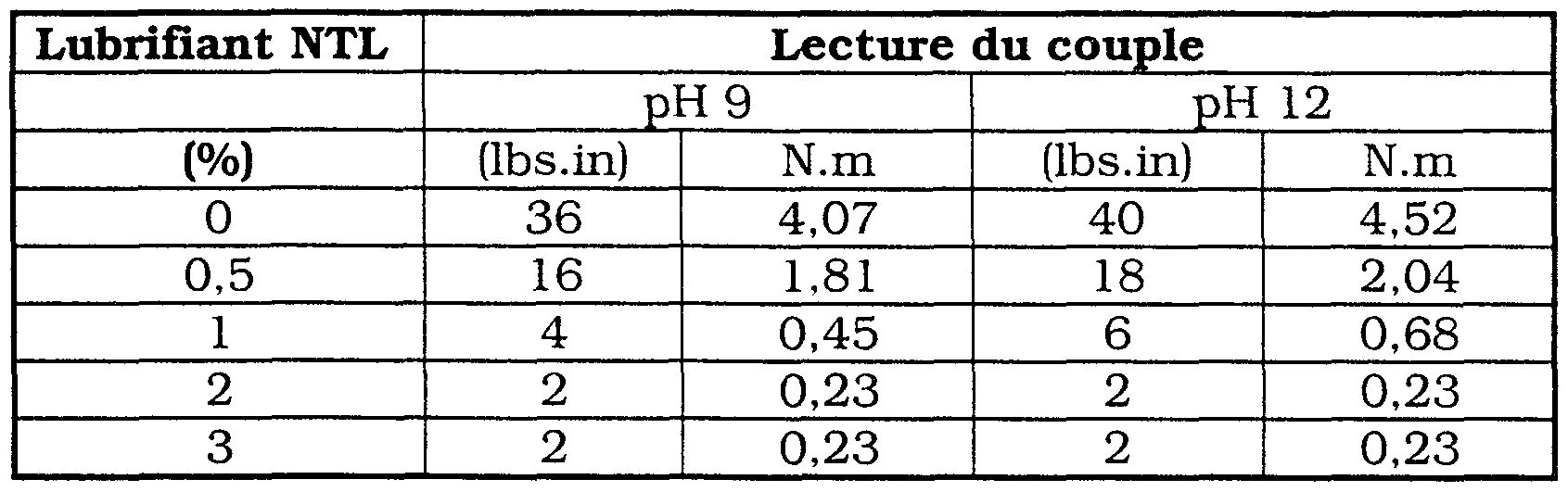
- the lubricating power of a lubricating composition added to a well fluid according to the invention is tested using a "Lubricity tester-Model 212" manufactured by the company NL Baroid Petroleum Services (Instruction Manual Part No.21 1210001EA ).
- the tests ("Lubricity-surface to surface) are carried out according to the procedures recommended by the RP 13B standard of the American Petroleum Institute (API), (100 psi (689 kPa) at 60 revolutions / minute).
- API American Petroleum Institute
- a first lubricating composition given as an example, and added to the base well fluid has been called NTL here.
- NTL is the result of the reaction of 52 kg of polymerized linseed oil with a viscosity of 10 Pa.s and 28 kg of diethanolamine, in a 100 liter reactor and heated for one hour at 160 ° C. Its viscosity is around 2700 mPa.s at 40 ° C.
- a second lubricating composition is the product of the reaction of 52 kg of linseed oil and 28 kg of diethanolamine in the same reactor as above and under the same conditions.
- Example 1 Silicate mud before aging
- composition of the basic fluid is Composition of the basic fluid:
- rheological properties of the mud are indicated (expressed in VA apparent viscosity in centipoise (cP), VP plastic viscosity in centipoise (cP), YV is the threshold shear value (Yield Value) in lb / 100ft 2 and gel 0 and gel 10 (these measurements comply with API RP 13B1 standard which gives the correspondence of SI units in Appendix I), with and without NTL, before (AV) and after aging (AP) from 16h at 80 ° C, as well as the filtration properties expressed by the amount of corrected filtrate (in cm3) obtained after 30 minutes of filtration.
- the formulation of the base fluid is the same as that of the silicate mud of Example 1.
- the lubrication performance and characteristics of the various mixtures are shown below.
- the mixtures were added at 1 or 2% by weight in the silicate mud formulation of Example 1. Before aging
- silicate mud formulation of example 1 is used, before aging and after aging as described in example 2. Before aging:
- Example 6 Bentonite mud with sea water composition of the base fluid:
- the dispersant used is polyacrylate FP30S sold by the company COATEX (France).
- composition of the basic fluid :
Landscapes
- Chemical & Material Sciences (AREA)
- Organic Chemistry (AREA)
- Life Sciences & Earth Sciences (AREA)
- General Life Sciences & Earth Sciences (AREA)
- Engineering & Computer Science (AREA)
- Materials Engineering (AREA)
- Chemical Kinetics & Catalysis (AREA)
- General Chemical & Material Sciences (AREA)
- Oil, Petroleum & Natural Gas (AREA)
- Dispersion Chemistry (AREA)
- Lubricants (AREA)
Abstract
Description


Claims
Priority Applications (12)
| Application Number | Priority Date | Filing Date | Title |
|---|---|---|---|
| EA200100032A EA004204B1 (ru) | 1998-06-12 | 1999-06-09 | ПРОМЫВОЧНАЯ ЖИДКОСТЬ БУРОВОЙ СКВАЖИНЫ, ВКЛЮЧАЮЩАЯ СМАЗОЧНУЮ КОМПОЗИЦИЮ, СПОСОБ РЕГУЛИРОВАНИЯ СМАЗЫВАНИЯ ПРОМЫВОЧНОЙ ЖИДКОСТЬЮ БУРОВОЙ СКВАЖИНЫ, ПРИМЕНЕНИЕ СПОСОБА К ПРОМЫВОЧНЫМ ЖИДКОСТЯМ С ВЫСОКИМ ЗНАЧЕНИЕМ pH |
| NZ509275A NZ509275A (en) | 1998-06-12 | 1999-06-09 | Well fluid comprising a lubricating composition - process for controlling the lubrication of a well fluid - application to high pH fluids |
| DK99923707T DK1092003T3 (da) | 1998-06-12 | 1999-06-09 | Borevæske omfattende en smöresammensætning og fremgangsmåde for at verificere smöring fra en borevæske samt anvendelse til væsker med en höj pH-værdi |
| KR1020007013989A KR20010072597A (ko) | 1998-06-12 | 1999-06-09 | 윤활용 조성물을 포함하는 시추공 유체, 이 시추공 유체의윤활력 제어 방법 및 이것을 pH가 높은 유체에 사용하는방법 |
| BR9911120-9A BR9911120A (pt) | 1998-06-12 | 1999-06-09 | Fluido de poço, comportando uma composição lubrificante - processo para controlar a lubrificação de um fluido de poço - aplicação aos fluidos com elevado ph |
| US09/719,352 US6750180B1 (en) | 1998-06-12 | 1999-06-09 | Borehole fluid containing a lubricating composition—method for verifying the lubrification of a borehole fluid—application with respect to fluids with a high ph |
| MXPA00012083A MXPA00012083A (es) | 1998-06-12 | 1999-06-09 | Fluido de pozos que comprende una composicion lubricante, procedimiento para controlar la lubricacion de un fluido de pozos y aplicacion a fluidos de alto ph. |
| CA2334992A CA2334992C (fr) | 1998-06-12 | 1999-06-09 | Fluide de puits comportant une composition lubrifiante - procede pour controler la lubrification d'un fluide de puits - application aux fluides a haut ph |
| EP99923707A EP1092003B1 (fr) | 1998-06-12 | 1999-06-09 | Fluide de puits comportant une composition lubrifiante - procede pour controler la lubrification d'un fluide de puits - application aux fluides a haut ph |
| AU40479/99A AU756939B2 (en) | 1998-06-12 | 1999-06-09 | Borehole fluid containing a lubricating composition - method for verifying the lubrification of a borehole fluid application with respect to fluids with a high pH |
| DE69916607T DE69916607T2 (de) | 1998-06-12 | 1999-06-09 | Gleitmittel enthaltende bohrspülung und verfahren zum einstellen der gleitwirkung einer bohrspülung , verwendung in flüssigkeiten mit hohen ph werten |
| NO20006266A NO20006266L (no) | 1998-06-12 | 2000-12-11 | Borefluid inneholdende en smöremiddelblanding, fremgangsmåte for regulering av smöringen for et borefluid og anvendelse av fluider med höy pH |
Applications Claiming Priority (2)
| Application Number | Priority Date | Filing Date | Title |
|---|---|---|---|
| FR9807969A FR2779733B1 (fr) | 1998-06-12 | 1998-06-12 | Fluide de puits comportant une composition lubrifiante - procede pour controler la lubrification d'un fluide de puits application aux fluides a haut ph |
| FR98/07969 | 1998-06-12 |
Publications (1)
| Publication Number | Publication Date |
|---|---|
| WO1999066006A1 true WO1999066006A1 (fr) | 1999-12-23 |
Family
ID=9527783
Family Applications (1)
| Application Number | Title | Priority Date | Filing Date |
|---|---|---|---|
| PCT/FR1999/001367 Ceased WO1999066006A1 (fr) | 1998-06-12 | 1999-06-09 | Fluide de puits comportant une composition lubrifiante - procede pour controler la lubrification d'un fluide de puits - application aux fluides a haut ph |
Country Status (16)
| Country | Link |
|---|---|
| US (1) | US6750180B1 (fr) |
| EP (1) | EP1092003B1 (fr) |
| KR (1) | KR20010072597A (fr) |
| CN (1) | CN1305517A (fr) |
| AU (1) | AU756939B2 (fr) |
| BR (1) | BR9911120A (fr) |
| CA (1) | CA2334992C (fr) |
| DE (1) | DE69916607T2 (fr) |
| DK (1) | DK1092003T3 (fr) |
| EA (1) | EA004204B1 (fr) |
| FR (1) | FR2779733B1 (fr) |
| ID (1) | ID27050A (fr) |
| MX (1) | MXPA00012083A (fr) |
| NO (1) | NO20006266L (fr) |
| NZ (1) | NZ509275A (fr) |
| WO (1) | WO1999066006A1 (fr) |
Cited By (7)
| Publication number | Priority date | Publication date | Assignee | Title |
|---|---|---|---|---|
| EP1208898A1 (fr) * | 2000-11-24 | 2002-05-29 | Institut Francais Du Petrole | Formulation désémulsionnante organique et son utilisation dans le traitment des puits forés en boue à l'huile |
| US7084092B2 (en) * | 2003-08-25 | 2006-08-01 | M-I L.L.C. | Shale hydration inhibition agent and method of use |
| CN105112029A (zh) * | 2015-09-11 | 2015-12-02 | 中石化石油工程技术服务有限公司 | 键合型润滑抑制剂及含有键合型润滑抑制剂的水基钻井液 |
| CN105131914A (zh) * | 2015-09-11 | 2015-12-09 | 中石化石油工程技术服务有限公司 | 一种离子吸附型生物润滑剂及含有该润滑剂的水基钻井液 |
| CN105219359A (zh) * | 2015-09-11 | 2016-01-06 | 中石化石油工程技术服务有限公司 | 一种缔合型润滑剂及含有该润滑剂的水基钻井液 |
| CN105255457A (zh) * | 2015-09-11 | 2016-01-20 | 中石化石油工程技术服务有限公司 | 一种仿原油型生物润滑剂及含有该润滑剂的水基钻井液 |
| WO2022013117A1 (fr) | 2020-07-15 | 2022-01-20 | Totalenergies Marketing Services | Composition lubrifiante pour des compositions à base d'eau |
Families Citing this family (8)
| Publication number | Priority date | Publication date | Assignee | Title |
|---|---|---|---|---|
| US6908887B2 (en) * | 2002-08-22 | 2005-06-21 | Halliburton Energy Services, Inc. | Suspending agent |
| BRPI0402260B1 (pt) * | 2004-06-15 | 2015-02-18 | Botica Com Farmaceutica Ltda | Composição para produtos de higiene, cosméticos e perfumes. |
| US8258066B2 (en) | 2005-12-12 | 2012-09-04 | Milliken & Company | Cleaning device |
| CN103725267A (zh) * | 2013-12-17 | 2014-04-16 | 中国石油集团渤海钻探工程有限公司 | 钻井液用抗高温润滑剂的制备及使用方法 |
| CN113293038B (zh) * | 2021-06-23 | 2023-01-24 | 四川轻化工大学 | 一种超低硫清洁柴油用胺类抗磨剂的制备方法及其应用 |
| US11760920B1 (en) | 2022-04-06 | 2023-09-19 | Halliburton Energy Services, Inc. | Lubricant for monovalent and divalent brines |
| US12325821B2 (en) | 2022-07-12 | 2025-06-10 | Secure Specialty Chemicals Corp. | Lubricant blends and methods for improving lubricity of brine-based drilling fluids |
| US12258514B2 (en) | 2023-04-25 | 2025-03-25 | Halliburton Energy Services, Inc. | Non-greasing lubricant for high salinity fluids |
Citations (4)
| Publication number | Priority date | Publication date | Assignee | Title |
|---|---|---|---|---|
| GB922667A (en) * | 1961-06-09 | 1963-04-03 | Master Chemical Corp | Stable aqueous cutting fluid containing an amine salt of boric acid |
| US3761410A (en) * | 1971-03-22 | 1973-09-25 | Nl Industries Inc | Composition and process for increasing the lubricity of water base drilling fluids |
| US4359393A (en) * | 1981-03-09 | 1982-11-16 | The Cincinnati Vulcan Company | Water active metalworking lubricant compositions |
| SU1493662A1 (ru) * | 1986-07-31 | 1989-07-15 | Институт Химии Ан Узсср | Способ получени эмульгатора гаметоцидов и стабилизатора глинистых суспензий |
Family Cites Families (7)
| Publication number | Priority date | Publication date | Assignee | Title |
|---|---|---|---|---|
| US4280915A (en) * | 1977-06-23 | 1981-07-28 | Nl Industries, Inc. | Salt stable lubricant for water base drilling fluids |
| US5567675A (en) * | 1994-02-16 | 1996-10-22 | Buckman Laboratories Of Canada, Ltd. | Application of N,N-dialkylamides to control the formation of emulsions or sludge during drilling or workover of producing oil wells |
| US5510452A (en) * | 1994-07-11 | 1996-04-23 | Rheox, Inc. | Pourable liquid polyesteramide rheological additives and the use thererof |
| US6339048B1 (en) * | 1999-12-23 | 2002-01-15 | Elementis Specialties, Inc. | Oil and oil invert emulsion drilling fluids with improved anti-settling properties |
| FR2768732B1 (fr) * | 1997-09-25 | 2003-10-24 | Inst Francais Du Petrole | Procede de fabrication d'un agent de surface emulsifiant et dispersant, a partir d'une huile polymerisee et d'un aminoalcool |
| FR2793703B1 (fr) * | 1999-05-19 | 2001-06-29 | Inst Francais Du Petrole | Procede de fabrication de compositions utilisables comme agents de surface emulsifiants et dispersants, les compositions obtenues et leurs utilisations |
| FR2793702B1 (fr) * | 1999-05-19 | 2001-06-29 | Inst Francais Du Petrole | Compositions utilisables comme agents de surface emulsifiants et dispersants, leur preparation et leurs utilisations |
-
1998
- 1998-06-12 FR FR9807969A patent/FR2779733B1/fr not_active Expired - Fee Related
-
1999
- 1999-06-09 KR KR1020007013989A patent/KR20010072597A/ko not_active Ceased
- 1999-06-09 CA CA2334992A patent/CA2334992C/fr not_active Expired - Lifetime
- 1999-06-09 BR BR9911120-9A patent/BR9911120A/pt not_active Application Discontinuation
- 1999-06-09 EA EA200100032A patent/EA004204B1/ru not_active IP Right Cessation
- 1999-06-09 ID IDW20002500A patent/ID27050A/id unknown
- 1999-06-09 WO PCT/FR1999/001367 patent/WO1999066006A1/fr not_active Ceased
- 1999-06-09 DE DE69916607T patent/DE69916607T2/de not_active Expired - Fee Related
- 1999-06-09 US US09/719,352 patent/US6750180B1/en not_active Expired - Lifetime
- 1999-06-09 DK DK99923707T patent/DK1092003T3/da active
- 1999-06-09 CN CN99807254A patent/CN1305517A/zh active Pending
- 1999-06-09 MX MXPA00012083A patent/MXPA00012083A/es not_active IP Right Cessation
- 1999-06-09 AU AU40479/99A patent/AU756939B2/en not_active Expired
- 1999-06-09 NZ NZ509275A patent/NZ509275A/en not_active IP Right Cessation
- 1999-06-09 EP EP99923707A patent/EP1092003B1/fr not_active Expired - Lifetime
-
2000
- 2000-12-11 NO NO20006266A patent/NO20006266L/no not_active Application Discontinuation
Patent Citations (4)
| Publication number | Priority date | Publication date | Assignee | Title |
|---|---|---|---|---|
| GB922667A (en) * | 1961-06-09 | 1963-04-03 | Master Chemical Corp | Stable aqueous cutting fluid containing an amine salt of boric acid |
| US3761410A (en) * | 1971-03-22 | 1973-09-25 | Nl Industries Inc | Composition and process for increasing the lubricity of water base drilling fluids |
| US4359393A (en) * | 1981-03-09 | 1982-11-16 | The Cincinnati Vulcan Company | Water active metalworking lubricant compositions |
| SU1493662A1 (ru) * | 1986-07-31 | 1989-07-15 | Институт Химии Ан Узсср | Способ получени эмульгатора гаметоцидов и стабилизатора глинистых суспензий |
Non-Patent Citations (1)
| Title |
|---|
| DATABASE WPI Section Ch Week 9017, Derwent World Patents Index; Class D23, AN 90-130964, XP002094473 * |
Cited By (10)
| Publication number | Priority date | Publication date | Assignee | Title |
|---|---|---|---|---|
| EP1208898A1 (fr) * | 2000-11-24 | 2002-05-29 | Institut Francais Du Petrole | Formulation désémulsionnante organique et son utilisation dans le traitment des puits forés en boue à l'huile |
| FR2817165A1 (fr) * | 2000-11-24 | 2002-05-31 | Inst Francais Du Petrole | Formulation desemulsionnante organique et son utilisation dans le traitement des drains fores en boue a l'huile |
| US7226896B2 (en) | 2000-11-24 | 2007-06-05 | Institut Francais Du Petrole | Organic emulsion-breaking formula and its use in treating well bores drilled in oil-base mud |
| US7084092B2 (en) * | 2003-08-25 | 2006-08-01 | M-I L.L.C. | Shale hydration inhibition agent and method of use |
| CN105112029A (zh) * | 2015-09-11 | 2015-12-02 | 中石化石油工程技术服务有限公司 | 键合型润滑抑制剂及含有键合型润滑抑制剂的水基钻井液 |
| CN105131914A (zh) * | 2015-09-11 | 2015-12-09 | 中石化石油工程技术服务有限公司 | 一种离子吸附型生物润滑剂及含有该润滑剂的水基钻井液 |
| CN105219359A (zh) * | 2015-09-11 | 2016-01-06 | 中石化石油工程技术服务有限公司 | 一种缔合型润滑剂及含有该润滑剂的水基钻井液 |
| CN105255457A (zh) * | 2015-09-11 | 2016-01-20 | 中石化石油工程技术服务有限公司 | 一种仿原油型生物润滑剂及含有该润滑剂的水基钻井液 |
| WO2022013117A1 (fr) | 2020-07-15 | 2022-01-20 | Totalenergies Marketing Services | Composition lubrifiante pour des compositions à base d'eau |
| US12122977B2 (en) | 2020-07-15 | 2024-10-22 | Totalenergies Onetech | Lubricant composition for water-based compositions |
Also Published As
| Publication number | Publication date |
|---|---|
| EP1092003A1 (fr) | 2001-04-18 |
| DK1092003T3 (da) | 2004-08-16 |
| CA2334992C (fr) | 2010-10-19 |
| FR2779733B1 (fr) | 2005-03-11 |
| AU4047999A (en) | 2000-01-05 |
| KR20010072597A (ko) | 2001-07-31 |
| DE69916607T2 (de) | 2005-04-28 |
| CN1305517A (zh) | 2001-07-25 |
| EP1092003B1 (fr) | 2004-04-21 |
| US6750180B1 (en) | 2004-06-15 |
| NZ509275A (en) | 2003-11-28 |
| NO20006266L (no) | 2001-01-24 |
| DE69916607D1 (de) | 2004-05-27 |
| BR9911120A (pt) | 2001-02-20 |
| ID27050A (id) | 2001-02-22 |
| NO20006266D0 (no) | 2000-12-11 |
| CA2334992A1 (fr) | 1999-12-23 |
| EA200100032A1 (ru) | 2001-06-25 |
| FR2779733A1 (fr) | 1999-12-17 |
| MXPA00012083A (es) | 2002-04-17 |
| AU756939B2 (en) | 2003-01-30 |
| EA004204B1 (ru) | 2004-02-26 |
Similar Documents
| Publication | Publication Date | Title |
|---|---|---|
| EP0713909B1 (fr) | Composition lubrifiante comportant un ester - utilisation de la composition et fluide de puits comportant la composition | |
| EP1092003B1 (fr) | Fluide de puits comportant une composition lubrifiante - procede pour controler la lubrification d'un fluide de puits - application aux fluides a haut ph | |
| US9340722B2 (en) | Water-based mud lubricant using fatty acid polyamine salts and fatty acid esters | |
| US20080169102A1 (en) | Surfactant Wash Treatment Fluids and Associated Methods | |
| US20080169103A1 (en) | Surfactant Wash Treatment Fluids and Associated Methods | |
| EA015332B1 (ru) | Буровой раствор на водной основе | |
| US11377613B2 (en) | Brine-tolerant lubricants and methods for using the same | |
| EA015201B1 (ru) | Буровой раствор на водной основе | |
| AU760476B2 (en) | A lubricating method for silicate drilling fluids | |
| EP2708586B1 (fr) | Modificateur de frottement pour fluides de forage | |
| EP1680477B1 (fr) | Agents lubrifiants a base de phospholipides dans des fluides de forage aqueux | |
| FR2550796A1 (fr) | Compositions adjuvantes pour fluides de forage | |
| US20250188337A1 (en) | Self-degrading organogels | |
| WO2008084227A1 (fr) | Fluides de traitement de lavage aux tensio-actifs et procédés associés | |
| JP2021530597A (ja) | 油田掘削流体用途のための環境に優しい潤滑剤 | |
| CN112585236A (zh) | 用于水基钻井液系统的合成润滑剂 | |
| JP2000282020A (ja) | 地熱井用掘削泥水組成物および掘削方法 | |
| CA2335762C (fr) | Procede de lubrification de fluides de forage au silicate | |
| EP4134410B1 (fr) | Additif de lubrification | |
| CN119013371A (zh) | 用于水基钻井液的双功能添加剂 | |
| WO2022046746A1 (fr) | Formulation de boue à base d'huile à émulsion inverse utilisant un sel de calcium d'acide gras comme émulsifiant primaire |
Legal Events
| Date | Code | Title | Description |
|---|---|---|---|
| WWE | Wipo information: entry into national phase |
Ref document number: 1200100042 Country of ref document: VN Ref document number: 99807254.0 Country of ref document: CN |
|
| AK | Designated states |
Kind code of ref document: A1 Designated state(s): AL AM AT AU AZ BA BB BG BR BY CA CH CN CU CZ DE DK EE ES FI GB GE GH GM HR HU ID IL IS JP KE KG KP KR KZ LC LK LR LS LT LU LV MD MG MK MN MW MX NO NZ PL PT RO RU SD SE SG SI SK SL TJ TM TR TT UA UG US UZ VN YU ZW |
|
| AL | Designated countries for regional patents |
Kind code of ref document: A1 Designated state(s): GH GM KE LS MW SD SL SZ UG ZW AM AZ BY KG KZ MD RU TJ TM AT BE CH CY DE DK ES FI FR GB GR IE IT LU MC NL PT SE BF BJ CF CG CI CM GA GN GW ML MR NE SN TD TG |
|
| 121 | Ep: the epo has been informed by wipo that ep was designated in this application | ||
| DFPE | Request for preliminary examination filed prior to expiration of 19th month from priority date (pct application filed before 20040101) | ||
| WWE | Wipo information: entry into national phase |
Ref document number: 1999923707 Country of ref document: EP |
|
| WWE | Wipo information: entry into national phase |
Ref document number: PA/a/2000/012083 Country of ref document: MX |
|
| ENP | Entry into the national phase |
Ref document number: 2334992 Country of ref document: CA |
|
| WWE | Wipo information: entry into national phase |
Ref document number: 1020007013989 Country of ref document: KR |
|
| WWE | Wipo information: entry into national phase |
Ref document number: 40479/99 Country of ref document: AU Ref document number: 09719352 Country of ref document: US |
|
| WWE | Wipo information: entry into national phase |
Ref document number: 509275 Country of ref document: NZ |
|
| WWE | Wipo information: entry into national phase |
Ref document number: 200100032 Country of ref document: EA |
|
| REG | Reference to national code |
Ref country code: DE Ref legal event code: 8642 |
|
| WWP | Wipo information: published in national office |
Ref document number: 1999923707 Country of ref document: EP |
|
| WWP | Wipo information: published in national office |
Ref document number: 1020007013989 Country of ref document: KR |
|
| WWG | Wipo information: grant in national office |
Ref document number: 40479/99 Country of ref document: AU |
|
| WWG | Wipo information: grant in national office |
Ref document number: 1999923707 Country of ref document: EP |
|
| WWR | Wipo information: refused in national office |
Ref document number: 1020007013989 Country of ref document: KR |