WO1999067334A1 - Phthalocyanine compounds and their use - Google Patents
Phthalocyanine compounds and their use Download PDFInfo
- Publication number
- WO1999067334A1 WO1999067334A1 PCT/GB1999/001810 GB9901810W WO9967334A1 WO 1999067334 A1 WO1999067334 A1 WO 1999067334A1 GB 9901810 W GB9901810 W GB 9901810W WO 9967334 A1 WO9967334 A1 WO 9967334A1
- Authority
- WO
- WIPO (PCT)
- Prior art keywords
- compounds
- formula
- ink
- alkyl
- mixture
- Prior art date
- Legal status (The legal status is an assumption and is not a legal conclusion. Google has not performed a legal analysis and makes no representation as to the accuracy of the status listed.)
- Ceased
Links
- 0 CC1*(C)C1C1=*CC(C)CC1 Chemical compound CC1*(C)C1C1=*CC(C)CC1 0.000 description 1
Classifications
-
- C—CHEMISTRY; METALLURGY
- C09—DYES; PAINTS; POLISHES; NATURAL RESINS; ADHESIVES; COMPOSITIONS NOT OTHERWISE PROVIDED FOR; APPLICATIONS OF MATERIALS NOT OTHERWISE PROVIDED FOR
- C09D—COATING COMPOSITIONS, e.g. PAINTS, VARNISHES OR LACQUERS; FILLING PASTES; CHEMICAL PAINT OR INK REMOVERS; INKS; CORRECTING FLUIDS; WOODSTAINS; PASTES OR SOLIDS FOR COLOURING OR PRINTING; USE OF MATERIALS THEREFOR
- C09D11/00—Inks
- C09D11/30—Inkjet printing inks
- C09D11/32—Inkjet printing inks characterised by colouring agents
-
- C—CHEMISTRY; METALLURGY
- C09—DYES; PAINTS; POLISHES; NATURAL RESINS; ADHESIVES; COMPOSITIONS NOT OTHERWISE PROVIDED FOR; APPLICATIONS OF MATERIALS NOT OTHERWISE PROVIDED FOR
- C09B—ORGANIC DYES OR CLOSELY-RELATED COMPOUNDS FOR PRODUCING DYES, e.g. PIGMENTS; MORDANTS; LAKES
- C09B47/00—Porphines; Azaporphines
- C09B47/04—Phthalocyanines abbreviation: Pc
- C09B47/08—Preparation from other phthalocyanine compounds, e.g. cobaltphthalocyanineamine complex
- C09B47/24—Obtaining compounds having —COOH or —SO3H radicals, or derivatives thereof, directly bound to the phthalocyanine radical
- C09B47/26—Amide radicals
-
- C—CHEMISTRY; METALLURGY
- C09—DYES; PAINTS; POLISHES; NATURAL RESINS; ADHESIVES; COMPOSITIONS NOT OTHERWISE PROVIDED FOR; APPLICATIONS OF MATERIALS NOT OTHERWISE PROVIDED FOR
- C09D—COATING COMPOSITIONS, e.g. PAINTS, VARNISHES OR LACQUERS; FILLING PASTES; CHEMICAL PAINT OR INK REMOVERS; INKS; CORRECTING FLUIDS; WOODSTAINS; PASTES OR SOLIDS FOR COLOURING OR PRINTING; USE OF MATERIALS THEREFOR
- C09D11/00—Inks
- C09D11/30—Inkjet printing inks
- C09D11/32—Inkjet printing inks characterised by colouring agents
- C09D11/328—Inkjet printing inks characterised by colouring agents characterised by dyes
Definitions
- IPC International Patent Classification
- Foim PCT/ISA210 (patent family annex) (July 1992) PHTHALOCYANINE COMPOUNDS AND THEIR USE
- UP ink jet printing
- UP is a non-impact printing technique in which droplets of ink are ejected through a fine nozzle onto a substrate without bringing the nozzle into contact with the substrate.
- colorants and inks used in UP desirably provide sharp, non-feathered images having good water-fastness, light-fastness and optical density.
- the inks are often required to dry quickly when applied to a substrate to prevent smudging, but they should not form a crust over the tip of an ink jet nozzle because this will stop the printer from working.
- the inks should also be stable to storage over time without decomposing or forming a precipitate which could block the fine nozzle.
- colorants used in UP have good solubility (preferably in aqueous systems) so they can be dissolved an ink and fired from the ink-jet head without coming out of solution and blocking the nozzle. Yet colorants that have good operability (i.e. high water solubility) are likely to produce prints of poor water fastness due to the same high water solubility.
- a significant challenge in designing new colorants for UP is to provide in the same molecule the apparently mutually exclusive properties of good operability for the ink and yet high water fastness for the print. This often requires the synthesis of a colorant molecule of complex structure comprising many different functional groups and such complex molecules can be expensive and difficult to prepare in high yield.
- Pc represents a phthalocyanine nucleus
- R 1 represents H or -(CH 2 ) n R 3 ;
- R 2 represents(CH 2 ) n R 3 ; or R 1 and R 2 together with the nitrogen atom to which they are attached represent a 5 or 6-membered ring;
- n is independently an integer from 1 to 30; and
- R 3 is independently a group selected from hydroxy, sulpho, cyano, -SR 4 , -CO 2 R 5 , -P0 3 H 2 and -NR 6 R 7 ; where:
- R 4 , R 5 , R 6 and R 7 independently represent H, C h alky! optionally substituted by one or more groups selected from hydroxy, mercapto, sulpho, carboxy, cyano and - PO 3 H 2 ;
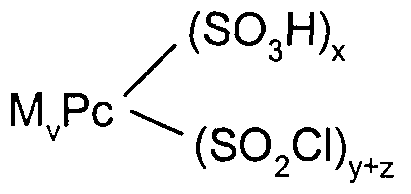
- v is the valence of Pc divided by the valence of M;
- x is from 1.2 to 3.8;
- y is from 0.1 to 2.7;
- z is from 0.1 to 2.7;
- x, y and z satisfy 2 ⁇ x + y + z ⁇ 4; with the provisos that:
- R 4 and R 5 are other than H; when R 1 is H or C 1 . 4 alkyl then R 4 is other than C 1 . 4 alkyleneSO 3 H; when R 1 is H or C 1 . 4 alkyl and R 5 is H, C 1-4 alkyl or hydroxyC 1 . 4 alkyl; Ihen R 7 is other than C 1-4 alkyl, hydroxyC ⁇ alkyl or morpholino; and when R 1 is H or C M alkyl then R 6 and R 7 are other than both H or (together with the N atom to which they are attached) other than a morpholino ring.
- phthalocyanine compounds have particular utility as colorants for use in P.
- compounds of the present invention exhibit improved operational advantages when used in UP without adversely effecting print water fastness.
- compounds of the present invention have other properties which are also useful in UP. For example they can produce IJ prints which exhibit good optical density, light fastness and/or a particularly attractive cyan shade. Their preparation is straightforward because of their simpler structure.
- the compounds of the present invention described herein include all chemical and physical forms thereof (such as those described herein) and incorporate all the above provisos. Preferred compounds are those which are UP-effective.
- M is a metal it is preferably selected from Li, Na, K, Mg, Ca, Ba, Al, Si, Sn, Pb, Rh, Sc, Ti, V, Cr, Mn, Fe, Co, Ni and Cu, more preferably from Sc, Ti, Va, Cr, Mn, Fe,
- Co, Zn, Ni and Cu especially from Ni and Cu, particularly Cu.
- v is inverse half the valence of M. 5
- the values for v, x, y and z may represent averages for the mixture. Insofar as purification techniques will allow, it is preferred that the mixture comprises one compound as the major component, more preferably the mixture iso substantially free of other compounds of Formula (1 ).
- x is from 1.2 to 2.8, more preferably 1.5 to 2.5, most preferably 1.8 to 2.2, especially 2.0.
- y and z are independently from 0.3 to 2.0, more preferably from 0.5 to 1.5, most preferably 1.0. 5
- z is > 1 (i.e. where there is a plurality of -SO 2 NR 1 R 2 groups attached to the
- each R and R 2 may independently represent a different substituent in each -S0 2 NR 1 R 2 group.
- Most preferred compounds are those in which x is 2 , y is 1 and z is 1.
- n is independently: preferably from 1 to 15, o more preferably from 1 to 8, most preferably from 1 to 4.
- R ⁇ R 2 and the N-atom to which they are attached form a cyclic group is preferably selected from morpholino, pyridyl or piperidino; more preferably morpholino.
- Preferred compounds of Formula (1 ) are those in which: M is Cu or Ni, 5 R 1 is selected from H and optionally substituted C 1-15 alkyl; and
- R 2 is a substituted C 1-15 alkyl.
- More preferred compounds of Formula (1 ) are those in which: M is Cu, R 1 is selected from H, C 1-4 alkyl and hydroxyC 1-4 alkyl; and 0 R 2 is a hydroxyC ⁇ alkyl.
- Specific compounds of Formula (1 ) are selected from those exemplified herein and any UP-effective salts thereof, more preferably the alkali metal or optionally substituted ammonium salts thereof.
- Any radical group mentioned herein as a substituent refers to a monovalent radical unless otherwise stated.
- a group which comprises a chain of three or more atoms signifies a group in which the chain may be straight or branched or the chain or any part of the chain may form a ring.
- Substituents may replace any H attached to an atom in the ring (e.g. Pc nucleus) or chain which is chemically suitable and may be located at any available position on the ring or chain (e.g. R 3 can be on any position on the alkyl chain and is not restricted to terminal position).
- the substituents on the Pc nucleus are positioned so that none of its phenyl moieties have more than one substituent.
- the total number of certain atoms is specified herein for certain substituents, for example C.,. m alkyl, signifies an alkyl group having from 1 to m carbon atoms.
- compounds of Formula (1 ) may exist in many different physical and chemical forms which also form part of the present invention. These forms may comprise any of the following (including mixtures thereof and combinations thereof in the same molecular moiety): salts, stereoisomers (e.g. enantiomers, diastereoisomers, geometric isomers, tautomers and/or conformers), zwitterions, polymorphic forms (e.g. phases, crystalline forms, amorphous forms, solid solutions and/or interstitial compounds); complexes (e.g.
- Compounds of Formula (1 ) may be in the form as shown in the structures herein (i.e. with free sulphonic acid groups) but are preferably in the form of salts. Salts of Formula (1 ) may be formed from one or more organic and/or inorganic bases and/or acids and compounds of Formula (1 ) which are acidic and/or basic (for example acid and/or base addition salts).
- Salts of Formula (1 ) comprise all UP-effective salts that may be formed from monovalent and/or multivalent acids and/or bases.
- Salts of Formula (1) also comprise all enantiomeric salts formed with UP-effective chiral acids and/or bases and/or any mixtures of enantiomers of such salts (for example racemic mixtures).
- the dyes may be converted into a salt using known techniques.
- the present invention comprises all salts of Formula (1 ) and mixtures thereof, especially those which are UP- effective.
- Preferred salts of Formulae (1) are alkali metal salts (especially lithium, sodium and potassium salts), and optionally substituted ammonium salts (especially salts with ammonia and volatile amines). More preferred salts are those with a cation of formula + NT 4 where each T is independently H or optionally substituted alkyl, or two groups represented by T are H or optionally substituted alkyl and the remaining two groups represented by T, together with the N atom to which they are attached, form a 5 or 6 membered ring (preferably a morpholine, pyridine or piperidine ring). Most preferably each T is independently H or C 1-4 alkyl, especially H, CH 3 or CH 3 CH 2 , more especially H.
- Examples of cations which are UP-effective comprise: + NH 4 , morpholinium, piperidinium, pyridinium, (CH 3 ) 3 N ⁇ , (CH 3 ) 2 N + H 2 , H 2 N + (CH 3 )(CH 2 CH 3 ), CH 3 N ⁇ 3 , CH 3 CH 2 N ⁇ 3 , H 2 N + (CH 2 CH 3 ) 2 , CH 3 CH 2 CH 2 N ⁇ 3, CH 3 CH 2 CH 2 N ⁇ 3 , (CH 3 ) 2 CHN + H 3 , N + (CH 3 ) 4 , N + (CH 2 CH 3 ) 4 , N-methyl pyridinium, N,N-dimethyl piperidinium and N,N-dimethyl morpholinium.
- Compounds of Formula (1 ) may have many uses other than UP.
- compounds of the present invention may be used as intermediates in the preparation and/or purification of other compounds of Formula (1 ) and/or as research tools and/or diagnostic aids in relation to P.
- colorant' as used herein includes both dyes and pigments. Colorants are not limited to materials which solely provide colour in the visible region of the electromagnetic (EM) spectrum but include materials (which may be visibly colourless or weakly coloured) which attenuate radiation in other regions of the EM spectrum invisible to the naked eye [e.g. ultra-violet (UV) and/or infra-red (IR) absorbers]. Compounds of the present invention may exhibit such colorant properties outside the visible region.
- Compounds of Formula (1 ) may be prepared by the methods described below and by other suitable methods analogous to those described in the art for similar phthalocyanine compounds.
- a preferred method for preparing one or more compounds of Formula (1 ) comprises the following steps: (i) condensing one or more compounds of Formula (3)
- step (i) treating the adduct from step (i) with a base, to produce one or more compounds of Formula (1 ); where v, x, y, z, M, Pc, R 1 and R 2 are as represented herein.
- the ammonia and amine are present respectively in approximately y and z molar equivalents to the amount of phthalocyanine.
- the base comprises sodium hydroxide and the pH of the mixture may be adjusted to be from 7.0 to 9.0, preferably 8.0.
- Compounds of Formula (3) may be prepared using known methods.
- a preferred method preparing these compounds comprises heating (preferably for about 1 to about 24 hours), a metal-free or metal containing phthalocyanine (optionally comprising an5 average of two to four sulpho groups per molecule) with chlorosulphonic acid, preferably at a temperature above 60°C, more preferably above 100°C, most preferably from 120°C to 165°C.
- chlorosulphonic acid preferably at a temperature above 60°C, more preferably above 100°C, most preferably from 120°C to 165°C.
- this may be followed cooling, preferably to a temperature from 30°C to 50°C.
- the phthalocyanine is then heated with PCI 3 (conveniently for about 4 to about 6 hours), preferably at lower temperature than with the chlorosulphonic acid, more o preferably from 80°C to 105°C.
- an ink which is effective for use in ink jet printing, the ink comprising a fluid medium, (optionally a liquid) and a colorant (preferably a dye) comprising one or more compounds of the present invention as defined herein.
- the ink of the present invention comprises: o (a) from 0.01 to 30 parts of an UP-effective compound of Formula (1 ); and
- the number of parts of component (a) is preferably from 0.1 to 20, more preferably 5 from 0.5 to 15, and especially from 1 to 5 parts.
- the number of parts of component (b) is preferably from 99.9 to 80, more preferably from 99.5 to 85, especially from 99 to 95 parts.
- component (a) When the medium is a liquid, preferably component (a) is completely dissolved in component (b).
- component (a) has a solubility in component (b) at 20°C of at least 10%. This allows the preparation of concentrates which may be used to prepare more dilute inks and reduces the chance of the colorant precipitating if evaporation of the liquid medium occurs during storage.
- Preferred liquid media include water, a mixture of water and an organic solvent and an organic solvent free from water.
- the weight ratio of water to organic solvent is preferably from 99:1 to 1 :99, more preferably from 99:1 to 50:50 and especially from 95:5 to 80:20.
- the organic solvent comprising the mixture of water and organic solvent is a water-miscible organic solvent or a mixture of such solvents.
- the liquid medium may comprise water and preferably two or more, more preferably from 2 to 8, water-soluble organic solvents.
- Preferred water-miscible organic solvents comprise: C ⁇ -alkanols, preferably methanol, ethanol, n-propanol, isopropanol, n-butanol, sec-butanol, tert-butanol, n-pentanol, cyclopentanol and/or cyclohexanol; linear amides, preferably dimethylformamide and/or dimethylacetamide; ketones and/or ketone-alcohols, preferably acetone, methyl ether ketone, cyclohexanone and/or diacetone alcohol; water-miscible ethers, preferably tetrahydrofuran and/or dioxane; diols, preferably C 2 .
- C ⁇ -alkanols preferably methanol, ethanol, n-propanol, isopropanol, n-butanol, sec-butanol, tert-
- diols for example pentane-1 ,5-diol, ethylene glycol, propylene glycol, butylene glycol, pentylene glycol, hexylene glycol and/or thiodiglycol
- oligo- and/or poly-alkyleneglycols for example diethylene glycol, t ethylene glycol, polyethylene glycol and/or polypropylene glycol
- triols preferably glycerol and/or 1 ,2,6-hexanetriol
- C 1-4 alkyl ethers of diols preferably monoC ⁇ alkyl ethers of C 2 . 12 diols: ⁇ for example 2-methoxyethanol, 2-(2-methoxyethoxy)ethanol, 2-(2-ethoxyethoxy)-ethanol,
- More preferred water-soluble organic solvents are selected from: cyclic amides (e.g. 2-pyrrolidone, N-methyl-pyrrolidone and N-ethyl-pyrrolidone); diols, (e.g. 1 ,5-pentane diol, ethyleneglycol, thiodiglycol, diethyleneglycol and triethyleneglycol);
- cyclic amides e.g. 2-pyrrolidone, N-methyl-pyrrolidone and N-ethyl-pyrrolidone
- diols e.g. 1 ,5-pentane diol, ethyleneglycol, thiodiglycol, diethyleneglycol and triethyleneglycol
- diols e.g. 1 ,5-pentane diol, ethyleneglycol, thiodiglycol, diethyleneglycol and triethyleneglycol
- C ⁇ alkyl ethers of diols e.g. 2-methoxy-2-ethoxy-2-ethoxyethanol
- all UP-effective mixtures thereof e.g. 2-methoxy-2-ethoxy-2-ethoxyethanol
- a preferred liquid medium comprises: 8
- Examples of further UP-effective media for inks of the present invention comprise a mixture of water and one or more organic solvents are described in US 4,963,189, US 4,703,113, US 4,626,284 and EP 0425150-A.
- the solvent preferably has a boiling point of from 30° to 200°C, more preferably of from 40° to 150°C, especially from 50 to 125°C.
- the organic solvent may be water-immiscible, water-miscible or a mixture of such solvents.
- Preferred water- miscible organic solvents comprise any of those described above and mixtures thereof.
- Preferred water-immiscible solvents comprise aliphatic hydrocarbons; esters (for example ethyl acetate) chlorinated hydrocarbons (for example dichloromethane), ethers (for example diethyl ether) and mixtures thereof.
- the liquid medium comprises a water-immiscible organic solvent
- a polar solvent for example a C ⁇ alkanol
- the liquid medium is an organic solvent free from water it comprises a ketone (especially methyl ethyl ketone) and/or an alcohol (especially a C M alkanol, more especially ethanol or propanol).
- the organic solvent free from water may be a single organic solvent or a mixture of two or more organic solvents. It is preferred that when the medium is an organic solvent free from water it is a mixture of 2 to 5 different organic solvents. This allows a medium to be selected which gives good control over the drying characteristics and storage stability of the ink.
- Ink media comprising organic solvent free from water are particularly useful where fast drying times are required and particularly when printing onto hydrophobic and non- absorbent substrates, for example plastics, metal and glass.
- Preferred low melting solid media have a melting point in the range from 60°C to 125°C.
- Suitable low melting point solids include long chain fatty acids or alcohols, preferably those with C 18 . 24 chains, and sulphonamides.
- the compound of Formula (1 ) may be dissolved in the low melting point solid or may be finely dispersed in it.
- the ink may also contain additional components conventionally used in inks for UP, for example viscosity and surface tension modifiers, corrosion inhibitors, biocides, kogation reducing additives and surfactants which may be ionic or non-ionic.
- additional components conventionally used in inks for UP, for example viscosity and surface tension modifiers, corrosion inhibitors, biocides, kogation reducing additives and surfactants which may be ionic or non-ionic.
- a further aspect of the invention provides a process for printing an image on a substrate comprising applying to the substrate by means of an ink jet printer, an ink of the present invention as defined herein.
- the ink jet printer preferably applies the ink to the substrate in the form of droplets which are ejected through a small orifice onto the substrate.
- Preferred ink jet printers are piezoelectric ink jet printers and thermal ink jet printers.
- thermal ink jet printers programmed pulses of heat are applied to the ink in a reservoir (e.g. by means of a resistor adjacent to the orifice) thereby causing the ink to be ejected in the form of small droplets directed towards the substrate during relative movement between the substrate and the orifice.
- piezoelectric ink jet printers the oscillation of a small crystal causes ejection of the ink from the orifice.
- a further aspect of the present invention provides a substrate which has applied thereon an ink of the present invention as defined herein and/or one or more compounds of the present invention as defined herein.
- the substrate preferably comprises paper, plastic, a textile, metal or glass, more preferably paper, an overhead projector slide or a textile material, especially paper.
- Preferred papers are plain or treated papers which may have an acid, alkaline or neutral character.
- the ink and/or compounds of the present invention have been applied to the substrate by a printed process, more preferably the process of the present invention as defined herein.
- the ink according to the invention is preferably applied thereto by: i) applying the ink to the textile material using an ink jet printer; and ii) heating the printed textile material at a suitable temperature, preferably from 50°C to 250°C, to fix the ink on the material.
- Preferred textile materials are natural, synthetic and semi-synthetic materials.
- Examples of preferred natural textile materials include wool, silk, hair and cellulosic materials, particularly cotton, jute, hemp, flax and linen.
- Examples of preferred synthetic and semi-synthetic materials include polyamides, polyesters, polyacrylonitriles and polyurethanes.
- the textile material has been treated with an aqueous pre-treatment composition comprising a thickening agent and optionally a water-soluble base and a hydrotropic agent and dried prior to step i) above.
- an aqueous pre-treatment composition comprising a thickening agent and optionally a water-soluble base and a hydrotropic agent and dried prior to step i) above.
- the pre-treatment composition preferably comprises a solution of the base and the hydrotropic agent in water containing the thickening agent. Particularly preferred pre- treatment compositions are described more fully in EP 0534660-A.
- Copper phthalocyanine (115g) was added in portions to stirred chlorosulphonic acid (308 ml) over 30 minutes keeping the temperature below 50°C. The mixture was stirred for 30 minutes before being heated gradually to 140°C, at which temperature it was stirred for 3 hours to obtain CuPc(SO 3 H) 4 .
- the mixture was cooled to 40°C and phosphorus trichloride (26.3g) was added in portions over 30 minutes, whilst the temperature was kept below 50°C.
- the mixture was stirred overnight at room temperature and then cooled to 0°C and poured onto a mixture of ice (700g), water (700g), concentrated hydrochloric acid (40 ml) and sodium chloride (100g).
- the mixture was stirred at 0°C for 30 minutes.
- the precipitated product was collected by filtration at reduced pressure and washed with ice-cold hydrochloric acid solution (0.5 M, 1.5 I) to obtain a paste of the above sulphonyl chloride.
- Example 16 (alternative preparation of Example 2)
- Copper phthalocyanine (1 1.52g @ 98%) was added to chlorosulphonic acid (31.2ml) whilst maintaining the temperature ⁇ 60C. The mixture was then heated to 140°C and kept at this temperature for ⁇ 3hours. The mixture was then cooled to 40°C and PCL 3 12
- the mixture was then heated to 40°C and salted to 12% w/v with sodium chloride.
- the pH of the mixture was reduced to 0.6 by adding concentrated HCI.
- the solid obtained was collected by filtration and washed with brine.
- the solid was re- dissolved in distilled water at pH 7.5 and desalinated by dialysis. Water was evaporated to yield 17.4g of the title compound.
- Example 17 (alternative preparation of Example 6)
- Example 18 (alternative preparation of Example 7)
- Example 19 (alternative preparation of Example 3)
- Copper phthalocyanine (117:6g ⁇ > a ⁇ added lu chlorusulpho ⁇ ic 300 * (3 ml, 542.9g) over 1-2 hours whilst maintaining the temperature at ⁇ 60°C.
- the temperature was raised to 140°C over 1.3- hours and heatedat that tem eraLure for a further hours.
- the mixture was cooled to 40 ⁇ C and PCLj (18ml, 27.5g) was added dropwise maintaining
- Tn ⁇ -solid prepared above (389g -wasj.tddttd to -waterf! litre) foftowe ⁇ ty qtg ⁇ jrw (2 Q .2& cfca ⁇ d the pH of ca ⁇ stieliq ⁇ or.
- the mixture was stirred at this pH and heated to 70 to 80°C for -4 hours.
- Chroma values were obtained in a conventional manner.
- Examples 2, 6 and 7 were also tested for chroma and performed very similarly to Example 1 , (i.e. better than Cyan 1 ).
- Dyes of the present invention also demonstrate a desirable combination of solubility and water fastness compared to prior art dye, as illustrated by the following test.
- Example 6 The water fastness of Example 6 herein was compared with the known dye Cyan 1 in the conventional run down test.
- Water fastness (denoted herein by WF) was determined by running water (0.5 ml) down lines of print at an angle of approximately 45°C immediately after the lines had been printed. The prints were given a score of 1 to 10 where 1 indicates poor wet fastness and 10 indicates no detected ink run down (i.e. 100% water fast).
- Examples 5, 6, 9 to 15 herein were also tested in the run down test and showed a comparable WF to Example 6 (i.e. better than Cyan 1 ).
- Example 1 The aqueous solubility of Example 1 was found to be 29%. This compares to an aqueous solubility of 14% for its mono-sulphonic acid substituted analogue.
- Prints made with the dyes of the Examples exhibit a WF comparable to or better than the corresponding zero or mono-sulphonic acid dyes.
- Dyes of the invention also exhibit a particularly attractive cyan shade with good chroma compared to their corresponding zero or mono-sulphonic acid analogues.
- the dyes of the present invention are significantly easier than prior art dyes to formulate in UP inks and use in UP and yet they produce prints of comparable or improved quality to prior art dyes.
- the dissolved sodium salt may be converted into other salt [e.g. the potassium salt] by passing the solution through an ion-exchange column comprising Dowex HGRW resin saturated with a suitable solution [e.g. potassium hydroxide solution (5% w/v)].
- a suitable solution e.g. potassium hydroxide solution (5% w/v)
- the solution of the (e.g. potassium) salt thus obtained was then filtered and water was evaporated form the filtrate to yield a purified salt suitable for use directly in an ink as described below.
- Ink jet printing of compounds of Formula (1 ) was demonstrated as follows.
- Inks separately comprising each exemplified dye were prepared by dissolving 2 parts of the sodium salt, prepared as described above, in 98 parts of a mixture of water and 2-pyrrolidone (in a respective ratio of 90:10 by volume).
- the inks were printed onto plain paper (obtained from Felix Schoeller) using a thermal ink-jet printer to give a bright cyan prints which had excellent light fastness.
- inks comprising the exemplified dyes may be may be prepared as described in the following tables in which the number in the first column (headed Ex. no.) denotes the example number of dye to be used in the ink.
- the dye may be in its free acid form and/or in the form of any UP-effective salt (e.g. sodium, potassium, ammonium, or QAC salt).
- Numbers quoted in the second column onwards refer to the number of parts of the relevant ingredient and all parts are by weight.
- the inks may be applied to paper by thermal or piezo ink jet printing.
- PG propylene glycol
- DEG diethylene glycol
- NMP N-methyl pyrollidone
- DMK dimethylketone
- MEOH methanol
- 2P 2-pyrollidone
- MIBK methylisobutyl ketone
- CET cetyl ammonium bromide
- TBT tertiary butanol
- TDG thiodiglycol
- BDL butane-2,3-diol
- PHO Na 2 HPO 4
- P12 propane-1 ,2-diol
- CHL cyclohexanol
- PDL pentan-1 ,5-diol. 17 TABLE
Landscapes
- Chemical & Material Sciences (AREA)
- Organic Chemistry (AREA)
- Life Sciences & Earth Sciences (AREA)
- Engineering & Computer Science (AREA)
- Materials Engineering (AREA)
- Wood Science & Technology (AREA)
- Inks, Pencil-Leads, Or Crayons (AREA)
- Ink Jet Recording Methods And Recording Media Thereof (AREA)
- Nitrogen Condensed Heterocyclic Rings (AREA)
- Ink Jet (AREA)
Abstract
Description


Claims

Priority Applications (7)
| Application Number | Priority Date | Filing Date | Title |
|---|---|---|---|
| DE69910581T DE69910581T2 (en) | 1998-06-23 | 1999-06-18 | PHTHALOCYANINE COMPOUNDS AND THEIR USE |
| AU42789/99A AU4278999A (en) | 1998-06-23 | 1999-06-18 | Phthalocyanine compounds and their use |
| MXPA00011605A MXPA00011605A (en) | 1998-06-23 | 1999-06-18 | Phthalocyanine compounds and their use. |
| HK02100763.3A HK1039347B (en) | 1998-06-23 | 1999-06-18 | Phthalocyanine compounds and their use |
| EP99957177A EP1093492B1 (en) | 1998-06-23 | 1999-06-18 | Phthalocyanine compounds and their use |
| JP2000555981A JP4565744B2 (en) | 1998-06-23 | 1999-06-18 | Compounds, compositions and uses |
| AT99957177T ATE247693T1 (en) | 1998-06-23 | 1999-06-18 | PHTHALOCYANINE COMPOUNDS AND THEIR USE |
Applications Claiming Priority (4)
| Application Number | Priority Date | Filing Date | Title |
|---|---|---|---|
| GBGB9813475.2A GB9813475D0 (en) | 1998-06-23 | 1998-06-23 | Compounds,compositions and use |
| GB9813475.2 | 1998-06-23 | ||
| US09/240,602 | 1999-02-01 | ||
| US09/240,602 US6149722A (en) | 1998-06-23 | 1999-02-01 | Phthalocyanine dyes, inks containing the same and use thereof in ink jet printing |
Publications (1)
| Publication Number | Publication Date |
|---|---|
| WO1999067334A1 true WO1999067334A1 (en) | 1999-12-29 |
Family
ID=26313915
Family Applications (1)
| Application Number | Title | Priority Date | Filing Date |
|---|---|---|---|
| PCT/GB1999/001810 Ceased WO1999067334A1 (en) | 1998-06-23 | 1999-06-18 | Phthalocyanine compounds and their use |
Country Status (10)
| Country | Link |
|---|---|
| EP (1) | EP1093492B1 (en) |
| JP (1) | JP4565744B2 (en) |
| CN (1) | CN1116364C (en) |
| AT (1) | ATE247693T1 (en) |
| AU (1) | AU4278999A (en) |
| DE (1) | DE69910581T2 (en) |
| HK (1) | HK1039347B (en) |
| MX (1) | MXPA00011605A (en) |
| TW (1) | TW538104B (en) |
| WO (1) | WO1999067334A1 (en) |
Cited By (18)
| Publication number | Priority date | Publication date | Assignee | Title |
|---|---|---|---|---|
| WO2003078529A1 (en) * | 2002-03-14 | 2003-09-25 | Avecia Limited | Processes for preparing phthalocyanine compounds |
| EP1254932A3 (en) * | 2001-05-04 | 2004-01-21 | Hewlett-Packard Company | Dye based ink set for ink jet printing |
| WO2004035700A1 (en) * | 2002-10-12 | 2004-04-29 | Avecia Limited | Phthalocyanine compounds used in inks |
| WO2005014726A1 (en) * | 2003-07-18 | 2005-02-17 | Avecia Inkjet Limited | Phthalocyanines and their use in ink-jet printers |
| JPWO2003062329A1 (en) * | 2002-01-24 | 2005-05-19 | 富士写真フイルム株式会社 | Ink jet recording ink, ink manufacturing method, and ink jet recording method |
| JPWO2003068872A1 (en) * | 2002-02-13 | 2005-06-02 | 富士写真フイルム株式会社 | Ink jet recording ink and ink jet recording method |
| JPWO2003066753A1 (en) * | 2002-02-08 | 2005-06-02 | 富士写真フイルム株式会社 | Ink jet recording ink and ink jet recording method |
| JPWO2003066751A1 (en) * | 2002-02-04 | 2005-06-02 | 富士写真フイルム株式会社 | Ink composition and ink jet recording method |
| WO2005071025A1 (en) | 2004-01-23 | 2005-08-04 | Fujifilm Imaging Colorants Limited | Process for the fractionation of mixtures of phthalocyanine dyes |
| US7132012B2 (en) | 2004-07-15 | 2006-11-07 | Fuji Photo Film Co., Ltd. | Phthalocyanine compound, ink, ink jet recording method and image forming method |
| WO2006114569A3 (en) * | 2005-04-23 | 2006-12-21 | Fujifilm Imaging Colorants Ltd | Phthalocyanines and their use in ink-jet printing |
| US7156908B2 (en) * | 2002-10-12 | 2007-01-02 | Fujifilm Imaging Colorants Limited | Phthalocyanine compounds, ink compositions comprising said compounds, and printing process therewith |
| WO2007116203A1 (en) * | 2006-04-11 | 2007-10-18 | Fujifilm Imaging Colorants Limited | Phthalocyanines and their use in ink-jet printing |
| US7300503B2 (en) | 2004-07-21 | 2007-11-27 | Fujifilm Corporation | Dye mixture and ink containing the same, inkjet recording method and image forming method |
| WO2011114130A1 (en) | 2010-03-17 | 2011-09-22 | Fujifilm Imaging Colorants Limited | Phthalocyanines and their use in ink jet printing |
| WO2011114132A1 (en) | 2010-03-17 | 2011-09-22 | Fujifilm Imaging Colorants Limited | Azaphthalocyanines and their use in ink-jet printing |
| WO2011114131A1 (en) | 2010-03-17 | 2011-09-22 | Fujifilm Imaging Colorants Limited | Azaphthalocyanines and their use in ink jet printing |
| US9044037B2 (en) | 2006-03-29 | 2015-06-02 | Wm. Wrigley Jr. Company | Non-contact printed comestible products and apparatus and method for producing same |
Families Citing this family (5)
| Publication number | Priority date | Publication date | Assignee | Title |
|---|---|---|---|---|
| JP4571721B2 (en) * | 1999-11-10 | 2010-10-27 | 株式会社日本化学工業所 | Copper phthalocyanine dye |
| AU2004263708B2 (en) * | 2003-07-18 | 2010-07-01 | Fujifilm Imaging Colorants Limited | Phthalocyanines and their use in ink-jet printers |
| GB0316854D0 (en) * | 2003-07-18 | 2003-08-20 | Avecia Ltd | Compounds,inks and processes |
| WO2014156496A1 (en) * | 2013-03-28 | 2014-10-02 | 富士フイルム株式会社 | Colored composition, printing method, cloth, board material, and tetraazaporphyrin-type compound |
| CN116178381A (en) * | 2022-12-26 | 2023-05-30 | 沈阳化工研究院有限公司 | A kind of preparation method of blue light green zinc phthalocyanine dye |
Citations (12)
| Publication number | Priority date | Publication date | Assignee | Title |
|---|---|---|---|---|
| FR838418A (en) * | 1937-05-26 | 1939-03-06 | Ig Farbenindustrie Ag | Dyes of the phthalocyanine series |
| FR1347692A (en) * | 1961-08-16 | 1964-01-04 | Durand & Huguenin Ag | Process for coloring aluminum oxide layers produced on aluminum |
| EP0014407A1 (en) * | 1979-02-09 | 1980-08-20 | Bayer Ag | Dye solutions, their preparation and their use for colouring paper |
| JPS5930874A (en) * | 1982-08-12 | 1984-02-18 | Taoka Chem Co Ltd | Aqueous ink |
| EP0196901A2 (en) * | 1985-03-29 | 1986-10-08 | Taoka Chemical Co., Ltd | Copper phthalocyanine compound and aqueous ink composition comprising the same |
| EP0519395A1 (en) * | 1991-06-18 | 1992-12-23 | Eastman Kodak Company | Sulfonamido or amido substituted phthalocyanines for optical recording |
| EP0596383A1 (en) * | 1992-11-06 | 1994-05-11 | Bayer Ag | Copper phthalocyanine-liquid formulation |
| EP0649881A1 (en) * | 1993-10-21 | 1995-04-26 | Bayer Ag | Novel copper phtalocyanines and their use |
| EP0719847A1 (en) * | 1994-04-25 | 1996-07-03 | Seiko Epson Corporation | Water-base ink composition and method of recording therewith |
| WO1997013811A1 (en) * | 1995-10-07 | 1997-04-17 | Zeneca Limited | Phthalocyanine compounds |
| WO1998049240A1 (en) * | 1997-04-26 | 1998-11-05 | Avecia Limited | Phthalocyanine ink-jet dyes |
| WO1998049239A1 (en) * | 1997-04-26 | 1998-11-05 | Avecia Limited | Phthalocyanine ink-jet dyes |
Family Cites Families (2)
| Publication number | Priority date | Publication date | Assignee | Title |
|---|---|---|---|---|
| JP2826583B2 (en) * | 1989-10-16 | 1998-11-18 | 田岡化学工業株式会社 | Ink composition for inkjet recording |
| JPH0860052A (en) * | 1994-08-18 | 1996-03-05 | Nippon Kayaku Co Ltd | Ink composition and color filter produced using the same |
-
1999
- 1999-06-18 WO PCT/GB1999/001810 patent/WO1999067334A1/en not_active Ceased
- 1999-06-18 AT AT99957177T patent/ATE247693T1/en not_active IP Right Cessation
- 1999-06-18 HK HK02100763.3A patent/HK1039347B/en not_active IP Right Cessation
- 1999-06-18 CN CN99807772A patent/CN1116364C/en not_active Expired - Fee Related
- 1999-06-18 JP JP2000555981A patent/JP4565744B2/en not_active Expired - Fee Related
- 1999-06-18 MX MXPA00011605A patent/MXPA00011605A/en not_active IP Right Cessation
- 1999-06-18 EP EP99957177A patent/EP1093492B1/en not_active Expired - Lifetime
- 1999-06-18 AU AU42789/99A patent/AU4278999A/en not_active Abandoned
- 1999-06-18 DE DE69910581T patent/DE69910581T2/en not_active Expired - Lifetime
- 1999-06-23 TW TW088110562A patent/TW538104B/en not_active IP Right Cessation
Patent Citations (12)
| Publication number | Priority date | Publication date | Assignee | Title |
|---|---|---|---|---|
| FR838418A (en) * | 1937-05-26 | 1939-03-06 | Ig Farbenindustrie Ag | Dyes of the phthalocyanine series |
| FR1347692A (en) * | 1961-08-16 | 1964-01-04 | Durand & Huguenin Ag | Process for coloring aluminum oxide layers produced on aluminum |
| EP0014407A1 (en) * | 1979-02-09 | 1980-08-20 | Bayer Ag | Dye solutions, their preparation and their use for colouring paper |
| JPS5930874A (en) * | 1982-08-12 | 1984-02-18 | Taoka Chem Co Ltd | Aqueous ink |
| EP0196901A2 (en) * | 1985-03-29 | 1986-10-08 | Taoka Chemical Co., Ltd | Copper phthalocyanine compound and aqueous ink composition comprising the same |
| EP0519395A1 (en) * | 1991-06-18 | 1992-12-23 | Eastman Kodak Company | Sulfonamido or amido substituted phthalocyanines for optical recording |
| EP0596383A1 (en) * | 1992-11-06 | 1994-05-11 | Bayer Ag | Copper phthalocyanine-liquid formulation |
| EP0649881A1 (en) * | 1993-10-21 | 1995-04-26 | Bayer Ag | Novel copper phtalocyanines and their use |
| EP0719847A1 (en) * | 1994-04-25 | 1996-07-03 | Seiko Epson Corporation | Water-base ink composition and method of recording therewith |
| WO1997013811A1 (en) * | 1995-10-07 | 1997-04-17 | Zeneca Limited | Phthalocyanine compounds |
| WO1998049240A1 (en) * | 1997-04-26 | 1998-11-05 | Avecia Limited | Phthalocyanine ink-jet dyes |
| WO1998049239A1 (en) * | 1997-04-26 | 1998-11-05 | Avecia Limited | Phthalocyanine ink-jet dyes |
Non-Patent Citations (1)
| Title |
|---|
| PATENT ABSTRACTS OF JAPAN vol. 008, no. 118 (C - 226) 31 May 1984 (1984-05-31) * |
Cited By (27)
| Publication number | Priority date | Publication date | Assignee | Title |
|---|---|---|---|---|
| EP1254932A3 (en) * | 2001-05-04 | 2004-01-21 | Hewlett-Packard Company | Dye based ink set for ink jet printing |
| EP1469047A4 (en) * | 2002-01-24 | 2007-01-24 | Fuji Photo Film Co Ltd | Ink for ink-jet recording, ink producing method, and ink-jet recording method |
| JPWO2003062329A1 (en) * | 2002-01-24 | 2005-05-19 | 富士写真フイルム株式会社 | Ink jet recording ink, ink manufacturing method, and ink jet recording method |
| JPWO2003066751A1 (en) * | 2002-02-04 | 2005-06-02 | 富士写真フイルム株式会社 | Ink composition and ink jet recording method |
| JPWO2003066753A1 (en) * | 2002-02-08 | 2005-06-02 | 富士写真フイルム株式会社 | Ink jet recording ink and ink jet recording method |
| JPWO2003068872A1 (en) * | 2002-02-13 | 2005-06-02 | 富士写真フイルム株式会社 | Ink jet recording ink and ink jet recording method |
| US7314273B2 (en) | 2002-03-14 | 2008-01-01 | Fujifilm Imaging Colorants Limited | Process for preparing phthalocyanine compounds |
| WO2003078529A1 (en) * | 2002-03-14 | 2003-09-25 | Avecia Limited | Processes for preparing phthalocyanine compounds |
| US7147698B2 (en) | 2002-10-12 | 2006-12-12 | Fujifilm Imaging Colorants Limited | Phthalocyanine compounds used in inks |
| US7156908B2 (en) * | 2002-10-12 | 2007-01-02 | Fujifilm Imaging Colorants Limited | Phthalocyanine compounds, ink compositions comprising said compounds, and printing process therewith |
| WO2004035700A1 (en) * | 2002-10-12 | 2004-04-29 | Avecia Limited | Phthalocyanine compounds used in inks |
| GB2418670A (en) * | 2003-07-18 | 2006-04-05 | Avecia Inkjet Ltd | Phthalocyanines and their use in ink-jet printers |
| WO2005014726A1 (en) * | 2003-07-18 | 2005-02-17 | Avecia Inkjet Limited | Phthalocyanines and their use in ink-jet printers |
| GB2418670B (en) * | 2003-07-18 | 2007-06-27 | Avecia Inkjet Ltd | Phthalocyanines and their use in ink-jet printers |
| WO2005071025A1 (en) | 2004-01-23 | 2005-08-04 | Fujifilm Imaging Colorants Limited | Process for the fractionation of mixtures of phthalocyanine dyes |
| US7132012B2 (en) | 2004-07-15 | 2006-11-07 | Fuji Photo Film Co., Ltd. | Phthalocyanine compound, ink, ink jet recording method and image forming method |
| US7300503B2 (en) | 2004-07-21 | 2007-11-27 | Fujifilm Corporation | Dye mixture and ink containing the same, inkjet recording method and image forming method |
| WO2006114569A3 (en) * | 2005-04-23 | 2006-12-21 | Fujifilm Imaging Colorants Ltd | Phthalocyanines and their use in ink-jet printing |
| US7641725B2 (en) | 2005-04-23 | 2010-01-05 | Fujifilm Imaging Colorants Limited | Phthalocyanines and their use in ink-jet printing |
| US9044037B2 (en) | 2006-03-29 | 2015-06-02 | Wm. Wrigley Jr. Company | Non-contact printed comestible products and apparatus and method for producing same |
| US9226513B2 (en) | 2006-03-29 | 2016-01-05 | Wm. Wrigley Jr. Company | Non-contact printed comestible products and apparatus and method for producing same |
| US10092020B2 (en) | 2006-03-29 | 2018-10-09 | Wm. Wrigley Jr. Company | Non-contact printed comestible products and apparatus and method for producing same |
| WO2007116203A1 (en) * | 2006-04-11 | 2007-10-18 | Fujifilm Imaging Colorants Limited | Phthalocyanines and their use in ink-jet printing |
| US7641726B2 (en) | 2006-04-11 | 2010-01-05 | Fujifilm Imaging Colorants Limited | Phthalocyanines and their use in ink-jet printing |
| WO2011114130A1 (en) | 2010-03-17 | 2011-09-22 | Fujifilm Imaging Colorants Limited | Phthalocyanines and their use in ink jet printing |
| WO2011114132A1 (en) | 2010-03-17 | 2011-09-22 | Fujifilm Imaging Colorants Limited | Azaphthalocyanines and their use in ink-jet printing |
| WO2011114131A1 (en) | 2010-03-17 | 2011-09-22 | Fujifilm Imaging Colorants Limited | Azaphthalocyanines and their use in ink jet printing |
Also Published As
| Publication number | Publication date |
|---|---|
| ATE247693T1 (en) | 2003-09-15 |
| JP2002522561A (en) | 2002-07-23 |
| CN1307617A (en) | 2001-08-08 |
| DE69910581T2 (en) | 2004-06-24 |
| AU4278999A (en) | 2000-01-10 |
| HK1039347A1 (en) | 2002-04-19 |
| MXPA00011605A (en) | 2002-04-24 |
| JP4565744B2 (en) | 2010-10-20 |
| EP1093492B1 (en) | 2003-08-20 |
| HK1039347B (en) | 2004-04-16 |
| DE69910581D1 (en) | 2003-09-25 |
| TW538104B (en) | 2003-06-21 |
| EP1093492A1 (en) | 2001-04-25 |
| CN1116364C (en) | 2003-07-30 |
Similar Documents
| Publication | Publication Date | Title |
|---|---|---|
| EP1239010B1 (en) | Phthalocyanines, compositions and use | |
| EP0979253B1 (en) | Phthalocyanine ink-jet dyes | |
| EP1093492B1 (en) | Phthalocyanine compounds and their use | |
| US6569212B2 (en) | Phthalocyanine ink-jet dyes | |
| US6454845B1 (en) | Phthalocyanine compounds used in inks for ink-jet printing | |
| EP1084201B1 (en) | Use of lithium salts of anionic dyes to enhance their light-fastness | |
| EP0975698B1 (en) | Phthalocyanine ink-jet dyes | |
| EP1009775B1 (en) | Phthalocyanine compounds used in inks for ink jet printing | |
| US6508873B1 (en) | Phthalocyanine compounds used in inks for ink jet printing | |
| EP1476507B1 (en) | Compounds, compositions and uses | |
| US6277185B1 (en) | Dye compounds, compositions containing them and their use | |
| EP1554354A1 (en) | Phthalocyanine compounds, ink compositions comprising said compounds, and printing process therewith | |
| US6332918B1 (en) | Phthalocyanine compounds for ink-jet printing | |
| EP1563020A1 (en) | Phthalocyanine compounds used in inks | |
| WO2000008101A2 (en) | Phthalocyanine compounds used in inks for ink jet printing | |
| GB2341868A (en) | Sulpho and phenylaminosulphonyl substituted phthalocyanine derivatives and their use in ink jet inks | |
| WO2001066649A1 (en) | Compound, composition and use | |
| WO2001066648A1 (en) | Compound, compositions and use | |
| WO2004029158A1 (en) | Metal complexes of azo dyes and their uses in ink-jet printing | |
| GB2332208A (en) | 4-(2-amino-3,6-disulpho-8-hydroxynaphth-1-ylazo)anilino- pyrimidine or 1,3,5-triazine dyes & their use in ink jet printing inks |
Legal Events
| Date | Code | Title | Description |
|---|---|---|---|
| WWE | Wipo information: entry into national phase |
Ref document number: 99807772.0 Country of ref document: CN |
|
| AK | Designated states |
Kind code of ref document: A1 Designated state(s): AE AL AM AT AU AZ BA BB BG BR BY CA CH CN CU CZ DE DK EE ES FI GB GD GE GH GM HR HU ID IL IN IS JP KE KG KP KR KZ LC LK LR LS LT LU LV MD MG MK MN MW MX NO NZ PL PT RO RU SD SE SG SI SK SL TJ TM TR TT UA UG US UZ VN YU ZA ZW |
|
| AL | Designated countries for regional patents |
Kind code of ref document: A1 Designated state(s): GH GM KE LS MW SD SL SZ UG ZW AM AZ BY KG KZ MD RU TJ TM AT BE CH CY DE DK ES FI FR GB GR IE IT LU MC NL PT SE BF BJ CF CG CI CM GA GN GW ML MR NE SN TD TG |
|
| 121 | Ep: the epo has been informed by wipo that ep was designated in this application | ||
| DFPE | Request for preliminary examination filed prior to expiration of 19th month from priority date (pct application filed before 20040101) | ||
| REG | Reference to national code |
Ref country code: DE Ref legal event code: 8642 |
|
| WWE | Wipo information: entry into national phase |
Ref document number: 1999957177 Country of ref document: EP |
|
| WWE | Wipo information: entry into national phase |
Ref document number: IN/PCT/2000/00613/MU Country of ref document: IN |
|
| WWE | Wipo information: entry into national phase |
Ref document number: PA/a/2000/011605 Country of ref document: MX |
|
| WWE | Wipo information: entry into national phase |
Ref document number: 1020007014541 Country of ref document: KR |
|
| WWP | Wipo information: published in national office |
Ref document number: 1999957177 Country of ref document: EP |
|
| REG | Reference to national code |
Ref country code: DE Ref legal event code: 8642 |
|
| WWP | Wipo information: published in national office |
Ref document number: 1020007014541 Country of ref document: KR |
|
| WWG | Wipo information: grant in national office |
Ref document number: 1999957177 Country of ref document: EP |
|
| WWG | Wipo information: grant in national office |
Ref document number: 1020007014541 Country of ref document: KR |