WO2000005285A1 - Copolyacetal - Google Patents
Copolyacetal Download PDFInfo
- Publication number
- WO2000005285A1 WO2000005285A1 PCT/JP1999/003966 JP9903966W WO0005285A1 WO 2000005285 A1 WO2000005285 A1 WO 2000005285A1 JP 9903966 W JP9903966 W JP 9903966W WO 0005285 A1 WO0005285 A1 WO 0005285A1
- Authority
- WO
- WIPO (PCT)
- Prior art keywords
- group
- glycidyl ether
- polyacetal copolymer
- formula
- compound
- Prior art date
- Legal status (The legal status is an assumption and is not a legal conclusion. Google has not performed a legal analysis and makes no representation as to the accuracy of the status listed.)
- Ceased
Links
Classifications
-
- C—CHEMISTRY; METALLURGY
- C08—ORGANIC MACROMOLECULAR COMPOUNDS; THEIR PREPARATION OR CHEMICAL WORKING-UP; COMPOSITIONS BASED THEREON
- C08L—COMPOSITIONS OF MACROMOLECULAR COMPOUNDS
- C08L59/00—Compositions of polyacetals; Compositions of derivatives of polyacetals
-
- C—CHEMISTRY; METALLURGY
- C08—ORGANIC MACROMOLECULAR COMPOUNDS; THEIR PREPARATION OR CHEMICAL WORKING-UP; COMPOSITIONS BASED THEREON
- C08G—MACROMOLECULAR COMPOUNDS OBTAINED OTHERWISE THAN BY REACTIONS ONLY INVOLVING UNSATURATED CARBON-TO-CARBON BONDS
- C08G2/00—Addition polymers of aldehydes or cyclic oligomers thereof or of ketones; Addition copolymers thereof with less than 50 molar percent of other substances
- C08G2/18—Copolymerisation of aldehydes or ketones
- C08G2/22—Copolymerisation of aldehydes or ketones with epoxy compounds
Definitions
- the present invention relates to a polyacetal resin having high rigidity, excellent creep characteristics, and high surface hardness and excellent sliding characteristics.
- Polyacetal resins have excellent properties in mechanical properties, thermal properties, electrical properties, slidability, moldability, etc., and are mainly used as structural materials and mechanical parts for electrical equipment, automotive parts, precision Widely used for machine parts, etc.
- As a means for improving such physical properties a method of filling a fibrous filler into a polyacetate resin, and a method of reducing the amount of a comonomer in a polyacetate copolymer are known.
- the filling of fibrous fillers causes problems such as poor appearance of molded products and reduced sliding characteristics
- the method of reducing comonomer causes problems such as reduced thermal stability of polymers. Did not gain.
- the present inventor paid attention to the improvement of the intrinsic rigidity and creep characteristics of the polymer due to the modification of the polymer skeleton itself.
- Japanese Patent Application Laid-Open No. Hei 3-170526 discloses trioxane and ethylene oxide, 1,3-dioxolan, 1,3-dioxepane, 1,3,5-trioxepane. At least one cyclic ether compound selected from 1,3,6-trioxocan and glycidyl phenyl ether, styrene oxide, dali
- a modified polyacetal copolymer obtained by copolymerizing at least one compound selected from sidyl naphthyl ether is disclosed.
- this modified polyacetal copolymer is intended to improve the formability by increasing the crystallization rate, and particularly to achieve high cycle properties. The rigidity improving effect of the copolymer was not always satisfactory. Disclosure of the invention
- An object of the present invention is to provide a copolymerized polyacetal resin which solves the above-mentioned problems, has high rigidity, has excellent creep characteristics, and further has excellent surface characteristics, sliding characteristics and the like.
- the present inventors have conducted intensive studies to achieve the above object, and as a result, surprisingly, a polyacetal copolymer having a branched structure introduced by copolymerizing a specific glycidyl ether compound has It has been found that unexpectedly improved rigidity and improved creep characteristics are possible, and the present invention has been achieved.
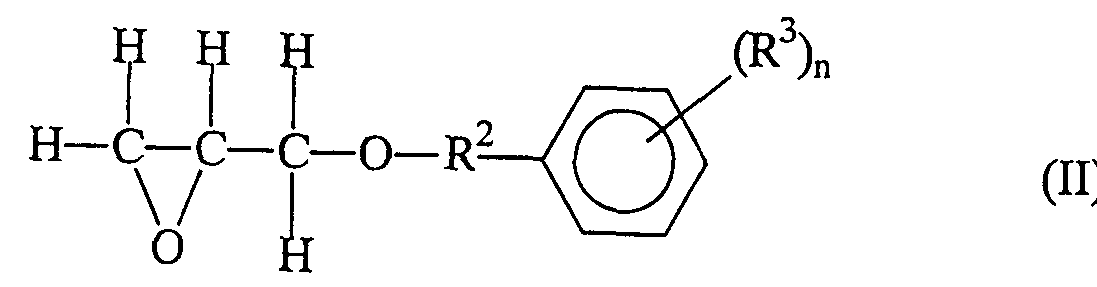
- the present invention relates to (A) 100 parts by weight of trioxane, (B) 0.01 to 10 parts by weight of at least one compound selected from dalicidyl ether compounds represented by the following general formula), ( ⁇ ) or (III). And (C) a polyether copolymer obtained by copolymerizing 0 to 20 parts by weight of a cyclic ether compound copolymerizable with trioxane (excluding the glycidyl ether compound of the above (B)).
- R 1 represents a hydrogen substituent of the phenyl group, and And n is an integer of 1 to 5, and when n is 2 or more, R 1 may be the same or different.
- n if there are n is 2 or an integer of 0 to 5 R 3 may be the same as or different from each.
- the polyalkylene oxide glycol residue of -C 2 may be a polyoxyalkylene group having 2 to 20 carbon atoms, and the alkylene group may be preferably ethylene or propylene.
- R 4 represents an alkyl group having 1 to 30 carbon atoms, an alkenyl group or an arginyl group having 2 to 20 carbon atoms
- R 5 represents an alkylene group having 1 to 30 carbon atoms
- n represents 0 to 20. It is an integer.
- the component (B) is preferably any one of the formulas (1), ( ⁇ ) and (III).
- phenyl group component especially in formula (I), preferably has a substituent R 1 at at least ol bets position.
- the ortho-substituent R 1 may show steric hindrance. preferable.
- the trioxane (A) used in the present invention is a cyclic trimer of formaldehyde, which is generally obtained by reacting an aqueous formaldehyde solution in the presence of an acidic catalyst, and which is obtained by a method such as distillation. It is used after purification.
- the trioxane (A) used for the polymerization is preferably free from impurities such as water, methanol, and formic acid.
- specific examples of the compound of the component (B) represented by the formula (I) include butyl phenyl glycidyl ether, sec-butyl phenyl glycidyl ether, n-butyl phenyl glycidyl ether, and phenyl phenol. Glycidyl ether, cresyl glycidyl ether, jib mouth mocresyl glycidyl ether and the like can be mentioned.
- the glycidyl ether compound (B) used in the present invention preferably has a substituent R 1 at least at the ortho position from the viewpoint of the thermal stability of the resulting polyacetal copolymer. Are particularly preferable, for example, those having steric hindrance, for example, a phenyl group and a tert-butyl group.
- Preferred examples of the component (B) represented by the formula (II) include benzyl glycidyl ether and a compound represented by the following formula (II).
- an example of a preferable compound of the component (B) represented by the formula (III) is represented by the following formula ( ⁇ ).
- Other examples include methyldalicidyl ether, ethyl dalicydyl ether, butyldalicydyl ether, 2-ethylhexylglycidyl ether, and 2-methyloctyldaricidyl ether.
- R 4 is an alkyl group having 1 to 30 carbon atoms
- Component (B) is copolymerized in an amount of 0.01 to 10 parts by weight, preferably 0.1 to 10 parts by weight, per 100 parts by weight of trioxane of component (A).
- the copolymerization amount of the component (B) is too small, the formation of a branched structure derived from the component (B) is small, so that the effects of improving the rigidity and creep characteristics aimed at by the present invention cannot be obtained. Then, problems such as a decrease in crystallinity and a decrease in rigidity occur.
- Examples of the cyclic ether compound (C) copolymerizable with the trioxane (A) in the polyacetal copolymer of the present invention include ethylene oxide, propylene oxide, petylene oxide, epichlorohydrin, epipib-mohydrin, styrene oxide, and the like.
- the copolymerization amount of the cyclic ether compound (C) is 100 parts by weight of trioxane of the component (A). 0 to 20 parts by weight, preferably 0.05 to: 15 parts by weight, particularly preferably 0.1 to 10 parts by weight.
- Such a cyclic ether compound (C) is not particularly essential for improving the rigidity and cleave characteristics aimed at by the present invention, but it stabilizes the polymerization reaction and at the same time stabilizes the polyacetal copolymer produced.
- the copolymerization ratio of the cyclic ether compound (C) is too large, the improvement in rigidity and creep properties aimed at by the present invention becomes insufficient.
- the copolymerization ratio of the cyclic ether compound (C) as described above is determined in consideration of such a viewpoint.
- the polyacetal copolymer of the present invention is prepared by adding trioxane (A), a glycidyl ether compound (B) and a cyclic ether compound (C) to an appropriate amount of a It can be obtained by a method such as performing bulk polymerization using a polymerization catalyst.
- the polyacetal copolymer of the present invention preferably has an abrasion index m obtained from the crystallization rate of 3, and by satisfying this requirement, the polyacetal copolymer has more excellent rigidity, creep characteristics and the like. It becomes a copolymer.
- the avehami index was measured using a thermal scanning calorimeter (DSC) in a nitrogen atmosphere at 200 ° C for 3 minutes, then cooled to the crystallization temperature and maintained. Is calculated based on the following equation.
- V is the volume of spherulites growing from one spherulite
- N is the number of crystal nuclei
- X is after t hours
- K is the rate constant
- m is the Abram index
- the trioxane (A), the glycidyl ether compound (B), and the cyclic ether compound (C) are separately fed into the polymerization machine, a catalyst is added, or the catalyst is added to the trioxane (A).
- the effect of improving rigidity and creep characteristics is slightly inferior to the above.
- the polymerization apparatus is not particularly limited, and a known apparatus is used, and any method such as a batch method and a continuous method can be used.
- the polymerization temperature is preferably maintained at 65 to 35 ° C.
- the deactivation after the polymerization is performed by adding a basic compound or an aqueous solution thereof to the reaction product discharged from the polymerization machine after the polymerization reaction or the reaction product in the polymerization machine.
- Examples of the cationic polymerization catalyst used in the present invention include lead tetrachloride, tin tetrachloride, titanium tetrachloride, aluminum trichloride, zinc chloride, vanadium trichloride, antimony trichloride, phosphorus pentafluoride, antimony pentafluoride, Boron trifluoride, Boron trifluoride getyl etherate, Boron trifluoride dibutyl etherate, Boron trifluoride dioxa Boron trifluoride coordination compound such as boron trifluoride acetic unhydrate, boron trifluoride triethylamine complex compound, perchloric acid, acetyl chloride, t-butyl park mouthrate, hydroxyacetic acid, Inorganic and organic acids such as trichloroacetic acid, trifluoroacetic acid, and P-toluenesulfonic acid, triethyloxodimethylt
- boron trifluoride boron trifluoride getyl etherate, boron trifluoride dibutyl etherate, boron trifluoride dioxanate, boron trifluoride acetate anhydrate, boron trifluoride triethylamine Boron trifluoride coordination compounds such as complex compounds are preferred.
- These catalysts can be used after being diluted with an organic solvent or the like.
- a chemical component capable of forming a branched structure in addition to the above components, a chemical component capable of forming a branched structure can be used in combination.
- Components that can form a branched structure include, for example, ethylene glycol diglycidyl ether, propylene glycol diglycidyl ether, 1,4-butanediol diglycidyl ether, hexamethylene dalicol diglycidyl ether, and resorcinol diglycidyl ether.
- Bisphenol A diglycidyl ether polyethylene glycol diglycidyl ether, polypropylene glycol diglycidyl ether, polybutylene glycol diglycidyl ether, glycerin and derivatives thereof, pen-erythritol and derivatives thereof, and the like.
- Examples of the molecular weight modifier used in the present invention include low molecular weight acetal compounds having an alkoxy group such as methylal, methoxymethylal, dimethoxymethylal, trimethoxymethylal, and oxymethylenedi-n-butyl ether; methanol; Examples thereof include alcohols such as phenol and butanol, and ester compounds. Among them, a low molecular weight acetal compound having an alkoxy group is particularly preferable. Further, the amount of these molecular weight modifiers to be added is not particularly limited as long as the effects of the present invention are not impaired.
- Examples of the basic compound for neutralizing and deactivating the polymerization catalyst include ammonia, amines such as triethylamine, triptylamine, triethanolamine and tributylamine, or water of an alkali metal or an alkaline earth metal. Oxide salts and other known catalyst deactivators are used. After the polymerization reaction, it is preferable to add these aqueous solutions to the product promptly to deactivate the product. After such a polymerization method and a deactivation method, if necessary, washing, separation and recovery of unreacted monomers, drying, etc. are performed by a conventionally known method.
- a stabilization treatment is carried out by a known method such as decomposition removal of an unstable terminal or sealing of an unstable terminal with a stable substance, and necessary various stabilizers are blended.
- a stabilizer used here one or more of a hindered phenol compound, a nitrogen-containing compound, an alkali or alkaline earth metal hydroxide, an inorganic salt, a carboxylate and the like can be used. Can be mentioned.
- thermoplastic resins for example, coloring agents such as dyes and pigments, lubricants, nucleating agents, release agents, antistatic agents, surfactants
- coloring agents such as dyes and pigments
- lubricants for example, lubricants, nucleating agents, release agents, antistatic agents, surfactants
- organic polymer materials inorganic or organic fibrous, powdery, and plate-like fillers
- the degree of polymerization of the polyacetal copolymer of the present invention there is no particular limitation on the degree of polymerization of the polyacetal copolymer of the present invention, and the degree of polymerization and the like can be adjusted according to the purpose of use and the molding means.However, when used for molding, the temperature is 190 ° C.
- the melt index (Ml) measured under a load of 2.06 kg is preferably from 1 to 100 g ZlO, particularly preferably S ⁇ g ZlO.
- the mechanism by which the polyacetal copolymer of the present invention exhibits excellent effects in rigidity and creep properties is not always clear, but the present inventors presume roughly as follows.
- the polyacetal polymer which is a crystalline resin, has a lamellar structure when molecules are folded during the process of cooling and solidifying from a molten state in molding and the like.
- a load such as bending or pulling is applied to the molded product, slip occurs at the lamella interface, resulting in distortion and stress relaxation, but when exceeding the limit value, fracture occurs.
- the polyacetal copolymer of the present invention since the polyacetal copolymer of the present invention has a branched structure, a polymer constituting one lamella is entangled with a polymer molecule constituting an adjacent lamella or is inserted into the lamella.
- the Avrami index was calculated by the method described above.
- Dumbbell-shaped test specimens were molded using an injection molding machine and measured according to ASTM D638 method.
- Test specimens were molded using an injection molding machine and measured according to the ASTM method.
- Test specimens were molded using an injection molding machine and measured according to the ASTM method.
- a paddle was attached using a continuous mixing reactor consisting of a barrel that has a jacket through which a heat (cool) medium passes and a cross section of two circles partially overlapping, and a rotary shaft with paddles. While rotating the rotating shafts at 150 rpm, a homogeneous mixed solution of trioxane (A), glycidyl ether compound (B) and cyclic ether compound (1,3-dioxolan) (C) shown in Table 1 was polymerized into a polymerization machine.
- A trioxane
- B glycidyl ether compound
- C cyclic ether compound (1,3-dioxolan
- methylal as a molecular weight regulator and a dibutyl ether solution of boron trifluoride dibutyl etherate as a catalyst become 0.01% by weight in terms of boron trifluoride with respect to trioxane.
- bulk polymerization was carried out by continuously adding and supplying.
- the reaction product discharged from the polymerization machine was immediately passed through a crusher, and was added to an aqueous solution containing 0.05% by weight of triethylamine at 60 ° C. to deactivate the catalyst. Further, after separation, washing and drying, a crude polyacetyl copolymer was obtained.
- Example 6 Polymerization was carried out in the same manner as in Example 6, except that the glycidyl ether compound (B) was not used, but with the composition shown in Table 1, and the same treatment was carried out. A polyacetal copolymer was obtained.
- Comparative Example 3 the amount of component (C) was adjusted based on the same concept as in Comparative Example 1.
- Table 1 shows the results of each evaluation.
- Example 2 100 0.59 1,3-dioxolane 3.20 3 ⁇ added 60.5 2580 92.5 glycidyl ether
- Example 4 100 0.65 1,3-dioxolane 3.20 3 ⁇ added 60.2 2560 92.0
- Example 6 In the same manner as in Example 6, except that the compound (B) is polymerized with the composition shown in Table 2, and further subjected to a treatment for removing unstable portions, and then melt-kneaded with a stabilizer to form a pellet-shaped copolymer. A polymer was obtained.
- Table 2 shows the results of each evaluation.
- Example 6 In the same manner as in Example 6, except that the compound (B) is polymerized with the composition shown in Table 3, and then subjected to a treatment for removing unstable portions, and then melt-kneaded with a stabilizer to form a pellet-shaped copolymer. A polymer was obtained.
- Table 1 shows the results of each evaluation.
Landscapes
- Chemical & Material Sciences (AREA)
- Health & Medical Sciences (AREA)
- Chemical Kinetics & Catalysis (AREA)
- Medicinal Chemistry (AREA)
- Polymers & Plastics (AREA)
- Organic Chemistry (AREA)
- Polyoxymethylene Polymers And Polymers With Carbon-To-Carbon Bonds (AREA)
- Epoxy Resins (AREA)
- Polyethers (AREA)
Description



Claims


Priority Applications (2)
| Application Number | Priority Date | Filing Date | Title |
|---|---|---|---|
| EP99931519A EP1120431A4 (en) | 1998-07-24 | 1999-07-23 | COPOLYACETAL |
| US09/646,752 US6255440B1 (en) | 1998-07-24 | 1999-07-23 | Copolyacetal |
Applications Claiming Priority (6)
| Application Number | Priority Date | Filing Date | Title |
|---|---|---|---|
| JP20976298 | 1998-07-24 | ||
| JP20976498A JP3926484B2 (ja) | 1998-07-24 | 1998-07-24 | ポリアセタール共重合体 |
| JP20976398 | 1998-07-24 | ||
| JP10/209762 | 1998-07-24 | ||
| JP10/209764 | 1998-07-24 | ||
| JP10/209763 | 1998-07-24 |
Publications (1)
| Publication Number | Publication Date |
|---|---|
| WO2000005285A1 true WO2000005285A1 (fr) | 2000-02-03 |
Family
ID=27329053
Family Applications (1)
| Application Number | Title | Priority Date | Filing Date |
|---|---|---|---|
| PCT/JP1999/003966 Ceased WO2000005285A1 (fr) | 1998-07-24 | 1999-07-23 | Copolyacetal |
Country Status (7)
| Country | Link |
|---|---|
| US (1) | US6255440B1 (ja) |
| EP (1) | EP1120431A4 (ja) |
| KR (1) | KR100529457B1 (ja) |
| CN (1) | CN1178970C (ja) |
| MY (1) | MY117970A (ja) |
| TW (1) | TWI237035B (ja) |
| WO (1) | WO2000005285A1 (ja) |
Cited By (1)
| Publication number | Priority date | Publication date | Assignee | Title |
|---|---|---|---|---|
| US6642321B1 (en) * | 1999-06-23 | 2003-11-04 | Polyplastics Co., Ltd. | Polyacetal resin composition |
Families Citing this family (3)
| Publication number | Priority date | Publication date | Assignee | Title |
|---|---|---|---|---|
| DE102008018966A1 (de) | 2008-04-16 | 2009-10-22 | Ticona Gmbh | Verfahren zur Herstellung von Oxymethylen-Polymeren und dafür geeignete Vorrichtung |
| EP2546272A1 (en) | 2011-07-15 | 2013-01-16 | Ticona GmbH | Process for producing oxymethylene polymers |
| EP3103827B1 (en) | 2014-02-03 | 2019-12-11 | Manac Inc. | Bromine-containing polyether polymer and method for producing same |
Citations (11)
| Publication number | Priority date | Publication date | Assignee | Title |
|---|---|---|---|---|
| JPS4326873B1 (ja) * | 1965-04-24 | 1968-11-19 | ||
| JPS4326871B1 (ja) * | 1965-03-05 | 1968-11-19 | ||
| JPS447139B1 (ja) * | 1965-01-11 | 1969-03-28 | ||
| JPS4428509B1 (ja) * | 1965-06-30 | 1969-11-22 | ||
| JPS4953286A (ja) * | 1972-07-10 | 1974-05-23 | ||
| JPS6112713A (ja) * | 1984-06-27 | 1986-01-21 | Mitsubishi Gas Chem Co Inc | オキシメチレン共重合体の製造法 |
| JPH02214714A (ja) * | 1989-02-14 | 1990-08-27 | Mitsubishi Gas Chem Co Inc | オキシメチレン三元重合体の製造方法 |
| JPH03109411A (ja) * | 1989-09-21 | 1991-05-09 | Toray Ind Inc | 射出成形用ポリオキシメチレン共重合体の製造方法 |
| JPH03170526A (ja) * | 1989-08-09 | 1991-07-24 | Toray Ind Inc | ポリオキシメチレン樹脂射出成形材料 |
| JPH04226917A (ja) * | 1990-05-22 | 1992-08-17 | Sanofi Sa | 神経退化過程における予防及び治療用医薬 |
| JPH08231665A (ja) * | 1995-02-23 | 1996-09-10 | Polyplastics Co | ポリオキシメチレン共重合体及びその製造法 |
Family Cites Families (5)
| Publication number | Priority date | Publication date | Assignee | Title |
|---|---|---|---|---|
| US4181685A (en) | 1971-01-15 | 1980-01-01 | Hoechst Aktiengesellschaft | Thermoplastic molding compositions on the basis of polyoxymethylenes |
| KR0146285B1 (ko) | 1989-08-09 | 1998-08-17 | 마에다 가쓰노스께 | 폴리옥시메틸렌 다원공중합체 및 그의 성형품 |
| JP3109104B2 (ja) | 1991-02-22 | 2000-11-13 | 東レ株式会社 | オキシメチレン多元共重合体 |
| JP3170526B2 (ja) | 1992-10-16 | 2001-05-28 | 日本パーオキサイド株式会社 | 過酢酸と過酸化水素の分別定量方法 |
| JP3109411B2 (ja) | 1995-07-20 | 2000-11-13 | 東洋紡績株式会社 | 感熱記録材料用空洞含有ポリエステル系フィルムおよび感熱記録材料 |
-
1999
- 1999-07-20 TW TW088112281A patent/TWI237035B/zh not_active IP Right Cessation
- 1999-07-21 MY MYPI99003064A patent/MY117970A/en unknown
- 1999-07-23 CN CNB99809000XA patent/CN1178970C/zh not_active Expired - Lifetime
- 1999-07-23 KR KR10-2000-7013575A patent/KR100529457B1/ko not_active Expired - Lifetime
- 1999-07-23 EP EP99931519A patent/EP1120431A4/en not_active Withdrawn
- 1999-07-23 US US09/646,752 patent/US6255440B1/en not_active Expired - Lifetime
- 1999-07-23 WO PCT/JP1999/003966 patent/WO2000005285A1/ja not_active Ceased
Patent Citations (11)
| Publication number | Priority date | Publication date | Assignee | Title |
|---|---|---|---|---|
| JPS447139B1 (ja) * | 1965-01-11 | 1969-03-28 | ||
| JPS4326871B1 (ja) * | 1965-03-05 | 1968-11-19 | ||
| JPS4326873B1 (ja) * | 1965-04-24 | 1968-11-19 | ||
| JPS4428509B1 (ja) * | 1965-06-30 | 1969-11-22 | ||
| JPS4953286A (ja) * | 1972-07-10 | 1974-05-23 | ||
| JPS6112713A (ja) * | 1984-06-27 | 1986-01-21 | Mitsubishi Gas Chem Co Inc | オキシメチレン共重合体の製造法 |
| JPH02214714A (ja) * | 1989-02-14 | 1990-08-27 | Mitsubishi Gas Chem Co Inc | オキシメチレン三元重合体の製造方法 |
| JPH03170526A (ja) * | 1989-08-09 | 1991-07-24 | Toray Ind Inc | ポリオキシメチレン樹脂射出成形材料 |
| JPH03109411A (ja) * | 1989-09-21 | 1991-05-09 | Toray Ind Inc | 射出成形用ポリオキシメチレン共重合体の製造方法 |
| JPH04226917A (ja) * | 1990-05-22 | 1992-08-17 | Sanofi Sa | 神経退化過程における予防及び治療用医薬 |
| JPH08231665A (ja) * | 1995-02-23 | 1996-09-10 | Polyplastics Co | ポリオキシメチレン共重合体及びその製造法 |
Non-Patent Citations (3)
| Title |
|---|
| CHEMICAL ABSTRACTS, vol. 81, no. 18, November 1974, Columbus, Ohio, US; abstract no. 106175Y, MIKHAILOV M.: "Conformation and crystallinity of trioxane homo- and copolymers obtained by solid-liquid-state polymerization" page 14; column 2; XP002926624 * |
| IZW. OTD. KHIM. NAUKI, BULG. AKAD. NAUK. (ENG), vol. 7, no. 1, 1974, pages 61 - 69 * |
| See also references of EP1120431A4 * |
Cited By (1)
| Publication number | Priority date | Publication date | Assignee | Title |
|---|---|---|---|---|
| US6642321B1 (en) * | 1999-06-23 | 2003-11-04 | Polyplastics Co., Ltd. | Polyacetal resin composition |
Also Published As
| Publication number | Publication date |
|---|---|
| MY117970A (en) | 2004-08-30 |
| KR20010052479A (ko) | 2001-06-25 |
| KR100529457B1 (ko) | 2005-11-17 |
| TWI237035B (en) | 2005-08-01 |
| US6255440B1 (en) | 2001-07-03 |
| CN1178970C (zh) | 2004-12-08 |
| EP1120431A4 (en) | 2002-11-27 |
| EP1120431A1 (en) | 2001-08-01 |
| CN1310732A (zh) | 2001-08-29 |
Similar Documents
| Publication | Publication Date | Title |
|---|---|---|
| JP4718464B2 (ja) | ポリオキシメチレンホモポリマーおよびコポリマー、ならびにその製造および使用 | |
| EP1508592A1 (en) | Polyacetal resin composition | |
| JP4762387B2 (ja) | ポリアセタール樹脂組成物 | |
| WO2000005285A1 (fr) | Copolyacetal | |
| WO2001042326A1 (fr) | Copolymere polyacetalique | |
| WO2001040375A1 (en) | Branched polyacetal resin composition | |
| JP4467669B2 (ja) | 分岐ポリアセタール樹脂組成物 | |
| JP3208353B2 (ja) | ポリアセタール樹脂の製造方法 | |
| JP3926512B2 (ja) | ポリアセタール共重合体 | |
| JP3115473B2 (ja) | 変性ポリオキシメチレン共重合体の製造法 | |
| JP2001002886A (ja) | 分岐ポリアセタール樹脂組成物 | |
| JP2005232404A (ja) | ポリアセタール樹脂組成物 | |
| JP3883750B2 (ja) | ポリアセタール共重合体 | |
| JP3926484B2 (ja) | ポリアセタール共重合体 | |
| JP3086360B2 (ja) | 変性ポリアセタール共重合体、その製造法およびそれを含有する組成物 | |
| JP4472302B2 (ja) | ポリアセタール共重合体の製造方法 | |
| JP2001163944A (ja) | ポリアセタール共重合体及びその製造方法 | |
| WO2000055227A1 (fr) | Copolymere polyacetal et son procede de production | |
| JP2001163943A (ja) | ポリアセタール共重合体 | |
| JP2002275227A (ja) | ポリアセタール共重合体 | |
| JP3093139B2 (ja) | 変性ポリオキシメチレン共重合体、その製造法及びそれを含有する組成物 | |
| JP4979856B2 (ja) | ポリアセタール樹脂組成物 | |
| JP4204876B2 (ja) | バックル用樹脂材料及びその成形品 | |
| JP2002234922A (ja) | ポリアセタール共重合体及びその製造方法 | |
| JP2001240639A (ja) | 変性ポリアセタール樹脂とその製造方法 |
Legal Events
| Date | Code | Title | Description |
|---|---|---|---|
| WWE | Wipo information: entry into national phase |
Ref document number: 99809000.X Country of ref document: CN |
|
| AK | Designated states |
Kind code of ref document: A1 Designated state(s): CN KR US |
|
| AL | Designated countries for regional patents |
Kind code of ref document: A1 Designated state(s): AT BE CH CY DE DK ES FI FR GB GR IE IT LU MC NL PT SE |
|
| DFPE | Request for preliminary examination filed prior to expiration of 19th month from priority date (pct application filed before 20040101) | ||
| 121 | Ep: the epo has been informed by wipo that ep was designated in this application | ||
| WWE | Wipo information: entry into national phase |
Ref document number: 09646752 Country of ref document: US |
|
| WWE | Wipo information: entry into national phase |
Ref document number: 1020007013575 Country of ref document: KR |
|
| WWE | Wipo information: entry into national phase |
Ref document number: 1999931519 Country of ref document: EP |
|
| WWP | Wipo information: published in national office |
Ref document number: 1020007013575 Country of ref document: KR |
|
| WWP | Wipo information: published in national office |
Ref document number: 1999931519 Country of ref document: EP |
|
| WWG | Wipo information: grant in national office |
Ref document number: 1020007013575 Country of ref document: KR |