WO2000022004A1 - Process for making a dilithium initiator, and the use therof - Google Patents
Process for making a dilithium initiator, and the use therof Download PDFInfo
- Publication number
- WO2000022004A1 WO2000022004A1 PCT/EP1999/007758 EP9907758W WO0022004A1 WO 2000022004 A1 WO2000022004 A1 WO 2000022004A1 EP 9907758 W EP9907758 W EP 9907758W WO 0022004 A1 WO0022004 A1 WO 0022004A1
- Authority
- WO
- WIPO (PCT)
- Prior art keywords
- alkyl
- diisopropenylbenzene
- lithium
- lithium alkyl
- compound
- Prior art date
- Legal status (The legal status is an assumption and is not a legal conclusion. Google has not performed a legal analysis and makes no representation as to the accuracy of the status listed.)
- Ceased
Links
- 0 *c(c(N)c(c(C1CCC1)c1N)P)c1N Chemical compound *c(c(N)c(c(C1CCC1)c1N)P)c1N 0.000 description 1
Classifications
-
- C—CHEMISTRY; METALLURGY
- C07—ORGANIC CHEMISTRY
- C07F—ACYCLIC, CARBOCYCLIC OR HETEROCYCLIC COMPOUNDS CONTAINING ELEMENTS OTHER THAN CARBON, HYDROGEN, HALOGEN, OXYGEN, NITROGEN, SULFUR, SELENIUM OR TELLURIUM
- C07F1/00—Compounds containing elements of Groups 1 or 11 of the Periodic Table
- C07F1/02—Lithium compounds
-
- C—CHEMISTRY; METALLURGY
- C08—ORGANIC MACROMOLECULAR COMPOUNDS; THEIR PREPARATION OR CHEMICAL WORKING-UP; COMPOSITIONS BASED THEREON
- C08F—MACROMOLECULAR COMPOUNDS OBTAINED BY REACTIONS ONLY INVOLVING CARBON-TO-CARBON UNSATURATED BONDS
- C08F36/00—Homopolymers and copolymers of compounds having one or more unsaturated aliphatic radicals, at least one having two or more carbon-to-carbon double bonds
- C08F36/02—Homopolymers and copolymers of compounds having one or more unsaturated aliphatic radicals, at least one having two or more carbon-to-carbon double bonds the radical having only two carbon-to-carbon double bonds
- C08F36/04—Homopolymers and copolymers of compounds having one or more unsaturated aliphatic radicals, at least one having two or more carbon-to-carbon double bonds the radical having only two carbon-to-carbon double bonds conjugated
Definitions
- This invention relates to a process for making a dilithium initiator, and the use thereof in the preparation of anionically polymerized polymers Background of the Invention
- U.S. Patent 3,734,973 describes the production of multifunctional anionic polymerization initiators by reacting diisopropenylbenzene compounds with a lithium alkyl. These two components are reacted in a molar range of 0.1:1 to 4:1 and the reaction is conducted in the presence of a polymerizable monovinyl-substituted aromatic compound employed as a solubilizing monomer and also in the presence of a hydrocarbon or polar diluent.
- butadiene for example, it describes the addition of butadiene to a mixture of diisopropenylbenzene and toluene and then adding secondary butyllithium to that mixture in solution in cyclohexane, after which time the reaction to form the dilithium initiator was carried out.
- the reaction was also carried out without the butadiene as a solubilizing agent and a precipitate formed.
- These initiators were used to carry out the anionic copolymerization of styrene and butadiene. They can also be used to make block copolymers of those monomers.
- the chemistry involved in the reaction of the diisopropenylbenzene and the lithium alkyl is prone to suffer from a competing side reaction which forms oligomers of diisopropenylbenzene.
- the oligomers consume diisopropenylbenzene and this limits the yield of the dilithium initiator.
- the oligomers have more than two lithium centers per molecule. If all of the lithium centers in the oligomers initiate polymerization, a nonlinear, star, or radial polymer will result. This is undesirable if the desired polymer is a difunctional anionic polymer.
- This invention is a process for making a dilithium initiator which comprises mixing together a di(l- ⁇ alkyl or aryl ⁇ ethylene) arene compound and diethylether and then adding the mixture to (a) a secondary lithium alkyl, and/or (b) tertiary lithium alkyl to allow the same to react at a temperature of from (a) 40 to 50 °C or from (b) 25 to 50 °C, such that the molar ratio of the diethyl ether to the lithium alkyl is from 0.1:1 to (a) 1.5:1 or (b) 2:1 and the molar ratio of the di(l- ⁇ alkyl or aryl ⁇ ethylene) arene compound to lithium alkyl is from 0.4:1 to 0.6:1.
- the di(l- ⁇ alkyl or aryl ⁇ ethylene) arene compound is a compound belonging to the class described in European patent application No. 673,954 and the documents cited in respect of this application. Examples include benzene derivatives, naphthalene derivatives and other fused ring systems generally having no more than 14 ring atoms.
- the alkyl group in each "1-alkylethylene” group independently is selected from Cl to C4 alkyl groups, with a methyl group being preferred.
- the aryl group in each " 1-arylethylene” group is typically an aromatic hydrocarbyl group having no more than 14, preferably 6 ring atoms. It may be substituted, but phenyl is preferred.
- the preferred di(l- ⁇ alkyl or aryl ⁇ ethylene) - arene compound is diisopropenylbenzene, and the present invention is hence further described with diisopropenylbenzene as the di(l- ⁇ alkyl or aryl ⁇ ethylene) arene .
- the molar ratio of the diisopropenylbenzene compound to the lithium alkyl is preferably as close to 0.5:1 as possible.
- the presence ofexcess diisopropenylbenzene compound is undesirable as it will promote the formation of oligomers. If there is not enough lithium alkyl to react with all of the isopropenyl centers, it is hypothesized that they will react with the newly formed benzyl lithium centers and in this way make oligomers. Excess lithium alkyl, on the other hand, is only undesirable if the polymerization application cannot tolerate monoinitiated product. Monoinitiated product would arise from the excess lithium alkyl used in the preparation of the diinitiator.
- a combination of monoinitiated and diinitated polymers will be preferred.
- an excess of lithium alkyl should be used in the preparation of the diinitiator. It is preferred that the molar ratio of diethyl ether to lithium alkyl be as close to 1:1 as possible .
- di(l- ⁇ alkyl or aryl ⁇ ethylene) arene compound is diisopropenylbenzene.
- diisopropenylbenzene compounds which can be used according to the present invention are represented by the following formula
- R' s are isopropenyl radicals and each of the remaining R' s is independently selected from hydrogen, or an alkyl, or cycloalkyl radical, or combinations thereof, containing from one to six carbon atoms.
- Exemplary compounds are e.g., 2,6- or 2,7-di(l- phenylethylene) naphthalene; 1, 5-diisopropenylnaphthalene; 1, 2-diisopropenylbenzene; 1, 3-diisopropenylbenzene; 1,4- diisopropenylbenzene; 3,4,5, 6-tetramethyl-l, 2-diisopropenylbenzene; 2,4,5, 6-tetraethyl-l, 3-diisopropenylbenzene; 2,3,5, 6-tetra-n-hexyl-l , 4-diisopropenylbenzene; 3, 4-di- cyclohexyl-1, 2-diisopropenylbenzene; 5- ( 3-methy1- cyclopentyl) -1, 3-diisopropenylbenzene; 3-cyclopentyl- methyl-6-n-propyl-l, 4-d
- the lithium alkyl compounds that are reacted with the diisopropenylbenzene compounds of this invention are represented by the formula R'Li, wherein R' is a secondary or tertiary alkyl, preferably containing from 3 to 20, preferably 4 to 10, carbon atoms per molecule.
- lithium alkyl compounds are isopropyl- lithium, sec-butyllithium, tert-octyl-lithium, tert- butyllithium, and the like, sec-butyl and tert-butyl- lithium are preferred.
- the dilithium initiators of this invention are prepared by reacting a lithium alkyl compound with a diisopropenylbenzene compound at a mole ratio of diisopropenylbenzene to lithium alkyl in the range of 0.4:1 to 0.6:1, preferably 0.45:1 to 0.55:1. Excess lithium alkyl may be used for applications where a mixture of diinitiator and monoinitiator is preferred.
- Diethyl ether is utilized in the reaction at a molar ratio of diethyl ether to lithium alkyl compound of above 0.1:1 to 1.5:1 for secondary lithium alkyls and 2:1 for tertiary lithium alkyls, preferably 0.4:1 to 1.1:1, and most preferably about 1:1 for secondary lithium alkyls and 2:1 for tertiary lithium alkyls because this ratio gives the best results with poorer results observed at both lower and higher ratios.
- This reaction is carried out in a relatively narrow temperature range of 25 to 50 °C and in the case of secondary lithium alkyls, 40 to 50 °C. Lower yields of the dilithium initiator and thus higher levels of oligomer will be obtained at higher and lower temperatures.
- the diisopropenylbenzene compound and the diethyl ether are first mixed together. Then they are added to the lithium alkyl compound. It is highly preferred that this mixture be added to the lithium alkyl at a rate that allows control of the reaction temperature within the desired range .
- Anionically polymerized polymers of conjugated dienes and/or vinyl aromatic hydrocarbons and/or other monomers can be made with the dilithium initiators according to conventional practice such as described in U.S. No. 3,734,973.
- Functionalized anionic polymers wherein the functionalization is terminal and/or internal are produced using the dilithium initiators of the present invention, such as described in U.S. Patent No. 5,393,843.
- the polymer is made by anionic polymerization utilizing a dilithium initiator which is the adduct derived from the reaction of m-diisopropenyl- benzene with two equivalents of s-BuLi. Monomer is added to the initiator in hydrocarbon solution and anionic living polymer chains grow outwardly from the ends of the dilithium initiator.
- the polymers to be functionalized are then capped to form functional end groups as described in U.S. Patent Nos . 4,417,029, 4,518,753, and 4,753,991. Of particular interest herein are terminal hydroxyl, carboxyl, sulfonate, and amine groups. To make unfunctionalized polymers, the living chain ends are terminated with hydrogen or methanol .
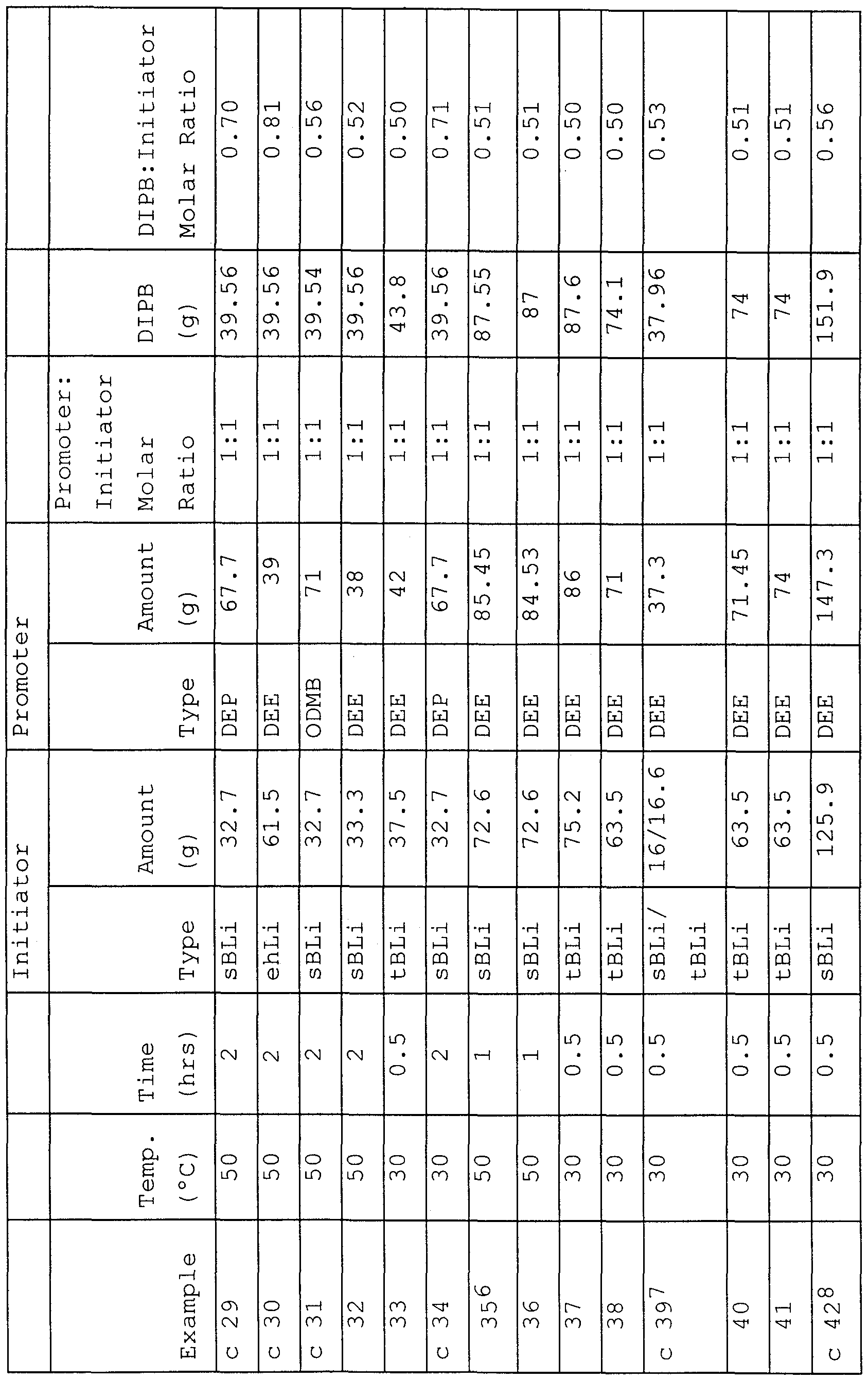
- Alkyllithium initiator compounds included sec-butyllithium, (sBLi), phenyllithium (PLi), 2-ethylhexyllithium (EHLi) , n-butyllithium (nBLi) , n-heptyllithium (nHLi) , and tert- butyllithium (tBLi) .
- DEE diethyl ether
- DEP diethoxypropane
- ODMB o-dimethoxybenzene
- DIPB diisopropenylbenzene
- 1 is the desired compound.
- 2 is dimer
- 3 is trimer
- 4 is tetramer
- 5+ is the larger species.
- DIPB/DEE mixture added at beginning, a sample was taken, and the rest of the mixture was added.
- reaction mixture of 24 was reacted for 2 additional hours at the higher temperature.
- Impurities may have thrown off the ratio of sBLi to DIPB.
- t-butyllithium works well at lower temperatures (see Examples 7, 22, 33, 37, 38, 40, and 41) and at higher temperatures (Example 23) .
- s-butyllithium does not work well at promoter : initiator ratios below 0.1:1 and above 1.5:1
- Example 2 (Comparative)
- the lithium alkyl reagent, t-BuLi (191.4 g of a 1.7 M solution in pentane, 0.5 mol) was combined in an autoclave with the promoter, diethylether (38.2 g, 0.5 mol) .
- the molar ratio of promoter to lithium alkyl was 1:1.
- This solution was heated to 50 °C.
- a solution of 39.56 g of diisopropenylbenzene (0.25 mol) in 511 g of polymerization grade cyclohexane was added to the reactor over a period of about 1 hour.
- the temperature was controlled at 50 °C.
- the solution was maintained at 50 °C for an additional 1 hour post reaction period.
Landscapes
- Chemical & Material Sciences (AREA)
- Organic Chemistry (AREA)
- Health & Medical Sciences (AREA)
- Chemical Kinetics & Catalysis (AREA)
- Medicinal Chemistry (AREA)
- Polymers & Plastics (AREA)
- Engineering & Computer Science (AREA)
- Materials Engineering (AREA)
- Polymerization Catalysts (AREA)
- Organic Low-Molecular-Weight Compounds And Preparation Thereof (AREA)
- Low-Molecular Organic Synthesis Reactions Using Catalysts (AREA)
- Addition Polymer Or Copolymer, Post-Treatments, Or Chemical Modifications (AREA)
- Dental Preparations (AREA)
- Adhesives Or Adhesive Processes (AREA)
- Nonmetallic Welding Materials (AREA)
Abstract
Description




Claims
Priority Applications (6)
| Application Number | Priority Date | Filing Date | Title |
|---|---|---|---|
| BR9914347-0A BR9914347A (en) | 1998-10-09 | 1999-10-07 | Process for preparing a di-lithium initiator and using it |
| DE69914095T DE69914095T2 (en) | 1998-10-09 | 1999-10-07 | METHOD FOR PRODUCING A DILITHIUM INITIATOR AND USE THEREOF |
| EP99948993A EP1123320B1 (en) | 1998-10-09 | 1999-10-07 | Process for making a dilithium initiator, and the use therof |
| JP2000575906A JP4445135B2 (en) | 1998-10-09 | 1999-10-07 | Method for producing dilithium initiator and use thereof |
| AU62028/99A AU6202899A (en) | 1998-10-09 | 1999-10-07 | Process for making a dilithium initiator, and the use therof |
| AT99948993T ATE257488T1 (en) | 1998-10-09 | 1999-10-07 | METHOD FOR PRODUCING A DILITHIUM INITIATOR AND USE THEREOF |
Applications Claiming Priority (2)
| Application Number | Priority Date | Filing Date | Title |
|---|---|---|---|
| US10369598P | 1998-10-09 | 1998-10-09 | |
| US60/103,695 | 1998-10-09 |
Publications (1)
| Publication Number | Publication Date |
|---|---|
| WO2000022004A1 true WO2000022004A1 (en) | 2000-04-20 |
Family
ID=22296568
Family Applications (1)
| Application Number | Title | Priority Date | Filing Date |
|---|---|---|---|
| PCT/EP1999/007758 Ceased WO2000022004A1 (en) | 1998-10-09 | 1999-10-07 | Process for making a dilithium initiator, and the use therof |
Country Status (12)
| Country | Link |
|---|---|
| US (1) | US6217798B1 (en) |
| EP (1) | EP1123320B1 (en) |
| JP (1) | JP4445135B2 (en) |
| KR (1) | KR100649780B1 (en) |
| AT (1) | ATE257488T1 (en) |
| AU (1) | AU6202899A (en) |
| BR (1) | BR9914347A (en) |
| DE (1) | DE69914095T2 (en) |
| ES (1) | ES2211178T3 (en) |
| TW (1) | TW539691B (en) |
| WO (1) | WO2000022004A1 (en) |
| ZA (1) | ZA200102901B (en) |
Cited By (3)
| Publication number | Priority date | Publication date | Assignee | Title |
|---|---|---|---|---|
| WO2002008300A1 (en) * | 2000-07-25 | 2002-01-31 | Bayer Aktiengesellschaft | Method for producing di -or tri-functional lithium based initiator systems and the use thereof |
| US6562923B1 (en) | 2000-09-11 | 2003-05-13 | Michelin Recherche Et Technique S.A. | Process for the preparation of a dilithiated initiator and anionic polymerization process |
| GB2361919B (en) * | 2000-03-04 | 2004-06-02 | Goodyear Tire & Rubber | Synthesis of dilithium initiator |
Families Citing this family (2)
| Publication number | Priority date | Publication date | Assignee | Title |
|---|---|---|---|---|
| GR1004163B (en) | 2001-11-01 | 2003-02-21 | Polycarbocyclic derivatives for modification of resist, optical and etch resistance properties | |
| EP1709090B1 (en) * | 2003-09-24 | 2016-03-23 | Kraton Polymers U.S. LLC | Anionic polymerization diinitiator and process for preparing same |
Citations (1)
| Publication number | Priority date | Publication date | Assignee | Title |
|---|---|---|---|---|
| US5393843A (en) * | 1992-08-31 | 1995-02-28 | Shell Oil Company | Butadiene polymers having terminal functional groups |
Family Cites Families (1)
| Publication number | Priority date | Publication date | Assignee | Title |
|---|---|---|---|---|
| US3734973A (en) | 1971-11-04 | 1973-05-22 | Phillips Petroleum Co | Multifunctional polymerization initiators from diisopropenylbenzene |
-
1999
- 1999-09-30 US US09/409,924 patent/US6217798B1/en not_active Expired - Lifetime
- 1999-10-07 BR BR9914347-0A patent/BR9914347A/en not_active IP Right Cessation
- 1999-10-07 DE DE69914095T patent/DE69914095T2/en not_active Expired - Lifetime
- 1999-10-07 JP JP2000575906A patent/JP4445135B2/en not_active Expired - Lifetime
- 1999-10-07 AT AT99948993T patent/ATE257488T1/en not_active IP Right Cessation
- 1999-10-07 ES ES99948993T patent/ES2211178T3/en not_active Expired - Lifetime
- 1999-10-07 WO PCT/EP1999/007758 patent/WO2000022004A1/en not_active Ceased
- 1999-10-07 EP EP99948993A patent/EP1123320B1/en not_active Expired - Lifetime
- 1999-10-07 AU AU62028/99A patent/AU6202899A/en not_active Abandoned
- 1999-10-07 KR KR1020017004334A patent/KR100649780B1/en not_active Expired - Lifetime
- 1999-10-20 TW TW088118092A patent/TW539691B/en not_active IP Right Cessation
-
2001
- 2001-04-09 ZA ZA200102901A patent/ZA200102901B/en unknown
Patent Citations (1)
| Publication number | Priority date | Publication date | Assignee | Title |
|---|---|---|---|---|
| US5393843A (en) * | 1992-08-31 | 1995-02-28 | Shell Oil Company | Butadiene polymers having terminal functional groups |
Cited By (3)
| Publication number | Priority date | Publication date | Assignee | Title |
|---|---|---|---|---|
| GB2361919B (en) * | 2000-03-04 | 2004-06-02 | Goodyear Tire & Rubber | Synthesis of dilithium initiator |
| WO2002008300A1 (en) * | 2000-07-25 | 2002-01-31 | Bayer Aktiengesellschaft | Method for producing di -or tri-functional lithium based initiator systems and the use thereof |
| US6562923B1 (en) | 2000-09-11 | 2003-05-13 | Michelin Recherche Et Technique S.A. | Process for the preparation of a dilithiated initiator and anionic polymerization process |
Also Published As
| Publication number | Publication date |
|---|---|
| ZA200102901B (en) | 2002-01-30 |
| US6217798B1 (en) | 2001-04-17 |
| DE69914095D1 (en) | 2004-02-12 |
| JP4445135B2 (en) | 2010-04-07 |
| KR20010080012A (en) | 2001-08-22 |
| KR100649780B1 (en) | 2006-11-24 |
| TW539691B (en) | 2003-07-01 |
| BR9914347A (en) | 2001-11-27 |
| ATE257488T1 (en) | 2004-01-15 |
| DE69914095T2 (en) | 2004-06-09 |
| AU6202899A (en) | 2000-05-01 |
| EP1123320B1 (en) | 2004-01-07 |
| EP1123320A1 (en) | 2001-08-16 |
| ES2211178T3 (en) | 2004-07-01 |
| JP2002527541A (en) | 2002-08-27 |
Similar Documents
| Publication | Publication Date | Title |
|---|---|---|
| US4080492A (en) | Butadiene polymerization process | |
| Morton et al. | Anionic polymerization of vinyl monomers | |
| EP0212693B1 (en) | Method for coupling polymers obtained by the anionic polymerization of dienic and/or vinylaromatic monomers | |
| US3668263A (en) | Organolithium polymerization initiators and use thereof in polymerization processes | |
| US6455651B1 (en) | Uniform initiation of anionic polymerization using organo-substituted alkali metal initiators | |
| US4182818A (en) | Polyfunctional lithium containing initiator | |
| KR101768293B1 (en) | Novel initiator in anionic polymerization and method for preparing a conjugated diene polymer using the same | |
| Guyot et al. | New perfectly difunctional organolithium initiators for block copolymer synthesis: Synthesis of dilithium initiators in the absence of polar additives | |
| EP0331400B1 (en) | Catalyst composition for polymerization of conjugated diene and process for producing conjugated diene polymer | |
| US4196153A (en) | Polyfunctional lithium containing initiator | |
| US4704438A (en) | Novel styrene copolymer | |
| EP1123320B1 (en) | Process for making a dilithium initiator, and the use therof | |
| US4136245A (en) | Continuous solution polymerization process | |
| KR100214404B1 (en) | Selective hydrogenation of conjugated diolefin polymers | |
| US7550537B2 (en) | Organo-dilithium compound and process for preparing the same | |
| US4189555A (en) | Continuous solution polymerization process | |
| US4136244A (en) | Continuous solution polymerization process | |
| US3652456A (en) | Multifunctional polymerization initiators from allyl-substituted tertiary amines | |
| JP2002504564A (en) | Production of initiator compositions for suppressed anionic polymerization | |
| GB2124228A (en) | Organo-lithium polymerization initiator | |
| US4202954A (en) | Continuous solution polymerization process | |
| US20040254321A1 (en) | Uniform initiation of anionic polymerization using organo-substituted alkali metal initiators | |
| JPH0235767B2 (en) | ||
| US4208498A (en) | Continuous solution polymerization process | |
| RU1358350C (en) | Method of synthesis of organometallic compounds |
Legal Events
| Date | Code | Title | Description |
|---|---|---|---|
| AK | Designated states |
Kind code of ref document: A1 Designated state(s): AE AL AM AT AU AZ BA BB BG BR BY CA CH CN CR CU CZ DE DK DM EE ES FI GB GD GE GH GM HR HU ID IL IN IS JP KE KG KP KR KZ LC LK LR LS LT LU LV MD MG MK MN MW MX NO NZ PL PT RO RU SD SE SG SI SK SL TJ TM TR TT TZ UA UG UZ VN YU ZA ZW |
|
| AL | Designated countries for regional patents |
Kind code of ref document: A1 Designated state(s): GH GM KE LS MW SD SL SZ TZ UG ZW AM AZ BY KG KZ MD RU TJ TM AT BE CH CY DE DK ES FI FR GB GR IE IT LU MC NL PT SE BF BJ CF CG CI CM GA GN GW ML MR NE SN TD TG |
|
| 121 | Ep: the epo has been informed by wipo that ep was designated in this application | ||
| DFPE | Request for preliminary examination filed prior to expiration of 19th month from priority date (pct application filed before 20040101) | ||
| WWE | Wipo information: entry into national phase |
Ref document number: 1999948993 Country of ref document: EP |
|
| WWE | Wipo information: entry into national phase |
Ref document number: 1020017004334 Country of ref document: KR |
|
| ENP | Entry into the national phase |
Ref country code: JP Ref document number: 2000 575906 Kind code of ref document: A Format of ref document f/p: F |
|
| REG | Reference to national code |
Ref country code: DE Ref legal event code: 8642 |
|
| WWP | Wipo information: published in national office |
Ref document number: 1999948993 Country of ref document: EP |
|
| WWP | Wipo information: published in national office |
Ref document number: 1020017004334 Country of ref document: KR |
|
| WWG | Wipo information: grant in national office |
Ref document number: 1999948993 Country of ref document: EP |
|
| WWG | Wipo information: grant in national office |
Ref document number: 1020017004334 Country of ref document: KR |