WO2000025915A2 - A method for preparing a hydrogenation catalyst system - Google Patents
A method for preparing a hydrogenation catalyst system Download PDFInfo
- Publication number
- WO2000025915A2 WO2000025915A2 PCT/EP1999/008311 EP9908311W WO0025915A2 WO 2000025915 A2 WO2000025915 A2 WO 2000025915A2 EP 9908311 W EP9908311 W EP 9908311W WO 0025915 A2 WO0025915 A2 WO 0025915A2
- Authority
- WO
- WIPO (PCT)
- Prior art keywords
- compounds
- hydrogenation
- compound
- hydrogen
- catalyst
- Prior art date
- Legal status (The legal status is an assumption and is not a legal conclusion. Google has not performed a legal analysis and makes no representation as to the accuracy of the status listed.)
- Ceased
Links
Classifications
-
- B—PERFORMING OPERATIONS; TRANSPORTING
- B01—PHYSICAL OR CHEMICAL PROCESSES OR APPARATUS IN GENERAL
- B01J—CHEMICAL OR PHYSICAL PROCESSES, e.g. CATALYSIS OR COLLOID CHEMISTRY; THEIR RELEVANT APPARATUS
- B01J37/00—Processes, in general, for preparing catalysts; Processes, in general, for activation of catalysts
- B01J37/0009—Use of binding agents; Moulding; Pressing; Powdering; Granulating; Addition of materials ameliorating the mechanical properties of the product catalyst
-
- C—CHEMISTRY; METALLURGY
- C08—ORGANIC MACROMOLECULAR COMPOUNDS; THEIR PREPARATION OR CHEMICAL WORKING-UP; COMPOSITIONS BASED THEREON
- C08F—MACROMOLECULAR COMPOUNDS OBTAINED BY REACTIONS ONLY INVOLVING CARBON-TO-CARBON UNSATURATED BONDS
- C08F8/00—Chemical modification by after-treatment
- C08F8/04—Reduction, e.g. hydrogenation
-
- B—PERFORMING OPERATIONS; TRANSPORTING
- B01—PHYSICAL OR CHEMICAL PROCESSES OR APPARATUS IN GENERAL
- B01J—CHEMICAL OR PHYSICAL PROCESSES, e.g. CATALYSIS OR COLLOID CHEMISTRY; THEIR RELEVANT APPARATUS
- B01J31/00—Catalysts comprising hydrides, coordination complexes or organic compounds
- B01J31/02—Catalysts comprising hydrides, coordination complexes or organic compounds containing organic compounds or metal hydrides
- B01J31/12—Catalysts comprising hydrides, coordination complexes or organic compounds containing organic compounds or metal hydrides containing organo-metallic compounds or metal hydrides
-
- B—PERFORMING OPERATIONS; TRANSPORTING
- B01—PHYSICAL OR CHEMICAL PROCESSES OR APPARATUS IN GENERAL
- B01J—CHEMICAL OR PHYSICAL PROCESSES, e.g. CATALYSIS OR COLLOID CHEMISTRY; THEIR RELEVANT APPARATUS
- B01J31/00—Catalysts comprising hydrides, coordination complexes or organic compounds
- B01J31/02—Catalysts comprising hydrides, coordination complexes or organic compounds containing organic compounds or metal hydrides
- B01J31/12—Catalysts comprising hydrides, coordination complexes or organic compounds containing organic compounds or metal hydrides containing organo-metallic compounds or metal hydrides
- B01J31/121—Metal hydrides
-
- B—PERFORMING OPERATIONS; TRANSPORTING
- B01—PHYSICAL OR CHEMICAL PROCESSES OR APPARATUS IN GENERAL
- B01J—CHEMICAL OR PHYSICAL PROCESSES, e.g. CATALYSIS OR COLLOID CHEMISTRY; THEIR RELEVANT APPARATUS
- B01J31/00—Catalysts comprising hydrides, coordination complexes or organic compounds
- B01J31/02—Catalysts comprising hydrides, coordination complexes or organic compounds containing organic compounds or metal hydrides
- B01J31/12—Catalysts comprising hydrides, coordination complexes or organic compounds containing organic compounds or metal hydrides containing organo-metallic compounds or metal hydrides
- B01J31/122—Metal aryl or alkyl compounds
-
- B—PERFORMING OPERATIONS; TRANSPORTING
- B01—PHYSICAL OR CHEMICAL PROCESSES OR APPARATUS IN GENERAL
- B01J—CHEMICAL OR PHYSICAL PROCESSES, e.g. CATALYSIS OR COLLOID CHEMISTRY; THEIR RELEVANT APPARATUS
- B01J31/00—Catalysts comprising hydrides, coordination complexes or organic compounds
- B01J31/16—Catalysts comprising hydrides, coordination complexes or organic compounds containing coordination complexes
- B01J31/22—Organic complexes
- B01J31/2282—Unsaturated compounds used as ligands
- B01J31/2295—Cyclic compounds, e.g. cyclopentadienyls
-
- C—CHEMISTRY; METALLURGY
- C08—ORGANIC MACROMOLECULAR COMPOUNDS; THEIR PREPARATION OR CHEMICAL WORKING-UP; COMPOSITIONS BASED THEREON
- C08C—TREATMENT OR CHEMICAL MODIFICATION OF RUBBERS
- C08C19/00—Chemical modification of rubber
- C08C19/02—Hydrogenation
-
- B—PERFORMING OPERATIONS; TRANSPORTING
- B01—PHYSICAL OR CHEMICAL PROCESSES OR APPARATUS IN GENERAL
- B01J—CHEMICAL OR PHYSICAL PROCESSES, e.g. CATALYSIS OR COLLOID CHEMISTRY; THEIR RELEVANT APPARATUS
- B01J2231/00—Catalytic reactions performed with catalysts classified in B01J31/00
- B01J2231/60—Reduction reactions, e.g. hydrogenation
- B01J2231/64—Reductions in general of organic substrates, e.g. hydride reductions or hydrogenations
- B01J2231/641—Hydrogenation of organic substrates, i.e. H2 or H-transfer hydrogenations, e.g. Fischer-Tropsch processes
- B01J2231/645—Hydrogenation of organic substrates, i.e. H2 or H-transfer hydrogenations, e.g. Fischer-Tropsch processes of C=C or C-C triple bonds
-
- B—PERFORMING OPERATIONS; TRANSPORTING
- B01—PHYSICAL OR CHEMICAL PROCESSES OR APPARATUS IN GENERAL
- B01J—CHEMICAL OR PHYSICAL PROCESSES, e.g. CATALYSIS OR COLLOID CHEMISTRY; THEIR RELEVANT APPARATUS
- B01J2531/00—Additional information regarding catalytic systems classified in B01J31/00
- B01J2531/40—Complexes comprising metals of Group IV (IVA or IVB) as the central metal
- B01J2531/46—Titanium
-
- B—PERFORMING OPERATIONS; TRANSPORTING
- B01—PHYSICAL OR CHEMICAL PROCESSES OR APPARATUS IN GENERAL
- B01J—CHEMICAL OR PHYSICAL PROCESSES, e.g. CATALYSIS OR COLLOID CHEMISTRY; THEIR RELEVANT APPARATUS
- B01J2531/00—Additional information regarding catalytic systems classified in B01J31/00
- B01J2531/40—Complexes comprising metals of Group IV (IVA or IVB) as the central metal
- B01J2531/48—Zirconium
-
- B—PERFORMING OPERATIONS; TRANSPORTING
- B01—PHYSICAL OR CHEMICAL PROCESSES OR APPARATUS IN GENERAL
- B01J—CHEMICAL OR PHYSICAL PROCESSES, e.g. CATALYSIS OR COLLOID CHEMISTRY; THEIR RELEVANT APPARATUS
- B01J2531/00—Additional information regarding catalytic systems classified in B01J31/00
- B01J2531/40—Complexes comprising metals of Group IV (IVA or IVB) as the central metal
- B01J2531/49—Hafnium
Definitions
- This invention concerns a method for preparing a hydrogenation catalyst system process, and a process for the hydrogenation of an olefinically unsaturated compound with hydrogen in the presence of a hydrogenation catalyst system obtained by the method of the invention.
- US 3663635 describes catalyst systems for the hydrogenation of unsaturated compounds such as olefins based on titanocenes of the formula TiX2Y2 ⁇ n which X represents halide, amino, hydrocarbylamino, thio, carboxylate, alkoxide or a hydrogen atom, and Y is cyclopentadienyl, indenyl, fluorenyl or allyl substituted or not, which are reacted with an aluminium hydride.
- unsaturated compounds such as olefins based on titanocenes of the formula TiX2Y2 ⁇ n which X represents halide, amino, hydrocarbylamino, thio, carboxylate, alkoxide or a hydrogen atom, and Y is cyclopentadienyl, indenyl, fluorenyl or allyl substituted or not, which are reacted with an aluminium hydride.
- DE 3401983 describes catalyst systems for the hydrogenation of (co) polymers of conjugated dienes based on titanocenes of the formula (C5H5)2 iRR' wherein R and R' may be the same or different, representing a C ⁇ -Cg alkyl or alkoxy group; Cg-Cg aryl, aryloxy, aralkyl- or cycloalkyl group; a halogen atom or a carbonyl group, which are reacted with a lithium compound, i.e., a living (polybutadiene) polymer.
- US 5039755 describes the hydrogenation of a conjugated diene (co) polymer that is terminated with hydrogen in the presence of a titanocene to which sec- butyllithium is added.
- US 5132372 concerns the use of methyl benzoate as promoting agent in titanocene-based hydrogenation reactions. Further promoters are disclosed in US5173537 (which describes the deactivation of lithium hydride by addition of various reagents prior to hydrogenation and titanium catalyst addition) .
- EP 339986 concerns hydrogenation catalyst systems consisting of at least one titanocene and a lithium compound in a molar ratio of 1/0.5 to 1/20, and optionally a reducing organometallic compound selected from the group consisting of aluminium compounds, zinc compounds and magnesium compounds.
- EP 434469 describes a hydrogenation catalyst system based on at least one group 4 metallocene, at least one complex lithium, sodium or potassium compound, and optionally a polar compound or an alkali oxyhydrocarbyl compound.
- EP 544304 describes a hydrogenation catalyst system based on at least one group 4 metallocene, at least one polarized compound selected from the group consisting of carbonyl group-containing compounds and epoxy group containing compounds, and an organic lithium compound.
- EP 795564 describes a catalyst composition based on indenyl or an indenyl-like compound as ligand
- EP 810231 describes catalyst systems based on heterocyclic (phosphorus containing) cyclopentadienyl- like compounds as ligand.
- a zirconium-based hydrogenation catalyst system is described in WO 9525130.
- the activity of these catalyst systems strongly depends on a proper molar ratio of (B) over (A) . It is common practice in the above documents to specify a molar ratio of (B) / (A) in the range of, e.g., 2 to 20 (e.g., DE 3401983). However, the actual operating window illustrated in the art is much narrower than this.
- the (B)/(A) ratio at which adequate hydrogenation is achieved is in the range of 5 to 10. Apparently, at lower ratios the metallocene is insufficiently activated. At higher ratios the catalyst systems are less effective, believed to be due to increased catalyst decay. This is particularly unfortunate if the metal hydride or organometallic compound (B) is already present in high amounts in the olefinically unsaturated compounds to be hydrogenated. It will therefore by appreciated that there is a need for an improved catalyst preparation method and an improved hydrogenation process.
- a catalyst preparation method is known wherein a storage stable catalyst system is prepared by reacting the titanocene (A) with an organometallic compound (B) in the presence of a polymer containing olefinic unsaturated double bonds. The resulting catalyst mixture is in direct contact with hydrogen, and to this a polar compound is added.
- the catalyst system of this Japanese patent document is produced separately from the olefinically unsaturated compound. Optimising the (B)/(A) ratio will therefore be less of a problem. Moreover, should the catalyst system should suffer from catalyst decay during hydrogenation, then additional catalyst may be withdrawn from storage and added to the hydrogenation reaction.
- the present invention accordingly aims at providing a method for preparing a more robust catalyst system, i.e., that suffers less from catalyst decay, can be prepared in situ and at conventional but also higher (B) / (A) ratios and has increased hydrogenation activity.
- the aim of the present invention is surprisingly achieved by the catalyst preparation method disclosed in claim 1. Summary of the invention
- a method for preparing a hydrogenation catalyst system involving the reaction of a group 4 metallocene (A) with a metal hydride or an organometallic compound (B) at a (B) / (A) molar ratio that is larger than 10 followed by the activation of the resulting catalyst mixture with hydrogen at a hydrogen pressure p (in MPa) and at a temperature T (in °C) , wherein a neutralising agent (C) that is capable of reacting with the compound (B) is added to the catalyst mixture - a) either prior to the activation, or b) within t hours from the activation wherein t equals x divided by (p * T * (B)/(A)), and x corresponds to 10,000.
- the group 4 metallocene (A) may be any of the metallocenes mentioned in documents mentioned above. Such compounds may be represented by the following general formula :
- each R represents the same or a different substituted or unsubstituted, fused, and/or heterocyclic cyclopentadienyl-like ⁇ 5 ligand; each R' represents the same or a different group selected from C ⁇ C ⁇ _2 hydro- carbyl groups, CL ⁇ Ci2 hydrocarboxyl groups, a carbonyl group, a beta-diketone coordination group or -preferably- a halogen atom, and M is a titanium, zirconium or hafnium atom.
- M is preferably a titanium atom. Suitable examples of
- R include the heterocyclic cyclopentadienyl-like ⁇ 5 ligands disclosed in EP 810231, and/or the fused ring system -such as indenyl or fluorenyl- disclosed in US 3663635 and EP 795564.
- both groups R are the same and represent a cyclopentadienyl group.
- Suitable substituents in case one or both groups R are substituted, include halogen atoms, hydrocarbyl groups and/or hydrocarbyloxy groups of up to 12 carbon atoms.
- hydrocarbyl and hydrocarboxyl used above include alkyl and alkoxy groups (cyclic, linear or branched) ; aryl and aryloxy groups and substituted variants thereof.
- each R' is a halogen atom, more preferably a chloride atom. Therefore, the most preferred group 4 metallocene is bis (cyclopentadienyl ) titanium dichloride (Cp 2 TiCl 2 ) • The metallocene is used in amounts of from 0.1 to
- 500 typically from 1 to 100 mg per kg of unsaturated compound, and preferably in amounts in the range of from 5 to 50 mg/kg. More may be used to speed up the hydrogenation process, but also -given the increased activity of the catalyst system- less may be used, to reduce the cost and environmental impact of the catalyst system.
- the more common organometallic compound used as compound (B) at least in respect of the hydrogenation of (co) polymers of conjugated dienes, are lithium compounds and/or lithium hydride.
- the lithium compounds include the living polymer produced using a lithium-based polymerization initiator and added organic lithium compounds such as alkyllithium. Suitable organic lithium compounds are, for instance, listed in EP 544304.
- the lithium hydride may be suitably produced by terminating the lithium-based initiated polymerization by the addition of hydrogen. Since the living polymer and the lithium hydride are readily available, they are preferred.
- compound (B) may also be selected from the group organometallic compounds mentioned in JP 8033846, e.g., Na-, K-, Mg-, Ba-, Zn-, Al- or Ca-containing compounds having reducing activity or in any of the other patent documents mentioned herein before.
- the initial molar ratio of compound (B) over group 4 metallocene (A) may vary widely. In contrast to the patent documents mentioned in this specification, there is no upper limit to this ratio. Thus, in the prior art processes the ratio is limited to for instance: 3-30 (US 5039755; US 5132372; US 5242986; EP 532099); 6-25 (EP 795564; EP 801079;- EP 810231); 0.5-20 (EP 339986; EP 434469); 2-20 (DE 3401983); 5-15 (US 5244980); less than 15 (EP 601953) or less than 6 (US 5173537) .
- a (B)/(A) ratio in the present process of less than 1000 will most definitely activate all of the metallocene, without poisoning the catalyst system as would occur in the prior art processes.
- the preferred lower limit (based on economical factors) is at least 15, more preferably at least 20.
- the (B) / (A) molar ratio is in the range of 20-500, more preferably in the range of 25-200, e.g., in the range of 25-100.
- the reaction with the metallocene (A) is relatively straightforward.
- the metallocene is either dissolved in a suitable, inert solvent to which subsequently compound (B) is added or vice versa.
- No specific pressure and temperature conditions apply.
- the metallocene (A) and compound (B) may be reacted by contacting these components for about 1 to 60 minutes, preferably for 5 to 20 minutes at a temperature in the range of 20-90 °C and at a pressure in the range of 0.0 to 5.0 MPa.
- neutralisation agent (C) depends on the nature of compound (B) .
- Other relevant factors affecting the choice of neutralisation agent are for instance its environmental impact, and its impact on the product qualities and ease of handling.
- Suitable neutralisation agents include for instance the compounds mentioned in JP 8083346, e.g., selected from ketone compounds, sulphoxide compounds, carboxylic acid compounds, carboxylate ester compounds, aldehyde compounds, lactone compounds, lactam compounds, amine compounds, amide compounds, nitrile compounds, epoxy compounds and oxime compounds, and the polarized compounds mentioned in EP 0544304.
- Good results have been found using aliphatic and/or aromatic alcohols, for instance, lower alkyl alcohols (C_ to Cg) , and optionally substituted phenols. Very good results have been found with the use of ethanol .
- neutralising agent (C) is added to the catalyst mixture formed by the reaction of metallocene (A) with compound (B) before activation.
- metallocene (A) and compound (B) are reacted in an inert (hydrogen-free) environment, neutralising agent (C ) is added, and then the catalyst mixture is activated with hydrogen .
- Neutralising agent (C) may therefore be added within, for instance, 3 hours from activating the catalyst intermediate without adversely affecting its performance. Indeed, even longer periods may be contemplated, if the temperature and/or pressure is low enough. At temperatures above 25 °C or pressures above 1 MPa catalyst decay will increasingly effect the catalyst performance. The beneficial effects of the present invention may still be achieved if the neutralising agent (C) is added within t hours, wherein t equals x divided by p * T * (B) / (A) , and x corresponds to 10,000, preferably 7,500, more preferably 5,000.
- neutralising agent (C) is added within 15 minutes from activating the catalyst mixture.
- the presence of metal hydride or organometallic compound (B) and -more importantly- of neutralising agent (C) during the subsequent hydrogenation process is preferably avoided.
- the amount of (C) should be sufficient to consume a substantial part of compound (B) remaining after reaction with metallocene (A) .
- neutralising agent (C) is used in a molar ratio of (C) / (B) in the range of 0.1 to 1.05, more preferably in a range of 0.45 to 1.0, e.g., most preferably in the range of 0.5 to 0.9, say in an amount of about 0.6.
- neutralisation of excess compound (B) is relatively straightforward as well.
- the catalyst mixture is a solution comprising the olefini- cally unsaturated compound and the reaction product of metallocene (A) with compound (B)
- neutralising agent (C) may be simply added to that solution. Again, no specific pressure and temperature conditions apply.
- the neutralisation reaction of compound (B) with agent (C) may for instance be carried out at the conditions described with respect to the reaction of metallocene (A) with compound (B) .
- the catalyst system may comprise other components, such as the various promoters mentioned in the referred documents.
- the catalyst may be used for the hydrogenation of olefinically unsaturated compounds. However, they are preferably used in the hydrogenation of polymers.
- Polymers that can be hydrogenated by the process of the invention have been described in the various patent documents referred to in the present specification. Of particular interest are polymers of conjugated dienes such as 1, 3-butadiene and/or isoprene and copolymers (random or block) of these dienes with vinylaromatic monomers, e.g. with styrene.
- the process may be used to hydrogenate high and low molecular weight polymers .
- the catalyst system has been found to show excellent activity and stability, whereas it is now much more easy to achieve full hydrogenation at even less than ideal conditions .
- the hydrogenation process can be performed at partial hydrogen pressures in the range of from 0.1 to 10 MPa, and preferably from 0.1 to 5.0 MPa.
- the unsaturated compound to be hydrogenated is diluted with and/or dissolved in a solvent .
- Hydrocarbon solvents used in the hydrogenation reaction may be aliphatic hydrocarbons, e.g., pentane, hexane, heptane, octane, etc.; alicyclic hydrocarbons, e.g., cyclopentane, methyl cyclopentane, cyclohexane, etc., or an aromatic solvent such as toluene.
- These hydrocarbon solvents may contain 20% by weight or a smaller amount of ethers such as diethyl ether, tetrahydrofuran, dibutyl ether, diethoxypropane, dioxane.
- Olefinically unsaturated polymers are typically hydrogenated whilst dissolved in a hydrocarbon solvent, for instance the solvent in which the polymer is produced.
- a hydrocarbon solvent for instance the solvent in which the polymer is produced.
- the polymer concentration is 1-30% by weight, and preferably 3-20% by weight.
- the hydrogenation reaction is effected by supplying hydrogen, with or without stirring, while maintaining the temperature of the (dissolved) unsaturated compound at a specified temperature.
- the temperature suitable for the hydrogenation reaction is 0 to 150 °C .
- a temperature lower than 0 °C is uneconomical, since the rate of hydrogenation is retarded. If the temperature is higher than 150 °C, on the other hand, side-reactions and/or decompositions may occur. Moreover aromatic rings will be hydrogenated at the same time leading to a poor hydrogenation selectivity if only olefinically unsaturated bonds are to be hydrogenated.
- a more preferable temperature range is 20 to 140 °C, and particularly preferably 50 to 130 °C .
- the hydrogenation reaction is carried out for a time period of from 1 minute to 3 hours . The reaction time may be shorter when a larger amount of the catalyst composition is used and the pressure is higher.
- a 30 1 batch of polystyrene-polybutadiene-polystyrene (SBS) block copolymer of 110,000 molecular weight was prepared in a stainless steel reactor by sequential anionic polymerisation using sec-butyllithium as the initiator.
- the polymerisation was conducted in cyclohexane (CyC6) at 20 wt% solids, to which was added 140 ppm of diethoxypropane.
- the vinyl content of the SBS polymer was 40 percent.
- the polymer contained 30% styrene.
- the reactor was sparged with 0.3 MPa of hydrogen for 2 hours to terminate the living SBS-Li polymer and produce a cement composed of SBS and LiH dissolved in CyC6.
- the LiH content of the polymer cement was determined to be 2.4 mmol/litre .
- a stainless steel reactor was charged with 800 grams of SBS cement, prepared as described in Example 1. The temperature of the reactor was fixed at 50 °C and the reactor was pressurised ' to 0.2 MPa of hydrogen to saturate the cement. Meanwhile a suspension of 42 mg (0.169 mmol, 10 ppm of Ti on cement) of bis (cyclopentadienyl) titanium dichloride (Cp2 iCl2) in 10 ml of CyC6 was prepared. The catalyst suspension was added to the reactor and the hydrogen pressure was raised to 5.0 MPa. Immediately an exothermic reaction occurred.
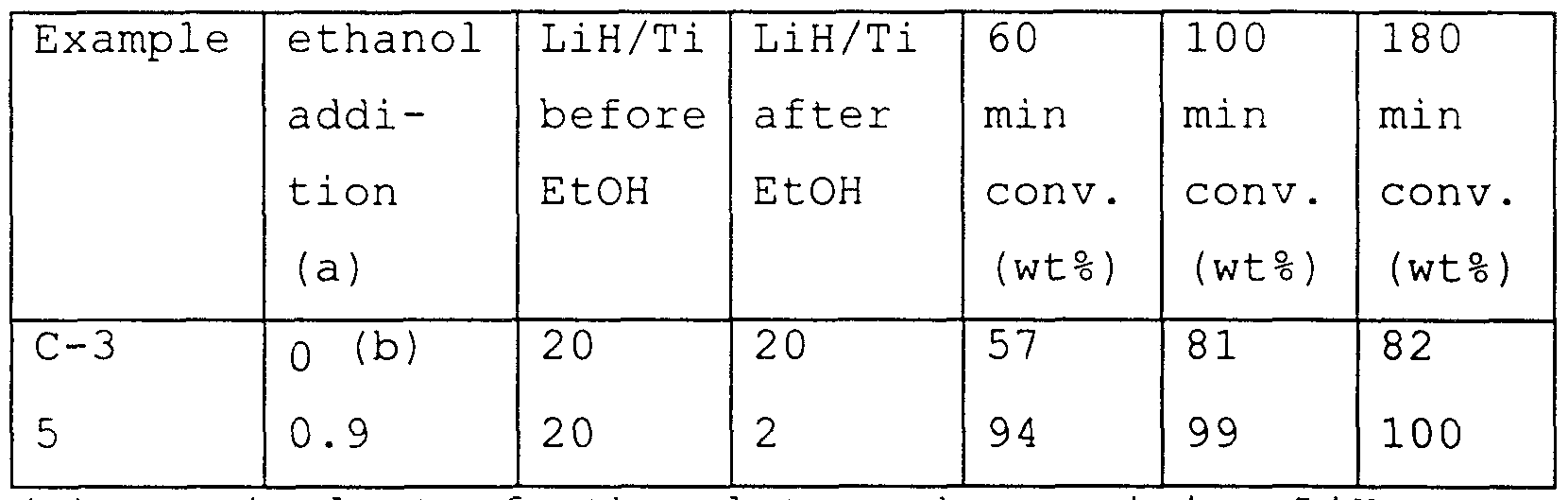
- Table 1 conversion data as a function of titanium levels on cement
- Example 24 Hydrogenation of SBS block copolymer with Cp2TiCl2 •
- the catalyst intermediate was produced in a hydrogen free atmosphere.
- a stainless steel reactor was charged with 800 grams of SBS cement, prepared as described in Example 1. The temperature of the reactor was fixed at 50 °C. In the experiment 4.2 mg of Cp2TiCl2 was applied. After an activation time of 10 minutes at 50 °C and 0.1 MPa of nitrogen, 85 per cent of the remaining LiH was neutralised by reaction with ethanol. The reactor was pressurised with hydrogen and the hydrogenation was allowed to run at 70 °C. The results are shown in Table 7 and Figure 6.
- Example 25-26 Hydrogenation of SBS block copolymer with Cp2TiCl2- The catalyst was aged for 4 hours at 50 °C in a hydrogen free atmosphere.
- Example 28-31 Hydrogenation of SBS block copolymer with Cp2TiCl2.
- the catalyst was activated in a hydrogen free atmosphere at different temperatures.
- a stainless steel reactor was charged with 800 grams of SBS cement, prepared as described in Example 1.
- 4.2 mg of Cp2TiCl2 was applied. After an activation time of 10 minutes at various temperatures, 70 per cent of the remaining LiH was neutralised by reaction with ethanol.
- the hydrogenation was carried out at 70 °C. The results are shown in Table 8 and Figure 8.
- Ionol CP is 2, 6-ditertbutyl-4-methylphenol
Landscapes
- Chemical & Material Sciences (AREA)
- Organic Chemistry (AREA)
- Chemical Kinetics & Catalysis (AREA)
- Engineering & Computer Science (AREA)
- Materials Engineering (AREA)
- Health & Medical Sciences (AREA)
- General Chemical & Material Sciences (AREA)
- Medicinal Chemistry (AREA)
- Polymers & Plastics (AREA)
- Inorganic Chemistry (AREA)
- Addition Polymer Or Copolymer, Post-Treatments, Or Chemical Modifications (AREA)
- Organic Low-Molecular-Weight Compounds And Preparation Thereof (AREA)
- Catalysts (AREA)
- Low-Molecular Organic Synthesis Reactions Using Catalysts (AREA)
Abstract
Description




Claims
Priority Applications (6)
| Application Number | Priority Date | Filing Date | Title |
|---|---|---|---|
| AT99968770T ATE224230T1 (en) | 1998-10-30 | 1999-10-28 | METHOD FOR PRODUCING A HYDROGENATION CATALYST COMPOSITION |
| AU26595/00A AU2659500A (en) | 1998-10-30 | 1999-10-28 | A method for preparing a hydrogenation catalyst system |
| BR9914924-9A BR9914924A (en) | 1998-10-30 | 1999-10-28 | Method for preparing a hydrogenation catalyst system, and, process for the hydrogenation of an olefinically unsaturated compound with hydrogen. |
| DE69903058T DE69903058T2 (en) | 1998-10-30 | 1999-10-28 | METHOD FOR PRODUCING A HYDRATION CATALYST COMPOSITION |
| JP2000579346A JP5166658B2 (en) | 1998-10-30 | 1999-10-28 | Method for producing hydrogenation catalyst system |
| EP99968770A EP1131156B1 (en) | 1998-10-30 | 1999-10-28 | A method for preparing a hydrogenation catalyst system |
Applications Claiming Priority (2)
| Application Number | Priority Date | Filing Date | Title |
|---|---|---|---|
| EP98308932 | 1998-10-30 | ||
| EP98308932.7 | 1998-10-30 |
Publications (2)
| Publication Number | Publication Date |
|---|---|
| WO2000025915A2 true WO2000025915A2 (en) | 2000-05-11 |
| WO2000025915A3 WO2000025915A3 (en) | 2000-08-10 |
Family
ID=8235140
Family Applications (1)
| Application Number | Title | Priority Date | Filing Date |
|---|---|---|---|
| PCT/EP1999/008311 Ceased WO2000025915A2 (en) | 1998-10-30 | 1999-10-28 | A method for preparing a hydrogenation catalyst system |
Country Status (12)
| Country | Link |
|---|---|
| US (2) | US6461993B1 (en) |
| EP (1) | EP1131156B1 (en) |
| JP (1) | JP5166658B2 (en) |
| KR (1) | KR100600458B1 (en) |
| AT (1) | ATE224230T1 (en) |
| AU (1) | AU2659500A (en) |
| BR (1) | BR9914924A (en) |
| DE (1) | DE69903058T2 (en) |
| ES (1) | ES2184520T3 (en) |
| TW (1) | TW583027B (en) |
| WO (1) | WO2000025915A2 (en) |
| ZA (1) | ZA200103702B (en) |
Cited By (2)
| Publication number | Priority date | Publication date | Assignee | Title |
|---|---|---|---|---|
| WO2002034799A1 (en) * | 2000-07-28 | 2002-05-02 | Kraton Polymers Research B.V. | Process for preparing partially hydrogenated butadiene polymers |
| EP1403286A1 (en) * | 2002-09-27 | 2004-03-31 | ENI S.p.A. | Process for the hydrogenation of homopolymers and copolymers of conjugated dienes |
Families Citing this family (12)
| Publication number | Priority date | Publication date | Assignee | Title |
|---|---|---|---|---|
| WO2005030821A1 (en) * | 2003-09-24 | 2005-04-07 | Kraton Polymers Research B.V. | Conjugated diene polymers and copolymer blocks having high vinyl content prepared using mixed microstructure control agents and process for preparing same |
| US20110119992A1 (en) * | 2009-11-24 | 2011-05-26 | Exxonmobil Research And Engineering Company | Oxidation resistant interstitial metal hydride catalysts and associated processes |
| US20110119990A1 (en) | 2009-11-24 | 2011-05-26 | Exxonmobil Research And Engineering Companhy | Group 13-15 interstitial metal hydride catalysts and associated processes |
| US20110119993A1 (en) * | 2009-11-24 | 2011-05-26 | Exxonmobil Research And Engineering Company | High severity hydroprocessing interstitial metal hydride catalysts and associated processes |
| US8618010B2 (en) * | 2009-11-24 | 2013-12-31 | Exxonmobil Research And Engineering Company | Interstitial metal hydride catalyst activity regeneration process |
| US8637424B2 (en) | 2010-11-09 | 2014-01-28 | Exxonmobil Research And Engineering Company | Integrated interstitial metal hydride catalyst support systems and associated processes |
| US8765628B2 (en) | 2010-11-09 | 2014-07-01 | Exxonmobil Research And Engineering Company | Poison resistant catalyst systems and associated processes |
| US8598067B2 (en) | 2010-11-09 | 2013-12-03 | Exxonmobil Research And Engineering Company | Interstitial metal hydride catalyst systems and associated processes |
| US10016749B2 (en) | 2012-09-21 | 2018-07-10 | Asahi Kasei Chemicals Corporation | Catalyst composition for hydrogenation and method for hydrogenation using the same |
| CN104718026B (en) | 2012-09-21 | 2017-05-17 | 旭化成株式会社 | Hydrogenation catalyst composition and hydrogenation method using said hydrogenation catalyst composition |
| TWI586693B (en) | 2013-07-23 | 2017-06-11 | 財團法人工業技術研究院 | Method for selectively hydrogenating copolymer |
| US10472451B2 (en) | 2014-09-04 | 2019-11-12 | Kuraray Co., Ltd. | Method for producing anionic polymer |
Family Cites Families (29)
| Publication number | Priority date | Publication date | Assignee | Title |
|---|---|---|---|---|
| US3401983A (en) * | 1967-01-24 | 1968-09-17 | Henriette L Williams | Vehicle brake control |
| BE737574A (en) | 1968-09-05 | 1970-02-02 | ||
| DE2722221A1 (en) * | 1977-05-17 | 1978-11-23 | Studiengesellschaft Kohle Mbh | ALKALIMETAL COMPLEX COMPLEXES, PROCESS FOR THEIR PRODUCTION AND THEIR USE FOR HYDROGENATION AND NITRIDATION OF ALKALIMETALS |
| US4501857A (en) | 1983-01-20 | 1985-02-26 | Asahi Kasei Kogyo Kabushiki Kaisha | Method for hydrogenation of polymer |
| US4656230A (en) * | 1985-07-12 | 1987-04-07 | Phillips Petroleum Company | Hydrogenation process |
| JP2718059B2 (en) | 1988-04-28 | 1998-02-25 | 日本合成ゴム株式会社 | Polymer hydrogenation method and catalyst |
| JP2969771B2 (en) | 1989-12-22 | 1999-11-02 | ジェイエスアール株式会社 | Method for hydrogenating olefinically unsaturated polymer and catalyst composition for hydrogenation |
| US5039755A (en) | 1990-05-29 | 1991-08-13 | Shell Oil Company | Selective hydrogenation of conjugated diolefin polymers |
| US5141997A (en) * | 1990-08-15 | 1992-08-25 | Shell Oil Company | Selective hydrogenation of conjugated diolefin polymers |
| US5132372A (en) | 1991-09-09 | 1992-07-21 | Shell Oil Company | Process for selective hydrogenation of conjugated diolefin polymers |
| US5206307A (en) * | 1991-09-09 | 1993-04-27 | Shell Oil Company | Process for selective hydrogenation of conjugated diolefin polymers |
| US5270274A (en) | 1991-11-28 | 1993-12-14 | Japan Synthetic Rubber Co., Ltd. | Catalyst composition for hydrogenating olefinically unsaturated polymers |
| US5173537A (en) | 1991-12-20 | 1992-12-22 | Shell Oil Company | Selective hydrogenation of conjugated diolefin poylmers |
| US5242961A (en) * | 1992-05-28 | 1993-09-07 | Shell Oil Company | Color prevention in titanium catalyzed hydrogenated diene polymers |
| JP3282166B2 (en) * | 1992-09-01 | 2002-05-13 | ジェイエスアール株式会社 | Method for hydrogenating olefinically unsaturated polymer and hydrogenation catalyst |
| US5583185A (en) * | 1992-11-03 | 1996-12-10 | Repsol Quimica S.A. | Process for hydrogenation in solution of the double bonds of conjugated dienes, and hydrogenated block copolymer produced |
| US5244980A (en) * | 1992-12-07 | 1993-09-14 | Shell Oil Company | Selective hydrogenation of conjugated diolefin polymers with Tebbe's reagent |
| JP3326773B2 (en) * | 1993-01-26 | 2002-09-24 | ジェイエスアール株式会社 | Method for hydrogenating polymer containing olefinically unsaturated bond and hydrogenation catalyst |
| FI97141C (en) | 1994-03-14 | 1996-10-25 | Neste Oy | Process for hydrogenating selectively unsaturated polymers |
| JP3617553B2 (en) | 1994-05-18 | 2005-02-09 | 旭化成ケミカルズ株式会社 | Olefin hydrogenated composite catalyst and process for producing hydrogenated conjugated diene polymer |
| JPH09121783A (en) | 1995-09-01 | 1997-05-13 | Res Inst For Prod Dev | Feed for fish and shell |
| CN1130383C (en) * | 1996-03-15 | 2003-12-10 | 国际壳牌研究有限公司 | Hydrogenizing method for conjugate diene polymer and its adaptive catalyst composition |
| US5705571A (en) * | 1996-05-17 | 1998-01-06 | Taiwan Synthetic Rubber Corporation | Process for selective hydrogenation of conjugated diene polymer |
| JPH1053614A (en) | 1996-05-29 | 1998-02-24 | Shell Internatl Res Maatschappij Bv | Process for hydrogenating conjugated diene polymers and catalyst compositions suitable for use in this process |
| IT1284105B1 (en) * | 1996-07-04 | 1998-05-08 | Enichem Elastomers | PROCEDURE FOR THE PREPARATION OF A CATALYST USEFUL FOR THE HYDROGENATION OF STYRENE-BUTADIENE COPOLYMERS |
| JPH10101727A (en) * | 1996-09-24 | 1998-04-21 | Shell Internatl Res Maatschappij Bv | Catalysts and methods for hydrogenating olefins or polymers |
| IT1295266B1 (en) * | 1997-10-03 | 1999-05-04 | Enichem Spa | PROCEDURE AND CATALYST FOR THE HYDROGENATION OF OLEFINICALLY UNSATURATED COMPOUNDS |
| JP3777810B2 (en) * | 1998-07-24 | 2006-05-24 | Jsr株式会社 | Olefinic unsaturated compound hydrogenation catalyst and hydrogenation method |
| KR100348761B1 (en) * | 1999-11-26 | 2002-08-13 | 금호석유화학 주식회사 | Method for the selective hydrogenation of the conjugated diene containing polymer |
-
1999
- 1999-10-05 TW TW088117150A patent/TW583027B/en not_active IP Right Cessation
- 1999-10-08 US US09/416,218 patent/US6461993B1/en not_active Expired - Lifetime
- 1999-10-28 BR BR9914924-9A patent/BR9914924A/en not_active IP Right Cessation
- 1999-10-28 EP EP99968770A patent/EP1131156B1/en not_active Expired - Lifetime
- 1999-10-28 KR KR1020017005486A patent/KR100600458B1/en not_active Expired - Fee Related
- 1999-10-28 WO PCT/EP1999/008311 patent/WO2000025915A2/en not_active Ceased
- 1999-10-28 AT AT99968770T patent/ATE224230T1/en not_active IP Right Cessation
- 1999-10-28 AU AU26595/00A patent/AU2659500A/en not_active Abandoned
- 1999-10-28 ES ES99968770T patent/ES2184520T3/en not_active Expired - Lifetime
- 1999-10-28 DE DE69903058T patent/DE69903058T2/en not_active Expired - Fee Related
- 1999-10-28 JP JP2000579346A patent/JP5166658B2/en not_active Expired - Fee Related
-
2001
- 2001-05-08 ZA ZA200103702A patent/ZA200103702B/en unknown
-
2002
- 2002-07-09 US US10/191,439 patent/US20030073571A1/en not_active Abandoned
Cited By (4)
| Publication number | Priority date | Publication date | Assignee | Title |
|---|---|---|---|---|
| WO2002034799A1 (en) * | 2000-07-28 | 2002-05-02 | Kraton Polymers Research B.V. | Process for preparing partially hydrogenated butadiene polymers |
| US7186783B2 (en) | 2000-07-28 | 2007-03-06 | Kraton Polymers U.S. Llc | Process for preparaing partially hydrogenated butadiene polymers |
| EP1403286A1 (en) * | 2002-09-27 | 2004-03-31 | ENI S.p.A. | Process for the hydrogenation of homopolymers and copolymers of conjugated dienes |
| US6831135B2 (en) | 2002-09-27 | 2004-12-14 | Eni S.P.A. | Process for the hydrogenation of homopolymers and copolymers of conjugated dienes |
Also Published As
| Publication number | Publication date |
|---|---|
| ATE224230T1 (en) | 2002-10-15 |
| EP1131156B1 (en) | 2002-09-18 |
| ZA200103702B (en) | 2002-05-13 |
| US6461993B1 (en) | 2002-10-08 |
| EP1131156A2 (en) | 2001-09-12 |
| AU2659500A (en) | 2000-05-22 |
| KR20010083935A (en) | 2001-09-03 |
| JP5166658B2 (en) | 2013-03-21 |
| WO2000025915A3 (en) | 2000-08-10 |
| ES2184520T3 (en) | 2003-04-01 |
| JP2003524515A (en) | 2003-08-19 |
| DE69903058T2 (en) | 2003-06-05 |
| DE69903058D1 (en) | 2002-10-24 |
| KR100600458B1 (en) | 2006-07-13 |
| US20030073571A1 (en) | 2003-04-17 |
| BR9914924A (en) | 2001-07-10 |
| TW583027B (en) | 2004-04-11 |
Similar Documents
| Publication | Publication Date | Title |
|---|---|---|
| EP1131156B1 (en) | A method for preparing a hydrogenation catalyst system | |
| CN1036655C (en) | Selective hydrogenation of conjugated diolefin polymers | |
| KR100348761B1 (en) | Method for the selective hydrogenation of the conjugated diene containing polymer | |
| EP0401897B1 (en) | Hydrogenation catalyst and hydrogenation process wherein said catalyst is used | |
| EP0584860B1 (en) | Selective partial hydrogenation of conjugated diene polymers | |
| CN1050139C (en) | Improved process for selective hydrogenation of conjugated diene polymers | |
| EP1214360B1 (en) | Process to prepare hydrogenated polymers with improved colour | |
| JP2991824B2 (en) | Selective hydrogenation of conjugated diolefin polymers | |
| US6881797B2 (en) | Process for hydrogenation of conjugated diene polymer | |
| RU2123012C1 (en) | Method of producing selectively hydrogenated conjugated diolefin polymers | |
| KR20000012973A (en) | Method for hydrogenation of conjugated diene polymer | |
| US5132372A (en) | Process for selective hydrogenation of conjugated diolefin polymers | |
| US7186782B2 (en) | Hydrogenation catalyst composition and process for hydrogenation of conjugated diene polymer | |
| US5030779A (en) | Hydrogenation catalyst and hydrogenation process wherein said catalyst is used | |
| JP2004211058A (en) | Method of hydrogenating conjugated diene polymer using highly active lithium hydride manufactured in reactor with high-velocity injection nozzle | |
| US5177155A (en) | Selective hydrogenation of conjugation diolefin polymers with rare earth catalysts | |
| CA1231935A (en) | Method of preparing high cis-1, 4 diene polymers having good green strength and tack using a catalyst composition containing a carbonxylated metal oxy aluminate component | |
| JP2006316275A (en) | Selective hydrogenation of unsaturated (co) polymers | |
| ZA200101658B (en) | Removal of hydrogenation catalyst from polymer solutions by treatment with ammonia and carbon dioxide. | |
| KR100332465B1 (en) | Process for the hydrogenation of unsaturated polymer | |
| KR100295601B1 (en) | Process for selective hydrogenation of conjugated diene polymer | |
| KR100356533B1 (en) | Method for the selective hydrogenation of the conjugated diene polymer |
Legal Events
| Date | Code | Title | Description |
|---|---|---|---|
| AK | Designated states |
Kind code of ref document: A2 Designated state(s): AE AL AM AT AU AZ BA BB BG BR BY CA CH CN CR CU CZ DE DK DM EE ES FI GB GD GE GH GM HR HU ID IL IN IS JP KE KG KP KR KZ LC LK LR LS LT LU LV MA MD MG MK MN MW MX NO NZ PL PT RO RU SD SE SG SI SK SL TJ TM TR TT TZ UA UG UZ VN YU ZA ZW |
|
| AL | Designated countries for regional patents |
Kind code of ref document: A2 Designated state(s): GH GM KE LS MW SD SL SZ TZ UG ZW AM AZ BY KG KZ MD RU TJ TM AT BE CH CY DE DK ES FI FR GB GR IE IT LU MC NL PT SE BF BJ CF CG CI CM GA GN GW ML MR NE SN TD TG |
|
| 121 | Ep: the epo has been informed by wipo that ep was designated in this application | ||
| DFPE | Request for preliminary examination filed prior to expiration of 19th month from priority date (pct application filed before 20040101) | ||
| AK | Designated states |
Kind code of ref document: A3 Designated state(s): AE AL AM AT AU AZ BA BB BG BR BY CA CH CN CR CU CZ DE DK DM EE ES FI GB GD GE GH GM HR HU ID IL IN IS JP KE KG KP KR KZ LC LK LR LS LT LU LV MA MD MG MK MN MW MX NO NZ PL PT RO RU SD SE SG SI SK SL TJ TM TR TT TZ UA UG UZ VN YU ZA ZW |
|
| AL | Designated countries for regional patents |
Kind code of ref document: A3 Designated state(s): GH GM KE LS MW SD SL SZ TZ UG ZW AM AZ BY KG KZ MD RU TJ TM AT BE CH CY DE DK ES FI FR GB GR IE IT LU MC NL PT SE BF BJ CF CG CI CM GA GN GW ML MR NE SN TD TG |
|
| WWE | Wipo information: entry into national phase |
Ref document number: 1999968770 Country of ref document: EP |
|
| WWE | Wipo information: entry into national phase |
Ref document number: 1020017005486 Country of ref document: KR |
|
| ENP | Entry into the national phase |
Ref country code: JP Ref document number: 2000 579346 Kind code of ref document: A Format of ref document f/p: F |
|
| WWE | Wipo information: entry into national phase |
Ref document number: 2001/03702 Country of ref document: ZA Ref document number: 200103702 Country of ref document: ZA |
|
| REG | Reference to national code |
Ref country code: DE Ref legal event code: 8642 |
|
| WWP | Wipo information: published in national office |
Ref document number: 1020017005486 Country of ref document: KR |
|
| WWP | Wipo information: published in national office |
Ref document number: 1999968770 Country of ref document: EP |
|
| WWG | Wipo information: grant in national office |
Ref document number: 1999968770 Country of ref document: EP |
|
| WWG | Wipo information: grant in national office |
Ref document number: 1020017005486 Country of ref document: KR |