WO2000026404A1 - Technique permettant de detecter un gene affecte par un agent perturbateur endocrinien - Google Patents
Technique permettant de detecter un gene affecte par un agent perturbateur endocrinien Download PDFInfo
- Publication number
- WO2000026404A1 WO2000026404A1 PCT/JP1999/005964 JP9905964W WO0026404A1 WO 2000026404 A1 WO2000026404 A1 WO 2000026404A1 JP 9905964 W JP9905964 W JP 9905964W WO 0026404 A1 WO0026404 A1 WO 0026404A1
- Authority
- WO
- WIPO (PCT)
- Prior art keywords
- genes involved
- gene
- endocrine
- genes
- cell
- Prior art date
- Legal status (The legal status is an assumption and is not a legal conclusion. Google has not performed a legal analysis and makes no representation as to the accuracy of the status listed.)
- Ceased
Links
Classifications
-
- C—CHEMISTRY; METALLURGY
- C12—BIOCHEMISTRY; BEER; SPIRITS; WINE; VINEGAR; MICROBIOLOGY; ENZYMOLOGY; MUTATION OR GENETIC ENGINEERING
- C12Q—MEASURING OR TESTING PROCESSES INVOLVING ENZYMES, NUCLEIC ACIDS OR MICROORGANISMS; COMPOSITIONS OR TEST PAPERS THEREFOR; PROCESSES OF PREPARING SUCH COMPOSITIONS; CONDITION-RESPONSIVE CONTROL IN MICROBIOLOGICAL OR ENZYMOLOGICAL PROCESSES
- C12Q1/00—Measuring or testing processes involving enzymes, nucleic acids or microorganisms; Compositions therefor; Processes of preparing such compositions
- C12Q1/68—Measuring or testing processes involving enzymes, nucleic acids or microorganisms; Compositions therefor; Processes of preparing such compositions involving nucleic acids
- C12Q1/6876—Nucleic acid products used in the analysis of nucleic acids, e.g. primers or probes
- C12Q1/6883—Nucleic acid products used in the analysis of nucleic acids, e.g. primers or probes for diseases caused by alterations of genetic material
-
- C—CHEMISTRY; METALLURGY
- C12—BIOCHEMISTRY; BEER; SPIRITS; WINE; VINEGAR; MICROBIOLOGY; ENZYMOLOGY; MUTATION OR GENETIC ENGINEERING
- C12Q—MEASURING OR TESTING PROCESSES INVOLVING ENZYMES, NUCLEIC ACIDS OR MICROORGANISMS; COMPOSITIONS OR TEST PAPERS THEREFOR; PROCESSES OF PREPARING SUCH COMPOSITIONS; CONDITION-RESPONSIVE CONTROL IN MICROBIOLOGICAL OR ENZYMOLOGICAL PROCESSES
- C12Q2600/00—Oligonucleotides characterized by their use
- C12Q2600/158—Expression markers
Definitions
- the present invention relates to an endocrine disrupting substance that affects homeostasis of a living body and a method for detecting a gene affected by the substance.
- Endocrine disruptors are often referred to as environmental hormones, and collectively refer to chemicals released into the environment that have hormone-like or antihormonal effects. Effects on wildlife ecosystems include changes in fertility, especially male feminization, decreased fertility, decreased hatchability, decreased survival of offspring, and abnormal reproductive behavior. In addition, as effects on human health, decreased sperm count, endometriosis, infertility, ovarian cancer, uterine cancer, prostate cancer, etc. have been suspected, but have not been proven.
- Estradiol a natural female hormone
- getylstilbestrol a synthetic female hormone
- isoflavone a component harmless to humans in beans
- bisphenol A a substance suspected of being an endocrine disruptor
- the method of measuring the binding activity to the hormone receptor and the inhibitory activity of the hormone synthase system in vitro satisfies the necessary conditions as a method for measuring endocrine disruptors, but it is by no means sufficient.
- in vivo methods for examining the effects on growth and morphogenesis of rats, potatoes, fish, etc. are insensitive and complex, and require a long time to examine a large number of samples.
- the above-mentioned conventional analysis method can analyze the relationship between a substance that may cause endocrine disruption and the receptor, but cannot analyze the signal transduction system thereafter.
- the present inventors have made intensive studies and have established a method for detecting many types of genes that are rapidly and sensitively and simultaneously affected by endocrine disruptors. Further, the present inventors have found a method for detecting an endocrine disrupting substance using a DNA array on which the gene or a fragment thereof is immobilized. Furthermore, a method for detecting a substance that may cause endocrine disruption was constructed, and the present invention was completed.
- the gist of the present invention is:
- a method for detecting a gene affected by an endocrine disruptor comprising a nucleic acid sample containing mRNA or its cDNA derived from a cell, tissue or organism contacted with a sample containing an endocrine disruptor was prepared, and the nucleic acid sample was hybridized with a DNA array on which a gene or a DNA fragment derived from the gene that might be affected by endocrine disruptors was immobilized, and the result was used as a nucleic acid sample from a control sample.
- a method for detecting a gene characterized by selecting a gene that is affected by endocrine disruptors as compared to
- Rh family GTPase and genes involved in its regulator are involved in its regulator
- [3] A method for detecting an endocrine disrupting substance, comprising measuring expression of a gene detected by the method according to [1] or [2],
- a method for detecting a substance that may cause endocrine disruption comprising detecting mRNA or cDNA derived from a cell, tissue or organism contacted with a sample expected to contain the substance.
- a nucleic acid sample containing the nucleic acid sample was prepared, and the nucleic acid sample was hybridized with the DNA affected by an endocrine disrupter or a DNA fragment having a DNA fragment derived from the gene immobilized thereon.
- a method of detecting substances that may cause endocrine disruption compared to
- Substances that may cause endocrine disruption belong to the following categories. Method for detecting endocrine disruptors described in [5]:
- Rh family GTPase and genes involved in its regulator are involved in its regulator
- the endocrine disruptor is also called an exogenous endocrine disruptor or an environmental hormone, but when taken up in an animal body, the normal endocrine disruptor normally operates in the body.
- Exogenous substances that affect hormonal action including those that maintain, promote and suppress normal hormonal action. It also includes substances that can affect normal hormonal effects.
- Category 1 organic chlorine-based compounds (eg, organic chlorine-based compounds in general, polychlorinated bicarbonate (PCB)), (2) Category 2: phenols ( For example, phenols in general, bisphenol A,
- PCB polychlorinated bicarbonate
- 2,4-Dichroic phenol, pentachlorophenol (3) Category 3: phthalates (eg, general phthalates), (4) Category 4: aromatic hydrocarbons (eg, benzo ( a) pyrene, di-2-ethylhexyl adipate (DEHA), benzophenone, 4-nitrotoluene, styrene dimer and trimer, 1,2-dibromo-3-chloropronocene, styrene, n -Butylbenzene), (5) Categories
- Pesticides eg, pesticides in general, 2,4,5-T (trichlorophenoxyacetic acid), 2,4-D (dichlorophenoxyacetic acid), benomyl, amitrol, mesomil
- Category 6 Organotin compounds
- Category 7 Seven categories of estrogen, dioxins and power categories that are not classified as power categories. It is classified as exempt from Myrex, Toxaphen, Aldicarb, and Keepon (Chronore decon). Table 1 shows them.
- PCP Pentachlorophenol
- C5-C9 Alkyl phenol
- Maneb is an endocrine disrupter but not power category vs. metyram
- Endocrine disruptors are not limited to those listed above.
- the effects and toxicity of getylstilbestrol (DES) and estrogen (female hormone), which are known to cause vaginal cancer in humans, have been confirmed.
- Bis Huyunault Leu A etc. are also considered to have endocrine disrupting effects.
- the primary actions of these substances include: 1) direct action with hormone receptors (eg, synthetic hormone preparations, DDT, phthalate, etc.), 2) action via other receptors (eg, dioxin, etc.), 3) Metabolic inhibitory effects (eg, steroid metabolism inhibitors, inhibitors of aromatase-5-reductase, etc.), 4) Other system-mediated effects (eg, substances that affect the nervous system and immune system), etc. And their modes of action are diverse [Chemistry, Vol. 53, No. 7, pp. 12-15 (1998)].
- hormone receptors eg, synthetic hormone preparations, DDT, phthalate, etc.
- Other receptors eg, dioxin, etc.
- Other system-mediated effects eg, substances that affect the nervous system and immune system
- modes of action are diverse [Chemistry, Vol. 53, No. 7, pp. 12-15 (1998)].
- the gene affected by an endocrine disrupter described herein is defined as a gene whose expression is promoted or suppressed by the endocrine disrupter as compared with a control.
- the gene may be of one type or a plurality of types. Therefore, the gene to be immobilized on the D NAT lei of the present invention should be selected from the viewpoint that the endocrine disrupter directly and / or indirectly participates in a factor that affects the expression thereof. Both those whose expression is promoted and those whose expression is suppressed can be suitably used.
- the candidate for the gene (that is, a gene that may be affected by an endocrine disrupting substance) is not particularly limited.
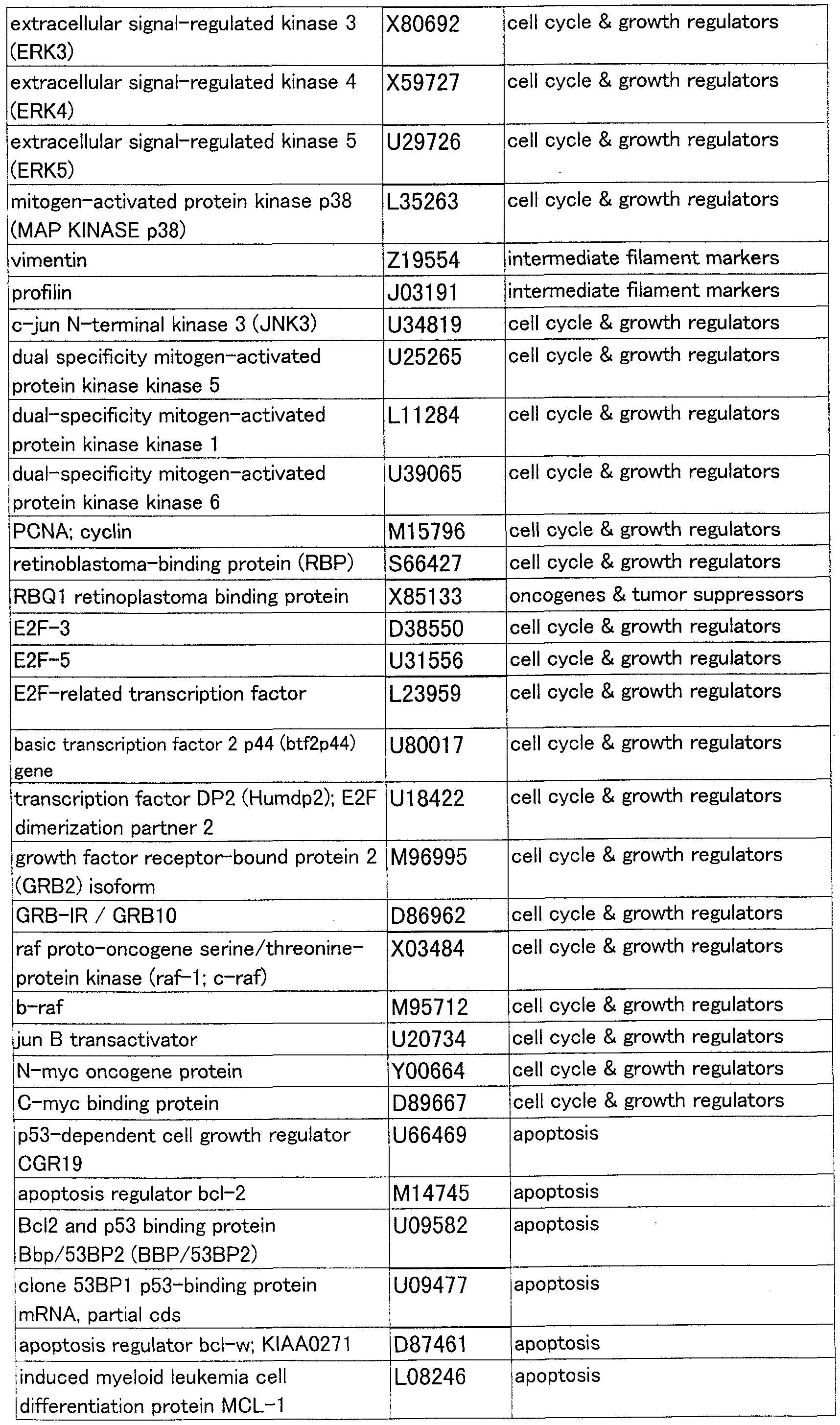
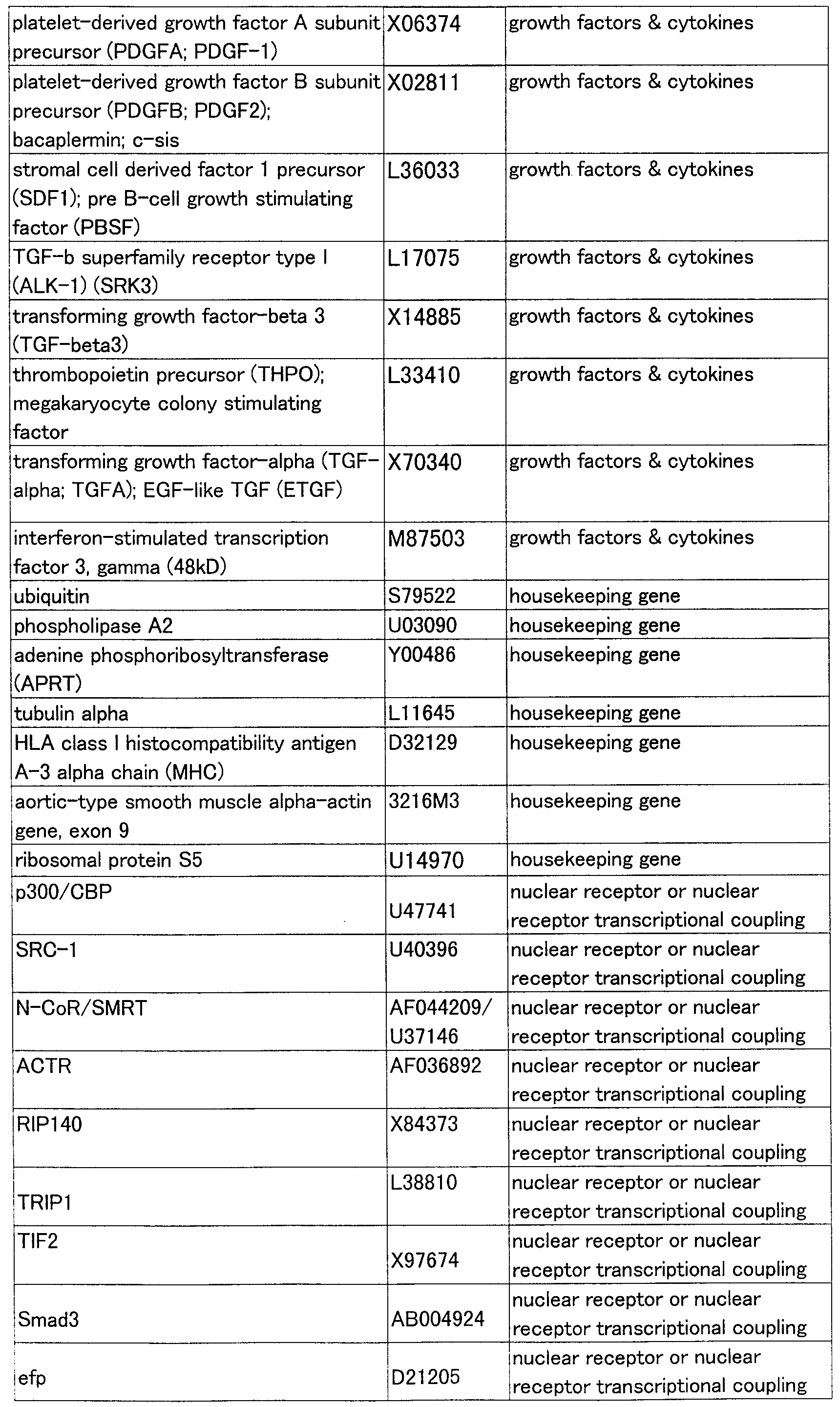
- nuclear receptor or nuclear receptor Oia genes involved in nuclear receptor or nuclear receptor transcriptional coupling, 2) ⁇ genes involved in kinase-type signal transduction; (3) gonad differentiation (4) genes involved in receptor-type kinase; (5) genes involved in undermediate filament markers;
- Genes involved in cell cycle & growth regulators Genes involved in oncogenes and tumor suppressors, (8) Apoptosis Genes involved in DNA damage response, repair & recombination, (10) genes involved in receptors, (11) cell death and Genes involved in cell fate & development regulators, (1 2) cell adhesion, motility and invasion (cell genes involved in adhesion, motility & invasion), (1 3) genes involved in angiogenesis regulators, (14) cell invasion
- spare precursor secreted protein acidic J03040 cell adhesion, motility & and rich in cysteine; osteonectin
- vitronectin precursor serum spreading X03168 cell adhesion, motility &factor; S-protein (contains invasion
- HSPG2 heparan sulfate proteoglycan
- VEGF-G vascular endothelial growth factor C U43142 angiogenesis regulators precursor
- PLGF-1 placenta growth factors 1
- X54936 angiogenesis regulators integrin alpha 7B X74295 cell adhesion, motility & invasion
- IGAE integrin alpha— E precursor
- shi 25851 cell adhesion, motility & mucosal lymphocyte-1 antigen hml-1 invasion
- FADK focal adhesion kinase
- PYK2 motility & rich tyrosine kinase 2
- ILK integrin-linked kinase
- CAKbeta cell adhesion kinase beta
- U43522 cell adhesion, motility & protein tyrosine kinase Pyk2 invasion
- MDC9 metalloprotease / disintegrin / cysteine- U41 766 invasion regulators rich protein precursor
- FGD1 dysplasia protein
- ephrin type-- A receptor 2 precursor M59371 cell -cell interactions epithelial cell kinase (ECK); tyrosine- protein kinase receptor ECK
- rho GDP dissociation inihibitor 2 (rho L20688 Rho family small GTPases & GDI 2); LY-GDI their regulator
- rho GDP dissociation inihibitor 1 (rho X69550 Rho family small GTPases & GDI 1) their regulator
- p2 -activated kinase p65-PAK
- N-cadherin N-cadherin
- S42303 cell -cell interactions cadherin-2
- cadherin 3 placenta cadherin X63629 cell cell interactions precursor; P-cadherin
- cadherin 5 vascular endothelial- X79981 cell cell interactions cadherin precursor; VE-cadherin; 7B4
- CD144 antigen CD144 antigen
- ⁇ ⁇ ⁇ As a gene that may be affected by secretory disruptors, more specifically, the estrogen receptor known to bind to the above-mentioned getylstilbestrol, bisphenol A or 17 ⁇ -estradiol Genes and genes involved in the signal transduction pathway thereof are exemplified.
- the gene affected by the endocrine disrupting substance can be detected by the following method.
- the DNII array used herein refers to an array in which a gene or a DNA fragment derived from the gene is immobilized on a support, and includes, for example, an array called a DNA chip.
- the support is not particularly limited as long as it can be used for hybridization, and usually a slide glass, a silicon chip, a nitrosenololose or nylon membrane is used.
- the gene or its DNA fragment immobilized on the support is not particularly limited, but can be prepared, for example, as follows. From the GeneBank Accession No.
- a primer pair for PCR amplification optimal for the method of the present invention can be prepared.
- a genomic DNA, genomic DNA library or cDNA library can be converted into a type II, and the desired PCR amplified fragment can be obtained according to the standard protocol conditions attached to a commercially available PCR kit.
- the obtained DNA fragment can be purified using, for example, Microcon 100 (Takara Shuzo Nei) or the like. This purified DNA fragment can be suitably used in the method of the present invention.
- the DNA array can be prepared by immobilizing the above-mentioned gene or a fragment thereof on a support into which an amino group has been introduced, for example.
- a DNA array production apparatus for example, a DNA chip production apparatus manufactured by GMS, it is possible to produce a DNA array in which genes are aligned and immobilized at high density. it can.
- nucleic acid sample By using such a DNA array, the amounts of various types of nucleic acid molecules contained in a nucleic acid sample can be measured simultaneously. Another advantage is that even small amounts of nucleic acid samples can be measured.
- An arbitrary gene or a DNA fragment derived from the gene is immobilized on the DNA array used in the present invention.
- a gene encoding a protein expected to have a function related to endocrine disrupting action or a DNA fragment derived from the gene is immobilized.
- a chain length of about 1 kb can be suitably used. The length is not particularly limited. Even if the length is shorter or longer than the length, it can be used for hybridization with nucleic acid derived from a sample. Any chain length may be used as long as it specifically hybridizes.
- Examples of such a gene include, but are not limited to, a hormone receptor gene, a gene encoding a cofactor of a receptor, a gene encoding a protein involved in signal transduction from a receptor, hormone biosynthesis, Examples include a gene encoding a protein involved in metabolism, or an oncogene.
- nucleic acid sample examples include mRNA prepared from cells or tissues over time or day after contacting any endocrine disrupting substance with cells or tissues (organs) sensitive to endocrine disrupting substances, or cDNA obtained by reverse transcription reaction using mRNA as type III can be used.
- the cells to be brought into contact with the sample containing endocrine disruptors may be those collected from an organism or cultured cells.
- the tissue is not particularly limited as long as it is considered to be affected by endocrine disruptors. Further, the cells, tissues or organisms to be used are not particularly limited to humans.
- the duration of contact with the endocrine disruptor can vary depending on the organism used, the endocrine disruptor and the genes affected by it.
- a nucleic acid sample containing mRNA or its cDNA is prepared in the same manner as above from a cell, a fibrous tissue or an organism as a control, and hybridized under strict conditions. Appropriate labeling can be performed as described below so that the result of whether or not the nucleic acid sample has hybridized with DNA on the DNA array can be easily confirmed.
- the labeling method is not particularly limited, and for example, a substance such as a radioisotope, a fluorescent substance, a chemiluminescent substance, or an antigen recognized by a suitable antibody can be used.
- a substance such as a radioisotope, a fluorescent substance, a chemiluminescent substance, or an antigen recognized by a suitable antibody
- hybridization may be performed without labeling the nucleic acid sample, and then an interactor substance that emits fluorescence or chemiluminescence may be used.
- Hybridization of the nucleic acid sample thus obtained and DNA on the DNA array can be performed by a known method. It is natural that the hybridization and washing steps are performed under optimal conditions according to the length of the DNA on the DNA array, etc. manual), second clothes, 9.5-9.5.55 (19989).
- a multi-wavelength detection fluorescent analyzer that can detect multiple labels, for example, two types of fluorescence, allows the use of a nucleic acid sample derived from cells, tissues, or living matter that has been brought into contact with an endocrine disruptor, and a control nucleic acid sample. Gene expression differences can be compared on the same DNAT layer. For example, a nucleic acid sample from a cell that has been contacted with an endocrine disruptor is fluorescently labeled with Cy3-dUPP, and a control nucleic acid sample is fluorescently labeled with Cy5-dUPP. By mixing the two in equal amounts and performing hybridization with the DNA array, the difference in gene expression between the two can be detected as a difference in color. Genes whose expression level changes significantly can be detected.
- the gene is also useful as an indicator for detecting endocrine disruptors.
- Selection of genes affected by endocrine disruptors is performed by comparing the signal intensity detected as an indicator of expression level with that obtained using a nucleic acid sample from a control sample. For example, if the value of the fluorescence signal for a sample containing endocrine disruptors divided by the fluorescence signal from a control sample is greater than 1.00, treatment with the test substance has enhanced the expression of that gene. And less than 1.00 indicates that the expression of the gene was suppressed by treatment with the test substance. A value of 1.00 indicates that the gene is unaffected by treatment with the test substance. If expression is promoted, the above value is greater than 1.10, preferably greater than 1.30, more preferably greater than 2.00. When the expression is suppressed, the above value is smaller than 0.90, preferably smaller than 0.80, more preferably smaller than 0.70, c
- genes affected by endocrine disruptors by the method of the present invention for example, various types of genes involved in the nuclear receptor of a cell and downstream of its signal transduction pathway, can be simultaneously and rapidly performed in vitro. Sensitivity can be detected It is also possible to find that known genes are involved in new signaling pathways that have not been known before.
- nucleic acid sample is prepared from cells, tissues or organisms that are considered to be affected by endocrine disruptors as described above, and hybridized in the same manner as described above. Can be measured. The results confirm the presence of endocrine disruptors.
- a competitive RNA or DNA for the mRNA of a gene that has been confirmed to be affected by an endocrine disruptor is prepared, and is subjected to a competitive RT-PCR method using that as an internal standard.
- the presence of endocrine disruptors can also be confirmed by quantitatively measuring the degree of expression of the gene in question.
- the expression of genes affected by endocrine disruptors by the method of the present invention for example, the expression of nuclear receptors in cells and various genes downstream thereof, is used as an index to determine the substantial presence or absence of endocrine disruptors. The determination can be facilitated.
- the substance that may cause endocrine disruption means a substance that may affect the normal hormonal action that is originally performed in the living body, and the action was confirmed. And those that have not yet been identified.
- the genes that were confirmed to be affected by endocrine disrupters by the method described in (1) above were immobilized by the same method as above. And make it.
- a nucleic acid sample is prepared from a cell, tissue, or organism that has been brought into contact with a sample expected to contain a substance that may cause endocrine disruption as described above, and hybridized as described above. Measure changes in gene expression as signal intensity differences be able to. From the results, the substance can be considered as an endocrine disruptor. In addition, not only when a change in signal is confirmed in all DNAs on the DNA array but also in a case where a change in signal is confirmed in a part of the DNA, the result indicates that the substance is regarded as an endocrine disrupting substance. You can think.
- the detection method is optimized by further selecting the gene affected by the substance by the method described in (1) above, and the detection method is improved.
- a substance that causes endocrine disruption of the substance can be detected.
- a competitive RT-PCR method in which competitive RNA or DNA for mRNA of a gene that has been confirmed to be affected by endocrine disruptors as described above is prepared and used as an internal standard.
- the degree of endocrine disruption can be quantitatively detected from gene expression. That is, there is no particular limitation on the method for detecting and quantifying the expression of the gene affected by the endocrine disrupting substance obtained by the method described in the above (1), as long as the method can detect and quantify the gene.
- the above method can also be suitably used.
- the DNA array of the present invention includes an array in which a gene or a fragment thereof is immobilized on a support, and includes, for example, an array called a DNA chip.
- the support used for the DNA array of the present invention is not particularly limited as long as it can be used for hybridization, and usually a slide glass, a silicon chip, a nitrocellulose or nylon membrane or the like is used. More preferably, any material may be used as long as it is non-porous and has a structure with a smooth surface, and is not particularly limited. For example, glass such as slide glass can be suitably used.
- the surface of the support may be any as long as it can immobilize DNA by covalent or non-covalent bonds, and those having a hydrophilic or hydrophobic functional group on the surface of the support can be suitably used. There is no particular limitation.
- those having a hydroxyl group, an amino group, a thiol group, an aldehyde group, a carboxyl group, an acyl group and the like can be preferably used.
- These functional groups may be present as surface characteristics of the support itself, or may be introduced by surface treatment.
- a surface-treated product for example, glass is used for a market such as aminoaminosilane. Examples include those treated with a commercially available silane coupling agent and those treated with a polycation such as polylysine or polyethyleneimine. Some of the treated slide glasses are commercially available.
- the DNA array of the present invention may be any one as long as a gene or a DNA fragment derived from the gene that is affected by an endocrine disrupting substance is fixed, and the DNA fragment derived from the gene or the gene is double-stranded.
- a DNA microarray in which DNAs are aligned and immobilized on the same support under denaturing conditions may be used, including those in which at least a part of the immobilized DNAs is single-stranded DNA.
- the DNA array in the present specification may be a double-stranded DNA which is denatured and aligned on the same support and spotted.
- the density of the array is not particularly limited. For example, a high-density DNA array may be used, and an array in which DNA of 100 dots or more Zcm 2 is immobilized can be suitably used.
- the DNA fragment to be aligned and immobilized on the support is not particularly limited, but is generally a double-stranded polynucleotide or a derivative thereof having a chain length of 50 bases or more, and a PCR (polymerase chain).
- a single-stranded DNA or a derivative thereof which is denatured at the time of immobilization on a DNA-immobilized support and which is prepared by enzymatic amplification by a reaction method or the like can be suitably used.
- the derivative may be modified so that it can be immobilized on the surface of the support, and is not particularly limited. For example, an amino group ⁇ ⁇ ⁇ thiol group may be added at the 5 ′ end of DNA. And DNA into which a functional group such as has been introduced.
- the gene or its DNA fragment immobilized on the support is not particularly limited.
- DNA amplified by a genomic DNA library or a cDNA library with a type II cDNA library can be used. Can be used. Oligonucleotides synthesized based on a known nucleotide sequence can also be used. Nucleic acids other than DNA that are known in the art to be usable for hybridization, such as RNA prepared by in vitro transcription, can also be immobilized in place of DNA.
- the above-mentioned gene or its fragment can be prepared by a known method, for example, by immobilizing it on a support into which an amino group has been introduced.
- the above immobilization operation was performed using a DNA array production device, For example, by using a DNA chip production apparatus manufactured by GMS, a DNA array of the present invention in which genes are aligned and immobilized can be produced.
- a gene encoding a protein having a function related to the expression of hormone action or a fragment thereof is immobilized.
- a fragment for example, a chain length of about 100 b to about 1 kb can be suitably used, but it is not particularly limited. Any chain length may be used as long as it specifically hybridizes in the hybridization.
- Examples of such a gene include, but are not limited to, a hormone receptor gene, a gene encoding a cofactor of a receptor, a gene encoding a protein involved in signal transduction from a receptor, and biosynthesis of hormones.
- a gene encoding a protein involved in progeny tr, or an oncogene may be mentioned.
- a gene affected by an endocrine disrupting substance obtained by the method described in the above (1) may be fixed. Furthermore, (1) Since all the genes affected by endocrine disruptors can be obtained by the method described above, it is necessary to prepare a DNA array for detecting genes affected by endocrine disrupters in which all of the genes are immobilized. Can be.
- a nuclear receptor in a cell and a gene involved downstream of its signal transduction pathway can be measured quickly and with high sensitivity in vitro. Therefore, the presence or absence of a substance that may cause endocrine disruption can be substantially easily determined.
- Example 1
- Table 3 shows genes that may be affected by endocrine disruptors.
- human and mouse-derived cells and fibroblast mRNA (Clontech was amplified by RT-PCR (reverse transcription-PCR) method. Analyze the nucleotide sequence of the amplified cDNA, confirm that the fragment is the target fragment, collect the amplified fragment by ethanol precipitation, and adjust to 1 ⁇ M with 10 OmM carbonate buffer (pH 9.5). Dissolved.
- a ⁇ -actin gene was prepared as a housekeeping gene, and a plasmid pUC18 was prepared in the same manner as a negative control.
- mice Ten 2-day-old female mice were divided into an endocrine disruptor-administered group and a non-administered group.
- the administration group received 0.1 mg / mouse / getylstilbestrol (DES), which could cause endocrine disruption. They were injected intravenously for two days at the rate of day. On the fourth day, the ovaries were removed and mRNA was prepared using an mRNA extraction kit (Qiagen).
- RNA Approximately 3 zg of mRNA, oligo dT primer, dNTP containing Cy3-dUTP (Amersham) for the treated group or Cy5-dUTP (Amersham) for the non-treated group, and reverse transcriptase ( (Gibco BRL), gel filtration, then concentration under reduced pressure, and dissolved in 4XSSCZ0.2% SDS to prepare fluorescently labeled cDNA.
- the culture plates 1 2 Ueru, placed 2 X 1 0 5 cells per Ueru, Preserved in the same medium for 24 hours-After removing the medium, the DME medium containing 5% human serum from which steroid hormones have been removed by treatment with activated carbon-dextran, and the presence of 1 OpM 17-
- FBS Shi fetal serum
- CSFl receptor-1 Commercial primer 19.
- CSFl receptor-2 3 1, 32
- a DNA fragment of about 100 b to about 1 kb was prepared from cDNA using each primer pair shown in Table 4 by the method described in Example 1, and a DNA array on which the DNA fragment was spotted was prepared.
- each gene of cathepsin G, NGF receptor, and CSF1 receptor was amplified using the primer for the gene in the Human UniGene DNA (manufactured by Research Genetics) set.
- 24-hour treatment grown in DME medium containing 10% fetal serum (FBS) After the treated human breast cancer cells MCF-7 were treated with trypsin, 2 ⁇ 10 6 cells per dish were placed in a culture dish having a diameter of 10 cm and kept in the same medium for 24 hours. After removing the medium, a DME medium containing 5% human serum from which steroid hormones have been removed by treatment with activated carbon-dextran, 1 OnM of 17- ⁇ -estradiol ( ⁇ 2 ) and 1 OnM of getyl stillbest Roll (DES) or 5 ⁇
- FBS fetal serum
- the cells were cultured for 24 hours in the presence of bisphenol A (BisA).
- Bisphenol A Bisphenol A
- a sample in the absence of the above-mentioned chemical substance was prepared in the same manner.
- the cells after each treatment were collected, and all RNA was extracted by the method described in Example 2 (1).
- Reaction solution A Total RNA about 1300; ug, 10 / ig oligo dT primer (Takara Shuzo) and 20 ⁇ l getyl pyrocarbonate (DEPC, Wako Pure Chemical Industries) Treated water.
- Reaction solution B Buffer for 5X AMV RTase (Life Science) 12 ⁇ m
- reaction solution A was kept at 70 ° C. for 10 minutes, and then cooled on an ice bath. Thereafter, the reaction solution B was added, and the mixture was kept at 42 ° C for 5 minutes. Thereafter, about 60 U of AMV RTase (manufactured by Life Science) was further added, and the reaction solution was adjusted to 60/1 with DEPC-treated water. This RT reaction solution was kept at 42 ° C for 70 minutes. To this reaction solution was added a 500 mM EDTA solution (7.5 / 1) and 1 M sodium hydroxide (15 ⁇ l), and the mixture was kept at 60 ° C. for 1 hour to decompose type I RNA.
- AMV RTase manufactured by Life Science
- Immobilized gene name DE S treatment B is A treatment E 2 treatment
- genes other than those that are overexpressed compared to control cells genes that are suppressed.
- genes used in this embodiment as shown in Table 5, although often not Akirana parts in the pathway or mechanism or the like to the stimulus E 2, deep gene and considered related to estrogen It has been confirmed that many genes are affected and their expression is promoted (for example, p300 / CBP, ACTR, RIP 140, TI F2, PDGF receptor, VEGF receptor gene).
- VEGF receptor gene The presence of the VEGF receptor gene was considered to have less effect on the gene than in the case of DES stimulation. However, in the case of 24-hour culture treatment, the expression of genes such as kinase type JNK2 and BMK2, and receptor type kinase VEGF receptor is suppressed. It was confirmed that gene expression was regulated in different patterns. As described above, the use of the chip of the present invention provides a method for observing significant signal fluctuations in expression for each treatment substance and each treatment time, and suppresses the expression of genes affected by endocrine disrupting substances, particularly, the expression. Genes could be clearly detected. Industrial applicability
- the method of the present invention has an excellent effect that various kinds of genes affected by endocrine disrupting substances can be simultaneously detected in vitro rapidly and with high sensitivity.
- the present invention also provides a DNA array capable of rapidly and highly sensitively detecting genes affected by endocrine disruptors. It is also useful as a method for detecting a gene involved in a new signaling pathway that has not been known before. Furthermore, the presence or absence of endocrine disrupting substances or substances that may cause endocrine disruption can be determined using the expression of various types of genes affected by endocrine disrupting substances obtained by the method of the present invention as an index. It has an excellent effect. Sequence listing free text
- SEQ ID NO: 1 Designed oligonucleotide primer to amplify Smad3 mRNA.
- SEQ ID NO: 2 Designed oligonucleotide primer to amplify Smad3 mRNA.
- SEQ ID NO: 3 Designed oligonucleotide primer to amplify VEGF receptor mRNA.
- SEQ ID NO: 4 Designed oligonucleotide primer to amplify VEGF receptor mRNA.
- SEQ ID NO: 5 Designed oligonucleotide primer to amplify ACTR mRNA.
- SEQ ID NO: 6 Designed oligonucleotide primer to amplify ACTR mRNA.
- SEQ ID NO: 7 Designed oligonucleotide primer to amplify N-CoR / SMRT mRNA.
- SEQ ID NO: 8 Designed oligonucleotide primer to amplify N_ CoR / SMRT mRNA.
- SEQ ID NO: 9 Designed oligonucleotide primer to amplify efp mRNA.
- SEQ ID NO: 10 Designed oligonucleotide primer to amplify efp mRNA.
- SEQ ID NO: 11 Designed oligonucleotide primer to amplify c- Myc-
- SEQ ID NO: 12 Designed oligonucleotide primer to amplify c- Myc-1 mRNA.
- SEQ ID NO: 13 Designed oligonucleotide primer to amplify vitamin D receptor mRNA.
- SEQ ID NO: 14 Designed oligonucleotide primer to amplify vitamin D receptor mRNA.
- SEQ ID NO: 15 Designed oligonucleotide primer to amplify c-Myc-
- SEQ ID NO: 16 Designed oligonucleotide primer to amplify c-Myc-
- SEQ ID NO: 17 Designed oligonucleotide primer to amplify Bax mRNA.
- SEQ ID NO: 18 Designed oligonucleotide primer to amplify Bax mRNA.
- SEQ ID NO: 19 Designed oligonucleotide primer to amplify JNKl mRNA.
- SEQ ID NO: 20 Designed oligonucleotide primer to amplify JNKl mRNA.
- SEQ ID N0: 21 Designed oligonucleotide primer to amplify p38 mRNA.
- SEQ ID NO: 22 Designed oligonucleotide primer to amplify p38 mRNA.
- SEQ ID NO: 23 Designed oligonucleotide primer to amplify TRIP 1 mRNA.
- SEQ ID NO: 24 Designed oligonucleotide primer to amplify TRIP 1 mRNA.
- SEQ ID NO: 25 Designed oligonucleotide primer to amplify ARA 70 mRNA.
- SEQ ID NO: 26 Designed oligonucleotide primer to amplify ARA 70 mRNA.
- SEQ ID NO: 27 Designed oligonucleotide primer to amplify insulin receptor mRNA.
- SEQ ID NO: 28 Designed oligonucleotide primer to amplify insulin receptor mRNA.
- SEQ ID NO: 29 Designed oligonucleotide primer to amplify PDGF receptor mRNA.
- SEQ ID N0: 30 Designed oligonucleotide primer to amplify PDGF receptor mRNA.
- SEQ ID N0: 31 Designed oligonucleotide primer to amplify CSFl receptor-2 mRNA.
- SEQ ID NO: 32 Designed oligonucleotide primer to amplify CSFl receptor-2 mRNA.
- SEQ ID N0: 33 Designed oligonucleotide primer to amplify FGF receptor mRNA.
- SEQ ID NO: 34 Designed oligonucleotide primer to amplify FGF receptor mRNA.
- SEQ ID N0: 35 Designed oligonucleotide primer to amplify p38 gamma mRNA.
- SEQ ID N0: 36 Designed oligonucleotide primer to amplify p38 gamma mRNA.
- SEQ ID NO: 37 Designed oligonucleotide primer to amplify Bel-X mRNA.
- SEQ ID NO: 38 Designed oligonucleotide primer to amplify Bel- X mRNA.
- SEQ ID N0: 39 Designed oligonucleotide primer to amplify c- Myc-
- SEQ ID N0: 40 Designed oligonucleotide primer to amplify c-Myc-
- SEQ ID N0: 41 Designed oligonucleotide primer to amplify pS2 protein mRNA.
- SEQ ID N0: 42 Designed oligonucleotide primer to amplify pS2 protein mRNA.
- SEQ ID NO: 43 Designed oligonucleotide primer to amplify lactoferrin mRNA.
- SEQ ID N0: 44 Designed oligonucleotide primer to amplify lactoferrin mRNA.
- SEQ ID N0: 45 Designed oligonucleotide primer to amplify RIP 140 mRNA.
- SEQ ID N0: 46 Designed oligonucleotide primer to amplify RIP
- SEQ ID N0: 47 Designed oligonucleotide primer to amplify TIF2 mRNA.
- SEQ ID N0: 48 Designed oligonucleotide primer to amplify TIF2 mRNA.
- SEQ ID N0: 49 Designed oligonucleotide primer to amplify JNK2 mRNA.
- SEQ ID NO: 50 Designed oligonucleotide primer to amplify JNK2 mRNA.
- SEQ ID NO: 51 Designed oligonucleotide primer to amplify Bax delta mRNA.
- SEQ ID N0: 52 Designed oligonucleotide primer to amplify Bax delta mRNA.
- SEQ ID NO: 53 Designed oligonucleotide primer to amplify BMK-l mRNA.
- SEQ ID N0: 54 Designed oligonucleotide primer to amplify BMK-l mRNA.
- SEQ ID NO: 55 Designed oligonucleotide primer to amplify BMK-2 mRNA.
- SEQ ID N0: 56 Designed oligonucleotide primer to amplify BMK-2 mRNA.
- SEQ ID NO: 57 Designed oligonucleotide primer to amplify Src-1 mRNA.
- SEQ ID NO: 58 Designed oligonucleotide primer to amplify Src-1 mRNA.
- SEQ ID NO: 59 Designed oligonucleotide primer to amplify p300 / CBP mRNA.
- SEQ ID NO: 60 Designed oligonucleotide primer to amplify p300 / CBP mRNA.
- SEQ ID N0: 61 Designed oligonucleotide primer to amplify ⁇ -act in mRNA.
- SEQ ID NO: 62 Designed oligonucleotide primer to amplify ⁇ -act in mRNA.
Landscapes
- Chemical & Material Sciences (AREA)
- Life Sciences & Earth Sciences (AREA)
- Organic Chemistry (AREA)
- Health & Medical Sciences (AREA)
- Proteomics, Peptides & Aminoacids (AREA)
- Engineering & Computer Science (AREA)
- Zoology (AREA)
- Wood Science & Technology (AREA)
- Analytical Chemistry (AREA)
- Genetics & Genomics (AREA)
- Bioinformatics & Cheminformatics (AREA)
- Immunology (AREA)
- Microbiology (AREA)
- Molecular Biology (AREA)
- Physics & Mathematics (AREA)
- Biotechnology (AREA)
- Biochemistry (AREA)
- Biophysics (AREA)
- General Engineering & Computer Science (AREA)
- General Health & Medical Sciences (AREA)
- Pathology (AREA)
- Measuring Or Testing Involving Enzymes Or Micro-Organisms (AREA)
- Medicines That Contain Protein Lipid Enzymes And Other Medicines (AREA)
Description






Claims
Priority Applications (3)
| Application Number | Priority Date | Filing Date | Title |
|---|---|---|---|
| EP99952794A EP1126035A4 (en) | 1998-10-30 | 1999-10-28 | METHOD FOR DETECTING GENES THAT ARE INTERRUPTED BY AN ENDOCRINE INTERRUPTER |
| AU64878/99A AU6487899A (en) | 1998-10-30 | 1999-10-28 | Method for detecting gene affected by endocrine disruptor |
| KR1020017004836A KR20010080216A (ko) | 1998-10-30 | 1999-10-28 | 내분비교란물질에 의해 영향을 받은 유전자 검출 방법 |
Applications Claiming Priority (2)
| Application Number | Priority Date | Filing Date | Title |
|---|---|---|---|
| JP31028598 | 1998-10-30 | ||
| JP10/310285 | 1998-10-30 |
Publications (1)
| Publication Number | Publication Date |
|---|---|
| WO2000026404A1 true WO2000026404A1 (fr) | 2000-05-11 |
Family
ID=18003397
Family Applications (1)
| Application Number | Title | Priority Date | Filing Date |
|---|---|---|---|
| PCT/JP1999/005964 Ceased WO2000026404A1 (fr) | 1998-10-30 | 1999-10-28 | Technique permettant de detecter un gene affecte par un agent perturbateur endocrinien |
Country Status (5)
| Country | Link |
|---|---|
| EP (1) | EP1126035A4 (ja) |
| KR (1) | KR20010080216A (ja) |
| CN (1) | CN1331754A (ja) |
| AU (1) | AU6487899A (ja) |
| WO (1) | WO2000026404A1 (ja) |
Cited By (5)
| Publication number | Priority date | Publication date | Assignee | Title |
|---|---|---|---|---|
| WO2003014394A1 (fr) * | 2001-08-03 | 2003-02-20 | Asahi Medical Co., Ltd. | Methode d'evaluation de la biocompatibilite |
| KR100748182B1 (ko) | 2005-03-16 | 2007-08-10 | 한국과학기술연구원 | 내분비계 장애물질 검색용 마커 유전자 및 이를 이용한내분비계 장애물질의 검색 방법 |
| EP1990412A2 (en) | 2001-03-14 | 2008-11-12 | Takara Bio, Inc. | Promoters |
| WO2021193097A1 (ja) * | 2020-03-23 | 2021-09-30 | 住友化学株式会社 | 化学物質が有する内分泌系に影響を与える要因の判別方法 |
| CN114127033A (zh) * | 2019-07-05 | 2022-03-01 | 免疫医疗有限责任公司 | 方法和分子 |
Families Citing this family (5)
| Publication number | Priority date | Publication date | Assignee | Title |
|---|---|---|---|---|
| KR100896934B1 (ko) * | 2003-10-17 | 2009-05-14 | 한국과학기술연구원 | 환경호르몬 검색용 cDNA 칩 |
| WO2007113204A2 (en) * | 2006-03-30 | 2007-10-11 | Vib Vzw | Method for detecting and classifying endocrine disruptor compounds |
| KR100789726B1 (ko) * | 2006-10-18 | 2008-01-02 | 전남대학교산학협력단 | 양서류 여포를 이용한 환경유해물질의 검출 및 독성평가방법 |
| KR101017060B1 (ko) * | 2009-02-19 | 2011-02-25 | 한국과학기술연구원 | 톡사펜 노출 여부 확인용 바이오마커 및 이를 이용한 확인방법 |
| CN108061804B (zh) * | 2016-11-09 | 2020-05-12 | 北京大学人民医院 | 用于诊断子宫内膜异位症的生物标志物 |
Citations (3)
| Publication number | Priority date | Publication date | Assignee | Title |
|---|---|---|---|---|
| US4798807A (en) * | 1986-06-24 | 1989-01-17 | The Regents Of The University Of California | Monoclonal antibodies and method for detecting dioxins and dibenzofurans |
| US5445934A (en) * | 1989-06-07 | 1995-08-29 | Affymax Technologies N.V. | Array of oligonucleotides on a solid substrate |
| US5496703A (en) * | 1991-11-15 | 1996-03-05 | Cornell Research Foundation, Inc. | Indirect immunoassay for dioxinlike compounds |
Family Cites Families (1)
| Publication number | Priority date | Publication date | Assignee | Title |
|---|---|---|---|---|
| WO1997013877A1 (en) * | 1995-10-12 | 1997-04-17 | Lynx Therapeutics, Inc. | Measurement of gene expression profiles in toxicity determination |
-
1999
- 1999-10-28 EP EP99952794A patent/EP1126035A4/en not_active Withdrawn
- 1999-10-28 CN CN99814877A patent/CN1331754A/zh active Pending
- 1999-10-28 KR KR1020017004836A patent/KR20010080216A/ko not_active Ceased
- 1999-10-28 AU AU64878/99A patent/AU6487899A/en not_active Abandoned
- 1999-10-28 WO PCT/JP1999/005964 patent/WO2000026404A1/ja not_active Ceased
Patent Citations (3)
| Publication number | Priority date | Publication date | Assignee | Title |
|---|---|---|---|---|
| US4798807A (en) * | 1986-06-24 | 1989-01-17 | The Regents Of The University Of California | Monoclonal antibodies and method for detecting dioxins and dibenzofurans |
| US5445934A (en) * | 1989-06-07 | 1995-08-29 | Affymax Technologies N.V. | Array of oligonucleotides on a solid substrate |
| US5496703A (en) * | 1991-11-15 | 1996-03-05 | Cornell Research Foundation, Inc. | Indirect immunoassay for dioxinlike compounds |
Non-Patent Citations (3)
| Title |
|---|
| AMY HOFFER ET AL.: "Dioxin Induces Transcription of fos and jun Genes by Ah Receptor-Dependent and -Independent Pathways", TOXICOLOGY AND APPLIED PHARMACOLOGY,, vol. 141, 1996, pages 238 - 247, XP002932108 * |
| FUJIO KAYAMA.: "What is the environmental hormone problem? (in Japanese)", CHEMISTRY,, vol. 53, July 1998 (1998-07-01), pages 12 - 15, XP002932109 * |
| See also references of EP1126035A4 * |
Cited By (5)
| Publication number | Priority date | Publication date | Assignee | Title |
|---|---|---|---|---|
| EP1990412A2 (en) | 2001-03-14 | 2008-11-12 | Takara Bio, Inc. | Promoters |
| WO2003014394A1 (fr) * | 2001-08-03 | 2003-02-20 | Asahi Medical Co., Ltd. | Methode d'evaluation de la biocompatibilite |
| KR100748182B1 (ko) | 2005-03-16 | 2007-08-10 | 한국과학기술연구원 | 내분비계 장애물질 검색용 마커 유전자 및 이를 이용한내분비계 장애물질의 검색 방법 |
| CN114127033A (zh) * | 2019-07-05 | 2022-03-01 | 免疫医疗有限责任公司 | 方法和分子 |
| WO2021193097A1 (ja) * | 2020-03-23 | 2021-09-30 | 住友化学株式会社 | 化学物質が有する内分泌系に影響を与える要因の判別方法 |
Also Published As
| Publication number | Publication date |
|---|---|
| EP1126035A1 (en) | 2001-08-22 |
| KR20010080216A (ko) | 2001-08-22 |
| AU6487899A (en) | 2000-05-22 |
| EP1126035A4 (en) | 2002-09-11 |
| CN1331754A (zh) | 2002-01-16 |
Similar Documents
| Publication | Publication Date | Title |
|---|---|---|
| Emilsson et al. | Alzheimer's disease: mRNA expression profiles of multiple patients show alterations of genes involved with calcium signaling | |
| Terasaka et al. | Using a customized DNA microarray for expression profiling of the estrogen-responsive genes to evaluate estrogen activity among natural estrogens and industrial chemicals | |
| JP5237076B2 (ja) | 乳癌患者の診断および予後 | |
| Fielden et al. | Gestational and lactational exposure of male mice to diethylstilbestrol causes long-term effects on the testis, sperm fertilizing ability in vitro, and testicular gene expression | |
| Datson et al. | Expression profiling in laser‐microdissected hippocampal subregions in rat brain reveals large subregion‐specific differences in expression | |
| US20210155994A1 (en) | Biomarker for determining aging, determining obesity and diagnosing cancer and diagnostic kit using the same | |
| Hockley et al. | Interlaboratory and interplatform comparison of microarray gene expression analysis of HepG2 cells exposed to benzo (a) pyrene | |
| US20050147978A1 (en) | Method for quantitative determination of multi-drug resistance in tumors | |
| Hiyama et al. | Differential gene expression profiles between neuroblastomas with high telomerase activity and low telomerase activity | |
| Feldker et al. | GeneChip analysis of hippocampal gene expression profiles of short‐and long‐attack‐latency mice: Technical and biological implications | |
| KR20010080216A (ko) | 내분비교란물질에 의해 영향을 받은 유전자 검출 방법 | |
| US20080193938A1 (en) | Materials And Methods Relating To Breast Cancer Classification | |
| KR101567841B1 (ko) | 휘발성 유기화합물 검출용 바이오마커 및 이를 이용한휘발성 유기화합물의 검출 방법 | |
| Mamo et al. | Transcript Profiles of Some Developmentally Important Genes Detected in Bovine Oocytes and In Vitro‐produced Blastocysts Using RNA Amplification and cDNA Microarrays | |
| US20060115840A1 (en) | In situ dilution of external controls for use in microarrays | |
| EP2177609B1 (en) | Marker gene for detection of tumor promoter, and method for detection of tumor promoter | |
| KR102074523B1 (ko) | 간독성 유발 물질 예측용 바이오마커 조성물 및 이를 이용한 간독성 유발 물질의 스크리닝 방법 | |
| Inoue et al. | Comparative profiling of the gene expression for estrogen responsiveness in cultured human cell lines | |
| JPWO2000026404A1 (ja) | 内分泌かく乱物質によって影響を受ける遺伝子の検出方法 | |
| JP4832412B2 (ja) | マイクロアレイ及びエストロゲン類似活性化合物の活性評価方法 | |
| KR101194260B1 (ko) | 디에틸스틸베스트롤에 의해 유도된 생식계 유전독성을 이용한 유전독성물질 검출용 키트 및 이의 검출 방법 | |
| KR101138954B1 (ko) | 갑상선 과산화효소 활성 저해 화학물질 노출 여부 확인용 바이오마커 및 이를 이용한 확인방법 | |
| JP2008167699A (ja) | 化学物質の影響評価方法 | |
| Cho et al. | Gene expression profile of endometrial carcinoma cells exposed to di-(2-ethylhexyl) phthalate | |
| JP2008073035A (ja) | Pi3キナーゼ阻害剤の効果判定法 |
Legal Events
| Date | Code | Title | Description |
|---|---|---|---|
| WWE | Wipo information: entry into national phase |
Ref document number: 99814877.6 Country of ref document: CN |
|
| ENP | Entry into the national phase |
Ref document number: 1999 64878 Country of ref document: AU Kind code of ref document: A |
|
| AK | Designated states |
Kind code of ref document: A1 Designated state(s): AE AL AM AT AU AZ BA BB BG BR BY CA CH CN CR CU CZ DE DK DM EE ES FI GB GD GE GH GM HR HU ID IL IN IS JP KE KG KR KZ LC LK LR LS LT LU LV MA MD MG MK MN MW MX NO NZ PL PT RO RU SD SE SG SI SK SL TJ TM TR TT TZ UA UG US UZ VN YU ZA ZW |
|
| AL | Designated countries for regional patents |
Kind code of ref document: A1 Designated state(s): GH GM KE LS MW SD SL SZ TZ UG ZW AM AZ BY KG KZ MD RU TJ TM AT BE CH CY DE DK ES FI FR GB GR IE IT LU MC NL PT SE BF BJ CF CG CI CM GA GN GW ML MR NE SN TD TG |
|
| DFPE | Request for preliminary examination filed prior to expiration of 19th month from priority date (pct application filed before 20040101) | ||
| 121 | Ep: the epo has been informed by wipo that ep was designated in this application | ||
| ENP | Entry into the national phase |
Ref document number: 2000 579776 Country of ref document: JP Kind code of ref document: A |
|
| WWE | Wipo information: entry into national phase |
Ref document number: 1020017004836 Country of ref document: KR |
|
| WWE | Wipo information: entry into national phase |
Ref document number: 1999952794 Country of ref document: EP |
|
| WWE | Wipo information: entry into national phase |
Ref document number: 09830652 Country of ref document: US |
|
| WWP | Wipo information: published in national office |
Ref document number: 1020017004836 Country of ref document: KR Ref document number: 1999952794 Country of ref document: EP |
|
| REG | Reference to national code |
Ref country code: DE Ref legal event code: 8642 |
|
| WWW | Wipo information: withdrawn in national office |
Ref document number: 1999952794 Country of ref document: EP |
|
| WWR | Wipo information: refused in national office |
Ref document number: 1020017004836 Country of ref document: KR |