WO2000027401A1 - Combinations for diabetes which contain a sulfonylurea, a glitazone and a biguanide - Google Patents
Combinations for diabetes which contain a sulfonylurea, a glitazone and a biguanide Download PDFInfo
- Publication number
- WO2000027401A1 WO2000027401A1 PCT/US1999/018140 US9918140W WO0027401A1 WO 2000027401 A1 WO2000027401 A1 WO 2000027401A1 US 9918140 W US9918140 W US 9918140W WO 0027401 A1 WO0027401 A1 WO 0027401A1
- Authority
- WO
- WIPO (PCT)
- Prior art keywords
- troglitazone
- sulfonylurea
- metformin
- patients
- glitazone
- Prior art date
- Legal status (The legal status is an assumption and is not a legal conclusion. Google has not performed a legal analysis and makes no representation as to the accuracy of the status listed.)
- Ceased
Links
- 0 COc1ccc(*)cc1 Chemical compound COc1ccc(*)cc1 0.000 description 1
Classifications
-
- A—HUMAN NECESSITIES
- A61—MEDICAL OR VETERINARY SCIENCE; HYGIENE
- A61K—PREPARATIONS FOR MEDICAL, DENTAL OR TOILETRY PURPOSES
- A61K31/00—Medicinal preparations containing organic active ingredients
- A61K31/33—Heterocyclic compounds
- A61K31/395—Heterocyclic compounds having nitrogen as a ring hetero atom, e.g. guanethidine or rifamycins
- A61K31/41—Heterocyclic compounds having nitrogen as a ring hetero atom, e.g. guanethidine or rifamycins having five-membered rings with two or more ring hetero atoms, at least one of which being nitrogen, e.g. tetrazole
- A61K31/425—Thiazoles
- A61K31/427—Thiazoles not condensed and containing further heterocyclic rings
-
- A—HUMAN NECESSITIES
- A61—MEDICAL OR VETERINARY SCIENCE; HYGIENE
- A61K—PREPARATIONS FOR MEDICAL, DENTAL OR TOILETRY PURPOSES
- A61K31/00—Medicinal preparations containing organic active ingredients
- A61K31/13—Amines
- A61K31/155—Amidines (), e.g. guanidine (H2N—C(=NH)—NH2), isourea (N=C(OH)—NH2), isothiourea (—N=C(SH)—NH2)
-
- A—HUMAN NECESSITIES
- A61—MEDICAL OR VETERINARY SCIENCE; HYGIENE
- A61K—PREPARATIONS FOR MEDICAL, DENTAL OR TOILETRY PURPOSES
- A61K31/00—Medicinal preparations containing organic active ingredients
- A61K31/33—Heterocyclic compounds
- A61K31/395—Heterocyclic compounds having nitrogen as a ring hetero atom, e.g. guanethidine or rifamycins
- A61K31/41—Heterocyclic compounds having nitrogen as a ring hetero atom, e.g. guanethidine or rifamycins having five-membered rings with two or more ring hetero atoms, at least one of which being nitrogen, e.g. tetrazole
- A61K31/425—Thiazoles
- A61K31/426—1,3-Thiazoles
-
- A—HUMAN NECESSITIES
- A61—MEDICAL OR VETERINARY SCIENCE; HYGIENE
- A61K—PREPARATIONS FOR MEDICAL, DENTAL OR TOILETRY PURPOSES
- A61K31/00—Medicinal preparations containing organic active ingredients
- A61K31/33—Heterocyclic compounds
- A61K31/395—Heterocyclic compounds having nitrogen as a ring hetero atom, e.g. guanethidine or rifamycins
- A61K31/435—Heterocyclic compounds having nitrogen as a ring hetero atom, e.g. guanethidine or rifamycins having six-membered rings with one nitrogen as the only ring hetero atom
- A61K31/44—Non condensed pyridines; Hydrogenated derivatives thereof
- A61K31/4427—Non condensed pyridines; Hydrogenated derivatives thereof containing further heterocyclic ring systems
- A61K31/4439—Non condensed pyridines; Hydrogenated derivatives thereof containing further heterocyclic ring systems containing a five-membered ring with nitrogen as a ring hetero atom, e.g. omeprazole
-
- A—HUMAN NECESSITIES
- A61—MEDICAL OR VETERINARY SCIENCE; HYGIENE
- A61K—PREPARATIONS FOR MEDICAL, DENTAL OR TOILETRY PURPOSES
- A61K31/00—Medicinal preparations containing organic active ingredients
- A61K31/64—Sulfonylureas, e.g. glibenclamide, tolbutamide, chlorpropamide
-
- A—HUMAN NECESSITIES
- A61—MEDICAL OR VETERINARY SCIENCE; HYGIENE
- A61K—PREPARATIONS FOR MEDICAL, DENTAL OR TOILETRY PURPOSES
- A61K45/00—Medicinal preparations containing active ingredients not provided for in groups A61K31/00 - A61K41/00
- A61K45/06—Mixtures of active ingredients without chemical characterisation, e.g. antiphlogistics and cardiaca
-
- A—HUMAN NECESSITIES
- A61—MEDICAL OR VETERINARY SCIENCE; HYGIENE
- A61P—SPECIFIC THERAPEUTIC ACTIVITY OF CHEMICAL COMPOUNDS OR MEDICINAL PREPARATIONS
- A61P3/00—Drugs for disorders of the metabolism
- A61P3/08—Drugs for disorders of the metabolism for glucose homeostasis
-
- A—HUMAN NECESSITIES
- A61—MEDICAL OR VETERINARY SCIENCE; HYGIENE
- A61P—SPECIFIC THERAPEUTIC ACTIVITY OF CHEMICAL COMPOUNDS OR MEDICINAL PREPARATIONS
- A61P3/00—Drugs for disorders of the metabolism
- A61P3/08—Drugs for disorders of the metabolism for glucose homeostasis
- A61P3/10—Drugs for disorders of the metabolism for glucose homeostasis for hyperglycaemia, e.g. antidiabetics
Definitions
- This invention relates to combinations of antidiabetic compounds, and to a method for treating diabetes employing such combinations.
- Diabetes mellitus is a metabolic disorder characterized by hyperglycemia, insulin resistance, and is often associated with other disorders such as obesity, hypertension, hyperlipidemia, as well as complications such as cardiovascular disease, retinopathy, neuropathy, and nephropathy.
- the disease is progressive in nature, and can often be controlled initially by diet alone, but generally requires treatment with drugs such as sulfonylureas and injections of exogenous insulin.
- drugs such as sulfonylureas and injections of exogenous insulin.
- a new class of compounds known as the glitazones has recently received a great deal of attention for their ability to treat diabetes. These compounds operate by increasing the sensitivity of insulin receptors throughout the body, thereby diminishing or eliminating the need for exogenous insulin.
- Another agent known as a biguanide also is used to decrease hepatic glucose production as well as intestinal absorption of glucose.
- This invention provides a method of treating diabetes by administering to a subject in need of treatment a combination of a sulfonylurea antidiabetic agent and an antidiabetic glitazone, together with a biguanide antidiabetic agent such as metformin, or simply a glitazone together with a biguanide.
- a sulfonylurea antidiabetic agent such as metformin
- a biguanide antidiabetic agent such as metformin
- the sulfonylureas are a class of compounds that have been widely employed to treat diabetes. Such compounds are well known, for example as described in United States Patent No. 3,454,635, 3,669,966, 2,968,158, 3,501,495,
- A is hydrogen, halo, or an organic radical such as alkyl, alkanoyl, aryl, aralkyl, heteroaryl, and cycloalkyl
- B is alkyl, cycloalkyl, and a heterocyclic group such as hexahydroazepine.
- Preferred sulfonylureas to be employed are those wherein A is chloro, alkyl such as methyl, or alkyl substituted with aryl carbonyl or aryl carboxamido, for instance 3-chloro-5-methoxybenzoylethyl or 5-methyl-2-pyrazinylcarbonylaminoethyl.
- Especially preferred sulfonylureas to be employed in the combinations of this invention are glyburide, gliquidone, glipizide, tolbutamide, tolazamide, glisoxepid, chlorpropamide, glibornuride, gliclazide, glimepiride, phenbutamide, and tolcyclamide.
- the foregoing sulfonylureas are used in combination with a glitazone to treat diabetes and to improve glycemic control.
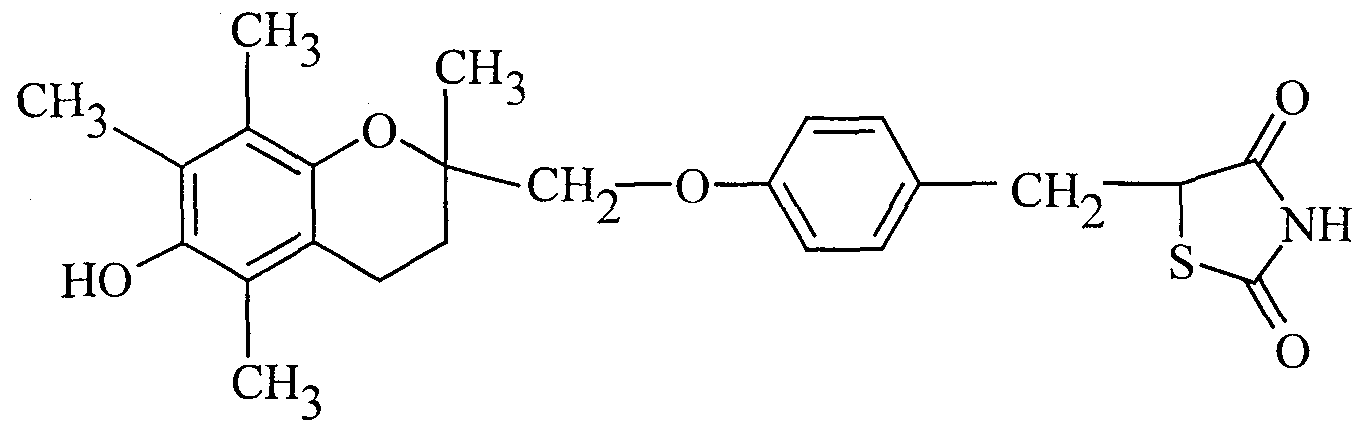
- glitazones are a family of antidiabetic agents characterized as being thiazolidinediones or related analogs. They are described in Current Pharmaceutical Design, 1996;2:85-101. Typical glitazones have the formula
- n 1, 2, or 3
- Y and Z independently are O or NH
- E is a cyclic or bicyclic aromatic or non-aromatic ring, optionally containing a heteroatom selected from oxygen or nitrogen.
- Preferred glitazones have the formula
- R! and R ⁇ independently are hydrogen or Ci -C5 alkyl
- R3 is hydrogen, a Cj-Cg aliphatic acyl group, an alicyclic acyl group, an aromatic acyl group, a heterocyclic acyl group, an araliphatic acyl group, a (Ci -C6 alkoxy) carbonyl group, or an aralkyloxycarbonyl group;
- R4 and R ⁇ independently are hydrogen, C1-C5 alkyl, C1-C5 alkoxy, or R4 and R ⁇ together are Ci -C4 alkyl enedioxy;
- W is -CH2-, >CO, or CHOR6, where R ⁇ is any one of the atoms or groups defined for R ⁇ and may be the same as or different from R ⁇ ; n, Y, and Z are as defined above, and pharmaceutically acceptable salts thereof.
- An especially preferred glitazone is troglitazone having the formula
- glitazones that can be employed in this invention are described in United States Patent No. 5,457,109, which is incorporated herein by reference.
- Other specific glitazones which are preferred include ciglitazone, pioglitazone, englitazone, TA 174, which has the formula
- glitazones include: 5-(4-[2-[ 1 -(4-2'-Pyridylphenyl)ethylideneaminooxy]ethoxy]benzyl]- thiazolidine-2 ,4-dione ;
- metformin A typical biguanide is metformin. It typically is used clinically as a pharmaceutically acceptable salt, preferably the hydrochloride salt.
- a commercial form of metformin hydrochloride is available, and its chemical name is N,N- dimethylimidodicarbonimidic diamide hydrochloride.
- Metformin hydrochloride has the structural formula
- metalformin means the base compound as well as its pharmaceutically acceptable salts. Metformin is used clinically to manage
- NIDDM particularly in patients who are not effectively treated with a sulfonylurea. While it is not chemically related to the sulfonylureas, it routinely is utilized in combination with a sulfonylurea, and has been shown to be synergistic in some cases. Other biguanides can also be used.
- FIG. 1 Dose response of CS-045 (troglitazone), pioglitazone, and BRL-49653 (rosiglitazone) in causing reduction in red blood cell counts in female rats.
- FIG. 1 Dose response of troglitazone, pioglitazone, and rosiglitazone in increases in brown adipose tissue in rats.
- Figure 4 Dose response (ED25) of troglitazone, pioglitazone, and rosiglitazone in causing a decrease i plasma glucose in KK mice.
- Figure 5 Dose response(ED25) of troglitazone, pioglitazone, and rosiglitazone in decreasing plasma glucose (%) in ZDF rats.
- Figure 6 Dose response of troglitazone, pioglitazone, and rosiglitazone in decreasing plasma glucose (%) in GK rats.
- Figure 7 Dose response of troglitazone, pioglitazone, and rosiglitazone in decreasing plasma glucose (%) in db/db mice.
- Figure 8 Change in fasting plasma glucose (FPG) ( ⁇ SEM) during metformin and troglitazone monotherapy and during metformin and troglitazone combination therapy.
- FPG fasting plasma glucose
- Figure 9 Changes in FPG and post-prandial glucose (PPG ( ⁇ SEM) at 3 months of monotherapy of metformin and of troglitazone.
- Figure 10 (A) Mean percent change in endogenous glucose production
- EGP glucose disposal rates
- B Mean percent change in glucose disposal rates (GDR) under hyperinsulinemic clamp conditions after 3 months of monotherapy of metformin and of troglitazone.
- Figure 11 Changes in FPG and PPG after 3 months monotherapy of metformin and of troglitazone, and after an additional 3 months of combination therapy (metformin and troglitazone).
- a glitazone is used in combination with a biguanide, or in combination with both a sulfonylurea and a biguanide, to treat diabetes and to improve glycemic control in patients in need of treatment.
- the compounds can be employed individually, or can be combined in a single formulation, for example as a tablet, capsule, syrup, solution, as well as controlled release formulations.
- the sulfonylurea, biguanide, and glitazone are formulated individually, and administered in the same manner that each is normally used clinically.
- the dosage of each agent will vary depending upon the severity of the disease, the frequency of administration, the particular agents and combinations utilized, and other factors routinely considered by an attending medical practitioner.
- the sulfonylurea normally will be administered at a daily dose of from about 0.25 mg to about 500 mg, typically about 3 mg to about 250 mg.
- a typical dosage for glyburide, for example, will be about 10 to about 20 mg per day.
- the glitazones will normally be administered at doses from about 5 mg to about 2500 mg per day, and more typically from about 50 mg to about 1500 mg per day.
- a preferred glitazone is troglitazone, and it will be employed at doses from about 100 mg to about 1000 mg per day.
- a further preferred glitazone is rosiglitazone (BRL 49653), and it will be employed at doses of about 5 mg to about 10 mg per day.
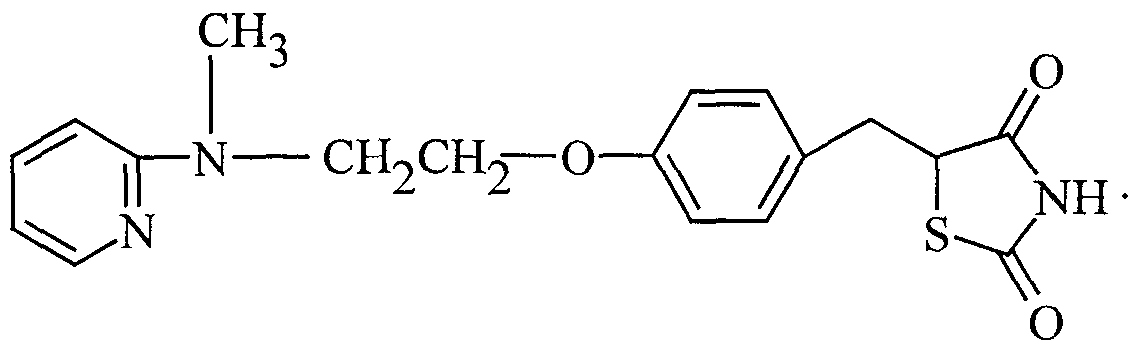
- Another preferred glitazone is pioglitazone, and it will be employed at doses of about 50 mg to about 200 mg per day.
- Metformin hydrochloride will be administered at doses of about 300 mg to about 2000 mg per day. It is available commercially in tablets which contain 500 mg and 850 mg of active agent. These can be given up to two times a day or more.
- Typical combinations to be employed according to this invention thus include troglitazone plus metformin, and troglitazone plus metformin plus a sulfonylurea such as glyburide.
- Another typical and preferred combination is rosiglitazone plus metformin, and rosiglitazone plus metformin plus a sulfonylurea such as glyburide. Still another preferred combination is pioglitazone plus metformin, and pioglitazone plus metformin plus a sulfonylurea such as glyburide. These combinations produce better than expected control of NIDDM.
- compositions of antidiabetic agents for example, metformin and a glitazone, as well as metformin, a sulfonylurea and a glitazone, and a method of treating diabetes and controlling glycemic conditions comprising administering to a patient in need of treatment an effective amount of metformin and a glitazone, or metformin, a sulfonylurea and an effective amount of a glitazone.
- the compositions will contain about one to about 1000 parts by weight of sulfonylurea, and about 1000 to about one part by weight glitazone.
- a typical composition of glyburide and troglitazone will contain about 12 mg of glyburide and about 500 mg of troglitazone. Such combination will be administered to an adult patient about once each day to achieve a desired glycemic control.
- Metformin can be combined directly with a glitazone such as troglitazone. Typical doses will be about 500 mg of metformin and about 300 to 600 mg of troglitazone.
- a typical three-way composition includes 12 mg of glyburide, 400 mg of troglitazone, and 500 mg of metformin.
- compositions may contain common excipients and carriers such as starch, sucrose, talc, gelatin, methylcellulose, and magnesium stearate.
- the compositions will normally be made for oral administration, for instance as tablets or capsules, but also may be in the form of aqueous suspensions or solutions, suppositories, slow release forms, for example employing an osmotic pump, skin patch, or the like.
- the method of treating diabetes employing a combination provided by this invention has been established in a long-term controlled clinical evaluation. A typical study determined the efficacy and safety of troglitazone alone and in combination with the sulfonylurea glyburide for the treatment of non-insulin dependent diabetes mellitus (NIDDM).
- NIDDM non-insulin dependent diabetes mellitus
- a primary objective of the study was to assess the efficacy of troglitazone alone or in combination with micronized glyburide in patients with NIDDM by comparing changes in markers of glycemic and lipid homeostasis over 1 year of treatment. Long-term safety was also an objective of this study, assessed by adverse events and clinical laboratory data.
- Troglitazone monotherapy and troglitazone/glyburide combination therapy were well-tolerated throughout the study. Overall, 70% of patients treated with troglitazone monotherapy had adverse events compared with 90% of patients treated with glyburide (control) therapy. Patients treated with combination therapy had an incidence of adverse events similar to glyburide therapy, 91%. To what extent the high dropout rate for troglitazone monotherapy affected the incidence of adverse events is not known. In general, the incidence of adverse events was not influenced by age or menopausal status. Overall, patients treated with combination therapy had a higher incidence of associated adverse events (26%) compared with those treated with glyburide (10%).
- Baseline clinical laboratory parameters were compared with values at the end of the study (last visit) to identify any abnormal trends.
- the percent of patients with increases or decreases in laboratory values were calculated based on the number of patients at risk for changes outside of the reference range; i.e., patients with low or high values at baseline were not considered at risk for a decrease or increase, respectively. .
- AST returned to baseline levels 49 days after therapy was withdrawn.
- Hematology Minimal changes occurred with any of the hematological parameters. Changes that met criteria for possible clinical importance were increases or decreases within the normal range or transient changes that subsequently resolved. Patients meeting clinically important changes in hematology parameters are noted here. Thirty-four patients had changes in hemoglobin or hematocrit or both meeting criteria for clinically meaningful change. Seven patients had mildly transient decreases which returned to baseline levels while remaining on troglitazone (3 patients; two on 400 mg, one on
- AST AST, or both. Three of these patients were terminated due to enzymes elevations; all were followed and enzymes returned to either baseline or within normal limits. Four additional patients had transient elevations which resolved while remaining on troglitazone or troglitazone combination. Two patients on troglitazone 600 mg combination, three on troglitazone 300 mg combination, and one patient on troglitazone 200 mg monotherapy had mildly elevated ( ⁇ 3 x upper normal limit) at the end of the study. Three of these patients were concomitantly using many additional medications for concurrent illness which cannot be ruled out as causal or contributory to their elevated enzymes.
- troglitazone enhances insulin action at the cellular level, it does not stimulate insulin release nor does it mimic its action.
- the therapeutic benefits of troglitazone treatment depend on the availability of adequate amounts of insulin.
- the addition of troglitazone to concurrent sulfonylurea treatment provides a balance of stimulated release of insulin while ameliorating insulin resistance.
- the mean change from baseline in FSG for the 600T/12G arm was -56 mg/dL, representing a difference of -79 mg/dL from the control arm.
- the improvement in FSG is confirmed by a mean change from baseline in HbAj c of -1.75%) in the same treatment arm, a difference of -2.65% from the active control arm.
- Troglitazone should be added to current treatment regimens of a sulfonylurea beginning at 200 mg and increasing up to 600 mg as needed to optimize glycemic control. As patients reach target goals of glycemic control, the dose of sulfonylurea may be reduced or even eliminated based on the level of glycemic control. Hence, in these patients (sulfonylurea failures), troglitazone as monotherapy is achieved only if warranted based upon glycemic control parameters. Faced with the alternative of reducing the dosage of one of the agents, the pathophysiology of the disease should be considered.
- Troglitazone alone can be effective in naive patients who are not well-controlled on diet and exercise but have not been managed on oral agents.
- the deficit in the insulin secretory capacity of naive patients is generally relative, and the improvement in insulin sensitivity may be sufficient to restore normoglycemia.
- the insulin reduction observed in the combination treatment arms reflects an improvement in insulin sensitivity since the lower insulin level is associated with significant decreases in FSG and HbAj c rather than increases.
- the direction of the change in the fasting levels of insulin and serum glucose is mirrored by similar changes in the AUC of the insulin and serum glucose during the meal tolerance test for the combination arms.
- the improved insulin sensitivity leads to a reduced demand on pancreatic secretion of insulin, a desirable outcome given the natural progression of the disease.
- the magnitude of the reduction in insulin in the monotherapy arms is greater than that observed in the various combination arms. While a similar reduction between the monotherapy and the combination treatment arms would have been expected based upon enhanced insulin activity, the additional decrease in insulin levels may be attributed to the removal of sulfonylurea-stimulated insulin secretion. Finally, the reduction observed in the control arm (micronized glyburide) may be attributed to gradual degradation of the pancreatic secretory function or secondary failure typically observed with sulfonylurea treatment over time. This change cannot be attributed to improvements in insulin sensitivity, since FSG levels increased and did not decrease. The observed changes in insulin levels were confirmed by similar changes in direction and magnitude in C-peptide levels for all treatment arms.
- Lipid Parameters The classical manifestations of insulin resistance in a diabetic population are elevated triglycerides and low levels of HDL. Therefore, the reversal of insulin resistance should be expected to elicit favorable changes in these lipid parameters, as observed in this study. Although statistical significance was reached in some (but not all) treatment arms, the general trend of the changes is consistent with the reversal of insulin resistance, i.e., a reduction in triglycerides and an increase in
- Troglitazone both as mono- and combination therapy, was well-tolerated during the study.
- the overall adverse event profile of troglitazone/glyburide combination therapy was similar to the adverse event profile of glyburide monotherapy.
- Most adverse events occurred at the lower incidence in patients treated with troglitazone monotherapy compared with the patients treated with glyburide monotherapy. This may be attributed to a better adverse event profile for troglitazone and may in part be due to the high dropout rate for patients treated with troglitazone monotherapy. Tolerance was also evident by the rare occurrence of unacceptable levels of clinical laboratory parameters; most of these occurrences resolved while study treatment continued.
- Monotherapy should only be achieved if indicated by downward titration of the sulfonylurea dose.
- application of the results of this study should not be limited to patients who fail on maximum doses of sulfonylurea therapy but also extended to patients on lower doses of a sulfonylurea.
- Troglitazone/glyburide combination therapy is well-tolerated and significantly (p ⁇ 0.0001) improves glycemic control over a 52-week period at doses of 200 mg/12 mg to 600 mg/12 mg compared with glyburide monotherapy in patients with NIDDM who are not adequately controlled on sulfonylurea therapy.
- Another glitazone, namely BRL 49653 now known as rosiglitazone,
- RSG Rosiglitazone
- Range 21.2-38.2 19.2-39.5 21.5-37.9 a Normal range, for Ages 13-49, 3.89-6.38 mmol/L; for Ages ⁇ 50 years,
- rosiglitazone is a preferred glitazone to be combined with a sulfonylurea according to this invention.
- the sulfonylurea will be employed at a dose of about 0.25 mg to about 500 mg, typically from about 3 mg to about 250 mg.
- the rosiglitazone will be administered at a dose of about 5 to about 2500 mg per day, and more typically at a dose of about 5 mg to about 50 mg.
- pioglitazone (( ⁇ )-5-[p-[2-(5-ethyl-2-pyridyl)ethoxy]benzyl]-2,4- thiazolidinedione hydrochloride), both alone and in combination with sulfonylureas, in controlling and promoting hepatic glucose uptake in patients having NIDDM.
- Pi pioglitazone
- One such clinical trial used 20 patients having a mean age of 58.2 ⁇ 9.4 (13 males, 7 females). All patients were controlling their blood glucose by diet alone or by taking a sulfonylurea.
- pioglitazone was administered orally at a dose of 30 mg/day, every morning for 3 months.
- fasting plasma glucose (FPG) level significantly (p ⁇ 0.01) decreased from 11.0 ⁇ 1.5 mmol/liter to 8.9 ⁇ 1.1 mmol/liter.
- Hemoglobin A c level significantly fell from 9.2 ⁇ 1.8% to 8.3 ⁇ 1.5% (p ⁇ 0.01).
- Fasting serum insulin and C peptide levels decreased from 83 ⁇ 36 pmol/liter and 0.62 ⁇ 0.21 nmol/liter to 66 ⁇ 29 pmol/liter and 0.58 ⁇ 0.25 nmol/liter, respectively.
- pioglitazone was administered in combination with glipizide (Gl).
- Gl glipizide
- Pb placebo
- pioglitazone 45 mg/day
- 5 mg/day 5 mg/day of glipizide.
- the patients were dosed for 7 days on one treatment, and then for the following 7 days on the alternate treatment.
- the pharmacokinetic (PK) effects of multiple doses of pioglitazone on steady state glipizide levels was determined.
- the plasma glipizide PK parameters are shown in Table 4.
- hepatic glucose uptake In another study in patients, pioglitazone alone, and together with sulfonylureas, significantly increased hepatic glucose uptake (HGU). Thirty patients were selected for the trial. Four controlled their blood glucose on diet alone; the remaining 26 were taking a sulfonylurea. Twenty-one patients were given 30 mg of pioglitazone daily for 12 weeks. Nine patients (one on diet alone, 8 on sulfonylurea drugs), were given placebo. The group receiving pioglitazone showed an increase in HGU from 28.5 ⁇ 19.4 to 59.4 + 27.1. a 12% increase in hepatic glucose uptake. The group receiving placebo showed no significant change in hepatic glucose uptake.
- HGU hepatic glucose uptake
- the glitazones are a class of thiazolidinediones which have been shown to enhance hepatic and peripheral glucose uptake in animals, including humans, and are thus useful for treating diabetes mellitus. All of the glitazone compounds operate by the same mechanism within an animal system. Several studies have established the close similarity in biological activity of various glitazones from within the thiazolidinedione class. For example, troglitazone, pioglitazone, and rosiglitazone all cause a slight reduction in red blood cell counts when administered at various dosages to female rats (Figure 1).
- the foregoing studies establish that the glitazones are a class of antidiabetic agents which exert a very similar spectrum of biological effects in animals.
- the studies also establish the ability of the glitazones to be used in combination with a sulfonylurea for the significant increase in hepatic glucose uptake, and the dramatic reduction in plasma glucose levels.
- the combinations are thus particularly well suited to the treatment of type 2 diabetes, and can be utilized in the treatment of impaired glucose tolerance in order to even prevent or delay the onset of NIDDM.
- the glitazones can also be utilized in combination with a biguanide such as metformin, as well as in combination with a biguanide plus a sulfonylurea.
- the patients were evenly matched for age, body mass index (BMI), fasting plasma glucose (FPG), HbAj c , and fasting insulin and C-peptide.
- BMI body mass index
- FPG fasting plasma glucose
- HbAj c fasting insulin and C-peptide.
- the treatment group was in general obese, moderately diabetic, and had a mean BMI of 33.5 kg/m 2 , a mean HbAj c (prior to starting the study) of 9.6%, and a mean FPG of 280 mg/dL.
- metformin and troglitazone 1000 mg metformin BID, 400 mg troglitazone QD
- metformin caused less than 27% increase in glucose disposal rate
- Triglycerides +43 -36 (p 0.07) -67
- the sulfonylurea/metformin combination had no effect on C-peptide levels, the triple combination of sulfonylurea/biguanide/ glitazone caused a 7% reduction.
- the sulfonylurea/metformin treated group had an increase in triglycerides of 43 mg/dL, the sulfonylurea/ glitazone/biguanide combination caused a reduction of 36 mg/dL.
Landscapes
- Health & Medical Sciences (AREA)
- Medicinal Chemistry (AREA)
- Veterinary Medicine (AREA)
- Public Health (AREA)
- General Health & Medical Sciences (AREA)
- Animal Behavior & Ethology (AREA)
- Chemical & Material Sciences (AREA)
- Life Sciences & Earth Sciences (AREA)
- Pharmacology & Pharmacy (AREA)
- Epidemiology (AREA)
- Diabetes (AREA)
- Hematology (AREA)
- Engineering & Computer Science (AREA)
- Organic Chemistry (AREA)
- General Chemical & Material Sciences (AREA)
- Chemical Kinetics & Catalysis (AREA)
- Obesity (AREA)
- Bioinformatics & Cheminformatics (AREA)
- Nuclear Medicine, Radiotherapy & Molecular Imaging (AREA)
- Endocrinology (AREA)
- Emergency Medicine (AREA)
- Pharmaceuticals Containing Other Organic And Inorganic Compounds (AREA)
- Acyclic And Carbocyclic Compounds In Medicinal Compositions (AREA)
- Medicinal Preparation (AREA)
- Medicines That Contain Protein Lipid Enzymes And Other Medicines (AREA)
Abstract
Description



Claims
Priority Applications (8)
| Application Number | Priority Date | Filing Date | Title |
|---|---|---|---|
| DK99939130T DK1128834T3 (en) | 1998-11-09 | 1999-08-11 | Combinations for diabetes containing glyburide, troglitazone (and a biguanide) |
| EP99939130A EP1128834B1 (en) | 1998-11-09 | 1999-08-11 | Combinations for diabetes which contain glyburide,troglitazone (and a biguanide) |
| AT99939130T ATE293980T1 (en) | 1998-11-09 | 1999-08-11 | COMBINATIONS FOR DIABETES WHICH CONTAIN GLYBURIDE, TROGLITAZONE (AND A BIGUANIDE). |
| SI9930780T SI1128834T1 (en) | 1998-11-09 | 1999-08-11 | |
| JP2000580630A JP2002529417A (en) | 1998-11-09 | 1999-08-11 | Diabetic combination drug containing sulfonylurea, glitazone and biguanide |
| AU53473/99A AU5347399A (en) | 1998-11-09 | 1999-08-11 | Combinations for diabetes which contain a sulfonylurea, a glitazone and a biguanide |
| DE69925019T DE69925019T2 (en) | 1998-11-09 | 1999-08-11 | COMBINATIONS FOR DIABETES CONTAINING GLYBURIDE, TROGLITAZONE (AND A BIGUANIDE) |
| CA002345524A CA2345524C (en) | 1998-11-09 | 1999-08-11 | Combinations for diabetes which contain a sulfonylurea, a glitazone and a biguanide |
Applications Claiming Priority (2)
| Application Number | Priority Date | Filing Date | Title |
|---|---|---|---|
| US09/189,132 | 1998-11-09 | ||
| US09/189,132 US6011049A (en) | 1997-02-19 | 1998-11-09 | Combinations for diabetes |
Publications (1)
| Publication Number | Publication Date |
|---|---|
| WO2000027401A1 true WO2000027401A1 (en) | 2000-05-18 |
Family
ID=22696072
Family Applications (1)
| Application Number | Title | Priority Date | Filing Date |
|---|---|---|---|
| PCT/US1999/018140 Ceased WO2000027401A1 (en) | 1998-11-09 | 1999-08-11 | Combinations for diabetes which contain a sulfonylurea, a glitazone and a biguanide |
Country Status (20)
| Country | Link |
|---|---|
| US (1) | US6011049A (en) |
| EP (2) | EP1514550A3 (en) |
| JP (1) | JP2002529417A (en) |
| AR (1) | AR020973A1 (en) |
| AT (1) | ATE293980T1 (en) |
| AU (1) | AU5347399A (en) |
| CA (1) | CA2345524C (en) |
| CO (1) | CO5150152A1 (en) |
| CR (1) | CR6128A (en) |
| DE (1) | DE69925019T2 (en) |
| DK (1) | DK1128834T3 (en) |
| ES (1) | ES2241305T3 (en) |
| GT (1) | GT199900158A (en) |
| HN (1) | HN1999000184A (en) |
| PA (1) | PA8484901A1 (en) |
| PE (1) | PE20001235A1 (en) |
| PT (1) | PT1128834E (en) |
| SI (1) | SI1128834T1 (en) |
| UY (1) | UY25791A1 (en) |
| WO (1) | WO2000027401A1 (en) |
Cited By (24)
| Publication number | Priority date | Publication date | Assignee | Title |
|---|---|---|---|---|
| WO2002004024A1 (en) * | 2000-06-30 | 2002-01-17 | Rieveley Robert B | Composition for the treatment of diabetes |
| WO2002096402A1 (en) * | 2001-06-01 | 2002-12-05 | Astrazeneca Ab | A pharmaceutical combination comprising either (s)-2-ethoxy-3- [4-(2- {4-methane sulfonyl oxyphenyl} ethoxy) phenyl] propanoic acid or 3-{4-[2- (4-tert-butoxy carbonyl aminophenyl) ethoxy] phenyl} -(s)-2-ethoxy propanoic acid and a biguanide drug |
| WO2002100413A1 (en) * | 2001-06-01 | 2002-12-19 | Astrazeneca Ab | A PHARMACEUTICAL COMBINATION COMPRISING EITHER (S)-2-ETHOXY-3- [4-(2-{4-METHANE SULFONYL OXYPHENYL} ETHOXY) PHENYL] PROPANOIC ACID OR 3-{4-[2-(4-TERT- BUTOXY CARBONYL AMINOPHENYL) ETHOXY] PHENYL} -(s)-2-ETHOXY PROPANOIC ACID AND A SULONYLUREA |
| WO2003011308A1 (en) * | 2001-07-30 | 2003-02-13 | Mitsubishi Pharma Corporation | Drugs for ameliorating postcibal hyperglycemia |
| US6559188B1 (en) | 1999-09-17 | 2003-05-06 | Novartis Ag | Method of treating metabolic disorders especially diabetes, or a disease or condition associated with diabetes |
| EP1429740A4 (en) * | 2001-07-10 | 2005-01-26 | Kos Life Sciences Inc | CORE FORMULATION COMPRISING TROGLITAZONE AND BIGUANIDE |
| EP1278513A4 (en) * | 2000-05-01 | 2005-01-26 | Aeropharm Technology Inc | A core formulation |
| US6878749B2 (en) | 1999-09-17 | 2005-04-12 | Novartis Ag | Method of treating metabolic disorders, especially diabetes, or a disease or condition associated with diabetes |
| EP1558220A4 (en) * | 2003-07-24 | 2006-07-12 | Wockhardt Ltd | Oral compositions for treatment of diseases |
| WO2007043853A1 (en) * | 2005-10-12 | 2007-04-19 | World-Trade Import-Export, Wtie, Ag. | Pharmaceutical compositions comprising combined antidiabetic substances for use in diabetes mellitus |
| WO2007073136A1 (en) * | 2005-12-20 | 2007-06-28 | World-Trade Import-Export, Wtie, Ag. | Pharmaceutical compositions containing derivative substances of thiazolidinediones combined with a biguanide for use in type 2 diabetes mellitus |
| US7285543B2 (en) | 1997-03-07 | 2007-10-23 | Metabasis Therapeutics, Inc. | Purine inhibitors of fructose-1,6-bisphosphatase |
| US7312219B2 (en) | 1998-09-09 | 2007-12-25 | Metabasis Therapeutics, Inc. | Heteroaromatic inhibitors of fructose 1,6-bisphosphatase |
| US7371739B2 (en) | 2000-03-08 | 2008-05-13 | Metabasis Therapeutics, Inc. | Aryl fructose-1,6-bisphosphatase inhibitors |
| US7563774B2 (en) | 2000-06-29 | 2009-07-21 | Metabasis Therapeutics, Inc. | Combination of FBPase inhibitors and antidiabetic agents useful for the treatment of diabetes |
| US7700128B2 (en) | 2003-10-31 | 2010-04-20 | Takeda Pharmaceutical Company Limited | Solid preparation comprising an insulin sensitizer, an insulin secretagogue and a polyoxyethylene sorbitan fatty acid ester |
| US8791115B2 (en) | 2006-01-13 | 2014-07-29 | Poxel Sas | Combination of triazine derivatives and insulin sensitisers |
| WO2017105229A1 (en) | 2015-12-14 | 2017-06-22 | Ll Management | Compositions and methods for inducing beige or brown fat tissue |
| US10975434B2 (en) | 2015-12-23 | 2021-04-13 | Sanofi-Aventis Deutschland Gmbh | Growth differentiation factor 15 as biomarker for metformin |
| WO2021125951A1 (en) | 2019-12-18 | 2021-06-24 | Logick Energetics B.V. | Pharmaceutical composition for use in preventing or stopping metastases |
| NL2024493B1 (en) | 2019-12-16 | 2021-09-02 | Logick Energetics B V | Pharmaceutical composition for preventing or stopping metastases |
| WO2021205026A2 (en) | 2020-04-10 | 2021-10-14 | Logick Energetics B.V. | Pharmaceutical composition for treatment of enveloped dna or rna virus induced infections and disorders |
| WO2022265509A1 (en) | 2021-06-17 | 2022-12-22 | Logick Energetics B.V. | Pharmaceutical composition for increasing mitochondrial activity and/or improving adiponectin production |
| NL2029634B1 (en) | 2021-11-04 | 2023-06-02 | Logick Energetics B V | Pharmaceutical composition for increasing mitochondrial activity and/or improving adiponectin production |
Families Citing this family (115)
| Publication number | Priority date | Publication date | Assignee | Title |
|---|---|---|---|---|
| TWI238064B (en) * | 1995-06-20 | 2005-08-21 | Takeda Chemical Industries Ltd | A pharmaceutical composition for prophylaxis and treatment of diabetes |
| US6099859A (en) | 1998-03-20 | 2000-08-08 | Andrx Pharmaceuticals, Inc. | Controlled release oral tablet having a unitary core |
| US6099862A (en) * | 1998-08-31 | 2000-08-08 | Andrx Corporation | Oral dosage form for the controlled release of a biguanide and sulfonylurea |
| US20040081697A1 (en) * | 1998-11-12 | 2004-04-29 | Smithkline Beecham P.L.C. | Pharmaceutical composition for modified release of an insulin sensitiser and another antidiabetic agent |
| US20040102486A1 (en) * | 1998-11-12 | 2004-05-27 | Smithkline Beecham Corporation | Novel method of treatment |
| US20030153607A1 (en) * | 1998-11-12 | 2003-08-14 | Smithkline Beecham P.L.C. | Novel composition and use |
| GB9824893D0 (en) * | 1998-11-12 | 1999-01-06 | Smithkline Beckman Corp | Novel method of treatment |
| US6586438B2 (en) * | 1999-11-03 | 2003-07-01 | Bristol-Myers Squibb Co. | Antidiabetic formulation and method |
| US6780432B1 (en) * | 2000-05-01 | 2004-08-24 | Aeropharm Technology, Inc. | Core formulation |
| US6296874B1 (en) * | 2000-05-01 | 2001-10-02 | Aeropharm Technology Incorporated | Core formulation comprising troglitazone and abiguanide |
| US6610272B1 (en) | 2000-05-01 | 2003-08-26 | Aeropharm Technology Incorporated | Medicinal aerosol formulation |
| AU2000273085A1 (en) * | 2000-10-02 | 2002-04-15 | Usv Limited | Sustained release pharmaceutical compositions containing metformin and method ofits production |
| US6866866B1 (en) * | 2000-11-03 | 2005-03-15 | Andrx Labs, Llc | Controlled release metformin compositions |
| CA2434169C (en) | 2001-01-12 | 2011-03-15 | Sun Pharmaceutical Industries Limited | Spaced drug delivery system |
| KR200249057Y1 (en) * | 2001-03-22 | 2001-10-19 | 김진환 | Sewage backflow integrated into the lid and base. Odor Prevention Device |
| FR2823225B1 (en) * | 2001-04-04 | 2004-09-17 | Pierre Desreumaux | USE OF COMPOUNDS MODULATING THE ACTIVITY OF THE RXR-PPAR HETERODIMER AS A MEDICAMENT FOR THE TREATMENT OF HEPATITIS C AND METHOD FOR SCREENING THEREOF |
| CA2443632C (en) * | 2001-04-10 | 2011-05-03 | Sun Pharmaceutical Industries Limited | Timed pulse release composition |
| US20040156903A1 (en) * | 2002-05-22 | 2004-08-12 | Abrams Andrew L.. | Metering and packaging of controlled release medication |
| AU2001273289B2 (en) * | 2001-07-10 | 2004-10-07 | Kos Life Sciences, Inc. | Core formulation comprising pioglitazone hydrochloride and a biguanide |
| AU2001273310B2 (en) * | 2001-07-10 | 2004-10-07 | Kos Life Sciences, Inc. | A core formulation |
| EP1408966B1 (en) | 2001-07-17 | 2008-02-20 | N-Gene Research Laboratories Inc. | Synergistic pharmaceutical combinations for the prevention or treatment of diabetes |
| JP4965060B2 (en) * | 2001-07-27 | 2012-07-04 | メルク パテント ゲゼルシャフト ミット ベシュレンクテル ハフツング | Bauhinia extract |
| FR2832633B1 (en) * | 2001-11-28 | 2004-09-24 | Lipha | PHARMACEUTICAL COMPOSITION COMPRISING A METFORMIN ASSOCIATION AND A 4-OXO-BUTANOIC ACID AND ITS USE FOR TREATING DIABETES |
| US7183321B2 (en) * | 2001-12-17 | 2007-02-27 | Bristol-Myers Squibb Company | Antidiabetic formulation and method |
| FR2834640B1 (en) * | 2002-01-11 | 2004-09-24 | Lipha | PHARMACEUTICAL COMPOSITION COMPRISING A GLITAZONE AND A 4-OXOBUTANOIC ACID AND ITS USE FOR TREATING DIABETES |
| ATE361065T1 (en) * | 2002-01-25 | 2007-05-15 | Silanes Sa De Cv Lab | PHARMACEUTICAL COMPOSITION FOR CONTROLLING BLOOD SUGAR IN PATIENTS WITH TYPE 2 DIABETES |
| US6682759B2 (en) | 2002-02-01 | 2004-01-27 | Depomed, Inc. | Manufacture of oral dosage forms delivering both immediate-release and sustained-release drugs |
| US20030187074A1 (en) * | 2002-03-04 | 2003-10-02 | Javed Hussain | Oral compositions for treatment of diabetes |
| US8911781B2 (en) | 2002-06-17 | 2014-12-16 | Inventia Healthcare Private Limited | Process of manufacture of novel drug delivery system: multilayer tablet composition of thiazolidinedione and biguanides |
| US20040081678A1 (en) * | 2002-08-09 | 2004-04-29 | Anthony Cincotta | Therapeutic process for the treatment of obesity and associated metabolic disorders |
| US8821915B2 (en) * | 2002-08-09 | 2014-09-02 | Veroscience, Llc | Therapeutic process for the treatment of the metabolic syndrome and associated metabolic disorders |
| US7407955B2 (en) | 2002-08-21 | 2008-08-05 | Boehringer Ingelheim Pharma Gmbh & Co., Kg | 8-[3-amino-piperidin-1-yl]-xanthines, the preparation thereof and their use as pharmaceutical compositions |
| AU2003272504A1 (en) | 2002-09-20 | 2004-04-08 | Andrx Labs Llc | Multistage formulation containing a biguanide and thiazolidindione derivatives |
| US7785627B2 (en) | 2002-09-20 | 2010-08-31 | Watson Pharmaceuticals, Inc. | Pharmaceutical formulation containing a biguanide and a thiazolidinedione derivative |
| US9060941B2 (en) * | 2002-09-20 | 2015-06-23 | Actavis, Inc. | Pharmaceutical formulation containing a biguanide and a thiazolidinedione derivative |
| US7959946B2 (en) * | 2002-09-20 | 2011-06-14 | Watson Pharmaceuticals, Inc. | Pharmaceutical formulation containing a biguanide and a thiazolidinedione derivative |
| US8084058B2 (en) | 2002-09-20 | 2011-12-27 | Watson Pharmaceuticals, Inc. | Pharmaceutical formulation containing a biguanide and a thiazolidinedione derivative |
| MXPA05003252A (en) * | 2002-09-26 | 2005-07-05 | Eisai Co Ltd | Combination drug. |
| IN192749B (en) * | 2002-11-15 | 2004-05-15 | Ranbaxy Lab Ltd | |
| US20060210633A1 (en) * | 2003-04-03 | 2006-09-21 | Sun Pharmaceutical Industries Limited | Programmed drug delivery system |
| US20050013863A1 (en) | 2003-07-18 | 2005-01-20 | Depomed, Inc., A Corporation Of The State Of California | Dual drug dosage forms with improved separation of drugs |
| US20050054731A1 (en) * | 2003-09-08 | 2005-03-10 | Franco Folli | Multi-system therapy for diabetes, the metabolic syndrome and obesity |
| US7501426B2 (en) | 2004-02-18 | 2009-03-10 | Boehringer Ingelheim International Gmbh | 8-[3-amino-piperidin-1-yl]-xanthines, their preparation and their use as pharmaceutical compositions |
| AU2005299808B2 (en) * | 2004-10-25 | 2009-08-20 | Novartis Ag | Combination of DPP-IV inhibitor, PPAR antidiabetic and metformin |
| DE102004054054A1 (en) | 2004-11-05 | 2006-05-11 | Boehringer Ingelheim Pharma Gmbh & Co. Kg | Process for preparing chiral 8- (3-amino-piperidin-1-yl) -xanthines |
| WO2006074278A2 (en) * | 2005-01-05 | 2006-07-13 | Mitsunori Ono | Compositions for treating diabetes or obesity |
| US20070015839A1 (en) * | 2005-07-14 | 2007-01-18 | Franco Folli | Daily Dosage Regimen for Treating Diabetes, Obesity, Metabolic Syndrome and Polycystic Ovary Syndrome |
| MXPA05009633A (en) * | 2005-09-08 | 2007-03-07 | Silanes Sa De Cv Lab | Stable pharmaceutical composition comprising immediate-release glimepiride and delayed-release metformin. |
| US20070249561A1 (en) * | 2006-04-25 | 2007-10-25 | Taylor Bradley K | Pharmacological method for treatment of neuropathic pain |
| PE20080251A1 (en) | 2006-05-04 | 2008-04-25 | Boehringer Ingelheim Int | USES OF DPP IV INHIBITORS |
| EP1852108A1 (en) | 2006-05-04 | 2007-11-07 | Boehringer Ingelheim Pharma GmbH & Co.KG | DPP IV inhibitor formulations |
| EP2540725A1 (en) | 2006-05-04 | 2013-01-02 | Boehringer Ingelheim International GmbH | Polymorphs of 1-((4-Methyl-chinazolin-2-yl)methyl)-3-methyl-7-(2-butin-1-yl)-8-(3-(R)-amino-piperidin-1-yl)xanthin |
| US20090238763A1 (en) * | 2006-07-09 | 2009-09-24 | Chongxi Yu | High penetration compositions and uses thereof |
| US20090221703A1 (en) | 2006-07-09 | 2009-09-03 | Chongxi Yu | High penetration composition and uses thereof |
| TW200816995A (en) * | 2006-08-31 | 2008-04-16 | Daiichi Sankyo Co Ltd | Pharmaceutical composition containing insulin sensitizers |
| PL2084124T3 (en) | 2006-10-02 | 2014-08-29 | Techfields Biochem Co Ltd | Positively charged water-soluble prodrugs of prostaglandins and related compounds with very high skin penetration rates |
| AU2006350707A1 (en) | 2006-11-08 | 2008-05-15 | Chongxi Yu | Transdermal delivery systems of peptides and related compounds |
| CN101547898B (en) | 2006-12-10 | 2014-09-24 | 于崇曦 | Transdermal drug delivery system for β-lactam antibiotics |
| HUE031712T2 (en) | 2007-01-15 | 2017-08-28 | Chongxi Yu | Positively charged water-soluble prodrugs of retinoids and retinoid-like compounds with very high skin penetration rates |
| WO2008093173A1 (en) | 2007-01-31 | 2008-08-07 | Chongxi Yu | Positively charged water-soluble prodrugs of 1h-imidazo[4, 5-c]quinolin-4-amines and related compounds with very high skin penetration rates |
| US20070172525A1 (en) * | 2007-03-15 | 2007-07-26 | Ramesh Sesha | Anti-diabetic combinations |
| US20080064701A1 (en) * | 2007-04-24 | 2008-03-13 | Ramesh Sesha | Anti-diabetic combinations |
| EP3053440B1 (en) * | 2007-04-11 | 2020-08-12 | Omeros Corporation | Compositions and methods for prophylaxis and treatment of addictions |
| US20160331729A9 (en) * | 2007-04-11 | 2016-11-17 | Omeros Corporation | Compositions and methods for prophylaxis and treatment of addictions |
| US11241420B2 (en) | 2007-04-11 | 2022-02-08 | Omeros Corporation | Compositions and methods for prophylaxis and treatment of addictions |
| KR20150058566A (en) | 2007-06-04 | 2015-05-28 | 테크필즈 인크 | Pro-drugs of NSAIAs With Very High Skin and Membranes Penetration Rates and Their New Medicinal Uses |
| WO2009024542A2 (en) * | 2007-08-17 | 2009-02-26 | Boehringer Ingelheim International Gmbh | Purin derivatives for use in the treatment of fab-related diseases |
| US8551524B2 (en) * | 2008-03-14 | 2013-10-08 | Iycus, Llc | Anti-diabetic combinations |
| PE20091730A1 (en) | 2008-04-03 | 2009-12-10 | Boehringer Ingelheim Int | FORMULATIONS INVOLVING A DPP4 INHIBITOR |
| PE20100156A1 (en) * | 2008-06-03 | 2010-02-23 | Boehringer Ingelheim Int | NAFLD TREATMENT |
| US8476008B2 (en) * | 2008-07-23 | 2013-07-02 | Diabetomics, Llc | Methods for detecting pre-diabetes and diabetes |
| UY32030A (en) * | 2008-08-06 | 2010-03-26 | Boehringer Ingelheim Int | "TREATMENT FOR DIABETES IN INAPPROPRIATE PATIENTS FOR THERAPY WITH METFORMIN" |
| BRPI0916997A2 (en) | 2008-08-06 | 2020-12-15 | Boehringer Ingelheim International Gmbh | DPP-4 INHIBITOR AND ITS USE |
| NZ604091A (en) * | 2008-08-15 | 2014-08-29 | Boehringer Ingelheim Int | Purin derivatives for use in the treatment of fab-related diseases |
| EP2361092A4 (en) * | 2008-09-04 | 2012-07-11 | Anthony I Rozmanith | MEDICAL CARE |
| US20100075937A1 (en) * | 2008-09-24 | 2010-03-25 | Hollis-Eden Pharmaceuticals, Inc. | Patient populations and treatment methods |
| US20200155558A1 (en) | 2018-11-20 | 2020-05-21 | Boehringer Ingelheim International Gmbh | Treatment for diabetes in patients with insufficient glycemic control despite therapy with an oral antidiabetic drug |
| BR122021011394B1 (en) | 2008-12-04 | 2021-09-28 | Chongxi Yu | HIGH PENETRATION COMPOSITION OF A MAIN DRUG, AND USE OF A HPC |
| CN102256976A (en) | 2008-12-23 | 2011-11-23 | 贝林格尔.英格海姆国际有限公司 | Salt Forms of Organic Compounds |
| AR074990A1 (en) | 2009-01-07 | 2011-03-02 | Boehringer Ingelheim Int | TREATMENT OF DIABETES IN PATIENTS WITH AN INAPPROPRIATE GLUCEMIC CONTROL THROUGH METFORMIN THERAPY |
| NZ619408A (en) | 2009-03-11 | 2015-08-28 | Omeros Corp | Compositions and methods for prophylaxis and treatment of addictions |
| PT3278665T (en) | 2009-04-29 | 2020-11-19 | Amarin Pharmaceuticals Ie Ltd | Stable pharmaceutical composition and methods of using same |
| SG175390A1 (en) | 2009-04-29 | 2011-12-29 | Amarin Corp Plc | Pharmaceutical compositions comprising epa and a cardiovascular agent and methods of using the same |
| PL2427475T3 (en) | 2009-05-08 | 2021-07-19 | Techfields Biochem Co., Ltd. | High penetration prodrug compositions of peptides and peptide-related compounds |
| US9352025B2 (en) | 2009-06-05 | 2016-05-31 | Veroscience Llc | Combination of dopamine agonists plus first phase insulin secretagogues for the treatment of metabolic disorders |
| US9969751B2 (en) | 2009-06-10 | 2018-05-15 | Techfields Pharma Co., Ltd. | High penetration prodrug compositions of antimicrobials and antimicrobial-related compounds |
| CN106074486A (en) | 2009-06-15 | 2016-11-09 | 阿马里纳药物爱尔兰有限公司 | Triglyceride, the compositions not increasing LDL C level and method is reduced in the object of Statins therapy together |
| US20110065756A1 (en) * | 2009-09-17 | 2011-03-17 | De Taeye Bart M | Methods and compositions for treatment of obesity-related diseases |
| KR20240090632A (en) | 2009-11-27 | 2024-06-21 | 베링거 인겔하임 인터내셔날 게엠베하 | Treatment of genotyped diabetic patients with dpp-iv inhibitors such as linagliptin |
| WO2011128782A2 (en) * | 2010-04-13 | 2011-10-20 | Jorge Luis Rosado | Compositions and methods for treating type ii diabetes and related disorders |
| CN102946875A (en) | 2010-05-05 | 2013-02-27 | 贝林格尔.英格海姆国际有限公司 | Combination therapy |
| US9241952B2 (en) | 2010-05-24 | 2016-01-26 | Ozstar Therapeutics Pty Ltd | Method of treating type II diabetes, hyperglycemia or hypoglycemia by administering a synergistic combination of a sulphonylurea and inulin |
| WO2011161161A1 (en) | 2010-06-24 | 2011-12-29 | Boehringer Ingelheim International Gmbh | Diabetes therapy |
| AR083878A1 (en) | 2010-11-15 | 2013-03-27 | Boehringer Ingelheim Int | VASOPROTECTORA AND CARDIOPROTECTORA ANTIDIABETIC THERAPY, LINAGLIPTINA, TREATMENT METHOD |
| NZ778131A (en) | 2010-11-29 | 2023-03-31 | Amarin Pharmaceuticals Ie Ltd | Low eructation composition and methods for treating and/or preventing cardiovascular disease in a subject with fish allergy/hypersensitivity |
| US8883800B2 (en) | 2011-07-15 | 2014-11-11 | Boehringer Ingelheim International Gmbh | Substituted quinazolines, the preparation thereof and the use thereof in pharmaceutical compositions |
| US11291643B2 (en) | 2011-11-07 | 2022-04-05 | Amarin Pharmaceuticals Ireland Limited | Methods of treating hypertriglyceridemia |
| CN103159651B (en) * | 2011-12-14 | 2015-06-17 | 安徽贝克联合制药有限公司 | Sulfonylurea guanidine and preparation method and application thereof |
| CN111012914A (en) | 2012-01-18 | 2020-04-17 | 苏州泰飞尔医药有限公司 | High penetrating power prodrug compositions and pharmaceutical compositions for the treatment of pulmonary diseases |
| US9555001B2 (en) | 2012-03-07 | 2017-01-31 | Boehringer Ingelheim International Gmbh | Pharmaceutical composition and uses thereof |
| JP6218811B2 (en) | 2012-05-14 | 2017-10-25 | ベーリンガー インゲルハイム インターナショナル ゲゼルシャフト ミット ベシュレンクテル ハフツング | Xanthine derivatives as DPP-4 inhibitors for use in the treatment of SIRS and / or sepsis |
| JP6224084B2 (en) | 2012-05-14 | 2017-11-01 | ベーリンガー インゲルハイム インターナショナル ゲゼルシャフト ミット ベシュレンクテル ハフツング | Xanthine derivatives as DPP-4 inhibitors for the treatment of glomerular epithelial cell related disorders and / or nephrotic syndrome |
| WO2013174767A1 (en) | 2012-05-24 | 2013-11-28 | Boehringer Ingelheim International Gmbh | A xanthine derivative as dpp -4 inhibitor for use in modifying food intake and regulating food preference |
| US20140187633A1 (en) | 2012-12-31 | 2014-07-03 | Amarin Pharmaceuticals Ireland Limited | Methods of treating or preventing nonalcoholic steatohepatitis and/or primary biliary cirrhosis |
| US20140271841A1 (en) | 2013-03-15 | 2014-09-18 | Amarin Pharmaceuticals Ireland Limited | Pharmaceutical composition comprising eicosapentaenoic acid and derivatives thereof and a statin |
| US9585859B2 (en) | 2013-10-10 | 2017-03-07 | Amarin Pharmaceuticals Ireland Limited | Compositions and methods for lowering triglycerides without raising LDL-C levels in a subject on concomitant statin therapy |
| EP3110449B1 (en) | 2014-02-28 | 2023-06-28 | Boehringer Ingelheim International GmbH | Medical use of a dpp-4 inhibitor |
| WO2015195662A1 (en) | 2014-06-16 | 2015-12-23 | Amarin Pharmaceuticals Ireland Limited | Methods of reducing or preventing oxidation of small dense ldl or membrane polyunsaturated fatty acids |
| CN109310697A (en) | 2016-06-10 | 2019-02-05 | 勃林格殷格翰国际有限公司 | Combination of linagliptin and metformin |
| US12274703B2 (en) | 2017-12-21 | 2025-04-15 | Gliapharm Sa | Compositions and methods of treatment for neurological disorders comprising a dementia |
| US12310967B2 (en) | 2017-12-21 | 2025-05-27 | Gliapharm Sa | Compositions and methods of treatment for neurological disorders comprising motor neuron diseases |
| KR20210110890A (en) | 2018-09-24 | 2021-09-09 | 애머린 파마슈티칼스 아일랜드 리미티드 | Methods of reducing the risk of cardiovascular events in a subject |
| WO2020132378A2 (en) | 2018-12-22 | 2020-06-25 | Gliapharm Sa | Compositions and methods of treatment for neurological disorders comprising depression |
| US12427134B2 (en) | 2019-11-12 | 2025-09-30 | Amarin Pharmaceuticals Ireland Limited | Methods of reducing the risk of cardiovascular events in a subject with atrial fibrillation and/or atrial flutter |
| AU2022263358A1 (en) | 2021-04-21 | 2023-11-30 | Amarin Pharmaceuticals Ireland Limited | Methods of reducing the risk of heart failure |
Citations (2)
| Publication number | Priority date | Publication date | Assignee | Title |
|---|---|---|---|---|
| EP0861666A2 (en) * | 1995-06-20 | 1998-09-02 | Takeda Chemical Industries, Ltd. | Pharmaceutical composition for use in treatment of diabetes |
| WO1999003477A1 (en) * | 1997-07-18 | 1999-01-28 | Smithkline Beecham P.L.C. | Treatment of diabetes with thiazolidinedione, insulin secretagogue and diguanide |
Family Cites Families (2)
| Publication number | Priority date | Publication date | Assignee | Title |
|---|---|---|---|---|
| US5917052A (en) * | 1994-09-28 | 1999-06-29 | Shaman Pharmaceuticals, Inc. | Hypoglycemic agent from cryptolepis |
| IL118778A (en) * | 1995-07-03 | 1999-07-14 | Sankyo Co | Pharmaceutical compositions for the treatment of arteriosclerosis and xanthoma containing an hmg-coa reductase inhibitor |
-
1998
- 1998-11-09 US US09/189,132 patent/US6011049A/en not_active Expired - Fee Related
-
1999
- 1999-06-01 HN HN1999000184A patent/HN1999000184A/en unknown
- 1999-08-11 ES ES99939130T patent/ES2241305T3/en not_active Expired - Lifetime
- 1999-08-11 PT PT99939130T patent/PT1128834E/en unknown
- 1999-08-11 JP JP2000580630A patent/JP2002529417A/en active Pending
- 1999-08-11 AU AU53473/99A patent/AU5347399A/en not_active Abandoned
- 1999-08-11 WO PCT/US1999/018140 patent/WO2000027401A1/en not_active Ceased
- 1999-08-11 EP EP04029821A patent/EP1514550A3/en not_active Withdrawn
- 1999-08-11 CA CA002345524A patent/CA2345524C/en not_active Expired - Fee Related
- 1999-08-11 SI SI9930780T patent/SI1128834T1/xx unknown
- 1999-08-11 EP EP99939130A patent/EP1128834B1/en not_active Expired - Lifetime
- 1999-08-11 DE DE69925019T patent/DE69925019T2/en not_active Expired - Fee Related
- 1999-08-11 DK DK99939130T patent/DK1128834T3/en active
- 1999-08-11 AT AT99939130T patent/ATE293980T1/en not_active IP Right Cessation
- 1999-09-17 GT GT199900158A patent/GT199900158A/en unknown
- 1999-10-26 AR ARP990105394A patent/AR020973A1/en unknown
- 1999-10-29 PA PA19998484901A patent/PA8484901A1/en unknown
- 1999-11-05 CR CR6128A patent/CR6128A/en unknown
- 1999-11-05 PE PE1999001121A patent/PE20001235A1/en not_active Application Discontinuation
- 1999-11-05 UY UY25791A patent/UY25791A1/en unknown
- 1999-11-05 CO CO99070009A patent/CO5150152A1/en unknown
Patent Citations (2)
| Publication number | Priority date | Publication date | Assignee | Title |
|---|---|---|---|---|
| EP0861666A2 (en) * | 1995-06-20 | 1998-09-02 | Takeda Chemical Industries, Ltd. | Pharmaceutical composition for use in treatment of diabetes |
| WO1999003477A1 (en) * | 1997-07-18 | 1999-01-28 | Smithkline Beecham P.L.C. | Treatment of diabetes with thiazolidinedione, insulin secretagogue and diguanide |
Non-Patent Citations (6)
| Title |
|---|
| BELL D S H: "PRUDENT UTILIZATION OF THE PRESENTLY AVAILABLE TREATMENT MODALITIES FOR TYPE 2 DIABETES", ENDOCRINOLOGIST, vol. 8, no. 5, 1998, pages 332 - 341, XP000878807 * |
| ELSON DF ET AL: "Therapy for type 2 diabetes mellitus [see comments]", WISCONSIN MEDICAL JOURNAL,US,MADISON, WI, vol. 97, no. 3, 1 March 1998 (1998-03-01), pages 49 - 54, XP002081122, ISSN: 0043-6542 * |
| KAPPEL C ET AL: "Type 2 diabetes: Update on therapy", COMPREHENSIVE THERAPY,US,AMERICAN SOCIETY OF CONTEMPORARY MEDICINE AND, vol. 24, no. 6/07, 1 June 1998 (1998-06-01), pages 319 - 326, XP002080974, ISSN: 0098-8243 * |
| SCHEEN AJ ET AL: "Oral antidiabetic agents. A guide to selection", DRUGS,AT,ADIS INTERNATIONAL LTD, vol. 55, no. 2, 1 February 1998 (1998-02-01), pages 225 - 236, XP002080821, ISSN: 0012-6667 * |
| WASIELEWSKI S: "Troglitazone in type II diabetes mellitus", DEUTSCHE APOTHEKER ZEITUNG,DE,DEUTSCHER APOTHEKER ZEITUNG, STUTTGART, vol. 138, no. 27, 2 July 1998 (1998-07-02), pages 28 - 29, XP002080883, ISSN: 0011-9857 * |
| YALE J-F, VALIQUETT T R, FOYT H: "TROGLITAZONE EFFICACY AND SAFETY IN COMBINATION WITH SULFONYLUREA AND METFORMIN AS TRIPLE THERAPY", DIABETES, vol. 48, no. SUPPL. 1, 1999, pages a118, XP000878792 * |
Cited By (30)
| Publication number | Priority date | Publication date | Assignee | Title |
|---|---|---|---|---|
| US7285543B2 (en) | 1997-03-07 | 2007-10-23 | Metabasis Therapeutics, Inc. | Purine inhibitors of fructose-1,6-bisphosphatase |
| US7312219B2 (en) | 1998-09-09 | 2007-12-25 | Metabasis Therapeutics, Inc. | Heteroaromatic inhibitors of fructose 1,6-bisphosphatase |
| US6559188B1 (en) | 1999-09-17 | 2003-05-06 | Novartis Ag | Method of treating metabolic disorders especially diabetes, or a disease or condition associated with diabetes |
| US6878749B2 (en) | 1999-09-17 | 2005-04-12 | Novartis Ag | Method of treating metabolic disorders, especially diabetes, or a disease or condition associated with diabetes |
| US7371739B2 (en) | 2000-03-08 | 2008-05-13 | Metabasis Therapeutics, Inc. | Aryl fructose-1,6-bisphosphatase inhibitors |
| EP1278513A4 (en) * | 2000-05-01 | 2005-01-26 | Aeropharm Technology Inc | A core formulation |
| US7563774B2 (en) | 2000-06-29 | 2009-07-21 | Metabasis Therapeutics, Inc. | Combination of FBPase inhibitors and antidiabetic agents useful for the treatment of diabetes |
| WO2002004024A1 (en) * | 2000-06-30 | 2002-01-17 | Rieveley Robert B | Composition for the treatment of diabetes |
| EP1666034A1 (en) * | 2001-06-01 | 2006-06-07 | AstraZeneca AB | Pharmaceutical combination comprising a biguanide |
| WO2002100413A1 (en) * | 2001-06-01 | 2002-12-19 | Astrazeneca Ab | A PHARMACEUTICAL COMBINATION COMPRISING EITHER (S)-2-ETHOXY-3- [4-(2-{4-METHANE SULFONYL OXYPHENYL} ETHOXY) PHENYL] PROPANOIC ACID OR 3-{4-[2-(4-TERT- BUTOXY CARBONYL AMINOPHENYL) ETHOXY] PHENYL} -(s)-2-ETHOXY PROPANOIC ACID AND A SULONYLUREA |
| WO2002096402A1 (en) * | 2001-06-01 | 2002-12-05 | Astrazeneca Ab | A pharmaceutical combination comprising either (s)-2-ethoxy-3- [4-(2- {4-methane sulfonyl oxyphenyl} ethoxy) phenyl] propanoic acid or 3-{4-[2- (4-tert-butoxy carbonyl aminophenyl) ethoxy] phenyl} -(s)-2-ethoxy propanoic acid and a biguanide drug |
| EP1429740A4 (en) * | 2001-07-10 | 2005-01-26 | Kos Life Sciences Inc | CORE FORMULATION COMPRISING TROGLITAZONE AND BIGUANIDE |
| US7879869B2 (en) | 2001-07-30 | 2011-02-01 | Mitsubishi Tanabe Pharma Corporation | Drugs for ameliorating postcibal hyperglycemia |
| WO2003011308A1 (en) * | 2001-07-30 | 2003-02-13 | Mitsubishi Pharma Corporation | Drugs for ameliorating postcibal hyperglycemia |
| EP1558220A4 (en) * | 2003-07-24 | 2006-07-12 | Wockhardt Ltd | Oral compositions for treatment of diseases |
| US7700128B2 (en) | 2003-10-31 | 2010-04-20 | Takeda Pharmaceutical Company Limited | Solid preparation comprising an insulin sensitizer, an insulin secretagogue and a polyoxyethylene sorbitan fatty acid ester |
| WO2007043853A1 (en) * | 2005-10-12 | 2007-04-19 | World-Trade Import-Export, Wtie, Ag. | Pharmaceutical compositions comprising combined antidiabetic substances for use in diabetes mellitus |
| WO2007073136A1 (en) * | 2005-12-20 | 2007-06-28 | World-Trade Import-Export, Wtie, Ag. | Pharmaceutical compositions containing derivative substances of thiazolidinediones combined with a biguanide for use in type 2 diabetes mellitus |
| US8791115B2 (en) | 2006-01-13 | 2014-07-29 | Poxel Sas | Combination of triazine derivatives and insulin sensitisers |
| WO2017105229A1 (en) | 2015-12-14 | 2017-06-22 | Ll Management | Compositions and methods for inducing beige or brown fat tissue |
| US10792303B2 (en) | 2015-12-14 | 2020-10-06 | Logick Energetics | Compositions and methods for inducing beige or brown fat tissue |
| US10975434B2 (en) | 2015-12-23 | 2021-04-13 | Sanofi-Aventis Deutschland Gmbh | Growth differentiation factor 15 as biomarker for metformin |
| US11807905B2 (en) | 2015-12-23 | 2023-11-07 | Sanofi-Aventis Deutschland Gmbh | Growth differentiation factor 15 as biomarker for metformin |
| NL2024493B1 (en) | 2019-12-16 | 2021-09-02 | Logick Energetics B V | Pharmaceutical composition for preventing or stopping metastases |
| WO2021125951A1 (en) | 2019-12-18 | 2021-06-24 | Logick Energetics B.V. | Pharmaceutical composition for use in preventing or stopping metastases |
| WO2021205026A2 (en) | 2020-04-10 | 2021-10-14 | Logick Energetics B.V. | Pharmaceutical composition for treatment of enveloped dna or rna virus induced infections and disorders |
| NL2025335B1 (en) | 2020-04-10 | 2021-10-26 | Logick Energetics B V | Pharmaceutical composition for treatment of corona virus infection |
| WO2022265509A1 (en) | 2021-06-17 | 2022-12-22 | Logick Energetics B.V. | Pharmaceutical composition for increasing mitochondrial activity and/or improving adiponectin production |
| NL2028476B1 (en) | 2021-06-17 | 2022-12-27 | Logick Energetics B V | Pharmaceutical composition for increasing mitochondrial activity and/or improving adiponectin production |
| NL2029634B1 (en) | 2021-11-04 | 2023-06-02 | Logick Energetics B V | Pharmaceutical composition for increasing mitochondrial activity and/or improving adiponectin production |
Also Published As
| Publication number | Publication date |
|---|---|
| DE69925019D1 (en) | 2005-06-02 |
| US6011049A (en) | 2000-01-04 |
| EP1514550A3 (en) | 2009-04-29 |
| JP2002529417A (en) | 2002-09-10 |
| SI1128834T1 (en) | 2005-08-31 |
| AU5347399A (en) | 2000-05-29 |
| PA8484901A1 (en) | 2000-09-29 |
| AR020973A1 (en) | 2002-06-05 |
| CA2345524A1 (en) | 2000-05-18 |
| CO5150152A1 (en) | 2002-04-29 |
| PT1128834E (en) | 2005-07-29 |
| GT199900158A (en) | 2001-03-10 |
| CA2345524C (en) | 2005-09-20 |
| EP1128834A1 (en) | 2001-09-05 |
| HN1999000184A (en) | 2000-02-10 |
| EP1514550A2 (en) | 2005-03-16 |
| DK1128834T3 (en) | 2005-07-04 |
| PE20001235A1 (en) | 2000-11-08 |
| ES2241305T3 (en) | 2005-10-16 |
| ATE293980T1 (en) | 2005-05-15 |
| CR6128A (en) | 2000-11-30 |
| DE69925019T2 (en) | 2006-03-02 |
| EP1128834B1 (en) | 2005-04-27 |
| UY25791A1 (en) | 2001-03-16 |
Similar Documents
| Publication | Publication Date | Title |
|---|---|---|
| US6011049A (en) | Combinations for diabetes | |
| US5972973A (en) | Sulfonylurea-glitazone combinations for diabetes | |
| US6586438B2 (en) | Antidiabetic formulation and method | |
| JP2003519621A5 (en) | ||
| MXPA02004282A (en) | Pharmaceutical composition comprising a combination of metformin and glibenclamide. | |
| EP1874308A1 (en) | Roflumilast for the treatment of diabetes mellitus | |
| EA003021B1 (en) | Use of insulin sensitiser, an insulin secretagogue and a biguanide antyhyperglycaemic agent for treating diabetes mellitius | |
| Ii | Promising new approaches | |
| SK612000A3 (en) | Application of insulin sensitiser, insulin secretagogue and alpha glucosidase inhibitor antihyperglycaemic agent for the treatment of diabetes mellitus and conditions associated with diabetes mellitus and a pharmaceutical composition | |
| TW201210586A (en) | Methods of using diacerein as an adjunctive therapy for diabetes | |
| AU8022900B2 (en) | ||
| MXPA99007574A (en) | Sulfonylurea-glitazone synergistic combinations for diabetes |
Legal Events
| Date | Code | Title | Description |
|---|---|---|---|
| AK | Designated states |
Kind code of ref document: A1 Designated state(s): AE AL AU BA BB BG BR CA CN CR CU CZ DM EE GD GE HR HU ID IL IN IS JP KP KR LC LK LR LT LV MG MK MN MX NO NZ PL RO SG SI SK SL TR TT UA US UZ VN YU ZA |
|
| AL | Designated countries for regional patents |
Kind code of ref document: A1 Designated state(s): GH GM KE LS MW SD SL SZ UG ZW AM AZ BY KG KZ MD RU TJ TM AT BE CH CY DE DK ES FI FR GB GR IE IT LU MC NL PT SE BF BJ CF CG CI CM GA GN GW ML MR NE SN TD TG |
|
| 121 | Ep: the epo has been informed by wipo that ep was designated in this application | ||
| DFPE | Request for preliminary examination filed prior to expiration of 19th month from priority date (pct application filed before 20040101) | ||
| ENP | Entry into the national phase |
Ref document number: 2345524 Country of ref document: CA Ref country code: CA Ref document number: 2345524 Kind code of ref document: A Format of ref document f/p: F |
|
| WWE | Wipo information: entry into national phase |
Ref document number: PA/a/2001/003876 Country of ref document: MX |
|
| WWE | Wipo information: entry into national phase |
Ref document number: 1999939130 Country of ref document: EP |
|
| ENP | Entry into the national phase |
Ref country code: JP Ref document number: 2000 580630 Kind code of ref document: A Format of ref document f/p: F |
|
| WWP | Wipo information: published in national office |
Ref document number: 1999939130 Country of ref document: EP |
|
| WWG | Wipo information: grant in national office |
Ref document number: 1999939130 Country of ref document: EP |