WO2000035451A1 - N-ureidoalkyl-piperidines as modulators of chemokine receptor activity - Google Patents
N-ureidoalkyl-piperidines as modulators of chemokine receptor activity Download PDFInfo
- Publication number
- WO2000035451A1 WO2000035451A1 PCT/US1999/030332 US9930332W WO0035451A1 WO 2000035451 A1 WO2000035451 A1 WO 2000035451A1 US 9930332 W US9930332 W US 9930332W WO 0035451 A1 WO0035451 A1 WO 0035451A1
- Authority
- WO
- WIPO (PCT)
- Prior art keywords
- alkyl
- occurrence
- substituted
- cycloalkyl
- chr
- Prior art date
- Legal status (The legal status is an assumption and is not a legal conclusion. Google has not performed a legal analysis and makes no representation as to the accuracy of the status listed.)
- Ceased
Links
- 0 CC*N(CCC(CC)C(*)CC(CN1C(C)C1)*C*C)C(*)C(*)CC Chemical compound CC*N(CCC(CC)C(*)CC(CN1C(C)C1)*C*C)C(*)C(*)CC 0.000 description 21
- ABGXADJDTPFFSZ-UHFFFAOYSA-N C(C1CCNCC1)c1ccccc1 Chemical compound C(C1CCNCC1)c1ccccc1 ABGXADJDTPFFSZ-UHFFFAOYSA-N 0.000 description 1
- LEFUYYKPPCENSR-QCDXTXTGSA-N C/C=C(/Nc1cc(C(C)=O)ccc1)\SC Chemical compound C/C=C(/Nc1cc(C(C)=O)ccc1)\SC LEFUYYKPPCENSR-QCDXTXTGSA-N 0.000 description 1
- ODXSIKUOKOTICP-UHFFFAOYSA-N CC1(C2)C2(C)C(CC=O)CC[O](Cc2ccccc2)C1 Chemical compound CC1(C2)C2(C)C(CC=O)CC[O](Cc2ccccc2)C1 ODXSIKUOKOTICP-UHFFFAOYSA-N 0.000 description 1
- ZZTAILGOQRWZLL-UHFFFAOYSA-N Cc1cc(C(COc2ccccc2)=N)c(CC2CCCC(Cc3ccccc3)CCC2)cc1 Chemical compound Cc1cc(C(COc2ccccc2)=N)c(CC2CCCC(Cc3ccccc3)CCC2)cc1 ZZTAILGOQRWZLL-UHFFFAOYSA-N 0.000 description 1
- FDGHDNCMFYGKLP-UHFFFAOYSA-N Nc1c(CNCCC(CCC2CC2)Cc2ccccc2)cccc1 Chemical compound Nc1c(CNCCC(CCC2CC2)Cc2ccccc2)cccc1 FDGHDNCMFYGKLP-UHFFFAOYSA-N 0.000 description 1
- JTDLYJARBNQWQU-UHFFFAOYSA-N [O-][N+](c1ccccc1CC1CCC(Cc2ccccc2)CC1)=O Chemical compound [O-][N+](c1ccccc1CC1CCC(Cc2ccccc2)CC1)=O JTDLYJARBNQWQU-UHFFFAOYSA-N 0.000 description 1
Classifications
-
- C—CHEMISTRY; METALLURGY
- C07—ORGANIC CHEMISTRY
- C07D—HETEROCYCLIC COMPOUNDS
- C07D207/00—Heterocyclic compounds containing five-membered rings not condensed with other rings, with one nitrogen atom as the only ring hetero atom
- C07D207/02—Heterocyclic compounds containing five-membered rings not condensed with other rings, with one nitrogen atom as the only ring hetero atom with only hydrogen or carbon atoms directly attached to the ring nitrogen atom
- C07D207/04—Heterocyclic compounds containing five-membered rings not condensed with other rings, with one nitrogen atom as the only ring hetero atom with only hydrogen or carbon atoms directly attached to the ring nitrogen atom having no double bonds between ring members or between ring members and non-ring members
- C07D207/08—Heterocyclic compounds containing five-membered rings not condensed with other rings, with one nitrogen atom as the only ring hetero atom with only hydrogen or carbon atoms directly attached to the ring nitrogen atom having no double bonds between ring members or between ring members and non-ring members with hydrocarbon radicals, substituted by hetero atoms, attached to ring carbon atoms
-
- C—CHEMISTRY; METALLURGY
- C07—ORGANIC CHEMISTRY
- C07D—HETEROCYCLIC COMPOUNDS
- C07D207/00—Heterocyclic compounds containing five-membered rings not condensed with other rings, with one nitrogen atom as the only ring hetero atom
- C07D207/02—Heterocyclic compounds containing five-membered rings not condensed with other rings, with one nitrogen atom as the only ring hetero atom with only hydrogen or carbon atoms directly attached to the ring nitrogen atom
- C07D207/04—Heterocyclic compounds containing five-membered rings not condensed with other rings, with one nitrogen atom as the only ring hetero atom with only hydrogen or carbon atoms directly attached to the ring nitrogen atom having no double bonds between ring members or between ring members and non-ring members
- C07D207/06—Heterocyclic compounds containing five-membered rings not condensed with other rings, with one nitrogen atom as the only ring hetero atom with only hydrogen or carbon atoms directly attached to the ring nitrogen atom having no double bonds between ring members or between ring members and non-ring members with radicals, containing only hydrogen and carbon atoms, attached to ring carbon atoms
-
- C—CHEMISTRY; METALLURGY
- C07—ORGANIC CHEMISTRY
- C07D—HETEROCYCLIC COMPOUNDS
- C07D211/00—Heterocyclic compounds containing hydrogenated pyridine rings, not condensed with other rings
- C07D211/04—Heterocyclic compounds containing hydrogenated pyridine rings, not condensed with other rings with only hydrogen or carbon atoms directly attached to the ring nitrogen atom
- C07D211/06—Heterocyclic compounds containing hydrogenated pyridine rings, not condensed with other rings with only hydrogen or carbon atoms directly attached to the ring nitrogen atom having no double bonds between ring members or between ring members and non-ring members
- C07D211/08—Heterocyclic compounds containing hydrogenated pyridine rings, not condensed with other rings with only hydrogen or carbon atoms directly attached to the ring nitrogen atom having no double bonds between ring members or between ring members and non-ring members with hydrocarbon or substituted hydrocarbon radicals directly attached to ring carbon atoms
- C07D211/10—Heterocyclic compounds containing hydrogenated pyridine rings, not condensed with other rings with only hydrogen or carbon atoms directly attached to the ring nitrogen atom having no double bonds between ring members or between ring members and non-ring members with hydrocarbon or substituted hydrocarbon radicals directly attached to ring carbon atoms with radicals containing only carbon and hydrogen atoms attached to ring carbon atoms
- C07D211/14—Heterocyclic compounds containing hydrogenated pyridine rings, not condensed with other rings with only hydrogen or carbon atoms directly attached to the ring nitrogen atom having no double bonds between ring members or between ring members and non-ring members with hydrocarbon or substituted hydrocarbon radicals directly attached to ring carbon atoms with radicals containing only carbon and hydrogen atoms attached to ring carbon atoms with hydrocarbon or substituted hydrocarbon radicals attached to the ring nitrogen atom
-
- C—CHEMISTRY; METALLURGY
- C07—ORGANIC CHEMISTRY
- C07D—HETEROCYCLIC COMPOUNDS
- C07D211/00—Heterocyclic compounds containing hydrogenated pyridine rings, not condensed with other rings
- C07D211/04—Heterocyclic compounds containing hydrogenated pyridine rings, not condensed with other rings with only hydrogen or carbon atoms directly attached to the ring nitrogen atom
- C07D211/06—Heterocyclic compounds containing hydrogenated pyridine rings, not condensed with other rings with only hydrogen or carbon atoms directly attached to the ring nitrogen atom having no double bonds between ring members or between ring members and non-ring members
- C07D211/08—Heterocyclic compounds containing hydrogenated pyridine rings, not condensed with other rings with only hydrogen or carbon atoms directly attached to the ring nitrogen atom having no double bonds between ring members or between ring members and non-ring members with hydrocarbon or substituted hydrocarbon radicals directly attached to ring carbon atoms
- C07D211/18—Heterocyclic compounds containing hydrogenated pyridine rings, not condensed with other rings with only hydrogen or carbon atoms directly attached to the ring nitrogen atom having no double bonds between ring members or between ring members and non-ring members with hydrocarbon or substituted hydrocarbon radicals directly attached to ring carbon atoms with substituted hydrocarbon radicals attached to ring carbon atoms
-
- C—CHEMISTRY; METALLURGY
- C07—ORGANIC CHEMISTRY
- C07D—HETEROCYCLIC COMPOUNDS
- C07D401/00—Heterocyclic compounds containing two or more hetero rings, having nitrogen atoms as the only ring hetero atoms, at least one ring being a six-membered ring with only one nitrogen atom
- C07D401/02—Heterocyclic compounds containing two or more hetero rings, having nitrogen atoms as the only ring hetero atoms, at least one ring being a six-membered ring with only one nitrogen atom containing two hetero rings
- C07D401/06—Heterocyclic compounds containing two or more hetero rings, having nitrogen atoms as the only ring hetero atoms, at least one ring being a six-membered ring with only one nitrogen atom containing two hetero rings linked by a carbon chain containing only aliphatic carbon atoms
-
- C—CHEMISTRY; METALLURGY
- C07—ORGANIC CHEMISTRY
- C07D—HETEROCYCLIC COMPOUNDS
- C07D401/00—Heterocyclic compounds containing two or more hetero rings, having nitrogen atoms as the only ring hetero atoms, at least one ring being a six-membered ring with only one nitrogen atom
- C07D401/02—Heterocyclic compounds containing two or more hetero rings, having nitrogen atoms as the only ring hetero atoms, at least one ring being a six-membered ring with only one nitrogen atom containing two hetero rings
- C07D401/12—Heterocyclic compounds containing two or more hetero rings, having nitrogen atoms as the only ring hetero atoms, at least one ring being a six-membered ring with only one nitrogen atom containing two hetero rings linked by a chain containing hetero atoms as chain links
-
- C—CHEMISTRY; METALLURGY
- C07—ORGANIC CHEMISTRY
- C07D—HETEROCYCLIC COMPOUNDS
- C07D405/00—Heterocyclic compounds containing both one or more hetero rings having oxygen atoms as the only ring hetero atoms, and one or more rings having nitrogen as the only ring hetero atom
- C07D405/02—Heterocyclic compounds containing both one or more hetero rings having oxygen atoms as the only ring hetero atoms, and one or more rings having nitrogen as the only ring hetero atom containing two hetero rings
- C07D405/12—Heterocyclic compounds containing both one or more hetero rings having oxygen atoms as the only ring hetero atoms, and one or more rings having nitrogen as the only ring hetero atom containing two hetero rings linked by a chain containing hetero atoms as chain links
-
- C—CHEMISTRY; METALLURGY
- C07—ORGANIC CHEMISTRY
- C07D—HETEROCYCLIC COMPOUNDS
- C07D413/00—Heterocyclic compounds containing two or more hetero rings, at least one ring having nitrogen and oxygen atoms as the only ring hetero atoms
- C07D413/02—Heterocyclic compounds containing two or more hetero rings, at least one ring having nitrogen and oxygen atoms as the only ring hetero atoms containing two hetero rings
- C07D413/12—Heterocyclic compounds containing two or more hetero rings, at least one ring having nitrogen and oxygen atoms as the only ring hetero atoms containing two hetero rings linked by a chain containing hetero atoms as chain links
-
- C—CHEMISTRY; METALLURGY
- C07—ORGANIC CHEMISTRY
- C07D—HETEROCYCLIC COMPOUNDS
- C07D417/00—Heterocyclic compounds containing two or more hetero rings, at least one ring having nitrogen and sulfur atoms as the only ring hetero atoms, not provided for by group C07D415/00
- C07D417/02—Heterocyclic compounds containing two or more hetero rings, at least one ring having nitrogen and sulfur atoms as the only ring hetero atoms, not provided for by group C07D415/00 containing two hetero rings
- C07D417/12—Heterocyclic compounds containing two or more hetero rings, at least one ring having nitrogen and sulfur atoms as the only ring hetero atoms, not provided for by group C07D415/00 containing two hetero rings linked by a chain containing hetero atoms as chain links
-
- C—CHEMISTRY; METALLURGY
- C07—ORGANIC CHEMISTRY
- C07D—HETEROCYCLIC COMPOUNDS
- C07D471/00—Heterocyclic compounds containing nitrogen atoms as the only ring hetero atoms in the condensed system, at least one ring being a six-membered ring with one nitrogen atom, not provided for by groups C07D451/00 - C07D463/00
- C07D471/02—Heterocyclic compounds containing nitrogen atoms as the only ring hetero atoms in the condensed system, at least one ring being a six-membered ring with one nitrogen atom, not provided for by groups C07D451/00 - C07D463/00 in which the condensed system contains two hetero rings
- C07D471/10—Spiro-condensed systems
Definitions
- This invention relates generally to modulators of chemokine receptor activity, pharmaceutical compositions containing the same, and methods of using the same as agents for treatment and prevention of inflammatory diseases such as asthma and allergic diseases, as well as autoimmune pathologies such as rheumatoid arthritis and atherosclerosis .
- Chemokines are chemotactic cytokines, of molecular weight 6-15 kDa, that are released by a wide variety of cells to attract and activate, among other cell types, macrophages, T and B lymphocytes, eosinophils, basophils and neutrophils (reviewed in Luster, New Eng. J Med., 338, 436-445 (1998) and Rollins, Blood, 90, 909-928 (1997)).
- CXC chemotactic cytokines
- CC chemotactic cytokines, of molecular weight 6-15 kDa, that are released by a wide variety of cells to attract and activate, among other cell types, macrophages, T and B lymphocytes, eosinophils, basophils and neutrophils (reviewed in Luster, New Eng. J Med., 338, 436-445 (1998) and Rollins, Blood, 90, 909-928 (1997)).
- CXC single amino acid
- CC adjacent
- the CXC chemokines such as interleukin-8 (IL-8) , neutrophil-activating protein-2 (NAP- 2) and melanoma growth stimulatory activity protein (MGSA) are chemotactic primarily for neutrophils and T lymphocytes, whereas the CC chemokines, such as RANTES, MIP-lOC, MlP-l ⁇ , the monocyte chemotactic proteins (MCP-1, MCP-2, MCP-3, MCP-4, and MCP-5) and the eotaxins (-1,-2, and -3) are chemotactic for, among other cell types, macrophages, T lymphocytes, eosinophils, dendritic cells, and basophils.
- IL-8 interleukin-8
- NAP-2 neutrophil-activating protein-2
- MGSA melanoma growth stimulatory activity protein
- chemokines lymphotactin-1, lymphotactin-2 (both C chemokines), and fractalkine (a CXXXC chemokine) that do not fall into either of the major chemokine subfamilies.
- the chemokines bind to specific cell-surface receptors belonging to the family of G-protein-coupled seven- transme brane-domain proteins (reviewed in Horuk, Trends Pharm.
- chemokine receptors On binding their cognate ligands, chemokine receptors transduce an intracellular signal through the associated trimeric G proteins, resulting in, among other responses, a rapid increase in intracellular calcium concentration, changes in cell shape, increased expression of cellular adhesion molecules, degranulation, and promotion of cell migration.
- chemokine receptors There are at least ten human chemokine receptors that bind or respond to CC chemokines with the following characteristic patterns: CCR- 1 (or "CKR-1" or "CC-CKR-1”) [MlP-l ⁇ , MCP-3, MCP-4, RANTES] (Ben-Barruch, et al .
- CCR-2A and CCR-2B [CKR-2A” /"CKR-2B” or "CC-CKR-2A” / "CC-CKR-2B” ) [MCP-1, MCP- 2, MCP-3, MCP-4, MCP-5] (Charo et al . , Proc . Natl. Acad. Sci. USA, 91, 2752-2756 (1994), Luster, New Eng. J. Med., 338, 436-445 (1998)); CCR-3 (or "CKR-3" or "CC-CKR-3")
- CCR-5 or "CKR-5" OR “CC- CKR-5" [MlP-l ⁇ , RANTES, MlP-l ⁇ ] (Sanson, et al . , Biochemistry, 35, 3362-3367 (1996)); CCR-6 (or “CKR-6” or “CC-CKR-6") [LARC] (Baba et al . , J. Biol. Chem., 272, 14893-14898 (1997)); CCR-7 (or “CKR-7” or "CC-CKR-7”) [ELC] (Yoshie et al . , J. Leukoc. Biol.
- CCR-8 or "CKR-8” or "CC-CKR-8" [1-309, TARC, MlP-l ⁇ ] (Napolitano et al . , J. Immunol., 157, 2759-2763 (1996), Bernardini et al., Eur. J. Immunol., 28, 582-588 (1998)); and CCR-10 (or “CKR-10” or "CC-CKR-10") [MCP-1, MCP-3]
- chemokine receptors In addition to the mammalian chemokine receptors, mammalian cytomegaloviruses, herpesviruses and poxviruses have been shown to express, in infected cells, proteins with the binding properties of chemokine receptors (reviewed by Wells and Schwartz, Curr. Opin. Biotech., 8, 741-748 (1997)).
- Human CC chemokines such as RANTES and MCP-3, can cause rapid mobilization of calcium via these virally encoded receptors . Receptor expression may be permissive for infection by allowing for the subversion of normal immune system surveillance and response to infection.
- human chemokine receptors such as CXCR4, CCR2, CCR3 , CCR5 and CCR8 , can act as co- receptors for the infection of mammalian cells by microbes as with, for example, the human immunodeficiency viruses (HIV) .
- HAV human immunodeficiency viruses
- Chemokine receptors have been implicated as being important mediators of inflammatory, infectious, and immunoregulatory disorders and diseases, including asthma and allergic diseases, as well as autoimmune pathologies such as rheumatoid arthritis and atherosclerosis.
- the chemokine receptor CCR-3 plays a pivotal role in attracting eosinophils to sites of allergic inflammation and in subsequently activating these cells.
- the chemokine ligands for CCR-3 induce a rapid increase in intracellular calcium concentration, increased expression of cellular adhesion molecules, cellular degranulation, and the promotion of eosinophil migration. Accordingly, agents which modulate chemokine receptors would be useful in such disorders and diseases.
- agents which modulate chemokine receptors would also be useful in infectious diseases such as by blocking infection of CCR3 expressing cells by HIV or in preventing the manipulation of immune cellular responses by viruses such as cytomegaloviruses .
- infectious diseases such as by blocking infection of CCR3 expressing cells by HIV or in preventing the manipulation of immune cellular responses by viruses such as cytomegaloviruses .
- a substantial body of art has accumulated over the past several decades with respect to substituted piperidines and pyrrolidines . These compounds have implicated in the treatment of a variety of disorders.
- WO 98/25604 describes spiro-substituted azacycles which are useful as modulators of chemokine receptors:
- Ri is C ⁇ _ 6 alkyl, optionally substituted with functional groups such as -NR 6 CONHR 7 , wherein R 6 and R 7 may be phenyl further substituted with hydroxy, alkyl, cyano, halo and haloalkyl .
- Such spiro compounds are not considered part of the present invention.
- WO 95/13069 is directed to certain piperidine, pyrrolidine, and hexahydro-lH-azepine compounds of general formula:
- Compounds of this type are claimed to promote the release of growth hormone in humans and animals .
- WO 93/06108 discloses pyrrolobenzoxazine derivatives as 5-hydroxytryptamine (5-HT) agonists and antagonists:
- NPY Neuropeptide Y
- A is lower alkylene and R 4 may be phenyl optionally substituted with halogen.
- U.S. Pat. No. 5,668,151 discloses Neuropeptide Y (NPY) antagonists comprising 1, 4-dihydropyridines with a piperidinyl or tetrahydropyridinyl-containing moiety attached to the 3-position of the 4-phenyl ring:
- B may be NH, NR 1 , O, or a bond
- R 7 may be substituted phenyl, benzyl, phenethyl and the like.
- one object of the present invention is to provide novel agonists or antagonists of CCR-3, or pharmaceutically acceptable salts or prodrugs thereof. It is another object of the present invention to provide pharmaceutical compositions comprising a pharmaceutically acceptable carrier and a therapeutically effective amount of at least one of the compounds of the present invention or a pharmaceutically acceptable salt or prodrug form thereof.
- the present invention provides novel N-ureidoalkyl-piperidines for use in therapy.
- the present invention provides the use of novel N-ureidoalkyl-piperidines for the manufacture of a medicament for the treatment of allergic disorders .
- E, Z, M, J, K, L, Q, R 1 , R 2 , R 3 , and R 4 are effective modulators of chemokine activity.
- the present invention provides novel compounds of formula (I) :
- M is absent or selected from CH 2 , CHR 5 , CHR 13 , CR 13 R 13 , and CR 5 R 13 ;
- Q is selected from CH 2 , CHR 5 , CHR 13 , CR 13 R 13 , and CR 5 R 13 ;
- J, K, and L are independently selected from CH 2 , CHR 5 , CHR 6 , CR 6 R 6 and CR 5 R 6 ;
- J is selected from CH 2 , CHR 5 , CHR 13 , and CR 5 R 13 ;
- Z is selected from O and S
- E is - (CHR 7 ) -(CHR 9 ) v - (CHR 11 )- ;
- R 1 and R 2 are independently selected from H, C ⁇ _ 8 alkyl, C 2 - 8 alkenyl, C 2 - 8 alkynyl, (CH 2 ) r c 3 - 6 cycloalkyl, and a
- R c at each occurrence, is selected from C - ⁇ alkyl, C3- 6 cycloalkyl, and phenyl;
- R 2 and R 3 join to form a 5, 6, or 7-membered ring substituted with 0-3 R a ;
- R 3 is selected from a (CR 3 'R 3 ") r -C 3 _ ⁇ o carbocyclic residue substituted with 0-5 R 15 and a (CR 3 'R 3 ") r -5-10 membered heterocyclic system containing 1-4 heteroatoms selected from N, 0, and S, substituted with 0-3 R 15 ;
- R 3 ' and R 3 " are selected from H, C ⁇ _ 6 alkyl, (CH 2 ) r C3- 6 cycloalkyl, and phenyl;
- R 4 is absent, taken with the nitrogen to which it is attached to form an N-oxide, or selected from C 1 - 8 alkyl, C 2 -8 alkenyl, C 2 - 8 alkynyl, (CH 2 ) r C 3 - 6 cycloalkyl, (CH 2 ) q C (0)R b , (CH 2 ) q C (0)NR a R a ' , (CH 2 ) q C(0)OR 4b , and a (CH 2 ) r -C 3 _ ⁇ 0 carbocyclic residue substituted with 0-3 R c ;
- R 4a and R 4a ' are selected from H, C ⁇ _ 6 alkyl, (CH 2 ) r C 3 _ 6 cycloalkyl, and phenyl;
- R b at each occurrence, is selected from C ⁇ _ 6 alkyl, C_ 8 alkenyl, (CH 2 ) r C3-6 cycloalkyl, C 2 _s alkynyl, and phenyl;
- R 4c is selected from C ⁇ ⁇ 6 alkyl, C 2 _ 8 alkenyl, C 2 _ 8 alkynyl, C 3 -- 6 cycloalkyl, Cl, F, Br, I, CN, N0 2 , (CF 2 ) r CF 3 , (CH 2 ) r OC 1 - 5 alkyl, (CH 2 ) r 0H, (CH 2 ) r SC 1 _ 5 alkyl, (CH 2 ) r NR a R a ' , and (CH 2 ) r phenyl; alternatively, R 4 joins with R 7 , R 9 , or R 11 to form a 5, 6 or 7 membered piperidinium spirocycle or pyrrolidinium spirocycle substituted with 0-3 R a ;
- R 5 is selected from a (CR-'R 5 ") t -C 3 _ ⁇ o carbocyclic residue substituted with 0-5 R 16 and a (CR 5 'R 5 ") t -5-10 membered heterocyclic system containing 1-4 heteroatoms selected from N, 0, and S, substituted with 0-3 R 16 ;
- R 5 ' and R 5 " are selected from H, C - ⁇ alkyl, (CH 2 ) r c 3-6 cycloalkyl, and phenyl;
- R 6 is selected from C ⁇ _ 6 alkyl, C 2 - 8 alkenyl, C 2 -s alkynyl, (CH 2 ) r C 3 - 6 cycloalkyl, (CF 2 ) r CF 3 , CN, (CH 2 ) r NR 6a R 6a ', (CH 2 ) r OH, (CH 2 ) r OR 6b , (CH 2 ) r SH, (CH 2 ) r SR 6b , (CH 2 ) r C(0)OH, (CH 2 ) r C (0) R 6b , (CH 2 ) r C(0)NR 6a R 6a ', (CH 2 ) r NR 6d C(0)R 6a , (CH 2 ) r C (O) OR 6b , (CH 2 ) r OC(0)R 6b , (CH 2 ) r S(0) p R 6b , (CH 2 ) r S (0) p R 6b
- R 6a and R 6a ' are selected from H, C ⁇ _ 6 alkyl, C 3 -. 6 cycloalkyl, and phenyl substituted with 0-3 R 6c.
- R 6b at each occurrence, is selected from C ⁇ _ 6 alkyl, C 3 _ 6 cycloalkyl, and phenyl substituted with 0-3 R 6c ;
- R 6c is selected from C ⁇ _ 6 alkyl, C 3 - 6 cycloalkyl, Cl, F, Br, I, CN, N0 , (CF 2 ) r CF 3 , (CH 2 ) r 0C ⁇ _ 5 alkyl, (CH 2 ) r OH, (CH 2 ) r SC ⁇ _ 5 alkyl, and (CH 2 ) r NR 6d R 6d ;
- R 6d at each occurrence, is selected from H, Ci-g alkyl, and C3-6 cycloalkyl;
- R 7 at each occurrence is selected from H or alternatively R 7 joins with R 4 to form a 5, 6, or 7 membered piperidinium spirocycle or pyrrolidinium spirocycle substituted with 0-3R";
- R 9 at each occurrence is selected from H or alternatively R 9 joins with R 4 to form a 5, 6, or 7 membered piperidinium spirocycle or pyrrolidinium spirocycle substituted with 0-3R a ;
- R at each occurrence is selected from H, C ⁇ galkyl, C 2 _ 8 alkenyl, C_ 8 alkynyl, and a (CH 2 ) r -C 3 _ ⁇ o carbocyclic residue substituted with 0-5 R llc , or alternatively R 11 joins with R * to form a 5, 6, or 7 membered piperidinium spirocycle or pyrrolidinium spirocycle substituted with 0-3R a ;
- R lla and R lla ' are selected from H, C ⁇ _ 6 alkyl, C 2 -8 alkenyl, C 2 -s alkynyl, a (CH 2 ) r -C3- ⁇ o carbocyclic residue substituted with 0-5 R lle , and a
- R llb at each occurrence, is selected from C_ 6 alkyl, C 2 - 8 alkenyl, C2-8 alkynyl, a (CH 2 ) r -C 3 -6 carbocyclic residue substituted with 0-2 R lle , and a (CH 2 ) r -5-6 membered heterocyclic system containing 1-4 heteroatoms selected from N, 0, and S, substituted with 0-3 R lle ;
- R ll is selected from C 1 - 6 alkyl, C 2 _g alkenyl, C _ 8 alkynyl, (CH 2 ) r C 3 _ 6 cycloalkyl, Cl, Br, I, F, (CF 2 ) r CF 3 , N0 2 , CN, (CH 2 ) r NR llf R llf , (CH 2 ) r OH, (CH 2 ) r OC ⁇ _ 4 alkyl, (CH 2 ) r SC ⁇ _ 4 alkyl, (CH 2 ) r C (O) OH, (CH 2 ) r C(0)R llb , (CH 2 ) r C(0)NR llf R llf , (CH 2 ) r NR llf C (0)R lla , (CH 2 )rC(0)OC ⁇ _ 4 alkyl, (CH 2 ) r OC (0)R llb , (CH 2 )
- R lle at each occurrence, is selected from C ⁇ _ 6 alkyl, C 2 - 8 alkenyl, C 2 - 8 alkynyl, C 3 _ 6 cycloalkyl, Cl, F, Br, I,
- R llf at each occurrence, is selected from H, C 1 - 6 alkyl, and C 3 _ 6 cycloalkyl ,-
- R 13 is selected from C ⁇ _ 6 alkyl, C 2 _s alkenyl, C 2 _ 8 alkynyl, C 3 - 6 cycloalkyl, (CF 2 ) W CF 3 , (CH 2 )NR 13a R 13a ', (CH 2 ) g OH, (CH 2 ) q OR 13b , (CH 2 ) g SH, (CH 2 ) g SR 13b , (CH 2 ) w C(0)OH, (CH 2 ) W C (0) R 13b , (CH 2 ) W C (O) NR 13a R 13a ' , (CH 2 ) g NR 13d C (0) R 13a , (CH 2 ) w C(0)OR 13b , (CH 2 ) q OC(0)R 13b , (CH 2 ) W S (O) p R 13b , (CH 2 ) w S(0) 2 NR 1 a R a ', (
- R 13b at each occurrence, is selected from C ⁇ _6 alkyl, C 3 _ 6 cycloalkyl, and phenyl substituted with 0-3 R 13c ;
- R 13c at each occurrence, is selected from C ⁇ _ 6 alkyl, C 3 - 6 cycloalkyl, Cl, F, Br, I, CN, N0 2 , (CF 2 ) r CF 3 , (CH 2 ) r 0C ⁇ _ 5 alkyl, (CH 2 ) r 0H, (CH 2 ) r SC ⁇ _ 5 alkyl, and (CH 2 ) r NR 13d R 13d ; R 13d , at each occurrence, is selected from H, C ⁇ _ 6 alkyl, and C 3 - 6 cycloalkyl;
- R 15 is selected from C ⁇ _ 8 alkyl, (CH 2 ) r C 3 -6 cycloalkyl, Cl, Br, I, F, N0 2 , CN, (CHR') r NR 15a R 15a ', (CHR') r OH, (CHR' ) r O (CHR' ) r R 15d , (CHR') r SH, (CHR') r C(0)H, (CHR') r S (CHR' ) r R 15d , (CHR') r C(0)0H, (CHR') r C(0) (CHR') r R 15b , (CHR') r C(0)NR 15a R 15a ', (CHR' ) r NR 15f C (O) (CHR' ) r R 15b , (CHR' ) r NR 15f C (0)NR 15f R 15f , (CHR' ) r
- R' at each occurrence, is selected from H, C ⁇ - ⁇ alkyl, C 2 - 8 alkenyl, C 2 -8 alkynyl, (CH 2 ) r C 3 - 6 cycloalkyl, and (CH 2 ) r phenyl substituted with R 15e ;
- R 15a and R 15a ' are selected from H, C ⁇ _ 6 alkyl, C 2 -8 alkenyl, C 2 -8 alkynyl, a (CH 2 ) r -C 3 -io carbocyclic residue substituted with 0-5 R 15e , and a (CH 2 ) r -5-10 membered heterocyclic system containing 1-4 heteroatoms selected from N, 0, and S, substituted with 0-2 R 15e ;
- R 15b is selected from C ⁇ _e alkyl, C 2 - 8 alkenyl, C 2 -8 alkynyl, a (CH 2 ) r -C 3 _ 6 carbocyclic residue substituted with 0-3 R 15e , and (CH 2 ) r ⁇ 5-6 membered heterocyclic system containing 1-4 heteroatoms selected from N, O, and S, substituted with 0-2 R 15e ;
- R 15d at each occurrence, is selected from C 2 _ 8 alkenyl, C _s alkynyl, C ⁇ _ 6 alkyl substituted with 0-3 R 15e , a (CH 2 )r-C 3 _ ⁇ o carbocyclic residue substituted with 0-3 R 15e , and a (CH ) r 5-6 membered heterocyclic system containing 1-4 heteroatoms selected from N, O, and S, substituted with 0-3 R 15e ;
- R 15e is selected from ⁇ -s alkyl, C 2 - 8 alkenyl, C 2 _ 8 alkynyl, (CH ) r C 3 _ 6 cycloalkyl, Cl, F, Br, I, CN, N0 2 , (CF 2 ) r CF 3 , (CH 2 ) r OC ⁇ _ 5 alkyl, OH, SH,
- R 15f is selected from H, C ⁇ - 6 alkyl, C 3 - 6 cycloalkyl, and phenyl;
- R 16 is selected from C 1 - 8 alkyl, C 2 _ 8 alkenyl, C 2 _ 8 alkynyl, (CH 2 ) r C 3 - 6 cycloalkyl, Cl, Br, I, F, N0 2 , CN, (CHR') r NR 16a R 16a ', (CHR') r OH, (CHR') r O(CHR') r R 16d , (CHR') r SH, (CHR' ) r C (O) H, (CHR') r S(CHR') r R 16d , (CHR' ) r C (0) OH,
- R 16a and R 16a ' are selected from H, C ⁇ _ 6 alkyl, C 2 - 8 alkenyl, C 2 _ 8 alkynyl, a (CH 2 ) r -C 3 _ ⁇ 0 carbocyclic residue substituted with 0-5 R 16e , and a (CH 2 ) r -5-10 membered heterocyclic system containing 1-4 heteroatoms selected from N, O, and S, substituted with 0-2 R 16e ;
- R 16b at each occurrence, is selected from C ⁇ - ⁇ alkyl, C 2 _s alkenyl, C 2 _ 8 alkynyl, a (CH 2 ) r C 3 _ 6 carbocyclic residue substituted with 0-3 R 16e , and a (CH 2 ) r -5-6 membered heterocyclic system containing 1-4 heteroatoms selected from N, 0, and S, substituted with 0-2 R 16e ;
- R 16d is selected from C 2 - 8 alkenyl, C _s alkynyl, C ⁇ _ 6 alkyl substituted with 0-3 R 16e , a (CH ) r -C 3 _ ⁇ o carbocyclic residue substituted with 0-3 R 16e , and a (CH 2 ) r -5-6 membered heterocyclic system containing 1-4 heteroatoms selected from N, O, and S, substituted with 0-3 R 16e ;
- R 16e is selected from C ⁇ - 6 alkyl, C 2 - 8 alkenyl, C 2 - 8 alkynyl, (CH 2 ) r C 3 _ 6 cycloalkyl, Cl, F, Br, I, CN, N0 2 , (CF 2 ) r CF 3 , (CH 2 ) r OCi- 5 alkyl, OH, SH, (CH 2 ) r SC ⁇ - 5 alkyl, (CH 2 ) r NR 16f R 16f , and (CH 2 ) r phenyl;
- R 16f at each occurrence, is selected from H, C 1 -- 5 alkyl, and C 3 - 6 cycloalkyl, and phenyl;
- v is selected from 1 and 2 ,-
- t is selected from 1 and 2 ,-
- w is selected from 0 and 1;
- r is selected from 0, 1, 2, 3, 4, and 5;
- q is selected from 1, 2, 3, 4, and 5;
- p is selected from 0, 1, 2, and 3.
- the present invention provides novel compounds of formula (I) , wherein: R 4 is absent, taken with the nitrogen to which it is attached to form an N-oxide, or selected from C ⁇ _ 8 alkyl, (CH 2 ) r C 3 - 6 cycloalkyl, and (CH 2 ) r -phenyl substituted with 0-3 R 4c ;
- R 4c is selected from C ⁇ _ 6 alkyl, C 2 _ ⁇ alkenyl, C _ 8 alkynyl, C 3 _6 cycloalkyl, Cl, F, Br, I, CN, N0 2 , (CF 2 ) r CF 3 , (CH 2 ) r OC ! - 5 alkyl, (CH 2 ) r OH, (CH 2 ) r SCi_ 5 alkyl, (CH ) r NR 4a R 4 ' , and (CH 2 ) r phenyl ;
- R 4 joins with R 7 , R 9 , or R 11 to form a 5, 6 or 7 membered piperidinium spirocycle or pyrrolidinium spirocycle substituted with 0-3 R a ;
- R 1 and R 2 are independently selected from H and C ⁇ _ 4 alkyl
- R 6 is selected from C ⁇ _ 4 alkyl, C 2 - 8 alkenyl, C 2 - 8 alkynyl, (CH 2 ) r C 3 - 6 cycloalkyl, (CF 2 ) r CF 3 , CN, (CH 2 ) r OH, (CH 2 ) r OR 6b , (CH 2 ) r C (O) R 6b , (CH 2 ) r C(0)NR 6a R 6a ', (CH 2 ) r NR 6d C (0) R 6a , and (CH 2 ) t phenyl substituted with 0-3 R 6c ;
- R 6a and R 6a ' are selected from H, C ⁇ _ 6 alkyl, C 3 - 6 cycloalkyl, and phenyl substituted with 0-3 R 6c ;
- R 6b at each occurrence, is selected from C ⁇ _ 6 alkyl, C 3 _ 6 cycloalkyl, and phenyl substituted with 0-3 R 6c ;
- R 6c is selected from C ⁇ _ 6 alkyl, C 3 - 6 cycloalkyl, Cl, F, Br, I, CN, N0 2 , (CF 2 ) r CF 3 , (CH 2 ) r 0C ⁇ _ 5 alkyl, (CH 2 ) r 0H, (CH 2 ) r SC ⁇ _5 alkyl, and (CH 2 ) r NR 6d R 6d ;
- R 6 at each occurrence, is selected from H, C ⁇ _ 6 alkyl, and C 3 - 6 cycloalkyl
- R 13 at each occurrence, is selected from C ⁇ _ 4 alkyl, C 3 - 6 cycloalkyl, (CH 2 )NR 13a R 13a ' , (CH 2 )OH, (CH )OR 13b , (CH 2 ) w C(0)R 13b , (CH 2 ) w C(0)NR 13a R 13a ', (CH 2 )NR 13d C (0) R 13a , (CH 2 ) w S(0) 2 NR 13a R 13 ', (CH 2 )NR 13d S(0) 2 R 13b , and (CH ) w -phenyl substituted with 0-3 R 13c ;
- R 13a and R 13a ' are selected from H, C ⁇ _ 6 alkyl, C 3 _ 6 cycloalkyl, and phenyl substituted with 0-3
- R 13b at each occurrence, is selected from C ⁇ _ 6 alkyl, C 3 --6 cycloalkyl, and phenyl substituted with 0-3 R 13c ;
- R 13c at each occurrence, is selected from C ⁇ _ 6 alkyl, C 3 - 6 cycloalkyl, Cl, F, Br, I, CN, N0 2 , (CF 2 ) r CF 3 , (CH 2 ) r OC ⁇ _ 5 alkyl, (CH 2 ) r OH, and (CH 2 ) r NR 13d R 13d ;
- R 13d at each occurrence, is selected from H, C ⁇ _ 6 alkyl, and C 3 - 6 cycloalkyl;
- v is selected from 1 and 2;
- q is selected from 1, 2, and 3;
- r is selected from 0, 1, 2, and 3.
- R 3 is selected from a (CR 3 'H) r -carbocyclic residue substituted with 0-5 R 15 , wherein the carbocyclic residue is selected from phenyl, C 3 _ 6 cycloalkyl, naphthyl, and adamantyl; and a (CR 3 'H) r -heterocyclic system substituted with 0-3 R 15 , wherein the heterocyclic system is selected from pyridinyl, thiophenyl, furanyl, indazolyl, benzothiazolyl, benzimidazolyl, benzothiophenyl, benzofuranyl, benzoxazolyl, benzisoxazolyl, quinolinyl, isoquinolinyl, imidazolyl, indolyl, indolinyl, isoindolyl, isothiadiazolyl, isoxazolyl, piperidinyl, pyrrazolyl, 1,
- R 5 is selected from (CR 5 ⁇ ) t -phenyl substituted with 0-5 R 16 ,- and a (CR 'H) t -heterocyclic system substituted with 0-3 R 16 , wherein the heterocyclic system is selected from pyridinyl, thiophenyl, furanyl, indazolyl, benzothiazolyl, benzimidazolyl, benzothiophenyl, benzofuranyl, benzoxazolyl, benzisoxazolyl, quinolinyl, isoquinolinyl, imidazolyl, indolyl, indolinyl, isoindolyl, isothiadiazolyl, isoxazolyl, piperidinyl, pyrrazolyl, 1, 2 , 4-triazolyl, 1, 2, 3 -triazolyl, tetrazolyl, thiadiazolyl, thiazolyl, oxazolyl,
- the present invention provides novel compounds of formula (I-i) , wherein the compound of formula (I-i) is:
- R 16 is selected from C ⁇ _s alkyl, (CH 2 ) r C 3 _ 6 cycloalkyl, CF 3 , Cl, Br, I, F, (CH 2 ) r R 16a R 16a ', N0 2 , CN, OH, (CH 2 ) r OR 16d , (CH 2 ) r C(0)R 16b , (CH 2 ) r C(0)NR 16a R 16a ', (CH 2 ) r NR 16f C (0) R 16b , (CH 2 ) r S (0) p R 16b , (CH 2 ) r S (0) 2 NR 16 R 16a ' ,
- R 16a and R 16a ' are selected from H, C ⁇ _ 6 alkyl, C 3 _ 6 cycloalkyl, and (CH 2 ) r phenyl substituted with 0-3 R 16e ;
- R 16b at each occurrence, is selected from H, C ⁇ _ 6 alkyl,
- R 16d at each occurrence, is selected from C ⁇ _g alkyl and phenyl;
- R 16e at each occurrence, is selected from C ⁇ _ 6 alkyl, Cl,
- R 16f at each occurrence, is selected from H, and C 1 - 5 alkyl .
- the present invention provides novel compounds of formula (I-ii), wherein the compound formula (I-ii) is:
- R 16 is selected from C ⁇ _s alkyl, (CH 2 ) r C 3 _ 6 cycloalkyl, CF 3 , Cl, Br, I, F, (CH 2 ) r NR 16a R 16a ⁇ N0 2 , CN, OH, (CH 2 ) r OR 16d / (CH 2 ) r C(0)R 16b , (CH 2 ) r C(0)NR 16a R 16a ', (CH 2 ) r NR 16f C (0) R 16b , (CH 2 ) r S(0) p R 16b , (CH 2 ) r S(0) 2 NR 16a R 16a# ,
- R 16a and R 16a ' are selected from H, C ⁇ -e alkyl, C 3 _ 6 cycloalkyl, and (CH 2 ) r ph e ⁇ yl substituted with 0-3 R 16e ;
- R 16b at each occurrence, is selected from H, C ⁇ s alkyl,
- R 16d is selected from C 1 - 6 alkyl and phenyl
- R 16e at each occurrence, is selected from C ⁇ _ 6 alkyl, Cl, F, Br, I, CN, N0 2 , (CF 2 ) r CF 3 , OH, and (CH 2 ) r OCi- 5 alkyl; and
- R 16f at each occurrence, is selected from H, and C 1 - 5 alkyl .
- R 5 is CHphenyl substituted with 0-3 R 16 ;
- E is -CH 2 -(CH 2 )-(CH 2 ) ;
- r is selected from 0, 1, and 2.
- E is -CH 2 -(CHR 9 )-CHR 1:L ;
- R 5 is CH 2 phenyl substituted with 0-3 R 16 ;
- r is selected from 0, 1, and 2.
- the present invention provides novel compounds of formula (I-i), wherein: J is selected from CH 2 and CHR 5 ;
- K is selected from CH 2 and CHR 5 ;
- L is selected from CH 2 and CHR 5 ;
- R 3 is a C 3 -. 10 carbocyclic residue substituted with 0-3 R 15 , wherein the carbocyclic residue is selected from cyclopropyl, cyclopentyl, cyclohexyl, phenyl, naphthyl and adamantyl, and a (CR 3 'H) r -heterocyclic system substituted with 0-3 R 15 , wherein the heterocyclic system is selected from pyridinyl, thiophenyl, furanyl, indazolyl, benzothiazolyl, benzimidazolyl, benzothiophenyl, benzofuranyl, benzoxazolyl, benzisoxazolyl, quinolinyl, isoquinolinyl, imidazolyl, indolyl, indolinyl, isoindolyl, isothiadiazolyl, isoxazolyl, piperidinyl, pyrrazolyl,
- R 15 is selected from C ⁇ _ 8 alkyl, (CH 2 ) r C 3 -6 cycloalkyl, CF 3 , Cl, Br, I, F, (CH 2 ) r R 15a R 15a ', N0 2 , CN, OH, (CH 2 ) r OR 15d , (CH 2 ) r C(0)R 15b , (CH 2 ) r C(0)NR 15 R 15a ⁇ (CH 2 ) r NR 15f C (0) R 15b , (CH 2 ) r S(0) p R 15b , (CH 2 ) r S(0) 2 NR 15a R 5a ',
- R 15a and R 15a ' are selected from H, C ⁇ _ 6 alkyl, C 3 _ 6 cycloalkyl, and (CH 2 ) r phenyl substituted with 0-3 R 15e ;
- R 15b at each occurrence, is selected from H, C ⁇ _ 6 alkyl,
- R 15d is selected from C -Q alkyl and phenyl ;
- R 15e at each occurrence, ⁇ s selected from C ⁇ _ 6 alkyl, Cl,
- R 15f is selected from H, and C 1 - 5 alkyl .
- the present invention provides novel compounds of formula (I-ii) , wherein:
- K is selected from CH 2 and CHR 5 ;
- L is selected from CH 2 and CHR 5 ;
- R 3 is a C 3 .- 10 carbocyclic residue substituted with 0-3 R 15 , wherein the carbocyclic residue is selected from cyclopropyl, cyclopentyl, cyclohexyl, phenyl, naphthyl and adamantyl, and a (CR 3 'H) r -heterocyclic system substituted with 0-3 R 15 , wherein the heterocyclic system is selected from pyridinyl, thiophenyl, furanyl, indazolyl, benzothiazolyl, benzimidazolyl, benzothiophenyl, benzofuranyl, benzoxazolyl, benzisoxazolyl, quinolinyl, isoquinolinyl, imidazolyl, indolyl, indolinyl, isoindolyl, isothiadiazolyl, isoxazolyl, piperidinyl, pyrrazolyl,
- R 15 is selected from C 1 - 8 alkyl, (CH 2 ) r C 3 - 6 cycloalkyl, CF 3 , Cl, Br, I, F, (CH 2 ) r NR 15a R 15a ', N0 , CN, OH, (CH 2 ) r OR 15d , (CH 2 ) r C(0)R 15b , (CH 2 ) r C(0)NR 15a R 15a ⁇ (CH 2 ) r NR 15f C (0) R 15b , (CH 2 ) r S (0) p R 15 , (CH 2 ) r S (0) 2 NR 5a R 15 ' ,
- R 15a and R 15a ' are selected from H, C ⁇ -e alkyl, C 3 .- 6 cycloalkyl, and (CH 2 ) r phenyl substituted with 0-3 R 15e ;
- R 15b is selected from H, ⁇ -Q alkyl, c 3-6 cycloalkyl, and (CH 2 ) r phenyl substituted with 0-3
- R 15d is selected from C ⁇ _ 6 alkyl and phenyl
- R 15e is selected from C - ⁇ alkyl, Cl,
- R 15f is selected from H, and C 1 - 5 alkyl
- the present invention provides novel compounds of formula (I) , wherein:
- M is absent or selected from CH 2 ;
- J is CH 2 ;
- K and L are independently selected from CH 2 and CHR 5 ;
- Z is O
- R 3 is a C 3 - 10 carbocyclic residue substituted with 0-3 R 15 , wherein the carbocyclic residue is selected from cyclopropyl, cyclopentyl, cyclohexyl, phenyl, naphthyl and adamantyl, and a (CR 3 'H) r -heterocyclic system substituted with 0-3 R 15 , wherein the heterocyclic system is selected from pyridinyl, thiophenyl, furanyl, indazolyl, benzothiazolyl, benzimidazolyl, benzothiophenyl, benzofuranyl, benzoxazolyl, benzisoxazolyl, quinolinyl, isoquinolinyl, imidazolyl, indolyl, indolinyl, isoindolyl, isothiadiazolyl, isoxazolyl, piperidinyl, pyrrazolyl, 1,
- R 5 is selected from a CH 2 -C 3 . 10 carbocyclic residue substituted with 1-5 R 16 and a heterocyclic system substituted with 0-3 R 15 , wherein the heterocyclic system is selected from pyridinyl, thiophenyl, furanyl, indazolyl, benzothiazolyl, benzimidazolyl, benzothiophenyl, benzofuranyl, benzoxazolyl, benzisoxazolyl, quinolinyl, isoquinolinyl, imidazolyl, indolyl, indolinyl, isoindolyl, isothiadiazolyl, isoxazolyl, piperidinyl, pyrrazolyl, 1, 2, 4-triazolyl, 1, 2, 3-triazolyl, tetrazolyl, thiadiazolyl, thiazolyl, oxazolyl, pyrazinyl, and pyrimidinyl
- the present invention provides novel compounds of formula (I) and pharmaceutically acceptable salt forms thereof, wherein the compound of formula I is selected from:
- the present invention provides novel compounds of formula (I] and pharmaceutically acceptable salts form thereof, wherein the compound of formula I is selected from:
- the present invention provides novel compounds of formula (I) and pharmaceutically acceptable salts form thereof, wherein the compound of formula I is selected from:
- the present invention provides novel compounds of formula (I) and pharmaceutically acceptable salts form thereof, wherein the compound of formula I is selected from:
- the present invention provides a pharmaceutical composition, comprising a pharmaceutically acceptable carrier and a therapeutically effective amount of a compound of the present invention.
- the present invention provides a method for modulation of chemokine receptor activity comprising administering to a patient in need thereof a therapeutically effective amount of the compounds of the present invention.
- the present invention provides a method for treating or preventing inflammatory diseases, comprising administering to a patient in need thereof a therapeutically effective amount of a compound of the present invention.
- the present invention provides a method for treating or preventing asthma, comprising administering to a patient in need thereof a therapeutically effective amount of a compound of the present invention.
- the present invention provides novel compounds of formula (I) :
- M is absent or selected from CH 2 , CHR 5 , CHR 13 , CR 13 R 13 , and CR 5 R 13 ;
- Q is selected from CH 2 , CHR 5 , CHR 13 , CR 13 R 13 , and CR 5 R 13 ;
- J, K, and L are independently selected from CH 2 , CHR 5 , CHR 6 , CR 6 R 6 and CR 5 R 6 ;
- Z is selected from NR la , CHCN, CHN0 2 , and C(CN) 2 ;
- R la is selected from H, C 1 - 6 alkyl, C 3 - 6 cycloalkyl, CONR lb R lb , OR lb , CN, N0 2 , and ⁇ CH 2 ) w pheny1;
- R lb is independently selected from H, C ⁇ alkyl, C 3 _ 6 cycloalkyl, and phenyl;
- E is -(CR 7 R 8 )-(CR 9 R 10 ) V -(CR 11 R 12 )-;
- R 1 and R 2 are independently selected from H, C ⁇ _ ⁇ alkyl, C 2 - 8 alkenyl, C 2 - 8 alkynyl, (CH 2 ) r C 3 - 6 cycloalkyl, and a
- R b at each occurrence, is selected from H, C ⁇ - 6 alkyl, C 3 - 6 cycloalkyl, and phenyl,-
- R c at each occurrence, is selected from C ⁇ - ⁇ alkyl, C 3 - 6 cycloalkyl, and phenyl;
- R 2 and R 3 join to form a 5, 6, or 7-membered ring substituted with 0-3 R a ;
- R 3 is selected from a (CR 3 'R 3 ") r -C 3 _ ⁇ o carbocyclic residue substituted with 0-5 R 15 and a (CR 3 'R 3 ") r -5-10 membered heterocyclic system containing 1-4 heteroatoms selected from N, O, and S, substituted with 0-3 R 15 ;
- R 3 ' and R 3 " are selected from H, C ⁇ _ 6 alkyl, (CH 2 ) r C 3 - 6 cycloalkyl, and phenyl;
- R 4 is absent, taken with the nitrogen to which it is attached to form an N-oxide, or selected from C ⁇ _ 8 alkyl, C 2 _ 8 alkenyl, C 2 _ 8 alkynyl, (CH 2 ) r C 3 - 6 cycloalkyl, (CH 2 ) q C(0)R b , (CH 2 ) q C (0)NR R 4a ' ,
- R a and R a ' are selected from H, C ⁇ _ 6 alkyl, (CH 2 ) r C 3 - 6 cycloalkyl, and phenyl;
- R 4b at each occurrence, is selected from C -e alkyl, C 2 _s alkenyl, (CH 2 ) r C 3 - 6 cycloalkyl, C 2 _ 8 alkynyl, and phenyl ;
- R c is selected from C ⁇ - 6 alkyl, C 2 _ 8 alkenyl, C 2 _ ⁇ alkynyl, C 3 -- 6 cycloalkyl, Cl, F, Br, I, CN, N0 2 , (CF 2 ) r CF 3 , (CH 2 ) r OC ! _ 5 alkyl, (CH 2 ) r 0H, (CH 2 ) r SC ⁇ _ 5 alkyl, (CH 2 ) r R 4a R 4a ' , and (CH 2 ) r phenyl;
- R 4 joins with R 7 , R 9 , or R 11 to form a 5, 6 or 7 membered piperidinium spirocycle or pyrrolidinium spirocycle substituted with 0-3 R a ;
- R 5 is selected from a (CR 5 'R 5 ") t -C 3 _ ⁇ o carbocyclic residue substituted with 0-5 R 16 and a (CR 5 'R 5 ") t -5-10 membered heterocyclic system containing 1-4 heteroatoms selected from N, 0, and S, substituted with 0-3 R 16 ;
- R 5 ' and R 5 ", at each occurrence, are selected from H, C ⁇ s alkyl , (CH 2 ) r C 3 - 6 cycloalkyl , and phenyl ;
- R 6 at each occurrence, is selected from C ⁇ -e alkyl, C 2 _s alkenyl, C 2 -8 alkynyl, (CH 2 ) r C 3 - 6 cycloalkyl, (CF ) r CF 3 , CN, (CH 2 ) r NR 6a R 6a ⁇ (CH 2 ) r OH, (CH 2 ) r OR 6b , (CH 2 ) r SH, (CH 2 ) r SR 6b , (CH 2 ) r C(0)OH, (CH 2 ) r C (0) R 6b , (CH 2 ) r C(0)NR 6a R 6a ', (CH 2 ) r NR 6d C(0)R 6a , (CH 2 )
- R 6a and R 6a ' are selected from H, C ⁇ _ 6 alkyl, C 3 - 6 cycloalkyl, and phenyl substituted with 0-3
- R 6b at each occurrence, is selected from C ⁇ _ 6 alkyl, C 3 .- 6 cycloalkyl, and phenyl substituted with 0-3 R 6c ;
- R 6c is selected from C ⁇ _ 6 alkyl, C 3 - 6 cycloalkyl, Cl, F, Br, I, CN, N0 2 , (CF 2 ) r CF 3 , (CH 2 ) r OC ⁇ _ 5 alkyl, (CH 2 ) r OH, (CH 2 ) r SC ⁇ _ 5 alkyl, and (CH 2 ) r NR 6d R 6d ;
- R 6d at each occurrence, is selected from H, C - 5 alkyl, and C 3 - 6 cycloalkyl;
- R 7 is selected from H, C ⁇ _6 alkyl, C 2 _ 8 alkenyl, C 2 _ 8 alkynyl, (CH 2 ) q OH, (CH 2 ) q SH, (CH 2 ) q OR 7d , (CH 2 ) q SR 7d , (CH 2 ) q NR 7a R 7a ', (CH 2 ) r C(0)OH, (CH 2 ) r C (O) R 7b , (CH 2 ) r C(0)NR 7a R 7a ', (CH 2 ) q NR 7a C(0)R 7a , (CH 2 ) q NR 7a C (0) H, (CH 2 ) r C(0)OR 7b , (CH 2 ) q OC(0)R 7b , (CH 2 ) q S (0) p R 7b , (CH 2 ) q S(0) 2 NR 7a R 7a ⁇ (CH 2 ) q NR 7a S
- R 7a and R 7a ' are selected from H, C ⁇ _ 6 alkyl, C 2 _ 8 alkenyl, C 2 -8 alkynyl, a (CH 2 ) r -C 3 _ ⁇ o carbocyclic residue substituted with 0-5 R 7e , and a (CH 2 ) r -5-10 membered heterocyclic system containing 1-4 heteroatoms selected from N, 0, and S, substituted with 0-3 R 7e ;
- R 7b is selected from C ⁇ _ 6 alkyl, C 2 _s alkenyl, C 2 - 8 alkynyl, a (CH 2 ) r -C 3 _ 6 carbocyclic residue substituted with 0-2 R 7e , and a (CH 2 ) r -5-6 membered heterocyclic system containing 1-4 heteroatoms selected from N, 0, and S, substituted with 0-3 R 7e ;
- R 7d is selected from C ⁇ _ 6 alkyl substituted with 0-3 R 7e , alkenyl, alkynyl, and a C 3 _ ⁇ o carbocyclic residue substituted with 0-3 R 7c ;
- R 7e is selected from C ⁇ - 6 alkyl, C 2 - 8 alkenyl, C 2 - ⁇ alkynyl, C 3 _ 6 cycloalkyl, Cl, F, Br, I, CN, N0 2 , (CF 2 ) r CF 3 , (CH 2 ) r 0C ! _ 5 alkyl, OH, SH, (CH 2 ) r SC ⁇ _ 5 alkyl, (CH 2 ) r NR 7f R 7f , and (CH 2 ) rPhenyl;
- R 7f at each occurrence, is selected from H, C ⁇ - 6 alkyl, and C 3 - 6 cycloalkyl;
- R 8 is selected from H, C ⁇ _ 6 alkyl, C 3 - 6 cycloalkyl, and (CH 2 ) r phenyl substituted with 0-3 R 8 ;
- R 8a at each occurrence, is selected from C ⁇ _e alkyl, C 2 - 8 alkenyl, C2- 8 alkynyl, C 3 - 6 cycloalkyl, Cl, F, Br, I, CN, N0 2 , (CF 2 ) r CF 3 , (CH 2 ) r OCi- 5 alkyl, OH, SH, (CH 2 ) r SC ⁇ _ 5 alkyl, (CH 2 ) r NR 7f R 7f , and (CH 2 ) r pheny1;
- R 7 and R 8 join to form C 3 -. 7 cycloalkyl , or
- R 8b is selected from H, C ⁇ - 6 alkyl, C 3 - 6 cycloalkyl, OH, CN, and (CH 2 ) r -phenyl ;
- R 9 is selected from H, C ⁇ _ 6 alkyl, C 2 _s alkenyl, C 2 _ 8 alkynyl, F, Cl, Br, I, N0 2 , CN, (CH 2 ) r OH, (CH 2 ) r SH, (CH 2 ) r OR 9d , (CH 2 ) r SR 9d , (CH 2 ) r NR 9a R 9a ', (CH 2 ) r C (0) OH, (CH 2 ) r C(0)R 9b , (CH 2 ) r C(0)NR 9a R 9a ', (CH 2 ) r NR 9a C (0) R 9a , (CH 2 ) r NR 9a C(0)H, (CH 2 ) r NR 9a C(0)NHR 9a , (CH 2 ) r C (O) 0R 9b , (CH 2 ) r OC(0)R 9b , (CH 2 ) r OC
- R 9a and R 9a ' are selected from H, C ⁇ _ 6 alkyl, C 2 - 8 alkenyl, C 2 _ 8 alkynyl, a (CH 2 ) r -C 3 _ ⁇ 0 carbocyclic residue substituted with 0-5 R 9e , and a (CH 2 ) r -5-10 membered heterocyclic system containing 1-4 heteroatoms selected from N, 0, and S, substituted with 0-3 R 9e ;
- R 9b at each occurrence, is selected from C ⁇ _ 6 alkyl, C 2 _s alkenyl, C 2 _ 8 alkynyl, a (CH 2 ) r -C 3 _6 carbocyclic residue substituted with 0-2 R 9e , and a (CH 2 ) r -5-6 membered heterocyclic system containing 1-4 heteroatoms selected from N, 0, and S, substituted with 0-3 R 9e ;
- R 9c at each occurrence, is selected from C ⁇ _ 6 alkyl, C 2 - 8 alkenyl, C2-8 alkynyl, (CH 2 ) r C 3 _ 6 cycloalkyl, Cl, Br, I, F, (CF 2 ) r CF 3 , N0 2 , CN, (CH 2 ) r NR 9f R 9 f , (CH 2 ) r OH, (CH 2 ) r OCi_ 4 alkyl, (CH 2 )
- R 9d is selected from C 1 - 6 alkyl, C 2 -6 alkenyl, C 2 _ 6 alkynyl, a C _ ⁇ o carbocyclic residue substituted with 0-3 R 9c , and a 5-6 membered heterocyclic system containing 1-4 heteroatoms selected from the group consisting of N, 0, and S substituted with 0-3 R 9c ;
- R 9e is selected from C ⁇ _g alkyl, C 2 _ ⁇ alkenyl, C2-8 alkynyl, (CH 2 ) r C 3 - 6 cycloalkyl, Cl, F, Br, I, CN, N0 2 , (CF 2 ) r CF 3 , (CH 2 ) r OC ⁇ _ 5 alkyl, OH, SH, (CH ) r SC ⁇ _ 5 alkyl, (CH 2 ) r NR 9f R 9f , and (CH 2 ) r phenyl;
- R 9f at each occurrence, is selected from H, C 1 - 6 alkyl, and C 3 -- 6 cycloalkyl;
- R 10 is selected from H, C 1 - 6 alkyl, C _ 8 alkenyl, C 2 _ 8 alkynyl, F, Cl, Br, I, N0 2 , CN, (CH 2 ) r OH, (CH 2 ) r OR 10d , (CH 2 ) r SR 10d , (CH 2 ) r NR 10a R 10a ', (CH 2 ) r C (0) OH, (CH 2 ) r C(0)R lob , (CH 2 ) r C(O)NR 10a R 10a ', (CH 2 ) r NR 10a C(O)R 1 0 a , (CH 2 ) r R 10a C(O)H, (CH 2 ) r C(O)OR 10b , (CH 2 ) r 0C (O) R 10b , (CH 2 ) r S(O) p R 10 , (CH 2 ) r S(O) 2
- R 10 is selected from C ⁇ _ 6 alkyl, C 2 _ 8 alkenyl, C 2 -8 alkynyl, a (CH 2 ) r -C 3 _ 6 carbocyclic residue substituted with 0-2 R 10e , and a (CH 2 ) r -5-6 membered heterocyclic system containing 1-4 heteroatoms selected from N, O, and S, substituted with 0-3 R 10e ;
- R 10c is selected from C ⁇ _ 6 alkyl, C 2 _s alkenyl, C 2 _s alkynyl, (CH 2 ) r C 3 - 6 cycloalkyl, Cl, Br, I, F, (CF 2 ) r CF 3 , N0 2 , CN, (CH 2 ) r NR 10f R 10f , (CH 2 ) r 0H, (CH 2 ) r OCi- 4 alkyl, (CH 2 ) r SC ⁇ _ 4 alkyl, (CH 2 ) r C (O)OH, (CH 2 ) r C(O)R 0b , (CH 2 ) r C(O)NR 10f R 10f , (CH 2 ) r NR 10f C (0)R 10a , (CH 2 ) r C(0)OCi- 4 alkyl, (CH 2 ) r OC (O)R 10b ,
- R 10d is selected from C ⁇ - 6 alkyl, C 2 -6 alkenyl, C 2 - 6 alkynyl, a C 3 _ ⁇ o carbocyclic residue substituted with 0-3 R 10c , and a 5-6 membered heterocyclic system containing 1-4 heteroatoms selected from the group consisting of N, 0, and S substituted with 0-3 R 10c ;
- R 10e is selected from C ⁇ _ 6 alkyl, C 2 - 8 alkenyl, C 2 -8 alkynyl, (CH 2 ) r C 3 - 6 cycloalkyl, Cl, F, Br, I, CN, N0 2 , (CF 2 ) r CF 3 , (CH 2 ) r OC ⁇ _ 5 alkyl, OH, SH,
- R 10f at each occurrence, is selected from H, C 1 -- 6 alkyl, and C 3 _6 cycloalkyl;
- R 10 when R 10 is -OH, R 9 is not halogen, cyano, or bonded to the carbon to which it is attached through a heteroatom;
- R 11 is selected from H, C 1 - 6 alkyl, C 2 _s alkenyl, C 2 _ ⁇ alkynyl, (CH 2 ) q OH, (CH 2 ) q SH, (CH 2 ) q OR lld , (CH 2 ) q SR lld , (CH 2 ) q NR lla R lla , (CH 2 ) r C(0)0H, (CH 2 ) r C (O) R llb , (CH 2 ) r C(0)NR lla R lla ', (CH 2 ) q NR lla C(0)R lla , (CH 2 ) q NR lla C(0)NHR lla , (CH 2 ) r C (O) OR llb , (CH 2 ) q OC (0) R llb , (CH 2 ) q S(0) p R l , (CH 2 ) q S(0) 2 NR
- R ll and R lla ' are selected from H, C ⁇ _ 6 alkyl, C 2 _ 8 alkenyl, C 2 _ 8 alkynyl, a (CH 2 ) r -C 3 _ ⁇ o carbocyclic residue substituted with 0-5 R lle , and a
- R llb at each occurrence, is selected from C ⁇ -e alkyl, C _s alkenyl, C 2 - 8 alkynyl, a (CH 2 ) r -C 3 _6 carbocyclic residue substituted with 0-2 R lle , and a (CH 2 ) r -5-6 membered heterocyclic system containing 1-4 heteroatoms selected from N, O, and S, substituted with 0-3 R lle ;
- R llc is selected from C ⁇ _ 6 alkyl, C _ 8 alkenyl, C 2 - ⁇ alkynyl, ⁇ CH 2 ) r C 3 _ 6 cycloalkyl, Cl, Br, I, F, (CF 2 ) r CF 3 , N0 2 , CN, (CH 2 ) r NR 1: fR lf , (CH 2 ) r OH, (CH 2 ) r OC ⁇ _ 4 alkyl, (CH 2 ) r SC ⁇ _ 4 alkyl, (CH 2 ) r C (O)OH, (CH 2 ) r C(0)R llb , (CH 2 ) r C(0)NR llf R llf , (CH 2 ) r NR llf C (0) R lla , (CH 2 ) r C(0)0Ci- 4 alkyl, (CH 2 ) r OC (0)R llb , )
- R lld is selected from C ⁇ _6 alkyl substituted with 0-3 R lle , C 2 _6 alkenyl, C 2 _6 alkynyl, and a C3-10 carbocyclic residue substituted with 0-3
- R lle at each occurrence, is selected from C 1 - 6 alkyl, C 2 _ 8 alkenyl, C 2 _s alkynyl, C 3 _ 6 cycloalkyl, Cl, F, Br, I, CN, N0 2 , (CF 2 ) r CF 3 , (CH 2 ) r OCi- 5 alkyl, OH, SH, (CH 2 ) r SC ⁇ _ 5 alkyl, (CH 2 ) r NR llf R llf , and (CH 2 ) r pheny1;
- R llf at each occurrence, is selected from H, Ci-g alkyl, and C 3 _ 6 cycloalkyl;
- R 12 is selected from H, C ⁇ _ 6 alkyl, (CH 2 ) q OH, (CH 2 ) r C 3 - 6 cycloalkyl, and (CH 2 ) t phenyl substituted with 0-3 R 12a ;
- R 12a is selected from C ⁇ _ 6 alkyl, C 2 _ ⁇ alkenyl, C 2 _ 8 alkynyl, C 3 - 6 cycloalkyl, Cl, F, Br, I, CN, N0 2 , (CF 2 ) r CF 3 , (CH 2 ) r OC ⁇ _ 5 alkyl, OH, SH, (CH 2 ) r SC ⁇ . 5 alkyl, (CH 2 ) r NR 9f R 9f , and (CH 2 ) r Phenyl;
- R 11 and R 12 join to form C 3 .- 7 cycloalkyl
- R 13 is selected from C ⁇ _ 6 alkyl, C 2 - 8 alkenyl, C 2 _ 8 alkynyl, C 3 - 6 cycloalkyl, (CF 2 ) W CF 3 , (CH 2 )NR 13a R 1 ⁇ (CH 2 )OH, (CH 2 )OR 13b , (CH 2 ) SH, (CH 2 )SR 13 , (CH 2 ) w C(0)OH, (CH 2 ) W C (0)R 13b , (CH 2 ) w C(0)NR 13a R 13a ', (CH 2 )NR 13d C(0)R 13a , (CH 2 ) W C (0)OR 13b , (CH 2 )OC(0)R 1 b , (CH 2 ) w S(0) p R 13 , (CH 2 ) W S (O) 2 NR 13a R 13a ' , (CH 2 )NR 13d S(0) 2 R 13b , and (CH 2 ) w
- R 13a and R 13a ' are selected from H, C ⁇ _ 6 alkyl, C 3 _ 6 cycloalkyl, and phenyl substituted with 0-3
- R 13b at each occurrence, is selected from C ⁇ - 6 alkyl, C 3 -- 6 cycloalkyl, and phenyl substituted with 0-3 R 13c ;
- R 13c is selected from C ⁇ _ 6 alkyl, C 3 - 6 cycloalkyl, Cl, F, Br, I, CN, N0 2 , (CF 2 ) r CF 3 , (CH 2 ) r OC _ 5 alkyl, (CH 2 ) r OH, (CH 2 ) r SC _ 5 alkyl, and (CH 2 ) r NR 13d R 13d ;
- R 13d at each occurrence, is selected from H, C ⁇ _ 6 alkyl, and C 3 - 6 cycloalkyl;
- R 15 is selected from C ⁇ _ 8 alkyl, (CH 2 ) r C 3 _ 6 cycloalkyl, Cl, Br, I, F, N0 2 , CN, (CHR') r NR 15a R 15a ', (CHR') r OH, (CHR' ) r O (CHR' ) r R 15d , (CHR') r SH, (CHR') r C(0)H, (CHR' ) r S (CHR' ) r R 15d , (CHR') r C(0)OH, (CHR') r C(0) (CHR') r R 15b , (CHR') r C(0)NR 15a R 15a ', (CHR' ) r NR 15f C (O) (CHR' ) r R 15b , (CHR' ) r NR 15f C (0)NR 15f R 15f , (CHR' )
- R 15a and R 15a ' are selected from H, C _ 6 alkyl, C 2 _ 8 alkenyl, C 2 -8 alkynyl, a (CH 2 ) r -C 3 -io carbocyclic residue substituted with 0-5 R 15e , and a (CH 2 ) r -5-10 membered heterocyclic system containing 1-4 heteroatoms selected from N, 0, and S, substituted with 0-2 R 15e ;
- R 15b is selected from C ⁇ _ 6 alkyl, C 2 - 8 alkenyl, C 2 _8 alkynyl, a (CH 2 ) r -C 3 _ 6 carbocyclic residue substituted with 0-3 R 15e , and (CH 2 ) r -5-6 membered heterocyclic system containing 1-4 heteroatoms selected from N, O, and S, substituted with 0-2 R 15e ;
- R 15d is selected from C 2 _ 8 alkenyl, C 2 _ ⁇ alkynyl, C ⁇ _ 6 alkyl substituted with 0-3 R 15e , a (CH 2 ) r -C 3 _ ⁇ o carbocyclic residue substituted with 0-3 R 15e , and a (CH 2 ) r 5-6 membered heterocyclic system containing 1-4 heteroatoms selected from N, O, and S, substituted with 0-3 R 15e ;
- R 15e is selected from C ⁇ _g alkyl, C 2 - 8 alkenyl, C 2 -8 alkynyl, (CH 2 ) r C 3 _ 6 cycloalkyl, Cl, F, Br, I, CN, N0 2 , (CF 2 ) r CF 3 , (CH 2 ) r OCi- 5 alkyl, OH, SH, (CH 2 ) r SC ⁇ _ 5 alkyl, (CH 2 ) r NR 15 fR 15f , and (CH 2 ) r phenyl;
- R 15f is selected from H, C ⁇ - 6 alkyl, C 3 - 6 cycloalkyl, and phenyl;
- R 16a and R 16a ' are selected from H, C ⁇ _6 alkyl, C 2 _ 8 alkenyl, C 2 _ 8 alkynyl, a (CH 2 ) r -C 3 - ⁇ o carbocyclic residue substituted with 0-5 R 16e , and a (CH 2 ) r -5-10 membered heterocyclic system containing 1-4 heteroatoms selected from N, 0, and S, substituted with 0-2 R 16e ;
- R 16b is selected from C ⁇ _6 alkyl, C2-8 alkenyl, C 2 _8 alkynyl, a (CH 2 ) r C3_6 carbocyclic residue substituted with 0-3 R 16e , and a (CH ) r -5-6 membered heterocyclic system containing 1-4 heteroatoms selected from N, O, and S, substituted with 0-2 R 16e ;
- R 16d is selected from C 2 _8 alkenyl, C 2 _ 8 alkynyl, C ⁇ _6 alkyl substituted with 0-3 R 16e , a (CH 2 ) r -C3_ ⁇ o carbocyclic residue substituted with 0-3
- R 16e and a (CH 2 ) r -5-6 membered heterocyclic system containing 1-4 heteroatoms selected from N, 0, and S, substituted with 0-3 R 16e ;
- R 16e is selected from C ⁇ _6 alkyl, C _s alkenyl, C _s alkynyl, (CH 2 ) r C 3 _6 cycloalkyl, Cl, F, Br, I, CN, N0 2 , (CF 2 ) r CF 3 , (CH2) r OC _ 5 alkyl, OH, SH, (CH 2 ) r SC 1 -5 alkyl, (CH 2 ) r NR 16f R 16f , and (CH 2 ) r phenyl;
- R 16f at each occurrence, is selected from H, C ⁇ -5 alkyl, and C3-6 cycloalkyl, and phenyl; v is selected from 0, 1, and 2;
- t is selected from 1 and 2 ;
- w is selected from 0 and -1;
- r is selected from 0, 1, 2, 3, 4, and 5;
- q is selected from 1, 2, 3, 4, and 5;
- p is selected from 1, 2, and 3.
- the present invention provides novel compounds of formula (I) , wherein:
- R 4 is absent, taken with the nitrogen to which it is attached to form an N-oxide, or selected from C ⁇ _ ⁇ alkyl, (CH 2 ) r C 3 - 6 cycloalkyl, and (CH 2 ) r -phenyl substituted with 0-3 R c ;
- R c is selected from C ⁇ _ 6 alkyl, C 2 _s alkenyl, C 2 - 8 alkynyl, C 3 _ 6 cycloalkyl, Cl, F, Br, I, CN, N0 2 , (CF 2 ) r CF 3 , (CH 2 ) r OC 1 - 5 alkyl, (CH 2 ) r 0H, (CH 2 ) r SC;- 5 alkyl, (CH 2 ) r NR a R a ' , and (CH 2 ) r phenyl;
- R 4 joins with R 7 , R 9 , or R 11 to form a 5, 6 or 7 membered piperidinium spirocycle or pyrrolidinium spirocycle substituted with 0-3 R a ;
- R 1 and R 2 are independently selected from H and C ⁇ - 4 alkyl
- R 6 is selected from C ⁇ - 4 alkyl, C 2 _ 8 alkenyl, C 2 - 8 alkynyl, (CH 2 ) r C 3 - 6 cycloalkyl, (CF 2 ) r CF 3 , CN, (CH 2 ) r 0H, (CH 2 ) r 0R 6b , (CH 2 ) r C (0) R 6b , (CH 2 ) r C(0)NR 6a R 6a ', (CH 2 ) r NR 6d C (0) R 6 , and (CH 2 ) t phenyl substituted with 0-3 R 6c ; R 6a and R 6a ', at each occurrence, are selected from H, C ⁇ _ 6 alkyl, C _ 6 cycloalkyl, and phenyl substituted with 0-3 R 6c.
- R 6b at each occurrence, is selected from C _ 6 alkyl, C 3 _ 6 cycloalkyl, and phenyl substituted with 0-3 R 6c ;
- R 6c is selected from C _ 6 alkyl, C 3 -g cycloalkyl, Cl, F, Br, I, CN, N0 2 , (CF 2 ) r CF 3 , (CH 2 ) r OC ⁇ _ 5 alkyl, (CH 2 ) r OH, (CH 2 ) r SC ⁇ - 5 alkyl, and (CH 2 ) r NR 6d R 6d ;
- R 6d at each occurrence, is selected from H, C ⁇ _ 6 alkyl, and C 3 - 6 cycloalkyl;
- R 7 is selected from H, C ⁇ _ 3 alkyl, (CH ) r C 3 _ 6 cycloalkyl, (CH 2 ) q OH, (CH 2 ) q OR 7d , (CH 2 ) q NR 7a R 7a ', (CH 2 ) r C (0) R 7b , (CH 2 ) r C(0)NR 7a R 7a ', (CH 2 ) q NR 7a C(0)R 7a , C _ 6 haloalkyl, (CH 2 ) r phenyl with 0-2 R 7c ;
- R 7a and R a ' are selected from H, C ⁇ _ 6 alkyl, (CH 2 ) r C3-6 cycloalkyl, a (CH2) r P nen yl substituted with 0-3 R 7e ;
- R 7b at each occurrence, is selected from C ⁇ _ 6 alkyl, C 2 _ ⁇ alkenyl, C 2 -s alkynyl, (CH 2 ) r C 3 _ 6 cycloalkyl, (CH ) r phenyl substituted with 0-3 R 7e ;
- R 7c is selected from C ⁇ _ 4 alkyl, C 2 _ 8 alkenyl, C 2 _ 8 alkynyl, (CH 2 ) r C 3 -6 cycloalkyl, Cl, Br, I, F, (CF 2 ) r CF 3 , N0 2 , CN, (CH 2 ) r NR 7 f R 7 f , (CH 2 ) r OH,
- R 7e is selected from C ⁇ _e alkyl, C 2 - 8 alkenyl, C 2 - 8 alkynyl, C 3 - 6 cycloalkyl, Cl, F, Br, I, CN, N0 2 , (CF 2 ) r CF 3 , (CH 2 ) r OC 1 _ 5 alkyl, OH, SH, (CH 2 ) r SC _ 5 alkyl, (CH 2 ) r NR 7f R 7f , and (CH ) r phenyl;
- R 7f at each occurrence, is selected from H, C ⁇ -5 alkyl, and C 3 - 6 cycloalkyl;
- R 11 is selected from H, C ⁇ _ 6 alkyl, (CH 2 ) r C 3 - 6 cycloalkyl, (CH 2 ) q OH, (CH 2 ) q OR lld , (CH 2 ) q NR lla R lla ', (CH 2 ) r C (O) R llb , (CH 2 ) r C(0)NR lla R lla ', (CH 2 ) q NR lla C(0)R lla , C ⁇ _ 6 haloalkyl, (CH 2 ) r phenyl with 0-2 R llc , (CH 2 ) r -5-10 membered heterocyclic system containing 1-4 heteroatoms selected from N, O, and S, substituted with 0-3 R 15 ;
- R lla and R lla ' are selected from H, C ⁇ _ 6 alkyl, (CH 2 ) r C 3 - 6 cycloalkyl, a (CH 2 ) r phenyl substituted with 0-3 R lle ;
- R llb at each occurrence, is selected from C _ 6 alkyl, C 2 _ 8 alkenyl, C 2 - 8 alkynyl, (CH 2 ) r C 3 - 6 cycloalkyl,
- R llc is selected from C ⁇ _4 alkyl, C _s alkenyl, C _s alkynyl, (CH 2 ) r C 3 - 6 cycloalkyl, Cl, Br, I, F, (CF 2 ) r CF 3 , N0 2 , CN, (CH 2 ) r NR llf R llf , (CH 2 ) r OH, (CH 2 )rOC ⁇ _ 4 alkyl, (CH 2 ) r C (0) R llb , (CH 2 ) r C (0)NR llf R 1:f , (CH 2 ) r NR llf C (0) R lla , (CH 2 ) r S (0) p R llb , (CH 2 ) r S(0) 2 NR llf R llf , (CH 2 ) r NR llf S (0) 2 R llb , and (CH 2 )
- R lle at each occurrence, -is selected from C ⁇ _ 6 alkyl, C 2 _s alkenyl, C 2 -a alkynyl, C 3 - 6 cycloalkyl, Cl, F, Br, I, CN, N0 2 , (CF 2 ) r CF 3 , (CH 2 ) r OC ⁇ _ 5 alkyl, OH, SH, (CH 2 ) r SC _ 5 alkyl, (CH 2 ) r NR llf R llf , and (CH 2 ) r phenyl ;
- R llf at each occurrence, is selected from H, C ⁇ _ 5 alkyl and C 3 - 6 cycloalkyl;
- R 12 is H or joins with R 11 to form C 3 _ 7 cycloalkyl
- R 13 is selected from C ⁇ _ 4 alkyl, C 3 - 6 cycloalkyl, (CH 2 )NR 13a R 13a ' , (CH 2 )OH, (CH 2 )OR 13b , (CH 2 ) w C(0)R 13b , (CH 2 ) w C(0)NR 13a R 13a ', (CH 2 ) NR 13d C (O) R 13a , (CH 2 ) w S(0) NR 13a R 13a ', (CH 2 )NR 13d S(0) 2 R 13b , and (CH 2 ) w -phenyl substituted with 0-3 R 13c ;
- R 13a and R 13a ' are selected from H, C ⁇ - 6 alkyl, C 3 _ 6 cycloalkyl, and phenyl substituted with 0-3 R 13c.
- R 13b at each occurrence, is selected from C ⁇ _ 6 alkyl, C 3 _ 6 cycloalkyl, and phenyl substituted with 0-3 R 13c ;
- R 13c is selected from C ⁇ -g alkyl, C 3 _ 6 cycloalkyl, Cl, F, Br, I, CN, N0 2 , (CF 2 ) r CF 3 , (CH 2 ) r OC ⁇ _ 5 alkyl, (CH 2 ) r OH, and (CH 2 ) r NR 13d R 13d ;
- R 13d at each occurrence, is selected from H, C _ 6 alkyl, and C 3 -- 6 cycloalkyl;
- v is selected from 1 and 2;
- q is selected from 1, 2, and 3; and r is selected from 0, 1, 2, and 3.
- R 3 is selected from a (CR 3 'H) r -carbocyclic residue substituted with 0-5 R 15 , wherein the carbocyclic residue is selected from phenyl, C 3 _ 6 cycloalkyl, naphthyl, and adamantyl; and a (CR 3 'H) r -heterocyclic system substituted with 0-3 R 15 , wherein the heterocyclic system is selected from pyridinyl, thiophenyl, furanyl, indazolyl, benzothiazolyl, benzimidazolyl, benzothiophenyl, benzofuranyl, benzoxazolyl, benzisoxazolyl, quinolinyl, isoquinolinyl, imidazolyl, indolyl, indolinyl, isoindolyl, isothiadiazolyl, isoxazolyl, piperidinyl, pyrrazolyl, 1,
- R 5 is selected from (CR 5 'H) -phenyl substituted with 0-5 R 16 ; and a (CR 5 'H) t -heterocyclic system substituted with 0-3 R 16 , wherein the heterocyclic system is selected from pyridinyl, thiophenyl, furanyl, indazolyl, benzothiazolyl, benzimidazolyl, benzothiophenyl, benzofuranyl, benzoxazolyl, benzisoxazolyl, quinolinyl, isoquinolinyl, imidazolyl, indolyl, isoindolyl, piperidinyl, pyrrazolyl, 1,2,4- triazolyl, 1, 2, 3-triazolyl, tetrazolyl, thiazolyl, oxazolyl, pyrazinyl, and pyrimidinyl.
- the heterocyclic system is selected from pyridinyl,
- the present invention provides novel compounds of formula (I-i) , wherein the compound of formula (I-i) is:
- R 16 at each occurrence, is selected from C ⁇ _ 8 alkyl, (CH ) r C 3 - 6 cycloalkyl, CF 3 , Cl, Br, I, F,
- R 16a and R 16a ' are selected from H, C ⁇ _ 6 alkyl, C 3 -- 6 cycloalkyl, and (CH 2 ) r Phenyl substituted with 0-3 R 16e ;
- R 16b at each occurrence, is selected from H, C ⁇ _ 6 alkyl,
- R 16d is selected from C ⁇ -s alkyl and phenyl ,-
- R 16e at each occurrence, is selected from C ⁇ _ 6 alkyl, Cl,
- R 16f at each occurrence, is selected from H, and C ⁇ - 5 alkyl .
- the present invention provides novel compounds of formula (I- ii) , wherein the compound formula (I-ii) is:
- R 16 at each occurrence, is selected from C ⁇ _ 8 alkyl, (CH 2 ) r C 3 -6 cycloalkyl, CF 3 , Cl, Br, I, F, (CH 2 ) r NR 16a R 16a ⁇ N0 2 , CN, OH, (CH 2 ) r OR 16d ,
- R 16 and R 16a ' are selected from H, C ⁇ _ 6 alkyl, C 3 _ 6 cycloalkyl, and (CH 2 ) r phenyl substituted with 0-3 R 16e ;
- R 16 at each occurrence, is selected from H, C ⁇ _ 6 alkyl,
- R 16d at each occurrence, is selected from C ⁇ _ 6 alkyl and phenyl ;
- R 16e at each occurrence, is selected from C ⁇ _ 5 alkyl, Cl,
- R 16f at each occurrence, is selected from H, and C _ 5 alkyl .
- R 5 is CH 2 phenyl substituted with 0-3 R 16 ;
- E is -CH 2 - (CR 9 R 10 ) - (CR 1:L R 12 ) ;
- R 9 is selected from H, C ⁇ _ 6 alkyl , (CH 2 ) r C 3 - 6 cycloalkyl , F, Cl , CN, (CH 2 ) r 0H, (CH 2 ) r OR 9d , ( CH 2 ) r NR 9a R 9a ' , (CH 2 ) r OC(0)NHR 9i , (CH 2 ) r phenyl substituted with 0-5 R 9e , and a heterocyclic system substituted with 0-2 R 9e , wherein the heterocyclic system is selected from pyridyl, thiophenyl, furanyl, oxazolyl, and thiazolyl,-
- R 9a and R 9a ' are selected from H, C ⁇ _ 6 alkyl, C 3 - 6 cycloalkyl, and (CH 2 ) r phenyl substituted with 0-3 R 9e ;
- R 9d at each occurrence, is selected from C ⁇ _ 6 alkyl and phenyl ;
- R 9e at each occurrence, is selected from C ⁇ _g alkyl, Cl, F, Br, I, CN, N0 2 , (CF 2 ) r CF 3 , OH, and (CH 2 ) r OC _ 5 alkyl ,-
- R 10 is selected from H, C ⁇ - 5 alkyl, OH, and CH 2 OH;
- R 10 when R 10 is -OH, R 9 is not halogen, cyano, or bonded to the carbon to which it is attached through a heteroatom;
- R 11 is selected from H, C ⁇ _s alkyl, (CH ) r phenyl substituted with 0-5 R lle , and a (CH 2 ) r -heterocyclic system substituted with 0-2 R lle , wherein the heterocyclic system is selected from pyridinyl, thiophenyl, furanyl, indazolyl, benzothiazolyl, benzimidazolyl, benzothiophenyl, benzofuranyl, benzoxazolyl, benzisoxazolyl, quinolinyl, isoquinolinyl, imidazolyl, indolyl, isoindolyl, piperidinyl, pyrrazolyl, 1,2,4- triazolyl, 1, 2, 3-triazolyl, tetrazolyl, thiazolyl, oxazolyl, pyrazinyl, and pyrimidinyl; and
- R lle at each occurrence, is selected from C ⁇ _ 6 alkyl , Cl ,
- R 12 is H;
- R 11 and R 12 j oin to form C3-7 cycloalkyl ;
- r is selected from 0 , 1 , and 2 .
- the present invention provides novel compounds of formula ( I-ii ) , wherein :
- R 5 is CH 2 phenyl substituted with 0-3 R 16 ;
- E is -CH 2 - (CR 9 R 10 ) - (CR 1:L R 12 ) ;
- R 9 is selected from H, C ⁇ _ 6 alkyl, (CH 2 ) r C 3 - 6 cycloalkyl, F, Cl, CN, (CH 2 ) r OH, (CH 2 ) r OR 9d , (CH 2 ) r NR 9a R 9a ' , (CH 2 ) r OC(0)NHR 9a , (CH 2 ) r phenyl substituted with 0-5 R 9e , and a heterocyclic system substituted with 0-2 R 9e , wherein the heterocyclic system is selected from pyridyl, thiophenyl, furanyl, oxazolyl, and thiazolyl;
- R 9a and R 9a ' are selected from H, C ⁇ _g alkyl, C 3 _g cycloalkyl, and (CH 2 ) r phenyl substituted with 0-3 R 9e ;
- R 9d at each occurrence, is selected from C ⁇ _ 6 alkyl and phenyl ;
- R 9e at each occurrence, is selected from C ⁇ _ 6 alkyl, Cl, F, Br, I, CN, N0 2 , (CF 2 ) r CF 3 , OH, and (CH 2 ) r 0C _ 5 alkyl;
- R 11 is selected from H, C ⁇ _s alkyl, (CH 2 ) r phenyl substituted with 0-5 R lle , and a (CH 2 ) r -heterocyclic system substituted with 0-2 R lle , wherein the heterocyclic system is selected from pyridinyl, thiophenyl, furanyl, indazolyl, benzothiazolyl, benzimidazolyl, benzothiophenyl, benzofuranyl, benzoxazolyl, benzisoxazolyl, quinolinyl, isoquinolinyl, imidazolyl, indolyl, isoindolyl, piperidinyl, pyrrazolyl, 1,2,4- triazolyl, 1, 2 , 3-triazolyl, tetrazolyl, thiazolyl, oxazolyl, pyrazinyl, and pyrimidinyl; and
- R lle at each occurrence, is selected from C ⁇ _ 6 alkyl, Cl,
- R 12 is H
- R 11 and R 12 join to form C 3 - 7 cycloalkyl
- r is selected from 0, 1, and 2.
- the present invention provides novel compounds of formula (I-i) , wherein:
- J is selected from CH 2 and CHR 5 ;
- K is selected from CH 2 and CHR 5 ;
- L is selected from CH 2 and CHR 5 ;
- R 3 is a C 3 - X0 carbocyclic residue substituted with 0-3 R 15 , wherein the carbocyclic residue is selected from cyclopropyl, cyclopentyl, cyclohexyl, phenyl, naphthyl and adamantyl, and a (CR 3 'H) r -heterocyclic system substituted with 0-3 R 15 , wherein the heterocyclic system is selected from pyridinyl, thiophenyl, furanyl, indazolyl, benzothiazolyl, benzimidazolyl, benzothiophenyl, benzofuranyl, benzoxazolyl, benzisoxazolyl, quinolinyl, isoquinolinyl, imidazolyl, indolyl, indolinyl, isoindolyl, isothiadiazolyl, isoxazolyl, piperidinyl, pyrrazolyl
- R 15 is selected from C ⁇ _s alkyl, (CH 2 ) r C 3 _ 6 cycloalkyl, CF 3 , Cl, Br, I, F, (CH 2 ) r NR 15a R 15 ', N0 2 , CN, OH, (CH 2 ) r OR 15d , (CH 2 ) r C(0)R 15b , (CH 2 ) r C(0)NR 15a R 15a ', (CH 2 ) r NR 15f C (0) R 15b , (CH 2 ) r S(0) p R 15 , (CH 2 ) r S(0) 2 NR 15a R 15a ⁇
- R 15a and R 15a# are selected from H, C ⁇ _g alkyl, C 3 _ cycloalkyl, and (CH 2 ) r phenyl substituted with 0-3 R 15e ;
- R 15b at each occurrence, is selected from H, C ⁇ _ 6 alkyl,
- R 15d is selected from C ⁇ _ 6 alkyl and phenyl,-
- R 15e is selected from C _ 6 alkyl, Cl,-
- R 15f at each occurrence, is selected from H, and C ⁇ - 5 alkyl .
- R 15f at each occurrence, is selected from H, and C ⁇ - 5 alkyl .
- K is selected from CH and CHR 5 ;
- L is selected from CH 2 and CHR 5 ;
- R 3 is a C 3 _ ⁇ o carbocyclic residue substituted with 0-3 R 15 , wherein the carbocyclic residue is selected from cyclopropyl, cyclopentyl, cyclohexyl, phenyl, naphthyl and adamantyl, and a (CR 3 'H) r -heterocyclic system substituted with 0-3 R 15 , wherein the heterocyclic system is selected from pyridinyl, thiophenyl, furanyl, indazolyl, benzothiazolyl, benzimidazolyl, benzothiophenyl, benzofuranyl, benzoxazolyl, benzisoxazolyl, quinolinyl, isoquinolinyl, imidazolyl, indolyl, indolinyl, isoindolyl, isothiadiazolyl, isoxazolyl, piperidinyl, pyrrazolyl,
- R 15 at each occurrence, is selected from C ⁇ - 8 alkyl, (CH 2 ) r C 3 _ 6 cycloalkyl, CF 3 , Cl, Br, I, F,
- R 15a and R 15a ' are selected from H, C ⁇ _g alkyl, C 3 _ 6 cycloalkyl, and (CH ) r phenyl substituted with 0-3 R 15e ;
- R 15b at each occurrence, is selected from H, C ⁇ _ 6 alkyl,
- R 15d at each occurrence, ⁇ is selected from C ⁇ _ 6 alkyl and phenyl ;
- R 15e is selected from C ⁇ _ 6 alkyl, Cl,
- R 15f at each occurrence, is selected from H, and C ⁇ _ 5 alkyl .
- the present invention provides . novel compounds of formula (I) and pharmaceutically acceptable salt forms thereof, wherein the compound of formula I is selected from:
- the present invention provides novel compounds of formula (I) :
- M is absent or selected from CH 2 , CHR 5 , CHR 13 , CR 13 R 13 , and CR 5 R 13 ;
- Q is selected from CH 2 , CHR 5 , CHR 13 , CR 13 R 13 , and CR 5 R 13 ;
- J, K, and L are independently selected from CH , CHR 5 , CHR 6 , CR 6 R 6 and CRR 6 ;
- Z is selected from NR la , CHCN, CHN0 2 , and C(CN) 2 ;
- R la is selected from H, C ⁇ - 6 alkyl, C 3 -- 6 cycloalkyl, C0NR lb R lb , OR lb , CN, N0 2 , and (CH 2 ) w pheny1 ;
- R lb is independently selected from H, C ⁇ _ 3 alkyl, C 3 _g cycloalkyl, and phenyl;
- E is selected from:
- ring A is a C 3 -. 6 carbocyclic residue
- R 1 and R 2 are independently selected from H, C ⁇ _ 6 alkyl, C 2 _g alkenyl, C _ 8 alkynyl, (CH 2 ) r C 3 _ 6 cycloalkyl, and a (CH ) r -C 3 _ ⁇ o carbocyclic residue substituted with 0-5 R a ;
- R b at each occurrence, is selected from H, C ⁇ - 6 alkyl, C 3 - 6 cycloalkyl, and phenyl;
- R c at each occurrence, is selected from C - 6 alkyl, C 3 - 6 cycloalkyl, and phenyl;
- R 2 and R 3 join to form a 5, 6, or 7-membered ring substituted with 0-3 R a ;
- R 3 i s selected from a (CR 3 'R 3 " ) r -C 3 _ o carbocyclic residue substituted with 0-5 R 15 and a (CR 3 'R 3 ') r -5-10 membered heterocyclic system containing 1-4 heteroatoms selected from N, O, and S, substituted with 0-3 R 15 ;
- R 3 ' and R 3 " are selected from H, C ⁇ _6 alkyl, (CH 2 ) r C 3 - 6 cycloalkyl, and phenyl;
- R 4 is absent, taken with the nitrogen to which it is attached to form an N-oxide, or selected from C ⁇ _g alkyl, C 2 - 8 alkenyl, C 2 - 8 alkynyl, (CH 2 ) r C 3 -6 cycloalkyl, (CH 2 ) q C (O) R 4b , (CH 2 ) q C (0)NR 4a R a ' , (CH 2 ) q C(0)OR 4b , and a (CH 2 ) r -C 3 _ ⁇ 0 carbocyclic residue substituted with 0-3 R c ;
- R 4a and R a ' are selected from H, C ⁇ _ 6 alkyl, (CH 2 ) r C 3 - 6 cycloalkyl, and phenyl ,- R 4b , at each occurrence, is selected from C _ 6 alkyl, C 2 _s alkenyl, (CH 2 ) r C 3 - 6 cycloalkyl, C _s alkynyl, and phenyl ,-
- R c at each occurrence, is selected from C ⁇ _ 6 alkyl, C 2 _s alkenyl, C 2 _s alkynyl, C 3 - cycloalkyl, Cl , F, Br, I, CN, N0 2 , (CF 2 ) r CF 3 , (CH 2 ) r OC ⁇ - 5 alkyl, (CH 2 ) r OH, (CH 2 ) r SC _ 5 alkyl, (CH 2 ) r NR 4a R a ' , and (CH 2 ) r pheny1 ;
- R 4 joins with R 7 , R 9 , or R 11 to form a 5, 6 or 7 membered piperidinium spirocycle or pyrrolidinium spirocycle substituted with 0-3 R ;
- R 5 is selected from a (CR 5 'R 5 ") t -C 3 _ ⁇ o carbocyclic residue substituted with 0-5 R 16 and a (CR 5 'R 5 " ) t -5-10 membered heterocyclic system containing 1-4 heteroatoms selected from N, O, and S, substituted with 0-3 R 16 ;
- R 5 ' and R 5 " are selected from H, C ⁇ _ 6 alkyl, (CH 2 ) r C 3 -g cycloalkyl, and phenyl;
- R 6 is selected from C ⁇ _ 6 alkyl, C 2 _ ⁇ alkenyl, C 2 _ 8 alkynyl, (CH 2 ) r C 3 -g cycloalkyl, (CF 2 ) r CF 3 , CN, (CH 2 ) r NR 6a R 6a ', (CH 2 ) r OH, (CH 2 ) r OR 6b , (CH 2 ) r SH, (CH 2 ) r SR 6b , (CH 2 ) r C(0)OH, (CH 2 ) r C (O) R 6b , (CH 2 ) r C(0)NR 6a R 6a ', (CH 2 ) r R 6d C(0)R 6a , (CH 2 ) r C (0) 0R 6b , (CH 2 ) r OC(0)R 6b , (CH 2 ) r S(0) p R 6b , (CH 2 ) r S (CH 2 ) r
- R 6a and R 6a ' are selected from H, C ⁇ _ 6 alkyl, C 3 .- 6 cycloalkyl, and phenyl substituted with 0-3 R 6c.
- R 6b at each occurrence, is selected from C ⁇ _ 6 alkyl, C 3 _ 6 cycloalkyl, and phenyl substituted with 0-3 R 6c ;
- R 6c at each occurrence, is selected from C ⁇ _ 6 alkyl, C 3 - 6 cycloalkyl, Cl, F, Br, I, CN, N0 2 , (CF 2 ) r CF 3 , (CH 2 ) r OC ⁇ _ 5 alkyl, (CH 2 ) r OH, (CH 2 ) r SC _ 5 alkyl, and (CH 2 ) r NR 6d R 6d ;
- R 6d at each occurrence, is selected from H, s alkyl, and C 3 - 6 cycloalkyl;
- R 7 is selected from H, C ⁇ - 6 alkyl, C 2 _ 8 alkenyl, C 2 _ 8 alkynyl, (CH 2 ) q OH, (CH 2 ) q SH, (CH 2 ) q OR 7d , (CH 2 ) q SR 7d , (CH 2 ) q NR 7a R 7a ', (CH 2 ) r C(0)OH, (CH 2 ) r C (O) R 7b , (CH 2 ) r C(0)NR 7a R 7a ', (CH 2 ) q NR 7a C(0)R 7a , (CH 2 ) q NR 7a C (O)H, (CH 2 ) r C(0)OR 7b , (CH 2 ) q OC(0)R 7 , (CH 2 ) q S (0) p R 7b , (CH 2 ) q S(0) 2 NR 7a R 7a ⁇ (CH 2 ) q NR 7a S
- R 7a and R 7a ' are selected from H, C ⁇ _g alkyl, C 2 _ 8 alkenyl, C 2 _ 8 alkynyl, (CH 2 ) r C 3 - 6 cycloalkyl, a (CH 2 ) r _ C 3 _ ⁇ o carbocyclic residue substituted with 0-5 R 7e , and a (CH 2 ) r -5 ⁇ 10 membered heterocyclic system containing 1-4 heteroatoms selected from N, 0, and S, substituted with 0-3 R 7e ;
- R 7b is selected from C ⁇ _ 6 alkyl, C 2 - 8 alkenyl, C 2 - 8 alkynyl, a (CH 2 ) r -C 3 -6 carbocyclic residue substituted with 0-2 R 7e , and a (CH 2 ) r -5-6 membered heterocyclic system containing 1-4 heteroatoms selected from N, 0, and S, substituted with 0-3 R 7e ;
- R 7c is selected from C ⁇ _ 6 alkyl, C 2 - 8 alkenyl, C 2 - 8 alkynyl, (CH 2 ) r C 3 - 6 cycloalkyl, Cl, Br, I, F, (CF 2 ) r CF 3 , N0 2 , CN, (CH 2 ) r NR 7 f R 7f , (CH 2 ) r 0H,
- R 7d is selected from C ⁇ _ 6 alkyl substituted with 0-3 R 7e , alkenyl, alkynyl, and a C 3 _ o carbocyclic residue substituted with 0-3 R c ;
- R 7e is selected from C ⁇ _ 6 alkyl, C 2 _ 8 alkenyl, C 2 _ 8 alkynyl, C 3 - 6 cycloalkyl, Cl , F, Br, I, CN, N0 2 , (CF 2 ) r CF 3 , (CH 2 ) r OC _ 5 alkyl, OH, SH, (CH 2 ) r SC _ 5 alkyl, (CH 2 ) r NR 7f R 7f , and (CH 2 ) r phenyl ;
- R 7f at each occurrence, is selected from H, C ⁇ - 6 alkyl, and C 3 -6 cycloalkyl;
- R 8 is selected from H, C ⁇ _ 6 alkyl, C 3 _ 6 cycloalkyl, and (CH 2 ) t phenyl substituted with 0-3 R 8a ;
- R 8a is selected from C ⁇ _ 6 alkyl, C 2 _s alkenyl, C 2 _s alkynyl, C 3 -g cycloalkyl, Cl, F, Br, I, CN, N0 2 , (CF 2 ) r CF 3 , (CH 2 )rOC - 5 alkyl, OH, SH, (CH 2 ) r SC _ 5 alkyl, (CH 2 ) r NR 7f R 7f , and (CH 2 ) r pheny1;
- R 8b is selected from H, C ⁇ - 6 alkyl, C 3 - 6 cycloalkyl, OH, CN, and (CH 2 ) r -phenyl ;
- R 9 is selected from H, C ⁇ _g alkyl, C 2 - 8 alkenyl, C 2 - 8 alkynyl, F, Cl, Br, I, N0 2 , CN, (CH 2 ) r 0H, (CH 2 ) r SH, (CH 2 ) r OR 9d , (CH 2 ) r SR 9d , (CH 2 ) r NR 9a R a ' , (CH 2 ) r C (O)OH, (CH 2 ) r C(0)R 9b , (CH 2 ) r C(0)NR 9a R 9a ', (CH 2 ) r NR 9a C (O) R 9a , (CH 2 ) r NR 9a C(0)H, (CH 2 ) r R 9a C(0)NHR 9a , (CH 2 ) r C (0) 0R 9b , (CH 2 ) r OC(0)R 9b , (CH 2 ) r r
- R 9a and R 9a ' are selected from H, C ⁇ _ 6 alkyl, C 2 -8 alkenyl, C 2 -8 alkynyl, a (CH 2 ) r -C 3 - ⁇ o carbocyclic residue substituted with 0-5 R 9e , and a
- R 9b is selected from C ⁇ _g alkyl, C 2 - 8 alkenyl, C 2 - 8 alkynyl, a (CH 2 ) r -C 3 _ 6 carbocyclic residue substituted with 0-2 R 9e , and a (CH 2 ) r -5-6 membered heterocyclic system containing 1-4 heteroatoms selected from N, O, and S, substituted with 0-3 R 9e ;
- R 9d is selected from C _ 6 alkyl, C 2 -g alkenyl, C - 6 alkynyl, a C 3 _ ⁇ o carbocyclic residue substituted with 0-3 R 9c , and a 5-6 membered heterocyclic system containing 1-4 heteroatoms selected from the group consisting of N, O, and S substituted with 0-3 R 9c ;
- R 9e at each occurrence, is selected from C ⁇ _ 6 alkyl, C 2 _ 8 alkenyl, C _ 8 alkynyl, (CH 2 ) r C -g cycloalkyl, Cl, F, Br, I, CN, N0 2 , (CF 2 ) r CF 3 , (CH 2 ) r OC ⁇ - 5 alkyl, OH, SH, (CH 2 ) r SC ⁇ _ 5 alkyl, (CH 2 ) r NR 9f R 9f , and (CH 2 ) r
- R 9f at each occurrence, is selected from H, C ⁇ - 6 alkyl, and C 3 - 6 cycloalkyl;
- R 10 is selected from H, C ⁇ _ 6 alkyl, C 2 - 8 alkenyl, C 2 -8 alkynyl, F, Cl, Br, I, N0 2 , CN, (CH 2 ) r OH, (CH 2 ) r OR 10d , (CH 2 ) r SR 10d , (CH 2 ) r NR 10a R 10a ⁇ (CH 2 ) r C (0) OH, (CH 2 ) r C(O)R 10b , (CH 2 ) r C(O)NR 10a R 10a ', (CH 2 ) r NR 10a C (0) R 10a , (CH 2 ) r NR 10a C(O)H, (CH 2 ) r C(O)OR 10b , (CH 2 ) r OC (O) R 10b , (CH 2 ) r S(O) p R 10b , (CH 2 ) r S(O) 2 NR 10
- R 10a and R 10a ' are selected from H, C ⁇ _g alkyl, C 2 _ 8 alkenyl, C _s alkynyl, a (CH ) r -C3_ ⁇ o carbocyclic residue substituted with 0-5 R 10e , and a (CH 2 ) r -5-10 membered heterocyclic system containing 1-4 heteroatoms selected from N, O, and S, substituted with 0-3 R 10e ;
- R 10b is selected from C ⁇ _ 6 alkyl, C 2 _ 8 alkenyl, C 2 _ 8 alkynyl, a (CH 2 ) r -C 3 _ 6 carbocyclic residue substituted with 0-2 R 10e , and a (CH 2 ) r -5-6 membered heterocyclic system containing 1-4 heteroatoms selected from N, O, and S, substituted with 0-3 R 10e ;
- R 10c is selected from C ⁇ _6 alkyl, C 2 _B alkenyl, C 2 _ 8 alkynyl, (CH 2 ) r C 3 -g cycloalkyl, Cl, Br, I, F, (CF 2 ) r CF 3 , N0 2 , CN, (CH 2 ) r NR 10f R 10f , (CH 2 ) r OH, (CH 2 ) r OC - 4 alkyl, (CH 2 ) r SC _ 4 alkyl, (CH 2 ) r C (O) OH, (CH 2 ) r C(O)R 10b , (CH 2 ) r C(O)NR 10f R 10 f, (CH 2 ) r NR 10f C (0) R 10a , (CH 2 ) r C(0)OC -4 alkyl, (CH 2 ) r OC (O) R 10b , (CH 2 ) r C (0) R 10a
- R 10 is selected from C ⁇ _ 6 alkyl, C 2 -g alkenyl, C 2 - 6 alkynyl, a C 3 - 0 carbocyclic residue substituted with 0-3 R 10c , and a 5-6 membered heterocyclic system containing 1-4 heteroatoms selected from the group consisting of N, O, and S substituted with 0-3 R 10c ;
- R 10e is selected from C ⁇ - 6 alkyl, C 2 _ 8 alkenyl, C 2 _ 8 alkynyl, (CH 2 ) r C 3 - 6 cycloalkyl, Cl, F, Br, I, CN, N0 2 , (CF 2 ) r CF 3 , (CH 2 ) r OC ⁇ - 5 alkyl, OH, SH, (CH 2 ) r SC ⁇ _ 5 alkyl, (CH 2 ) r NR 10f R 10f , and (CH 2 ) r pheny1 ;
- R 10f at each occurrence, is selected from H, C ⁇ - 5 alkyl, and C3- 6 cycloalkyl;
- R 10 when R 10 is -OH, R 9 is not halogen, cyano, or bonded to the carbon to which it is attached through a heteroatom,-
- R 11 is selected from H, C _ 6 alkyl, C 2 _ 8 alkenyl, C _s alkynyl, (CH 2 ) q OH, (CH 2 ) q SH, (CH 2 ) q OR lld , (CH 2 ) q SR lld , (CH 2 ) q NR lla R lla ', (CH 2 ) r C(0)0H, (CH 2 ) r C (O) R llb , (CH 2 ) r C (0) NR lla R lla ' , (CH 2 ) q NR lla C (0) R lla , (CH 2 ) q NR lla C(0)NHR lla , (CH 2 ) r C (0) OR llb , (CH 2 ) q 0C (0)R llb ,
- R lla and R lla ' are selected from H, C _ 6 alkyl, C 2 - 8 alkenyl, C 2 -8 alkynyl, a (CH 2 ) r -C 3 - ⁇ o carbocyclic residue substituted with 0-5 R lle , and a (CH 2 )r-5-10 membered heterocyclic system containing 1-4 heteroatoms selected from N, 0, and S, substituted with 0-3 R lle ;
- R llb at each occurrence, is selected from C ⁇ _ 6 alkyl, C 2 - 8 alkenyl, C 2 _ ⁇ alkynyl, a (CH 2 ) r -C 3 _g carbocyclic residue substituted with 0-2 R lle , and a (CH 2 ) r -5-6 membered heterocyclic system containing 1-4 heteroatoms selected from N, O, and S, substituted with 0-3 R lle ;
- R llc at each occurrence, is selected from C ⁇ _ 6 alkyl, C 2 _s alkenyl, C 2 _s alkynyl, (CH 2 ) r C 3 _g cycloalkyl, Cl, Br, I,
- R lld at each occurrence, is selected from C ⁇ _ 6 alkyl substituted with 0-3 R lle , C 2 _ 6 alkenyl, C 2 - 6 alkynyl, and a C 3 _ o carbocyclic residue substituted with 0-3 R llc.
- R lle at each occurrence, is selected from C _ 6 alkyl, C _g alkenyl, C 2 _s alkynyl, C 3 -- 6 cycloalkyl, Cl , F, Br, I, CN, N0 2 , (CF 2 ) r CF 3 , (CH 2 ) r OC ⁇ _ 5 alkyl, OH, SH, (CH 2 ) r SC ⁇ _ 5 alkyl, (CH 2 ) r NR llf R llf , and (CH 2 ) r phenyl;
- R llf at each occurrence, is selected from H, C ⁇ - 6 alkyl, and C 3 _ 6 cycloalkyl ,-
- R 12 i s selected from H, C ⁇ _ 6 alkyl, (CH 2 ) q OH, (CH 2 ) r C 3 - 6 cycloalkyl, and (CH 2 ) pheny1 substituted with 0-3 R 12a ;
- R 12a is selected from C ⁇ _g alkyl, C _ 8 alkenyl, C 2 _ 8 alkynyl, C 3 - 6 cycloalkyl, Cl, F, Br, I, CN, N0 2 , (CF 2 ) r CF 3 , (CH 2 ) r OC - 5 alkyl, OH, SH, (CH 2 ) r SC _ 5 alkyl, (CH 2 ) r NR 9f R 9f , and (CH 2 ) r pheny1 ;
- R 11 and R 12 join to form C 3 -- 7 cycloalkyl
- R 13 at each occurrence, is selected from C ⁇ _g alkyl, C 2 _ 8 alkenyl, C 2 _ ⁇ alkynyl, C 3 - 6 cycloalkyl, (CF 2 ) CF 3 , (CH 2 )NR 13 R 13a ', (CH 2 )OH, (CH 2 )OR 13b , (CH 2 )SH, (CH 2 )SR 13b , (CH 2 ) w C(0)OH, (CH 2 ) W C (O) R 13b ,
- R 13 and R 13a ' are selected from H, C ⁇ _g alkyl, C 3 - 6 cycloalkyl, and phenyl substituted with 0-3
- R 13b at each occurrence, is selected from C ⁇ _ 6 alkyl, C 3 _ 6 cycloalkyl, and phenyl substituted with 0-3 R 13c ;
- R 13c at each occurrence, is selected from C _ 6 alkyl, C 3 - 6 cycloalkyl, Cl, F, Br, I, CN, N0 2 , (CF 2 ) r CF 3 , (CH 2 ) r OC ⁇ _ 5 alkyl, (CH 2 ) r OH, (CH 2 ) r SC ⁇ - 5 alkyl, and (CH 2 ) r NR 13d R 13d ; R 13d , at each occurrence, is selected from H, C _ 6 alkyl, and C 3 - 6 cycloalkyl;
- R' at each occurrence, is selected from H, C ⁇ _g alkyl, C 2 _ 8 alkenyl, C 2 _s alkynyl, (CH 2 ) r C 3 _g cycloalkyl, and (CH 2 ) r phenyl substituted with R 14e ;
- R 1 a and R 1 ' are selected from H, C ⁇ _ 6 alkyl, C - 8 alkenyl, C 2 _ 8 alkynyl, a (CH 2 ) r -C 3 - 10 carbocyclic residue substituted with 0-5 R 1 e , and a (CH 2 ) r -5-10 membered heterocyclic system containing 1-4 heteroatoms selected from N, 0, and S, substituted with 0-2 R 1 e ;
- R 1 b at each occurrence, is selected from C ⁇ _ 6 alkyl, C 2 _ 8 alkenyl, C 2 _s alkynyl, a (CH 2 ) r -C 3 _ 6 carbocyclic residue substituted with 0-3 R 14e , and (CH 2 ) r -5-6 membered heterocyclic system containing 1-4 heteroatoms selected from N, O, and S, substituted with 0-2 R 14e ;
- R 1 d at each occurrence, is selected from C 2 _ 8 alkenyl, C 2 _s alkynyl, C _ 6 alkyl substituted with 0-3 R 14e , a (CH 2 ) r -C 3 _ ⁇ o carbocyclic residue substituted with 0-3 R 1 e , and a (CH 2 ) r 5-6 membered heterocyclic system containing 1-4 heteroatoms selected from N, 0, and S, substituted with 0-3 R 14e ;
- R 1 e is selected from C ⁇ - 6 alkyl, C 2 _ 8 alkenyl, C 2 - 8 alkynyl, (CH ) r C 3 _ 6 cycloalkyl, Cl, F, Br, I, CN, N0 2 , (CF 2 ) r CF 3 , (CH 2 ) r OC ⁇ _ 5 alkyl, OH, SH,
- R 1 f is selected from H, C - 6 alkyl, C 3 - 6 cycloalkyl, and phenyl;
- R 14 joins with R 4 to form a 5, 6 or 7 membered piperidinium spirocycle or pyrrolidinium spirocycle fused to ring A, the spirocycle substituted with 0-3 R a ;
- R 15 is selected from C ⁇ _ 6 alkyl, C 2 _ 8 alkenyl, C _ 8 alkynyl, (CH 2 ) r C 3 - 6 cycloalkyl, Cl, Br, I, F, N0 2 , CN, (CHR') r NR 15a R 15a ', (CHR') r OH, (CHR') r O(CHR') r R 15d , (CHR') r SH, (CHR' ) r C (O) H, (CHR') r S(CHR') r R 15d , (CHR' ) r C (0) OH,
- R 15b is selected from C ⁇ _ 6 alkyl, C 2 - 8 alkenyl, C 2 - 8 alkynyl, a (CH 2 ) r -C 3 _ 6 carbocyclic residue substituted with 0-3 R 15e , and (CH 2 ) r -5-6 membered heterocyclic system containing 1-4 heteroatoms selected from N, 0, and S, substituted with 0-2 R 15e ;
- R 15d is selected from C 2 _s alkenyl, C 2 _ 8 alkynyl, C ⁇ _ 6 alkyl substituted with 0-3 R 15e , a
- R 15e is selected from C ⁇ _ 6 alkyl, C 2 _ 8 alkenyl, C 2 _ 8 alkynyl, (CH 2 ) r C 3 _g cycloalkyl, Cl, F, Br, I, CN, N0 2 , (CF 2 ) r CF 3 , (CH 2 ) r OC ⁇ _ 5 alkyl, OH, SH, (CH 2 ) r SCi_ 5 alkyl, (CH 2 ) r NR 15f R 15f , and (CH 2 ) r phenyl ;
- R 15f is selected from H, C - 6 alkyl, C 3 - 6 cycloalkyl, and phenyl ;
- R 16 is selected from C ⁇ _ 6 alkyl, C _ 8 alkenyl, C 2 _a alkynyl, (CH 2 ) r C 3 _ 6 cycloalkyl, Cl, Br, I, F, N0 2 , CN, (CHR') r NR 16a R 16a ', (CHR') r 0H, (CHR') r O(CHR') r R 16d , (CHR') r SH, (CHR' ) r C (0) H, ( ( ⁇ C ⁇ HRR'' ⁇ ) r complicat.Sc!
- R 16a and R 16 ' are selected from H, C _ 6 alkyl, C 2 _ 8 alkenyl, C 2 _ 8 alkynyl, a (CH 2 ) r -C 3 - ⁇ o carbocyclic residue substituted with 0-5 R 16e , and a (CH ) r -5-10 membered heterocyclic system containing 1-4 heteroatoms selected from N, 0, and S, substituted with 0-2 R 16e ;
- R 16b is selected from C ⁇ _ 6 alkyl, C 2 _s alkenyl, C 2 _ 8 alkynyl, a (CH 2 ) r C 3 _ 6 carbocyclic residue substituted with 0-3 R 16e , and a (CH 2 ) r -5-6 membered heterocyclic system containing 1-4 heteroatoms selected from N, 0, and S, substituted with 0-2 R 16e ;
- R 16d is selected from C 2 - 8 alkenyl, C 2 - 8 alkynyl, C ⁇ _ 6 alkyl substituted with 0-3 R 16e , a
- R 16e is selected from C ⁇ _ 6 alkyl, C 2 _s alkenyl, C _ 8 alkynyl, (CH ) r C 3 _g cycloalkyl, Cl, F, Br, I, CN, N0 2 , (CF 2 ) r CF 3 , (CH 2 ) r OC _ 5 alkyl, OH, SH, (CH 2 ) r SC ⁇ _ 5 alkyl, (CH 2 ) r NR 16f R 16f , and (CH 2 ) r phenyl;
- R 16f at each occurrence, is selected from H, C ⁇ _ 6 alkyl, and C 3 - 6 cycloalkyl, and phenyl;
- g is selected from 0, 1, 2, 3, and 4;
- w is selected from 0 and 1;
- r is selected from 0, 1, 2, 3, 4, and 5;
- q is selected from 1, 2, 3, 4, and 5;
- p is selected from 1, 2, and 3.
- the present invention provides novel compounds of formula (I) , wherein:
- E is selected from:
- R 4 is absent, taken with the nitrogen to which it is attached to form an N-oxide, or selected from C ⁇ _s alkyl, (CH 2 ) r C 3 - 6 cycloalkyl, and (CH ) r -phenyl substituted with 0-3 R c ;
- R 4c is selected from C ⁇ _ 6 alkyl, C 2 _ 8 alkenyl, C 2 _s alkynyl, C 3 - 6 cycloalkyl, Cl, F, Br, I, CN, N0 2 , (CF 2 ) r CF 3 , (CH 2 ) r OC - 5 alkyl, (CH 2 ) r OH, (CH 2 ) r SC _ 5 alkyl, (CH 2 ) r NR a R a ' , and (CH 2 ) r pheny1 ; alternatively, R 4 joins with R 7 or R 9 to form a 5, 6 or 7 membered piperidinium spirocycle substituted with 0-3 R ;
- R 1 and R 2 are independently selected from H and C ⁇ _ 4 alkyl
- R 6 at each occurrence, is selected from C ⁇ _ 4 alkyl, C 2 _ 8 alkenyl, C 2 _ 8 alkynyl, (CH 2 ) r C 3 _g cycloalkyl, (CF 2 )rCF 3 , CN, (CH 2 ) r OH, (CH 2 ) r OR 6b , (CH 2 ) r C (0) R 6b ,
- R 6a and R 6a ' are selected from H, C ⁇ _ 6 alkyl, C 3 _ 6 cycloalkyl, and phenyl substituted with 0-3 R 6c.
- R 6 at each occurrence, is selected from C ⁇ _ 6 alkyl, C 3 _ cycloalkyl, and phenyl substituted with 0-3 R 6c ;
- R 6c is selected from C ⁇ _ 6 alkyl, C 3 _g cycloalkyl, Cl, F, Br, I, CN, N0 2 , (CF 2 ) r CF 3 , (CH 2 ) r OC ⁇ _ 5 alkyl, (CH 2 ) r OH, (CH 2 ) r SC ⁇ - 5 alkyl, and (CH 2 ) r NR 6d R 6d ;
- R 6d at each occurrence, is selected from H, C ⁇ _ 6 alkyl, and C 3 - 6 cycloalkyl;
- R 7 is selected from H, C ⁇ _ 3 alkyl, (CH 2 ) r C 3 - 6 cycloalkyl, (CH 2 ) q OH, (CH 2 ) q OR 7d , (CH 2 ) q NR 7a R 7a ', (CH 2 ) r C (O) R 7b , (CH 2 ) r C(0)NR 7a R 7a ', (CH 2 ) q NR 7a C (0) R 7a , C _ 6 haloalkyl, (CH 2 ) r phenyl with 0-2 R 7c ;
- R 7a and R 7 ' are selected from H, C ⁇ _ 6 alkyl, (CH 2 ) r C 3 -6 cycloalkyl, a (CH 2 ) r phenyl substituted with 0-3 R 7e ;
- R 7b at each occurrence, is selected from C ⁇ _ 6 alkyl, C 2 - 8 alkenyl, C 2 - 8 alkynyl, (CH 2 ) r C 3 - 6 cycloalkyl, (CH 2 ) r phenyl substituted with 0-3 R 7e ;
- R 7c is selected from C ⁇ _ 4 alkyl, C 2 - 8 alkenyl, C 2 _ 8 alkynyl, (CH 2 ) r C 3 _ 6 cycloalkyl, Cl, Br, I, F, (CF 2 ) r CF 3 , N0 2 , CN, (CH 2 ) r NR f R 7 f , (CH 2 ) r OH, (CH 2 ) r OC _ 4 alkyl, (CH 2 ) r C (0) R 7b , (CH 2 ) r C (0)NR 7f R 7f , (CH 2 ) r NR 7f C(0)R 7a , (CH 2 ) r S(0) p R 7b , (CH 2 ) r S (0) 2 NR 7f R 7f , (CH 2 ) r NR 7f S(0) 2 R 7b , and (CH 2 ) r phenyl substituted with 0-
- R 7d at each occurrence, is selected from C ⁇ _ 6 alkyl
- R 7e is selected from C ⁇ _ 6 alkyl, C 2 _ 8 alkenyl, C 2 _ 8 alkynyl, C 3 -g cycloalkyl, Cl, F, Br, I, CN, N0 2 , (CF 2 ) r CF 3 , (CH 2 ) r OC ⁇ _ 5 alkyl, OH, SH, (CH 2 ) r SC ⁇ _ 5 alkyl, (CH 2 ) r NR 7f R 7f , and (CH 2 ) r pheny1 ;
- R 7f at each occurrence, is selected from H, C ⁇ - 5 alkyl, and C3-6 cycloalkyl;
- R 11 is selected from H, C ⁇ _g alkyl, (CH 2 ) r C 3 -g cycloalkyl, (CH 2 ) q OH, (CH 2 ) q OR ll , (CH 2 ) q NR lla R lla ', (CH 2 ) r C (0) R llb , (CH 2 ) r C(0)NR lla R ll ', (CH 2 ) q NR lla C(0)R lla , C _ 6 haloalkyl, (CH 2 ) r phenyl with 0-2 R ll , (CH 2 ) r -5-10 membered heterocyclic system containing 1-4 heteroatoms selected from N, 0, and S, substituted with 0-3 R 15 ;
- R lla and R lla ' are selected from H, C ⁇ _ 6 alkyl, (CH 2 ) r C 3 - 6 cycloalkyl, a (CH 2 ) r phenyl substituted with 0-3 R lle ;
- R llb at each occurrence, is selected from C ⁇ _ 6 alkyl, C 2 _ 8 alkenyl, C _ 8 alkynyl, (CH 2 ) r C 3 - 6 cycloalkyl, (CH 2 ) r phenyl substituted with 0-3 R lle ;
- R llc is selected from C ⁇ _ 4 alkyl, C 2 _ 8 alkenyl, C 2 _ 8 alkynyl, (CH 2 ) r C 3 - 6 cycloalkyl, Cl, Br, I, F, (CF 2 ) r CF 3 , N0 2 , CN, (CH 2 ) r NR llf R llf , (CH 2 ) r OH, (CH 2 ) r OC ⁇ _ 4 alkyl, (CH 2 ) r C (0) R llb , (CH 2 ) r C (0)NR llf R llf , (CH 2 ) r NR llf C (O) R lla , (CH 2 ) r S (0) p R llb , (CH 2 ) r S(0) 2 NR llf R llf , (CH 2 ) r NR llf S(0) 2 R llb , and (CHCH
- R lld at each occurrence, is selected from C ⁇ _ 5 alkyl
- R lle at each occurrence, is selected from C ⁇ _ 6 alkyl, C 2 - 8 alkenyl, C 2 _ 8 alkynyl, C 3 - cycloalkyl, Cl, F, Br, I, CN, N0 2 , (CF 2 ) r CF 3 , (CH 2 ) r OC ⁇ - 5 alkyl, OH, SH, (CH 2 ) r SC ⁇ _ 5 alkyl, (CH 2 ) r NR llf R llf , and (CH 2 ) r pheny1 ;
- R llf at each occurrence, is selected from H, C ⁇ - 5 alkyl and C 3 - 6 cycloalkyl;
- R 12 is H or joins with R 11 to form C 3 -. 7 cycloalkyl
- R 13 is selected from C ⁇ _ 4 alkyl, C 3 - 6 cycloalkyl, (CH 2 )NR 13 R 13a ' , (CH 2 )OH, (CH 2 )OR 13b , (CH 2 ) w C(0)R 13b , (CH 2 ) w C(0)NR 13a R 13 ', (CH 2 )NR 13d C (0) R 13a , (CH 2 ) w S(0) 2 NR 13a R 13a ', (CH 2 )NR 13d S (0) 2 R 13b , and (CH 2 ) w -phenyl substituted with 0-3 R 13c ;
- R 13a and R 13a ' are selected from H, C ⁇ _ 6 alkyl, C 3 -- 6 cycloalkyl, and phenyl substituted with 0-3 R 13c ;
- R 13b at each occurrence, is selected from C _ 6 alkyl, C 3 _ cycloalkyl, and phenyl substituted with 0-3 R 13c ;
- R 13c is selected from C ⁇ _ 6 alkyl, C 3 - 6 cycloalkyl, Cl, F, Br, I, CN, N0 2 , (CF 2 ) r CF 3 , (CH 2 ) r OC _ 5 alkyl, (CH 2 ) r OH, and (CH 2 ) r NR 13d R 13d ;
- R 13d at each occurrence, is selected from H, C ⁇ _ 6 alkyl, and C 3 - 6 cycloalkyl;
- v is selected from 1 and 2;
- q is selected from 1, 2, and 3;
- r is selected from 0, 1, 2, and 3.
- the present invention provides novel compounds of formula (I) , wherein:
- ring A is selected from:
- R 3 is selected from a (CR 3 'H) r -carbocyclic residue substituted with 0-5 R 15 , wherein the carbocyclic residue is selected from phenyl, C 3 _ 6 cycloalkyl, naphthyl, and adamantyl; and a (CR 3 'H) r -heterocyclic system substituted with 0-3 R 15 , wherein the heterocyclic system is selected from pyridinyl, thiophenyl, furanyl, indazolyl, benzothiazolyl, benzimidazolyl, benzothiophenyl, benzofuranyl, benzoxazolyl, benzisoxazolyl, quinolinyl, isoquinolinyl, imidazolyl, indolyl, indolinyl, isoindolyl, isothiadiazolyl, isoxazolyl, piperidinyl, pyrrazolyl, 1,
- R 5 is selected from (CR 5 'H) t -phenyl substituted with 0-5 R 16 ; and a (CR 5 'H) -heterocyclic system substituted with 0-3 R 16 , wherein the heterocyclic system is selected from pyridinyl, thiophenyl, furanyl, indazolyl, benzothiazolyl, benzimidazolyl, benzothiophenyl, benzofuranyl, benzoxazolyl, benzisoxazolyl, quinolinyl, isoquinolinyl, imidazolyl, indolyl, isoindolyl, piperidinyl, pyrrazolyl, 1,2,4- triazolyl, 1, 2, 3 -triazolyl, tetrazolyl, thiazolyl, oxazolyl, pyrazinyl, and pyrimidinyl.
- the heterocyclic system is selected from pyridinyl
- the present invention provides novel compounds of formula (I-i) , wherein the compound of formula (I-i) is:
- R 16 at each occurrence, is selected from C ⁇ _ ⁇ alkyl, (CH 2 ) r C 3 - 6 cycloalkyl, CF 3 , Cl, Br, I, F, (CH 2 ) r NR 16a R 16a ', N0 2 , CN, OH, (CH 2 ) r OR 16d ,
- R 16a and R 16a ' are selected from H, C ⁇ _ 6 alkyl, C 3 .- 6 cycloalkyl, and (CH 2 ) r phenyl substituted with 0-3 R 16e ;
- R 16b at each occurrence, 'is selected from H, C ⁇ _ 6 alkyl,
- R 16 at each occurrence, is selected from C ⁇ _ 6 alkyl and phenyl;
- R 16e at each occurrence, is selected from C ⁇ _ 6 alkyl, Cl,
- R 16f at each occurrence, is selected from H, and C ⁇ - 5 alkyl .
- the present invention provides novel compounds of formula (I- ii), wherein (I-ii) is:
- R 16 is selected from C ⁇ _ ⁇ alkyl, (CH 2 ) r C 3 -6 cycloalkyl, CF 3 , Cl, Br, I, F, (CH 2 ) r NR 16a R 16a ', N0 2 , CN, OH, (CH 2 ) r OR 16d , (CH 2 ) r C(0)R 16b , (CH 2 ) r C(0)NR 16a R 16a ', (CH 2 ) r NR 16f C (0)R 16b , (CH 2 ) r S(0) p R 16b , (CH 2 ) r S(0) 2 NR 16a R 16a ',
- R 16 and R 16a ' are selected from H, C_ 6 alkyl, C 3 _g cycloalkyl, and (CH 2 ) r phenyl substituted with 0-3 R 16e ;
- R 16b at each occurrence, is selected from H, C ⁇ - 6 alkyl,
- R 16d at each occurrence, is selected from C ⁇ _g alkyl and phenyl;
- R 16e at each occurrence, is selected from C ⁇ _ 6 alkyl, Cl, F, Br, I, CN, N0 2 , (CF 2 ) r CF 3 , OH, and (CH 2 ) r OC ⁇ _ 5 alkyl; and
- R 16f at each occurrence, is selected from H, and C ⁇ - 5 alkyl .
- the present invention provides novel compounds of formula (I-i) , wherein:
- R 5 is CH 2 phenyl substituted with 0-3 R 16 ;
- R 9 is selected from H, C ⁇ _ 6 alkyl, (CH 2 ) r C 3 -g cycloalkyl, F, Cl, CN, (CH 2 ) r OH, (CH 2 ) r OR 9d , (CH 2 ) r NR 9a R 9a ' , (CH 2 ) r OC(0)NHR 9 ⁇ (CH 2 ) r phenyl substituted with 0-5 R 9e , and a heterocyclic system substituted with 0-2 R 9e , wherein the heterocyclic system is selected from pyridyl, thiophenyl, furanyl, oxazolyl, and thiazolyl;
- R 9a and R 9a ' are selected from H, C ⁇ _ 6 alkyl, C 3 _ 6 cycloalkyl, and (CH 2 ) r phenyl substituted with 0-3 R 9e ;
- R 9d is selected from C - 6 alkyl and phenyl
- R 9e is selected from C ⁇ _ 6 alkyl, Cl, F, Br, I, CN, N0 2 , (CF 2 ) r CF 3 , OH, and (CH 2 ) r OC - 5 alkyl; R10 i ⁇ selected from H, C ⁇ _ 5 alkyl, OH, and CH 2 OH;
- R 10 when R 10 is -OH, R 9 is not halogen, cyano, or bonded to the carbon to which it is attached through a heteroatom;
- R 11 is selected from H, C ⁇ _s alkyl, (CH 2 ) r phenyl substituted with 0-5 R lle , and a (CH 2 ) r -heterocyclic system substituted with 0-2 R lle , wherein the heterocyclic system is selected from pyridinyl, thiophenyl, furanyl, indazolyl, benzothiazolyl, benzimidazolyl, benzothiophenyl, benzofuranyl, benzoxazolyl, benzisoxazolyl, quinolinyl, isoquinolinyl, imidazolyl, indolyl, isoindolyl, piperidinyl, pyrrazolyl, 1,2,4- triazolyl, 1, 2, 3 -triazolyl, tetrazolyl, thiazolyl, oxazolyl, pyrazinyl, and pyrimidinyl; and
- R lle at each occurrence, is selected from C ⁇ _ 6 alkyl, Cl,
- R 12 is H
- R 11 and R 12 join to form C 3 -. 7 cycloalkyl
- R 14 at each occurrence, is selected from C ⁇ _ 8 alkyl, (CH 2 ) r C 3 - 6 cycloalkyl, CF 3 , Cl, Br, I, F, (CH 2 ) r NR 1 a R 14a ', N0 2 , CN, OH, (CH 2 ) r OR 14d ,
- R 1 a and R 14 ' are selected from H, C _ 6 alkyl, C 3 _g cycloalkyl, and (CH 2 ) r Phenyl substituted with 0-3 R 14e , and a (CH 2 ) r -5-6 membered heterocyclic system containing 1-4 heteroatoms selected from N, O, and S, substituted with 0-2 R 15e ;
- R 1 at each occurrence, is selected from H, C ⁇ _e alkyl,
- R 1 d is selected from C ⁇ _ 6 alkyl and phenyl
- R 1 e at each occurrence, is selected from C ⁇ _ 6 alkyl, Cl,
- R 14f at each occurrence, is selected from H, and C ⁇ - 5 alkyl ;
- r is selected from 0 , 1 , and 2 .
- the present invention provides novel compounds of formula ( I-ii) , wherein :
- R 5 is CH 2 phenyl substituted with 0-3 R 16 ;
- R 9 is selected from H, C ⁇ _ ⁇ alkyl, (CH 2 ) r C 3 - 6 cycloalkyl, F, Cl, CN, (CH 2 ) r OH, (CH 2 ) r OR 9d , (CH 2 ) r NR 9 R 9a ' , (CH 2 ) r OC(0)NHR 9a , (CH 2 ) r phenyl substituted with 0-5 R 9e , and a heterocyclic system substituted with 0-2 R 9e , wherein the heterocyclic system is selected from pyridyl, thiophenyl, furanyl, oxazolyl, and thiazolyl,-
- R 9a and R 9a ' are selected from H, C ⁇ _ 6 alkyl, C 3 - 6 cycloalkyl, and (CH ) r phenyl substituted with 0-3 R 9e ;
- R 9d is selected from C _ 6 alkyl and phenyl;
- R 9e at each occurrence, is selected from C ⁇ _ 6 alkyl, Cl, F, Br, I, CN, N0 2 , (CF 2 )- r CF 3 , OH, and (CH 2 ) r OC _ 5 alkyl;
- R 10 is selected from H, C ⁇ _ 8 alkyl, OH, and CH 2 OH;
- R 10 when R 10 is -OH, R 9 is not halogen, cyano, or bonded to the carbon to which it is attached through a heteroatom;
- R 11 is selected from H, C ⁇ _g alkyl, (CH 2 ) r phenyl substituted with 0-5 R lle , and a (CH 2 ) r -heterocyclic system substituted with 0-2 R lle , wherein the heterocyclic system is selected from pyridinyl, thiophenyl, furanyl, indazolyl, benzothiazolyl, benzimidazolyl, benzothiophenyl, benzofuranyl, benzoxazolyl, benzisoxazolyl, quinolinyl, isoquinolinyl, imidazolyl, indolyl, isoindolyl, piperidinyl, pyrrazolyl, 1,2,4- triazolyl, 1, 2 , 3 -triazolyl, tetrazolyl, thiazolyl, oxazolyl, pyrazinyl, and pyrimidinyl; and
- R lle at each occurrence, is selected from C ⁇ _g alkyl, Cl,
- R 12 is H
- R 11 and R 12 join to form C 3 - 7 cycloalkyl
- R 14 at each occurrence, is selected from C ⁇ _ 8 alkyl, (CH 2 ) r C 3 _ 6 cycloalkyl, CF 3 , Cl, Br, I, F,
- R 1 and R 14a ' are selected from H, C ⁇ _g alkyl, C 3 _ 6 cycloalkyl, and (CH 2 ) r phenyl substituted with 0-3 R 14e ;
- R 14b at each occurrence, is selected from H, C ⁇ - 6 alkyl,
- R 14d at each occurrence, is selected from C ⁇ _g alkyl and phenyl ;
- R 14e at each occurrence, is selected from C ⁇ _g alkyl, Cl,
- R 1 f at each occurrence, is selected from H, and C ⁇ - 5 alkyl ;
- r is selected from 0, 1, and 2.
- the present invention provides novel compounds of formula (I-i) , wherein:
- J is selected from CH and CHR 5 ;
- K is selected from CH and CHR 5 ;
- L is selected from CH 2 and CHR 5 ;
- R 3 is a C 3 _ ⁇ o carbocyclic residue substituted with 0-3 R 15 , wherein the carbocyclic residue is selected from cyclopropyl, cyclopentyl, cyclohexyl, phenyl, naphthyl and adamantyl, and a (CR 3 'H) r -heterocyclic system substituted with 0-3 R 15 , wherein the heterocyclic system is selected from pyridinyl, thiophenyl, furanyl, indazolyl, benzothiazolyl, benzimidazolyl, benzothiophenyl, benzofuranyl, benzoxazolyl, benzisoxazolyl, quinolinyl, isoquinolinyl, imidazolyl, indolyl, indolinyl, isoindolyl, isothiadiazolyl, isoxazolyl, piperidinyl, pyrrazolyl,
- R 15 is selected from C ⁇ _ 8 alkyl, (CH 2 ) r C 3 - 6 cycloalkyl, CF 3 , Cl, Br, I, F, (CH 2 ) r NR 15a R 15a ', N0 2 , CN, OH, (CH 2 ) r OR 15d , (CH 2 ) r C(0)R 15b , (CH 2 ) r C(0)NR 15a R 15a ', (CH 2 ) r NR 15f C (0) R 15b , (CH 2 )rS(0) p R 15b , (CH 2 ) r S(0) 2 NR 15a R 15a ',
- R 15a and R 15a ' are selected from H, C _ 6 alkyl, C 3 - 6 cycloalkyl, and (CH 2 ) r phenyl substituted with 0-3 R 15e ;
- R 15b at each occurrence, is selected from H, C ⁇ _g alkyl,
- R 15d is selected from C _ 6 alkyl and phenyl ;
- R 15e is selected from C ⁇ _ 6 alkyl, Cl,
- R 15f is selected from H, and C ⁇ - 5 alkyl .
- the present invention provides novel compounds of formula (I-ii) , wherein:
- K is selected from CH and CHR 5 ;
- L is selected from CH 2 and CHR 5 ;
- R 3 is a C 3 - 0 carbocyclic residue substituted with 0-3 R 15 , wherein the carbocyclic residue is selected from cyclopropyl, cyclopentyl, cyclohexyl, phenyl, naphthyl and adamantyl, and a (CR 3 'H) r -heterocyclic system substituted with 0-3 R 15 , wherein the heterocyclic system is selected from pyridinyl, thiophenyl, furanyl, indazolyl, benzothiazolyl, benzimidazolyl, benzothiophenyl, benzofuranyl, benzoxazolyl, benzisoxazolyl, quinolinyl, isoquinolinyl, imidazolyl, indolyl, indolinyl, isoindolyl, isothiadiazolyl, isoxazolyl, piperidinyl, pyrrazolyl,
- R 15 is selected from C ⁇ _ 8 alkyl, (CH 2 ) r C3-6 cycloalkyl, CF 3 , Cl, Br, I, F, (CH 2 ) r NR 15 R 15a ', N0 2 , CN, OH, (CH 2 ) r OR 15d , (CH 2 ) r C(0)R 15b , (CH 2 ) r C(0)NR 15a R 15a ⁇ (CH 2 ) r NR 15f C (0) R 15b , (CH 2 ) r S(0) p R 15b , (CH 2 ) r S(0) 2 NR 15a R 15a ', (CH 2 ) r NR 15f S(0) R 15b , and (CH 2 ) r phenyl substituted with 0-3 R 15e , and a (CH ) r -5-6 membered heterocyclic system containing 1-4 heteroatoms selected from N, O, and S, substituted with 0
- R 15a and R 15a ' are selected from H, C ⁇ _ 6 alkyl, C _g cycloalkyl, and (CH 2 ) r phenyl substituted with 0-3 R 15e ;
- R 15b at each occurrence, is selected from H, C ⁇ - 6 alkyl,
- R 15d is selected from C ⁇ _g alkyl and phenyl ;
- R 15e is selected from C ⁇ _ 6 alkyl, Cl, F, Br, I, CN, N0 2 , (CF 2 ) r CF 3 , OH, and (CH 2 ) r OC ⁇ - 5 alkyl; and
- R 15f at each occurrence, is selected from H and C ⁇ - 5 alkyl.
- the present invention provides novel compounds of formula (I) and pharmaceutically acceptable salt forms thereof, wherein the compound of formula (I) is selected from
- the present invention provides a pharmaceutical composition, comprising a pharmaceutically acceptable carrier and a therapeutically effective amount of a compound of the present invention.
- the present invention provides a method for modulation of chemokine receptor activity comprising administering to a patient in need thereof a therapeutically effective amount of a compound of the present invention.
- the present invention provides a method for treating inflammatory disorders comprising administering to a patient in need thereof a therapeutically effective amount of a compound of the present invention
- the present invention provides a method for treating or preventing disorders selected from asthma, allergic rhinitis, atopic dermatitis, inflammatory bowel diseases, idiopathic pulmonary fibrosis, bullous pemphigoid, helminthic parasitic infections, allergic colitis, eczema, conjunctivitis, transplantation, familial eosinophilia, eosinophilic cellulitis, eosinophilic pneumonias, eosinophilic fasciitis, eosinophilic gastroenteritis, drug induced eosinophilia, HIV infection, cystic fibrosis, Churg-Strauss syndrome, lymphoma, Hodgkin's disease, and colonic carcinoma.
- disorders selected from asthma, allergic rhinitis, atopic dermatitis, inflammatory bowel diseases, idiopathic pulmonary fibrosis, bullous pemphigoid, helminthic parasitic infections, allergic colitis
- the compounds herein described may have asymmetric centers .
- a group may optionally be substituted with up to two R groups and R a at each occurrence is selected independently from the definition of R .
- R a at each occurrence is selected independently from the definition of R .
- combinations of substituents and/or variables are permissible only if such combinations result in stable compounds.
- a bond to a substituent is shown to cross a bond connecting two atoms in a ring, then such substituent may be bonded to any atom on the ring.
- substituent When a substituent is listed without indicating the atom via which such substituent is bonded to the rest of the compound of a given formula, then such substituent may be bonded via any atom in such substituent.
- Combinations of substituents and/or variables are permissible only if such combinations result in stable compounds .
- C ⁇ _ ⁇ alkyl is intended to include both branched and straight-chain saturated aliphatic hydrocarbon groups having the specified number of carbon atoms, examples of which include, but are not limited to, methyl, ethyl, n-propyl, i-propyl, n-butyl, i-butyl, sec- butyl, t-butyl, pentyl, and hexyl .
- C ⁇ _s alkyl is intended to include Ci, C 2 , C 3 , C 4 , C 5 , C ⁇ , C 7 , and Cs alkyl groups.
- Alkenyl is intended to include hydrocarbon chains of either a straight or branched configuration and one or more unsaturated carbon-carbon bonds which may occur in any stable point along the chain, such as ethenyl, propenyl, and the like.
- Alkynyl is intended to include hydrocarbon chains of either a straight or branched configuration and one or more unsaturated triple carbon-carbon bonds which may occur in any stable point along the chain, such as ethynyl, propynyl, and the like.
- C 3 _ 6 cycloalkyl is intended to include saturated ring groups having the specified number of carbon atoms in the ring, including mono-, bi-, or poly-cyclic ring systems, such as cyclopropyl, cyclobutyl, cyclopentyl, cyclohexyl, and cycloheptyl in the case of C 7 cycloalkyl.
- C 3 _ 6 cycloalkyl is intended to include C 3 , C 4 , C 5 , and C cycloalkyl groups
- Halo or “halogen” as used herein refers to fluoro, chloro, bromo, and iodo
- the compounds of Formula I can also be quaternized by standard techniques such as alkylation of the piperidine or pyrrolidine with an alkyl halide to yield quaternary piperidinium salt products of Formula I .
- Such quaternary piperidinium salts would include a counterion.
- counterion is used to represent a small, negatively charged species such as chloride, bromide, hydroxide, acetate, sulfate, and the like.
- piperidinium spirocycle or pyrrolidinium spirocycle is intented to mean a stable spirocycle ring system, in which the two rings form a quarternary nitrogene at the ring junction.
- 5-6-membered cyclic ketal is intended to mean 2, 2-disubstituted 1, 3-dioxolane or 2,2- disubstituted 1,3-dioxane and their derivatives.
- carrier or “carbocyclic residue” is intended to mean any stable 3, 4, 5, 6, or 7-membered monocyclic or bicyclic or 7 , 8, 9, 10, 11, 12, or 13-membered bicyclic or tricyclic, any of which may be saturated, partially unsaturated, or aromatic.
- carbocycles include, but are not limited to, cyclopropyl, cyclobutyl, cyclopentyl, cyclohexyl, cycloheptyl, adamantyl, cyclooctyl, ; [3.3.0]bicyclooctane, [4.3.0]bicyclononane, [4.4.0 ] bicyclodecane (decalin) , [2.2.2]bicyclooctane, fluorenyl, phenyl, naphthyl, indanyl, adamantyl, or tetrahydronaphthyl (tetralin) .
- heterocycle or
- heterocyclic system is intended to mean a stable 5, 6, or 7-membered monocyclic or bicyclic or 7, 8, 9, or 10- membered bicyclic heterocyclic ring which is saturated, partially unsaturated or unsaturated (aromatic) , and which consists of carbon atoms and 1, 2, 3, or 4 heteroatoms independently selected from the group consisting of N, NH, O and S and including any bicyclic group in which any of the above-defined heterocyclic rings is fused to a benzene ring.
- the nitrogen and sulfur heteroatoms may optionally be oxidized.
- the heterocyclic ring may be attached to its pendant group at any heteroatom or carbon atom which results in a stable structure.
- heterocyclic rings described herein may be substituted on carbon or on a nitrogen atom if the resulting compound is stable. If specifically noted, a nitrogen in the heterocycle may optionally be quaternized. It is preferred that when the total number of S and O atoms in the heterocycle exceeds 1, then these heteroatoms are not adjacent to one another.
- aromatic heterocyclic system is intended to mean a stable 5- to 7- membered monocyclic or bicyclic or 7- to 10-membered bicyclic heterocyclic aromatic ring which consists of carbon atoms and from 1 to 4 heterotams independently selected from the group consisting of N, O and S.
- heterocycles include, but are not limited to, lH-indazole, 2-pyrrolidonyl, 2H, 6H-1, 5, 2-dithiazinyl, 2H-pyrrolyl, 3H-indolyl, 4-piperidonyl, 4aH-carbazole, 4H- quinolizinyl, 6H-1, 2 , 5-thiadiazinyl, acridinyl, azocinyl, benzimidazolyl, benzofuranyl, benzothiofuranyl, benzothiophenyl, benzoxazolyl, benzthiazolyl, benztriazolyl, benztetrazolyl, benzisoxazolyl, benzisothiazolyl, benzimidazalonyl, carbazolyl,
- oxazolyl oxazolidinylperimidinyl, phenanthridinyl, phenanthrolinyl, phenarsazinyl, phenazinyl, phenothiazinyl, phenoxathiinyl, phenoxazinyl, phthalazinyl, piperazinyl, piperidinyl, pteridinyl, piperidonyl, 4-piperidonyl, pteridinyl, purinyl, pyranyl, pyrazinyl, pyrazolidinyl, pyrazolinyl, pyrazolyl, pyridazinyl, pyridooxazole, pyridoimidazole, pyridothiazole, pyridinyl, pyridyl, pyridyl, pyrimidinyl, pyrrolidinyl, pyrrolinyl, pyrrolyl,
- Preferred heterocycles include, but are not limited to, pyridinyl, thiophenyl, furanyl, indazolyl, benzothiazolyl, benzimidazolyl, benzothiaphenyl , benzofuranyl, benzoxazolyl, benzisoxazolyl, quinolinyl, isoquinolinyl, imidazolyl, indolyl, isoidolyl, piperidinyl, piperidonyl, 4-piperidonyl, piperonyl, pyrrazolyl, 1,2,4- triazolyl, 1, 2 , 3 -triazolyl, tetrazolyl, thiazolyl, oxazolyl, pyrazinyl, and pyrimidinyl. Also included are fused ring and spiro compounds containing, for example, the above heterocycles.
- phrases "pharmaceutically acceptable” is employed herein to refer to those compounds, materials, compositions, and/or dosage forms which are, within the scope of sound medical judgment, suitable for use in contact with the tissues of human beings and animals without excessive toxicity, irritation, allergic response, or other problem or complication, commensurate with a reasonable benefit/risk ratio.
- pharmaceutically acceptable salts refer to derivatives of the disclosed compounds wherein the parent compound is modified by making acid or base salts thereof.
- pharmaceutically acceptable salts include, but are not limited to, mineral or organic acid salts of basic residues such as amines; alkali or organic salts of acidic residues such as carboxylic acids; and the like.
- the pharmaceutically acceptable salts include the conventional non-toxic salts or the quaternary ammonium salts of the parent compound formed, for example, from non- toxic inorganic or organic acids.
- such conventional non-toxic salts include those derived from inorganic acids such as hydrochloric, hydrobromic , sulfuric, sulfamic, phosphoric, nitric and the like; and the salts prepared from organic acids such as acetic, propionic, succinic, glycolic, stearic, lactic, malic, tartaric, citric, ascorbic, pamoic, maleic, hydroxymaleic, phenylacetic, glutamic, benzoic, salicylic, sulfanilic, 2- acetoxybenzoic, fumaric, toluenesulfonic, methanesulfonic, ethane disulfonic, oxalic, isethionic, and the like.
- inorganic acids such as hydrochloric, hydrobromic , sulfuric, sulfamic, phosphoric, nitric and the like
- organic acids such as acetic, propionic, succinic, glycolic, stearic,
- the pharmaceutically acceptable salts of the present invention can be synthesized from the parent compound which contains a basic or acidic moiety by conventional chemical methods .
- such salts can be prepared by reacting the free acid or base forms of these compounds with a stoichiometric amount of the appropriate base or acid in water or in an organic solvent, or in a mixture of the two; generally, nonaqueous media like ether, ethyl acetate, ethanol, isopropanol, or acetonitrile are preferred.
- Lists of suitable salts are found in Remington 's Pharmaceutical Sciences, 17th ed. , Mack Publishing Company, Easton, PA, 1985, p. 1418, the disclosure of which is hereby incorporated by reference.
- prodrugs are known to enhance numerous desirable qualities of pharmaceuticals (e.g., solubility, bioavailability, manufacturing, etc ... ) the compounds of the present invention may be delivered in prodrug form.
- the present invention is intended to cover prodrugs of the presently claimed compounds, methods of delivering the same and compositions containing the same.
- Prodrugs are intended to include any covalently bonded carriers which release an active parent drug of the present invention in vivo when such prodrug is administered to a mammalian subject.
- Prodrugs the present invention are prepared by modifying functional groups present in the compound in such a way that the modifications are cleaved, either in routine manipulation or in vivo, to the parent compound.
- Prodrugs include compounds of the present invention wherein a hydroxy, amino, or sulfhydryl group is bonded to any group that, when the prodrug of the present invention is administered to a mammalian subject, it cleaves to form a free hydroxyl, free amino, or free sulfhydryl group, respectively.
- Examples of prodrugs include, but are not limited to, acetate, formate and benzoate derivatives of alcohol and amine functional groups in the compounds of the present invention.
- Solid compound and “stable structure” are meant to indicate a compound that is sufficiently robust to survive isolation to a useful degree of purity from a reaction mixture, and formulation into an efficacious therapeutic agent .
- the compounds of Formula I can be prepared using the reactions and techniques described below. The reactions are performed in a solvent appropriate to the reagents and materials employed and suitable for the transformations being effected. It will be understood by those skilled in the art of organic synthesis that the functionality present on the molecule should be consistent with the transformations proposed. This will sometimes require a judgment to modify the order of the synthetic steps or to select one particular process scheme over another in order to obtain a desired compound of the invention. It will also be recognized that another major consideration in the planning of any synthetic route in this field is the judicious choice of the protecting group used for protection of the reactive functional groups present in the compounds described in this invention.
- halide Cl, Br, I
- KI can also be added to facilitate the displacement, provided the solvent is suitable, such as an alcohol, 2-butanone, DMF or DMSO, amongst others.
- the displacement can be performed at room temperature to the reflux temperature of the solvent.
- the protecting group is subsequently removed to yield amine 4.
- Protecting groups include phthalimide which can be removed by hydrazine, a reaction familiar to one skilled in the art; bis-BOC which can be removed by either TFA or HCl dissolved in a suitable solvent, both procedures being familiar to one skilled in the art; a nitro group instead of an amine which can be reduced to yield an amine by conditions familiar to one skilled in the art; 2,4-dimethyl pyrrole (S. P.
- urea formation also facilitates urea formation (Bailey, R. A., et al . , Tet. Lett. 1998, 39, 6267-6270) .
- the urea forming reactions are done in a non- 0 hydroxylic inert solvent such as THF, toluene, DMF, etc., at room temperature to the reflux temperature of the solvent and can employ the use of an acid scavenger or base when necessary such as carbonate and bicarbonate salts, triethylamine, DBU, Hunigs base, DMAP, etc.
- Substituted pyrrolidines and piperidines 1 can either be obtained commercially or be prepared as shown in Scheme 2.
- Commercially available N-benzylpiperid-3-one 16. can be debenzylated and protected with a BOC group employing reactions familiar to one skilled in the art. Subsequent
- Chiral pyrrolidines/piperidines can be synthesized via asymmetric hydrogenation of 18 . using chiral catalysts (see Parshall, G.W. Homogeneous Catalysis, John Wiley and Sons, New York: 1980, pp. 43-45; Collman, J.P., Hegedus, L.S. Principles and Applications of Organotransition Metal Chemistry, University Science Books, Mill Valley, CA, 1980, pp. 341-348) .
- Displacement of the SMe group with amines yields substituted guanidines 23 (see H. King and I. M. Tonkin J. Chem. Soc . 1946, 1063 and references therein) .
- reaction of thiourea 21 with amines in the presence of triethanola ine and "lac sulfur" which facilitates the removal of H 2 S yields substituted guanidines 23 (K. Ramadas, Tet. Lett. 1996, 37, 5161 and references therein).
- a method for introducing substituents in linkage E is that of A. Chesney et al . (Syn. Comm. 1990, 20 (20), 3167- 3180) as shown in Scheme 4.
- Michael reaction of pyrrolidine or piperidine 1 with Michael acceptor 26 yields intermediate 22 which can undergo subsequent reactions in the same pot.
- reduction yields alcohol 28 which can be elaborated to the amine 2i by standard procedures familiar to one skilled in the art. Some of these include mesylation or tosylation followed by displacement with NaN 3 followed by reduction to yield amine 29.
- Another route as depicted in Scheme 4 involves reaction with diphenylphosphoryl azide followed by reduction of the azide to ⁇ yield amine 29.
- the mesylate or tosylate can also be displaced by other nucleophiles such as NH 3 , BOC 2 N ⁇ , potassium phthalimide, etc., with subsequent deprotection where necessary to yield amines 29-
- 23 can be converted to urea or thiourea 10. by- procedures discussed for Scheme 1 or to the compounds of this invention by procedures previously discussed.
- aldehyde 22 may be reacted with a lithium or a Grignard reagent 3_1 to yield alcohol adduct 3_2. This in turn can be converted to urea or thiourea 3_4 in the same way as discussed for the conversion of 28 to 30.
- Scheme 5 shows that intermediate 36 can be extended via a Wittig reaction (A. Chesney, et al . Syn. Comm. 1990, 20 (20), 3167-3180) to yield 37.
- This adduct can be reduced catalytically to yield 38 . or by other procedures familiar to one skilled in the art.
- OH group can undergo synthetic transformations which are familiar to one skilled in the art and which will be discussed in much detail later on in the application.
- Chiral auxilliaries can also be used to introduce stereo- and enantioselectivity in these aldol condensations, procedures which are familiar to one skilled in the art.
- ketone 52 which may undergo nucleophilic 1,2-addition with organometallic reagents such as alkyl- or aryllithiums, Grignards, or zinc reagents, with or without CeCl 3 (T. I amoto, et al . , Tet . Lett. 1985, 26, 4763-4766; T. Imamoto, et al . , Tet. Lett. 1984, 25, 4233-4236) in aprotic solvents such as ether, dioxane, or THF to yield alcohol 58 .
- organometallic reagents such as alkyl- or aryllithiums, Grignards, or zinc reagents
- CeCl 3 T. I amoto, et al . , Tet . Lett. 1985, 26, 4763-4766; T. Imamoto, et al . , Tet. Lett. 1984, 25, 4233-4236
- aprotic solvents
- Epoxides disclosed by structure 54 may be synthesized enantio-selectively from amino acid starting materials by the methods of Dellaria, et al. J Med Chem 1987, 30 (11), 2137, and Luly, et al . J Org Chem 1987, 52 (8), 1487.
- the carbonyl group of ketone 52 in Scheme 8 may undergo Wittig reactions followed by reduction of the double bond to yield alkyl, arylalkyl, heterocyclic-alkyl, cycloalkyl, cycloalkylalkyl, etc. substitution at that position, reactions that are familiar to one skilled in the art.
- Wittig reagents can also contain functional groups which after reduction of the double bond yield the following functionality: esters (Buddrus, J. Angew Chem., 1968, 80), nitriles (Cativiela, C.et al . , Tetrahedron 1996, 52 (16), 5881-5888.), ketone (Stork, G.et al .
- alcohol 55 or 58 may be tosylated, mesylated, triflated, or converted to a halogen by methods familiar to one skilled in the art to produce compound 59.
- carbon homologs of 55 or 58 where OH can be (CH 2 ) r OH and it is also understood that these carbon homologs may have substituents on the methylene groups as well
- a hydroxyl group may be converted to a bromide by CBr 4 and Ph 3 P (Takano, S. Heterocycles 1991, 32,
- This aldehyde can undergo reduction to alcohol 62 with, for example, NaBH 4 which in turn can undergo all of the SN2 displacement reactions mentioned for alcohol 55 . or 58.
- Alcohol 62 is a one carbon homolog of alcohol 55 or 58.
- This alcohol can undergo activation followed by the same SN2 displacement reactions discussed previously, ad infinitum, to result in 3, 4, 5... etc. carbon homologation products .
- Aldehyde 61 can also be reacted with a lithium or Grignard reagent to form an alcohol 61a which can also undergo the above displacement reactions.
- Oxidation by methods familiar to one skilled in the art yields ketone 61b.
- Displacement by malonate yields malonic ester 6! which can be saponified and decarboxylated to yield carboxylic acid .64, a. two carbon homologation product.
- Conversion to ester 65 (A. Hassner and V. Alexanian, Tet. Lett, 1978, 46, 4475-8) and reduction with LAH yields alcohol 68 which can undergo all of the displacement reactions discussed for alcohol 55 or 58.
- Alcohols may be converted to the corresponding fluoride 70 by DAST (diethylaminosulfur trifluoride) (Middleton, W. J. ; Bingham, E. M. ; Org. Synth. 1988, VI, pg. 835).
- DAST diethylaminosulfur trifluoride
- Sulfones 72 can be converted to the corresponding sulfonamides 73 by the method of H.-C. Huang, E. et al., Tet. Lett. (1994) 35, 7201-7204 which involves first, treatment with base followed by reaction with a trialkylborane yielding a sulfinic acid salt which can be reacted with hydroxylamine-O-sulfonic acid to yield a sulfonamide.
- Another route to sulfonamides involves reaction of amines with a sulfonyl chloride (G. Hilgetag and A. Martini, Preparative Organic Chemistry, New York:
- the isothiouronium salt may be synthesized from the corresponding halide, mesylate or tosylate 59 via reaction with thiourea (for a discussion on the synthesis of sulfonyl chlorides see G. Hilgetag and A. Martini, ibid., p. 670) . Carboxylic acid 64.
- the aldehyde 67 obtained from the Weinreb amide reduction can be reduced to the alcohol with NaBH 4 -
- the aldehyde or ketone 67 (or 61 or 61b for that matter) can undergo Wittig reactions as discussed previously followed by optional catalytic hydrogenation of the olefin.
- This Wittig sequence is one method for synthesizing the carbocyclic and heterocyclic substituted systems at R 9 employing the appropriate carbocyclic or heterocyclic Wittig (or Horner-Emmons) reagents.
- the Wittig reaction may also be used to synthesize alkenes at R 9 and other functionality as well .
- Ester 65 can also form amides j66 by the method of Weinreb (A.
- Alcohol 68 can be converted to ether 69 by procedures familiar to one skilled in the art, for example, NaH, followed by an alkyliodide or by Mitsunobu chemistry (Mitsunobu, O. Synthesis, 1981, 1-28).
- Alcohol 55 or 58, 62, or 68. can be acylated by procedures familiar to one skilled in the art, for example, by Schotten-Baumann conditions with an acid chloride or by an anhydride with a base such as pyridine to yield 28.
- Halide, mesylate, tosylate or triflate 5j? can undergo displacement with azide followed by reduction to yield amine 24 a procedure familiar to one skilled in the art.
- This amine can undergo optional reductive amination and acylation to yield 25 or reaction with ethyl formate (usually refluxing ethyl formate) to yield formamide 75.
- Amine 24 can again undergo optional reductive amination followed by reaction with a sulfonyl chloride to yield 2.- for example under Schotten- Baumann conditions as discussed previously.
- This same sequence may be employed for amine 60a, the reduction product of nitrile 60.
- Tosylate 59 can undergo displacement with cuprates to yield 22 (Hanessian, S.; Thavonekham, B.; DeHoff, B.; J Org. Chem. 1989, 54, 5831).
- Aldehyde 61 or its homologous extensions can be reacted with a carbon anion of an aryl (phenyl, naphthalene, etc.) or heterocyclic group to yield an aryl alcohol or a heterocyclic alcohol.
- CeCl 3 may be added (T.
- aryl and heterocyclic anions may also be alkylated by 59 . (or its carbon homolog) to yield compounds where R 9 contains an aryl or heterocyclic group.
- Compound .59 or its carbon homologs may be alkylated by an alkyne anion to produce alkynes at R 9 (see R.C. Larock, Comprehensive Organic Transformations, New York, 1989, VCH Publishers, p 297) .
- carboxaldehyde . 61 or its carbon homologs can undergo 1,2-addition by an alkyne anion
- Nitro groups can be introduced by displacing bromide 59. (or its carbon homologs) with sodium nitrite in DMF (J.K. Stille and E.D. Vessel J. Org. Chem. 1960, 25,
- R 9 is either in its final form or in a suitable protected precursor form.
- This electrophile can be a carbon-based electrophile, some examples being formaldehyde to introduce a CH 2 OH group, an aldehyde or a ketone which also introduces a one-carbon homologated alcohol, ethylene oxide (or other epoxides) which introduces a -CH 2 CH 2 OH group (a two-carbon homologated alcohol), an alkyl halide, etc., all of which can be later elaborated into R 9 .
- It can also be an oxygen-based electrophile such as MCPBA, Davis' reagent (Davis, F. A. ; Haque, M.
- Weinreb amide 82 can be synthesized via Michael-type addition of 1 to alpha, beta-unsaturated Weinreb amide .83. Subsequent reaction with a Grignard reagent forms ketone 85.. This ketone can also be synthesized in one step directly from 1 and alpha,beta- unsaturated ketone .84 using the same procedure. This ketone may be reduced with LAH, NaBH 4 or other reducing agents to form alcohol 86. Or else, ketone 85 can be reacted with an organolithium or Grignard reagents to form tertiary alcohol 82 . Or else, ester .80 can be directly reduced with iBH 4 or LAH to yield primary alcohol 88. SCHEME 10
- Alcohols JB6, 82 , and 88 can all be tosylated, mesylated, triflated, or converted to a halogen by methods discussed previously and displaced with an amine nucleophile such as azide, diphenylphosphoryl azide (with or without DEAD and Ph 3 P) , phthalimide, etc. as discussed previously (and which are familiar to one skilled in the art) and after reduction (azide) or deprotection with hydrazine (phthalimide) , for example, yield the corresponding amines. These can then be elaborated into the compounds of this invention as discussed previously.
- Ketone j85 can also be converted into imine .89 which can be reacted with a Grignard reagent or lithium reagent, etc., to form a protected amine JQ which can be deprotected and elaborated into the compounds of this invention as discussed previously.
- Some protecting groups include benzyl and substituted benzyl which can be removed by hydrogenation, and cyanoethyl, which can be removed with aqueous base, etc. It is to be understood that R 7-12 in Scheme 10 can be in their final form or in precursor form which can be elaborated into final form by procedures familiar to one skilled in the art.
- Magnesium amides of amines have been used to add in a Michael-type manner to alpha, beta-unsaturated esters where the substituents at the beta position of the unsaturated ester are tied together to form a cyclopentane ring (for example, compound 79 where R 7 and R 8 are taken together to be -(CH 2 ) 4 -) (Kobayashi, K. et al . , Bull Chem Soc Jpn, 1997,
- amine 1 might have to be activated with Lewis acids in order to open the epoxide ring (Fujiwara, M. ; Imada, M.; Baba, A.; Matsuda, H. ; etrahedron Lett 1989, 30, 739; Caron, M. ; Sharpless, K. B.; J Org Chem 1985, 50, 1557) or 1 has to be deprotonated and used as a metal amide, for example the lithium amide (Gorzynski-Smith, J.; Synthesis 1984 (8), 629) or MgBr amide (Carre, M. C; Houmounou, J. P.; Caubere, P.; Tetrahedron Lett 1985, 26, 3107) or aluminum amide (Overman, L. E.; Flippin, L. A.; Tetrahedron Lett 1981, 22, 195).
- Lewis acids for example the lithium amide (Gorzynski-Smith, J.; Synthesis 1984 (8), 629) or M
- the quaternary salts (where R 4 is present as a substituent) of pyrrolidines and piperidines can be synthesized by simply reacting the amine with an alkylating agent, such as methyl iodide, methyl bromide, ethyl iodide, ethyl bromide, ethyl or methyl bromoacetate, bromoacetonitrile, allyl iodide, allylbromide, benzyl bromide, etc. in a suitable solvent such as THF, DMF, DMSO, etc . at room temperature to the reflux temperature of the solvent.
- an alkylating agent such as methyl iodide, methyl bromide, ethyl iodide, ethyl bromide, ethyl or methyl bromoacetate, bromoacetonitrile, allyl iodide, allylbromide, benzyl bromid
- Spiroquaternary salts can be synthesized in a similar manner, the only difference being that the alkylating agent is located intra olecularly as shown in Scheme 12. It is understood by one skilled in the art that functional groups might not be in their final form to permit cyclization to the quaternary ammonium salt and might have to be in precursor form or in protected form to be elaborated to their final form at a later stage.
- the leaving groups represented by X in Scheme 12 may equal those represented in Scheme 1, but are not limited thereto.
- N-oxides of pyrrolidines and piperidines can be made by the procedure of L. W. Deady (Syn. Comm. 1977, 7, 509-514) . This simply entails reacting the pyrrolidine or piperidine with MCPBA, for example, in an inert solvent such as methylene chloride.
- Multisubstituted pyrrolidines and piperidines may be synthesized by the methods outlined in Scheme 13.
- thermodynamic or kinetic conditions yield regioselectively alkylated products (for a discussion on thermodynamic vs. kinetic alkylations see H. House Modern Synthetic Reactions, W. A. Benjamin, Inc. (Menlo Park, CA: 1972) chapter 9) .
- the amine 109 an then be elaborated into the compounds of this invention by methods discussed previously (Scheme 1) .
- the carbonyl- containing intermediate 107 in Scheme 13 can also be reduced to the methylene analog via a Wolff-Kishner reduction and modifications thereof, or by other methods familiar to one skilled in the art.
- the carbonyl group can also be reduced to an OH group, which can undergo all of the reactions described in Scheme 9 to synthesize the R6 groups .
- This piperidine or pyrrolidine can be deprotected and elaborated to the compounds of this invention by methods discussed earlier.
- halide Cl, Br, I
- Reduction using DIBAL for example, and if necessary followed by oxidation such as a Swern oxidation (S. L. Huang, K. Omura, D. Swern J. Org. Chem.
- R 5* R 5 or a precursor thereof
- the OH may be reduced by the method of Barton (Barton, D. H. R. ,- Jaszberenyi, J. C. Tet. Lett. 1989, 30, 2619 and other references therein) .
- the alcohol can also be displaced with dialkyllithium cuprates (not shown) (Hanessian, S.; Thavonekham, B. ,- DeHoff, B.; J Org. Chem. 1989, 54, 5831) .
- Deprotection if necessary yields 120 which may be elaborated as described previously into the compounds of this invention.
- a method for the alkylation of alkyl groups, arylalkyl groups, allylic groups, propargy ⁇ c groups, etc., and a variety of other electrophiles onto the pyrrolidinyl and/or piperidinyl alpha-carbons (alpha to the ring nitrogen atom) is represented by the work of Peter Beak, et al. as shown in Scheme 15. It is understood by one skilled in the art that the R 5 and R 13 groups are either in their precursor, protected, or final form. Only one R 5 group is shown to be substituted on piperidine/pyrrolidine 121. However it is understood by one skilled in the art that additional functionality may be present on the ring in either precursor, protected, or final form.
- Scheme 17 describes another method for the synthesis of compounds where R 9 and R 10 are taken together to form cycloalkyl groups .
- alcohols can then be activated either by conversion to a halide or to a mesylate, tosylate or triflate by methods familiar to one skilled in the art and as discussed previously, and then alkylated with pyrrolidine/piperidine 1 by the conditions described in Scheme 1 to yield 135. Subsequent deprotection yields amine 136 which can be elaborated to the compounds of this invention as described previously.
- alcohol 133 can be oxidized to the aldehyde and then reacted With R 7or8 MgBr or R 7 or8 L i with or without C e C l 3 to yield the corresponding alcohol 133 where instead of -CH 2 OH, we would have -CHR 7or8 OH.
- This oxidation-1, 2-addition sequence may be repeated to yield a tertiary alcohol .
- the alcohol may then be tosylated, mesylated, triflated, or converted to Cl, Br, or I by procedures familiar to one skilled in the art to yield 134 and then displaced with pyrrolidine/piperidine 1 to yield 135.
- Subsequent deprotection yields 136 which may undergo elaboration to the compounds of this invention as discussed previously.
Landscapes
- Chemical & Material Sciences (AREA)
- Organic Chemistry (AREA)
- Pharmaceuticals Containing Other Organic And Inorganic Compounds (AREA)
Abstract
Description

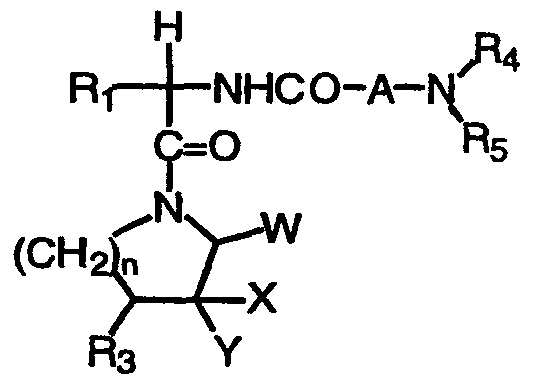


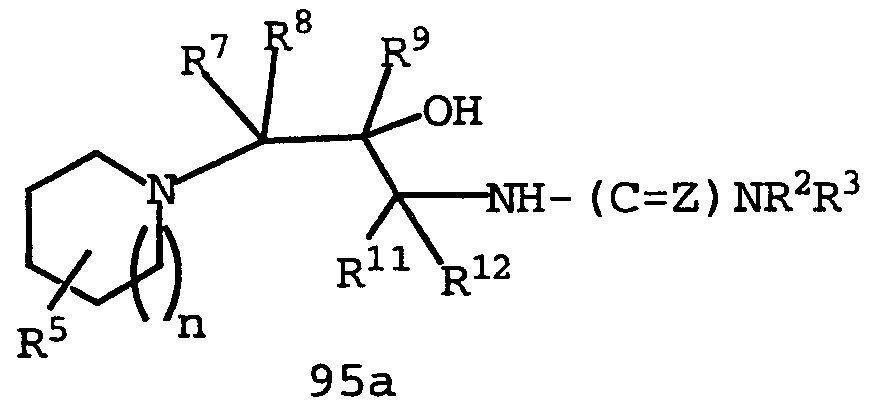


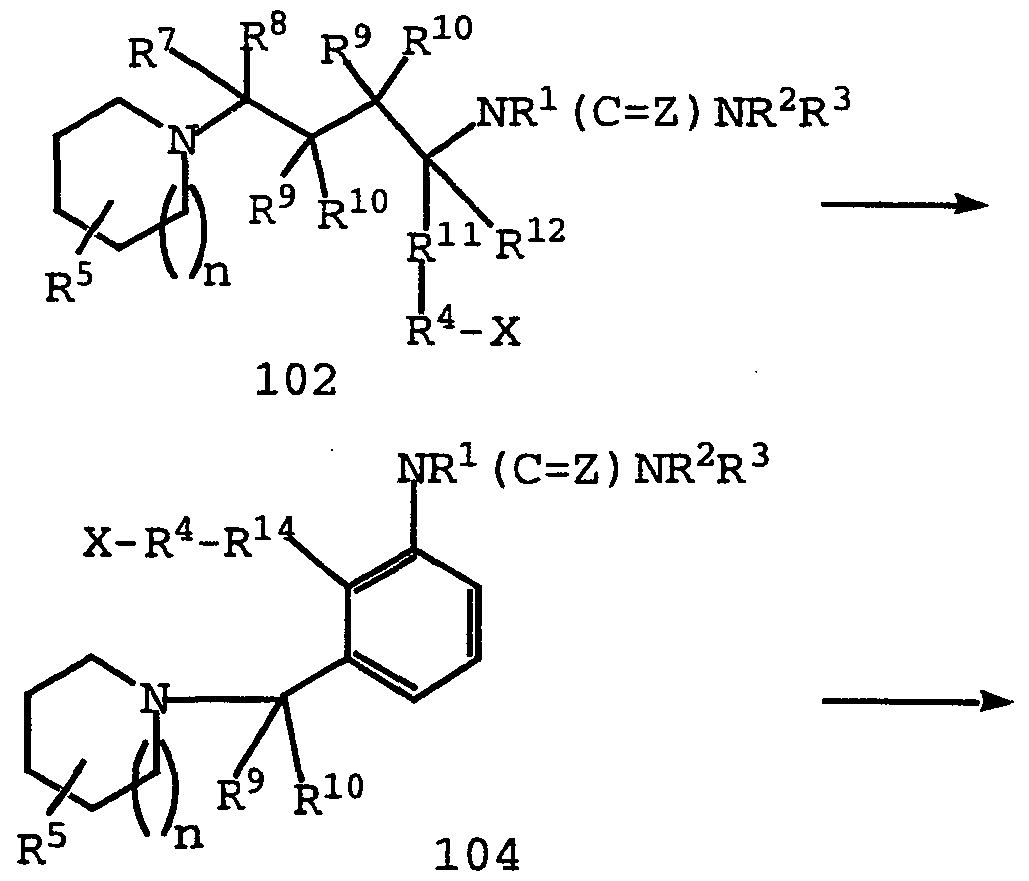


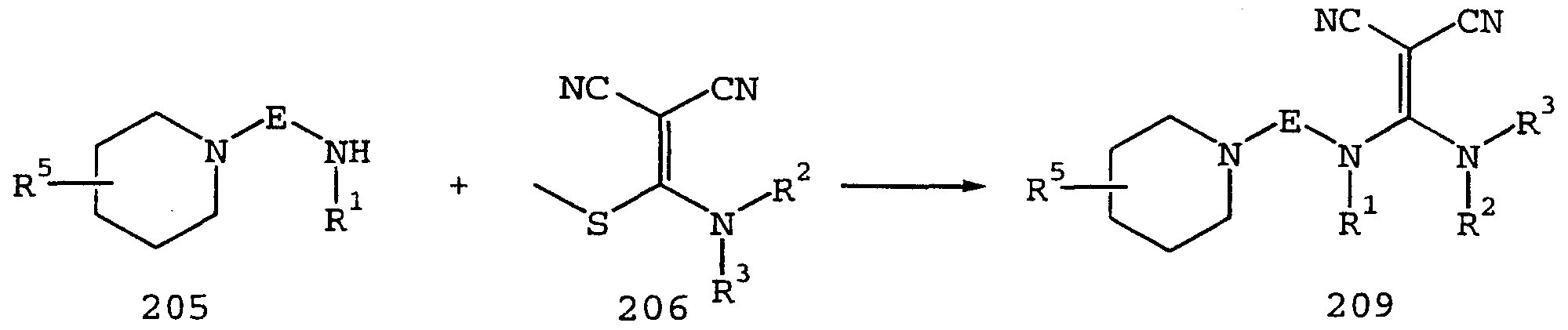


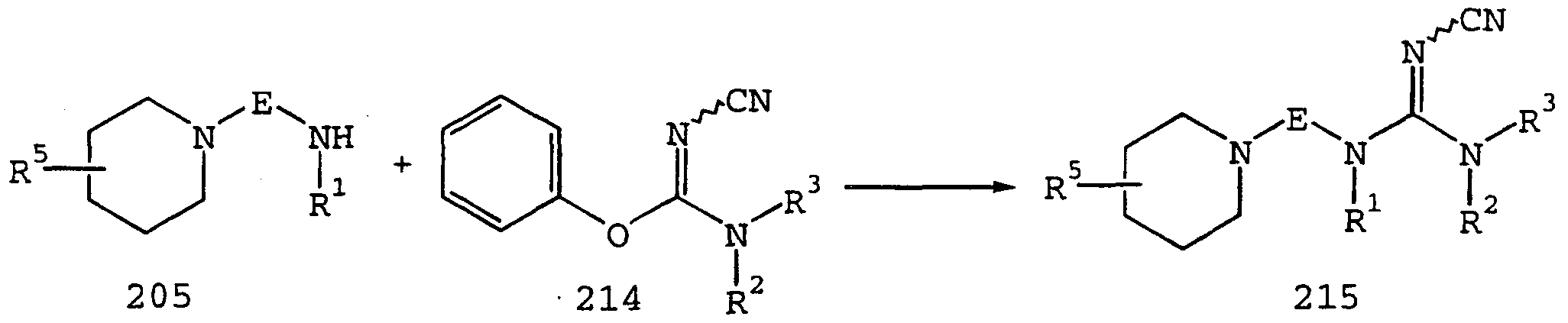


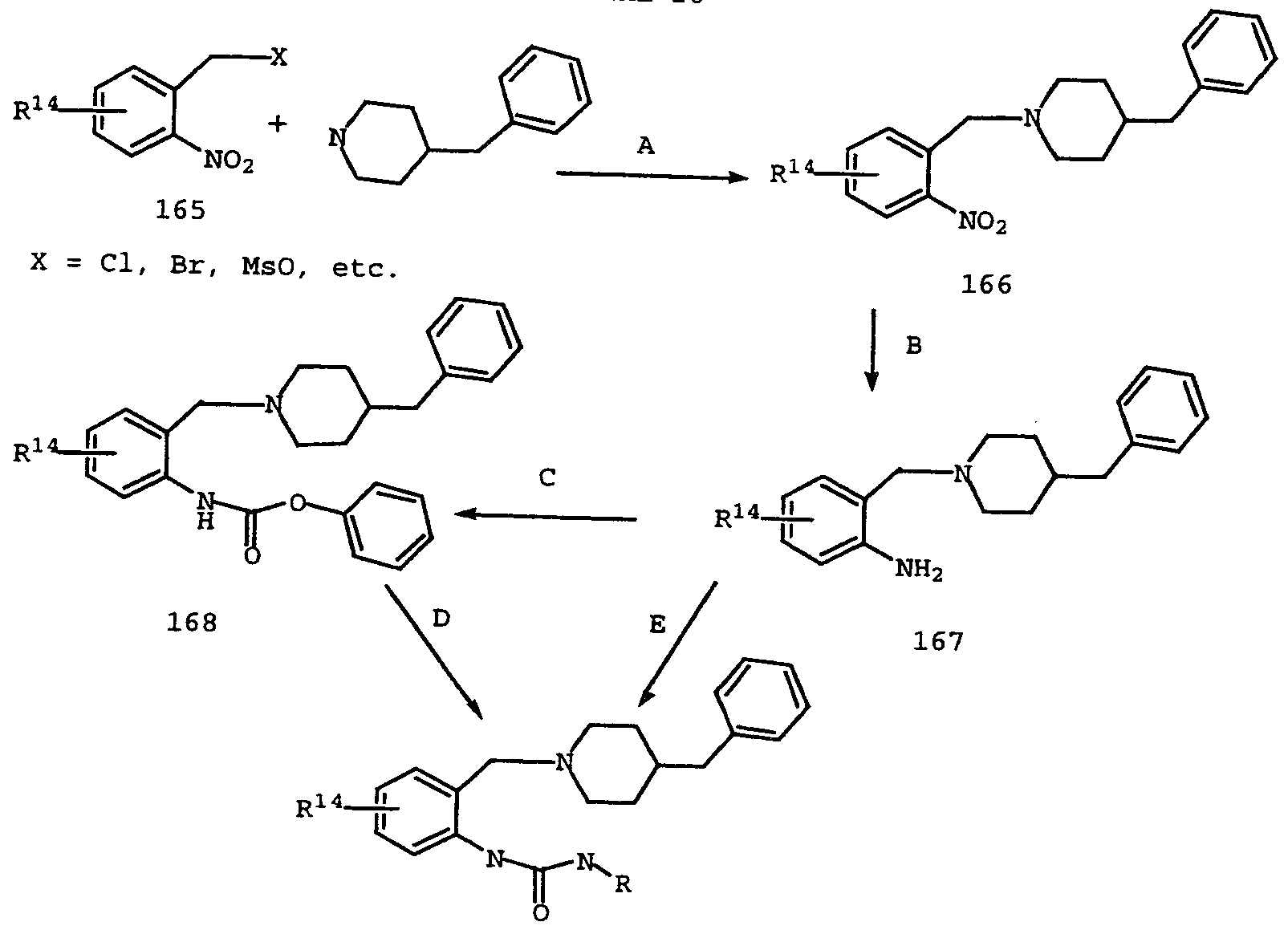


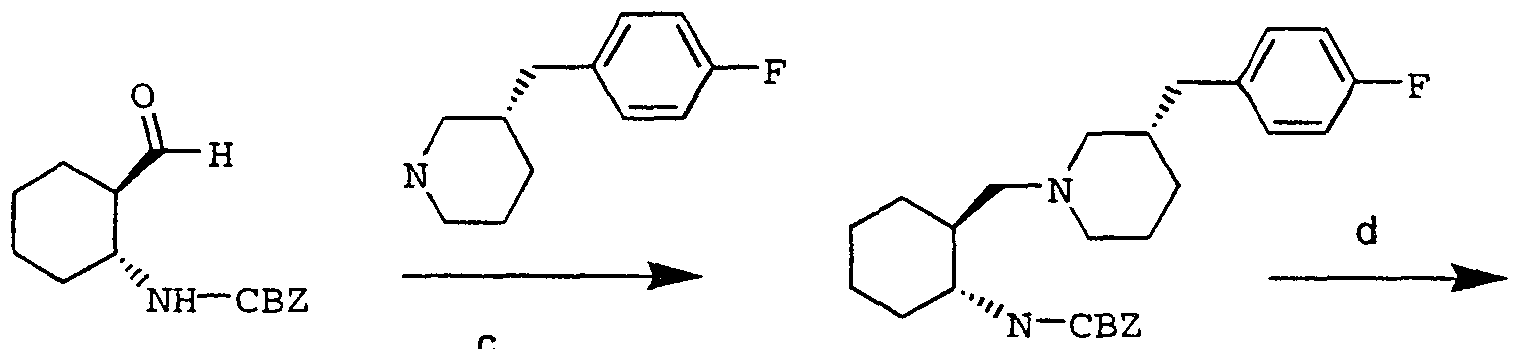
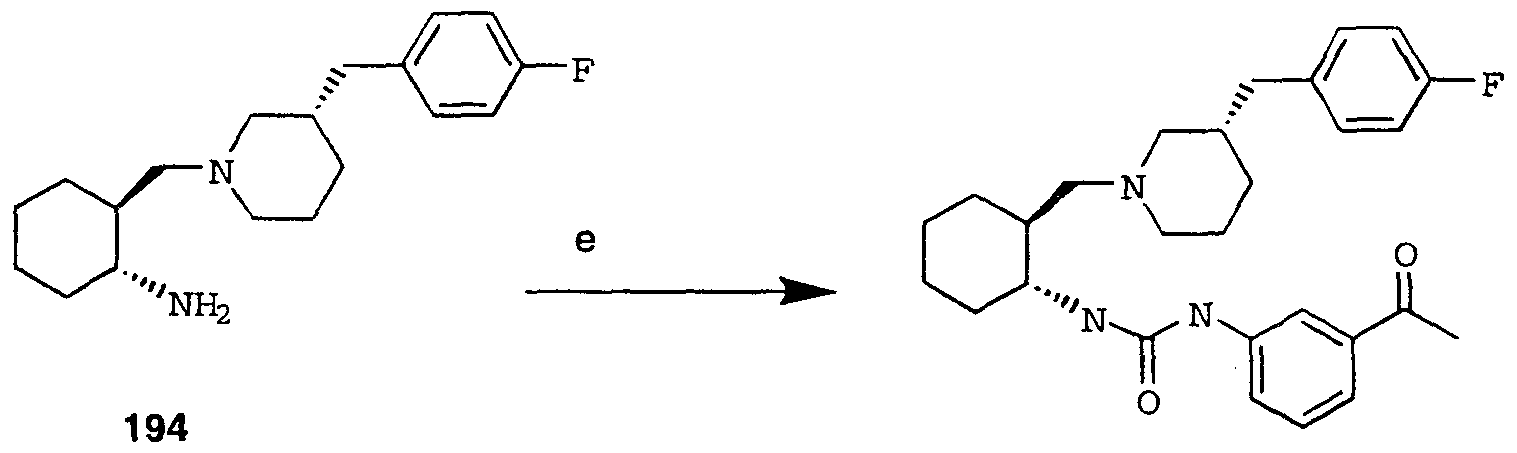


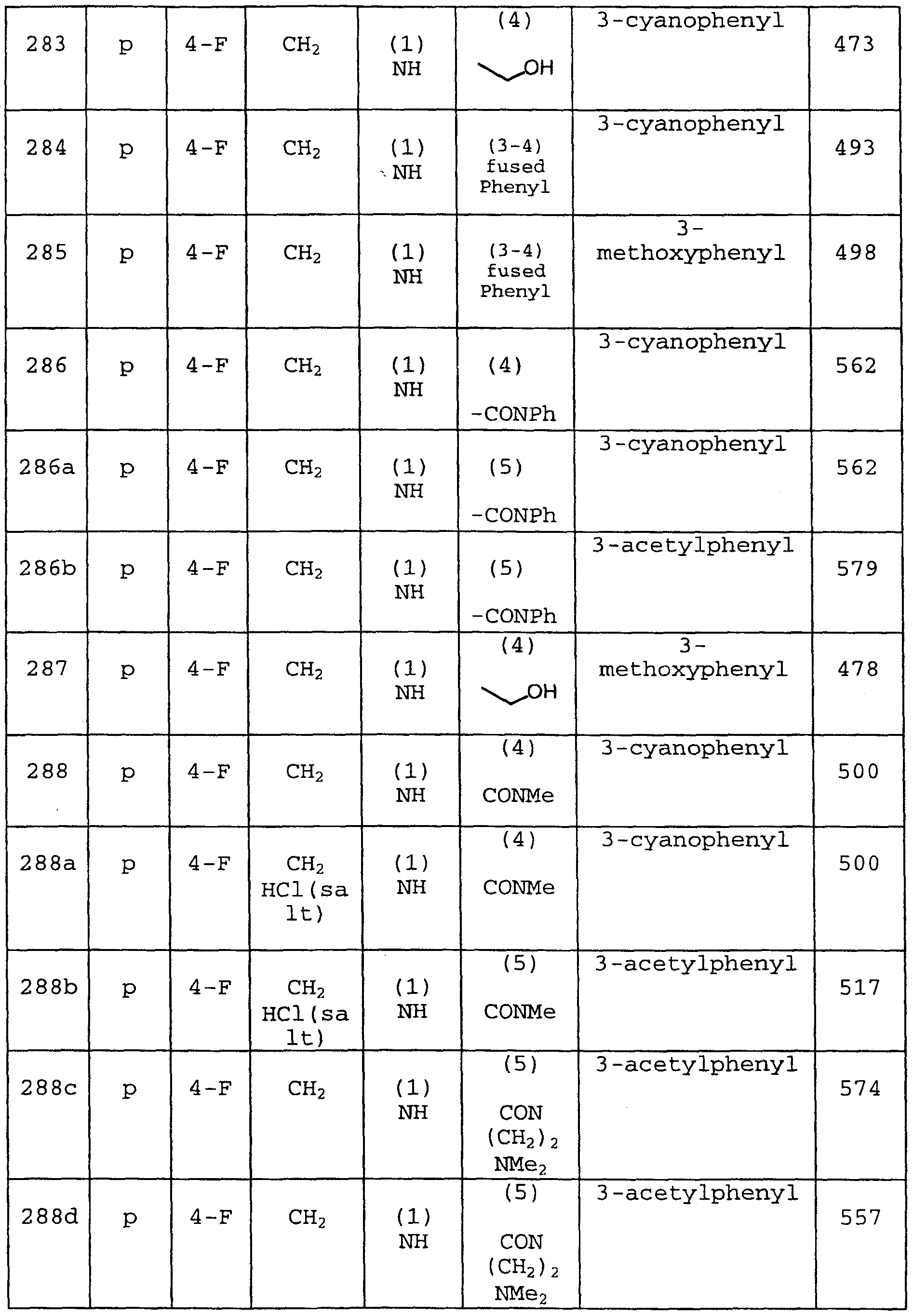


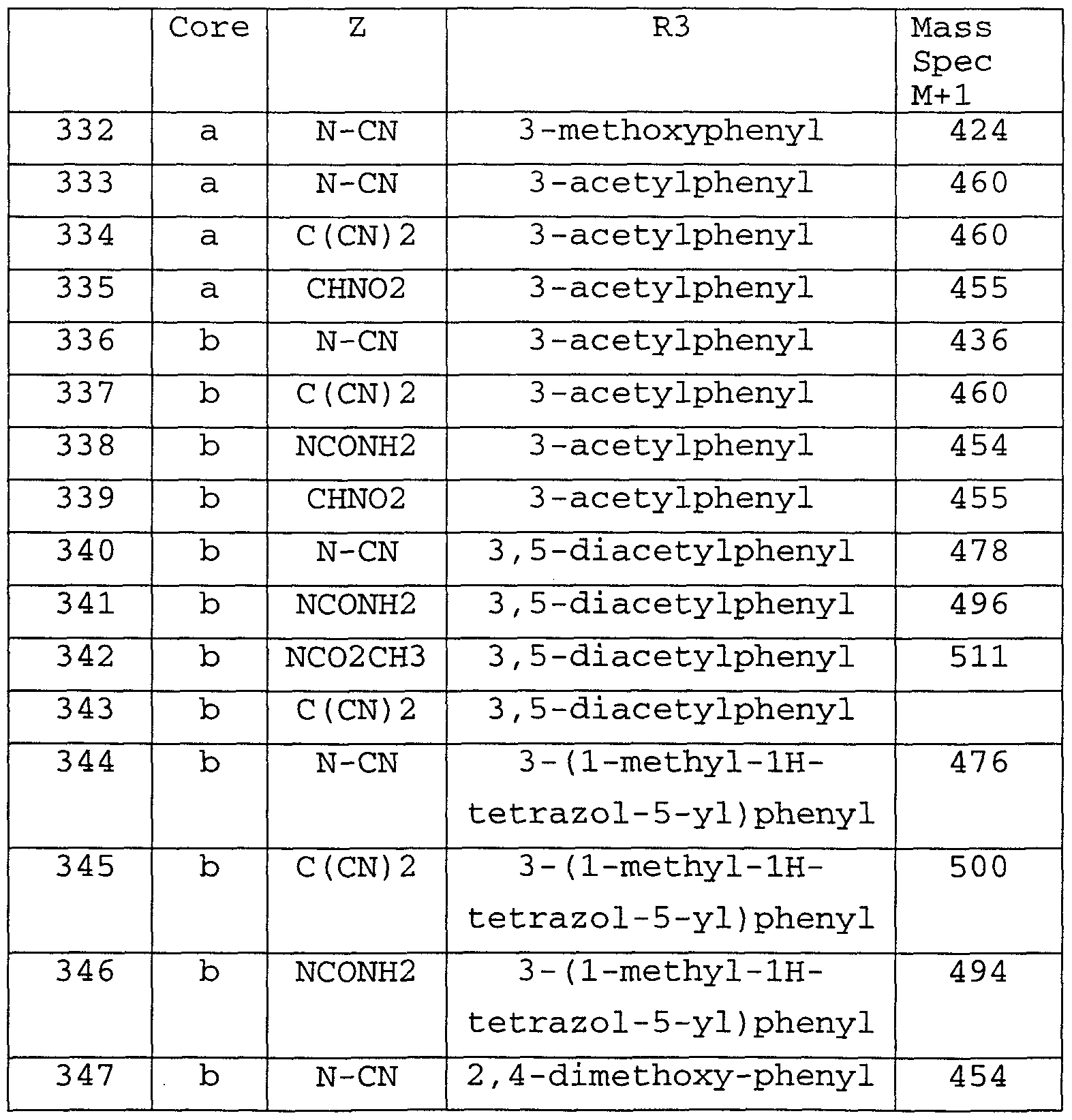


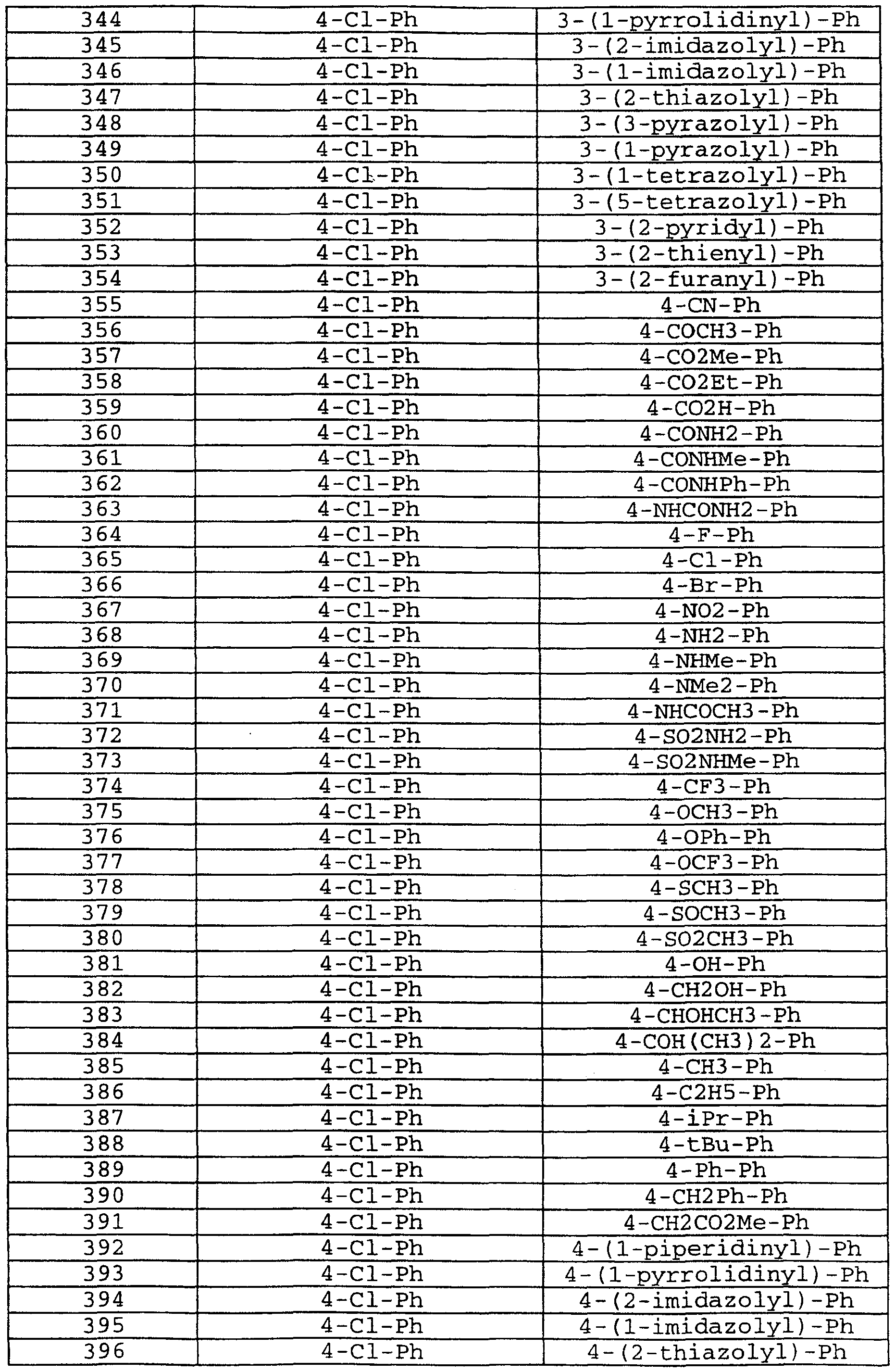


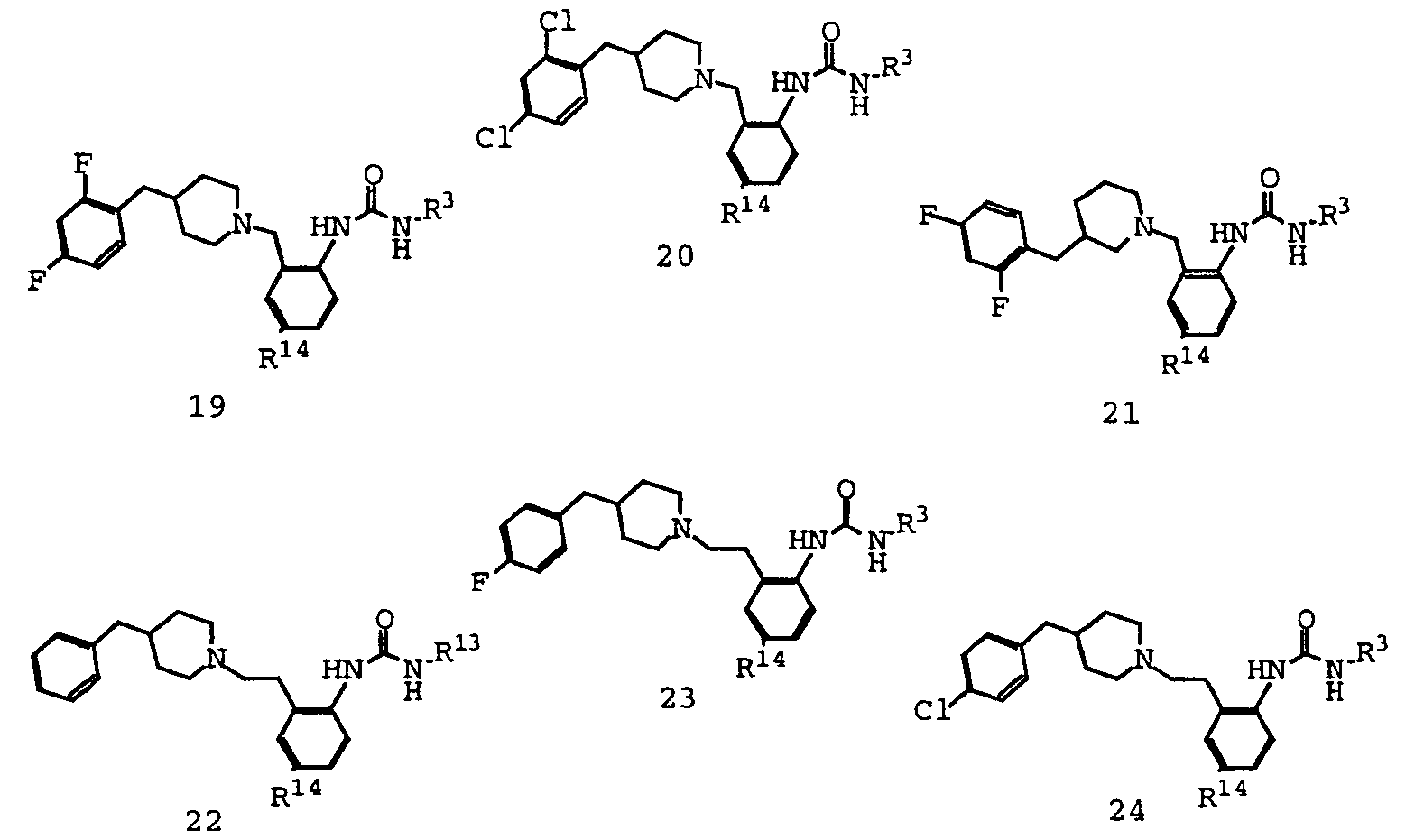


Claims


Priority Applications (3)
| Application Number | Priority Date | Filing Date | Title |
|---|---|---|---|
| EP99964297A EP1140086A4 (en) | 1998-12-18 | 1999-12-17 | N-ureidoalkyl-piperidines as modulators of chemokine receptor activity |
| CA002350730A CA2350730A1 (en) | 1998-12-18 | 1999-12-17 | N-ureidoalkyl-piperidines as modulators of chemokine receptor activity |
| AU20572/00A AU2057200A (en) | 1998-12-18 | 1999-12-17 | N-ureidoalkyl-piperidines as modulators of chemokine receptor activity |
Applications Claiming Priority (4)
| Application Number | Priority Date | Filing Date | Title |
|---|---|---|---|
| US11271798P | 1998-12-18 | 1998-12-18 | |
| US60/112,717 | 1998-12-18 | ||
| US16124399P | 1999-10-22 | 1999-10-22 | |
| US60/161,243 | 1999-10-22 |
Publications (1)
| Publication Number | Publication Date |
|---|---|
| WO2000035451A1 true WO2000035451A1 (en) | 2000-06-22 |
Family
ID=26810265
Family Applications (1)
| Application Number | Title | Priority Date | Filing Date |
|---|---|---|---|
| PCT/US1999/030332 Ceased WO2000035451A1 (en) | 1998-12-18 | 1999-12-17 | N-ureidoalkyl-piperidines as modulators of chemokine receptor activity |
Country Status (4)
| Country | Link |
|---|---|
| EP (1) | EP1140086A4 (en) |
| AU (1) | AU2057200A (en) |
| CA (1) | CA2350730A1 (en) |
| WO (1) | WO2000035451A1 (en) |
Cited By (43)
| Publication number | Priority date | Publication date | Assignee | Title |
|---|---|---|---|---|
| WO2001098272A1 (en) * | 2000-06-20 | 2001-12-27 | Astrazeneca Ab | Novel compounds |
| WO2002051414A1 (en) * | 2000-12-22 | 2002-07-04 | Takeda Chemical Industries, Ltd. | Medicinal compositions for oral use |
| US6552028B2 (en) | 2000-12-19 | 2003-04-22 | Syntex (U.S.A.) Llc | 2,4-substituted pyrrolidine derivatives-CCR-3 receptor antagonists |
| US6586446B1 (en) | 1999-10-15 | 2003-07-01 | Bristol-Myers Squibb Company | Bicyclic and tricyclic amines as modulators of chemokine receptor activity |
| US6608227B1 (en) | 1999-10-15 | 2003-08-19 | Bristol-Myers Squibb Pharma | Benzylcycloalkyl amines as modulators of chemokine receptor activity |
| WO2003068743A1 (en) | 2002-02-18 | 2003-08-21 | Astrazeneca Ab | Chemical compounds |
| US6627629B2 (en) | 2000-06-30 | 2003-09-30 | Bristol-Myers Squibb Pharma | N-ureidoheterocycloalkyl-piperidines as modulators of chemokine receptor activity |
| US6638950B2 (en) | 2000-06-21 | 2003-10-28 | Bristol-Myers Squibb Pharma Company | Piperidine amides as modulators of chemokine receptor activity |
| US6784200B2 (en) | 2000-10-13 | 2004-08-31 | Bristol-Myers Squibb Pharma Company | Bicyclic and tricyclic amines as modulators of chemokine receptor activity |
| WO2005048932A2 (en) | 2003-11-13 | 2005-06-02 | Bristol-Myers Squibb Company | N-ureidoalkyl-amino compounds as modulators of chemokine receptor activity |
| US6903085B1 (en) | 1999-08-24 | 2005-06-07 | Astrazeneca, Ab | Substituted piperidine compounds useful as modulators of chemokine receptor activity |
| US6906073B2 (en) | 2001-11-30 | 2005-06-14 | Roche Palo Alto Llc | Piperazine CCR-3 receptor antagonists |
| US6911458B2 (en) | 2000-06-20 | 2005-06-28 | Astra Zeneca | Compounds |
| US6919356B2 (en) | 2002-09-26 | 2005-07-19 | Bristol Myers Squibb Company | N-substituted heterocyclic amines as modulators of chemokine receptor activity |
| US6919368B2 (en) | 1998-12-18 | 2005-07-19 | Bristol-Myers Squibb Pharma Company | N-ureidoalkyl-piperidines as modulators of chemokine receptor activity |
| US6927222B2 (en) | 2000-02-25 | 2005-08-09 | Astrazeneca Ab | Compounds |
| RU2261245C2 (en) * | 2000-10-31 | 2005-09-27 | Астра Зенека АБ | New compounds |
| US6958350B2 (en) | 2001-02-19 | 2005-10-25 | Astrazeneca Ab | Chemical compounds |
| US6960602B2 (en) | 2001-03-22 | 2005-11-01 | Astrazeneca Ab | Piperidine derivatives as modulators of chemokine receptors |
| US6977265B2 (en) | 2001-11-30 | 2005-12-20 | Roche Palo Alto Llc | Piperidine CCR-3 receptor antagonists |
| US7019007B2 (en) | 2001-11-30 | 2006-03-28 | Syntex (U.S.A.) Llc | CCR-3 receptor antagonists (I) |
| US7101882B2 (en) | 2000-09-29 | 2006-09-05 | Glaxo Group Limited | Morpholin-acetamide derivatives for the treatment of inflammatory diseases |
| WO2006129679A1 (en) | 2005-05-31 | 2006-12-07 | Ono Pharmaceutical Co., Ltd. | Spiropiperidine compound and medicinal use thereof |
| US7192973B2 (en) | 2001-11-15 | 2007-03-20 | Astrazeneca Ab | Piperidine derivatives and their use as modulators of chemokine receptor activity (especially CCR5) |
| WO2007049771A1 (en) | 2005-10-28 | 2007-05-03 | Ono Pharmaceutical Co., Ltd. | Compound containing basic group and use thereof |
| WO2007058322A1 (en) | 2005-11-18 | 2007-05-24 | Ono Pharmaceutical Co., Ltd. | Basic group-containing compound and use thereof |
| EP1631286A4 (en) * | 2003-06-12 | 2007-08-29 | Bristol Myers Squibb Co | N-ureidoalkyl-piperidines as modulators of chemokine receptor activity |
| WO2007105637A1 (en) | 2006-03-10 | 2007-09-20 | Ono Pharmaceutical Co., Ltd. | Nitrogenated heterocyclic derivative, and pharmaceutical agent comprising the derivative as active ingredient |
| US7294636B2 (en) | 2003-05-09 | 2007-11-13 | Astrazeneca Ab | Chemical compounds |
| WO2007132846A1 (en) | 2006-05-16 | 2007-11-22 | Ono Pharmaceutical Co., Ltd. | Compound having acidic group which may be protected, and use thereof |
| WO2008016006A1 (en) | 2006-07-31 | 2008-02-07 | Ono Pharmaceutical Co., Ltd. | Compound having cyclic group bound thereto through spiro binding and use thereof |
| US7345063B2 (en) | 2001-03-23 | 2008-03-18 | Astrazeneca Ab | Amides, preparation and therapeutic use as modulators of CCR-receptor activity |
| US7388020B2 (en) | 2001-03-19 | 2008-06-17 | Astrazeneca Ab | Benzimidazol derivatives modulate chemokine receptors |
| US7390830B1 (en) | 1999-05-18 | 2008-06-24 | Teijin Limited | Remedies or prophylactics for diseases in association with chemokines |
| US7576117B1 (en) | 1999-08-04 | 2009-08-18 | Teijin Limited | Cyclic amine CCR3 antagonist |
| US7723349B2 (en) | 2003-04-24 | 2010-05-25 | Incyte Corporation | Aza spiro alkane derivatives as inhibitors of metalloproteases |
| US7956070B2 (en) | 2004-02-02 | 2011-06-07 | Astrazeneca Ab | Piperidines as chemokine modulators (CCR) |
| EP2364982A1 (en) | 2003-04-18 | 2011-09-14 | ONO Pharmaceutical Co., Ltd. | Spiro-piperidine compounds as chemokine receptor antagonists and medicinal use thereof |
| EP2385040A1 (en) | 2003-03-14 | 2011-11-09 | ONO Pharmaceutical Co., Ltd. | Nitrogen-containing heterocyclic derivatives and drugs containing the same as the active ingredient |
| US8148405B2 (en) | 2005-08-02 | 2012-04-03 | Astrazeneca Ab | Salt I |
| EP2546234A1 (en) | 2004-09-13 | 2013-01-16 | Ono Pharmaceutical Co., Ltd. | Nitrogeneous heterocyclic derivative and medicine containing the same as an active ingredient |
| US10117931B2 (en) | 2009-04-28 | 2018-11-06 | Kameran Lashkari | Methods for treatment of age-related macular degeneration |
| US12617796B2 (en) | 2020-05-07 | 2026-05-05 | Janssen Pharmaceutica Nv | Antagonists of the adenosine A2a receptor |
Citations (6)
| Publication number | Priority date | Publication date | Assignee | Title |
|---|---|---|---|---|
| US3988294A (en) * | 1974-03-11 | 1976-10-26 | R. T. Vanderbilt Company, Inc. | Surface coating compositions containing antimicrobic ureas |
| JPH01261383A (en) * | 1988-04-11 | 1989-10-18 | Nippon Chemiphar Co Ltd | Alkylene diamine derivative |
| US5236921A (en) * | 1990-09-05 | 1993-08-17 | Sanofi | Arylalkylamines, process for preparing them and pharmaceutical compositions containing them |
| US5317020A (en) * | 1989-11-06 | 1994-05-31 | Sanofi | Aromatic amine compounds their method of preparation and pharmaceutical compositions in which they are present |
| WO1994027991A1 (en) * | 1993-05-26 | 1994-12-08 | Novo Nordisk A/S | Piperidine derivatives, their preparation and use |
| WO1997019060A1 (en) * | 1995-11-17 | 1997-05-29 | Zeneca Limited | 3-(4-subst.-piperidinyl-1)-1-(3,4-dichlorophenyl)propyl carbamates and ureas and derivatives as novel neurokinin antagonists |
Family Cites Families (5)
| Publication number | Priority date | Publication date | Assignee | Title |
|---|---|---|---|---|
| FR2641278B1 (en) * | 1989-01-05 | 1991-03-22 | Lipha | PIPERIDINES, METHODS OF PREPARATION AND MEDICAMENTS CONTAINING THEM |
| DE69131842T2 (en) * | 1990-10-05 | 2000-07-27 | Ajinomoto Co., Inc. | Piperidine derivatives and their use as antiarrhythmic agents |
| US5668151A (en) * | 1995-06-07 | 1997-09-16 | Bristol-Myers Squibb Company | Dihydropyridine NPY antagonists: piperidine derivatives |
| IL125658A0 (en) * | 1997-08-18 | 1999-04-11 | Hoffmann La Roche | Ccr-3 receptor antagonists |
| PT1131291E (en) * | 1998-11-17 | 2005-01-31 | Hoffmann La Roche | ANTAGONISTS III OF THE 4-AROIL-PIPERIDIN-CCR-3 RECEPTOR |
-
1999
- 1999-12-17 AU AU20572/00A patent/AU2057200A/en not_active Abandoned
- 1999-12-17 WO PCT/US1999/030332 patent/WO2000035451A1/en not_active Ceased
- 1999-12-17 CA CA002350730A patent/CA2350730A1/en not_active Abandoned
- 1999-12-17 EP EP99964297A patent/EP1140086A4/en not_active Withdrawn
Patent Citations (6)
| Publication number | Priority date | Publication date | Assignee | Title |
|---|---|---|---|---|
| US3988294A (en) * | 1974-03-11 | 1976-10-26 | R. T. Vanderbilt Company, Inc. | Surface coating compositions containing antimicrobic ureas |
| JPH01261383A (en) * | 1988-04-11 | 1989-10-18 | Nippon Chemiphar Co Ltd | Alkylene diamine derivative |
| US5317020A (en) * | 1989-11-06 | 1994-05-31 | Sanofi | Aromatic amine compounds their method of preparation and pharmaceutical compositions in which they are present |
| US5236921A (en) * | 1990-09-05 | 1993-08-17 | Sanofi | Arylalkylamines, process for preparing them and pharmaceutical compositions containing them |
| WO1994027991A1 (en) * | 1993-05-26 | 1994-12-08 | Novo Nordisk A/S | Piperidine derivatives, their preparation and use |
| WO1997019060A1 (en) * | 1995-11-17 | 1997-05-29 | Zeneca Limited | 3-(4-subst.-piperidinyl-1)-1-(3,4-dichlorophenyl)propyl carbamates and ureas and derivatives as novel neurokinin antagonists |
Non-Patent Citations (5)
| Title |
|---|
| AM. J. PHYSIOL., vol. 269 (1, PT. 1), 1995, pages L119 - L126 * |
| DATABASE CA CHEM. ABSTR.; KIM ET AL.: "Migration and proliferation of guinea pig and human airway epithelial cells in response to tachykinins", XP002949854 * |
| DATABASE CA CHEM. ABSTR.; KRANEVELD ET AL.: "Airway hyperresponsiveness: first eosinophils and then neuropeptides", XP002949855 * |
| INT. J. IMMUNOPHARM., vol. 19, no. 9/10, 1997, pages 517 - 527 * |
| See also references of EP1140086A4 * |
Cited By (62)
| Publication number | Priority date | Publication date | Assignee | Title |
|---|---|---|---|---|
| US6919368B2 (en) | 1998-12-18 | 2005-07-19 | Bristol-Myers Squibb Pharma Company | N-ureidoalkyl-piperidines as modulators of chemokine receptor activity |
| US7390830B1 (en) | 1999-05-18 | 2008-06-24 | Teijin Limited | Remedies or prophylactics for diseases in association with chemokines |
| US7576117B1 (en) | 1999-08-04 | 2009-08-18 | Teijin Limited | Cyclic amine CCR3 antagonist |
| US6903085B1 (en) | 1999-08-24 | 2005-06-07 | Astrazeneca, Ab | Substituted piperidine compounds useful as modulators of chemokine receptor activity |
| US6608227B1 (en) | 1999-10-15 | 2003-08-19 | Bristol-Myers Squibb Pharma | Benzylcycloalkyl amines as modulators of chemokine receptor activity |
| US7550500B2 (en) | 1999-10-15 | 2009-06-23 | Bristol-Myers Squibb Company | Bicyclic and tricyclic amines as modulators of chemokine receptor activity |
| US6960666B2 (en) | 1999-10-15 | 2005-11-01 | Bristol-Myers Squibb Pharma Company | Bicyclic and tricyclic amines as modulators of chemokine receptor activity |
| US7126010B2 (en) | 1999-10-15 | 2006-10-24 | Bristol-Myers Squibb Pharma Company | Benzylcycloalkyl amines as modulators of chemokine receptor activity |
| US6864380B2 (en) | 1999-10-15 | 2005-03-08 | Bristol-Myers Squibb Pharma Company | Benzylcycloalkyl amines as modulators of chemokine receptor activity |
| US6586446B1 (en) | 1999-10-15 | 2003-07-01 | Bristol-Myers Squibb Company | Bicyclic and tricyclic amines as modulators of chemokine receptor activity |
| US6943188B2 (en) | 2000-02-25 | 2005-09-13 | Astrazeneca Ab | Hydroxyalkyl compounds |
| US6951874B2 (en) | 2000-02-25 | 2005-10-04 | Astrazeneca Ab | Compounds |
| US6927222B2 (en) | 2000-02-25 | 2005-08-09 | Astrazeneca Ab | Compounds |
| US7528156B2 (en) | 2000-06-20 | 2009-05-05 | Astrazeneca Ab | Compounds |
| WO2001098272A1 (en) * | 2000-06-20 | 2001-12-27 | Astrazeneca Ab | Novel compounds |
| US6911458B2 (en) | 2000-06-20 | 2005-06-28 | Astra Zeneca | Compounds |
| US6984651B2 (en) | 2000-06-21 | 2006-01-10 | Bristol-Myers Squibb Pharma, Company | Piperidine amides as modulators of chemokine receptor activity |
| US6638950B2 (en) | 2000-06-21 | 2003-10-28 | Bristol-Myers Squibb Pharma Company | Piperidine amides as modulators of chemokine receptor activity |
| US6627629B2 (en) | 2000-06-30 | 2003-09-30 | Bristol-Myers Squibb Pharma | N-ureidoheterocycloalkyl-piperidines as modulators of chemokine receptor activity |
| US6949546B2 (en) | 2000-06-30 | 2005-09-27 | Bristol-Myers Squibb Pharma Company | N-ureidoheterocycloalkyl-piperidines as modulators of chemokine receptor activity |
| US7560548B2 (en) | 2000-09-29 | 2009-07-14 | Glaxo Group Limited | Morpholin-acetamide derivatives for the treatment of inflammatory diseases |
| US7101882B2 (en) | 2000-09-29 | 2006-09-05 | Glaxo Group Limited | Morpholin-acetamide derivatives for the treatment of inflammatory diseases |
| US6784200B2 (en) | 2000-10-13 | 2004-08-31 | Bristol-Myers Squibb Pharma Company | Bicyclic and tricyclic amines as modulators of chemokine receptor activity |
| RU2261245C2 (en) * | 2000-10-31 | 2005-09-27 | Астра Зенека АБ | New compounds |
| US6552028B2 (en) | 2000-12-19 | 2003-04-22 | Syntex (U.S.A.) Llc | 2,4-substituted pyrrolidine derivatives-CCR-3 receptor antagonists |
| WO2002051414A1 (en) * | 2000-12-22 | 2002-07-04 | Takeda Chemical Industries, Ltd. | Medicinal compositions for oral use |
| US6958350B2 (en) | 2001-02-19 | 2005-10-25 | Astrazeneca Ab | Chemical compounds |
| US7388020B2 (en) | 2001-03-19 | 2008-06-17 | Astrazeneca Ab | Benzimidazol derivatives modulate chemokine receptors |
| US6960602B2 (en) | 2001-03-22 | 2005-11-01 | Astrazeneca Ab | Piperidine derivatives as modulators of chemokine receptors |
| US7345063B2 (en) | 2001-03-23 | 2008-03-18 | Astrazeneca Ab | Amides, preparation and therapeutic use as modulators of CCR-receptor activity |
| US7192973B2 (en) | 2001-11-15 | 2007-03-20 | Astrazeneca Ab | Piperidine derivatives and their use as modulators of chemokine receptor activity (especially CCR5) |
| US6906073B2 (en) | 2001-11-30 | 2005-06-14 | Roche Palo Alto Llc | Piperazine CCR-3 receptor antagonists |
| US7019007B2 (en) | 2001-11-30 | 2006-03-28 | Syntex (U.S.A.) Llc | CCR-3 receptor antagonists (I) |
| US6977265B2 (en) | 2001-11-30 | 2005-12-20 | Roche Palo Alto Llc | Piperidine CCR-3 receptor antagonists |
| US7709500B2 (en) | 2002-02-18 | 2010-05-04 | Astrazeneca Ab | Chemical compounds |
| WO2003068743A1 (en) | 2002-02-18 | 2003-08-21 | Astrazeneca Ab | Chemical compounds |
| US6919356B2 (en) | 2002-09-26 | 2005-07-19 | Bristol Myers Squibb Company | N-substituted heterocyclic amines as modulators of chemokine receptor activity |
| EP2385040A1 (en) | 2003-03-14 | 2011-11-09 | ONO Pharmaceutical Co., Ltd. | Nitrogen-containing heterocyclic derivatives and drugs containing the same as the active ingredient |
| EP2364982A1 (en) | 2003-04-18 | 2011-09-14 | ONO Pharmaceutical Co., Ltd. | Spiro-piperidine compounds as chemokine receptor antagonists and medicinal use thereof |
| US7723349B2 (en) | 2003-04-24 | 2010-05-25 | Incyte Corporation | Aza spiro alkane derivatives as inhibitors of metalloproteases |
| US10226459B2 (en) | 2003-04-24 | 2019-03-12 | Incyte Holdings Corporation | Aza spiro alkane derivatives as inhibitors of metalloproteases |
| US9801877B2 (en) | 2003-04-24 | 2017-10-31 | Incyte Corporation | AZA spiro alkane derivatives as inhibitors of metalloproteases |
| US9403775B2 (en) | 2003-04-24 | 2016-08-02 | Incyte Corporation | AZA spiro alkane derivatives as inhibitors of metalloproteases |
| US8637497B2 (en) | 2003-04-24 | 2014-01-28 | Incyte Corporation | AZA spiro alkane derivatives as inhibitors of metalloproteases |
| US8039471B2 (en) | 2003-04-24 | 2011-10-18 | Incyte Corporation | Aza spiro alkane derivatives as inhibitors of metalloproteases |
| US7294636B2 (en) | 2003-05-09 | 2007-11-13 | Astrazeneca Ab | Chemical compounds |
| US7351720B2 (en) | 2003-06-12 | 2008-04-01 | Bristol-Myers Squibb Company | N-ureidoalkyl-piperidines as modulators of chemokine receptor activity |
| US7550486B2 (en) | 2003-06-12 | 2009-06-23 | Bristol-Myers Squibb Company | N-ureidoalkyl-piperidines as modulators of chemokine receptor activity |
| EP1631286A4 (en) * | 2003-06-12 | 2007-08-29 | Bristol Myers Squibb Co | N-ureidoalkyl-piperidines as modulators of chemokine receptor activity |
| US7291744B2 (en) | 2003-11-13 | 2007-11-06 | Bristol-Myers Squibb Company | N-ureidoalkyl-amino compounds as modulators of chemokine receptor activity |
| WO2005048932A2 (en) | 2003-11-13 | 2005-06-02 | Bristol-Myers Squibb Company | N-ureidoalkyl-amino compounds as modulators of chemokine receptor activity |
| US7956070B2 (en) | 2004-02-02 | 2011-06-07 | Astrazeneca Ab | Piperidines as chemokine modulators (CCR) |
| EP2546234A1 (en) | 2004-09-13 | 2013-01-16 | Ono Pharmaceutical Co., Ltd. | Nitrogeneous heterocyclic derivative and medicine containing the same as an active ingredient |
| WO2006129679A1 (en) | 2005-05-31 | 2006-12-07 | Ono Pharmaceutical Co., Ltd. | Spiropiperidine compound and medicinal use thereof |
| US8148405B2 (en) | 2005-08-02 | 2012-04-03 | Astrazeneca Ab | Salt I |
| WO2007049771A1 (en) | 2005-10-28 | 2007-05-03 | Ono Pharmaceutical Co., Ltd. | Compound containing basic group and use thereof |
| WO2007058322A1 (en) | 2005-11-18 | 2007-05-24 | Ono Pharmaceutical Co., Ltd. | Basic group-containing compound and use thereof |
| WO2007105637A1 (en) | 2006-03-10 | 2007-09-20 | Ono Pharmaceutical Co., Ltd. | Nitrogenated heterocyclic derivative, and pharmaceutical agent comprising the derivative as active ingredient |
| WO2007132846A1 (en) | 2006-05-16 | 2007-11-22 | Ono Pharmaceutical Co., Ltd. | Compound having acidic group which may be protected, and use thereof |
| WO2008016006A1 (en) | 2006-07-31 | 2008-02-07 | Ono Pharmaceutical Co., Ltd. | Compound having cyclic group bound thereto through spiro binding and use thereof |
| US10117931B2 (en) | 2009-04-28 | 2018-11-06 | Kameran Lashkari | Methods for treatment of age-related macular degeneration |
| US12617796B2 (en) | 2020-05-07 | 2026-05-05 | Janssen Pharmaceutica Nv | Antagonists of the adenosine A2a receptor |
Also Published As
| Publication number | Publication date |
|---|---|
| CA2350730A1 (en) | 2000-06-22 |
| AU2057200A (en) | 2000-07-03 |
| EP1140086A1 (en) | 2001-10-10 |
| EP1140086A4 (en) | 2002-04-03 |
Similar Documents
| Publication | Publication Date | Title |
|---|---|---|
| EP1158980B1 (en) | N-ureidoalkyl-piperidines as modulators of chemokine receptor activity | |
| US6780857B2 (en) | N-ureidoalkyl-piperidines as modulators of chemokine receptor activity | |
| US6331541B1 (en) | N-ureidoalkyl-piperidines as modulators of chemokine receptor activity | |
| US6444686B1 (en) | N-ureidoalkyl-piperidines as modulators of chemokine receptor activity | |
| US6525069B1 (en) | N-ureidoalkyl-piperidines as modulators of chemokine receptor activity | |
| EP1140086A1 (en) | N-ureidoalkyl-piperidines as modulators of chemokine receptor activity | |
| EP1156807A1 (en) | N-ureidoalkyl-piperidines as modulators of chemokine receptor activity | |
| US6605623B1 (en) | N-ureidoalkyl-piperidines as modulators of chemokine receptor activity | |
| WO2001098270A2 (en) | N-ureidoalkyl-piperidines as modulators of chemokine receptor activity | |
| WO2001098269A2 (en) | N-ureidoalkyl-piperidines as modulators of chemokine receptor activity | |
| US6897234B2 (en) | N-ureidoalkyl-piperidines as modulators of chemokine receptor activity | |
| AU2001271359A1 (en) | N-ureidoalkyl-piperidines as modulators of chemokine receptor activity | |
| MXPA01006148A (en) | N-ureidoalkyl-piperidines as modulators of chemokine receptor activity |
Legal Events
| Date | Code | Title | Description |
|---|---|---|---|
| AK | Designated states |
Kind code of ref document: A1 Designated state(s): AL AU BR CA CN CZ EE HU IL IN JP KR LT LV MK MX NO NZ PL RO SG SI SK TR UA VN ZA |
|
| AL | Designated countries for regional patents |
Kind code of ref document: A1 Designated state(s): AM AZ BY KG KZ MD RU TJ TM AT BE CH CY DE DK ES FI FR GB GR IE IT LU MC NL PT SE |
|
| 121 | Ep: the epo has been informed by wipo that ep was designated in this application | ||
| DFPE | Request for preliminary examination filed prior to expiration of 19th month from priority date (pct application filed before 20040101) | ||
| ENP | Entry into the national phase |
Ref document number: 2350730 Country of ref document: CA Ref country code: CA Ref document number: 2350730 Kind code of ref document: A Format of ref document f/p: F |
|
| WWE | Wipo information: entry into national phase |
Ref document number: 1999964297 Country of ref document: EP |
|
| WWP | Wipo information: published in national office |
Ref document number: 1999964297 Country of ref document: EP |
|
| WWW | Wipo information: withdrawn in national office |
Ref document number: 1999964297 Country of ref document: EP |