WO2000035909A1 - 4-aryloxindoles as inhibitors of jnk protein kinases - Google Patents
4-aryloxindoles as inhibitors of jnk protein kinases Download PDFInfo
- Publication number
- WO2000035909A1 WO2000035909A1 PCT/EP1999/009673 EP9909673W WO0035909A1 WO 2000035909 A1 WO2000035909 A1 WO 2000035909A1 EP 9909673 W EP9909673 W EP 9909673W WO 0035909 A1 WO0035909 A1 WO 0035909A1
- Authority
- WO
- WIPO (PCT)
- Prior art keywords
- dihydro
- indol
- methylene
- pyrrol
- lower alkyl
- Prior art date
- Legal status (The legal status is an assumption and is not a legal conclusion. Google has not performed a legal analysis and makes no representation as to the accuracy of the status listed.)
- Ceased
Links
- 0 Cc1c(CC(*2=C)=O)c2ccc1 Chemical compound Cc1c(CC(*2=C)=O)c2ccc1 0.000 description 5
- WLSMFYKOVPNMSI-RAXLEYEMSA-N COc1c(/C=C(/c2c(-c(cc3)ccc3O)c(F)ccc2N2)\C2=O)[nH]cc1 Chemical compound COc1c(/C=C(/c2c(-c(cc3)ccc3O)c(F)ccc2N2)\C2=O)[nH]cc1 WLSMFYKOVPNMSI-RAXLEYEMSA-N 0.000 description 1
- ZYXPVQZUFJCZFU-WJDWOHSUSA-N O=C(/C1=C\c2ccc[nH]2)Nc2c1c(-c1cccc(C(F)(F)F)c1)ccc2 Chemical compound O=C(/C1=C\c2ccc[nH]2)Nc2c1c(-c1cccc(C(F)(F)F)c1)ccc2 ZYXPVQZUFJCZFU-WJDWOHSUSA-N 0.000 description 1
Classifications
-
- C—CHEMISTRY; METALLURGY
- C07—ORGANIC CHEMISTRY
- C07D—HETEROCYCLIC COMPOUNDS
- C07D409/00—Heterocyclic compounds containing two or more hetero rings, at least one ring having sulfur atoms as the only ring hetero atoms
- C07D409/14—Heterocyclic compounds containing two or more hetero rings, at least one ring having sulfur atoms as the only ring hetero atoms containing three or more hetero rings
-
- A—HUMAN NECESSITIES
- A61—MEDICAL OR VETERINARY SCIENCE; HYGIENE
- A61P—SPECIFIC THERAPEUTIC ACTIVITY OF CHEMICAL COMPOUNDS OR MEDICINAL PREPARATIONS
- A61P29/00—Non-central analgesic, antipyretic or antiinflammatory agents, e.g. antirheumatic agents; Non-steroidal antiinflammatory drugs [NSAID]
-
- A—HUMAN NECESSITIES
- A61—MEDICAL OR VETERINARY SCIENCE; HYGIENE
- A61P—SPECIFIC THERAPEUTIC ACTIVITY OF CHEMICAL COMPOUNDS OR MEDICINAL PREPARATIONS
- A61P43/00—Drugs for specific purposes, not provided for in groups A61P1/00-A61P41/00
-
- C—CHEMISTRY; METALLURGY
- C07—ORGANIC CHEMISTRY
- C07D—HETEROCYCLIC COMPOUNDS
- C07D403/00—Heterocyclic compounds containing two or more hetero rings, having nitrogen atoms as the only ring hetero atoms, not provided for by group C07D401/00
- C07D403/02—Heterocyclic compounds containing two or more hetero rings, having nitrogen atoms as the only ring hetero atoms, not provided for by group C07D401/00 containing two hetero rings
- C07D403/06—Heterocyclic compounds containing two or more hetero rings, having nitrogen atoms as the only ring hetero atoms, not provided for by group C07D401/00 containing two hetero rings linked by a carbon chain containing only aliphatic carbon atoms
-
- C—CHEMISTRY; METALLURGY
- C07—ORGANIC CHEMISTRY
- C07D—HETEROCYCLIC COMPOUNDS
- C07D403/00—Heterocyclic compounds containing two or more hetero rings, having nitrogen atoms as the only ring hetero atoms, not provided for by group C07D401/00
- C07D403/14—Heterocyclic compounds containing two or more hetero rings, having nitrogen atoms as the only ring hetero atoms, not provided for by group C07D401/00 containing three or more hetero rings
-
- C—CHEMISTRY; METALLURGY
- C07—ORGANIC CHEMISTRY
- C07D—HETEROCYCLIC COMPOUNDS
- C07D405/00—Heterocyclic compounds containing both one or more hetero rings having oxygen atoms as the only ring hetero atoms, and one or more rings having nitrogen as the only ring hetero atom
- C07D405/14—Heterocyclic compounds containing both one or more hetero rings having oxygen atoms as the only ring hetero atoms, and one or more rings having nitrogen as the only ring hetero atom containing three or more hetero rings
Definitions
- Protein kinases are a class of proteins that regulate a variety of cellular functions. This is accomplished by the phosphorylation of specific amino acids on protein substrates resulting in conformational alteration of the substrate protein. The conformational change modulates the activity of the substrate or its ability to interact with other binding partners.
- the enzyme activity of the protein kinase refers to the rate at which the kinase adds phosphate groups to a substrate. It can be measured, for example, by determining the amount of a substrate that is converted to a product as a function of time. Phosphorylation of a substrate occurs at the active-site of a protein kinase.
- JNK Jun N-terminal kinase protein kinases
- SAPK mitogen-activated protein
- JNK phosphorylates the NH 2 -terminal activation domain of c-Jun on Ser63 and Ser73, causing increased c-Jun transcriptional activity.
- c-Jun is an AP-1 transcription factor that mediates immediate-early gene expression. See, e.g., A. Minden et al., Biochimica et Biophysica Acta 1333 (1997) F85-F104; and A. Karin, Biochimica et Biophysica Acta, vol.172 (1991) pp.129-157.
- JNK protein kinase is markedly activated in response to treatment of cells with pro-inflammatory cytokines or exposure to environmental stress. JNK thus mediates the effect of extracellular stimuli on c-Jun. See Gupta, supra; and Minden, supra. Accordingly, JNK is a physiological regulator of AP-1 transcriptional activity. Thus, inhibition of JNK activity will inhibit AP-1 -dependent transcription of inflammatory and immune mediators which are implicated in pathological proliferative conditions, for example inflammatory diseases and neuro-degenerative diseases, in particular, rheumatoid arthritis. See, e.g. Swantek et al., Molecular and Cellular Biology, vol. 17 (1997) pp. 6274-6282; Maroney et al., J. Neuroscience, vol. 18 (1 Jan. 1998) pp. 104-111 ; and Minden, supra, at F92.
- the rat homologue of JNK is also called SAPK (stress-activated protein kinase).
- SAPK isoforms share significant (>90%) sequence identity with the corresponding JNK isoforms [compare Kyriakis et al., Nature, Vol. 369 (12 May 1994) pp. 156-160 and Gupta et al., supra].
- Both JNK and SAPK are capable of phosphorylation of the c-Jun substrate and thus have very similar enzyme activity.
- JNK and SAPK are part of a protein kinase cascade that is activated by various extracellular stimuli. See e.g. Minden supra; and Kyriakis et al., BioEssays Vol. 18 (1996) pp. 567-577.
- JNK and SAPK each can be activated by phosphorylation on specific threonine and tyrosine residues by dual specificity MAP kinase kinases such as MKK4, SEK-1 , or MKK7. See Kyriakis et al., supra; and Tournier et al., Proceedings of the National Academy of Sciences USA Vol. 94 (July 1997), pp. 7337- 7342).
- the dual specificity MAP kinase kinases can be activated by phosphorylation on serine and/or threonine residues by MAP kinase kinase kinases such as MEKK-1.
- measurement of JNK or SAPK enzyme activity may be enhanced by activation by the upstream or preceding kinases.
- measurement of SAPK inhibition closely correlates with JNK inhibition.
- Inhibitors of protein kinase catalytic activity are known in the art. See US Pat. No. 5,792,783 (3-heteroaryl-2-indolinones that modulate/inhibit tyrosine kinase signal transduction); WO 98/24432 (indoline compounds that inhibit FLK protein kinase); WO 97/45409 (substituted tetralylmethelen-oxindole analogues that inhibit tyrosine kinase). In particular, small molecule inhibitors typically block the binding of substrates by tightly interacting with the protein kinase ATP binding site (or "active site”). See WO 98/24432. It is desirable to identify small-molecule compounds that may be readily synthesized and are effective in inhibiting the catalytic activity of protein kinases, in particular of the JNK protein kinases.
- Indolinone (also known as oxindole) compounds asserted to be useful in the regulating abnormal cell proliferation through tyrosine kinase inhibition are disclosed for example in WO 96/40116, WO 98/07695, WO 95/01349, WO 96/32380, WO 96/22976, WO 96/16964, WO 98/50356 (2-indolinone derivatives as modulators of protein kinase activity); Mohammadi et. al, Science, Vol. 276, 9 May 1997, pp. 955- 960.
- Oxindole derivatives have also been described for various other therapeutic uses: 5,206,261 (improvement of cerebral function); WO 92/07830 (peptide antagonists); EP 580 502 A1 (antioxidants).
- the present invention relates to 4-aryloxindoles capable of inhibiting the activity of one or more JNK protein kinases. Such compounds are useful for the treatment of inflammatory diseases and neuro-degenerative diseases. In particular, the compounds of the present invention are especially useful in the treatment or control of rheumatoid arthritis.
- the present invention is directed to 4-aryloxindoles having the following formula:
- A is aryl or heteroaryl, each of which optionally substituted by one or more -OR 4 , COR 4 , -COOR 4 , -CONR 6 R 7 ,-NR 6 R 7 , -CN, -NO 2 , -SO 2 R 4 , -SO 2 NR 6 R 7 , halogen, perfluoroalkyl, lower alkyl, lower alkyl substituted by (a), halogen, cycloalkyl, and/or heterocycle; cycloalkyl or cycloalkyl substituted by (a), halogen, lower alkyl, and/or heterocycle; heterocycle or heterocycle substituted by (a), halogen, lower alkyl, and/or cycloalkyl; where (a) is -OR 4 , -NR 6 R 7 , -COR 4 , -COOR 4 , -OCOR 4 , -CONR 6 R 7 , -CN, -NO 2 , -S
- R 2 is hydrogen, -OR 4 , -COOR 4 , -CONR 6 R 7 , -NR 6 R 7 , halogen, -N0 2 , -CN, -SO 2 NR 6 R 7 , -S0 2 R 4 perfluoroalkyl, lower alkyl, or lower alkyl substituted by -OR 8 , -NR 6 R 7 , -COR 4 , -COOR 4 , and/or -CONR 6 R 7 ;
- R 3 is hydrogen, -OR 4 , -COR 4 , -COOR 4 , -CONR 6 R 7 , halogen, -CN, -NR 6 R 7 , perfluoroalkyl, lower alkyl, or lower alkyl substituted by -OR 8 and/or -NR 6 R 7 ;
- R 4 is hydrogen, lower alkyl or lower alkyl substituted by (b), cycloalkyl and/or heterocycle; cycloalkyl or cycloalkyl substituted (b), lower alkyl and/or heterocycle; heterocycle or heterocycle substituted by (b), lower alkyl and/or cycloalkyl; where (b) is -OR 5 , -COOR 8 , -COR 8 , -CONR 8 R 9 , -NR 6 R 7 , -CN, -N0 2 , -SO 2 R 8 , or - S0 2 NR 8 R 9 ;
- R 5 is hydrogen, -COR 8 , -CONR 8 R 9 , lower alkyl or lower alkyl substituted by -OR 9 , - NR 9 R 10 , -N(COR 9 )R 10 , -COR 9 , -CONR 9 R 10 , and/or -COOR 9 ;
- R 6 and R 7 are each independently hydrogen, -COR 8 , -COOR 8 , -CONR 8 R 9 , -SO 2 R 8 , -
- R 6 and R 7 are each independently cycloalkyl or cycloalkyl substituted by (c), lower alkyl and/or heterocycle; heterocycle (or heterocycle substituted by (c), lower alkyl and/or cycloalkyl), aryl (or aryl substituted by (c), lower alkyl, cycloalkyl and/or heterocycle), or heteroaryl (or heteroaryl substituted by (c), lower alkyl, cycloalkyl and/or heterocycle); where (c) is -OR 5 , -COOR 8 , -COR 8 , -CONR 8 R 9 , -CN, -N0 2 , -S0 2 R 8 ( -SO 2 NR 8 R 9 , -
- -NR 6 R 7 forms a ring having 3 to 7 atoms, said ring optionally including one or more additional hetero atoms and being optionally substituted by one or more of lower alkyl, -OR 5 , -COR 8 , -COOR 8 , CONR 8 R 9 , and -NR 5 R 9 ;
- R 8 is hydrogen, lower alkyl (or lower alkyl substituted by cycloalkyl, heterocycle, aryl, heteroaryl, -OR 9 , -NR 9 R 10 , and/or -N(COR 9 )R 10 ), aryl (or aryl substituted by (d), lower alkyl, cycloalkyl, heterocycle, halogen and /or -
- R 9 and R 10 are each independently hydrogen, lower alkyl or aryl
- the present invention is further directed to pharmaceutical compositions comprising a pharmaceutically effective amount of any one or more of the above- described compounds and a pharmaceutically acceptable carrier or excipient.
- the present invention is also directed to the use of a compound of claim I, prodrugs of such compounds and/or salts thereof in the preparation of a medicament for treating and/or controlling inflammatory diseases and neuro-degenerative diseases, in particular, the treatment or control of rheumatoid arthritis.
- the present invention is also directed to intermediates useful in the preparation of the above- described 4-aryloxindoles.
- Aryl means an aromatic group having 5 to 10 atoms and consisting of one or 2 rings. Examples of aryl groups include phenyl and 1 - or 2-naphthyl.
- Cycloalkyl means a non-aromatic, partially or completely saturated cyclic aliphatic hydrocarbon group containing 3 to 8 atoms.
- Examples of cycloalkyl groups include cyclopropyl, cyclopentyl and cyclohexyl.
- Effective Amount means an amount of at least one compound of Formula I or Formula II, or a pharmaceutically acceptable salt, prodrug or metabolite thereof, that inhibits the development or proliferation of (1 ) an inflammatory disease or response and/or (2) a neuro-degenerative disease or response, such as for example, and not as a limitation, rheumatoid arthritis.
- Halogen means fluorine, chlorine, bromine or iodine.
- Heteroaryl groups are aromatic groups having 5 to 10 atoms, one or 2 rings, and containing one or more hetero atoms. Examples of heteroaryl groups are 2-, 3- or 4-pyridyl, tetrazolyl, oxadiazolyl, pyrazinyl, indolyl and quinolyl.
- Hetero atom means an atom selected from N, O and S.
- Heterocycle means a 3- to 10-membered non-aromatic, partially or completely saturated hydrocarbon group, such as tetrahydroquinolyl, which contains one or two rings and at least one hetero atom.
- IC 5 o refers to the concentration of a particular 4-aryloxindole or 4- heteroaryloxidole required to inhibit 50% of the SAPK protein kinase catalytic activity. IC50 can be measured, inter alia, using the assay described herein in Example 66.
- Lower Alkyl denotes a straight-chain or branched saturated aliphatic hydrocarbon having 1 to 6, preferably 1 to 4, carbon atoms.
- Typical lower alkyl groups include methyl, ethyl, propyl, isopropyl, butyl, t-butyl, 2-butyl, pentyl, hexyl and the like.
- “Pharmaceutically acceptable salt” refers to conventional acid-addition salts or base-addition salts which retain the biological effectiveness and properties of the compounds of formula I or formula II and are formed from suitable non-toxic organic or inorganic acids or inorganic bases.
- Sample acid-addition salts include those derived from inorganic acids such as hydrochloric acid, hydrobromic acid, hydroiodic acid, sulfuric acid, sulfamic acid, phosphoric acid and nitric acid, and those derived from organic acids such as p-toluenesulfonic acid, salicylic acid, methanesulfonic acid, oxalic acid, succinic acid, citric acid, malic acid, lactic acid, fumaric acid, and the like.
- Sample base-addition salts include those derived from ammonium, potassium, sodium, and quaternary ammonium hydroxide, such as for example tetramethylammonium hydroxide.
- “Pharmaceutically acceptable,” such as pharmaceutically acceptable carrier, excipient, prodrug, etc., means pharmacologically acceptable and substantially non- toxic to the subject to which the particular compound is administered.
- “Pharmaceutically active metabolite” means a metabolic product of a compound of formula I or formula II which is pharmaceutically acceptable and effective.
- Prodrug refers to a compound that may be converted under physiological conditions or by solvolysis to any of the compounds of formula I or formula II or to a pharmaceutically acceptable salt of a compound of formula I or formula II.
- a prodrug may be inactive when administered to a subject but is converted in vivo to an active compound of formula I or formula II.
- substituted as in substituted alkyl means that the substitution can occur at one or more positions and, unless otherwise indicated, that the substituents are independently selected from the specified options.
- A is aryl or heteroaryl, each of which optionally may be substituted by -NR 6 R 7 , -OR 4 , -COR 4 ,
- the present invention is directed to compounds having the formula:
- Ft 1 , R 1 ' and R 1 " are each independently hydrogen, -OR 4 , -COR 4 , -COOR 4 , - CONR 5 R 7 ,-NR 6 R 7 , -CN, -N0 2 , -SO 2 R 4 , -S0 2 NR 6 R 7 , halogen, perfluoroalkyl, lower alkyl (or lower alkyl substituted by (a), halogen, cycloalkyl, and/or heterocycle), cycloalkyl (or cycloalkyl substituted by (a), halogen, lower alkyl, and/or heterocycle), heterocycle (or heterocycle substituted by (a), halogen, lower alkyl, and/or cycloalkyl); where (a) is -OR 4 , -NR 6 R 7 , -COR 4 , -COOR 4 , -OCOR 4 , -CON
- R 2 is hydrogen, -OR 4 , N0 2 , perfluoroalkyl, -NR 6 R 7 , halogen, -COR 4 , -COOR 4 , -CONR 6 R 7 , lower alkyl or lower alkyl substituted by -OR 8 and -NR 6 R 7 , -COR 4 , -COOR 4 , and/or -CONR 6 R 7 .
- Preferred perfluoroalkyls include -CF 3 .
- R 3 is preferably hydrogen, -OR 4 , -NR 6 R 7 , lower alkyl or lower alkyl substituted -OR 8 and/or -NR 6 R 7 .
- R 4 is preferably hydrogen, lower alkyl or lower alkyl substituted by -OR 5 , -
- R 5 is preferably -COR 8 , -CONR 8 R 9 , or lower alkyl.
- R 6 and R 7 are preferably each independently hydrogen, -COR 8 , -COOR 8 , - CONR 8 R 9 , -SO 2 R 8 , aryl, heteroaryl, lower alkyl or lower alkyl substituted by OR 5 , and/or -NR 8 R 9 .
- R 8 is preferably hydrogen, aryl, heteroaryl, lower alkyl or lower alkyl substituted by aryl, heteroaryl, -OR 9 , -NR 9 R 10 , and/or -N(COR 9 )R 10 .
- A is preferably heteroaryl, particularly indole or substituted indole.
- the compounds disclosed herein and covered by the above formulae may exhibit tautomerism or structural isomerism. It is intended that the invention encompasses any tautomeric or structural isomeric form of these compounds, or mixtures of such forms, and is not limited to any one tautomeric or structural isomeric form utilized within the formulae drawn above.
- the compounds of formula I may be prepared by processes known in the art. Suitable processes for synthesizing these compounds are provided in the examples. Generally, these compounds may be prepared according to the following synthesis scheme:
- Compounds 1 and 2 are either available from commercial sources or are synthesized by methods known in the art. Compounds 1 and 2 are reacted in piperidine and an appropriate solvent to yield compound 3. Compound 3 is then reacted with compound 4, which also is available from commercial sources or is synthesized by methods known in the art, to yield a compound of formula I. Compounds of formula II may be synthesized in an analogous manner.
- the present invention is directed to pharmaceutical compositions comprising at least one compound according to the invention or a prodrug thereof, or a pharmaceutically acceptable salt of a compound according to the invention or a prodrug of such compound.
- compositions can be administered orally, for example, in the form of tablets, coated tablets, dragees, hard or soft gelatin capsules, solutions, emulsions or suspensions. They can also be administered rectally, for example, in the form of suppositories, or parenterally, for example, in the form of injection solutions.
- compositions of the present invention comprising compounds of formula I or formula II, prodrugs of such compounds, or the salts thereof, may be manufactured in a manner that is know in the art, e.g. by means of conventional mixing, encapsulating, dissolving, granulating, emulsifying, entrapping, dragee-making, or lyophilizing processes.
- These pharmaceutical preparations can be formulated with therapeutically inert, inorganic or organic carriers. Lactose, corn starch or derivatives thereof, talc, steric acid or its salts can be used as such carriers for tablets, coated tablets, dragees and hard gelatin capsules.
- Suitable carriers for soft gelatin capsules are vegetable oils, waxes, fats, semi-solid or liquid poll.
- Suitable carriers for the manufacture of solutions and syrups are water, polyols, saccharose, invert sugar and glucose.
- Suitable carriers for injection are water, alcohols, polyols, glycerin, vegetable oils, phospholipids and surfactants.
- Suitable carriers for suppositories are natural or hardened oils, waxes, fats and semi-liquid polyols.
- the pharmaceutical preparations can also contain preserving agents, solubilizing agents, stabilizing agents, wetting agents, emulsifying agents, sweetening agents, coloring agents, flavoring agents, salts for varying the osmotic pressure, buffers, coating agents or antioxidants. They can also contain other therapeutically valuable substances, including additional active ingredients other than those of formula I or formula II.
- the compounds of formula I or formula II, prodrugs thereof, and their salts, and compositions containing these compounds are useful in the treatment or control of inflammatory diseases and neuro-degenerative diseases, in particular, in the treatment or control of rheumatoid arthritis.
- a therapeutically effective amount of a compound in accordance with this invention means an amount of compound that is effective to prevent, alleviate or ameliorate symptoms of disease of the subject being treated. Determination of a therapeutically effective amount is within the skill in the art.
- the therapeutically effective amount or dosage of a compound according to this invention can vary within wide limits and will be adjusted to the individual requirements in each particular case.
- the daily dosage can be administered as a single dose or in divided doses, or for parental administration, it may be given as continuous infusion.
- Example 1 General Synthesis Methods and Starting Materials
- the product was purified via either flash column chromatography (Si ⁇ 2, 230-400 mesh with ethyl acetate/hexanes as solvent) or with reverse phase HPLC (using either acetonitrile / water or acetonitrile / water / trifluoroacetic acid as solvent).
- 2,4-Dimethoxy-6-bromopyridine (1.73 g, 7.9 mmol) (prepared according to B.W. Langly et al., J. Am. Chem. Soc. 78:2136 (1955)) was dissolved in dry tetrahydrofuran (50 mL) under argon. The solution was cooled to -100 °C with an ethanol/liquid nitrogen bath. ⁇ -Butyllithium (4.74 mL, 11.8 mmol, 2.5 M solution in hexanes) (Aldrich) was added dropwise, very slowly (dripped down the inside of the flask in order to precool the solution), and the reaction was stirred at -100 °C for 5 min.
- Tributyltin chloride (Aldrich) was then added neat, and the reaction was slowly allowed to warm to room temperature where it was stirred for 1 h. A saturated solution of sodium bicarbonate (10 mL) was then added, and the tetrahydrofuran was evaporated in vacuo. The product was then extracted with chloroform (3 x 50 mL), and the combined organic extracts were dried over magnesium sulfate. The product was purified via flash column chromatography (5% MeOH/CHCl3) to yield 2.17 g (64%) stannane as a clear oil.
- reaction mixture was allowed to cool to room temperature, concentrated in vacuo to remove N,N-dimethylformamide , and then directly purified by flash chromatography (Merck Silica gel 60, 70-230 mesh, 10% ethyl acetate-hexanes then 25% ethyl acetate-hexanes elution) to provide pure (Z)-1 ,3-dihydro-4-phenyl-3-[(1 H-pyrrol-2- yl)methylene]-2H-indol-2-one (Yield 21.9 mg, 85%) as an orange solid (mp 184 - 185 °C).
- reaction mixture was allowed to cool to room temperature, concentrated in vacuo to remove N,N- dimethylformamide, and then directly purified by flash chromatography (Merck Silica gel 60, 70-230 mesh, 10% ethyl acetate-hexanes then 25% ethyl acetate-hexanes elution) to provide pure (Z)-1 ,3-dihydro-3-[(1 H-pyrrol-2-yl)methylene]-4-(2-thiophenyl)- 2H-indol-2-one (Yield 26.8 mg, 83%) as an orange solid (mp 213 - 214 °C).
- reaction mixture was allowed to cool to room temperature and then directly purified by flash chromatography (Merck Silica gel 60, 230-400 mesh, 35% ethyl acetate-hexanes elution) to yield pure (Z)-4-(3- aminophenyl)-1 ,3-dihydro-3-[(1 H-pyrrol-2-yl)methylene]-2H-indol-2-one (410 mg, 91 %) as a yellow solid (mp 92 - 94 °C) (solid to gel).
- reaction mixture was allowed to cool to room temperature, concentrated in vacuo to remove N,N- dimethylformamide, and then directly purified by flash chromatography (Merck Silica gel 60, 70-230 mesh, 10% ethyl acetate-hexanes then 25% ethyl acetate-hexanes elution) to provide pure (Z)-1 ,3-dihydro-4-(3-nitrophenyl)-3-[(1 H-pyrrol-2- yl)methylene]-2H-indol-2-one (24.1 mg, 70%) as an orange solid (mp 197 - 199 °C).
- reaction mixture was allowed to cool to room temperature and then directly purified by flash chromatography (Merck Silica gel 60, 230-400 mesh, 25% ethyl acetate-hexanes elution) to provide a crude yellow solid containing product.
- the solid was dissolved in chloroform and precipitation by the addition of hexanes provided pure (Z)-1 ,3-dihydro-4-(4-methylphenyl)-3-[(1 H-pyrrol-2-yl)methylene]-2H- indol-2-one (yield 19 mg, 71 %) as a yellow solid (mp 217-218 °C).
- reaction mixture was allowed to cool to room temperature and then directly purified by flash chromatography (Merck Silica gel 60, 230-400 mesh, 25% ethyl acetate- hexanes elution) to provide a crude yellow oil containing product. Recrystallization from chloroform-pentane yielded pure (Z)-1 ,3-dihydro-4-(2-methylphenyl)-3-[(1 H- pyrrol-2-yl)methylene]-2H-indol-2-one (yield 20 mg, 75%) as yellow needle-like crystals (mp 195-197 °C).
- reaction mixture was allowed to cool to room temperature and then directly purified by flash chromatography (Merck Silica gel 60, 230-400 mesh, 60% ethyl acetate-hexanes elution) to yield pure (Z)-4-(2,4-dichlorophenyl)-1 ,3-dihydro-3- [(1 H-pyrrol-2-yl)methylene]-2H-indol-2-one (yield 52 mg, 69%) as a yellow-brown solid (mp 185 -187 °C).
- reaction mixture was allowed to cool to room temperature and then directly purified by flash chromatography (Merck Silica gel 60, 230-400 mesh, 20% ethyl acetate-hexanes elution) to yield pure (Z)-N-[3-[2,3-dihydro-2-oxo-3-(1 H-pyrrol- 2-yl-methylene)-1 H-indol-4-yl]phenyl]methanesulfonamide (21 mg, 67%) as a yellow solid (mp 224 - 225 °C).
- reaction mixture was allowed to cool to room temperature and then directly purified by flash chromatography (Merck Silica gel 60, 230-400 mesh, 25% ethyl acetate- hexanes elution) to provide pure (Z)-4-(3-chlorophenyl)-1 ,3-dihydro-3-[(1 H-pyrrol-2- yl)methylene]-2H-indol-2-one (26 mg, 90%) as a yellow solid (mp 165 - 167 °C).
- reaction mixture was allowed to cool to room temperature and then directly purified by flash chromatography (Merck Silica gel 60, 230-400 mesh, 40% ethyl acetate-hexanes then 50% ethyl acetate-hexanes with 1 % glacial acetic acid elution) to yield pure (Z)-4-[2,3-Dihydro-2-oxo-3-[(1 H-pyrrol-2- yl)methylene]-1 H-indol-4-yl]-benzoic acid (yield: 33 mg, 91 %) as an orange solid (mp 315 - 317 °C).
- reaction mixture was then allowed to cool to room temperature and directly purified by flash chromatography (Merck Silica gel 60, 230- 400 mesh, 45% ethyl acetate-hexanes elution) to provide a crude yellow solid containing the desired product and a 1 ,3-dicyclohexylcarbodiimide derivative. Most of the 1 ,3-dicyclohexylcarbodiimide derivative was removed by precipitation from an ethanolic solution through the slow addition of distilled water. The precipitated solid was collected by suction filtration. The filtrate was concentrated in vacuo and then directly purified by column chromatography.
- flash chromatography Merck Silica gel 60, 230- 400 mesh, 45% ethyl acetate-hexanes elution
- Step A 3-Carboxyphenylboronic acid A solution of 3-formylphenylboronic acid (3.35 g, 22.34 mmol) (Lancaster) in a
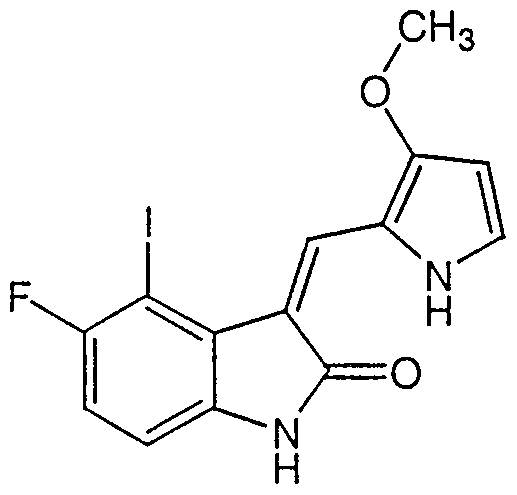
- Step B A solution of (Z)-1 ,3-dihydro-4-iodo-3-[(1 H-pyrrol-2-yl)methylene]-2H-indol-2- one (30 mg, 0.089 mmol) (Starting Material 1 ), 2M aqueous Na2C03 solution (150 ⁇ L, 0.300 mmol), (Ph3P)2PdCl2 (4 mg, 0.006 mmol)(Aldrich), and 3- carboxyphenylboronic acid (17 mg, 0.102 mmol) (from Step A above) in 4 mL of a 3:1 mixture of 1 ,2-dimethoxyethane:distilled water was heated at 95 °C under a nitrogen atmosphere for 24 h.
- reaction mixture was allowed to cool to room temperature and then directly purified by flash chromatography (Merck Silica gel 60, 230-400 mesh, 50% ethyl acetate-hexanes then 100% ethyl acetate with 1 % glacial acetic acid elution) to provide pure (Z)-3-[2,3-dihydro-2-oxo-3-[(1 H-pyrrol-2-yl)methylene]-1 H- indol-4-yl]-benzoic acid (yield: 23 mg, 78%) as an orange solid (mp 233 - 235 °C).
- Step A A solution of glycine tert-butyl ester hydrochloride (300 mg, 1.79 mmol) (Aldrich), Et3N (250 ⁇ L, 1.79 mmol), and 4-(fluorosulfonyl)benzoyl chloride (400 mg, 1.79 mmol) (Aldrich) in 9 mL of dry N,N-dimethylformamide was stirred at room temperature under a nitrogen atmosphere for 12 h. The reaction mixture was diluted with ethyl acetate.
- Step B A solution of the crude (4-fluorosulfonyl-benzoylamino)-acetic acid tert-butyl ester (541 mg, 1.70 mmol) (from step A above) in 2 mL of methylene chloride was treated with 2 mL of trifluoroacetic acid. The reaction mixture was stirred at room temperature for 72 h. The reaction mixture was concentrated in vacuo to provide crude (4-fluorosulfonyl-benzoylamino)-acetic acid (407.9 mg, 92%) as a solid that was used without further purification.
- Step C A solution of (Z)-4-(3-aminophenyl)-1 ,3-dihydro-3-[(1 H-pyrrol-2-yl) methylene]-2H-indol-2-one (30 mg, 0.100 mmol) (from Example 4 supra), crude (4- fluorosulfonyl-benzoylamino)-acetic acid (28 mg, 0.107 mmol) (from step B above), 0-benzotriazol-1-yl-N,N,N',N'-tetramethyluronium hexafluorophosphate (HBTU, 45 mg, 0.119 mmol) (Advance ChemTech), 1 -hydroxybenzotriazole hydrate (HOBT, 16 mg, 0.118 mmol) (Aldrich), and N,N-diisopropylethylamine (52 ⁇ L, 0.300 mmol) (Aldrich) in 3 mL of dry N,N-dimethylformamide (Fisher Scientific
- Example 40 (Z)-1 ,3-Dihydro-4-(5-indolyl)-3-[(3-methoxy-1 H-pyrrol-2- yl)methylene]-2H-indol-2-one (MM)
- the reaction was allowed to slowly warm to room temperature, then the suspension was poured into an ice cold solution of 1 N HCl. The organic phase was separated, and the aqueous phase was washed with ether. The combined organic extracts were extracted with 1 N NaOH (3x 25 mL), and the combined alkaline extracts were acidified to pH 1 with 1 N HCl. The product was then extracted with ether, and the combined ether layers were dried over magnesium sulfate and concentrated in vacuo to yield a brownish solid. The product was recrystallized from boiling water to yield 450 mg (55%) white crystals (mp > 290 °C).
- Step B (Z)-1 ,3-Dihydro-4-(5-indolyl)-3-[(3-methoxy-1 H-pyrrol-2-yl)methylene]- 2H-indol-2-one
- Step A (Z)-1 ,3-dihydro-4-(5-indolyl)-3-[(3-methoxy-1 H-pyrrol-2-yl)methylene]-5- nitro-2H-indol-2-one
- Step B (Z)-5-Amino-1 ,3-dihydro-4-(5-indolyl)-3-[(3-methoxy-1 H-pyrrol-2- yl)methylene]-2H-indol-2-one
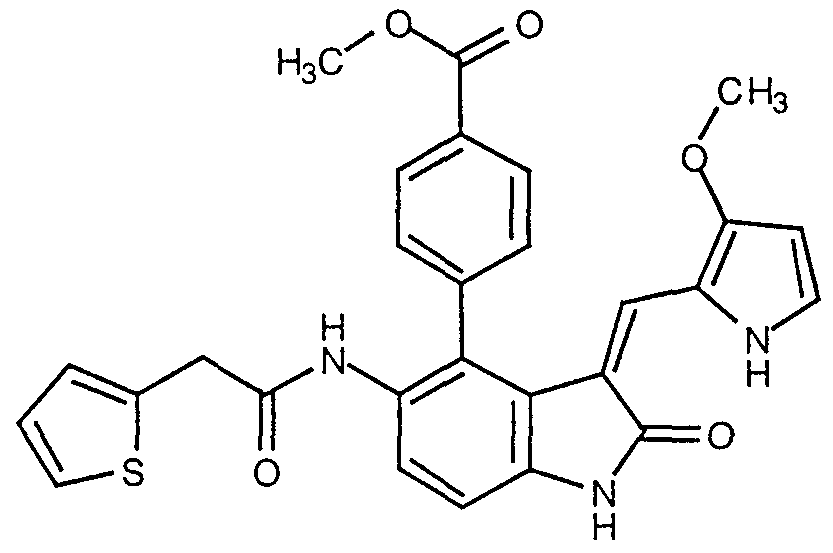
- Step C (Z)-N-[2,3-Dihydro-4-(5-indoIyl)-3-[(3-methoxy-1 H-pyrrol-2- yl)methylene]-2-oxo-1 H-indol-5-yl]-2-thiopheneacetamide (QQ)
- Step A 4-Methoxycarbonyl-phenyl boronic acid
- (trimethylsilyl)diazomethane (3 mL, 2 M in hexanes) (Aldrich) was added to a suspension of 4-carboxyphenylboronic acid (1 .0 g, 6 mmol) (Lancaster) in ether (50 mL). After stirring for 2 h at room temperature, DMF (8 mL) was added to obtain a clear solution. An additional portion of (trimethylsilyl) diazomethane (3 mL, 2 M in hexanes) was added. After stirring for an additional 2 h, the reaction was quenched by adding acetic acid and concentrating under reduced pressure. Residue was recrystallized from water to give product. (Yield 0.81 g, 75%).
- Step B (Z)-4-[2,3-Dihydro-3-[(3-methoxy-1 H-pyrrol-2-yl)methylene]-5-nitro-2- oxo-1 H-indol-4-yl]-benzoic acid methyl ester (RR)
- the reaction was allowed to slowly warm to room temperature, then the suspension was poured into an ice cold solution of 1 N HCl. The organic phase was separated, and the aqueous phase was washed with ether. The combined organic extracts were extracted with 1 N NaOH (3x 25 mL), and the combined alkaline extracts were acidified to pH 1 with 1 N HCl. The product was then extracted with ether, and the combined ether layers were dried over magnesium sulfate and concentrated in vacuo to yield a brownish solid. The product was recrystallized from boiling water to yield 367 mg (46%) white crystals.
- Step B (Z)-1 ,3-Dihydro-4-(4-indolyI)-3-[(3-methoxy-1 H-pyrrol-2-yl)methylene]- 2H-indoI-2-one (TT)
- the reaction was then poured into 100 mL water and the product was extracted with ethyl acetate (4x50 mL). The combined organic layers were dried over magnesium sulfate and concentrated in vacuo. The product was purified via flash column chromatography (1 % CH3OH in CHCI3) to yield 42 mg (38%) orange powder.
- Step A 6-lndoIeboronic acid To a suspension of sodium hydride (130 mg, 5.41 mmol) in anhydrous tetrahydrofuran (20 mL) was added 6-bromoindole (973 mg, 4.96 mmol) (prepared according to W.A. Ayer et al., Tetrahedron 54tJ 41:2919-2924 (1992)) at 0 °C. After 15 min. of stirring at 0 °C, the reaction was cooled to -78 °C, and tert-butyllithium (10.2 mmol, 1.7 M in hexane) (Aldrich) was added dropwise (a white precipitate immediately formed). After 10 min.
- Step A (Z)-1 ,3-Dihydro-4-(6-indolyl)-3-[(3-methoxy-1 H-pyrrol-2-yl)methylene]-5- nitro-2H-indol-2-one
- Step B (Z)-5-amino-1 ,3-dihydro-4-(6-indolyl)-3-[(3-methoxy-1 H-pyrrol-2- yl)methylene]-2H-indol-2-one
- Step C (Z)-N-[2,3-Dihydro-4-(6-indolyl)-3-[(3-methoxy-1 H-pyrrol-2-yl)methylene]- 2-OXO-1 H-indol-5-yl]-2-thiopheneacetamide (VV)
- 3-Amino-4-methyIphenylboronic acid was prepared by hydrogenation of 4- methyl-3-nitrophenyl-boronic acid (TCI).
- 3-tert-Butyl-dimethyl-silyloxy-phenylboronic acid was prepared according to the procedure for preparing 4-tert-butyl-dimethyl-silyloxy-phenylboronic acid of: S. Yonezawa et al., Total Synthesis of Terprenin, a Novel Immunosuppressive p- Terphenyl Derivative. J. Org. Chem. 1998, 63,5831 -5837.
- 3-(Carbamoylmethyl-amino)-phenylboronic acid was prepared according to the procedure of A. H. Soloway et al., Acylation and alkylation of aminoboronic acid. J. Org. Chem. 1960, 25, 1683-1686.
- the SAPK inhibitory activity of the compounds of the invention is demonstrated below. These effects indicate that the compounds of the present invention are useful in treating inflammatory diseases such as, for example, rheumatoid arthritis.
- Human JNK is highly homologous to rat SAPK. To measure the inhibitory activity of test compounds, the compounds were tested in the rat SAPK assay.
- test compound refers to the average counts per minute of the test duplicates
- nonspecific refers to the average counts per minute when no SAPK was added
- total refers to the average counts per minute when no compound was added.
- the U937 cells a human monocyte/macrophage cell line, was obtained from the ATTC and grown in the recommended medium. These cells when stimulated with lipopolysaccharide (LPS) release TNF, another inflammatory mediator implicated in the JNK pathway (Swantek et al., supra) and IL-6. In this assay the ability of a test compound to block TNF expression is evaluated.
- LPS lipopolysaccharide
- the U937 cells were suspension cells which when stimulated with phorbol myristate acetate (PMA) (Sigma, St. Louis, MO) became adherent. After PMA stimulation the cells were washed in cell culture medium and plated at 1 X10 5 cells/well in 96 well plates. The following day the test compounds and dexamethasone control (Sigma, St. Louis, MO) were added to the cells for 1 hour of preincubation. Then the cells were stimulated with LPS (Sigma, St. Louis, MO). After an additional 24 hours of incubation the supernatants were removed and assayed for TNF-o and IL-6 by ELISA. The IL-6 ELISA was run as described previously for the MG63 assay. The TNF ELISA was run using a kit supplied by Genzyme (Cambridge, MA).
- 96 well plates were coated with antibody to TNF- ⁇ or IL-6. Supernatants were added to the coated plates and any antigen (TNF- ⁇ or IL-6) in the supernatant bound to the antibody coated on the plates. The plates were then washed with PBS containing 0.05% Tween 20 (Sigma, St. Louis, MO) and the biotinylated secondary antibody was added. This secondary antibody binds to the already bound antigen creating a "sandwich effect". Plates were washed as described above and horseradish peroxidase (HRP)-streptavidin conjugate (Sigma, St. Louis, MO) was added to the plates.
- HRP horseradish peroxidase
- HRP-streptavidin bound to the biotin-antibody conjugate The plates were washed and TMB substrate (Kirkegaard and Perry Labs, Gaithersburg, MD) was added to the wells. This substrate changes color in the presence of HRP-streptavidin.
- the intensity of the color (measured at 450 nm) is proportional to the amount of TNF- ⁇ or IL-6 produced by the U937 cells upon exposure to LPS and the test compounds.
- Optical density values were converted to concentration (pg/ml or Units/ml) based on a standard curve included in the assay.
- IC 5 o values for each test compound were determined from the linear regression of a plot of the logarithm of the concentration of compound versus amount of TNF- ⁇ or IL- 6 secreted.
- the TNF- ⁇ antibodies and the IL-6 antibodies were obtained from either Genzyme, Cambridge, MA or Pharmingen, San Diego, CA.).
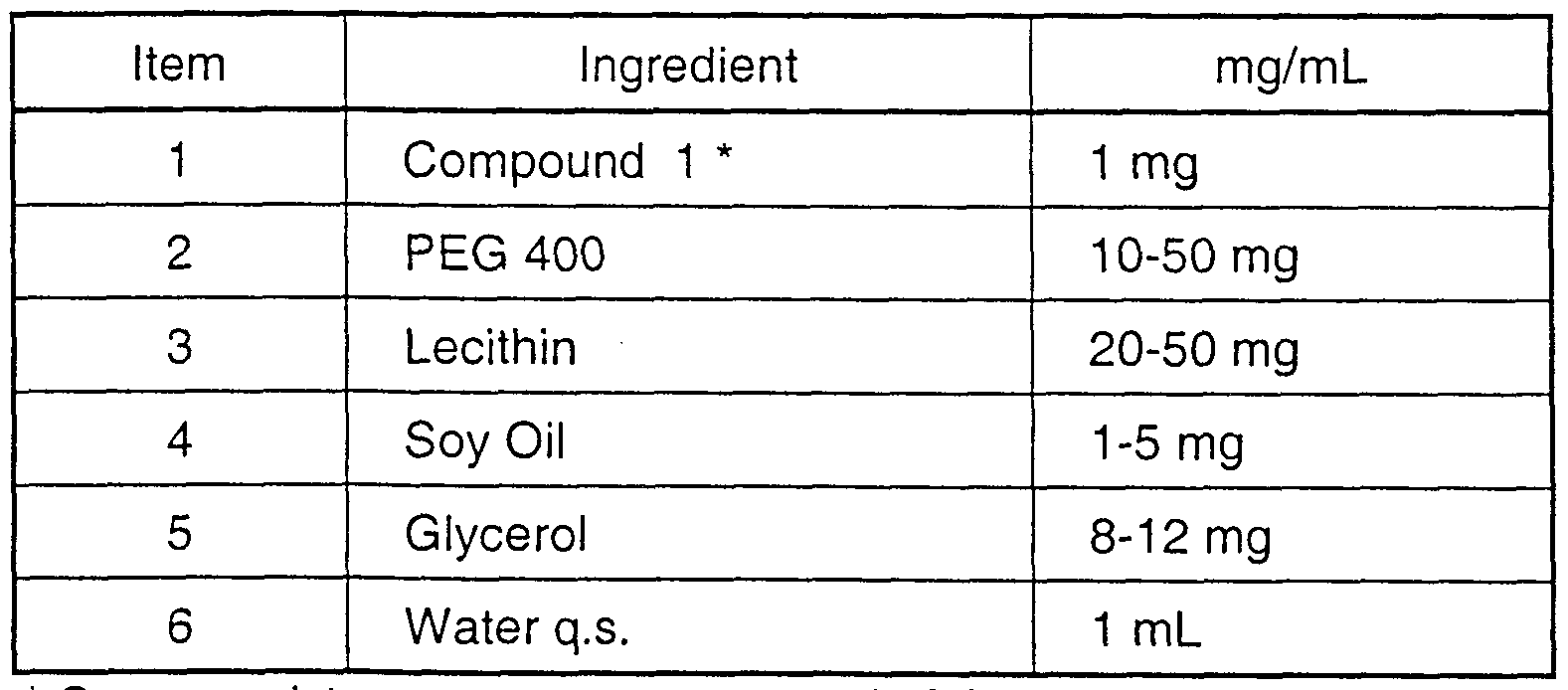
- 'Compound 1 represents a compound of the invention.
- Step 4 Pass the granulation from Step 3 through a suitable milling equipment.
- Compound 1 represents a compound of the invention.
- Compound 1 represents a compound of the invention.
Landscapes
- Chemical & Material Sciences (AREA)
- Organic Chemistry (AREA)
- Health & Medical Sciences (AREA)
- Life Sciences & Earth Sciences (AREA)
- Public Health (AREA)
- General Chemical & Material Sciences (AREA)
- Medicinal Chemistry (AREA)
- Nuclear Medicine, Radiotherapy & Molecular Imaging (AREA)
- Chemical Kinetics & Catalysis (AREA)
- Pharmacology & Pharmacy (AREA)
- Veterinary Medicine (AREA)
- Animal Behavior & Ethology (AREA)
- General Health & Medical Sciences (AREA)
- Bioinformatics & Cheminformatics (AREA)
- Engineering & Computer Science (AREA)
- Pain & Pain Management (AREA)
- Rheumatology (AREA)
- Pharmaceuticals Containing Other Organic And Inorganic Compounds (AREA)
- Plural Heterocyclic Compounds (AREA)
- Medicinal Preparation (AREA)
Abstract
Description







Claims


Priority Applications (6)
| Application Number | Priority Date | Filing Date | Title |
|---|---|---|---|
| JP2000588169A JP2002532493A (en) | 1998-12-17 | 1999-12-09 | 4-Aryloxindoles as JNK protein kinase inhibitors |
| BR9916223-7A BR9916223A (en) | 1998-12-17 | 1999-12-09 | 4-aryloxindols as inhibitors of jnk protein kinases |
| CA002354591A CA2354591A1 (en) | 1998-12-17 | 1999-12-09 | 4-aryloxindoles as inhibitors of jnk protein kinases |
| EP99966933A EP1149093A1 (en) | 1998-12-17 | 1999-12-09 | 4-aryloxindoles as inhibitors of jnk protein kinases |
| KR1020017007597A KR20010101266A (en) | 1998-12-17 | 1999-12-09 | 4-aryloxindoles as inhibitors of jnk protein kinases |
| AU22815/00A AU760039B2 (en) | 1998-12-17 | 1999-12-09 | 4-aryloxindoles as inhibitors of JNK protein kinases |
Applications Claiming Priority (4)
| Application Number | Priority Date | Filing Date | Title |
|---|---|---|---|
| US11259098P | 1998-12-17 | 1998-12-17 | |
| US60/112,590 | 1998-12-17 | ||
| US14902899P | 1999-08-16 | 1999-08-16 | |
| US60/149,028 | 1999-08-16 |
Publications (1)
| Publication Number | Publication Date |
|---|---|
| WO2000035909A1 true WO2000035909A1 (en) | 2000-06-22 |
Family
ID=26810127
Family Applications (1)
| Application Number | Title | Priority Date | Filing Date |
|---|---|---|---|
| PCT/EP1999/009673 Ceased WO2000035909A1 (en) | 1998-12-17 | 1999-12-09 | 4-aryloxindoles as inhibitors of jnk protein kinases |
Country Status (10)
| Country | Link |
|---|---|
| US (1) | US6307056B1 (en) |
| EP (1) | EP1149093A1 (en) |
| JP (1) | JP2002532493A (en) |
| KR (1) | KR20010101266A (en) |
| CN (1) | CN1136217C (en) |
| AU (1) | AU760039B2 (en) |
| BR (1) | BR9916223A (en) |
| CA (1) | CA2354591A1 (en) |
| TR (1) | TR200101858T2 (en) |
| WO (1) | WO2000035909A1 (en) |
Cited By (36)
| Publication number | Priority date | Publication date | Assignee | Title |
|---|---|---|---|---|
| WO2002002551A1 (en) * | 2000-06-30 | 2002-01-10 | Sugen, Inc. | 4-heteroaryl-3-heteroarylidenyl-2-indolinones and their use as protein kinase inhibitors |
| WO2002051442A1 (en) * | 2000-12-26 | 2002-07-04 | Takeda Chemical Industries, Ltd. | Concomitant drugs |
| US6451838B1 (en) | 2000-05-24 | 2002-09-17 | Pharmacia & Upjohn Company | 1-(pyrrolidin-1-ylmethyl)-3-(pyrrol-2-ylmethylidene)-2-indolinone derivatives |
| WO2002055517A3 (en) * | 2000-12-20 | 2002-09-26 | Sugen, Inc | 4-(hetero)aryl substituted indolinones |
| WO2002081475A1 (en) * | 2001-04-06 | 2002-10-17 | Eisai Co., Limited | Jun kinase inhibitors |
| WO2002066450A3 (en) * | 2001-02-15 | 2002-12-05 | Signal Pharm Inc | Anthrone derivatives and their use as ink inhibitors |
| US6569868B2 (en) | 1998-04-16 | 2003-05-27 | Sugen, Inc. | 2-indolinone derivatives as modulators of protein kinase activity |
| US6599902B2 (en) | 2001-05-30 | 2003-07-29 | Sugen, Inc. | 5-aralkysufonyl-3-(pyrrol-2-ylmethylidene)-2-indolinone derivatives as kinase inhibitors |
| WO2002092065A3 (en) * | 2001-05-16 | 2003-07-31 | Cephalon Inc | Novel methods for the treatment and prevention of pain using stress-activated protein kinase inhibitors |
| WO2003051838A3 (en) * | 2001-12-13 | 2003-09-18 | Abbott Lab | Protein kinase inhibitors |
| US6706709B2 (en) | 2000-06-02 | 2004-03-16 | Sugen, Inc. | Indolinone derivatives as protein kinase/phosphatase inhibitors |
| US6982274B2 (en) | 2001-04-16 | 2006-01-03 | Eisai Co., Ltd. | 1H-indazole compound |
| US7105563B2 (en) | 2003-10-24 | 2006-09-12 | Schering Aktiengesellschaft | Indolinone derivatives and their use in treating disease-states such as cancer |
| US7119114B1 (en) | 1999-08-19 | 2006-10-10 | Signal Pharmaceuticals, Llc | Pyrazoloanthrone and derivatives thereof as JNK inhibitors and compositions and methods related thereto |
| US7141564B2 (en) | 2001-05-25 | 2006-11-28 | Smithkline Beecham P.L.C. | Nitrogen-containing bicyclic heterocycles for use as antibacterials |
| US7291630B2 (en) | 2002-03-28 | 2007-11-06 | Eisai Co., Ltd. | Azaindoles as inhibitors of c-Jun N-terminal kinases |
| US7335676B2 (en) | 1999-08-19 | 2008-02-26 | Signal Pharmaceuticals, Llc | Methods for treating inflammatory conditions or inhibiting JNK |
| US7351729B2 (en) | 2002-03-08 | 2008-04-01 | Signal Pharmaceuticals, Llc | JNK inhibitors for use in combination therapy for treating or managing proliferative disorders and cancers |
| JP2008519762A (en) * | 2004-11-09 | 2008-06-12 | アイアールエム・リミテッド・ライアビリティ・カンパニー | Compounds and compositions as protein kinase inhibitors |
| US7429609B2 (en) | 2002-05-31 | 2008-09-30 | Eisai R & D Management Co., Ltd. | Pyrazole compound and medicinal composition containing the same |
| US7465736B2 (en) | 2002-06-14 | 2008-12-16 | Laboratoires Serono S.A. | Azole methylidene cyanide derivatives and their use as protein kinase modulators |
| US7504401B2 (en) | 2003-08-29 | 2009-03-17 | Locus Pharmaceuticals, Inc. | Anti-cancer agents and uses thereof |
| US7534800B2 (en) | 2002-03-28 | 2009-05-19 | Eisai R & D Development Co., Ltd. | 7-azaindoles as inhibitors of c-Jun N-terminal kinases for the treatment of neurodegenerative disorders |
| US7612086B2 (en) | 2003-05-16 | 2009-11-03 | Eisai R & D Management Co. Ltd. | JNK inhibitors |
| US7645769B2 (en) | 2005-08-05 | 2010-01-12 | Eisai R & D Management Co., Ltd. | Inhibitors of c-Jun N-terminal kinases for the treatment of neurodegenerative disorders relating to apoptosis and/or inflammation |
| US7652137B2 (en) | 2003-03-06 | 2010-01-26 | Eisai R & D Management Co., Ltd. | Synthesis of 5 substituted 7-azaindoles and 7-azaindolines |
| US7683078B2 (en) | 2001-07-23 | 2010-03-23 | Laboratoires Serono S.A. | Arylsulfonamide derivatives as C-Jun-N-Terminal Kinases (JNK's) inhibitors |
| EP2248521A1 (en) | 2004-10-29 | 2010-11-10 | Alcon, Inc. | Inhibitors of jun n-terminal kinases for treating glaucomatous retinopathy and ocular diseases |
| US7968572B2 (en) | 2005-10-03 | 2011-06-28 | Ono Pharmaceuticals Co., Ltd. | Nitrogen-containing heterocyclic compound and pharmaceutical application thereof |
| EA016437B1 (en) * | 2005-07-15 | 2012-05-30 | Мерк Сероно С.А. | Jnk inhibitors for the treatment of endometreosis pharmaceutical composition containing thereof |
| US8658640B2 (en) | 2005-07-15 | 2014-02-25 | Merck Serono Sa | JNK inhibitors for the treatment of endometriosis |
| WO2014160401A1 (en) * | 2013-03-13 | 2014-10-02 | Boston Biomedical, Inc. | 3-(aryl or heteroaryl) methyleneindolin-2-one derivatives as inhibitors of cancer stem cell pathway kinases for the treatment of cancer |
| US10350601B2 (en) | 2013-03-13 | 2019-07-16 | Celsee Diagnostics, Inc. | System and method for capturing and analyzing cells |
| WO2020237025A1 (en) * | 2019-05-23 | 2020-11-26 | Gilead Sciences, Inc. | Substituted exo-methylene-oxindoles which are hpk1/map4k1 inhibitors |
| US11897878B2 (en) | 2018-10-31 | 2024-02-13 | Gilead Sciences, Inc. | Substituted 6-azabenzimidazole compounds |
| US11925631B2 (en) | 2018-10-31 | 2024-03-12 | Gilead Sciences, Inc. | Substituted 6-azabenzimidazole compounds |
Families Citing this family (6)
| Publication number | Priority date | Publication date | Assignee | Title |
|---|---|---|---|---|
| CA2488013A1 (en) * | 2002-05-30 | 2003-12-11 | Celgene Corporation | Methods of using jnk or mkk inhibitors to modulate cell differentiation and to treat myeloproliferative disorders and myelodysplastic syndromes |
| CN1747949A (en) * | 2002-12-20 | 2006-03-15 | 法马西亚公司 | Acyclic pyrazole compounds |
| NZ597304A (en) | 2005-10-13 | 2013-06-28 | Anthrogenesis Corp | Immunomodulation using placental stem cells |
| ZA200804717B (en) * | 2005-12-29 | 2010-02-24 | Anthrogenesis Corp | Improved composition for collecting and preserving a placental stem cells and methods of using the composition |
| CA2677679A1 (en) | 2007-02-12 | 2008-08-21 | Anthrogenesis Corporation | Hepatocytes and chondrocytes from adherent placental stem cells; and cd34+, cd45- placental stem cell-enriched cell populations |
| NZ612888A (en) | 2007-02-12 | 2015-02-27 | Anthrogenesis Corp | Treatment of inflammatory diseases using placental stem cells |
Citations (2)
| Publication number | Priority date | Publication date | Assignee | Title |
|---|---|---|---|---|
| WO1996032380A1 (en) * | 1995-04-07 | 1996-10-17 | Pharmacia & Upjohn S.P.A. | Substituted indolylmethylene-oxindole analogues as tyrosine kinase inhibitors |
| WO1996040116A1 (en) * | 1995-06-07 | 1996-12-19 | Sugen, Inc. | Indolinone compounds for the treatment of disease |
Family Cites Families (27)
| Publication number | Priority date | Publication date | Assignee | Title |
|---|---|---|---|---|
| US4556672A (en) | 1984-03-19 | 1985-12-03 | Pfizer Inc. | 3-Substituted 2-oxindole-1-carboxamides as analgesic and anti-inflammatory agents |
| ES2110965T3 (en) | 1989-07-25 | 1998-03-01 | Taiho Pharmaceutical Co Ltd | DERIVED FROM OXOINDOL. |
| WO1991009598A1 (en) | 1990-01-05 | 1991-07-11 | Pfizer Inc. | Azaoxindole derivatives |
| GB9004483D0 (en) | 1990-02-28 | 1990-04-25 | Erba Carlo Spa | New aryl-and heteroarylethenylene derivatives and process for their preparation |
| WO1992007830A2 (en) | 1990-10-29 | 1992-05-14 | Pfizer Inc. | Oxindole peptide antagonists |
| GB9115160D0 (en) | 1991-07-12 | 1991-08-28 | Erba Carlo Spa | Methylen-oxindole derivatives and process for their preparation |
| US5322950A (en) | 1991-12-05 | 1994-06-21 | Warner-Lambert Company | Imidazole with angiotensin II antagonist properties |
| FR2694004B1 (en) | 1992-07-21 | 1994-08-26 | Adir | News 3- (Hydroxybenzylidenyl) -indoline-2-ones and 3- (hydroxybenzylidenyl) -indoline-2-thiones, methods of preparation, and pharmaceutical compositions containing them. |
| GB9226855D0 (en) | 1992-12-23 | 1993-02-17 | Erba Carlo Spa | Vinylene-azaindole derivatives and process for their preparation |
| GB9313638D0 (en) | 1993-07-01 | 1993-08-18 | Erba Carlo Spa | Arylidene and heteroarylidene oxindole derivatives and process for their preparation |
| GB9326136D0 (en) | 1993-12-22 | 1994-02-23 | Erba Carlo Spa | Biologically active 3-substituted oxindole derivatives useful as anti-angiogenic agents |
| GB9412719D0 (en) | 1994-06-24 | 1994-08-17 | Erba Carlo Spa | Substituted azaindolylidene compounds and process for their preparation |
| GB9423997D0 (en) | 1994-11-28 | 1995-01-11 | Erba Carlo Spa | Substituted 3-arylidene-7-azaoxindole compounds and process for their preparation |
| GB9501567D0 (en) | 1995-01-26 | 1995-03-15 | Pharmacia Spa | Hydrosoluble 3-arylidene-2-oxindole derivatives as tyrosine kinase inhibitors |
| JPH11512708A (en) | 1995-09-11 | 1999-11-02 | オステオアルスリィティス サイエンシズ,インコーポレイテッド | Protein tyrosine kinase inhibitors for treating osteoarthritis |
| US5733920A (en) | 1995-10-31 | 1998-03-31 | Mitotix, Inc. | Inhibitors of cyclin dependent kinases |
| GB9610964D0 (en) | 1996-05-24 | 1996-07-31 | Pharmacia & Upjohn Spa | Substituted tetralylmethylen-oxindole analogues as tyrosine kinase inhibitors |
| GB9611797D0 (en) | 1996-06-06 | 1996-08-07 | Pharmacia Spa | Substituted quinolylmethylen-oxindole analogues as tyrosine kinase inhibitors |
| WO1998007695A1 (en) * | 1996-08-23 | 1998-02-26 | Sugen, Inc. | Indolinone combinatorial libraries and related products and methods for the treatment of disease |
| WO1998024432A2 (en) | 1996-12-05 | 1998-06-11 | Sugen, Inc. | Use of indolinone compounds as modulators of protein kinases |
| EP0984930B1 (en) * | 1997-05-07 | 2005-04-06 | Sugen, Inc. | 2-indolinone derivatives as modulators of protein kinase activity |
| GB9716557D0 (en) | 1997-08-06 | 1997-10-08 | Glaxo Group Ltd | Benzylidene-1,3-dihydro-indol-2-one derivatives having anti-cancer activity |
| GB9718913D0 (en) | 1997-09-05 | 1997-11-12 | Glaxo Group Ltd | Substituted oxindole derivatives |
| EP1066257A2 (en) | 1998-03-26 | 2001-01-10 | Sugen, Inc. | Heterocylic classes of compounds for the modulating tyrosine protein kinase |
| EA005032B1 (en) | 1998-05-29 | 2004-10-28 | Сьюджен, Инк. | Pyrrole substituted 2-indolinone (variants), pharmaceutical composition (variants), method for modulation of catalytic activity method for treating and preventing a protein kinase related disorders in an organism |
| CA2383623A1 (en) | 1998-08-04 | 2000-02-17 | Sugen, Inc. | 3-methylidenyl-2-indolinone modulators of protein kinase |
| JP2002523455A (en) | 1998-08-31 | 2002-07-30 | スージェン・インコーポレーテッド | Geometrically restricted 2-indolinone derivatives as modulators of protein kinase activity |
-
1999
- 1999-12-09 EP EP99966933A patent/EP1149093A1/en not_active Withdrawn
- 1999-12-09 BR BR9916223-7A patent/BR9916223A/en not_active IP Right Cessation
- 1999-12-09 CA CA002354591A patent/CA2354591A1/en not_active Abandoned
- 1999-12-09 AU AU22815/00A patent/AU760039B2/en not_active Ceased
- 1999-12-09 KR KR1020017007597A patent/KR20010101266A/en not_active Ceased
- 1999-12-09 JP JP2000588169A patent/JP2002532493A/en active Pending
- 1999-12-09 WO PCT/EP1999/009673 patent/WO2000035909A1/en not_active Ceased
- 1999-12-09 TR TR2001/01858T patent/TR200101858T2/en unknown
- 1999-12-09 CN CNB998145858A patent/CN1136217C/en not_active Expired - Fee Related
- 1999-12-15 US US09/464,466 patent/US6307056B1/en not_active Expired - Fee Related
Patent Citations (2)
| Publication number | Priority date | Publication date | Assignee | Title |
|---|---|---|---|---|
| WO1996032380A1 (en) * | 1995-04-07 | 1996-10-17 | Pharmacia & Upjohn S.P.A. | Substituted indolylmethylene-oxindole analogues as tyrosine kinase inhibitors |
| WO1996040116A1 (en) * | 1995-06-07 | 1996-12-19 | Sugen, Inc. | Indolinone compounds for the treatment of disease |
Cited By (60)
| Publication number | Priority date | Publication date | Assignee | Title |
|---|---|---|---|---|
| US6569868B2 (en) | 1998-04-16 | 2003-05-27 | Sugen, Inc. | 2-indolinone derivatives as modulators of protein kinase activity |
| US7119114B1 (en) | 1999-08-19 | 2006-10-10 | Signal Pharmaceuticals, Llc | Pyrazoloanthrone and derivatives thereof as JNK inhibitors and compositions and methods related thereto |
| US7335676B2 (en) | 1999-08-19 | 2008-02-26 | Signal Pharmaceuticals, Llc | Methods for treating inflammatory conditions or inhibiting JNK |
| US6482848B2 (en) | 2000-05-24 | 2002-11-19 | Sugen Incorporated | Prodrugs of 3-(pyrrol-2-ylmethylidene)-2-indolinone derivatives |
| US6716870B2 (en) | 2000-05-24 | 2004-04-06 | Sugen, Inc. | Prodrugs of 3-(pyrrol-2-ylmethylidene)-2-indolinone derivatives |
| US7053113B2 (en) | 2000-05-24 | 2006-05-30 | Sugen, Inc. | Mannich base prodrugs of 3-(pyrrol-2-yl-methylidene)-2-indolinone derivatives |
| US6451838B1 (en) | 2000-05-24 | 2002-09-17 | Pharmacia & Upjohn Company | 1-(pyrrolidin-1-ylmethyl)-3-(pyrrol-2-ylmethylidene)-2-indolinone derivatives |
| US7008943B2 (en) | 2000-05-24 | 2006-03-07 | Pharmacia & Upjohn Company | 1-(Pyrrolidin-1-ylmethyl)-3-(pyrrol-2-ylmethylidene)-2-indolinone derivatives |
| US7112603B2 (en) | 2000-05-24 | 2006-09-26 | Agouron Pharmaceuticals, Inc. | Prodrugs of 3-(pyrrol-2-ylmethylidene)-2-indolinone derivatives |
| US6710067B2 (en) | 2000-05-24 | 2004-03-23 | Sugen Incorporated | Mannich base prodrugs of 3-(pyrrol-2-ylmethylidene)-2-indolinone derivatives |
| US7071332B2 (en) | 2000-06-02 | 2006-07-04 | Sugen, Inc. | Indolinone derivatives as protein kinase/phosphatase inhibitors |
| US6706709B2 (en) | 2000-06-02 | 2004-03-16 | Sugen, Inc. | Indolinone derivatives as protein kinase/phosphatase inhibitors |
| US7053086B2 (en) | 2000-06-30 | 2006-05-30 | Sugen, Inc. | 4-heteroaryl-3-heteroarylidenyl-2-indolinones and their use as protein kinase inhibitors |
| WO2002002551A1 (en) * | 2000-06-30 | 2002-01-10 | Sugen, Inc. | 4-heteroaryl-3-heteroarylidenyl-2-indolinones and their use as protein kinase inhibitors |
| US6635640B2 (en) | 2000-06-30 | 2003-10-21 | Sugen, Inc. | 4-heteroaryl-3-heteroarylidenyl-2-indolinones and their use as protein kinase inhibitors |
| US6677368B2 (en) * | 2000-12-20 | 2004-01-13 | Sugen, Inc. | 4-aryl substituted indolinones |
| US6861418B2 (en) | 2000-12-20 | 2005-03-01 | Sugen, Inc. | 4-aryl substituted indolinones |
| WO2002055517A3 (en) * | 2000-12-20 | 2002-09-26 | Sugen, Inc | 4-(hetero)aryl substituted indolinones |
| WO2002051442A1 (en) * | 2000-12-26 | 2002-07-04 | Takeda Chemical Industries, Ltd. | Concomitant drugs |
| US7354947B2 (en) | 2001-02-15 | 2008-04-08 | Signal Pharmaceuticals, Llc | Isothiazoloanthrones, isoxazoloanthrones, isoindolanthrones and derivatives thereof a JNK inhibitors and compositions and methods related thereto |
| US6987184B2 (en) | 2001-02-15 | 2006-01-17 | Signal Pharmaceuticals, Llc | Isothiazoloanthrones, isoxazoloanthrones, isoindolanthrones and derivatives thereof as JNK inhibitors and compositions and methods related |
| WO2002066450A3 (en) * | 2001-02-15 | 2002-12-05 | Signal Pharm Inc | Anthrone derivatives and their use as ink inhibitors |
| US7314940B2 (en) | 2001-04-06 | 2008-01-01 | Eisai Co., Ltd. | Jun kinase inhibitors |
| WO2002081475A1 (en) * | 2001-04-06 | 2002-10-17 | Eisai Co., Limited | Jun kinase inhibitors |
| US7541376B2 (en) | 2001-04-16 | 2009-06-02 | Eisai R&D Management Co., Ltd. | 1H-indazole compounds |
| US7776890B2 (en) | 2001-04-16 | 2010-08-17 | Eisai R&D Management Co., Ltd. | 1H-indazole compounds |
| US6982274B2 (en) | 2001-04-16 | 2006-01-03 | Eisai Co., Ltd. | 1H-indazole compound |
| WO2002092065A3 (en) * | 2001-05-16 | 2003-07-31 | Cephalon Inc | Novel methods for the treatment and prevention of pain using stress-activated protein kinase inhibitors |
| US7018999B2 (en) | 2001-05-16 | 2006-03-28 | Cephalon, Inc. | Methods for the treatment and prevention of pain |
| US7141564B2 (en) | 2001-05-25 | 2006-11-28 | Smithkline Beecham P.L.C. | Nitrogen-containing bicyclic heterocycles for use as antibacterials |
| US6599902B2 (en) | 2001-05-30 | 2003-07-29 | Sugen, Inc. | 5-aralkysufonyl-3-(pyrrol-2-ylmethylidene)-2-indolinone derivatives as kinase inhibitors |
| US7683078B2 (en) | 2001-07-23 | 2010-03-23 | Laboratoires Serono S.A. | Arylsulfonamide derivatives as C-Jun-N-Terminal Kinases (JNK's) inhibitors |
| WO2003051838A3 (en) * | 2001-12-13 | 2003-09-18 | Abbott Lab | Protein kinase inhibitors |
| US7351729B2 (en) | 2002-03-08 | 2008-04-01 | Signal Pharmaceuticals, Llc | JNK inhibitors for use in combination therapy for treating or managing proliferative disorders and cancers |
| US7291630B2 (en) | 2002-03-28 | 2007-11-06 | Eisai Co., Ltd. | Azaindoles as inhibitors of c-Jun N-terminal kinases |
| US7534800B2 (en) | 2002-03-28 | 2009-05-19 | Eisai R & D Development Co., Ltd. | 7-azaindoles as inhibitors of c-Jun N-terminal kinases for the treatment of neurodegenerative disorders |
| US7429609B2 (en) | 2002-05-31 | 2008-09-30 | Eisai R & D Management Co., Ltd. | Pyrazole compound and medicinal composition containing the same |
| US7465736B2 (en) | 2002-06-14 | 2008-12-16 | Laboratoires Serono S.A. | Azole methylidene cyanide derivatives and their use as protein kinase modulators |
| US7652137B2 (en) | 2003-03-06 | 2010-01-26 | Eisai R & D Management Co., Ltd. | Synthesis of 5 substituted 7-azaindoles and 7-azaindolines |
| US7612086B2 (en) | 2003-05-16 | 2009-11-03 | Eisai R & D Management Co. Ltd. | JNK inhibitors |
| US7504401B2 (en) | 2003-08-29 | 2009-03-17 | Locus Pharmaceuticals, Inc. | Anti-cancer agents and uses thereof |
| US7105563B2 (en) | 2003-10-24 | 2006-09-12 | Schering Aktiengesellschaft | Indolinone derivatives and their use in treating disease-states such as cancer |
| EP2248521A1 (en) | 2004-10-29 | 2010-11-10 | Alcon, Inc. | Inhibitors of jun n-terminal kinases for treating glaucomatous retinopathy and ocular diseases |
| US8101608B2 (en) | 2004-11-09 | 2012-01-24 | IRM LLC, a Delware Limited Corporation | Compounds and compositions as protein kinase inhibitors |
| JP2008519762A (en) * | 2004-11-09 | 2008-06-12 | アイアールエム・リミテッド・ライアビリティ・カンパニー | Compounds and compositions as protein kinase inhibitors |
| JP4917041B2 (en) * | 2004-11-09 | 2012-04-18 | アイアールエム・リミテッド・ライアビリティ・カンパニー | Compounds and compositions as protein kinase inhibitors |
| US8592414B2 (en) | 2005-07-15 | 2013-11-26 | Merck Serono, S.A. | JNK inhibitors for the treatment of endometriosis |
| EA016437B1 (en) * | 2005-07-15 | 2012-05-30 | Мерк Сероно С.А. | Jnk inhibitors for the treatment of endometreosis pharmaceutical composition containing thereof |
| US8658640B2 (en) | 2005-07-15 | 2014-02-25 | Merck Serono Sa | JNK inhibitors for the treatment of endometriosis |
| US7645769B2 (en) | 2005-08-05 | 2010-01-12 | Eisai R & D Management Co., Ltd. | Inhibitors of c-Jun N-terminal kinases for the treatment of neurodegenerative disorders relating to apoptosis and/or inflammation |
| US7968572B2 (en) | 2005-10-03 | 2011-06-28 | Ono Pharmaceuticals Co., Ltd. | Nitrogen-containing heterocyclic compound and pharmaceutical application thereof |
| WO2014160401A1 (en) * | 2013-03-13 | 2014-10-02 | Boston Biomedical, Inc. | 3-(aryl or heteroaryl) methyleneindolin-2-one derivatives as inhibitors of cancer stem cell pathway kinases for the treatment of cancer |
| US10350601B2 (en) | 2013-03-13 | 2019-07-16 | Celsee Diagnostics, Inc. | System and method for capturing and analyzing cells |
| US11897878B2 (en) | 2018-10-31 | 2024-02-13 | Gilead Sciences, Inc. | Substituted 6-azabenzimidazole compounds |
| US11925631B2 (en) | 2018-10-31 | 2024-03-12 | Gilead Sciences, Inc. | Substituted 6-azabenzimidazole compounds |
| US12258346B2 (en) | 2018-10-31 | 2025-03-25 | Gilead Sciences, Inc. | Substituted 6-azabenzimidazole compounds |
| US11453681B2 (en) | 2019-05-23 | 2022-09-27 | Gilead Sciences, Inc. | Substituted eneoxindoles and uses thereof |
| TWI826690B (en) | 2019-05-23 | 2023-12-21 | 美商基利科學股份有限公司 | Substituted eneoxindoles and uses thereof |
| WO2020237025A1 (en) * | 2019-05-23 | 2020-11-26 | Gilead Sciences, Inc. | Substituted exo-methylene-oxindoles which are hpk1/map4k1 inhibitors |
| US12037342B2 (en) | 2019-05-23 | 2024-07-16 | Gilead Sciences, Inc. | Substituted eneoxindoles and uses thereof |
Also Published As
| Publication number | Publication date |
|---|---|
| BR9916223A (en) | 2001-09-04 |
| CN1136217C (en) | 2004-01-28 |
| TR200101858T2 (en) | 2001-12-21 |
| CN1330648A (en) | 2002-01-09 |
| AU760039B2 (en) | 2003-05-08 |
| AU2281500A (en) | 2000-07-03 |
| CA2354591A1 (en) | 2000-06-22 |
| US6307056B1 (en) | 2001-10-23 |
| JP2002532493A (en) | 2002-10-02 |
| EP1149093A1 (en) | 2001-10-31 |
| KR20010101266A (en) | 2001-11-14 |
Similar Documents
| Publication | Publication Date | Title |
|---|---|---|
| US6307056B1 (en) | 4-aryloxindoles | |
| JP5325783B2 (en) | Benzotriazole kinase modulator | |
| ES2209527T3 (en) | "44- AND 5-ALQUINILOXINDOLELS AND 4- AND 5-ALQUENILOXINDONES. | |
| KR101152162B1 (en) | Substituted pyrimidines and their use as jnk modulators | |
| AU767138B2 (en) | 4,5-pyrazinoxindoles as protein kinase inhibitors | |
| PL180027B1 (en) | New compounds, fused pyrrolocarboxanilides, which are a new class of ligands for the brain GABA receptor PL PL PL PL PL PL PL PL | |
| ME02337B (en) | pyridazinone | |
| JPH07215947A (en) | 1-benzenesulfonyl-1,3-dihydro-2H-benzimidazol-2-one derivative | |
| KR20030064773A (en) | Antiinflammation agents | |
| TW202417429A (en) | Novel heterobicyclic compound for inhibiting yap-tead interaction and pharmaceutical composition comprising same | |
| MXPA01006141A (en) | 4-aryloxindoles as inhibitors of jnk protein kinases | |
| CN114621194A (en) | 4-methylene-N-hydroxybenzamide compound and application thereof | |
| WO2009030725A2 (en) | Azaindoles as inhibitors of soluble adenylate cyclase | |
| ZA200104320B (en) | 4-Aryloxindoles as inhibitors of JNK protein kinases. | |
| US6313310B1 (en) | 4-and 5-alkynyloxindoles and 4-and 5-alkenyloxindoles | |
| EP2001843A2 (en) | Soluble adenylate cyclase inhibitors | |
| ZA200104281B (en) | 4- and 5-alkynyloxindoles and 4- and 5-alkenyloxindoles. | |
| MXPA01006049A (en) | 4- and 5-alkynyloxindoles and 4- and 5-alkenyloxindoles |
Legal Events
| Date | Code | Title | Description |
|---|---|---|---|
| WWE | Wipo information: entry into national phase |
Ref document number: 99814585.8 Country of ref document: CN |
|
| AK | Designated states |
Kind code of ref document: A1 Designated state(s): AE AL AM AT AU AZ BA BB BG BR BY CA CH CN CU CZ DE DK EE ES FI GB GD GE GH GM HR HU ID IL IN IS JP KE KG KP KR KZ LC LK LR LS LT LU LV MA MD MG MK MN MW MX NO NZ PL PT RO RU SD SE SG SI SK SL TJ TM TR TT UA UG UZ VN YU ZA ZW |
|
| AL | Designated countries for regional patents |
Kind code of ref document: A1 Designated state(s): GH GM KE LS MW SD SL SZ TZ UG ZW AM AZ BY KG KZ MD RU TJ TM AT BE CH CY DE DK ES FI FR GB GR IE IT LU MC NL PT SE BF BJ CF CG CI CM GA GN GW ML MR NE SN TD TG |
|
| DFPE | Request for preliminary examination filed prior to expiration of 19th month from priority date (pct application filed before 20040101) | ||
| 121 | Ep: the epo has been informed by wipo that ep was designated in this application | ||
| WWE | Wipo information: entry into national phase |
Ref document number: 2001/04320 Country of ref document: ZA Ref document number: 200104320 Country of ref document: ZA |
|
| WWE | Wipo information: entry into national phase |
Ref document number: 1999966933 Country of ref document: EP |
|
| ENP | Entry into the national phase |
Ref document number: 2354591 Country of ref document: CA Ref document number: 2354591 Country of ref document: CA Kind code of ref document: A |
|
| WWE | Wipo information: entry into national phase |
Ref document number: 22815/00 Country of ref document: AU |
|
| WWE | Wipo information: entry into national phase |
Ref document number: PA/a/2001/006141 Country of ref document: MX Ref document number: 2001/01858 Country of ref document: TR |
|
| WWE | Wipo information: entry into national phase |
Ref document number: 1020017007597 Country of ref document: KR |
|
| ENP | Entry into the national phase |
Ref document number: 2000 588169 Country of ref document: JP Kind code of ref document: A |
|
| REG | Reference to national code |
Ref country code: DE Ref legal event code: 8642 |
|
| WWP | Wipo information: published in national office |
Ref document number: 1999966933 Country of ref document: EP |
|
| WWP | Wipo information: published in national office |
Ref document number: 1020017007597 Country of ref document: KR |
|
| CR1 | Correction of entry in section i |
Free format text: PAT. BUL. 19/2002 UNDER (30) REPLACE "NOT FURNISHED" BY "10/002737" |
|
| WWG | Wipo information: grant in national office |
Ref document number: 22815/00 Country of ref document: AU |
|
| WWR | Wipo information: refused in national office |
Ref document number: 1020017007597 Country of ref document: KR |