WO2000049006A1 - C-7 metal alkoxides of baccatin iii - Google Patents
C-7 metal alkoxides of baccatin iii Download PDFInfo
- Publication number
- WO2000049006A1 WO2000049006A1 PCT/US2000/004271 US0004271W WO0049006A1 WO 2000049006 A1 WO2000049006 A1 WO 2000049006A1 US 0004271 W US0004271 W US 0004271W WO 0049006 A1 WO0049006 A1 WO 0049006A1
- Authority
- WO
- WIPO (PCT)
- Prior art keywords
- producing
- solution
- compound
- compound according
- group
- Prior art date
- Legal status (The legal status is an assumption and is not a legal conclusion. Google has not performed a legal analysis and makes no representation as to the accuracy of the status listed.)
- Ceased
Links
- 0 CC(C)([C@@](C1)([C@](C([C@]2([C@](C[C@@]3[O-])OC2)OC(C)=O)[C@]3(C)C([C@@]2OC(*)=O)=O)OC(c3ccccc3)=O)O)C2=C(C)[C@]1O Chemical compound CC(C)([C@@](C1)([C@](C([C@]2([C@](C[C@@]3[O-])OC2)OC(C)=O)[C@]3(C)C([C@@]2OC(*)=O)=O)OC(c3ccccc3)=O)O)C2=C(C)[C@]1O 0.000 description 1
Classifications
-
- C—CHEMISTRY; METALLURGY
- C07—ORGANIC CHEMISTRY
- C07D—HETEROCYCLIC COMPOUNDS
- C07D305/00—Heterocyclic compounds containing four-membered rings having one oxygen atom as the only ring hetero atoms
- C07D305/14—Heterocyclic compounds containing four-membered rings having one oxygen atom as the only ring hetero atoms condensed with carbocyclic rings or ring systems
Definitions
- the present invention is directed to intermediates useful in the production of the anti-neoplastic compound paclitaxel. More particularly, it is directed to the C-7 metal alkoxides of baccatin III and analogs thereof, as well as methods of producing the same.
- Taxanes are known to exhibit anti-tumor activity. As a result of this activity, taxanes have received increasing attention in the scientific and medical community. Primary among these is a compound known as “paclitaxel” which is also referred to in the literature as “taxol”. Paclitaxel has been approved for the chemotherapeutic treatment of several different varieties of tumors, and the clinical trials indicate that paclitaxel promises a broad range of potent anti-leukemic and tumor-inhibiting activity. Paclitaxel has the formula:
- Paclitaxel is a naturally occurring taxane diterpenoid which is found in several species of the yew (genus Taxus, family Taxaceae). Unfortunately, the concentration of this compound is very low. The species of evergreen are also slow growing. Even though the bark of the yew trees typically exhibit the highest concentration of paclitaxel, the production of one kilogram of paclitaxel requires approximately 16,000 pounds of bark. Thus, the long term prospects for the availability of paclitaxel through isolation are discouraging.
- paclitaxel in the yew tree While the presence of paclitaxel in the yew tree is in extremely low concentrations, there are a variety of other taxane compounds, such as Baccatin III, cephalommanine, 10-deacetylbaccatin III, etc., which are also able to be extracted from the yew bark. Some of these other taxane compounds are more readily extracted in higher yields. Indeed, a relatively high concentration of 10-deacetylbaccatin III can be extracted from the leaves of the yew as a renewable resource.
- taxane compounds such as Baccatin III, cephalommanine, 10-deacetylbaccatin III, etc.
- paclitaxel is synthesized by joining C7-TES baccatin III with N-carbamate protected C2' hydroxyl benzyl- type protected (2R,3S)-3-phenylisoserine, where the C2' hydroxyl is protected by a hydrogenable benzyl-type group such as benzyloxymethyl (BOM) or benzyl. Following the esterification of the protected baccatin III and the protected side chain, the compound may be suitably deprotected, acylated, and further deprotected to yield paclitaxel.
- BOM benzyloxymethyl
- C7-CBZ baccatin III is esterified with a C3'-N-CBZ-C2'-0-protected (2R,3S)-3-phenylisoserine side chain, followed by deprotection to produce paclitaxel.
- That patent teaches that C7-CBZ baccatin III is produced by adding n-butyl lithium and benzyl chloroformate (CBZ-CI) to baccatin III.
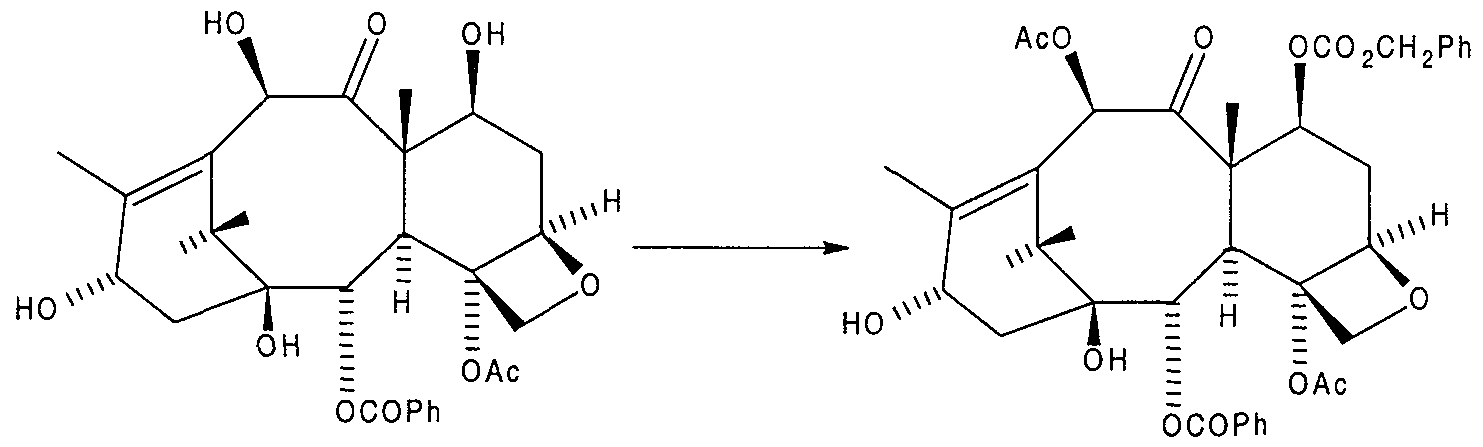
- C7-CBZ baccatin III may be directly synthesized from 10-deacetylbaccatin III by adding n-butyl lithium, acetyl chloride (or acetic anhydride) and benzyl chloroformate.
- the present invention is directed to the synthesis of C-7 CBZ protected baccatin III and analogs thereof through a metal alkoxide intermediate.
- the C-7 CBZ protected baccatin III can then be esterified with a suitably protected side chain, then the resulting compound deprotected to yield paclitaxel or other analogs.
- the present invention thus is directed to a new chemical intermediate having the formula
- R is an alkyl group and M + is an alkali metal counterion selected from the group consisting of a potassium counterion and a sodium counterion.
- M + is an alkali metal counterion selected from the group consisting of a potassium counterion and a sodium counterion.
- the alkyl group is a methyl group.
- the present invention is further directed to a method of producing a compound having the above formula, wherein R is an alkyl group and the M + counterion is an alkali metal counterion selected from the group consisting of a potassium counterion and a sodium counterion, from a starting compound which is either baccatin III or 10-deacetylbaccatin III.
- the method comprises the steps of dissolving the starting compound in a first solvent to form a first solution which is then cooled to a temperature of -20°C or less.
- An alkali base selected from the group consisting of a potassium base and a sodium base is thereafter added to the first solution to form an intermediate compound having a metal alkoxide at the C-7 position. Any of the intermediate compound present in the first solution where the intermediate compound does not already have an acetyl group at the C-10 position is then selectively acylated at the C-10 position.
- the starting compound is dissolved in tetrahydrofuran (THF), and the first solution is cooled under a nitrogen atmosphere.
- the alkali base is preferably potassium hydride or sodium hydride.
- the starting compound is 10-deacetylbaccatin III, it is preferred that at least two equivalents of the alkali base is added.
- the first solution is stirred for approximately five minutes.
- the intermediate compound is selectively acylated by adding an acid chloride, preferably acetyl chloride, or acetic anhydride.
- a quenching agent preferably ammonium chloride, may be added to remove excess alkali base and acylating agent.
- the preferred method is conducted so as to produce a compound wherein R is a methyl group.
- the present disclosure is broadly directed to new chemical compounds, namely, C-7 metal alkoxides of baccatin III and analogs thereof.
- the invention also concerns a method of producing these chemical compounds. Such compounds are demonstrably useful for the efficient production of paclitaxel and paclitaxel analogs. More specifically, the present invention discloses C-7 metal alkoxides of baccatin III as useful intermediates in the synthesis of C-7 CBZ baccatin III, which is a useful intermediate in the production of paclitaxel.
- the C-7 CBZ baccatin III may be esterified with an N-CBZ-3-phenylisoserine acid having a hydrogenable benzyl-type hydroxyl protecting group at C-2' to join the side chain at the C-13 hydroxyl of the protected baccatin III backbone.
- the general processes described herein involve the production of the C-7 CBZ baccatin III backbone through the C-7 metal alkoxide intermediate, the condensation of the C-7 CBZ baccatin III backbone with a suitably protected N-CBZ-3-phenylisoserine acid having the hydrogenable benzyl-type protecting group at C-2', and the subsequent deprotection to yield paclitaxel.
- baccatin III can be protected at the C-7 site to yield C-7 CBZ baccatin III.
- 10- deacetylbaccatin III (10-DAB) can be directly converted to C-7 CBZ baccatin III without going through a baccatin III intermediate. Production from baccatin III is advantageous for its yield and simplicity.
- Baccatin III is dissolved in anhydrous THF (tetrahydrofuran) to form a first solution, which is cooled under a nitrogen atmosphere to a reduced temperature of less than -20° C.
- An alkali base such as potassium hydride or sodium hydride (1.6 M in hexane) is then added dropwise to the first solution to form a second solution, which is stirred for approximately five minutes at the reduced temperature. This creates the C-7 metal alkoxide of baccatin
- Benzyl chloroformate (CBZ-CI) is added dropwise to the second solution to form a third solution which is then stirred and allowed to warm to 0° C over approximately one hour.
- the third solution is quenched with cold saturated ammonium chloride to eliminate any excess alkali base and CBZ-CI, and the mixture is concentrated under vacuum to yield a first residue.
- This first residue is next taken up in ethyl acetate and washed once with water to remove unwanted salts. Next, the residue is washed with brine. The organic layer is then dried and concentrated under vacuum to yield a second residue.
- the second residue is recrystallized or column chromatographed with ethyl acetate: hexane to give C-7 CBZ baccatin III as a white solid.
- C-7 CBZ baccatin III can be synthesized directly from 10- deacetylbaccatin III as follows:
- 10-DAB is dissolved in THF to form a first solution which is cooled to a reduced temperature of less than -20° C under a nitrogen atmosphere.
- At least two equivalents of an alkali base such as potassium hydride or sodium hydride (1.6 M in hexane) — or another alkali base, as described above — are then added dropwise to the first solution to form a second solution which is then stirred for approximately five minutes at the reduced temperature.
- acetyl chloride one equivalent
- acetic anhydride one equivalent may possibly be used in place of the acetyl chloride to acylate the 10-DAB.
- benzyl chloroformate (one equivalent) is next added, and this fourth solution is stirred for an additional thirty minutes at the reduced temperature and then warmed to 0° C over thirty minutes.
- the fourth solution is then quenched with cold saturated ammonium chloride at the reduced temperature to remove any excess alkali base, acetyl chloride and CBZ-CI; this mixture is then warmed to room temperature.
- the solvent is removed under vacuum to yield an initial residue which is taken up in ethyl acetate and washed with water to remove unwanted salts. The residue is then washed with brine, dried and concentrated under vacuum to yield a final residue.
- M + K + or Na +
- R is CH 3 or another alkyl group.
- both Route 1 and Route 2 to the production of C-7 CBZ baccatin III can be expressed as a generalized method.
- This method starts with a step of dissolving a starting compound selected from a group consisting of baccatin III and 10-deacetylbaccatin III in a first solvent to form a first solution.
- the first solution is then cooled to a temperature of -20°C or less.
- an alkali base is added to the first solution thereby to form an intermediate compound having a metal alkoxide at the C-7 position thereof.
- the method includes selectively acylating, at the C-10 position, any of the first intermediate compound present in the first solution where the intermediate compound does not already have an acetyl group at the C-10 position thereby to produce a second solution of C-7 metal alkoxide of baccatin III.
- the first intermediate compound may be acylated with the appropriate acid chloride to form analogues with various alkyl groups at C-10.
- the method may include a step of thereafter adding CBZ-CI to the second solution to form a third solution of C-7 CBZ baccatin III.
- the Pi protecting group on the C-2' hydroxyl is a hydrogenatable protecting group such as benzyloxymethyl (BOM) or benzyl.
- the solution is cooled to room temperature and an equal volume of ethyl acetate or diethyl ether is added to the solution.
- the resulting mixture is then cooled to 0°C and held at this temperature for twenty-four hours. After this time it is filtered, and the residue is rinsed with either diethyl ether or ethyl acetate.
- the combined organics are then washed with hydrochloric acid (5%), water, and finally brine.
- the organic phase is separated, dried and concentrated under vacuum.
- the resulting residue is then dissolved in ethyl acetate: hexane and eluted over a silica gel plug. The eluent is then concentrated under vacuum to result in the esterified compound:
- the esterified compound, above, may now be converted into paclitaxel by removing the nitrogen and C-7 CBZ groups, putting the benzoyl group onto the nitrogen, and finally removing the C-2' benzyl-type protecting group. Removal of the CBZ groups, and subsequent addition of the benzoyl group to the nitrogen are accomplished as follows (BOM is shown as the protecting group at the C-2' hydroxyl site, although benzyl could also be used):
- the coupled product is dissolved in isopropanol to which the Pearlman's catalyst is added.
- the resulting mixture is hydrogenated at 40 psi for twenty-four hours, although alternatively, the mixture can be stirred under one atmosphere of hydrogen for twenty-four hours.
- the mixture is filtered through diatomaceous earth and reduced under vacuum to residue.
- the residue is taken up in toluene and anhydrous potassium carbonate added.
- the residue may be taken up in ethyl acetate or toluene and a tertiary amine base, such as triethylamine, is added.
- benzoyl chloride is then added dropwise, and the mixture stirred for two hours.
- the resulting mixture is then washed with water and finally brine.
- the resulting organic phase is then separated, dried, and concentrated under vacuum to yield C-2' BOM paclitaxel.
- the BOM protected paclitaxel is dissolved in isopropanol to which Pearlman's catalyst is added. This mixture is hydrogenated for twenty-four hours under 40 psi hydrogen to yield paclitaxel.
Landscapes
- Chemical & Material Sciences (AREA)
- Organic Chemistry (AREA)
- Epoxy Compounds (AREA)
- Pharmaceuticals Containing Other Organic And Inorganic Compounds (AREA)
- Organic Low-Molecular-Weight Compounds And Preparation Thereof (AREA)
- Silicon Compounds (AREA)
- Silicates, Zeolites, And Molecular Sieves (AREA)
- Ceramic Products (AREA)
Abstract
Description




Claims


Priority Applications (9)
| Application Number | Priority Date | Filing Date | Title |
|---|---|---|---|
| AU37016/00A AU3701600A (en) | 1999-02-19 | 2000-02-18 | C-7 metal alkoxides of baccatin iii |
| IL14459100A IL144591A0 (en) | 1999-02-19 | 2000-02-18 | Metal alkoxides of baccatin iii and methods for the production thereof |
| CA002361922A CA2361922A1 (en) | 1999-02-19 | 2000-02-18 | C-7 metal alkoxides of baccatin iii |
| EP00915802A EP1155008A4 (en) | 1999-02-19 | 2000-02-18 | C-7 METAL ALCOXIDES OF BACCATIN III |
| KR1020017010480A KR20010102234A (en) | 1999-02-19 | 2000-02-18 | C-7 metal alkoxides of baccatin iii |
| JP2000599746A JP2003518004A (en) | 1999-02-19 | 2000-02-18 | C-7 metal alkoxide compound of baccatin III |
| MXPA01008352A MXPA01008352A (en) | 1999-02-19 | 2000-02-18 | C-7 metal alkoxides of baccatin iii. |
| BR0008352-6A BR0008352A (en) | 1999-02-19 | 2000-02-18 | Chemical compound, and, process to produce a compound |
| NO20013935A NO20013935L (en) | 1999-02-19 | 2001-08-14 | C-7 Metal alkoxide of baccatin III |
Applications Claiming Priority (2)
| Application Number | Priority Date | Filing Date | Title |
|---|---|---|---|
| US09/252,739 | 1999-02-19 | ||
| US09/252,739 US5973170A (en) | 1996-09-25 | 1999-02-19 | C-7 metal alkoxides of baccatin III |
Publications (1)
| Publication Number | Publication Date |
|---|---|
| WO2000049006A1 true WO2000049006A1 (en) | 2000-08-24 |
Family
ID=22957328
Family Applications (1)
| Application Number | Title | Priority Date | Filing Date |
|---|---|---|---|
| PCT/US2000/004271 Ceased WO2000049006A1 (en) | 1999-02-19 | 2000-02-18 | C-7 metal alkoxides of baccatin iii |
Country Status (15)
| Country | Link |
|---|---|
| US (1) | US5973170A (en) |
| EP (1) | EP1155008A4 (en) |
| JP (1) | JP2003518004A (en) |
| KR (1) | KR20010102234A (en) |
| CN (1) | CN1148363C (en) |
| AU (1) | AU3701600A (en) |
| BR (1) | BR0008352A (en) |
| CA (1) | CA2361922A1 (en) |
| CZ (1) | CZ20012786A3 (en) |
| IL (1) | IL144591A0 (en) |
| MX (1) | MXPA01008352A (en) |
| NO (1) | NO20013935L (en) |
| RU (1) | RU2001125669A (en) |
| WO (1) | WO2000049006A1 (en) |
| ZA (1) | ZA200106383B (en) |
Cited By (1)
| Publication number | Priority date | Publication date | Assignee | Title |
|---|---|---|---|---|
| EP2147916A4 (en) * | 2004-01-16 | 2010-01-27 | Guilin Huiang Biochemistry | Method for the preparation of synthesized taxanoids |
Families Citing this family (5)
| Publication number | Priority date | Publication date | Assignee | Title |
|---|---|---|---|---|
| US6358996B1 (en) | 2000-06-09 | 2002-03-19 | Napro Biotherapeutics, Inc. | Stable isotope labeling of paclitaxel |
| CA2441484A1 (en) * | 2001-03-23 | 2002-10-03 | Napro Biotherapeutics, Inc. | Molecular conjugates for use in treatment of cancer |
| US6479679B1 (en) | 2001-04-25 | 2002-11-12 | Napro Biotherapeutics, Inc. | Two-step conversion of protected taxane ester to paclitaxel |
| US6452025B1 (en) | 2001-04-25 | 2002-09-17 | Napro Biotherapeutics, Inc. | Three-step conversion of protected taxane ester to paclitaxel |
| US6653501B2 (en) | 2001-06-27 | 2003-11-25 | Napro Biotherapeutics, Inc. | Chiral resolution method for producing compounds useful in the synthesis of taxanes |
Citations (1)
| Publication number | Priority date | Publication date | Assignee | Title |
|---|---|---|---|---|
| US5229526A (en) * | 1991-09-23 | 1993-07-20 | Florida State University | Metal alkoxides |
Family Cites Families (3)
| Publication number | Priority date | Publication date | Assignee | Title |
|---|---|---|---|---|
| US5684175A (en) * | 1993-02-05 | 1997-11-04 | Napro Biotherapeutics, Inc. | C-2' hydroxyl-benzyl protected, N-carbamate protected (2R, 3S)- 3-phenylisoserine and production process therefor |
| US5688977A (en) * | 1996-02-29 | 1997-11-18 | Napro Biotherapeutics, Inc. | Method for docetaxel synthesis |
| US5750737A (en) * | 1996-09-25 | 1998-05-12 | Sisti; Nicholas J. | Method for paclitaxel synthesis |
-
1999
- 1999-02-19 US US09/252,739 patent/US5973170A/en not_active Expired - Fee Related
-
2000
- 2000-02-18 CN CNB008038716A patent/CN1148363C/en not_active Expired - Fee Related
- 2000-02-18 EP EP00915802A patent/EP1155008A4/en not_active Withdrawn
- 2000-02-18 RU RU2001125669/04A patent/RU2001125669A/en unknown
- 2000-02-18 CA CA002361922A patent/CA2361922A1/en not_active Abandoned
- 2000-02-18 IL IL14459100A patent/IL144591A0/en unknown
- 2000-02-18 WO PCT/US2000/004271 patent/WO2000049006A1/en not_active Ceased
- 2000-02-18 JP JP2000599746A patent/JP2003518004A/en active Pending
- 2000-02-18 KR KR1020017010480A patent/KR20010102234A/en not_active Withdrawn
- 2000-02-18 BR BR0008352-6A patent/BR0008352A/en not_active Application Discontinuation
- 2000-02-18 CZ CZ20012786A patent/CZ20012786A3/en unknown
- 2000-02-18 MX MXPA01008352A patent/MXPA01008352A/en not_active Application Discontinuation
- 2000-02-18 AU AU37016/00A patent/AU3701600A/en not_active Abandoned
-
2001
- 2001-08-03 ZA ZA200106383A patent/ZA200106383B/en unknown
- 2001-08-14 NO NO20013935A patent/NO20013935L/en not_active Application Discontinuation
Patent Citations (1)
| Publication number | Priority date | Publication date | Assignee | Title |
|---|---|---|---|---|
| US5229526A (en) * | 1991-09-23 | 1993-07-20 | Florida State University | Metal alkoxides |
Cited By (2)
| Publication number | Priority date | Publication date | Assignee | Title |
|---|---|---|---|---|
| EP2147916A4 (en) * | 2004-01-16 | 2010-01-27 | Guilin Huiang Biochemistry | Method for the preparation of synthesized taxanoids |
| US8314261B2 (en) | 2004-01-16 | 2012-11-20 | Guilin Huiang Biochemistry Pharmaceutical Co. Ltd. | Process for the preparation of synthetic taxanes |
Also Published As
| Publication number | Publication date |
|---|---|
| CZ20012786A3 (en) | 2002-01-16 |
| ZA200106383B (en) | 2002-03-06 |
| MXPA01008352A (en) | 2003-06-06 |
| AU3701600A (en) | 2000-09-04 |
| CN1148363C (en) | 2004-05-05 |
| EP1155008A1 (en) | 2001-11-21 |
| NO20013935L (en) | 2001-10-16 |
| CA2361922A1 (en) | 2000-08-24 |
| EP1155008A4 (en) | 2002-05-08 |
| CN1340047A (en) | 2002-03-13 |
| IL144591A0 (en) | 2002-05-23 |
| KR20010102234A (en) | 2001-11-15 |
| RU2001125669A (en) | 2004-02-27 |
| BR0008352A (en) | 2002-01-29 |
| US5973170A (en) | 1999-10-26 |
| NO20013935D0 (en) | 2001-08-14 |
| JP2003518004A (en) | 2003-06-03 |
Similar Documents
| Publication | Publication Date | Title |
|---|---|---|
| US5688977A (en) | Method for docetaxel synthesis | |
| US6133462A (en) | C-7 CBZ baccatin III and production method therefor | |
| US5675025A (en) | Paclitaxel synthesis from precursor compounds and methods of producing the same | |
| US5948919A (en) | Paclitaxel synthesis from precursor compounds and methods of producing the same | |
| US6107497A (en) | Intermediate for use in docetaxel synthesis and production method therefor | |
| US5973170A (en) | C-7 metal alkoxides of baccatin III | |
| US6066749A (en) | Method for conversion of C-2'-O-protected-10-hydroxy taxol to c-2'-O-protected taxol:useful intermediates in paclitaxel synthesis | |
| US6048990A (en) | Method for selective acylation of C-2'-O-protected-10-hydroxy-taxol at the C-10 position | |
| EP1082316B1 (en) | Methods and useful intermediates for paclitaxel synthesis from c-7, c-10 di-cbz baccatin iii | |
| CA2375343A1 (en) | C-2 hydroxyl protected-n-acyl(2r,3s)-3-phenylisoserine activated esters and methods for production thereof | |
| IL153043A (en) | Intermediate for baccatin iii derivatives and methods for the production thereof | |
| MXPA99002793A (en) | Method for paclitaxel synthesis |
Legal Events
| Date | Code | Title | Description |
|---|---|---|---|
| WWE | Wipo information: entry into national phase |
Ref document number: 00803871.6 Country of ref document: CN |
|
| AK | Designated states |
Kind code of ref document: A1 Designated state(s): AE AL AM AT AU AZ BA BB BG BR BY CA CH CN CR CU CZ DE DK DM EE ES FI GB GD GE GH GM HR HU ID IL IN IS JP KE KG KP KR KZ LC LK LR LS LT LU LV MA MD MG MK MN MW MX NO NZ PL PT RO RU SD SE SG SI SK SL TJ TM TR TT TZ UA UG UZ VN YU ZA ZW |
|
| AL | Designated countries for regional patents |
Kind code of ref document: A1 Designated state(s): GH GM KE LS MW SD SL SZ TZ UG ZW AM AZ BY KG KZ MD RU TJ TM AT BE CH CY DE DK ES FI FR GB GR IE IT LU MC NL PT SE BF BJ CF CG CI CM GA GN GW ML MR NE SN TD TG |
|
| 121 | Ep: the epo has been informed by wipo that ep was designated in this application | ||
| DFPE | Request for preliminary examination filed prior to expiration of 19th month from priority date (pct application filed before 20040101) | ||
| WWE | Wipo information: entry into national phase |
Ref document number: 144591 Country of ref document: IL |
|
| WWE | Wipo information: entry into national phase |
Ref document number: IN/PCT/2001/782/KOL Country of ref document: IN |
|
| ENP | Entry into the national phase |
Ref document number: 2361922 Country of ref document: CA Ref document number: 2361922 Country of ref document: CA Kind code of ref document: A |
|
| WWE | Wipo information: entry into national phase |
Ref document number: PV2001-2786 Country of ref document: CZ |
|
| WWE | Wipo information: entry into national phase |
Ref document number: 513301 Country of ref document: NZ |
|
| WWE | Wipo information: entry into national phase |
Ref document number: 2001/06383 Country of ref document: ZA Ref document number: 200106383 Country of ref document: ZA |
|
| WWE | Wipo information: entry into national phase |
Ref document number: 37016/00 Country of ref document: AU Ref document number: 2000915802 Country of ref document: EP |
|
| ENP | Entry into the national phase |
Ref document number: 2000 599746 Country of ref document: JP Kind code of ref document: A |
|
| WWE | Wipo information: entry into national phase |
Ref document number: PA/a/2001/008352 Country of ref document: MX Ref document number: 1020017010480 Country of ref document: KR |
|
| WWP | Wipo information: published in national office |
Ref document number: 1020017010480 Country of ref document: KR |
|
| WWP | Wipo information: published in national office |
Ref document number: 2000915802 Country of ref document: EP |
|
| REG | Reference to national code |
Ref country code: DE Ref legal event code: 8642 |
|
| WWP | Wipo information: published in national office |
Ref document number: PV2001-2786 Country of ref document: CZ |
|
| WWR | Wipo information: refused in national office |
Ref document number: PV2001-2786 Country of ref document: CZ |
|
| WWW | Wipo information: withdrawn in national office |
Ref document number: 1020017010480 Country of ref document: KR |
|
| WWW | Wipo information: withdrawn in national office |
Ref document number: 2000915802 Country of ref document: EP |