WO2000059883A2 - Verfahren zur herstellung von n-aryl-aza-heterocyclen in gegenwart von cesiumcarbonat - Google Patents
Verfahren zur herstellung von n-aryl-aza-heterocyclen in gegenwart von cesiumcarbonat Download PDFInfo
- Publication number
- WO2000059883A2 WO2000059883A2 PCT/EP2000/001574 EP0001574W WO0059883A2 WO 2000059883 A2 WO2000059883 A2 WO 2000059883A2 EP 0001574 W EP0001574 W EP 0001574W WO 0059883 A2 WO0059883 A2 WO 0059883A2
- Authority
- WO
- WIPO (PCT)
- Prior art keywords
- group
- indole
- atoms
- aza
- general formula
- Prior art date
- Legal status (The legal status is an assumption and is not a legal conclusion. Google has not performed a legal analysis and makes no representation as to the accuracy of the status listed.)
- Ceased
Links
Classifications
-
- C—CHEMISTRY; METALLURGY
- C07—ORGANIC CHEMISTRY
- C07D—HETEROCYCLIC COMPOUNDS
- C07D295/00—Heterocyclic compounds containing polymethylene-imine rings with at least five ring members, 3-azabicyclo [3.2.2] nonane, piperazine, morpholine or thiomorpholine rings, having only hydrogen atoms directly attached to the ring carbon atoms
- C07D295/04—Heterocyclic compounds containing polymethylene-imine rings with at least five ring members, 3-azabicyclo [3.2.2] nonane, piperazine, morpholine or thiomorpholine rings, having only hydrogen atoms directly attached to the ring carbon atoms with substituted hydrocarbon radicals attached to ring nitrogen atoms
- C07D295/08—Heterocyclic compounds containing polymethylene-imine rings with at least five ring members, 3-azabicyclo [3.2.2] nonane, piperazine, morpholine or thiomorpholine rings, having only hydrogen atoms directly attached to the ring carbon atoms with substituted hydrocarbon radicals attached to ring nitrogen atoms substituted by singly bound oxygen or sulfur atoms
- C07D295/084—Heterocyclic compounds containing polymethylene-imine rings with at least five ring members, 3-azabicyclo [3.2.2] nonane, piperazine, morpholine or thiomorpholine rings, having only hydrogen atoms directly attached to the ring carbon atoms with substituted hydrocarbon radicals attached to ring nitrogen atoms substituted by singly bound oxygen or sulfur atoms with the ring nitrogen atoms and the oxygen or sulfur atoms attached to the same carbon chain, which is not interrupted by carbocyclic rings
- C07D295/088—Heterocyclic compounds containing polymethylene-imine rings with at least five ring members, 3-azabicyclo [3.2.2] nonane, piperazine, morpholine or thiomorpholine rings, having only hydrogen atoms directly attached to the ring carbon atoms with substituted hydrocarbon radicals attached to ring nitrogen atoms substituted by singly bound oxygen or sulfur atoms with the ring nitrogen atoms and the oxygen or sulfur atoms attached to the same carbon chain, which is not interrupted by carbocyclic rings to an acyclic saturated chain
-
- C—CHEMISTRY; METALLURGY
- C07—ORGANIC CHEMISTRY
- C07C—ACYCLIC OR CARBOCYCLIC COMPOUNDS
- C07C201/00—Preparation of esters of nitric or nitrous acid or of compounds containing nitro or nitroso groups bound to a carbon skeleton
- C07C201/06—Preparation of nitro compounds
- C07C201/12—Preparation of nitro compounds by reactions not involving the formation of nitro groups
-
- C—CHEMISTRY; METALLURGY
- C07—ORGANIC CHEMISTRY
- C07C—ACYCLIC OR CARBOCYCLIC COMPOUNDS
- C07C209/00—Preparation of compounds containing amino groups bound to a carbon skeleton
- C07C209/04—Preparation of compounds containing amino groups bound to a carbon skeleton by substitution of functional groups by amino groups
- C07C209/06—Preparation of compounds containing amino groups bound to a carbon skeleton by substitution of functional groups by amino groups by substitution of halogen atoms
- C07C209/10—Preparation of compounds containing amino groups bound to a carbon skeleton by substitution of functional groups by amino groups by substitution of halogen atoms with formation of amino groups bound to carbon atoms of six-membered aromatic rings or from amines having nitrogen atoms bound to carbon atoms of six-membered aromatic rings
-
- C—CHEMISTRY; METALLURGY
- C07—ORGANIC CHEMISTRY
- C07C—ACYCLIC OR CARBOCYCLIC COMPOUNDS
- C07C213/00—Preparation of compounds containing amino and hydroxy, amino and etherified hydroxy or amino and esterified hydroxy groups bound to the same carbon skeleton
- C07C213/06—Preparation of compounds containing amino and hydroxy, amino and etherified hydroxy or amino and esterified hydroxy groups bound to the same carbon skeleton from hydroxy amines by reactions involving the etherification or esterification of hydroxy groups
-
- C—CHEMISTRY; METALLURGY
- C07—ORGANIC CHEMISTRY
- C07C—ACYCLIC OR CARBOCYCLIC COMPOUNDS
- C07C381/00—Compounds containing carbon and sulfur and having functional groups not covered by groups C07C301/00 - C07C337/00
- C07C381/10—Compounds containing sulfur atoms doubly-bound to nitrogen atoms
Definitions
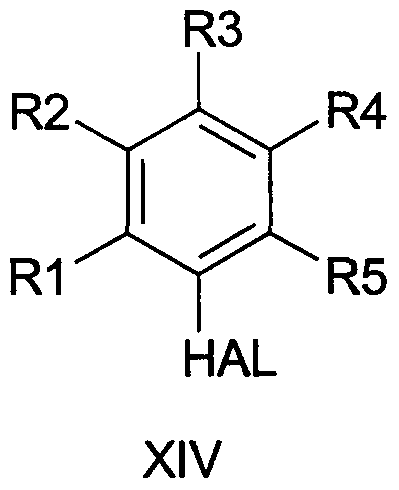
- the invention relates to a method for nucleophilic substitution on activated aromatics of the general formula XIV
- Rl, R2, R3, R4 and R5 are the same or different and are a hydrogen atom, a nitro group, a cyano group, an alkoxycarbonyl group with up to 5 C atoms, an aldehyde group, an alkylcarbonyl group with up to 5 C atoms, an arylcarbonyl group or mean an amide group, where the radicals Rl to R5 cannot all be a hydrogen atom at the same time and HAL for a halogen atom, but especially a fluorine atom, with nucleophiles such as alcohols, amines, sulfoximides, CH-acidic compounds of the formulas V to XI
- HETN denotes an aromatic aza heterocycle with a total of 5 or 6 ring atoms, where up to 3 ring atoms can be nitrogen atoms and up to two further aromatic carbon rings may be fused to the heterocycle and Rl to R5 have the meaning given above.
- 1- (Benzotriazol-1-yl) -2, -dinitrobenzene can be obtained in 96% yield by boiling benzotriazole with 2,4-dinitrochlorobenzene in toluene for 9 days (A.R. Katritzky, J. Wu, Synthesis 1994, 597).
- 4-heterocyclically substituted nitrobenzenes and benzaldehydes can be obtained by reacting the respective aza heterocycles, e.g. Benzotriazole, 1, 2, 4-triazole or benzimidazole with 4-fluorobenzaldehyde or 4-fluoro- or 4-chloro-benzaldehyde can be obtained in DMSO or DMF at 100 ° C (DJ Gale, JFK Wilshire, Aust. J. Chem. 23, 1063, 1970; J. Rosevear, JKF Wilshire, Aust. J. Chem. 44, 1097, 1991).
- Benzotriazole, 1, 2, 4-triazole or benzimidazole with 4-fluorobenzaldehyde or 4-fluoro- or 4-chloro-benzaldehyde can be obtained in DMSO or DMF at 100 ° C (DJ Gale, JFK Wilshire, Aust. J. Chem. 23, 1063, 1970; J. Roseve
- Nitrophenylazoles can by Ullmann condensation of azoles with aryl halides in pyridine in the presence of potassium carbonate and copper (II) oxide at high temperatures and long reaction times (MA Khan, JB Polya, J. Chem. Soc. (C), 1970, 85; AK Khan , EK Rocha, Chem. Pharm.
- nucleophiles V to X also react with 2-fluoronitrobenzene at room temperature in the cesium carbonate / dimethylformide system: illustration 1
- R 1 to R 5 have the meaning given above and HAL stands for a halogen atom, but in particular for a fluorine atom, investigated in the system cesium carbonate / dimethyl formamide.
- dimethylformamide instead of dimethylformamide, other dipolar aprotic solvents such as e.g. Dimethylacetamide, acetonitrile, dimethyl sulfoxide, acetone or N-methylpyrrolidone can be used, but the reaction times at room temperature are then significantly longer and the yields are often lower.
- dipolar aprotic solvents such as e.g. Dimethylacetamide, acetonitrile, dimethyl sulfoxide, acetone or N-methylpyrrolidone
- the suspension is poured onto water, the product is extracted with ethyl acetate and the crude product obtained after evaporation of the organic phase is purified using the methods customary in organic chemistry, for example by crystallization or chromatography.
- the invention is illustrated and explained by the following exemplary embodiments:
- Example 9 N-2-cyanophenyldiphenylsulfoximide from 2 fluorobenzonitrile and diphenylsulfoximide at 80 ° C for 8 h / toluene -ethanol 10 + 1 / 74.3% / mp 160 ° C
- Example 10 N-2-cyanophenyldiphenylsulfoximide from 2 fluorobenzonitrile and diphenylsulfoximide at 80 ° C for 8 h / toluene -ethanol 10 + 1 / 74.3% / mp 160 ° C
- Example 10 N-2-cyanophenyldiphenylsulfoximide from 2 fluorobenzonitrile and diphenylsulfoximide at 80 ° C for 8 h / toluene -ethanol 10 + 1 / 74.3% / mp 160 ° C
- Example 10 N-2-cyanophenyldiphenylsulfoximide from 2 fluorobenzon
- N-4-nitrophenyldiphenylsulfoximide from 4-fluoronitrobenzene and diphenylsulfoximide 64 h / toluene -ethanol 10 + 0.5 / 64.1% / mp 166 ° C
- Example 16 1 - (4-Ethoxycarbonylphenyl) indole from ethyl 4-fluorobenzoate and indole at 80 ° C
- Example 36 1- (2-nitrophenyl) indole-2-carboxylic acid ethyl ester from 2-fluoronitrobenzene and indole-2-carboxylic acid ethyl ester 58 h / toluene / 47.9% / mp 90 ° C.
- Example 37 1- (4-nitrophenyl) indole-2-carboxylic acid ethyl ester from 4-fluoronitrobenzene and indole-2-carboxylic acid ethyl ester at 80 ° C.
Landscapes
- Chemical & Material Sciences (AREA)
- Organic Chemistry (AREA)
- Chemical Kinetics & Catalysis (AREA)
- Indole Compounds (AREA)
- Plural Heterocyclic Compounds (AREA)
- Low-Molecular Organic Synthesis Reactions Using Catalysts (AREA)
- Pyrrole Compounds (AREA)
- Organic Low-Molecular-Weight Compounds And Preparation Thereof (AREA)
- Nitrogen Condensed Heterocyclic Rings (AREA)
Abstract
Description


Claims




Priority Applications (8)
| Application Number | Priority Date | Filing Date | Title |
|---|---|---|---|
| CA002360923A CA2360923A1 (en) | 1999-03-30 | 2000-02-25 | Process for the arylation of aza-heterocycles with activated aromatics in presence of caesium carbonate |
| AU38068/00A AU3806800A (en) | 1999-03-30 | 2000-02-25 | Method for arylating aza-heterocycles with activated aromatic compounds in the presence of cesium carbonate |
| BR0009432-3A BR0009432A (pt) | 1999-03-30 | 2000-02-25 | Processo para arilação de aza-heterociclos com aromáticos ativados na presença de carbonato de césio |
| EP00916872A EP1165512A2 (de) | 1999-03-30 | 2000-02-25 | Verfahren zur herstellung von n-aryl-aza-heterocyclen in gegenwart von cesiumcarbonat |
| JP2000609395A JP2002541143A (ja) | 1999-03-30 | 2000-02-25 | 炭酸セシウムの存在下における活性芳香族化合物によるアザ複素環化合物のアリール化方法 |
| US09/889,341 US6774242B1 (en) | 1999-03-30 | 2000-02-25 | Method for arylating aza-heterocycles with activated aromatic compounds in the presence of caesium carbonate |
| MXPA01009596A MXPA01009596A (es) | 1999-03-30 | 2000-02-25 | Procedimiento para arilar aza-heterociclos con aromaticos activados en la presencia de carbonato de cesio. |
| US10/892,422 US6933390B2 (en) | 1999-03-30 | 2004-07-15 | Process for the arylation of aza-heterocycles with activated aromatics in presence of caesium carbonate |
Applications Claiming Priority (2)
| Application Number | Priority Date | Filing Date | Title |
|---|---|---|---|
| DE19914610 | 1999-03-30 | ||
| DE19914610.1 | 1999-03-30 |
Related Child Applications (3)
| Application Number | Title | Priority Date | Filing Date |
|---|---|---|---|
| US09/889,341 A-371-Of-International US6774242B1 (en) | 1999-03-30 | 2000-02-25 | Method for arylating aza-heterocycles with activated aromatic compounds in the presence of caesium carbonate |
| US09889341 A-371-Of-International | 2000-02-25 | ||
| US10/892,422 Division US6933390B2 (en) | 1999-03-30 | 2004-07-15 | Process for the arylation of aza-heterocycles with activated aromatics in presence of caesium carbonate |
Publications (2)
| Publication Number | Publication Date |
|---|---|
| WO2000059883A2 true WO2000059883A2 (de) | 2000-10-12 |
| WO2000059883A3 WO2000059883A3 (de) | 2001-09-13 |
Family
ID=7903080
Family Applications (1)
| Application Number | Title | Priority Date | Filing Date |
|---|---|---|---|
| PCT/EP2000/001574 Ceased WO2000059883A2 (de) | 1999-03-30 | 2000-02-25 | Verfahren zur herstellung von n-aryl-aza-heterocyclen in gegenwart von cesiumcarbonat |
Country Status (8)
| Country | Link |
|---|---|
| US (2) | US6774242B1 (de) |
| EP (1) | EP1165512A2 (de) |
| JP (1) | JP2002541143A (de) |
| AU (1) | AU3806800A (de) |
| BR (1) | BR0009432A (de) |
| CA (1) | CA2360923A1 (de) |
| MX (1) | MXPA01009596A (de) |
| WO (1) | WO2000059883A2 (de) |
Cited By (2)
| Publication number | Priority date | Publication date | Assignee | Title |
|---|---|---|---|---|
| US7517367B2 (en) | 2004-03-06 | 2009-04-14 | Wella Ag | Cationic naphthyldiazo dyes and keratin fibers-coloring agents containing these dyes |
| CN104788355A (zh) * | 2015-04-02 | 2015-07-22 | 聊城大学 | 一种含氮杂环苯腈或邻苯二腈化合物的合成方法 |
Families Citing this family (4)
| Publication number | Priority date | Publication date | Assignee | Title |
|---|---|---|---|---|
| US8029454B2 (en) | 2003-11-05 | 2011-10-04 | Baxter International Inc. | High convection home hemodialysis/hemofiltration and sorbent system |
| MX2007012394A (es) * | 2005-04-06 | 2007-11-07 | Sicor Inc | Procesos para la preparacion de farmacos anticancer. |
| WO2018165466A1 (en) * | 2017-03-10 | 2018-09-13 | Regents Of The University Of Minnesota | Indole and indazole compounds and therapeutic uses thereof |
| CN106866561B (zh) * | 2017-04-11 | 2019-04-23 | 中国工程物理研究院化工材料研究所 | 硝基或二硝基苯基-苯并[1,2,3]三唑、衍生物及制备方法 |
Family Cites Families (1)
| Publication number | Priority date | Publication date | Assignee | Title |
|---|---|---|---|---|
| US5977361A (en) * | 1997-10-16 | 1999-11-02 | Yale University | Transition metal-catalyzed process for preparing N-aryl compounds |
-
2000
- 2000-02-25 EP EP00916872A patent/EP1165512A2/de not_active Withdrawn
- 2000-02-25 US US09/889,341 patent/US6774242B1/en not_active Expired - Fee Related
- 2000-02-25 WO PCT/EP2000/001574 patent/WO2000059883A2/de not_active Ceased
- 2000-02-25 AU AU38068/00A patent/AU3806800A/en not_active Abandoned
- 2000-02-25 BR BR0009432-3A patent/BR0009432A/pt not_active IP Right Cessation
- 2000-02-25 MX MXPA01009596A patent/MXPA01009596A/es active IP Right Grant
- 2000-02-25 JP JP2000609395A patent/JP2002541143A/ja not_active Withdrawn
- 2000-02-25 CA CA002360923A patent/CA2360923A1/en not_active Abandoned
-
2004
- 2004-07-15 US US10/892,422 patent/US6933390B2/en not_active Expired - Fee Related
Non-Patent Citations (10)
| Title |
|---|
| DINSMORE C.J. & ZARTMAN C.B.: "Arylmethanesulfonates are convenient latent phenols in the nucleophilic aromatic substitution reaction" TETRAHEDRON LETTERS, ELSEVIER SCIENCE PUBLISHERS, AMSTERDAM, NL, Bd. 40, Nr. 21, 21. Mai 1999 (1999-05-21), Seiten 3989-3990, XP004164592 ISSN: 0040-4039 * |
| FLESSNER T. & DOYE S.: "Cesium carbonate: A powerful inorganic base in organic synthesis" JOURNAL F]R PRAKTISCHE CHEMIE, CHEMIKER ZEITUNG, WILEY-VCH, WEINHEIM, DE, Bd. 341, Nr. 2, Februar 1999 (1999-02), Seiten 186-190, XP002153415 * |
| GALE D.J. & WILSHIRE J.F.K.: "The preparation of sole polymethine Astrazon dyes" AUSTRALIAN JOURNAL OF CHEMISTRY, Bd. 23, 1970, Seiten 1063-1068, XP000909779 ISSN: 0004-9425 in der Anmeldung erw{hnt * |
| LEE J.C. ET AL.: "Facile synthesis of alkyl phenyl ethers using cesium carbonate" SYNTHETIC COMMUNICATIONS, MARCEL DEKKER, INC., BASEL, CH, Bd. 25, Nr. 9, September 1995 (1995-09), Seiten 1367-1370, XP000943391 * |
| MAIORANA S. ET AL.: "Aromatic nucleophilic substitution on haloarene chromium tricarbonyl complexes: Mild N-arylation of indoles" SYNTHESIS, GEORG THIEME VERLAG. STUTTGART, DE, Mai 1998 (1998-05), Seiten 735-738, XP002157809 * |
| MANN G. ET AL.: "Palladium-catalyzed C-N(sp2) bond formation: N-arylation of aromatic and unsaturated nitrogen and the reductive elimination chemistry of palladium azolyl and methyleneamido complexes" JOURNAL OF THE AMERICAN CHEMICAL SOCIETY, AMERICAN CHEMICAL SOCIETY, WASHINGTON, US, Bd. 120, Nr. 4, 4. Februar 1998 (1998-02-04), Seiten 827-828, XP002157808 in der Anmeldung erw{hnt * |
| PARK K.K. ET AL.: "Synthesis and 1H-nmr of N-arylated nitrogen-containing aromatic heterocycles" BULLETIN OF THE KOREAN CHEMICAL SOCIETY, Bd. 6, Nr. 3, M{rz 1985 (1985-03), Seiten 141-144, XP002157810 * |
| RUSSELL STABLER S. ET AL.: "Preparation of N-arylated heterocycles by nucleophilic aromatic substitution" SYNTHETIC COMMUNICATIONS, MARCEL DEKKER, INC., BASEL, CH, Bd. 24, Nr. 1, 1994, Seiten 123-129, XP000909777 ISSN: 0039-7911 in der Anmeldung erw{hnt * |
| SMITH III W.J. & SAWYER J.S.: "A novel and selective method for the N-arylation of indoles mediated by KF/Al2O3" TETRAHEDRON LETTERS, ELSEVIER SCIENCE PUBLISHERS, AMSTERDAM, NL, Bd. 37, Nr. 3, 15. Januar 1996 (1996-01-15), Seiten 299-302, XP004030349 ISSN: 0040-4039 * |
| WOLFE J.P. & BUCHWALD S.L.: "Improved functional group compatibility in the palladium-catalyzed amination of aryl bromides" TETRAHEDRON LETTERS, ELSEVIER SCIENCE PUBLISHERS, AMSTERDAM, NL, Bd. 38, Nr. 36, 8. September 1997 (1997-09-08), Seiten 6359-6362, XP004087936 ISSN: 0040-4039 * |
Cited By (2)
| Publication number | Priority date | Publication date | Assignee | Title |
|---|---|---|---|---|
| US7517367B2 (en) | 2004-03-06 | 2009-04-14 | Wella Ag | Cationic naphthyldiazo dyes and keratin fibers-coloring agents containing these dyes |
| CN104788355A (zh) * | 2015-04-02 | 2015-07-22 | 聊城大学 | 一种含氮杂环苯腈或邻苯二腈化合物的合成方法 |
Also Published As
| Publication number | Publication date |
|---|---|
| BR0009432A (pt) | 2002-01-08 |
| CA2360923A1 (en) | 2000-10-12 |
| US20040249185A1 (en) | 2004-12-09 |
| MXPA01009596A (es) | 2003-10-14 |
| US6774242B1 (en) | 2004-08-10 |
| US6933390B2 (en) | 2005-08-23 |
| WO2000059883A3 (de) | 2001-09-13 |
| AU3806800A (en) | 2000-10-23 |
| EP1165512A2 (de) | 2002-01-02 |
| JP2002541143A (ja) | 2002-12-03 |
Similar Documents
| Publication | Publication Date | Title |
|---|---|---|
| DE3780669T2 (de) | 2-pyrazolin-5-ones und ein verfahren zu deren herstellung. | |
| DE2539452A1 (de) | 1,3,4-trisubstituierte-4-arylpiperidine | |
| JP2010508332A (ja) | メデトミジンおよびその塩類を調製する方法 | |
| DE69323667T2 (de) | 4-substituierte 1,2,4-Triazolderivate | |
| DE60303273T2 (de) | Verfahren zur Monomethylierung von stickstoffhaltigen Heterocyclen | |
| DE69314492T2 (de) | Verfahren zur herstellung von indolderivaten enthaltend einen 1,2,4-triazol-1-yl substituenten | |
| EP0124067B1 (de) | 2-(Aminoalkyl)-pyrrol-Derivate, Verfahren zu ihrer Herstellung und ihre Verwendung | |
| DE69313771T3 (de) | Carbazolon - Derivate und Verfahren zu ihrer Herstellung | |
| EP1165512A2 (de) | Verfahren zur herstellung von n-aryl-aza-heterocyclen in gegenwart von cesiumcarbonat | |
| EP0323799B1 (de) | Imidazolderivate II | |
| EP0017080A2 (de) | Verfahren zur Herstellung von Hydroxyethyl-azolen; Zwischenprodukte | |
| NL8005491A (nl) | Heterocyclische verbindingen met therapeutische wer- king. | |
| DE1620016A1 (de) | 3-(Piperazinoalkyl)-pyrazole und Verfahren zu ihrer Herstellung | |
| DD273440A5 (de) | Verfahren zur herstellung von 1,2 benzisoxazolen und 1,2-benziothiazolen | |
| DE69521295T2 (de) | Triazolderivate | |
| DE60212947T2 (de) | Verfahren zur herstellung von 5-substituierten oxazolverbindungen und 1,5-disubstituierten imidazolverbindungen | |
| JP2001342178A (ja) | 4−メチルピラゾール−5−カルボン酸化合物の製造方法 | |
| DE3421295A1 (de) | Neue pyrrolidincarbonsaeurederivative, verfahren zu ihrer herstellung | |
| US7678923B2 (en) | Method for synthesizing 5-chloro-1-aryl-4-(4,5-dicyano-1h-imidazol-2-yl)-3-alkyl-1h-pyrazole derivatives | |
| WO1998003465A1 (de) | Verfahren zur herstellung von racemischen phenethylaminen | |
| JP6182507B2 (ja) | 2,3−ジハロゲノアニリンの製造方法 | |
| DE2820013A1 (de) | Verfahren zur herstellung von o-alkylierten hydroxylaminen | |
| WO2011020579A1 (de) | Verfahren zur herstellung von 1-phenyl-1,2,4-triazolen | |
| DE69502861T2 (de) | Verfahren zur Herstellung von Beta-Nitro-Enaminen und deren Zwischenprodukten | |
| DE3434680A1 (de) | 4,5-dihydro-3(2h)-pyridazinone, verfahren zu ihrer herstellung und ihre verwendung |
Legal Events
| Date | Code | Title | Description |
|---|---|---|---|
| AK | Designated states |
Kind code of ref document: A2 Designated state(s): AE AL AU BA BB BG BR CA CN CR CU CZ DM EE GD GE HR HU ID IL IN IS JP KP KR LC LK LR LT LV MA MG MK MN MX NO NZ PL RO SG SI SK TR TT UA US UZ VN YU ZA |
|
| AL | Designated countries for regional patents |
Kind code of ref document: A2 Designated state(s): GH GM KE LS MW SD SL SZ TZ UG ZW AM AZ BY KG KZ MD RU TJ TM AT BE CH CY DE DK ES FI FR GB GR IE IT LU MC NL PT SE BF BJ CF CG CI CM GA GN GW ML MR NE SN TD TG |
|
| DFPE | Request for preliminary examination filed prior to expiration of 19th month from priority date (pct application filed before 20040101) | ||
| 121 | Ep: the epo has been informed by wipo that ep was designated in this application | ||
| ENP | Entry into the national phase |
Ref document number: 2360923 Country of ref document: CA Ref country code: CA Ref document number: 2360923 Kind code of ref document: A Format of ref document f/p: F |
|
| WWE | Wipo information: entry into national phase |
Ref document number: 2000916872 Country of ref document: EP |
|
| AK | Designated states |
Kind code of ref document: A3 Designated state(s): AE AL AU BA BB BG BR CA CN CR CU CZ DM EE GD GE HR HU ID IL IN IS JP KP KR LC LK LR LT LV MA MG MK MN MX NO NZ PL RO SG SI SK TR TT UA US UZ VN YU ZA |
|
| AL | Designated countries for regional patents |
Kind code of ref document: A3 Designated state(s): GH GM KE LS MW SD SL SZ TZ UG ZW AM AZ BY KG KZ MD RU TJ TM AT BE CH CY DE DK ES FI FR GB GR IE IT LU MC NL PT SE BF BJ CF CG CI CM GA GN GW ML MR NE SN TD TG |
|
| WWE | Wipo information: entry into national phase |
Ref document number: PA/a/2001/009596 Country of ref document: MX |
|
| ENP | Entry into the national phase |
Ref country code: JP Ref document number: 2000 609395 Kind code of ref document: A Format of ref document f/p: F |
|
| WWP | Wipo information: published in national office |
Ref document number: 2000916872 Country of ref document: EP |
|
| WWE | Wipo information: entry into national phase |
Ref document number: 09889341 Country of ref document: US |
|
| WWW | Wipo information: withdrawn in national office |
Ref document number: 2000916872 Country of ref document: EP |