WO2000064986A1 - Neue carbopyronin-fluoreszenz-farbstoffe - Google Patents
Neue carbopyronin-fluoreszenz-farbstoffe Download PDFInfo
- Publication number
- WO2000064986A1 WO2000064986A1 PCT/EP2000/003568 EP0003568W WO0064986A1 WO 2000064986 A1 WO2000064986 A1 WO 2000064986A1 EP 0003568 W EP0003568 W EP 0003568W WO 0064986 A1 WO0064986 A1 WO 0064986A1
- Authority
- WO
- WIPO (PCT)
- Prior art keywords
- compounds
- solution
- compounds according
- compound
- group
- Prior art date
- Legal status (The legal status is an assumption and is not a legal conclusion. Google has not performed a legal analysis and makes no representation as to the accuracy of the status listed.)
- Ceased
Links
Classifications
-
- G—PHYSICS
- G01—MEASURING; TESTING
- G01N—INVESTIGATING OR ANALYSING MATERIALS BY DETERMINING THEIR CHEMICAL OR PHYSICAL PROPERTIES
- G01N33/00—Investigating or analysing materials by specific methods not covered by groups G01N1/00 - G01N31/00
- G01N33/48—Biological material, e.g. blood, urine; Haemocytometers
- G01N33/50—Chemical analysis of biological material, e.g. blood, urine; Testing involving biospecific ligand binding methods; Immunological testing
- G01N33/58—Chemical analysis of biological material, e.g. blood, urine; Testing involving biospecific ligand binding methods; Immunological testing involving labelled substances
- G01N33/582—Chemical analysis of biological material, e.g. blood, urine; Testing involving biospecific ligand binding methods; Immunological testing involving labelled substances with fluorescent label
-
- C—CHEMISTRY; METALLURGY
- C09—DYES; PAINTS; POLISHES; NATURAL RESINS; ADHESIVES; COMPOSITIONS NOT OTHERWISE PROVIDED FOR; APPLICATIONS OF MATERIALS NOT OTHERWISE PROVIDED FOR
- C09B—ORGANIC DYES OR CLOSELY-RELATED COMPOUNDS FOR PRODUCING DYES, e.g. PIGMENTS; MORDANTS; LAKES
- C09B11/00—Diaryl- or thriarylmethane dyes
- C09B11/28—Pyronines ; Xanthon, thioxanthon, selenoxanthan, telluroxanthon dyes
Definitions
- the invention relates to the use of carbopyronine compounds of the general formula (I) as labeling groups in methods for the detection of analytes, new carbopyronine compounds and a method for producing these compounds.
- dyes are used as labeling or detection groups.
- fluorescent dyes have become more important in recent years and have replaced other, often cost-intensive, processes that use radioisotopes for labeling, for example.
- FITC fluorescein isothiocyanate
- FLUOS fluorescein-N-hydroxysuccinimide ester
- rhodamine derivatives etc.
- Ri, R2, R 3 , R4, R5, ⁇ and R 7 each independently represent hydrogen, halogen, a hydroxyl, amino, sulfo or carboxy or aldehyde group or a saturated or unsaturated, straight-chain, branched or cyclic hydrocarbon group with up to 20 denotes carbon atoms, the hydrocarbon groups comprising alkyl, alkenyl, alkynyl, cycloalkyl, aryl, in particular phenyl, and / or heteroaryl radicals and, if appropriate, heteroatoms such as oxygen, sulfur or nitrogen atoms or / and contain several substituents, preferably selected from halogens, hydroxy, amino, sulfo, phospho, carboxy, aldehyde, CC 4 alkoxy or / and CC 4 alkoxycarbonyl groups, or one or more of the radicals RrR each form a ring system with adjacent substituents, which may contain one or more multiple bonds,
- R 8 and R 8a each independently represent a saturated or unsaturated, straight-chain, branched or cyclic hydrocarbon group with up to 20 carbon atoms, for example a C 1 -C 6 -alkyl group, in particular methyl, ethyl, propyl or / and butyl, or is an aryl or heteroaryl group, in particular phenyl, which optionally heteroatoms such as oxygen, sulfur or nitrogen atoms and / or one or more substituents, preferably selected from halogens, hydroxy, amino, sulfo, phospho, carboxy, aldehyde, dC 4 alkoxy or / and C 1 -C 4 alkoxycarbonyl groups, or R 8 and R 8a form a ring system can, R 9 , R 10 .
- the compounds of the general formula (I) can be used as labeling groups in methods for the qualitative and / or quantitative determination of an analyte. This determination can be carried out in aqueous liquids, for example samples of body fluids such as blood, serum, plasma or urine, waste water samples or food. The method can be carried out either as a wet test, for example in a cuvette, or as a dry test on an appropriate reagent carrier.
- the analyte can be determined by means of a single reaction or by a sequence of reactions.
- the use of compounds of the general formula (I) showed very good results in chemical and in particular in medical and biological detection methods for the determination of an analyte, especially in nucleic acid sequencing methods and in protein analysis.
- the compounds of the general formula (I) can be used in all chemical, medical and biological detection methods known to the person skilled in the art, in which fluorescent dyes are suitable as a labeling group.
- the compounds of the general formula (I) are generally covalently coupled to a receptor specific for the analyte to be detected. This is done using generally known methods.
- the specific receptor can be any suitable compound or molecule, preferably it is a peptide, a polypeptide or a nucleic acid.
- the compounds or conjugates of these compounds can be used, for example, in nucleic acid hybridization processes, in particular for the sequencing of nucleic acids or immunochemical processes. Such methods are described, for example, in Sambrook et al., Molecular Cloning, A Laboratory Manual, 1989, Cold Spring Harbor.
- Another object of the present invention was to provide new carbopyronin compounds which are particularly suitable for use as a labeling group in analyte detection methods, can be prepared using simple and inexpensive methods, are easy to handle and have the disadvantages of the prior art Avoid technology at least partially.
- R 1 -R 12 and X have the meanings given above, with the proviso that when RR 3 and R 5 -R are hydrogen and R 8 , R 8a and Rg- R 12 are methyl, R 4 is not hydrogen, methyl, isopropyl, phenyl, 2,6-dimethylphenyl or 2-isopropenylphenyl.
- An advantage of the compounds (I) is that almost any substituent variation means that the properties of individual compounds, e.g. the spectroscopic properties, the position of the absorption and fluorescence maxima, the solubility properties, the fluorescence quantum yield and decay time, vary widely and can therefore be selected as desired. In this way, interference with interfering substances in samples such as serum, blood or plasma etc. can be reduced or even completely avoided.
- Some compounds of formula (I) can be prepared by processes known per se. However, the synthesis is preferably carried out using a new process which is described below and is particularly simple and inexpensive.
- R 6 are bridged with R- ⁇ or / and R 7 with R 12 , Ri with R 10 or / and R 2 with R 9 and form a ring system which can contain one or more multiple bonds .
- the ring system preferably contains one or more 5- or 6-membered rings.
- R 4 is preferably hydrogen, CrC 6 alkyl or a radical containing an aromatic ring system, for example a radical containing carboxy and / or halogen groups, such as 2-carboxy-phenyl, 2-carboxy-tetrachlorophenyl or pentafluorophenyl.
- R 8 and R 8a are preferably each independently methyl, ethyl or / and optionally substituted phenyl.
- dashed lines may mean double bonds, in the presence of which the residues R bound via a dashed line are missing, Ri, R 3 , R, R 5 , R 6 , R7, Rs, R ⁇ a, R9, R11, R12 and X as defined above and R can be the same or different on each occurrence and as R 1 -R 7 is defined above.
- the compounds preferably have a group capable of covalent coupling, for example -COOH, -NH 2 , -OH or / and -SH. Via this coupling group, the compound can be coupled to a support and / or to a biomolecule according to known methods.
- the carrier can consist of any suitable material, particularly suitable for detection methods, for example porous glass, plastics, ion exchange resins, dextranes, cellulose, cellulose derivatives and / or hydrophilic polymers.
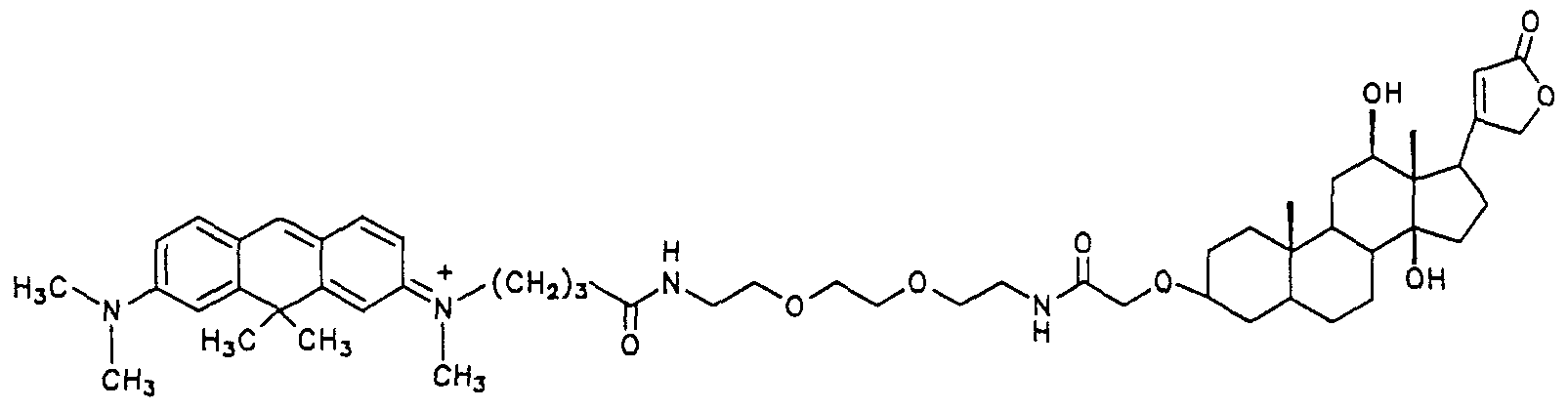
- the biomolecules are preferably selected from peptides, polypeptides, nucleotides, nucleosides, nucleic acids, nucleic acid analogues and / or haptens.
- the absorption maxima and the fluorescence quantum yield are not significantly changed by coupling the compounds according to the invention to the above-mentioned carriers and biomolecules.
- Table 1 Specific examples of compounds according to the invention are shown in Table 1 below.
- Table 1 ⁇ A absorption maximum
- ⁇ F fluorescence maximum
- Another object of the present invention was to provide a production process for carbopyronine compounds which is simple, environmentally friendly and inexpensive to carry out and which at least partially avoids the disadvantages of the known processes for producing carbopyronines.
- R 1 -R 12 and X have the meanings given in claim 1, characterized in that a compound of the general formula (II)
- n R 5 , R 6 , R 7 , R 8 , R 8a , Rn and R i2 are as defined above, or the dehydration product of II with a compound of general formula III or its dehydration product
- R1-R4, Rg and R1 0 are as defined above and
- Y represents a halogen, in particular bromine, a hydroxyl or thio group, in a suitable solvent, under acidic conditions and in the presence of a catalyst, and the compound formed by ring closure between the compounds II or their dehydration product and III is converted to structure I by oxidation .
- the compounds II or their dehydration product can be reacted with the dehydration product of III, the structure I being formed directly — without an oxidation step.
- the solvent is preferably a non-polar solvent, in particular methylene chloride, 1, 2-dichloroethane or chloroform.
- the acid is preferably an inorganic acid such as sulfuric acid, phosphoric acid or polyphosphoric acid.
- Commonly used oxidizing agents can also be used as oxidizing agents.
- the oxidizing agent is preferably tetrabutylammonium (meta) periodate.
- Illustrations 1, 2, 3 and 4 show the absorption and fluorescence spectra of the compounds AZ 2 (17), AZ 13 (20), JA 268 (16) and AZ1 1 (23).
- the ethanolic solution of oxidizing agent and leuco base is heated to boiling, whereby it can be seen by thin-layer chromatography that the oxidation is complete after only a few minutes.
- the carbopyronine is precipitated from ethanolic solution by adding 10% sodium perchlorate solution and slowly adding water dropwise as the poorly soluble perchlorate.
- the new synthesis route can be used universally.
- the corresponding alcohols can be obtained from aniline, indoline, tetrahydroquinoline and 1, 2-dihydroquinoline derivatives by means of a Vilsmaier synthesis with subsequent reduction and these can be converted to the dye with an isopropenyl derivative.
- the synthesis proceeds in one step, i.e. isolation of intermediate products is not necessary.
- the methylene chloride is distilled off on a rotary evaporator.
- the sulfuric acid solution is kept in the refrigerator overnight.
- the solution is then poured onto ice and neutralized with dilute sodium hydroxide solution.
- the aqueous solution is extracted with chloroform.
- the combined organic phases are dried over sodium sulfate, filtered and evaporated to dryness.
- the residue is taken up in 200 ml of ethanol, with 10 drops of 60% Perchloric acid and 0.17 g (0.39 mmol) tetrabutylammonium (meta) periodate added.
- the solution is heated to reflux for 30 minutes.
- the cooled solution is dropped into a solution of 20 g of sodium perchlorate in 1 liter of water. You stir overnight.
- the deep red colored reaction mixture is dropped into 100 ml ice-cold ethanol, with 0.78 g (1.8 mmol) tetrabutyl lammonium (meta) periodate added and heated to boiling for 3 min.
- the mixture is allowed to cool to room temperature and 50 ml of 20% sodium perchlorate solution are added.
- 300 ml of water are added dropwise to completely precipitate the dye.
- the crystalline product is filtered off and dried in a desiccator under vacuum with SICAPENT ® . Yield: 0.7 g of 1 H-NMR data in acetone-d 6:
- the methylene chloride is distilled off on a rotary evaporator and the sulfuric acid solution is stirred at room temperature for 1 h.
- the residue is taken up in 400 ml of ice-cold ethanol. 1.2 g (2.7 mmol) of tetrabutylammonium (meta) periodate are added.
- the solution is briefly heated to boiling, cooled and mixed with 200 ml of a 20% sodium perchlorate solution. Then 500 ml of water are added dropwise. The precipitate is filtered off and dried in a desiccator.
- JA 267 JA 267 are refluxed in a mixture of 50 ml of acetone, 50 ml of water and 5 ml of 2N hydrochloric acid for 6 hours.
- the solvent is distilled off and the residue is purified by chromatography.
- connection JF 19 To a solution of 50 mg (0.16 mmol) of 2,10-bis (dimethylamino) anthrone in 10 ml of dry tetrahydrofuran, 0.27 ml (0.81 mmol) of a 3 M methylmagnesium bromide solution are added dropwise in an argon protective gas atmosphere at room temperature Given diethyl ether. When the reaction is complete, the mixture is cooled in an ice-water bath, the reaction mixture is dissolved in 50 ml of ethanol and acidified with trifluoroacetic acid. This solution is suspended in a mixture of 50 ml of chloroform and 50 ml of water.
- the reaction mixture is cooled in an ice-water bath, the reaction mixture is dissolved in 50 ml of ethanol and acidified with trifluoroacetic acid. This solution is suspended in a mixture of 50 ml of chloroform and 50 ml of water. The organic phase is separated off, concentrated to dryness on a rotary evaporator and purified by column chromatography over silica gel. After the dye fraction was evaporated to dryness on a rotary evaporator, it is dissolved in ethanol and then in 100 ml of 25% aqueous solution Sodium perchlorate solution dropped. Then 300 ml of water are added dropwise. The precipitated dye is filtered and dried in vacuo. Yield: 0.02 g
- the temperature should not exceed - 70 ° C.
- the mixture is then warmed to -60 ° C. and stirred for 3 hours.
- the cooling bath is removed and allowed to warm to room temperature.
- the mixture is cooled in an ice-water bath, the reaction mixture is dissolved in 50 ml of ethanol and acidified with trifluoroacetic acid. This solution is suspended in a mixture of 50 ml of chloroform and 50 ml of water.
- the organic phase is separated off, evaporated to dryness on a rotary evaporator and purified by column chromatography.
- the dye fraction is evaporated to dryness on a rotary evaporator, taken up in ethanol and then added dropwise to 100 ml of aqueous 25% sodium perchlorate solution. After the addition has ended, 300 ml of water are added dropwise.
- the precipitated dye is filtered and dried in vacuo. Connection AZ 18
- reaction mixture is heated to reflux for 2 hours, cooled and hydrolyzed dropwise with water. 50 ml of water and 50 ml of ether are added and saturated ammonium chloride solution is added until the white precipitate has dissolved again. The aqueous phase is extracted with ether. The combined organic phases are washed with saturated sodium bicarbonate solution and with water. It is then dried over sodium sulfate and the solvent is distilled off. The remaining light yellow oil can be used directly for the subsequent reaction.
- tetrabutylammonium (meta) periodate 1.2 g (2.7 mmol) of tetrabutylammonium (meta) periodate are added. The solution is briefly heated to boiling, cooled and mixed with 100 ml of a 20% sodium perchlorate solution. Then 250 ml of water are added dropwise. The precipitate is filtered off and dried in a desiccator.
- the solution is allowed to warm to room temperature and stirred at room temperature for 18 h. It is cooled in an ice-water bath, the reaction mixture is dissolved in 50 ml of ethanol and acidified with trifluoroacetic acid. This solution is suspended in a mixture of 50 ml of chloroform and 50 ml of water. The organic phase is separated off, evaporated to dryness on a rotary evaporator, and purified by column chromatography over silica gel. The dye is eluted with 15% ethanolic chloroform. After the product phase has been evaporated to dryness on a rotary evaporator, it is dissolved in ethanol and then added dropwise in 100 ml of aqueous 25% sodium perchlorate solution. After the addition has ended, 300 ml of water are added dropwise. The precipitating dye is filtered and dried over phosphorus pentoxide in a vacuum desiccator.
- JF 30 80 mg (0.14 mmol) of JF 30 are refluxed in 10 ml of a 1: 3 mixture of 2 M hydrochloric acid and acetone for 40 min. The mixture is allowed to cool and is suspended in 50 ml of a 1: 1 mixture of chloroform and water. The water phase is neutralized with saturated sodium bicarbonate solution. The organic phase is separated off and the aqueous phase is extracted several times with 20% ethanolic chloroform. The combined organic phases are evaporated in a rotary evaporator and purified by column chromatography over silica gel. The dye is eluted with 20% ethanolic chloroform.
- the product phase After the product phase has been evaporated to dryness on a rotary evaporator, it is dissolved in ethanol and then added dropwise in 100 ml of aqueous 25% sodium perchlorate solution. After the addition has ended, 300 ml of water are added dropwise. The precipitating dye is filtered and dried over phosphorus pentoxide in a vacuum desiccator.
- JF 31 70 mg (0.12 mmol) of JF 31 are refluxed in a 10% sodium hydroxide solution in 1: 1 ethanol and water for 1 h.
- the mixture is allowed to cool and is suspended in a 1: 1 mixture of chloroform and water.
- the pH is adjusted to 8 with trifluoroacetic acid and the organic phase is separated off.
- the aqueous phase is extracted several times with 20% ethanolic chloroform. This extraction is repeated until there is hardly any dye left in the aqueous phase (acidification test).
- JF 17 70 mg (0.12 mmol) of JF 17 are refluxed in 30 ml of a solution of 3 g of sodium hydroxide in ethanol / water (1: 1) for 1 h. The mixture is allowed to cool and the solution is neutralized with half-concentrated hydrochloric acid. The dye is then precipitated by the dropwise addition of water. It is filtered off and the product is dried in a vacuum desiccator over phosphorus pentoxide.
- the sulfuric acid solution is then added to 1000 ml of ice-cooled ethanol and 50 ml of 60% perchloric acid and 5 l are added dropwise.
- the precipitated dye is filtered off and dried over phosphorus pentoxide in a vacuum desiccator.
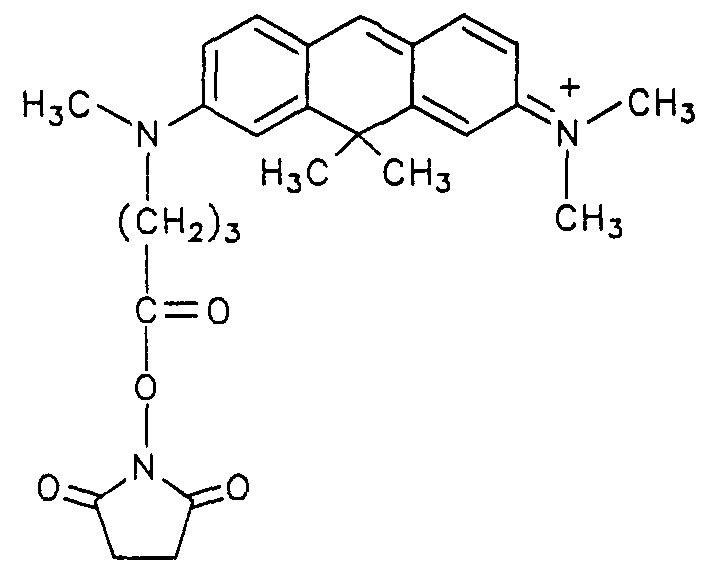
- 0.1 mmol JA 262 are dissolved with 0.2 mmol N-hydroxysuccinimide and 0.2 mmol dicyclohexylcarbodiimide in 20 ml acetonitrile. The mixture is allowed to stir at room temperature for 4 h and the product mixture is rotated in. The purification is carried out by chromatography (HPLC, RP 18).
- JA 262-dUTP conjugate 10 ⁇ mol of 5- (3-aminoallyl) -UTP are dissolved in 0.5 ml of 0.1 M sodium borate buffer (pH 8) and a solution of 5 ⁇ mol of JA 262 active ester in 1 ml of amine-free dimethylformamide is added. The solution is stirred for 15 h at room temperature. The solvents are distilled off in vacuo and the residue is purified by chromatography (RP 18).
Landscapes
- Health & Medical Sciences (AREA)
- Life Sciences & Earth Sciences (AREA)
- Engineering & Computer Science (AREA)
- Chemical & Material Sciences (AREA)
- Immunology (AREA)
- Urology & Nephrology (AREA)
- Biomedical Technology (AREA)
- Molecular Biology (AREA)
- Hematology (AREA)
- Biotechnology (AREA)
- General Health & Medical Sciences (AREA)
- Cell Biology (AREA)
- Organic Chemistry (AREA)
- Food Science & Technology (AREA)
- Medicinal Chemistry (AREA)
- Physics & Mathematics (AREA)
- Analytical Chemistry (AREA)
- Biochemistry (AREA)
- Microbiology (AREA)
- General Physics & Mathematics (AREA)
- Pathology (AREA)
- Investigating Or Analysing Materials By The Use Of Chemical Reactions (AREA)
- Nitrogen Condensed Heterocyclic Rings (AREA)
- Investigating Or Analysing Biological Materials (AREA)
- Other In-Based Heterocyclic Compounds (AREA)
- Indole Compounds (AREA)
- Plural Heterocyclic Compounds (AREA)
Abstract
Description




Claims


Priority Applications (5)
| Application Number | Priority Date | Filing Date | Title |
|---|---|---|---|
| EP00922654A EP1173519B1 (de) | 1999-04-27 | 2000-04-19 | Neue carbopyronin-fluoreszenz-farbstoffe |
| DE50003369T DE50003369D1 (de) | 1999-04-27 | 2000-04-19 | Neue carbopyronin-fluoreszenz-farbstoffe |
| JP2000614327A JP4921641B2 (ja) | 1999-04-27 | 2000-04-19 | 新規のカルボピロニン蛍光色素 |
| US09/980,531 US6828159B1 (en) | 1999-04-27 | 2000-04-19 | Carbopyronine fluorescent dyes |
| AU42971/00A AU4297100A (en) | 1999-04-27 | 2000-04-19 | Novel carbopyronine fluorescence dyes |
Applications Claiming Priority (2)
| Application Number | Priority Date | Filing Date | Title |
|---|---|---|---|
| DE19919119A DE19919119A1 (de) | 1999-04-27 | 1999-04-27 | Neue Carbopyronin-Fluoreszenz-Farbstoffe |
| DE19919119.0 | 1999-04-27 |
Publications (1)
| Publication Number | Publication Date |
|---|---|
| WO2000064986A1 true WO2000064986A1 (de) | 2000-11-02 |
Family
ID=7906033
Family Applications (1)
| Application Number | Title | Priority Date | Filing Date |
|---|---|---|---|
| PCT/EP2000/003568 Ceased WO2000064986A1 (de) | 1999-04-27 | 2000-04-19 | Neue carbopyronin-fluoreszenz-farbstoffe |
Country Status (6)
| Country | Link |
|---|---|
| US (1) | US6828159B1 (de) |
| EP (1) | EP1173519B1 (de) |
| JP (1) | JP4921641B2 (de) |
| AU (1) | AU4297100A (de) |
| DE (2) | DE19919119A1 (de) |
| WO (1) | WO2000064986A1 (de) |
Cited By (6)
| Publication number | Priority date | Publication date | Assignee | Title |
|---|---|---|---|---|
| EP1623701A1 (de) * | 2004-06-01 | 2006-02-08 | L'oreal | Verwendung von Triarylmethan-Derivaten als direkte Farbstoffe in Färbemittel, Zusammensetzung und Verfahren zur deren Verwendung |
| US7935822B2 (en) | 2002-12-18 | 2011-05-03 | Atto-Tec Gmbh | Carboxamide-substituted dyes for analytical applications |
| EP2332918A1 (de) | 2003-07-02 | 2011-06-15 | ATTO-TEC GmbH | Sulfonamidderivate polycyclischer Farbstoffe für analytische Anwendungen |
| WO2015175870A1 (en) * | 2014-05-16 | 2015-11-19 | Life Technologies Corporation | Carbopyronone compounds useful as diagnostic adjuvants |
| US10059843B2 (en) | 2015-11-16 | 2018-08-28 | StoreDot Ltd. | Rhodamine derivatives dyes, color-conversion-layer and uses thereof |
| US10227492B2 (en) | 2015-11-16 | 2019-03-12 | StoreDot Ltd. | Modifications of the sol-gel films and production processes thereof |
Families Citing this family (12)
| Publication number | Priority date | Publication date | Assignee | Title |
|---|---|---|---|---|
| WO2003007296A1 (en) * | 2001-07-13 | 2003-01-23 | Ciba Specialty Chemicals Holding Inc. | Fast-writable and precision-writable high-capacity optical storage media |
| WO2004003510A2 (en) * | 2002-07-01 | 2004-01-08 | Guava Technologies, Inc. | Fluorescent dyes, energy transfer couples and methods |
| DE102010042634A1 (de) * | 2010-10-19 | 2012-04-19 | Atto-Tec Gmbh | Neue Amin-substituierte tricyclische Fluoreszenzfarbstoffe |
| EP2748173B1 (de) | 2011-08-26 | 2016-11-23 | Ecole Polytechnique Federale De Lausanne (EPFL) EPFL-TTO | Zelldurchlässiger fluoreszenzfarbstoff |
| EP3293230A1 (de) | 2016-09-12 | 2018-03-14 | Max-Planck-Gesellschaft zur Förderung der Wissenschaften e.V. | Zellenpenetrierende fluoreszenzfarbstoffe mit sekundären alkoholfunktionalitäten |
| US10975427B2 (en) | 2017-01-20 | 2021-04-13 | Omniome, Inc. | Process for cognate nucleotide detection in a nucleic acid sequencing workflow |
| JP6824202B2 (ja) * | 2017-03-27 | 2021-02-03 | 東友ファインケム株式会社Dongwoo Fine−Chem Co., Ltd. | 着色樹脂組成物 |
| EP3461814A1 (de) | 2017-09-29 | 2019-04-03 | ATTO-TEC GmbH | Neue poly-sulfonierte fluoreszenz-farbstoffe |
| WO2019079593A1 (en) | 2017-10-19 | 2019-04-25 | Omniome, Inc. | BACKGROUND NOISE REDUCTION AND STABILIZATION OF SIMULTANEOUS COMPLEXES IN LINKED ASSAY WORKFLOWS |
| CN108864733B (zh) * | 2018-05-17 | 2019-11-19 | 山西大学 | 一种近红外碳罗丹明荧光染料及其合成方法 |
| US11155713B2 (en) | 2018-05-29 | 2021-10-26 | Elitechgroup, Inc. | Carborhodamine compounds and methods of preparation thereof |
| KR102228538B1 (ko) | 2018-06-01 | 2021-03-15 | 주식회사 엘지화학 | 염료 화합물 및 포토폴리머 조성물 |
Citations (2)
| Publication number | Priority date | Publication date | Assignee | Title |
|---|---|---|---|---|
| EP0543333A1 (de) * | 1991-11-18 | 1993-05-26 | Roche Diagnostics GmbH | Neue pentacyclische Verbindungen und ihre Verwendung als Absorptions- oder Fluoreszenzfarbstoffe |
| US5366860A (en) * | 1989-09-29 | 1994-11-22 | Applied Biosystems, Inc. | Spectrally resolvable rhodamine dyes for nucleic acid sequence determination |
Family Cites Families (3)
| Publication number | Priority date | Publication date | Assignee | Title |
|---|---|---|---|---|
| US4320940A (en) * | 1978-06-19 | 1982-03-23 | Mueller Gary E | Optical filtering element |
| US5561045A (en) * | 1994-01-04 | 1996-10-01 | Intracel Corporation | Detection reagent, article, and immunoassay method |
| US6183968B1 (en) * | 1998-03-27 | 2001-02-06 | Incyte Pharmaceuticals, Inc. | Composition for the detection of genes encoding receptors and proteins associated with cell proliferation |
-
1999
- 1999-04-27 DE DE19919119A patent/DE19919119A1/de not_active Withdrawn
-
2000
- 2000-04-19 AU AU42971/00A patent/AU4297100A/en not_active Abandoned
- 2000-04-19 US US09/980,531 patent/US6828159B1/en not_active Expired - Lifetime
- 2000-04-19 DE DE50003369T patent/DE50003369D1/de not_active Expired - Lifetime
- 2000-04-19 JP JP2000614327A patent/JP4921641B2/ja not_active Expired - Fee Related
- 2000-04-19 WO PCT/EP2000/003568 patent/WO2000064986A1/de not_active Ceased
- 2000-04-19 EP EP00922654A patent/EP1173519B1/de not_active Expired - Lifetime
Patent Citations (2)
| Publication number | Priority date | Publication date | Assignee | Title |
|---|---|---|---|---|
| US5366860A (en) * | 1989-09-29 | 1994-11-22 | Applied Biosystems, Inc. | Spectrally resolvable rhodamine dyes for nucleic acid sequence determination |
| EP0543333A1 (de) * | 1991-11-18 | 1993-05-26 | Roche Diagnostics GmbH | Neue pentacyclische Verbindungen und ihre Verwendung als Absorptions- oder Fluoreszenzfarbstoffe |
Non-Patent Citations (3)
| Title |
|---|
| C. AARON AND C.C. BARKER: "Steric Effects in Di- and Tri-arylmethane Dyes. Part X.", JOURNAL OF THE CHEMICAL SOCIETY, SECTION B: PHYSICAL ORGANIC CHEMISTRY., no. 2, 1971, CHEMICAL SOCIETY. LETCHWORTH., GB, pages 319 - 324, XP002140950 * |
| G. HALLAS: "Electronic Absorption Spectrum of the alpha-1-Adamantyl Derivative of Michler's Hydrol Blue", JOURNAL OF THE CHEMICAL SOCIETY, SECTION B: PHYSICAL ORGANIC CHEMISTRY., no. 1, 1967, CHEMICAL SOCIETY. LETCHWORTH., GB, pages 91 - 92, XP002140951 * |
| R.W. CASTELINO AND G. HALLAS: "Electronic Absorption Spectra of Some Analogues and Derivatives of Michler's Ketone", JOURNAL OF THE CHEMICAL SOCIETY, SECTION B: PHYSICAL ORGANIC CHEMISTRY., no. 7, 1971, CHEMICAL SOCIETY. LETCHWORTH., GB, pages 1468 - 1471, XP002140952 * |
Cited By (14)
| Publication number | Priority date | Publication date | Assignee | Title |
|---|---|---|---|---|
| US7935822B2 (en) | 2002-12-18 | 2011-05-03 | Atto-Tec Gmbh | Carboxamide-substituted dyes for analytical applications |
| US8530660B2 (en) | 2002-12-18 | 2013-09-10 | Atto-Tec Gmbh | Carboxamide-substituted dyes for analytical applications |
| US8614317B2 (en) | 2003-07-02 | 2013-12-24 | Atto-Tec Gmbh | Sulfonamide derivatives of polycyclic dyes used for analytical applications |
| EP2332918A1 (de) | 2003-07-02 | 2011-06-15 | ATTO-TEC GmbH | Sulfonamidderivate polycyclischer Farbstoffe für analytische Anwendungen |
| EP2374795A1 (de) | 2003-07-02 | 2011-10-12 | ATTO-TEC GmbH | Sulfonsäurederivate polycyclischer Farbstoffe für analytische Anwendungen |
| US8846924B2 (en) | 2003-07-02 | 2014-09-30 | Atto-Tec Gmbh | Sulfonamide derivatives of polycyclic dyes used for analytical applications |
| US9035042B2 (en) | 2003-07-02 | 2015-05-19 | Atto-Tec Gmbh | Sulfonamide derivatives of polycyclic dyes used for analytical applications |
| US7329289B2 (en) * | 2004-06-01 | 2008-02-12 | L'Oréal, S.A. | Use of triarylmethane derivatives as direct dyes in a dye composition, composition and implementation process |
| EP1623701A1 (de) * | 2004-06-01 | 2006-02-08 | L'oreal | Verwendung von Triarylmethan-Derivaten als direkte Farbstoffe in Färbemittel, Zusammensetzung und Verfahren zur deren Verwendung |
| WO2015175870A1 (en) * | 2014-05-16 | 2015-11-19 | Life Technologies Corporation | Carbopyronone compounds useful as diagnostic adjuvants |
| US10018617B2 (en) | 2014-05-16 | 2018-07-10 | Life Technologies Corporation | Carbopyronone compounds useful as diagnostic adjuvants |
| US10739330B2 (en) | 2014-05-16 | 2020-08-11 | Life Technologies Corporation | Carbopyronone compounds useful as diagnostic adjuvants |
| US10059843B2 (en) | 2015-11-16 | 2018-08-28 | StoreDot Ltd. | Rhodamine derivatives dyes, color-conversion-layer and uses thereof |
| US10227492B2 (en) | 2015-11-16 | 2019-03-12 | StoreDot Ltd. | Modifications of the sol-gel films and production processes thereof |
Also Published As
| Publication number | Publication date |
|---|---|
| JP4921641B2 (ja) | 2012-04-25 |
| DE19919119A1 (de) | 2000-11-02 |
| AU4297100A (en) | 2000-11-10 |
| US6828159B1 (en) | 2004-12-07 |
| DE50003369D1 (de) | 2003-09-25 |
| EP1173519A1 (de) | 2002-01-23 |
| JP2002543233A (ja) | 2002-12-17 |
| EP1173519B1 (de) | 2003-08-20 |
Similar Documents
| Publication | Publication Date | Title |
|---|---|---|
| EP1173519B1 (de) | Neue carbopyronin-fluoreszenz-farbstoffe | |
| DE69817165T2 (de) | Sulfonierte xanthenderivate | |
| DE69731179T3 (de) | Fluorierte xanthenderivate | |
| Shen et al. | Building Rhodamine-BODIPY fluorescent platform using Click reaction: Naked-eye visible and multi-channel chemodosimeter for detection of Fe3+ and Hg2+ | |
| AT405461B (de) | Lumineszenzindikator | |
| EP3461815B1 (de) | Neue poly-sulfonierte fluoreszenz-farbstoffe | |
| DE3881735T2 (de) | Diagnostischer Fluoreszenztest, Testbestandteile und Konjugate. | |
| DE102010042634A1 (de) | Neue Amin-substituierte tricyclische Fluoreszenzfarbstoffe | |
| EP0567622B1 (de) | Neue pentacyclische verbindungen und ihre verwendung als absorptions- oder fluoreszenzfarbstoffe | |
| CN109608414B (zh) | 检测过氧亚硝酸根的荧光探针及其制备方法和应用 | |
| EP0747447A2 (de) | Neue Oxazinfarbstoffe und ihre Verwendung als Fluoreszenzmarker | |
| WO1992008720A1 (en) | Photo-labile compounds, their synthesis and use as fluorophores | |
| DE29610062U1 (de) | Versteifte Monomethincyanin-Farbstoffe | |
| EP1054039B1 (de) | Neue Fluoreszenzfarbstoffe und ihre Verwendung als Fluoreszenzmarker | |
| EP0578067A1 (de) | Fotochemische Markierung von Nukleinsäuren mit Europiumchelat-Reagenzien und ihre Verwendung in Gensondentestsystemen | |
| EP1317511A1 (de) | Oxazinderivate | |
| CN108484479B (zh) | 一种咔唑基双光子荧光探针及其制备方法和用途 | |
| EP1173520B1 (de) | Neue amidopyrylium-fluoreszenz-farbstoffe | |
| CN110487761B (zh) | 检测汞离子的荧光探针及其制备方法与使用方法 | |
| CN113354612A (zh) | 基于吡罗红的线粒体和核仁rna近红外荧光探针、制备及应用 | |
| CN111334070B (zh) | 一类532nm激发的罗丹明类荧光染料及其制备方法 | |
| CN117050070B (zh) | 一种荧光探针及其制备方法和在Aβ检测中的应用 | |
| DE69024717T2 (de) | 7-Hydroxy-Cumarine mit Substituenten in 4-Stellung | |
| EP0281829A2 (de) | Addukte aus Ketoverbindungen und Anionen von Oxasäuren, Verfahren zu deren Herstellung, deren Verwendung sowie Azoketoverbindungen. | |
| DE4222254A1 (de) | Fotochemische Markierung von Nukleinsäuren mit Digoxigenin-Reagenzien und ihre Verwendung in Gensondentestsystemen |
Legal Events
| Date | Code | Title | Description |
|---|---|---|---|
| AK | Designated states |
Kind code of ref document: A1 Designated state(s): AU CA CN JP US |
|
| AL | Designated countries for regional patents |
Kind code of ref document: A1 Designated state(s): AT BE CH CY DE DK ES FI FR GB GR IE IT LU MC NL PT SE |
|
| DFPE | Request for preliminary examination filed prior to expiration of 19th month from priority date (pct application filed before 20040101) | ||
| 121 | Ep: the epo has been informed by wipo that ep was designated in this application | ||
| ENP | Entry into the national phase |
Ref country code: JP Ref document number: 2000 614327 Kind code of ref document: A Format of ref document f/p: F |
|
| WWE | Wipo information: entry into national phase |
Ref document number: 09980531 Country of ref document: US |
|
| WWE | Wipo information: entry into national phase |
Ref document number: 2000922654 Country of ref document: EP |
|
| WWP | Wipo information: published in national office |
Ref document number: 2000922654 Country of ref document: EP |
|
| WWG | Wipo information: grant in national office |
Ref document number: 2000922654 Country of ref document: EP |