WO2000073517A1 - Process for the improvement of the magnetic characteristics in grain oriented electrical silicon steel sheets by laser treatment - Google Patents
Process for the improvement of the magnetic characteristics in grain oriented electrical silicon steel sheets by laser treatment Download PDFInfo
- Publication number
- WO2000073517A1 WO2000073517A1 PCT/EP2000/004577 EP0004577W WO0073517A1 WO 2000073517 A1 WO2000073517 A1 WO 2000073517A1 EP 0004577 W EP0004577 W EP 0004577W WO 0073517 A1 WO0073517 A1 WO 0073517A1
- Authority
- WO
- WIPO (PCT)
- Prior art keywords
- comprised
- process according
- fact
- strip
- laser beam
- Prior art date
- Legal status (The legal status is an assumption and is not a legal conclusion. Google has not performed a legal analysis and makes no representation as to the accuracy of the status listed.)
- Ceased
Links
Classifications
-
- C—CHEMISTRY; METALLURGY
- C21—METALLURGY OF IRON
- C21D—MODIFYING THE PHYSICAL STRUCTURE OF FERROUS METALS; GENERAL DEVICES FOR HEAT TREATMENT OF FERROUS OR NON-FERROUS METALS OR ALLOYS; MAKING METAL MALLEABLE, e.g. BY DECARBURISATION OR TEMPERING
- C21D8/00—Modifying the physical properties of ferrous metals or ferrous alloys by deformation combined with, or followed by, heat treatment
- C21D8/12—Modifying the physical properties of ferrous metals or ferrous alloys by deformation combined with, or followed by, heat treatment during manufacturing of articles with special electromagnetic properties
- C21D8/1277—Modifying the physical properties of ferrous metals or ferrous alloys by deformation combined with, or followed by, heat treatment during manufacturing of articles with special electromagnetic properties involving a particular surface treatment
-
- C—CHEMISTRY; METALLURGY
- C21—METALLURGY OF IRON
- C21D—MODIFYING THE PHYSICAL STRUCTURE OF FERROUS METALS; GENERAL DEVICES FOR HEAT TREATMENT OF FERROUS OR NON-FERROUS METALS OR ALLOYS; MAKING METAL MALLEABLE, e.g. BY DECARBURISATION OR TEMPERING
- C21D8/00—Modifying the physical properties of ferrous metals or ferrous alloys by deformation combined with, or followed by, heat treatment
- C21D8/12—Modifying the physical properties of ferrous metals or ferrous alloys by deformation combined with, or followed by, heat treatment during manufacturing of articles with special electromagnetic properties
- C21D8/1294—Modifying the physical properties of ferrous metals or ferrous alloys by deformation combined with, or followed by, heat treatment during manufacturing of articles with special electromagnetic properties involving a localised treatment
-
- B—PERFORMING OPERATIONS; TRANSPORTING
- B23—MACHINE TOOLS; METAL-WORKING NOT OTHERWISE PROVIDED FOR
- B23K—SOLDERING OR UNSOLDERING; WELDING; CLADDING OR PLATING BY SOLDERING OR WELDING; CUTTING BY APPLYING HEAT LOCALLY, e.g. FLAME CUTTING; WORKING BY LASER BEAM
- B23K26/00—Working by laser beam, e.g. welding, cutting or boring
- B23K26/352—Working by laser beam, e.g. welding, cutting or boring for surface treatment
-
- C—CHEMISTRY; METALLURGY
- C21—METALLURGY OF IRON
- C21D—MODIFYING THE PHYSICAL STRUCTURE OF FERROUS METALS; GENERAL DEVICES FOR HEAT TREATMENT OF FERROUS OR NON-FERROUS METALS OR ALLOYS; MAKING METAL MALLEABLE, e.g. BY DECARBURISATION OR TEMPERING
- C21D10/00—Modifying the physical properties by methods other than heat treatment or deformation
- C21D10/005—Modifying the physical properties by methods other than heat treatment or deformation by laser shock processing
-
- C—CHEMISTRY; METALLURGY
- C21—METALLURGY OF IRON
- C21D—MODIFYING THE PHYSICAL STRUCTURE OF FERROUS METALS; GENERAL DEVICES FOR HEAT TREATMENT OF FERROUS OR NON-FERROUS METALS OR ALLOYS; MAKING METAL MALLEABLE, e.g. BY DECARBURISATION OR TEMPERING
- C21D6/00—Heat treatment of ferrous alloys
- C21D6/008—Heat treatment of ferrous alloys containing Si
-
- C—CHEMISTRY; METALLURGY
- C22—METALLURGY; FERROUS OR NON-FERROUS ALLOYS; TREATMENT OF ALLOYS OR NON-FERROUS METALS
- C22C—ALLOYS
- C22C38/00—Ferrous alloys, e.g. steel alloys
- C22C38/02—Ferrous alloys, e.g. steel alloys containing silicon
-
- C—CHEMISTRY; METALLURGY
- C21—METALLURGY OF IRON
- C21D—MODIFYING THE PHYSICAL STRUCTURE OF FERROUS METALS; GENERAL DEVICES FOR HEAT TREATMENT OF FERROUS OR NON-FERROUS METALS OR ALLOYS; MAKING METAL MALLEABLE, e.g. BY DECARBURISATION OR TEMPERING
- C21D8/00—Modifying the physical properties of ferrous metals or ferrous alloys by deformation combined with, or followed by, heat treatment
- C21D8/12—Modifying the physical properties of ferrous metals or ferrous alloys by deformation combined with, or followed by, heat treatment during manufacturing of articles with special electromagnetic properties
- C21D8/1244—Modifying the physical properties of ferrous metals or ferrous alloys by deformation combined with, or followed by, heat treatment during manufacturing of articles with special electromagnetic properties characterised by the heat treatment
- C21D8/1272—Final recrystallisation annealing
-
- C—CHEMISTRY; METALLURGY
- C21—METALLURGY OF IRON
- C21D—MODIFYING THE PHYSICAL STRUCTURE OF FERROUS METALS; GENERAL DEVICES FOR HEAT TREATMENT OF FERROUS OR NON-FERROUS METALS OR ALLOYS; MAKING METAL MALLEABLE, e.g. BY DECARBURISATION OR TEMPERING
- C21D8/00—Modifying the physical properties of ferrous metals or ferrous alloys by deformation combined with, or followed by, heat treatment
- C21D8/12—Modifying the physical properties of ferrous metals or ferrous alloys by deformation combined with, or followed by, heat treatment during manufacturing of articles with special electromagnetic properties
- C21D8/1277—Modifying the physical properties of ferrous metals or ferrous alloys by deformation combined with, or followed by, heat treatment during manufacturing of articles with special electromagnetic properties involving a particular surface treatment
- C21D8/1283—Application of a separating or insulating coating
Definitions
- the present invention refers to a process for the improvement of magnetic characteristics in grain oriented electrical silicon steel sheets by laser scribing, and more particularly it refers to a radiation process of the steel sheet after final annealing , in order to improve its induction characteristics losses and magnetostriction, with respect to the non-treated steel sheet State of the art
- Gra i n oriented electrical silicon steel sheets are mainly used in the manufacturing of cores for transformers, in this use, one of the most studied magnetic characteristics of the material, particularly after the oil crisis of the Seventies and more recently according to the increasing interest in energetic saving, is the one related to the so-called core losses, or losses, that is to say related to the quantity of energy lost during the working of the transformer. Losses are expressed in watt by kg of weight of the core and depend on various factors and particularly by the movement of the magnetic domain walls, defined as areas within the material wherein electrons responsible for the ferromagnetism have parallel spins and therefore a magnetic moment which is not null.
- the magnetic moment within a single domain is oriented according to the directions of easy magnetization, that is to say according to the crystallographic directions ⁇ 100>
- Domain walls are areas among adjacent domains through which the magnetic moment rotates and they are characterized by the value of this rotation, therefore we are talking about 180° and non-180° walls (in this material 90°)
- initial magnetization essentially takes place by movement of the domain wails, the ones being favorably oriented with respect to the applied field, take less energy and grow at the expenses of the other domains by lateral movement of the walls at 180°.
- a higher mobility of the walls makes magnetization easier and therefore the movement of the walls needs less energy
- Energetic consumption associated with the movement of the walls at 180° is due to the electromotive forces generated by the movements of the walls opposing to this movement.
- a further step has been the one related to the treatment of the steel sheet surface with concentrated energetic pulses in the form of laser beams, electron beams, plasma and the like.
- This temperature limit is due to the fact that improvements on losses due to the laser-type treatments completely disappear at temperatures higher than 500-600°C.
- This patent states that the laser treatment effects are used not only in order to reduce losses, but also to improve magnetostriction; however, on this aspect, no convincing demonstrations of the results obtained are given; in fact, Table 1 -the only one in which magnetostriction evaluations are given- shows that measures concerning magnetostriction are expressed as size variations under a mechanical load of 17 kg. Therefore, in this regard, it must be pointed out that, as it is well known, a mechanical traction improves the magnetostriction.
- the results according to the invention are lower, as long as magnetostriction is concerned, than the ones which can be obtained by simply applying the final insulating coating, without laser treatment. Therefore, the only advantage of the laser treatment is to improve the value of the total core losses.
- European Patent Application n. 611.829 filed on August 24 th 1994 refers to the electronic beam treatment of an electrical oriented grain steel sheet surface, in order to obtain a product (core of transformer) having improved characteristics in shape and acoustic emissions.
- the invention consists in the fact that the steel sheet, provided with final insulating coating, is radiated with an electron beam sent on the steel sheet in such a way to follow a continuous or discontinuous zigzag path, so that the electron beam traces correspond to the apexes of the zigzag path.
- scope of the present invention is to obtain a laser treatment of magnetic oriented grain steel sheets able to absolutely improve values of core losses, magnetostriction and induction measured at 800 A/m values (from now on B800). Another scope of the present invention is to carry out the laser treatment in order not to damage the steel sheet insulating coating.
- a further scope of the present invention is to avoid the additional cost -necessary up to now- of a final insulating coating of the steel sheet after the laser treatment.
- Description of the invention The present invention relates to a process wherein a oriented grain silicon steel sheet having already undergone a secondary recrystallization final annealing and provided with an insulating coating, is treated with a continuous emission laser, for instance a CO 2 one having a wave length of 10.46 ⁇ m, continuously scanning the strip in motion in a generically transversal direction with respect to the motion direction of the same strip.
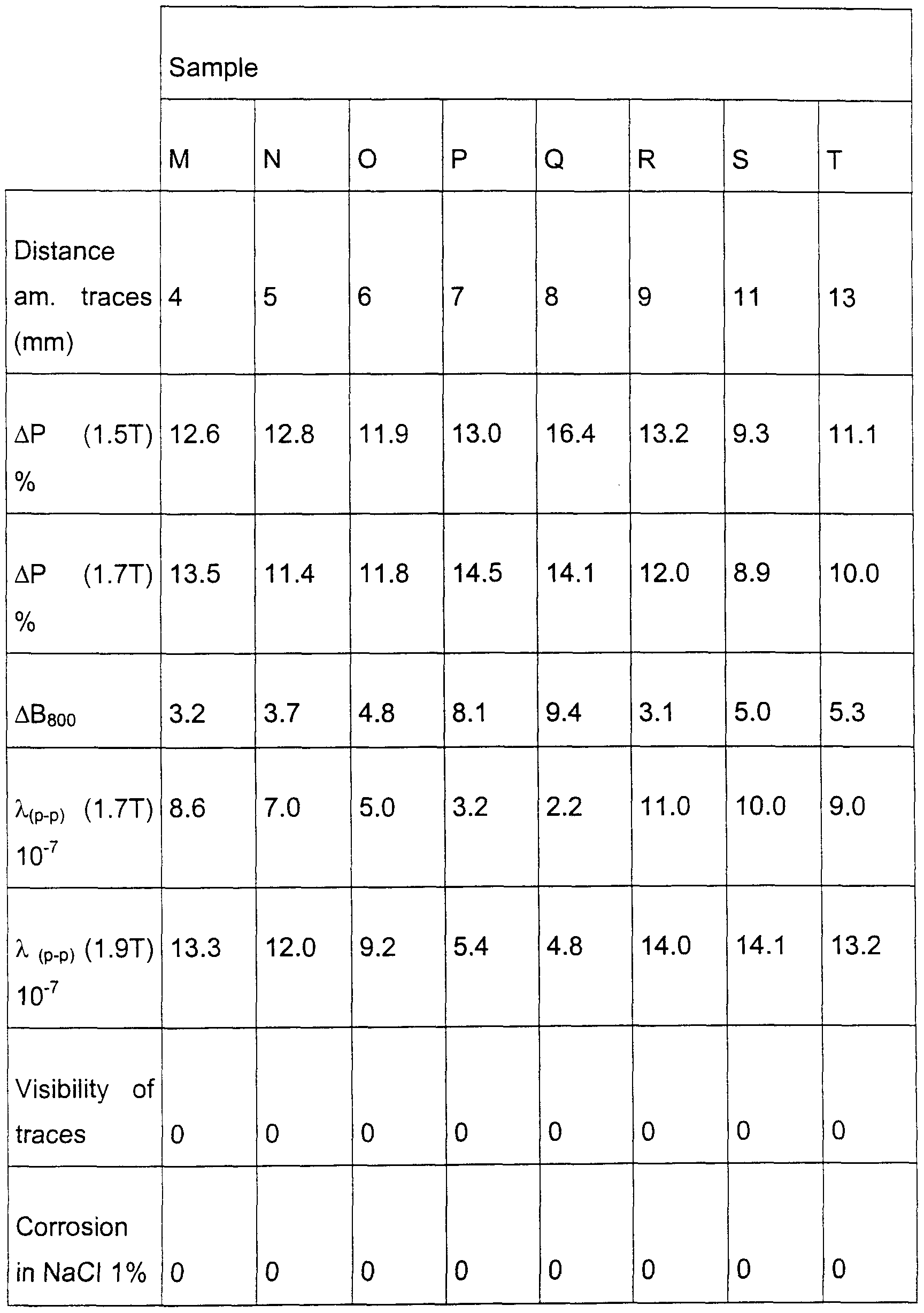
- the process is characterized by the fact that some previously chosen process parameters (that is to say specific radiation energy, dwell time and distance between two consecutive traces of the laser beam on the steel sheet) are contemporarily and continuously adjusted respectively within the ranges 0.1 and 25 mJ/mm 2 , 1x10 "6 s and 1x10 "2 s, 2 and 12 mm, in order to optimize the improvement of at least one of the magnetic characteristics of the strip, chosen between induction and core losses, continuously measured before and after the laser beam treatment, and not to damage the glass film insulating coating.
- process parameters that is to say specific radiation energy, dwell time and distance between two consecutive traces of the laser beam on the steel sheet
- dwell time the time is meant for which a particular surface of the strip is radiated by the laser beam, dwell time being a function of the strip speed, of the laser beam scanning speed and of the transversal sizes of the laser beam.
- the specific radiation energy is preferably comprised between 2 and 8 mJ/mm 2 , and more particularly between 3 and 5 mJ/mm 2 .
- the dwell time it must be preferably comprised between 1x10 "5 and 1x10 "3 s, and more particularly between 1 and 8x10 "4 s.
- the distance between the two consecutive lines must be preferably kept in the range between 3,5 and 8 mm according to the average size of the grain; in our test very good results have been obtained at distance values between two consecutive lines 10-20% lower than the average grain size measured in the rolling direction of the strip.
- Another very important factor is the scanning speed of the laser beam on the strip surface, depending on other parameters such as the translation speed of the steel sheet in the line and the distance among the scribed lines; therefore in different plants this parameter can have different values, still maintaining to optimum values the obtained magnetic characteristics; in the test carried out in laboratory, excellent results with scanning speeds comprised between 800 and 10,000 m/min have been obtained; in the industrial plant used, values commonly used are comprised between 1500 and 6000 m/min.
- the laser beam transversal dimensions, or length of the spot, from which the dwell time depends are comprised between 1 and 60 mm, preferably between 5 and 50 mm, with common values comprised between 7 and 40 mm.
- process parameters also depend on the rotation speed of the polygonal mirror; therefore, according to the invention, this rotation speed is comprised between 100 and 10,000 rev/min., preferably between 600 and 6,000 rev/min.
- Process parameters can be adjusted in order to optimize the loss or magnetostriction improvement, obtaining also small improvements in the magnetic permeability value.
- relevant measure in this text have been carried out according to the method stated by G. Ban and F. Janosi in "Measuring system and evaluation method of DC and AC magnetostriction behaviour to investigate 3.2% SiFe G.O. electrical steels"
- a steel having 3.2% by weight of Si, of the kind commonly used for the production of steel sheets having high magnetic characteristics has been produced and transformed, according to known methods, in steel sheets having a thickness of
- Strips covered with glass film and insulating coating (one for the conventional treatment and three for the one according to the present invention) have been radiated with laser beam in the following conditions: Table 1
- a strip has been also treated by changing the dwell time. Data related to the test is reported in the following table 3.
Landscapes
- Chemical & Material Sciences (AREA)
- Engineering & Computer Science (AREA)
- Physics & Mathematics (AREA)
- Mechanical Engineering (AREA)
- Organic Chemistry (AREA)
- Metallurgy (AREA)
- Materials Engineering (AREA)
- Thermal Sciences (AREA)
- Crystallography & Structural Chemistry (AREA)
- Manufacturing & Machinery (AREA)
- Electromagnetism (AREA)
- Optics & Photonics (AREA)
- Plasma & Fusion (AREA)
- Manufacturing Of Steel Electrode Plates (AREA)
- Soft Magnetic Materials (AREA)
- Heat Treatment Of Sheet Steel (AREA)
Abstract
Description



Claims
Priority Applications (9)
| Application Number | Priority Date | Filing Date | Title |
|---|---|---|---|
| EP00940258A EP1200636B1 (en) | 1999-05-26 | 2000-05-19 | Process for the improvement of the magnetic characteristics in grain oriented electrical silicon steel sheets by laser treatment |
| DE60004244T DE60004244T2 (en) | 1999-05-26 | 2000-05-19 | METHOD FOR IMPROVING THE MAGNETIC PROPERTIES OF CORNORIENTED ELECTRIC STEEL SHEETS BY LASER TREATMENT |
| PL351738A PL192135B1 (en) | 1999-05-26 | 2000-05-19 | Process for the improvement of the magnetic characteristics in grain oriented electrical silicon steel sheets by laser treatment |
| SK1688-2001A SK285746B6 (en) | 1999-05-26 | 2000-05-19 | Process for the improvement of the magnetic characteristics in grain oriented electrical silicon steel sheets by laser treatment |
| AU55249/00A AU5524900A (en) | 1999-05-26 | 2000-05-19 | Process for the improvement of the magnetic characteristics in grain oriented electrical silicon steel sheets by laser treatment |
| JP2001500005A JP2003500541A (en) | 1999-05-26 | 2000-05-19 | Method of improving magnetic properties of grain-oriented electromagnetic silicon steel sheet by laser treatment |
| US09/979,753 US6666929B1 (en) | 1999-05-26 | 2000-05-19 | Process for the improvement of the magnetic characteristics in grain oriented electrical silicon steel sheets by laser treatment |
| BR0010715-8A BR0010715A (en) | 1999-05-26 | 2000-05-19 | Process for improving the magnetic characteristics of electrically oriented silicon grain steel sheets, using leiser treatment |
| AT00940258T ATE246260T1 (en) | 1999-05-26 | 2000-05-19 | METHOD FOR IMPROVING THE MAGNETIC PROPERTIES OF CORNO-ORIENTED ELECTRICAL STEEL SHEET BY LASER TREATMENT |
Applications Claiming Priority (2)
| Application Number | Priority Date | Filing Date | Title |
|---|---|---|---|
| IT1999RM000334A IT1306157B1 (en) | 1999-05-26 | 1999-05-26 | PROCEDURE FOR THE IMPROVEMENT OF MAGNETIC CHARACTERISTICS OF SILICON STEEL GRAIN STEEL ORIENTED BY TREATMENT |
| ITRM99A000334 | 1999-05-26 |
Publications (1)
| Publication Number | Publication Date |
|---|---|
| WO2000073517A1 true WO2000073517A1 (en) | 2000-12-07 |
Family
ID=11406788
Family Applications (1)
| Application Number | Title | Priority Date | Filing Date |
|---|---|---|---|
| PCT/EP2000/004577 Ceased WO2000073517A1 (en) | 1999-05-26 | 2000-05-19 | Process for the improvement of the magnetic characteristics in grain oriented electrical silicon steel sheets by laser treatment |
Country Status (15)
| Country | Link |
|---|---|
| US (1) | US6666929B1 (en) |
| EP (1) | EP1200636B1 (en) |
| JP (1) | JP2003500541A (en) |
| KR (1) | KR100658197B1 (en) |
| CN (1) | CN1221673C (en) |
| AT (1) | ATE246260T1 (en) |
| AU (1) | AU5524900A (en) |
| BR (1) | BR0010715A (en) |
| CZ (1) | CZ298905B6 (en) |
| DE (1) | DE60004244T2 (en) |
| IT (1) | IT1306157B1 (en) |
| PL (1) | PL192135B1 (en) |
| RU (1) | RU2238340C2 (en) |
| SK (1) | SK285746B6 (en) |
| WO (1) | WO2000073517A1 (en) |
Cited By (2)
| Publication number | Priority date | Publication date | Assignee | Title |
|---|---|---|---|---|
| EP1154025A3 (en) * | 2000-05-12 | 2003-11-26 | Nippon Steel Corporation | Low iron loss and low noise grain-oriented electrical steel sheet and a method for producing the same |
| AU2006293699B2 (en) * | 2005-09-26 | 2011-12-01 | Imperial Innovations Limited | Photovoltaic cells comprising two photovoltaic cells and two photon sources |
Families Citing this family (31)
| Publication number | Priority date | Publication date | Assignee | Title |
|---|---|---|---|---|
| RU2301839C2 (en) * | 2003-03-19 | 2007-06-27 | Ниппон Стил Корпорейшн | Grain-oriented electrical steel sheet at high electrical characteristics and method of manufacture of such sheet |
| TWI305548B (en) * | 2005-05-09 | 2009-01-21 | Nippon Steel Corp | Low core loss grain-oriented electrical steel sheet and method for producing the same |
| JP5000182B2 (en) * | 2006-04-07 | 2012-08-15 | 新日本製鐵株式会社 | Method for producing grain-oriented electrical steel sheet with excellent magnetic properties |
| WO2009075328A1 (en) * | 2007-12-12 | 2009-06-18 | Nippon Steel Corporation | Method for manufacturing grain-oriented electromagnetic steel sheet whose magnetic domains are controlled by laser beam application |
| RU2405841C1 (en) * | 2009-08-03 | 2010-12-10 | Открытое акционерное общество "Новолипецкий металлургический комбинат" | Manufacturing method of plate anisotropic electric steel |
| JP5234222B2 (en) * | 2010-04-01 | 2013-07-10 | 新日鐵住金株式会社 | Oriented electrical steel sheet and manufacturing method thereof |
| JP5927754B2 (en) * | 2010-06-29 | 2016-06-01 | Jfeスチール株式会社 | Oriented electrical steel sheet and manufacturing method thereof |
| JP4782248B1 (en) * | 2010-07-28 | 2011-09-28 | 新日本製鐵株式会社 | Oriented electrical steel sheet and manufacturing method thereof |
| BR112013005335B1 (en) * | 2010-09-09 | 2018-10-23 | Nippon Steel & Sumitomo Metal Corporation | grain oriented electric steel sheet and method for manufacturing it |
| DE102010050844A1 (en) | 2010-11-09 | 2012-05-10 | Volkswagen Ag | Laser treatment of a workpiece by a laser beam, by lowering contours with laser beam, generating two crack columns on the surface of the workpiece, and forming the grain-oriented portions with a grain orientation |
| CN102477484B (en) * | 2010-11-26 | 2013-09-25 | 宝山钢铁股份有限公司 | Quick laser scribing method |
| DE102011000712A1 (en) * | 2011-02-14 | 2012-08-16 | Thyssenkrupp Electrical Steel Gmbh | Method for producing a grain-oriented flat steel product |
| KR20130140902A (en) | 2011-06-01 | 2013-12-24 | 신닛테츠스미킨 카부시키카이샤 | Device for producing grain-oriented magnetic steel sheet and method for producing grain-oriented magnetic steel sheet |
| KR101638890B1 (en) * | 2011-12-27 | 2016-07-12 | 제이에프이 스틸 가부시키가이샤 | Device to improve iron loss properties of grain-oriented electrical steel sheet |
| US10062483B2 (en) * | 2011-12-28 | 2018-08-28 | Jfe Steel Corporation | Grain-oriented electrical steel sheet and method for improving iron loss properties thereof |
| JP5884168B2 (en) * | 2012-02-08 | 2016-03-15 | Jfeスチール株式会社 | Oriented electrical steel sheet and manufacturing method thereof |
| MX372893B (en) * | 2012-10-30 | 2020-05-28 | Jfe Steel Corp | METHOD FOR MANUFACTURING A GRAIN-ORIENTED ELECTRICAL STEEL SHEET EXHIBITING LOW IRON LOSS. |
| JP5594439B1 (en) * | 2012-10-31 | 2014-09-24 | Jfeスチール株式会社 | Oriented electrical steel sheet and manufacturing method thereof |
| RU2501866C1 (en) * | 2012-11-23 | 2013-12-20 | Владимир Иванович Пудов | Method of perfecting magnetic properties of anisotropic electric steel by laser processing |
| RU2529260C1 (en) * | 2013-09-10 | 2014-09-27 | Олег Иванович Квасенков | Fruit sauce production method |
| WO2016002043A1 (en) | 2014-07-03 | 2016-01-07 | 新日鐵住金株式会社 | Laser machining device |
| KR101562962B1 (en) * | 2014-08-28 | 2015-10-23 | 주식회사 포스코 | Method and appratus for refining magnetic domains in grain-oriented electrical steel sheet and grain-oriented electrical steel manufactured using the same |
| CN105567925B (en) * | 2016-01-14 | 2017-12-15 | 中国科学院理化技术研究所 | Cold and hot circulating treatment process for reducing magnetostriction coefficient of silicon steel sheet |
| CN108660303B (en) * | 2017-03-27 | 2020-03-27 | 宝山钢铁股份有限公司 | Stress-relief-annealing-resistant laser-scored oriented silicon steel and manufacturing method thereof |
| CN108511163A (en) * | 2018-03-26 | 2018-09-07 | 江苏亚威变压器有限公司 | A kind of high frequency transformer and its resin-cast method |
| EP3780037B1 (en) * | 2018-03-30 | 2024-11-27 | JFE Steel Corporation | Iron core for transformer |
| RU2703768C1 (en) * | 2018-06-13 | 2019-10-22 | Общество с ограниченной ответственностью "ТермоЛазер" | Method of laser steel hardening at wide path of hardening |
| KR102162984B1 (en) | 2018-12-19 | 2020-10-07 | 주식회사 포스코 | Grain oriented electrical steel sheet and manufacturing method of the same |
| JP7192884B2 (en) * | 2019-06-28 | 2022-12-20 | 日立金属株式会社 | Fe-based amorphous alloy ribbon, iron core, and transformer |
| CN114854967A (en) * | 2022-04-28 | 2022-08-05 | 上海宝鼎机械制造有限公司 | Laser-scored high-magnetic-induction oriented silicon steel and manufacturing method thereof |
| CN114807559B (en) * | 2022-05-09 | 2023-07-18 | 国网智能电网研究院有限公司 | A kind of low loss and low magnetostriction oriented silicon steel material and its preparation method |
Citations (4)
| Publication number | Priority date | Publication date | Assignee | Title |
|---|---|---|---|---|
| EP0008385A1 (en) * | 1978-07-26 | 1980-03-05 | Nippon Steel Corporation | Grain-oriented electromagnetic steel sheet and method for its production |
| EP0033878A2 (en) * | 1980-01-25 | 1981-08-19 | Nippon Steel Corporation | Method for treating an electromagnetic steel sheet by laser-beam irradiation |
| EP0100638A2 (en) * | 1982-07-30 | 1984-02-15 | Armco Advanced Materials Corporation | Laser treatment of electrical steel |
| GB2128639A (en) * | 1982-10-20 | 1984-05-02 | Westinghouse Electric Corp | Improved loss ferromagnetic materials and methods of improvement |
Family Cites Families (11)
| Publication number | Priority date | Publication date | Assignee | Title |
|---|---|---|---|---|
| US4535218A (en) * | 1982-10-20 | 1985-08-13 | Westinghouse Electric Corp. | Laser scribing apparatus and process for using |
| JPS59197525A (en) * | 1983-04-23 | 1984-11-09 | Nippon Steel Corp | Preparation of directional electromagnetic steel plate |
| US4655854A (en) * | 1983-10-27 | 1987-04-07 | Kawasaki Steel Corporation | Grain-oriented silicon steel sheet having a low iron loss free from deterioration due to stress-relief annealing and a method of producing the same |
| SU1636459A1 (en) * | 1988-08-15 | 1991-03-23 | Институт физики металлов Уральского отделения АН СССР | Process for production of anisotropic electric sheet steel |
| JP3023242B2 (en) * | 1992-05-29 | 2000-03-21 | 川崎製鉄株式会社 | Method for producing low iron loss unidirectional silicon steel sheet with excellent noise characteristics |
| JPH06136552A (en) * | 1992-10-22 | 1994-05-17 | Nippon Steel Corp | Oriented electrical steel sheet with excellent magnetic iron loss and method of manufacturing the same |
| RU2016094C1 (en) * | 1992-09-02 | 1994-07-15 | Новолипецкий металлургический комбинат им.Ю.В.Андропова | Method of laser working of large-grain transformer anisotropic steel with thickness 0,15-0,30 mm |
| DE69331221T2 (en) * | 1993-02-15 | 2002-05-23 | Kawasaki Steel Corp., Kobe | Process for the production of low-noise grain-oriented silicon steel sheets with low watt losses and with excellent shape properties |
| JPH10298654A (en) * | 1997-04-24 | 1998-11-10 | Nippon Steel Corp | Manufacturing equipment for grain-oriented electrical steel sheets with excellent magnetic properties |
| JP3357578B2 (en) * | 1997-07-25 | 2002-12-16 | 川崎製鉄株式会社 | Grain-oriented electrical steel sheet with extremely low iron loss and method for producing the same |
| DE19750066C1 (en) * | 1997-11-12 | 1999-08-05 | Ebg Elektromagnet Werkstoffe | Process for coating electrical steel strips with an annealing separator |
-
1999
- 1999-05-26 IT IT1999RM000334A patent/IT1306157B1/en active
-
2000
- 2000-05-19 CZ CZ20014215A patent/CZ298905B6/en not_active IP Right Cessation
- 2000-05-19 PL PL351738A patent/PL192135B1/en unknown
- 2000-05-19 US US09/979,753 patent/US6666929B1/en not_active Expired - Fee Related
- 2000-05-19 KR KR1020017015113A patent/KR100658197B1/en not_active Expired - Fee Related
- 2000-05-19 WO PCT/EP2000/004577 patent/WO2000073517A1/en not_active Ceased
- 2000-05-19 AT AT00940258T patent/ATE246260T1/en not_active IP Right Cessation
- 2000-05-19 BR BR0010715-8A patent/BR0010715A/en not_active IP Right Cessation
- 2000-05-19 CN CNB008080704A patent/CN1221673C/en not_active Expired - Fee Related
- 2000-05-19 SK SK1688-2001A patent/SK285746B6/en not_active IP Right Cessation
- 2000-05-19 EP EP00940258A patent/EP1200636B1/en not_active Expired - Lifetime
- 2000-05-19 DE DE60004244T patent/DE60004244T2/en not_active Expired - Lifetime
- 2000-05-19 JP JP2001500005A patent/JP2003500541A/en active Pending
- 2000-05-19 RU RU2001132087A patent/RU2238340C2/en not_active IP Right Cessation
- 2000-05-19 AU AU55249/00A patent/AU5524900A/en not_active Abandoned
Patent Citations (5)
| Publication number | Priority date | Publication date | Assignee | Title |
|---|---|---|---|---|
| EP0008385A1 (en) * | 1978-07-26 | 1980-03-05 | Nippon Steel Corporation | Grain-oriented electromagnetic steel sheet and method for its production |
| EP0033878A2 (en) * | 1980-01-25 | 1981-08-19 | Nippon Steel Corporation | Method for treating an electromagnetic steel sheet by laser-beam irradiation |
| EP0087587A1 (en) * | 1980-01-25 | 1983-09-07 | Nippon Steel Corporation | An electromagnetic steel sheet treated by laser-beam irradiation |
| EP0100638A2 (en) * | 1982-07-30 | 1984-02-15 | Armco Advanced Materials Corporation | Laser treatment of electrical steel |
| GB2128639A (en) * | 1982-10-20 | 1984-05-02 | Westinghouse Electric Corp | Improved loss ferromagnetic materials and methods of improvement |
Cited By (3)
| Publication number | Priority date | Publication date | Assignee | Title |
|---|---|---|---|---|
| EP1154025A3 (en) * | 2000-05-12 | 2003-11-26 | Nippon Steel Corporation | Low iron loss and low noise grain-oriented electrical steel sheet and a method for producing the same |
| US6918966B2 (en) | 2000-05-12 | 2005-07-19 | Nippon Steel Corporation | Low iron loss and low noise grain-oriented electrical steel sheet and a method for producing the same |
| AU2006293699B2 (en) * | 2005-09-26 | 2011-12-01 | Imperial Innovations Limited | Photovoltaic cells comprising two photovoltaic cells and two photon sources |
Also Published As
| Publication number | Publication date |
|---|---|
| IT1306157B1 (en) | 2001-05-30 |
| KR20020030271A (en) | 2002-04-24 |
| CZ298905B6 (en) | 2008-03-05 |
| DE60004244T2 (en) | 2004-04-15 |
| CN1352700A (en) | 2002-06-05 |
| SK16882001A3 (en) | 2002-05-09 |
| BR0010715A (en) | 2002-02-13 |
| DE60004244D1 (en) | 2003-09-04 |
| PL351738A1 (en) | 2003-06-02 |
| US6666929B1 (en) | 2003-12-23 |
| RU2238340C2 (en) | 2004-10-20 |
| SK285746B6 (en) | 2007-07-06 |
| PL192135B1 (en) | 2006-09-29 |
| KR100658197B1 (en) | 2006-12-15 |
| AU5524900A (en) | 2000-12-18 |
| ATE246260T1 (en) | 2003-08-15 |
| JP2003500541A (en) | 2003-01-07 |
| CZ20014215A3 (en) | 2002-05-15 |
| ITRM990334A0 (en) | 1999-05-26 |
| CN1221673C (en) | 2005-10-05 |
| ITRM990334A1 (en) | 2000-11-26 |
| EP1200636A1 (en) | 2002-05-02 |
| EP1200636B1 (en) | 2003-07-30 |
Similar Documents
| Publication | Publication Date | Title |
|---|---|---|
| EP1200636B1 (en) | Process for the improvement of the magnetic characteristics in grain oriented electrical silicon steel sheets by laser treatment | |
| EP0008385B1 (en) | Grain-oriented electromagnetic steel sheet and method for its production | |
| KR100727333B1 (en) | Electronic steel sheet suitable for small iron core and manufacturing method thereof | |
| RU2721969C1 (en) | Product from textured silicon steel with low losses in iron for transformer with low noise level and method of production thereof | |
| US4437907A (en) | Amorphous alloy for use as a core | |
| JP5866850B2 (en) | Method for producing grain-oriented electrical steel sheet | |
| CA3088125C (en) | Grain-oriented electrical steel sheet, stacked transformer core using the same, and method for producing stacked core | |
| EP1154025A2 (en) | Low iron loss and low noise grain-oriented electrical steel sheet and a method for producing the same | |
| US4545828A (en) | Local annealing treatment for cube-on-edge grain oriented silicon steel | |
| JPH01281709A (en) | Method of obtaining heat-resistant fractionalized magnetic domains in electrical steel to reduce core loss | |
| JP2022022490A (en) | Grain oriented electrical steel sheet | |
| US5306356A (en) | Magnetic sheet metal obtained from hot-rolled strip steel containing, in particular, iron, silicon and aluminum | |
| US4762575A (en) | Process for producing electrical steel sheet | |
| JP4268042B2 (en) | Method for producing (110) [001] grain-oriented electrical steel using strip casting | |
| Patri et al. | Magnetic domain refinement of silicon-steel laminations by laser scribing | |
| Kobayashi et al. | Heatproof domain refining method using combination of local strain and heat treatment for grain oriented 3% Si-Fe | |
| WO2024063163A1 (en) | Grain-oriented electrical steel sheet | |
| Weidenfeller et al. | Domain refinement and domain wall activation of surface treated Fe Si sheets | |
| Kosuge et al. | Microstructures and magnetic properties of heatproof domain-refined grain-oriented silicon steel sheets | |
| EP0423623B1 (en) | Process for preparing wound core having low core loss | |
| JP7727245B2 (en) | grain-oriented electrical steel sheet | |
| Salsgiver | Future Prospects for Grain-Oriented Silicon Steels | |
| KR100237159B1 (en) | The manufacturing method for non orient electric steel sheet | |
| JPS596319A (en) | Manufacture of amorphous magnetic material having excellent magnetic property | |
| JP2025519626A (en) | Method for producing low magnetostriction grain-oriented silicon steel sheet, and grain-oriented silicon steel sheet |
Legal Events
| Date | Code | Title | Description |
|---|---|---|---|
| WWE | Wipo information: entry into national phase |
Ref document number: 00808070.4 Country of ref document: CN |
|
| AK | Designated states |
Kind code of ref document: A1 Designated state(s): AE AG AL AM AT AU AZ BA BB BG BR BY CA CH CN CR CU CZ DE DK DM DZ EE ES FI GB GD GE GH GM HR HU ID IL IN IS JP KE KG KP KR KZ LC LK LR LS LT LU LV MA MD MG MK MN MW MX MZ NO NZ PL PT RO RU SD SE SG SI SK SL TJ TM TR TT TZ UA UG US UZ VN YU ZA ZW |
|
| AL | Designated countries for regional patents |
Kind code of ref document: A1 Designated state(s): GH GM KE LS MW MZ SD SL SZ TZ UG ZW AM AZ BY KG KZ MD RU TJ TM AT BE CH CY DE DK ES FI FR GB GR IE IT LU MC NL PT SE BF BJ CF CG CI CM GA GN GW ML MR NE SN TD TG |
|
| 121 | Ep: the epo has been informed by wipo that ep was designated in this application | ||
| DFPE | Request for preliminary examination filed prior to expiration of 19th month from priority date (pct application filed before 20040101) | ||
| ENP | Entry into the national phase |
Ref document number: 2001 500005 Country of ref document: JP Kind code of ref document: A |
|
| WWE | Wipo information: entry into national phase |
Ref document number: 16882001 Country of ref document: SK |
|
| WWE | Wipo information: entry into national phase |
Ref document number: PV2001-4215 Country of ref document: CZ |
|
| WWE | Wipo information: entry into national phase |
Ref document number: 1020017015113 Country of ref document: KR |
|
| WWE | Wipo information: entry into national phase |
Ref document number: 2000940258 Country of ref document: EP |
|
| WWE | Wipo information: entry into national phase |
Ref document number: 09979753 Country of ref document: US |
|
| REG | Reference to national code |
Ref country code: DE Ref legal event code: 8642 |
|
| WWP | Wipo information: published in national office |
Ref document number: 1020017015113 Country of ref document: KR |
|
| WWP | Wipo information: published in national office |
Ref document number: 2000940258 Country of ref document: EP |
|
| WWP | Wipo information: published in national office |
Ref document number: PV2001-4215 Country of ref document: CZ |
|
| WWG | Wipo information: grant in national office |
Ref document number: 2000940258 Country of ref document: EP |
|
| WWG | Wipo information: grant in national office |
Ref document number: 1020017015113 Country of ref document: KR |
|
| WWG | Wipo information: grant in national office |
Ref document number: PV2001-4215 Country of ref document: CZ |