WO2001002378A1 - Nematicidal trifluorobutenes - Google Patents
Nematicidal trifluorobutenes Download PDFInfo
- Publication number
- WO2001002378A1 WO2001002378A1 PCT/IB2000/000868 IB0000868W WO0102378A1 WO 2001002378 A1 WO2001002378 A1 WO 2001002378A1 IB 0000868 W IB0000868 W IB 0000868W WO 0102378 A1 WO0102378 A1 WO 0102378A1
- Authority
- WO
- WIPO (PCT)
- Prior art keywords
- compounds
- formula
- methyl
- chloro
- trifluoro
- Prior art date
- Legal status (The legal status is an assumption and is not a legal conclusion. Google has not performed a legal analysis and makes no representation as to the accuracy of the status listed.)
- Ceased
Links
- 0 CC(CCNC1=NC=C*1)=C(C(C)=C)N Chemical compound CC(CCNC1=NC=C*1)=C(C(C)=C)N 0.000 description 1
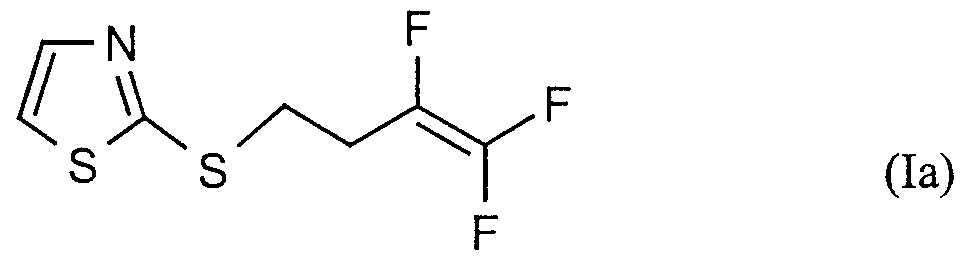
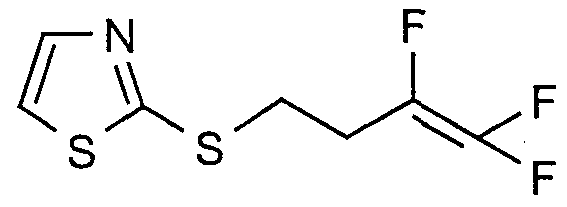
- ZPTRFECGKAVAAK-UHFFFAOYSA-N FC(CCSc1ncc[s]1)=C(F)F Chemical compound FC(CCSc1ncc[s]1)=C(F)F ZPTRFECGKAVAAK-UHFFFAOYSA-N 0.000 description 1
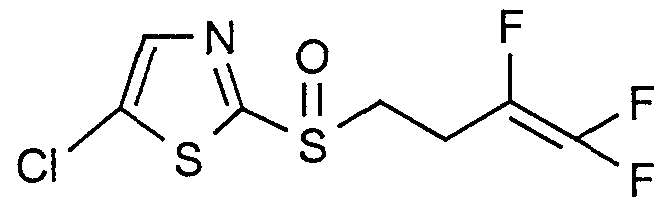
- OZKFECQBGFGHIO-UHFFFAOYSA-N O=S(CCC(F)=C(F)F)c([s]1)ncc1Cl Chemical compound O=S(CCC(F)=C(F)F)c([s]1)ncc1Cl OZKFECQBGFGHIO-UHFFFAOYSA-N 0.000 description 1
Classifications
-
- C—CHEMISTRY; METALLURGY
- C07—ORGANIC CHEMISTRY
- C07D—HETEROCYCLIC COMPOUNDS
- C07D277/00—Heterocyclic compounds containing 1,3-thiazole or hydrogenated 1,3-thiazole rings
- C07D277/02—Heterocyclic compounds containing 1,3-thiazole or hydrogenated 1,3-thiazole rings not condensed with other rings
- C07D277/20—Heterocyclic compounds containing 1,3-thiazole or hydrogenated 1,3-thiazole rings not condensed with other rings having two or three double bonds between ring members or between ring members and non-ring members
- C07D277/32—Heterocyclic compounds containing 1,3-thiazole or hydrogenated 1,3-thiazole rings not condensed with other rings having two or three double bonds between ring members or between ring members and non-ring members with hetero atoms or with carbon atoms having three bonds to hetero atoms with at the most one bond to halogen, e.g. ester or nitrile radicals, directly attached to ring carbon atoms
- C07D277/36—Sulfur atoms
-
- A—HUMAN NECESSITIES
- A01—AGRICULTURE; FORESTRY; ANIMAL HUSBANDRY; HUNTING; TRAPPING; FISHING
- A01N—PRESERVATION OF BODIES OF HUMANS OR ANIMALS OR PLANTS OR PARTS THEREOF; BIOCIDES, e.g. AS DISINFECTANTS, AS PESTICIDES OR AS HERBICIDES; PEST REPELLANTS OR ATTRACTANTS; PLANT GROWTH REGULATORS
- A01N43/00—Biocides, pest repellants or attractants, or plant growth regulators containing heterocyclic compounds
- A01N43/72—Biocides, pest repellants or attractants, or plant growth regulators containing heterocyclic compounds having rings with nitrogen atoms and oxygen or sulfur atoms as ring hetero atoms
- A01N43/74—Biocides, pest repellants or attractants, or plant growth regulators containing heterocyclic compounds having rings with nitrogen atoms and oxygen or sulfur atoms as ring hetero atoms five-membered rings with one nitrogen atom and either one oxygen atom or one sulfur atom in positions 1,3
- A01N43/78—1,3-Thiazoles; Hydrogenated 1,3-thiazoles
Definitions
- the present invention relates to novel triflluorobutenes and their use as nematicides.
- US Patent No. 3,518,172 describes trifluorobutenyl compounds which have nematicidal activity.
- WO 95/24403 describes that 4,4-difluorobutenyl compounds have nematicidal activity.
- Japanese Laid-open Patent Application No. 176141/1997 mentiones thiazole derivatives having insecticidal and acaricidal activity.
- X represents halogen
- n 0, 1 or 2.
- process (A) are reacted with a halogenating agent, optionally in the presence of one or more inert diluents (process (A)).
- n 1 or 2
- process (B) are reacted with an oxidizing agent, optionally in the presence of one or more inert diluents (process (B)).
- the compounds of the formula (I) of the present invention have strong nematicidal activity and show good compatibility with various crops. According to the present invention the compounds of the formula (I) have surprisingly strong nematicidal activity compared with the known compounds described in the aforementioned literature.
- X preferably represents fluoro, chloro or bromo.
- X particularly preferably represents fluoro or chloro.
- X very particularly preferably represents chloro.
- n preferably represents 0 or 2.
- n particulary preferably represents 2.
- Process (A) for preparing compounds of the formula (I) of the present invention can be represented by the following reaction scheme in which N-chlorosuccinimide is exemplaryly used as halogenating agent:
- Process (B) for preparing compounds of the formula (I) of the present invention can be represented by the following reaction in which 5-chloro-2-(3,4,4-trifluoro-3- butenylthio)thiazole is used as a starting material and m-chloroperoxybenzoic acid is exemplaryly used as oxidizing agent.
- Halogenating agents used in Process (A) can be agents usually used for this purpose in organic chemistry and which are known to a person skilled in the art, including for example sulfuryl chloride, N-chlorosuccinimide, N-bromosuccinimide, trichloro- isocyanuric acid, potassium fluoride, sodium chlorate, phosphorus pentachloride, titanium (IV) chloride, chlorine gas, bromine, iodine etc.
- Oxidizing agents used for the oxidation of the above-mentioned compounds of the formula (lb) in process (B) can be agents usually used for this purpose in organic chemistry and which are known to a person skilled in the art including for example hydrogen peroxide water, m-chloroperoxybenzoic acid, peroxyacetic acid, peroxy- benzoic acid, magnesium monoperoxyphthalate, potassium peroxymonosulfate, etc.
- Diluents which can be used in this process can for example be water; aliphatic, alicyclic and aromatic hydrocarbons (which can be optionally chlorinated) such as hexane, cyclohexane, petroleum ether, ligroine, benzene, methylene chloride, chloroform, carbon tetrachloride, ethylene chloride, chlorobenzene etc.; ethers, such as diethyl ether, methyl ethyl ether, di-isopropyl ether, dibutyl ether, propylene oxide, dioxane, tetrahydrofuran etc.; nitriles, such as acetonitrile, propionitrile, acrylonitrile etc.; acid amides, such as dimethylformamide, dimethylacetamide, N-methylpyrrolidone etc.;
- reaction temperatures of process (A) according to the invention can be varied over a relatively wide range. In general, temperatures in a range of between 0 and
- the process (A) according to the invention is generally carried out under normal pressure. However, it is possible to carry out the process (A) under elevated pressure or under reduced pressure, in general between 0.1 bar and 10 bar.
- the starting materials are generally employed in approximately equimolar amounts. However, it is also possible to use one of the components in a relatively large excess. Work-up is carried out according to customary methods (cf. the preparation examples).
- the compound of the formula (I) in which n represents 0 and X represents chloro can be obtained by reacting 1-1.2 moles of N-chlorosuccinimide with 1 mole of 2-(3,4,4-trifluoro-3-butenylthio)thiazole in carbon tetrachloride under reflux by heating.
- Diluents which can be used in this process can for example be water; aliphatic, alicyclic and aromatic hydrocarbons (which can be optionally chlorinated), such as hexane, cyclohexane, petroleum, ether, ligroine, benzene, toluene, xylene, methylene chloride, chloroform, carbon tetrachloride, ethylene chloride, chlorobenzene etc.; ethers, such as diethyl ether, methyl ethyl ether, di-isopropyl ether, dibutyl ether, propylene oxide, dioxane, tetrahydrofuran etc.; nitriles, such as acetonitrile, propionitrile, acrylonitrile etc.; alcohols, for example methanol, ethanol, isopropanol
- reaction temperatures of process (B) according to the invention can be varied over a relatively wide range. In general, temperatures in a range of between 0 and
- the process (B) according to the invention is generally carried out under normal pressure. However, it is also possible to carry out the process (B) under elevated pressure or under reduced pressure, in general between 0.1 bar and 10 bar.
- the starting materials are generally employed in approximately equimolar amounts. However, it is also possible to use one of the components in a relatively large excess. Work-up is carried out according to customary methods (cf. the preparation examples).
- compounds of the formula (I) in which n represents 1 can be obtained by reacting, 1-2 moles of m-chloroperoxybenzoic acid with 1 mole of the compound of the formula (lb) in methyl ene chloride under cooling with ice.
- the compounds of the formula (I) according to the present invention show strong controlling activity against nematodes. They can, therefore, be efficiently used as nematicidal agents.
- the compounds of the formula (I) of the present invention do not exhibit phytotoxicity against crops and can be used for controlling harmful nematodes.
- the compounds according to the invention can be used, for example, against nematodes such as Pratylenchus spp., Globodera spp., such as Globodera rostochiensis recycledweber, Heterodera spp., such as Heterodera glycines ichinohe, Meloidogyne spp., Aphelenchoides spp., such as Aphelenchoides basseyi christie, Radopholus similis, Ditylenchus dipsaci, Tylenchulus semipenetrans, Longidorus spp., Xiphinema spp., Trichodorus spp., Bursaphelenchus spp., such as Bursaphelenchus xylophilis etc.
- nematodes such as Pratylenchus spp., Globodera spp., such as Globodera rostochiensis recycledweber, He
- the compounds according to the invention are especially useful for combating Pratylenchus spp., Globodera rostochiensis recycledweber, Heterodera glycines ichinohe, Meloidogyne spp,, Aphelenchoides basseyi christie, Bursaphelenchus xylophilis.
- the active compounds can be converted into the customary formulations, such as solutions, emulsions, wettable powders, water dispersible granules, suspensions, powders, dusting agents, foaming agents, pastes, soluble powders, granules, suspo- emulsion concentrates, microcapsules, fumigants, natural and synthetic materials impregnated with active compound and very fine capsules and polymeric substances.
- customary formulations such as solutions, emulsions, wettable powders, water dispersible granules, suspensions, powders, dusting agents, foaming agents, pastes, soluble powders, granules, suspo- emulsion concentrates, microcapsules, fumigants, natural and synthetic materials impregnated with active compound and very fine capsules and polymeric substances.
- formulations are prepared in a known manner, for example by mixing the active compounds with extenders, that is liquid solvents, liquefied gas and/or solid diluents or carriers, if appropriate with the use of surface-active agents, that is emulsifiers and/or dispersants and/or foam-formers.
- Suitable liquid solvents are essentially: aromatics, such as xylene, toluene, or alkylnaphthalenes, chlorinated aromatics and chlorinated aliphatic hydrocarbons, such as chlorobenzene, chloroethylenes or methylene chloride, aliphatic hydrocarbons, such as cyclohexane or paraffins, for example mineral oil fractions, mineral or vegetable oil, alcohols, such as butanol or glycol, and also their ethers and esters, ketones, such as acetone, methyl ethyl ketone, methyl isobutyl ketone or cyclohexanone, strongly polar solvents, such as dimethylformamide and dimethyl sulphoxide, and also water.
- aromatics such as xylene, toluene, or alkylnaphthalenes
- chlorinated aromatics and chlorinated aliphatic hydrocarbons such as chlorobenzene, chloroethylenes or methylene
- Liquefied gas diluents or carriers are liquefied substances which are gases at normal temperature and pressure.
- Liquefied gas diluents can be, for example, aerosol propellants such as butane, propane, nitrogen gas, carbon dioxide, halogenated hydrocarbons, etc.
- Suitable solid carriers are: for example ammonium salts and ground natural minerals, such as kaolins, clays, talc, chalk, quartz, attapulgite, montmorillonite or diatomaceous earth, and ground synthetic minerals, such as finely divided silica, alumina and silicates;
- suitable solid carriers for granules are: for example crushed and fractionated natural rocks such as calcite, marble, pumice, sepiolite and dolomite, as well as synthetic granules of inorganic and organic meals, and granules of organic material such as sawdust, coconut shells, maize cobs and tobacco stalks;
- suitable emulsifiers and/or foam- formers are: for example nonionic and anionic emulsifiers, such as polyoxyethylene fatty acid esters, polyoxyethylene fatty alcohol ethers, for example alkylaryl polyglycol ethers, alkylsulphonates, alkyl sulphates, aryls
- Tackifiers such as carboxymethylcellulose and natural and synthetic polymers in the form of powders, granules or latices, such as gum arabic, polyvinyl alcohol and polyvinyl acetate, as well as natural phospholipids, such as cephalins and lecithins, and synthetic phospholipids, can be used in the formulations.
- Other additives can be mineral and vegetable oils.
- colorants such as inorganic pigments, for example iron oxide, titanium oxide and Prussian Blue, and organic dyestuffs, such as alizarin dyestuffs, azo dyestuffs and metal phthalocyanine dyestuffs, and trace nutrients such as salts of iron, manganese, boron, copper, cobalt, molybdenum and zinc.
- organic dyestuffs such as alizarin dyestuffs, azo dyestuffs and metal phthalocyanine dyestuffs
- trace nutrients such as salts of iron, manganese, boron, copper, cobalt, molybdenum and zinc.
- the formulations in general contain between 0.01 and 95 per cent by weight of active compound, preferably between 0.1 and 90%, particularly preferably between 0.5 and
- the active compounds according to the invention can also be used in a mixture with known fungicides, bactericides, acaricides, nematicides or insecticides, to widen, for example, the activity spectrum or to prevent the development of resistance. In many cases, this results in synergistic effects, i.e. the activity of the mixture exceeds the activity of the individual components.
- Examples of particularly advantageous mixing components are the following: Fungicides: aldimorph, ampropylfos, ampropylfos potassium, andoprim, anilazine, azaconazole, azoxystrobin, benalaxyl, benodanil, benomyl, benzamacril, benzamacril-isobutyl, bialaphos, binapacryl, biphenyl, bitertanol, blasticidin-S, bromuconazole, bupirimate, buthiobate, calcium polysulphide, capsimycin, captafol, captan, carbendazim, carboxin, carvon, quinomethionate, chlobenthiazone, chlorfenazole, chloroneb, chloropicrin, chlorothalonil, chlozolinate, clozylacon, cufraneb, cymoxanil, cyproconazole, c
- N-(2,3-dichloro-4-hydroxyphenyl)-l-methyl-cyclohexanecarboxamide N-(2,6-dimethylphenyl)-2-methoxy-N-(tetrahydro-2-oxo-3-furanyl)-acetamide, N-(2,6-dimethylphenyl)-2-methoxy-N-(tetrahydro-2-oxo-3-thienyl)-acetamide, N-(2-chloro-4-nitrophenyl)-4-methyl-3-nitro-benzenesulphonamide, N-(4-cyclohexylphenyl)-l,4,5,6-tetrahydro-2-pyrimidineamine,
- N-(4-hexylphenyl)- 1 ,4,5 ,6-tetrahydro-2-pyrimidineamine N-(5-chloro-2-methylphenyl)-2-methoxy-N-(2-oxo-3-oxazolidinyl)-acetamide, N-(6-methoxy)-3-pyridinyl)-cyclopropanecarboxamide, N-[2,2,2-trichloro-l-[(chloroacetyl)-amino]-ethyl]-benz amide, N-[3-chloro-4,5-bis(2-propinyloxy)-phenyl]-N'-methoxy-methanimidamide,
- Bactericides bronopol, dichlorophen, nitrapyrin, nickel dimethyldithiocarbamate, kasugamycin, octhilinone, furancarboxyhc acid, oxytetracyclin, probenazole, streptomycin, tecloftalam, copper sulphate and other copper preparations.
- Insecticides / acaricide / nematicides abamectin, acephate, acetamiprid, acrinathrin, alanycarb, aldicarb, aldoxycarb, alpha- cypermethrin, alphamethrin, amitraz, avermectin, AZ 60541, azadirachtin, azamethiphos, azinphos A, azinphos M, azocyclotin, Bacillus popilliae, Bacillus sphaericus, Bacillus subtilis, Bacillus thuringiensis, baculoviruses, Beauveria bassiana, Beauveria tenella, bendiocarb, benfuracarb, bensultap, benzoximate, betacyfluthrin, bifenazate, bifenthrin, bioethanomethrin, bio- permethrin,
- Metharhizium flavoviride methidathion, methiocarb, methomyl, methoxyfenozide, metolcarb, metoxadiazone, mevinphos, milbemectin, monocrotophos, naled, nitenpyram, nithiazine, novaluron, omethoat, oxamyl, oxydemethon M,
- a mixture with other known active compounds, such as herbicides, or with fertilizers and growth regulators is also possible.
- the active compounds according to the invention can be present in their commercial formulations and in the use forms, prepared from these formulations, as a mixture with synergists.
- Synergists are compounds which increase the action of the active compounds, without it being necessary for the synergist added to be active itself.
- the active-compound content of the use forms prepared from the commercial formulations can vary within wide limits.
- the active-compound concentration of the use forms can be from 0.0000001 to 95%> by weight of active compound, preferably between 0.0001 and 1% by weight. Application is carried out in a customary manner adapted to the use forms.
- 2-Mercaptothiazole (5.18 g), potassium carbonate (6.72 g) and 4-bromo- 1,1,2- trifluorobutene-1 (9.21 g) are reflux ed in acetonitrile (60 ml) in the presence of argon gas for 6 hours by heating. After the reaction mixture has reached room temperature, it is filtered and the solvent is distilled off. The residue is dissolved in dichloromethane and washed with 5% aqueous solution of sodium hydroxide and water in this order.
- test agent prepared as mentioned above was added to soil contaminated with Meloidogyne incognita to a chemical concentration of 10 ppm and homogeneously mixed by stirring.
- a pot (1/5000 are) was filled with the soil.
- About 20 seeds of tomato (variety: Kurihara) were sown per pot. After cultivation in a greenhouse for 4 weeks, they were carefully pulled out not to damage the roots and the root knot index and the controlling effect were determined as follows. Degree of damage No knots were formed (Complete control).
- Knots were formed to a medium extent.
- Example No. 1 To a mixture of 10 parts of a compound according to the present invention (Example No. 1), 30 parts of bentonite (montmorillonite), 58 parts of talc and 2 parts of ligninsulphonate salt, 25 parts water are added, well kneaded, worked up into granules of 10-40 mesh with the help of an extrusion granulator and dried at 40-50°C to obtain granules.
- bentonite montmorillonite
- talc 58 parts of talc
- ligninsulphonate salt To a mixture of 10 parts of a compound according to the present invention (Example No. 1), 30 parts of bentonite (montmorillonite), 58 parts of talc and 2 parts of ligninsulphonate salt, 25 parts water are added, well kneaded, worked up into granules of 10-40 mesh with the help of an extrusion granulator and dried at 40-50°C to obtain granules.
- Example No. 2 95 Parts of clay mineral particles having a particle diameter distribution of 0.2-2 mm are put into a rotary mixer. While rotating it, 5 parts of a compound according to the present invention (Example No. 2) are sprayed onto the mineral particles together with a liquid diluent to obtain uniformly wetted particles and the particles are then dried at 40-50°C to obtain granules.
- Example No. 3 30 Parts of a compound according to the present invention (Example No. 3), 55 parts of xylene, 8 parts of polyoxyethylene alkyl phenyl ether and 7 parts of calcium alkylbenzenesulphonate are mixed and stirred to obtain an emulsion.
- Example 4 (Wettable powder)
- Example No. 1 15 parts of a compound according to the present invention (Example No. 1), 80 parts of a mixture of white carbon (hydrous amorphous silicon oxide fine powders) and powder clay (1:5), 2 parts of sodium alkylbenzenesulphonate and 3 parts of sodium alkylnaphthalenesulphonate-formalin-condensate are crushed and mixed together to obtain a wettable powder.
Landscapes
- Chemical & Material Sciences (AREA)
- Organic Chemistry (AREA)
- Life Sciences & Earth Sciences (AREA)
- Agronomy & Crop Science (AREA)
- Pest Control & Pesticides (AREA)
- Plant Pathology (AREA)
- Health & Medical Sciences (AREA)
- Engineering & Computer Science (AREA)
- Dentistry (AREA)
- General Health & Medical Sciences (AREA)
- Wood Science & Technology (AREA)
- Zoology (AREA)
- Environmental Sciences (AREA)
- Agricultural Chemicals And Associated Chemicals (AREA)
- Organic Low-Molecular-Weight Compounds And Preparation Thereof (AREA)
- Liquid Crystal Substances (AREA)
- Thiazole And Isothizaole Compounds (AREA)
- Pharmaceuticals Containing Other Organic And Inorganic Compounds (AREA)
Abstract
Description





Claims


Priority Applications (9)
| Application Number | Priority Date | Filing Date | Title |
|---|---|---|---|
| EP00937136A EP1200418B1 (en) | 1999-07-06 | 2000-06-28 | Nematicidal trifluorobutenes |
| HK02107654.0A HK1046403B (en) | 1999-07-06 | 2000-06-28 | Nematicidal trifluorobutenes |
| AT00937136T ATE263157T1 (en) | 1999-07-06 | 2000-06-28 | NEMATICIDE TRIFLUORBUTENE |
| DE60009511T DE60009511T2 (en) | 1999-07-06 | 2000-06-28 | NEMATICID TRIFLUORBUTENE |
| JP2001507816A JP4806145B2 (en) | 1999-07-06 | 2000-06-28 | Nematocidal trifluorobutenes |
| US10/030,361 US6734198B1 (en) | 1999-07-06 | 2000-06-28 | Nematicidal trifluorobutenes |
| BRPI0012243-2A BR0012243B1 (en) | 1999-07-06 | 2000-06-28 | trifluoride butene nematocidal compounds, their preparation processes and their use, nematode fighting process, as well as nematocidal compositions and their preparation process. |
| CA002378148A CA2378148C (en) | 1999-07-06 | 2000-06-28 | Nematicidal trifluorobutenes |
| AU52420/00A AU5242000A (en) | 1999-07-06 | 2000-06-28 | Nematicidal trifluorobutenes |
Applications Claiming Priority (2)
| Application Number | Priority Date | Filing Date | Title |
|---|---|---|---|
| JP11191638A JP2001019685A (en) | 1999-07-06 | 1999-07-06 | Nematocidal trifluorobutene |
| JP11/191638 | 1999-07-06 |
Publications (1)
| Publication Number | Publication Date |
|---|---|
| WO2001002378A1 true WO2001002378A1 (en) | 2001-01-11 |
Family
ID=16277995
Family Applications (1)
| Application Number | Title | Priority Date | Filing Date |
|---|---|---|---|
| PCT/IB2000/000868 Ceased WO2001002378A1 (en) | 1999-07-06 | 2000-06-28 | Nematicidal trifluorobutenes |
Country Status (20)
| Country | Link |
|---|---|
| US (1) | US6734198B1 (en) |
| EP (1) | EP1200418B1 (en) |
| JP (2) | JP2001019685A (en) |
| KR (1) | KR100687170B1 (en) |
| CN (1) | CN1159304C (en) |
| AT (1) | ATE263157T1 (en) |
| AU (1) | AU5242000A (en) |
| BR (1) | BR0012243B1 (en) |
| CA (1) | CA2378148C (en) |
| CO (1) | CO5210911A1 (en) |
| CR (1) | CR6540A (en) |
| DE (1) | DE60009511T2 (en) |
| DK (1) | DK1200418T3 (en) |
| ES (1) | ES2215671T3 (en) |
| GT (1) | GT200000103A (en) |
| HK (1) | HK1046403B (en) |
| HN (1) | HN2000000109A (en) |
| TR (1) | TR200200068T2 (en) |
| WO (1) | WO2001002378A1 (en) |
| ZA (1) | ZA200109995B (en) |
Cited By (22)
| Publication number | Priority date | Publication date | Assignee | Title |
|---|---|---|---|---|
| WO2001066529A1 (en) * | 2000-03-09 | 2001-09-13 | Nihon Bayer Agrochem K.K. | Nematicidal trifluorobutenes |
| WO2002006257A1 (en) * | 2000-07-13 | 2002-01-24 | Bayer Cropscience Ag | Heterocyclic fluoroalkenyl thioethers and the use thereof as pesticides (iii) |
| WO2002006259A1 (en) * | 2000-07-13 | 2002-01-24 | Bayer Cropscience Ag | Heterocyclic fluoroalkenyl thioethers and the use thereof as pesticides (iv) |
| WO2003029231A1 (en) * | 2001-09-28 | 2003-04-10 | Bayer Cropscience Ag | Nematicidal trifluorobutene derivatives |
| WO2003106436A1 (en) * | 2002-06-14 | 2003-12-24 | Bayer Cropscience Ag | Nematicidal tetrazole-containing trifluorobutenes |
| WO2004005268A1 (en) * | 2002-07-03 | 2004-01-15 | Bayer Cropscience Ag | Method for producing heterocyclic fluoroalkenyl sulfones |
| WO2004095929A1 (en) * | 2003-05-02 | 2004-11-11 | Bayer Cropscience Aktiengesellschaft | Active substance combinations that have nematicidal, insecticidal, and fungicidal properties and are based on trifluorobutenyl compounds |
| WO2004095930A1 (en) * | 2003-05-02 | 2004-11-11 | Bayer Cropscience Aktiengesellschaft | Active substance combination based on trifluorobutinyl compounds and exhibiting nematicidal and insecticidal properties |
| WO2010108616A1 (en) | 2009-03-25 | 2010-09-30 | Bayer Cropscience Ag | Nematicidal, insecticidal, and acaricidal combination of active substances, comprising pyridylethyl benzamide and insecticide |
| EP2460407A1 (en) | 2010-12-01 | 2012-06-06 | Bayer CropScience AG | Agent combinations comprising pyridylethyl benzamides and other agents |
| WO2013030262A1 (en) | 2011-09-02 | 2013-03-07 | Basf Se | Insecticidal active mixtures comprising arylquinazolinone compounds |
| WO2017002100A1 (en) * | 2015-09-23 | 2017-01-05 | Isagro S.P.A. | Heterocyclic trifluoroalkenyl compounds having a nematocidal activity, their agronomic compositions and use thereof |
| WO2018104787A1 (en) * | 2016-12-09 | 2018-06-14 | Adama Makhteshim Ltd. | High-concentration fluensulfone formulations, their uses and processes of preparation |
| EP3254564A4 (en) * | 2015-02-06 | 2018-07-18 | Ishihara Sangyo Kaisha, Ltd. | Insecticidal composition and insect pest control method |
| WO2018229542A1 (en) * | 2017-06-09 | 2018-12-20 | Adama Makhteshim Ltd. | Formulation for seed treatment comprising fluensulfone |
| WO2019123196A1 (en) | 2017-12-20 | 2019-06-27 | Pi Industries Ltd. | Fluoralkenyl compounds, process for preparation and use thereof |
| WO2020095161A1 (en) | 2018-11-05 | 2020-05-14 | Pi Industries Ltd. | Nitrone compounds and use thereof |
| WO2020141514A1 (en) | 2018-12-31 | 2020-07-09 | Adama Makhteshim Ltd. | Synthesis of 1,1,2-trifluoro-4-(substituted sufonyl)-but-1-ene |
| WO2021024253A1 (en) | 2019-08-04 | 2021-02-11 | Yeda Research And Development Co. Ltd. | Process for the preparation of fluensulfone |
| US11352335B2 (en) | 2018-01-23 | 2022-06-07 | Adama Makhteshim, Ltd. | Synthesis of 5-chloro-2-[(3,4,4-trifluoro-3-buten-1-yl)THIO]-thiazole |
| US11533910B2 (en) | 2015-12-10 | 2022-12-27 | Adama Makhteshim Ltd. | Polyelectrolyte-layer forming block copolymers and compositions and uses thereof |
| US12089597B2 (en) | 2018-04-13 | 2024-09-17 | Bayer Aktiengesellschaft | Active ingredient combinations with insecticidal, nematicidal and acaricidal properties |
Families Citing this family (19)
| Publication number | Priority date | Publication date | Assignee | Title |
|---|---|---|---|---|
| DE10201238A1 (en) * | 2002-01-15 | 2003-07-24 | Bayer Cropscience Ag | 2-(Di- or trifluoro-3-butenylsulfanyl)-1,3-thiazole preparation, for use as pesticide intermediate, from substituted di- or trifluorobutene derivative by reaction with thiocyanate, hydrogen sulfide and acetaldehyde |
| JP2005008567A (en) * | 2003-06-19 | 2005-01-13 | Bayer Cropscience Ag | Nematocidal thiazoline-containing fluorobutene |
| CN102702133A (en) * | 2012-01-10 | 2012-10-03 | 山东省联合农药工业有限公司 | Trifluoro-butylene insecticide containing thiazole |
| CN102696609B (en) * | 2012-01-10 | 2013-09-11 | 山东中农联合生物科技有限公司 | Trifluoro butene pesticide containing pyridine |
| BR102013021210B1 (en) | 2013-01-25 | 2015-12-01 | Fundação Universidade Fed De São Carlos | process of obtaining biopolymeric nanoparticles containing oil and azadirachta extracts indicates a. juss (neem), biopolymer nanoparticles and powder microparticles |
| US20170006872A1 (en) * | 2014-01-28 | 2017-01-12 | Sumitomo Chemical Company, Limited | Method for controlling pests |
| CN104430477A (en) * | 2014-11-25 | 2015-03-25 | 广东中迅农科股份有限公司 | Pesticide composition containing fluensulfone and neonicotinoid insecticide |
| CN104855392B (en) * | 2015-02-04 | 2016-08-17 | 东莞市瑞德丰生物科技有限公司 | A kind of nematicidal composition |
| CN106135230B (en) * | 2015-04-13 | 2018-05-15 | 深圳诺普信农化股份有限公司 | A kind of nematicidal disease-resistant composition and its application |
| CN106554335B (en) * | 2015-09-30 | 2017-09-19 | 山东省联合农药工业有限公司 | A kind of nematicide containing lactonic ring of transconfiguration and its production and use |
| CN105409989B (en) * | 2015-11-30 | 2017-12-08 | 广东真格生物科技有限公司 | A kind of nematicidal composition containing fluorine thiophene worm sulfone and Benfuracard micro |
| CN106386832A (en) * | 2016-08-31 | 2017-02-15 | 冯涵丽 | Insecticidal composition containing fluensulfone and pentaflumizone |
| CN106386833A (en) * | 2016-08-31 | 2017-02-15 | 冯涵丽 | Insecticidal composition containing fluensulfone and pentaflumizone |
| CN107006489A (en) * | 2017-05-10 | 2017-08-04 | 广西南宁黑泥巴农业科技有限公司 | A kind of nematicidal composition of fluorine-containing thiophene worm sulfone and recinine |
| CN107897216A (en) * | 2017-11-25 | 2018-04-13 | 惠州市无龄康态健康科技有限公司 | A kind of synergy nematicidal composition for being used to prevent sweep stem nematode |
| PY1980072A (en) | 2018-09-26 | 2020-06-05 | Adama Makhteshim Ltd | PROCESS AND INTERMEDIATES FOR THE PREPARATION OF FLUENSULFONE |
| CN111011385A (en) * | 2019-10-31 | 2020-04-17 | 河北威远生物化工有限公司 | Nematicidal composition |
| CN111233785A (en) * | 2020-03-17 | 2020-06-05 | 河北师范大学 | Method for synthesizing fluensulfone |
| CN113455512B (en) * | 2021-08-11 | 2022-12-30 | 安徽辉隆集团银山药业有限责任公司 | Nematicidal composition containing allyl isothiocyanate and fluensulfone and application thereof |
Citations (2)
| Publication number | Priority date | Publication date | Assignee | Title |
|---|---|---|---|---|
| WO1986007590A1 (en) * | 1985-06-20 | 1986-12-31 | Fmc Corporation | Pesticidal polyhaloalkene derivatives |
| WO1995024403A1 (en) * | 1994-03-10 | 1995-09-14 | Zeneca Limited | (4,4-difluorobut-3-enylthio)-substituted heterocyclic or carbocyclic ring compounds having pesticidal activity |
Family Cites Families (4)
| Publication number | Priority date | Publication date | Assignee | Title |
|---|---|---|---|---|
| GB229380A (en) * | 1923-11-19 | 1925-02-19 | David Douglas Williamson | Improvements in or relating to internal-combustion engines |
| US3513172A (en) | 1965-09-27 | 1970-05-19 | Stauffer Chemical Co | 3-phenyl-5-(3,4,4-trifluoro-3-butenylthio)1,2,4-thiadiazole |
| JPS63500037A (en) * | 1985-06-20 | 1988-01-07 | エフ エム シ− コ−ポレ−シヨン | Insecticide polyhaloalkene derivatives |
| JPH09176141A (en) | 1995-12-26 | 1997-07-08 | Nissan Chem Ind Ltd | Thiazole derivative and pest controller |
-
1999
- 1999-07-06 JP JP11191638A patent/JP2001019685A/en active Pending
-
2000
- 2000-06-28 DE DE60009511T patent/DE60009511T2/en not_active Expired - Lifetime
- 2000-06-28 KR KR1020017016339A patent/KR100687170B1/en not_active Expired - Fee Related
- 2000-06-28 CN CNB008097836A patent/CN1159304C/en not_active Expired - Lifetime
- 2000-06-28 GT GT200000103A patent/GT200000103A/en unknown
- 2000-06-28 JP JP2001507816A patent/JP4806145B2/en not_active Expired - Lifetime
- 2000-06-28 US US10/030,361 patent/US6734198B1/en not_active Expired - Lifetime
- 2000-06-28 ES ES00937136T patent/ES2215671T3/en not_active Expired - Lifetime
- 2000-06-28 CA CA002378148A patent/CA2378148C/en not_active Expired - Lifetime
- 2000-06-28 HK HK02107654.0A patent/HK1046403B/en not_active IP Right Cessation
- 2000-06-28 AU AU52420/00A patent/AU5242000A/en not_active Abandoned
- 2000-06-28 AT AT00937136T patent/ATE263157T1/en active
- 2000-06-28 TR TR2002/00068T patent/TR200200068T2/en unknown
- 2000-06-28 DK DK00937136T patent/DK1200418T3/en active
- 2000-06-28 EP EP00937136A patent/EP1200418B1/en not_active Expired - Lifetime
- 2000-06-28 BR BRPI0012243-2A patent/BR0012243B1/en not_active IP Right Cessation
- 2000-06-28 WO PCT/IB2000/000868 patent/WO2001002378A1/en not_active Ceased
- 2000-06-29 HN HN2000000109A patent/HN2000000109A/en unknown
- 2000-07-05 CO CO00050179A patent/CO5210911A1/en not_active Application Discontinuation
-
2001
- 2001-12-05 ZA ZA200109995A patent/ZA200109995B/en unknown
- 2001-12-20 CR CR6540A patent/CR6540A/en unknown
Patent Citations (2)
| Publication number | Priority date | Publication date | Assignee | Title |
|---|---|---|---|---|
| WO1986007590A1 (en) * | 1985-06-20 | 1986-12-31 | Fmc Corporation | Pesticidal polyhaloalkene derivatives |
| WO1995024403A1 (en) * | 1994-03-10 | 1995-09-14 | Zeneca Limited | (4,4-difluorobut-3-enylthio)-substituted heterocyclic or carbocyclic ring compounds having pesticidal activity |
Cited By (66)
| Publication number | Priority date | Publication date | Assignee | Title |
|---|---|---|---|---|
| US6743814B2 (en) | 2000-03-09 | 2004-06-01 | Nihon Bayer Agrochem K.K. | Nematicidal trifluorobutenes |
| WO2001066529A1 (en) * | 2000-03-09 | 2001-09-13 | Nihon Bayer Agrochem K.K. | Nematicidal trifluorobutenes |
| WO2002006257A1 (en) * | 2000-07-13 | 2002-01-24 | Bayer Cropscience Ag | Heterocyclic fluoroalkenyl thioethers and the use thereof as pesticides (iii) |
| WO2002006259A1 (en) * | 2000-07-13 | 2002-01-24 | Bayer Cropscience Ag | Heterocyclic fluoroalkenyl thioethers and the use thereof as pesticides (iv) |
| US6710045B2 (en) | 2000-07-13 | 2004-03-23 | Bayer Cropscience Ag | Heterocyclic fluoroalkenyl thioethers and the use thereof as pesticides (IV) |
| WO2003029231A1 (en) * | 2001-09-28 | 2003-04-10 | Bayer Cropscience Ag | Nematicidal trifluorobutene derivatives |
| WO2003106436A1 (en) * | 2002-06-14 | 2003-12-24 | Bayer Cropscience Ag | Nematicidal tetrazole-containing trifluorobutenes |
| EP2258693A1 (en) | 2002-07-03 | 2010-12-08 | Makhteshim Chemical Works Ltd. | Process for the preparation of heterocyclic fluoralkenylulfones |
| WO2004005268A1 (en) * | 2002-07-03 | 2004-01-15 | Bayer Cropscience Ag | Method for producing heterocyclic fluoroalkenyl sulfones |
| CN104761512A (en) * | 2002-07-03 | 2015-07-08 | 马克特辛姆化学工厂有限公司 | Method for producing heterocyclic fluoroalkenyl sulfones |
| US8901311B2 (en) * | 2002-07-03 | 2014-12-02 | Makhteshim Chemical Works, Ltd. | Method for producing heterocyclic fluoroalkenyl sulfones |
| CN108719307A (en) * | 2003-05-02 | 2018-11-02 | 阿达玛马克西姆有限公司 | It is based on trifluorobutene based compound and show the conjugate of the active material of nematicidal and insecticidal properties |
| CN103314990B (en) * | 2003-05-02 | 2015-12-02 | 阿达玛马克西姆有限公司 | Based on trifluorobutene based compound and show the bond of the active substance killing nematode and insecticidal properties |
| AU2004233566B2 (en) * | 2003-05-02 | 2010-01-14 | Makhteshim Chemical Works Ltd. | Active substance combination based on trifluorobutinyl compounds and exhibiting nematicidal and insecticidal properties |
| US11026425B2 (en) | 2003-05-02 | 2021-06-08 | Adama Makhteshim Ltd. | Active substance combinations that have nematicidal, insecticidal, and fungicidal properties and are based on trifluorobutenyl compounds |
| US10412966B2 (en) | 2003-05-02 | 2019-09-17 | Adama Makhteshim Ltd. | Active substance combinations that have nematicidal, insecticidal, and fungicidal properties and are based on trifluorobutenyl compounds |
| US9681662B2 (en) | 2003-05-02 | 2017-06-20 | Adama Makhteshim Ltd. | Active substance combination based on trifluorobutinyl compounds and exhibiting nematicidal and insecticidal properties |
| CN105165845B (en) * | 2003-05-02 | 2018-06-12 | 阿达玛马克西姆有限公司 | It is based on trifluorobutene based compound and show the conjugate of the active material of nematicidal and insecticidal properties |
| US9642366B2 (en) | 2003-05-02 | 2017-05-09 | Adama Makhteshim Ltd. | Active substance combinations that have nematicidal, insecticidal, and fungicidal properties and are based on trifluorobutenyl compounds |
| US10045535B2 (en) | 2003-05-02 | 2018-08-14 | Adama Makhteshim Ltd. | Active substance combination based on trifluorobutinyl compounds and exhibiting nematicidal and insecticidal properties |
| CN103314990A (en) * | 2003-05-02 | 2013-09-25 | 马克特辛姆化学工厂有限公司 | Active substance combination based on trifluorobutinyl compounds and exhibiting nematicidal and insecticidal properties |
| CN102550570B (en) * | 2003-05-02 | 2015-07-08 | 马克特辛姆化学工厂有限公司 | Active substance combinations that have nematicidal, insecticidal, and fungicidal properties and are based on trifluorobutenyl compounds |
| WO2004095930A1 (en) * | 2003-05-02 | 2004-11-11 | Bayer Cropscience Aktiengesellschaft | Active substance combination based on trifluorobutinyl compounds and exhibiting nematicidal and insecticidal properties |
| US9072300B2 (en) | 2003-05-02 | 2015-07-07 | Adama Makhteshim Ltd. | Active substance combinations that have nematicidal, insecticidal, and fungicidal properties and are based on trifluorobutenyl compounds |
| AU2004233565B2 (en) * | 2003-05-02 | 2009-10-01 | Makhteshim Chemical Works Ltd. | Active substance combinations that have nematicidal, insecticidal, and fungicidal properties and are based on trifluorobutenyl compounds |
| US8815921B2 (en) | 2003-05-02 | 2014-08-26 | Makhteshim Chemical Works, Ltd. | Active substance combination based on trifluorobutinyl compounds and exhibiting nematicidal and insecticidal properties |
| WO2004095929A1 (en) * | 2003-05-02 | 2004-11-11 | Bayer Cropscience Aktiengesellschaft | Active substance combinations that have nematicidal, insecticidal, and fungicidal properties and are based on trifluorobutenyl compounds |
| US8426605B2 (en) | 2003-05-02 | 2013-04-23 | Makhteshim Chemical Works, Ltd. | Active substance combinations that have nematicidal, insecticidal, and fungicidal properties and are based on trifluorobutenyl compounds |
| EP2564699A1 (en) | 2009-03-25 | 2013-03-06 | Bayer CropScience AG | Nematicidal agent combinations comprising Fluopyram and Metarhizium |
| EP2564703A1 (en) | 2009-03-25 | 2013-03-06 | Bayer CropScience AG | Nematicidal agent combinations comprising fluopyram and rynaxypyr or cyazypyr |
| EP2564698A1 (en) | 2009-03-25 | 2013-03-06 | Bayer CropScience AG | Nematicidal agent combinations comprising Fluopyram and Bacillus firmus |
| EP2564702A1 (en) | 2009-03-25 | 2013-03-06 | Bayer CropScience AG | Nematicidal agent combinations comprising fluopyram and a further active |
| EP2564701A1 (en) | 2009-03-25 | 2013-03-06 | Bayer CropScience AG | Nematicidal agent combinations comprising fluopyram and fluensulfone |
| EP2564700A1 (en) | 2009-03-25 | 2013-03-06 | Bayer CropScience AG | Nematicidal agent combinations comprising Fluopyram and Hirsutella |
| EP2564704A1 (en) | 2009-03-25 | 2013-03-06 | Bayer CropScience AG | Nematicidal agent combinations comprising fluopyram and methiocarb |
| EP2564705A1 (en) | 2009-03-25 | 2013-03-06 | Bayer CropScience AG | Nematicidal agent combinations comprising Fluopyram and Pasteuria penetrans |
| EP2561755A1 (en) | 2009-03-25 | 2013-02-27 | Bayer CropScience AG | Nematicidal combinations comprising fluopyram and mycorrhiza |
| EP2561756A1 (en) | 2009-03-25 | 2013-02-27 | Bayer CropScience AG | Nematicidal agent combinations comprising fluopyram and spirotetramate |
| WO2010108616A1 (en) | 2009-03-25 | 2010-09-30 | Bayer Cropscience Ag | Nematicidal, insecticidal, and acaricidal combination of active substances, comprising pyridylethyl benzamide and insecticide |
| EP3103339A1 (en) | 2010-12-01 | 2016-12-14 | Bayer Intellectual Property GmbH | Agent combinations comprising pyridylethyl benzamides and other agents |
| EP3092900A1 (en) | 2010-12-01 | 2016-11-16 | Bayer Intellectual Property GmbH | Active ingredient combinations comprising pyridylethylbenzamides and other active ingredients |
| EP2460407A1 (en) | 2010-12-01 | 2012-06-06 | Bayer CropScience AG | Agent combinations comprising pyridylethyl benzamides and other agents |
| EP3103338A1 (en) | 2010-12-01 | 2016-12-14 | Bayer Intellectual Property GmbH | Agent combinations comprising pyridylethyl benzamides and other agents |
| EP3103334A1 (en) | 2010-12-01 | 2016-12-14 | Bayer Intellectual Property GmbH | Agent combinations comprising pyridylethyl benzamides and other agents |
| WO2012072696A1 (en) | 2010-12-01 | 2012-06-07 | Bayer Cropscience Ag | Active ingredient combinations comprising pyridylethylbenzamides and other active ingredients |
| EP3103340A1 (en) | 2010-12-01 | 2016-12-14 | Bayer Intellectual Property GmbH | Agent combinations comprising pyridylethyl benzamides and other agents |
| WO2013030262A1 (en) | 2011-09-02 | 2013-03-07 | Basf Se | Insecticidal active mixtures comprising arylquinazolinone compounds |
| EP3254564A4 (en) * | 2015-02-06 | 2018-07-18 | Ishihara Sangyo Kaisha, Ltd. | Insecticidal composition and insect pest control method |
| WO2017002100A1 (en) * | 2015-09-23 | 2017-01-05 | Isagro S.P.A. | Heterocyclic trifluoroalkenyl compounds having a nematocidal activity, their agronomic compositions and use thereof |
| IL258285A (en) * | 2015-09-23 | 2018-05-31 | Isagro Spa | Heterocyclic trifluoroalkenyl compounds having a nematocidal activity, their agronomic compositions and use thereof |
| ITUB20153829A1 (en) * | 2015-09-23 | 2017-03-23 | Isagro Spa | Trifluoroalchenyl heterocyclic compounds with nematocidal activity, their agronomic compositions and their use |
| EA033156B1 (en) * | 2015-09-23 | 2019-09-30 | Исагро С.П.А. | Heterocyclic trifluoroalkenyl compounds having a nematocidal activity, their agronomic compositions and use thereof |
| US11533910B2 (en) | 2015-12-10 | 2022-12-27 | Adama Makhteshim Ltd. | Polyelectrolyte-layer forming block copolymers and compositions and uses thereof |
| WO2018104787A1 (en) * | 2016-12-09 | 2018-06-14 | Adama Makhteshim Ltd. | High-concentration fluensulfone formulations, their uses and processes of preparation |
| CN110049673A (en) * | 2016-12-09 | 2019-07-23 | 阿达玛马克西姆股份有限公司 | High-concentration fluthiandin formulation, use and preparation method thereof |
| WO2018229542A1 (en) * | 2017-06-09 | 2018-12-20 | Adama Makhteshim Ltd. | Formulation for seed treatment comprising fluensulfone |
| WO2019123196A1 (en) | 2017-12-20 | 2019-06-27 | Pi Industries Ltd. | Fluoralkenyl compounds, process for preparation and use thereof |
| US11352335B2 (en) | 2018-01-23 | 2022-06-07 | Adama Makhteshim, Ltd. | Synthesis of 5-chloro-2-[(3,4,4-trifluoro-3-buten-1-yl)THIO]-thiazole |
| IL276196B1 (en) * | 2018-01-23 | 2023-09-01 | Adama Makhteshim Ltd | Synthesis of 5-chloro-2-[(3,4,4-trifluoro-3-buten-1-yl)thio]-thiazole |
| IL276196B2 (en) * | 2018-01-23 | 2024-01-01 | Adama Makhteshim Ltd | Synthesis of 5-chloro-2-[(3,4,4-trifluoro-3-buten-1-yl)thio]-thiazole |
| US12089597B2 (en) | 2018-04-13 | 2024-09-17 | Bayer Aktiengesellschaft | Active ingredient combinations with insecticidal, nematicidal and acaricidal properties |
| WO2020095161A1 (en) | 2018-11-05 | 2020-05-14 | Pi Industries Ltd. | Nitrone compounds and use thereof |
| WO2020141514A1 (en) | 2018-12-31 | 2020-07-09 | Adama Makhteshim Ltd. | Synthesis of 1,1,2-trifluoro-4-(substituted sufonyl)-but-1-ene |
| US11897853B2 (en) | 2018-12-31 | 2024-02-13 | Adama Makhteshim Ltd. | Synthesis of 1,1,2-trifluoro-4-(substituted sufonyl)-but-1-ene |
| WO2021024253A1 (en) | 2019-08-04 | 2021-02-11 | Yeda Research And Development Co. Ltd. | Process for the preparation of fluensulfone |
| US12466798B2 (en) | 2019-08-04 | 2025-11-11 | Yeda Research And Development Co. Ltd. | Process for the preparation of fluensulfone |
Also Published As
| Publication number | Publication date |
|---|---|
| US6734198B1 (en) | 2004-05-11 |
| AU5242000A (en) | 2001-01-22 |
| KR100687170B1 (en) | 2007-02-27 |
| CN1359379A (en) | 2002-07-17 |
| EP1200418B1 (en) | 2004-03-31 |
| CN1159304C (en) | 2004-07-28 |
| CA2378148C (en) | 2008-09-23 |
| DK1200418T3 (en) | 2004-07-26 |
| CR6540A (en) | 2008-09-17 |
| BR0012243A (en) | 2002-03-26 |
| EP1200418A1 (en) | 2002-05-02 |
| CA2378148A1 (en) | 2001-01-11 |
| JP4806145B2 (en) | 2011-11-02 |
| ATE263157T1 (en) | 2004-04-15 |
| BR0012243B1 (en) | 2010-12-28 |
| HK1046403A1 (en) | 2003-01-10 |
| HN2000000109A (en) | 2001-02-02 |
| GT200000103A (en) | 2001-12-20 |
| TR200200068T2 (en) | 2002-05-21 |
| JP2003503485A (en) | 2003-01-28 |
| ES2215671T3 (en) | 2004-10-16 |
| ZA200109995B (en) | 2002-11-27 |
| HK1046403B (en) | 2005-04-22 |
| DE60009511D1 (en) | 2004-05-06 |
| CO5210911A1 (en) | 2002-10-30 |
| KR20020012283A (en) | 2002-02-15 |
| DE60009511T2 (en) | 2005-03-17 |
| JP2001019685A (en) | 2001-01-23 |
Similar Documents
| Publication | Publication Date | Title |
|---|---|---|
| CA2378148C (en) | Nematicidal trifluorobutenes | |
| US6369093B1 (en) | Pyrazole carboxanilide fungicide | |
| US6310005B1 (en) | Isothiazole carboxylic acid amides | |
| WO2000073290A1 (en) | Isothiazolecarboxamides and their use as microbicides | |
| US8188129B2 (en) | (−)-enantiomer of the 2-[2-(1-chloro-cyclopropyl)-3-(2-chlorophenyl)-2-hydroxypropyl]-2,4-dihydro-[1,2,4]-triazole-3-thione | |
| WO2001055124A1 (en) | Isothiazolecarboxylic acid derivatives and their use as microbicides | |
| WO2003029231A1 (en) | Nematicidal trifluorobutene derivatives | |
| US6930076B2 (en) | Nematicidal trifluorobutenyl imidazole thioether derivatives | |
| WO2001064644A1 (en) | Dichloropyridyl- and dichloroisothiazolyl-thiocarboxamides and their use as microbicides | |
| US20060173190A1 (en) | Nematicidal thiazoline-containing fluorobutenes | |
| US6593358B1 (en) | Thienyl-pyrazoles and their use for controlling pests | |
| WO2003106436A1 (en) | Nematicidal tetrazole-containing trifluorobutenes | |
| WO2002051822A2 (en) | Isothiazolecarboxamides as microbicides | |
| US6566383B2 (en) | Sulfonyltriazol derivatives and their use for combating micro-organisms | |
| WO2004046140A1 (en) | Isothiazolyl-benzoxazine derivatives | |
| US6359142B1 (en) | Sulfonyl oxazolones and their use for combating undesirable microorganisms | |
| WO2001029014A1 (en) | Isothiazole-5-carboxylic esters as microbicides |
Legal Events
| Date | Code | Title | Description |
|---|---|---|---|
| WWE | Wipo information: entry into national phase |
Ref document number: 00809783.6 Country of ref document: CN |
|
| AK | Designated states |
Kind code of ref document: A1 Designated state(s): AE AG AL AM AT AU AZ BA BB BG BR BY BZ CA CH CN CR CU CZ DE DK DM DZ EE ES FI GB GD GE GH GM HR HU ID IL IN IS JP KE KG KP KR KZ LC LK LR LS LT LU LV MA MD MG MK MN MW MX MZ NO NZ PL PT RO RU SD SE SG SI SK SL TJ TM TR TT TZ UA UG US UZ VN YU ZA ZW |
|
| AL | Designated countries for regional patents |
Kind code of ref document: A1 Designated state(s): GH GM KE LS MW MZ SD SL SZ TZ UG ZW AM AZ BY KG KZ MD RU TJ TM AT BE CH CY DE DK ES FI FR GB GR IE IT LU MC NL PT SE BF BJ CF CG CI CM GA GN GW ML MR NE SN TD TG |
|
| DFPE | Request for preliminary examination filed prior to expiration of 19th month from priority date (pct application filed before 20040101) | ||
| 121 | Ep: the epo has been informed by wipo that ep was designated in this application | ||
| WWE | Wipo information: entry into national phase |
Ref document number: 2000937136 Country of ref document: EP |
|
| WWE | Wipo information: entry into national phase |
Ref document number: 1020017016339 Country of ref document: KR |
|
| WWE | Wipo information: entry into national phase |
Ref document number: 2378148 Country of ref document: CA Ref document number: 2002/00068 Country of ref document: TR |
|
| WWP | Wipo information: published in national office |
Ref document number: 1020017016339 Country of ref document: KR |
|
| WWE | Wipo information: entry into national phase |
Ref document number: 10030361 Country of ref document: US |
|
| WWP | Wipo information: published in national office |
Ref document number: 2000937136 Country of ref document: EP |
|
| REG | Reference to national code |
Ref country code: DE Ref legal event code: 8642 |
|
| WWG | Wipo information: grant in national office |
Ref document number: 2000937136 Country of ref document: EP |
|
| WWG | Wipo information: grant in national office |
Ref document number: 1020017016339 Country of ref document: KR |