WO2001005361A2 - Emulgatorfreie feindisperse systeme vom typ wasser-in-öl - Google Patents
Emulgatorfreie feindisperse systeme vom typ wasser-in-öl Download PDFInfo
- Publication number
- WO2001005361A2 WO2001005361A2 PCT/EP2000/006847 EP0006847W WO0105361A2 WO 2001005361 A2 WO2001005361 A2 WO 2001005361A2 EP 0006847 W EP0006847 W EP 0006847W WO 0105361 A2 WO0105361 A2 WO 0105361A2
- Authority
- WO
- WIPO (PCT)
- Prior art keywords
- preparations
- weight
- advantageous
- cosmetic
- group
- Prior art date
- Legal status (The legal status is an assumption and is not a legal conclusion. Google has not performed a legal analysis and makes no representation as to the accuracy of the status listed.)
- Ceased
Links
- 0 CC*C(*CC)C(C)(C)N Chemical compound CC*C(*CC)C(C)(C)N 0.000 description 2
- UIIFVVNTHZAHNV-CMDGGOBGSA-N CCCCC/C=C/CC(C(OC)=O)N(C)[NH+]([O-])O Chemical compound CCCCC/C=C/CC(C(OC)=O)N(C)[NH+]([O-])O UIIFVVNTHZAHNV-CMDGGOBGSA-N 0.000 description 1
- HVQAJTFOCKOKIN-UHFFFAOYSA-N OC1=C(c2ccccc2)Oc2ccccc2C1=O Chemical compound OC1=C(c2ccccc2)Oc2ccccc2C1=O HVQAJTFOCKOKIN-UHFFFAOYSA-N 0.000 description 1
Classifications
-
- A—HUMAN NECESSITIES
- A61—MEDICAL OR VETERINARY SCIENCE; HYGIENE
- A61K—PREPARATIONS FOR MEDICAL, DENTAL OR TOILETRY PURPOSES
- A61K8/00—Cosmetics or similar toiletry preparations
- A61K8/02—Cosmetics or similar toiletry preparations characterised by special physical form
- A61K8/04—Dispersions; Emulsions
- A61K8/06—Emulsions
- A61K8/064—Water-in-oil emulsions, e.g. Water-in-silicone emulsions
-
- A—HUMAN NECESSITIES
- A61—MEDICAL OR VETERINARY SCIENCE; HYGIENE
- A61K—PREPARATIONS FOR MEDICAL, DENTAL OR TOILETRY PURPOSES
- A61K8/00—Cosmetics or similar toiletry preparations
- A61K8/02—Cosmetics or similar toiletry preparations characterised by special physical form
- A61K8/04—Dispersions; Emulsions
- A61K8/06—Emulsions
-
- A—HUMAN NECESSITIES
- A61—MEDICAL OR VETERINARY SCIENCE; HYGIENE
- A61K—PREPARATIONS FOR MEDICAL, DENTAL OR TOILETRY PURPOSES
- A61K8/00—Cosmetics or similar toiletry preparations
- A61K8/18—Cosmetics or similar toiletry preparations characterised by the composition
- A61K8/19—Cosmetics or similar toiletry preparations characterised by the composition containing inorganic ingredients
- A61K8/25—Silicon; Compounds thereof
-
- A—HUMAN NECESSITIES
- A61—MEDICAL OR VETERINARY SCIENCE; HYGIENE
- A61K—PREPARATIONS FOR MEDICAL, DENTAL OR TOILETRY PURPOSES
- A61K8/00—Cosmetics or similar toiletry preparations
- A61K8/18—Cosmetics or similar toiletry preparations characterised by the composition
- A61K8/19—Cosmetics or similar toiletry preparations characterised by the composition containing inorganic ingredients
- A61K8/27—Zinc; Compounds thereof
-
- A—HUMAN NECESSITIES
- A61—MEDICAL OR VETERINARY SCIENCE; HYGIENE
- A61K—PREPARATIONS FOR MEDICAL, DENTAL OR TOILETRY PURPOSES
- A61K8/00—Cosmetics or similar toiletry preparations
- A61K8/18—Cosmetics or similar toiletry preparations characterised by the composition
- A61K8/19—Cosmetics or similar toiletry preparations characterised by the composition containing inorganic ingredients
- A61K8/29—Titanium; Compounds thereof
-
- A—HUMAN NECESSITIES
- A61—MEDICAL OR VETERINARY SCIENCE; HYGIENE
- A61K—PREPARATIONS FOR MEDICAL, DENTAL OR TOILETRY PURPOSES
- A61K8/00—Cosmetics or similar toiletry preparations
- A61K8/18—Cosmetics or similar toiletry preparations characterised by the composition
- A61K8/30—Cosmetics or similar toiletry preparations characterised by the composition containing organic compounds
- A61K8/49—Cosmetics or similar toiletry preparations characterised by the composition containing organic compounds containing heterocyclic compounds
- A61K8/4973—Cosmetics or similar toiletry preparations characterised by the composition containing organic compounds containing heterocyclic compounds with oxygen as the only hetero atom
- A61K8/498—Cosmetics or similar toiletry preparations characterised by the composition containing organic compounds containing heterocyclic compounds with oxygen as the only hetero atom having 6-membered rings or their condensed derivatives, e.g. coumarin
-
- A—HUMAN NECESSITIES
- A61—MEDICAL OR VETERINARY SCIENCE; HYGIENE
- A61Q—SPECIFIC USE OF COSMETICS OR SIMILAR TOILETRY PREPARATIONS
- A61Q17/00—Barrier preparations; Preparations brought into direct contact with the skin for affording protection against external influences, e.g. sunlight, X-rays or other harmful rays, corrosive materials, bacteria or insect stings
- A61Q17/04—Topical preparations for affording protection against sunlight or other radiation; Topical sun tanning preparations
-
- C—CHEMISTRY; METALLURGY
- C09—DYES; PAINTS; POLISHES; NATURAL RESINS; ADHESIVES; COMPOSITIONS NOT OTHERWISE PROVIDED FOR; APPLICATIONS OF MATERIALS NOT OTHERWISE PROVIDED FOR
- C09K—MATERIALS FOR MISCELLANEOUS APPLICATIONS, NOT PROVIDED FOR ELSEWHERE
- C09K23/00—Use of substances as emulsifying, wetting, dispersing, or foam-producing agents
- C09K23/54—Silicon compounds
-
- A—HUMAN NECESSITIES
- A61—MEDICAL OR VETERINARY SCIENCE; HYGIENE
- A61K—PREPARATIONS FOR MEDICAL, DENTAL OR TOILETRY PURPOSES
- A61K2800/00—Properties of cosmetic compositions or active ingredients thereof or formulation aids used therein and process related aspects
- A61K2800/20—Chemical, physico-chemical or functional or structural properties of the composition as a whole
- A61K2800/30—Characterized by the absence of a particular group of ingredients
- A61K2800/33—Free of surfactant
Definitions
- Emulsifier-free, finely dispersed systems of the water-in-oil type Emulsifier-free, finely dispersed systems of the water-in-oil type
- the present invention relates to emulsifier-free, finely dispersed systems of the water-in-oil type, preferably as cosmetic or dermatological preparations.
- the present invention relates to cosmetic and dermatological preparations with effective protection against harmful oxidation processes in the skin, but also to protect cosmetic preparations themselves or Protect the components of cosmetic preparations from harmful oxidation processes
- the invention also relates to cosmetic and dermatological preparations which contain antioxidants.
- the present invention relates to cosmetic and dermatological preparations for the prophylaxis and treatment of cosmetic or dermatological skin changes such as skin aging, in particular skin aging caused by oxidative processes
- the present invention relates to cosmetic or dermatological preparations containing active ingredients for the care and protection of the skin, in particular sensitive skin, as well as very particularly in the foreground of skin that has aged or aged due to internal and / or external factors
- the present invention further relates to cosmetic and dermatological light protection formulations. Furthermore, the present invention relates to preparations for cosmetic and dermatological treatment or prophylaxis of erythematous, inflammatory allergic or autoimmune-reactive symptoms, in particular dermatoses
- the damaging effect of the ultraviolet part of the sun's radiation on the skin is generally known. Depending on their respective wavelength, the rays have different effects on the skin organ.
- UV-C radiation with a wavelength of less than 290 nm is emitted by the ozone layer in absorbs the earth's atmosphere and is therefore of no physiological importance.
- rays in the range between 290 nm and 320 nm cause the so-called UV-B range, erythema causes simple sunburn or even more or less severe burns.
- the maximum in erythema effectiveness of sunlight is the narrower Range given around 308 nm
- UV-A radiation with a wavelength between 320 nm and 400 nm has only a negligible biological effect and that UV-B rays are accordingly responsible for most of the light damage to human skin
- UV-B radiation is far more dangerous than UV-B radiation with regard to the triggering of photodynamic, especially phototoxic reactions and chronic changes in the skin.
- the damaging influence of UV-B radiation can also be caused by UV-A radiation can be intensified
- UV-A radiation is sufficient under normal everyday conditions to damage the collagen and egg fibers that are essential for the structure and firmness of the skin.
- the clinical appearance of light-aged skin includes, for example, wrinkles and wrinkles, as well as an irregularly furrowed relief.
- the areas affected by skin-related aging can show irregular pigmentation.
- the formation of brown spots, keratoses and even carcinomas or malignant melanomas is also possible a prematurely aged by everyday UV Be ⁇ astung skin is also characterized de r Langerhans cells and a slight chronic inflammation by a ge ⁇ ngere activity from Furthermore, even very low doses of radiation can trigger photochemical reactions.
- antioxidants and / or radical scavengers can be added to the cosmetic or dermatological formulations.
- Vitamin E a substance with a known antioxidative effect in sunscreen formulations, but the effect achieved here falls far short of the hoped-for effect
- UV-A radiation About 90% of the ultraviolet radiation reaching the earth consists of UV-A rays. While UV-B radiation varies greatly depending on numerous factors (e.g. time of year and time of day or latitude), UV-A radiation remains independent of the year - and daytime or geographic factors relatively constant day by day At the same time, the majority of UV-A radiation penetrates the living epidermis, while around 70% of UV-B rays are retained by the horny layer
- UV-B filters UV-A filters and broadband filters (which have a filter effect over the entire range of UV-A and UV-B) UV filters and their concentration in the sunscreen have the option of influencing the degree of shielding of the UV light.
- the extinction values can at best provide guidance for the dosage of the substances in the finished formulations, because of interactions with ingredients of the formulation or the Skin itself can cause imponderability. It is also generally difficult to estimate in advance how evenly and in what layer thickness the filter substance is distributed in and on the layer of the skin
- the sun protection factor indicates the prolongation of sun exposure, which is made possible by the use of the sunscreen. It is the quotient of the erythema threshold time with sunscreen and erythema threshold time without sunscreen
- the IPD method (IPD ⁇ immediate pigment darkening) is usually used to test the UV-A protection performance. Similar to the determination of the light protection factor, a value is determined which indicates how long the one protected by the light protection agent Skin can be irradiated with UV-A radiation until the same pigmentation occurs as for unprotected skin
- a waterproof sunscreen protects the user not only after bathing but also protects him from sunburn while bathing
- W / 0 formulations are advantageous in order to achieve high sun protection factors and, at the same time, very good water resistance.
- W / O emulsions of the prior art often have unsatisfactory cosmetic properties. When used, corresponding preparations can have a greasy, shiny and Leave some sticky impression and can be difficult to distribute - especially on hairy skin. In individual cases, such preparations may not even be marketable, since they are not accepted by consumers or judged negatively
- Light dermatoses are usually drawn by UV-A radiation.
- the most common of all photodermatoses is polymorphic light dermatosis (PLD), which is also known as sun allergy or Stahl acne and is described in the literature (e.g. BA Voelckel et al, Monilia- und Venereal diseases (1989), 156, S 2) carries a variety of other names
- Antioxidants are mainly used as protective substances against the spoilage of the preparations containing them. However, it is known that undesirable oxidation processes can also occur in human and animal skin. Such processes play an essential role in skin aging
- Chronological skin aging is caused, for example, by endogenous, genetically determined factors.
- the following structural damage and functional disorders occur in the epidermis and Dennis, for example, which can also fall under the term "senile xerosis"
- Exogenous factors such as UV light and chemical noxae, can have a cumulative effect and, for example, accelerate or complement endogenous aging processes.
- exogenous factors in particular lead to the following structural damage and functional disorders in the skin, which are excessive and quality of damage go beyond chronological aging
- the present invention relates in particular to products for the care of skin aged naturally, as well as for the treatment of the consequential damage caused by malnutrition, in particular the phenomena listed under a) to g)
- Products for the care of aged skin are known per se. They contain, for example, retinoids (Vitamin A acid and / or its derivatives) or Vitamin A and / or its derivatives
- retinoids Vitamin A acid and / or its derivatives
- Vitamin A and / or its derivatives their effect on the structural damage is limited to a large extent Dauber also has considerable difficulties in product development to stabilize the active ingredients to a sufficient extent against oxidative decomposition
- products containing vitamin A acid often cause severe erythematous skin irritation.
- Retinoids can therefore only be used in low concentrations
- flavones or flavonoids in cosmetics or dermatology is known per se.
- DE-44 44 238-A1 describes combinations of cinnamic acid derivatives and flavone glycosides, for example ⁇ -glycosyl rutin as antioxidants and as active substances against other indications.
- JP-OS describes He ⁇ -04-363,395 a method to prevent the decomposition of perfume components, which is characterized inter alia by an addition of ⁇ -glucosylrutin to the corresponding preparations.
- EP-OS 586 303 and EP-OS 595 694 describe the use of Flavonoids as antioxidants or light protection substances in cosmetics
- flavonde pvates flavanone pvates or flavonoids
- flavonoids A considerable disadvantage of flavonde pvates, flavanone pvates or flavonoids is, however, that they have a certain instability.
- Another disadvantage of these substances is that they yellow the products in which they are used in higher concentrations, especially when they are used in formulations which contain titanium dioxide Since the consumer perceives a yellowing as unattractive, in individual cases this can mean that such preparations cannot be marketable because they are not accepted by the consumer or judged negatively
- Emulsions are generally understood to mean heterogeneous systems which consist of two liquids which are immiscible or only miscible with one another to a limited extent and which are usually referred to as phases.
- one of the two liquids is dispersed in the form of very fine droplets in the other liquid
- a surface-active substance emulsifier
- Emulsifiers have an amphiphilic molecular structure consisting of a polar (hydrophilic) and a non-polar (lipophilic) part of the molecule , which are spatially separated from each other Emulsifiers reduce the interfacial tension between the phases by being arranged at the interface between the two liquids.They form interface films at the oil / water interface, which counteracts the irreversible confluence of the droplets. Stabilization of emulsions are common Emulsifier mixtures used
- emulsifiers can be subdivided into ionic (anionic, cationic and amphoteric) and nonionic according to their hydrophilic molecular part.
- anionic emulsifier is soap, which is usually referred to as the water-soluble sodium or potassium salts of the saturated and unsaturated higher fatty acids.
- the quaternary ammonium compounds are important representatives of the cationic emulsifiers.
- the hydrophilic part of the molecule of nonionic emulsifiers often consists of glycine, polyglycine, sorbitan, carbohydrates or polyoxyethylene glycols and is mostly linked to the lipophilic part of the molecule via ester and ether bonds.
- emulsifiers are decisive for the stability of an emulsion.
- the characteristics of all substances contained in the system have to be taken into account. If one looks at skin care emulsions, for example, polar oil components and UV filters, for example, lead to instabilities.
- other stabilizers are therefore used. which, for example, increase the viscosity of the emulsion and / or act as a protective colloid
- Emulsions are the most important product type in the field of cosmetic and / or dermatological preparations
- the use of the customary emulsifiers in cosmetic or dermatological preparations is harmless.
- emulsifiers like ultimately any chemical substance, can cause allergic reactions or reactions based on user sensitivity. There has therefore been no lack of attempts to reduce the amount of conventional emulsifiers Minimum, ideally even to be completely reduced
- a reduction in the amount of emulsifier required can be achieved, for example, if it is used that finely divided solid particles have an additional stabilizing effect. This leads to an accumulation of the solid substance at the oil / water phase boundary in the form of a layer, which prevents the disperse phases from flowing together It is not the chemical, but the surface properties of the solid particles that are essential
- WO-Sch ⁇ ft WO-98/42301 describes emulsifier-free finely dispersed systems of the water-in-oil type, which are stabilized by the addition of micronized, inorganic pigments selected from the group of metal oxides, in particular titanium dioxide
- Another object of the present invention was to enrich the state of the art in cosmetic or dermatological preparations in which any use of conventional emulsifiers can be dispensed with
- cosmetic or dermatological preparations which are finely dispersed systems of the water-in-oil type, containing
- the preparations contain significantly less than 0.5% by weight of one or more emulsifiers.
- Preparations according to the invention which are entirely free of conventional emulsifiers are particularly preferred
- the preparations according to the invention are mixtures of oils or ollosible substances and water or water-soluble components, which are stabilized by the addition of the modified layered silicate particles and need not contain any emulsifier in the conventional sense
- the preparations according to the invention are extremely satisfactory preparations in every respect, which surprisingly show excellent cosmetic properties and are distinguished by excellent skin compatibility. It was not for the person skilled in the art to predict that the preparations according to the invention would act better as radical scavengers, better the binding of harmful photoproducts to lipids Prevent DNA and proteins, work better against aging, better against the skin Protect photoreactions and better prevent inflammatory reactions and show less yellowing than preparations of the prior art
- Flavones Flavones, flavanones and flavonoids
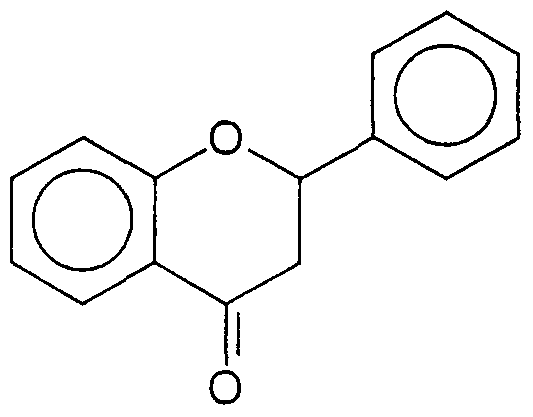
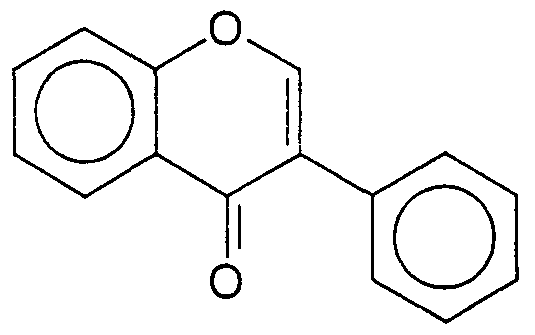
- Flavon and its derivatives are characterized by the following basic structure (substitution positions specified)
- flavones usually occur in glycosidated form
- Flavonoids are glycosides of flavones, the flavanones, whose basic structure is characterized by the following structure
- the flavonoids are preferably selected from the group of substances of the genetic structural formula
- Zi - Z 7 are independently selected from the group H, OH, alkoxy and hydroxyalkoxy, where the alkoxy or hydroxyalkoxy groups are branched and unbranched and can have 1-18 carbon atoms, and wherein Gly is selected from the group the mono- and oligoglycoside residues
- the flavonoids can, however, also advantageously be selected from the group of substances of the genetic structural formula
- Zi - Z 6 are selected independently of one another from the group H, OH, alkoxy and hydroxyalkoxy, where the alkoxy or hydroxyalkoxy groups are branched and unbranched and can have 1-18 C atoms, and wherein Gly is selected from the group the mono- and oligoglycoside residues
- Such structures can preferably be selected from the group of substances of the genetic structural formula wherein Glyi, Gly 2 and Gly 3 independently of one another represent monoglycoside residues or Gly 2 or Gly 3 can also represent, individually or jointly, saturated portions by hydrogen atoms
- Glyi, Gly 2 and Gly 3 are preferably selected independently of one another from the group of the hexosyl residues, in particular the rhamnosyl residues and glucosyl residues.
- hexosyl residues for example allosyl, altrosyl, galactosyl, gulosyl, idosyl mannosyl and tamosyl, can also be used advantageously if appropriate be advantageous according to the invention to use pentosyl radicals
- Zi - Z 5 are advantageously selected independently of one another from the group H, Oh methoxy, ethoxy and 2-hydroxyethoxy, and the flavone glycosides have the structure
- the flavone glycosides according to the invention from the group which are represented by the following structure are particularly advantageous where Gly ⁇ Gly 2 and Gly 3 independently of one another represent monoglycoside residues or Gly 2 or Gly 3 can also represent, individually or together, saturated portions by hydrogen atoms
- Glyi, Gly 2 and Gly 3 are preferably selected independently of one another from the group of the hexosyl residues, in particular the rhamnosyl residues and glucosyl residues.
- other hexosyl residues for example allosyl, altrosyl, apiosyl, biosidyl, galactosyl, gulosyl, idosyl, mannosyl, talosyl, ascorbinyl, arabinsoyl , Dulcityl, fructosyl, mannityl, rhamnosyl, ribosyl, sorbityl, xylosyl may be used advantageously if appropriate. It may also be advantageous according to the invention to use pentosyl radicals
- flavone glycoside (s) from the group ⁇ -glucosyl rutin, ⁇ -glucosylmy ⁇ ct ⁇ n, ⁇ -glucosylisoquercit ⁇ in and ⁇ -glucosyl cross t ⁇ n
- a particularly advantageous flavonoid according to the invention is ⁇ -glucosylrutin. It has the following structure
- Na ⁇ ngin (Aurantiin, Na-r ⁇ ngen ⁇ n-7-rhamnogiucos ⁇ d). It is characterized by the following structure
- Hespe ⁇ din (3 ', 5,7-T ⁇ -hydroxy-4'-methoxyflavanon-7-rut ⁇ nos ⁇ d, Hespe ⁇ dosid, Hesperet ⁇ n-7-O-rut ⁇ nos ⁇ d). It is characterized by the following structure
- Another particularly advantageous flavonoid according to the invention is rutin (3,3 ', 4', 5,7-pentahydroxyflavon-3-rut ⁇ nos ⁇ d, Quercet ⁇ n-3-rut ⁇ nos ⁇ d, Sopho ⁇ n, Birutan Rutabion, Taurutin Phytomelin, Melin). It is characterized by the following Structure
- Another particularly advantageous flavonoid according to the invention is troxerutin (3,5-dihydroxy-3 ⁇ 4 ⁇ 7-t ⁇ s (2-hydroxyethoxy) flavon-3- (6-0- (6-deoxy- ⁇ -L-mannopyranosyl) -ß-D-glucopyranoside)) It is characterized by the following structure
- Another particularly advantageous flavonoid according to the invention is monoxerutin (3 3 ', 4' 5-tetrahydroxy-7- (2-hydroxyethoxy) flavon-3- (6-0- (6-deoxy- ⁇ -L-mannopyranosyl) -ß- D-glucopyranoside)) It is characterized by the following structure
- Another particularly advantageous flavonoid according to the invention is diosmin (3 ', 5 7-trihydroxy-4'methoxyflavon-7-rhamnoglucosid). It is characterized by the following structure
- flavonoids whose glucoside residues are bonded via the phenolic hydroxyl functions of the flavone in positions 3 ', 4' and / or 5 '
- Neohespe ⁇ dindihydrochalkon (1- (4 - ((2-0- (6-deoxy- ⁇ -L-mannopyranosyl) -ß-D-glucopyranosyl) oxy) -2,6-d ⁇ hydroxyphenyl) -3- (3-hydroxy-4-methoxyphenyl) -1-propanone), which is characterized by the following structure
- flavonoids used according to the invention, in particular flavonoids in the strict sense, are collectively referred to below as “flavonoids”, regardless of whether a single substance or an isomer mixture or a mixture of different individual substances is present
- Citrus fruit peel extract, citrus fruit kernel extract, soy extract (eg the commercial product phytodermin from society) have proven to be particularly advantageous Chem Laboratorium Dr Kurt Richter GmbH), Sophora Japonica extract (e.g. the commercial product Sopho ⁇ ne from the company Solabia), women's thistle extract ((e.g. the commercial product Psoralen Silyma ⁇ n from the company Mani GmbH chemical products), cat paw bleed extract, spinach extract and a mixed plant extract from passion flowers, black currants and vine leaves (e.g. the AE Complex commercial product from Solabia), calendula extract (e.g. the Pot Mangold AMI watersoluble commercial product from Alban Muller)
- the total amount of one or more flavones, flavanones and / or flavonoids in the finished cosmetic or dermatological preparations is advantageously chosen from the range from 0.01 to 5.0% by weight, preferably 0.1 to 2.0% by weight, based on the total weight of the preparations
- Silicates are salts and esters (silicic acid esters) of orthosilicic acid [S ⁇ (OH)] and their condensation products.
- the silicates are not only the most species-rich class of minerals, but also geologically and technically extremely important.
- Over 80% of the earth's crust consists of silicates layered silicates (phyllosilicates, leaf silicates ) are (ideally) silicate structures with two-dimensionally infinite layers of [S ⁇ 0 4 ] " tetrahedra, each tetrahedron being connected to neighboring tetrahedra via 3 bridging oxygen
- Chemical formulas can only be approximated for layered silicates, since they have a large ion exchange capacity and silicon can be exchanged for aluminum, which in turn can be exchanged for magnesium, Fe 2+ , Fe 3+ , Zn and the like.
- the resulting negative charge of the layers is generally balanced by cations, in particular by Na + and Ca 2+ in interlayer positions
- Layered silicates can swell by reversible storage of water (in 2 to 7 times the amount) and other substances such as alcohols, glycols and the like. Their use as a thickener in cosmetic products is accordingly known per se.
- Advantageous sheet silicates in the sense of the present invention are, for example, those whose largest direction of expansion in the unmodified and unswollen state has an average length of less than 10 ⁇ m.
- the average dimensions of the modified layered silicate particles used can be 1000 nm ⁇ 100 nm ⁇ 1 nm and below.
- the effective size of the modified layered silicate particles in a cosmetic or dermatological formulation naturally depends on the amount of substances stored.
- modified layered silicates in the sense of the present invention are, for example, modified smectites (smectites).
- Smectites are always very fine-grained (mostly ⁇ 2 mm), predominantly lamellar, moss-like or spherical aggregates three-layer clay minerals (2: 1 layer silicates), in which a central layer of octahedrally coordinated cations sandwiched by 2 layers of [(Si, AI) 0 4 ] tetrahedra is surrounded.
- Smectites are idealized by the following structural formula, in which white circles filled with silicon and / or aluminum atoms, light gray circles filled with oxygen atoms, dark gray circles filled with hydrogen atoms and black circles filled with aluminum, magnesium, iron atoms and / or other exchange cations:
- modified smectites are e.g. B. modified Montmorillonite.
- Montmorillonites are described by the approximate chemical formula AI 2 [(OH) 2 / Si 4 O ⁇ 0 ] • n H 2 0 or Al 2 0 3 • 4 Si0 2 • H 2 0 ⁇ n H 2 0 and represent the dioctahedral Clay minerals belonging to smectites.
- Hectorites are also particularly advantageous for the purposes of the present invention.
- Hectorites belong to the smectites and have the approximate chemical formula M + o , 3 (Mg 2.7 Li 0.3 ) [Si 4 ⁇ 0 (OH) 2 ], in which M + mostly represents Na + .
- Bentonites are clays and rocks, the smectites, especially montmorillonite, as the main minerals included
- the "raw" bentonites are either calcium bentonites (referred to in the UK as Fuller earths) or sodium bentonites (also Wyoming bentonites)
- Modified layered silicates in the sense of the present invention are layered silicates, in particular the layered silicate types already mentioned, whose organophilicity (also lipophile) has been increased, for example by reaction with quaternary ammonium compounds.
- Such layered silicates are also referred to as organophilic layered silicates
- bentones ie organic derivatives of montmoleonites (or bentonites) and / or hectorites, which are produced by ion exchange reactions with alkylammonium bases, are particularly advantageous for the purposes of the present invention
- modified layered silicates in the sense of the present invention can be obtained, for example, by reacting layered silicates with quaternium-18.
- Quatemium-18 is a mixture of quaternary ammonium chloride salts, which are described by the following structural formula
- radicals R 1 are independently selected from the group methyl and hydrogenated
- stearalkonium hectotone a reaction product of hectometer and stearalkomum chloride (benzyldimethylstearylammonium chloride), and Quatern ⁇ um-18 hectometer, a reaction product of hectometer and quaternum-18, which are, for example, 38 under the trade names Bentone Nord and Bentone man
- the total amount of one or more modified layered silicates in the finished cosmetic or dermatological preparations is advantageously in the range of 0 05 to 20 0% by weight, preferably 0 1 to 5 0% by weight, based on the total weight of the preparations
- modified layered silicate particles may also be advantageous to combine the modified layered silicate particles with other amphiphilic pigments, which may also contribute to the stabilization of the pickling emulsions
- Such pigments are, for example, micronized, inorganic pigments which are selected from the group of amphiphilic metal oxides, in particular from the group of titanium dioxide, zinc oxide, silicon dioxide or siliconate (for example talc), where the metal oxides can be present either individually or in a mixture it is essentially irrelevant in which of the naturally occurring modifications the amphiphilic metal oxides used are present
- the average particle diameter of the pigments used for combination with modified layered silicates between 1 nm and 200 nm, particularly advantageously between 5 nm and 100 nm
- modified layered silicates according to the invention with untreated, almost pure pigment particles, in particular with those which can also be used as a dye in the food industry and / or as an absorber of UV radiation in sun protection agents zinc oxide pigments available from Merck and those available under the trade names zinc oxide neutral from Haarmann & Reimer or NanoX from the Harcros Chemical Group
- modified layered silicates with inorganic pigments which have been surface-treated to be water-repellent (“coated”), and at the same time an amphiphilic character of these pigments is to be formed or should be maintained.
- This surface treatment can then consist of the pigments being known per se Process can be provided with a thin hydrophobic layer
- Such a method which is described below using the example of titanium dioxide, consists, for example, in that the hydrophobic surface layer after a reaction in accordance with
- n and m are stoichiometric parameters to be used after rectification, R and R 'are the desired organic radicals.
- Particularly advantageous combination partners are T ⁇ 0 2 -p ⁇ gmente, for example those coated with aluminum stearate, available under the trade name MT 100 T from TAYCA
- a further advantageous coating of the combination partners consists of dimethylpolysiloxane (also dimethicone), a mixture of fully methylated, linear siloxane polymers which are blocked at the end with tnmethylsiloxy units.
- dimethylpolysiloxane also dimethicone
- a mixture of fully methylated, linear siloxane polymers which are blocked at the end with tnmethylsiloxy units.
- the combination of modified layered silicates with zinc oxide pigments is particularly advantageous in the sense of the present invention coated in this way
- the inorganic pigments used in addition to modified layered silicates are coated with a mixture of dimethylpolysiloxane, in particular dimethylpolysiloxane with an average chain length of 200 to 350 dimethylsiloxane units, and SiCagel, which is also referred to as simethicone. It is particularly advantageous , if the inorganic pigments are additionally coated with aluminum hydroxide or aluminum oxide hydrate (also alumina, CAS No. 1333-84-2). Particularly advantageous combination partners are titanium dioxides which are coated with simethicone and alumina, the coating also being able to contain water. An example of this is the titanium dioxide available under the trade name Eusolex T2000 from Merck
- modified layered silicates with a mixture of different inorganic, amphiphilic pigment types both within a crystal, for example as iron mixed oxide or talc (magnesium silicate), and also by mixing several metal oxide types within one preparation.
- Particularly advantageous combination partners are magnesium silicates, for example those available under the trade name Talkum Micron from Grolmann
- the modified layered silicates according to the invention can furthermore advantageously be combined with other pigments, for example with titanium dioxide pigments which are coated with octylsilanol and / or with silicon dioxide particles which have been treated to be water-repellent on the surface.
- silicon dioxide particles examples are spherical polyalkylsilsesquioxane particles as described in European disclosure 686 391 are mentioned.
- polyalkylsilsesquioxane particles are obtained, for example, from Degussa under the trade names Aerosil R972 and Aerosil 200V
- modified layered silicates are further advantageously combined with microfine polymer particles which are present in the preparation in the form of solids.
- Favorable combination partners in the sense of the present invention are, for example, polycarbonates, polyethers, polyethylene, polypropylene, polyvinyl chloride, polystyrene, polyamides, polyacrylates and the like
- Combination partners suitable according to the invention are, for example, microfine polyamide particles, in particular those available under the trade name SP-500 from the company TORAY. Also advantageous are polyamide 6 (also nylon 6) or polyamide 12 (also nylon 12) particles. Polyamide 6 is made of ⁇ -Aminocaproic acid (6-amino hexanoic acid) or ⁇ -caprolactam polyamide [poly ( ⁇ -caprolactam)], and polyamide 12 is a poly ( ⁇ -lau ⁇ niactam) made of ⁇ -lau ⁇ nlactam.
- Orgasol ® 1002 (polyamide) are advantageous for the purposes of the present invention 6) and Orgasol ® 2002 (polyamide 12) from ELF ATOCHEM
- microfine polymer particles which are suitable for combination with the inventive modified Schichtsihkaten are microfine polymethacrylates Such particles are obtainable, for example under the trade name POLYTRAP ® by the company DOW CHEMICAL
- microfine polymer particles used as combination partners are coated on the surface.
- This surface treatment can consist in that the polymer particles are provided with a thin hydrophilic layer by methods known per se.
- Advantageous coatings consist, for example, of titanium dioxide (T ⁇ 0 2 ), zirconium dioxide (Zr0 2 ) or also other polymers such as, for example, polymethyl methacrylate.
- Particularly advantageous microfine polymer particles for the purposes of the present invention are, for example, those obtainable by the process for hydrophilic coating of hydrophobic polymer particles described in US Pat. No. 4,898,913
- the average particle diameter of the microfine polymer particles used as the combination partner is preferably selected to be less than 100 ⁇ m, particularly advantageously less than 50 ⁇ m. It is essentially irrelevant in what form (plates, rods, spheres, etc.) the polymer particles used are present
- modified layered silicates according to the invention are furthermore preferably combined with amphiphilic modified polysaccharides which have no thickening properties
- amphiphilic polysaccharides can be obtained, for example, by reacting starch with mono-, bi- or polyfunctional reagents or oxidizing agents in reactions which are largely polymer-analogous
- R can represent, for example, a hydrogen and / or an alkyl and / or aralkyl radical (in the case of the starch ether) or a hydrogen and / or an organic and / or inorganic acid radical (in the case of the starch ester)
- R can represent, for example, a hydrogen and / or an alkyl and / or aralkyl radical (in the case of the starch ether) or a hydrogen and / or an organic and / or inorganic acid radical (in the case of the starch ester)
- modified layered silicates according to the invention with starch ethers, for example with those which are etherified by starch etherification with tetrahedra.
- methylolacetylene diurea are available and which are referred to as Amylum non mucilaginosum (non-swelling starch)
- modified layered silicates according to the invention with starch esters and / or their salts, for example with sodium and / or aluminum salts of low-substituted half esters of starch, in particular with sodium starch n-octenyl succinate of structural formula (I), in which R is the following, is particularly advantageous Structure distinguished
- the mean particle diameter of the modified polysaccharides used for combination with the modified layered silicates according to the invention is advantageous to choose to be less than 20 ⁇ m, particularly advantageously less than 15 ⁇ m
- modified polysaccharides which can be combined with the modified layered silicates, should of course not be limiting.
- Modified polysaccharides which are advantageous combination partners in the sense of the present invention, can be obtained in numerous ways known per se, both chemically and physically In principle, new ways of producing such polysaccharides are also conceivable. What is important here is that the modified polysaccharides show amphiphilic properties and that they do not have a thickening effect
- modified layered silicates according to the invention are also preferably combined with bornite
- the average particle diameter of the boron particles used is advantageous to be less than 20 ⁇ m, particularly advantageously less than 15 ⁇ m
- boron nitride particles which have been surface-treated ("coated") to be water-repellent, the amphiphilic character being formed or maintained at the same time
- boron nitride particles consists of dimethylpolysiloxane (also Dimethicone), a mixture of fully methylated, linear siloxane polymers, which are blocked at the end with tnmethylsiloxy units.
- dimethylpolysiloxane also Dimethicone
- a mixture of fully methylated, linear siloxane polymers which are blocked at the end with tnmethylsiloxy units.
- the boron nitride particles available from Carborundum under the trade name Tres BN ® UHP 1106 are advantageous
- boron nitride particles with polymethylhydrogensiloxane, a linear polysiloxane, which is also referred to as methicone.
- Advantageous boronite particles treated with methicone are, for example, those available from Carborundum under the trade name Tres BN® UHP 1107
- the Pickenng emulsions according to the invention can serve as the basis for cosmetic or dermatological formulations. These can be composed as usual and can be used, for example, for the treatment and care of the skin as a lip care product as a demo product and as a make-up or make-up removal product in decorative cosmetics or as a light protection preparation the cosmetic and dermatological preparations according to the invention are applied to the skin in sufficient quantities in the manner customary for cosmetics
- cosmetic or topical dermatological compositions within the meaning of the present invention, depending on their structure, can be used, for example, as skin protection cream, cleansing milk, sunscreen lotion, nutritional cream, day or night cream, etc. It is possible and advantageous, if appropriate, to use the compositions according to the invention as the basis for pharmaceutical formulations to use
- the cosmetic and dermatological preparations according to the invention can contain cosmetic auxiliaries as are usually used in such preparations, for example preservatives, bactericides, perfumes, substances for preventing foaming, dyes, pigments which have a coloring effect, thickeners, softening, moisturizing and / or moisturizing substances, fats, oils, waxes or other usual components of a cosmetic or dermatological formulation such as alcohols, polyols, polymers, foam stabilizers, electrolytes, organic solvents or silicone solvents
- compositions according to the invention are very good vehicles for cosmetic or dermatological active ingredients in the skin, advantageous active ingredients being antioxidants which can protect the skin against oxidative stress
- the preparations advantageously contain one or more antioxidants All of the antioxidants suitable or customary for cosmetic and / or dermatological applications can be used as inexpensive but nevertheless optional antioxidants.It is advantageous to use antioxidants as the only class of active ingredient, for example when one The focus is on cosmetic or dermatological use, such as combating the oxidative stress on the skin. However, it is also advantageous to use the stick preparations according to the invention with a Provide content of one or more antioxidants if the preparations are to serve another purpose, e.g. as a sunscreen
- the antioxidants are particularly advantageously selected from the group consisting of amino acids (eg glycine, histidine, tyrosine tryptophan) and their derivatives, imidazoles (eg urocanic acid) and their derivatives, peptides such as D, L-camosin, D-carnosine, L- Carosin and its derivatives (eg Anse ⁇ n), carotenoids, carotene (eg ⁇ -carotene, ⁇ -carotm, lycopene) and their derivatives, chlorogenic acid and their derivatives, lipoic acid and their derivatives (eg dihydrohonsoic acid), aurothioglucose, propylthiouracil and other thiols (e.g.
- amino acids eg glycine, histidine, tyrosine tryptophan
- imidazoles eg urocanic acid
- peptides such as D, L-camosin, D
- thioredoxm glutathione, cysteine, cystine, cystamine and their glycosyl, N-acetyl, methyl, ethyl, propyl, amyl, butyl and lauryl, palmitoyl, oleyl, ⁇ -Linoleyl, cholesteryl and glyceryl esters) as well as their salts, dilauryl thiodipropionate, distearyl thiodipropionate, thiodipropionic acid and their derivatives (esters, ethers, peptides, lipids, nucleotides, nucleosides and salts) as well as sulfoximine compounds (e.g.
- buthioninsulfoximines homiminones, stemsulfonesulfonoxides), - , Hexa-, heptathioninsulfoximine
- very low contractual doses e.g. pmol to ⁇ mol / kg
- furthermore (metal) chelators e.g. ⁇ -hydroxy fatty acids, palmitic acid, phytic acid, lactofer ⁇ n
- ⁇ -hydroxy acids e.g.
- Citro - Nenoic acid lactic acid, malic acid
- humic acid bile acid, bile extracts, bilirubm, bihdrin, EDTA, EGTA and their derivatives
- unsaturated fatty acids and their derivatives eg ⁇ -lmolene acid, linoleic acid, oleic acid
- folic acid and their derivatives ubiquinone and ubiquinol and their derivatives
- vitamin C and derivatives e.g. ascorbyl palmitate.
- Mg ascorbyl phosphate ascorbyl acetate tocopherols and derivatives (e.g.
- vitamin E acetate
- vitamin A and derivatives vitamin A palmitate
- derbenzene methionine eg stilbene oxide, trans-stilbene oxide
- derivatives salts, esters, ether sugars, nucleotides, nucleosides, peptides and lipids
- the amount of the aforementioned antioxidants (one or more compounds) in the preparations according to the invention is preferably 0.001 to 30% by weight, particularly preferably 0.05 to 20% by weight, in particular 0.1 to 10% by weight, based on the total weight of the preparation If vitamin E and / or its derivative represent the antioxidant (s), it is advantageous to choose their respective concentrations from the range from 0.001 to 10% by weight, based on the total weight of the formulation
- vitamin A or vitamin A derivatives or carotenes or their derivatives represent the antioxidant (s)
- the active ingredients can also be selected very advantageously from the group of lipophilic active ingredients, in particular from the following group
- the active substances from the group of the refatting substances, for example Purcelhnol, Euce ⁇ t and Neoce ⁇ t
- Those cosmetic and dermatological preparations which are in the form of a sunscreen are also favorable. They preferably contain, in addition to the active compound combinations according to the invention, at least one UV-A filter substance and / or at least one UV-B filter substance. Such formulations can, although not necessary, possibly also containing one or more inorganic pigments as UV filter substances
- Inorganic pigments based on metal oxides and / or other metal compounds which are sparingly soluble or insoluble in water are preferred, in particular the oxides of titanium (T ⁇ 0 2 ) zinc (ZnO), iron (eg Fe 2 0 3 ), zirconium (Zr0 2 ), SiCium (Si0 2 ), manganese (eg MnO), aluminum (Al 2 0 3 ), cerium (eg Ce 2 0 3 ), mixed oxides of the corresponding metals and mixtures of such oxides
- An additional content of stabilizing titanium dioxide and / or zinc oxide particles can of course also be advantageous, but is not necessary in the sense of the present invention
- UV protection substances like antioxidants and, if desired, preservatives, also provide effective protection for the preparations themselves against spoilage
- Preparations according to the invention advantageously contain substances which absorb UV radiation in the UV-A and / or UV-B range, the total amount of the filter substances, for example, 0.1% by weight to 30% by weight, preferably 0.5 to 20 % By weight, in particular 1.0 to 15.0% by weight, based on the total weight of the preparations, in order to provide cosmetic preparations which protect the hair or the skin from the entire range of ultraviolet radiation Sunscreen for hair or skin
- UV-A filter substances for the purposes of the present invention are dibenzoyl methande ⁇ vate, in particular 4- (tert-butyl) -4'-methoxyd ⁇ benzoylmethan (CAS No. 70356-09-1), marketed by Givaudan under the trade name Parsol ® 1789 and is sold by Merck under the trade name Eusolex® 9020
- Further advantageous UV-A filter substances are the phenylene-1,4-b ⁇ s- (2-benz ⁇ m ⁇ dazyl) -3 3 '5,5'-tetrasulfonic acid
- salts especially the corresponding sodium, potassium or t ⁇ ethanolammonium salts, in particular the phenylene-1,4-b ⁇ s- (2-benz ⁇ m ⁇ dazyl) -3,3'-5,5'-tetrasulfonic acid bis -nat ⁇ umsalz
- UV filter substances in the sense of the present invention are also so-called broadband filters, that is filter substances which absorb both UV-A and UV-B radiation
- Advantageous broadband filters or UV-B filter substances are, for example, bis-resorcinyl t ⁇ azinde ⁇ vate with the following structure
- R 1 , R 2 and R 3 are independently selected from the group of branched and unbranched alkyl groups having 1 to 10 carbon atoms or a single hydrogen atom. Particularly preferred are 2,4-B ⁇ s - ⁇ [4- (2-ethyl - hexyloxy) -2-hydroxy] -phenyl ⁇ -6- (4-methoxyphenyl) -1, 3,5-t ⁇ az ⁇ n (INCI Aniso T ⁇ azin), which is available under the trade name Tinosorb® S from CIBA-Chemikahen GmbH, and the 4,4 ', 4 "- (1, 3,5-T ⁇ az ⁇ n-2,4,6-t ⁇ ylt ⁇ m ⁇ no) -t ⁇ s-benzoic acid-t ⁇ s (2-ethyl-hexyl ester), synonymous 2,4,6-T ⁇ s- [ an ⁇ l ⁇ no- (p-carbo-2'-ethyl-1'-hexyloxy)] - 1, 3,5-t ⁇
- UV filter substances also described the structural motif
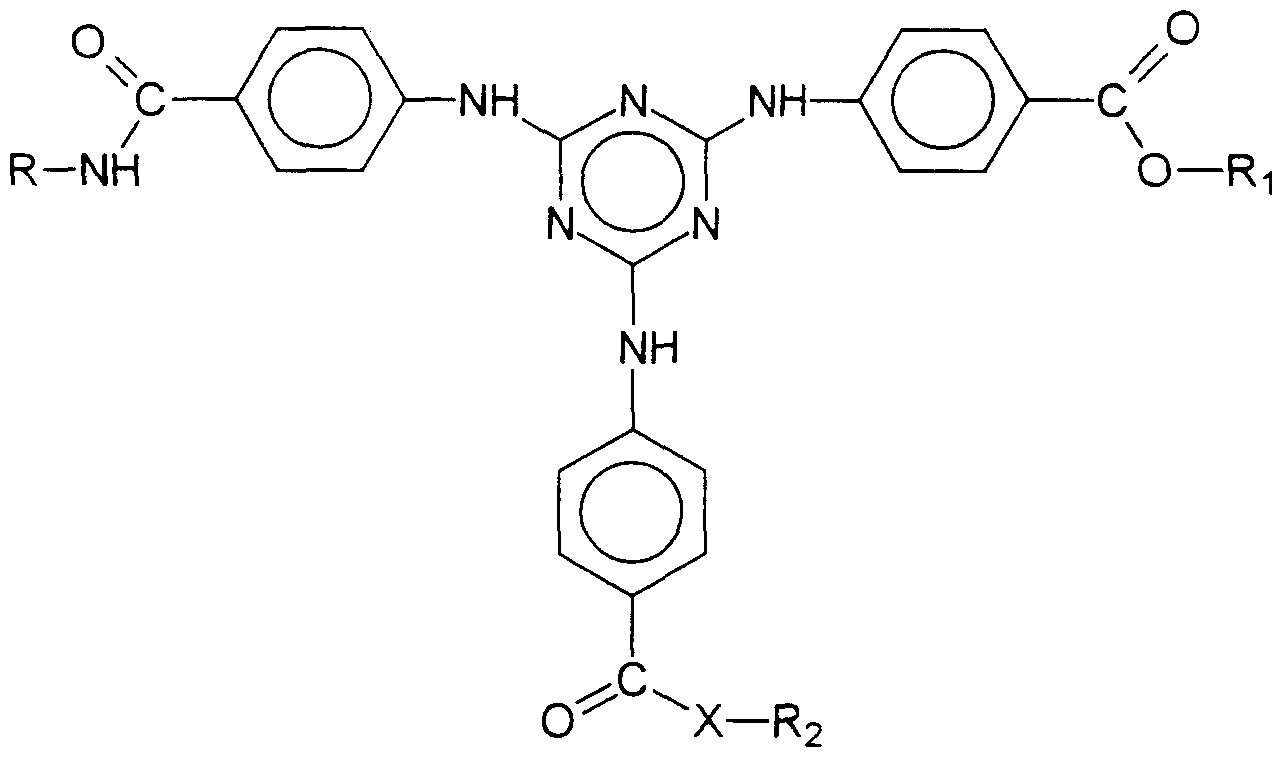
- UV filter substances in the sense of the present invention, for example, the s-T ⁇ azinden ⁇ vate described in the European Disclosure EP 570 838 A1, whose chemical structure by the Gen ⁇ sche formula is reproduced, whereby
- R represents a branched or unbranched CrC ⁇ 8 alkyl radical, a Cs-C- 2 cycloalkyl radical, optionally substituted with one or more C 1 -C 4 alkyl groups
- X represents an oxygen atom or an NH group
- Ri represents a branched or unbranched CrC ⁇ 8 alkyl radical, a Cs -C 2 cycloalkyl radical optionally substituted with one or more CC 4 alkyl groups, or a
- Hydrogen atom an alkali metal atom, an ammonium group or a group of
- A represents a branched or unbranched C 8 -C 8 alkyl radical, a C 5 -C 2 cycloalkyl or aryl radical, optionally substituted with one or more Cr
- R 3 represents a hydrogen atom or a methyl group
- n represents a number from 1 to 10
- a branched or unbranched C 8 -C alkyl radical a C 5 -C 2 cycloalkyl radical, optionally substituted with one or more dC 4 - Alkyl groups
- X represents the NH group
- a branched or unbranched C 8 -C alkyl radical a C 12 -C 12 cycloalkyl radical optionally substituted with one or more CC 4 alkyl groups
- A represents a branched or unbranched C 8 -C 8 alkyl radical, a C 5 -C 2 cycloalkyl or aryl radical, optionally substituted by one or more d-
- R 3 represents a hydrogen atom or a methyl group
- n represents a number from 1 to 10 when X represents an oxygen atom.
- a particularly preferred UV filter substance in the sense of the present invention is also an asymmetrically substituted s-triazine, the chemical structure of which is represented by the formula
- dioctyibutylamidotriazon (INCI: dioctylbutamidotriazone) and is available under the trade name UVASORB HEB from Sigma 3V.
- European laid-open specification 775 698 also describes bis-resorcinyltriazine derivatives which are preferably to be used and whose chemical structure is represented by the generic formula is reproduced, wherein R, R 2 and Ai represent a wide variety of organic radicals
- Also advantageous in the sense of the present invention are the 2,4-B ⁇ s - ⁇ [4- (3-sulfonato) -2-hydroxypropyloxy) -2-hydroxy] phenyl ⁇ -6- (4-methoxyphenyl) -1, 3,5-t ⁇ az ⁇ n sodium salt, the 2,4-B ⁇ s - ⁇ [4- (3- (2-propyloxy) -2-hydroxypropyloxy) -2-hydroxy] phenyl ⁇ -6- (4-methoxyphenyl) - 1, 3,5-t ⁇ az ⁇ n, the 2,4-B ⁇ s - ⁇ [4- (2-ethylhexyloxy) -2-hydroxy] phenyl ⁇ -6- [4- (2-methoxyethylcarboxyl) phenylamine] -1, 3,5-t ⁇ az ⁇ n, the 2,4-B ⁇ s - ⁇ [4- (3- (2-propyloxy) -2-hydroxypropyloxy) - 2-hydroxy
- An advantageous broadband filter in the sense of the present invention is the 2,2'-methylene-b ⁇ s- (6- (2H-benzot ⁇ azol-2-yl) -4- (1, 1, 3,3-tetramethylbutyl) phenol), which through the chemical structural formula
- Another advantageous broadband filter for the purposes of the present invention is 2- (2H-benzot ⁇ azol-2-yl) -4-methyl-6- [2-methyl-3- [1, 3,3,3-tetramethyl-1 - [( t ⁇ methyls ⁇ lyl) oxy] d ⁇ s ⁇ loxa- nylJpropyl] -phenol (CAS No. 155633-54-8) with the INCI name Dromet ⁇ zole T ⁇ siloxane which by the chemical structural formula
- the UV-B filters can be oil-soluble or water-soluble.
- Advantageous UV-B filter substances are eg
- 3-Benzyl ⁇ dencampher-De ⁇ vate preferably 3- (4-Methylbenzyhden) camphor, 3-benzylidene hdencampher,
- esters of Benzalmalonsaure preferably 4-Methoxybenzalmalonsaured ⁇ (2-ethylhexyl xyl) ester
- esters of cinnamic acid preferably 4-Methoxyz ⁇ mtsaure (2-ethylhexyl) ester, 4-methoxy zimtsaureisopentylester,
- Advantageous water-soluble UV-B filter substances are, for example
- a further light protection filter substance to be used advantageously according to the invention is ethylhexyl-2-cyano-3 3-diphenylacrylate (octocrylene), which is available from BASF under the name UvinuP N 539 and is distinguished by the following structure
Landscapes
- Health & Medical Sciences (AREA)
- Life Sciences & Earth Sciences (AREA)
- Chemical & Material Sciences (AREA)
- Public Health (AREA)
- Veterinary Medicine (AREA)
- General Health & Medical Sciences (AREA)
- Animal Behavior & Ethology (AREA)
- Birds (AREA)
- Epidemiology (AREA)
- Inorganic Chemistry (AREA)
- Dispersion Chemistry (AREA)
- Materials Engineering (AREA)
- Organic Chemistry (AREA)
- Engineering & Computer Science (AREA)
- Oil, Petroleum & Natural Gas (AREA)
- Dermatology (AREA)
- Cosmetics (AREA)
- Medicinal Preparation (AREA)
- Colloid Chemistry (AREA)
Abstract
Description








Claims
Priority Applications (4)
| Application Number | Priority Date | Filing Date | Title |
|---|---|---|---|
| EP00949370A EP1200042B1 (de) | 1999-07-20 | 2000-07-18 | Emulgatorfreie feindisperse systeme vom typ wasser-in-öl |
| JP2001510418A JP2003504386A (ja) | 1999-07-20 | 2000-07-18 | 乳化剤を含まない油中水型の微分散系 |
| AT00949370T ATE308298T1 (de) | 1999-07-20 | 2000-07-18 | Emulgatorfreie feindisperse systeme vom typ wasser-in-öl |
| DE50011516T DE50011516D1 (de) | 1999-07-20 | 2000-07-18 | Emulgatorfreie feindisperse systeme vom typ wasser-in-öl |
Applications Claiming Priority (4)
| Application Number | Priority Date | Filing Date | Title |
|---|---|---|---|
| DE19934012.9 | 1999-07-20 | ||
| DE19934012 | 1999-07-20 | ||
| DE19939848.8 | 1999-08-23 | ||
| DE19939848A DE19939848A1 (de) | 1999-07-20 | 1999-08-23 | Emulgatorfreie feindisperse Systeme vom Typ Wasser-in-Öl |
Publications (2)
| Publication Number | Publication Date |
|---|---|
| WO2001005361A2 true WO2001005361A2 (de) | 2001-01-25 |
| WO2001005361A3 WO2001005361A3 (de) | 2001-07-19 |
Family
ID=26054260
Family Applications (1)
| Application Number | Title | Priority Date | Filing Date |
|---|---|---|---|
| PCT/EP2000/006847 Ceased WO2001005361A2 (de) | 1999-07-20 | 2000-07-18 | Emulgatorfreie feindisperse systeme vom typ wasser-in-öl |
Country Status (6)
| Country | Link |
|---|---|
| EP (1) | EP1200042B1 (de) |
| JP (1) | JP2003504386A (de) |
| AT (1) | ATE308298T1 (de) |
| DE (1) | DE50011516D1 (de) |
| ES (1) | ES2252029T3 (de) |
| WO (1) | WO2001005361A2 (de) |
Cited By (2)
| Publication number | Priority date | Publication date | Assignee | Title |
|---|---|---|---|---|
| JP2002275468A (ja) * | 2001-03-21 | 2002-09-25 | Nikken Kasei Kk | ジヒドロカルコンを含有する抗酸化剤 |
| EP1453478B1 (de) * | 2001-08-29 | 2011-10-12 | Beiersdorf AG | Kosmetische und dermatologische lichtschutzformulierungen mit einem gehalt an partikulären uv-filtersubstanzen und alkylnaphthalaten |
Family Cites Families (3)
| Publication number | Priority date | Publication date | Assignee | Title |
|---|---|---|---|---|
| DE4444238A1 (de) * | 1994-12-13 | 1996-06-20 | Beiersdorf Ag | Kosmetische oder dermatologische Wirkstoffkombinationen aus Zimtsäurederivaten und Flavonglycosiden |
| FR2731615B1 (fr) * | 1995-03-15 | 1997-07-25 | Fabre Pierre Dermo Cosmetique | Compositions ecran-solaire comprenant un melange de particules d'oxyde de titane et/ou de zinc, leur procede de preparation et leur utilisation |
| DE19755504A1 (de) * | 1997-12-13 | 1999-06-17 | Beiersdorf Ag | Verwendung von Flavonen und Flavonoiden gegen die UV-induzierte Zersetzung von Dibenzoylmethan und dessen Derivaten |
-
2000
- 2000-07-18 DE DE50011516T patent/DE50011516D1/de not_active Expired - Lifetime
- 2000-07-18 ES ES00949370T patent/ES2252029T3/es not_active Expired - Lifetime
- 2000-07-18 AT AT00949370T patent/ATE308298T1/de not_active IP Right Cessation
- 2000-07-18 WO PCT/EP2000/006847 patent/WO2001005361A2/de not_active Ceased
- 2000-07-18 JP JP2001510418A patent/JP2003504386A/ja active Pending
- 2000-07-18 EP EP00949370A patent/EP1200042B1/de not_active Expired - Lifetime
Cited By (2)
| Publication number | Priority date | Publication date | Assignee | Title |
|---|---|---|---|---|
| JP2002275468A (ja) * | 2001-03-21 | 2002-09-25 | Nikken Kasei Kk | ジヒドロカルコンを含有する抗酸化剤 |
| EP1453478B1 (de) * | 2001-08-29 | 2011-10-12 | Beiersdorf AG | Kosmetische und dermatologische lichtschutzformulierungen mit einem gehalt an partikulären uv-filtersubstanzen und alkylnaphthalaten |
Also Published As
| Publication number | Publication date |
|---|---|
| JP2003504386A (ja) | 2003-02-04 |
| ES2252029T3 (es) | 2006-05-16 |
| EP1200042B1 (de) | 2005-11-02 |
| DE50011516D1 (de) | 2005-12-08 |
| ATE308298T1 (de) | 2005-11-15 |
| WO2001005361A3 (de) | 2001-07-19 |
| EP1200042A2 (de) | 2002-05-02 |
Similar Documents
| Publication | Publication Date | Title |
|---|---|---|
| DE19933464A1 (de) | Emulgatorfreie, disperse topische Zubereitungen | |
| DE10226353A1 (de) | Kosmetische und dermatologische Lichtschutzzubereitungen enthaltend eine synergistische Kombination aus UV-Absorbern, anorganischen Pigmenten und organischen Farbstoffen | |
| DE19755504A1 (de) | Verwendung von Flavonen und Flavonoiden gegen die UV-induzierte Zersetzung von Dibenzoylmethan und dessen Derivaten | |
| EP1077058A2 (de) | Emulgatorfreie feindisperse Systeme vom Typ Wasser-in-Öl | |
| WO2002087517A2 (de) | Verwendung von isoflavonoiden in kosmetischen oder dermatologischen zubereitungen zur prophylaxe vor und behandlung von sensibler haut | |
| EP1200039A2 (de) | Emulgatorfreie feindisperse systeme vom typ wasser-in-öl | |
| DE10155966A1 (de) | Emulgatorfreie kosmetische und dermatologische Lichtschutzformulierungen mit einem Gehalt an Hydroxybenzophenonen | |
| EP1371357B1 (de) | Kosmetische und dermatologische Lichtschutzzubereitungen enthaltend UV-Absorber und Schichtsilikate | |
| WO2002089757A2 (de) | Verwendung von isoflavonen in kosmetischen oder dermatologischen zubereitungen | |
| EP1000603B1 (de) | Verwendung von oberflächenaktiven Citronensäureestern zur Stabilisierung von Flavonen, Flavanonen bzw. Flavonoiden, synergistische Gemische aus Flavonen, Flavanonen bzw. Flavonoiden und oberflächenaktiven Substanzen sowie kosmetische und dermatologische Zubereitungen mit einem Gehalt an solchen Gemischen | |
| EP1055413A2 (de) | Wirkstoffkombinationen aus sulfonierten UV-Filtersubstanzen und Flavonderivaten und/oder Flavanonderivaten, insbesondere von Flavonoiden sowie kosmetische Zubereitungen, solche Wirkstoffkombinationen enthaltend | |
| EP0821944B1 (de) | Wasserfeste Lichtschutzzubereitungen mit einem Gehalt an anorganischen Mikropigmenten und wasserlöslichen UV-Filtersubstanzen | |
| EP1200042B1 (de) | Emulgatorfreie feindisperse systeme vom typ wasser-in-öl | |
| EP0850639B1 (de) | Wasserfeste Lichtschutzzubereitungen mit einem Gehalt an anorganischen Mikropigmenten und wasserlöslichen UV-Filtersubstanzen | |
| EP0998898B1 (de) | Verwendung von Alkylglucosiden zur Stabilisierung von Flavonen, Flavanonen bzw. Flavonoiden, synergistische Gemische aus Flavonen, Flavanonen bzw. Flavonoiden und Alkylglucosiden sowie kosmetische und dermatologische Zubereitungen mit einem Gehalt an solchen Gemischen | |
| DE19923713A1 (de) | Kosmetische oder dermatologische Lichtschutzzubereitungen mit einem Gehalt an Flavonderivaten und/oder Flavanonderivaten, insbesondere von Flavonoiden und Benzotriazol sowie die Verwendung von UV-Filtersubstanzen, welche das Strukturmotiv des Benzotriazols aufweisen, zur Stabilisierung von Flavonderivaten und/oder Flavanonderivaten, insbesondere von Flavonoiden | |
| EP1062943B1 (de) | Kosmetische oder dermatologische Lichtschutzzubereitungen mit einem Gehalt an Bornitrid und UV-Filtersubstanzen, welche das Strukturmotiv des Triazins aufweisen | |
| EP1055414A1 (de) | Kosmetische oder dermatologische Lichtschutzzubereitungen mit einem Gehalt an Bornitrid und sulfonierten UV-Filtersubstanzen sowie die Verwendung von Bornitrid zur Stabilisierung von Emulsionen, die einen Gehalt an Elektrolyten, insbesondere einen Gehalt an sulfonierten UV-Filtersubstanzen, aufweisen | |
| DE19845324A1 (de) | Verwendung von Nitrilotriessigsäure zur Stabilisierung von Flavonen, Flavanonen bzw. Flavonoiden, synergistische Gemische aus Flavonen, Flavanonen bzw. Flavonoiden und Nitrilessigsäure sowie kosmetische und dermatologische Zubereitungen mit einem Gehalt an solchen Gemischen | |
| EP1055411A2 (de) | Kosmetische oder dermatologische Lichtschutzzubereitungen mit einem Gehalt an Flavonderivaten und/oder Flavanonderivaten, insbesondere von Flavonoiden und s-Triazin | |
| DE19939848A1 (de) | Emulgatorfreie feindisperse Systeme vom Typ Wasser-in-Öl | |
| DE10131796A1 (de) | Verwendung von Cardiolipin in kosmetischen oder dermatologischen Zubereitungen | |
| DE19845319A1 (de) | Verwendung von oberflächenaktiven Substanzen zur Stabilisierung von Flavonen, Flavanonen bzw. Flavonoiden, synergistische Gemische aus Flavonen, Flavanonen bzw. Flavonoiden und oberflächenaktiven Substanzen sowie kosmetische und dermatologische Zubereitungen mit einem Gehalt an solchen Gemischen | |
| DE19845266A1 (de) | Verwendung von Butylhydroxytoluol zur Stabilisierung von Flavonen, Flavanonen bzw. Flavonoiden, synergistische Gemische aus Flavonen, Flavanonen bzw. Flavonoiden und Butylhydroxytoluol sowie kosmetische und dermatologische Zubereitungen mit einem Gehalt an solchen Gemischen | |
| EP1055415A2 (de) | Wirkstoffkombinationen aus Bornitrid und Flavonderivaten und/oder Flavanonderivaten, insbesondere von Flavonoiden, sowie kosmetische Zubereitungen, solche Wirkstoffkombinationen enthaltend |
Legal Events
| Date | Code | Title | Description |
|---|---|---|---|
| AK | Designated states |
Kind code of ref document: A2 Designated state(s): JP US |
|
| AL | Designated countries for regional patents |
Kind code of ref document: A2 Designated state(s): AT BE CH CY DE DK ES FI FR GB GR IE IT LU MC NL PT SE |
|
| 121 | Ep: the epo has been informed by wipo that ep was designated in this application | ||
| DFPE | Request for preliminary examination filed prior to expiration of 19th month from priority date (pct application filed before 20040101) | ||
| AK | Designated states |
Kind code of ref document: A3 Designated state(s): JP US |
|
| AL | Designated countries for regional patents |
Kind code of ref document: A3 Designated state(s): AT BE CH CY DE DK ES FI FR GB GR IE IT LU MC NL PT SE |
|
| WWE | Wipo information: entry into national phase |
Ref document number: 2000949370 Country of ref document: EP |
|
| WWP | Wipo information: published in national office |
Ref document number: 2000949370 Country of ref document: EP |
|
| WWE | Wipo information: entry into national phase |
Ref document number: 10031539 Country of ref document: US |
|
| WWG | Wipo information: grant in national office |
Ref document number: 2000949370 Country of ref document: EP |