WO2001008166A1 - Cable, in particular for transport or distribution of electrical energy and insulating composition - Google Patents
Cable, in particular for transport or distribution of electrical energy and insulating composition Download PDFInfo
- Publication number
- WO2001008166A1 WO2001008166A1 PCT/EP2000/007114 EP0007114W WO0108166A1 WO 2001008166 A1 WO2001008166 A1 WO 2001008166A1 EP 0007114 W EP0007114 W EP 0007114W WO 0108166 A1 WO0108166 A1 WO 0108166A1
- Authority
- WO
- WIPO (PCT)
- Prior art keywords
- group
- benzophenone
- alkyl
- alkoxy
- optionally substituted
- Prior art date
- Legal status (The legal status is an assumption and is not a legal conclusion. Google has not performed a legal analysis and makes no representation as to the accuracy of the status listed.)
- Ceased
Links
Classifications
-
- H—ELECTRICITY
- H01—ELECTRIC ELEMENTS
- H01B—CABLES; CONDUCTORS; INSULATORS; SELECTION OF MATERIALS FOR THEIR CONDUCTIVE, INSULATING OR DIELECTRIC PROPERTIES
- H01B3/00—Insulators or insulating bodies characterised by the insulating materials; Selection of materials for their insulating or dielectric properties
- H01B3/18—Insulators or insulating bodies characterised by the insulating materials; Selection of materials for their insulating or dielectric properties mainly consisting of organic substances
- H01B3/30—Insulators or insulating bodies characterised by the insulating materials; Selection of materials for their insulating or dielectric properties mainly consisting of organic substances plastics; resins; waxes
- H01B3/44—Insulators or insulating bodies characterised by the insulating materials; Selection of materials for their insulating or dielectric properties mainly consisting of organic substances plastics; resins; waxes vinyl resins; acrylic resins
- H01B3/441—Insulators or insulating bodies characterised by the insulating materials; Selection of materials for their insulating or dielectric properties mainly consisting of organic substances plastics; resins; waxes vinyl resins; acrylic resins from alkenes
-
- C—CHEMISTRY; METALLURGY
- C08—ORGANIC MACROMOLECULAR COMPOUNDS; THEIR PREPARATION OR CHEMICAL WORKING-UP; COMPOSITIONS BASED THEREON
- C08K—Use of inorganic or non-macromolecular organic substances as compounding ingredients
- C08K5/00—Use of organic ingredients
- C08K5/04—Oxygen-containing compounds
- C08K5/13—Phenols; Phenolates
- C08K5/132—Phenols containing keto groups, e.g. benzophenones
-
- Y—GENERAL TAGGING OF NEW TECHNOLOGICAL DEVELOPMENTS; GENERAL TAGGING OF CROSS-SECTIONAL TECHNOLOGIES SPANNING OVER SEVERAL SECTIONS OF THE IPC; TECHNICAL SUBJECTS COVERED BY FORMER USPC CROSS-REFERENCE ART COLLECTIONS [XRACs] AND DIGESTS
- Y10—TECHNICAL SUBJECTS COVERED BY FORMER USPC
- Y10T—TECHNICAL SUBJECTS COVERED BY FORMER US CLASSIFICATION
- Y10T428/00—Stock material or miscellaneous articles
- Y10T428/29—Coated or structually defined flake, particle, cell, strand, strand portion, rod, filament, macroscopic fiber or mass thereof
- Y10T428/2913—Rod, strand, filament or fiber
- Y10T428/2933—Coated or with bond, impregnation or core
-
- Y—GENERAL TAGGING OF NEW TECHNOLOGICAL DEVELOPMENTS; GENERAL TAGGING OF CROSS-SECTIONAL TECHNOLOGIES SPANNING OVER SEVERAL SECTIONS OF THE IPC; TECHNICAL SUBJECTS COVERED BY FORMER USPC CROSS-REFERENCE ART COLLECTIONS [XRACs] AND DIGESTS
- Y10—TECHNICAL SUBJECTS COVERED BY FORMER USPC
- Y10T—TECHNICAL SUBJECTS COVERED BY FORMER US CLASSIFICATION
- Y10T428/00—Stock material or miscellaneous articles
- Y10T428/29—Coated or structually defined flake, particle, cell, strand, strand portion, rod, filament, macroscopic fiber or mass thereof
- Y10T428/2913—Rod, strand, filament or fiber
- Y10T428/2933—Coated or with bond, impregnation or core
- Y10T428/294—Coated or with bond, impregnation or core including metal or compound thereof [excluding glass, ceramic and asbestos]
-
- Y—GENERAL TAGGING OF NEW TECHNOLOGICAL DEVELOPMENTS; GENERAL TAGGING OF CROSS-SECTIONAL TECHNOLOGIES SPANNING OVER SEVERAL SECTIONS OF THE IPC; TECHNICAL SUBJECTS COVERED BY FORMER USPC CROSS-REFERENCE ART COLLECTIONS [XRACs] AND DIGESTS
- Y10—TECHNICAL SUBJECTS COVERED BY FORMER USPC
- Y10T—TECHNICAL SUBJECTS COVERED BY FORMER US CLASSIFICATION
- Y10T428/00—Stock material or miscellaneous articles
- Y10T428/29—Coated or structually defined flake, particle, cell, strand, strand portion, rod, filament, macroscopic fiber or mass thereof
- Y10T428/2913—Rod, strand, filament or fiber
- Y10T428/2933—Coated or with bond, impregnation or core
- Y10T428/294—Coated or with bond, impregnation or core including metal or compound thereof [excluding glass, ceramic and asbestos]
- Y10T428/2942—Plural coatings
- Y10T428/2947—Synthetic resin or polymer in plural coatings, each of different type
Definitions
- the present invention concerns a cable, in particular for transport or distribution of electrical energy and insulating composition used therein.
- the present invention concerns a cable, in particular for transport or distribution of electrical energy, preferably at medium or high voltage, comprising an insulating covering consisting of a polymeric composition comprising at least one polyolefin having improved electrical properties.
- intermediate voltage means a voltage ranging from 5 to 35 kV
- high tension means a voltage greater than 35 kV.
- this polyolefin is a cross-linked polyethylene (XLPE).
- the covering structure of such cables comprises three different layers of extruded material: - internal semiconducting layer;
- This covering structure is generally made by passing a metallic conductor through an extrusion head into which together flow three extruders (triple-head extrusion), which deposit the aforesaid layers onto the said metallic conductor in the order indicated above.
- a suitable device also referred to as a vulcanising tube, where the said cross- linking is effected.
- the cross-linking is achieved by via radicals by thermal decomposition of organic peroxides, for example dicumyl peroxide, tert- butyl cumyl peroxide and the like, which are added to the polyolefin before the extrusion or injected directly into the extruder.
- organic peroxides for example dicumyl peroxide, tert- butyl cumyl peroxide and the like
- the extrusion temperature of the material which constitutes the insulating layer must not exceed the limit imposed by the decomposition temperature of the peroxide utilised. For example, when dicumyl peroxide is used, the temperature of the extruder is maintained below 130°C to avoid premature cross-linking of the insulating material.
- the cross-linking process is performed at a temperature ranging from 200 to 400°C and the time necessary to achieve complete cross-linking of the insulating material varies from case to case depending on parameters well known to the technician of the field.
- the cable is subjected to a degassing treatment, generally at a temperature of about 70-90°C, to eliminate decomposition products of the peroxide such as, for example, methanol and water since their presence within the insulating layer can prejudice its performance in time.
- the cable is cooled and collected on reels.
- the cable is completed by the addition of a metallic screen, an external sheath and, in some cases, other protective coverings (armouring).
- EP-A-0 089 490 and EP-A-0 111 043 teach the use, as voltage stabilizer, of a mixture consisting of one or more divalent aliphatic alcohols having from 4 to 15 carbon atoms and of aliphatic or aliphatic/aromatic compounds, which are liquids or liquefy below 80°C and which contain alcoholic and/or ketonic functional groups.
- the said stabilizing mixture is added to the electrical insulating material in quantities of between 0.3 and 5% by weight.
- the insulating material is based on a polyolefin such as, for example, a low-density polyethylene cross-linked via peroxide.
- the aforesaid insulating material is said to show improved dielectric resistance over time even in the presence of moisture, offering protection against growth of the so-called “water trees” and against occurrence of the so-called “electrical trees”. Both acetophenone and benzophenone are mentioned among the materials constituting the aforesaid stabilizing mixture.
- DE 2 709 139 describes the use of a diaryl-ketonic carboxylic acid or of an ester thereof, in quantities that range from 0.1 to 5% by weight, as electrical voltage stabilizer in a polyolefin-based insulating material.
- the said voltage stabilizer is said not to interfere with the cross-linking process and would not be inactivated by peroxides only because it is generated "in situ" by decomposition of the cross-linking agent itself.
- benzophenone-2-carboxylic acid deriving from the decomposition of the cross-linking agent 3-t- butylperoxy-3-phenylphthalide, is in fact mentioned.
- JP 47-28042 describes the use of benzophenone or benzophenone substituted with alkyl groups, aryl groups, halogen, or OH groups with poly alpha-olefins to improve dielectric breakdown strength in insulation of high-voltage cables or electrical machine.
- benzophenone derivatives 2-hydroxy-4-n-octyloxy benzophenone, 2,2'-dihydroxy-4-n-oxyloxybenzophenone, 2,2'-dihydroxy-4-n- dodecylbenzophenone, 2,2'-dihydroxy-4-n-dodecyloxybenzophenone, 2,2'-dichloro-4-methylbenzophenone, 2,2'-dihydroxy-4-n-butyloxybenzopheno ⁇ e, 2-bromo-4-methylbenzophenone are mentioned.
- GB 1304112 describes a method for the polymerization of monomers and crosslinking of polymers with radiation.
- Insulation on electrical conductors can be crosslinked with the predominantly continuum visible light radiation from the radiation source by exposing the insulated conductor to the predominantly continuum visible light radiation.
- the rate and extent of crosslinking can be enhanced by blending the crosslinkable polymer with photosensitizers among which benzophenone, 3- or 4-methylbenzophenone or 3- or 4- methoxybenzophenone are mentioned. Therefore, the need to produce electrical cables equipped with a polyolefin insulating covering having improved electrical properties, in particular high values of dielectric strength and stability over time, but using conventional cross-linking systems, is still keenly felt.
- the Applicant proposed to satisfy this need by adding a voltage stabilizer having the following group of properties to the material that constitutes the insulating layer of the cable: - ability to increase the lifetime and the dielectric strength of the insulating layer without substantially altering the other electrical properties required for an insulating material, in particular low dielectric loss (tandelta) values; - high stability in the insulating material over time thanks to a reduced ability to migrate towards the external surface of the insulating layer itself.
- the migration of the additive involves a loss of the stabilizing effects over time, above all in the interface zone between the internal semiconducting layer and the insulating layer where probability of partial discharges is the greatest;
- the present invention concerns an electrical cable comprising at least one conducting element, at least one polyolefin-based insulating covering layer, in which the said covering layer comprises at least one voltage stabilizer, characterized in that the said voltage stabilizer is a benzophenone substituted with at least one group selected from alkyl, arylalkyl, and alkylaryl, and in that the said group: a) is linked to a phenyl ring of the benzophenone directly or via an oxygen bridge (-O-); b) contains, optionally, one or more oxygen bridges (-O-); and c) is optionally linked to a phenyl ring of at least one other benzophenone group, provided that when said at least one group is an alkyl, optionally substituted, the carbon atom of the said alkyl which is directly linked to a phenyl ring of the said benzophenone is tertiary.
- the said voltage stabilizer is a benzophenone substituted with at least one group selected from alkyl
- the total number of carbon atoms of said at least one group is greater than 8.
- the presence of at least one group with more than 8 carbon atoms improves compatibility of the voltage stabilizer with the polyolefin-based insulating material, thus decreasing exudation (migration) of the additive from the insulating material.
- the voltage stabilizer is a substituted benzophenone of formula (I):
- Ri, R 2 , R 3 and R 4 are selected from:
- Ri', R 2 ', R 3 ' and R 4 ' are selected from the same groups indicated above for Ri, R 2 , R3 and R 4 ;
- - -Q- is a group of formula -O-R5-O-, where R 5 is selected from: C 1 -C 30 alkylene, optionally substituted with at least one group selected from C 6 -C ⁇ 4 aryl, C C 3 o alkoxy and C 6 -C ⁇ aryloxy; Ce-C ⁇ arylene, optionally substituted with at least one group selected from C1-C30 alkyl, C Cso alkoxy and C 6 -C 1 aryloxy; wherein, optionally, the alkyl and alkoxy groups have one or more oxygen bridges (-O-) along the aliphatic chain; provided that: at least one of the substituents Ri, R 2 , R 3 and R is different from hydrogen; and when said at least one group is an alkyl, optionally substituted, the carbon atom of the said alkyl which is directly linked to a phenyl ring of the said benzophenone is tertiary.
- Ri, R 2 , R 3 , R , R ⁇ R2', R3' and R 4 ' have the meanings indicated above, provided that when at least one of these is a C1-C30 alkyl, optionally substituted as indicated above, the carbon atom of the said alkyl which is directly linked to a phenyl ring of the said benzophenone is tertiary.
- the said polyolefin is a polyolefin cross-linked via radicals, still more preferably cross-linked via peroxides.
- the said voltage stabilizer has a boiling point higher than the extrusion temperature of the insulating material.
- the said stabilizer preferably has a melting point lower than the extrusion temperature of the insulating material.
- the said voltage stabilizer preferably has a boiling point higher than 180°C and a melting point lower than 150°C. In order to avoid handling problems with the said voltage stabilizer, particularly in the cable production stage, it preferably has an ignition temperature (flash point) higher than 110°C.
- the quantity of the said voltage stabilizer in the insulating layer ranges from 0.1 to 5% by weight relative to the total weight of the said insulating layer, and still more preferably it ranges from 0.5 to 2%.
- the said insulating covering layer of the cable according to the present invention is cross-linked using a peroxide selected from the group comprising dicumyl peroxide, tert- butyl peroxide, tert-butyl cumyl peroxide, 2,5-dimethyl-2,5-di(tert- butylperoxy)hexane, ⁇ , '-bis(tert-butylperoxy)diisopropylbenzene, and the like, or mixtures thereof.
- the insulating layer of the cable according to the present invention can also comprise other conventional additives such as, for example, antioxidants, processing aids, lubricants, pigments, "water- tree retardant” additives, and the like.
- the present invention concerns a polyolefin-based insulating composition
- a polyolefin-based insulating composition comprising at least one voltage stabilizer, characterized in that the said voltage stabilizer is a benzophenone substituted with at least one group selected from alkyl, arylalkyl, and alkylaryl, and in that the said group: a) is linked to a phenyl ring of the benzophenone directly or via an oxygen bridge (-O-); b) contains, optionally, one or more oxygen bridges (-O-); and c) is optionally linked to a phenyl ring of at least one other benzophenone group, provided that when said at least one group is an alkyl, optionally substituted, the carbon atom of the said alkyl which is directly linked to a phenyl ring of the said benzophenone is tertiary, and with the proviso that said substituted benzophenone is different from 3- or 4-methoxy-benzophenone.
- C 6 -C ⁇ aryl groups are phenyl, naphthyl, anthracyl, biphenyl and the like.
- the aryl group is phenyl.
- C 1 -C30 alkyl means an aliphatic group, linear or branched, of formula -C ⁇ H 2 n+ ⁇ , where n is an integer from 1 to 30, or a cycloalkyl group of formula -C m H 2m , where m is an integer from 3 to 30.
- C1-C30 alkyl groups are methyl, ethyl, n-propyl, isopropyl, n-butyl, isobutyl, tert-butyl, n-pentyl, 1 -methyl-butyl, 1 -ethyl-butyl, 1 ,1 -dimethyl- butyl, 1-methyl-1 -ethyl-butyl, 1 ,2-dimethyl-butyl, 1-methyl-2-ethyl-butyl, 1 ,3-dimethyl-butyl, cyclobutyl, cyclohexyl, 2-methyl-cyclohexyl, 3- methylcyclohexyl, 4-methylcyclohexyl, and the like, and superior homologues thereof.
- the C1-C30 alkyl group is a tertiary alkyl group such as, for example, tert-butyl, 1 ,1 -dimethyl-butyl and 1 -methyl-1 -ethyl-butyl.
- C1-C30 alkoxy it is meant - a group of formula -O-C p H 2 p+ ⁇ where p is an integer ranging from 1 to 30, or - a chain of general formula -O-(CH 2 O) q (CH 2 CH 2 O) r (CH(CH3)CH 2 O)s(CH 2 CH(CH 3 )O),-R 6 in which R 6 is a C ⁇ -C 4 alkyl and q, r, s and t are 0 or an integer ranging from 1 to 30, provided that the total number of carbon atoms ranges from 2 to 30.
- alkoxy groups are -OCH 3 , -OC 2 H 5 ,
- alkoxy is a group of formula -O-CpH 2p+ ⁇ where p is an integer ranging from 1 to 20, even more preferably from 5 to 20.
- C 6 -C ⁇ 4 aryloxy groups are phenyloxy, naphthyloxy, p- phenyl-phenyloxy and the like.
- aryloxy is a phenyloxy group.
- -Q- is a group of formula -O-(CH 2 ) u -O-, where u is an integer ranging from 1 to 24, even more preferably from 5 to 15.
- Typical examples of substituted benzophenones according to the present invention are those selected from the group comprising:, 2,4-di- octyloxy-benzophenone, 4(1 ,1 -dimethyl-1-tridecyl) benzophenone, 4,4'- di-tertbutyl-benzophenone, 4-dodecyloxy-benzophenone, 1 ,12-di-4- benzoylphenoxy dodecane, 4-octadecyloxy-benzophe ⁇ one and 4,4'-di- dodecyloxy-benzophenone.
- the substituted benzophenone of the present invention is selected from 2,4-dioctyloxy-benzophenone, 4(1 ,1-dimethyl-1- tridecyl)benzophenone, 4,4'-di-tert-butylbenzophenone, 4-dodecyloxy- benzophenone, 1 ,12-di-4-benzoylphenoxy dodecane, 4-octadecyloxy- benzophenone and 4,4'-di-dodecyloxy-benzophenone.
- Figure 1 shows a perspective view of an insulated electrical cable according to the invention
- Figure 2 is a vertical sectional view of a test piece utilised for evaluation of the dielectric strength of the material constituting the insulating layer of the cable of the present invention
- Figure 3 is a top view of the internal bottom of the test piece of Figure 2.
- 1 indicates an insulated electric cable as a whole, comprising a metallic conductor 2, an internal semiconducting layer 3, an insulating layer 4, an external semiconducting layer 5, a metallic screen 6, of wound wires or conducting bands, then covered with a sheath 7.
- the internal and external semiconducting layers 3 and 5 are made of suitable conventional materials, extruded onto the conductor 2, separately or simultaneously with the insulating covering layer 4 according to the present invention.
- the screen 6 and the sheath 7 are also made using standard materials and techniques. At least one of the semiconducting layers 3 and 5 can optionally incorporate one or more voltage stabilizers according to the present invention.
- the polyolefin constituting the base of the insulating material can be selected, for example, from: polyolefins (homopolymers or copolymers of different olefins), copolymers of olefins/ ethylenically unsaturated esters, polyesters, polyethers, copolymers of polyethers/polyesters, and mixtures thereof.
- polyethylene in particular high density PE (HDPE), low density PE (LDPE), linear low density PE (LLDPE), very low density PE (VLDPE); polypropylene (PP); thermoplastic propylene/ethylene copolymers; ethylene-propylene (EPR) or ethylene-propylene-diene (EPDM) rubbers; natural rubbers; butyl rubbers; ethylene/vinylacetate copolymers (EVA); ethylene/methyl-acrylate copolymers (EMA); ethylene/ethyl-acrylate copolymers (EEA); ethylene/butyl-acrylate copolymers (EBA); thermoplastic ethylene/alpha-olefin copolymers, and the like.
- PE polyethylene
- HDPE high density PE
- LDPE low density PE
- LLDPE linear low density PE
- VLDPE very low density PE
- PP polypropylene
- thermoplastic propylene/ethylene copolymers ethylene-propylene (EPR) or ethylene-propylene-
- substituted benzophenones according to the present invention can be found on the market or they may be prepared with synthetic methods well known to anyone of ordinary skill in the field.
- an aromatic ring of the benzophenone of formula (I) when substituted by an alkyl and/or an aryl as described above, this can be produced by reacting benzoyl chloride with a phenyl group suitably substituted by aryl and/or alkyl, in the presence of a Lewis acid in a polar organic solvent in accordance with the Friedel Crafts reaction (J. March, "Advanced Organic Chemistry", 3rd Ed., 1985, pp. 479-484).
- test piece illustrated in Figures 2 and 3 are described in detail in the next chapter devoted to the "Tests of Dielectric Strength".
- present invention is now further described by the following
- the solid obtained was crystallized from absolute ethanol (150 ml) and the dark-coloured precipitate was again crystallized from absolute ethanol with the addition of activated carbon.
- the reaction was left at a temperature of 5 °C for five hours and thirty minutes.
- NaOH 4M 80 ml was added dropwise to the reaction mixture, mantaining the temperature lower than 5 °C.
- the two phases were shaked over night.
- the low-density polyethylene (LDPE) is weighed and heated in a hot- air oven for 2 hours at 70°C.
- the antioxidant and the peroxide are mixed and placed in the oven at 70°C until a clear solution is obtained. This mixture is then added to the preheated LDPE.
- This mixture is maintained at 70°C in a hot-air oven for 1 hour, for partial absorption of the additive in the XLPE granules.
- the material is then processed in a double-screw Brabender Plasticoder PL2000 laboratory apparatus equipped with metering device by means of which the additive is introduced. From the said apparatus, the mixture is obtained in the form of filaments or granules.
- test pieces (20) used for the DS tests are pressed "beakers” of insulating material (Fig.2).
- the said test pieces (20) are prepared from the mixture in the form of filaments deriving from the double-screw apparatus.
- the said material is compacted under pressure at 130°C so as to obtain a plate of 10 mm thickness. From this are cut disks, from which the test pieces (20) are moulded (125 - 130°C; 100 bar) .subjected to cross-linking for 40 minutes at 180°C and then cooled over about 35 minutes. They are then again heated to 130°C for 30 minutes and, finally, at 70°C for 64 hours in the oven to degas the cross-linking by-products .
- the bottom of the test pieces is then lacquered, both inside (21 ) and outside (22), with graphite-based semiconducting lacquer, which, thanks also to the properly designed internal profile, makes it possible to apply high electrical gradients.
- eight pointed cavities (23) are cut on the bottom of these test samples, with a radius of curvature of 5 microns, which simulate the strongly divergent electric field conditions that may be encountered in the vicinity of some types of defect present in real cables.
- the arrangement of the individual pointed cavities (23) on the bottom of the test pieces (20) is illustrated in Figure 3.
- the pointed cavity at which the discharge occurred is identified, and the thickness between the tip of the point and the outside base of the beaker-shaped test piece is measured.
- 9 test pieces are used for each test cycle.
- the voltage values that caused perforation in each sample (divided by the thickness of the insulating material of the test piece and hence expressed in kV/mm) were processed statistically.
- the value reproduced in Table 1 corresponds to the Weibull alpha value of the experimental data distribution.
- Table 1 shows that the additives of the present invention lead to a considerable increase in the dielectric strength (both measured as the absolute value (DS) and as the MVS) of the insulating material compared to the comparison additives (ADD2, and ADD6).
- DS absolute value
- MVS comparison additives
- test pieces exactly the same as those illustrated in Fig.2, except that they had a flat bottom both internally and externally.
- This type of test piece was chosen because, being flat, it makes it possible to exert better control over the gradient applied, whose consistency from sample to sample is fundamental for correct ageing.
- an alternating current is applied to a series of 10 test pieces immersed in silicone oil, and is increased of 2.5 KV/houruntil the test pieces were perforated.
- the values of the discharge times and voltage gradients for the different test pieces are then processed statistically.
- the value reproduced in Table 2 corresponds to the Weibull alpha value of the distribution of the experimental data.
- test pieces are prepared in a manner analogous to that illustrated for the test pieces of Fig.2, but with flat bottoms and a bottom thickness of about 0.5 mm.
- a discharge time with each ageing electrical gradient (kV/mm).
- the tests are performed at ambient temperature, so that purely electrical ageing is simulated.
- films were formed by compression of 4 g of mixture in an electrical press under the following conditions:
- cross-linked films were divided into two groups:
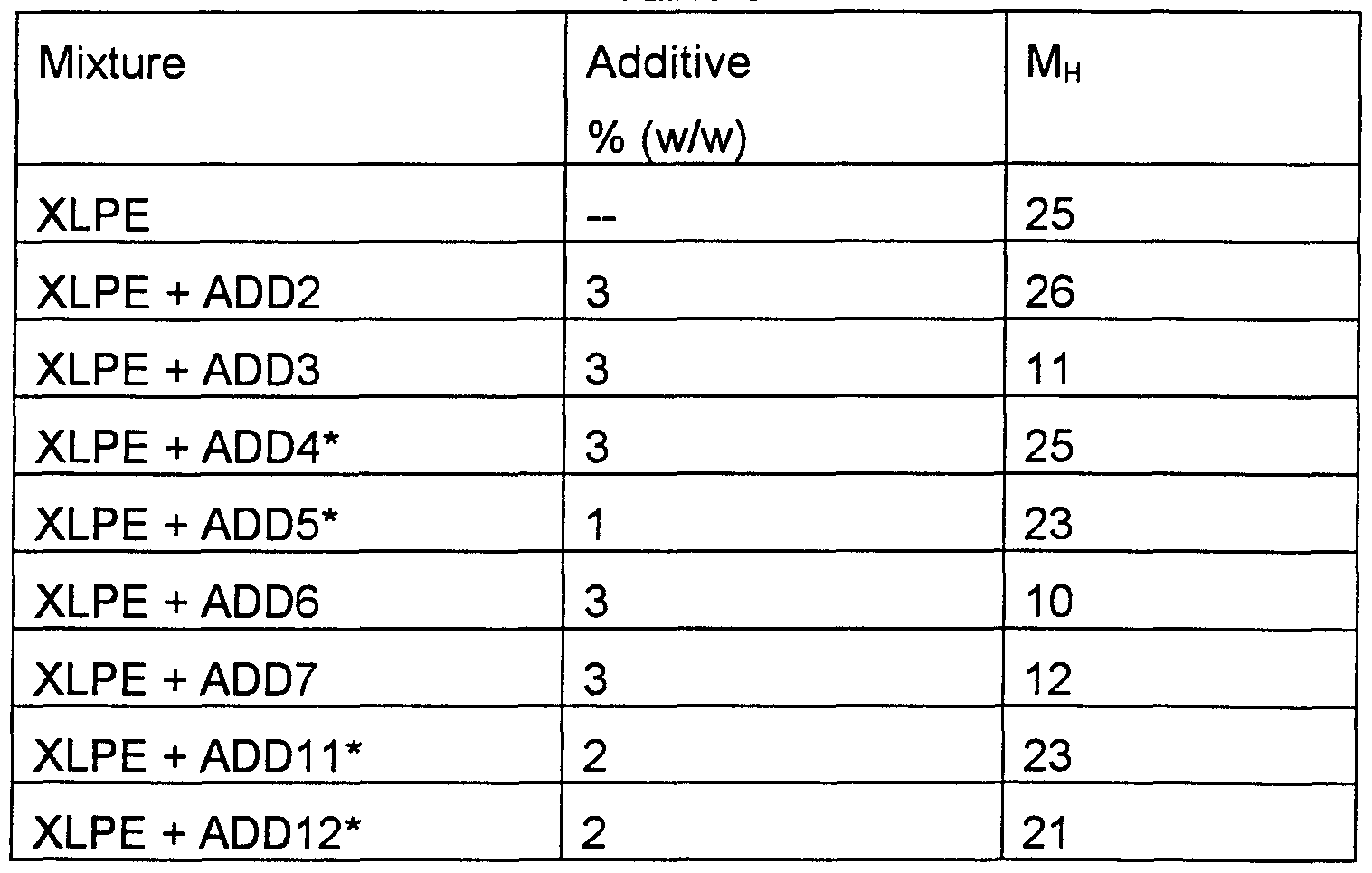
- Tables 4 and 5 show that additives ADD5, ADD8, ADD9, ADD10, ADD11 and ADD12 migrate much less than the other tested additives.
Landscapes
- Physics & Mathematics (AREA)
- Spectroscopy & Molecular Physics (AREA)
- Chemical & Material Sciences (AREA)
- Health & Medical Sciences (AREA)
- Chemical Kinetics & Catalysis (AREA)
- Medicinal Chemistry (AREA)
- Polymers & Plastics (AREA)
- Organic Chemistry (AREA)
- Organic Insulating Materials (AREA)
- Compositions Of Macromolecular Compounds (AREA)
Abstract
Description




Claims


Priority Applications (7)
| Application Number | Priority Date | Filing Date | Title |
|---|---|---|---|
| EP00962279A EP1208571B1 (en) | 1999-07-27 | 2000-07-24 | Cable, in particular for transport or distribution of electrical energy and insulating composition |
| AT00962279T ATE251330T1 (en) | 1999-07-27 | 2000-07-24 | CABLES, IN PARTICULAR FOR TRANSPORT AND DISTRIBUTION OF ELECTRICAL ENERGY AND INSULATION COMPOSITION |
| CA002380309A CA2380309C (en) | 1999-07-27 | 2000-07-24 | Cable, in particular for transport or distribution of electrical energy and insulating composition |
| BRPI0012762-0A BR0012762B1 (en) | 1999-07-27 | 2000-07-24 | electrical cable, and polyolefin-based insulating composition. |
| AU74073/00A AU7407300A (en) | 1999-07-27 | 2000-07-24 | Cable, in particular for transport or distribution of electrical energy and insulating composition |
| DE60005699T DE60005699T2 (en) | 1999-07-27 | 2000-07-24 | CABLES, ESPECIALLY FOR TRANSPORT AND DISTRIBUTION OF ELECTRICAL ENERGY AND INSULATION COMPOSITION |
| US10/054,950 US6696154B2 (en) | 1999-07-27 | 2002-01-25 | Cable, in particular for transport or distribution of electrical energy and insulating composition |
Applications Claiming Priority (4)
| Application Number | Priority Date | Filing Date | Title |
|---|---|---|---|
| EP99202460.4 | 1999-07-27 | ||
| EP99202460 | 1999-07-27 | ||
| US14614899P | 1999-07-30 | 1999-07-30 | |
| US60/146,148 | 1999-07-30 |
Related Child Applications (1)
| Application Number | Title | Priority Date | Filing Date |
|---|---|---|---|
| US10/054,950 Continuation US6696154B2 (en) | 1999-07-27 | 2002-01-25 | Cable, in particular for transport or distribution of electrical energy and insulating composition |
Publications (1)
| Publication Number | Publication Date |
|---|---|
| WO2001008166A1 true WO2001008166A1 (en) | 2001-02-01 |
Family
ID=8240495
Family Applications (1)
| Application Number | Title | Priority Date | Filing Date |
|---|---|---|---|
| PCT/EP2000/007114 Ceased WO2001008166A1 (en) | 1999-07-27 | 2000-07-24 | Cable, in particular for transport or distribution of electrical energy and insulating composition |
Country Status (9)
| Country | Link |
|---|---|
| EP (1) | EP1208571B1 (en) |
| AR (1) | AR024960A1 (en) |
| AT (1) | ATE251330T1 (en) |
| AU (1) | AU7407300A (en) |
| BR (1) | BR0012762B1 (en) |
| CA (1) | CA2380309C (en) |
| DE (1) | DE60005699T2 (en) |
| ES (1) | ES2208421T3 (en) |
| WO (1) | WO2001008166A1 (en) |
Cited By (14)
| Publication number | Priority date | Publication date | Assignee | Title |
|---|---|---|---|---|
| EP2072569A1 (en) | 2007-12-21 | 2009-06-24 | Borealis Technology OY | Polyolefin composition for medium/high/extra high voltage cables with improved electrical breakdown strength |
| EP2163576A1 (en) | 2008-09-09 | 2010-03-17 | Borealis AG | Polyolefin composition for medium/high/extra high voltage cables comprising benzophenone-type voltage stabiliser |
| WO2011110280A1 (en) | 2010-03-08 | 2011-09-15 | Borealis Ag | Polyolefin composition for medium/high/extra high voltage cables comprising benzil-type voltage stabiliser |
| WO2012050792A1 (en) * | 2010-09-30 | 2012-04-19 | Union Carbide Chemicals & Plastics Technology Llc | Coated conductor with voltage stabilized inner layer |
| WO2012069864A1 (en) | 2010-11-25 | 2012-05-31 | Prysmian S.P.A. | Energy cable having a voltage stabilized thermoplastic electrically insulating layer |
| US9576703B2 (en) | 2010-12-23 | 2017-02-21 | Prysmian S.P.A. | Energy cable having stabilized dielectric resistance |
| CN108484975A (en) * | 2018-02-27 | 2018-09-04 | 天津大学 | The method that benzophenone derivates inhibit high voltage direct current cable space charge |
| EP3408340A1 (en) * | 2015-12-22 | 2018-12-05 | ELKEM SILICONES France SAS | Use of a type ii photoinitiator system for crosslinking silicone compositions |
| US10490318B2 (en) | 2013-04-18 | 2019-11-26 | Dow Global Technologies Llc | Coated conductor with voltage-stabilized inner layer |
| CN112125793A (en) * | 2020-09-16 | 2020-12-25 | 宜都市华阳化工有限责任公司 | 2, 4-di-n-octyloxy benzophenone and synthesis method and application thereof |
| US11248095B2 (en) | 2018-02-14 | 2022-02-15 | N3 Coat Ltd. and Mobichem Scientific Engineering Ltd. | Photoinitiators for polyolefins |
| WO2022093682A1 (en) | 2020-10-30 | 2022-05-05 | Dow Global Technologies Llc | Polyolefin formulation |
| WO2023014630A1 (en) * | 2021-08-04 | 2023-02-09 | Dow Global Technologies Llc | Polyolefin formulation containing combination of voltage stabilizer compounds |
| RU2799514C2 (en) * | 2018-02-14 | 2023-07-05 | Н3Кьюэ Лтд | Photoinitiators for polyolefins |
Families Citing this family (1)
| Publication number | Priority date | Publication date | Assignee | Title |
|---|---|---|---|---|
| CN108794861A (en) * | 2018-07-05 | 2018-11-13 | 天津大学 | Inhibit crosslinked polyetylene insulated electrical tree aging process method based on benzophenone derivates |
Citations (2)
| Publication number | Priority date | Publication date | Assignee | Title |
|---|---|---|---|---|
| DE2709139A1 (en) * | 1977-03-03 | 1978-09-07 | Licentia Gmbh | Voltage stabiliser used in high tension cable insulation - based on polyolefin contg. di:aryl ketone carbonic acid or its ester |
| EP0089490A1 (en) * | 1982-03-19 | 1983-09-28 | Licentia Patent-Verwaltungs-GmbH | Insulation stabilized against high voltage |
-
2000
- 2000-07-24 CA CA002380309A patent/CA2380309C/en not_active Expired - Lifetime
- 2000-07-24 BR BRPI0012762-0A patent/BR0012762B1/en not_active IP Right Cessation
- 2000-07-24 ES ES00962279T patent/ES2208421T3/en not_active Expired - Lifetime
- 2000-07-24 WO PCT/EP2000/007114 patent/WO2001008166A1/en not_active Ceased
- 2000-07-24 DE DE60005699T patent/DE60005699T2/en not_active Expired - Lifetime
- 2000-07-24 AT AT00962279T patent/ATE251330T1/en active
- 2000-07-24 EP EP00962279A patent/EP1208571B1/en not_active Expired - Lifetime
- 2000-07-24 AU AU74073/00A patent/AU7407300A/en not_active Abandoned
- 2000-07-27 AR ARP000103884A patent/AR024960A1/en not_active Application Discontinuation
Patent Citations (2)
| Publication number | Priority date | Publication date | Assignee | Title |
|---|---|---|---|---|
| DE2709139A1 (en) * | 1977-03-03 | 1978-09-07 | Licentia Gmbh | Voltage stabiliser used in high tension cable insulation - based on polyolefin contg. di:aryl ketone carbonic acid or its ester |
| EP0089490A1 (en) * | 1982-03-19 | 1983-09-28 | Licentia Patent-Verwaltungs-GmbH | Insulation stabilized against high voltage |
Non-Patent Citations (1)
| Title |
|---|
| DATABASE WPI Week 7251, Derwent World Patents Index; AN 79940T, XP002123034 * |
Cited By (28)
| Publication number | Priority date | Publication date | Assignee | Title |
|---|---|---|---|---|
| EP2072569A1 (en) | 2007-12-21 | 2009-06-24 | Borealis Technology OY | Polyolefin composition for medium/high/extra high voltage cables with improved electrical breakdown strength |
| CN102149758B (en) * | 2008-09-09 | 2014-07-16 | 博里利斯股份公司 | Polyolefin composition for medium/high/extra high voltage cables comprising benzophenone-type voltage stabilizer |
| EP2163576A1 (en) | 2008-09-09 | 2010-03-17 | Borealis AG | Polyolefin composition for medium/high/extra high voltage cables comprising benzophenone-type voltage stabiliser |
| WO2010028721A1 (en) * | 2008-09-09 | 2010-03-18 | Borealis Ag | Polyolefin composition for medium/high/extra high voltage cables comprising benzophenone-type voltage stabilizer |
| CN102149758A (en) * | 2008-09-09 | 2011-08-10 | 博里利斯股份公司 | Polyolefin composition for medium/high/extra high voltage cables comprising benzophenone-type voltage stabilizer |
| EA021033B1 (en) * | 2008-09-09 | 2015-03-31 | Бореалис Аг | Polyolefin composition for medium/high/extra high voltage cables comprising benzophenone-type voltage stabilizer |
| KR101318956B1 (en) * | 2008-09-09 | 2013-10-17 | 보레알리스 아게 | Polyolefin Composition for Medium/High/Extra High Voltage Cables Comprising Benzophenon-Type Voltage Stabiliser |
| US8765843B2 (en) | 2008-09-09 | 2014-07-01 | Borealis Ag | Polyolefin composition for medium/extra/high voltage cables comprising benzophenone-type voltage stabilizer |
| WO2011110280A1 (en) | 2010-03-08 | 2011-09-15 | Borealis Ag | Polyolefin composition for medium/high/extra high voltage cables comprising benzil-type voltage stabiliser |
| US9133320B2 (en) | 2010-03-08 | 2015-09-15 | Borealis Ag | Polyolefin composition for medium/high/extra high voltage cables comprising benzil-type voltage stabiliser |
| CN103229250A (en) * | 2010-09-30 | 2013-07-31 | 联合碳化化学及塑料技术有限责任公司 | Covered conductors with voltage stabilizing inner layer |
| US9040828B2 (en) | 2010-09-30 | 2015-05-26 | Union Carbide Chemicals & Plastics Technology Llc | Coated conductor with voltage stabilized inner layer |
| WO2012050792A1 (en) * | 2010-09-30 | 2012-04-19 | Union Carbide Chemicals & Plastics Technology Llc | Coated conductor with voltage stabilized inner layer |
| CN103229250B (en) * | 2010-09-30 | 2016-06-08 | 联合碳化化学及塑料技术有限责任公司 | Covered conductors with voltage stabilizing inner layer |
| RU2539359C1 (en) * | 2010-11-25 | 2015-01-20 | Призмиан С.П.А. | Power cable containing thermoplastic and electric insulating layer with voltage stabiliser |
| WO2012069864A1 (en) | 2010-11-25 | 2012-05-31 | Prysmian S.P.A. | Energy cable having a voltage stabilized thermoplastic electrically insulating layer |
| US9576703B2 (en) | 2010-12-23 | 2017-02-21 | Prysmian S.P.A. | Energy cable having stabilized dielectric resistance |
| US10490318B2 (en) | 2013-04-18 | 2019-11-26 | Dow Global Technologies Llc | Coated conductor with voltage-stabilized inner layer |
| JP2019507205A (en) * | 2015-12-22 | 2019-03-14 | エルケム・シリコーンズ・フランス・エスアエスELKEM SILICONES France SAS | Use of a type II photoinitiator system to crosslink a silicone composition |
| EP3408340A1 (en) * | 2015-12-22 | 2018-12-05 | ELKEM SILICONES France SAS | Use of a type ii photoinitiator system for crosslinking silicone compositions |
| US11248095B2 (en) | 2018-02-14 | 2022-02-15 | N3 Coat Ltd. and Mobichem Scientific Engineering Ltd. | Photoinitiators for polyolefins |
| RU2799514C2 (en) * | 2018-02-14 | 2023-07-05 | Н3Кьюэ Лтд | Photoinitiators for polyolefins |
| CN108484975A (en) * | 2018-02-27 | 2018-09-04 | 天津大学 | The method that benzophenone derivates inhibit high voltage direct current cable space charge |
| CN112125793A (en) * | 2020-09-16 | 2020-12-25 | 宜都市华阳化工有限责任公司 | 2, 4-di-n-octyloxy benzophenone and synthesis method and application thereof |
| CN112125793B (en) * | 2020-09-16 | 2024-05-10 | 宜都市华阳化工有限责任公司 | 2, 4-Di-n-octoxybenzophenone and synthetic method and application thereof |
| WO2022093682A1 (en) | 2020-10-30 | 2022-05-05 | Dow Global Technologies Llc | Polyolefin formulation |
| US12441868B2 (en) | 2020-10-30 | 2025-10-14 | Dow Global Technlogies LLC | Polyolefin formulation |
| WO2023014630A1 (en) * | 2021-08-04 | 2023-02-09 | Dow Global Technologies Llc | Polyolefin formulation containing combination of voltage stabilizer compounds |
Also Published As
| Publication number | Publication date |
|---|---|
| ES2208421T3 (en) | 2004-06-16 |
| ATE251330T1 (en) | 2003-10-15 |
| DE60005699T2 (en) | 2004-08-19 |
| CA2380309A1 (en) | 2001-02-01 |
| CA2380309C (en) | 2009-04-14 |
| BR0012762B1 (en) | 2009-05-05 |
| EP1208571B1 (en) | 2003-10-01 |
| DE60005699D1 (en) | 2003-11-06 |
| AR024960A1 (en) | 2002-10-30 |
| BR0012762A (en) | 2002-04-02 |
| AU7407300A (en) | 2001-02-13 |
| EP1208571A1 (en) | 2002-05-29 |
Similar Documents
| Publication | Publication Date | Title |
|---|---|---|
| US6696154B2 (en) | Cable, in particular for transport or distribution of electrical energy and insulating composition | |
| EP1208571B1 (en) | Cable, in particular for transport or distribution of electrical energy and insulating composition | |
| EP2545114B1 (en) | Polyolefin composition for medium/high/extra high voltage cables comprising benzil-type voltage stabiliser | |
| CN101903450B (en) | Polyolefin composition for medium/high/extra high voltage cables with improved electrical breakdown strength | |
| EA021033B1 (en) | Polyolefin composition for medium/high/extra high voltage cables comprising benzophenone-type voltage stabilizer | |
| CN114829462B (en) | Polyolefin composition | |
| US3933772A (en) | Dielectric polyolefin compositions | |
| US4501688A (en) | Silane oligomers useful as anti-treeing additives | |
| US20240417541A1 (en) | Polyolefin formulation containing combination of voltage stabilizer compounds | |
| TWI908906B (en) | Polyolefin formulation | |
| CA3226773A1 (en) | Polyolefin formulation containing combination of voltage stabilizer compounds | |
| US4492647A (en) | Organopolysiloxanes useful as dielectric fluids and anti-treeing additives | |
| US5981065A (en) | Telephone cables | |
| RU2854006C1 (en) | Thermoplastic composition for insulation of self-supporting wires and electrical cables | |
| US3985938A (en) | Dielectric ethylene copolymer compositions containing alkylfluoranthene | |
| US20240270935A1 (en) | Polyolefin formulation containing crotophenone compound | |
| EP0009268A1 (en) | Process for cross-linking shaped non-polar synthetic resins and electric objects insulated with said crosslinked resins | |
| US4514535A (en) | Electrical tree and water tree resistant compounds and polymer compositions containing the same | |
| US3915945A (en) | Dielectric polyolefin compositions | |
| Wald et al. | XLPE-Based Products Available in the Market and Their Applications | |
| JPS63291938A (en) | Flame-retardant electrical insulating composition | |
| Haridoss et al. | Accelerated water tree tests on three layer miniature cables | |
| BR112019025731A2 (en) | POLYOLEFINE COMPOSITIONS |
Legal Events
| Date | Code | Title | Description |
|---|---|---|---|
| AK | Designated states |
Kind code of ref document: A1 Designated state(s): AE AG AL AM AT AU AZ BA BB BG BR BY BZ CA CH CN CR CU CZ DE DK DM DZ EE ES FI GB GD GE GH GM HR HU ID IL IN IS JP KE KG KP KR KZ LC LK LR LS LT LU LV MA MD MG MK MN MW MX MZ NO NZ PL PT RO RU SD SE SG SI SK SL TJ TM TR TT TZ UA UG US UZ VN YU ZA ZW |
|
| AL | Designated countries for regional patents |
Kind code of ref document: A1 Designated state(s): GH GM KE LS MW MZ SD SL SZ TZ UG ZW AM AZ BY KG KZ MD RU TJ TM AT BE CH CY DE DK ES FI FR GB GR IE IT LU MC NL PT SE BF BJ CF CG CI CM GA GN GW ML MR NE SN TD TG |
|
| 121 | Ep: the epo has been informed by wipo that ep was designated in this application | ||
| DFPE | Request for preliminary examination filed prior to expiration of 19th month from priority date (pct application filed before 20040101) | ||
| WWE | Wipo information: entry into national phase |
Ref document number: 10054950 Country of ref document: US Ref document number: 2380309 Country of ref document: CA |
|
| WWE | Wipo information: entry into national phase |
Ref document number: 2000962279 Country of ref document: EP |
|
| REG | Reference to national code |
Ref country code: DE Ref legal event code: 8642 |
|
| WWP | Wipo information: published in national office |
Ref document number: 2000962279 Country of ref document: EP |
|
| WWG | Wipo information: grant in national office |
Ref document number: 2000962279 Country of ref document: EP |
|
| NENP | Non-entry into the national phase |
Ref country code: JP |