WO2001011968A2 - Heterocyclic spiro compounds as pesticides - Google Patents

Heterocyclic spiro compounds as pesticides Download PDF

Info

Publication number
WO2001011968A2
WO2001011968A2 PCT/EP2000/007851 EP0007851W WO0111968A2 WO 2001011968 A2 WO2001011968 A2 WO 2001011968A2 EP 0007851 W EP0007851 W EP 0007851W WO 0111968 A2 WO0111968 A2 WO 0111968A2
Authority
WO
WIPO (PCT)
Prior art keywords
formula
compound
compounds
spp
composition
Prior art date
Legal status (The legal status is an assumption and is not a legal conclusion. Google has not performed a legal analysis and makes no representation as to the accuracy of the status listed.)
Ceased
Application number
PCT/EP2000/007851
Other languages
French (fr)
Other versions
WO2001011968A3 (en
Inventor
Stephen Lindell
Ulrich Sanft
Maria-Theresia Thönessen
Current Assignee (The listed assignees may be inaccurate. Google has not performed a legal analysis and makes no representation or warranty as to the accuracy of the list.)
Bayer CropScience AG
Original Assignee
Aventis CropScience GmbH
Priority date (The priority date is an assumption and is not a legal conclusion. Google has not performed a legal analysis and makes no representation as to the accuracy of the date listed.)
Filing date
Publication date
Application filed by Aventis CropScience GmbH filed Critical Aventis CropScience GmbH
Priority to AU75092/00A priority Critical patent/AU7509200A/en
Priority to KR1020027001876A priority patent/KR20020029101A/en
Priority to BR0013085-0A priority patent/BR0013085A/en
Priority to JP2001516331A priority patent/JP2003506468A/en
Priority to EP00964011A priority patent/EP1209974A2/en
Publication of WO2001011968A2 publication Critical patent/WO2001011968A2/en
Publication of WO2001011968A3 publication Critical patent/WO2001011968A3/en
Anticipated expiration legal-status Critical
Ceased legal-status Critical Current

Links

Classifications

    • AHUMAN NECESSITIES
    • A01AGRICULTURE; FORESTRY; ANIMAL HUSBANDRY; HUNTING; TRAPPING; FISHING
    • A01NPRESERVATION OF BODIES OF HUMANS OR ANIMALS OR PLANTS OR PARTS THEREOF; BIOCIDES, e.g. AS DISINFECTANTS, AS PESTICIDES OR AS HERBICIDES; PEST REPELLANTS OR ATTRACTANTS; PLANT GROWTH REGULATORS
    • A01N43/00Biocides, pest repellants or attractants, or plant growth regulators containing heterocyclic compounds
    • A01N43/90Biocides, pest repellants or attractants, or plant growth regulators containing heterocyclic compounds having two or more relevant hetero rings, condensed among themselves or with a common carbocyclic ring system
    • AHUMAN NECESSITIES
    • A01AGRICULTURE; FORESTRY; ANIMAL HUSBANDRY; HUNTING; TRAPPING; FISHING
    • A01NPRESERVATION OF BODIES OF HUMANS OR ANIMALS OR PLANTS OR PARTS THEREOF; BIOCIDES, e.g. AS DISINFECTANTS, AS PESTICIDES OR AS HERBICIDES; PEST REPELLANTS OR ATTRACTANTS; PLANT GROWTH REGULATORS
    • A01N25/00Biocides, pest repellants or attractants, or plant growth regulators, characterised by their forms, or by their non-active ingredients or by their methods of application, e.g. seed treatment or sequential application; Substances for reducing the noxious effect of the active ingredients to organisms other than pests
    • A01N25/12Powders or granules
    • CCHEMISTRY; METALLURGY
    • C07ORGANIC CHEMISTRY
    • C07DHETEROCYCLIC COMPOUNDS
    • C07D491/00Heterocyclic compounds containing in the condensed ring system both one or more rings having oxygen atoms as the only ring hetero atoms and one or more rings having nitrogen atoms as the only ring hetero atoms, not provided for by groups C07D451/00 - C07D459/00, C07D463/00, C07D477/00 or C07D489/00
    • C07D491/02Heterocyclic compounds containing in the condensed ring system both one or more rings having oxygen atoms as the only ring hetero atoms and one or more rings having nitrogen atoms as the only ring hetero atoms, not provided for by groups C07D451/00 - C07D459/00, C07D463/00, C07D477/00 or C07D489/00 in which the condensed system contains two hetero rings
    • C07D491/10Spiro-condensed systems
    • CCHEMISTRY; METALLURGY
    • C07ORGANIC CHEMISTRY
    • C07DHETEROCYCLIC COMPOUNDS
    • C07D498/00Heterocyclic compounds containing in the condensed system at least one hetero ring having nitrogen and oxygen atoms as the only ring hetero atoms
    • C07D498/02Heterocyclic compounds containing in the condensed system at least one hetero ring having nitrogen and oxygen atoms as the only ring hetero atoms in which the condensed system contains two hetero rings
    • C07D498/10Spiro-condensed systems
    • CCHEMISTRY; METALLURGY
    • C07ORGANIC CHEMISTRY
    • C07DHETEROCYCLIC COMPOUNDS
    • C07D498/00Heterocyclic compounds containing in the condensed system at least one hetero ring having nitrogen and oxygen atoms as the only ring hetero atoms
    • C07D498/12Heterocyclic compounds containing in the condensed system at least one hetero ring having nitrogen and oxygen atoms as the only ring hetero atoms in which the condensed system contains three hetero rings
    • C07D498/20Spiro-condensed systems
    • CCHEMISTRY; METALLURGY
    • C09DYES; PAINTS; POLISHES; NATURAL RESINS; ADHESIVES; COMPOSITIONS NOT OTHERWISE PROVIDED FOR; APPLICATIONS OF MATERIALS NOT OTHERWISE PROVIDED FOR
    • C09DCOATING COMPOSITIONS, e.g. PAINTS, VARNISHES OR LACQUERS; FILLING PASTES; CHEMICAL PAINT OR INK REMOVERS; INKS; CORRECTING FLUIDS; WOODSTAINS; PASTES OR SOLIDS FOR COLOURING OR PRINTING; USE OF MATERIALS THEREFOR
    • C09D5/00Coating compositions, e.g. paints, varnishes or lacquers, characterised by their physical nature or the effects produced; Filling pastes
    • C09D5/02Emulsion paints including aerosols
    • C09D5/024Emulsion paints including aerosols characterised by the additives
    • C09D5/025Preservatives, e.g. antimicrobial agents
    • YGENERAL TAGGING OF NEW TECHNOLOGICAL DEVELOPMENTS; GENERAL TAGGING OF CROSS-SECTIONAL TECHNOLOGIES SPANNING OVER SEVERAL SECTIONS OF THE IPC; TECHNICAL SUBJECTS COVERED BY FORMER USPC CROSS-REFERENCE ART COLLECTIONS [XRACs] AND DIGESTS
    • Y02TECHNOLOGIES OR APPLICATIONS FOR MITIGATION OR ADAPTATION AGAINST CLIMATE CHANGE
    • Y02PCLIMATE CHANGE MITIGATION TECHNOLOGIES IN THE PRODUCTION OR PROCESSING OF GOODS
    • Y02P20/00Technologies relating to chemical industry
    • Y02P20/50Improvements relating to the production of bulk chemicals
    • Y02P20/55Design of synthesis routes, e.g. reducing the use of auxiliary or protecting groups

Definitions

  • Agrochemically acceptable derivates include acid addition salts, quaternary salts and derivates hydrolyzable in vivo (prodrugs), of the compounds of formula (I).
  • Agrochemically acceptable acid addition salts of the compounds of formula (I) include the salts of mineral acids, for example, hydrochloric acid, hydrobromic acid, hydroiodic acid, nitric acid, sulfuric acid or phosphoric acid, and organic acids for example monobasic acids such as acetic acid, formic acid, propionic acid, methanesulfonic and ethanesulfonic acid or toluene sulfonic acid, and polybasic acids such as oxalic acid, malonic acid, malic acid, tartaric acid, maleic acid, fumaric acid or succinic acid or salts with acidic amino acids, such as aspartic and glutamic acids. Salts may be readily formed from the compounds of formula (I) by mixing with the appropriate acid or by exchange with an other acid addition salt of the compound of formula (I).
  • Some of the compounds of formula (I) contain asymmetric carbon or double bond (depending on the type of substituent groups involved) and hence exist as a plurality of optical and geometric isomers.
  • This invention includes all of these isomers, individually and in any mixture of two or more thereof.
  • (CrC 6 )-alkyl is identical to "lower alkyl” and means, unless otherwise specified, a linear or branched carbon chain of 1 to 6 carbon atoms, which is optionally substituted by one or more fluorine atoms.
  • (CrC ⁇ J-alkyl groups) there may be mentioned methyl, trifluoromethyl, ethyl, 2,2,2-trifluoro-ethyl, propyl, isopropyl, butyl, isobutyl, sec-butyl, tert-butyl, pentyl, isopentyl, neopentyl, tert-pentyl, 1-methylbutyl, 2-methylbutyl, 1 ,2- dimethylpropyl, hexyl, isohexyl,
  • (CrC6)-alkoxy groups may be mentioned methoxy, ethoxy, propoxy, isopropoxy, butoxy, isobutoxy, sec-butoxy, tert-butoxy, pentyloxy (amyloxy), isopentyloxy, tert- pentyioxy, neopentyloxy, 2-methyl butoxy, 1 ,2-dimethylpropoxy, 1-ethylpropoxy and hexyloxy.
  • (CrC 6 )-alkylthio groups correspond to above lower alkoxy groups in which oxygen is replaced by sulfur.
  • Illustrative examples include methylthio, ethylthio, propylthio, isopropylthio, butylthio, sec-butylthio, tert-butylthio, pentylthio, neopentylthio, 2-methylbutylthio, 1,2- dimethylpropylthio and 1-ethylpropylthio.
  • (CrC 6 )-alkoxycarbonyl groups are derivable by carboxyl group esterification with a linear or branched alcohol of 1 to 6 carbon atoms, e .g. methoxycarbonyl, ethoxycarbonyl, propoxycarbonyl, isopropoxycarbonyl, butoxycarbonyl, isobutoxycarbonyl, sec-butoxycarbonyl, tert-butoxycarbonyl, pentoxycarbonyl, isopentyloxycarbonyl, tert-pentyloxycarbonyl, neopentylcarbonyl and hexyloxycarbonyl.
  • a linear or branched alcohol of 1 to 6 carbon atoms e .g. methoxycarbonyl, ethoxycarbonyl, propoxycarbonyl, isopropoxycarbonyl, butoxycarbonyl, isobutoxycarbonyl, sec-butoxycarbonyl, tert-butoxycarbonyl, pentoxycarbonyl
  • (CrC 6 )-alkanoyl groups include e.g. formyl, acetyl, propionyl, butyryl, isobutyryl, valeryl, isovaleryl, pivaloyl and hexanoyl.
  • (CrC 6 )-alkanoyl groups include formyloxy, acetyloxy, trifluoroacetyloxy, propionyloxy, butyryloxy, isobutyryloxy, valeryloxy, isovaleryloxy, pivaloyloxy and hexanoyloxy.
  • (CrC ⁇ J-alkanoylthio groups” correspond to above (CrC 6 )-alkanoyloxy groups in which the oxygen of the oxy radical is replaced by sulfur.
  • Illustrative examples include formylthio, acetylthio, propionylthio, butyrylthio, isobutyrylthio, varelythio, isovalylthio, pivaloylthio and hexanoylthio.
  • is a bivalent radical, preferably of 1, 2 or 3 carbon atoms, in which at least one of the carbon atoms may optionally be substituted by a (C C 6 ) alkyl group as defined above
  • illustrative examples include methylene, methylmethylene, dimethylmethylene, ethylene, trimethylene, 1- or 2-methylethylene, 1- or 2-ethylethylene, 1- or
  • Halogen atom may be any one of fluorine, chlorine, bromine or iodine.
  • the optional lower alkanediyl bridging group in the N-A-C-B-ring is as defined for "Alk"; examples of such saturated bicyclo rings are:
  • Preferred compounds are those in which the N-A-C-B-ring represents quinuclidine, 2- azabicyclo[2.2.1]heptane, 1-azabicyclo[2.2.1]heptane or 8-azabicyclo[3.2.1]octane and especially preferred are compounds in which the N-A-C-B-ring is 1- azabicyclo[2.2.1 . heptane.
  • R 10 is (CrCe)-alkyl, especially methyl, ethyl or propyl, (C 2 -C 6 )-alkenyl, especially allyl or prenyl, or (C 2 -C 6 )-alkynoyl, especially propargyl.
  • R 1 is hydrogen or alkyl, especially methyl or 2,2,2- trifluoroethyl, or in the case where R 1 forms ring A, methylene.
  • Quaternary salts which may be mentioned include N + -(C- ⁇ -C 6 )-alkyl, preferably N + - methyl.
  • Derivates hydrolyzable in vivo which may be mentioned include (C ⁇ -C 6 )- alky xycarbonyl, benzyloxycarbonyl or (C ⁇ -C 6 )-alkanoyl.
  • X represents a sulfur atom and/or
  • R 1 represents COR' and/or
  • R 2 , R 4 , R 5 represent (C C 6 )-alkyl and/or 7
  • R 3 represents H, (d-C ⁇ J-alkyl, carboxy, (CrC 6 )-alkoxycarbonyl, (CrC 6 )-alkanoyl and/or
  • R 6 represents a halogen atom, (CrC 6 )-alkyl, carboxy, (CrC 6 )-alkoxy, (CrC 6 )- alkanoyloxy, (CrC 6 )-alkylthio; (CrC 6 )-alkanoylthio.
  • the compounds of formula (I) can be prepared through various synthetic routes adapted for the individual chemical structures. Synthetic routes for the preparation of formula (I) in which W represents CR 9 R 10 are disclosed in EP-A 0311 313:
  • ring A 1 is a piperidine ring in which the nitrogen atom may be substituted by (C Ce) alkyl, (C-i-C 6 ) alkanoyl, (CrC 6 ) alkoxycarbonyl or a protective group for amines and/or may 11 be connected to a ring carbon (other than the common carbon atom of the spiro structure) via a (C ⁇ -C 6 ) alkylene bridging group;
  • ring A 2 is a piperidine ring in which the nitrogen atom may be substituted by (C Ce) alkanoyl (C Ce) alkoxycarbonyl or a protective group for amines and/or may be connected to a ring carbon (other than the common structure atom ofthe spiro structure) via a (C C 6 )
  • Z 3 and Z 4 are the same or different and selected from oxygen and sulfur atoms;
  • R 11 and R 12 are the same or different (C- ⁇ -C 6 ) alkyls;
  • R 13 is a hydrogen atom or (CrC 6 ) alkyl;
  • R 14 is a hydrogen atom or (C Ce) alkyl;
  • R 15 is a hydrogen atom or (C ⁇ -C 6 ) alkyl, carbonyl or (C- ⁇ -C 6 ) alkoxycarbonyl;
  • R 16 is a hydrogen atom or an alkyl group of 1 to 5 carbon atoms;
  • R 17 is (C C 6 ) alkyl,
  • R 20 is hydroxyl, mercapto, (C ⁇ -C 6 ) alkoxy or (C C 6 ) alkylthio;
  • Ph is phenyl;
  • R 18 and R 19 are the same or different and selected from a hydrogen atom and (C Ce) alkyls.
  • compound (II) and alkali metal salt of compound (III) are allowed to react, or compound (II) and compound (III) are allowed to react in the presence of 12 base; the two reactants are used in equimolar amounts or with one reactant in slight excess.
  • the reaction is preferably carried out in an inert organic solvent under cooling or at room temperature.
  • Suitable solvents are aprotic compounds, such as dimethyl sulfoxide, benzene, toluene, xylene, dichloromethane, tetrahydrofurane, N,N-dimethylformamide, dichloroethane, chloroform and carbon tetrachlorides.
  • the alkali metal salt of compound (III) can be obtained by reaction of compound (III) with base, such as sodium hydride, preferably under anhydrous conditions.
  • base such as sodium hydride
  • the same type of base may be used in the reaction of compound (II) and compound (III) in free form.
  • any type of protective group commonly employed for amino groups may be used in this invention. These include groups of urethane type (e.g., t-butoxycarbonyl), of acyl type (e.g., formyl, acetyl and propionyl), and of benzyl type (e.g., benzyl, benzhydryl and trityl). Removal of these protective groups may be effected by usual methods, in the presence of acid or base for those of urethane type, in the presence of base for those of acyl type, and by catalytic reduction for those of benzyl type. Hydrochloric acid, trifluoroacetic acid and hydrobromic acid/acetic acid may be mentioned as acid catalyst, and sodium hydrochloride and potassium hydroxide as the base catalysts.
  • urethane type e.g., t-butoxycarbonyl
  • acyl type e.g., formyl, acetyl and propionyl
  • Compounds (II) can be obtained by reaction of oxo-heterocyclic compound carrying protective group, lower alkyl, lower alkanoyl and lower alkoxycarbonyl with lower alkyl dialkylphosphonoacetate in an inert solvent (e.g. dimethoxyethane, dioxane and tetrahydrofuran) in the presence of base under cooling or at room temperature, or by the normal Wittig reaction, followed by removal of any protective group.
  • an inert solvent e.g. dimethoxyethane, dioxane and tetrahydrofuran
  • Spiro compounds of 3-iodo-heterocyclic type represented by formula (lb) can be prepared by iodination of alkenyl-substituted, heterocyclic alcohol (IV), followed by removal of any protective group as required. 13 The reaction is preferably carried out by dissolving compund (IV) in an inert organic solvent, adding an aqueous alkaline solution of iodine in a more than stoichiometric amount, and holding the resulitng mixture under cooling or at room temperature.
  • Suitable organis solvents are aprotic compounds, such as dichloromethane, dichloroethane, chloroform, carbon tetrachloride, benzene, toluene, xylene and dimethyl sulfoxide; and sodium carbonate, potassium carbonate, sodium bicarbonate, sodium hydroxide and potassium hydroxide may be mentioned as examples of the alkali.
  • Compounds (IV) (starting material) are compounds, which can be easily obtained, as shown in the reaction formula given below, by the action of Grignard reagent, prepared from alkenyl halide and magnesium by usual method, upon oxo-heterocyclic compound.
  • This cyclization is effected by the action of Lewis acid (such as tin tetrachloride, titanium tetrachloride and boron trifluoride(diethyl ether complex) upon compound (V) dissolved in an inert organic solvent, followed by addition of base.
  • Lewis acid such as tin tetrachloride, titanium tetrachloride and boron trifluoride(diethyl ether complex
  • Suitable organic solvents are aprotic compounds, such as dichloromethane, dichloroethane, chloroform, carbon tetrachloride, benzene, toluene, xylene and dimethyl sulfoxide.
  • the base may be any compound that can trap the hydrochloric acid and metal salt formed, illustrative examples being organic bases, such as triethylamine, trimethylamine, pyri ⁇ ine, picoline, lutidine and dimethylaniline; and inorganic bases, such as sodium hydroxide, potassium hydroxide, sodium carbonate and potassium carbonate.
  • the reaction is preferably carried out under cooling or at room temperature.
  • the decarboxylation reaction is effected by heating (preferably under reflux) in the presence of acid.
  • the substituent group is a lower alkoxyacarbonyl
  • a process may be adopted in which the starting material (Id) may be dissolved in inert organic solvent (e.g., dimethylformamide and dimethyl sulfoxide) and this solution heated in the presence of an equimolar or excess amount of sodium chloride.
  • inert organic solvent e.g., dimethylformamide and dimethyl sulfoxide
  • Method 1 reaction product need not be isolated, but may be heated in the form of an acidic aqueous solution for direct conversion to compound (Ie).
  • Method 5 15 Compounds according to the invention can be prepared by reduction, and various reduction processes may be adopted depending on the type of radical to be reduced.
  • Method 5 is a process for obtaining compounds (If) carrying hydroxyl as substituent at 3-positio ⁇ by reduction of corresponding compounds in which the 3-position is carbonyl.
  • the reaction is preferably carried out in an inert solvent (for example, alcohols, such as methanol, ethanol and isopropanol, tetrahydrofuran and dioxanes) at room temperature or at elevated temperature using reducing agent that can selectively reduce the carbonyl at 3-position (e.g. a boron hydride compound, such as sodium borohydride and sodium cyanoborohydride).
  • an inert solvent for example, alcohols, such as methanol, ethanol and isopropanol, tetrahydrofuran and dioxanes
  • reducing agent that can selectively reduce the carbonyl at 3-position
  • a boron hydride compound such as sodium borohydride and sodium cyanoborohydride
  • N-lower-alkyl compounds of formula (Ih) can also be synthesized by reduction of starting material (Ig) carrying a lower alkanoyl as the substituent group at N-position.
  • the reaction is preferably carried out in an organic solvent (e.g. ether, tetrahydrofurane or dioxane) using, as reducing agent, an aluminium hydride compound (such as lithium aluminium hydride) at room temperature or at an elevated temperature.
  • organic solvent e.g. ether, tetrahydrofurane or dioxane
  • an aluminium hydride compound such as lithium aluminium hydride
  • N-methyl compounds according to the invention of formula (li) can be synthesized by reduction of compound (III) carrying a urethane-type substituent at the N-position.
  • the reduction is preferably effected in an organic solvent (e.g., tetrahydrofurane, ether or dioxane) using, as reducing agent, aluminium hydride (prepared from lithium aluminium hydride and sulfuric acid) at room temperature or at elevated temperature, or under cooling.
  • organic solvent e.g., tetrahydrofurane, ether or dioxane
  • aluminium hydride prepared from lithium aluminium hydride and sulfuric acid
  • Cyclic ketals of formula (k) can be synthesized by methods commonly employed for the preparation of cyclic ketals. For example, corresponding carbonyl compound (Ij) is allowed to react with compound (VIII), such as a glycol, a hydroxyaikanethiol or an alkanedithiol, or with epoxy compound (IX), to form compound (Ik).
  • compound (VIII) such as a glycol, a hydroxyaikanethiol or an alkanedithiol
  • epoxy compound (IX) epoxy compound
  • the reaction is carried out by dissolving compound (Ij) and an equimolar or excess amount of compound (III) in an inert organic solvent (preferably a solvent adapted for azeotropic dehydration, such as benzene, toluene or xylene) and heating the solution under reflux in the presence of acid catalyst to effect dehydration (preferably using a Dean-Stark azeotropic dehydration apparatus).
  • an inert organic solvent preferably a solvent adapted for azeotropic dehydration, such as benzene, toluene or xylene
  • the acid catalyst may be adipic-acid, oxalic acid or pyridine hydrochloride, but p-toluenesulfonic acid is the most preferred.
  • reaction is carried out in an inert solvent, such as dichloromethane, dichloroethane, chloroform, carbon tetrachloride, ether, dioxane or tetrahydrofuran, in the presence of Lewis acid (e.g., boron trifluoride/diethylether or in tin tetrachloride), the desired product can be obtained without dehydration or heating.
  • Lewis acid e.g., boron trifluoride/diethylether or in tin tetrachloride
  • epoxy compound (IX) is used as starting material
  • the reaction is carried out in an inert solvent (e.g.
  • dichloromethane dichloroethane, chloroform or carbon tetrachloride
  • stannous chloride or boron trifluoride/ether complex at room temperature or at elevated temperature, or in the presence of tetraethylammonium bromide at 80 to 150°C in an autoclave.
  • This reaction is preferably carried out in an inert, aprotic organic solvent (such as dimethyl sulfoxid, dimethylformamide, tetrahydrofuran, ether, dioxane, benzene, toluene or xylene) under cooling or at elevated temperature using an equimolar or 17 excess amount of compound (X).
  • aprotic organic solvent such as dimethyl sulfoxid, dimethylformamide, tetrahydrofuran, ether, dioxane, benzene, toluene or xylene
  • the compound (X) can be prepared by reaction of corresponding alkyltriphenylphosphonium halide with an equimolar or excess amount of base in the same solvent as above under cooling or heating.
  • the base used is preferably sodium hydride or n-butylithium.
  • R 1 , R 10 , A and B are as defined above for formula (I), Y' represents O or S, and in addition R 1 may represent a protecting group, or
  • R 1 , A and B are as defined above for formula (I) and in addition, R 1 may represent a protecting group, or 18 c) preparing a compound of formula (I) in which Y' is S by thiation of a corresponding compound of formula (I) in which Y' is O, or
  • R 1 , A and B are as defined above for formula (I), R" represents a C C 6 - alkyl group and in addition, R 1 may represent a protecting group, with hydroxyurea, or
  • reaction of process (a) methods similar to those described by Miles, H. T., (J. Amer. Chem. Soc. 79, 2565-8 (1957)] may be used.
  • the reaction may be carried out in the absence of a solvent and at a temperature of, for example, from 100°C- 250°C.
  • suitable leaving groups that X' may represent include halide, for example bromide, and alkoxy, eg methoxy.
  • the hydrolysis may be carried out in the presence of an acid, for example, hydrochloric or sulfuric acid in a solvent.
  • Protic solvents are preferred, for example, methanol, ethanol or water or mixtures thereof and at a temperature of, for example, from 0°C-100°C.
  • the thiation reaction may be carried out by methods similar to those described by De Amici using, for example, 2,4-bis(4-methoxyphenyl)-1 ,3-dithia-2,4- diphosphetane-2,4-disulfide (Lawesson's Reagent) in an inert solvent, for example, toluene at a temperature of, for example, from 50°C-120°C.
  • Lawesson's Reagent 2,4-bis(4-methoxyphenyl)-1 ,3-dithia-2,4- diphosphetane-2,4-disulfide
  • suitable leaving groups that X' may represent include halide, for example, bromide.
  • Protecting groups which R 1 may represent include benzyloxycarbonyl or a borane complex.
  • the reaction may be earned out in an inert solvent, for example, nitromethane, and at temperature of, for example, from 0°C to 50°C. 20
  • suitable leaving groups that Z' may represent include halide, for example bromide.
  • the reaction may be carried out in the presence of a base, for example in alkali carbonate in which the alkali metal may be, for example, sodium or potassium.
  • the reaction may be conducted in an inert solvent, for example an aprotic solvent such as acetone, and at a temperature of, for example, from 0°- to 100°C.
  • suitable leaving groups which L may represent include, for example, halogen, preferably chlorine, bromine or iodine, or an alkyl- or aryl- sulfonate group, for example, mesylate ortosyiate.
  • the alkylation reaction may be earned out in aprotic solvent, for example, acetonitrile, in the presence of a base, for example, potassium carbonate, and at a temperature of, for example, from 0° -100°C.
  • urethane formation may be earned out under similar conditions as those used in process (f) above.
  • methylation is accomplished by heating the amine with formic acid and formaldehyde at a temperature of, for example, from 50°C-100°C.
  • ring formation is carried out with hydroxyurea in the presence of a base, for example, an alkali alkoxide such as sodium methoxide, in a protic solvent, for example, an alcohol such as methanol and at a temperature of, for example, from 0°C - 50°C.
  • a base for example, an alkali alkoxide such as sodium methoxide
  • a protic solvent for example, an alcohol such as methanol
  • protecting groups are represented by benzyloxycarbonyl, which may readily be removed by, for example, triflic acid, hydrogenolysis or hydrogen bromide in acetic acid.
  • Other groups which may be mentioned include borane, which may be removed by aqueous sodium carbonate and t-butyloxycarbonyl which may be removed by trifluoracetic acid. Further protecting 21 groups and methods for their removal are described in T.W. Greene, Protective Groups in Organic Synthesis, Wiley-lnterscience, 1981.
  • compounds of formula (I) may be prepared by heating a compound of formula (XIII) together with a hydroxylamine of formula R 10 NHOH.
  • the reaction can be performed neat, or in a suitable solvent (such as toluene, xylene or mesitylene), at temperatures typically between 80 and 165 C C.
  • Compounds of formula (XI) may be prepared by reacting the corresponding compound of formula (XII) with a compound of formula R 0 -Y'-H, in which R 10 and Y' are as defined above.
  • the reaction may be earned out by heating the compound of formula (XII) with the appropriate alcohol or thioalcohol in the presence of a base, for example, potassium carbonate.
  • a base for example, potassium carbonate.
  • the reaction may be carried out at a temperature of, for example, from 20°C-100°C.
  • R 1 , and B are as defined above for formula (I) and in addition, R 1 may represent a protecting group with a nitrile oxide of formula (XV),
  • the nitrile oxide of formula (XV) may be prepared in situ from a corresponding compound of formula (XVI), 22
  • X is a halide
  • the reaction may be carried out by methods similar to those described by Vyas, D. M. et al. (Tet. Letts. 25, 487-490 (1984)].
  • the reaction may be carried out in the presence of a base, for example, sodium or potassium bicarbonate or sodium acetate in a suitable solvent.
  • Suitable solvents include water or an aprotic solvent, for example, ethyl acetate or methylene chloride.
  • the reaction may also be earned out in the presence of silver nitrate and aqueous acetic acid.
  • the reaction may be earned out at a temperature of, for example, from -10°C - 30°C.
  • Compounds of formula (XII) in which X' is alkoxy, for example methoxy may be prepared by alcoholysis of the corresponding compound of formula (XII) in which X' is halogen by reaction with an alcohol, for example methanol, in the presence of a base, for example potassium carbonate, at a temperature of, for example, from 20°C-100°C.
  • a base for example potassium carbonate
  • the starting materials of formula (XIV) may be prepared by a number of methods, for example, by reacting the corresponding compound of formula (XVII),
  • R 1 , A and B are as defined above for formula (I) and in addition R 1 may represent a protecting group, with a Wittig reagent, for example, methyl triphenyl- phosphonium bromide in the usual manner.
  • a Wittig reagent for example, methyl triphenyl- phosphonium bromide in the usual manner.
  • reaction may be earned out in the presence of a base, for example, butyl lithium or sodamide, in an aprotic solvent, for example, THF or hexane or mixtures of solvents, at a temperature of, for example, from 0°C-50°C.
  • a base for example, butyl lithium or sodamide
  • an aprotic solvent for example, THF or hexane or mixtures of solvents
  • esters can be synthesized by reaction of corresponding carboxylic acid or reactive derivatives thereof with lower alcohol or reactive derivative thereof (e.g., lower alkyl halide) in the presence of condensation agent or base as required, or by other commonly used esterification techniques.
  • lower alcohol or reactive derivative thereof e.g., lower alkyl halide
  • condensation agent or base e.g., lower alkyl halide
  • compounds of this invention having free carboxyl group can be derived from corresponding esters by hydrolysis.
  • Thiocarboxylic acids and esters thereof can be similarly prepared.
  • Compounds carrying a lower alkyl as substituent group at the N-position can be derived from corresponding free-nitrogen compounds by the usual N-alkylation methods using lower alkyl halide or by the action of lower alkylaldehyde in the presence of reducing agent, such as sodium borohydride or sodium cyanoborohydride.
  • Compounds carrying a lower alkanoyl a substituent group at the N-position can be derived from corresponding free-nitrogen compound by the usual amidation methods using lower alkanoic acid or reactive derivative thereof in the presence of base as required.
  • Compounds according to the invention carrying a mercapto substituent group at the 3- position can be synthesized by sulfonating corresponding compounds carrying a 24 hydroxy substituent group at the 3-position (wich may optionally have a protective group), followed by the action of thiocarboxyiic acid (such as thioacetic acid, CH 3 CO- SH), hydrolysis and removal of the protective group as required; or by forming corresponding N-alkyl compound according to Method 6 or Method 7.
  • thiocarboxyiic acid such as thioacetic acid, CH 3 CO- SH
  • Compounds carrying a thioether substituent group at the 3-position can be derived from the mercapto compounds obtained above or alkali metal salts thereof by the action of lower alkyl halide or lower alkyl sulfonate (preferably p-toluenesulfonate) in the presence of base as required.
  • Compounds carrying an ether substituent at the 3-position can be derived from corresponding 3-hydroxy compounds by the action of lower alkyl halide (e.g., lower alkyl iodide) in the presence of base, followed by removal of the protective group as required; or by forming corresponding N-alkyl compounds according to Method 6 or Method 7.
  • lower alkyl halide e.g., lower alkyl iodide
  • Acid addition salts of compounds of formula (I) may be converted to the corresponding free base by the action of a stronger base.
  • the acid addition salts of the compound of formula (I) may be prepared by reaction of the free base with an appropriate acid.
  • Quaternary salts may be prepared from the corresponding secondary or tertiary amines by conventional methods, for example as described in J March, Advanced Organic Chemistry, 3r ED, Wiley-lnterscience, 1985.
  • the compounds according to the invention (I) thus prepared are isolated and purified in the free form or as salts (obtainable by common salt-forming reactions). 25 Isolation and purification can be effected by common chemical operations, such as liquid/liquid separation, extraction, concentration, crystallization, filtration, recrystallization, and various types of chromatography.
  • the compounds according to the invention may be obtained in different isomeric forms (such as geometric isomers, racemic compounds, optical isomers and diastereomers), either alone or as a mixture thereof.
  • Geometric isomers can be separated by appropriately selecting the starting material or by utilizing differences in the pyhsicochemical properties of the isomers.
  • Optical isomers and diastereomers can be separated by appropriately selecting the starting material, by general racemic separation techniques (for example, forming diastereomer salts with optically active acid, such as tartaric acid, followed by optical resolution), or by commonly used for diastereomer separation (for example, fractional crystallization ahd chromatography).
  • reaction steps described with no reference to protective groups may also be carried out with protective groups present.
  • Collections of compounds of the formula (I) which can be synthesized by the abovementioned Methods may also be prepared in a parallel manner, and this may be effected manually or in a semiautomated or fully automated manner.
  • this is to be understood as meaning a procedure as it is described, for example, by S.H. DeWitt in "Annual Reports in Combinatorial Chemistry and Molecular Diversity: Automated synthesis", Volume 1 , Verlag Escom 1997, pages 69 to 77.
  • the apparatuses mentioned lead to a modular procedure in which the individual process steps are automated, but manual operations must be performed between the process steps. This can be prevented by employing semi-integrated or fully integrated automation systems where the automation modules in question are operated by, for example, robots.
  • Such automation systems can be obtained, for example, from Zymark Co ⁇ oration, Zymark Center, Hopkinton, MA 01748, USA.
  • compounds of the formula (I) may be prepared in part or fully by solid-phase-supported methods.
  • solid-phase-supported synthesis methods are described extensively in the specialist literature, for example Barry A. Bunin in 'The Combinatorial Index", Academic Press, 1998.
  • the use of solid-phase-supported synthesis methods permits a series of protocols which are known from the literature and which, in turn, can be performed manually or in an automated manner.
  • the "tea-bag method” Houghten, US 4,631 ,211 ; Houghten et al., Proc. Natl. Acad.
  • the preparation ofthe processes described herein yields compounds ofthe formula (I) in the form of substance collections which are termed libraries.
  • the present invention also relates to libraries which comprise at least two compounds of the formula (I).
  • the compounds of the formula (I) are suitable for controlling animal pests, in particular arthropods, e.g. insects and arachnids, helminths and mollusks, very especially preferably for controlling insects and arachnids which are encountered in agriculture, in livestock breeding, in forests, in the protection of stored goods and materials, and in the hygiene sector, and have good plant tolerance and favorable toxicity to warm-blooded species. They are active against normally sensitive and resistant species and against all or individual developmental stages.
  • the abovementioned pests include: from the order ofthe Acarina, for example, Acarus siro, Argas spp., Ornithodoros spp., Dermanyssus gallinae, Eriophyes ribis, Phyllocoptruta oleivora, Boophilus spp., Rhipicephalus spp., Amblyomma spp., Hyalomma spp., Ixodes spp., Psoroptes spp., Chorioptes spp., Sarcoptes spp., Tarsonemus spp., Bryobia praetiosa, Panonychus spp., Tetranychus spp., Eotetranychus spp., Oligonychus spp., Eutetranychus spp. From the order ofthe Isopoda, for example, Oniscus aselus, Armadium vulgare, Porcell
  • Chilopoda for example, Geophilus carpophagus, Scutigera spp.
  • Symphyla for example, Scutigerella immaculata.
  • Thysanura for example, Lepisma saccharina.
  • Collembola for example, Onychiurus armatus.
  • Orthoptera for example, Blatta orientalis, Periplaneta americana, Leucophaea maderae, Blattella germanica, Acheta domesticus, Gryllotalpa spp., Locusta migratoria migratorioides, Melanoplus differentialis, Schistocerca gregaria.
  • Isoptera for example, Reticulitermes spp.
  • Anoplura for example, Phylloera vastatrix, Pemphigus spp., Pediculus humanus corporis, Haematopinus spp., Linognathus spp.
  • Thysanoptera From the order ofthe Thysanoptera, for example, Hercinothrips femoraiis, Thrips tabaci.
  • Heteroptera for example, Eurygaster spp., Dysdercus intermedius, Piesma quadrata, Cimex lectularius, Rhodnius prolixus, Triatoma spp.
  • Homoptera for example, Aleurodes brassicae, Bemisia tabaci, Trialeurodes vaporariorum, Aphis gossypii, Brevicoryne brassicae, Cryptomyzus ribis, 28
  • Hymenoptera From the order ofthe Hymenoptera, for example, Diprion spp., Hoplocampa spp., Lasius spp., Monomorium pharaonis, Vespa spp.
  • Siphonaptera for example, Xenopsylla cheopsis, Ceratophyllus spp.
  • Arachnida for example, Scorpio maurus, Latrodectus mactans.
  • helminths for example, Haemonchus, Trichostrongulus, Ostertagia, Cooperia, Chabertia, Strongyloides, Oesophagostomum, Hyostrongulus, Ancyiostoma, Ascaris and Heterakis and also Fasciola.
  • Gastropoda for example, Deroceras spp., Arion spp., Lymnaea spp., Galba spp., Succinea spp., Biomphalaria spp., Bulinus spp., Oncomelania spp.
  • Bivalva for example, Dreissena spp.
  • the plant-parasitic nematodes which can be controlled in accordance with the invention include, for example, the root-parasitic soil-dwelling nematodes such as, for example, those ofthe genera Meloidogyne (root knot nematodes, such as Meloidogyne incognita, Meloidogyne hapla and Meloidogyne javanica), Heterodera and Globodera (cyst-forming nematodes, such as Globodera rostochiensis, Globodera pallida, Heterodera trifolii) and of the genera Radopholus, such as Radopholus similis, Pratylenchus such as Pratyienchus neglectus, Pratylenchus penetrans and Pratylenchus curvitatus;
  • the root-parasitic soil-dwelling nematodes such as, for example, those ofthe genera Meloidogyne (root knot nem
  • Tylenchulus such as Tylenchulus semipenetrans, Tylenchorhynchus, such as Tylenchorhynchus dubius and Tylenchorhynchus claytoni, Rotylenchus such as Rotylenchus robustus, Heliocotylenchus such as Haliocotylenchus multicinctus, Belonoaimus such as Belonoaimus longicaudatus, Longidorus such as Longidorus elongatus, Trichodorus such Trichodorus primitivus and Xiphinema such as Xiphinema index.
  • Ditylenchus stem parasites, such as Ditylenchus dipsaci and Ditylenchus destructor
  • Aphelenchoides foliar nematodes, such as Aphelenchoides ritzemabosi
  • Anguina seed nematodes, such as Anguina tritici
  • the invention also relates to compositions, for example crop protection compositions, preferably insecticidal, acaricidal, ixodicidal, nematicidal, or molluskicidal, especially preferably insecticidal and acaricidal, compositions which comprise one or more compounds of the formula (I) in addition to suitable formulation auxiliaries.
  • crop protection compositions preferably insecticidal, acaricidal, ixodicidal, nematicidal, or molluskicidal, especially preferably insecticidal and acaricidal, compositions which comprise one or more compounds of the formula (I) in addition to suitable formulation auxiliaries.
  • compositions according to the invention comprise an effective amount, usually 1 to 95% by weight of one or more ofthe active substances of the formula (I).
  • compositions according to the invention To prepare the compositions according to the invention, the active substance and the other additives are combined and brought into suitable use form.
  • WP Wettable powders
  • EC emulsifiable concentrates
  • SL aqueous solutions
  • SC oil- or water-based dispersions
  • SE suspoemulsions
  • SE dusts
  • DP seed-dressing products
  • granules in the form of microgranules spray granules, coated granules and abso ⁇ tion granules, water-dispersible granules (WG), ULV formulations, microcapsules, waxes or baits.
  • auxilairies such as inert materials, surfactants, solvents and other additives
  • inert materials such as inert materials, surfactants, solvents and other additives
  • solvents and other additives are also known and described, for example, in Watkins, “Handbook of Insecticide Dust Diluents and Garners", 2nd Ed., Darland Books, Caldwell N.J.; H. v. 31 Olphen, "Introduction to Clay Colloid Chemistry", 2nd Ed., J. Wiley & Sons, N.Y.; Marsden, “Solvents Guide”, 2nd Ed., Interscience, N.Y. 1950; McCutcheon's, “Detergents and Emulsifiers Annual", MC Publ.
  • Wettable powders are preparations which are uniformly dispersible in water which, besides the active substance, also comprise wetters, for example polyoxyethylated alkylphenols, polyoxyethyiated fatty alcohols, alkylsulfonates or alkylphenolsulfonates and dispersants, for example sodium lignosulfonate or sodium 2,2'- dinaphthylmethane-6,6'-disulfonate, in addition to a diluent or inert material.
  • wetters for example polyoxyethylated alkylphenols, polyoxyethyiated fatty alcohols, alkylsulfonates or alkylphenolsulfonates and dispersants, for example sodium lignosulfonate or sodium 2,2'- dinaphthylmethane-6,6'-disulfonate, in addition to a diluent or inert material.
  • Emulsifiable concentrates are prepared by dissolving the active substance in an organic solvent, for example butanol, cyclohexanone, dimethylformamide, xylene or else higher-boiling aromatics or hydrocarbons, with addition of one or more emulsifiers.
  • organic solvent for example butanol, cyclohexanone, dimethylformamide, xylene or else higher-boiling aromatics or hydrocarbons.
  • emulsifiers the following can be used, for example: calcium alkylarylsulfonates such as calcium dodecylbenzenesulfonate, or nonionic emulsifiers such as fatty acid polyglycol esters, alkylaryl polyglycol ethers, fatty alcohol polyglycol ethers, propylene oxide/ethylene oxide condensates, alkyl polyethers, sorbitan fatty acid esters, polyoxyethylene sorbitan fatty acid esters or polyoxyethylene sorbitol esters.
  • calcium alkylarylsulfonates such as calcium dodecylbenzenesulfonate
  • nonionic emulsifiers such as fatty acid polyglycol esters, alkylaryl polyglycol ethers, fatty alcohol polyglycol ethers, propylene oxide/ethylene oxide condensates, alkyl polyethers, sorbitan fatty acid esters, polyoxyethylene sorbitan fatty acid est
  • Dusts are obtained, for example, by grinding the active substance with finely divided solid materials, for example talc or natural clays, such as kaolin, bentonite, pyrophyllite or diatomaceous earth.
  • Granules can be prepared either by atomizing the active substance onto adsorptive, granulated inert material or by applying active substance concentrates onto the surface of carrier materials such as sand or kaolinites, or of granulated inert material, by means of adhesives, for example polyvinyl alcohol or 32 sodium polyacrylate, or else mineral oils.
  • Suitable active substances can also be granulated in the manner which is customary for the preparation of fertilizer granules, if desired as a mixture with fertilizers.
  • the active substance concentration in wettable powders is, for example, approximately 10 to 90% by weight, the remainder to 100% by weight is composed of customary formulation auxiliaries.
  • the active substance concentration may be approximately 5 to 80% by weight.
  • Formulations in the form of dusts usually comprise 5 to 20% by weight of active substance, sprayable solutions approximately 2 to 20% by weight.
  • the active substance content depends partly on whether the active compound is in liquid or solid form and on which granulation auxiliaries, fillers and the like are being used.
  • the abovementioned active substance formulations comprise, if appropriate, the tackifiers, wetters, dispersants, emulsifiers, penetrants, solvents, fillers or carriers which are conventional in each case.
  • the concentrates which are present in commercially available form, are, if desired, diluted in the customary manner, for example in the case of wettable powders, emulsifiable concentrates, dispersions and in some cases also microgranules using water. Preparations in the form of dusts and granules and sprayable solutions are usually not diluted any further with other inert substances prior to use.
  • the application rate required varies with the external conditions such as, inter alia, temperature and humidity. It may vary within wide limits, for example between 0.0005 and 10.0 kg/ha or more of active substance, but it is preferably between 0.001 and 5 kg/ha.
  • the active substances according to the invention in their commercially available formulations and in the use forms prepared from these formulations (see the abovementioned compositions) may be present in mixtures with other active 33 substances such as insecticides, attractants, sterilants, acaricides, nematicides, fungicides, molluskicides, growth regulatory substances or herbicides.
  • the pesticides include, for example, phosphoric esters, carbamates, carboxylic esters, formamidines, tin compounds and materials produced by microorganisms.
  • alanycarb (OK-135), aldicarb, 2-sec-butylphenyl methylcarbamate (BPMC), carbaryl, carbofuran, carbosulfan, cloethocarb, benfuracarb, ethiofencarb, furathiocarb, HCN- 801 , isoprocarb, methomyl, 5-methyl-m-cumenylbutyryl (methyl)carbamate, oxamyl, pirimicarb, propoxur, thiodicarb, thiofanox, 1-methylthio(ethylideneamino)-N-methyl-N- (mo ⁇ holinothio)carbamate (UC 51717), triazamate;
  • the active substance content ofthe use forms prepared from the commercially available formulations may range from 0.00000001 up to 95% by weight of active substance, preferably between 0.00001 and 1% by weight. Application is effected in a customary manner adapted to suit the use forms.
  • the invention also relates to a method of controlling harmful insects, Acarina, mites, endo and ectoparasites, helminths, mollusks and/or nematodes in which an effective amount of a compound according to the invention or of a composition according to the invention is applied to these or to the plants, areas or substrates infested with them.
  • the active substances according to the invention are also suitable for use in the veterinary medicine sector, preferably for controlling endoparasites and ectoparasites, and in the field of animal keeping.
  • the active substances according to the invention may be applied in the known manner, such as by oral administration in the form of, for example, tablets, capsules, drinks or granules, by dermal application in the form of, for example, dipping, spraying, pouring on and spotting on, and dusting, and by parenteral administration in the form of, for example, an injection.
  • the compounds according to the invention are also suitable for use in technology, for example as wood preservative, as preservative in paints, in cooling lubricants for metalworking, or as preservative in drilling and cutting oils.
  • the compounds of the formula (I) can also be employed particularly advantageously in livestock keeping (for example cattle, sheep, pigs and poultry such as chickens, geese and the like).
  • livestock keeping for example cattle, sheep, pigs and poultry such as chickens, geese and the like.
  • the compounds if appropriate in suitable formulations (cf. above), are administered orally to the animals, if appropriate together with the drinking water or feed. Since excretion in the feces is highly efficient, the development of insects in the animals' feces can be prevented very easily in this manner.
  • the dosages and formulations which are suitable in each case depend, in particular, on the species and the developmental stage of the productive livestock and also on the risk of infestation and can be determined readily and established by customary methods.
  • the compounds can be employed in cattle at dosages of 0.01 to 1 mg/kg bodyweight.
  • Such fungicides are described e.g. in C.D.S. Tomlin, S.B. Walker, The Pesticide Manual, 11 th ed., British Crop Protection Council, Famham 1997.
  • the invention also relates to seed, treated or coated with an effective amount of a compound according to the invention or of a composition according to the invention. 37
  • the compounds of the formula (I) can also be employed for controlling animal pests in crops of known genetically engineered plants or genetically engineered plants yet to be developed.
  • the transgenic plants are distinguished by especially advantageous properties, for example by resistances to particular crop protection agents, resistances to plant diseases or pathogens of plant diseases, such as particular insects or microorganisms such as fungi, bacteria or viruses.
  • Other particular properties concern, for example, the harvested material with regard to quantity, quality, storage properties, composition and specific constituents.
  • cereals such as wheat, barley, rye, oats, millet, rice, cassava and maize or else crops of sugar beet, cotton, soya, oilseed rape, potatoes, tomatoes, peas and other types of vegetables.
  • the invention therefore also relates to the use of compounds of the formula (I) for controlling harmful organisms in transgenic crop plants.
  • Ethyl lactate (3.26 g, 27.6 mmol) was instilled into a stirred suspension of sodium hydride (95 % dry; 0.66 g, 27.6 mmol) in dry DMF (10 ml) at 5°C. The temperature was allowed to rise to room temperature (r.t.) and after 1.5 hr ( 3-ethoxycarbonylmethylene)- 1-azabicycio [2.2.1] heptane (1.0 g, 5.5 mmol; prepared as described in EP-A 0 363 085) was instilled into the yellow reaction solution. The mixture was stirred at r. t. under nitrogen for 23 hr, acidified with ethanolic HCL solution and then evaporated under reduced pressure.
  • a dust is obtained by mixing 10 parts by weight of active substance and 90 parts by weight of talc as inert material and comminuting the mixture in a hammer mill.
  • a wettable powder which is readily dispersible in water is obtained by mixing 25 parts by weight of active substance, 65 parts by weight of kaolin-containing quartz as inert material, 10 parts by weight of potassium lignosulfonate and 1 part by weight of sodium oleoylmethyltaurinate as wetter and dispersant and grinding the mixture in a pinned-disk mill.
  • a dispersion concentrate which is readily dispersible in water is prepared by mixing 40 parts by weight of active substance with 7 parts by weight of a sulfosuccinic monoester, 2 parts by weight of a sodium lignosulfonate and 51 parts by weight of water and grinding the mixture in a ball mill to a fineness of below 5 microns.
  • An emulsifiable concentrate can be prepared from 15 parts by weight of active substance, 75 parts by weight of cyclohexanone as solvent and 10 parts by weight of oxyethylated nonylphenol (10 EO) as emulsifier.
  • Granules can be prepared from 2 to 15 parts by weight of active substance and an inert granule carrier material such as attapulgite, pumice granules and/or quartz sand. It is expedient to use a suspension of the wettable powder of Example b) with a solids content of 30%, which is sprayed onto the surface of attapulgite granules, and these are dried and mixed intimately.
  • the wettable powder amounts to approx. 5% by weight and the inert carrier material to approx. 95% by weight of the finished granules. 51
  • Bean plants Phaseoius vulgaris which were severely infested with a complete population of spider mites (Tetranychus urticae) were dipped into an aqueous solution ofthe formulated preparation to be tested. After 6 days storage in a controlled- environment cabinet at approx. 25°C, the mortality of all mite stages was determined. At a concentration of 300 ppm (based on the active substance content) a 50 - 100 % mortality was caused by the preparations of examples 2, 4, 6 and 53.
  • Field beans (Vicia faba) which were densly populated with the black bean aphid (Aphis fabae) were dipped for 5 seconds into an aqueous solution ofthe formulated preparation to be tested. The mortality ofthe aphids was determined after 6 days. At a concentration of 300 ppm a 50 - 100 % mortality was shown by the preparation of example 4.
  • Filter paper sections containing approx. 30 24-hour-old eggs of the tobacco budworm (Heliothis virescens) were immersed for 5 seconds into an aqueous solution of the formulated preparation to be tested and subsequently placed in the Petri dish.
  • a further 200 ⁇ l of the aqueous solution were distributed over the nutrient medium.
  • the mortality of the preparation on the eggs and any larvae hatched from them was determined. At a concentration of 300 ppm a 50 - 100 % mortality was shown by the preparations of examples 6, 36, 80 and 81.
  • the leaves of 12 rice plants having a stem length of 8 cm are dipped for 5 seconds into an aqueous solution of the formulated preparation to be examined. After the solution has dripped off, the rice plants are placed in a Petri dish and populated with approximately 20 larvae (L3 stage) of the rice leaf hopper species Niiaparvata lugens. After 6 days' storage at approx. 25°C, the mortality among the leaf hopper larvae is determined. At a concentration of 300 ppm a 50 - 100 % mortality was shown by the preparations of examples 4 and 53.
  • Example 6 Germinated broad bean seeds (Vicia faba) with radicles are transferred into brown glass bottles filled with tap water. Four milliliters of an aqueous solution ofthe formulated preparation to be examined are pipetted into the brown glass bottle. The broad bean is subsequently heavily populated with approximately 100 black bean aphids (Aphis fabae). After 6 days' storage at approx. 25°C, the root-systemic activity ofthe preparation on the aphids is determined. At a concentration of of 30 ppm a mortality of 50-100% among the aphids by root-systemic action was shown by the preparation of examples 4 and 53. 53
  • A represents (CH 2 ) m optionally substituted by R 4 ;
  • B represents (CH 2 ) n optionally substituted by R 5 ;
  • W represents CR 9 R 10 or NR 0 ;
  • X represents an oxygen or sulfur atom
  • Y represents (CO) or C(S);
  • Z 1 ,Z 2 represent oxygen or sulfur;
  • m,n represent an integer from 1 to 3 inclusive;
  • Alk represents a (CrC ⁇ J-alkylene chain
  • R 1 represents H, (C C 6 )-alkyl, COR', COOR', in which R' represents H, (C C 6 )- alkyl or phenyl;
  • R 2 , R 4 , R 5 , R 7 , R 8 , R 9 represent H or (Ci-QO-alkyl;
  • R 3 represent H, (CrC 6 )-alkyl, carboxy, (C ⁇ -C 6 )-alkoxycarbonyl, (CrC 6 )-alkanoyl;
  • R 6 represents a halogen atom, (C C 6 )-alkyl, carboxy, (C ⁇ -C 6 )-alkoxy, (C C ⁇ )- alkylthio, (CrC 6 )-alkanoyloxy, (CrC 6 )-alkylthio; (C C 6 )-alkanoyloxy or (C-i-C ⁇ )- alkanoylthio;
  • R 10 represents hydrogen, (C- ⁇ -C 6 )-alkyl, (C 2 -C 6 )-alkenyl or (C 2 -C 6 )-alkynyl, provided that any two of R 1 , R 4 and R 5 may together form a (C ⁇ -C 3 )-alkylene chain

Landscapes

  • Chemical & Material Sciences (AREA)
  • Organic Chemistry (AREA)
  • Life Sciences & Earth Sciences (AREA)
  • General Health & Medical Sciences (AREA)
  • Health & Medical Sciences (AREA)
  • Engineering & Computer Science (AREA)
  • Wood Science & Technology (AREA)
  • Environmental Sciences (AREA)
  • Dentistry (AREA)
  • Zoology (AREA)
  • Plant Pathology (AREA)
  • Pest Control & Pesticides (AREA)
  • Agronomy & Crop Science (AREA)
  • Materials Engineering (AREA)
  • Dispersion Chemistry (AREA)
  • Toxicology (AREA)
  • Heterocyclic Carbon Compounds Containing A Hetero Ring Having Oxygen Or Sulfur (AREA)
  • Agricultural Chemicals And Associated Chemicals (AREA)
  • Nitrogen And Oxygen Or Sulfur-Condensed Heterocyclic Ring Systems (AREA)
  • Nitrogen Condensed Heterocyclic Rings (AREA)
  • Plural Heterocyclic Compounds (AREA)
  • Pharmaceuticals Containing Other Organic And Inorganic Compounds (AREA)

Abstract

Heterocyclic spiro compounds of formula (I) or salts thereof, wherein the symbols have the meaning given in the description, are useful for combatting animal pest.

Description

3 Agrochemically acceptable derivates include acid addition salts, quaternary salts and derivates hydrolyzable in vivo (prodrugs), of the compounds of formula (I).
Agrochemically acceptable acid addition salts of the compounds of formula (I) include the salts of mineral acids, for example, hydrochloric acid, hydrobromic acid, hydroiodic acid, nitric acid, sulfuric acid or phosphoric acid, and organic acids for example monobasic acids such as acetic acid, formic acid, propionic acid, methanesulfonic and ethanesulfonic acid or toluene sulfonic acid, and polybasic acids such as oxalic acid, malonic acid, malic acid, tartaric acid, maleic acid, fumaric acid or succinic acid or salts with acidic amino acids, such as aspartic and glutamic acids. Salts may be readily formed from the compounds of formula (I) by mixing with the appropriate acid or by exchange with an other acid addition salt of the compound of formula (I).
Some of the compounds of formula (I) contain asymmetric carbon or double bond (depending on the type of substituent groups involved) and hence exist as a plurality of optical and geometric isomers.
This invention includes all of these isomers, individually and in any mixture of two or more thereof.
In this specification, the term "(CrC6)-alkyl" is identical to "lower alkyl" and means, unless otherwise specified, a linear or branched carbon chain of 1 to 6 carbon atoms, which is optionally substituted by one or more fluorine atoms.
As illustrative examples of "(CrCβJ-alkyl groups", there may be mentioned methyl, trifluoromethyl, ethyl, 2,2,2-trifluoro-ethyl, propyl, isopropyl, butyl, isobutyl, sec-butyl, tert-butyl, pentyl, isopentyl, neopentyl, tert-pentyl, 1-methylbutyl, 2-methylbutyl, 1 ,2- dimethylpropyl, hexyl, isohexyl,
1-methylpentyl, 2-methylpentyl, 3-methylpentyl, 1 ,1-dimethylbutyl, 1 ,2-dimethyl- butyl-, 2,2-dimethylbutyl, 1 ,3-dimethylbutyl, 2,3-dimethylbutyl, 3,3-dimethylbutyl, 1- ethylbutyl, 2-ethylbutyl, 1 ,1 ,2-trimethylpropyl, 1 ,2,2-trimethylpropyl, 1-ethyl-1- methylpropyl and 1-ethyl-2-methylpropyl. 4 As "(CrC6)-alkoxy groups", may be mentioned methoxy, ethoxy, propoxy, isopropoxy, butoxy, isobutoxy, sec-butoxy, tert-butoxy, pentyloxy (amyloxy), isopentyloxy, tert- pentyioxy, neopentyloxy, 2-methyl butoxy, 1 ,2-dimethylpropoxy, 1-ethylpropoxy and hexyloxy.
"(CrC6)-alkylthio groups" correspond to above lower alkoxy groups in which oxygen is replaced by sulfur.
Illustrative examples include methylthio, ethylthio, propylthio, isopropylthio, butylthio, sec-butylthio, tert-butylthio, pentylthio, neopentylthio, 2-methylbutylthio, 1,2- dimethylpropylthio and 1-ethylpropylthio.
"(CrC6)-alkoxycarbonyl groups" are derivable by carboxyl group esterification with a linear or branched alcohol of 1 to 6 carbon atoms, e .g. methoxycarbonyl, ethoxycarbonyl, propoxycarbonyl, isopropoxycarbonyl, butoxycarbonyl, isobutoxycarbonyl, sec-butoxycarbonyl, tert-butoxycarbonyl, pentoxycarbonyl, isopentyloxycarbonyl, tert-pentyloxycarbonyl, neopentylcarbonyl and hexyloxycarbonyl.
"(CrC6)-alkanoyl groups" include e.g. formyl, acetyl, propionyl, butyryl, isobutyryl, valeryl, isovaleryl, pivaloyl and hexanoyl.
Ilustrative examples of "(CrC6)-alkanoyl groups" include formyloxy, acetyloxy, trifluoroacetyloxy, propionyloxy, butyryloxy, isobutyryloxy, valeryloxy, isovaleryloxy, pivaloyloxy and hexanoyloxy.
"(CrCβJ-alkanoylthio groups" correspond to above (CrC6)-alkanoyloxy groups in which the oxygen of the oxy radical is replaced by sulfur. Illustrative examples include formylthio, acetylthio, propionylthio, butyrylthio, isobutyrylthio, varelythio, isovalylthio, pivaloylthio and hexanoylthio.
The (Cι-C6)-alkylene chain represented by Alk and forming a ring with the radical: Z1
Figure imgf000005_0001
is a bivalent radical, preferably of 1, 2 or 3 carbon atoms, in which at least one of the carbon atoms may optionally be substituted by a (C C6) alkyl group as defined above, illustrative examples include methylene, methylmethylene, dimethylmethylene, ethylene, trimethylene, 1- or 2-methylethylene, 1- or 2-ethylethylene, 1- or
2-propylethylene, 1- or 2-isopropylethylene, 1- or 2-butylethylene, 1 ,2-dimethylethylene, 1 ,2-diethylethylene, 1 -ethyl-2-methylethylene,
2-ethyl-1-methylethylene, 1-, 2-, or 3-methylmethylene, 1-, 2- or 3-ethyltrimethylene, 1-, 2- or 2-propyltrimethylene, 1-, 2- or 3-isopropyltrimethylene, 1 ,2-, 1 ,3- or 2,3- dimethyltrimethylene, 1 ,2-, 1 ,3-or 2,3-dimethyltrimethylene, 1 ,2,3-trimethyltrimethylene and 1 ,2,3-triethylmethylene.
"Halogen atom" may be any one of fluorine, chlorine, bromine or iodine.
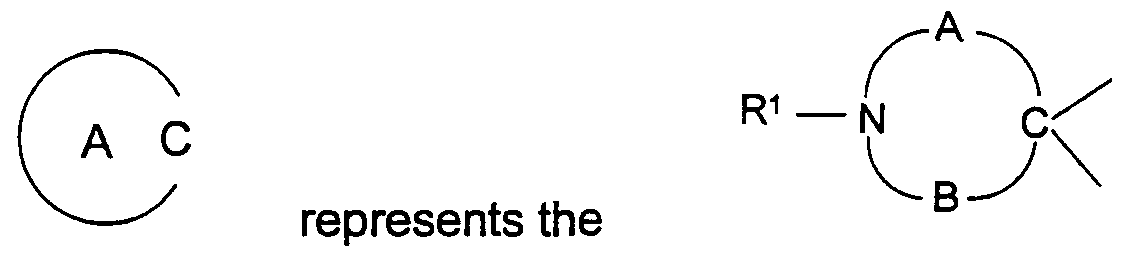
The optional lower alkanediyl bridging group in the N-A-C-B-ring is as defined for "Alk"; examples of such saturated bicyclo rings are:
1-azabicyclo[2.2.1]heptane, 2-azabicyclo [2.2.1]heptane, 1-azabicyclo[2,2,2]octane (quinuclidine), 1-azabicyclo[3,2,2]nonane, 1-azabicyclo[3,1 ,1]heptane, 1- azabicyclo[3,2,1]octane, 1-azabicyclo[3,3,1]nonane, 7,7-dimethyl-1- azabicyclo[2,2,1]heptane, 8-azabicyclo[3.2.1]octane and 6-azabicyclo[3.2.1]octane rings.
Preferred compounds are those in which the N-A-C-B-ring represents quinuclidine, 2- azabicyclo[2.2.1]heptane, 1-azabicyclo[2.2.1]heptane or 8-azabicyclo[3.2.1]octane and especially preferred are compounds in which the N-A-C-B-ring is 1- azabicyclo[2.2.1.heptane.
Compounds are preferred in which Y represents C(O). 6 Compounds are preferred in which the sum of n + m is 4. Compounds are preferred in which R2, R3 and/or R9 are hydrogen. Compounds are preferred in which X is oxygen.
Compounds are preferred in which R10 is (CrCe)-alkyl, especially methyl, ethyl or propyl, (C2-C6)-alkenyl, especially allyl or prenyl, or (C2-C6)-alkynoyl, especially propargyl.
Compounds are preferred in which R1 is hydrogen or alkyl, especially methyl or 2,2,2- trifluoroethyl, or in the case where R1 forms ring A, methylene.
As a further preferred group of compounds there are provided compounds of formula (I), in which W represents NR10and R10 is (C C4)-alkyl, (C3-C6)-alkenyl or (C3-C6)- alkynyl.
Quaternary salts which may be mentioned include N+-(C-ι-C6)-alkyl, preferably N+- methyl.
Derivates hydrolyzable in vivo which may be mentioned include (Cι-C6)- alky xycarbonyl, benzyloxycarbonyl or (Cι-C6)-alkanoyl.
The compounds of formula are partly known and partly new. Accordingly, in a further aspect ofthe invention there is provided a compound of the formula (I)
Figure imgf000006_0001
wherein the symbols and indices have the meanings given above; with the proviso that W represents NR10 and
X represents a sulfur atom and/or
R1 represents COR' and/or
R2, R4, R5 represent (C C6)-alkyl and/or 7
R3 represents H, (d-CβJ-alkyl, carboxy, (CrC6)-alkoxycarbonyl, (CrC6)-alkanoyl and/or
R6 represents a halogen atom, (CrC6)-alkyl, carboxy, (CrC6)-alkoxy, (CrC6)- alkanoyloxy, (CrC6)-alkylthio; (CrC6)-alkanoylthio.
In a further aspect of the invention there is provided a compound of the formula (I), wherein the symbols and indices have the meaning given above, with the proviso that W represents CR9R10 and R4, R5 together form a (CrC3)-alkylene chain and/or R10 represents (C2-C6)-alkenyl or (C2-C6)-alkynyl and/or m+n equals 2, 3, 5 or 6.
In a further aspect ofthe invention there is provided a compound ofthe formula (I), wherein the symbols and indices have the meaning given above, with the proviso that one or more alkyl groups are substituted by one or more fluorine atoms.
The compounds of formula (I) can be prepared through various synthetic routes adapted for the individual chemical structures. Synthetic routes for the preparation of formula (I) in which W represents CR9R10 are disclosed in EP-A 0311 313:
Figure imgf000007_0001
ring:
Method 1
Z4
Figure imgf000008_0001
(la)
Method 2
Figure imgf000008_0002
(IV) (lb)
Method 3
Figure imgf000008_0003
(Ic)
(V) Method 4
Figure imgf000009_0001
(Id) (Ie)
Method 5
Reduction
Figure imgf000009_0002
Figure imgf000009_0003
(If)
(VI)
Method 6
R10
Figure imgf000009_0004
(ig) (In) 10
Method 7
Figure imgf000010_0001
(VII) (In)
Method 8
Figure imgf000010_0002
(Ik)
Method 9
Figure imgf000010_0003
(II) (lm)
(wherein ring A, R2, R3, R7, R8, R9, R10, X, Y, Z1, Z2 and Alk are as defined above; ring A1 is a piperidine ring in which the nitrogen atom may be substituted by (C Ce) alkyl, (C-i-C6) alkanoyl, (CrC6) alkoxycarbonyl or a protective group for amines and/or may 11 be connected to a ring carbon (other than the common carbon atom of the spiro structure) via a (Cι-C6) alkylene bridging group; ring A2 is a piperidine ring in which the nitrogen atom may be substituted by (C Ce) alkanoyl (C Ce) alkoxycarbonyl or a protective group for amines and/or may be connected to a ring carbon (other than the common structure atom ofthe spiro structure) via a (C C6) alkylene briding group; ring A3 is a piperidine ring in which the nitrogen atom may be substituted by (CrC6) alkanoyl or (C Ce) alkoxycarbonyl and/or may be connected to a ring carbon (other than the common carbon atom of the spiro structure) via a (C-ι-C6) alkylene bridging group; ring A4 is a 1 ,3 or 1 ,4-disubstituted piperidine ring structure; Y1 is a radical represented by
Figure imgf000011_0001
Z3 and Z4 are the same or different and selected from oxygen and sulfur atoms; R11 and R12 are the same or different (C-ι-C6) alkyls; R13 is a hydrogen atom or (CrC6) alkyl; R14 is a hydrogen atom or (C Ce) alkyl; R15 is a hydrogen atom or (Cι-C6) alkyl, carbonyl or (C-ι-C6) alkoxycarbonyl; R16 is a hydrogen atom or an alkyl group of 1 to 5 carbon atoms; R17 is (C C6) alkyl, R20 is hydroxyl, mercapto, (Cι-C6) alkoxy or (C C6) alkylthio; Ph is phenyl; and R18 and R19 are the same or different and selected from a hydrogen atom and (C Ce) alkyls.
Method 1
There are many cyclization processes for preparing the compounds according to the invention. Compounds represented by the general formula (la) can be advantageously synthesized by cyclic condensation between, ester of cycloalkylidenacetic acid (II) and ester of hydroxy (or mercapto)alkyl-(thio)carboxylic acid (III), followed by removal of the protective group as required.
In this method compound (II) and alkali metal salt of compound (III) are allowed to react, or compound (II) and compound (III) are allowed to react in the presence of 12 base; the two reactants are used in equimolar amounts or with one reactant in slight excess. The reaction is preferably carried out in an inert organic solvent under cooling or at room temperature. Suitable solvents are aprotic compounds, such as dimethyl sulfoxide, benzene, toluene, xylene, dichloromethane, tetrahydrofurane, N,N-dimethylformamide, dichloroethane, chloroform and carbon tetrachlorides. Of these, dimethyl sulfoxide ortetrahydrofuran is the most preferred. The alkali metal salt of compound (III) can be obtained by reaction of compound (III) with base, such as sodium hydride, preferably under anhydrous conditions. The same type of base may be used in the reaction of compound (II) and compound (III) in free form.
Any type of protective group commonly employed for amino groups may be used in this invention. These include groups of urethane type (e.g., t-butoxycarbonyl), of acyl type (e.g., formyl, acetyl and propionyl), and of benzyl type (e.g., benzyl, benzhydryl and trityl). Removal of these protective groups may be effected by usual methods, in the presence of acid or base for those of urethane type, in the presence of base for those of acyl type, and by catalytic reduction for those of benzyl type. Hydrochloric acid, trifluoroacetic acid and hydrobromic acid/acetic acid may be mentioned as acid catalyst, and sodium hydrochloride and potassium hydroxide as the base catalysts.
Compounds (II) can be obtained by reaction of oxo-heterocyclic compound carrying protective group, lower alkyl, lower alkanoyl and lower alkoxycarbonyl with lower alkyl dialkylphosphonoacetate in an inert solvent (e.g. dimethoxyethane, dioxane and tetrahydrofuran) in the presence of base under cooling or at room temperature, or by the normal Wittig reaction, followed by removal of any protective group.
Method 2
Spiro compounds of 3-iodo-heterocyclic type represented by formula (lb) can be prepared by iodination of alkenyl-substituted, heterocyclic alcohol (IV), followed by removal of any protective group as required. 13 The reaction is preferably carried out by dissolving compund (IV) in an inert organic solvent, adding an aqueous alkaline solution of iodine in a more than stoichiometric amount, and holding the resulitng mixture under cooling or at room temperature.
Suitable organis solvents are aprotic compounds, such as dichloromethane, dichloroethane, chloroform, carbon tetrachloride, benzene, toluene, xylene and dimethyl sulfoxide; and sodium carbonate, potassium carbonate, sodium bicarbonate, sodium hydroxide and potassium hydroxide may be mentioned as examples of the alkali.
The type of protective group and methods for removing them are as in Method 1.
Compounds (IV) (starting material) are compounds, which can be easily obtained, as shown in the reaction formula given below, by the action of Grignard reagent, prepared from alkenyl halide and magnesium by usual method, upon oxo-heterocyclic compound.
(IV)
Figure imgf000013_0001
(wherein ring A2, R3, R9, R10 and R13 are as defined above and B is a halogen atom).
Method 3
Compounds according to the invention of formula (Ic) can be synthesized by subjecting epoxy compound (V) to cyclization, followed by removal of the protective group as required.
This cyclization is effected by the action of Lewis acid (such as tin tetrachloride, titanium tetrachloride and boron trifluoride(diethyl ether complex) upon compound (V) dissolved in an inert organic solvent, followed by addition of base. 14
Suitable organic solvents are aprotic compounds, such as dichloromethane, dichloroethane, chloroform, carbon tetrachloride, benzene, toluene, xylene and dimethyl sulfoxide. The base may be any compound that can trap the hydrochloric acid and metal salt formed, illustrative examples being organic bases, such as triethylamine, trimethylamine, pyriυine, picoline, lutidine and dimethylaniline; and inorganic bases, such as sodium hydroxide, potassium hydroxide, sodium carbonate and potassium carbonate.
The reaction is preferably carried out under cooling or at room temperature.
The types of protective group and methods of removing them are as in Method 1.
Method 4
Compounds according to the invention of formula (Ie) can be synthesized by decarboxylation of corresponding compound (Id) carrying carboxyl or lower alkoxycarbonyl as the substituent group at 4-position.
The decarboxylation reaction is effected by heating (preferably under reflux) in the presence of acid.
When the substituent group is a lower alkoxyacarbonyl, a process may be adopted in which the starting material (Id) may be dissolved in inert organic solvent (e.g., dimethylformamide and dimethyl sulfoxide) and this solution heated in the presence of an equimolar or excess amount of sodium chloride. When Method 1 is followed by this method, the Method 1 reaction product need not be isolated, but may be heated in the form of an acidic aqueous solution for direct conversion to compound (Ie).
Method 5 15 Compounds according to the invention can be prepared by reduction, and various reduction processes may be adopted depending on the type of radical to be reduced.
Method 5 is a process for obtaining compounds (If) carrying hydroxyl as substituent at 3-positioπ by reduction of corresponding compounds in which the 3-position is carbonyl.
The reaction is preferably carried out in an inert solvent (for example, alcohols, such as methanol, ethanol and isopropanol, tetrahydrofuran and dioxanes) at room temperature or at elevated temperature using reducing agent that can selectively reduce the carbonyl at 3-position (e.g. a boron hydride compound, such as sodium borohydride and sodium cyanoborohydride).
Method 6
N-lower-alkyl compounds of formula (Ih) can also be synthesized by reduction of starting material (Ig) carrying a lower alkanoyl as the substituent group at N-position.
The reaction is preferably carried out in an organic solvent (e.g. ether, tetrahydrofurane or dioxane) using, as reducing agent, an aluminium hydride compound (such as lithium aluminium hydride) at room temperature or at an elevated temperature.
Method 7
N-methyl compounds according to the invention of formula (li) can be synthesized by reduction of compound (III) carrying a urethane-type substituent at the N-position.
The reduction is preferably effected in an organic solvent (e.g., tetrahydrofurane, ether or dioxane) using, as reducing agent, aluminium hydride (prepared from lithium aluminium hydride and sulfuric acid) at room temperature or at elevated temperature, or under cooling. 16 Method 8
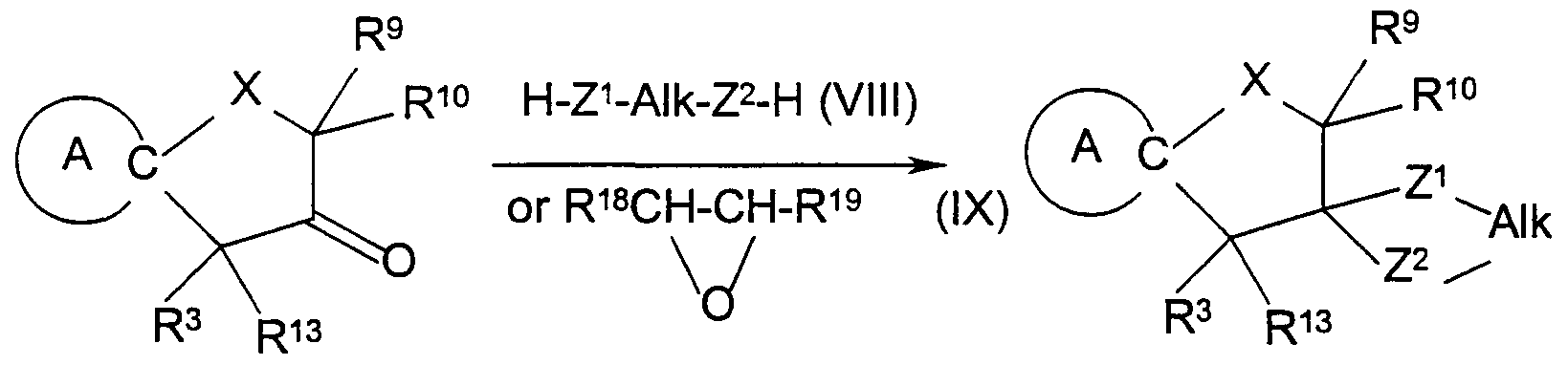
Cyclic ketals of formula (k) can be synthesized by methods commonly employed for the preparation of cyclic ketals. For example, corresponding carbonyl compound (Ij) is allowed to react with compound (VIII), such as a glycol, a hydroxyaikanethiol or an alkanedithiol, or with epoxy compound (IX), to form compound (Ik).
The reaction is carried out by dissolving compound (Ij) and an equimolar or excess amount of compound (III) in an inert organic solvent (preferably a solvent adapted for azeotropic dehydration, such as benzene, toluene or xylene) and heating the solution under reflux in the presence of acid catalyst to effect dehydration (preferably using a Dean-Stark azeotropic dehydration apparatus). The acid catalyst may be adipic-acid, oxalic acid or pyridine hydrochloride, but p-toluenesulfonic acid is the most preferred. If the reaction is carried out in an inert solvent, such as dichloromethane, dichloroethane, chloroform, carbon tetrachloride, ether, dioxane or tetrahydrofuran, in the presence of Lewis acid (e.g., boron trifluoride/diethylether or in tin tetrachloride), the desired product can be obtained without dehydration or heating. When epoxy compound (IX) is used as starting material, the reaction is carried out in an inert solvent (e.g. dichloromethane, dichloroethane, chloroform or carbon tetrachloride) in the presence of stannous chloride or boron trifluoride/ether complex at room temperature or at elevated temperature, or in the presence of tetraethylammonium bromide at 80 to 150°C in an autoclave.
Method 9
Compounds of formula (Im) having an alkylidene group at the 3-position can be synthesized by reaction of corresponding compound (II) in which the 3-position is carbonyl with alkyltriphenylphospholane (X).
This reaction is preferably carried out in an inert, aprotic organic solvent (such as dimethyl sulfoxid, dimethylformamide, tetrahydrofuran, ether, dioxane, benzene, toluene or xylene) under cooling or at elevated temperature using an equimolar or 17 excess amount of compound (X). The compound (X) can be prepared by reaction of corresponding alkyltriphenylphosphonium halide with an equimolar or excess amount of base in the same solvent as above under cooling or heating. The base used is preferably sodium hydride or n-butylithium.
Processes for the preparation of compounds of foπnula (I) or acid addition salts thereof in which W represents NR11 are disclosed in WO-A 92/01690:
a) preparing a compound of foπnula (I) by rearrangement of a corresponding compound of formula (XI),
Figure imgf000017_0001
in which R1, R10, A and B are as defined above for formula (I), Y' represents O or S, and in addition R1 may represent a protecting group, or
b) preparing a compound of formula (I) in which R10 represents hydrogen and Y' represents O, by hydrolysis of a corresponding compound of formula (XII),
Figure imgf000017_0002
in which X' represents a suitable leaving group, R1, A and B are as defined above for formula (I) and in addition, R1 may represent a protecting group, or 18 c) preparing a compound of formula (I) in which Y' is S by thiation of a corresponding compound of formula (I) in which Y' is O, or
d) preparing a compound of formula (I) in which R10 represents methyl by reaction of trimethyloxonium tetrafluoroborate with the corresponding compound of formula (XII).
e) preparing a compound of formula (I) in which R10 represents Ci-Cδ alkyl, C3-C6- alkenyl or C3-C6-alkynyl by reaction of the corresponding compound of formula (I) in which R10 represents hydrogen and in addition, R1 may represent a protecting group, with a corresponding reagent R10Z' in which Z' represents a suitable leaving group, or
f) preparing a compound of formula (I) in which R1 is Cι-C6-alkyl by reaction of the corresponding compound of formula (I) in which R1 is hydrogen with a compound of the formula R1L in which L represents a suitable leaving group.
g) preparing a compound of formula (I) in which R1 is -COOR' by reaction of the corresponding compound of formula (I) in which R1 is hydrogen with a corresponding haloformate ester, or
h) preparing a compound of the formula (I) in which R1 is methyl by reaction of the corresponding compound of formula (I) in which R1 is H with formaldehyde and formic acid, or
preparing a compound ofthe formula (I) in which R10 is hydrogen by reacting a corresponding compound of the formula (XIII),
R1 N
B
Figure imgf000018_0001
19 in which R1, A and B are as defined above for formula (I), R" represents a C C6- alkyl group and in addition, R1 may represent a protecting group, with hydroxyurea, or
j) preparing a compound of the formula (I) containing an amino group by removing a protecting group from a compound of formula (I) in which the amino group is protected.
and where desired or necessary converting the corresponding compound of formula (I) into an agrochemically acceptable acid addition product or quaternary salt thereof or vice versa.
In the reaction of process (a), methods similar to those described by Miles, H. T., (J. Amer. Chem. Soc. 79, 2565-8 (1957)] may be used. The reaction may be carried out in the absence of a solvent and at a temperature of, for example, from 100°C- 250°C.
In the reaction of process (b) suitable leaving groups that X' may represent include halide, for example bromide, and alkoxy, eg methoxy. The hydrolysis may be carried out in the presence of an acid, for example, hydrochloric or sulfuric acid in a solvent. Protic solvents are preferred, for example, methanol, ethanol or water or mixtures thereof and at a temperature of, for example, from 0°C-100°C.
In process (c) the thiation reaction may be carried out by methods similar to those described by De Amici using, for example, 2,4-bis(4-methoxyphenyl)-1 ,3-dithia-2,4- diphosphetane-2,4-disulfide (Lawesson's Reagent) in an inert solvent, for example, toluene at a temperature of, for example, from 50°C-120°C.
In the reaction of process (d) suitable leaving groups that X' may represent include halide, for example, bromide. Protecting groups which R1 may represent include benzyloxycarbonyl or a borane complex. The reaction may be earned out in an inert solvent, for example, nitromethane, and at temperature of, for example, from 0°C to 50°C. 20
In the reaction of process (e) suitable leaving groups that Z' may represent include halide, for example bromide. The reaction may be carried out in the presence of a base, for example in alkali carbonate in which the alkali metal may be, for example, sodium or potassium. The reaction may be conducted in an inert solvent, for example an aprotic solvent such as acetone, and at a temperature of, for example, from 0°- to 100°C.
In the reaction of process (f), suitable leaving groups which L may represent include, for example, halogen, preferably chlorine, bromine or iodine, or an alkyl- or aryl- sulfonate group, for example, mesylate ortosyiate. The alkylation reaction may be earned out in aprotic solvent, for example, acetonitrile, in the presence of a base, for example, potassium carbonate, and at a temperature of, for example, from 0° -100°C.
In the reaction of process (g), urethane formation may be earned out under similar conditions as those used in process (f) above.
In the reaction of process (h) methylation is accomplished by heating the amine with formic acid and formaldehyde at a temperature of, for example, from 50°C-100°C.
In the reaction of process (i) ring formation is carried out with hydroxyurea in the presence of a base, for example, an alkali alkoxide such as sodium methoxide, in a protic solvent, for example, an alcohol such as methanol and at a temperature of, for example, from 0°C - 50°C. Methods similar to those described by Olive, J.L. et al. (Bull. Soc. Chem. Fr. 1976, No. 9-10, 1589) may be used.
In the reaction of process 0) particularly suitable protecting groups are represented by benzyloxycarbonyl, which may readily be removed by, for example, triflic acid, hydrogenolysis or hydrogen bromide in acetic acid. Other groups which may be mentioned include borane, which may be removed by aqueous sodium carbonate and t-butyloxycarbonyl which may be removed by trifluoracetic acid. Further protecting 21 groups and methods for their removal are described in T.W. Greene, Protective Groups in Organic Synthesis, Wiley-lnterscience, 1981.
In addition, it was found that compounds of formula (I) may be prepared by heating a compound of formula (XIII) together with a hydroxylamine of formula R10NHOH. The reaction can be performed neat, or in a suitable solvent (such as toluene, xylene or mesitylene), at temperatures typically between 80 and 165CC.
Compounds of formula (XI) may be prepared by reacting the corresponding compound of formula (XII) with a compound of formula R 0-Y'-H, in which R10 and Y' are as defined above.
The reaction may be earned out by heating the compound of formula (XII) with the appropriate alcohol or thioalcohol in the presence of a base, for example, potassium carbonate. The reaction may be carried out at a temperature of, for example, from 20°C-100°C.
Compounds of formula (XII) may be prepared by reacting a corresponding compound of formula (XIV),
Figure imgf000021_0001
in which R1, and B are as defined above for formula (I) and in addition, R1 may represent a protecting group with a nitrile oxide of formula (XV),
X"-C=N-O (XV)
in which X" is a halide.
The nitrile oxide of formula (XV) may be prepared in situ from a corresponding compound of formula (XVI), 22
(X)"2C=N-OH (XVI)
in which X" is a halide, by treatment with base. The reaction may be carried out by methods similar to those described by Vyas, D. M. et al. (Tet. Letts. 25, 487-490 (1984)]. The reaction may be carried out in the presence of a base, for example, sodium or potassium bicarbonate or sodium acetate in a suitable solvent. Suitable solvents include water or an aprotic solvent, for example, ethyl acetate or methylene chloride. The reaction may also be earned out in the presence of silver nitrate and aqueous acetic acid. The reaction may be earned out at a temperature of, for example, from -10°C - 30°C.
Compounds of formula (XII) in which X' is alkoxy, for example methoxy, may be prepared by alcoholysis of the corresponding compound of formula (XII) in which X' is halogen by reaction with an alcohol, for example methanol, in the presence of a base, for example potassium carbonate, at a temperature of, for example, from 20°C-100°C.
The starting materials of formula (XIV) may be prepared by a number of methods, for example, by reacting the corresponding compound of formula (XVII),
RI
Figure imgf000022_0001
in which R1, A and B are as defined above for formula (I) and in addition R1 may represent a protecting group, with a Wittig reagent, for example, methyl triphenyl- phosphonium bromide in the usual manner.
The reaction may be earned out in the presence of a base, for example, butyl lithium or sodamide, in an aprotic solvent, for example, THF or hexane or mixtures of solvents, at a temperature of, for example, from 0°C-50°C. 23 Compounds of formula (XIII), (XVI) and (XVII) are either known compounds which are commercially available or may be prepared by literature methods from compounds known per se.
General Methods
Many general methods may be applied to the preparation ofthe compounds according to the invention.
For example, esters can be synthesized by reaction of corresponding carboxylic acid or reactive derivatives thereof with lower alcohol or reactive derivative thereof (e.g., lower alkyl halide) in the presence of condensation agent or base as required, or by other commonly used esterification techniques. Conversely compounds of this invention having free carboxyl group can be derived from corresponding esters by hydrolysis. Thiocarboxylic acids and esters thereof can be similarly prepared.
Compounds in which the 3-position is thiocarbonyl can also be synthesized (other than by Method 1 ) by the action of phosphorous pentasulfide or Lawesson's reagent (preferably used when no amide or ester bond is present) upon a compound in which the 3-position is carbonyl.
Compounds carrying a lower alkyl as substituent group at the N-position can be derived from corresponding free-nitrogen compounds by the usual N-alkylation methods using lower alkyl halide or by the action of lower alkylaldehyde in the presence of reducing agent, such as sodium borohydride or sodium cyanoborohydride. Compounds carrying a lower alkanoyl a substituent group at the N-position can be derived from corresponding free-nitrogen compound by the usual amidation methods using lower alkanoic acid or reactive derivative thereof in the presence of base as required.
Compounds according to the invention carrying a mercapto substituent group at the 3- position can be synthesized by sulfonating corresponding compounds carrying a 24 hydroxy substituent group at the 3-position (wich may optionally have a protective group), followed by the action of thiocarboxyiic acid (such as thioacetic acid, CH3CO- SH), hydrolysis and removal of the protective group as required; or by forming corresponding N-alkyl compound according to Method 6 or Method 7.
Compounds carrying a thioether substituent group at the 3-position can be derived from the mercapto compounds obtained above or alkali metal salts thereof by the action of lower alkyl halide or lower alkyl sulfonate (preferably p-toluenesulfonate) in the presence of base as required.
Compounds carrying an ether substituent at the 3-position can be derived from corresponding 3-hydroxy compounds by the action of lower alkyl halide (e.g., lower alkyl iodide) in the presence of base, followed by removal of the protective group as required; or by forming corresponding N-alkyl compounds according to Method 6 or Method 7.
Acid addition salts of compounds of formula (I) may be converted to the corresponding free base by the action of a stronger base. The acid addition salts of the compound of formula (I) may be prepared by reaction of the free base with an appropriate acid.
Quaternary salts may be prepared from the corresponding secondary or tertiary amines by conventional methods, for example as described in J March, Advanced Organic Chemistry, 3r ED, Wiley-lnterscience, 1985.
Compounds of formula (I) having hydrolyzable groups mentiond above may be prepared from the corresponding secondary amines by methods well known in the art, for example, alkanoyl derivatives may be prepared by reaction with an alkanoyl halide.
The compounds according to the invention (I) thus prepared are isolated and purified in the free form or as salts (obtainable by common salt-forming reactions). 25 Isolation and purification can be effected by common chemical operations, such as liquid/liquid separation, extraction, concentration, crystallization, filtration, recrystallization, and various types of chromatography.
As stated above, the compounds according to the invention may be obtained in different isomeric forms (such as geometric isomers, racemic compounds, optical isomers and diastereomers), either alone or as a mixture thereof. Geometric isomers can be separated by appropriately selecting the starting material or by utilizing differences in the pyhsicochemical properties of the isomers. Optical isomers and diastereomers can be separated by appropriately selecting the starting material, by general racemic separation techniques (for example, forming diastereomer salts with optically active acid, such as tartaric acid, followed by optical resolution), or by commonly used for diastereomer separation (for example, fractional crystallization ahd chromatography).
When some of the above preparative methods are to be used in succession, reaction steps described with no reference to protective groups may also be carried out with protective groups present.
Collections of compounds of the formula (I) which can be synthesized by the abovementioned Methods may also be prepared in a parallel manner, and this may be effected manually or in a semiautomated or fully automated manner. In this case, it is possible, for example, to automate the procedure of the reaction, work-up or purification ofthe products or ofthe intermediates. In total, this is to be understood as meaning a procedure as it is described, for example, by S.H. DeWitt in "Annual Reports in Combinatorial Chemistry and Molecular Diversity: Automated synthesis", Volume 1 , Verlag Escom 1997, pages 69 to 77.
A series of commercially available apparatuses as they are offered by, for example, Stem Corporation, Woodrolfe Road, Tollesbury, Essex, CM9 8SE, England or H+P Labortechnik GmbH, Bruckmannring 28, 85764 Oberschleiβheim, Germany, may be used for the parallel procedure of the reaction and work-up. For the parallel purification 26 of compounds of the formula (I), or of intermediates obtained during the preparation, use may be made, inter alia, of chromatography apparatuses, for example those by ISCO, Inc., 4700 Superior Street, Lincoln, NE 68504, USA.
The apparatuses mentioned lead to a modular procedure in which the individual process steps are automated, but manual operations must be performed between the process steps. This can be prevented by employing semi-integrated or fully integrated automation systems where the automation modules in question are operated by, for example, robots. Such automation systems can be obtained, for example, from Zymark Coφoration, Zymark Center, Hopkinton, MA 01748, USA.
In addition to what has been described here, compounds of the formula (I) may be prepared in part or fully by solid-phase-supported methods. For this purpose, individual intermediate steps or all intermediate steps of the synthesis or of a synthesis adapted to suit the procedure in question are bound to a synthetic resin. Solid-phase-supported synthesis methods are described extensively in the specialist literature, for example Barry A. Bunin in 'The Combinatorial Index", Academic Press, 1998. The use of solid-phase-supported synthesis methods permits a series of protocols which are known from the literature and which, in turn, can be performed manually or in an automated manner. For example, the "tea-bag method" (Houghten, US 4,631 ,211 ; Houghten et al., Proc. Natl. Acad. Sci, 1985, 82, 5131-5135), in which products by IRORI, 11149 North Torrey Pines Road, La Jolla, CA 92037, USA, are employed, may be semiautomated. The automation of solid-phase-supported parallel syntheses is performed successfully, for example, by apparatuses by Argonaut Technologies, Inc., 887 Industrial Road, San Carlos, CA 94070, USA or MultiSynTech GmbH, Wullener Feld 4, 58454 Witten, Germany.
The preparation ofthe processes described herein yields compounds ofthe formula (I) in the form of substance collections which are termed libraries. The present invention also relates to libraries which comprise at least two compounds of the formula (I). 27 The compounds of the formula (I) are suitable for controlling animal pests, in particular arthropods, e.g. insects and arachnids, helminths and mollusks, very especially preferably for controlling insects and arachnids which are encountered in agriculture, in livestock breeding, in forests, in the protection of stored goods and materials, and in the hygiene sector, and have good plant tolerance and favorable toxicity to warm-blooded species. They are active against normally sensitive and resistant species and against all or individual developmental stages. The abovementioned pests include: from the order ofthe Acarina, for example, Acarus siro, Argas spp., Ornithodoros spp., Dermanyssus gallinae, Eriophyes ribis, Phyllocoptruta oleivora, Boophilus spp., Rhipicephalus spp., Amblyomma spp., Hyalomma spp., Ixodes spp., Psoroptes spp., Chorioptes spp., Sarcoptes spp., Tarsonemus spp., Bryobia praetiosa, Panonychus spp., Tetranychus spp., Eotetranychus spp., Oligonychus spp., Eutetranychus spp. From the order ofthe Isopoda, for example, Oniscus aselus, Armadium vulgare, Porcellio scaber. From the order of the Diplopoda, for example, Blaniulus guttulatus.
From the order ofthe Chilopoda, for example, Geophilus carpophagus, Scutigera spp. From the order of the Symphyla, for example, Scutigerella immaculata. From the order of the Thysanura, for example, Lepisma saccharina. From the order of the Collembola, for example, Onychiurus armatus. From the order of the Orthoptera, for example, Blatta orientalis, Periplaneta americana, Leucophaea maderae, Blattella germanica, Acheta domesticus, Gryllotalpa spp., Locusta migratoria migratorioides, Melanoplus differentialis, Schistocerca gregaria. From the order of the Isoptera, for example, Reticulitermes spp. From the order of the Anoplura, for example, Phylloera vastatrix, Pemphigus spp., Pediculus humanus corporis, Haematopinus spp., Linognathus spp.
From the order of the Mallophaga, for example, Trichodectes pp., Damalinea spp.
From the order ofthe Thysanoptera, for example, Hercinothrips femoraiis, Thrips tabaci.
From the order ofthe Heteroptera, for example, Eurygaster spp., Dysdercus intermedius, Piesma quadrata, Cimex lectularius, Rhodnius prolixus, Triatoma spp. From the order of the Homoptera, for example, Aleurodes brassicae, Bemisia tabaci, Trialeurodes vaporariorum, Aphis gossypii, Brevicoryne brassicae, Cryptomyzus ribis, 28
Doralis fabae, Doralis pomi, Eriosoma lanigerum, Hyalopterus arundinis, Macrosiphum avenae, Myzus spp., Phorodon humuli, Rhopalosiphum padi, Empoasca spp., Euscelus bilobatus, Nephotettix cincticeps, Lecanium comi, Saissetia oleae, Laodelphax striatellus, Nilaparvata lugens, Aonidiella aurantii, Aspidiotus hederae, Pseudococcus spp., Psylla spp.
From the order of the Lepidoptera, for example, Pectinophora gossypiella, Bupalus piniarius, Cheimatobia brumata, Lithocolletis blancardella, Hyponomeuta padella, Plutella macuiipennis, Malacosoma neustria, Euproctis chrysorrhoea, Lymantria spp., Bucculatrix thurberiella, Phyllocnistis citrella, Agrotis spp., Euxoa spp., Feltia spp., Earias insulana, Heliothis spp., Laphygma exigua, Mamestra brassicae, Panolis flammea, Prodenia litura, Spodoptera spp., Trichoplusia ni, Carpocapsa pomonella, Pieris spp., Chilo spp., Pyrausta nubilalis, Ephestia kuehniella, Galleria mellonella, Cacoecia podana, Capua reticulana, Choristoneura fumiferana, Clysia ambiguella, Homona magnanima, Tortrix viridana.
From the order of the Coleoptera, for example, Anobium punctatum, Rhizopertha dominica, Bruchidius obtectus, Acanthoscelides obtectus, Hylotrupes bajulus, Agelastica alni, Leptinotarsa decemlineata, Phaedon cochleariae, Diabrotica spp., Psylloides chrysocephala, Epilachna varivestis, Atomaria spp., Oryzaephilus surinamensis, Anthonomus spp., Sitophilus spp., Otiorrhynchus sulcatus, Cosmopolites sordidus, Ceuthorrynchus assimilis, Hypera postica, Dermestes spp., Trogoderma, Anthrenus spp., Attagenus spp., Lyctus spp., Meligethes aeneus, Ptinus spp., Niptus hololeucus, Gibbium psylloides, Tribolium spp., Tenebrio molitor, Agriotes spp., Conoderus spp., Melolontha melolontha, Amphimallon solstitialis, Costelytra zealandica.
From the order ofthe Hymenoptera, for example, Diprion spp., Hoplocampa spp., Lasius spp., Monomorium pharaonis, Vespa spp.
From the order ofthe Diptera, for example, Aedes spp., Anopheles spp., Culex spp., Drosophiia melanogaster, Musca spp., Fannia spp., Calliphora erythrocephala, Lucilia spp., Chrysomyia spp., Cuterebra spp., Gastrophilus spp., Hypobosca spp., Stomoxys spp., Oestrus spp., Hypoderma spp., Tabanus spp., Tannia spp., Bibio hortulanus, 29 Oscinella frit, Phorbia spp., Pegomyia hyoscyami, Ceratitis capitata, Dacus oleae, Tipula paludosa.
From the order of the Siphonaptera, for example, Xenopsylla cheopsis, Ceratophyllus spp. From the order of the Arachnida, for example, Scorpio maurus, Latrodectus mactans. From the class of the helminths, for example, Haemonchus, Trichostrongulus, Ostertagia, Cooperia, Chabertia, Strongyloides, Oesophagostomum, Hyostrongulus, Ancyiostoma, Ascaris and Heterakis and also Fasciola.
From the class of the Gastropoda, for example, Deroceras spp., Arion spp., Lymnaea spp., Galba spp., Succinea spp., Biomphalaria spp., Bulinus spp., Oncomelania spp. From the class of the Bivalva, for example, Dreissena spp.
The plant-parasitic nematodes which can be controlled in accordance with the invention include, for example, the root-parasitic soil-dwelling nematodes such as, for example, those ofthe genera Meloidogyne (root knot nematodes, such as Meloidogyne incognita, Meloidogyne hapla and Meloidogyne javanica), Heterodera and Globodera (cyst-forming nematodes, such as Globodera rostochiensis, Globodera pallida, Heterodera trifolii) and of the genera Radopholus, such as Radopholus similis, Pratylenchus such as Pratyienchus neglectus, Pratylenchus penetrans and Pratylenchus curvitatus;
Tylenchulus such as Tylenchulus semipenetrans, Tylenchorhynchus, such as Tylenchorhynchus dubius and Tylenchorhynchus claytoni, Rotylenchus such as Rotylenchus robustus, Heliocotylenchus such as Haliocotylenchus multicinctus, Belonoaimus such as Belonoaimus longicaudatus, Longidorus such as Longidorus elongatus, Trichodorus such Trichodorus primitivus and Xiphinema such as Xiphinema index.
Other nematode genera which can be controlled using the compounds according to the invention are Ditylenchus (stem parasites, such as Ditylenchus dipsaci and Ditylenchus destructor), Aphelenchoides (foliar nematodes, such as Aphelenchoides ritzemabosi) and Anguina (seed nematodes, such as Anguina tritici). 30
The invention also relates to compositions, for example crop protection compositions, preferably insecticidal, acaricidal, ixodicidal, nematicidal, or molluskicidal, especially preferably insecticidal and acaricidal, compositions which comprise one or more compounds of the formula (I) in addition to suitable formulation auxiliaries.
In general, the compositions according to the invention comprise an effective amount, usually 1 to 95% by weight of one or more ofthe active substances of the formula (I).
To prepare the compositions according to the invention, the active substance and the other additives are combined and brought into suitable use form.
They can be formulated in various ways, depending on the biological and/or chemical- physical parameters which prevail. The following are examples of possible formulations:
Wettable powders (WP), emulsifiable concentrates (EC), aqueous solutions (SL), emulsions, sprayable solutions, oil- or water-based dispersions (SC), suspoemulsions (SE), dusts (DP), seed-dressing products, granules in the form of microgranules, spray granules, coated granules and absoφtion granules, water-dispersible granules (WG), ULV formulations, microcapsules, waxes or baits.
These individual types of formulations are known in principle and are described, for example, in: Winnacker-Kϋchler, "Chemical Technology", Volume 7, C. Hauser Verlag Munich, 4th Edition 1986; van Falkenberg, "Pesticides Formulations", Marcel Dekker N.Y., 2nd Ed. 1972-73; K. Martens, "Spray Drying Handbook", 3rd Ed. 1979, G. Goodwin Ltd. London.
The necessary formulation auxilairies such as inert materials, surfactants, solvents and other additives, are also known and described, for example, in Watkins, "Handbook of Insecticide Dust Diluents and Garners", 2nd Ed., Darland Books, Caldwell N.J.; H. v. 31 Olphen, "Introduction to Clay Colloid Chemistry", 2nd Ed., J. Wiley & Sons, N.Y.; Marsden, "Solvents Guide", 2nd Ed., Interscience, N.Y. 1950; McCutcheon's, "Detergents and Emulsifiers Annual", MC Publ. Coφ., Ridgewood N.J.; Sisley and Wood, "Encyclopedia of Surface Active Agents", Chem. Publ. Co. Inc., N.Y. 1964; Schonfeldt, "Grenzflachenaktive Athylenoxidaddukte", [Surface-active ethylene oxide adducts] Wiss. Veriagsgesell., Stuttgart 1967; Winnacker-Kϋchler, "Chemische Technologie", Volume 7, C. Hauser Verlag Munich, 4th Edition 1986.
Based on these formulations, it is also possible to prepare combinations with other pesticidally active materials, fertilizers and/or growth regulators, for example in the form of a ready-mix formulation or a tank mix. Wettable powders are preparations which are uniformly dispersible in water which, besides the active substance, also comprise wetters, for example polyoxyethylated alkylphenols, polyoxyethyiated fatty alcohols, alkylsulfonates or alkylphenolsulfonates and dispersants, for example sodium lignosulfonate or sodium 2,2'- dinaphthylmethane-6,6'-disulfonate, in addition to a diluent or inert material.
Emulsifiable concentrates are prepared by dissolving the active substance in an organic solvent, for example butanol, cyclohexanone, dimethylformamide, xylene or else higher-boiling aromatics or hydrocarbons, with addition of one or more emulsifiers. As emulsifiers, the following can be used, for example: calcium alkylarylsulfonates such as calcium dodecylbenzenesulfonate, or nonionic emulsifiers such as fatty acid polyglycol esters, alkylaryl polyglycol ethers, fatty alcohol polyglycol ethers, propylene oxide/ethylene oxide condensates, alkyl polyethers, sorbitan fatty acid esters, polyoxyethylene sorbitan fatty acid esters or polyoxyethylene sorbitol esters.
Dusts are obtained, for example, by grinding the active substance with finely divided solid materials, for example talc or natural clays, such as kaolin, bentonite, pyrophyllite or diatomaceous earth. Granules can be prepared either by atomizing the active substance onto adsorptive, granulated inert material or by applying active substance concentrates onto the surface of carrier materials such as sand or kaolinites, or of granulated inert material, by means of adhesives, for example polyvinyl alcohol or 32 sodium polyacrylate, or else mineral oils. Suitable active substances can also be granulated in the manner which is customary for the preparation of fertilizer granules, if desired as a mixture with fertilizers.
The active substance concentration in wettable powders is, for example, approximately 10 to 90% by weight, the remainder to 100% by weight is composed of customary formulation auxiliaries. In the case of emulsifiable concentrates, the active substance concentration may be approximately 5 to 80% by weight. Formulations in the form of dusts usually comprise 5 to 20% by weight of active substance, sprayable solutions approximately 2 to 20% by weight. In the case of granules, the active substance content depends partly on whether the active compound is in liquid or solid form and on which granulation auxiliaries, fillers and the like are being used.
Besides, the abovementioned active substance formulations comprise, if appropriate, the tackifiers, wetters, dispersants, emulsifiers, penetrants, solvents, fillers or carriers which are conventional in each case.
For use, the concentrates, which are present in commercially available form, are, if desired, diluted in the customary manner, for example in the case of wettable powders, emulsifiable concentrates, dispersions and in some cases also microgranules using water. Preparations in the form of dusts and granules and sprayable solutions are usually not diluted any further with other inert substances prior to use.
The application rate required varies with the external conditions such as, inter alia, temperature and humidity. It may vary within wide limits, for example between 0.0005 and 10.0 kg/ha or more of active substance, but it is preferably between 0.001 and 5 kg/ha.
The active substances according to the invention, in their commercially available formulations and in the use forms prepared from these formulations (see the abovementioned compositions) may be present in mixtures with other active 33 substances such as insecticides, attractants, sterilants, acaricides, nematicides, fungicides, molluskicides, growth regulatory substances or herbicides.
The pesticides include, for example, phosphoric esters, carbamates, carboxylic esters, formamidines, tin compounds and materials produced by microorganisms.
Preferred components in mixtures are:
1. from the group of the phosphorus compounds acephate, azamethiphos, azinphos-ethyl, azinphos-methyl, bromophos, bromophos- ethyl, cadusafos (F-67825), chlorethoxyphos, chlorfenvinphos, chlormephos, chloφyrifos, chloφyrifos-methyl, demeton, demeton-S-methyl, demeton-S-methyl sulfone, dialifos, diazinon, dichlorvos, dicrotophos, dimethoate, disulfoton, EPN, ethion, ethoprophos, etrimfos, famphur, fenamiphos, fenitriothion, fensulfothion, fenthion, fonofos, formothion, fosthiazate (ASC-66824), heptenophos, isazophos, isothioate, isoxathion, malathion, methacrifos, methamidophos, methidathion, salithion, mevinphos, monocrotophos, naled, omethoate, oxydemeton-methyl, parathion, parathion-methyl, phenthoate, phorate, phosalone, phosfolan, phosphocarb (BAS-301), phosmet, phosphamidon, phoxim, pirimiphos, pirimiphos-ethyl, pirimiphos-methyl, profenofos, propaphos, proetamphos, prothiofos, pyraclofos, pyridapenthion, quinalphos, sulprofos, temephos, terbufos, tebupirimfos, tetrachlorvinphos, thiometon, triazophos, trichloφhon, vamidothion;
2. from the group of the carbamates alanycarb (OK-135), aldicarb, 2-sec-butylphenyl methylcarbamate (BPMC), carbaryl, carbofuran, carbosulfan, cloethocarb, benfuracarb, ethiofencarb, furathiocarb, HCN- 801 , isoprocarb, methomyl, 5-methyl-m-cumenylbutyryl (methyl)carbamate, oxamyl, pirimicarb, propoxur, thiodicarb, thiofanox, 1-methylthio(ethylideneamino)-N-methyl-N- (moφholinothio)carbamate (UC 51717), triazamate;
from the group of the carboxylic esters 34 acrinathrin, allethrin, alphametrin, 5-benzyl-3-furylmethyl (E)- (1 R)-cis-2,2-dimethyl-3- (2-oxothioian-3-ylidenemethyl)cyclopropanecarboxylate, beta-Cyfluthrin, beta-cypermethrin, bioallethrin, bioallethrin ((S)-cyclopentyiisomer), bioresmethrin, bifenthrin, (RS)-1-cyano-1-(6-phenoxy-2-pyridyl)methyl (1 RS)-trans-3-(4-tert- butylphenyl)-2,2-dimethylcyclopropanecarboxylate (NCI 85193), cycloprothrin, cyfluthrin, cyhalothrin, cythithrin, cypermethrin, cyphenothrin, deltamethrin, empenthrin, esfenvalerate, fenfluthrin, fenpropathrin, fenvalerate, flucythrinate, flumethrin, fluvalinate (D isomer), imiprothrin (S-41311), lambda-cyhalothrin, permethrin, phenothrin ((R) isomer), prallethrin, pyrethrins (natural products), resmethrin, tefluthrin, tetramethrin, theta-Cypermethrin (TD-2344), tralomethrin, transfluthrin, zeta-cypermethrin (F-56701 );
4. from the group of the amidines amitraz, chlordimeform;
5. from the group of the tin compounds cyhexatin, fenbutatin oxide;
6. others abamectin, ABG-9008, acetamiprid, anagrapha falcitera, AKD-1022, AKD-3059, ANS- 118, bacillus thuringiensis, beauveria bassianea, bensultap, bifenazate (D-2341), binapacryl, BJL-932, bromopropylate, BTG-504, BTG-505, buprofezin, camphechlor, cartap, chlorobenziiate, chlorfenapyr, chlorfluazuron, 2-(4-chlorophenyl)-4,5- diphenylthiophene (UBI-T 930), chlorfentezine, chromafenozide (ANS-118), CG-216, CG-217, CG-234, A-184699, 2-naphthylmethyl cyclopropanecarboxylate (Ro12-0470), cyromazin, diacloden (thiamethoxam), diafenthiuron, ethyl 2-chloro-N-(3,5-dichloro-4- (1 ,1 ,2,3,3,3-hexafluoro-1-propyloxy)phenyl)carbamoyl)-2-carboximidate, DDT, dicofol, diflubenzuron, N-(2,3-dihydro-3-methyl-1 ,3-thiazol-2-ylidene)-2,4-xylidine, dinobuton, dinocap, diofenolan, DPX-062, emamectin benzoate (MK-244), endosulfan, ethiprole (sulfethiprole), ethofenprox, etoxazole (YI-5301), fenazaquin, fenoxycarb, fipronil, fluazuron, flumite (flufenzine, SZI-121), 2-fluoro-5-(4-(4-ethoxyphenyl)-4-methyl-1- pentyl)diphenyl ether (MTI 800), granulosis and nuclear polyhedrosis viruses, 35 fenpyroximate, fenthiocarb, fiubenzimine, flucycloxuron, flufenoxuron, flufenprox (ICI- A5683), fluproxyfen, gamma-HCH, halofenozide (RH-0345), halofenprox (MTI-732), hexaflumuron (DE_473), hexythiazox, HOI-9004, hydramethyinon (AC 217300), lufenuron, imidacloprid, indoxacarb (DPX-MP062), kanemite (AKD-2023), M-020, MTI- 446, ivermectin, M-020, methoxyfenozide (intrepid, RH-2485), milbemectin, NC-196, neemgard, nitenpyram (TI-304), 2-nitromethyl-4,5-dihydro-6H-thiazine (DS 52618), 2-nitromethyl-3,4-dihydrothiazole (SD 35651 ), 2-nitromethylene-1 ,2-thiazinan-3- ylcarbamaldehyde (WL 108477), Pyriproxyfen (S-71639), NC-196, NC-1111 , NNI- 9768, Novaiuron (MCW-275), OK-9701 , OK-9601, OK-9602, propargite, pymethrozine, pyridaben, pyrimidifen (SU-8801 ), RH-0345, RH-2485, RYI-210, S-1283, S-1833, SB7242, SI-8601 , silafluofen, silomadine (CG-177), spinosad, SU-9118, tebufenozide, tebufenpyrad (MK-239), teflubenzuron, tetradifon, tetrasul, thiacloprid, thiocyclam, TI-435, tolfenpyrad (OMI-88), triazamate (RH-7988), triflumuron, verbutin, vertalec (mykotal), YI-5301.
The active substance content ofthe use forms prepared from the commercially available formulations may range from 0.00000001 up to 95% by weight of active substance, preferably between 0.00001 and 1% by weight. Application is effected in a customary manner adapted to suit the use forms.
The invention also relates to a method of controlling harmful insects, Acarina, mites, endo and ectoparasites, helminths, mollusks and/or nematodes in which an effective amount of a compound according to the invention or of a composition according to the invention is applied to these or to the plants, areas or substrates infested with them.
The active substances according to the invention are also suitable for use in the veterinary medicine sector, preferably for controlling endoparasites and ectoparasites, and in the field of animal keeping.
In a further aspect of the invention there is provided the use of the compounds of formula (I) for preparing a composition for the treatment of ecto and/or endoparasites in animals. 36
The active substances according to the invention may be applied in the known manner, such as by oral administration in the form of, for example, tablets, capsules, drinks or granules, by dermal application in the form of, for example, dipping, spraying, pouring on and spotting on, and dusting, and by parenteral administration in the form of, for example, an injection.
In addition, the compounds according to the invention are also suitable for use in technology, for example as wood preservative, as preservative in paints, in cooling lubricants for metalworking, or as preservative in drilling and cutting oils.
Accordingly, the compounds of the formula (I) can also be employed particularly advantageously in livestock keeping (for example cattle, sheep, pigs and poultry such as chickens, geese and the like). In a preferred embodiment of the invention, the compounds, if appropriate in suitable formulations (cf. above), are administered orally to the animals, if appropriate together with the drinking water or feed. Since excretion in the feces is highly efficient, the development of insects in the animals' feces can be prevented very easily in this manner. The dosages and formulations which are suitable in each case depend, in particular, on the species and the developmental stage of the productive livestock and also on the risk of infestation and can be determined readily and established by customary methods. For example, the compounds can be employed in cattle at dosages of 0.01 to 1 mg/kg bodyweight.
In addition the compounds or compositions according to the invention can be applied in combination with fungicides known from the literature.
Such fungicides are described e.g. in C.D.S. Tomlin, S.B. Walker, The Pesticide Manual, 11th ed., British Crop Protection Council, Famham 1997.
The invention also relates to seed, treated or coated with an effective amount of a compound according to the invention or of a composition according to the invention. 37
The compounds of the formula (I) can also be employed for controlling animal pests in crops of known genetically engineered plants or genetically engineered plants yet to be developed. As a rule, the transgenic plants are distinguished by especially advantageous properties, for example by resistances to particular crop protection agents, resistances to plant diseases or pathogens of plant diseases, such as particular insects or microorganisms such as fungi, bacteria or viruses. Other particular properties concern, for example, the harvested material with regard to quantity, quality, storage properties, composition and specific constituents.
The use in economically important transgenic crops of useful plants and ornamentals is preferred, for example of cereals such as wheat, barley, rye, oats, millet, rice, cassava and maize or else crops of sugar beet, cotton, soya, oilseed rape, potatoes, tomatoes, peas and other types of vegetables.
When used in transgenic crops, in particular those which have resistances to insects, effects are frequently observed, in addition to the effects against harmful organisms to be observed in other crops, which are specific for application in the transgenic crop in question, for example an altered or specifically widened spectrum of pests which can be controlled, or altered application rates which may be employed for application.
The invention therefore also relates to the use of compounds of the formula (I) for controlling harmful organisms in transgenic crop plants.
The use according to the invention of compounds ofthe formula (I) or of compositions comprising them, for example as insecticide, acaricide, helminthicide, molluskicide or nematicide, also includes the case where the compound of the formula (I) or its salt is formed from a precursor only after application, for example in the insect, in a plant or in the soil.
The disclosures in European patent applications No. 99115966.6 and 99115968.2 from which this application claims priority, and in the abstract accompanying this application are incoφorated herein by reference. 38
The following examples further illustrate the invention.
Many examples describing the preparation of the compounds described herein can be found in examples 1 to 36 of EP-A 0 311 313 and examples 1 to 4 of WO-A 92/01690 which are hereby incorporated by reference. The following examples further illustrate the invention:
A. Preparation Examples
Example 1
Ethyl 5'-methyl-4'-oxospiro[1-azabicyclo[2.2.1]heptane-3,2'-oxolan]-3'-carboxylate
Ethyl lactate (3.26 g, 27.6 mmol) was instilled into a stirred suspension of sodium hydride (95 % dry; 0.66 g, 27.6 mmol) in dry DMF (10 ml) at 5°C. The temperature was allowed to rise to room temperature (r.t.) and after 1.5 hr ( 3-ethoxycarbonylmethylene)- 1-azabicycio [2.2.1] heptane (1.0 g, 5.5 mmol; prepared as described in EP-A 0 363 085) was instilled into the yellow reaction solution. The mixture was stirred at r. t. under nitrogen for 23 hr, acidified with ethanolic HCL solution and then evaporated under reduced pressure. Saturated NaHCO3 solution (10 ml) was added and the mixture was extracted with CH2CI2 (4 x 50 ml). The combined organic extracts were dried (MgSO ) and evaporated to yield crude product which was chromatographed (silicia gel; MeOH/EtOAc) to yield the title compound as a mixture of stereoisomers; m/z (El) 253 (M+; 12%), 198 (100%).
Example 2 5'-Methyl-spiro[1-azabicyclo[2.2.1]heptane-3,2'-oxoian]-4'-one
Ethyl 5'-methyl-4'-oxospiro [1 -azabicyclo [2.2.1] heptane-3,2'-oxolan]-3'-carboxylate (0.12 g; 0.5 mmol) in 1 M hydrochloric acid (2 ml) was heated under reflux for 4.5 hr. The mixture was allowed to cool to room temperature , basified with 25% NaOH 39 solution and extracted with CH2CI2 (3 x 10ml), The combined organic extracts were dried (MgSO ) and evaporated to yield the title compound as a mixture of stereoisomers; m/z (El) 181 (M+; 8%), 82 (100%).
Example 3 Spiro[1-azabicyclo[2.2.1]heptane-3,5'-isoxazolidin-3'-one
A solution of hydroxyurea (0.44 g, 5.8 mmol) in dry MeOH (1ml) was instilled into a solution of sodium methoxide (1.35g, 7.5 mmol) in dry MeOH (2 ml) at r. t.. After stirring for 2 hr a solution of (3-ethoxycarbonyimethylene)-1-azabicyclo [2.2.1]heptane (1.0 g, 5.5 mmol) in MeOH (1 ml) was added. The mixture was stirred under nitrogen for 70 hr and then a solution of acetic acid (0.44 ml, 7.7 mmol) in water (5 ml) was added. The mixture was extracted thrice with CH2CI2 and then the aqueous phase was evaporated to dryness under reduced pressure. The resultant crude product was chromatographed (silicia gel; MeOH/EtoAc) to yield the title compound as a mixture of stereoisomers; m/z (El) 168 (M+; 10%), 125 (100%).
Example 4
2'-Ethyi-spiro[1-azabicyclo[2.2.1]heptane-3,5'-isoxazolidin-3'-one Hydrochloride
A solution of (3-ethoxycarbonylmethylene)-1-azabicyclo[2.2.1]heptane (0.1 g, 0.55mmol) and N-ethylhydroxylamine (0.17 g, 2.8 mmol) in toluene (1 ml) was heated at 100°C for 40 hr. The mixture was cooled to room temperature, evaporated under reduced pressure and chromatographed (silicia gel; MeOH/CH2CI2) to give 2'-ethyl- spiro [1-azabicyclo[2.2.1]heptane-3,5'-isoxazolidin-3'-one.
This material was dissolved in methanolic HCl and evaporated to dryness to yield the title compound as a mixture of stereoisomers; m/z (El) 197(M+1 ; 1%), 82 (100%) m/z (ES) 197 (M+1). 40 The compounds listed in the following Table can be prepared using the experimental procedures described above or in EP-A 0311 313, WO-A 92/01692 and S. Tsukamoto et al., Chem. Pharm. Bull., 1995, 43, 1523:
41
Table:
Figure imgf000041_0001
where W represents CR9 or N
Figure imgf000041_0002
42
Figure imgf000042_0001
43
Figure imgf000043_0001
44
Figure imgf000044_0001
45
Figure imgf000045_0001
46
Figure imgf000046_0001
47
Figure imgf000047_0001
48
Figure imgf000048_0001
49
Figure imgf000049_0001
Data from EP-A 0 311 313
Data from WO-A 92/01690
Data from S. Tsukamoto et al., Chem. Pharm. Bull., 1995, 43, 1523
Positive ion electrospray (ES) (M + 1 data)
Abbreviations:
Me: methyl
Et: ethyl n-Pr: n-propyl (-CH2-CH2-CH3) i-Pr: iso-propyl (-CH(CH3)2) 50 Ph: phenyi
B. Formulation examples
a) A dust is obtained by mixing 10 parts by weight of active substance and 90 parts by weight of talc as inert material and comminuting the mixture in a hammer mill.
b) A wettable powder which is readily dispersible in water is obtained by mixing 25 parts by weight of active substance, 65 parts by weight of kaolin-containing quartz as inert material, 10 parts by weight of potassium lignosulfonate and 1 part by weight of sodium oleoylmethyltaurinate as wetter and dispersant and grinding the mixture in a pinned-disk mill.
c) A dispersion concentrate which is readily dispersible in water is prepared by mixing 40 parts by weight of active substance with 7 parts by weight of a sulfosuccinic monoester, 2 parts by weight of a sodium lignosulfonate and 51 parts by weight of water and grinding the mixture in a ball mill to a fineness of below 5 microns.
d) An emulsifiable concentrate can be prepared from 15 parts by weight of active substance, 75 parts by weight of cyclohexanone as solvent and 10 parts by weight of oxyethylated nonylphenol (10 EO) as emulsifier.
e) Granules can be prepared from 2 to 15 parts by weight of active substance and an inert granule carrier material such as attapulgite, pumice granules and/or quartz sand. It is expedient to use a suspension of the wettable powder of Example b) with a solids content of 30%, which is sprayed onto the surface of attapulgite granules, and these are dried and mixed intimately. The wettable powder amounts to approx. 5% by weight and the inert carrier material to approx. 95% by weight of the finished granules. 51
C. Biological examples
Example 1 Effect on the spider mite Tetranychus urticae
Bean plants (Phaseoius vulgaris) which were severely infested with a complete population of spider mites (Tetranychus urticae) were dipped into an aqueous solution ofthe formulated preparation to be tested. After 6 days storage in a controlled- environment cabinet at approx. 25°C, the mortality of all mite stages was determined. At a concentration of 300 ppm (based on the active substance content) a 50 - 100 % mortality was caused by the preparations of examples 2, 4, 6 and 53.
Example 2 Effect on the aphid Aphis fabae
Field beans (Vicia faba) which were densly populated with the black bean aphid (Aphis fabae) were dipped for 5 seconds into an aqueous solution ofthe formulated preparation to be tested. The mortality ofthe aphids was determined after 6 days. At a concentration of 300 ppm a 50 - 100 % mortality was shown by the preparation of example 4.
Example 3
Effect on the butterfly larva Spodoptera litoralis
Ten L2 larvae ofthe Egyptian cotton leafworm (Spodoptera litoralis) were introduced into a Petri dish whose bottom was covered with filter paper and contained approx. 5 ml of nutrient medium. The larvae and the nutrient medium were then treated with an aqueous solution of the formulated preparation to be tested. The Petri dish was subsequently sealed with a lid. After 6 days' storage at approx. 25°C, the effect ofthe preparation on the larvae was determined. At a concentration of 300 ppm a 50 - 100 % mortality was shown by the preparation of example 4. 52
Example 4
Effect on the egg-larval stage of Heliothis virescens
A Petri dish whose bottom was covered with filter paper and which contained approx. 5 ml of nutrient medium was prepared. Filter paper sections containing approx. 30 24-hour-old eggs of the tobacco budworm (Heliothis virescens) were immersed for 5 seconds into an aqueous solution of the formulated preparation to be tested and subsequently placed in the Petri dish. A further 200 μl of the aqueous solution were distributed over the nutrient medium. After 6 days' storage at approx. 25°C, the mortality of the preparation on the eggs and any larvae hatched from them was determined. At a concentration of 300 ppm a 50 - 100 % mortality was shown by the preparations of examples 6, 36, 80 and 81.
Example 5
The leaves of 12 rice plants having a stem length of 8 cm are dipped for 5 seconds into an aqueous solution of the formulated preparation to be examined. After the solution has dripped off, the rice plants are placed in a Petri dish and populated with approximately 20 larvae (L3 stage) of the rice leaf hopper species Niiaparvata lugens. After 6 days' storage at approx. 25°C, the mortality among the leaf hopper larvae is determined. At a concentration of 300 ppm a 50 - 100 % mortality was shown by the preparations of examples 4 and 53.
Example 6 Germinated broad bean seeds (Vicia faba) with radicles are transferred into brown glass bottles filled with tap water. Four milliliters of an aqueous solution ofthe formulated preparation to be examined are pipetted into the brown glass bottle. The broad bean is subsequently heavily populated with approximately 100 black bean aphids (Aphis fabae). After 6 days' storage at approx. 25°C, the root-systemic activity ofthe preparation on the aphids is determined. At a concentration of of 30 ppm a mortality of 50-100% among the aphids by root-systemic action was shown by the preparation of examples 4 and 53. 53
Example 7
Effect on the cattle tick Boophilus miroplus
Five recently fed adult female cattle ticks (Boophilus miroplus) were dipped for 5 minutes into an aqueous solution of the formulated preparation to be tested. The ticks were stored in a Petri dish at approx. 30°C for 6 days and then (as an indirect measure of tick mortality) the inhibition of oviposition was determined. At a concentration of 300 ppm a 50 - 100 % inhibition of oviposition was shown by the preparations of examples
4, 53, 60 and 63.
54
Patent claims:
1. The use of a heterocyclic spiro compound of the formula (I) or a salt thereof
Figure imgf000054_0001
wherein
A represents (CH2)m optionally substituted by R4; B represents (CH2)n optionally substituted by R5; W represents CR9R10 or NR 0;
X represents an oxygen or sulfur atom; when W is CR9R10 then
Y represents C(O), C(S), CHR6, C=CR7R8 or
Figure imgf000054_0002
when W is NR10 then Y represents (CO) or C(S); Z1,Z2 represent oxygen or sulfur; m,n represent an integer from 1 to 3 inclusive;
Alk represents a (CrCβJ-alkylene chain;
R1 represents H, (C C6)-alkyl, COR', COOR', in which R' represents H, (C C6)- alkyl or phenyl; R2, R4, R5, R7, R8, R9 represent H or (Ci-QO-alkyl;
R3 represent H, (CrC6)-alkyl, carboxy, (Cι-C6)-alkoxycarbonyl, (CrC6)-alkanoyl;
R6 represents a halogen atom, (C C6)-alkyl, carboxy, (Cι-C6)-alkoxy, (C Cβ)- alkylthio, (CrC6)-alkanoyloxy, (CrC6)-alkylthio; (C C6)-alkanoyloxy or (C-i-Cβ)- alkanoylthio; R10 represents hydrogen, (C-ι-C6)-alkyl, (C2-C6)-alkenyl or (C2-C6)-alkynyl, provided that any two of R1, R4 and R5 may together form a (Cι-C3)-alkylene chain

Claims

55 or an agrochemically acceptable derivate thereof, for controlling animal pests.
2. The use as claimed in claim 1 , wherein W represents CR9R10.
3. The use as claimed in claim 1 wherein W represents NR10.
4. A crop protection composition which comprises at least one compound according to any of claims 1 to 3 and at least one formulation auxiliary.
5. An insecticidal, acaricidal or nematicidal composition as claimed in claim 4 which comprises an effective amount of at least one compound of the formula (I) according to any of claims 1 to 3 together with the additives or auxiliaries conventionally used for this application.
6. A crop protection composition which comprises a insecticidally, acaricidally or nematicidally effective amount of at least one compound of the formula (I) according to any of claims 1 to 3 and at least one further active substance together with the auxiliaries and additives conventionally used for this application.
7. A composition for use in the protection of timber or as preservative in sealants, in paints, in cooling lubricants for metalworking or in drilling and cutting oils, comprising at least one compound ofthe formula (I) according to any of claims 1 to 3 together with the auxiliaries and additives conventionally used for these applications.
8. A compound of the formula (I) according to any of claims 1 to 3 or a composition as claimed in claim 4, 5 or 6 for use in the preparation of a veterinary medicament.
56 9. A process for the preparation of a composition as claimed in any of claims 4 to 7, which comprises combining the active substance and the other additives and bringing the mixture into a suitable use form.
10. The use of a compound according to any of claims 1 to 3 or of a composition as claimed in any of claims 4, 6 or 7 for controlling animal pest from the group insects, acarina, helminths, mites, mollusks and nematodes.
11. A method of controlling harmful insects, acarina, mites, helminths, mollusks and nematodes, in which an effective amount of a compound according to any of claims 1 to 3 or of a composition as claimed in any of claims 4, 5 or 6 is applied to these or to the plants, areas or substrates infested with them.
12. Seed, treated or coated with an effective amount of a compound according to any of claims 1 to 3 or of a composition as claimed in any of claims 4, 5 or 6.
13. A heterocyclic spiro compound of the formula (I) according to claim 1 , wherein the symbols and indices have the meanings given in claim 1 , with the proviso that W represents NR10 and
X represents a sulfur atom and/or
R1 represents COR' and/or
R2, R4, R5 independently represent (C-i-CβJ-alkyl and/or
R3 represents H, (CrC6)-alkyl, carboxy, (Cι-C6)-alkoxycarbonyl, (C C6)- alkanoyl and/or
R6 represents a halogen atom, (CrC6)-alkyl, carboxy, (d-CβJ-alkoxy, (C
C6)-alkanoyloxy, (CrC6)-aikylthio; (Cι-C6)-alkanoylthio.
14. A hetrocyclic spiro compound of the formula (I) according to claim 1 , wherein the symbols and indices have the meanings given in claim 1 , with the proviso that
W represents CR9R10 and
R4, R5 together form a (Cι-C3)-alkylene chain and/or 57 R10 represents (C2-C6)-alkenyl or (C2-C6)-alkynyl and/or m+n equals 2, 3, 5 or 6.
15. A hetrocyclic spiro compound of the formula (I) according to claim 1 , wherein the symbols and indices have the meanings given in claim 1 , with the proviso that one or more alkyl groups are substituted by one or more fluorine atoms.
1 Heterocyclic spiro compounds as pesticides
Description
The invention relates to the field of pest control, especially the control of animal pests like arthropods, e.g. insects and arachnids, ecto- and endoparasites, helminths, nematodes and mollusks.
Since modem pesticides must meet a wide range of demands, for example regarding level, duration and spectrum of action, use spectrum, toxicity, combination with other active substances, combination with formulation auxiliaries or synthesis, and since the occurrence of resistances is possible, the development of such substances can never be regarded as concluded, and there is constantly a high demand for novel compounds which are advantageous over the known compounds, at least as far as some aspects are concerned.
It was an object of the present invention to provide compounds which widen the spectrum ofthe pesticides in various aspects.
It has now suφrisingly been found that certain heterocyclic spiro compounds are useful for controlling animal pests.
Such compounds are partly known from EP-A 0311 313 and WO-A 92/01690 as useful drugs for the prevention and treatment of diseases, particularly those caused by neurological disorders, such as nervous degeneration. However no hint to their possible use in pest control is given.
Accordingly, in one aspect of the invention there is provided the use of a heterocyclic spiro compound ofthe formula (I),
PCT/EP2000/007851 1999-08-13 2000-08-11 Heterocyclic spiro compounds as pesticides Ceased WO2001011968A2 (en)

Priority Applications (5)

Application Number Priority Date Filing Date Title
AU75092/00A AU7509200A (en) 1999-08-13 2000-08-11 Heterocyclic spiro compounds as pesticides
KR1020027001876A KR20020029101A (en) 1999-08-13 2000-08-11 Heterocyclic spiro compounds as pesticides
BR0013085-0A BR0013085A (en) 1999-08-13 2000-08-11 Heterocyclic spiro compounds as pesticides
JP2001516331A JP2003506468A (en) 1999-08-13 2000-08-11 Heterocyclic spiro compounds as pesticides
EP00964011A EP1209974A2 (en) 1999-08-13 2000-08-11 Heterocyclic spiro compounds as pesticides

Applications Claiming Priority (4)

Application Number Priority Date Filing Date Title
EP99115966.6 1999-08-13
EP99115968 1999-08-13
EP99115968.2 1999-08-13
EP99115966 1999-08-13

Publications (2)

Publication Number Publication Date
WO2001011968A2 true WO2001011968A2 (en) 2001-02-22
WO2001011968A3 WO2001011968A3 (en) 2001-08-30

Family

ID=26153084

Family Applications (1)

Application Number Title Priority Date Filing Date
PCT/EP2000/007851 Ceased WO2001011968A2 (en) 1999-08-13 2000-08-11 Heterocyclic spiro compounds as pesticides

Country Status (7)

Country Link
EP (1) EP1209974A2 (en)
JP (1) JP2003506468A (en)
KR (1) KR20020029101A (en)
CN (1) CN1368848A (en)
AU (1) AU7509200A (en)
BR (1) BR0013085A (en)
WO (1) WO2001011968A2 (en)

Cited By (3)

* Cited by examiner, † Cited by third party
Publication number Priority date Publication date Assignee Title
US9845301B2 (en) 2015-07-31 2017-12-19 Pfizer Inc. 1,1,1-trifluoro-3-hydroxypropan-2-yl carbamate derivatives and 1,1,1-trifluoro-4-hydroxybutan-2-yl carbamate derivatives as MAGL inhibitors
US10329308B2 (en) 2017-01-20 2019-06-25 Pfizer Inc. 1,1,1-trifluoro-3-hydroxypropan-2-yl carbamate derivatives as MAGL inhibitors
US10858373B2 (en) 2017-01-23 2020-12-08 Pfizer Inc. Heterocyclic spiro compounds as MAGL inhibitors

Families Citing this family (2)

* Cited by examiner, † Cited by third party
Publication number Priority date Publication date Assignee Title
GB0601402D0 (en) * 2006-01-24 2006-03-08 Syngenta Participations Ag Chemical Compounds
ITMI20061279A1 (en) * 2006-06-30 2008-01-01 Consiglio Nazionale Ricerche SELECTIVE NICOTINIC AGONISTS FOR THE ALFA7 RECEPTOR SUBTIPLE, PROCEDURE FOR THEIR PREPARATION AND RELATED PHARMACEUTICAL COMPOSITIONS

Family Cites Families (5)

* Cited by examiner, † Cited by third party
Publication number Priority date Publication date Assignee Title
RO86918B1 (en) * 1981-12-21 1985-05-31 Institutul De Cercetari Pentru Pesticide Process for the preparation of trispirane derivatives
EP0189370A3 (en) * 1985-01-16 1988-01-27 Sandoz Ag Spirodioxolanes, -dithiolanes and -oxothiolanes
DE3853758T2 (en) * 1987-10-05 1995-09-07 Yamanouchi Pharma Co Ltd Heterocyclic spiro compounds and their production.
US5073560A (en) * 1990-07-20 1991-12-17 Fisons Corporation Spiro-isoxazolidine derivatives as cholinergic agents
DE19540736A1 (en) * 1994-12-23 1996-06-27 Bayer Ag 3-aryl-tetronic acid derivatives

Cited By (6)

* Cited by examiner, † Cited by third party
Publication number Priority date Publication date Assignee Title
US9845301B2 (en) 2015-07-31 2017-12-19 Pfizer Inc. 1,1,1-trifluoro-3-hydroxypropan-2-yl carbamate derivatives and 1,1,1-trifluoro-4-hydroxybutan-2-yl carbamate derivatives as MAGL inhibitors
US10428034B2 (en) 2015-07-31 2019-10-01 Pfizer Inc. 1,1,1-trifluoro-3-hydroxypropan-2-yl carbamate derivatives and 1,1,1-trifluoro-4-hydroxybutan-2-yl carbamate derivatives as MAGL inhibitors
US10723711B2 (en) 2015-07-31 2020-07-28 Pfizer Inc. 1,1,1-trifluoro-3-hydroxypropan-2-yl carbamate derivatives and 1,1,1-trifluoro-4-hydroxybutan-2-yl carbamate derivatives as MAGL inhibitors
US10329308B2 (en) 2017-01-20 2019-06-25 Pfizer Inc. 1,1,1-trifluoro-3-hydroxypropan-2-yl carbamate derivatives as MAGL inhibitors
US10626125B2 (en) 2017-01-20 2020-04-21 Pfizer Inc. 1,1,1-trifluoro-3-hydroxypropan-2-yl carbamate derivatives as MAGL inhibitors
US10858373B2 (en) 2017-01-23 2020-12-08 Pfizer Inc. Heterocyclic spiro compounds as MAGL inhibitors

Also Published As

Publication number Publication date
EP1209974A2 (en) 2002-06-05
CN1368848A (en) 2002-09-11
KR20020029101A (en) 2002-04-17
JP2003506468A (en) 2003-02-18
WO2001011968A3 (en) 2001-08-30
BR0013085A (en) 2002-04-23
AU7509200A (en) 2001-03-13

Similar Documents

Publication Publication Date Title
US6265350B1 (en) 1,3-oxazoline and 1,3-thiazoline derivatives, their preparation, and their use as pesticides
JP4366518B2 (en) Heterocyclylnicotinamide and similar pyrimidine derivatives as pesticides.
JP4238035B2 (en) Aryl isoxazoline derivatives, process for their production and their use as pesticides
US6555501B1 (en) 4-trifluoromethyl-3-oxazolylpyridines, processes for their preparation, compositions comprising them and their use as pesticides
US6949551B2 (en) Dihalopropene compounds, processes for their preparation, compositions comprising them and their use as pesticides
US20020032328A1 (en) Heterocyclic acylsulfimides, processes for their preparation, compositions comprising them and their use as pesticides
EP1140922A1 (en) 4-trifluoromethyl-3-oxadiazolyl pyridines, methods for the production thereof, agents containing these compounds, and their use as pesticides
US20040010145A1 (en) Heterocyclylalkylazole derivatives and their use as pesticides
WO2001011968A2 (en) Heterocyclic spiro compounds as pesticides
DE10014006A1 (en) New heterocyclic acylsulfimide derivatives, useful as insecticides, acaricides and nematocides for plant protection or in veterinary medicine
US20040009992A1 (en) Azolylalkylazole derivatives, their preparation, and their use as pesticides
WO2001015532A1 (en) Azabicyclo and azacyclo oxime and amine compounds as pesticides
AU2008202971B2 (en) Arylisoxazoline derviatives
EP1236727A1 (en) Azabicyclo compounds as pesticides
MXPA00012631A (en) 1,3-oxazoline and 1,3-thiazoline derivatives, method for producing the same and their use as pesticides

Legal Events

Date Code Title Description
AK Designated states

Kind code of ref document: A2

Designated state(s): AE AG AL AM AU AZ BA BB BG BR BY BZ CA CN CR CU CZ DM DZ EE GD GE HR HU ID IL IN IS JP KG KP KR KZ LC LK LR LT LV MA MD MG MK MN MX MZ NO NZ PL RO RU SG SI SK TJ TM TR TT UA UZ VN YU ZA

AL Designated countries for regional patents

Kind code of ref document: A2

Designated state(s): GH GM KE LS MW MZ SD SL SZ TZ UG ZW AM AZ BY KG KZ MD RU TJ TM AT BE CH CY DE DK ES FI FR GB GR IE IT LU MC NL PT SE BF BJ CF CG CI CM GA GN GW ML MR NE SN TD TG

121 Ep: the epo has been informed by wipo that ep was designated in this application
DFPE Request for preliminary examination filed prior to expiration of 19th month from priority date (pct application filed before 20040101)
AK Designated states

Kind code of ref document: A3

Designated state(s): AE AG AL AM AU AZ BA BB BG BR BY BZ CA CN CR CU CZ DM DZ EE GD GE HR HU ID IL IN IS JP KG KP KR KZ LC LK LR LT LV MA MD MG MK MN MX MZ NO NZ PL RO RU SG SI SK TJ TM TR TT UA UZ VN YU ZA

AL Designated countries for regional patents

Kind code of ref document: A3

Designated state(s): GH GM KE LS MW MZ SD SL SZ TZ UG ZW AM AZ BY KG KZ MD RU TJ TM AT BE CH CY DE DK ES FI FR GB GR IE IT LU MC NL PT SE BF BJ CF CG CI CM GA GN GW ML MR NE SN TD TG

WWE Wipo information: entry into national phase

Ref document number: 2000964011

Country of ref document: EP

WWE Wipo information: entry into national phase

Ref document number: 008115133

Country of ref document: CN

Ref document number: 1020027001826

Country of ref document: KR

WWE Wipo information: entry into national phase

Ref document number: 1020027001876

Country of ref document: KR

WWW Wipo information: withdrawn in national office

Ref document number: 1020027001826

Country of ref document: KR

WWW Wipo information: withdrawn in national office

Ref document number: 1020027001826

Country of ref document: KR

WWP Wipo information: published in national office

Ref document number: 1020027001876

Country of ref document: KR

WWP Wipo information: published in national office

Ref document number: 2000964011

Country of ref document: EP

WWW Wipo information: withdrawn in national office

Ref document number: 2000964011

Country of ref document: EP

WWW Wipo information: withdrawn in national office

Ref document number: 1020027001876

Country of ref document: KR