WO2001014371A1 - N-heterocyclic derivatives as nos inhibitors - Google Patents

N-heterocyclic derivatives as nos inhibitors Download PDF

Info

Publication number
WO2001014371A1
WO2001014371A1 PCT/US2000/023173 US0023173W WO0114371A1 WO 2001014371 A1 WO2001014371 A1 WO 2001014371A1 US 0023173 W US0023173 W US 0023173W WO 0114371 A1 WO0114371 A1 WO 0114371A1
Authority
WO
WIPO (PCT)
Prior art keywords
amιno
ιmιdazol
acetamιde
ethyl
propyl
Prior art date
Legal status (The legal status is an assumption and is not a legal conclusion. Google has not performed a legal analysis and makes no representation as to the accuracy of the status listed.)
Ceased
Application number
PCT/US2000/023173
Other languages
French (fr)
Inventor
Damian O. Arnaiz
John J. Baldwin
David D. Davey
James J. Devlin
Roland Ellwood Dolle, Iii
Shawn David Erickson
Kirk Mcmillan
Michael M. Morrissey
Michael H. J. Ohlmeyer
Gonghua Pan
Vidyadhar Madhav Paradkar
John Parkinson
Gary B. Phillips
Bin Ye
Zuchun Zhao
Current Assignee (The listed assignees may be inaccurate. Google has not performed a legal analysis and makes no representation or warranty as to the accuracy of the list.)
Berlex Laboratories Inc
Pharmacopeia LLC
Original Assignee
Berlex Laboratories Inc
Pharmacopeia Inc
Priority date (The priority date is an assumption and is not a legal conclusion. Google has not performed a legal analysis and makes no representation as to the accuracy of the date listed.)
Filing date
Publication date
Priority to HK02105317.3A priority Critical patent/HK1043594A1/en
Priority to AU70671/00A priority patent/AU769405B2/en
Priority to EEP200200091A priority patent/EE05199B1/en
Priority to UA2002032401A priority patent/UA72930C2/en
Priority to DK00959333T priority patent/DK1206467T3/en
Priority to EP00959333A priority patent/EP1206467B1/en
Priority to MXPA02002022A priority patent/MXPA02002022A/en
Priority to HK03103750.1A priority patent/HK1051683B/en
Priority to SK262-2002A priority patent/SK2622002A3/en
Priority to ROA200200205A priority patent/RO122202B1/en
Priority to CA002376355A priority patent/CA2376355C/en
Priority to DE60007329T priority patent/DE60007329T2/en
Priority to AT00959333T priority patent/ATE256681T1/en
Priority to NZ517411A priority patent/NZ517411A/en
Priority to HR20020175A priority patent/HRP20020175B1/en
Priority to PL00353539A priority patent/PL353539A1/en
Priority to IL14831300A priority patent/IL148313A0/en
Priority to BR0014144-5A priority patent/BR0014144A/en
Priority to SI200020040A priority patent/SI20818B/en
Application filed by Berlex Laboratories Inc, Pharmacopeia Inc filed Critical Berlex Laboratories Inc
Priority to JP2001518702A priority patent/JP4739625B2/en
Publication of WO2001014371A1 publication Critical patent/WO2001014371A1/en
Priority to IL148313A priority patent/IL148313A/en
Priority to NO20020925A priority patent/NO323886B1/en
Priority to BG106440A priority patent/BG65804B1/en
Anticipated expiration legal-status Critical
Ceased legal-status Critical Current

Links

Classifications

    • CCHEMISTRY; METALLURGY
    • C07ORGANIC CHEMISTRY
    • C07DHETEROCYCLIC COMPOUNDS
    • C07D231/00Heterocyclic compounds containing 1,2-diazole or hydrogenated 1,2-diazole rings
    • C07D231/02Heterocyclic compounds containing 1,2-diazole or hydrogenated 1,2-diazole rings not condensed with other rings
    • C07D231/10Heterocyclic compounds containing 1,2-diazole or hydrogenated 1,2-diazole rings not condensed with other rings having two or three double bonds between ring members or between ring members and non-ring members
    • C07D231/12Heterocyclic compounds containing 1,2-diazole or hydrogenated 1,2-diazole rings not condensed with other rings having two or three double bonds between ring members or between ring members and non-ring members with only hydrogen atoms, hydrocarbon or substituted hydrocarbon radicals, directly attached to ring carbon atoms
    • AHUMAN NECESSITIES
    • A61MEDICAL OR VETERINARY SCIENCE; HYGIENE
    • A61PSPECIFIC THERAPEUTIC ACTIVITY OF CHEMICAL COMPOUNDS OR MEDICINAL PREPARATIONS
    • A61P1/00Drugs for disorders of the alimentary tract or the digestive system
    • A61P1/04Drugs for disorders of the alimentary tract or the digestive system for ulcers, gastritis or reflux esophagitis, e.g. antacids, inhibitors of acid secretion, mucosal protectants
    • AHUMAN NECESSITIES
    • A61MEDICAL OR VETERINARY SCIENCE; HYGIENE
    • A61PSPECIFIC THERAPEUTIC ACTIVITY OF CHEMICAL COMPOUNDS OR MEDICINAL PREPARATIONS
    • A61P11/00Drugs for disorders of the respiratory system
    • AHUMAN NECESSITIES
    • A61MEDICAL OR VETERINARY SCIENCE; HYGIENE
    • A61PSPECIFIC THERAPEUTIC ACTIVITY OF CHEMICAL COMPOUNDS OR MEDICINAL PREPARATIONS
    • A61P11/00Drugs for disorders of the respiratory system
    • A61P11/06Antiasthmatics
    • AHUMAN NECESSITIES
    • A61MEDICAL OR VETERINARY SCIENCE; HYGIENE
    • A61PSPECIFIC THERAPEUTIC ACTIVITY OF CHEMICAL COMPOUNDS OR MEDICINAL PREPARATIONS
    • A61P13/00Drugs for disorders of the urinary system
    • A61P13/12Drugs for disorders of the urinary system of the kidneys
    • AHUMAN NECESSITIES
    • A61MEDICAL OR VETERINARY SCIENCE; HYGIENE
    • A61PSPECIFIC THERAPEUTIC ACTIVITY OF CHEMICAL COMPOUNDS OR MEDICINAL PREPARATIONS
    • A61P17/00Drugs for dermatological disorders
    • AHUMAN NECESSITIES
    • A61MEDICAL OR VETERINARY SCIENCE; HYGIENE
    • A61PSPECIFIC THERAPEUTIC ACTIVITY OF CHEMICAL COMPOUNDS OR MEDICINAL PREPARATIONS
    • A61P17/00Drugs for dermatological disorders
    • A61P17/02Drugs for dermatological disorders for treating wounds, ulcers, burns, scars, keloids, or the like
    • AHUMAN NECESSITIES
    • A61MEDICAL OR VETERINARY SCIENCE; HYGIENE
    • A61PSPECIFIC THERAPEUTIC ACTIVITY OF CHEMICAL COMPOUNDS OR MEDICINAL PREPARATIONS
    • A61P17/00Drugs for dermatological disorders
    • A61P17/06Antipsoriatics
    • AHUMAN NECESSITIES
    • A61MEDICAL OR VETERINARY SCIENCE; HYGIENE
    • A61PSPECIFIC THERAPEUTIC ACTIVITY OF CHEMICAL COMPOUNDS OR MEDICINAL PREPARATIONS
    • A61P19/00Drugs for skeletal disorders
    • A61P19/02Drugs for skeletal disorders for joint disorders, e.g. arthritis, arthrosis
    • AHUMAN NECESSITIES
    • A61MEDICAL OR VETERINARY SCIENCE; HYGIENE
    • A61PSPECIFIC THERAPEUTIC ACTIVITY OF CHEMICAL COMPOUNDS OR MEDICINAL PREPARATIONS
    • A61P21/00Drugs for disorders of the muscular or neuromuscular system
    • AHUMAN NECESSITIES
    • A61MEDICAL OR VETERINARY SCIENCE; HYGIENE
    • A61PSPECIFIC THERAPEUTIC ACTIVITY OF CHEMICAL COMPOUNDS OR MEDICINAL PREPARATIONS
    • A61P25/00Drugs for disorders of the nervous system
    • AHUMAN NECESSITIES
    • A61MEDICAL OR VETERINARY SCIENCE; HYGIENE
    • A61PSPECIFIC THERAPEUTIC ACTIVITY OF CHEMICAL COMPOUNDS OR MEDICINAL PREPARATIONS
    • A61P25/00Drugs for disorders of the nervous system
    • A61P25/14Drugs for disorders of the nervous system for treating abnormal movements, e.g. chorea, dyskinesia
    • A61P25/16Anti-Parkinson drugs
    • AHUMAN NECESSITIES
    • A61MEDICAL OR VETERINARY SCIENCE; HYGIENE
    • A61PSPECIFIC THERAPEUTIC ACTIVITY OF CHEMICAL COMPOUNDS OR MEDICINAL PREPARATIONS
    • A61P25/00Drugs for disorders of the nervous system
    • A61P25/28Drugs for disorders of the nervous system for treating neurodegenerative disorders of the central nervous system, e.g. nootropic agents, cognition enhancers, drugs for treating Alzheimer's disease or other forms of dementia
    • AHUMAN NECESSITIES
    • A61MEDICAL OR VETERINARY SCIENCE; HYGIENE
    • A61PSPECIFIC THERAPEUTIC ACTIVITY OF CHEMICAL COMPOUNDS OR MEDICINAL PREPARATIONS
    • A61P29/00Non-central analgesic, antipyretic or antiinflammatory agents, e.g. antirheumatic agents; Non-steroidal antiinflammatory drugs [NSAID]
    • AHUMAN NECESSITIES
    • A61MEDICAL OR VETERINARY SCIENCE; HYGIENE
    • A61PSPECIFIC THERAPEUTIC ACTIVITY OF CHEMICAL COMPOUNDS OR MEDICINAL PREPARATIONS
    • A61P3/00Drugs for disorders of the metabolism
    • A61P3/08Drugs for disorders of the metabolism for glucose homeostasis
    • A61P3/10Drugs for disorders of the metabolism for glucose homeostasis for hyperglycaemia, e.g. antidiabetics
    • AHUMAN NECESSITIES
    • A61MEDICAL OR VETERINARY SCIENCE; HYGIENE
    • A61PSPECIFIC THERAPEUTIC ACTIVITY OF CHEMICAL COMPOUNDS OR MEDICINAL PREPARATIONS
    • A61P35/00Antineoplastic agents
    • AHUMAN NECESSITIES
    • A61MEDICAL OR VETERINARY SCIENCE; HYGIENE
    • A61PSPECIFIC THERAPEUTIC ACTIVITY OF CHEMICAL COMPOUNDS OR MEDICINAL PREPARATIONS
    • A61P37/00Drugs for immunological or allergic disorders
    • AHUMAN NECESSITIES
    • A61MEDICAL OR VETERINARY SCIENCE; HYGIENE
    • A61PSPECIFIC THERAPEUTIC ACTIVITY OF CHEMICAL COMPOUNDS OR MEDICINAL PREPARATIONS
    • A61P37/00Drugs for immunological or allergic disorders
    • A61P37/02Immunomodulators
    • AHUMAN NECESSITIES
    • A61MEDICAL OR VETERINARY SCIENCE; HYGIENE
    • A61PSPECIFIC THERAPEUTIC ACTIVITY OF CHEMICAL COMPOUNDS OR MEDICINAL PREPARATIONS
    • A61P37/00Drugs for immunological or allergic disorders
    • A61P37/02Immunomodulators
    • A61P37/06Immunosuppressants, e.g. drugs for graft rejection
    • AHUMAN NECESSITIES
    • A61MEDICAL OR VETERINARY SCIENCE; HYGIENE
    • A61PSPECIFIC THERAPEUTIC ACTIVITY OF CHEMICAL COMPOUNDS OR MEDICINAL PREPARATIONS
    • A61P43/00Drugs for specific purposes, not provided for in groups A61P1/00-A61P41/00
    • AHUMAN NECESSITIES
    • A61MEDICAL OR VETERINARY SCIENCE; HYGIENE
    • A61PSPECIFIC THERAPEUTIC ACTIVITY OF CHEMICAL COMPOUNDS OR MEDICINAL PREPARATIONS
    • A61P9/00Drugs for disorders of the cardiovascular system
    • AHUMAN NECESSITIES
    • A61MEDICAL OR VETERINARY SCIENCE; HYGIENE
    • A61PSPECIFIC THERAPEUTIC ACTIVITY OF CHEMICAL COMPOUNDS OR MEDICINAL PREPARATIONS
    • A61P9/00Drugs for disorders of the cardiovascular system
    • A61P9/02Non-specific cardiovascular stimulants, e.g. drugs for syncope, antihypotensives
    • AHUMAN NECESSITIES
    • A61MEDICAL OR VETERINARY SCIENCE; HYGIENE
    • A61PSPECIFIC THERAPEUTIC ACTIVITY OF CHEMICAL COMPOUNDS OR MEDICINAL PREPARATIONS
    • A61P9/00Drugs for disorders of the cardiovascular system
    • A61P9/04Inotropic agents, i.e. stimulants of cardiac contraction; Drugs for heart failure
    • AHUMAN NECESSITIES
    • A61MEDICAL OR VETERINARY SCIENCE; HYGIENE
    • A61PSPECIFIC THERAPEUTIC ACTIVITY OF CHEMICAL COMPOUNDS OR MEDICINAL PREPARATIONS
    • A61P9/00Drugs for disorders of the cardiovascular system
    • A61P9/08Vasodilators for multiple indications
    • AHUMAN NECESSITIES
    • A61MEDICAL OR VETERINARY SCIENCE; HYGIENE
    • A61PSPECIFIC THERAPEUTIC ACTIVITY OF CHEMICAL COMPOUNDS OR MEDICINAL PREPARATIONS
    • A61P9/00Drugs for disorders of the cardiovascular system
    • A61P9/10Drugs for disorders of the cardiovascular system for treating ischaemic or atherosclerotic diseases, e.g. antianginal drugs, coronary vasodilators, drugs for myocardial infarction, retinopathy, cerebrovascula insufficiency, renal arteriosclerosis
    • CCHEMISTRY; METALLURGY
    • C07ORGANIC CHEMISTRY
    • C07DHETEROCYCLIC COMPOUNDS
    • C07D233/00Heterocyclic compounds containing 1,3-diazole or hydrogenated 1,3-diazole rings, not condensed with other rings
    • C07D233/54Heterocyclic compounds containing 1,3-diazole or hydrogenated 1,3-diazole rings, not condensed with other rings having two double bonds between ring members or between ring members and non-ring members
    • C07D233/56Heterocyclic compounds containing 1,3-diazole or hydrogenated 1,3-diazole rings, not condensed with other rings having two double bonds between ring members or between ring members and non-ring members with only hydrogen atoms or radicals containing only hydrogen and carbon atoms, attached to ring carbon atoms
    • CCHEMISTRY; METALLURGY
    • C07ORGANIC CHEMISTRY
    • C07DHETEROCYCLIC COMPOUNDS
    • C07D249/00Heterocyclic compounds containing five-membered rings having three nitrogen atoms as the only ring hetero atoms
    • C07D249/02Heterocyclic compounds containing five-membered rings having three nitrogen atoms as the only ring hetero atoms not condensed with other rings
    • C07D249/081,2,4-Triazoles; Hydrogenated 1,2,4-triazoles

Definitions

  • the invention relates to a series of ⁇ /-heterocycl ⁇ c compounds and derivatives useful as inhibitors of nitric oxide synthase (NOS) and to methods of therapy for various diseases employing those compounds
  • Nitric oxide is produced under various conditions by virtually all nucleated mammalian cells A number of pathologies are ascribed to abnormalities in NO production including stroke, insulin dependent diabetes, septic shock-induced hypotension, rheumatoid arthritis and multiple sclerosis Nitric oxide is synthesized in biological tissues by an enzyme called nitric oxide synthase (NOS) which uses NADPH and molecular oxygen to oxidize L-arginme to citrulline and nitric oxide
  • NOS nitric oxide synthase
  • Nitric oxide synthase exists in at least three isoforms, which fall into two primary categories constitutive and inducible Two constitutive isoforms, which are calcium and calmodulin dependent, have been identified, and one inducible isoform has been identified
  • the constitutive isoforms are (1 ) a neuronal isoform, NOS-1 or nNOS, which is found in the brain and skeletal muscles and (2) an endothelial isoform, NOS-3 or eNOS, which is expressed in the endothelium of blood vessels, the epithelium of the bronchial tree and in the brain
  • the inducible isoform (NOS2 or iNOS) is expressed in virtually all nucleated mammalian cells following exposure to inflammatory cytokines or lipopolysaccha ⁇ de Its presence in macrophages and lung epithelial cells is particularly noteworthy
  • the inducible isoform is neither stimulated by calcium nor blocked by calmodulin antagonists It contains several tightly bound co-factors, including FMN, FAD and tetrahydrobioptenn
  • Nitric oxide generated by the inducible form of NOS has been implicated in the pathogenesis of inflammatory diseases
  • hypotension induced by hpopolysaccharide or tumor necrosis factor a can be reversed by NOS inhibitors
  • Conditions which lead to cytokine-induced hypotension include septic shock, hemodialysis and interleukin therapy in cancer patients
  • an iNOS inhibitor would be effective in treating cytokine-induced hypotension
  • NOS inhibitors would therefore have beneficial effects on inflammatory bowel disease, cerebral ischemia and arthritis
  • Inhibitors of NOS may also be useful in treating adult respiratory distress syndrome (ARDS) and myocarditis, and they may be useful as adjuvants to short term immunosuppression in transplant therapy
  • ARDS adult respiratory distress syndrome
  • myocarditis myocarditis
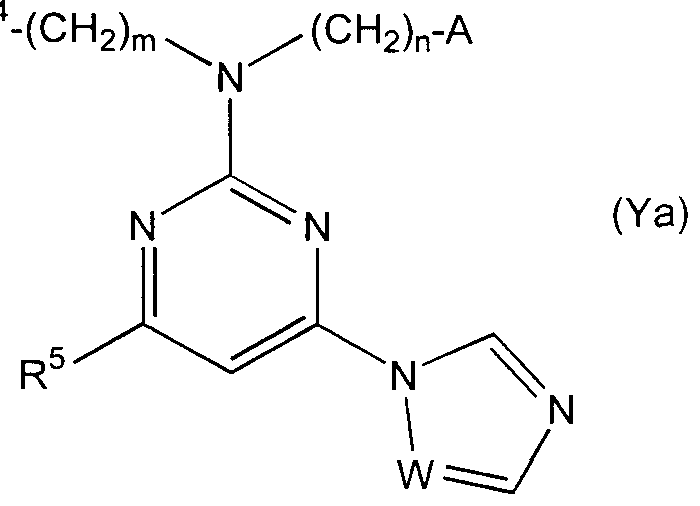
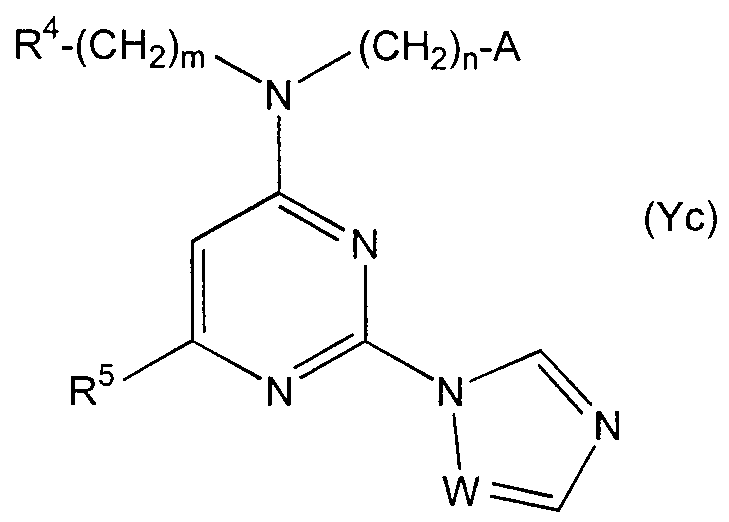
  • the invention is directed to compounds of formula (Ya), formula (Yb) and formula (Yc)
  • n and m are each independently an integer from 1 to 4,
  • A is -C(0)OR 1 or -C(0)N(R 1 )R 2
  • each W is N or CH
  • each R 1 is independently hydrogen, alkyl, aryl or aralkyl
  • each R 2 is independently hydrogen, C 0 -C 20 alkyl, -(CH 2 ) n -N(R 1 ) 2 , heterocyclylalkyl (optionally substituted by alkyl, halo, haloalkyl or alkoxy), aralkyl (optionally substituted by halo, alkyl, alkoxy, or -N(R 1 ) 2 ),
  • R 4 is hydroxy, cyano, heterocyclyl, -N(R 1 )R 2 , -N(R 1 )-C(0)-R , -N(R 1 )-C(0)OR 1 , -N(R )-S(0) t -R 1 , or-N
  • AA is an ammo acid
  • X, Y and Z are independently N or C(R 19 )
  • U is N or C(R 5 ), provided that U is N only when X is N and Z and Y are CR 19 ,
  • W is or CH
  • R 1 and R 2 are independently chosen from the group consisting of hydrogen, optionally substituted
  • C ⁇ C ⁇ alkyl optionally substituted cycloalkyl, -[C 0 -C 8 alkyl]-R 9 , -[C 2 -C 8 alkenyl]-R 9 , -[C 2 -C 8 alkynyl]-R 9 , -[C 2 -C 8 alkyl]-R 10 (optionally substituted by hydroxy), -[C CaJ-R 11
  • R 5 is chosen from the group consisting of hydrogen, halo, alkyl, haloalkyl, optionally substituted aralkyl, optionally substituted aryl, -OR 16 , -S(0) t -R 16 , -N(R 16 )R 21 , -N(R 16 )C(0)N(R 1 )R 16 ,
  • each R 9 is independently chosen from the group consisting of haloalkyl, cycloalkyl (optionally substituted with halo, cyano, alkyl or alkoxy), carbocyclyl (optionally substituted with one or more substituents selected from the group consisting of halo, alkyl and alkoxy), and heterocyclyl (optionally substituted with alkyl, aralkyl or alkoxy), each R 10 is independently chosen from the group consisting of halo, alkoxy, optionally substituted aryloxy, optionally substituted aralkoxy, optionally substituted -S(0) t -R 22 , acylamino, ammo, monoalkylamino, dialkylammo, (tr ⁇ phenylmethyl)am ⁇
  • the invention is directed to pharmaceutical compositions comprising a compound of formula (Ya), formula (Yb), and formula (Yc), as described above, and a pharmaceutically acceptable carrier
  • the invention is directed to methods of treating a condition resulting from an abnormality in nitric oxide production which comprises administering to a mammal having a condition resulting from an abnormality in nitric oxide production a therapeutically effective amount of compound of formula (Ya), formula (Yb), and formula (Yc), as described above
  • Alkyl refers to a straight or branched hydrocarbon chain radical consisting solely of carbon and hydrogen atoms, containing no unsaturation, having from one to eight carbon atoms, and which is attached to the rest of the molecule by a single bond, e.g , methyl, ethyl, n-propyl, 1 -methylethyl (/so-propyl), n-butyl, n-pentyl, 1 ,1-d ⁇ methylethyl (f-butyl), and the like
  • Alkyl radicals having more than eight carbon atoms are indicated herein by the notation "[C x -C y alkyl]" where x and y indicate the number of carbons present
  • Alkyl radicals may be optionally substituted by one or more substituents independently selected from the group consisting of halo, hydroxy, alkoxy, carboxy, cyano, carbonyl, alkoxycarbonyl, cyano, ammo
  • Alkenyl refers to a straight or branched chain monovalent or divalent radical consisting solely of carbon and hydrogen, containing at least one double bond and having from one to eight carbon atoms, e g , ethenyl, prop-1-enyl, but-1-enyl, pent-1-enyl, penta-1 ,4-d ⁇ enyl, and the like
  • Alkynyl refers to a straight or branched chain monovalent or divalent radical consisting solely of carbon and hydrogen, containing at least one triple bond and having from one to eight carbon atoms, e g , ethynyl, prop-1-ynyl, but-1 -ynyl, pent-1-ynyl, pent-3-ynyl, and the like
  • Alkoxy refers to a radical of the formula -0R a where R a is an alkyl radical as defined above, e g , methoxy, eth
  • Alkoxycarbonyl refers to a radical of the formula -C(0)OR a where R a is an alkyl radical as defined above, e g , methoxycarbonyl, ethoxycarbonyl, n-propoxycarbonyl, and the like
  • Alkoxycarbonylalkyl refers to a radical of the formula -R a -C(0)OR a where each R a is independently an alkyl radical as defined above, e g , 2-(methoxycarbonyl)ethyl, 3-(ethoxycarbonyl)propyl, 4-(n-propoxycarbonyl)butyl, and the like
  • Alkylsulfonylamino refers to a radical of the formula -N(H)S(0) 2 -R a where R a is an alkyl radical as defined above, e g , methylsulfonylamino, ethylsulfonylamino, and the like
  • Alkylsulfonyl refers to a radical of the formula -S(0) 2 -R a where R a is an alkyl radical as defined above, e g , methylsulfonyl, ethylsulfonyl, and the like
  • Alkylthio refers to a radical of the formula -S-R a where R a is an alkyl radical as defined above, e g , methylthio, ethylthio, n-propylthio, and the like
  • Amidino refers to a radical of the formula -C(NH)-NH 2
  • Ammo refers to a radical of the formula -NH 2
  • Aminocarbonyl refers to a radical of the formula -C(0)NH 2
  • Aminosulfonyl refers to a radical of the formula -S(0) 2 NH 2
  • Aryl refers to a phenyl or naphthyl radical
  • the aryl radical may be optionally substituted by one or more substituents selected from the group consisting of hydroxy, mercapto, halo, alkyl, alkenyl, alkynyl, phenyl, phenylalkyl, phenylalkenyl, alkoxy, phenoxy, phenylalkoxy, haloalkyl, haloalkoxy, formyl, nitro, cyano, cycloalkyl, hydroxyalkyl, alkoxyalkyl, phenoxyalkyl, phenylalkoxyalkyl, amidino, ureido, alkoxycarbonyamino, ammo, monoalkylamino, dialkylammo, monophenylamino, monophenylalkylamino, sulfonylamino, akylsulfonylamino, ammoalky
  • Aralkyl refers to a radical of the formula -R a R b where R a is an alkyl radical as defined above and R b is an aryl radical as defined above, e g , benzyl, and the like The aryl radical may be optionally substituted as described above
  • Aryloxy refers to a radical of the formula -OR b where R b is an aryl radical as defined above, e g , phenoxy and naphthoxy, and the like The aryl radical may be optionally substituted as described above
  • Aryloxycarbonyl refers to a radical of the formula -C(0)OR b where R b is an aryl radical as defined above, e g , phenoxycarbonyl
  • aralkoxy refers to a radical of the formula -OR c where R c is an aralkyl radical as defined above, e g , benzyloxy, and the like
  • R c is an aralkyl radical as defined above, e g , benzyloxy, and the like
  • the aralkyl radical may be optionally substituted as described above
  • Alkoxycarbonyl refers to a radical of the formula -C(0)OR c where R c is an aralkyl radical as defined above, e g , benzyloxycarbonyl, and the like The aralkyl radical may be optionally substituted as described above
  • Arylammocarbonyl refers to a radical of the formula -C(0)N(R b )H where R b is an aryl radical as defined above, e g , phenylaminocarbonyl, and the like The aryl radical may be optionally substituted as described above
  • Arylaminosulfonyl refers to a radical of the formula -S(0) 2 N(R b )H where R b is an aryl radical as defined above, e g , phenylaminosulfonyl, and the like The aryl radical may be optionally substituted as described above
  • Arylsulfonyl refers to a radical of the formula -S(0) 2 -R b where R b is an aryl radical as defined above, e g , phenylsulfonyl, and the like The aryl radical may be optionally substituted as described above
  • Arylsulfonylammocarbonyl refers to a radical of the formula -C(0)N(H)S(0) 2 R b where R b is an aryl radical as defined above, e g , phenylsulfonylammocarbonyl, and the like The aryl radical may be optionally substituted as described above
  • Acyl refers to a radical of the formula -C(0)-R a and -C(0)R b where R a is an alkyl radical as defined above and R b is an aryl radical as defined above, e g , acetyl, propionyl, benzoyl, and
  • Alkylamino refers to a radical of the formula -N(H)-C(0)-R a and -N(H)-C(0)-R b where R a is an alkyl radical as defined above and R b is an aryl radical as defined above, e g , acetylamino benzoylamino and the like
  • Alkylene refers to straight or branched chain divalent radical consisting solely of carbonyl and hydrogen, containing no unsaturation and having from one to eight carbon atoms, e g , methylene, ethylene, propylene, ⁇ -butylene, and the like The alkylene radical may be optionally substituted by one or more substituents selected from the group consisting of alkyl, hydroxy, -N(R 16 )R 21 or -C(0)N(R )R 16 where R 1 , R 16 and R 21 are as defined above in the Summary of the Invention
  • Cycloalkyl refers to a stable 3- to 10-membered monocyc c or bicyclic radical which is saturated, and which consist solely of carbon and hydrogen atoms, e g , cyclopropyl, cyclobutyl, cyclobutyl, cyclohexyl, decalmyl and the like Unless otherwise stated specifically in the specification, the term “cycloalkyl” is meant to include cycloalkyl radicals which are optionally substituted by one or more substituents independently selected from the group consisting of alkyl, halo, hydroxy, ammo, cyano, nitro, alkoxy, carboxy and alkoxycarbonyl "Carboxy” refers to the radical of the formula -C(0)OH "Carboxyalkyl” refers to a radical of the formula -R a -C(0)OH where R a is an alkyl radical as defined above, e g , carboxymethyl, 2-carboxyethyl, 3-
  • D ⁇ (alkoxy)alkyl refers to a radical of the formula -R a (-OR a ) 2 where each R a is independently an alkyl radical as defined above and where the -OR a groups may be attached to any carbon in the R a group, e g , 3,3-d ⁇ methoxypropyl, 2,3-d ⁇ methoxypropyl, and the like
  • Dialkylammo refers to a radical of the formula -N(R a )R a where each R a is independently an alkyl radical as defined above, e g , dimethylamino, diethylamino, (methyl )(ethyl)am ⁇ no, and
  • Dialkylaminocarbonyl refers to a radical of the formula -C(0)N(R a )R a where each R a is independently an alkyl radical as defined above, e g , dimethylaminocarbonyl, methylethylaminocarbonyl, diethylammocarbonyl, dipropylaminocarbonyl, ethylpropylaminocarbonyl, and the like
  • Dialkylaminosulfonyl refers to a radical of the formula -S(0) 2 N(R a )R a where each R a is independently an alkyl radical as defined above, e g , dimethylaminosulfonyl, methylethylammosulfonyl, diethylaminosulfonyl, dipropylammsulfonyl, ethylpropylaminosulfonyl,
  • Halo refers to bromo, chloro, i ⁇ do or fluoro
  • Haloalkyl refers to an alkyl radical, as defined above, that is substituted by one or more halo radicals, as defined above, e g , t ⁇ fluoromethyl, d fluoromethyl, t ⁇ chloromethyl, 2,2,2-t ⁇ fluoroethyl, 1-fluoromethyl-2-fluoroethyl, 3-bromo-2-fluoropropyl, 1-bromomethyl-2-bromoethyl, and the like
  • Heterocyclyl refers to a stable 3- to 15-membered ring radical which consists of carbon atoms and from one to five heteroatoms selected from the group consisting of nitrogen, oxygen and sulfur
  • the heterocyclyl radical may be a monocyclic, bicyclic or t ⁇ cyclic ring system, which may include fused or bridged ring systems, and the nitrogen, carbon or sulfur atoms in the heterocyclyl radical may be optionally oxidized, the nitrogen atom may be optionally qua
  • Heterocyclylalkyl refers to a radical of the formula -R a -R e where R a is an alkyl radical as defined above and R e is a heterocyclyl radical as defined above, e g , 2-(1 ,3-benzod ⁇ oxol-5- yl)ethyl, and 3-(1 ,4-benzod ⁇ oxan-6-yl)propyl, and the like
  • “Monoalkylamino” refers to a radical of the formula -N(H)R a where R a is an alkyl radical as defined above, e g , methylamino, ethylamino, propylammo, and the like
  • “Monoalkylammocarbonyl” refers to a radical of the formula -C(0)N(H)R a where R a is an alkyl radical as defined above, e g , methylaminocarbonyl, ethylammocarbonyl, propylaminocarbonyl, and the like
  • “Monoalkylam osulfonyl” refers to a radical of the formula -S(0) 2 N(H)R a where R a is an alkyl radical as defined above, e g , methylaminosulfonyl, ethylaminosulfonyl, propyiaminosulfonyl, and the like
  • ⁇ /-heterocyclyl refers to a heterocyclyl radical as defined above which contains at least one nitrogen atom and which is attached to the main structure through the nitrogen atom
  • the N- heterocyclyl radical may contain up to three additional hetero atoms Examples include pipendinyl, piperazinyl, pyrrohdinyl, morpholinyl, thiomorpholmyl, azetidmyl, indolyl, pyrrolyl, imidazolyl, tetrahydroisoqumolyl, perhydroazepinyl, tetrazolyl, tnazolyl, oxazmyl, and the like, and may be optionally substituted as described above for heterocyclyl radicals
  • the ⁇ /-heterocyclyl radical may also be optionally substituted by R 6 as defined above in the Summary of the Invention
  • Phenylalkyl refers to an alkyl radical as defined above substituted by a phenyl radical, e g , benzyl, and the like
  • Phenylalkenyl refers to an alkenyl radical as defined above substituted by a phenyl radical
  • salts refers to salts prepared from pharmaceutically acceptable non-toxic acids or bases including inorganic acids and bases and organic acids and bases
  • salts may be prepared from pharmaceutically acceptable non-toxic acids including inorganic and organic acids
  • Suitable pharmaceutically acceptable acid addition salts for the compounds of the present invention include acetic, benzenesulfonic (besylate), benzoic, camphorsulfonic, citric, ethenesulfonic, fumaric, gluconic, glutamic, hydrobromic, hydrochloric, isethionic, lactic, maleic, malic, mandelic, methanesulfonic, mucic, nitric, pamoic, pantothenic, phosphoric, succmic, sulfu ⁇ c, tarta ⁇ c acid, p-toluenesulfonic, and the like
  • suitable pharmaceutically acceptable base addition salts for the compounds of the present invention include metallic salt
  • Treating covers the treatment of a condition in a human, which condition results from an abnormality in nitric oxide production, and includes (i) preventing the condition from occurring in a human, in particular, when such human is predisposed to the condition but has not yet been diagnosed as having it, (n) inhibiting the condition, ; e , arresting its development, or
  • Nitric oxide generated by the inducible form of nitric oxide synthase has been implicated in the pathogenesis of numerous inflammatory and autoimmune diseases and also in diseases which are generally not regarded as inflammatory, but nevertheless may involve cytokines which locally up-regulate i-NOS
  • the compounds of the invention are therefore useful in treating mammals, preferably humans, having a condition resulting from an abnormality in nitric oxide production Such conditions include, but are not limited to, the following
  • the compounds of the current invention may also be useful for the management of male and female reproductive functions when used alone or combined with other drugs commonly used for these indications
  • Examples include inhibition of fertilization endometnal receptivity and implantation (alone or in combination with a progesterone antagonist), post-coital contraception (alone or in combination with a progesterone antagonist), mduction of abortion (in combination with an antiprogestin and in further combination with a prostaglandin), control and management of labor and delivery, treatment of cervical incompetence (alone or in combination with progesterone or a progestm), treatment of endomet ⁇ osis (alone or in combination with other drugs, including LHRH-agonists/antagonists antiprogestins orprogestms by either sequential application or by concomitant administration) See, for example, the following references Chwalisz, K et al , J Soc Gynecol Invest (1997), Vol 4, No 1 (Supplement), page 104a, which discusses
  • the compounds of the present invention include 1 -substituted imidazoles This class of compounds has previously been described as mechanism-based, heme-binding inhibitors of the cytochrome P450 family of enzymes (Maurice, M et al .
  • the compounds of the present invention may thus be useful as inhibitors of selected cytochrome P450 family members of therapeutic interest including, but not limited to, P450 enzymes involved in steroid and retmoid biosynthesis (Masamura ef al , Breast Cancer Res Treat (1995), Vol 33, pp 19-26, Swart, P et al , J Clm Endocnnol Metab , Vol 77, pp 98-102, Docks, P et al .
  • Imidazole- based compounds may also have antifungal activity (Aoyama, Y et al , Biochem Pharmacol (1992), Vol 44, pp 1701 -1705)
  • the P450 inhibitory activity of the compounds of the present invention can be assessed using appropriate assay systems specific for the P450 isoform of interest Such assays are included in the references cited above
  • cytochrome P450 3A4 which can be assayed in a manner similar to the method described in Yamazaki et al , Carcmogenesis (1995), Vol 16, pp 2167-2170
  • Nitric oxide synthases are complex enzymes that catalyze the conversion of L-arginme to nitric oxide (NO) and citrull e Catalysis proceeds through two successive oxidations of the guanidinium group of L-arginine
  • a cell-based nitric oxide synthase assay employing the measurement of nitric oxide oxidation product, nitrite, in the conditioned medium of cultured cells was employed for the evaluation of the compounds of the invention
  • the murine monocytic cell lines RAW 264 7 and J774 are well documented as capable of producing >10 ⁇ M nitrite in response to immunostimulation
  • Any suitable route of administration may be employed for providing a patient with an effective dosage of compounds of the invention
  • oral, rectal, parenteral (subcutaneous, intramuscular, intravenous), transdermal, and like forms of administration may be employed
  • Dosage forms include tablets, troches, dispersions, suspensions, solutions, capsules patches, and the like
  • compositions of the present invention comprise the compounds of the invention as the active ingredient, and may also contain a pharmaceutically acceptable carrier, and optionally, other therapeutic ingredients
  • Carriers such as starches, sugars, and microcrystallme cellulose, diluents, granulating agents, lubricants, binders, disintegrating agents, and the like are suitable in the case of oral solid preparations (such as powders, capsules, and tablets), and oral solid preparations are preferred over the oral liquid preparations Methods for their preparation are well known in the art
  • tablets and capsules represent the most advantageous oral dosage unit forms, in which case solid pharmaceutical carriers are employed If desired, tablets may be coated by standard aqueous or nonaqueous techniques In addition to the common dosage forms set out above, the compounds of the present invention may also be administered by controlled or sustained release means and delivery devices
  • compositions of the present invention suitable for oral administration may be presented as discrete units such as capsules, cachets, or tablets, each containing a predetermined amount of the active ingredient, as a powder or granules, or as a solution or a suspension in an aqueous liquid, a non-aqueous liquid, an oil-m-water emulsion, or a water-in-oil liquid emulsion
  • Such compositions may be prepared by any of the methods of pharmacy, but all methods include the step of bringing into association the active ingredient with the carrier which constitutes one or more necessary ingredients
  • the compositions are prepared by uniformly and intimately admixing the active ingredient with liquid carriers or finely divided solid carriers or both, and then, if necessary, shaping the product into the desired presentation
  • a preferred group of compounds are those compounds having the formula (Yc) wherein n is 1 , m is 2 or 3, A is -C(0)OR 1 or -C(0)N(R 1 )R 2 , each W is CH, R 1 is hydrogen or alkyl, and R 2 is hydrogen, alkyl, -(CH) n -N(R 1 ) 2 , optionally substituted heterocyclylalkyl or optionally substituted aralkyl
  • a preferred class of compounds are those compounds wherein R 4 is -N(R 1 )R 2 where R 1 is hydrogen or alkyl and R 2 is heterocyclylalkyl selected from the group consisting of (1 ,3-benzod ⁇ oxol-5-yl)methyl or (1 ,4-benzod ⁇ oxan-6-yl)methyl
  • R 4 is -N(R 1 )R 2 where R 1 is hydrogen or alkyl and R 2 is heterocyclylalkyl selected from the group consisting of (1 ,3-benzod ⁇ oxol-5-yl)methyl or (1 ,4-benzod ⁇ oxan-6-yl)methyl
  • preferred compounds are selected from the group consisting of 2-[[3-[[(1 ,3-benzod ⁇ oxol-5-yl)methyl](methyl)am ⁇ no]propyl][2-(1 /- - ⁇ m ⁇ dazol-1-yl)-6-methylpy ⁇ m ⁇ d ⁇ n-
  • a preferred class of compounds are those compounds wherein R 4 is heterocyclyl
  • preferred compounds are selected from the group consisting of
  • R 4 is hydroxy, cyano, -N(R 1 )R 2 , -N(R 1 )-C(0)-R 1 , -N(R 1 )-C(0)OR ⁇ -N(R 1 )- S(0) t -R 1 , or -N(R )-C(0)-N(R 1 ) 2 , where each R 1 and each R 2 is independently hydrogen, alkyl or aralkyl
  • preferred compounds are selected from the group consisting of 2-[[3-hydroxypropyl][2-(1 -/- ⁇ m ⁇ dazol-1 -yl)-6-methylpyr ⁇ m ⁇ d ⁇ n-4-yl]am ⁇ no]- ⁇ /-[2-(1 ,3-benzod ⁇ oxol-5- yl)ethyl]acetam ⁇ de, 2-[[2-cyanoethyl][2-(1 /-/- ⁇ m ⁇ dazol-1-yl)-6-methylpyr ⁇ m ⁇ d ⁇ n-4-yl]am ⁇ no]- ⁇ /-[2-(1 ,3-benzod ⁇ oxol-5- yl)ethyl]acetam ⁇ de, 2-[[3-(d ⁇ methylam ⁇ no)propyl][2-(1/-/- ⁇ m ⁇ dazol-1-yl)-6-methylpy ⁇ m ⁇ d ⁇ n-4-yl]am ⁇ no]- ⁇ /-[2-(
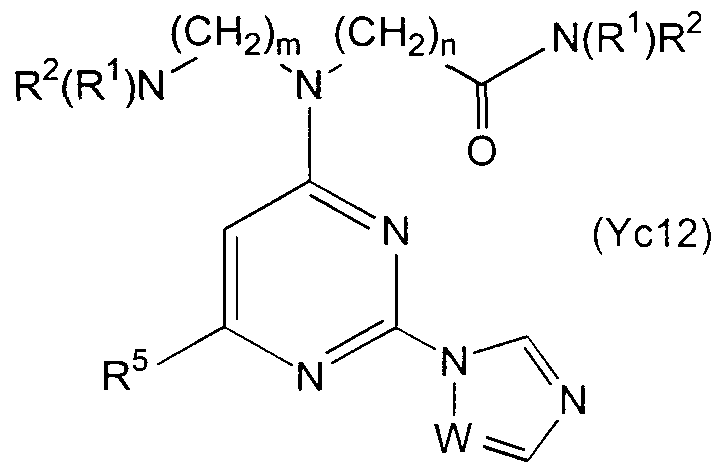
  • Reaction Schemes 1 through 4 depict methods of preparing compounds of formula (Yc) Compounds of formula (Ya) and formula (Yc) may be similarly prepared Reaction Scheme 1
  • Reaction Scheme 2 depicts another method of preparing compounds of formula (Yc) Compounds of formula (Ya) and formula (Yb) may be similarly prepared
  • compounds of formula (Y 10 ) and derivatives thereof are prepared as follows In a manner similar to the preparation of compounds of formula (Yc3) above, to 2-[(2- cyanoethyl)(d ⁇ methylethoxycarbonyl)am ⁇ no]acet ⁇ c acid (8 3 g, 39 mmol) dissolved in CH 2 CI 2 (100 mL) was added carbonyldiimidazole (6 2 g, 38 mmol) After stirring for 30 minutes, homopiperonylamine, hydrochlo ⁇ de (8 0 g, 41 mmol) and dnsopropylethylamine (7 5 mL, 43 mmol) were added After stirring for 18 hours, most of the solvent was removed in vacuo and the residue was partitioned with ethyl acetate and 1 N HCI The organic layer was separated, washed with aqueous bicarbonate and brine, dried (Na 2 S0 4 ), and the solvent was removed in vacuo to give 13 g
  • Reaction Scheme 3 depicts another method of preparing compounds of formula (Yc) Compounds of formula (Ya) and formula (Yb) may be similarly prepared with the appropriately substituted starting materials Reaction Scheme 3

Landscapes

  • Health & Medical Sciences (AREA)
  • Organic Chemistry (AREA)
  • Chemical & Material Sciences (AREA)
  • Engineering & Computer Science (AREA)
  • Bioinformatics & Cheminformatics (AREA)
  • Public Health (AREA)
  • Veterinary Medicine (AREA)
  • Medicinal Chemistry (AREA)
  • Nuclear Medicine, Radiotherapy & Molecular Imaging (AREA)
  • Chemical Kinetics & Catalysis (AREA)
  • Pharmacology & Pharmacy (AREA)
  • Life Sciences & Earth Sciences (AREA)
  • Animal Behavior & Ethology (AREA)
  • General Health & Medical Sciences (AREA)
  • General Chemical & Material Sciences (AREA)
  • Cardiology (AREA)
  • Immunology (AREA)
  • Neurology (AREA)
  • Heart & Thoracic Surgery (AREA)
  • Biomedical Technology (AREA)
  • Neurosurgery (AREA)
  • Pulmonology (AREA)
  • Diabetes (AREA)
  • Dermatology (AREA)
  • Urology & Nephrology (AREA)
  • Orthopedic Medicine & Surgery (AREA)
  • Rheumatology (AREA)
  • Physical Education & Sports Medicine (AREA)
  • Hospice & Palliative Care (AREA)
  • Vascular Medicine (AREA)
  • Psychiatry (AREA)
  • Pain & Pain Management (AREA)
  • Obesity (AREA)
  • Psychology (AREA)
  • Hematology (AREA)
  • Endocrinology (AREA)
  • Emergency Medicine (AREA)
  • Transplantation (AREA)
  • Pharmaceuticals Containing Other Organic And Inorganic Compounds (AREA)
  • Plural Heterocyclic Compounds (AREA)

Abstract

N-Heterocyclic derivatives of formula (Ya) are described herein, as well as other N-heterocycles, as inhibitors of nitric oxide synthase. Pharmaceutical compositions containing these compounds, methods of using these compounds as inhibitors of nitric oxide synthase and processes for synthesizing these compounds are also described herein.

Description

Λ/-HETEROCYCLIC DERIVATIVES AS NOS INHIBITORS
Field of the Invention
The invention relates to a series of Λ/-heterocyclιc compounds and derivatives useful as inhibitors of nitric oxide synthase (NOS) and to methods of therapy for various diseases employing those compounds
Background of the Invention
Nitrogen monoxide (NO) has been implicated in a number of diverse physiological processes, including smooth muscle relaxation, platelet inhibition, nerve transmission, immune regulation and penile erection Nitric oxide is produced under various conditions by virtually all nucleated mammalian cells A number of pathologies are ascribed to abnormalities in NO production including stroke, insulin dependent diabetes, septic shock-induced hypotension, rheumatoid arthritis and multiple sclerosis Nitric oxide is synthesized in biological tissues by an enzyme called nitric oxide synthase (NOS) which uses NADPH and molecular oxygen to oxidize L-arginme to citrulline and nitric oxide
Nitric oxide synthase (NOS) exists in at least three isoforms, which fall into two primary categories constitutive and inducible Two constitutive isoforms, which are calcium and calmodulin dependent, have been identified, and one inducible isoform has been identified The constitutive isoforms are (1 ) a neuronal isoform, NOS-1 or nNOS, which is found in the brain and skeletal muscles and (2) an endothelial isoform, NOS-3 or eNOS, which is expressed in the endothelium of blood vessels, the epithelium of the bronchial tree and in the brain These constitutive isoforms are not the target of the NOS inhibitors of the present invention
The inducible isoform (NOS2 or iNOS) is expressed in virtually all nucleated mammalian cells following exposure to inflammatory cytokines or lipopolysacchaπde Its presence in macrophages and lung epithelial cells is particularly noteworthy The inducible isoform is neither stimulated by calcium nor blocked by calmodulin antagonists It contains several tightly bound co-factors, including FMN, FAD and tetrahydrobioptenn
Nitric oxide generated by the inducible form of NOS has been implicated in the pathogenesis of inflammatory diseases In experimental animals, hypotension induced by hpopolysaccharide or tumor necrosis factor a can be reversed by NOS inhibitors Conditions which lead to cytokine-induced hypotension include septic shock, hemodialysis and interleukin therapy in cancer patients It is expected that an iNOS inhibitor would be effective in treating cytokine-induced hypotension In addition, recent studies have suggested a role for NO in the pathogenesis of inflammation, and NOS inhibitors would therefore have beneficial effects on inflammatory bowel disease, cerebral ischemia and arthritis Inhibitors of NOS may also be useful in treating adult respiratory distress syndrome (ARDS) and myocarditis, and they may be useful as adjuvants to short term immunosuppression in transplant therapy The diversity and ubiquity of NO function in physiology make the specific therapeutic targeting of NO-related phenomena an important consideration. Since endogenous NO production is the result of the actions of related but distinct isozymes, the differential inhibition of NOS isozymes allows more selective therapy with fewer side effects
SUMMARY OF THE INVENTION
In one aspect, the invention is directed to compounds of formula (Ya), formula (Yb) and formula (Yc)
Figure imgf000004_0001
Figure imgf000004_0002
wherein n and m are each independently an integer from 1 to 4, A is -C(0)OR1 or -C(0)N(R1)R2, each W is N or CH, each R1 is independently hydrogen, alkyl, aryl or aralkyl, each R2 is independently hydrogen, C0-C20 alkyl, -(CH2)n-N(R1)2, heterocyclylalkyl (optionally substituted by alkyl, halo, haloalkyl or alkoxy), aralkyl (optionally substituted by halo, alkyl, alkoxy, or -N(R1)2), R4 is hydroxy, cyano, heterocyclyl, -N(R1)R2, -N(R1)-C(0)-R , -N(R1)-C(0)OR1, -N(R )-S(0)t-R1, or-N(R1)-C(0)-N(R1)2, R5 is hydrogen, halo, alkyl, aryl, aralkyl, or haloalkyl, as a single stereoisomer or mixture thereto, or a pharmaceutically acceptable salt thereof In another aspect, the invention is directed to compounds of formula (IV)
Figure imgf000005_0001
wherein
AA is an ammo acid, X, Y and Z are independently N or C(R19),
U is N or C(R5), provided that U is N only when X is N and Z and Y are CR19,
W is or CH,
R1 and R2 are independently chosen from the group consisting of hydrogen, optionally substituted
C^C^ alkyl, optionally substituted cycloalkyl, -[C0-C8 alkyl]-R9, -[C2-C8 alkenyl]-R9, -[C2-C8 alkynyl]-R9, -[C2-C8 alkyl]-R10 (optionally substituted by hydroxy), -[C CaJ-R11
(optionally substituted by hydroxy), and optionally substituted heterocyclyl, or R1 and R2 together with the nitrogen atom to which they are attached is an optionally substituted
Λ/-heterocyclyl, R5 is chosen from the group consisting of hydrogen, halo, alkyl, haloalkyl, optionally substituted aralkyl, optionally substituted aryl, -OR16, -S(0)t-R16, -N(R16)R21, -N(R16)C(0)N(R1)R16,
-N(R16)C(0)OR16, -N(R16)C(0)R16, -[C0-C8 alkyl]-C(0)OR16,
-[C0-C8 alkyl]-C(H)[C(0)OR16]2, and -[C0-Cβ alkyl]-C(0)N(R1)R16, each R9 is independently chosen from the group consisting of haloalkyl, cycloalkyl (optionally substituted with halo, cyano, alkyl or alkoxy), carbocyclyl (optionally substituted with one or more substituents selected from the group consisting of halo, alkyl and alkoxy), and heterocyclyl (optionally substituted with alkyl, aralkyl or alkoxy), each R10 is independently chosen from the group consisting of halo, alkoxy, optionally substituted aryloxy, optionally substituted aralkoxy, optionally substituted -S(0)t-R22, acylamino, ammo, monoalkylamino, dialkylammo, (trιphenylmethyl)amιno, hydroxy, mercapto, and alkylsulfonamido, each R11 is independently chosen from the group consisting of cyano, dι(alkoxy)alkyl, carboxy, alkoxycarbonyl, ammocarbonyl, monoalkylaminocarbonyl and dialkylammocarbonyl, each R16 is independently hydrogen, alkyl, optionally substituted aryl, optionally substituted aralkyl or cycloalkyl, R19 is hydrogen, alkyl (opnonally substituted with hydroxy), cyclopropyl, halo or haloalkyl, each R2 is hydrogen, alkyl, cycloalkyl, optionally substituted aryl, optionally substituted aralkyl, -C(0)R22 or -S02R22, or R2 taken together with R1 and the nitrogen to which they are attached is an optionally substituted A/-heterocyclyl, or R21 taken together with R16 and the nitrogen to which they are attached is an optionally substituted Λ/-heterocyclyl, each R22 is independently alkyl, cycloalkyl, optionally substituted aryl or optionally substituted aralkyl, and t is zero, one or two, as a single isomer or mixture thereof, or a pharmaceutically acceptable salt thereof
In another aspect, the invention is directed to pharmaceutical compositions comprising a compound of formula (Ya), formula (Yb), and formula (Yc), as described above, and a pharmaceutically acceptable carrier
In another aspect, the invention is directed to methods of treating a condition resulting from an abnormality in nitric oxide production which comprises administering to a mammal having a condition resulting from an abnormality in nitric oxide production a therapeutically effective amount of compound of formula (Ya), formula (Yb), and formula (Yc), as described above
Detailed Description of the Invention Definitions
As used in this specification and appended claims, unless specified to the contrary, the following terms have the meaning indicated
"Alkyl" refers to a straight or branched hydrocarbon chain radical consisting solely of carbon and hydrogen atoms, containing no unsaturation, having from one to eight carbon atoms, and which is attached to the rest of the molecule by a single bond, e.g , methyl, ethyl, n-propyl, 1 -methylethyl (/so-propyl), n-butyl, n-pentyl, 1 ,1-dιmethylethyl (f-butyl), and the like Alkyl radicals having more than eight carbon atoms are indicated herein by the notation "[Cx-Cy alkyl]" where x and y indicate the number of carbons present Alkyl radicals may be optionally substituted by one or more substituents independently selected from the group consisting of halo, hydroxy, alkoxy, carboxy, cyano, carbonyl, alkoxycarbonyl, cyano, ammo, monoalkylamino, dialkylammo, nitro, alkylthio, amidino, aryl, heterocyclyl, aryloxy, aralkoxy, acylamino, aminocarbonyl, monoalkylammocarbonyl, and dialkylaminocarbonyl
"Alkenyl" refers to a straight or branched chain monovalent or divalent radical consisting solely of carbon and hydrogen, containing at least one double bond and having from one to eight carbon atoms, e g , ethenyl, prop-1-enyl, but-1-enyl, pent-1-enyl, penta-1 ,4-dιenyl, and the like "Alkynyl" refers to a straight or branched chain monovalent or divalent radical consisting solely of carbon and hydrogen, containing at least one triple bond and having from one to eight carbon atoms, e g , ethynyl, prop-1-ynyl, but-1 -ynyl, pent-1-ynyl, pent-3-ynyl, and the like "Alkoxy" refers to a radical of the formula -0Ra where Ra is an alkyl radical as defined above, e g , methoxy, ethoxy, propoxy, and the like
"Alkoxycarbonyl" refers to a radical of the formula -C(0)ORa where Ra is an alkyl radical as defined above, e g , methoxycarbonyl, ethoxycarbonyl, n-propoxycarbonyl, and the like
"Alkoxycarbonylalkyl" refers to a radical of the formula -Ra-C(0)ORa where each Ra is independently an alkyl radical as defined above, e g , 2-(methoxycarbonyl)ethyl, 3-(ethoxycarbonyl)propyl, 4-(n-propoxycarbonyl)butyl, and the like
"Alkylsulfonylamino" refers to a radical of the formula -N(H)S(0)2-Ra where Ra is an alkyl radical as defined above, e g , methylsulfonylamino, ethylsulfonylamino, and the like
"Alkylsulfonyl" refers to a radical of the formula -S(0)2-Ra where Ra is an alkyl radical as defined above, e g , methylsulfonyl, ethylsulfonyl, and the like "Alkylthio" refers to a radical of the formula -S-Ra where Ra is an alkyl radical as defined above, e g , methylthio, ethylthio, n-propylthio, and the like
"Amidino" refers to a radical of the formula -C(NH)-NH2 "Ammo" refers to a radical of the formula -NH2 "Aminocarbonyl" refers to a radical of the formula -C(0)NH2 "Aminosulfonyl" refers to a radical of the formula -S(0)2NH2
"Aryl" refers to a phenyl or naphthyl radical The aryl radical may be optionally substituted by one or more substituents selected from the group consisting of hydroxy, mercapto, halo, alkyl, alkenyl, alkynyl, phenyl, phenylalkyl, phenylalkenyl, alkoxy, phenoxy, phenylalkoxy, haloalkyl, haloalkoxy, formyl, nitro, cyano, cycloalkyl, hydroxyalkyl, alkoxyalkyl, phenoxyalkyl, phenylalkoxyalkyl, amidino, ureido, alkoxycarbonyamino, ammo, monoalkylamino, dialkylammo, monophenylamino, monophenylalkylamino, sulfonylamino, akylsulfonylamino, ammoalkyl, monoalkylaminoalkyl, dialkylaminoalkyl, monophenylaminoalkyl, monophenylalkylaminoalkyl, acyl, carboxyalkyl, alkoxycarbonylalkyl, aminocarbonyl, monoalkylammocarbonyl, dialkylaminocarbonyl, aminocarbonylalkyl, monoalkylaminocarbonylalkyl, and dialkylaminocarbonylalkyl, as defined herein
"Aralkyl" refers to a radical of the formula -RaRb where Ra is an alkyl radical as defined above and Rb is an aryl radical as defined above, e g , benzyl, and the like The aryl radical may be optionally substituted as described above "Aryloxy" refers to a radical of the formula -ORb where Rb is an aryl radical as defined above, e g , phenoxy and naphthoxy, and the like The aryl radical may be optionally substituted as described above
"Aryloxycarbonyl" refers to a radical of the formula -C(0)ORb where Rb is an aryl radical as defined above, e g , phenoxycarbonyl
"Aralkoxy" refers to a radical of the formula -ORc where Rc is an aralkyl radical as defined above, e g , benzyloxy, and the like The aralkyl radical may be optionally substituted as described above
"Aralkoxycarbonyl" refers to a radical of the formula -C(0)ORc where Rc is an aralkyl radical as defined above, e g , benzyloxycarbonyl, and the like The aralkyl radical may be optionally substituted as described above
"Arylammocarbonyl" refers to a radical of the formula -C(0)N(Rb)H where Rb is an aryl radical as defined above, e g , phenylaminocarbonyl, and the like The aryl radical may be optionally substituted as described above "Arylaminosulfonyl" refers to a radical of the formula -S(0)2N(Rb)H where Rb is an aryl radical as defined above, e g , phenylaminosulfonyl, and the like The aryl radical may be optionally substituted as described above
"Arylsulfonyl" refers to a radical of the formula -S(0)2-Rb where Rb is an aryl radical as defined above, e g , phenylsulfonyl, and the like The aryl radical may be optionally substituted as described above
"Arylsulfonylammocarbonyl" refers to a radical of the formula -C(0)N(H)S(0)2Rb where Rb is an aryl radical as defined above, e g , phenylsulfonylammocarbonyl, and the like The aryl radical may be optionally substituted as described above
"Acyl" refers to a radical of the formula -C(0)-Ra and -C(0)Rb where Ra is an alkyl radical as defined above and Rb is an aryl radical as defined above, e g , acetyl, propionyl, benzoyl, and
"Acylamino" refers to a radical of the formula -N(H)-C(0)-Ra and -N(H)-C(0)-Rb where Ra is an alkyl radical as defined above and Rb is an aryl radical as defined above, e g , acetylamino benzoylamino and the like "Alkylene" refers to straight or branched chain divalent radical consisting solely of carbonyl and hydrogen, containing no unsaturation and having from one to eight carbon atoms, e g , methylene, ethylene, propylene, π-butylene, and the like The alkylene radical may be optionally substituted by one or more substituents selected from the group consisting of alkyl, hydroxy, -N(R16)R21 or -C(0)N(R )R16 where R1, R16 and R21 are as defined above in the Summary of the Invention
"Cycloalkyl" refers to a stable 3- to 10-membered monocyc c or bicyclic radical which is saturated, and which consist solely of carbon and hydrogen atoms, e g , cyclopropyl, cyclobutyl, cyclobutyl, cyclohexyl, decalmyl and the like Unless otherwise stated specifically in the specification, the term "cycloalkyl" is meant to include cycloalkyl radicals which are optionally substituted by one or more substituents independently selected from the group consisting of alkyl, halo, hydroxy, ammo, cyano, nitro, alkoxy, carboxy and alkoxycarbonyl "Carboxy" refers to the radical of the formula -C(0)OH "Carboxyalkyl" refers to a radical of the formula -Ra-C(0)OH where Ra is an alkyl radical as defined above, e g , carboxymethyl, 2-carboxyethyl, 3-carboxypropyl, and the like
"Dι(alkoxy)alkyl" refers to a radical of the formula -Ra(-ORa)2 where each Ra is independently an alkyl radical as defined above and where the -ORa groups may be attached to any carbon in the Ra group, e g , 3,3-dιmethoxypropyl, 2,3-dιmethoxypropyl, and the like "Dialkylammo" refers to a radical of the formula -N(Ra)Ra where each Ra is independently an alkyl radical as defined above, e g , dimethylamino, diethylamino, (methyl )(ethyl)amιno, and
"Dialkylaminocarbonyl" refers to a radical of the formula -C(0)N(Ra)Ra where each Ra is independently an alkyl radical as defined above, e g , dimethylaminocarbonyl, methylethylaminocarbonyl, diethylammocarbonyl, dipropylaminocarbonyl, ethylpropylaminocarbonyl, and the like
"Dialkylaminosulfonyl" refers to a radical of the formula -S(0)2N(Ra)Ra where each Ra is independently an alkyl radical as defined above, e g , dimethylaminosulfonyl, methylethylammosulfonyl, diethylaminosulfonyl, dipropylammsulfonyl, ethylpropylaminosulfonyl,
"Halo" refers to bromo, chloro, iσdo or fluoro
"Haloalkyl" refers to an alkyl radical, as defined above, that is substituted by one or more halo radicals, as defined above, e g , tπfluoromethyl, d fluoromethyl, tπchloromethyl, 2,2,2-tπfluoroethyl, 1-fluoromethyl-2-fluoroethyl, 3-bromo-2-fluoropropyl, 1-bromomethyl-2-bromoethyl, and the like
"Haloalkoxy" refers to a radical of the formula -ORd where Rd is an haloalkyl radical as defined above, e g , trifluoromethoxy, difluoromethoxy, tπchloromethoxy, 2,2,2-tπfluoroethoxy, 1-fluoromethyl-2-fluoroethoxy, 3-bromo-2-fluoropropoxy, 1-bromomethyl-2-bromoethoxy, and the like "Heterocyclyl" refers to a stable 3- to 15-membered ring radical which consists of carbon atoms and from one to five heteroatoms selected from the group consisting of nitrogen, oxygen and sulfur For purposes of this invention, the heterocyclyl radical may be a monocyclic, bicyclic or tπcyclic ring system, which may include fused or bridged ring systems, and the nitrogen, carbon or sulfur atoms in the heterocyclyl radical may be optionally oxidized, the nitrogen atom may be optionally quaternized, and the heterocyclyl radical may be partially or fully saturated or aromatic The heterocyclyl radical may be attached to the mam structure at any heteroatom or carbon atom which results in the creation of a stable compound Examples of such heterocyclyl radicals include, but are not limited to, azepmyl, azetidmyl, acπdinyl, benzimidazolyl, benzodioxolyl, benzodioxanyl, benzothiazolyl, benzoxazolyl, benzopyranyl, benzofuranyl, benzothienyl, carbazolyl, cmnolinyl, decahydroisoqumolyl, dioxolanyl, furyl, isothiazolyl, qumuclidinyl, imidazolyl, imidazolinyl, imidazolidmyl, isothiazolid yl, indolyl, isoindolyl, indolinyl, iso dolinyl, indolizmyl, isoxazolyl, isoxazolidinyl, morpholinyl, naphthyπdinyl, oxadiazolyl, octahydromdolyl, octahydroisomdolyl, 2-oxopιperazιnyl, 2-oxopιperιdιnyl, 2-oxopyrrolιdιnyl, 2-oxoazepιnyl, oxazolyl, oxazolidmyl, perhydroazepinyl, pipendinyl, piperazinyl, 4-pιpeπdonyl, phenazinyl, phenothiazinyl, phenoxazmyl, phthalazinyl, pteπdinyl, puπnyl, pyrrolyl, pyrro dinyl, pyrazolyl, pyrazolid yl, pyπdinyl, pyrazmyl, pyπmidinyl, pyπdazinyl, quinazolmyl, quinoxalmyl, quinolmyl, qumuclidinyl, isoquinolmyl, thiazolyl, thiazolidinyl, thiadiazolyl, tπazolyl, tetrazolyl, tetrahydrofuryl, tetrahydropyranyl, tetrahydroisoqumolyl, thienyl, thiomorpholmyl, thiomorpholmyl sulfoxide, and thiomorpholmyl sulfone The heterocyclyl radical may be optionally substituted by R6 as defined above in the Summary of the Invention or may be optionally substituted by one or more substituents selected from the group consisting of hydroxy, mercapto, halo, alkyl alkenyl, alkynyl, phenyl, phenylalkyl, phenylalkenyl, alkoxy, phenoxy, phenylalkoxy, haloalkyl, haloalkoxy formyl, nitro, cyano, amidino, cycloalkyl, hydroxyalkyl, alkoxyalkyl, phenoxyalkyl, phenylalkoxyalkyl, amidino, ureido, alkoxycarbonyamino, am o, monoalkylamino, dialkylammo, monophenylamino, monophenylalkylamino, aminoalkyl, monoalkylaminoalkyl, dialkylaminoalkyl, monophenylaminoalkyl, monophenylalkylammoalkyl, alkylcarbonyl, carboxyalkyl, alkoxycarbonylalkyl, aminocarbonyl, monoalkylammocarbonyl, dialkylaminocarbonyl, aminocarbonylalkyl, monoalkylammocarbonylalkyl, dialkylaminocarbonylalkyl, and imidazolyl, as defined herein
"Heterocyclylalkyl" refers to a radical of the formula -Ra-Re where Ra is an alkyl radical as defined above and Re is a heterocyclyl radical as defined above, e g , 2-(1 ,3-benzodιoxol-5- yl)ethyl, and 3-(1 ,4-benzodιoxan-6-yl)propyl, and the like "Monoalkylamino" refers to a radical of the formula -N(H)Ra where Ra is an alkyl radical as defined above, e g , methylamino, ethylamino, propylammo, and the like
"Monoalkylammocarbonyl" refers to a radical of the formula -C(0)N(H)Ra where Ra is an alkyl radical as defined above, e g , methylaminocarbonyl, ethylammocarbonyl, propylaminocarbonyl, and the like "Monoalkylam osulfonyl" refers to a radical of the formula -S(0)2N(H)Ra where Ra is an alkyl radical as defined above, e g , methylaminosulfonyl, ethylaminosulfonyl, propyiaminosulfonyl, and the like
"Λ/-heterocyclyl" refers to a heterocyclyl radical as defined above which contains at least one nitrogen atom and which is attached to the main structure through the nitrogen atom The N- heterocyclyl radical may contain up to three additional hetero atoms Examples include pipendinyl, piperazinyl, pyrrohdinyl, morpholinyl, thiomorpholmyl, azetidmyl, indolyl, pyrrolyl, imidazolyl, tetrahydroisoqumolyl, perhydroazepinyl, tetrazolyl, tnazolyl, oxazmyl, and the like, and may be optionally substituted as described above for heterocyclyl radicals In addition to being optionally substituted by the substituents listed above for a heterocyclyl radical, the Λ/-heterocyclyl radical may also be optionally substituted by R6 as defined above in the Summary of the Invention
"Phenylalkyl" refers to an alkyl radical as defined above substituted by a phenyl radical, e g , benzyl, and the like
"Optional" or "optionally" means that the subsequently described event of circumstances may or may not occur, and that the description includes instances where said event or circumstance occurs and instances in which it does not For example, "optionally substituted aryl" means that the aryl radical may or may not be substituted and that the description includes both substituted aryl radicals and aryl radicals having no substitution The term "-[C2-C8 alkyl]-R10 (optionally substituted by hydroxy)" means that the alkyl has the optional substitution The same goes for the term "-[CrC8 alkyl]-R11 (optionally substituted by hydroxy)" The term "optionally substituted -S(0)tR22" means that the R22 substituents all have the optional substitution
"Phenylalkenyl" refers to an alkenyl radical as defined above substituted by a phenyl radical
The term "pharmaceutically acceptable salt" refers to salts prepared from pharmaceutically acceptable non-toxic acids or bases including inorganic acids and bases and organic acids and bases When the compounds of the present invention are basic, salts may be prepared from pharmaceutically acceptable non-toxic acids including inorganic and organic acids Suitable pharmaceutically acceptable acid addition salts for the compounds of the present invention include acetic, benzenesulfonic (besylate), benzoic, camphorsulfonic, citric, ethenesulfonic, fumaric, gluconic, glutamic, hydrobromic, hydrochloric, isethionic, lactic, maleic, malic, mandelic, methanesulfonic, mucic, nitric, pamoic, pantothenic, phosphoric, succmic, sulfuπc, tartaπc acid, p-toluenesulfonic, and the like When the compounds contain an acidic side chain, suitable pharmaceutically acceptable base addition salts for the compounds of the present invention include metallic salts made from aluminum, calcium, lithium, magnesium, potassium, sodium and zinc or organic salts made from lysme, Λ/,Λ/'-dιbenzylethylenedιamιne, chloroprocaine, choline, diethanolamine, ethylenediamine, meglumine (Λ/-methylglucamιne) and procame "Therapeutically effective amount" refers to that amount of a compound of the invention which, when administered to a human in need thereof, is sufficient to effect treatment, as defined below, for conditions resulting from an abnormality in nitric oxide production The amount of a compound of the invention which constitutes a "therapeutically effective amount" will vary depending on the compound, the condition and its severity, and the age of the human to be treated, but can be determined routinely by one of ordinary skill in the art having regard to his own knowledge and to this disclosure
"Treating" or "treatment" as used herein covers the treatment of a condition in a human, which condition results from an abnormality in nitric oxide production, and includes (i) preventing the condition from occurring in a human, in particular, when such human is predisposed to the condition but has not yet been diagnosed as having it, (n) inhibiting the condition, ; e , arresting its development, or
(in) relieving the condition, i.e , causing regression of the condition The yield of each of the reactions described herein is expressed as a percentage of the theoretical yield
Most of the compounds described herein contain one or more asymmetric centers and may thus give rise to enantiomers, diastereomers, and other stereoisomeπc forms that may be defined, in terms of absolute stereochemistry, as (R)- or (S)- or, as (D)- or (L)- for ammo acids The present invention is meant to include all such possible isomers, as well as, their racemic and optically pure forms Optically active (/?)- and (S)-, or (D)- and (L)- isomers may be prepared using chiral synthons or chiral reagents, or resolved using conventional techniques When the compounds described herein contain olefinic double bonds or other centers of geometric asymmetry, and unless specified otherwise, it is intended that the compounds include both E and Z geometric isomers Likewise, all tautomeπc forms are also intended to be included
The nomenclature used herein is a modified form of the I U P A C nomenclature system wherein the compounds of the invention are named herein as amide derivatives For example, the following compound of the invention
Figure imgf000012_0001
is named herein as 2-[[3-[(1 ,3-benzodιoxol-5-yl)methyl]amιnopropyl][2-(1 /-/-ιmιdazol-1 -yl)-6- methylpyπmιdιn-4-yl]amιno]-Λ/,Λ/-dιethylacetamιde Unless otherwise indicated, compound names are intended to include any single stereoisomer, enantiomer, racemate or mixtures thereof
Utility of the Compounds of the Invention
Nitric oxide generated by the inducible form of nitric oxide synthase (i-NOS) has been implicated in the pathogenesis of numerous inflammatory and autoimmune diseases and also in diseases which are generally not regarded as inflammatory, but nevertheless may involve cytokines which locally up-regulate i-NOS The compounds of the invention, alone or in combination with other pharmaceutical agents, are therefore useful in treating mammals, preferably humans, having a condition resulting from an abnormality in nitric oxide production Such conditions include, but are not limited to, the following
Multiple sclerosis (Parkinson, J F et al . J Mol Med (1997), Vol 75, pp 174-186), stroke or cerebral ischemia (ladecola, C et al , J Neurosci (1997), Vol 17, pp 9157-9164), Alzheimer's disease (Smith, M A et al , A Neurosci (1997), Vol 17, pp 2653-2657, Wallace, M N et al , Exp Neurol (1997), Vol 144, pp 266-272), HIV dementia (Adamson D C et al , Science (1996), Vol 274, pp 1917-1921 ), Parkinson's disease (Hunot, S et al , Neuroscience (1996), Vol 72, pp 355-363), meningitis (Koedel, U et al , Ann Neurol (1995), Vol 37, pp 313- 323), dilated cardiomyopathy and congestive heart failure (Satoh M et al , J Am Coll Cardiol (1997), Vol 29, pp 716-724), atherosclerosis (Wilcox, J N et al , Artenoscler Thromb Vase
Biol (1997), Vol 17, pp 2479-2488), restenosis or graft stenosis, septic shock and hypotension (Petros, A et al , Cardiovasc Res (1994), Vol 28, pp 34-39), hemorrhagic shock (Thiemermann, C et al , Proc Natl Acad Sci (1993), Vol 90, pp 267-271 ), asthma (Barnes, P J , Ann Med (1995), Vol 27, pp 389-393, Flak, T A et al , Am J Respir Crit Care Med (1996), Vol 154, pp S202-S206), adult respiratory distress syndrome, smoke or particulate- mediated lung injury (Ischiropoulos, H et al , Am J Respir Crit Care Med (1994), Vol 150, pp 337-341 , Van Dyke, K , Agents Actions (1994), Vol 41 , pp 44-49), pathogen-mediated pneumonias (Adler, H et al , J Exp Med (1997), Vol 185, pp 1533-1540), trauma of various etiologies (Thomae, K R et al , Surgery (1996), Vol 119, pp 61 -66), rheumatoid arthritis and osteoarthπtis (Grabowski, P S et al , Br J Rheumatol (1997), Vol 36, pp 651-655), glomerulonephritis (Wemberg, J B et al , J Exp Med (1994), Vol 179, pp 651 -660), systemic lupus erythematosus (Belmont, H M et al , Arthritis Rheum (1997), Vol 40, pp 1810-1816), inflammatory bowel diseases such as ulcerative colitis and Crohn's disease (Godkm, A J et al , Eur J Clin Invest (1996), Vol 26, pp 867-872, Singer, I I et al , Gastroenterology (1996), Vol 1 1 1 , pp 871-885), insulin dependent diabetes mellitus (McDaniel, M L , et al , Proc Soc Exp Biol Med (1996), Vol 211 , pp 24-32), diabetic neuropathy or nephropathy (Sugimoto, K and Yagihashi, S , Microvasc Res (1997), Vol 53, pp 105-112, Amore, A et al , Kidney Int (1997), Vol 51 , pp 27-35), acute and chronic organ transplant rejection (Worrall, N K et al , Transplantation (1997), Vol 63, pp 1095-1101 ), transplant vasculopathies (Russell, M E et al (1995), Vol 92, pp 457-464), graft-versus-host disease (Kichian, K et al . J Immunol (1996), Vol 157, pp 2851-2856), psoriasis and other inflammatory skin diseases (Bruch-Gerharz, D et al . J Exp Med (1996), Vol 184, pp 2007-2012), and cancer (Thomsen, L L et al , Cancer Res (1997), Vol 57, pp 3300-3304)
The compounds of the current invention may also be useful for the management of male and female reproductive functions when used alone or combined with other drugs commonly used for these indications Examples, without implied limitation, include inhibition of fertilization endometnal receptivity and implantation (alone or in combination with a progesterone antagonist), post-coital contraception (alone or in combination with a progesterone antagonist), mduction of abortion (in combination with an antiprogestin and in further combination with a prostaglandin), control and management of labor and delivery, treatment of cervical incompetence (alone or in combination with progesterone or a progestm), treatment of endometπosis (alone or in combination with other drugs, including LHRH-agonists/antagonists antiprogestins orprogestms by either sequential application or by concomitant administration) See, for example, the following references Chwalisz, K et al , J Soc Gynecol Invest (1997), Vol 4, No 1 (Supplement), page 104a, which discusses the inhibition of fertilization, endometπal receptivity and implantation, or post-coital contraception, alone or in combination with a progesterone antagonist, Chwalisz, K et al , Prenat Neonat Med (1996), Vol 1 , pp 292-329, which discusses the induction of abortion, in combination with an antiprogestin and in further combination with a prostaglandin, and the control and management of labor and delivery, and Chwalisz, K et al , Hum Reprod (1997), vol 12, pp 101-109, which discusses the treatment of cervical incompetence, alone or in combination with progesterone or a progestm
Those skilled in the art will also recognize that the compounds of the present invention include 1 -substituted imidazoles This class of compounds has previously been described as mechanism-based, heme-binding inhibitors of the cytochrome P450 family of enzymes (Maurice, M et al . FASEB J (1992), Vol 6, pp 752-8) in addition to nitric oxide synthesis (Chabm, R NM ef al , Biochemistry (1996), Vol 35, pp 9567-9575) The compounds of the present invention may thus be useful as inhibitors of selected cytochrome P450 family members of therapeutic interest including, but not limited to, P450 enzymes involved in steroid and retmoid biosynthesis (Masamura ef al , Breast Cancer Res Treat (1995), Vol 33, pp 19-26, Swart, P et al , J Clm Endocnnol Metab , Vol 77, pp 98-102, Docks, P et al . Br J Dermatol (1995), Vol 133, pp 426-32) and cholesterol biosynthesis (Burton, P M et al , Biochem Pharmacol (1995J, Vol 50, pp 529-544, and Swmney, D C ef al , Biochemistry (1994), Vol 33, pp 4702-4713) Imidazole- based compounds may also have antifungal activity (Aoyama, Y et al , Biochem Pharmacol (1992), Vol 44, pp 1701 -1705) The P450 inhibitory activity of the compounds of the present invention can be assessed using appropriate assay systems specific for the P450 isoform of interest Such assays are included in the references cited above One additional example of mammalian cytochrome P450 isoform that may be inhibited by the compounds of the present invention is cytochrome P450 3A4 which can be assayed in a manner similar to the method described in Yamazaki et al , Carcmogenesis (1995), Vol 16, pp 2167-2170
Testing of the Compounds of the Invention
Nitric oxide synthases are complex enzymes that catalyze the conversion of L-arginme to nitric oxide (NO) and citrull e Catalysis proceeds through two successive oxidations of the guanidinium group of L-arginine
A cell-based nitric oxide synthase assay employing the measurement of nitric oxide oxidation product, nitrite, in the conditioned medium of cultured cells was employed for the evaluation of the compounds of the invention The murine monocytic cell lines RAW 264 7 and J774 are well documented as capable of producing >10 μM nitrite in response to immunostimulation
Induction of iNOS in RAW 264 7 Mouse Monocytes RAW 264 7 murine macrophage cells were obtained from American Type Culture
Collection (Rockville, Maryland) and were maintained in RPMI 1640 containing 10% fetal bovine serum (FBS), 5000 units/mL of penicillin and streptomycin, and 2mM glutamine (maintenance medium) NOS activity was measured by a fluorescent assay of the nitric oxide oxidation product, nitrite, (Diamani ef al , Talanta (1986), Vol 33, pp 649-652) Induction of iNOS (inducible nitric oxide synthase) is stimulated by treatment of the cells with lipopolysacchaπde and γ-interferon The method of the assay is described below
Cells are harvested, diluted to 500,000 cells/mL with maintenance medium, and seeded into 96-well plates at 100 μl/well The plates are incubated overnight at 37°C, under a 5% C02 atmosphere The medium is then replaced with 90 μl of BME medium containing 10% FBS, 100 units/mL of penicillin, 100 μl streptomycin, 2 mM glutamine, 100 units/mL of mterferon-γ and 2 μg/mL of lipopoly-sacchaπde Λ/-guanιdιno-methyl-L-argιnιne is added to four wells (negative control) at a final concentration of 200 μM using 10 μl of 2 mM stock solution in 100 mM Hepes, pH 7 3 + 0 1 % DMSO and four wells receive only the 100 mM Hepes/0 1 % DMSO buffer (positive control) Compounds for evaluation are dissolved at 10-fold the desired final concentration in Hepes/DMSO and 10 μL of these solutions is transferred to the 96-well plate The plates are incubated for 17 hrs at 37°C, under a 5% C02 atmosphere Nitrite accumulated in the culture medium is determined as follows add 15 μL of 2,3-dιamιnonaphthalene (10 μg/mL in 0 75 M HCI) to each well and incubate for 10 minutes at room temperature Add 15 μl of 1 N NaOH and measure the fluorescence emission at 405 nm, using an excitation wavelength of 365 nm Enzyme activity in experimental wells is normalized to percent control using the positive and negative control values The signal to noise ratio is >10 for the assay
The compounds of the invention, when tested in this assay, demonstrated the ability to inhibit nitric oxide production
Various in vivo assays may be employed to determine the efficacy of the compounds of the invention in treating a condition resulting from an abnormality in nitric oxide production, such as arthritis The following is a description of such an assay utilizing rats Effects of Compounds of the Invention on Adiuvant-lnduced Arthritis in Rats
Male Lewis rats were injected intradermally (proximal quarter of the tail) with 0 1 mL of Mycobacterium butyπcum in Incomplete Freund's Adjuvant (10 mg/mL) Either vehicle (acidified saline, 1 mL/kg) or a compound of the invention (3, 10, or 30 mg/kg) were administered subcutaneously (b i d ), starting on the day following adjuvant immunization, and continued until the end of the experiment (N= 10 rats per treatment group) Clinical scores (see below) were measured in all limbs 3 times per week throughout the study Rats were euthanized 34-35 days after immunization At the time of euthanasia, a radiologic evaluation (see below) of the hind paws was performed, a blood sample was collected for clinical blood chemistry and drug levels (high dose group only, 6 or 12 hours post final dose), a section of liver was obtained for measurement of potential toxicity, and the hind limbs were preserved for histopathological determination
Clinical scoring - each limb was graded according to the following scale
0 no signs of inflammation
1 moderate redness, first indication of swelling, joint flexible
2 moderate redness, moderate swelling, joint flexible 3 redness, significant swelling and distortion of the paw, joint beginning to fuse 4 redness, gross swelling and distortion of the paw, joint completely fused Radiological scoring - each hind limb was graded on a scale of 0-3 for each of the following parameters soft tissue swelling cartilage loss erosion heterotropic ossification The compounds of the invention, when tested in this assay, demonstrated the ability to treat the arthritis present in the rats
Those skilled in the art will also recognize that numerous assays for the activity of the NOS isoforms (iNOS, nNOS and eNOS) exist which can be used to evaluate the biological activity of the compounds of the current invention These include assays for native NOS isoforms in tissues studied ex vivo (Mitchell et al , Br J Pharmacol (1991 ), Vol 104, pp 289- 291 , Szabo et al , Br J Pharmacol (1993), Vol 108, pp 786-792, Joly et al , Br J Pharmacol (1995), Vol 1 15, pp 491 -497) as well as primary cell cultures and cell lines (Forstermann et al , Eur J Pharmacol (1992), Vol 225, pp 161-165, Radmoski et al , Cardiovasc Res (1993), Vol 27, pp 1380-1382, Wang ef al , J Pharmacol Exp Ther (1994), Vol 268, pp 552-557) Those skilled in the art will also recognize that recombmant NOS enzymes can be expressed in heterologous cells by either transient transfection (Karlsen et al , Diabetes, (1995), Vol 44, pp 753-758), stable transfection (McMillan ef al , Proc Natl Acad Sα (1992), Vol 89, pp 1 1 141 - 1 1 145, Sessa ef al , J Biol Chem (1995), Vol 270, pp 17641-17644) or via the use of lytic virus transfection (Busconi & Michel, Mol Pharmacol (1995), Vol 47, pp 655-659, List et al , Biochem J (1996), Vol 315, pp 57-63) using NOS cDNAs Heterologous expression can be achieved in mammalian cells (McMillan et al., Proc Natl Acad Sci (1992), Vol 89, pp 11141- 1 1145), insect cells (Busconi & Michel, Mol Pharmacol (1995), Vol 47, pp 655-659, List et al , Biochem J (1996), Vol 315, pp 57-63), yeast (San et al , Biochemistry (1996), Vol 35, pp 7204-7213) or bacteria (Roman ef al , Proc Natl Acad Sci (1995), Vol 92, pp 8428-8432, Martasek ef al , Biochem Biophys Res Commun (1996), Vol 219, pp 359-365) Any of these heterologous expression systems can be used to establish iNOS, nNOS and eNOS assay systems to evaluate the biological activity of the compounds of the present invention
Administration of the Compounds of the Invention
Any suitable route of administration may be employed for providing a patient with an effective dosage of compounds of the invention For example, oral, rectal, parenteral (subcutaneous, intramuscular, intravenous), transdermal, and like forms of administration may be employed Dosage forms include tablets, troches, dispersions, suspensions, solutions, capsules patches, and the like
The pharmaceutical compositions of the present invention comprise the compounds of the invention as the active ingredient, and may also contain a pharmaceutically acceptable carrier, and optionally, other therapeutic ingredients Carriers such as starches, sugars, and microcrystallme cellulose, diluents, granulating agents, lubricants, binders, disintegrating agents, and the like are suitable in the case of oral solid preparations (such as powders, capsules, and tablets), and oral solid preparations are preferred over the oral liquid preparations Methods for their preparation are well known in the art
Because of their ease of administration, tablets and capsules represent the most advantageous oral dosage unit forms, in which case solid pharmaceutical carriers are employed If desired, tablets may be coated by standard aqueous or nonaqueous techniques In addition to the common dosage forms set out above, the compounds of the present invention may also be administered by controlled or sustained release means and delivery devices
Pharmaceutical compositions of the present invention suitable for oral administration may be presented as discrete units such as capsules, cachets, or tablets, each containing a predetermined amount of the active ingredient, as a powder or granules, or as a solution or a suspension in an aqueous liquid, a non-aqueous liquid, an oil-m-water emulsion, or a water-in-oil liquid emulsion Such compositions may be prepared by any of the methods of pharmacy, but all methods include the step of bringing into association the active ingredient with the carrier which constitutes one or more necessary ingredients In general, the compositions are prepared by uniformly and intimately admixing the active ingredient with liquid carriers or finely divided solid carriers or both, and then, if necessary, shaping the product into the desired presentation
Preferred Embodiments Of the compounds of formula (Ya), formula (Yb) and formula (Yc) as described above in the Summary of the invention, a preferred group of compounds are those compounds having the formula (Yc) wherein n is 1 , m is 2 or 3, A is -C(0)OR1 or -C(0)N(R1)R2, each W is CH, R1 is hydrogen or alkyl, and R2 is hydrogen, alkyl, -(CH)n-N(R1)2, optionally substituted heterocyclylalkyl or optionally substituted aralkyl
Of this subgroup of compounds, a preferred class of compounds are those compounds wherein R4 is -N(R1)R2 where R1 is hydrogen or alkyl and R2 is heterocyclylalkyl selected from the group consisting of (1 ,3-benzodιoxol-5-yl)methyl or (1 ,4-benzodιoxan-6-yl)methyl Of this class of compounds, preferred compounds are selected from the group consisting of 2-[[3-[[(1 ,3-benzodιoxol-5-yl)methyl](methyl)amιno]propyl][2-(1 /- -ιmιdazol-1-yl)-6-methylpyπmιdιn-
4-yl]amιno]acetιc acid, ethyl ester, 2-[[3-[[(1 ,3-benzodιoxol-5-yl)methyl](methyl)amιno]propyl][2-(1 /-/-ιmιdazol-1-yl)-6-methylpyrιmιdιn- 4-yl]amιno]-/V,/V-dιethylacetamιde,
2-[[3-[[(1 ,3-benzodιoxol-5-yl)methyl](methyl)amιno]propyl][2-(1H-ιmιdazol-1-yl)-6-methylpyπmιdιn-
4-yl]amιno]-Λ/-(2-dιmethylamιnoethyl)acetamιde, 2-[[3-[[(1 ,3-benzodιoxol-5-yl)methyl](methyl)amιno]propyl][2-(1 /- -ιmιdazol-1-yl)-6-methylpyrιmιdιn- 4-yl]amιno]acetamιde, 2-[[3-[(1 ,3-benzodιoxol-5-yl)methyl]amιnopropyl][2-(1 H-ιmιdazol-1-yl)-6-methylpyrιmιdιn-4- yl]amιno]-Λ/,Λ/-dιethylacetamιde, 2-[[3-[(1 ,3-benzodιoxol-5-yl)methyl]amιnopropyl][2-(1 H-ιmιdazol-1-yl)-6-methylpyπmιdιn-4- yl]amιno]-Λ/-methylacetamιde, 2-[[3-[(1 ,4-benzodιoxan-6-yl)methyl]amιnopropyl][2-(1 H-ιmιdazol-1 -yl)-6-methylpyπmιdιn-4- yl]amιno]-Λ/-methylacetamιde,
2-[[3-t(1 ,4-benzodιoxan-6-yl)methyl]amιnopropyl][2-(1 H-ιmιdazol-1-yl)-6-methylpyrιmιdιn-4- yl]amιno]-Λ/,Λ/-dιethylacetamιde, 2-[[3-[(1 ,4-benzodιoxan-6-yl)methyl]amιnopropyl][2-(1 H-ιmιdazol-1 -yl)-6-methylpyπmιdιn-4- yl]amιno]acetamιde, and 2-[[3-[(1 ,3-benzodιoxol-5-yl)methyl]amιnopropyl]t2-(1 H-ιmιdazol-1-yl)-6-methylpyrιmιdιn-4- yl]amιno]acetamιde
Of the preferred subgroup of compounds, a preferred class of compounds are those compounds wherein R4 is heterocyclyl
Of this class of compounds, preferred compounds are selected from the group consisting of
2-[[pyrιdιn-3-ylmethyl][2-(1 /-/-ιmιdazol-1 -yl)-6-methylpyπmιdιn-4-yl]amιno]-Λ/-[2-(1 ,3-benzodιoxol-
5-yl)ethyl]acetamιde, 2-[[2-( H-ιmιdazol-1-yl)-6-methylpyπmιdιn-4-yl][(1 ,3-benzodιoxol-5-yl)methyl]amιno]-A/-[2-(1 ,3- benzodιoxol-5-yl)ethyl]acetamιde, and 2-[[2-( H-ιmιdazol-1 -yl)-6-methylpyπmιdιn-4-yl][2-(morpholιn-4-yl)ethyl]amιno]-Λ/-[2-(1 ,3- benzodιoxol-5-yl)ethyl]acetamιde
Of this subgroup of compounds, another preferred class of compounds are those compounds wherein R4 is hydroxy, cyano, -N(R1)R2, -N(R1)-C(0)-R1, -N(R1)-C(0)OR\ -N(R1)- S(0)t-R1, or -N(R )-C(0)-N(R1)2, where each R1 and each R2 is independently hydrogen, alkyl or aralkyl
Of this class of compounds, preferred compounds are selected from the group consisting of 2-[[3-hydroxypropyl][2-(1 -/-ιmιdazol-1 -yl)-6-methylpyrιmιdιn-4-yl]amιno]-Λ/-[2-(1 ,3-benzodιoxol-5- yl)ethyl]acetamιde, 2-[[2-cyanoethyl][2-(1 /-/-ιmιdazol-1-yl)-6-methylpyrιmιdιn-4-yl]amιno]-Λ/-[2-(1 ,3-benzodιoxol-5- yl)ethyl]acetamιde, 2-[[3-(dιmethylamιno)propyl][2-(1/-/-ιmιdazol-1-yl)-6-methylpyπmιdιn-4-yl]amιno]-Λ/-[2-(1 ,3- benzodιoxol-5-yl)ethyl]acetamιde,
2-[[3-(acetylamιno)propyl][2-(1 /-/-ιmιdazol-1-yl)-6-methylpyπmιdιn-4-yl]amιno]-Λ/-[2-(1 ,3- benzodιoxol-5-yl)ethyl]acetamιde, 2-[[3-(methylsulfonylamιno)propyl][2-(1 H-ιmιdazol-1-yl)-6-methylpyrιmιdιn-4-yl]amιno]-Λ/-[2-(1 ,3- benzodιoxol-5-yl)ethyl]acetamιde; 2-f[3-(methoxycarbonylamιno)propyl][2-(1 /-/-ιmιdazol-1-yl)-6-methylpyrιmιdιn-4-yl]amιno]-Λ/-[2- (1 ,3-benzodιoxol-5-yl)ethyl]acetamιde, 2-[[3-(phenylmethylamιno)propyl][2-(1 /-/-ιmιdazol-1 -yl)-6-methylpyrιmιdιn-4-yl]amιno]-Λ/-[2-(1 ,3- benzodιoxol-5-yl)ethyl]acetamιde, 2-[[3-amιnopropyl][2-(1 /-/-ιmιdazol-1-yl)-6-methylpyrιmιdιn-4-yl]amιno]-Λ -[2-(1 ,3-benzodιoxol-5- yl)ethyl]acetamιde,
2-[[3-amιnopropyl][2-(1H-ιmιdazol-1-yl)-6-methylpyrιmιdιn-4-yl]amιno]-Λ/-[2-(4- methoxyphenyl)ethyl]acetamιde, 2-[[3-(methylsulfonylamιno)propyl][2-(1 H-ιmιdazol-1-yl)-6-methylpyrιmιdιn-4-yl]amιno]-Λ/-[2-(4- methoxyphenyl)ethyl]acetamιde, 2-[[3-(methoxycarbonylamιno)propyl][2-(1 H-ιmιdazol-1-yl)-6-methylpyrιmιdιn-4-yl]amιno]-Λ/-[2-(4- methoxyphenyl)ethyl]acetamιde, 2-[[3-(phenylmethylamιno)propyl][2-(1r7-ιmιdazol-1-yl)-6-methylpyπmιdιn-4-yl]amιno]-Λ/-t2-(4- methoxyphenyl)ethyl]acetamιde, 2-[[3-(acetylamιno)propyl][2-(1 H-ιmιdazol-1 -yl)-6-methylpyπmιdιn-4-yl]amιno]-Λ/-[2-(4- methoxyphenyl)ethyl]acetamιde,
2-[[3-amιnopropyl][2-(1 /- -ιmιdazol-1-yl)-6-methylpyrιmιdιn-4-yl]amιno]-Λ/-[2-(1 ,4-benzodιoxan-6- yl)ethyl]acetamιde, 2-[[3-(methoxycarbonylamιno)propyl][2-(1 H-ιmιdazol-1-yl)-6-methylpyπmιdιn-4-yl]amιno]-Λ/-[2- (1 ,4-benzodιoxan-6-yl)ethyl]acetamιde, 2-[[3-(dι(phenylmethyl)amιno)propyl][2-(1 /-/-ιmιdazol-1 -yl)-6-methylpyπmιdιn-4-yl]amιno]-Λ/-[2- (1 ,4-benzodιoxan-6-yl)ethyl]acetamιde, 2-[[3-(acetylamιno)propyl][2-(1r7-ιmιdazol-1-yl)-6-methylpyrιmιdιn-4-yl]amιno]-A/-[2-(1 ,4- benzodιoxan-6-yl)ethyl]acetamιde, -[[3-(methylsulfonylamιno)propyl][2-(1 /- -ιmιdazol-1-yl)-6-methylpyπmιdιn-4-yl]amιno]-Λ/-[2-(1 ,4- benzodιoxan-6-yl)ethyl]acetamιde, -[[3-(dιmethylamιno)propyl][2-(1 H-ιmιdazol-1-yl)-6-methylpyrιmιdιn-4-yl]amιno]-Λ/-[2-(1 ,4- benzodιoxan-6-yl)ethyl]acetamιde, -[[3-(dιmethylamιno)propyl][2-(1/-/-ιmιdazol-1-yl)-6-methylpyrιmιdιn-4-yl]amιno]-Λ/-[2-(4- methoxyphenyl)ethyl]acetamιde, -[[3-(ureιdo)propyl][2-(1 H-ιmιdazol-1-yl)-6-methylpyπmιdιn-4-yl]amιno]-Λ -[2-(4- methoxyphenyl)ethyl]acetamιde, -[[3-(phenylmethylamιno)propyl][2-(1 /- -ιmιdazol-1-yl)-6-methylpyπmιdιn-4-yl]amιno]-Λ/-[2-(1 ,4- benzodιoxan-6-yl)ethyl]acetamιde, -[[3-(phenylmethylamιno)propyl][2-(1 H-ιmιdazol-1 -yl)-6-methylpyπmιdιn-4-yl]amιno]-Λ/-[2-(2,3- dιhydrobenzofuran-5-yl)ethyl]acetamιde, -[[3-amιnopropyl][2-(1 -/-ιmιdazol-1 -yl)-6-methylpyπmιdιn-4-yl]amιno]-Λ/-[2-(2,3- dιhydrobenzofuran-5-yl)ethyl]acetamιde, -[[3-(dιmethylamιno)propyl][2-(1 /-/-ιmιdazol-1-yl)-6-methylpyπmιdιn-4-yl]amιno]-Λ/-[2-(2,3- dιhydrobenzofuran-5-yl)ethyl]acetamιde, -[[3-(acetylamιno)propyl][2-(1 H-ιmιdazol-1-yl)-6-methylpyπmιdιn-4-yl]amιno]-Λ/-[2-(2,3- dιhydrobenzofuran-5-yl)ethyl]acetamιde, -[[3-(methoxycarbonylamιno)propyl][2-(1 /-/-ιmιdazol-1-yl)-6-methylpyrιmιdιn-4-yl]amιno]-/V-[2- (2,3-dιhydrobenzofuran-5-yl)ethyl]acetamιde, -[[3-(methylsulfonylamιno)propyl][2-(1 /-/-ιmιdazol-1 -yl)-6-methylpyrιmιdιn-4-yl]amιno]-Λ/-[2-(2,3- dιhydrobenzofuran-5-yl)ethyl]acetamιde, -[[3-(ureιdo)propyl][2-(1 H-ιmιdazol-1-yl)-6-methylpyπmιdιn-4-yl]amιno]-A/-[2-(1 ,4-benzodιoxan-6- yl)ethyl]acetamιde, and 2-[[3-(ureιdo)propyl][2-(1 /-/-ιmιdazol-1-yl)-6-methylpyπmιdιn-4-yl]amιno]-Λ/-[2-(2,3- dιhydrobenzofuran-5-yl)ethyl]acetamιde
Preparation of the Compounds of the Invention
Reaction Schemes 1 through 4 depict methods of preparing compounds of formula (Yc) Compounds of formula (Ya) and formula (Yc) may be similarly prepared Reaction Scheme 1
Figure imgf000021_0001
(Yι)
Figure imgf000021_0002
Figure imgf000021_0003
Compounds of formulae (Y,), (Y2), (Y4) and (Y5) are commercially available or may be prepared by methods disclosed herein or by methods known to those of ordinary skill in the art Each R1, R2, m and n are independently as described above in the Summary of the Invention for compounds of formula (Ya), formula (Yb) and formula (Yc), and R5 and W are also as described above in the Summary of the Invention for compounds of formula (Ya), formula (Yb) and formula (Yc)
The above synthesis may be carried out as follows
To Λ/-cyanoethylglycιne, ethyl ester (15 9 g, 102 mmol) (a compound of formula (Y2)) dissolved in DMSO (70 mL) was added 4-chloro-6-methyl-2-methylsulfonylpyrιmιdιne (18 8 g, 91 mmol) (a compound of formula (Y,)) and dnsopropylethylamine (18 mL, 100 mmol) After stirring for 16 hours, the reaction temperature was raised to 70°C and imidazole (26 5 g 0 39 mol) was added After stirring for 1 day, the reaction was cooled to ambient temperature and added to ice water The solid that formed was suction filtered and collected on paper to give 9 9 g of 2-[(2- cyanoethyl)[2-(1 /-/-ιmιdazol-1-yl)-6-methylpyrιmιdιn-4-yl]amιno]acetιc acid, ethyl ester (a compound of formula (Yd ))
To 2-[(2-cyanoethyl)[2-(1 H-ιmιdazol-1-yl)-6-methylpyπmιdιn-4-yl]amιno]acetιc acid, ethyl ester (4 51 g, 14 4 mmol) dissolved in THF (250 mL) was added LiOH (0 91 g, 21 7 mmol) and water (30 mL) After stirring for 18 hours, most of the solvent was removed in vacuo and 1 N HCI (21 7 mL, 21 7 mmol) was added The solid that formed was suction filtered and collected on paper to give 3 17 g of 2-[(2-cyanoethyl)[2-(1 /- -ιmιdazol-1-yl)-6-methylpyrιmιdιn-4-yl]amιno]acetιc acid (a compound of formula (Yc2))
To 2-[(2-cyanoethyl)[2-(1 /-/-ιmιdazol-1 -yl)-6-methylpyrιmιdιn-4-yl]amιno]acetιc acid (1 53 g, 5 3 mmol) slurπed in DMF (25 mL) was added carbonyldnmidazole (0 87 g, 5 4 mmol) After stirring for 2 hours, diethylamine (1 0 mL, 9 7 mmol) (a compound of formula (Y4)) was added
After stirring for 18 hours, the reaction was partitioned with ethyl acetate and water The organic layer was separated, dried (Na2S04), and the solvent was removed in vacuo to give 0 91 g of 2- [(2-cyanoethyl)[2-(1 H-ιmιdazol-1 -yl)-6-methylpyπmιdιn-4-yl]amιno]-A/,Λ/-dιethylacetamιde (a compound of formula (Yc3)) The following compounds of formula (Yc3) and derivatives thereof were prepared in a similar manner with the appropriately substituted starting materials 2-[(2-cyanoethyl)[2-(1 H-ιmιdazol-1-yl)-6-methylpyπmιdιn-4-yl]amιno]-Λ/-methylacetamιde, 2-[(2-cyanoethyl)[2-(1 /-/-ιmιdazol-1-yl)-6-methylpyrιmιdιn-4-yl]amιno]-A/-[2-(1 ,4-benzodιoxan-6- yl)ethyl]acetamιde Ammonia (g) was bubbled into 2-[(2-cyanoethyl)[2-(1 H-ιmιdazol-1-yl)-6-methylpyrιmιdιn-
4-yl]amιno]-Λ/,Λ/-dιethylacetamιde (0 22 g, 0 65 mmol) dissolved in MeOH (25 mL) Raney Nickel (0 8 g) was added and the mixture was placed under nitrogen at 50 psi When the reaction was determined to be complete by TLC, the reaction mixture was suction filtered through celite and the solvent was removed in vacuo To the residue dissolved in MeOH (10 mL) was added piperonal (0 29 g, 1 9 mmol) and NaBH(OAc)3 (0 40 g, 1 9 mmol) After stirring for 18 hours, the solvent was evaporated and the residue was partitioned between ethyl acetate and aqueous bicarbonate solution The organic layer was separated, dried (Na2S04), and the solvent was removed in vacuo Chromatography on silica with acetonitrile/ammonium hydroxide (19/1 ) gave 2-[[3-[(1 ,3-benzodιoxol-5-yl)methyl]amιnopropyl][2-(1 H-ιmιdazol-1 -yl)-6-methylpyrιmιdιn-4- yl]amιno]-Λ/,Λ/-dιethylacetamιde, a compound of formula (Yc4), NMR (CDCI3) 8 4 (s, 1 ), 7 65 (s, 1 ), 7 0 (s, 1 ), 6 85 (s, 1 ), 6 75 (d, 1 ), 6 5 (d, 1 ), 6 05 (br, 1 ), 5 85 (s, 2), 4 3 (s, 2), 3 85 (s, 2), 3 65 (br, 2), 3 4 (m, 4), 2 95 (t, 2), 2 3 (s, 3), 2 2 (m, 2), 1 25 (t, 3), 1 1 (t, 3) ppm The following compounds of formula (Yc4) and derivatives thereof were prepared in a similar manner with appropriately substituted starting materials 2-[[3-[(1 ,4-benzodιoxan-6-yl)methyl]amιnopropyl][2-(1 H-ιmιdazol-1 -yl)-6-methylpyrιmιdιn-4- yl]amιno]-Λ/-methylacetamιde, NMR (CDCI3) 8 5 (s, 1 ), 7 8 (s, 1 ), 7 1 (s, 1 ), 6 75 (m, 3), 6 25 (br, 1 ), 4 25 (s, 4), 4 15 (br, 2), 3 7 (s, 2), 3 6 (s, 2), 2 8 (d, 3), 2 75 (m, 2), 2 4 (s, 3), 1 85 (m, 2) ppm,
2-[[3-[(1 ,3-benzodιoxol-5-yl)methyl]amιnopropyl]f2-(1H-ιmιdazol-1-yl)-6-methylpyrιmιdιn-4- yl]amιno]-Λ/-methylacetamιde, NMR (DMSO-d6) 8 4 (s, 1 ), 8 0 (m, 1 ), 7 8 (s, 1 ), 7 05 (s, 1 ), 6 9 (s, 1 ), 6 8 (m, 2), 6 65 (s, 1 ), 6 3 (br, 1 ), 5 95 (s, 2), 4 1 (br, 2), 3 6 (s, 2), 3 55 (br, 2), 3 3 (br, 3), 2 6 (m, 2), 2 3 (s, 3), 1 75 (m, 2) ppm, 2-[[3-[(1 ,4-benzodιoxan-6-yl)methyl]amιnopropyl][2-(1 /-/-ιmιdazol-1-yl)-6-methylpyrιmιdιn-4- yl]amιno]-Λ/,Λ/-dιethylacetamιde, NMR (CDCI3) 8 4 (s, 1 ), 7 7 (s, 1 ), 7 05 (s, 1 ), 6 85 (s, 1 ), 6 6 (m, 2), 6 3 (br, 1 ), 4 4 (s, 2), 4 25 (s, 4), 3 7 (s, 2), 3 6 (m, 2), 3 4 (q, 4), 2 7 (t, 2), 2 35 (s, 3), 1 9 (m, 2), 1 35 (t, 3), 1 15 (t, 3) ppm, 2-[[3-[(1 ,4-benzodιoxan-6-yl)methyl]amιnopropyl][2-(1 H-ιmιdazol-1 -yl)-6-methylpyrιmιdιn-4- yl]amιno]acetamιde, NMR (CDCI3) 8 5 (s, 1 ), 7 8 (s, 1 ), 7 1 (s, 1 ), 6 75 (m, 3), 6 3 (br, 1 ),
6 0 (br, 1 ), 4 2 (s, 4), 4 15 (s, 2), 3 65 (m, 4), 2 75 (m, 2), 2 4 (s, 3), 1 85 (m, 2) ppm, 2-[[3-[(1 ,3-benzodιoxol-5-yl)methyl]amιnopropyl][2-(1 /-/-ιmιdazol-1-yl)-6-methylpyrιmιdιn-4- yl]amιno]acetamιde, NMR (CDCI3) 8 5 (s, 1 ), 7 75 (s, 1 ), 7 05 (s, 1 ), 6 75 (m, 3), 6 3 (br, 1 ), 5 95 (s, 2), 5 4 (br, 1 ), 4 15 (s, 2), 3 7 (br, 2), 3 6 (s, 2), 2 75 (t, 2), 2 4 (s, 3), 1 85 (m, 2) ppm
Compounds of formula (Y4) wherein R2 is 2-(1 ,4-benzodιoxan-6-yl)ethyl may be prepared as follows and reacted with the compound of formula (Yc2) to prepare compounds of formula (Yc3), which may be further reacted as described above to form compounds of formula (Yc4) To 1 ,4-benzodιoxane-6-carboxaldehyde (10 0 g, 60 mmol) in acetic acid (50 mL) was added nitromethane (6 3 mL, 1 9 eq ) and ammonium acetate (5 1 g, 1 1 eq ) After heating at 110°C for 4 hours the mixture was cooled to ambient temperature, water (150 mL) was added, and the solid precipitate was collected by filtration The solid was crystallized from methylene chloπde-hexane (1 1 , 45 mL) to obtain 7 6 g (61 %) of 6-(2-nιtroethenyl)-1 ,4-benzodιoxane To a portion of the solid (3 58 g) dissolved in MeOH-EtOH-AcOEt (1 1 1 , 450 mL) was added 10% Pd/C (1 7 g) and concentrated HCI (3 3 mL, 2 3 eq) After shaking on a Parr hydrogenator at 45 psi for 5 hours, the catalyst was removed by filtration through Celite and washed with methanol Evaporation of the filtrate gave 3 59 g (96%) of 1 ,4-benzodιoxan-6-ethanamιne, hydrochloπde Alternatively, compounds of formula (Y3) may be reacted as follows to form compounds of formula (Yc3) wherein R1 and R2 are both hydrogen, which may be further reacted with a compound of formula (Y5) to form compounds of formula (Yc4)
To 2-[(2-cyanoethyl)[2-(1 /-/-ιmιdazol-1 -yl)-6-methylpyrιmιdιn-4-yl]amιno]acetιc acid, ethyl ester (2 3 g, 7 3 mmol) slurπed in MeOH (50 mL) and cooled in a dry ice/acetone bath was bubbled NH3 The bomb was sealed and heated in an oil bath at 65°C for 2 days The reaction was cooled in a dry ice/acetone bath and the seal was broken The solid was suction filtered to give 1 7 g of 2-[(2-cyanoethyl)[2-(1 /-/-ιmιdazol-1 -yl)-6-methylpyrιmιdιn-4-yl]amιno]acetamιde
Reaction Scheme 2 depicts another method of preparing compounds of formula (Yc) Compounds of formula (Ya) and formula (Yb) may be similarly prepared
Reaction Scheme 2
Figure imgf000025_0001
Compounds of formulae (Y,), (Y6), (Y7), (Y9) and (Y5) are commercially available or may be prepared by methods disclosed herein or by methods known to those of ordinary skill in the art Each R1, R2, m and n are independently as described above in the Summary of the Invention for compounds of formula (Ya), formula (Yb) and formula (Yc), and R4, R5 and W are also as described above in the Summary of the Invention for compounds of formula (Ya), formula (Yb) and formula (Yc) The above synthesis may be carried out as follows
To homopiperonylamine hydrochlonde (2 14 g, 10 6 mmol) (a compound of formula (Y7)) in CH2CI2 (20 mL) in an ice bath was added tπethylamine (3 1 mL, 21 mmol) and chloroacetyl chloride (0 85 mL, 10 mmol) (a compound of formula (Y6)) After warming to ambient temperature and stirring for 16 hours, the reaction was partitioned with 1 N HCI The organic layer was separated, washed with aqueous bicarbonate, dried (Na2S04), and the solvent was removed in vacuo to give 1 8 g of 2-chloro-Λ -[2-(1 ,3-benzodιoxol-5-yl)ethyl]acetamιde, a compound of formula (Y8)
To 2-chloro-Λ/-[2-(1 ,3-benzodιoxol-5-yl)ethyl]acetamιde (0 45 g, 1 9 mmol) in ethanol (10 mL) was added 3-amιnopropanol (0 72 mL, 9 4 mmol) (a compound of formula (Y9)) After heating the reaction in an oil bath at 60°C for 1 day, the reaction was partitioned with ethyl acetate and water The organic layer was separated, washed with brine, dried (Na2S04), and the solvent was removed in vacuo to give 0 44 g of 2-[(3-hydroxypropyl)amιno]-Λ -[2-(1 ,3- benzodιoxol-5-yl)ethyl]acetamιde, a compound of formula (Y10) The following compounds of formula (Y10) were prepared in a similar manner from the appropriately substituted starting materials
2-[(3-pyπdιnylmethyl)amιno]-Λ/-[2-(1 ,3-benzodιoxol-5-yl)ethyl]acetamιde, 2-[[2-(4-morpholιnyl)ethyl]amιno]-Λ/-[2-(1 ,3-benzodιoxol-5-yl)ethyl]acetamιde, 2-[(1 ,3-benzodιoxol-5-ylmethyl)amιno]-Λ/-[2-(1 ,3-benzodιoxol-5-yl)ethyl]acetamιde To 2-[(3-hydroxypropyl)amιno]-Λ/-(1 ,3-benzodιoxol-5-ylmethyl)acetamιde (0 44 g, 1 6 mmol) dissolved in DMSO (5 mL) was added 4-chloro-6-methyl-2-methylsulfonylpyπmιdme (0 31 g, 1 5 mmol) (a compound of formula (Y,) and dusopropylethylamine (0 55 mL, 3 1 mmol) After stirring for 16 hours, the reaction temperature was raised to 70°C and imidazole (0 47 g, 6 9 mol) was added After stirring for 1 day, the reaction was cooled to ambient temperature and partitioned with water and ethyl acetate The organic layer is separated, dried (Na2S04), and the solvent was removed in vacuo Chromatography on silica with CH2CI2/MeOH gave 2-[[3- hydroxypropyl][2-(1 H-ιmιdazol-1-yl)-6-methylpyrιmιdιn-4-yl]amιno]-Λ/-[2-(1 ,3-benzodιoxol-5- yl)ethyl]acetamιde, a compound of formula (Yc5)
The following compounds of formula (Yc5) and derivatives thereof were prepared in a similar manner with the appropriately substituted starting materials
2-[[pyrιdιn-3-ylmethyl][2-(1 r-/-ιmιdazol-1-yl)-6-methylpyπmιdιn-4-yl]amιno]-Λ/-[2-(1 ,3-benzodιoxol- 5-yl)ethyl]acetamιde, NMR (CDCI3) 8 6 (s, 1 ), 8 45 (s, 2), 8 15 (t, 1 ), 7 8 (s, 1 ), 7 7 (d, 1 ), 7 35 (br, 1 ), 7 05 (s, 1 ), 6 8 (br, 2), 6 6 (br, 2), 6 0 (s, 2), 4 8 (m, 2), 4 2 (m, 2), 3 3 (m, 2), 2 6 (m, 2), 2 3 (s, 3) ppm, 2-[[2-cyanoethyl][2-(1 H-ιmιdazol-1-yl)-6-methylpyπmιdιn-4-yl]amιno]-Λ/-[2-(1 ,3-benzodιoxol-5- yl)ethyl]acetamιde, NMR(CDCI3) 8 5 (s, 1 ), 7 8 (s, 1 ), 7 1 (s, 1 ), 6 6 (d, 1 ), 6 55 (d, 1 ), 6 3 (t, 1 ), 6 2 (s, 1 ), 5 9 (s, 2), 4 2 (s, 2), 3 9 (t, 2), 3 55 (t, 2), 2 8 (t, 2), 2 75 (t, 2), 2 45 (s, 3) ppm, -[[3-[[(1 ,3-benzodιoxol-5-yl)methyl](methyl)amιno]propyl][2-(1 /-/-ιmιdazol-1 -yl)-6-methylpyrιmιdιn- 4-yl]amιno]acetιc acid, ethyl ester, NMR (CDCI3) 8 5 (s, 1 ), 7 8 (s, 1 ), 7 05 (s, 1 ), 6 85 (s 1 ), 6 75 (m, 2), 6 4 (br, 1 ), 5 9 (s, 2), 4 2 (m, 4), 3 6 (m, 2), 3 4 (s, 2), 2 4 (t, 2), 2 35 (s, 3), 2 2 (s, 3), 1 9 (t, 3), 1 2 (t, 3) ppm, -[[2-( H-ιmιdazol-1-yl)-6-methylpyrιmιdιn-4-yl][2-(morpholιn-4-yl)ethyl]amιno]-Λ/-[2-(1 ,3- benzodιoxol-5-yl)ethyl]acetamιde, NMR (CDCI3) 8 5 (s, 1 ), 7 8 (s, 1 ), 7 1 (s, 1 ), 6 5 (d, 1 ), 6 3 (br, 1 ), 6 15 (s, 2), 5 7 (br, 2), 4 0 (m, 4), 3 45 (m, 8), 2 6 (m, 2), 2 4 (s, 3), 2 35 (m, 4) ppm, and -[[2-( /-/-ιmιdazol-1 -yl)-6-methylpyrιmιdιn-4-yl][(1 ,3-benzodιoxol-5-yl)methyl]amιno]-Λ/-[2-(1 ,3- benzodιoxol-5-yl)ethyl]acetamιde, NMR (CDCI3) 8 75 (s, 1 ), 8,15 (t, 1 ), 7 8 (s, 1 ), 7 15 (s,
1 ), 6 75 (d, 1 ), 6 7 (m, 2), 6 55 (d, 1 ), 64 (m, 2), 6 2 (br, 1 ), 6 0 (s, 2), 5 9 (s, 2), 4 65 (br, 2), 4 1 (br, 2), 3 4 (m, 2), 2 3 (s, 3) ppm
Alternatively, compounds of formula (Y10) and derivatives thereof are prepared as follows In a manner similar to the preparation of compounds of formula (Yc3) above, to 2-[(2- cyanoethyl)(dιmethylethoxycarbonyl)amιno]acetιc acid (8 3 g, 39 mmol) dissolved in CH2CI2 (100 mL) was added carbonyldiimidazole (6 2 g, 38 mmol) After stirring for 30 minutes, homopiperonylamine, hydrochloπde (8 0 g, 41 mmol) and dnsopropylethylamine (7 5 mL, 43 mmol) were added After stirring for 18 hours, most of the solvent was removed in vacuo and the residue was partitioned with ethyl acetate and 1 N HCI The organic layer was separated, washed with aqueous bicarbonate and brine, dried (Na2S04), and the solvent was removed in vacuo to give 13 g of 2-[(2-cyanoethyl)(dιmethylethoxycarbonyl)amιno]-Λ/-[2-(1 ,3-benzodιoxol-5- yl)ethyl]acetamιde
To 2-[(2-cyanoethyl)(dιmethylethoxycarbonyl)amιno]-Λ/-[2-(1 ,3-benzodιoxol-5- yl)ethyl]acetamιde (14 g, 37 mmol) in CH2CI2 (75 mL) cooled in an ice bath was added tπfluoroacetic acid (50 mL) After stirring for 1 hour the ice bath was removed and the solvent was removed in vacuo The residue was triturated with ether and a solid formed The solid was collected by filtration to give 12 g of 2-[(2-cyanoethyl)amιno]-Λ/-[2-(1 ,3-benzodιoxol-5- yl)ethyl]acetamιde, tπfluoroacetic acid salt, a compound of formula (Y10) Alternatively, compounds of formula (Y10) and derivatives thereof are prepared as follows
To Λ/-methyl-β-alanιnenιtπle (50 g, mmol in acetonitnle was added piperonyl chloride (50 g, mmol) After stirring for 18 h, the solvent was removed in vacuo The residue was dissolved in CH2CI2, washed with aqueous carbonate, dried (MgS04), and the solvent was removed in vacuo The residue was dissolved in methanol saturated with ammonia (600 mL) and Raney nickel (10 g) was added After shaking under an atmosphere of hydrogen at 20 psi for 6 h, the reaction was filtered through celite and the solvent was removed in vacuo to give 65 g of Λ/-(1 ,3-benzodιoxol-5- ylmethyl)-Λ/-methyl-1 ,3-propanedιamιne To Λ/-(1 ,3-benzodιoxol-5-ylmethyl)-Λ/-methyl-1 ,3-propanedιamιne (33 g, 0 15 mol) in CH2CI2 (500 mL) was added ethyl glyoxalate (30 mL of a 50% toluene solution, 0 15 mol) and sodium triacetoxyborohydπde (40 g, 0 19 mol) After stirring for 4 hours, the reaction was washed with aqueous potassium carbonate and the solvent removed in vacuo Chromatography on silica with CH2CI2/ MeOH/ ammonium hydroxide gave 14 g of 2-[[3-[(1 ,3-benzodιoxol-5- ylmethyl)amιno]propyl]amιno]acetιc acid, ethyl ester, a compound of formula (Y10)
Reaction Scheme 3 depicts another method of preparing compounds of formula (Yc) Compounds of formula (Ya) and formula (Yb) may be similarly prepared with the appropriately substituted starting materials Reaction Scheme 3
Figure imgf000029_0001
(Yc9)
Compounds of formulae (Yc3) are prepared by methods disclosed herein Each R1, R2, m and n are independently as described above in the Summary of the Invention for compounds of formula (Ya), formula (Yb) and formula (Yc), and R5 and W are also as described above in the Summary of the Invention for compounds of formula (Ya), formula (Yb) and formula (Yc)
The above synthesis may be carried out as follows
To 2-[(2-cyanoethyl)[2-(1 H-ιmιdazol-1 -yl)-6-methylpyπmιdιn-4-yl]amιno]-/v-[2-(1 ,3- benzodιoxol-5-yl)ethyl]acetamιde (2 5 g, 5 8 mmol) (a compound of formula (Yc3)) in MeOH (50 mL) was bubbled ammonia Raney nickel (1 0 g of a 50 % slurry) was added and the reaction was placed on a Parr hydrogenator at 50 psi. After shaking for 16 hours, the pressure was released and the reaction mixture was suction filtered through Cehte. The solvent was removed in vacuo and the residue was chromatographed on silica gel (9 1 CH3CN/NH4OH) to afford 2-[[3- amιnopropyl][2-(1 /-/-ιmιdazol-1 -yl)-6-methylpyrιmιdιn-4-yl]amιno]-Λ/-[2-(1 ,3-benzodιoxol-5- yl)ethyl]acetamιde, a compound of formula (Yc6), as a white solid; NMR (DMSO-d6, 90°C) 8 4 (s, 1 ), 7 8 (s, 1 ), 7.0 (s, 1 ), 6 75 (d, 1 ), 6.7 (s, 1 ), 6.6 (d, 1 ), 5.9 (s, 2), 4.1 (s, 2), 3.6 (br, 2), 3.3 (m, 2), 2.75 (t, 2), 2.6 (t, 2), 2.3 (s, 3), 1.8 (m, 2) ppm.
The following compounds of formula (Yc6) and derivatives thereof were prepared in a similar manner with appropriately substituted starting materials. 2-[[3-amιnopropyl][2-(1 /- -ιmιdazol-1-yl)-6-methylpyπmιdιn-4-yl]amιno]-Λ/-[2-(4- methoxyphenyl)ethyl]acetamιde; NMR (DMSO-d6, 90 C) 8.4 (s, 1 ), 7.8 (s, 1 ), 7.05 (m, 3), 6 75 (d, 2), 6.45 (s, 1 ), 4 1 (s, 2), 3.7 (s, 3), 3.55 (t, 2), 3.3 (m, 2), 3.2 (s, 2), 3.6 (m, 4), 2.3 (s, 3) ppm, 2-[[3-amιnopropyl][2-(1H-ιmιdazol-1 -yl)-6-methylpyπmιdιn-4-yl]amιno]-Λ/-[2-(1 ,4-benzodιoxan-6- yl)ethyl]acetamιde; NMR (DMSO-d6) 8.42 (br, 1 ), 8.08 (br, 1 ), 7.80 (br, 1 ), 7 02 (s, 1 ),
6.65 (m, 4), 4.16 (m, 6), 4.05 (br, 1 ), 3.65 (br, 1 ), 3 45 (br, 2), 3 15 (br, 2), 2 59 (m, 4), 2.35 (s, 3), 1.62 (m, 2) ppm; and 2-[[3-amιnopropyl][2-(1 H-ιmιdazol-1-yl)-6-methylpyrιmidιn-4-yl]amιno]-Λ/-[2-(2,3- dιhydrobenzofuran-5-yl)ethyl]acetamιde; NMR (CDCI3) 8 46 (s, 1 ), 7 75 (s, 1 ), 7.06 (s, 1 ), 6.80 (s, 1 ), 6.70 (d, 1 ), 6.52 (d, 1 ), 6.18 (br, 1 ), 4.46 (t, 2), 4.06 ( br, 2), 3.60 (br, 2), 3 45
(m, 2), 3.05 (m, 2), 2.78 (br, 2), 2.65 (m, 2), 2.39 (s, 3), 1.70 (br, 4) ppm. Compounds of formula (Yc6) may be used to prepare compounds of formula (Yc7), (Yc8) and (Yc9) as set forth below:
To 2-[(3-amιnopropyl)[2-(1 /-/-ιmιdazol-1 -yl)-6-methylpyrιmιdιn-4-yl]amιno]-Λ/-[2-(1 ,3- benzodιoxol-5-yl)ethyl]acetamιde (0.3 g, 0 7 mmol) (a compound of formula (Yc6)) dissolved in MeOH (10 mL) was added formalin (0.15 mL, 2.0 mmol) and sodium tπacetoxyborohydπde (0.37 g, 1 7 mmol). After stirring for 16 hours, the solvent was removed in vacuo The residue was partitioned with ethyl acetate and aqueous bicarbonate The organic layer was separated, washed with brine, dried (Na2S04), and the solvent was removed in vacuo Chromatography on silica with acetonitnle/ammonium hydroxide gave 0 14 g of 2-[[3-(dιmethylamιno)propyl][2-(1 /-/- ιmιdazol-1-yl)-6-methylpyrιmιdιn-4-yl]amιno]-A/-[2-(1 ,3-benzodιoxol-5-yl)ethyl]acetamιde, a compound of formula (Yc8); NMR (CDCI3) 8.5 (s, 1 ), 7.8 (s, 1 ), 7.1 (s, 1 ), 6 5 (d, 1 ), 6.45 (s, 2), 6.4 (d, 1 ), 6.2 (m, 1 ), 5.9 (s, 2), 4.15 (s, 2), 3.55 (m, 2), 3.5 (q, 2), 2.6 (t, 2), 2 4 (s, 3), 2.3 (t, 2), 2.25 (s, 6), 1.7 (m, 2) ppm. To 2-[(3-amιnopropyl)[2-(1 /-/-ιmιdazol-1-yl)-6-methylpyrιmιdιn-4-yl]amιno]-Λ/-[2-(1 ,3- benzodιoxol-5-yl)ethyl]acetamιde (50 mg, 0.11 mmol) (a compound of formula (Yc6)) in methanol (2 mL) was added benzaldehyde (0.2 M in methanol, 68 μL, 0.14 mmol) After stirring for 15 minutes, borane-pyπdine complex (0.2 M in methanol, 0.14 mmol) was added After 2 hours, the solution was evaporated The residue was partitioned into water and ethyl acetate The aqueous layer was extracted twice with ethyl acetate The combined ethyl acetate fractions were washed with brine, dried over sodium sulfate and concentrated The residue was purified by chromatography on silica gel (2 1 ethyl acetate/hexanes) to provide 2-[[3- (phenylmethylamιno)propyl][2-(1 r7-ιmιdazol-1-yl)-6-methylpyrιmιdιn-4-yl]amιno]-Λ/-[2-(1 ,3- benzodιoxol-5-yl)ethyl]acetamιde, a compound of formula (Yc8), as a white solid, NMR (CDCI3) 8 65 (s, 1 ), 7 7 (s, 1 ), 7 2 (br, 5), 7 1 (s, 1 ), 6 6 (d, 1 ), 6 55 (s, 1 ), 6 5 (d, 1 ), 6 1 (br, 2), 5 9 (s, 2), 3 95 (br, 2), 3 5 (br, 6), 2 7 (m, 3), 2 35 (s, 6) ppm
The following compounds of formula (Yc8) and derivatives thereof were prepared in a similar manner with appropriately substituted starting materials
2-[[3-(phenylmethylamιno)propyl][2-(1 /-/-ιmιdazol-1 -yl)-6-methylpyrιmιdιn-4-yl]amιno]-Λ -[2-(4- methoxyphenyl)ethyl]acetamιde, NMR (CDCI3) 8 45 (s, 1 ), 7 75 (s, 1 ), 7 2 (br, 5), 7 05 (s, 1 ), 6 9 (d, 2), 6 65 (d, 2), 6 4 (br, 1 ), 4 1 (s, 2), 3 75 (s, 2), 3 7 (s, 3), 3 6 (br, 2), 3 45 (dd, 2), 2 7 (m, 4), 2 35 (s, 3), 1 8 (s, 2) ppm, 2-[[3-(dιmethylamιno)propyl][2-(1 /-/-ιmιdazol-1-yl)-6-methylpyrιmιdιn-4-yl]amιno]-Λ/-[2-(4- methoxyphenyl)ethyl]acetamιde, NMR (CDCI3) 8 45 (s, 1 ), 7 75 (s, 1 ), 7 05 (s, 1 ), 6 85 (d, 2), 6 6 (d, 2), 6 3 (br, 1 ), 6 25 (br, 1 ), 4 1 (s, 2), 3 7 (s, 3), 3 5(m, 4), 2 7 (t, 2), 2 4 (s 3), 2 3 (t, 2), 2 2 (s, 6), 1 75 (m, 2) ppm, 2-[[3-(dι(phenylmethyl)amιno)propyl][2-(1 H-ιmιdazol-1-yl)-6-methylpyrιmιdιn-4-yl]amιno]-Λ/-[2- (1 ,4-benzodιoxan-6-yl)ethyl]acetamιde, NMR (CDCI3) 8 45 (s, 1 ), 7 70 (s, 1 ), 7 35 (m,
10), 7 04 (s, 1 ), 6 62 (d, 1 ), 6 45 (s, 1 ), 6 40 (d, 1 ), 6 06 (br, 1 ), 5 96 (br, 1 ), 4 15 (br, 4), 3 92 (br, 2), 3 60 (s, 4), 3 45 (m, 4), 2 62 (t, 2), 2 50 (t, 2), 2 30 (s, 3), 1 72 (m, 2) ppm, 2-[[3-(phenylmethylamιno)propyl][2-(1 H-ιmιdazol-1-yl)-6-methylpyrιmιdιn-4-yl]amιno]-Λ/-[2-(1 ,4- benzodιoxan-6-yl)ethyl]acetamιde, NMR (CDCI3) 8 45 (s, 1 ), 7 75 (s, 1 ), 7 25 ( m, 6), 7 05 ( s, 1 ), 6 60 (d, 1 ), 6 45 (s, 1 ), 6 40 (d, 1 ), 6 20 (br, 1 ), 4 10 ( m, 6), 3 70 (br, 4), 3 40 (m,
2), 2 65 (t, 2), 2 60 (t, 2), 2 40 (s, 3), 1 90 (br, 1 ), 1 76 (m, 2) ppm, 2-[[3-(dιmethylamιno)propyl][2-(1H-ιmιdazol-1-yl)-6-methylpyrιmιdιn-4-yl]amιno]-Λ/-[2-(1 ,4- benzodιoxan-6-yl)ethyl]acetamιde, NMR (CDCI3) 8 45 (s, 1 ), 7 75 (s, 1 ), 7 05 (s, 1 ), 6 65 ( d, 1 ), 6 50 (s, 1 ), 6 42 (s, 1 ), 6 30 (t, 1 ), 6 16 (br, 1 ), 4 12 ( m, 6), 3 50 (m, 4), 2 75 (m, 2), 2 62 (t, 2), 2 56 (s, 6), 2 40 (s, 3), 2 10 (m, 2) ppm,
2-[[3-(phenylmethylamιno)propyl][2-(1 -/-ιmιdazol-1-yl)-6-methylpyπmιdιn-4-yl]amιno]-Λ/-[2-(2,3- dιhydrobenzofuran-5-yl)ethyl]acetamιde, NMR (CDCI3) 8 46 (s, 1 ), 7 75 (s, 1 ), 7 30 (m, 6), 7 10 (s, 1 ), 6 82 (s, 1 ), 6 68 (d, 1 ), 6 54 (d, 1 ), 6 25 (br, 1 ), 4 46 (t, 2), 4 10 (br, 2), 3 70 (br, 2), 3 62 (br, 2), 3 45 (m, 2), 3 05 (t, 2), 2 65 (m, 4), 2 40 (s, 3), 1 78 (m, 2) ppm, and 2-[[3-(dιmethylamιno)propyl][2-(1 /-/-ιmιdazol-1-yl)-6-methylpyrιmιdιn-4-yl]amιno]-Λ/-[2-(2,3- dιhydrobenzofuran-5-yl)ethyl]acetamιde, NMR (CDCI3) 8 45 (s, 1 ), 7 76 (s, 1 ), 7 06 (s, 1 ), 6 85 (s, 1 ), 6 70 (d, 1 ), 6 50 (d, 1 ), 6 16 (br, 2), 4 50 (t, 2), 4 10 (s, 2), 3 52 (m, 4), 3 05 (t, 2), 2 76 (m, 2), 2 68 (m, 2), 2 62 (s, 6), 2 42 (s, 3), 2 10 (m, 2) ppm To 2-[(3-amιnopropyl)[2-(1 H-ιmιdazol-1-yl)-6-methylpyrιmιdιn-4-yl]amιno]-Λ/-[2-(1 ,3- benzodιoxol-5-yl)ethyl]acetamιde (0 3 g, 0 7 mmol) (a compound of formula (Yc6)) dissolved in pyridine (5 mL) was added acetic anhydride (0 10 mL, 1 0 mmol) After stirring for 16 hours, the reaction was partitioned with ethyl acetate and water The organic layer was separated, washed with water and brine, dried (Na2S04), and the solvent was removed in vacuo Chromatography on silica with CH2CI2 gave 0 14 g of 2-[[3-(acetylamιno)propyl][2-(1 /-/-ιmιdazol-1 -yl)-6- methylpyrιmιdιn-4-yl]amιno]-/ -[2-(1 ,3-benzodιoxol-5-yl)ethyl]acetamιde, a compound of formula (Yc7), NMR (DMSO-d6) 8 4 (s, 1 ), 8 05 (t, 2), 7 85 (t, 1 ), 7 8 (s, 1 ), 7 05 (s, 1 ), 6 7 (m, 2), 6 6 (m, 1 ), 6 2 (s, 1 ), 5 9 (s, 2), 4 1 (m, 2), 3-3 6 (m, 6), 2 6 (m, 2), 2 3 (m, 3), 1 8 (s, 3), 1 65 (m, 2) ppm The following compounds of formula (Yc7) and derivatives thereof were prepared in a similar manner with appropriately substituted starting materials
2-[[3-(methylsulfonylamιno)propyl][2-(1 -/-ιmιdazol-1-yl)-6-methylpyπmιdιn-4-yl]amιno]-Λ/-[2-(1 ,3- benzodιoxol-5-yl)ethyl]acetamιde, NMR (CDCI3) 8 45 (s, 1 ), 7 65 (s, 1 ), 7 0 (s, 1 ), 6 55 (m, 2), 6 5 (s, 1 ), 6 45 (d, 1 ), 6 15 (br, 1 ), 5 95 (br, 1 ), 5 85 (s, 2), 4 1 (s, 2), 3 65 (br, 2), 3 45 (m, 2), 3 2 (dd,2), 2 9 (s, 3), 2 65 (t, 2), 2 35 (s, 3), 1 9 (m, 2) ppm,
2-[[3-(methoxycarbonylamιno)propyl][2-(1 -/-ιmιdazol-1 -yl)-6-methylpyrιmιdιn-4-yl]amιno]-Λ/-[2-
(1 ,3-benzodιoxol-5-yl)ethyl]acetamιde, NMR (CDCI3) 8 45 (s, 1 ), 7 7 (s, 1 ), 7 1 (s, 1 ), 6 55 (d, 1 ), 6 5 (s, 1 ), 6 45 (d, 1 ), 6 3 (br, 1 ), 6 1 (br, 1 ), 5 9 (s, 2), 4 1 (s, 2), 3 7 (s, 3), 3 5 (m, 2), 3 2 (dd, 2), 2 7 (t, 2), 2 4 (s, 3), 1 85 (m, 4) ppm, 2-[[3-(methylsulfonylamιno)propyl][2-(1 H-ιmιdazol-1-yl)-6-methylpyrιmιdιn-4-yl]amιno]-Λ/-[2-(4- methoxyphenyl)ethyl]acetamιde, NMR (CDCI3) 8 45 (s, 1 ), 7 75 (s, 1 ), 7 1 (s, 1 ), 6 95 (d, 2), 6 7 (d, 2), 6 25 (br, 1 ), 6 15 (br, 1 ), 4 1 (s, 2), 3 75 (s, 3), 3 6 (br, 2), 3 5 (m, 2), 3 2 (dd, 2), 2 95 (s, 3), 2 7 (t, 2), 2 4 (s, 3), 1 85 (m, 2) ppm, 2-[[3-(methoxycarbonylamιno)propyl][2-(1 /-/-ιmιdazol-1 -yl)-6-methylpyrιmιdιn-4-yl]amιno]-tV-[2-(4- methoxyphenyl)ethyl]acetamιde, NMR (CDCI3) 8 45 (s, 1 ), 7 75 (s, 1 ), 7 1 (s, 1 ), 6 9 (d,
2), 6 7 (d, 2), 6 2 (br, 1 ), 6 1 (br, 1 ), 4 05 (s, 2), 3 75 (s, 3), 3 65 (s, 2), 3 5 (s, 3), 3 2 (m, 2), 2 7 (t, 2), 2 4 (s, 3), 1 8 (m, 4) ppm, 2-[[3-(acetylamιno)propyl][2-(1H-ιmιdazol-1-yl)-6-methylpyrιmιdιn-4-yl]amιno]-Λ/-[2-(4- methoxyphenyl)ethyl]acetamιde, NMR (CDCI3) 8 45 (s, 1 ), 7 7 (s, 1 ), 7 05 (s, 1 ), 6 9 (d, 2), 6 65 (d, 2), 6 4 (br, 1 ), 6 1 (s, 1 ), 4 05 (s, 2), 3 7 (s, 3), 3 5 (m, 4), 3 25 (dd, 2), 2 7 (t,
2), 2 4 (s, 3), 1 9 (s, 3), 1 8 (m, 2) ppm, 2-[[3-(methoxycarbonylamιno)propyl][2-(1 /-/-ιmιdazol-1-yl)-6-methylpyrιmιdιn-4-yl]amιno]-/V-[2- (1 ,4-benzodιoxan-6-yl)ethyl]acetamιde, NMR (CDCI3) 8 60 (s, 1 ), 7 78 (s, 1 ), 7 08 (s, 1 ), 6 64 ( d, 1 ), 6 45 (s, 1 ), 6 44 (d, 1 ), 6 25 (br, 1 ), 6 15 (s, 1 ), 5 05 (br, 1 ), 4 12 ( m, 6), 3 65 (s, 3), 3 45 (m, 4), 3 20 (m, 2), 2 65 (t, 2), 2 40 (s, 3), 1 80 (m, 2) ppm,
2-[[3-(acetylamιno)propyl][2-(1 /-/-ιmιdazol-1-yl)-6-methylpyπmιdιn-4-yl]amιno]-Λ/-[2-(1 ,4- benzodιoxan-6-yl)ethyl]acetamιde, NMR (CDCI3) 8 50 (s, 1 ), 7 75 (s, 1 ), 7 06 ( s, 1 ), 6 62 ( d, 1 ), 6 58 (br, 1 ), 6 45 (s, 1 ), 6 42 (d, 1 ), 6 15 (s, 1 ), 4 10 ( m, 6), 3 55 (m, 4), 3 30 (m, 2), 2 64 (t, 2), 2 40 (s, 3), 1 92 (s, 3), 1 82 (m, 2) ppm, -[[3-(methylsulfonylamιno)propyl][2-(1 -/-ιmιdazol-1-yl)-6-methylpyrιmιdιn-4-yl]amιno]-Λ/-t2-(1 ,4- benzodιoxan-6-yl)ethyl]acetamιde, NMR (CDCI3) 8 46 (s, 1 ), 7 76 (s, 1 ), 7 03 (s, 1 ), 6 65 (d, 1 ), 6 50 (s, 1 ), 6 42 (d, 1 ), 6 18 (br, 1 ), 5 80 (br, 1 ), 4 20 (m, 6), 3 65 (br, 2), 3 48 (m,
2), 3 20 (m, 2), 2 92 (s, 3), 2 65 (m, 2), 2 40 (s, 3), 1 90 (m, 2) ppm, -[[3-(acetylamιno)propyl][2-(1 /-/-ιmιdazol-1-yl)-6-methylpyrιmιdιn-4-yl]amιno]-Λ/-[2-(2,3- dιhydrobenzofuran-5-yl)ethyl]acetamιde, NMR (CDCI3) 8 46 (s, 1 ), 7 76 (s, 1 ), 7 05 (s, 1 ), 6 86 (s, 1 ), 6 72 (d, 1 ), 6 55 (d, 1 ), 6 45 (br, 2), 6 13 (s, 1 ), 4 50 (t, 2), 4 08 (s, 2), 3 55 (m, 4), 3 30 (q, 2), 3 06 (t, 2), 2 66 (t, 2), 2 40 (s, 3), 1 93 (s, 3), 1 85 (m, 2) ppm, -[[3-(methoxycarbonylamιno)propyl][2-(1 /- -ιmιdazol-1 -yl)-6-methylpyrιmιdιn-4-yl]amιno]-Λ/-[2- (2,3-dιhydrobenzofuran-5-yl)ethyl]acetamιde, NMR (CDCI3) 8 46 (s, 1 ), 7 76 (s, 1 ), 7 05 (s, 1 ), 6 84 (s, 1 ), 6 70 (d, 1 ), 6 54 (d, 1 ), 6 26 (br, 2), 6 10 (s, 1 ), 5 08 (br 1 ), 4 50 (t, 2) 4 06 (s, 2), 3 65 (s, 3), 3 50 (m, 4), 3 22 (q, 2), 3 04 (t, 2), 2 66 (t, 2), 2 42 (s, 3), 1 80 (m, 2) ppm, and
2-[[3-(methylsulfonylamιno)propyl][2-(1 H-ιmιdazol-1-yl)-6-methylpyrιmιdιn-4-yl]amιno]-Λ/-[2-(2,3- dιhydrobenzofuran-5-yl)ethyl]acetamιde, NMR (CDCI3) 8 44 (s, 1 ), 7 74 (s, 1 ), 7 02 (s, 1 ), 6 86 (s, 1 ), 6 72 (d, 1 ), 6 52 (m, 2), 6 19 (s, 2), 5 80 (br, 1 ), 4 50 (t, 2), 4 10 (s, 2), 3 62 (br, 2), 3 46 (q, 2), 3 20 (q, 2), 3 06 (t, 2), 2 95 (s, 3), 2 66 (t, 2), 2 38 (s, 3), 1 86 (m, 2) ppm
To 2-[(3-amιnopropyl)[2-(1 /-/-ιmιdazol-1-yl)-6-methylpyrιmιdιn-4-yl]amιno]-Λ/-[2-(4- methoxyphenyl)ethyl]acetamιde (135 mg, 0 32 mmol) (a compound of formula (Yc6)) in pyridine (1 5mL) was added water (1 5 mL) solution of potassium cyanate (64 mg, 0 76 mmol) The mixture was stirred and heated in an oil bath at 80°C overnight The mixture was poured into water and extracted with ethyl acetate (3x20mL) The combined ethyl acetate fractions were washed with brine, dried over sodium sulfate and concentrated The residue was purified by chromatography on silica gel (9 1 CH3CN/NH4OH) to afford 2-[[3-(ureido)propyl][2-(1 H-imidazol- 1 -yl)-6-methylpyrιmιdιn-4-yl]amιno]-Λ/-[2-(4-methoxyphenyl)ethyl]acetamιde, a compound of formula (Yc9), as a white solid, NMR (DMSO-d6, 90 C) 8 4 (s, 1 ), 7 8 (s, 1 ), 7 05 (d, 2), 7 0 (s, 1 ), 6 75 (d, 2), 6 4 (s, 1 ), 4 1 (s, 2), 3 7 (s, 3), 3 5 (m, 2), 3 25 (m, 2), 3 05 (m, 2), 2 65 (t, 2), 2 3 (s, 3), 1 7 (m, 2) ppm
The following compounds of formula (Yc9) and derivatives thereof were prepared in a similar manner with the appropriately substituted starting materials
2-[[3-(ureιdo)propyl][2-(1 /- -ιmιdazol-1 -yl)-6-methylpyrιmιdιn-4-yl]amιno]-Λ/-[2-(1 ,4-benzodιoxan-6- yl)ethyl]acetamιde, NMR (DMSO-d6) 8 42 (br, 1 ), 8 08 (t, 1 ), 7 80 (br, 1 ), 7 05 (s, 1 ), 6 60
( m, 3), 6 03 (br, 1 ), 5 45 (br, 1 ), 4 18 (br, 6), 3 40 (m, 6), 3 00 (m, 2), 2 55 (m, 2), 2 35 (br, 3), 1 70 (m, 2) ppm, and 2-[[3-(ureιdo)propyl][2-(1 /-/-ιmιdazol-1 -yl)-6-methylpyrιmιdιn-4-yl]amιno]-Λ/-[2-(2,3- dιhydrobenzofuran-5-yl)ethyl]acetamιde, NMR (DMSO-d6) 8 45 (br, 1 ), 8 12 (br, 1 ), 7 80 (br, 1 ), 7 00 (m, 2), 6 82 (m, 1 ), 6 60 (br, 1 ), 6 10 (br, 1 ), 5 42 (br, 1 ), 4 42 (t, 2), 4 14 (m, 2), 3 00-3 60 (m, 10), 2 60 (m, 2), 2 30 (s, 3), 1 68 (m, 2) ppm Reaction Scheme 4 depicts another method of preparing compounds of formula (Yc)
Compounds of formula (Ya) and formula (Yb) may be similarly prepared
Reaction Scheme 4
Figure imgf000034_0001
(Yc10)
N(R )(R2)H (Y4)
Figure imgf000034_0002
Compounds of formulae (Yc10) are prepared by methods disclosed herein Each R1, R2, m and n are independently as described above in the Summary of the Invention for compounds of formula (Ya), formula (Yb) and formula (Yc), and R5 and W are also as described above in the Summary of the Invention for compounds of formula (Ya), formula (Yb) and formula (Yc)
The above synthesis may be carried out as follows
To 2-[[3-[(1 ,3-benzodιoxol-5-ylmethyl)amιno](methyl)propyl][2-(1 H-ιmιdazol-1 -yl)-6- methylpyrιmιdιn-4-yl]amιno]acetιc acid, ethyl ester (2 2 g, 4 6 mmol) (a compound of formula (Yc10)) dissolved in THF (50 mL) was added LiOH (0 34 g, 8 1 mmol) and water (10 mL) After stirring for 16 hours, the solvent was removed in vacuo and 1 N HCI (8 1 mL, 8 1 mmol) was added The solvent was removed in vacuo to give 2-[[3-[(1 ,3-benzodιoxol-5- ylmethyl)(methyl)amιno]propyl][2-(1 r7-ιmιdazol-1-yl)-6-methylpyπmιdιn-4-yl]amιno]acetιc acid, a compound of formula (Yc11 )
To 2-[[3-[(1 ,3-benzodιoxol-5-ylmethyl)(methyl)amιno]propyl][2-(1 H-ιmιdazol-1 -yl)-6- methylpyrιmιdιn-4-yl]amιno]acetιc acid (0 35 g, 0 8 mmol) (a compound of formula (Yd 1 )) slurned in DMF (5 mL) was added carbonyldiimidazole (0 14 g, 0 8 mmol) After stirring for 20 minutes, diethylamine (0 25 mL, 2 4 mmol) was added After stirring for 18 hours, the reaction was partitioned with ethyl acetate and water The organic layer was separated, washed with water, dried (Na2S04), and the solvent was removed in vacuo to give 0 91 g of the desired product Chromatography on silica with CH2CI2/ MeOH gave 2-[[3-[[(1 ,3-benzodιoxol-5- yl)methyl](methyl)amιno]propyl][2-(1/-/-ιmιdazol-1-yl)-6-methylpyrιmιdιn-4-yl]amιno]-Λ/,Λ/- diethylacetamide, NMR (CDCI3) 8 4 (s, 1 ), 7 85 (s, 1 ), 7 1 (m, 1 ), 6 85 (s, 1 ), 6 75 (m, 2), 6 4 (br, 1 ), 5 95 (s, 2), 4 4 (br, 2), 3 6 (br, 2), 3 4 (m, 6), 2 45 (t, 2), 2 35 (s, 3), 2 2 (s, 3), 1 9 (m, 2), 1 3 (t, 3), 1 15 (t, 3) ppm
The following compounds of formula (Yd 2) and derivatives thereof were prepared in a similar manner
2-[[3-[[(1 ,3-benzodιoxol-5-yl)methyl](methyl)amιno]propyl][2-(1 H-ιmιdazol-1-yl)-6-methylpyrιmιdιn- 4-yl]amιno]-A/-(2-dιmethylamιnoethyl)acetamιde, NMR (CDCI3) 8 5 (s, 1 ), 7 8 (s, 1 ), 7 1 (s, 1 ), 6 8 (s, 1 ), 6 75 (m, 2), 6 25 (br, 1 ), 5 95 (s, 2), 4 15 (br, 2), 3 6 (br, 2), 3 4 (s, 2), 3 35 (m, 2), 2 4 (t, 2), 2 4 (s, 3), 2 35 (t, 2), 2 2 (s, 3), 2 0 (br, 6), 1 8 (m, 2), 1 6 (m, 2) ppm, and
2-[[3-[[(1 ,3-benzodιoxol-5-yl)methyl](methyl)amιno]propyl][2-(1 /-/-ιmιdazol-1 -yl)-6-methylpyrιmιdιn- 4-yl]amιno]acetamιde, NMR (DMSO-d6) 8 4 (s, 1 ), 7 8 (s, 1 ), 7 5 (s, 1 ), 7 1 (m, 2), 6 8 (m, 3), 6 3 (br, 1 ), 6 0 (s, 2), 5 4 (br, 1 ), 4 1 (m, 2), 3 4 (m, 4), 2 4 (t, 2), 2 3 (s, 3), 2 1 (s, 3), 1 75 (m, 2) ppm
* * * * *
While the present invention has been described with reference to the specific embodiments thereof, it should be understood by those skilled in the art that various changes may be made and equivalents may be substituted without departing from the true spirit and scope of the invention In addition, many modifications may be made to adapt a particular situation, material, composition of matter, process, process step or steps, to the objective, spirit and scope of the present invention All such modifications are intended to be within the scope of the claims appended hereto

Claims

What is claimed is:
A compound of formula (Ya), formula (Yb) or formula (Yc)
R
Figure imgf000036_0001
R
Figure imgf000036_0002
R
Figure imgf000036_0003
wherein n and m are independently an integer from 1 to 4,
A is -C(0)OR1 or -C(0)N(R )R2, each W is N or CH, each R1 is independently hydrogen, alkyl, aryl or aralkyl, each R2 is independently hydrogen, C,-C20 alkyl, -(CH2)n-N(R )2, heterocyclylalkyl (optionally substituted by alkyl, halo, haloalkyl or alkoxy), aralkyl (optionally substituted by halo, alkyl, alkoxy, or -N(R1)2), when m is an integer from 2 to 4, R4 can be hydroxy, -N(R )R2, -N(R1)-C(0)-R1, -N(R1)-C(0)OR1,
-N(R1)-S(0)t-R\ or-N(R1)-C(0)-N(R )2, when m is an integer from 1 to 4, R4 can also be cyano or heterocyclyl, R5 is hydrogen, halo, alkyl, aryl, aralkyl, or haloalkyl, as a single stereoisomer or mixture thereto, or a pharmaceutically acceptable salt thereof
2 The compound of Claim 1 having the formula (Yc) wherein
Figure imgf000037_0001
A is -C(0)OR1 or -C(0)N(R1)R2,
R1 is hydrogen or alkyl, and
R2 is hydrogen, alkyl, -(CH)n-N(R1)2, optionally substituted heterocyclylalkyl or optionally substituted aralkyl
3 The compound of Claim 3 wherein R" is -N(R1)R2 where R1 is hydrogen or alkyl and R2 is heterocyclylalkyl selected from the group consisting of (1 ,3-benzodιoxol-5-yl)methyl or (1 ,4-benzodιoxan-6-yl)methyl
4 The compound of Claim 4 selected from the group consisting of 2-[[3-[[(1 ,3-benzodιoxol-5-yl)methyl](methyl)amιno]propyl][2-(1 /-/-ιmιdazol-1 -yl)-6-methylpyπmιdιn-
4-yl]amιno]acetιc acid, ethyl ester, 2-[[3-[[(1 ,3-benzodιoxol-5-yl)methyl](methyl)amιno]propyl][2-(1/- -ιmιdazol-1-yl)-6-methylpyrιmιdιn-
4-yl]amιno]-Λ/,Λ/-dιethylacetamιde; 2-[[3-[[(1 ,3-benzodιoxol-5-yl)methyl](methyl)amιno]propyl][2-(1H-ιmιdazol-1-yl)-6-methylpyπmιdιn-
4-yl]amιno]-Λ/-(2-dιmethylamιnoethyl)acetamιde, 2-[[3-[[(1 ,3-benzodιoxol-5-yl)methyl](methyl)amιno]propyl][2-(1 /- -ιmιdazol-1 -yl)-6-methylpyπmιdιn-
4-yl]amιno]acetamιde, 2-[[3-[(1 ,3-benzodιoxol-5-yl)methyl]amιnopropyl][2-(1 /-/-ιmιdazol-1-yl)-6-methylpyπmιdιn-4- yl]amιno]-Λ/,Λ/-dιethylacetamιde, 2-[[3-[(1 ,3-benzodιoxol-5-yl)methyl]amιnopropyl][2-(1/-/-ιmιdazol-1-yl)-6-methylpyrιmιdιn-4- yl]amιno]-Λ/-methylacetamιde, 2-[[3-[(1 ,4-benzodιoxan-6-yl)methyl]amιnopropyl][2-(1 H-ιmιdazol-1 -yl)-6-methylpyπmιdιn-4- yl]amιno]-Λ/-methylacetamιde, 2-[[3-[(1 ,4-benzodιoxan-6-yl)methyl]amιnopropyl][2-(1 /-/-ιmιdazol-1-yl)-6-methylpyrιmιdιn-4- yl]amιno]-Λ/,Λ -dιethylacetamιde, 2-[[3-[(1 ,4-benzodιoxan-6-yl)methyl]amιnopropyl][2-(1 /-/-ιmιdazol-1-yl)-6-methylpyrιmιdιn-4- yl]amιno]acetamιde, and -[[3-[(1 ,3-benzodιoxol-5-yl)methyl]amιnopropyl][2-(1 H-ιmιdazol-1 -yl)-6-methylpyπmιdιn-4- yl]amιno]acetamιde
5 The compound of Claim 2 wherein R4 is heterocyclyl
6 The compound of Claim 5 selected from the group consisting of 2-[[pyrιdιn-3-ylmethyl][2-(1 H-ιmιdazol-1-yl)-6-methylpyrιmιdιn-4-yl]amιno]-Λ/-[2-(1 ,3-benzodιoxol-
5-yl)ethyl]acetamιde, 2-[[2-( /-/-ιmιdazol-1 -yl)-6-methylpyrιmιdιn-4-yl][(1 ,3-benzodιoxol-5-yl)methyl]amιno]-Λ/-[2-(1 ,3- benzodιoxol-5-yl)ethyl]acetamιde, and 2-[[2-( -/-ιmιdazol-1 -yl)-6-methylpyπmιdιn-4-yl][2-(morpholιn-4-yl)ethyl]amιno]-Λ/-[2-(1 ,3- benzodιoxol-5-yl)ethyl]acetamιde
7 The compound of Claim 2 wherein R4 is hydroxy, cyano, -N(R1)R2, -N(R1)-C(0)- R1, -N(R1)-C(0)OR1, -N(R1)-S(0)t-R1, or -N(R1)-C(0)-N(R1)2, where each R1 and each R2 is independently hydrogen, alkyl or aralkyl
8 The compound of Claim 7 selected from the group consisting of 2-[[3-hydroxypropyl][2-(1 /-/-ιmιdazol-1-yl)-6-methylpyrιmιdιn-4-yl]amιno]-Λ/-[2-(1 ,3-benzodιoxol-5- yl)ethyl]acetamιde, 2-[[2-cyanoethyl][2-(1 r-/-ιmιdazol-1-yl)-6-methylpyπmιdιn-4-yl]amιno]-Λ/-[2-(1 ,3-benzodιoxol-5- yl)ethyl]acetamιde, 2-[[3-(dιmethylamιno)propyl][2-(1t-/-ιmιdazol-1-yl)-6-methylpyπmιdιn-4-yl]amιno]-A/-[2-(1 ,3- benzodιoxol-5-yl)ethyl]acetamιde, 2-[[3-(acetylamιno)propyl][2-(1 H-ιmιdazol-1-yl)-6-methylpyrιmιdιn-4-yl]amιno]-Λ/-[2-(1 ,3- benzodιoxol-5-yl)ethyl]acetamιde, 2-[[3-(methylsulfonylamιno)propyl][2-(1 - -ιmιdazol-1-yl)-6-methylpyπmιdιn-4-yl]amιno]-Λ/-[2-(1 ,3- benzodιoxol-5-yl)ethyl]acetamιde, 2-[[3-(methoxycarbonylamιno)propyl][2-(1 H-ιmιdazol-1 -yl)-6-methylpyrιmιdιn-4-yl]amιno]-Λ/-[2-
(1 ,3-benzodιoxol-5-yl)ethyl]acetamιde, 2-[[3-(phenylmethylamιno)propyl][2-(1 /-/-ιmιdazol-1 -yl)-6-methylpyrιmιdιn-4-yl]amιno]-Λ/-[2-(1 ,3- benzodιoxol-5-yl)ethyl]acetamιde, 2-[[3-amιnopropyl][2-(1 r7-ιmιdazol-1-yl)-6-methylpyπmιdιn-4-yl]amιno]-Λ/-[2-(1 ,3-benzodιoxol-5- yl)ethyl]acetamιde, 2-[[3-amιnopropyl][2-(1 /- -ιmιdazol-1-yl)-6-methylpyrιmιdιn-4-yl]amιno]-Λ/-[2-(4- methoxyphenyl)ethyl]acetamιde, 2-[[3-(methylsulfonylamιno)propyl][2-(1 /-/-ιmιdazol-1-yl)-6-methylpyrιmιdιn-4-yl]amιno]-Λ/-[2-(4- methoxyphenyl)ethyl]acetamιde, -[[3-(methoxycarbonylamιno)propyl][2-(1 H-ιmιdazol-1-yl)-6-methylpyπmιdιn-4-yl]amιno]-Λ/-[2-(4- methoxyphenyl)ethyl]acetamιde, -[[3-(phenylmethylamιno)propyl][2-(1 H-ιmιdazol-1-yl)-6-methylpyrιmιdιn-4-yl]amιno]-Λ/-[2-(4- methoxyphenyl)ethyl]acetamιde, -[[3-(acetylamιno)propyl][2-(1 -/-ιmιdazol-1-yl)-6-methylpyrιmιdιn-4-yl]amιno]-Λ/-[2-(4- methoxyphenyl)ethyl]acetamιde, -[[3-amιnopropyl][2-(1 H-ιmιdazol-1-yl)-6-methylpyrιmιdιn-4-yl]amιno]-Λ/-[2-(1 ,4-benzodιoxan-6- yl)ethyl]acetamιde, -[[3-(methoxycarbonylamιno)propyl][2-(1 H-ιmιdazol-1-yl)-6-methylpyrιmιdιn-4-yl]amιno]-Λ/-[2-
(1 ,4-benzodιoxan-6-yl)ethyl]acetamιde, -[[3-(dι(phenylmethyl)amιno)propyl][2-(1 /- -ιmιdazol-1-yl)-6-methylpyrιmιdιn-4-yl]amιno]-Λ/-[2-
(1 ,4-benzodιoxan-6-yl)ethyl]acetamιde, -[[3-(acetylamιno)propyl][2-(1 H-ιmιdazol-1 -yl)-6-methylpyπmιdιn-4-yl]amιno]-Λ/-[2-(1 ,4- benzodιoxan-6-yl)ethyl]acetamιde, -[[3-(methylsulfonylamιno)propyl][2-(1 - -ιmιdazol-1-yl)-6-methylpyrιmιdιn-4-yl]amιno]-Λ/-[2-(1 ,4- benzodιoxan-6-yl)ethyl]acetamιde, -[[3-(dιmethylamιno)propyl][2-(1 /-/-ιmιdazol-1 -yl)-6-methylpyπmιdιn-4-yl]amιno]-Λ/-[2-(1 ,4- benzodιoxan-6-yl)ethyl]acetamιde, -[[3-(dιmethylamιno)propyl][2-(1 /-/-ιmιdazol-1 -yl)-6-methylpyrιmιdιn-4-yl]amιno]-Λ/-[2-(4- methoxyphenyl)ethyl]acetamιde, -[[3-(ureιdo)propyl][2-(1H-ιmιdazol-1-yl)-6-methylpyrιmιdιn-4-yl]amιno]-Λ/-[2-(4- methoxyphenyl )ethyl]acetamιde, -[[3-(phenylmethylamιno)propyl][2-(1 H-ιmιdazol-1 -yl)-6-methylpyrιmιdιn-4-yl]amιno]-Λ/-[2-(1 ,4- benzodιoxan-6-yl)ethyl]acetamιde, -[[3-(phenylmethylamιno)propyl][2-(1 /-/-ιmιdazol-1-yl)-6-methylpyπmιdιn-4-yl]amιno]-Λ/-[2-(2,3- dιhydrobenzofuran-5-yl)ethyl]acetamιde, -[[3-amιnopropyl][2-(1H-ιmιdazol-1-yl)-6-methylpyπmιdιn-4-yl]amιno]-Λ/-[2-(2,3- dιhydrobenzofuran-5-yl)ethyl]acetamιde, -[[3-(dιmethylamιno)propyl][2-(1 H-ιmιdazol-1 -yl)-6-methylpyπmιdιn-4-yl]amιno]-Λ/-[2-(2,3- dιhydrobenzofuran-5-yl)ethyl]acetamιde, -[[3-(acetylamιno)propyl][2-(1 H-ιmιdazol-1-yl)-6-methylpyrιmιdιn-4-yl]amιno]-Λ/-[2-(2,3- dιhydrobenzofuran-5-yl)ethyl]acetamιde, 2-[[3-(methoxycarbonylamιno)propyl][2-(1 /-/-ιmιdazol-1 -yl)-6-methylpyπmιdιn-4-yl]amιno]-Λ/-[2-
(2,3-dιhydrobenzofuran-5-yl)ethyl]acetamιde, 2-[[3-(methylsulfonylamιno)propyl][2-(1 H-ιmιdazol-1-yl)-6-methylpyπmιdιn-4-yl]amιno]-A/-[2-(2,3- dιhydrobenzofuran-5-yl)ethyl]acetamιde, 2-[[3-(ureιdo)propyl][2-(1 H-ιmιdazol-1-yl)-6-methylpyπmιdιn-4-yl]amιno]-Λ/-[2-(1 ,4-benzodιoxan-6- yl)ethyl]acetamιde, and 2-[[3-(ureιdo)propyl][2-(1 - -ιmιdazol-1-yl)-6-methylpyrιmιdιn-4-yl]amιno]-Λ/-[2-(2,3- dιhydrobenzofuran-5-yl)ethyl]acetamιde
9 A pharmaceutical composition comprising a compound of formula (Ya), formula
(Yb) or formula (Yc)
R
Figure imgf000040_0001
Figure imgf000040_0002
Figure imgf000040_0003
wherein n and m are independently an integer from 1 to 4,
A is -C(0)OR1 or -C(0)N(R )R2,
Figure imgf000040_0004
each R1 is independently hydrogen, alkyl, aryl or aralkyl, each R2 is independently hydrogen, C,-C20 alkyl, -(CH2)n-N(R1)2, heterocyclylalkyl (optionally substituted by alkyl, halo, haloalkyl or alkoxy), aralkyl (optionally substituted by halo, alkyl, alkoxy, or -N(R1)2), when m is an integer from 2 to 4, R4 can be hydroxy, -N(R1)R2, -N(R1)-C(0)-R1, -N(R1)-C(0)OR1,
-N(R1)-S(0)t-R1, or-N(R )-C(0)-N(R1)2, when m is an integer from 1 to 4, R4 can also be cyano or heterocyclyl, R5 is hydrogen, halo, alkyl, aryl, aralkyl, or haloalkyl, as a single stereoisomer or mixture thereto, or a pharmaceutically acceptable salt thereof, and a pharmaceutically acceptable excipient thereof
10 A method of treating a condition resulting from an abnormality in nitric oxide production which comprises administering to a mammal having a condition resulting from an abnormality in nitric oxide production a therapeutically effective amount of a compound of formula (Ya), formula (Yb) or formula (Yc)
R
Figure imgf000042_0001
R
Figure imgf000042_0002
Figure imgf000042_0003
wherein n and m are independently an integer from 1 to 4,
A is -C(0)OR1 or -C(0)N(R1)R2,
Figure imgf000042_0004
each R1 is independently hydrogen, alkyl, aryl or aralkyl, each R2 is independently hydrogen, C^C^ alkyl, -(CH2)n-N(R1)2, heterocyclylalkyl (optionally substituted by alkyl, halo, haloalkyl or alkoxy), aralkyl (optionally substituted by halo, alkyl, alkoxy, or -N(R1)2), when m is an integer from 2 to 4, R4 can be hydroxy, -N(R1)R2, -N(R1)-C(0)-R1, -N(R )-C(0)OR1
-N(R1)-S(0),-R1, or-N(R1)-C(0)-N(R1)2, when m is an integer from 1 to 4, R4 can also be cyano or heterocyclyl, R5 is hydrogen, halo, alkyl, aryl, aralkyl, or haloalkyl, as a single stereoisomer or mixture thereto, or a pharmaceutically acceptable salt thereof
1 1 The method according to Claim 10 wherein said condition resulting from an abnormality in nitric oxide production is chosen from the group consisting of multiple sclerosis, stroke or cerebral ischemia, Alzheimer's disease, HIV dementia, Parkinson's disease, meningitis, dilated cardiomyopathy and congestive heart failure, atherosclerosis, restenosis or graft stenosis, septic shock and hypotension, hemorrhagic shock, asthma, adult respiratory distress syndrome, smoke or particulate-mediated lung injury, pathogen-mediated pneumonias, trauma of various etiologies, rheumatoid arthritis and osteoarthπtis, glomerulonephntis, systemic lupus erythematosus, inflammatory bowel diseases such as ulcerative colitis and Crohn's disease, insulin dependent diabetes mel tus, diabetic neuropathy or nephropathy, acute and chronic organ transplant rejection, transplant vasculopathies, graft-versus-host disease, psoriasis and other inflammatory skin diseases, and cancer
12 The method of Claim 1 1 wherein the condition is multiple sclerosis
13 The method of Claim 11 wherein the condition is rheumatoid arthritis
14 The method of Claim 11 wherein the condition is dilated cardiomyopathy
15 The method of Claim 11 wherein the condition is congestive heart failure
PCT/US2000/023173 1999-08-26 2000-08-24 N-heterocyclic derivatives as nos inhibitors Ceased WO2001014371A1 (en)

Priority Applications (23)

Application Number Priority Date Filing Date Title
AT00959333T ATE256681T1 (en) 1999-08-26 2000-08-24 N-HETEROCYCLIC DERIVATIVES AS NOS INHIBITORS
EEP200200091A EE05199B1 (en) 1999-08-26 2000-08-24 N-heteroclinical derivatives as NOS inhibitors
UA2002032401A UA72930C2 (en) 1999-08-26 2000-08-24 N-heterocyclic compounds derivatives as inhibitors of nitric oxide synthase (nos)
DK00959333T DK1206467T3 (en) 1999-08-26 2000-08-24 N-heterocyclic derivatives as NOS inhibitors
EP00959333A EP1206467B1 (en) 1999-08-26 2000-08-24 N-heterocyclic derivatives as nos inhibitors
MXPA02002022A MXPA02002022A (en) 1999-08-26 2000-08-24 N.
HK03103750.1A HK1051683B (en) 1999-08-26 2000-08-24 N-heterocyclic derivatives as nos inhibitors
SK262-2002A SK2622002A3 (en) 1999-08-26 2000-08-24 N-heterocyclic derivatives as nitric oxide synthase inhibitors and pharmaceutical compositions containing these compounds
ROA200200205A RO122202B1 (en) 1999-08-26 2000-08-24 Pyrimidine derivatives, pharmaceutical compositions containing the same, utilization thereof as nitric oxide synthase inhibitors
CA002376355A CA2376355C (en) 1999-08-26 2000-08-24 N-heterocyclic derivatives as nos inhibitors
HR20020175A HRP20020175B1 (en) 1999-08-26 2000-08-24 N-HETEROCYCLIC DERIVATIVES AS NOS INHIBITORS
HK02105317.3A HK1043594A1 (en) 1999-08-26 2000-08-24 N-heterocyclic derivatives as nos inhibitors
NZ517411A NZ517411A (en) 1999-08-26 2000-08-24 N-heterocyclic derivatives as NOS inhibitors
DE60007329T DE60007329T2 (en) 1999-08-26 2000-08-24 N-HETEROCYCLIC DERIVATIVES AS NOS INHIBITORS
PL00353539A PL353539A1 (en) 1999-08-26 2000-08-24 N-heterocyclic derivatives as NOS inhibitors
IL14831300A IL148313A0 (en) 1999-08-26 2000-08-24 N-heterocyclic derivatives as nos inhibitors
BR0014144-5A BR0014144A (en) 1999-08-26 2000-08-24 N-heterocyclic derivatives as nos inhibitors
SI200020040A SI20818B (en) 1999-08-26 2000-08-24 N-heterocyclic derivatives as nos inhibitors
AU70671/00A AU769405B2 (en) 1999-08-26 2000-08-24 N-heterocyclic derivatives as NOS inhibitors
JP2001518702A JP4739625B2 (en) 1999-08-26 2000-08-24 N-heterocyclic derivatives as NOS inhibitors
IL148313A IL148313A (en) 1999-08-26 2002-02-21 N - heterocyclic derivatives, pharmaceutical compositions comprising them and uses of said derivatives
NO20020925A NO323886B1 (en) 1999-08-26 2002-02-26 N-heterocyclic derivatives of NOS inhibitors, pharmaceutical compositions containing them, and their use in the manufacture of drugs.
BG106440A BG65804B1 (en) 1999-08-26 2002-02-26 N-heterocyclic derivatives as nos inhibitors

Applications Claiming Priority (2)

Application Number Priority Date Filing Date Title
US09/383,813 1999-08-26
US09/383,813 US6432947B1 (en) 1997-02-19 1999-08-26 N-heterocyclic derivatives as NOS inhibitors

Publications (1)

Publication Number Publication Date
WO2001014371A1 true WO2001014371A1 (en) 2001-03-01

Family

ID=23514822

Family Applications (1)

Application Number Title Priority Date Filing Date
PCT/US2000/023173 Ceased WO2001014371A1 (en) 1999-08-26 2000-08-24 N-heterocyclic derivatives as nos inhibitors

Country Status (34)

Country Link
US (11) US6432947B1 (en)
EP (1) EP1206467B1 (en)
JP (1) JP4739625B2 (en)
KR (1) KR100708783B1 (en)
CN (1) CN1206228C (en)
AT (1) ATE256681T1 (en)
AU (1) AU769405B2 (en)
BG (1) BG65804B1 (en)
BR (1) BR0014144A (en)
CA (1) CA2376355C (en)
CZ (1) CZ2002642A3 (en)
DE (1) DE60007329T2 (en)
DK (1) DK1206467T3 (en)
EE (1) EE05199B1 (en)
ES (1) ES2213599T3 (en)
HK (1) HK1043594A1 (en)
HR (1) HRP20020175B1 (en)
HU (1) HUP0202450A3 (en)
IL (2) IL148313A0 (en)
LT (1) LT4982B (en)
LV (1) LV12887B (en)
MX (1) MXPA02002022A (en)
NO (1) NO323886B1 (en)
NZ (1) NZ517411A (en)
PL (1) PL353539A1 (en)
PT (1) PT1206467E (en)
RO (1) RO122202B1 (en)
RS (1) RS50378B (en)
RU (1) RU2277094C2 (en)
SI (1) SI20818B (en)
SK (1) SK2622002A3 (en)
UA (1) UA72930C2 (en)
WO (1) WO2001014371A1 (en)
ZA (1) ZA200201485B (en)

Cited By (18)

* Cited by examiner, † Cited by third party
Publication number Priority date Publication date Assignee Title
WO2003007963A1 (en) * 2001-07-17 2003-01-30 Neotherapeutics, Inc. Pyrimidine derivatives and their use in the treatment of neurodegenerative diseases
WO2003092678A1 (en) * 2002-04-30 2003-11-13 Schering Aktiengesellschaft 1-substituted imidazole derivatives as nos inhibitors
WO2004019986A1 (en) * 2002-08-29 2004-03-11 Schering Aktiengesellschaft Methods of treating acute respiratory distress syndrome
GB2361473B (en) * 2000-03-08 2004-09-01 Microgenics Corp Ecstasy-class analogs and use of same in detection of ecstasy-class compounds
US6919347B2 (en) 1999-07-15 2005-07-19 Pharmacopeia Drug Discovery, Inc. Bradykinin B1 receptor antagonists
WO2006060424A3 (en) * 2004-12-01 2007-03-29 Kalypsys Inc Inducible nitric oxide synthase dimerization inhibitors
EP1795192A3 (en) * 2002-04-30 2008-05-07 Bayer Schering Pharma Aktiengesellschaft 1-(Pyridazin-3-yl)-imidazole derivatives as inhibitors of nitric oxide synthase (NOS)
US8101623B2 (en) 2007-10-11 2012-01-24 Astrazeneca Ab Substituted pyrrolo[2,3-d]pyrimidine as a protein kinase B inhibitor
US8785638B2 (en) 2009-05-15 2014-07-22 Katholieke Universiteit Leuven Thieno [2, 3-B] pyridine derivatives as viral replication inhibitors
US8906906B2 (en) 2009-08-05 2014-12-09 Katholieke Universiteit Leuven Viral replication inhibitors
US9132129B2 (en) 2010-11-15 2015-09-15 Katholieke Universiteit Leuven Antiviral compounds
US9402847B2 (en) 2011-04-01 2016-08-02 Astrazeneca Ab Combinations comprising (S)-4-amino-N-(1-(4-chlorophenyl)-3-hydroxypropyl)-1-(7H-pyrrolo[2,3-d]pyrimidin-4-yl)piperidine-4-carboxamide
US9487525B2 (en) 2012-04-17 2016-11-08 Astrazeneca Ab Crystalline forms of (s)-4-amino-n-(1-(4-chlorophenyl)-3-hydroxypropyl)-1-(7h-pyrrolo[2,3-d]pyrimidin-4-yl) piperidine-4-carboxamide
WO2017013410A1 (en) 2015-07-17 2017-01-26 Ucl Business Plc Selective inhibitors of i-nos for use against viral infection
US9737540B2 (en) 2011-11-30 2017-08-22 Astrazeneca Ab Combination treatment of cancer
US11535660B1 (en) 2018-03-23 2022-12-27 Cannot Therapeutics, Inc. Modulators of G-protein coupled receptors
US12202816B2 (en) 2018-09-28 2025-01-21 Calliditas Therapeutics Suisse Sa Compounds as NADPH oxidase inhibitors
US12281149B2 (en) 2021-05-13 2025-04-22 Carmot Therapeutics, Inc. Modulators of G-protein coupled receptors

Families Citing this family (45)

* Cited by examiner, † Cited by third party
Publication number Priority date Publication date Assignee Title
US6432947B1 (en) * 1997-02-19 2002-08-13 Berlex Laboratories, Inc. N-heterocyclic derivatives as NOS inhibitors
NZ525513A (en) 1998-08-07 2004-09-24 Pont Pharmaceuticals Du Succinoylamino lactams as inhibitors of Abeta protein production
HRP990246A2 (en) 1998-08-07 2000-06-30 Du Pont Pharm Co Succinoylamino benzodiazepines as inhibitors of a beta protein production
CN1436175A (en) 2000-04-03 2003-08-13 布里斯托尔-迈尔斯斯奎布药品公司 Cyclic lactams as inhibitors of A beta-protein production
US8571653B2 (en) * 2001-08-31 2013-10-29 Bio Control Medical (B.C.M.) Ltd. Nerve stimulation techniques
US8386056B2 (en) * 2001-08-31 2013-02-26 Bio Control Medical (B.C.M.) Ltd. Parasympathetic stimulation for treating atrial arrhythmia and heart failure
US7904176B2 (en) 2006-09-07 2011-03-08 Bio Control Medical (B.C.M.) Ltd. Techniques for reducing pain associated with nerve stimulation
US7885709B2 (en) * 2001-08-31 2011-02-08 Bio Control Medical (B.C.M.) Ltd. Nerve stimulation for treating disorders
US20040077650A1 (en) * 2002-10-18 2004-04-22 Pfizer Inc. Cannabinoid receptor ligands and uses thereof
JP2007522219A (en) * 2004-02-12 2007-08-09 メルク エンド カムパニー インコーポレーテッド Aminoheterocyclic modulators of chemokine receptor activity
EP1568698A1 (en) * 2004-02-27 2005-08-31 Aventis Pharma Deutschland GmbH Pyrrole-derivatives as factor Xa inhibitors
KR100935273B1 (en) * 2004-06-10 2010-01-06 아이알엠 엘엘씨 Protein Kinase Inhibitor Compounds and Compositions
RU2401265C2 (en) * 2004-06-10 2010-10-10 Айрм Ллк Compounds and compositions as protein kinase inhibitors
CA2581454A1 (en) * 2004-09-23 2006-03-30 Reddy Us Therapeutics, Inc. Novel pyrimidine compounds, process for their preparation and compositions containing them
MY179032A (en) * 2004-10-25 2020-10-26 Cancer Research Tech Ltd Ortho-condensed pyridine and pyrimidine derivatives (e.g.purines) as protein kinase inhibitors
UY29177A1 (en) * 2004-10-25 2006-05-31 Astex Therapeutics Ltd SUBSTITUTED DERIVATIVES OF PURINA, PURINONA AND DEAZAPURINA, COMPOSITIONS THAT CONTAIN METHODS FOR THEIR PREPARATION AND ITS USES
CN101084214A (en) * 2004-11-17 2007-12-05 迈卡纳治疗股份有限公司 Kinase inhibitors
US20070123572A1 (en) * 2005-11-28 2007-05-31 Kalypsys, Inc. Novel method of preparation of 5-chloro-3-imidazol-1-yl-[1,2,4]thiadiazole and (3-imidazol-1-yl-[1,2,4]thiadiazol-5yl)-dialkyl-amines
KR101155335B1 (en) * 2005-01-07 2012-06-11 엘지전자 주식회사 Multimedia message service operating method for mobile communication terminal
JP2008534689A (en) * 2005-04-05 2008-08-28 ファーマコペイア, インコーポレイテッド Purine and imidazopyridine derivatives for immunosuppression
US7884109B2 (en) * 2005-04-05 2011-02-08 Wyeth Llc Purine and imidazopyridine derivatives for immunosuppression
JPWO2007020888A1 (en) 2005-08-12 2009-02-26 武田薬品工業株式会社 Brain / nerve cell protective agent and sleep disorder therapeutic agent
KR101487027B1 (en) * 2005-09-30 2015-01-28 미카나 테라퓨틱스, 인크. Substituted pyrazole compounds
EP1954694A1 (en) * 2005-11-28 2008-08-13 Kalypsys, Inc. Imidazole derivatives as nitric oxide synthase dimerisation inhibitor
US7989459B2 (en) * 2006-02-17 2011-08-02 Pharmacopeia, Llc Purinones and 1H-imidazopyridinones as PKC-theta inhibitors
US20090281075A1 (en) * 2006-02-17 2009-11-12 Pharmacopeia, Inc. Isomeric purinones and 1h-imidazopyridinones as pkc-theta inhibitors
US8017612B2 (en) * 2006-04-18 2011-09-13 Japan Tobacco Inc. Piperazine compound and use thereof as a HCV polymerase inhibitor
DK3421471T3 (en) * 2006-04-25 2021-06-14 Astex Therapeutics Ltd PURIN AND DEAZAPURIN DERIVATIVES AS PHARMACEUTICAL COMPOUNDS
JP2009534454A (en) * 2006-04-25 2009-09-24 アステックス、セラピューティックス、リミテッド Pharmaceutical compounds
EP2066791B1 (en) 2006-10-03 2012-09-12 Genzyme Corporation Gene therapy for amyotrophic lateral sclerosis and other spinal cord disorders
US7919490B2 (en) * 2006-10-04 2011-04-05 Wyeth Llc 6-substituted 2-(benzimidazolyl)purine and purinone derivatives for immunosuppression
TW200837064A (en) * 2006-10-04 2008-09-16 Pharmacopeia Inc 8-substituted 2-(benzimidazolyl)purine derivatives for immunosuppression
US7902187B2 (en) * 2006-10-04 2011-03-08 Wyeth Llc 6-substituted 2-(benzimidazolyl)purine and purinone derivatives for immunosuppression
US20080119496A1 (en) * 2006-11-16 2008-05-22 Pharmacopeia Drug Discovery, Inc. 7-Substituted Purine Derivatives for Immunosuppression
EP1939181A1 (en) * 2006-12-27 2008-07-02 sanofi-aventis Heteroaryl-substituted carboxamides and use thereof for the stimulation of the expression of NO synthase
EP2166849A4 (en) * 2007-06-11 2010-09-15 Miikana Therapeutics Inc Substituted pyrazole compounds
JP2011510996A (en) * 2008-01-30 2011-04-07 グラクソスミスクライン・リミテッド・ライアビリティ・カンパニー Novel sEH inhibitors and uses thereof
US20100311776A1 (en) * 2008-01-30 2010-12-09 Smithkline Beecham Corporation Novel sEH Inhibitors and their Use
WO2009097475A1 (en) * 2008-01-30 2009-08-06 Smithkline Beecham Corporation NOVEL sEH INHIBITORS AND THEIR USE
JP2011515462A (en) * 2008-03-27 2011-05-19 アウククランド ウニセルビセス リミテッド Substituted pyrimidines and triazines and their use in cancer therapy
CN102574438B (en) 2009-09-18 2015-03-04 沃尔沃拉斯特瓦格纳公司 Console for attachment to a vehicle chassis and vehicle comprising a suspension carrying console
CN102617503B (en) * 2011-03-03 2014-05-07 上海常丰生物医药科技有限公司 Novel synthetic method of (S)-3-morpholinyl carboxylic acid
US9701661B2 (en) * 2014-07-11 2017-07-11 Northwestern University 2-imidazolyl-pyrimidine scaffolds as potent and selective inhibitors of neuronal nitric oxide synthase
JP6883653B2 (en) 2016-12-20 2021-06-09 アストラゼネカ・アクチエボラーグAstrazeneca Aktiebolag Amino-triazolopyridine compounds and their use in the treatment of cancer
CN107115334A (en) * 2017-03-04 2017-09-01 王宏 A kind of pharmaceutical composition for treating immunity miscarriage

Citations (3)

* Cited by examiner, † Cited by third party
Publication number Priority date Publication date Assignee Title
WO1993017009A1 (en) * 1992-02-28 1993-09-02 Zenyaku Kogyo Kabushiki Kaisha s-TRIAZINE DERIVATIVE AND REMEDY FOR ESTROGEN-DEPENDENT DISEASES CONTAINING THE SAME AS ACTIVE INGREDIENT
EP0640599A1 (en) * 1993-08-26 1995-03-01 Ono Pharmaceutical Co., Ltd. 4-Aminopyrimidine derivatives
WO1998037079A1 (en) * 1997-02-19 1998-08-27 Berlex Laboratories, Inc. N-heterocyclic derivatives as nos inhibitors

Family Cites Families (13)

* Cited by examiner, † Cited by third party
Publication number Priority date Publication date Assignee Title
JPS6339875A (en) 1986-08-05 1988-02-20 Nissin Food Prod Co Ltd Pyrimidine derivative
DE4118720A1 (en) 1991-06-07 1992-12-10 Bayer Ag SUBSTITUTED IMIDAZOLINYLPYRIMIDINE
EP0548553A1 (en) * 1991-11-25 1993-06-30 Takeda Chemical Industries, Ltd. Optically active azole compounds, their production and use
TW279864B (en) * 1993-02-19 1996-07-01 Janssen Pharmaceutica Nv
US5593992A (en) 1993-07-16 1997-01-14 Smithkline Beecham Corporation Compounds
US5426110A (en) 1993-10-06 1995-06-20 Eli Lilly And Company Pyrimidinyl-glutamic acid derivatives
AU4149696A (en) 1994-11-15 1996-06-06 Merck & Co., Inc. Substituted heterocycles as inhibitors of nitric oxide synthase
US5629322A (en) 1994-11-15 1997-05-13 Merck & Co., Inc. Cyclic amidine analogs as inhibitors of nitric oxide synthase
AU7296896A (en) * 1995-11-01 1997-05-22 Novartis Ag Purine derivatives and processes for their preparation
ZA977427B (en) 1996-09-04 1998-03-02 Dainippon Pharmaceutical Co 2,4-disubstituted pyrimidine derivative, process for preparing the same, and a pharmaceutical composition containing the same.
US6432947B1 (en) * 1997-02-19 2002-08-13 Berlex Laboratories, Inc. N-heterocyclic derivatives as NOS inhibitors
CA2280515A1 (en) * 1997-03-11 1998-09-17 E.I. Du Pont De Nemours And Company Heteroaryl azole herbicides
US6525051B2 (en) 2000-03-27 2003-02-25 Schering Aktiengesellschaft N-heterocyclic derivatives as NOS inhibitors

Patent Citations (3)

* Cited by examiner, † Cited by third party
Publication number Priority date Publication date Assignee Title
WO1993017009A1 (en) * 1992-02-28 1993-09-02 Zenyaku Kogyo Kabushiki Kaisha s-TRIAZINE DERIVATIVE AND REMEDY FOR ESTROGEN-DEPENDENT DISEASES CONTAINING THE SAME AS ACTIVE INGREDIENT
EP0640599A1 (en) * 1993-08-26 1995-03-01 Ono Pharmaceutical Co., Ltd. 4-Aminopyrimidine derivatives
WO1998037079A1 (en) * 1997-02-19 1998-08-27 Berlex Laboratories, Inc. N-heterocyclic derivatives as nos inhibitors

Cited By (30)

* Cited by examiner, † Cited by third party
Publication number Priority date Publication date Assignee Title
US6919347B2 (en) 1999-07-15 2005-07-19 Pharmacopeia Drug Discovery, Inc. Bradykinin B1 receptor antagonists
GB2361473B (en) * 2000-03-08 2004-09-01 Microgenics Corp Ecstasy-class analogs and use of same in detection of ecstasy-class compounds
US6946547B2 (en) 2000-03-08 2005-09-20 Microgenics Corporation Ecstasy-class analogs and use of same in detection of ecstasy-class compounds
WO2003007963A1 (en) * 2001-07-17 2003-01-30 Neotherapeutics, Inc. Pyrimidine derivatives and their use in the treatment of neurodegenerative diseases
EP1795192A3 (en) * 2002-04-30 2008-05-07 Bayer Schering Pharma Aktiengesellschaft 1-(Pyridazin-3-yl)-imidazole derivatives as inhibitors of nitric oxide synthase (NOS)
WO2003092678A1 (en) * 2002-04-30 2003-11-13 Schering Aktiengesellschaft 1-substituted imidazole derivatives as nos inhibitors
US6982259B2 (en) 2002-04-30 2006-01-03 Schering Aktiengesellschaft N-heterocyclic derivatives as NOS inhibitors
US7202263B2 (en) 2002-04-30 2007-04-10 Schering Aktiengesellschaft N-heterocyclic derivatives as NOS inhibitors
WO2004019986A1 (en) * 2002-08-29 2004-03-11 Schering Aktiengesellschaft Methods of treating acute respiratory distress syndrome
US7825256B2 (en) 2004-12-01 2010-11-02 Kalypsys, Inc. Inducible nitric oxide synthase dimerization inhibitors
WO2006060424A3 (en) * 2004-12-01 2007-03-29 Kalypsys Inc Inducible nitric oxide synthase dimerization inhibitors
US10059714B2 (en) 2007-10-11 2018-08-28 Astrazeneca Ab Protein kinase B inhibitors
US8101623B2 (en) 2007-10-11 2012-01-24 Astrazeneca Ab Substituted pyrrolo[2,3-d]pyrimidine as a protein kinase B inhibitor
US12252495B2 (en) 2007-10-11 2025-03-18 Astrazeneca Ab Protein kinase B inhibitors
US11760760B2 (en) 2007-10-11 2023-09-19 Astrazeneca Ab Protein kinase B inhibitors
US9492453B2 (en) 2007-10-11 2016-11-15 Astrazeneca Ab Protein kinase B inhibitors
US11236095B2 (en) 2007-10-11 2022-02-01 Astrazeneca Ab Protein kinase B inhibitors
US10654855B2 (en) 2007-10-11 2020-05-19 Astrazeneca Ab Protein kinase B inhibitors
US8785638B2 (en) 2009-05-15 2014-07-22 Katholieke Universiteit Leuven Thieno [2, 3-B] pyridine derivatives as viral replication inhibitors
US9499563B2 (en) 2009-05-15 2016-11-22 Katholieke Universiteit Leuven Thieno [2, 3-B] pyridine derivatives as viral replication inhibitors
US8906906B2 (en) 2009-08-05 2014-12-09 Katholieke Universiteit Leuven Viral replication inhibitors
US9132129B2 (en) 2010-11-15 2015-09-15 Katholieke Universiteit Leuven Antiviral compounds
US9402847B2 (en) 2011-04-01 2016-08-02 Astrazeneca Ab Combinations comprising (S)-4-amino-N-(1-(4-chlorophenyl)-3-hydroxypropyl)-1-(7H-pyrrolo[2,3-d]pyrimidin-4-yl)piperidine-4-carboxamide
US9737540B2 (en) 2011-11-30 2017-08-22 Astrazeneca Ab Combination treatment of cancer
US10039766B2 (en) 2012-04-17 2018-08-07 Astrazeneca Ab Crystalline forms of (s)-4-amino-n-(1-(4-chlorophenyl)-3-hydroxypropyl)-1-(7h-pyrrolo[2,3-d] pyrimidin-4-y1) piperidine-4-carboxamide
US9487525B2 (en) 2012-04-17 2016-11-08 Astrazeneca Ab Crystalline forms of (s)-4-amino-n-(1-(4-chlorophenyl)-3-hydroxypropyl)-1-(7h-pyrrolo[2,3-d]pyrimidin-4-yl) piperidine-4-carboxamide
WO2017013410A1 (en) 2015-07-17 2017-01-26 Ucl Business Plc Selective inhibitors of i-nos for use against viral infection
US11535660B1 (en) 2018-03-23 2022-12-27 Cannot Therapeutics, Inc. Modulators of G-protein coupled receptors
US12202816B2 (en) 2018-09-28 2025-01-21 Calliditas Therapeutics Suisse Sa Compounds as NADPH oxidase inhibitors
US12281149B2 (en) 2021-05-13 2025-04-22 Carmot Therapeutics, Inc. Modulators of G-protein coupled receptors

Also Published As

Publication number Publication date
US20030078265A1 (en) 2003-04-24
US6846829B2 (en) 2005-01-25
US6841674B2 (en) 2005-01-11
ZA200201485B (en) 2003-07-30
US20020165203A1 (en) 2002-11-07
IL148313A0 (en) 2002-09-12
EE05199B1 (en) 2009-08-17
NO323886B1 (en) 2007-07-16
SK2622002A3 (en) 2002-09-10
US6670473B2 (en) 2003-12-30
CN1206228C (en) 2005-06-15
NO20020925L (en) 2002-04-16
DE60007329T2 (en) 2004-06-09
SI20818A (en) 2002-08-31
CA2376355A1 (en) 2001-03-01
CZ2002642A3 (en) 2002-08-14
EE200200091A (en) 2003-04-15
US6849739B2 (en) 2005-02-01
DK1206467T3 (en) 2004-04-26
MXPA02002022A (en) 2002-10-31
IL148313A (en) 2008-04-13
LT4982B (en) 2003-01-27
US20030027794A1 (en) 2003-02-06
PT1206467E (en) 2004-05-31
US20030092678A1 (en) 2003-05-15
RS50378B (en) 2009-11-10
HUP0202450A3 (en) 2003-12-29
DE60007329D1 (en) 2004-01-29
ES2213599T3 (en) 2004-09-01
EP1206467B1 (en) 2003-12-17
CN1382136A (en) 2002-11-27
ATE256681T1 (en) 2004-01-15
US20030083332A1 (en) 2003-05-01
LT2002028A (en) 2002-09-25
US20030073669A1 (en) 2003-04-17
RO122202B1 (en) 2009-02-27
KR100708783B1 (en) 2007-04-19
UA72930C2 (en) 2005-05-16
JP4739625B2 (en) 2011-08-03
BG106440A (en) 2002-11-29
US6432947B1 (en) 2002-08-13
HRP20020175A2 (en) 2005-10-31
YU12002A (en) 2005-03-15
AU7067100A (en) 2001-03-19
US20030004137A1 (en) 2003-01-02
PL353539A1 (en) 2003-12-01
US20030060452A1 (en) 2003-03-27
EP1206467A1 (en) 2002-05-22
US20020183323A1 (en) 2002-12-05
RU2277094C2 (en) 2006-05-27
HK1051683A1 (en) 2003-08-15
US20030069210A1 (en) 2003-04-10
US6841673B2 (en) 2005-01-11
BR0014144A (en) 2002-05-21
BG65804B1 (en) 2009-12-31
CA2376355C (en) 2009-10-27
LV12887B (en) 2003-01-20
US6887865B2 (en) 2005-05-03
US6864368B2 (en) 2005-03-08
AU769405B2 (en) 2004-01-29
US6864263B2 (en) 2005-03-08
KR20020062277A (en) 2002-07-25
HUP0202450A2 (en) 2002-11-28
US6747031B2 (en) 2004-06-08
HRP20020175B1 (en) 2008-07-31
NO20020925D0 (en) 2002-02-26
SI20818B (en) 2009-04-30
NZ517411A (en) 2003-09-26
HK1043594A1 (en) 2002-09-20
JP2003507476A (en) 2003-02-25

Similar Documents

Publication Publication Date Title
EP1206467B1 (en) N-heterocyclic derivatives as nos inhibitors
EP0968206B1 (en) N-heterocyclic derivatives as nos inhibitors
AU2002340282B2 (en) Pyrazolidinone compounds as ligands of the prostaglandin EP2 and/or EP4 receptors
EP1501504B1 (en) 1-substituted imidazole derivatives as nos inhibitors
HUT54125A (en) Process for producing triazine derivatives and pharmaceutical compositions comprising same

Legal Events

Date Code Title Description
WWE Wipo information: entry into national phase

Ref document number: P-120/02

Country of ref document: YU

AK Designated states

Kind code of ref document: A1

Designated state(s): AE AG AL AM AT AU AZ BA BB BG BR BY BZ CA CH CN CR CU CZ DE DK DM DZ EE ES FI GB GD GE GH GM HR HU ID IL IN IS JP KE KG KP KR KZ LC LK LR LS LT LU LV MA MD MG MK MN MW MX MZ NO NZ PL PT RO RU SD SE SG SI SK SL TJ TM TR TT TZ UA UG US UZ VN YU ZA ZW

AL Designated countries for regional patents

Kind code of ref document: A1

Designated state(s): GH GM KE LS MW MZ SD SL SZ TZ UG ZW AM AZ BY KG KZ MD RU TJ TM AT BE CH CY DE DK ES FI FR GB GR IE IT LU MC NL PT SE BF BJ CF CG CI CM GA GN GW ML MR NE SN TD TG

121 Ep: the epo has been informed by wipo that ep was designated in this application
DFPE Request for preliminary examination filed prior to expiration of 19th month from priority date (pct application filed before 20040101)
ENP Entry into the national phase

Ref document number: 2376355

Country of ref document: CA

Ref document number: 2376355

Country of ref document: CA

Kind code of ref document: A

WWE Wipo information: entry into national phase

Ref document number: PV2002-642

Country of ref document: CZ

Ref document number: 2002/01485

Country of ref document: ZA

Ref document number: 148313

Country of ref document: IL

Ref document number: 2622002

Country of ref document: SK

Ref document number: 200020040

Country of ref document: SI

Ref document number: 200201485

Country of ref document: ZA

WWE Wipo information: entry into national phase

Ref document number: 517411

Country of ref document: NZ

WWE Wipo information: entry into national phase

Ref document number: 1020027002407

Country of ref document: KR

Ref document number: 70671/00

Country of ref document: AU

Ref document number: IN/PCT/2002/00232/MU

Country of ref document: IN

ENP Entry into the national phase

Ref document number: 2002 200200205

Country of ref document: RO

Kind code of ref document: A

Ref document number: 2000 106440

Country of ref document: BG

Kind code of ref document: A

WWE Wipo information: entry into national phase

Ref document number: PA/a/2002/002022

Country of ref document: MX

Ref document number: 2000959333

Country of ref document: EP

WWE Wipo information: entry into national phase

Ref document number: P20020175A

Country of ref document: HR

WWE Wipo information: entry into national phase

Ref document number: 2002028

Country of ref document: LT

ENP Entry into the national phase

Ref document number: 2002 2002107203

Country of ref document: RU

Kind code of ref document: A

Ref document number: 2002 20020050

Country of ref document: LV

Kind code of ref document: A

WWE Wipo information: entry into national phase

Ref document number: 200220020050

Country of ref document: LV

WWE Wipo information: entry into national phase

Ref document number: 008146691

Country of ref document: CN

WWP Wipo information: published in national office

Ref document number: 2000959333

Country of ref document: EP

WWP Wipo information: published in national office

Ref document number: 1020027002407

Country of ref document: KR

REG Reference to national code

Ref country code: DE

Ref legal event code: 8642

WWP Wipo information: published in national office

Ref document number: PV2002-642

Country of ref document: CZ

WWP Wipo information: published in national office

Ref document number: 2002028

Country of ref document: LT

WWG Wipo information: grant in national office

Ref document number: 2002028

Country of ref document: LT

WWP Wipo information: published in national office

Ref document number: 517411

Country of ref document: NZ

WWG Wipo information: grant in national office

Ref document number: 2000959333

Country of ref document: EP

WWG Wipo information: grant in national office

Ref document number: 517411

Country of ref document: NZ

WWG Wipo information: grant in national office

Ref document number: 70671/00

Country of ref document: AU