WO2001016133A2 - 8-substituted-6-trifluoromethyl-9-pyrido[3,2-g]quinoline compounds as androgen receptor modulators - Google Patents
8-substituted-6-trifluoromethyl-9-pyrido[3,2-g]quinoline compounds as androgen receptor modulators Download PDFInfo
- Publication number
- WO2001016133A2 WO2001016133A2 PCT/US2000/023507 US0023507W WO0116133A2 WO 2001016133 A2 WO2001016133 A2 WO 2001016133A2 US 0023507 W US0023507 W US 0023507W WO 0116133 A2 WO0116133 A2 WO 0116133A2
- Authority
- WO
- WIPO (PCT)
- Prior art keywords
- trifluoromethyl
- pyrido
- hydrogen
- alkyl
- compound
- Prior art date
- Legal status (The legal status is an assumption and is not a legal conclusion. Google has not performed a legal analysis and makes no representation as to the accuracy of the status listed.)
- Ceased
Links
- 0 *C(*)(C12)C(*)(*)[C@@]1C(*)(*)N(*)c1c2c(*)c(c(*)c(*)c(*)n2)c2c1* Chemical compound *C(*)(C12)C(*)(*)[C@@]1C(*)(*)N(*)c1c2c(*)c(c(*)c(*)c(*)n2)c2c1* 0.000 description 1
- RXEQUBUDLGMJAE-UHFFFAOYSA-N O=C1Nc2cc3ncccc3cc2C=C1 Chemical compound O=C1Nc2cc3ncccc3cc2C=C1 RXEQUBUDLGMJAE-UHFFFAOYSA-N 0.000 description 1
- RFGXNUXNXWMFRQ-UHFFFAOYSA-N c1cc2cc3cccnc3cc2nc1 Chemical compound c1cc2cc3cccnc3cc2nc1 RFGXNUXNXWMFRQ-UHFFFAOYSA-N 0.000 description 1
Classifications
-
- C—CHEMISTRY; METALLURGY
- C07—ORGANIC CHEMISTRY
- C07D—HETEROCYCLIC COMPOUNDS
- C07D471/00—Heterocyclic compounds containing nitrogen atoms as the only ring hetero atoms in the condensed system, at least one ring being a six-membered ring with one nitrogen atom, not provided for by groups C07D451/00 - C07D463/00
- C07D471/02—Heterocyclic compounds containing nitrogen atoms as the only ring hetero atoms in the condensed system, at least one ring being a six-membered ring with one nitrogen atom, not provided for by groups C07D451/00 - C07D463/00 in which the condensed system contains two hetero rings
- C07D471/04—Ortho-condensed systems
-
- A—HUMAN NECESSITIES
- A61—MEDICAL OR VETERINARY SCIENCE; HYGIENE
- A61P—SPECIFIC THERAPEUTIC ACTIVITY OF CHEMICAL COMPOUNDS OR MEDICINAL PREPARATIONS
- A61P13/00—Drugs for disorders of the urinary system
- A61P13/08—Drugs for disorders of the urinary system of the prostate
-
- A—HUMAN NECESSITIES
- A61—MEDICAL OR VETERINARY SCIENCE; HYGIENE
- A61P—SPECIFIC THERAPEUTIC ACTIVITY OF CHEMICAL COMPOUNDS OR MEDICINAL PREPARATIONS
- A61P15/00—Drugs for genital or sexual disorders; Contraceptives
-
- A—HUMAN NECESSITIES
- A61—MEDICAL OR VETERINARY SCIENCE; HYGIENE
- A61P—SPECIFIC THERAPEUTIC ACTIVITY OF CHEMICAL COMPOUNDS OR MEDICINAL PREPARATIONS
- A61P15/00—Drugs for genital or sexual disorders; Contraceptives
- A61P15/08—Drugs for genital or sexual disorders; Contraceptives for gonadal disorders or for enhancing fertility, e.g. inducers of ovulation or of spermatogenesis
-
- A—HUMAN NECESSITIES
- A61—MEDICAL OR VETERINARY SCIENCE; HYGIENE
- A61P—SPECIFIC THERAPEUTIC ACTIVITY OF CHEMICAL COMPOUNDS OR MEDICINAL PREPARATIONS
- A61P17/00—Drugs for dermatological disorders
-
- A—HUMAN NECESSITIES
- A61—MEDICAL OR VETERINARY SCIENCE; HYGIENE
- A61P—SPECIFIC THERAPEUTIC ACTIVITY OF CHEMICAL COMPOUNDS OR MEDICINAL PREPARATIONS
- A61P17/00—Drugs for dermatological disorders
- A61P17/14—Drugs for dermatological disorders for baldness or alopecia
-
- A—HUMAN NECESSITIES
- A61—MEDICAL OR VETERINARY SCIENCE; HYGIENE
- A61P—SPECIFIC THERAPEUTIC ACTIVITY OF CHEMICAL COMPOUNDS OR MEDICINAL PREPARATIONS
- A61P3/00—Drugs for disorders of the metabolism
-
- A—HUMAN NECESSITIES
- A61—MEDICAL OR VETERINARY SCIENCE; HYGIENE
- A61P—SPECIFIC THERAPEUTIC ACTIVITY OF CHEMICAL COMPOUNDS OR MEDICINAL PREPARATIONS
- A61P35/00—Antineoplastic agents
-
- A—HUMAN NECESSITIES
- A61—MEDICAL OR VETERINARY SCIENCE; HYGIENE
- A61P—SPECIFIC THERAPEUTIC ACTIVITY OF CHEMICAL COMPOUNDS OR MEDICINAL PREPARATIONS
- A61P43/00—Drugs for specific purposes, not provided for in groups A61P1/00-A61P41/00
-
- A—HUMAN NECESSITIES
- A61—MEDICAL OR VETERINARY SCIENCE; HYGIENE
- A61P—SPECIFIC THERAPEUTIC ACTIVITY OF CHEMICAL COMPOUNDS OR MEDICINAL PREPARATIONS
- A61P5/00—Drugs for disorders of the endocrine system
- A61P5/24—Drugs for disorders of the endocrine system of the sex hormones
- A61P5/26—Androgens
-
- A—HUMAN NECESSITIES
- A61—MEDICAL OR VETERINARY SCIENCE; HYGIENE
- A61P—SPECIFIC THERAPEUTIC ACTIVITY OF CHEMICAL COMPOUNDS OR MEDICINAL PREPARATIONS
- A61P7/00—Drugs for disorders of the blood or the extracellular fluid
Definitions
- This invention relates to non-steroidal compounds that are modulators (i.e. agonists and antagonists) of androgen receptors, and to methods for the making and use of such compounds.
- Intracellular receptors form a class of structurally-related genetic regulators scientists have named "ligand dependent transcription factors.” R.M. Evans,
- Steroid receptors are a recognized subset of the IRs, including the progesterone receptor (PR), androgen receptor (AR), estrogen receptor (ER), glucocorticoid receptor (GR) and mineralocorticoid receptor (MR). Regulation of a gene by such factors requires both the IR itself and a corresponding ligand which has the ability to selectively bind to the IR in a way that affects gene transcription.
- PR progesterone receptor
- AR androgen receptor
- ER estrogen receptor
- GR glucocorticoid receptor
- MR mineralocorticoid receptor
- Ligands to the IRs can include low molecular weight native molecules, such as the hormones progesterone, estrogen and testosterone, as well as synthetic derivative compounds such as methoxyprogesterone acetate, diefhylstilbesterol and 19- nortestosterone. These ligands, when present in the fluid surrounding a cell, pass through the outer cell membrane by passive diffusion and bind to specific IR proteins to create a ligand receptor complex. This complex then translocates to the cell's nucleus, where it binds to a specific gene or genes present in the cell's DNA.
- a compound which binds an IR and mimics the effect of the native ligand is referred to as an "agonist”
- a compound that inhibits the effect of the native ligand is called an "antagonist.”
- Ligands to the steroid receptors are known to play an important role in health of both women and men.
- the native female ligand, progesterone, as well as synthetic analogues, such as norgestrel (18-homonorethisterone) and norethisterone (17 ⁇ -ethinyl-19-nortestosterone) are used in birth control formulations, typically in combination with the female hormone estrogen or synthetic estrogen analogues, as effective modulators of both PR and ER.
- antagonists to PR are potentially useful in treating chronic disorders, such as certain hormone dependent cancers of the breast, ovaries, and uterus, and in treating non-malignant conditions such as uterine fibroids and endometriosis, a leading cause of infertility in women.
- AR antagonists such as cyproterone acetate and flutamide have proved useful in the treatment of prostatic hyperplasia and cancer of the prostate.
- the effectiveness of known modulators of steroid receptors is often tempered by their undesired side-effect profile, particularly during long-term administration.
- progesterone and estrogen agonists such as norgestrel and diethylstilbesterol respectively
- progesterone antagonist mifepristone (RU486)
- RU486 if administered for chronic indications, such as uterine fibroids, endometriosis and certain hormone- dependent cancers, could lead to homeostatic imbalances in a patient due to its inherent cross-reactivity as a GR antagonist.
- a group of quinoline analogs having an adjacent polynucleic ring system of the indene or fluorene series or an adjacent polynucleic heterocyclic ring system with substituents having a nonionic character have been described as photoconductive reducing agents, stabilizers, laser dyes and antioxidants. See e.g., U.S. Patent Nos.
- the present invention is directed to compounds, pharmaceutical compositions, and methods for modulating processes mediated by androgen receptors (AR). More particularly, the invention relates to non-steroidal compounds and compositions which are high affinity, high specificity agonists, partial agonists (i.e., partial activators and/or tissue-specific activators) and antagonists for androgen receptors. Also provided are methods of making such compounds and pharmaceutical compositions, as well as critical intermediates used in their synthesis.
- alkyl refers to an optionally substituted straight-chain or branched- chain hydrocarbon radical having from 1 to about 10 carbon atoms, more preferably from 1 to about 6 carbon atoms, and most preferably from 1 to about 4 carbon atoms.
- alkyl radical examples include methyl, ethyl, n-propyl, isopropyl, n-butyl, isobutyl, sec-butyl, tert-butyl, pentyl, hexyl, octyl and the like.
- alkenyl refers to a straight-chain or branched-chain hydrocarbon radical having one or more carbon-carbon double-bonds and having from 2 to about 10 carbon atoms, preferably from 2 to about 6 carbon atoms, and most preferably from 2 to about 4 carbon atoms.
- Preferred alkeny groups include allyl.
- alkenyl radicals include ethenyl, propenyl, 1 ,4-butadienyl and the like.
- alkynyl refers to a straight-chain or branched-chain hydrocarbon radical having one or more carbon-carbon triple-bonds and having from 2 to about 10 carbon atoms, preferably from 2 to about 6 carbon atoms, and most preferably from 2 to about 4 carbon atoms.
- alkynyl radicals include ethynyl, propynyl, butynyl and the like.
- aryl refers to optionally substituted aromatic ring systems.
- the term aryl includes monocyclic aromatic rings, polycyclic aromatic ring systems, and polyaromatic ring systems.
- the polyaromatic and polycyclic ring systems may contain from two to four, more preferably two to three, and most preferably two, rings.
- Preferred aryl groups include 5-or 6-membered aromatic ring systems.
- heteroaryl refers to optionally substituted aromatic ring systems having one or more heteroatoms such as, for example, oxygen, nitrogen and sulfur.
- heteroaryl may include five- or six-membered heterocyclic rings, polycyclic heteroaromatic ring systems, and polyheteroaromatic ring systems where the ring system has from two to four, more preferably two to three, and most preferably two, rings.
- heterocyclic, polycyclic heteroaromatic, and polyheteroaromatic include ring systems containing optionally substituted heteroaromatic rings having more than one heteroatom as described above (e.g., a six membered ring with two nitrogens), including polyheterocychc ring systems from two to four, more preferably two to three, and most preferably two, rings.
- heteroaryl groups have from one to
- heteroaryl includes ring systems such as, for example, pyridine, quinoline, furan, thiophene, pyrrole, imidazole and pyrazole.
- alkoxy refers to an alkyl ether radical wherein the term alkyl is defined as above.
- alkoxy radicals include methoxy, ethoxy, n-propoxy, isopropoxy, n-butoxy, iso-butoxy, sec-butoxy, tert-butoxy and the like.
- aryloxy refers to an aryl ether radical wherein the term aryl is defined as above.
- aryloxy radicals include phenoxy, benzyloxy and the like.
- cycloalkyl refers to a saturated or partially saturated monocyclic, bicyclic or tricyclic alkyl radical wherein each cyclic moiety has about 3 to about 8 carbon atoms.
- examples of cycloalkyl radicals include cyclopropyl, cyclobutyl, cyclopentyl, cyclohexyl and the like.
- cycloalkylalkyl refers to an alkyl radical as defined above which is substituted by a cycloalkyl radical having from about 3 to about 8 carbon atoms.
- arylalkyl refers to an alkyl radical as defined above in which one hydrogen atom is replaced by an aryl radical as defined above, such as, for example, benzyl, 2-phenylethyl and the like.
- arylalkyl refers to arylmefhyl.
- alkyl, alkenyl, and alkynyl include optionally substituted straight- chain, branched-chain, cyclic, saturated and/or unsaturated structures, and combinations thereof.
- cycloalkyl, allyl, aryl, arylalkyl, arylalkyl, heteroaryl, alkynyl, and alkenyl include optionally substituted cycloalkyl, allyl, aryl, arylalkyl, arylalkyl, heteroaryl, alkynyl, and alkenyl groups.
- haloalkyl, haloalkenyl and haloalkynyl include alkyl, alkenyl and alkynyl structures, as described above, that are substituted with one or more fluorines, chlorines, bromines or iodines, or with combinations thereof.
- heteroalkyl, heteroalkenyl and heteroalkynyl include optionally substituted alkyl, alkenyl and alkynyl structures, as described above, in which one or more skeletal atoms are oxygen, nitrogen, sulfur, or combinations thereof.
- substituents of an "optionally substituted" structure include, for example, one or more, preferably 1 to 4, and more preferably 1 to 2 of the following preferred substitutents: alkyl, alkenyl, alkynyl, aryl, heteroaryl, alkoxy, aryloxy, cycloalkyl, cycloalkylalkyl, arylalkyl, amino, alkylamino, dialkylamino, F, Cl, Br, I, C ⁇ -C 6 alkyl, OR 2 , NR 13 R 14 and SR 2 .
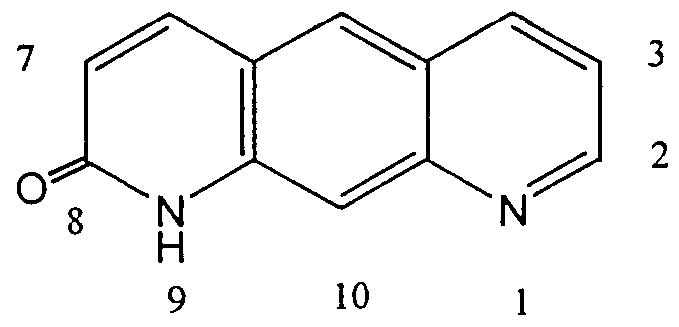
- An 8-pyridono [5,6-g] quinoline is represented by the following structure.
- R is hydrogen, Cj-C 6 alkyl, F, Cl, Br, I, NO 2 , OR , NR R , or SR ;
- R is hydrogen, Cj-C ⁇ alkyl or Cj-C ⁇ alkenyl, wherein the Cj-C f i alkyl and Cj-
- C alkenyl are optionally substituted with Cj-C ⁇ alkyl, arylalkyl or heteroaryl; 3 4
- R and R each independently represent hydrogen, C ⁇ -C alkyl, C j-Cg haloalkyl, C j-C ⁇ perhaloalkyl, Ci-C ⁇ alkenyl, C j-C ⁇ alkynyl, aryl, or heteroaryl, wherein the alkyl, haloalkyl, perhaloalkyl, alkenyl, alkynyl, aryl, and heteroaryl are
- R and R may be taken together form a three- to seven-membered ring
- R and R each independently represent hydrogen, C] -C alkyl, C j-Cfi haloalkyl, C j-C ⁇ perhaloalkyl, C j -Cg alkenyl, C ] -C6 alkynyl, aryl, or heteroaryl, wherein the alkyl, haloalkyl, perhaloalkyl, alkenyl, alkynyl, aryl, and heteroaryl are
- R and R may be taken together form a carbonyl, an imine, or a three- to seven-
- R and R each independently represent hydrogen, C j-Cg alkyl, C j-Cg
- R and R may be taken together form a carbonyl, an imine, or a three- to seven-
- R 9 represents hydrogen, C 1 -C4 alkyl, F, Cl, Br, I, OR 2 , NR13R14, or SR 2 ;
- R 10 is represents hydrogen, F, Cl, Br, CF 3 , CF 2 OR 2 , CH 2 OR 2 , OR 2 , C ⁇ -C 6 alkyl, Cj-C ⁇ haloalkyl, Cj-C ⁇ perhaloalkyl, aryl, or heteroaryl, wherein the alkyl, haloalkyl, perhaloalkyl, aryl, and heteroaryl are optionally substituted with hydrogen, F, Cl, Br, C!-C 4 alkyl, OR 2 , NR°R 14 , or SR 2 ;
- R represents hydrogen, F, Cl, Br, I, Cj-Cg alkyl, Cj-C ⁇ perhaloalkyl, Cj-C ⁇ perhaloalkyl, Cj-Cg alkenyl, alkynyl, aryl, and heteroaryl, wherein the alkyl, haloalkyl, perhaloalkyl, alkenyl, alkynyl, aryl, or heteroaryl are optionally substituted with hydrogen, F, Cl, Br, C]-C 4 alkyl, OR 2 , NR 13 R 14 , or SR 2 ;
- R 12 represents hydrogen, C(0)R ! ', SR 2 , S(O)R 13 , S(O 2 )R 13 , C ⁇ -C 6 alkyl, Cj-
- heteroaryl are optionally substituted with hydrogen, F, Cl, Br, C1-C4 alkyl, OR , 13 i 4 2
- X represents hydrogen, F, Cl, Br, I, CN, CF 3 , SR 2 , S(O)R 13 , S0 2 R 13 , SO 3 R 13 ,
- R and R each independently represents hydrogen, C(0)R , SO2R , Ci-C6 alkyl, alkenyl, Ci-C ⁇ haloalkyl, Cj-Cg perhaloalkyl, aryl, arylalkyl or heteroaryl, wherein the alkyl, alkenyl, haloalkyl, perhaloalkyl, aryl, arylalkyl, and heteroaryl are optionally substituted with hydrogen, F, Cl, Br, C]-C 4 alkyl, OR 2 , NR°R 14 , or SR 2 ; with the proviso that when the dotted line in the ring structure is a double bond, R 6 and R 7 are null; and pharmaceutically aceptable salts thereof.
- R 1 groups include hydrogen, CI -C Q - alkyl, F, Cl, Br, I, NO2, OR ,
- R 1 groups include hydrogen and C ⁇ -C 4 alkyl.
- R 1 is hydrogen.
- Preferred R 2 groups include hydrogen, Cj-C ⁇ alkyl or Cj-C ⁇ alkenyl, wherein the Cj-Cg alkyl and Cj-Cg alkenyl are preferably substituted with Ci-Cg alkyl, arylalkyl or heteroaryl. More preferred R groups include hydrogen and Cj-C 4 alkyl. Most preferably R is hydrogen.
- R 3 groups include hydrogen, Cj-Cg alkyl, C]-C6 perhaloalkyl, Cj-C ⁇ alkenyl, Cj-C ⁇ alkynyl, aryl, and heteroaryl, wherein the alkyl, perhaloalkyl, alkenyl, alkynyl, aryl, and heteroaryl may be optionally substituted. More preferred R groups include hydrogen, Cj-C ⁇ alkyl, Cj-C ⁇ perhaloalkyl, Cj-Cg alkenyl, Ci -C ⁇ alkynyl, and C ⁇ -C(, allyl. Most preferably, R 3 is hydrogen or C ⁇ -C 6 alkyl.
- R 3 is taken with R 4 to form a three- to seven-membered ring that is optionally substituted.
- Preferred R 4 groups include hydrogen, Cj-Cg alkyl, Cj-C ⁇ perhaloalkyl, Cj-C ⁇ alkenyl, Cj-C ⁇ alkynyl, aryl, and heteroaryl, wherein the alkyl, perhaloalkyl, alkenyl, alkynyl, aryl, and heteroaryl are optionally substituted. More preferred R 4 groups include hydrogen, Cj-C ⁇ alkyl, Cj-C ⁇ perhaloalkyl, Cj-C ⁇ alkenyl, Cj-C ⁇ alkynyl, and
- R 4 is hydrogen or C ⁇ -C 6 alkyl.
- Preferred R 5 groups include hydrogen, Cj-C ⁇ alkyl, Cj-Cg perhaloalkyl, Cj-C ⁇ alkenyl, Cj-C ⁇ alkynyl, aryl, and heteroaryl, wherein the alkyl, perhaloalkyl, alkenyl, alkynyl, aryl, and heteroaryl are optionally substituted.
- More preferred R 3 groups include hydrogen, Cj-C ⁇ alkyl, Cj-Cg perhaloalkyl, Ci-C ⁇ alkenyl, C J-CO alkynyl, and
- R 5 is hydrogen or C ⁇ -C 6 alkyl. Also preferred are compounds where R 3 is taken with R 6 to form a carbonyl, an imine, or a three- to seven-membered ring that is optionally substitutedl.
- R 6 groups include hydrogen, Cj-C ⁇ alkyl, Cj-Cg perhaloalkyl, alkenyl, Cj-C ⁇ alkynyl, aryl, and heteroaryl, wherein the alkyl, perhaloalkyl, alkenyl, alkynyl, aryl, and heteroaryl are optionally substituted. More preferred R 6 groups include hydrogen, CJ -CO alkyl, Cj-C ⁇ perhaloalkyl and null. Most preferably, R 6 is hydrogen.
- Preferred R 7 groups include hydrogen, Cj-Cg alkyl, Cj-Cg perhaloalkyl, Cj-Cg alkenyl, Cj-C ⁇ alkynyl, aryl, and heteroaryl, wherein the alkyl, perhaloalkyl, alkenyl, alkynyl, aryl, and heteroaryl are optionally substituted.
- R is taken with R to form a carbonyl, an imine, or a three- to seven-membered ring that is optionally substituted.
- More preferred R 7 groups include hydrogen, C ⁇ -C 6 alkyl, C ⁇ -C 6 perhaloalkyl and null. Most preferably R 7 is hydrogen.
- Preferred R 8 groups include hydrogen, Cj-Cg alkyl, Cj-C ⁇ perhaloalkyl, CJ -CO alkenyl, Cj-Cg alkynyl, aryl, and heteroaryl, wherein the alkyl, perhaloalkyl, alkenyl, alkynyl, aryl, are heteroaryl are optionally substituted. More preferred R groups include hydrogen, Cj-Cg alkyl, Cj-Cg perhaloalkyl, C]-C6 alkenyl, and Cj-C ⁇ alkynyl.
- R 8 is hydrogen or C ⁇ -C 6 alkyl.
- Preferred R groups include hydrogen, C1-C4 alkyl, F, Cl, Br, I, OR ,
- R 9 groups include hydrogen, C1-C4 alkyl, F, Cl,
- R is hydrogen, F, Cl, Br, or I.
- R 10 groups include hydrogen, F, Cl, Br, CF 3 , CF 2 OR 2 , CH 2 OR 2 , OR 2 ,
- R 10 groups include hydrogen, F, Cl, Br, CF 3 , CF 2 OR 2 , CH 2 OR 2 , OR 2 , and
- R 10 is hydrogen, F, Cl, Br, I, or CF 3 .
- R 1 1 groups include hydrogen, F, Cl, Br, CF 3 , Cj-C ⁇ alkyl, Cj-Cg haloalkyl, Ci-C ⁇ * perhaloalkyl, Cj-C ⁇ alkenyl, Cj-C ⁇ alkynyl, aryl, and heteroaryl, wherein the alkyl, haloalkyl, perhaloalkyl, alkenyl, alkynyl, aryl, and heteroaryl are optionally substituted. More preferred R 1 ' groups include hydrogen, F, Cl, Br, I, and
- R ⁇ is hydrogen, F, Cl, Br, or I.
- Preferred R 12 groups include hydrogen, C(O)R' ', SR 2 , S(O)R 13 , SO 2 R 13 , -
- R groups include hydrogen, C1-C6 alkyl, arylalkyl, and heteroaryl, wherein the alkyl, arylalkyl and
- R is hydrogen.
- Preferred X groups include hydrogen, F, Cl, Br, I, CN, SR 2 , S(O)R 13 , S0 2 R 13 ,
- More preferred X groups include hydrogen, F,
- R 13 groups include hydrogen, C(O)R ] SO 2 R 3 , Cj-C ⁇ alkyl, Cj-C ⁇ haloalkyl, Cj-C ⁇ perhaloalkyl, aryl, arylalkyl or heteroaryl, wherein the alkyl, haloalkyl, perhaloalkyl, aryl, arylalkyl, and heteroaryl are optionally substituted. More preferred R 13 groups include hydrogen and C ⁇ -C 6 alkyl.
- R 14 groups include hydrogen, C(O)R H , SO 2 R 3 , C]-C 6 alkyl, -C ⁇ haloalkyl, C]-C6 perhaloalkyl, aryl, arylalkyl and heteroaryl, wherein the alkyl, perhaloalkyl, aryl, arylalkyl and heteroaryl are optionally substituted. More preferred R 14 groups include hydrogen and C ⁇ -C alkyl.
- R is hydrogen or C ⁇ -C 4 alkyl
- R , R 3 , R 4 , and R 5 each independently is hydrogen or C ⁇ -C 6 alkyl
- R 6 and R 7 are hydrogen
- R 8 and R 9 each independently is hydrogen or C ⁇ -C 6 alkyl;
- R 10 is hydrogen, F, Cl, Br, I, or CF 3 ;
- R 11 is hydrogen, F, Cl, Br, or I;
- R 12 is hydrogen and X is hydrogen, F, Cl, Br, I or CN.
- R is hydrogen or C ⁇ -C 4 0 alkyl
- R 2 , R 3 , R 4 , R 8 each independently is hydrogen or C,-C 6 alkyl
- R 5 , R 6 , R 7 , and R 9 are each hydrogen
- R 10 is CF 3
- R 11 is hydrogen or F
- X is hydrogen, F, Cl, Br, I or CN.
- the present invention provides a pharmaceutical composition
- a pharmaceutical composition comprising an effective amount of an androgen receptor modulating ⁇ - . 1 -> compound of formulas I or II or combinations thereof as shown above wherein R
- the present invention comprises a method of modulating processes mediated by androgen receptors comprising administering to a patient an effective amount of compounds of formulas I or II or combinations thereof as
- compositions may be synthesized as pharmaceutically acceptable salts for incorporation into various pharmaceutical compositions.
- pharmaceutically acceptable salts include, but are not limited to, hydrochloric, hydrobromic, hydroiodic, hydrofluoric, sulfuric, citric, maleic, acetic, lactic, nicotinic, succinic, oxalic, phosphoric, malonic, salicylic, phenylacetic, stearic, pyridine, ammonium, piperazine, diethylamine, nicotinamide, formic, urea, sodium, potassium, calcium, magnesium, zinc, lithium, cinnamic, methylamino, methanesulfonic, picric, tartaric, triethylamino, dimethylamino, and tris(hydroxymethyl)aminomethane. Additional pharmaceutically acceptable salts are known to those skilled in the art.
- AR agonist, partial agonist and antagonist compounds including compounds with tissue-selective AR modulator activity of the present invention are useful in the treatment of acne (antagonist), male-pattern baldness (antagonist), male hormone replacement therapy (agonist), wasting diseases (agonist), hirsutism (antagonist), stimulation of hematopoiesis (agonist), hypogonadism (agonist), prostatic hyperplasia (antagonist), osteoporosis (agonist), male contraception (agonist), impotence (agonist), cancer cachexia (agonist), various hormone-dependent cancers, including, without limitation, prostate (antagonist) and breast cancer and as anabolic agents (agonist). It is understood by those of skill in the art that a partial agonist may be used where agonist activity is desired, or where antagonist activity is desired, depending upon the AR modulator profile of the particular partial agonist.
- a compound with a mixed steroid receptor profile is preferred.
- a PR agonist i.e., progestin
- a compound that is primarily a PR agonist, but also displays some AR and MR modulating activity may prove useful.
- the mixed MR effects would be useful to control water balance in the body, while the AR effects would help to control acne flare ups.
- the compounds of the present invention can be used in a wide variety of combination therapies to treat the conditions and diseases described above.
- the compounds of the present invention can be used in combination with other hormones and other therapies, including, without limitation, chemotherapeutic agents such as cytostatic and cytotoxic agents, immunological modifiers such as interferons, interleukins, growth hormones and other cytokines, hormone therapies, surgery and radiation therapy.
- chemotherapeutic agents such as cytostatic and cytotoxic agents
- immunological modifiers such as interferons, interleukins, growth hormones and other cytokines
- hormone therapies surgery and radiation therapy.
- Representative AR modulator compounds i.e., agonists and antagonists
- Schemes I-IV show examples of substitutions at the C-8 carbon of the quinolinone compounds.
- Compounds of the present invention comprising classes of heterocyclic nitrogen compounds and their derivatives, may be obtained by routine chemical synthesis by those skilled in the art, e.g., by modification of the heterocyclic nitrogen compounds disclosed or by a total synthesis approach.
- 8- Fluoro-9-pyridoquinolines (3) are prepared in a halex reaction by treatment of a 8-halo- 9-pyridoquinoline with an inorganic fluoride source, such as KF, in a high boiling polar solvent, such as sulpholane, at elevated temperatures.
- 8-bromo-substitution is accomplished by treatment of a pyridonoquinoline with a dehydrative brominating reagent, such as phosphorous oxybromide to yield 8-bromo-9-pyridoquinolines (e.g., Structure 4, Scheme II).
- a dehydrative brominating reagent such as phosphorous oxybromide
- Reductive dehalogenation of the 8-position is achieved by treatment of a 8-halo- compound with a hydride source such as tri- «-butyltin hydride, in the presence of a free radical initiator, such as 2,2'-azobisisobutyronitrile (AIBN) to yield 8-hydro derivatives (e.g., Structure 5).
- AIBN 2,2'-azobisisobutyronitrile
- 8-hydro-derivatives such as Structure 5
- a nucleophilic cyanide salt such as potassium cyanide
- para- toluenesulfonyl chloride in the presence of para- toluenesulfonyl chloride affords 8-cyano-9-pyridoquinolines (e.g., Structure 6).
- an benzoic acid chloride e.g., Structure 7
- benzoyl chloride in place of the para-toluenesulfonyl chloride, affords the 9-benzoyl-8-cyano- 8,9-dihydro-adducts as shown in Structure 8.
- Sulfoxy or sulfonyl substitution at C-8 is introduced by a 3-step procedure from pyridonoquinolines (e.g., Structure 1, Scheme III).
- pyridonoquinolines e.g., Structure 1, Scheme III.
- the quinoline is converted to the corresponding thiopyridonoquinoline (e.g., Structure 9) by treatment with a thionation reagent such as 2,4-bis(4-methoxyphenyl)-l,3,2,4-dithiadiphosphetane 2,4- disulfide (Lawesson's Reagent).
- a thionation reagent such as 2,4-bis(4-methoxyphenyl)-l,3,2,4-dithiadiphosphetane 2,4- disulfide (Lawesson's Reagent).
- the thiopyridonoquinoline is converted to an alkylsulfide such as Structure 10 by exposure to an alkyl
- alkylsulfide is converted to a corresponding sulfoxide compound such as Structure 11 subsequent treatment with a mild peroxidant, such as magnesium monoperoxyphthalate (MMPP).
- MMPP magnesium monoperoxyphthalate
- Oxidation to a corresponding sulfone such as 12 is achieved using a stronger peroxidant, such as meta-chloroperoxybenzoic acid (mCPBA).
- mCPBA meta-chloroperoxybenzoic acid
- Amino-substitution at C-8 and subsequent derivatives of the 8- aminopyridoquinoHnes are synthesized from parent 8- pyridonoquinolines (e.g., Structure 1) by treatment with an aryl or alkyl amine, such as para-me hoxybenzylamine, in the presence of hexamethyldisilazane (HMDS) and an acid catalyst, such as para-toluenesulfonic acid (p-TsOH), at elevated temperatures to afford aminated products (e.g., Structure 13, as shown in Scheme IV).
- HMDS hexamethyldisilazane
- p-TsOH para-toluenesulfonic acid
- Removal of a benzyl protecting group is accomplished using a strong organic acid, such as trifluoroacetic acid (TFA) at elevated temperatures to afford unsubstituted aminopyridoquinolines (e.g., Structure 14).
- TFA trifluoroacetic acid
- This removal is optionally performed before further derivatization, or after further derivatization, such as N-alkylation, which can be achieved by treatment with a base, such as sodium hydride, and subsequent trapping with an alkyl halide to afford mono-substituted compounds (e.g., Structure 15). Iterative alkylation by this process is achieved, leading to optionally di-substituted 8- aminopyridoquinolines (e.g., Structure 18).
- TFA trifluoroacetic acid
- N-Acylations and N-sulfonylations are achieved under standard conditions, using an electrophilic acylation reagent such as acetic anhydride, or a sulfonylating reagent, such as methanesulfonyl chloride, in the presence of a mild base, such as triethylamine to afford mono or disubstituted compounds as shown in Structures 16 and 17.
- an electrophilic acylation reagent such as acetic anhydride
- a sulfonylating reagent such as methanesulfonyl chloride
- Scheme V shows the preparation of trifluoromethyl substituted quinolines.
- Trifluoromethyl-substitution at C-8 is accomplished starting with 7-amino-l,2-dihydro- quinolines or a tetrahydroquinoline (e.g., Structure 19) followed by treatment with a trifluoromethyl-dione such as l,l,l,5,5,5-hexafluoropentane-2,4-dione in the presence of an acid catalyst, such as/7-TsOH, at elevated temperatures to afford 6,8-bis- trifluoromethylated compounds, an example of which is shown in Structure 20.
- a trifluoromethyl-dione such as l,l,l,5,5,5-hexafluoropentane-2,4-dione
- an acid catalyst such as/7-TsOH
- a method for alkylating amino-quinoline compounds is shown in Scheme VI.
- Alkylation at N-1 is achieved using standard reductive amination conditions as follows.
- An 8-substituted pyridoquinoline such as Structure 21, is treated with an aldehyde, such as paraformaldehyde, and a mild reductant, such as sodium cyanoborohydride, in the presence of an acid, such as acetic acid, to afford N-1 -alkylated products (as shown in Structure 22, Scheme VI).
- an aldehyde such as paraformaldehyde
- a mild reductant such as sodium cyanoborohydride
- the compounds of the present invention also include racemates, stereoisomers and mixtures of said compounds, including isotopically-labeled and radio-labeled compounds. Such isomers can be isolated by standard resolution techniques, including fractional crystallization and chiral column chromatography.
- any of the steroid modulator compounds of the present invention may be combined in a mixture with a pharmaceutically acceptable carrier to provide pharmaceutical compositions useful for treating the biological conditions or disorders noted herein in mammalian, and more preferably, in human patients.
- the particular carrier employed in these pharmaceutical compositions may take a wide variety of forms depending upon the type of administration desired, e.g., intravenous, oral, topical, suppository or parenteral.
- compositions of the present invention in oral liquid dosage forms (e.g., suspensions, elixirs and solutions), typical pharmaceutical media such as water, glycols, oils, alcohols, flavoring agents, preservatives, coloring agents and the like may be employed.
- typical pharmaceutical media such as water, glycols, oils, alcohols, flavoring agents, preservatives, coloring agents and the like may be employed.
- oral solid dosage forms e.g., powders, tablets and capsules
- carriers such as starches, sugars, diluents, granulating agents, lubricants, binders, disintegrating agents and the like may be employed. Due to their ease of administration, tablets and capsules represent the most advantageous oral dosage form for the pharmaceutical compositions of the present invention.
- a carrier will typically comprise sterile water although other ingredients that aid in solubility or serve as preservatives, may also be included.
- injectable suspensions may also be prepared in which case appropriate liquid carriers, suspending agents and the like may be employed.
- compositions of the present invention may be formulated using bland moisturizing bases such as ointments or creams.
- suitable ointment bases are petrolatum, petrolatum plus volatile silicones, lanolin, and water in oil emulsions such as EucerinTM (Beiersdorf).
- suitable cream bases are NiveaTM Cream (Beiersdorf), cold cream (USP), Purpose CreamTM (Johnson &
- compositions and compounds of the present invention may generally be administered in the form of a dosage unit (e.g., tablet, capsule etc.) at concentrations from about 1 ⁇ g/kg of body weight to about 500 mg/kg of body weight, more preferably from about 10 ⁇ g/kg to about 250 mg/kg, and most preferably from about 20 ⁇ g/kg to about 100 mg/kg.
- a dosage unit e.g., tablet, capsule etc.
- concentrations from about 1 ⁇ g/kg of body weight to about 500 mg/kg of body weight, more preferably from about 10 ⁇ g/kg to about 250 mg/kg, and most preferably from about 20 ⁇ g/kg to about 100 mg/kg.
- the particular quantity of pharmaceutical composition according to the present invention administered to a patient will depend upon a number of factors, including, without limitation, the biological activity desired, the condition of the patient, and tolerance for the drug.
- the compounds of this invention also have utility when radio- or isotopically- labeled as ligands for use in assays to determine the presence of AR in a cell background or extract. They are particularly useful due to their ability to selectively activate androgen receptors, and can therefore be used to determine the presence of such receptors in the presence of other steroid receptors or related intracellular receptors. 15 Due to the selective specificity of the compounds of this invention for steroid receptors, these compounds can be used to purify samples of steroid receptors in vitro. Such purification can be carried out by mixing samples containing steroid receptors with one or more of_fhe compounds of the present invention so that the compounds bind to the receptors of choice, and then separating out the bound ligand/receptor
- the compounds and pharmaceutical compositions of the present invention may advantageously be used in the treatment of the diseases and conditions described herein.
- the compounds and compositions of the present invention are particularly useful as modulators of male sex steroid-dependent diseases and conditions such as the treatment of acne, male-pattern baldness, male hormone replacement therapy, wasting diseases, hirsutism, stimulation of hematopoiesis, hypogonadism, prostatic hyperplasia, osteoporosis (agonist), male contraception (agonist), impotence (agonist), cancer cachexia (agonist), various hormone-dependent cancers including without limitation prostate cancer and breast cancer, and as anabolic agents.
- the compounds and pharmaceutical compositions of the present invention possess a number of advantages over previously identified steroidal and non-steroidal compounds.
- the compounds and pharmaceutical compositions of the present invention possess a number of advantages over previously identified steroid modulator compounds.
- the compounds are extremely potent AR activators preferably displaying 50% maximal activation of AR at a concentration of less than 100 nM, more preferably at a concentration of less than 50 nM, more preferably yet at a concentration of less than 20 nM, and most preferably at a concentration of 10 nM or less.
- the selective compounds of the present invention generally do not display undesired cross-reactivity with other steroid receptors, as is seen with the compound mifepristone (RU486; Roussel Uclaf).
- Mifepristone is a known PR antagonist that displays an undesirable cross reactivity on GR and AR, thereby limiting its use in long-term, chronic administration.
- the small organic molecules of the present invention are easier to synthesize, provide greater stability and are more easily administered in oral dosage forms than other known steroidal compounds.
- reaction mixture turned cloudy and was treated with .-toluenesulfonic acid hydrate (10 mg).
- the reaction mixture was stirred 15 min at room temperature and K_2CO 3 (0.5 g) added.
- the reaction mixture was stirred vigorously for 5 min, filtered, and concentrated to a yellow oil. Purification by silica gel chromatography (hexane:EtOAc, 8:1) afforded 144 mg (61%) of Compound 149 as a yellow powder.
- the co-transfection assay provides a method for identifying functional agonists and partial agonists which mimic, or antagonists which inhibit, the effect of native hormones, and quantifying their activity for responsive IR proteins.
- the co-transfection assay mimics an in vivo system in the laboratory.
- activity in the co-transfection assay correlates very well with known in vivo activity, such that the co-transfection assay functions as a qualitative and quantitative predictor of a tested compounds in vivo pharmacology. See, e.g., T. Berger et al. 41 J. Steroid Biochem.
- a cloned cDNA for an IR e.g., human PR, AR or GR
- a constitutive promoter e.g., the SV 40 promoter
- transfection a procedure to induce cells to take up foreign genes
- This introduced gene directs the recipient cells to make the IR protein of interest.
- a second gene is also introduced (co-transfected) into the same cells in conjunction with the IR gene.
- This second gene comprising the cDNA for a reporter protein, such as firefly luciferase (LUC), controlled by an appropriate hormone responsive promoter containing a hormone response element (HRE).
- This reporter plasmid functions as a reporter for the transcription-modulating activity of the target IR.
- the reporter acts as a surrogate for the products (mRNA then protein) normally expressed by a gene under control of the target receptor and its native hormone.
- the co-transfection assay can detect small molecule agonists or antagonists of target IRs. Exposing the transfected cells to an agonist ligand compound increases reporter activity in the transfected cells. This activity can be conveniently measured, e.g., by increasing luciferase production, which reflects compound-dependent, IR- mediated increases in reporter transcription. To detect antagonists, the co-transfection assay is carried out in the presence of a constant concentration of an agonist to the target IR (e.g., progesterone for PR) known to induce a defined reporter signal. Increasing concentrations of a suspected antagonist will decrease the reporter signal (e.g., luciferase production).
- a constant concentration of an agonist to the target IR e.g., progesterone for PR
- Increasing concentrations of a suspected antagonist will decrease the reporter signal (e.g., luciferase production).
- the co-transfection assay is therefore useful to detect both agonists and antagonists of specific IRs. Furthermore, it determines not only whether a compound interacts with a particular IR, but whether this interaction mimics (agonizes) or blocks (antagonizes) the effects of the native regulatory molecules on target gene expression, as well as the specificity and strength of this interaction.
- CV-1 cells African green monkey kidney fibroblasts
- DMEM Dulbecco's Modified Eagle Medium
- charcoal resin-stripped fetal bovine serum then transferred to 96-well microtiter plates one day prior to transfection.
- the CV-1 cells were transiently transfected by calcium phosphate coprecipitation according to the procedure of Berger et al., 41 J. Steroid Biochem. Mol.
- pShAR (5 ng/well), MTV-LUC reporter (100 ng/well), pRS- ⁇ -Gal (50 ng/well) and filler DNA (pGEM; 45 ng/well).
- the receptor plasmid, pRShAR contains the human AR under constitutive control of the SV-40 promoter, as more fully described in J.A. Simental et al, J. Biol. Chem., 266:510 (1991).
- the reporter plasmid, MTV-LUC contains the cDNA for firefly luciferase (LUC) under control of the mouse mammary tumor virus (MTV) long terminal repeat, a conditional promoter containing an androgen response element. See e.g., Berger et al. supra.
- MTV mouse mammary tumor virus
- pRS- ⁇ -Gal coding for constitutive expression of E. coli ⁇ - galactosidase ( ⁇ -Gal) was included as an internal control for evaluation of transfection efficiency and compound toxicity.
- PBS phosphate-buffered saline
- Media containing reference compounds i.e. progesterone as a PR agonist, mifepristone ((1 lbeta, 17beta)-l l-[4-(dimefhylamino) pheny_]-17-hydroxy-17-(l-propynyl)estra-4,9-dien-3-one: RU486; Roussel Uclaf) as a
- PR antagonist dihydrotestosterone (DHT; Sigma Chemical) as an AR agonist and 2- OH-flutamide (the active metabolite of 2-methyl-N-[4-nitro-3-(trifluoromethyl)phenyl] pronanamide; Schering-Plough) as an AR antagonist; estradiol (Sigma) as an ER agonist and ICI 164,384 (N-butyl-3,17-dihydroxy-N-mefhyl-(7-alpha,17-beta)-estra- l,3,5(10)-triene-7-undecanamide; ICI Americas) as an ER antagonist; dexamethasone
- the mean and standard error of the mean (SEM) of the NR were calculated. Data was plotted as the response of the compound compared to the reference compounds over the range of the dose-response curve.
- the effective concentration that produced 50% of the maximum response (EC50) was quantified.
- Agonist efficacy was a function (%) of LUC expression relative to the maximum LUC production by the reference agonist for PR, AR, ER, GR or MR.
- Antagonist activity was determined by testing the amount of LUC expression in the presence of a fixed amount of DHT as an AR agonist and progesterone as a PR agonist at the EC50 concentration.
- the concentration of test compound that inhibited 50% of LUC expression induced by the reference agonist was quantified (IC50).
- the efficacy of antagonists was determined as a function (%) of maximal inhibition.
- ⁇ H-DHT tritiated dihydrotestosterone
- Triton X-100-based buffer Triton X-100-based buffer.
- the lysates were assayed for amount of bound ⁇ H-DHT and ⁇ -Gal activity using a scintillation counter or spectrophotometer, respectively.
- the difference between the total binding and the nonspecific binding, normalized by the ⁇ -Gal rate, was defined as specific binding.
- the specific binding was evaluated by Scatchard analysis to determine the K for - H-DHT. See e.g., D. Rodbard, "Mathematics and statistics of ligand assays: an illustrated guide" In: J Langon and JJ. Clapp, eds., Ligand Assay, Masson Publishing U.S.A., Inc., New York, pp.
- IC50 values were determined.
- the IC50 value is defined as the concentration of competing ligand needed to reduce specific binding by 50%.
- the IC50 value was determined graphically from a log-logit plot of the data.
- the Kj values were determined by application of the Cheng-Prusoff equivuation to the IC50 values, the labeled ligand concentration and the K of the labeled ligand.
- agonist, antagonist and binding activity assay results of selected androgen receptor modulator compounds of present invention and the standard reference compounds on AR, as well as the cross-reactivity of selected compounds on the PR, ER, MR and GR receptors are shown in Tables 1-2 below. Efficacy is reported as the percent maximal response observed for each compound relative to the reference agonist and antagonist compounds indicated above. Also reported in Tables 1-2 for each compound is its antagonist potency or IC 50 (which is the concentration (nM), required to reduce the maximal response by 50%), its agonist potency or EC 50 (nM).
- Table 1 Agonist, partial agonist, antagonist and binding activity of androgen receptor modulator compounds of present invention and the reference agonist compound, dihydrotestosterone (DHT), and reference antagonists compound, 2- hydroxyflutamide (2-OH-Flut) and Casodex, on AR.
- DHT dihydrotestosterone
- DHT dihydrotestosterone
- Casodex 2- hydroxyflutamide
- na not active (i.e. efficacy of ⁇ 20 and potency of > 10,000)
- nd not determined
- Table 2 Overall agonist and antagonist potency of selected androgen receptor modulator compounds of present invention and the reference agonist and antagonist compounds shown in Table 1 on PR, AR, ER, GR and MR.
- the androgen receptor modulator compounds of the present invention may be readily utilized in pharmacological applications where AR antagonist or agonist activity is desired, and where it is desired to minimize cross reactivities with other steroid receptor related IRs.
- In vivo applications of the invention include administration of the disclosed compounds to mammalian subjects, and in particular to humans.
- Example provides illustrative pharmaceutical composition formulations:
- Hard gelatin capsules are prepared using the following ingredients:
- COMPOUND 101 ⁇ 40 Starch dried 100 Magnesium stearate 10 Total 250 mg
- the above ingredients are mixed and filled into hard gelatin capsules in 250 mg quantities.
- a tablet is prepared using the ingredients below:
- the components are blended and compressed to form tablets each weighing
- Tablets each containing 60 mg of active ingredient, are made as follows:
- Polyvinylpyrrolidone (PVP) 4 (as 10% solution in water)
- the active ingredient, starch, and cellulose are passed through a No. 45 mesh U.S. sieve and mixed thoroughly.
- the solution of PVP is mixed with the resultant powders, which are then passed through a No. 14 mesh U.S. sieve.
- the granules so produced are dried at 50° C and passed through a No. 18 mesh U.S. sieve.
- the SCMS, magnesium stearate, and talc previously passed through a No. 60 mesh U.S. sieve, and then added to the granules which, after mixing, are compressed on a tablet machine to yield tablets each weighing 150 mg.
- Suppositories, each containing 225 mg of active ingredient may be made as follows:
- An intravenous formulation may be prepared as follows:
- the compound is dissolved in the glycerol and then the solution is slowly diluted with isotonic saline.
- the solution of the above ingredients is then administered intravenously at a rate of 1 mL per minute to a patient.
Landscapes
- Health & Medical Sciences (AREA)
- Chemical & Material Sciences (AREA)
- Organic Chemistry (AREA)
- General Health & Medical Sciences (AREA)
- Veterinary Medicine (AREA)
- General Chemical & Material Sciences (AREA)
- Medicinal Chemistry (AREA)
- Nuclear Medicine, Radiotherapy & Molecular Imaging (AREA)
- Chemical Kinetics & Catalysis (AREA)
- Pharmacology & Pharmacy (AREA)
- Life Sciences & Earth Sciences (AREA)
- Animal Behavior & Ethology (AREA)
- Public Health (AREA)
- Bioinformatics & Cheminformatics (AREA)
- Engineering & Computer Science (AREA)
- Reproductive Health (AREA)
- Diabetes (AREA)
- Endocrinology (AREA)
- Hematology (AREA)
- Dermatology (AREA)
- Obesity (AREA)
- Urology & Nephrology (AREA)
- Gynecology & Obstetrics (AREA)
- Pregnancy & Childbirth (AREA)
- Pharmaceuticals Containing Other Organic And Inorganic Compounds (AREA)
- Nitrogen Condensed Heterocyclic Rings (AREA)
Abstract
Description





Claims


Priority Applications (4)
| Application Number | Priority Date | Filing Date | Title |
|---|---|---|---|
| EP00957851A EP1212322A2 (en) | 1999-08-27 | 2000-08-25 | 8-substituted-6-trifluoromethyl-9-pyrido[3,2-g]quinoline compounds as androgen receptor modulators |
| CA002378298A CA2378298A1 (en) | 1999-08-27 | 2000-08-25 | 8-substituted-6-trifluoromethyl-9-pyrido¬3,2-g|quinoline compounds as androgen receptor modulators |
| AU69412/00A AU6941200A (en) | 1999-08-27 | 2000-08-25 | 8-substituted-6-trifluoromethyl-9-pyrido(3,2-g)quinoline compounds as androgen receptor modulators |
| JP2001519699A JP2003508397A (en) | 1999-08-27 | 2000-08-25 | 8-Substituted-6-trifluoromethyl-9-pyrido [3,2-G] quinoline compounds as androgen receptor modulators |
Applications Claiming Priority (2)
| Application Number | Priority Date | Filing Date | Title |
|---|---|---|---|
| US15123599P | 1999-08-27 | 1999-08-27 | |
| US60/151,235 | 1999-08-27 |
Publications (2)
| Publication Number | Publication Date |
|---|---|
| WO2001016133A2 true WO2001016133A2 (en) | 2001-03-08 |
| WO2001016133A3 WO2001016133A3 (en) | 2001-06-14 |
Family
ID=22537880
Family Applications (1)
| Application Number | Title | Priority Date | Filing Date |
|---|---|---|---|
| PCT/US2000/023507 Ceased WO2001016133A2 (en) | 1999-08-27 | 2000-08-25 | 8-substituted-6-trifluoromethyl-9-pyrido[3,2-g]quinoline compounds as androgen receptor modulators |
Country Status (6)
| Country | Link |
|---|---|
| US (2) | US6667313B1 (en) |
| EP (1) | EP1212322A2 (en) |
| JP (1) | JP2003508397A (en) |
| AU (1) | AU6941200A (en) |
| CA (1) | CA2378298A1 (en) |
| WO (1) | WO2001016133A2 (en) |
Cited By (34)
| Publication number | Priority date | Publication date | Assignee | Title |
|---|---|---|---|---|
| WO2002000617A3 (en) * | 2000-06-28 | 2003-01-30 | Bristol Myers Squibb Co | Selective androgen receptor modulators and methods for their identification, design and use |
| US6670386B2 (en) | 2001-07-31 | 2003-12-30 | Bristol-Myers Squibb Company | Bicyclic modulators of androgen receptor function |
| US7009052B2 (en) | 2003-03-20 | 2006-03-07 | Warner Lambert Company Llc | Sulfonamide derivatives |
| US7057048B2 (en) | 2003-01-17 | 2006-06-06 | Warner Lambert Company Llc | Androgen receptor antagonists |
| US7064207B2 (en) | 2003-01-17 | 2006-06-20 | Warner Lambert Company Llc | Androgen receptor antagonists |
| US7074933B2 (en) | 2003-02-11 | 2006-07-11 | Warner Lambert Company Llc | Urea and thiourea derivatives |
| US7098340B2 (en) | 2003-05-14 | 2006-08-29 | Warner Lambert Company Llc | Benzyl sulfonamide derivatives |
| US7115745B2 (en) | 2003-02-11 | 2006-10-03 | Warner Lambert Company Llc | Benzyl urea and thiourea derivatives |
| WO2006133567A1 (en) | 2005-06-17 | 2006-12-21 | Endorecherche, Inc. | Helix 12 directed non-steroidal antiandrogens |
| WO2007047991A1 (en) | 2005-10-21 | 2007-04-26 | Bristol-Myers Squibb Company | Tetrahydroisoquinoline as lxr modulators |
| WO2007050425A2 (en) | 2005-10-21 | 2007-05-03 | Bristol-Myers Squibb Company | Lxr modulators |
| US7214690B2 (en) | 2001-02-23 | 2007-05-08 | Ligand Pharmaceuticals Incorporated | Tricyclic quinolinone and tricyclic quinoline androgen receptor modulator compounds and methods |
| WO2007062314A2 (en) | 2005-11-23 | 2007-05-31 | Bristol-Myers Squibb Company | Heterocyclic cetp inhibitors |
| WO2008070496A2 (en) | 2006-12-01 | 2008-06-12 | Bristol-Myers Squibb Company | N- ( (3-benzyl) -2, 2- (bis-phenyl) -propan-1-amine derivatives as cetp inhibitors for the treatment of atherosclerosis and cardiovascular diseases |
| US7405234B2 (en) | 2002-05-17 | 2008-07-29 | Bristol-Myers Squibb Company | Bicyclic modulators of androgen receptor function |
| WO2008124922A1 (en) | 2007-04-12 | 2008-10-23 | Endorecherche, Inc. | 17alpha-substituted steroids as systemic antiandrogens and selective androgen receptor modulators |
| US7625923B2 (en) | 2004-03-04 | 2009-12-01 | Bristol-Myers Squibb Company | Bicyclic modulators of androgen receptor function |
| US7696241B2 (en) | 2004-03-04 | 2010-04-13 | Bristol-Myers Squibb Company | Bicyclic compounds as modulators of androgen receptor function and method |
| US7727980B2 (en) | 2001-02-23 | 2010-06-01 | Ligand Pharmaceuticals Incorporated | Tricyclic androgen receptor modulator compounds and methods |
| WO2010093601A1 (en) | 2009-02-10 | 2010-08-19 | Metabasis Therapeutics, Inc. | Novel sulfonic acid-containing thyromimetics, and methods for their use |
| WO2010099217A1 (en) | 2009-02-25 | 2010-09-02 | Braincells, Inc. | Modulation of neurogenesis using d-cycloserine combinations |
| US7816372B2 (en) | 2003-08-22 | 2010-10-19 | Ligand Pharmaceuticals Incorporated | 6-cycloamino-2-quinolinone derivatives as androgen receptor modulator compounds |
| US7820702B2 (en) | 2004-02-04 | 2010-10-26 | Bristol-Myers Squibb Company | Sulfonylpyrrolidine modulators of androgen receptor function and method |
| EP2258359A2 (en) | 2005-08-26 | 2010-12-08 | Braincells, Inc. | Neurogenesis by muscarinic receptor modulation with sabcomelin |
| EP2275095A2 (en) | 2005-08-26 | 2011-01-19 | Braincells, Inc. | Neurogenesis by muscarinic receptor modulation |
| EP2314289A1 (en) | 2005-10-31 | 2011-04-27 | Braincells, Inc. | Gaba receptor mediated modulation of neurogenesis |
| WO2011063115A1 (en) | 2009-11-19 | 2011-05-26 | Braincells Inc. | Combination of nootropic agent with one or more neurogenic or neurogenic sensitizing agents for stimulating or increasing neurogenesis |
| WO2011091033A1 (en) | 2010-01-20 | 2011-07-28 | Braincells, Inc. | Modulation of neurogenesis by ppar agents |
| EP2377530A2 (en) | 2005-10-21 | 2011-10-19 | Braincells, Inc. | Modulation of neurogenesis by PDE inhibition |
| EP2377531A2 (en) | 2006-05-09 | 2011-10-19 | Braincells, Inc. | Neurogenesis by modulating angiotensin |
| EP2428516A1 (en) | 2003-11-19 | 2012-03-14 | Metabasis Therapeutics, Inc. | Novel phosphorus-containing thyromimetics |
| US8519158B2 (en) | 2004-03-12 | 2013-08-27 | Ligand Pharmaceuticals Incorporated | Androgen receptor modulator compounds and methods |
| WO2015089634A1 (en) | 2013-12-19 | 2015-06-25 | Endorecherche, Inc. | Non-steroidal antiandrogens and selective androgen receptor modulators with a pyridyl moiety |
| US12319651B2 (en) | 2019-04-19 | 2025-06-03 | Ligand Pharmaceuticals Incorporated | Crystalline forms and methods of producing crystalline forms of a compound |
Families Citing this family (16)
| Publication number | Priority date | Publication date | Assignee | Title |
|---|---|---|---|---|
| MXPA02002032A (en) * | 1999-08-27 | 2003-05-19 | Ligand Pharm Inc | Androgen receptor modulator compounds and methods. |
| US6566372B1 (en) | 1999-08-27 | 2003-05-20 | Ligand Pharmaceuticals Incorporated | Bicyclic androgen and progesterone receptor modulator compounds and methods |
| EP1212322A2 (en) * | 1999-08-27 | 2002-06-12 | Ligand Pharmaceuticals Incorporated | 8-substituted-6-trifluoromethyl-9-pyrido[3,2-g]quinoline compounds as androgen receptor modulators |
| US7001911B2 (en) | 2000-06-28 | 2006-02-21 | Bristol-Myers Squibb Company | Fused cyclic modulators of nuclear hormone receptor function |
| US20040077605A1 (en) | 2001-06-20 | 2004-04-22 | Salvati Mark E. | Fused heterocyclic succinimide compounds and analogs thereof, modulators of nuclear hormone receptor function |
| US6953679B2 (en) | 2000-09-19 | 2005-10-11 | Bristol-Myers Squibb Company | Method for the preparation of fused heterocyclic succinimide compounds and analogs thereof |
| FR2825268B1 (en) * | 2001-05-31 | 2004-09-17 | Oreal | COSMETIC COMPOSITION COMPRISING CALCIUM CARBONATE PARTICLES AND CONDITIONERS |
| WO2003034987A2 (en) * | 2001-10-19 | 2003-05-01 | Merck & Co., Inc. | Androgen receptor modulators and methods of use thereof |
| US7087636B2 (en) | 2001-12-19 | 2006-08-08 | Bristol-Myers Squibb Company | Fused heterocyclic compounds and analogs thereof, modulators of nuclear hormone receptor function |
| EP1567487A4 (en) | 2002-11-15 | 2005-11-16 | Bristol Myers Squibb Co | Open chain prolyl urea-related modulators of androgen receptor function |
| US20070141636A1 (en) * | 2003-11-24 | 2007-06-21 | Fang Chen | Method for identifying androgen receptor modulators with full or mixed agonist activity |
| US20080125403A1 (en) | 2004-04-02 | 2008-05-29 | Merck & Co., Inc. | Method of Treating Men with Metabolic and Anthropometric Disorders |
| EP1916896A4 (en) * | 2005-08-26 | 2010-08-11 | Univ California | NON-STEROIDIAN ANTIANDROGENES |
| CN101945853B (en) | 2007-12-21 | 2014-08-20 | 配体药物公司 | Selective androgen receptor modulators (sarms) and uses thereof |
| WO2013024022A1 (en) | 2011-08-12 | 2013-02-21 | INSERM (Institut National de la Santé et de la Recherche Médicale) | Methods and pharmaceutical compositions for treatment of pulmonary hypertension |
| US11629196B2 (en) | 2020-04-27 | 2023-04-18 | Incelldx, Inc. | Method of treating SARS-CoV-2-associated hypercytokinemia by administering a human monoclonal antibody (PRO-140) that inhibits CCR5/CCL5 binding interactions |
Family Cites Families (76)
| Publication number | Priority date | Publication date | Assignee | Title |
|---|---|---|---|---|
| US667313A (en) * | 1900-05-07 | 1901-02-05 | Olaf Hetlesaeter | Excavator. |
| CH590275A5 (en) | 1970-03-16 | 1977-07-29 | Hoffmann La Roche | |
| DE2038106A1 (en) | 1970-07-31 | 1972-02-10 | Henkel & Cie Gmbh | Activators for per compounds |
| US3979394A (en) | 1970-12-11 | 1976-09-07 | Agfa-Gevaert N.V. | Duplo quinoline compounds |
| GB1379387A (en) | 1970-12-11 | 1975-01-02 | Agfa Gevaert | Photoconductive recording materials |
| GB1400993A (en) | 1971-11-10 | 1975-07-16 | Agfa Gevaert | Electrophotographic material |
| BE795696A (en) | 1972-02-28 | 1973-08-21 | Agfa Gevaert Nv | FOR HEAT SENSITIVE MATERIALS |
| US3936461A (en) | 1973-09-24 | 1976-02-03 | Warner-Lambert Company | Substituted 4-benzylquinolines |
| US3993656A (en) | 1974-11-19 | 1976-11-23 | Merck & Co., Inc. | 1,8-Naphthyridine compounds |
| IE43079B1 (en) | 1975-03-20 | 1980-12-17 | Ici Ltd | Quinolone derivatives |
| US4138490A (en) | 1975-03-20 | 1979-02-06 | Imperial Chemical Industries Limited | Analgesic compositions containing 1,2-dihydro-2-oxoquinol-4-ylpropionic acid derivatives |
| SU555119A1 (en) | 1975-05-19 | 1977-04-25 | Предприятие П/Я Г-4913 | Vulcanized rubber compound based on polyisoprene rubber |
| LU77254A1 (en) | 1977-05-04 | 1979-01-18 | ||
| US4326055A (en) | 1977-12-22 | 1982-04-20 | Hoffmann-La Roche Inc. | Stilbene derivatives |
| US4234589A (en) | 1979-09-24 | 1980-11-18 | E. R. Squibb & Sons, Inc. | Imidazolylethoxymethyl derivatives of 1,3-dioxolo quinolines |
| JPS5777676A (en) | 1980-10-31 | 1982-05-15 | Otsuka Pharmaceut Co Ltd | Carbostyril derivative |
| DE3202100A1 (en) | 1982-01-23 | 1983-08-04 | Basf Ag, 6700 Ludwigshafen | SUBSTITUTED 4-HYDROXYANILIDES, ITS PRODUCTION AND PHARMACEUTICAL PREPARATIONS CONTAINING THEM |
| US4534979A (en) | 1982-06-28 | 1985-08-13 | Usv Pharmaceutical Corp. | Polyene compounds useful in the treatment of psoriasis and allergic responses |
| US4427654A (en) | 1982-07-27 | 1984-01-24 | University Of Delaware | Wound healing compositions and formulations |
| US4505852A (en) | 1982-11-29 | 1985-03-19 | Enzyme Systems Products | 7-Amino-4-trifluoromethylquinolone derived substrates and method for determining enzymes and inhibitors |
| US4539134A (en) | 1982-12-02 | 1985-09-03 | Halliburton Company | Methods and cleaning compositions for removing organic materials from metallic surfaces |
| US4710507A (en) | 1983-12-22 | 1987-12-01 | Pfizer Inc. | Quinolone inotropic agents |
| PT80533B (en) | 1984-05-29 | 1987-04-06 | Pfizer | Process for preparing quinolone inotropic agents |
| FR2569689B1 (en) | 1984-09-05 | 1990-11-16 | Oreal | NOVEL BENZONORBORNENE DERIVATIVES, PREPARATION METHODS THEREOF, AND MEDICINAL AND COSMETIC COMPOSITIONS CONTAINING THEM |
| DE3434944A1 (en) | 1984-09-22 | 1986-04-03 | Basf Ag, 6700 Ludwigshafen | L-SUBSTITUTED TETRALIN DERIVATIVES, THEIR PRODUCTION AND USE |
| FR2580277B1 (en) | 1985-04-15 | 1988-06-10 | Oreal | NOVEL NAPHTHALENIC DERIVATIVES WITH RETINOIC ACTION, THEIR PREPARATION METHOD AND MEDICINAL AND COSMETIC COMPOSITIONS CONTAINING THEM |
| LU86022A1 (en) | 1985-07-25 | 1987-02-04 | Cird | POLYCYLIC AROMATIC DERIVATIVES, THEIR PREPARATION PROCESS AND THEIR APPLICATION IN THE PHARMACEUTICAL AND COSMETIC FIELDS |
| JPS62215581A (en) | 1986-03-18 | 1987-09-22 | Koichi Shiyudo | Flavone carboxylic acid derivative |
| FR2601670B1 (en) | 1986-07-17 | 1988-10-07 | Cird | NOVEL AROMATIC BICYCLIC DERIVATIVES, THEIR PREPARATION PROCESS AND THEIR USE IN HUMAN AND VETERINARY MEDICINE AND IN COSMETICS |
| US5071773A (en) | 1986-10-24 | 1991-12-10 | The Salk Institute For Biological Studies | Hormone receptor-related bioassays |
| FR2605626B1 (en) | 1986-10-27 | 1989-06-02 | Oreal | NOVEL BICYCLIC AROMATIC DERIVATIVES, THEIR PREPARATION PROCESS AND THEIR USE IN COSMETICS AND IN HUMAN AND VETERINARY MEDICINE |
| US5081242A (en) | 1986-12-22 | 1992-01-14 | Ortho Pharmaceutical Corporation | 6-benzoxazinyl- and 6-benzothiazinyl 2,3,4,5-tetrahydropyridazin-3-ones |
| GB8630702D0 (en) | 1986-12-23 | 1987-02-04 | Wellcome Found | Quinoline compound |
| FR2614618B1 (en) | 1987-04-30 | 1989-07-07 | Cird | POLYCYCLIC HETEROCYCLIC DERIVATIVES, THEIR PREPARATION PROCESS AND THEIR USE IN HUMAN AND VETERINARY MEDICINE |
| EP0303418A3 (en) | 1987-08-11 | 1990-11-07 | Smithkline Beecham Laboratoires Pharmaceutiques | Substituted indolones, useful in the treatment of heart or asthmatic diseases |
| LU87040A1 (en) | 1987-11-04 | 1989-06-14 | Oreal | POLYCYCLIC AROMATIC ESTERS OF MACROLIDIC AND LINCOSAMIDIC ANTIBIOTICS, PROCESS FOR THEIR PREPARATION AND PHARMACEUTICAL AND COSMETIC COMPOSITIONS CONTAINING THEM |
| US4981784A (en) | 1987-12-02 | 1991-01-01 | The Salk Institute For Biological Studies | Retinoic acid receptor method |
| WO1989007441A1 (en) | 1988-02-10 | 1989-08-24 | The Regents Of The University Of California | 6-amino-1,2-benzopyrone antitumorigenic agents and method |
| DE3810706A1 (en) | 1988-03-25 | 1989-10-05 | Schering Ag | Substituted coumarin derivatives, processes for their preparation, and their use as herbicides |
| DE68916592T2 (en) | 1988-06-23 | 1994-12-01 | Agfa Gevaert Nv | Photosensitive recording material suitable for electrophotographic purposes. |
| GB8820174D0 (en) | 1988-08-25 | 1988-09-28 | Wellcome Found | Quinoline compound |
| US5091528A (en) | 1990-09-12 | 1992-02-25 | Allergan, Inc. | 6- or 7- (2-imino-2-imidazolidine)-1,4-benzoxazines as α adrenergic agents |
| DE4036779A1 (en) | 1990-11-17 | 1992-05-21 | Basf Ag | USE OF ARYLPOLYCAN CARBONIC ACIDS AND THEIR DERIVATIVES AS LIGHT PROTECTION AGENTS IN COSMETIC PREPARATIONS |
| US5147844A (en) | 1991-06-14 | 1992-09-15 | Eastman Kodak Company | Mixture on cyan and yellow dyes to form a green hue for color filter array element |
| FR2683818B1 (en) | 1991-11-14 | 1993-12-31 | Adir Cie | NOVEL 3-SULFONYLAMINO-2- (1H) -QUINOLEINONE DERIVATIVES, THEIR PREPARATION PROCESS AND THE PHARMACEUTICAL COMPOSITIONS CONTAINING THEM. |
| DE69333894D1 (en) | 1992-04-22 | 2005-12-01 | Ligand Pharm Inc | Compounds with retinoid x receptor selectivity |
| CA2093577C (en) | 1992-05-07 | 2006-01-03 | Michael Klaus | Alkyl or alkoxy substituted s-heterocyclic retinoids |
| JP2594409B2 (en) | 1992-09-29 | 1997-03-26 | アディール エ コンパニー | Novel chromene compounds with triene side chains |
| WO1994012880A2 (en) | 1992-11-25 | 1994-06-09 | La Jolla Cancer Research Foundation | Rxr homodimer formation and bridged bicyclic aromatic compounds and their use in modulating gene expression |
| WO1994015901A1 (en) | 1993-01-11 | 1994-07-21 | Ligand Pharmaceuticals Inc. | Compounds having selectivity for retinoid x receptors |
| CA2153235C (en) | 1993-01-11 | 2005-08-23 | Marcus F. Boehm | Compounds having selectivity for retinoid x receptors |
| US5455265A (en) | 1993-02-11 | 1995-10-03 | Allergan, Inc. | Method of treatment with compounds having selective agonist-like activity on RXR retinoid receptors |
| US5399586A (en) | 1993-03-11 | 1995-03-21 | Allergan, Inc. | Treatment of mammals afflicted with tumors with compounds having RXR retinoid receptor agonist activity |
| AU1860995A (en) | 1994-03-08 | 1995-09-25 | Takeda Chemical Industries Ltd. | Quinoline or quinazoline derivatives as anti-inflammatory agents, in particular for treating arthritis |
| FR2719041B1 (en) | 1994-04-26 | 1996-05-31 | Cird Galderma | New polyene compounds, pharmaceutical and cosmetic compositions containing them and uses. |
| KR100363545B1 (en) | 1994-08-10 | 2003-02-19 | 에프. 호프만-라 로슈 아게 | Retinoic acid x-receptor ligands |
| US5977125A (en) | 1994-10-31 | 1999-11-02 | Eisai Co., Ltd. | Mono-or polyenic carboxylic acid derivatives |
| US5968908A (en) | 1994-12-19 | 1999-10-19 | American Cyanamid Company | Restricted 9-cis retinoids |
| IL116259A (en) | 1994-12-19 | 2000-07-16 | American Cyanamid Co | Analogs of 9-cis retinoic acid and their use |
| US5688808A (en) | 1994-12-22 | 1997-11-18 | Ligand Pharmaceuticals Incorporated | Steroid receptor modulator compounds and methods |
| AU717251B2 (en) | 1994-12-22 | 2000-03-23 | Ligand Pharmaceuticals Incorporated | Steroid receptor modulator compounds and methods |
| US6083977A (en) | 1994-12-30 | 2000-07-04 | Ligand Pharmaceuticals Incorporated | Trienoic retinoid compounds and methods |
| MX9704878A (en) | 1994-12-30 | 1997-11-29 | Ligand Pharm Inc | Novel trienoic retinoid compounds and methods. |
| DE69635560T2 (en) | 1995-06-21 | 2006-08-17 | Société de Conseils de Recherches et D'Applications Scientifiques (S.C.R.A.S.) | Camptothecin analogues, processes for their preparation, their use as medicaments and pharmaceutical compositions containing them |
| JP3964478B2 (en) | 1995-06-30 | 2007-08-22 | エーザイ・アール・アンド・ディー・マネジメント株式会社 | Heterocycle-containing carboxylic acid derivative and pharmaceutical containing the same |
| US5776699A (en) | 1995-09-01 | 1998-07-07 | Allergan, Inc. | Method of identifying negative hormone and/or antagonist activities |
| AU726450B2 (en) | 1995-10-06 | 2000-11-09 | Ligand Pharmaceuticals Incorporated | Dimer-selective RXR modulators and methods for their use |
| BR9710988A (en) * | 1996-06-27 | 2002-01-15 | Ligand Pharm Inc | Androgen receptor modulating method and compounds |
| FR2752837B1 (en) | 1996-09-02 | 1999-11-12 | Cird Galderma | NOVEL HORMONAL RECEPTOR MODULATING COMPOUNDS, COMPOSITIONS COMPRISING SAME AND THEIR USE IN THERAPY |
| BR9814957A (en) | 1997-11-12 | 2000-10-03 | Hoffmann La Roche | Treatment of immune diseases mediated by type 2 "t" helper cell with retinoid antagonists |
| AU3247799A (en) | 1998-02-27 | 1999-09-15 | Novo Nordisk A/S | Glp-1 derivatives of glp-1 and exendin with protracted profile of action |
| AU3595099A (en) | 1998-05-11 | 1999-11-29 | Novo Nordisk A/S | New compounds, their preparation and use |
| US6147224A (en) | 1998-10-01 | 2000-11-14 | Allergan Sales, Inc. | 2,4-pentadienoic acid derivatives having selective activity for retinoid X (RXR) receptors |
| CN1337931A (en) | 1999-03-08 | 2002-02-27 | 巴斯利尔药物股份公司 | Retinoid antagonists and use thereof |
| AT407876B (en) | 1999-04-30 | 2001-07-25 | Georg Dr Uray | LUMINESCENT 4-TRIFLUORMETHYL-2-CHINOLINONES WITH LONG-WAVE UV ABSORPTION AND THEIR USE |
| EP1212322A2 (en) * | 1999-08-27 | 2002-06-12 | Ligand Pharmaceuticals Incorporated | 8-substituted-6-trifluoromethyl-9-pyrido[3,2-g]quinoline compounds as androgen receptor modulators |
-
2000
- 2000-08-25 EP EP00957851A patent/EP1212322A2/en not_active Withdrawn
- 2000-08-25 AU AU69412/00A patent/AU6941200A/en not_active Abandoned
- 2000-08-25 JP JP2001519699A patent/JP2003508397A/en active Pending
- 2000-08-25 US US09/648,683 patent/US6667313B1/en not_active Expired - Lifetime
- 2000-08-25 CA CA002378298A patent/CA2378298A1/en not_active Abandoned
- 2000-08-25 WO PCT/US2000/023507 patent/WO2001016133A2/en not_active Ceased
-
2002
- 2002-12-23 US US10/329,307 patent/US20030149268A1/en not_active Abandoned
Cited By (50)
| Publication number | Priority date | Publication date | Assignee | Title |
|---|---|---|---|---|
| US6960474B2 (en) | 2000-06-28 | 2005-11-01 | Bristol-Myers Squibb Company | Method for the treatment of a condition remediable by administration of a selective androgen receptor modulator |
| WO2002000617A3 (en) * | 2000-06-28 | 2003-01-30 | Bristol Myers Squibb Co | Selective androgen receptor modulators and methods for their identification, design and use |
| US7214690B2 (en) | 2001-02-23 | 2007-05-08 | Ligand Pharmaceuticals Incorporated | Tricyclic quinolinone and tricyclic quinoline androgen receptor modulator compounds and methods |
| US7727980B2 (en) | 2001-02-23 | 2010-06-01 | Ligand Pharmaceuticals Incorporated | Tricyclic androgen receptor modulator compounds and methods |
| US6670386B2 (en) | 2001-07-31 | 2003-12-30 | Bristol-Myers Squibb Company | Bicyclic modulators of androgen receptor function |
| US6992102B2 (en) | 2001-07-31 | 2006-01-31 | Bristol-Myers Squibb Company | Bicyclic modulators of androgen receptor function |
| US7405234B2 (en) | 2002-05-17 | 2008-07-29 | Bristol-Myers Squibb Company | Bicyclic modulators of androgen receptor function |
| US7772267B2 (en) | 2002-05-17 | 2010-08-10 | Bristol-Myers Squibb Company | Bicyclic modulators of androgen receptor function |
| US7064207B2 (en) | 2003-01-17 | 2006-06-20 | Warner Lambert Company Llc | Androgen receptor antagonists |
| US7057048B2 (en) | 2003-01-17 | 2006-06-06 | Warner Lambert Company Llc | Androgen receptor antagonists |
| US7115745B2 (en) | 2003-02-11 | 2006-10-03 | Warner Lambert Company Llc | Benzyl urea and thiourea derivatives |
| US7074933B2 (en) | 2003-02-11 | 2006-07-11 | Warner Lambert Company Llc | Urea and thiourea derivatives |
| US7009052B2 (en) | 2003-03-20 | 2006-03-07 | Warner Lambert Company Llc | Sulfonamide derivatives |
| US7098340B2 (en) | 2003-05-14 | 2006-08-29 | Warner Lambert Company Llc | Benzyl sulfonamide derivatives |
| US7816372B2 (en) | 2003-08-22 | 2010-10-19 | Ligand Pharmaceuticals Incorporated | 6-cycloamino-2-quinolinone derivatives as androgen receptor modulator compounds |
| EP2428516A1 (en) | 2003-11-19 | 2012-03-14 | Metabasis Therapeutics, Inc. | Novel phosphorus-containing thyromimetics |
| US7989640B2 (en) | 2004-02-04 | 2011-08-02 | Bristol-Myers Squibb Company | Sulfonylpyrrolidine modulators of androgen receptor function and method |
| US7820702B2 (en) | 2004-02-04 | 2010-10-26 | Bristol-Myers Squibb Company | Sulfonylpyrrolidine modulators of androgen receptor function and method |
| US7625923B2 (en) | 2004-03-04 | 2009-12-01 | Bristol-Myers Squibb Company | Bicyclic modulators of androgen receptor function |
| US7696241B2 (en) | 2004-03-04 | 2010-04-13 | Bristol-Myers Squibb Company | Bicyclic compounds as modulators of androgen receptor function and method |
| US7732480B2 (en) | 2004-03-04 | 2010-06-08 | Bristol-Myers Squibb Company | Bicyclic compounds as modulators of androgen receptor function and method |
| US8865918B2 (en) | 2004-03-12 | 2014-10-21 | Ligand Pharmaceuticals Incorporated | Androgen receptor modulator compounds and methods |
| US9359285B2 (en) | 2004-03-12 | 2016-06-07 | Ligand Pharmaceuticals Incorporated | Androgen receptor modulator compounds and methods |
| US8519158B2 (en) | 2004-03-12 | 2013-08-27 | Ligand Pharmaceuticals Incorporated | Androgen receptor modulator compounds and methods |
| US7709516B2 (en) | 2005-06-17 | 2010-05-04 | Endorecherche, Inc. | Helix 12 directed non-steroidal antiandrogens |
| US8168627B2 (en) | 2005-06-17 | 2012-05-01 | Endorecherche, Inc. | Helix 12 directed non-steroidal antiandrogens |
| WO2006133567A1 (en) | 2005-06-17 | 2006-12-21 | Endorecherche, Inc. | Helix 12 directed non-steroidal antiandrogens |
| EP2275096A2 (en) | 2005-08-26 | 2011-01-19 | Braincells, Inc. | Neurogenesis via modulation of the muscarinic receptors |
| EP2258359A2 (en) | 2005-08-26 | 2010-12-08 | Braincells, Inc. | Neurogenesis by muscarinic receptor modulation with sabcomelin |
| EP2258357A2 (en) | 2005-08-26 | 2010-12-08 | Braincells, Inc. | Neurogenesis with acetylcholinesterase inhibitor |
| EP2258358A2 (en) | 2005-08-26 | 2010-12-08 | Braincells, Inc. | Neurogenesis with acetylcholinesterase inhibitor |
| EP2275095A2 (en) | 2005-08-26 | 2011-01-19 | Braincells, Inc. | Neurogenesis by muscarinic receptor modulation |
| EP2377530A2 (en) | 2005-10-21 | 2011-10-19 | Braincells, Inc. | Modulation of neurogenesis by PDE inhibition |
| WO2007047991A1 (en) | 2005-10-21 | 2007-04-26 | Bristol-Myers Squibb Company | Tetrahydroisoquinoline as lxr modulators |
| WO2007050425A2 (en) | 2005-10-21 | 2007-05-03 | Bristol-Myers Squibb Company | Lxr modulators |
| EP2392567A1 (en) | 2005-10-21 | 2011-12-07 | Bristol-Myers Squibb Company | Benzothiazine derivatives and their use as lxr modulators |
| EP2314289A1 (en) | 2005-10-31 | 2011-04-27 | Braincells, Inc. | Gaba receptor mediated modulation of neurogenesis |
| WO2007062314A2 (en) | 2005-11-23 | 2007-05-31 | Bristol-Myers Squibb Company | Heterocyclic cetp inhibitors |
| EP2377531A2 (en) | 2006-05-09 | 2011-10-19 | Braincells, Inc. | Neurogenesis by modulating angiotensin |
| EP2382975A2 (en) | 2006-05-09 | 2011-11-02 | Braincells, Inc. | Neurogenesis by modulating angiotensin |
| WO2008070496A2 (en) | 2006-12-01 | 2008-06-12 | Bristol-Myers Squibb Company | N- ( (3-benzyl) -2, 2- (bis-phenyl) -propan-1-amine derivatives as cetp inhibitors for the treatment of atherosclerosis and cardiovascular diseases |
| US9284345B2 (en) | 2007-04-12 | 2016-03-15 | Endorecherche, Inc. | 17alpha-substituted steroids as systemic antiandrogens and selective androgen receptor modulators |
| WO2008124922A1 (en) | 2007-04-12 | 2008-10-23 | Endorecherche, Inc. | 17alpha-substituted steroids as systemic antiandrogens and selective androgen receptor modulators |
| WO2010093601A1 (en) | 2009-02-10 | 2010-08-19 | Metabasis Therapeutics, Inc. | Novel sulfonic acid-containing thyromimetics, and methods for their use |
| WO2010099217A1 (en) | 2009-02-25 | 2010-09-02 | Braincells, Inc. | Modulation of neurogenesis using d-cycloserine combinations |
| WO2011063115A1 (en) | 2009-11-19 | 2011-05-26 | Braincells Inc. | Combination of nootropic agent with one or more neurogenic or neurogenic sensitizing agents for stimulating or increasing neurogenesis |
| WO2011091033A1 (en) | 2010-01-20 | 2011-07-28 | Braincells, Inc. | Modulation of neurogenesis by ppar agents |
| WO2015089634A1 (en) | 2013-12-19 | 2015-06-25 | Endorecherche, Inc. | Non-steroidal antiandrogens and selective androgen receptor modulators with a pyridyl moiety |
| US9682960B2 (en) | 2013-12-19 | 2017-06-20 | Endorecherche, Inc. | Non-steroidal antiandrogens and selective androgen receptor modulators with a pyridyl moiety |
| US12319651B2 (en) | 2019-04-19 | 2025-06-03 | Ligand Pharmaceuticals Incorporated | Crystalline forms and methods of producing crystalline forms of a compound |
Also Published As
| Publication number | Publication date |
|---|---|
| EP1212322A2 (en) | 2002-06-12 |
| WO2001016133A3 (en) | 2001-06-14 |
| CA2378298A1 (en) | 2001-03-08 |
| US20030149268A1 (en) | 2003-08-07 |
| US6667313B1 (en) | 2003-12-23 |
| JP2003508397A (en) | 2003-03-04 |
| AU6941200A (en) | 2001-03-26 |
Similar Documents
| Publication | Publication Date | Title |
|---|---|---|
| US6667313B1 (en) | 8-substituted-6-triflouromethyl-9-pyrido [3,2-G] quinoline compounds as androgen receptor modulators | |
| EP0918774B9 (en) | Androgen receptor modulator compounds and methods | |
| EP0800519B1 (en) | Steroid receptor modulator compounds and methods | |
| US6017924A (en) | Androgen receptor modulator compounds and methods | |
| US7026484B2 (en) | Tricyclic androgen receptor modulator compounds and methods | |
| US6093821A (en) | Process for preparing steroid receptor modulator compounds | |
| US7214690B2 (en) | Tricyclic quinolinone and tricyclic quinoline androgen receptor modulator compounds and methods | |
| CA2383077A1 (en) | Androgen receptor modulator compounds and methods | |
| RU2579513C2 (en) | Inhibitors of akt activity | |
| CA2259031C (en) | Androgen receptor modulator compounds and methods | |
| KR100470192B1 (en) | Androgen Receptor Modulators Compounds and Methods | |
| MXPA98010831A (en) | Compounds and modulators of androge receiver | |
| HUT78121A (en) | Androgen receptor modulator fused quinoline and indole derivatives, process for their preparation, their use and pharmaceutical compositions containing them | |
| HK1033577A (en) | Steroid receptor modulator compounds and methods |
Legal Events
| Date | Code | Title | Description |
|---|---|---|---|
| AK | Designated states |
Kind code of ref document: A2 Designated state(s): AE AG AL AM AT AU AZ BA BB BG BR BY BZ CA CH CN CR CU CZ DE DK DM DZ EE ES FI GB GD GE GH GM HR HU ID IL IN IS JP KE KG KP KR KZ LC LK LR LS LT LU LV MA MD MG MK MN MW MX MZ NO NZ PL PT RO RU SD SE SG SI SK SL TJ TM TR TT TZ UA UG US UZ VN YU ZA ZW |
|
| AL | Designated countries for regional patents |
Kind code of ref document: A2 Designated state(s): GH GM KE LS MW MZ SD SL SZ TZ UG ZW AM AZ BY KG KZ MD RU TJ TM AT BE CH CY DE DK ES FI FR GB GR IE IT LU MC NL PT SE BF BJ CF CG CI CM GA GN GW ML MR NE SN TD TG |
|
| 121 | Ep: the epo has been informed by wipo that ep was designated in this application | ||
| AK | Designated states |
Kind code of ref document: A3 Designated state(s): AE AG AL AM AT AU AZ BA BB BG BR BY BZ CA CH CN CR CU CZ DE DK DM DZ EE ES FI GB GD GE GH GM HR HU ID IL IN IS JP KE KG KP KR KZ LC LK LR LS LT LU LV MA MD MG MK MN MW MX MZ NO NZ PL PT RO RU SD SE SG SI SK SL TJ TM TR TT TZ UA UG US UZ VN YU ZA ZW |
|
| AL | Designated countries for regional patents |
Kind code of ref document: A3 Designated state(s): GH GM KE LS MW MZ SD SL SZ TZ UG ZW AM AZ BY KG KZ MD RU TJ TM AT BE CH CY DE DK ES FI FR GB GR IE IT LU MC NL PT SE BF BJ CF CG CI CM GA GN GW ML MR NE SN TD TG |
|
| DFPE | Request for preliminary examination filed prior to expiration of 19th month from priority date (pct application filed before 20040101) | ||
| WWE | Wipo information: entry into national phase |
Ref document number: 2378298 Country of ref document: CA |
|
| WWE | Wipo information: entry into national phase |
Ref document number: 69412/00 Country of ref document: AU |
|
| WWE | Wipo information: entry into national phase |
Ref document number: 2000957851 Country of ref document: EP |
|
| WWP | Wipo information: published in national office |
Ref document number: 2000957851 Country of ref document: EP |
|
| REG | Reference to national code |
Ref country code: DE Ref legal event code: 8642 |
|
| WWW | Wipo information: withdrawn in national office |
Ref document number: 2000957851 Country of ref document: EP |