WO2001019811A2 - N-arymethylthioanilide compounds useful for the inhibition of the replication of hiv - Google Patents
N-arymethylthioanilide compounds useful for the inhibition of the replication of hiv Download PDFInfo
- Publication number
- WO2001019811A2 WO2001019811A2 PCT/US2000/024986 US0024986W WO0119811A2 WO 2001019811 A2 WO2001019811 A2 WO 2001019811A2 US 0024986 W US0024986 W US 0024986W WO 0119811 A2 WO0119811 A2 WO 0119811A2
- Authority
- WO
- WIPO (PCT)
- Prior art keywords
- compound
- recited
- hiv
- hydrogen
- effective amount
- Prior art date
- Legal status (The legal status is an assumption and is not a legal conclusion. Google has not performed a legal analysis and makes no representation as to the accuracy of the status listed.)
- Ceased
Links
- 0 Cc1c(*)c(*)c(*)c(S)c1C Chemical compound Cc1c(*)c(*)c(*)c(S)c1C 0.000 description 3
- GOFUKZUGLOWGHE-UHFFFAOYSA-N Cc([o]cc1)c1C(Nc(cc1COc(cccc2)c2Cl)ccc1Cl)=S Chemical compound Cc([o]cc1)c1C(Nc(cc1COc(cccc2)c2Cl)ccc1Cl)=S GOFUKZUGLOWGHE-UHFFFAOYSA-N 0.000 description 1
Classifications
-
- C—CHEMISTRY; METALLURGY
- C07—ORGANIC CHEMISTRY
- C07D—HETEROCYCLIC COMPOUNDS
- C07D405/00—Heterocyclic compounds containing both one or more hetero rings having oxygen atoms as the only ring hetero atoms, and one or more rings having nitrogen as the only ring hetero atom
- C07D405/02—Heterocyclic compounds containing both one or more hetero rings having oxygen atoms as the only ring hetero atoms, and one or more rings having nitrogen as the only ring hetero atom containing two hetero rings
- C07D405/12—Heterocyclic compounds containing both one or more hetero rings having oxygen atoms as the only ring hetero atoms, and one or more rings having nitrogen as the only ring hetero atom containing two hetero rings linked by a chain containing hetero atoms as chain links
-
- A—HUMAN NECESSITIES
- A61—MEDICAL OR VETERINARY SCIENCE; HYGIENE
- A61K—PREPARATIONS FOR MEDICAL, DENTAL OR TOILETRY PURPOSES
- A61K31/00—Medicinal preparations containing organic active ingredients
- A61K31/33—Heterocyclic compounds
- A61K31/335—Heterocyclic compounds having oxygen as the only ring hetero atom, e.g. fungichromin
- A61K31/34—Heterocyclic compounds having oxygen as the only ring hetero atom, e.g. fungichromin having five-membered rings with one oxygen as the only ring hetero atom, e.g. isosorbide
- A61K31/343—Heterocyclic compounds having oxygen as the only ring hetero atom, e.g. fungichromin having five-membered rings with one oxygen as the only ring hetero atom, e.g. isosorbide condensed with a carbocyclic ring, e.g. coumaran, bufuralol, befunolol, clobenfurol, amiodarone
-
- A—HUMAN NECESSITIES
- A61—MEDICAL OR VETERINARY SCIENCE; HYGIENE
- A61P—SPECIFIC THERAPEUTIC ACTIVITY OF CHEMICAL COMPOUNDS OR MEDICINAL PREPARATIONS
- A61P31/00—Antiinfectives, i.e. antibiotics, antiseptics, chemotherapeutics
- A61P31/12—Antivirals
- A61P31/14—Antivirals for RNA viruses
- A61P31/18—Antivirals for RNA viruses for HIV
-
- C—CHEMISTRY; METALLURGY
- C07—ORGANIC CHEMISTRY
- C07D—HETEROCYCLIC COMPOUNDS
- C07D307/00—Heterocyclic compounds containing five-membered rings having one oxygen atom as the only ring hetero atom
- C07D307/02—Heterocyclic compounds containing five-membered rings having one oxygen atom as the only ring hetero atom not condensed with other rings
- C07D307/34—Heterocyclic compounds containing five-membered rings having one oxygen atom as the only ring hetero atom not condensed with other rings having two or three double bonds between ring members or between ring members and non-ring members
- C07D307/56—Heterocyclic compounds containing five-membered rings having one oxygen atom as the only ring hetero atom not condensed with other rings having two or three double bonds between ring members or between ring members and non-ring members with hetero atoms or with carbon atoms having three bonds to hetero atoms with at the most one bond to halogen, e.g. ester or nitrile radicals, directly attached to ring carbon atoms
- C07D307/68—Carbon atoms having three bonds to hetero atoms with at the most one bond to halogen
-
- C—CHEMISTRY; METALLURGY
- C07—ORGANIC CHEMISTRY
- C07D—HETEROCYCLIC COMPOUNDS
- C07D333/00—Heterocyclic compounds containing five-membered rings having one sulfur atom as the only ring hetero atom
- C07D333/02—Heterocyclic compounds containing five-membered rings having one sulfur atom as the only ring hetero atom not condensed with other rings
- C07D333/04—Heterocyclic compounds containing five-membered rings having one sulfur atom as the only ring hetero atom not condensed with other rings not substituted on the ring sulphur atom
- C07D333/26—Heterocyclic compounds containing five-membered rings having one sulfur atom as the only ring hetero atom not condensed with other rings not substituted on the ring sulphur atom with hetero atoms or with carbon atoms having three bonds to hetero atoms with at the most one bond to halogen, e.g. ester or nitrile radicals, directly attached to ring carbon atoms
- C07D333/38—Carbon atoms having three bonds to hetero atoms with at the most one bond to halogen, e.g. ester or nitrile radicals
-
- C—CHEMISTRY; METALLURGY
- C07—ORGANIC CHEMISTRY
- C07D—HETEROCYCLIC COMPOUNDS
- C07D409/00—Heterocyclic compounds containing two or more hetero rings, at least one ring having sulfur atoms as the only ring hetero atoms
- C07D409/02—Heterocyclic compounds containing two or more hetero rings, at least one ring having sulfur atoms as the only ring hetero atoms containing two hetero rings
- C07D409/12—Heterocyclic compounds containing two or more hetero rings, at least one ring having sulfur atoms as the only ring hetero atoms containing two hetero rings linked by a chain containing hetero atoms as chain links
Definitions
- This invention relates to N-arylmethylthioanilide compounds useful for the inhibition of the replication of HIV.
- This invention also relates to a method for the prevention or treatment of HIV-1 infection in a patient which comprises administering to the patient an effective amount of the N-arylmethylthioanilide compounds.
- HIV-1 human immunodeficiency virus type 1
- RT virus-encoded reverse transcriptase
- U.S. Patents Nos . 5,268,389 and 5,693,827 describe certain compounds useful for inhibiting the replication of HIV. The selectivity of these compounds for HIV-1 is due to a highly specific interaction with HIV-1 RT .
- HIV-1 strains resistant to several HIV-1 specific RT inhibitors in cell culture and in AIDS patients has caused concern for further development of these inhibitors in the clinic.
- HIV-1 strains containing the 100 Leu—»Ile mutation in their RT are resistant to TIBO R82913 and
- HIV-1 strains containing the 138 Glu—Lys mutation in their RT are resistant to TSAO derivatives.
- the 181 Tyr ⁇ -Cys mutation in the RT of HIV-1 strains renders the mutant viruses resistant to nevirapine and pyridinone. See, e.g. Balzarini et al , J. Virology 67(9): 5353-5359
- Balzarini I Balzarini I
- Balzarini II Balzarini et al . Virology 192: 246-253 (1993)
- U. S. Patent No. 5,696,151 describes certain methylfuranyl- and methylthienyl -pentenylether derivatives useful against HIV-1 and HIV-1 reverse transcriptase mutants.
- This invention relates to a compound of the formula
- a and X are independently oxygen or sulphur
- R 6 is H, halogen, C ⁇ -C 4 alkyl, C ⁇ C, alkoxy, C ⁇ alkylthio, cyano, or nitro;
- Y is -CH 2 0-, -0CH. 2 -, -CH 2 S-, or -CH 2 S0 2 -;
- Q is:
- R 1 to R 5 are each independently:
- R 7 is H, linear or branched C 1 -C 4 alkyl, C 1 -C 4 haloalkyl, aminocarbonylmethyl , (C-Cg alkoxy) carbonylmethyl , cyanomethyl , or arylmethyl and R 8 is hydrogen or methyl;
- R 9 is hydrogen, alkyl, or C-C 4 haloalkyl
- R 10 is H, halogen, Cj-C, alkyl or (C : -C 4 alkoxy) - carbonyl .
- the compounds of this invention are useful for the inhibition of the replication of Human Immunodeficiency Virus-1 (HIV-1) , in vitro and in vivo .
- HIV-1 Human Immunodeficiency Virus-1
- the compounds are useful in the therapeutic or prophylactic treatment of diseases caused by HIV-1 thereof, such as acquired immune deficiency syndrome (AIDS) .
- AIDS acquired immune deficiency syndrome
- This invention additionally relates to a pharmaceutical composition
- a pharmaceutical composition comprising a therapeutically effective amount of the compound of formula I and a pharmaceutically acceptable carrier.
- This invention also relates to a method of treating
- HIV-1 infection in an afflicted host which comprises administering to the host a therapeutically effective amount of the compound of formula I .
- Preferred compounds of this invention are those compounds of formula I wherein: A is oxygen or sulfur; X is sulfur;
- R 6 is halogen, C ⁇ -C ⁇ alkyl, C -C ⁇ alkoxy, C ⁇ -C ⁇ , alkylthio, or cyano
- Y is -CH 2 0-, -OCH,-, or -CH 2 S-;
- Q is an aromatic group of the structure
- R 1 to R 5 are each independently hydrogen, halogen, alkyl, C ⁇ - C 6 alkoxy, trihalomethyl, cyano, nitro, or trihalomethoxy .
- X is sulfur
- R 6 is halogen, methoxy, or cyano
- Y is -CH 2 0- or -OCH 2 -;
- R 1 to R 5 are each independently hydrogen, fluoro, chloro, methyl, methoxy, trifluoromethyl , trifluoromethoxy, cyano, or nitro, wherein one or more of R 2 , R 3 , R 4 , and R 5 are hydrogen.
- R 1 to R 5 are each independently hydrogen, fluoro, chloro, methyl, methoxy, trifluoromethyl , trifluoromethoxy, cyano, or nitro, wherein one or more of R 2 , R 3 , R 4 , and R 5 are hydrogen.
- R 1 is fluoro and one or more of R 2 , R 3 , R 4 , and R 5 are hydrogen .
- the compounds of this invention can be prepared according to the following scheme (A, X, Y, Q, and R 6 are as defined above) :
- the compounds of the present invention can be administered orally, parenterally, sublingually, by inhalation spray, rectally, or topically in dosage unit formulations containing conventional non-toxic pharmaceutically acceptable carriers, adjuvants, and vehicles.
- Pharmaceutically acceptable carriers, adjuvants and vehicles useful in the composition of this invention can be found in standard pharmaceutical texts such as, e.g., Remington's Pharmaceutical Sciences, 16th Edition, Mack Publishing Company, Easton, PA (1980) .
- the therapeutically effective amount of the compounds of this invention that can be combined with the pharmaceutically acceptable carrier to produce a single dosage form will vary depending upon the age and condition of the host treated and the particular mode of administration.
- the compounds of this invention are most desirably administered at a concentration level that will generally afford anti- virally effective results without causing any harmful or deleterious side effects.
- the compounds of this invention can be administered as the sole active pharmaceutical agents, the compounds can also be used in combination with one or more other pharmaceutical agents which are not deleterious to the activity of the compounds of this invention or whose combination with the compounds will not have a deleterious effect on the host treated.
- Step 4 Preparation of N- (3-acetoxymethyl-4-chloro- phenyl) -2 -methyl-3 - furancarboxanilide
- a solution of 22.8g of the 5-amino-2-chlorobenzoyl acetate from Step 3 above and 17.2ml of triethylamine in 118ml ether was prepared and then added dropwise to a second solution of 16.6g 2-methyl-3-thiophenecarboxylic acid chloride in 118ml ether at 0°C to 10 °C and the resultant mixture was stirred at room temperature overnight.
- Step 5 Preparation of N- (4-chloro-3 -hydroxymethyl- phenyl) -2 -methyl-3 - furancarboxamide
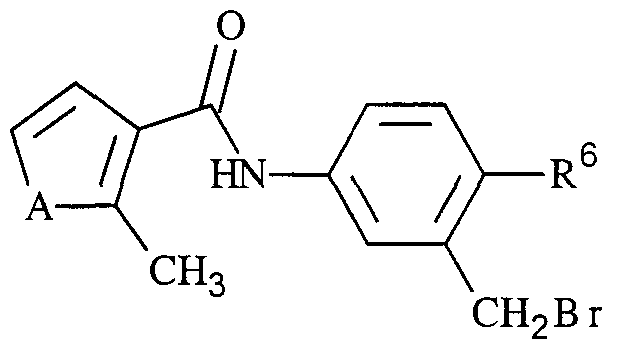
- Step 6 Preparation of N- (3 -bromomethyl-4-chlorophenyl) - 2 -methyl-3 - furancarboxamide 12g of the N- (4-chloro-3 -hydroxymethylphenyl) -2- methyl -3 -furancarboxamide prepared in Step 5 above, was dissolved in 180ml ethyl acetate. 1.8ml of phosphorus tribromide was then added. The resultant mixture was stirred for 90 minutes at room temperature. 100ml of water was then added to the mixture. The resultant organic phase was separated, washed with water, aqueous sodium bicarbonate solution and water, and then dried over magnesium sulfate. The solvent was evaporated off to produce 12.97g of N- (3 -bromomethyl -4 -chlorophenyl) -2- methyl -3 -furancarboxamide as a solid.
- Step 7 Preparation of N-3- ( (2 -chlorophenoxy) methyl) -4- chlorophenyl-2 -methyl-3 - furancarboxamide
- reaction mixture was then passed through a plug of neutral aluminum oxide, eluted with 1:1 ether/hexane and purified by column chromatography on silica gel, to produce 0.77g of N-3- ( (2-chlorophenoxy) methyl) -4- chlorophenyl-2-methyl-3-furancarbothioamide as a yellow solid, mp 116-117°C.
- Nuclear magnetic resonance and mass spectra were consistent with the claimed structure.
- HIV-1 (III B ) was originally obtained from the culture supernatant of persistently HIV-1-infected H9 cells and was provided by R.C. Gallo and M. Popovic (National Cancer Institute, National Institutes of Health, Bethesda, MD) .
- HIV-1 RT mutant strains were done as follows: HIV-l/lOO-Ile ("100- lie") was selected for resistance against TIBO R82150 as described in Balzarini et al , Virology 192 : 246-253 (1993); HIV-l/103-Asn (“103-Asn”) was selected for resistance against TIBO R82913 as described in Balzarini et al, Virology 192: 246-253 (1993); HIV-l/106-Ala (“106- Ala”) was selected for resistance against nevirapine as described in Balzarini et al, J. Virol.
- HIV-l/181- Cys (“181-Cys”) was selected for resistance against pyridinone L-697,661 as described in Balzarini et al , Virology 192 : 246-253 (1993); and HIV-l/188-His (“188- His") was selected for resistance against HEPT as described in Balzarini et al , Mol . Pharmocol . 44 . : 694-701 (1993) .
- 188-His was then further converted to HIV-l/188- Leu ( "188-Leu” ) upon further passage in cell culture in the absence of the HEPT.
- HIV-l/lOl-Glu (101-Glu) and HIV- l/190-Glu (“190-Glu") were selected for resistance against the thiocarboxanilide derivative designated as UC38 as described in Balzarini et al , Antiviral Research 21_ : 219- 236 (1995) .
- HIV-l/184-Ile (“184-Ile”) was selected for resistance against the combination of 3TC and TSAO-m 3 T as described in Balzarini et al, Molecular Pharm. 4_9: 882-890 (1996) .
- HIV-l/184-Val (“184-Val") was selected for resistance against 3TC as described in Balzarini et al, Molecular Pharm. 49: 882-890 (1996).
Landscapes
- Chemical & Material Sciences (AREA)
- Organic Chemistry (AREA)
- Health & Medical Sciences (AREA)
- Life Sciences & Earth Sciences (AREA)
- Animal Behavior & Ethology (AREA)
- Medicinal Chemistry (AREA)
- Veterinary Medicine (AREA)
- Public Health (AREA)
- General Health & Medical Sciences (AREA)
- Pharmacology & Pharmacy (AREA)
- Epidemiology (AREA)
- Virology (AREA)
- Oncology (AREA)
- Nuclear Medicine, Radiotherapy & Molecular Imaging (AREA)
- General Chemical & Material Sciences (AREA)
- AIDS & HIV (AREA)
- Chemical Kinetics & Catalysis (AREA)
- Tropical Medicine & Parasitology (AREA)
- Communicable Diseases (AREA)
- Molecular Biology (AREA)
- Pharmaceuticals Containing Other Organic And Inorganic Compounds (AREA)
- Organic Low-Molecular-Weight Compounds And Preparation Thereof (AREA)
Abstract
Description




Claims


Priority Applications (5)
| Application Number | Priority Date | Filing Date | Title |
|---|---|---|---|
| CA2384134A CA2384134C (en) | 1999-09-17 | 2000-09-12 | N-arylmethylthioanilide compounds useful for the inhibition of the replication of hiv |
| EP00963380A EP1220848B1 (en) | 1999-09-17 | 2000-09-12 | N-arymethylthioanilide compounds useful for the inhibition of the replication of hiv |
| DE60006706T DE60006706T2 (en) | 1999-09-17 | 2000-09-12 | N-ARYLMETHYLTHIOANILIDE DERIVATIVES FOR INHIBITING HIV REPLICATION |
| AT00963380T ATE254611T1 (en) | 1999-09-17 | 2000-09-12 | N-ARYLMETHYLTHIOANILIDE DERIVATIVES FOR INHIBITING HIV REPLICATION |
| DK00963380T DK1220848T3 (en) | 1999-09-17 | 2000-09-12 | N-arylmethylthioanilide compounds useful for inhibiting the replication of HIV |
Applications Claiming Priority (2)
| Application Number | Priority Date | Filing Date | Title |
|---|---|---|---|
| US09/398,649 | 1999-09-17 | ||
| US09/398,649 US6143780A (en) | 1999-09-17 | 1999-09-17 | N-arylmethylthioanilide compounds useful for the inhibition of the replication of HIV |
Publications (2)
| Publication Number | Publication Date |
|---|---|
| WO2001019811A2 true WO2001019811A2 (en) | 2001-03-22 |
| WO2001019811A3 WO2001019811A3 (en) | 2001-07-26 |
Family
ID=23576222
Family Applications (1)
| Application Number | Title | Priority Date | Filing Date |
|---|---|---|---|
| PCT/US2000/024986 Ceased WO2001019811A2 (en) | 1999-09-17 | 2000-09-12 | N-arymethylthioanilide compounds useful for the inhibition of the replication of hiv |
Country Status (8)
| Country | Link |
|---|---|
| US (1) | US6143780A (en) |
| EP (1) | EP1220848B1 (en) |
| AT (1) | ATE254611T1 (en) |
| CA (1) | CA2384134C (en) |
| DE (1) | DE60006706T2 (en) |
| DK (1) | DK1220848T3 (en) |
| ES (1) | ES2211608T3 (en) |
| WO (1) | WO2001019811A2 (en) |
Families Citing this family (11)
| Publication number | Priority date | Publication date | Assignee | Title |
|---|---|---|---|---|
| CN1738797A (en) | 2002-11-19 | 2006-02-22 | 阿基里昂药品公司 | Substituted aryl thioureas and related compounds, inhibitors of viral replication |
| DE102006052504A1 (en) * | 2006-11-06 | 2008-05-08 | Temper, Rupert | Method for producing an agent against an infectious disease |
| LT2848610T (en) * | 2006-11-15 | 2017-11-10 | Ym Biosciences Australia Pty Ltd | Inhibitors of kinase activity |
| DE102008015033A1 (en) * | 2008-03-17 | 2009-09-24 | Aicuris Gmbh & Co. Kg | Substituted (pyrazolyl-carbonyl) imidazolidinones and their use |
| DE102008015032A1 (en) * | 2008-03-17 | 2009-09-24 | Aicuris Gmbh & Co. Kg | Substituted pyrazolamides and their use |
| DE102008062863A1 (en) | 2008-12-17 | 2010-06-24 | Aicuris Gmbh & Co. Kg | Substituted (thiophenyl-carbonyl) imidazolidinones and their use |
| DE102008062878A1 (en) | 2008-12-17 | 2010-06-24 | Aicuris Gmbh & Co. Kg | Substituted furancarboxamides and their use |
| US8993509B2 (en) | 2009-03-31 | 2015-03-31 | Robert Zimmerman | Method for treatment of cachexia by administering inhibitors of adipose triglyceride lipase expression or activity |
| EP3743063A4 (en) * | 2018-01-26 | 2021-10-20 | Nurix Therapeutics, Inc. | CBL-B INHIBITORS AND METHOD OF USING THEREOF |
| AU2020272937B2 (en) | 2019-04-09 | 2024-09-26 | Nurix Therapeutics, Inc. | 3-substituted piperidine compounds for Cbl-b inhibition, and use of a Cbl-b inhibitor in combination with a cancer vaccine and/or oncolytic virus |
| US20250346567A1 (en) * | 2024-05-13 | 2025-11-13 | Pfizer Inc. | Substituted pyridine and phenyl compounds |
Family Cites Families (2)
| Publication number | Priority date | Publication date | Assignee | Title |
|---|---|---|---|---|
| US5696151A (en) * | 1995-11-30 | 1997-12-09 | Uniroyal Chemical Company, Inc. | Compounds useful for the inhibition of the replication of HIV-1 and HIV-1 mutants |
| US6017947A (en) * | 1999-09-17 | 2000-01-25 | Brouwer; Walter Gerhard | Heterocyclic carbodithioperoxyimidic compounds useful for the inhibition of the replication of HIV |
-
1999
- 1999-09-17 US US09/398,649 patent/US6143780A/en not_active Expired - Lifetime
-
2000
- 2000-09-12 DK DK00963380T patent/DK1220848T3/en active
- 2000-09-12 AT AT00963380T patent/ATE254611T1/en active
- 2000-09-12 DE DE60006706T patent/DE60006706T2/en not_active Expired - Lifetime
- 2000-09-12 CA CA2384134A patent/CA2384134C/en not_active Expired - Lifetime
- 2000-09-12 ES ES00963380T patent/ES2211608T3/en not_active Expired - Lifetime
- 2000-09-12 EP EP00963380A patent/EP1220848B1/en not_active Expired - Lifetime
- 2000-09-12 WO PCT/US2000/024986 patent/WO2001019811A2/en not_active Ceased
Also Published As
| Publication number | Publication date |
|---|---|
| ES2211608T3 (en) | 2004-07-16 |
| CA2384134C (en) | 2011-01-18 |
| EP1220848A2 (en) | 2002-07-10 |
| CA2384134A1 (en) | 2001-03-22 |
| US6143780A (en) | 2000-11-07 |
| WO2001019811A3 (en) | 2001-07-26 |
| DE60006706D1 (en) | 2003-12-24 |
| ATE254611T1 (en) | 2003-12-15 |
| DK1220848T3 (en) | 2004-03-29 |
| DE60006706T2 (en) | 2004-08-19 |
| EP1220848B1 (en) | 2003-11-19 |
Similar Documents
| Publication | Publication Date | Title |
|---|---|---|
| CN113292565B (en) | Nucleoside compound and preparation method and application thereof | |
| CN103130710B (en) | Anti-enteric virus71 (EV71) hexanolactam aldehyde compound and its production and use | |
| EP1220848B1 (en) | N-arymethylthioanilide compounds useful for the inhibition of the replication of hiv | |
| CN103145608A (en) | Anti-enterovirus 71 (EV71) caprolactam compounds, and preparation method and application thereof | |
| CN102838523A (en) | Anti-enterovirus 71 (EV71) valerolactam compounds, preparation method and uses thereof | |
| BRPI0711208A2 (en) | compounds, intermediates for the synthesis of compounds, process, pharmaceutical composition, use of a compound and uses | |
| RU2661895C2 (en) | Guanidinobenzoic acid ester compound | |
| JP6867998B2 (en) | Substituted hydrophobic benzenesulfonamide thiazole compounds for use in treating cancer | |
| CN102526087A (en) | Application of nucleoside compound to preparation of medicament for treating enterovirus 71 (EV71) infectious disease | |
| AP902A (en) | Furan and thiophenenecarbothioamide derivatives, their preparation and their use as inhibitors of the replication of HIV-1 and HIV-1 mutants | |
| CN107459511A (en) | Ketone compounds of 4 imino group oxazolidine of anti-enteric virus71 (EV71) 2 and its production and use | |
| CN115894587B (en) | Preparation of a nucleoside derivative and its use in the field of antiviral drugs | |
| WO2022265577A2 (en) | Coronavirus enzyme modulators, methods of synthesis and uses thereof | |
| CN113402414A (en) | Benzoic acid derivative and preparation method and pharmaceutical application thereof | |
| KR101045985B1 (en) | Composition for inhibiting SARS Coronavirus comprising aryl diketoacid derivatives | |
| US6017947A (en) | Heterocyclic carbodithioperoxyimidic compounds useful for the inhibition of the replication of HIV | |
| CN111747944B (en) | Broad-spectrum anti-enveloped virus compound, composition and application thereof | |
| CN105777829B (en) | A kind of prodrug containing nucleoside-like structure, its preparation method, pharmaceutical composition and use thereof | |
| CN107074876B (en) | Macrocyclic heterocyclic compound for inhibiting hepatitis C virus and preparation and application thereof | |
| CN113387909A (en) | Medical application of 2, 3-epoxysuccinyl derivative | |
| JPH0616685A (en) | 2-Formylbenzylphosphonic acid derivative and method for producing the same | |
| CN107663202B (en) | 3-(ureido-methyl)-4-aryl-pyridine derivative and preparation method thereof and application as anti-cancer drug | |
| CA1150268A (en) | Decaprenylamine derivatives | |
| US5914351A (en) | Anti-viral aromatic hydrazones | |
| AU2023275711A1 (en) | Inhibitors of molluscum contagiosum infection and methods using the same |
Legal Events
| Date | Code | Title | Description |
|---|---|---|---|
| AK | Designated states |
Kind code of ref document: A2 Designated state(s): CA |
|
| AL | Designated countries for regional patents |
Kind code of ref document: A2 Designated state(s): AT BE CH CY DE DK ES FI FR GB GR IE IT LU MC NL PT SE |
|
| 121 | Ep: the epo has been informed by wipo that ep was designated in this application | ||
| AK | Designated states |
Kind code of ref document: A3 Designated state(s): CA |
|
| AL | Designated countries for regional patents |
Kind code of ref document: A3 Designated state(s): AT BE CH CY DE DK ES FI FR GB GR IE IT LU MC NL PT SE |
|
| DFPE | Request for preliminary examination filed prior to expiration of 19th month from priority date (pct application filed before 20040101) | ||
| WWE | Wipo information: entry into national phase |
Ref document number: 2384134 Country of ref document: CA |
|
| WWE | Wipo information: entry into national phase |
Ref document number: 2000963380 Country of ref document: EP |
|
| WWP | Wipo information: published in national office |
Ref document number: 2000963380 Country of ref document: EP |
|
| WWG | Wipo information: grant in national office |
Ref document number: 2000963380 Country of ref document: EP |