WO2001025317A2 - Method of treating epoxy resin-cured product - Google Patents
Method of treating epoxy resin-cured product Download PDFInfo
- Publication number
- WO2001025317A2 WO2001025317A2 PCT/JP2000/006951 JP0006951W WO0125317A2 WO 2001025317 A2 WO2001025317 A2 WO 2001025317A2 JP 0006951 W JP0006951 W JP 0006951W WO 0125317 A2 WO0125317 A2 WO 0125317A2
- Authority
- WO
- WIPO (PCT)
- Prior art keywords
- epoxy resin
- cured product
- salts
- treatment liquid
- alkali metal
- Prior art date
- Legal status (The legal status is an assumption and is not a legal conclusion. Google has not performed a legal analysis and makes no representation as to the accuracy of the status listed.)
- Ceased
Links
Classifications
-
- C—CHEMISTRY; METALLURGY
- C08—ORGANIC MACROMOLECULAR COMPOUNDS; THEIR PREPARATION OR CHEMICAL WORKING-UP; COMPOSITIONS BASED THEREON
- C08J—WORKING-UP; GENERAL PROCESSES OF COMPOUNDING; AFTER-TREATMENT NOT COVERED BY SUBCLASSES C08B, C08C, C08F, C08G or C08H
- C08J11/00—Recovery or working-up of waste materials
- C08J11/04—Recovery or working-up of waste materials of polymers
- C08J11/10—Recovery or working-up of waste materials of polymers by chemically breaking down the molecular chains of polymers or breaking of crosslinks, e.g. devulcanisation
- C08J11/16—Recovery or working-up of waste materials of polymers by chemically breaking down the molecular chains of polymers or breaking of crosslinks, e.g. devulcanisation by treatment with inorganic material
-
- C—CHEMISTRY; METALLURGY
- C08—ORGANIC MACROMOLECULAR COMPOUNDS; THEIR PREPARATION OR CHEMICAL WORKING-UP; COMPOSITIONS BASED THEREON
- C08J—WORKING-UP; GENERAL PROCESSES OF COMPOUNDING; AFTER-TREATMENT NOT COVERED BY SUBCLASSES C08B, C08C, C08F, C08G or C08H
- C08J11/00—Recovery or working-up of waste materials
- C08J11/04—Recovery or working-up of waste materials of polymers
- C08J11/10—Recovery or working-up of waste materials of polymers by chemically breaking down the molecular chains of polymers or breaking of crosslinks, e.g. devulcanisation
-
- H—ELECTRICITY
- H05—ELECTRIC TECHNIQUES NOT OTHERWISE PROVIDED FOR
- H05K—PRINTED CIRCUITS; CASINGS OR CONSTRUCTIONAL DETAILS OF ELECTRIC APPARATUS; MANUFACTURE OF ASSEMBLAGES OF ELECTRICAL COMPONENTS
- H05K3/00—Apparatus or processes for manufacturing printed circuits
- H05K3/22—Secondary treatment of printed circuits
- H05K3/28—Applying non-metallic protective coatings
- H05K3/288—Removal of non-metallic coatings, e.g. for repairing
-
- C—CHEMISTRY; METALLURGY
- C08—ORGANIC MACROMOLECULAR COMPOUNDS; THEIR PREPARATION OR CHEMICAL WORKING-UP; COMPOSITIONS BASED THEREON
- C08J—WORKING-UP; GENERAL PROCESSES OF COMPOUNDING; AFTER-TREATMENT NOT COVERED BY SUBCLASSES C08B, C08C, C08F, C08G or C08H
- C08J2363/00—Characterised by the use of epoxy resins; Derivatives of epoxy resins
-
- H—ELECTRICITY
- H05—ELECTRIC TECHNIQUES NOT OTHERWISE PROVIDED FOR
- H05K—PRINTED CIRCUITS; CASINGS OR CONSTRUCTIONAL DETAILS OF ELECTRIC APPARATUS; MANUFACTURE OF ASSEMBLAGES OF ELECTRICAL COMPONENTS
- H05K2203/00—Indexing scheme relating to apparatus or processes for manufacturing printed circuits covered by H05K3/00
- H05K2203/17—Post-manufacturing processes
- H05K2203/178—Demolishing, e.g. recycling, reverse engineering, destroying for security purposes; Using biodegradable materials
-
- Y—GENERAL TAGGING OF NEW TECHNOLOGICAL DEVELOPMENTS; GENERAL TAGGING OF CROSS-SECTIONAL TECHNOLOGIES SPANNING OVER SEVERAL SECTIONS OF THE IPC; TECHNICAL SUBJECTS COVERED BY FORMER USPC CROSS-REFERENCE ART COLLECTIONS [XRACs] AND DIGESTS
- Y02—TECHNOLOGIES OR APPLICATIONS FOR MITIGATION OR ADAPTATION AGAINST CLIMATE CHANGE
- Y02P—CLIMATE CHANGE MITIGATION TECHNOLOGIES IN THE PRODUCTION OR PROCESSING OF GOODS
- Y02P20/00—Technologies relating to chemical industry
- Y02P20/50—Improvements relating to the production of bulk chemicals
- Y02P20/582—Recycling of unreacted starting or intermediate materials
-
- Y—GENERAL TAGGING OF NEW TECHNOLOGICAL DEVELOPMENTS; GENERAL TAGGING OF CROSS-SECTIONAL TECHNOLOGIES SPANNING OVER SEVERAL SECTIONS OF THE IPC; TECHNICAL SUBJECTS COVERED BY FORMER USPC CROSS-REFERENCE ART COLLECTIONS [XRACs] AND DIGESTS
- Y02—TECHNOLOGIES OR APPLICATIONS FOR MITIGATION OR ADAPTATION AGAINST CLIMATE CHANGE
- Y02W—CLIMATE CHANGE MITIGATION TECHNOLOGIES RELATED TO WASTEWATER TREATMENT OR WASTE MANAGEMENT
- Y02W30/00—Technologies for solid waste management
- Y02W30/50—Reuse, recycling or recovery technologies
- Y02W30/62—Plastics recycling; Rubber recycling
Definitions
- the present invention relates to a method of treating an epoxy resin-cured product, a method of separating a composite material of inorganic matter and epoxy resin-cured product, and a treatment liquid for an epoxy resin-cured product .
- Epoxy resin-cured products are used in a variety of fields such as insulating materials , adhesives , and paints due to their superiority in electrical characteristics, heat resistance, and adhesion.
- the epoxy resin becomes infusible and insoluble in general-purpose solvents after it is thermo-cured, it has been difficult to recycle the epoxy resin-cured products and products to which the epoxy resin-cured product adheres or on which the epoxy resin-cured product is applied.
- a technique of grinding, pulverizing, and separating according to specific gravity is a known example of a method of separating a printed wiring board, which is a composite material of epoxy resin-cured product and inorganic matter such as glass fiber and metal, into each component.
- a printed wiring board which is a composite material of epoxy resin-cured product and inorganic matter such as glass fiber and metal
- pulverized glass fibers and resin powders thus obtained can be utilized only as fillers. Therefore their value as valuable goods is significantly low, and, in addition, it has been impossible to separate each component perfectly.
- known examples include a method in which resins of printed wiring boards, laminates or the like are thermal-decomposed to recover metals and glass fibers while the thermal-decomposed resins are gasified or liquidized for the recovery, and a method of recovering not only inorganic matter but also the thermal decomposed resins.
- thermal decomposition of resins requires high temperatures so that obtained metals and inorganic matter are oxidized and denaturalized while resins are oxidized or carbonized, thereby decreasing their value; when resins contain toxic materials such as halogens and lead, separation and treatment of these materials require enormous costs .
- thermosetting resin-cured wastes are not generally preferred.
- organic solvents to separate inorganic matter such as metal and glass.
- thermosetting resins including the epoxy resin are generally poorly soluble in general-purpose solvents as is clear from their definition "resin rendered insoluble and infusible by application of heat"
- general solvents as exemplified in the above publication do not have enough solvency for separation and recovery of resin-cured products. Therefore, pulverization is required as a pretreatment before the dissolving treatment, which places a limitation on the recycling application of recovered inorganic matter such as glass fibers in that recovered inorganic matter can be utilized only as pulverized matter and not as woven or nonwoven fabric without reprocessing.
- Another object of the present invention is to provide a separation method involving decomposition and dissolution of an epoxy resin-cured product to easily separate the inorganic matter and resin components contained in a composite material of inorganic matter and epoxy resin-cured product each in a recyclable state.
- a further object of the present invention is to provide a treatment liquid for an epoxy resin-cured product for use in the above-mentioned two methods.
- etching liquids which contain amide- based solvents and alkali metal compounds but do not contain dangerous chemicals such as concentrated sulfuric acid and chromic acid (see Japanese Unexamined Patent Application Publication No. 8-325436, No. 8-325437, No. 8-325438, No. 9- 316445, and No. 10-126052).
- the decomposition catalyst for epoxy resin-cured products serves as a catalyst to cleave the ether linkage in the epoxy resin, thereby accelerating the decomposition of the epoxy resin swollen with the organic solvent.
- a method of separating a composite material of inorganic matter and epoxy resin-cured product which comprises the following steps (1) and (2):
- a treatment liquid for an epoxy resin- cured product containing a decomposition catalyst for epoxy resin-cured products and an organic solvent.
- the treatment method and separation method according to the present invention can decompose and dissolve the epoxy resin-cured product to easily recover the resin components in a recyclable state without causing thermal decomposition or without requiring pulverization of materials to be treated by using the above-mentioned treatment liquid.
- the decomposition products can be recycled, fur example, as a raw material for synthetic resins.
- the inorganic matter insoluble in the treatment liquid inorganic filler, inorganic fiber, inorganic foil, etc.
- the treatment liquid containing the resin components can easily be separated from the treatment liquid containing the resin components, which enables recycling of the inorganic matter as well as the resin components.
- inorganic fillers and inorganic fibers are dispersed in the treatment liquid by decomposition and dissolution of the resin-cured product, thereby enabling separation and recovery of such inorganic matter.
- a method of treating an epoxy resin-cured product according to the present invention involves treating the epoxy resin-cured product with a treatment liquid containing a decomposition catalyst for epoxy resin-cured products and an organic solvent to decompose and dissolve the epoxy resin-cured product.
- the epoxy resin-cured product to be treated is essentially comprised of an epoxy resin, a curing agent, and a crosslinking agent, and may further contain a curing accelerator, a catalyst, an elastomer, a flame retardant, etc. Components other than the epoxy resin may be present as impurities .
- Any epoxy resin can be an object to be treated as far as it has an epoxy group in the molecule, and examples thereof include bisphenol A-type epoxy resin, bisphenol F- type epoxy resin, bisphenol S-type epoxy resin, alicyclic epoxy resin, aliphatic linear epoxy resin, phenol novolak- type epoxy resin, cresol novolak-type epoxy resin, bisphenol A novolak-type epoxy resin, diglycidyl ethers of biphenols, diglycidyl ethers of naphthalenediols , diglycidyl ethers of phenols, diglycidyl ethers of alcohols, and compounds obtained from the above-mentioned compounds by substitution with an alkyl group, halogenation, or hydrogenation. They can be used singly or in combination.
- epoxy resins whose hydrogen located in the ortho position on the benzene ring with respect to the ether group bonded to the same benzene group is substituted with a halogen atom such as chlorine and bromine.
- halogenated bisphenol compounds such as tetrabromobisphenol A with epichlorohydrin
- examples include halogenated bisphenol A-type epoxy resin, halogenated bisphenol F-type epoxy resin, and halogenated bisphenol S-type epoxy resin.
- any curing agent for epoxy resins can be included as far as it can cure epoxy resins, and examples thereof include multifunctional phenols , amines , imidazole compounds , acid anhydrides , organic phosphorus compounds , and halides of the above-mentioned compounds. Any of these compounds can be used singly or in combination.
- the amount of the curing agent to be blended is not specifically limited as far as it can promote the curing reaction of the epoxy group, the curing agent is preferably included in a range of 0.01 to 5.0 equivalents, more preferably in a range of 0.8 to 1.2 equivalents, relative to one mole of the epoxy group .
- multifunctional phenols examples include monocyclic bifunctional phenols such as hydroquinone , resorcinol, and catechol; polycyclic bifunctional phenols such as bisphenol A, bisphenol F, naphthalenediols , and biphenols ; and these compounds halogenated or substituted with an alkyl group. Novolaks and resols, which are polycondensates of these phenols and aldehydes, can be used as well.
- amines examples include aliphatic or aromatic primary amines , aliphatic or aromatic secondary amines , aliphatic or aromatic tertiary amines, quaternary ammonium salts thereof, alicyclic amines, guanidines, and urea derivatives.
- N,N- benzyldimethylamine 2- (dimethylaminomethyl)phenol, 2,4,6- tris ( dimethylaminomethyl)phenol , tetramethylguanidine , triethanolamine, N,N' -dimethylpiperazine, 1,4- diazabicyclo[2.2.2] octane, 1 , 8-diazabicyclo[ 5.4.0] -7- undecene, 1, 5-diazabicyclo[ 4.4.0 ] -5-nonene, hexamethylenetetramine, pyridine, picoline, piperidine , pyrrolidine, dimethylcyclohexylamine , dimethylhexylamine , cyclohexylamine , diisobutylamine, di-n-butylamine, diphenylamine , N-methylaniline, tri-n-propylamine, tri-n- octylamine, tri-n-
- triphenylamine tetramethylammonium chloride, tetramethylammonium bromide, tetramethylammonium iodide, triethylenetetramine, diaminodiphenylmethane, diaminodiphenyl ether, dicyandiamide, tolylbiguanide, guanylurea, and dimethylurea.
- imidazole compounds include imidazole, 2-ethylimidazole, 2-ethyl-4-methylimidazole, 2- methylimidazole, 2-phenylimidazole, 2-undecylimidazole, 1- benzyl-2-methylimidazole, 2-heptadecylimidazole, 4,5- diphenylimidazole, 2-methylimidazoline, 2-phenylimidazoline, 2-undecylimidazoline, 2-heptadecylimidazoline, 2- isopropylimidazole, 2 , 4-dimethylimidazole, 2-phenyl-4- methylimidazole, 2-ethylidazoline, 2-phenyl-4- methylimidazoline, benzimidazole, and 1-cyanoethylimidazole.
- acid anhydrides examples include phthalic anhydride, hexahydrophthalic anhydride, pyromellitic dianhydride, and benzophenonetetracarboxylic dianhydride.
- Any organic phosphorus compounds can be used as far as it is a phosphorus compound having an organic group.
- Examples thereof include hexamethylphosphoric triamide, tri(dichloropropyl) phosphate, tri(chloropropyl) phosphate, triphenyl phosphite, trimethyl phosphate, phenylphosphonic acid, triphenylphosphine, tri-n-butylphosphine, and diphenylphosphine .
- the epoxy resin-cured product may contain a curing accelerator.
- curing accelerators include, but are not limited to, tertiary amines, imidazoles, and quaternary ammonium salts.
- the epoxy resin-cured product to be subjected to the treatment according to the present invention can be obtained by curing the epoxy resin composition comprising the above- described components using an arbitrary known method and any curing condition can be selected as far as the reaction proceeds.
- any temperature may be used as far as the reaction proceeds, although curing is in general preferably performed at a temperature ranging between room temperature and about 250° C.
- the curing reaction may be carried out either under pressure, under atmospheric pressure, or under reduced pressure.
- the treatment liquid to decompose and dissolve the above-mentioned resin-cured products contains a decomposition catalyst for epoxy resin-cured products and an organic solvent.
- the treatment liquid used in the present invention contains, as essential components, at least a compound that serves as a catalyst for cleavage of the ether linkage of the epoxy resin-cured products and an organic solvent .
- the treatment liquid may further contain arbitrary known compounds other than the two components or even impurities .
- the decomposition catalyst for epoxy resin-cured products contains one or more compounds selected from alkali metals and/or alkali metal compounds, phosphorous-containing acids and/or salts thereof, and organic acids and/or salts thereof.
- the term "one or more compounds” means any combination of these compounds is acceptable and examples thereof include a combination of alkali metal compounds, a combination of phosphorous- containing acids (salts), a combination of an alkali metal compound and a phosphorous-containing acid (salt), and a combination of a phosphorous-containing acid (salt) and an organic acid (salt).
- These compounds are preferably added in an amount of 0.001 to 80 % by weight, especially 0.1 to 30 % by weight in total in the organic solvent.
- the amount When the amount is less than 0.001 % by weight, the decomposition rate of the epoxy resin-cured product tends to be lower, while when the amount exceeds 80 % by weight, the preparation of the treatment liquid tends to be difficult . Moreover, it is not always necessary that all of these compounds are dissolved in the organic solvent, and a saturated solution in which the solute is in an equilibrium state in the solution is also useful because insoluble parts in the saturated solution can supply a source of fresh compounds when the already-dissolved compounds become deactivated during the reaction.
- alkali metals examples include lithium, sodium, potassium, rubidium, and cesium.
- alkali metal compounds include hydrides , hydroxides , borohydrides , amide compounds , fluorides , chlorides , bromides , iodides , borates, phosphates, carbonates, sulfates, nitrates, organic acid salts, alcoholates, and phenolates, obtained from any one of these alkali metals.
- the alkali metal salts are preferably used due to their high solubility in organic solvents, high catalytic effect (ion activity), and low toxicity as ions.
- any of these metals and metal compounds can be used singly or in combination and preferably added in an amount of 0.01 to 80 % by weight, especially 0.1 to 10 % by weight in an organic solvent.
- phosphorous-containing acids used herein include phosphoric acid, metaphosphoric acid, hypophosphoric acid, phosphorous acid (phosphonic acid) , hypophosphorous acid (phosphinic acid), pyrophosphoric acid, trimetaphosphoric acid, tetrametaphosphoric acid, and pyrophosphorous acid.
- the salts of phosphorous-containing acids used herein are salts of anions of the above-mentioned phosphorous-containing acids and cations, and the cations can be, for example, ions of lithium, sodium, potassium, rubidium, cesium, beryllium, magnesium, calcium, strontium, barium, titanium, zirconium, vanadium, chromium, manganese, iron, cobalt, nickel, copper, silver, palladium, zinc, aluminum, gallium, st nnum, or ammonium.
- alkali metal compounds are preferred for the same reason as described above and hydrates are preferred in terms of solubility in solvents .
- These salts can be any one of primary salts having a metal and two hydrogens, secondary salts having two metals and a hydrogen, and a tertiary salts having three metals. Also, these salts can be any one of acidic salts, alkaline salts, and neutral salts. Any of these compounds can be used singly or in combination and preferably added in an amount of 0.01 to 80 % by weight, especially 0.1 to 30 % by weight in an organic solvent.
- organic acids examples include acrylic acid, adipic acid, ascorbic acid, asparagic acid, aminobenzoic acid, alginic acid, benzole acid, oleic acid, formic acid, citric acid, glycolic acid, gluconic acid, glutamic acid, cinnamic acid, succinic acid, acetic acid, salicylic acid, oxalic acid, tartaric acid, toluenesulfonic acid, nicotinic acid, lactic acid, uric acid, halogenated acetic acid, phthalic acid, benzenesulfonic acid, malonic acid, butyric acid, and malic acid.
- the salts of organic acids are salts of anions of the above-mentioned organic acids and cations other than hydrogen, and the cations can be, for example, ions of lithium, sodium, potassium, rubidium, cesium, beryllium, magnesium, calcium, strontium, barium, titanium, zirconium, vanadium, chromium, manganese, iron, cobalt, nickel, copper, silver, palladium, zinc, aluminum, gallium, stannum, or ammonium.
- hydrates and alkali metal salts are preferred for the same reason as described above.
- These salts can be any one of primary salts having a metal and two hydrogens, secondary salts having two metals and a hydrogen, and a tertiary salts having three metals. Also, these salts can be any one of acidic salts, alkaline salts, and neutral salts. Any of these compounds can be used singly or in combination and preferably added in an amount of 0.01 to 80 % by weight, especially 0.1 to 30 % by weight in an organic solvent.
- one or more solvents selected from amide-based, alcohol-based, ketone-based, and ether- based solvents are preferably used in terms of solubility of ionic catalysts, but use can also be made of other solvents such as hydrocarbons , halogenated hydrocarbons , phenols , acetals, fatty acids, acid anhydrides, esters, nitrogen compounds, sulfur compounds (such as dimethylsulfoxide) and solvents having two or more functional groups (ester and ether, alcohol and ether, and the like). Any of these solvents can be used singly or in combination (for example, a combination of amide-based solvents and a combination of an amide-based solvent and a non-amide-based solvent). Furthermore, any solvent can be concurrently employed and inorganic solvents such as water and ammonia may be mixed, and impurities may be present.
- amide-based solvents include formamide, N-methylformamide, N,N-dimethylformamide, N,N- diethylformamide, acetamide, N-methylacetamide, N,N- dimethylacetamide , N,N,N' ,N' -tetramethylurea, 2-pyrrolidone, N-methyl-2-pyrrolidone, caprolactam, and carbamates.
- alcohol-based solvents examples include methanol, ethanol, 1-propanol, 2-propanol, 1-butanol, 2-butanol, iso- butanol, tert-butanol, 1-pentanol, 2-pentaol, 3-pentanol, 2- methyl-1-butanol, iso-pentyl alcohol, tert-pentyl alcohol, 3-methyl- 2-butanol, neopentyl alcohol, 1-hexanol, 2-methyl- 1-pentanol, 4-methyl-2-pentanol, 2-ethyl- 1-butanol, 1- heptanol, 2-heptanol, 3-heptanol, cyclohexanol, 1- methylcyclohexanol, 2-methylcyclohexanol, 3- methylcyclohexanol, 4-methylcyclohexanol, ethylene glycol, ethylene glycol monomethyl ether, ethylene glycol,
- ketone-based solvents examples include acetone, methyl ethyl ketone, 2-pentanone, 3-pentanone, 2-hexanone, methyl isobutyl ketone, 2-heptanone, 4-heptanone, diisobutyl ketone, cyclohexanone , methylcyclohexanone , phorone, and isophorone.
- ether-based solvents examples include dipropyl ether, diisopropyl ether, dibutyl ether, dihexyl ether, anisole, phenetol, dioxane, tetrahydrofuran, acetal, ethylene glycol dimethyl ether, ethylene glycol diethyl ether, diethylene glycol dimethyl ether, and diethylene glycol diethyl ether.
- the treatment liquid may be prepared either in an air atmosphere or in an inert gas and either under atmospheric pressure (normal pressure), under reduced pressure, or under pressure. Other components such as surfactant may be added to the treatment liquid thus obtained.
- the treatment method involving decomposition and dissolution of the epoxy resin-cured product, which is a subject to be treated, with the above-mentioned treatment liquid is not specifically limited, and the treatment may be performed, for example, by immersing the epoxy resin-cured product in the treatment liquid or by spraying the treatment liquid on the epoxy resin-cured product instead of immersing.
- the treatment liquid may be stirred by an agitator, a pump, or blowing of gas. In the case of dipping treatment, the treatment may be conducted while vibrating the treatment liquid by ultrasound.
- the treatment liquid for the treatment of the resin-cured product may be used at an arbitrary temperature ranging between the freezing point and the boiling point of the solvent in order to control the treatment rate.
- the treatment liquid may preferably have a temperature of 250° C or lower in air and 300° C or lower in an inert gas.
- the treatment liquid may be used and stored either in air or in an inert gas, and either under atmospheric pressure, under reduced pressure, or under pressure. Although high pressure may be effective in some cases, atmospheric pressure is more preferred when safety is of concern.
- the size of the subject to be treated is not specifically limited, and the subject may be just in the state as it is disposed of and recovered (for example, a 250 mm-square printed wiring board) or may be crushed and pulverized.
- a crushed and pulverized subject requires a shorter time to be treated, but the recovered materials thus obtained have limited applications.
- the size of crushed pieces is preferably approximately 5 mm or larger, or 10 mm or larger.
- pulverization approximately 1 mm or smaller
- recovered glass fibers find no application for recycling, which may significantly decrease their value.
- the amount of the treatment liquid with respect to the subject is not specifically limited, and if the treatment liquid contacts the subject, such an amount is enough.
- the resin components can be obtained by separating and removing residues (insoluble parts) from the liquid by precipitation after the treatment and removing the organic solvent by distillation.
- the components recovered can be recycled as a raw material for synthetic resins.
- the decomposition products can be recycled in their recovered state or preferably after purification, when the decomposition products obtained after the treatment of the resin-cured product are, for example, phenols, glycidyl ethers of phenols, metal salts of phenols, amines , carboxylic acids , and halogenated or hydrogenated products of the above-mentioned compounds (in the concrete, such as phenol, cresol, dimethylphenol , propylphenol, ethylphenol, hydroquinone , resorcinol, catechol, bisphenol A, bisphenol F, biphenol, dihydroxydiphenyl ether, dihydroxydiphenyl sulfone, phenol novolak, cresol novolak, bisphenol A novolak, and glycidyl ethers of these compounds, halides of these compounds, alkali metal salts of these compounds, and ammonium salts of these compounds).
- phenols, glycidyl ethers of phenols metal salt
- a method of separating a composite material of inorganic matter and epoxy resin-cured product according to the present invention includes the following steps (1) and
- Composite materials of inorganic matter and epoxy resin-cured product to be treated comprise the above- mentioned epoxy resin-cured product and inorganic matter, and are typically insulating boards, metal-clad laminates, or printed wiring boards, which contain metals and glass as inorganic matter.
- the inorganic matter can be, for example, metals and metal oxides , hydroxides , halides , or nitrides . More concretely, examples include boron, aluminum, iron, silicon, titanium, chrome, cobalt, nickel, zinc, palladium, silver, stannum, tungsten, platinum, gold, lead, alumina, zirconia, titania, magnesia, silicon carbide, silicon nitride, boron nitride, mica, silica, clay, glass, carbon, calcium carbonate, aluminum hydroxide, magnesium hydroxide, and calcium silicate. These metals and compounds may be fused or mixed.
- the shape of the inorganic matter may be, for example, powder, granule, fiber, foil, film, wire, or circuit.
- the fiber may be in a mat-like state or woven like fabric.
- the content of inorganic matter in a composite material is arbitrary, it generally ranges from 5 to 90 % by weight based on the total amount of the composite material .
- the inorganic matter is, for example, powdery, granular, or staple-like
- such inorganic matter is blended with the above-mentioned epoxy resin composition for curing, which is cured by cast molding or the like to obtain a composite material of inorganic matter and epoxy resin-cured product.
- the inorganic matter is mat-like or fabriclike, such inorganic matter is immersed in the above- mentioned epoxy resin composition (which may contain powdery, granular, or staple-like inorganic matter as described above) and then partial-cured to obtain a B-stage prepreg.
- Such a B-stage prepreg and laminates obtained by laminating and curing this prepreg or a prepreg at a pre-B-stage are also the composite material of inorganic matter and epoxy resin-cured product.
- the present invention is further applicable to the composite materials of inorganic matter and epoxy resin-cured product such as: resin boards or films covered with a metal foil obtained by coating or flow- coating the metal foil with the above-mentioned epoxy resin composition (which may contain powdery, granular, or staplelike inorganic matter as described above) and then curing the same; resin boards covered with a metal foil obtained by laminating a metal foil onto the above-mentioned prepreg or prepreg at a pre-B-stage and then curing the same; laminates covered with a metal foil obtained by laminating the above- mentioned metal foil-covered resin boards or films (before curing) or metal foil-covered resin boards (which are formed with prepregs and before curing) onto the above-mentioned laminates and then curing the
- the step (1) of treating the composite materials, the resin components thus obtained and recycling thereof are the same as described for the treatment method of the epoxy resin-cured product.
- the separation step (2) is not specifically limited and inorganic matter such as metals and glass can easily be separated from the liquid, for example, by filtration or decantation, for recycling purpose. According to the separation method of the present invention, because subjects to be treated such as substrate need not to be crushed or pulverized before the treatment, inorganic matter can be recovered in such a recyclable state that is suitable for a variety of applications. For example, it is possible to recycle glass fibers (glass fabrics) in their recovered state.
- a treatment liquid for an epoxy resin- cured product according to the present invention contains a decomposition catalyst for epoxy resin-cured products and an organic solvent and is preferably used in the method of treating the epoxy resin-cured product according to the present invention and in the method of separating composite materials of inorganic matter and epoxy resin-cured product according to the present invention.
- the preferred components and preparation method of the treatment liquid are the same as described for the above-mentioned method of treating the epoxy resin-cured product.
- % means % by weight .
- Epoxy resin compositions were prepared by blending a brominated bisphenol A-type epoxy resin (manufactured by
- each epoxy resin was adjusted such that two samples of the epoxy resin composition with a respective bromine content of 20% and 30% relative to the total amount of the epoxy resin composition were obtained.
- the curing agent was added in an amount of 0.5% based on the total amount of the epoxy resins.
- Two samples of the epoxy resin composition obtained in this manner were cured in an oven at 170° C for 60 minutes to obtain two kinds of resin boards with different bromine contents (about 0.5 to about 1.0 mm thick).
- Preparation of treatment liquid In each case of Examples Al to A15, components listed in Table 1 were mixed to prepare a 3% solution of an alkali metal compound in an amide-based, ketone-based, alcohol- based or ether-based organic solvent. In some of these treatment liquids , the alkali metal compound was not completely dissolved and precipitated on the bottom of a tank when the liquids were allowed to stand.
- the treatment liquids were maintained at a predetermined temperature (60°C, 80° C, or 100° C) and agitated hard for one hour.
- the treatment liquids were visually inspected to evaluate the solubility according to the following rating. 5: all dissolved; 4: almost all dissolved; 3: half dissolved; 2: significantly broken; 1: broken to some extent; 0: no change.
- the results are shown in Table 1.
- An epoxy resin composition was prepared by blending a brominated bisphenol A-type epoxy resin (manufactured by Tohto Kasei Co., Ltd., product name "AER8011”; epoxy equivalent 470, bromine content 20%), a high-molecular- weight brominated bisphenol A-type epoxy resin (bromine content 53%, number average molecular weight 25,000; the number average molecular weight was measured by gel permeation chromatography and converted based on a calibration curve prepared with a standard polystyrene), a phenol novolak resin (manufactured by Hitachi Chemical Co., Ltd., product name "HP850N” ; hydroxyl equivalent 106) as a curing agent, and 2-methyl-4-methylimidazole as a curing accelerator.
- a brominated bisphenol A-type epoxy resin manufactured by Tohto Kasei Co., Ltd., product name "AER8011”; epoxy equivalent 470, bromine content 20%
- the amounts of the two epoxy resins and the phenol novolak resin were adjusted such that the ratio of the epoxy equivalent to the hydroxyl equivalent was 1.
- the amount of each epoxy resin was adjusted to give a bromine content of 28% relative to the total amount of the epoxy resin composition excluding the amount of inorganic matter.
- the curing agent was added in an amount of 0.5% based on the total amount of the epoxy resins .
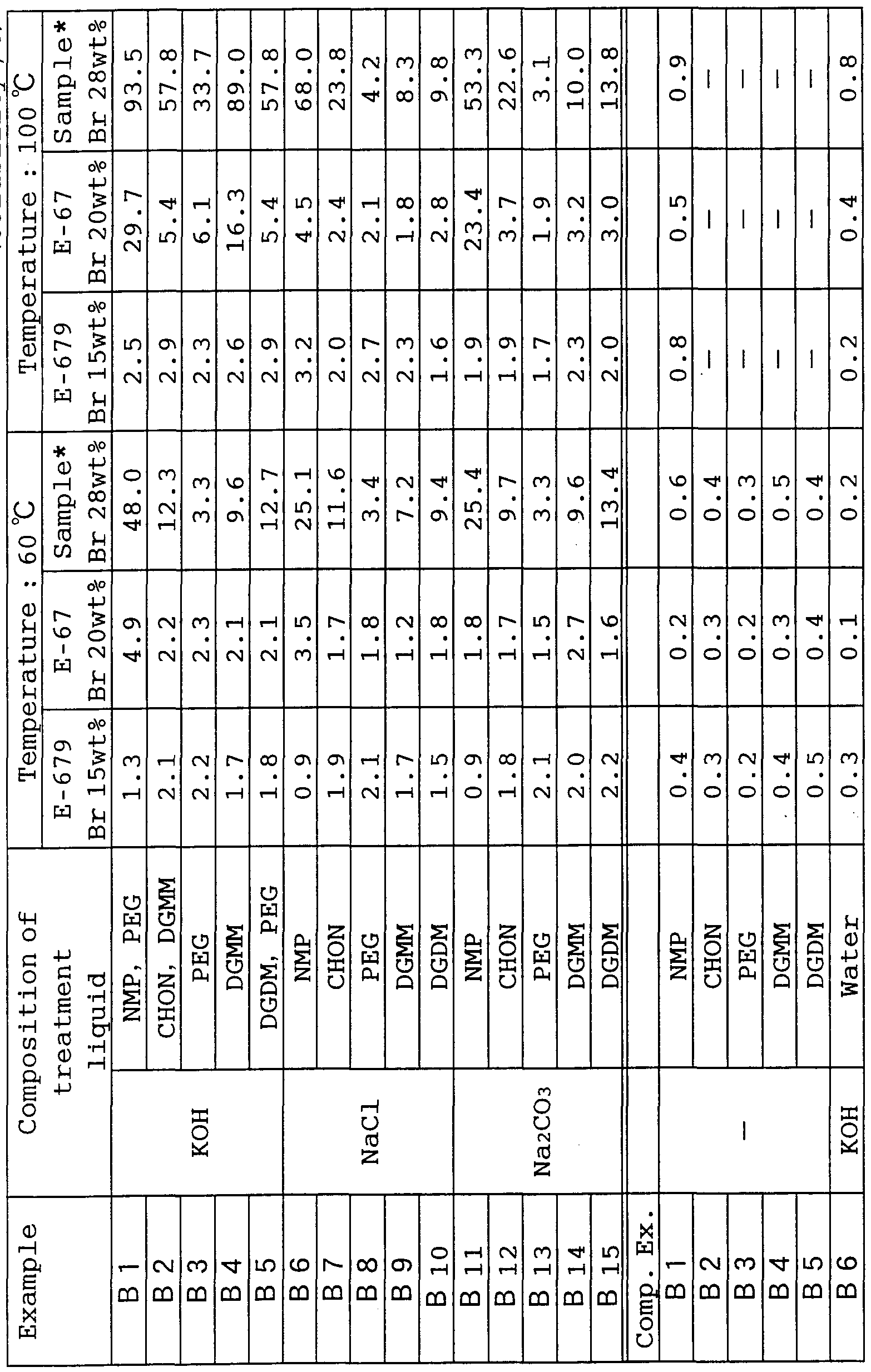
- Examples Bl to B15 components listed in Table 2 were mixed to prepare a 3% solution of an alkali metal compound in an amide-based, ketone-based, alcohol- based or ether-based organic solvent (s).
- the combinations shown in Examples Bl, B2 , and B5 were NMP 80% and PEG 17%, CHON 80% and DGMM 17%, and DGDM 80% and PEG 17%, respectively.
- the alkali metal compound was not completely dissolved and precipitated on the bottom of a tank when the liquids were allowed to stand.
- the compound names in Table 2 are the same as in Table 1.
- Treatment liquid that contained no alkali metal compound was used in each case of Comparative Examples Bl to B5 , and a 3% aqueous solution of sodium hydroxide was prepared in Comparative Example B6.
- the above-mentioned three kinds of test pieces were weighed and then immersed in each of the treatment liquids at a predetermined temperature (60°C or 100° C) . After 60 minutes, the test pieces were taken out from the treatment liquid and weighed again.
- the weight of the resin-cured product before the treatment was calculated from the ratio of the resin in the composite material, and the rate of change in weight of the resin-cured product was calculated from the difference in weight before and after the treatment to obtain a solubility of the resin-cured product in the treatment liquid.
- a brominated epoxy resin-cured product, glass cloth, and copper foil were used to form a composite material, which was heated to 170° C for 90 minutes to cure.
- Dicyandiamide which is an amine, was added as a curing agent of the brominated epoxy resin.
- the amount of the brominated epoxy resin was adjusted to yield a bromine content of the resin-cured product of approximately 20%.
- the sample was cut into a size of 10 mm by 30 mm and three lines of circuit of 1 mm-wide copper foils were formed on the both sides of the cut sample to obtain a test piece. (Preparation of treatment liquid)
- Comparative Examples are: Comparative Examples Cl to C3 where each treatment liquid contained an organic solvent only; Comparative Examples C4 where the treatment liquid contained water only; and Comparative Examples C5 to C21 where each treatment liquid was a 3% aqueous solution of a phosphorous-containing acid or its salt listed in Table 3. (Preparation of composite material)
- Each of above-mentioned treatment liquids was placed in a flask equipped with a condenser, a thermometer, an inlet for nitrogen, and a stirrer and heated to 140° C (for organic solvents) or 100° C (for aqueous solutions) in an oil bath while being mildly stirred under nitrogen gas stream.
- the above-mentioned test piece was weighed, immersed in each treatment liquid for four hours, taken out and weighed again. The change in weight before and after the treatment was divided by the total weight of the resin in the test piece which was weighted beforehand to obtain a solubility of the resin-cured product.
- the solubility was approximately 1% in Comparative Examples Cl to C3 where the treatment liquid was only an organic solvent. And the solubility was 0% in Comparative Examples C4 to C21 where the treatment liquid was only water or an aqueous solution of a phosphorous-containing acid or its salt.
- the treatment liquid dissolved the resin- cured product in all the cases of Examples Cl to C45 where the treatment liquid was an organic solvent solution of a phosphorous -containing acid or its salt although the solubility varied depending on the solvent. In particular, high solubility was shown in Examples CIO, Cll, C30, and C31.
- a composite material of inorganic matter and epoxy resin-cured product was prepared as in Examples C and subjected to the same treatment as in Examples C with a respective one of the treatment liquids containing the components listed in Table 4 to determine the solubility in each treatment liquid.
- the solubility was approximately 1% in Comparative Examples Dl and D2 where the treatment liquid was an organic solvent.
- the solubility was 0% in Comparative Examples D3 to D20 where the treatment liquid was only water or an aqueous solution of an organic acid or its salt.
- the treatment liquid dissolved the resin- cured product in all the cases of Examples Dl to D34 where the treatment liquid was an organic solvent solution of an organic acid or its salt, although the solubility varied depending on the solvent. In particular, high solubility was shown in Examples D3, D6 , D9 , D19, D20, and D21.
- the present disclosure relates to subject matter contained in Japanese Patent Applications NO. HEI11-286187 , filed on October 7, 1999, and No. HEI11-286188 , filed on
Landscapes
- Chemical & Material Sciences (AREA)
- Engineering & Computer Science (AREA)
- Polymers & Plastics (AREA)
- Health & Medical Sciences (AREA)
- Chemical Kinetics & Catalysis (AREA)
- Medicinal Chemistry (AREA)
- Life Sciences & Earth Sciences (AREA)
- Organic Chemistry (AREA)
- Sustainable Development (AREA)
- Manufacturing & Machinery (AREA)
- Microelectronics & Electronic Packaging (AREA)
- Separation, Recovery Or Treatment Of Waste Materials Containing Plastics (AREA)
- Processing Of Solid Wastes (AREA)
- Processing And Handling Of Plastics And Other Materials For Molding In General (AREA)
Abstract
Description




Claims
Priority Applications (4)
| Application Number | Priority Date | Filing Date | Title |
|---|---|---|---|
| AT00964690T ATE293653T1 (en) | 1999-10-07 | 2000-10-05 | METHOD FOR TREATING HARDENED EPOXY RESIN PRODUCTS |
| US10/088,531 US6962628B1 (en) | 1999-10-07 | 2000-10-05 | Method of treating epoxy resin-cured product |
| DE2000619624 DE60019624T2 (en) | 1999-10-07 | 2000-10-05 | METHOD FOR THE TREATMENT OF HARDENED EPOXY RESIN PRODUCTS |
| EP20000964690 EP1220876B1 (en) | 1999-10-07 | 2000-10-05 | Method of treating epoxy resin-cured product |
Applications Claiming Priority (4)
| Application Number | Priority Date | Filing Date | Title |
|---|---|---|---|
| JP28618899 | 1999-10-07 | ||
| JP28618799 | 1999-10-07 | ||
| JP11/286187 | 1999-10-07 | ||
| JP11/286188 | 1999-10-07 |
Publications (2)
| Publication Number | Publication Date |
|---|---|
| WO2001025317A2 true WO2001025317A2 (en) | 2001-04-12 |
| WO2001025317A3 WO2001025317A3 (en) | 2002-05-02 |
Family
ID=26556200
Family Applications (1)
| Application Number | Title | Priority Date | Filing Date |
|---|---|---|---|
| PCT/JP2000/006951 Ceased WO2001025317A2 (en) | 1999-10-07 | 2000-10-05 | Method of treating epoxy resin-cured product |
Country Status (9)
| Country | Link |
|---|---|
| US (1) | US6962628B1 (en) |
| EP (1) | EP1220876B1 (en) |
| KR (1) | KR100468802B1 (en) |
| CN (1) | CN1185286C (en) |
| AT (1) | ATE293653T1 (en) |
| DE (1) | DE60019624T2 (en) |
| ES (1) | ES2239038T3 (en) |
| TW (1) | TWI284572B (en) |
| WO (1) | WO2001025317A2 (en) |
Cited By (4)
| Publication number | Priority date | Publication date | Assignee | Title |
|---|---|---|---|---|
| EP1437378A1 (en) * | 2003-01-09 | 2004-07-14 | Electricité de France | Process for the valorization of waste epoxy resin materials |
| CN101928406A (en) * | 2010-09-02 | 2010-12-29 | 中国科学院宁波材料技术与工程研究所 | A method for catalytically decomposing carbon fiber reinforced thermosetting epoxy resin composites |
| JP2016522842A (en) * | 2013-04-18 | 2016-08-04 | アデッソ アドバーンスト マテリアルズ ウーシー カンパニー リミテッド.Adesso Advanced Materials Wuxi Co.,Ltd. | Novel cyclic acetals, cyclic ketal diamines epoxy curing agents, and degradable polymers and composites based on them |
| US10968329B2 (en) * | 2016-03-08 | 2021-04-06 | Showa Denko Materials Co., Ltd. | Method of recovering decomposition product of thermosetting resin cured product and method of producing recycled material |
Families Citing this family (27)
| Publication number | Priority date | Publication date | Assignee | Title |
|---|---|---|---|---|
| KR20040098179A (en) * | 2003-05-14 | 2004-11-20 | 리퀴드테크놀로지(주) | Composition for removal residue of sensitive photoresist |
| US20050066995A1 (en) * | 2003-09-30 | 2005-03-31 | International Business Machines Corporation | Non-hermetic encapsulant removal for module rework |
| JP4945347B2 (en) * | 2007-07-13 | 2012-06-06 | 株式会社日立産機システム | How to recycle electrical equipment |
| CN101891902B (en) * | 2010-07-23 | 2012-05-23 | 浙江理工大学 | A kind of recycling method of waste epoxy resin |
| CN102218439A (en) * | 2011-01-24 | 2011-10-19 | 同济大学 | Method for pyrolysis separation of valuable components from substrates of waste printed circuit boards |
| US10752748B2 (en) * | 2011-07-08 | 2020-08-25 | Adesso Advanced Materials Wuhu Co., Ltd. | Methods for recycling reinforced composites |
| CN102343355A (en) * | 2011-07-26 | 2012-02-08 | 广东联塑科技实业有限公司 | Production technology for plastic-coated and lining plastic defective products |
| CN102391711B (en) * | 2011-09-13 | 2013-06-19 | 天津德高化成电子材料有限公司 | Epoxy resin and silicon resin cured coating and encapsulation removing agent |
| CN102617885B (en) * | 2012-03-28 | 2014-08-13 | 四川大学 | Method for recovering waste thermosetting resin and composite materials thereof through solvents |
| CN102699011B (en) * | 2012-06-21 | 2014-10-01 | 上海大学 | Method for treating waste circuit boards with dimethyl sulfoxide |
| WO2015030813A1 (en) | 2013-08-30 | 2015-03-05 | Halliburton Energy Services, Inc. | Removing cured resins from subterranean formations and completions |
| WO2015069288A1 (en) | 2013-11-11 | 2015-05-14 | Halliburton Energy Services, Inc. | Removing resin coatings from surfaces |
| US20150321936A1 (en) * | 2014-05-08 | 2015-11-12 | Avantech, Inc. | Method for resin, solids, and sludge solidification, stabilization, and reduction of disposal volume |
| US20170096540A1 (en) * | 2015-10-06 | 2017-04-06 | Korea Institute Of Science And Technology | Method and composition for swelling pretreatment before decomposition of cured theremosetting resin materials |
| CN108779286A (en) * | 2016-03-08 | 2018-11-09 | 日立化成株式会社 | Treatment method of thermosetting resin cured product |
| WO2017154097A1 (en) | 2016-03-08 | 2017-09-14 | 日立化成株式会社 | Inorganic material separation method, reprocessed material production method, and organic substance removal method |
| KR102109653B1 (en) * | 2016-07-27 | 2020-05-13 | 한국기계연구원 | Chemically dissolvable thermosetting resin composition for recycling of fiber-reinforeced composite and dissolution method thereof |
| CN109365487B (en) * | 2018-11-30 | 2020-07-07 | 清远市进田企业有限公司 | Efficient energy-saving cleaning process for epoxy coating in waste circuit board |
| CN109852307A (en) * | 2018-12-19 | 2019-06-07 | 无锡嘉联电子材料有限公司 | A kind of method of useless epoxy potting compound recycling and reusing |
| TWI744750B (en) | 2019-12-23 | 2021-11-01 | 財團法人工業技術研究院 | Method for degradating thermosetting resin, catalyst composition used therein and resin composition obtained thereby |
| CN111171373A (en) * | 2020-03-09 | 2020-05-19 | 艾达索高新材料芜湖有限公司 | Recovery method of fiber reinforced composite material |
| CN114534734B (en) * | 2020-11-27 | 2024-02-27 | 万华化学集团股份有限公司 | A solid base catalyst for the synthesis of 3,5-dimethylphenol by acetone gas phase method and its preparation method and application |
| JP2024507883A (en) * | 2021-02-18 | 2024-02-21 | インテグレーテッド リサイクリング テクノロジーズ コーポレーション | Chemical separation of waste printed circuit boards |
| CN113522885B (en) * | 2021-07-09 | 2023-05-09 | 东莞理工学院 | A method for treating waste printed circuit boards with near-critical fluid |
| CN114290472B (en) * | 2021-12-03 | 2023-02-03 | 西南林业大学 | Method for recovering urea resin and raw materials from wood-based panel and application |
| CN115232633B (en) * | 2022-08-18 | 2024-04-12 | 华北电力大学 | A method for pyrolyzing waste engineering plastics to co-produce phenolic chemicals and supercapacitor carbon materials |
| TWI833599B (en) * | 2022-08-26 | 2024-02-21 | 日商德山股份有限公司 | Processing liquid for semiconductors and manufacturing method of semiconductor elements |
Family Cites Families (21)
| Publication number | Priority date | Publication date | Assignee | Title |
|---|---|---|---|---|
| US3551204A (en) * | 1967-08-08 | 1970-12-29 | Amicon Corp | Process and composition for recovering electronic devices from encapsulation in potting compounds |
| US3625763A (en) * | 1968-12-04 | 1971-12-07 | Bunker Ramo | Conformal coating stripping method and composition |
| US3673099A (en) * | 1970-10-19 | 1972-06-27 | Bell Telephone Labor Inc | Process and composition for stripping cured resins from substrates |
| US3770528A (en) * | 1971-09-29 | 1973-11-06 | Martin Processing Co Inc | Method for the surface treatment of polyimide materials |
| US4089704A (en) * | 1976-12-27 | 1978-05-16 | Bell Telephone Laboratories, Incorporated | Removal of RTV silicon rubber encapsulants |
| US4276186A (en) * | 1979-06-26 | 1981-06-30 | International Business Machines Corporation | Cleaning composition and use thereof |
| US4316322A (en) * | 1979-10-25 | 1982-02-23 | Burroughs Corporation | Method of fabricating electrical contacts in a printed circuit board |
| US4278557A (en) * | 1980-04-15 | 1981-07-14 | The United States Of America As Represented By The Secretary Of The Air Force | Solvent mixture for dissolving and removing epoxy resinous compounds |
| US4428871A (en) * | 1981-09-23 | 1984-01-31 | J. T. Baker Chemical Company | Stripping compositions and methods of stripping resists |
| US4741784A (en) * | 1984-11-26 | 1988-05-03 | Kote-Off, Inc. | Composition and method for removing conformal coatings |
| US5536439A (en) * | 1995-03-13 | 1996-07-16 | Gage Products Company | Non-abrasive line cleaning composition |
| JP3286117B2 (en) * | 1995-06-01 | 2002-05-27 | 日立化成工業株式会社 | Epoxy resin cured product etchant |
| JP3286116B2 (en) * | 1995-06-01 | 2002-05-27 | 日立化成工業株式会社 | Epoxy resin cured product etchant |
| JPH08325439A (en) | 1995-06-01 | 1996-12-10 | Nitto Boseki Co Ltd | Silane coupling agent for manufacturing glass fiber reinforced epoxy resin moldings |
| JP3286115B2 (en) * | 1995-06-01 | 2002-05-27 | 日立化成工業株式会社 | Epoxy resin cured product etchant |
| JPH09316445A (en) * | 1996-05-31 | 1997-12-09 | Hitachi Chem Co Ltd | Etching solution for epoxy resin cured product |
| JP4062554B2 (en) * | 1996-10-18 | 2008-03-19 | 日立化成工業株式会社 | Etching solution for cured epoxy resin |
| JP3544834B2 (en) | 1997-03-17 | 2004-07-21 | 株式会社東芝 | Mixed waste treatment equipment |
| JPH10314716A (en) | 1997-05-14 | 1998-12-02 | Hakusui Sangyo:Kk | Sewage purification device and sewage purification system |
| US6245822B1 (en) * | 1998-04-27 | 2001-06-12 | Matsushita Electric Industrial Co. Ltd. | Method and apparatus for decomposition treating article having cured thermosetting resin |
| JP3994660B2 (en) * | 2000-12-22 | 2007-10-24 | 日立化成工業株式会社 | Decomposition treatment liquid for unsaturated polyester resin cured product, treatment method for unsaturated polyester resin cured product using the treatment liquid, and separation method for composite material |
-
2000
- 2000-10-05 US US10/088,531 patent/US6962628B1/en not_active Expired - Lifetime
- 2000-10-05 EP EP20000964690 patent/EP1220876B1/en not_active Expired - Lifetime
- 2000-10-05 DE DE2000619624 patent/DE60019624T2/en not_active Expired - Lifetime
- 2000-10-05 WO PCT/JP2000/006951 patent/WO2001025317A2/en not_active Ceased
- 2000-10-05 ES ES00964690T patent/ES2239038T3/en not_active Expired - Lifetime
- 2000-10-05 AT AT00964690T patent/ATE293653T1/en active
- 2000-10-05 KR KR10-2002-7004386A patent/KR100468802B1/en not_active Expired - Fee Related
- 2000-10-05 CN CNB008191166A patent/CN1185286C/en not_active Expired - Lifetime
- 2000-10-07 TW TW89120988A patent/TWI284572B/en not_active IP Right Cessation
Cited By (5)
| Publication number | Priority date | Publication date | Assignee | Title |
|---|---|---|---|---|
| EP1437378A1 (en) * | 2003-01-09 | 2004-07-14 | Electricité de France | Process for the valorization of waste epoxy resin materials |
| FR2849854A1 (en) * | 2003-01-09 | 2004-07-16 | Electricite De France | PROCESS FOR RECOVERING WASTE MATERIALS BASED ON EPOXIDE RESIN. |
| CN101928406A (en) * | 2010-09-02 | 2010-12-29 | 中国科学院宁波材料技术与工程研究所 | A method for catalytically decomposing carbon fiber reinforced thermosetting epoxy resin composites |
| JP2016522842A (en) * | 2013-04-18 | 2016-08-04 | アデッソ アドバーンスト マテリアルズ ウーシー カンパニー リミテッド.Adesso Advanced Materials Wuxi Co.,Ltd. | Novel cyclic acetals, cyclic ketal diamines epoxy curing agents, and degradable polymers and composites based on them |
| US10968329B2 (en) * | 2016-03-08 | 2021-04-06 | Showa Denko Materials Co., Ltd. | Method of recovering decomposition product of thermosetting resin cured product and method of producing recycled material |
Also Published As
| Publication number | Publication date |
|---|---|
| WO2001025317A3 (en) | 2002-05-02 |
| TWI284572B (en) | 2007-08-01 |
| CN1185286C (en) | 2005-01-19 |
| DE60019624T2 (en) | 2006-03-09 |
| KR20020085880A (en) | 2002-11-16 |
| EP1220876A2 (en) | 2002-07-10 |
| DE60019624D1 (en) | 2005-05-25 |
| KR100468802B1 (en) | 2005-02-02 |
| ATE293653T1 (en) | 2005-05-15 |
| EP1220876B1 (en) | 2005-04-20 |
| CN1434838A (en) | 2003-08-06 |
| ES2239038T3 (en) | 2005-09-16 |
| US6962628B1 (en) | 2005-11-08 |
Similar Documents
| Publication | Publication Date | Title |
|---|---|---|
| EP1220876B1 (en) | Method of treating epoxy resin-cured product | |
| JP4051873B2 (en) | Recycling method of composite material of inorganic and cured epoxy resin | |
| JP4967885B2 (en) | Recycling method for cured epoxy resin | |
| JP2010065230A (en) | Process liquid for decomposition or dissolution of ester bond-containing macromolecule, treating method using the process liquid, and method of separating composite material | |
| EP2123688A1 (en) | Novel phosphorus-containing epoxy resin, epoxy resin composition essentially containing the epoxy resin, and cured product of the epoxy resin composition | |
| JPH0649402A (en) | Solder resist ink composition and its cured product | |
| JP4765202B2 (en) | Treatment solution for cured epoxy resin, treatment method and treatment product using the same | |
| JP2000219799A (en) | Flame retardant epoxy resin composition and laminate | |
| JP2005255902A (en) | Treating liquid for epoxy resin cured product, and treating method using the same | |
| JP5793990B2 (en) | Method for opening semiconductor package and method for inspecting semiconductor package | |
| JPH08325438A (en) | Etchant for cured epoxy resin | |
| JP4645160B2 (en) | Treatment liquid for decomposition or dissolution of ester bond-containing polymer, treatment method using the treatment liquid, and separation method of composite material | |
| JP2003133688A (en) | Recycling method and processing method of printed wiring board | |
| JPH08134238A (en) | Production of epoxy resin prepreg | |
| JP5002865B2 (en) | Epoxy adhesive film and adhesion method | |
| JP4143876B2 (en) | Etching solution management method for cured epoxy resin and etching method for cured epoxy resin using the management method | |
| JPH09268218A (en) | Production of epoxy resin, epoxy resin composition and irs cured material | |
| JP2000143847A (en) | Etching method for cured epoxy resin | |
| JP2005220198A (en) | Dehalogenation method of halogen-containing epoxy resin | |
| JPH06298904A (en) | Epoxy resin composition, epoxy resin mixture and its cured material | |
| JP2003286332A (en) | Method for producing insulating resin sheet and insulating resin with metal foil | |
| JP2009221487A (en) | Method for producing high molecular weight epoxy resin | |
| JP2000143844A (en) | Etching process for epoxy resin cured product | |
| JP2006273949A (en) | Laminate resin composition, prepreg and laminate | |
| JP3529118B2 (en) | Epoxy resin, epoxy resin composition and cured product thereof |
Legal Events
| Date | Code | Title | Description |
|---|---|---|---|
| AK | Designated states |
Kind code of ref document: A2 Designated state(s): CN KR SG US |
|
| AL | Designated countries for regional patents |
Kind code of ref document: A2 Designated state(s): AT BE CH CY DE DK ES FI FR GB GR IE IT LU MC NL PT SE |
|
| 121 | Ep: the epo has been informed by wipo that ep was designated in this application | ||
| WWE | Wipo information: entry into national phase |
Ref document number: 1020027004386 Country of ref document: KR |
|
| WWE | Wipo information: entry into national phase |
Ref document number: 008191166 Country of ref document: CN |
|
| WWE | Wipo information: entry into national phase |
Ref document number: 2000964690 Country of ref document: EP |
|
| WWE | Wipo information: entry into national phase |
Ref document number: 10088531 Country of ref document: US |
|
| WWP | Wipo information: published in national office |
Ref document number: 2000964690 Country of ref document: EP |
|
| DFPE | Request for preliminary examination filed prior to expiration of 19th month from priority date (pct application filed before 20040101) | ||
| WWP | Wipo information: published in national office |
Ref document number: 1020027004386 Country of ref document: KR |
|
| WWG | Wipo information: grant in national office |
Ref document number: 1020027004386 Country of ref document: KR |
|
| WWG | Wipo information: grant in national office |
Ref document number: 2000964690 Country of ref document: EP |