WO2001025385A1 - Fabric softener compositions - Google Patents
Fabric softener compositions Download PDFInfo
- Publication number
- WO2001025385A1 WO2001025385A1 PCT/EP2000/009399 EP0009399W WO0125385A1 WO 2001025385 A1 WO2001025385 A1 WO 2001025385A1 EP 0009399 W EP0009399 W EP 0009399W WO 0125385 A1 WO0125385 A1 WO 0125385A1
- Authority
- WO
- WIPO (PCT)
- Prior art keywords
- composition
- polyorganosiloxane
- use according
- formula
- alkyl
- Prior art date
- Legal status (The legal status is an assumption and is not a legal conclusion. Google has not performed a legal analysis and makes no representation as to the accuracy of the status listed.)
- Ceased
Links
- 0 CC1(C)*C(C)(C)CC(*)C1 Chemical compound CC1(C)*C(C)(C)CC(*)C1 0.000 description 2
Classifications
-
- C—CHEMISTRY; METALLURGY
- C11—ANIMAL OR VEGETABLE OILS, FATS, FATTY SUBSTANCES OR WAXES; FATTY ACIDS THEREFROM; DETERGENTS; CANDLES
- C11D—DETERGENT COMPOSITIONS; USE OF SINGLE SUBSTANCES AS DETERGENTS; SOAP OR SOAP-MAKING; RESIN SOAPS; RECOVERY OF GLYCEROL
- C11D3/00—Other compounding ingredients of detergent compositions covered in group C11D1/00
- C11D3/16—Organic compounds
- C11D3/37—Polymers
- C11D3/3746—Macromolecular compounds obtained by reactions only involving carbon-to-carbon unsaturated bonds
- C11D3/3749—Polyolefins; Halogenated polyolefins; Natural or synthetic rubber; Polyarylolefins or halogenated polyarylolefins
-
- C—CHEMISTRY; METALLURGY
- C11—ANIMAL OR VEGETABLE OILS, FATS, FATTY SUBSTANCES OR WAXES; FATTY ACIDS THEREFROM; DETERGENTS; CANDLES
- C11D—DETERGENT COMPOSITIONS; USE OF SINGLE SUBSTANCES AS DETERGENTS; SOAP OR SOAP-MAKING; RESIN SOAPS; RECOVERY OF GLYCEROL
- C11D1/00—Detergent compositions based essentially on surface-active compounds; Use of these compounds as a detergent
- C11D1/38—Cationic compounds
- C11D1/645—Mixtures of compounds all of which are cationic
-
- C—CHEMISTRY; METALLURGY
- C11—ANIMAL OR VEGETABLE OILS, FATS, FATTY SUBSTANCES OR WAXES; FATTY ACIDS THEREFROM; DETERGENTS; CANDLES
- C11D—DETERGENT COMPOSITIONS; USE OF SINGLE SUBSTANCES AS DETERGENTS; SOAP OR SOAP-MAKING; RESIN SOAPS; RECOVERY OF GLYCEROL
- C11D17/00—Detergent materials or soaps characterised by their shape or physical properties
- C11D17/0008—Detergent materials or soaps characterised by their shape or physical properties aqueous liquid non soap compositions
- C11D17/0017—Multi-phase liquid compositions
-
- C—CHEMISTRY; METALLURGY
- C11—ANIMAL OR VEGETABLE OILS, FATS, FATTY SUBSTANCES OR WAXES; FATTY ACIDS THEREFROM; DETERGENTS; CANDLES
- C11D—DETERGENT COMPOSITIONS; USE OF SINGLE SUBSTANCES AS DETERGENTS; SOAP OR SOAP-MAKING; RESIN SOAPS; RECOVERY OF GLYCEROL
- C11D17/00—Detergent materials or soaps characterised by their shape or physical properties
- C11D17/04—Detergent materials or soaps characterised by their shape or physical properties combined with or containing other objects
- C11D17/041—Compositions releasably affixed on a substrate or incorporated into a dispensing means
- C11D17/046—Insoluble free body dispenser
-
- C—CHEMISTRY; METALLURGY
- C11—ANIMAL OR VEGETABLE OILS, FATS, FATTY SUBSTANCES OR WAXES; FATTY ACIDS THEREFROM; DETERGENTS; CANDLES
- C11D—DETERGENT COMPOSITIONS; USE OF SINGLE SUBSTANCES AS DETERGENTS; SOAP OR SOAP-MAKING; RESIN SOAPS; RECOVERY OF GLYCEROL
- C11D17/00—Detergent materials or soaps characterised by their shape or physical properties
- C11D17/04—Detergent materials or soaps characterised by their shape or physical properties combined with or containing other objects
- C11D17/041—Compositions releasably affixed on a substrate or incorporated into a dispensing means
- C11D17/047—Arrangements specially adapted for dry cleaning or laundry dryer related applications
-
- C—CHEMISTRY; METALLURGY
- C11—ANIMAL OR VEGETABLE OILS, FATS, FATTY SUBSTANCES OR WAXES; FATTY ACIDS THEREFROM; DETERGENTS; CANDLES
- C11D—DETERGENT COMPOSITIONS; USE OF SINGLE SUBSTANCES AS DETERGENTS; SOAP OR SOAP-MAKING; RESIN SOAPS; RECOVERY OF GLYCEROL
- C11D17/00—Detergent materials or soaps characterised by their shape or physical properties
- C11D17/06—Powder; Flakes; Free-flowing mixtures; Sheets
-
- C—CHEMISTRY; METALLURGY
- C11—ANIMAL OR VEGETABLE OILS, FATS, FATTY SUBSTANCES OR WAXES; FATTY ACIDS THEREFROM; DETERGENTS; CANDLES
- C11D—DETERGENT COMPOSITIONS; USE OF SINGLE SUBSTANCES AS DETERGENTS; SOAP OR SOAP-MAKING; RESIN SOAPS; RECOVERY OF GLYCEROL
- C11D3/00—Other compounding ingredients of detergent compositions covered in group C11D1/00
- C11D3/0005—Other compounding ingredients characterised by their effect
- C11D3/001—Softening compositions
-
- C—CHEMISTRY; METALLURGY
- C11—ANIMAL OR VEGETABLE OILS, FATS, FATTY SUBSTANCES OR WAXES; FATTY ACIDS THEREFROM; DETERGENTS; CANDLES
- C11D—DETERGENT COMPOSITIONS; USE OF SINGLE SUBSTANCES AS DETERGENTS; SOAP OR SOAP-MAKING; RESIN SOAPS; RECOVERY OF GLYCEROL
- C11D3/00—Other compounding ingredients of detergent compositions covered in group C11D1/00
- C11D3/0005—Other compounding ingredients characterised by their effect
- C11D3/001—Softening compositions
- C11D3/0015—Softening compositions liquid
-
- C—CHEMISTRY; METALLURGY
- C11—ANIMAL OR VEGETABLE OILS, FATS, FATTY SUBSTANCES OR WAXES; FATTY ACIDS THEREFROM; DETERGENTS; CANDLES
- C11D—DETERGENT COMPOSITIONS; USE OF SINGLE SUBSTANCES AS DETERGENTS; SOAP OR SOAP-MAKING; RESIN SOAPS; RECOVERY OF GLYCEROL
- C11D3/00—Other compounding ingredients of detergent compositions covered in group C11D1/00
- C11D3/02—Inorganic compounds ; Elemental compounds
- C11D3/04—Water-soluble compounds
- C11D3/042—Acids
-
- C—CHEMISTRY; METALLURGY
- C11—ANIMAL OR VEGETABLE OILS, FATS, FATTY SUBSTANCES OR WAXES; FATTY ACIDS THEREFROM; DETERGENTS; CANDLES
- C11D—DETERGENT COMPOSITIONS; USE OF SINGLE SUBSTANCES AS DETERGENTS; SOAP OR SOAP-MAKING; RESIN SOAPS; RECOVERY OF GLYCEROL
- C11D3/00—Other compounding ingredients of detergent compositions covered in group C11D1/00
- C11D3/02—Inorganic compounds ; Elemental compounds
- C11D3/12—Water-insoluble compounds
- C11D3/124—Silicon containing, e.g. silica, silex, quartz or glass beads
-
- C—CHEMISTRY; METALLURGY
- C11—ANIMAL OR VEGETABLE OILS, FATS, FATTY SUBSTANCES OR WAXES; FATTY ACIDS THEREFROM; DETERGENTS; CANDLES
- C11D—DETERGENT COMPOSITIONS; USE OF SINGLE SUBSTANCES AS DETERGENTS; SOAP OR SOAP-MAKING; RESIN SOAPS; RECOVERY OF GLYCEROL
- C11D3/00—Other compounding ingredients of detergent compositions covered in group C11D1/00
- C11D3/16—Organic compounds
- C11D3/26—Organic compounds containing nitrogen
- C11D3/32—Amides; Substituted amides
-
- C—CHEMISTRY; METALLURGY
- C11—ANIMAL OR VEGETABLE OILS, FATS, FATTY SUBSTANCES OR WAXES; FATTY ACIDS THEREFROM; DETERGENTS; CANDLES
- C11D—DETERGENT COMPOSITIONS; USE OF SINGLE SUBSTANCES AS DETERGENTS; SOAP OR SOAP-MAKING; RESIN SOAPS; RECOVERY OF GLYCEROL
- C11D3/00—Other compounding ingredients of detergent compositions covered in group C11D1/00
- C11D3/16—Organic compounds
- C11D3/37—Polymers
- C11D3/3703—Macromolecular compounds obtained otherwise than by reactions only involving carbon-to-carbon unsaturated bonds
- C11D3/3726—Polyurethanes
-
- C—CHEMISTRY; METALLURGY
- C11—ANIMAL OR VEGETABLE OILS, FATS, FATTY SUBSTANCES OR WAXES; FATTY ACIDS THEREFROM; DETERGENTS; CANDLES
- C11D—DETERGENT COMPOSITIONS; USE OF SINGLE SUBSTANCES AS DETERGENTS; SOAP OR SOAP-MAKING; RESIN SOAPS; RECOVERY OF GLYCEROL
- C11D3/00—Other compounding ingredients of detergent compositions covered in group C11D1/00
- C11D3/16—Organic compounds
- C11D3/37—Polymers
- C11D3/3703—Macromolecular compounds obtained otherwise than by reactions only involving carbon-to-carbon unsaturated bonds
- C11D3/373—Macromolecular compounds obtained otherwise than by reactions only involving carbon-to-carbon unsaturated bonds containing silicones
-
- C—CHEMISTRY; METALLURGY
- C11—ANIMAL OR VEGETABLE OILS, FATS, FATTY SUBSTANCES OR WAXES; FATTY ACIDS THEREFROM; DETERGENTS; CANDLES
- C11D—DETERGENT COMPOSITIONS; USE OF SINGLE SUBSTANCES AS DETERGENTS; SOAP OR SOAP-MAKING; RESIN SOAPS; RECOVERY OF GLYCEROL
- C11D3/00—Other compounding ingredients of detergent compositions covered in group C11D1/00
- C11D3/16—Organic compounds
- C11D3/37—Polymers
- C11D3/3703—Macromolecular compounds obtained otherwise than by reactions only involving carbon-to-carbon unsaturated bonds
- C11D3/373—Macromolecular compounds obtained otherwise than by reactions only involving carbon-to-carbon unsaturated bonds containing silicones
- C11D3/3738—Alkoxylated silicones
-
- C—CHEMISTRY; METALLURGY
- C11—ANIMAL OR VEGETABLE OILS, FATS, FATTY SUBSTANCES OR WAXES; FATTY ACIDS THEREFROM; DETERGENTS; CANDLES
- C11D—DETERGENT COMPOSITIONS; USE OF SINGLE SUBSTANCES AS DETERGENTS; SOAP OR SOAP-MAKING; RESIN SOAPS; RECOVERY OF GLYCEROL
- C11D3/00—Other compounding ingredients of detergent compositions covered in group C11D1/00
- C11D3/16—Organic compounds
- C11D3/37—Polymers
- C11D3/3703—Macromolecular compounds obtained otherwise than by reactions only involving carbon-to-carbon unsaturated bonds
- C11D3/373—Macromolecular compounds obtained otherwise than by reactions only involving carbon-to-carbon unsaturated bonds containing silicones
- C11D3/3742—Nitrogen containing silicones
-
- C—CHEMISTRY; METALLURGY
- C11—ANIMAL OR VEGETABLE OILS, FATS, FATTY SUBSTANCES OR WAXES; FATTY ACIDS THEREFROM; DETERGENTS; CANDLES
- C11D—DETERGENT COMPOSITIONS; USE OF SINGLE SUBSTANCES AS DETERGENTS; SOAP OR SOAP-MAKING; RESIN SOAPS; RECOVERY OF GLYCEROL
- C11D1/00—Detergent compositions based essentially on surface-active compounds; Use of these compounds as a detergent
- C11D1/38—Cationic compounds
- C11D1/52—Carboxylic amides, alkylolamides or imides or their condensation products with alkylene oxides
- C11D1/523—Carboxylic alkylolamides, or dialkylolamides, or hydroxycarboxylic amides (R1-CO-NR2R3), where R1, R2 or R3 contain one hydroxy group per alkyl group
-
- C—CHEMISTRY; METALLURGY
- C11—ANIMAL OR VEGETABLE OILS, FATS, FATTY SUBSTANCES OR WAXES; FATTY ACIDS THEREFROM; DETERGENTS; CANDLES
- C11D—DETERGENT COMPOSITIONS; USE OF SINGLE SUBSTANCES AS DETERGENTS; SOAP OR SOAP-MAKING; RESIN SOAPS; RECOVERY OF GLYCEROL
- C11D1/00—Detergent compositions based essentially on surface-active compounds; Use of these compounds as a detergent
- C11D1/38—Cationic compounds
- C11D1/62—Quaternary ammonium compounds
-
- C—CHEMISTRY; METALLURGY
- C11—ANIMAL OR VEGETABLE OILS, FATS, FATTY SUBSTANCES OR WAXES; FATTY ACIDS THEREFROM; DETERGENTS; CANDLES
- C11D—DETERGENT COMPOSITIONS; USE OF SINGLE SUBSTANCES AS DETERGENTS; SOAP OR SOAP-MAKING; RESIN SOAPS; RECOVERY OF GLYCEROL
- C11D2111/00—Cleaning compositions characterised by the objects to be cleaned; Cleaning compositions characterised by non-standard cleaning or washing processes
- C11D2111/10—Objects to be cleaned
- C11D2111/12—Soft surfaces, e.g. textile
Definitions
- the present invention relates to the use of fabric softener compositions comprising selected polyorganosiloxanes, or mixtures thereof, together with selected additives for the wrinkle recovery or reduction of wet soiling in domestic applications.
- fabric softener compositions comprising selected polyorganosiloxanes, or mixtures thereof, together with selected additives for the wrinkle recovery or reduction of wet soiling in domestic applications.
- textile softening compositions for use in a textile laundering operation to impart excellent wrinkle recovery and wet soiling benefits on the textile.
- Wrinkles in fabrics are caused by the bending and creasing of the textile material which places an external portion of a filament in a yarn under tension while the internal portion of that filament in the yarn is placed under compression.
- the hydrogen bonding that occurs between the cellulose molecules contributes to keeping wrinkles in place.
- the wrinkling of fabric, in particular clothing, is therefore subject to the inherent tensional elastic deformation and recovery properties of the fibres which constitute the yarn and fabrics.
- the present invention helps remove wrinkles from fabrics, including clothing, dry cleanable fabrics and draperies, without the need for ironing.
- the present invention can be used on washed clothing, which is damp or dry, to relax wrinkles and give clothes a ready to wear look that is demanded by today's consumer.
- the present invention also essentially eliminates the need for touch up ironing usually associated with closet, drawer, and suitcase storage of garments.
- the present invention can also act as an excellent ironing aid.
- the present invention makes the task of ironing easier and faster by creating less iron drag.
- the composition of the present invention produces a crisp, smooth appearance similar to that of spray starch ironing aids without the dry residue or flaking that occurs with typical spray starch ironing aids.
- composition of the present invention is an in-wear wrinkle control benefit.
- the composition of the present invention can help to prevent future wrinkles from forming in the fabric even after the fabric has been through a wash cycle, or a tumble drying process.
- one component of the compositions of the present invention are polyorganosiloxanes.
- Such compounds are known to be used on an industrial scale to finish fabrics by providing them with a permanent or semi-permanent finish aimed at improving their general appearance.
- Significant for these industrial fabric finishing processes is a co- called curing step generally involving temperatures in excess of 150°C often for periods of one hour or more.
- the object here is to form a chemical finish which resists destruction during subsequent cleaning/laundering of fabrics.
- This process of finishing is not carried out in domestic applications and accordingly one would not expect benefits of a comparable nature or magnitude from polyorganosiloxanes included as adjuncts in domestic softeners.
- the compounds of the current invention achieved a permanence associated with industrial textile finishing, problems associated with a cumulative build through the wash cycles could occur such as fabric discoloration and even in extremes an unpleasant feel to the wearer.
- This invention relates to a method of use of a fabric softener composition for the wrinkle recovery treatment or the reduction of wet soiling of textile fibre materials in domestic applications, which softener composition comprises:
- R 1 is OH, OR 2 or CH 3
- R 2 is CH 3 or CH 2 CH 3
- R J is Ci-Czoalkoxy, CH 3 , CH 2 CHR H 2 NHR 3 , or CH 2 CHR H 2 N(COCH 3 )R 3
- R 4 is H or CH 3
- R 7 is CH 3 , CH 2 CH 3 or CH 2 CH 2 CH 2 OH
- R 8 is H or CH 3 the sum of X and Y is 40 to 4000;
- R 9 is CH 3 , CH 3 CH 2 or Phenyl
- R 10 is -O-Si or -O-R 9 the sum of v and w equals 3, and v does not equal 3
- n 0 or 1 when n is 0, U 1 is N, when n is 1 , U 1 is CH I is 2 to 8 k is 0 to 6 m is 0 to 3 R 11 isHorCH 3
- p 0 to 6
- R 13 is NH, O, OCH 2 CH(OH)CH 2 N(Butyl), OOCN(Butyl)
- R 14 is H, linear or branched C C 4 alkyl, Phenyl or CH 2 CH(OH)CH 3
- R 15 is H or linear or branched C C 4 alkyl
- R 16 is CH 3 , CH 2 CH 3 or (CH 2 ) q OH q is 1 to 6
- R 3 is as previously defined
- R 17 is OH, OR 18 or CH 3
- R 18 is CH 3 or CH 2 CH 3
- R 19 is R 20 -(EO) m -(PO) n -R 21 m is 3 to 25 n is 0 to 10 ⁇ 22 ⁇ 23
- R 20 is the direct bond or CH 2 CH(R")(CH 2 )pR p is 1 to 4
- R 26 is linear or branched d - C 20 alkoxy, CH 2 CH(R 4 )R 29
- R 4 is as previously defined
- R ,29 is linear or branched Ci - C 20 alkyl
- R is aryl, aryl substituted by linear or branched Ci - C 10 alkyl, linear or branched Ci - C 20 alkyl substituted by aryl or aryl substituted by linear or branched Ci - C 10 alkyl
- O the sum of X 2 , X 3 , X 4 and Y 2 is 20 to 1500, wherein X 3 , X 4 and Y 2 may be independently of each other 0; or a mixture thereof.
- the composition is preferably used as a component in a liquid rinse conditioner composition.
- the textile fibre materials are preferably treated for wrinkle recovery.
- compositions are usually incorporated into impregnates on non-woven sheets.
- other application forms are known to those skilled in the art.
- the fabric softener composition will be used after the textile fibre materials have been washed with a laundry detergent, which may be one of a broad range of detergent types.
- a laundry detergent which may be one of a broad range of detergent types.
- the tumble dryer sheet will be used after a laundering process.
- the textile fibre materials may be damp or dry.
- the fabric softener composition may also be sprayed directly onto the fabrics prior to or during the ironing or drying of the treated fabrics.
- the polyorganosiloxane may be anionic, nonionic or cationic, preferably nonionic or cationic.
- the polyorganosiloxanes, or mixtures thereof, are preferably used in a dispersed form, via the use of an emulsifier.
- the fabric softener compositions are preferably in liquid aqueous form.
- the fabric softener compositions preferably contain a water content of 25 to 90% by weight based on the total weight of the composition.
- the particles of the emulsion as a rule have a diameter of between 5nm and 1000nm.
- the nitrogen content of the aqueous emulsion due to the polyorganosiloxane is from 0.001 to 0.25 % with respect to the silicon content. In general a nitrogen content of 0 to 0.25% is preferred.
- the fabric softener composition preferably has a solids content of 5 to 70% at a temperature of 120°C.
- the fabric softener composition preferably has a pH value from 2.0 to 9.0, especially 2.0 to 7.0.
- the fabric softener composition may further comprise an additional polyorganosiloxane:
- G is Ci to C 20 alkyl.
- This polydimethylsiloxane is cationic, has a viscosity at 25°C of 250 mmV 1 to 450 mm 2 s '1 , has a specific gravity of 1.00 to 1.02 g/cm 3 and has a surface tension of 28.5 mNm "1 to 33.5 mNm "1 .
- the fabric softener composition may further comprise an additional polyorganosiloxane, such as that known as Magnasoft HSSD, or a polyorganosiloxane of the formula:
- R is CH 2 CH 2 CH 2 N(R ) 2
- R is linear or branched C C 4 alkyl
- R ' is (CH 2 ) x ..-(EO) m -(PO) n -R "" n is O to 10
- R is H or linear or branched C ⁇ -C alkyl
- PO is -CH(CH 3 )CH 2 0- or -CH 2 CH(CH 3 )0- the sum of X , Y and S ' is 40 to 300.
- compositions comprise dispersed polyorganosiloxanes of formula (1 ):
- R 1 is OH, OR 2 or CH 3
- R 3 ⁇ s C ⁇ -C 20 alkoxy, CH 3 , CH 2 CHR CH 2 NHR 5 , or
- R 7 is CH 3> CH 2 CH 3 or CH 2 CH 2 CH 2 OH the sum of X and Y is 40 to 1500
- a dispersed polyorganosiloxane which comprises at least one unit of the formula (5); (5) (R 9 ) ' v v (R 10 ) 'w Si-A-B
- R 9 is CH 3 ,
- R 10 is -O-Si or -O-R 9 the sum of v and w equals 3, and v does not equal 3
- n 1
- U 1 isCH k is 0 to 6
- R 11 isHorCH 3
- R 13 is OOCN(Butyl)
- R 14 is H, linear C C 4 alkyl, Phenyl
- R 15 is H or linear C ⁇ -C 4 alkyl
- R 3 is as previously defined
- R 17 is OH, OR 18 or CH 3
- R 18 is CH 3 or CH 2 CH 3
- R 19 is R 20 -(EO) m -(PO)n-R 21
- n 0 to 10
- R 20 is the direct bond or CH 2 CH(R 22 )(CH 2 ) P R 23 p is 1 to 4
- R 24 s linear or branched C ⁇ -C 3 alkyl or Si(R 25 ) 3
- R 25 s R 24 OCH 3 or OCH 2 CH 3
- R 26 is linear Ci - C 20 alkoxy, CH 2 CH(R 4 )R 29 R 4 is as previously defined R 29 is linear d - C 0 alkyl R 27 is, CH 2 CH(R 4 )Phenyl R 28 ⁇ s
- O the sum of X 2 , X 3 , X 4 and Y 2 is 40 to 1500, wherein X 3 , X 4 and Y 2 may be independently of each other 0; or a mixture thereof.
- R 1 s preferably OH or CH 3 .
- R J s preferably CH 3) C ⁇ 0 -C 20 alkoxy or CH 2 CHR 4 CH 2 NHR 5 . s preferably H.
- R 5 s preferably H or CH 2 CH 2 NHR 6 .
- R 7 s preferably CH 3 , CH 2 CH 3 or especially CH 2 CH 2 CH 2 OH.
- the sum of X + Y is preferably 100 to 2000.
- R 3 is CH 3 C ⁇ 0 -C 20 alkoxy or CH 2 CHR 4 CH 2 NHR 5 ,
- R 4 is H
- R 5 is H or CH 2 CH 2 NHR 6 ,
- R 7 is CH 3 CH 2 CH 3 or especially CH 2 CH 2 CH 2 OH
- R 3 is preferably CH 3 , C ⁇ 0 -C 20 alkoxy or CH 2 CHR CH 2 NHR 5 .
- R 4 is preferably H.
- R 5 is preferably H or CH 2 CH 2 NHR 6 .
- R 7 is preferably CH 2 CH 3 , CH 2 CH 2 CH 2 OH or especially CH 3 .
- R 1 7 is preferably CH 3 or OH.
- R 20 is preferably the direct bond.
- R 21 is preferably H.
- R 3 is CH 3 , C ⁇ o-C 20 alkoxy or CH 2 CHR 4 CH 2 NHR 5 ,
- R 4 is H
- R 5 is H or CH 2 CH 2 NHR 6 ,
- R 7 is CH 2 CH 3 , CH 2 CH 2 CH 2 OH or especially CH 3 , and
- R ⁇ 7 is CH 3 or OH.
- R 26 is preferably CH 2 CH(R 4 )R 29 .
- R 4 is preferably H.
- R 27 is preferably 2-phenyl propyl.
- the sum of X 2 , X 3 , X 4 and Y 2 is preferably 40 to 500.
- R 26 is CH 2 CH(R 4 )R 29 ,
- R 4 is H
- R 27 is 2-phenyl propyl.
- Very interesting polyorganosiloxanes are those of formula (1 ).
- Emulsifiers used to prepare the polyorganosiloxane compositions include:
- Ethoxylates such as alkyl ethoxylates, amine ethoxylates or ethoxylated alkylammoniumhalides.
- Alkyl ethoxylates include alcohol ethoxylates or isotridecyl ethoxylates.
- Preferred alcohol ethoxylates include linear or branched nonionic alkyl ethoxylates containing 2 to 15 ethylene oxide units.
- Preferred isotridecyl ethoxylates include nonionic isotridecyl ethoxylates containing 5 to 25 ethylene oxide units.
- Preferred amine ethoxylates include nonionic C10 to C20 alkyl amino ethoxylates containing 4 to 10 ethylene oxide units.
- Preferred ethoxylated alkylammoniumhalides include nonionic or cationic ethoxylated C6 to C20 alkyl bis(hydroxyethyl)methylammonium chlorides.
- Alkylam onium halides preferably cationic quaternary ester alkylammonium halides.
- Silicones preferably nonionic polydimethylsiloxane polyoxyalkylene copolymers
- Saccharides preferably nonionic alkylpolyglycosides.
- a mixture of these emulsifiers may also be used.
- the fabric softener compositions further comprise one or more components selected from polyethylene, fatty acid alkanol amide, polysilicic acid and polyurethane. These components are described below.
- the dispersed polyethylene (polyethylene wax) is known and is described in detail in the prior art (compare, for example, DE-C-2,359,966, DE-A-2,824,716 and DE-A-1 ,925,993).
- the dispersed polyethylene is as a rule a polyethylene having functional groups, in particular COOH groups, some of which can be esterified. These functional groups are introduced by oxidation of the polyethylene. However, it is also possible to obtain the functionality by copolymerization of ethylene with, for example, acrylic acid.
- the dispersed polyethylenes have a density of at least 0.91 g/cm 3 at 20°C, an acid number of at least 5 and a saponification number of at least 10.
- the drop point is in the range of from 100 to 150°C.
- Dispersed polyethylenes which have a density of 0.95 to 1.05 g/cm 3 at 20°C, an acid number of 10 to 60 and a saponification number of 15 to 80 are particularly preferred. This material is generally obtainable commercially in the form of flakes, lozenges and the like. A mixture of these dispersed polyethylenes may also be used.
- the polyethylene wax is usually employed in the form of dispersions.
- Various emulsifiers are suitable for their preparation. The preparation of the dispersions is described in detail in the prior art.
- Emulsifiers suitable for dispersing the polyethylene component include:
- Ethoxylates such as alkyl ethoxylates or amine ethoxylates.
- Alkyl ethoxylates include alcohol ethoxylates or isotridecyl ethoxylates.
- Preferred alcohol ethoxylates include nonionic fatty alcohol ethoxylates containing 2 to 55 ethylene oxide units.
- Preferred isotridecyl ethoxylates include nonionic isotridecyl ethoxylates containing 6 to 9 ethylene oxide units
- Preferred amine ethoxylates include nonionic C10 to C20 alkyl ammo ethoxylates containing 7 to 9 ethylene oxide units
- Alkylammonium halides preferably cationic quaternary ester alkylammonium halides.
- Ammonium salts preferably cationic aliphatic quaternary ammonium chloride or sulfate.
- a mixture of these emulsifiers may also be used.
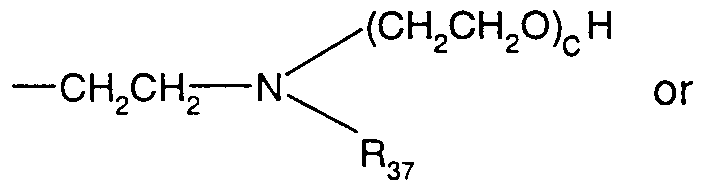
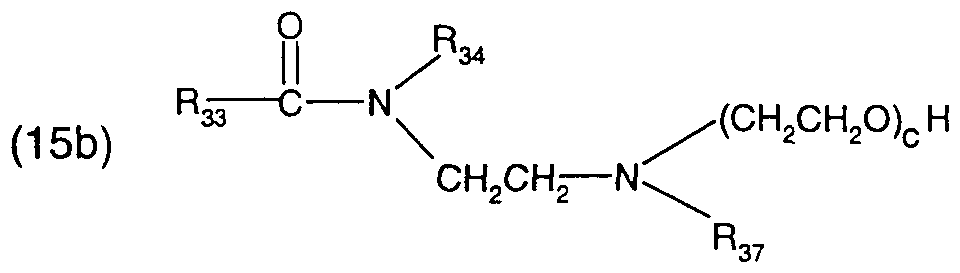
- Suitable fatty acid alkanolamides are for example those of formula
- R 33 is a saturated or unsaturated hydrocarbon radical containing 10 to 24 carbon atoms
- o R 34 is hydrogen or a radical of formula -CH 2 OH, -(CH 2 CH 2 O) c H or 11 wherein c is a
- C_R 36 number from 1 to 10 and R 36 is as defined above for R 33 , and
- R 35 is a radical of formula -CH 2 OH, -(CH 2 CH 2 O) c H, — CH 2 CH 2 — N. or
- R 37 is hydrogen or a radical of formula 11 wherein R 36 is as defined above,
- R 38 ' and R 38 " have the same or different meaning and are as defined above for R 34
- R 39 , R 39 ' and R 39 " have the same or different meaning and are a radical of formula
- C — R, c R 33 and R 36 are preferably a saturated or unsaturated hydrocarbon radical containing 14 to 24 carbon atoms. Preferred are saturated hydrocarbon radicals.
- R 34 is preferably hydrogen, -CH 2 OH or a radical of formula 11
- R 35 is preferably a radical of formula
- c is preferably a number from 1 to 5.
- R39, R39' and R 39 " are as defined above.
- fatty acid alkanolamides of formula (15a) wherein R34, R 3 8, R 3 8' and R 38 " are hydrogen or -CH 2 OH. Furthermore, fatty acid alkanolamides of formula (15a), wherein R34, R 3 8, R 3 8' and R 38 " are hydrogen or -CH 2 OH. Furthermore, fatty acid alkanolamides of formula (15a), wherein R34, R 3 8, R 3 8' and R 38 " are hydrogen or -CH 2 OH. Furthermore, fatty acid alkanolamides of formula (15a), wherein R34, R 3 8, R 3 8' and R 38 " are hydrogen or -CH 2 OH. Furthermore, fatty acid alkanolamides of formula (15a), wherein R34, R 3 8, R 3 8' and R 38 " are hydrogen or -CH 2 OH. Furthermore, fatty acid alkanolamides of formula (15a), wherein R34, R 3 8, R 3 8' and R 38 " are hydrogen or -CH 2 OH. Furthermore, fatty
- R 33 , R 34 , R 37 and c are preferred, wherein R 33 , R 34 , R 37 and c are as defined above.
- R M is preferably hydrogen.
- the above fatty acid alkanolamides can also be present in form of the corresponding ammonium salts.
- a mixture of these fatty acid alkanolamides may also be used.
- Emulsifiers suitable for dispersing the fatty acid alkanol amide component include:
- Ethoxylates such as alkyl ethoxylates, amine ethoxylates or amide ethoxylates.
- Alkyl ethoxylates include alcohol ethoxylates or isotridecyl ethoxylates.
- Preferred alcohol ethoxylates include nonionic fatty alcohol ethoxylates containing 2 to 55 ethylene oxide units.
- Preferred isotridecyl ethoxylates include nonionic isotridecyl ethoxylates containing 5 to 45 ethylene oxide units.
- Preferred amine ethoxylates include nonionic C10 to C20 alkyl amino ethoxylates containing 4 to 25 ethylene oxide units.
- Preferred amide ethoxylates include cationic fatty acid amide ethoxylates containing 2 to 25 ethylene oxide units.
- Alkylammonium halides preferably cationic quaternary ester alkylammonium halides or cationic aliphatic acid alkylamidotrialkylammonium methosulfates.
- Ammonium salts preferably cationic aliphatic quaternary ammonium chloride or sulfate. A mixture of these emulsifiers may also be used.
- polyurethanes are the reaction products of a diol and an ethoxysilate with a diisocyanate.
- the additives selected from the group consisting of a polyethylene, a fatty acid alkanolamide, a polysilicic acid, and a polyurethane are, as a rule, used in an amount of 0.01 to 25 % by weight, especially 0.01 to 15 % by weight, based on the total weight of the fabric softener composition.
- Preferred as additives are polyethylene, fatty acid alkanolamides and polyurethanes, especially polyethylene and fatty acid alkanolamides. Highly preferred are polyethylene.
- a highly preferred fabric softener composition used according to the present invention comprises: a) 0.01 to 70 % by weight based on the total weight of the composition of a polyorganosiloxane, or a mixture thereof; b) 0.2 to 25 % by weight based on the total weight of an emulsifier, or a mixture thereof; c) 0.01 to 25 % by weight, especially 0.01 to 15 % by weight, based on the total weight of at least one additive selected from the group consisting of a polyethylene, a fatty acid alkanolamide, a polysilicic acid, or a polyurethane, and d) water to 100 %.
- the fabric softener compositions can be prepared as follows:
- emulsions of the polyorganosiloxane are prepared.
- the polyorganosiloxane and polyethylene, fatty acid alkanol amide, polysilicic acid or polyurethane are emulsified in water using one or more surfactants and shear forces, e.g. by means of a colloid mill. Suitable surfactants are described above.
- the components may be emulsified individually before being mixed together, or emulsified together after the components have been mixed.
- the surfactant(s) is/are used in customary amounts known to the person skilled in the art and can be added either to the polyorganosiloxane or to the water prior to emulsification.
- the fabric softener composition according to the invention is usually, but not exclusively, prepared by firstly stirring the active substance, i.e. the hydrocarbon based fabric softening component, in the molten state into water, then, where required, adding further desired additives and, finally, after cooling, adding the polyorganosiloxane emulsion.
- Hydrocarbon fabric softeners suitable for use herein are selected from the following classes of compounds:
- Cationic quaternary ammonium salts (i) Cationic quaternary ammonium salts.
- the counter ion of such cationic quaternary ammonium salts may be a halide, such as chloride or bromide, methyl sulphate, or other ions well known in the literature.
- the counter ion is methyl sulfate or any alkyl sulfate or any halide, methyl sulfate being most preferred for the dryer-added articles of the invention.
- cationic quaternary ammonium salts include but are not limited to:
- An especially preferred ester-linked quaternary ammonium material for use in the invention can be represented by the formula:
- each R 31 group is independently selected from d to C alkyl, hydroxyalkyl or C 2 to C 4 alkenyl groups; T is either O
- each R 32 group is independently selected from C 8 to C 28 alkyl or alkenyl groups; and e is an integer from 0 to 5.
- a second preferred type of quaternary ammonium material can be represented by the formula:
- R 31 , e and R 32 are as defined above.
- Cyclic quaternary ammonium salts of the imidazolinium type such as di(hydrogenated tallow)dimethyl imidazolinium methylsulfate, 1 -ethylene-bis(2-tallow-1 -methyl) imidazolinium methylsulfate and the like;
- Diamido quaternary ammonium salts such as: methyl-bis(hydrogenated tallow amidoethyl)-2-hydroxethyl ammonium methyl sulfate, methyl bi(tallowamidoethyl)-2- hydroxypropyl ammonium methylsulfate and the like;
- Biodegradable quaternary ammonium salts such as N,N-di(tallowoyl-oxy-ethyl)-N,N- dimethyl ammonium methyl sulfate and N,N-di(tallowoyl-oxy-propyl)-N,N-dimethyl ammonium methyl sulfate.
- Biodegradable quaternary ammonium salts are described, for example, in U.S. Patents 4,137,180, 4,767,547 and 4,789,491 incorporated by reference herein.
- Preferred biodegradable quaternary ammonium salts include the biodegradable cationic diester compounds as described in U.S. Patent 4,137,180, herein incorporated by reference.
- Tertiary fatty amines having at least one and preferably two C8 to C30, preferably C12 to C22 alkyl chains.
- examples include hardened tallow-di-methylamine and cyclic amines such as 1 -(hydrogenated tallow)amidoethyl-2-(hydrogenated tallow) imidazoline.
- Cyclic amines which may be employed for the compositions herein are described in U.S. Patent 4,806,255 incorporated by reference herein.
- Carboxylic acids having 8 to 30 carbons atoms and one carboxylic group per molecule.
- the alkyl portion has 8 to 30, preferably 12 to 22 carbon atoms.
- the alkyl portion may be linear or branched, saturated or unsaturated, with linear saturated alkyl preferred.
- Stearic acid is a preferred fatty acid for use in the composition herein. Examples of these carboxylic acids are commercial grades of stearic acid and palmitic acid, and mixtures thereof which may contain small amounts of other acids.
- Esters of polyhydric alcohols such as sorbitan esters or glycerol stearate.
- Sorbitan esters are the condensation products of sorbitol or iso-sorbitol with fatty acids such as stearic acid.
- Preferred sorbitan esters are monoalkyl.
- SPAN 60 SPAN 60 (ICI) which is a mixture of sorbitan and isosorbide stearates.
- Preferred fabric softeners for use herein are acyclic quaternary ammonium salts. Di(hydrogenated)tallowdimethyl ammonium methylsulfate is most widely used for dryer articles of this invention. Mixtures of the above mentioned fabric softeners may also be used.
- the fabric softening composition employed in the present invention preferably contains about 0.1 % to about 95% of the fabric softening component. Preferably from about 2% to about 70% and most preferably from about 2% to about 30% of the fabric softening component is employed herein to obtain optimum softening at minimum cost. When the fabric softening component includes a quaternary ammonium salt, the salt is used in the amount of about 2% to about 70%, preferably about 2% to about 30%.
- the fabric softener composition can, for example, be prepared by mixing a preformulated fabric softener with an emulsion comprising the polyorganosiloxane and the additive.
- the liquid rinse conditioner composition may also comprise additives which are customary for standard commercial liquid rinse conditioners, for example alcohols, such as ethanol, n- propanol, i-propanol, polyhydric alcohols, for example glycerol and propylene glycol; amphoteric and nonionic surfactants, for example carboxyl derivatives of imidazole, oxyethylated fatty alcohols, hydrogenated and ethoxylated castor oil, alkyl polyglycosides, for example decyl polyglucose and dodecylpolyglucose, fatty alcohols, fatty acid esters, fatty acids, ethoxylated fatty acid glycerides or fatty acid partial glycerides; also inorganic or organic salts, for example water-soluble potassium, sodium or magnesium salts, non- aqueous solvents, pH buffers, perfumes, dyes, hydrotropic agents, antifoams, anti redeposition agents, polymeric or other thick
- fabric softener compositions are traditionally prepared as dispersions containing for example up to 20 % by weight of active material in water. They have a turbid appearance.
- alternative formulations usually containing actives at levels of 5 to 40 % along with solvents can be prepared as microemulsions which have a clear appearance (as to the solvents and the formulations see for example US-A-5,543,067 und WO-A-98/17757) .
- the additives and polyorganosiloxanes of the present invention can be used for such compositions although it will be necessary to use them in microemulsion form to preserve the clear appearance of the fabric softener compositions which are microemulsions.
- the conditioning composition of the present invention may be coated onto a flexible substrate which carries a fabric conditioning amount of the composition and is capable of releasing the composition at dryer operating temperatures.
- the conditioning composition in turn has a preferred melting (or softening) point of about 25°C to about 150°C.
- the fabric conditioning composition which may be employed in the invention is coated onto a dispensing means which effectively releases the fabric conditioning composition in a tumble dryer.
- a dispensing means which effectively releases the fabric conditioning composition in a tumble dryer.
- Such dispensing means can be designed for single usage or for multiple uses.
- One such multi-use article comprises a sponge material releasably enclosing enough of the conditioning composition to effectively impart fabric softness during several drying cycles.
- This multi-use article can be made by filling a porous sponge with the composition. In use, the composition melts and leaches out through the pores of the sponge to soften and condition fabrics.
- Such a filled sponge can be used to treat several loads of fabrics in conventional dryers, and has the advantage that it can remain in the dryer after use and is not likely to be misplaced or lost.
- Another article comprises a cloth or paper bag releasably enclosing the composition and sealed with a hardened plug of the mixture. The action and heat of the dryer opens the bag and releases the composition to perform its softening.
- a highly preferred article comprises the inventive compositions releasably affixed to a flexible substrate such as a sheet of paper or woven or non-woven cloth substrate.
- a flexible substrate such as a sheet of paper or woven or non-woven cloth substrate.
- the sheet conformation has several advantages. For example, effective amounts of the compositions for use in conventional dryers can be easily absorbed onto and into the sheet substrate by a simple dipping or padding process. Thus, the end user need not measure the amount of the composition necessary to obtain fabric softness and other benefits. Additionally, the flat configuration of the sheet provides a large surface area which results in efficient release and distribution of the materials onto fabrics by the tumbling action of the dryer.
- the substrates used in the articles can have a dense, or more preferably, open or porous structure.
- suitable materials which can be used as substrates herein include paper, woven cloth, and non-woven cloth.
- the term "cloth” herein means a woven or non- woven substrate for the articles of manufacture, as distinguished from the term “fabric” which encompasses the clothing fabrics being dried in an automatic dryer.
- absorbent is intended to mean a substrate with an absorbent capacity (i.e., a parameter representing a substrates ability to take up and retain a liquid) from 4 to 12, preferably 5 to 7 times its weight of water.
- the absorbent capacity is preferably in the range of 15 to 22, but some special foams can have an absorbent capacity in the range from 4 to 12.
- draining time is 15 seconds instead of 1 minute
- the specimen is immediately weighed on a torsion balance having a pan with turned-up edges.
- Absorbent capacity values are then calculated in accordance with the formula given in said Specification. Based on this test, one-ply, dense bleached paper (e.g., Kraft or bond having a basis weight of about 32 pounds per 3,000 square feet) has an absorbent capacity of 3.5 to 4; commercially available household one-ply towel paper has a value of 5 to 6; and commercially available two-ply household towelling paper has a value of 7 to about 9.5.
- one-ply, dense bleached paper e.g., Kraft or bond having a basis weight of about 32 pounds per 3,000 square feet
- absorbent capacity values 3.5 to 4
- commercially available household one-ply towel paper has a value of 5 to 6
- commercially available two-ply household towelling paper has a value of 7 to about 9.5.
- Suitable materials which can be used as a substrate in the invention herein include, among others, sponges, paper, and woven and non-woven cloth, all having the necessary absorbency requirements defined above.
- the preferred non-woven cloth substrates can generally be defined as adhesively bonded fibrous or filamentous products having a web or carded fiber structure (where the fiber strength is suitable to allow carding), or comprising fibrous mats in which the fibers or filaments are distributed haphazardly or in random array (i.e. an array of fibers is a carded web wherein partial orientation of the fibers is frequently present, as well as a completely haphazard distributional orientation), or substantially aligned.
- the fibers or filaments can be natural (e.g. wool, silk, jute, hemp, cotton, linen, sisal, or ramie) or synthetic (e.g. rayon, cellulose ester, polyvinyl derivatives, polyolefins, polyamides, or polyesters).
- the preferred absorbent properties are particularly easy to obtain with non-woven cloths and are provided merely by building up the thickness of the cloth, i.e., by superimposing a plurality of carded webs or mats to a thickness adequate to obtain the necessary absorbent properties, or by allowing a sufficient thickness of the fibers to deposit on the screen.
- Any diameter or denier of the fiber (generally up to about 10 denier) can be used, inasmuch as it is the free space between each fiber that makes the thickness of the cloth directly related to the absorbent capacity of the cloth, and which, further, makes the non-woven cloth especially suitable for impregnation with a composition by means of intersectional or capillary action.
- any thickness necessary to obtain the required absorbent capacity can be used.
- the substrate for the composition is a non-woven cloth made from fibers deposited haphazardly or in random array on the screen, the articles exhibit excellent strength in all directions and are not prone to tear or separate when used in the automatic clothes dryer.
- the non-woven cloth is water-laid or air-laid and is made from cellulosic fibers, particularly from regenerated cellulose or rayon.
- Such non-woven cloth can be lubricated with any standard textile lubricant.
- the fibers are from 5mm to 50mm in length and are from 1.5 to 5 denier.
- the fibers are at least partially orientated haphazardly, and are adhesively bonded together with a hydrophobic or substantially hydrophobic binder-resin.
- the cloth comprises about 70% fiber and 30% binder resin polymer by weight and has a basis weight of from about 18 to 45g per square meter.
- the amount impregnated into and/or coated onto the absorbent substrate is conveniently in the weight ratio range of from about 10:1 to 0.5:1 based on the ratio of total conditioning composition to dry, untreated substrate (fiber plus binder).
- the amount of the conditioning composition ranges from about 5:1 to about 1 :1 , most preferably from about 3:1 to 1 :1 , by weight of the dry untreated substrate.
- the dryer sheet substrate is coated by being passed over a rotogravure applicator roll.
- the sheet In its passage over this roll, the sheet is coated with a thin, uniform layer of molten fabric softening composition contained in a rectangular pan at a level of about 15g per square yard. Passage for the substrate over a cooling roll then solidifies the molten softening composition to a solid. This type of applicator is used to obtain a uniform homogeneous coating across the sheet.
- the articles are held at room temperature until the composition substantially solidifies.
- the resulting dry articles, prepared at the composition substrate ratios set forth above, remain flexible; the sheet articles are suitable for packaging in rolls.
- the sheet articles can optionally be slitted or punched to provide a non-blocking aspect at any convenient time if desired during the manufacturing process.
- the fabric conditioning composition employed in the present invention includes certain fabric softeners which can be used singly or in admixture with each other.
- suitable textile fibre materials which can be treated with the liquid rinse conditioner composition are materials made of silk, wool, polyamide, acrylics or polyurethanes, and, in particular, cellulosic fibre materials of all types.
- Such fibre materials are, for example, natural cellulose fibres, such as cotton, linen, jute and hemp, and regenerated cellulose. Preference is given to textile fibre materials made of cotton.
- the fabric softener compositions are also suitable for hydroxyl-containing fibres which are present in mixed fabrics, for example mixtures of cotton with polyester fibres or polyamide fibres.
- the liquid rinse conditioners are prepared by using the procedure described below. This type of fabric rinse conditioners is normally known under the name of "triple strength” or “triple fold” formula.
- the rinse conditioner formulation as described above was used as a base formulation.
- the fabric softener is mixed with a separately prepared polyorganosiloxane /additive emulsion.
- the fabric softener formulations used in the following examples are listed in the following Table 1.
- an emulsifiable oxidised polyethylene which has a density of 0.95 to 1.05 g/cm 3 at 20°C, a drop point of 100-150°C, an acid number of 10 to 60 and a saponification number of 15 to 80
- an emulsifiable oxidised polyethylene which has a density of 0.95 to 1.05 g/cm 3 at 20°C, a drop point of 100-150°C, an acid number of 10 to 60 and a saponification number of 15 to 80
- an emulsifiable oxidised polyethylene which has a density of 0.95 to 1.05 g/cm 3 at 20°C, a drop point of 100-150°C, an acid number of 10 to 60 and a saponification number of 15 to 80
- an emulsifiable oxidised polyethylene which has a density of 0.95 to 1.05 g/cm 3 at 20°C, a drop point of 100-150°C, an acid number of 10 to 60 and a saponification number of 15 to 80
- an emulsifiable oxidised polyethylene which has a density of 0.95 to 1.05 g/cm 3 at 20°C, a drop point of 100-150°C, an acid number of 10 to 60 and a saponification number of 15 to 80
- an emulsifiable oxidised polyethylene which has a density of 0.95 to 1.05 g/cm 3 at 20°C, a drop point of 100-150°C, an acid number of 10 to 60 and a saponification number of 15 to 80
- an emulsifiable oxidised polyethylene which has a density of 0.95 to 1.05 g/cm 3 at 20°C, a drop point of 100-150°C, an acid number of 10 to 60 and a saponification number of 15 to 80
- R 3 is -CH 2 CH 2 CH 2 NH 2
- R 19 is a polyethylene/polypropyleneoxide radical
- X 1 + Y 1 + S 150-300
- R 3 is -CH 2 CH 2 CH 2 NH 2
- R 1 9 is a polyethylene/polypropyleneoxide radical
- an emulsifiable oxidised polyethylene which has a density of 0.95 to 1.05 g/cm 3 at 20°C, a drop point of 100-150°C, an acid number of 10 to 60 and a saponification number of 15 to 80
- an emulsifiable oxidised polyethylene which has a density of 0.95 to 1.05 g/cm 3 at 20°C, a drop point of 100-150°C, an acid number of 10 to 60 and a saponification number of 15 to 80
- an emulsifiable oxidised polyethylene which has a density of 0.95 to 1.05 g/cm 3 at 20°C, a drop point of 100-150°C, an acid number of 10 to 60 and a saponification number of 15 to 80
- an emulsifiable oxidised polyethylene which has a density of 0.95 to 1.05 g/cm 3 at 20°C, a drop point of 100-150°C, an acid number of 10 to 60 and a saponification number of 15 to 80
- Woven cotton swatches of size of 50 cm by 40 cm are washed together with ballast material (cotton and cotton/polyester) in a AEG Oeko Lavamat 73729 washing machine maintaining the washing temperature at 40°C .
- the total fabric load of 1 kg is washed for 15 minutes with 33 g of ECE Color Fastness Test Detergent 77 (Formulation January 1977, according to ISO 105-CO6).
- the rinse conditioner formulation as described in Table 1 is applied in the last rinse cycle at 20°C. After rinsing with the formulation the textile swatches are dried on a washing line at ambient temperature.
- the creasing (surface smoothness) of the dried swatches is evaluated according to the
- AATCC-Standard method Nr. 124 Five persons evaluate the creases of the cotton swatches against the AATCC THREE DIMENSIONAL Smoothness Appearance Replicas. On the evaluation scale a number of 1 means very strong creasing, whereas 5 means almost no creasing.
- the textile swatches (cotton woven) from Example 2 are divided in 2 parts and one of it (with a size of 20 cm to 40cm) is slightly rewetted with 6.5 ml water (fine sprayed over the textile surface) and ironed without pressure for 60 seconds at 160°C.
- micro creases of the ironed swatches are evaluated according AATCC-Standard method Nr. 124 as described in Example 2.
- Example 5 (Reduction of micro creases on cotton/polyester (after ironing))
- the textile swatches (cotton/polyester woven) from Example 2 are divided in 2 parts and one of it (with a size of 20 cm to 40cm) is slightly rewetted with 6.5 ml water (fine sprayed over the textile surface) and ironed without pressure for 60 seconds at 160°C.
- the micro creases of the ironed swatches are evaluated according AATCC-Standard method Nr. 124 as described in Example 2.
- Woven cotton swatches of size of 50 cm by 40 cm are washed together with ballast material (cotton and cotton/polyester) in a AEG Oeko Lavamat 73729 washing machine maintaining the washing temperature at 40°C.
- the total fabric load of 1 kg is washed for 15 minutes with 33 g of ECE Color Fastness Test Detergent 77 (Formulation January 1977, according to ISO 105-CO6).
- the rinse conditioner formulation as described in Table 1 is applied in the last rinse cycle at 20°C. After rinsing with the formulation the textile swatches are dried on a washing line at ambient temperature.
- the treated swatches are cut to 5g pieces and then "soiled" for 20 minutes in a Linitest apparatus at 80°C with a solution of
- the soiled swatches are rinsed 30 seconds with tap water, spun and dried on a line at 60°C.
- a third step the soiled textile swatches are washed in a Linitest apparatus for 20 minutes with 3 g/l ECE Detergent at 80°C using a liquor ratio of 50:1.
- the washed swatches are rinsed for 30 seconds with tap water, spun and dried on a line at 60°C.
- the lightness value Y measured with a Datacolor Spectraphotometer SF 500 is taken as a measure for the amount of soil deposited on the textile. Decreasing values of Y mean higher soil deposits on the textile.
- the lightness value Y is measured after soiling of the swatches with carbon black and after washing out of the soil. Table 6 (Results of lightness value measurements after soiling of the cotton swatches)
- Results in Table 7 demonstrate that besides reduced wet soiling the treated textile release in a wash process the soil more readily compared to untreated materials.
- Results in Table 8 show that an improved wet soil behaviour (less staining) of polyester/cotton fabric material can be achieved when treated with compositions of the present invention.
- Cotton woven 120 g/m2, bleached, with resin finishing : Cotton/Polyester 66/34 woven: 85 g/m2, bleached.
Landscapes
- Chemical & Material Sciences (AREA)
- Life Sciences & Earth Sciences (AREA)
- Engineering & Computer Science (AREA)
- Chemical Kinetics & Catalysis (AREA)
- Oil, Petroleum & Natural Gas (AREA)
- Wood Science & Technology (AREA)
- Organic Chemistry (AREA)
- Inorganic Chemistry (AREA)
- Treatments For Attaching Organic Compounds To Fibrous Goods (AREA)
- Nonwoven Fabrics (AREA)
- Detergent Compositions (AREA)
Abstract
Description








Claims



Priority Applications (12)
| Application Number | Priority Date | Filing Date | Title |
|---|---|---|---|
| JP2001528541A JP2003511575A (en) | 1999-10-05 | 2000-09-26 | Fabric softener composition |
| AT00964235T ATE304044T1 (en) | 1999-10-05 | 2000-09-26 | USE OF LAUNDRY SOFTENER COMPOSITIONS |
| BR0014531-9A BR0014531A (en) | 1999-10-05 | 2000-09-26 | Fabric softening compositions |
| EP00964235A EP1218478B1 (en) | 1999-10-05 | 2000-09-26 | Use of fabric softener compositions |
| CA002385870A CA2385870A1 (en) | 1999-10-05 | 2000-09-26 | Fabric softener compositions |
| IL14875700A IL148757A0 (en) | 1999-10-05 | 2000-09-26 | Fabric softener compositions |
| DE60022528T DE60022528T2 (en) | 1999-10-05 | 2000-09-26 | USE OF WASH MACHINE COMPOSITIONS |
| US10/089,853 US6825163B1 (en) | 1999-10-05 | 2000-09-26 | Fabric softener compositions |
| MXPA02003467A MXPA02003467A (en) | 1999-10-05 | 2000-09-26 | Fabric softener compositions. |
| AU75229/00A AU7522900A (en) | 1999-10-05 | 2000-09-26 | Fabric softener compositions |
| KR1020027004362A KR20020040836A (en) | 1999-10-05 | 2000-09-26 | Fabric softener compositions |
| US10/930,221 US6958317B2 (en) | 1999-10-05 | 2004-08-31 | Fabric softener compositions |
Applications Claiming Priority (2)
| Application Number | Priority Date | Filing Date | Title |
|---|---|---|---|
| EP99810897.1 | 1999-10-05 | ||
| EP99810897 | 1999-10-05 |
Related Child Applications (2)
| Application Number | Title | Priority Date | Filing Date |
|---|---|---|---|
| US10089853 A-371-Of-International | 2000-09-26 | ||
| US10/930,221 Division US6958317B2 (en) | 1999-10-05 | 2004-08-31 | Fabric softener compositions |
Publications (1)
| Publication Number | Publication Date |
|---|---|
| WO2001025385A1 true WO2001025385A1 (en) | 2001-04-12 |
Family
ID=8243064
Family Applications (1)
| Application Number | Title | Priority Date | Filing Date |
|---|---|---|---|
| PCT/EP2000/009399 Ceased WO2001025385A1 (en) | 1999-10-05 | 2000-09-26 | Fabric softener compositions |
Country Status (16)
| Country | Link |
|---|---|
| US (2) | US6825163B1 (en) |
| EP (1) | EP1218478B1 (en) |
| JP (1) | JP2003511575A (en) |
| KR (1) | KR20020040836A (en) |
| CN (1) | CN1378587A (en) |
| AT (1) | ATE304044T1 (en) |
| AU (1) | AU7522900A (en) |
| BR (1) | BR0014531A (en) |
| CA (1) | CA2385870A1 (en) |
| DE (1) | DE60022528T2 (en) |
| ES (1) | ES2248125T3 (en) |
| IL (1) | IL148757A0 (en) |
| MX (1) | MXPA02003467A (en) |
| PT (1) | PT1218478E (en) |
| WO (1) | WO2001025385A1 (en) |
| ZA (1) | ZA200202678B (en) |
Cited By (15)
| Publication number | Priority date | Publication date | Assignee | Title |
|---|---|---|---|---|
| WO2002038851A1 (en) * | 2000-11-13 | 2002-05-16 | Basf Aktiengesellschaft | Highly branched polymers for the anti-crease dressing of cellulose containing textiles |
| WO2002081612A1 (en) * | 2001-04-03 | 2002-10-17 | Ciba Specialty Chemicals Holding Inc. | Fabric softene compositions |
| WO2002081611A1 (en) * | 2001-04-03 | 2002-10-17 | Ciba Specialty Chemicals Holding Inc. | Fabric softener compositions |
| JP2003020561A (en) * | 2001-07-04 | 2003-01-24 | Kao Corp | Textile processing methods |
| WO2003060051A1 (en) * | 2002-01-18 | 2003-07-24 | Ciba Specialty Chemicals Holding Inc. | Fabric rinse compositions |
| US6630132B2 (en) | 2001-08-23 | 2003-10-07 | Goldschmidt Ag | UV-light-absorbing quaternary polysiloxanes |
| WO2004022839A3 (en) * | 2002-09-09 | 2004-05-06 | Rhodia Chimie Sa | Textile rinsing formulation |
| EP1449911A1 (en) * | 2003-02-18 | 2004-08-25 | Cognis Iberia, S.L. | Aqueous compositions containing microencapsulated active components |
| US6897190B2 (en) | 2002-02-28 | 2005-05-24 | The Procter & Gamble Company | Detergent compositions including dispersible polyolefin wax and method for using same |
| WO2006103076A3 (en) * | 2005-03-30 | 2006-12-21 | Ge Bayer Silicones Gmbh & Co | Composition containing polyamino-polysiloxane and/or polyammonium-polysiloxane compounds on a substrate |
| US7776989B2 (en) | 2005-02-02 | 2010-08-17 | Evonik Goldschmidt Gmbh | UV-light-absorbing quaternary polysiloxanes |
| WO2013032493A1 (en) * | 2011-08-26 | 2013-03-07 | Colgate-Palmolive Company | Fabric wrinkle reduction composition |
| US8609077B2 (en) * | 2002-03-21 | 2013-12-17 | Basf Se | Polysiloxane compositions |
| US8853372B2 (en) | 2010-08-23 | 2014-10-07 | Dow Corning Corporation | Saccharide siloxanes stable in aqueous environments and methods for the preparation and use of such saccharide siloxanes |
| US8877216B2 (en) | 2005-05-23 | 2014-11-04 | Dow Corning Corporation | Cosmetic and skin-care compositions comprising saccharide-siloxane copolymers |
Families Citing this family (13)
| Publication number | Priority date | Publication date | Assignee | Title |
|---|---|---|---|---|
| ATE469959T1 (en) * | 2005-06-24 | 2010-06-15 | Basf Se | COMPOSITIONS CONTAINING A POLYORGANOSILOXANE HAVING ONE OR MORE PIPERIDINYL FUNCTIONS AS SURFACE PROTECTION AGENTS |
| JP5214122B2 (en) * | 2005-08-15 | 2013-06-19 | 花王株式会社 | Method for producing emulsified composition |
| US8190658B2 (en) * | 2006-03-14 | 2012-05-29 | Korea Institute Of Science And Technology | Intelligent computing device agent system for automatic recognition of multi user computing environment and information sharing setup |
| JP5226782B2 (en) | 2007-06-15 | 2013-07-03 | イーコラブ インコーポレイティド | Fabric softener composition and method of use |
| JP4748332B2 (en) | 2008-12-15 | 2011-08-17 | 信越化学工業株式会社 | Textile treatment compositions, detergents and softeners, and textile products treated with them |
| US8232239B2 (en) * | 2010-03-09 | 2012-07-31 | Ecolab Usa Inc. | Liquid concentrated fabric softener composition |
| JP5562102B2 (en) * | 2010-04-15 | 2014-07-30 | キヤノン株式会社 | Clear ink, inkjet recording method, ink set, and ink cartridge |
| US8673838B2 (en) | 2011-06-22 | 2014-03-18 | Ecolab Usa Inc. | Solid concentrated fabric softener composition |
| US9725679B2 (en) | 2014-11-21 | 2017-08-08 | Ecolab Usa Inc. | Compositions to boost fabric softener performance |
| US9506015B2 (en) | 2014-11-21 | 2016-11-29 | Ecolab Usa Inc. | Compositions to boost fabric softener performance |
| US9688945B2 (en) | 2014-11-21 | 2017-06-27 | Ecolab Usa Inc. | Compositions to boost fabric softener performance |
| BR112018012509A2 (en) | 2015-12-28 | 2018-12-11 | Colgate Palmolive Co | fabric softeners |
| US11028345B2 (en) | 2018-11-27 | 2021-06-08 | Ava Stern | Organic hemp dryer sheet |
Citations (11)
| Publication number | Priority date | Publication date | Assignee | Title |
|---|---|---|---|---|
| US3992332A (en) * | 1974-08-22 | 1976-11-16 | Hemson Joseph Zenon | Liquid composition for fabric treatment |
| GB1549180A (en) * | 1975-07-16 | 1979-08-01 | Procter & Gamble | Textile treating compositions |
| EP0133562A2 (en) * | 1983-08-12 | 1985-02-27 | Henkel Kommanditgesellschaft auf Aktien | Additive for detergents for textiles |
| EP0150872A1 (en) * | 1984-01-25 | 1985-08-07 | THE PROCTER & GAMBLE COMPANY | Liquid detergent compositions containing organo-functional polysiloxanes |
| DE3932276A1 (en) * | 1988-09-28 | 1990-03-29 | Dow Corning Ltd | COMPOSITION AND METHOD FOR THE TREATMENT OF TEXTILES |
| DE3926005A1 (en) * | 1989-08-05 | 1991-02-07 | Pfersee Chem Fab | Textile fibres softening treatment - using aq. compsn. contg. polyethylene wax dispersed poly:organo:siloxane(s)] and softener |
| EP0413416A2 (en) * | 1989-06-21 | 1991-02-20 | Colgate-Palmolive Company | Fiber conditioning compositions containing an aminosilicone |
| EP0544493A1 (en) * | 1991-11-26 | 1993-06-02 | Unilever Plc | Fabric conditioning composition containing an emulsified silicone mixture |
| US5407588A (en) * | 1989-03-02 | 1995-04-18 | Lever Brothers Company, Division Of Conopco, Inc. | Fabric softening composition |
| EP0739976A1 (en) * | 1995-04-28 | 1996-10-30 | Henkel Kommanditgesellschaft auf Aktien | Brighteners |
| US5728673A (en) * | 1996-01-31 | 1998-03-17 | The Procter & Gamble Company | Process for making a fluid, stable liquid fabric softening composition including dispersible polyolefin |
Family Cites Families (9)
| Publication number | Priority date | Publication date | Assignee | Title |
|---|---|---|---|---|
| EP0075987B1 (en) * | 1981-09-25 | 1987-11-25 | THE PROCTER & GAMBLE COMPANY | Laundry additive products containing amino-silanes |
| US4793943A (en) * | 1983-12-22 | 1988-12-27 | Albright & Wilson Limited | Liquid detergent compositions |
| CA1261276A (en) * | 1984-11-09 | 1989-09-26 | Mark B. Grote | Shampoo compositions |
| US5062973A (en) * | 1989-04-04 | 1991-11-05 | Creative Products Resource Associates, Ltd. | Stearate-based dryer-added fabric modifier sheet |
| CA2015736A1 (en) * | 1989-05-11 | 1990-11-11 | Diane G. Schmidt | Perfume particles for use in cleaning and conditioning compositions |
| DE4007136A1 (en) | 1989-08-05 | 1991-09-12 | Pfersee Chem Fab | COMPOSITION IN THE FORM OF AN AQUEOUS DISPERSION AND METHOD FOR TREATING FIBER MATERIALS |
| AU641014B2 (en) * | 1990-06-01 | 1993-09-09 | Unilever Plc | Liquid fabric conditioner and dryer sheet fabric conditioner containing compatible silicones |
| GB9615613D0 (en) * | 1996-07-25 | 1996-09-04 | Unilever Plc | Fabric treatment composition |
| EP0896998A1 (en) * | 1997-08-14 | 1999-02-17 | The Procter & Gamble Company | Laundry detergent compositions comprising a saccharide gum degrading enzyme |
-
2000
- 2000-09-26 CN CN00813949A patent/CN1378587A/en active Pending
- 2000-09-26 US US10/089,853 patent/US6825163B1/en not_active Expired - Fee Related
- 2000-09-26 MX MXPA02003467A patent/MXPA02003467A/en active IP Right Grant
- 2000-09-26 EP EP00964235A patent/EP1218478B1/en not_active Expired - Lifetime
- 2000-09-26 PT PT00964235T patent/PT1218478E/en unknown
- 2000-09-26 DE DE60022528T patent/DE60022528T2/en not_active Expired - Fee Related
- 2000-09-26 ES ES00964235T patent/ES2248125T3/en not_active Expired - Lifetime
- 2000-09-26 JP JP2001528541A patent/JP2003511575A/en active Pending
- 2000-09-26 IL IL14875700A patent/IL148757A0/en unknown
- 2000-09-26 KR KR1020027004362A patent/KR20020040836A/en not_active Ceased
- 2000-09-26 AU AU75229/00A patent/AU7522900A/en not_active Abandoned
- 2000-09-26 CA CA002385870A patent/CA2385870A1/en not_active Abandoned
- 2000-09-26 BR BR0014531-9A patent/BR0014531A/en not_active Application Discontinuation
- 2000-09-26 AT AT00964235T patent/ATE304044T1/en not_active IP Right Cessation
- 2000-09-26 WO PCT/EP2000/009399 patent/WO2001025385A1/en not_active Ceased
-
2002
- 2002-04-05 ZA ZA200202678A patent/ZA200202678B/en unknown
-
2004
- 2004-08-31 US US10/930,221 patent/US6958317B2/en not_active Expired - Fee Related
Patent Citations (11)
| Publication number | Priority date | Publication date | Assignee | Title |
|---|---|---|---|---|
| US3992332A (en) * | 1974-08-22 | 1976-11-16 | Hemson Joseph Zenon | Liquid composition for fabric treatment |
| GB1549180A (en) * | 1975-07-16 | 1979-08-01 | Procter & Gamble | Textile treating compositions |
| EP0133562A2 (en) * | 1983-08-12 | 1985-02-27 | Henkel Kommanditgesellschaft auf Aktien | Additive for detergents for textiles |
| EP0150872A1 (en) * | 1984-01-25 | 1985-08-07 | THE PROCTER & GAMBLE COMPANY | Liquid detergent compositions containing organo-functional polysiloxanes |
| DE3932276A1 (en) * | 1988-09-28 | 1990-03-29 | Dow Corning Ltd | COMPOSITION AND METHOD FOR THE TREATMENT OF TEXTILES |
| US5407588A (en) * | 1989-03-02 | 1995-04-18 | Lever Brothers Company, Division Of Conopco, Inc. | Fabric softening composition |
| EP0413416A2 (en) * | 1989-06-21 | 1991-02-20 | Colgate-Palmolive Company | Fiber conditioning compositions containing an aminosilicone |
| DE3926005A1 (en) * | 1989-08-05 | 1991-02-07 | Pfersee Chem Fab | Textile fibres softening treatment - using aq. compsn. contg. polyethylene wax dispersed poly:organo:siloxane(s)] and softener |
| EP0544493A1 (en) * | 1991-11-26 | 1993-06-02 | Unilever Plc | Fabric conditioning composition containing an emulsified silicone mixture |
| EP0739976A1 (en) * | 1995-04-28 | 1996-10-30 | Henkel Kommanditgesellschaft auf Aktien | Brighteners |
| US5728673A (en) * | 1996-01-31 | 1998-03-17 | The Procter & Gamble Company | Process for making a fluid, stable liquid fabric softening composition including dispersible polyolefin |
Cited By (19)
| Publication number | Priority date | Publication date | Assignee | Title |
|---|---|---|---|---|
| WO2002038851A1 (en) * | 2000-11-13 | 2002-05-16 | Basf Aktiengesellschaft | Highly branched polymers for the anti-crease dressing of cellulose containing textiles |
| WO2002081612A1 (en) * | 2001-04-03 | 2002-10-17 | Ciba Specialty Chemicals Holding Inc. | Fabric softene compositions |
| WO2002081611A1 (en) * | 2001-04-03 | 2002-10-17 | Ciba Specialty Chemicals Holding Inc. | Fabric softener compositions |
| JP2003020561A (en) * | 2001-07-04 | 2003-01-24 | Kao Corp | Textile processing methods |
| US6630132B2 (en) | 2001-08-23 | 2003-10-07 | Goldschmidt Ag | UV-light-absorbing quaternary polysiloxanes |
| WO2003060051A1 (en) * | 2002-01-18 | 2003-07-24 | Ciba Specialty Chemicals Holding Inc. | Fabric rinse compositions |
| US6897190B2 (en) | 2002-02-28 | 2005-05-24 | The Procter & Gamble Company | Detergent compositions including dispersible polyolefin wax and method for using same |
| US8609077B2 (en) * | 2002-03-21 | 2013-12-17 | Basf Se | Polysiloxane compositions |
| WO2004022839A3 (en) * | 2002-09-09 | 2004-05-06 | Rhodia Chimie Sa | Textile rinsing formulation |
| EP1449911A1 (en) * | 2003-02-18 | 2004-08-25 | Cognis Iberia, S.L. | Aqueous compositions containing microencapsulated active components |
| US7776989B2 (en) | 2005-02-02 | 2010-08-17 | Evonik Goldschmidt Gmbh | UV-light-absorbing quaternary polysiloxanes |
| WO2006103076A3 (en) * | 2005-03-30 | 2006-12-21 | Ge Bayer Silicones Gmbh & Co | Composition containing polyamino-polysiloxane and/or polyammonium-polysiloxane compounds on a substrate |
| US8877216B2 (en) | 2005-05-23 | 2014-11-04 | Dow Corning Corporation | Cosmetic and skin-care compositions comprising saccharide-siloxane copolymers |
| US8853372B2 (en) | 2010-08-23 | 2014-10-07 | Dow Corning Corporation | Saccharide siloxanes stable in aqueous environments and methods for the preparation and use of such saccharide siloxanes |
| WO2013032493A1 (en) * | 2011-08-26 | 2013-03-07 | Colgate-Palmolive Company | Fabric wrinkle reduction composition |
| CN103748204A (en) * | 2011-08-26 | 2014-04-23 | 高露洁-棕榄公司 | Fabric wrinkle reduction composition |
| AU2011375735B2 (en) * | 2011-08-26 | 2014-07-31 | Colgate-Palmolive Company | Fabric wrinkle reduction composition |
| CN103748204B (en) * | 2011-08-26 | 2017-11-14 | 高露洁-棕榄公司 | fabric wrinkle reduction composition |
| US10428295B2 (en) | 2011-08-26 | 2019-10-01 | Colgate-Palmolive Company | Fabric wrinkle reduction composition |
Also Published As
| Publication number | Publication date |
|---|---|
| DE60022528D1 (en) | 2005-10-13 |
| JP2003511575A (en) | 2003-03-25 |
| US20050026809A1 (en) | 2005-02-03 |
| ATE304044T1 (en) | 2005-09-15 |
| ES2248125T3 (en) | 2006-03-16 |
| US6958317B2 (en) | 2005-10-25 |
| BR0014531A (en) | 2002-06-04 |
| AU7522900A (en) | 2001-05-10 |
| CA2385870A1 (en) | 2001-04-12 |
| EP1218478A1 (en) | 2002-07-03 |
| MXPA02003467A (en) | 2002-08-20 |
| IL148757A0 (en) | 2002-09-12 |
| PT1218478E (en) | 2005-11-30 |
| EP1218478B1 (en) | 2005-09-07 |
| US6825163B1 (en) | 2004-11-30 |
| KR20020040836A (en) | 2002-05-30 |
| DE60022528T2 (en) | 2006-06-29 |
| ZA200202678B (en) | 2003-07-30 |
| CN1378587A (en) | 2002-11-06 |
Similar Documents
| Publication | Publication Date | Title |
|---|---|---|
| US6825163B1 (en) | Fabric softener compositions | |
| US6800602B1 (en) | Fabric softener compositions | |
| US5254269A (en) | Fabric conditioning composition containing an emulsified silicone mixture | |
| AU641014B2 (en) | Liquid fabric conditioner and dryer sheet fabric conditioner containing compatible silicones | |
| WO2002081611A1 (en) | Fabric softener compositions | |
| US6815412B1 (en) | Fabric softener compositions | |
| US6831055B1 (en) | Fabric softener compositions | |
| US6949503B2 (en) | Fabric softener compositions | |
| WO2001025384A1 (en) | Fabric softener compositions | |
| WO2001025382A1 (en) | Fabric softener compositions | |
| WO2002081612A1 (en) | Fabric softene compositions |
Legal Events
| Date | Code | Title | Description |
|---|---|---|---|
| AK | Designated states |
Kind code of ref document: A1 Designated state(s): AE AG AL AM AT AU AZ BA BB BG BR BY BZ CA CH CN CR CU CZ DE DK DM DZ EE ES FI GB GD GE GH GM HR HU ID IL IN IS JP KE KG KP KR KZ LC LK LR LS LT LU LV MA MD MG MK MN MW MX MZ NO NZ PL PT RO RU SD SE SG SI SK SL TJ TM TR TT TZ UA UG US UZ VN YU ZA ZW |
|
| AL | Designated countries for regional patents |
Kind code of ref document: A1 Designated state(s): GH GM KE LS MW MZ SD SL SZ TZ UG ZW AM AZ BY KG KZ MD RU TJ TM AT BE CH CY DE DK ES FI FR GB GR IE IT LU MC NL PT SE BF BJ CF CG CI CM GA GN GW ML MR NE SN TD TG |
|
| 121 | Ep: the epo has been informed by wipo that ep was designated in this application | ||
| DFPE | Request for preliminary examination filed prior to expiration of 19th month from priority date (pct application filed before 20040101) | ||
| WWE | Wipo information: entry into national phase |
Ref document number: 2000964235 Country of ref document: EP |
|
| WWE | Wipo information: entry into national phase |
Ref document number: 148757 Country of ref document: IL |
|
| WWE | Wipo information: entry into national phase |
Ref document number: 2385870 Country of ref document: CA |
|
| WWE | Wipo information: entry into national phase |
Ref document number: 1020027004362 Country of ref document: KR |
|
| ENP | Entry into the national phase |
Ref country code: JP Ref document number: 2001 528541 Kind code of ref document: A Format of ref document f/p: F |
|
| WWE | Wipo information: entry into national phase |
Ref document number: 2002/02678 Country of ref document: ZA Ref document number: PA/a/2002/003467 Country of ref document: MX Ref document number: 008139490 Country of ref document: CN Ref document number: 200202678 Country of ref document: ZA |
|
| WWP | Wipo information: published in national office |
Ref document number: 1020027004362 Country of ref document: KR |
|
| WWP | Wipo information: published in national office |
Ref document number: 2000964235 Country of ref document: EP |
|
| WWE | Wipo information: entry into national phase |
Ref document number: 10089853 Country of ref document: US |
|
| REG | Reference to national code |
Ref country code: DE Ref legal event code: 8642 |
|
| WWG | Wipo information: grant in national office |
Ref document number: 2000964235 Country of ref document: EP |